EP1354757A2 - Siège de véhicule à dossier mince - Google Patents
Siège de véhicule à dossier mince Download PDFInfo
- Publication number
- EP1354757A2 EP1354757A2 EP03290955A EP03290955A EP1354757A2 EP 1354757 A2 EP1354757 A2 EP 1354757A2 EP 03290955 A EP03290955 A EP 03290955A EP 03290955 A EP03290955 A EP 03290955A EP 1354757 A2 EP1354757 A2 EP 1354757A2
- Authority
- EP
- European Patent Office
- Prior art keywords
- blocks
- seat according
- strip
- pavers
- backrest
- Prior art date
- Legal status (The legal status is an assumption and is not a legal conclusion. Google has not performed a legal analysis and makes no representation as to the accuracy of the status listed.)
- Withdrawn
Links
Images

Classifications
-
- B—PERFORMING OPERATIONS; TRANSPORTING
- B60—VEHICLES IN GENERAL
- B60N—SEATS SPECIALLY ADAPTED FOR VEHICLES; VEHICLE PASSENGER ACCOMMODATION NOT OTHERWISE PROVIDED FOR
- B60N2/00—Seats specially adapted for vehicles; Arrangement or mounting of seats in vehicles
- B60N2/70—Upholstery springs ; Upholstery
- B60N2/7094—Upholstery springs
-
- B—PERFORMING OPERATIONS; TRANSPORTING
- B60—VEHICLES IN GENERAL
- B60N—SEATS SPECIALLY ADAPTED FOR VEHICLES; VEHICLE PASSENGER ACCOMMODATION NOT OTHERWISE PROVIDED FOR
- B60N2/00—Seats specially adapted for vehicles; Arrangement or mounting of seats in vehicles
- B60N2/68—Seat frames
Definitions
- the present invention relates to a vehicle seat provided with a thin backrest.
- vehicle seat backrests are relatively thick because they include a large layer of foam for provide a feeling of flexibility and comfort to the passenger. It This results in a reduction in the space available at the rear of the seat and a feeling of crampedness for the occupant as well as for the observer found outside the vehicle. This feeling is also felt when the backrest is straightened than when it is folded back on the seat.
- the present invention aims to remedy the drawbacks mentioned above, and therefore relates to a vehicle seat with a backrest thin which, at rest, has a curved shape adapting to the curve of the back of the passenger, which deforms elastically under the pressure of the back so as to constantly support it throughout its surface, but which is practically non-deformable with respect to the forces which are applied on its back side.
- the file according to the invention comprises a plurality of parallelepipedic pavers made of rigid material, arranged side by side with a small gap between their faces adjacent and interconnected, at the bottom of said intervals, by flexible and inextensible connecting means, so that the paving stones can rotate relative to each other only in the direction that their adjacent faces deviate from each other but not in the direction contrary, the flat wall thus formed by the paving stones being stretched between two tubular uprights and fixed to them, with an orientation for which said wall deforms under the pressure of the back of the passenger.
- the file may also include a plurality of elements in wedge shape or keys which are inserted in said intervals, so each block make an angle with the adjacent block equal to that of wedge-shaped elements that the interior faces of the pavers form between them a continuous slightly curved concave surface.
- the file may still include at least one strip of material elastic which is fixed on the outside faces of the pavers so as to keep the keys in place within the intervals and give said wall an ability to deform elastically when it is pushed in by the passenger's back.
- the file includes several strips of pavers arranged horizontally between the tubular uprights, one above the other, each strip of pavers comprising several blocks arranged side by side in line and connected to the level of their base by said flexible connecting means.
- the backrest can also be formed of several double strips of pavers, each double strip comprising two parallel lines of pavers, the pavers of each line being connected to the neighboring pavers of the same line and on the block of the other line by connecting means Flexible.
- Each line of pavers can be fitted with an elastic band, but we can also use an elastic sheet to cover everything all of the tiles in the folder.
- Pavers can be made by molding a material rigid plastic. They can be molded either individually and then be interconnected, at their base, by connecting means flexible, for example by gluing them by their base on a strip of fabric or flexible plastic, either be made by molding in rosaries, the paving stones being arranged side by side in line and connected between them by flexible membranes coming from molding with the pavers. We can still manufacture them in sheets where the pavers are arranged in a grid network. Each block is then connected to the four blocks which frame it by means of flexible membranes coming from molding with the paving stones, at their base.
- each strip of pavers includes at its ends two terminal pavers which are shaped to come into abutment against stops which are fixed on the tubular uprights, when the strip of pavers is pushed from the back.
- the file comprises still at least one inextensible strap passing at the back of at least a strip of paving stones and fixed by its ends to the uprights tubular, said strap having a length greater than that of strips of pavers so as to limit the maximum deformation of the backrest under back pressure.
- the seat back 10 shown in Figures 1 and 2 includes two tubular support posts 12, 14 which can be articulated by their lower ends on a seat, not shown, of so that it can be folded down on it. The amounts can be joined at their upper end by a stiffening beam carrying a headrest, not shown.
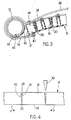
- the paver strips can be produced by molding. As the shows figure 4, at the exit of the mold, the adjacent faces 22, 24 of neighboring blocks are separated by an interval 26 which presents a very slight flare from the connecting bridge 20 upwards. The result the strip 16 can be bent in the direction of the arrows F to which the adjacent faces 22, 24 diverge more from each other. However, if you try to bend the strip in the opposite direction, the pavers bend together, so that the strip of pavers becomes rigid and practically undeformable.
- the invention takes advantage of this property of the strip of paving stones to be foldable in one direction and rigid in the other direction to produce a backrest from the headquarters.
- the strips of pavers are fixed on the uprights tubular 12, 14 so that their planar face 28 which contains the connecting bridges 20 is turned towards the back of the passenger.
- each strip of pavers 16 is given a natural curvature that adapts to the shape of the back, inserting into each of the intervals 26 a wedge-shaped element 30 or key.
- the key has an opening angle greater than the original flaring of the faces adjacent 22, 24.
- the introduction of keys 30 does not change the properties of the strip of paving stones which have been explained above. The only change is that, at rest, the strip of paving stones is curved instead to be flat.
- the paving strips are fixed so that the tiles are arranged in rows and columns. Thanks to this arrangement, we can reduce the number of keys by using keys cruciforms 30, as shown in Figure 2, of which the four branches have a wedge shape in section. The branches of each key fit into the four cross intervals formed by each group of four adjacent paving stones.
- each elastic band 34 is fixed to each pavers by any means of assembly, for example by means of screws 36.
- the elastic band performs two functions: it keeps in place the keys and it gives elasticity to deformation of the backrest. So, if pressing pressure is exerted on the file, the concavity of the file increases, which is accompanied by the opening of all intervals 26 in a more or less pronounced degree depending on the area of the back pressing on either pad.
- the tape portions elastic bands between each pair of neighboring 36 screws stretch so differently and thus exert restoring forces on the pavers individual tending to bring them back to their original position. This elasticity gives the passenger a feeling of comfort.
- the elastic bands can be of different stiffness depending on their position on the backrest, so as to adapt the comfort of the backrest in the back.
- the bands elastic bands are fixed vertically on the paving stones.
- the comfort of the back is significantly improved because the backrest adapts to deformations caused by the back, as well in the vertical direction than in the horizontal direction.
- This tablecloth performs the same function as elastic bands horizontal and vertical, but it is easier to assemble.
- the pavers can be made in the form of a double strip of pavers parallel from molding, the blocks of the same strip being connected between them by connecting bridges as before, while the pavers of one strip are connected to the adjacent pavers of the other strip by loose or elastic connections.
- FIGS. 1 and 2 The method of connecting the strips of pavers to the tubular uprights 12, 14 is illustrated in FIGS. 1 and 2.
- Each elastic band 34 is extends beyond the terminal blocks 37, 38 by portions of fixing which is wound on the tubular uprights and which are fixed on the front face of said terminal blocks, for example by means of screws or 40 bolts.
- said terminal blocks include a tapered end 42 in the form of a cylinder portion which fits on the side wall of the tubular element.
- stops 44 are fixed on the tubular uprights, immediately in front of the said ends 42 in order to prevent the block advancing movement of the folder.
- the backrest is provided with several straps inextensible 46, preferably as many straps as bands elastic. Each strap has two end portions which wind around the tubular uprights 12, 14 and which are fixed to the by means of bolts 40, 48 or any other means of connection on the two faces of the terminal blocks 37, 38, and a loose central portion passing behind the strip of cobblestones.
- the invention therefore made it possible to produce a thin file having the same comfort as classic backrests.
- the thickness of the backrest can be reduced to 50 mm or more.
- the seat cushion can also be made of the same way as the folder. It goes without saying that the backrest and seat are covered with leather or fabric upholstery.
Landscapes
- Engineering & Computer Science (AREA)
- Aviation & Aerospace Engineering (AREA)
- Transportation (AREA)
- Mechanical Engineering (AREA)
- Chair Legs, Seat Parts, And Backrests (AREA)
- Seats For Vehicles (AREA)
Abstract
Description
Claims (20)
- Siège de véhicule, caractérisé en ce qu'il comporte un dossier (10) comprenant une pluralité de pavés parallélépipédiques (18) en matière rigide, disposés côte à côte avec un faible intervalle (26) entre leurs faces adjacentes (22, 24) et reliés entre eux, au niveau du fond desdits intervalles, par des moyens de liaison (20) souples et inextensibles, de sorte que les pavés peuvent pivoter l'un par rapport à l'autre seulement dans le sens où leurs faces adjacentes s'écartent l'une de l'autre, mais pas dans le sens contraire, la paroi plane ainsi formée par les pavés étant tendue entre deux montants tubulaires (12, 14) et fixée à ces derniers, avec une orientation pour laquelle ladite paroi se déforme sous la pression du dos du passager.
- Siège selon la revendication 1, caractérisé en ce qu'il comporte en outre une pluralité d'éléments en forme de coin ou clés (30) qui sont insérés dans lesdits intervalles, de façon que chaque pavé fasse avec le pavé adjacent un angle égal à celui des éléments en forme de coin et que les faces intérieures des pavés forment entre elles une surface continue légèrement incurvée concave.
- Siège selon la revendication 1, caractérisé en ce qu'il comporte en outre au moins une bande (34) en matière élastique qui est fixée sur les faces extérieures des pavés de manière à maintenir en place les clés à l'intérieur des intervalles et à conférer à ladite paroi une aptitude à se déformer élastiquement lorsqu'elle est enfoncée par le dos du passager.
- Siège selon la revendication 1, caractérisé en ce que le dossier comprend plusieurs bandes de pavés (16) disposées horizontalement entre les montants tubulaires (12, 14) l'une au-dessus de l'autre, chaque bande de pavés comprenant plusieurs pavés (18) disposés côte à côte en ligne et reliés au niveau de leur base par lesdits moyens de liaison souples (20).
- Siège selon la revendication 1, caractérisé en ce que le dossier comprend plusieurs doubles bandes de pavés, chaque double bande comprenant deux lignes parallèles de pavés, les pavés de chaque ligne étant reliés aux pavés voisins de la même ligne et au pavé de l'autre ligne par des moyens de liaison souples.
- Siège selon la revendication 4, caractérisé en ce que chaque bande de pavés est munie d'une bande élastique (34).
- Siège selon la revendication 1, caractérisé en ce qu'une nappe élastique recouvre l'ensemble de tous les pavés du dossier.
- Siège selon la des revendication 1, caractérisé en ce que les pavés (18) sont réalisés par moulage d'une matière plastique rigide.
- Siège selon la revendication 1, caractérisé en ce que les pavés sont moulés individuellement, puis reliés entre eux par des moyens de liaison souples, par exemple en les collant par leur base sur une bande de tissu ou de matière plastique souple.
- Siège selon la revendication 1, caractérisé en ce que les pavés sont fabriqués par moulage en chapelets, les pavés étant disposés côte à côte en ligne et reliés entre eux à leur base par de membranes souples venant de moulage avec les pavés.
- Siège selon la revendication 3, caractérisé en ce que chaque bande élastique se prolonge au-delà des pavés terminaux (37, 38) de chaque bande de pavés par des portions qui sont enroulées autour des montants tubulaires (12, 14) et qui sont fixées sur lesdits pavés terminaux par tout moyen de liaison.
- Siège selon la revendication 1, caractérisé en ce que chaque bande élastique est fixée à chacun des pavés.
- Siège selon la revendication 1, caractérisé en ce que les pavés terminaux (37, 38) de chaque bande de pavés comportent une extrémité (42) qui est susceptible de venir en appui contre une butée (44) qui est fixée sur le montant tubulaire, lorsque la bande de pavés subit une poussée depuis l'arrière.
- Siège selon la revendication 2, caractérisé en ce que les clés (30) sont cruciformes et comportent quatre branches ayant une section en forme de coin.
- Siège selon la revendication 3, caractérisé en ce que chaque bande élastique (34) a une largeur suffisante pour qu'elle recouvre à la fois les extrémités des branches verticales des clés cruciformes (30), situées au-dessus et au-dessous de la bande de pavés considérée.
- Siège selon l'une des revendications précédentes, caractérisé en ce qu'il comporte en outre au moins une sangle inextensible (46) fixée par ses extrémités sur les montants tubulaires de façon à présenter une portion centrale lâche de longueur supérieure à celle des bandes de pavés de manière à limiter la déformation maximale du dossier sous la poussée du dos.
- Siège selon la revendication 1, caractérisé en ce que les montants tubulaires (12, 14) sont articulés par leur extrémité inférieure sur une assise.
- Siège selon la revendication 1, caractérisé en ce que les montants tubulaires (12, 14) sont reliés à leur extrémité supérieure par une poutre de rigidification pouvant porter un appui-tête.
- Siège selon l'une des revendications 1 à 17, caractérisé en ce qu'il comporte une assise comprenant les mêmes éléments que le dossier.
- Siège selon l'une des revendications précédentes, caractérisé en ce que le dossier et l'assise sont recouverts d'une sellerie.
Applications Claiming Priority (2)
| Application Number | Priority Date | Filing Date | Title |
|---|---|---|---|
| FR0204793A FR2838691B1 (fr) | 2002-04-17 | 2002-04-17 | Siege de vehicule a dossier mince |
| FR0204793 | 2002-04-17 |
Publications (2)
| Publication Number | Publication Date |
|---|---|
| EP1354757A2 true EP1354757A2 (fr) | 2003-10-22 |
| EP1354757A3 EP1354757A3 (fr) | 2009-09-02 |
Family
ID=28459903
Family Applications (1)
| Application Number | Title | Priority Date | Filing Date |
|---|---|---|---|
| EP03290955A Withdrawn EP1354757A3 (fr) | 2002-04-17 | 2003-04-17 | Siège de véhicule à dossier mince |
Country Status (2)
| Country | Link |
|---|---|
| EP (1) | EP1354757A3 (fr) |
| FR (1) | FR2838691B1 (fr) |
Families Citing this family (1)
| Publication number | Priority date | Publication date | Assignee | Title |
|---|---|---|---|---|
| DE10322190B3 (de) * | 2003-05-16 | 2005-01-13 | Schukra Gerätebau AG | Lordosenstützkorb |
Family Cites Families (3)
| Publication number | Priority date | Publication date | Assignee | Title |
|---|---|---|---|---|
| FR2442029B1 (fr) * | 1978-11-22 | 1985-08-23 | Gaston Theophile | Nouveau type de fauteuil |
| FR2728205B1 (fr) * | 1994-12-19 | 1997-02-21 | Faure Bertrand Equipements Sa | Dossier antichoc pour siege de vehicule |
| SE505419C2 (sv) * | 1996-09-09 | 1997-08-25 | Volvo Ab | Ryggstödsstruktur och fordonssäte med en dylik struktur |
-
2002
- 2002-04-17 FR FR0204793A patent/FR2838691B1/fr not_active Expired - Fee Related
-
2003
- 2003-04-17 EP EP03290955A patent/EP1354757A3/fr not_active Withdrawn
Also Published As
| Publication number | Publication date |
|---|---|
| FR2838691A1 (fr) | 2003-10-24 |
| EP1354757A3 (fr) | 2009-09-02 |
| FR2838691B1 (fr) | 2004-07-09 |
Similar Documents
| Publication | Publication Date | Title |
|---|---|---|
| EP0230389B1 (fr) | Matelas amélioré constitué d'éléments modulaires individuels et application à la confection de fauteuils, coussins et dosserets amovibles | |
| EP2685871B1 (fr) | Element de literie reversible a quatre cotes | |
| EP2738096B1 (fr) | Dossier de siège d'aéronef comprenand une colonne structurale portant des dispositifs transversaux de support de l'occupant | |
| EP0835069B1 (fr) | Dispositif de confort ondulant pour mobilier avec systeme de suspension | |
| LU81935A1 (fr) | Chaise | |
| USD513456S1 (en) | Stacking chair | |
| EP2230126A2 (fr) | Siège de véhicule avec coussins gonflables | |
| EP0128407A1 (fr) | Siège | |
| FR3115740A1 (fr) | Housse pour siège, siège associé et véhicule comportant un tel siège | |
| EP1354757A2 (fr) | Siège de véhicule à dossier mince | |
| EP2690987B1 (fr) | Siège à jonction souple | |
| EP0930033A1 (fr) | Procédé et appui-tête latéral amovible pour maintenir latéralement la tête d'une personne assise dans un fauteuil | |
| EP1083809A1 (fr) | Siege anatomique comprenant un appui lombaire et une assise presentant au moins une depression pour ischions | |
| FR2608580A1 (fr) | Structure d'une partie d'appui lombaire pour un siege de vehicule | |
| FR2580160A1 (fr) | Perfectionnements aux nappes souples pour dossiers de sieges et aux ensembles comportant de telles nappes | |
| EP0774222B1 (fr) | Siège adaptable à la morphologie de l'utilisateur | |
| FR2972974A1 (fr) | Banquette allegee et resistante pour vehicule automobile | |
| FR3001373A1 (fr) | Banquette pliable, matelas pour banquette pliable et procede de fabrication correspondant | |
| FR3154662A1 (fr) | Elément de siège et siège, notamment de véhicule automobile | |
| WO2024134108A1 (fr) | Coussin monolithique | |
| FR2458253A1 (fr) | Siege transformable | |
| WO2020188314A1 (fr) | Feuille flexible enroulable en oreiller et masque forme avec une telle feuille | |
| FR2895332A1 (fr) | Siege a deux hauteurs de rehaussement | |
| WO2007020356A1 (fr) | Habillage amovible pour siege a dossier, en particulier pour fauteuils roulants | |
| BE888505A (fr) | Rembourrage de meuble servant de siege, |
Legal Events
| Date | Code | Title | Description |
|---|---|---|---|
| PUAI | Public reference made under article 153(3) epc to a published international application that has entered the european phase |
Free format text: ORIGINAL CODE: 0009012 |
|
| AK | Designated contracting states |
Kind code of ref document: A2 Designated state(s): AT BE BG CH CY CZ DE DK EE ES FI FR GB GR HU IE IT LI LU MC NL PT RO SE SI SK TR |
|
| AX | Request for extension of the european patent |
Extension state: AL LT LV MK |
|
| RIC1 | Information provided on ipc code assigned before grant |
Ipc: B60N 2/68 20060101AFI20090625BHEP |
|
| PUAL | Search report despatched |
Free format text: ORIGINAL CODE: 0009013 |
|
| AK | Designated contracting states |
Kind code of ref document: A3 Designated state(s): AT BE BG CH CY CZ DE DK EE ES FI FR GB GR HU IE IT LI LU MC NL PT RO SE SI SK TR |
|
| AX | Request for extension of the european patent |
Extension state: AL LT LV MK |
|
| AKX | Designation fees paid | ||
| REG | Reference to a national code |
Ref country code: DE Ref legal event code: 8566 |
|
| STAA | Information on the status of an ep patent application or granted ep patent |
Free format text: STATUS: THE APPLICATION IS DEEMED TO BE WITHDRAWN |
|
| 18D | Application deemed to be withdrawn |
Effective date: 20100303 |