EP1354629A1 - Cordierite honeycomb structural body and method of manufacturing the structural body - Google Patents
Cordierite honeycomb structural body and method of manufacturing the structural body Download PDFInfo
- Publication number
- EP1354629A1 EP1354629A1 EP01972554A EP01972554A EP1354629A1 EP 1354629 A1 EP1354629 A1 EP 1354629A1 EP 01972554 A EP01972554 A EP 01972554A EP 01972554 A EP01972554 A EP 01972554A EP 1354629 A1 EP1354629 A1 EP 1354629A1
- Authority
- EP
- European Patent Office
- Prior art keywords
- cordierite
- honeycomb structure
- substrate
- powder
- firing
- Prior art date
- Legal status (The legal status is an assumption and is not a legal conclusion. Google has not performed a legal analysis and makes no representation as to the accuracy of the status listed.)
- Granted
Links
Classifications
-
- C—CHEMISTRY; METALLURGY
- C04—CEMENTS; CONCRETE; ARTIFICIAL STONE; CERAMICS; REFRACTORIES
- C04B—LIME, MAGNESIA; SLAG; CEMENTS; COMPOSITIONS THEREOF, e.g. MORTARS, CONCRETE OR LIKE BUILDING MATERIALS; ARTIFICIAL STONE; CERAMICS; REFRACTORIES; TREATMENT OF NATURAL STONE
- C04B35/00—Shaped ceramic products characterised by their composition; Ceramics compositions; Processing powders of inorganic compounds preparatory to the manufacturing of ceramic products
- C04B35/01—Shaped ceramic products characterised by their composition; Ceramics compositions; Processing powders of inorganic compounds preparatory to the manufacturing of ceramic products based on oxide ceramics
- C04B35/16—Shaped ceramic products characterised by their composition; Ceramics compositions; Processing powders of inorganic compounds preparatory to the manufacturing of ceramic products based on oxide ceramics based on silicates other than clay
- C04B35/18—Shaped ceramic products characterised by their composition; Ceramics compositions; Processing powders of inorganic compounds preparatory to the manufacturing of ceramic products based on oxide ceramics based on silicates other than clay rich in aluminium oxide
- C04B35/195—Alkaline earth aluminosilicates, e.g. cordierite or anorthite
-
- B—PERFORMING OPERATIONS; TRANSPORTING
- B01—PHYSICAL OR CHEMICAL PROCESSES OR APPARATUS IN GENERAL
- B01D—SEPARATION
- B01D53/00—Separation of gases or vapours; Recovering vapours of volatile solvents from gases; Chemical or biological purification of waste gases, e.g. engine exhaust gases, smoke, fumes, flue gases, aerosols
- B01D53/34—Chemical or biological purification of waste gases
- B01D53/74—General processes for purification of waste gases; Apparatus or devices specially adapted therefor
- B01D53/86—Catalytic processes
- B01D53/88—Handling or mounting catalysts
- B01D53/885—Devices in general for catalytic purification of waste gases
-
- C—CHEMISTRY; METALLURGY
- C04—CEMENTS; CONCRETE; ARTIFICIAL STONE; CERAMICS; REFRACTORIES
- C04B—LIME, MAGNESIA; SLAG; CEMENTS; COMPOSITIONS THEREOF, e.g. MORTARS, CONCRETE OR LIKE BUILDING MATERIALS; ARTIFICIAL STONE; CERAMICS; REFRACTORIES; TREATMENT OF NATURAL STONE
- C04B38/00—Porous mortars, concrete, artificial stone or ceramic ware; Preparation thereof
- C04B38/0006—Honeycomb structures
-
- C—CHEMISTRY; METALLURGY
- C04—CEMENTS; CONCRETE; ARTIFICIAL STONE; CERAMICS; REFRACTORIES
- C04B—LIME, MAGNESIA; SLAG; CEMENTS; COMPOSITIONS THEREOF, e.g. MORTARS, CONCRETE OR LIKE BUILDING MATERIALS; ARTIFICIAL STONE; CERAMICS; REFRACTORIES; TREATMENT OF NATURAL STONE
- C04B41/00—After-treatment of mortars, concrete, artificial stone or ceramics; Treatment of natural stone
- C04B41/009—After-treatment of mortars, concrete, artificial stone or ceramics; Treatment of natural stone characterised by the material treated
-
- C—CHEMISTRY; METALLURGY
- C04—CEMENTS; CONCRETE; ARTIFICIAL STONE; CERAMICS; REFRACTORIES
- C04B—LIME, MAGNESIA; SLAG; CEMENTS; COMPOSITIONS THEREOF, e.g. MORTARS, CONCRETE OR LIKE BUILDING MATERIALS; ARTIFICIAL STONE; CERAMICS; REFRACTORIES; TREATMENT OF NATURAL STONE
- C04B41/00—After-treatment of mortars, concrete, artificial stone or ceramics; Treatment of natural stone
- C04B41/45—Coating or impregnating, e.g. injection in masonry, partial coating of green or fired ceramics, organic coating compositions for adhering together two concrete elements
- C04B41/50—Coating or impregnating, e.g. injection in masonry, partial coating of green or fired ceramics, organic coating compositions for adhering together two concrete elements with inorganic materials
- C04B41/5024—Silicates
-
- C—CHEMISTRY; METALLURGY
- C04—CEMENTS; CONCRETE; ARTIFICIAL STONE; CERAMICS; REFRACTORIES
- C04B—LIME, MAGNESIA; SLAG; CEMENTS; COMPOSITIONS THEREOF, e.g. MORTARS, CONCRETE OR LIKE BUILDING MATERIALS; ARTIFICIAL STONE; CERAMICS; REFRACTORIES; TREATMENT OF NATURAL STONE
- C04B41/00—After-treatment of mortars, concrete, artificial stone or ceramics; Treatment of natural stone
- C04B41/80—After-treatment of mortars, concrete, artificial stone or ceramics; Treatment of natural stone of only ceramics
- C04B41/81—Coating or impregnation
- C04B41/85—Coating or impregnation with inorganic materials
-
- F—MECHANICAL ENGINEERING; LIGHTING; HEATING; WEAPONS; BLASTING
- F01—MACHINES OR ENGINES IN GENERAL; ENGINE PLANTS IN GENERAL; STEAM ENGINES
- F01N—GAS-FLOW SILENCERS OR EXHAUST APPARATUS FOR MACHINES OR ENGINES IN GENERAL; GAS-FLOW SILENCERS OR EXHAUST APPARATUS FOR INTERNAL-COMBUSTION ENGINES
- F01N3/00—Exhaust or silencing apparatus having means for purifying, rendering innocuous, or otherwise treating exhaust
- F01N3/08—Exhaust or silencing apparatus having means for purifying, rendering innocuous, or otherwise treating exhaust for rendering innocuous
- F01N3/10—Exhaust or silencing apparatus having means for purifying, rendering innocuous, or otherwise treating exhaust for rendering innocuous by thermal or catalytic conversion of noxious components of exhaust
- F01N3/24—Exhaust or silencing apparatus having means for purifying, rendering innocuous, or otherwise treating exhaust for rendering innocuous by thermal or catalytic conversion of noxious components of exhaust characterised by constructional aspects of converting apparatus
- F01N3/28—Construction of catalytic reactors
- F01N3/2803—Construction of catalytic reactors characterised by structure, by material or by manufacturing of catalyst support
- F01N3/2825—Ceramics
- F01N3/2828—Ceramic multi-channel monoliths, e.g. honeycombs
-
- C—CHEMISTRY; METALLURGY
- C04—CEMENTS; CONCRETE; ARTIFICIAL STONE; CERAMICS; REFRACTORIES
- C04B—LIME, MAGNESIA; SLAG; CEMENTS; COMPOSITIONS THEREOF, e.g. MORTARS, CONCRETE OR LIKE BUILDING MATERIALS; ARTIFICIAL STONE; CERAMICS; REFRACTORIES; TREATMENT OF NATURAL STONE
- C04B2111/00—Mortars, concrete or artificial stone or mixtures to prepare them, characterised by specific function, property or use
- C04B2111/00474—Uses not provided for elsewhere in C04B2111/00
- C04B2111/0081—Uses not provided for elsewhere in C04B2111/00 as catalysts or catalyst carriers
-
- C—CHEMISTRY; METALLURGY
- C04—CEMENTS; CONCRETE; ARTIFICIAL STONE; CERAMICS; REFRACTORIES
- C04B—LIME, MAGNESIA; SLAG; CEMENTS; COMPOSITIONS THEREOF, e.g. MORTARS, CONCRETE OR LIKE BUILDING MATERIALS; ARTIFICIAL STONE; CERAMICS; REFRACTORIES; TREATMENT OF NATURAL STONE
- C04B2235/00—Aspects relating to ceramic starting mixtures or sintered ceramic products
- C04B2235/02—Composition of constituents of the starting material or of secondary phases of the final product
- C04B2235/30—Constituents and secondary phases not being of a fibrous nature
- C04B2235/32—Metal oxides, mixed metal oxides, or oxide-forming salts thereof, e.g. carbonates, nitrates, (oxy)hydroxides, chlorides
- C04B2235/3231—Refractory metal oxides, their mixed metal oxides, or oxide-forming salts thereof
- C04B2235/3232—Titanium oxides or titanates, e.g. rutile or anatase
-
- C—CHEMISTRY; METALLURGY
- C04—CEMENTS; CONCRETE; ARTIFICIAL STONE; CERAMICS; REFRACTORIES
- C04B—LIME, MAGNESIA; SLAG; CEMENTS; COMPOSITIONS THEREOF, e.g. MORTARS, CONCRETE OR LIKE BUILDING MATERIALS; ARTIFICIAL STONE; CERAMICS; REFRACTORIES; TREATMENT OF NATURAL STONE
- C04B2235/00—Aspects relating to ceramic starting mixtures or sintered ceramic products
- C04B2235/70—Aspects relating to sintered or melt-casted ceramic products
- C04B2235/74—Physical characteristics
- C04B2235/77—Density
-
- C—CHEMISTRY; METALLURGY
- C04—CEMENTS; CONCRETE; ARTIFICIAL STONE; CERAMICS; REFRACTORIES
- C04B—LIME, MAGNESIA; SLAG; CEMENTS; COMPOSITIONS THEREOF, e.g. MORTARS, CONCRETE OR LIKE BUILDING MATERIALS; ARTIFICIAL STONE; CERAMICS; REFRACTORIES; TREATMENT OF NATURAL STONE
- C04B2235/00—Aspects relating to ceramic starting mixtures or sintered ceramic products
- C04B2235/70—Aspects relating to sintered or melt-casted ceramic products
- C04B2235/96—Properties of ceramic products, e.g. mechanical properties such as strength, toughness, wear resistance
-
- Y—GENERAL TAGGING OF NEW TECHNOLOGICAL DEVELOPMENTS; GENERAL TAGGING OF CROSS-SECTIONAL TECHNOLOGIES SPANNING OVER SEVERAL SECTIONS OF THE IPC; TECHNICAL SUBJECTS COVERED BY FORMER USPC CROSS-REFERENCE ART COLLECTIONS [XRACs] AND DIGESTS
- Y10—TECHNICAL SUBJECTS COVERED BY FORMER USPC
- Y10T—TECHNICAL SUBJECTS COVERED BY FORMER US CLASSIFICATION
- Y10T428/00—Stock material or miscellaneous articles
- Y10T428/13—Hollow or container type article [e.g., tube, vase, etc.]
- Y10T428/131—Glass, ceramic, or sintered, fused, fired, or calcined metal oxide or metal carbide containing [e.g., porcelain, brick, cement, etc.]
-
- Y—GENERAL TAGGING OF NEW TECHNOLOGICAL DEVELOPMENTS; GENERAL TAGGING OF CROSS-SECTIONAL TECHNOLOGIES SPANNING OVER SEVERAL SECTIONS OF THE IPC; TECHNICAL SUBJECTS COVERED BY FORMER USPC CROSS-REFERENCE ART COLLECTIONS [XRACs] AND DIGESTS
- Y10—TECHNICAL SUBJECTS COVERED BY FORMER USPC
- Y10T—TECHNICAL SUBJECTS COVERED BY FORMER US CLASSIFICATION
- Y10T428/00—Stock material or miscellaneous articles
- Y10T428/24—Structurally defined web or sheet [e.g., overall dimension, etc.]
- Y10T428/24149—Honeycomb-like
-
- Y—GENERAL TAGGING OF NEW TECHNOLOGICAL DEVELOPMENTS; GENERAL TAGGING OF CROSS-SECTIONAL TECHNOLOGIES SPANNING OVER SEVERAL SECTIONS OF THE IPC; TECHNICAL SUBJECTS COVERED BY FORMER USPC CROSS-REFERENCE ART COLLECTIONS [XRACs] AND DIGESTS
- Y10—TECHNICAL SUBJECTS COVERED BY FORMER USPC
- Y10T—TECHNICAL SUBJECTS COVERED BY FORMER US CLASSIFICATION
- Y10T428/00—Stock material or miscellaneous articles
- Y10T428/26—Web or sheet containing structurally defined element or component, the element or component having a specified physical dimension
- Y10T428/263—Coating layer not in excess of 5 mils thick or equivalent
- Y10T428/264—Up to 3 mils
- Y10T428/265—1 mil or less
Definitions
- the present invention relates to a cordierite honeycomb structure suitably used as a catalyst carrier for purifying automobile exhaust gas and a manufacturing method thereof.
- Catalysts for purifying automobile exhaust gas are generally used in the form in which they are carried on a carrier.
- a catalyst carrier of this kind has been utilized a honeycomb structure made of cordierite.
- emission gas control has become increasingly strict year by year, and thus, to keep up with the situation, i.e., to improve purification performance of the catalyst, a honeycomb structure with extremely thin partition wall as compared with conventional one has been proposed.
- Thin-walled honeycomb structures in which the wall thickness is 100 ⁇ m or less and the open frontal area of the end surfaces are 83% or more in some cases, have a variety of favorable characteristics as a catalyst carrier; for example, (1) the catalyst can be activated in an early stage after engine start-up because of a low heat capacity and a high warming-up efficiency, and (2) a pressure loss during passage of exhaust gas through the catalyst carrier can be lowered due to a high open frontal area, and so utilization thereof can be expected in the future.
- a thin-walled honeycomb structure presents a problem, due to the above described structural characteristics, of serious abrasion of the end surfaces of the frontal openings exposed to exhaust gas of high pressure discharged from the engine.
- a catalyst i.e., catalyst carrier
- the method of thickening the proximities of the end surfaces of the frontal openings is not preferable because it lowers the open frontal area of the end surfaces of a honeycomb structure, although improving the abrasive resistance of the end surfaces of the frontal openings, thereby decreasing the merit of a small pressure loss of a thin-walled honeycomb structure.
- the method of applying and firing a glass component such as a glaze did not successfully provide sufficient abrasive resistance since the applied part was vitrified and became rather brittle, although making the part compact and increasing strength thereof.
- the method of applying and firing a specific component of cordierite-forming raw materials is not preferable because it causes the chemical composition of the applied part to deviate from the stoichiometrical composition of cordierite leading to a high coefficient of thermal expansion, thereby losing thermal shock resistance, although allowing compacting of the part to proceed.
- the method only made compact the proximities of the end surfaces of the frontal openings and was insufficient from the viewpoint of abrasive resistance as well.
- the present invention was made in view of the problem of the prior art described above and it is an object of the invention to provide a honeycomb structure that does not decrease the merits of a thin-walled honeycomb structure, such as a small pressure loss, and is also excellent in the abrasive resistance of the end surfaces of the frontal openings, and manufacturing method thereof.
- the inventors have carried out intensive studies, and found that the problem of the prior art described above can be solved by forming a reinforced part having been loaded with a cordierite powder at least on one end surface of the frontal openings of the substrate of a honeycomb structure made of cordierite thereby completing the invention.
- the present invention provides a cordierite honeycomb structure characterized in that the structure has a reinforced part having been loaded with a cordierite powder at least on one end surface of the frontal openings of the substrate of a honeycomb structure made of cordierite.
- a cordierite honeycomb structure of the present invention preferably has a reinforced part with which a cordierite powder has been loaded through a glass phase.
- a cordierite honeycomb structure of the present invention preferably has reinforced parts only in portions of the end surfaces of the frontal openings of the substrate and of 10 mm or less from the end surfaces of the frontal openings of the substrate towards the cell-forming direction and it is effective when the thickness of the partition wall of the substrate is 100 ⁇ m or less.
- the present invention provides a manufacturing method of a cordierite honeycomb structure characterized in that the drying and/or firing are carried out after slurry containing a cordierite powder is applied to at least one end surface of the frontal openings of the fired or unfired substrate of a honeycomb structure, made of cordierite or a cordierite-forming raw material.
- the drying and/or firing are preferably carried out after slurry containing a cordierite powder and colloidal ceramic is made to adhere to the structure and the drying and/or firing are preferably carried out after slurry containing a cordierite powder and glaze is made to adhere to the structure.
- a cordierite honeycomb structure of the present invention has a reinforced part having been loaded with a cordierite powder at least on one end surface of the frontal openings of the substrate of a honeycomb structure made of cordierite.
- the present invention provides a honeycomb structure that does not decrease the merits of a thin-walled honeycomb structure, such as a small pressure loss, and is excellent in the abrasive resistance of the end surfaces of the frontal openings.
- a cordierite honeycomb structure of the present invention (hereinafter simply referred to as a "honeycomb structure”) is characterized in that it has a reinforced part having been loaded with a cordierite powder. This reinforced part fills atmospheric pores of the wall surface of a cordierite honeycomb structure of which substrate is made of a cordierite powder and is fused through a firing step, and therefore it becomes compact and its porosity is lowered, compared with other parts.
- the thermal shock resistance is not decreased because the reinforced part is loaded with a cordierite powder, which is also a material used for the substrate, and so the difference in coefficients of thermal expansion between the reinforced part and the substrate is small and the thermal shock resistance does not decrease.
- cordierite powder in this invention literally refers to a powder of cordierite (2MgO ⁇ 2Al 2 O 3 ⁇ 5SiO 2 ), the chemical composition is 48 to 54% by weight of SiO 2 , 32 to 38% by weight of Al 2 O 3 and 12 to 18% by weight of MgO, and its main crystalline phase is cordierite.
- a “substrate” as used in the present invention refers to a honeycomb structure, a tubular structure having a large number of cells (penetrating pores) partitioned by a plurality of partition walls, and its whole shape, size, the number of cells and shape thereof, and the like are not particularly limited; however, the present invention is especially effective in a thin-walled honeycomb structure that exhibits a low abrasive resistance on the end surfaces of the frontal openings and has a partition wall thickness of 100 ⁇ m or less.
- a "reinforced part” is possessed only on at least either one of the end surfaces of the frontal openings of the substrate and does not need to be possessed on both of the end surfaces of the frontal openings. Since only one end surface of the frontal openings is exposed to exhaust gas of high pressure placed towards the engine side, only the abrasive resistance of the part thereof needs to be improved. However, because of no need for consideration of the direction when placed, the reinforced part is preferably possessed on both end surfaces of the frontal openings.
- the "reinforced part” is compact and its porosity is low compared with other parts, and therefore widely spread formation thereof is not preferable because the amount of catalyst carried is decreased. Accordingly, the reinforced part is preferably possessed on a minimum portion for effecting enhancement in abrasive resistance, i.e., only the whole end surfaces of the frontal openings of a honeycomb structure and only the part within 10 mm from the end surfaces towards the cell-forming direction.
- “Loading” is used in the present invention refers to a state in which a cordierite powder is bound to the substrate in any form, and cordierite after having been loaded does not need to be a powder.
- the part of a cordierite powder depending on the temperature, sometimes becomes like glass to be fused to the substrate through a glass phase, or is completely fused to be integrated into the substrate.
- the substrate may be made of cordierite or made of a cordierite-forming raw material, or the substrate may be fired one (hereinafter referred to as a "fired body") or unfired one (one only dried, not fired yet after extrusion molding; hereinafter referred to as a "dried body”).
- fired body the substrate may be fired one (hereinafter referred to as a "fired body") or unfired one (one only dried, not fired yet after extrusion molding; hereinafter referred to as a "dried body”).
- firing after loading is essential for a body made of a cordierite-forming raw material and a dried body.
- a method of loading a cordierite powder is not particularly limited.
- the methods include a spray method, a coating method with a brush, and a method coating with a sponge or the like impregnated with a slurry. More particularly, a method in which a substrate is immersed in slurry containing a cordierite powder and after the slurry is applied thereto, the substrate is dried and/or fired (so called the dipping method) is preferable. This is because the dipping method is simple and can provide a homogeneous carried state.
- Water for example, can be used as a dispersing medium for slurry and the slurry concentration is not particularly limited. However, the concentration of solid matter is preferably about 10 to 60% by weight in order to prepare homogeneous slurry with few precipitates.
- an additive such as a surfactant used to prepare normal slurry.
- an additive for strengthening the binding between colloidal ceramic, glaze or the like, a cordierite powder and a substrate is preferably added.
- Colloidal ceramic in this invention refers to a colloidal ceramic particle with an average particle size of 0.2 ⁇ m or less. Addition of this particle together with a cordierite powder to slurry is preferable because it permits homogeneous loading of a cordierite powder and drying or heat treatment such as firing evaporates the moisture of the colloidal matter to create a strong adhesive effect.
- This method can improve the abrasive resistance, if the substrate is a fired body, only even by drying the substrate at a relatively low temperature of about 100 to 2O0°C without firing after slurry is made to adhere.
- a temperature of the proximity of the melting point (1450°C) of cordierite part of a cordierite powder becomes like glass and is fused to and is strongly bound to the substrate through a glass phase; therefore, it is preferable from the viewpoint of further improving the abrasive resistance.
- colloidal silica and colloidal alumina which are commercially available, are preferably used.
- the solid matter ratio of cordierite powder to colloidal ceramic is preferably from about 5:95 to 20:80 by weight, to avoid the effect of a large extent of contraction when the colloidal ceramic is crystallized or vitrified in the process of heat treatment.
- a "glaze” in this invention refers to a formulation that forms glass of silicates after firing.
- a glaze different from colloidal ceramic, is highly effective in adhesion only after it is fired and vitrified. That is, the effects of a glaze described above cannot be acquired simply by drying without firing.
- Constituents constituting a glaze is not particularly restricted and a feldspar-based glaze with a vitrification temperature of 1250°C or above is preferably used so as not to extremely lower the melting point of the substrate part to which the glaze adheres, and so a cordierite-based glaze in which about 30 to 40% by weight of cordierite is formulated in advance is further preferable in order to decrease the coefficient of thermal expansion of the glaze.
- the cordierite-based glaze mentioned above can be prepared, for example, by wet grinding and mixing a cordierite powder to be carried in the substrate together with glaze raw materials of feldspar, silica, clay, etc. using a trommel.
- a cordierite powder in the glaze is the same material as, but much finer than, a cordierite powder to be carried in the substrate, thereby constituting part of the vitrified constituent.
- the ratio of cordierite powder to glaze is preferably about 1 to 1.
- the substrate to which slurry is applied as mentioned above can form a reinforced part by drying and/or firing.
- Drying here refers to an operation in which a dispersing medium in the slurry is removed at a relatively low temperature of about 100 to 200°C and a cordierite powder and the like in the slurry are bound to the substrate.
- firing refers to an operation(s) in which a cordierite powder and the like in the slurry are sintered, fused, and melted and integrated into the substrate by heat treatment at a relatively high temperature of about 500 to 1400°C.
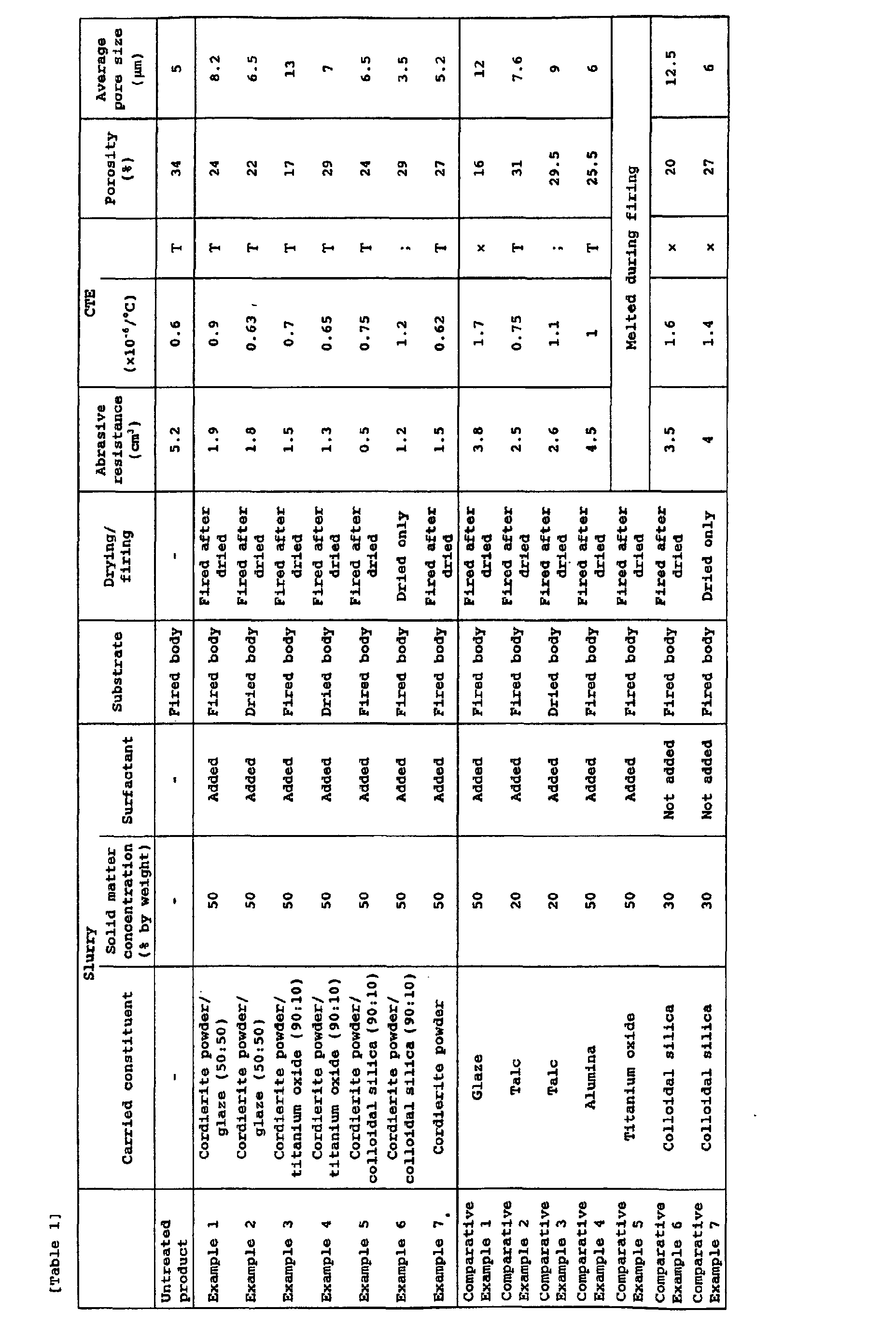
- Examples and Comparative Examples demonstrate a honeycomb structure of a cylindrical shape 100 mm in diameter and 100 mm in length, having square cells at a density of 62 cells/cm 2 , with the thickness of the partition walls being 90 ⁇ m and an open frontal area of 86%, using as the substrate a fired body made of cordierite or a dried body made of a cordierite-forming raw material.
- slurry having a composition indicated in Table 1, using water as dispersing medium was prepared.
- a nonionic surfactant of 1% by weight relative to the total weight of slurry.
- Honeycomb structure samples of Examples and Comparative Examples were measured for abrasive resistances, coefficients of thermal expansion, porosities and average pore sizes to evaluate performance thereof.
- Abrasive resistance was evaluated by means of the volume of worn part of a sample after the following test was carried out.
- the diameter of the iron ball was determined so that the ball does not pass through the square cell of the substrate.
- CTE coefficient of thermal expansion
- a differential thermal dilatometer was used for measurement and the difference of the thermal expansion between a sample and a standard material at 40 to 800°C was calculated for evaluation.
- the volume of the worn part is 10% by volume or less of the untreated product, indicating a great improvement in abrasive resistance.
- the CTE thereof is rarely increased as well, showing an extremely good result.
- a honeycomb structure of the present invention has a reinforced part having been loaded with a cordierite powder at least on one end surface of the frontal openings, does not decrease merits of a small pressure loss and the like as a thin-walled honeycomb structure, and is also excellent in abrasive resistance of the end surfaces of the frontal openings.
Landscapes
- Chemical & Material Sciences (AREA)
- Engineering & Computer Science (AREA)
- Ceramic Engineering (AREA)
- Materials Engineering (AREA)
- Structural Engineering (AREA)
- Organic Chemistry (AREA)
- Chemical Kinetics & Catalysis (AREA)
- Environmental & Geological Engineering (AREA)
- Health & Medical Sciences (AREA)
- Inorganic Chemistry (AREA)
- General Chemical & Material Sciences (AREA)
- Oil, Petroleum & Natural Gas (AREA)
- Analytical Chemistry (AREA)
- Biomedical Technology (AREA)
- Manufacturing & Machinery (AREA)
- Toxicology (AREA)
- Combustion & Propulsion (AREA)
- Mechanical Engineering (AREA)
- General Engineering & Computer Science (AREA)
- Catalysts (AREA)
- Exhaust Gas Treatment By Means Of Catalyst (AREA)
- Porous Artificial Stone Or Porous Ceramic Products (AREA)
Abstract
Description
Claims (7)
- A cordierite honeycomb structure characterized in that the structure has a reinforced part having been loaded with a cordierite powder at least on one end surface of the frontal openings of the substrate of a honeycomb structure made of cordierite.
- The cordierite honeycomb structure according to claim 1, characterized in that the structure has a reinforced part with which a cordierite powder has been loaded through a glass phase.
- The cordierite honeycomb structure according to claim 1 or 2, characterized in that the structure has reinforced parts only in portions of the end surfaces of the frontal openings of the substrate and of 10 mm or less from the end surfaces of the frontal openings of the substrate towards the cell-forming direction.
- The cordierite honeycomb structure according to any one of claims 1 to 3, characterized in that the thickness of the partition wall of the substrate is 100 µm or less.
- A method of manufacturing a cordierite honeycomb structure, characterized in that the drying and/or firing are carried out after slurry containing a cordierite powder is applied to at least one end surface of the frontal openings of the fired or unfired substrate of a honeycomb structure, made of cordierite or a cordierite-forming raw material.
- The method of manufacturing a cordierite honeycomb structure according to claim 5, characterized in that the drying and/or firing are carried out after slurry containing a cordierite powder and colloidal ceramic is applied to the structure.
- The method of manufacturing a cordierite honeycomb structure according to claim 5, characterized in that the drying and firing are carried out after slurry containing a cordierite powder and glaze is applied to the structure.
Applications Claiming Priority (3)
| Application Number | Priority Date | Filing Date | Title |
|---|---|---|---|
| JP2000311399A JP4473438B2 (en) | 2000-10-12 | 2000-10-12 | Cordierite honeycomb structure and manufacturing method thereof |
| JP2000311399 | 2000-10-12 | ||
| PCT/JP2001/008491 WO2002030567A1 (en) | 2000-10-12 | 2001-09-28 | Cordierite honeycomb structural body and method of manufacturing the structural body |
Publications (3)
| Publication Number | Publication Date |
|---|---|
| EP1354629A1 true EP1354629A1 (en) | 2003-10-22 |
| EP1354629A4 EP1354629A4 (en) | 2004-11-10 |
| EP1354629B1 EP1354629B1 (en) | 2008-06-04 |
Family
ID=18791172
Family Applications (1)
| Application Number | Title | Priority Date | Filing Date |
|---|---|---|---|
| EP01972554A Expired - Lifetime EP1354629B1 (en) | 2000-10-12 | 2001-09-28 | Cordierite honeycomb structural body and method of manufacturing the structural body |
Country Status (7)
| Country | Link |
|---|---|
| US (1) | US6726977B2 (en) |
| EP (1) | EP1354629B1 (en) |
| JP (1) | JP4473438B2 (en) |
| AU (1) | AU2001292281A1 (en) |
| DE (1) | DE60134341D1 (en) |
| WO (1) | WO2002030567A1 (en) |
| ZA (1) | ZA200204424B (en) |
Families Citing this family (18)
| Publication number | Priority date | Publication date | Assignee | Title |
|---|---|---|---|---|
| JP2003095768A (en) * | 2001-09-18 | 2003-04-03 | Ngk Insulators Ltd | Honeycomb structure and manufacturing method thereof |
| JP2003103181A (en) * | 2001-09-28 | 2003-04-08 | Ngk Insulators Ltd | Honeycomb catalyst, honeycomb intermediate, and method for producing honeycomb catalyst |
| JP4172986B2 (en) * | 2002-10-10 | 2008-10-29 | 日本碍子株式会社 | Honeycomb structure, manufacturing method thereof, and exhaust gas purification system using the honeycomb structure |
| CN100386505C (en) * | 2003-05-06 | 2008-05-07 | 揖斐电株式会社 | honeycomb structure |
| US7488366B2 (en) * | 2003-07-25 | 2009-02-10 | Ngk Insulators, Ltd. | Ceramic porous body and method for evaluating its permeability |
| CN1859962B (en) * | 2003-09-29 | 2011-06-22 | 日立金属株式会社 | Ceramic honeycomb filter and production method therefor |
| JP4874123B2 (en) * | 2003-12-31 | 2012-02-15 | コーニング インコーポレイテッド | Ceramic structure with hydrophobic coating |
| US20080110147A1 (en) * | 2005-03-28 | 2008-05-15 | Beall Douglas M | Low thermal expansion articles |
| JPWO2006126278A1 (en) * | 2005-05-27 | 2008-12-25 | イビデン株式会社 | Honeycomb structure |
| DE102006014999A1 (en) * | 2005-09-06 | 2007-03-08 | Robert Bosch Gmbh | A method of making a filter element and support structure for a catalyst having improved resistance to alkali and alkaline earth ions |
| US8242038B2 (en) * | 2007-10-31 | 2012-08-14 | Corning Incorporated | Low thermal expansion high strength honeycomb cement and method therefor |
| EP2222618A2 (en) * | 2007-11-30 | 2010-09-01 | Corning Incorporated | Compositions for applying to honeycomb bodies |
| US8143180B2 (en) * | 2007-11-30 | 2012-03-27 | Corning Incorporated | Honeycomb cement with ceramic-forming crystallizable glass and method therefor |
| WO2009141890A1 (en) * | 2008-05-20 | 2009-11-26 | イビデン株式会社 | Honeycomb structure and exhaust gas purification apparatus |
| JP6238791B2 (en) * | 2014-03-03 | 2017-11-29 | 日本碍子株式会社 | Plugged honeycomb structure |
| US11891339B2 (en) | 2018-08-31 | 2024-02-06 | Corning Incorporated | Cordierite-indialite-pseudobrookite structured ceramic bodies, batch composition mixtures, and methods of manufacturing ceramic bodies therefrom |
| JP7379248B2 (en) * | 2020-03-27 | 2023-11-14 | 日本碍子株式会社 | Porous ceramic structure and method for manufacturing porous ceramic structure |
| JP7379247B2 (en) | 2020-03-27 | 2023-11-14 | 日本碍子株式会社 | Porous ceramic structure and method for manufacturing porous ceramic structure |
Family Cites Families (7)
| Publication number | Priority date | Publication date | Assignee | Title |
|---|---|---|---|---|
| JPS5426978A (en) * | 1977-08-03 | 1979-02-28 | Sakai Chem Ind Co Ltd | Catalyst and catalytic reactor |
| JPS60141667A (en) * | 1983-12-28 | 1985-07-26 | 日本碍子株式会社 | Material for ceramic honeycomb structure |
| JPS63162028A (en) * | 1986-12-26 | 1988-07-05 | Ube Tokuto:Kk | Method for preventing abrasion of solid catalyst for stack gas denitration apparatus |
| US5629067A (en) * | 1992-01-30 | 1997-05-13 | Ngk Insulators, Ltd. | Ceramic honeycomb structure with grooves and outer coating, process of producing the same, and coating material used in the honeycomb structure |
| US5846276A (en) * | 1995-07-05 | 1998-12-08 | Matsushita Electric Industrial Co., Ltd. | Exhaust gas filter |
| JP3867439B2 (en) * | 1998-06-03 | 2007-01-10 | 株式会社デンソー | Honeycomb structure and manufacturing method thereof |
| JP3803853B2 (en) * | 1999-12-17 | 2006-08-02 | 日立造船株式会社 | Method for curing the end of the catalyst |
-
2000
- 2000-10-12 JP JP2000311399A patent/JP4473438B2/en not_active Expired - Lifetime
-
2001
- 2001-09-28 DE DE60134341T patent/DE60134341D1/en not_active Expired - Lifetime
- 2001-09-28 WO PCT/JP2001/008491 patent/WO2002030567A1/en not_active Ceased
- 2001-09-28 US US10/168,082 patent/US6726977B2/en not_active Expired - Lifetime
- 2001-09-28 EP EP01972554A patent/EP1354629B1/en not_active Expired - Lifetime
- 2001-09-28 AU AU2001292281A patent/AU2001292281A1/en not_active Abandoned
-
2002
- 2002-06-03 ZA ZA200204424A patent/ZA200204424B/en unknown
Also Published As
| Publication number | Publication date |
|---|---|
| JP4473438B2 (en) | 2010-06-02 |
| JP2002121085A (en) | 2002-04-23 |
| US6726977B2 (en) | 2004-04-27 |
| US20030026944A1 (en) | 2003-02-06 |
| ZA200204424B (en) | 2003-06-03 |
| EP1354629A4 (en) | 2004-11-10 |
| AU2001292281A1 (en) | 2002-04-22 |
| WO2002030567A1 (en) | 2002-04-18 |
| EP1354629B1 (en) | 2008-06-04 |
| DE60134341D1 (en) | 2008-07-17 |
Similar Documents
| Publication | Publication Date | Title |
|---|---|---|
| US6726977B2 (en) | Cordierite honeycomb structure and manufacturing method thereof | |
| EP1493724B1 (en) | Porous material and method for production thereof | |
| CA2362763C (en) | Honeycomb structure and process for production thereof | |
| US8518857B2 (en) | Ceramic structures having hydrophobic coatings | |
| EP0278750B1 (en) | Cordierite honeycomb structural bodies | |
| EP0278749B1 (en) | Cordierite honeycomb-structural body and a method for producing the same | |
| KR100649477B1 (en) | Silicon carbide based porous material and method for preparation thereof, and honeycomb structure | |
| US6596372B2 (en) | Ceramic honeycomb structural body and methods of preparing the same | |
| EP1277714A1 (en) | Honeycomb structure and method for its manufacture | |
| JP2002234779A (en) | Honeycomb structure and manufacturing method thereof | |
| PL214868B1 (en) | Silicon carbide porous body, process for producing the same and honeycomb structure | |
| GB2071639A (en) | Ceramic honeycomb bocy | |
| EP1364928A1 (en) | Honeycomb structure | |
| US20050261128A1 (en) | Honeycomb catalyst carrier and method for production thereof | |
| CN110317074A (en) | Ceramic porous article and its manufacturing method and dust filter | |
| EP1787968A1 (en) | Method for manufacturing porous article, porous article and honeycomb structure | |
| EP1995226B1 (en) | Porous object based on silicon carbide and process for producing the same | |
| EP2006261B1 (en) | Porous object based on silicon carbide and process for producing the same | |
| JP2010215414A (en) | Honeycomb structure | |
| JPH0729059B2 (en) | Cordierite honeycomb structure | |
| JPH06165943A (en) | Cordierite honeycomb structure | |
| JPS60241917A (en) | Purifying body of exhaust gas |
Legal Events
| Date | Code | Title | Description |
|---|---|---|---|
| PUAI | Public reference made under article 153(3) epc to a published international application that has entered the european phase |
Free format text: ORIGINAL CODE: 0009012 |
|
| 17P | Request for examination filed |
Effective date: 20020620 |
|
| AK | Designated contracting states |
Kind code of ref document: A1 Designated state(s): AT BE CH CY DE DK ES FI FR GB GR IE IT LI LU MC NL PT SE TR |
|
| AX | Request for extension of the european patent |
Extension state: AL LT LV MK RO SI |
|
| RBV | Designated contracting states (corrected) |
Designated state(s): BE DE FR GB |
|
| A4 | Supplementary search report drawn up and despatched |
Effective date: 20040928 |
|
| 17Q | First examination report despatched |
Effective date: 20050222 |
|
| GRAP | Despatch of communication of intention to grant a patent |
Free format text: ORIGINAL CODE: EPIDOSNIGR1 |
|
| GRAS | Grant fee paid |
Free format text: ORIGINAL CODE: EPIDOSNIGR3 |
|
| GRAA | (expected) grant |
Free format text: ORIGINAL CODE: 0009210 |
|
| AK | Designated contracting states |
Kind code of ref document: B1 Designated state(s): BE DE FR GB |
|
| REG | Reference to a national code |
Ref country code: GB Ref legal event code: FG4D |
|
| REF | Corresponds to: |
Ref document number: 60134341 Country of ref document: DE Date of ref document: 20080717 Kind code of ref document: P |
|
| PG25 | Lapsed in a contracting state [announced via postgrant information from national office to epo] |
Ref country code: BE Free format text: LAPSE BECAUSE OF FAILURE TO SUBMIT A TRANSLATION OF THE DESCRIPTION OR TO PAY THE FEE WITHIN THE PRESCRIBED TIME-LIMIT Effective date: 20080604 |
|
| PLBE | No opposition filed within time limit |
Free format text: ORIGINAL CODE: 0009261 |
|
| STAA | Information on the status of an ep patent application or granted ep patent |
Free format text: STATUS: NO OPPOSITION FILED WITHIN TIME LIMIT |
|
| 26N | No opposition filed |
Effective date: 20090305 |
|
| GBPC | Gb: european patent ceased through non-payment of renewal fee |
Effective date: 20080928 |
|
| REG | Reference to a national code |
Ref country code: FR Ref legal event code: ST Effective date: 20090529 |
|
| PG25 | Lapsed in a contracting state [announced via postgrant information from national office to epo] |
Ref country code: FR Free format text: LAPSE BECAUSE OF NON-PAYMENT OF DUE FEES Effective date: 20080930 |
|
| PG25 | Lapsed in a contracting state [announced via postgrant information from national office to epo] |
Ref country code: GB Free format text: LAPSE BECAUSE OF NON-PAYMENT OF DUE FEES Effective date: 20080928 |
|
| PGFP | Annual fee paid to national office [announced via postgrant information from national office to epo] |
Ref country code: DE Payment date: 20100930 Year of fee payment: 10 |
|
| PG25 | Lapsed in a contracting state [announced via postgrant information from national office to epo] |
Ref country code: DE Free format text: LAPSE BECAUSE OF NON-PAYMENT OF DUE FEES Effective date: 20130403 |
|
| REG | Reference to a national code |
Ref country code: DE Ref legal event code: R119 Ref document number: 60134341 Country of ref document: DE Effective date: 20130403 |