EP1351320A2 - Piezoelectric ceramic composition, its production method, and piezoelectric device and dielectric device - Google Patents
Piezoelectric ceramic composition, its production method, and piezoelectric device and dielectric device Download PDFInfo
- Publication number
- EP1351320A2 EP1351320A2 EP03006090A EP03006090A EP1351320A2 EP 1351320 A2 EP1351320 A2 EP 1351320A2 EP 03006090 A EP03006090 A EP 03006090A EP 03006090 A EP03006090 A EP 03006090A EP 1351320 A2 EP1351320 A2 EP 1351320A2
- Authority
- EP
- European Patent Office
- Prior art keywords
- piezoelectric
- ceramic composition
- piezoelectric ceramic
- dielectric
- constant
- Prior art date
- Legal status (The legal status is an assumption and is not a legal conclusion. Google has not performed a legal analysis and makes no representation as to the accuracy of the status listed.)
- Withdrawn
Links
Classifications
-
- C—CHEMISTRY; METALLURGY
- C01—INORGANIC CHEMISTRY
- C01G—COMPOUNDS CONTAINING METALS NOT COVERED BY SUBCLASSES C01D OR C01F
- C01G33/00—Compounds of niobium
- C01G33/006—Compounds containing niobium, with or without oxygen or hydrogen, and containing two or more other elements
-
- C—CHEMISTRY; METALLURGY
- C04—CEMENTS; CONCRETE; ARTIFICIAL STONE; CERAMICS; REFRACTORIES
- C04B—LIME, MAGNESIA; SLAG; CEMENTS; COMPOSITIONS THEREOF, e.g. MORTARS, CONCRETE OR LIKE BUILDING MATERIALS; ARTIFICIAL STONE; CERAMICS; REFRACTORIES; TREATMENT OF NATURAL STONE
- C04B35/00—Shaped ceramic products characterised by their composition; Ceramics compositions; Processing powders of inorganic compounds preparatory to the manufacturing of ceramic products
- C04B35/01—Shaped ceramic products characterised by their composition; Ceramics compositions; Processing powders of inorganic compounds preparatory to the manufacturing of ceramic products based on oxide ceramics
- C04B35/495—Shaped ceramic products characterised by their composition; Ceramics compositions; Processing powders of inorganic compounds preparatory to the manufacturing of ceramic products based on oxide ceramics based on vanadium, niobium, tantalum, molybdenum or tungsten oxides or solid solutions thereof with other oxides, e.g. vanadates, niobates, tantalates, molybdates or tungstates
-
- C—CHEMISTRY; METALLURGY
- C04—CEMENTS; CONCRETE; ARTIFICIAL STONE; CERAMICS; REFRACTORIES
- C04B—LIME, MAGNESIA; SLAG; CEMENTS; COMPOSITIONS THEREOF, e.g. MORTARS, CONCRETE OR LIKE BUILDING MATERIALS; ARTIFICIAL STONE; CERAMICS; REFRACTORIES; TREATMENT OF NATURAL STONE
- C04B35/00—Shaped ceramic products characterised by their composition; Ceramics compositions; Processing powders of inorganic compounds preparatory to the manufacturing of ceramic products
- C04B35/622—Forming processes; Processing powders of inorganic compounds preparatory to the manufacturing of ceramic products
- C04B35/626—Preparing or treating the powders individually or as batches ; preparing or treating macroscopic reinforcing agents for ceramic products, e.g. fibres; mechanical aspects section B
- C04B35/62605—Treating the starting powders individually or as mixtures
- C04B35/6261—Milling
- C04B35/6262—Milling of calcined, sintered clinker or ceramics
-
- H—ELECTRICITY
- H10—SEMICONDUCTOR DEVICES; ELECTRIC SOLID-STATE DEVICES NOT OTHERWISE PROVIDED FOR
- H10N—ELECTRIC SOLID-STATE DEVICES NOT OTHERWISE PROVIDED FOR
- H10N30/00—Piezoelectric or electrostrictive devices
- H10N30/80—Constructional details
- H10N30/85—Piezoelectric or electrostrictive active materials
- H10N30/853—Ceramic compositions
-
- C—CHEMISTRY; METALLURGY
- C01—INORGANIC CHEMISTRY
- C01P—INDEXING SCHEME RELATING TO STRUCTURAL AND PHYSICAL ASPECTS OF SOLID INORGANIC COMPOUNDS
- C01P2006/00—Physical properties of inorganic compounds
- C01P2006/40—Electric properties
-
- C—CHEMISTRY; METALLURGY
- C04—CEMENTS; CONCRETE; ARTIFICIAL STONE; CERAMICS; REFRACTORIES
- C04B—LIME, MAGNESIA; SLAG; CEMENTS; COMPOSITIONS THEREOF, e.g. MORTARS, CONCRETE OR LIKE BUILDING MATERIALS; ARTIFICIAL STONE; CERAMICS; REFRACTORIES; TREATMENT OF NATURAL STONE
- C04B2235/00—Aspects relating to ceramic starting mixtures or sintered ceramic products
- C04B2235/02—Composition of constituents of the starting material or of secondary phases of the final product
- C04B2235/30—Constituents and secondary phases not being of a fibrous nature
- C04B2235/32—Metal oxides, mixed metal oxides, or oxide-forming salts thereof, e.g. carbonates, nitrates, (oxy)hydroxides, chlorides
- C04B2235/3201—Alkali metal oxides or oxide-forming salts thereof
- C04B2235/3203—Lithium oxide or oxide-forming salts thereof
-
- C—CHEMISTRY; METALLURGY
- C04—CEMENTS; CONCRETE; ARTIFICIAL STONE; CERAMICS; REFRACTORIES
- C04B—LIME, MAGNESIA; SLAG; CEMENTS; COMPOSITIONS THEREOF, e.g. MORTARS, CONCRETE OR LIKE BUILDING MATERIALS; ARTIFICIAL STONE; CERAMICS; REFRACTORIES; TREATMENT OF NATURAL STONE
- C04B2235/00—Aspects relating to ceramic starting mixtures or sintered ceramic products
- C04B2235/02—Composition of constituents of the starting material or of secondary phases of the final product
- C04B2235/30—Constituents and secondary phases not being of a fibrous nature
- C04B2235/32—Metal oxides, mixed metal oxides, or oxide-forming salts thereof, e.g. carbonates, nitrates, (oxy)hydroxides, chlorides
- C04B2235/3231—Refractory metal oxides, their mixed metal oxides, or oxide-forming salts thereof
- C04B2235/3251—Niobium oxides, niobates, tantalum oxides, tantalates, or oxide-forming salts thereof
- C04B2235/3255—Niobates or tantalates, e.g. silver niobate
-
- C—CHEMISTRY; METALLURGY
- C04—CEMENTS; CONCRETE; ARTIFICIAL STONE; CERAMICS; REFRACTORIES
- C04B—LIME, MAGNESIA; SLAG; CEMENTS; COMPOSITIONS THEREOF, e.g. MORTARS, CONCRETE OR LIKE BUILDING MATERIALS; ARTIFICIAL STONE; CERAMICS; REFRACTORIES; TREATMENT OF NATURAL STONE
- C04B2235/00—Aspects relating to ceramic starting mixtures or sintered ceramic products
- C04B2235/02—Composition of constituents of the starting material or of secondary phases of the final product
- C04B2235/30—Constituents and secondary phases not being of a fibrous nature
- C04B2235/32—Metal oxides, mixed metal oxides, or oxide-forming salts thereof, e.g. carbonates, nitrates, (oxy)hydroxides, chlorides
- C04B2235/3294—Antimony oxides, antimonates, antimonites or oxide forming salts thereof, indium antimonate
-
- C—CHEMISTRY; METALLURGY
- C04—CEMENTS; CONCRETE; ARTIFICIAL STONE; CERAMICS; REFRACTORIES
- C04B—LIME, MAGNESIA; SLAG; CEMENTS; COMPOSITIONS THEREOF, e.g. MORTARS, CONCRETE OR LIKE BUILDING MATERIALS; ARTIFICIAL STONE; CERAMICS; REFRACTORIES; TREATMENT OF NATURAL STONE
- C04B2235/00—Aspects relating to ceramic starting mixtures or sintered ceramic products
- C04B2235/02—Composition of constituents of the starting material or of secondary phases of the final product
- C04B2235/30—Constituents and secondary phases not being of a fibrous nature
- C04B2235/44—Metal salt constituents or additives chosen for the nature of the anions, e.g. hydrides or acetylacetonate
- C04B2235/442—Carbonates
-
- C—CHEMISTRY; METALLURGY
- C04—CEMENTS; CONCRETE; ARTIFICIAL STONE; CERAMICS; REFRACTORIES
- C04B—LIME, MAGNESIA; SLAG; CEMENTS; COMPOSITIONS THEREOF, e.g. MORTARS, CONCRETE OR LIKE BUILDING MATERIALS; ARTIFICIAL STONE; CERAMICS; REFRACTORIES; TREATMENT OF NATURAL STONE
- C04B2235/00—Aspects relating to ceramic starting mixtures or sintered ceramic products
- C04B2235/02—Composition of constituents of the starting material or of secondary phases of the final product
- C04B2235/50—Constituents or additives of the starting mixture chosen for their shape or used because of their shape or their physical appearance
- C04B2235/52—Constituents or additives characterised by their shapes
- C04B2235/5204—Monocrystalline powders
-
- C—CHEMISTRY; METALLURGY
- C04—CEMENTS; CONCRETE; ARTIFICIAL STONE; CERAMICS; REFRACTORIES
- C04B—LIME, MAGNESIA; SLAG; CEMENTS; COMPOSITIONS THEREOF, e.g. MORTARS, CONCRETE OR LIKE BUILDING MATERIALS; ARTIFICIAL STONE; CERAMICS; REFRACTORIES; TREATMENT OF NATURAL STONE
- C04B2235/00—Aspects relating to ceramic starting mixtures or sintered ceramic products
- C04B2235/60—Aspects relating to the preparation, properties or mechanical treatment of green bodies or pre-forms
- C04B2235/604—Pressing at temperatures other than sintering temperatures
-
- C—CHEMISTRY; METALLURGY
- C04—CEMENTS; CONCRETE; ARTIFICIAL STONE; CERAMICS; REFRACTORIES
- C04B—LIME, MAGNESIA; SLAG; CEMENTS; COMPOSITIONS THEREOF, e.g. MORTARS, CONCRETE OR LIKE BUILDING MATERIALS; ARTIFICIAL STONE; CERAMICS; REFRACTORIES; TREATMENT OF NATURAL STONE
- C04B2235/00—Aspects relating to ceramic starting mixtures or sintered ceramic products
- C04B2235/70—Aspects relating to sintered or melt-casted ceramic products
- C04B2235/72—Products characterised by the absence or the low content of specific components, e.g. alkali metal free alumina ceramics
-
- C—CHEMISTRY; METALLURGY
- C04—CEMENTS; CONCRETE; ARTIFICIAL STONE; CERAMICS; REFRACTORIES
- C04B—LIME, MAGNESIA; SLAG; CEMENTS; COMPOSITIONS THEREOF, e.g. MORTARS, CONCRETE OR LIKE BUILDING MATERIALS; ARTIFICIAL STONE; CERAMICS; REFRACTORIES; TREATMENT OF NATURAL STONE
- C04B2235/00—Aspects relating to ceramic starting mixtures or sintered ceramic products
- C04B2235/70—Aspects relating to sintered or melt-casted ceramic products
- C04B2235/74—Physical characteristics
- C04B2235/77—Density
Definitions
- This invention relates to a piezoelectric ceramic composition not containing lead in the composition, its production method, and a piezoelectric device and a dielectric device each using the piezoelectric ceramic composition as its material.
- a PZT (PbTiO 3 -PbZrO 3 ) component system ceramic containing lead has been used in the past as a piezoelectric ceramic composition.
- the PZT described above is excellent in an electro-mechanical coupling coefficient and piezoelectric characteristics such as a piezoelectric constant, and a piezoelectric device utilizing PZT has been widely used in sensors, actuators, filters, and so forth. Since PZT has a relatively high relative dielectric constant, it has also been used as a dielectric device such as in capacitors.
- the piezoelectric ceramic composition formed of PZT contains lead as one of its constituent elements. Therefore, detrimental lead is likely to elute from industrial wastes of products containing PZT and to induce environmental pollution. Concerns about the environment in recent years have made it difficult to produce those products that may result in the environmental pollution, such as PZT. Therefore, development of piezoelectric ceramic compositions not containing lead has been required, and a piezoelectric ceramic composition expressed by the general formula (K 1-x Na x )NbO 3 (with the proviso that 0 ⁇ x ⁇ 1) has drawn an increasing attention ("Journal of the American Ceramics Society", 1962, Vol. 45, No. 5, p209).
- the piezoelectric ceramic composition expressed by this general formula involves the problems that piezoelectric constants such as a piezoelectric d 31 constant and a piezoelectric g 31 constant and an electro-mechanical coupling coefficient Kp are low, a dielectric loss is great and a relative dielectric constant is small.
- the piezoelectric ceramic composition expressed by the general formula (K 1-x Na x ) NbO 3 (0 ⁇ x ⁇ 1) is believed to be a novel promising composition that will replace PZT, it has hardly been put into practical application. For this reason, the lead type piezoelectric ceramic composition such as PZT that may invite the environmental pollution has still been utilized widely at present even after the piezoelectric ceramic composition expressed by the general formula described above has been developed.
- this invention aims at providing a piezoelectric ceramic composition that does not contain lead, can be sintered at a normal pressure and is excellent in at least one of a piezoelectric constant, an electro-mechanical coupling coefficient, a dielectric loss, a relative dielectric constant and a Curie point, its production method, and a piezoelectric device and a dielectric device each utilizing the piezoelectric ceramic composition.
- the piezoelectric ceramic composition according to the invention is expressed by the general formula ⁇ Li x (K 1-y Na y ) 1-x ⁇ (Nb 1-z Sb z )O 3 and does not contain lead in the composition.
- the piezoelectric ceramic composition is excellent in at least one of a piezoelectric constant, an electro-mechanical coupling coefficient, a dielectric. loss, a relative dielectric constant and a Curie point.
- the piezoelectric ceramic composition described above can be sufficiently densified through sintering at a normal pressure.
- the piezoelectric ceramic composition is safe to the environment, can be sintered at a normal temperature and can be used as a material of a piezoelectric device or dielectric device having high performance.
- piezoelectric ceramic composition used in the invention includes not only ceramic compositions having piezoelectric characteristics but also dielectric ceramic compositions having dielectric characteristics.
- the molding obtained by molding powder formed of the piezoelectric ceramic composition described above can be sintered at a normal temperature. Therefore, sintering can be carried out easily and at a low cost.
- the piezoelectric ceramic composition obtained after sintering does not contain lead and is excellent in at least one of piezoelectric constants such as a piezoelectric d 31 constant and a piezoelectric g 31 constant, an electro-mechanical coupling coefficient, a dielectric loss, a relative dielectric constant and a Curie point. Therefore, the piezoelectric ceramic composition can be utilized as a material of high-performance piezoelectric or dielectric devices.
- a method of producing a piezoelectric ceramic composition comprising the steps of mixing a lithium-containing compound, a sodium-containing compound, a potassium-containing compound, a niobium-containing compound and an antimony-containing compound; and sintering the mixture.
- the lithium-containing compound, the sodium-containing compound, the potassium-containing compound, the niobium-containing compound and the antimony-containing compound are mixed and sintered as described above.
- the piezoelectric ceramic composition expressed by the general formula ⁇ Li x (K 1-y Na y ) 1-x ⁇ (Nb 1-z Sb z )O 3 can be easily obtained.
- the piezoelectric ceramic composition described above can be sintered at the normal temperature.
- the piezoelectric ceramic composition obtained after sintering does not contain lead and is excellent in at least one of the piezoelectric constants such as a piezoelectric d 31 constant and a piezoelectric g 31 constant, an electro-mechanical coupling coefficient, a dielectric loss, a relative dielectric constant and a Curie point.
- a piezoelectric device having a piezoelectric body formed of the piezoelectric ceramic composition of the first invention described above.
- the piezoelectric device described above has a piezoelectric body formed of the piezoelectric ceramic composition of the first invention. Therefore, the piezoelectric device does not contain lead and is safe to the environment.
- the piezoelectric device can utilize as such the properties of the piezoelectric ceramic composition in that the piezoelectric constant, the electro-mechanical coupling coefficient, etc, are high. Therefore, the piezoelectric device can be utilized as excellent piezoelectric devices such as a piezoelectric sensor having a high sensitivity, a piezoelectric vibrator and an actuator having high electro-mechanical energy conversion efficiency.
- a dielectric device having a dielectric body formed of the piezoelectric ceramic composition of the first invention.
- the dielectric device described above has the dielectric body formed of the piezoelectric ceramic composition of the first invention. Therefore, the dielectric device does not contain lead and is safe to the environment.
- the dielectric device can utilize as such the properties of the piezoelectric ceramic composition in that the dielectric loss is low and the relative dielectric constant is high. Consequently, the dielectric device can be utilized as excellent dielectric devices such as a capacitor having a large electrostatic capacity.
- a piezoelectric device having a piezoelectric body formed of a piezoelectric ceramic composition produced by the production method of the second or third invention.
- the piezoelectric device of the invention uses the piezoelectric ceramic composition produced by the production method of the second or third invention as the piezoelectric body. Therefore, the piezoelectric device can as such utilize the excellent characteristics of the piezoelectric ceramic composition, and can be utilized as excellent piezoelectric devices such as a piezoelectric sensor having a high sensitivity, a piezoelectric vibrator and an actuator having high electro-mechanical energy conversion efficiency.
- a dielectric device having a dielectric body formed of a piezoelectric ceramic composition produced by the production method of a piezoelectric ceramic composition according to the second or third invention.
- the dielectric device described above uses the piezoelectric ceramic composition produced by the production method of a piezoelectric ceramic composition according to the second or third invention as the dielectric body. Therefore, the dielectric device can utilize as such the excellent properties of the piezoelectric ceramic composition as excellent dielectric devices such as a capacitor having a large electrostatic capacity.
- the piezoelectric ceramic composition described above has both piezoelectric and dielectric properties and can be used as both piezoelectric body and dielectric body. More concretely, it can be used as piezoelectric vibrators, surface wave filters, piezoelectric sensors, actuators, ultrasonic motors, piezoelectric transformers and capacitors.
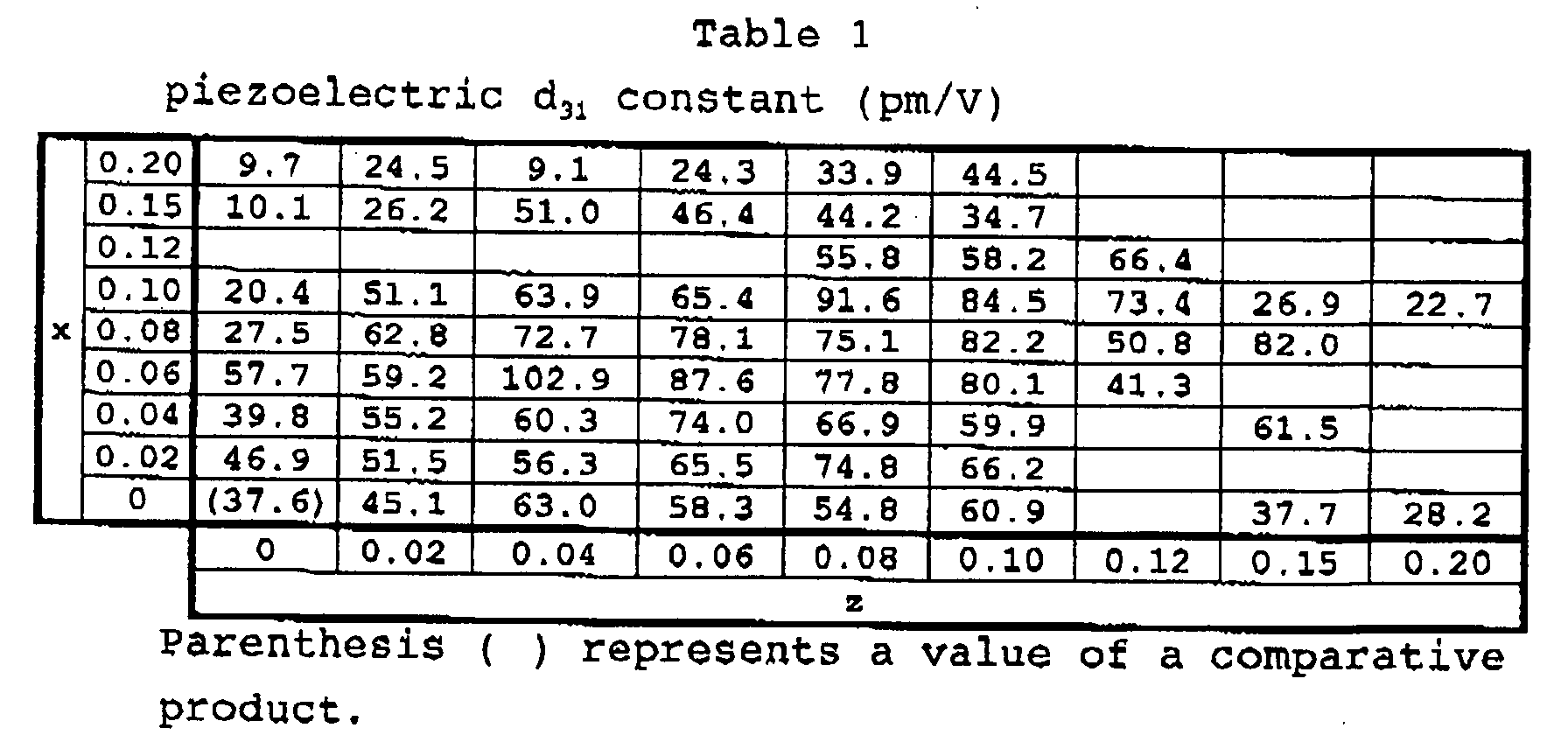
- the piezoelectric ceramic composition preferably has a piezoelectric d 31 constant of at least 30 pm/v.
- the piezoelectric ceramic composition can be used in sensors, ultrasonic motors, actuators, piezoelectric transformers, piezoelectric vibrators, etc, having a high sensitivity by making the most of its high piezoelectric d 31 constant of at least 30 pm/V.
- the piezoelectric d 31 constant is particularly preferably at least 50 pm/V.
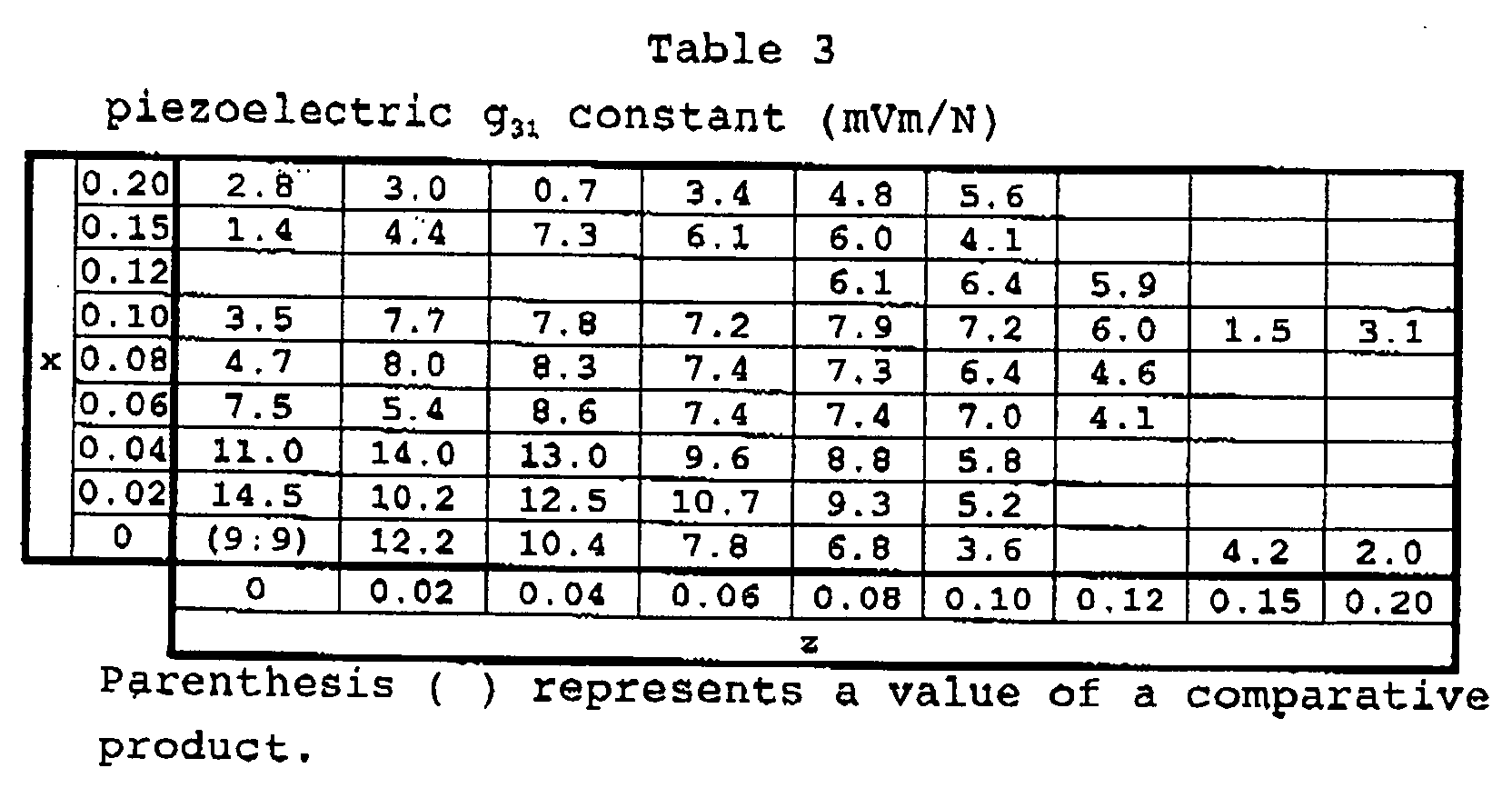
- the piezoelectric ceramic composition preferably has a piezoelectric g 31 constant of at least 7 x 10 -3 Vm/N.
- the piezoelectric ceramic composition can be used as piezoelectric transformers, ultrasonic motors, sensors, etc, having a high boltage boosting ratio by making the most of its high piezoelectric g 31 constant of at least 7 x 10 -3 Vm/N.
- the piezoelectric g 31 constant is particularly preferably at least 10 x 10 -3 Vm/N.
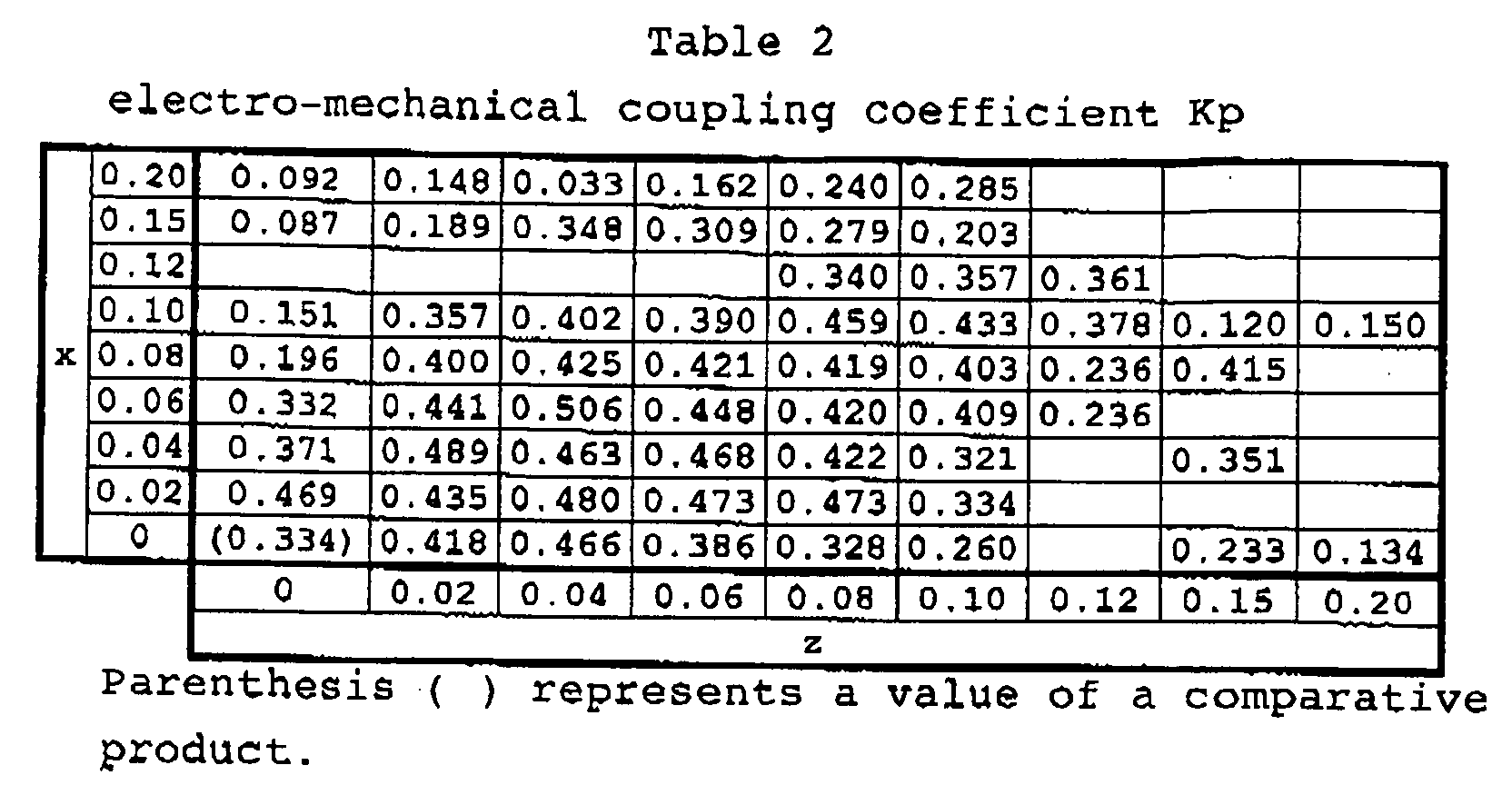
- the piezoelectric ceramic composition described above preferably has an electro-mechanical coupling coefficient Kp of at least 0.3.
- the piezoelectric ceramic composition can be used as piezoelectric actuators, piezoelectric vibrators, sensors, piezoelectric transformers, ultrasonic motors, etc, having high conversion efficiency of mechanical energy and electric energy by making the most of its high electro-mechanical coupling coefficient Kp of at least 0.3.
- the electro-mechanical coupling coefficient Kp is particularly preferably at least 0.35.
- the piezoelectric ceramic composition described above preferably has a dielectric loss of not greater than 0.09.
- the piezoelectric ceramic composition can be used as dielectric devices such as capacitors, piezoelectric transformers, ultrasonic motors, etc, by making the most of its low dielectric constant of not greater than 0.09.
- the dielectric loss is particularly preferably 0.035 or less.
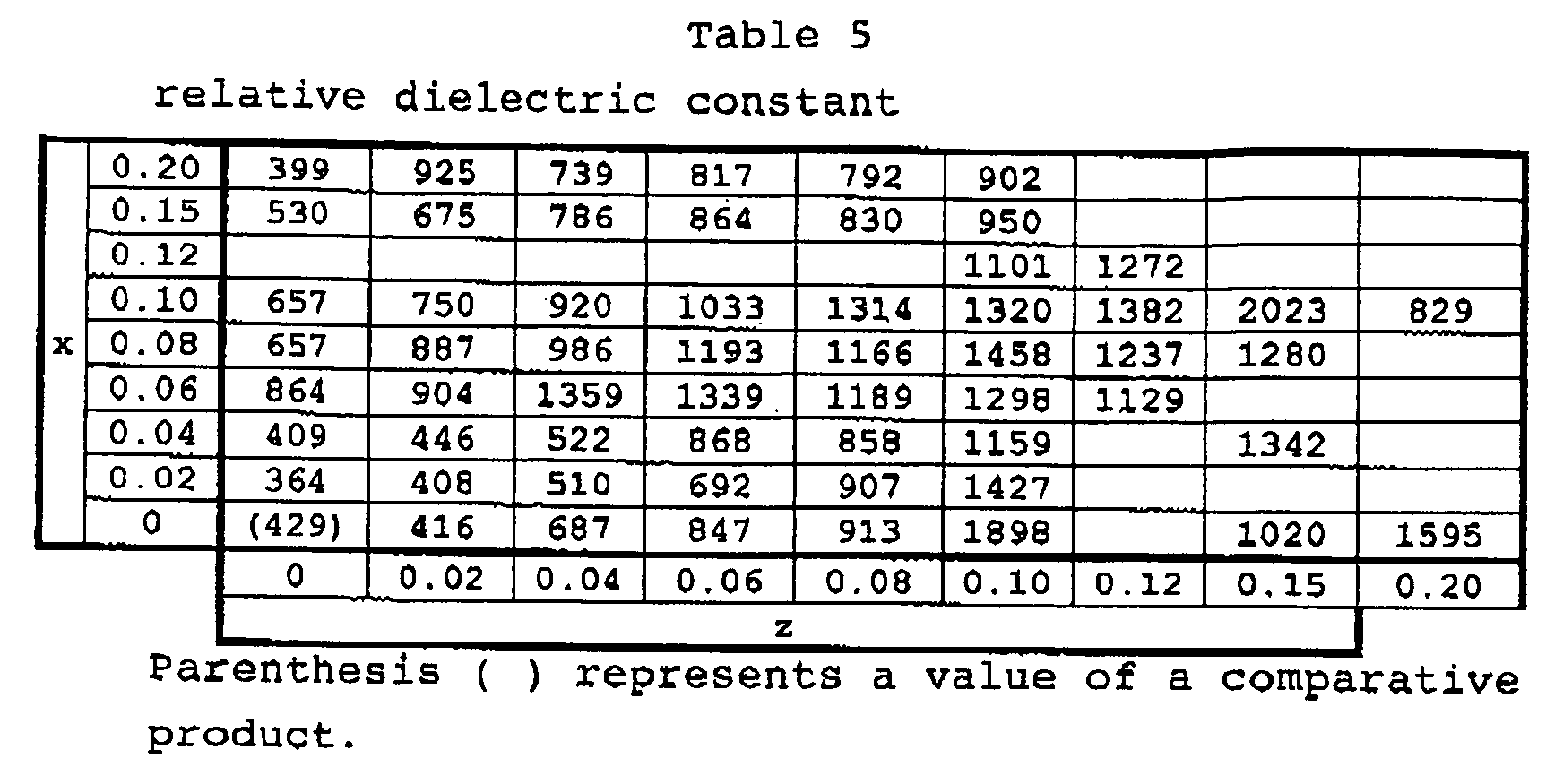
- the piezoelectric ceramic composition described above preferably has a relative dielectric constant of at least 400.
- the piezoelectric ceramic composition can be used as dielectric devices such as capacitors having a great electrostatic capacity by making the most of its relative dielectric constant of at least 400.
- the piezoelectric ceramic composition described above preferably has a curie point of at least 200°C.
- the piezoelectric ceramic composition can be used under a high temperature environment such as in the proximity of an automobile engine by making the most of its high Curie point of at least 200°C.
- the Curie point is particularly preferably at least 250°C.
- the piezoelectric ceramic composition described above preferably has a piezoelectric d 31 constant of at least 30 pm/V, an electro-mechanical coupling coefficient Kp of at least 0.3 and a Curie point of at least 200°C.
- the piezoelectric ceramic composition can be used under a high temperature environment such as in the proximity of an automobile engine, and can be used as sensors, piezoelectric actuators, piezoelectric transformers, ultrasonic motors, etc, having high sensitivity and high conversion efficiency of mechanical energy and electric energy.
- the piezoelectric ceramic composition described above preferably has a piezoelectric d 31 constant of at least 30 pm/V, a dielectric constant of not greater than 0.09 and a Curie point of at least 200°C.
- the piezoelectric ceramic composition can be used under a high temperature environment such as in the proximity of an automobile engine, and can be used as piezoelectric transformers, ultrasonic motors, etc, having high sensitivity and excellent dielectric loss.
- the lithium-containing compound is Li 2 CO 3
- the sodium-containing compound is Na 2 CO 3
- the potassium-containing compound is K 2 CO 3
- the niobium-containing compound is Nb 2 O 5
- the antimony-containing compound is Sb 2 O 5 or Sb 2 O 3 .
- the piezoelectric ceramic composition described above can be easily produced.
- examples of the piezoelectric devices described above include piezoelectric vibrators, surface wave filters, piezoelectric sensors, actuators, ultrasonic motors, piezoelectric transformers, piezoelectric gyro sensors, knock sensors, and so forth.
- the dielectric devices described above are for example capacitors and stacked capacitors.
- the piezoelectric ceramic composition described above is produced, and its characteristics such as piezoelectric and dielectric characteristics are measured.
- high purity Li 2 CO 3, K 2 CO 3 , Na 2 CO 3 , Nb 2 O 5 and Sb 2 O 5 each having a purity of at least 99% are prepared as the starting materials of the piezoelectric ceramic composition.
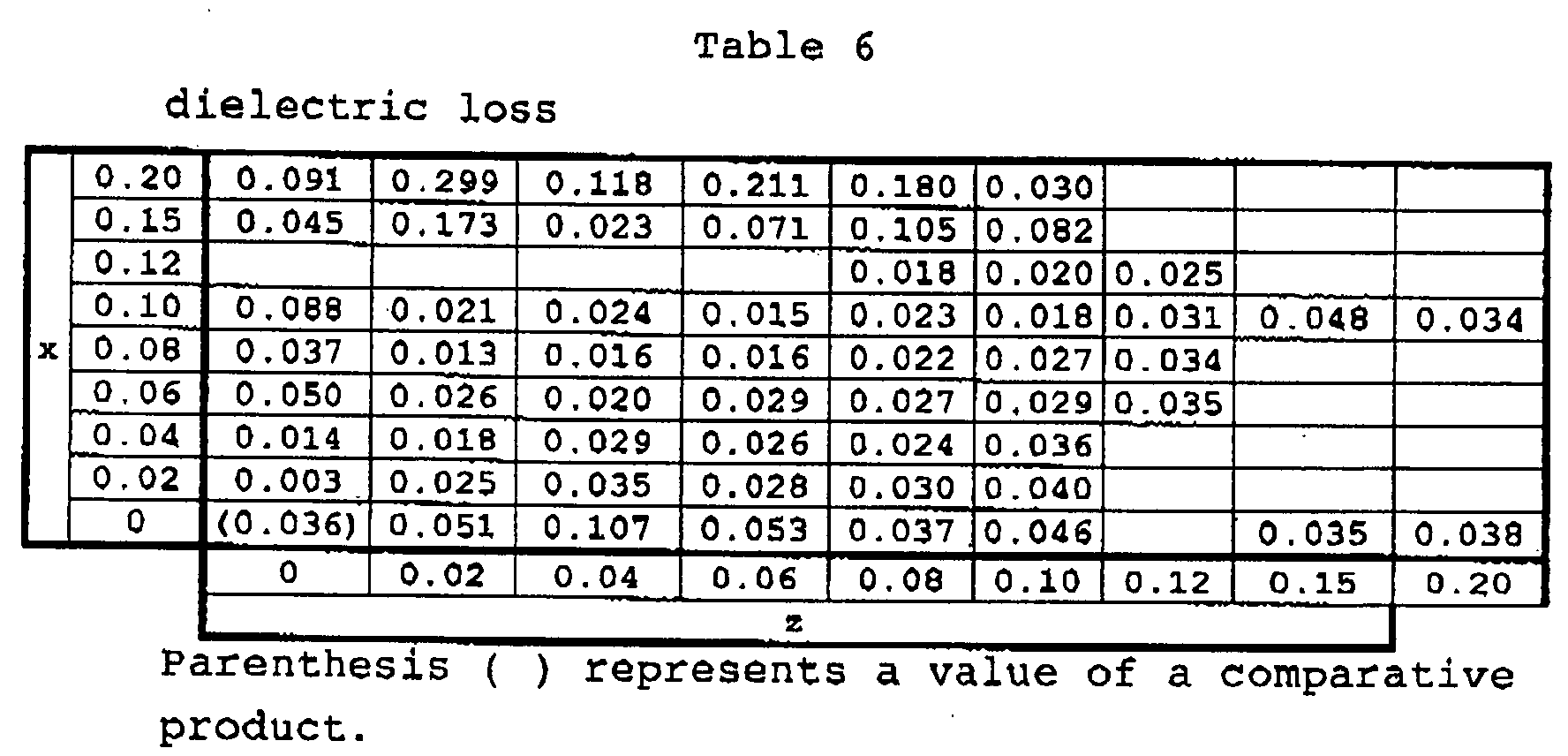
- a plurality of materials is prepared by use of these starting materials by changing x and z but keeping y at 0.5 in the general formula ⁇ Li x (K 1-y Na y ) 1-x ⁇ (Nb 1-z Sb z )O 3 .
- x is set to 0, 0.02, 0.04, 0.06, 0.08, 0.10, 0.12, 0.15 and 0.20.
- z is set to 0, 0.02, 0.04, 0.06, 0.08, 0.10, 0.12, 0.15 and 0.20.
- the starting materials so blended as to achieve each stoichiometric composition are mixed in acetone for 24 hours by use of a ball mill to prepare a mixture of each stoichiometric composition.
- the mixture is calcined at 750°C for 5 hours, and the mixture after calcinations is pulverized for 24 hours in the ball mill. Subsequently, polyvinyl butyral as a binder is added and the mixture is granulated.
- Powder after granulation is press-molded at a pressure of 2 tons/cm 2 into a disc having a diameter of 18 mm and a thickness of 1 mm, and the resulting molding is sintered at 1,000 to 1,300°C for one hour.
- the sintering temperature at this time is selected between 1,000°C and 1,300°C to a temperature that provides a maximum density.
- Each molding after sintering is compacted to a relative density of at least 98%.
- Both surfaces of each molding after sintering are straight-polished and disc polished.
- Gold electrodes are then provided to both surfaces of each disc sample by sputtering.
- a DC voltage of 1 to 5 kV/mm is applied across the electrodes, in silicone oil, at 100°C for 10 minutes, and polarization is attained in the direction of thickness to give each piezoelectric ceramic composition of this example.
- the piezoelectric d 31 constant, the piezoelectric g 31 constant, the electro-mechanical coupling coefficient Kp, the Curie point, the dielectric loss and the relative dielectric constant are measured for each of the piezoelectric ceramic compositions so produced in this example.
- the piezoelectric d 31 constant, the piezoelectric g 31 constant and the electro-mechanical coupling coefficient Kp are measured in accordance with a resonance-antiresonance method by use of an impedance analyzer.
- the dielectric loss and the relative dielectric constant are measured at a measurement frequency of 1 kHz by use of the impedance analyzer.
- the Curie point is set to the temperature that provides the highest relative dielectric constant.
- this example produces the comparative products in the following way.
- high purity K 2 CO 3 , Na 2 CO 3 and Nb 2 O 5 each having a purity of at least 99% are prepared as the starting materials of the comparative products.
- this mixture is calcined at 750°C for 5 hours, and the mixture after calcination is pulverized for 24 hours in the ball mill. Subsequently, polyvinyl butyral is added as a binder, and the mixture is granulated.
- Powder after granulation is press-molded at a pressure of 2 tons/cm 2 into a disc having a diameter of 18 mm and a thickness of 1 mm, and the resulting molding is sintered at 1,100°C for one hour.
- a relative density after sintering is 96.2%.
- Both surfaces of each molding after sintering are straight-polished and disc-polished.
- Gold electrodes are then provided to both surfaces of each disc sample by sputtering.
- a DC voltage of 1 to 5 kV/mm is applied across the electrodes for 10 minutes, in silicone oil, at 100°C, and polarization is attained in the direction of thickness to give each comparative product.
- the piezoelectric d 31 constant, the piezoelectric g 31 constant, the electro-mechanical coupling coefficient Kp, the Curie point, the dielectric loss and the relative dielectric constant are measured for each of the comparative product so produced.
- the measurement method of each measurement value is the same as that of the products of the invention.
- the piezoelectric d 31 constant is generally proportional to an output voltage of a piezoelectric type sensor such as acceleration sensors, pressure application sensors, impact sensors and knock sensors. From this aspect, a piezoelectric ceramic composition having a higher piezoelectric d 31 constant can fabricate a sensor having a greater charge sensor output. To produce sensors having characteristics at least equivalent to those of the comparative products, the composition preferably has a piezoelectric d 31 constant of at least 30 pm/v. To produce a high sensitivity sensor by improving a signal-to-noise ratio (SN ratio) and an output voltage, the piezoelectric d 31 constant is preferably at least 50 pm/V.
- SN ratio signal-to-noise ratio
- the electro-mechanical coupling coefficient Kp is generally proportional to electro-mechanical energy conversion efficiency of piezoelectric transformers, ultrasonic motors, actuators or ultrasonic vibrators.
- a piezoelectric ceramic composition having a higher electro-mechanical coupling coefficient Kp can fabricate piezoelectric transformers, ultrasonic motors, actuators or ultrasonic vibrators having higher electro-mechanical energy conversion efficiency.
- the composition preferably has an electro-mechanical coupling coefficient Kp of at least 0.3, more preferably at least 0.35.
- the piezoelectric g 31 constant is generally proportional to an output voltage of piezoelectric sensors, piezoelectric transformers and ultrasonic motors in the same way as the piezoelectric d 31 constant. From this aspect, a piezoelectric ceramic composition having a higher piezoelectric g 31 constant can fabricate a sensor having a greater charge sensor output. To produce sensors having characteristics at least equivalent to those of the comparative products, the composition preferably has a piezoelectric g 31 constant of at least 10 x 10 -3 Vm/N.
- the Curie points of the piezoelectric ceramic compositions of this example is higher than 193°C. Therefore, the piezoelectric ceramic composition of this example falling within the composition range described above can be used for high-temperature sensor components, high-temperature actuator components and high-temperature ultrasonic motor components such as knock sensors that can be stably used for a long time at high-temperature portions in the proximity of automobile engines.
- the Curie point described above is preferably higher than 200°C and further preferably higher than 250°C.
- the relative dielectric constant is generally proportional to the electrostatic capacity of capacitors. From this aspect, a piezoelectric ceramic composition having a higher relative dielectric constant can fabricate a capacitor having a greater electrostatic capacity. To produce capacitors having characteristics at least equivalent to those of the comparative products, the composition preferably has a relative dielectric constant of 400 or more, further preferably 600 or more.
- the dielectric loss is proportional to the heat energy that a capacitor loses when an AC voltage is applied to the capacitor such as a laminated capacitor. From this aspect, a piezoelectric ceramic composition having a smaller dielectric loss can fabricate a capacitor having a smaller energy loss. To produce capacitors having characteristics at least equivalent to those of the comparative products, the composition preferably has a dielectric loss of not greater than 0.09, further preferably not greater than 0.035.
- piezoelectric ceramic compositions are prepared by changing the K and Na contents contained in the piezoelectric ceramic compositions expressed by the general formula ⁇ Li x (K 1-y Na y ) 1-x ⁇ (Nb 1-z Sb z )O 3 described above, and the piezoelectric and dielectric characteristics are examined.
- high purity Li 2 CO 3 , K 2 CO 3 , Na 2 CO 3 , Nb 2 O 5 and Sb 2 O 5 each having a purity of at least 99% are prepared as the starting materials in the same way as in Example 1.
- These three kinds of materials are respectively mixed in acetone for 24 hours by use of a ball mill in the same way as in Example 1 and each mixture of the stoichiometric composition is prepared.
- Powder after granulation is press-molded at a pressure of 2 tons/cm 2 into a disc having a diameter of 18 mm and a thickness of 1 mm, and the resulting molding is sintered at 1,000 to 1,300°C for one hour in the same way as in Example 1.
- a temperature providing a maximum density is selected as the sintering temperature between 1,000 and 1,300°C. All the moldings after sintering are compacted to a relative density 98% or more.
- Both surfaces of each molding after sintering are straight-polished and disc-polished.
- Gold electrodes are then provided to both surfaces of each disc sample by sputtering.
- a DC voltage of 1 to 5 kV/mm is applied across the electrodes for 10 minutes, in silicone oil, at 100°C, and polarization is attained in the direction of thickness to give three kinds of piezoelectric ceramic compositions. These compositions are called Sample E1 to Sample E3, respectively.
- the piezoelectric ceramic composition of Sample E1 is expressed by Li 0.06 (K 0.4 Na 0.6 ) 0.94 (Nb 0.96 Sb 0.04 )O 3 .
- the piezoelectric ceramic composition of Sample E2 is expressed by Li 0.06 (K 0.5 Na 0.5 ) 0.94 (Nb 0.96 Sb 0.04 )O 3 .
- the piezoelectric ceramic composition of Sample E3 is expressed by Li 0.06 (K 0.6 Na 0.4 ) 0.94 (Nb 0.96 Sb 0.04 )O 3 .
- the piezoelectric d 31 constant, the piezoelectric g 31 constant, the electro-mechanical coupling coefficient Kp, the dielectric loss and the relative dielectric constant are measured for these three kinds of piezoelectric ceramic compositions (Samples E1 to E3).
- the piezoelectric d 31 constant, the piezoelectric g 31 constant and the electro-mechanical coupling coefficient Kp are measured in accordance with a resonance-antiresonance method using an impedance analyzer.
- the dielectric loss and the relative dielectric constant are measured at a measuring frequency of 1 kHz by use of the impedance analyzer.
- these three kinds of piezoelectric ceramic compositions of this example exhibit excellent piezoelectric and dielectric characteristics and have particularly excellent relative dielectric constants.
- This invention provides a piezoelectric ceramic composition that does not contain lead, can be sintered at a normal pressure and is excellent in at least one of a piezoelectric constant, an electro-mechanical coupling coefficient, a dielectric loss, a relative dielectric constant and a Curie point, its production method, and a piezoelectric device and a dielectric device each utilizing the piezoelectric ceramic composition.
- the invention further relates to a piezoelectric device having a piezoelectric body formed of the piezoelectric ceramic composition described above and a dielectric device having a dielectric body formed of the piezoelectric ceramic composition described above.
Landscapes
- Chemical & Material Sciences (AREA)
- Engineering & Computer Science (AREA)
- Ceramic Engineering (AREA)
- Organic Chemistry (AREA)
- Manufacturing & Machinery (AREA)
- Inorganic Chemistry (AREA)
- Materials Engineering (AREA)
- Structural Engineering (AREA)
- Compositions Of Oxide Ceramics (AREA)
- Ceramic Capacitors (AREA)
Abstract
Description

| sample No. | Sample E1 | Sample E2 | Sample E3 |
| x | 0.06 | 0.06 | 0.06 |
| y | 0.60 | 0.50 | 0.40 |
| z | 0.04 | 0.04 | 0.04 |
| piezoelectric d31 constant (pm/V) | 42.3 | 102.9 | 25.8 |
| electro-mechanical coupling coefficient Kp | 0.248 | 0.506 | 0.176 |
| piezoelectric g31 constant (mVm/N) | 4.3 | 8.6 | 3.3 |
| relative dielectric constant | 1105 | 1359 | 876 |
| dielectric loss | 0.035 | 0.020 | 0.038 |
Claims (16)
- A piezoelectric ceramic composition expressed by the general formula {Lix(K1-yNay)1-x}(Nb1-zSbz)O3, each of x, y and z respectively falling within composition range of 0 ≦ x ≦ 0.2, 0 ≦ y ≦ 1.0 and 0 ≦ z ≦ 0.2 (with the exception of x = z = 0).
- A piezoelectric ceramic composition as defined in claim 1, wherein a piezoelectric d31 constant of said piezoelectric ceramic composition is 30 pm/V or above.
- A piezoelectric ceramic composition as defined in claim 1 or 2, wherein a piezoelectric g31 constant of said piezoelectric ceramic composition is 7 x 10⁻³ Vm/N or above.
- A piezoelectric ceramic composition as defined in any of claims 1 through 3, wherein an electro-mechanical coupling coefficient Kp of said piezoelectric ceramic composition is 0.3 or above.
- A piezoelectric ceramic composition as defined in any of claims 1 through 4, wherein a dielectric loss of said piezoelectric ceramic composition is 0.09 or below.
- A piezoelectric ceramic composition as defined in any of claims 1 through 5, wherein a relative dielectric constant of said piezoelectric ceramic composition is 400 or above.
- A piezoelectric ceramic composition as defined in any of claims 1 through 6, wherein a Curie point of said piezoelectric ceramic composition is 200°C or above.
- A piezoelectric ceramic composition as defined in claim 1, wherein said dielectric ceramic composition has a piezoelectric d31 constant of 30 pm/V or above, an electro-mechanical coupling coefficient Kp of 0.3 or above and a Curie point of 200°C or above.
- A piezoelectric ceramic composition as defined in claim 1, wherein said dielectric ceramic composition has a piezoelectric d31 constant of 30 pm/V or above, a dielectric loss of 0.09 or below and a Curie point of 200°C or above.
- A method of producing a piezoelectric ceramic composition comprising the steps of:molding powder of a piezoelectric ceramic composition expressed by the general formula {Lix(K1-y Nay)1-x}(Nb1-zSbz)O3, each of x, y and z respectively falling within composition range of 0 ≦ x ≦ 0.2, 0 ≦ y ≦ 1.0 and 0 ≦ z ≦ 0.2 (with the exception of x = z = 0); andsintering the resulting molding.
- A method of producing a piezoelectric ceramic composition for obtaining said piezoelectric ceramic composition as defined in any of claims 1 through 9, said method comprising the steps of:mixing a lithium-containing compound, a sodium-containing compound, a potassium-containing compound, a niobium-containing compound and an antimony-containing compound; andsintering the mixture.
- A method of producing a piezoelectric ceramic composition as defined in claim 11, wherein said lithium-containing compound is Li2CO3, said sodium-containing compound is Na2CO3, said potassium-containing compound is K2CO3, said niobium-containing compound is Nb2O5 and said antimony-containing compound is Sb2O5 or Sb2O3.
- A piezoelectric device having a piezoelectric body formed of said piezoelectric ceramic composition as defined in any of claims 1 through 9.
- A dielectric device having a dielectric body formed of said piezoelectric ceramic composition as defined in any of claims 1 through 9.
- A piezoelectric device having a piezoelectric body formed of a piezoelectric ceramic composition produced by said production method of a piezoelectric ceramic composition as defined in any of claims 10 through 12.
- A dielectric device having a dielectric body formed of a dielectric ceramic composition produced by said production method of a piezoelectric ceramic composition as defined in any of claims 10 through 12.
Applications Claiming Priority (4)
| Application Number | Priority Date | Filing Date | Title |
|---|---|---|---|
| JP2002077590 | 2002-03-20 | ||
| JP2002077590 | 2002-03-20 | ||
| JP2003026197 | 2003-02-03 | ||
| JP2003026197A JP4631246B2 (en) | 2002-03-20 | 2003-02-03 | Piezoelectric ceramic composition, manufacturing method thereof, piezoelectric element and dielectric element |
Publications (2)
| Publication Number | Publication Date |
|---|---|
| EP1351320A2 true EP1351320A2 (en) | 2003-10-08 |
| EP1351320A3 EP1351320A3 (en) | 2003-11-05 |
Family
ID=28043787
Family Applications (1)
| Application Number | Title | Priority Date | Filing Date |
|---|---|---|---|
| EP20030006090 Withdrawn EP1351320A3 (en) | 2002-03-20 | 2003-03-19 | Piezoelectric ceramic composition, its production method, and piezoelectric device and dielectric device |
Country Status (3)
| Country | Link |
|---|---|
| US (1) | US7267783B2 (en) |
| EP (1) | EP1351320A3 (en) |
| JP (1) | JP4631246B2 (en) |
Cited By (1)
| Publication number | Priority date | Publication date | Assignee | Title |
|---|---|---|---|---|
| WO2006130055A1 (en) * | 2005-05-31 | 2006-12-07 | St. Jude Medical Ab | Piezoelectric film |
Families Citing this family (24)
| Publication number | Priority date | Publication date | Assignee | Title |
|---|---|---|---|---|
| JP2004155601A (en) * | 2002-11-05 | 2004-06-03 | Nippon Ceramic Co Ltd | Piezoelectric ceramic composition |
| JP4541985B2 (en) | 2004-10-29 | 2010-09-08 | 株式会社デンソー | Method for producing polycrystal |
| WO2007080684A1 (en) * | 2006-01-12 | 2007-07-19 | Murata Manufacturing Co., Ltd. | Anisotropically shaped ceramic particles and process for production of the same |
| JP4943043B2 (en) | 2006-03-31 | 2012-05-30 | 富士フイルム株式会社 | Method for manufacturing piezoelectric ceramics |
| JP6178038B2 (en) | 2006-10-24 | 2017-08-09 | ジボダン エス エー | Consumable materials |
| US7658111B2 (en) * | 2006-11-16 | 2010-02-09 | Endevco Corporation | Sensors with high temperature piezoelectric ceramics |
| US8022604B2 (en) * | 2007-10-19 | 2011-09-20 | Ngk Insulators, Ltd. | (Li, Na, K)(Nb, Ta)O3 type piezoelectric/electrostrictive ceramic composition containing 30-50 mol% Ta and piezoelectric/electrorestrictive device containing the same |
| DE102008042955A1 (en) | 2007-11-08 | 2009-05-14 | Denso Corp., Kariya-shi | Method for producing a ceramic with crystal orientation |
| DE102010000783A1 (en) | 2009-01-12 | 2010-09-16 | Denso Corporation, Kariya-City | Piezoelectric ceramics for piezoelectric element, contain crystal grain comprising shell and core phases, each differing in composition and having preset amount of crystal lattice defects |
| JP5647120B2 (en) | 2010-01-29 | 2014-12-24 | 日本特殊陶業株式会社 | Lead-free piezoelectric ceramic composition, piezoelectric element using the same, knock sensor, and method for producing lead-free piezoelectric ceramic composition |
| CN103119002B (en) | 2010-12-24 | 2014-09-17 | 太阳诱电株式会社 | Piezoelectric ceramic, piezoelectric ceramic component, and piezoelectric device in which piezoelectric ceramic component is used |
| JP5662888B2 (en) | 2011-07-04 | 2015-02-04 | 太陽誘電株式会社 | Multi-layer piezoelectric ceramic parts |
| MY166346A (en) | 2011-07-13 | 2018-06-25 | Ngk Spark Plug Co | Lead-free piezoelectric ceramic composition, method for producing same, piezoelectric element using lead-free piezoelectric ceramic composition, ultrasonic processing machine, ultrasonic drive device, and sensing device |
| DE112012003356B4 (en) * | 2012-06-26 | 2016-08-04 | Honda Electronics Co. Ltd. | Piezoelectric ceramic composition |
| JP5543537B2 (en) | 2012-07-24 | 2014-07-09 | 太陽誘電株式会社 | Piezoelectric element |
| JP5704725B2 (en) | 2012-08-24 | 2015-04-22 | 太陽誘電株式会社 | Piezoelectric ceramics and piezoelectric element |
| CN103073289B (en) * | 2013-01-25 | 2014-10-29 | 瑞声声学科技(深圳)有限公司 | Piezoceramic material, sintering body, piezoceramic device and preparation method of piezoceramic material |
| MY173808A (en) | 2013-03-29 | 2020-02-24 | Ngk Spark Plug Co | Unleaded piezoelectric ceramic composition, piezoelectric element using same, device, and method for manufacturing unleaded piezoelectric ceramic composition |
| JP5823014B2 (en) | 2014-04-11 | 2015-11-25 | 日本特殊陶業株式会社 | Lead-free piezoelectric ceramic composition, piezoelectric element using the same, and lead-free piezoelectric ceramic composition manufacturing method |
| JP2015205805A (en) | 2014-04-11 | 2015-11-19 | 日本特殊陶業株式会社 | Leadless piezoelectric ceramic composition, piezoelectric element using the same and manufacturing method of leadless piezoelectric ceramic composition |
| CN104119078B (en) * | 2014-07-25 | 2016-08-24 | 陕西科技大学 | A kind of KNN system low-loss leadless piezoelectric ceramics preparation method |
| JP6457415B2 (en) | 2016-03-10 | 2019-01-23 | 太陽誘電株式会社 | Piezoelectric element and manufacturing method thereof |
| JP7462275B2 (en) * | 2018-04-21 | 2024-04-05 | 西安交通大学 | How to obtain lead-free piezoelectric materials, corresponding lead-free piezoelectric materials |
| KR102378638B1 (en) | 2020-06-23 | 2022-03-25 | 울산대학교 산학협력단 | Lead-free piezoelectric ceramic composition and preparation method thereof |
Family Cites Families (31)
| Publication number | Priority date | Publication date | Assignee | Title |
|---|---|---|---|---|
| US2598707A (en) * | 1949-10-20 | 1952-06-03 | Bell Telephone Labor Inc | Electrical device embodying ferroelectric substance |
| JPS4881096A (en) | 1972-01-31 | 1973-10-30 | ||
| JPS5630713B2 (en) | 1973-04-04 | 1981-07-16 | ||
| JPS5047193A (en) | 1973-08-15 | 1975-04-26 | ||
| JPS5155999A (en) | 1974-11-11 | 1976-05-17 | Taiyo Yuden Kk | |
| JPS5555589A (en) * | 1979-08-02 | 1980-04-23 | Nec Corp | Piezo-electric porcelain |
| JPS6022513B2 (en) * | 1980-05-01 | 1985-06-03 | 旭硝子株式会社 | piezoelectric porcelain |
| JPS56120180A (en) | 1981-02-12 | 1981-09-21 | Nec Corp | Piezoelectric porcelain |
| JPS5860582A (en) * | 1981-10-06 | 1983-04-11 | Asahi Glass Co Ltd | Piezo-electric ceramics |
| SU1294791A1 (en) * | 1985-10-14 | 1987-03-07 | Ростовский государственный университет им.М.А.Суслова | Piezoelectric ceramic material |
| JP3142014B2 (en) | 1991-09-19 | 2001-03-07 | 株式会社村田製作所 | Manufacturing method of multilayer ceramic capacitor |
| US5951908A (en) * | 1998-01-07 | 1999-09-14 | Alliedsignal Inc. | Piezoelectrics and related devices from ceramics dispersed in polymers |
| JP3259678B2 (en) | 1998-02-18 | 2002-02-25 | 株式会社村田製作所 | Piezoelectric ceramic composition |
| TW563265B (en) * | 1998-02-18 | 2003-11-21 | Murata Manufacturing Co | Piezoelectric ceramic composition |
| JP3654408B2 (en) | 1998-02-18 | 2005-06-02 | 株式会社村田製作所 | Piezoelectric ceramic composition |
| TW429636B (en) * | 1998-02-18 | 2001-04-11 | Murata Manufacturing Co | Piezoelectric ceramic composition |
| JP3259677B2 (en) | 1998-02-18 | 2002-02-25 | 株式会社村田製作所 | Piezoelectric ceramic composition |
| JP3282576B2 (en) | 1998-02-18 | 2002-05-13 | 株式会社村田製作所 | Piezoelectric ceramic composition |
| JP3531803B2 (en) * | 1999-02-24 | 2004-05-31 | 株式会社豊田中央研究所 | Alkali metal containing niobium oxide based piezoelectric material composition |
| US6514427B2 (en) * | 1999-10-18 | 2003-02-04 | Matsushita Electric Industrial Co., Ltd. | Piezoelectric ceramic composition and piezoelectric element containing the same |
| JP4355084B2 (en) | 2000-02-29 | 2009-10-28 | 京セラ株式会社 | Piezoelectric ceramic composition and piezoelectric resonator |
| JP2001316182A (en) * | 2000-04-28 | 2001-11-13 | Kyocera Corp | Piezoelectric ceramics and piezoelectric resonators |
| JP2001342065A (en) | 2000-05-30 | 2001-12-11 | Matsushita Electric Ind Co Ltd | Piezoelectric ceramic composition |
| JP4493226B2 (en) | 2001-02-27 | 2010-06-30 | 京セラ株式会社 | Piezoelectric ceramic and piezoelectric element |
| JP4135389B2 (en) | 2001-04-23 | 2008-08-20 | 株式会社豊田中央研究所 | Method for producing crystal-oriented ceramics, anisotropic shaped powder and method for producing the same |
| DE60224748T2 (en) * | 2001-04-23 | 2009-02-05 | Kabushiki Kaisha Toyota Chuo Kenkyusho | Grain-oriented ceramics and process for their preparation, and anisotropically shaped powder and process for its preparation |
| JP4788936B2 (en) | 2001-04-27 | 2011-10-05 | Tdk株式会社 | Piezoelectric ceramic |
| JP4001357B2 (en) | 2001-05-16 | 2007-10-31 | Tdk株式会社 | Piezoelectric ceramic |
| WO2002102738A1 (en) * | 2001-06-15 | 2002-12-27 | Tdk Corporation | Piezoelectric porcelain and method for preparation thereof |
| JP4001362B2 (en) | 2002-01-31 | 2007-10-31 | Tdk株式会社 | Piezoelectric ceramic and manufacturing method thereof |
| JP4355115B2 (en) | 2001-06-28 | 2009-10-28 | 京セラ株式会社 | Piezoelectric ceramic and piezoelectric element |
-
2003
- 2003-02-03 JP JP2003026197A patent/JP4631246B2/en not_active Expired - Fee Related
- 2003-03-19 US US10/391,191 patent/US7267783B2/en not_active Expired - Fee Related
- 2003-03-19 EP EP20030006090 patent/EP1351320A3/en not_active Withdrawn
Cited By (1)
| Publication number | Priority date | Publication date | Assignee | Title |
|---|---|---|---|---|
| WO2006130055A1 (en) * | 2005-05-31 | 2006-12-07 | St. Jude Medical Ab | Piezoelectric film |
Also Published As
| Publication number | Publication date |
|---|---|
| JP4631246B2 (en) | 2011-02-16 |
| JP2003342069A (en) | 2003-12-03 |
| EP1351320A3 (en) | 2003-11-05 |
| US20030178605A1 (en) | 2003-09-25 |
| US7267783B2 (en) | 2007-09-11 |
Similar Documents
| Publication | Publication Date | Title |
|---|---|---|
| US7267783B2 (en) | Piezoelectric ceramic composition, its production method, and piezoelectric device and dielectric device | |
| KR100821542B1 (en) | Piezoelectric Ceramics and Manufacturing Method Thereof | |
| EP1382588A1 (en) | Piezoelectric ceramic composition and method of production of same, piezoelectric element, and dielectric element | |
| CN101389580B (en) | Piezoelectric ceramic composition | |
| JP2002068835A (en) | Piezoelectric ceramic composition | |
| JP4480967B2 (en) | Piezoelectric ceramic composition, piezoelectric element, and dielectric element | |
| JP4156461B2 (en) | Piezoelectric ceramic composition, method for producing the same, and piezoelectric element | |
| JP4510140B2 (en) | Piezoelectric ceramic composition, piezoelectric element and dielectric element | |
| JP4524558B2 (en) | Piezoelectric ceramic and manufacturing method thereof | |
| JP4163068B2 (en) | Piezoelectric ceramic composition and piezoelectric element | |
| WO2007049764A1 (en) | Piezoelectric ceramic composition and piezoelectric ceramic | |
| US7150838B2 (en) | Piezoelectric ceramic composition, its production method and piezoelectric device | |
| US4765919A (en) | Piezoelectric ceramic materials | |
| JP4995412B2 (en) | Piezoelectric ceramic composition and piezoelectric element using the same | |
| KR930002641B1 (en) | Ferroelectric ceramics | |
| KR100901463B1 (en) | Lead-free Piezoelectric Ceramic Compositions for Sensors and Actuators and Manufacturing Methods Thereof | |
| JP4616544B2 (en) | Piezoelectric ceramic composition, production method thereof, and piezoelectric element | |
| JP5022926B2 (en) | Piezoelectric ceramic composition and piezoelectric element | |
| JP2000272963A (en) | Piezoelectric porcelain composition | |
| WO2011118884A1 (en) | Lead-free piezoelectric ceramic composition for sensors and actuators and a production method for the same | |
| KR20240009472A (en) | Lead-free piezoelectric magnetic composition, and piezoelectric element | |
| JP5011140B2 (en) | Piezoelectric ceramic composition, method for producing the same, and piezoelectric element | |
| KR101012143B1 (en) | Lead-free Piezoelectric Ceramic Compositions for Sensors and Actuators and Manufacturing Method Thereof | |
| JP2567914B2 (en) | Ferroelectric ceramics | |
| KR970010348B1 (en) | Piezo-electric ceramics composition |
Legal Events
| Date | Code | Title | Description |
|---|---|---|---|
| PUAI | Public reference made under article 153(3) epc to a published international application that has entered the european phase |
Free format text: ORIGINAL CODE: 0009012 |
|
| PUAL | Search report despatched |
Free format text: ORIGINAL CODE: 0009013 |
|
| AK | Designated contracting states |
Kind code of ref document: A2 Designated state(s): AT BE BG CH CY CZ DE DK EE ES FI FR GB GR HU IE IT LI LU MC NL PT RO SE SI SK TR |
|
| AX | Request for extension of the european patent |
Extension state: AL LT LV MK |
|
| AK | Designated contracting states |
Kind code of ref document: A3 Designated state(s): AT BE BG CH CY CZ DE DK EE ES FI FR GB GR HU IE IT LI LU MC NL PT RO SE SI SK TR |
|
| AX | Request for extension of the european patent |
Extension state: AL LT LV MK |
|
| 17P | Request for examination filed |
Effective date: 20040504 |
|
| AKX | Designation fees paid |
Designated state(s): DE FR GB |
|
| 17Q | First examination report despatched |
Effective date: 20041102 |
|
| STAA | Information on the status of an ep patent application or granted ep patent |
Free format text: STATUS: THE APPLICATION IS DEEMED TO BE WITHDRAWN |
|
| 18D | Application deemed to be withdrawn |
Effective date: 20080311 |