EP1348746A1 - Two-component coating composition and coating process using the same - Google Patents
Two-component coating composition and coating process using the same Download PDFInfo
- Publication number
- EP1348746A1 EP1348746A1 EP03006947A EP03006947A EP1348746A1 EP 1348746 A1 EP1348746 A1 EP 1348746A1 EP 03006947 A EP03006947 A EP 03006947A EP 03006947 A EP03006947 A EP 03006947A EP 1348746 A1 EP1348746 A1 EP 1348746A1
- Authority
- EP
- European Patent Office
- Prior art keywords
- component
- thermosetting
- photo
- curing
- film
- Prior art date
- Legal status (The legal status is an assumption and is not a legal conclusion. Google has not performed a legal analysis and makes no representation as to the accuracy of the status listed.)
- Granted
Links
- 239000008199 coating composition Substances 0.000 title claims abstract description 34
- 238000000576 coating method Methods 0.000 title claims abstract description 34
- 238000000016 photochemical curing Methods 0.000 claims abstract description 68
- 229920001187 thermosetting polymer Polymers 0.000 claims abstract description 68
- 238000011282 treatment Methods 0.000 claims abstract description 37
- 230000008439 repair process Effects 0.000 claims abstract description 29
- 239000011248 coating agent Substances 0.000 claims abstract description 16
- 239000000126 substance Substances 0.000 claims description 18
- 238000001723 curing Methods 0.000 claims description 11
- NIXOWILDQLNWCW-UHFFFAOYSA-M Acrylate Chemical compound [O-]C(=O)C=C NIXOWILDQLNWCW-UHFFFAOYSA-M 0.000 claims description 8
- 230000002950 deficient Effects 0.000 claims description 6
- 229920000178 Acrylic resin Polymers 0.000 claims description 4
- 239000004593 Epoxy Substances 0.000 claims description 4
- 239000003999 initiator Substances 0.000 claims description 4
- JOYRKODLDBILNP-UHFFFAOYSA-N urethane group Chemical group NC(=O)OCC JOYRKODLDBILNP-UHFFFAOYSA-N 0.000 claims description 4
- 239000004925 Acrylic resin Substances 0.000 claims description 3
- QYKIQEUNHZKYBP-UHFFFAOYSA-N Vinyl ether Chemical compound C=COC=C QYKIQEUNHZKYBP-UHFFFAOYSA-N 0.000 claims description 3
- 150000002148 esters Chemical class 0.000 claims description 2
- 230000001678 irradiating effect Effects 0.000 claims description 2
- 241000894007 species Species 0.000 claims 1
- 238000012360 testing method Methods 0.000 description 12
- 239000000203 mixture Substances 0.000 description 10
- 231100000241 scar Toxicity 0.000 description 8
- 238000005406 washing Methods 0.000 description 8
- 208000032544 Cicatrix Diseases 0.000 description 7
- 230000037387 scars Effects 0.000 description 7
- 230000005856 abnormality Effects 0.000 description 6
- 238000005498 polishing Methods 0.000 description 6
- 238000011156 evaluation Methods 0.000 description 5
- 125000000524 functional group Chemical group 0.000 description 5
- 238000005299 abrasion Methods 0.000 description 4
- 239000003795 chemical substances by application Substances 0.000 description 4
- 239000000428 dust Substances 0.000 description 4
- 239000003973 paint Substances 0.000 description 4
- 238000010422 painting Methods 0.000 description 4
- 230000000379 polymerizing effect Effects 0.000 description 4
- 229920005989 resin Polymers 0.000 description 4
- 239000011347 resin Substances 0.000 description 4
- 229920000877 Melamine resin Polymers 0.000 description 3
- 229910000831 Steel Inorganic materials 0.000 description 3
- 230000000052 comparative effect Effects 0.000 description 3
- 238000000227 grinding Methods 0.000 description 3
- 239000004615 ingredient Substances 0.000 description 3
- 238000000034 method Methods 0.000 description 3
- 238000006116 polymerization reaction Methods 0.000 description 3
- 238000010526 radical polymerization reaction Methods 0.000 description 3
- 239000010959 steel Substances 0.000 description 3
- 239000000758 substrate Substances 0.000 description 3
- 238000007669 thermal treatment Methods 0.000 description 3
- 229920002803 thermoplastic polyurethane Polymers 0.000 description 3
- XLYOFNOQVPJJNP-UHFFFAOYSA-N water Substances O XLYOFNOQVPJJNP-UHFFFAOYSA-N 0.000 description 3
- NBIIXXVUZAFLBC-UHFFFAOYSA-N Phosphoric acid Chemical compound OP(O)(O)=O NBIIXXVUZAFLBC-UHFFFAOYSA-N 0.000 description 2
- NIXOWILDQLNWCW-UHFFFAOYSA-N acrylic acid group Chemical group C(C=C)(=O)O NIXOWILDQLNWCW-UHFFFAOYSA-N 0.000 description 2
- 239000000654 additive Substances 0.000 description 2
- 229920000180 alkyd Polymers 0.000 description 2
- 239000000956 alloy Substances 0.000 description 2
- 229910045601 alloy Inorganic materials 0.000 description 2
- 150000001875 compounds Chemical class 0.000 description 2
- 239000003085 diluting agent Substances 0.000 description 2
- 238000001035 drying Methods 0.000 description 2
- JDSHMPZPIAZGSV-UHFFFAOYSA-N melamine Chemical compound NC1=NC(N)=NC(N)=N1 JDSHMPZPIAZGSV-UHFFFAOYSA-N 0.000 description 2
- 229910052751 metal Inorganic materials 0.000 description 2
- 239000002184 metal Substances 0.000 description 2
- 239000003505 polymerization initiator Substances 0.000 description 2
- 230000008569 process Effects 0.000 description 2
- 230000009257 reactivity Effects 0.000 description 2
- 239000002904 solvent Substances 0.000 description 2
- 239000004923 Acrylic lacquer Substances 0.000 description 1
- RWSOTUBLDIXVET-UHFFFAOYSA-N Dihydrogen sulfide Chemical class S RWSOTUBLDIXVET-UHFFFAOYSA-N 0.000 description 1
- FYYHWMGAXLPEAU-UHFFFAOYSA-N Magnesium Chemical compound [Mg] FYYHWMGAXLPEAU-UHFFFAOYSA-N 0.000 description 1
- 239000000020 Nitrocellulose Substances 0.000 description 1
- 208000027418 Wounds and injury Diseases 0.000 description 1
- 125000003647 acryloyl group Chemical group O=C([*])C([H])=C([H])[H] 0.000 description 1
- 230000000996 additive effect Effects 0.000 description 1
- 229910052782 aluminium Inorganic materials 0.000 description 1
- XAGFODPZIPBFFR-UHFFFAOYSA-N aluminium Chemical compound [Al] XAGFODPZIPBFFR-UHFFFAOYSA-N 0.000 description 1
- 229910000147 aluminium phosphate Inorganic materials 0.000 description 1
- 239000007864 aqueous solution Substances 0.000 description 1
- 230000015572 biosynthetic process Effects 0.000 description 1
- 238000006243 chemical reaction Methods 0.000 description 1
- 239000003086 colorant Substances 0.000 description 1
- 238000007796 conventional method Methods 0.000 description 1
- 230000006378 damage Effects 0.000 description 1
- 230000003247 decreasing effect Effects 0.000 description 1
- 230000006866 deterioration Effects 0.000 description 1
- 238000007865 diluting Methods 0.000 description 1
- 230000000694 effects Effects 0.000 description 1
- 125000003700 epoxy group Chemical group 0.000 description 1
- 238000002474 experimental method Methods 0.000 description 1
- 239000000945 filler Substances 0.000 description 1
- 238000009472 formulation Methods 0.000 description 1
- 238000007756 gravure coating Methods 0.000 description 1
- 230000000977 initiatory effect Effects 0.000 description 1
- 208000014674 injury Diseases 0.000 description 1
- 238000011835 investigation Methods 0.000 description 1
- 150000004694 iodide salts Chemical class 0.000 description 1
- 239000004922 lacquer Substances 0.000 description 1
- 229910052749 magnesium Inorganic materials 0.000 description 1
- 239000011777 magnesium Substances 0.000 description 1
- 239000002075 main ingredient Substances 0.000 description 1
- 238000004519 manufacturing process Methods 0.000 description 1
- 238000005259 measurement Methods 0.000 description 1
- 230000007246 mechanism Effects 0.000 description 1
- QSHDDOUJBYECFT-UHFFFAOYSA-N mercury Chemical compound [Hg] QSHDDOUJBYECFT-UHFFFAOYSA-N 0.000 description 1
- 229910052753 mercury Inorganic materials 0.000 description 1
- 238000002156 mixing Methods 0.000 description 1
- 239000000178 monomer Substances 0.000 description 1
- 229920001220 nitrocellulos Polymers 0.000 description 1
- 238000007591 painting process Methods 0.000 description 1
- 229920003023 plastic Polymers 0.000 description 1
- 239000004033 plastic Substances 0.000 description 1
- 239000000843 powder Substances 0.000 description 1
- 239000007870 radical polymerization initiator Substances 0.000 description 1
- 238000011160 research Methods 0.000 description 1
- 238000005507 spraying Methods 0.000 description 1
- 238000010345 tape casting Methods 0.000 description 1
- 238000001029 thermal curing Methods 0.000 description 1
- 125000000391 vinyl group Chemical group [H]C([*])=C([H])[H] 0.000 description 1
Images
Classifications
-
- B—PERFORMING OPERATIONS; TRANSPORTING
- B05—SPRAYING OR ATOMISING IN GENERAL; APPLYING FLUENT MATERIALS TO SURFACES, IN GENERAL
- B05D—PROCESSES FOR APPLYING FLUENT MATERIALS TO SURFACES, IN GENERAL
- B05D3/00—Pretreatment of surfaces to which liquids or other fluent materials are to be applied; After-treatment of applied coatings, e.g. intermediate treating of an applied coating preparatory to subsequent applications of liquids or other fluent materials
- B05D3/02—Pretreatment of surfaces to which liquids or other fluent materials are to be applied; After-treatment of applied coatings, e.g. intermediate treating of an applied coating preparatory to subsequent applications of liquids or other fluent materials by baking
- B05D3/0209—Multistage baking
-
- B—PERFORMING OPERATIONS; TRANSPORTING
- B05—SPRAYING OR ATOMISING IN GENERAL; APPLYING FLUENT MATERIALS TO SURFACES, IN GENERAL
- B05D—PROCESSES FOR APPLYING FLUENT MATERIALS TO SURFACES, IN GENERAL
- B05D3/00—Pretreatment of surfaces to which liquids or other fluent materials are to be applied; After-treatment of applied coatings, e.g. intermediate treating of an applied coating preparatory to subsequent applications of liquids or other fluent materials
- B05D3/02—Pretreatment of surfaces to which liquids or other fluent materials are to be applied; After-treatment of applied coatings, e.g. intermediate treating of an applied coating preparatory to subsequent applications of liquids or other fluent materials by baking
- B05D3/0254—After-treatment
-
- B—PERFORMING OPERATIONS; TRANSPORTING
- B05—SPRAYING OR ATOMISING IN GENERAL; APPLYING FLUENT MATERIALS TO SURFACES, IN GENERAL
- B05D—PROCESSES FOR APPLYING FLUENT MATERIALS TO SURFACES, IN GENERAL
- B05D3/00—Pretreatment of surfaces to which liquids or other fluent materials are to be applied; After-treatment of applied coatings, e.g. intermediate treating of an applied coating preparatory to subsequent applications of liquids or other fluent materials
- B05D3/06—Pretreatment of surfaces to which liquids or other fluent materials are to be applied; After-treatment of applied coatings, e.g. intermediate treating of an applied coating preparatory to subsequent applications of liquids or other fluent materials by exposure to radiation
- B05D3/061—Pretreatment of surfaces to which liquids or other fluent materials are to be applied; After-treatment of applied coatings, e.g. intermediate treating of an applied coating preparatory to subsequent applications of liquids or other fluent materials by exposure to radiation using U.V.
- B05D3/065—After-treatment
- B05D3/067—Curing or cross-linking the coating
-
- B—PERFORMING OPERATIONS; TRANSPORTING
- B05—SPRAYING OR ATOMISING IN GENERAL; APPLYING FLUENT MATERIALS TO SURFACES, IN GENERAL
- B05D—PROCESSES FOR APPLYING FLUENT MATERIALS TO SURFACES, IN GENERAL
- B05D7/00—Processes, other than flocking, specially adapted for applying liquids or other fluent materials to particular surfaces or for applying particular liquids or other fluent materials
- B05D7/50—Multilayers
- B05D7/52—Two layers
-
- B—PERFORMING OPERATIONS; TRANSPORTING
- B05—SPRAYING OR ATOMISING IN GENERAL; APPLYING FLUENT MATERIALS TO SURFACES, IN GENERAL
- B05D—PROCESSES FOR APPLYING FLUENT MATERIALS TO SURFACES, IN GENERAL
- B05D7/00—Processes, other than flocking, specially adapted for applying liquids or other fluent materials to particular surfaces or for applying particular liquids or other fluent materials
- B05D7/50—Multilayers
- B05D7/52—Two layers
- B05D7/53—Base coat plus clear coat type
Definitions
- the present invention relates to a two-component coating composition comprising a thermosetting component and photo curing component, and a coating process using the same. More specifically, the invention relates to a coating composition in which repair operation can be conducted in a painting line such as an automobile painting line at the time of top-coating, and in which the film obtained after the final curing has sufficient wear resistance, and a coating process using such a coating composition.
- transparent paint excelling in wear resistance is top-coated onto a subject to be painted such as a metal plate having been surface-treated and primer-coated as a final finishing to form a clear coat.
- paints which have been used, include paint compositions for new cars comprising, for example, melamine/alkyd resins, thermosetting acrylic resins, or urethane resins and for cars to be repaired include nitrocellulose lacquers, modified acrylic lacquers, melamine/alkyd resin for baking at a low temperature, acrylic/melamine resins, quick-drying urethane resins and urethane resins.
- the repair stage In the exterior painting line for automobile, the repair stage is a necessary stage in terms of quality for outward appearance, and if no repair stage is conducted, the production cannot be conducted in a practical manner.
- the present invention has been made based on such a discovery.
- thermosetting component and a photo-curing component, which forms a film through a thermosetting and a following photo curing treatment; said thermosetting component and said photo-curing component being blended in such amounts sufficient for forming a film after the thermosetting treatment to have a prescribed repair property and for forming a final film after the photo curing treatment to have a prescribed wear resistance.
- a coating process according to the present invention is a process for top-coating a primer coated substance by two-stage curing consisting of a thermosetting treatment and a photo curing treatment.
- the process of the present invention comprises an application stage for applying the coating composition for top coating according to the present invention onto the primer-coated substance; a thermosetting stage for thermally treating the substance having said coating composition applied thereon at a temperature and for a period sufficient for thermosetting said thermosetting component to give a thermoset primary film; and a photo curing stage for irradiating a light for photo curing said photo curing component on said primary film to obtain a final film.
- the primary film obtained in said thermosetting stage may be inspected, and if the primary film is found to have a defective portion, the defective portion may be repaired.
- thermosetting treatment a coat (primary film) formed after a thermosetting treatment can be repaired, typically by grinding or polishing for finish.
- the primary film with the prescribed repair property is of softness sufficient for conducting repair such as grinding and polishing for finish.
- curing can be used in exchangeable with hardening, setting as used in this art.
- photo curing component is intended to comprise a photo curing main agent (hereinafter referred to as "photo curing ingredient”) and a corresponding initiator.
- the composition of the present invention a coating composition according to a first aspect of the present invention
- composition of the present invention is composed of (a) a thermosetting component; (b) a photo curing component, and may contain any other component known in the art, such as a diluent.
- thermosetting composition As two-component type composition comprising a thermosetting composition and a photo curing composition, WO98/00456, which is incorporated herein by reference, discloses a specific polymerizing resin including a thermosetting functional group and a polymerizing group.
- the composition disclosed therein is intended to improve rigidity and resistance to injury, and there is no disclosure for the repair property intended in the present invention.
- thermosetting resins known per se including, but not being restricted to, urethane, thermosetting aminoalkyd and thermosetting acrylic resins, may be used as the thermosetting composition.
- thermosetting component used according to the present invention which forms a film upon a thermal treatment at a prescribed temperature, the resulting film should have a sufficient repair property.
- the thermosetting component should be incorporated in such an amount that the film formed after the thermosetting treatment and before the photo curing treatment has sufficient repair property.
- the pencil hardness of the film can be mentioned.
- the pencil hardness of the film obtained by thermosetting is not less than 6B, preferably from B to H.
- the pencil hardness bellow 6B is not preferable in terms of workability, i.e., the film is of poor adhesion to the substance to be coated. Conversely, if the film has pencil hardness greater than H makes, it can be repaired only with difficulty.
- the photo curing component intended herein is a component which is cured by the irradiation of a light with a prescribed wavelength, and comprises a photo-polymerizing oligomer [main polymerizing agent (photo curing ingredient) including a monomer in a broadest meaning), a reactive diluent, and a photoinitiator as main ingredients, and optionally comprising a reactive agent, an additive, and a colorant.
- the photo curing component can be classified into two types depending upon the reaction mechanisms. One type of the photo curing component is cured by a radical polymerization reaction. Another is cured by a cathion polymerization.
- the radical polymerization types include, but are not restricted to, resins or oligomers containing acryloyl group and/or vinyl group as a functional group.
- the cathion polymerization types include, but are not restricted to, resins or oligomers containing epoxy group and/or vinyl ether group as a functional group.
- the photo curing component can be roughly divided into (1) urethane/acrylate components; (2) epoxy/acrylate components; (3) ester/acrylate components; (4) acrylate components; (5) epoxy components; (6) vinyl ether component; and (7) oxethane components.
- Types (1) to (4) are components which are cured through a radical polymerization reaction, and types (5) to 7 are cured through a cathion polymerization reaction.
- any of photo curing components suitably selected from these components can be used.
- thermosetting The purpose of adding this component is that the film having been cured by the thermosetting is further hardened to a prescribed hardness. Consequently, this component is incorporated in such an amount that the resulting final film has prescribed wear resistance.
- Photo initiator making up the photo curing component is a polymerization initiator corresponding to the kind of the photo curing component (main agent) selected.
- Typical radical polymerization initiators include azo compounds and typical cathion polymerization initiators includes iodide salts and sulfonium salts.
- the solvents which may be used in the present invention, are not specifically restricted as long as they can dissolve both curing components to be a specific viscosity.
- Substances to be coated (substrate) applicable to the coating composition of the present invention are not specifically restricted, as long as they are not modified under the coating conditions of the present invention (i.e., the thermosetting treatment and photo curing treatment).
- the coating composition of the present invention can be applied to an automobile part.
- Typical examples of the substances to be coated include, but are not restricted to, metal plates such as various steel plates, aluminum (alloy) plates, magnesium (alloy) plates; and heat resistant plastics.
- the substance to be treated is an automobile part.
- the film requires a repair property during the course of painting process, and the final film also requires a prescribed wear resistance which can withstand repeatedly car washing.
- parts for new car and parts, which requires recoating due to accident or such are included in the automobile parts.
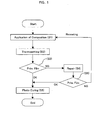
- FIG. 1 is a flowchart showing the coating process of the present invention.
- the coating composition of the present invention is applied to a substance to be coated so as to be a prescribed thickness (S1).
- the application of the coating composition may be carried out by any of the methods known in the art including, but being not restricted to, spray coating, roll coating, gravure coating, and knife coating.
- the substance on which a prescribed thickness of the coating composition has been applied is thermally treated in a heater heated at a prescribed temperature to thermally cure the thermosetting component contained in the coating composition of the present invention (primary curing) (S2).
- the heater which is used in this stage, is selected from among those well known in the art such as an oven, and an infrared heater.
- thermal treatment conditions are suitably selected depending upon the thermosetting component used in the coating composition.
- Preferred thermal treatment conditions are those where the photo curing component contained in the coating composition are not deteriorated.
- thermosetting of the thermosetting component contained in the coating composition of the present invention as described above provides a primary film formed on the surface of the substrate.
- the primary film is in the state where it is adhered on the substance in a sufficient manner and the photo curing component contained in the primary film still remains uncured.
- thermoset film is inspected (S3). If abnormality such as adhesion of dust, lacking of film (the partial peeling off of the film etc.), uneven coating or the like is not found (OK) , the stage is shifted to stage S5 to conduct a photo curing treatment. If any abnormality such as adhesion of dust is found in S3 (NG), the stage is shifted to stage S4, which is a stage for conducting a repair operation. After the repair operation, the repaired primary film coated on the substrate is again inspected in stage S6. In S6, if no abnormality is found (OK), then the stage is shifted to stage S5. If abnormality is found (NG), the stage is shifted to S1 to carry out recoating (Recoat: S1).
- repair stage S4 the primary film obtained in the thermosetting stage, which still contains the functional groups of the thermosetting component, is adhered on the substance in a sufficient manner, and repair such as removal of dust can be conducted.
- a photo curing treatment is carried out in S5.
- the substance having the primary film formed thereon in which no abnormality has been found in S3 may be stored, for example, in a dark portion, and the photo curing stage is conducted after a prescribed period.
- the photo curing can be continuously conducted, just after stage S3.
- a light source for photo curing in the photo curing stage of the present invention is not restricted as long as it irradiates a light having a wavelength for initiating the photo curing of the photo curing component contained in the coating composition of the present invention such as ultraviolet lamps, and excimer laser.
- the primary film which still contains functional groups and whose rigidity is insufficient can be hardened to a prescribed rigidity.
- a coating composition of the present invention (Sample No. 2) and comparative composition (Nos. 1, 2, and 3) were formulated using amounts of the components shown in Table 1.
- As the photo initiator Dull Cure #1173 from Specialty Chemicals Inc. was used. Unit: Parts by Weight No. 1 No. 2 No. 3 Thermosetting Component 100 75 0 Photo Curing Component 0 25 100
- Each of the coating compositions formulated as described above was coated on a soft steel plate (which had been treated with phosphoric acid, electrodeposited, surface of which had been coated with Orga P-5 (Nippon Paint Co., Ltd.,) followed by dried at 140°C for 30 minutes).
- the soft steel plate was thermally treated (at 140°C for 30 minutes) and/or photo-cured (irradiation of ultraviolet using a high-pressure mercury lamp (80 W/cm) at an irradiation distance of 10 cm at a treating rate of 3 m/minute) to form a film.
- a polishing test shown below was conducted for the resulting films in order to evaluate a repair property.
- the films obtained by the curing treatment(s) was polished, with abrasion paper (#2000 water abrasion paper from 3M Corp.) , then polished with very fine compound (hard 1 from 3M Corp.) for 45 minutes, and the coated surface was washed with water. Subsequently, the polished film was further polished with finishing compound (GX-II form Sankyo Rikagaku Corp.) for 45 minutes, and the coated surface was then washed with water.
- abrasion paper #2000 water abrasion paper from 3M Corp.
- very fine compound hard 1 from 3M Corp.
- finishing compound GX-II form Sankyo Rikagaku Corp.
- the coated surface having been polished as described above was visibly evaluated as four-point evaluation where criterion 1 means that no scar is found, criterion 2 means that shallow scars remain, criterion 3 means that deep scars remains, and criterion 4 means that scars do not disappear.
- the tolerable level in this test is criteria 1 and 2. The results are shown in Table 2.
- the film having both good repair property and good wear resistance can be obtained for the first time by two-stage curing treatment comprising the thermosetting treatment and the photo curing treatment.
- a coating composition for top coating according to the present invention comprises a thermosetting component and a photo-curing component, which forms a film through a thermosetting and a following photo curing treatment.
- the thermosetting component and the photo-curing component in the coating composition is blended in such amounts sufficient for forming a film after the thermosetting treatment to have a prescribed repair property and for forming a final film after the photo curing treatment to have a prescribed wear resistance.
Landscapes
- Application Of Or Painting With Fluid Materials (AREA)
- Paints Or Removers (AREA)
Abstract
Description
- The present invention relates to a two-component coating composition comprising a thermosetting component and photo curing component, and a coating process using the same. More specifically, the invention relates to a coating composition in which repair operation can be conducted in a painting line such as an automobile painting line at the time of top-coating, and in which the film obtained after the final curing has sufficient wear resistance, and a coating process using such a coating composition.
- In an exterior painting line such as for automobile, transparent paint excelling in wear resistance is top-coated onto a subject to be painted such as a metal plate having been surface-treated and primer-coated as a final finishing to form a clear coat.
- Examples of paints, which have been used, include paint compositions for new cars comprising, for example, melamine/alkyd resins, thermosetting acrylic resins, or urethane resins and for cars to be repaired include nitrocellulose lacquers, modified acrylic lacquers, melamine/alkyd resin for baking at a low temperature, acrylic/melamine resins, quick-drying urethane resins and urethane resins.
- In these conventional techniques, however, due to enhanced wear resistance of the film having been formed, the rigidity of the formed film becomes too high. This remains a problem in terms of the fact that repair operations conducted after the film formation of the exterior paint of automobile such as grinding of the film-defective portion and polishing for finishing can be carried out only with difficulty.
- In the exterior painting line for automobile, the repair stage is a necessary stage in terms of quality for outward appearance, and if no repair stage is conducted, the production cannot be conducted in a practical manner.
- Furthermore, if the rigidity of the final film is decreased in order to secure the repair ability, no practical wear resistance can be obtained.
- Consequently, there is a demand for a coating composition for top coating, which can give a top coat having sufficient wear resistance and repair ability after coating, and for a coating process using the same.
- We have conducted research and investigation in light of the situation associated with the prior art. As a result, it has been discovered that by applying two-stage curing comprising a thermal curing treatment and a photo curing treatment, both rigidity enough for conducting repair during the course of the coating process and the final wear resistance can be obtained. Furthermore, we have discovered that in two-component system comprising a thermosetting component and a photo component, one component acts as a diluting component (filler) for the other component in which the former component weakens the performance of the other component. Consequently, it has been found that by blending both components within a level that the characteristics of both components can be satisfied; a two-component coating composition for top coating having the characteristics of both components can be produced.
- The present invention has been made based on such a discovery.
- According to the present invention, there is provided a coating composition for top coating comprising a thermosetting component and a photo-curing component, which forms a film through a thermosetting and a following photo curing treatment; said thermosetting component and said photo-curing component being blended in such amounts sufficient for forming a film after the thermosetting treatment to have a prescribed repair property and for forming a final film after the photo curing treatment to have a prescribed wear resistance.
- A coating process according to the present invention is a process for top-coating a primer coated substance by two-stage curing consisting of a thermosetting treatment and a photo curing treatment. The process of the present invention comprises an application stage for applying the coating composition for top coating according to the present invention onto the primer-coated substance; a thermosetting stage for thermally treating the substance having said coating composition applied thereon at a temperature and for a period sufficient for thermosetting said thermosetting component to give a thermoset primary film; and a photo curing stage for irradiating a light for photo curing said photo curing component on said primary film to obtain a final film.
- In the coating process of the present invention, the primary film obtained in said thermosetting stage may be inspected, and if the primary film is found to have a defective portion, the defective portion may be repaired.
-
- FIG. 1 is a flowchart showing the coating process of the present invention.
-
- Embodiments of the present invention will now be described.
- The terms used herein are defined as follows:
- The term "prescribed repair property" intended herein means that a coat (primary film) formed after a thermosetting treatment can be repaired, typically by grinding or polishing for finish. Specifically, the primary film with the prescribed repair property is of softness sufficient for conducting repair such as grinding and polishing for finish.
- The term "prescribed wear resistance" intended herein means that the final film formed after photo curing has sufficient wear resistance.
- The term "curing" can be used in exchangeable with hardening, setting as used in this art.
- The term "photo curing component" is intended to comprise a photo curing main agent (hereinafter referred to as "photo curing ingredient") and a corresponding initiator.
- First, a coating composition (hereinafter referred to as "the composition of the present invention") according to a first aspect of the present invention will now be described.
- The composition of the present invention is composed of (a) a thermosetting component; (b) a photo curing component, and may contain any other component known in the art, such as a diluent.
- As two-component type composition comprising a thermosetting composition and a photo curing composition, WO98/00456, which is incorporated herein by reference, discloses a specific polymerizing resin including a thermosetting functional group and a polymerizing group. However, the composition disclosed therein is intended to improve rigidity and resistance to injury, and there is no disclosure for the repair property intended in the present invention.
- In the present invention, any of thermosetting resins known per se, including, but not being restricted to, urethane, thermosetting aminoalkyd and thermosetting acrylic resins, may be used as the thermosetting composition. In the thermosetting component used according to the present invention, which forms a film upon a thermal treatment at a prescribed temperature, the resulting film should have a sufficient repair property. Specifically, the thermosetting component should be incorporated in such an amount that the film formed after the thermosetting treatment and before the photo curing treatment has sufficient repair property.
- As one measurement for the repair property, pencil hardness of the film can be mentioned. According to a preferred embodiment of the present invention, the pencil hardness of the film obtained by thermosetting is not less than 6B, preferably from B to H. The pencil hardness bellow 6B is not preferable in terms of workability, i.e., the film is of poor adhesion to the substance to be coated. Conversely, if the film has pencil hardness greater than H makes, it can be repaired only with difficulty.
- The photo curing component intended herein is a component which is cured by the irradiation of a light with a prescribed wavelength, and comprises a photo-polymerizing oligomer [main polymerizing agent (photo curing ingredient) including a monomer in a broadest meaning), a reactive diluent, and a photoinitiator as main ingredients, and optionally comprising a reactive agent, an additive, and a colorant. The photo curing component can be classified into two types depending upon the reaction mechanisms. One type of the photo curing component is cured by a radical polymerization reaction. Another is cured by a cathion polymerization.
- The radical polymerization types include, but are not restricted to, resins or oligomers containing acryloyl group and/or vinyl group as a functional group. The cathion polymerization types include, but are not restricted to, resins or oligomers containing epoxy group and/or vinyl ether group as a functional group.
- Also, depending upon the kinds of the photo polymerizing oligomer (photo curing ingredient) , the photo curing component can be roughly divided into (1) urethane/acrylate components; (2) epoxy/acrylate components; (3) ester/acrylate components; (4) acrylate components; (5) epoxy components; (6) vinyl ether component; and (7) oxethane components. Types (1) to (4) are components which are cured through a radical polymerization reaction, and types (5) to 7 are cured through a cathion polymerization reaction.
- In the present invention, any of photo curing components suitably selected from these components can be used.
- The purpose of adding this component is that the film having been cured by the thermosetting is further hardened to a prescribed hardness. Consequently, this component is incorporated in such an amount that the resulting final film has prescribed wear resistance.
- Photo initiator making up the photo curing component is a polymerization initiator corresponding to the kind of the photo curing component (main agent) selected. Typical radical polymerization initiators include azo compounds and typical cathion polymerization initiators includes iodide salts and sulfonium salts.
- The solvents, which may be used in the present invention, are not specifically restricted as long as they can dissolve both curing components to be a specific viscosity.
- Any of known additives can be added to the component of the present invention as long as they impair the effects and functions of the present invention.
- In the present invention, care should be taken to the reactivity of two components, particularly, the deterioration of the photo curing component at the time of thermosetting the coating composition of the present invention. Specifically, it is required to set conditions where the photo curing component is not deteriorated at the time of the coating composition of the present invention is thermoset. These conditions can be determined by previous experiments (see Examples, which will be described later on).
- Substances to be coated (substrate) applicable to the coating composition of the present invention are not specifically restricted, as long as they are not modified under the coating conditions of the present invention (i.e., the thermosetting treatment and photo curing treatment). In particular, the coating composition of the present invention can be applied to an automobile part. Typical examples of the substances to be coated include, but are not restricted to, metal plates such as various steel plates, aluminum (alloy) plates, magnesium (alloy) plates; and heat resistant plastics.
- In a preferred embodiment of the present invention, the substance to be treated is an automobile part. In the automobile part, the film requires a repair property during the course of painting process, and the final film also requires a prescribed wear resistance which can withstand repeatedly car washing. In the present invention, when the coating is applied to an automobile part, parts for new car and parts, which requires recoating due to accident or such are included in the automobile parts.
- Next, the coating process of the present invention will now be described by referring to FIG. 1. FIG. 1 is a flowchart showing the coating process of the present invention.
- In the present invention, the coating composition of the present invention is applied to a substance to be coated so as to be a prescribed thickness (S1).
- The application of the coating composition may be carried out by any of the methods known in the art including, but being not restricted to, spray coating, roll coating, gravure coating, and knife coating.
- Subsequently, the substance on which a prescribed thickness of the coating composition has been applied is thermally treated in a heater heated at a prescribed temperature to thermally cure the thermosetting component contained in the coating composition of the present invention (primary curing) (S2). The heater, which is used in this stage, is selected from among those well known in the art such as an oven, and an infrared heater.
- The thermal treatment conditions are suitably selected depending upon the thermosetting component used in the coating composition. Preferred thermal treatment conditions are those where the photo curing component contained in the coating composition are not deteriorated.
- The thermosetting of the thermosetting component contained in the coating composition of the present invention as described above provides a primary film formed on the surface of the substrate. The primary film is in the state where it is adhered on the substance in a sufficient manner and the photo curing component contained in the primary film still remains uncured.
- In the next stage, the surface of thermoset film is inspected (S3). If abnormality such as adhesion of dust, lacking of film (the partial peeling off of the film etc.), uneven coating or the like is not found (OK) , the stage is shifted to stage S5 to conduct a photo curing treatment. If any abnormality such as adhesion of dust is found in S3 (NG), the stage is shifted to stage S4, which is a stage for conducting a repair operation. After the repair operation, the repaired primary film coated on the substrate is again inspected in stage S6. In S6, if no abnormality is found (OK), then the stage is shifted to stage S5. If abnormality is found (NG), the stage is shifted to S1 to carry out recoating (Recoat: S1).
- In repair stage S4 according to the present invention, the primary film obtained in the thermosetting stage, which still contains the functional groups of the thermosetting component, is adhered on the substance in a sufficient manner, and repair such as removal of dust can be conducted.
- On the other hand, if no abnormality is found in S3 (OK), a photo curing treatment is carried out in S5. In this case, the substance having the primary film formed thereon in which no abnormality has been found in S3 may be stored, for example, in a dark portion, and the photo curing stage is conducted after a prescribed period. Alternatively, the photo curing can be continuously conducted, just after stage S3.
- A light source for photo curing in the photo curing stage of the present invention is not restricted as long as it irradiates a light having a wavelength for initiating the photo curing of the photo curing component contained in the coating composition of the present invention such as ultraviolet lamps, and excimer laser.
- As described above, by the photo curing treatment, the primary film which still contains functional groups and whose rigidity is insufficient can be hardened to a prescribed rigidity.
- The present invention will be described by the working examples and comparative examples. However, it should be noted that the present invention is not restricted to the working examples.
- A coating composition of the present invention (Sample No. 2) and comparative composition (Nos. 1, 2, and 3) were formulated using amounts of the components shown in Table 1. As the photo initiator, Dull Cure #1173 from Specialty Chemicals Inc. was used.
Unit: Parts by Weight No. 1 No. 2 No. 3 Thermosetting Component 100 75 0 Photo Curing Component 0 25 100 - Each of the coating compositions formulated as described above was coated on a soft steel plate (which had been treated with phosphoric acid, electrodeposited, surface of which had been coated with Orga P-5 (Nippon Paint Co., Ltd.,) followed by dried at 140°C for 30 minutes). The soft steel plate was thermally treated (at 140°C for 30 minutes) and/or photo-cured (irradiation of ultraviolet using a high-pressure mercury lamp (80 W/cm) at an irradiation distance of 10 cm at a treating rate of 3 m/minute) to form a film.
- A polishing test shown below was conducted for the resulting films in order to evaluate a repair property.
- The films obtained by the curing treatment(s) was polished, with abrasion paper (#2000 water abrasion paper from 3M Corp.) , then polished with very fine compound (hard 1 from 3M Corp.) for 45 minutes, and the coated surface was washed with water. Subsequently, the polished film was further polished with finishing compound (GX-II form Sankyo Rikagaku Corp.) for 45 minutes, and the coated surface was then washed with water.
- The coated surface having been polished as described above was visibly evaluated as four-point evaluation where criterion 1 means that no scar is found, criterion 2 means that shallow scars remain, criterion 3 means that deep scars remains, and criterion 4 means that scars do not disappear. The tolerable level in this test is criteria 1 and 2. The results are shown in Table 2.
- Subsequently, in order to evaluate wear resistance, the evaluation for abrasion through car washing was conducted as follows:
- (1) An aqueous solution each containing 20 parts by weight of three types of test powders defined according to JIS Z 8901 was thoroughly mixed, and was applied on the coated surface in an amount of 100 ml per 1 m2, followed by drying.
- (2) Subsequently, the coated surface having the dust adhered thereon was placed in an automatic car washer, and the automatic car washer was rotated 40 times.
- (3) After operations (1) and (2) were carried out twice, the
four-point evaluation was visibly made in which criterion 1
means that noticeable washing scars cannot be found, criterion
2 means that slight washing scars can be found, criterion 3 means
that noticeable washing scars can be found, and criterion 4
means that remarkably noticeable washing scars can be found.
The tolerable level in this test is criteria 1 and 2. The
results are shown in Table 2.
Curing Treatments and Test Results Test No. A B C D Sample No. 1 2 2 3 Thermosetting Yes Yes Yes No Photo Curing No No No Yes Polishing Test 1 2 4 4 Evaluation for Car Washing 3 3 2 1 Note Primary Film Final Film -
- It can be understood from FIG. 2 that in the case where the coating composition of the present invention (Sample No. 2) was used to only conduct the thermosetting treatment (Test No. B: Primary Film), the primary film formed has well repair property. Also, it has been proven that when the primary film was further subjected to photo curing treatment (Test No. C: Final Film), the final film obtained has sufficient wear resistance.
- In contrast, in the case where only the thermosetting treatment is carried out (Test No. A), the resultant film has well repair ability, but has insufficient wear resistance. Also, in the case where only the photo curing treatment was conducted (Test No. D) , the resultant film has sufficient wear resistance but has poor repair ability.
- Consequently, it can be concluded that the film having both good repair property and good wear resistance can be obtained for the first time by two-stage curing treatment comprising the thermosetting treatment and the photo curing treatment.
- A coating composition for top coating according to the present invention comprises a thermosetting component and a photo-curing component, which forms a film through a thermosetting and a following photo curing treatment. The thermosetting component and the photo-curing component in the coating composition is blended in such amounts sufficient for forming a film after the thermosetting treatment to have a prescribed repair property and for forming a final film after the photo curing treatment to have a prescribed wear resistance.
Claims (8)
- A coating composition for top coating comprising a thermosetting component and a photo-curing component, which forms a film through a thermosetting treatment and a following photo curing treatment; said thermosetting component and a photo curing component being blended in such amounts sufficient for forming a film after said thermosetting treatment to have a prescribed repair property and for forming a final film after said photo curing treatment to have a prescribed wear resistance.
- The coating process as claimed in Claim 1, wherein said thermosetting component is selected from urethane, thermosetting aminoalkyd or thermosetting acrylic resins.
- The coating process as claimed in Claim 1, wherein said photo curing component comprises a photo curing specie selected from among an urethane/acrylate component, an epoxy/acrylate component, an ester/acrylate component, an acrylate component, an epoxy component, a vinyl ether component, or an oxethane component; and an initiator.
- A coating process for top-coating a primer coated substance by two-stage curing consisting of a thermosetting treatment and a photo curing treatment, which comprises:an application stage for applying the coating composition for top coating comprising a thermosetting component and a photo-curing component, which forms a film through thermosetting and the following photo-curing; said thermosetting component and a photo-curing component being blended in such amounts sufficient for forming a film after thermosetting to have a prescribed repair property and for forming a final film after photo-curing to have a prescribed wear resistance onto the primer-coated substance;a thermosetting stage for thermally treating the substance having said coating composition applied thereon at a temperature and for a period sufficient for thermosetting said thermosetting component to give a thermoset primary film; anda photo curing stage for irradiating a light for photo curing said photo curing component on said primary film to obtain a final film.
- The coating process as claimed in Claim 4, wherein said primary is formed so that the pencil hardness thereof becomes from 6B to H.
- The coating process as claimed in Claim 4, wherein the primary film obtained in said thermosetting stage is inspected, and if the primary film is found to have a defective portion, the defective portion is repaired.
- The coating process as claimed in Claim 5, wherein the primary film obtained in said thermosetting stage is inspected, and if the primary film is found to have a defective portion, the defective portion is repaired.
- The coating process as claimed in any one of claims 5 to 7, wherein said substance is an automobile part.
Applications Claiming Priority (2)
| Application Number | Priority Date | Filing Date | Title |
|---|---|---|---|
| JP2002097478A JP2003290707A (en) | 2002-03-29 | 2002-03-29 | Thermosetting / photosetting two-component coating composition and coating method using the same |
| JP2002097478 | 2002-03-29 |
Publications (2)
| Publication Number | Publication Date |
|---|---|
| EP1348746A1 true EP1348746A1 (en) | 2003-10-01 |
| EP1348746B1 EP1348746B1 (en) | 2006-07-19 |
Family
ID=27800576
Family Applications (1)
| Application Number | Title | Priority Date | Filing Date |
|---|---|---|---|
| EP03006947A Revoked EP1348746B1 (en) | 2002-03-29 | 2003-03-26 | Two-component coating composition and coating process using the same |
Country Status (4)
| Country | Link |
|---|---|
| US (1) | US20030187087A1 (en) |
| EP (1) | EP1348746B1 (en) |
| JP (1) | JP2003290707A (en) |
| DE (1) | DE60306831T2 (en) |
Cited By (1)
| Publication number | Priority date | Publication date | Assignee | Title |
|---|---|---|---|---|
| EP1445035A3 (en) * | 2003-02-04 | 2005-03-02 | Ford Global Technologies, LLC | A photocurable composition and a method of applying same |
Families Citing this family (3)
| Publication number | Priority date | Publication date | Assignee | Title |
|---|---|---|---|---|
| DE102004044534B4 (en) * | 2004-07-01 | 2006-05-11 | Daimlerchrysler Ag | Method for curing paints |
| BRPI0901335A2 (en) * | 2009-04-30 | 2011-01-04 | Companhia Nitro Quimica Brasileira | process of obtaining cured thermoset polymeric compounds |
| EP2394746A1 (en) * | 2010-06-14 | 2011-12-14 | Saint-Gobain Glass France | Method for flood coating a polymeric material |
Citations (2)
| Publication number | Priority date | Publication date | Assignee | Title |
|---|---|---|---|---|
| JPH0368475A (en) * | 1989-08-07 | 1991-03-25 | Kansai Paint Co Ltd | Formation of coating film |
| JPH07126554A (en) * | 1993-11-05 | 1995-05-16 | Dainippon Ink & Chem Inc | Resin composition for powder coating |
Family Cites Families (2)
| Publication number | Priority date | Publication date | Assignee | Title |
|---|---|---|---|---|
| DE19924674C2 (en) * | 1999-05-29 | 2001-06-28 | Basf Coatings Ag | Coating material curable thermally and with actinic radiation and its use |
| US6326059B1 (en) * | 2000-08-07 | 2001-12-04 | E.I. Du Pont De Nemours And Company | Two-stage cure coating compositions |
-
2002
- 2002-03-29 JP JP2002097478A patent/JP2003290707A/en active Pending
-
2003
- 2003-03-26 EP EP03006947A patent/EP1348746B1/en not_active Revoked
- 2003-03-26 US US10/396,570 patent/US20030187087A1/en not_active Abandoned
- 2003-03-26 DE DE60306831T patent/DE60306831T2/en not_active Expired - Fee Related
Patent Citations (2)
| Publication number | Priority date | Publication date | Assignee | Title |
|---|---|---|---|---|
| JPH0368475A (en) * | 1989-08-07 | 1991-03-25 | Kansai Paint Co Ltd | Formation of coating film |
| JPH07126554A (en) * | 1993-11-05 | 1995-05-16 | Dainippon Ink & Chem Inc | Resin composition for powder coating |
Non-Patent Citations (2)
| Title |
|---|
| DATABASE CA [online] CHEMICAL ABSTRACTS SERVICE, COLUMBUS, OHIO, US; SAKAGAMI, MASAYUKI ET AL: "Solvent- and scratch-resistant powder coating compositions for smooth-surfaced coatings with good adhesion", XP002243450, retrieved from STN Database accession no. 123:115661 CA * |
| DATABASE WPI Section Ch Week 199118, Derwent World Patents Index; Class A14, AN 1991-129078, XP002243451 * |
Cited By (3)
| Publication number | Priority date | Publication date | Assignee | Title |
|---|---|---|---|---|
| EP1445035A3 (en) * | 2003-02-04 | 2005-03-02 | Ford Global Technologies, LLC | A photocurable composition and a method of applying same |
| US6908644B2 (en) | 2003-02-04 | 2005-06-21 | Ford Global Technologies, Llc | Clearcoat insitu rheology control via UV cured oligomeric additive network system |
| US7632547B2 (en) | 2003-02-04 | 2009-12-15 | Ford Global Technologies, Llc | Clearcoat insitu rheology control via UV cured oligomeric additive network system |
Also Published As
| Publication number | Publication date |
|---|---|
| EP1348746B1 (en) | 2006-07-19 |
| JP2003290707A (en) | 2003-10-14 |
| DE60306831D1 (en) | 2006-08-31 |
| US20030187087A1 (en) | 2003-10-02 |
| DE60306831T2 (en) | 2006-11-23 |
Similar Documents
| Publication | Publication Date | Title |
|---|---|---|
| CN100413601C (en) | coating composition | |
| US6617370B2 (en) | Method for repairing the coated surface of a vehicle | |
| JP3282881B2 (en) | Method for producing overcoat lacquer coating | |
| JP5133481B2 (en) | Repair painting method | |
| WO2005044472A1 (en) | Coating composition curable with ultraviolet radiation | |
| JP5913429B2 (en) | Electrodeposition coating composition, electrodeposition coating method, and fluorine-containing coating film | |
| US6541076B2 (en) | Method of priming SMC parts | |
| EP1348746B1 (en) | Two-component coating composition and coating process using the same | |
| JP2002194013A (en) | Energy ray-curable resin composition and coating film forming method | |
| JP2011256378A (en) | Active energy ray-curable coating composition for pre-coated metal and method for manufacturing pre-coated metal using the composition | |
| JP4160459B2 (en) | Method for forming cured coating film | |
| DE10392212B4 (en) | A method of forming a coating film on a vehicle body | |
| CN1820056A (en) | Chemical composition and method for polymerisation thereof for use on vehicle bodywork repair | |
| JP2010501662A (en) | UV curable putty composition | |
| JPH05161869A (en) | Method for forming paint film | |
| JP4921252B2 (en) | Repair film formation method | |
| JP2002282784A (en) | Film forming method and substrate | |
| KR102835591B1 (en) | Electric Vehicle Repair Painting Method Using LED Clear Coat | |
| KR102835595B1 (en) | Electric Vehicle Partial Repair Painting Method Using LED Blending | |
| JP2005034688A (en) | Method for forming cured coating film | |
| JP2004051749A (en) | Photocurable resin coating composition and cured coated film | |
| JPS5821669B2 (en) | UV-curable steel plate pre-treatment paint with good topcoat adhesion | |
| JP2022180115A (en) | Aqueous coating composition and method for manufacturing coated article | |
| JP2003275676A (en) | Repair method and substrate for automotive coatings | |
| JP2002282782A (en) | Film forming method and substrate |
Legal Events
| Date | Code | Title | Description |
|---|---|---|---|
| PUAI | Public reference made under article 153(3) epc to a published international application that has entered the european phase |
Free format text: ORIGINAL CODE: 0009012 |
|
| AK | Designated contracting states |
Kind code of ref document: A1 Designated state(s): AT BE BG CH CY CZ DE DK EE ES FI FR GB GR HU IE IT LI LU MC NL PT RO SE SI SK TR |
|
| AX | Request for extension of the european patent |
Extension state: AL LT LV MK |
|
| 17P | Request for examination filed |
Effective date: 20030926 |
|
| AKX | Designation fees paid |
Designated state(s): DE GB |
|
| 17Q | First examination report despatched |
Effective date: 20050401 |
|
| GRAP | Despatch of communication of intention to grant a patent |
Free format text: ORIGINAL CODE: EPIDOSNIGR1 |
|
| GRAS | Grant fee paid |
Free format text: ORIGINAL CODE: EPIDOSNIGR3 |
|
| GRAA | (expected) grant |
Free format text: ORIGINAL CODE: 0009210 |
|
| AK | Designated contracting states |
Kind code of ref document: B1 Designated state(s): DE GB |
|
| REG | Reference to a national code |
Ref country code: GB Ref legal event code: FG4D |
|
| REF | Corresponds to: |
Ref document number: 60306831 Country of ref document: DE Date of ref document: 20060831 Kind code of ref document: P |
|
| PGFP | Annual fee paid to national office [announced via postgrant information from national office to epo] |
Ref country code: GB Payment date: 20070321 Year of fee payment: 5 |
|
| PGFP | Annual fee paid to national office [announced via postgrant information from national office to epo] |
Ref country code: DE Payment date: 20070322 Year of fee payment: 5 |
|
| PLBI | Opposition filed |
Free format text: ORIGINAL CODE: 0009260 |
|
| PLAX | Notice of opposition and request to file observation + time limit sent |
Free format text: ORIGINAL CODE: EPIDOSNOBS2 |
|
| 26 | Opposition filed |
Opponent name: AKZO NOBEL COATINGS INTERNATIONAL BV Effective date: 20070410 |
|
| GBPC | Gb: european patent ceased through non-payment of renewal fee |
Effective date: 20080326 |
|
| RDAD | Information modified related to despatch of communication that patent is revoked |
Free format text: ORIGINAL CODE: EPIDOSCREV1 |
|
| RDAF | Communication despatched that patent is revoked |
Free format text: ORIGINAL CODE: EPIDOSNREV1 |
|
| PG25 | Lapsed in a contracting state [announced via postgrant information from national office to epo] |
Ref country code: DE Free format text: LAPSE BECAUSE OF NON-PAYMENT OF DUE FEES Effective date: 20081001 |
|
| RDAG | Patent revoked |
Free format text: ORIGINAL CODE: 0009271 |
|
| STAA | Information on the status of an ep patent application or granted ep patent |
Free format text: STATUS: PATENT REVOKED |
|
| 27W | Patent revoked |
Effective date: 20090102 |
|
| PG25 | Lapsed in a contracting state [announced via postgrant information from national office to epo] |
Ref country code: GB Free format text: LAPSE BECAUSE OF NON-PAYMENT OF DUE FEES Effective date: 20080326 |