EP1348456A1 - Poche et procédé de défibrination utilisant un élément textile - Google Patents
Poche et procédé de défibrination utilisant un élément textile Download PDFInfo
- Publication number
- EP1348456A1 EP1348456A1 EP20030290650 EP03290650A EP1348456A1 EP 1348456 A1 EP1348456 A1 EP 1348456A1 EP 20030290650 EP20030290650 EP 20030290650 EP 03290650 A EP03290650 A EP 03290650A EP 1348456 A1 EP1348456 A1 EP 1348456A1
- Authority
- EP
- European Patent Office
- Prior art keywords
- fluid
- blood
- bag
- textile element
- Prior art date
- Legal status (The legal status is an assumption and is not a legal conclusion. Google has not performed a legal analysis and makes no representation as to the accuracy of the status listed.)
- Granted
Links
- 239000004753 textile Substances 0.000 title claims abstract description 41
- 238000000034 method Methods 0.000 title claims abstract description 19
- 210000004369 blood Anatomy 0.000 claims abstract description 62
- 239000008280 blood Substances 0.000 claims abstract description 62
- 239000012530 fluid Substances 0.000 claims abstract description 46
- 102000009123 Fibrin Human genes 0.000 claims abstract description 31
- 108010073385 Fibrin Proteins 0.000 claims abstract description 31
- BWGVNKXGVNDBDI-UHFFFAOYSA-N Fibrin monomer Chemical compound CNC(=O)CNC(=O)CN BWGVNKXGVNDBDI-UHFFFAOYSA-N 0.000 claims abstract description 31
- 229950003499 fibrin Drugs 0.000 claims abstract description 31
- 210000002381 plasma Anatomy 0.000 claims abstract description 15
- 239000013060 biological fluid Substances 0.000 claims abstract description 12
- 210000002966 serum Anatomy 0.000 claims description 26
- 238000005070 sampling Methods 0.000 claims description 8
- 239000003146 anticoagulant agent Substances 0.000 claims description 7
- 229940127219 anticoagulant drug Drugs 0.000 claims description 7
- 238000013019 agitation Methods 0.000 claims description 5
- 229920000728 polyester Polymers 0.000 claims description 4
- -1 polyethylene Polymers 0.000 claims description 4
- 239000000463 material Substances 0.000 claims description 3
- 229920000642 polymer Polymers 0.000 claims description 3
- 229920002635 polyurethane Polymers 0.000 claims description 3
- 239000004814 polyurethane Substances 0.000 claims description 3
- 239000004952 Polyamide Substances 0.000 claims description 2
- 239000004698 Polyethylene Substances 0.000 claims description 2
- 239000004743 Polypropylene Substances 0.000 claims description 2
- 230000001413 cellular effect Effects 0.000 claims description 2
- 229920001577 copolymer Polymers 0.000 claims description 2
- 239000004744 fabric Substances 0.000 claims description 2
- 229920002457 flexible plastic Polymers 0.000 claims description 2
- 229920002647 polyamide Polymers 0.000 claims description 2
- 229920000573 polyethylene Polymers 0.000 claims description 2
- 229920001155 polypropylene Polymers 0.000 claims description 2
- 238000000926 separation method Methods 0.000 claims description 2
- 239000002759 woven fabric Substances 0.000 claims description 2
- 239000004745 nonwoven fabric Substances 0.000 claims 1
- 230000023555 blood coagulation Effects 0.000 description 5
- 238000005119 centrifugation Methods 0.000 description 3
- 239000011243 crosslinked material Substances 0.000 description 3
- 239000004033 plastic Substances 0.000 description 3
- 229920003023 plastic Polymers 0.000 description 3
- IJRKANNOPXMZSG-SSPAHAAFSA-N 2-hydroxypropane-1,2,3-tricarboxylic acid;(2r,3s,4r,5r)-2,3,4,5,6-pentahydroxyhexanal Chemical compound OC[C@@H](O)[C@@H](O)[C@H](O)[C@@H](O)C=O.OC(=O)CC(O)(C(O)=O)CC(O)=O IJRKANNOPXMZSG-SSPAHAAFSA-N 0.000 description 2
- RSGFPIWWSCWCFJ-VAXZQHAWSA-N 2-hydroxypropane-1,2,3-tricarboxylic acid;(2r,3s,4r,5r)-2,3,4,5,6-pentahydroxyhexanal;phosphoric acid Chemical compound OP(O)(O)=O.OC[C@@H](O)[C@@H](O)[C@H](O)[C@@H](O)C=O.OC(=O)CC(O)(C(O)=O)CC(O)=O RSGFPIWWSCWCFJ-VAXZQHAWSA-N 0.000 description 2
- 108010049003 Fibrinogen Proteins 0.000 description 2
- 102000008946 Fibrinogen Human genes 0.000 description 2
- 241001465754 Metazoa Species 0.000 description 2
- 241001494479 Pecora Species 0.000 description 2
- 108090000190 Thrombin Proteins 0.000 description 2
- 239000011324 bead Substances 0.000 description 2
- 230000015572 biosynthetic process Effects 0.000 description 2
- 239000003153 chemical reaction reagent Substances 0.000 description 2
- 230000015271 coagulation Effects 0.000 description 2
- 238000005345 coagulation Methods 0.000 description 2
- 238000004891 communication Methods 0.000 description 2
- 238000010908 decantation Methods 0.000 description 2
- 229940012952 fibrinogen Drugs 0.000 description 2
- 230000014759 maintenance of location Effects 0.000 description 2
- 238000004519 manufacturing process Methods 0.000 description 2
- 239000011148 porous material Substances 0.000 description 2
- 238000002360 preparation method Methods 0.000 description 2
- 229960004072 thrombin Drugs 0.000 description 2
- 241000283690 Bos taurus Species 0.000 description 1
- BHPQYMZQTOCNFJ-UHFFFAOYSA-N Calcium cation Chemical compound [Ca+2] BHPQYMZQTOCNFJ-UHFFFAOYSA-N 0.000 description 1
- 241000282465 Canis Species 0.000 description 1
- 241000283086 Equidae Species 0.000 description 1
- 241000282324 Felis Species 0.000 description 1
- 239000004677 Nylon Substances 0.000 description 1
- 241000282887 Suidae Species 0.000 description 1
- 208000007536 Thrombosis Diseases 0.000 description 1
- 230000001580 bacterial effect Effects 0.000 description 1
- 230000000903 blocking effect Effects 0.000 description 1
- 210000000601 blood cell Anatomy 0.000 description 1
- 229910001424 calcium ion Inorganic materials 0.000 description 1
- 210000004027 cell Anatomy 0.000 description 1
- 238000004113 cell culture Methods 0.000 description 1
- 238000006243 chemical reaction Methods 0.000 description 1
- 230000000536 complexating effect Effects 0.000 description 1
- 238000011109 contamination Methods 0.000 description 1
- 230000008030 elimination Effects 0.000 description 1
- 238000003379 elimination reaction Methods 0.000 description 1
- 210000003743 erythrocyte Anatomy 0.000 description 1
- 239000005038 ethylene vinyl acetate Substances 0.000 description 1
- 239000000835 fiber Substances 0.000 description 1
- 238000001914 filtration Methods 0.000 description 1
- 229920001778 nylon Polymers 0.000 description 1
- 230000035515 penetration Effects 0.000 description 1
- 229920000098 polyolefin Polymers 0.000 description 1
- 229920000915 polyvinyl chloride Polymers 0.000 description 1
- 102000004169 proteins and genes Human genes 0.000 description 1
- 108090000623 proteins and genes Proteins 0.000 description 1
- 238000011084 recovery Methods 0.000 description 1
- 239000000126 substance Substances 0.000 description 1
- 239000006228 supernatant Substances 0.000 description 1
- 238000011282 treatment Methods 0.000 description 1
- 238000003466 welding Methods 0.000 description 1
Images



Classifications
-
- A—HUMAN NECESSITIES
- A61—MEDICAL OR VETERINARY SCIENCE; HYGIENE
- A61M—DEVICES FOR INTRODUCING MEDIA INTO, OR ONTO, THE BODY; DEVICES FOR TRANSDUCING BODY MEDIA OR FOR TAKING MEDIA FROM THE BODY; DEVICES FOR PRODUCING OR ENDING SLEEP OR STUPOR
- A61M1/00—Suction or pumping devices for medical purposes; Devices for carrying-off, for treatment of, or for carrying-over, body-liquids; Drainage systems
- A61M1/02—Blood transfusion apparatus
- A61M1/0209—Multiple bag systems for separating or storing blood components
-
- A—HUMAN NECESSITIES
- A61—MEDICAL OR VETERINARY SCIENCE; HYGIENE
- A61J—CONTAINERS SPECIALLY ADAPTED FOR MEDICAL OR PHARMACEUTICAL PURPOSES; DEVICES OR METHODS SPECIALLY ADAPTED FOR BRINGING PHARMACEUTICAL PRODUCTS INTO PARTICULAR PHYSICAL OR ADMINISTERING FORMS; DEVICES FOR ADMINISTERING FOOD OR MEDICINES ORALLY; BABY COMFORTERS; DEVICES FOR RECEIVING SPITTLE
- A61J1/00—Containers specially adapted for medical or pharmaceutical purposes
- A61J1/05—Containers specially adapted for medical or pharmaceutical purposes for collecting, storing or administering blood, plasma or medical fluids ; Infusion or perfusion containers
- A61J1/10—Bag-type containers
-
- A—HUMAN NECESSITIES
- A61—MEDICAL OR VETERINARY SCIENCE; HYGIENE
- A61J—CONTAINERS SPECIALLY ADAPTED FOR MEDICAL OR PHARMACEUTICAL PURPOSES; DEVICES OR METHODS SPECIALLY ADAPTED FOR BRINGING PHARMACEUTICAL PRODUCTS INTO PARTICULAR PHYSICAL OR ADMINISTERING FORMS; DEVICES FOR ADMINISTERING FOOD OR MEDICINES ORALLY; BABY COMFORTERS; DEVICES FOR RECEIVING SPITTLE
- A61J1/00—Containers specially adapted for medical or pharmaceutical purposes
- A61J1/14—Details; Accessories therefor
- A61J1/1475—Inlet or outlet ports
- A61J1/1487—Inlet or outlet ports with friction fit, e.g. connecting tubes directly to a protruding port
-
- A—HUMAN NECESSITIES
- A61—MEDICAL OR VETERINARY SCIENCE; HYGIENE
- A61M—DEVICES FOR INTRODUCING MEDIA INTO, OR ONTO, THE BODY; DEVICES FOR TRANSDUCING BODY MEDIA OR FOR TAKING MEDIA FROM THE BODY; DEVICES FOR PRODUCING OR ENDING SLEEP OR STUPOR
- A61M1/00—Suction or pumping devices for medical purposes; Devices for carrying-off, for treatment of, or for carrying-over, body-liquids; Drainage systems
- A61M1/02—Blood transfusion apparatus
- A61M1/0204—Blood stirrers, e.g. for defibrination
-
- A—HUMAN NECESSITIES
- A61—MEDICAL OR VETERINARY SCIENCE; HYGIENE
- A61M—DEVICES FOR INTRODUCING MEDIA INTO, OR ONTO, THE BODY; DEVICES FOR TRANSDUCING BODY MEDIA OR FOR TAKING MEDIA FROM THE BODY; DEVICES FOR PRODUCING OR ENDING SLEEP OR STUPOR
- A61M1/00—Suction or pumping devices for medical purposes; Devices for carrying-off, for treatment of, or for carrying-over, body-liquids; Drainage systems
- A61M1/02—Blood transfusion apparatus
- A61M1/0209—Multiple bag systems for separating or storing blood components
- A61M1/0218—Multiple bag systems for separating or storing blood components with filters
-
- A—HUMAN NECESSITIES
- A61—MEDICAL OR VETERINARY SCIENCE; HYGIENE
- A61M—DEVICES FOR INTRODUCING MEDIA INTO, OR ONTO, THE BODY; DEVICES FOR TRANSDUCING BODY MEDIA OR FOR TAKING MEDIA FROM THE BODY; DEVICES FOR PRODUCING OR ENDING SLEEP OR STUPOR
- A61M1/00—Suction or pumping devices for medical purposes; Devices for carrying-off, for treatment of, or for carrying-over, body-liquids; Drainage systems
- A61M1/36—Other treatment of blood in a by-pass of the natural circulatory system, e.g. temperature adaptation, irradiation ; Extra-corporeal blood circuits
- A61M1/3621—Extra-corporeal blood circuits
- A61M1/3627—Degassing devices; Buffer reservoirs; Drip chambers; Blood filters
- A61M1/3633—Blood component filters, e.g. leukocyte filters
- A61M1/3635—Constructional details
- A61M1/3636—Constructional details having a flexible housing
-
- A—HUMAN NECESSITIES
- A61—MEDICAL OR VETERINARY SCIENCE; HYGIENE
- A61M—DEVICES FOR INTRODUCING MEDIA INTO, OR ONTO, THE BODY; DEVICES FOR TRANSDUCING BODY MEDIA OR FOR TAKING MEDIA FROM THE BODY; DEVICES FOR PRODUCING OR ENDING SLEEP OR STUPOR
- A61M1/00—Suction or pumping devices for medical purposes; Devices for carrying-off, for treatment of, or for carrying-over, body-liquids; Drainage systems
- A61M1/36—Other treatment of blood in a by-pass of the natural circulatory system, e.g. temperature adaptation, irradiation ; Extra-corporeal blood circuits
- A61M1/3672—Means preventing coagulation
-
- A—HUMAN NECESSITIES
- A61—MEDICAL OR VETERINARY SCIENCE; HYGIENE
- A61J—CONTAINERS SPECIALLY ADAPTED FOR MEDICAL OR PHARMACEUTICAL PURPOSES; DEVICES OR METHODS SPECIALLY ADAPTED FOR BRINGING PHARMACEUTICAL PRODUCTS INTO PARTICULAR PHYSICAL OR ADMINISTERING FORMS; DEVICES FOR ADMINISTERING FOOD OR MEDICINES ORALLY; BABY COMFORTERS; DEVICES FOR RECEIVING SPITTLE
- A61J1/00—Containers specially adapted for medical or pharmaceutical purposes
- A61J1/14—Details; Accessories therefor
- A61J1/1468—Containers characterised by specific material properties
-
- A—HUMAN NECESSITIES
- A61—MEDICAL OR VETERINARY SCIENCE; HYGIENE
- A61M—DEVICES FOR INTRODUCING MEDIA INTO, OR ONTO, THE BODY; DEVICES FOR TRANSDUCING BODY MEDIA OR FOR TAKING MEDIA FROM THE BODY; DEVICES FOR PRODUCING OR ENDING SLEEP OR STUPOR
- A61M1/00—Suction or pumping devices for medical purposes; Devices for carrying-off, for treatment of, or for carrying-over, body-liquids; Drainage systems
- A61M1/02—Blood transfusion apparatus
- A61M1/025—Means for agitating or shaking blood containers
-
- A—HUMAN NECESSITIES
- A61—MEDICAL OR VETERINARY SCIENCE; HYGIENE
- A61M—DEVICES FOR INTRODUCING MEDIA INTO, OR ONTO, THE BODY; DEVICES FOR TRANSDUCING BODY MEDIA OR FOR TAKING MEDIA FROM THE BODY; DEVICES FOR PRODUCING OR ENDING SLEEP OR STUPOR
- A61M1/00—Suction or pumping devices for medical purposes; Devices for carrying-off, for treatment of, or for carrying-over, body-liquids; Drainage systems
- A61M1/36—Other treatment of blood in a by-pass of the natural circulatory system, e.g. temperature adaptation, irradiation ; Extra-corporeal blood circuits
- A61M1/3679—Other treatment of blood in a by-pass of the natural circulatory system, e.g. temperature adaptation, irradiation ; Extra-corporeal blood circuits by absorption
-
- A—HUMAN NECESSITIES
- A61—MEDICAL OR VETERINARY SCIENCE; HYGIENE
- A61M—DEVICES FOR INTRODUCING MEDIA INTO, OR ONTO, THE BODY; DEVICES FOR TRANSDUCING BODY MEDIA OR FOR TAKING MEDIA FROM THE BODY; DEVICES FOR PRODUCING OR ENDING SLEEP OR STUPOR
- A61M2202/00—Special media to be introduced, removed or treated
- A61M2202/04—Liquids
- A61M2202/0413—Blood
- A61M2202/0445—Proteins
- A61M2202/0447—Glycoproteins
- A61M2202/0449—Fibrinogen, also called factor 1
Definitions
- the invention relates to a bag for defibrinating a fluid.
- biological system a bag system comprising such a bag, methods of defibrination as well as the use of a textile element for the defibrination of a biological fluid.
- the invention typically applies to the removal of fibrin from the blood or plasma of an animal or a human, so as to obtain a so-called uncoagulable blood or a blood serum, i.e. defibrinated plasma.
- Such anticoagulants contained in the bag intended for collecting the blood taken, for example citrate-phosphate-dextrose (CPD) or acid-citrate-dextrose (ACD).
- CPD citrate-phosphate-dextrose
- ACD acid-citrate-dextrose
- anticoagulants allow, by complexing the calcium ions, to block the blood coagulation cascade from the start of the chain. But adding anticoagulant is sometimes undesirable. This is particularly the case for the preparation of reagents from incoagulable blood or blood serum used in cell culture or in the field medical.
- defibrination which is the removal of fibrin from the blood or plasma blood.
- fibrinogen which is a protein soluble present in blood plasma, polymerizes under the action of thrombin, insoluble fibrin. This reaction results in coagulation, i.e. the formation of blood clots which include red blood cells, possibly other blood cells and fibrin.
- fibrin is the last element in the coagulation cascade, and its elimination therefore makes it possible to obtain an incoagulable blood or a serum blood.
- Defibrination of the blood is usually achieved by naturally leaving the blood clotting and separating the serum from the clots by decantation and / or centrifugation.
- Another solution for defibrination of blood is the "threshing" of the blood of so as to obtain fibrin by avoiding the formation of clots.
- Such a process is for example described in document US-4 129 131 in which balls rigid or cross-linked material is used.
- the invention notably proposes a method of defibrination in a single step which allows to obtain in a simple and effective an incoagulable blood or a blood serum, the process being able to be implemented in a pocket structure conventionally used in the blood collection and processing.
- the invention provides a pocket intended defibrination of a biological fluid such as blood or blood plasma, type comprising an external envelope forming an internal volume for said fluid, said envelope being provided with at least one inlet orifice and / or outlet of the fluid, in which at least one textile element capable of fixing the fibrin fluid is placed in the interior volume.
- a biological fluid such as blood or blood plasma
- the invention proposes a pocket system intended for removal and defibrination of a biological fluid such as blood or blood plasma, of the type comprising a primary fluid collection bag comprising an outer envelope forming an interior volume for said fluid, said envelope being provided with at least one inlet orifice to which fluid withdrawal means are connected via a first tube, in which at least one textile element capable of fixing the fibrin fluid is placed in the interior volume.
- a biological fluid such as blood or blood plasma
- the invention provides a method of defibrinating a biological fluid such as blood or blood plasma, in which collects the fluid in the interior volume of a pocket inside which at at least one textile element capable of fixing the fibrin of the fluid is disposed, said pocket being agitated for a period making it possible to eliminate substantially all of the fluid fibrin.
- the invention proposes a method of sampling and defibrination of a biological fluid such as blood or blood plasma, in which the fluid is removed and collected in the interior volume of a pocket inside which at least one textile element capable of fixing the fibrin of the fluid is disposed, said volume not containing anticoagulant solution and said pocket being agitated for a period making it possible to eliminate substantially all the fibrin in the fluid.
- the invention proposes a use of an element textile for defibrination of a biological fluid such as blood or plasma blood, in which said element is capable of fixing the fibrin of the fluid and is put in contact with the fluid under conditions and / or a time allowing the defibrination of the fluid.
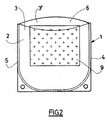
- Figures 1 to 3 show a bag 1 for defibrination of blood or blood plasma.
- the blood is animal blood such as the blood of cattle, sheep, pigs, felines, canines and horses.
- the blood is sheep's blood.
- the blood is human blood.
- the pocket 1 is flexible and comprises an outer casing 2 formed of two sheets of plastic material flexible, weldable and sterilizable 3 and 3 '.
- sheets 3 and 3 ' can be PVC, polyolefin, ethylene vinyl acetate (EVA), polyurethane or polyester.
- the flexible bag 1 includes an inlet port 7 and an outlet port 8 of the blood. These holes 7 and 8 are intended to be connected to pipes flexible, typically made of plastic, intended to allow respectively the introduction and recovery of the fluid in the pocket 1.
- the entry and exit of the fluid can be done through a single orifice.
- the pocket 1 also comprises a textile element 9 arranged in the volume interior 6, without compartmentalizing it.
- the textile element 9 is moves freely in the pocket 1.
- the textile element 9 "floats" in the pocket 1.
- the textile element 9 is inserted between the two sheets 3 and 3 'during manufacture pocket 1, for example before welding.
- the textile element 9 is fixed locally inside the pocket 1. Typically, at least one of the edges of the textile element 9 is held in a part of the weld bead 5. Thus, the textile element 9 is prevented from folding in on itself and / or hindering the flow of the fluid by blocking the inlet 7 and / or outlet 8 ports of the pocket 1.
- the textile element 9 comprises a sheet formed from at least one layer of knitted fabric, woven fabric or nonwoven.
- the material forming the textile element 9 is chosen from polymers or copolymers based on polyethylene, polypropylene, polyester, polyamide, polyurethane and their derivatives or any other polymer compatible with blood.
- the textile element 9 is capable of retaining fibrin.
- fibrinogen becomes fibrin under the action of thrombin.
- This fibrin is in the form of a filament.
- fibrin filaments come into contact with the textile element 9, they become entangled in the yarns and / or fibers of the element 9 and thus remain blocked in the textile element 9.
- porosity and the wettability of the textile element 9 makes it possible to improve the penetration and the retention of fibrin therein.
- the textile element 9 is formed of sheet placed inside pocket 1 so that the surface of the sheet is parallel to the surface of the sheets 3 and 3 '. So the thickness and volume of the pocket 1 containing the textile element 9 are substantially unchanged from the thickness and volume of the same pocket without textile element 9.
- the flat configuration of the sheet ensures a large contact surface between the blood fibrin and the textile element 9, without modifying in any way sensitive the interior volume 6 of the pocket 1.
- the surface of the textile element 9 is for example less than the surface of the sheets 3 and 3 'which form the envelope 2.
- the textile element 9 can also be pleated or wavy, for example in the case where its surface is higher than that of sheets 3 and 3 '.
- the surface of this element can represent more than 50% of the surface of sheets 3 and 3 '.
- the textile element 9 consists of a rectangular sheet of polyester in the form of a nonwoven layer with a thickness of about 400 ⁇ m and having an average pore size of about 40 ⁇ m.
- Another shape and / or a different number of textile elements 9 can be provided depending in particular on the shape of the pocket and / or the quantity of fluid to be defibrinated.
- FIG. 4 an embodiment particular of a bag system for sampling and defibrination blood in a closed circuit, this system comprising a flexible bag 1 such that described above.
- the pocket 1, called the primary collection pocket, is connected via a first tube 10 and at one of its inlet orifices 7 at sampling means 11.
- the system further comprises a pocket 12, called secondary pocket, intended to receive defibrinated blood which is connected to the pocket 1 via a second tube 13 and at one of its outlet ports 8.
- the secondary pocket 12 is made of flexible plastic, weldable and sterilizable.
- the sampling means 11 are a sampling needle.
- the bag system further includes a filter capable of retaining the micro-clots 14 disposed between the primary pocket 1 and the secondary pocket 12 on the second pipe 13.
- This filter 14 consists of a chamber plastic dropper 15 comprising a porous element 16 having a pore diameter of about 200 ⁇ m, the porous element 16 being by example in Nylon.
- This filter 14 makes it possible to eliminate the last fibrin filaments and the micro clots possibly present in the blood or serum.
- the bag system does not does not contain a filter capable of retaining micro clots.
- said satellite pockets may possibly be sterile connected to primary bag 1 and / or secondary bag 12. This is the case, for example, when defibrinated blood or serum needs to undergo further treatments such as centrifugation.
- the bag system of the invention is sterilizable and closed, so that the risk of bacterial contamination is limited.
- the fluid is removed and collects in the interior volume 6 of the bag 1, said volume not containing no anticoagulant solution and said bag 1 being agitated for a period sufficient to remove substantially all of the fibrin from the fluid.
- the defibrinated blood is transferred to the secondary pocket 12.
- the defibrinated blood is transferred via the filter 14 capable of retaining the micro-clots.
- the bag 12 containing defibrinated blood can then be treated so conventional by decantation and / or centrifugation to prepare blood serum.
- the defibrinated blood contained in the bag 12 is allowed to settle so as to obtain an upper layer containing the serum and a layer lower containing serum-free blood.
- the serum is again centrifuged so as to obtain a supernatant of substantially pure serum, that is to say devoid of components cell.
- the defibrinated blood contained in the secondary pocket 12 so as to obtain an upper layer containing practically pure serum and a lower layer containing blood without serum.
- FIG. 4 which additionally comprises at least one satellite pocket in fluid communication with the secondary bag 12 for collecting blood serum.
- agitation of the bag is interrupted so as to allow the blood to settle defibrinated in said pocket 1 until separation of blood serum and cellular elements of blood.
- the transfer of the serum is carried out via a filter 14 capable of retaining the micro clots, preferably using a press.
- the bag 12 then contains blood serum which can optionally be centrifuged so as to obtain a substantially pure acellular serum.
- FIG. 4 which additionally comprises at least one satellite pocket in fluid communication with the secondary bag 12 to collect the pure blood serum.
- the bag 1 is shaken in order to improve the delivery. in contact between the fibrin filaments and the textile element 9.
- the pocket is in horizontal position and agitation can be done manually or using a automatic agitator.
- the pocket is laid flat on the plate of the automatic agitator in operation.
- the ratio of the volume of blood drawn to the total volume of the bag is less than 1/2, in particular equal to 1/3. So the layer of blood in pocket 1 laid flat is thin and the surface of contact between the blood and the textile element 9 is extended.
- the second tube 13 is breakable and weldable in order to ability to dissociate from the bag system the secondary bag 12 containing the defibrinated blood or serum.
Landscapes
- Health & Medical Sciences (AREA)
- Heart & Thoracic Surgery (AREA)
- Vascular Medicine (AREA)
- General Health & Medical Sciences (AREA)
- Veterinary Medicine (AREA)
- Public Health (AREA)
- Life Sciences & Earth Sciences (AREA)
- Animal Behavior & Ethology (AREA)
- Hematology (AREA)
- Anesthesiology (AREA)
- Biomedical Technology (AREA)
- Engineering & Computer Science (AREA)
- Cardiology (AREA)
- Pharmacology & Pharmacy (AREA)
- External Artificial Organs (AREA)
- Investigating Or Analysing Biological Materials (AREA)
- Treatments For Attaching Organic Compounds To Fibrous Goods (AREA)
Abstract
Description
- la figure 1 représente une vue de face d'une poche selon un premier mode de réalisation de l'invention ;
- la figure 2 représente une vue en perspective et en coupe transversale suivant la ligne II-II de la figure 1 ;
- la figure 3 représente une vue de face d'une poche selon un deuxième mode de réalisation de l'invention ;
- la figure 4 représente, en vue schématique de face, un système à poches destiné au prélèvement et à la défibrination du sang.
Claims (13)
- Poche (1) destinée à la défibrination d'un fluide biologique tel que le sang ou le plasma sanguin, du type comprenant une enveloppe extérieure (2) formant un volume intérieur (6) pour ledit fluide, ladite enveloppe (2) étant munie d'au moins un orifice d'entrée (7) et/ou de sortie (8) du fluide, caractérisée en ce qu'au moins un élément textile (9) apte à fixer la fibrine du fluide est disposé dans le volume intérieur (6), sans compartimenter ledit volume intérieur.
- Poche selon la revendication 1, caractérisée en ce que l'élément textile (9) comprend au moins une couche de tricot, de tissé et/ou de non-tissé.
- Poche selon la revendication 1 ou 2, caractérisée en ce que l'élément textile (9) est réalisé à partir d'un polymère ou d'un copolymère à base de polyéthylène, polypropylène, polyester, polyamide, polyuréthanne et leurs dérivés.
- Poche selon l'une quelconque des revendications 1 à 3, caractérisée en ce que l'enveloppe extérieure (2) est formée de deux feuilles (3,3') de matériau plastique souple qui sont assemblées sur leur périphérie.
- Poche selon l'une quelconque des revendications 1 à 4, caractérisée en ce que l'élément textile (9) est fixé localement sur une partie de la périphérie (4) du volume intérieur (6).
- Système à poches destiné au prélèvement et à la défibrination d'un fluide biologique tel que le sang ou le plasma sanguin, du type comprenant une poche (1) primaire de recueil du fluide comprenant une enveloppe extérieure (2) formant un volume intérieur (6) pour ledit fluide, ladite enveloppe (2) étant munie d'au moins un orifice d'entrée (7) auquel des moyens de prélèvement (11) du fluide sont connectés par l'intermédiaire d'une première tubulure (10), ledit système étant caractérisé en ce qu'au moins un élément textile (9) apte à fixer la fibrine du fluide est disposé dans le volume intérieur (6).
- Système selon la revendication 6, caractérisé en ce qu'il comprend en outre au moins une deuxième poche (12) de recueil du fluide défibriné qui est reliée à un orifice de sortie (8) de ladite poche (1) par l'intermédiaire d'une deuxième tubulure (13).
- Système à poches selon la revendication 7, caractérisé en ce qu'un filtre (14) apte à retenir les micro-caillots est prévu sur la deuxième tubulure (13).
- Procédé de défibrination d'un fluide biologique tel que du sang ou du plasma sanguin, dans lequel on recueille le fluide dans le volume intérieur (6) d'une poche (1) à l'intérieur duquel au moins un élément textile (9) apte à fixer la fibrine du fluide est disposé, ladite poche (1) étant agitée pendant une durée permettant d'éliminer sensiblement toute la fibrine du fluide.
- Procédé de prélèvement et de défibrination d'un fluide biologique tel que du sang ou du plasma sanguin, dans lequel on prélève le fluide et on le recueille dans le volume intérieur (6) d'une poche (1) à l'intérieur duquel au moins un élément textile (9) apte à fixer la fibrine du fluide est disposé, ledit volume (6) ne contenant pas de solution anticoagulante et ladite poche (1) étant agitée pendant une durée permettant d'éliminer sensiblement toute la fibrine du fluide.
- Procédé selon la revendication 10, dans lequel le fluide défibriné est ensuite transféré en circuit clos dans une deuxième poche (12) qui est reliée de façon étanche et stérile à la poche (1).
- Procédé selon la revendication 10, dans lequel le fluide est du sang et, après défibrination du sang, l'agitation de la poche (1) est interrompue de sorte à laisser décanter le sang défibriné dans ladite poche (1) jusqu'à séparation du sérum sanguin et des éléments cellulaires du sang.
- Procédé selon la revendication 12, dans lequel le sérum est ensuite transféré en circuit clos dans une deuxième poche (12) qui est reliée de façon étanche et stérile à la poche (1).
Applications Claiming Priority (2)
| Application Number | Priority Date | Filing Date | Title |
|---|---|---|---|
| FR0203758 | 2002-03-26 | ||
| FR0203758A FR2837713B1 (fr) | 2002-03-26 | 2002-03-26 | Poche et procede de defibrination utilisant un element textile |
Publications (2)
| Publication Number | Publication Date |
|---|---|
| EP1348456A1 true EP1348456A1 (fr) | 2003-10-01 |
| EP1348456B1 EP1348456B1 (fr) | 2008-10-01 |
Family
ID=27799259
Family Applications (1)
| Application Number | Title | Priority Date | Filing Date |
|---|---|---|---|
| EP20030290650 Expired - Lifetime EP1348456B1 (fr) | 2002-03-26 | 2003-03-14 | Poche et procédé de défibrination utilisant un élément textile |
Country Status (6)
| Country | Link |
|---|---|
| EP (1) | EP1348456B1 (fr) |
| AT (1) | ATE409501T1 (fr) |
| AU (1) | AU2003202448B2 (fr) |
| DE (1) | DE60323776D1 (fr) |
| FR (1) | FR2837713B1 (fr) |
| NZ (1) | NZ524919A (fr) |
Cited By (1)
| Publication number | Priority date | Publication date | Assignee | Title |
|---|---|---|---|---|
| CN116920141A (zh) * | 2023-02-09 | 2023-10-24 | 安徽美家美环境科技有限公司 | 一种洁净消杀系统及洁净方法 |
Families Citing this family (8)
| Publication number | Priority date | Publication date | Assignee | Title |
|---|---|---|---|---|
| CN107921184A (zh) * | 2015-06-04 | 2018-04-17 | 冯达泽尼艾瑞斯卡格兰达医院马乔里门诊部 | 多袋的系统及用于制备血液成分的方法 |
| US12653937B2 (en) | 2022-03-10 | 2026-06-16 | Terumo Bct, Inc. | Apheresis system safety features |
| US12599710B2 (en) | 2022-03-10 | 2026-04-14 | Terumo Bct, Inc. | Methods and interfaces for providing donation process feedback |
| US12478551B2 (en) | 2022-03-10 | 2025-11-25 | Terumo Bct, Inc. | Collection bottle with integrated cap, handle, and shield features |
| US12691032B2 (en) | 2022-03-10 | 2026-07-28 | Terumo Bct, Inc. | Bottle tray with magnetic coupling and load cell overload protection |
| US12521474B2 (en) | 2022-03-10 | 2026-01-13 | Terumo Bct, Inc. | Soft cassette with integrated features |
| US12379916B2 (en) | 2022-03-10 | 2025-08-05 | Terumo Bct, Inc. | Communications and operation control of apheresis systems |
| US12458740B2 (en) | 2022-03-10 | 2025-11-04 | Terumo Bct, Inc. | Modular serviceability sleds and interconnections |
Citations (7)
| Publication number | Priority date | Publication date | Assignee | Title |
|---|---|---|---|---|
| US4073732A (en) * | 1974-04-19 | 1978-02-14 | Johnson & Johnson | Media for filtering blood |
| US4129131A (en) | 1976-10-26 | 1978-12-12 | Henry Naftulin | Method and apparatus for defibrination of blood |
| US4437472A (en) * | 1981-06-19 | 1984-03-20 | Henry Naftulin | Apparatus for collecting fluids |
| US4701267A (en) * | 1984-03-15 | 1987-10-20 | Asahi Medical Co., Ltd. | Method for removing leukocytes |
| US5616254A (en) * | 1990-11-06 | 1997-04-01 | Pall Corporation | System and method for processing biological fluid |
| WO1999037340A2 (fr) * | 1998-01-23 | 1999-07-29 | Pall Corporation | Systeme de traitement de fluide biologique |
| EP0953361A1 (fr) * | 1998-04-27 | 1999-11-03 | Maco Pharma | Poche et ensemble de poches de filtration |
-
2002
- 2002-03-26 FR FR0203758A patent/FR2837713B1/fr not_active Expired - Fee Related
-
2003
- 2003-03-14 AT AT03290650T patent/ATE409501T1/de not_active IP Right Cessation
- 2003-03-14 DE DE60323776T patent/DE60323776D1/de not_active Expired - Lifetime
- 2003-03-14 EP EP20030290650 patent/EP1348456B1/fr not_active Expired - Lifetime
- 2003-03-25 NZ NZ524919A patent/NZ524919A/en not_active IP Right Cessation
- 2003-03-25 AU AU2003202448A patent/AU2003202448B2/en not_active Ceased
Patent Citations (8)
| Publication number | Priority date | Publication date | Assignee | Title |
|---|---|---|---|---|
| US4073732A (en) * | 1974-04-19 | 1978-02-14 | Johnson & Johnson | Media for filtering blood |
| US4129131A (en) | 1976-10-26 | 1978-12-12 | Henry Naftulin | Method and apparatus for defibrination of blood |
| US4437472A (en) * | 1981-06-19 | 1984-03-20 | Henry Naftulin | Apparatus for collecting fluids |
| US4701267A (en) * | 1984-03-15 | 1987-10-20 | Asahi Medical Co., Ltd. | Method for removing leukocytes |
| US4701267B1 (en) * | 1984-03-15 | 1996-03-12 | Asahi Medical Co | Method for removing leukocytes |
| US5616254A (en) * | 1990-11-06 | 1997-04-01 | Pall Corporation | System and method for processing biological fluid |
| WO1999037340A2 (fr) * | 1998-01-23 | 1999-07-29 | Pall Corporation | Systeme de traitement de fluide biologique |
| EP0953361A1 (fr) * | 1998-04-27 | 1999-11-03 | Maco Pharma | Poche et ensemble de poches de filtration |
Cited By (1)
| Publication number | Priority date | Publication date | Assignee | Title |
|---|---|---|---|---|
| CN116920141A (zh) * | 2023-02-09 | 2023-10-24 | 安徽美家美环境科技有限公司 | 一种洁净消杀系统及洁净方法 |
Also Published As
| Publication number | Publication date |
|---|---|
| ATE409501T1 (de) | 2008-10-15 |
| NZ524919A (en) | 2004-09-24 |
| EP1348456B1 (fr) | 2008-10-01 |
| AU2003202448A1 (en) | 2003-10-23 |
| AU2003202448B2 (en) | 2008-11-13 |
| FR2837713B1 (fr) | 2005-01-07 |
| FR2837713A1 (fr) | 2003-10-03 |
| DE60323776D1 (de) | 2008-11-13 |
Similar Documents
| Publication | Publication Date | Title |
|---|---|---|
| EP0131529B1 (fr) | Appareillage utilisable notamment en plasmaphérèse | |
| FI109336B (fi) | Järjestelmä ja menetelmä biologisten nesteiden käsittelemiseksi | |
| EP0132210B1 (fr) | Appareillage utilisable notamment en plasmaphérèse | |
| EP0705114B1 (fr) | Procede et appareil d'extraction de fluides indesirables de produits sanguins traites | |
| EP1382361B1 (fr) | Unité de déleucocytation sélective d'un fluide contenant des plaquettes sanguines | |
| EP1262202B1 (fr) | Ligne de prélèvement du sang placentaire comprenant une poche de rinçage | |
| EP0925116B1 (fr) | Bol centrifuge pour la recuperation de sang autologue | |
| EP0953361B1 (fr) | Poche et ensemble de poches de filtration | |
| FR2519555A1 (fr) | Appareillage et procede de plasmapherese alternative avec appareil a membrane | |
| CN100492006C (zh) | 过滤仪及血液检测容器 | |
| FR2716626A1 (fr) | Procédé de traitement d'un fluide biologique, notamment en aphérèse, et système à y utiliser. | |
| EP2589395B1 (fr) | Système de clamp et de poche de sang | |
| EP1348456B1 (fr) | Poche et procédé de défibrination utilisant un élément textile | |
| JP2003052792A (ja) | フィルターを一時的に関連付ける手段を有するバッグ及びバッグシステム並びにそのバッグシステムの使用方法 | |
| FR2696938A1 (fr) | Méthodes et assemblage de traitement d'un fluide biologique. | |
| FR2821762A1 (fr) | Unite de filtration comprenant deux milieux filtrants distincts et systeme a poches le comprenant | |
| WO2021094483A1 (fr) | Unite de filtration pour la deleucocytation du sang comprenant un non-tisse perfore en relief | |
| KR20080025050A (ko) | 혈액 분리 기구 및 혈액 분리 장치 | |
| EP0752904B1 (fr) | Dispositif de filtration de fluides biologiques et son application | |
| FR2817152A1 (fr) | Systeme a poches et procede pour l'inactivation virale d'un fluide prealablement deleucocyte | |
| FR2542620A1 (fr) | Filtre et procede pour l'obtention d'echantillons de plasma sanguin | |
| CA2576498C (fr) | Procede d'autotransfusion et dispositif d'autotransfusion a separation de phases et concentration a poches amovibles | |
| FR2806621A1 (fr) | Poche de recueil avec insert | |
| JP2005000802A (ja) | フィルタおよび血液成分分離装置 | |
| WO2017179705A1 (fr) | Récipient pour préparation de suspensions cellulaires, et méthode de préparation de suspensions cellulaires |
Legal Events
| Date | Code | Title | Description |
|---|---|---|---|
| PUAI | Public reference made under article 153(3) epc to a published international application that has entered the european phase |
Free format text: ORIGINAL CODE: 0009012 |
|
| AK | Designated contracting states |
Kind code of ref document: A1 Designated state(s): AT BE BG CH CY CZ DE DK EE ES FI FR GB GR HU IE IT LI LU MC NL PT RO SE SI SK TR |
|
| AX | Request for extension of the european patent |
Extension state: AL LT LV MK |
|
| 17P | Request for examination filed |
Effective date: 20031209 |
|
| AKX | Designation fees paid |
Designated state(s): AT BE BG CH CY CZ DE DK EE ES FI FR GB GR HU IE IT LI LU MC NL PT RO SE SI SK TR |
|
| GRAP | Despatch of communication of intention to grant a patent |
Free format text: ORIGINAL CODE: EPIDOSNIGR1 |
|
| GRAS | Grant fee paid |
Free format text: ORIGINAL CODE: EPIDOSNIGR3 |
|
| GRAA | (expected) grant |
Free format text: ORIGINAL CODE: 0009210 |
|
| AK | Designated contracting states |
Kind code of ref document: B1 Designated state(s): AT BE BG CH CY CZ DE DK EE ES FI FR GB GR HU IE IT LI LU MC NL PT RO SE SI SK TR |
|
| REG | Reference to a national code |
Ref country code: GB Ref legal event code: FG4D Free format text: NOT ENGLISH |
|
| REG | Reference to a national code |
Ref country code: CH Ref legal event code: EP |
|
| REG | Reference to a national code |
Ref country code: IE Ref legal event code: FG4D Free format text: LANGUAGE OF EP DOCUMENT: FRENCH |
|
| REF | Corresponds to: |
Ref document number: 60323776 Country of ref document: DE Date of ref document: 20081113 Kind code of ref document: P |
|
| PG25 | Lapsed in a contracting state [announced via postgrant information from national office to epo] |
Ref country code: SI Free format text: LAPSE BECAUSE OF FAILURE TO SUBMIT A TRANSLATION OF THE DESCRIPTION OR TO PAY THE FEE WITHIN THE PRESCRIBED TIME-LIMIT Effective date: 20081001 |
|
| NLV1 | Nl: lapsed or annulled due to failure to fulfill the requirements of art. 29p and 29m of the patents act | ||
| REG | Reference to a national code |
Ref country code: IE Ref legal event code: FD4D |
|
| PG25 | Lapsed in a contracting state [announced via postgrant information from national office to epo] |
Ref country code: BG Free format text: LAPSE BECAUSE OF FAILURE TO SUBMIT A TRANSLATION OF THE DESCRIPTION OR TO PAY THE FEE WITHIN THE PRESCRIBED TIME-LIMIT Effective date: 20090101 Ref country code: AT Free format text: LAPSE BECAUSE OF FAILURE TO SUBMIT A TRANSLATION OF THE DESCRIPTION OR TO PAY THE FEE WITHIN THE PRESCRIBED TIME-LIMIT Effective date: 20081001 Ref country code: ES Free format text: LAPSE BECAUSE OF FAILURE TO SUBMIT A TRANSLATION OF THE DESCRIPTION OR TO PAY THE FEE WITHIN THE PRESCRIBED TIME-LIMIT Effective date: 20090112 |
|
| PG25 | Lapsed in a contracting state [announced via postgrant information from national office to epo] |
Ref country code: FI Free format text: LAPSE BECAUSE OF FAILURE TO SUBMIT A TRANSLATION OF THE DESCRIPTION OR TO PAY THE FEE WITHIN THE PRESCRIBED TIME-LIMIT Effective date: 20081001 Ref country code: NL Free format text: LAPSE BECAUSE OF FAILURE TO SUBMIT A TRANSLATION OF THE DESCRIPTION OR TO PAY THE FEE WITHIN THE PRESCRIBED TIME-LIMIT Effective date: 20081001 Ref country code: PT Free format text: LAPSE BECAUSE OF FAILURE TO SUBMIT A TRANSLATION OF THE DESCRIPTION OR TO PAY THE FEE WITHIN THE PRESCRIBED TIME-LIMIT Effective date: 20090302 |
|
| PG25 | Lapsed in a contracting state [announced via postgrant information from national office to epo] |
Ref country code: RO Free format text: LAPSE BECAUSE OF FAILURE TO SUBMIT A TRANSLATION OF THE DESCRIPTION OR TO PAY THE FEE WITHIN THE PRESCRIBED TIME-LIMIT Effective date: 20081001 Ref country code: IE Free format text: LAPSE BECAUSE OF FAILURE TO SUBMIT A TRANSLATION OF THE DESCRIPTION OR TO PAY THE FEE WITHIN THE PRESCRIBED TIME-LIMIT Effective date: 20081001 Ref country code: EE Free format text: LAPSE BECAUSE OF FAILURE TO SUBMIT A TRANSLATION OF THE DESCRIPTION OR TO PAY THE FEE WITHIN THE PRESCRIBED TIME-LIMIT Effective date: 20081001 Ref country code: DK Free format text: LAPSE BECAUSE OF FAILURE TO SUBMIT A TRANSLATION OF THE DESCRIPTION OR TO PAY THE FEE WITHIN THE PRESCRIBED TIME-LIMIT Effective date: 20081001 |
|
| PLBE | No opposition filed within time limit |
Free format text: ORIGINAL CODE: 0009261 |
|
| STAA | Information on the status of an ep patent application or granted ep patent |
Free format text: STATUS: NO OPPOSITION FILED WITHIN TIME LIMIT |
|
| PG25 | Lapsed in a contracting state [announced via postgrant information from national office to epo] |
Ref country code: SE Free format text: LAPSE BECAUSE OF FAILURE TO SUBMIT A TRANSLATION OF THE DESCRIPTION OR TO PAY THE FEE WITHIN THE PRESCRIBED TIME-LIMIT Effective date: 20090101 Ref country code: IT Free format text: LAPSE BECAUSE OF FAILURE TO SUBMIT A TRANSLATION OF THE DESCRIPTION OR TO PAY THE FEE WITHIN THE PRESCRIBED TIME-LIMIT Effective date: 20081001 Ref country code: CZ Free format text: LAPSE BECAUSE OF FAILURE TO SUBMIT A TRANSLATION OF THE DESCRIPTION OR TO PAY THE FEE WITHIN THE PRESCRIBED TIME-LIMIT Effective date: 20081001 |
|
| 26N | No opposition filed |
Effective date: 20090702 |
|
| BERE | Be: lapsed |
Owner name: MACO PHARMA Effective date: 20090331 |
|
| PG25 | Lapsed in a contracting state [announced via postgrant information from national office to epo] |
Ref country code: SK Free format text: LAPSE BECAUSE OF FAILURE TO SUBMIT A TRANSLATION OF THE DESCRIPTION OR TO PAY THE FEE WITHIN THE PRESCRIBED TIME-LIMIT Effective date: 20081001 |
|
| PG25 | Lapsed in a contracting state [announced via postgrant information from national office to epo] |
Ref country code: MC Free format text: LAPSE BECAUSE OF NON-PAYMENT OF DUE FEES Effective date: 20090331 |
|
| REG | Reference to a national code |
Ref country code: CH Ref legal event code: PL |
|
| PG25 | Lapsed in a contracting state [announced via postgrant information from national office to epo] |
Ref country code: CH Free format text: LAPSE BECAUSE OF NON-PAYMENT OF DUE FEES Effective date: 20090331 Ref country code: LI Free format text: LAPSE BECAUSE OF NON-PAYMENT OF DUE FEES Effective date: 20090331 |
|
| PG25 | Lapsed in a contracting state [announced via postgrant information from national office to epo] |
Ref country code: BE Free format text: LAPSE BECAUSE OF NON-PAYMENT OF DUE FEES Effective date: 20090331 |
|
| PG25 | Lapsed in a contracting state [announced via postgrant information from national office to epo] |
Ref country code: GR Free format text: LAPSE BECAUSE OF FAILURE TO SUBMIT A TRANSLATION OF THE DESCRIPTION OR TO PAY THE FEE WITHIN THE PRESCRIBED TIME-LIMIT Effective date: 20090102 |
|
| PG25 | Lapsed in a contracting state [announced via postgrant information from national office to epo] |
Ref country code: LU Free format text: LAPSE BECAUSE OF NON-PAYMENT OF DUE FEES Effective date: 20090314 |
|
| PG25 | Lapsed in a contracting state [announced via postgrant information from national office to epo] |
Ref country code: HU Free format text: LAPSE BECAUSE OF FAILURE TO SUBMIT A TRANSLATION OF THE DESCRIPTION OR TO PAY THE FEE WITHIN THE PRESCRIBED TIME-LIMIT Effective date: 20090402 |
|
| PG25 | Lapsed in a contracting state [announced via postgrant information from national office to epo] |
Ref country code: TR Free format text: LAPSE BECAUSE OF FAILURE TO SUBMIT A TRANSLATION OF THE DESCRIPTION OR TO PAY THE FEE WITHIN THE PRESCRIBED TIME-LIMIT Effective date: 20081001 |
|
| PG25 | Lapsed in a contracting state [announced via postgrant information from national office to epo] |
Ref country code: CY Free format text: LAPSE BECAUSE OF FAILURE TO SUBMIT A TRANSLATION OF THE DESCRIPTION OR TO PAY THE FEE WITHIN THE PRESCRIBED TIME-LIMIT Effective date: 20081001 |
|
| REG | Reference to a national code |
Ref country code: FR Ref legal event code: PLFP Year of fee payment: 13 |
|
| PGFP | Annual fee paid to national office [announced via postgrant information from national office to epo] |
Ref country code: DE Payment date: 20150327 Year of fee payment: 13 |
|
| PGFP | Annual fee paid to national office [announced via postgrant information from national office to epo] |
Ref country code: GB Payment date: 20150327 Year of fee payment: 13 Ref country code: FR Payment date: 20150317 Year of fee payment: 13 |
|
| REG | Reference to a national code |
Ref country code: DE Ref legal event code: R119 Ref document number: 60323776 Country of ref document: DE |
|
| GBPC | Gb: european patent ceased through non-payment of renewal fee |
Effective date: 20160314 |
|
| REG | Reference to a national code |
Ref country code: FR Ref legal event code: ST Effective date: 20161130 |
|
| PG25 | Lapsed in a contracting state [announced via postgrant information from national office to epo] |
Ref country code: GB Free format text: LAPSE BECAUSE OF NON-PAYMENT OF DUE FEES Effective date: 20160314 Ref country code: DE Free format text: LAPSE BECAUSE OF NON-PAYMENT OF DUE FEES Effective date: 20161001 Ref country code: FR Free format text: LAPSE BECAUSE OF NON-PAYMENT OF DUE FEES Effective date: 20160331 |