EP1347675A1 - Bedieneinheit für Fahrzeuge - Google Patents
Bedieneinheit für Fahrzeuge Download PDFInfo
- Publication number
- EP1347675A1 EP1347675A1 EP02006735A EP02006735A EP1347675A1 EP 1347675 A1 EP1347675 A1 EP 1347675A1 EP 02006735 A EP02006735 A EP 02006735A EP 02006735 A EP02006735 A EP 02006735A EP 1347675 A1 EP1347675 A1 EP 1347675A1
- Authority
- EP
- European Patent Office
- Prior art keywords
- plate
- contact area
- latching hook
- control unit
- base part
- Prior art date
- Legal status (The legal status is an assumption and is not a legal conclusion. Google has not performed a legal analysis and makes no representation as to the accuracy of the status listed.)
- Granted
Links
Images

Classifications
-
- B—PERFORMING OPERATIONS; TRANSPORTING
- B60—VEHICLES IN GENERAL
- B60R—VEHICLES, VEHICLE FITTINGS, OR VEHICLE PARTS, NOT OTHERWISE PROVIDED FOR
- B60R11/00—Arrangements for holding or mounting articles, not otherwise provided for
- B60R11/02—Arrangements for holding or mounting articles, not otherwise provided for for radio sets, television sets, telephones, or the like; Arrangement of controls thereof
-
- H—ELECTRICITY
- H01—ELECTRIC ELEMENTS
- H01H—ELECTRIC SWITCHES; RELAYS; SELECTORS; EMERGENCY PROTECTIVE DEVICES
- H01H1/00—Contacts
- H01H1/58—Electric connections to or between contacts; Terminals
- H01H1/5805—Connections to printed circuits
-
- B—PERFORMING OPERATIONS; TRANSPORTING
- B60—VEHICLES IN GENERAL
- B60R—VEHICLES, VEHICLE FITTINGS, OR VEHICLE PARTS, NOT OTHERWISE PROVIDED FOR
- B60R11/00—Arrangements for holding or mounting articles, not otherwise provided for
- B60R2011/0042—Arrangements for holding or mounting articles, not otherwise provided for characterised by mounting means
- B60R2011/0049—Arrangements for holding or mounting articles, not otherwise provided for characterised by mounting means for non integrated articles
- B60R2011/0064—Connection with the article
- B60R2011/0071—Connection with the article using latches, clips, clamps, straps or the like
Definitions
- the invention relates to an operating unit, in particular for vehicles, such as airplanes or coaches, and concerns in particular an operating unit with a plate, for example a circuit board supporting the electronics, the circuit board using a special locking connection is attached.
- buttons as controls for Driving functions or service functions.
- These buttons usually consist of one in the interior lining integrated, movable front panel and an underlying, operated by means of the front panel, switching part, which is usually is placed directly on a board so that the Switching information directly to a monitoring or evaluation circuit can be forwarded.
- Each latching hook consists of a flexible one that enables bending Base part and one arranged at the end of the base part Contact area for retaining the board.
- the investment area spills over the edge of the board and lies there against the board To secure pressure. From a certain one acting on the board Force, for example caused by a button, is released the connection with the conventional locking hook through the resulting Torque, because the locking hooks bend out so far, until they no longer overlap the board.
- the circuit board is then no longer secured and is subject to further force application shifted from their position, resulting in an undesirable Failure of the button leads.
- the invention is based on the object of an operating unit for to create a vehicle with improved mounting of the plate.
- the invention proposes an operating unit in which at least a gripping element designed as an elastically bendable locking hook is whose base part faces the opposite encompassing element and its contact area the opposite encompassing element is turned away.
- a gripping element designed as an elastically bendable locking hook is whose base part faces the opposite encompassing element and its contact area the opposite encompassing element is turned away.
- Recesses are preferably provided at the edge of the plate which the locking hook and / or the gripping part is arranged. This The arrangement ensures a particularly stable mounting of the plate.
- the contact area of the latching hook advantageously projects above the Cutouts in the plate on two opposite cutout wheels, so that the base part of the locking hook is in the recess can move while the contact area rests on the plate and it lasts.
- the investment area towers above the edge connecting the two aforementioned edges the recess.
- the plate can be used as a printed circuit board with or for electrical and / or electronic circuits or components his.
- the encircling element is preferably rigid, unless it is a Locking hook is formed.
- the wrapping element can also be over extend all or part of the side edge of the plate.
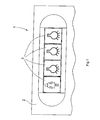
- the control unit 1 shown in Fig. 1 for vehicles has an aperture 2, which in the interior of the vehicle is integrated, and several Button 3, which can have different functions. On airplanes these functions are typically the actuation of the lamps over the seats and calling flight attendants.
- a plate 4 which is a circuit board and circuits for detecting and evaluating the Positions of the various buttons 3 carries, held.
- Plate 4 is arranged by several, on the long sides of the plate 4, opposite latching hook 5 (Fig. 3) held.
- the number the locking hook 5 can according to the length of the plate 4 and the desired The strength of the attachment can be varied.
- Each locking hook is there from a base part 6 fastened to the panel 2 and a arranged at the end of the base part 6 facing away from the panel 2 Contact area 7, on the side facing away from the panel 2 Plate 4 rests.
- the length of the base part 6 is dimensioned in such a way that when the plate 4 rests on support ribs 8, the contact areas 7 press on the plate 4 and thus between the Support ribs 8 and the contact areas 7 locked.
- Recesses 9 are arranged on the long sides of the plate 4, through which the base parts 6 of the locking hook 5 run.
- the investment areas 7 protrude the recesses 9 laterally, i.e. longitudinal the plate 4 so as to apply a holding pressure to the plate 4.
- the plate 4 has reached this position, it has the bevelled, inner Areas of the investment areas 7, along which they suffered happened, so that the locking hook 5 is not pushed further out become. Due to the preload of the flexible base parts 6 the locking hooks 5 return to the position shown in FIG. 2 back, the contact areas 7 now facing away from the diaphragm 2 Back of the plate 4 rest, so that the plate 4 between the support ribs 8 and the contact areas 7 is fixed.
- the contact areas 7 each form one with the base part 6 acute angle, so that the contact area 7 with only one edge or a relatively narrow surface on the plate 4. This facilitates the sliding of the contact areas 7 on the plate 4, if engage or snap in the locking hooks 5 when inserting the plate 4.
- the plate 4 for repair or exchange purposes from the control unit 1 is to be removed, then the locking hooks 5 bent apart until the investment area 7 is outside the Plate 4 is located, so no more pressure on it. Then can the plate 4 can be removed in a simple manner.
- the invention was at least based on the use of a pair of locking hooks described on both sides of the plate are arranged. But it is also conceivable that only one Edge of the plate one or more locking hooks of the type described above Type is / are. On the opposite edge of the plate is this e.g. gripped by a rigid grip, behind which the plate (inclined) is inserted, then through Swivel to lock with the latching hook or latches.
- the base part each locking hook arranged on one side of the plate is the opposite plate edge or stopping point (e.g. gripping projection) facing, while its contact area this plate edge is turned away.
Landscapes
- Engineering & Computer Science (AREA)
- Mechanical Engineering (AREA)
- Physics & Mathematics (AREA)
- Electromagnetism (AREA)
- Switch Cases, Indication, And Locking (AREA)
- Slide Fasteners, Snap Fasteners, And Hook Fasteners (AREA)
- Automatic Assembly (AREA)
- Fittings On The Vehicle Exterior For Carrying Loads, And Devices For Holding Or Mounting Articles (AREA)
- Casings For Electric Apparatus (AREA)
- Vehicle Body Suspensions (AREA)
- Lighting Device Outwards From Vehicle And Optical Signal (AREA)
- Push-Button Switches (AREA)
Abstract
Description
- einer Platte und
- mindestens zwei die Platte zwischen sich aufnehmenden Umgreifelementen, von denen jedes einen die Platte zurückhaltenden Anlagebereich und einen den Anlagebereich tragenden Basisteil aufweist.
- dass mindestens eines der Umgreifelemente als elastischer Rasthaken ausgebildet ist, und
- dass der Anlagebereich des mindestens einen Rasthakens auf derjenigen Seite seines Basisteils angeordnet ist, die dem anderen Umgreifelement abgewandt ist, wobei bei einer Kraftausübung auf die Platte in Richtung auf den Anlagebereich des mindestens einen Rasthakens dieser in Richtung auf das Umgreifelement bewegbar ist.
Claims (7)
- Bedieneinheit für ein Fahrzeug mitdadurch gekennzeichnet,einer Platte (4) undmindestens zwei die Platte (4) zwischen sich aufnehmenden Umgreifelementen, von denen jedes einen die Platte (4) zurückhaltenden Anlagebereich (7) und einen den Anlagebereich (7) tragenden Basisteil (6) aufweist,dass mindestens eines der Umgreifelemente als elastischer Rasthaken (5) ausgebildet ist, unddass der Anlagebereich (7) des mindestens einen Rasthakens (5) auf derjenigen Seite seines Basisteils (6) angeordnet ist, die dem anderen Umgreifelement abgewandt ist, wobei bei einer Kraftausübung auf die Platte (4) in Richtung auf den Anlagebereich (7) des mindestens einen Rasthakens (5) dieser in Richtung auf das Umgreifelement bewegbar ist.
- Bedieneinheit nach Anspruch 1, dadurch gekennzeichnet, dass der mindestens eine Rasthaken (5) zwischen seinem Anlagebereich (7) und seinem Basisteil (6) einen spitzer Winkel aufweist.
- Bedieneinheit nach Anspruch 1 oder 2, dadurch gekennzeichnet, dass der Basisteil (6) des mindestens einen Rasthaken (5) elastisch biegbar ist.
- Bedieneinheit nach einem der Ansprüche 1 bis 3, dadurch gekennzeichnet, dass in der Platte (4) am Rand eine Aussparung (9) für den mindestens einen Rasthaken (5) vorgesehen ist.
- Bedieneinheit nach Anspruch 4, dadurch gekennzeichnet, dass der Anlagebereich (7) des Rasthakens (5) die Aussparung (9) in der Platte (4) an zwei gegenüberliegenden Rändern der Aussparung (9) und/oder an dem diese beiden Ränder verbindenden Rand der Aussparung (9) überragt.
- Bedieneinheit nach einem der Ansprüche 1 bis 5, dadurch gekennzeichnet, dass die Platte (4) eine Platine für elektrische und/oder elektronische Schaltungen und/oder Bauteile ist.
- Bedieneinheit nach einem der Ansprüche 1-6, dadurch gekennzeichnet, dass die mindestens zwei Umgreifelemente jeweils als elastische Rasthaken (5) ausgebildet sind und dass die Basisteile (6) der Rasthaken (5) einander zugewandt und die Anlagebereiche (7) einander abgewandt sind, wobei bei einer Belastung der Platte (4) in Richtung auf die Anlagebereiche (7) jeder Rasthaken (5) ein Drehmoment in Richtung auf den jeweils anderen Rasthaken (5) erfährt.
Priority Applications (4)
| Application Number | Priority Date | Filing Date | Title |
|---|---|---|---|
| EP02006735A EP1347675B1 (de) | 2002-03-23 | 2002-03-23 | Bedieneinheit für Fahrzeuge |
| DE50210156T DE50210156D1 (de) | 2002-03-23 | 2002-03-23 | Bedieneinheit für Fahrzeuge |
| ES02006735T ES2283481T3 (es) | 2002-03-23 | 2002-03-23 | Unidad de control para vehiculos. |
| AT02006735T ATE362695T1 (de) | 2002-03-23 | 2002-03-23 | Bedieneinheit für fahrzeuge |
Applications Claiming Priority (1)
| Application Number | Priority Date | Filing Date | Title |
|---|---|---|---|
| EP02006735A EP1347675B1 (de) | 2002-03-23 | 2002-03-23 | Bedieneinheit für Fahrzeuge |
Publications (2)
| Publication Number | Publication Date |
|---|---|
| EP1347675A1 true EP1347675A1 (de) | 2003-09-24 |
| EP1347675B1 EP1347675B1 (de) | 2007-05-16 |
Family
ID=27771878
Family Applications (1)
| Application Number | Title | Priority Date | Filing Date |
|---|---|---|---|
| EP02006735A Expired - Lifetime EP1347675B1 (de) | 2002-03-23 | 2002-03-23 | Bedieneinheit für Fahrzeuge |
Country Status (4)
| Country | Link |
|---|---|
| EP (1) | EP1347675B1 (de) |
| AT (1) | ATE362695T1 (de) |
| DE (1) | DE50210156D1 (de) |
| ES (1) | ES2283481T3 (de) |
Cited By (1)
| Publication number | Priority date | Publication date | Assignee | Title |
|---|---|---|---|---|
| WO2009053280A1 (de) | 2007-10-26 | 2009-04-30 | BSH Bosch und Siemens Hausgeräte GmbH | Bedienblende für ein elektrogerät |
Citations (5)
| Publication number | Priority date | Publication date | Assignee | Title |
|---|---|---|---|---|
| DE8328123U1 (de) * | 1983-09-30 | 1984-02-02 | Rafi Gmbh & Co Elektrotechnische Spezialfabrik, 7981 Berg | Haltevorrichtung |
| FR2579694A1 (fr) * | 1985-03-29 | 1986-10-03 | Baco Const Elect | Piece d'accouplement en tandem pour elements fonctionnels d'appareils de commande et de signalisation a configuration modulaire |
| US4750091A (en) * | 1986-12-29 | 1988-06-07 | Chrysler Motors Corporation | Circuit board enclosure latch system |
| EP0841673A2 (de) * | 1996-11-12 | 1998-05-13 | Molex Incorporated | Elektrischer Schaltmodul |
| EP0984673A1 (de) * | 1998-09-02 | 2000-03-08 | Pioneer Corporation | Rasthaken |
-
2002
- 2002-03-23 DE DE50210156T patent/DE50210156D1/de not_active Expired - Lifetime
- 2002-03-23 AT AT02006735T patent/ATE362695T1/de not_active IP Right Cessation
- 2002-03-23 ES ES02006735T patent/ES2283481T3/es not_active Expired - Lifetime
- 2002-03-23 EP EP02006735A patent/EP1347675B1/de not_active Expired - Lifetime
Patent Citations (5)
| Publication number | Priority date | Publication date | Assignee | Title |
|---|---|---|---|---|
| DE8328123U1 (de) * | 1983-09-30 | 1984-02-02 | Rafi Gmbh & Co Elektrotechnische Spezialfabrik, 7981 Berg | Haltevorrichtung |
| FR2579694A1 (fr) * | 1985-03-29 | 1986-10-03 | Baco Const Elect | Piece d'accouplement en tandem pour elements fonctionnels d'appareils de commande et de signalisation a configuration modulaire |
| US4750091A (en) * | 1986-12-29 | 1988-06-07 | Chrysler Motors Corporation | Circuit board enclosure latch system |
| EP0841673A2 (de) * | 1996-11-12 | 1998-05-13 | Molex Incorporated | Elektrischer Schaltmodul |
| EP0984673A1 (de) * | 1998-09-02 | 2000-03-08 | Pioneer Corporation | Rasthaken |
Cited By (2)
| Publication number | Priority date | Publication date | Assignee | Title |
|---|---|---|---|---|
| WO2009053280A1 (de) | 2007-10-26 | 2009-04-30 | BSH Bosch und Siemens Hausgeräte GmbH | Bedienblende für ein elektrogerät |
| CN101836521B (zh) * | 2007-10-26 | 2013-01-16 | Bsh博世和西门子家用器具有限公司 | 用于电器的操作面板 |
Also Published As
| Publication number | Publication date |
|---|---|
| EP1347675B1 (de) | 2007-05-16 |
| DE50210156D1 (de) | 2007-06-28 |
| ATE362695T1 (de) | 2007-06-15 |
| ES2283481T3 (es) | 2007-11-01 |
Similar Documents
| Publication | Publication Date | Title |
|---|---|---|
| DE2814991C2 (de) | ||
| DE2115728B2 (de) | ||
| DE102017117509A1 (de) | Elektrisches Gerät | |
| DE4300734A1 (de) | Einrichtung zum lösbaren Befestigen eines elektrischen Servicegerätes | |
| EP0725986B1 (de) | Elektrische baugruppe | |
| DE1942495B1 (de) | Fusschalter fuer ein diktiergeraet insbesondere magnetton bandgeraet | |
| EP2382349B1 (de) | Bügelsohle, bügelvorrichtung mit einer bügelsohle sowie bügelvorrichtungs-set | |
| EP1347675A1 (de) | Bedieneinheit für Fahrzeuge | |
| DE10213095C1 (de) | Bedieneinheit für Fahrzeuge | |
| EP3812602A1 (de) | Saugnapfvorrichtung und haltevorrichtung | |
| EP3515790A1 (de) | Manteleinheit für eine verstellbare lenksäule eines kraftfahrzeugs | |
| DE2360600C3 (de) | Halterung für ein Gerät der Nachrichtentechnik in einer Einbauwand | |
| DE4309973A1 (de) | Montagesystem zum Verbinden einer Baugruppe mit einem Baugruppenträger | |
| EP0899646B1 (de) | Pedal für ein Kraftfahrzeug | |
| WO2013160321A1 (de) | Befestigungseinrichtung sowie anordnung umfassend ein gerät oder einen körper und eine hutschiene | |
| DE69801986T2 (de) | Kompakter drucker | |
| EP1446202B2 (de) | Anordnung fur eine auf einem ski positionierbare skibindung | |
| DE202019105894U1 (de) | Saugnapfvorrichtung und Haltevorrichtung | |
| DE2735332C2 (de) | Wischvorrichtung für Scheiben von Kraftfahrzeugen | |
| WO2019072413A1 (de) | Befestigungsvorrichtung | |
| DE20014195U1 (de) | Betätigungselement zum Ein- und Aushebeln von Flachbaugruppen mit Verriegelungselement in mindestens drei Schaltstellungen, Frontelement für eine Flachbaugruppe mit Betätigungselement und Baugruppenträger zur Aufnahme von Flachbaugruppen | |
| CH640369A5 (en) | Screw connection for a top-hat section DIN rail | |
| DE2648922C2 (de) | Anordnung für einen Kfz-Lenkstockschalter | |
| DE3047089A1 (de) | Verriegelungsvorrichtung fuer baugruppen | |
| DE202024100272U1 (de) | Elektrisches Modul zum Anschließen an eine Tragschiene mit einem Tragschienenprofil |
Legal Events
| Date | Code | Title | Description |
|---|---|---|---|
| PUAI | Public reference made under article 153(3) epc to a published international application that has entered the european phase |
Free format text: ORIGINAL CODE: 0009012 |
|
| AK | Designated contracting states |
Kind code of ref document: A1 Designated state(s): AT BE CH CY DE DK ES FI FR GB GR IE IT LI LU MC NL PT SE TR |
|
| AX | Request for extension of the european patent |
Extension state: AL LT LV MK RO SI |
|
| 17P | Request for examination filed |
Effective date: 20040312 |
|
| AKX | Designation fees paid |
Designated state(s): AT BE CH CY DE DK ES FI FR GB GR IE IT LI LU MC NL PT SE TR |
|
| RAP1 | Party data changed (applicant data changed or rights of an application transferred) |
Owner name: GOODRICH LIGHTING SYSTEMS GMBH |
|
| GRAP | Despatch of communication of intention to grant a patent |
Free format text: ORIGINAL CODE: EPIDOSNIGR1 |
|
| GRAS | Grant fee paid |
Free format text: ORIGINAL CODE: EPIDOSNIGR3 |
|
| GRAA | (expected) grant |
Free format text: ORIGINAL CODE: 0009210 |
|
| AK | Designated contracting states |
Kind code of ref document: B1 Designated state(s): AT BE CH CY DE DK ES FI FR GB GR IE IT LI LU MC NL PT SE TR |
|
| PG25 | Lapsed in a contracting state [announced via postgrant information from national office to epo] |
Ref country code: FI Free format text: LAPSE BECAUSE OF FAILURE TO SUBMIT A TRANSLATION OF THE DESCRIPTION OR TO PAY THE FEE WITHIN THE PRESCRIBED TIME-LIMIT Effective date: 20070516 |
|
| REG | Reference to a national code |
Ref country code: GB Ref legal event code: FG4D Free format text: NOT ENGLISH |
|
| REG | Reference to a national code |
Ref country code: CH Ref legal event code: EP |
|
| REG | Reference to a national code |
Ref country code: IE Ref legal event code: FG4D Free format text: LANGUAGE OF EP DOCUMENT: GERMAN |
|
| REF | Corresponds to: |
Ref document number: 50210156 Country of ref document: DE Date of ref document: 20070628 Kind code of ref document: P |
|
| REG | Reference to a national code |
Ref country code: CH Ref legal event code: NV Representative=s name: HEPP, WENGER & RYFFEL AG |
|
| REG | Reference to a national code |
Ref country code: SE Ref legal event code: TRGR |
|
| GBT | Gb: translation of ep patent filed (gb section 77(6)(a)/1977) |
Effective date: 20070730 |
|
| REG | Reference to a national code |
Ref country code: ES Ref legal event code: FG2A Ref document number: 2283481 Country of ref document: ES Kind code of ref document: T3 |
|
| ET | Fr: translation filed | ||
| REG | Reference to a national code |
Ref country code: IE Ref legal event code: FD4D |
|
| PG25 | Lapsed in a contracting state [announced via postgrant information from national office to epo] |
Ref country code: IE Free format text: LAPSE BECAUSE OF FAILURE TO SUBMIT A TRANSLATION OF THE DESCRIPTION OR TO PAY THE FEE WITHIN THE PRESCRIBED TIME-LIMIT Effective date: 20070516 Ref country code: DK Free format text: LAPSE BECAUSE OF FAILURE TO SUBMIT A TRANSLATION OF THE DESCRIPTION OR TO PAY THE FEE WITHIN THE PRESCRIBED TIME-LIMIT Effective date: 20070516 Ref country code: PT Free format text: LAPSE BECAUSE OF FAILURE TO SUBMIT A TRANSLATION OF THE DESCRIPTION OR TO PAY THE FEE WITHIN THE PRESCRIBED TIME-LIMIT Effective date: 20071016 |
|
| PLBE | No opposition filed within time limit |
Free format text: ORIGINAL CODE: 0009261 |
|
| STAA | Information on the status of an ep patent application or granted ep patent |
Free format text: STATUS: NO OPPOSITION FILED WITHIN TIME LIMIT |
|
| 26N | No opposition filed |
Effective date: 20080219 |
|
| PG25 | Lapsed in a contracting state [announced via postgrant information from national office to epo] |
Ref country code: GR Free format text: LAPSE BECAUSE OF FAILURE TO SUBMIT A TRANSLATION OF THE DESCRIPTION OR TO PAY THE FEE WITHIN THE PRESCRIBED TIME-LIMIT Effective date: 20070817 |
|
| BERE | Be: lapsed |
Owner name: GOODRICH LIGHTING SYSTEMS G.M.B.H. Effective date: 20080331 |
|
| PG25 | Lapsed in a contracting state [announced via postgrant information from national office to epo] |
Ref country code: MC Free format text: LAPSE BECAUSE OF NON-PAYMENT OF DUE FEES Effective date: 20080331 |
|
| PG25 | Lapsed in a contracting state [announced via postgrant information from national office to epo] |
Ref country code: BE Free format text: LAPSE BECAUSE OF NON-PAYMENT OF DUE FEES Effective date: 20080331 |
|
| PG25 | Lapsed in a contracting state [announced via postgrant information from national office to epo] |
Ref country code: CY Free format text: LAPSE BECAUSE OF FAILURE TO SUBMIT A TRANSLATION OF THE DESCRIPTION OR TO PAY THE FEE WITHIN THE PRESCRIBED TIME-LIMIT Effective date: 20070516 |
|
| PG25 | Lapsed in a contracting state [announced via postgrant information from national office to epo] |
Ref country code: AT Free format text: LAPSE BECAUSE OF NON-PAYMENT OF DUE FEES Effective date: 20080323 |
|
| PGFP | Annual fee paid to national office [announced via postgrant information from national office to epo] |
Ref country code: CH Payment date: 20100325 Year of fee payment: 9 Ref country code: ES Payment date: 20100326 Year of fee payment: 9 |
|
| PGFP | Annual fee paid to national office [announced via postgrant information from national office to epo] |
Ref country code: IT Payment date: 20100325 Year of fee payment: 9 |
|
| PG25 | Lapsed in a contracting state [announced via postgrant information from national office to epo] |
Ref country code: LU Free format text: LAPSE BECAUSE OF NON-PAYMENT OF DUE FEES Effective date: 20080323 |
|
| PG25 | Lapsed in a contracting state [announced via postgrant information from national office to epo] |
Ref country code: TR Free format text: LAPSE BECAUSE OF FAILURE TO SUBMIT A TRANSLATION OF THE DESCRIPTION OR TO PAY THE FEE WITHIN THE PRESCRIBED TIME-LIMIT Effective date: 20070516 |
|
| PGFP | Annual fee paid to national office [announced via postgrant information from national office to epo] |
Ref country code: NL Payment date: 20100324 Year of fee payment: 9 |
|
| PGFP | Annual fee paid to national office [announced via postgrant information from national office to epo] |
Ref country code: SE Payment date: 20100329 Year of fee payment: 9 |
|
| REG | Reference to a national code |
Ref country code: NL Ref legal event code: V1 Effective date: 20111001 |
|
| REG | Reference to a national code |
Ref country code: CH Ref legal event code: PL |
|
| REG | Reference to a national code |
Ref country code: SE Ref legal event code: EUG |
|
| PG25 | Lapsed in a contracting state [announced via postgrant information from national office to epo] |
Ref country code: LI Free format text: LAPSE BECAUSE OF NON-PAYMENT OF DUE FEES Effective date: 20110331 Ref country code: NL Free format text: LAPSE BECAUSE OF NON-PAYMENT OF DUE FEES Effective date: 20111001 Ref country code: CH Free format text: LAPSE BECAUSE OF NON-PAYMENT OF DUE FEES Effective date: 20110331 |
|
| PG25 | Lapsed in a contracting state [announced via postgrant information from national office to epo] |
Ref country code: IT Free format text: LAPSE BECAUSE OF NON-PAYMENT OF DUE FEES Effective date: 20110323 |
|
| REG | Reference to a national code |
Ref country code: ES Ref legal event code: FD2A Effective date: 20120424 |
|
| PG25 | Lapsed in a contracting state [announced via postgrant information from national office to epo] |
Ref country code: ES Free format text: LAPSE BECAUSE OF NON-PAYMENT OF DUE FEES Effective date: 20110324 |
|
| PG25 | Lapsed in a contracting state [announced via postgrant information from national office to epo] |
Ref country code: SE Free format text: LAPSE BECAUSE OF NON-PAYMENT OF DUE FEES Effective date: 20110324 |
|
| PGFP | Annual fee paid to national office [announced via postgrant information from national office to epo] |
Ref country code: GB Payment date: 20130327 Year of fee payment: 12 |
|
| GBPC | Gb: european patent ceased through non-payment of renewal fee |
Effective date: 20140323 |
|
| PG25 | Lapsed in a contracting state [announced via postgrant information from national office to epo] |
Ref country code: GB Free format text: LAPSE BECAUSE OF NON-PAYMENT OF DUE FEES Effective date: 20140323 |
|
| REG | Reference to a national code |
Ref country code: FR Ref legal event code: PLFP Year of fee payment: 15 |
|
| REG | Reference to a national code |
Ref country code: FR Ref legal event code: PLFP Year of fee payment: 16 |
|
| REG | Reference to a national code |
Ref country code: FR Ref legal event code: PLFP Year of fee payment: 17 |
|
| PGFP | Annual fee paid to national office [announced via postgrant information from national office to epo] |
Ref country code: FR Payment date: 20210218 Year of fee payment: 20 |
|
| PGFP | Annual fee paid to national office [announced via postgrant information from national office to epo] |
Ref country code: DE Payment date: 20210217 Year of fee payment: 20 |
|
| REG | Reference to a national code |
Ref country code: DE Ref legal event code: R071 Ref document number: 50210156 Country of ref document: DE |