EP1346757A1 - Liquid-liquid extraction of polar organic substances from their aqueous solutions with fluorinated extracting liquids - Google Patents
Liquid-liquid extraction of polar organic substances from their aqueous solutions with fluorinated extracting liquids Download PDFInfo
- Publication number
- EP1346757A1 EP1346757A1 EP20030004057 EP03004057A EP1346757A1 EP 1346757 A1 EP1346757 A1 EP 1346757A1 EP 20030004057 EP20030004057 EP 20030004057 EP 03004057 A EP03004057 A EP 03004057A EP 1346757 A1 EP1346757 A1 EP 1346757A1
- Authority
- EP
- European Patent Office
- Prior art keywords
- ocf
- fluorinated
- polar organic
- liquid
- molecular weight
- Prior art date
- Legal status (The legal status is an assumption and is not a legal conclusion. Google has not performed a legal analysis and makes no representation as to the accuracy of the status listed.)
- Granted
Links
Classifications
-
- C—CHEMISTRY; METALLURGY
- C07—ORGANIC CHEMISTRY
- C07C—ACYCLIC OR CARBOCYCLIC COMPOUNDS
- C07C209/00—Preparation of compounds containing amino groups bound to a carbon skeleton
- C07C209/82—Purification; Separation; Stabilisation; Use of additives
- C07C209/86—Separation
-
- C—CHEMISTRY; METALLURGY
- C07—ORGANIC CHEMISTRY
- C07B—GENERAL METHODS OF ORGANIC CHEMISTRY; APPARATUS THEREFOR
- C07B63/00—Purification; Separation; Stabilisation; Use of additives
-
- C—CHEMISTRY; METALLURGY
- C07—ORGANIC CHEMISTRY
- C07C—ACYCLIC OR CARBOCYCLIC COMPOUNDS
- C07C29/00—Preparation of compounds having hydroxy or O-metal groups bound to a carbon atom not belonging to a six-membered aromatic ring
- C07C29/74—Separation; Purification; Use of additives, e.g. for stabilisation
- C07C29/76—Separation; Purification; Use of additives, e.g. for stabilisation by physical treatment
- C07C29/86—Separation; Purification; Use of additives, e.g. for stabilisation by physical treatment by liquid-liquid treatment
-
- C—CHEMISTRY; METALLURGY
- C07—ORGANIC CHEMISTRY
- C07C—ACYCLIC OR CARBOCYCLIC COMPOUNDS
- C07C41/00—Preparation of ethers; Preparation of compounds having groups, groups or groups
- C07C41/01—Preparation of ethers
- C07C41/34—Separation; Purification; Stabilisation; Use of additives
- C07C41/38—Separation; Purification; Stabilisation; Use of additives by liquid-liquid treatment
-
- C—CHEMISTRY; METALLURGY
- C07—ORGANIC CHEMISTRY
- C07C—ACYCLIC OR CARBOCYCLIC COMPOUNDS
- C07C45/00—Preparation of compounds having >C = O groups bound only to carbon or hydrogen atoms; Preparation of chelates of such compounds
- C07C45/78—Separation; Purification; Stabilisation; Use of additives
- C07C45/80—Separation; Purification; Stabilisation; Use of additives by liquid-liquid treatment
-
- C—CHEMISTRY; METALLURGY
- C07—ORGANIC CHEMISTRY
- C07C—ACYCLIC OR CARBOCYCLIC COMPOUNDS
- C07C51/00—Preparation of carboxylic acids or their salts, halides or anhydrides
- C07C51/42—Separation; Purification; Stabilisation; Use of additives
- C07C51/48—Separation; Purification; Stabilisation; Use of additives by liquid-liquid treatment
-
- C—CHEMISTRY; METALLURGY
- C07—ORGANIC CHEMISTRY
- C07C—ACYCLIC OR CARBOCYCLIC COMPOUNDS
- C07C67/00—Preparation of carboxylic acid esters
- C07C67/48—Separation; Purification; Stabilisation; Use of additives
- C07C67/58—Separation; Purification; Stabilisation; Use of additives by liquid-liquid treatment
Definitions
- the present invention relates to a process for recovering polar organic substances from their aqueous solutions by liquid-liquid extraction with a solvent consisting of a fluorinated fluid.
- the present ivnention relates to a process to separate polar organic substances such for example ketones, alcohols, aldehydes, alkyl esters of carboxylic acids, carboxylic acids, ethers, amines and heterocyclic substances, from their aqueous solutions by contact of said solutions with fluorinated fluids selected from hydrofluoropolyethers, hydrofluoroethers, hydrofluorocarbons and/or their mixtures with perfluoropolyethers and/or perfluorocarbons.
- fluorinated fluids selected from hydrofluoropolyethers, hydrofluoroethers, hydrofluorocarbons and/or their mixtures with perfluoropolyethers and/or perfluorocarbons.
- the separation of polar organic substances from their aqueous solutions is generally carried out by fractional distillation.
- the polar organic substances have boiling points close to that of the water, in the order of ⁇ 10°C, more specifically ⁇ 5°C, or form therewith azeotropes, or like-azeotropic or near-azeotropic mixtures, their separation by fractional distillation results difficult and expensive or impossible.
- An object of the present invention is therefore a liquid-liquid extraction process of polar organic substances, completely or partially soluble in water, from their aqueous solutions, comprising:
- the process is particularly advantageous when the polar organic substances form with water an azeotropic mixture or near azeotropic mixtures, or have a boiling point with respect to water, in the order of ⁇ 10°C, more specifically ⁇ 5°C.
- the mixtures of polar organic substances with water are meant, having the vapour composition, in balance with the liquid phase, substantially equal to the liquid composition.
- Classes of polar organic substances which can be separated from the water by the above process are ketones, alcohols, aldehydes, alkyl esters of carboxylic acids, carboxylic acids, ethers, amines and heterocyclic compounds. Specific examples of said substances are, for example, methylethylketone, triethylamine, and ethyl acetate.
- the substances of the class A), B) and C) are extractants which are liquid under the ambient conditions, 25°C and 1 atm. It is also possible to use the extractants of said classes which are not liquid at the ambient conditions provided that one works under pressure or at temperatures lower than the boiling temperature so that the process is carried out in liquid phase.
- the preferred compounds of class A) are hydroperfluoropolyethers having formula (I): wherein X has the above meaning; the coefficients a, b, d, e, f, g are 0 or integers, c is 1, 2 or 3, selected so that their sum results such that the number average molecular weight is in the range 82-12,000, preferably 180-5,000; T 1 , T 2 , equal to or different from each other, are selected from -CF 2 H,-CF(CF 3 )H, -CF 2 CF 2 H, -(CH 3 , -C 2 H 5 .
- Examples of formula (I) compounds having -CH 3 end groups are the following: Molecular Weight (MWn) CH 3 OCF 2 CF 2 OCH 3 162 CH 3 OCF 2 CF 2 OCF 2 CF 2 OCH 3 278 CH 3 OCF 2 CF 2 OCF 2 OCF 2 CF 2 OCH 3 344 CH 3 O(CF 2 CF 2 O) 3 CH 3 394 CH 3 OCF 2 CF 2 O(CF 2 O) 2 CF 2 CF 2 OCH 3 410 CH 3 OCF 2 CF 2 OCF 2 OCF 2 OCF 2 OCF 2 OCH 3 460 CH 3 O(CF 2 CF 2 O) 4 CH 3 510 CH 3 OCF 2 CF 2 OCF 2 O(CF 2 CF 2 O) 2 CF 2 CF 2 OCH 3 576 CH 3 O(CF 2 CF 2 O) 5 CH 3 626
- Examples of formula (I) compounds having -C 2 H 5 end groups are the following: MWn CH 3 CH 2 OCF 2 CF 2 OCH 2 CH 3 190 CH 3 CH 2 OCF 2 CF 2 OCF 2 CF 2 OCH 2 CH 3 306 CH 3 CH 2 OCF 2 CF 2 OCF 2 OCF 2 CF 2 OCH 2 CH 3 372 CH 3 CH 2 O(CF 2 CF 2 O) 3 CH 2 CH 3 422 CH 3 CH 2 OCF 2 CF 2 O(CF 2 O) 2 CF 2 CF 2 OCH 2 CH 3 438 CH 3 CH 2 OCF 2 CF 2 OCF 2 OCF 2 CF 2 OCF 2 CF 2 OCH 2 CH 3 488 CH 3 CH 2 O(CF 2 CF 2 O) 4 CH 2 CH 3 538 CH 3 CH 2 OCF 2 CF 2 OCF 2 OCF 2 O(CF 2 CF 2 O) 2 CF 2 CF 2 OCH 2 CH 3 604 CH 3 CH 2 O(CF 2 CF 2 O) 5 CH 2 CH 3 654
- Examples of formula (I) compounds having -CH 3 and -CF 2 H end groups are the following: MWn CH 3 OCF 2 H 82 CH 3 OCF 2 CF 2 OCF 2 H 198 CH 3 OCF 2 CF 2 OCF 2 OCF 2 H 264 CH 3 O(CF 2 CF 2 O) 2 CF 2 H 314 CH 3 OCF 2 CF 2 O(CF 2 O) 2 CF 2 H 330 CH 3 OCF 2 CF 2 OCF 2 OCF 2 CF 2 OCF 2 H 380 CH 3 O(CF 2 CF 2 O) 3 CF 2 H 430 CH 3 OCF 2 CF 2 OCF 2 O(CF 2 CF 2 O) 2 CF 2 H 496 CH 3 O(CF 2 CF 2 O) 4 CF 2 H 546
- Examples of formula (I) compounds having -C 2 H 5 and -CF 2 H end groups are the following: MWn CH 3 CH 2 OCF 2 H 96 CH 3 CH 2 OCF 2 CF 2 OCF 2 H 212 CH 3 CH 2 OCF 2 CF 2 OCF 2 OCF 2 H 278 CH 3 CH 2 O(CF 2 CF 2 O) 2 CF 2 H 328 CH 3 CH 2 OCF 2 CF 2 O(CF 2 O) 2 CF 2 H 344 CH 3 CH 2 OCF 2 CF 2 OCF 2 OCF 2 CF 2 OCF 2 H 394 CH 3 CH 2 O(CF 2 CF 2 O) 3 CF 2 H 444 CH 3 CH 2 OCF 2 CF 2 OCF 2 O(CF 2 CF 2 O) 2 CF 2 H 510 CH 3 CH 2 O(CF 2 CF 2 O) 4 CF 2 H 560
- Examples of formula (II) compounds are the following: MWn b.p. (°C) HCF 2 OCF 2 OCF 2 H 184 35 HCF 2 OCF 2 CF 2 OCF 2 H 234 58-59 HCF 2 OCF 2 OCF 2 H 250 68 HCF 2 OCF 2 OCF 2 CF 2 OCF 2 H 300 85-86 HCF 2 OCF 2 CF 2 OCF 2 OCF 2 H 350 98.5 HCF 2 (OCF 2 ) 2 OCF 2 CF 2 OCF 2 H 366 109 HCF 2 OCF 2 (OCF 2 CF 2 ) 2 OCF 2 H 416 123 HCF 2 (OCF 2 CF 2 ) 3 OCF 2 H 466 133 HCF 2 (OCF 2 ) 2 (OCF 2 CF 2 ) 2 OCF 2 H 482 142 HCF 2 OCF 2 (OCF 2 CF 2 ) 3 OCF 2 H 532 151 HCF 2 (OCF 2 CF 2 ) 4 OCF 2 H 582 160
- the perfluoropolyether amount in said mixture is in the range 0-50% by weight, preferably 0-20% by weight.
- the class B) compounds are preferably selected from those liquid under the ambient conditions, such as for example CF 3 CF 2 -CFH-CFH-CF 3 , cyclo-C 5 F 8 H 3 , cyclo-C 5 F 9 H 2 .
- the class C) compounds are preferably hydrofluoroethers of general formula (III): R 1 -O-R 2 wherein R 1 , R 2 , equal to or different from each other, are alkyls comprising together at least 3 carbon atoms, wherein at least one of the R 1 , R 2 contains at least one fluorine atom and wherein the total number of hydrogen atoms is equal at most to the number of the fluorine atoms.
- the number of fluorine atoms is higher than the number of hydrogen atoms.
- R 1 and/or R 2 can contain one or more ether oxygen atoms.
- the formula (I) compounds having both the end groups -CH 3 , or -C 2 H 5 , or having one end group selected between -CH 3 , -C 2 H 5 , and the other -CF 2 H can be prepared with the following method.
- the perfluoropolyethers, corresponding to those of formula (I), having -COF end groups are reacted with an alkaline metal fluoride (M) to give the corresponding alcoholates having -CF 2 OM end groups, which are reacted with methyl- or ethyl-sulphite, at temperatures between 110°C and 200°C.
- reaction mixture is salified with a base, then it is distilled under steam flow obtaining an aqueous residue and a distillate from which an organic phase is separated formed by the formula (I) compound wherein T 1 and T 2 are methyl or ethyl.
- the residue of the aforesaid distillation is acidified with an HCl solution, distilled under vacuum, in a range from 70°C to 170°C, separating from the distillate an organic phase formed by a formula (I) product wherein T 1 is -CH 3 or -C 2 H 5 and T 2 is -CF 2 COOH, which is salified with KOH or NaOH, subsequently decarboxylated by known methods obtaining the compound of formula (I) wherein T 1 is -CH 3 or -C 2 H 5 and T 2 is -CF 2 H.
- hydrofluoropolyethers of formula (II) are known for example from EP 695,775.
- the perfluoropolyethers are known products, for example from USP 5,149,842, USP 5,000,830, USP 5,144,092.
- the class B) compounds are known, for example, from USP 5,220,082, EP 982,281.
- the class C) hydrofluoroethers are known, for example, from USP 5,713,211.
- step 1) of the invention process can be carried out by mixing the fluorinated extractant with the aqueous solution in a prefe-rably stirred system, at temperatures in the range 0°C-50°C, preferably 15°C-30°C, and at atmospheric pressure or higher so that the fluorinated solvent is in liquid phase.
- Step 1) can be carried out continuously by using, for example, a column in which the extractant is countercurrent fed to the aqueous solution.
- the aqueous phase separated in 2) can be subjected to successive extractions with recycle of the extractant.
- the recovered extractant in step 3 can be reused for subsequent extractions.
- the aqueous solutions to be subjected to the extraction process can contain from 0.1 to 99% by weight of completely dissolved polar organic substance.
- the ratio by weight between the aqueous solution containing the polar organic compound and the fluorinated extractant can be in the range 0.005-50, preferably 0.01-10.
- the amount of the extracted polar substance is low, it is possible to increase the extraction yield by increasing the fluorinated extractant amount or, as said above, by subjecting the aqueous phase, after the first extraction, to subsequent extractions.
- an extraction equal to 4% is obtained .
- the process appears particularly advantageous for the separation of polar organic substances forming azeotropes with the water or which have boiling points very close to that of the water, or which form near azeotropic mixtures with the water.
- the present process results furthermore advantageous since it makes it possible the use of fluorinated extractants having boiling points very different from the boiling point of the polar organic substance, which allows the use, in the separation step 3), of a simple fractional distillation, with a limited plate number.
- a further advantage of the present invention process is due to the chemical inertia of the fluorinated extractant which allows also the separation of reactive or unstable polar organic substances.
- the invention process can also be used in the purification of industrial waters from polar organic substances or from organic solvents present in a low or high amount.
- MEK-water containing 86.7% of methylethylketone (MEK) CH 3 COCH 2 CH 3 has been used which being close to the azeotrope MEK-water was not possible to separate by fractional distillation.
- the mixture is put under stirring for 30 minutes and then discharged in a 250 ml separatory funnel.
- the lower organic phase is discharged and analyzed. 210 g of solution containing 83.2 g of MEK corresponding to 96.0% of the initially present MEK are recovered.
- the 210 g of organic phase have been subjected to fractional distillation at a temperature of 79°C obtaining 83 g of distillate containing 98.3% of MEK and 1.7% of water with a MEK yield of 94.1% and a purity of 98.3%.
- Example 1 40 g of aqueous solution containing 1.7 g of methylethylketone (MEK) are introduced into a 100 ml flask equipped with stirrer. 39.8 g of hydrofluoropolyether used in Example 1 are fed to the same.
- MEK methylethylketone
- Example 1 77.8 g of aqueous solution containing 3.3 g of methylethylketone (MEK) are introduced into a 250 ml flask equipped with stirrer. 38.4 g of hydrofluoropolyether used in Example 1 are fed to the same.
- MEK methylethylketone
- Example 1 41.5 g of aqueous solution containing 10.7 g of methylethylketone (MEK) are introduced into a 100 ml flask equipped with stirrer. 21 g of hydrofluoropolyether used in Example 1 are fed to the same.
- MEK methylethylketone
- aqueous solution containing 43.4 g of methylethylketone (MEK) are introduced into a 250 ml flask equipped with stirrer.
- 60 g of a commercial sample of hydrofluoroether HFE 7500 by 3M are fed to the same, having structure with molecular weight 414 having a boiling point of 123.5°C, viscosity at 25°C equal to 1,33 cSt.
- the mixture is put under stirring for 35 minutes and then discharged into a 250 ml separatory funnel.
- the lower organic phase is discharged and analyzed.
Landscapes
- Chemical & Material Sciences (AREA)
- Organic Chemistry (AREA)
- Engineering & Computer Science (AREA)
- Oil, Petroleum & Natural Gas (AREA)
- Organic Low-Molecular-Weight Compounds And Preparation Thereof (AREA)
- Vaporization, Distillation, Condensation, Sublimation, And Cold Traps (AREA)
- Pyridine Compounds (AREA)
- Extraction Or Liquid Replacement (AREA)
Abstract
Description
- The present invention relates to a process for recovering polar organic substances from their aqueous solutions by liquid-liquid extraction with a solvent consisting of a fluorinated fluid.
- More specifically the present ivnention relates to a process to separate polar organic substances such for example ketones, alcohols, aldehydes, alkyl esters of carboxylic acids, carboxylic acids, ethers, amines and heterocyclic substances, from their aqueous solutions by contact of said solutions with fluorinated fluids selected from hydrofluoropolyethers, hydrofluoroethers, hydrofluorocarbons and/or their mixtures with perfluoropolyethers and/or perfluorocarbons.
- The separation of polar organic substances from their aqueous solutions is generally carried out by fractional distillation. However, when the polar organic substances have boiling points close to that of the water, in the order of ±10°C, more specifically ±5°C, or form therewith azeotropes, or like-azeotropic or near-azeotropic mixtures, their separation by fractional distillation results difficult and expensive or impossible.
- For the aforesaid separations in the prior art the use of solvents to selectively extract the organic substance from the water, using liquid-liquid extraction columns or extractive distillation columns has been made.
- In USP 6,121,497 the methylethylketone (MEK) is separated from an aqueous mixture containing MEK and ethanol, by liquid-liquid extraction with a solvent selected between isopentane and xylene, by using a column having 20 plates and subsequently by distilling the MEK/solvent mixture in a column having 36 plates to separate the MEK from the solvent.
- In patent application WO 00/44,697 ethanol is separated from its aqueous solutions by using an extractive distillation solvent selected from amines and chlorinated hydrocarbons.
- Said known methods, however, are complicated and expensive and require toxic and/or flammable and/or harmful solvents for the environment.
- It has been unexpectedly and surprisingly found a process which allows to separate said polar organic substances from their aqueous solutions, by liquid-liquid extraction with an extractant selected from specific fluorinated liquids which do not show the drawbacks of those of the prior art.
- An object of the present invention is therefore a liquid-liquid extraction process of polar organic substances, completely or partially soluble in water, from their aqueous solutions, comprising:
- 1) addition to said aqueous solutions of a fluorinated
extracting liquid selected from
- A) hydrofluoropolyethers,
- B) hydrofluorocarbons,
- C) hydrofluoroethers,
or mixtures thereof, wherein A), B) and C) have a molecular
weight in the range 82-12,000, preferably 180-5,000,
and when A) is a polymer the molecular weight is a number
average weight,
with formation of an aqueous phase and of an organic phase; - 2) separation of the organic phase, formed by the fluorinated extractant containing the polar organic substance, from the aqueous phase;
- 3) fractional distillation of the organic phase to separate the polar organic substance from the extractant.
-
- The process is particularly advantageous when the polar organic substances form with water an azeotropic mixture or near azeotropic mixtures, or have a boiling point with respect to water, in the order of ±10°C, more specifically ±5°C.
- According to the present invention with near azeotropic mixtures, the mixtures of polar organic substances with water are meant, having the vapour composition, in balance with the liquid phase, substantially equal to the liquid composition.
- Classes of polar organic substances which can be separated from the water by the above process are ketones, alcohols, aldehydes, alkyl esters of carboxylic acids, carboxylic acids, ethers, amines and heterocyclic compounds. Specific examples of said substances are, for example, methylethylketone, triethylamine, and ethyl acetate.
- Generally the substances of the class A), B) and C) are extractants which are liquid under the ambient conditions, 25°C and 1 atm. It is also possible to use the extractants of said classes which are not liquid at the ambient conditions provided that one works under pressure or at temperatures lower than the boiling temperature so that the process is carried out in liquid phase.
- The class A) hydrofluoropolyethers comprise one or more oxy(per)fluoroalkylene units selected from
- The preferred compounds of class A) are hydroperfluoropolyethers having formula (I):wherein X has the above meaning; the coefficients a, b, d, e, f, g are 0 or integers, c is 1, 2 or 3, selected so that their sum results such that the number average molecular weight is in the range 82-12,000, preferably 180-5,000; T1, T2, equal to or different from each other, are selected from -CF2H,-CF(CF3)H, -CF2CF2H, -(CH3, -C2H5.

- The compounds of formula (I) show a low environmental impact. In particular they show an ODP = 0 and a low potential greenhouse effect (GWP).
- Examples of formula (I) compounds having -CH3 end groups, are the following:
Molecular Weight (MWn) CH3OCF2CF2OCH3 162 CH3OCF2CF2OCF2CF2OCH3 278 CH3OCF2CF2OCF2OCF2CF2OCH3 344 CH3O(CF2CF2O)3CH3 394 CH3OCF2CF2O(CF2O)2CF2CF2OCH3 410 CH3OCF2CF2OCF2OCF2CF2OCF2CF2OCH3 460 CH3O(CF2CF2O)4CH3 510 CH3OCF2CF2OCF2O(CF2CF2O)2CF2CF2OCH3 576 CH3O(CF2CF2O)5CH3 626 - Examples of formula (I) compounds having -C2H5 end groups, are the following:
MWn CH3CH2OCF2CF2OCH2CH3 190 CH3CH2OCF2CF2OCF2CF2OCH2CH3 306 CH3CH2OCF2CF2OCF2OCF2CF2OCH2CH3 372 CH3CH2O(CF2CF2O)3CH2CH3 422 CH3CH2OCF2CF2O(CF2O)2CF2CF2OCH2CH3 438 CH3CH2OCF2CF2OCF2OCF2CF2OCF2CF2OCH2CH3 488 CH3CH2O(CF2CF2O)4CH2CH3 538 CH3CH2OCF2CF2OCF2O(CF2CF2O)2CF2CF2OCH2CH3 604 CH3CH2O(CF2CF2O)5CH2CH3 654 - Examples of formula (I) compounds having -CH3 and -CF2H end groups, are the following:
MWn CH3OCF2H 82 CH3OCF2CF2OCF2H 198 CH3OCF2CF2OCF2OCF2H 264 CH3O(CF2CF2O)2CF2H 314 CH3OCF2CF2O(CF2O)2CF2H 330 CH3OCF2CF2OCF2OCF2CF2OCF2H 380 CH3O(CF2CF2O)3CF2H 430 CH3OCF2CF2OCF2O(CF2CF2O)2CF2H 496 CH3O(CF2CF2O)4CF2H 546 - Examples of formula (I) compounds having -C2H5 and -CF2H end groups, are the following:
MWn CH3CH2OCF2H 96 CH3CH2OCF2CF2OCF2H 212 CH3CH2OCF2CF2OCF2OCF2H 278 CH3CH2O(CF2CF2O)2CF2H 328 CH3CH2OCF2CF2O(CF2O)2CF2H 344 CH3CH2OCF2CF2OCF2OCF2CF2OCF2H 394 CH3CH2O(CF2CF2O)3CF2H 444 CH3CH2OCF2CF2OCF2O(CF2CF2O)2CF2H 510 CH3CH2O(CF2CF2O)4CF2H 560 - Particularly preferred compounds of formula (I) are those of formula (II):
- Examples of formula (II) compounds are the following:
MWn b.p. (°C) HCF2OCF2OCF2H 184 35 HCF2OCF2CF2OCF2H 234 58-59 HCF2OCF2OCF2OCF2H 250 68 HCF2OCF2OCF2CF2OCF2H 300 85-86 HCF2OCF2CF2OCF2CF2OCF2H 350 98.5 HCF2(OCF2)2OCF2CF2OCF2H 366 109 HCF2OCF2(OCF2CF2)2OCF2H 416 123 HCF2(OCF2CF2)3OCF2H 466 133 HCF2(OCF2)2(OCF2CF2)2OCF2H 482 142 HCF2OCF2(OCF2CF2)3OCF2H 532 151 HCF2(OCF2CF2)4OCF2H 582 160 HCF2(OCF2)2(OCF2CF2)3OCF2H 593 169 HCF2OCF2(OCF2CF2)4OCF2H 648 175 HCF2(OCF2CF2)5OCF2H 698 183 HCF2(OCF2)2(OCF2CF2)4OCF2H 714 190 HCF2OCF2(OCF2CF2)5OCF2H 764 196 - Mixtures of said hydrofluoropolyethers or mixtures of hydrofluoropolyethers with perfluoropolyethers having the same formula (I) but with T1 = T2 selected between -CF2X1 (X1 = -F, -CF3), -C3F7 can also be used.
- The perfluoropolyether amount in said mixture is in the range 0-50% by weight, preferably 0-20% by weight.
- The class B) compounds are preferably selected from those liquid under the ambient conditions, such as for example CF3CF2-CFH-CFH-CF3, cyclo-C5F8H3, cyclo-C5F9H2.
- Mixtures of class A) hydrofluoropolyethers with class B) hydrofluorocarbons can also be used.
- The class C) compounds are preferably hydrofluoroethers of general formula (III):
- Specific examples are C3F7-O-CH3, C3F7-O-C2H5, C4F9-OCH3, C4F9-O-C2H5, C7F15-O-C2H5, C4F9-O-CF2H, C4F9-O-CF2CF2H.
- The formula (I) compounds having both the end groups -CH3, or -C2H5, or having one end group selected between -CH3, -C2H5, and the other -CF2H, can be prepared with the following method. The perfluoropolyethers, corresponding to those of formula (I), having -COF end groups are reacted with an alkaline metal fluoride (M) to give the corresponding alcoholates having -CF2OM end groups, which are reacted with methyl- or ethyl-sulphite, at temperatures between 110°C and 200°C. The so obtained reaction mixture is salified with a base, then it is distilled under steam flow obtaining an aqueous residue and a distillate from which an organic phase is separated formed by the formula (I) compound wherein T1 and T 2 are methyl or ethyl. The residue of the aforesaid distillation is acidified with an HCl solution, distilled under vacuum, in a range from 70°C to 170°C, separating from the distillate an organic phase formed by a formula (I) product wherein T1 is -CH3 or -C2H5 and T2 is -CF2COOH, which is salified with KOH or NaOH, subsequently decarboxylated by known methods obtaining the compound of formula (I) wherein T1 is -CH3 or -C2H5 and T2 is -CF2H.
- The hydrofluoropolyethers of formula (II) are known for example from EP 695,775.
- The perfluoropolyethers are known products, for example from USP 5,149,842, USP 5,000,830, USP 5,144,092.
- The class B) compounds are known, for example, from USP 5,220,082, EP 982,281.
- The class C) hydrofluoroethers are known, for example, from USP 5,713,211.
- All the compounds of the classes A), B) and C) have an impact on the ozone equal to zero (ODP = 0), are not toxic, are not flammable, show a high thermal and chemical stability and a low potential greenhouse effect (GWP).
- The treatment of step 1) of the invention process can be carried out by mixing the fluorinated extractant with the aqueous solution in a prefe-rably stirred system, at temperatures in the range 0°C-50°C, preferably 15°C-30°C, and at atmospheric pressure or higher so that the fluorinated solvent is in liquid phase. Step 1) can be carried out continuously by using, for example, a column in which the extractant is countercurrent fed to the aqueous solution.
- The aqueous phase separated in 2) can be subjected to successive extractions with recycle of the extractant.
- The recovered extractant in step 3) can be reused for subsequent extractions.
- The aqueous solutions to be subjected to the extraction process can contain from 0.1 to 99% by weight of completely dissolved polar organic substance.
- The ratio by weight between the aqueous solution containing the polar organic compound and the fluorinated extractant can be in the range 0.005-50, preferably 0.01-10.
- If the amount of the extracted polar substance is low, it is possible to increase the extraction yield by increasing the fluorinated extractant amount or, as said above, by subjecting the aqueous phase, after the first extraction, to subsequent extractions. For example to extract isopropanol if one operates at 1:1 ratios and with a fluorinated extractant having molecular weight 655, in a single step, an extraction equal to 4% is obtained . To increase the extracted isopropanol amount, one can operate with a 1:78 ratio with a fluorinated solvent having molecular weight 1583, so obtaining an extraction yield of about 10 times higher.
- The process appears particularly advantageous for the separation of polar organic substances forming azeotropes with the water or which have boiling points very close to that of the water, or which form near azeotropic mixtures with the water.
- The present process results furthermore advantageous since it makes it possible the use of fluorinated extractants having boiling points very different from the boiling point of the polar organic substance, which allows the use, in the separation step 3), of a simple fractional distillation, with a limited plate number.
- With the present process it is possible to obtain extraction yields higher than 90% in a single step, as in the case of aqueous mixtures containing ketones, amines and esters, in particular MEK, and purities of the extracted polar organic substance higher than 98%.
- A further advantage of the present invention process is due to the chemical inertia of the fluorinated extractant which allows also the separation of reactive or unstable polar organic substances.
- The invention process can also be used in the purification of industrial waters from polar organic substances or from organic solvents present in a low or high amount.
- Some Examples follow for illustrative and not limitative purposes of the present invention.
- An aqueous solution MEK-water containing 86.7% of methylethylketone (MEK) CH3COCH2CH3 has been used which being close to the azeotrope MEK-water was not possible to separate by fractional distillation.
- 100 g of aqueous solution containing 86.7 g of methylethylketone (MEK) are introduced into a 250 ml flask equipped with stirrer. 122 g of hydroperfluoropolyether having structure of formula (II) are introduced into the same, wherein T1 = T2 = -CF2H and is formed for 12% by weight by the oligomer having d = 4, e = 0, for 18% by the oligomer having d = 3 and e = 2, for 28% by the oligomer having d = 4 and e = 1, for 30% by the oligomer having d = 5 and e = 0, for 8% by the oligomer having d = 4 and e = 2 and for 4% by the oligomer having d = 5 and e = 1, with number average molecular weight of 655 having a boiling temperature of 178°C, visco-sity at 25°C equal to 1,50 cSt. The mixture is put under stirring for 30 minutes and then discharged in a 250 ml separatory funnel. The lower organic phase is discharged and analyzed. 210 g of solution containing 83.2 g of MEK corresponding to 96.0% of the initially present MEK are recovered.
- The 210 g of organic phase have been subjected to fractional distillation at a temperature of 79°C obtaining 83 g of distillate containing 98.3% of MEK and 1.7% of water with a MEK yield of 94.1% and a purity of 98.3%.
- 33 g of aqueous solution containing 1.4 g of methylethylketone (MEK) CH3COCH2CH3 are introduced into a 100 ml flask equipped with stirrer. 64.7 g of hydrofluoropolyether used in Example 1 are fed to the same.
- After separation of the organic phase 66 g of solution containing 1.9% by weight of methylethylketone corresponding to 89.6% of the fed methylethylketone and 0.03% of water are obtained.
- 40 g of aqueous solution containing 1.7 g of methylethylketone (MEK) are introduced into a 100 ml flask equipped with stirrer. 39.8 g of hydrofluoropolyether used in Example 1 are fed to the same.
- After separation 41 g of solution containing 2.9% by weight of methylethylketone corresponding to 69.9% of the fed methylethylketone and 0.04% of water are obtained.
- 77.8 g of aqueous solution containing 3.3 g of methylethylketone (MEK) are introduced into a 250 ml flask equipped with stirrer. 38.4 g of hydrofluoropolyether used in Example 1 are fed to the same.
- After separation 40 g of solution containing 3.9% by weight of methylethylketone corresponding to 47.3% of the fed methylethylketone are obtained.
- 41.5 g of aqueous solution containing 10.7 g of methylethylketone (MEK) are introduced into a 100 ml flask equipped with stirrer. 21 g of hydrofluoropolyether used in Example 1 are fed to the same.
- After separation 27.3 g of solution containing 22.8% by weight of methylethylketone corresponding to 58.2% of the fed methylethylketone and 0.4% of water are obtained.
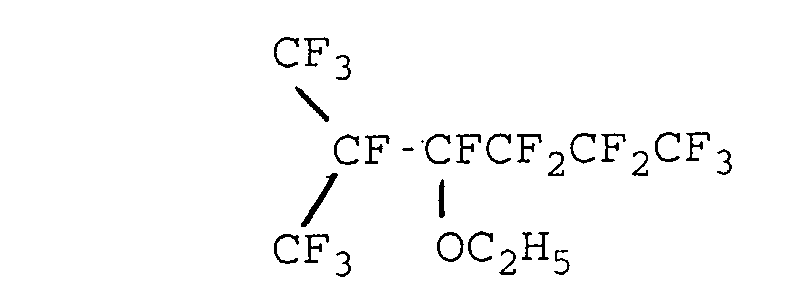
- 50 g of aqueous solution containing 43.4 g of methylethylketone (MEK) are introduced into a 250 ml flask equipped with stirrer. 60 g of a commercial sample of hydrofluoroether HFE 7500 by 3M are fed to the same, having structurewith molecular weight 414 having a boiling point of 123.5°C, viscosity at 25°C equal to 1,33 cSt. The mixture is put under stirring for 35 minutes and then discharged into a 250 ml separatory funnel. The lower organic phase is discharged and analyzed.
- 104 g of solution containing 40.8 g of MEK corresponding to 94.0% of the initially present MEK are recovered.
- 76.3 g of aqueous solution containing 68.6 g of ethanol CH3CH2OH are introduced into a 250 ml flask equipped with stirrer. 77.4 g of hydrofluoropolyether used in Example 1 are fed to the same. The mixture is put under stirring for 30 minutes and then discharged into a 250 ml separatory funnel. The lower organic phase is discharged and analyzed.
- 67.7 g of solution containing 3.2 g of ethanol corresponding to 4.7% of the initially present ethanol are recovered.
- 189 g of aqueous solution containing 141.9 g of isopropanol (CH3)2CHOH are introduced into a 500 ml flask equipped with stirrer. 184 g of hydrofluoropolyether used in Example 1 are fed to the same. The mixture is put under stirring for 45 minutes and then discharged into a 500 ml separatory funnel. The lower organic phase is discharged and analyzed.
- 180 g of solution containing 6.1 g of isopropanol corresponding to 4.3% of the initially present isopropanol are recovered.
- 1.7 g of aqueous solution containing 0.5 g of isopropanol are treated with 133.3 g of an hydrofluoropolyether having structure of formula (II) wherein T1 = T2 = -CF2H with d/e = 1.1 having number average molecular weight of 1583, viscosity at 20°C equal to 6.34 cSt in a 100 ml flask equipped with stirrer.
- After separation 133.6 g of a solution containing 0.17% by weight of isopropanol corresponding to 45% of the fed isopropanol and 0.03% of water are recovered.
- 20 g of aqueous solution containing 1.3 g of triethylamine (CH3CH2)3N are introduced into a 100 ml flask equipped with stirrer. 31.2 g of hydrofluoropolyether used in Example 1 are fed to the same. The mixture is put under stirring for 30 minutes and then discharged into a 100 ml separatory funnel. The lower organic phase is discharged and analyzed.
- 32.4 g of solution containing 1.2 g of triethylamine corresponding to 92.3% of the initially present triethylamine are recovered.
- 31.5 g of aqueous solution containing 19.6 g of formic acid HCOOH are introduced into a 200 ml flask equipped with stirrer. 82.8 g of hydrofluoropolyether having structure of formula (II) are fed to the same, wherein T1 = T2 = -CF2H and it is formed for 11.8% by weight by the oligomer having d = 0 and e = 1, for 88.1% by the oligomer having d = 1 and e = 0 and for 0.1% by the oligomer having d = 1 and e = 1 with number average molecular weight of 228 having a boiling point of 51.5°C, viscosity at 25°C equal to 0.37 cSt. The mixture is put under stirring for 30 minutes and then discharged into a 200 ml separatory funnel.
- After separation 83.8 g of a solution containing 1.2% by weight of formic acid (corresponding to 5.1% of the fed formic acid) and 0.3% of water are obtained.
- 35 g of aqueous solution containing 17.1 g of diglyme (CH3OCH2CH2)2O are introduced into a 100 ml flask equipped with stirrer. 35.8 g of hydrofluoropolyether used in Example 1 are fed to the same. The mixture is put under stirring for 30 minutes and then discharged into a 100 ml separatory funnel.
- After separation 41.2 g of a solution containing 12.9% by weight of diglyme corresponding to 31.1% of the fed diglyme and to 0.2% of water are obtained.
- 35.1 g of aqueous solution containing 14.8 g of pyridine C5H5N are introduced into a 100 ml flask equipped with stirrer. 49.6 g of hydrofluoropolyether used in Example 1 are fed to the same. The mixture is put under stirring for 30 minutes and then discharged into a 100 ml separatory funnel. The lower organic phase is discharged and analyzed.
- 51.7 g of solution'containing 2.1 g of pyridine corresponding to 14.2% of the initially present pyridine are recovered.
- 27.8 g of aqueous solution containing 2.0 g of ethyl acetate CH3COOCH2CH3 are introduced into a 100 ml flask equipped with stirrer. 29.0 g of hydrofluoropolyether used in Example 1 are fed to the same. The mixture is put under stirring for 30 minutes and then discharged into a 100 ml separatory funnel. The lower organic phase is discharged and analyzed.
- 30.9 g of solution containing 1.9 g of ethyl acetate corresponding to 95% of the initially present ethyl acetate are recovered.
- 44.3 g of aqueous solution containing 22.6 g of acetic acid CH3COOH are introduced into a 100 ml flask equipped with stirrer. 44.3 g of hydrofluoropolyether used in Example 1 are fed to the same. The mixture is put under stirring for 30 minutes and then discharged into a 100 ml separatory funnel.
- After separation 45.2 g of a solution containing 2.02% by weight of acetic acid corresponding to 4.0% of the fed acetic acid and to the 0.01% of water are obtained.
- 43.9 g of aqueous solution containing 27.5 g of methylethylketone (MEK) and 4.7 g of ethanol are introduced into a 250 ml flask equipped with stirrer. 58.7 g of hydrofluoropolyether used in Example 1 are fed to the same. The mixture is put under stirring for 30 minutes and then discharged into a 250 ml separatory funnel.
- After separation 82.1 g of a solution containing 26.4% by weight of methylethylketone corresponding to 78.9% of the fed methylethylketone, 2.1% of ethanol corresponding to 36.2% of the fed ethanol and 0.8% of water are obtained.
- 29.9 g of aqueous solution containing 18.6 g of methylethylketone (MEK) and 3.3 g of ethanol are introduced into a 100 ml flask equipped with stirrer. 40.7 g of hydrofluoropolyether having structure of formula (II) are fed to the same, wherein T1 = T2 = -CF2H and it is formed for 0.6% by weight by the oligomer having d = 1 and e = 0, for 20.4% by the oligomer having d = 1 and e = 1, for 75.9% by the oligomer having d = 2 and e = 0, for 2% by the oligomer having d = 1 and e = 2 and for 1% by the oligomer having d = 2 and e = 1 with number average molecular weight of 342 having a boiling point of 94.4°C, viscosity at 25°C equal to 0.59 cSt. The mixture is put under stirring for 30 minutes and then discharged into a 100 ml separatory funnel.
- After separation 60.9 g of a solution containing 28.9% by weight of methylethylketone corresponding to 94.6% of the fed methylethylketone, 3.2% of ethanol corresponding to 59% of the fed ethanol and 1.1% of water are obtained.
Claims (8)
- A liquid-liquid extraction process of polar organic substances, completely or partially soluble in water, from their aqueous solutions, comprising:1) addition to said aqueous solutions of a fluorinated extracting liquid selected fromA) hydrofluoropolyethers,B) hydrofluorocarbons,C) hydrofluoroethers, or mixtures thereof, wherein A), B) and C) have a molecular weight in the range 82-12,000, preferably 180-5,000, and when A) is a polymer the molecular weight is a number average molecular weight, with formation of an aqueous phase and of an organic phase;2) separation of the organic phase, formed by the fluorinated extractant containing the polar organic substance, from the aqueous phase;3) fractional distillation of the organic phase to separate the polar organic substance from the extractant.
- A process according to claim 1, wherein the class A) hydrofluoropolyethers comprise one or more oxy(per)fluoroalkylene units selected from
- A process according to claims 1-2, wherein the class A) hydroperfluoropolyethers have formula (I):wherein X has the above meaning; the coefficients a, b, d, e, f, g are 0 or integers, c is 1, 2 or 3, selected so that their sum results such that the number average molecular weight is in the range 82-12,000, preferably 180-5,000; T1, T2, equal to or different from each other, are selected from -CF2H, -CF(CF3)H, -CF2CF2H, -CH3,-C2H5.

- A process acording to claims 1-3, wherein the class A) hydroperfluoropolyethers have formula (II):
- A process according to claim 1, wherein the class C) hydrofluoroethers have general formula (III):
wherein at least one of the R1, R2 contains at least one fluorine atom and wherein the total number of the hydrogen atoms is equal at most to the number of the fluorine atoms, preferably to increase the non flammability the number of fluorine atoms is higher than the number of hydrogen atoms, optionally R1 and/or R2 containing one or more ether oxygen atoms. - A process according to claims 1-5, wherein the mixing of the fluorinated extractant with the aqueous solution is carried out in a stirred system, at temperatures in the range 0°C-50°C, preferably 15°C-30°C, and at atmospheric pressure or higher.
- A process according to claims 1-6, wherein the aqueous solutions to be subjected to the extraction process contain from 0.1 to 99% by weight of completely dissolved polar organic substance.
- A process according to claims 1-7, wherein the ratio by weight between the aqueous solution containing the polar organic compound and the fluorinated extractant is in the range 0.005-50, preferably 0.01-10.
Applications Claiming Priority (2)
| Application Number | Priority Date | Filing Date | Title |
|---|---|---|---|
| IT2002MI000513A ITMI20020513A1 (en) | 2002-03-12 | 2002-03-12 | LIQUID-LIQUID EXTRACTION OF POLAR ORGANIC SUBSTANCES FROM THEIR AQUEOUS SOLUTIONS WITH FLUORINATED EXTRACTIVE LIQUIDS |
| ITMI20020513 | 2002-03-12 |
Publications (2)
| Publication Number | Publication Date |
|---|---|
| EP1346757A1 true EP1346757A1 (en) | 2003-09-24 |
| EP1346757B1 EP1346757B1 (en) | 2005-05-04 |
Family
ID=11449489
Family Applications (1)
| Application Number | Title | Priority Date | Filing Date |
|---|---|---|---|
| EP03004057A Expired - Lifetime EP1346757B1 (en) | 2002-03-12 | 2003-02-25 | Liquid-liquid extraction of polar organic substances from their aqueous solutions with fluorinated extracting liquids |
Country Status (5)
| Country | Link |
|---|---|
| US (1) | US7132051B2 (en) |
| EP (1) | EP1346757B1 (en) |
| JP (1) | JP4414148B2 (en) |
| DE (1) | DE60300592T2 (en) |
| IT (1) | ITMI20020513A1 (en) |
Cited By (1)
| Publication number | Priority date | Publication date | Assignee | Title |
|---|---|---|---|---|
| EP2444385B1 (en) * | 2009-06-15 | 2014-12-10 | Daikin Industries, Ltd. | Method for producing fluorine-containing ether with high purity |
Families Citing this family (7)
| Publication number | Priority date | Publication date | Assignee | Title |
|---|---|---|---|---|
| JP4540463B2 (en) * | 2004-12-16 | 2010-09-08 | 三和油化工業株式会社 | Hydrofluoroether recovery method |
| US7629397B2 (en) * | 2006-06-23 | 2009-12-08 | Exxonmobil Chemical Patents Inc. | Phase separation process utilizing a hydrofluorocarbon |
| EP2205550B1 (en) * | 2007-09-27 | 2017-08-30 | 3M Innovative Properties Company | A process for preparing fluorinated carboxylic acid fluorides |
| WO2009042331A1 (en) * | 2007-09-27 | 2009-04-02 | 3M Innovative Properties Company | Fluorinated polyethers and polyether oils and methods of preparation |
| FR2941691B1 (en) | 2009-02-02 | 2013-09-20 | Souza Guillaume De | WATER PRETREATMENT UNIT BY DIRECT CONTACT EXCHANGE. |
| KR101641140B1 (en) * | 2014-05-22 | 2016-07-20 | 주식회사 엘지화학 | A Method for Preparation of Allyl Alcohol |
| CN104370673B (en) * | 2014-10-16 | 2017-06-09 | 中国石油化工股份有限公司 | A kind of method of separating-purifying organic matter |
Citations (3)
| Publication number | Priority date | Publication date | Assignee | Title |
|---|---|---|---|---|
| US3846488A (en) * | 1972-01-06 | 1974-11-05 | Rohm & Haas | Accelerating separation rate of two liquid phases in the extraction of aqueous acrylic acid |
| US4582570A (en) * | 1981-07-24 | 1986-04-15 | Merix Corporation | Azeotropic dehydration distillation process |
| US6121497A (en) * | 1998-10-16 | 2000-09-19 | Celanese International Corporation | Process of recovering methyl ethyl ketone from an aqueous mixture of methyl ethyl ketone and ethanol |
Family Cites Families (12)
| Publication number | Priority date | Publication date | Assignee | Title |
|---|---|---|---|---|
| IT1217658B (en) | 1988-05-20 | 1990-03-30 | Ausimont Spa | PROCESS PERFECTED FOR THE PRODUCTION OF PERFLUOROPOLYETERS CONSTITUTED SUBSTANTIALLY BY PERFLUDOSSIETILENCHE AND PERFLUOROXIPROPYLENE UNITS |
| IT1229845B (en) | 1989-04-20 | 1991-09-13 | Ausimont Srl | PROCEDURE FOR THE PREPARATION OF PEROXIDE PERFLUOROPOLYETERS. |
| IT1241679B (en) | 1990-03-06 | 1994-01-31 | Ausimont Spa | PERFLUOROPOLYETERS AND PROCESSES FOR THEIR PREPARATION |
| US5220082A (en) | 1990-10-11 | 1993-06-15 | E. I. Du Pont De Nemours And Company | Process for production of polyfluoroolefins |
| US5225048A (en) * | 1991-01-29 | 1993-07-06 | Athens Corp. | Method for concentration of liquids |
| IT1274591B (en) | 1994-08-05 | 1997-07-18 | Ausimont Spa | PROCESS FOR THE PREPARATION OF HYDROGEN POLYOXYPERFLUOROALKANS TERMINATED |
| JP3142878B2 (en) | 1995-10-20 | 2001-03-07 | ミネソタ マイニング アンド マニュファクチャリング カンパニー | Hydrofluoroether as a low-temperature refrigerant |
| JP2001505128A (en) * | 1996-12-06 | 2001-04-17 | アドバンスト・ファイトニックス・リミテッド | Material processing |
| JPH10316597A (en) | 1997-05-15 | 1998-12-02 | Agency Of Ind Science & Technol | Fluorinated saturated hydrocarbon |
| US6046368A (en) * | 1998-03-17 | 2000-04-04 | 3M Innovative Properties Company | Catalytic process for making hydrofluoroethers |
| CA2255413A1 (en) * | 1998-12-11 | 2000-06-11 | Fracmaster Ltd. | Foamed nitrogen in liquid co2 for fracturing |
| WO2000044697A1 (en) | 1999-01-28 | 2000-08-03 | Izak Nieuwoudt | Separation of ethanol and water from mixtures thereof by extractive distillation |
-
2002
- 2002-03-12 IT IT2002MI000513A patent/ITMI20020513A1/en unknown
-
2003
- 2003-02-25 DE DE60300592T patent/DE60300592T2/en not_active Expired - Lifetime
- 2003-02-25 EP EP03004057A patent/EP1346757B1/en not_active Expired - Lifetime
- 2003-03-11 US US10/384,665 patent/US7132051B2/en not_active Expired - Fee Related
- 2003-03-12 JP JP2003066839A patent/JP4414148B2/en not_active Expired - Fee Related
Patent Citations (3)
| Publication number | Priority date | Publication date | Assignee | Title |
|---|---|---|---|---|
| US3846488A (en) * | 1972-01-06 | 1974-11-05 | Rohm & Haas | Accelerating separation rate of two liquid phases in the extraction of aqueous acrylic acid |
| US4582570A (en) * | 1981-07-24 | 1986-04-15 | Merix Corporation | Azeotropic dehydration distillation process |
| US6121497A (en) * | 1998-10-16 | 2000-09-19 | Celanese International Corporation | Process of recovering methyl ethyl ketone from an aqueous mixture of methyl ethyl ketone and ethanol |
Cited By (1)
| Publication number | Priority date | Publication date | Assignee | Title |
|---|---|---|---|---|
| EP2444385B1 (en) * | 2009-06-15 | 2014-12-10 | Daikin Industries, Ltd. | Method for producing fluorine-containing ether with high purity |
Also Published As
| Publication number | Publication date |
|---|---|
| ITMI20020513A0 (en) | 2002-03-12 |
| DE60300592T2 (en) | 2006-01-19 |
| ITMI20020513A1 (en) | 2003-09-12 |
| DE60300592D1 (en) | 2005-06-09 |
| US20030173310A1 (en) | 2003-09-18 |
| JP2003267895A (en) | 2003-09-25 |
| JP4414148B2 (en) | 2010-02-10 |
| EP1346757B1 (en) | 2005-05-04 |
| US7132051B2 (en) | 2006-11-07 |
Similar Documents
| Publication | Publication Date | Title |
|---|---|---|
| JP5711050B2 (en) | Production of fluoromethyl 2,2,2-trifluoro-1- (trifluoromethyl) ethyl ether | |
| KR101445410B1 (en) | HYDROFLUOROETHER COMPOUNDS AND METHODS OF MAKING AND USING THE SAME | |
| JP2804077B2 (en) | Functional fluoropolyether | |
| EP2914358B1 (en) | Process for the purification of (per)fluoropolyethers with carboxylate end groups | |
| EP1346757B1 (en) | Liquid-liquid extraction of polar organic substances from their aqueous solutions with fluorinated extracting liquids | |
| KR101455449B1 (en) | Method for producing fluorine-containing ether with high purity | |
| KR100591625B1 (en) | Treatment of Formaldehyde-Containing Mixtures | |
| US5872157A (en) | Method for olefin oxidation | |
| JP6804552B2 (en) | Method for producing fluorinated compound | |
| WO2002026689A1 (en) | Process for producing fluorinated polyvalent carbonyl compound | |
| CA2067077A1 (en) | Process for the preparation of perfluoroethercarboxylic acids | |
| JP5824963B2 (en) | Purification method of fluoroalkyl vinyl ether | |
| JPH11343267A (en) | Method for producing halogen-containing carboxylic acid ester | |
| WO2002048085A1 (en) | Process for producing product of decomposition of fluorinated ester compound | |
| EP1912925B1 (en) | Separation/purification of desflurane from hydrogen fluoride | |
| US6241807B1 (en) | System for recovery of metals from solutions thereof | |
| JP3030335B2 (en) | Purification method of fluorinated ether | |
| JP4362710B2 (en) | Method for producing fluorine-containing carbonyl compound | |
| JP3644038B2 (en) | Method for purifying perfluorovinyl ether | |
| CN118479958A (en) | Method for separating isopropyl alcohol-isopropyl acetate binary mixed solvent | |
| JP2025522606A (en) | Hydrofluoroether composition and method for preparing same | |
| US3840592A (en) | Separation of dioxin and 2,4,5-t from dioxin and 2,4,5-t-contaminated silvex | |
| JP4769633B2 (en) | Purification method of hydrophobic nonionic surfactant | |
| JPWO1998023569A1 (en) | Method for purifying perfluorovinyl ether | |
| JP2007008841A (en) | Method for recovering 1,3-dialkyl-2-imidazolidinone |
Legal Events
| Date | Code | Title | Description |
|---|---|---|---|
| PUAI | Public reference made under article 153(3) epc to a published international application that has entered the european phase |
Free format text: ORIGINAL CODE: 0009012 |
|
| AK | Designated contracting states |
Kind code of ref document: A1 Designated state(s): AT BE BG CH CY CZ DE DK EE ES FI FR GB GR HU IE IT LI LU MC NL PT SE SI SK TR |
|
| AX | Request for extension of the european patent |
Extension state: AL LT LV MK RO |
|
| 17P | Request for examination filed |
Effective date: 20040220 |
|
| AKX | Designation fees paid |
Designated state(s): DE FR GB IT |
|
| GRAP | Despatch of communication of intention to grant a patent |
Free format text: ORIGINAL CODE: EPIDOSNIGR1 |
|
| GRAS | Grant fee paid |
Free format text: ORIGINAL CODE: EPIDOSNIGR3 |
|
| GRAA | (expected) grant |
Free format text: ORIGINAL CODE: 0009210 |
|
| AK | Designated contracting states |
Kind code of ref document: B1 Designated state(s): DE FR GB IT |
|
| REG | Reference to a national code |
Ref country code: GB Ref legal event code: FG4D |
|
| REG | Reference to a national code |
Ref country code: IE Ref legal event code: FG4D |
|
| REF | Corresponds to: |
Ref document number: 60300592 Country of ref document: DE Date of ref document: 20050609 Kind code of ref document: P |
|
| PLBE | No opposition filed within time limit |
Free format text: ORIGINAL CODE: 0009261 |
|
| STAA | Information on the status of an ep patent application or granted ep patent |
Free format text: STATUS: NO OPPOSITION FILED WITHIN TIME LIMIT |
|
| ET | Fr: translation filed | ||
| 26N | No opposition filed |
Effective date: 20060207 |
|
| REG | Reference to a national code |
Ref country code: DE Ref legal event code: R082 Ref document number: 60300592 Country of ref document: DE Representative=s name: MEISSNER, BOLTE & PARTNER GBR, DE Ref country code: DE Ref legal event code: R082 Ref document number: 60300592 Country of ref document: DE Representative=s name: MEISSNER BOLTE PATENTANWAELTE RECHTSANWAELTE P, DE |
|
| REG | Reference to a national code |
Ref country code: DE Ref legal event code: R082 Ref document number: 60300592 Country of ref document: DE Representative=s name: MEISSNER, BOLTE & PARTNER GBR, DE |
|
| REG | Reference to a national code |
Ref country code: FR Ref legal event code: PLFP Year of fee payment: 14 |
|
| PGFP | Annual fee paid to national office [announced via postgrant information from national office to epo] |
Ref country code: IT Payment date: 20160222 Year of fee payment: 14 Ref country code: DE Payment date: 20160216 Year of fee payment: 14 |
|
| PGFP | Annual fee paid to national office [announced via postgrant information from national office to epo] |
Ref country code: GB Payment date: 20160224 Year of fee payment: 14 Ref country code: FR Payment date: 20160108 Year of fee payment: 14 |
|
| REG | Reference to a national code |
Ref country code: DE Ref legal event code: R119 Ref document number: 60300592 Country of ref document: DE |
|
| GBPC | Gb: european patent ceased through non-payment of renewal fee |
Effective date: 20170225 |
|
| REG | Reference to a national code |
Ref country code: FR Ref legal event code: ST Effective date: 20171031 |
|
| PG25 | Lapsed in a contracting state [announced via postgrant information from national office to epo] |
Ref country code: DE Free format text: LAPSE BECAUSE OF NON-PAYMENT OF DUE FEES Effective date: 20170901 Ref country code: FR Free format text: LAPSE BECAUSE OF NON-PAYMENT OF DUE FEES Effective date: 20170228 |
|
| PG25 | Lapsed in a contracting state [announced via postgrant information from national office to epo] |
Ref country code: GB Free format text: LAPSE BECAUSE OF NON-PAYMENT OF DUE FEES Effective date: 20170225 Ref country code: IT Free format text: LAPSE BECAUSE OF NON-PAYMENT OF DUE FEES Effective date: 20170225 |