EP1344774A1 - Synthesizing methods of dicyanomethylidene compound and heterocyclic compound - Google Patents
Synthesizing methods of dicyanomethylidene compound and heterocyclic compound Download PDFInfo
- Publication number
- EP1344774A1 EP1344774A1 EP03005826A EP03005826A EP1344774A1 EP 1344774 A1 EP1344774 A1 EP 1344774A1 EP 03005826 A EP03005826 A EP 03005826A EP 03005826 A EP03005826 A EP 03005826A EP 1344774 A1 EP1344774 A1 EP 1344774A1
- Authority
- EP
- European Patent Office
- Prior art keywords
- group
- substituted
- compound represented
- unsubstituted
- formula
- Prior art date
- Legal status (The legal status is an assumption and is not a legal conclusion. Google has not performed a legal analysis and makes no representation as to the accuracy of the status listed.)
- Granted
Links
- -1 dicyanomethylidene compound Chemical class 0.000 title claims abstract description 196
- 238000000034 method Methods 0.000 title claims abstract description 48
- 230000002194 synthesizing effect Effects 0.000 title claims abstract description 40
- 150000002391 heterocyclic compounds Chemical class 0.000 title claims abstract description 12
- 239000003795 chemical substances by application Substances 0.000 claims abstract description 27
- OAKJQQAXSVQMHS-UHFFFAOYSA-N hydrazine Substances NN OAKJQQAXSVQMHS-UHFFFAOYSA-N 0.000 claims abstract description 23
- 230000000269 nucleophilic effect Effects 0.000 claims abstract description 21
- 239000012024 dehydrating agents Substances 0.000 claims abstract description 17
- CUONGYYJJVDODC-UHFFFAOYSA-N malononitrile Chemical class N#CCC#N CUONGYYJJVDODC-UHFFFAOYSA-N 0.000 claims abstract description 12
- 239000007795 chemical reaction product Substances 0.000 claims abstract description 5
- 150000001875 compounds Chemical class 0.000 claims description 84
- 125000000623 heterocyclic group Chemical group 0.000 claims description 35
- 125000000217 alkyl group Chemical group 0.000 claims description 20
- 125000003118 aryl group Chemical group 0.000 claims description 18
- 125000004435 hydrogen atom Chemical group [H]* 0.000 claims description 14
- 125000001424 substituent group Chemical group 0.000 claims description 14
- 229910052757 nitrogen Inorganic materials 0.000 claims description 5
- 125000004430 oxygen atom Chemical group O* 0.000 claims description 5
- 229910052717 sulfur Inorganic materials 0.000 claims description 5
- 125000004434 sulfur atom Chemical group 0.000 claims description 5
- 125000004433 nitrogen atom Chemical group N* 0.000 claims description 4
- 125000004432 carbon atom Chemical group C* 0.000 description 58
- 239000002904 solvent Substances 0.000 description 33
- 238000006243 chemical reaction Methods 0.000 description 31
- XLYOFNOQVPJJNP-UHFFFAOYSA-N water Substances O XLYOFNOQVPJJNP-UHFFFAOYSA-N 0.000 description 22
- WEVYAHXRMPXWCK-UHFFFAOYSA-N Acetonitrile Chemical compound CC#N WEVYAHXRMPXWCK-UHFFFAOYSA-N 0.000 description 15
- ZMANZCXQSJIPKH-UHFFFAOYSA-N Triethylamine Chemical compound CCN(CC)CC ZMANZCXQSJIPKH-UHFFFAOYSA-N 0.000 description 15
- 239000011541 reaction mixture Substances 0.000 description 15
- LFQSCWFLJHTTHZ-UHFFFAOYSA-N Ethanol Chemical compound CCO LFQSCWFLJHTTHZ-UHFFFAOYSA-N 0.000 description 12
- KFZMGEQAYNKOFK-UHFFFAOYSA-N Isopropanol Chemical compound CC(C)O KFZMGEQAYNKOFK-UHFFFAOYSA-N 0.000 description 12
- YXFVVABEGXRONW-UHFFFAOYSA-N Toluene Chemical compound CC1=CC=CC=C1 YXFVVABEGXRONW-UHFFFAOYSA-N 0.000 description 12
- 239000000203 mixture Substances 0.000 description 11
- XHXFXVLFKHQFAL-UHFFFAOYSA-N phosphoryl trichloride Chemical compound ClP(Cl)(Cl)=O XHXFXVLFKHQFAL-UHFFFAOYSA-N 0.000 description 10
- 238000003756 stirring Methods 0.000 description 10
- YMWUJEATGCHHMB-UHFFFAOYSA-N Dichloromethane Chemical compound ClCCl YMWUJEATGCHHMB-UHFFFAOYSA-N 0.000 description 9
- XEKOWRVHYACXOJ-UHFFFAOYSA-N Ethyl acetate Chemical compound CCOC(C)=O XEKOWRVHYACXOJ-UHFFFAOYSA-N 0.000 description 9
- OKKJLVBELUTLKV-UHFFFAOYSA-N Methanol Chemical compound OC OKKJLVBELUTLKV-UHFFFAOYSA-N 0.000 description 9
- OOANNPDXEPQATR-UHFFFAOYSA-N 2-(1-amino-2,2-dimethylpropylidene)propanedinitrile Chemical compound CC(C)(C)C(N)=C(C#N)C#N OOANNPDXEPQATR-UHFFFAOYSA-N 0.000 description 8
- JUJWROOIHBZHMG-UHFFFAOYSA-N Pyridine Chemical compound C1=CC=NC=C1 JUJWROOIHBZHMG-UHFFFAOYSA-N 0.000 description 8
- 239000007787 solid Substances 0.000 description 8
- RIOQSEWOXXDEQQ-UHFFFAOYSA-N triphenylphosphine Chemical compound C1=CC=CC=C1P(C=1C=CC=CC=1)C1=CC=CC=C1 RIOQSEWOXXDEQQ-UHFFFAOYSA-N 0.000 description 8
- 125000003545 alkoxy group Chemical group 0.000 description 7
- ZMXDDKWLCZADIW-UHFFFAOYSA-N N,N-Dimethylformamide Chemical compound CN(C)C=O ZMXDDKWLCZADIW-UHFFFAOYSA-N 0.000 description 6
- 125000004104 aryloxy group Chemical group 0.000 description 6
- VLKZOEOYAKHREP-UHFFFAOYSA-N n-Hexane Chemical compound CCCCCC VLKZOEOYAKHREP-UHFFFAOYSA-N 0.000 description 6
- 239000003960 organic solvent Substances 0.000 description 6
- UHZYTMXLRWXGPK-UHFFFAOYSA-N phosphorus pentachloride Chemical compound ClP(Cl)(Cl)(Cl)Cl UHZYTMXLRWXGPK-UHFFFAOYSA-N 0.000 description 6
- 150000003839 salts Chemical class 0.000 description 6
- 239000007858 starting material Substances 0.000 description 6
- UDEGDFIPVYZBGQ-UHFFFAOYSA-N 2-(2,2-dimethylpropanoyl)propanedinitrile Chemical compound CC(C)(C)C(=O)C(C#N)C#N UDEGDFIPVYZBGQ-UHFFFAOYSA-N 0.000 description 5
- 239000005456 alcohol based solvent Substances 0.000 description 5
- 125000003342 alkenyl group Chemical group 0.000 description 5
- 125000004414 alkyl thio group Chemical group 0.000 description 5
- 125000005110 aryl thio group Chemical group 0.000 description 5
- 239000003759 ester based solvent Substances 0.000 description 5
- 150000002825 nitriles Chemical class 0.000 description 5
- 238000003786 synthesis reaction Methods 0.000 description 5
- JVVRJMXHNUAPHW-UHFFFAOYSA-N 1h-pyrazol-5-amine Chemical class NC=1C=CNN=1 JVVRJMXHNUAPHW-UHFFFAOYSA-N 0.000 description 4
- OISVCGZHLKNMSJ-UHFFFAOYSA-N 2,6-dimethylpyridine Chemical compound CC1=CC=CC(C)=N1 OISVCGZHLKNMSJ-UHFFFAOYSA-N 0.000 description 4
- CSCPPACGZOOCGX-UHFFFAOYSA-N Acetone Chemical compound CC(C)=O CSCPPACGZOOCGX-UHFFFAOYSA-N 0.000 description 4
- 239000004215 Carbon black (E152) Substances 0.000 description 4
- IAZDPXIOMUYVGZ-UHFFFAOYSA-N Dimethylsulphoxide Chemical compound CS(C)=O IAZDPXIOMUYVGZ-UHFFFAOYSA-N 0.000 description 4
- JLTDJTHDQAWBAV-UHFFFAOYSA-N N,N-dimethylaniline Chemical compound CN(C)C1=CC=CC=C1 JLTDJTHDQAWBAV-UHFFFAOYSA-N 0.000 description 4
- NQRYJNQNLNOLGT-UHFFFAOYSA-N Piperidine Chemical compound C1CCNCC1 NQRYJNQNLNOLGT-UHFFFAOYSA-N 0.000 description 4
- WYURNTSHIVDZCO-UHFFFAOYSA-N Tetrahydrofuran Chemical compound C1CCOC1 WYURNTSHIVDZCO-UHFFFAOYSA-N 0.000 description 4
- 125000005194 alkoxycarbonyloxy group Chemical group 0.000 description 4
- 125000006615 aromatic heterocyclic group Chemical group 0.000 description 4
- 125000005200 aryloxy carbonyloxy group Chemical group 0.000 description 4
- 125000003917 carbamoyl group Chemical group [H]N([H])C(*)=O 0.000 description 4
- 150000001732 carboxylic acid derivatives Chemical class 0.000 description 4
- 125000000392 cycloalkenyl group Chemical group 0.000 description 4
- JHIVVAPYMSGYDF-UHFFFAOYSA-N cyclohexanone Chemical compound O=C1CCCCC1 JHIVVAPYMSGYDF-UHFFFAOYSA-N 0.000 description 4
- 239000004210 ether based solvent Substances 0.000 description 4
- 125000005843 halogen group Chemical group 0.000 description 4
- 229930195733 hydrocarbon Natural products 0.000 description 4
- 150000002430 hydrocarbons Chemical class 0.000 description 4
- 150000002905 orthoesters Chemical class 0.000 description 4
- 125000005328 phosphinyl group Chemical group [PH2](=O)* 0.000 description 4
- UMJSCPRVCHMLSP-UHFFFAOYSA-N pyridine Natural products COC1=CC=CN=C1 UMJSCPRVCHMLSP-UHFFFAOYSA-N 0.000 description 4
- 125000000999 tert-butyl group Chemical group [H]C([H])([H])C(*)(C([H])([H])[H])C([H])([H])[H] 0.000 description 4
- 125000003396 thiol group Chemical class [H]S* 0.000 description 4
- JVSFQJZRHXAUGT-UHFFFAOYSA-N 2,2-dimethylpropanoyl chloride Chemical compound CC(C)(C)C(Cl)=O JVSFQJZRHXAUGT-UHFFFAOYSA-N 0.000 description 3
- WFDIJRYMOXRFFG-UHFFFAOYSA-N Acetic anhydride Chemical compound CC(=O)OC(C)=O WFDIJRYMOXRFFG-UHFFFAOYSA-N 0.000 description 3
- WMFOQBRAJBCJND-UHFFFAOYSA-M Lithium hydroxide Chemical compound [Li+].[OH-] WMFOQBRAJBCJND-UHFFFAOYSA-M 0.000 description 3
- KWYUFKZDYYNOTN-UHFFFAOYSA-M Potassium hydroxide Chemical compound [OH-].[K+] KWYUFKZDYYNOTN-UHFFFAOYSA-M 0.000 description 3
- HEMHJVSKTPXQMS-UHFFFAOYSA-M Sodium hydroxide Chemical compound [OH-].[Na+] HEMHJVSKTPXQMS-UHFFFAOYSA-M 0.000 description 3
- 125000004423 acyloxy group Chemical group 0.000 description 3
- 125000004466 alkoxycarbonylamino group Chemical group 0.000 description 3
- 125000003282 alkyl amino group Chemical group 0.000 description 3
- 125000004644 alkyl sulfinyl group Chemical group 0.000 description 3
- 125000004390 alkyl sulfonyl group Chemical group 0.000 description 3
- 125000004656 alkyl sulfonylamino group Chemical group 0.000 description 3
- 125000000304 alkynyl group Chemical group 0.000 description 3
- 150000001412 amines Chemical class 0.000 description 3
- 125000003277 amino group Chemical group 0.000 description 3
- 125000006598 aminocarbonylamino group Chemical group 0.000 description 3
- 125000004397 aminosulfonyl group Chemical group NS(=O)(=O)* 0.000 description 3
- 125000001769 aryl amino group Chemical group 0.000 description 3
- 125000005162 aryl oxy carbonyl amino group Chemical group 0.000 description 3
- 125000005161 aryl oxy carbonyl group Chemical group 0.000 description 3
- 125000005135 aryl sulfinyl group Chemical group 0.000 description 3
- 125000004657 aryl sulfonyl amino group Chemical group 0.000 description 3
- 125000004391 aryl sulfonyl group Chemical group 0.000 description 3
- 125000000751 azo group Chemical group [*]N=N[*] 0.000 description 3
- 239000007810 chemical reaction solvent Substances 0.000 description 3
- 239000000460 chlorine Substances 0.000 description 3
- 229910052801 chlorine Inorganic materials 0.000 description 3
- 125000001309 chloro group Chemical group Cl* 0.000 description 3
- 239000013078 crystal Substances 0.000 description 3
- MGNCLNQXLYJVJD-UHFFFAOYSA-N cyanuric chloride Chemical compound ClC1=NC(Cl)=NC(Cl)=N1 MGNCLNQXLYJVJD-UHFFFAOYSA-N 0.000 description 3
- 125000004122 cyclic group Chemical group 0.000 description 3
- 125000000753 cycloalkyl group Chemical group 0.000 description 3
- VAYGXNSJCAHWJZ-UHFFFAOYSA-N dimethyl sulfate Chemical compound COS(=O)(=O)OC VAYGXNSJCAHWJZ-UHFFFAOYSA-N 0.000 description 3
- 150000002148 esters Chemical class 0.000 description 3
- 229910052736 halogen Inorganic materials 0.000 description 3
- 229910052751 metal Inorganic materials 0.000 description 3
- 239000002184 metal Substances 0.000 description 3
- 125000002950 monocyclic group Chemical group 0.000 description 3
- 150000007530 organic bases Chemical class 0.000 description 3
- 125000001820 oxy group Chemical group [*:1]O[*:2] 0.000 description 3
- 125000004469 siloxy group Chemical group [SiH3]O* 0.000 description 3
- 125000003808 silyl group Chemical group [H][Si]([H])([H])[*] 0.000 description 3
- 125000004149 thio group Chemical group *S* 0.000 description 3
- NWZSZGALRFJKBT-KNIFDHDWSA-N (2s)-2,6-diaminohexanoic acid;(2s)-2-hydroxybutanedioic acid Chemical compound OC(=O)[C@@H](O)CC(O)=O.NCCCC[C@H](N)C(O)=O NWZSZGALRFJKBT-KNIFDHDWSA-N 0.000 description 2
- RYHBNJHYFVUHQT-UHFFFAOYSA-N 1,4-Dioxane Chemical compound C1COCCO1 RYHBNJHYFVUHQT-UHFFFAOYSA-N 0.000 description 2
- 238000005160 1H NMR spectroscopy Methods 0.000 description 2
- ABWDYPYMGCFQPJ-UHFFFAOYSA-N 2-(chloromethylidene)propanedinitrile Chemical class ClC=C(C#N)C#N ABWDYPYMGCFQPJ-UHFFFAOYSA-N 0.000 description 2
- BNGPVKSKKYIJCR-UHFFFAOYSA-N 2-chloro-1,3-dimethylimidazolidine;hydrochloride Chemical compound [Cl-].CN1CC[NH+](C)C1Cl BNGPVKSKKYIJCR-UHFFFAOYSA-N 0.000 description 2
- 125000002941 2-furyl group Chemical group O1C([*])=C([H])C([H])=C1[H] 0.000 description 2
- 125000001494 2-propynyl group Chemical group [H]C#CC([H])([H])* 0.000 description 2
- 125000000175 2-thienyl group Chemical group S1C([*])=C([H])C([H])=C1[H] 0.000 description 2
- 125000004179 3-chlorophenyl group Chemical group [H]C1=C([H])C(*)=C([H])C(Cl)=C1[H] 0.000 description 2
- YYROPELSRYBVMQ-UHFFFAOYSA-N 4-toluenesulfonyl chloride Chemical compound CC1=CC=C(S(Cl)(=O)=O)C=C1 YYROPELSRYBVMQ-UHFFFAOYSA-N 0.000 description 2
- ZCYVEMRRCGMTRW-UHFFFAOYSA-N 7553-56-2 Chemical compound [I] ZCYVEMRRCGMTRW-UHFFFAOYSA-N 0.000 description 2
- VHUUQVKOLVNVRT-UHFFFAOYSA-N Ammonium hydroxide Chemical compound [NH4+].[OH-] VHUUQVKOLVNVRT-UHFFFAOYSA-N 0.000 description 2
- IJGRMHOSHXDMSA-UHFFFAOYSA-N Atomic nitrogen Chemical compound N#N IJGRMHOSHXDMSA-UHFFFAOYSA-N 0.000 description 2
- LSNNMFCWUKXFEE-UHFFFAOYSA-M Bisulfite Chemical compound OS([O-])=O LSNNMFCWUKXFEE-UHFFFAOYSA-M 0.000 description 2
- WKBOTKDWSSQWDR-UHFFFAOYSA-N Bromine atom Chemical compound [Br] WKBOTKDWSSQWDR-UHFFFAOYSA-N 0.000 description 2
- 0 C*C(*)=C(*)C#N Chemical compound C*C(*)=C(*)C#N 0.000 description 2
- CKDWPUIZGOQOOM-UHFFFAOYSA-N Carbamyl chloride Chemical compound NC(Cl)=O CKDWPUIZGOQOOM-UHFFFAOYSA-N 0.000 description 2
- ZAMOUSCENKQFHK-UHFFFAOYSA-N Chlorine atom Chemical compound [Cl] ZAMOUSCENKQFHK-UHFFFAOYSA-N 0.000 description 2
- YXHKONLOYHBTNS-UHFFFAOYSA-N Diazomethane Chemical compound C=[N+]=[N-] YXHKONLOYHBTNS-UHFFFAOYSA-N 0.000 description 2
- IAZDPXIOMUYVGZ-WFGJKAKNSA-N Dimethyl sulfoxide Chemical compound [2H]C([2H])([2H])S(=O)C([2H])([2H])[2H] IAZDPXIOMUYVGZ-WFGJKAKNSA-N 0.000 description 2
- PXGOKWXKJXAPGV-UHFFFAOYSA-N Fluorine Chemical compound FF PXGOKWXKJXAPGV-UHFFFAOYSA-N 0.000 description 2
- 229930194542 Keto Natural products 0.000 description 2
- MZRVEZGGRBJDDB-UHFFFAOYSA-N N-Butyllithium Chemical compound [Li]CCCC MZRVEZGGRBJDDB-UHFFFAOYSA-N 0.000 description 2
- PCLIMKBDDGJMGD-UHFFFAOYSA-N N-bromosuccinimide Chemical compound BrN1C(=O)CCC1=O PCLIMKBDDGJMGD-UHFFFAOYSA-N 0.000 description 2
- JRNVZBWKYDBUCA-UHFFFAOYSA-N N-chlorosuccinimide Chemical compound ClN1C(=O)CCC1=O JRNVZBWKYDBUCA-UHFFFAOYSA-N 0.000 description 2
- 238000005481 NMR spectroscopy Methods 0.000 description 2
- CTQNGGLPUBDAKN-UHFFFAOYSA-N O-Xylene Chemical compound CC1=CC=CC=C1C CTQNGGLPUBDAKN-UHFFFAOYSA-N 0.000 description 2
- CDBYLPFSWZWCQE-UHFFFAOYSA-L Sodium Carbonate Chemical compound [Na+].[Na+].[O-]C([O-])=O CDBYLPFSWZWCQE-UHFFFAOYSA-L 0.000 description 2
- UIIMBOGNXHQVGW-UHFFFAOYSA-M Sodium bicarbonate Chemical compound [Na+].OC([O-])=O UIIMBOGNXHQVGW-UHFFFAOYSA-M 0.000 description 2
- WQDUMFSSJAZKTM-UHFFFAOYSA-N Sodium methoxide Chemical compound [Na+].[O-]C WQDUMFSSJAZKTM-UHFFFAOYSA-N 0.000 description 2
- HEDRZPFGACZZDS-MICDWDOJSA-N Trichloro(2H)methane Chemical compound [2H]C(Cl)(Cl)Cl HEDRZPFGACZZDS-MICDWDOJSA-N 0.000 description 2
- WETWJCDKMRHUPV-UHFFFAOYSA-N acetyl chloride Chemical compound CC(Cl)=O WETWJCDKMRHUPV-UHFFFAOYSA-N 0.000 description 2
- 239000002253 acid Substances 0.000 description 2
- 125000002252 acyl group Chemical group 0.000 description 2
- 125000004442 acylamino group Chemical group 0.000 description 2
- 125000004453 alkoxycarbonyl group Chemical group 0.000 description 2
- 150000001408 amides Chemical class 0.000 description 2
- QGZKDVFQNNGYKY-UHFFFAOYSA-N ammonia Natural products N QGZKDVFQNNGYKY-UHFFFAOYSA-N 0.000 description 2
- HOPRXXXSABQWAV-UHFFFAOYSA-N anhydrous collidine Natural products CC1=CC=NC(C)=C1C HOPRXXXSABQWAV-UHFFFAOYSA-N 0.000 description 2
- 150000001602 bicycloalkyls Chemical group 0.000 description 2
- 230000015572 biosynthetic process Effects 0.000 description 2
- GDTBXPJZTBHREO-UHFFFAOYSA-N bromine Substances BrBr GDTBXPJZTBHREO-UHFFFAOYSA-N 0.000 description 2
- 229910052794 bromium Inorganic materials 0.000 description 2
- 244000309464 bull Species 0.000 description 2
- 150000001718 carbodiimides Chemical class 0.000 description 2
- 125000002915 carbonyl group Chemical group [*:2]C([*:1])=O 0.000 description 2
- 125000003178 carboxy group Chemical group [H]OC(*)=O 0.000 description 2
- 238000005660 chlorination reaction Methods 0.000 description 2
- UTBIMNXEDGNJFE-UHFFFAOYSA-N collidine Natural products CC1=CC=C(C)C(C)=N1 UTBIMNXEDGNJFE-UHFFFAOYSA-N 0.000 description 2
- 238000006482 condensation reaction Methods 0.000 description 2
- 125000004093 cyano group Chemical group *C#N 0.000 description 2
- 125000000113 cyclohexyl group Chemical group [H]C1([H])C([H])([H])C([H])([H])C([H])(*)C([H])([H])C1([H])[H] 0.000 description 2
- 125000001511 cyclopentyl group Chemical group [H]C1([H])C([H])([H])C([H])([H])C([H])(*)C1([H])[H] 0.000 description 2
- 125000004663 dialkyl amino group Chemical group 0.000 description 2
- 125000004986 diarylamino group Chemical group 0.000 description 2
- HPNMFZURTQLUMO-UHFFFAOYSA-N diethylamine Chemical compound CCNCC HPNMFZURTQLUMO-UHFFFAOYSA-N 0.000 description 2
- SBZXBUIDTXKZTM-UHFFFAOYSA-N diglyme Chemical compound COCCOCCOC SBZXBUIDTXKZTM-UHFFFAOYSA-N 0.000 description 2
- HPYNZHMRTTWQTB-UHFFFAOYSA-N dimethylpyridine Natural products CC1=CC=CN=C1C HPYNZHMRTTWQTB-UHFFFAOYSA-N 0.000 description 2
- 239000006185 dispersion Substances 0.000 description 2
- 150000002084 enol ethers Chemical class 0.000 description 2
- 150000002085 enols Chemical class 0.000 description 2
- 125000001495 ethyl group Chemical group [H]C([H])([H])C([H])([H])* 0.000 description 2
- 239000012530 fluid Substances 0.000 description 2
- 239000011737 fluorine Substances 0.000 description 2
- 229910052731 fluorine Inorganic materials 0.000 description 2
- 150000004820 halides Chemical class 0.000 description 2
- 150000002367 halogens Chemical class 0.000 description 2
- 238000010438 heat treatment Methods 0.000 description 2
- 238000004128 high performance liquid chromatography Methods 0.000 description 2
- IKDUDTNKRLTJSI-UHFFFAOYSA-N hydrazine monohydrate Substances O.NN IKDUDTNKRLTJSI-UHFFFAOYSA-N 0.000 description 2
- 150000002429 hydrazines Chemical class 0.000 description 2
- 125000000717 hydrazino group Chemical group [H]N([*])N([H])[H] 0.000 description 2
- 125000002887 hydroxy group Chemical group [H]O* 0.000 description 2
- RAXXELZNTBOGNW-UHFFFAOYSA-N imidazole Substances C1=CNC=N1 RAXXELZNTBOGNW-UHFFFAOYSA-N 0.000 description 2
- MTNDZQHUAFNZQY-UHFFFAOYSA-N imidazoline Chemical class C1CN=CN1 MTNDZQHUAFNZQY-UHFFFAOYSA-N 0.000 description 2
- 125000002883 imidazolyl group Chemical group 0.000 description 2
- 150000007529 inorganic bases Chemical class 0.000 description 2
- 239000000543 intermediate Substances 0.000 description 2
- 229910052740 iodine Inorganic materials 0.000 description 2
- 239000011630 iodine Substances 0.000 description 2
- 239000002608 ionic liquid Substances 0.000 description 2
- 239000012948 isocyanate Substances 0.000 description 2
- 150000002513 isocyanates Chemical class 0.000 description 2
- 125000001449 isopropyl group Chemical group [H]C([H])([H])C([H])(*)C([H])([H])[H] 0.000 description 2
- 239000005453 ketone based solvent Substances 0.000 description 2
- 125000000468 ketone group Chemical group 0.000 description 2
- QARBMVPHQWIHKH-UHFFFAOYSA-N methanesulfonyl chloride Chemical compound CS(Cl)(=O)=O QARBMVPHQWIHKH-UHFFFAOYSA-N 0.000 description 2
- 125000002496 methyl group Chemical group [H]C([H])([H])* 0.000 description 2
- 125000004123 n-propyl group Chemical group [H]C([H])([H])C([H])([H])C([H])([H])* 0.000 description 2
- 125000001624 naphthyl group Chemical group 0.000 description 2
- 125000000449 nitro group Chemical group [O-][N+](*)=O 0.000 description 2
- CTSLXHKWHWQRSH-UHFFFAOYSA-N oxalyl chloride Chemical compound ClC(=O)C(Cl)=O CTSLXHKWHWQRSH-UHFFFAOYSA-N 0.000 description 2
- YWXLYZIZWVOMML-UHFFFAOYSA-N oxirane-2,2,3,3-tetracarbonitrile Chemical compound N#CC1(C#N)OC1(C#N)C#N YWXLYZIZWVOMML-UHFFFAOYSA-N 0.000 description 2
- 125000001037 p-tolyl group Chemical group [H]C1=C([H])C(=C([H])C([H])=C1*)C([H])([H])[H] 0.000 description 2
- 125000001997 phenyl group Chemical group [H]C1=C([H])C([H])=C(*)C([H])=C1[H] 0.000 description 2
- 125000003367 polycyclic group Chemical group 0.000 description 2
- SCVFZCLFOSHCOH-UHFFFAOYSA-M potassium acetate Chemical compound [K+].CC([O-])=O SCVFZCLFOSHCOH-UHFFFAOYSA-M 0.000 description 2
- BWHMMNNQKKPAPP-UHFFFAOYSA-L potassium carbonate Chemical compound [K+].[K+].[O-]C([O-])=O BWHMMNNQKKPAPP-UHFFFAOYSA-L 0.000 description 2
- 239000002244 precipitate Substances 0.000 description 2
- 125000002924 primary amino group Chemical group [H]N([H])* 0.000 description 2
- 150000003222 pyridines Chemical class 0.000 description 2
- 125000000246 pyrimidin-2-yl group Chemical group [H]C1=NC(*)=NC([H])=C1[H] 0.000 description 2
- 230000035484 reaction time Effects 0.000 description 2
- MFRIHAYPQRLWNB-UHFFFAOYSA-N sodium tert-butoxide Chemical compound [Na+].CC(C)(C)[O-] MFRIHAYPQRLWNB-UHFFFAOYSA-N 0.000 description 2
- 125000000020 sulfo group Chemical group O=S(=O)([*])O[H] 0.000 description 2
- 150000003462 sulfoxides Chemical class 0.000 description 2
- GFYHSKONPJXCDE-UHFFFAOYSA-N sym-collidine Natural products CC1=CN=C(C)C(C)=C1 GFYHSKONPJXCDE-UHFFFAOYSA-N 0.000 description 2
- 238000001308 synthesis method Methods 0.000 description 2
- VZGDMQKNWNREIO-UHFFFAOYSA-N tetrachloromethane Chemical compound ClC(Cl)(Cl)Cl VZGDMQKNWNREIO-UHFFFAOYSA-N 0.000 description 2
- YLQBMQCUIZJEEH-UHFFFAOYSA-N tetrahydrofuran Natural products C=1C=COC=1 YLQBMQCUIZJEEH-UHFFFAOYSA-N 0.000 description 2
- DLYUQMMRRRQYAE-UHFFFAOYSA-N tetraphosphorus decaoxide Chemical compound O1P(O2)(=O)OP3(=O)OP1(=O)OP2(=O)O3 DLYUQMMRRRQYAE-UHFFFAOYSA-N 0.000 description 2
- 238000004809 thin layer chromatography Methods 0.000 description 2
- 150000003556 thioamides Chemical class 0.000 description 2
- FYSNRJHAOHDILO-UHFFFAOYSA-N thionyl chloride Chemical compound ClS(Cl)=O FYSNRJHAOHDILO-UHFFFAOYSA-N 0.000 description 2
- QAEDZJGFFMLHHQ-UHFFFAOYSA-N trifluoroacetic anhydride Chemical compound FC(F)(F)C(=O)OC(=O)C(F)(F)F QAEDZJGFFMLHHQ-UHFFFAOYSA-N 0.000 description 2
- PYOKUURKVVELLB-UHFFFAOYSA-N trimethyl orthoformate Chemical compound COC(OC)OC PYOKUURKVVELLB-UHFFFAOYSA-N 0.000 description 2
- HVLLSGMXQDNUAL-UHFFFAOYSA-N triphenyl phosphite Chemical compound C=1C=CC=CC=1OP(OC=1C=CC=CC=1)OC1=CC=CC=C1 HVLLSGMXQDNUAL-UHFFFAOYSA-N 0.000 description 2
- 239000008096 xylene Substances 0.000 description 2
- NXLNNXIXOYSCMB-UHFFFAOYSA-N (4-nitrophenyl) carbonochloridate Chemical compound [O-][N+](=O)C1=CC=C(OC(Cl)=O)C=C1 NXLNNXIXOYSCMB-UHFFFAOYSA-N 0.000 description 1
- KYVBNYUBXIEUFW-UHFFFAOYSA-N 1,1,3,3-tetramethylguanidine Chemical compound CN(C)C(=N)N(C)C KYVBNYUBXIEUFW-UHFFFAOYSA-N 0.000 description 1
- YQTCQNIPQMJNTI-UHFFFAOYSA-N 2,2-dimethylpropan-1-one Chemical group CC(C)(C)[C]=O YQTCQNIPQMJNTI-UHFFFAOYSA-N 0.000 description 1
- RIOQOLSODGFOQV-UHFFFAOYSA-N 2-(aminomethylidene)propanedinitrile Chemical class NC=C(C#N)C#N RIOQOLSODGFOQV-UHFFFAOYSA-N 0.000 description 1
- FALRKNHUBBKYCC-UHFFFAOYSA-N 2-(chloromethyl)pyridine-3-carbonitrile Chemical compound ClCC1=NC=CC=C1C#N FALRKNHUBBKYCC-UHFFFAOYSA-N 0.000 description 1
- RVDZIDDYLIPTDR-UHFFFAOYSA-N 2-(methylsulfanylmethylidene)propanedinitrile Chemical class CSC=C(C#N)C#N RVDZIDDYLIPTDR-UHFFFAOYSA-N 0.000 description 1
- 125000001340 2-chloroethyl group Chemical group [H]C([H])(Cl)C([H])([H])* 0.000 description 1
- 125000001731 2-cyanoethyl group Chemical group [H]C([H])(*)C([H])([H])C#N 0.000 description 1
- 125000003903 2-propenyl group Chemical group [H]C([*])([H])C([H])=C([H])[H] 0.000 description 1
- LULLNKCNUSIXBK-UHFFFAOYSA-N 3-amino-5-(2,2-dimethylpropanoyl)-1h-pyrazole-4-carbonitrile Chemical compound CC(C)(C)C(=O)C=1NN=C(N)C=1C#N LULLNKCNUSIXBK-UHFFFAOYSA-N 0.000 description 1
- CYCIDKHJBSFNAY-UHFFFAOYSA-N 3-amino-5-tert-butyl-1h-pyrazole-4-carbonitrile Chemical compound CC(C)(C)C1=NNC(N)=C1C#N CYCIDKHJBSFNAY-UHFFFAOYSA-N 0.000 description 1
- MXZMACXOMZKYHJ-UHFFFAOYSA-N 4,4-dimethyl-3-oxopentanenitrile Chemical compound CC(C)(C)C(=O)CC#N MXZMACXOMZKYHJ-UHFFFAOYSA-N 0.000 description 1
- 125000004172 4-methoxyphenyl group Chemical group [H]C1=C([H])C(OC([H])([H])[H])=C([H])C([H])=C1* 0.000 description 1
- SKDHHIUENRGTHK-UHFFFAOYSA-N 4-nitrobenzoyl chloride Chemical compound [O-][N+](=O)C1=CC=C(C(Cl)=O)C=C1 SKDHHIUENRGTHK-UHFFFAOYSA-N 0.000 description 1
- ZHBXGHWSVIBUCQ-UHFFFAOYSA-N 5-tert-butyl-1h-pyrazol-3-amine Chemical compound CC(C)(C)C1=CC(N)=NN1 ZHBXGHWSVIBUCQ-UHFFFAOYSA-N 0.000 description 1
- QTBSBXVTEAMEQO-UHFFFAOYSA-M Acetate Chemical compound CC([O-])=O QTBSBXVTEAMEQO-UHFFFAOYSA-M 0.000 description 1
- QGZKDVFQNNGYKY-UHFFFAOYSA-O Ammonium Chemical compound [NH4+] QGZKDVFQNNGYKY-UHFFFAOYSA-O 0.000 description 1
- BVKZGUZCCUSVTD-UHFFFAOYSA-M Bicarbonate Chemical compound OC([O-])=O BVKZGUZCCUSVTD-UHFFFAOYSA-M 0.000 description 1
- BVKZGUZCCUSVTD-UHFFFAOYSA-L Carbonate Chemical compound [O-]C([O-])=O BVKZGUZCCUSVTD-UHFFFAOYSA-L 0.000 description 1
- QOSSAOTZNIDXMA-UHFFFAOYSA-N Dicylcohexylcarbodiimide Chemical compound C1CCCCC1N=C=NC1CCCCC1 QOSSAOTZNIDXMA-UHFFFAOYSA-N 0.000 description 1
- YIIMEMSDCNDGTB-UHFFFAOYSA-N Dimethylcarbamoyl chloride Chemical compound CN(C)C(Cl)=O YIIMEMSDCNDGTB-UHFFFAOYSA-N 0.000 description 1
- MYMOFIZGZYHOMD-UHFFFAOYSA-N Dioxygen Chemical compound O=O MYMOFIZGZYHOMD-UHFFFAOYSA-N 0.000 description 1
- DGAQECJNVWCQMB-PUAWFVPOSA-M Ilexoside XXIX Chemical compound C[C@@H]1CC[C@@]2(CC[C@@]3(C(=CC[C@H]4[C@]3(CC[C@@H]5[C@@]4(CC[C@@H](C5(C)C)OS(=O)(=O)[O-])C)C)[C@@H]2[C@]1(C)O)C)C(=O)O[C@H]6[C@@H]([C@H]([C@@H]([C@H](O6)CO)O)O)O.[Na+] DGAQECJNVWCQMB-PUAWFVPOSA-M 0.000 description 1
- 238000006000 Knoevenagel condensation reaction Methods 0.000 description 1
- 238000005684 Liebig rearrangement reaction Methods 0.000 description 1
- PHSPJQZRQAJPPF-UHFFFAOYSA-N N-alpha-Methylhistamine Chemical compound CNCCC1=CN=CN1 PHSPJQZRQAJPPF-UHFFFAOYSA-N 0.000 description 1
- NHNBFGGVMKEFGY-UHFFFAOYSA-N Nitrate Chemical compound [O-][N+]([O-])=O NHNBFGGVMKEFGY-UHFFFAOYSA-N 0.000 description 1
- YGYAWVDWMABLBF-UHFFFAOYSA-N Phosgene Chemical compound ClC(Cl)=O YGYAWVDWMABLBF-UHFFFAOYSA-N 0.000 description 1
- LGRFSURHDFAFJT-UHFFFAOYSA-N Phthalic anhydride Natural products C1=CC=C2C(=O)OC(=O)C2=C1 LGRFSURHDFAFJT-UHFFFAOYSA-N 0.000 description 1
- ZLMJMSJWJFRBEC-UHFFFAOYSA-N Potassium Chemical compound [K] ZLMJMSJWJFRBEC-UHFFFAOYSA-N 0.000 description 1
- KEAYESYHFKHZAL-UHFFFAOYSA-N Sodium Chemical compound [Na] KEAYESYHFKHZAL-UHFFFAOYSA-N 0.000 description 1
- VMHLLURERBWHNL-UHFFFAOYSA-M Sodium acetate Chemical compound [Na+].CC([O-])=O VMHLLURERBWHNL-UHFFFAOYSA-M 0.000 description 1
- QAOWNCQODCNURD-UHFFFAOYSA-L Sulfate Chemical compound [O-]S([O-])(=O)=O QAOWNCQODCNURD-UHFFFAOYSA-L 0.000 description 1
- QKDGGEBMABOMMW-UHFFFAOYSA-I [OH-].[OH-].[OH-].[OH-].[OH-].[V+5] Chemical compound [OH-].[OH-].[OH-].[OH-].[OH-].[V+5] QKDGGEBMABOMMW-UHFFFAOYSA-I 0.000 description 1
- 239000012346 acetyl chloride Substances 0.000 description 1
- 125000002777 acetyl group Chemical group [H]C([H])([H])C(*)=O 0.000 description 1
- 125000005073 adamantyl group Chemical group C12(CC3CC(CC(C1)C3)C2)* 0.000 description 1
- 150000004703 alkoxides Chemical class 0.000 description 1
- 125000000033 alkoxyamino group Chemical group 0.000 description 1
- 125000003806 alkyl carbonyl amino group Chemical group 0.000 description 1
- 125000004448 alkyl carbonyl group Chemical group 0.000 description 1
- 125000005196 alkyl carbonyloxy group Chemical group 0.000 description 1
- 239000002168 alkylating agent Substances 0.000 description 1
- 229940100198 alkylating agent Drugs 0.000 description 1
- 125000005109 alkynylthio group Chemical group 0.000 description 1
- HSFWRNGVRCDJHI-UHFFFAOYSA-N alpha-acetylene Natural products C#C HSFWRNGVRCDJHI-UHFFFAOYSA-N 0.000 description 1
- 238000007112 amidation reaction Methods 0.000 description 1
- 125000002178 anthracenyl group Chemical group C1(=CC=CC2=CC3=CC=CC=C3C=C12)* 0.000 description 1
- 125000001204 arachidyl group Chemical group [H]C([*])([H])C([H])([H])C([H])([H])C([H])([H])C([H])([H])C([H])([H])C([H])([H])C([H])([H])C([H])([H])C([H])([H])C([H])([H])C([H])([H])C([H])([H])C([H])([H])C([H])([H])C([H])([H])C([H])([H])C([H])([H])C([H])([H])C([H])([H])[H] 0.000 description 1
- 125000004658 aryl carbonyl amino group Chemical group 0.000 description 1
- 125000005129 aryl carbonyl group Chemical group 0.000 description 1
- 125000005199 aryl carbonyloxy group Chemical group 0.000 description 1
- CSKNSYBAZOQPLR-UHFFFAOYSA-N benzenesulfonyl chloride Chemical compound ClS(=O)(=O)C1=CC=CC=C1 CSKNSYBAZOQPLR-UHFFFAOYSA-N 0.000 description 1
- PASDCCFISLVPSO-UHFFFAOYSA-N benzoyl chloride Chemical compound ClC(=O)C1=CC=CC=C1 PASDCCFISLVPSO-UHFFFAOYSA-N 0.000 description 1
- 125000003236 benzoyl group Chemical group [H]C1=C([H])C([H])=C(C([H])=C1[H])C(*)=O 0.000 description 1
- 125000001797 benzyl group Chemical group [H]C1=C([H])C([H])=C(C([H])=C1[H])C([H])([H])* 0.000 description 1
- JHIWVOJDXOSYLW-UHFFFAOYSA-N butyl 2,2-difluorocyclopropane-1-carboxylate Chemical compound CCCCOC(=O)C1CC1(F)F JHIWVOJDXOSYLW-UHFFFAOYSA-N 0.000 description 1
- 125000000484 butyl group Chemical group [H]C([*])([H])C([H])([H])C([H])([H])C([H])([H])[H] 0.000 description 1
- VSGNNIFQASZAOI-UHFFFAOYSA-L calcium acetate Chemical compound [Ca+2].CC([O-])=O.CC([O-])=O VSGNNIFQASZAOI-UHFFFAOYSA-L 0.000 description 1
- 239000001639 calcium acetate Substances 0.000 description 1
- 235000011092 calcium acetate Nutrition 0.000 description 1
- 229960005147 calcium acetate Drugs 0.000 description 1
- AXCZMVOFGPJBDE-UHFFFAOYSA-L calcium dihydroxide Chemical compound [OH-].[OH-].[Ca+2] AXCZMVOFGPJBDE-UHFFFAOYSA-L 0.000 description 1
- 239000000920 calcium hydroxide Substances 0.000 description 1
- 229910001861 calcium hydroxide Inorganic materials 0.000 description 1
- QXDMQSPYEZFLGF-UHFFFAOYSA-L calcium oxalate Chemical compound [Ca+2].[O-]C(=O)C([O-])=O QXDMQSPYEZFLGF-UHFFFAOYSA-L 0.000 description 1
- 229910052799 carbon Inorganic materials 0.000 description 1
- 150000004649 carbonic acid derivatives Chemical class 0.000 description 1
- 150000001728 carbonyl compounds Chemical class 0.000 description 1
- 150000001244 carboxylic acid anhydrides Chemical class 0.000 description 1
- UOCJDOLVGGIYIQ-PBFPGSCMSA-N cefatrizine Chemical group S([C@@H]1[C@@H](C(N1C=1C(O)=O)=O)NC(=O)[C@H](N)C=2C=CC(O)=CC=2)CC=1CSC=1C=NNN=1 UOCJDOLVGGIYIQ-PBFPGSCMSA-N 0.000 description 1
- 125000004218 chloromethyl group Chemical group [H]C([H])(Cl)* 0.000 description 1
- 230000000052 comparative effect Effects 0.000 description 1
- 238000001816 cooling Methods 0.000 description 1
- 238000002425 crystallisation Methods 0.000 description 1
- 230000008025 crystallization Effects 0.000 description 1
- 125000006165 cyclic alkyl group Chemical group 0.000 description 1
- 150000001923 cyclic compounds Chemical class 0.000 description 1
- 125000001559 cyclopropyl group Chemical group [H]C1([H])C([H])([H])C1([H])* 0.000 description 1
- 125000004186 cyclopropylmethyl group Chemical group [H]C([H])(*)C1([H])C([H])([H])C1([H])[H] 0.000 description 1
- 230000018044 dehydration Effects 0.000 description 1
- 238000006297 dehydration reaction Methods 0.000 description 1
- 150000005690 diesters Chemical class 0.000 description 1
- 125000003438 dodecyl group Chemical group [H]C([H])([H])C([H])([H])C([H])([H])C([H])([H])C([H])([H])C([H])([H])C([H])([H])C([H])([H])C([H])([H])C([H])([H])C([H])([H])C([H])([H])* 0.000 description 1
- 229940079593 drug Drugs 0.000 description 1
- 239000003814 drug Substances 0.000 description 1
- 239000000975 dye Substances 0.000 description 1
- 238000005886 esterification reaction Methods 0.000 description 1
- AEOCXXJPGCBFJA-UHFFFAOYSA-N ethionamide Chemical compound CCC1=CC(C(N)=S)=CC=N1 AEOCXXJPGCBFJA-UHFFFAOYSA-N 0.000 description 1
- 125000003754 ethoxycarbonyl group Chemical group C(=O)(OCC)* 0.000 description 1
- RIFGWPKJUGCATF-UHFFFAOYSA-N ethyl chloroformate Chemical compound CCOC(Cl)=O RIFGWPKJUGCATF-UHFFFAOYSA-N 0.000 description 1
- 125000006125 ethylsulfonyl group Chemical group 0.000 description 1
- 125000002534 ethynyl group Chemical group [H]C#C* 0.000 description 1
- WBJINCZRORDGAQ-UHFFFAOYSA-N formic acid ethyl ester Natural products CCOC=O WBJINCZRORDGAQ-UHFFFAOYSA-N 0.000 description 1
- 125000002485 formyl group Chemical group [H]C(*)=O 0.000 description 1
- 125000002541 furyl group Chemical group 0.000 description 1
- 125000002350 geranyl group Chemical group [H]C([*])([H])/C([H])=C(C([H])([H])[H])/C([H])([H])C([H])([H])C([H])=C(C([H])([H])[H])C([H])([H])[H] 0.000 description 1
- 125000001867 hydroperoxy group Chemical group [*]OO[H] 0.000 description 1
- 150000004679 hydroxides Chemical class 0.000 description 1
- 239000005457 ice water Substances 0.000 description 1
- 125000001041 indolyl group Chemical group 0.000 description 1
- 125000000959 isobutyl group Chemical group [H]C([H])([H])C([H])(C([H])([H])[H])C([H])([H])* 0.000 description 1
- 238000002955 isolation Methods 0.000 description 1
- XGZVUEUWXADBQD-UHFFFAOYSA-L lithium carbonate Chemical compound [Li+].[Li+].[O-]C([O-])=O XGZVUEUWXADBQD-UHFFFAOYSA-L 0.000 description 1
- 229910052808 lithium carbonate Inorganic materials 0.000 description 1
- 150000002642 lithium compounds Chemical class 0.000 description 1
- UBJFKNSINUCEAL-UHFFFAOYSA-N lithium;2-methylpropane Chemical compound [Li+].C[C-](C)C UBJFKNSINUCEAL-UHFFFAOYSA-N 0.000 description 1
- 150000002681 magnesium compounds Chemical class 0.000 description 1
- VTHJTEIRLNZDEV-UHFFFAOYSA-L magnesium dihydroxide Chemical compound [OH-].[OH-].[Mg+2] VTHJTEIRLNZDEV-UHFFFAOYSA-L 0.000 description 1
- 239000000347 magnesium hydroxide Substances 0.000 description 1
- 229910001862 magnesium hydroxide Inorganic materials 0.000 description 1
- UKZCGMDMXDLAGZ-UHFFFAOYSA-M magnesium;2-methylpropane;bromide Chemical compound [Mg+2].[Br-].C[C-](C)C UKZCGMDMXDLAGZ-UHFFFAOYSA-M 0.000 description 1
- CQRPUKWAZPZXTO-UHFFFAOYSA-M magnesium;2-methylpropane;chloride Chemical compound [Mg+2].[Cl-].C[C-](C)C CQRPUKWAZPZXTO-UHFFFAOYSA-M 0.000 description 1
- IWCVDCOJSPWGRW-UHFFFAOYSA-M magnesium;benzene;chloride Chemical compound [Mg+2].[Cl-].C1=CC=[C-]C=C1 IWCVDCOJSPWGRW-UHFFFAOYSA-M 0.000 description 1
- LWLPYZUDBNFNAH-UHFFFAOYSA-M magnesium;butane;bromide Chemical compound [Mg+2].[Br-].CCC[CH2-] LWLPYZUDBNFNAH-UHFFFAOYSA-M 0.000 description 1
- QUXHCILOWRXCEO-UHFFFAOYSA-M magnesium;butane;chloride Chemical compound [Mg+2].[Cl-].CCC[CH2-] QUXHCILOWRXCEO-UHFFFAOYSA-M 0.000 description 1
- NXPHGHWWQRMDIA-UHFFFAOYSA-M magnesium;carbanide;bromide Chemical compound [CH3-].[Mg+2].[Br-] NXPHGHWWQRMDIA-UHFFFAOYSA-M 0.000 description 1
- CCERQOYLJJULMD-UHFFFAOYSA-M magnesium;carbanide;chloride Chemical compound [CH3-].[Mg+2].[Cl-] CCERQOYLJJULMD-UHFFFAOYSA-M 0.000 description 1
- FRIJBUGBVQZNTB-UHFFFAOYSA-M magnesium;ethane;bromide Chemical compound [Mg+2].[Br-].[CH2-]C FRIJBUGBVQZNTB-UHFFFAOYSA-M 0.000 description 1
- YCCXQARVHOPWFJ-UHFFFAOYSA-M magnesium;ethane;chloride Chemical compound [Mg+2].[Cl-].[CH2-]C YCCXQARVHOPWFJ-UHFFFAOYSA-M 0.000 description 1
- FPYJFEHAWHCUMM-UHFFFAOYSA-N maleic anhydride Chemical compound O=C1OC(=O)C=C1 FPYJFEHAWHCUMM-UHFFFAOYSA-N 0.000 description 1
- 239000000463 material Substances 0.000 description 1
- 229910021645 metal ion Inorganic materials 0.000 description 1
- 150000002739 metals Chemical class 0.000 description 1
- 125000000956 methoxy group Chemical group [H]C([H])([H])O* 0.000 description 1
- 125000001160 methoxycarbonyl group Chemical group [H]C([H])([H])OC(*)=O 0.000 description 1
- 125000004184 methoxymethyl group Chemical group [H]C([H])([H])OC([H])([H])* 0.000 description 1
- XMJHPCRAQCTCFT-UHFFFAOYSA-N methyl chloroformate Chemical compound COC(Cl)=O XMJHPCRAQCTCFT-UHFFFAOYSA-N 0.000 description 1
- HAMGRBXTJNITHG-UHFFFAOYSA-N methyl isocyanate Chemical compound CN=C=O HAMGRBXTJNITHG-UHFFFAOYSA-N 0.000 description 1
- DVSDBMFJEQPWNO-UHFFFAOYSA-N methyllithium Chemical compound C[Li] DVSDBMFJEQPWNO-UHFFFAOYSA-N 0.000 description 1
- 125000002816 methylsulfanyl group Chemical group [H]C([H])([H])S[*] 0.000 description 1
- 125000006216 methylsulfinyl group Chemical group [H]C([H])([H])S(*)=O 0.000 description 1
- 125000004170 methylsulfonyl group Chemical group [H]C([H])([H])S(*)(=O)=O 0.000 description 1
- 125000002757 morpholinyl group Chemical group 0.000 description 1
- OFCCYDUUBNUJIB-UHFFFAOYSA-N n,n-diethylcarbamoyl chloride Chemical compound CCN(CC)C(Cl)=O OFCCYDUUBNUJIB-UHFFFAOYSA-N 0.000 description 1
- 125000004108 n-butyl group Chemical group [H]C([H])([H])C([H])([H])C([H])([H])C([H])([H])* 0.000 description 1
- 125000001280 n-hexyl group Chemical group C(CCCCC)* 0.000 description 1
- 238000010534 nucleophilic substitution reaction Methods 0.000 description 1
- NOPZJEGEHWRZSE-UHFFFAOYSA-N octadecyl formate Chemical group CCCCCCCCCCCCCCCCCCOC=O NOPZJEGEHWRZSE-UHFFFAOYSA-N 0.000 description 1
- 125000001117 oleyl group Chemical group [H]C([*])([H])C([H])([H])C([H])([H])C([H])([H])C([H])([H])C([H])([H])C([H])([H])C([H])([H])/C([H])=C([H])\C([H])([H])C([H])([H])C([H])([H])C([H])([H])C([H])([H])C([H])([H])C([H])([H])C([H])([H])[H] 0.000 description 1
- 229910052760 oxygen Inorganic materials 0.000 description 1
- 239000001301 oxygen Substances 0.000 description 1
- 125000006678 phenoxycarbonyl group Chemical group 0.000 description 1
- AHWALFGBDFAJAI-UHFFFAOYSA-N phenyl carbonochloridate Chemical compound ClC(=O)OC1=CC=CC=C1 AHWALFGBDFAJAI-UHFFFAOYSA-N 0.000 description 1
- DGTNSSLYPYDJGL-UHFFFAOYSA-N phenyl isocyanate Chemical compound O=C=NC1=CC=CC=C1 DGTNSSLYPYDJGL-UHFFFAOYSA-N 0.000 description 1
- NHKJPPKXDNZFBJ-UHFFFAOYSA-N phenyllithium Chemical compound [Li]C1=CC=CC=C1 NHKJPPKXDNZFBJ-UHFFFAOYSA-N 0.000 description 1
- ANRQGKOBLBYXFM-UHFFFAOYSA-M phenylmagnesium bromide Chemical compound Br[Mg]C1=CC=CC=C1 ANRQGKOBLBYXFM-UHFFFAOYSA-M 0.000 description 1
- 125000003170 phenylsulfonyl group Chemical group C1(=CC=CC=C1)S(=O)(=O)* 0.000 description 1
- NBIIXXVUZAFLBC-UHFFFAOYSA-K phosphate Chemical compound [O-]P([O-])([O-])=O NBIIXXVUZAFLBC-UHFFFAOYSA-K 0.000 description 1
- 229940085991 phosphate ion Drugs 0.000 description 1
- FAIAAWCVCHQXDN-UHFFFAOYSA-N phosphorus trichloride Chemical compound ClP(Cl)Cl FAIAAWCVCHQXDN-UHFFFAOYSA-N 0.000 description 1
- 125000004193 piperazinyl group Chemical group 0.000 description 1
- 229920000137 polyphosphoric acid Polymers 0.000 description 1
- 239000011591 potassium Substances 0.000 description 1
- 229910052700 potassium Inorganic materials 0.000 description 1
- 229960003975 potassium Drugs 0.000 description 1
- 235000011056 potassium acetate Nutrition 0.000 description 1
- 239000011736 potassium bicarbonate Substances 0.000 description 1
- 229910000028 potassium bicarbonate Inorganic materials 0.000 description 1
- 235000015497 potassium bicarbonate Nutrition 0.000 description 1
- 229910000027 potassium carbonate Inorganic materials 0.000 description 1
- 235000011181 potassium carbonates Nutrition 0.000 description 1
- 229910000105 potassium hydride Inorganic materials 0.000 description 1
- NTTOTNSKUYCDAV-UHFFFAOYSA-N potassium hydride Chemical compound [KH] NTTOTNSKUYCDAV-UHFFFAOYSA-N 0.000 description 1
- TYJJADVDDVDEDZ-UHFFFAOYSA-M potassium hydrogencarbonate Chemical compound [K+].OC([O-])=O TYJJADVDDVDEDZ-UHFFFAOYSA-M 0.000 description 1
- 229940086066 potassium hydrogencarbonate Drugs 0.000 description 1
- LPNYRYFBWFDTMA-UHFFFAOYSA-N potassium tert-butoxide Chemical compound [K+].CC(C)(C)[O-] LPNYRYFBWFDTMA-UHFFFAOYSA-N 0.000 description 1
- 125000001844 prenyl group Chemical group [H]C([*])([H])C([H])=C(C([H])([H])[H])C([H])([H])[H] 0.000 description 1
- WYVAMUWZEOHJOQ-UHFFFAOYSA-N propionic anhydride Chemical compound CCC(=O)OC(=O)CC WYVAMUWZEOHJOQ-UHFFFAOYSA-N 0.000 description 1
- 125000004309 pyranyl group Chemical group O1C(C=CC=C1)* 0.000 description 1
- 125000004076 pyridyl group Chemical group 0.000 description 1
- 125000000719 pyrrolidinyl group Chemical group 0.000 description 1
- 125000000168 pyrrolyl group Chemical group 0.000 description 1
- 125000005493 quinolyl group Chemical group 0.000 description 1
- 238000010992 reflux Methods 0.000 description 1
- 238000007363 ring formation reaction Methods 0.000 description 1
- 229920006395 saturated elastomer Polymers 0.000 description 1
- 125000002914 sec-butyl group Chemical group [H]C([H])([H])C([H])([H])C([H])(*)C([H])([H])[H] 0.000 description 1
- 239000011734 sodium Substances 0.000 description 1
- 229910052708 sodium Inorganic materials 0.000 description 1
- 239000001632 sodium acetate Substances 0.000 description 1
- 235000017281 sodium acetate Nutrition 0.000 description 1
- 229910000030 sodium bicarbonate Inorganic materials 0.000 description 1
- 235000017557 sodium bicarbonate Nutrition 0.000 description 1
- 229910000029 sodium carbonate Inorganic materials 0.000 description 1
- 235000017550 sodium carbonate Nutrition 0.000 description 1
- QDRKDTQENPPHOJ-UHFFFAOYSA-N sodium ethoxide Chemical compound [Na+].CC[O-] QDRKDTQENPPHOJ-UHFFFAOYSA-N 0.000 description 1
- 229910000104 sodium hydride Inorganic materials 0.000 description 1
- 239000012312 sodium hydride Substances 0.000 description 1
- 125000003696 stearoyl group Chemical group O=C([*])C([H])([H])C([H])([H])C([H])([H])C([H])([H])C([H])([H])C([H])([H])C([H])([H])C([H])([H])C([H])([H])C([H])([H])C([H])([H])C([H])([H])C([H])([H])C([H])([H])C([H])([H])C([H])([H])C([H])([H])[H] 0.000 description 1
- 125000004079 stearyl group Chemical group [H]C([*])([H])C([H])([H])C([H])([H])C([H])([H])C([H])([H])C([H])([H])C([H])([H])C([H])([H])C([H])([H])C([H])([H])C([H])([H])C([H])([H])C([H])([H])C([H])([H])C([H])([H])C([H])([H])C([H])([H])C([H])([H])[H] 0.000 description 1
- 238000006467 substitution reaction Methods 0.000 description 1
- 229940014800 succinic anhydride Drugs 0.000 description 1
- QAOWNCQODCNURD-UHFFFAOYSA-N sulfuric acid Substances OS(O)(=O)=O QAOWNCQODCNURD-UHFFFAOYSA-N 0.000 description 1
- ILMRJRBKQSSXGY-UHFFFAOYSA-N tert-butyl(dimethyl)silicon Chemical group C[Si](C)C(C)(C)C ILMRJRBKQSSXGY-UHFFFAOYSA-N 0.000 description 1
- 125000001412 tetrahydropyranyl group Chemical group 0.000 description 1
- 125000001544 thienyl group Chemical group 0.000 description 1
- 231100000331 toxic Toxicity 0.000 description 1
- 231100000167 toxic agent Toxicity 0.000 description 1
- 230000002588 toxic effect Effects 0.000 description 1
- PVFOMCVHYWHZJE-UHFFFAOYSA-N trichloroacetyl chloride Chemical compound ClC(=O)C(Cl)(Cl)Cl PVFOMCVHYWHZJE-UHFFFAOYSA-N 0.000 description 1
- GKASDNZWUGIAMG-UHFFFAOYSA-N triethyl orthoformate Chemical compound CCOC(OCC)OCC GKASDNZWUGIAMG-UHFFFAOYSA-N 0.000 description 1
- PNQBEPDZQUOCNY-UHFFFAOYSA-N trifluoroacetyl chloride Chemical compound FC(F)(F)C(Cl)=O PNQBEPDZQUOCNY-UHFFFAOYSA-N 0.000 description 1
- 125000002023 trifluoromethyl group Chemical group FC(F)(F)* 0.000 description 1
- CYTQBVOFDCPGCX-UHFFFAOYSA-N trimethyl phosphite Chemical compound COP(OC)OC CYTQBVOFDCPGCX-UHFFFAOYSA-N 0.000 description 1
- 125000000026 trimethylsilyl group Chemical group [H]C([H])([H])[Si]([*])(C([H])([H])[H])C([H])([H])[H] 0.000 description 1
- 229920002554 vinyl polymer Polymers 0.000 description 1
Classifications
-
- C—CHEMISTRY; METALLURGY
- C07—ORGANIC CHEMISTRY
- C07D—HETEROCYCLIC COMPOUNDS
- C07D231/00—Heterocyclic compounds containing 1,2-diazole or hydrogenated 1,2-diazole rings
- C07D231/02—Heterocyclic compounds containing 1,2-diazole or hydrogenated 1,2-diazole rings not condensed with other rings
- C07D231/10—Heterocyclic compounds containing 1,2-diazole or hydrogenated 1,2-diazole rings not condensed with other rings having two or three double bonds between ring members or between ring members and non-ring members
- C07D231/14—Heterocyclic compounds containing 1,2-diazole or hydrogenated 1,2-diazole rings not condensed with other rings having two or three double bonds between ring members or between ring members and non-ring members with hetero atoms or with carbon atoms having three bonds to hetero atoms with at the most one bond to halogen, e.g. ester or nitrile radicals, directly attached to ring carbon atoms
- C07D231/38—Nitrogen atoms
-
- C—CHEMISTRY; METALLURGY
- C07—ORGANIC CHEMISTRY
- C07C—ACYCLIC OR CARBOCYCLIC COMPOUNDS
- C07C253/00—Preparation of carboxylic acid nitriles
- C07C253/30—Preparation of carboxylic acid nitriles by reactions not involving the formation of cyano groups
-
- C—CHEMISTRY; METALLURGY
- C07—ORGANIC CHEMISTRY
- C07C—ACYCLIC OR CARBOCYCLIC COMPOUNDS
- C07C255/00—Carboxylic acid nitriles
- C07C255/01—Carboxylic acid nitriles having cyano groups bound to acyclic carbon atoms
- C07C255/30—Carboxylic acid nitriles having cyano groups bound to acyclic carbon atoms containing cyano groups and singly-bound nitrogen atoms, not being further bound to other hetero atoms, bound to the same unsaturated acyclic carbon skeleton
Definitions
- the present invention relates to synthesizing methods of a dicyanomethylidene compound and a heterocyclic compound.
- Aminopyrazoles represented by formula (V) are useful as the intermediates and starting materials of functional compounds, such as dyes and medicines. Aminopyrazoles are also useful since they are intermediates for synthesizing other heterocyclic compounds as disclosed in U.S. Patent 5,294,612.
- thioamide derivative and dithiocarboxylate of starting materials are also not easily available, thus the number of processes increases the same as the above (d). Further, tetracyanoethylene oxide is not an inexpensive material.
- An object of the present invention is to provide a method of synthesizing a heterocyclic compound represented by formula (V) in short steps and efficiently without using toxic compounds, compounds which are not easy to handle or expensive starting materials, and another object is to provide a method of synthesizing a dicyanomethylidene compound represented by formula (II) which is preferably used as the starting material of the heterocyclic compound represented by formula (V).
- a dicyanomethylidene compound represented by the following formula (II) is synthesized by making a dehydrating agent and then a nucleophilic agent act on a compound represented by the following formula (I):
- the dehydrating agent in the present invention means a compound which can take two hydrogen atoms and one oxygen atom from the same molecule or a plurality of molecules formally. All the compounds having precedents of capable of being used for such a purpose in the past come under the dehydrating agent of the present invention.
- dehydrating agents compounds which can be used as the reacting agents in active ester and acid halide syntheses can be exemplified, in addition to compounds capable of being used as the reacting agents in ordinary dehydration condensation reactions (e.g., an esterification reaction by a carboxylic acid and an alcohol, an amidation reaction by a carboxylic acid and an amine, Knoevenagel reaction by an active methylene compound and a carbonyl compound, and a dehydrating ring closing reaction of a cyclic compound).
- ordinary dehydration condensation reactions e.g., an esterification reaction by a carboxylic acid and an alcohol, an amidation reaction by a carboxylic acid and an amine, Knoevenagel reaction by an active methylene compound and a carbonyl compound, and a dehydrating ring closing reaction of a cyclic compound.
- the examples of the dehydrating agents include, e.g., carboxylic acid halide (preferably carboxylic acid chloride, e.g., acetyl chloride, trichloroacetyl chloride, trifluoroacetyl chloride, pivaloyl chloride, benzoyl chloride, p-nitrobenzoyl chloride, oxalyl chloride), carboxylic anhydride (e.g., acetic anhydride, trifluoroacetic anhydride, propionic anhydride, succinic anhydride, maleic anhydride, phthalic anhydride), chlorocarbonic ester (e.g., methyl chlorocarbonate, ethyl chlorocarbonate, phenyl chlorocarbonate, p-nitrophenyl chlorocarbonate), sulfonic acid halide (preferably sulfonic acid chloride, e.g., methanesulfonic acid chloride, benzenesulf
- dehydrating agents e.g., carboxylic acid halide, chlorocarbonic ester, sulfonic acid chloride, carbodiimides, isocyanates, carbamic acid chloride, phosphorus oxychloride, cyanuric chloride, 1,1-carbonyl-bis-lH-imidazole, and imidazolinium salts (e.g., 2-chloro-1, 3-dimethylimidazolinium chloride) are exemplified.
- a base may be made to act on the compound represented by formula (I) before or at the same time with the dehydrating agent and the nucleophilic agent.
- concentration of the compound represented by formula (I) at the time of reaction is preferably from 0.01 to 10 mol/liter, and more preferably from 0.1 to 5 mol/liter. It is preferred to use the dehydrating agent in the molar ratio of from 1/10 to 50 to the compound represented by formula (I).
- the base may be an organic or inorganic base.
- organic base e.g., pyridines such as pyridine, collidine and lutidine, nitrogen-containing cyclic compounds such as DBU and DBN, amines such as diethylamine, triethylamine and N,N-dimethylaniline, and N,N,N',N'-tetramethylguanidine, are exemplified, but the present invention is not limited to these compounds.
- metallic hydroxides such as sodium hydroxide, potassium hydroxide, calcium hydroxide, magnesium hydroxide, lithium hydroxide, and vanadium hydroxide
- metal alkoxides such as sodium methoxide, sodium ethoxide, sodium t-butoxide, and potassium t-butoxide
- metal carbonates such as lithium carbonate, sodium carbonate, potassium carbonate, sodium hydrogencarbonate, and potassium hydrogencarbonate, hydrogencarbonate, metallic salts of carboxylic acid such as sodium acetate, potassium acetate, calcium acetate, and calcium oxalate
- hydrogenatedmetals such as sodiumhydride and potassium hydride
- metals such as sodium and potassium
- organic metallic compounds such as organic magnesium compounds and organic lithium compounds (e.g., methylmagnesium bromide, methylmagnesium chloride, ethylmagnesium bromide, ethylmagnesium chloride, phenylmagnesium bromide, phenylmagnesium
- the bases for use in the reaction of the present invention are preferably organic bases, and more preferably pyridines such as pyridine, collidine and lutidine, nitrogen-containing cyclic compounds such as DBU and DBN, and amines such as diethylamine, triethylamine and N,N-dimethylaniline are exemplified.
- pyridines such as pyridine, collidine and lutidine
- nitrogen-containing cyclic compounds such as DBU and DBN
- amines such as diethylamine, triethylamine and N,N-dimethylaniline
- bases can be used in the amount necessary for the reaction to progress to the highest yield, but in general the mol number of bases used is preferably from 0.2 to 5 times the mol number of the compound represented by formula (I), and more preferably from 0.5 to 3 times.
- the nucleophilic agent is a compound capable of introducing substitution X into the position where X in the compound represented by formula (II) is substituted by the nucleophilic substitution reaction by acting on the compound represented by formula (I).
- alkoxyl, aryloxy, amino, mono- or dialkylamino, mono- or diarylamino, hydroxylamino, mono- or dialkoxyamino, hydrazino, thiol, alkylthio, and arylthio are exemplified. These substituents may have a substituent. It is preferred to use the nucleophilic agent in the molar ratio of from 1/10 to 50 to the compound represented by formula (I).
- reaction of the invention in synthesizing a dicyanomethylidene compound represented by formula (II) by making a dehydrating agent and then a nucleophilic agent act on a compound represented by formula (I), the reaction is preferably performed in the presence of a solvent.
- hydrocarbon-based solvents e.g., toluene, xylene and hexane
- halogen-based solvents e.g., methylene chloride
- sulfoxide-based solvents e.g., dimethyl sulfoxide
- amide-based solvents e.g., dimethylformamide
- ether-based solvents e.g., tetrahydrofuran, dioxane and diglyme
- alcohol-based solvents e.g., methanol, ethanol and isopropanol
- nitrile-based solvents e.g., acetonitrile
- ketone-based solvents e.g., acetone and cyclohexanone
- ester-based solvents e.g., ethyl acetate
- heterocyclic-based solvents e.g., pyridine and piperidine
- water e.g., pyridine and pipe
- the solvent may be a hydrous organic solvent or may be a two-phase series solvent of water-organic solvent.
- an ionic liquid may be used as a reaction solvent as described in J. Chem. Tech. Biotechnol., 68, 351 (1997), or the reaction may be carried out by using a super-critical fluid as described in Science, 269, 1065 (1995).
- hydrocarbon-based solvents e.g., toluene
- nitrile-based solvents e.g., acetonitrile
- ester-based solvents e.g., ethyl acetate
- reaction of the present invention it is preferred to carry out the reaction at -20°C to 100°C, and more preferably from -10°C to 80°C.
- the termination of the reaction can be confirmed by NMR, TLC, HPLC and other methods.
- the time required for the reaction normally depends upon the reaction temperature, pH and the introducing time of bases, but the reaction time is generally about 0.1 to 24 hours.
- reaction is carried out for 0.1 to 24 hours when the temperature is from -10°C to 80°C.
- R represents a hydrogen atom, a substituted or unsubstituted alkyl group, a substituted or unsubstituted aryl group, or a substituted or unsubstituted heterocyclic group.
- the alkyl group is a saturated or unsaturated, straight chain, branched, or cyclic alkyl group preferably having from 1 to 36 carbon atoms, more preferably from 1 to 30 carbon atoms, and still more preferably from 1 to 20 carbon atoms, which may have a substituent.
- the aryl group is a monocyclic or condensed aryl group preferably having from 6 to 36 carbon atoms, and more preferably from 6 to 30 carbon atoms, which may have a substituent.
- the heterocyclic group is preferably a monovalent group obtained by removing one hydrogen atom from a 5- or 6-membered, substituted or unsubstituted, aromatic or non-aromatic heterocyclic compound, and more preferably a 5- or 6-membered aromatic heterocyclic group having from 3 to 30 carbon atoms, which may have a substituent.
- the examples of the substituents include, e.g., a halogen atom, an alkyl group (including a monocyclic or polycyclic cycloalkyl group), an alkenyl group (including a monocyclic or polycyclic cycloalkenyl group), an alkynyl group, an aryl group, a heterocyclic group, a cyano group, a hydroxyl group, a nitro group, a carboxyl group, an alkoxyl group, an aryloxy group, a silyloxy group, a heterocyclic oxy group, an acyloxy group, a carbamoyloxy group, an alkoxycarbonyloxy group, an aryloxycarbonyloxy group, an amino group (including an alkyl-or arylamino group), an acylamino group, an aminocarbonylamino group, an alkoxycarbonylamino group, an aryloxycarbonylamino group, a sulf
- substituents include a halogen atom (e.g., fluorine, chlorine, bromine and iodine), an alkyl group [a straight chain, branched or cyclic, substituted or unsubstituted alkyl group including, e.g., an alkyl group (preferably an alkyl group having from 1 to 30 carbon atoms, e.g., methyl, ethyl, n-propyl, isopropyl, t-butyl, n-octyl, eicosyl, 2-chloroethyl, 2-cyanoethyl and 2-ethylhexyl), a cycloalkyl group (preferably a substituted or unsubstituted cycloalkyl group having from 3 to 30 carbon atoms, e.g., cyclohexyl, cyclopentyl and 4-n-dodecylcyclohexyl), a bi
- R preferably represents an unsubstituted alkyl group, an unsubstituted aryl group or an unsubstituted heterocyclic group.
- alkyl group e.g., a methyl group, an ethyl group, an n-propyl group, an isopropyl group, a cyclopropyl group, a propargyl group, an n-butyl group, an s-butyl group, an isobutyl group, a t-butyl group, an n-amyl group, a t-amyl group, a cyclopentyl group, an n-hexyl group, a cyclohexyl group, an adamantyl group, an n-octyl group, a t-octyl group, a 2-ethylhexyl group, a dodecyl group, an octadecyl group, a chloromethyl group, a trifluoromethyl group, a methoxymethyl group, a methoxyethoxymethyl group, a methoxythiomethyl
- aryl group e.g., a phenyl group, a p-tolyl group, a p-methoxyphenyl group, a naphthyl group, an anthracenyl group, an m-chlorophenyl group, and an o-hexadecanoylaminophenyl group are exemplified, but the present invention is by no means limited to these groups.
- heterocyclic group e.g., a pyrrolyl group, a pyrrolidinyl group, a thienyl group, a furyl group, a pyridyl group, an imidazolyl group, an indolyl group, a quinolyl group, a pyranyl group, a morpholinyl group, a piperazinyl group, a 2-furyl group, a 2-thienyl group, a 2-pyrimidinyl group, and 2-benzothiazolyl group are exemplified, but the present invention is by no means limited to these groups.
- X represents a substituent that derives from a nucleophilic agent and is bonded via an oxygen, nitrogen or sulfur atom. X is as described in the nucleophilic agent above.
- the compound represented by formula (I) can take the form of a tautomer such as keto type and enol type depending upon the environment.
- the compound of the present invention is described in only one type of keto type or enol type, but the compound may be the tautomer thereof.
- the compound represented by formula (II) also may be a tautomer.
- the compound of the invention is described in one representative form, but tautomers different from the description of the compound of the present invention are also included in the compound of the invention.
- the compound represented by formula (II) can be synthesized easily and in a high yield by synthesizing the compound represented by formula (I) by the reaction of the compound represented by formula (III) with malononitrile, and then making a dehydrating agent and then a nucleophilic agent act on the compound represented by formula (I) without being taken out.
- the concentration of the compound represented by formula (III) at the time of reaction is preferably from 0.01 to 10 mol/liter, and more preferably from 0.1 to 5 mol/liter. It is preferred to use malononitrile in the molar ratio of from 1/10 to 10 to the compound represented by formula (III).
- the synthesizing method of the dicyanomethylidene compound represented by formula (II) comprising the steps of synthesizing the compound represented by formula (I) by reacting the compound represented by formula (III) with malononitrile, and then making a dehydrating agent and then a nucleophilic agent act on the compound represented by formula (I) without taking out the compound represented by formula (I) is excellent.
- L represents a releasing group.
- a halogen atom e.g., fluorine, chlorine, bromine and iodine
- an alkoxyl group, an aryloxy group, an acyloxy group, an alkoxycarbonyloxy group, an aryloxycarbonyloxy group, and a heterocyclic group e.g., an imidazolyl group
- a halogen atom in particular, a chlorine atom is preferred.
- the heterocyclic compound represented by the following formula (V) can be easily synthesized by making the compound represented by formula (II) synthesized by the method of the present invention act on hydrazine represented by the following formula (IV).
- concentration of the compound represented by formula (II) at the time of reaction is preferably from 0.01 to 10 mol/liter, and more preferably from 0.1 to 5 mol/liter. It is preferred to use hydrazine represented by formula (IV) in the molar ratio of from 1/10 to 10 to the compound represented by formula (II).
- R' represents a hydrogen atom, a substituted or unsubstituted alkyl group, a substituted or unsubstituted aryl group, or a substituted or unsubstituted heterocyclic group.
- R represents a hydrogen atom, a substituted or unsubstituted alkyl group, a substituted or unsubstituted aryl group, or a substituted or unsubstituted heterocyclic group.
- this reaction is preferably performed in the presence of a solvent.
- a solvent hydrocarbon-based solvents, e.g., toluene, xylene and hexane, halogen-based solvents, e.g., methylene chloride, sulfoxide-based solvents, e.g., dimethyl sulfoxide, amide-based solvents, e.g., dimethylformamide, ether-based solvents, e.g., tetrahydrofuran, dioxane and diglyme, alcohol-based solvents, e.g., methanol, ethanol and isopropanol, nitrile-based solvents, e.g., acetonitrile, ketone-based solvents, e.g., acetone and cyclohexan
- the solvent may be a hydrous organic solvent or may be a two-phase series solvent of water-organic solvent.
- an ionic liquid may be used as a reaction solvent as described in J. Chem. Tech. Biotechnol., 68, 351 (1997), or the reaction may be carried out by using a super-critical fluid as described in Science, 269, 1065 (1995).
- solvents water, alcohol-based solvents, ether-based solvents, nitrile-based solvents, ester-based solvents, heterocyclic-based solvents and mixtures of these solvents are preferably used in the reaction.
- Water, alcohol-based solvents e.g., methanol, ethanol and isopropanol, and mixtures of water and alcohol-based solvents are more preferably used.
- reaction it is preferred to carry out the reaction at from 0°C to 200°C, and more preferably from 0°C to 120°C.
- the termination of the reaction can be confirmed by NMR, TLC, HPLC and other methods.
- the time required for the reaction normally depends upon the reaction temperature, the equivalent ratio of the compound represented by formula (IV) to the compound represented by formula (II), and the reaction solvent, but the reaction time is generally about 0.1 to 24 hours.
- reaction is carried out for 0.1 to 24 hours when the temperature is from -10°C to 80°C.
- the compounds represented by formulae (IV) and (V) may be accompanied by counter salts by the synthesizing process and the isolation.
- the counter salts e.g., a halogen ion, a sulfate ion, a nitrate ion, a carbonate ion, a sulfonate ion, a phosphate ion, an acetate ion, a metal ion and an ammonium ion are exemplified.
- the compounds may form inner salts according to the structure.
- the compounds for use in the present invention may contain isotopes (e.g., 2 H, 3 H, 13 C, 15 N).
- 2-(1-Amino-2,2-dimethylpropylidene)propanedinitrile (7.46 g) (50 mmol) was dispersed in 10 ml of isopropanol and 20 ml of water. After stirring the dispersion at room temperature for about 10 minutes, 7.51 g (150 mmol) of hydrazine hydrate was dropwise added to the dispersion slowly, and the reaction solution was stirred for one hour under reflux with heating.
- a 3-substituted-5-amino-4-cyanopyrazole compound and a dicyanomethylidene compound which is preferably used as the starting material of 3-substituted-5-amino-4-cyanopyrazole compound can be synthesized in shorter processes and more efficiently than according to synthesizing methods so far been known.
Landscapes
- Chemical & Material Sciences (AREA)
- Organic Chemistry (AREA)
- Chemical Kinetics & Catalysis (AREA)
- Organic Low-Molecular-Weight Compounds And Preparation Thereof (AREA)
- Plural Heterocyclic Compounds (AREA)
- Pharmaceuticals Containing Other Organic And Inorganic Compounds (AREA)
Abstract
Description
- The present invention relates to synthesizing methods of a dicyanomethylidene compound and a heterocyclic compound.
- Aminopyrazoles represented by formula (V) are useful as the intermediates and starting materials of functional compounds, such as dyes and medicines. Aminopyrazoles are also useful since they are intermediates for synthesizing other heterocyclic compounds as disclosed in U.S. Patent 5,294,612.
- General synthesis methods of these aminopyrazoles are described, e.g., in Hiroshi Yamanaka et al., Hetero-kanKagobutsu noKagaku (Chemistry of Heterocyclic Compounds, Chap. 5, Kodansha Scientific (1988), J.A. Joule and K. Mills, Heterocyclic Chemistry, 4th Ed., Chap. 22, Blackwell Science (2000), A.R. Katritzky and A.F. Pozharskii, Handbook of Heterocyclic Chemistry, 2nd Ed., Chap. 4.3.2.3, Pergamon (2000), and A.R. Katritzky and C.W. Rees, Comprehensive Heterocyclic Chemistry. Vol. 5, Chap. 4.04.3, Pergamon (1984). Aminopyrazoles can be easily synthesized by the reaction of ß-ketonitrile compounds with hydrazines.
- Specifically, for example, it is reported in J. Org. Chem., 52, 25, 1987, 5538 that 5-amino-3-t-butylpyrazole in the yield of 82% can be easily synthesized by heating pivaloylacetonitrile and hydrazine hydrate in an ethanol solvent for one hour.
- On the other hand, it is reported in Bull. Chim. Soc. Fr., 1965, 3323 that 3-substituted-5-amino-4-cyanopyrazole cannot be obtained by reacting acylmalononitrile derivative represented by formula (I) directly with hydrazines in the same manner as the above synthesizing route. In practice, 5-amino-4-cyano-3-pivaloylpyrazole cannot be obtained even when pivaloylmalononitrile and hydrazine in an isopropanol solvent at 80°C.
- Synthesizing methods of 3-substituted-5-amino-4-cyanopyrazoles which have been reported heretofore are as follows.
- (a) Methods of converting acylmalononitrile into enol ether under a basic condition by dimethylsulfuric acid or diazomethane (a compound represented by formula (II), wherein X represents -OCH3 or -OC2H5), and then reacting the enol ether with hydrazine (e.g., J. Heterocyclic Chem., 12, 1199 (1975), Bull. Chim. Soc. Fr., 3323 (1965), J. Chem. Soc., Perkin Trans., 1, 1545 (1996), and U.S. Patent 5,294,612),
- (b) Methods of converting acylmalononitrile into a 3-chloro-2-cyanoacrylonitrile derivative (a compound represented by formula (II), wherein X represents -Cl) by the reaction with phosphorus pentachloride, and reacting the 3-chloro-2-cyanoacrylonitrile derivative with hydrazine (e.g., U.S. Patent 5,079,213, EP-A-0492444),
- (c) Methods of synthesizing a 3-amino-2-cyanoacrylonitrile derivative and reacting the compound with hydrazine (e.g., J. Heterocyclic Chem., 29, 1067 (1992)),
- (d) Methods of synthesizing a 3-alkoxy-2-cyanoacrylonitrile derivative (a compound represented by formula (II), wherein X represents an alkoxyl group) fromorthoesterandmalononitrile, and reacting the 3-alkoxy-2-cyanoacrylonitrile derivative with hydrazine (e.g., J. Org. Chem., 21, 1240 (1956)), and
- (e) Methods of preparing a methylthioamidium salt from a thioamide derivative and dimethylsulfuric acid, reacting the methylthioamidium salt with malononitrile, and then reacting the compound with hydrazine, or synthesizing a 3-methylthio-2-cyanoacrylonitrile derivative (a compound represented by formula (II), wherein X represents -SCH3) from thioamide or dithiocarboxylate and tetracyanoethylene oxide, and then reacting the compound with hydrazine (J. Heterocyclic Chem., 27, 647 (1990)).
-
- These synthesizing methods have problems as described below.
- In method (a), toxic dimethylsulfuric acid or diazomethane which is not easy to handle must be used as the alkylating agent.
- In method (b), since a large quantity of phosphorus pentachloride is used for chlorination, charging for reaction and post treatment are not easy. For example, in U.S. Patent 5,079,213, although the yield is not described, 57 g of a compound represented by formula (II) (wherein R21 represents t-Bu) and 86 g of phosphorus pentachloride are reacted in 500 ml of methylene chloride. That is, about 1.1 equivalent amount of phosphorus pentachloride is used, and not all the chlorine atoms on the phosphorus pentachloride are used for chlorination. Further, the use of a halide-based solvent is not preferred, since it maleficently affects environment.
- In method (c), the syntheses of matrices are limited to those which are easily synthesized. In many cases, as described in DE-A-2434922, Liebigs Ann. Chem., 884 (1982), and J. Heterocyclic Chem., 29, 1067 (1992), the syntheses require several processes.
- In method (d), limited orthoesters of startingmaterials are easily available, but when a desired orthoester is not available, the step of synthesizing the orthoester is necessary, as a result, the number of entire processes is increased.
- In method (e), thioamide derivative and dithiocarboxylate of starting materials are also not easily available, thus the number of processes increases the same as the above (d). Further, tetracyanoethylene oxide is not an inexpensive material.
- As described above, a simple synthesizing method of a compound represented by formula (V) has been desired.
- An object of the present invention is to provide a method of synthesizing a heterocyclic compound represented by formula (V) in short steps and efficiently without using toxic compounds, compounds which are not easy to handle or expensive starting materials, and another object is to provide a method of synthesizing a dicyanomethylidene compound represented by formula (II) which is preferably used as the starting material of the heterocyclic compound represented by formula (V).
- The above objects of the present invention have been achieved by the following synthesizing method of a dicyanomethylidene compound and synthesizing method of a heterocyclic compound by using the dicyanomethylidene compound.
- (1) A synthesizing method of a dicyanomethylidene
compound represented by the following formula (II), which
comprises: reacting a compound represented by the following
formula (I) with a dehydrating agent; and then reacting the
reaction product with a nucleophilic agent:
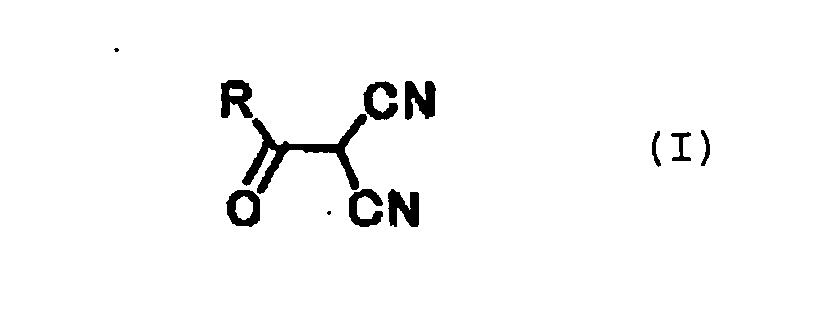 wherein R represents a hydrogen atom, a substituted or unsubstituted alkyl group, a substituted or unsubstituted aryl group, or a substituted or unsubstituted heterocyclic group; X represents a substituent that derives from the nucleophilic agent and is bonded via one of an oxygen atom, a nitrogen atom and a sulfur atom.
- (2) A synthesizing method of a dicyanomethylidene
compound represented by the following formula (II), which
comprises: synthesizing a compound represented by the following
formula (I) by reacting a compound represented by the following
formula (III) with malononitrile; reacting the compound
represented by the formula (I) with a dehydrating agent without
taking out the compound represented by the formula (I); and
then reacting the reaction product with a nucleophilic agent:
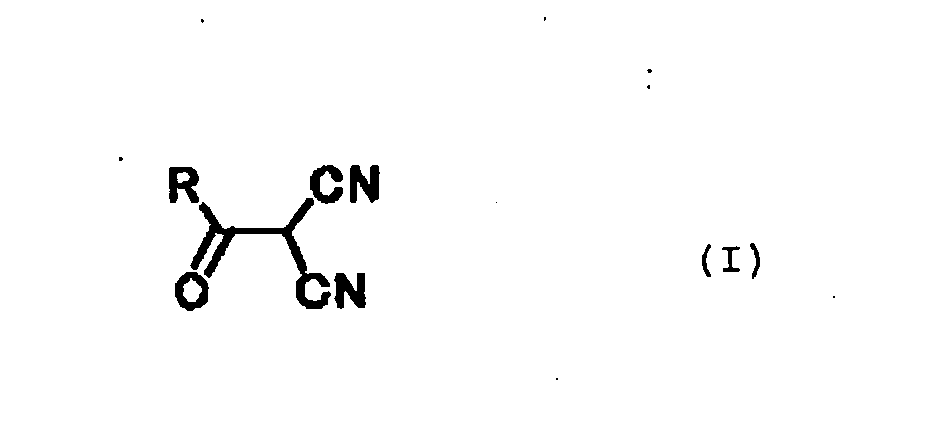
 wherein R represents a hydrogen atom, a substituted or unsubstituted alkyl group, a substituted or unsubstituted aryl group, or a substituted or unsubstituted heterocydic group; X represents a substituent that derives from the nucleophilic agent and is bonded via one of an oxygen atom, a nitrogen atom and a sulfur atom; L represents a releasing group.
- (3) A synthesizing method of a heterocyclic compound
represented by the following formula (V), which comprises
reacting the compound represented by formula (II) synthesized
by the method described in claim 1 or 2 with a hydrazine compound
represented by the following formula (IV):
wherein R' represents a hydrogen atom, a substituted or unsubstituted alkyl group, a substituted or unsubstituted aryl group, or a substituted or unsubstituted heterocyclic group.

- (4) The synthesizing method described in the item (1), wherein the dehydrating agent is used in the molar ratio of from 1/10 to 50 to the compound represented by formula (I).
- (5) The synthesizing method described in the item (1), wherein the nucleophilic agent is used in the molar ratio of from 1/10 to 50 to the compound represented by formula (I).
- (6) The synthesizing method described in the item (2), wherein malononitrile is used in the molar ratio of from 1/10 to 10 to the compound represented by formula (III).
- (7) The synthesizing method described in the item (3), wherein the hydrazine compound represented by formula (IV) is used in the molar ratio of from 1/10 to 10 to the compound represented by formula (II).
-
- The present invention is described in detail below.
- In the present invention, a dicyanomethylidene compound represented by the following formula (II) is synthesized by making a dehydrating agent and then a nucleophilic agent act on a compound represented by the following formula (I):

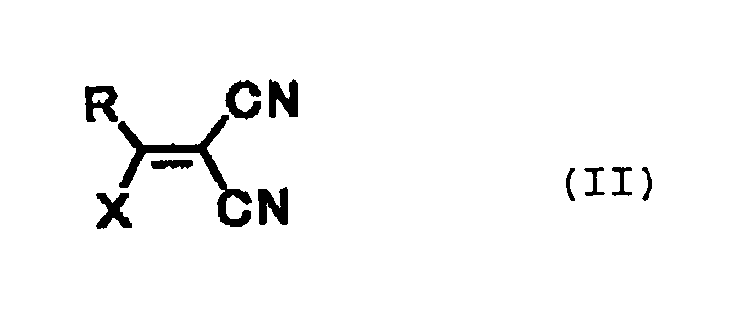
- The dehydrating agent in the present invention means a compound which can take two hydrogen atoms and one oxygen atom from the same molecule or a plurality of molecules formally. All the compounds having precedents of capable of being used for such a purpose in the past come under the dehydrating agent of the present invention.
- As the dehydrating agents, compounds which can be used as the reacting agents in active ester and acid halide syntheses can be exemplified, in addition to compounds capable of being used as the reacting agents in ordinary dehydration condensation reactions (e.g., an esterification reaction by a carboxylic acid and an alcohol, an amidation reaction by a carboxylic acid and an amine, Knoevenagel reaction by an active methylene compound and a carbonyl compound, and a dehydrating ring closing reaction of a cyclic compound). The examples of the dehydrating agents include, e.g., carboxylic acid halide (preferably carboxylic acid chloride, e.g., acetyl chloride, trichloroacetyl chloride, trifluoroacetyl chloride, pivaloyl chloride, benzoyl chloride, p-nitrobenzoyl chloride, oxalyl chloride), carboxylic anhydride (e.g., acetic anhydride, trifluoroacetic anhydride, propionic anhydride, succinic anhydride, maleic anhydride, phthalic anhydride), chlorocarbonic ester (e.g., methyl chlorocarbonate, ethyl chlorocarbonate, phenyl chlorocarbonate, p-nitrophenyl chlorocarbonate), sulfonic acid halide (preferably sulfonic acid chloride, e.g., methanesulfonic acid chloride, benzenesulfonic acid chloride, p-toluenesulfonic acid chloride), carbodiimides (e.g., dicyclohexylcarbodiimide), isocyanates (e.g., methyl isocyanate, phenyl isocyanate), carbamic acid chloride (e.g., dimethylcarbamic acid chloride, diethylcarbamic acid chloride), phosphorus pentoxide, phosphorus pentachloride, phosphorus trichloride, phosphorus tribromide, phosphorus oxychloride, polyphosphoric acid, phosphorous triesters (e.g., trimethyl phosphite, triphenyl phosphite), phosgene, cyanuric chloride, thionyl chloride, combinations of diazocarboxylic diester and triphenylphosphine, combinations of carbon tetrachloride and triphenylphosphine, combinations of N-chlorosuccinimide and triphenylphosphine, combinations of N-bromosuccinimide and triphenylphosphine, orthoesters (e.g., methyl orthoformate, ethyl orthoformate), 1,1-carbonyl-bis-lH-imidazole, and imidazolinium salts (e.g., 2-chloro-1,3-dimethylimidazolinium chloride), but the present invention is by no means limited to these compounds.
- As the preferred dehydrating agents, e.g., carboxylic acid halide, chlorocarbonic ester, sulfonic acid chloride, carbodiimides, isocyanates, carbamic acid chloride, phosphorus oxychloride, cyanuric chloride, 1,1-carbonyl-bis-lH-imidazole, and imidazolinium salts (e.g., 2-chloro-1, 3-dimethylimidazolinium chloride) are exemplified.
- In making a dehydrating agent and then a nucleophilic agent act on a compound represented by formula (I), a base may be made to act on the compound represented by formula (I) before or at the same time with the dehydrating agent and the nucleophilic agent. The concentration of the compound represented by formula (I) at the time of reaction is preferably from 0.01 to 10 mol/liter, and more preferably from 0.1 to 5 mol/liter. It is preferred to use the dehydrating agent in the molar ratio of from 1/10 to 50 to the compound represented by formula (I).
- The base may be an organic or inorganic base.
- As the organic base, e.g., pyridines such as pyridine, collidine and lutidine, nitrogen-containing cyclic compounds such as DBU and DBN, amines such as diethylamine, triethylamine and N,N-dimethylaniline, and N,N,N',N'-tetramethylguanidine, are exemplified, but the present invention is not limited to these compounds.
- As the inorganic base, e.g., metallic hydroxides such as sodium hydroxide, potassium hydroxide, calcium hydroxide, magnesium hydroxide, lithium hydroxide, and vanadium hydroxide, metal alkoxides such as sodium methoxide, sodium ethoxide, sodium t-butoxide, and potassium t-butoxide, metal carbonates such as lithium carbonate, sodium carbonate, potassium carbonate, sodium hydrogencarbonate, and potassium hydrogencarbonate, hydrogencarbonate, metallic salts of carboxylic acid such as sodium acetate, potassium acetate, calcium acetate, and calcium oxalate, hydrogenatedmetals such as sodiumhydride and potassium hydride, metals such as sodium and potassium, and organic metallic compounds such as organic magnesium compounds and organic lithium compounds (e.g., methylmagnesium bromide, methylmagnesium chloride, ethylmagnesium bromide, ethylmagnesium chloride, phenylmagnesium bromide, phenylmagnesium chloride, t-butylmagnesium bromide, t-butylmagnesium chloride, n-butylmagnesium bromide, n-butylmagnesium chloride, methyl lithium, n-butyl lithium, t-butyl lithium, phenyl lithium), are exemplified, but the present invention is by no means limited to these compounds.
- The bases for use in the reaction of the present invention are preferably organic bases, and more preferably pyridines such as pyridine, collidine and lutidine, nitrogen-containing cyclic compounds such as DBU and DBN, and amines such as diethylamine, triethylamine and N,N-dimethylaniline are exemplified.
- In the reaction of the present invention, bases can be used in the amount necessary for the reaction to progress to the highest yield, but in general the mol number of bases used is preferably from 0.2 to 5 times the mol number of the compound represented by formula (I), and more preferably from 0.5 to 3 times.
- In the present invention, the nucleophilic agent is a compound capable of introducing substitution X into the position where X in the compound represented by formula (II) is substituted by the nucleophilic substitution reaction by acting on the compound represented by formula (I).
- As the examples of x, substituted or unsubstituted alkoxyl, substituted or unsubstituted aryloxy, hydroperoxy, substituted or unsubstituted alkylhydroperoxy, substituted or unsubstituted arylhydroperoxy, amino, substituted or unsubstituted alkylamino, substituted or unsubstituted dialkylamino, substituted or unsubstituted arylamino, substituted or unsubstituted diarylamino, hydroxylamino, substituted or unsubstituted alkoxyamino, substituted or unsubstituted dialkoxyamino, substituted or unsubstituted hydrazino, thiol, substituted or unsubstituted alkylthio, substituted or unsubstituted arylthio, substituted or unsubstituted alkyldithio, and substituted or unsubstituted aryldithio are exemplified. As the preferred examples of X, alkoxyl, aryloxy, amino, mono- or dialkylamino, mono- or diarylamino, hydroxylamino, mono- or dialkoxyamino, hydrazino, thiol, alkylthio, and arylthio are exemplified. These substituents may have a substituent. It is preferred to use the nucleophilic agent in the molar ratio of from 1/10 to 50 to the compound represented by formula (I).
- In the reaction of the invention, in synthesizing a dicyanomethylidene compound represented by formula (II) by making a dehydrating agent and then a nucleophilic agent act on a compound represented by formula (I), the reaction is preferably performed in the presence of a solvent. As the solvents, hydrocarbon-based solvents, e.g., toluene, xylene and hexane, halogen-based solvents, e.g., methylene chloride, sulfoxide-based solvents, e.g., dimethyl sulfoxide, amide-based solvents, e.g., dimethylformamide, ether-based solvents, e.g., tetrahydrofuran, dioxane and diglyme, alcohol-based solvents, e.g., methanol, ethanol and isopropanol, nitrile-based solvents, e.g., acetonitrile, ketone-based solvents, e.g., acetone and cyclohexanone, ester-based solvents, e.g., ethyl acetate, heterocyclic-based solvents, e.g., pyridine and piperidine, and water can be used. Two or more organic solvents may be used as mixture. The solvent may be a hydrous organic solvent or may be a two-phase series solvent of water-organic solvent. Further, an ionic liquid may be used as a reaction solvent as described in J. Chem. Tech. Biotechnol., 68, 351 (1997), or the reaction may be carried out by using a super-critical fluid as described in Science, 269, 1065 (1995).
- Of the above solvents, hydrocarbon-based solvents, ether-based solvents, nitrile-based solvents, ester-based solvents and heterocyclic-based solvents are preferably used. Hydrocarbon-based solvents, e.g., toluene, nitrile-based solvents, e.g., acetonitrile, and ester-based solvents, e.g., ethyl acetate are more preferably used.
- In the reaction of the present invention, it is preferred to carry out the reaction at -20°C to 100°C, and more preferably from -10°C to 80°C. The termination of the reaction can be confirmed by NMR, TLC, HPLC and other methods.
- The time required for the reaction normally depends upon the reaction temperature, pH and the introducing time of bases, but the reaction time is generally about 0.1 to 24 hours.
- It is preferred that the reaction is carried out for 0.1 to 24 hours when the temperature is from -10°C to 80°C.
- The compounds in the present invention are described below.
- In formulae (I) and (II), R represents a hydrogen atom, a substituted or unsubstituted alkyl group, a substituted or unsubstituted aryl group, or a substituted or unsubstituted heterocyclic group.
- The alkyl group is a saturated or unsaturated, straight chain, branched, or cyclic alkyl group preferably having from 1 to 36 carbon atoms, more preferably from 1 to 30 carbon atoms, and still more preferably from 1 to 20 carbon atoms, which may have a substituent.
- The aryl group is a monocyclic or condensed aryl group preferably having from 6 to 36 carbon atoms, and more preferably from 6 to 30 carbon atoms, which may have a substituent.
- The heterocyclic group is preferably a monovalent group obtained by removing one hydrogen atom from a 5- or 6-membered, substituted or unsubstituted, aromatic or non-aromatic heterocyclic compound, and more preferably a 5- or 6-membered aromatic heterocyclic group having from 3 to 30 carbon atoms, which may have a substituent.
- The examples of the substituents include, e.g., a halogen atom, an alkyl group (including a monocyclic or polycyclic cycloalkyl group), an alkenyl group (including a monocyclic or polycyclic cycloalkenyl group), an alkynyl group, an aryl group, a heterocyclic group, a cyano group, a hydroxyl group, a nitro group, a carboxyl group, an alkoxyl group, an aryloxy group, a silyloxy group, a heterocyclic oxy group, an acyloxy group, a carbamoyloxy group, an alkoxycarbonyloxy group, an aryloxycarbonyloxy group, an amino group (including an alkyl-or arylamino group), an acylamino group, an aminocarbonylamino group, an alkoxycarbonylamino group, an aryloxycarbonylamino group, a sulfamoylamino group, an alkyl- or arylsulfonylamino group, a mercapto group, an alkylthio group, an arylthio group, a heterocyclic thio group, a sulfamoyl group, a sulfo group, an alkyl- or arylsulfinyl group, an alkyl- or arylsulfonyl group, an acyl group, an aryloxycarbonyl group, analkoxycarbonyl group, a carbamoyl group, an aryl- or heterocyclic azo group, an imido group, a phosphino group, a phosphinyl group, a phosphinyloxy group, a phosphinylamino group, and a silyl group.
- The more specific examples of the substituents include a halogen atom (e.g., fluorine, chlorine, bromine and iodine), an alkyl group [a straight chain, branched or cyclic, substituted or unsubstituted alkyl group including, e.g., an alkyl group (preferably an alkyl group having from 1 to 30 carbon atoms, e.g., methyl, ethyl, n-propyl, isopropyl, t-butyl, n-octyl, eicosyl, 2-chloroethyl, 2-cyanoethyl and 2-ethylhexyl), a cycloalkyl group (preferably a substituted or unsubstituted cycloalkyl group having from 3 to 30 carbon atoms, e.g., cyclohexyl, cyclopentyl and 4-n-dodecylcyclohexyl), a bicycloalkyl group (preferably a substituted or unsubstituted bicycloalkyl group having from 5 to 30 carbon atoms, i.e., a monovalent group obtained by removing one hydrogen atom from a bicycloalkane group having from 5 to 30 carbon atoms, e.g., bicyclo[1,2,2]heptan-2-yl and bicyclo[2,2,2]octan-3-yl), and tricyclo structure having more cyclic structures, and further, the alkyl groups in the substituents described below (e.g., the alkyl group in an alkynylthio group) are also included in the alkyl group of these concepts], an alkenyl group [a straight chain, branched or cyclic, substituted or unsubstituted alkenyl group including, e.g., an alkenyl group (preferably a substituted or unsubstituted alkenyl group having from 2 to 30 carbon atoms, e.g., vinyl allyl, prenyl, geranyl and oleyl), a cycloalkenyl group (preferably a substituted or unsubstituted cycloalkenyl group having from 3 to 30 carbon atoms, i.e., a monovalent group obtained by removing one hydrogen atom from a cycloalkene group having from 3 to 30 carbon atoms, e.g., 2-cyclopenten-1-yl and 2-cyclohexen-1-yl), a bicycloalkenyl group (a substituted or unsubstituted bicycloalkenyl group, preferably a substituted or unsubstituted bicycloalkenyl group having from 5 to 30 carbon atoms, i.e., a monovalent group obtained by removing one hydrogen atom from a bicycloalkene group having one double bond, e.g., bicyclo[2,2,1]hept-2-en-1-yl and bicyclo[2,2,2]oct-2-en-4-yl], an alkynyl group (preferably a substituted or unsubstituted alkynyl group having from 2 to 30 carbon atoms, e.g., ethynyl, propargyl and trimethylsilylethynyl), an aryl group (preferably a substituted or unsubstituted aryl group having from 6 to 30 carbon atoms, e.g., phenyl, p-tolyl, naphthyl, m-chlorophenyl, and o-hexadecanoylaminophenyl), a heterocyclic group (preferably a monovalent group obtained by removing one hydrogen atom from a 5- or 6-membered, substituted or unsubstituted, aromatic or non-aromatic heterocyclic compound, and more preferably a 5- or 6-membered aromatic heterocyclic group having from 3 to 30 carbon atoms, e.g., 2-furyl, 2-thienyl, 2-pyrimidinyl, and 2-benzothiazolyl), a cyano group, a hydroxyl group, a nitro group, a carboxyl group, an alkoxyl group (preferably a substituted or unsubstituted alkoxyl group having from 1 to 30 carbon atoms, e.g., methoxy, ethoxy, isopropoxy, t-butoxy, n-octyloxy, and 2-methoxyethoxy), an aryloxy group (preferably a substituted or unsubstituted aryloxy group having from 6 to 30 carbon atoms, e.g., phenoxy, 2-methylphenoxy, 4-t-butylphenoxy, 3-nitrophenoxy, and 2-tetradecanoylaminophenoxy), a silyloxy group (preferably a silyloxy group having from 3 to 20 carbon atoms, e.g., trimethylsilyloxy and t-butyldimethylsilyloxy), a heterocyclic oxy group (preferably a substituted or unsubstituted heterocyclic oxy group having from 2 to 30 carbon atoms, e.g., 2-phenyltetrazol-5-oxy and 2-tetrahydropyranyloxy), an acyloxy group (preferably formyloxy, a substituted or unsubstituted alkylcarbonyloxy group having from 2 to 30 carbon atoms, a substituted or unsubstituted arylcarbonyloxy group having from 7 to 30 carbon atoms, e.g., acetyloxy, pivaloyloxy, stearoyloxy, benzoyloxy, and p-methoxyphenylcarbonyloxy), a carbamoyloxy group (preferably a substituted or unsubstituted carbamoyloxy group having from 1 to 30 carbon atoms, e.g., N,N-dimethylcarbamoyloxy, N,N-diethylcarbamoyloxy, morpholinocarbonyloxy, N,N-di-n-octylaminocarbonyloxy, and N-n-octylcarbamoyloxy), an alkoxycarbonyloxy group (preferably a substituted or unsubstituted alkoxycarbonyloxy group having from 2 to 30 carbon atoms, e.g., methoxycarbonyloxy, ethoxycarbonyloxy, t-butoxycarbonyloxy, and n-octylcarbonyloxy), an aryloxycarbonyloxy group (preferably a substituted or unsubstituted aryloxycarbonyloxy group having from 7 to 30 carbon atoms, e.g., phenoxycarbonyloxy, p-methoxyphenoxycarbonyloxy, and p-(n-hexadecyloxy)phenoxycarbonyloxy), an amino group (preferably an amino group, a substituted or unsubstituted alkylamino group having from 1 to 30 carbon atoms, a substituted or unsubstituted arylamino group having from 6 to 30 carbon atoms, e.g., amino, methylamino, dimethylamino, anilino, N-methylanilino, and diphenylamino), an acylamino group (preferably formylamino, a substituted or unsubstituted alkylcarbonylamino group having from 2 to 30 carbon atoms, a substituted or unsubstituted arylcarbonylamino group having from 7 to 30 carbon atoms, e.g., acetylamino, pivaloylamino, lauroylamino, benzoylamino, and 3,4,5-tri-n-octyloxyphenyl-carbonylamino), an aminocarbonylamino group (preferably a substituted or unsubstituted aminocarbonylamino group having from 1 to 30 carbon atoms, e.g., carbamoylamino, N,N-dimethylaminocarbonylamino, and N,N-diethylaminocarbonylamino, morpholinocarbonylamino), an alkoxycarbonylamino group (preferably a substituted or unsubstituted alkoxycarbonylamino group having from 2 to 30 carbon atoms, e.g., methoxycarbonylamino, ethoxycarbonylamino, t-butoxycarbonylamino, n-octadecyloxycarbonylamino, and N-methylmethoxycarbonylamino), an aryloxycarbonylamino group (preferably a substituted or unsubstituted aryloxycarbonylamino group having from 7 to 30 carbon atoms, e.g., phenoxycarbonylamino, p-chlorophenoxycarbonylamino, and m-(n-octyloxy)phenoxycarbonylamino), a sulfamoylamino group (preferably a substituted or unsubstituted sulfamoylamino group having from 0 to 30 carbon atoms, e.g., sulfamoylamino, N,N-dimethylaminosulfonylamino, and N-n-octylaminosulfonylamino), an alkyl- or arylsulfonylamino group (preferably a substituted or unsubstituted alkylsulfonylamino group having from 1 to 30 carbon atoms, a substituted or unsubstituted arylsulfonylamino group having from 6 to 30 carbon atoms, e.g., methylsulfonylamino, butylsulfonylamino, phenylsulfonylamino, 2,3,5-trichlorophenylsulfonylamino, and p-methylphenylsulfonylamino), a mercapto group, an alkylthio group (preferably a substituted or unsubstituted alkylthio group having from 1 to 30 carbon atoms, e.g., methylthio, ethylthio, and n-hexadecylthio), an arylthio group (preferably a substituted or unsubstituted arylthio group having from 6 to 30 carbon atoms, e.g., phenylthio, p-chlorophenylthio, and m-methoxyphenylthio), a heterocyclic thio group (preferably a substituted or unsubstituted heterocyclic thio group having from 2 to 30 carbon atoms, e.g., 2-benzothiazolylthio and 1-phenyltetrazol-5-ylthio), a sulfamoyl group (preferably a substituted or unsubstituted sulfamoyl group having from 0 to 30 carbon atoms, e.g., N-ethylsulfamoyl, N-(3-dodecyloxypropyl)sulfamoyl, N,N-dimethylsulfamoyl, N-acetylsulfamoyl, N-benzoylsulfamoyl, and N-(N'-phenylcarbamoyl)sulfamoyl), a sulfo group, an alkyl-or arylsulfinyl group (preferably a substituted or unsubstituted alkylsulfinyl group having from 1 to 30 carbon atoms, a substituted or unsubstituted arylsulfinyl group having from 6 to 30 carbon atoms, e.g., methylsulfinyl, ethylsulfinyl, phenylsulfinyl and p-methylphenylsulfinyl), an alkyl- or arylsulfonyl group (preferably a substituted or unsubstituted alkylsulfonyl group having from 1 to 30 carbon atoms, a substituted or unsubstituted arylsulfonyl group having from 6 to 30 carbon atoms, e.g., methylsulfonyl, ethylsulfonyl, phenylsulfonyl, and p-methylphenylsulfonyl), an acyl group (preferably formyl, a substituted or unsubstituted alkylcarbonyl group having from 2 to 30 carbon atoms, a substituted or unsubstituted arylcarbonyl group having from 7 to 30 carbon atoms, a substituted or unsubstituted heterocyclic carbonyl group having from 4 to 30 carbon atoms bonded to a carbonyl group via a carbon atom, e.g., acetyl, pivaloyl, 2-chloroacetyl, stearoyl, benzoyl, p-n-octyloxyphenylcarbonyl, 2-pyridylcarbonyl, and 2-furylcarbonyl), an aryloxycarbonyl group (preferably a substituted or unsubstituted aryloxycarbonyl group having from 7 to 30 carbon atoms, e.g., phenoxycarbonyl, o-chlorophenoxycarbonyl, m-nitrophenoxycarbonyl, and p-(t-butyl)phenoxycarbonyl), an alkoxycarbonyl group (preferably a substituted or unsubstituted alkoxycarbonyl group having from 2 to 30 carbon atoms, e.g., methoxycarbonyl, ethoxycarbonyl, t-butoxycarbonyl, and n-octadecyloxycarbonyl), a carbamoyl group (preferably a substituted or unsubstituted carbamoyl group having from 1 to 30 carbon atoms, e.g., carbamoyl, N-methylcarbamoyl, N,N-dimethylcarbamoyl, N,N-di-n-octylcarbamoyl, and N-(methylsulfonyl)carbamoyl), an aryl- or heterocyclic azo group (preferably a substituted or unsubstituted arylazo group having from 6 to 30 carbon atoms, a substituted or unsubstituted heterocyclic azo group having from 3 to 30 carbon atoms, e.g., phenylazo, p-chlorophenylazo, and 5-ethylthio-1,3,4-thiadiazol-2-ylazo), an imido group (preferably N-succinimido, N-phthalimido and diacetylamino), a phosphino group (preferably a substituted or unsubstituted phosphino group having from 2 to 30 carbon atoms, e.g., dimethylphosphino, diphenylphosphino and methylphenoxyphosphino), a phosphinyl group (preferably a substituted or unsubstituted phosphinyl group having from 2 to 30 carbon atoms, e.g., phosphinyl, dioctyloxyphosphinyl and diethoxyphosphinyl), a phosphinyloxy group (preferably a substituted or unsubstituted phosphinyloxy group having from 2 to 30 carbon atoms, e.g., diphenoxyphosphinyloxy and dioctyloxyphosphinyloxy), a phosphinylamino group (preferably a substituted or unsubstituted phosphinylamino group having from 2 to 30 carbon atoms, e.g., dimethoxyphosphinylamino and dimethylaminophosphinylamino), and a silyl group (preferably a substituted or unsubstituted silyl group having from 3 to 30 carbon atoms, e.g., trimethylsilyl, t-butyldimethylsilyl and phenyldimethylsilyl).
- R preferably represents an unsubstituted alkyl group, an unsubstituted aryl group or an unsubstituted heterocyclic group.
- As the alkyl group, e.g., a methyl group, an ethyl group, an n-propyl group, an isopropyl group, a cyclopropyl group, a propargyl group, an n-butyl group, an s-butyl group, an isobutyl group, a t-butyl group, an n-amyl group, a t-amyl group, a cyclopentyl group, an n-hexyl group, a cyclohexyl group, an adamantyl group, an n-octyl group, a t-octyl group, a 2-ethylhexyl group, a dodecyl group, an octadecyl group, a chloromethyl group, a trifluoromethyl group, a methoxymethyl group, a methoxyethoxymethyl group, a methoxythiomethyl group, a tetrahydropyranyl group, a phenacyl group, a cyclopropylmethyl group, an allyl group, a benzyl group, and a trimethylsilylethynyl group are exemplified, but the present invention is by no means limited to these groups.
- As the aryl group, e.g., a phenyl group, a p-tolyl group, a p-methoxyphenyl group, a naphthyl group, an anthracenyl group, an m-chlorophenyl group, and an o-hexadecanoylaminophenyl group are exemplified, but the present invention is by no means limited to these groups.
- As the heterocyclic group, e.g., a pyrrolyl group, a pyrrolidinyl group, a thienyl group, a furyl group, a pyridyl group, an imidazolyl group, an indolyl group, a quinolyl group, a pyranyl group, a morpholinyl group, a piperazinyl group, a 2-furyl group, a 2-thienyl group, a 2-pyrimidinyl group, and 2-benzothiazolyl group are exemplified, but the present invention is by no means limited to these groups.
- X represents a substituent that derives from a nucleophilic agent and is bonded via an oxygen, nitrogen or sulfur atom. X is as described in the nucleophilic agent above.
- The compound represented by formula (I) can take the form of a tautomer such as keto type and enol type depending upon the environment. The compound of the present invention is described in only one type of keto type or enol type, but the compound may be the tautomer thereof. The compound represented by formula (II) also may be a tautomer. The compound of the invention is described in one representative form, but tautomers different from the description of the compound of the present invention are also included in the compound of the invention.
- The compound represented by formula (II) can be synthesized easily and in a high yield by synthesizing the compound represented by formula (I) by the reaction of the compound represented by formula (III) with malononitrile, and then making a dehydrating agent and then a nucleophilic agent act on the compound represented by formula (I) without being taken out. The concentration of the compound represented by formula (III) at the time of reaction is preferably from 0.01 to 10 mol/liter, and more preferably from 0.1 to 5 mol/liter. It is preferred to use malononitrile in the molar ratio of from 1/10 to 10 to the compound represented by formula (III).

- When the compound represented by formula (I) is once taken out, it is necessary to neutralize and precipitate the compound represented by formula (III) and malononitrile with an acid of 1 equivalent amount or more after condensation reaction with a base of 2 equivalent amount or more, which is very uneconomical. Further, there are cases where the yield of crystallization of the compound represented by formula (I) is low, it is also uneconomical to take out the compound represented by formula (I) in this point. Therefore, the synthesizing method of the dicyanomethylidene compound represented by formula (II) comprising the steps of synthesizing the compound represented by formula (I) by reacting the compound represented by formula (III) with malononitrile, and then making a dehydrating agent and then a nucleophilic agent act on the compound represented by formula (I) without taking out the compound represented by formula (I) is excellent.
- In formula (III), L represents a releasing group. As the examples of the releasing groups, a halogen atom (e.g., fluorine, chlorine, bromine and iodine), an alkoxyl group, an aryloxy group, an acyloxy group, an alkoxycarbonyloxy group, an aryloxycarbonyloxy group, and a heterocyclic group (e.g., an imidazolyl group) are exemplified. Of the above releasing groups, a halogen atom (in particular, a chlorine atom) is preferred.
- The heterocyclic compound represented by the following formula (V) can be easily synthesized by making the compound represented by formula (II) synthesized by the method of the present invention act on hydrazine represented by the following formula (IV). The concentration of the compound represented by formula (II) at the time of reaction is preferably from 0.01 to 10 mol/liter, and more preferably from 0.1 to 5 mol/liter. It is preferred to use hydrazine represented by formula (IV) in the molar ratio of from 1/10 to 10 to the compound represented by formula (II).
 wherein R' represents a hydrogen atom, a substituted or unsubstituted alkyl group, a substituted or unsubstituted aryl group, or a substituted or unsubstituted heterocyclic group. As the substituted or unsubstituted alkyl group, the substituted or unsubstituted aryl group, and the substituted or unsubstituted heterocyclic group, the substituents described above in the explanation of R are exemplified.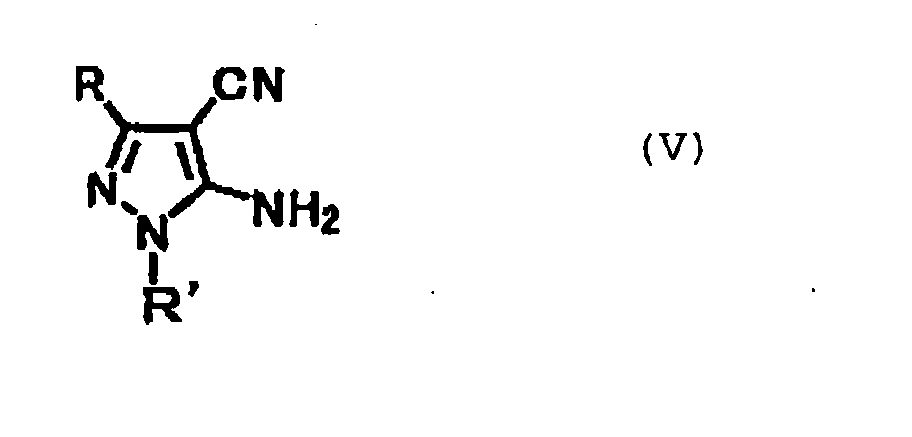
- In the invention, in synthesizing the heterocyclic compound represented by formula (V) by making the compound represented by formula (IV) act on the compound represented by formula (II), this reaction is preferably performed in the presence of a solvent. As the solvent, hydrocarbon-based solvents, e.g., toluene, xylene and hexane, halogen-based solvents, e.g., methylene chloride, sulfoxide-based solvents, e.g., dimethyl sulfoxide, amide-based solvents, e.g., dimethylformamide, ether-based solvents, e.g., tetrahydrofuran, dioxane and diglyme, alcohol-based solvents, e.g., methanol, ethanol and isopropanol, nitrile-based solvents, e.g., acetonitrile, ketone-based solvents, e.g., acetone and cyclohexanone, ester-based solvents, e.g., ethyl acetate, heterocyclic-based solvents, e.g., pyridine and piperidine, and water can be used. Two or more organic solvents may be used as mixture. The solvent may be a hydrous organic solvent or may be a two-phase series solvent of water-organic solvent. Further, an ionic liquid may be used as a reaction solvent as described in J. Chem. Tech. Biotechnol., 68, 351 (1997), or the reaction may be carried out by using a super-critical fluid as described in Science, 269, 1065 (1995).
- Of the above solvents, water, alcohol-based solvents, ether-based solvents, nitrile-based solvents, ester-based solvents, heterocyclic-based solvents and mixtures of these solvents are preferably used in the reaction. Water, alcohol-based solvents, e.g., methanol, ethanol and isopropanol, and mixtures of water and alcohol-based solvents are more preferably used.
- In the above reaction, it is preferred to carry out the reaction at from 0°C to 200°C, and more preferably from 0°C to 120°C. The termination of the reaction can be confirmed by NMR, TLC, HPLC and other methods.
- The time required for the reaction normally depends upon the reaction temperature, the equivalent ratio of the compound represented by formula (IV) to the compound represented by formula (II), and the reaction solvent, but the reaction time is generally about 0.1 to 24 hours.
- It is preferred that the reaction is carried out for 0.1 to 24 hours when the temperature is from -10°C to 80°C.
- The compounds represented by formulae (IV) and (V) may be accompanied by counter salts by the synthesizing process and the isolation. As the counter salts, e.g., a halogen ion, a sulfate ion, a nitrate ion, a carbonate ion, a sulfonate ion, a phosphate ion, an acetate ion, a metal ion and an ammonium ion are exemplified. The compounds may form inner salts according to the structure.
- The compounds for use in the present invention may contain isotopes (e.g., 2H, 3H, 13C, 15N).
- The present invention is illustrated in more detail below with reference to examples below, but these are not to be construed as limiting the invention.
- Malononitrile (6.61 g) (0.1 mol) was added to 80 ml of acetonitrile, and 12.3 ml (0.1 mol) of pivaloyl chloride was added thereto. The mixture was cooled to internal temperature of 5°C or lower, and 27.9 ml (0.2 mol) of triethylamine was dropwise added to the mixture with stirring the mixture and with maintaining the internal temperature at 10°C or lower. After completion of the dropwise addition, the reaction mixture was stirred in an ice bath for 30 minutes, and 10.1 ml of phosphorus oxychloride was dropwise added to the reaction mixture so that the internal temperature became 15°C or lower. After stirring the reaction mixture for further two hours in an ice bath, 68 ml of a 25% aqueous ammonia was dropwise added so that the internal temperature lowered to 20°C or less. After stirring the reaction mixture for further one hour in an ice bath, 150 ml of water was dropwise added to the reaction mixture. The solid formed was filtered and washed with water. The solid was dried, thereby 10.47 g (yield: 70%) of the objective 2-(1-amino-2,2-dimethylpropylidene)propanedinitrile was obtained as a white solid. FAB MS (posit) 150 (MH+), 1H NMR (CDCl3) δ 1.45 (9H, s, t-C4H9), 5.78 (1H, bs, NH), 6.35 (1H, bs, NH).
- 2-(1-Amino-2,2-dimethylpropylidene)propanedinitrile was synthesized in the same manner as in Example 1 except for using the same mol of dehydrating agents shown below in place of the phosphorus oxychloride. The yield of 2-(1-amino-2,2-dimethylpropylidene)propanedinitrile in each case is shown in Table 1 below.
Dehydrating Agent Yield (%) Ms-Cl 64 Ts-Cl 43 t-Bu-COCl 62 Ac-Cl 32 Ph-COCl 58 O2N-C6H4-OCOCl 39 O2N-C6H4-COCl 41 Ph-OCOCl 37 Cyanuric chloride 55 P-Cl5 1 - Malononitrile (6.61 g) (0.1 mol) was added to 80 ml of toluene, and 12.3 ml (0.1 mol) of pivaloyl chloride was added thereto. The mixture was cooled to internal temperature of 5°C or lower, and 27.9 ml (0.2 mol) of triethylamine was dropwise added to the mixture with stirring the mixture and with maintaining the internal temperature at 10°C or lower. After completion of the dropwise addition, the reaction mixture was stirred in an ice bath for 30 minutes, and 50 g of ice water was added thereto. To the reaction mixture was dropwise added 13.2 ml of concentrated sulfuric acid so that the internal temperature became 20°C or lower with stirring the reaction mixture in an ice bath. After stirring the reaction mixture for further one hour in an ice bath, the solid formed was filtered and washed with water. The solid was dried, thereby 12.63 g (yield: 84%) of pivaloylmalononitrile was obtained as pale yellow crystals. Pivaloylmalononitrile (15.02 g) (0.1 mol) was added to 80 ml of acetonitrile to lower the internal temperature to 5°C or lower, and 14.0 ml (0.1 mol) of triethylamine was dropwise added with stirring the mixture and with maintaining the internal temperature at 10°C or lower. After completion of the dropwise addition, the reaction mixture was stirred in an ice bath for 30 minutes, and 10.1 ml of phosphorus oxychloride was dropwise added to the reaction mixture so that the internal temperature became 15°C or lower. After stirring the reaction mixture for further two hours in an ice bath, 68 ml of a 25% aqueous ammonia was dropwise added to the reaction mixture so that the internal temperature lowered to 20°C or lower. After stirring the reaction mixture for further one hour in an ice bath, 150 ml of water was dropwise added to the reaction mixture. The solid formed was filtered and washed with water. The solid was dried, thereby 9.39 g (yield: 63%) of 2-(1-amino-2,2-dimethylpropylidene)propanedinitrile was obtained as a white solid.
- The yield at large of 2-(1-amino-2,2-dimethylpropylidene)propanedinitrile was 53% when pivaloylmalononitrile was once taken out. Therefore, it can be seen that it is also preferred from the point of yield to synthesize 2-(1-amino-2,2-dimethylpropylidene)propanedinitrile by a consistent method without taking out pivaloylmalononitrile.
- 2-(1-Amino-2,2-dimethylpropylidene)propanedinitrile (7.46 g) (50 mmol) was dispersed in 10 ml of isopropanol and 20 ml of water. After stirring the dispersion at room temperature for about 10 minutes, 7.51 g (150 mmol) of hydrazine hydrate was dropwise added to the dispersion slowly, and the reaction solution was stirred for one hour under reflux with heating.
- When the reaction solution was stirred with ice cooling after confirming the completion of the reaction by TLC, crystals were precipitated. The precipitates were filtered, washed with isopropanol and water (4/1), and dried, thereby 7.87 g of the objective compound was obtained as white crystals (yield: 96%). FAB MS (posit) 165 (MH+), 1H NMR (DMSO-d6) δ 1.27 (9H, s, C4H9), 5.50-6.30 (2H, bs, NH2), 11.20-11.90 (1H, bs, NH).
- According to the synthesis method of the present invention, a 3-substituted-5-amino-4-cyanopyrazole compound and a dicyanomethylidene compound which is preferably used as the starting material of 3-substituted-5-amino-4-cyanopyrazole compound can be synthesized in shorter processes and more efficiently than according to synthesizing methods so far been known.
- The entire disclosure of each and every foreign patent application from which the benefit of foreign priority has been claimed in the present application is incorporated herein by reference, as if fully set forth.
Claims (7)
- A synthesizing method of a dicyanomethylidene compound represented by the following formula (II), which comprises: reacting a compound represented by the following formula (I) with a dehydrating agent; and then reacting the reaction product with a nucleophilic agent:
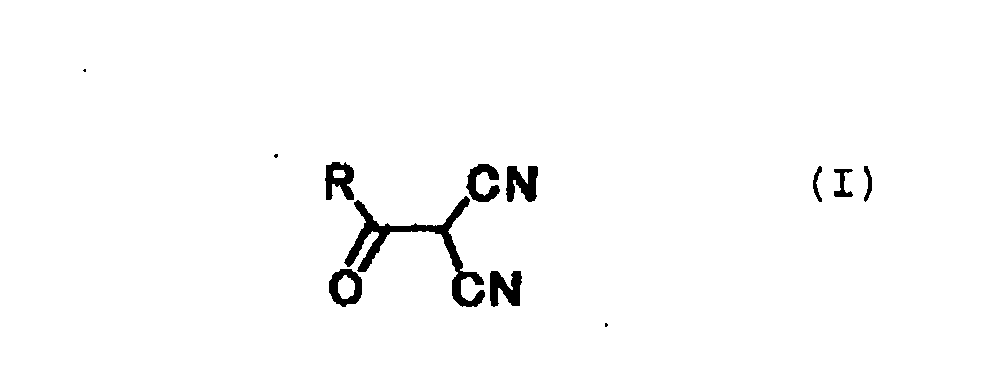 wherein R represents a hydrogen atom, a substituted or unsubstituted alkyl group, a substituted or unsubstituted aryl group, or a substituted or unsubstituted heterocyclic group; X represents a substituent that derives from the nucleophilic agent and is bonded via one of an oxygen atom, a nitrogen atom and a sulfur atom.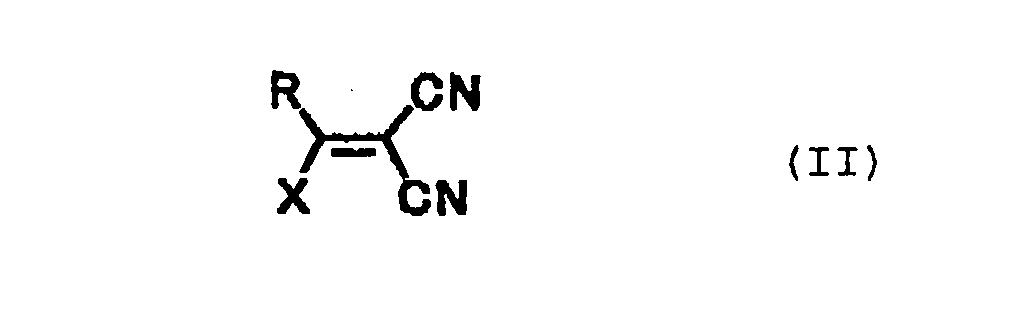
- A synthesizing method of a dicyanomethylidene compound represented by the following formula (II), which comprises: synthesizing a compound represented by the following formula (I) by reacting a compound represented by the following formula (III) with malononitrile; reacting the compound represented by the formula (I) with a dehydrating agent without taking out the compound represented by the formula (I); and then reacting the reaction product with a nucleophilic agent:

 wherein R represents a hydrogen atom, a substituted or unsubstituted alkyl group, a substituted or unsubstituted aryl group, or a substituted or unsubstituted heterocyclic group; X represents a substituent that derives from the nucleophilic agent and is bonded via one of an oxygen atom, a nitrogen atom and a sulfur atom; L represents a releasing group.
- A synthesizing method of a heterocyclic compound represented by the following formula (V), which comprises reacting the compound represented by formula (II) synthesized by the method described in claim 1 or 2 with a hydrazine compound represented by the following formula (IV):
 wherein R' represents a hydrogen atom, a substituted or unsubstituted alkyl group, a substituted or unsubstituted aryl group, or a substituted or unsubstituted heterocyclic group.
- The synthesizing method described in claim 1, wherein the dehydrating agent is used in the molar ratio of from 1/10 to 50 to the compound represented by formula (I).
- The synthesizing method described in claim 1, wherein the nucleophilic agent is used in the molar ratio of from 1/10 to 50 to the compound represented by formula (I).
- The synthesizing method described in claim 2, wherein malononitrile is used in the molar ratio of from 1/10 to 10 to the compound represented by formula (III).
- The synthesizing method described in claim 3, wherein the hydrazine compound represented by formula (IV) is used in the molar ratio of from 1/10 to 10 to the compound represented by formula (II).
Applications Claiming Priority (2)
| Application Number | Priority Date | Filing Date | Title |
|---|---|---|---|
| JP2002072531 | 2002-03-15 | ||
| JP2002072531A JP4074771B2 (en) | 2002-03-15 | 2002-03-15 | Method for synthesizing dicyanomethylidene compound and heterocyclic compound |
Publications (2)
| Publication Number | Publication Date |
|---|---|
| EP1344774A1 true EP1344774A1 (en) | 2003-09-17 |
| EP1344774B1 EP1344774B1 (en) | 2005-12-07 |
Family
ID=27764567
Family Applications (1)
| Application Number | Title | Priority Date | Filing Date |
|---|---|---|---|
| EP03005826A Expired - Lifetime EP1344774B1 (en) | 2002-03-15 | 2003-03-14 | Synthesizing methods of dicyanomethylidene compound and heterocyclic compound |
Country Status (4)
| Country | Link |
|---|---|
| EP (1) | EP1344774B1 (en) |
| JP (1) | JP4074771B2 (en) |
| AT (1) | ATE312082T1 (en) |
| DE (1) | DE60302592T2 (en) |
Cited By (2)
| Publication number | Priority date | Publication date | Assignee | Title |
|---|---|---|---|---|
| WO2010086118A1 (en) | 2009-02-02 | 2010-08-05 | Bayer Cropscience Ag | Isothiazolyloxyphenyl amidines and use thereof as fungicides |
| CN102060773A (en) * | 2011-01-07 | 2011-05-18 | 大连凯飞精细化工有限公司 | 3-tert-butyl-4-cyano-5-aminopyrazole and its synthesis method |
Families Citing this family (4)
| Publication number | Priority date | Publication date | Assignee | Title |
|---|---|---|---|---|
| JPWO2008081711A1 (en) * | 2006-12-28 | 2010-04-30 | 三井化学アグロ株式会社 | 2-Fluorine-containing acyl-3-aminoacrylonitrile derivative and method for producing the same |
| JP5264392B2 (en) * | 2008-09-30 | 2013-08-14 | 富士フイルム株式会社 | Method for producing 5-aminopyrazole derivative |
| JP2011201794A (en) * | 2010-03-24 | 2011-10-13 | Fujifilm Corp | Process for producing 5-aminopyrazole derivative and salt thereof |
| JP7824778B2 (en) * | 2022-01-31 | 2026-03-05 | 三菱ガス化学ネクスト株式会社 | Method for producing cyclized products by cyclization reaction accompanied by dehydration condensation, and method for producing 1,3,4-substituted-pyrazole-5-carboxylic acid esters |
Citations (2)
| Publication number | Priority date | Publication date | Assignee | Title |
|---|---|---|---|---|
| US4032322A (en) * | 1976-06-18 | 1977-06-28 | Loren Kenneth Gibbons | Isothiazolylformamidine derivatives as herbicides |
| EP0484814A1 (en) * | 1990-10-31 | 1992-05-13 | Eastman Kodak Company | Magenta pyrazolylazoaniline dye-donor element for thermal dye transfer |
-
2002
- 2002-03-15 JP JP2002072531A patent/JP4074771B2/en not_active Expired - Fee Related
-
2003
- 2003-03-14 EP EP03005826A patent/EP1344774B1/en not_active Expired - Lifetime
- 2003-03-14 AT AT03005826T patent/ATE312082T1/en not_active IP Right Cessation
- 2003-03-14 DE DE60302592T patent/DE60302592T2/en not_active Expired - Lifetime
Patent Citations (2)
| Publication number | Priority date | Publication date | Assignee | Title |
|---|---|---|---|---|
| US4032322A (en) * | 1976-06-18 | 1977-06-28 | Loren Kenneth Gibbons | Isothiazolylformamidine derivatives as herbicides |
| EP0484814A1 (en) * | 1990-10-31 | 1992-05-13 | Eastman Kodak Company | Magenta pyrazolylazoaniline dye-donor element for thermal dye transfer |
Non-Patent Citations (1)
| Title |
|---|
| SOUTHWICK, PHILIP L.; DHAWAN BALRAM: "Preparation of 4,6-Diaminopyrazolo[3,4-d]pyrimidines with Variation in Substitution at the 1- and 3-Positions", J.HET.CHEM, vol. 12, 1975, pages 1199 - 1205, XP002248196 * |
Cited By (5)
| Publication number | Priority date | Publication date | Assignee | Title |
|---|---|---|---|---|
| WO2010086118A1 (en) | 2009-02-02 | 2010-08-05 | Bayer Cropscience Ag | Isothiazolyloxyphenyl amidines and use thereof as fungicides |
| EP2223917A1 (en) | 2009-02-02 | 2010-09-01 | Bayer CropScience AG | Isothiazolyloxyphenylamidines and their use as fungicides |
| US8138211B2 (en) | 2009-02-02 | 2012-03-20 | Bayer Cropscience Ag | Isothiazolyloxyphenylamidines and their use as fungicides |
| US8470739B2 (en) | 2009-02-02 | 2013-06-25 | Bayer Cropsciene Ag | Isothiazolyloxyphenylamidines and their use as fungicides |
| CN102060773A (en) * | 2011-01-07 | 2011-05-18 | 大连凯飞精细化工有限公司 | 3-tert-butyl-4-cyano-5-aminopyrazole and its synthesis method |
Also Published As
| Publication number | Publication date |
|---|---|
| ATE312082T1 (en) | 2005-12-15 |
| DE60302592D1 (en) | 2006-01-12 |
| DE60302592T2 (en) | 2006-06-22 |
| JP2003267943A (en) | 2003-09-25 |
| JP4074771B2 (en) | 2008-04-09 |
| EP1344774B1 (en) | 2005-12-07 |
Similar Documents
| Publication | Publication Date | Title |
|---|---|---|
| EP2102166B1 (en) | Process for producing 5-aminopyrazole derivative, and azo dye | |
| EP1344774B1 (en) | Synthesizing methods of dicyanomethylidene compound and heterocyclic compound | |
| JP5789362B2 (en) | Process for producing 5-aminopyrazole derivative or salt thereof | |
| JP2010077067A (en) | Method for producing pyrazole derivative | |
| JP2011201794A (en) | Process for producing 5-aminopyrazole derivative and salt thereof | |
| JP5264392B2 (en) | Method for producing 5-aminopyrazole derivative | |
| JP2003267954A (en) | Method for synthesizing heterocyclic compound | |
| JP2010077066A (en) | Method for producing 5-aminopyrazole derivative | |
| JP4253159B2 (en) | Method for producing acylaminophenols | |
| JP4261728B2 (en) | Method for producing acylaminohydroquinones | |
| JP2005097136A (en) | Method for producing pyridine derivative containing sulfo group | |
| JP4778717B2 (en) | Method for producing heterocyclic compound | |
| JP2003286273A (en) | 1,2,4-benzothiadiazine-1,1-dioxide and method of producing the same | |
| JP4267944B2 (en) | Method for producing 3-amino-5-pyrazolone compound | |
| EP1671958B1 (en) | Method of producing amide compound | |
| JP2004123544A (en) | Method for producing 4, 5-dialkoxycarbonylimidazole compound | |
| JP4217374B2 (en) | Process for producing 4-thio-substituted phenol or 1-naphthol compound | |
| WO2010113955A1 (en) | Method for producing 2,6-diaminopyridine compound | |
| JP2005200375A (en) | Method for producing thiophene compound | |
| JP4115831B2 (en) | Process for producing alkoxycarbonyl compound | |
| JP2004284979A (en) | METHOD FOR PRODUCING alpha-(2-ALKYL-1,2,4-BENZOTHIAZIADINE-1,1-DIOXIDO-3-YL)ACETANILIDE DERIVATIVE | |
| JP2004238351A (en) | Method for producing 4,5-di-substituted imidazole | |
| JP2002105075A (en) | Condensed nitrogen-containing heterocyclic compound and method for producing the same | |
| JP2010241914A (en) | Method for producing azo compound | |
| JP2003335759A (en) | Method for synthesizing 2,6-diamino-substituted pyridine compound |
Legal Events
| Date | Code | Title | Description |
|---|---|---|---|
| PUAI | Public reference made under article 153(3) epc to a published international application that has entered the european phase |
Free format text: ORIGINAL CODE: 0009012 |
|
| AK | Designated contracting states |
Kind code of ref document: A1 Designated state(s): AT BE BG CH CY CZ DE DK EE ES FI FR GB GR HU IE IT LI LU MC NL PT RO SE SI SK TR |
|
| AX | Request for extension of the european patent |
Extension state: AL LT LV MK |
|
| 17P | Request for examination filed |
Effective date: 20031031 |
|
| 17Q | First examination report despatched |
Effective date: 20031229 |
|
| AKX | Designation fees paid |
Designated state(s): AT BE BG CH CY CZ DE DK EE ES FI FR GB GR HU IE IT LI LU MC NL PT RO SE SI SK TR |
|
| GRAP | Despatch of communication of intention to grant a patent |
Free format text: ORIGINAL CODE: EPIDOSNIGR1 |
|
| GRAS | Grant fee paid |
Free format text: ORIGINAL CODE: EPIDOSNIGR3 |
|
| GRAA | (expected) grant |
Free format text: ORIGINAL CODE: 0009210 |
|
| AK | Designated contracting states |
Kind code of ref document: B1 Designated state(s): AT BE BG CH CY CZ DE DK EE ES FI FR GB GR HU IE IT LI LU MC NL PT RO SE SI SK TR |
|
| PG25 | Lapsed in a contracting state [announced via postgrant information from national office to epo] |
Ref country code: IT Free format text: LAPSE BECAUSE OF FAILURE TO SUBMIT A TRANSLATION OF THE DESCRIPTION OR TO PAY THE FEE WITHIN THE PRESCRIBED TIME-LIMIT;WARNING: LAPSES OF ITALIAN PATENTS WITH EFFECTIVE DATE BEFORE 2007 MAY HAVE OCCURRED AT ANY TIME BEFORE 2007. THE CORRECT EFFECTIVE DATE MAY BE DIFFERENT FROM THE ONE RECORDED. Effective date: 20051207 Ref country code: FI Free format text: LAPSE BECAUSE OF FAILURE TO SUBMIT A TRANSLATION OF THE DESCRIPTION OR TO PAY THE FEE WITHIN THE PRESCRIBED TIME-LIMIT Effective date: 20051207 Ref country code: SI Free format text: LAPSE BECAUSE OF FAILURE TO SUBMIT A TRANSLATION OF THE DESCRIPTION OR TO PAY THE FEE WITHIN THE PRESCRIBED TIME-LIMIT Effective date: 20051207 Ref country code: CZ Free format text: LAPSE BECAUSE OF FAILURE TO SUBMIT A TRANSLATION OF THE DESCRIPTION OR TO PAY THE FEE WITHIN THE PRESCRIBED TIME-LIMIT Effective date: 20051207 Ref country code: NL Free format text: LAPSE BECAUSE OF FAILURE TO SUBMIT A TRANSLATION OF THE DESCRIPTION OR TO PAY THE FEE WITHIN THE PRESCRIBED TIME-LIMIT Effective date: 20051207 Ref country code: CH Free format text: LAPSE BECAUSE OF FAILURE TO SUBMIT A TRANSLATION OF THE DESCRIPTION OR TO PAY THE FEE WITHIN THE PRESCRIBED TIME-LIMIT Effective date: 20051207 Ref country code: RO Free format text: LAPSE BECAUSE OF FAILURE TO SUBMIT A TRANSLATION OF THE DESCRIPTION OR TO PAY THE FEE WITHIN THE PRESCRIBED TIME-LIMIT Effective date: 20051207 Ref country code: SK Free format text: LAPSE BECAUSE OF FAILURE TO SUBMIT A TRANSLATION OF THE DESCRIPTION OR TO PAY THE FEE WITHIN THE PRESCRIBED TIME-LIMIT Effective date: 20051207 Ref country code: LI Free format text: LAPSE BECAUSE OF FAILURE TO SUBMIT A TRANSLATION OF THE DESCRIPTION OR TO PAY THE FEE WITHIN THE PRESCRIBED TIME-LIMIT Effective date: 20051207 Ref country code: AT Free format text: LAPSE BECAUSE OF FAILURE TO SUBMIT A TRANSLATION OF THE DESCRIPTION OR TO PAY THE FEE WITHIN THE PRESCRIBED TIME-LIMIT Effective date: 20051207 Ref country code: BE Free format text: LAPSE BECAUSE OF FAILURE TO SUBMIT A TRANSLATION OF THE DESCRIPTION OR TO PAY THE FEE WITHIN THE PRESCRIBED TIME-LIMIT Effective date: 20051207 |
|
| REG | Reference to a national code |
Ref country code: GB Ref legal event code: FG4D |
|
| REG | Reference to a national code |
Ref country code: CH Ref legal event code: EP |
|
| REG | Reference to a national code |
Ref country code: IE Ref legal event code: FG4D |
|
| REF | Corresponds to: |
Ref document number: 60302592 Country of ref document: DE Date of ref document: 20060112 Kind code of ref document: P |
|
| PG25 | Lapsed in a contracting state [announced via postgrant information from national office to epo] |
Ref country code: DK Free format text: LAPSE BECAUSE OF FAILURE TO SUBMIT A TRANSLATION OF THE DESCRIPTION OR TO PAY THE FEE WITHIN THE PRESCRIBED TIME-LIMIT Effective date: 20060307 Ref country code: BG Free format text: LAPSE BECAUSE OF FAILURE TO SUBMIT A TRANSLATION OF THE DESCRIPTION OR TO PAY THE FEE WITHIN THE PRESCRIBED TIME-LIMIT Effective date: 20060307 Ref country code: SE Free format text: LAPSE BECAUSE OF FAILURE TO SUBMIT A TRANSLATION OF THE DESCRIPTION OR TO PAY THE FEE WITHIN THE PRESCRIBED TIME-LIMIT Effective date: 20060307 Ref country code: GR Free format text: LAPSE BECAUSE OF FAILURE TO SUBMIT A TRANSLATION OF THE DESCRIPTION OR TO PAY THE FEE WITHIN THE PRESCRIBED TIME-LIMIT Effective date: 20060307 |
|
| PG25 | Lapsed in a contracting state [announced via postgrant information from national office to epo] |
Ref country code: IE Free format text: LAPSE BECAUSE OF NON-PAYMENT OF DUE FEES Effective date: 20060314 |
|
| PG25 | Lapsed in a contracting state [announced via postgrant information from national office to epo] |
Ref country code: ES Free format text: LAPSE BECAUSE OF FAILURE TO SUBMIT A TRANSLATION OF THE DESCRIPTION OR TO PAY THE FEE WITHIN THE PRESCRIBED TIME-LIMIT Effective date: 20060318 |
|
| PG25 | Lapsed in a contracting state [announced via postgrant information from national office to epo] |
Ref country code: LU Free format text: LAPSE BECAUSE OF NON-PAYMENT OF DUE FEES Effective date: 20060331 Ref country code: MC Free format text: LAPSE BECAUSE OF NON-PAYMENT OF DUE FEES Effective date: 20060331 |
|
| PG25 | Lapsed in a contracting state [announced via postgrant information from national office to epo] |
Ref country code: PT Free format text: LAPSE BECAUSE OF FAILURE TO SUBMIT A TRANSLATION OF THE DESCRIPTION OR TO PAY THE FEE WITHIN THE PRESCRIBED TIME-LIMIT Effective date: 20060508 |
|
| NLV1 | Nl: lapsed or annulled due to failure to fulfill the requirements of art. 29p and 29m of the patents act | ||
| PG25 | Lapsed in a contracting state [announced via postgrant information from national office to epo] |
Ref country code: HU Free format text: LAPSE BECAUSE OF FAILURE TO SUBMIT A TRANSLATION OF THE DESCRIPTION OR TO PAY THE FEE WITHIN THE PRESCRIBED TIME-LIMIT Effective date: 20060608 |
|
| REG | Reference to a national code |
Ref country code: CH Ref legal event code: PL |
|
| PLBE | No opposition filed within time limit |
Free format text: ORIGINAL CODE: 0009261 |
|
| STAA | Information on the status of an ep patent application or granted ep patent |
Free format text: STATUS: NO OPPOSITION FILED WITHIN TIME LIMIT |
|
| 26N | No opposition filed |
Effective date: 20060908 |
|
| REG | Reference to a national code |
Ref country code: IE Ref legal event code: MM4A |
|
| EN | Fr: translation not filed | ||
| PG25 | Lapsed in a contracting state [announced via postgrant information from national office to epo] |
Ref country code: FR Free format text: LAPSE BECAUSE OF FAILURE TO SUBMIT A TRANSLATION OF THE DESCRIPTION OR TO PAY THE FEE WITHIN THE PRESCRIBED TIME-LIMIT Effective date: 20070126 |
|
| PG25 | Lapsed in a contracting state [announced via postgrant information from national office to epo] |
Ref country code: EE Free format text: LAPSE BECAUSE OF FAILURE TO SUBMIT A TRANSLATION OF THE DESCRIPTION OR TO PAY THE FEE WITHIN THE PRESCRIBED TIME-LIMIT Effective date: 20051207 |
|
| PG25 | Lapsed in a contracting state [announced via postgrant information from national office to epo] |
Ref country code: TR Free format text: LAPSE BECAUSE OF FAILURE TO SUBMIT A TRANSLATION OF THE DESCRIPTION OR TO PAY THE FEE WITHIN THE PRESCRIBED TIME-LIMIT Effective date: 20051207 |
|
| PG25 | Lapsed in a contracting state [announced via postgrant information from national office to epo] |
Ref country code: FR Free format text: LAPSE BECAUSE OF FAILURE TO SUBMIT A TRANSLATION OF THE DESCRIPTION OR TO PAY THE FEE WITHIN THE PRESCRIBED TIME-LIMIT Effective date: 20060331 |
|
| PG25 | Lapsed in a contracting state [announced via postgrant information from national office to epo] |
Ref country code: FR Free format text: LAPSE BECAUSE OF FAILURE TO SUBMIT A TRANSLATION OF THE DESCRIPTION OR TO PAY THE FEE WITHIN THE PRESCRIBED TIME-LIMIT Effective date: 20051207 Ref country code: CY Free format text: LAPSE BECAUSE OF FAILURE TO SUBMIT A TRANSLATION OF THE DESCRIPTION OR TO PAY THE FEE WITHIN THE PRESCRIBED TIME-LIMIT Effective date: 20051207 |
|
| PGFP | Annual fee paid to national office [announced via postgrant information from national office to epo] |
Ref country code: GB Payment date: 20140312 Year of fee payment: 12 |
|
| PGFP | Annual fee paid to national office [announced via postgrant information from national office to epo] |
Ref country code: DE Payment date: 20140417 Year of fee payment: 12 |
|
| REG | Reference to a national code |
Ref country code: DE Ref legal event code: R119 Ref document number: 60302592 Country of ref document: DE |
|
| GBPC | Gb: european patent ceased through non-payment of renewal fee |
Effective date: 20150314 |
|
| PG25 | Lapsed in a contracting state [announced via postgrant information from national office to epo] |
Ref country code: GB Free format text: LAPSE BECAUSE OF NON-PAYMENT OF DUE FEES Effective date: 20150314 Ref country code: DE Free format text: LAPSE BECAUSE OF NON-PAYMENT OF DUE FEES Effective date: 20151001 |