EP1342833A2 - Verfahren zur Reduzierung und Einstellung des Gehaltes von feinen Feststoffen in einer Papierfasersuspension - Google Patents
Verfahren zur Reduzierung und Einstellung des Gehaltes von feinen Feststoffen in einer Papierfasersuspension Download PDFInfo
- Publication number
- EP1342833A2 EP1342833A2 EP02026551A EP02026551A EP1342833A2 EP 1342833 A2 EP1342833 A2 EP 1342833A2 EP 02026551 A EP02026551 A EP 02026551A EP 02026551 A EP02026551 A EP 02026551A EP 1342833 A2 EP1342833 A2 EP 1342833A2
- Authority
- EP
- European Patent Office
- Prior art keywords
- content
- fine solids
- washing
- suspension
- filter device
- Prior art date
- Legal status (The legal status is an assumption and is not a legal conclusion. Google has not performed a legal analysis and makes no representation as to the accuracy of the status listed.)
- Granted
Links
Images
Classifications
-
- D—TEXTILES; PAPER
- D21—PAPER-MAKING; PRODUCTION OF CELLULOSE
- D21D—TREATMENT OF THE MATERIALS BEFORE PASSING TO THE PAPER-MAKING MACHINE
- D21D5/00—Purification of the pulp suspension by mechanical means; Apparatus therefor
- D21D5/02—Straining or screening the pulp
-
- D—TEXTILES; PAPER
- D21—PAPER-MAKING; PRODUCTION OF CELLULOSE
- D21B—FIBROUS RAW MATERIALS OR THEIR MECHANICAL TREATMENT
- D21B1/00—Fibrous raw materials or their mechanical treatment
- D21B1/04—Fibrous raw materials or their mechanical treatment by dividing raw materials into small particles, e.g. fibres
- D21B1/12—Fibrous raw materials or their mechanical treatment by dividing raw materials into small particles, e.g. fibres by wet methods, by the use of steam
- D21B1/30—Defibrating by other means
- D21B1/32—Defibrating by other means of waste paper
-
- D—TEXTILES; PAPER
- D21—PAPER-MAKING; PRODUCTION OF CELLULOSE
- D21D—TREATMENT OF THE MATERIALS BEFORE PASSING TO THE PAPER-MAKING MACHINE
- D21D1/00—Methods of beating or refining; Beaters of the Hollander type
- D21D1/20—Methods of refining
- D21D1/40—Washing the fibres
-
- Y—GENERAL TAGGING OF NEW TECHNOLOGICAL DEVELOPMENTS; GENERAL TAGGING OF CROSS-SECTIONAL TECHNOLOGIES SPANNING OVER SEVERAL SECTIONS OF THE IPC; TECHNICAL SUBJECTS COVERED BY FORMER USPC CROSS-REFERENCE ART COLLECTIONS [XRACs] AND DIGESTS
- Y02—TECHNOLOGIES OR APPLICATIONS FOR MITIGATION OR ADAPTATION AGAINST CLIMATE CHANGE
- Y02W—CLIMATE CHANGE MITIGATION TECHNOLOGIES RELATED TO WASTEWATER TREATMENT OR WASTE MANAGEMENT
- Y02W30/00—Technologies for solid waste management
- Y02W30/50—Reuse, recycling or recovery technologies
- Y02W30/64—Paper recycling
Definitions
- the invention relates to a method according to the preamble of claim 1.
- paper fiber suspensions contain not only the actual paper fibers, but also a more or less large amount of fine solids.
- fine solids can be mineral fillers, which are usually necessary for paper production. They are usually called “ashes”. It can also be fiber fragments, e.g. arise during the milling of the fibers. These are also called fine substances.
- ashes mineral fillers
- fiber fragments e.g. arise during the milling of the fibers. These are also called fine substances.
- there are printing ink particles or other fine impurities especially in waste paper suspensions. The removal of these fine solids is called ash removal, since the incombustible fillers often have the largest share.
- the suspension which is relatively thin because of the laundry, is then thickened again in order to be able to optimally carry out the subsequent preparation steps.
- the filter device used for thickening works similarly to the washing device in that it mechanically separates the water from the fibrous material. The big difference is that as much of the solid as possible is retained during filtering. Disc filters are particularly cheap for this.
- the invention is based on the object of improving known methods of this type in such a way that the content of fine solids can be set quickly and safely. Fluctuations in raw materials should be able to be compensated.
- the operation of a combination of washing and filtering devices is particularly advantageously possible.
- the washing device can be operated constantly and adjusted to optimal laundry.
- Optimal washing means that the greatest possible proportion of the fine substances contained in the paper fiber suspension get into the filtrate.
- this washing-out effect is made more difficult by the fact that filter cakes are also formed in washing devices which are suitable for retaining even the fine solids.
- the machine should be optimized accordingly, which will be easier if it can be operated at constant throughput.
- the filter device processing the accepted substance of the washing device can also be operated essentially constantly, which in turn is a great advantage. Fluctuations arise only through the variation of the supplementary component. This can also be done through a particularly advantageous Avoid embodiment of the invention, namely by adding the filtrate formed in the filter device together with the supplementary component after removal of the dilution component. In other cases, however, it may also make sense to take this filtrate for dilution elsewhere, because this relieves the volume of the filter device.
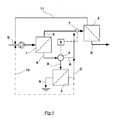
- FIG. 1 shows that the paper fiber suspension S is first pumped into the washing device 1.
- the accept 5 formed therein contains the major part of the fibers and then passes to the filter device 2 for thickening the filter device 2.
- the dilution component B is treated in a demineralization 3 in such a way that a filtrate C with at most a very low solids content is obtained, and a reject R, which essentially contains the fine solids separated by the process.
- DAF dissolved air flotation
- the reject R of the Entstoffung 3 may contain fillers and / or fiber fines and / or color particles. It is discarded or, for example, elsewhere in paper production used. In certain cases it is also useful to isolate the fillers from the reject R and to reuse them in paper production.
- the filtrate C from this separation 3 can advantageously be the filter device 2 be supplied in order - as already mentioned - to keep its volume throughput constant. However, it is also conceivable to use this filtrate C elsewhere for dilution, for which purpose the dashed line 10 is shown. This also shows Figure a way to also return the filtrate formed in the filter device 2 through the line 11 for dilution purposes. Of course there are other options too, that is a question of water management. As a thickened substance, a fiber suspension S 'forms in the filter device 2, which has the desired values, both with regard to the content of fine substances and the consistency.
- control valve 4 it is particularly advantageous in performing the method used system, for example in the inlet to the filter device 2, to install an online measuring device 7, which determines the ash content there. Such devices are known.
- a control signal for the control valve 4 can then be formed via a controller 8.
- this control loop can also be included in the process computer for the entire system, possibly to take into account further criteria for optimizing the system.
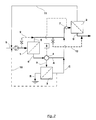
- the method can also be varied such that part of the accept 5 coming from the washing device 1 does not get into the filter device 2, but rather as a bypass flow 12 into the thickened suspension S 'removed therefrom.
- the filter device 2 can be made smaller and the entire operation becomes more economical.
- This bypass flow 12 is advantageously kept constant or does not fall below a minimum value.
- this apparatus can also be relieved by means of a bypass flow conducted through a bypass line 9, provided that the requirements for the washing effect are still met.
- bypass line 9 carries the entire stream of the fiber suspension S.
- the scrubber is then switched off for as long. All in all, the described method enables a very wide range of degrees of ash removal to be realized with particularly economical operation of the equipment used.
Landscapes
- Engineering & Computer Science (AREA)
- Mechanical Engineering (AREA)
- Life Sciences & Earth Sciences (AREA)
- Wood Science & Technology (AREA)
- Paper (AREA)
Abstract
Description
- Die Erfindung bezieht sich auf ein Verfahren gemäß dem Oberbegriff des Anspruchs 1.
- Bekanntlich enthalten Papierfasersuspensionen nicht nur die eigentlichen Papierfasern, sondern auch eine mehr oder weniger große Menge von feinen Feststoffen. Solche feinen Feststoffe können mineralische Füllstoffe sein, die in der Regel zur Papiererzeugung nötig sind. Man nennt sie zumeist "Asche". Es können aber auch Faserbruchstücke sein, die z.B. bei der Mahlung der Fasern entstehen. Diese werden auch Feinstoffe genannt. Darüber hinaus gibt es besonders in Altpapiersuspensionen Druckfarbenpartikel oder sonstige feine Verunreinigungen. Die Entfernung dieser feinen Feststoffe wird Entaschung genannt, da die unbrennbaren Füllstoffe oft den größten Anteil haben.
- Es ist nun sehr stark von der Art und Qualität des aus dieser Papierfasersuspension später hergestellten Papieres abhängig, in welchem Maße die feinen Feststoffe in der Suspension verbleiben sollen, bzw. in welcher Menge sie zu entfernen sind. Oft werden sie in sogenannten Wäschern abgeschieden, da sie sich auf Grund ihrer Feinheit mechanisch leicht von den Fasern trennen und mit dem Waschfiltrat abführen lassen. Solche Waschvorrichtungen können mit einem oder zwei umlaufenden Endlossieben arbeiten, wie sie z.B. in der DE 30 05 681 ausführlich beschrieben sind. Eine andere Möglichkeit ist die Verwendung eines an sich bekannten Schneckeneindickers. Neuerdings werden für diesen Zweck aber auch Drucksortierer verwendet, die so betrieben werden, dass nicht - wie üblich - die Fasern in den Durchlauf, sondern in den Überlauf gelangen, wodurch sich die Möglichkeit des Auswaschens von feinen Feststoffen bietet. Auch wenn mit den genannten Maschinen zumeist eine ausreichende Entaschung möglich ist, haben sie doch den Nachteil, dass sich der Entaschungseffekt bei laufendem Betrieb nur in geringem Maße verändern lässt.
- Bei Verfahren der hier genannten Art wird die wegen der Wäsche relativ dünne Suspension anschließend wieder eingedickt, um die nachfolgenden Aufbereitungsschritte optimal durchführen zu können. Die zum Eindicken verwendete Filtervorrichtung arbeitet insofern ähnlich wie die Waschvorrichtung, als sie auf mechanischem Wege das Wasser vom Faserstoff trennt. Der große Unterschied liegt daber darin, dass beim Filtern ein möglichst großer Teil des Feststoffes zurückgehalten wird. Dazu sind Scheibenfilter besonders günstig.
- Der Erfindung liegt die Aufgabe zu Grunde, bekannte Verfahren dieser Art so zu verbessern, dass sich der Gehalt von feinen Feststoffen schnell und sicher einstellen lässt. Rohstoffschwankungen sollten ausgeglichen werden können.
- Diese Aufgabe wird durch die im Kennzeichen des Anspruchs 1 genannten Merkmale gelöst.
- Mit Hilfe des erfindungsgemäßen Verfahrens ist der Betrieb einer Kombination von Wasch- und Filtervorrichtung besonders vorteilhaft möglich. Durch Verändern der Mengenaufteilung des Waschfiltrats kann sofort, also praktisch ohne Totzeiten, der Gehalt der feinen Feststoffe - bezogen auf den gesamten Feststoff - in der später eingedickten Suspension verändert und auf den gewünschten Wert gebracht werden. Dabei kann die Waschvorrichtung konstant gefahren und auf optimale Wäsche eingestellt werden. Optimale Wäsche heißt, dass ein möglichst großer Anteil der in der Papierfasersuspension enthaltenen feinen Stoffe ins Filtrat gelangt. Bekanntlich wird dieser Auswascheffekt dadurch erschwert, dass sich auch bei Waschvorrichtungen Filterkuchen bilden, die geeignet sind, auch die feinen Feststoffe zurückzuhalten. Um dennoch einen guten Auswascheffekt zu erzielen, sollte die Maschine entsprechend optimiert werden, was erleichtert wird, wenn sie mit konstantem Durchsatz gefahren werden kann. Auch die den Gutstoff der Waschvorrichtung verarbeitende Filtervorrichtung kann im Wesentlichen konstant betrieben werden, was wiederum ein großer Vorteil ist. Schwankungen kommen lediglich durch die Variation des Ergänzungsanteils zustande. Auch das lässt sich durch eine besonders vorteilhafte Ausgestaltung der Erfindung vermeiden, nämlich indem nach Entstoffung des Verdünnungsanteils das dabei gebildete Filtrat ebenfalls zusammen mit dem Ergänzungsanteil in die Filtervorrichtung zugegeben wird. In anderen Fällen kann es aber auch sinnvoll sein, dieses Filtrat an anderer Stelle zum Verdünnen zu nehmen, weil dadurch die Filtervorrichtung volumendurchsatzmäßig entlastet wird.
- Die Erfindung und ihre Vorteile werden erläutert an Hand von Zeichnungen, von denen
- Fig. 1
- ein Verfahrensschema zur Durchführung und
- Fig. 2
- eine Variante
- Die Figur 1 zeigt, dass die Papierfasersuspension S zunächst in die Waschvorrichtung 1 eingepumpt wird. Der darin gebildete Gutstoff 5 enthält den größten Teil der Fasern und gelangt anschließend zur Eindickung in die Filtervorrichtung 2. Das ablaufende Waschfiltrat 6 wird in einem Stellventil 4 aufgeteilt in den Ergänzungsanteil A und den Verdünnungsanteil B. Der Ergänzungsanteil A geht zusammen mit dem Gutstoff 5 in die Filtervorrichtung 2. Der Verdünnungsanteil B wird in einer Entstoffung 3 so behandelt, dass ein Filtrat C mit höchstens sehr geringem Feststoffanteil anfällt sowie ein Rejekt R, der im Wesentlichen die durch das Verfahren abgeschiedenen feinen Feststoffe enthält. Zur Entstoffung kann mit Vorteil eine sogenannten Entspannungsflotation (Abkürzung "DAF" = dissolved air flotation) durchgeführt werden. Bei dieser bilden sich durch Druckentspannung der Suspension sehr feine Luftblasen, die die Abscheidung aller Feststoffteilchen, also auch der hydrophilen Anteile, ermöglichen. Der Rejekt R der Entstoffung 3 kann Füllstoffe und/oder Faserfeinstoffe und/oder Farbpartikel enthalten. Er wird verworfen oder z.B. an anderer Stelle in der Papierfabrikation
eingesetzt. In bestimmten Fällen ist es auch nützlich, aus dem Rejekt R die Füllstoffe zu isolieren und bei der Papierfabrikation wieder zu verwenden. - Das Filtrat C aus dieser Entstoffung 3 kann mit Vorteil der Filtervorrichtung 2
zugeführt werden, um - wie bereits erwähnt - dessen Volumendurchsatz konstant zu halten. Es ist aber auch denkbar, dieses Filtrat C an anderer Stelle zur Verdünnung zu verwenden, wozu hier die gestrichelte Linie 10 eingezeichnet ist. Ferner zeigt diese Figur eine Möglichkeit, auch das in der Filtervorrichtung 2 gebildete Filtrat durch die Leitung 11 zu Verdünnungszwecken zurückzuführen. Selbstverständlich gibt es auch andere Möglichkeiten, das ist eine Frage des Wassermanagements. Als eingedickter Stoff bildet sich in der Filtervorrichtung 2 eine Faserstoffsuspension S', die die gewünschten Werte aufweist, sowohl was den Gehalt an feinen Stoffen, als auch die Konsistenz betrifft. Es ist besonders vorteilhaft, in der zur Durchführung des Verfahrens
verwendeten Anlage z.B. im Einlauf zur Filtervorrichtung 2 ein online-Messgerät 7 zu installieren, das dort den Aschegehalt bestimmt. Solche Geräte sind bekannt. Über einen Regler 8 kann dann ein Steuersignal für das Stellventil 4 gebildet werden. Selbstverständlich kann dieser Regelkreis auch in den Prozessrechner für die gesamte Anlage aufgenommen werden, eventuell um weitere Kriterien zur Optimierung der Anlage zu berücksichtigen. - Wie Fig. 2 zeigt, kann das Verfahren kann auch so variiert werden, dass ein Teil des aus der Waschvorrichtung 1 stammenden Gutstoffes 5 nicht in die Filtervorrichtung 2 gelangt, sondern als Bypassstrom 12 in die daraus entnommene eingedickte Suspension S'. Dadurch kann die Filtervorrichtung 2 kleiner ausgelegt werden, und der gesamte Betrieb wird wirtschaftlicher. Mit Vorteil wird dieser Bypassstrom 12 konstant gehalten oder ein Minimalwert nicht unterschritten. Eine ähnliche Überlegung ist auch beim Betrieb der Waschvorrichtung 1 anstellbar. Auch dieser Apparat kann, wie die Figur 2 alternativ zeigt, durch einen über eine Umgehungsleitung 9 geführten Bypassstrom entlastet werden, sofern auch dann die Anforderungen an den Wascheffekt noch erfüllt werden.
- In Anlagen mit gemischtem Betrieb kann es auch vorkommen, dass zeitweise ein Auswaschen von feinen Stoffen aus der Faserstoffsuspension unnötig ist. In diesem Fall führt die Umgehungsleitung 9 den gesamten Strom der Faserstoffsuspension S. Der Wäscher wird dann so lange abgeschaltet. Insgesamt lässt sich also durch das beschriebene Verfahren eine sehr große Bandbreite von Entaschungsgraden bei besonders ökonomischem Betrieb der eingesetzten Apparaturen realisieren.
Claims (15)
- Verfahren zur Reduzierung und Einstellung des Gehaltes von feinen Feststoffen in einer Papierfasersuspension, insbesondere einer aus Altpapier gewonnenen Papierfasersuspension, mit Hilfe von mindestens einer Waschvorrichtung (1) sowie von mindestens einer Filtervorrichtung (2),
dadurch gekennzeichnet,
dass die Papierfasersuspension (S) zunächst zumindest teilweise über die Waschvorrichtung (1) geführt wird, deren Gutstoff (5) zumindest teilweise in
die Filtervorrichtung (2) gelangt, während das Waschfiltrat (6) der Waschvorrichtung (1) aufgeteilt wird in einen dem Gutstoff (5) wieder
zugeführten Ergänzungsanteil (A) sowie einen Verdünnungsanteil (B), wobei diese Mengenaufteilung des Waschfiltrates (6) so eingestellt wird, dass die in der Filtervorrichtung (2) eingedickte Suspension (S') den gewünschten Gehalt an feinen Feststoffen hat. - Verfahren nach Anspruch 1,
dadurch gekennzeichnet,
dass die Menge des Verdünnungsanteils (B) erhöht wird, wenn der Gehalt der feinen Feststoffe gesenkt werden soll. - Verfahren nach Anspruch 1 oder 2,
dadurch gekennzeichnet,
dass der Verdünnungsanteil (B) entstofft wird. - Verfahren nach Anspruch 3,
dadurch gekennzeichnet,
dass die Entstoffung (3) durch eine Entspannungsflotation durchgeführt wird. - Verfahren nach Anspruch 3 oder 4,
dadurch gekennzeichnet,
dass der entstoffte Verdünnungsanteil als Filtrat (C) in die Filtervorrichtung (2) geführt wird. - Verfahren nach einem der voranstehenden Ansprüche,
dadurch gekennzeichnet,
dass die Waschvorrichtung (1) so betrieben wird, dass mindestens 10 % des in der Papierfasersuspension (S) enthaltenen Feststoffes in das Waschfiltrat (6) gelangt. - Verfahren nach einem der voranstehenden Ansprüche,
dadurch gekennzeichnet,
dass mit Hilfe eines online-Messgerätes (7) der Gehalt an feinen Feststoffen im Einlauf zur Filtervorrichtung (2) gemessen wird und dass dieses Messsignal mit Hilfe eines Reglers (8) ein Stellventil (4) ansteuert, mit dem die Aufteilung des Waschfiltrates (6) in den Ergänzungsanteil (A) und den Verdünnungsanteil (B) vorgenommen wird. - Verfahren nach einem der voranstehenden Ansprüche,
dadurch gekennzeichnet,
dass die Waschvorrichtung (1) mit einem zeitlich konstanten Volumendurchsatz betrieben wird. - Verfahren nach einem der voranstehenden Ansprüche,
dadurch gekennzeichnet,
dass ein Teil des Gutstoffes (5) unter Umgehung der Filtervorrichtung (2) in die eingedickte Suspension (S') geführt wird. - Verfahren nach Anspruch 9,
dadurch gekennzeichnet,
dass der Teil des Gutstoffes (5) konstant gehalten wird. - Verfahren nach einem der voranstehenden Ansprüche,
dadurch gekennzeichnet,
dass ein Teil der Suspension (S) unter Umgehung der Waschvorrichtung (1) in deren Gutstoff (5) geführt wird. - Verfahren nach Anspruch 11,
dadurch gekennzeichnet,
dass der in dem Gutstoff (5) geführte Teil der Suspension (S) konstant gehalten wird. - Verfahren nach einem der voranstehenden Ansprüche,
dadurch gekennzeichnet,
dass zumindest ein Teil der feinen Feststoffe, deren Gehalt eingestellt wird, mineralische Füllstoffe, sogenannte Asche, sind. - Verfahren nach einem der voranstehenden Ansprüche,
dadurch gekennzeichnet,
dass zumindest ein Teil der feinen Feststoffe, deren Gehalt eingestellt wird, Farbpartikel sind. - Verfahren nach einem der voranstehenden Ansprüche,
dadurch gekennzeichnet,
dass zumindest ein Teil der feinen Feststoffe, deren Gehalt eingestellt wird, Faserbruchstücke sind.
Applications Claiming Priority (4)
| Application Number | Priority Date | Filing Date | Title |
|---|---|---|---|
| DE10209995 | 2002-03-07 | ||
| DE10209995 | 2002-03-07 | ||
| DE2002118265 DE10218265C1 (de) | 2002-03-07 | 2002-04-24 | Verfahren zur Reduzierung und Einstellung des Gehaltes von feinen Feststoffen in einer Papierfasersuspension |
| DE10218265 | 2002-04-24 |
Publications (3)
| Publication Number | Publication Date |
|---|---|
| EP1342833A2 true EP1342833A2 (de) | 2003-09-10 |
| EP1342833A3 EP1342833A3 (de) | 2004-01-28 |
| EP1342833B1 EP1342833B1 (de) | 2006-10-18 |
Family
ID=27758425
Family Applications (1)
| Application Number | Title | Priority Date | Filing Date |
|---|---|---|---|
| EP20020026551 Expired - Lifetime EP1342833B1 (de) | 2002-03-07 | 2002-11-28 | Verfahren zur Reduzierung und Einstellung des Gehaltes von feinen Feststoffen in einer Papierfasersuspension |
Country Status (4)
| Country | Link |
|---|---|
| EP (1) | EP1342833B1 (de) |
| AT (1) | ATE343013T1 (de) |
| DE (1) | DE50208494D1 (de) |
| ES (1) | ES2272630T3 (de) |
Family Cites Families (2)
| Publication number | Priority date | Publication date | Assignee | Title |
|---|---|---|---|---|
| CH644414A5 (de) * | 1980-02-06 | 1984-07-31 | Escher Wyss Gmbh | Siebmaschine, insbesondere zur behandlung von aus altpapier gewonnenen waesserigen faserstoffsuspensionen. |
| FR2612212B1 (fr) * | 1987-03-13 | 1990-06-29 | Centre Tech Ind Papier | Procede et installation pour le recyclage de vieux papiers imprimes |
-
2002
- 2002-11-28 AT AT02026551T patent/ATE343013T1/de not_active IP Right Cessation
- 2002-11-28 ES ES02026551T patent/ES2272630T3/es not_active Expired - Lifetime
- 2002-11-28 DE DE50208494T patent/DE50208494D1/de not_active Expired - Fee Related
- 2002-11-28 EP EP20020026551 patent/EP1342833B1/de not_active Expired - Lifetime
Also Published As
| Publication number | Publication date |
|---|---|
| EP1342833A3 (de) | 2004-01-28 |
| DE50208494D1 (de) | 2006-11-30 |
| ATE343013T1 (de) | 2006-11-15 |
| ES2272630T3 (es) | 2007-05-01 |
| EP1342833B1 (de) | 2006-10-18 |
Similar Documents
| Publication | Publication Date | Title |
|---|---|---|
| DE4034054C1 (de) | ||
| DE69403662T2 (de) | Verfahren und apparat zur behandlung von füllstoffe enthaltendem material wie rückgewonnenen fasern | |
| DE4130472C2 (de) | Verfahren und Vorrichtung zur Behandlung einer Faserstoffsuspension | |
| EP0558908B1 (de) | Aufbereitung und Verfahren von Altpapier | |
| EP0147564B1 (de) | Anordnung zur Aufbereitung von Altpapier | |
| EP1728918A2 (de) | Verfahren zur Entfernung von Störstoffen aus einer wässrigen Papierfasersuspension | |
| DE4242338C2 (de) | Verfahren und Anlage zur Behandlung von Siebwasser | |
| DE102006008761A1 (de) | Verfahren zum Auflösen und Reinigen von störstoffhaltigen Papierrohstoffen | |
| DE68914666T2 (de) | Verfahren und Vorrichtung zur Herstellung eines Cellulosebreis von verbesserter Qualität. | |
| DE10218265C1 (de) | Verfahren zur Reduzierung und Einstellung des Gehaltes von feinen Feststoffen in einer Papierfasersuspension | |
| EP1403422A1 (de) | Verfahren zur Aufbereitung von Altpapier | |
| DE102008009134A1 (de) | Verfahren zur Entfernung von Störstoffen aus einer wässrigen Faserstoffsuspension | |
| DE10135699A1 (de) | Verfahren zur Aufbereitung von Trockenausschuss | |
| EP1798329B1 (de) | Verfahren zur Entfernung von Störstoffen aus einer wässrigen Faserstoffsuspension | |
| EP0653510A2 (de) | Verfahren zur Aufbereitung von bedrucktem Altpapier | |
| EP2657397B1 (de) | Verfahren zur Auflösung von Faserstoffen | |
| DE3139989C2 (de) | Verfahren zur Herstellung von Papier aus stark verschmutzten Faserrohstoffen und Anlage zur Ausführung des Verfahrens | |
| EP1342833B1 (de) | Verfahren zur Reduzierung und Einstellung des Gehaltes von feinen Feststoffen in einer Papierfasersuspension | |
| EP1262594B1 (de) | Verfahren zur Abscheidung von Anteilen aus einer Faserstoffsuspension | |
| WO2012123529A1 (de) | Verfahren und vorrichtung zur regelung der filterleistung einer filtervorrichtung | |
| DE102005016192A1 (de) | Verfahren zum Auflösen und Reinigen von störstoffhaltigen Papierrohrstoffen | |
| DE102008019197A1 (de) | Verfahren zur Entfernung von Störstoffen aus einer wässrigen Faserstoffsuspension | |
| DE102008013458A1 (de) | Verfahren zur Entfernung von Störstoffen aus einer wässrigen Faserstoffsuspension | |
| EP1063347B1 (de) | Verfahren zur dosierbaren Verdünnung der Faserstoffsuspension in oder vor einem Stoffauflauf einer Papiermaschine | |
| DE10015355A1 (de) | Verfahren zur Entfernung von feinen partikelförmigen Verunreinigungen aus Altpapierfaserstoff |
Legal Events
| Date | Code | Title | Description |
|---|---|---|---|
| PUAI | Public reference made under article 153(3) epc to a published international application that has entered the european phase |
Free format text: ORIGINAL CODE: 0009012 |
|
| AK | Designated contracting states |
Kind code of ref document: A2 Designated state(s): AT BE BG CH CY CZ DE DK EE ES FI FR GB GR IE IT LI LU MC NL PT SE SK TR |
|
| AX | Request for extension of the european patent |
Extension state: AL LT LV MK RO SI |
|
| PUAL | Search report despatched |
Free format text: ORIGINAL CODE: 0009013 |
|
| AK | Designated contracting states |
Kind code of ref document: A3 Designated state(s): AT BE BG CH CY CZ DE DK EE ES FI FR GB GR IE IT LI LU MC NL PT SE SK TR |
|
| AX | Request for extension of the european patent |
Extension state: AL LT LV MK RO SI |
|
| 17P | Request for examination filed |
Effective date: 20040728 |
|
| AKX | Designation fees paid |
Designated state(s): AT BE BG CH CY CZ DE DK EE ES FI FR GB GR IE IT LI LU MC NL PT SE SK TR |
|
| GRAP | Despatch of communication of intention to grant a patent |
Free format text: ORIGINAL CODE: EPIDOSNIGR1 |
|
| GRAS | Grant fee paid |
Free format text: ORIGINAL CODE: EPIDOSNIGR3 |
|
| RAP1 | Party data changed (applicant data changed or rights of an application transferred) |
Owner name: VOITH PATENT GMBH |
|
| GRAA | (expected) grant |
Free format text: ORIGINAL CODE: 0009210 |
|
| AK | Designated contracting states |
Kind code of ref document: B1 Designated state(s): AT BE BG CH CY CZ DE DK EE ES FI FR GB GR IE IT LI LU MC NL PT SE SK TR |
|
| PG25 | Lapsed in a contracting state [announced via postgrant information from national office to epo] |
Ref country code: IT Free format text: LAPSE BECAUSE OF FAILURE TO SUBMIT A TRANSLATION OF THE DESCRIPTION OR TO PAY THE FEE WITHIN THE PRESCRIBED TIME-LIMIT;WARNING: LAPSES OF ITALIAN PATENTS WITH EFFECTIVE DATE BEFORE 2007 MAY HAVE OCCURRED AT ANY TIME BEFORE 2007. THE CORRECT EFFECTIVE DATE MAY BE DIFFERENT FROM THE ONE RECORDED. Effective date: 20061018 Ref country code: CZ Free format text: LAPSE BECAUSE OF FAILURE TO SUBMIT A TRANSLATION OF THE DESCRIPTION OR TO PAY THE FEE WITHIN THE PRESCRIBED TIME-LIMIT Effective date: 20061018 Ref country code: SK Free format text: LAPSE BECAUSE OF FAILURE TO SUBMIT A TRANSLATION OF THE DESCRIPTION OR TO PAY THE FEE WITHIN THE PRESCRIBED TIME-LIMIT Effective date: 20061018 Ref country code: FI Free format text: LAPSE BECAUSE OF FAILURE TO SUBMIT A TRANSLATION OF THE DESCRIPTION OR TO PAY THE FEE WITHIN THE PRESCRIBED TIME-LIMIT Effective date: 20061018 Ref country code: IE Free format text: LAPSE BECAUSE OF FAILURE TO SUBMIT A TRANSLATION OF THE DESCRIPTION OR TO PAY THE FEE WITHIN THE PRESCRIBED TIME-LIMIT Effective date: 20061018 |
|
| REG | Reference to a national code |
Ref country code: GB Ref legal event code: FG4D Free format text: NOT ENGLISH |
|
| GBT | Gb: translation of ep patent filed (gb section 77(6)(a)/1977) |
Effective date: 20061018 |
|
| REG | Reference to a national code |
Ref country code: IE Ref legal event code: FG4D Free format text: LANGUAGE OF EP DOCUMENT: GERMAN Ref country code: CH Ref legal event code: NV Representative=s name: E. BLUM & CO. PATENTANWAELTE Ref country code: CH Ref legal event code: EP |
|
| PG25 | Lapsed in a contracting state [announced via postgrant information from national office to epo] |
Ref country code: MC Free format text: LAPSE BECAUSE OF NON-PAYMENT OF DUE FEES Effective date: 20061130 Ref country code: BE Free format text: LAPSE BECAUSE OF NON-PAYMENT OF DUE FEES Effective date: 20061130 |
|
| REF | Corresponds to: |
Ref document number: 50208494 Country of ref document: DE Date of ref document: 20061130 Kind code of ref document: P |
|
| PG25 | Lapsed in a contracting state [announced via postgrant information from national office to epo] |
Ref country code: SE Free format text: LAPSE BECAUSE OF FAILURE TO SUBMIT A TRANSLATION OF THE DESCRIPTION OR TO PAY THE FEE WITHIN THE PRESCRIBED TIME-LIMIT Effective date: 20070118 Ref country code: BG Free format text: LAPSE BECAUSE OF FAILURE TO SUBMIT A TRANSLATION OF THE DESCRIPTION OR TO PAY THE FEE WITHIN THE PRESCRIBED TIME-LIMIT Effective date: 20070118 Ref country code: DK Free format text: LAPSE BECAUSE OF FAILURE TO SUBMIT A TRANSLATION OF THE DESCRIPTION OR TO PAY THE FEE WITHIN THE PRESCRIBED TIME-LIMIT Effective date: 20070118 |
|
| PG25 | Lapsed in a contracting state [announced via postgrant information from national office to epo] |
Ref country code: PT Free format text: LAPSE BECAUSE OF FAILURE TO SUBMIT A TRANSLATION OF THE DESCRIPTION OR TO PAY THE FEE WITHIN THE PRESCRIBED TIME-LIMIT Effective date: 20070319 |
|
| ET | Fr: translation filed | ||
| REG | Reference to a national code |
Ref country code: ES Ref legal event code: FG2A Ref document number: 2272630 Country of ref document: ES Kind code of ref document: T3 |
|
| REG | Reference to a national code |
Ref country code: IE Ref legal event code: FD4D |
|
| PLBE | No opposition filed within time limit |
Free format text: ORIGINAL CODE: 0009261 |
|
| STAA | Information on the status of an ep patent application or granted ep patent |
Free format text: STATUS: NO OPPOSITION FILED WITHIN TIME LIMIT |
|
| 26N | No opposition filed |
Effective date: 20070719 |
|
| REG | Reference to a national code |
Ref country code: CH Ref legal event code: PFA Owner name: VOITH PATENT GMBH Free format text: VOITH PATENT GMBH#SANKT POELTENER STRASSE 43#89522 HEIDENHEIM (DE) -TRANSFER TO- VOITH PATENT GMBH#SANKT POELTENER STRASSE 43#89522 HEIDENHEIM (DE) |
|
| BERE | Be: lapsed |
Owner name: VOITH PATENT G.M.B.H. Effective date: 20061130 |
|
| PGFP | Annual fee paid to national office [announced via postgrant information from national office to epo] |
Ref country code: DE Payment date: 20071123 Year of fee payment: 6 Ref country code: ES Payment date: 20071129 Year of fee payment: 6 Ref country code: NL Payment date: 20071119 Year of fee payment: 6 |
|
| PGFP | Annual fee paid to national office [announced via postgrant information from national office to epo] |
Ref country code: CH Payment date: 20071115 Year of fee payment: 6 Ref country code: AT Payment date: 20071116 Year of fee payment: 6 Ref country code: IT Payment date: 20071122 Year of fee payment: 6 |
|
| PG25 | Lapsed in a contracting state [announced via postgrant information from national office to epo] |
Ref country code: GR Free format text: LAPSE BECAUSE OF FAILURE TO SUBMIT A TRANSLATION OF THE DESCRIPTION OR TO PAY THE FEE WITHIN THE PRESCRIBED TIME-LIMIT Effective date: 20070119 |
|
| PGFP | Annual fee paid to national office [announced via postgrant information from national office to epo] |
Ref country code: FR Payment date: 20071122 Year of fee payment: 6 Ref country code: GB Payment date: 20071120 Year of fee payment: 6 |
|
| PG25 | Lapsed in a contracting state [announced via postgrant information from national office to epo] |
Ref country code: EE Free format text: LAPSE BECAUSE OF FAILURE TO SUBMIT A TRANSLATION OF THE DESCRIPTION OR TO PAY THE FEE WITHIN THE PRESCRIBED TIME-LIMIT Effective date: 20061018 |
|
| PG25 | Lapsed in a contracting state [announced via postgrant information from national office to epo] |
Ref country code: TR Free format text: LAPSE BECAUSE OF FAILURE TO SUBMIT A TRANSLATION OF THE DESCRIPTION OR TO PAY THE FEE WITHIN THE PRESCRIBED TIME-LIMIT Effective date: 20061018 Ref country code: LU Free format text: LAPSE BECAUSE OF NON-PAYMENT OF DUE FEES Effective date: 20061128 |
|
| PG25 | Lapsed in a contracting state [announced via postgrant information from national office to epo] |
Ref country code: CY Free format text: LAPSE BECAUSE OF FAILURE TO SUBMIT A TRANSLATION OF THE DESCRIPTION OR TO PAY THE FEE WITHIN THE PRESCRIBED TIME-LIMIT Effective date: 20061018 |
|
| REG | Reference to a national code |
Ref country code: CH Ref legal event code: PL |
|
| GBPC | Gb: european patent ceased through non-payment of renewal fee |
Effective date: 20081128 |
|
| PG25 | Lapsed in a contracting state [announced via postgrant information from national office to epo] |
Ref country code: NL Free format text: LAPSE BECAUSE OF NON-PAYMENT OF DUE FEES Effective date: 20090601 |
|
| NLV4 | Nl: lapsed or anulled due to non-payment of the annual fee |
Effective date: 20090601 |
|
| PG25 | Lapsed in a contracting state [announced via postgrant information from national office to epo] |
Ref country code: IT Free format text: LAPSE BECAUSE OF NON-PAYMENT OF DUE FEES Effective date: 20081128 Ref country code: AT Free format text: LAPSE BECAUSE OF NON-PAYMENT OF DUE FEES Effective date: 20081128 |
|
| REG | Reference to a national code |
Ref country code: FR Ref legal event code: ST Effective date: 20090731 |
|
| PG25 | Lapsed in a contracting state [announced via postgrant information from national office to epo] |
Ref country code: CH Free format text: LAPSE BECAUSE OF NON-PAYMENT OF DUE FEES Effective date: 20081130 Ref country code: LI Free format text: LAPSE BECAUSE OF NON-PAYMENT OF DUE FEES Effective date: 20081130 Ref country code: DE Free format text: LAPSE BECAUSE OF NON-PAYMENT OF DUE FEES Effective date: 20090603 |
|
| PG25 | Lapsed in a contracting state [announced via postgrant information from national office to epo] |
Ref country code: GB Free format text: LAPSE BECAUSE OF NON-PAYMENT OF DUE FEES Effective date: 20081128 |
|
| REG | Reference to a national code |
Ref country code: ES Ref legal event code: FD2A Effective date: 20081129 |
|
| PG25 | Lapsed in a contracting state [announced via postgrant information from national office to epo] |
Ref country code: ES Free format text: LAPSE BECAUSE OF NON-PAYMENT OF DUE FEES Effective date: 20081129 |
|
| PG25 | Lapsed in a contracting state [announced via postgrant information from national office to epo] |
Ref country code: FR Free format text: LAPSE BECAUSE OF NON-PAYMENT OF DUE FEES Effective date: 20081130 |