EP1342366B1 - Procede de traitement de donnees video destinees a etre visualisees sur un ecran et dispositif mettant en oeuvre le procede - Google Patents
Procede de traitement de donnees video destinees a etre visualisees sur un ecran et dispositif mettant en oeuvre le procede Download PDFInfo
- Publication number
- EP1342366B1 EP1342366B1 EP01983660A EP01983660A EP1342366B1 EP 1342366 B1 EP1342366 B1 EP 1342366B1 EP 01983660 A EP01983660 A EP 01983660A EP 01983660 A EP01983660 A EP 01983660A EP 1342366 B1 EP1342366 B1 EP 1342366B1
- Authority
- EP
- European Patent Office
- Prior art keywords
- motion
- sequence
- value
- slow motion
- receiver
- Prior art date
- Legal status (The legal status is an assumption and is not a legal conclusion. Google has not performed a legal analysis and makes no representation as to the accuracy of the status listed.)
- Expired - Lifetime
Links
- 238000000034 method Methods 0.000 title claims abstract description 18
- 238000012545 processing Methods 0.000 title abstract description 12
- 230000033001 locomotion Effects 0.000 claims description 132
- 238000001514 detection method Methods 0.000 claims description 32
- 230000005540 biological transmission Effects 0.000 claims description 26
- 230000000694 effects Effects 0.000 claims description 2
- 230000004044 response Effects 0.000 claims 2
- 210000000689 upper leg Anatomy 0.000 claims 2
- 238000012800 visualization Methods 0.000 description 15
- 238000010200 validation analysis Methods 0.000 description 14
- 230000000875 corresponding effect Effects 0.000 description 12
- 239000000872 buffer Substances 0.000 description 7
- 230000006870 function Effects 0.000 description 6
- 230000006872 improvement Effects 0.000 description 6
- 238000010586 diagram Methods 0.000 description 5
- 230000004913 activation Effects 0.000 description 3
- 230000003068 static effect Effects 0.000 description 3
- 230000001133 acceleration Effects 0.000 description 2
- 238000009825 accumulation Methods 0.000 description 2
- 230000003213 activating effect Effects 0.000 description 2
- 230000008901 benefit Effects 0.000 description 2
- 238000010276 construction Methods 0.000 description 2
- 230000001276 controlling effect Effects 0.000 description 2
- 230000007423 decrease Effects 0.000 description 2
- 230000008569 process Effects 0.000 description 2
- 238000012360 testing method Methods 0.000 description 2
- 230000007704 transition Effects 0.000 description 2
- 240000008042 Zea mays Species 0.000 description 1
- 238000004364 calculation method Methods 0.000 description 1
- 238000012937 correction Methods 0.000 description 1
- 230000002596 correlated effect Effects 0.000 description 1
- 230000009977 dual effect Effects 0.000 description 1
- 230000000977 initiatory effect Effects 0.000 description 1
- 230000004048 modification Effects 0.000 description 1
- 238000012986 modification Methods 0.000 description 1
- 238000010422 painting Methods 0.000 description 1
- 238000003672 processing method Methods 0.000 description 1
- 230000003252 repetitive effect Effects 0.000 description 1
- 238000005070 sampling Methods 0.000 description 1
- 230000011664 signaling Effects 0.000 description 1
- 230000001360 synchronised effect Effects 0.000 description 1
Images



Classifications
-
- H—ELECTRICITY
- H04—ELECTRIC COMMUNICATION TECHNIQUE
- H04N—PICTORIAL COMMUNICATION, e.g. TELEVISION
- H04N5/00—Details of television systems
- H04N5/14—Picture signal circuitry for video frequency region
- H04N5/147—Scene change detection
-
- H—ELECTRICITY
- H04—ELECTRIC COMMUNICATION TECHNIQUE
- H04N—PICTORIAL COMMUNICATION, e.g. TELEVISION
- H04N21/00—Selective content distribution, e.g. interactive television or video on demand [VOD]
- H04N21/80—Generation or processing of content or additional data by content creator independently of the distribution process; Content per se
- H04N21/85—Assembly of content; Generation of multimedia applications
- H04N21/854—Content authoring
- H04N21/8549—Creating video summaries, e.g. movie trailer
-
- H—ELECTRICITY
- H04—ELECTRIC COMMUNICATION TECHNIQUE
- H04N—PICTORIAL COMMUNICATION, e.g. TELEVISION
- H04N21/00—Selective content distribution, e.g. interactive television or video on demand [VOD]
- H04N21/40—Client devices specifically adapted for the reception of or interaction with content, e.g. set-top-box [STB]; Operations thereof
- H04N21/43—Processing of content or additional data, e.g. demultiplexing additional data from a digital video stream; Elementary client operations, e.g. monitoring of home network or synchronising decoder's clock; Client middleware
- H04N21/433—Content storage operation, e.g. storage operation in response to a pause request, caching operations
- H04N21/4331—Caching operations, e.g. of an advertisement for later insertion during playback
-
- H—ELECTRICITY
- H04—ELECTRIC COMMUNICATION TECHNIQUE
- H04N—PICTORIAL COMMUNICATION, e.g. TELEVISION
- H04N21/00—Selective content distribution, e.g. interactive television or video on demand [VOD]
- H04N21/40—Client devices specifically adapted for the reception of or interaction with content, e.g. set-top-box [STB]; Operations thereof
- H04N21/43—Processing of content or additional data, e.g. demultiplexing additional data from a digital video stream; Elementary client operations, e.g. monitoring of home network or synchronising decoder's clock; Client middleware
- H04N21/44—Processing of video elementary streams, e.g. splicing a video clip retrieved from local storage with an incoming video stream or rendering scenes according to encoded video stream scene graphs
- H04N21/44008—Processing of video elementary streams, e.g. splicing a video clip retrieved from local storage with an incoming video stream or rendering scenes according to encoded video stream scene graphs involving operations for analysing video streams, e.g. detecting features or characteristics in the video stream
-
- H—ELECTRICITY
- H04—ELECTRIC COMMUNICATION TECHNIQUE
- H04N—PICTORIAL COMMUNICATION, e.g. TELEVISION
- H04N21/00—Selective content distribution, e.g. interactive television or video on demand [VOD]
- H04N21/40—Client devices specifically adapted for the reception of or interaction with content, e.g. set-top-box [STB]; Operations thereof
- H04N21/47—End-user applications
- H04N21/472—End-user interface for requesting content, additional data or services; End-user interface for interacting with content, e.g. for content reservation or setting reminders, for requesting event notification, for manipulating displayed content
- H04N21/47217—End-user interface for requesting content, additional data or services; End-user interface for interacting with content, e.g. for content reservation or setting reminders, for requesting event notification, for manipulating displayed content for controlling playback functions for recorded or on-demand content, e.g. using progress bars, mode or play-point indicators or bookmarks
-
- H—ELECTRICITY
- H04—ELECTRIC COMMUNICATION TECHNIQUE
- H04N—PICTORIAL COMMUNICATION, e.g. TELEVISION
- H04N5/00—Details of television systems
- H04N5/44—Receiver circuitry for the reception of television signals according to analogue transmission standards
Definitions
- the invention relates to a video data processing method intended to be displayed on a screen as well as to a device implementing the method.
- the invention applies more particularly to the detection of video data extracted from a television program having a certain characteristic, and to their display on a television screen,
- the context of the present invention is that of home audio-visual servers, and generally of any device capable of viewing audiovisual programs received from a broadcast network.
- a user of such equipment can obtain a large amount of audiovisual information. He thus has little time devoted to each emission and prefers to overfly them by visualizing a summary.
- Programs such as football matches have more interesting moments than others, such as goals or the best actions.
- a user with little time may want to see only a summary composed of the most interesting sequences.
- Television broadcasters may issue audio-visual summaries corresponding to certain programs they broadcast. These summaries are for example, tapes of broadcast movies. But this requires the broadcaster to build the said summaries.
- the broadcasting of such abstracts occupies a significant bandwidth on the broadcast network.
- One of the aims of the present invention is to be able to provide the user with audiovisual program summaries.
- the present solution does not require additional processing by the broadcaster and does not require additional bandwidth.
- the patent application EP 1 026 887 describes a recording system on video cassette or hard disk of part of a program selected by a user. In order to present the user only a minimum duration of the transmission, the system detects the slow motion sequences and records only these sequences in the memory. The slow motion sequences are then viewed one after the other.
- the patent application DE 19737 889 describes a system for improving automatic recording devices on tape recorders.
- the system In order to limit the space occupied on the magnetic tape, the system only records segments of signals corresponding to interesting audiovisual sequences. These segments can in particular be detected by a slow motion detector, the slow motion sequences being considered more interesting than the normal speed sequences. Segment detection is done by analyzing the amount of motion between video images.
- the receiver reads in its memory the transmission that the user wishes to view, detects the slow motion sequences and sends them successively to a display screen.
- the user sees in order only sequences that seem particularly interesting since the broadcaster offers them in slow motion.
- the idle sequences are accelerated according to the calculated idle factor in order to view them at normal speed.
- the broadcaster does not need to build audio-visual summaries and transmit them since the receiver does this, which saves bandwidth. If the user then has the time, he can see the broadcast which is recorded in its entirety in the memory of the receiver.
- user controls make it possible to control the display of the sequence of slow motion sequences, such as: visualization of the sequences continuously or on a single shot, jump to the next sequence, jump to the previous sequence.
- the method comprises a step of validating a hooking signal when the value of the confidence counter is greater than a determined value
- the accounting step performs a decrease in the value of the confidence counter when step d) detects an inequality.
- the value of the confidence counter is capped.
- the subject of the invention is also an audiovisual transmission receiver comprising a means for receiving transmissions transmitted on a broadcasting network, a means for memorizing at least part of the audiovisual programs received, a means for reading the broadcast. memory and a means for viewing the read transmissions, an idle sequence detector within a recorded audiovisual program, characterized in that it comprises means for calculating an idling factor of the sequence with respect to the speed normal, an acceleration means according to the idle factor of the recorded idle sequence, and a display module controlling the memory reading means, the acceleration means and the display means for displaying at normal speed the idle sequences detected by the idle detector analyzing the emission read by the reading means.
- the receiver can record audiovisual programs from a network. Then, the user issues a command to his receiver to read the recorded program and detects the sequences in slow motion, each detected sequence is displayed on a screen. In this way, the user can quickly see the most interesting moments of the show.
- the receiver displays the slow motion sequences at normal speed, which speeds up the visualization of the summary.
- the receiver comprises a storage memory of at least one audiovisual transmission part, a motion detector detecting a movement (M) or an absence of movement (S) between two images of the same parity of said audio-visual broadcast read from said memory, characterized in that it further comprises a means for determining a repetition pattern of frames composed of a value (M) followed by a sequence of values (S) comprising at least one value (S), a storage memory of a so-called reference pattern obtained by the means for determining a pattern of frame repetition, a comparator comparing the reference pattern with the patterns recorded at the output of the motion detector operating on the frames resulting from the audiovisual program being processed, a confidence counter accounting for the number of identities determined by the comparator, a means for transmitting an idle presence signal when the value of the confidence counter reaches a determined value (Thaut).
- the receiver calculates the idle factor, the latter being equal to the number of values of movement and absence of movement of the reference pattern.
- the receiver According to a particular mode of operation, the receiver generates a hooking signal when the value of the confidence counter reaches a determined value. This hooking signal triggers the memorization of the audiovisual program in the device.
- the receiver divides the value of the confidence counter when the comparator detects a difference between the reference pattern and the frame repetition pattern detected by the determining means.
- the motion detector incorporated in the receiver detects a movement between two frames of the same parity separated by at least one frame of the same parity as the first two.
- the receiver is, for example, a DVB-compliant TV decoder. It uses an ISO / IEC 13818-1 transport layer.
- the receiver is connected to an antenna 1, itself connected to a tuner 2 (also called a "tuner") and possibly to an audiovisual program support reader 21, typically a video tape recorder.
- the signal supplied by the tuner is demodulated by a demodulator 3.
- the demodulated data are deinterleaved and corrected by an error correction circuit 4 and transmitted to a demultiplexer 5.
- the microprocessor 23 is connected to a memory 12 comprising the operating system as well as resident or downloaded programs for implementing applications such as an EPG.
- the memory is illustrated in the form of a single block, but can physically comprise several blocks of different nature: RAM RAM, ROM ROM, reprogrammable EEPROM memory or FLASH.
- ROM contains, among other things, the basic program of the receiver. This program includes input / output management routines such as: programming the demultiplexer, receiving commands from the remote control, viewing video sequences stored in memory and specified by a pointer, etc.
- a character generator 15 allows the generation of control menus or graphics relating to the parameters of the receiver or to a particular application.
- the video signal generated is multiplexed with one of the video signals from the video receiver 17 to a Scart socket (SCART socket in English) connected to a television 22.
- the multiplexing circuit 20 is managed by the microprocessor 23.
- the receiver is also equipped with a remote control 11, connected to the microprocessor by an infrared link 24. This remote control has among other keys navigation ( ⁇ , ⁇ , ⁇ , ⁇ ) and keys: " ⁇ ", " ⁇ ", “OK” , "END". For the sake of clarity, only the most important connections of the microprocessor 23 are illustrated.
- the audio or video sections or packets filtered by the demultiplexer are stored in predefined areas of a buffer memory 6.
- the receiver also includes a hard disk 25 connected to the microprocessor by means of an interface 26 allowing fast transfers of data. information.
- the hard disk is advantageously integrated with the receiver, it can be proposed in the form of a separate equipment.
- the disk carrier may optionally be removable.
- the program executable by the microprocessor 23 analyzes the data stored in the buffer memory 6 by the demultiplexer 5 and determines whether they correspond to the selection of the user. If so, then they are saved in the hard drive 25.
- the capacity of the disc allows you to record at least several hours audiovisual programs in a compressed format (MPEG 2 for example).
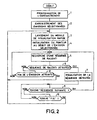
- step 1 the user programs his reception apparatus in order to record one or more broadcasts.
- the programming can be done either by defining a time and a specific service, or by explicitly specifying the event (using an Electronic Program Guide for example, EPG for short).
- step 2 the broadcasts are actually recorded in the hard disk.
- a second step the user wishes to quickly visualize the contents of the memory of his hard disk. He then launches a Quick View Module, MVR for short.
- this module is physically speaking a program managed by the microprocessor, although conceptually, it is an application processing data packets, just like an audio or video receiver, for which dedicated circuits are used.
- the module presents, with the aid of a menu displayed on the screen, information relating to all the programs recorded in the hard disk. This menu is called "initial". This information is for example the title, the duration, the service whose emission has been extracted ... or any other information likely to help the user in his choice. The user navigates through this menu by visually highlighting the broadcasts.
- Audiovisual data read from the hard drive is extracted from a pointer.
- the MVR module initializes this pointer to the start address of the show selected.
- the module searches from the position defined by the pointer and until the end of the recorded program, the slow motion sequences.
- step 6 an idle sequence is detected which causes the execution of step 7 during which the sequence is displayed. If the end of the emission is reached without a sequence being detected (test of step 8), the module displays the initial menu (step 3), the user can thus quickly see other recorded programs or exit the MVR.
- the visualization in step 7 is configurable, we will see later the different options.
- step 7 the program jumps to step 9 and waits for a command from the user.
- the user manually controls the succession of the visualization of the different sequences;
- the module jumps to step 5 to search for the next idle sequence. If the user presses the "END" key (step 10), he interrupts the quick view and returns to the initial menu.
- the figure 3 shows an example of a menu that appears when the user views programs recorded in the receiver's memory.
- the selected program appears at the top of the screen 30 and a control panel 31 at the bottom of the screen.
- This banner contains the command icons.
- the strip does not appear and the commands are made by function keys on the remote control 11.
- a nonlimiting list of commands is: go to the beginning of the display of the recorded programs 32, display of the previous recorded show 33, back view of the broadcast 34, launch of the MVR 35, quick viewing of the recorded show 36, viewing of the next recorded show 37.
- the command that interests us most for the present invention is that to launch the Quick View Module (MVR).
- MVR Quick View Module
- a first improvement of the present exemplary embodiment is that the slow motion sequences are sequentially and continuously displayed.
- a user command entitled “Continuous visualization / blow by move” allows either to visualize the following sequence when the user actuates the command " ⁇ ", or to visualize the succession of the sequences without interruption.
- the program after step 7 jumps directly to step 10 and does not perform the test of step 9.
- the command "Continuous Visualization / Jog” is a two-state control, a new operation switches to the initial state.
- Another improvement is that the user can return at any time to the beginning of the current idle sequence by activating the " ⁇ " icon. This improvement is made by storing in a temporary memory the value of the start of sequence pointer. A double activation close to the [ ⁇ ] icon (also called “double click") allows you to return to the idle sequence preceding the current one. This function is easily achievable by putting in a stack the starting addresses of each idle sequence detected: Another way of doing which will be detailed later, is to detect the sequences during the reception, to memorize only the sequences and to create a sequence index table.
- the user can view the slow motion sequences at normal speed. This is done knowing the idle ratio, the determination of this ratio is performed at the same time as the detection of idle sequences.
- the user requests normal-speed playback of slow motion sequences by activating the icon titled "Normal / Slow Speed".
- the display management module multiplies the display speed of the sequence read from the memory by the idle ratio. In this way, the visualization of the summary consisting of all the sequences of idling is accelerated, and lasts a minimum time. A second activation of the icon returns to the initial idle speed.
- Idle detection can be done in different ways.
- the broadcast broadcaster can identify the idle sequences using an identifier transmitted in the service information. This identifier includes the event name, the start and end time references of the idle sequence, and the idle ratio value. It is recalled that this value is taken into account when the user wishes to view a slow motion sequence at normal speed. This first way of doing compels the broadcaster to know in advance the slow motion sequences.
- the figure 5 shows an initial sequence named "Sini”. From this sequence, a slow motion sequence called “Sral” is carried out. By tripling the number of broadcast frames, this broadcast taking three times longer, the sequence is displayed three more slowly than the "Sini" start sequence.
- the idle factor in this example is equal to 3.
- the present exemplary embodiment uses a motion detector which analyzes two consecutive frames extracted from an audiovisual program and which determines whether they differ significantly or not.
- a frame repeat detector uses the output values of this detector to determine whether the images are totally static or moving in time.
- the idle detector must be able to distinguish sequences containing still images such as the presentation of a painter's painting, sequences at normal speed, and slow motion sequences where the images evolve slowly in order to detect only the latter. . Only the sequences corresponding to the third category must be detected.
- the figure 6 shows the general operating principle of the idle sequence detection device which is the subject of the invention.
- the device receives the broadcast video signals as input and stores them in a video memory 61 which is part of the memory 12.
- the video data is read from the memory 61 and transmitted to a motion detector 62 by two outputs corresponding to the two signals. frames Tprec and Tsuiv consecutive.
- the motion detector 62 operates by computing thresholds interframe differences, that is to say the accumulation, on all or part of the frames, of the luminance difference between the pixels located at the same position in the frames. two frames. It provides, for each pair of input frames, a so-called "motion" indicator of Boolean type.
- the value of the motion indicator is M ("M": Movement) if the detector detects movement between the two scanned frames or S (“S": Static) if the two frames are identical perfectly or significantly.
- the succession of the values M and S of the indicator over time is analyzed by the frame repetition detector 63, which positions at its output a boolean indicating whether or not the input video sequence corresponds to an idle.
- this shows an example of a sequence of indicator values at the output of the motion detector, which corresponds to a factor 3 slow motion generated by repeating frames.
- reference pattern a characteristic pattern
- M transition with motion
- S transitions without motion or static
- the reference motif is: [MSS].
- the reference pattern obtained using the values of output of the motion detector consists of an "M” indicator immediately followed by a sequence of consecutive "S" indicators.
- the number of symbols M and S of the reference pattern is equal to the idling ratio denoted N.
- the determination of the idling ratio N is an important piece of data which is related to each idle sequence and which can be used during the display. According to the present exemplary embodiment, the user can visualize the slow motion sequences at normal speed by sending to the screen an image over N, which has the effect of accelerating in the same ratio the slow motion sequence.
- the figure 7 is a diagram of a finite state machine for processing the patterns of the indicator values.
- This drawing conforms to the UML standard for state machines.
- the principle of the repetitive pattern detection is as follows: it is a question of locating, at the output of the motion detector, the sequences consisting of an "M” indicator followed by at least one "S".
- a counter C1 is initialized to 1 which will determine the period of the detected pattern, which corresponds to the idle ratio if the detection is validated.
- the controller After receiving the "M”, we expect an "S”. If the received flag does not match the expected value, the controller returns to its initial state. In the opposite case, the counter C1 is incremented.
- the motion pattern not being validated as corresponding to an idle it should be indicated at each frame period that no idle sequence has been detected.
- the figure 8 illustrates the processing applied to validate the idle sequence detection on the data from the motion detector, from the idle ratio estimated in the determination phase.
- the value of the confidence counter remains at "0". If there is identity, the counter slowly increases until a ceiling value.
- the confidence counter can be represented by a byte. On the other hand, if there is no more identity, the counter decreases rapidly.
- the reference pattern actually corresponds to a particular phase, among all the possible phases in a repetition period, of the reference movement pattern. It is therefore necessary to synchronize the validation process with the output of the motion detector so that the group of samples from the motion detector comprises first an "M” indicator, then the "S" indicators. This synchronization occurs naturally, insofar as the output state of the detection process corresponds precisely to this phase. It is therefore sufficient to read the first group of values of motion indicators for validation in the wake of the detection for the phasing is correct.
- the CONFMax ceiling value of the confidence counter being 32
- the values Thaut and Tbas are for example 16 and 8 respectively.
- issued signal called "ACC" for "Snapping" when the confidence is between the two thresholds Thaut and Tbas, indicates that at least two idle patterns have been detected but it is not enough to be sure to be in the presence of a slow motion.
- the value of the confidence counter reaches Thaut, it is certain that a large number of consecutive coincidences between the observed pattern and the reference pattern have occurred, it is then possible to validate the idle detection.
- the confidence counter is incremented for each identity observed between the pattern from the motion detector and the reference pattern. It takes 32 identities for the meter to reach its ceiling. Suppose now that the idle sequence stops. At the first difference with the reference pattern, the value of the counter becomes 16. The idle detection signal is therefore always activated. During the second consecutive difference, the counter has the value 8, the idle detection signal is deactivated, but the snap remains active. It is only at the third difference (the value of the counter is equal to 4) that the two signals are deactivated.
- An improvement of the present invention consists in using the ACC signal to trigger the storage of the frames of the received audiovisual program in a temporary memory (a part of the hard disk 25 for example). If finally, no idle sequence is detected, the confidence counter falling below the value Tbas, then these data will be overwritten. Otherwise, they are stored in memory at the addresses preceding those of the idle sequence actually detected. In this way, almost all of the idle sequence forms a continuous block and can be viewed without interruption.
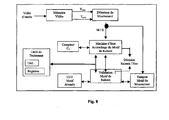
- the figure 9 represents a general diagram of the idle sequence detection device.
- the input stream includes, among other things, the luminance and chrominance information of the pixels constituting the frames of the signal video.
- This information is stored in a video memory having a dual read access, so as to simultaneously supply the motion detector with the luminance values of the pixels belonging to a first frame Tprec and a second frame Tsuiv, and occupying the same locations at the same time. inside these two frames.
- An exemplary embodiment of a motion detector consists of an electronic circuit making it possible to accumulate the luminance differences of the pixels coming from Tprec and Tsuiv, and to compare the thresholds of the results of this accumulation in order to provide at its output a binary indicator "M / S", synchronous input video frames, signaling the presence (M) or absence (S) of movement between the two processed frames.
- the values compared by the comparator are declared identical if they do not differ by a certain percentage. This percentage is 10% in the present embodiment. So that if the motion detector indicates if two frames are almost identical, the difference between two pixels being 10% maximum.
- This electronic circuit can be realized by discrete electronic components or by a specialized integrated circuit (ASIC: "Application Specific Integrated Circuit" in English) or by a software module using the computing and memory resources of a processing unit and integrated into the MVR.
- ASIC Application Specific Integrated Circuit
- the output values of the motion detector are supplied to the processing block executing the state machine which detects the presence of an idle sequence.
- This block has read and write access to the counter C 1 whose function is to calculate the repetition period of the motion pattern. The calculation is done by counting the number of indicators M (thus one unit) and S indicators. After detecting a period of an idle pattern, the value of the counter C 1 is stored and the counter C 1 is set to zero. The repetition pattern thus detected constitutes the reference pattern; it is stored in a memory. The value of the stored counter is the repetition period of the reference pattern, and corresponds to the idle ratio.
- the output of the motion detector supplies secondly a buffer memory for storing a series of values "M" and "S" constituting the output of the motion detector, of length equal to that of the reference pattern.
- the contents of this buffer are subsequently compared to the reference pattern.
- the capacity of this buffer must be sized according to the maximum value Pmax of the repetition period of the motion pattern, which coincides with the maximum value of the idle ratio that is to be detected.
- the detection device 63 In the absence or at the beginning of the appearance of an idle sequence, the detection device 63 outputs a binary signal indicating, at each frame period, that no idle sequence has been detected, since the motive repetition pattern corresponding to a possible slow motion has not yet been validated. This block also controls the initiation of the idle pattern validation process. Finally, it supplies the pattern validation block with the value of the repetition period of the pattern, and the signal ACC.
- the value of the repetition period of the pattern allows the construction, by the validation block, of the reference pattern.
- This construction can advantageously be implemented by means of a "Look-Up-Table" according to the English terminology, addressed by the value of the detected repetition period, and comprising, for each value of this period considered valid; the sequence of "M / S" indicators constituting the reference pattern.
- the validation block of the idle pattern compares the sequence of values "M” and "S” stored in the buffer fed by the output of the motion detector, and the reference pattern stored in the "Look-Up-Table". This block validates the result of the comparison by means of the confidence counter introduced previously, to output a binary signal indicating, at each frame period, whether or not there is an idle sequence.
- the idle pattern validation block finally has an output to the detection block, in order to be able to reset and restart the detection process in case the validation of the idle pattern fails.
- the blocks for determining and validating the idle pattern, as well as the counter C 1 and the buffers and LUTs, can advantageously be implemented by a software module using the resources of a processor or processing unit comprising, inter alia, a Arithmetic and Logic Unit and registers allowing the storage of the intermediate variables of the treatment.
- Processing constants such as Tbas, Thaut and CONFmax can be stored in non-volatile ROM memory (Read Only Memory).
- the set of elements represented in the device of the figure 9 is controlled by synchronization signals relating to the sampling of video pixels, pixel lines and frames available at the input of the device at the same time as the video stream.
- the motion detector could detect their identity. To avoid this, according to an improvement of the invention, the motion detector does not compare two consecutive frames but two frames separated by at least one other frame.
- the invention is not limited to television decoders but can be applied to any device for receiving audiovisual broadcasts.
- Audiovisual broadcasts may notably be received in the form of a video cassette, the reception means then becoming a means of reading an audiovisual medium.
Landscapes
- Engineering & Computer Science (AREA)
- Multimedia (AREA)
- Signal Processing (AREA)
- Databases & Information Systems (AREA)
- Human Computer Interaction (AREA)
- Computer Security & Cryptography (AREA)
- Television Signal Processing For Recording (AREA)
- Two-Way Televisions, Distribution Of Moving Picture Or The Like (AREA)
- Television Systems (AREA)
Applications Claiming Priority (3)
| Application Number | Priority Date | Filing Date | Title |
|---|---|---|---|
| FR0014009A FR2816157A1 (fr) | 2000-10-31 | 2000-10-31 | Procede de traitement de donnees video distinees a etre visualisees sur ecran et dispositif mettant en oeuvre le procede |
| FR0014009 | 2000-10-31 | ||
| PCT/FR2001/003377 WO2002037836A1 (fr) | 2000-10-31 | 2001-10-30 | Procede de traitement de donnees video destinees a etre visualisees sur un ecran et dispositif mettant en oeuvre le procede |
Publications (2)
| Publication Number | Publication Date |
|---|---|
| EP1342366A1 EP1342366A1 (fr) | 2003-09-10 |
| EP1342366B1 true EP1342366B1 (fr) | 2011-04-20 |
Family
ID=8855963
Family Applications (1)
| Application Number | Title | Priority Date | Filing Date |
|---|---|---|---|
| EP01983660A Expired - Lifetime EP1342366B1 (fr) | 2000-10-31 | 2001-10-30 | Procede de traitement de donnees video destinees a etre visualisees sur un ecran et dispositif mettant en oeuvre le procede |
Country Status (9)
| Country | Link |
|---|---|
| US (1) | US7565679B2 (https=) |
| EP (1) | EP1342366B1 (https=) |
| JP (1) | JP4027225B2 (https=) |
| KR (1) | KR100839944B1 (https=) |
| CN (1) | CN100518242C (https=) |
| AU (1) | AU2002215092A1 (https=) |
| DE (1) | DE60144489D1 (https=) |
| FR (1) | FR2816157A1 (https=) |
| WO (1) | WO2002037836A1 (https=) |
Families Citing this family (7)
| Publication number | Priority date | Publication date | Assignee | Title |
|---|---|---|---|---|
| JP4727342B2 (ja) * | 2004-09-15 | 2011-07-20 | ソニー株式会社 | 画像処理装置、画像処理方法、画像処理プログラム及びプログラム格納媒体 |
| JP4872079B2 (ja) * | 2006-05-19 | 2012-02-08 | 国立大学法人長岡技術科学大学 | 文章更新量評価プログラム |
| KR20090087915A (ko) * | 2006-11-14 | 2009-08-18 | 코닌클리케 필립스 일렉트로닉스 엔.브이. | 슬로우 모션을 검출하기 위한 방법 및 장치 |
| CN106095389B (zh) * | 2009-12-23 | 2020-03-17 | 英特尔公司 | 用于自动获得并同步上下文内容和应用的方法和设备 |
| CN102656555B (zh) * | 2009-12-23 | 2016-08-10 | 英特尔公司 | 用于自动获得并同步上下文内容和应用的方法和设备 |
| JP2013243619A (ja) * | 2012-05-22 | 2013-12-05 | Toshiba Corp | 音響処理装置及び音響処理方法 |
| GB2514557A (en) * | 2013-05-28 | 2014-12-03 | Snell Ltd | Image processing |
Family Cites Families (101)
| Publication number | Priority date | Publication date | Assignee | Title |
|---|---|---|---|---|
| US7079176B1 (en) * | 1991-11-25 | 2006-07-18 | Actv, Inc. | Digital interactive system for providing full interactivity with live programming events |
| US5425021A (en) * | 1993-01-28 | 1995-06-13 | International Business Machines Corporation | Packet switching resource management within nodes |
| US5949476A (en) * | 1993-10-20 | 1999-09-07 | Cableshare, Inc. | Television system distributing a dynamically varying number of concurrent video presentations over a single television channel |
| US5491511A (en) * | 1994-02-04 | 1996-02-13 | Odle; James A. | Multimedia capture and audit system for a video surveillance network |
| US5907837A (en) * | 1995-07-17 | 1999-05-25 | Microsoft Corporation | Information retrieval system in an on-line network including separate content and layout of published titles |
| US6067552A (en) * | 1995-08-21 | 2000-05-23 | Cnet, Inc. | User interface system and method for browsing a hypertext database |
| KR100211056B1 (ko) * | 1995-12-23 | 1999-07-15 | 이계철 | 다수개의 비디오에 대한 윈도우 제어방법 |
| US6018768A (en) * | 1996-03-08 | 2000-01-25 | Actv, Inc. | Enhanced video programming system and method for incorporating and displaying retrieved integrated internet information segments |
| US6035330A (en) * | 1996-03-29 | 2000-03-07 | British Telecommunications | World wide web navigational mapping system and method |
| US6374260B1 (en) * | 1996-05-24 | 2002-04-16 | Magnifi, Inc. | Method and apparatus for uploading, indexing, analyzing, and searching media content |
| US6181336B1 (en) * | 1996-05-31 | 2001-01-30 | Silicon Graphics, Inc. | Database-independent, scalable, object-oriented architecture and API for managing digital multimedia assets |
| US5875332A (en) * | 1996-05-31 | 1999-02-23 | International Business Machines Corporation | Generating a common gateway interface adapter customized for a stored procedure |
| US5761436A (en) * | 1996-07-01 | 1998-06-02 | Sun Microsystems, Inc. | Method and apparatus for combining truncated hyperlinks to form a hyperlink aggregate |
| US6038610A (en) * | 1996-07-17 | 2000-03-14 | Microsoft Corporation | Storage of sitemaps at server sites for holding information regarding content |
| KR100206804B1 (ko) * | 1996-08-29 | 1999-07-01 | 구자홍 | 하일라이트 부분 자동 선택 녹화 방법 |
| US6038561A (en) * | 1996-10-15 | 2000-03-14 | Manning & Napier Information Services | Management and analysis of document information text |
| US6012126A (en) * | 1996-10-29 | 2000-01-04 | International Business Machines Corporation | System and method for caching objects of non-uniform size using multiple LRU stacks partitions into a range of sizes |
| US5915001A (en) * | 1996-11-14 | 1999-06-22 | Vois Corporation | System and method for providing and using universally accessible voice and speech data files |
| US6177931B1 (en) * | 1996-12-19 | 2001-01-23 | Index Systems, Inc. | Systems and methods for displaying and recording control interface with television programs, video, advertising information and program scheduling information |
| US5917424A (en) * | 1996-12-31 | 1999-06-29 | At & T Corp | Duplicate page sensor system and method |
| CA2285645A1 (en) * | 1997-01-06 | 1998-07-16 | Bellsouth Intellectual Property Corporation | Method and system for tracking network use |
| US5892843A (en) * | 1997-01-21 | 1999-04-06 | Matsushita Electric Industrial Co., Ltd. | Title, caption and photo extraction from scanned document images |
| US6225995B1 (en) * | 1997-10-31 | 2001-05-01 | Oracle Corporaton | Method and apparatus for incorporating state information into a URL |
| US5870755A (en) * | 1997-02-26 | 1999-02-09 | Carnegie Mellon University | Method and apparatus for capturing and presenting digital data in a synthetic interview |
| US6064376A (en) * | 1997-03-13 | 2000-05-16 | United Video Properties, Inc. | Adjustable program guide display system |
| US6065058A (en) * | 1997-05-09 | 2000-05-16 | International Business Machines Corp. | Dynamic push filtering based on information exchanged among nodes in a proxy hierarchy |
| US5895471A (en) * | 1997-07-11 | 1999-04-20 | Unwired Planet, Inc. | Providing a directory of frequently used hyperlinks on a remote server |
| US6026413A (en) * | 1997-08-01 | 2000-02-15 | International Business Machines Corporation | Determining how changes to underlying data affect cached objects |
| US6081774A (en) * | 1997-08-22 | 2000-06-27 | Novell, Inc. | Natural language information retrieval system and method |
| US6192382B1 (en) * | 1997-09-24 | 2001-02-20 | Mediaone Group, Inc. | Method and system for web site construction using HTML fragment caching |
| US6026391A (en) * | 1997-10-31 | 2000-02-15 | Oracle Corporation | Systems and methods for estimating query response times in a computer system |
| US6061692A (en) * | 1997-11-04 | 2000-05-09 | Microsoft Corporation | System and method for administering a meta database as an integral component of an information server |
| US6029165A (en) * | 1997-11-12 | 2000-02-22 | Arthur Andersen Llp | Search and retrieval information system and method |
| US6681227B1 (en) * | 1997-11-19 | 2004-01-20 | Ns Solutions Corporation | Database system and a method of data retrieval from the system |
| US6055543A (en) * | 1997-11-21 | 2000-04-25 | Verano | File wrapper containing cataloging information for content searching across multiple platforms |
| US5918232A (en) * | 1997-11-26 | 1999-06-29 | Whitelight Systems, Inc. | Multidimensional domain modeling method and system |
| US6253204B1 (en) * | 1997-12-17 | 2001-06-26 | Sun Microsystems, Inc. | Restoring broken links utilizing a spider process |
| US6067565A (en) * | 1998-01-15 | 2000-05-23 | Microsoft Corporation | Technique for prefetching a web page of potential future interest in lieu of continuing a current information download |
| US6377995B2 (en) * | 1998-02-19 | 2002-04-23 | At&T Corp. | Indexing multimedia communications |
| US6173287B1 (en) * | 1998-03-11 | 2001-01-09 | Digital Equipment Corporation | Technique for ranking multimedia annotations of interest |
| US6859213B1 (en) * | 1998-03-23 | 2005-02-22 | Sun Microsystems, Inc. | Method and apparatus for selecting attachments |
| US6175829B1 (en) * | 1998-04-22 | 2001-01-16 | Nec Usa, Inc. | Method and apparatus for facilitating query reformulation |
| US6044375A (en) * | 1998-04-30 | 2000-03-28 | Hewlett-Packard Company | Automatic extraction of metadata using a neural network |
| US6208988B1 (en) * | 1998-06-01 | 2001-03-27 | Bigchalk.Com, Inc. | Method for identifying themes associated with a search query using metadata and for organizing documents responsive to the search query in accordance with the themes |
| US6711590B1 (en) * | 1998-07-10 | 2004-03-23 | Canon Kabushiki Kaisha | Linking metadata with a time-sequential digital signal |
| US6240416B1 (en) * | 1998-09-11 | 2001-05-29 | Ambeo, Inc. | Distributed metadata system and method |
| US6829646B1 (en) * | 1999-10-13 | 2004-12-07 | L. V. Partners, L.P. | Presentation of web page content based upon computer video resolutions |
| US6934963B1 (en) * | 1998-09-22 | 2005-08-23 | United Video Properties, Inc. | Interactive television program guide with passive content |
| US6567800B1 (en) * | 1998-10-01 | 2003-05-20 | At&T Corp. | System and method for searching information stored on a network |
| US6249844B1 (en) * | 1998-11-13 | 2001-06-19 | International Business Machines Corporation | Identifying, processing and caching object fragments in a web environment |
| JP3695191B2 (ja) * | 1998-12-25 | 2005-09-14 | 日本電気株式会社 | 翻訳支援装置及びその方法並びにコンピュータ可読記録媒体 |
| US6236395B1 (en) * | 1999-02-01 | 2001-05-22 | Sharp Laboratories Of America, Inc. | Audiovisual information management system |
| US6393415B1 (en) * | 1999-03-31 | 2002-05-21 | Verizon Laboratories Inc. | Adaptive partitioning techniques in performing query requests and request routing |
| US6539382B1 (en) * | 1999-04-29 | 2003-03-25 | International Business Machines Corporation | Intelligent pre-caching algorithm for a directory server based on user data access history |
| US6175830B1 (en) * | 1999-05-20 | 2001-01-16 | Evresearch, Ltd. | Information management, retrieval and display system and associated method |
| US20020059184A1 (en) * | 1999-05-27 | 2002-05-16 | Yoav Ilan | Subject-oriented communication through the internet |
| US6547829B1 (en) * | 1999-06-30 | 2003-04-15 | Microsoft Corporation | Method and system for detecting duplicate documents in web crawls |
| US6519564B1 (en) * | 1999-07-01 | 2003-02-11 | Koninklijke Philips Electronics N.V. | Content-driven speech-or audio-browser |
| US7293280B1 (en) * | 1999-07-08 | 2007-11-06 | Microsoft Corporation | Skimming continuous multimedia content |
| US7181438B1 (en) * | 1999-07-21 | 2007-02-20 | Alberti Anemometer, Llc | Database access system |
| US7353246B1 (en) * | 1999-07-30 | 2008-04-01 | Miva Direct, Inc. | System and method for enabling information associations |
| US6895402B1 (en) * | 1999-08-25 | 2005-05-17 | International Business Machines Corporation | Detecting framing of a network resource identified by a target uniform resource locator |
| US6701355B1 (en) * | 1999-09-29 | 2004-03-02 | Susquehanna Media Co. | System and method for dynamically substituting broadcast material and targeting to specific audiences |
| US6549922B1 (en) * | 1999-10-01 | 2003-04-15 | Alok Srivastava | System for collecting, transforming and managing media metadata |
| AU7863600A (en) * | 1999-10-05 | 2001-05-10 | Zapmedia, Inc. | System and method for distributing media assets to user devices and managing user rights of the media assets |
| US6516337B1 (en) * | 1999-10-14 | 2003-02-04 | Arcessa, Inc. | Sending to a central indexing site meta data or signatures from objects on a computer network |
| US6519603B1 (en) * | 1999-10-28 | 2003-02-11 | International Business Machine Corporation | Method and system for organizing an annotation structure and for querying data and annotations |
| US6351755B1 (en) * | 1999-11-02 | 2002-02-26 | Alta Vista Company | System and method for associating an extensible set of data with documents downloaded by a web crawler |
| JP4325102B2 (ja) * | 1999-11-12 | 2009-09-02 | ソニー株式会社 | 情報処理装置および方法、並びにプログラム格納媒体 |
| US6556983B1 (en) * | 2000-01-12 | 2003-04-29 | Microsoft Corporation | Methods and apparatus for finding semantic information, such as usage logs, similar to a query using a pattern lattice data space |
| EP2352120B1 (en) * | 2000-01-13 | 2016-03-30 | Digimarc Corporation | Network-based access to auxiliary data based on steganographic information |
| US6519648B1 (en) * | 2000-01-24 | 2003-02-11 | Friskit, Inc. | Streaming media search and continuous playback of multiple media resources located on a network |
| US7162691B1 (en) * | 2000-02-01 | 2007-01-09 | Oracle International Corp. | Methods and apparatus for indexing and searching of multi-media web pages |
| US6675174B1 (en) * | 2000-02-02 | 2004-01-06 | International Business Machines Corp. | System and method for measuring similarity between a set of known temporal media segments and a one or more temporal media streams |
| WO2001061568A2 (en) * | 2000-02-17 | 2001-08-23 | E-Numerate Solutions, Inc. | Rdl search engine |
| US6834308B1 (en) * | 2000-02-17 | 2004-12-21 | Audible Magic Corporation | Method and apparatus for identifying media content presented on a media playing device |
| US6718328B1 (en) * | 2000-02-28 | 2004-04-06 | Akamai Technologies, Inc. | System and method for providing controlled and secured access to network resources |
| US6839903B1 (en) * | 2000-03-24 | 2005-01-04 | Sony Corporation | Method of selecting a portion of a block of data for display based on characteristics of a display device |
| US7222163B1 (en) * | 2000-04-07 | 2007-05-22 | Virage, Inc. | System and method for hosting of video content over a network |
| US6865593B1 (en) * | 2000-04-12 | 2005-03-08 | Webcollege, Inc. | Dynamic integration of web sites |
| US6718365B1 (en) * | 2000-04-13 | 2004-04-06 | International Business Machines Corporation | Method, system, and program for ordering search results using an importance weighting |
| US6732175B1 (en) * | 2000-04-13 | 2004-05-04 | Intel Corporation | Network apparatus for switching based on content of application data |
| US6976090B2 (en) * | 2000-04-20 | 2005-12-13 | Actona Technologies Ltd. | Differentiated content and application delivery via internet |
| US20020032906A1 (en) * | 2000-06-02 | 2002-03-14 | Grossman Avram S. | Interactive marketing and advertising system and method |
| AU2001271772A1 (en) * | 2000-06-30 | 2002-01-14 | Eddie H. Williams | Online digital content library |
| US7089325B1 (en) * | 2000-07-05 | 2006-08-08 | Register.Com, Inc. | Method and apparatus for URL forwarding |
| US6778986B1 (en) * | 2000-07-31 | 2004-08-17 | Eliyon Technologies Corporation | Computer method and apparatus for determining site type of a web site |
| US6990453B2 (en) * | 2000-07-31 | 2006-01-24 | Landmark Digital Services Llc | System and methods for recognizing sound and music signals in high noise and distortion |
| US7464086B2 (en) * | 2000-08-01 | 2008-12-09 | Yahoo! Inc. | Metatag-based datamining |
| US20020049738A1 (en) * | 2000-08-03 | 2002-04-25 | Epstein Bruce A. | Information collaboration and reliability assessment |
| AUPQ921400A0 (en) * | 2000-08-04 | 2000-08-31 | Canon Kabushiki Kaisha | Method of enabling browse and search access to electronically-accessible multimedia databases |
| US6728767B1 (en) * | 2000-08-18 | 2004-04-27 | Cisco Technology, Inc. | Remote identification of client and DNS proxy IP addresses |
| US6895406B2 (en) * | 2000-08-25 | 2005-05-17 | Seaseer R&D, Llc | Dynamic personalization method of creating personalized user profiles for searching a database of information |
| MXPA03003495A (es) * | 2000-10-24 | 2005-01-25 | Thomson Licensing Sa | Metodo para dimensionar una pagina de reproduccion de medios embebida. |
| US20040030683A1 (en) * | 2000-11-21 | 2004-02-12 | Evans Philip Clark | System and process for mediated crawling |
| US6842761B2 (en) * | 2000-11-21 | 2005-01-11 | America Online, Inc. | Full-text relevancy ranking |
| US20020078003A1 (en) * | 2000-12-15 | 2002-06-20 | Krysiak Bruce R. | Method and system for identifying one or more information sources based on one or more trust networks associated with one or more knowledge domains |
| JP3801889B2 (ja) * | 2001-09-07 | 2006-07-26 | 住友電装株式会社 | 端子金具 |
| AU2002363055A1 (en) * | 2001-10-19 | 2003-05-06 | Bank Of America Corporation | System and method for interative advertising |
| US7185003B2 (en) * | 2002-11-14 | 2007-02-27 | Seisint, Inc. | Query scheduling in a parallel-processing database system |
| US8214256B2 (en) * | 2003-09-15 | 2012-07-03 | Time Warner Cable Inc. | System and method for advertisement delivery within a video time shifting architecture |
-
2000
- 2000-10-31 FR FR0014009A patent/FR2816157A1/fr active Pending
-
2001
- 2001-10-30 EP EP01983660A patent/EP1342366B1/fr not_active Expired - Lifetime
- 2001-10-30 CN CNB018183662A patent/CN100518242C/zh not_active Expired - Fee Related
- 2001-10-30 WO PCT/FR2001/003377 patent/WO2002037836A1/fr not_active Ceased
- 2001-10-30 KR KR1020037005886A patent/KR100839944B1/ko not_active Expired - Fee Related
- 2001-10-30 DE DE60144489T patent/DE60144489D1/de not_active Expired - Lifetime
- 2001-10-30 AU AU2002215092A patent/AU2002215092A1/en not_active Abandoned
- 2001-10-30 JP JP2002540444A patent/JP4027225B2/ja not_active Expired - Fee Related
- 2001-10-30 US US10/415,214 patent/US7565679B2/en not_active Expired - Fee Related
Also Published As
| Publication number | Publication date |
|---|---|
| KR20030045150A (ko) | 2003-06-09 |
| AU2002215092A1 (en) | 2002-05-15 |
| US7565679B2 (en) | 2009-07-21 |
| CN100518242C (zh) | 2009-07-22 |
| FR2816157A1 (fr) | 2002-05-03 |
| JP4027225B2 (ja) | 2007-12-26 |
| CN1473426A (zh) | 2004-02-04 |
| JP2004513570A (ja) | 2004-04-30 |
| EP1342366A1 (fr) | 2003-09-10 |
| WO2002037836A1 (fr) | 2002-05-10 |
| DE60144489D1 (de) | 2011-06-01 |
| KR100839944B1 (ko) | 2008-06-20 |
| US20040047596A1 (en) | 2004-03-11 |
Similar Documents
| Publication | Publication Date | Title |
|---|---|---|
| EP2952007B1 (en) | User control of replacement television advertisements inserted by a smart television | |
| KR100246075B1 (ko) | 프로그램 정보의 부재에 의해 자동 활성화되는 채널 가이드 | |
| KR20070001240A (ko) | 실행중인 방송 또는 저장 콘텐츠를 캐치-업하기 위한 방법및 장치 | |
| EP2443566B1 (fr) | Procede de selection de versions d'un document parmi une pluralite de versions reçues a la suite d'une recherche, et recepteur associe | |
| EP1342366B1 (fr) | Procede de traitement de donnees video destinees a etre visualisees sur un ecran et dispositif mettant en oeuvre le procede | |
| EP1432246B1 (fr) | Procede et dispositif de decodage et d'affichage en marche arriere d'images mpeg, circuit pilote video et boitier decodeur incorporant un tel dispositif | |
| US8683522B2 (en) | Animated station identifier in program guides | |
| KR20110027708A (ko) | 콘텐트 아이템의 요약을 프리젠테이션하는 방법 및 장치 | |
| EP1258140B1 (fr) | Procede de visualisation d'emissions audiovisuelles diffusees et dispositif de visualisation associe | |
| FR2841724A1 (fr) | Systeme et procede de synchronisation pour programmes audiovisuels, dispositifs et procedes associes | |
| WO2017158274A1 (fr) | Acquisition d'extraits d'un flux multimédia sur un terminal | |
| WO2002049246A1 (fr) | Procede de mesure d'audience d'applications interactives telediffusees ou embarquees sur un decodeur de recepteur de television | |
| FR2889016A1 (fr) | Procede de creation d'un resume d'un document en fonction de criteres introduits par l'utilisateur, et dispositif audiovisuel associe au procede | |
| GB2430596A (en) | An image stream search tool | |
| FR2816156A1 (fr) | Procede de detection d'une sequence de ralenti dans une emission audiovisuelle et appareil mettant en oeuvre le procede | |
| WO2020183080A1 (fr) | Procédé de gestion du téléchargement d'images associées à des sauts d'images susceptibles d'être realisés lors d'une lecture accelerée d'un contenu multimedia diffusé en continu | |
| WO2001069940A1 (fr) | Dispositif de synchronisation d'applications interactives dans un recepteur de television | |
| FR2834416A1 (fr) | Procede de diffusion de services audiovisuels, central de diffusion et support d'enregistrement, procede de visualisation d'emissions audiovisuelles et dispositif associes | |
| EP3381183B1 (fr) | Procede de programmation d'un enregistrement d'une emission par un decodeur de television numerique | |
| EP1225761A1 (fr) | Procédé de commande d'un appareil comportant plusieurs sources vidéo | |
| WO2002015555A2 (fr) | Procede de determination de la source video selectionnee par un utilisateur | |
| CA2623288A1 (en) | Selection of a starting image of an image stream | |
| EP0755153A1 (fr) | Procédé et module de contrÔle et gestion de la réception de signaux numériques à commandes indépendantes du canal de transmission | |
| FR3041852A1 (fr) | Procede et dispositif d'enrichissement d'une fonction pause de la lecture d'une sequence d'images | |
| FR2898235A1 (fr) | Procede d'affichage d'informations extraites d'un document compose de reportages et recepteur mettant en oeuvre le procede |
Legal Events
| Date | Code | Title | Description |
|---|---|---|---|
| PUAI | Public reference made under article 153(3) epc to a published international application that has entered the european phase |
Free format text: ORIGINAL CODE: 0009012 |
|
| 17P | Request for examination filed |
Effective date: 20030515 |
|
| AK | Designated contracting states |
Kind code of ref document: A1 Designated state(s): AT BE CH CY DE DK ES FI FR GB GR IE IT LI LU MC NL PT SE TR |
|
| AX | Request for extension of the european patent |
Extension state: AL LT LV MK RO SI |
|
| RIN1 | Information on inventor provided before grant (corrected) |
Inventor name: CHEVALLIER, LOUIS Inventor name: EVEN, GILLES Inventor name: LE CLERC, FRANEOIS |
|
| RBV | Designated contracting states (corrected) |
Designated state(s): AT BE CH CY DE FR GB IT LI |
|
| RAP1 | Party data changed (applicant data changed or rights of an application transferred) |
Owner name: THOMSON LICENSING |
|
| 17Q | First examination report despatched |
Effective date: 20061229 |
|
| RAP1 | Party data changed (applicant data changed or rights of an application transferred) |
Owner name: THOMSON LICENSING |
|
| GRAP | Despatch of communication of intention to grant a patent |
Free format text: ORIGINAL CODE: EPIDOSNIGR1 |
|
| RBV | Designated contracting states (corrected) |
Designated state(s): DE FR GB IT |
|
| GRAS | Grant fee paid |
Free format text: ORIGINAL CODE: EPIDOSNIGR3 |
|
| GRAA | (expected) grant |
Free format text: ORIGINAL CODE: 0009210 |
|
| REG | Reference to a national code |
Ref country code: DE Ref legal event code: R084 Ref document number: 60144489 Country of ref document: DE |
|
| AK | Designated contracting states |
Kind code of ref document: B1 Designated state(s): DE FR GB IT |
|
| REG | Reference to a national code |
Ref country code: GB Ref legal event code: FG4D Free format text: NOT ENGLISH |
|
| REF | Corresponds to: |
Ref document number: 60144489 Country of ref document: DE Date of ref document: 20110601 Kind code of ref document: P |
|
| REG | Reference to a national code |
Ref country code: DE Ref legal event code: R096 Ref document number: 60144489 Country of ref document: DE Effective date: 20110601 |
|
| PLBE | No opposition filed within time limit |
Free format text: ORIGINAL CODE: 0009261 |
|
| STAA | Information on the status of an ep patent application or granted ep patent |
Free format text: STATUS: NO OPPOSITION FILED WITHIN TIME LIMIT |
|
| 26N | No opposition filed |
Effective date: 20120123 |
|
| REG | Reference to a national code |
Ref country code: DE Ref legal event code: R097 Ref document number: 60144489 Country of ref document: DE Effective date: 20120123 |
|
| REG | Reference to a national code |
Ref country code: FR Ref legal event code: PLFP Year of fee payment: 15 |
|
| REG | Reference to a national code |
Ref country code: FR Ref legal event code: PLFP Year of fee payment: 16 |
|
| REG | Reference to a national code |
Ref country code: DE Ref legal event code: R082 Ref document number: 60144489 Country of ref document: DE Representative=s name: DEHNS, DE Ref country code: DE Ref legal event code: R082 Ref document number: 60144489 Country of ref document: DE Representative=s name: HOFSTETTER, SCHURACK & PARTNER PATENT- UND REC, DE |
|
| REG | Reference to a national code |
Ref country code: FR Ref legal event code: PLFP Year of fee payment: 17 |
|
| REG | Reference to a national code |
Ref country code: FR Ref legal event code: PLFP Year of fee payment: 18 |
|
| REG | Reference to a national code |
Ref country code: FR Ref legal event code: TP Owner name: THOMSON LICENSING DTV, FR Effective date: 20180830 |
|
| REG | Reference to a national code |
Ref country code: GB Ref legal event code: 732E Free format text: REGISTERED BETWEEN 20180927 AND 20181005 |
|
| REG | Reference to a national code |
Ref country code: DE Ref legal event code: R082 Ref document number: 60144489 Country of ref document: DE Representative=s name: DEHNS, DE Ref country code: DE Ref legal event code: R081 Ref document number: 60144489 Country of ref document: DE Owner name: INTERDIGITAL MADISON PATENT HOLDINGS, FR Free format text: FORMER OWNER: THOMSON LICENSING, ISSY-LES-MOULINEAUX, FR |
|
| PGFP | Annual fee paid to national office [announced via postgrant information from national office to epo] |
Ref country code: FR Payment date: 20191024 Year of fee payment: 19 Ref country code: IT Payment date: 20191024 Year of fee payment: 19 |
|
| PGFP | Annual fee paid to national office [announced via postgrant information from national office to epo] |
Ref country code: DE Payment date: 20191227 Year of fee payment: 19 Ref country code: GB Payment date: 20191029 Year of fee payment: 19 |
|
| REG | Reference to a national code |
Ref country code: DE Ref legal event code: R119 Ref document number: 60144489 Country of ref document: DE |
|
| GBPC | Gb: european patent ceased through non-payment of renewal fee |
Effective date: 20201030 |
|
| PG25 | Lapsed in a contracting state [announced via postgrant information from national office to epo] |
Ref country code: DE Free format text: LAPSE BECAUSE OF NON-PAYMENT OF DUE FEES Effective date: 20210501 Ref country code: FR Free format text: LAPSE BECAUSE OF NON-PAYMENT OF DUE FEES Effective date: 20201031 |
|
| PG25 | Lapsed in a contracting state [announced via postgrant information from national office to epo] |
Ref country code: GB Free format text: LAPSE BECAUSE OF NON-PAYMENT OF DUE FEES Effective date: 20201030 |
|
| PG25 | Lapsed in a contracting state [announced via postgrant information from national office to epo] |
Ref country code: IT Free format text: LAPSE BECAUSE OF NON-PAYMENT OF DUE FEES Effective date: 20201030 |