EP1339802B1 - Verfahren zur herstellung von staubfreien, rieselfähigen pigmentkonzentraten - Google Patents
Verfahren zur herstellung von staubfreien, rieselfähigen pigmentkonzentraten Download PDFInfo
- Publication number
- EP1339802B1 EP1339802B1 EP01999210A EP01999210A EP1339802B1 EP 1339802 B1 EP1339802 B1 EP 1339802B1 EP 01999210 A EP01999210 A EP 01999210A EP 01999210 A EP01999210 A EP 01999210A EP 1339802 B1 EP1339802 B1 EP 1339802B1
- Authority
- EP
- European Patent Office
- Prior art keywords
- pigment
- waxes
- process according
- free
- dispersants
- Prior art date
- Legal status (The legal status is an assumption and is not a legal conclusion. Google has not performed a legal analysis and makes no representation as to the accuracy of the status listed.)
- Expired - Lifetime
Links
- 239000000049 pigment Substances 0.000 title claims abstract description 75
- 238000004519 manufacturing process Methods 0.000 title claims abstract description 11
- 239000012141 concentrate Substances 0.000 claims abstract description 23
- XLYOFNOQVPJJNP-UHFFFAOYSA-N water Substances O XLYOFNOQVPJJNP-UHFFFAOYSA-N 0.000 claims abstract description 17
- 229920000642 polymer Polymers 0.000 claims abstract description 12
- 239000002270 dispersing agent Substances 0.000 claims abstract description 11
- -1 polyethylene Polymers 0.000 claims description 31
- 239000001993 wax Substances 0.000 claims description 28
- 238000000034 method Methods 0.000 claims description 26
- 239000004698 Polyethylene Substances 0.000 claims description 19
- 229920000573 polyethylene Polymers 0.000 claims description 19
- 239000004743 Polypropylene Substances 0.000 claims description 13
- 239000000203 mixture Substances 0.000 claims description 13
- 229920001155 polypropylene Polymers 0.000 claims description 13
- 238000002360 preparation method Methods 0.000 claims description 13
- 239000006185 dispersion Substances 0.000 claims description 9
- 239000012860 organic pigment Substances 0.000 claims description 9
- 239000000080 wetting agent Substances 0.000 claims description 9
- 238000009472 formulation Methods 0.000 claims description 6
- 239000004952 Polyamide Substances 0.000 claims description 4
- 239000000969 carrier Substances 0.000 claims description 4
- 229920002647 polyamide Polymers 0.000 claims description 4
- 239000005020 polyethylene terephthalate Substances 0.000 claims description 4
- 229920000139 polyethylene terephthalate Polymers 0.000 claims description 4
- 239000000839 emulsion Substances 0.000 claims description 3
- 239000004814 polyurethane Substances 0.000 claims description 3
- 239000000843 powder Substances 0.000 claims description 3
- 239000000243 solution Substances 0.000 claims description 3
- 239000004793 Polystyrene Substances 0.000 claims description 2
- 239000004676 acrylonitrile butadiene styrene Substances 0.000 claims description 2
- 235000014113 dietary fatty acids Nutrition 0.000 claims description 2
- 239000000194 fatty acid Substances 0.000 claims description 2
- 229930195729 fatty acid Natural products 0.000 claims description 2
- 239000012188 paraffin wax Substances 0.000 claims description 2
- 235000019809 paraffin wax Nutrition 0.000 claims description 2
- 235000019271 petrolatum Nutrition 0.000 claims description 2
- 229920000058 polyacrylate Polymers 0.000 claims description 2
- 239000004417 polycarbonate Substances 0.000 claims description 2
- 229920000515 polycarbonate Polymers 0.000 claims description 2
- 239000004810 polytetrafluoroethylene Substances 0.000 claims description 2
- 229920001343 polytetrafluoroethylene Polymers 0.000 claims description 2
- 239000004800 polyvinyl chloride Substances 0.000 claims description 2
- 239000004372 Polyvinyl alcohol Substances 0.000 claims 2
- 239000011118 polyvinyl acetate Substances 0.000 claims 2
- 229920002689 polyvinyl acetate Polymers 0.000 claims 2
- 229920002451 polyvinyl alcohol Polymers 0.000 claims 2
- DQXBYHZEEUGOBF-UHFFFAOYSA-N but-3-enoic acid;ethene Chemical compound C=C.OC(=O)CC=C DQXBYHZEEUGOBF-UHFFFAOYSA-N 0.000 claims 1
- 239000005038 ethylene vinyl acetate Substances 0.000 claims 1
- 239000004811 fluoropolymer Substances 0.000 claims 1
- 229920002313 fluoropolymer Polymers 0.000 claims 1
- 229920001200 poly(ethylene-vinyl acetate) Polymers 0.000 claims 1
- 229920003229 poly(methyl methacrylate) Polymers 0.000 claims 1
- 239000004926 polymethyl methacrylate Substances 0.000 claims 1
- 239000000725 suspension Substances 0.000 abstract description 8
- 229920003023 plastic Polymers 0.000 abstract description 4
- 239000004033 plastic Substances 0.000 abstract description 4
- 238000004040 coloring Methods 0.000 abstract description 3
- 235000008504 concentrate Nutrition 0.000 description 18
- 239000008187 granular material Substances 0.000 description 13
- 239000002667 nucleating agent Substances 0.000 description 8
- 238000001035 drying Methods 0.000 description 7
- 239000004594 Masterbatch (MB) Substances 0.000 description 6
- 239000007787 solid Substances 0.000 description 6
- 239000000126 substance Substances 0.000 description 6
- 239000004815 dispersion polymer Substances 0.000 description 5
- 238000012360 testing method Methods 0.000 description 5
- GWEVSGVZZGPLCZ-UHFFFAOYSA-N Titan oxide Chemical compound O=[Ti]=O GWEVSGVZZGPLCZ-UHFFFAOYSA-N 0.000 description 4
- 239000001023 inorganic pigment Substances 0.000 description 4
- 239000002245 particle Substances 0.000 description 4
- 239000011164 primary particle Substances 0.000 description 4
- NIXOWILDQLNWCW-UHFFFAOYSA-M Acrylate Chemical compound [O-]C(=O)C=C NIXOWILDQLNWCW-UHFFFAOYSA-M 0.000 description 3
- 239000013543 active substance Substances 0.000 description 3
- 238000005054 agglomeration Methods 0.000 description 3
- 230000002776 aggregation Effects 0.000 description 3
- 239000013011 aqueous formulation Substances 0.000 description 3
- 230000000052 comparative effect Effects 0.000 description 3
- 238000009826 distribution Methods 0.000 description 3
- 238000011010 flushing procedure Methods 0.000 description 3
- 239000000654 additive Substances 0.000 description 2
- 239000004595 color masterbatch Substances 0.000 description 2
- 238000010438 heat treatment Methods 0.000 description 2
- 238000003801 milling Methods 0.000 description 2
- 238000002156 mixing Methods 0.000 description 2
- 125000005375 organosiloxane group Chemical group 0.000 description 2
- 230000002572 peristaltic effect Effects 0.000 description 2
- 229920002635 polyurethane Polymers 0.000 description 2
- 239000007921 spray Substances 0.000 description 2
- 239000004408 titanium dioxide Substances 0.000 description 2
- 230000000007 visual effect Effects 0.000 description 2
- 241000238876 Acari Species 0.000 description 1
- 101100117236 Drosophila melanogaster speck gene Proteins 0.000 description 1
- 239000005062 Polybutadiene Substances 0.000 description 1
- 229920002125 Sokalan® Polymers 0.000 description 1
- 239000002253 acid Substances 0.000 description 1
- 150000001252 acrylic acid derivatives Chemical class 0.000 description 1
- 239000004480 active ingredient Substances 0.000 description 1
- 230000000996 additive effect Effects 0.000 description 1
- 229920000180 alkyd Polymers 0.000 description 1
- 238000000149 argon plasma sintering Methods 0.000 description 1
- 239000011230 binding agent Substances 0.000 description 1
- 239000012876 carrier material Substances 0.000 description 1
- 239000001913 cellulose Substances 0.000 description 1
- 229920002678 cellulose Polymers 0.000 description 1
- 238000004140 cleaning Methods 0.000 description 1
- 239000000470 constituent Substances 0.000 description 1
- XCJYREBRNVKWGJ-UHFFFAOYSA-N copper(II) phthalocyanine Chemical compound [Cu+2].C12=CC=CC=C2C(N=C2[N-]C(C3=CC=CC=C32)=N2)=NC1=NC([C]1C=CC=CC1=1)=NC=1N=C1[C]3C=CC=CC3=C2[N-]1 XCJYREBRNVKWGJ-UHFFFAOYSA-N 0.000 description 1
- 238000005336 cracking Methods 0.000 description 1
- KPUWHANPEXNPJT-UHFFFAOYSA-N disiloxane Chemical class [SiH3]O[SiH3] KPUWHANPEXNPJT-UHFFFAOYSA-N 0.000 description 1
- 239000003814 drug Substances 0.000 description 1
- 229940079593 drug Drugs 0.000 description 1
- 229940088679 drug related substance Drugs 0.000 description 1
- 230000000694 effects Effects 0.000 description 1
- 239000003995 emulsifying agent Substances 0.000 description 1
- 238000005516 engineering process Methods 0.000 description 1
- 150000002148 esters Chemical class 0.000 description 1
- 229920005676 ethylene-propylene block copolymer Polymers 0.000 description 1
- 238000002474 experimental method Methods 0.000 description 1
- 238000001125 extrusion Methods 0.000 description 1
- 239000000835 fiber Substances 0.000 description 1
- 239000011888 foil Substances 0.000 description 1
- 238000012812 general test Methods 0.000 description 1
- 238000010348 incorporation Methods 0.000 description 1
- 239000004615 ingredient Substances 0.000 description 1
- 238000004898 kneading Methods 0.000 description 1
- 239000000463 material Substances 0.000 description 1
- 238000005259 measurement Methods 0.000 description 1
- 229910052751 metal Inorganic materials 0.000 description 1
- 239000002184 metal Substances 0.000 description 1
- 238000013508 migration Methods 0.000 description 1
- 230000005012 migration Effects 0.000 description 1
- 239000002480 mineral oil Substances 0.000 description 1
- 239000012170 montan wax Substances 0.000 description 1
- 239000008188 pellet Substances 0.000 description 1
- 239000002985 plastic film Substances 0.000 description 1
- 229920006255 plastic film Polymers 0.000 description 1
- 239000004584 polyacrylic acid Substances 0.000 description 1
- 229920002857 polybutadiene Polymers 0.000 description 1
- 229920005594 polymer fiber Polymers 0.000 description 1
- 229920000098 polyolefin Polymers 0.000 description 1
- 235000014483 powder concentrate Nutrition 0.000 description 1
- 239000013074 reference sample Substances 0.000 description 1
- 239000000344 soap Substances 0.000 description 1
- 238000005507 spraying Methods 0.000 description 1
- 238000009827 uniform distribution Methods 0.000 description 1
- 238000009736 wetting Methods 0.000 description 1
Images
Classifications
-
- C—CHEMISTRY; METALLURGY
- C09—DYES; PAINTS; POLISHES; NATURAL RESINS; ADHESIVES; COMPOSITIONS NOT OTHERWISE PROVIDED FOR; APPLICATIONS OF MATERIALS NOT OTHERWISE PROVIDED FOR
- C09B—ORGANIC DYES OR CLOSELY-RELATED COMPOUNDS FOR PRODUCING DYES, e.g. PIGMENTS; MORDANTS; LAKES
- C09B67/00—Influencing the physical, e.g. the dyeing or printing properties of dyestuffs without chemical reactions, e.g. by treating with solvents grinding or grinding assistants, coating of pigments or dyes; Process features in the making of dyestuff preparations; Dyestuff preparations of a special physical nature, e.g. tablets, films
- C09B67/0071—Process features in the making of dyestuff preparations; Dehydrating agents; Dispersing agents; Dustfree compositions
- C09B67/0092—Dyes in solid form
- C09B67/0095—Process features in the making of granulates
-
- C—CHEMISTRY; METALLURGY
- C08—ORGANIC MACROMOLECULAR COMPOUNDS; THEIR PREPARATION OR CHEMICAL WORKING-UP; COMPOSITIONS BASED THEREON
- C08J—WORKING-UP; GENERAL PROCESSES OF COMPOUNDING; AFTER-TREATMENT NOT COVERED BY SUBCLASSES C08B, C08C, C08F, C08G or C08H
- C08J3/00—Processes of treating or compounding macromolecular substances
- C08J3/20—Compounding polymers with additives, e.g. colouring
- C08J3/22—Compounding polymers with additives, e.g. colouring using masterbatch techniques
- C08J3/226—Compounding polymers with additives, e.g. colouring using masterbatch techniques using a polymer as a carrier
-
- C—CHEMISTRY; METALLURGY
- C09—DYES; PAINTS; POLISHES; NATURAL RESINS; ADHESIVES; COMPOSITIONS NOT OTHERWISE PROVIDED FOR; APPLICATIONS OF MATERIALS NOT OTHERWISE PROVIDED FOR
- C09B—ORGANIC DYES OR CLOSELY-RELATED COMPOUNDS FOR PRODUCING DYES, e.g. PIGMENTS; MORDANTS; LAKES
- C09B67/00—Influencing the physical, e.g. the dyeing or printing properties of dyestuffs without chemical reactions, e.g. by treating with solvents grinding or grinding assistants, coating of pigments or dyes; Process features in the making of dyestuff preparations; Dyestuff preparations of a special physical nature, e.g. tablets, films
- C09B67/0001—Post-treatment of organic pigments or dyes
- C09B67/0003—Drying, e.g. sprax drying; Sublimation of the solvent
-
- C—CHEMISTRY; METALLURGY
- C09—DYES; PAINTS; POLISHES; NATURAL RESINS; ADHESIVES; COMPOSITIONS NOT OTHERWISE PROVIDED FOR; APPLICATIONS OF MATERIALS NOT OTHERWISE PROVIDED FOR
- C09B—ORGANIC DYES OR CLOSELY-RELATED COMPOUNDS FOR PRODUCING DYES, e.g. PIGMENTS; MORDANTS; LAKES
- C09B67/00—Influencing the physical, e.g. the dyeing or printing properties of dyestuffs without chemical reactions, e.g. by treating with solvents grinding or grinding assistants, coating of pigments or dyes; Process features in the making of dyestuff preparations; Dyestuff preparations of a special physical nature, e.g. tablets, films
- C09B67/0071—Process features in the making of dyestuff preparations; Dehydrating agents; Dispersing agents; Dustfree compositions
- C09B67/0092—Dyes in solid form
- C09B67/0094—Treatment of powders, e.g. antidusting
Definitions
- the invention relates to a process for the preparation of dust-free, free-flowing pigment concentrates with removal of water from pigment suspensions containing polymers and dispersants in the fluidized bed dryer.
- the resulting spherical pigment concentrates are dust-free and free-flowing.
- the invention comprises the use of pigment concentrates prepared for coloring plastics and polymers.
- Plastics are usually dyed using pigment concentrates (pigment masterbatches).
- the pigment concentrates prepared by extrusion processes, contain the corresponding pigment in concentrations of about 20 to 70% by weight, a polymeric carrier and mostly various substances (waxes / wetting agents / dispersants), which support the incorporation process of the pigments and for uniform distribution as possible (Dispersion) of the pigments.
- flush pastes are state of the art and by W. Herbst and K. Hunger in "Industrial Organic Pigments", 2nd edition, pp. 91-92, VCH Verlagsgesellschaft mbH, D-6945 Weinheim, 1995, described in more detail .
- the aqueous pigment presscake normally obtained initially in the pigment production is not dried and ground but treated in a "flushing" process with oily binders, such as alkyd resins, mineral oils, cellulose acetobutyrate or other suitable substances.
- oily binders such as alkyd resins, mineral oils, cellulose acetobutyrate or other suitable substances.
- the water on the pigment surface is displaced by the organic substances. Flushing thus avoids the process steps of pigment production, drying and milling, which lead to agglomeration in particular.
- pigment agglomerates lead to clogging of the extruder's melt sieves and fiber breakage, which is usually accompanied by longer downtimes and increased cleaning requirements of the equipment.
- a highly effective dispersion is achieved by a dispersant which is a mixture of different polyolefin components and more particularly polyacrylic acid esters.
- the preparation of the pigment preparations can be carried out in the solid state by mixing as a dry blend and / or by melt mixing in suitable extruders or kneaders.
- the pulverulent organic or inorganic pigments are mixed with granular or pulverulent polymers and corresponding waxes.
- the waxes are used in powder form. They are obtained either by spraying techniques or milling processes. The grain sizes of these waxes are usually ⁇ 1000 microns. Depending on the method used, the particle size distributions vary naturally.
- the water between the pigment primary particles is removed and against the 0.1 - 1.0 micron drug particles, ie wetting agent, dispersing additive and optionally replaced polymers, so that agglomeration of the pigment particles is avoided.
- the inventive fluidized-bed drying of the pigment / active substance suspension produces spherical, dust-free, free-flowing pigment preparations.
- a pigment concentrate is formed which as a rule does not have to be dispersed further in the twin-screw extruder with other auxiliaries.
- the fluidized-bed drying process is generally carried out continuously with simultaneous fabrication. However, a discontinuous operation is possible.
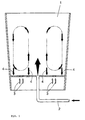
- the aqueous formulation consisting of the pigment press cake and the active substance solutions, dispersions or emulsions, is sprayed with a peristaltic pump into the fluidized bed chamber 1 via a nozzle 2 from below into the fluidized bed dryer.
- a peristaltic pump into the fluidized bed chamber 1 via a nozzle 2 from below into the fluidized bed dryer.
- the supply via several nozzles from above and / or from below in the fluidized bed dryer is possible.
- Hot air 3 which is guided or entrained to the suspension, can by swirling evaporate the water, which exits upwardly from the fluidized bed chamber 1.
- the suspension remains in the fluidized bed chamber 1 for a predetermined time and leaves it at the lower outlet as dry, dust-free, classified, free-flowing granules.
- Powder concentrates for the purposes of the present invention include organic and inorganic pigments as well as mixtures of organic and inorganic pigments, which may be obtained as an aqueous presscake. In customary pigment concentrates, these are therefore generally contained in a proportion of from 30 to 70% by weight.
- the pigment concentrates particularly preferably comprise from 30 to 60 parts by weight of the organic and / or inorganic pigments in powder form, based on 100 parts by weight of the pigment concentrates.
- Particularly preferred polymer carriers for the purposes of the present invention include in particular powdered polyethylene (PE), polypropylene (PP), acrylonitrile-butadiene-styrene (ABS), polystyrene (PS), polyamide (PA), polyurethane (TPU), polyvinyl chloride (PVC), Polyethylene terephthalate (PT), polycarbonate (PC), acrylates and PTFE.
- PE powdered polyethylene
- PP polypropylene
- ABS acrylonitrile-butadiene-styrene
- PS polystyrene
- PA polyamide
- TPU polyurethane
- PVC polyvinyl chloride
- PT Polyethylene terephthalate
- PC polycarbonate
- acrylates and PTFE acrylates and PTFE.
- Particularly preferred polymer carriers which can be used as aqueous dispersions for the purposes of the present invention include, for example, polyethylene (PE), polypropylene (PP), polyacrylates (AC), polyurethane (TPU) and butadiene rubber.
- the pigment is bound by the active ingredients and it creates a dust-free granules.
- a fluidized-bed plant is used for the continuous drying of granules of suspensions and solutions or else especially with the simultaneous supply of pulverulent substances.
- the resulting granulate is discharged classified from the process chamber and cooled if necessary. This process is variable and can be customized to the specific product requirements.
- their amount in the pigment concentrate is 0.1 to 50.0 parts by weight.
- Another object of the invention comprises the use of pigment concentrates for coloring plastics and polymers.
- the respective formulation is in an Ultraturrax with a speed of about 3 000 U / min. mixed at room temperature.
- the aqueous pigment formulation thus contains about 25-45% dry matter and has a viscosity of about 800 mPas. It is well to promote with a peristaltic pump.
- nucleating agent In the fluidized bed reactor, a nucleating agent is first introduced. The amount depends on the size of the machine. In the laboratory machine used, the nucleating agent amount is about 600 g.
- the nucleating agent is usually a pigment concentrate, a spherical granules of about 1500 microns diameter.
- the nucleating agent is on the bottom sieve with a mesh size of about 100 microns.
- the aqueous pigment suspension is also sprayed from below through a nozzle with a diameter of 1.2 mm into the vortex chamber.
- the hot air By the hot air, the water is evaporated, at the same time the drug substances (dispersing, wetting agent and optionally polymer) on the primary particles of the pigment, thereby agglomerating the primary particles is avoided.
- a further test for determining the quality of dispersion is the determination of the color strength of a masterbatch.
- the masterbatch with the polymeric carrier is diluted to a pigment content of 0.2% by weight and lightened with titanium dioxide (10 parts by weight of titanium dioxide based on 1 Part by weight of colored pigment).
- titanium dioxide 10 parts by weight of titanium dioxide based on 1 Part by weight of colored pigment.
- the color strength of the reference samples is defined as 100% by definition.
- Pigment Red 57 1 (from pigment press cake, water about 70%) 10 Parts of polyalkyl acrylate (Tegomer®DA 102, Goldschmidt AG) 50 Parts of polyethylene polymer dispersion 1
- Pigment Red 57 1 (from pigment press cake, water about 70%) 15 Parts of polyalkyl acrylate (Tegomer®DA 102, Goldschmidt AG) 35 Parts of polyethylene polymer dispersion 1
- Pigment Green 7 from pigment press cake 10 Parts of organosiloxane (Tegopren®6875, Goldschmidt AG) 50 Parts of polyethylene polymer dispersion
- Pigment Blue 15 1 from pigment press cake 5 Parts of organosiloxane (Tegopren®6875, Goldschmidt AG) 10 Parts of polyalkyl acrylate (Tegomer® DA102, Goldschmidt AG) 35 Parts of polyethylene polymer dispersion 1
- the formulation was premixed in a tumble mixer at room temperature and then mixed and dispersed at 180 to 220 ° C in a twin-screw extruder.
- the forming melt strand was cooled and cut by a granulator. The result was a relatively coarse, uniform cylindrical granules.
- the ingredients were placed in a kneader where the water was removed by heating and vacuum.
- the wax went to the pigment surface (flushing process). After this process, the kneading had to be ground. The result was a regrind with different grain size and dusty proportions.
Landscapes
- Chemical & Material Sciences (AREA)
- Chemical Kinetics & Catalysis (AREA)
- Organic Chemistry (AREA)
- Health & Medical Sciences (AREA)
- Medicinal Chemistry (AREA)
- Polymers & Plastics (AREA)
- Pigments, Carbon Blacks, Or Wood Stains (AREA)
- Processes Of Treating Macromolecular Substances (AREA)
- Compositions Of Macromolecular Compounds (AREA)
- Paper (AREA)
Description
- Gegenstand der Erfindung ist ein Verfahren zur Herstellung von staubfreien, rieselfähigen Pigmentkonzentraten unter Entzug des Wassers aus Pigmentsuspensionen, die Polymere und Dispergiermittel enthalten, im Wirbelschichttrockner. Die entstandenen kugelförmigen Pigmentkonzentrate sind staubfrei und gut rieselfähig. Weiterhin umfaßt die Erfindung die Verwendung so hergestellter Pigmentkonzentrate zum Einfärben von Kunststoffen und Polymeren.
- Pigmentkonzentrate und Verfahren zu deren Herstellung für die genannten Anwendungen sind dem Stand der Technik zu entnehmen.
- So beschreibt die DE-B-12 39 093 Trägermaterialien auf Basis einer Mischung aus einem amorphen Ethylen-Propylen-Block-Mischpolymerisat und einem kristallinen Polypropylen für die Herstellung von Pigmentkonzentraten. DE-A-26 52 628 bezieht sich auf die Verwendung von Polypropylenwachsen mit einer Viskosität von 500 bis 5 000 mPas (170 °C) und einem isotaktischen Anteil von 40 bis 90 %.
- Kunststoffe werden üblicherweise unter Verwendung von Pigmentkonzentraten (Pigment-Masterbatchen) eingefärbt. Die Pigmentkonzentrate, hergestellt über Extrusionsprozesse, enthalten das entsprechende Pigment in Konzentrationen von etwa 20 bis 70 Gew.-%, einen polymeren Träger sowie meist verschiedenartige Substanzen (Wachse/Netzmittel/Dispergiermittel), die den Einarbeitungsprozess der Pigmente unterstützen und für eine möglichst gleichmäßige Verteilung (Dispergierung) der Pigmente sorgen.
- Das Dispergieren von organischen Pigmenten wird in bestimmten Fällen durch den Einsatz von Pigment-Flush-Pasten umgangen.
- Die Herstellung von sogenannten Flush-Pasten ist Stand der Technik und von W. Herbst und K. Hunger in "Industrielle Organische Pigmente", 2. Auflage, S. 91-92, VCH Verlagsgesellschaft mbH, D-6945 Weinheim, 1995, genauer beschrieben. Bei dieser Technologie wird der bei der Pigmentherstellung normalerweise zunächst anfallende wässrige Pigmentpresskuchen nicht getrocknet und gemahlen, sondern in einem "Flush-"Prozess mit öligen Bindemitteln, wie Alkydharzen, Mineralölen, Zellulose-Acetobutyrat oder anderen geeigneten Substanzen, behandelt. Dabei wird das Wasser an der Pigmentoberfläche durch die organischen Substanzen verdrängt. Durch das Flushen werden somit die vor allem zur Agglomeratbildung führenden Verfahrensschritte der Pigmentherstellung, das Trocknen und das Mahlen, vermieden.
- Die Herstellung der Flush-Pasten wird in einem Innenkneter vorgenommen. Presskuchen und Dispergierwachse werden im Kneter vermischt; das Wasser wird durch Erwärmung und Vakuum entfernt; das Wachs zieht auf die Pigmente auf. Dieses Verfahren ist diskontinuierlich, und die Pigmentpräparation muss anschließend konfektioniert werden.
- Im Folienbereich stört Stippenbildung den optischen Eindruck und führt zur Rissbildung sowie zu unerwünschten Lichtstreueffekten.
- Bei der Herstellung von Polymerfasern führen Pigmentagglomerate zur Verstopfung der Schmelzsiebe des Extruders und zum Faserbruch, der in der Regel von längeren Stillstandszeiten und erhöhtem Reinigungsbedarf der Anlagen begleitet ist.
- In der DE-A-195 16 387 wird eine hocheffektive Dispergierung durch ein Dispergiermittel erreicht, welches eine Mischung verschiedener Polyolefinkomponenten und spezieller Polyacrylsäureester darstellt.
- Die Herstellung der Pigmentpräparationen kann im festen Zustand durch Mischen als Dry Blend und/oder durch Schmelzemischen in geeigneten Extrudern oder Knetern erfolgen.
- Üblicherweise werden die pulverförmigen organischen oder anorganischen Pigmente mit granulat- oder pulverförmigen Polymeren und entsprechenden Wachsen miteinander vermischt. Auch die Wachse werden pulverförmig eingesetzt. Sie werden entweder durch Sprühtechniken oder Vermahlungsprozesse erhalten. Die Korngrößen dieser Wachse liegen in der Regel bei < 1 000 µm. Je nach verwendetem Verfahren variieren die Korngrößenverteilungen natürlich.
- Gemäß US-A-4 277 288, FR-A-2 438 073, US-A-4 264 552, GB-A-2 009 204 werden Pigmentgranulate in Wirbelschichtverfahren hergestellt. Dabei werden jedoch organische Pigmente in trockener pulveriger Form in einem Wirbelschichtmischer mit feuchten Additiven benetzt und anschließend bei gleichzeitiger Agglomeration in größere Granulatpartikel überführt.
- Für eine optimale Dispergierung werden je nach Pigmenttyp bis zu 40 Gew.-% Wachs benötigt. Da zu hohe Wachsmengen immer wieder zu Migrationen und zu Ablagerungen an den Düsen führen, ist es von besonderem Interesse, Pigmentkonzentrate mit gut dispergierten Pigmenten bei möglichst geringen Anteilen an Wachsen herzustellen.
- Gegenstand der Erfindung ist in einer ersten Ausführungsform ein Verfahren zur Herstellung von staubfreien, rieselfähigen, organischen Pigmentkonzentraten aus bei der Pigmentherstellung anfallenden Pigmentpresskuchen unter Zusatz von Keimbildnern, Netz- und Dispergiermitteln, wobei das Wasser in einem Wirbelschichtverfahren entzogen wird.
- Bei diesem Verfahren wird das Wasser zwischen den Pigmentprimärteilchen entfernt und gegen die 0,1 - 1,0 µm großen Wirkstoffpartikel, d. h. Netzmittel, Dispergieradditiv und gegebenenfalls Polymeren ausgetauscht, so dass ein Agglomerieren der Pigmentteilchen vermieden wird.
- Durch die erfindungsgemäße Wirbelschichttrocknung der Pigment-/Wirkstoffsuspension entstehen kugelförmige, staubfreie, gut rieselfähige Pigmentpräparationen.
- Es entsteht also ein Pigmentkonzentrat, das in der Regel nicht weiter im Doppelwellenextruder mit anderen Hilfsstoffen dispergiert werden muss.
- Beim Wirbelschichttrocknungsverfahren arbeitet man in der Regel kontinuierlich mit gleichzeitiger Konfektionierung. Jedoch ist auch eine diskontinuierliche Arbeitsweise möglich.
- Nachfolgend wird das Wirbelschichttrocknen anhand der Figur 1 erläutert.
- Die wässrige Formulierung, bestehend aus dem Pigmentpresskuchen und den Wirkstofflösungen, -dispersionen oder -emulsionen, wird mit einer Schlauchpumpe in die Wirbelschichtkammer 1 über eine Düse 2 von unten in den Wirbelschichttrockner eingesprüht. Alternativ ist auch die Zuführung über mehrere Düsen von oben und/oder von unten in den Wirbelschichttrockner möglich. Gegebenenfalls ist es möglich, durch verschiedene Düsen unterschiedliche Bestandteile einzubringen. Heißluft 3, die der Suspension entgegengeführt oder mitgeführt wird, lässt durch Verwirbelung das Wasser verdunsten, das nach oben aus der Wirbelschichtkammer 1 austritt. Die Suspension verbleibt für eine vorbestimmte Zeit in der Wirbelschichtkammer 1 und verlässt diese am unteren Auslass als trockenes, staubfreies, klassiertes, rieselfähiges Granulat.
- Pulverkonzentrate im Sinne der vorliegenden Erfindung umfassen organische sowie anorganische Pigmente ebenso wie Gemische aus organischen und anorganischen Pigmenten, die als wässriger Presskuchen anfallen können. In üblichen Pigmentkonzentraten sind diese daher in der Regel in einem Mengenanteil von 30 bis 70 Gew.-% enthalten.
- Besonders bevorzugt im Sinne der vorliegenden Erfindung umfassen die Pigmentkonzentrate 30 bis 60 Gew.-Teile der organischen und/oder anorganischen Pigmente in Pulverform bezogen auf 100 Gew.-Teile der Pigmentkonzentrate.
- Besonders bevorzugte Polymerträger im Sinne der vorliegenden Erfindung umfassen insbesondere pulverförmiges Polyethylen (PE), Polypropylen (PP), Acrylnitril-Butadien-Styrol (ABS), Polystyrol (PS), Polyamid (PA), Polyurethan (TPU), Polyvinylchlorid (PVC), Polyethylenterephthalat (PT), Polycarbonat (PC), Acrylate und PTFE.
- Besonders bevorzugte Polymerträger, die im Sinne der vorliegenden Erfindung als wässrige Dispersionen eingesetzt werden können, umfassen beispielsweise Polyethylen (PE), Polypropylen (PP), Polyacrylate (AC), Polyurethan (TPU) und Butadien-Kautschuk.
- Das Pigment wird durch die Wirkstoffe gebunden und es entsteht ein staubfreies Granulat.
- Erfindungsgemäß wird eine Wirbelschichtanlage zur kontinuierlichen Granulatstrocknung von Suspensionen und Lösungen oder auch speziell bei gleichzeitiger Zuführung von pulverigen Substanzen eingesetzt.
- Das entstehende Granulat wird klassiert aus der Prozesskammer ausgetragen und bei Bedarf gekühlt. Dieser Vorgang ist variierbar und kann den speziellen Produktanforderungen individuell angepasst werden.
- Als Dispergier- und Netzmittel als Bestandteile der wässrigen Formulierungen zur Behandlung des Pigmentpresskuchens können vorzugsweise folgende Substanzen verwendet werden:
- Polyethylenwachse, polar, unpolar
- Polypropylenwachse, unpolar
- Paraffinwachse
- Ethylenvinylacetatwachse
- Fettsäureester
- Metallseifen
- Montanwachse
- Polyalkylacrylate
- Organo-modifizierte Siloxane
- Säurewachse
- Esterwachse
- Oxidierte Wachse
- Wachse, pulverförmig
- Wachse, mikronisiert
- Wachse, im Wasser dispergiert
- Vorzugsweise beträgt deren Menge in dem Pigmentkonzentrat 0,1 bis 50,0 Gew.-Teile.
- Ein weiterer Gegenstand der Erfindung umfaßt die Verwendung von Pigmentkonzentraten zum Einfärben von Kunststoffen und Polymeren.
- Allgemeine Versuchsvorschrift zur Herstellung der Pigmentformulierung für den Eintrag in den Wirbelschichttrockner:
-
- X
- Gew.-Teile wässriger Pigmentpresskuchen, Trockensubstanz 30-50 Gew.-% (Rest Wasser)
- Y
- Gew.-Teile wässrige Formulierung Dispergier- und Netzmittel
- Z
- Gew.-Teile wässrige Polymerdispersion
- Die jeweilige Formulierung wird in einem Ultraturrax mit einer Drehzahl von ca. 3 000 U/Min. bei Raumtemperatur vermischt.
- Die wässrige Pigmentformulierung enthält somit etwa 25 - 45 % Trockensubstanz und hat eine Viskosität von ca. 800 mPas. Sie ist mit einer Schlauchpumpe gut zu fördern.
- In den Wirbelschichtreaktor wird zunächst ein Keimbildner eingebracht. Die Menge ist abhängig von der Größe der Maschine. Bei der verwendeten Labormaschine beträgt die Keimbildnermenge ca. 600 g.
- Der Keimbildner ist meist ein Pigmentkonzentrat, ein Kugelgranulat von ca. 1 500 µm Durchmesser.
- Vor der Wirbelschichttrocknung befindet sich der Keimbildner auf dem Bodensieb mit einer Maschenweite von ca. 100 µm.
- Beim Start der Wirbelschichttrocknung wird erwärmte Luft von unten durch das Sieb geblasen, dadurch wird der Keimbildner in der Kammer verwirbelt. Es entsteht ein sogenanntes Wirbelbett.
- Gleichzeitig wird ebenfalls von unten durch eine Düse mit einem Durchmesser von 1,2 mm die wässrige Pigmentsuspension in die Wirbelkammer eingesprüht.
- Durch die Heißluft wird das Wasser abgedunstet, wobei gleichzeitig die Wirkstoffsubstanzen (Dispergier-, Netzmittel und gegebenenfalls Polymer) auf die Primärteilchen des Pigmentes aufziehen, dadurch wird das Agglomerieren der Primärteilchen vermieden.
- Das Primärteilchen/Wirkstoffgemisch lagert sich auf den Keimbildnern ab.
- Nach einer gewissen Zeit ist der Keimbildner mit der Trockensubstanz der neuen Rezeptur abgeführt, so dass nur gleichmäßige Granulate aus der eingebrachten neuen Rezeptur entstehen.
Prozessdaten Luftmenge: 20 % Lufttemperatur: ca. 105 °C Ablufttemperatur: ca. 60 °C Produkttemperatur: ca. 70 °C Sprühdruck: 1,5 bar Sprührate: ca. 36 g/Min. - Zur Beurteilung der Dispergierqualität von Pigmenten in Farb-Masterbatchen bediente man sich folgender Tests:
- Bei diesem Test wird eine Mischung aus Masterbatch und polymerem Träger, die einen Pigmentgehalt von 10 Gew.-% aufweist, in einem Extruder aufgeschmolzen und über ein definiertes Filterpaket extrudiert. Über einen definierten Zeitraum (1 h) wird der Druckanstieg verfolgt. Als Maß für die Güte des Masterbatches wird der Druckfilterwert (DF) bestimmt, der sich nach folgender Formel ergibt:

mit - Pmax. =
- Enddruck (bar)
- Po =
- Druck bei Betrieb ohne Masterbatch
- F =
- Filterfläche (cm2)
- t =
- Messdauer (min.)
- K =
- Konzentration (%)
- G =
- Extruderdurchsatz (g/min.)
- Der Druckfilterwert gibt an, in welchem Maß ein Filterpaket durch Agglomerate zugesetzt wird. Ein sehr niedriger Druckfilterwert weist auf eine sehr gute Dispergierung der Pigmentkonzentrate hin.
- Einen weiteren Test zur Bestimmung der Dispergiergüte stellt die Bestimmung der Farbstärke eines Masterbatches dar. Hierbei wird das Masterbatch mit dem polymeren Träger auf einen Pigmentanteil von 0,2 Gew.-% verdünnt und mit Titandioxid aufgehellt (10 Gew.-Teile Titandioxid bezogen auf 1 Gew.-Teil Farbpigment). Dieses Material wird zu Platten verspritzt, an denen man die coloristischen Bestimmungen durchführt. Für diese Messungen hat sich das CIE-Lab-Farbsystem bewährt.
- Je höher die Farbstärke im Vergleich zu einer Referenzprobe ist, desto besser ist die Verteilung des Pigmentes bzw. desto geringer ist der Agglomeratanteil in dem zugrundeliegenden Farb-Masterbatch.
- Zum Vergleich wird die Farbstärke der Referenzproben per Definition mit 100 % festgelegt.
- Ein weiterer Test ist die visuelle Beurteilung von Farbstippen in einer ca. 50 µm starken Kunststofffolie unter dem Mikroskop. Es wird eine PE-Folie unter Einsatz von 1 Gew.-% eines 40 Gew.-%igen Pigmentkonzentrats hergestellt. Die Größe und Anzahl der Farbstippen wird durch Noten definiert:
Note 1: keine oder sehr wenig Farbstippen = gute Qualität
Zwischennoten
Note 6: sehr viele Farbstippen = schlechte Qualität -
40 Teile (bezogen auf Feststoff) Pigment Rot 57:1 (aus Pigmentpresskuchen, Wasser ca. 70 %) 10 Teile Polyalkylacrylat (Tegomer®DA 102, Goldschmidt AG) 50 Teile Polyethylen-Polymerdispersion1 -
50 Teile (bezogen auf Feststoff) Pigment Rot 57:1 (aus Pigmentpresskuchen, Wasser ca. 70 %) 15 Teile Polyalkylacrylat (Tegomer®DA 102, Goldschmidt AG) 35 Teile Polyethylen-Polymerdispersion1 -
40 Teile (bezogen auf Feststoff) Pigment Grün 7 aus Pigmentpresskuchen 10 Teile Organosiloxan (Tegopren®6875, Goldschmidt AG) 50 Teile Polyethylen-Polymerdispersion -
50 Teile (bezogen auf Feststoff) Pigment Blau 15:1 aus Pigmentpresskuchen 5 Teile Organosiloxan (Tegopren®6875, Goldschmidt AG) 10 Teile Polyalkylacrylat (Tegomer®DA102, Goldschmidt AG) 35 Teile Polyethylen-Polymerdispersion1 -
40 Teile Pigment Rot 57:1 30 Teile Polypropylenwachs (Dispergiermittel)2 30 Teile Polypropylen (Finapro®PPH 11012) - Die Rezeptur wurde im Taumelmischer bei Raumtemperatur vorgemischt und anschließend bei 180 bis 220 °C im Doppelwellenextruder gemischt und dispergiert. Der sich bildende Schmelzestrang wurde gekühlt und durch einen Granulator geschnitten. Es entstand ein relativ grobes, gleichmäßiges Zylindergranulat.
-
50 Teile Pigment Rot 57:1 30 Teile Polyethylenwachs3 20 Teile Polypropylen (Finapro® PPH 11012) - Die Bestandteile wurden in einen Kneter gegeben, dort wurde durch Erwärmung und Vakuum das Wasser entfernt. Das Wachs ging an die Pigmentoberfläche (Flush-Prozess). Nach diesem Prozess musste das Knetergut vermahlen werden. Es entstand ein Mahlgut mit unterschiedlicher Korngröße und staubenden Anteilen.
-
50 Teile (bezogen auf Feststoff) Pigment Rot 57:1 (aus Presskuchen, Wasser ca. 70 %) 50 Teile Polyethylenwachs4 - Die Komponenten wurden einem Flush-Prozess unterzogen und anschließend in Kugelmühlen dispergiert. Es entstand eine Präparation mit unterschiedlichen Korngrößen und staubenden Anteilen.
- 1) Gemisch aus Polyethylen-Primärdispersion und Polyethylenwachsemulsion mit ionischen Emulgatoren
- 2) Standard Polpropylenwachs
Erweichungspunkt: ca. 160 °C
Dichte 20°C: 0,89 g/cm3
Viskosität 170°C: ca. 1.800 mPas - 3) Standard Polyethylenwachs
Erweichungspunkt: ca. 100 °C
Dichte 20°C: 0,92 g/cm3
Viskosität 140°C: ca. 100 bis 200 mPas - 4) Standard Polyethylenwachs
Erweichungspunkt: ca. 102 °C
Dichte 20°C: 0,91 g/cm3
Viskosität 140°C: ca. 200 mPas
| Beispiele | Korngrößenverteilung der Präparaion | Farbstärke im Vergleich zum Vgl.-Beispiel 1 | Stippen Foliennote | Druckfilterwert bar x cm2/g |
| 1 | Kugelgranulat | 118 | 3 | 0,5 |
| 100 % 1 200 µm | ||||
| 2 | Kugelgranulat | 116 | 3 | 1,0 |
| 100 % 1 200 µm | ||||
| 3 | Kugelgranulat | 110 | 3 | 1,5 |
| 100 % 1 250 µm | ||||
| 4 | Kugelgranulat | 115 | 2 | 1,0 |
| 100 % 1 300 µm | ||||
| Vgl. 1 | Zylindergranulat | 100 | 5 | 12,0 |
| 100 % 3 x 4 mm | ||||
| Vgl. 2 | Mahlgut | 115 | 2 | 1,5 |
| < 800µm 100% | ||||
| < 500µm 92% | ||||
| < 300µm 77% | ||||
| < 100µm 32% | ||||
| Vgl. 3 | Mahlgut | 120 | 3 | 1,8 |
| < 800 µm 100% | ||||
| < 500 µm 89% | ||||
| < 300 µm 70% | ||||
| < 100 µm 34% |
Claims (7)
- Verfahren zur Herstellung von staubfreien, rieselfähigen, organischen Pigmentkonzentraten aus bei der Pigmentherstellung anfallenden Pigmentpresskuchen unter Zusatz von Keimbildnern, Netz- und Dispergiermitteln, wobei das Wasser in einem Wirbelschichtverfahren entzogen wird.
- Verfahren nach Anspruch 1, dadurch gekennzeichnet, dass man die Herstellung kontinuierlich oder diskontinuierlich vornimmt.
- Verfahren nach einem der Ansprüche 1 oder 2, dadurch gekennzeichnet, dass man dem Pigmentpresskuchen anorganische und organische Pulverpigmente zusetzt.
- Verfahren nach einem der Ansprüche 1 bis 3, dadurch gekennzeichnet, dass man die wässrigen Pigmentformulierungen einsetzt, die pulverförmige Polymerträger enthalten, umfassend insbesondere Polyethylen (PE), Polypropylen (PP), Acrylnitril-Butadien-Styrol (ABS), Polystyrol (PS), Polyamid (PA), Polyurethan (PU), Polyvinylchlorid (PVC), Polyethylenterephthalat (PET), Polycarbonat (PC), Polyacrylat (PMMA), Polyvinylacetat (PVAC), Polyvinylalkohol (PVA) und/oder Fluorpolymer (PTFE).
- Verfahren nach einem der Ansprüche 1 bis 4, dadurch gekennzeichnet, dass man Netz- oder Dispergiermittel einsetzt, die ausgewählt sind aus unpolaren, polaren Polyethylenwachsen, unpolaren Polypropylenwachsen, Paraffinwachsen, Ethylenvinylacetatwachsen, Fettsäureestern, ten und/oder organo-modifizierten Siloxanen.
- Verfahren nach einem der Ansprüche 1 bis 5, dadurch gekennzeichnet, dass man Polymerträger einsetzt, die in Wasser gelöst, emulgiert oder dispergiert sind.
- Verfahren nach einem der Ansprüche 1 bis 6, dadurch gekennzeichnet, dass Netz- und Dispergiermittel in einer Menge von 0,5 bis 50,0 Gew.-% zugesetzt werden.
Applications Claiming Priority (3)
| Application Number | Priority Date | Filing Date | Title |
|---|---|---|---|
| DE10060718 | 2000-12-07 | ||
| DE10060718 | 2000-12-07 | ||
| PCT/EP2001/013393 WO2002046313A2 (de) | 2000-12-07 | 2001-12-06 | Verfahren zur herstellung von staubfreien, rieselfähigen pigmentkonzentraten |
Publications (2)
| Publication Number | Publication Date |
|---|---|
| EP1339802A2 EP1339802A2 (de) | 2003-09-03 |
| EP1339802B1 true EP1339802B1 (de) | 2006-11-02 |
Family
ID=7666061
Family Applications (1)
| Application Number | Title | Priority Date | Filing Date |
|---|---|---|---|
| EP01999210A Expired - Lifetime EP1339802B1 (de) | 2000-12-07 | 2001-12-06 | Verfahren zur herstellung von staubfreien, rieselfähigen pigmentkonzentraten |
Country Status (6)
| Country | Link |
|---|---|
| US (1) | US6743835B2 (de) |
| EP (1) | EP1339802B1 (de) |
| AT (1) | ATE344300T1 (de) |
| DE (1) | DE50111390D1 (de) |
| DK (1) | DK1339802T3 (de) |
| WO (1) | WO2002046313A2 (de) |
Cited By (1)
| Publication number | Priority date | Publication date | Assignee | Title |
|---|---|---|---|---|
| DE102016009514A1 (de) * | 2016-08-04 | 2018-02-08 | Giesecke+Devrient Currency Technology Gmbh | Verfahren und Vorrichtung zum Erzeugen von Kompositpartikeln |
Families Citing this family (5)
| Publication number | Priority date | Publication date | Assignee | Title |
|---|---|---|---|---|
| US6743835B2 (en) * | 2000-12-07 | 2004-06-01 | Goldschmidt Ag | Preparation of nondusting free-flowing pigment concentrates |
| US6911489B2 (en) * | 2002-06-10 | 2005-06-28 | Asahi Glass Fluoropolymers Usa, Inc. | Methods for preparing agglomerated pellets of polytetrafluoroethylene and molded articles and the agglomerated pellets of polytetrafluoroethylene and molded articles prepared thereby |
| US20090297714A1 (en) * | 2008-06-02 | 2009-12-03 | Xerox Corporation | Flush pigment for solid inkjet ink |
| DE102008063965C5 (de) * | 2008-12-19 | 2019-02-21 | Evonik Degussa Gmbh | Hydrophobierte zementhaltige Zusammensetzungen |
| BE1027682B1 (nl) * | 2019-10-17 | 2021-05-18 | Italmaster Belgium Nv | Werkwijze voor het voorzien van een pigmentconcentraat en werkwijze voor het kleuren van een polymeersamenstelling |
Family Cites Families (29)
| Publication number | Priority date | Publication date | Assignee | Title |
|---|---|---|---|---|
| DE1239023B (de) | 1964-05-06 | 1967-04-20 | Siemens Ag | Verfahren zur Herstellung von Selen-Gleichrichterelementen mit einer die aktive Gleichrichterflaeche verkleinernden Isolierschicht zwischen Selen und Deckelektrode |
| US3755244A (en) * | 1971-06-02 | 1973-08-28 | Hercules Inc | Polyolefin pigment dispersions |
| AT342163B (de) * | 1975-04-28 | 1978-03-28 | Hercules Inc | Trockene, in wasser dispergierbare pigmentmasse |
| US4168180A (en) * | 1976-10-29 | 1979-09-18 | Hercules Incorporated | Pigment concentrates |
| DE2652628C2 (de) | 1976-11-19 | 1984-08-23 | Hoechst Ag, 6230 Frankfurt | Pigmentpräparationen auf Basis von Polypropylenwachs |
| GB1590154A (en) * | 1977-04-19 | 1981-05-28 | Ici Ltd | Process for preparing low dusting granulated dyestuffs |
| DE2738511A1 (de) * | 1977-08-26 | 1979-03-01 | Bayer Ag | Herstellung von pigmentkonzentraten |
| CH635862A5 (de) * | 1977-10-15 | 1983-04-29 | Ciba Geigy Ag | Verfahren zur granulierung von pigmenten. |
| GB2009204B (en) * | 1977-10-15 | 1982-08-18 | Ciba Geigy Ag | Granulation of pegments |
| US4277288A (en) * | 1978-10-06 | 1981-07-07 | Ciba-Geigy Corporation | Fluidized granulation of pigments using organic granulating assistant |
| FR2438073A1 (fr) * | 1978-10-06 | 1980-04-30 | Ciba Geigy Ag | Granulation de pigments |
| US4391648A (en) * | 1980-08-20 | 1983-07-05 | Ciba-Geigy Corporation | Particulate pigment compositions |
| DE3323951A1 (de) * | 1983-07-02 | 1985-01-03 | Röhm GmbH, 6100 Darmstadt | Acrylatharze als bindemittel fuer farbmittelkonzentrate |
| DD300596A7 (de) * | 1984-10-18 | 1992-06-25 | Silberhuette Pyrotechnik Veb | Verfahren zur herstellung pyrotechnischer mischungen |
| DE3708904A1 (de) * | 1987-03-19 | 1988-09-29 | Bayer Ag | Pigmentpraeparationen |
| US5171613A (en) * | 1990-09-21 | 1992-12-15 | Union Carbide Chemicals & Plastics Technology Corporation | Apparatus and methods for application of coatings with supercritical fluids as diluents by spraying from an orifice |
| JPH07507075A (ja) * | 1991-11-13 | 1995-08-03 | イーストマン ケミカル カンパニー | 蛍光顔料コンセントレート |
| US5455288A (en) * | 1994-01-26 | 1995-10-03 | Needham; Donald G. | Dustless color concentrate granules |
| NL9400781A (nl) * | 1994-05-11 | 1995-12-01 | Holland Colours Nv | Pigmentconcentraat. |
| US5584922A (en) * | 1994-09-14 | 1996-12-17 | Ciba-Geigy Corporation | Stir-in organic pigments |
| US5716558A (en) * | 1994-11-14 | 1998-02-10 | Union Carbide Chemicals & Plastics Technology Corporation | Method for producing coating powders catalysts and drier water-borne coatings by spraying compositions with compressed fluids |
| US5589531A (en) * | 1995-03-07 | 1996-12-31 | Cabot Corporation | Preparation and use of pelletized submicron pigment powder/polymer compositions |
| DE19516387A1 (de) | 1995-05-04 | 1996-11-07 | Huels Chemische Werke Ag | Dispergiermittel für Pigmentkonzentrate |
| GB9521812D0 (en) * | 1995-10-25 | 1996-01-03 | Ciba Geigy Ag | Pigments |
| DE19811791A1 (de) * | 1998-03-18 | 1999-09-23 | Borchers Gmbh | Wäßrige Dispersionen mit einer speziellen Dispergiermittelkombination |
| EP1026212A1 (de) * | 1999-01-29 | 2000-08-09 | Sigma Coatings B.V. | Pigmentkonzentrate |
| DE19947175A1 (de) * | 1999-10-01 | 2001-04-05 | Merck Patent Gmbh | Pigmentpräparation |
| DE10054344A1 (de) * | 2000-11-02 | 2002-05-29 | Clariant Gmbh | Verwendung von gecoateten Pigmentgranulaten in elektrophotographischen Tonern und Entwicklern, Pulverlacken und Ink-Jet-Tinten |
| US6743835B2 (en) * | 2000-12-07 | 2004-06-01 | Goldschmidt Ag | Preparation of nondusting free-flowing pigment concentrates |
-
2001
- 2001-12-05 US US10/006,962 patent/US6743835B2/en not_active Expired - Fee Related
- 2001-12-06 WO PCT/EP2001/013393 patent/WO2002046313A2/de not_active Ceased
- 2001-12-06 EP EP01999210A patent/EP1339802B1/de not_active Expired - Lifetime
- 2001-12-06 AT AT01999210T patent/ATE344300T1/de active
- 2001-12-06 DK DK01999210T patent/DK1339802T3/da active
- 2001-12-06 DE DE50111390T patent/DE50111390D1/de not_active Expired - Lifetime
Cited By (1)
| Publication number | Priority date | Publication date | Assignee | Title |
|---|---|---|---|---|
| DE102016009514A1 (de) * | 2016-08-04 | 2018-02-08 | Giesecke+Devrient Currency Technology Gmbh | Verfahren und Vorrichtung zum Erzeugen von Kompositpartikeln |
Also Published As
| Publication number | Publication date |
|---|---|
| DE50111390D1 (de) | 2006-12-14 |
| WO2002046313A2 (de) | 2002-06-13 |
| US20020161083A1 (en) | 2002-10-31 |
| ATE344300T1 (de) | 2006-11-15 |
| US6743835B2 (en) | 2004-06-01 |
| WO2002046313A3 (de) | 2002-09-26 |
| EP1339802A2 (de) | 2003-09-03 |
| DK1339802T3 (da) | 2007-02-05 |
Similar Documents
| Publication | Publication Date | Title |
|---|---|---|
| EP2536771B1 (de) | Verfahren zur rückführung von polymerfeinteilchen | |
| EP1845137B1 (de) | Verfahren zur Herstellung von Pigmentgranulaten und deren Verwendung | |
| CH510078A (de) | Verfahren zur Herstellung farbiger thermoplastischer Pulver | |
| DE2520636A1 (de) | Beschichtete teilchen und daraus hergestellte leitfaehige massen | |
| DE69430437T2 (de) | Granülations-methode und -vorrichtung unter rühren mit grosser geschwindigkeit | |
| DE4336612C2 (de) | Mehrstufiges Verfahren zur Herstellung von anorganischen Pigmentgranulaten und deren Verwendung zur Färbung von Kunststoffen und zur Herstellung von Pulverlacken | |
| EP1580221B1 (de) | Verfahren zur Herstellung fester Treibmittelpräparationen | |
| CH635862A5 (de) | Verfahren zur granulierung von pigmenten. | |
| DE1916267C3 (de) | Verfahren zum Einbringen von Zusatzstoffen in thermoplastische Kunststoffe | |
| DE2314338A1 (de) | Verfahren zum ueberziehen von in form von einzelteilchen vorliegenden elastomeren mit einem harz | |
| DE19501053A1 (de) | Stabilisatorgemisch aus Chromanderivaten und inerten organischen Lösungsmitteln sowie dieses Stabilisatorgemisch enthaltende Mikrokapseln | |
| EP0004268A1 (de) | Harz-Farbkonzentrate für die Einfärbung von Harzen und Verfahren zu deren Herstellung | |
| DE2550422A1 (de) | Katalysatoren mit enger partikelgroessenverteilung und verfahren zu ihrer herstellung | |
| DE19727848B4 (de) | Kautschukadditivgranulat, ein Verfahren zu seiner Herstellung sowie seine Verwendung | |
| EP1004616B1 (de) | Mikronisierte Polyolefine zur Herstellung von Pigmentkonzentraten | |
| EP1339802A2 (de) | Verfahren zur herstellung von staubfreien, rieselfähigen pigmentkonzentraten | |
| EP2658930B1 (de) | Öl- und wachshaltige mittel in stückiger form mit bestimmten wachsmischungen für die asphalt- und bitumeneinfärbung | |
| DE69609040T2 (de) | Pellets enthaltend in Äthylen-Vinylacetatpolymer dispergiertes Pigment | |
| DE2611548C2 (de) | ||
| DE10233081A1 (de) | Verwendung von festen Pigmentzubereitungen zur Einfärbung von Kunststoffen | |
| DE2522986A1 (de) | Verfahren zur herstellung von pigmentzubereitungen fuer die einfaerbungen von kunststoffen | |
| DE10225314A1 (de) | Herstellung von Pigmentpräparationen und ihre Verwendung | |
| DE1592897A1 (de) | Verfahren zur Herstellung von Pigmentmassen | |
| DE10314519A1 (de) | Granulatförmige Farbstoffpräparation, ein Verfahren zu deren Herstellung und deren Verwendung | |
| EP2297242B1 (de) | Verfahren zur homogenen einarbeitung von polymerpartikeln in polymere matrices |
Legal Events
| Date | Code | Title | Description |
|---|---|---|---|
| PUAI | Public reference made under article 153(3) epc to a published international application that has entered the european phase |
Free format text: ORIGINAL CODE: 0009012 |
|
| 17P | Request for examination filed |
Effective date: 20030524 |
|
| AK | Designated contracting states |
Kind code of ref document: A2 Designated state(s): AT BE CH CY DE DK ES FI FR GB GR IE IT LI LU MC NL PT SE TR |
|
| 17Q | First examination report despatched |
Effective date: 20050112 |
|
| RAP1 | Party data changed (applicant data changed or rights of an application transferred) |
Owner name: GOLDSCHMIDT GMBH Owner name: GLATT INGENIEURTECHNIK GMBH |
|
| GRAP | Despatch of communication of intention to grant a patent |
Free format text: ORIGINAL CODE: EPIDOSNIGR1 |
|
| GRAS | Grant fee paid |
Free format text: ORIGINAL CODE: EPIDOSNIGR3 |
|
| GRAA | (expected) grant |
Free format text: ORIGINAL CODE: 0009210 |
|
| AK | Designated contracting states |
Kind code of ref document: B1 Designated state(s): AT BE CH CY DE DK ES FI FR GB GR IE IT LI LU MC NL PT SE TR |
|
| PG25 | Lapsed in a contracting state [announced via postgrant information from national office to epo] |
Ref country code: IE Free format text: LAPSE BECAUSE OF FAILURE TO SUBMIT A TRANSLATION OF THE DESCRIPTION OR TO PAY THE FEE WITHIN THE PRESCRIBED TIME-LIMIT Effective date: 20061102 Ref country code: FI Free format text: LAPSE BECAUSE OF FAILURE TO SUBMIT A TRANSLATION OF THE DESCRIPTION OR TO PAY THE FEE WITHIN THE PRESCRIBED TIME-LIMIT Effective date: 20061102 |
|
| REG | Reference to a national code |
Ref country code: GB Ref legal event code: FG4D Free format text: NOT ENGLISH |
|
| REG | Reference to a national code |
Ref country code: IE Ref legal event code: FG4D Free format text: LANGUAGE OF EP DOCUMENT: GERMAN |
|
| REG | Reference to a national code |
Ref country code: CH Ref legal event code: EP |
|
| REF | Corresponds to: |
Ref document number: 50111390 Country of ref document: DE Date of ref document: 20061214 Kind code of ref document: P |
|
| PG25 | Lapsed in a contracting state [announced via postgrant information from national office to epo] |
Ref country code: LI Free format text: LAPSE BECAUSE OF NON-PAYMENT OF DUE FEES Effective date: 20061231 Ref country code: MC Free format text: LAPSE BECAUSE OF NON-PAYMENT OF DUE FEES Effective date: 20061231 Ref country code: CH Free format text: LAPSE BECAUSE OF NON-PAYMENT OF DUE FEES Effective date: 20061231 |
|
| PG25 | Lapsed in a contracting state [announced via postgrant information from national office to epo] |
Ref country code: SE Free format text: LAPSE BECAUSE OF FAILURE TO SUBMIT A TRANSLATION OF THE DESCRIPTION OR TO PAY THE FEE WITHIN THE PRESCRIBED TIME-LIMIT Effective date: 20070202 |
|
| REG | Reference to a national code |
Ref country code: DK Ref legal event code: T3 |
|
| PG25 | Lapsed in a contracting state [announced via postgrant information from national office to epo] |
Ref country code: ES Free format text: LAPSE BECAUSE OF FAILURE TO SUBMIT A TRANSLATION OF THE DESCRIPTION OR TO PAY THE FEE WITHIN THE PRESCRIBED TIME-LIMIT Effective date: 20070213 |
|
| GBT | Gb: translation of ep patent filed (gb section 77(6)(a)/1977) |
Effective date: 20070208 |
|
| PG25 | Lapsed in a contracting state [announced via postgrant information from national office to epo] |
Ref country code: PT Free format text: LAPSE BECAUSE OF FAILURE TO SUBMIT A TRANSLATION OF THE DESCRIPTION OR TO PAY THE FEE WITHIN THE PRESCRIBED TIME-LIMIT Effective date: 20070402 |
|
| ET | Fr: translation filed | ||
| REG | Reference to a national code |
Ref country code: IE Ref legal event code: FD4D |
|
| REG | Reference to a national code |
Ref country code: CH Ref legal event code: PL |
|
| PLBE | No opposition filed within time limit |
Free format text: ORIGINAL CODE: 0009261 |
|
| STAA | Information on the status of an ep patent application or granted ep patent |
Free format text: STATUS: NO OPPOSITION FILED WITHIN TIME LIMIT |
|
| 26N | No opposition filed |
Effective date: 20070803 |
|
| PG25 | Lapsed in a contracting state [announced via postgrant information from national office to epo] |
Ref country code: GR Free format text: LAPSE BECAUSE OF FAILURE TO SUBMIT A TRANSLATION OF THE DESCRIPTION OR TO PAY THE FEE WITHIN THE PRESCRIBED TIME-LIMIT Effective date: 20070203 |
|
| PG25 | Lapsed in a contracting state [announced via postgrant information from national office to epo] |
Ref country code: TR Free format text: LAPSE BECAUSE OF FAILURE TO SUBMIT A TRANSLATION OF THE DESCRIPTION OR TO PAY THE FEE WITHIN THE PRESCRIBED TIME-LIMIT Effective date: 20061102 Ref country code: LU Free format text: LAPSE BECAUSE OF NON-PAYMENT OF DUE FEES Effective date: 20061206 |
|
| PG25 | Lapsed in a contracting state [announced via postgrant information from national office to epo] |
Ref country code: CY Free format text: LAPSE BECAUSE OF FAILURE TO SUBMIT A TRANSLATION OF THE DESCRIPTION OR TO PAY THE FEE WITHIN THE PRESCRIBED TIME-LIMIT Effective date: 20061102 |
|
| NLT1 | Nl: modifications of names registered in virtue of documents presented to the patent office pursuant to art. 16 a, paragraph 1 |
Owner name: GLATT INGENIEURTECHNIK GMBH Owner name: EVONIK GOLDSCHMIDT GMBH |
|
| REG | Reference to a national code |
Ref country code: FR Ref legal event code: CD |
|
| PGFP | Annual fee paid to national office [announced via postgrant information from national office to epo] |
Ref country code: DK Payment date: 20101210 Year of fee payment: 10 Ref country code: AT Payment date: 20101214 Year of fee payment: 10 |
|
| PGFP | Annual fee paid to national office [announced via postgrant information from national office to epo] |
Ref country code: GB Payment date: 20101221 Year of fee payment: 10 |
|
| PGFP | Annual fee paid to national office [announced via postgrant information from national office to epo] |
Ref country code: NL Payment date: 20111228 Year of fee payment: 11 |
|
| PGFP | Annual fee paid to national office [announced via postgrant information from national office to epo] |
Ref country code: IT Payment date: 20111228 Year of fee payment: 11 |
|
| REG | Reference to a national code |
Ref country code: FR Ref legal event code: TP Owner name: MARKUS WEIMANN, DE Effective date: 20120911 |
|
| REG | Reference to a national code |
Ref country code: DE Ref legal event code: R081 Ref document number: 50111390 Country of ref document: DE Owner name: WEIMANN, MARKUS, DE Free format text: FORMER OWNER: EVONIK GOLDSCHMIDT GMBH, GLATT INGENIEURTECHNIK GMBH, , DE Effective date: 20121012 Ref country code: DE Ref legal event code: R081 Ref document number: 50111390 Country of ref document: DE Owner name: WEIMANN, MARKUS, DE Free format text: FORMER OWNERS: EVONIK GOLDSCHMIDT GMBH, 45127 ESSEN, DE; GLATT INGENIEURTECHNIK GMBH, 99427 WEIMAR, DE Effective date: 20121012 |
|
| REG | Reference to a national code |
Ref country code: NL Ref legal event code: V1 Effective date: 20130701 |
|
| REG | Reference to a national code |
Ref country code: AT Ref legal event code: MM01 Ref document number: 344300 Country of ref document: AT Kind code of ref document: T Effective date: 20121206 |
|
| REG | Reference to a national code |
Ref country code: DK Ref legal event code: EBP |
|
| GBPC | Gb: european patent ceased through non-payment of renewal fee |
Effective date: 20121206 |
|
| PG25 | Lapsed in a contracting state [announced via postgrant information from national office to epo] |
Ref country code: NL Free format text: LAPSE BECAUSE OF NON-PAYMENT OF DUE FEES Effective date: 20130701 Ref country code: AT Free format text: LAPSE BECAUSE OF NON-PAYMENT OF DUE FEES Effective date: 20121206 |
|
| PG25 | Lapsed in a contracting state [announced via postgrant information from national office to epo] |
Ref country code: GB Free format text: LAPSE BECAUSE OF NON-PAYMENT OF DUE FEES Effective date: 20121206 |
|
| PG25 | Lapsed in a contracting state [announced via postgrant information from national office to epo] |
Ref country code: IT Free format text: LAPSE BECAUSE OF NON-PAYMENT OF DUE FEES Effective date: 20121206 |
|
| PG25 | Lapsed in a contracting state [announced via postgrant information from national office to epo] |
Ref country code: DK Free format text: LAPSE BECAUSE OF NON-PAYMENT OF DUE FEES Effective date: 20130102 |
|
| PGFP | Annual fee paid to national office [announced via postgrant information from national office to epo] |
Ref country code: FR Payment date: 20131209 Year of fee payment: 13 |
|
| PGFP | Annual fee paid to national office [announced via postgrant information from national office to epo] |
Ref country code: BE Payment date: 20131217 Year of fee payment: 13 |
|
| PGFP | Annual fee paid to national office [announced via postgrant information from national office to epo] |
Ref country code: DE Payment date: 20140206 Year of fee payment: 13 |
|
| PG25 | Lapsed in a contracting state [announced via postgrant information from national office to epo] |
Ref country code: BE Free format text: LAPSE BECAUSE OF NON-PAYMENT OF DUE FEES Effective date: 20141231 |
|
| REG | Reference to a national code |
Ref country code: DE Ref legal event code: R119 Ref document number: 50111390 Country of ref document: DE |
|
| REG | Reference to a national code |
Ref country code: FR Ref legal event code: ST Effective date: 20150831 |
|
| PG25 | Lapsed in a contracting state [announced via postgrant information from national office to epo] |
Ref country code: DE Free format text: LAPSE BECAUSE OF NON-PAYMENT OF DUE FEES Effective date: 20150701 |
|
| PG25 | Lapsed in a contracting state [announced via postgrant information from national office to epo] |
Ref country code: FR Free format text: LAPSE BECAUSE OF NON-PAYMENT OF DUE FEES Effective date: 20141231 |