EP1331794A2 - Verfahren zur Adresszuweisung in einem Netzwerk und Komponenten dafür - Google Patents
Verfahren zur Adresszuweisung in einem Netzwerk und Komponenten dafür Download PDFInfo
- Publication number
- EP1331794A2 EP1331794A2 EP02025898A EP02025898A EP1331794A2 EP 1331794 A2 EP1331794 A2 EP 1331794A2 EP 02025898 A EP02025898 A EP 02025898A EP 02025898 A EP02025898 A EP 02025898A EP 1331794 A2 EP1331794 A2 EP 1331794A2
- Authority
- EP
- European Patent Office
- Prior art keywords
- address
- subset
- slave
- value set
- value
- Prior art date
- Legal status (The legal status is an assumption and is not a legal conclusion. Google has not performed a legal analysis and makes no representation as to the accuracy of the status listed.)
- Granted
Links
Images



Classifications
-
- H—ELECTRICITY
- H04—ELECTRIC COMMUNICATION TECHNIQUE
- H04L—TRANSMISSION OF DIGITAL INFORMATION, e.g. TELEGRAPHIC COMMUNICATION
- H04L61/00—Network arrangements, protocols or services for addressing or naming
- H04L61/50—Address allocation
- H04L61/5038—Address allocation for local use, e.g. in LAN or USB networks, or in a controller area network [CAN]
-
- H—ELECTRICITY
- H04—ELECTRIC COMMUNICATION TECHNIQUE
- H04L—TRANSMISSION OF DIGITAL INFORMATION, e.g. TELEGRAPHIC COMMUNICATION
- H04L67/00—Network arrangements or protocols for supporting network services or applications
- H04L67/01—Protocols
Definitions
- the present invention relates to a method for automatic Assignment of at least one slave address in a data processing network with a master device and at least a slave device.
- Device addresses must be assigned uniquely in a network be, so that the individual devices are specifically addressed can.
- the manual assignment of such addresses e.g. by setting of switches on the individual devices, is pronounced time consuming and error prone, since a single wrong set switch can be enough to a network out of service and then often do not cause the cause of the error is immediately recognizable. Besides, it is cumbersome at all devices that belong to a network and sometimes far from each other, to access the switches, to set them.
- the object of the invention is components for a computer network and a method for automatic address assignment in a DV network indicate the above-mentioned shortcomings of a avoid manual address assignment, i. the one fast and guarantee error-free address assignment.
- the inventive method is a master device of a It implements its feasibility a slave device whose address is in the DV network through a DV network to the slave device Address setting command is adjustable and set up is the value of a property of its own with one in it Address setting command specified value range of this property and depending on the result of the Compare to execute the address setting command or not perform.
- step b) The recursive return to step b) will cause the subsets in the course of the procedure always smaller, until Finally, in each case one-element subsets received so that the procedure in each case a degree place.
- a preferred embodiment of the method are the first and second addresses, which in step b) are the subsets be assigned, temporary addresses, and if in Step d) the first subset or in step e) the second Subset containing exactly one element is added to the slave device the value of the individualizing property of this element corresponds to a final address assigned.
- step b) the first and the second address used.
- Step b) there is the possibility of every repetition of Step b) at least one value for the first and / or the second address to reintroduce, which so far no element of Associated with the search value set.
- This procedure increases Although the number of distributed to the elements of the search value set Addresses, but it allows an acceleration of the process.
- the The first subset containing an element is preferably further Checks if at least one slave exists with the second address is addressable. If this is the case, and if the second subset contains only one element, then means this is that a slave device has been found in which the Value of the individualizing property of the element of second subset, and assigned to the second address has been; if the second subset is more than one element contains the second subset as a search value set and the process returns to step b).
- step c) If several slave addresses are to be assigned, it is expedient that if the check in step c) shows that no slave addressable with the first address is the elements the first subset of the finite value set deleted become. The consequence of this measure is that, if, to assign a further address, step a) is repeated is, the search value set is reduced so that the Allocation of an address possibly a smaller number of subdivisions the search value set requires.
- the method to be described below is executable in any data processing system with a master device and one or more slave devices where the master device is able to issue an address assignment command to the Slave devices to be sent in addition to one to be assigned Address contains at least one accompanying parameter value, and wherein the at least one slave device is capable of using a comparison of this at least one parameter value with its own property to decide if it's the address assignment command or not.
- the property can be any property that has a finite number of Values, and it must be ensured that no two slave devices of the DV network have the same value have this property.
- the property may e.g. a Serial number of the slave devices or their network interfaces be.
- the DV network can have any conventional structure, not necessary to describe at this point is.
- the master device knows the possible values that the relevant one Property of the slave devices may have. This knowledge can be e.g. from a convention of the manufacturers of the slave devices show that for the property only discrete values be used within a given interval, or An operator can change the limits of such an interval or an enumeration of possible values of the property in enter the master device.
- finite set of values This enumeration or interval of possible values of the property is hereinafter referred to as the "finite set of values".
- finite value set the set of integers between 0 and 15, and it is assumed that there are slave devices, whose individualizing property has the value 2, 3, 9 or 15 has.
- the generalization to other sets of values and values is obvious.
- this becomes finite Value set as the search value set, in the following is searched for slave devices whose property corresponds to one of the values of the search value set.
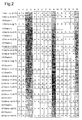
- step 2 the master device issues an address assignment command, in line 1 of Fig. 2 as "Set ⁇ a (0-15)" off, with all slave devices of the network where the value of the Property is between 0 and 15 inclusive, the address a is assigned.
- a command can be used instead "Set d ⁇ a (0-15)", where d is a default address referred to in the slave devices, which Addresses to be assigned, set by default and those assigned to the other slave devices Addresses is different. If the DV network is a Profibus network is, this default address has d in general the value 126. The address a can be 125 or any others, in the computer network not otherwise assigned Have value.
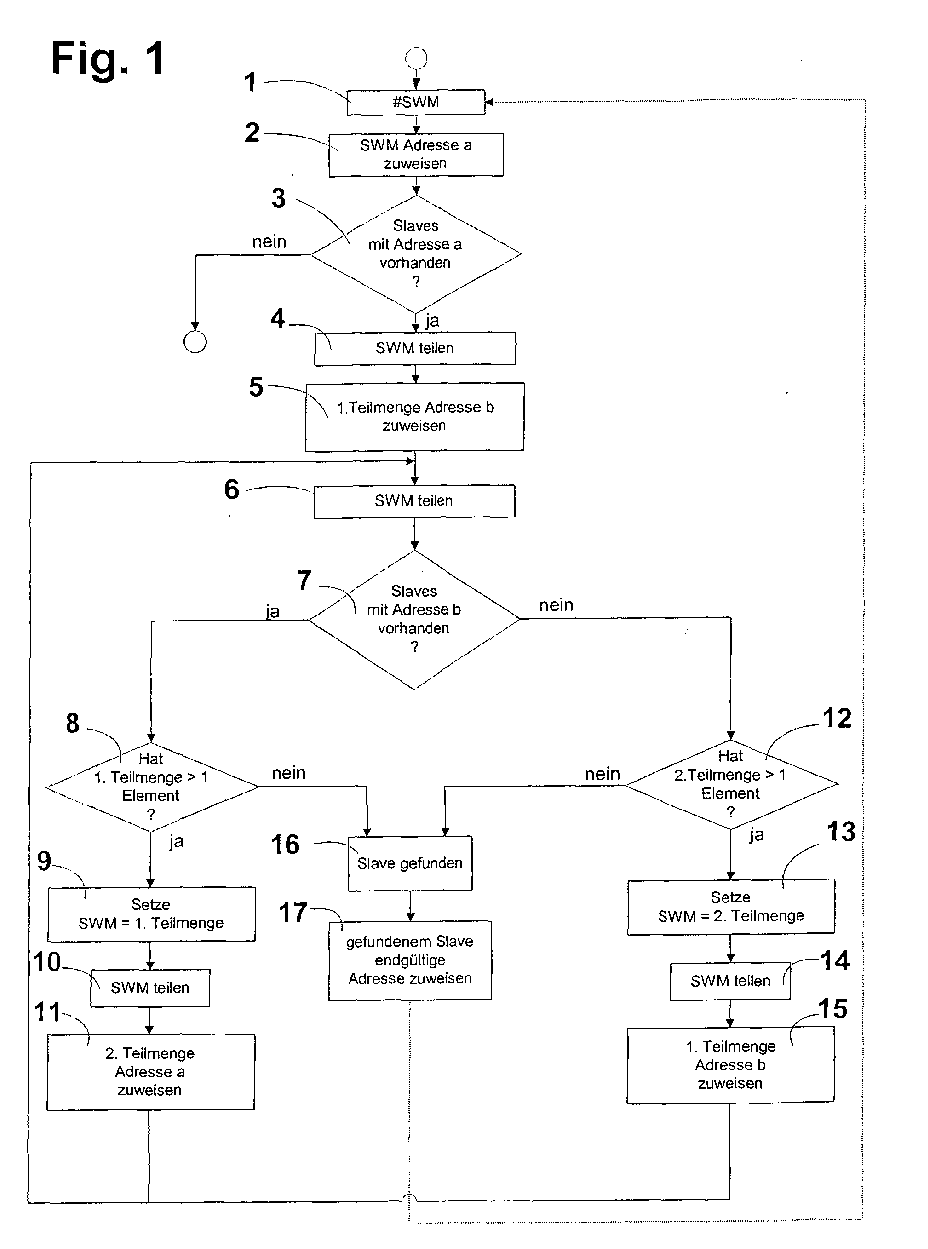
- step 3 it can be checked if slaves exist are, which now have the address a. If not If the case is, the process aborts; if such slaves exist
- the search value set is divided, preferably in two parts of the same size.
- the division into a first subset takes place with the elements ⁇ 0, 1, ..., 7 ⁇ and a second subset with the elements ⁇ 8, 9, ..., 15 ⁇ .
- the first subset becomes a new address b, e.g. assigned with the value 124, in step 5.
- the second line of Fig. 2 shows that from the implementation of such a command "Set a ⁇ b (0-7)" resulting Address distribution.
- the search value set is divided.
- step 7 the master device sends a check command "Check b ", of all slave devices with the address b with a Feedback is answered. Because the slave devices with the property values 2 and 3 have the address b, branches Proceed to step 8, which checks to see if the first Subset contains more than one element. This is the one here Case, therefore, the process goes to step 9, in which the first subset with the values 0 to 7 as search value set is defined. In step 11, the 2nd subset becomes the Address assigned. Subsequently, the process returns to Step 6 where a redeployment of this search value set is made this time into subsets ⁇ 0, 1, 2, 3 ⁇ and ⁇ 4, 5, 6, 7 ⁇ . The repetition of steps 6, 7 (corresponding to the Line 5 in Fig.
- Step 2 shows that further at least one slave device exists with the address b; because the search value set still contains more than one element, the Repeat steps 9 to 11 (corresponding to the lines 6, 7 in Fig. 2).
- the review results from Step 7 (line 7) that in the resulting 1st subset ⁇ 0, 1 ⁇ no slave device with address b exists anymore.
- the method branches to step 12, where it is checked whether the second subset, here the set ⁇ 2, 3 ⁇ , more than one Element comprises. Since this is the case here, in step 13 the second subset ⁇ 2, 3 ⁇ defines the search value set, from which Subsets ⁇ 2 ⁇ and ⁇ 3 ⁇ result.
- the first one now Subset ⁇ 2 ⁇ is assigned the address b in step 15 (line 8th).
- step 7 again becomes a slave device found with address b (line 9 in Fig. 2); because the first subset but only one element, which contains ⁇ 2 ⁇ , becomes this time branches from step 8 to step 16, where the master device detects that a slave device with the property value 2 is available and this with a command "Set b ⁇ 1 (2-2)" assigns the address 1 (step 17, line 10 in Fig. 2).
- step 2 in which all not yet found slave devices with the command "Set b ⁇ a (0-15) "(line 11 in Fig. 2) again assigned the address a becomes.
- the slave device with the property value 2 is of this Command not affected, mind you; because it's not anymore Address b has, it is not addressed by this command.
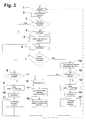
- step 3 shows a flowchart of a modification of the method of Fig. 1; it differs from the former by one between step 7 and 12 inserted step 18 of the Deleting the elements of the first subset from the finite Set of values and a step 19 of deleting the property value one found in the previous step 16 Slave device from the finite set of values.
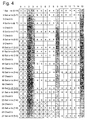
- Fig. 4 shows the transmitted by this method from the master device Commands and the resulting assignment of the Addresses to the individual slave devices. Until the line 7 differs Fig. 4 is not of Fig. 2.
- step 7 recognizes the master device that has the property values 0 and 1 can not correspond to slave devices, and therefore, in step 18, eliminates these property values the finite set of values. This is in the figure as crossed Box in the columns of property values 0 and 1 shown. For finding the slave device with the property value 2, this deletion is completely without impact.
- step 19 After assigning address 1 to the slave device with the property value 2 (line 10 in Fig. 4) is in step 19 and the Property value 2 deleted from the finite set of values, so that in line 11 of Fig. 4, only the elements 3 to 15 contains.
- the instruction sequence shown in FIG. 5 differs from that of FIG of Fig. 4 by the values of the addresses assigned therein. Instead of temporary addresses a, b are from the outset final Addresses 1, 2 used. The terminal with the property value 2 receives in this way the address 2, and the Step 17 of assigning the final address is omitted.
- the Address 2 is now no longer available from the master device and to search for the property value of the next slave device is first returned to step 2 (Line 10 of FIG. 5) to all slave devices with property values in the reduced search value set ⁇ 3, 4, ..., 15 ⁇ the Assigned to address 1.
- the slave device with the property value 3 receives in this way the address 3.
- results falls to the slave device with the property value 9 the address 1 too; and the search for the slave device with the Property value 15 is found using addresses 4 and 5 instead.
- FIG. 6 shows a flow chart of a modified method, with more than two different addresses at the same time can be used in the search value set.
- Steps 1 to 3 are the same as in the method described above, only the name a the address is replaced by a (i) in the figure.
- Fig. 7 shows the sequence of the master device in the implementation of the method of FIG. 6.
- a (0) 1. Every repetition of step 4 is accompanied by an increment of i Accordingly, at the first implementation of the Step 5, corresponding to line 2 of Fig. 7, the address a (1) assigned for which the master device has the value 2.
- the verification of step 6 (line 3) shows that slaves are present with address 2, whereupon in step 7, the number the elements of the first subset, and as in The previously considered embodiments initially about Step 8 is returned to step 4.
- Step 6 line 7
- step 6 line 7
- elements ⁇ 0, 1 ⁇ be removed from the finite value set.
- the second subset ⁇ 2, 3 ⁇ still contains two elements, so that branches in the following step 9 to step 10 where the second subset is set as the search value set and return to step 4. There i get the Value "4", i. the master device selects as address value a (4) again the value 4, since this address value is not an element of finite Value set is more assigned and thus available again stands, and assigns it to the first subset, consisting from element "2" (step 5 or line 8).
- step 6 determines that a Slave with the property value "2" is present and the Address "4" received.
- the property value "2" becomes the finite one in step 14 Value set deleted.
- step 15 If the test in step 15 would result in the second subset contains no addresses of existing slave devices, so would be the second subset of the finite set of values in Step 16 is deleted before the procedure returns to step 1.
- step 1 the remaining finite set of values ⁇ 4, 5, ..., 15 ⁇ is set as the search value set.
- step 2 will turn assigned an address a (0), which among the still available Addresses is selected, in the case of line 11 of FIG. 7 the address 1. From here, the procedure is repeated in analog Way as described above, so the search for the slave devices with property values 9 and 15 here does not need to be described in detail; that of the master device used for this purpose and their implications shown in Fig. 7.
- a preferred field of application of the present invention are DP systems according to the Profibus standard; but it is on the Hand that the inventive method also in other systems applicable, provided they support address assignment commands, the transmission of accompanying parameters allow, by means of which a slave device, such a Address assignment command receives, can decide whether it is the Assignment or not.
Landscapes
- Engineering & Computer Science (AREA)
- Computer Networks & Wireless Communication (AREA)
- Signal Processing (AREA)
- Small-Scale Networks (AREA)
- Computer And Data Communications (AREA)
Abstract
Description
- Fig. 1
- ein Flussdiagramm einer ersten Ausgestaltung des erfindungsgemäßen Verfahrens;
- Fig. 2
- die Abfolge von Befehlen, die das Master-Gerät zur Durchführung des Verfahrens von Fig. 1 an die Slave-Geräte sendet, sowie die Auswirkungen dieser Befehle;
- Fig. 3
- eine Abwandlung des Flussdiagramms aus Fig. 1;
- Fig. 4,
- analog zu Fig. 2, die Folge der gemäß dem Flussdiagramm von Fig. 3 gesendeten Befehle und ihrer Auswirkungen;
- Fig. 5
- eine Befehlsfolge gemäß einer Abwandlung des mit Bezug auf Figs. 3 und 4 beschriebenen Verfahrens;
- Fig. 6
- ein Flussdiagramm eines Verfahrens, bei dem mehr als zwei Adressen gleichzeitig verwendet werden; und
- Fig. 7
- ein Beispiel der Befehlsfolge und deren Auswirkungen gemäß dem Verfahren von Fig. 6.
Claims (10)
- Verfahren zur automatischen Zuweisung wenigstens einer Slave-Adresse in einem DV-Netzwerk mit einem Master-Gerät und wenigstens einem Slave-Gerät, bei dem die Slave-Geräte eine individualisierende Eigenschaft aufweisen, die für jedes Slave-Gerät einen anderen Wert aus einer endlichen Wertemenge hat, mit den Schritten:a) Setzen der endlichen Wertemenge als eine Such-Wertemenge (1),b) Aufteilen der Suchwertemenge in wenigstens zwei Teilmengen (4, 6) und Zuweisen von Adressen an die Slave-Geräte (5), so dass nach dem Zuweisen alle Slave-Geräte, bei denen der Wert der individualisierenden Eigenschaft in der ersten Teilmenge liegt, eine erste Adresse (b) haben, und alle Slave-Geräte, bei denen der Wert der individualisierenden Eigenschaft in der zweiten Teilmenge liegt, eine zweite Adresse (a) haben;c) Such-Wertemenge teilen (6) und überprüfen (7), ob wenigstens ein Slave-Gerät existiert, das mit der ersten Adresse (b) adressiert ist;d) wenn ja, 1. Teilmenge als Such-Wertemenge setzen (9), Such-Wertemenge teilen (10) und 2. Teilmenge Adresse (a) zuweisen (11), Zurückkehren zu Schritt c)e) Wenn nein, 2. Teilmenge als Such-Wertemenge setzen (13), Such-Wertemenge teilen (14) und 1. Teilmenge Adresse (b) zuweisen (15), Zurückkehren zu Schritt c)
- Verfahren nach Anspruch 1, dadurch gekennzeichnet, dass die Such-Wertemenge in genau zwei Teilmengen aufgeteilt wird.
- Verfahren nach Anspruch 1 oder 2, dadurch gekennzeichnet, dass wenn in Schritt d) die erste Teilmenge oder in Schritt e) die zweite Teilmenge ein Element enthält, dem Slave-Gerät, bei dem der Wert der individualisierenden Eigenschaft diesem Element entspricht, eine endgültige Adresse zugewiesen wird (17),
- Verfahren nach einem der vorhergehenden Ansprüche, dadurch gekennzeichnet, dass bei jeder Wiederholung von Schritt c) (6) identische Werte der ersten und der zweiten Adresse verwendet werden.
- Verfahren nach Anspruch 1, 2 oder 3, dadurch gekennzeichnet, dass bei jeder Wiederholung von Schritt d) (15) oder e) (11) wenigstens ein Wert für die erste und / oder die zweite Adresse eingeführt wird, der keinem Element der Such-Wertemenge zugeordnet ist.
- Verfahren nach Anspruch 5, dadurch gekennzeichnet, dass wenn in Schritt c) die erste Teilemenge ein Element enthält, ferner überprüft wird (15), ob wenigstens ein Slave existiert, der mit der zweiten Adresse adressierbar ist, und dass, wenn ja und wenn die zweite Teilmenge mehr als ein Element enthält, die zweite Teilmenge als Such-Wertemenge gesetzt (10) wird und zu Schritt b) zurückgekehrt wird.
- Verfahren nach einem der vorhergehenden Ansprüche, dadurch gekennzeichnet, dass wenn die Überprüfung in Schritt c) (7) ergibt, dass kein Slave-Gerät mit der ersten Adresse adressierbar ist, die Elemente der ersten Teilmenge aus der endlichen Wertemenge gestrichen werden (18).
- Verfahren nach einem der vorhergehenden Ansprüche, dadurch gekennzeichnet, dass ein Element der endlichen Wertemenge, zu dem ein Slave-Gerät gefunden worden ist, aus der endlichen Wertemenge gestrichen wird (19).
- Master-Gerät für ein DV-Netzwerk, dadurch gekennzeichnet, dass es eingerichtet ist, das Verfahren nach einem der vorhergehenden Ansprüche durchzuführen.
- Slave-Gerät für ein DV-Netzwerk, dessem Adresse in dem DV-Netzwerk durch einen an das Slave-Gerät gerichteten Adresseinstellbefehl einstellbar ist, dadurch gekennzeichnet, dass das Slave-Gerät eingerichtet ist, den Wert einer ihm eigenen Eigenschaft mit einem in dem Adresseinstellbefehl angegebenen Wertebereich zu vergleichen und in Abhängigkeit vom Ergebnis des Vergleichs den Adresseinstellbefehl auszuführen oder nicht auszuführen.
Applications Claiming Priority (2)
| Application Number | Priority Date | Filing Date | Title |
|---|---|---|---|
| DE10202851A DE10202851A1 (de) | 2002-01-24 | 2002-01-24 | Verfahren zur Adresszuweisung in einem Netzwerk und Komponenten dafür |
| DE10202851 | 2002-01-24 |
Publications (3)
| Publication Number | Publication Date |
|---|---|
| EP1331794A2 true EP1331794A2 (de) | 2003-07-30 |
| EP1331794A3 EP1331794A3 (de) | 2006-05-17 |
| EP1331794B1 EP1331794B1 (de) | 2008-03-05 |
Family
ID=7713044
Family Applications (1)
| Application Number | Title | Priority Date | Filing Date |
|---|---|---|---|
| EP02025898A Expired - Lifetime EP1331794B1 (de) | 2002-01-24 | 2002-11-20 | Verfahren zur Adresszuweisung in einem Netzwerk und Komponenten dafür |
Country Status (3)
| Country | Link |
|---|---|
| US (1) | US7558821B2 (de) |
| EP (1) | EP1331794B1 (de) |
| DE (2) | DE10202851A1 (de) |
Families Citing this family (3)
| Publication number | Priority date | Publication date | Assignee | Title |
|---|---|---|---|---|
| DE102005034944B3 (de) * | 2005-07-22 | 2006-11-09 | Siemens Ag | Verfahren und Anordnung zur automatischen Konfiguration eines Master-Slave-Feldbussystems |
| DE102010055337B4 (de) * | 2010-12-21 | 2021-12-16 | Abb Ag | Integration von Feldgeräten in ein verteiltes System |
| CN103886730A (zh) * | 2012-12-19 | 2014-06-25 | 中国科学院沈阳自动化研究所 | 一种基于无线Hart适配器终端的通信方法 |
Family Cites Families (7)
| Publication number | Priority date | Publication date | Assignee | Title |
|---|---|---|---|---|
| US4360870A (en) * | 1980-07-30 | 1982-11-23 | International Business Machines Corporation | Programmable I/O device identification |
| US4730251A (en) * | 1985-10-28 | 1988-03-08 | International Business Machines Corporation | Automatic I/O address assignment |
| CA2055991C (en) * | 1991-01-02 | 1997-04-22 | John Harris Blevin | Address management for remote terminals in digital loop transmission systems |
| US5636342A (en) * | 1995-02-17 | 1997-06-03 | Dell Usa, L.P. | Systems and method for assigning unique addresses to agents on a system management bus |
| DE19621272A1 (de) | 1996-05-25 | 1997-11-27 | Bosch Gmbh Robert | Adressierungsvorrichtung für eine Nebenstation eines seriellen Bussystems und Verfahren zur Adressierung einer Nebenstation |
| DE19733906C2 (de) | 1997-08-05 | 1999-09-30 | Siemens Ag | Verfahren zur automatischen Adreßvergabe, Bussystem zur automatischen Adreßvergabe und Kommunikationsteilnehmer, die im Bussystem bzw. im Rahmen des Verfahrens einsetzbar sind |
| US6928501B2 (en) * | 2001-10-15 | 2005-08-09 | Silicon Laboratories, Inc. | Serial device daisy chaining method and apparatus |
-
2002
- 2002-01-24 DE DE10202851A patent/DE10202851A1/de not_active Ceased
- 2002-09-18 US US10/245,700 patent/US7558821B2/en not_active Expired - Fee Related
- 2002-11-20 EP EP02025898A patent/EP1331794B1/de not_active Expired - Lifetime
- 2002-11-20 DE DE50211826T patent/DE50211826D1/de not_active Expired - Lifetime
Also Published As
| Publication number | Publication date |
|---|---|
| EP1331794B1 (de) | 2008-03-05 |
| EP1331794A3 (de) | 2006-05-17 |
| DE50211826D1 (de) | 2008-04-17 |
| DE10202851A1 (de) | 2003-08-14 |
| US20030140125A1 (en) | 2003-07-24 |
| US7558821B2 (en) | 2009-07-07 |
Similar Documents
| Publication | Publication Date | Title |
|---|---|---|
| DE602004000617T2 (de) | Verfahren zum Einrichten von Netzwerkadressen | |
| DE10040438A1 (de) | Adressvergabeverfahren für mindestens einen neu an ein Bussystem angeschlossenen Busteilnehmer | |
| DE3416939A1 (de) | Verfahren zur steuerung von betriebseinrichtungen | |
| DE2722124A1 (de) | Anordnung zum feststellen des prioritaetsranges in einem dv-system | |
| DE2256135B2 (de) | Verfahren und Anordnung zum Prüfen von monolithisch integrierten Halbleiterschaltungen | |
| DE2517302A1 (de) | Datenverarbeitungssystem mit mehrprogramm-verarbeitung | |
| DE3850444T2 (de) | Progammverwaltungsverfahren für verteilte Verarbeitungssysteme und angepasste Vorrichtung. | |
| DE112014004709B4 (de) | Steuerungssystem, Leitstation, extern gesteuerte Station | |
| DE60311682T2 (de) | Verfahren zur Ausführung einer symmetrischen Adressenumsetzung | |
| EP0956530A1 (de) | Verfahren zur transformation einer zur nachbildung eines technischen prozesses dienenden fuzzy-logik in ein neuronales netz | |
| DE60217729T2 (de) | Verfahren zum erkennen eines elektronischen geräts in einem mehrfachsteuersystem | |
| EP1331794B1 (de) | Verfahren zur Adresszuweisung in einem Netzwerk und Komponenten dafür | |
| EP3047635A1 (de) | Feldbuskoppler zur anbindung von modulen an einen feldbus und verfahren zur adressierung derartiger module | |
| DE3842286A1 (de) | Verfahren zur verarbeitung von daten in einem verteilten verarbeitungssystem | |
| DE102020119853B3 (de) | Verfahren zum Steuern eines Automatisierungssystems mit Visualisierung von Programmobjekten eines Steuerprogramms des Automatisierungssystems und Automatisierungssystem | |
| EP1248430B1 (de) | Verfahren und Generierungsmodul zur Ermittlung von Filtermasken zur Relevanzprüfung von Kennzeichnern | |
| DE69701183T2 (de) | Datenkompressionsverfahren und -system mit Kontext Baumstruktur Algorithmus | |
| DE102008022839A1 (de) | Verfahren und Vorrichtung zur Korrektur von digital übertragenen Informationen | |
| DE69021951T2 (de) | Verfahren zum Erzeugen eines Maskierungsbits während eines dynamischen Vergleichs eines seriellen Datenstroms mit einer Referenz. | |
| DE102017216823A1 (de) | Verarbeitungseinheit, elektronische steuereinheit und verarbeitungsverfahren | |
| EP1399856A1 (de) | Verfahren zur zusammenführung verteilter datenbanken | |
| DE3043324C2 (de) | Verfahren zur funktionellen Prüfung von sequentiellen Netzen und Anordnung zur Durchführung des Verfahrens | |
| DE19957107B4 (de) | Verfahren zur Gewährleistung des Datenaustauschs zwischen mehreren Einrichtungen | |
| DE10139068B4 (de) | Verfahren zum Ermitteln einer Folge von Befehlen und entsprechendes Computerprogramm | |
| EP2899603B1 (de) | Projektieren eines Feldbussystems |
Legal Events
| Date | Code | Title | Description |
|---|---|---|---|
| PUAI | Public reference made under article 153(3) epc to a published international application that has entered the european phase |
Free format text: ORIGINAL CODE: 0009012 |
|
| AK | Designated contracting states |
Designated state(s): AT BE BG CH CY CZ DE DK EE ES FI FR GB GR IE IT LI LU MC NL PT SE SK TR |
|
| AX | Request for extension of the european patent |
Extension state: AL LT LV MK RO SI |
|
| PUAL | Search report despatched |
Free format text: ORIGINAL CODE: 0009013 |
|
| AK | Designated contracting states |
Kind code of ref document: A3 Designated state(s): AT BE BG CH CY CZ DE DK EE ES FI FR GB GR IE IT LI LU MC NL PT SE SK TR |
|
| AX | Request for extension of the european patent |
Extension state: AL LT LV MK RO SI |
|
| 17P | Request for examination filed |
Effective date: 20060711 |
|
| 17Q | First examination report despatched |
Effective date: 20060913 |
|
| AKX | Designation fees paid |
Designated state(s): DE FR GB |
|
| GRAP | Despatch of communication of intention to grant a patent |
Free format text: ORIGINAL CODE: EPIDOSNIGR1 |
|
| GRAS | Grant fee paid |
Free format text: ORIGINAL CODE: EPIDOSNIGR3 |
|
| GRAA | (expected) grant |
Free format text: ORIGINAL CODE: 0009210 |
|
| AK | Designated contracting states |
Kind code of ref document: B1 Designated state(s): DE FR GB |
|
| REG | Reference to a national code |
Ref country code: GB Ref legal event code: FG4D Free format text: NOT ENGLISH |
|
| GBT | Gb: translation of ep patent filed (gb section 77(6)(a)/1977) |
Effective date: 20080305 |
|
| REF | Corresponds to: |
Ref document number: 50211826 Country of ref document: DE Date of ref document: 20080417 Kind code of ref document: P |
|
| ET | Fr: translation filed | ||
| PLBE | No opposition filed within time limit |
Free format text: ORIGINAL CODE: 0009261 |
|
| STAA | Information on the status of an ep patent application or granted ep patent |
Free format text: STATUS: NO OPPOSITION FILED WITHIN TIME LIMIT |
|
| 26N | No opposition filed |
Effective date: 20081208 |
|
| REG | Reference to a national code |
Ref country code: FR Ref legal event code: PLFP Year of fee payment: 14 |
|
| PGFP | Annual fee paid to national office [announced via postgrant information from national office to epo] |
Ref country code: GB Payment date: 20151123 Year of fee payment: 14 |
|
| PGFP | Annual fee paid to national office [announced via postgrant information from national office to epo] |
Ref country code: FR Payment date: 20151124 Year of fee payment: 14 |
|
| GBPC | Gb: european patent ceased through non-payment of renewal fee |
Effective date: 20161120 |
|
| REG | Reference to a national code |
Ref country code: FR Ref legal event code: ST Effective date: 20170731 |
|
| PG25 | Lapsed in a contracting state [announced via postgrant information from national office to epo] |
Ref country code: FR Free format text: LAPSE BECAUSE OF NON-PAYMENT OF DUE FEES Effective date: 20161130 |
|
| PG25 | Lapsed in a contracting state [announced via postgrant information from national office to epo] |
Ref country code: GB Free format text: LAPSE BECAUSE OF NON-PAYMENT OF DUE FEES Effective date: 20161120 |
|
| PGFP | Annual fee paid to national office [announced via postgrant information from national office to epo] |
Ref country code: DE Payment date: 20171124 Year of fee payment: 16 |
|
| REG | Reference to a national code |
Ref country code: DE Ref legal event code: R119 Ref document number: 50211826 Country of ref document: DE |
|
| PG25 | Lapsed in a contracting state [announced via postgrant information from national office to epo] |
Ref country code: DE Free format text: LAPSE BECAUSE OF NON-PAYMENT OF DUE FEES Effective date: 20190601 |