EP1329528A1 - Co-ni base heat-resistant alloy and method for production thereof - Google Patents
Co-ni base heat-resistant alloy and method for production thereof Download PDFInfo
- Publication number
- EP1329528A1 EP1329528A1 EP01965698A EP01965698A EP1329528A1 EP 1329528 A1 EP1329528 A1 EP 1329528A1 EP 01965698 A EP01965698 A EP 01965698A EP 01965698 A EP01965698 A EP 01965698A EP 1329528 A1 EP1329528 A1 EP 1329528A1
- Authority
- EP
- European Patent Office
- Prior art keywords
- mass
- resistant alloy
- present
- base heat
- working
- Prior art date
- Legal status (The legal status is an assumption and is not a legal conclusion. Google has not performed a legal analysis and makes no representation as to the accuracy of the status listed.)
- Granted
Links
Images

Classifications
-
- C—CHEMISTRY; METALLURGY
- C22—METALLURGY; FERROUS OR NON-FERROUS ALLOYS; TREATMENT OF ALLOYS OR NON-FERROUS METALS
- C22C—ALLOYS
- C22C19/00—Alloys based on nickel or cobalt
- C22C19/07—Alloys based on nickel or cobalt based on cobalt
-
- C—CHEMISTRY; METALLURGY
- C22—METALLURGY; FERROUS OR NON-FERROUS ALLOYS; TREATMENT OF ALLOYS OR NON-FERROUS METALS
- C22C—ALLOYS
- C22C30/00—Alloys containing less than 50% by weight of each constituent
-
- C—CHEMISTRY; METALLURGY
- C22—METALLURGY; FERROUS OR NON-FERROUS ALLOYS; TREATMENT OF ALLOYS OR NON-FERROUS METALS
- C22F—CHANGING THE PHYSICAL STRUCTURE OF NON-FERROUS METALS AND NON-FERROUS ALLOYS
- C22F1/00—Changing the physical structure of non-ferrous metals or alloys by heat treatment or by hot or cold working
- C22F1/10—Changing the physical structure of non-ferrous metals or alloys by heat treatment or by hot or cold working of nickel or cobalt or alloys based thereon
Definitions
- the present invention relates to a Co-Ni base heat-resistant alloy and to a preparation method therefor, and more particularly concerns a Co-Ni base heat-resistant alloy that is used for springs, bolts, etc., that are employed to portions, such as engines and exhaust systems and peripheral devices of gas turbines, which are exposed to high temperatures, and to a preparation method therefor.
- heat-resistant parts that are employed in portions, such as engines and exhaust systems and peripheral devices of gas turbines, that are exposed to high temperatures, are manufactured by using Ni-base super heat-resistant alloy such as Inconel X-750 (Ni: 73.0 mass%, Cr: 15.0 mass%, Al: 0.8 mass%, Ti: 2.5 mass%, Fe: 6.8 mass%, Mn: 0.70 mass%, Si: 0.25 mass%, C: 0.04, Nb+Ta: 0.9 mass%) and Inconel 718 (Ni: 53.0 mass%, Cr: 18.6 mass%, Mo: 3.1 mass%, Al: 0.4 mass%, Ti: 0.9 mass%, Fe: 18.5 mass%, Mn: 0.20 mass%, Si: 0.18 mass%, C: 0.04 mass%, Nb+Ta: 5.0 mass%).
- Ni-base super heat-resistant alloy such as Inconel X-750 (Ni: 73.0 mass%, Cr: 15.0 mass%, Al: 0.8 mass%, Ti: 2.5 mass%,
- Ni-base super-heat-resistant alloys are reinforced by depositing ⁇ ' (Ni 3 (Al, Ti, Nb) and ⁇ " (Ni 3 Nb).
- ⁇ ' and ⁇ " become coarse due to overaging, causing degradation in the strength.
- parts such as springs and bolts on which stress is continuously imposed are subjected to great stress relaxation, failing to maintain performances originally required for the parts.
- objects of the present invention are to provide a heat resistant alloy which exhibits higher strength than the above-mentioned Ni-base super-heat-resistant alloy, and is less susceptible to degradation in the strength even after a long-period of use under high temperatures, and to provide a preparation method therefor.
- the inventors of the present invention have carried out various research and studies to find a heat-resistant alloy that has higher strength and is less susceptible to degradation in strength even after long-period of use under high temperatures in comparison with the Ni-base super-heat-resistant alloys, and have found that a Co-Ni-Cr based alloy is usable as the heat-resistant alloy, and that since this Co-Ni-Cr based alloy has a very low stacking fault energy so that when this is subjected to cold working or warm working, a solute element such as Mo, Fe and Nb is segregated in stacking faults of extended dislocation to block dislocation movements and consequently to achieve a high work hardening performance, and that when this is aged subsequently after the cold working or the warm working with working strain remaining therein, the strength is further improved.
- Japanese Unexamined Patent Application Publication No. 10-140279 has disclosed such an alloy; however, since this is still not sufficient in strength under high temperatures, a ⁇ phase is deposited when this alloy is strengthened by increasing the amount of solute elements such as Mo, Fe, and Nb therein, resulting in degradation in workability and toughness.
- the inventors of the present invention have found that in order to solve this problem, when Cr is set to be a minimum level that is required for use in a heat-resistant environment of not more than 750°C, it is possible to suppress the deposition of the ⁇ phase even when the amount of solute elements such as Mo, Fe, and Nb is increased, and that it is possible to further increase the strength by adding W thereto.
- the Co-Ni base heat-resistant alloy of the present invention contains C: not more than 0.05%, Si: not more than 0.5%, Mn: not more than 1.0%, Ni: 25 to 45%, Cr: 13 to less than 18%, Mo + 1/2W of one kind or two kinds of Mo and W: 7 to 20%, Ti: 0.1 to 3.0%, Nb: 0.1 to 5.0% and Fe: 0.1 to 5.0%, with the rest being composed of Co and inevitable impurities.
- the present invention preferably contains at least one selected from the group consisting of REM (at least one rare-earth elements such as Y, Ce, and misch metal): 0.007 to 0.10%, B: 0.001 to 0.010%, Mg: 0.0007 to 0.010% and Zr: 0.001 to 0.20%.
- REM at least one rare-earth elements such as Y, Ce, and misch metal
- the preparation method of the Co-Ni base heat-resistant alloy of the present invention is characterized by the steps in which: an alloy containing C: not more than 0.05%, Si: not more than 0.5%, Mn: not more than 1.0%, Ni: 25 to 45%, Cr: 13 to less than 18%, Mo + 1/2W of one kind or two kinds of Mo and W: 7 to 20%, Ti: 0.1 to 3.0%, Nb: 0.1 to 5.0% and Fe: 0.1 to 5.0%, and the rest being composed of Co and inevitable impurities, is subjected to a solid solution heat treatment at 1000 to 1200°C or a hot working at this temperature, and this is then subjected to a cold working or a warm working having a working ratio of not less than 40%, and this is then subjected to an aging heat treatment at 500 to 800°C for 0.1 to 50 hours.
- the alloy is preferably allowed to contain at least one selected from the group consisting of REM (at least one rare-earth elements such as Y, Ce, and misch metal): 0.007 to 0.10%, B: 0.001 to 0.010%, Mg: 0.0007 to 0.010% and Zr: 0.001 to 0.20%.
- REM at least one rare-earth elements such as Y, Ce, and misch metal
- Carbon C is bound to Nb and Ti to form carbides to prevent crystal particles from becoming coarse at the time of a solid solution heat treatment, and also to strengthen the grain boundary; thus, this element is contained for these purposes.
- the content must be set to be not less than 0.005%; however, since a content exceeding 0.05%, more specifically, 0.03%, would cause degradation in the toughness and corrosion resistance, and would also form a carbide with a dislocation anchoring element such as Mo, resulting in interference with the dislocation anchoring, the content is set to be not more than 0.05%.
- the preferable range is set to be 0.005 to 0.03%.
- Si Not more than 0.5%
- Si is effectively used as a deoxidizer, this element is contained for this purpose; however, since a content exceeding 0.5%, more specifically, 0.3%, would cause degradation in the toughness, the content is set to be not more than 0.5%. The preferable range is set to be not more than 0.3%.
- Mn 0.1 to 1.0%
- the content must be set to be not less than 0.1%, more preferably, 0.25%; however, since a content exceeding 1.0%, more specifically, 0.7%, would cause degradation in the corrosion resistance, the content is set to be 0.1 to 1.0%.
- the preferable range is set to be 0.25 to 0.7%.
- Ni is an element that is used for stabilizing austenite serving as a matrix and improves heat resistance and corrosion resistance of the alloy, this element is contained for these purposes.
- the content must be set to be not less than 25%, more preferably, 27%; however, since a content exceeding 45%, more specifically, 33%, would cause degradation in the work hardening performance, the content is set to be 25 to 45%.
- the preferable range is set to be 27 to 33%.
- Cr 13% to less than 18%
- the content must be set to be not less than 13%, more preferably, 14.5%; however, since a content exceeding 18%, more specifically, 17%, tends to cause deposition of a ⁇ phase, the content is set to be in a range of 13 to less than 18%. The preferable range is set to be 14.5 to 17%. Mo + 1/2W: 7 to 20%
- the content must be set to be not less than 7%, more preferably, 9%; however, since the total amount of the content of Mo and 1/2 of the content of W exceeds 20%, more specifically, 16%, tends to cause deposition of a ⁇ phase, the content is set in a range of 7 to 20%. The preferable range is set to be 9 to 16%.
- the content must be set to be not less than 0.1%, more preferably, 0.5%; however, since a content exceeding 3.0%, more specifically, 1.8%, would cause deposition of an ⁇ phase (Ni 3 Ti) resulting in degradation in the workability and toughness, the content is set to be in a range of 0.1 to 3.0%. The preferable range is set to be 0.5 to 1.8%. Nb:0.1 to 5.0%
- Nb is bound to C to form carbides to prevent crystal particles from becoming coarse at the time of a solid solution heat treatment and to strengthen the grain boundary, and also solid solution-treated in the matrix to strengthen the matrix, thereby improving the work hardening performance; thus, this element is contained for these purposes.
- the content must be set to be not less than 0.1%, more preferably, 0.5%; however, since the content exceeding 5.0%, more specifically, 3.5%, would cause deposition of a ⁇ phase (Ni 3 Nb) resulting in degradation in the workability and toughness, the content is set to be in a range of 0.1 to 5.0%. The preferable range is set to be 0.5 to 3.5%.
- Fe 0.1 to 5.0%
- the content must be set to be not less than 0.1%, more preferably, 0.5%; however, since a content exceeding 5.0%, more specifically, 3.3%, causes degradation in the oxidation resistance property, the content is set to be in a range of 0.1 to 5.0%. The preferable range is set to be 0.5 to 3.3%.
- the application of Mo, Nb, and Fe in a combined manner makes it possible to greatly increase the solid solution strength and work hardening of the matrix, which greatly enhances the maximum tensile strength obtained at room temperature and at high temperatures, and exerts an effect of shifting the temperature having a maximum of the tensile strength at a high temperature to the high temperature side, in comparison with the application of Mo and Nb or Mo and Fe in a combined manner.
- REM 0.007 to 0.10%
- the content must be set to be not less than 0.007%, more preferably, 0.01%; however, since the content exceeding 0.10%, more specifically, 0.04%, causes degradation in the hot workability and oxidation resistance property in an inverse manner, the content is set to be in a range of 0.007 to 0.10%.
- the preferable range is set to be 0.01 to 0.04%.
- B must be set to be 0.001%, more preferably, 0.002%, Mg must be set to be 0.0007%, more preferably, 0.001%, and Zr must be set to be 0.001%, more preferably, 0.01%; however, since B exceeding 0.010%, more specifically, 0.004%, Mg exceeding 0.010%, more specifically, 0.003% and Zr exceeding 0.20%, more specifically 0.03%, would cause degradation in the hot workability and oxidation resistance property, the ranges of the contents are respectively set to be in the above-mentioned ranges. More preferably, B is set to be in a range of 0.002 to 0.004%, Mg is set to be in a range of 0.001 to 0.003%, and Zr is set to be in a range of 0.01 to 0.03%.
- Co Balance
- Co which has a close-packed hexagonal lattice structure, is allowed to contain Ni so as to have a face-centered cubic lattice structure, that is, austenite, thereby exerting a high work hardening performance.
- solute atoms such as Mo are segregated at stacking faults between extended dislocations which have been introduced through cold or warm working so as to interfere with dislocation movements so that by suppressing the reoccurrence of dislocations, the Co-Ni base heat-resistant alloy having the above-mentioned component composition is strengthened.
- the above-mentioned Co-Ni base heat-resistant alloy is subjected to a solid solution heat treatment at 1000 to 1200°C to make the organization homogenous, or a hot working at a temperature of not less than 1000°C to make the crystal grains finer, and this is then subject to cold working or warm working at a temperature of a working ratio of not less than 40% so that a great number of the dislocations are introduced to carry out work hardening.
- the warm working may be carried out during a cooling process after the solid solution heat treatment or the hot working.
- an aging heat treatment is carried out for 0.1 to 50 hours at 500 to 800°C so that solute atoms such as Mo and Fe are segregated in stacking faults formed between half-dislocations of extended dislocations; thus, the dislocation movements are blocked so that stress relaxation, that is, reoccurrence of dislocations, is suppressed.
- the solid solution heat treatment or the hot working is carried out at 1000 to 1200°C is because a temperature lower than 1000°C fails to provide a sufficiently homogenous structure and also fails to lower the hardness, causing a difficulty in working. Moreover, this might cause deposition of a compound such as Mo that exerts an anchoring effect on dislocations, and the subsequent reduction in the age hardening property. Moreover, a temperature exceeding 1200°C makes crystal grains coarse, resulting in degradation in the toughness and strength.
- the reason that the cold working or warm working having a working ratio of not less than 40% is carried out after the solid solution heat treatment or the hot working is because, as shown in Table 3 and Fig. 1, the working ratio of less than 40% fails to provide a high work hardening perfomance that is exerted by solute elements such as Mo and Fe to be segregated in the stacking faults in extended dislocations to interfere with the dislocation movements, and also causes greater creep elongation.
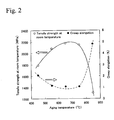
- the reason that the aging heat treatment is carried out at 500 to 800°C for 0.1 to 50 hours after the cold or warm working of a working ratio of not less than 40% is because, as shown in Table 4 and Fig. 2, when the treatment is at less than 500°C or less than 0.1 hour, it fails to increase the strength sufficiently or, when the treatment exceeds 800°C or exceeds 50 hours, the dislocations reform to cause degradation in the hardness and strength, as well as the subsequent greater creep elongation.
- the alloy is melted and prepared through a normal method by using a vacuum high-frequency induction furnace, etc., and is forged into an ingot through a normal forging method. Thereafter, this is subjected to a hot working and solid solution heat treatment at 1000 to 1200°C, and this is then subjected to a cold working or warm working having a working ratio of not less than 40%, and is then subjected to an aging heat treatment at 500 to 800°C for 0.1 to 50 hours.
- Co-Ni base heat-resistant alloy of the present invention is applied to parts and devices such as exhaust-related parts such as engine exhaust manifolds, peripheral devices of gas turbines, furnace chamber materials, heat-resistant springs and heat-resistant bolts, in which Inconel X750 or Inconel X718 has been used. It is also applied to parts and devices used under higher temperature.
- Alloys of an example and a comparative example of the present invention which have the component compositions shown in the following Table 1, were melted and prepared through a normal method by using a vacuum high-frequency induction furnace to obtain ingots of 30 kg. These ingots were formed into cylindrical bars each having a diameter of 35 mm through a hot forging process. Those bars except for that of comparative example 4 were subjected to a solution heat treatment at 1100°C, and then a cold working at a working ratio of 85% to form cylindrical bars each having a diameter of 13.6 mm, and these were then subjected to an aging of 720°C x 4 hours.
- the bar of comparative example 4 was subjected to a solid solution heat treatment at 1050°C, and was then subjected to an aging treatment of 725°C ⁇ 16 hours at a working ratio of 30%.
- Tensile test pieces having a diameter of 8 mm at parallel portions were obtained from these elements, and these were subjected to tensile tests at room temperature to measure the tensile strength.
- creep test pieces having a diameter of 6 mm at parallel portions with a distance between scores of 30 mm were obtained, and these were subjected to creep test in which a stress of 330 MPa was applied thereto at 700°C to measure the elongation 1000 hours later. Table 2 shows the results of these tests.
- Cylindrical bars having a diameter of 35 mm of No. 6 alloy of the present invention shown in Table 1 were subjected to a solid solution heat treatment at 1100°C, and were then subjected to cold workings at working ratios of 35%, 45% and 60% (comparative example 5, and examples 12 and 13 of the present invention), and these were then subjected to an aging of 720°C ⁇ 4 hours.
- Tensile test pieces and creep test pieces were obtained from these elements in the same manner as in example 1, and tensile tests and creep tests were carried out on these under the same conditions as in example 1 to measure the tensile strength and creep.
- Table 3 and Fig. 1 show the results of the tests.
- Example 12 of the present invention 45 1853 1.9
- Example 13 of the present invention 60 1971 1.2
- Example 6 of the present invention 85 2256 1.0 Creep elongation was measured by creep tests carried out under conditions of 700°C, 330MPa.
- Cylindrical bars having a diameter of 35 mm of No. 10 alloy of the present invention shown in Table 1 were subjected to a solid solution heat treatment at 1100°C and to cold working at working ratio of 85%, and were then subjected to an aging under conditions shown in Table 4 (comparative examples 6 and 7, examples 14 and 15 of the present invention).
- Tensile test pieces and creep test pieces were obtained from these elements in the same manner as in example 1, and tensile tests and creep tests were carried out on these under the same conditions as in example 1 to measure the tensile strength and creep.
- Table 4 and Fig. 2 show the results of the tests.
- Comparative example 7 850 4 1314 4.8 Creep elongation was measured by creep tests carried out under conditions of 700°C, 330MPa.
- Table 1 and Table 2 show that, in the examples of the present invention, the tensile strength at room temperature was set in a range of 2148 to 2775 MPa, and the creep elongation was set to be 0.7 to 1.1%.
- the tensile strength at room temperature was 1677 MPa which was lower than 78% of the examples of the present invention with the creep elongation being 1.7 times greater than that of the example of the present invention.
- the tensile strength at room temperature was 1451 MPa which was lower than 68% of the examples of the present invention with the creep elongation being not less than 2 times greater than that of the example of the present invention.
- the Co-Ni base heat-resistant alloy of the present invention has a higher strength at room temperature in comparison with Ni base super-heat-resistant alloys that have been conventionally used, and is less susceptible to degradation in strength even after long periods of use at high temperatures.
- the preparation method of the present invention makes it possible to prepare a Co-Ni base heat-resistant alloy which has a higher strength at room temperature in comparison with Ni base super-heat-resistant alloys that have been conventionally used, and is less susceptible to degradation in strength even after long periods of use at high temperatures.
Landscapes
- Chemical & Material Sciences (AREA)
- Engineering & Computer Science (AREA)
- Materials Engineering (AREA)
- Mechanical Engineering (AREA)
- Metallurgy (AREA)
- Organic Chemistry (AREA)
- Physics & Mathematics (AREA)
- Thermal Sciences (AREA)
- Crystallography & Structural Chemistry (AREA)
- Heat Treatment Of Steel (AREA)
- Heat Treatment Of Articles (AREA)
Abstract
Description
Ni: 25 to 45%
Cr: 13% to less than 18%
Mo + 1/2W: 7 to 20%
Ti: 0.1 to 3.0%
Nb:0.1 to 5.0%
Fe: 0.1 to 5.0%
B: 0.001 to 0.010%, Mg: 0.0007 to 0.010%, Zr: 0.001 to 0.20%.
Co: Balance


| Cold working ratio (%) | Tensile strength at room temperature (MPa) | Creep elongation (%) 1000 hours later | |
| Comparative example 5 | 35 | 1589 | 3.8 |
| Example 12 of the present invention | 45 | 1853 | 1.9 |
| Example 13 of the | 60 | 1971 | 1.2 |
| Example 6 of the present invention | 85 | 2256 | 1.0 |
| Creep elongation was measured by creep tests carried out under conditions of 700°C, 330MPa. |
| Aging temperature (°C) | Heating time (hr) | Tensile strength at room temperature (MPa) | Creep elongation (%) 1000 hours later | |
| Comparative example 6 | 450 | 16 | 1795 | 2.1 |
| Example 14 of the present invention | 550 | 32 | 2069 | 1.2 |
| Example 15 of the present invention | 650 | 16 | 2226 | 1.1 |
| Example 10 of the present invention | 720 | 4 | 2148 | 1.1 |
| Comparative example 7 | 850 | 4 | 1314 | 4.8 |
| Creep elongation was measured by creep tests carried out under conditions of 700°C, 330MPa. |
Claims (8)
- A Co-Ni base heat-resistant alloy comprising: all by weight,not more than 0.05 mass% of C; not more than 0.5 mass% of Si; not more than 1.0 mass% of Mn; 25 to 45 mass% of Ni; 13 to less than 18 mass% of Cr; 7 to 20 mass% of Mo + 1/2W of at least one of Mo and W; 0.1 to 3.0 mass% of Ti; 0.1 to 5.0 mass% of Nb; 0.1 to 5.0 mass% of Fe; and the balance of substantially Co and inevitable impurities.
- The Co-Ni base heat-resistant alloy according to claim 1, further comprising: 0.007 to 0.10 mass% of REM.
- The Co-Ni base heat-resistant alloy according to claim 1, further comprising: all by weight,at least one selected from the group consisting of 0.001 to 0.010 mass% of B; 0.0007 to 0.010 mass% of Mg; 0.001 to 0.20 mass% of Zr.
- The Co-Ni base heat-resistant alloy according to claim 1, further comprising: all by weight,0.007 to 0.10 mass% of REM; and at least one selected from the group consisting of 0.001 to 0.010 mass% of B; 0.0007 to 0.010 mass% of Mg; and 0.001 to 0.20 mass% of Zr.
- A preparation method of Co-Ni base heat-resistant alloy, the method comprising the steps of:subjecting an alloy which contains not more than 0.05 mass% of C; not more than 0.5 mass% of Si; not more than 1.0 mass% of Mn; 25 to 45 mass% of Ni; 13 to less than 18 mass% of Cr; 7 to 20 mass% of Mo + 1/2W of one kind or more of Mo and W: 0.1 to 3.0 mass% of Ti; 0.1 to 5.0 mass% of Nb; 0.1 to 5.0 mass% of Fe; and the balance of substantially Co and inevitable impurities, to a solid solution heat treatment at 1000 to 1200°C or a hot working at this temperature;then subjecting this to a cold working or a warm working having a working ratio of not less than 40 mass%; andthen subjecting this to an aging heat treatment at 500 to 800°C for 0.1 to 50 hours.
- The preparation method of Co-Ni base heat-resistant alloy according to claim 5, wherein said alloy further comprises: 0.007 to 0.10 mass% of REM.
- The preparation method of Co-Ni base heat-resistant alloy according to claim 5, wherein said alloy further comprises: all by weight,at least one selected from the group consisting of 0.001 to 0.010 mass% of B; 0.0007 to 0.010 mass% of Mg; and 0.001 to 0.20 mass% of Zr.
- The preparation method of Co-Ni base heat-resistant alloy according to claim 5, wherein said alloy further comprises: all by weight,0.007 to 0.10 of REM, and at least one selected from the group consisting of 0.001 to 0.010 mass% of B; 0.0007 to 0.010 mass% of Mg and 0.001 to 0.20 mass% of Zr.
Applications Claiming Priority (3)
| Application Number | Priority Date | Filing Date | Title |
|---|---|---|---|
| JP2000282868 | 2000-09-19 | ||
| JP2000282868A JP4315582B2 (en) | 2000-09-19 | 2000-09-19 | Co-Ni base heat-resistant alloy and method for producing the same |
| PCT/JP2001/008104 WO2002024967A1 (en) | 2000-09-19 | 2001-09-18 | Co-ni base heat-resistant alloy and method for production thereof |
Publications (3)
| Publication Number | Publication Date |
|---|---|
| EP1329528A1 true EP1329528A1 (en) | 2003-07-23 |
| EP1329528A4 EP1329528A4 (en) | 2005-09-07 |
| EP1329528B1 EP1329528B1 (en) | 2007-03-14 |
Family
ID=18767305
Family Applications (1)
| Application Number | Title | Priority Date | Filing Date |
|---|---|---|---|
| EP01965698A Expired - Lifetime EP1329528B1 (en) | 2000-09-19 | 2001-09-18 | Co-ni base heat-resistant alloy and method for production thereof |
Country Status (6)
| Country | Link |
|---|---|
| US (1) | US20040025989A1 (en) |
| EP (1) | EP1329528B1 (en) |
| JP (1) | JP4315582B2 (en) |
| DE (1) | DE60127286T2 (en) |
| ES (1) | ES2283429T3 (en) |
| WO (1) | WO2002024967A1 (en) |
Families Citing this family (8)
| Publication number | Priority date | Publication date | Assignee | Title |
|---|---|---|---|---|
| JP4264926B2 (en) * | 2002-07-05 | 2009-05-20 | 日本発條株式会社 | Method for producing precipitation-strengthened Co-Ni heat resistant alloy |
| CH699456A1 (en) | 2008-09-08 | 2010-03-15 | Alstom Technology Ltd | High temperature cobalt-base superalloy. |
| JP5736140B2 (en) * | 2010-09-16 | 2015-06-17 | セイコーインスツル株式会社 | Co-Ni base alloy and method for producing the same |
| WO2015151318A1 (en) * | 2014-03-31 | 2015-10-08 | 日立金属株式会社 | METHOD FOR PRODUCING Fe-Ni-BASED SUPER HEAT-RESISTANT ALLOY |
| CN104141066A (en) * | 2014-07-08 | 2014-11-12 | 株洲富力达硬质合金有限公司 | Cobalt-base alloy material and manufacturing method thereof |
| JP7398415B2 (en) * | 2021-10-22 | 2023-12-14 | トクセン工業株式会社 | Spring wire made of Co-Ni-Cr-Mo alloy |
| CN115011858B (en) * | 2022-06-23 | 2023-03-17 | 沈阳航空航天大学 | High-strength high-plasticity CoCrNiAlTi multi-principal-element alloy and preparation method thereof |
| CN115323221B (en) * | 2022-08-19 | 2023-08-01 | 三峡大学 | Cobalt-chromium-nickel alloy, heat treatment process thereof and obtained heat treatment reinforced cobalt-chromium-nickel alloy |
Family Cites Families (14)
| Publication number | Priority date | Publication date | Assignee | Title |
|---|---|---|---|---|
| US2245366A (en) * | 1938-07-26 | 1941-06-10 | Rohn Wilhelm | Hardening cobalt-nickel-chromiumiron alloys |
| JPS5631345B2 (en) * | 1972-01-27 | 1981-07-21 | ||
| JPS5184725A (en) * | 1975-01-23 | 1976-07-24 | Sumitomo Metal Ind | TAINETSUSEIO JUSURUGOKIN |
| JPS57143462A (en) * | 1981-03-02 | 1982-09-04 | Mitsubishi Heavy Ind Ltd | Heat resistant ni alloy |
| JPS60262935A (en) * | 1984-06-11 | 1985-12-26 | Mitsubishi Metal Corp | Co base heat resisting alloy for glass fiber forming spinner |
| EP0365716A1 (en) * | 1984-08-08 | 1990-05-02 | Latrobe Steel Company | Nickel-cobalt base alloys |
| US4908069A (en) * | 1987-10-19 | 1990-03-13 | Sps Technologies, Inc. | Alloys containing gamma prime phase and process for forming same |
| JPH04202733A (en) * | 1990-11-30 | 1992-07-23 | Daido Steel Co Ltd | Method for manufacturing Co-based alloy members |
| DE69126847T2 (en) * | 1990-11-30 | 1998-02-12 | Matsushita Electric Ind Co Ltd | Tape cassette |
| JPH04202732A (en) * | 1990-11-30 | 1992-07-23 | Daido Steel Co Ltd | Co base alloy member having surface excellent in heat damage resistance |
| EP0492489B1 (en) * | 1990-12-21 | 1995-05-24 | Nippon Steel Corporation | Alloy for use in an environment of highly corrosive combustion gases and double-walled tube using this alloy |
| JPH04235261A (en) * | 1991-01-11 | 1992-08-24 | Daido Steel Co Ltd | Manufacture of co-base alloy stock |
| US5476555A (en) * | 1992-08-31 | 1995-12-19 | Sps Technologies, Inc. | Nickel-cobalt based alloys |
| JP3580441B2 (en) * | 1994-07-19 | 2004-10-20 | 日立金属株式会社 | Ni-base super heat-resistant alloy |
-
2000
- 2000-09-19 JP JP2000282868A patent/JP4315582B2/en not_active Expired - Fee Related
-
2001
- 2001-09-18 US US10/363,129 patent/US20040025989A1/en not_active Abandoned
- 2001-09-18 ES ES01965698T patent/ES2283429T3/en not_active Expired - Lifetime
- 2001-09-18 DE DE60127286T patent/DE60127286T2/en not_active Expired - Fee Related
- 2001-09-18 EP EP01965698A patent/EP1329528B1/en not_active Expired - Lifetime
- 2001-09-18 WO PCT/JP2001/008104 patent/WO2002024967A1/en not_active Ceased
Also Published As
| Publication number | Publication date |
|---|---|
| WO2002024967A1 (en) | 2002-03-28 |
| ES2283429T3 (en) | 2007-11-01 |
| EP1329528B1 (en) | 2007-03-14 |
| DE60127286T2 (en) | 2007-12-20 |
| EP1329528A4 (en) | 2005-09-07 |
| DE60127286D1 (en) | 2007-04-26 |
| JP2002097537A (en) | 2002-04-02 |
| JP4315582B2 (en) | 2009-08-19 |
| US20040025989A1 (en) | 2004-02-12 |
Similar Documents
| Publication | Publication Date | Title |
|---|---|---|
| EP1378579B1 (en) | Precipitation hardened Co-Ni based heat-resistant alloy and production method therefor | |
| US6918972B2 (en) | Ni-base alloy, heat-resistant spring made of the alloy, and process for producing the spring | |
| EP1507879B1 (en) | Nickel-base alloy | |
| EP1696108B1 (en) | Heat resistant alloy for exhaust valves durable at 900°C and exhaust valves made for the alloy | |
| EP1900835B1 (en) | Cobalt-chromium-iron-nickel alloys amenable to nitride strengthening | |
| EP1591548B1 (en) | Method for producing of a low thermal expansion Ni-base superalloy | |
| JP2778705B2 (en) | Ni-based super heat-resistant alloy and method for producing the same | |
| EP2610360A1 (en) | Co-based alloy | |
| EP3208354B1 (en) | Ni-based superalloy for hot forging | |
| EP3208355B1 (en) | Ni-based superalloy for hot forging | |
| EP0657558B1 (en) | Fe-base superalloy | |
| KR20200094155A (en) | Heat treatment for improved ductility of Ni-Cr-Co-Mo-Ti-Al alloy | |
| JP2000256770A (en) | Low thermal expansion Ni-base superalloy | |
| EP1329528B1 (en) | Co-ni base heat-resistant alloy and method for production thereof | |
| JP2004256840A (en) | Composite strengthened Ni-base superalloy and method for producing the same | |
| JP5769204B2 (en) | Fe-Ni base alloy having excellent high temperature characteristics and hydrogen embrittlement resistance and method for producing the same | |
| CA2930153A1 (en) | Maraging steel | |
| JP6745050B2 (en) | Ni-based alloy and heat-resistant plate material using the same | |
| JP3556701B2 (en) | Heat treatment method of precipitation strengthened nickel base superalloy material | |
| JP2004292918A (en) | Method for producing high-strength Co-Ni-based alloy | |
| JPH04247853A (en) | Heat-resistant steel for engine valve |
Legal Events
| Date | Code | Title | Description |
|---|---|---|---|
| PUAI | Public reference made under article 153(3) epc to a published international application that has entered the european phase |
Free format text: ORIGINAL CODE: 0009012 |
|
| 17P | Request for examination filed |
Effective date: 20030312 |
|
| AK | Designated contracting states |
Designated state(s): DE ES FR GB SE |
|
| A4 | Supplementary search report drawn up and despatched |
Effective date: 20050727 |
|
| GRAP | Despatch of communication of intention to grant a patent |
Free format text: ORIGINAL CODE: EPIDOSNIGR1 |
|
| GRAS | Grant fee paid |
Free format text: ORIGINAL CODE: EPIDOSNIGR3 |
|
| GRAA | (expected) grant |
Free format text: ORIGINAL CODE: 0009210 |
|
| AK | Designated contracting states |
Kind code of ref document: B1 Designated state(s): DE ES FR GB SE |
|
| RAP1 | Party data changed (applicant data changed or rights of an application transferred) |
Owner name: NHK SPRING CO., LTD. |
|
| REG | Reference to a national code |
Ref country code: GB Ref legal event code: FG4D |
|
| REF | Corresponds to: |
Ref document number: 60127286 Country of ref document: DE Date of ref document: 20070426 Kind code of ref document: P |
|
| REG | Reference to a national code |
Ref country code: SE Ref legal event code: TRGR |
|
| REG | Reference to a national code |
Ref country code: ES Ref legal event code: FG2A Ref document number: 2283429 Country of ref document: ES Kind code of ref document: T3 |
|
| PLBE | No opposition filed within time limit |
Free format text: ORIGINAL CODE: 0009261 |
|
| STAA | Information on the status of an ep patent application or granted ep patent |
Free format text: STATUS: NO OPPOSITION FILED WITHIN TIME LIMIT |
|
| 26N | No opposition filed |
Effective date: 20071217 |
|
| PG25 | Lapsed in a contracting state [announced via postgrant information from national office to epo] |
Ref country code: SE Free format text: LAPSE BECAUSE OF NON-PAYMENT OF DUE FEES Effective date: 20070919 |
|
| EUG | Se: european patent has lapsed | ||
| GBPC | Gb: european patent ceased through non-payment of renewal fee |
Effective date: 20070918 |
|
| PG25 | Lapsed in a contracting state [announced via postgrant information from national office to epo] |
Ref country code: DE Free format text: LAPSE BECAUSE OF NON-PAYMENT OF DUE FEES Effective date: 20080401 |
|
| REG | Reference to a national code |
Ref country code: FR Ref legal event code: ST Effective date: 20080531 |
|
| PG25 | Lapsed in a contracting state [announced via postgrant information from national office to epo] |
Ref country code: FR Free format text: LAPSE BECAUSE OF NON-PAYMENT OF DUE FEES Effective date: 20071001 |
|
| PG25 | Lapsed in a contracting state [announced via postgrant information from national office to epo] |
Ref country code: GB Free format text: LAPSE BECAUSE OF NON-PAYMENT OF DUE FEES Effective date: 20070918 |
|
| REG | Reference to a national code |
Ref country code: ES Ref legal event code: FD2A Effective date: 20070919 |
|
| PG25 | Lapsed in a contracting state [announced via postgrant information from national office to epo] |
Ref country code: ES Free format text: LAPSE BECAUSE OF NON-PAYMENT OF DUE FEES Effective date: 20070919 |