EP1329447A2 - Céramides, composition les comprenant et utilisations - Google Patents
Céramides, composition les comprenant et utilisations Download PDFInfo
- Publication number
- EP1329447A2 EP1329447A2 EP02293040A EP02293040A EP1329447A2 EP 1329447 A2 EP1329447 A2 EP 1329447A2 EP 02293040 A EP02293040 A EP 02293040A EP 02293040 A EP02293040 A EP 02293040A EP 1329447 A2 EP1329447 A2 EP 1329447A2
- Authority
- EP
- European Patent Office
- Prior art keywords
- skin
- composition
- hair
- care
- improve
- Prior art date
- Legal status (The legal status is an assumption and is not a legal conclusion. Google has not performed a legal analysis and makes no representation as to the accuracy of the status listed.)
- Granted
Links
Classifications
-
- C—CHEMISTRY; METALLURGY
- C07—ORGANIC CHEMISTRY
- C07C—ACYCLIC OR CARBOCYCLIC COMPOUNDS
- C07C235/00—Carboxylic acid amides, the carbon skeleton of the acid part being further substituted by oxygen atoms
- C07C235/02—Carboxylic acid amides, the carbon skeleton of the acid part being further substituted by oxygen atoms having carbon atoms of carboxamide groups bound to acyclic carbon atoms and singly-bound oxygen atoms bound to the same carbon skeleton
- C07C235/28—Carboxylic acid amides, the carbon skeleton of the acid part being further substituted by oxygen atoms having carbon atoms of carboxamide groups bound to acyclic carbon atoms and singly-bound oxygen atoms bound to the same carbon skeleton the carbon skeleton being acyclic and unsaturated
-
- A—HUMAN NECESSITIES
- A61—MEDICAL OR VETERINARY SCIENCE; HYGIENE
- A61K—PREPARATIONS FOR MEDICAL, DENTAL OR TOILETRY PURPOSES
- A61K8/00—Cosmetics or similar toiletry preparations
- A61K8/18—Cosmetics or similar toiletry preparations characterised by the composition
- A61K8/30—Cosmetics or similar toiletry preparations characterised by the composition containing organic compounds
- A61K8/68—Sphingolipids, e.g. ceramides, cerebrosides, gangliosides
-
- A—HUMAN NECESSITIES
- A61—MEDICAL OR VETERINARY SCIENCE; HYGIENE
- A61Q—SPECIFIC USE OF COSMETICS OR SIMILAR TOILETRY PREPARATIONS
- A61Q1/00—Make-up preparations; Body powders; Preparations for removing make-up
- A61Q1/02—Preparations containing skin colorants, e.g. pigments
- A61Q1/04—Preparations containing skin colorants, e.g. pigments for lips
- A61Q1/06—Lipsticks
-
- A—HUMAN NECESSITIES
- A61—MEDICAL OR VETERINARY SCIENCE; HYGIENE
- A61Q—SPECIFIC USE OF COSMETICS OR SIMILAR TOILETRY PREPARATIONS
- A61Q17/00—Barrier preparations; Preparations brought into direct contact with the skin for affording protection against external influences, e.g. sunlight, X-rays or other harmful rays, corrosive materials, bacteria or insect stings
-
- A—HUMAN NECESSITIES
- A61—MEDICAL OR VETERINARY SCIENCE; HYGIENE
- A61Q—SPECIFIC USE OF COSMETICS OR SIMILAR TOILETRY PREPARATIONS
- A61Q19/00—Preparations for care of the skin
-
- A—HUMAN NECESSITIES
- A61—MEDICAL OR VETERINARY SCIENCE; HYGIENE
- A61Q—SPECIFIC USE OF COSMETICS OR SIMILAR TOILETRY PREPARATIONS
- A61Q3/00—Manicure or pedicure preparations
-
- A—HUMAN NECESSITIES
- A61—MEDICAL OR VETERINARY SCIENCE; HYGIENE
- A61Q—SPECIFIC USE OF COSMETICS OR SIMILAR TOILETRY PREPARATIONS
- A61Q5/00—Preparations for care of the hair
- A61Q5/12—Preparations containing hair conditioners
Definitions
- the subject of the present invention is new ceramides, their process for preparation and their use, in particular for the care of the skin, hair and nails in cosmetics or dermatology.
- the epidermis of terrestrial vertebrates has evolved to form a barrier effective against water loss, essential factor for survival in an environment dry. It has been known for several decades that this barrier function is provided by a set of lipid compounds such as acids free fatty acids, cholesterol and its derivatives as well as many ceramide compounds. These are extremely hydrophobic molecules the physicochemical arrangement in the intercellular spaces depends closely of their molecular structures as well as the interactions that they can exchange with proteins. This is how certain ceramides are linked by covalent bonds to the proteins of the corneocyte envelope. These bound ceramides provide an effective binder between other lipids and proteins allowing a better physico-chemical stability of the whole. This concept of bound lipids (ceramides or fatty acids) is also involved in the development of skin appendages such as hair and nails.
- the applicant has sought new ceramides effective in strengthening the barrier function of the epidermis. This reinforcement not only allows to better protect the skin against drying out or penetration of xeno-biotic but indirectly - through improved functional abilities skin-fighting against skin aging, limiting or to slow down pigmentary disorders, to keep a system longer effective immune and thus provide better protection against invasions microbial or viral.
- the present application relates to a composition
- a composition comprising, in a medium physiologically acceptable, at least one of these ceramides, the use of this ceramide in particular for reinforcing the lipid barrier of the epidermis, and / or to improve the quality of the epidermis.
- the present invention relates to the use of these ceramides in cosmetic or pharmaceutical compositions, especially dermatological.
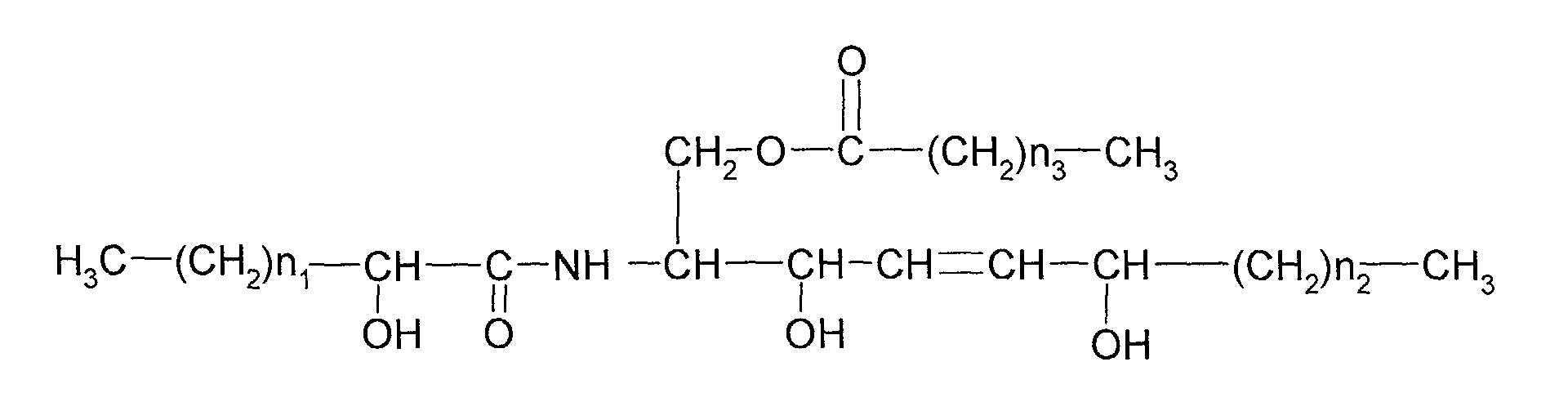
- These new ceramides consist of an amidated 6-OH-sphingenine base by an alpha-hydroxy fatty acid with long chain and esterified in position 1 by a second saturated fatty acid shorter chain.
- the ceramides of the present invention can enhance the lipid barrier of the epidermis and / or restore or maintain the integrity of the stratum corneum. They can therefore be used to improve the surface appearance and hydration of the skin, as well as to protect it, including protecting dry and rough skin. They can also be used as essential nutrition agents for keratinous substances (skin, hair, eyelash, nail). Furthermore, the compositions comprising these compounds may be advantageously used to improve and / or maintain the lipid content of the human epidermis, in vivo and in vitro.
- the compounds which are the subject of the invention can be isolated from samples lipids produced by non-invasive methods on volunteers healthy. These lipid samples are then subjected to a preparative treatment and analytics to separate and identify ceramidic families.
- Another potential source of the compounds of the invention is the use of enzymes such as trans-acylases acting on precursors or modulators of these enzymes.
- the precursors are in particular compounds of formula (II): in which n 1 is between 17 and 35, preferably between 21 and 30, preferentially between 23 and 28, preferably equal to 25, 26 or 27, n 2 is between 9 and 18, preferably between 11 and 15, preferably between 11 and 13, more preferably equal to 11.
- n 1 is between 17 and 35, preferably between 21 and 30, preferentially between 23 and 28, preferably equal to 25, 26 or 27, n 2 is between 9 and 18, preferably between 11 and 15, preferably between 11 and 13, more preferably equal to 11.
- All these precursors possessing a free OH may also be used to be attached to proteins of the envelope via an ester function, thereby reinforcing the lipid primer layer of the corneocytes of the skin or its appendages.
- An object of the present invention is a composition comprising, in a physiologically acceptable medium, at least one ceramide according to the invention.
- This composition is advantageously a cosmetic or pharmaceutical composition, especially a dermatological composition comprising, in a cosmetically or pharmaceutically acceptable medium, at least one compound of formula (I) according to the invention.
- composition according to the invention comprises at least one compound of formula (I), alone or in a mixture, in an amount that may be between 0.005 and 20% by weight, preferably from 0.01 to 10% by weight, in particular from 0.05 to 5%, or even 0.1 to 1% by weight, relative to the total weight of the composition.
- physiologically acceptable medium in which the compounds according to the invention can be used as well as its constituents, their quantity, the dosage form of the composition and its method of preparation, may be chosen by the person skilled in the art on the basis of his general knowledge of depending on the type of composition sought.
- the composition may thus comprise an aqueous phase which may comprise water, a floral water such as cornflower water, mineral water such as VITTEL water, LUCAS water or LA ROCHE water. POSAY and / or thermal water.
- Said aqueous phase may also comprise alcohols such as C 1 -C 6 monoalcohols, among which mention may be made of ethanol, propanol, butanol, isopropanol or isobutanol; and / or polyols such as glycerol, butylene glycol, isoprene glycol, propylene glycol, polyethylene glycol.
- composition according to the invention when the composition according to the invention is in the form of an emulsion, it may optionally further comprise a surfactant, preferably in an amount of from 0.01 to 30% by weight relative to the total weight of the composition.
- a surfactant preferably in an amount of from 0.01 to 30% by weight relative to the total weight of the composition.
- the composition according to the invention may also comprise less a co-emulsifier that can be selected from sorbitan monostearate oxyethylenated, fatty alcohols such as stearyl alcohol or cetyl alcohol, or esters of fatty acids and polyols such as glyceryl stearate.
- the composition according to the invention may further comprise a particulate phase which may comprise pigments and / or nacres and / or fillers usually used in cosmetic compositions.
- the pigments may be present in a proportion of 0-20% by weight, relative to the total weight of the composition, and preferably in a proportion of 2-15%. They may be white or colored, inorganic and / or organic, of usual or nanometric size.
- organic pigments mention may be made of carbon black, and the lacquers commonly used to give the lips and the skin a make-up effect, which are calcium, barium, aluminum or zirconium salts, dyes acids such as halo-acid, azo or anthraquinone dyes.
- the nacres may be present in the composition in a proportion of 0-20% by weight, preferably at a high level of the order of 2-15% by weight.
- the fillers which may be present in the composition in a proportion of 0-20% by weight, relative to the total weight of the composition, preferably 2-10%, may be inorganic or synthetic, lamellar or non-lamellar. Mention may be made of talc, mica, silica, kaolin, nylon and polyethylene powders, Teflon, starch, boron nitride, microspheres such as Expancel (Nobel Industrie), polytrap ( Dow Corning) and silicone resin microbeads (Toshiba Tospearls, for example).
- composition may also comprise especially water-soluble dyes chosen from the usual dyes of the field in question, such as the disodium salt of a culvert, the disodium salt of alizarin green, the yellow of quinoline, the trisodium salt of amaranth, the disodium salt of tartrazine, the monosodium salt of rhodamine, the disodium salt of fuchsin, the xanthophyll.
- water-soluble dyes chosen from the usual dyes of the field in question, such as the disodium salt of a culvert, the disodium salt of alizarin green, the yellow of quinoline, the trisodium salt of amaranth, the disodium salt of tartrazine, the monosodium salt of rhodamine, the disodium salt of fuchsin, the xanthophyll.
- composition according to the invention may also comprise at least one other active product that can be selected from moisturizers or humectants as glycerin, sorbitol, pentaerythritol, pyrrolidone carboxylic acid and its salts; softeners; products for the treatment of skin conditions; the solar filters; germicides; conservatives; antioxidants; the agents browning agents such as dihydroxyacetone, erythrulose, glyceraldehyde, gamma-dialdehydes such as tartaric aldehyde, these compounds possibly being associated with dyes; especially sunscreens water-soluble or fat-soluble; antiperspirants, deodorants, astringents; cooling, tonic, healing, keratolytic and depilatory products; scented waters; plant tissue extracts, such as polysaccharides; antidandruff agents; antiseborrhoeic agents; oxidants such as bleaching agents such as hydrogen peroxide; reducers such as thi
- composition of the invention may furthermore comprise to help prevent or improve keratin materials, especially skin, and even better dry, rough and / or damaged skin, such as sphingenine, sphinganine or 4-OH-sphinganine; ceramides; glycoceramides; C14-30 fatty acids; triglycerides; sterols like cholesterol.
- keratin materials especially skin, and even better dry, rough and / or damaged skin
- sphingenine, sphinganine or 4-OH-sphinganine such as sphingenine, sphinganine or 4-OH-sphinganine; ceramides; glycoceramides; C14-30 fatty acids; triglycerides; sterols like cholesterol.
- the composition according to the invention may comprise adjuvants in the field under consideration, such as hydrophilic gelling agents or lipophilic, hydrophilic or lipophilic additives, especially cosmetic actives or hydrophilic or lipophilic pharmaceuticals, solvents, perfumes, propellants, odor absorbers.
- adjuvants in the field under consideration, such as hydrophilic gelling agents or lipophilic, hydrophilic or lipophilic additives, especially cosmetic actives or hydrophilic or lipophilic pharmaceuticals, solvents, perfumes, propellants, odor absorbers.
- the nature and quantity of these adjuvants may be chosen by those skilled in the art, on the basis of their knowledge general, so as to obtain the desired presentation form for the composition. In any case, the person skilled in the art will take care to choose all the possible additional compounds and / or their quantity, in such a way that the advantageous properties of the composition according to the invention are not not, or not substantially, impaired by the proposed addition.
- compositions according to the invention may thus be in the form of emulsions, hydroalcoholic, oily or oleo-alcoholic lotions, gels, dispersions or solid rods, sprays or aerosol foams.
- the composition may have the form in particular of aqueous or oily solution; dispersion of the lotion or serum type; emulsions of liquid or semi-liquid consistency of the milk type obtained by dispersion of a fatty phase in an aqueous phase (O / W) or conversely (W / O); suspensions or emulsions of soft consistency of the cream or gel type aqueous or anhydrous; microcapsules or microparticles; vesicular dispersions of ionic and / or nonionic type.
- the composition may be in the form of aqueous, alcoholic or aqueous-alcoholic solutions; in the form of creams, gels, emulsions, foams; in the form of aerosol compositions also comprising a propellant under pressure.
- compositions are, for example, lotions, milks or emollient creams, milks or creams for the care of the skin or hair, creams, lotions or make-up removers, foundation bases, lotions, sun protection milks or creams, lotions, artificial tanning milks or creams, shaving creams or foams, aftershave lotions, shampoos or mascaras.
- These compositions may also be in the form of sticks for the lips intended either to color or avoid chapped skin, or eye makeup products or makeup and foundation for the face.
- compositions according to the invention find a preferred application as 10.
- composition for the care of keratin materials in particular the skin, nails, eyelashes, hair, and especially dry and / or rough skin and / or damaged, and particularly as a skin care composition of the moisturizing type, and as a sunscreen composition or after Sun.
- the present invention also relates to the use of the compounds of formula (I) for reinforcing the barrier function of the skin and for strengthening the nails and hair. More specifically, the subject of the invention is the use of at least one compound of formula (I) or a composition comprising it, for the preparation of a composition, in particular a cosmetic or pharmaceutical composition, intended to reinforce the lipid barrier of the epidermis, in particular of dry and / or rough and / or damaged skin, and / or to restore or maintain the integrity of the stratum corneum and / or to improve the surface appearance and / or hydration of the skin.
- skin and / or to protect the skin, especially dry and rough skin, and / or as an essential nutrition agent for keratinous substances (skin, hair, eyelash, nail) and / or to improve and / or maintain the lipid content of the human epidermis, in vivo and in vitro, and / or the treatment of dermatological conditions resulting in an imbalance of barrier function or epidermal homeostasis.
- keratinous substances skin, hair, eyelash, nail
- the present invention also relates to the use of at least one compound of formula (I) or a composition comprising it, for the treatment of affections dermatological conditions resulting in an imbalance of the barrier function or epidermal homeostasis.
- Another subject of the invention consists of a treatment method cosmetics of the skin, hair, eyelashes or nails consisting in applying on them a sufficient quantity of a composition comprising at least less a ceramide according to the invention.
- the samples are taken from a cohort of 22 women (healthy volunteers) with a mean age of 33.8 years +/- 8.8 and a skin qualified as normal by clinicians.
- the samples are taken on the forearm using a turbine after cleaning the skin with a cotton soaked in ether to remove traces of sebum.
- the extraction chamber of the turbine filled with 10 ml of hexane / ethanol mixture (2/3) is applied on a surface of 12.56 cm 2 .
- the mixture is stirred for 1 minute and then collected with a glass syringe and stored in a glass container at -20 ° C. Three samples are thus made on the forearm of each person.
- the samples are then combined, evaporated to dryness using a rotary evaporator, taken up in 1 ml of chloroform / methanol (2/1) and stored at -20 ° C.
- the solids content corresponding to all these samples is 36.4 mg and represents an extracted area of 829 cm 2 .
- ceramides are separated from other lipid categories by depositing the previously obtained lipid sample on a cartridge of normal phase silica (silica gel 60). After removal of neutral lipids per 10 ml of chloroform containing 1% acetic acid, the ceramides are eluted with 10 ml of chloroform / methanol (95/5). Ceramides are then stored in 1 ml of chloroform at -20 ° C.
- the various ceramides are separated by thin layer chromatography under the following conditions: 1.7 mg of the mixture of ceramides obtained at the end of the first step are deposited on a 20x20 cm Whatman LK5 silica plate and two successive elutions are made with chloroform / methanol / acetic acid in the ratios. 5/1 for the first elution and 190/9/1 for the second elution.
- the classes of ceramides are marked in ultraviolet (at 254 nm) after vaporization on the plate of a 5 mg / 100 ml solution of primulin. This observation delimits 10 contiguous zones on the numbered silica plate from 1 to 10 going from the most eluted zone to the less eluted zone. Silica each of these areas is scraped, recovered and extracted several times with a mixture of chloroform / methanol (2/1). The organic phases are collected and washed with water and then evaporated to dryness to obtain the compounds pure ceramics. Some of these ceramides are then put back into solution in chloroform / methanol (2/1) for analytical identification.
- ceramides of the invention are recovered in the No. 1 spot of the silica plate, such that n 1 is between 17 and 35, n 2 is between 9 and 18, and n 3 is between 12 and 18.
- the sample for analysis is divided into two fractions.
- a derivation of the first ceramides fraction is carried out by means of chloride of benzoyl.
- the benzoyl derivatives thus obtained are separated by chromatography high performance liquid and injected into a spectrograph of column output mass by coupling HPLC-MS.
- the second fraction undergoes alkaline hydrolysis to release the sphingoid bases contained in the ceramides.
- the released bases are derived with orthophthalaldehyde before being separated into HPLC with fluorescence detection.
- the set of analytical results thus obtained makes it possible to assign a precise molecular structure to each ceramide present in the sample.
- n 1 is between 25 and 27, n 2 is equal to 11, and n 3 is equal to 14.
Landscapes
- Health & Medical Sciences (AREA)
- Life Sciences & Earth Sciences (AREA)
- Animal Behavior & Ethology (AREA)
- Veterinary Medicine (AREA)
- Public Health (AREA)
- General Health & Medical Sciences (AREA)
- Dermatology (AREA)
- Organic Chemistry (AREA)
- Chemical & Material Sciences (AREA)
- Epidemiology (AREA)
- Birds (AREA)
- Molecular Biology (AREA)
- Biophysics (AREA)
- Cosmetics (AREA)
- Organic Low-Molecular-Weight Compounds And Preparation Thereof (AREA)
- Pharmaceuticals Containing Other Organic And Inorganic Compounds (AREA)
- Cephalosporin Compounds (AREA)
- Medicines Containing Material From Animals Or Micro-Organisms (AREA)
Abstract
Description
Par ailleurs, les compositions comprenant ces composés peuvent être avantageusement employées pour améliorer et/ou maintenir, le contenu lipidique de l'épiderme humain, in vivo et in vitro.
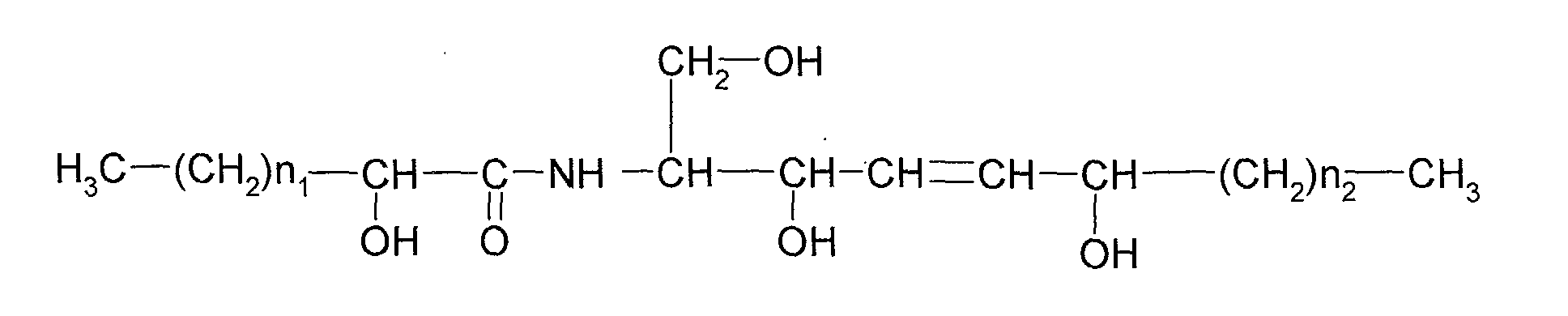
Ces précurseurs correspondent aux composés de l'invention non estérifiés en position 1.
Tous ces précurseurs possédant un OH libre pourront également être utilisés pour être accrochés sur des protéines de l'enveloppe via une fonction ester renforçant ainsi la couche d'apprêt lipidique des cornéocytes de la peau ou de ses annexes.
Cette composition est avantageusement une composition cosmétique ou pharmaceutique, notamment dermatologique, comprenant dans un milieu cosmétiquement ou pharmaceutiquement acceptable, au moins un composé de formule (I) selon l'invention.
Ladite phase aqueuse peut comprendre en outre des alcools tels que des monoalcools en C1-C6, parmi lesquels on peut citer l'éthanol, le propanol, le butanol, l'isopropanol, l'isobutanol; et/ou des polyols tels que le glycérol, le butylèneglycol, l'isoprène glycol, le propylèneglycol, le polyéthylèneglycol.
Les huiles volatiles sont généralement des huiles ayant, à 25°C, une tension de vapeur saturante au moins égale à 0,5 millibar (soit 50 Pa).
Parmi les constituants de la phase grasse, on peut citer :
- les silicones volatiles cycliques ayant de 3 à 8 atomes de silicium et de préférence de 4 à 6. Il s'agit par exemple de la cyclotétradiméthylsiloxane, de la cyclopentadiméthylsiloxane ou de la cyclohexadiméthylsiloxane,
- les cyclocopolymères du type diméthylsiloxane/méthylalkylsiloxane,
- les silicones volatiles linéaires ayant de 2 à 9 atomes de silicium. Il s'agit par exemple de l'hexaméthyldisiloxane ou un PDMS de faible viscosité (1 cSt). On peut encore citer l'hexaméthyldisiloxane et les alkyltrisiloxanes tels que l'hexylheptaméthyltrisiloxane ou l'octylheptaméthyltrisiloxane.
- les huiles volatiles hydrocarbonées, telles que les isoparaffines et notamment l'isododécane;
- les polyalkyl(C1-C20) siloxanes et notamment ceux à groupements terminaux triméthylsilyle, parmi lesquels on peut citer les polydiméthylsiloxanes linéaires et les alkylméthylpolysiloxanes tels que la cétyldiméthicone (nom CTFA),
- les silicones modifiées par des groupements aliphatiques et/ou aromatiques, éventuellement fluorés, ou par des groupements fonctionnels tels que des groupements hydroxyles, thiols et/ou amines.
- les huiles de silicone phénylées,
- les huiles d'origine animale, végétale ou minérale, et notamment les huiles animales ou végétales formées par des esters d'acide gras et de polyols, en particulier les triglycérides liquides, par exemple les huiles de tournesol, de maïs, de soja, de courge, de pépins de raisin, de sésame, de noisette, d'abricot, d'amandes ou d'avocat; les huiles de poisson, le tricaprocaprylate de glycérol, ou les huiles végétales ou animales de formule R1COOR2 dans laquelle R1 représente le reste d'un acide gras supérieur comportant de 7 à 19 atomes de carbone et R2 représente une chaíne hydrocarbonée ramifiée contenant de 3 à 20 atomes de carbone, par exemple, l'huile de Purcellin; l'huile de paraffine, de vaseline, le perhydrosqualène, l'huile de germes de blé, de calophyllum, de sésame, de macadamia, de pépins de raisin, de colza, de coprah, d'arachide, de palme, de ricin, de jojoba, d'olive ou de germes de céréales; des esters d'acides gras; des alcools; des acétylglycérides; des octanoates, décanoates ou ricinoléates d'alcools ou de polyalcools; des triglycérides d'acides gras; des glycérides;
- les huiles fluorées et perfluorées.
- les gommes de silicones;
- les cires d'origine animale, végétale, minérale ou synthétique telles que les cires microcristallines, la paraffine, le pétrolatum, la vaseline, l'ozokérite, la cire de montan; la cire d'abeilles, la lanoline et ses dérivés; les cires de Candellila, d'Ouricury, de Carnauba, du Japon, le beurre de cacao, les cires de fibres de lièges ou de canne à sucre; les huiles hydrogénées concrètes à 25°C, les ozokérites, les esters gras et les glycérides concrets à 25°C; les cires de polyéthylène et les cires obtenues par synthèse de Fischer-Tropsch; des huiles hydrogénées concrètes à 25°C; des lanolines; des esters gras concrets à 25°C; les cires de silicone; les cires fluorées.
Les pigments peuvent être présents à raison de 0-20 % en poids, par rapport au poids total de la composition, et de préférence à raison de 2-15 %. Ils peuvent être blancs ou colorés, minéraux et/ou organiques, de taille usuelle ou nanométrique. On peut citer, parmi les pigments et les nanopigments minéraux, les dioxydes de titane, de zirconium ou de cérium, ainsi que les oxydes de zinc, de fer ou de chrome, les nanotitanes, le bleu ferrique. Parmi les pigments organiques, on peut citer le noir de carbone, et les laques couramment employées pour conférer aux lèvres et à la peau un effet de maquillage, qui sont des sels de calcium, de baryum, d'aluminium ou de zirconium, de colorants acides tels que les colorants halogéno-acides, azoïques ou anthraquinoniques.
Les nacres peuvent être présentes dans la composition à raison de 0-20% en poids, de préférence à un taux élevé de l'ordre de 2-15% en poids. Parmi les nacres envisageables, on peut citer la nacre naturelle, le mica recouvert d'oxyde de titane, d'oxyde de fer, de pigment naturel ou d'oxychlorure de bismuth ainsi que le mica titane coloré.
Les charges, qui peuvent être présentes dans la composition à raison de 0-20 % en poids, par rapport au poids total de la composition, de préférence 2-10%, peuvent être minérales ou de synthèse, lamellaires ou non lamellaires. On peut citer le talc, le mica, la silice, le kaolin, les poudres de Nylon et de polyéthylène, le Téflon, l'amidon, le nitrure de bore, les microsphères telles que l'Expancel (Nobel Industrie), le polytrap (Dow Corning) et les microbilles de résine de silicone (Tospearls de Toshiba, par exemple).
La composition peut également comprendre des colorants notamment hydrosolubles choisis parmi les colorants usuels du domaine considéré tels que le sel disodique de ponceau, le sel disodique du vert d'alizarine, le jaune de quinoléine, le sel trisodique d'amarante, le sel disodique de tartrazine, le sel monosodique de rhodamine, le sel disodique de fuchsine, la xanthophylle.
Pour une application sur les cheveux, la composition peut être sous forme de solutions aqueuses, alcooliques ou hydroalcooliques; sous forme de crèmes, de gels, d'émulsions, de mousses; sous forme de compositions pour aérosol comprenant également un agent propulseur sous pression.
Ces compositions peuvent également se présenter sous la forme de bâtons pour les lèvres destinés soit à les colorer, soit à éviter les gerçures, ou de produits de maquillage pour les yeux ou de fards et fonds de teint pour le visage.
- d'un produit de soin, de traitement ou de protection, des matières kératiniques, et notamment de la peau du visage ou du corps y compris le cuir chevelu, tel qu'une composition de soin (de jour, de nuit, hydratante) du visage ou du corps; une composition anti-rides ou anti-age pour le visage; une composition matifiante pour le visage; une composition pour les peaux irritées; une composition démaquillante; un lait pour le corps, notamment hydratant éventuellement après-soleil;
- d'une composition de protection solaire, de bronzage artificiel (autobronzant) ou de soin après-soleil;
- d'une composition capillaire, et notamment une crème ou un gel protecteur solaire; une composition de soin du cuir chevelu, notamment anti-chute ou repousse des cheveux; un shampooing antiparasitaire;
- d'un produit de maquillage des matières kératiniques tel qu'un fond de teint, une crème teintée, un fard à joues ou à paupières, une poudre libre ou compacte, un stick anti-cernes, un stick camouflant, un rouge à lèvres, un soin des lèvres; un vernis à ongles, un soin des ongles, un mascara, un mascara traitant, un eye-liner.
Plus précisément, l'invention a pour objet l'utilisation d'au moins un composé de formule (I) ou d'une composition le comprenant, pour la préparation d'une composition, notamment cosmétique ou pharmaceutique, destinée à renforcer la barrière lipidique de l'épiderme, notamment de la peau sèche et/ou rugueuse et/ou abímée, et/ou à rétablir ou maintenir l'intégrité du stratum corneum et/ou à améliorer l'aspect de surface et/ou l'hydratation de la peau, et/ou à protéger la peau, notamment les peaux sèches et rugueuses, et/ou comme agent de nutrition essentiel pour les matières kératiniques (peau, cheveu, cil, ongle) et/ou à améliorer et/ou maintenir le contenu lipidique de l'épiderme humain, in vivo et in vitro, et/ou au traitement des affections dermatologiques se traduisant par un déséquilibre de la fonction barrière ou de l'homéostasie épidermique.
Trois prélèvements sont ainsi réalisés sur l'avant bras de chaque personne. Les échantillons sont ensuite rassemblés, évaporés à sec à l'aide d'un évaporateur rotatif, repris dans 1 ml de chloroforme /méthanol (2/1) et conservé à -20 °C. L'extrait sec correspondant à l'ensemble de ces prélèvements est de 36,4 mg et représente une surface extraite de 829 cm2.
On dépose 1,7 mg du mélange de céramides obtenues à l'issue de la première étape sur une plaque de silice Whatman LK5 de 20x20 cm et on procède à 2 élutions successives avec un mélange chloroforme /méthanol /acide acétique dans les rapports 190/5/1 pour la première élution et 190/9/1 pour la seconde élution.
L'ensemble des résultats analytiques ainsi obtenu permet d'attribuer une structure moléculaire précise à chaque céramide présent dans l'échantillon.
- Stéarate de glycérol 2 %
- Monostéarate de sorbitan 1 %
- gélifiant (Carbopol 940 ® vendu par Goodrich) 0,4 %
- fraction liquide de graisse de karité 24 %
- Fraction A de céramides de l'exemple 1 0,2 %
- Alcool cétylique 0,5 %
- Alcool stéarique 1,4 %
- triéthanolamine 0,7 %
- antioxydants qs
- parfum qs
- Conservateurs qs
- Eau qsp 100%
- Huile de ricin 25 %
- lanoline 20 %
- cires 15 %
- Fraction A de céramides de l'exemple 1 20 %
- pigments 8 %
- huile de vaseline qsp 100%
- décaméthylcyclopentasiloxane 25 g
- Fraction A de céramides de l'exemple 1 0,1 g
- Mélange d'un polydiméthylsiloxane hydroxylé en bout de chaíne et de cyclométhicone (Q2-1401 de DOW CORNING) 65 g
- benzoate d'alcools gras en C12-C15 (FINSOLV TN) 4,95 g
Claims (14)
- Composé de formule (I) suivante :dans laquelle n1 est compris entre 17 et 35, n2 est compris entre 9 et 18, et n3 est compris entre 12 et 18.

- Composé selon la revendication 1, caractérisé par le fait que n1 est compris entre 21 et 30, préférentiellement entre 23 et 28, de préférence encore est égal à 25, 26 ou 27.
- Composé selon l'une des revendications précédentes, caractérisé par le fait que n2 est compris entre 11 et 15, préférentiellement entre 11 et 13, de préférence encore égal à 11.
- Composé selon l'une des revendications précédentes, caractérisé par le fait que n3 est compris entre 14 et 16, de préférence égal à 14.
- Composition comprenant, dans un milieu physiologiquement acceptable, au moins un composé selon l'une des revendications 1 à 4.
- Composition selon la revendication 5, se présentant sous la forme d'une composition cosmétique ou pharmaceutique, comprenant un milieu cosmétiquement ou pharmaceutiquement acceptable.
- Composition selon l'une des revendications 5 à 6, dans laquelle le composé de formule (I) est présent en une quantité de 0,005 à 20% en poids, de préférence de 0,01 à 10% en poids, notamment 0,05 à 5%, voire 0,1 à 1% en poids, par rapport au poids total de la composition.
- Composition selon l'une des revendications 5 à 7, comprenant au moins un constituant choisi parmi l'eau, les monoalcools en C1-C6, les polyols, les huiles d'origine animale, végétale, minérale ou synthétique, volatiles ou non; les cires d'origine animale, végétale, minérale ou synthétique; les corps gras pâteux; les gommes; les tensioactifs, les co-émulsionnants, les pigments, les nacres, les charges, les colorants, les gélifiants hydrophiles ou lipophiles, les additifs hydrophiles ou lipophiles, les actifs notamment cosmétiques ou pharmaceutiques hydrophiles ou lipophiles, les solvants, les parfums, les propulseurs, les absorbeurs d'odeur; les hydratants ou les humectants; les adoucissants; les produits pour le traitement d'affections cutanées; les filtres solaires; les germicides; les conservateurs; les antioxydants; les agents de brunissage artificiel; les filtres solaires notamment hydrosolubles ou liposolubles; les antiperspirants, les déodorants, les astringents; les produits rafraíchissants, toniques, cicatrisants, kératolytiques, dépilatoires; les eaux parfumées; les extraits de tissus végétaux; les agents antipelliculaires; les agents antiséborrhéiques; les oxydants tels que des agents de décoloration; les réducteurs; les substances destinées à améliorer l'état des peaux sèches ou séniles, les tocophérols, les vitamines E, F ou A et leurs esters, l'acide rétinoïque, les acides gras essentiels, l'acide glycyrrhétinique, les kératolytiques et les caroténoïdes; des actifs pouvant aider à prévenir ou à améliorer les matières kératiniques, tels que la sphingénine, la sphinganine ou la 4-OH-sphinganine; les céramides; les glycocéramides; les acides gras en C14-30; les triglycérides; les stérols comme le cholestérol.
- Composition selon l'une des revendications 5 à 8, se présentant sous la formed'un produit de soin, de traitement ou de protection, des matières kératiniques, et notamment de la peau du visage ou du corps y compris le cuir chevelu, tel qu'une composition de soin (de jour, de nuit, hydratante) du visage ou du corps; une composition anti-rides ou anti-age pour le visage; une composition matifiante pour le visage; une composition pour les peaux irritées; une composition démaquillante; un lait pour le corps, notamment hydratant éventuellement après-soleil;d'une composition de protection solaire, de bronzage artificiel (autobronzant) ou de soin après-soleil;d'une composition capillaire, et notamment une crème ou un gel protecteur solaire; une composition de soin du cuir chevelu, notamment anti-chute ou repousse des cheveux; un shampooing antiparasitaire;d'un produit de maquillage des matières kératiniques tel qu'un fond de teint, une crème teintée, un fard à joues ou à paupières, une poudre libre ou compacte, un stick anti-cernes, un stick camouflant, un rouge à lèvres, un soin des lèvres; un vernis à ongles, un soin des ongles, un mascara, un mascara traitant, un eye-liner.
- Composition selon l'une des revendications 5 à 9, se présentant sous la forme d'une composition pour le soin des matières kératiniques, notamment de la peau, des ongles, des cils, des cheveux, et en particulier de la peau sèche et/ou rugueuse et/ou abímée.
- Utilisation cosmétique d'au moins un composé de formule (I) tel que défini dans l'une des revendications 1 à 4,pour renforcer la fonction barrière de la peau, notamment de la peau sèche et/ou rugueuse et/ou abímée, et/oupour renforcer les ongles et/ou les cheveux, et/oupour rétablir et/ou maintenir l'intégrité du stratum corneum, et/oupour améliorer l'aspect de surface et/ou l'hydratation de la peau,pour protéger la peau, notamment les peaux sèches et rugueuses, et/oucomme agent de nutrition essentiel pour les matières kératiniques (peau, cheveu, cil, ongle), et/oupour améliorer et/ou maintenir le contenu lipidique de l'épiderme humain, in vivo et in vitro.
- Utilisation d'au moins un composé de formule (I) tel que défini dans l'une des revendications 1 à 4, dans une composition cosmétique destinée àrenforcer la fonction barrière de la peau, notamment de la peau sèche et/ou rugueuse et/ou abímée, et/ourenforcer les ongles et/ou les cheveux, et/ourétablir et/ou maintenir l'intégrité du stratum corneum, et/ouaméliorer l'aspect de surface et/ou 'hydratation de la peau,protéger la peau, notamment les peaux sèches et rugueuses, et/ouaméliorer et/ou maintenir le contenu lipidique de l'épiderme humain, in vivo et in vitro.
- Utilisation d'au moins un composé de formule (I) tel que défini dans l'une des revendications 1 à 4, pour la préparation d'une composition pharmaceutique destinée àrenforcer la fonction barrière de la peau, notamment de la peau sèche et/ou rugueuse et/ou abímée, et/ourenforcer les ongles et/ou les cheveux, et/ourétablir et/ou maintenir l'intégrité du stratum corneum, et/ouaméliorer l'aspect de surface et/ou l'hydratation de la peau,protéger la peau, notamment les peaux sèches et rugueuses, et/ouaméliorer et/ou maintenir le contenu lipidique de l'épiderme humain, in vivo et in vitro, et/outraiter les affections dermatologiques se traduisant par un déséquilibre de la fonction barrière ou de l'homéostasie épidermique.
- Procédé de traitement cosmétique de la peau, des cheveux, des cils ou des ongles, caractérisé par le fait qu'il consiste à appliquer sur la peau, les cheveux, les ongles ou les cils une quantité suffisante d'une composition cosmétique selon l'une quelconque des revendications 6 à 10.
Applications Claiming Priority (2)
| Application Number | Priority Date | Filing Date | Title |
|---|---|---|---|
| FR0200760A FR2834986B1 (fr) | 2002-01-22 | 2002-01-22 | Nouveaux ceramides, compositions les contenant et leur utilisation cosmetique ou dermatologique |
| FR0200760 | 2002-01-22 |
Publications (3)
| Publication Number | Publication Date |
|---|---|
| EP1329447A2 true EP1329447A2 (fr) | 2003-07-23 |
| EP1329447A3 EP1329447A3 (fr) | 2004-01-02 |
| EP1329447B1 EP1329447B1 (fr) | 2008-02-27 |
Family
ID=8871374
Family Applications (1)
| Application Number | Title | Priority Date | Filing Date |
|---|---|---|---|
| EP02293040A Expired - Lifetime EP1329447B1 (fr) | 2002-01-22 | 2002-12-09 | Céramides, composition les comprenant et utilisations |
Country Status (7)
| Country | Link |
|---|---|
| EP (1) | EP1329447B1 (fr) |
| JP (1) | JP3985901B2 (fr) |
| AT (1) | ATE387422T1 (fr) |
| CA (1) | CA2414431A1 (fr) |
| DE (1) | DE60225239T2 (fr) |
| ES (1) | ES2301614T3 (fr) |
| FR (1) | FR2834986B1 (fr) |
Cited By (2)
| Publication number | Priority date | Publication date | Assignee | Title |
|---|---|---|---|---|
| WO2007006536A1 (fr) * | 2005-07-08 | 2007-01-18 | Schwan-Stabilo Cosmetics Gmbh & Co. Kg | Preparation cosmetique anhydre |
| WO2012004227A1 (fr) * | 2010-07-06 | 2012-01-12 | Unilever Plc | Malvidine pour favoriser la pousse de cheveux |
Families Citing this family (4)
| Publication number | Priority date | Publication date | Assignee | Title |
|---|---|---|---|---|
| DE602005025227D1 (de) * | 2004-08-16 | 2011-01-20 | Union Carbide Chem Plastic | Körperpflegezusammensetzung |
| JP5690074B2 (ja) * | 2010-03-23 | 2015-03-25 | 日本精化株式会社 | セラミド誘導体を含有する化粧料 |
| KR102644587B1 (ko) * | 2015-12-24 | 2024-03-07 | (주)아모레퍼시픽 | 유사 세라마이드 화합물 및 그 제조방법 |
| EP3546589B1 (fr) * | 2018-03-29 | 2022-08-10 | Evonik Operations GmbH | Procédé de production de sphingolipides |
Family Cites Families (1)
| Publication number | Priority date | Publication date | Assignee | Title |
|---|---|---|---|---|
| FR2732680B1 (fr) * | 1995-04-05 | 1997-05-09 | Oreal | Composes de type ceramides, leur procede de preparation et leur utilisation |
-
2002
- 2002-01-22 FR FR0200760A patent/FR2834986B1/fr not_active Expired - Fee Related
- 2002-12-09 ES ES02293040T patent/ES2301614T3/es not_active Expired - Lifetime
- 2002-12-09 AT AT02293040T patent/ATE387422T1/de not_active IP Right Cessation
- 2002-12-09 EP EP02293040A patent/EP1329447B1/fr not_active Expired - Lifetime
- 2002-12-09 DE DE60225239T patent/DE60225239T2/de not_active Expired - Lifetime
- 2002-12-12 CA CA002414431A patent/CA2414431A1/fr not_active Abandoned
-
2003
- 2003-01-22 JP JP2003013650A patent/JP3985901B2/ja not_active Expired - Fee Related
Cited By (2)
| Publication number | Priority date | Publication date | Assignee | Title |
|---|---|---|---|---|
| WO2007006536A1 (fr) * | 2005-07-08 | 2007-01-18 | Schwan-Stabilo Cosmetics Gmbh & Co. Kg | Preparation cosmetique anhydre |
| WO2012004227A1 (fr) * | 2010-07-06 | 2012-01-12 | Unilever Plc | Malvidine pour favoriser la pousse de cheveux |
Also Published As
| Publication number | Publication date |
|---|---|
| JP3985901B2 (ja) | 2007-10-03 |
| ES2301614T3 (es) | 2008-07-01 |
| DE60225239T2 (de) | 2009-04-30 |
| ATE387422T1 (de) | 2008-03-15 |
| FR2834986A1 (fr) | 2003-07-25 |
| DE60225239D1 (de) | 2008-04-10 |
| EP1329447B1 (fr) | 2008-02-27 |
| CA2414431A1 (fr) | 2003-07-22 |
| FR2834986B1 (fr) | 2004-02-20 |
| JP2003238508A (ja) | 2003-08-27 |
| EP1329447A3 (fr) | 2004-01-02 |
Similar Documents
| Publication | Publication Date | Title |
|---|---|---|
| EP1292608B1 (fr) | Nouveaux composes de la famille des n-acylamino-amides, compositions les comprenant, et utilisations | |
| EP0647617B1 (fr) | Céramides, leur procédé de préparation et leurs applications en cosmétique | |
| CA2061692C (fr) | Ceramides, leur procede de preparation et leurs applications en cosmetique et en dermopharmacie | |
| US6846940B2 (en) | Ceramides, compositions thereof and methods of use thereof | |
| EP0736522B1 (fr) | Composés de type céramides, leur procédé de préparation et leur utilisation en cosmétique ou en dermatologie | |
| EP0709084B1 (fr) | Utilisation d'une huile riche en acide pétrosélinique comme agent hydratant | |
| EP1337234B1 (fr) | Utilisation de derives de l'acide 2-oxothiazolidine 4-carboxylique comme agents prodesquamants | |
| FR2854897A1 (fr) | Compositions cosmetiques ou dermopharmaceutiques pour reduire les signes du vieillissement cutane. | |
| FR2811552A1 (fr) | Composition notamment cosmetique ou pharmaceutique se presentant sous forme solide | |
| FR2718639A1 (fr) | Composition cosmétique et/ou dermatologique contenant un tri (alpha-hydroxyacylate) de glycerol comme seul précurseur de glycerol. | |
| EP1329447B1 (fr) | Céramides, composition les comprenant et utilisations | |
| FR2855049A1 (fr) | Composition comprenant un precurseur de ceramide a base 6-hydroxy-sphingenine et un activeur de la voie des 6-hydroxylases, utilisation pour renforcer la fonction barriere de la peau | |
| FR2780286A1 (fr) | Nouveaux anticorps, compositions a application topique contenant ces anticorps et utilisation de tels anticorps dans ou pour la fabrication de compositions a application topique | |
| CA2374154C (fr) | Utilisations de derives de polyaminoacide comme agent hydratant, et compositions cosmetique ou pharmaceutique les comprenant | |
| FR2855048A1 (fr) | Composition comprenant un precurseur de ceramide a base phytosphingosine et un activeur de la voie des 4-hydroxylases, utilisation pour renforcer la fonction barriere de la peau | |
| FR2811556A1 (fr) | Composition comprenant un precurseur de ceramides, utilisation pour ameliorer l'epiderme naturel ou reconstruit , equivalent de peau obtenu | |
| RU2727514C2 (ru) | Новые соединения группы n-ациламиноамидов, содержащие их композиции и применения | |
| FR2855047A1 (fr) | Composition comprenant une base sphingoide, un activateur de la voie des 4-et/ou des 6-hydroxylases et un acide gras, utilisation pour renforcer la fonction barriere de la peau | |
| FR2834985A1 (fr) | Nouveaux ceramides, compositions les contenant et leur utilisation cosmetique ou dermatologique | |
| FR2874610A1 (fr) | Nouveaux ceramides, leur preparation, leur utilisation pour former des dispersions de spherules, compositions les comprenant, et procede de traitement | |
| FR2843589A1 (fr) | 6-hydroxy-4-sphingenine de haute purete, procede de preparation et utilisation pour ameliorer l'epiderme | |
| FR2915375A1 (fr) | Composition cosmetique solide | |
| FR2816616A1 (fr) | Composes amphiphiles anioniques a cation aminoguanidium, compositions les comprenant et utilisation |
Legal Events
| Date | Code | Title | Description |
|---|---|---|---|
| PUAI | Public reference made under article 153(3) epc to a published international application that has entered the european phase |
Free format text: ORIGINAL CODE: 0009012 |
|
| AK | Designated contracting states |
Designated state(s): AT BE BG CH CY CZ DE DK EE ES FI FR GB GR IE IT LI LU MC NL PT SE SI SK TR |
|
| AX | Request for extension of the european patent |
Extension state: AL LT LV MK RO |
|
| PUAL | Search report despatched |
Free format text: ORIGINAL CODE: 0009013 |
|
| AK | Designated contracting states |
Kind code of ref document: A3 Designated state(s): AT BE BG CH CY CZ DE DK EE ES FI FR GB GR IE IT LI LU MC NL PT SE SI SK TR |
|
| AX | Request for extension of the european patent |
Extension state: AL LT LV MK RO |
|
| RIC1 | Information provided on ipc code assigned before grant |
Ipc: 7A 61K 7/027 B Ipc: 7C 07C 235/08 A Ipc: 7A 61K 7/48 B Ipc: 7A 61K 7/06 B |
|
| 17P | Request for examination filed |
Effective date: 20040702 |
|
| AKX | Designation fees paid |
Designated state(s): AT BE BG CH CY CZ DE DK EE ES FI FR GB GR IE IT LI LU MC NL PT SE SI SK TR |
|
| GRAP | Despatch of communication of intention to grant a patent |
Free format text: ORIGINAL CODE: EPIDOSNIGR1 |
|
| RIC1 | Information provided on ipc code assigned before grant |
Ipc: A61Q 99/00 20060101ALI20070927BHEP Ipc: C07C 235/08 20060101AFI20070927BHEP Ipc: A61Q 5/12 20060101ALI20070927BHEP Ipc: A61K 8/42 20060101ALI20070927BHEP |
|
| GRAS | Grant fee paid |
Free format text: ORIGINAL CODE: EPIDOSNIGR3 |
|
| GRAA | (expected) grant |
Free format text: ORIGINAL CODE: 0009210 |
|
| AK | Designated contracting states |
Kind code of ref document: B1 Designated state(s): AT BE BG CH CY CZ DE DK EE ES FI FR GB GR IE IT LI LU MC NL PT SE SI SK TR |
|
| REG | Reference to a national code |
Ref country code: GB Ref legal event code: FG4D Free format text: NOT ENGLISH |
|
| REG | Reference to a national code |
Ref country code: CH Ref legal event code: EP |
|
| REG | Reference to a national code |
Ref country code: IE Ref legal event code: FG4D Free format text: LANGUAGE OF EP DOCUMENT: FRENCH |
|
| REF | Corresponds to: |
Ref document number: 60225239 Country of ref document: DE Date of ref document: 20080410 Kind code of ref document: P |
|
| REG | Reference to a national code |
Ref country code: ES Ref legal event code: FG2A Ref document number: 2301614 Country of ref document: ES Kind code of ref document: T3 |
|
| PG25 | Lapsed in a contracting state [announced via postgrant information from national office to epo] |
Ref country code: FI Free format text: LAPSE BECAUSE OF FAILURE TO SUBMIT A TRANSLATION OF THE DESCRIPTION OR TO PAY THE FEE WITHIN THE PRESCRIBED TIME-LIMIT Effective date: 20080227 |
|
| NLV1 | Nl: lapsed or annulled due to failure to fulfill the requirements of art. 29p and 29m of the patents act | ||
| PG25 | Lapsed in a contracting state [announced via postgrant information from national office to epo] |
Ref country code: AT Free format text: LAPSE BECAUSE OF FAILURE TO SUBMIT A TRANSLATION OF THE DESCRIPTION OR TO PAY THE FEE WITHIN THE PRESCRIBED TIME-LIMIT Effective date: 20080227 |
|
| PG25 | Lapsed in a contracting state [announced via postgrant information from national office to epo] |
Ref country code: SI Free format text: LAPSE BECAUSE OF FAILURE TO SUBMIT A TRANSLATION OF THE DESCRIPTION OR TO PAY THE FEE WITHIN THE PRESCRIBED TIME-LIMIT Effective date: 20080227 |
|
| REG | Reference to a national code |
Ref country code: IE Ref legal event code: FD4D |
|
| PG25 | Lapsed in a contracting state [announced via postgrant information from national office to epo] |
Ref country code: CZ Free format text: LAPSE BECAUSE OF FAILURE TO SUBMIT A TRANSLATION OF THE DESCRIPTION OR TO PAY THE FEE WITHIN THE PRESCRIBED TIME-LIMIT Effective date: 20080227 Ref country code: NL Free format text: LAPSE BECAUSE OF FAILURE TO SUBMIT A TRANSLATION OF THE DESCRIPTION OR TO PAY THE FEE WITHIN THE PRESCRIBED TIME-LIMIT Effective date: 20080227 Ref country code: SK Free format text: LAPSE BECAUSE OF FAILURE TO SUBMIT A TRANSLATION OF THE DESCRIPTION OR TO PAY THE FEE WITHIN THE PRESCRIBED TIME-LIMIT Effective date: 20080227 Ref country code: IE Free format text: LAPSE BECAUSE OF FAILURE TO SUBMIT A TRANSLATION OF THE DESCRIPTION OR TO PAY THE FEE WITHIN THE PRESCRIBED TIME-LIMIT Effective date: 20080227 Ref country code: DK Free format text: LAPSE BECAUSE OF FAILURE TO SUBMIT A TRANSLATION OF THE DESCRIPTION OR TO PAY THE FEE WITHIN THE PRESCRIBED TIME-LIMIT Effective date: 20080227 Ref country code: PT Free format text: LAPSE BECAUSE OF FAILURE TO SUBMIT A TRANSLATION OF THE DESCRIPTION OR TO PAY THE FEE WITHIN THE PRESCRIBED TIME-LIMIT Effective date: 20080721 Ref country code: SE Free format text: LAPSE BECAUSE OF FAILURE TO SUBMIT A TRANSLATION OF THE DESCRIPTION OR TO PAY THE FEE WITHIN THE PRESCRIBED TIME-LIMIT Effective date: 20080527 |
|
| PLBE | No opposition filed within time limit |
Free format text: ORIGINAL CODE: 0009261 |
|
| STAA | Information on the status of an ep patent application or granted ep patent |
Free format text: STATUS: NO OPPOSITION FILED WITHIN TIME LIMIT |
|
| 26N | No opposition filed |
Effective date: 20081128 |
|
| PG25 | Lapsed in a contracting state [announced via postgrant information from national office to epo] |
Ref country code: EE Free format text: LAPSE BECAUSE OF FAILURE TO SUBMIT A TRANSLATION OF THE DESCRIPTION OR TO PAY THE FEE WITHIN THE PRESCRIBED TIME-LIMIT Effective date: 20080227 Ref country code: BG Free format text: LAPSE BECAUSE OF FAILURE TO SUBMIT A TRANSLATION OF THE DESCRIPTION OR TO PAY THE FEE WITHIN THE PRESCRIBED TIME-LIMIT Effective date: 20080527 |
|
| BERE | Be: lapsed |
Owner name: L'OREAL Effective date: 20081231 |
|
| PG25 | Lapsed in a contracting state [announced via postgrant information from national office to epo] |
Ref country code: CY Free format text: LAPSE BECAUSE OF FAILURE TO SUBMIT A TRANSLATION OF THE DESCRIPTION OR TO PAY THE FEE WITHIN THE PRESCRIBED TIME-LIMIT Effective date: 20080227 Ref country code: MC Free format text: LAPSE BECAUSE OF NON-PAYMENT OF DUE FEES Effective date: 20081231 |
|
| REG | Reference to a national code |
Ref country code: CH Ref legal event code: PL |
|
| PG25 | Lapsed in a contracting state [announced via postgrant information from national office to epo] |
Ref country code: BE Free format text: LAPSE BECAUSE OF NON-PAYMENT OF DUE FEES Effective date: 20081231 |
|
| PG25 | Lapsed in a contracting state [announced via postgrant information from national office to epo] |
Ref country code: LI Free format text: LAPSE BECAUSE OF NON-PAYMENT OF DUE FEES Effective date: 20081231 Ref country code: CH Free format text: LAPSE BECAUSE OF NON-PAYMENT OF DUE FEES Effective date: 20081231 |
|
| PG25 | Lapsed in a contracting state [announced via postgrant information from national office to epo] |
Ref country code: LU Free format text: LAPSE BECAUSE OF NON-PAYMENT OF DUE FEES Effective date: 20081209 |
|
| PG25 | Lapsed in a contracting state [announced via postgrant information from national office to epo] |
Ref country code: TR Free format text: LAPSE BECAUSE OF FAILURE TO SUBMIT A TRANSLATION OF THE DESCRIPTION OR TO PAY THE FEE WITHIN THE PRESCRIBED TIME-LIMIT Effective date: 20080227 |
|
| PG25 | Lapsed in a contracting state [announced via postgrant information from national office to epo] |
Ref country code: GR Free format text: LAPSE BECAUSE OF FAILURE TO SUBMIT A TRANSLATION OF THE DESCRIPTION OR TO PAY THE FEE WITHIN THE PRESCRIBED TIME-LIMIT Effective date: 20080528 |
|
| REG | Reference to a national code |
Ref country code: FR Ref legal event code: PLFP Year of fee payment: 14 |
|
| REG | Reference to a national code |
Ref country code: FR Ref legal event code: PLFP Year of fee payment: 15 |
|
| REG | Reference to a national code |
Ref country code: FR Ref legal event code: PLFP Year of fee payment: 16 |
|
| PGFP | Annual fee paid to national office [announced via postgrant information from national office to epo] |
Ref country code: DE Payment date: 20171206 Year of fee payment: 16 Ref country code: FR Payment date: 20171113 Year of fee payment: 16 |
|
| PGFP | Annual fee paid to national office [announced via postgrant information from national office to epo] |
Ref country code: GB Payment date: 20171206 Year of fee payment: 16 |
|
| PGFP | Annual fee paid to national office [announced via postgrant information from national office to epo] |
Ref country code: ES Payment date: 20180102 Year of fee payment: 16 |
|
| PGFP | Annual fee paid to national office [announced via postgrant information from national office to epo] |
Ref country code: IT Payment date: 20171221 Year of fee payment: 16 |
|
| REG | Reference to a national code |
Ref country code: DE Ref legal event code: R119 Ref document number: 60225239 Country of ref document: DE |
|
| GBPC | Gb: european patent ceased through non-payment of renewal fee |
Effective date: 20181209 |
|
| PG25 | Lapsed in a contracting state [announced via postgrant information from national office to epo] |
Ref country code: IT Free format text: LAPSE BECAUSE OF NON-PAYMENT OF DUE FEES Effective date: 20181209 Ref country code: FR Free format text: LAPSE BECAUSE OF NON-PAYMENT OF DUE FEES Effective date: 20181231 Ref country code: DE Free format text: LAPSE BECAUSE OF NON-PAYMENT OF DUE FEES Effective date: 20190702 |
|
| PG25 | Lapsed in a contracting state [announced via postgrant information from national office to epo] |
Ref country code: GB Free format text: LAPSE BECAUSE OF NON-PAYMENT OF DUE FEES Effective date: 20181209 |
|
| REG | Reference to a national code |
Ref country code: ES Ref legal event code: FD2A Effective date: 20200131 |
|
| PG25 | Lapsed in a contracting state [announced via postgrant information from national office to epo] |
Ref country code: ES Free format text: LAPSE BECAUSE OF NON-PAYMENT OF DUE FEES Effective date: 20181210 |