EP1328131B1 - Verfahren und System zur Planung und/oder Einschätzung der Zellkapazität in CDMA Funknetzwerken - Google Patents
Verfahren und System zur Planung und/oder Einschätzung der Zellkapazität in CDMA Funknetzwerken Download PDFInfo
- Publication number
- EP1328131B1 EP1328131B1 EP02080692A EP02080692A EP1328131B1 EP 1328131 B1 EP1328131 B1 EP 1328131B1 EP 02080692 A EP02080692 A EP 02080692A EP 02080692 A EP02080692 A EP 02080692A EP 1328131 B1 EP1328131 B1 EP 1328131B1
- Authority
- EP
- European Patent Office
- Prior art keywords
- traffic
- cell
- representative value
- capacity
- added
- Prior art date
- Legal status (The legal status is an assumption and is not a legal conclusion. Google has not performed a legal analysis and makes no representation as to the accuracy of the status listed.)
- Expired - Lifetime
Links
- 238000000034 method Methods 0.000 title claims abstract description 43
- 238000011156 evaluation Methods 0.000 claims abstract description 36
- 230000000670 limiting effect Effects 0.000 claims abstract description 34
- 230000005540 biological transmission Effects 0.000 claims description 57
- 230000000694 effects Effects 0.000 claims description 25
- 238000004590 computer program Methods 0.000 claims description 10
- 238000004364 calculation method Methods 0.000 claims description 6
- 230000002829 reductive effect Effects 0.000 description 4
- 238000013459 approach Methods 0.000 description 3
- 230000029058 respiratory gaseous exchange Effects 0.000 description 3
- 230000008859 change Effects 0.000 description 2
- 230000003247 decreasing effect Effects 0.000 description 2
- 238000012854 evaluation process Methods 0.000 description 2
- 238000005457 optimization Methods 0.000 description 2
- 240000004759 Inga spectabilis Species 0.000 description 1
- 230000002860 competitive effect Effects 0.000 description 1
- 230000007423 decrease Effects 0.000 description 1
- 230000001419 dependent effect Effects 0.000 description 1
- 238000011161 development Methods 0.000 description 1
- 238000005516 engineering process Methods 0.000 description 1
- 230000006872 improvement Effects 0.000 description 1
- 230000001151 other effect Effects 0.000 description 1
- 238000012545 processing Methods 0.000 description 1
- 230000009467 reduction Effects 0.000 description 1
- 230000004044 response Effects 0.000 description 1
- 230000003068 static effect Effects 0.000 description 1
Images


Classifications
-
- H—ELECTRICITY
- H04—ELECTRIC COMMUNICATION TECHNIQUE
- H04W—WIRELESS COMMUNICATION NETWORKS
- H04W16/00—Network planning, e.g. coverage or traffic planning tools; Network deployment, e.g. resource partitioning or cells structures
- H04W16/18—Network planning tools
Definitions
- the invention relates to a method and a system for planning and/or evaluation of radio networks. More specifically, the invention relates to a method and system for planning and/or evaluation of cell capacity in (CDMA) radio networks comprising at least one base station that defines at least one cell.
- CDMA cell capacity in
- CDMA code division multiple access
- Radio planning and/or evaluation typically involves stages such as dimensioning, detailed capacity and coverage planning and/or network optimization. Radio planning is important for e.g. quick and accurate response to changes in e.g. traffic conditions or to cope with future traffic demands and as a consequence provides an operator with competitive advantages. Moreover accurate planning can contribute to higher cost efficiency in operating radio networks.
- the dimensioning stage in radio planning involves the estimation of the number and configuration of network elements, based, among others, on the operator's requirements and the radio propagation in the area. In the capacity and coverage planning stage base station locations, configurations and parameters are determined in more detail on the basis of e.g.
- the method and system according to the invention can be used in all stages of the radio planning and/or evaluation, and is particularly useful in the capacity and coverage planning stage.
- the capacity of cells can be estimated by increasing the number of users until the specified loading is exceeded or the base stations run out of power.
- This approach for estimating capacity has two main drawbacks. Firstly, each time users are added to the network, the evaluation of which users out of the snap-shot total (the set of individual users) must be done again. Secondly, evaluation of only one snap-shot is not sufficient for analyzing the average behavior of the network. This means that in order to obtain statistically confident results the whole procedure of adding users and evaluating which users are served until the maximum capacity is reached must be performed a large number of times, each time with another set of individual mobile stations. Then the average results can be derived. The problem with this method is that it is slow and therefore inefficient. Thus it does not provide an efficient solution for evaluating the capacity of cells.
- the prior art fails to disclose a solution for planning and/or evaluation of radio networks based on adding traffic all over cells in small steps, which is better to estimate the capacity of a whole cell.
- the prior art is limited to uplink planning and/or evaluation.
- a solution for both uplink and downlink planning and/or evaluation is desirable for complete cell capacity estimations.
- the aim of the invention is to provide a solution for capacity planning and/or evaluation of whole cells of radio networks, where both uplink cell capacity estimations and downlink cell capacity estimations can be made.
- the present invention provides a solution for capacity planning and/or evaluation of whole cells of radio networks, possibly CDMA radio networks, where both uplink cell capacity estimations and downlink cell capacity estimations can be made.
- a method and system are provided for the planning and/or evaluation of a capacity in a radio network comprising at least one base station defining at least one cell.
- the method can comprise the following steps or a subset of the following steps, where the system comprises means to handle these steps:
- the adding of an amount of traffic and determining whether or not more traffic can be added can be repeated as long as more traffic can be added.
- the added amount of traffic can be a fixed amount of traffic.
- the amount of traffic can also be chosen such that the increase in used capacity representative value is fixed.
- the system can comprise one or more modules.
- One or more modules can be provided to include an inter-cell interference effect in the calculation of the used capacity representative value.
- One or more modules can be provided to include a soft handover effect in the calculation of the used capacity representative value.
- One or more modules can be provided to define the unloaded link budget (L) comprising a soft handover effect.
- One or more modules can be provided to define the unloaded link budget (L) as a function of a distance to the at least one base station in the at least one cell.
- One or more modules can be provided to determine whether or not more uplink traffic can be added using the formula ⁇ L min , where ⁇ is the sum of all noise rises ⁇ and L min is the minimum value of the unloaded link budget L.
- One ore more modules can be provided to determine whether or not more uplink traffic can be added using the formula ⁇ L min +x, where x is a non-zero value.
- One or more modules can be provided to determine whether or not more downlink traffic can be added using the formula P fixed + ⁇ P traffic ⁇ P BS,max , where ⁇ P traffic is the sum of all transmission power P traffic .
- a computer program can be used to perform steps as mentioned above for the method and can comprise modules as mentioned above for the system.
- the computer program can run on a computer system, at least including software code portions for performing one or more steps of the method as mentioned above when run on the computer system.
- a radio network comprising at least one base station defining at least one cell can determine the uplink and/or downlink capacity using a method as mentioned above.
- the planning and/or evaluation method can involve the following phases as shown schematically in figure 1 . Each phase can involve one or more steps programmed in corresponding modules or subroutines.
- the limiting capacity representative value is defined (a) for the cell that is to be planned and/or evaluated, which will be used to determine (c) whether or not more traffic can be added.
- the limiting capacity representative value can be a number or a function.
- an amount of traffic is added (b) to the cell.
- the best planning and/or evaluation results can be achieved when adding a small amount of traffic, but it is possible to use a larger amount of traffic.
- the traffic is added all over the cell in thin "slices", where the distribution in each slice corresponds to the assumed traffic distribution. From the added amount of traffic the used capacity representative value is calculated (b). This used capacity representative value can be compared to the limiting capacity representative value, from which it can be determined (c) whether or not more traffic can be added to the cell.
- the link budget is a ratio, which expresses how much power a user requires for a connection (on average) with respect to the maximum transmission power. If the link budget is 0 dB, the user must transmit with maximum power, if it is 3 dB, it only requires half of the maximum power, and so on.
- the weakest link budget in a cell limits the number of users a cell can have before cell coverage problems begin to occur. This can be explained as follows. Suppose the cell is of limited area, for example because other cells surround it. Therefore some kind of cell border exists. Assume that for the moment other cells do not interfere the cell of interest. L min denotes the weakest value of the unloaded link budget in the cell of interest. The weakest value of the loaded link budget is then L min - ⁇ , where ⁇ is the total noise rise caused by traffic.
- the uplink planning and/or evaluation method uses the unloaded link budget L as the limiting capacity representative value, and the noise rise ⁇ as the used capacity representative variable.
- the uplink capacity is Limited by the weakest unloaded link budget. When so much traffic has been added that the mobile station with the weakest link budget has to transmit with maximum power, the cell is considered as full.
- the link budget gets worse. Full coverage exists as long as the link budget is non-negative in the whole cell. Actually the traffic can be increased (c) as long as the total noise rise ⁇ is less than L min . This is the maximum capacity of the cell before cell-shrinking effects occur.
- ⁇ max 3dB or ⁇ max -5dB. If this ⁇ max is less than L min the method uses x having a value less than 0, i.e. x- ⁇ max -L min . Besides preventing cell breathing the inter-cell interference can be limited in this manner.
- the link budget L is only dependent on the propagation attenuation, i.e. it is a function of the distance from the base station as shown in figure 3 .
- the link budget at this point defines the worst link budget in the cell.
- the link budget L When moving on a line from the first base station (BS1) to the second base station (BS2), the link budget L would then increase again after this point (CB).
- the link budget L e.g. as a function of the distance for all pixels in each cell
- traffic can be added.
- L the link budget
- FIG 3 This is illustrated in figure 3 , where a homogenous traffic distribution has been assumed.
- cell 1 of base station 1 (BS1) and cell 2 of base station 2 (BS2) a thin "slice" (T BS1,1 and T BS2,1 ) of the assumed traffic distribution has been added.
- the thickness of the slice in figure 3 represents noise rise at the base station.
- the noise rise takes the intra-cell interference into account.
- Other effects such as soft handover can be taken into account as well.
- the cells are of the same size and the user density is the same, so the noise rise will be the same in both cells. Note that the difference between the unloaded link budget and the noise rise is equal to the loaded link budget.
- the inter-cell interference is taken into account.
- the total effect is expressed in an additional noise rise. That is, the total thickness of both slices represents intra-cell interference from all traffic added in the cell so far and interference from other cells.
- the first slice of traffic in cell 1 influences the noise rise for the first and second slices of traffic in cell 2, and vice versa.
- inter-cell interference can be taken into account in different ways. For example, one may take the inter-cell interference caused by the traffic in the first cell into account already when adding traffic for the first time to the second cell.
- the procedure of adding parts of the traffic is repeated (d) as long as there is room for more traffic in the system.
- the interference of the n-1 slices in other cells is taken into account.
- the noise rise of the system will have reached the weakest point of the unloaded link budget.
- the traffic so far added to the cell corresponds to the maximum cell capacity for the given coverage area (i.e. for total coverage). This situation is shown in figure 3 .
- Soft handover can be included by an improved link budget in the border region of two cells. This will effectively mean that more traffic can be added before the cell is full. Furthermore, because a user in soft handover generally uses less transmission power, his contribution to the noise rise should be less than for a user which is not in soft handover. This can be taken care of in the same way as described in patent application EP-A-1292162 (published on 12.03.2003).
- a third way of proceeding is to evaluate cell-breathing effects.
- the weakest links in a limiting cell can be removed, thereby decreasing its coverage area.
- traffic is added to the system users in the uncovered pixels are preferably not taken into account.
- the (previously) limiting cell has smaller coverage area, it can serve more users and the total system capacity can be increased. This procedure may be performed in an iterative manner.
- the maximum cell capacity When the maximum cell capacity has been found, it can be compared with the actual traffic offered. If the cell capacity is sufficient, no problems should occur and one can go on with other kind of evaluations, e.g. producing plots of coverage or required transmission power. If the capacity is insufficient, measures can be taken to increase the capacity. For example, sites, frequencies or sectors can be added. After a change of configuration the evaluation can be re-started.
- the downlink planning and/or evaluation method uses the maximum allowed transmission power P BS,max of the base station as the limiting capacity representative value, and the required base station transmission power as the used capacity representative variable.
- the capacity is limited by the maximum base station transmission power.
- the downlink situation is complicated by the fixed signal, which needs some of the available power of the base station and which causes interference.
- the adjustment of the fixed signal power is therefore part of the downlink planning.
- the downlink is more complicated than the uplink.
- the downlink one has to provide coverage of both the fixed signal and the traffic.
- the power assigned to the fixed signal is constant, whereas the power for the traffic signal for a particular user depends on many factors, e.g. bit rate, Eb/N0-requirement, and interference from other base stations at the position of the user. Furthermore, the total available power is limited. These are factors that complicate the downlink planning.
- the noise rise was used as a main planning variable, because it took all important effects into account, such as inter-cell interference and cell load.
- the base station (BS) transmission power plays a similar role. It directly depends on inter-cell interference, target Eb/N0, the orthogonality factor, etc. Therefore the BS transmission power is chosen as a main planning variable for the downlink planning and/or evaluation.
- the maximum allowed BS transmission power limits the capacity of the cell.
- the transmission power is preferably divided between the fixed power and the power for the traffic channels.
- the allowed transmission power should be less than or equal to the available transmission power.
- the fixed power can e.g. be a pilot power.
- the pilot power must be high enough for the pilot to be detected in the entire cell area. It should also be detectable beyond the cell to make soft handover possible and so that the cell can be found in advance by a user moving towards the cell.
- the traffic is added according to the assumed traffic distribution until the maximum transmission power has been reached in at least one cell. The principle is illustrated in figure 4 .
- a thin slice (T BS1,1 ) of traffic is entered into the system.
- the required transmission power for this amount of traffic is calculated, thereby taking the inter-cell interference caused by the pilot power of the other cell into account.
- the thickness of the slice in figure 4 represents the required transmission power at the base station.
- T BS1,2 Preferable for every further iteration another thin slice (T BS1,2 ,...,T BS1,n ) of traffic is added. Interference of traffic added so far in the own and other cells are taken into account. After some number of iterations the maximum base station transmission power will have been reached. The traffic so far added to the cell corresponds to the maximum cell capacity for the given coverage area.
- the effects of soft handover can be taken care of by modifying the corresponding parameters in the equation for calculating the total traffic channel power P traffic .
- the path loss Lp may be reduced to model the link improvement, and the required Eb/N0 can be modified to model the reduction in required transmission power.
- an extra factor that directly takes all soft handover effects into account may be introduced in the equation.
- the limiting cell is the one in which the maximum allowed transmission power is reached first.
- Another way consists of removing some of the traffic in the limiting cell, and continuing adding traffic in other cells, until another cell is the limiting one, and so on. In this way one will obtain a capacity estimate which is closer to the total system capacity, though all of the traffic in one or several cells can not be served.
- a third way of proceeding is to evaluate cell-breathing effects.
- the effect of reduced cell coverage can be evaluated by decreasing the coverage area and - at the same time - increasing the traffic above the maximum capacity for total coverage. This may be performed in an iterative manner.
- the maximum cell capacity When the maximum cell capacity has been found, it can be compared with the actual traffic offered. If the cell capacity is sufficient, no problems should occur and one can go on with other kind of evaluations, e.g. producing plots of pilot and traffic channel coverage, or of required transmission power. If the capacity is insufficient, there are several ways to proceed:
- the evaluation can be re-started.
- the proposed method may also be used for optimizing the pilot power. This could be done in an iterative manner, where the power in each cell is adjusted downwards and/or upwards in small steps until the required coverage criteria are met.
Landscapes
- Engineering & Computer Science (AREA)
- Computer Networks & Wireless Communication (AREA)
- Signal Processing (AREA)
- Mobile Radio Communication Systems (AREA)
- Radio Relay Systems (AREA)
Claims (31)
- Verfahren zur Planung und/oder Einschätzung der Kapazität in einem CDMA-Funknetzwerk, umfassend mindestens eine Basisstation (BS1, BS2), definierend mindestens eine Zelle, wobei das Verfahren die Schritte umfasst:- Definieren (a) eines die Grenzkapazität darstellenden Wertes für mindestens eine Basisstation (BS1, BS2) in der mindestens einen Zelle;- Hinzufügen (b) einer Verkehrsmenge (TBS) zu der mindestens einen Zelle und Berechnen eines den Kapazitätseinsatz darstellenden Wertes an der mindestens einen Basisstation (BS1, BS2) für die zusätzliche Verkehrsmenge (TBS);- Bestimmen (c), ob oder ob nicht mehr Verkehr (TBS) hinzugefügt werden kann, durch Vergleich des die Grenzkapazität darstellenden Wertes mit mindestens dem die eingesetzte Kapazität darstellenden Wert; gekennzeichnet durch- das Bestimmen des die Grenzkapazität darstellenden Wertes für den Uplink als Funktion eines entladenen Verbindungsbudgets, wobei das entladene Verbindungsbudget ein Verhältnis ist, welches ausdrückt, wieviel Leistung ein Benutzer für eine Verbindung in Bezug auf die maximale Übertragungs-Leistung benötigt, in der mindestens einen Zelle, und das Bestimmen des die Grenzkapazität darstellenden Wertes für den Downlink als eine Funktion der Übertragungsleistung der Basisstation in der mindestens einen Zelle, in der die Verkehrsmenge (TBS) hinzugefügt wird, dergestalt, dass dies einem Anteil der angenommenen Verkehrsverteilung entspricht.
- Verfahren nach Anspruch 1, bei dem das Verfahren weiterhin den Schritt umfasst:- Wiederholen (d) von- Hinzufügen einer Verkehrsmenge (TBS) und Bestimmen (c), ob oder ob nicht mehr Verkehr (TBS) hinzugefügt werden kann, solange mehr Verkehr (TBS) hinzugefügt werden kann.
- Verfahren nach einem der Ansprüche 1-2, wobei- die Kapazität eine Uplink-Kapazität ist;- der Verkehr (TBS) ein Uplink-Verkehr (TBS) ist;- der die Grenzkapazität darstellende Wert ein entladenes Verbindungsbudget (L) ist, das entladene Verbindungsbudget ein Verhältnis ist, welches ausdrückt, wieviel Leistung ein Benutzer für eine Verbindung in Bezug auf die maximale Übertragungs-Leistung erfordert,- der die Grenzkapazität darstellende Wert ein Rausch-Anstieg (κ) ist, der eine Intra-Zellen-Interferenz-Wirkung von der hinzugefügten Menge des Uplink-Verkehrs (TBS) umfasst.
- Verfahren nach Anspruch 3, bei dem das entladene Verbindungsbudget (L) als eine Funktion einer Distanz zu der mindestens einen Basisstation (BS1, BS2) in der mindestens einen Zelle definiert ist.
- Verfahren nach Anspruch 3 und 4, bei dem das entladene Verbindungsbudget (L) als eine weiche Übergabe-Wirkung umfassend definiert wird.
- Verfahren nach einem der Ansprüche 3-5, bei dem die Bestimmung (c), ob oder ob nicht mehr Uplink-Verkehr (TBS) hinzugefügt werden kann, die Formel benutzt

wobei Σκ die Summe aller Rausch-Anstiege κ ist, und Lmin der Minimalwert des entladenen Verbindungsbudgets (L) ist. - Verfahren nach einem der Ansprüche 3-6, bei dem die Bestimmung (c), ob oder ob nicht mehr Uplink-Verkehr (TBS) hinzugefügt werden kann, die Formel benutzt

wobei Σκ die Summe aller Rausch-Anstiege κ ist, und Lmin der Minimalwert des entladenen Verbindungsbudgets (L) und x ein Wert ungleich 0 ist. - Verfahren nach den Ansprüchen 1-2, wobei- die Kapazität eine Downlink-Kapazität ist;- der Verkehr (TBS) ein Downlink-Verkehr (TBS) ist;- der die Grenzkapazität darstellende Wert eine maximal gestattete Übertragungsleistung (PBS,max) ist;- der die eingesetzte Kapazität darstellende Wert die erforderliche Übertragungsleistung (Ptraffic) ist;- Bestimmen (c), ob oder ob nicht mehr Downlink-Verkehr (TBS) hinzugefügt werden kann, durch Vergleich der maximal gestatteten Übertragungsleistung (PBS,max) mit der Summe einer festen Leistung (Pfixed) und der Übertragungsleistung (Ptraffic);wobei das Verfahren weiterhin den Schritt umfasst des- Definierens (a2) der festen Leistung (Pfixed) zu der mindestens einen Basisstation (BS1, BS2) in der mindestens einen Zelle.
- Verfahren nach Anspruch 8, bei dem die Bestimmung, ob oder ob nicht mehr Downlink-Verkehr (TBS) hinzugefügt werden kann, die Formel benutzt
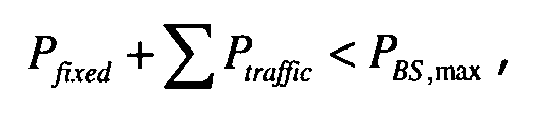
wobei ΣPtraffic die Summe aller Übertragungsleistungen Ptraffic ist. - Verfahren nach den Ansprüchen 1-9, bei dem eine feste Menge an Verkehr (TBS) hinzugefügt wird.
- Verfahren nach den Ansprüchen 1-10, bei dem die Verkehrsmenge (TBS) so gewählt wird, dass der Anstieg in dem die eingesetzte Kapazität darstellenden Wert fixiert ist.
- Verfahren nach den Ansprüchen 1-11, bei dem eine Inter-Zellen-Interferenz-Wirkung in der Berechnung des die eingesetzte Kapazität darstellenden Wertes eingebunden wird.
- Verfahren nach den Ansprüchen 1-12, bei dem eine die weiche Übergabe betreffende Wirkung in die Berechnung des die eingesetzte Kapazität darstellenden Wertes eingebunden ist.
- System für das Planen und/oder Einschätzen einer Kapazität in einem CDMA-Funknetzwerk, umfassend mindestens eine Basisstation (BS1, Bs2), definierend mindestens eine Zelle, wobei das System umfasst:- Mittel zum Definieren eines die Grenzkapazität darstellenden Wertes für mindestens eine Basisstation (BS1, BS2) in der mindestens einen Zelle;- Mittel zum Hinzufügen einer Verkehrsmenge (TBS) zu der mindestens einen Zelle und Berechnen eines den Kapazitätseinsatz darstellenden Wertes an der mindestens einen Basisstation (BS1, BS2) für die zusätzliche Verkehrsmenge (TBS);- Mittel zum Bestimmen, ob oder ob nicht mehr Verkehr (TBS) hinzugefügt werden kann, durch Vergleich des die Grenzkapazität darstellenden Wertes mit mindestens dem die eingesetzte Kapazität darstellenden Wert;gekennzeichnet durch Mittel zum Bestimmen des die Grenzkapazität darstellenden Wertes für den Uplink als Funktion eines entladenen Verbindungsbudgets, wobei das entladene Verbindungsbudget ein Verhältnis ist, welches ausdrückt, wieviel Leistung ein Benutzer für eine Verbindung in Bezug auf die maximale Übertragungs-Leistung benötigt, in der mindestens einen Zelle, und Mittel zum Bestimmen des die Grenzkapazität darstellenden Wertes für den Downlink als eine Funktion der Übertragungsleistung der Basisstation in der mindestens einen Zelle, in der die Verkehrsmenge (TBS) hinzugefügt wird, dergestalt, dass dies einem Anteil der angenommenen Verkehrsverteilung entspricht.
- System nach Anspruch 14, bei dem das System weiterhin Mittel umfasst zum Wiederholen der Schritte des Hinzufügens einer Verkehrsmenge (TBS) und des Bestimmens, ob oder ob nicht mehr Verkehr (TBS) hinzugefügt werden kann, solange mehr Verkehr (TBS) hinzugefügt werden kann.
- System nach einem der Ansprüche 14-15, bei dem- die Kapazität eine Uplink-Kapazität ist;- der Verkehr (TBS) ein Uplink-Verkehr (TBS) ist;- der die Grenzkapazität darstellende Wert ein entladenes Verbindungsbudget (L) ist, das entladene Verbindungsbudget ein Verhältnis ist, welches ausdrückt, wieviel Leistung ein Benutzer für eine Verbindung in Bezug auf die maximale Übertragungs-Leistung erfordert,- der die Grenzkapazität darstellende Wert ein Rausch-Anstieg κ ist, der eine Intra-Zellen-Interferenz-Wirkung von der hinzugefügten Menge des Uplink-Verkehrs (TBS) umfasst.
- System nach Anspruch 16, bei dem ein oder mehrere Module vorgesehen sind, um das entladene Verbindungsbudget (L) als eine Funktion einer Distanz zu der mindestens einen Basisstation (BS1, BS2) in der mindestens einen Zelle zu definieren.
- System nach Anspruch 16 und 17, bei dem ein oder mehrere Module vorgesehen sind, um das entladene Verbindungsbudget (L) als eine weiche Übergabe-Wirkung umfassend zu definieren.
- System nach einem der Ansprüche 16-18, bei dem ein oder mehrere Module vorgesehen sind, um zu bestimmen, ob oder ob nicht mehr Uplink-Verkehr (TBS) hinzugefügt werden kann, wobei die Formel benutzt wird

wobei Σκ die Summe aller Rausch-Anstiege κ ist, und Lmin der Minimalwert des entladenen Verbindungsbudgets (L) ist. - System nach einem der Ansprüche 16-19, bei dem ein oder mehrere Module vorgesehen sind, um zu bestimmen, ob oder ob nicht mehr Uplink-Verkehr (TBS) hinzugefügt werden kann, die Formel benutzend

wobei Σκ die Summe aller Rausch-Anstiege κ ist, und Lmin der Minimalwert des entladenen Verbindungsbudgets (L) und x ein Wert ungleich 0 ist. - System nach den Ansprüchen 14-16, bei dem- die Kapazität eine Downlink-Kapazität ist;- der Verkehr (TBS) ein Downlink-Verkehr (TBS) ist;- der die Grenzkapazität darstellende Wert eine maximal gestattete Übertragungsleistung (PBS,max) ist;- der die eingesetzte Kapazität darstellende Wert die erforderliche Übertragungsleistung Ptraffic ist; wobei das System ferner umfasst:- Mittel zum Bestimmen, ob oder ob nicht mehr Downlink-Verkehr (TBS) hinzugefügt werden kann, durch Vergleich der maximal gestatteten Übertragungsleistung (PBS,max) mit der Summe einer festen Leistung (Pfixed) und der Übertragungsleistung Ptraffic; und- Mittel zum Definieren der festen Leistung (Pfixed) zu der mindestens einen Basisstation (BS1, BS2) in der mindestens einen Zelle.
- System nach Anspruch 21, bei dem ein oder mehrere Module vorgesehen sind, um zu bestimmen, ob oder ob nicht mehr Downlink-Verkehr (TBS) hinzugefügt werden kann, die Formel benutzend

wobei ΣPtraffic die Summe aller Übertragungsleistungen Ptraffic ist. - System nach den Ansprüchen 14-22, bei dem eine feste Menge an Verkehr (TBS) hinzugefügt wird.
- System nach den Ansprüchen 14-23, bei dem die Verkehrsmenge (TBS) so gewählt wird, dass der Anstieg in dem die eingesetzte Kapazität darstellenden Wert fixiert ist.
- System nach den Ansprüchen 14-24, bei dem die Verkehrsmenge (TBS) so gewählt wird, dass dies einem Anteil der angenommenen Verkehrsverteilung entspricht.
- System nach den Ansprüchen 14-25, bei dem ein oder mehrere Module vorgesehen sind, um eine Inter-Zellen-Interferenz-Wirkung in der Berechnung des die eingesetzte Kapazität darstellenden Wertes einzubinden.
- System nach den Ansprüchen 14-26, bei dem ein oder mehrere Module vorgesehen sind, um eine die weiche Übergabe betreffende Wirkung in die Berechnung des die eingesetzte Kapazität darstellenden Wertes einzubinden.
- Computerprogramm für die Planung und/oder Einschätzung einer Kapazität in einem CDMA-Funknetzwerk, umfassend mindestens eine Basisstation (BS1, BS2), definierend mindestens eine Zelle, wobei das Computerprogramm Codemittel umfasst, die, wenn diese auf einem Computer ausgeführt werden, die Schritte ausführen- Definieren eines die Grenzkapazität darstellenden Wertes für die mindestens eine Basisstation (BS1, BS2) in der mindestens einen Zelle;- Hinzufügen einer Verkehrsmenge (TBS) zu der mindestens einen Zelle und Berechnen eines den Kapazitätseinsatz darstellenden Wertes an der mindestens einen Basisstation (BS1, BS2) für die zusätzliche Verkehrsmenge (TBS);- Bestimmen, ob oder ob nicht mehr Verkehr (TBS) hinzugefügt werden kann, durch Vergleich des die Grenzkapazität darstellenden Wertes mit mindestens dem die eingesetzte Kapazität darstellenden Wert;gekennzeichnet durch das Bestimmen des die Grenzkapazität darstellenden Wertes für den Uplink als Funktion eines entladenen Verbindungsbudgets, wobei das entladene Verbindungsbudget ein Verhältnis ist, welches ausdrückt, wieviel Leistung ein Benutzer für eine Verbindung in Bezug auf die maximale Übertragungs-Leistung benötigt, in der mindestens einen Zelle, und das Bestimmen des die Grenzkapazität darstellenden Wertes für den Downlink als eine Funktion der Übertragungsleistung der Basisstation in der mindestens einen Zelle, in der die Verkehrsmenge (TBS) hinzugefügt wird, dergestalt, dass dies einem Anteil der angenommenen Verkehrsverteilung entspricht.
- Computerprogramm nach Anspruch 28, bei dem das Computerprogramm weiterhin Codemittel umfasst, die, wenn diese auf einem Computer ausgeführt werden, den Schritt ausführen des Wiederholens des Hinzufügens der Verkehrsmenge (TBS) und des Wiederholens des Bestimmens, ob oder ob nicht mehr Verkehr (TBS) hinzugefügt werden kann, solange mehr Verkehr (TBS) hinzugefügt werden kann.
- Computerprogramm nach einem der Ansprüche 28-29, bei dem- die Kapazität eine Uplink-Kapazität ist;- der Verkehr (TBS) ein Uplink-Verkehr (TBS) ist;- der die Grenzkapazität darstellende Wert ein entladenes Verbindungsbudget (L) ist, das entladene Verbindungsbudget ein Verhältnis ist, welches ausdrückt, wieviel Leistung ein Benutzer für eine Verbindung in Bezug auf die maximale Übertragungs-Leistung erfordert,- der die Grenzkapazität darstellende Wert ein Rausch-Anstieg κ ist, der eine Intra-Zellen-Interferenz-Wirkung von der hinzugefügten Menge des Uplink-Verkehrs (TBS) umfasst.
- Computerprogramm nach den Ansprüchen 28-29, bei dem- die Kapazität eine Downlink-Kapazität ist;- der Verkehr (TBS) ein Downlink-Verkehr (TBS) ist;- der die Grenzkapazität darstellende Wert eine maximal gestattete Übertragungsleistung (PBS,max) ist;- der die eingesetzte Kapazität darstellende Wert eine erforderliche Übertragungsleistung Ptraffic ist;- das Computerprogramm Codemittel umfasst, die, wenn sie auf einem Computer ausgeführt werden, den Schritt ausführen des Bestimmens, ob oder ob nicht mehr Downlink-Verkehr (TBS) hinzugefügt werden kann, durch Vergleich der maximal gestatteten Übertragungsleistung (PBS,max) zu der Summe einer festen Leistung (Pfixed) und der Übertragungsleistung Ptraffic; und- das Computerprogramm weiterhin Codemittel umfasst, die, wenn sie auf einem Computer ausgeführt werden, den Schritt ausführen des Definierens der festen Leistung (Pfixed) zu der mindestens einen Basisstation (BS1, BS2) in der mindestens einen Zelle.
Applications Claiming Priority (4)
| Application Number | Priority Date | Filing Date | Title |
|---|---|---|---|
| US34881002P | 2002-01-15 | 2002-01-15 | |
| US348810P | 2002-01-15 | ||
| US35269502P | 2002-01-29 | 2002-01-29 | |
| US352695P | 2002-01-29 |
Publications (2)
| Publication Number | Publication Date |
|---|---|
| EP1328131A1 EP1328131A1 (de) | 2003-07-16 |
| EP1328131B1 true EP1328131B1 (de) | 2008-02-27 |
Family
ID=26995903
Family Applications (1)
| Application Number | Title | Priority Date | Filing Date |
|---|---|---|---|
| EP02080692A Expired - Lifetime EP1328131B1 (de) | 2002-01-15 | 2002-12-23 | Verfahren und System zur Planung und/oder Einschätzung der Zellkapazität in CDMA Funknetzwerken |
Country Status (5)
| Country | Link |
|---|---|
| US (1) | US7103361B2 (de) |
| EP (1) | EP1328131B1 (de) |
| JP (1) | JP3848923B2 (de) |
| AT (1) | ATE387817T1 (de) |
| DE (1) | DE60225238T2 (de) |
Families Citing this family (12)
| Publication number | Priority date | Publication date | Assignee | Title |
|---|---|---|---|---|
| US7313091B2 (en) * | 2002-05-24 | 2007-12-25 | Interdigital Technology Corporation | Method and system for control of congestion in CDMA systems |
| AU2002311537A1 (en) * | 2002-06-25 | 2004-01-06 | Nokia Corporation | Method and system to optimise soft handover gain in networks such as cdma networks |
| WO2005053344A1 (en) | 2003-11-28 | 2005-06-09 | Telecom Italia S.P.A. | Method for evaluating the performances of a mobile telephony network |
| US7197013B2 (en) * | 2004-03-01 | 2007-03-27 | Cisco Technology, Inc. | Quality evaluation for wireless communication networks |
| CN1989735B (zh) * | 2004-07-12 | 2010-09-29 | 艾利森电话股份有限公司 | 在增加通信量负载情况下测试无线电网络的方法和装置 |
| EP1653755B1 (de) * | 2004-11-01 | 2008-04-23 | Ascom (Schweiz) AG | Verfahren und Vorrichtung zur Bestimmung einer Abdeckung eines zellulären Netzsystems |
| US8583127B2 (en) | 2004-11-09 | 2013-11-12 | Telecom Italia S.P.A. | Process for planning a communications network, related planning system, and related communications networks and computer program product |
| US7729704B2 (en) * | 2005-03-31 | 2010-06-01 | Alcatel-Lucent Usa Inc. | Power load balancing in cellular networks employing shadow prices of base stations |
| EP2175585A1 (de) | 2008-10-13 | 2010-04-14 | Nederlandse Organisatie voor toegepast- natuurwetenschappelijk onderzoek TNO | Zellulare mobile Telekommunikationssysteme |
| ES2361893B1 (es) * | 2009-08-07 | 2012-05-04 | Vodafone España, S.A.U. | Método y sistema para seleccionar din�?micamente el alcance de celda de una estación base. |
| US8761102B2 (en) | 2011-12-08 | 2014-06-24 | At&T Intellectual Property I, L.P. | Method and apparatus for planning radio frequency spectrum in a wireless network |
| US8675587B2 (en) * | 2011-12-08 | 2014-03-18 | At&T Intellectual Property I, L.P. | Method and apparatus for planning radio frequency spectrum in a fixed wireless network |
Family Cites Families (14)
| Publication number | Priority date | Publication date | Assignee | Title |
|---|---|---|---|---|
| US5956643A (en) * | 1994-01-13 | 1999-09-21 | Lucent Technologies Inc. | Apparatus and method for adaptive dynamic channel assignment in wireless communication networks |
| US5710758A (en) * | 1995-09-29 | 1998-01-20 | Qualcomm Incorporated | Wireless network planning tool |
| FI108764B (fi) * | 1997-05-28 | 2002-03-15 | Nokia Corp | Solukkoradiojärjestelmän lähetinvastaanotinyksiköiden ohjaus |
| SE513988C2 (sv) * | 1998-03-30 | 2000-12-04 | Ericsson Telefon Ab L M | Förfarande och anordning för alstring av interferens över luftgränssnittet i ett cellulärt nät |
| JP3204310B2 (ja) * | 1998-08-12 | 2001-09-04 | 日本電気株式会社 | Cdma移動通信システムおよびその下り送信電力制御方法 |
| US6100843A (en) * | 1998-09-21 | 2000-08-08 | Tantivy Communications Inc. | Adaptive antenna for use in same frequency networks |
| US6842431B2 (en) * | 1999-11-04 | 2005-01-11 | Lucent Technologies Inc. | Methods and apparatus for characterization, adjustment and optimization of wireless networks |
| GB0000528D0 (en) * | 2000-01-11 | 2000-03-01 | Nokia Networks Oy | Location of a station in a telecommunications system |
| US6907244B2 (en) * | 2000-12-14 | 2005-06-14 | Pulse-Link, Inc. | Hand-off between ultra-wideband cell sites |
| US6947748B2 (en) * | 2000-12-15 | 2005-09-20 | Adaptix, Inc. | OFDMA with adaptive subcarrier-cluster configuration and selective loading |
| US6925059B2 (en) * | 2001-05-09 | 2005-08-02 | Ericsson, Inc. | Method and apparatus for distributing traffic load in a wireless packet data network |
| EP1292162A1 (de) * | 2001-09-10 | 2003-03-12 | Koninklijke KPN N.V. | System und Verfahren zur Planung und Auswertung eines Funknetzes |
| CN1559112A (zh) * | 2001-10-22 | 2004-12-29 | ��˹��ŵ�� | 导频信道功率自动调谐 |
| US20030109284A1 (en) * | 2001-12-07 | 2003-06-12 | Dag Akerberg | Flexible carrier utilization |
-
2002
- 2002-12-23 EP EP02080692A patent/EP1328131B1/de not_active Expired - Lifetime
- 2002-12-23 DE DE60225238T patent/DE60225238T2/de not_active Expired - Lifetime
- 2002-12-23 AT AT02080692T patent/ATE387817T1/de not_active IP Right Cessation
-
2003
- 2003-01-07 US US10/338,792 patent/US7103361B2/en not_active Expired - Lifetime
- 2003-01-15 JP JP2003006604A patent/JP3848923B2/ja not_active Expired - Fee Related
Non-Patent Citations (1)
| Title |
|---|
| None * |
Also Published As
| Publication number | Publication date |
|---|---|
| US20030134641A1 (en) | 2003-07-17 |
| US7103361B2 (en) | 2006-09-05 |
| DE60225238T2 (de) | 2009-05-07 |
| JP3848923B2 (ja) | 2006-11-22 |
| DE60225238D1 (de) | 2008-04-10 |
| ATE387817T1 (de) | 2008-03-15 |
| JP2003219463A (ja) | 2003-07-31 |
| EP1328131A1 (de) | 2003-07-16 |
Similar Documents
| Publication | Publication Date | Title |
|---|---|---|
| US7580712B2 (en) | Wireless high-speed data network planning tool | |
| EP0986276B1 (de) | Verfahren und Gerät zum Schätzen der Pilotendeckungen | |
| Wacker et al. | Static simulator for studying WCDMA radio network planning issues | |
| US8218450B2 (en) | Throughput estimation method and system | |
| JP2004201269A (ja) | 移動通信システムにおける基地局設置設計方法及び基地局設置設計装置並びにプログラム | |
| US8150402B2 (en) | Method for planning a cellular mobile telecommunications network | |
| WO2001045284A1 (en) | Systems and methods for rapidly determining cdma network performance | |
| US7103361B2 (en) | Method and system for planning and/or evaluation of cell capacity in (CDMA) radio networks | |
| CN101369834B (zh) | 联合功率控制方法、系统和设备 | |
| JP3795464B2 (ja) | (cdma)無線網におけるダウンリンクカバレージの計画及び/または評価のための方法及びシステム | |
| Laiho et al. | Radio network planning process and methods for WCDMA | |
| US7133679B2 (en) | Radio network planning | |
| US6512933B1 (en) | Iterative system and method for optimizing CDMA load distribution using reverse interference measurements | |
| Laiho et al. | Verification of WCDMA radio network planning prediction methods with fully dynamic network simulator | |
| EP1292162A1 (de) | System und Verfahren zur Planung und Auswertung eines Funknetzes | |
| Al-Kanj et al. | A mathematical optimization approach for cellular radio network planning with co-siting | |
| US20050265299A1 (en) | System and method for dimensioning a cdma network | |
| US20080254748A1 (en) | Method For Dimensioning or Evaluating a Radio Network | |
| EP1239605B1 (de) | Verfahren und Gerät zur Leistungsberechnung eines Funkkommunikationssystems | |
| Garcia-Lozano et al. | Enhanced analysis of WCDMA networks with repeaters deployment | |
| US9794891B2 (en) | Method and apparatus relating to interferece estimation in cellular communication networks | |
| US20080096596A1 (en) | Apparatus And Method For Optimising A Spread Spectrum Cellular Communication System | |
| EP1804542A1 (de) | Modellierung von abwärtsgerichteter Systembelastung | |
| JP3798711B2 (ja) | 無線通信システムにおける電力計算方法、装置および電力計算プログラム | |
| Popa et al. | WCDMA Systems Planning, Coverage and Optimization |
Legal Events
| Date | Code | Title | Description |
|---|---|---|---|
| PUAI | Public reference made under article 153(3) epc to a published international application that has entered the european phase |
Free format text: ORIGINAL CODE: 0009012 |
|
| AK | Designated contracting states |
Designated state(s): AT BE BG CH CY CZ DE DK EE ES FI FR GB GR IE IT LI LU MC NL PT SE SI SK TR |
|
| AX | Request for extension of the european patent |
Extension state: AL LT LV MK RO |
|
| 17P | Request for examination filed |
Effective date: 20040116 |
|
| 17Q | First examination report despatched |
Effective date: 20040216 |
|
| AKX | Designation fees paid |
Designated state(s): AT BE BG CH CY CZ DE DK EE ES FI FR GB GR IE IT LI LU MC NL PT SE SI SK TR |
|
| GRAP | Despatch of communication of intention to grant a patent |
Free format text: ORIGINAL CODE: EPIDOSNIGR1 |
|
| GRAS | Grant fee paid |
Free format text: ORIGINAL CODE: EPIDOSNIGR3 |
|
| GRAA | (expected) grant |
Free format text: ORIGINAL CODE: 0009210 |
|
| AK | Designated contracting states |
Kind code of ref document: B1 Designated state(s): AT BE BG CH CY CZ DE DK EE ES FI FR GB GR IE IT LI LU MC NL PT SE SI SK TR |
|
| REG | Reference to a national code |
Ref country code: GB Ref legal event code: FG4D |
|
| REG | Reference to a national code |
Ref country code: CH Ref legal event code: EP |
|
| REG | Reference to a national code |
Ref country code: IE Ref legal event code: FG4D |
|
| REF | Corresponds to: |
Ref document number: 60225238 Country of ref document: DE Date of ref document: 20080410 Kind code of ref document: P |
|
| REG | Reference to a national code |
Ref country code: CH Ref legal event code: NV Representative=s name: ISLER & PEDRAZZINI AG |
|
| REG | Reference to a national code |
Ref country code: SE Ref legal event code: TRGR |
|
| REG | Reference to a national code |
Ref country code: GR Ref legal event code: EP Ref document number: 20080401381 Country of ref document: GR |
|
| PG25 | Lapsed in a contracting state [announced via postgrant information from national office to epo] |
Ref country code: ES Free format text: LAPSE BECAUSE OF FAILURE TO SUBMIT A TRANSLATION OF THE DESCRIPTION OR TO PAY THE FEE WITHIN THE PRESCRIBED TIME-LIMIT Effective date: 20080607 |
|
| PG25 | Lapsed in a contracting state [announced via postgrant information from national office to epo] |
Ref country code: AT Free format text: LAPSE BECAUSE OF FAILURE TO SUBMIT A TRANSLATION OF THE DESCRIPTION OR TO PAY THE FEE WITHIN THE PRESCRIBED TIME-LIMIT Effective date: 20080227 |
|
| PG25 | Lapsed in a contracting state [announced via postgrant information from national office to epo] |
Ref country code: BE Free format text: LAPSE BECAUSE OF FAILURE TO SUBMIT A TRANSLATION OF THE DESCRIPTION OR TO PAY THE FEE WITHIN THE PRESCRIBED TIME-LIMIT Effective date: 20080227 Ref country code: SI Free format text: LAPSE BECAUSE OF FAILURE TO SUBMIT A TRANSLATION OF THE DESCRIPTION OR TO PAY THE FEE WITHIN THE PRESCRIBED TIME-LIMIT Effective date: 20080227 |
|
| PG25 | Lapsed in a contracting state [announced via postgrant information from national office to epo] |
Ref country code: PT Free format text: LAPSE BECAUSE OF FAILURE TO SUBMIT A TRANSLATION OF THE DESCRIPTION OR TO PAY THE FEE WITHIN THE PRESCRIBED TIME-LIMIT Effective date: 20080721 Ref country code: DK Free format text: LAPSE BECAUSE OF FAILURE TO SUBMIT A TRANSLATION OF THE DESCRIPTION OR TO PAY THE FEE WITHIN THE PRESCRIBED TIME-LIMIT Effective date: 20080227 Ref country code: SK Free format text: LAPSE BECAUSE OF FAILURE TO SUBMIT A TRANSLATION OF THE DESCRIPTION OR TO PAY THE FEE WITHIN THE PRESCRIBED TIME-LIMIT Effective date: 20080227 Ref country code: CZ Free format text: LAPSE BECAUSE OF FAILURE TO SUBMIT A TRANSLATION OF THE DESCRIPTION OR TO PAY THE FEE WITHIN THE PRESCRIBED TIME-LIMIT Effective date: 20080227 |
|
| ET | Fr: translation filed | ||
| PLBE | No opposition filed within time limit |
Free format text: ORIGINAL CODE: 0009261 |
|
| STAA | Information on the status of an ep patent application or granted ep patent |
Free format text: STATUS: NO OPPOSITION FILED WITHIN TIME LIMIT |
|
| 26N | No opposition filed |
Effective date: 20081128 |
|
| PG25 | Lapsed in a contracting state [announced via postgrant information from national office to epo] |
Ref country code: BG Free format text: LAPSE BECAUSE OF FAILURE TO SUBMIT A TRANSLATION OF THE DESCRIPTION OR TO PAY THE FEE WITHIN THE PRESCRIBED TIME-LIMIT Effective date: 20080527 Ref country code: EE Free format text: LAPSE BECAUSE OF FAILURE TO SUBMIT A TRANSLATION OF THE DESCRIPTION OR TO PAY THE FEE WITHIN THE PRESCRIBED TIME-LIMIT Effective date: 20080227 |
|
| PG25 | Lapsed in a contracting state [announced via postgrant information from national office to epo] |
Ref country code: CY Free format text: LAPSE BECAUSE OF FAILURE TO SUBMIT A TRANSLATION OF THE DESCRIPTION OR TO PAY THE FEE WITHIN THE PRESCRIBED TIME-LIMIT Effective date: 20080227 Ref country code: MC Free format text: LAPSE BECAUSE OF NON-PAYMENT OF DUE FEES Effective date: 20081231 |
|
| PG25 | Lapsed in a contracting state [announced via postgrant information from national office to epo] |
Ref country code: IE Free format text: LAPSE BECAUSE OF NON-PAYMENT OF DUE FEES Effective date: 20081223 |
|
| PG25 | Lapsed in a contracting state [announced via postgrant information from national office to epo] |
Ref country code: LU Free format text: LAPSE BECAUSE OF NON-PAYMENT OF DUE FEES Effective date: 20081223 |
|
| PG25 | Lapsed in a contracting state [announced via postgrant information from national office to epo] |
Ref country code: TR Free format text: LAPSE BECAUSE OF FAILURE TO SUBMIT A TRANSLATION OF THE DESCRIPTION OR TO PAY THE FEE WITHIN THE PRESCRIBED TIME-LIMIT Effective date: 20080227 |
|
| PGFP | Annual fee paid to national office [announced via postgrant information from national office to epo] |
Ref country code: CH Payment date: 20121221 Year of fee payment: 11 Ref country code: FI Payment date: 20121212 Year of fee payment: 11 |
|
| PGFP | Annual fee paid to national office [announced via postgrant information from national office to epo] |
Ref country code: GR Payment date: 20121221 Year of fee payment: 11 Ref country code: SE Payment date: 20121220 Year of fee payment: 11 |
|
| REG | Reference to a national code |
Ref country code: SE Ref legal event code: EUG |
|
| REG | Reference to a national code |
Ref country code: CH Ref legal event code: PL |
|
| PG25 | Lapsed in a contracting state [announced via postgrant information from national office to epo] |
Ref country code: SE Free format text: LAPSE BECAUSE OF NON-PAYMENT OF DUE FEES Effective date: 20131224 Ref country code: FI Free format text: LAPSE BECAUSE OF NON-PAYMENT OF DUE FEES Effective date: 20131223 |
|
| REG | Reference to a national code |
Ref country code: GR Ref legal event code: ML Ref document number: 20080401381 Country of ref document: GR Effective date: 20140702 |
|
| PG25 | Lapsed in a contracting state [announced via postgrant information from national office to epo] |
Ref country code: GR Free format text: LAPSE BECAUSE OF NON-PAYMENT OF DUE FEES Effective date: 20140702 Ref country code: CH Free format text: LAPSE BECAUSE OF NON-PAYMENT OF DUE FEES Effective date: 20131231 Ref country code: LI Free format text: LAPSE BECAUSE OF NON-PAYMENT OF DUE FEES Effective date: 20131231 |
|
| PGFP | Annual fee paid to national office [announced via postgrant information from national office to epo] |
Ref country code: NL Payment date: 20141219 Year of fee payment: 13 |
|
| PGFP | Annual fee paid to national office [announced via postgrant information from national office to epo] |
Ref country code: IT Payment date: 20141219 Year of fee payment: 13 |
|
| REG | Reference to a national code |
Ref country code: FR Ref legal event code: PLFP Year of fee payment: 14 |
|
| REG | Reference to a national code |
Ref country code: NL Ref legal event code: MM Effective date: 20160101 |
|
| PG25 | Lapsed in a contracting state [announced via postgrant information from national office to epo] |
Ref country code: NL Free format text: LAPSE BECAUSE OF NON-PAYMENT OF DUE FEES Effective date: 20160101 |
|
| REG | Reference to a national code |
Ref country code: FR Ref legal event code: PLFP Year of fee payment: 15 |
|
| PG25 | Lapsed in a contracting state [announced via postgrant information from national office to epo] |
Ref country code: IT Free format text: LAPSE BECAUSE OF NON-PAYMENT OF DUE FEES Effective date: 20151223 |
|
| PGFP | Annual fee paid to national office [announced via postgrant information from national office to epo] |
Ref country code: DE Payment date: 20161213 Year of fee payment: 15 Ref country code: GB Payment date: 20161222 Year of fee payment: 15 |
|
| PGFP | Annual fee paid to national office [announced via postgrant information from national office to epo] |
Ref country code: FR Payment date: 20161222 Year of fee payment: 15 |
|
| REG | Reference to a national code |
Ref country code: DE Ref legal event code: R082 Ref document number: 60225238 Country of ref document: DE Ref country code: DE Ref legal event code: R082 Ref document number: 60225238 Country of ref document: DE Representative=s name: SCHOEN, THILO, DIPL.-PHYS., DE |
|
| REG | Reference to a national code |
Ref country code: DE Ref legal event code: R119 Ref document number: 60225238 Country of ref document: DE |
|
| GBPC | Gb: european patent ceased through non-payment of renewal fee |
Effective date: 20171223 |
|
| REG | Reference to a national code |
Ref country code: FR Ref legal event code: ST Effective date: 20180831 |
|
| PG25 | Lapsed in a contracting state [announced via postgrant information from national office to epo] |
Ref country code: FR Free format text: LAPSE BECAUSE OF NON-PAYMENT OF DUE FEES Effective date: 20180102 Ref country code: DE Free format text: LAPSE BECAUSE OF NON-PAYMENT OF DUE FEES Effective date: 20180703 |
|
| PG25 | Lapsed in a contracting state [announced via postgrant information from national office to epo] |
Ref country code: GB Free format text: LAPSE BECAUSE OF NON-PAYMENT OF DUE FEES Effective date: 20171223 |