EP1323782A2 - Room temperature curable organopolysiloxane compositions - Google Patents
Room temperature curable organopolysiloxane compositions Download PDFInfo
- Publication number
- EP1323782A2 EP1323782A2 EP02258812A EP02258812A EP1323782A2 EP 1323782 A2 EP1323782 A2 EP 1323782A2 EP 02258812 A EP02258812 A EP 02258812A EP 02258812 A EP02258812 A EP 02258812A EP 1323782 A2 EP1323782 A2 EP 1323782A2
- Authority
- EP
- European Patent Office
- Prior art keywords
- composition
- hydrocarbon group
- monovalent hydrocarbon
- parts
- polymer
- Prior art date
- Legal status (The legal status is an assumption and is not a legal conclusion. Google has not performed a legal analysis and makes no representation as to the accuracy of the status listed.)
- Granted
Links
Classifications
-
- C—CHEMISTRY; METALLURGY
- C08—ORGANIC MACROMOLECULAR COMPOUNDS; THEIR PREPARATION OR CHEMICAL WORKING-UP; COMPOSITIONS BASED THEREON
- C08K—Use of inorganic or non-macromolecular organic substances as compounding ingredients
- C08K3/00—Use of inorganic substances as compounding ingredients
- C08K3/34—Silicon-containing compounds
- C08K3/36—Silica
-
- C—CHEMISTRY; METALLURGY
- C08—ORGANIC MACROMOLECULAR COMPOUNDS; THEIR PREPARATION OR CHEMICAL WORKING-UP; COMPOSITIONS BASED THEREON
- C08K—Use of inorganic or non-macromolecular organic substances as compounding ingredients
- C08K5/00—Use of organic ingredients
- C08K5/54—Silicon-containing compounds
- C08K5/541—Silicon-containing compounds containing oxygen
- C08K5/5415—Silicon-containing compounds containing oxygen containing at least one Si—O bond
-
- C—CHEMISTRY; METALLURGY
- C08—ORGANIC MACROMOLECULAR COMPOUNDS; THEIR PREPARATION OR CHEMICAL WORKING-UP; COMPOSITIONS BASED THEREON
- C08K—Use of inorganic or non-macromolecular organic substances as compounding ingredients
- C08K5/00—Use of organic ingredients
- C08K5/54—Silicon-containing compounds
- C08K5/541—Silicon-containing compounds containing oxygen
- C08K5/5415—Silicon-containing compounds containing oxygen containing at least one Si—O bond
- C08K5/5419—Silicon-containing compounds containing oxygen containing at least one Si—O bond containing at least one Si—C bond
Definitions
- This invention relates to curable organopolysiloxane compositions, and more particularly, to room temperature curable organopolysiloxane compositions suitable for use in proximity to automotive engines, and having oil resistance and coolant resistance.
- compositions which cure into elastomers at room temperature upon contact with air-borne moisture.
- those compositions of the type that cure while releasing alcohol are preferentially used in sealing, bonding and coating of electric and electronic equipment, owing to their advantageous features of no disgusting odor and no corrosion of metals.
- One typical composition of this type is described in JP-B 39-27643 as comprising an organopolysiloxane end-blocked with hydroxyl groups, an alkoxysilane, and an organic titanium compound.
- JP-A 55-43119 discloses a composition comprising an organopolysiloxane end-blocked with alkoxysilyl groups, an alkoxysilane, and alkoxy titanium.
- JP-B 7-39547 discloses a composition comprising a linear organopolysiloxane end-blocked with alkoxysilyl groups (including silethylene), an alkoxysilane, and alkoxy titanium.
- compositions lack oil resistance and long-life coolant (LLC) resistance which are requisite when used in proximity to automotive engines.
- An object of the invention is to provide new and useful curable organopolysiloxane compositions, particularly roomtemperature curable compositions, which cure to elastomers whose physical properties change little even when used under rigorous conditions e.g. as encountered in proximity to automotive engines, and which remain stable during storage under sealed conditions.
- the invention provides a room temperature curable organopolysiloxane composition comprising, as essential components,
- Component (A) used herein is important and constitutes a base polymer in the composition of the invention.
- component (A) must be an organopolysiloxane having at least one organooxy group-bonded silicon atom at an end and at least one such at a side chain of the polymer, joined through a divalent hydrocarbon group, and/or an organopolysiloxane having at least two organooxysilyl groups on - perhaps only on - side chains of the polymer.
- Options for the organooxy groups and hydrocarbon groups are as set out below for the preferred formulae.
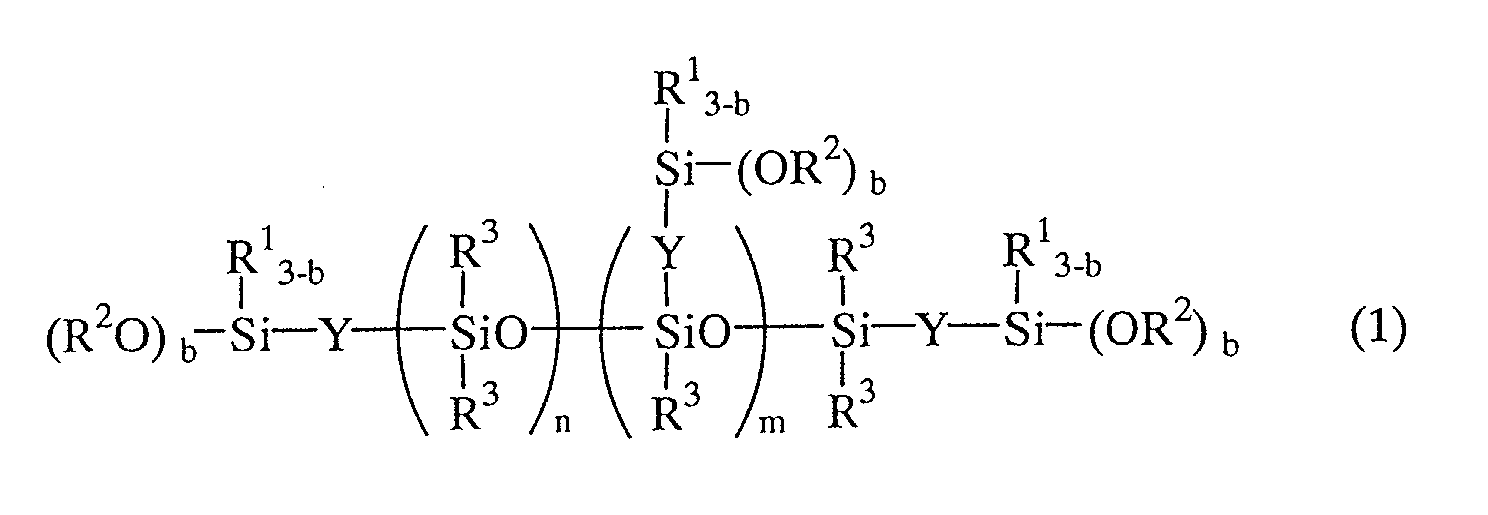
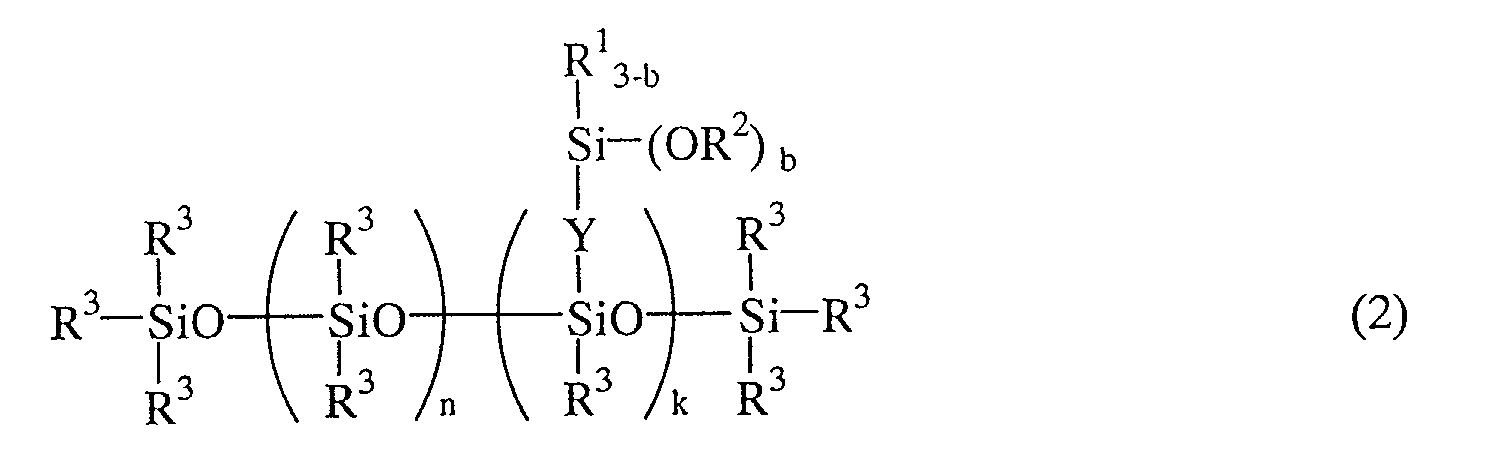
- Preferred organopolysiloxanes have the following general formulae (1) and (2).
- R 1 is a monovalent hydrocarbon group
- R 2 is a monovalent hydrocarbon group or alkoxy-substituted monovalent hydrocarbon group
- R 3 is a substituted or unsubstituted monovalent hydrocarbon group
- Y is a divalent hydrocarbon group having 1 to 8 carbon atoms
- b is an integer of 1 to 3
- k is an integer of 2 to 10
- m is an integer of 1 to 10
- n is such an integer that the organopolysiloxane may have a viscosity of 20 to 1,000,000 centipoise at 25°C.
- the monovalent hydrocarbon groups represented by R 1 and R 3 are preferably unsubstituted or substituted (e.g., halo or cyano substituted) monovalent hydrocarbon groups having 1 to 12 carbon atoms, especially 1 to 10 carbon atoms, for example, alkyl groups such as methyl, ethyl, propyl, butyl, hexyl, octyl, decyl and octadecyl; cycloalkyl groups such as cyclopentyl and cyclohexyl; alkenyl groups such as vinyl and allyl; aryl groups such as phenyl, tolyl and naphthyl; and aralkyl groups such as benzyl, phenylethyl and phenylpropyl.
- alkyl groups such as methyl, ethyl, propyl, butyl, hexyl, octyl, decyl and octa
- Exemplary halogenated hydrocarbon groups include chloromethyl, trifluoromethyl, chloropropyl, 3,3,3-trifluoropropyl, chlorophenyl, dibromophenyl, tetrachlorophenyl and difluorophenyl.
- Exemplary cyano alkyl groups are ⁇ -cyanoethyl, ⁇ -cyanopropyl and ⁇ -cyanopropyl. Of these, methyl, ethyl, propyl, phenyl and vinyl are preferred, with methyl being most preferred.
- Preferred groups represented by R 2 are those having 1 to 10 carbon atoms, especially 1 to 4 carbon atoms.
- Examples of monovalent hydrocarbon groups are as described above.
- Typical groups are alkyl groups such as methyl, ethyl, propyl, butyl, hexyl and octyl, and alkoxy-substituted alkyl groups such as methoxyethyl, ethoxyethyl, methoxypropyl and methoxybutyl, with methyl and ethyl being most preferred.
- Y is selected from divalent hydrocarbon groups, preferably having 1 to 8 carbon atoms, especially 1 to 6 carbon atoms, preferably alkylene groups, for example, -CH 2 -, -CH 2 CH 2 -, -CH 2 CH 2 CH 2 - or -CH 2 (CH 3 )CH-, with -CH 2 CH 2 - being most preferred.
- b, m and k are as defined above, and preferably, b is 2 or 3, m is from 1 to 5, more preferably from 1 to 3, and k is from 2 to 6, more preferably from 2 to 4.
- the organopolysiloxane (A) should preferably have a viscosity of 20 to 1,000,000 centipoise at 25°C. With a viscosity of less than 20 cp, the elastomer after curing may not be endowed with satisfactory physical properties, especially flexibility and elongation.
- a composition comprising an organopolysiloxane with a viscosity in excess of 1,000,000 cp may have such a high viscosity as to interfere with workability upon application.
- the preferred viscosity is in the range of 100 to 500,000 cp.
- n in formula (1) or (2) is selected such that the viscosity of the organopolysiloxane may fall in the range of 20 to 1,000,000 centipoise at 25°C.
- any of well-known methods may be used.
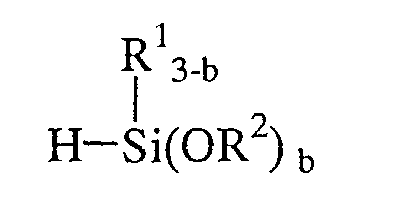
- it is prepared by effecting addition reaction between a corresponding alkenyl-terminated organopolysiloxane and an organooxysilane of the following formula: (wherein R 1 , R 2 and b are as defined above for the preferred formulae (1), (2)), in the presence of a Pt catalyst.
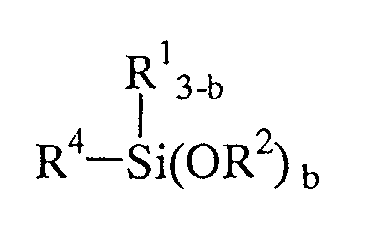
- addition reaction is carried out between a corresponding SiH-terminated organopolysiloxane and an organooxysilane of the following formula: wherein R 1 , R 2 and b are as defined above, and R 4 is alkenyl, yielding an organopolysiloxane (A).
- Component (B) is fumed silica. It is an important component for providing an appropriate viscosity and rubber reinforcement.
- the fumed silica should preferably have a specific surface area of 50 to 400 m 2 /g, and more preferably 100 to 300 m 2 /g, because such silica is effective for improving oil resistance, storage stability, appropriate viscosity and rubber physical properties.
- fumed silica has been surface treated.
- the surface-treated fumed silica use may be made of fumed silicas which have been treated with chlorosilanes such as dimethyldichlorosilane and trimethylchlorosilane and silazanes such as hexamethyldisilazane.
- fumed silica is surface treated during preparation of the composition.
- Component (B) is generally added in amounts of 1 to 40 parts by weight, preferably 3 to 30 parts by weight, per 100 parts by weight of component (A).
- a composition containing a larger amount of component (B) may have so high a viscosity as to interfere with mixing and working during application. With too small amounts of component (B), physical properties of cured rubber may become poor.
- Component (C) serves as a crosslinker for helping the composition cure into a rubber elastomer. It is an organooxysilane having the general formula: R 1 a Si(OR 2 ) 4-a wherein R 1 is a monovalent hydrocarbon group, R 2 is a monovalent hydrocarbon group or alkoxy-substituted monovalent hydrocarbon group, and "a" is 0 or 1, or a partial hydrolytic condensate thereof. It is understood that R 1 and R 2 are as defined above for formulae (1) and (2), with examples being also the same as described above.
- Illustrative examples of the organooxysilane (C) include tetrafunctional alkoxysilanes such as tetramethoxysilane, tetraethoxysilane and methylcellosolve orthosilicate; trifunctional alkoxysilanes such as methyltrimethoxysilane, methyltriethoxysilane, ethyltrimethoxysilane, vinyltrimethoxysilane, phenyltrimethoxysilane and methyltrimethoxyethoxysilane, and partial hydrolytic condensates thereof.
- organooxysilanes may be used alone or in admixture of any.
- difunctional alkoxysilanes such as diphenyldimethoxysilane and dimethyldimethoxysilane may be additionally added.
- Component (C) is generally added in amounts of 0.5 to 25 parts by weight, preferably 1 to 15 parts by weight, per 100 parts by weight of component (A). With too small amounts of component (C), the composition may not fully cure and tends to thicken and gel during storage in a cartridge. Too large amounts of component (C) may retard curing, provide unsatisfactory rubber physical properties and be uneconomical.
- Component (D) is a catalyst for the inventive composition to cure.
- exemplary catalysts include organotitanium compounds such as tetraisopropoxytitanium, tetra-t-butoxytitanium, titanium diisopropoxide bis(ethyl acetoacetate), and titanium diisopropoxide bis(acetylacetonate); organotin compounds such as dibutyltin dilaurate, dibutyltin bisacetylacetonate and tin octylate; dicarboxylic acid salts of metals such as lead dioctylate; organozirconium compounds such as zirconium tetraacetylacetonate; organoaluminum compounds such as aluminum triacetylacetonate; and amines such as hydroxylamine and tributylamine.
- organotitanium compounds such as tetraisopropoxytitanium, tetra-t-
- Titanium chelate catalysts are most preferred for enhancing the storage stability of the inventive composition.
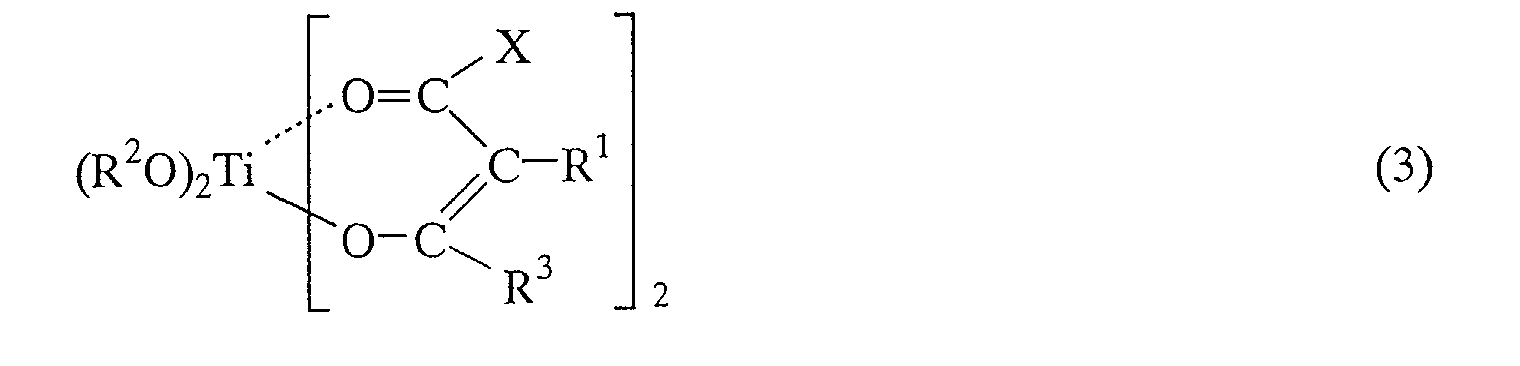
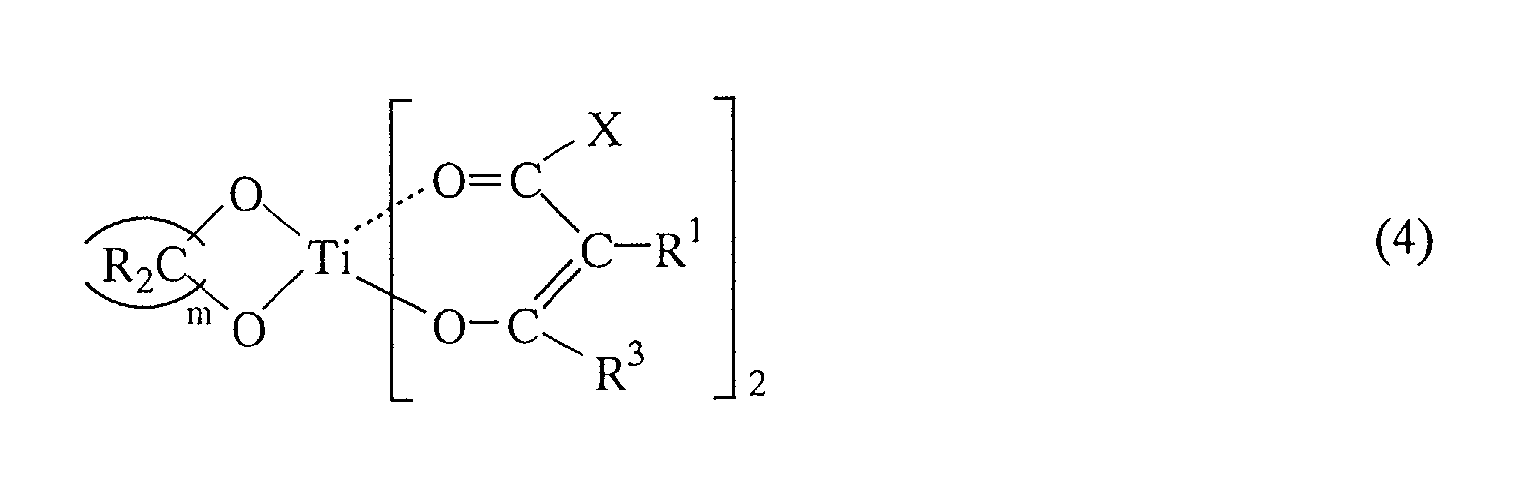
- Typical titanium chelate catalysts are of the general formulae (3) and (4).
- X is a monovalent hydrocarbon group, alkoxy group or amino group
- R 1 , R 2 and R 3 are as defined above.
- the monovalent hydrocarbon groups represented by X are exemplified by monovalent hydrocarbon groups of 1 to 12 carbon atoms, especially 1 to 10 carbon atoms, as described for R 1 and R 3 .
- Preferred alkoxy groups are those of 1 to 8 carbon atoms, especially 1 to 6 carbon atoms.
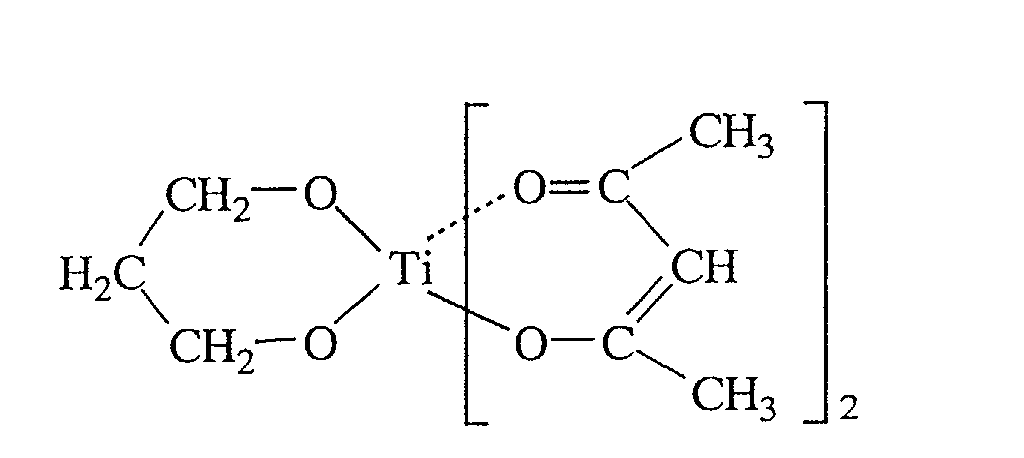
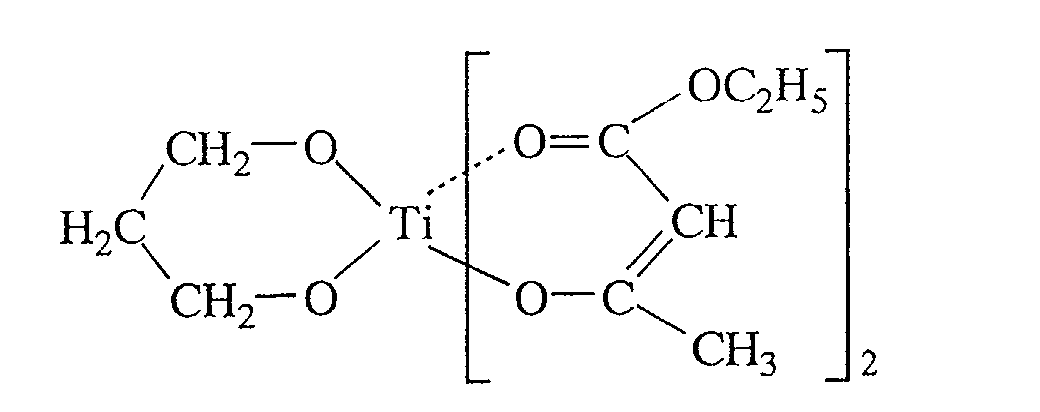
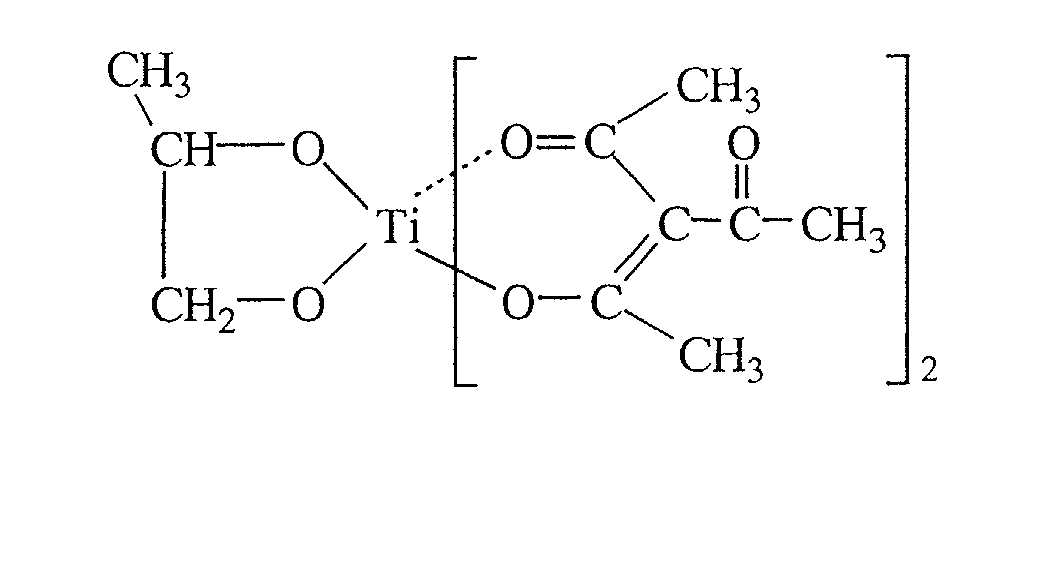
- titanium chelate catalysts include titanium diisopropoxide bis(ethyl acetoacetate), titanium diisopropoxide bis(acetylacetone), titanium dibutoxide bis(methyl acetoacetate), and those of the formulae shown below.
- Component (D) is generally added in catalytic amounts, preferably amounts of 0.1 to 10 parts by weight, preferably 0.2 to 7 parts by weight, per 100 parts by weight of component (A). With too small amounts of component (D), the composition will slowly cure. With too large amounts of component (D), the composition will cure too fast and become unstable during storage.
- composition further included in the composition according to a preferred embodiment of the invention is (E) an organosiloxane consisting essentially of R 4 3 SiO 1/2 units and SiO 4/2 units wherein R 4 is a substituted or unsubstituted monovalent hydrocarbon group having 1 to 6 carbon atoms, in which the molar ratio of R 4 3 SiO 1/2 units to SiO 4/2 units is from 0.6/1 to 1.2/1, and the content of hydroxysilyl groups is less than 0.7% by weight.
- Component (E) serves to enhance the crosslinking density of the composition and plays an important role in improving oil resistance by cooperating with components (A) and (F).
- the monovalent hydrocarbon groups represented by R 4 include alkyl, alkenyl, phenyl and halogenated alkyl groups, preferably methyl, phenyl and vinyl groups, with methyl and vinyl being most preferred.
- Component (E) is generally added in amounts of up to 50 parts by weight, preferably 2 to 40 parts by weight, per 100 parts by weight of component (A). With too small amounts of component (E), the composition may show low mechanical strength after oil immersion. With too large amounts of component (E), the composition will slowly cure or rubber physical properties may become insufficient.
- composition according to another preferred embodiment of the invention is (F) a basic filler. It is effective for improving the oil resistance, appropriate viscosity and rubber physical properties of the composition.
- suitable basic filler examples include calcium carbonate, calcium oxide, magnesia, aluminum hydroxide, microparticulate alumina, zinc oxide and zinc carbonate, which may be surface treated with silanes, silazanes, low degree-of-polymerization siloxanes, and organic compounds. Pretreated basic fillers are also useful. Alternatively, the basic filler may be treated with a silane during preparation of the composition. In order that the composition maintain its desired properties, it is important that no substantial quantities of by-products resulting from such treatment, catalysts and the like be left in the composition.
- Component (F) is generally added in amounts of up to 200 parts by weight, preferably 5 to 150 parts by weight, per 100 parts by weight of component (A). With too large amounts of component (F), the composition may have so high a viscosity as to interfere with mixing and workability upon application. With too small amounts of component (F), physical properties of cured rubber may become poor.
- the invention composition may further contain a fine powder inorganic filler for improving flow characteristics prior to curing, and endowing the rubbery elastomer after curing with desired mechanical properties.
- Suitable inorganic fillers include quartz flour, fumed titanium dioxide, diatomaceous earth and glass balloons, which may be surface treated with silanes, silazanes, low degree-of-polymerization siloxanes, organic compounds or the like.
- adhesion improving agents may be included, for example, silane coupling agents such as amino-containing alkoxysilanes, epoxy-containing alkoxysilanes, and mercapto-containing alkoxysilanes.
- silane coupling agents may be used alone or in admixture of any.
- Reaction mixtures of an amino-containing alkoxysilane with an epoxy-containing alkoxysilane are also useful. Of these, the reaction mixtures of an amino-containing alkoxysilane with an epoxy-containing alkoxysilane are most effective for improving adhesion.
- organic solvents mildew-proofing agents, flame retardants, heat resistance modifiers, plasticizers, thixotropic agents, pigments and the like may be added to the inventive composition.
- the inventive composition may be prepared by mixing components (A) to (F) and optional additives under humidity-shielded conditions.
- the composition thus obtained is stored in a sealed container and on use, exposed to air-borne moisture whereupon it cures into a rubbery elastomer. That is, the inventive composition can be used as one part type RTV organopolysiloxane composition.
- inventive compositions are suited as a sealing material for automobiles. They may also find application as sealing materials for buildings, sealing materials, adhesives and humidity-proof coatings for electric and electronic parts, and coatings and adhesives for items of fibers, glass, metals, and plastics. These uses are an aspect of the invention.
- variable groups having the same designation may be the same or may be selected independently from the specified options.
- Viscosity is a measurement in centipoise (cp) at 25°C.
- the polymer thus obtained had a viscosity of 31,000 cp.
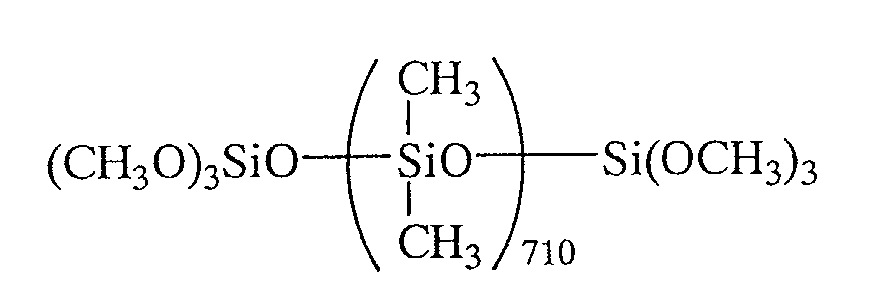
- the polymer was mixed with tetrabutyl titanate in a ratio of 100:1, it did not thicken immediately and cured after one day. This suggests that trimethoxysilane added to vinyl groups at ends and side chains of the polymer.
- This polymer is designated Polymer A and has the average formula shown below.
- the polymer thus obtained had a viscosity of 30,500 cp.
- the polymer was mixed with tetrabutyl titanate in a ratio of 100:1, it did not thicken immediately and cured after one day. This suggests that trimethoxysilane added to vinyl groups at ends of the polymer.
- This polymer is designated Polymer B and has the average formula shown below.
- the polymer thus obtained had a viscosity of 30,500 cp.
- the polymer was mixed with tetrabutyl titanate in a ratio of 100:1, it did not thicken immediately and cured after one day. This suggests that the polymer ends were substituted with trimethoxysilyl groups.
- This polymer is designated Polymer C and has the average formula shown below.
- a composition was prepared by uniformly mixing 50 parts of Polymer A, 9 parts of fumed silica having a specific surface area of 110 m 2 /g and surface treated with dimethyldichlorosilane, and 30 parts of colloidal calcium carbonate (Hakuenka CCR by Shiraishi Kogyo Co., Ltd.), and further mixing them with 3 parts of vinyltrimethoxysilane and 2 parts of titanium diisopropoxide bis(ethyl acetoacetate) in vacuum until uniform.
- the composition was contained in a plastic cartridge, which was sealed.
- a composition was prepared by uniformly mixing 100 parts of Polymer A, 9 parts of fumed silica having a specific surface area of 110 m 2 /g and surface treated with dimethyldichlorosilane, 30 parts of colloidal calcium carbonate (Hakuenka CCR by Shiraishi Kogyo Co., Ltd.), and 10 parts of a resinous siloxane copolymer consisting of trimethylsiloxy units ((CH 3 ) 3 SiO 1/2 units) and SiO 4/2 units, with a (CH 3 ) 3 SiO 1/2 /SiO 4/2 molar ratio of 0.74 and a silanol content of 0.06 mol/100 g, in toluene at a concentration of 50 wt% solids, and further mixing them with 3 parts of vinyltrimethoxysilane and 2 parts of titanium diisopropoxide bis(ethyl acetoacetate) in vacuum until uniform.
- the composition was contained in a plastic cartridge, which was sealed.
- compositions of the Examples were worked into sheets of 2 mm thick and cured in an atmosphere of 23°C and RH 50% for 7 days.
- Rubber physical properties (hardness, tensile strength and elongation at break) of the cured sheets were measured according to JIS K-6249.
- the sheets were subjected to a storage test, an oil resistance test and an LLC resistance test, conditions of which are described below, before rubber physical properties (hardness, tensile strength and elongation at break) were measured again. The results are shown in Table 1.
- a sheet was stored for 7 days while heating at 70°C in a dryer.
- a sheet was immersed in Toyota engine oil "Neo SJ20" at 120°C for 240 hours.
- a sheet was immersed in a 50% aqueous dilution of Toyota long-life coolant (LLC) at 120°C for 240 hours.
- LLC long-life coolant
- Example 1 A composition was prepared as in Example 1 except that Polymer B was used instead of Polymer A. On this composition, the same tests as in Example 1 were carried out. The results are shown in Table 1.
- Example 2 A composition was prepared as in Example 2 except that Polymer B was used instead of Polymer A. On this composition, the same tests as in Example 2 were carried out. The results are shown in Table 1.
- Example 1 A composition was prepared as in Example 1 except that Polymer C was used instead of Polymer A. On this composition, the same tests as in Example 1 were carried out. The results are shown in Table 1.
- Example Comparative Example 1 2 1 2 3 4 As cured Hardness (Durometer A) 58 60 56 59 50 58 Elongation (%) 220 250 310 330 450 350 Tensile strength (MPa) 3.9 4.0 3.4 3.6 3.2 3.5 After oil test Hardness (Durometer A) 48 52 30 35 15 33 Elongation (%) 200 240 290 300 610 300 Tensile strength (MPa) 3.4 3.6 1.7 2.2 1.6 2.1 After LLC test Hardness (Durometer A) 57 58 46 48 18 35 Elongation (%) 210 230 300 340 750 450 Tensile strength (MPa) 3.5 3.8 3.0 2.8 1.1 1.6 After storage Hardness (Durometer A) 58 58 48 46 48 43 Elongation (%) 230 270 450 380 500 300 Tensile strength (MPa)
- the room temperature curable organopolysiloxane composition of the invention is improved in stability during storage under sealed conditions and cures into an elastomeric product whose physical properties change little even when used under rigorous conditions as encountered in proximity to automotive engines, as compared with prior art RTV organopolysiloxane compositions of the one part, alcohol-removal type.
Landscapes
- Chemical & Material Sciences (AREA)
- Health & Medical Sciences (AREA)
- Chemical Kinetics & Catalysis (AREA)
- Medicinal Chemistry (AREA)
- Polymers & Plastics (AREA)
- Organic Chemistry (AREA)
- Compositions Of Macromolecular Compounds (AREA)
- Adhesives Or Adhesive Processes (AREA)
Abstract
Description



| Example | Comparative Example | |||||||
| 1 | 2 | 1 | 2 | 3 | 4 | |||
| As cured | Hardness | (Durometer A) | 58 | 60 | 56 | 59 | 50 | 58 |
| Elongation | (%) | 220 | 250 | 310 | 330 | 450 | 350 | |
| Tensile strength | (MPa) | 3.9 | 4.0 | 3.4 | 3.6 | 3.2 | 3.5 | |
| After oil test | Hardness | (Durometer A) | 48 | 52 | 30 | 35 | 15 | 33 |
| Elongation | (%) | 200 | 240 | 290 | 300 | 610 | 300 | |
| Tensile strength | (MPa) | 3.4 | 3.6 | 1.7 | 2.2 | 1.6 | 2.1 | |
| After LLC test | Hardness | (Durometer A) | 57 | 58 | 46 | 48 | 18 | 35 |
| Elongation | (%) | 210 | 230 | 300 | 340 | 750 | 450 | |
| Tensile strength | (MPa) | 3.5 | 3.8 | 3.0 | 2.8 | 1.1 | 1.6 | |
| After storage | Hardness | (Durometer A) | 58 | 58 | 48 | 46 | 48 | 43 |
| Elongation | (%) | 230 | 270 | 450 | 380 | 500 | 300 | |
| Tensile strength | (MPa) | 3.8 | 3.8 | 3.0 | 3.3 | 2.3 | 1.5 |
Claims (6)
- A room temperature curable organopolysiloxane composition comprising(A) 100 parts by weight of organopolysiloxane having at least one organooxysilyl group each at an end and a side chain of the polymer, and/or an organopolysiloxane having at least two organooxysilyl groups only on side chains of the polymer,(B) 1 to 40 parts by weight of fumed silica,(C) 0.5 to 25 parts by weight of organooxysilane having the general formula: R1 aSi(OR2)4-a wherein R1 is monovalent hydrocarbon group, R2 is monovalent hydrocarbon group or alkoxy-substituted monovalent hydrocarbon group, and "a" is 0 or 1, or a partial hydrolytic condensate thereof, and(D) 0.1 to 10 parts by weight of condensation catalyst.
- The composition of claim 1 wherein the polymer (A) has the following general formula (1) and/or (2):
 wherein R1 is a monovalent hydrocarbon group, R2 is a monovalent hydrocarbon group or alkoxy-substituted monovalent hydrocarbon group, R3 is a substituted or unsubstituted monovalent hydrocarbon group, Y is a divalent hydrocarbon group having 1 to 8 carbon atoms, b is an integer of 1 to 3, k is an integer of 2 to 10, m is an integer of 1 to 10, and n is such an integer that the organopolysiloxane may have a viscosity of 20 to 1,000,000 centipoise at 25°C.
- The composition of claim 1 or 2 wherein the condensation catalyst (D) is a titanium chelate catalyst.
- The composition of any one of claims 1 to 3, further comprising (E) organosiloxane consisting essentially of R4 3SiO1/2 units and SiO4/2 units wherein R4 is a substituted or unsubstituted monovalent hydrocarbon group having 1 to 6 carbon atoms, the molar ratio of R4 3SiO1/2 units to SiO4/2 units being from 0.6 to 1.2, said organosiloxane containing less than 0.7% by weight of hydroxysilyl groups.
- The composition of any one of claims 1 to 4, further comprising (F) a basic filler.
- The use of a composition according to any one of claims to 5 as a sealant, adhesive or coating.
Applications Claiming Priority (2)
| Application Number | Priority Date | Filing Date | Title |
|---|---|---|---|
| JP2001391272A JP3824071B2 (en) | 2001-12-25 | 2001-12-25 | Room temperature curable organopolysiloxane composition |
| JP2001391272 | 2001-12-25 |
Publications (3)
| Publication Number | Publication Date |
|---|---|
| EP1323782A2 true EP1323782A2 (en) | 2003-07-02 |
| EP1323782A3 EP1323782A3 (en) | 2003-09-17 |
| EP1323782B1 EP1323782B1 (en) | 2007-02-21 |
Family
ID=19188496
Family Applications (1)
| Application Number | Title | Priority Date | Filing Date |
|---|---|---|---|
| EP02258812A Expired - Lifetime EP1323782B1 (en) | 2001-12-25 | 2002-12-20 | Room temperature curable organopolysiloxane compositions |
Country Status (4)
| Country | Link |
|---|---|
| US (1) | US6878769B2 (en) |
| EP (1) | EP1323782B1 (en) |
| JP (1) | JP3824071B2 (en) |
| DE (1) | DE60218274T2 (en) |
Cited By (4)
| Publication number | Priority date | Publication date | Assignee | Title |
|---|---|---|---|---|
| EP1361254A1 (en) * | 2002-05-09 | 2003-11-12 | Shin-Etsu Chemical Co., Ltd. | Room temperature curable organopolysiloxane compositions |
| FR2864096A1 (en) * | 2003-12-23 | 2005-06-24 | Rhodia Chimie Sa | One-component, moisture-crosslinked silicone elastomer composition for use e.g. in adhesives or sealants for building applications, contains a special dialkyltin dicarboxylate compound as crosslinking catalyst |
| EP2094484A4 (en) * | 2006-12-21 | 2012-10-31 | Millennium Inorganic Chem | POLY (SILOXANE) MODIFIED TITANIUM DIOXIDE |
| WO2021024118A1 (en) * | 2019-08-02 | 2021-02-11 | 3M Innovative Properties Company | Composition including a polyorganosiloxane and an amino-functional silane and method of using the same |
Families Citing this family (12)
| Publication number | Priority date | Publication date | Assignee | Title |
|---|---|---|---|---|
| AU1941797A (en) * | 1997-03-17 | 1998-10-12 | Mitsubishi Denki Kabushiki Kaisha | Image encoder, image decoder, image encoding method, image decoding method and image encoding/decoding system |
| JP4916877B2 (en) * | 2003-04-03 | 2012-04-18 | ダウ・コーニング・コーポレイション | Moisture curable organosiloxane composition |
| US7304013B2 (en) * | 2003-06-30 | 2007-12-04 | Corning Incorporated | Metal oxide catalysts |
| JP4780976B2 (en) * | 2004-03-05 | 2011-09-28 | 信越化学工業株式会社 | Fluoropolyether adhesive composition |
| JP4186071B2 (en) * | 2004-03-25 | 2008-11-26 | 信越化学工業株式会社 | Room temperature curable organopolysiloxane composition, automotive parts |
| JP4569765B2 (en) * | 2005-05-13 | 2010-10-27 | 信越化学工業株式会社 | Room temperature curable silicone rubber composition for protecting electrical and electronic components, mounting circuit board, silver electrode and silver chip resistor |
| JP4811562B2 (en) * | 2005-05-13 | 2011-11-09 | 信越化学工業株式会社 | Room temperature curable organopolysiloxane composition |
| DE102006009004A1 (en) * | 2006-02-23 | 2007-09-06 | Sustech Gmbh & Co. Kg | Multifunctional star-shaped prepolymers, their preparation and use |
| JP5225651B2 (en) * | 2007-10-26 | 2013-07-03 | 花王株式会社 | Anti-fungal composition |
| US10066138B2 (en) * | 2013-12-27 | 2018-09-04 | Dow Corning Toray Co., Ltd. | Room-temperature-curable silicone rubber composition, the use thereof, and method for repairing electronic device |
| US20170275309A1 (en) * | 2014-09-04 | 2017-09-28 | Shin-Etsu Chemical Co., Ltd. | Novel organic titanium compound, method for producing same, and room temperature-curable resin composition |
| JP7626312B2 (en) | 2020-12-21 | 2025-02-07 | モメンティブ・パフォーマンス・マテリアルズ・ジャパン合同会社 | Water-resistant adhesive polyorganosiloxane composition |
Family Cites Families (13)
| Publication number | Priority date | Publication date | Assignee | Title |
|---|---|---|---|---|
| FR2228814B1 (en) * | 1973-05-11 | 1975-11-21 | Rhone Poulenc Ind | |
| JPS5543119A (en) | 1978-09-20 | 1980-03-26 | Sws Silicones Corp | Titanium ester contained vulcanizable organopolysiloxane composition and its manufacture |
| JPS5695923A (en) * | 1979-11-30 | 1981-08-03 | Shin Etsu Chem Co Ltd | Cold curing organopolysloxane composition |
| US4539367A (en) * | 1982-02-17 | 1985-09-03 | General Electric Company | Low modulus one-component RTV compositions and processes |
| US4743474A (en) * | 1983-08-05 | 1988-05-10 | Dow Corning Corporation | Coating process and moisture-curable organopolysiloxane compositions therefor |
| US4525566A (en) * | 1984-03-02 | 1985-06-25 | Dow Corning Corporation | Coating method and silicone composition for PSA release coating |
| JPS61148285A (en) * | 1984-12-21 | 1986-07-05 | Toray Silicone Co Ltd | Solid material treating agent composition |
| US4888404A (en) * | 1986-03-03 | 1989-12-19 | Dow Corning Corporation | Method of improving shelf life of silicone elastomeric sealant |
| US4652624A (en) * | 1986-03-03 | 1987-03-24 | Dow Corning Corporation | Room-temperature-curing silicone sealants |
| JPH0739547B2 (en) * | 1992-01-10 | 1995-05-01 | 東レ・ダウコーニング・シリコーン株式会社 | Room temperature curable organopolysiloxane composition |
| US5840794A (en) * | 1997-01-10 | 1998-11-24 | Dow Corning Corporation | Alkoxy functional sealants with rapid development of green strength |
| US6008284A (en) * | 1997-12-23 | 1999-12-28 | Dow Corning Corporation | Fast curing alkoxy-functional RTV compositions |
| US6235832B1 (en) * | 1998-12-21 | 2001-05-22 | Dow Corning Corporation | RTV silicone compositions with rapid development of green strength |
-
2001
- 2001-12-25 JP JP2001391272A patent/JP3824071B2/en not_active Expired - Fee Related
-
2002
- 2002-12-20 DE DE60218274T patent/DE60218274T2/en not_active Expired - Lifetime
- 2002-12-20 EP EP02258812A patent/EP1323782B1/en not_active Expired - Lifetime
- 2002-12-24 US US10/327,140 patent/US6878769B2/en not_active Expired - Lifetime
Cited By (9)
| Publication number | Priority date | Publication date | Assignee | Title |
|---|---|---|---|---|
| EP1361254A1 (en) * | 2002-05-09 | 2003-11-12 | Shin-Etsu Chemical Co., Ltd. | Room temperature curable organopolysiloxane compositions |
| US6784241B2 (en) | 2002-05-09 | 2004-08-31 | Shin-Etsu Chemical Co., Ltd. | Room temperature curable organopolysiloxane compositions |
| FR2864096A1 (en) * | 2003-12-23 | 2005-06-24 | Rhodia Chimie Sa | One-component, moisture-crosslinked silicone elastomer composition for use e.g. in adhesives or sealants for building applications, contains a special dialkyltin dicarboxylate compound as crosslinking catalyst |
| WO2005071007A1 (en) * | 2003-12-23 | 2005-08-04 | Rhodia Chimie | Polyorganosiloxane monocomponent compound crosslinking into silicone elastomer |
| US7838613B2 (en) | 2003-12-23 | 2010-11-23 | Rhodia Chimie | Polyorganosiloxane monocomponent compound crosslinking into silicone elastomer |
| EP2094484A4 (en) * | 2006-12-21 | 2012-10-31 | Millennium Inorganic Chem | POLY (SILOXANE) MODIFIED TITANIUM DIOXIDE |
| US8394873B2 (en) | 2006-12-21 | 2013-03-12 | Millennium Inorganic Chemicals, Inc. | Polysiloxane modified titanium dioxide |
| WO2021024118A1 (en) * | 2019-08-02 | 2021-02-11 | 3M Innovative Properties Company | Composition including a polyorganosiloxane and an amino-functional silane and method of using the same |
| US12421421B2 (en) | 2019-08-02 | 2025-09-23 | 3M Innovative Properties Company | Composition including a polyorganosiloxane and an amino-functional silane and method of using the same |
Also Published As
| Publication number | Publication date |
|---|---|
| US6878769B2 (en) | 2005-04-12 |
| DE60218274D1 (en) | 2007-04-05 |
| JP3824071B2 (en) | 2006-09-20 |
| DE60218274T2 (en) | 2007-11-08 |
| EP1323782B1 (en) | 2007-02-21 |
| JP2003183504A (en) | 2003-07-03 |
| US20030153672A1 (en) | 2003-08-14 |
| EP1323782A3 (en) | 2003-09-17 |
Similar Documents
| Publication | Publication Date | Title |
|---|---|---|
| US6809136B2 (en) | Room temperature curable organopolysiloxane compositions | |
| EP1323782B1 (en) | Room temperature curable organopolysiloxane compositions | |
| JPH05262989A (en) | Room temperature curable organopolysiloxane composition | |
| US6784241B2 (en) | Room temperature curable organopolysiloxane compositions | |
| US4760123A (en) | Room temperature curing polyorganosiloxane compositions | |
| KR101954055B1 (en) | Multi-component room-temperature-curable silicone elastomer composition | |
| KR20160008584A (en) | Non-metal catalyzed room temperature moisture curable organopolysiloxane compositions | |
| JP3916403B2 (en) | Room temperature curable sealing material composition for automobiles | |
| JPH0588866B2 (en) | ||
| KR101127301B1 (en) | Room Temperature Curable Organopolysiloxane Composition | |
| JP4171868B2 (en) | Room temperature curable organopolysiloxane composition | |
| JP2003221506A (en) | Room temperature curable organopolysiloxane composition | |
| JP4283009B2 (en) | Room temperature curable polyorganosiloxane composition | |
| WO2023068094A1 (en) | Room temperature-curable organopolysiloxane composition, adhesive, sealing agent, and coating agent | |
| JPH0572424B2 (en) | ||
| JPS63137958A (en) | One-package type room temperature curing organopolysiloxane composition | |
| JP4658654B2 (en) | Room temperature curable organopolysiloxane composition | |
| JP4530177B2 (en) | Room temperature curable organopolysiloxane composition | |
| JP2005290330A (en) | Room temperature curable organopolysiloxane composition | |
| JP2002348476A (en) | Room temperature curable polyorganosiloxane composition | |
| JP5534656B2 (en) | Room temperature curable organopolysiloxane composition | |
| JP3344012B2 (en) | Moisture curable organopolysiloxane composition | |
| JP5545981B2 (en) | Room temperature curable polyorganosiloxane composition | |
| EP4559978A1 (en) | Moisture-curable siloxane composition |
Legal Events
| Date | Code | Title | Description |
|---|---|---|---|
| PUAI | Public reference made under article 153(3) epc to a published international application that has entered the european phase |
Free format text: ORIGINAL CODE: 0009012 |
|
| AK | Designated contracting states |
Designated state(s): AT BE BG CH CY CZ DE DK EE ES FI FR GB GR IE IT LI LU MC NL PT SE SI SK TR |
|
| AX | Request for extension of the european patent |
Extension state: AL LT LV MK RO |
|
| PUAL | Search report despatched |
Free format text: ORIGINAL CODE: 0009013 |
|
| AK | Designated contracting states |
Kind code of ref document: A3 Designated state(s): AT BE BG CH CY CZ DE DK EE ES FI FR GB GR IE IT LI LU MC NL PT SE SI SK TR |
|
| AX | Request for extension of the european patent |
Extension state: AL LT LV MK RO |
|
| RIC1 | Information provided on ipc code assigned before grant |
Ipc: 7C 08K 5/5419 B Ipc: 7C 08K 5/5415 B Ipc: 7C 08K 3/36 B Ipc: 7C 08L 83/14 A |
|
| 17P | Request for examination filed |
Effective date: 20040121 |
|
| AKX | Designation fees paid |
Designated state(s): DE FR GB NL |
|
| 17Q | First examination report despatched |
Effective date: 20050622 |
|
| GRAP | Despatch of communication of intention to grant a patent |
Free format text: ORIGINAL CODE: EPIDOSNIGR1 |
|
| GRAS | Grant fee paid |
Free format text: ORIGINAL CODE: EPIDOSNIGR3 |
|
| GRAA | (expected) grant |
Free format text: ORIGINAL CODE: 0009210 |
|
| AK | Designated contracting states |
Kind code of ref document: B1 Designated state(s): DE FR GB NL |
|
| REG | Reference to a national code |
Ref country code: GB Ref legal event code: FG4D |
|
| REF | Corresponds to: |
Ref document number: 60218274 Country of ref document: DE Date of ref document: 20070405 Kind code of ref document: P |
|
| ET | Fr: translation filed | ||
| PLBE | No opposition filed within time limit |
Free format text: ORIGINAL CODE: 0009261 |
|
| STAA | Information on the status of an ep patent application or granted ep patent |
Free format text: STATUS: NO OPPOSITION FILED WITHIN TIME LIMIT |
|
| 26N | No opposition filed |
Effective date: 20071122 |
|
| REG | Reference to a national code |
Ref country code: FR Ref legal event code: PLFP Year of fee payment: 14 |
|
| REG | Reference to a national code |
Ref country code: FR Ref legal event code: PLFP Year of fee payment: 15 |
|
| REG | Reference to a national code |
Ref country code: FR Ref legal event code: PLFP Year of fee payment: 16 |
|
| PGFP | Annual fee paid to national office [announced via postgrant information from national office to epo] |
Ref country code: NL Payment date: 20191114 Year of fee payment: 18 Ref country code: DE Payment date: 20191210 Year of fee payment: 18 |
|
| PGFP | Annual fee paid to national office [announced via postgrant information from national office to epo] |
Ref country code: FR Payment date: 20191115 Year of fee payment: 18 |
|
| PGFP | Annual fee paid to national office [announced via postgrant information from national office to epo] |
Ref country code: GB Payment date: 20191219 Year of fee payment: 18 |
|
| REG | Reference to a national code |
Ref country code: DE Ref legal event code: R119 Ref document number: 60218274 Country of ref document: DE |
|
| REG | Reference to a national code |
Ref country code: NL Ref legal event code: MM Effective date: 20210101 |
|
| GBPC | Gb: european patent ceased through non-payment of renewal fee |
Effective date: 20201220 |
|
| PG25 | Lapsed in a contracting state [announced via postgrant information from national office to epo] |
Ref country code: NL Free format text: LAPSE BECAUSE OF NON-PAYMENT OF DUE FEES Effective date: 20210101 |
|
| PG25 | Lapsed in a contracting state [announced via postgrant information from national office to epo] |
Ref country code: FR Free format text: LAPSE BECAUSE OF NON-PAYMENT OF DUE FEES Effective date: 20201231 |
|
| PG25 | Lapsed in a contracting state [announced via postgrant information from national office to epo] |
Ref country code: GB Free format text: LAPSE BECAUSE OF NON-PAYMENT OF DUE FEES Effective date: 20201220 Ref country code: DE Free format text: LAPSE BECAUSE OF NON-PAYMENT OF DUE FEES Effective date: 20210701 |