EP1319959A2 - Verfahren zur nichtkooperativen Ortung von Teilnehmern in einem leistungsgeregelten Mobilfunksystem - Google Patents
Verfahren zur nichtkooperativen Ortung von Teilnehmern in einem leistungsgeregelten Mobilfunksystem Download PDFInfo
- Publication number
- EP1319959A2 EP1319959A2 EP02025889A EP02025889A EP1319959A2 EP 1319959 A2 EP1319959 A2 EP 1319959A2 EP 02025889 A EP02025889 A EP 02025889A EP 02025889 A EP02025889 A EP 02025889A EP 1319959 A2 EP1319959 A2 EP 1319959A2
- Authority
- EP
- European Patent Office
- Prior art keywords
- der
- station
- mobile station
- subscriber mobile
- power
- Prior art date
- Legal status (The legal status is an assumption and is not a legal conclusion. Google has not performed a legal analysis and makes no representation as to the accuracy of the status listed.)
- Granted
Links
Images

Classifications
-
- H—ELECTRICITY
- H04—ELECTRIC COMMUNICATION TECHNIQUE
- H04W—WIRELESS COMMUNICATION NETWORKS
- H04W52/00—Power management, e.g. Transmission Power Control [TPC] or power classes
- H04W52/04—Transmission power control [TPC]
- H04W52/18—TPC being performed according to specific parameters
- H04W52/22—TPC being performed according to specific parameters taking into account previous information or commands
- H04W52/226—TPC being performed according to specific parameters taking into account previous information or commands using past references to control power, e.g. look-up-table
-
- G—PHYSICS
- G01—MEASURING; TESTING
- G01S—RADIO DIRECTION-FINDING; RADIO NAVIGATION; DETERMINING DISTANCE OR VELOCITY BY USE OF RADIO WAVES; LOCATING OR PRESENCE-DETECTING BY USE OF THE REFLECTION OR RERADIATION OF RADIO WAVES; ANALOGOUS ARRANGEMENTS USING OTHER WAVES
- G01S5/00—Position-fixing by co-ordinating two or more direction or position line determinations; Position-fixing by co-ordinating two or more distance determinations
- G01S5/02—Position-fixing by co-ordinating two or more direction or position line determinations; Position-fixing by co-ordinating two or more distance determinations using radio waves
- G01S5/12—Position-fixing by co-ordinating two or more direction or position line determinations; Position-fixing by co-ordinating two or more distance determinations using radio waves by co-ordinating position lines of different shape, e.g. hyperbolic, circular, elliptical or radial
-
- H—ELECTRICITY
- H04—ELECTRIC COMMUNICATION TECHNIQUE
- H04W—WIRELESS COMMUNICATION NETWORKS
- H04W52/00—Power management, e.g. Transmission Power Control [TPC] or power classes
- H04W52/04—Transmission power control [TPC]
- H04W52/18—TPC being performed according to specific parameters
- H04W52/28—TPC being performed according to specific parameters using user profile, e.g. mobile speed, priority or network state, e.g. standby, idle or non-transmission
- H04W52/283—Power depending on the position of the mobile
-
- G—PHYSICS
- G01—MEASURING; TESTING
- G01S—RADIO DIRECTION-FINDING; RADIO NAVIGATION; DETERMINING DISTANCE OR VELOCITY BY USE OF RADIO WAVES; LOCATING OR PRESENCE-DETECTING BY USE OF THE REFLECTION OR RERADIATION OF RADIO WAVES; ANALOGOUS ARRANGEMENTS USING OTHER WAVES
- G01S11/00—Systems for determining distance or velocity not using reflection or reradiation
- G01S11/02—Systems for determining distance or velocity not using reflection or reradiation using radio waves
- G01S11/04—Systems for determining distance or velocity not using reflection or reradiation using radio waves using angle measurements
Definitions
- the present invention relates to a method for the non-cooperative location of Subscriber mobile stations in a performance-controlled mobile radio system.
- Non-cooperative means that the location without the system's own access Clarification station on the mobile radio system is carried out.
- Modern mobile radio systems are performance-controlled, i.e. those of Power radiated from subscriber mobile stations is strict Subject to transmission power management. It is regulated in such a way that Base station received power corresponds to a predetermined reception level.
- the radiated performance of the individual participants thus depends on the distance and the propagation conditions on the radio link between Subscriber mobile station and base station.
- the reception power at a any receiving point that is not identical to the base station is received depends on the relative spatial constellation between emitter and base station and reconnaissance station.
- Non-cooperative location methods using triangulation or transit time difference measurement is a necessary prerequisite for the location of a Emitters that it from several spatially distant bearing / receiving sensors can be received.
- several receiving points form one spatially distributed location sensor.
- the area or room coverage of such Location sensor corresponds to that of the individual receiving points together viewed area or the jointly viewed spatial area.
- the of Information and surveillance systems to monitor areas of interest are in usually significantly larger than the expansion of individual cells in cellular radio systems, while the transmission powers of the subscriber mobile stations to be located are based on the cell dimensions and through a series of technical measures be kept as low as possible.
- the availability of a location functionality to cover a larger spatial area of interest therefore requires a large number of spatially distributed reconnaissance stations.
- DE 195 28 616 A1 describes a method for the cooperative location of mobile stations that only requires one reconnaissance station, which contains a direction finder. Since a direction finder alone is not yet able to determine the complete position, the reconnaissance station additionally intercepts the radio traffic between the mobile station and the base station of the mobile radio system (cooperative location). In particular, the so-called TA value, which is a component of the GSM signaling, is determined and the position of the mobile stations is calculated from this and from the result of the bearing. Further location methods using internal parameters and protocols of the mobile radio system are described in DE 197 14 743 C2 and DE 43 21 418 A1 .
- DE 197 43 258 A1 describes a method for ensuring reciprocal speech traffic and for position detection between mobile radio stations with navigation devices.
- the position of the individual radio stations is based on the position information provided by a GPS antenna.
- Mutual voice communication between the individual radio stations is ensured by an electrical field strength detection device.
- a warning is generated.
- the invention has for its object to provide a method with which in addition a significant reduction in the number of reconnaissance stations required of the subscriber mobile stations without their own system access to the reconnaissance station is made possible.
- the reconnaissance station should therefore, if possible, without resorting to internal ones Data, protocol etc. of the mobile radio system work.
- the characteristic of power regulation in the mobile radio networks to be investigated enables the location determination according to the invention with only one reconnaissance station (Single station location).
- the regulation of the transmission power of the mobile subscribers is a essential feature of almost all modern mobile radio systems. The procedure is therefore applicable across the board and only needs to be used in a few measurement parameters be adapted.
- the method according to the invention is based on the simultaneous measurement of the received power and the bearing angle of subscriber mobile stations.
- the bearing angle can in the simplest case be a directional antenna with the lowest possible Main lobe width can be used. More convenient approaches rely on antenna arrays with beamforming or high-resolution algorithms.
- the base station and the propagation loss can be determined from the Reception station measured at possible positions of the Close the sending subscriber mobile station. The location is determined by Cutting the bearing beam with the locus determined from the power measurement.
- the determination of the reception level of radio signals is one of the Standard functionalities of modern radio reconnaissance sensors. For example, deliver modern broadband direction finder as measured values level and angle over time and frequency. The measured level is proportional to the reception field strength at the location of the Enlightenment station. The proportionality factor can be calibrated under Taking into account the antennas used. For radio networks that Using CDMA technology, many mobile subscribers transmit on the same frequency. A mixture of signals is therefore received at the reconnaissance station. The the Shares in the total reception level to be allocated to individual mobile subscribers must be selected by room-selective filtering. This can be done either Directional antennas or using high-resolution methods (e.g. Krim and Viberg "Two Decades of Array Signal Processing Research". IEEE signal Processing Magazine, July 1996, p. 67-94).
- the required information about the position of the base stations and the Target reception levels at the base stations are usually freely available - they therefore do not affect internal data of a mobile radio system.
- the advantage of the method according to the invention is not only a reduction of the required reconnaissance stations, but also with less clarification and less vulnerable to ECM: one location sensor with multiple spatially distributed mobile reconnaissance stations and central location calculation necessarily relies on a powerful radio network between the stations.
- the method according to the invention enables autonomous operation. There is no clearable radio radiation through data transmission central location calculation.
- the method according to the invention is also suitable for locating CDMA emissions (strong multi-wave incidence caused by other participants).
- An essential feature of almost all cellular radio systems is a regulation of the Transmitting power of the subscriber mobile station in a closed control loop. For It is essential for DS-CDMA systems, and it does for TDMA systems Capacity improvement.
- the transmission power of the subscriber mobile station is like this set that a precisely defined transmission quality is achieved: not too bad but not too good either! It follows that the reception level of all Subscriber mobile station at the base station are approximately the same. If this The desired level and the attenuation are known from the the reception level measured at the reconnaissance station can draw conclusions about possible Drag positions of the sending subscriber mobile station.
- the first term depends only on the environment, the second on the frequency (in MHz) and the third on the distance (in km), the three constants, A, b and c, are of the environment, the "scenario” S , dependent.
- Table 1 below contains an example of the parameters for the three environmental scenarios “open space”, city “and” pedestrian zone ".
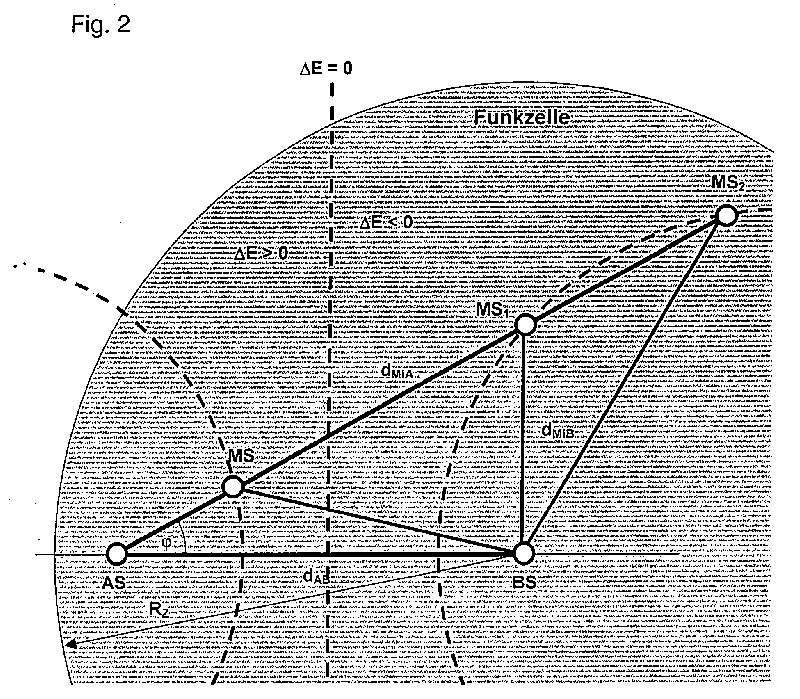
- the reception power E B at the base station BS requires the transmission power S M at the mobile station MS if the distance is d MB .
- the ratio of the two reception services only depends on the distance-determined terms. It is therefore sufficient to know the constant c , i.e. the slope of the damping line. This can be determined relatively easily by measurement.
- the position of the reconnaissance station AS represents the zero point with respect to M E , positive values are on the right, negative values on the left.
- the accuracy of the method essentially depends on the accuracy of the power control in the subscriber mobile station.
- the deviation from the nominal value E B is, for example, 1 dB, for future systems 0.25 dB is provided.
- the range ⁇ E ⁇ 1 gives quite imprecise results for ⁇ > 30. This is due to the fact that the possible positions of the subscriber mobile station move on the perpendicular bisector or circles with a very large diameter. Based on the maximum distance allowed, most of these solutions can be eliminated as inadmissible. With a control accuracy of 1/4 dB, the error is reduced to less than 1.5 or 3%.
- the chip sequence was generated from the user data by Walsh coding and subsequent spreading with a long PN sequence and a parallel "scrambling" with two short PN sequences.
- the RF carrier of a mobile station has a constant amplitude A , and the phase can change by ⁇ 90 ° after half a chip period; four angles are possible, the difference being 90 °.
- the RF signals from two mobile stations overlap, there are four Amplitudes possible and a total of 16 phases, the difference of which can be arbitrary. If the second mobile station is received with half the power at the most the first, then the two signals can be separated. You can do the two Determine partial services and even recover the two chip sequences.
- this method can also be successively applied to three (and more) subscriber mobile stations received at the same time.
- the following must apply to a total of m stations, MS 1 , MS 2 , ... MS m :
- m 3, i.e. two additional mobile stations. So that the conditions of GI. 14 are met, z. B. the reception level of MS 2 by 5 dB and that of MS 3 by 8 dB lower than that of MS 1 . This increases the total level for the reconnaissance station AS by 1.7 dB.
- the first step of a signal analysis "coming from above” is to interpret the chip sequences generated by scrambling with the two short PN sequences, PN I and PN Q , as "data" d I and d Q.
- IS-95 uses OQPSK in the mobile station to modulate the RF carrier with the frequency f T.
- the characteristic of this modulation method is that the amplitude is constant and the phases can be 45 °, 135 °, 225 ° and 315 °. However, the phase changes take place after half a symbol duration, i.e. twice the symbol frequency, and these can only be 0 or ⁇ 90 ° for successive symbols. In contrast to QPSK, a 180 ° phase jump is not carried out hard in one step, but softly one after the other in two 90 ° steps. This is also called serial modulation. s I and s Q are the symbols of the two short PN sequences, PN I and PN Q , on which the same data symbols are superimposed.
- the RF signal can be demodulated again by mixing with the carrier frequency.
- the multiplication by cos (2 ⁇ f T t ) and sin (2 ⁇ f T t ) as well as low pass filtering provides GI.
- D I ( t ) cos ( ⁇ + 45 ° + i ⁇ 90 °) and GI.
- Each i can therefore have a pair of data chips, e.g. B. 00, 01, 11, 10, assign (Fig. 3). However, this assignment is not clear. A corresponding carrier synchronization must be carried out in order to obtain the exact transmission sequence again.
- A A 1 1 + ⁇ 2 + 2 ⁇ cos ( ⁇ 2 - ⁇ 1 + ( i 2 - i 1 ) 90 °) GI.
- the sum vector A ( t ) can have 4 different lengths and a total of 16 directions.
- the endpoints of A lie on a circle with radius A 2 , the center of which is the four end points of A 1 are.
- a clear assignment is possible for A 2 ⁇ A 1 / 2 ,
- the reception level of MS 2 must therefore be less than half the level of MS 1 .
- the sum vector can be used A ( t ) determine both the center point and the radius of the circle and thus also the two amplitudes A 1 and A 2 or the power components of MS 1 and MS 2 in the sum signal.
- a ( t ) determines both the center point and the radius of the circle and thus also the two amplitudes A 1 and A 2 or the power components of MS 1 and MS 2 in the sum signal.
- the endpoints of A not on a circle, but on a kind of circular ring, but this nevertheless enables the center to be determined by vectorial averaging over all A ( t ) ,
- the influence of A can be eliminated by subtraction, so that from A 2 ( t ) the HF data can be obtained from MS 2 .
Landscapes
- Engineering & Computer Science (AREA)
- Computer Networks & Wireless Communication (AREA)
- Signal Processing (AREA)
- Physics & Mathematics (AREA)
- General Physics & Mathematics (AREA)
- Radar, Positioning & Navigation (AREA)
- Remote Sensing (AREA)
- Mobile Radio Communication Systems (AREA)
Abstract
- Position der Basisstation (BS) der zu ortenden Teilnehmermobilstation (MS);
- Sollempfangspegel der an einer Basisstation (BS) empfangbaren Leistung;
- Informationen zur Ermittlung der lokalen Ausbreitungsdämpfung der elektromagnetischen Strahlung;
Description
- Peileinrichtung,
- Aufklärungssensor zur Empfangspegelmessung,
- Rechner zur Auswertung der gewonnenen Messwerte und zur Ortsbestimmung der Teilnehmermobilstation,
- Datenbank mit Informationen zu den Positionen der Basisstationen, zum Sollempfangspegel an den Basisstationen sowie zur lokalen Ausbreitungsdämpfung elektromagnetischer Strahlung.
- Fig. 1:
- Beispiele für Dämpfungsgeraden für f = 1000 MHz,
- Fig. 2:
- Szenario zur Ortsbestimmung gemäß der Erfindung mittels nur einer Aufklärungsstation,
- Fig. 3
- asynchron demodulierter Phasenstern bei der Analyse der demodulierten HF- Trägerdaten des an der Aufklärungsstation empfangenen Signals,
- Fig. 4
- Darstellung des Summensignals bei der Analyse der demodulierten HF- Trägerdaten beim gleichzeitigen Empfang von Signalen zweier Teilnehmermobilstationen.
| Parameter für die Ausbreitungsdämpfung | |||
| Szenario | log A | b | c |
| Freiraum | 3,24 | 2,00 | 2,00 |
| Stadt | 4,95 | 2,56 | 3,52 |
| Fußgänger | 4,90 | 3,00 | 4,00 |
- Nur eine aktive Teilnehmermobilstation MS wird empfangen.
- Genügend genaue Richtantenne (oder sonstiges Antennensystem) für die Peilung.
- Genügend genaue Leistungsmessung.
- Kenntnis des Ausbreitungskoeffizienten c
- Position der Basisstation BS und daraus abgeleitet die Entfernung AS-BS.
- Gleiche Ausbreitungsbedingungen für die Strecken MS-BS und MS-AS.
- Kenntnis der Sollempfangsleistung bei der Basisstation BS.
- Kenntnis der maximal möglichen Entfernung MS-BS, um unzulässige Positionen der Mobilstation MS auszusortieren.

| Demodulationstabelle | ||
| i | dI | -d Q |
| 0 | >0 | ≥0 |
| 1 | ≤0 | >0 |
| 2 | <0 | ≤0 |
| 3 | ≥0 | <0 |
- ; konstante Amplitude A,
- ; Phasensprünge um 0°, +90° oder -90° im Abstand TC /2,
- ;ca. i Phasensprünge im Intervall von i Chips für i > 215 ≈ 33000.
- AS
- Aufklärungsstation
- BS
- Basisstation
- CDMA
- Code Division Multiple Access
- dBm
- Leistung in dB bezogen auf 1 mW
- DS-CDMA
- Direct Sequence CDMA
- ECM
- Electronic Counter Measure
- HF
- Hochfrequenz
- IS
- Interim Standard
- MS
- Mobilstation
- OQPSK
- Offset QPSK
- PN
- Pseudo-Noise
- QPSK
- Quaternary Phase Shift Keying
- TDMA
- Time Division Multiple Access
Claims (3)
- Verfahren zur nichtkooperativen Ortung einer Teilnehmermobilstation (MS) in einem leistungsgeregelten Mobilfunksystem, bei dem die an der Teilnehmermobilstation (MS) abgestrahlte Leistung derart geregelt wird, dass die an einer Basisstation (BS) des Mobilfunksystems empfangbare Leistung des von der Teilnehmermobilstation (MS) emittierten Signals einem vorgegebenen festen Empfangssollpegel entspricht, gekennzeichnet durch folgende Verfahrensschritte:a) es wird eine Datenbank bereitgestellt, in der folgende Informationen gespeichert sind:Position der Basisstation (BS) der zu ortenden Teilnehmermobilstation (MS);Sollempfangspegel der an einer Basisstation (BS) empfangbaren Leistung;Informationen zur Ermittlung der lokalen Ausbreitungsdämpfung der elektromagnetischen Strahlung;b) mittels genau einer Aufklärungsstation (AS) erfolgt die gleichzeitige Messung des Peilwinkels der Teilnehmermobilstation (MS) und der an der Aufklärungsstation (AS) empfangbaren Leistung des von der Teilnehmermobilstation (MS) emittierten Signals,c) in der Aufklärungsstation (AS) erfolgt eine Berechnung der Ortskurve mit möglichen Positionen der Teilnehmermobilstation (MS) aufgrund der gemessenen Empfangsleistung sowie unter Rückgriff auf die in der Datenbank gespeicherten Informationen,d) in der Aufklärungsstation erfolgt eine Ortsbestimmung der Teilnehmermobilstation (MS) durch Schneiden des aus Peilung ermittelten Peilstrahls mit der berechneten Ortskurve möglicher Positionen der Teilnehmermobilstation (MS).
- Verfahren nach Anspruch 1, dadurch gekennzeichnet, dass zur Verifikation der Ortsbestimmung der Abstand einer ermittelten Position der Mobilstation (MS) mit der Basisstation (BS) berechnet wird, und eine ermittelte Position dann verworfen wird, wenn dieser Abstand größer als Radius der betreffenden Funkzelle ist, wobei die Radien der Funkzellen des Mobilfunknetzes ebenfalls in der Datenbank bereitgestellt werden.
- Verfahren nach Anspruch 1 oder 2, gekennzeichnet durch folgende Verfahrens schritte, die nach den Schritten a), b) durchgeführt werden:Analyse der demodulierten HF-Trägerdaten des an der Aufklärungsstation (AS) empfangenen Signals zur Ermittlung, ob das Signal einer einzelnen Teilnehmermobilstation (MS) oder gleichzeitig die Signale mehrerer Teilnehmermobilstationen aus derselben Richtung empfangen werden,und im Falle, dass mehrere Teilnehmermobilstationen aus derselben Richtung gleichzeitig empfangen werden:Ermittlung der auf die einzelnen Teilnehmermobilstationen entfallenden Teilleistungen, undDurchführung der Schritte c) und d) für jedes der gleichzeitig empfangenen Signale der Teilnehmermobilstationen (MS).
Applications Claiming Priority (2)
| Application Number | Priority Date | Filing Date | Title |
|---|---|---|---|
| DE10161594A DE10161594C2 (de) | 2001-12-14 | 2001-12-14 | Verfahren zur nichtkooperativen Ortung von Teilnehmern in einem leistungsgeregelten Mobilfunksystem |
| DE10161594 | 2001-12-14 |
Publications (3)
| Publication Number | Publication Date |
|---|---|
| EP1319959A2 true EP1319959A2 (de) | 2003-06-18 |
| EP1319959A3 EP1319959A3 (de) | 2004-01-07 |
| EP1319959B1 EP1319959B1 (de) | 2010-01-13 |
Family
ID=7709281
Family Applications (1)
| Application Number | Title | Priority Date | Filing Date |
|---|---|---|---|
| EP02025889A Expired - Lifetime EP1319959B1 (de) | 2001-12-14 | 2002-11-20 | Verfahren zur nichtkooperativen Ortung von Teilnehmern in einem leistungsgeregelten Mobilfunksystem |
Country Status (3)
| Country | Link |
|---|---|
| EP (1) | EP1319959B1 (de) |
| AT (1) | ATE455308T1 (de) |
| DE (2) | DE10161594C2 (de) |
Families Citing this family (3)
| Publication number | Priority date | Publication date | Assignee | Title |
|---|---|---|---|---|
| ATE505044T1 (de) | 2007-11-29 | 2011-04-15 | Nokia Siemens Networks Oy | Funkzellenleistungsüberwachung und/oder - steuerung basierend auf den endgerätpositionierungsdaten und funkqualitätsparametern |
| DE102009017426A1 (de) * | 2009-03-03 | 2010-09-09 | T-Mobile International Ag | Verfahren und Mobilfunkendgerät zur Positionsbestimmung in Mobilfunknetzen mittels Richtungspeilung |
| FR3125597B1 (fr) * | 2021-07-23 | 2023-09-22 | Paris Sciences Et Lettres | Dispositif et procédé de positionnement centimetrique d’un mobile |
Family Cites Families (10)
| Publication number | Priority date | Publication date | Assignee | Title |
|---|---|---|---|---|
| US5208756A (en) * | 1991-01-28 | 1993-05-04 | Song Han L | Vehicle locating and navigating system |
| US5592180A (en) * | 1992-08-20 | 1997-01-07 | Nexus1994 Limited | Direction finding and mobile location system for trunked mobile radio systems |
| DE4321418A1 (de) * | 1993-06-26 | 1995-01-05 | Deutsche Aerospace | Verfahren zur Ortung von Mobilstationen in einem zellular aufgebauten Mobilfunknetz sowie Mobilfunknetz zur Durchführung des Verfahrens |
| JP2833967B2 (ja) * | 1993-07-23 | 1998-12-09 | 日本電気株式会社 | 携帯電話機の位置検出方法 |
| DE19528616A1 (de) * | 1995-08-04 | 1997-02-06 | Daimler Benz Aerospace Ag | Verfahren zur Funkortung einer Mobilstation und Anordnung zur Durchführung des Verfahrens |
| JP3599216B2 (ja) * | 1996-09-30 | 2004-12-08 | マツダ株式会社 | ナビゲーション装置 |
| FI104528B (fi) * | 1996-10-03 | 2000-02-15 | Nokia Networks Oy | Liikkuvan aseman paikallistamismenetelmä ja solukkoradioverkko |
| DE19714743C5 (de) * | 1997-04-09 | 2004-07-15 | T-Mobile Deutschland Gmbh | Verfahren und Einrichtung zur räumlichen Zuordnung von Qualitätsparametern in digitalen Mobilkommunikationssystemen |
| AU3503100A (en) * | 1999-02-25 | 2000-09-14 | Microsoft Corporation | Using a derived table of signal strength data to locate and track a user in a wireless network |
| US6300905B1 (en) * | 1999-10-05 | 2001-10-09 | Lucent Technologies Inc. | Location finding using a single base station in CDMA/TDMA systems |
-
2001
- 2001-12-14 DE DE10161594A patent/DE10161594C2/de not_active Expired - Fee Related
-
2002
- 2002-11-20 EP EP02025889A patent/EP1319959B1/de not_active Expired - Lifetime
- 2002-11-20 AT AT02025889T patent/ATE455308T1/de not_active IP Right Cessation
- 2002-11-20 DE DE50214165T patent/DE50214165D1/de not_active Expired - Lifetime
Also Published As
| Publication number | Publication date |
|---|---|
| DE10161594C2 (de) | 2003-10-30 |
| EP1319959B1 (de) | 2010-01-13 |
| ATE455308T1 (de) | 2010-01-15 |
| DE10161594A1 (de) | 2003-07-10 |
| EP1319959A3 (de) | 2004-01-07 |
| DE50214165D1 (de) | 2010-03-04 |
Similar Documents
| Publication | Publication Date | Title |
|---|---|---|
| EP2335442B1 (de) | Vorrichtung und verfahren zum schätzen einer orientierung eines mobilen endgeräts | |
| DE69128518T2 (de) | Verbesserter Zellular-Telefondienst mit Spreizspektrumübertragung | |
| DE60312168T2 (de) | System zum finden einer mobilen einheit | |
| DE69821213T2 (de) | Verfahren und Einrichtung zur Standorterfassung einer mobilen Station | |
| DE10297631B4 (de) | Verfahren zur Bestimmung von Ortsinformationen | |
| DE69726020T2 (de) | Verfahren und system zur schätzung der position der mobilen station | |
| DE60212580T2 (de) | Ortungssystem und Verfahren | |
| DE20311842U1 (de) | Gerät zur Lokalisierung mobiler Endgeräte auf Grundlage von Winkelmessungen | |
| EP1493284A1 (de) | Verfahren und anordnung sowie computerprogramm mit programmcode-mitteln und computerprogramm-produkt zur ermittlung einer position einer mobilen kommunikationseinrichtung in einem kommunikationsnetz | |
| DE69712790T2 (de) | Verfahren und vorrichtung zur richtfunkübertragung | |
| DE69922054T2 (de) | Verfahren und system zur bestimmung des aufenthaltsortes eines funkteilnehmers in einem cdma-kommunikationssystem | |
| DE10055289B4 (de) | System zur Bestimmung der Position eines Objekts | |
| DE102008010882A1 (de) | Vorrichtung und Verfahren zur Richtungsschätzung und/oder Decodierung von Sekundärradarsignalen | |
| DE69014984T2 (de) | Verfahren und Einrichtung zur Informationsübertragung zwischen Funksender-Empfänger desselben nach dem Frequenzsprungverfahren arbeitenden Netzes. | |
| DE10001834A1 (de) | Verfahren und Vorrichtung zur Bestimmung einer geographischen Position einer mobilen Kommunikationseinheit | |
| EP2081045A2 (de) | Funknetzwerksystem und Verfahren zur Bestimmung einer unbekannten Position einer Sende-Empfangs-Einheit eines Funknetzwerkes | |
| DE2613542A1 (de) | Entfernungsmesseinrichtung fuer luftfahrzeuge | |
| DE102017011879A1 (de) | Funkfeld basierte Authentifizierung von Knoten innerhalb einer Funkverbindung | |
| EP0153466B1 (de) | Drahtlos arbeitendes Signalübertragungssystem | |
| DE19936846A1 (de) | Netzbasiertes drahtloses Standortbestimmungssystem zum Lokalisieren von AMPs (FDMA) Mobiltelefonen | |
| EP1319959B1 (de) | Verfahren zur nichtkooperativen Ortung von Teilnehmern in einem leistungsgeregelten Mobilfunksystem | |
| DE19948556A1 (de) | Verfahren und Vorrichtungen zum Orten eines Mobilempfängers mittels Abwärtsstreckensignalen | |
| DE102014004981A1 (de) | Verfahren zur Bestimmung der relativen Position wenigstens einer passiven Ortungseinrichtung durch wenigstens eine aktive Ortungseinrichtung | |
| DE10345255B4 (de) | Verfahren und Anordnung zur Ermittlung einer Position einer mobilen Kommunikationseinrichtung in einem Kommunikationsnetz | |
| DE102017118324B4 (de) | Anordnung und Verfahren zur Abstandsmessung zwischen Geräten in einem Funksystem |
Legal Events
| Date | Code | Title | Description |
|---|---|---|---|
| PUAI | Public reference made under article 153(3) epc to a published international application that has entered the european phase |
Free format text: ORIGINAL CODE: 0009012 |
|
| AK | Designated contracting states |
Designated state(s): AT BE BG CH CY CZ DE DK EE ES FI FR GB GR IE IT LI LU MC NL PT SE SK TR |
|
| AX | Request for extension of the european patent |
Extension state: AL LT LV MK RO SI |
|
| PUAL | Search report despatched |
Free format text: ORIGINAL CODE: 0009013 |
|
| AK | Designated contracting states |
Kind code of ref document: A3 Designated state(s): AT BE BG CH CY CZ DE DK EE ES FI FR GB GR IE IT LI LU MC NL PT SE SK TR |
|
| AX | Request for extension of the european patent |
Extension state: AL LT LV MK RO SI |
|
| 17P | Request for examination filed |
Effective date: 20040603 |
|
| AKX | Designation fees paid |
Designated state(s): AT BE BG CH CY CZ DE DK EE ES FI FR GB GR IE IT LI LU MC NL PT SE SK TR |
|
| GRAP | Despatch of communication of intention to grant a patent |
Free format text: ORIGINAL CODE: EPIDOSNIGR1 |
|
| RIC1 | Information provided on ipc code assigned before grant |
Ipc: H04W 64/00 20090101ALI20090828BHEP Ipc: G01S 5/12 20060101AFI20090828BHEP |
|
| GRAS | Grant fee paid |
Free format text: ORIGINAL CODE: EPIDOSNIGR3 |
|
| GRAA | (expected) grant |
Free format text: ORIGINAL CODE: 0009210 |
|
| AK | Designated contracting states |
Kind code of ref document: B1 Designated state(s): AT BE BG CH CY CZ DE DK EE ES FI FR GB GR IE IT LI LU MC NL PT SE SK TR |
|
| REG | Reference to a national code |
Ref country code: GB Ref legal event code: FG4D Free format text: NOT ENGLISH |
|
| REG | Reference to a national code |
Ref country code: CH Ref legal event code: EP |
|
| REG | Reference to a national code |
Ref country code: IE Ref legal event code: FG4D |
|
| REF | Corresponds to: |
Ref document number: 50214165 Country of ref document: DE Date of ref document: 20100304 Kind code of ref document: P |
|
| REG | Reference to a national code |
Ref country code: SE Ref legal event code: TRGR |
|
| REG | Reference to a national code |
Ref country code: NL Ref legal event code: VDEP Effective date: 20100113 |
|
| PG25 | Lapsed in a contracting state [announced via postgrant information from national office to epo] |
Ref country code: PT Free format text: LAPSE BECAUSE OF FAILURE TO SUBMIT A TRANSLATION OF THE DESCRIPTION OR TO PAY THE FEE WITHIN THE PRESCRIBED TIME-LIMIT Effective date: 20100513 Ref country code: NL Free format text: LAPSE BECAUSE OF FAILURE TO SUBMIT A TRANSLATION OF THE DESCRIPTION OR TO PAY THE FEE WITHIN THE PRESCRIBED TIME-LIMIT Effective date: 20100113 Ref country code: ES Free format text: LAPSE BECAUSE OF FAILURE TO SUBMIT A TRANSLATION OF THE DESCRIPTION OR TO PAY THE FEE WITHIN THE PRESCRIBED TIME-LIMIT Effective date: 20100424 |
|
| REG | Reference to a national code |
Ref country code: IE Ref legal event code: FD4D |
|
| PG25 | Lapsed in a contracting state [announced via postgrant information from national office to epo] |
Ref country code: GR Free format text: LAPSE BECAUSE OF FAILURE TO SUBMIT A TRANSLATION OF THE DESCRIPTION OR TO PAY THE FEE WITHIN THE PRESCRIBED TIME-LIMIT Effective date: 20100414 Ref country code: IE Free format text: LAPSE BECAUSE OF FAILURE TO SUBMIT A TRANSLATION OF THE DESCRIPTION OR TO PAY THE FEE WITHIN THE PRESCRIBED TIME-LIMIT Effective date: 20100113 Ref country code: EE Free format text: LAPSE BECAUSE OF FAILURE TO SUBMIT A TRANSLATION OF THE DESCRIPTION OR TO PAY THE FEE WITHIN THE PRESCRIBED TIME-LIMIT Effective date: 20100113 Ref country code: CY Free format text: LAPSE BECAUSE OF FAILURE TO SUBMIT A TRANSLATION OF THE DESCRIPTION OR TO PAY THE FEE WITHIN THE PRESCRIBED TIME-LIMIT Effective date: 20100113 |
|
| PLBE | No opposition filed within time limit |
Free format text: ORIGINAL CODE: 0009261 |
|
| STAA | Information on the status of an ep patent application or granted ep patent |
Free format text: STATUS: NO OPPOSITION FILED WITHIN TIME LIMIT |
|
| PG25 | Lapsed in a contracting state [announced via postgrant information from national office to epo] |
Ref country code: BG Free format text: LAPSE BECAUSE OF FAILURE TO SUBMIT A TRANSLATION OF THE DESCRIPTION OR TO PAY THE FEE WITHIN THE PRESCRIBED TIME-LIMIT Effective date: 20100413 Ref country code: SK Free format text: LAPSE BECAUSE OF FAILURE TO SUBMIT A TRANSLATION OF THE DESCRIPTION OR TO PAY THE FEE WITHIN THE PRESCRIBED TIME-LIMIT Effective date: 20100113 Ref country code: CZ Free format text: LAPSE BECAUSE OF FAILURE TO SUBMIT A TRANSLATION OF THE DESCRIPTION OR TO PAY THE FEE WITHIN THE PRESCRIBED TIME-LIMIT Effective date: 20100113 |
|
| 26N | No opposition filed |
Effective date: 20101014 |
|
| PG25 | Lapsed in a contracting state [announced via postgrant information from national office to epo] |
Ref country code: DK Free format text: LAPSE BECAUSE OF FAILURE TO SUBMIT A TRANSLATION OF THE DESCRIPTION OR TO PAY THE FEE WITHIN THE PRESCRIBED TIME-LIMIT Effective date: 20100113 |
|
| BERE | Be: lapsed |
Owner name: EADS DEUTSCHLAND G.M.B.H. Effective date: 20101130 |
|
| PG25 | Lapsed in a contracting state [announced via postgrant information from national office to epo] |
Ref country code: MC Free format text: LAPSE BECAUSE OF NON-PAYMENT OF DUE FEES Effective date: 20101130 |
|
| REG | Reference to a national code |
Ref country code: CH Ref legal event code: PL |
|
| PG25 | Lapsed in a contracting state [announced via postgrant information from national office to epo] |
Ref country code: LI Free format text: LAPSE BECAUSE OF NON-PAYMENT OF DUE FEES Effective date: 20101130 Ref country code: CH Free format text: LAPSE BECAUSE OF NON-PAYMENT OF DUE FEES Effective date: 20101130 |
|
| PG25 | Lapsed in a contracting state [announced via postgrant information from national office to epo] |
Ref country code: BE Free format text: LAPSE BECAUSE OF NON-PAYMENT OF DUE FEES Effective date: 20101130 |
|
| REG | Reference to a national code |
Ref country code: AT Ref legal event code: MM01 Ref document number: 455308 Country of ref document: AT Kind code of ref document: T Effective date: 20101120 |
|
| PG25 | Lapsed in a contracting state [announced via postgrant information from national office to epo] |
Ref country code: AT Free format text: LAPSE BECAUSE OF NON-PAYMENT OF DUE FEES Effective date: 20101120 |
|
| PG25 | Lapsed in a contracting state [announced via postgrant information from national office to epo] |
Ref country code: LU Free format text: LAPSE BECAUSE OF NON-PAYMENT OF DUE FEES Effective date: 20101120 |
|
| REG | Reference to a national code |
Ref country code: DE Ref legal event code: R081 Ref document number: 50214165 Country of ref document: DE Owner name: AIRBUS DEFENCE AND SPACE GMBH, DE Free format text: FORMER OWNER: EADS DEUTSCHLAND GMBH, 85521 OTTOBRUNN, DE Effective date: 20140916 Ref country code: DE Ref legal event code: R081 Ref document number: 50214165 Country of ref document: DE Owner name: AIRBUS DS ELECTRONICS AND BORDER SECURITY GMBH, DE Free format text: FORMER OWNER: EADS DEUTSCHLAND GMBH, 85521 OTTOBRUNN, DE Effective date: 20140916 Ref country code: DE Ref legal event code: R081 Ref document number: 50214165 Country of ref document: DE Owner name: HENSOLDT SENSORS GMBH, DE Free format text: FORMER OWNER: EADS DEUTSCHLAND GMBH, 85521 OTTOBRUNN, DE Effective date: 20140916 |
|
| REG | Reference to a national code |
Ref country code: FR Ref legal event code: PLFP Year of fee payment: 14 |
|
| REG | Reference to a national code |
Ref country code: DE Ref legal event code: R081 Ref document number: 50214165 Country of ref document: DE Owner name: AIRBUS DS ELECTRONICS AND BORDER SECURITY GMBH, DE Free format text: FORMER OWNER: AIRBUS DEFENCE AND SPACE GMBH, 85521 OTTOBRUNN, DE Ref country code: DE Ref legal event code: R081 Ref document number: 50214165 Country of ref document: DE Owner name: HENSOLDT SENSORS GMBH, DE Free format text: FORMER OWNER: AIRBUS DEFENCE AND SPACE GMBH, 85521 OTTOBRUNN, DE |
|
| REG | Reference to a national code |
Ref country code: FR Ref legal event code: PLFP Year of fee payment: 15 |
|
| PGFP | Annual fee paid to national office [announced via postgrant information from national office to epo] |
Ref country code: FI Payment date: 20161111 Year of fee payment: 15 Ref country code: GB Payment date: 20161122 Year of fee payment: 15 Ref country code: FR Payment date: 20161118 Year of fee payment: 15 Ref country code: DE Payment date: 20161121 Year of fee payment: 15 |
|
| PGFP | Annual fee paid to national office [announced via postgrant information from national office to epo] |
Ref country code: IT Payment date: 20161123 Year of fee payment: 15 Ref country code: SE Payment date: 20161118 Year of fee payment: 15 |
|
| PGFP | Annual fee paid to national office [announced via postgrant information from national office to epo] |
Ref country code: TR Payment date: 20161111 Year of fee payment: 15 |
|
| REG | Reference to a national code |
Ref country code: DE Ref legal event code: R082 Ref document number: 50214165 Country of ref document: DE Representative=s name: LIFETECH IP SPIES & BEHRNDT PATENTANWAELTE PAR, DE Ref country code: DE Ref legal event code: R081 Ref document number: 50214165 Country of ref document: DE Owner name: HENSOLDT SENSORS GMBH, DE Free format text: FORMER OWNER: AIRBUS DS ELECTRONICS AND BORDER SECURITY GMBH, 82024 TAUFKIRCHEN, DE |
|
| REG | Reference to a national code |
Ref country code: DE Ref legal event code: R119 Ref document number: 50214165 Country of ref document: DE |
|
| REG | Reference to a national code |
Ref country code: SE Ref legal event code: EUG |
|
| GBPC | Gb: european patent ceased through non-payment of renewal fee |
Effective date: 20171120 |
|
| PG25 | Lapsed in a contracting state [announced via postgrant information from national office to epo] |
Ref country code: FI Free format text: LAPSE BECAUSE OF NON-PAYMENT OF DUE FEES Effective date: 20171120 |
|
| PG25 | Lapsed in a contracting state [announced via postgrant information from national office to epo] |
Ref country code: SE Free format text: LAPSE BECAUSE OF NON-PAYMENT OF DUE FEES Effective date: 20171121 |
|
| REG | Reference to a national code |
Ref country code: FR Ref legal event code: ST Effective date: 20180731 |
|
| PG25 | Lapsed in a contracting state [announced via postgrant information from national office to epo] |
Ref country code: DE Free format text: LAPSE BECAUSE OF NON-PAYMENT OF DUE FEES Effective date: 20180602 Ref country code: FR Free format text: LAPSE BECAUSE OF NON-PAYMENT OF DUE FEES Effective date: 20171130 Ref country code: IT Free format text: LAPSE BECAUSE OF NON-PAYMENT OF DUE FEES Effective date: 20171120 |
|
| PG25 | Lapsed in a contracting state [announced via postgrant information from national office to epo] |
Ref country code: GB Free format text: LAPSE BECAUSE OF NON-PAYMENT OF DUE FEES Effective date: 20171120 |
|
| PG25 | Lapsed in a contracting state [announced via postgrant information from national office to epo] |
Ref country code: TR Free format text: LAPSE BECAUSE OF NON-PAYMENT OF DUE FEES Effective date: 20171120 |