EP1314999A1 - Procédé de construction de trames - Google Patents
Procédé de construction de trames Download PDFInfo
- Publication number
- EP1314999A1 EP1314999A1 EP02102554A EP02102554A EP1314999A1 EP 1314999 A1 EP1314999 A1 EP 1314999A1 EP 02102554 A EP02102554 A EP 02102554A EP 02102554 A EP02102554 A EP 02102554A EP 1314999 A1 EP1314999 A1 EP 1314999A1
- Authority
- EP
- European Patent Office
- Prior art keywords
- frame
- task
- conflict
- tasks
- scores
- Prior art date
- Legal status (The legal status is an assumption and is not a legal conclusion. Google has not performed a legal analysis and makes no representation as to the accuracy of the status listed.)
- Granted
Links
Images


Classifications
-
- G—PHYSICS
- G01—MEASURING; TESTING
- G01S—RADIO DIRECTION-FINDING; RADIO NAVIGATION; DETERMINING DISTANCE OR VELOCITY BY USE OF RADIO WAVES; LOCATING OR PRESENCE-DETECTING BY USE OF THE REFLECTION OR RERADIATION OF RADIO WAVES; ANALOGOUS ARRANGEMENTS USING OTHER WAVES
- G01S13/00—Systems using the reflection or reradiation of radio waves, e.g. radar systems; Analogous systems using reflection or reradiation of waves whose nature or wavelength is irrelevant or unspecified
- G01S13/02—Systems using reflection of radio waves, e.g. primary radar systems; Analogous systems
- G01S13/06—Systems determining position data of a target
- G01S13/42—Simultaneous measurement of distance and other co-ordinates
- G01S13/426—Scanning radar, e.g. 3D radar
-
- G—PHYSICS
- G01—MEASURING; TESTING
- G01S—RADIO DIRECTION-FINDING; RADIO NAVIGATION; DETERMINING DISTANCE OR VELOCITY BY USE OF RADIO WAVES; LOCATING OR PRESENCE-DETECTING BY USE OF THE REFLECTION OR RERADIATION OF RADIO WAVES; ANALOGOUS ARRANGEMENTS USING OTHER WAVES
- G01S13/00—Systems using the reflection or reradiation of radio waves, e.g. radar systems; Analogous systems using reflection or reradiation of waves whose nature or wavelength is irrelevant or unspecified
- G01S13/66—Radar-tracking systems; Analogous systems
- G01S13/72—Radar-tracking systems; Analogous systems for two-dimensional [2D] tracking, e.g. combination of angle and range tracking, track-while-scan radar
-
- G—PHYSICS
- G01—MEASURING; TESTING
- G01S—RADIO DIRECTION-FINDING; RADIO NAVIGATION; DETERMINING DISTANCE OR VELOCITY BY USE OF RADIO WAVES; LOCATING OR PRESENCE-DETECTING BY USE OF THE REFLECTION OR RERADIATION OF RADIO WAVES; ANALOGOUS ARRANGEMENTS USING OTHER WAVES
- G01S13/00—Systems using the reflection or reradiation of radio waves, e.g. radar systems; Analogous systems using reflection or reradiation of waves whose nature or wavelength is irrelevant or unspecified
- G01S13/02—Systems using reflection of radio waves, e.g. primary radar systems; Analogous systems
- G01S13/06—Systems determining position data of a target
- G01S13/42—Simultaneous measurement of distance and other co-ordinates
- G01S13/44—Monopulse radar, i.e. simultaneous lobing
- G01S13/4463—Monopulse radar, i.e. simultaneous lobing using phased arrays
-
- G—PHYSICS
- G01—MEASURING; TESTING
- G01S—RADIO DIRECTION-FINDING; RADIO NAVIGATION; DETERMINING DISTANCE OR VELOCITY BY USE OF RADIO WAVES; LOCATING OR PRESENCE-DETECTING BY USE OF THE REFLECTION OR RERADIATION OF RADIO WAVES; ANALOGOUS ARRANGEMENTS USING OTHER WAVES
- G01S13/00—Systems using the reflection or reradiation of radio waves, e.g. radar systems; Analogous systems using reflection or reradiation of waves whose nature or wavelength is irrelevant or unspecified
- G01S13/02—Systems using reflection of radio waves, e.g. primary radar systems; Analogous systems
- G01S2013/0236—Special technical features
- G01S2013/0245—Radar with phased array antenna
- G01S2013/0254—Active array antenna
-
- G—PHYSICS
- G01—MEASURING; TESTING
- G01S—RADIO DIRECTION-FINDING; RADIO NAVIGATION; DETERMINING DISTANCE OR VELOCITY BY USE OF RADIO WAVES; LOCATING OR PRESENCE-DETECTING BY USE OF THE REFLECTION OR RERADIATION OF RADIO WAVES; ANALOGOUS ARRANGEMENTS USING OTHER WAVES
- G01S13/00—Systems using the reflection or reradiation of radio waves, e.g. radar systems; Analogous systems using reflection or reradiation of waves whose nature or wavelength is irrelevant or unspecified
- G01S13/02—Systems using reflection of radio waves, e.g. primary radar systems; Analogous systems
- G01S2013/0236—Special technical features
- G01S2013/0272—Multifunction radar
Definitions
- the present invention relates to a method of constructing frames, each frame being a succession of scheduled tasks intended to be executed. It applies in particular to the construction of frames of a speed camera, such as a multifunction radar with electronic scanning, scheduled tasks being the radar scores.
- Multifunction speed cameras with electronic scanning can spot their beams instantly in an axis cone perpendicular to the plane of the antenna. They have different modes of operation: rotating antenna, antenna stopped, mixed mode, antenna multi-dales ...
- Multifunction radars perform several types of scores corresponding to different operational missions: detection (standby scores), target tracking (tracking scores), identification, missile guidance ...
- a speed camera generally includes a request generator, which translates missions into scores.
- a watch mission corresponds to scores allowing to mesh a space of day before.
- Has a mission of pursuit corresponds to one or more scores making it possible to follow a track.
- the scores of the monitoring and tracking missions are intended to be performed periodically.
- the execution of scores, periodic or sporadic is scheduled by a scheduler.
- the scheduler allows you to build length frames determined time. When a frame is being constructed, the previous is executed by the radar. The scheduler therefore works in real time, because the time required to build a frame must be less than the duration of execution of the previous one by the radar.
- Time scheduling is a problem multi-criteria optimization, which consists in both maximizing the load of the radar and to execute the most important scores. Given the exponential combinatorics of this problem there is no algorithm allowing, in a limited time, to give an optimal solution.
- this process is characterized in that when a conflict with a task intended has been detected to be rejected, we place (E3) in the secondary list (L2) the task of the frame (TR) in conflict with said task intended to be rejected, the date of which execution date is closest to the due date of said task intended for be rejected.
- the activation date is the date on which the task can be executed at the earliest, ie the date on which the task becomes eligible.
- the due date is the date by which the task must have finished to be executed, i.e. the date on which the execution of the task must be necessarily finished.
- the due date is later than the date activation.
- the execution date is the date on which actually begins execution of the task. This execution date is defined once the task placed in a frame.
- the task execution time is the interval of time between its execution date and the end of its execution.
- a task can also have an optimal execution date.
- the optimal task execution date is the task execution date at which its performance is optimal.
- a task also has a priority.
- the priority of a task is its degree of importance. It is generally represented by an integer positive. We use a high number to indicate that the execution of this task is important, and weak otherwise.
- the application of the invention to the construction of frames is described. of a radar.
- the tasks to be scheduled are clockings.
- the scores are ordered in real time to construct frames.
- FIGS. 1 and 2 describe in more detail a example of implementation of the invention to construct a frame.
- the provisional frame TR is constructed using a simple and quick scheduling policy to implement. This scheduling policy allows time constraints to be respected.
- EDF from the Anglo-Saxon expression "Earliest Deadline First ”.
- EDF from the Anglo-Saxon expression "Earliest Deadline First ”. This policy consists in placing in the frame the scores by order of due date arriving first. This policy is simple because you just have to sort the scores by due date, and build the frame directly. We can show that this policy allows scheduling all scores if such a solution exists.
- This scheduling policy takes into account time constraints, but no priority constraints.
- the scheduling policy may consist in placing the scores in the frame in order of date closest execution optimal.
- HDF originating from the Anglo-Saxon expression "High delay from Due time First ".
- EDF policy tends to favor a scheduling of the pointing in front front of the cone of visibility.
- the scores are made as soon as possible (just after their activation date). This has the effect of increasing the overall mean deflection of the scores performed. This operation is not not optimal because the scores are less efficient when they are executed too early.
- HDF policy we rather seek to execute scores at their optimal execution date, i.e. for example when the line of sight is perpendicular to the plane of the antenna. In others terms, HDF policy helps reduce the overall average deflection of scores performed.
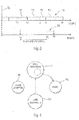
- the temporary frame TR is intended to be executed from the date T0 until the date TF.
- She includes a series of scores P1, P2, P3, P4 whose dates are respectively T1, T2, T3, T4.
- the dates for the completion of the scores P1, P2, P3 are respectively T2, T3, T4.
- the TE score PR due date is earlier than the TF date.
- the score PR does not have an execution date because it is not placed in a frame.
- the date of activation of the TA score i.e. the start of its activation window, is between T1 and T2.
- the TL deadline on which can start the execution of the PR pointing i.e. the end of its window activation, is between the start of T4 and the end of the score execution P4.
- This PR score is therefore intended to be rejected.
- the priority of the score PR is higher than that of the scores of the frame provisional.
- the global test E21 consists in verifying that no score of the TR frame has a lower priority than a score intended to be rejected LR. For this purpose, we can compare the lowest PMN priority of the scores from the TR frame to the highest priority PMX of the scores intended to be rejected.
- the test result is positive. There is no score in the TR frame whose priority is lower than that of a score intended to be rejected LR. This is enough to know that there is no conflict. Therefore, it is considered whether the E21 test result is positive that there is no conflict.
- the frame TR is then accepted E4.
- the first set LR1 is the set scores intended to be rejected LR and whose priority is higher than the lower PMN priority of the scores in the TR frame.
- the second set TR2 is the set of scores in the frame TR and whose priority is lower than the highest PMX priority of scores to be rejected LR.
- the selected score conflicts with at least one score of the TR frame, it is considered that there is a conflict in the TR frame.
- E21 we check first E21 that the set of scores placed in the frame TR are higher priority than the scores intended to be rejected. If the test is positive, the frame is accepted and sent to the space-time management device. Otherwise, other checks E23, E24 are carried out before to accept or refuse the frame.
- the first LR1 is the list of scores intended to be rejected LR and whose priority is higher than the minimum PMN priority of the scores placed in the frame TR.
- the second TR2 is the list of scores placed in the TR frame and whose priority is lower than the maximum PMX priority of the scores intended to be rejected LR. In the first list LR1, we select the maximum priority score.
- each shooting is a task.
- the activation window for these tasks depends on the relative position of the satellite and the area to be photographed (deflection possible), weather conditions (visibility), ...
- the priorities of tasks are dependent for example on the type of client (the shots of military customers are given higher priority than those of civilian customers by example).
- a frame is constructed each time the satellite passes from the dark side of the earth, and performed on the sunny side.
- the invention applies more generally to any gripping device of view.
- the invention applies to the construction of frames optronic equipment on board an aircraft.
- the tasks in this example are the shots taken by the optronic equipment. These shots may have other characteristics (scope of shooting view (large field or small field) which influence the choice of policy scheduling (we try to limit the number of large switching operations field / small field for example).
- the scheduling policy chosen may take account of these other characteristics, the method according to the invention applying in the same way.
Landscapes
- Engineering & Computer Science (AREA)
- Radar, Positioning & Navigation (AREA)
- Remote Sensing (AREA)
- Computer Networks & Wireless Communication (AREA)
- Physics & Mathematics (AREA)
- General Physics & Mathematics (AREA)
- Mobile Radio Communication Systems (AREA)
- Radar Systems Or Details Thereof (AREA)
Abstract
Description
- les contraintes temporelles,
- les contraintes de priorité.
- la première tâche est destinée à être rejetée,
- la seconde tâche est destinée à être exécutée dans la fenêtre d'activation de la première tâche, et
- la priorité de la première tâche est supérieure à celle de la seconde tâche.
- la première tâche est destinée à être rejetée,
- la date d'exécution de la seconde tâche est comprise dans la fenêtre d'activation de la première tâche, et
- la priorité de la première tâche est supérieure à celle de la seconde tâche.
- la figure 1 représente des ensembles de pointages lorsqu'on cherche à construire une trame ;
- la figure 2 représente quelques étapes d'un exemple de mise en oeuvre du procédé selon l'invention ;
- la figure 3 représente une situation de conflit entre des pointages d'une trame et un pointage dont la date d'échéance est dépassée ;
- la figure 4 représente des ensembles de pointages lorsqu'on a accepté une trame ;
- la figure 5 représente une sélection de pointages pouvant être en conflit ;
- la figure 6 représente les étapes d'un exemple de mise en oeuvre d'un procédé de recherche de conflit.
- une date d'activation,
- une date d'échéance,
- une date d'exécution,
- une durée d'exécution.
- le premier pointage a une priorité supérieure au second pointage ;
- le premier pointage est destiné à être rejeté ;
- le second pointage est placé dans la trame TR ;
- les chances de placer le premier pointage dans la trame TR augmentent de manière non négligeable si on enlève provisoirement (pendant la durée de construction de la trame TR) le second pointage de la liste principale.
Claims (5)
- Procédé de construction de trames, caractérisé en ce que :(a) on ordonnance (E1) les tâches d'une liste principale (L1) pour construire une trame (TR), les tâches étant placées dans cette trame ou restant dans la liste principale ;(b) on vérifie (E2) qu'aucune tâche placés dans cette trame n'est en conflit avec une éventuelle tâche destinée à être rejetée ;(c) si aucune tâche n'est en conflit, on accepte (E4) cette trame ;(d) sinon, on place (E3) un ou plusieurs des tâches (TR1) en conflit de la trame dans une liste secondaire (L2), on place les autres tâches de la trame dans la liste principale, et on réitère l'ordonnancement (E1) pour reconstruire cette trame ;(e) lorsque la trame est acceptée (E4), on place les éventuelles tâches de la liste secondaire (L2) dans la liste principale (L1), on rejette (RJ) les éventuels tâches destinées à être rejetées, et on construit de la même façon (E1, E2, E3, E4) la trame suivante à partir des tâches de la liste principale.
- Procédé selon la revendication 1, caractérisé en ce que pour vérifier qu'aucun pointage n'est en conflit (E2) :(a) on vérifie (E21) qu'aucune tâche de la trame (TR) a une priorité inférieure à celle d'une tâche destinée à être rejetée ;(b) s'il n'y en a aucune, on considère qu'aucune tâche n'est en conflit ;(c) sinon, on sélectionne (E22) une tâche parmi celles (LR1) destinées à être rejetées (LR) et dont la priorité est supérieure à la plus petite priorité (PMN) des tâches de la trame (TR) ;(d) on vérifie (E23) que la tâche sélectionnée n'est en conflit avec aucune tâche de la trame (TR) ;(e) si la tâche sélectionnée est en conflit, on considère qu'il y a un conflit ;(f) sinon, s'il n'y a pas d'autre tâche à sélectionner (24) on considère qu'il n'y a pas de conflit,(g) sinon on sélectionne une autre tâche (E22), et on réitère la vérification (E23) de la tâche sélectionnée.
- Procédé selon la revendication 2, caractérisé en ce que lorsqu'on a détecté un conflit avec une tâche destinée à être rejetée, on place (E3) dans la liste secondaire (L2) la tâche de la trame (TR) en conflit avec ladite tâche destinée à être rejetée dont la date d'exécution est la plus proche la date d'échéance de ladite tâche destinée à être rejetée.
- Procédé selon l'une quelconque des revendications précédentes, caractérisé en ce qu'on considère que deux tâches sont en conflit si :la première tâche est destinée à être rejetée,la seconde tâche est destinée à être exécutée dans la fenêtre d'activation de la première tâche, etla priorité de la première tâche est supérieure à celle de la seconde tâche.
- Procédé selon l'une quelconque des revendications 1 à 3, caractérisé en ce qu'on considère que deux tâches sont en conflit si :la première tâche est destinée à être rejetée,la date d'exécution de la seconde tâche est comprise dans la fenêtre d'activation de la première tâche, etla priorité de la première tâche est supérieure à celle de la seconde tâche.
Applications Claiming Priority (2)
| Application Number | Priority Date | Filing Date | Title |
|---|---|---|---|
| FR0115520 | 2001-11-26 | ||
| FR0115520A FR2832807B1 (fr) | 2001-11-26 | 2001-11-26 | Procede de construction de trames, notamment d'un radar |
Publications (2)
| Publication Number | Publication Date |
|---|---|
| EP1314999A1 true EP1314999A1 (fr) | 2003-05-28 |
| EP1314999B1 EP1314999B1 (fr) | 2011-01-26 |
Family
ID=8869978
Family Applications (1)
| Application Number | Title | Priority Date | Filing Date |
|---|---|---|---|
| EP20020102554 Expired - Lifetime EP1314999B1 (fr) | 2001-11-26 | 2002-11-08 | Procédé de construction de trames |
Country Status (3)
| Country | Link |
|---|---|
| EP (1) | EP1314999B1 (fr) |
| DE (1) | DE60239038D1 (fr) |
| FR (1) | FR2832807B1 (fr) |
Families Citing this family (1)
| Publication number | Priority date | Publication date | Assignee | Title |
|---|---|---|---|---|
| FR3126504B1 (fr) | 2021-08-25 | 2023-07-21 | Thales Sa | Procede de decision et d'evaluation d'entrelacement d'une pluralite de modes radar, programme d'ordinateur et dispositif associes |
Citations (6)
| Publication number | Priority date | Publication date | Assignee | Title |
|---|---|---|---|---|
| US4649390A (en) | 1983-08-05 | 1987-03-10 | Hughes Aircraft Company | Two dimension radar system with selectable three dimension target data extraction |
| JPH07177197A (ja) * | 1993-12-21 | 1995-07-14 | Nec Corp | 通信タスク管理方式 |
| FR2723211A1 (fr) | 1984-11-23 | 1996-02-02 | Dassault Electronique | Radars a trames de recurrence entrelacees et prcede correspondant |
| FR2737578A1 (fr) * | 1987-02-06 | 1997-02-07 | Dassault Electronique | Dispositif radar doppler a impulsions avec determination complete du vecteur vitesse de la cible |
| US5748468A (en) | 1995-05-04 | 1998-05-05 | Microsoft Corporation | Prioritized co-processor resource manager and method |
| JP2000003286A (ja) * | 1998-06-12 | 2000-01-07 | Nec Mobile Commun Ltd | メッセージ処理装置およびその方法 |
-
2001
- 2001-11-26 FR FR0115520A patent/FR2832807B1/fr not_active Expired - Fee Related
-
2002
- 2002-11-08 EP EP20020102554 patent/EP1314999B1/fr not_active Expired - Lifetime
- 2002-11-08 DE DE60239038T patent/DE60239038D1/de not_active Expired - Lifetime
Patent Citations (6)
| Publication number | Priority date | Publication date | Assignee | Title |
|---|---|---|---|---|
| US4649390A (en) | 1983-08-05 | 1987-03-10 | Hughes Aircraft Company | Two dimension radar system with selectable three dimension target data extraction |
| FR2723211A1 (fr) | 1984-11-23 | 1996-02-02 | Dassault Electronique | Radars a trames de recurrence entrelacees et prcede correspondant |
| FR2737578A1 (fr) * | 1987-02-06 | 1997-02-07 | Dassault Electronique | Dispositif radar doppler a impulsions avec determination complete du vecteur vitesse de la cible |
| JPH07177197A (ja) * | 1993-12-21 | 1995-07-14 | Nec Corp | 通信タスク管理方式 |
| US5748468A (en) | 1995-05-04 | 1998-05-05 | Microsoft Corporation | Prioritized co-processor resource manager and method |
| JP2000003286A (ja) * | 1998-06-12 | 2000-01-07 | Nec Mobile Commun Ltd | メッセージ処理装置およびその方法 |
Non-Patent Citations (4)
| Title |
|---|
| KIM K. PHAM: "location accuracv in X-band multifunction radar", IEEE, 5 March 1991 (1991-03-05), pages 6 - 10 |
| PATENT ABSTRACTS OF JAPAN vol. 1995, no. 10 30 November 1995 (1995-11-30) * |
| PATENT ABSTRACTS OF JAPAN vol. 2000, no. 04 31 August 2000 (2000-08-31) * |
| PHAM K K: "Location accuracy in X-band multifunction radar", PROCEEDINGS OF THE NATIONAL RADAR CONFERENCE. LOS ANGELES, MAR. 12 - 13, 1991, NEW YORK, IEEE, US, vol. CONF. 5, 12 March 1991 (1991-03-12), pages 6 - 10, XP010038682, ISBN: 0-87942-629-2 * |
Also Published As
| Publication number | Publication date |
|---|---|
| DE60239038D1 (de) | 2011-03-10 |
| FR2832807B1 (fr) | 2004-02-13 |
| FR2832807A1 (fr) | 2003-05-30 |
| EP1314999B1 (fr) | 2011-01-26 |
Similar Documents
| Publication | Publication Date | Title |
|---|---|---|
| EP0178954B1 (fr) | Procédé et dispositif pour l'exploration d'une fenêtre de la zone image d'un dispositif à transfert de charges du type à transfert de trames | |
| CA2993926C (fr) | Procede de planification d'acquisition d'images de zones terrestres par un engin spatial | |
| FR2761771A1 (fr) | Dispositif de recherche d'itineraire | |
| EP0633481B1 (fr) | Procédé de placement dans le temps de transactions notamment entre un radar secondaire de mode S et des avions | |
| EP0920677B1 (fr) | Procede et dispositif de reconnaissance air-sol pour equipement optronique | |
| EP1538504B1 (fr) | Procédé et système de pilotage automatique d'un aéronef à l'approche d'une position de parachutage | |
| EP1314999A1 (fr) | Procédé de construction de trames | |
| EP3239656B1 (fr) | Procédé d'optimisation de la détection de cibles marines et radar aéroporté mettant en oeuvre un tel procédé | |
| WO2015001242A1 (fr) | Procédé d'alignement d'un ensemble de modules solaires d'un suiveur solaire | |
| EP1336868A1 (fr) | Procede d'ordonnancement en temps reel notamment des pointages d'un radar | |
| EP1359433B1 (fr) | Procédé d'ordonnancement de pointages pour un radar multifonction, un sonar ou pour un lidar | |
| EP1584079B1 (fr) | Procede de detection d'incident sur route | |
| EP2602194B1 (fr) | Procédé de commande d'un ensemble d'au moins deux satellites, conçus pour fournir un service sur une orbite geostationnaire, rendant ledit service sur une orbite non-geostationnaire | |
| EP4433805A1 (fr) | Determination d'une orientation cristallographique d'une surface d'une piece d'un aeronef | |
| FR2895867A1 (fr) | Procede de reservation pour communication dans un reseau de communication mobile | |
| WO2022117928A1 (fr) | Transmission par signaux laser entre un satellite et une station de reception sur terre | |
| EP1359434B1 (fr) | Procédé d'ordonnacement de pointages pour un radar multifonction, un sonar ou pour un lidar | |
| EP4305381B1 (fr) | Procede de reconnaissance aerienne ameliore | |
| EP0943948B1 (fr) | Procédé d'alignement d'un objet avec un dispositif d'acquisition d'images et une optique de couplage | |
| EP0406073B1 (fr) | Procédé et dispositif de balayage pour systèmes optiques | |
| EP4592953A1 (fr) | Procédé et dispositif de correction de suivi d'objets, et procédé et système de suivi d'objet(s) mettant en uvre une telle correction | |
| EP1336867A1 (fr) | Procédé de régulation de la charge d'un radar, notamment par adaptation du maillage de veille | |
| FR2832808A1 (fr) | Procede de regulation de charge d'un radar | |
| WO2025237742A1 (fr) | Système et procédé de surveillance d'objets spatiaux en orbite | |
| FR2934055A1 (fr) | Procede pour elaborer une commande de balayage d'antenne pour realiser une image sar |
Legal Events
| Date | Code | Title | Description |
|---|---|---|---|
| PUAI | Public reference made under article 153(3) epc to a published international application that has entered the european phase |
Free format text: ORIGINAL CODE: 0009012 |
|
| AK | Designated contracting states |
Designated state(s): AT BE BG CH CY CZ DE DK EE ES FI FR GB GR IE IT LI LU MC NL PT SE SK TR |
|
| AX | Request for extension of the european patent |
Extension state: AL LT LV MK RO SI |
|
| 17P | Request for examination filed |
Effective date: 20031015 |
|
| AKX | Designation fees paid |
Designated state(s): AT BE CH CY LI |
|
| RBV | Designated contracting states (corrected) |
Designated state(s): DE FR GB IT |
|
| REG | Reference to a national code |
Ref country code: DE Ref legal event code: 8566 |
|
| 17Q | First examination report despatched |
Effective date: 20081014 |
|
| GRAP | Despatch of communication of intention to grant a patent |
Free format text: ORIGINAL CODE: EPIDOSNIGR1 |
|
| GRAS | Grant fee paid |
Free format text: ORIGINAL CODE: EPIDOSNIGR3 |
|
| GRAA | (expected) grant |
Free format text: ORIGINAL CODE: 0009210 |
|
| AK | Designated contracting states |
Kind code of ref document: B1 Designated state(s): DE FR GB IT |
|
| REG | Reference to a national code |
Ref country code: GB Ref legal event code: FG4D Free format text: NOT ENGLISH |
|
| REF | Corresponds to: |
Ref document number: 60239038 Country of ref document: DE Date of ref document: 20110310 Kind code of ref document: P |
|
| REG | Reference to a national code |
Ref country code: DE Ref legal event code: R096 Ref document number: 60239038 Country of ref document: DE Effective date: 20110310 |
|
| PLBE | No opposition filed within time limit |
Free format text: ORIGINAL CODE: 0009261 |
|
| STAA | Information on the status of an ep patent application or granted ep patent |
Free format text: STATUS: NO OPPOSITION FILED WITHIN TIME LIMIT |
|
| 26N | No opposition filed |
Effective date: 20111027 |
|
| REG | Reference to a national code |
Ref country code: DE Ref legal event code: R097 Ref document number: 60239038 Country of ref document: DE Effective date: 20111027 |
|
| REG | Reference to a national code |
Ref country code: FR Ref legal event code: PLFP Year of fee payment: 14 |
|
| REG | Reference to a national code |
Ref country code: FR Ref legal event code: PLFP Year of fee payment: 15 |
|
| REG | Reference to a national code |
Ref country code: FR Ref legal event code: PLFP Year of fee payment: 16 |
|
| REG | Reference to a national code |
Ref country code: FR Ref legal event code: PLFP Year of fee payment: 17 |
|
| PGFP | Annual fee paid to national office [announced via postgrant information from national office to epo] |
Ref country code: FR Payment date: 20211108 Year of fee payment: 20 Ref country code: GB Payment date: 20211021 Year of fee payment: 20 Ref country code: DE Payment date: 20211019 Year of fee payment: 20 |
|
| PGFP | Annual fee paid to national office [announced via postgrant information from national office to epo] |
Ref country code: IT Payment date: 20211027 Year of fee payment: 20 |
|
| REG | Reference to a national code |
Ref country code: DE Ref legal event code: R071 Ref document number: 60239038 Country of ref document: DE |
|
| REG | Reference to a national code |
Ref country code: GB Ref legal event code: PE20 Expiry date: 20221107 |
|
| PG25 | Lapsed in a contracting state [announced via postgrant information from national office to epo] |
Ref country code: GB Free format text: LAPSE BECAUSE OF EXPIRATION OF PROTECTION Effective date: 20221107 |
|
| P01 | Opt-out of the competence of the unified patent court (upc) registered |
Effective date: 20230427 |