EP1314707A2 - Aluminum nitride ceramics, members for use in a system for producing semiconductors, corrosion resistant members and conductive members - Google Patents
Aluminum nitride ceramics, members for use in a system for producing semiconductors, corrosion resistant members and conductive members Download PDFInfo
- Publication number
- EP1314707A2 EP1314707A2 EP02258094A EP02258094A EP1314707A2 EP 1314707 A2 EP1314707 A2 EP 1314707A2 EP 02258094 A EP02258094 A EP 02258094A EP 02258094 A EP02258094 A EP 02258094A EP 1314707 A2 EP1314707 A2 EP 1314707A2
- Authority
- EP
- European Patent Office
- Prior art keywords
- ceramics
- aluminum nitride
- volume resistivity
- intergranular
- room temperature
- Prior art date
- Legal status (The legal status is an assumption and is not a legal conclusion. Google has not performed a legal analysis and makes no representation as to the accuracy of the status listed.)
- Granted
Links
Images


Classifications
-
- C—CHEMISTRY; METALLURGY
- C04—CEMENTS; CONCRETE; ARTIFICIAL STONE; CERAMICS; REFRACTORIES
- C04B—LIME, MAGNESIA; SLAG; CEMENTS; COMPOSITIONS THEREOF, e.g. MORTARS, CONCRETE OR LIKE BUILDING MATERIALS; ARTIFICIAL STONE; CERAMICS; REFRACTORIES; TREATMENT OF NATURAL STONE
- C04B35/00—Shaped ceramic products characterised by their composition; Ceramics compositions; Processing powders of inorganic compounds preparatory to the manufacturing of ceramic products
- C04B35/622—Forming processes; Processing powders of inorganic compounds preparatory to the manufacturing of ceramic products
- C04B35/64—Burning or sintering processes
- C04B35/645—Pressure sintering
-
- C—CHEMISTRY; METALLURGY
- C04—CEMENTS; CONCRETE; ARTIFICIAL STONE; CERAMICS; REFRACTORIES
- C04B—LIME, MAGNESIA; SLAG; CEMENTS; COMPOSITIONS THEREOF, e.g. MORTARS, CONCRETE OR LIKE BUILDING MATERIALS; ARTIFICIAL STONE; CERAMICS; REFRACTORIES; TREATMENT OF NATURAL STONE
- C04B35/00—Shaped ceramic products characterised by their composition; Ceramics compositions; Processing powders of inorganic compounds preparatory to the manufacturing of ceramic products
- C04B35/515—Shaped ceramic products characterised by their composition; Ceramics compositions; Processing powders of inorganic compounds preparatory to the manufacturing of ceramic products based on non-oxide ceramics
- C04B35/58—Shaped ceramic products characterised by their composition; Ceramics compositions; Processing powders of inorganic compounds preparatory to the manufacturing of ceramic products based on non-oxide ceramics based on borides, nitrides, i.e. nitrides, oxynitrides, carbonitrides or oxycarbonitrides or silicides
- C04B35/581—Shaped ceramic products characterised by their composition; Ceramics compositions; Processing powders of inorganic compounds preparatory to the manufacturing of ceramic products based on non-oxide ceramics based on borides, nitrides, i.e. nitrides, oxynitrides, carbonitrides or oxycarbonitrides or silicides based on aluminium nitride
-
- H—ELECTRICITY
- H10—SEMICONDUCTOR DEVICES; ELECTRIC SOLID-STATE DEVICES NOT OTHERWISE PROVIDED FOR
- H10P—GENERIC PROCESSES OR APPARATUS FOR THE MANUFACTURE OR TREATMENT OF DEVICES COVERED BY CLASS H10
- H10P14/00—Formation of materials, e.g. in the shape of layers or pillars
- H10P14/60—Formation of materials, e.g. in the shape of layers or pillars of insulating materials
-
- H—ELECTRICITY
- H10—SEMICONDUCTOR DEVICES; ELECTRIC SOLID-STATE DEVICES NOT OTHERWISE PROVIDED FOR
- H10P—GENERIC PROCESSES OR APPARATUS FOR THE MANUFACTURE OR TREATMENT OF DEVICES COVERED BY CLASS H10
- H10P95/00—Generic processes or apparatus for manufacture or treatments not covered by the other groups of this subclass
-
- C—CHEMISTRY; METALLURGY
- C04—CEMENTS; CONCRETE; ARTIFICIAL STONE; CERAMICS; REFRACTORIES
- C04B—LIME, MAGNESIA; SLAG; CEMENTS; COMPOSITIONS THEREOF, e.g. MORTARS, CONCRETE OR LIKE BUILDING MATERIALS; ARTIFICIAL STONE; CERAMICS; REFRACTORIES; TREATMENT OF NATURAL STONE
- C04B2235/00—Aspects relating to ceramic starting mixtures or sintered ceramic products
- C04B2235/02—Composition of constituents of the starting material or of secondary phases of the final product
- C04B2235/30—Constituents and secondary phases not being of a fibrous nature
- C04B2235/32—Metal oxides, mixed metal oxides, or oxide-forming salts thereof, e.g. carbonates, nitrates, (oxy)hydroxides, chlorides
- C04B2235/3217—Aluminum oxide or oxide forming salts thereof, e.g. bauxite, alpha-alumina
- C04B2235/3222—Aluminates other than alumino-silicates, e.g. spinel (MgAl2O4)
-
- C—CHEMISTRY; METALLURGY
- C04—CEMENTS; CONCRETE; ARTIFICIAL STONE; CERAMICS; REFRACTORIES
- C04B—LIME, MAGNESIA; SLAG; CEMENTS; COMPOSITIONS THEREOF, e.g. MORTARS, CONCRETE OR LIKE BUILDING MATERIALS; ARTIFICIAL STONE; CERAMICS; REFRACTORIES; TREATMENT OF NATURAL STONE
- C04B2235/00—Aspects relating to ceramic starting mixtures or sintered ceramic products
- C04B2235/02—Composition of constituents of the starting material or of secondary phases of the final product
- C04B2235/30—Constituents and secondary phases not being of a fibrous nature
- C04B2235/32—Metal oxides, mixed metal oxides, or oxide-forming salts thereof, e.g. carbonates, nitrates, (oxy)hydroxides, chlorides
- C04B2235/3224—Rare earth oxide or oxide forming salts thereof, e.g. scandium oxide
- C04B2235/3225—Yttrium oxide or oxide-forming salts thereof
-
- C—CHEMISTRY; METALLURGY
- C04—CEMENTS; CONCRETE; ARTIFICIAL STONE; CERAMICS; REFRACTORIES
- C04B—LIME, MAGNESIA; SLAG; CEMENTS; COMPOSITIONS THEREOF, e.g. MORTARS, CONCRETE OR LIKE BUILDING MATERIALS; ARTIFICIAL STONE; CERAMICS; REFRACTORIES; TREATMENT OF NATURAL STONE
- C04B2235/00—Aspects relating to ceramic starting mixtures or sintered ceramic products
- C04B2235/02—Composition of constituents of the starting material or of secondary phases of the final product
- C04B2235/30—Constituents and secondary phases not being of a fibrous nature
- C04B2235/38—Non-oxide ceramic constituents or additives
- C04B2235/3804—Borides
-
- C—CHEMISTRY; METALLURGY
- C04—CEMENTS; CONCRETE; ARTIFICIAL STONE; CERAMICS; REFRACTORIES
- C04B—LIME, MAGNESIA; SLAG; CEMENTS; COMPOSITIONS THEREOF, e.g. MORTARS, CONCRETE OR LIKE BUILDING MATERIALS; ARTIFICIAL STONE; CERAMICS; REFRACTORIES; TREATMENT OF NATURAL STONE
- C04B2235/00—Aspects relating to ceramic starting mixtures or sintered ceramic products
- C04B2235/02—Composition of constituents of the starting material or of secondary phases of the final product
- C04B2235/30—Constituents and secondary phases not being of a fibrous nature
- C04B2235/38—Non-oxide ceramic constituents or additives
- C04B2235/3817—Carbides
-
- C—CHEMISTRY; METALLURGY
- C04—CEMENTS; CONCRETE; ARTIFICIAL STONE; CERAMICS; REFRACTORIES
- C04B—LIME, MAGNESIA; SLAG; CEMENTS; COMPOSITIONS THEREOF, e.g. MORTARS, CONCRETE OR LIKE BUILDING MATERIALS; ARTIFICIAL STONE; CERAMICS; REFRACTORIES; TREATMENT OF NATURAL STONE
- C04B2235/00—Aspects relating to ceramic starting mixtures or sintered ceramic products
- C04B2235/02—Composition of constituents of the starting material or of secondary phases of the final product
- C04B2235/30—Constituents and secondary phases not being of a fibrous nature
- C04B2235/38—Non-oxide ceramic constituents or additives
- C04B2235/3817—Carbides
- C04B2235/3821—Boron carbides
-
- C—CHEMISTRY; METALLURGY
- C04—CEMENTS; CONCRETE; ARTIFICIAL STONE; CERAMICS; REFRACTORIES
- C04B—LIME, MAGNESIA; SLAG; CEMENTS; COMPOSITIONS THEREOF, e.g. MORTARS, CONCRETE OR LIKE BUILDING MATERIALS; ARTIFICIAL STONE; CERAMICS; REFRACTORIES; TREATMENT OF NATURAL STONE
- C04B2235/00—Aspects relating to ceramic starting mixtures or sintered ceramic products
- C04B2235/02—Composition of constituents of the starting material or of secondary phases of the final product
- C04B2235/30—Constituents and secondary phases not being of a fibrous nature
- C04B2235/38—Non-oxide ceramic constituents or additives
- C04B2235/3852—Nitrides, e.g. oxynitrides, carbonitrides, oxycarbonitrides, lithium nitride, magnesium nitride
- C04B2235/386—Boron nitrides
-
- C—CHEMISTRY; METALLURGY
- C04—CEMENTS; CONCRETE; ARTIFICIAL STONE; CERAMICS; REFRACTORIES
- C04B—LIME, MAGNESIA; SLAG; CEMENTS; COMPOSITIONS THEREOF, e.g. MORTARS, CONCRETE OR LIKE BUILDING MATERIALS; ARTIFICIAL STONE; CERAMICS; REFRACTORIES; TREATMENT OF NATURAL STONE
- C04B2235/00—Aspects relating to ceramic starting mixtures or sintered ceramic products
- C04B2235/02—Composition of constituents of the starting material or of secondary phases of the final product
- C04B2235/30—Constituents and secondary phases not being of a fibrous nature
- C04B2235/38—Non-oxide ceramic constituents or additives
- C04B2235/3852—Nitrides, e.g. oxynitrides, carbonitrides, oxycarbonitrides, lithium nitride, magnesium nitride
- C04B2235/3865—Aluminium nitrides
-
- C—CHEMISTRY; METALLURGY
- C04—CEMENTS; CONCRETE; ARTIFICIAL STONE; CERAMICS; REFRACTORIES
- C04B—LIME, MAGNESIA; SLAG; CEMENTS; COMPOSITIONS THEREOF, e.g. MORTARS, CONCRETE OR LIKE BUILDING MATERIALS; ARTIFICIAL STONE; CERAMICS; REFRACTORIES; TREATMENT OF NATURAL STONE
- C04B2235/00—Aspects relating to ceramic starting mixtures or sintered ceramic products
- C04B2235/02—Composition of constituents of the starting material or of secondary phases of the final product
- C04B2235/30—Constituents and secondary phases not being of a fibrous nature
- C04B2235/42—Non metallic elements added as constituents or additives, e.g. sulfur, phosphor, selenium or tellurium
- C04B2235/422—Carbon
-
- C—CHEMISTRY; METALLURGY
- C04—CEMENTS; CONCRETE; ARTIFICIAL STONE; CERAMICS; REFRACTORIES
- C04B—LIME, MAGNESIA; SLAG; CEMENTS; COMPOSITIONS THEREOF, e.g. MORTARS, CONCRETE OR LIKE BUILDING MATERIALS; ARTIFICIAL STONE; CERAMICS; REFRACTORIES; TREATMENT OF NATURAL STONE
- C04B2235/00—Aspects relating to ceramic starting mixtures or sintered ceramic products
- C04B2235/70—Aspects relating to sintered or melt-casted ceramic products
- C04B2235/74—Physical characteristics
- C04B2235/76—Crystal structural characteristics, e.g. symmetry
- C04B2235/761—Unit-cell parameters, e.g. lattice constants
-
- C—CHEMISTRY; METALLURGY
- C04—CEMENTS; CONCRETE; ARTIFICIAL STONE; CERAMICS; REFRACTORIES
- C04B—LIME, MAGNESIA; SLAG; CEMENTS; COMPOSITIONS THEREOF, e.g. MORTARS, CONCRETE OR LIKE BUILDING MATERIALS; ARTIFICIAL STONE; CERAMICS; REFRACTORIES; TREATMENT OF NATURAL STONE
- C04B2235/00—Aspects relating to ceramic starting mixtures or sintered ceramic products
- C04B2235/70—Aspects relating to sintered or melt-casted ceramic products
- C04B2235/74—Physical characteristics
- C04B2235/77—Density
-
- C—CHEMISTRY; METALLURGY
- C04—CEMENTS; CONCRETE; ARTIFICIAL STONE; CERAMICS; REFRACTORIES
- C04B—LIME, MAGNESIA; SLAG; CEMENTS; COMPOSITIONS THEREOF, e.g. MORTARS, CONCRETE OR LIKE BUILDING MATERIALS; ARTIFICIAL STONE; CERAMICS; REFRACTORIES; TREATMENT OF NATURAL STONE
- C04B2235/00—Aspects relating to ceramic starting mixtures or sintered ceramic products
- C04B2235/70—Aspects relating to sintered or melt-casted ceramic products
- C04B2235/74—Physical characteristics
- C04B2235/78—Grain sizes and shapes, product microstructures, e.g. acicular grains, equiaxed grains, platelet-structures
-
- C—CHEMISTRY; METALLURGY
- C04—CEMENTS; CONCRETE; ARTIFICIAL STONE; CERAMICS; REFRACTORIES
- C04B—LIME, MAGNESIA; SLAG; CEMENTS; COMPOSITIONS THEREOF, e.g. MORTARS, CONCRETE OR LIKE BUILDING MATERIALS; ARTIFICIAL STONE; CERAMICS; REFRACTORIES; TREATMENT OF NATURAL STONE
- C04B2235/00—Aspects relating to ceramic starting mixtures or sintered ceramic products
- C04B2235/70—Aspects relating to sintered or melt-casted ceramic products
- C04B2235/80—Phases present in the sintered or melt-cast ceramic products other than the main phase
-
- C—CHEMISTRY; METALLURGY
- C04—CEMENTS; CONCRETE; ARTIFICIAL STONE; CERAMICS; REFRACTORIES
- C04B—LIME, MAGNESIA; SLAG; CEMENTS; COMPOSITIONS THEREOF, e.g. MORTARS, CONCRETE OR LIKE BUILDING MATERIALS; ARTIFICIAL STONE; CERAMICS; REFRACTORIES; TREATMENT OF NATURAL STONE
- C04B2235/00—Aspects relating to ceramic starting mixtures or sintered ceramic products
- C04B2235/70—Aspects relating to sintered or melt-casted ceramic products
- C04B2235/80—Phases present in the sintered or melt-cast ceramic products other than the main phase
- C04B2235/85—Intergranular or grain boundary phases
-
- C—CHEMISTRY; METALLURGY
- C04—CEMENTS; CONCRETE; ARTIFICIAL STONE; CERAMICS; REFRACTORIES
- C04B—LIME, MAGNESIA; SLAG; CEMENTS; COMPOSITIONS THEREOF, e.g. MORTARS, CONCRETE OR LIKE BUILDING MATERIALS; ARTIFICIAL STONE; CERAMICS; REFRACTORIES; TREATMENT OF NATURAL STONE
- C04B2235/00—Aspects relating to ceramic starting mixtures or sintered ceramic products
- C04B2235/70—Aspects relating to sintered or melt-casted ceramic products
- C04B2235/96—Properties of ceramic products, e.g. mechanical properties such as strength, toughness, wear resistance
-
- C—CHEMISTRY; METALLURGY
- C04—CEMENTS; CONCRETE; ARTIFICIAL STONE; CERAMICS; REFRACTORIES
- C04B—LIME, MAGNESIA; SLAG; CEMENTS; COMPOSITIONS THEREOF, e.g. MORTARS, CONCRETE OR LIKE BUILDING MATERIALS; ARTIFICIAL STONE; CERAMICS; REFRACTORIES; TREATMENT OF NATURAL STONE
- C04B2235/00—Aspects relating to ceramic starting mixtures or sintered ceramic products
- C04B2235/70—Aspects relating to sintered or melt-casted ceramic products
- C04B2235/96—Properties of ceramic products, e.g. mechanical properties such as strength, toughness, wear resistance
- C04B2235/9607—Thermal properties, e.g. thermal expansion coefficient
Definitions
- the present invention relates to an aluminum nitride ceramics having a low volume resistivity, a member for use in a system for producing semiconductors, a corrosion resistant member and a conductive member.
- An aluminum nitride sintered body has excellent corrosion resistant property against various corrosive substances such as a halogen-based gas and has thus been utilized for various members in a system for producing semiconductors including a ceramic heater and electrostatic chuck.
- a conventional dense aluminum nitride sintered body has a volume resistivity higher than 10 13 ⁇ ⁇ cm at room temperature. It is therefore needed to reduce the volume resistivity of an aluminum nitride sintered body depending on intended applications.
- the base material is used in a wider temperature range. It is thus demanded to provide a material having a reduced dependency of volume resistivity on temperature change.
- the sintered body may be produced by adding samarium oxide into powdery raw material of aluminum nitride.
- Japanese patent publications 8-314953A and 8-350075A disclose a method for further reducing the dependency of volume resistivity on temperature of an aluminum nitride sintered body.
- a conductive ceramics having a metallic conductivity such as TiN is added into powdery raw material of aluminum nitride in an amount of 10 to 30 weight percent.
- conductive ceramics is added into raw material of an aluminum nitride to provide a composite ceramics. According to this method, it is necessary to add a large amount of conductive ceramics into aluminum nitride raw material to obtain a composite ceramics for sufficiently reducing the volume resistivity of the sintered body. Characteristic properties of aluminum nitride are, however, lost by adding a large amount of conductive ceramics. For example, a high thermal conductivity, low thermal expansion, corrosion resistant property and chemical stability of aluminum nitride are lost or reduced. It is therefore desired to preserve the characteristic properties of aluminum nitride and reduce its volume resistivity.
- An object of the present invention is to preserve the characteristic properties of aluminum nitride and reduce its volume resistivity.
- Another object of the present invention is to provide a ceramic conductive member having corrosion resistant property by preserving the characteristic properties of aluminum nitride and reducing its volume resistivity.
- Another object of the present invention is to provide an aluminum nitride ceramics having a low volume resistivity at room temperature and a reduced temperature dependency of volume resistivity over a wide temperature range.
- the present invention provides an aluminum nitride ceramics containing boron atoms in an amount of not lower than 1.0 weight percent and carbon atoms in an amount of not lower than 0.3 weight percent and having a volume resistivity at room temperature of not higher than 1 ⁇ 10 12 ⁇ ⁇ cm.
- the present invention further provides an aluminum nitride ceramics comprising aluminum nitride phase and intergranular phases mainly consisting of boron nitride constituting a conductive path and having a volume resistivity at room temperature of not higher than 1 ⁇ 10 12 ⁇ ⁇ cm.
- the present invention further provides an aluminum nitride ceramics comprising aluminum nitride phase and intergranular phases mainly consisting of boron nitride and having a volume resistivity at room temperature of not higher than 1 ⁇ 10 12 ⁇ ⁇ c m, wherein 004 diffraction peak of the intergranular phase has a spacing d004 of not lower than 1.6650 angstrom.
- the present invention further provides an aluminum nitride ceramics being produced by sintering a mixture at least containing aluminum nitride and boron carbide and having a volume resistivity at room temperature of not higher than 1 ⁇ 10 12 ⁇ ⁇ cm.
- the present invention further provides a member for use in a system for producing semiconductors comprising the aluminum nitride ceramics.
- the present invention further provides a corrosion resistant or conductive member comprising the aluminum nitride ceramics.
- the present invention further provides a conductive member having a volume resistivity at room temperature of not higher than 1 ⁇ 10 6 ⁇ ⁇ cm and composed of an aluminum nitride ceramics containing aluminum nitride in a content of not lower than 80 weight percent.
- the inventors have tried to add various additives into an aluminum nitride ceramics, and studied the effects of the additives on the volume resistivity of the resulting aluminum nitride ceramics.
- the inventors have found that the volume resistivity at room temperature of an aluminum nitride sintered body may be reduced to a value not higher than 10 12 ⁇ ⁇ cm by adding a predetermined amount of boron carbide into raw material of aluminum nitride and sintering the mixture under specified conditions.
- the present invention is based on the discovery.
- the volume resistivity may be reduced to a value not higher than 10 10 ⁇ ⁇ C m and further not higher than 10 7 ⁇ ⁇ c m, by further increasing the added amount of boron carbide, and/or, by holding at a temperature between 1400 and 1800 °C before sintering at a maximum temperature.
- the inventors have reached the surprising discovery that the volume resistivity of an aluminum nitride ceramics may be still further reduced to a value not higher than 10 6 ⁇ ⁇ cm and even not higher than 10 2 ⁇ ⁇ cm.
- An aluminum nitride ceramics having this level of volume resistivity belongs to a conductive material and not to a semiconductor.
- intergranular phases mainly consisting of boron nitride are formed between aluminum nitride grains in a ceramics having a low resistivity.
- the intergranular phase usually has a plate-like shape as shown in Fig. 1.
- plate-like intergranular phases are sufficiently grown to form a kind of continuous phase or network microstructure.
- the inventors have observed the current distribution of an aluminum nitride sample and found that the plate-like intergranular phases function as a conductive path, for example as shown in Fig. 4. It has been thus proved that the intergranular phases mainly consisting of boron nitride are continuously formed to function as a conductive path and to reduce the volume resistivity of the ceramics.
- the volume resistivity of a normal boron nitride is relatively high and not lower than 10 16 ⁇ ⁇ c m. If the boron nitride phases are continuous to from a network microstructure, it should be difficult to reduce the volume resistivity of an aluminum nitride ceramics.
- the inventors have measured the distribution of each element in each of aluminum nitride sintered bodies in the examples described later. As a result, it is found that the intergranular phase is mainly consisting of boron nitride and also contains carbon atoms.
- Boron nitride has hexagonal crystalline system as carbon (graphite).
- the peaks of boron nitride are near to those of graphite measured by X-ray diffraction analysis.
- Carbon has, however, spacings of crystal lattices larger than those of boron nitride.
- a spacing d004 of 004 diffraction peak of boron nitride is 1.6636 angstrom according to No. 34-0421.
- the peak position of carbon corresponding to d004 of boron nitride is 0012 of JCPDS No. 26-1076. d0012 is 1.6740 angstrom.
- the ceramics according to the present invention has a spacing d004 of 004 diffraction peak of boron nitride of not lower than 1.6650 angstrom.
- the value is considerably larger than d004 of normal boron nitride and smaller than d0012 of carbon. That is, in the inventive ceramics, the intergranular phase consists of boron nitride whose crystal lattice is larger than that of normal boron nitride and smaller than that of carbon.
- the expansion of crystal lattice shows that carbon atoms are solid-soluted into crystalline lattices of boron nitride constituting the intergranular phase of an aluminum nitride ceramics.
- the resistivity may thus be reduced considerably.
- the intergranular phases with a reduced resistivity are made continuous to function as an electrically conductive path so that the volume resistivity of the ceramics may be considerably reduced.
- boron carbide When boron carbide is added to raw material of aluminum nitride and the mixed powder is sintered, boron carbide reacts with gaseous nitrogen to generate boron nitride in grain boundaries between aluminum nitride grains during the sintering. During the process, a part of carbon atoms is solid-soluted into boron nitride and left in the intergranular phase.
- the inventors have further added boron nitride powder directly into raw material of aluminum nitride and sintered the mixed powder.
- intergranular phases mainly consisting of boron nitride are formed in grain boundaries of aluminum nitride grains.
- carbon atoms are not solid-soluted into intergranular phases and the expansion of spacings accompanied with the solid-soluted carbon atoms is not observed.
- the volume resistivity of the ceramics is higher than 10 15 ⁇ ⁇ cm and not reduced. The results show that the intergranular phase itself does not have an electrical conductivity and does not function as a conductive path.
- boron carbide (B 4 C) in an amount of 0.5 weight percent calculated as boron is added into aluminum nitride powder and the mixed powder is then sintered at 1800 °C for two hours. It is thus obtained a sintered body having a thermal conductivity of 153 W/m ⁇ k and a relative porosity of 98. 9 percent.
- Boron carbide is added as a second additive for helping the sintering process of aluminum nitride powder at atmospheric pressure.
- the addition of boron carbide is said to have the effects of reducing the crystalline growth. It is thereby obtained a sintered body having a high thermal conductivity, an improved surface roughness and reduced color defects or irregularities.
- the relationship between the addition of boron carbide and volume resistivity is not described. According to the study of the inventors, the inventive ceramics cannot be produced according to the conditions and composition disclosed in the patent.
- An aluminum nitride ceramics according to the present invention means a ceramic material mainly consisting of a polycrystalline body composed of aluminum nitride.
- the ceramics may be produced by a process not particularly limited, including a gaseous phase process such as chemical vapor deposition, physical vapor deposition, organic metal chemical vapor deposition and vapor deposition.
- the aluminum nitride ceramics may preferably be produced by sintering.
- the content of aluminum in the aluminum nitride sintered body should be enough for forming aluminum nitride as the main phase.
- the content may preferably be not lower than 35 weight percent, and more preferably be not lower than 50 weight percent, of the sintered body.
- the content of aluminum nitride may preferably be not lower than 80 weight percent and more preferably be not lower than 90 weight percent.
- the content of boron atoms may preferably be not lower than 2.0 weight percent, or, the content of carbon atoms may preferably be not lower than 0.5 weight percent.
- the thermal conductivity of an aluminum nitride ceramics may be further increased by reducing the content of boron atoms to a value not higher than 5.0 weight percent.
- the content of boron atoms may preferably be not higher than 4.0 weight percent.
- the thermal conductivity of an aluminum nitride ceramics may be increased by reducing the content of carbon atoms to a value not higher than 1.5 weight percent.
- the content of carbon atoms may more preferably be not higher than 1.0 weight percent.
- the ratio of the contents (by weight) of carbon atoms to boron atoms (C/B) is controlled at a value not lower than 0.2 and not higher than 0.4. It is thereby possible to further reduce the volume resistivity of an aluminum nitride ceramics.
- An aluminum nitride ceramics according to the present invention, particularly sintered body, may preferably contain a rare earth element in an amount of 0.2 to 10 weight percent. It is thereby possible to obtain a dense body at a lower sintering temperature compared with the ceramics with no rare earth element added.
- the addition of a rare earth element also has the effects of promoting the growth of intergranular phases and improving the thermal conductivity.
- the content of rare earth element may preferably be not lower than 0.2 weight percent and more preferably be not lower than 0.5 weight percent.
- the content of a rare earth element may preferably be not higher than 10 weight percent.
- the rare earth element refers to the following seventeen elements; samarium, scandium, yttrium, lanthanum, cerium, praseodymium, neodymium, promethium, europium, gadolinium, terbium, dysprosium, holmium, erbium, thulium, ytterbium and lutetium.
- the rare earth element is one or more element selected from the group consisting of yttrium, lanthanum, cerium, neodymium, samarium, gadolinium, dysprosium, erbium and ytterbium.
- the total content of metal elements may preferably be not higher than 100 ppm, in some cases.
- the total content may more preferably be not higher than 50 ppm.
- the open porosity of an aluminum nitride ceramics is not higher than 1 percent and more preferably be not higher than 0.1 percent.
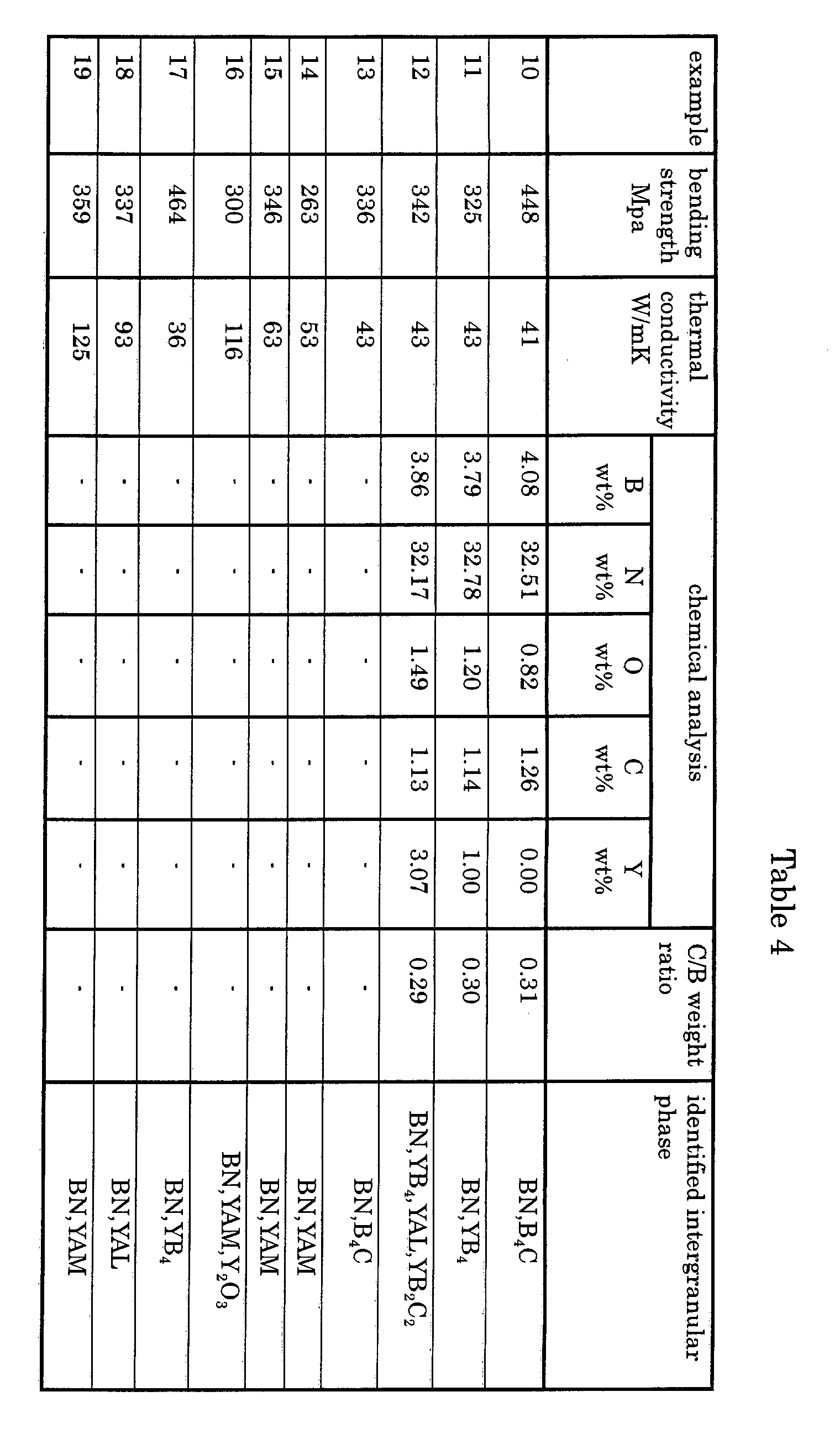
- the thermal conductivity of an aluminum nitride ceramics according to the present invention is not lower than 30 W/m ⁇ K.
- the upper limit of the thermal conductivity is not limited and may usually be 170 W/m ⁇ K and especially 150 W/m ⁇ K.
- an aluminum nitride ceramics contains intergranular phases mainly consisting of boron nitride.
- the following crystalline phases may be generated other than boron nitride phase. It has been proved that these secondary crystalline phases do not substantially affect the resistivity of an aluminum nitride ceramics.
- the intergranular phase is formed along the outer face of aluminum nitride particle and plate-shaped or film-shaped.
- the intergranular phase has an elongate shape preferably of an aspect ratio of not lower than 5, viewed on a ground face of an aluminum nitride ceramics in a magnitude of 500 to 1000.
- the intergranular phases form three-dimensional network.
- the intergranular phases are continuous over the whole of an aluminum nitride ceramics. It is desirable, however, that intergranular phases are continuous over plural of aluminum nitride grains.
- the conductive path constituted by the intergranular phase may be confirmed by taking a photograph by an atomic force microscope showing the current distribution analysis image of the ceramics and by measuring the contrast of the lightness of aluminum nitride grains and that of the intergranular phase.
- the spacing d004 of 004 diffraction peak of the intergranular phase is not lower than 1.6650 angstrom.
- d004 may more preferably be not lower than 1.6653 angstrom and most preferably be not lower than 1.6656 angstrom.
- d004 is not higher than 1.6740 angstrom (d0012 of carbon) and usually not higher than 1.6730 angstrom.
- the aluminum nitride ceramics according to the present invention has a ratio of volume resistivity at room temperature to that at 500 °C of 0.01 to 100.
- the present invention successfully provides an aluminum nitride ceramics having an extremely small dependency of volume resistivity on temperature.
- the conductive phase of the inventive ceramics has a high electrical conductivity to give metallic properties.
- the ceramic according to the present invention having a reduced temperature dependency of resistivity is particularly useful as a base material of, for example, an electrostatic chuck.
- the ratio of volume resistivity at room temperature to that at 500 °C may more preferably be 0.5 to 50 and particularly preferably be 0.1 to 10.
- an aluminum nitride ceramics has aluminum nitride and plate-like intergranular phases mainly consisting of boron nitride.
- the intergranular phase has a length of one side of not shorter than 5 ⁇ m. It is thereby possible to further reduce the dependency of volume resistivity on temperature.
- the intergranular phase has a longer side, meaning that the enhancement of growth of intergranular phase.
- the crystallinity of the intergranular phase is further improved so that electrons may move freely or with less bindings. Therefore, the intergranular phase has a higher electrical conductivity and behaves like a metal concerning the temperature dependency of volume resistivity.
- the raw material of aluminum nitride may be produced by various processes, including direct nitriding, reduction nitriding and gaseous phase synthesis from an alkyl aluminum.
- Boron carbide may be added to raw material of aluminum nitride.
- the oxide of a rare earth element may be added to the raw material.
- the compound of a rare earth element forming a rare earth oxide upon heating (a precursor of a rare earth oxide) may be added to the raw material.
- the precursor includes a nitrate, sulfate, oxalate and alkoxide.
- the precursor may be added as powder.
- the precursor such as a nitrate or sulfate may be dissolved into a solvent to obtain solution, which may be added into the raw material. It is thereby possible to uniformly disperse atoms of the rare earth element between aluminum nitride particles by dissolving the precursor in a solvent.
- the raw material may be shaped by any known methods including dry press, doctor blade, extrusion, casting and tape forming methods.
- raw powder of aluminum nitride may be dispersed in a solvent, into which the rare earth element may be added in a form of powder of the rare earth oxide or the solution described above.
- a mixing step it is possible to simply stir the formulation.
- the raw powder contains aggregates, it is possible to use a mixing and pulverizing machine, such as a pot mill, trommel and attrition mill, for pulverizing the aggregates.
- a mixing and pulverizing machine such as a pot mill, trommel and attrition mill, for pulverizing the aggregates.
- a binder component such as polyvinyl alcohol, may be added. In a step of removing a binder, however, it is necessary to avoid the shift or change of the formulation due to the oxidation of boron carbide.
- the solvent used for the mixing step may be dried, preferably by spray dry method. After carrying out vacuum drying process, the particle distribution of the dried particles may preferably be adjusted by passing the particles through a mesh.
- the material may be pressed using a metal mold to provide a disk-shaped body.
- the pressure for pressing raw material is not particularly limited, as long as the formed body may be handled without causing any fracture.
- the pressure may preferably be not lower than 100 kgf/ cm 2 .
- the powdery material may be supplied into a die for hot pressing without particularly forming the powdery material.
- the sintered body according to the invention may preferably be produced by hot pressing a body to be sintered, preferably at a pressure of not lower than 50 kgf /cm 2 .
- the sintering temperature is not limited, and may preferably be 1700 to 2200°C and more preferably be not lower than 1750 °C or not higher than 2100 °C.
- the sintering temperature may most preferably be 1750 to 2050 °C.
- the temperature may preferably be held at a holding temperature between 1400 to 1800 °C before sintering at a maximum temperature. It is proved that the growth of the intergranular phases mainly consisting of boron nitride in the sintered body may be further progressed to make the intergranular phases continuous and to further reduce the volume resistivity, by adding this temperature holding step.
- the preferred holding temperature in the temperature holding step may be changed depending on the added amount of boron carbide.
- the holding temperature may generally preferably be not lower than 1450 °C and not higher than 1750 °C. It is possible to control the values of volume resistivity and thermal conductivity by adjusting the holding temperature.
- the holding temperature may preferably be 1550 to 1650 °C for controlling the volume resistivity at a value not higher than 100 ⁇ ⁇ cm.
- the holding temperature may preferably be 1450 to 1550 °C for controlling the resistivity at a value between 10 5 and 10 12 ⁇ ⁇ c m.
- the holding temperature may preferably be 1650 to 1750 °C for controlling the resistivity at a value between 100 and 10 7 ⁇ ⁇ cm.
- the holding temperature may preferably be higher.
- the raw material may be held at 1500°C for a specified time period and then held at 1550 °C.
- the temperature may be slowly elevated from 1500 to 1800 °C.
- the time period for the temperature holding step may preferably be not shorter than 2 hours and more preferably be not shorter than 4 hours.
- the aluminum nitride ceramics according to the invention may preferably be used for various members in a system for producing semiconductors, such as systems for treating silicon wafers and for manufacturing liquid crystal displays.
- a system for producing semiconductors means a system usable in a wide variety of semiconductor processes in which metal contamination of a semiconductor is to be avoided.
- Such system includes a film forming, etching, cleaning and testing systems.
- An aluminum nitride ceramics according to the invention may be used as a corrosion resistant member.
- the corrosion resistant member may be used against corrosive substances such as a liquid including nitric acid, hydrochloric acid, mixed acid, hydrofluoric acid and aqua regia.
- the corrosive substance further includes a chlorine-based corrosive gas such as Cl 2 , BCl 3 , ClF 3 , HCl or the like and a fluorine-based corrosive gas such as ClF 3 gas, NF 3 gas, CF 4 gas, WF 6 , SF 4 or the like.
- the corrosion resistant member is particularly useful against the plasma of each gas.
- the member for a system for producing semiconductors may preferably be a corrosion resistant member such as a susceptor for the system.
- the inventive ceramics may be preferred for a metal embedded article having a corrosion resistant member and a metal member embedded therein.
- the corrosion resistant member includes a susceptor for mounting a semiconductor wafer thereon, a dummy wafer, a shadow ring, a tube for generating high frequency plasma, a dome for generating high frequency plasma, a high frequency wave-permeable window, an infrared radiation-permeable window, a lift pin for supporting a semiconductor wafer, a shower plate, an electrostatic chuck and a vacuum chuck.
- a resistive heating element, electrostatic chuck electrode or an electrode for generating high frequency plasma may be embedded in the susceptor.
- An aluminum nitride ceramics according to the present invention may be used as a conductive material having a volume resistivity at room temperature of not higher than 10 6 ⁇ ⁇ c m. It has been not known a conductive ceramic material having excellent corrosion resistant property and thermal conductivity as described above. The present invention thus provides a novel conductive ceramics having high corrosion resistant property.
- the volume resistivity may more preferably be reduced to a value not higher than 100 ⁇ ⁇ c m.
- Such conductive member may be utilized as, for example, a counter electrode for generating high frequency for use in a system for producing semiconductors.
- the conductive member may also be utilized as an electrode or heat generator to be exposed against a halogen-based gas or various chemical substances.
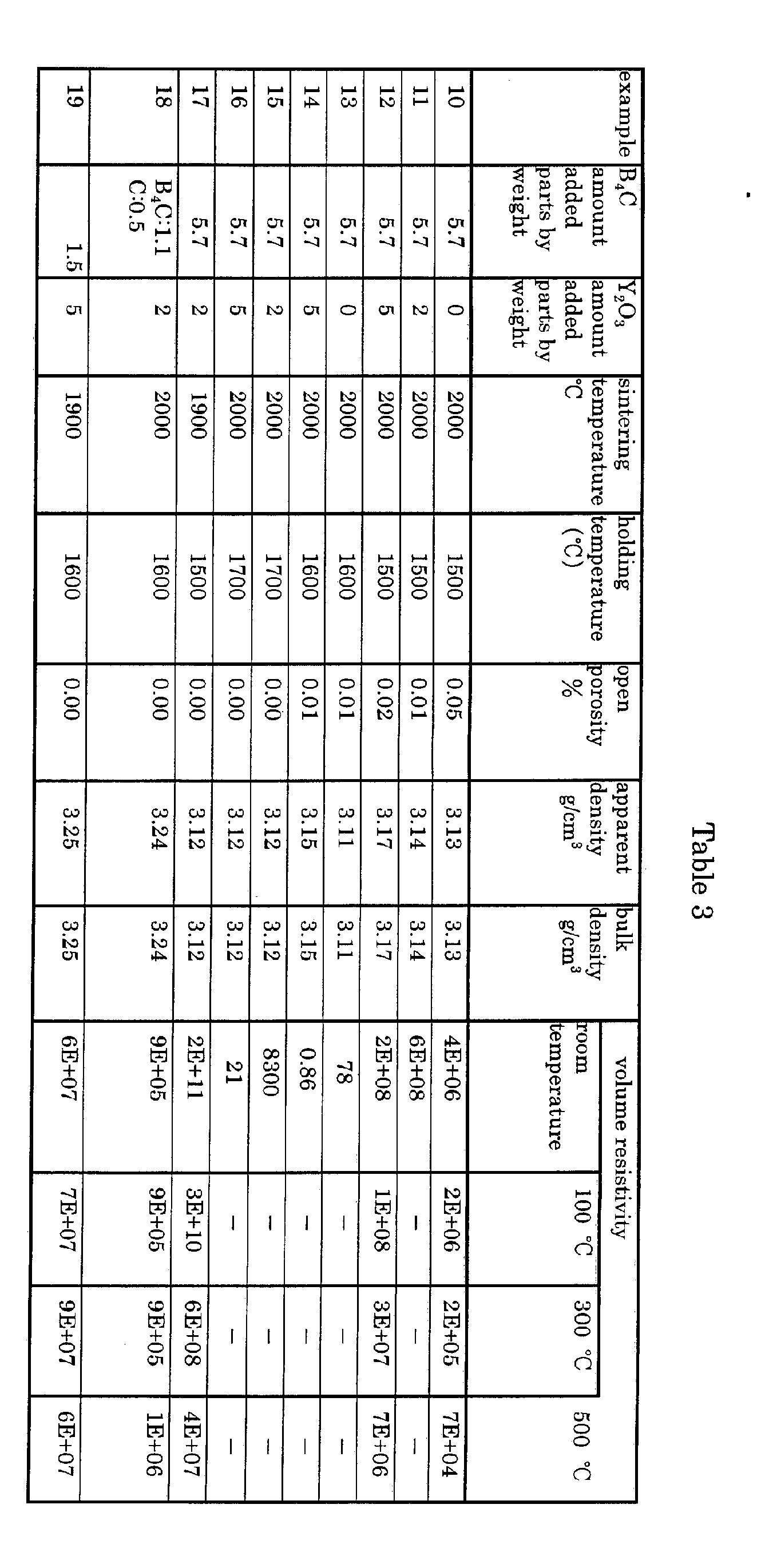
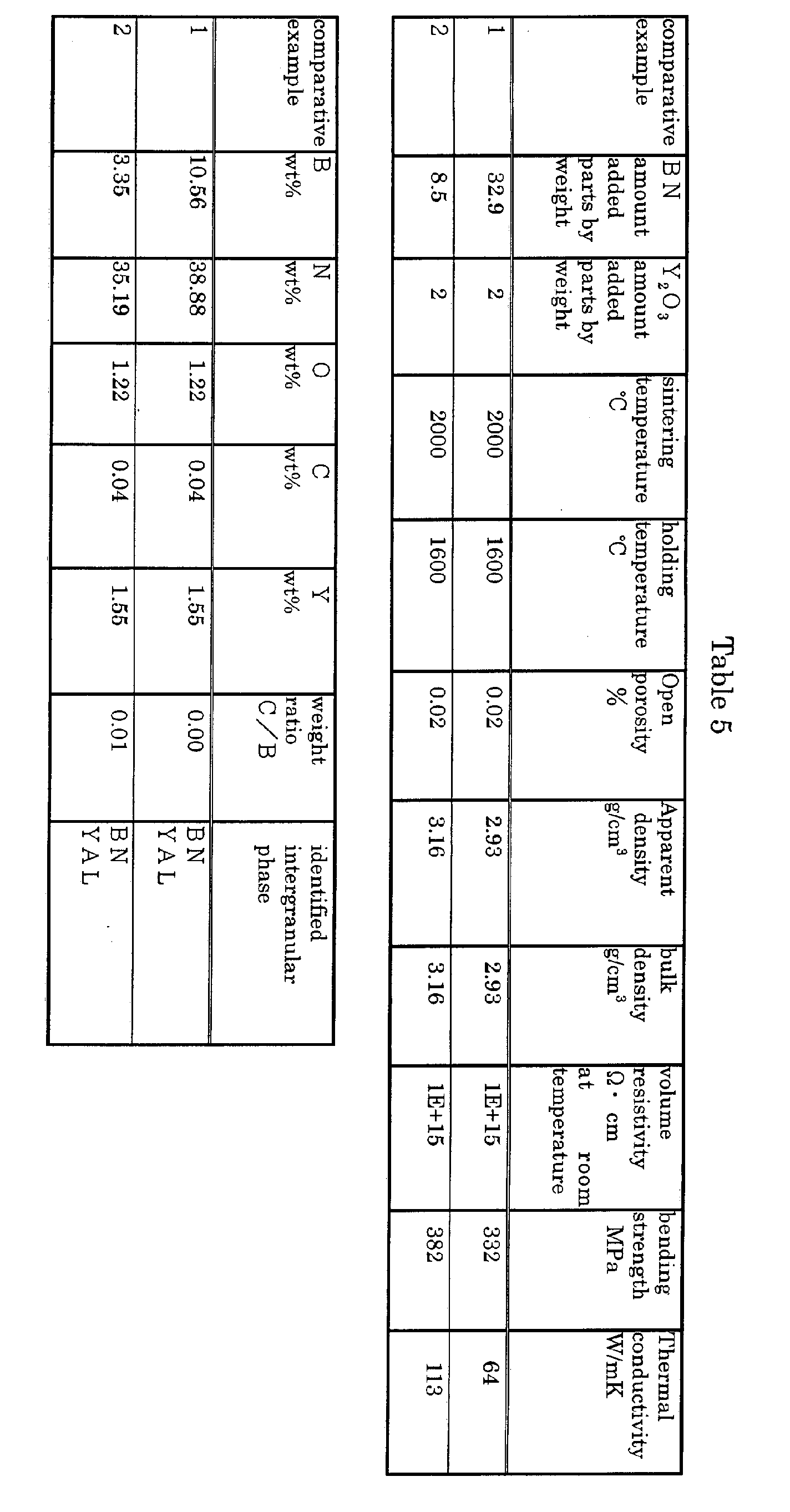
- Each powder was weighed as shown in tables 1 to 5.
- the amounts of B 4 C and Y 2 O 3 were converted to weight parts provided that the amount of aluminum nitride was converted to 100 weight parts.
- Each weighed powder was then subjected to wet blending using isopropyl alcohol as a solvent, a nylon pot and nylon media for 4 hours to obtain slurry. After the blending, the slurry was collected and dried at 110 °C in nitrogen atmosphere to obtain powdery raw material.
- the amounts of A1N, B 4 C and Y 2 O 3 in the formulation were calculated as "weight parts" ignoring the contents of impurities in each powder.
- Each mixed powder obtained in (1) section was then formed by uniaxial pressing at a pressure of 200 kgf / cm 2 to obtain a disk-formed body with a diameter of about 50 mm and a thickness of about 20 mm, which was then contained in a mold made of graphite for sintering.
- Each formed body was sintered by hot pressing at a pressure of 200 kgf/ cm 2 .
- the temperature was risen at a speed of 300 to 1000 °C/hour and then held at each holding temperature shown in tables 1 and 3 for 20 hours. The temperature was then risen to a maximum temperature of 1800 to 2000 °C, then held for 4 hours and then cooled.
- the temperature was lowered to 1400 °C at a speed of 300 °C/ hour and then cooled in a furnace.
- the formed body was set in vacuum from room temperature to 1000 °C and nitrogen gas was then introduced at a pressure of 1.5 MPa at 1000 °C. The pressure was then held at 0.15 MPa until the temperature reached 1400 °C in the cooling step while nitrogen gas was introduced at a flow rate of 5 liter / minute.
- the test sample has the following parts: a circular plate with a diameter ⁇ of 50 mm and thickness of 1 mm; a main electrode with a diameter of 20 mm; a guard electrode with an inner diameter of 30 mm and outer diameter of 40 mm; and an applying electrode with a diameter of 45 mm.
- the electrodes are formed of silver. 100 V/mm of voltage is applied and a current is read one minute after the application of voltage so that the volume resistivity is calculated.
- the resistivity is measured by four probe method in a sample having the resistivity of lower than 10 6 ⁇ c m.
- the volume resistivities at 100, 300 and 500 °C are also measured.
- a four-point bending strength at room temperature is measured according to "JIS R1601".
- Thermal conductivity was measured by laser flash method and calculated.
- the specific heat value (753 kJ/kg ⁇ K) of aluminum nitride was applied for the calculation.
- ICP inductively coupled plasma
- the polished surface of a sample was observed by backscattering electron image. It is also analyzed by EPMA and an atomic force microscope (AFM).
- the powdery raw material has a composition of 100/3.4/2.0 (AlN/B 4 C/Y 2 O 3 ; weight parts).
- the raw material was formed and sintered.
- the temperature was risen at a speed of 1000 °C/hour, held at 1600 °C for 20 hours and held at 2000 °C for 4 hours to obtain a dense body.
- the pressure during the sintering step was held at 0.15 MPa.
- the sintered body was processed for the evaluation of properties shown in the tables.
- the sintered body has a bulk density of 3.19 g/cm 3 and an open porosity of not higher than 0.1 percent to indicate that the body is sufficiently densified.
- the resistivity at room temperature measured by four probe method is 1.9 ⁇ ⁇ cm and is surprisingly low value.
- the four point bending strength is 279 MPa and thermal conductivity is 56 W/mK, both values being high.
- the sintered body has, in addition to A1N phase, YAlO 3 (YAL) phase and a phase mainly consisting of BN.
- YAlO 3 YAL
- a phase mainly consisting of BN in this sample, although B 4 C is added into raw material, the diffraction peak corresponding to B 4 C is not observed.
- the distribution of the plate-like phase is identical with that of B atoms according to the mapping by means of EPMA (Fig. 6). It is thus proved that the plate-like phase is mainly consisting of BN. It is also proved that the plate-like phase further contains carbon atoms.
- the powdery raw material has a composition of 100/5.7/2.0 (AlN/B 4 C/Y 2 O 3 ;weight parts).
- the raw material was shaped and sintered under the same conditions as the example 1. The properties of the sintered body were evaluated.
- the sintered body has a bulk density of 3.13 g/cm 3 and an open porosity of not higher than 0.1 percent to indicate that the body is sufficiently densified.
- the resistivity at room temperature measured by four probe method is 1 ⁇ ⁇ cm and is surprisingly low value.
- the four point bending strength is 268 MPa and thermal conductivity is 33 W/mK. It is proved that the sintered body has, in addition to A1N phase; Y 4 Al 2 O 9 (YAM) phase and a phase mainly consisting of BN by X-ray diffraction analysis.
- the same conditions as the example 1 are applied except that yttria is not added.
- the volume resistivity is 3 ⁇ 10 6 ⁇ ⁇ cm.
- the volume resistivity is extremely reduced to 1.9 ⁇ ⁇ cm by the addition of yttria.
- the addition of yttria is thus proved to be effective for further reducing the volume resistivity.
- B 4 C phase is not identified in the example 1 with the addition of yttria
- B 4 C phase is identified in the example 3 without the addition of yttria.
- an amount of B 4 C is set at 5.7 weight percent and an amount of yttria, maximum temperature in the sintering step and holding temperature are variously changed. These results are also in conformity with the above results. It is also proved that the volume resistivity may be further reduced by increasing the amount of B 4 C added to raw material. (0083) Further as can be seen from the above results, the holding temperature in the temperature holding step may preferably be 1450 to 1750 °C and the maximum temperature may preferably be not lower than 1800 °C. The holding temperature may preferably be 1550 to 1650 °C for reducing the volume resistivity to a value not higher than 100 ⁇ ⁇ c m.
- the holding temperature may preferably be 1450 to 1550 °C for reducing the volume resistivity at a value between 10 5 to 10 12 ⁇ c m.
- the holding temperature may preferably be 1650 to 1750 °C for reducing the volume resistivity of 100 to 10 7 ⁇ ⁇ c m. It is possible to control the growth of the intergranular phases mainly consisting of BN by controlling the holding temperature.
- Especially the holding temperature of 1550 to 1650 °C may be effective for the growth of the plate-like and continuous intergranular phases and for enhancing the solid solution of carbon atoms into the intergranular phases. It is thus preferred for obtaining a ceramics having a lower volume resistivity.
- the preferred ranges of resistivity and holding temperature are some of examples.
- the preferred holding temperature range for the corresponding resistivity range may be varied depending on an amount of added B 4 C.
- the ratio of the volume resistivity at room temperature to that at 500 °C is about 10 times.
- the ratio of the volume resistivity at room temperature to that at 500°C is lower than 10 times.
- the ratio of the volume resistivity at room temperature to that at 500 °C is about 60 or 30 times. It is thus obtained the sintered body having a low volume resistivity at room temperature as well as a smaller difference between the volume resistivities at room temperature and 500 °C.
- a small amount of added carbon may be contained in the conductive phase and functions substantially same as B 4 C.
- the sintered body has a considerably low volume resistivity at room temperature. Further, the volume resistivity at 500°C is substantially the same as that at room temperature.
- the surprising results may be caused as follows. In the example, a relatively small amount of B 4 C is added.
- the amount of liquid phase generated in the sintering step is relatively large compared with the amount of B 4 C so that B, C and O atoms may be easily diffused to enhance the growth of the conductive phase mainly consisting of boron nitride.
- the powdery raw material has a composition of 100/1.5/5.0 (AlN/B 4 C/Y 2 O 3 ;weight parts).
- the temperature was held at 1600 °C for 20 hours and then held at 1900 °C for 4 hours.
- the other conditions are the same as the example 1.
- the sintered body according to the example 19 has a considerably low volume resistivity at room temperature. Further, the volume resistivity at 500°C is substantially the same as that at room temperature.
- the surprising results may be caused as follows. In the example, a relatively small amount of B 4 C is added. The amount of liquid phase generated in the sintering step is relatively large compared with the amount of B 4 C so that B, C and O atoms may be easily diffused to enhance the growth of the conductive phase mainly consisting of boron nitride.
- the powdery raw material has a composition of 100/32.9/2.0 (AlN/BN/Y 2 O 3 ;weight parts).
- the temperature was risen at a speed of 1000 °C/hour.
- the formed body was held at 1600°C for 20 hours and then held at 2000 °C for 4 hours to produce a dense body.
- the pressure was held at 0.15 MPa in the sintering step.
- a dense body was produced under the conditions same as those in the comparative example 1 except that the powdery raw material has a composition of 100/8.5/2.0 (AlN/BN/Y 2 O 3 ;weight parts).
- the volume resistivity at room temperature and identified phases are the same as those in the comparative example 1.
- Figs. 1, 2 and 3 are photographs showing backscattering electron images of polished surfaces of samples according to the examples 1, 2 and comparative example 1 for the analysis of the microstructure.
- each photograph may be roughly divided into three regions in terms of brightness: white, gray and black regions.
- the white region corresponds with intergranular phase containing Y atoms and having a dimension of submicrons to several microns.
- the gray region is consisting of A1N phase constituting matrix of each sintered body.
- the black region is plate-like intergranular phase that is proved to be mainly consisting of BN according to the results of X-ray diffraction analysis and element analysis by EPMA. In the sample according to the example 1, this blackish intergranular phase is grown so that adjacent plate-like intergranular phases are interconnected with each other to form a kind of network.
- A1N particles (gray region) are smaller than those in the sample according to the example 1 and the blackish intergranular phase mainly consisting of BN are interconnected to form a kind of network microstructure.
- the content of BN is very large and BN phases are interconnected at many points. However, the growth and formation of plate like pattern is not clearly observed.
- the relationship between the microstructure (especially intergranular phase) and the resistivity of the sample according to the examples 1, 2 or comparative example 1 was further investigated as follows.
- the sample according to the example 1 having a reduced resistivity was analyzed by means of an atomic force microscope (AFM) to obtain a current distribution analytic images, which is shown in Fig 4.
- the analysis was carried out using a model "SPM stage D 3100" (probe type"DDESP ”) supplied by Digital Instruments.
- the test sample has a shape of a plate.
- the surface of the sample was polished for current distribution analysis.
- a DC bias was applied on the back face of the sample.
- the measurement of current distribution on the surface was performed on contact AFM current measurement mode.
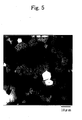
- FIG. 5 is an image showing the surface roughness over the same visual field as that of Fig. 4.
- the shape of each grain may be observed in this image.
- the current is larger in a white and bright region, indicating that the conductivity is high.
- the conductive phase (white and bright region) is elongated to have a plate-like shape.
- the distribution and shape of the conductive phase (shown in Fig. 4) is proved to be identical with the distribution of the plate-like intergranular phase shown in Fig. 5. It is also confirmed that the distribution of the conductive phase (blackish region) is identical with the distribution of the intergranular phase mainly consisting of BN shown in Fig. 1.
- the intergranular phases mainly consisting of BN have a low resistivity and three-dimensionally interconnected to form conductive path or network to reduce the resistivity of the sample.
- the intergranular phases mainly consisting of BN are continuous, the intergranular phase has a higher resistivity (contrary to the example 1) to prevent the reduction of the resistivity of the sample.
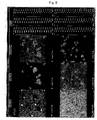
- Fig. 6 shows the results of analyzing the distribution of elements by of EPMA for the sample according to the example 1.
- B, C and N atoms are detected in the plate-like intergranular phase mainly consisting of BN.
- BN of hexagonal crystalline system usually has a high resistivity, it is proved that the intergranular phase mainly consisting of BN further contains C component.
- the C component is solid-soluted into BN phase to reduce the resistivity of BN otherwise having a higher resistivity.
- C graphite
- the spacing of the sample according to the example 1 is proved to be between those of BN and graphite.
- the results is consistent with the theory that C component is solid-soluted into BN to expand the crystal lattices of BN.
- the C components solid-soluted into BN phase may provide a high conductivity to BN phase to reduce the volume resistivity of the sample.
- the sample according to the example 7 has the same composition as that in the example 1, except that the holding temperature during the temperature holding step is 1700 °C and higher than that in the example 1.
- the volume resistivity at room temperature is 2 ⁇ 10 6 ⁇ ⁇ c m in the example 7.
- the spacing d004 of the phase mainly consisting of BN is 1.6659 angstrom in the example 7.
- d004 of the sample according to the comparative example 2 with BN added is 1.6649 angstrom.
- the resistivity of the sample is increased as the spacing d004 of the intergranular phase approaches that of BN and reduced as the spacing d004 approaches that of graphite. That is, the shift of the spacing is clearly correlated with the volume resistivity. In this way, the resistivity is regulated by the content of C component solid-soluted into BN phase.
- the invention may preserve the characteristic properties of an aluminum nitride and reduce its volume resistivity.
Landscapes
- Chemical & Material Sciences (AREA)
- Engineering & Computer Science (AREA)
- Ceramic Engineering (AREA)
- Manufacturing & Machinery (AREA)
- Materials Engineering (AREA)
- Structural Engineering (AREA)
- Organic Chemistry (AREA)
- Inorganic Chemistry (AREA)
- Ceramic Products (AREA)
Abstract
Description


| sample | J C P D S card number | spacing (angstrom) | volume resistivity (Ω · c m) |
| BN | N o . 34-0421 | 1.6636 | |
| comparative example 2 | ― | 1.6649 | 1 × 10¹⁵ |
| example 7 | ― | 1.6659 | 2 × 10⁶ |
| example 1 | ― | 1.6683 | 2 |
| C | N o . 26-1076 | 1.6740 |
Claims (29)
- An aluminum nitride ceramics containing boron atoms in an amount of not lower than 1.0 weight percent and carbon atoms in an amount of not lower than 0.3 weight percent and having a volume resistivity at room temperature of not higher than 1 x 10¹² Ω · cm.
- The ceramics of claim 1, comprising intergranular phases mainly consisting of boron nitride.
- An aluminum nitride ceramics comprising aluminum nitride grains and intergranular phases mainly consisting of boron nitride constituting a conductive path and having a volume resistivity at room temperature of not higher than 1 x 10¹² Ω · cm.
- An aluminum nitride ceramics comprising aluminum nitride grains and intergranular phases mainly consisting of boron nitride and having a volume resistivity at room temperature of not higher than 1 x 10¹² Ω · cm, wherein 004 diffraction peak of said intergranular phase has a spacing d004 of not lower than 1.6650 angstrom.
- The ceramics of claim 4, wherein said intergranular phases are continuously formed.
- The ceramics of any one of claims 1 to 5 wherein said intergranular phases constitute a conductive path.
- The ceramics of any one of claims 1 to 6 wherein said intergranular phase is plate-shaped.
- The ceramics of any one of claims 1 to 7 wherein carbon is solid-soluted into said intergranular phases.
- The ceramics of any one of claims 1 to 8 wherein the ratio (C/B) of carbon atoms to boron atoms by weight is not lower than 0.2 and not higher than 0.4.
- The ceramics of any one of claims 1 to 9, containing a rare earth element in an amount of not smaller than 0.2 weight percent.
- The ceramics of any one of claims 1 to 10 having a thermal conductivity of not lower than 30 W/m · K.
- The ceramics of any one of claims 1 to 11 being a sintered body.
- The ceramics of claim 12 being produced by sintering a mixture at least containing aluminum nitride and boron carbide.
- The ceramics of any one of claims 1 to 13 wherein the ratio of the volume resistivity at room temperature to the volume resistivity at 500°C is 0.01 to 100.
- An aluminum nitride ceramics being produced by sintering a mixture at least containing aluminum nitride and boron carbide and having a volume resistivity at room temperature of not higher than 1 x 10¹² Ω · cm.
- The ceramic of claim 15 being produced by holding a mixture at least containing aluminum nitride and boron carbide at a holding temperature not lower than 1400°C and not higher than 1800°C and then sintered at a maximum temperature higher than said holding temperature.
- The ceramics of claim 16 wherein said mixture is held at said holding temperature for a time period not shorter than 2 hours.
- The ceramics of any one of claims 15 to 17 having a content of aluminum nitride of not lower than 80 weight percent.
- The ceramics of any one of claims 15 to 18 wherein the ratio of the volume resistivity at room temperature to the volume resistivity at 500°C is 0.01 to 100.
- A member for use in a system for producing semiconductors comprising said aluminum nitride ceramics of any one of claims 1 to 19.
- A corrosion resistant member comprising said aluminum nitride ceramics of any one of claims 1 to 20.
- A conductive member comprising said aluminum nitride ceramics of any one of claims 1 to 20.
- A conductive member having a volume resistivity at room temperature of not higher than 1 x 10⁶ Ω · cm and composed of an aluminum nitride ceramics containing aluminum nitride in a content of not lower than 80 weight percent.
- The conductive member of claim 23 having a volume resistivity at room temperature of not higher than 1 x 100 Ω · cm.
- The conductive member of claim 23 or 24, wherein said aluminum nitride ceramics has intergranular phases mainly consisting of boron nitride, said intergranular phases constituting a conductive path.
- The conductive member of any one of claims 23 to 25 wherein 004 diffraction peak of said intergranular phase has a spacing d004 of not lower than 1.6650 angstrom.
- The conductive member of any one of claims 23 to 26, wherein said intergranular phases are continuously formed.
- The conductive member of any one of claims 23 to 27 wherein said aluminum nitride contains boron atoms in an amount of not lower than 1.0 weight percent and carbon atoms in an amount of not lower than 0.3 weight percent.
- The conductive member of any one of claims 23 to 28 containing a rare earth element in an amount of not smaller than 0.2 weight percent.
Applications Claiming Priority (4)
| Application Number | Priority Date | Filing Date | Title |
|---|---|---|---|
| JP2001358719 | 2001-11-26 | ||
| JP2001358719 | 2001-11-26 | ||
| JP2002307811A JP4245125B2 (en) | 2001-11-26 | 2002-10-23 | Aluminum nitride ceramics, semiconductor manufacturing members, corrosion resistant members, and conductive members |
| JP2002307811 | 2002-10-23 |
Publications (3)
| Publication Number | Publication Date |
|---|---|
| EP1314707A2 true EP1314707A2 (en) | 2003-05-28 |
| EP1314707A3 EP1314707A3 (en) | 2003-10-01 |
| EP1314707B1 EP1314707B1 (en) | 2009-01-07 |
Family
ID=26624678
Family Applications (1)
| Application Number | Title | Priority Date | Filing Date |
|---|---|---|---|
| EP02258094A Expired - Lifetime EP1314707B1 (en) | 2001-11-26 | 2002-11-25 | Aluminum nitride ceramics, members for use in a system for producing semiconductors, corrosion resistant members and conductive members |
Country Status (6)
| Country | Link |
|---|---|
| US (1) | US6884742B2 (en) |
| EP (1) | EP1314707B1 (en) |
| JP (1) | JP4245125B2 (en) |
| KR (1) | KR100494188B1 (en) |
| DE (1) | DE60230711D1 (en) |
| TW (1) | TWI223646B (en) |
Cited By (3)
| Publication number | Priority date | Publication date | Assignee | Title |
|---|---|---|---|---|
| EP1452510A1 (en) * | 2003-02-28 | 2004-09-01 | Ngk Insulators, Ltd. | Aluminium nitride materials and members for use in the production of semiconductors |
| US7122490B2 (en) | 2003-02-28 | 2006-10-17 | Ngk Insulators, Ltd. | Aluminum nitride materials and members for use in the production of semiconductors |
| CN107814570A (en) * | 2016-09-12 | 2018-03-20 | 中国科学院金属研究所 | The method that Peng ∕ carbothermic methods prepare the ceramic powder of two boron of ternary RE two |
Families Citing this family (12)
| Publication number | Priority date | Publication date | Assignee | Title |
|---|---|---|---|---|
| US7319914B1 (en) * | 2003-04-04 | 2008-01-15 | The United States Of America As Represented By The Secretary Of The Air Force | High speed and repeatability serial sectioning method for 3-D reconstruction of microstructures using scanning electron microscope |
| JP2006273587A (en) * | 2005-03-25 | 2006-10-12 | Ngk Insulators Ltd | Aluminum nitride-based ceramic, semiconductor manufacturing member, and method for manufacturing aluminum nitride-based ceramic |
| JP4915994B2 (en) * | 2005-09-22 | 2012-04-11 | 国立大学法人 香川大学 | Conductive ceramics, manufacturing method thereof, and member for semiconductor manufacturing apparatus |
| JP4740002B2 (en) * | 2006-03-20 | 2011-08-03 | 日本碍子株式会社 | Aluminum nitride sintered body, member for semiconductor manufacturing apparatus, and method for manufacturing aluminum nitride sintered body |
| US7799719B2 (en) * | 2007-01-17 | 2010-09-21 | Toto Ltd. | Ceramic member and corrosion-resisting member |
| JP2011128406A (en) * | 2009-12-18 | 2011-06-30 | Konica Minolta Business Technologies Inc | Toner for electrostatic latent image development and image forming method |
| KR101333629B1 (en) * | 2013-07-03 | 2013-11-27 | (주)보부하이테크 | Manufacturing method of ceramic heater for aln semiconductor having low leakagecurrent and improved power efficiency and ceramic heater for aln semiconductor having low leakagecurrent and improved power efficiency manufactured by the same |
| KR101757069B1 (en) | 2015-11-26 | 2017-07-13 | 한국세라믹기술원 | Alumina composite ceramic composition and method of manufacturing the same |
| KR102339550B1 (en) * | 2017-06-30 | 2021-12-17 | 주식회사 미코세라믹스 | Aluminum nitride sintered compact and members for semiconductor manufacturing apparatus including the same |
| CN109369191B (en) * | 2019-01-02 | 2021-08-03 | 山东博奥新材料技术有限公司 | Preparation method of yttrium-containing boron nitride-aluminum nitride composite powder |
| CN110183231B (en) * | 2019-05-31 | 2022-05-20 | 中南大学 | Preparation method of high-strength high-toughness boron carbide-based ceramic material and ceramic material thereof |
| KR102565344B1 (en) | 2020-12-01 | 2023-08-09 | 한국세라믹기술원 | Aluminium nitride ceramics composition and manufacturing method thereof |
Family Cites Families (17)
| Publication number | Priority date | Publication date | Assignee | Title |
|---|---|---|---|---|
| GB1285211A (en) * | 1969-01-09 | 1972-08-16 | United States Borax Chem | 31ycompositions for making refractory articles |
| JPH0717453B2 (en) * | 1985-11-28 | 1995-03-01 | 京セラ株式会社 | Aluminum nitride sintered body and method for manufacturing the same |
| EP0393524A3 (en) * | 1989-04-17 | 1993-02-10 | Kawasaki Steel Corporation | Method of making a sintered body of aluminium nitride |
| JPH03131574A (en) * | 1989-10-18 | 1991-06-05 | Hitachi Metals Ltd | Free-cutting sintered aluminum nitride |
| JPH04332831A (en) * | 1991-05-09 | 1992-11-19 | Kawasaki Refract Co Ltd | Temperature measuring element protecting tube |
| JPH05178671A (en) * | 1991-12-26 | 1993-07-20 | Shinko Electric Ind Co Ltd | Aluminum nitride sintered body |
| JPH06206772A (en) * | 1992-11-18 | 1994-07-26 | Toshiba Corp | Aluminum nitride sintered compact and ceramic circuit substrate |
| US5457075A (en) * | 1993-05-11 | 1995-10-10 | Hitachi Metals, Ltd. | Sintered ceramic composite and molten metal contact member produced therefrom |
| JP2541150B2 (en) * | 1994-05-25 | 1996-10-09 | 品川白煉瓦株式会社 | Aluminum nitride sintered body |
| JP3100871B2 (en) * | 1995-07-11 | 2000-10-23 | 株式会社東芝 | Aluminum nitride sintered body |
| JP3457495B2 (en) | 1996-03-29 | 2003-10-20 | 日本碍子株式会社 | Aluminum nitride sintered body, metal buried product, electronic functional material and electrostatic chuck |
| JPH10189698A (en) | 1996-12-27 | 1998-07-21 | Kyocera Corp | Electrostatic chuck |
| JP3370532B2 (en) | 1996-11-26 | 2003-01-27 | 京セラ株式会社 | Electrostatic chuck |
| JP3983362B2 (en) * | 1997-12-10 | 2007-09-26 | 日本碍子株式会社 | Porous composite ceramics and method for producing the same |
| MY127275A (en) | 1999-03-31 | 2006-11-30 | Hoya Corp | Glass substrate for magnetic recording medium, magnetic recording medium, and method of manufacturing the same |
| JP4447750B2 (en) | 1999-09-30 | 2010-04-07 | 日本碍子株式会社 | Aluminum nitride sintered body and semiconductor manufacturing member |
| JP4702978B2 (en) * | 2000-05-09 | 2011-06-15 | 株式会社東芝 | Aluminum nitride sintered body |
-
2002
- 2002-10-23 JP JP2002307811A patent/JP4245125B2/en not_active Expired - Fee Related
- 2002-10-25 TW TW091125214A patent/TWI223646B/en not_active IP Right Cessation
- 2002-11-25 EP EP02258094A patent/EP1314707B1/en not_active Expired - Lifetime
- 2002-11-25 DE DE60230711T patent/DE60230711D1/en not_active Expired - Lifetime
- 2002-11-25 KR KR10-2002-0073419A patent/KR100494188B1/en not_active Expired - Fee Related
- 2002-11-26 US US10/306,678 patent/US6884742B2/en not_active Expired - Lifetime
Cited By (3)
| Publication number | Priority date | Publication date | Assignee | Title |
|---|---|---|---|---|
| EP1452510A1 (en) * | 2003-02-28 | 2004-09-01 | Ngk Insulators, Ltd. | Aluminium nitride materials and members for use in the production of semiconductors |
| US7122490B2 (en) | 2003-02-28 | 2006-10-17 | Ngk Insulators, Ltd. | Aluminum nitride materials and members for use in the production of semiconductors |
| CN107814570A (en) * | 2016-09-12 | 2018-03-20 | 中国科学院金属研究所 | The method that Peng ∕ carbothermic methods prepare the ceramic powder of two boron of ternary RE two |
Also Published As
| Publication number | Publication date |
|---|---|
| KR20030043701A (en) | 2003-06-02 |
| JP4245125B2 (en) | 2009-03-25 |
| DE60230711D1 (en) | 2009-02-26 |
| US6884742B2 (en) | 2005-04-26 |
| US20030153452A1 (en) | 2003-08-14 |
| JP2003221278A (en) | 2003-08-05 |
| KR100494188B1 (en) | 2005-06-10 |
| TWI223646B (en) | 2004-11-11 |
| EP1314707A3 (en) | 2003-10-01 |
| EP1314707B1 (en) | 2009-01-07 |
Similar Documents
| Publication | Publication Date | Title |
|---|---|---|
| EP1314707B1 (en) | Aluminum nitride ceramics, members for use in a system for producing semiconductors, corrosion resistant members and conductive members | |
| US7122490B2 (en) | Aluminum nitride materials and members for use in the production of semiconductors | |
| TWI433825B (en) | Cerium oxide material, member for semiconductor manufacturing device, and method for producing cerium oxide material | |
| US20250304460A1 (en) | Ceramic sintered body comprising magnesium aluminate spinel | |
| US6919286B2 (en) | Aluminum nitride ceramics, members for use in a system for producing semiconductors, and corrosion resistant members | |
| EP1201622A2 (en) | A material with a low volume resistivity, aluminium nitride sintered body and article for manufacturing semiconductors | |
| US7148166B2 (en) | Aluminum nitride ceramics and a member used for the production of semiconductors | |
| US6607836B2 (en) | Material of low volume resistivity, an aluminum nitride sintered body and a member used for the production of semiconductors | |
| JP2002249379A (en) | Aluminum nitride sintered body and member for semiconductor manufacturing equipment | |
| EP3560904B1 (en) | Oriented aln sintered body, and production method therefor | |
| EP1357097B1 (en) | Aluminium nitride materials and members used for the production of semiconductors | |
| JP2003226580A (en) | Aluminum nitride ceramics and semiconductor manufacturing members | |
| JP2000327430A (en) | Aluminum nitride sintered body and its manufacturing method | |
| EP1452510B1 (en) | Aluminium nitride materials and members for use in the production of semiconductors | |
| Raether et al. | High strength and high thermal conductivity of aluminium nitride ceramics by microstructural design | |
| JP2004083291A (en) | Aluminum nitride sintered body, manufacturing method thereof, and susceptor with built-in electrode using aluminum nitride sintered body | |
| JP2004083292A (en) | Aluminum nitride sintered body, method for manufacturing the same, and susceptor with built-in electrode using aluminum nitride sintered body |
Legal Events
| Date | Code | Title | Description |
|---|---|---|---|
| PUAI | Public reference made under article 153(3) epc to a published international application that has entered the european phase |
Free format text: ORIGINAL CODE: 0009012 |
|
| AK | Designated contracting states |
Designated state(s): AT BE BG CH CY CZ DE DK EE ES FI FR GB GR IE IT LI LU MC NL PT SE SK TR |
|
| AX | Request for extension of the european patent |
Extension state: AL LT LV MK RO SI |
|
| PUAL | Search report despatched |
Free format text: ORIGINAL CODE: 0009013 |
|
| AK | Designated contracting states |
Kind code of ref document: A3 Designated state(s): AT BE BG CH CY CZ DE DK EE ES FI FR GB GR IE IT LI LU MC NL PT SE SK TR |
|
| AX | Request for extension of the european patent |
Extension state: AL LT LV MK RO SI |
|
| 17P | Request for examination filed |
Effective date: 20040326 |
|
| 17Q | First examination report despatched |
Effective date: 20040426 |
|
| AKX | Designation fees paid |
Designated state(s): DE FR GB |
|
| 17Q | First examination report despatched |
Effective date: 20040426 |
|
| GRAP | Despatch of communication of intention to grant a patent |
Free format text: ORIGINAL CODE: EPIDOSNIGR1 |
|
| GRAS | Grant fee paid |
Free format text: ORIGINAL CODE: EPIDOSNIGR3 |
|
| GRAA | (expected) grant |
Free format text: ORIGINAL CODE: 0009210 |
|
| AK | Designated contracting states |
Kind code of ref document: B1 Designated state(s): DE FR GB |
|
| REG | Reference to a national code |
Ref country code: GB Ref legal event code: FG4D |
|
| REF | Corresponds to: |
Ref document number: 60230711 Country of ref document: DE Date of ref document: 20090226 Kind code of ref document: P |
|
| PLBE | No opposition filed within time limit |
Free format text: ORIGINAL CODE: 0009261 |
|
| STAA | Information on the status of an ep patent application or granted ep patent |
Free format text: STATUS: NO OPPOSITION FILED WITHIN TIME LIMIT |
|
| 26N | No opposition filed |
Effective date: 20091008 |
|
| REG | Reference to a national code |
Ref country code: FR Ref legal event code: PLFP Year of fee payment: 14 |
|
| REG | Reference to a national code |
Ref country code: FR Ref legal event code: PLFP Year of fee payment: 15 |
|
| PGFP | Annual fee paid to national office [announced via postgrant information from national office to epo] |
Ref country code: DE Payment date: 20161123 Year of fee payment: 15 Ref country code: FR Payment date: 20161014 Year of fee payment: 15 Ref country code: GB Payment date: 20161123 Year of fee payment: 15 |
|
| REG | Reference to a national code |
Ref country code: DE Ref legal event code: R119 Ref document number: 60230711 Country of ref document: DE |
|
| GBPC | Gb: european patent ceased through non-payment of renewal fee |
Effective date: 20171125 |
|
| REG | Reference to a national code |
Ref country code: FR Ref legal event code: ST Effective date: 20180731 |
|
| PG25 | Lapsed in a contracting state [announced via postgrant information from national office to epo] |
Ref country code: FR Free format text: LAPSE BECAUSE OF NON-PAYMENT OF DUE FEES Effective date: 20171130 Ref country code: DE Free format text: LAPSE BECAUSE OF NON-PAYMENT OF DUE FEES Effective date: 20180602 |
|
| PG25 | Lapsed in a contracting state [announced via postgrant information from national office to epo] |
Ref country code: GB Free format text: LAPSE BECAUSE OF NON-PAYMENT OF DUE FEES Effective date: 20171125 |