EP1312982A1 - Radiation-sensitive composition, insulating film and organic el display element - Google Patents
Radiation-sensitive composition, insulating film and organic el display element Download PDFInfo
- Publication number
- EP1312982A1 EP1312982A1 EP01984445A EP01984445A EP1312982A1 EP 1312982 A1 EP1312982 A1 EP 1312982A1 EP 01984445 A EP01984445 A EP 01984445A EP 01984445 A EP01984445 A EP 01984445A EP 1312982 A1 EP1312982 A1 EP 1312982A1
- Authority
- EP
- European Patent Office
- Prior art keywords
- organic
- insulating film
- composition
- resin
- naphthoquinonediazide
- Prior art date
- Legal status (The legal status is an assumption and is not a legal conclusion. Google has not performed a legal analysis and makes no representation as to the accuracy of the status listed.)
- Withdrawn
Links
Images
Classifications
-
- G—PHYSICS
- G03—PHOTOGRAPHY; CINEMATOGRAPHY; ANALOGOUS TECHNIQUES USING WAVES OTHER THAN OPTICAL WAVES; ELECTROGRAPHY; HOLOGRAPHY
- G03F—PHOTOMECHANICAL PRODUCTION OF TEXTURED OR PATTERNED SURFACES, e.g. FOR PRINTING, FOR PROCESSING OF SEMICONDUCTOR DEVICES; MATERIALS THEREFOR; ORIGINALS THEREFOR; APPARATUS SPECIALLY ADAPTED THEREFOR
- G03F7/00—Photomechanical, e.g. photolithographic, production of textured or patterned surfaces, e.g. printing surfaces; Materials therefor, e.g. comprising photoresists; Apparatus specially adapted therefor
- G03F7/004—Photosensitive materials
- G03F7/0045—Photosensitive materials with organic non-macromolecular light-sensitive compounds not otherwise provided for, e.g. dissolution inhibitors
-
- G—PHYSICS
- G03—PHOTOGRAPHY; CINEMATOGRAPHY; ANALOGOUS TECHNIQUES USING WAVES OTHER THAN OPTICAL WAVES; ELECTROGRAPHY; HOLOGRAPHY
- G03F—PHOTOMECHANICAL PRODUCTION OF TEXTURED OR PATTERNED SURFACES, e.g. FOR PRINTING, FOR PROCESSING OF SEMICONDUCTOR DEVICES; MATERIALS THEREFOR; ORIGINALS THEREFOR; APPARATUS SPECIALLY ADAPTED THEREFOR
- G03F7/00—Photomechanical, e.g. photolithographic, production of textured or patterned surfaces, e.g. printing surfaces; Materials therefor, e.g. comprising photoresists; Apparatus specially adapted therefor
- G03F7/004—Photosensitive materials
- G03F7/022—Quinonediazides
- G03F7/023—Macromolecular quinonediazides; Macromolecular additives, e.g. binders
- G03F7/0233—Macromolecular quinonediazides; Macromolecular additives, e.g. binders characterised by the polymeric binders or the macromolecular additives other than the macromolecular quinonediazides
- G03F7/0236—Condensation products of carbonyl compounds and phenolic compounds, e.g. novolak resins
-
- G—PHYSICS
- G03—PHOTOGRAPHY; CINEMATOGRAPHY; ANALOGOUS TECHNIQUES USING WAVES OTHER THAN OPTICAL WAVES; ELECTROGRAPHY; HOLOGRAPHY
- G03F—PHOTOMECHANICAL PRODUCTION OF TEXTURED OR PATTERNED SURFACES, e.g. FOR PRINTING, FOR PROCESSING OF SEMICONDUCTOR DEVICES; MATERIALS THEREFOR; ORIGINALS THEREFOR; APPARATUS SPECIALLY ADAPTED THEREFOR
- G03F7/00—Photomechanical, e.g. photolithographic, production of textured or patterned surfaces, e.g. printing surfaces; Materials therefor, e.g. comprising photoresists; Apparatus specially adapted therefor
- G03F7/0005—Production of optical devices or components in so far as characterised by the lithographic processes or materials used therefor
- G03F7/0007—Filters, e.g. additive colour filters; Components for display devices
-
- G—PHYSICS
- G03—PHOTOGRAPHY; CINEMATOGRAPHY; ANALOGOUS TECHNIQUES USING WAVES OTHER THAN OPTICAL WAVES; ELECTROGRAPHY; HOLOGRAPHY
- G03F—PHOTOMECHANICAL PRODUCTION OF TEXTURED OR PATTERNED SURFACES, e.g. FOR PRINTING, FOR PROCESSING OF SEMICONDUCTOR DEVICES; MATERIALS THEREFOR; ORIGINALS THEREFOR; APPARATUS SPECIALLY ADAPTED THEREFOR
- G03F7/00—Photomechanical, e.g. photolithographic, production of textured or patterned surfaces, e.g. printing surfaces; Materials therefor, e.g. comprising photoresists; Apparatus specially adapted therefor
- G03F7/004—Photosensitive materials
- G03F7/022—Quinonediazides
-
- G—PHYSICS
- G03—PHOTOGRAPHY; CINEMATOGRAPHY; ANALOGOUS TECHNIQUES USING WAVES OTHER THAN OPTICAL WAVES; ELECTROGRAPHY; HOLOGRAPHY
- G03F—PHOTOMECHANICAL PRODUCTION OF TEXTURED OR PATTERNED SURFACES, e.g. FOR PRINTING, FOR PROCESSING OF SEMICONDUCTOR DEVICES; MATERIALS THEREFOR; ORIGINALS THEREFOR; APPARATUS SPECIALLY ADAPTED THEREFOR
- G03F7/00—Photomechanical, e.g. photolithographic, production of textured or patterned surfaces, e.g. printing surfaces; Materials therefor, e.g. comprising photoresists; Apparatus specially adapted therefor
- G03F7/004—Photosensitive materials
- G03F7/022—Quinonediazides
- G03F7/0226—Quinonediazides characterised by the non-macromolecular additives
-
- G—PHYSICS
- G03—PHOTOGRAPHY; CINEMATOGRAPHY; ANALOGOUS TECHNIQUES USING WAVES OTHER THAN OPTICAL WAVES; ELECTROGRAPHY; HOLOGRAPHY
- G03F—PHOTOMECHANICAL PRODUCTION OF TEXTURED OR PATTERNED SURFACES, e.g. FOR PRINTING, FOR PROCESSING OF SEMICONDUCTOR DEVICES; MATERIALS THEREFOR; ORIGINALS THEREFOR; APPARATUS SPECIALLY ADAPTED THEREFOR
- G03F7/00—Photomechanical, e.g. photolithographic, production of textured or patterned surfaces, e.g. printing surfaces; Materials therefor, e.g. comprising photoresists; Apparatus specially adapted therefor
- G03F7/004—Photosensitive materials
- G03F7/022—Quinonediazides
- G03F7/023—Macromolecular quinonediazides; Macromolecular additives, e.g. binders
- G03F7/0233—Macromolecular quinonediazides; Macromolecular additives, e.g. binders characterised by the polymeric binders or the macromolecular additives other than the macromolecular quinonediazides
-
- G—PHYSICS
- G03—PHOTOGRAPHY; CINEMATOGRAPHY; ANALOGOUS TECHNIQUES USING WAVES OTHER THAN OPTICAL WAVES; ELECTROGRAPHY; HOLOGRAPHY
- G03F—PHOTOMECHANICAL PRODUCTION OF TEXTURED OR PATTERNED SURFACES, e.g. FOR PRINTING, FOR PROCESSING OF SEMICONDUCTOR DEVICES; MATERIALS THEREFOR; ORIGINALS THEREFOR; APPARATUS SPECIALLY ADAPTED THEREFOR
- G03F7/00—Photomechanical, e.g. photolithographic, production of textured or patterned surfaces, e.g. printing surfaces; Materials therefor, e.g. comprising photoresists; Apparatus specially adapted therefor
- G03F7/004—Photosensitive materials
- G03F7/038—Macromolecular compounds which are rendered insoluble or differentially wettable
- G03F7/0382—Macromolecular compounds which are rendered insoluble or differentially wettable the macromolecular compound being present in a chemically amplified negative photoresist composition
-
- G—PHYSICS
- G03—PHOTOGRAPHY; CINEMATOGRAPHY; ANALOGOUS TECHNIQUES USING WAVES OTHER THAN OPTICAL WAVES; ELECTROGRAPHY; HOLOGRAPHY
- G03F—PHOTOMECHANICAL PRODUCTION OF TEXTURED OR PATTERNED SURFACES, e.g. FOR PRINTING, FOR PROCESSING OF SEMICONDUCTOR DEVICES; MATERIALS THEREFOR; ORIGINALS THEREFOR; APPARATUS SPECIALLY ADAPTED THEREFOR
- G03F7/00—Photomechanical, e.g. photolithographic, production of textured or patterned surfaces, e.g. printing surfaces; Materials therefor, e.g. comprising photoresists; Apparatus specially adapted therefor
- G03F7/004—Photosensitive materials
- G03F7/039—Macromolecular compounds which are photodegradable, e.g. positive electron resists
- G03F7/0392—Macromolecular compounds which are photodegradable, e.g. positive electron resists the macromolecular compound being present in a chemically amplified positive photoresist composition
-
- G—PHYSICS
- G03—PHOTOGRAPHY; CINEMATOGRAPHY; ANALOGOUS TECHNIQUES USING WAVES OTHER THAN OPTICAL WAVES; ELECTROGRAPHY; HOLOGRAPHY
- G03F—PHOTOMECHANICAL PRODUCTION OF TEXTURED OR PATTERNED SURFACES, e.g. FOR PRINTING, FOR PROCESSING OF SEMICONDUCTOR DEVICES; MATERIALS THEREFOR; ORIGINALS THEREFOR; APPARATUS SPECIALLY ADAPTED THEREFOR
- G03F7/00—Photomechanical, e.g. photolithographic, production of textured or patterned surfaces, e.g. printing surfaces; Materials therefor, e.g. comprising photoresists; Apparatus specially adapted therefor
- G03F7/004—Photosensitive materials
- G03F7/075—Silicon-containing compounds
- G03F7/0755—Non-macromolecular compounds containing Si-O, Si-C or Si-N bonds
-
- G—PHYSICS
- G03—PHOTOGRAPHY; CINEMATOGRAPHY; ANALOGOUS TECHNIQUES USING WAVES OTHER THAN OPTICAL WAVES; ELECTROGRAPHY; HOLOGRAPHY
- G03F—PHOTOMECHANICAL PRODUCTION OF TEXTURED OR PATTERNED SURFACES, e.g. FOR PRINTING, FOR PROCESSING OF SEMICONDUCTOR DEVICES; MATERIALS THEREFOR; ORIGINALS THEREFOR; APPARATUS SPECIALLY ADAPTED THEREFOR
- G03F7/00—Photomechanical, e.g. photolithographic, production of textured or patterned surfaces, e.g. printing surfaces; Materials therefor, e.g. comprising photoresists; Apparatus specially adapted therefor
- G03F7/004—Photosensitive materials
- G03F7/075—Silicon-containing compounds
- G03F7/0757—Macromolecular compounds containing Si-O, Si-C or Si-N bonds
-
- H—ELECTRICITY
- H10—SEMICONDUCTOR DEVICES; ELECTRIC SOLID-STATE DEVICES NOT OTHERWISE PROVIDED FOR
- H10K—ORGANIC ELECTRIC SOLID-STATE DEVICES
- H10K50/00—Organic light-emitting devices
- H10K50/80—Constructional details
- H10K50/84—Passivation; Containers; Encapsulations
- H10K50/844—Encapsulations
Definitions
- the present invention relates to a radiation sensitive resin composition, an insulating film made therefrom and an organic EL display element comprising the insulating film. More specifically, it relates to a positive type radiation sensitive resin composition suitable for the formation of an insulating film using radiation such as ultraviolet ray, deep ultraviolet ray, X-ray, electron beam, molecular beam, ⁇ -ray, synchrotron radiation or proton beam, an insulating film made therefrom and an organic EL display element comprising the insulating film.
- radiation such as ultraviolet ray, deep ultraviolet ray, X-ray, electron beam, molecular beam, ⁇ -ray, synchrotron radiation or proton beam
- organic EL elements Compared with liquid crystal display elements, organic EL elements have various advantages such as no dependence upon view angle as they emit light themselves, as well as excellent impact resistance, low voltage drive, low power consumption and high operational stability at low temperatures as they are solid elements. Passive type organic EL elements have the advantage of low cost since they are simple matrix elements. Owing to these advantages, the organic EL elements are highly expected to be used for mobile applications such as portable terminals and car equipment, and active studies on these organic EL elements are now under way.
- a transparent electrode (hole injection electrode) made from, for example, tin doped indium oxide (ITO) and a hole transport layer pattern are formed on a substrate.
- ITO tin doped indium oxide
- a passive type organic EL element after an insulating film pattern and a cathode partition pattern are formed, organic EL layer, electron transport layer and cathode are patterned by deposition.
- an active type organic EL element after an ITO pattern and a hole transport layer pattern are formed, an insulating layer pattern which will become partitions for the organic EL layer is formed, followed by the formation of an organic EL layer pattern by a masking method and the formation of electron transport layer and cathode patterns.
- the organic EL layer is generally made from a material formed by doping a base material such as Alq 3 or BeBq 3 with quinacridone or coumarin and the cathode is generally made from a material essentially composed of a metal having a low work function such as Mg or Ag.
- the insulating film material is generally an acrylic material having alkali developability or a polyimide material having organic developability. However, the following problem is encountered in this case.
- the hole transport layer, organic EL layer and electron transport layer are often made from a basic material such as an amine-based material to suitably transport holes or electrons.
- this material readily undergoes a structural change due to a trace amount of water and deterioration by an organic substance. Therefore, when the water permeability of an insulating film material is large or the residue after development exists at the time of forming an insulating film pattern, a phenomenon such as the spread of a non-emitting portion (dark area) occurs. Since a cathode essentially composed of a metal having a low work function is readily oxidized, a similar problem arises.
- a portion made from the basic material is in direct contact with an insulating film.
- this insulating film must have alkali developability or organic developability, it shows the acidity of carboxylic acid or phenol and reacts with the above basic material through water on the contact surface, or water changes the structure of the insulating film directly.
- the insulating film promotes corrosion by an acid.
- a cathode essentially composed of a metal having a low work function is corroded through its reaction with an acid, thereby forming a dark spot (non-luminous spot).
- an organic EL layer formed by deposition may crack, whereby water enters from the crack to cause an emission failure.
- an insulating film made from a conventionally known material does not have sufficient resistance to a resist remover which is used to form a cathode for a passive type organic EL element, thereby making it impossible to produce an organic EL display element stably.
- organic EL display element having a high aperture for high definition is now under study.
- This organic EL element is produced by the following method, for example.
- a drive terminal is formed on a substrate such as a glass substrate and an insulating film having flattening performance is formed on the terminal.
- a hole transport layer, organic EL layer, electron transport layer and electron injection electrode are then formed on the pattern sequentially.
- a 1 to 15 ⁇ m through hole or a U-shaped cavity must be formed in the insulating film used in the organic EL display element having the above structure to communicate the ITO electrode (hole injection electrode) formed above the insulating film with the drive terminal below the insulating film.
- the insulating film must have excellent flattening performance, high transparency and high resistance to a resist remover.
- first composition a radiation sensitive resin composition
- first composition a radiation sensitive resin composition
- a radiation sensitive resin composition comprising:
- an insulating film for an organic EL display element which is formed from the above first composition or the above second composition of the present invention.
- an organic EL display element comprising an insulating film formed from the above first composition or the above second composition of the present invention.
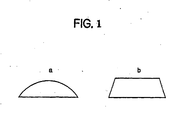
- Fig. 1 is a schematic diagram for judging whether the sectional form of a patterned thin film is good or not.
- the present invention will be described hereinbelow. A description is first given of the first composition.
- the first composition comprises an alkali-soluble resin having no epoxy group (a) and a 1,2-quinonediazide compound (b).
- the alkali-soluble resin having no epoxy group (a) is preferably a novolak resin having no epoxy group (to be simply referred to as "novolak resin” hereinafter) or a polymer of an unsaturated monomer having an acid group such as a carboxyl group or phenolic hydroxyl group.
- the novolak resin used in the present invention is obtained by polycondensing a phenol with an aldehyde in the presence of an acid catalyst.
- the phenol used include phenol, o-cresol, m-cresol, p-cresol, o-ethylphenol, m-ethylphenol,p-ethylphenol,o-butylphenol,m-butylphenol, p-butylphenol, 2,3-xylenol, 2,4-xylenol, 2,5-xylenol, 3,4-xylenol, 3,5-xylenol, 2,3,5-trimethylphenol, 3,4,5-trimethylphenol, p-phenylphenol, hydroquinone, catechol, resorcinol, 2-methylresorcinol, pyrogallol, ⁇ -naphthol, ⁇ -naphthol, bisphenol A, dihydroxybenzoic acid ester, gallic acid ester,
- o-cresol, m-cresol, p-cresol, 2,3-xylenol, 2,4-xylenol, 2,5-xylenol, 2,3,5-trimethylphenol, resorcinol and 2-methylresorcinol are preferred.
- These phenols may be used alone or in combination of two or more.
- aldehyde to be polycondensed with the above phenol examples include formaldehyde, paraformaldehyde, benzaldehyde, acetaldehyde, propylaldehyde, phenylaldehyde, ⁇ -phenylpropylaldehyde, ⁇ -phenylpropylaldehyde, o-hydroxybenzaldehyde, m-hydroxybenzaldehyde, p-hydroxybenzaldehyde, o-chlorobenzaldehyde, m-chlorobenzaldehyde, p-chlorobenzaldehyde, o-nitrobenzaldehyde, m-nitrobenzaldehyde, p-nitrobenzaldehyde, o-methylbenzaldehyde, m-methylbenzaldehyde, p-methylbenzaldehyde, o-ethylbenzaldehyde, m-e
- Trioxane which forms an aldehyde during a reaction may also be used as the above aldehyde. Out of these, formaldehyde is particularly preferred.
- the above aldehydes and compound forming an aldehyde may be used alone or in combination of two or more.
- the aldehyde is used in an amount of preferably 0.7 to 3 mols, more preferably 0.7 to 2 mols based on 1 mol of the phenol.
- the acid catalyst examples include hydrochloric acid, nitric acid, sulfuric acid, p-toluenesulfonic acid, formic acid, acetic acid and oxalic acid.
- the amount of the acid catalyst is preferably 1 x 10 -4 to 5 x 10 -1 mol based on 1 mol of the phenol.
- Water is preferably used as a reaction medium for a polycondensation reaction.
- a hydrophilic organic solvent may be used as a reaction medium.
- the solvent used in this case include alcohols such as methanol, ethanol and butanol; and cyclic ethers such as tetrahydrofuran and dioxane.
- the amount of the reaction medium is preferably 20 to 100 parts by weight based on 100 parts by weight of the total of the reaction raw materials.
- the condensation reaction temperature can be suitably adjusted according to the reactivity of each of the reaction raw materials. It is preferably 10 to 200° C. After the end of the polycondensation reaction, the temperature is suitably elevated to 130 to 230° C to remove an unreacted raw material, catalyst and reaction medium remaining in the system, thereby making it possible to distill off volatile matter under reduced pressure and to collect the novolak resin. At this point, the novolak resin may be collected after the reaction mixture obtained after the polycondensation reaction is washed with a suitable solvent as required.
- the weight average molecular weigh in terms of polystyrene (to be referred to as "Mw" hereinafter) of the novolak resin is preferably 2,000 to 20,000, more preferably 3,000 to 15,000.
- Mw polystyrene
- Mw is larger than 20,000, it may be difficult to apply the composition to a wafer uniformly, and developability and sensitivity may deteriorate.
- Mw is smaller than 2,000, not only a portion exposed to radiation but also a portion unexposed to radiation have solubility in a developer in the developing step to be described hereinafter, whereby a pattern may not be formed.
- the unsaturated monomer having an acid group is preferably an unsaturated carboxylic acid, unsaturated carboxylic anhydride or unsaturated monomer containing a phenolic hydroxyl group. They may be used alone or in combination of two or more.
- the polymer may be a polymer or copolymer of the above unsaturated monomer or a copolymer of the above unsaturated monomer and another olefinic unsaturated monomer.
- Examples of the unsaturated carboxylic acid and unsaturated carboxylic anhydride include o-vinylbenzoic acid, m-vinylbenzoic aid, p-vinylbenzoic acid, and alkyl, alkoxyl, halogen, nitro, cyano, amide and ester substituted products thereof; methacrylic acid, acrylic acid, and ⁇ -position substituted products obtained by substituting the ⁇ -position thereof by a haloalkyl, alkoxyl, halogen, nitro or cyano group; and unsaturated dicarboxylic acids such as maleic acid, maleic anhydride, fumaric acid, fumaric anhydride, citraconic acid, mesaconic acid, itaconic acid and 1,4-cyclohexenedicarboxylic acid, and half esters obtained by substituting one of the carboxyl groups thereof by a methyl, ethyl, propyl, i-propyl, n-butyl, sec-
- Examples of the unsaturated monomer containing a phenolic hydroxyl group include o-hydroxystyrene, m-hydroxystyrene, p-hydroxystyrene, and alkyl, alkoxyl, halogen, haloalkyl, nitro, cyano, amide, ester and carboxyl substituted products thereof; and polyhydroxyvinylphenols such as vinylhydroquinone, 5-vinylpyrogallol, 6-vinylpyrogallol and 1-vinylphloroglucinol.
- Examples of the another radically polymerizable olefinic unsaturated monomer include styrene and ⁇ -alkyl, o-alkyl, m-alkyl, p-alkyl, alkoxyl, halogen, haloalkyl, nitro, cyano, amide and ester substituted products thereof; olefins such as butadiene, isoprene and chloroprene; (meth)acrylates such as methyl (meth)acrylate, ethyl (meth)acrylate, n-propyl (meth)acrylate, i-propyl (meth)acrylate, n-butyl (meth)acrylate, sec-butyl (meth)acrylate, tert-butyl (meth)acrylate, pentyl (meth)acrylate, neopentyl (meth)acrylate, isoamylhexyl (meth)acrylate, cyclohex
- styrene, butadiene, phenyl (meth)acrylate, glycidyl (meth)acrylate and dicyclopentanyl (meth)acrylate are preferred as the another olefinic unsaturated monomer. They may be used alone or in combination of two or more.
- the amount of the another olefinic unsaturated monomer differs according to the type of a group which provides alkali solubility.
- the amount of the unsaturated monomer containing a phenolic hydroxyl group is preferably 0 to 30 wt%, more preferably 5 to 20 wt% based on the total weight of the unsaturated monomer containing a phenolic hydroxyl group and the another olefinic unsaturated monomer.
- the amount of the another olefinic unsaturated monomer is preferably 0 to 90 wt%, more preferably 10 to 80 wt% based on the total weight of the unsaturated carboxylic acid, unsaturated carboxylic anhydride and another olefinic unsaturated monomer.
- the ratio of the another olefinic unsaturated monomer to the unsaturated monomer having an acid group such as a hydroxyl group or carboxyl group is larger than the above range, alkali developability may become unsatisfactory.
- Examples of the solvent used to synthesize a polymer of the unsaturated monomer having an acid group include alcohols such as methanol, ethanol and diacetone alcohol; ethers such as tetrahydrofuran, tetrahydropyran and dioxane; glycol ethers such as ethylene glycol monomethyl ether and ethylene glycol monoethyl ether; ethylene glycol alkylether acetates such as methyl cellosolve acetate and ethyl cellosolve acetate; diethylene glycols such as diethylene glycol monomethyl ether, diethylene glycol monoethyl ether, diethylene glycol dimethyl ether, diethylene glycol diethyl ether and diethylene glycol ethyl methyl ether; propylene glycol monoalkyl ethers such as propylene glycol methyl ether, propylene glycol ethyl ether, propylene glycol propyl ether and propylene glycol butyl
- radical polymerization initiator may be used as the polymerization initiator used for the production of the polymer of an unsaturated monomer having an acid group.
- the polymerization initiator include azo compounds such as 2,2'-azobisisobutyronitrile, 2,2'-azobis-(2,4-dimethylvaleronitrile) and 2,2'-azobis-(4-methoxy-2,4-dimethylvaleronitrile); organic peroxides such as benzoyl peroxide, lauroyl peroxide, t-butyl peroxypyvarate and 1,1'-bis-(t-butylperoxy)cyclohexane; and hydrogen peroxide.
- a peroxide When a peroxide is used as the radical polymerization initiator, it may be used in conjunction with a reducing agent as a redox type initiator.
- a homopolymer of a monomer corresponding to a monomer having a phenolic hydroxyl group or carboxyl group of above unsaturated monomer having acid group protected by a protective group such as an alkyl group, acetyl group or phenacyl group, or a copolymer of the above monomer and another olefinic unsaturated monomer is obtained and then alkali solubility is provided by removing the protective group by a reaction such as hydrolysis.
- the polymer of an unsaturated monomer having an acid group used in the present invention may be a polymer having transparency or softening point improved by hydrogenation or the like.
- the weight average molecular weight in terms of polystyrene of the polymer of an unsaturated monomer having an acid group used in the present invention is preferably 2,000 to 100,000, more preferably 3,000 to 50,000, particularly preferably 5,000 to 30,000.
- a radiation sensitive resin composition having good balance among pattern shape, resolution, developability and heat resistance, and good balance between developability and sensitivity.
- hydroxystyrene (co) polymers and partial hydrides thereof such as Marukalyncur M and PHM-C (of Maruzen Petrochemical Co., Ltd.) and VP-1500 (of Nippon Soda Co., Ltd.).
- the 1,2-quinonediazide compound (b) used in the present invention is preferably a 1,2-quinonediazide compound having a structure that it forms a carboxylic acid by absorbing radiation.
- the compound is, for example, a 1,2-benzoquinonediazidesulfonic acid ester, 1,2-naphthoquinonediazidesulfonic acid ester, 1,2-benzoquinonediazidesulfonamide or 1,2-naphthoquinonediazidesulfonamide.
- the compound include 1,2-naphthoquinonediazidesulfonic acid esters of trihydroxybenzophenone such as 2,3,4-trihydroxybenzophenone-1,2-naphthoquinonediazide-4 -sulfonate, 2,3,4-trihydroxybenzophenone-1,2-naphthoquinonediazide-5 - sulfonate, 2,4,6-trihydroxybenzophenone-1,2-naphthoquinonediazide-4 -sulfonate and 2,4,6-trihydroxybenzophenone-1,2-naphthoquinonediazide-5 -sulfonate; 1,2-naphthoquinonediazidesulfonic acid esters of tetrahydroxybenzophenone such as 2,2',4,4'-tetrahydroxybenzophenone-1,2-naphthoquinonediazide-4-sulfonate, 2,2',4,4'-tetrahydroxybenzophenone-1,2-,2-
- the above compound may be used in the form of a condensate obtained by reacting part or all thereof with the above alkali-soluble resin (a).
- 1,2-naphthoquinonediazidesulfonic acid esters of trihydroxybenzophenone such as 2,3,4-trihydroxybenzophenone-1,2-naphthoquinonediazide-5 -sulfonate and 2,4,6-trihydroxybenzophenone-1,2-naphthoquinonediazide-5 -sulfonate
- 1,2-naphthoquinonediazidesulfonic acid esters of tetrahydroxybenzophenone such as 2,3,4,3'-tetrahydroxybenzophenone-1,2-naphthoquinonediazide-5-sulfonate, 2,3,4,4'-tetrahydroxybenzophenone-1,2-naphthoquinonediazide-4-sulfonate, 2,3,4,4'-tetrahydroxybenzophenone-1,2-naphthoquinonediazide-5-sulfonate and 2,3,4,4'-tetrahydroxybenzophenone-1,2-nap
- 2,3,4-trihydroxybenzophenone-1,2-naphthoquinonediazide-5 -sulfonate 1,2-naphthoquinonediazidesulfonic acid esters of tetrahydroxybenzophenone such as 2,3,4,4'-tetrahydroxybenzophenone-1,2-naphthoquinonediazide-4-sulfonate, 2,3,4,4'-tetrahydroxybenzophenone-1,2-naphthoquinonediazide-5-sulfonate and 2,3,4,4'-tetrahydroxy-3'-methoxybenzophenone-1,2-naphthoquinonediazide-5-sulfonate, 1,1,1-tri(p-hydroxyphenyl)ethane-1,2-naphthoquinonediazide-5-sulfonate, bis(2,3,4-trihydroxyphenyl)methane-1,2-naphthoquinonediazide-5-sulfonate
- the above 1,2-quinonediazide compounds may be used alone or in admixture of two or more.
- the amount of the 1,2-quinonediazide compound (b) is preferably 5 to 100 parts by weight, more preferably 10 to 50 parts by weight based on 100 parts by weight of the alkali-soluble resin (a). When the amount is smaller than 5 parts by weight, patterning may be difficult and when the amount is larger than 100 parts by weight, development with an alkaline aqueous solution developer may be difficult.
- An insulating film made from a radiation sensitive resin composition containing the above alkali-soluble resin (a) and the above 1,2-quinonediazide compound (b) has no residue after development and low water permeability for use in an organic EL element and can suppress the formation of a dark area caused by a trace amount of water.
- the radiation sensitive resin composition of the present invention may contain a basic nitrogen-containing compound (c).
- a basic nitrogen-containing compound (c) The reactivity of an insulating film made from the composition containing the basic nitrogen-containing compound (c) with a hole transport layer, organic EL layer and electron transport layer comprising a basic material and a cathode essentially composed of a metal having a low work function is fully suppressed, thereby making it possible to control the formation of a dark spot caused by the corrosion of the above layers.
- the basic nitrogen-containing compound (c) used in the present invention is preferably a nitrogen-containing organic compound whose basicity is not changed by exposure or baking, as exemplified by:
- the nitrogen-containing compound (I) include monoalkylamines such as n-hexylamine, n-heptylamine, n-octylamine, n-nonylamine and n-decylamine; dialkylamines such as di-n-butylamine, di-n-pentylamine, di-n-hexylamine, di-n-heptylamine, di-n-octylamine, di-n-nonylamine and di-n-decylamine; trialkylamines such as triethylamine, tri-n-propylamine, tri-n-butylamine, tri-n-pentylamine, tri-n-hexylamine, tri-n-heptylamine, tri-n-octylamine, tri-n-nonylamine and tri-n-decylamine; and aromatic amines such as aniline, N-methylaniline
- trialkylamines are preferred.
- Illustrative examples of (2) the nitrogen-containing compound (II) include ethylenediamine, N,N,N',N'-tetramethylethylenediamine, tetramethylenediamine, hexamethylenediamine, 4,4'-diaminodiphenylmethane, 4,4'-diaminodiphenyl ether, 4,4'-diaminobenzophenone, 4,4'-diaminodiphenylamine, 2,2-bis(4-aminophenyl)propane, 2-(3-aminophenyl)-2-(4-aminophenyl)propane, 2-(4-aminophenyl)-2-(3-hydroxyphenyl)propane, 2-(4-aminophenyl)-2-(4-hydroxyphenyl)propane, 1,4-bis[1-(4-aminophenyl)-1-methylethyl]benzene and 1,3-bis[1-(4
- Illustrative examples of (3) the nitrogen-containing compound (III) include poly(4-pyridine), poly(2-pyridine), poly(N-2-pyrrolidone), polyethyleneimine, polyarylamine and poly(dimethylaminoethylacrylamide).
- Illustrative examples of (4) the amide group-containing compound include formamide, N-methylformamide, N,N-dimethylformamide, acetamide, N-methylacetamide, N,N-dimethylacetamide, propionamide, benzamide, pyrrolidone and N-methylpyrrolidone.
- Illustrative examples of (5) the urea compound include urea, methylurea, 1,1-dimethylurea, 1,3-dimethylurea, 1,1,3,3-tetramethylurea, 1,3-diphenylurea and tributylurea.
- Illustrative examples of (6) the nitrogen-containing heterocyclic compound include imidazoles such as imidazole, benzimidazole, 4-methylimidazole and 4-methyl-2-phenylimidazole; pyridines such as pyridine, 2-methylpyridine, 4-methylpyridine, 2-ethylpyridine, 4-ethylpyridine, 2-phenylpyridine, 4-phenylpyridine, N-methyl-4-phenylpyridine, nicotine, nicotinic acid, nicotinamide, quinoline, 8-oxyquinoline and acridine; pyrazine, pyrazole, pyridazine, quinoxaline, purine, pyrrolidine, piperidine, morpholine, 4-methylmorpholine, piperazine, 1,4-dimethylpiperazine and 1,4-diazabicyclo[2.2.2]octane. Out of these, pyridines are particularly preferred.
- the nitrogen-containing compounds (I) and (6) the nitrogen-containing heterocyclic compounds are preferred.
- the basic nitrogen-containing compounds (c) may be used alone or in combination of two or more.
- the amount of the basic nitrogen-containing compound in the present invention is preferably 0.01 to 20 parts by weight, more preferably 0.05 to 10 parts by weight based on 100 parts by weight of the alkali-soluble resin (a).
- the amount of the basic nitrogen-containing compound is smaller than 0.01 part by weight, the effect of improving the service life of the organic EL element may not be obtained to the full and when the amount is larger than 20 parts by weight, the sensitivity of the obtained radiation sensitive resin composition and the developability of the exposed portion may deteriorate.
- the radiation sensitive resin composition of the present invention may further contain (d) at least one compound selected from a melamine compound and an epoxy compound.
- the radiation sensitive resin composition contains the compound (d)
- an insulating film formed from the composition achieves sufficiently high resistance to a resist stripper used to form a cathode for a passive type liquid crystal display element. Therefore, even when the insulating film is exposed to the resist stripper, it is not removed.
- the melamine used in the present invention is represented by the following formula (2): wherein R 4 to R 9 may be the same or different and each a hydrogen atom or -CH 2 OR group, R is a hydrogen atom or alkyl group having 1 to 6 carbon atoms, with the proviso that at least one of R 4 to R 9 must be a -CH 2 OR group.
- Examples of the melamine represented by the above formula (2) include hexamethylol melamine, hexabutyrol melamine, partial methylol melamine and alkylated products thereof, tetramethylol benzoguanamine, partial methylol benzoguanamine and alkylated products thereof.
- the amount of the melamine is preferably 1 to 100 parts by weight, more preferably 5 to 50 parts by weight based on 100 parts by weight of the alkali-soluble resin (a).
- the amount is smaller than 1 part by weight, the crosslinking density lowers and the obtained insulating film may be inferior in alkali resistance.
- the amount is larger than 100 parts by weight, the alkali solubility of the whole composition becomes too high, thereby readily causing such a problem as a decline in the film retention rate after development.
- the epoxy resin used in the present invention is preferably, for example, a phenol novolak epoxy resin, cresol novolak epoxy resin, bisphenol A epoxy resin, bisphenol F epoxy resin, alicyclic epoxy resin or aliphatic polyglycidiyl ether.
- a phenol novolak epoxy resin cresol novolak epoxy resin
- bisphenol A epoxy resin bisphenol A epoxy resin
- bisphenol F epoxy resin alicyclic epoxy resin or aliphatic polyglycidiyl ether.
- the following commercially available products of the epoxy resin may be used.
- phenol novolak epoxy resin Commercially available products of the phenol novolak epoxy resin include Epicoat 152 and 154 (of Yuka Shell Epoxy Co., Ltd.) and EPPN 201 and 202 (of Nippon Kayaku Co., Ltd.).
- cresol novolak epoxy resin Commercially available products of the cresol novolak epoxy resin include EOCN-102, 103S, 104S, 1020, 1025 and 1027 (of Nippon Kayaku Co., Ltd.) and Epicoat 180S75 (of Yuka Shell Epoxy Co., Ltd.).
- alicyclic epoxy resin Commercially available products of the alicyclic epoxy resin include CY-175, 177 and 179 (of Ciba-Geigy Co., Ltd.), ERL-4234, 4299, 4221 and 4206 (of U.U.C. Co., Ltd.), Showdyne 509 (of Showa Denko K.K.), Aldalite CY-182, 192 and 184 (of Ciba-Geigy Co., Ltd.), Epiclon 200 and 400 (of Dainippon Ink & Chemicals, Inc.), Epicoat 871 and 872 (of Yuka Shell Epoxy Co., Ltd.), and ED-5661 and 5662 (of Ceranees Coating Co., Ltd.).
- Epolite 100MF, 200E and 400E of Kyoeisha Yushi Kagaku Kogyo Co., Ltd.
- Epiol TMP of NOF Corporation
- the amount of the epoxy resin is preferably 1 to 100 parts by weight, more preferably 5 to 50 parts by weight based on 100 parts by weight of the alkali-soluble resin (a).
- the radiation sensitive resin composition of the present invention may contain other additives in limits not prejudicial to the object of the present invention.
- the other additives include, for example, a sensitizer, surfactant, adhesion aid, keeping stabilizer and defoamer.
- the above sensitizer may be blended to improve the radiation sensitivity of the radiation sensitive composition of the present invention.
- the sensitizer include 2H-pyrido-(3,2-b)-1,4-oxazin-3(4H)-ones, 10H-pyrido-(3,2-b)-(1,4)-benzothiazines, urazols, hydantoins, barbituric acid, glycine anhydrides, 1-hydroxybenzotriazoles, alloxans and maleimides.
- the amount of the sensitizer is preferably 100 parts or less by weight, more preferably 1 to 50 parts by weight based on 100 parts by weight of the 1,2-quinonediazide compound (b).
- the above surfactant may be blended to improve coatability, for example, striation and the developability of an exposed portion after the formation of a dry coating film.
- surfactant examples include nonionic surfactants such as polyoxyethylene alkyl ethers including polyoxyethylene lauryl ether, polyoxyethylene stearyl ether and polyoxyethylene oleyl ether, polyoxyethylene aryl ethers including polyoxyethylene octylphenyl ether and polyoxyethylene nonylphenyl ether, and polyethylene glycol dialkyl esters including polyethylene glycol dilaurate and polyethylene glycol distearate; fluorine-containing surfactants such as F Top EF301, 303 and 352 (of Shin Akita Kasei Co., Ltd.), Megafac F171, 172 and 173 (of Dainippon Ink and Chemicals, Inc.), Florade FC430 and 431 (of Sumitomo 3M, Ltd.), Asahi Guard AG710 and Surflon S-382, SC-101, 102, 103, 104, 105 and 106 (of Asahi Glass Co., Ltd.); and organo
- the above adhesion aid may be used to improve adhesion between an insulating film formed from the radiation sensitive composition of the present invention and a substrate.
- the adhesion aid is preferably a functional silane coupling agent such as a silane coupling agent having a reactive substituent such as a carboxyl group, methacryloyl group, isocyanate group or epoxy group.
- Specific examples of the adhesion aid include trimethoxysilylbenzoic acid, ⁇ -methacryloxypropyl trimethoxysilane, vinyltriacetoxysilane, vinyltrimethoxysilane, ⁇ -isocyanate propyltriethoxysilane, ⁇ -glycidoxypropyl trimethoxysilane and ⁇ -(3,4-epoxycyclohexyl)ethyltrimethoxysilane.
- the amount of the above surfactant is preferably 15 parts or less by weight, more preferably 10 parts or less by weight based on 100 parts by weight of the solids content of the composition.
- the radiation sensitive resin composition of the present invention is generally dissolved in a solvent before use.
- the solvent used for the preparation of the radiation sensitive resin composition of the present invention dissolves the above alkali-soluble resin (a), 1,2-quinoneazide compound (b), basic nitrogen-containing compound (c) and a melamine, epoxy resin and other additives optionally added (d) and does not react with these components.
- Examples of the solvent used to prepare the radiation sensitive resin composition of the present invention include glycol ethers such as ethylene glycol monomethyl ether and ethylene glycol monoethyl ether; ethylene glycol alkylether acetates such as methyl cellosolve acetate and ethyl cellosolve acetate; diethylene glycol alkyl ethers such as diethylene glycol monomethyl ether and diethylene glycol monoethyl ether; propylene glycol alkyl ether acetates such as propylene glycol methyl ether acetate, propylene glycol ethyl ether acetate and propylene glycol propyl ether acetate; aromatic hydrocarbons such as toluene and xylene; ketones such as methyl ethyl ketone, cyclohexanone, 2-heptanone and methyl isobutyl ketone; and esters such as methyl 2-hydroxypropionate, ethyl 2-hydroxypropionate
- glycol ethers ethylene glycol alkyl ether acetates, propylene glycol alkyl ether acetates, esters and diethylene glycols are preferred from the viewpoints of solubility, reactivity with each component and ease of forming a coating film.
- solvents may be used alone or in admixture.
- a high-boiling solvent may be used as required, as exemplified by benzyl ethyl ether, dihexyl ether, diethylene glycol monomethyl ether, diethylene glycol monoethyl ether, diethylene glycol monobutyl ether, acetonyl acetone, isophorone, caproic acid, caprylic acid, 1-octanol, 1-nonanol, benzyl alcohol, benzyl acetate, ethyl benzoate, diethyl oxalate, diethyl maleate, ⁇ -butyrolactone, ethylene carbonate, propylene carbonate, phenyl cellosolve acetate and carbitol acetate.
- the radiation sensitive resin composition of the present invention is prepared by using the above solvent.
- the radiation sensitive resin composition may have a suitable solids content according to its application purpose, the solids content may be, for example, 20 to 40 wt%.
- composition solution prepared as described above is filtered with a Millipore filter having an opening diameter of about 0.2 ⁇ m, preferably about 0.1 ⁇ m, before use.
- the first composition of the present invention is used to form an insulating film for an organic EL display element.
- the second composition contains (a') an alkali-soluble resin having an epoxy group and (b) a 1,2-quinonediazide compound.
- the second composition of the present invention contains (a') an alkali-soluble resin having an epoxy group, has suitable solubility in an alkaline developer and can be easily cured by heating without using a special curing agent.
- the alkali-soluble resin having an epoxy group (a') used in the present invention is not particularly limited if it has an epoxy group and has alkali solubility. It may be, for example, a copolymer obtained by copolymerizing (1a') an unsaturated monomer having an epoxy group, (2a') at least one monomer selected from an unsaturated carboxylic acid, unsaturated carboxylic anhydride and unsaturated monomer having a phenolic hydroxyl group and (3a') an olefinic unsaturated compound other than (1a') and (2a').
- Examples of the unsaturated monomer having an epoxy group (1a') include (meth)acrylates having an epoxy group such as glycidyl (meth)acrylate, ⁇ -methylglycidyl (meth)acrylate, ⁇ -ethylglycidyl (meth)acrylate, ⁇ -propylglycidyl (meth)acrylate, glycidyl ⁇ -ethylacrylate, ⁇ -methylglycidyl ⁇ -ethylacrylate, 3-methyl-3,4-epoxybutyl (meth)acrylate, 3-ethyl-3,4-epoxybutyl (meth)acrylate, 4-methyl-4,5-epoxypentyl (meth)acrylate and 5-methyl-5,6-epoxyhexyl (meth) acrylate; styrene derivatives having an epoxy group such as o-vinylbenzylglycidyl ether, m-vinylbenzylglycid
- glycidyl (meth)acrylate ⁇ -methylglycidyl (meth)acrylate, o-vinylbenzylglycidyl ether, m-vinylbenzylglycidyl ether and p-vinylbenzylglycidyl ether are preferred from the viewpoints of the transparency, developability and solvent resistance of the obtained insulating film.
- the amount of the unsaturated monomer having an epoxy group (1a') is preferably 20 to 90 wt%, more preferably 30 to 80 wt%, particularly preferably 40 to 70 wt%.
- Preferred examples of the at least one monomer selected from an unsaturated carboxylic acid, unsaturated carboxylic anhydride and unsaturated monomer having a phenolic hydroxyl group (2a') include hydroxystyrenes such as o-hydroxystyrene, m-hydroxystyrene, p-hydroxystyrene and alkyl, alkoxy, halogen, haloalkyl, nitro, cyano, amide, ester and carboxy substituted products thereof; polyhydroxyvinyl phenols such as vinylhydroquinone, 5-vinylpyrogallol, 6-vinylpyrogallol and 1-vinylphloroglucinol; vinylbenzoic acids such as o-vinylbenzoic acid, m-vinylbenzoic acid, p-vinylbenzoic acid and alkyl, alkoxy, halogen, nitro, cyano, amide and ester substituted products thereof; (meth)acrylic acids
- (meth)acrylic acid, maleic anhydride and fumaric acid are particularly preferred from the viewpoint of developability.
- the amount of the monomer (2a') is preferably 3 to 45 wt%, more preferably 6 to 30 wt%, much more preferably 10 to 25 wt%.
- Examples of the olefinic unsaturated compound (3a') other than (1a') and (2a') include alkyl methacrylates such as methyl methacrylate, ethyl methacrylate, n-butyl methacrylate, sec-butyl methacrylate and t-butyl methacrylate; alkyl acrylates such as methyl acrylate and isopropyl acrylate; cyclic alkyl methacrylates such as cyclohexyl methacrylate, 2-methylcyclohexyl methacrylate, tricyclo[5.2.1.0 2,6 ]decane-8-yl methacrylate (commonly called "dicyclopentanyl methacrylate" in this technical.
- alkyl methacrylates such as methyl methacrylate, ethyl methacrylate, n-butyl methacrylate, sec-butyl methacrylate and t-butyl methacrylate
- dicyclopentanyloxyethyl methacrylate and isobornyl methacrylate dicyclopentanyloxyethyl methacrylate and isobornyl methacrylate
- cyclic alkyl acrylates such as cyclohexyl acrylate, 2-methylcyclohexyl acrylate, tricyclo[5.2.1.0 2,6 ]decane-8-yl acrylate (commonly called "dicyclopentanyl acrylate” in this technical field), dicyclopentanyloxyethyl acrylate and isobornyl acrylate
- aryl methacrylates such as phenyl methacrylate and benzyl methacrylate
- aryl acrylates such as phenyl acrylate and benzyl acrylate
- dicarboxylic acid diesters such as diethyl maleate, diethyl fumarate and diethyl itaconate
- hydroxyalkyl esters such as 2-hydroxy
- styrene, butadiene, n-propyl acrylate, tricyclo[5.2.1.0 2,6 ]decane-8-yl acrylate, methyl methacrylate, 2-hydroxyethyl methacrylate and n-butyl methacrylate are preferred from the viewpoints of developability and the transparency of the obtained insulating film.
- the amount of the monomer (3a') is preferably 2 to 80 wt%, more preferably 5 to 60 wt%, much more preferably 10 to 40 wt%.
- the solvent and polymerization initiator used to copolymerize the above components (1a'), (2a') and (3a') may be the same as those listed for the polymer of an unsaturated monomer having an acid group used in the first composition.
- a molecular weight modifier for adjusting the molecular weight may be used.
- the molecular weight modifier include hydrocarbon halides such as chloroform and carbon tetrabromide; mercaptans such as n-hexylmercaptan, n-octylmercaptan, n-dodecylmercaptan, tert-dodecylmercaptan and thioglycolic acid; xanthogens such as dimethylxanthogen sulfide and diisopropylxanthogen disulfide; terpinolene and ⁇ -methylstyrene dimer.
- the weight average molecular weight in terms of polystyrene (Mw) of the alkali-soluble resin having an epoxy group (a') is preferably 2,000 to 100,000, more preferably 3,000 to 50,000, particularly preferably 5,000 to 30,000.
- Mw polystyrene
- a' alkali-soluble resin having an epoxy group
- the weight average molecular weight is higher than 100,000, it may be difficult to apply the composition to a wafer uniformly, and developability and sensitivity may deteriorate.
- the weight average molecular weight is lower than 2,000, not only the exposed portion but also the unexposed portion may exhibit solubility in an alkali developer, thereby making it impossible to form a pattern.
- the component (a') may be synthesized by introducing a protective group into the carboxyl group or phenolic hydroxyl group of the above monomer (2a') before copolymerization and removing the protective group after copolymerization to provide alkali solubility.
- the insulting film obtained from the composition of the present invention has sufficiently high transparency but the visible light transparency of the film can be further improved by hydrogenating the component (a') synthesized as described above.
- the softening point can also be changed by this treatment.
- Examples of the 1,2-quinonediazide compound used in the second composition are the same as those listed for the 1,2-quinonediazide compound used in the first composition.
- the above 1,2-quinonediazide compounds may be used alone or in combination of two or more.
- the amount of the 1,2-quinonediazide compound (b) is preferably 5 to 100 parts by weight, more preferably 10 to 50 parts by weight based on 100 parts by weight of the alkali-soluble resin having an epoxy group (a').
- amount is smaller than 5 parts by weight, patterning may be difficult and when the amount is larger than 100 parts by weight, development with an aqueous alkaline solution developer may be difficult.
- the second composition of the present invention may contain other additives in limits not prejudicial to the object of the present invention.
- the additives include a sensitizer, surfactant, adhesion aid, keeping stabilizer and defoamer.
- the second composition is dissolved in the same solvent as that for the first composition.
- the second composition may have a suitable solids content according to its application purpose and the solids content may be, for example, 20 to 40 wt%.
- composition solution prepared as described above is filtered with a Millipore filter having an opening diameter of about 0.2 ⁇ m, preferably about 0.1 ⁇ m, before use.
- An insulating film for an organic EL display element can be formed from the radiation sensitive resin composition of the present invention as follows, for example.
- the radiation sensitive resin composition of the present invention is applied to the surface of a base substrate and prebaked to remove the solvent in order to form a coating film.
- the application method can be suitably selected from spraying, roll coating, rotary coating and bar coating.
- the coating film is the most preferably prebaked at 60 to 110° C for 0.5 to 15 minutes.
- the thickness of the film after prebaking can be adjusted to a desired value according to the solids content and application conditions of the radiation sensitive composition, for example, 0.25 to 4 ⁇ m.
- the formed coating film is exposed to radiation through a predetermined pattern mask.
- the radiation used for exposure is ultraviolet ray such as g-line having a wavelength of 436 nm and i-line having a wavelength of 365 nm, deep ultraviolet ray such as KrF excimer laser beams, X-ray such as synchrotron radiation or charged corpuscular beams such as electron beams. Out of these, g-line and i-line are preferred.
- the developer is preferably an alkali aqueous solution prepared by dissolving in water an inorganic alkali such as sodium hydroxide, potassium hydroxide, sodium carbonate, sodium silicate, sodium metasilicate or ammonia water; primary amine such as ethylamine or n-propylamine; secondary amine such as diethylamine or di-n-propylamine; tertiary amine such as triethylamine or methyldiethylamine; alcohol amine such as dimethylethanolamine or triethanolamine; quaternary ammonium salt such as tetramethylammonium hydroxide, tetraethylammonium hydroxide or choline; or cyclic amine such as pyrrole, piperidine, 1,8-diazabicyclo-(5.4.0)-7-undecene or 1,5-diazabicyclo-(4.3.0)
- an inorganic alkali such as sodium hydroxide, potassium hydroxide, sodium carbon
- the development method is, for example, puddle development, dipping or shaking immersion.
- the patterned film may be rinsed with running water.
- the entire surface of the film may be further exposed to radiation from a high-pressure mercury lamp to decompose the residual 1,2-quinonediazide compound contained in the film.
- this film is heated with a heater such as a hot plate or oven to be cured.
- the heating temperature for curing is, for example, 150 to 250°C and the heating time is 5 to 30 minutes when the film is baked on a hot plate and 30 to 90 minutes when it is baked in an oven.
- the organic EL element of the present invention comprises the insulating film formed as described above.
- the organic EL element of the present invention is produced from the first composition as follows, for example.
- a transparent electrode such as an ITO electrode is formed on a glass substrate by sputtering and a positive type photoresist pattern is formed on the electrode. Thereafter, the ITO film is etched with a hydrochloric acid-based etchant and the resist film is removed to form a transparent electrode pattern such as a striped pattern.
- An insulating film pattern is formed from the first composition of the present invention on the substrate having this transparent electrode pattern as described above. Thereafter, an electron transport layer, inversely tapered cathode partitions, electron hole transport layer, organic EL emitting layer and cathode layer are formed on this insulating film pattern sequentially.
- An organic EL element is produced from the second composition as follows, for example.
- a drive terminal is formed on a substrate such as a glass substrate and an insulating film is formed from the second composition of the present invention on the terminal as described above.
- a transparent electrode such as an ITO electrode (hole injection electrode) is formed on the insulating film by sputtering and a pattern is formed by wet etching.
- An electron hole transport layer, organic EL layer, electron transport layer and electron injection electrode are formed on the electrode by deposition sequentially.
- the electron hole transport layer is made from a phthalocyanine-based material such as CuPc or H 2 Pc, or an aromatic amine.
- a low molecular organic EL material produced by doping a substrate made from Alq 3 or BeBq 3 with quinacridone or coumarin, or a high molecular organic EL material such as a polyphenylene-based or fluorene-based material is used as an organic EL emissive material.
- Mg-Al, Al-Li, Al-Li 2 O or Al-LiF is used as a cathode material.
- a hollow stainless steel can and the above substrate are sealed with a sealer such as an epoxy resin and assembled together into a module as an organic EL element.
- the first composition of the present invention may be preferably used as a composition for forming an insulating film for use in this organic EL display element.
- the organic EL emitting layer is generally formed by dissolving an organic EL emissive material in a solvent and applying the solution when a high molecular organic EL material is used as the above organic EL emissive material
- the first composition which contains (d) at least one compound selected from a melamine compound and an epoxy compound or a combination of (c) a nitrogen-containing basic compound and (d) at least one compound selected from a melamine compound and an epoxy compound is preferably used as a composition for forming an insulating film for use in this organic EL display element.
- the molecular weight measured hereinafter is a weight average molecular weight in terms of polystyrene measured by the GPC chromatograph HLC-8020 of Toso Corporation.
- the temperature of the oil bath was then elevated to 180° C over 3 hours, the inside pressure of the flask was reduced to 30 mmHg to remove volatile matter, and the molten resin was collected by cooling to room temperature.
- this resin was dissolved in ethyl acetate to a resin content of 30 %, methanol and water were added to this solution in amounts 1.3 times and 0.9 time the weight of the solution, respectively, stirred and left.
- This resin 1 had a weight average molecular weight (Mw) of 8,000.
- the temperature of the oil bath was then elevated to 180° C over 3 hours, the inside pressure of the flask was reduced to 30 mmHg to remove volatile matter, and the molten resin was collected by cooling to room temperature.
- this resin was dissolved in ethyl acetate to a resin content of 30 %, methanol and water were added to this solution in amounts 1.3 times and 0.9 time the weight of the solution, respectively, stirred and left.
- This resin 2 had a weight average molecular weight (Mw) of 7,500.
- the molten resin 3 was collected by cooling to room temperature.
- the resin 3 had a weight average molecular weight (Mw) of 8,800.
- resin 4 This precipitate was vacuum dried at 50° C for one night to obtain white resin powders (this resin will be referred to as "resin 4" hereinafter).
- the yield of the resin 4 was 95 %.
- the weight average molecular weight of the resin 4 was 1.01 x 10 4 .
- the yield of the obtained resin 5 was 95 % and the weight average molecular weight of the resin 5 was 2.21 x 10 4 .
- an alkali-soluble resin (to be referred to as "resin 6" hereinafter) was synthesized in the same manner as in Synthesis Example 4 except that 95.0 g of p-tert-butoxystyrene, 5.0 g of phenyl methacrylate, 10.0 g of 2,2'-azobisisobutyronitrile and 100.0 g of dioxane were fed to a similar separable flask to that of Synthesis Example 4.
- the yield of the obtained resin 6 was 94 % and the weight average molecular weight of the resin 6 was 2.30 x 10 4 .
- a solution containing a resin 8 was obtained in the same manner as in Synthesis Example 7 except that 7.5 g of styrene, 20.0 g of methacrylic acid, 22.5 g of dicyclopentanyl methacrylate, 50.0 g of glycidyl methacrylate, 4.0 g of 2,2'-azobisisobutyronitrile and 250.0 g of diethylene glycol dimethyl ether were fed to a similar separable flask to that of Synthesis Example 4.
- the obtained resin 8 had a solids content of 30 %.
- the resin 8 had a weight average molecular weight in terms of polystyrene of 2.13 x 10 4 .
- White resin powders (this resin will be referred to as "resin 9" hereinafter) were obtained in the same manner as in Synthesis Example 4 except that 100.0 g of p-tert-butoxystyrene, 2.0 g of 2,2'-azobisisobutyronitrile and 100.0 g of dioxane were fed to a similar separable flask to that of Synthesis Example 4.
- the yield of the obtained resin 9 was 95 % and the molecular weight thereof was 3.45 x 10 4 .
- a solution containing a resin 12 was obtained in the same manner as in Synthesis Example 11 except that 28.0 g of o-vinylbenzylglycidyl ether and 40.0 g of glycidyl methacrylate as the monomers (1a'), 22.0 g of methacrylic acid as the monomer (2a') and 10.0 g of styrene as the monomer (3a') were used.
- the solution containing the resin 12 had a solids content of 30 wt%.
- the weight average molecular weight in terms of polystyrene of the resin 12 was 1.7 x 10 4 .
- a solution containing a resin 13 was obtained in the same manner as in Synthesis Example 11 except that 21.0 g of o-vinylbenzylglycidyl ether and 25.0 g of glycidyl methacrylate as the monomers (1a'), 18.0 g of methacrylic acid as the monomer (2a'), and 10.0 g of styrene and 26.0 g of n-propyl acrylate as the monomers (3a') were used.
- the solution containing the resin 13 had a solids content of 30 wt%.
- the weight average molecular weight in terms of polystyrene of the resin 13 was 1.5 x 10 4 .
- the sectional form of the above patterned thin film was observed by a scanning electron microscope (S-4200 of Hitachi, Ltd.) to measure the tapered angle of the sectional form (angle formed by the bottom side and the tangent of the edge portion of the sectional form of the pattern, the same shall apply hereinafter).
- the result is shown in Table 1. When this value is 50° or less, it can be said that the sectional form of the pattern is satisfactory.
- a patterned thin film was formed on a glass substrate having an ITO film deposited thereon in the same manner as in (2) to check the existence of the residue after development by the following two methods.
- the above composition solution was applied to a 25 ⁇ m thick polyimide sheet to a film thickness of 10 ⁇ m with a spinner, pre-baked at 80° C for 1.5 minutes and heated at 220° C for 60 minutes to form a cured film on the polyimide sheet.
- An aluminum cup containing 15 g of distilled water was covered with this film to seal it up. This was placed in a thermostatic oven heated at 50° C to measure a reduction in the weight of the cup after 150 hours in order to calculate water permeability per unit area.
- Table 1 When this value is 500 g/cm 2 or less, it can be said that water permeability is sufficiently low.
- An organic EL panel for evaluation was prepared and a lightening promotion test was made on this panel at a screen brightness of 100 cd/m 2 ⁇ (Red: 100 + Green: 200 + Blue: 100) cd/m 2 + 3 x 0.7 ⁇ 100 cd/m 2 ⁇ and a temperature of 105° C.
- the time elapsed until the screen brightness was halved is shown in Table 1. When this value is 400 hours or more, it can be said that luminance half-life period is satisfactory.
- Composition solutions were prepared and evaluated in the same manner as in Example 1 except that the types and amounts of the components (a) and (b) were changed as shown in Table 1. The results are shown in Table 1.
- the unit of the amount of each component is parts by weight.
- the compounds (i), (ii) and (iii) are the following compounds.
- composition solution was evaluated for radiation sensitivity, sectional form, existence of the residue after development, water permeability, existence of a non-emitting portion and luminance half-life period in the same manner as in Example 1. The results are shown in Table 2.
- Composition solutions were prepared and evaluated in the same manner as in Example 4 except that the types and amounts of the components (a), (b) and (c) were changed as shown in Table 2. The results are shown in Table 2.
- Example 1 The procedure of Example 1 was repeated using the above composition solution to evaluate radiation sensitivity, sectional form, existence of the residue after development, water permeability, existence of a non-emitting portion and luminance half-life period. The results are shown in Table 3.
- the glass substrate having the patterned thin film formed thereon was immersed in a 1 % NaOH aqueous solution whose temperature was controlled to 25° C for 20 minutes.
- the ratio of the film thicknesses before and after immersion (t1/T1) x 100 [%] was calculated in which the film thickness before immersion was represented by T1 and the film thickness after immersion was represented by t1.
- the result is shown in Table 3. When this value is 95 to 105 %, it can be said that alkali resistance is satisfactory.
- the glass substrate having the patterned thin film formed thereon was immersed in a mixed solution of dimethyl sulfoxide/N-methylpyrrolidone (weight ratio of 70/30) whose temperature was controlled to 25° C for 20 minutes.
- the ratio of film thicknesses before and after immersion (t2/T2) x 100 (%) was calculated in which the film thickness before immersion was represented by T2 and the film thickness after immersion was represented by t2.
- Table 3 When this value is 95 to 105 %, it can be said that solvent resistance is satisfactory.
- the glass substrate having the patterned thin film formed thereon was additionally baked at 220° C for 60 minutes.
- the ratio of film thicknesses before and after additional baking (t3/T3) x 100 (%) was calculated in which the film thickness before additional baking was represented by T3 and the film thickness after additional baking was represented by t3.
- the result is shown in Table 3. When this value is 95 to 105 %, it can be said that heat resistance is satisfactory.
- Composition solutions were prepared and evaluated in the same manner as in Example 7 except that the types and amounts of the components (a), (b) and (d) were changed as shown in Table 3. The results are shown in Table 3.
- composition solution was evaluated for radiation sensitivity, sectional form, existence of the residue after development, water permeability, alkali resistance, solvent resistance, heat resistance, existence of a non-emitting portion and luminance half-life period in the same manner as in Example 7. The results are shown in Table 4.
- Composition solutions were prepared and evaluated in the same manner as in Example 10 except that the types and amounts of the components (a), (b), (c) and (d) were changed as shown in Table 4. The results are shown in Table 4.
- composition solution prepared above was applied to a glass substrate to a film thickness of 1.0 ⁇ m with a spin coater and pre-baked on a hot plate at 80° C for 1.5 minutes.
- the patterned thin film formed above was evaluated as follows.
- Radiation sensitive resin compositions were prepared in the same manner as in Example 13 except that the components (a), (b), (c) and (d) were changed as shown in Table 5 to form and evaluate patterned thin films. The results are shown in Table 5.
- composition solution prepared above was applied to a glass substrate to a thickness of 1.2 ⁇ m with a spin coater and prebaked on a hot plate at 80° C of 1.5 minutes to form a coating film.
- the coating film was then washed with running water and dried to form a pattern on the wafer. Thereafter, the coating film was exposed to 300 mJ/cm 2 of ultraviolet radiation which was ghi mixed-rays from the Aligner PLA501F of Canon Inc. and heated in an oven at 220° C for 60 minutes to form a 1.0 ⁇ m thick patterned thin film.
- the light transmission of the above glass substrate having the 1.0 ⁇ m thick patterned thin film formed thereon was measured with the 150-20 double beam spectrophotometer (of Hitachi, Ltd.).
- the minimum transmission at a wavelength range of 400 to 700 nm is shown in Table 6. When this value is 80 % or more, it can be said that transparency is satisfactory.
- the glass substrate having the patterned thin film formed thereon was immersed for 20 minutes in a 1 % NaOH aqueous solution whose temperature was controlled to 25° C.
- the ratio of film thicknesses before and after immersion (t1/T1) x 100 (%) in which the film thickness before immersion was represented by T1 and the film thickness after immersion was represented by t1 was calculated. This result is shown in Table 6. When this value is 95 to 105 %, it can be said that alkali resistance is satisfactory.
- the glass substrate having the patterned thin film formed thereon was immersed for 20 minutes in a mixed solution of dimethyl sulfoxide/N-methylpyrrolidone (weight ratio of 70/30) whose temperature was controlled to 25° C.
- the ratio of film thicknesses before and after immersion (t2/T2) x 100 (%) in which the film thickness before immersion was represented by T2 and the film thickness after immersion was represented by t2 was calculated. This result is shown in Table 6. When this value is 95 to 105 %, it can be said that solvent resistance is satisfactory.
- the glass substrate having the patterned thin film formed thereon was additionally baked at 220° C for 60 minutes.
- the ratio of film thicknesses before and after additional baking (t3/T3) x 100 (%) in which the film thickness before additional baking was represented by T3 and the film thickness after additional baking was represented by t3 was calculated. This result is shown in Table 6. When this value is 95 to 105 %, it can be said that heat resistance is satisfactory.
- the above composition was applied to a silicon wafer substrate having an aluminum pattern having a line width of 20 ⁇ m and a space width of 80 ⁇ m to a thickness of 1 ⁇ m. Thereafter, the substrate was prebaked at 80° C for 1.5 minutes, exposed to 300 mJ/cm 2 of ultraviolet radiation which was ghi mixed-rays from the Aligner PLA501F of Canon Inc., and heated at 220° C for 60 minutes to form an insulating film.
- the surface roughness of the formed insulating film was measured with the ⁇ -step (of KLA Tencol Co., Ltd.). The maximum surface unevenness is shown in Table 6. When this value is 0.2 ⁇ m or less, it can be said that flattening performance is satisfactory.
- An organic EL panel for evaluation was produced and a lighting promotion test was made on the panel at a screen brightness of 100 cd/m 2 ⁇ (Red: 100 + Green: 200 + Blue: 100) cd/m 2 + 3 x 0.7 ⁇ 100 cd/m 2 ⁇ and a temperature of 105° C.
- the time elapsed until the screen brightness was halved is shown in Table 6. When this value is 400 hours or more, it can be said that luminance half-life period is satisfactory.
- a composition solution was prepared and evaluated in the same manner as in Example 23 except that 333 parts by weight of a solution containing the resin 12 prepared in Synthesis Example 12 (corresponding to 100 parts by weight (solid content) of the resin 12) as the component (a) and 25 parts by weight of a condensate (4,4'-[1-[4-[1-[4-hydroxyphenyl]-1-methylethyl]phenyl] ethylidene]bisphenol-1,2-naphthoquinonediazide-5-sulfonate) of 4,4'-[1-[4-[1-[4-hydroxyphenyl]-1-methylethyl]phenyl] ethylidene]bisphenol (1.0 mol) and 1,2-naphthoquinonediazide-5-sulfonic acid chloride (2.0 mols) as the component (b) were used.
- Table 6 The results are shown in Table 6.
- a composition solution was prepared and evaluated in the same manner as in Example 23 except that 333 parts by weight of a solution containing the resin 13 prepared in Synthesis Example 13 (corresponding to 100 parts by weight (solid content) of the resin 13) as the component (a) and 20 parts by weight of a condensate (2,3,4-hydroxybenzophenone-1,2-naphthoquinonediazide-5-sulfonate) of 2,3,4-hydroxybenzophenone (1.0 mol) and 1,2-naphthoquinonediazide-5-sulfonic acid chloride (2.0 mols) as the component (b) were used.
- the results are shown in Table 6.
- a composition solution was prepared and evaluated in the same manner as in Example 23 except that the amount of the component (b) was changed to 40 parts by weight. The results are shown in Table 6.
- an insulating film for an organic EL element which has sufficiently low water permeability and a good sectional form and whose reactivity with a basic material and an electrode made from a metal having a low work function is suppressed, and a radiation sensitive resin composition (first composition) for forming the insulating film.
- an insulating film for an organic EL element which enables the formation of a through hole or U-shaped cavity therein and has excellent flattening performance high transparency, and high resistance to a resist stripper, and a radiation sensitive resin composition (second composition) for forming the insulating film.
- the organic EL display element of the present invention has no emission failure, sufficiently long luminance half-life period and excellent reliability.
Landscapes
- Physics & Mathematics (AREA)
- Spectroscopy & Molecular Physics (AREA)
- General Physics & Mathematics (AREA)
- Optics & Photonics (AREA)
- Materials For Photolithography (AREA)
- Electroluminescent Light Sources (AREA)
Abstract
According to the present invention, there are provided
an insulating film for an organic EL element, which has
sufficiently low water permeability and a good sectional form
and whose reactivity with a basic material and an electrode
made from a metal having a low work function is suppressed,
an insulating film for an organic EL element, which enables
the formation of a through hole or U-shaped cavity therein
and has excellent flattening performance, high transparency
and high resistance to a resist stripper, and a radiation
sensitive resin composition for forming the insulating film.
An organic EL display element having this insulating
film is free from an emission failure and has sufficiently
long luminance half-life period and excellent reliability.
The above composition comprises an alkali-soluble resin
which may have an epoxy group and a 1,2-quinonediazide
compound.
Description
The present invention relates to a radiation sensitive
resin composition, an insulating film made therefrom and an
organic EL display element comprising the insulating film.
More specifically, it relates to a positive type radiation
sensitive resin composition suitable for the formation of
an insulating film using radiation such as ultraviolet ray,
deep ultraviolet ray, X-ray, electron beam, molecular beam,
γ-ray, synchrotron radiation or proton beam, an insulating
film made therefrom and an organic EL display element
comprising the insulating film.
Compared with liquid crystal display elements, organic
EL elements have various advantages such as no dependence
upon view angle as they emit light themselves, as well as
excellent impact resistance, low voltage drive, low power
consumption and high operational stability at low temperatures
as they are solid elements. Passive type organic EL elements
have the advantage of low cost since they are simple matrix
elements. Owing to these advantages, the organic EL elements
are highly expected to be used for mobile applications such
as portable terminals and car equipment, and active studies
on these organic EL elements are now under way.
The production of the above organic EL elements is
generally carried out by the following method. A transparent
electrode (hole injection electrode) made from, for example,
tin doped indium oxide (ITO) and a hole transport layer pattern
are formed on a substrate. In the case of a passive type organic
EL element, after an insulating film pattern and a cathode
partition pattern are formed, organic EL layer, electron
transport layer and cathode are patterned by deposition. In
the case of an active type organic EL element, after an ITO
pattern and a hole transport layer pattern are formed, an
insulating layer pattern which will become partitions for
the organic EL layer is formed, followed by the formation
of an organic EL layer pattern by a masking method and the
formation of electron transport layer and cathode patterns.
The organic EL layer is generally made from a material
formed by doping a base material such as Alq3 or BeBq3 with
quinacridone or coumarin and the cathode is generally made
from a material essentially composed of a metal having a low
work function such as Mg or Ag.
The insulating film material is generally an acrylic
material having alkali developability or a polyimide material
having organic developability. However, the following
problem is encountered in this case.
The hole transport layer, organic EL layer and electron
transport layer are often made from a basic material such
as an amine-based material to suitably transport holes or
electrons. However, this material readily undergoes a
structural change due to a trace amount of water and
deterioration by an organic substance. Therefore, when the
water permeability of an insulating film material is large
or the residue after development exists at the time of forming
an insulating film pattern, a phenomenon such as the spread
of a non-emitting portion (dark area) occurs. Since a cathode
essentially composed of a metal having a low work function
is readily oxidized, a similar problem arises.
Particularly in the case of a passive type organic EL
element, a portion made from the basic material is in direct
contact with an insulating film. As this insulating film must
have alkali developability or organic developability, it shows
the acidity of carboxylic acid or phenol and reacts with the
above basic material through water on the contact surface,
or water changes the structure of the insulating film directly.
When the water permeability of the insulating film is large,
the insulating film promotes corrosion by an acid. A cathode
essentially composed of a metal having a low work function
is corroded through its reaction with an acid, thereby forming
a dark spot (non-luminous spot).
When the angle (tapered angle) formed by the bottom side
and the tangent of the edge portion of the sectional form
of the formed insulating film is large, an organic EL layer
formed by deposition may crack, whereby water enters from
the crack to cause an emission failure.
Further, an insulating film made from a conventionally
known material does not have sufficient resistance to a resist
remover which is used to form a cathode for a passive type
organic EL element, thereby making it impossible to produce
an organic EL display element stably.
An insulating film material which can solve the above
problems has not been proposed yet and it has been impossible
to produce an organic EL element having sufficiently long
service life stably.
Meanwhile, an organic EL display element having a high
aperture for high definition is now under study. This organic
EL element is produced by the following method, for example.
A drive terminal is formed on a substrate such as a glass
substrate and an insulating film having flattening performance
is formed on the terminal. A transparent electrode (hole
injection electrode) pattern made from ITO, for example, is
formed on the insulating film. The pattern is generally formed
by wet etching.
A hole transport layer, organic EL layer, electron
transport layer and electron injection electrode are then
formed on the pattern sequentially.
A 1 to 15 µm through hole or a U-shaped cavity must be
formed in the insulating film used in the organic EL display
element having the above structure to communicate the ITO
electrode (hole injection electrode) formed above the
insulating film with the drive terminal below the insulating
film. The insulating film must have excellent flattening
performance, high transparency and high resistance to a resist
remover.
However, a material capable of forming an insulating
film having such high resolution that the above through hole
or U-shaped cavity can be formed therein, excellent flattening
performance, high transparency and high resistance to a resist
remover has not been proposed yet.
It is an object of the present invention to provide a
radiation sensitive resin composition for forming an
insulating film which enables the stable production of an
organic EL element having long service life.
It is another object of the present invention to provide
a radiation sensitive resin composition for forming an
insulating film which enables the formation of a through hole
or U-shaped cavity therein and has excellent flattening
performance, high transparency and high resistance to a resist
remover.
It is still another object of the present invention to
provide an insulating film formed from the above radiation
sensitive resin composition.
It is a further object of the present invention to provide
an organic EL element comprising the above insulating film.
Other objects and advantages of the present invention
will become apparent from the following description.
According to the present invention, firstly, the above
objects and advantages of the present invention are attained
by a radiation sensitive resin composition (may be referred
to as "first composition" hereinafter), comprising:
According to the present invention, secondly, the above
objects and advantages of the present invention are attained
by a radiation sensitive resin composition, comprising:
According to the present invention, thirdly, the above
objects and advantages of the present invention are attained
by an insulating film for an organic EL display element, which
is formed from the above first composition or the above second
composition of the present invention.
According to the present invention, fourthly, the above
objects and advantages of the present invention are attained
by an organic EL display element comprising an insulating
film formed from the above first composition or the above
second composition of the present invention.
Fig. 1 is a schematic diagram for judging whether the
sectional form of a patterned thin film is good or not.
The present invention will be described hereinbelow.
A description is first given of the first composition. The
first composition comprises an alkali-soluble resin having
no epoxy group (a) and a 1,2-quinonediazide compound (b).
The alkali-soluble resin having no epoxy group (a) is
preferably a novolak resin having no epoxy group (to be simply
referred to as "novolak resin" hereinafter) or a polymer of
an unsaturated monomer having an acid group such as a carboxyl
group or phenolic hydroxyl group.
The novolak resin used in the present invention is
obtained by polycondensing a phenol with an aldehyde in the
presence of an acid catalyst. Examples of the phenol used
include phenol, o-cresol, m-cresol, p-cresol, o-ethylphenol,
m-ethylphenol,p-ethylphenol,o-butylphenol,m-butylphenol,
p-butylphenol, 2,3-xylenol, 2,4-xylenol, 2,5-xylenol,
3,4-xylenol, 3,5-xylenol, 2,3,5-trimethylphenol,
3,4,5-trimethylphenol, p-phenylphenol, hydroquinone,
catechol, resorcinol, 2-methylresorcinol, pyrogallol,
α-naphthol, β-naphthol, bisphenol A, dihydroxybenzoic acid
ester, gallic acid ester, o-nitrophenol, m-nitrophenol,
p-nitrophenol, o-chlorophenol, m-chlorophenol and
p-chlorophenol. Out of these compounds, o-cresol, m-cresol,
p-cresol, 2,3-xylenol, 2,4-xylenol, 2,5-xylenol,
2,3,5-trimethylphenol, resorcinol and 2-methylresorcinol
are preferred. These phenols may be used alone or in
combination of two or more.
Examples of the aldehyde to be polycondensed with the
above phenol include formaldehyde, paraformaldehyde,
benzaldehyde, acetaldehyde, propylaldehyde, phenylaldehyde,
α-phenylpropylaldehyde, β-phenylpropylaldehyde,
o-hydroxybenzaldehyde, m-hydroxybenzaldehyde,
p-hydroxybenzaldehyde, o-chlorobenzaldehyde,
m-chlorobenzaldehyde, p-chlorobenzaldehyde,
o-nitrobenzaldehyde, m-nitrobenzaldehyde,
p-nitrobenzaldehyde, o-methylbenzaldehyde,
m-methylbenzaldehyde, p-methylbenzaldehyde,
o-ethylbenzaldehyde, m-ethylbenzaldehyde,
p-ethylbenzaldehyde, p-n-butylaldehyde, furfural,
1-naphthoaldehyde, 2-naphthoaldehyde and
2-hydroxy-1-naphthoaldehyde. Trioxane which forms an
aldehyde during a reaction may also be used as the above aldehyde.
Out of these, formaldehyde is particularly preferred. The
above aldehydes and compound forming an aldehyde may be used
alone or in combination of two or more. The aldehyde is used
in an amount of preferably 0.7 to 3 mols, more preferably
0.7 to 2 mols based on 1 mol of the phenol.
Examples of the acid catalyst include hydrochloric acid,
nitric acid, sulfuric acid, p-toluenesulfonic acid, formic
acid, acetic acid and oxalic acid. The amount of the acid
catalyst is preferably 1 x 10⁻⁴ to 5 x 10⁻¹ mol based on 1 mol
of the phenol.
Water is preferably used as a reaction medium for a
polycondensation reaction. However, when the phenol used in
the polycondensation reaction does not dissolve in an aqueous
solution of an aldehyde and a heterogeneous system is thereby
formed in the initial stage of the reaction, a hydrophilic
organic solvent may be used as a reaction medium. Examples
of the solvent used in this case include alcohols such as
methanol, ethanol and butanol; and cyclic ethers such as
tetrahydrofuran and dioxane. The amount of the reaction
medium is preferably 20 to 100 parts by weight based on 100
parts by weight of the total of the reaction raw materials.
The condensation reaction temperature can be suitably
adjusted according to the reactivity of each of the reaction
raw materials. It is preferably 10 to 200° C. After the end
of the polycondensation reaction, the temperature is suitably
elevated to 130 to 230° C to remove an unreacted raw material,
catalyst and reaction medium remaining in the system, thereby
making it possible to distill off volatile matter under reduced
pressure and to collect the novolak resin. At this point,
the novolak resin may be collected after the reaction mixture
obtained after the polycondensation reaction is washed with
a suitable solvent as required.
The weight average molecular weigh in terms of
polystyrene (to be referred to as "Mw" hereinafter) of the
novolak resin is preferably 2,000 to 20,000, more preferably
3,000 to 15,000. When Mw is larger than 20,000, it may be
difficult to apply the composition to a wafer uniformly, and
developability and sensitivity may deteriorate. When Mw is
smaller than 2,000, not only a portion exposed to radiation
but also a portion unexposed to radiation have solubility
in a developer in the developing step to be described
hereinafter, whereby a pattern may not be formed.
The unsaturated monomer having an acid group is
preferably an unsaturated carboxylic acid, unsaturated
carboxylic anhydride or unsaturated monomer containing a
phenolic hydroxyl group. They may be used alone or in
combination of two or more.
The polymer may be a polymer or copolymer of the above
unsaturated monomer or a copolymer of the above unsaturated
monomer and another olefinic unsaturated monomer.
Examples of the unsaturated carboxylic acid and
unsaturated carboxylic anhydride include o-vinylbenzoic acid,
m-vinylbenzoic aid, p-vinylbenzoic acid, and alkyl, alkoxyl,
halogen, nitro, cyano, amide and ester substituted products
thereof; methacrylic acid, acrylic acid, and α-position
substituted products obtained by substituting the α-position
thereof by a haloalkyl, alkoxyl, halogen, nitro or cyano group;
and unsaturated dicarboxylic acids such as maleic acid, maleic
anhydride, fumaric acid, fumaric anhydride, citraconic acid,
mesaconic acid, itaconic acid and
1,4-cyclohexenedicarboxylic acid, and half esters obtained
by substituting one of the carboxyl groups thereof by a methyl,
ethyl, propyl, i-propyl, n-butyl, sec-butyl, ter-butyl,
phenyl, o-toluyl, m-toluyl or p-toluyl ester group, and half
amides obtained by substituting one of the carboxyl groups
thereof by an amide group.
Examples of the unsaturated monomer containing a
phenolic hydroxyl group include o-hydroxystyrene,
m-hydroxystyrene, p-hydroxystyrene, and alkyl, alkoxyl,
halogen, haloalkyl, nitro, cyano, amide, ester and carboxyl
substituted products thereof; and polyhydroxyvinylphenols
such as vinylhydroquinone, 5-vinylpyrogallol,
6-vinylpyrogallol and 1-vinylphloroglucinol.
Out of these unsaturated monomers having an acid group,
m-hydroxystyrene, p-hydroxystyrene, acrylic acid,
methacrylic acid, maleic acid, maleic anhydride and itaconic
acid are preferred. They may be used alone or in combination
of two or more.
Examples of the another radically polymerizable
olefinic unsaturated monomer include styrene and α-alkyl,
o-alkyl, m-alkyl, p-alkyl, alkoxyl, halogen, haloalkyl, nitro,
cyano, amide and ester substituted products thereof; olefins
such as butadiene, isoprene and chloroprene; (meth)acrylates
such as methyl (meth)acrylate, ethyl (meth)acrylate, n-propyl
(meth)acrylate, i-propyl (meth)acrylate, n-butyl
(meth)acrylate, sec-butyl (meth)acrylate, tert-butyl
(meth)acrylate, pentyl (meth)acrylate, neopentyl
(meth)acrylate, isoamylhexyl (meth)acrylate, cyclohexyl
(meth)acrylate, adamantyl (meth)acrylate, allyl
(meth)acrylate, propargyl (meth)acrylate, phenyl
(meth)acrylate, naphthyl (meth)acrylate, anthracenyl
(meth)acrylate, anthraquinonyl (meth)acrylate, piperonyl
(meth)acrylate, salicyl (meth)acrylate, cyclohexyl
(meth)acrylate, benzyl (meth)acrylate, phenethyl
(meth)acrylate, cresyl (meth)acrylate, glycidyl
(meth)acrylate, 1,1,1-trifluoroethyl (meth)acrylate,
perfluoroethyl (meth)acrylate, perfluoro-n-propyl
(meth)acrylate, perfluoro-i-propyl (meth)acrylate,
triphenylmethyl (meth)acrylate,
tricyclo[5.2.1.02,6]decane-8-yl (meth)acrylate (commonly
called "dicyclopentanyl (meth)acrylate" in this technical
field), cumyl (meth)acrylate, 3-(N,N-dimethylamino)propyl
(meth)acrylate, 3-(N,N-dimethylamino)ethyl (meth)acrylate,
furyl (meth)acrylate and furfuryl (meth)acrylate;
(meth)acrylanilide, (meth)acrylamide, N,N-dimethylamide
(meth)acrylate, N,N-diethylamide (meth)acrylate,
N,N-dipropylamide (meth)acrylate, N,N-diisopropylamide
(meth)acrylate, anthranylamide (meth)acrylate,
(meth)acrylonitrile, acrolein, vinyl chloride, vinylidene
chloride, vinyl fluoride, vinylidene fluoride,
N-vinylpyrrolidone, vinylpyridine, vinyl acetate,
N-phenylmaleimide, N-(4-hydroxyphenyl)maleimide,
N-methacryloylphthalimide and N-acryloylphthalimide.
Out of these, styrene, butadiene, phenyl (meth)acrylate,
glycidyl (meth)acrylate and dicyclopentanyl (meth)acrylate
are preferred as the another olefinic unsaturated monomer.
They may be used alone or in combination of two or more.
The amount of the another olefinic unsaturated monomer
differs according to the type of a group which provides alkali
solubility. The amount of the unsaturated monomer containing
a phenolic hydroxyl group is preferably 0 to 30 wt%, more
preferably 5 to 20 wt% based on the total weight of the
unsaturated monomer containing a phenolic hydroxyl group and
the another olefinic unsaturated monomer. In the case of an
unsaturated carboxylic acid and unsaturated carboxylic
anhydride, the amount of the another olefinic unsaturated
monomer is preferably 0 to 90 wt%, more preferably 10 to 80
wt% based on the total weight of the unsaturated carboxylic
acid, unsaturated carboxylic anhydride and another olefinic
unsaturated monomer. When the ratio of the another olefinic
unsaturated monomer to the unsaturated monomer having an acid
group such as a hydroxyl group or carboxyl group is larger
than the above range, alkali developability may become
unsatisfactory.
Examples of the solvent used to synthesize a polymer
of the unsaturated monomer having an acid group include
alcohols such as methanol, ethanol and diacetone alcohol;
ethers such as tetrahydrofuran, tetrahydropyran and dioxane;
glycol ethers such as ethylene glycol monomethyl ether and
ethylene glycol monoethyl ether; ethylene glycol alkylether
acetates such as methyl cellosolve acetate and ethyl
cellosolve acetate; diethylene glycols such as diethylene
glycol monomethyl ether, diethylene glycol monoethyl ether,
diethylene glycol dimethyl ether, diethylene glycol diethyl
ether and diethylene glycol ethyl methyl ether; propylene
glycol monoalkyl ethers such as propylene glycol methyl ether,
propylene glycol ethyl ether, propylene glycol propyl ether
and propylene glycol butyl ether; propylene glycol alkyl ether
acetates such as propylene glycol methyl ether acetate,
propylene glycol ethyl ether acetate, propylene glycol propyl
ether acetate and propylene glycol butyl ether acetate;
propylene glycol alkyl ether acetates such as propylene glycol
methyl ether propionate, propylene glycol ethyl ether
propionate, propylene glycol propyl ether propionate and
propylene glycol butyl ether propionate; aromatic
hydrocarbons such as toluene and xylene; ketones such as methyl
ethyl ketone, cyclohexanone and
4-hydroxy-4-methyl-2-pentanone; and esters such as methyl
acetate, ethyl acetate, propyl acetate, butyl acetate, ethyl
2-hydroxypropionate, methyl 2-hydroxy-2-methylpropionate,
ethyl 2-hydroxy-2-methylpropionate, methyl hydroxyacetate,
ethyl hydroxyacetate, butyl hydroxyacetate, methyl lactate,
ethyl lactate, propyl lactate, butyl lactate, methyl
3-hydroxypropionate, ethyl 3-hydroxypropionate, propyl
3-hydroxypropionate, butyl 3-hydroxypropionate, methyl
2-hydroxy-3-methylbutanoate, methyl methoxyacetate, ethyl
methoxyacetate, propyl methoxyacetate, butyl methoxyacetate,
methyl ethoxyacetate, ethyl ethoxyacetate, propyl
ethoxyacetate, butyl ethoxyacetate, methyl propoxyacetate,
ethyl propoxyacetate, propyl propoxyacetate, butyl
propoxyacetate, methyl butoxyacetate, ethyl butoxyacetate,
propyl butoxyacetate, butyl butoxyacetate, methyl
2-methoxypropionate, ethyl 2-methoxypropionate, propyl
2-methoxypropionate, butyl 2-methoxypropionate, methyl
2-ethoxypropionate, ethyl 2-ethoxypropionate, propyl
2-ethoxypropionate, butyl 2-ethoxypropionate, methyl
2-butoxypropionate, ethyl 2-butoxypropionate, propyl
2-butoxypropionate, butyl 2-butoxypropionate, methyl
3-methoxypropionate, ethyl 3-methoxypropionate, propyl
3-methoxypropionate, butyl 3-methoxypropionate, methyl
3-ethoxypropionate, ethyl 3-ethoxypropionate, propyl
3-ethoxypropionate, butyl 3-ethoxypropionate, methyl
3-propoxypropionate, ethyl 3-propoxypropionate, propyl
3-propoxypropionate, butyl 3-propoxypropionate, methyl
3-butoxypropionate, ethyl 3-butoxypropionate, propyl
3-butoxypropionate, and butyl 3-butoxypropionate. The
amount of the solvent is preferably 20 to 1,000 parts by weight
based on 100 parts by weight of the total of the reaction
raw materials.
Any generally known radical polymerization initiator
may be used as the polymerization initiator used for the
production of the polymer of an unsaturated monomer having
an acid group. Examples of the polymerization initiator
include azo compounds such as 2,2'-azobisisobutyronitrile,
2,2'-azobis-(2,4-dimethylvaleronitrile) and
2,2'-azobis-(4-methoxy-2,4-dimethylvaleronitrile);
organic peroxides such as benzoyl peroxide, lauroyl peroxide,
t-butyl peroxypyvarate and
1,1'-bis-(t-butylperoxy)cyclohexane; and hydrogen peroxide.
When a peroxide is used as the radical polymerization initiator,
it may be used in conjunction with a reducing agent as a redox
type initiator.
As another method of synthesizing the polymer of an
unsaturated monomer having an acid group used in the present
invention, a homopolymer of a monomer corresponding to a
monomer having a phenolic hydroxyl group or carboxyl group
of above unsaturated monomer having acid group protected by
a protective group such as an alkyl group, acetyl group or
phenacyl group, or a copolymer of the above monomer and another
olefinic unsaturated monomer is obtained and then alkali
solubility is provided by removing the protective group by
a reaction such as hydrolysis.
The polymer of an unsaturated monomer having an acid
group used in the present invention may be a polymer having
transparency or softening point improved by hydrogenation
or the like.
The weight average molecular weight in terms of
polystyrene of the polymer of an unsaturated monomer having
an acid group used in the present invention is preferably
2,000 to 100,000, more preferably 3,000 to 50,000,
particularly preferably 5,000 to 30,000. Within the above
range, there can be provided a radiation sensitive resin
composition having good balance among pattern shape,
resolution, developability and heat resistance, and good
balance between developability and sensitivity.
Commercially available products of the polymer include
hydroxystyrene (co) polymers and partial hydrides thereof such
as Marukalyncur M and PHM-C (of Maruzen Petrochemical Co.,
Ltd.) and VP-1500 (of Nippon Soda Co., Ltd.).
The 1,2-quinonediazide compound (b) used in the present
invention is preferably a 1,2-quinonediazide compound having
a structure that it forms a carboxylic acid by absorbing
radiation. The compound is, for example, a
1,2-benzoquinonediazidesulfonic acid ester,
1,2-naphthoquinonediazidesulfonic acid ester,
1,2-benzoquinonediazidesulfonamide or
1,2-naphthoquinonediazidesulfonamide.
Specific examples of the compound include
1,2-naphthoquinonediazidesulfonic acid esters of
trihydroxybenzophenone such as
2,3,4-trihydroxybenzophenone-1,2-naphthoquinonediazide-4
-sulfonate,
2,3,4-trihydroxybenzophenone-1,2-naphthoquinonediazide-5
- sulfonate,
2,4,6-trihydroxybenzophenone-1,2-naphthoquinonediazide-4
-sulfonate and
2,4,6-trihydroxybenzophenone-1,2-naphthoquinonediazide-5
-sulfonate; 1,2-naphthoquinonediazidesulfonic acid esters
of tetrahydroxybenzophenone such as
2,2',4,4'-tetrahydroxybenzophenone-1,2-naphthoquinonediazide-4-sulfonate,
2,2',4,4'-tetrahydroxybenzophenone-1,2-naphthoquinonediazide-5-sulfonate,
2,3,4,3'-tetrahydroxybenzophenone-1,2-naphthoquinonediazide-4-sulfonate,
2,3,4,3'-tetrahydroxybenzophenone-1,2-naphthoquinonediazide-5-sulfonate,
2,3,4,4'-tetrahydroxybenzophenone-1,2-naphthoquinonediazide-4-sulfonate,
2,3,4,4'-tetrahydroxybenzophenone-1,2-naphthoquinonediazide-5-sulfonate,
2,3,4,2'-tetrahydroxy-4'-methylbenzophenone-1,2-naphthoquinonediazide-4-sulfonate,
2,3,4,2'-tetrahydroxy-4'-methylbenzophenone-1,2-naphthoquinonediazide-5-sulfonate,
2,3,4,4'-tetrahydroxy-3'-methoxybenzophenone-1,2-naphthoquinonediazide-4-sulfonate
and
2,3,4,4'-tetrahydroxy-3'-methoxybenzophenone-1,2-naphthoquinonediazide-5-sulfonate;
1,2-naphthoquinonediazidesulfonic acid esters of
pentahydroxybenzophenone such as
2,3,4,2',6'-pentahydroxybenzophenone-1,2-naphthoquinonediazide-4-sulfonate
and
2,3,4,2' ,6'-pentahydroxybenzophenone-1,2-naphthoquinonediazide-5-sulfonate;
1,2-naphthoquinonediazidesulfonic acid esters of
hexahydroxybenzophenone such as
2,4,6,3',4,',5'-hexahydroxybenzophenone-1,2-naphthoquinonediazide-4-sulfonate,
2,4,6,3',4,',5'-hexahydroxybenzophenone-1,2-naphthoquinonediazide-5-sulfonate,
3,4,5,3',4,',5'-hexahydroxybenzophenone-1,2-naphthoquinonediazide-4-sulfonate
and
3,4,5,3',4,',5'-hexahydroxybenzophenone-1,2-naphthoquinonediazide-5-sulfonate;
and
1,2-naphthoquinonediazidesulfonic acid esters of
(polyhydroxyphenyl)alkane such as
bis(2,4-dihydroxyphenyl)methane-1,2-naphthoquinonediazide-4-sulfonate,
bis(2,4-dihydroxyphenyl)methane-1,2-naphthoquinonediazide-5-sulfonate,
bis(p-hydroxyphenyl)methane-1,2-naphthoquinonediazide-4-sulfonate,
bis(p-hydroxyphenyl)methane-1,2-naphthoquinonediazide-5-sulfonate,
tri(p-hydroxyphenyl)methane-1,2-naphthoquinonediazide-4-sulfonate,
tri(p-hydroxyphenyl)methane-1,2-naphthoquinonediazide-5-sulfonate,
1,1,1-tri(p-hydroxyphenyl)ethane-1,2-naphthoquinonediazide-4-sulfonate,
1,1,1-tri(p-hydroxyphenyl)ethane-1,2-naphthoquinonediazide-5-sulfonate,
bis(2,3,4-trihydroxyphenyl)methane-1,2-naphthoquinonediazide-4-sulfonate,
bis(2,3,4-trihydroxyphenyl)methane-1,2-naphthoquinonediazide-5-sulfonate,
2,2-bis(2,3,4-trihydroxyphenyl)propane-1,2-naphthoquinonediazide-4-sulfonate,
2,2-bis(2,3,4-trihydroxyphenyl)propane-1,2-naphthoquinonediazide-5-sulfonate,
1,1,3-tris(2,5-dimethyl-4-hydroxyphenyl)-3-phenylpropane
-1,2-naphthoquinonediazide-4-sulfonate,
1,1,3-tris(2,5-dimethyl-4-hydroxyphenyl)-3-phenylpropane
-1,2-naphthoquinonediazide-5-sulfonate, 4,4'-[1-[4-[1-[4-hydroxyphenyl]-1-methylethyl]phenyl]ethylidene]bisphenol
-1,2-naphthoquinonediazide-4-sulfonate, 4,4'-[1-[4-[1-[4-hydroxyphenyl]-1-methylethyl]phenyl]ethylidene]bisphenol
-1,2-naphthoquinonediazide-5-sulfonate,
bis(2,5-dimethyl-4-hydroxyphenyl)-2-hydroxyphenylmethane
-1,2-naphthoquinonediazide-4-sulfonate,
bis(2,5-dimethyl-4-hydroxyphenyl)-2-hydroxyphenylmethane
-1,2-naphthoquinonediazide-5-sulfonate,
3,3,3',3'-tetramethyl-1,1'-spirobiindene-5,6,7,5' ,6' ,7'-hexanol-1,2-naphthoquinonediazide-4-sulfonate,
3,3,3',3'-tetramethyl-1,1'-spirobiindene-5,6,7,5',6',7'-hexanol-1,2-naphthoquinonediazide-5-sulfonate,
2,2,4-trimethyl-7,2' ,4'-trihydroxyflavan-1,2-naphthoquinonediazide-4-sulfonate
and
2,2,4-trimethyl-7,2',4'-trihydroxyflavan-1,2-naphthoquinonediazide-5-sulfonate.
Besides the above compounds, 1,2-quinonediazide
compounds disclosed in "Light-Sensitive Systems", pp. 339
to 352, 1965 written by J. Kosar and published by John Wiley
& Sons, New York, and "Photoresist", pp. 50, 1975 written
by W.S. De Fores and published by McGraw-Hill, Inc., New York,
may also be used.
The above compound may be used in the form of a condensate
obtained by reacting part or all thereof with the above
alkali-soluble resin (a).
Out of these 1,2-quinonediazide compounds, preferred
are 1,2-naphthoquinonediazidesulfonic acid esters of
trihydroxybenzophenone such as
2,3,4-trihydroxybenzophenone-1,2-naphthoquinonediazide-5
-sulfonate and
2,4,6-trihydroxybenzophenone-1,2-naphthoquinonediazide-5
-sulfonate; 1,2-naphthoquinonediazidesulfonic acid esters
of tetrahydroxybenzophenone such as
2,3,4,3'-tetrahydroxybenzophenone-1,2-naphthoquinonediazide-5-sulfonate,
2,3,4,4'-tetrahydroxybenzophenone-1,2-naphthoquinonediazide-4-sulfonate,
2,3,4,4'-tetrahydroxybenzophenone-1,2-naphthoquinonediazide-5-sulfonate
and
2,3,4,4'-tetrahydroxy-3'-methoxybenzophenone-1,2-naphthoquinonediazide-5-sulfonate;
and
bis(2,4-dihydroxyphenyl)methane-1,2-naphthoquinonediazide-5-sulfonate,
bis(p-hydroxyphenyl)methane-1,2-naphthoquinonediazide-5-sulfonate,
tri(p-hydroxyphenyl)methane-1,2-naphthoquinonediazide-5-sulfonate,
1,1,1-tri(p-hydroxyphenyl)ethane-1,2-naphthoquinonediazide-5-sulfonate,
bis(2,3,4-trihydroxyphenyl)methane-1,2-naphthoquinonediazide-5-sulfonate,
2,2-bis(2,3,4-trihydroxyphenyl)propane-1,2-naphthoquinonediazide-5-sulfonate
and
1,1,3-tris(2,5-dimethyl-4-hydroxyphenyl)-3-phenylpropane
-1,2-naphthoquinonediazide-5-sulfonate.
More preferred are
2,3,4-trihydroxybenzophenone-1,2-naphthoquinonediazide-5
-sulfonate, 1,2-naphthoquinonediazidesulfonic acid esters
of tetrahydroxybenzophenone such as
2,3,4,4'-tetrahydroxybenzophenone-1,2-naphthoquinonediazide-4-sulfonate,
2,3,4,4'-tetrahydroxybenzophenone-1,2-naphthoquinonediazide-5-sulfonate
and
2,3,4,4'-tetrahydroxy-3'-methoxybenzophenone-1,2-naphthoquinonediazide-5-sulfonate,
1,1,1-tri(p-hydroxyphenyl)ethane-1,2-naphthoquinonediazide-5-sulfonate,
bis(2,3,4-trihydroxyphenyl)methane-1,2-naphthoquinonediazide-5-sulfonate,
2,2-bis(2,3,4-trihydroxyphenyl)propane-1,2-naphthoquinonediazide-5-sulfonate
and
1,1,3-tris(2,5-dimethyl-4-hydroxyphenyl)-3-phenylpropane
-1,2-naphthoquinonediazide-5-sulfonate.
The above 1,2-quinonediazide compounds may be used alone
or in admixture of two or more.
The amount of the 1,2-quinonediazide compound (b) is
preferably 5 to 100 parts by weight, more preferably 10 to
50 parts by weight based on 100 parts by weight of the
alkali-soluble resin (a). When the amount is smaller than
5 parts by weight, patterning may be difficult and when the
amount is larger than 100 parts by weight, development with
an alkaline aqueous solution developer may be difficult.
An insulating film made from a radiation sensitive resin
composition containing the above alkali-soluble resin (a)
and the above 1,2-quinonediazide compound (b) has no residue
after development and low water permeability for use in an
organic EL element and can suppress the formation of a dark
area caused by a trace amount of water.
The radiation sensitive resin composition of the present
invention may contain a basic nitrogen-containing compound
(c). The reactivity of an insulating film made from the
composition containing the basic nitrogen-containing
compound (c) with a hole transport layer, organic EL layer
and electron transport layer comprising a basic material and
a cathode essentially composed of a metal having a low work
function is fully suppressed, thereby making it possible to
control the formation of a dark spot caused by the corrosion
of the above layers.
The basic nitrogen-containing compound (c) used in the
present invention is preferably a nitrogen-containing organic
compound whose basicity is not changed by exposure or baking,
as exemplified by:
Illustrative examples of (1) the nitrogen-containing
compound (I) include monoalkylamines such as n-hexylamine,
n-heptylamine, n-octylamine, n-nonylamine and n-decylamine;
dialkylamines such as di-n-butylamine, di-n-pentylamine,
di-n-hexylamine, di-n-heptylamine, di-n-octylamine,
di-n-nonylamine and di-n-decylamine; trialkylamines such as
triethylamine, tri-n-propylamine, tri-n-butylamine,
tri-n-pentylamine, tri-n-hexylamine, tri-n-heptylamine,
tri-n-octylamine, tri-n-nonylamine and tri-n-decylamine;
and aromatic amines such as aniline, N-methylaniline,
N,N-dimethylaniline, 2-methylaniline, 3-methylaniline,
4-methylaniline, 4-nitroaniline, diphenylamine,
triphenylamine and naphthylamine.
Out of these, trialkylamines are preferred.
Illustrative examples of (2) the nitrogen-containing
compound (II) include ethylenediamine,
N,N,N',N'-tetramethylethylenediamine,
tetramethylenediamine, hexamethylenediamine,
4,4'-diaminodiphenylmethane, 4,4'-diaminodiphenyl ether,
4,4'-diaminobenzophenone, 4,4'-diaminodiphenylamine,
2,2-bis(4-aminophenyl)propane,
2-(3-aminophenyl)-2-(4-aminophenyl)propane, 2-(4-aminophenyl)-2-(3-hydroxyphenyl)propane, 2-(4-aminophenyl)-2-(4-hydroxyphenyl)propane, 1,4-bis[1-(4-aminophenyl)-1-methylethyl]benzene and 1,3-bis[1-(4-aminophenyl)-1-methylethyl]benzene.
2-(3-aminophenyl)-2-(4-aminophenyl)propane, 2-(4-aminophenyl)-2-(3-hydroxyphenyl)propane, 2-(4-aminophenyl)-2-(4-hydroxyphenyl)propane, 1,4-bis[1-(4-aminophenyl)-1-methylethyl]benzene and 1,3-bis[1-(4-aminophenyl)-1-methylethyl]benzene.
Illustrative examples of (3) the nitrogen-containing
compound (III) include poly(4-pyridine), poly(2-pyridine),
poly(N-2-pyrrolidone), polyethyleneimine, polyarylamine and
poly(dimethylaminoethylacrylamide).
Illustrative examples of (4) the amide group-containing
compound include formamide, N-methylformamide,
N,N-dimethylformamide, acetamide, N-methylacetamide,
N,N-dimethylacetamide, propionamide, benzamide, pyrrolidone
and N-methylpyrrolidone.
Illustrative examples of (5) the urea compound include
urea, methylurea, 1,1-dimethylurea, 1,3-dimethylurea,
1,1,3,3-tetramethylurea, 1,3-diphenylurea and tributylurea.
Illustrative examples of (6) the nitrogen-containing
heterocyclic compound include imidazoles such as imidazole,
benzimidazole, 4-methylimidazole and
4-methyl-2-phenylimidazole; pyridines such as pyridine,
2-methylpyridine, 4-methylpyridine, 2-ethylpyridine,
4-ethylpyridine, 2-phenylpyridine, 4-phenylpyridine,
N-methyl-4-phenylpyridine, nicotine, nicotinic acid,
nicotinamide, quinoline, 8-oxyquinoline and acridine;
pyrazine, pyrazole, pyridazine, quinoxaline, purine,
pyrrolidine, piperidine, morpholine, 4-methylmorpholine,
piperazine, 1,4-dimethylpiperazine and
1,4-diazabicyclo[2.2.2]octane. Out of these, pyridines are
particularly preferred.
Out of these basic nitrogen-containing compounds, (1)
the nitrogen-containing compounds (I) and (6) the
nitrogen-containing heterocyclic compounds are preferred.
In the present invention, the basic nitrogen-containing
compounds (c) may be used alone or in combination of two or
more.
The amount of the basic nitrogen-containing compound
in the present invention is preferably 0.01 to 20 parts by
weight, more preferably 0.05 to 10 parts by weight based on
100 parts by weight of the alkali-soluble resin (a). When
the amount of the basic nitrogen-containing compound is
smaller than 0.01 part by weight, the effect of improving
the service life of the organic EL element may not be obtained
to the full and when the amount is larger than 20 parts by
weight, the sensitivity of the obtained radiation sensitive
resin composition and the developability of the exposed
portion may deteriorate.
The radiation sensitive resin composition of the present
invention may further contain (d) at least one compound
selected from a melamine compound and an epoxy compound. When
the radiation sensitive resin composition contains the
compound (d), an insulating film formed from the composition
achieves sufficiently high resistance to a resist stripper
used to form a cathode for a passive type liquid crystal display
element. Therefore, even when the insulating film is exposed
to the resist stripper, it is not removed.
The melamine used in the present invention is represented
by the following formula (2):
 wherein R4 to R9 may be the same or different and each a hydrogen
atom or -CH2OR group, R is a hydrogen atom or alkyl group having
1 to 6 carbon atoms, with the proviso that at least one of
R4 to R9 must be a -CH2OR group.
wherein R4 to R9 may be the same or different and each a hydrogen
atom or -CH2OR group, R is a hydrogen atom or alkyl group having
1 to 6 carbon atoms, with the proviso that at least one of
R4 to R9 must be a -CH2OR group.
Examples of the melamine represented by the above formula
(2) include hexamethylol melamine, hexabutyrol melamine,
partial methylol melamine and alkylated products thereof,
tetramethylol benzoguanamine, partial methylol
benzoguanamine and alkylated products thereof.
Out of the above melamines, commercially available
products such as Cymel 300, 301, 303, 370, 325, 327, 701,
266, 267, 238, 1141, 272, 202, 1156, 1158, 1123, 1170, 1174,
UFR65 and 300 (of Mitsui Cyanamid Co., Ltd.) and Nikalac Mx-750,
-032, -706, -708, -40 and -31, Nikalac Ms-11 and Nikalac Mw-30
(of Sanwa Chemical Co., Ltd.) are preferred.
The amount of the melamine is preferably 1 to 100 parts
by weight, more preferably 5 to 50 parts by weight based on
100 parts by weight of the alkali-soluble resin (a). When
the amount is smaller than 1 part by weight, the crosslinking
density lowers and the obtained insulating film may be inferior
in alkali resistance. When the amount is larger than 100 parts
by weight, the alkali solubility of the whole composition
becomes too high, thereby readily causing such a problem as
a decline in the film retention rate after development.
The epoxy resin used in the present invention is
preferably, for example, a phenol novolak epoxy resin, cresol
novolak epoxy resin, bisphenol A epoxy resin, bisphenol F
epoxy resin, alicyclic epoxy resin or aliphatic polyglycidiyl
ether. The following commercially available products of the
epoxy resin may be used.
Commercially available products of the phenol novolak
epoxy resin include Epicoat 152 and 154 (of Yuka Shell Epoxy
Co., Ltd.) and EPPN 201 and 202 (of Nippon Kayaku Co., Ltd.).
Commercially available products of the cresol novolak
epoxy resin include EOCN-102, 103S, 104S, 1020, 1025 and 1027
(of Nippon Kayaku Co., Ltd.) and Epicoat 180S75 (of Yuka Shell
Epoxy Co., Ltd.).
Commercially available products of the bisphenol A epoxy
resin include Epicoat 1001, 1002, 1003, 1004, 1007, 1009,
1010 and 828 (of Yuka Shell Epoxy Co., Ltd.).
Commercially available products of the bisphenol F epoxy
resin include Epicoat 807 (of Yuka Shell Epoxy Co., Ltd.).
Commercially available products of the alicyclic epoxy
resin include CY-175, 177 and 179 (of Ciba-Geigy Co., Ltd.),
ERL-4234, 4299, 4221 and 4206 (of U.U.C. Co., Ltd.), Showdyne
509 (of Showa Denko K.K.), Aldalite CY-182, 192 and 184 (of
Ciba-Geigy Co., Ltd.), Epiclon 200 and 400 (of Dainippon Ink
& Chemicals, Inc.), Epicoat 871 and 872 (of Yuka Shell Epoxy
Co., Ltd.), and ED-5661 and 5662 (of Ceranees Coating Co.,
Ltd.).
Commercially available products of the aliphatic
polyglycidyl ether include Epolite 100MF, 200E and 400E (of
Kyoeisha Yushi Kagaku Kogyo Co., Ltd.) and Epiol TMP (of NOF
Corporation).
They may be used in combination of two or more.
The amount of the epoxy resin is preferably 1 to 100
parts by weight, more preferably 5 to 50 parts by weight based
on 100 parts by weight of the alkali-soluble resin (a).
The radiation sensitive resin composition of the present
invention may contain other additives in limits not
prejudicial to the object of the present invention. The other
additives include, for example, a sensitizer, surfactant,
adhesion aid, keeping stabilizer and defoamer.
The above sensitizer may be blended to improve the
radiation sensitivity of the radiation sensitive composition
of the present invention. Examples of the sensitizer include
2H-pyrido-(3,2-b)-1,4-oxazin-3(4H)-ones,
10H-pyrido-(3,2-b)-(1,4)-benzothiazines, urazols,
hydantoins, barbituric acid, glycine anhydrides,
1-hydroxybenzotriazoles, alloxans and maleimides. The
amount of the sensitizer is preferably 100 parts or less by
weight, more preferably 1 to 50 parts by weight based on 100
parts by weight of the 1,2-quinonediazide compound (b).
The above surfactant may be blended to improve
coatability, for example, striation and the developability
of an exposed portion after the formation of a dry coating
film.
Examples of the surfactant include nonionic surfactants
such as polyoxyethylene alkyl ethers including
polyoxyethylene lauryl ether, polyoxyethylene stearyl ether
and polyoxyethylene oleyl ether, polyoxyethylene aryl ethers
including polyoxyethylene octylphenyl ether and
polyoxyethylene nonylphenyl ether, and polyethylene glycol
dialkyl esters including polyethylene glycol dilaurate and
polyethylene glycol distearate; fluorine-containing
surfactants such as F Top EF301, 303 and 352 (of Shin Akita
Kasei Co., Ltd.), Megafac F171, 172 and 173 (of Dainippon
Ink and Chemicals, Inc.), Florade FC430 and 431 (of Sumitomo
3M, Ltd.), Asahi Guard AG710 and Surflon S-382, SC-101, 102,
103, 104, 105 and 106 (of Asahi Glass Co., Ltd.); and
organosiloxane polymer KP341 (of Shin-Etsu Chemical Co., Ltd.)
and acrylic acid or methacrylic acid (co)polymer Polyflow
No. 57 and 95 (of Kyoeisha Kagaku Co., Ltd.). The amount of
the surfactant is preferably 2 parts or less by weight, more
preferably 1 part or less by weight based on the solids content
of the composition.
The above adhesion aid may be used to improve adhesion
between an insulating film formed from the radiation sensitive
composition of the present invention and a substrate.
The adhesion aid is preferably a functional silane
coupling agent such as a silane coupling agent having a reactive
substituent such as a carboxyl group, methacryloyl group,
isocyanate group or epoxy group. Specific examples of the
adhesion aid include trimethoxysilylbenzoic acid,
γ-methacryloxypropyl trimethoxysilane,
vinyltriacetoxysilane, vinyltrimethoxysilane, γ-isocyanate
propyltriethoxysilane, γ-glycidoxypropyl trimethoxysilane
and β-(3,4-epoxycyclohexyl)ethyltrimethoxysilane. The
amount of the above surfactant is preferably 15 parts or less
by weight, more preferably 10 parts or less by weight based
on 100 parts by weight of the solids content of the composition.
The radiation sensitive resin composition of the present
invention is generally dissolved in a solvent before use.
The solvent used for the preparation of the radiation
sensitive resin composition of the present invention dissolves
the above alkali-soluble resin (a), 1,2-quinoneazide compound
(b), basic nitrogen-containing compound (c) and a melamine,
epoxy resin and other additives optionally added (d) and does
not react with these components.
Examples of the solvent used to prepare the radiation
sensitive resin composition of the present invention include
glycol ethers such as ethylene glycol monomethyl ether and
ethylene glycol monoethyl ether; ethylene glycol alkylether
acetates such as methyl cellosolve acetate and ethyl
cellosolve acetate; diethylene glycol alkyl ethers such as
diethylene glycol monomethyl ether and diethylene glycol
monoethyl ether; propylene glycol alkyl ether acetates such
as propylene glycol methyl ether acetate, propylene glycol
ethyl ether acetate and propylene glycol propyl ether acetate;
aromatic hydrocarbons such as toluene and xylene; ketones
such as methyl ethyl ketone, cyclohexanone, 2-heptanone and
methyl isobutyl ketone; and esters such as methyl
2-hydroxypropionate, ethyl 2-hydroxypropionate, ethyl
2-hydroxy-2-methylpropionate, ethyl
2-hydroxy-2-methylpropionate, ethyl ethoxyacetate, ethyl
oxyacetate, methyl 2-hydroxy-3-methylbutanoate,
3-methyl-3-methoxybutylacetate,
3-methyl-3-methoxybutylpropionate,
3-methyl-3-methoxybutylbutyrate, ethyl acetate, butyl
acetate, methyl 3-methoxypropionate, ethyl
3-methoxypropionate and butyl 3-methoxypropionate.
Out of these solvents, glycol ethers, ethylene glycol
alkyl ether acetates, propylene glycol alkyl ether acetates,
esters and diethylene glycols are preferred from the
viewpoints of solubility, reactivity with each component and
ease of forming a coating film.
These solvents may be used alone or in admixture.
Further, a high-boiling solvent may be used as required,
as exemplified by benzyl ethyl ether, dihexyl ether,
diethylene glycol monomethyl ether, diethylene glycol
monoethyl ether, diethylene glycol monobutyl ether, acetonyl
acetone, isophorone, caproic acid, caprylic acid, 1-octanol,
1-nonanol, benzyl alcohol, benzyl acetate, ethyl benzoate,
diethyl oxalate, diethyl maleate, γ-butyrolactone, ethylene
carbonate, propylene carbonate, phenyl cellosolve acetate
and carbitol acetate.
The radiation sensitive resin composition of the present
invention is prepared by using the above solvent. Although
the radiation sensitive resin composition may have a suitable
solids content according to its application purpose, the
solids content may be, for example, 20 to 40 wt%.
The composition solution prepared as described above
is filtered with a Millipore filter having an opening diameter
of about 0.2 µm, preferably about 0.1 µm, before use.
The first composition of the present invention is used
to form an insulating film for an organic EL display element.
A description is subsequently given of the second
composition of the present invention.
The second composition contains (a') an alkali-soluble
resin having an epoxy group and (b) a 1,2-quinonediazide
compound.
The second composition of the present invention contains
(a') an alkali-soluble resin having an epoxy group, has
suitable solubility in an alkaline developer and can be easily
cured by heating without using a special curing agent.
The alkali-soluble resin having an epoxy group (a') used
in the present invention is not particularly limited if it
has an epoxy group and has alkali solubility. It may be, for
example, a copolymer obtained by copolymerizing (1a') an
unsaturated monomer having an epoxy group, (2a') at least
one monomer selected from an unsaturated carboxylic acid,
unsaturated carboxylic anhydride and unsaturated monomer
having a phenolic hydroxyl group and (3a') an olefinic
unsaturated compound other than (1a') and (2a').
Examples of the unsaturated monomer having an epoxy group
(1a') include (meth)acrylates having an epoxy group such as
glycidyl (meth)acrylate, β-methylglycidyl (meth)acrylate,
β-ethylglycidyl (meth)acrylate, β-propylglycidyl
(meth)acrylate, glycidyl α-ethylacrylate, β-methylglycidyl
α-ethylacrylate, 3-methyl-3,4-epoxybutyl (meth)acrylate,
3-ethyl-3,4-epoxybutyl (meth)acrylate,
4-methyl-4,5-epoxypentyl (meth)acrylate and
5-methyl-5,6-epoxyhexyl (meth) acrylate; styrene derivatives
having an epoxy group such as o-vinylbenzylglycidyl ether,
m-vinylbenzylglycidyl ether, p-vinylbenzylglycidyl ether,
α-methyl-o-vinylbenzylglycidyl ether,
α-methyl-m-vinylbenzylglycidyl ether and
α-methyl-p-vinylbenzylglycidyl ether; styrene derivatives
having two epoxy groups such as
2,3-diglycidyloxymethylstyrene,
2,4-diglycidyloxymethylstyrene,
2,5-diglycidyloxymethylstyrene and
2,6-diglycidyloxymethylstyrene; and styrene derivatives
having three epoxy groups such as
2,3,4-triglycidyloxymethylstyrene,
2,3,5-triglycidyloxymethylstyrene,
2,3,6-triglycidyloxymethylstyrene,
3,4,5-triglycidyloxymethylstyrene and
2,4,6-triglycidyloxymethylstyrene.
Out of these, glycidyl (meth)acrylate,
β-methylglycidyl (meth)acrylate, o-vinylbenzylglycidyl
ether, m-vinylbenzylglycidyl ether and
p-vinylbenzylglycidyl ether are preferred from the viewpoints
of the transparency, developability and solvent resistance
of the obtained insulating film.
They may be used alone or in combination of two or more.
The amount of the unsaturated monomer having an epoxy
group (1a') is preferably 20 to 90 wt%, more preferably 30
to 80 wt%, particularly preferably 40 to 70 wt%.
When the amount is smaller than 20 wt%, resistance to
a remover used for the wet etching of an ITO electrode may
become unsatisfactory and when the amount is larger than 90
wt%, solubility in an alkaline developer may become too low,
thereby causing a problem with developability.
Preferred examples of the at least one monomer selected
from an unsaturated carboxylic acid, unsaturated carboxylic
anhydride and unsaturated monomer having a phenolic hydroxyl
group (2a') include hydroxystyrenes such as o-hydroxystyrene,
m-hydroxystyrene, p-hydroxystyrene and alkyl, alkoxy,
halogen, haloalkyl, nitro, cyano, amide, ester and carboxy
substituted products thereof; polyhydroxyvinyl phenols such
as vinylhydroquinone, 5-vinylpyrogallol, 6-vinylpyrogallol
and 1-vinylphloroglucinol; vinylbenzoic acids such as
o-vinylbenzoic acid, m-vinylbenzoic acid, p-vinylbenzoic
acid and alkyl, alkoxy, halogen, nitro, cyano, amide and ester
substituted products thereof; (meth)acrylic acids such as
methacrylic acid, acrylic acid and α-position haloalkyl,
alkoxy, halogen, nitro and cyano substituted products thereof;
and divalent unsaturated carboxylic acids such as maleic acid,
maleic anhydride, fumaric acid, citraconic acid, mesaconic
acid, itaconic acid and 1,4-cyclohexenedicarboxylic acid,
and methyl, ethyl, propyl, i-propyl, n-butyl, sec-butyl,
ter-butyl, phenyl, o-, m- and p-toluyl half esters and half
amides thereof.
Out of these, (meth)acrylic acid, maleic anhydride and
fumaric acid are particularly preferred from the viewpoint
of developability.
They may be used alone or in combination of two or more.
The amount of the monomer (2a') is preferably 3 to 45
wt%, more preferably 6 to 30 wt%, much more preferably 10
to 25 wt%.
When the amount is smaller than 3 wt%, developability
in an alkali developer may become too low and when the amount
is larger than 45 wt%, not only the exposed portion but also
the unexposed portion of the obtained radiation sensitive
resin composition may have solubility in an alkali developer,
thereby making it impossible to form a pattern.
Examples of the olefinic unsaturated compound (3a')
other than (1a') and (2a') include alkyl methacrylates such
as methyl methacrylate, ethyl methacrylate, n-butyl
methacrylate, sec-butyl methacrylate and t-butyl
methacrylate; alkyl acrylates such as methyl acrylate and
isopropyl acrylate; cyclic alkyl methacrylates such as
cyclohexyl methacrylate, 2-methylcyclohexyl methacrylate,
tricyclo[5.2.1.02,6]decane-8-yl methacrylate (commonly
called "dicyclopentanyl methacrylate" in this technical.
field), dicyclopentanyloxyethyl methacrylate and isobornyl
methacrylate; cyclic alkyl acrylates such as cyclohexyl
acrylate, 2-methylcyclohexyl acrylate,
tricyclo[5.2.1.02,6]decane-8-yl acrylate (commonly called
"dicyclopentanyl acrylate" in this technical field),
dicyclopentanyloxyethyl acrylate and isobornyl acrylate;
aryl methacrylates such as phenyl methacrylate and benzyl
methacrylate; aryl acrylates such as phenyl acrylate and
benzyl acrylate; dicarboxylic acid diesters such as diethyl
maleate, diethyl fumarate and diethyl itaconate; hydroxyalkyl
esters such as 2-hydroxyethyl methacrylate and
2-hydroxypropyl methacrylate; styrene, α-methylstyrene,
m-methylstyrene, p-methylstyrene, vinyltoluene,
p-methoxystyrene, acrylonitrile, methacrylonitrile, vinyl
chloride, vinylidene chloride, acrylamide, methacrylamide,
vinyl acetate, 1,3-butadiene, isoprene,
2,3-dimethyl-1,3-butadiene, phenyl maleimide, ethylene
glycol diacrylate, diethylene glycol diacrylate, triethylene
glycol diacrylate, neopentyl glycol diacrylate, glycerol
diacrylate, ethylene glycol dimethacrylate, diethylene
glycol dimethacrylate, triethylene glycol dimethacrylate,
neopentyl glycol dimethacrylate and glycerol dimethacrylate.
Out of these, styrene, butadiene, n-propyl acrylate,
tricyclo[5.2.1.02,6]decane-8-yl acrylate, methyl
methacrylate, 2-hydroxyethyl methacrylate and n-butyl
methacrylate are preferred from the viewpoints of
developability and the transparency of the obtained insulating
film.
They may be used alone or in combination.
The amount of the monomer (3a') is preferably 2 to 80
wt%, more preferably 5 to 60 wt%, much more preferably 10
to 40 wt%.
The solvent and polymerization initiator used to
copolymerize the above components (1a'), (2a') and (3a') may
be the same as those listed for the polymer of an unsaturated
monomer having an acid group used in the first composition.
To copolymerize the above components (1a'), (2a') and
(3a'), a molecular weight modifier for adjusting the molecular
weight may be used. Examples of the molecular weight modifier
include hydrocarbon halides such as chloroform and carbon
tetrabromide; mercaptans such as n-hexylmercaptan,
n-octylmercaptan, n-dodecylmercaptan,
tert-dodecylmercaptan and thioglycolic acid; xanthogens such
as dimethylxanthogen sulfide and diisopropylxanthogen
disulfide; terpinolene and α-methylstyrene dimer.
The weight average molecular weight in terms of
polystyrene (Mw) of the alkali-soluble resin having an epoxy
group (a') is preferably 2,000 to 100,000, more preferably
3,000 to 50,000, particularly preferably 5,000 to 30,000.
Within the above range, there can be provided a radiation
sensitive resin composition having good balance among pattern
shape, resolution, developability and heat resistance and
good balance between developability and sensitivity.
When the weight average molecular weight is higher than
100,000, it may be difficult to apply the composition to a
wafer uniformly, and developability and sensitivity may
deteriorate. When the weight average molecular weight is
lower than 2,000, not only the exposed portion but also the
unexposed portion may exhibit solubility in an alkali
developer, thereby making it impossible to form a pattern.
The component (a') may be synthesized by introducing
a protective group into the carboxyl group or phenolic hydroxyl
group of the above monomer (2a') before copolymerization and
removing the protective group after copolymerization to
provide alkali solubility.
The insulting film obtained from the composition of the
present invention has sufficiently high transparency but the
visible light transparency of the film can be further improved
by hydrogenating the component (a') synthesized as described
above. The softening point can also be changed by this
treatment.
Examples of the 1,2-quinonediazide compound used in the
second composition are the same as those listed for the
1,2-quinonediazide compound used in the first composition.
The above 1,2-quinonediazide compounds may be used alone
or in combination of two or more.
The amount of the 1,2-quinonediazide compound (b) is
preferably 5 to 100 parts by weight, more preferably 10 to
50 parts by weight based on 100 parts by weight of the
alkali-soluble resin having an epoxy group (a'). When the
amount is smaller than 5 parts by weight, patterning may be
difficult and when the amount is larger than 100 parts by
weight, development with an aqueous alkaline solution
developer may be difficult.
The second composition of the present invention may
contain other additives in limits not prejudicial to the object
of the present invention. The additives include a sensitizer,
surfactant, adhesion aid, keeping stabilizer and defoamer.
Examples of these additives are the same as those listed
for the first composition.
The second composition is dissolved in the same solvent
as that for the first composition. The second composition
may have a suitable solids content according to its application
purpose and the solids content may be, for example, 20 to
40 wt%.
The composition solution prepared as described above
is filtered with a Millipore filter having an opening diameter
of about 0.2 µm, preferably about 0.1 µm, before use.
An insulating film for an organic EL display element
can be formed from the radiation sensitive resin composition
of the present invention as follows, for example.
The radiation sensitive resin composition of the present
invention is applied to the surface of a base substrate and
prebaked to remove the solvent in order to form a coating
film. The application method can be suitably selected from
spraying, roll coating, rotary coating and bar coating.
As for prebaking conditions which differ according to
the type and amount of each component, the coating film is
the most preferably prebaked at 60 to 110° C for 0.5 to 15
minutes.
The thickness of the film after prebaking can be adjusted
to a desired value according to the solids content and
application conditions of the radiation sensitive composition,
for example, 0.25 to 4 µm.
Thereafter, the formed coating film is exposed to
radiation through a predetermined pattern mask. The
radiation used for exposure is ultraviolet ray such as g-line
having a wavelength of 436 nm and i-line having a wavelength
of 365 nm, deep ultraviolet ray such as KrF excimer laser
beams, X-ray such as synchrotron radiation or charged
corpuscular beams such as electron beams. Out of these, g-line
and i-line are preferred.
After exposure to radiation, a desired pattern can be
obtained by developing with a developer to remove an exposed
portion. The developer is preferably an alkali aqueous
solution prepared by dissolving in water an inorganic alkali
such as sodium hydroxide, potassium hydroxide, sodium
carbonate, sodium silicate, sodium metasilicate or ammonia
water; primary amine such as ethylamine or n-propylamine;
secondary amine such as diethylamine or di-n-propylamine;
tertiary amine such as triethylamine or methyldiethylamine;
alcohol amine such as dimethylethanolamine or
triethanolamine; quaternary ammonium salt such as
tetramethylammonium hydroxide, tetraethylammonium hydroxide
or choline; or cyclic amine such as pyrrole, piperidine,
1,8-diazabicyclo-(5.4.0)-7-undecene or
1,5-diazabicyclo-(4.3.0)-5-nonane. The developer may
contain a water-soluble organic solvent such as an alcohol
exemplified by methanol and ethanol, or a surfactant in a
suitable amount. Further, an organic solvent which dissolves
the composition of the present invention may be used as the
developer.
The development method is, for example, puddle
development, dipping or shaking immersion.
After development, the patterned film may be rinsed with
running water.
The entire surface of the film may be further exposed
to radiation from a high-pressure mercury lamp to decompose
the residual 1,2-quinonediazide compound contained in the
film.
Thereafter, this film is heated with a heater such as
a hot plate or oven to be cured. The heating temperature for
curing is, for example, 150 to 250°C and the heating time
is 5 to 30 minutes when the film is baked on a hot plate and
30 to 90 minutes when it is baked in an oven.
The organic EL element of the present invention comprises
the insulating film formed as described above.
The organic EL element of the present invention is
produced from the first composition as follows, for example.
A transparent electrode such as an ITO electrode is
formed on a glass substrate by sputtering and a positive type
photoresist pattern is formed on the electrode. Thereafter,
the ITO film is etched with a hydrochloric acid-based etchant
and the resist film is removed to form a transparent electrode
pattern such as a striped pattern. An insulating film pattern
is formed from the first composition of the present invention
on the substrate having this transparent electrode pattern
as described above. Thereafter, an electron transport layer,
inversely tapered cathode partitions, electron hole transport
layer, organic EL emitting layer and cathode layer are formed
on this insulating film pattern sequentially.
An organic EL element is produced from the second
composition as follows, for example.
A drive terminal is formed on a substrate such as a glass
substrate and an insulating film is formed from the second
composition of the present invention on the terminal as
described above. A transparent electrode such as an ITO
electrode (hole injection electrode) is formed on the
insulating film by sputtering and a pattern is formed by wet
etching.
An electron hole transport layer, organic EL layer,
electron transport layer and electron injection electrode
are formed on the electrode by deposition sequentially.
In the above both cases, the electron hole transport
layer is made from a phthalocyanine-based material such as
CuPc or H2Pc, or an aromatic amine. A low molecular organic
EL material produced by doping a substrate made from Alq3 or
BeBq3 with quinacridone or coumarin, or a high molecular
organic EL material such as a polyphenylene-based or
fluorene-based material is used as an organic EL emissive
material. Further, Mg-Al, Al-Li, Al-Li2O or Al-LiF is used
as a cathode material.
Thereafter, a hollow stainless steel can and the above
substrate are sealed with a sealer such as an epoxy resin
and assembled together into a module as an organic EL element.
Since the organic EL emitting layer is generally formed
by deposition when a low molecular organic EL material is
used as the above organic EL emissive material, the first
composition of the present invention may be preferably used
as a composition for forming an insulating film for use in
this organic EL display element.
Since the organic EL emitting layer is generally formed
by dissolving an organic EL emissive material in a solvent
and applying the solution when a high molecular organic EL
material is used as the above organic EL emissive material,
the first composition which contains (d) at least one compound
selected from a melamine compound and an epoxy compound or
a combination of (c) a nitrogen-containing basic compound
and (d) at least one compound selected from a melamine compound
and an epoxy compound is preferably used as a composition
for forming an insulating film for use in this organic EL
display element.
The following examples are provided for the purpose of
further illustrating the present invention but are in no way
to be taken as limiting. The molecular weight measured
hereinafter is a weight average molecular weight in terms
of polystyrene measured by the GPC chromatograph HLC-8020
of Toso Corporation.
After 57 g (0.6 mol) of metacresol, 38 g (0.4 mol) of
paracresol, 75.5 g of a 37 wt% aqueous solution of formaldehyde
(corresponding to 0.93 mol of formaldehyde), 0.95 g (0.005
mol) of p-toluenesulfonic acid monohydrate and 264 g of
methylisobutyl ketone were fed to a 1-liter stainless steel
(SUS316L) flask equipped with a cooling tube, stirrer and
thermometer, the flask was immersed in an oil bath to carry
out polycondensation under agitation at 130° C for 4 hours
while the reaction solution was refluxed.
The temperature of the oil bath was then elevated to
180° C over 3 hours, the inside pressure of the flask was reduced
to 30 mmHg to remove volatile matter, and the molten resin
was collected by cooling to room temperature. After this resin
was dissolved in ethyl acetate to a resin content of 30 %,
methanol and water were added to this solution in amounts
1.3 times and 0.9 time the weight of the solution, respectively,
stirred and left.
The solution was separated into two layers and the lower
layer was taken out, concentrated and dried to collect a resin
1. This resin 1 had a weight average molecular weight (Mw)
of 8,000.
After 76 g (0.8 mol) of metacresol, 13.9 g (0.12 mol)
of 2,3-xylenol, 9.3 g (0.08 mol) of 3,4-xylenol, 78 g of a
37 wt% aqueous solution of formaldehyde (corresponding to
0.96 mol of formaldehyde), 0.95 g (0.005 mol) of
p-toluenesulfonic acid monohydrate and 264 g of methylisobutyl
ketone were fed to a l-liter stainless steel (SUS316L) flask
equipped with a cooling tube, stirrer and thermometer, the
flask was immersed in an oil bath to carry out polycondensation
under agitation for 4 hours while the reaction solution was
refluxed.
The temperature of the oil bath was then elevated to
180° C over 3 hours, the inside pressure of the flask was reduced
to 30 mmHg to remove volatile matter, and the molten resin
was collected by cooling to room temperature. After this resin
was dissolved in ethyl acetate to a resin content of 30 %,
methanol and water were added to this solution in amounts
1.3 times and 0.9 time the weight of the solution, respectively,
stirred and left.
The solution was separated into two layers and the lower
layer was taken out, concentrated and dried to collect a resin
2. This resin 2 had a weight average molecular weight (Mw)
of 7,500.
After 54.07 g (0.50 mol) of metacresol, 54.07 g (0.50
mol) of paracresol, 71 g of a 37 wt% aqueous solution of
formaldehyde (corresponding to 0.88 mol of formaldehyde) and
6.3 g (0.05 mol) of oxalic acid dihydrate were fed to a 1-liter
flask equipped with a stirrer and thermometer, the flask was
immersed in an oil bath to carry out a polycondensation reaction
for 120 minutes under agitation while the inside temperature
of the flask was maintained at 100° C. After the temperature
of the oil bath was elevated to 180° C and the inside pressure
of the flask was reduced to 30 mmHg to remove volatile matter,
the molten resin 3 was collected by cooling to room temperature.
The resin 3 had a weight average molecular weight (Mw) of
8,800.
After 95.0 g of p-tert-butoxystyrene, 5.0 g of styrene,
10.0 g of 2,2'-azobisisobutyronitrile and 100.0 g of dioxane
were fed to a separable flask equipped with a stirrer, cooling
tube, nitrogen introduction tube and thermometer and purged
with nitrogen for 30 minutes, the flask was immersed in an
oil bath to carry out polymerization for 5 hours under agitation
while the inside temperature of the flask was maintained at
80° C. 60 g of a 7.2 % aqueous solution of hydrochloric acid
was added to the obtained resin solution, heated at 80°C and
stirred for 3 hours to hydrolyze a tert-butoxy group so as
to convert it into a hydroxyl group. The reaction mixture
was dissolved in acetone and the resulting solution was added
to 10 liters of a mixed solution of methanol and water (volume
ratio of water to methanol = 8/2) in order to obtain a
precipitate (this operation will be referred to as
"re-precipitation" hereinafter). This re-precipitation was
carried out twice to obtain a precipitate containing no
impurities. This precipitate was vacuum dried at 50° C for
one night to obtain white resin powders (this resin will be
referred to as "resin 4" hereinafter). The yield of the resin
4 was 95 %. The weight average molecular weight of the resin
4 was 1.01 x 10⁴.
An alkali-soluble resin (to be referred to as "resin
5" hereinafter) was synthesized in the same manner as in
Synthesis Example 4 except that 100.0 g of
p-tert-butoxystyrene, 10.0 g of 2,2'-azobisisobutyronitrile
and 100.0 g of dioxane were fed to a similar separable flask
to that of Synthesis Example 4.
The yield of the obtained resin 5 was 95 % and the weight
average molecular weight of the resin 5 was 2.21 x 10⁴.
An alkali-soluble resin (to be referred to as "resin
6" hereinafter) was synthesized in the same manner as in
Synthesis Example 4 except that 95.0 g of p-tert-butoxystyrene,
5.0 g of phenyl methacrylate, 10.0 g of
2,2'-azobisisobutyronitrile and 100.0 g of dioxane were fed
to a similar separable flask to that of Synthesis Example
4.
The yield of the obtained resin 6 was 94 % and the weight
average molecular weight of the resin 6 was 2.30 x 10⁴.
After 7.5 g of butadiene, 20.0 g of methacrylic acid,
22.5 g of dicyclopentanyl methacrylate, 50.0 g of glycidyl
methacrylate, 4.0 g of 2,2'-azobisisobutyronitrile and 250.0
g of diethylene glycol dimethyl ether were fed to a similar
separable flask to that of Synthesis Example 4 and purged
with nitrogen for 30 minutes, the separable flask was immersed
in an oil bath to carry out polymerization under agitation
for 4 hours while the inside temperature of the flask was
maintained at 80° C to obtain a solution containing a resin
7. The obtained solution of the resin 7 had a solids content
of 30 %. The resin 7 had a weight average molecular weight
in terms of polystyrene of 2.02 x 10⁴.
A solution containing a resin 8 was obtained in the same
manner as in Synthesis Example 7 except that 7.5 g of styrene,
20.0 g of methacrylic acid, 22.5 g of dicyclopentanyl
methacrylate, 50.0 g of glycidyl methacrylate, 4.0 g of
2,2'-azobisisobutyronitrile and 250.0 g of diethylene glycol
dimethyl ether were fed to a similar separable flask to that
of Synthesis Example 4. The obtained resin 8 had a solids
content of 30 %. The resin 8 had a weight average molecular
weight in terms of polystyrene of 2.13 x 10⁴.
White resin powders (this resin will be referred to as
"resin 9" hereinafter) were obtained in the same manner as
in Synthesis Example 4 except that 100.0 g of
p-tert-butoxystyrene, 2.0 g of 2,2'-azobisisobutyronitrile
and 100.0 g of dioxane were fed to a similar separable flask
to that of Synthesis Example 4. The yield of the obtained
resin 9 was 95 % and the molecular weight thereof was 3.45
x 104.
Light yellow resin powders (this resin will be referred
to as "resin 10" hereinafter) were obtained in the same manner
as in Synthesis Example 4 except that 100.0 g of
p-tert-butoxystyrene, 15.0 g of 2,2'-azobisisobutyronitrile
and 200.0 g of dioxane were fed to a similar separable flask
to that of Synthesis Example 4. The yield of the obtained
resin 10 was 94 % and the molecular weight thereof was 1.81
x 103.
After 50.0 g of glycidyl methacrylate as the monomer
(1a'), 20.0 g of methacrylic acid as the monomer (2a'), 7.5
g of butadiene and 22.5 g of tricyclo[5.2.1.02,6]decane-8-yl
methacrylate as the components (3a'), 250.0 g of diethylene
glycol dimethyl ether as a solvent and 4.0 g of
2,2'-azobisbutyronitrile as a polymerization initiator were
fed to a 1-liter separable flask equipped with a stirrer and
a thermometer and purged with nitrogen for 30 minutes, the
separable flask was immersed in an oil bath to carry out
polymerization under agitation for 3.5 hours while the inside
temperature was maintained at 80°C to obtain a solution
containing a resin 11. The obtained solution containing the
resin 11 had a solids content of 30 wt%. The weight average
molecular weight in terms of polystyrene of the resin 11 was
2.1 x 10⁴.
A solution containing a resin 12 was obtained in the
same manner as in Synthesis Example 11 except that 28.0 g
of o-vinylbenzylglycidyl ether and 40.0 g of glycidyl
methacrylate as the monomers (1a'), 22.0 g of methacrylic
acid as the monomer (2a') and 10.0 g of styrene as the monomer
(3a') were used. The solution containing the resin 12 had
a solids content of 30 wt%. The weight average molecular
weight in terms of polystyrene of the resin 12 was 1.7 x 10⁴.
A solution containing a resin 13 was obtained in the
same manner as in Synthesis Example 11 except that 21.0 g
of o-vinylbenzylglycidyl ether and 25.0 g of glycidyl
methacrylate as the monomers (1a'), 18.0 g of methacrylic
acid as the monomer (2a'), and 10.0 g of styrene and 26.0
g of n-propyl acrylate as the monomers (3a') were used. The
solution containing the resin 13 had a solids content of 30
wt%. The weight average molecular weight in terms of
polystyrene of the resin 13 was 1.5 x 10⁴.
100 parts by weight of the resin 1 obtained in Synthesis
Example 1 as the component (a) and 30 parts by weight of a
condensate (1,1,3-tris(2,5-dimethyl-4-hydroxyphenyl)-3-phenylpropane-1,2-naphthoquinonediazide-5-sulfonate)
of
1,1,3-tris(2,5-dimethyl-4-hydroxyphenyl)-3-phenylpropane
(1.0 mol) and 1,2-naphthoquinonediazide-5-sulfonic acid
chloride (1.9 mols) as the component (b) were mixed together,
the obtained mixture was diluted with and dissolved in methyl
3-methoxypropionate to a solids content of 30 wt%, and the
resulting solution was filtered with a membrane filter having
an opening diameter of 0.2 µm to prepare a composition solution.
The composition solution prepared above was applied to
the surface of a glass substrate with a spin coater to a film
thickness of 1.0 µm and pre-baked on a hot plate at 80° C for
1.5 minutes. Thereafter, the formed coating film was exposed
to radiation through a 30 µm line-and-space pattern mask using
the NSR1755i7A reduction projection exposure tool (NA = 0.50,
λ = 365 nm) of Nikon Corporation and developed with an aqueous
solution of tetramethylammonium hydroxide at 25° C for 1 minute.
The film was then washed with running water and dried to form
a pattern on the wafer in order to find the minimum amount
of exposure with which a 30 µm pattern could be formed. This
value is shown in Table 1. When this value is 200 mJ/cm2 or
less, it can be said that radiation sensitivity is
satisfactory.
The composition solution prepared above was applied to
the surface of a glass substrate to a film thickness of 1.0
µm with a spin coater and pre-baked on a hot plate at 80° C
for 1.5 minutes. Thereafter, the coating film was exposed
to radiation through a predetermined pattern mask using the
NSR1755i7A reduction projection exposure tool (NA = 0.50,
λ = 365 nm) of Nikon Corporation. The amount of exposure at
this point was set to the minimum amount with which a 30 µm
pattern could be formed, measured in (1) above. Thereafter,
the coating film was developed with an aqueous solution of
tetramethylammonlum hydroxide at 25° C for 1 minute. The film
was then washed with running water and dried to form a pattern
on the wafer. Thereafter, the pattern was exposed to 300 mJ/cm2
of ultraviolet radiation which was ghi mixed-rays using the
Aligner PLA501F of Canon Inc. and heated in an oven at 220° C
for 60 minutes to form a patterned thin film.
The sectional form of the above patterned thin film was
observed by a scanning electron microscope (S-4200 of Hitachi,
Ltd.) to measure the tapered angle of the sectional form (angle
formed by the bottom side and the tangent of the edge portion
of the sectional form of the pattern, the same shall apply
hereinafter). The result is shown in Table 1. When this value
is 50° or less, it can be said that the sectional form of
the pattern is satisfactory.
A patterned thin film was formed on a glass substrate
having an ITO film deposited thereon in the same manner as
in (2) to check the existence of the residue after development
by the following two methods.
The observation results are shown in Table 1.
The above composition solution was applied to a 25 µm
thick polyimide sheet to a film thickness of 10 µm with a
spinner, pre-baked at 80° C for 1.5 minutes and heated at 220° C
for 60 minutes to form a cured film on the polyimide sheet.
An aluminum cup containing 15 g of distilled water was covered
with this film to seal it up. This was placed in a thermostatic
oven heated at 50° C to measure a reduction in the weight of
the cup after 150 hours in order to calculate water permeability
per unit area. The result is shown in Table 1. When this
value is 500 g/cm2 or less, it can be said that water permeability
is sufficiently low.
An organic EL panel for evaluation was prepared and a
lighting test was made on this panel at a screen brightness
of 100 cd/m2 {(Red: 100 + Green : 200 + Blue: 100) cd/m2 +
3 x 0.7 ≒ 100 cd/m2} to check the existence of a non-emitting
portion with the eye. The result is shown in Table 1.
An organic EL panel for evaluation was prepared and a
lightening promotion test was made on this panel at a screen
brightness of 100 cd/m2 {(Red: 100 + Green: 200 + Blue: 100)
cd/m2 + 3 x 0.7 ≒ 100 cd/m2} and a temperature of 105° C. The
time elapsed until the screen brightness was halved is shown
in Table 1. When this value is 400 hours or more, it can be
said that luminance half-life period is satisfactory.
Composition solutions were prepared and evaluated in
the same manner as in Example 1 except that the types and
amounts of the components (a) and (b) were changed as shown
in Table 1. The results are shown in Table 1.

The unit of the amount of each component is parts by
weight. The compounds (i), (ii) and (iii) are the following
compounds.
(1,1,3-tris(2,5-dimethyl-4-hydroxyphenyl)-3-phenylpropane-1,2-naphthoquinonediazide-5-sulfonate) of 1,3-tris(2,5-dimethyl-4-hydroxyphenyl)-3-phenylpropane (1.0 mol) and 1,2-naphthoquinonediazide-5-sulfonic acid chloride (1.9 mols)
(4,4'-[1-[4-[1-[4-hydroxyphenyl]-1-methylethyl]phenyl] ethylidene]bisphenol-1,2-naphthoquinonediazide-5-sulfonate) of 4,4'-[1-[4-[1-[4-hydroxyphenyl]-1-methylethyl]phenyl] ethylidene]bisphenol (1.0 mol) and 1,2-naphthoquinonediazide-5-sulfonic acid chloride (2.0 mols)
(2,3,4-hydroxybenzophenone-1,2-naphthoquinonediazide-5-sulfonate) of 2,3,4-hydroxybenzophenone (1.0 mol) and 1,2-naphthoquinonediazide-5-sulfonic acid chloride (2.0 mols)
100 parts by weight of the resin 3 obtained in Synthesis
Example 3 as the component (a), 40 parts by weight of a
condensate (1,1,3-tris(2,5-dimethyl-4-hydroxyphenyl)-3-phenylpropane-1,2-naphthoquinonediazide-5-sulfonate)
of
1,1,3-tris(2,5-dimethyl-4-hydroxyphenyl)-3-phenylpropane
(1.0 mol) and 1,2-naphthoquinonediazide-5-sulfonic acid
chloride (1.9 mols) as the component (b) and 1 part by weight
of N,N-dimethylpyridine as the component (c) were mixed
together, the resulting mixture was diluted with and dissolved
in methyl 3-methoxypropionate to a solids content of 30 wt%,
and the resulting solution was filtered with a membrane filter
having an opening diameter of 0.2 µm to prepare a composition
solution.
The above composition solution was evaluated for
radiation sensitivity, sectional form, existence of the
residue after development, water permeability, existence of
a non-emitting portion and luminance half-life period in the
same manner as in Example 1. The results are shown in Table
2.
Composition solutions were prepared and evaluated in
the same manner as in Example 4 except that the types and
amounts of the components (a), (b) and (c) were changed as
shown in Table 2. The results are shown in Table 2.

In Table 2, the unit of the amount of each component
is parts by weight. The compounds (i), (ii) and (iii) are
the same as in Table 1 and compounds A, B, C and D are the
following compounds.
100 parts by weight of the resin 2 obtained in Synthesis
Example 2 as the component (a), 30 parts by weight of a
condensate (1,1,3-tris(2,5-dimethyl-4-hydroxyphenyl)-3-phenylpropane-1,2-naphthoquinonediazide-5-sulfonate)
of
1,1,3-tris(2,5-dimethyl-4-hydroxyphenyl)-3-phenylpropane
(1.0 mol) and 1,2-naphthoquinonediazide-5-sulfonic acid
chloride (1.9 mols) as the component (b) and 25 parts by weight
of Cymel 300 (of Mitsui Cyanamid Co., Ltd.) as the component
(d) were mixed together, the resulting mixture was diluted
with and dissolved in methyl 3-methoxypropionate to a solids
content of 30 wt%, and the resulting solution was filtered
with a membrane filter having an opening diameter of 0.2 µm
to prepare a composition solution.
The procedure of Example 1 was repeated using the above
composition solution to evaluate radiation sensitivity,
sectional form, existence of the residue after development,
water permeability, existence of a non-emitting portion and
luminance half-life period. The results are shown in Table
3.
The glass substrate having the patterned thin film formed
thereon was immersed in a 1 % NaOH aqueous solution whose
temperature was controlled to 25° C for 20 minutes. The ratio
of the film thicknesses before and after immersion (t1/T1)
x 100 [%] was calculated in which the film thickness before
immersion was represented by T1 and the film thickness after
immersion was represented by t1. The result is shown in Table
3. When this value is 95 to 105 %, it can be said that alkali
resistance is satisfactory.
The glass substrate having the patterned thin film formed
thereon was immersed in a mixed solution of dimethyl
sulfoxide/N-methylpyrrolidone (weight ratio of 70/30) whose
temperature was controlled to 25° C for 20 minutes. The ratio
of film thicknesses before and after immersion (t2/T2) x 100
(%) was calculated in which the film thickness before immersion
was represented by T2 and the film thickness after immersion
was represented by t2. The result is shown in Table 3. When
this value is 95 to 105 %, it can be said that solvent resistance
is satisfactory.
The glass substrate having the patterned thin film formed
thereon was additionally baked at 220° C for 60 minutes. The
ratio of film thicknesses before and after additional baking
(t3/T3) x 100 (%) was calculated in which the film thickness
before additional baking was represented by T3 and the film
thickness after additional baking was represented by t3. The
result is shown in Table 3. When this value is 95 to 105 %,
it can be said that heat resistance is satisfactory.
Composition solutions were prepared and evaluated in
the same manner as in Example 7 except that the types and
amounts of the components (a), (b) and (d) were changed as
shown in Table 3. The results are shown in Table 3.
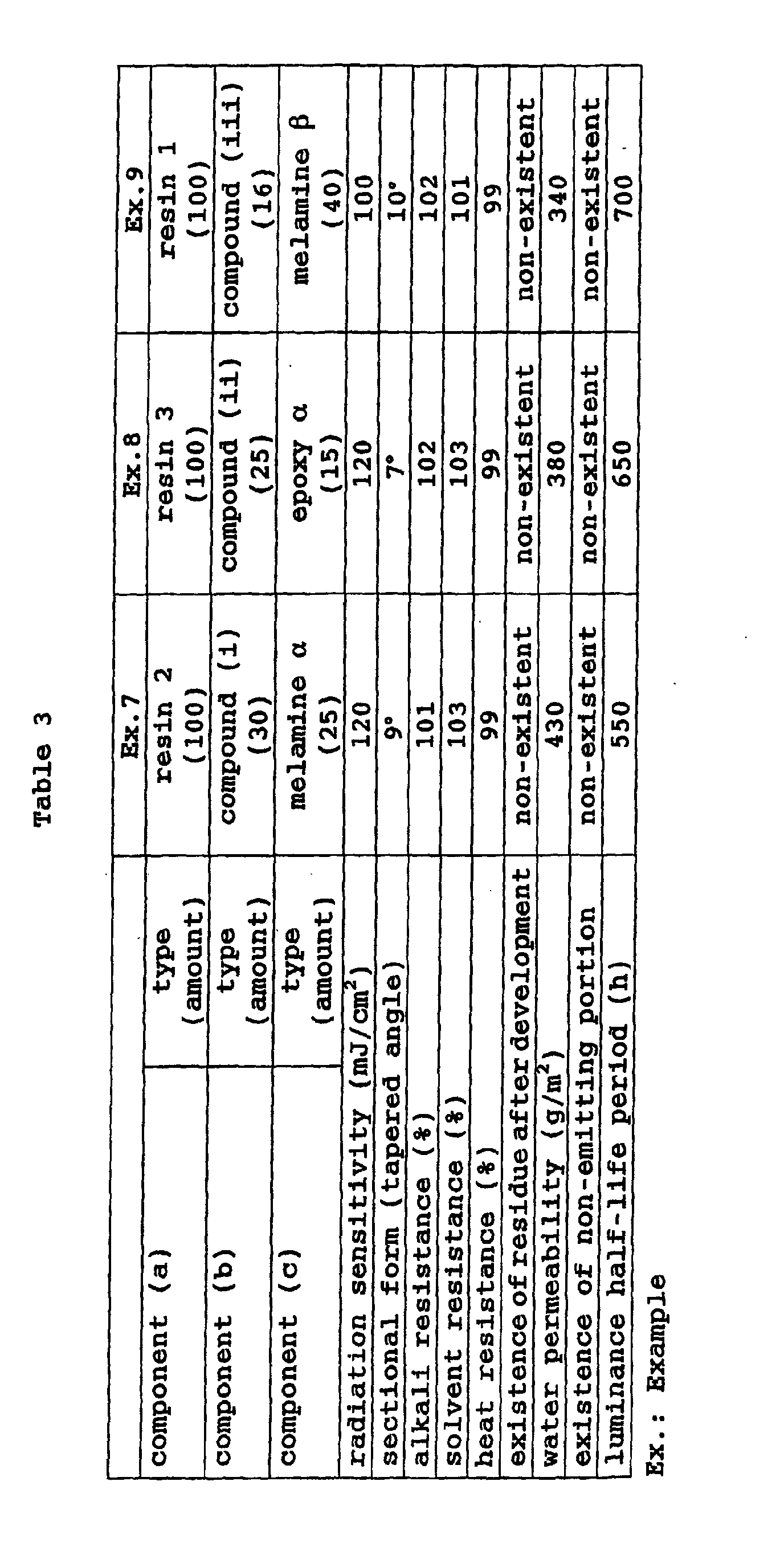
In Table 3, the unit of the amount of each component
is parts by weight, compounds (i), (ii) and (iii) are the
same as in Table 1, and melamine α, melamine β and epoxy α
are the following compounds.
100 parts by weight of the resin 1 obtained in Synthesis
Example 1 as the component (a), 45 parts by weight of a
condensate (1,1,3-tris(2,5-dimethyl-4-hydroxyphenyl)-3-phenylpropane-1,2-naphthoquinonediazide-5-sulfonate)
of
1,1,3-tris(2,5-dimethyl-4-hydroxyphenyl)-3-phenylpropane
(1.0 mol) and 1,2-naphthoquinonediazide-5-sulfonic acid
chloride (1.9 mols) as the component (b), 5 parts by weight
of nicotinamide as the component (c) and 30 parts by weight
of Cymel 300 (of Mitsui Cyanamid Co., Ltd., melamine compound)
as the component (d) were mixed together, the resulting mixture
was diluted with and dissolved in methyl 3-methoxypropionate
to a solids content of 30 wt%, and the obtained solution was
filtered with a membrane filter having an opening diameter
of 0.2 µm to prepare a composition solution.
The above composition solution was evaluated for
radiation sensitivity, sectional form, existence of the
residue after development, water permeability, alkali
resistance, solvent resistance, heat resistance, existence
of a non-emitting portion and luminance half-life period in
the same manner as in Example 7. The results are shown in
Table 4.
Composition solutions were prepared and evaluated in
the same manner as in Example 10 except that the types and
amounts of the components (a), (b), (c) and (d) were changed
as shown in Table 4. The results are shown in Table 4.

In Table 3, the unit of the amount of each component
is parts by weight, compounds (i), (ii) and (iii) are the
same as in Table 1, the compounds A, B and D are the same
as in Table 2, melamine α, melamine β and epoxy α are the
same as in Table 3, and melamine γ and epoxy β are the following
compounds.
100 parts by weight of the resin 4 obtained in Synthesis
Example 4 as the component (a), 30.0 parts by weight of a
condensate of
1,1,3-tris(2,5-dimethyl-4-hydroxyphenyl)-3-phenylpropane
(1.0 mol) and 1,2-naphthoquinonediazide-5-sulfonic acid
chloride (1.9 mols) as the component (b), 1.0 part by weight
of nicotinamide as the component (c) and 30.0 parts by weight
of Cymel 300 (of Mitsui Cyanamid Co., Ltd.) were mixed together,
the resulting mixture was diluted with and dissolved in methyl
3-methoxypropionate to a total solids content of 40 %, and
the obtained solution was filtered with a membrane filter
having an opening diameter of 0.1 µm to prepare a composition
solution.
The composition solution prepared above was applied to
a glass substrate to a film thickness of 1.0 µm with a spin
coater and pre-baked on a hot plate at 80° C for 1.5 minutes.
The coating film was then exposed to light (exposure: 200
mJ/cm2 of ghi mixed-rays) using the NSR1755i7A reduction
projection exposure tool (NA = 0.50, λ = 365 nm) of Nikon
Corporation and developed with an aqueous solution of
tetramethylammonium hydroxide at 25°C for 1 minute.
Thereafter, the developed coating film was washed with running
water and dried to form a pattern on the wafer. Then, the
pattern was exposed to 600 mJ/cm2 of ultraviolet radiation
which was ghi mixed-ray and heated in an oven at 200° C for
60 minutes to form a patterned thin film.
The patterned thin film formed above was evaluated as
follows.
Radiation sensitive resin compositions were prepared
in the same manner as in Example 13 except that the components
(a), (b), (c) and (d) were changed as shown in Table 5 to
form and evaluate patterned thin films. The results are shown
in Table 5.
Symbols representing the components (a), (b), (c) and
(d) in Table 5 denote the following components. The amounts
in Table 5 are all parts by weight in terms of solid matter.

333 parts by weight of a solution containing the resin
11 obtained in Synthesis Example 11 as the component (a)
(corresponding to 100 parts by weight (solid content) of the
resin 11) and 30.0 parts by weight of a condensate
(1,1,3-tris(2,5-dimethyl-4-hydroxyphenyl)-3-phenylpropane-1,2-naphthoquinonediazide-5-sulfonate)
of
1,1,3-tris(2,5-dimethyl-4-hydroxyphenyl)-3-phenylpropane
(1.0 mol) and 1,2-naphthoquinonediazide-5-sulfonic acid
chloride (1.9 mols) as the component (b) were mixed together,
the resulting mixture was diluted with and dissolved in
propylene glycol methyl ether acetate to a total solids content
of 30 %, and the resulting solution was filtered with a membrane
filter having an opening diameter of 0.2 µm to prepare a
composition solution.
The composition solution prepared above was applied to
a glass substrate to a thickness of 1.2 µm with a spin coater
and prebaked on a hot plate at 80° C of 1.5 minutes to form
a coating film. This coating film was exposed to light with
the NSR1755i7A reduction projection exposure tool of Nikon
Corporation (NA = 0.50, λ = 365 nm) through a predetermined
pattern mask and developed with an aqueous solution of
tetramethylammonium hydroxide at 25° C for 1 minute. The
coating film was then washed with running water and dried
to form a pattern on the wafer. Thereafter, the coating film
was exposed to 300 mJ/cm2 of ultraviolet radiation which was
ghi mixed-rays from the Aligner PLA501F of Canon Inc. and
heated in an oven at 220° C for 60 minutes to form a 1.0 µm
thick patterned thin film.
When the above obtained patterned thin film was observed
through an optical microscope, there was no scum and a 5.0
µm square through hole was formed.
The light transmission of the above glass substrate
having the 1.0 µm thick patterned thin film formed thereon
was measured with the 150-20 double beam spectrophotometer
(of Hitachi, Ltd.). The minimum transmission at a wavelength
range of 400 to 700 nm is shown in Table 6. When this value
is 80 % or more, it can be said that transparency is
satisfactory.
The glass substrate having the patterned thin film formed
thereon was immersed for 20 minutes in a 1 % NaOH aqueous
solution whose temperature was controlled to 25° C. The ratio
of film thicknesses before and after immersion (t1/T1) x 100
(%) in which the film thickness before immersion was
represented by T1 and the film thickness after immersion was
represented by t1 was calculated. This result is shown in
Table 6. When this value is 95 to 105 %, it can be said that
alkali resistance is satisfactory.
The glass substrate having the patterned thin film
formed thereon was immersed for 20 minutes in a mixed solution
of dimethyl sulfoxide/N-methylpyrrolidone (weight ratio of
70/30) whose temperature was controlled to 25° C. The ratio
of film thicknesses before and after immersion (t2/T2) x 100
(%) in which the film thickness before immersion was
represented by T2 and the film thickness after immersion was
represented by t2 was calculated. This result is shown in
Table 6. When this value is 95 to 105 %, it can be said that
solvent resistance is satisfactory.
The glass substrate having the patterned thin film formed
thereon was additionally baked at 220° C for 60 minutes. The
ratio of film thicknesses before and after additional baking
(t3/T3) x 100 (%) in which the film thickness before additional
baking was represented by T3 and the film thickness after
additional baking was represented by t3 was calculated. This
result is shown in Table 6. When this value is 95 to 105 %,
it can be said that heat resistance is satisfactory.
The above composition was applied to a silicon wafer
substrate having an aluminum pattern having a line width of
20 µm and a space width of 80 µm to a thickness of 1 µm.
Thereafter, the substrate was prebaked at 80° C for 1.5 minutes,
exposed to 300 mJ/cm2 of ultraviolet radiation which was ghi
mixed-rays from the Aligner PLA501F of Canon Inc., and heated
at 220° C for 60 minutes to form an insulating film. The surface
roughness of the formed insulating film was measured with
the α-step (of KLA Tencol Co., Ltd.). The maximum surface
unevenness is shown in Table 6. When this value is 0.2 µm
or less, it can be said that flattening performance is
satisfactory.
An organic EL panel for evaluation was produced and a
lighting promotion test was made on the panel at a screen
brightness of 100 cd/m2 {(Red: 100 + Green: 200 + Blue: 100)
cd/m2 + 3 x 0.7 ≒ 100 cd/m2} and a temperature of 105° C. The
time elapsed until the screen brightness was halved is shown
in Table 6. When this value is 400 hours or more, it can be
said that luminance half-life period is satisfactory.
A composition solution was prepared and evaluated in
the same manner as in Example 23 except that 333 parts by
weight of a solution containing the resin 12 prepared in
Synthesis Example 12 (corresponding to 100 parts by weight
(solid content) of the resin 12) as the component (a) and
25 parts by weight of a condensate
(4,4'-[1-[4-[1-[4-hydroxyphenyl]-1-methylethyl]phenyl]
ethylidene]bisphenol-1,2-naphthoquinonediazide-5-sulfonate)
of
4,4'-[1-[4-[1-[4-hydroxyphenyl]-1-methylethyl]phenyl]
ethylidene]bisphenol (1.0 mol) and
1,2-naphthoquinonediazide-5-sulfonic acid chloride (2.0
mols) as the component (b) were used. The results are shown
in Table 6.
A composition solution was prepared and evaluated in
the same manner as in Example 23 except that 333 parts by
weight of a solution containing the resin 13 prepared in
Synthesis Example 13 (corresponding to 100 parts by weight
(solid content) of the resin 13) as the component (a) and
20 parts by weight of a condensate
(2,3,4-hydroxybenzophenone-1,2-naphthoquinonediazide-5-sulfonate)
of 2,3,4-hydroxybenzophenone (1.0 mol) and
1,2-naphthoquinonediazide-5-sulfonic acid chloride (2.0
mols) as the component (b) were used. The results are shown
in Table 6.
A composition solution was prepared and evaluated in
the same manner as in Example 23 except that the amount of
the component (b) was changed to 40 parts by weight. The
results are shown in Table 6.

According to the present invention, there are provided
an insulating film for an organic EL element, which has
sufficiently low water permeability and a good sectional form
and whose reactivity with a basic material and an electrode
made from a metal having a low work function is suppressed,
and a radiation sensitive resin composition (first
composition) for forming the insulating film.
According to the present invention, there are also
provided an insulating film for an organic EL element, which
enables the formation of a through hole or U-shaped cavity
therein and has excellent flattening performance high
transparency, and high resistance to a resist stripper, and
a radiation sensitive resin composition (second composition)
for forming the insulating film.
The organic EL display element of the present invention
has no emission failure, sufficiently long luminance half-life
period and excellent reliability.
Claims (10)
- A radiation sensitive resin composition, comprising (1), (a) an alkali-soluble resin having no epoxy group and (b) a 1,2-quinonediazide compound, and (2) being for forming an insulating film for an organic EL display element.
- The composition of claim 1, wherein the alkali-soluble resin (a) is a novolak resin having no epoxy group.
- The composition of claim 1, wherein the alkali-soluble resin (a) is a copolymer having no epoxy group of (1a) at least one unsaturated monomer selected from the group consisting of an unsaturated carboxylic acid, unsaturated carboxylic anhydride and phenolic hydroxyl group-containing unsaturated monomer, and (2a) an olefinic unsaturated monomer other than the above unsaturated monomer (1a).
- The composition of claim 1 which further comprises (c) a basic nitrogen-containing compound.
- The composition of claim 1 which further comprises (d) at least one compound selected from the group consisting of a melamine compound and an epoxy compound.
- A radiation sensitive resin composition, comprising (1), (a') an alkali-soluble resin having an epoxy group and (b) a 1,2-quinonediazide compound, and (2) being for forming an insulating film for an organic EL display element.
- The composition of claim 1, wherein the alkali-soluble resin (a') having an epoxy group is a copolymer having an epoxy group of (1a') an unsaturated monomer having an epoxy group, (2a') at least one unsaturated monomer selected from the group consisting of an unsaturated carboxylic acid, unsaturated carboxylic anhydride and phenolic hydroxyl group-containing unsaturated monomer, and (3a') an olefinic unsaturated monomer other than the above unsaturated monomers (1a') and (2a').
- An insulating film for an organic EL display element, formed from the radiation sensitive resin composition of claim 1 or 6.
- Use of the radiation sensitive resin composition of claim 1 or 6 for the production of an insulating film for an organic EL display element.
- An organic EL display element having an insulating film formed from the radiation sensitive resin composition of claim 1 or 6.
Applications Claiming Priority (7)
| Application Number | Priority Date | Filing Date | Title |
|---|---|---|---|
| JP2000226468 | 2000-07-27 | ||
| JP2000226468A JP3909552B2 (en) | 2000-07-27 | 2000-07-27 | Radiation-sensitive resin composition and insulating film for organic EL device |
| JP2000370381A JP3915402B2 (en) | 2000-12-05 | 2000-12-05 | Radiation sensitive resin composition for forming insulating film of organic EL display element, insulating film formed therefrom, and organic EL display element |
| JP2000370381 | 2000-12-05 | ||
| JP2000379680A JP2002182380A (en) | 2000-12-14 | 2000-12-14 | Radiation-sensitive resin composition for forming insulating film of organic EL display element, insulating film formed therefrom, and organic EL display element |
| JP2000379680 | 2000-12-14 | ||
| PCT/JP2001/006425 WO2002010859A1 (en) | 2000-07-27 | 2001-07-26 | Radiation-sensitive composition, insulating film and organic el display element |
Publications (2)
| Publication Number | Publication Date |
|---|---|
| EP1312982A1 true EP1312982A1 (en) | 2003-05-21 |
| EP1312982A4 EP1312982A4 (en) | 2007-11-07 |
Family
ID=27344179
Family Applications (1)
| Application Number | Title | Priority Date | Filing Date |
|---|---|---|---|
| EP01984445A Withdrawn EP1312982A4 (en) | 2000-07-27 | 2001-07-26 | ACTINOSENSITIVE COMPOSITION, INSULATING FILM, AND ORGANIC EL DISPLAY |
Country Status (5)
| Country | Link |
|---|---|
| US (1) | US6797450B2 (en) |
| EP (1) | EP1312982A4 (en) |
| KR (1) | KR100745331B1 (en) |
| TW (1) | TWI297104B (en) |
| WO (1) | WO2002010859A1 (en) |
Cited By (2)
| Publication number | Priority date | Publication date | Assignee | Title |
|---|---|---|---|---|
| EP2016463A4 (en) * | 2006-04-13 | 2011-04-06 | Kolon Inc | Composition for positive type photoresist and positive type photoresist film manufactured thereby |
| US8609181B2 (en) | 2003-06-16 | 2013-12-17 | Semiconductor Energy Laboratory Co., Ltd. | Light emitting device and method for fabricating light emitting device |
Families Citing this family (17)
| Publication number | Priority date | Publication date | Assignee | Title |
|---|---|---|---|---|
| JP4524944B2 (en) * | 2001-03-28 | 2010-08-18 | Jsr株式会社 | Radiation sensitive resin composition, its use for forming interlayer insulating film and microlens, and interlayer insulating film and microlens |
| US6984476B2 (en) * | 2002-04-15 | 2006-01-10 | Sharp Kabushiki Kaisha | Radiation-sensitive resin composition, forming process for forming patterned insulation film, active matrix board and flat-panel display device equipped with the same, and process for producing flat-panel display device |
| DE60336216D1 (en) * | 2002-04-18 | 2011-04-14 | Nissan Chemical Ind Ltd | POSITIVE LIGHT-SENSITIVE RESIN COMPOSITION AND METHOD FOR STRUCTURAL EDUCATION |
| JP4232527B2 (en) * | 2003-05-09 | 2009-03-04 | Jsr株式会社 | Method for forming protrusion for vertical alignment type liquid crystal display element and spacer for vertical alignment type liquid crystal display element |
| KR100571721B1 (en) * | 2004-02-10 | 2006-04-17 | 삼성전자주식회사 | Thinner composition and method of removing photoresist using same |
| JP4993119B2 (en) | 2005-04-19 | 2012-08-08 | 日産化学工業株式会社 | Resist underlayer film forming composition for forming a photocrosslinking cured resist underlayer film |
| JP2008077057A (en) * | 2006-08-21 | 2008-04-03 | Jsr Corp | Photosensitive insulating resin composition, cured product thereof and electronic component including the same |
| KR101249992B1 (en) * | 2007-07-03 | 2013-04-02 | 주식회사 엘지화학 | Photosensitive resin composition for organic insulating film and organic insulating film made therefrom |
| JP5240380B1 (en) * | 2011-07-05 | 2013-07-17 | Jsr株式会社 | Resin composition, polymer, cured film and electronic component |
| CN103988127B (en) | 2011-12-09 | 2019-04-19 | 旭化成株式会社 | Photosensitive resin composition, method for producing cured relief pattern, semiconductor device, and display device |
| KR101413078B1 (en) * | 2011-12-30 | 2014-07-02 | 제일모직 주식회사 | Positive type photosensitive resin composition |
| KR101249997B1 (en) * | 2012-02-29 | 2013-04-03 | 주식회사 엘지화학 | Photosensitive resin composition for organic insulating film and organic insulating film made therefrom |
| JP6155823B2 (en) * | 2012-07-12 | 2017-07-05 | Jsr株式会社 | Organic EL device, radiation-sensitive resin composition, and cured film |
| JP6247014B2 (en) * | 2013-04-04 | 2017-12-13 | 東京応化工業株式会社 | Photosensitive resin composition |
| JP6621233B2 (en) * | 2014-07-25 | 2019-12-18 | 東京応化工業株式会社 | Photosensitive resin composition for forming insulating film in organic EL display element |
| CN109426070A (en) * | 2017-08-25 | 2019-03-05 | 京东方科技集团股份有限公司 | The preparation method of photoetching compositions, metal pattern and array substrate |
| CN111138616B (en) * | 2018-11-02 | 2022-03-08 | 万华化学(北京)有限公司 | A kind of amine chain extender and preparation method thereof, and polyurethane foam |
Family Cites Families (16)
| Publication number | Priority date | Publication date | Assignee | Title |
|---|---|---|---|---|
| JPS59184337A (en) | 1983-04-04 | 1984-10-19 | Hitachi Ltd | Photosensitive heat resistant material |
| US5217840A (en) * | 1985-08-12 | 1993-06-08 | Hoechst Celanese Corporation | Image reversal negative working o-quinone diazide and cross-linking compound containing photoresist process with thermal curing treatment and element produced therefrom |
| JP2584316B2 (en) * | 1988-06-30 | 1997-02-26 | 富士写真フイルム株式会社 | Positive photoresist composition |
| JP3114166B2 (en) * | 1992-10-22 | 2000-12-04 | ジェイエスアール株式会社 | Radiation-sensitive resin composition for microlenses |
| US5691101A (en) * | 1994-03-15 | 1997-11-25 | Kabushiki Kaisha Toshiba | Photosensitive composition |
| JP3024695B2 (en) * | 1994-06-08 | 2000-03-21 | 東京応化工業株式会社 | Positive photoresist composition |
| JPH10270173A (en) * | 1997-03-27 | 1998-10-09 | Junji Kido | Organic electroluminescent device and method of manufacturing the same |
| JPH1152560A (en) | 1997-08-06 | 1999-02-26 | Jsr Corp | Radiation-sensitive resin composition |
| US6168908B1 (en) | 1997-10-09 | 2001-01-02 | Jsr Corporation | Process for forming a cured film of a thermoplastic resin |
| TW432896B (en) | 1997-10-15 | 2001-05-01 | Siemens Ag | Preparation of organic electroluminescencizing elements |
| JPH11237737A (en) * | 1997-12-19 | 1999-08-31 | Kansai Shingijutsu Kenkyusho:Kk | Photosensitive resin composition and method for producing the same |
| US5985507A (en) * | 1998-02-18 | 1999-11-16 | Olin Microelectronic Chemicals, Inc. | Selected high thermal novolaks and positive-working radiation-sensitive compositions |
| JP3050215B2 (en) | 1998-11-27 | 2000-06-12 | ジェイエスアール株式会社 | Negative radiation-sensitive resin composition |
| KR100668244B1 (en) * | 1999-02-15 | 2007-01-17 | 에이제토 엘렉토로닉 마티리알즈 가부시키가이샤 | Photosensitive resin composition |
| JP2000347397A (en) * | 1999-06-04 | 2000-12-15 | Jsr Corp | Radiation-sensitive resin composition and its use for interlayer insulating film |
| WO2002001922A1 (en) * | 2000-06-28 | 2002-01-03 | Toray Industries, Inc. | Display |
-
2001
- 2001-07-26 TW TW090118347A patent/TWI297104B/zh not_active IP Right Cessation
- 2001-07-26 US US10/089,154 patent/US6797450B2/en not_active Expired - Lifetime
- 2001-07-26 WO PCT/JP2001/006425 patent/WO2002010859A1/en not_active Ceased
- 2001-07-26 EP EP01984445A patent/EP1312982A4/en not_active Withdrawn
- 2001-07-26 KR KR1020027003009A patent/KR100745331B1/en not_active Expired - Lifetime
Cited By (2)
| Publication number | Priority date | Publication date | Assignee | Title |
|---|---|---|---|---|
| US8609181B2 (en) | 2003-06-16 | 2013-12-17 | Semiconductor Energy Laboratory Co., Ltd. | Light emitting device and method for fabricating light emitting device |
| EP2016463A4 (en) * | 2006-04-13 | 2011-04-06 | Kolon Inc | Composition for positive type photoresist and positive type photoresist film manufactured thereby |
Also Published As
| Publication number | Publication date |
|---|---|
| US20030054284A1 (en) | 2003-03-20 |
| KR20020072529A (en) | 2002-09-16 |
| TWI297104B (en) | 2008-05-21 |
| EP1312982A4 (en) | 2007-11-07 |
| WO2002010859A1 (en) | 2002-02-07 |
| US6797450B2 (en) | 2004-09-28 |
| KR100745331B1 (en) | 2007-08-02 |
Similar Documents
| Publication | Publication Date | Title |
|---|---|---|
| US6797450B2 (en) | Radiation-sensitive composition, insulating film and organic EL display element | |
| US9366959B2 (en) | Negative photosensitive resin composition and application thereof | |
| KR20020027271A (en) | Radiation Sensitive Resin Composition, and Cured Product and Device Thereof | |
| EP0855620A1 (en) | Positive photoresist composition | |
| US6994944B2 (en) | Radiation sensitive resin composition, cathode separator and EL display device | |
| JP3915402B2 (en) | Radiation sensitive resin composition for forming insulating film of organic EL display element, insulating film formed therefrom, and organic EL display element | |
| JP3909552B2 (en) | Radiation-sensitive resin composition and insulating film for organic EL device | |
| KR20080104987A (en) | Radiation-sensitive resin composition, insulating film and organic EL display element | |
| US6168908B1 (en) | Process for forming a cured film of a thermoplastic resin | |
| KR20000017381A (en) | Radiation Sensitive Resin Compositions for Spacer, Process for Preparing Spacer, Spacer and Liquid Crystal Display Device | |
| JPH04352101A (en) | Radiation sensitive resin composition for microlens | |
| KR100880301B1 (en) | A composition for forming a light diffusing reflection film, a method of manufacturing the same, a light diffusion reflecting film, and a liquid crystal display device | |
| KR20050014742A (en) | Radiation Sensitive Resin Composition, Inter Layer Insulating Film and Microlens, and process for Preparing the Same | |
| KR101057850B1 (en) | Radiation-sensitive resin composition, interlayer insulating film, microlens and manufacturing method thereof | |
| JP2002182380A (en) | Radiation-sensitive resin composition for forming insulating film of organic EL display element, insulating film formed therefrom, and organic EL display element | |
| JP3772733B2 (en) | Radiation sensitive resin composition, protrusion of vertical alignment type liquid crystal display element formed therefrom, and liquid crystal display element comprising the same | |
| JP2003303692A (en) | Radiation-sensitive resin composition used for forming an insulating film of an organic EL display element by an ink jet method, an insulating film of an organic EL display element formed therefrom, and an organic EL display element | |
| JP2000194143A (en) | Method for forming pattern of luminous body deposited film | |
| KR100922843B1 (en) | Photosensitive resin composition for insulating film formation | |
| JP3757408B2 (en) | Cured film, film for electronic parts and manufacturing method thereof | |
| JP2000338662A (en) | Radiation-sensitive resin composition, its use for spacer, and spacer | |
| JPH11282162A (en) | Manufacturing method of cured film | |
| JP2002265876A (en) | Composition for forming light diffusion reflection film, light diffusion reflection film, and liquid crystal display device | |
| JP2004258319A (en) | Radiation-sensitive resin composition and liquid crystal display device using the same | |
| JP2005216714A (en) | Insulating film for organic EL, organic EL element, and method for manufacturing organic EL element |
Legal Events
| Date | Code | Title | Description |
|---|---|---|---|
| PUAI | Public reference made under article 153(3) epc to a published international application that has entered the european phase |
Free format text: ORIGINAL CODE: 0009012 |
|
| 17P | Request for examination filed |
Effective date: 20020522 |
|
| AK | Designated contracting states |
Designated state(s): AT BE CH CY DE DK ES FI FR GB GR IE IT LI LU MC NL PT SE TR |
|
| RAP1 | Party data changed (applicant data changed or rights of an application transferred) |
Owner name: JSR CORPORATION |
|
| RBV | Designated contracting states (corrected) |
Designated state(s): AT BE DE GB |
|
| A4 | Supplementary search report drawn up and despatched |
Effective date: 20071010 |
|
| 17Q | First examination report despatched |
Effective date: 20110125 |
|
| STAA | Information on the status of an ep patent application or granted ep patent |
Free format text: STATUS: THE APPLICATION IS DEEMED TO BE WITHDRAWN |
|
| 18D | Application deemed to be withdrawn |
Effective date: 20110607 |