EP1310550A1 - Entschäumerzusammensetzung und deren Verwendung - Google Patents
Entschäumerzusammensetzung und deren Verwendung Download PDFInfo
- Publication number
- EP1310550A1 EP1310550A1 EP02024317A EP02024317A EP1310550A1 EP 1310550 A1 EP1310550 A1 EP 1310550A1 EP 02024317 A EP02024317 A EP 02024317A EP 02024317 A EP02024317 A EP 02024317A EP 1310550 A1 EP1310550 A1 EP 1310550A1
- Authority
- EP
- European Patent Office
- Prior art keywords
- defoaming
- acid
- alcohol
- defoamer
- paraffin
- Prior art date
- Legal status (The legal status is an assumption and is not a legal conclusion. Google has not performed a legal analysis and makes no representation as to the accuracy of the status listed.)
- Granted
Links
Classifications
-
- C—CHEMISTRY; METALLURGY
- C11—ANIMAL OR VEGETABLE OILS, FATS, FATTY SUBSTANCES OR WAXES; FATTY ACIDS THEREFROM; DETERGENTS; CANDLES
- C11D—DETERGENT COMPOSITIONS; USE OF SINGLE SUBSTANCES AS DETERGENTS; SOAP OR SOAP-MAKING; RESIN SOAPS; RECOVERY OF GLYCEROL
- C11D17/00—Detergent materials or soaps characterised by their shape or physical properties
- C11D17/06—Powder; Flakes; Free-flowing mixtures; Sheets
-
- B—PERFORMING OPERATIONS; TRANSPORTING
- B01—PHYSICAL OR CHEMICAL PROCESSES OR APPARATUS IN GENERAL
- B01D—SEPARATION
- B01D19/00—Degasification of liquids
- B01D19/02—Foam dispersion or prevention
- B01D19/04—Foam dispersion or prevention by addition of chemical substances
- B01D19/0404—Foam dispersion or prevention by addition of chemical substances characterised by the nature of the chemical substance
-
- C—CHEMISTRY; METALLURGY
- C11—ANIMAL OR VEGETABLE OILS, FATS, FATTY SUBSTANCES OR WAXES; FATTY ACIDS THEREFROM; DETERGENTS; CANDLES
- C11D—DETERGENT COMPOSITIONS; USE OF SINGLE SUBSTANCES AS DETERGENTS; SOAP OR SOAP-MAKING; RESIN SOAPS; RECOVERY OF GLYCEROL
- C11D1/00—Detergent compositions based essentially on surface-active compounds; Use of these compounds as a detergent
- C11D1/66—Non-ionic compounds
- C11D1/82—Compounds containing silicon
-
- C—CHEMISTRY; METALLURGY
- C11—ANIMAL OR VEGETABLE OILS, FATS, FATTY SUBSTANCES OR WAXES; FATTY ACIDS THEREFROM; DETERGENTS; CANDLES
- C11D—DETERGENT COMPOSITIONS; USE OF SINGLE SUBSTANCES AS DETERGENTS; SOAP OR SOAP-MAKING; RESIN SOAPS; RECOVERY OF GLYCEROL
- C11D3/00—Other compounding ingredients of detergent compositions covered in group C11D1/00
- C11D3/0005—Other compounding ingredients characterised by their effect
- C11D3/0026—Low foaming or foam regulating compositions
-
- C—CHEMISTRY; METALLURGY
- C11—ANIMAL OR VEGETABLE OILS, FATS, FATTY SUBSTANCES OR WAXES; FATTY ACIDS THEREFROM; DETERGENTS; CANDLES
- C11D—DETERGENT COMPOSITIONS; USE OF SINGLE SUBSTANCES AS DETERGENTS; SOAP OR SOAP-MAKING; RESIN SOAPS; RECOVERY OF GLYCEROL
- C11D3/00—Other compounding ingredients of detergent compositions covered in group C11D1/00
- C11D3/16—Organic compounds
- C11D3/18—Hydrocarbons
-
- C—CHEMISTRY; METALLURGY
- C11—ANIMAL OR VEGETABLE OILS, FATS, FATTY SUBSTANCES OR WAXES; FATTY ACIDS THEREFROM; DETERGENTS; CANDLES
- C11D—DETERGENT COMPOSITIONS; USE OF SINGLE SUBSTANCES AS DETERGENTS; SOAP OR SOAP-MAKING; RESIN SOAPS; RECOVERY OF GLYCEROL
- C11D3/00—Other compounding ingredients of detergent compositions covered in group C11D1/00
- C11D3/16—Organic compounds
- C11D3/37—Polymers
- C11D3/3703—Macromolecular compounds obtained otherwise than by reactions only involving carbon-to-carbon unsaturated bonds
- C11D3/373—Macromolecular compounds obtained otherwise than by reactions only involving carbon-to-carbon unsaturated bonds containing silicones
Definitions
- the present invention relates to a defoamer composition containing solid particles at room temperature, at least containing at least one defoaming compound based on paraffin and at least one defoaming compound based on silicone.
- Detergents and cleaning agents usually contain tensides, which remove dirt and Effect the dispersion of the dirt in the washing or cleaning liquor. Such surfactants tend to however, when the fleet agitates, foam often forms. Excessive foaming in wash or However, cleaning machines can lead to the failure of the machines, to the emergence of washing or Cleaning fleet or damage the washing or cleaning machines .. There is hence a practical need to control the development of foam during the washing process and in particular to minimize.
- defoamers are therefore often required to determine the foam behavior to regulate the above-mentioned surfactants
- defoamers Antifoam agents used, on the one hand the development of foam and on the other hand should reduce the resulting foam.
- the terms "Defoamer” and “antifoam” are used synonymously, unless expressly stated otherwise is specified.
- Combinations are often used as anti-foaming agents in the context of the applications described above made of paraffins and silicones. This takes into account the problem that the two classes of compounds mentioned have their optimal effectiveness at different temperatures unfold. While the effectiveness of paraffins at lower temperatures, for example at about 40 ° C, is particularly pronounced, the silicones show an optimal effect from about 80 ° C, for example at about 95 ° C. The effectiveness of the named classes of compounds with regard the defoaming effect is also different.
- EP 0 708 817 B1 describes a granular foam control agent containing a defoamer active ingredient, a solid carrier material based on alkali metal sulfate and a cellulose ether mixture and a process for producing such foam control agents by spray drying.
- the defoamer granules claimed in the publication contain an organopolysiloxane, a paraffin or a mixture of organopolysiloxane and paraffin as defoaming agent, the defoamer components in the mixture mentioned being present together on one grain.
- WO 00/27959 describes a detergent tablet with defoamer granules .
- the publication also describes mixtures of paraffins and silicones as being effective for defoaming, the mixtures are only present together on one grain.
- WO 00/11127 relates to a process for producing defoamer granules in a fluidized bed process.
- the process described is suitable for the production of silicone-containing defoamer granules for solid detergents, granulation and drying being carried out simultaneously.
- the silicones are sprayed in the form of aqueous emulsions onto an admixed precursor made from carrier materials and, if appropriate, further defoamers.
- Paraffins for example, are proposed as further defoamers.
- the defoamers obtainable by the process described always have a mixture of silicones and paraffins on a single grain.
- WO 95/04124 relates to a granular foam regulator suitable for use in detergents and cleaning agents containing surfactants.
- a homogeneous premix consisting of carrier material and defoaming agent can be pressed in a rope shape over a hole mold and cut off after exiting the hole shape by means of a cutting device. Silicones and paraffins are described as defoaming agents.
- the defoamer active ingredients mentioned are always present together in one granulate.
- the present invention was therefore based on the object, defoamer compositions to provide that meet the above needs.
- the present invention therefore relates to a particle containing solid at room temperature Defoamer composition, containing at least one defoaming agent acting compound based on paraffin and at least one defoaming compound based on silicone, with at least one defoaming compound based on paraffin and at least one defoaming silicone-based compound on spatially separated particles available.
- room temperature in the context of the present text is a temperature of about 15 to about 25 ° C, especially a temperature of about 20 to about 23 ° C understood.
- solid particle is understood to mean a particle that as such represents a cantilevered body with a three-dimensional spatial shape, the not or not significantly in its form at room temperature without the influence of external forces changed.
- the term "spatially separated” relates to the arrangement of at least two at least one defoaming compound based on paraffin and at least one defoaming compound based on particles containing silicone to each other.
- Two “spatially separated” particles are used in the context of the present Text understood two particles that touch at most at the particle boundaries. The particles can be in a loose connection to each other.
- the loose connection of the "spatially separated "particles is at most of a strength which is less than the strength of a single particle. That is, to destroy a "loose connection" between two "Spatially separated” particles according to the present invention applied less force must be considered for the destruction (e.g. crushing or splitting) of an individual Particle.
- the term “spatially separated” therefore defines two in the sense of the present invention with regard to their active ingredient composition different particle systems in a mixture present together.
- paraffin waxes As a defoaming compound based on paraffin come within the scope of the present Invention basically applies to all paraffin-based compounds that have a defoaming effect Apply to aqueous solutions containing surfactants. However, are particularly suitable in the context of present invention paraffin waxes.
- Paraffin waxes which are suitable according to the invention are generally complex mixtures without a sharp melting point. To characterize them, their melting range is usually determined by differential thermal analysis (DTA), as described in "The Analyst” 87 (1962), 420 , and / or their solidification point. This is the temperature at which the wax changes from the liquid to the solid state by slow cooling. According to the invention, paraffins which are completely liquid at room temperature, that is to say those with a solidification point below 25 ° C., and paraffins which are solid at room temperature can be used.
- DTA differential thermal analysis
- the paraffin wax is preferably solid at room temperature and is in a completely liquid form at 100 ° C.
- the paraffin wax mixtures known from European patent application EP 0 309 931 can be used, for example from 26% by weight to 49% by weight of microcrystalline paraffin wax with a solidification point of 62 ° C to 90 ° C, 20% by weight to 49% .-% hard paraffin with a solidification point from 42 ° C to 56 ° C and 2 wt .-% to 25 wt .-% soft paraffin with a solidification point from 35 ° C to 40 ° C.
- Paraffins or paraffin mixtures are preferred in the context of the present invention used that solidify in the range of 30 ° C to 90 ° C. It should be noted that also Paraffin wax mixtures which appear solid at room temperature have different proportions of liquid May contain paraffin.
- the paraffin waxes which can be used according to the invention are the Liquid content at 40 ° C as high as possible without already being 100% at this temperature.
- Preferred paraffin wax mixtures have a liquid content of at least 50% by weight at 40 ° C. in particular from 55% by weight to 80% by weight, and at 60 ° C. a liquid fraction of at least 90% by weight.
- the temperature at which a liquid content of 100% by weight of the paraffin wax is reached is in particularly preferred paraffin wax mixtures still below 85 ° C, in particular at 75 ° C to 82 ° C. It is also important to ensure that the paraffins do not contain any volatile components.
- Paraffin waxes contain less than 1% by weight, in particular less than 0.5% by weight Parts vaporizable at 110 ° C and normal pressure.
- Paraffin waxes which can be used according to the invention can, for example, under the trade names Lunaflex® from Fuller and Deawax® can be obtained from DEA Mineralöl AG.
- suitable compounds having a defoaming action are present Silicon base basically all silicone compounds, one for use in washing or Detergents have sufficient foam-suppressing effects.
- organopolysiloxanes which have a content of finely divided silica, which in turn can also be silanated.
- organopolysiloxanes are described, for example, in European patent application EP 0 496 510 A1 , to which express reference is made and the disclosure of which is considered to be part of the disclosure of the present text with regard to the organopolysiloxane mentioned.
- Polydiorganosiloxanes as are known from the prior art are particularly preferred.
- Suitable polydiorganosiloxanes have an almost linear chain and are identified by the following formula (I), where R can independently represent an alkyl or an aryl radical and n can stand for numbers in the range from 40 to 1500.
- R can independently represent an alkyl or an aryl radical and n can stand for numbers in the range from 40 to 1500.
- suitable substituents R are methyl, ethyl, propyl, isobutyl, tert. Butyl and phenyl.
- suitable polydiorganosiloxanes contain finely divided silica, which can also be silanated can.
- Silica-containing dimethylpolysiloxanes are particularly suitable for the purposes of the present invention.
- the polydiorganosiloxanes advantageously have a Brookfield viscosity at 25 ° C. in the range from 5000 mPas to 30,000 mPas, in particular from 15,000 to 25,000 mPas.
- defoamer compositions according to the invention are solid at room temperature Particles before. It is therefore advantageous in the sense of the invention if the defoaming agents Paraffin-based or silicone-based compounds on an appropriate solid carrier material are upset.
- inorganic and / or organic carrier materials are suitable as carrier materials in the sense of the invention.
- suitable inorganic carrier materials alkali carbonates, aluminosilicates, water-soluble sheet silicates, alkali silicates, alkali sulfates, for example sodium sulfate and alkali phosphates.
- the alkali silicates are preferably a compound with a molar ratio of alkali oxide to SiO 2 of 1: 1.5 to 1: 3.5. The use of such silicates results in particularly good grain properties, in particular high abrasion stability and nevertheless high dissolution rate in water.
- the aluminosilicates referred to as carrier material include, in particular, the zeolites, for example zeolite NaA and NaX.
- the compounds referred to as water-soluble layered silicates include, for example, amorphous or crystalline water glass.
- organic carrier materials are film-forming polymers, for example Polyvinyl alcohols, polyvinyl pyrrolidones, poly (meth) acrylates, polycarboxylates, cellulose derivatives and Strength in question.
- Useful cellulose ethers are, in particular, alkali carboxymethyl cellulose, methyl cellulose, Ethyl cellulose, hydroxyethyl cellulose and so-called mixed cellulose ethers, which for Example methylhydroxyethyl cellulose and methyl hydroxypropyl cellulose, and their mixtures.
- the carboxymethyl cellulose usually having a degree of substitution of 0.5 up to 0.8 carboxymethyl groups per anhydroglucose unit and the methyl cellulose a degree of substitution has from 1.2 to 2 methyl groups per anhydroglucose unit.
- the mixtures contain preferably alkali carboxymethyl cellulose and nonionic cellulose ether in weight ratios from 80:20 to 40:60, in particular from 75:25 to 50:50.
- Such cellulose ether mixtures can be used in solid form or as aqueous solutions, which are pre-swollen in the usual way could be.
- the carrier is, for example, native Starch made up of amylose and amylopectin. Strength is called native strength, as it is available as an extract from natural sources, for example from rice, potatoes, corn and wheat. Native starch is a commercially available product and is therefore easily accessible.
- the defoamer content of the defoamer compositions according to the invention Paraffin and silicone based compounds are from about 1 to about 50% by weight, for example about 3 to about 40, about 4 to about 30 or about 5 to about 20% by weight or values in between, for example about 8 to about 15 or about 10 to about 13% by weight.
- Paraffin and silicone based compounds are from about 1 to about 50% by weight, for example about 3 to about 40, about 4 to about 30 or about 5 to about 20% by weight or values in between, for example about 8 to about 15 or about 10 to about 13% by weight.
- the content of the defoamer compositions according to the invention about 5 to. of defoaming compounds based on paraffin and silicone about 20% by weight, especially about 8 to about 15% by weight.
- the 100% by weight missing portion can, for example, exclusively from one of the above Carrier materials or from a mixture of two or more of the above-mentioned carrier materials consist.
- an inventive Defoamer composition yet another additive or a mixture contains two or more other additives.
- waxy defoamers are suitable as additives.
- Wax-like are understood to mean those compounds which have a melting point at atmospheric pressure above 25 ° C (room temperature), preferably above 50 ° C and in particular above 70 ° C exhibit.
- the wax-like defoamer substances optionally contained according to the invention are practically insoluble in water, i.e. at 20 ° C they are soluble in 100 g water below 0.1% by weight.
- Suitable waxy compounds are, for example, bisamides, Fatty alcohols, fatty acids, carboxylic acid esters of mono- and polyhydric alcohols and paraffin waxes or mixtures thereof.
- Bisamides that are derived from saturated fatty acids are suitable with 12 to 22, preferably 14 to 18 C atoms and alkylene diamines with 2 to 7 C atoms derived.
- Suitable fatty acids are lauric, myristic, stearic, arachic and behenic acid as well their mixtures, such as those from natural fats or hardened oils, such as tallow or hydrogenated palm oil are available.
- Suitable diamines are, for example, ethylenediamine, 1,3-propylenediamine, Tetramethylene diamine, pentamethylene diamine, hexamethylene diamine, p-phenylene diamine and toluenediamine.
- Preferred diamines are ethylenediamine and hexamethylenediamine.
- Especially preferred bisamides are bis-myristoyl-ethylenediamine, bis-palmitoyl-ethylenediamine, bis-stearoylethylenediamine and their mixtures and the corresponding derivatives of hexamethylenediamine.
- Suitable carboxylic acid esters are derived from carboxylic acids with 12 to 28 carbon atoms. In particular, these are esters of behenic acid, stearic acid, oleic acid, palmitic acid, myristic acid and / or lauric acid.
- the alcohol part of the carboxylic acid ester contains a mono- or polyhydric alcohol with 1 to 28 Carbon atoms in the hydrocarbon chain.
- suitable alcohols are behenyl alcohol, Arachidyl alcohol, coconut alcohol, 12-hydroxystearyl alcohol, oleyl alcohol and lauryl alcohol as well as ethylene glycol, glycerin, methanol, ethanol, isopropanol, vinyl alcohol, sucrose, Erythritol, pentaerythritol, sorbitan and / or sorbitol.
- esters are those of methanol, ethylene glycol, Glycerol and sorbitan, the acid part of the ester in particular from behenic acid, Stearic acid, oleic acid, palmitic acid or myristic acid is selected.
- Suitable esters of polyhydric alcohols are, for example, xylitol monopalmitate, pentarythritol monostearate, Glycerol monostearate, ethylene glycol monostearate and sorbitan monostearate, Sorbitan palmitate, sorbitan monolaurate, sorbitan dilaurate, sorbitan distearate, sorbitan dibehenate, sorbitan dioleate and mixed tallow alkyl sorbitan mono- and diesters.
- Useful glycerol esters are Mono-, di- or triesters of glycerol and the carboxylic acids mentioned, the monoesters or diesters are preferred.
- Glycerol monostearate, glycerol monooleate, glycerol monopalmitate, glycerol monobehenate and glycerol distearate are examples of this.
- suitable natural esters are beeswax, which mainly consists of the esters CH 3 (CH 2 ) 24 COO (CH 2 ) 27 CH 3 and CH 3 (CH 2 ) 26 COO (CH 2 ) 25 CH 3 , and carnauba wax, which is a mixture of carnauba acid alkyl esters, often in combination with small amounts of free carnauba acid, other long-chain acids, high molecular weight alcohols and hydrocarbons.
- Suitable carboxylic acids as a further defoamer compound are, in particular, behenic acid, Stearic acid, oleic acid, palmitic acid, myristic acid and lauric acid as well as their mixtures as they from natural fats or optionally hardened oils, such as tallow or hydrogenated palm oil are. Saturated fatty acids with 12 to 22, in particular 14 to 18, carbon atoms are preferred.
- Suitable fatty alcohols as a further defoamer compound are the hydrogenated products of the described Fatty acids.
- a defoamer composition according to the invention can also contain, as additives, fatty ketones of the formula (I), R 3 -CO-R 4 in which R 3 and R 4 independently of one another represent linear or branched hydrocarbon radicals having 11 to 25 carbon atoms and 0 or 1 double bond.
- ketones are known substances that can be obtained by the relevant methods of preparative organic chemistry. For their preparation, one starts from, for example, carboxylic acid magnesium salts which are pyrolyzed at temperatures above 300 ° C. with elimination of CO 2 and water, for example according to German published patent application DE 25 53 900 A.
- Suitable fat ketones are those which are obtained by pyrolysis of the magnesium salts Lauric acid, myristic acid, palmitic acid, palmitoleic acid, stearic acid, oleic acid, elaidic acid, petroselinic acid, arachic acid, gadoleic acid, behenic acid or erucic acid.
- fatty ketones of the formula (I) in which R 3 and R 4 represent alkyl radicals having 15 to 21 carbon atoms are suitable. Particularly suitable are palmitone (hentriacontanone-16; R 3 and R 4 stands for an alkyl radical with 15 carbon atoms), tritriacontanone-17 (R 3 and R 4 stands for an alkyl radical with 16 carbon atoms), stearone (pentatriacontanone-18; R 3 and R 4 represents an alkyl radical with 17 carbon atoms) heptatriacontanone-19 (R 3 and R 4 stands for an alkyl radical with 18 carbon atoms), arachinone (nonatriacontanone-20; R 3 and R 4 stands for an alkyl radical with 19 carbon atoms), hentetracontanone-21 (R 3 and R 4 stands for an alkyl radical with 20 carbon atoms) and / or Behenon (triatetracontanone-22; R 3 and R 4 stands for an alkyl radical
- the additives can be used, for example, in the defoamer compositions according to the invention are present in such a way that they each contain a defoaming compound based on paraffin or contain a defoaming compound based on silicone-containing particles are.
- the additives in the defoamer mixture also as discrete, spatially separated particles, if necessary Carriers raised, are present.
- the defoamer compounds according to the invention contain at least two different types of particles, at least one type of particles containing a defoaming compound based on paraffin and at least one further type of particles containing at least one defoaming compound based on silicone.
- At least two spatially separated particles are constructed in such a way that at least one of the particles contains a silicone-based defoaming compound and no paraffin-based defoaming compound or a paraffin-based defoaming compound and no silicone-based defoaming compound ,
- one of the particles or one type of particle contains a defoaming compound based on silicone and one defoaming compound based on paraffin while at least one other particle or another type of particle does not contain one of the two defoaming compounds mentioned, while it contains the other.
- a defoamer composition according to the invention can contain one type of particle with paraffin and silicone defoamers and another type of particle only one paraffin defoamer. This is not opposed to the fact that the particles contain one of the additives mentioned above or a mixture of two or more thereof in addition to the defoamers specified in each case.
- the particles instead of paraffin wax, mixtures of paraffin wax with known foam-regulating silicone oil can therefore also be used.
- the silicone oil can contain, in a known manner, finely divided fillers, for example hydrophilic or hydrophobic silicon dioxide, so-called highly disperse silicic acid, pyrogenic or precipitated, in particular hydrophobicized silicon dioxide with a surface area of at least 50 m 2 / g being particularly preferred, as is the case for example under the names Aerosil® or Sipernat® is commercially available.
- Silicone oil for example polydimethylsiloxane, is preferably present in the mixtures of paraffin wax and silicone oil in amounts such that the ratio of paraffin to silicone oil is in the range from 1:10 to about 10: 1, for example about 1: 3 to about 3: 1.
- ratios in one are suitable Range from about 1:10 to about 10: 1, for example about 1: 5 to about 5: 1 or about 1: 3 to about 3: 1.
- ratios in one are suitable Range from about 1:10 to about 10: 1, for example about 1: 5 to about 5: 1 or about 1: 3 to about 3: 1.
- Which relationship to an optimal defoaming effect and one that is as constant as possible Defoaming effect with regard to low and high washing and cleaning temperatures leads, for example, from the surfactants used in detergents or cleaning agents dependent.
- the effect according to the invention is within the above mentioned conditions occurs and the optimization of specific surfactants and surfactant mixtures in washing or cleaning agents can be done as part of fewer routine tests.
- the in the frame Examples inserted in this text provide an indication of various types of surfactants and mixtures typically used in detergents.
- paraffin defoamers For example, the effectiveness of paraffin defoamers at high levels of nonionic surfactants after, so that in this case a higher dosage of paraffins is required. Furthermore, for example the effectiveness of the paraffin defoamer together with anionic surfactants from the ABS class higher than that of anionic surfactants from the FAS class, so that this too Case (FAS) a higher dosage of paraffin defoamer is required.
- FAS too Case
- the defoamer compositions according to the invention contain the defoamers Components as solid particles.
- the production of such solid particles can be different Procedure. With all processes it is important to ensure that the production of solid particles with defoaming compounds based on paraffin and defoaming acting silicone-based compounds is carried out in such a way that in the sense of the above said at least one of the particles is a defoaming silicone-based compound and no paraffin-based defoaming compound or a defoaming compound Paraffin-based compound and does not contain a defoaming silicone-based compound.
- the carrier material is usually first prepared in the usual way by spray drying an aqueous slurry of the carrier materials.
- granular carrier materials become the defoaming compounds based on paraffin or silicone and optionally the additives, for example additionally existing melted wax-like defoamer substances, for example by successive Mixing, especially applied in the form of a spray.
- the carrier material is thereby preferably kept in motion by mixing elements or by fluidization in order to achieve a uniform To ensure loading of the carrier material.
- the ones used for this, for example Spray mixers can be operated continuously or discontinuously.
- the solid particles can be spray-dried aqueous solution or slurry of carrier materials and the desired defoamer substances Manufacture on paraffin or silicone basis.
- Spray drying the solutions or slurries can be carried out in a known manner in systems provided for this purpose, so-called Spray towers, using hot, co-current or counter-current drying gases respectively.
- the drying process is carried out by means of drying gases carried in cocurrent with the spray material preferred, because in particular with paraffin-containing precursors, the potential for hot air volatility loss of some of the components of the paraffin to a minimum can be lowered.
- the solid particles can be produced by simultaneous granulation and drying of an aqueous solution or slurry of carrier materials and the respective defoamer substances.
- the simultaneous drying and granulation is preferably carried out in the fluidized bed by the SKET process, for example in accordance with European patent EP 603 207 B or by the fluidized bed process, which will be explained in more detail below.
- the solid particles are produced by spraying the defoaming compounds onto the support material while drying and granulating in a fluidized bed.
- the granulation and simultaneous drying take place in a fluidized bed above a circular inflow floor provided with through-openings for the drying air, preferably according to the so-called SKET process.
- the defoaming compounds are introduced into the fluidized bed via one or more nozzles.
- the defoamer compositions can be produced by the so-called fluid bed process.
- the defoaming compounds on the preferably solid intermediate simultaneous drying and granulation in a fluidized bed above one with through openings sprayed for the drying air provided rectangular inflow surface, the one to be dried Product preferably conveyed pneumatically continuously during the drying phase becomes.
- Suitable apparatus for the fluid bed process are for example on the market from Companies offered Sulzer, Heinen, Gea or Babcock.
- the simultaneous drying and granulation are preferably carried out in one horizontally arranged thin film evaporator with rotating internals, e.g. is marketed by VRV under the name "Flashdryer”.
- rotating internals e.g. is marketed by VRV under the name "Flashdryer”.
- the carrier material is metered in with one or more nozzles sprayed defoaming compound sprayed and against the heated wall centrifuged on the drying in a thin layer of typically 1 to 10 mm thickness he follows.
- the defoamer compositions according to the invention have a particle size of about 0.1 mm to about 2 mm, in particular about 0.2 to about 1.8 or about 0.4 to about 1.4 or about 0.6 to about 1.2 mm or about 0.8 to about 1 mm.
- particle size is used in frames In the present invention, the value of the average particle size, commonly referred to as d50 Roger that. Suitable methods for determining this value are known to the person skilled in the art, Examples of suitable methods are, for example, light microscopy, electron microscopy, Screening or sedimentation processes, but especially the volume distribution (Measurement method: Coulter Counter).
- the defoamer compositions according to the invention can be used now only produce by methods in which it is ensured that those described above Components are present on separate particles. Basically, therefore, the individual solids involved in a defoamer compositions according to the invention manufacture the above-mentioned process, the defoamer composition according to the invention is finally completed by mixing appropriate amounts of solid particles, such as are obtainable, for example, by the abovementioned method. This mixing can basically be done by any method that ensures that a essentially homogeneous mixture of the individual components of the defoamer composition according to the invention results.
- Preferred mixing devices for incorporating the defoaming compounds into the inventive Defoamer compositions are the so-called free-fall mixers.
- the present invention therefore also relates to a method for producing an inventive one Defoamer composition, in each of which at least one particulate Solid, which has at least one defoaming compound as active ingredient Contains paraffin base and at least one particulate solid, which is the active ingredient contains at least one defoaming compound based on silicone, are mixed, where at least one type of particulate solid is an active ingredient component of the other type does not contain particulate solid.
- the defoamer compositions according to the invention can be mixed, for example commercially available products are manufactured.
- the products for example Dehydran ® 750, Dehydran ® 751, Dehydran ® 760 and Dehydran ® 770 (manufacturer: Cognis Deutschland GmbH, Düsseldorf).
- Dehydran ® 750 and Dehydran ® 751 are defoamer powder, which contain 8-10% by weight silicone oil on sulfate / silicate as carrier material.
- Dehydran ® 760 is a defoamer powder that contains a mixture of 2 - 4% by weight silicone oil and 6 to 12% by weight Contains paraffin (ratio 1: 3) on sulfate / silicate as carrier material.
- Dehydran ® 770 is a defoamer powder, which contains 15 wt .-% paraffin on sulfate / silicate as a carrier material.
- defoamer compositions produced by the processes according to the invention show a good defoaming effect and are both in spray-dried, in granulated and in lumpy detergents can be used, i.e. also in detergent tablets,
- Another object of the present invention therefore relates to the use of the invention Defoamer compositions for the manufacture of solid detergents.
- the present invention furthermore relates to compositions which are active in washing and cleaning, for example detergents, the defoamer composition according to the invention contain.
- the washing and cleaning-active compositions according to the invention contain the compositions according to the invention Defoamer composition in an amount of 0.05 to 20% by weight, for example about 0.5 to about 10 or about 1 to about 5 weight percent.
- one according to the invention contains wash and cleaning active composition, the defoamer composition according to the invention in an amount at which the ratio of to the desired defoaming is required
- Amount of defoamer composition at 95 ° C is more than 0.6 to less than 1.8.
- the defoamer compositions can be used in the detergents according to the invention in quantities from 0.2 to 7.0% by weight, preferably in amounts of 0.5 to 4.0% by weight, based on the detergent be included.
- the detergents can also be customary anionic, nonionic or cationic Contain surfactants, as well as other common ingredients in usual amounts.
- detergents such as tripolyphosphate or zeolite, as well as bleaches if necessary such as perborate or percarbonate in usual amounts.
- the defoamer granules can be mixed in easily.
- Suitable nonionic surfactants in the detergents according to the invention are, for example, fatty alcohol alkoxylates which, by pressure splitting of vegetable fats and oils in fatty acids or by subsequent esterification or direct transesterification with methanol into the fatty acid methyl esters and subsequent selective hydrogenation to fatty alcohols, while maintaining the double bonds, and subsequent alkoxylation , preferably ethoxylation are available.
- Fatty alcohol ethoxylates are produced by ethoxylating vegetable-based fatty alcohols R 1 -OH, as described in EP 370 273 B1 , or from oxo alcohols.
- the alkenyl radical R 1 can be derived from primary unsaturated alcohols.
- unsaturated alcohols are undecen-1-ol, laurolein alcohol, myristoline alcohol, palmitolein alcohol, petroselaidin alcohol, oleyl alcohol, elaidyl alcohol, ricinol alcohol, linoleyl alcohol, linolenyl alcohol, gadoleyl alcohol, arachidone alcohol, eruca alcohol, palmoleyl alcohol, brassoleyl alcohol, brassol alcohol alcohol, brassidyl alcohol, brassol alcohol alcohol, brassidyl alcohol, brassol alcohol alcohol, brassidyl alcohol and brassidyl alcohol and saturated fatty alcohols which were obtained by the processes described in EP 0 724 555 B1 .
- the fatty alcohols based on plants are preferably compounds which are used in Essential, i.e. are at least 10% by weight unsaturated, and iodine numbers from 20 to 130, preferably 20 to 110, in particular 20 to 85 and a cone content of less than 4.5% by weight, preferably 6% by weight.
- fatty alcohol alkoxylates which are derived from monohydric, unsaturated alcohols of the formula R 1 -OH having 6 to 22 carbon atoms, in particular having 6 to 18 carbon atoms.
- the fatty alcohols are used in the form of their alkoxylates, which are obtained by reaction with 1 to 50 mol of 1,2-epoxyalkanes (CH 2 OCHR 2 ), preferably 2 to 35 mol and preferably 3 to 25 mol, where R 2 is hydrogen or a Is methyl or an ethyl radical.
- Fatty alcohol ethoxylates (R 2 hydrogen) which are formed by reaction with 1 to 50 mol of ethylene oxide, preferably 2 to 35 mol, in particular 3 to 25 mol, are preferably used.
- Fatty alcohol ethoxylates with a degree of ethoxylation between 50 and 60% by weight of ethylene oxide are particularly preferred.
- the alkoxylation takes place in the presence of catalysts, preferably alkaline catalysts such as sodium methoxide, sodium hydroxide and potassium hydroxide.
- catalysts preferably alkaline catalysts such as sodium methoxide, sodium hydroxide and potassium hydroxide.
- anionic surfactants suitable in the detergents according to the invention are soaps, alkyl benzene sulfonates, secondary alkane sulfonates, olefin sulfonates, alkyl ether sulfonates, Glycerol ether sulfonates, ⁇ -methyl ester sulfonates, sulfofatty acids, alkyl and / or alkenyl sulfates, Alkyl ether sulfates, glycerol ether sulfates, hydroxy mixed ether sulfates, fatty alcohol (ether) phosphates, Monoglyceride (ether) sulfates, fatty acid amide (ether) sulfates, mono- and dialkyl sulfosuccinates, monound Dialkyl sulfosuccinamates, sulfotriglycerides, amide soaps, ether carboxylic acids and their salts
- Anionic surfactants are preferably selected from the group formed by alkyl and / or Alkenyl sulfates, alkyl ether sulfates, alkyl benzene sulfonates, soaps, monoglyceride (ether) sulfates and alkanesulfonates, especially fatty alcohol sulfates, fatty alcohol ether sulfates, secondary alkanesulfonates and linear alkyl benzene sulfonates.
- the washing and cleaning agents according to the invention preferably contain 0.1 to 89% by weight, preferably 0.2 to 85% by weight, in particular 0.5 to 70% by weight of anionic surfactants as an active substance, based on the agent.
- Alkyl and / or alkenyl sulfates which are also often referred to as fatty alcohol sulfates, are to be understood as meaning the sulfation products of primary alcohols which follow the formula (II) R 3 O-SO 3 X in which R 16 represents a linear or branched, aliphatic alkyl and / or alkenyl radical having 6 to 22, preferably 12 to 18 carbon atoms and X represents an alkali and / or alkaline earth metal, ammonium, alkylammonium, alkanolammonium or glucammonium.
- alkyl sulfates which can be used in the context of the invention are the sulfation products of capron alcohol, caprylic alcohol, capric alcohol, 2-ethylhexyl alcohol, lauryl alcohol, myristyl alcohol, cetyl alcohol, palmoleyl alcohol, stearyl alcohol, isostearyl alcohol, oleyl alcohol, aryl selenyl alcohol, elaidyl alcohol, Behenyl alcohol and erucyl alcohol and their technical mixtures, which are obtained by high pressure hydrogenation of technical methyl ester fractions or aldehydes from Roelen's oxosynthesis.
- the sulfation products can preferably be used in the form of their alkali metal salts and in particular their sodium salts.
- Alkyl sulfates based on C 16/18 tallow fatty alcohols or vegetable fatty alcohols of comparable C chain distribution in the form of their sodium salts are particularly preferred.
- ether sulfates are known anionic surfactants which are produced on an industrial scale by SO 3 - or chlorosulfonic acid (CSA) sulfation of fatty alcohol or oxo alcohol polyglycol ethers and subsequent neutralization.
- SO 3 - or chlorosulfonic acid (CSA) sulfation of fatty alcohol or oxo alcohol polyglycol ethers and subsequent neutralization.
- ether sulfates which follow the formula (III) are suitable R 4 O- (CH 2 CH 2 O) a SO 3 X in which R 17 represents a linear or branched alkyl and / or alkenyl radical with 6 to 22 carbon atoms, a for numbers from 1 to 10 and X for an alkali and / or alkaline earth metal, ammonium, alkylammonium, alkanolammonium or glucammonium.
- Typical examples are the sulfates of addition products with an average of 1 to 10 and in particular 2 to 5 moles of ethylene oxide with capron alcohol, caprylic alcohol, 2-ethylhexyl alcohol, capric alcohol, lauryl alcohol, isotridecyl alcohol, myristyl alcohol, cetyl alcohol, palmoleyl alcohol, stearyl alcohol, isostearyl alcohol, oleyl alcohol, oleyl alcohol, oleyl alcohol, oleyl alcohol, oleyl alcohol, oleyl alcohol, oleyl alcohol, oleyl alcohol, oleyl alcohol, oleyl alcohol, oleyl alcohol, oleyl alcohol, oleyl alcohol, oleyl alcohol, oleyl alcohol, oleyl alcohol, oleyl alcohol, oleyl alcohol, oleyl alcohol, oleyl alcohol, oleyl alcohol, oleyl alcohol, oleyl alcohol, oleyl alcohol, oleyl alcohol,
- the ether sulfates can have both a conventional and a narrow homolog distribution. It is particularly preferred to use ether sulfates based on adducts of an average of 2 to 3 mol ethylene oxide with technical C 12/14 or C 12/18 coconut fatty alcohol fractions in the form of their sodium and / or magnesium salts.
- Alkylbenzenesulfonates preferably follow the formula (IV), R 5 -Ph-SO 3 X in which R 5 is a branched, but preferably linear alkyl radical having 10 to 18 carbon atoms, Ph is a phenyl radical and X is an alkali and / or alkaline earth metal, ammonium, alkylammonium, alkanolammonium or glucammonium.
- R 5 is a branched, but preferably linear alkyl radical having 10 to 18 carbon atoms
- Ph is a phenyl radical
- X is an alkali and / or alkaline earth metal, ammonium, alkylammonium, alkanolammonium or glucammonium.
- Dodecylbenzenesulfonates, tetradecylbenzenesulfonates, hexadecylbenzenesulfonates and their technical mixtures in the form of the sodium salts are
- soaps are to be understood as meaning fatty acid salts of the formula (V) R 6 CO-OX in which R 6 CO is a linear or branched, saturated or unsaturated acyl radical having 6 to 22 and preferably 12 to 18 carbon atoms and again X is alkali and / or alkaline earth metal, ammonium, alkylammonium or alkanolammonium.
- Typical examples are the sodium, potassium, magnesium, ammonium and triethanolammonium salts of caproic acid, caprylic acid, 2-ethylhexanoic acid, capric acid, lauric acid, isotridecanoic acid, myristic acid, palmitic acid, palmoleic acid, stearic acid, isostearic acid, oleic acid, elaoleic acid, petoleic acid, linoleic acid, petoleic acid, linoleic acid, petoleic acid, linoleic acid, linoleic acid, Linolenic acid, elaeostearic acid, arachic acid, gadoleic acid, behenic acid and erucic acid and their technical mixtures.
- coconut or palm kernel fatty acid is preferably used in the form of its sodium or potassium salts.
- Monoglyceride sulfates and monoglyceride ether sulfates are known anionic surfactants which can be obtained by the relevant methods of preparative organic chemistry.
- the usual starting point for their production is triglycerides, which, if appropriate, are transesterified to the monoglycerides after ethoxylation and subsequently sulfated and neutralized.
- suitable sulfating agents preferably gaseous sulfur trioxide or chlorosulfonic acid [cf. EP 0 561 825 B1, EP 0 561 999 B1 (Henkel)].
- the neutralized substances can be subjected to ultrafiltration in order to reduce the electrolyte content to a desired level [DE 42 04 700 A1 (Henkel)].
- Overviews of the chemistry of the monoglyceride sulfates are for example by AK Biswas et al. in J.Am.Oil.Chem.Soc. 37 , 171 (1960) and FU Ahmed J.Am.Oil.Chem.Soc. 67 , 8 (1990) .
- the monoglyceride (ether) sulfates to be used in accordance with the invention follow the formula (VI), in which R 7 CO stands for a linear or branched acyl radical with 6 to 22 carbon atoms, c, d and e in total for 0 or for numbers from 1 to 30, preferably 2 to 10, and X stands for an alkali or alkaline earth metal.
- Typical examples of monoglyceride (ether) sulfates suitable for the purposes of the invention are the reaction products of lauric acid monoglyceride, coconut fatty acid monoglyceride, palmitic acid monoglyceride, stearic acid monoglyceride, oleic acid monoglyceride and tallow fatty acid monoglyceride as well as their ethylene oxide adducts or their formulated with sulfuric acid trioxide.
- Monoglyceride sulfates of the formula (VI) are preferably used in which R 7 CO represents a linear acyl radical having 8 to 18 carbon atoms.
- Alkane sulfonates can be divided into primary and secondary alkane sulfonates. This means compounds of the formula (VII) where in primary alkanesulfonates R 8 is hydrogen and R 9 is an alkyl radical with no more than 50 carbons. The secondary alkanesulfonates are preferred. R 20 and R 21 represent alkyl radicals, where R 8 and R 9 together should not have more than 50 carbon atoms.
- the detergents and cleaning agents according to the invention can contain further nonionic surfactants.
- Typical examples of further nonionic surfactants are alkoxylates of alkanols, end group capped Alkoxylates of alkanols without free OH groups, alkoxylated fatty acid lower alkyl esters, Hydroxy mixed ethers, alkylphenol polyglycol ethers, fatty acid polyglycol esters, fatty acid amide polyglycol ethers, Fatty amine polyglycol ethers, alkoxylated triglycerides, mixed ethers or mixed formals, Alk (en) yl oligoglycosides, fatty acid N-alkyl glucamides, protein hydrolyzates (especially vegetable Wheat based products), polyol fatty acid esters, sugar esters, sorbitan esters, polysorbates and Amine oxides.
- the nonionic surfactants contain polyglycol ether chains, these can be a conventional,
- the further nonionic surfactants are preferably selected from the group formed by Alkyl and / or alkenyl oligoglycosides, hydroxy mixed ethers, alkoxylates of alkanols, in particular Fatty alcohol polyethylene glycol / polypropylene glycol ether (FAEO / PO) or fatty alcohol polypropylene glycol / polyethylene glycol ether (FAPO / EO), end-capped alkoxylates of alkanols, in particular end group-capped fatty alcohol polyethylene glycol / polypropylene glycol ether or end-capped fatty alcohol polypropylene glycol / polyethylene glycol ether, and fatty acid lower alkyl esters and amine oxides.
- Fatty alcohol polyethylene glycol / polypropylene glycol ether Fatty alcohol polyethylene glycol / polypropylene glycol ether (FAEO / PO) or fatty alcohol polypropylene glycol / polyethylene glycol ether (FAPO / EO)
- Alkyl and / or alkenyl oligoglycosides which follow the formula (VIII) are preferably used, R 10 O- [G] p in which R 3 is an alkyl and / or alkenyl radical having 4 to 22 carbon atoms, G is a sugar radical having 5 or 6 carbon atoms and p is a number from 1 to 10. They can be obtained according to the relevant procedures in preparative organic chemistry. As a representative of the extensive literature, reference is made here to the documents EP 0 301 298 A1 and WO 90/03977 .
- the alkyl and / or alkenyl oligoglycosides can be derived from aldoses or ketoses with 5 or 6 carbon atoms, preferably glucose.
- the preferred alkyl and / or alkenyl oligoglycosides are thus alkyl and / or alkenyl oligoglucosides.
- Alkyl and / or alkenyl oligoglycosides with an average degree of oligomerization p of 1.1 to 3.0 are preferably used. From an application point of view, preference is given to those alkyl and / or alkenyl oligoglycosides whose degree of oligomerization is less than 1.7 and is in particular between 1.2 and 1.4.
- the alkyl or alkenyl radical R 10 can be derived from primary alcohols having 4 to 11, preferably 8 to 10, carbon atoms.
- Typical examples are butanol, capronic alcohol, caprylic alcohol, capric alcohol and undecyl alcohol and their technical mixtures, such as are obtained, for example, in the hydrogenation of technical fatty acid methyl esters or in the course of the hydrogenation of aldehydes from Roelen's oxosynthesis.
- the alkyl or alkenyl radical R 10 can also be derived from primary alcohols having 12 to 22, preferably 12 to 14, carbon atoms.
- Typical examples are lauryl alcohol, myristyl alcohol, cetyl alcohol, palmoleyl alcohol, stearyl alcohol, isostearyl alcohol, oleyl alcohol, elaidyl alcohol, petroselinyl alcohol, arachyl alcohol, gadoleyl alcohol, behenyl alcohol, erucyl alcohol, brassidyl alcohol and their technical mixtures, which can be obtained as described above.
- Alkyl oligoglucosides based on hardened C 12/14 coconut alcohol with a DP of 1 to 3 are preferred.
- Hydroxy mixed ethers of the formula (IX) are also suitable as constituents of the washing or cleaning agents according to the invention.
- B stands for 0 or numbers from 1 to 30, y for 0 or numbers from 1 to 30, the sum of x and y being greater than or equal to 1.
- Hydroxy mixed ethers of the formula (IX) are known from the literature and are described, for example, in German application DE 19738866. Hydroxy mixed ethers can be ring opening products of both internal olefins (R 14 is not hydrogen) or internal olefins (R 14 is hydrogen), the latter being preferred. They are prepared by reacting 1,2-epoxyalkanes (R 15 CHOCR 14 H), where R 14 is hydrogen, R 15 is an aliphatic saturated, straight-chain or branched alkyl radical having 2 to 22, in particular 6 to 16 carbon atoms, with alcohols that have been alkoxylated.
- Preferred hydroxy mixed ethers for the purposes of the invention are those derived from alkoxylates of monohydric alcohols of the formula R 11 -OH having 4 to 18 carbon atoms, where R 11 is an aliphatic, saturated, straight-chain or branched alkyl radical, in particular having 6 to 16 carbon atoms, and R 14 represents hydrogen.
- Suitable straight-chain alcohols are 1-butanol, Capron, ⁇ nanth, Capryl, Pelargon, Caprinal alcohol, undecanol-1, lauryl alcohol, tridecanol-1, myristyl alcohol, pentadecanol-1, palmityl alcohol, Heptadecanol-1, stearyl alcohol, nonadecanol-1, arachidyl alcohol, heneicosanol-1, Behenyl alcohol and their technical mixtures, such as those used in the high-pressure hydrogenation of technical methyl esters based on fats and oils are obtained, examples of such branched Alcohols are so-called oxo alcohols, which usually carry 2 to 4 methyl groups as branches and be produced after the oxo process and so-called Guerbet alcohols, which are in the 2-position are branched with an alkyl group.
- Suitable Guerbet alcohols are 2-ethylhexanol, 2-butyloctanol, 2-he
- the alcohols are used in the form of their alkoxylates, which are prepared in a known manner by reacting the alcohols in any order with ethylene oxide, propylene oxide and / or butylene oxide.
- fatty alcohol polyethylene glycol / polypropylene glycol ethers of the formula (X), which are optionally end-capped, R 16 O (CH 2 CH 2 O) n [CH 2 (CH 3 ) CHO] m R 17 contain, in which R 16 for an alkyl and / or alkenyl radical having 8 to 22 C atoms, R 17 for H or an alkyl radical having 1 to 8 C atoms, n for a number from 1 to 40, preferably 1 to 30 , in particular 1 to 15, and m represents 0 or a number from 1 to 10.
- the agents according to the invention contain fatty alcohol polyethylene glycol / polypropylene glycol ether of the formula (X) in which R 16 is an aliphatic, saturated, straight-chain or branched alkyl radical having 8 to 16 carbon atoms, n is a number from 1 to 10, and m represents 0 and R 17 represents hydrogen.
- R 16 is an aliphatic, saturated, straight-chain or branched alkyl radical having 8 to 16 carbon atoms
- n is a number from 1 to 10
- m represents 0
- R 17 represents hydrogen.
- These are addition products of 1 to 10 moles of ethylene oxide with monofunctional alcohols.
- the alcohols described above, such as fatty alcohols, oxo alcohols and Guerbet alcohols, are suitable as alcohols.
- Alcohol ethoxylates which have a narrow homolog distribution are also suitable.
- R 16 is an aliphatic, saturated, straight-chain or branched alkyl radical having 8 to 16 carbon atoms
- n is a number from 2 to 7
- m is a number from 3 to 7
- R 17 represents hydrogen.
- the end group-capped compounds of the formula (X) are capped with an alkyl group with 1 to 8 carbon atoms (R 17 ).
- Such compounds are often referred to in the literature as mixed ethers.
- Suitable representatives are methyl group-locked compounds of the formula (X) in which R 16 is an aliphatic, saturated, straight-chain or branched alkyl radical having 8 to 16 carbon atoms, n is a number from 2 to 7, m is a number from 3 to 7 and R 7 represents a methyl group.
- Such compounds can easily be prepared by reacting the corresponding non-end-capped fatty alcohol polyethylene glycol / polypropylene glycol ether with methyl chloride in the presence of a base.
- alkyl-capped compounds are those of the formula (X) in which R 16 is an aliphatic, saturated, straight-chain or branched alkyl radical having 8 to 16 carbon atoms, n is a number from 5 to 15, m is 0 and R. 17 represents an alkyl group with 4 to 8 carbon atoms.
- the end group closure is preferably carried out with a straight-chain or branched butyl group by the corresponding fatty alcohol polyethylene glycol ether with n-butyl chloride or with tert. Butyl chloride is reacted in the presence of bases.
- end-capped fatty alcohol polypropylene glycol / polyethylene glycol ethers of the formula (XI) may be present.
- Such connections are described, for example, in German Offenlegungsschrift DE 43 23 252 A1 .
- Particularly preferred representatives of the compounds of the formula (XI) are those in which R 18 is an aliphatic, saturated, straight-chain or branched alkyl radical having 8 to 16 carbon atoms, q is a number from 1 to 5, r is a number of 1 to 6 and R 19 represents hydrogen.
- R 18 is an aliphatic, saturated, straight-chain or branched alkyl radical having 8 to 16 carbon atoms
- q is a number from 1 to 5
- r is a number of 1 to 6
- R 19 represents hydrogen.
- These are preferably addition products of 1 to 5 mol of propylene oxide and of 1 to 6 mol of ethylene oxide with monofunctional alcohols, which have already been described as suitable in connection with the hydroxy mixed ethers.
- Suitable alkoxylated fatty acid lower alkyl esters are surfactants of the formula (XII) R 20 CO- (OCH 2 CHR 21 ) w OR 22 in which R 20 CO is a linear or branched, saturated and / or unsaturated acyl radical having 6 to 22 carbon atoms, R 21 is hydrogen or methyl, R 22 is a linear or branched alkyl radical having 1 to 4 carbon atoms and w is a number from 1 to 20 stands.
- Typical examples are the formal insert products of on average 1 to 20 and preferably 5 to 10 moles of ethylene and / or propylene oxide in the methyl, ethyl, propyl, isopropyl, butyl and tert-butyl esters of caproic acid, caprylic acid, 2-ethylhexanoic acid , Capric acid, lauric acid, isotridecanoic acid, myristic acid, palmitic acid, palmoleic acid, stearic acid, isostearic acid, oleic acid, elaidic acid, petroselinic acid, linoleic acid, linolenic acid, elaeostearic acid, arachic acid, gadoleic acid, behenic acid and erucic acid and their technical mixtures.
- the products are usually prepared by inserting the alkoxides into the carbonyl ester bond in the presence of special catalysts, such as, for example, calcined hydrotalcite. Reaction products of an average of 5 to 10 moles of ethylene oxide into the ester linkage of technical coconut fatty acid methyl esters are particularly preferred.
- the preparation of the amine oxides of the formula (XIII) is based on tertiary fatty amines which have at least one long alkyl radical and is oxidized in the presence of hydrogen peroxide.
- R 23 represents a linear or branched alkyl radical having 6 to 22, preferably 12 to 18 carbon atoms
- R 24 and R 25 independently of one another are R 23 or, if appropriate hydroxy-substituted alkyl radical with 1 to 4 carbon atoms.
- Amine oxides of the formula (XIII) are preferably used in which R 23 and R 24 represent C 12/14 and C 12/18 cocoalkyl radicals and R 25 denotes a methyl or a hydroxyethyl radical.
- Amine oxides of the formula (XIII) in which R 23 represents a C 12/14 or C 12/18 cocoalkyl radical and R 24 and R 25 have the meaning of a methyl or hydroxyethyl radical are likewise preferred.
- alkylamido-amine oxides of the formula (XIV), the alkylamido radical R 26 CONH being obtained by the reaction of linear or branched carboxylic acids, preferably having 6 to 22, preferably having 12 to 18, carbon atoms, in particular from C 12/14 or C 12/18 - fatty acids with amines.
- R 27 represents a linear or branched alkenyl group with 2 to 6, preferably 2 to 4 carbon atoms and R 24 and R 25 have the meaning given in formula (XIII).
- the washing and cleaning agents according to the invention contain 0.1 to 89 wt .-%, preferably 0.2 to 85 wt .-%, in particular 0.5 to 70 wt .-% more nonionic surfactants, calculated as active substance, based on the agent.
- the washing and cleaning agents according to the invention contain disintegrants.
- disintegrant is to be understood as meaning substances which are contained in the washing and cleaning agents in order to accelerate their disintegration when they come into contact with water. Overviews can be found, for example, in J.Pharm.Sci. 61 (1972) or Römpp Chemielexikon, 9th edition, volume 6, p. 4440.
- the disintegrants can be macroscopically distributed homogeneously in the granules, but from a microscopic point of view they can form zones of increased concentration due to the manufacturing process.
- the preferred disintegrants include polysaccharides such as natural starch and its derivatives (carboxymethyl starch, starch glycolates in the form of their alkali salts, agar agar, guar gum, pectins etc.), celluloses and their derivatives (carboxymethyl cellulose, microcrystalline cellulose), polyvinylpyrrolidone, collidone, alginic acid and their alkali salts (alginates), amorphous or also partially crystalline layered silicates (bentonites), polyurethanes, polyethylene glycols and gas-generating systems.
- polysaccharides such as natural starch and its derivatives (carboxymethyl starch, starch glycolates in the form of their alkali salts, agar agar, guar gum, pectins etc.), celluloses and their derivatives (carboxymethyl cellulose, microcrystalline cellulose), polyvinylpyrrolidone, collidone, alginic acid and their
- the surfactants and the disintegrants can be used in a weight ratio of 1:10 to 10: 1, preferably 1: 5 to 5: 1 and in particular 1: 2 to 2: 1, based in each case on the solids content (pure substance content) , It is also advisable to adjust the water content of the disintegrants or detergents and cleaning agents so that they do not automatically swell during storage.
- the residual water content should preferably not exceed 10% by weight.
- inorganic and organic builder substances are inorganic and organic builder substances, where as inorganic builder substances mainly zeolites, crystalline layered silicates and amorphous silicates with image properties and - where permissible - also phosphates, for example Tripolyphosphate, are used.
- the builder substances are preferably in the inventive Detergents in amounts from about 10 to about 60 wt .-%, based on the total Detergent included.
- the zeolite frequently used as a detergent builder is preferably zeolite A and / or P.
- zeolite P for example, zeolite MAP® (commercial product from Crosfield) is particularly preferred.
- zeolite X and mixtures which contain two or more zeolites selected from the group consisting of zeolite A, X, P or Y are also suitable.
- VE-GOBOND AX® commercial product from Condea Augusta SpA.
- the zeolite can be used as a spray-dried powder or as an undried stabilized suspension that is still moist from its production.
- the zeolite can contain small additions of nonionic surfactants as stabilizers, for example 1 to 3% by weight, based on zeolite, of ethoxylated C 12 -C 18 fatty alcohols with 2 to 5 ethylene oxide groups , C 12 -C 14 fatty alcohols with 4 to 5 ethylene oxide groups or ethoxylated isotridecanols.
- Suitable zeolites have an average particle size of less than 10 ⁇ m (volume distribution; Measurement method: Coulter Counter) and preferably contain 18 to 22% by weight, in particular 20 up to 22% by weight of bound water.
- Suitable substitutes or partial substitutes for phosphates and zeolites are crystalline, layered sodium silicates of the general formula NaMSi x O2 x + 1 * yH 2 O, where M is sodium or hydrogen, x is a number from 1.9 to 4 and y is a number from 0 to 20 and preferred values for x are 2, 3 or 4.
- Such crystalline layered silicates are described, for example, in European patent application EP 0 164 514 A1 .
- Useful sheet silicates are known, for example, from US 3,966,629, US 4,062,647, EP 0 026 529 A1 and EP 0 028 432 A1 , the disclosure of the cited documents with regard to crystalline sheet silicates being regarded as part of the disclosure of the present text.
- Layered silicates which are largely free of calcium ions and strongly coloring iron ions due to an alkali treatment are preferably used.
- Suitable builder substances also include amorphous sodium silicates with a modulus Na 2 O: SiO 2 of 1: 2 to 1: 3.3, preferably 1: 2 to 1: 2.8 and in particular 1: 2 to 1: 2.6 , which are delayed release and have secondary washing properties.
- amorphous is also understood to mean “X-ray amorphous”. This means that the silicates in X-ray diffraction experiments do not provide sharp X-ray reflections, as are typical for crystalline substances, but at most one or more maxima of the scattered X-rays, which have a width of several degree units of the diffraction angle.
- the sodium salts of orthophosphates, pyrophosphates and in particular are particularly suitable the tripolyphosphate.
- Their content is generally not more than 25% by weight, preferably not more than 20 wt .-%, each based on the finished agent.
- Suitable organic builder substances are, for example, those which can be used in the form of their sodium salts
- Polycarboxylic acids such as citric acid, adipic acid, succinic acid, glutaric acid, tartaric acid, Sugar acids, aminocarboxylic acids, nitrilotriacetic acid (NTA), if such use is not objectionable for ecological reasons, as well as mixtures of these.
- the acids themselves can also be used.
- the acids have a builder effect typically also the property of an acidifying component and are therefore also used for Setting a lower and milder pH value for detergents or cleaning agents.
- Suitable organic builder substances are dextrins, for example oligomers or polymers of carbohydrates that can be obtained by partial hydrolysis of starches.
- hydrolysis products are preferably hydrolysis products with average molecular weights in the range from 400 to 500,000.
- a preferred dextrin is described in British patent application GB 94 19 091 A1 .
- Suitable cobuilders are oxydisuccinates and other derivatives of disuccinates, preferably ethylenediamine disuccinate.
- glycerol disuccinates and glycerol trisuccinates are also particularly suitable in this context, as are described, for example, in US Pat. Nos. 4,524,009, 4,639,325, in European patent application EP 0 150 930 A1 and in Japanese patent application JP 93/339896 , to which expressly here is referred to and the disclosure of which with regard to oxydisuccinates and other derivatives of disuccinates is considered part of the disclosure of the present text.
- acetylated hydroxycarboxylic acids or their salts which may also be in lactone form and which contain at least 4 carbon atoms and at least one hydroxyl group and a maximum of two acid groups.
- Such cobuilders are described, for example, in international patent application WO 95/20029 , to which express reference is made and whose disclosure with regard to acetylated hydroxycarboxylic acids is part of the disclosure of the present text.
- Suitable polymeric polycarboxylates are, for example, the sodium salts of polyacrylic acid or polymethacrylic acid, for example those with a relative molecular weight of 800 to 150,000 (based on acid and measured in each case against polystyrene sulfonic acid).
- Suitable copolymeric polycarboxylates are, in particular, those of acrylic acid with methacrylic acid and of acrylic acid or methacrylic acid with maleic acid.
- biodegradable polymers composed of more than two different monomer units, for example those which, according to DE 43 00 772 A1, are monomeric salts of acrylic acid and maleic acid and vinyl alcohol or vinyl alcohol derivatives or, according to DE 42 213 81 C2, are monomers Contain salts of acrylic acid and 2-alkylallylsulfonic acid as well as sugar derivatives.
- Further preferred copolymers are those which are described in German patent applications DE 43 03 320 A1 and DE 44 17 734 A1 and which preferably contain acrolein and acrylic acid / acrylic acid salts or acrolein and vinyl acetate as monomers.
- polyacetals which can be obtained by reacting dialdehydes with polyolcarboxylic acids which have 5 to 7 carbon atoms and at least 3 hydroxyl groups, for example as described in European patent application EP 0 280 223 A1 .
- Preferred polyacetals are obtained from dialdehydes such as glyoxal, glutaraldehyde, terephthalaldehyde and mixtures thereof and from polyol carboxylic acids such as gluconic acid and / or glucoheptonic acid.
- the agents can also contain components that make the oil and fat washable made of textiles.
- the preferred oil and fat dissolving components include for example nonionic cellulose ethers such as methyl cellulose and methyl hydroxypropyl cellulose with a proportion of methoxyl groups of 15 to 30 wt .-% and of hydroxypropoxyl groups of 1 to 15% by weight, based in each case on the nonionic cellulose ether, and those from the prior art Polymers of phthalic acid and / or terephthalic acid or of their known in the art Derivatives, in particular polymers of ethylene terephthalates and / or polyethylene glycol terephthalates or anionically and / or nonionically modified derivatives of these. Especially preferred among these are the sulfonated derivatives of phthalic acid and terephthalic acid polymers.
- Suitable ingredients of the detergents according to the invention are water-soluble inorganic Salts such as bicarbonates, carbonates, amorphous silicates, normal water glasses, which none have outstanding builder properties, or mixtures of these: in particular become alkali carbonate and / or amorphous alkali silicate, especially sodium silicate with a molar Na20: Si02 ratio of 1: 1 to 1: 4.5, preferably 1: 2 to 1: 3.5.
- the salary in The detergent according to the invention in sodium carbonate is preferably up to 40 % By weight, advantageously between 2 and 35% by weight.
- the content of the means in sodium silicate (without special builder properties) is generally up to 10% by weight and preferably between 1 and 8% by weight.
- the detergents can usually contain other known detergents additives used, for example salts of polyphosphonic acids, optical brighteners, Enzymes, enzyme stabilizers, small amounts of neutral filling salts as well as colors and fragrances, Contain opacifiers or pearlescent agents.
- sodium perborate tetrahydrate and sodium perborate monohydrate are of particular importance.
- bleaching agents which can be used are, for example, sodium percarbonate, peroxypyrophosphates, citrate perhydrates and H 2 O 2 -producing peracidic salts or peracids, such as perbenzoates, peroxophthalates, diperazelaic acid, phthaloiminoperic acid or diperdodecanedioic acid.
- the bleaching agent content of the agents is preferably 5 to 35% by weight and in particular up to 30% by weight, advantageously using perborate monohydrate or percarbonate.
- Bleach activators which can be used are compounds which, under perhydrolysis conditions, give aliphatic peroxocarboxylic acids having preferably 1 to 10 C atoms, in particular 2 to 4 C atoms, and / or optionally substituted perbenzoic acid. Substances are suitable which carry O- and / or N-acyl groups of the number of carbon atoms mentioned and / or optionally substituted benzoyl groups.
- Multi-acylated alkylenediamines in particular tetraacetylethylene diamine (TAED), acylated triazine derivatives, in particular 1,5-diacetyl-2,4-dioxohexahydro-1,3,5-triazine (DADHT), acylated glycolurils, in particular tetraacetylglycoluril (TAGU), N- Acylimides, especially N-nonanoylsuccinimide (NOSI), acylated phenolsulfonates, especially n-nonanoyl- or isononanoyloxybenzenesulfonate (n- or iso-NOBS), carboxylic acid anhydrides, especially phthalic anhydride, acylated polyhydric alcohols, especially triacetyloxy, 2,5-diacetyloxy, 2,5-ethylene glycol 2,5-dihydrofuran and the enol esters known from German patent
- Such bleach activators are in the usual range of amounts, preferably in amounts of 1% by weight. up to 10% by weight, in particular 2% by weight to 8% by weight, based on the total agent.
- Bleach-enhancing transition metal complexes especially with the central atoms Mn, Fe, Co, Cu, Mo, V, Ti and / or Ru are used in conventional amounts, preferably in an amount up to 1 % By weight, in particular from 0.0025% by weight to 0.25% by weight and particularly preferably from 0.01 % By weight to 0.1% by weight, based in each case on the total composition.
- enzymes from the hydrolase class such as proteases, Esterases, lipases or lipolytic enzymes, amylases, cellulases or other glycosyl hydrolases and mixtures of the enzymes mentioned. All of these hydrolases carry in the Laundry for removing stains such as stains containing protein, fat or starch, and graying. Cellulases and other glycosyl hydrolases can be removed by removing Pilling and microfibrils help maintain color and increase the softness of the textile. Oxidoreductases can also be used for bleaching or for inhibiting color transfer become.
- Bacterial strains or fungi such as Bacillus subtilis and Bacillus are particularly suitable licheniformis, Streptomyces griseus and Humicola insolens are enzymatic active ingredients. Proteases of the subtilisin type and in particular proteases which are preferred Bacillus lentus are used.
- Enzyme mixtures are, for example, from Protease and amylase or protease and lipase or lipolytic enzymes or protease and cellulase or from cellulase and lipase or lipolytically active enzymes or from Protease, amylase and lipase or lipolytic enzymes or protease, lipase or lipolytic acting enzymes and cellulase, but especially protease and / or upase-containing Mixtures or mixtures with lipolytically active enzymes of particular interest.
- Known cutinases are examples of such lipolytically active enzymes.
- Peroxidases too or oxidases have been found to be suitable in some cases.
- amylases include in particular ⁇ -amylases, iso-amylases, pullulanases and pectinases.
- cellulases are preferably cellobiohydrolases, endoglucanases and ⁇ -glucosidases, which are also cellobiases are called, or mixtures of these are used. Because the different cellulase types through their CMCase and Avicelase activities can distinguish through targeted blends the desired activities are set for the cellulases.
- the enzymes can be adsorbed on carriers and / or embedded in coating substances in order to protect them against premature decomposition.
- the proportion of enzymes, enzyme mixtures or Enzyme granules can, for example, about 0.1 to 5 wt .-%, preferably 0.1 to about 2 wt .-% be.
- the agents can contain further enzyme stabilizers.
- enzyme stabilizers For example, 0.5 to 1% by weight sodium formate can be used. It is also possible to use proteases which are stabilized with soluble calcium salts and a calcium content of preferably about 1.2% by weight, based on the enzyme.
- calcium salts magnesium salts also serve as stabilizers.
- boron compounds for example boric acid, boron oxide, borax and other alkali metal borates, such as the salts of orthoboric acid (H 3 BO 3 ), metaboric acid (HBO 2 ) and pyrobic acid (tetraboric acid H 2 B 4 O 7 ), is particularly advantageous.
- Graying inhibitors have the task of removing the dirt detached from the fiber in the liquor to keep suspended and thus prevent the dirt from re-opening.
- water soluble Colloids mostly organic in nature, such as the water-soluble salts polymeric carboxylic acids, glue, gelatin, salts of ether carboxylic acids or ether sulfonic acids Starch or cellulose or salts of acidic sulfuric acid esters of cellulose or Strength.
- Water-soluble polyamides containing acidic groups are also suitable for this purpose. Soluble starch preparations and starch products other than those mentioned above can also be used use, e.g. degraded starch, aldehyde starches etc. Polyvinylpyrrolidone is also useful.
- cellulose ethers such as carboxymethyl cellulose (sodium salt), methyl cellulose, Hydroxyalkyl cellulose and mixed ethers, such as methylhydroxyethyl cellulose, methyl hydroxypropyl cellulose, Methyl carboxymethyl cellulose and mixtures thereof, and polyvinyl pyrrolidone for example in amounts of 0.1 to 5 wt .-%, based on the agent used.
- the detergents or cleaning agents can contain, as optical brighteners, derivatives of diaminostilbenedisulfonic acid or its alkali metal salts. Suitable are, for example, salts of 4,4'-bis (2-anilino-4-morpholino-1,3,5-triazinyl-6-amino) stilbene-2,2'-disulfonic acid or compounds of similar structure which instead of the morpholino- Group carry a diethanolamino group, a methylamino group, anilino group or a 2-methoxyethylamino group.
- Brighteners of the substituted diphenylstyryl type may also be present, for example the alkali salts of 4,4'-bis (2-sulfostyryl) diphenyl, 4,4'-bis (4-chloro-3-sulfostyryl-diphenyl), or 4- ( 4-chlorostyryl) -4 '- (2-sulfostyryl) -diphenyls. Mixtures of the aforementioned brighteners can also be used.
- Uniformly white granules are obtained if, apart from the usual brighteners, the agents are used in customary amounts, for example between 0.1 and 0, 5% by weight, preferably between 0.1 and 0.3% by weight, also small amounts, for example 10 -6 to 10 -3 % by weight, preferably around 10 -5 % by weight, of a blue dye
- a blue dye is Tinolux® (commercial product from Ciba-Geigy).
- Suitable soil-repellants are substances which preferably Contain ethylene terephthalate and / or polyethylene glycol terephthalate groups, which Molar ratio of ethylene terephthalate to polyethylene glycol terephthalate in the range from 50:50 to 90:10 can lie.
- the molecular weight of the linking polyethylene glycol units is in particular in the range of 750 to 5000, i.e. the degree of ethoxylation of those containing polyethylene glycol groups Polymers can be approximately 15 to 100.
- the polymers are characterized by an average Molecular weight from about 5000 to 200,000 and can be a block, but preferably one Show random structure. Examples of commercially available polymers are the products Milease® T (ICI) or Repelotex® SRP 3 (Rhône-Poulenc).
- fragrance compounds e.g. the synthetic Products of the ester, ether, aldehyde, ketone, alcohol and hydrocarbon type are used become.
- Fragrance compounds of the ester type are e.g. Benzyl acetate, phenoxyethyl isobutyrate, p-tert-butylcyclohexyl acetate, linalyl acetate, dimethylbenzylcarbinylacetate, phenylethyl acetate, linalyl benzoate, Benzyl formate, ethyl methylphenyl glycinate, allyl cyclohexyl propionate, styrallyl propionate and benzyl salicylate.
- the ethers include, for example, benzyl ethyl ether, the aldehydes e.g. the linear alkanals with 8-18 C atoms, citral, citronellal, citronellyloxyacetaldehyde, cyclamenaldehyde, Hydroxycitronellal, Ulial and Bourgeonal, to the ketones e.g.
- the hydrocarbons mainly include terpenes such as Lime and pinene.
- terpenes such as Lime and pinene.
- perfume oils can also be natural Fragrance mixtures contain, as are available from vegetable sources, e.g. Pine, Citrus, Jasmine, patchouly, rose or ylang-ylang oil.
- fragrances can be incorporated directly into the agents according to the invention but can also be advantageous to apply the fragrances to carriers, which the liability of the Reinforcing perfumes on the laundry and by a slower fragrance release for long-lasting Ensure the fragrance of the textiles.
- Cyclodextrins for example, have become such carrier materials proven, the cyclodextrin-perfume complexes additionally with other auxiliaries can be coated.
- the detergents according to the invention can also contain inorganic salts as fillers. or adjusting agents, such as sodium sulfate, which is preferably present in amounts of 0 to 10, in particular 1 to 5 wt .-% - based on the agent - is contained.
- the recipes given were (with the exception of the sulfate and defoamer content) in one Lödige mixers made from the individual components.
- the sulfate and defoamer content was those recipes supplied separately, the sulfate addition depending on Defoamer fraction ad 100 was carried out.
- the foaming power of the recipes was in a Miele W 985 washing machine excluding automatic quantity control in the 40 and 95 ° C washing program determined.
- the dosage was 75g powder per cycle at 3 ° water hardness.
- the few quantities are given in the following tables, at which have a medium foam level that can be designated as foam-safe.
- the foam level set corresponds approximately to a half-filled drum, as through the sight glass evident (grade 3).
- the defoamer compositions according to the invention bring about a reduction in the total needed for good results Defoamer quantities and also a uniform defoaming result for low and high washing temperatures.
Landscapes
- Chemical & Material Sciences (AREA)
- Chemical Kinetics & Catalysis (AREA)
- Life Sciences & Earth Sciences (AREA)
- Engineering & Computer Science (AREA)
- Oil, Petroleum & Natural Gas (AREA)
- Wood Science & Technology (AREA)
- Organic Chemistry (AREA)
- Health & Medical Sciences (AREA)
- Toxicology (AREA)
- Dispersion Chemistry (AREA)
- Detergent Compositions (AREA)
- Degasification And Air Bubble Elimination (AREA)
Abstract
Description
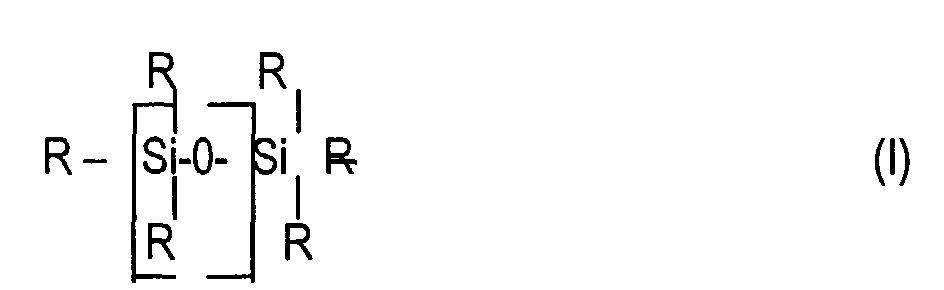
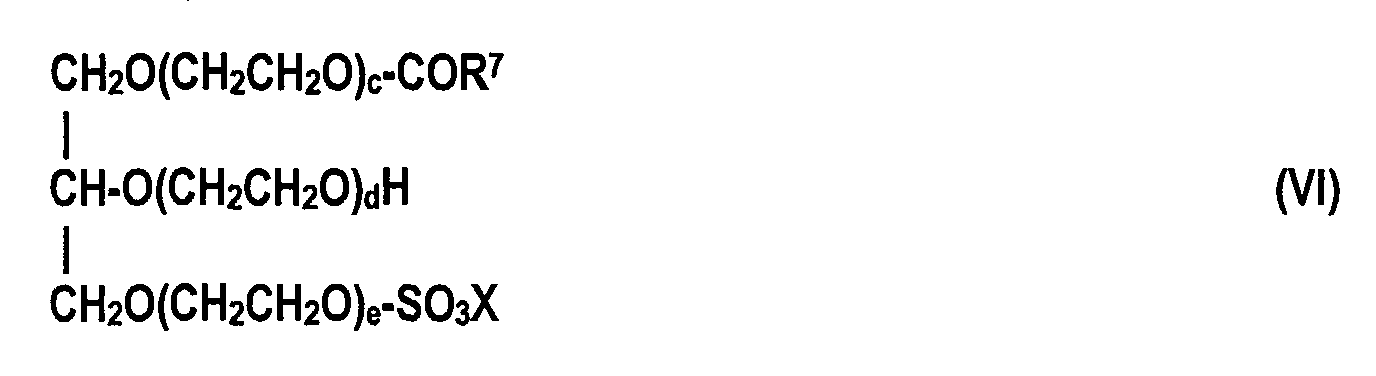

R20 und R21 stehen für Alkylreste, wobei R8 und R9 zusammen nicht mehr als 50 Kohlenstoffatome haben sollen.
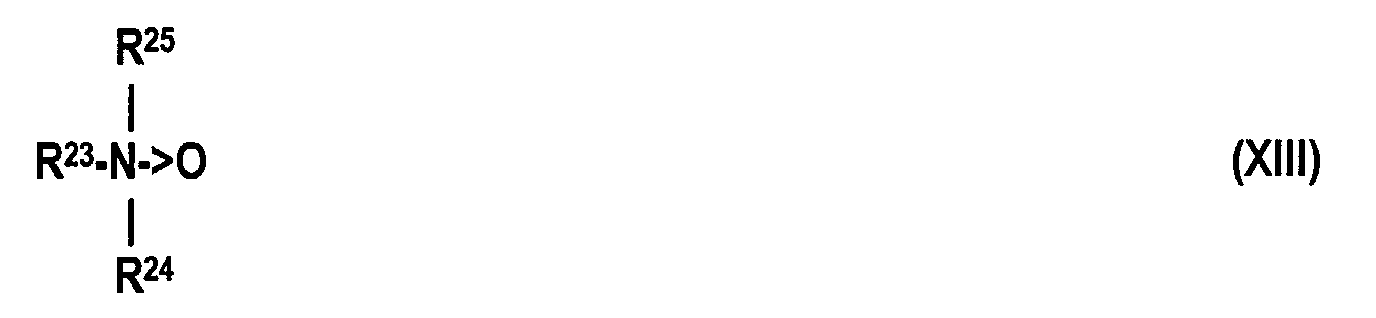

| Inhaltsstoff | Ref. 1 | Ref. 1 | Ref.1 | B1 | Ref. 2 | Ref. 2 | Ref. 2 | B2 |
| ABS | 9,75 | 9,75 | 9,75 | 9,75 | ||||
| FAS C12/18 | 9,75 | 9,75 | 9,75 | 9,75 | ||||
| FA C12/18 7EO | 3,25 | 3,25 | 3,25 | 3,25 | 3,25 | 3,25 | 3,25 | 3,25 |
| Na-Seife C16/18 | 1,5 | 1,5 | 1,5 | 1,5 | 1,5 | 1,5 | 1,5 | 1,5 |
| Zeolith | 25 | 25 | 25 | 25 | 25 | 25 | 25 | 25 |
| STPP | ||||||||
| Phosphonat | 1 | 1 | 1 | 1 | 1 | 1 | 1 | 1 |
| Soda | 15 | 15 | 15 | 15 | 15 | 15 | 15 | 15 |
| Na-Silikat | 3 | 3 | 3 | 3 | 3 | 3 | 3 | 3 |
| Acetophosphonat | 0,5 | 0,5 | 0,5 | 0,5 | 0,5 | 0,5 | 0,5 | 0,5 |
| Polycarboxylat | 3 | 3 | 3 | 3 | 3 | 3 | 3 | 3 |
| Na-Percarbonat | 15 | 15 | 15 | 15 | 15 | 15 | 15 | 15 |
| TAED | 3 | 3 | 3 | 3 | 3 | 3 | 3 | 3 |
| Wasser | 10 | 10 | 10 | 10 | 10 | 10 | 10 | 10 |
| Na-Sulfat | ad 100 | ad 100 | ad 100 | ad 100 | ad 100 | ad 100 | ad 100 | ad 100 |
| Dehydran® 770 | X | X | ||||||
| Dehydran® 750 | X | X | ||||||
| Dehydran® 760 | X | X | ||||||
| Gemisch aus Dehydran® 770 und 750 | A | B | ||||||
| Gemisch aus Dehydran 770 und 760 | ||||||||
| Ben. Menge bei 40 °C | 3 | 0,75 | 3,5 | 1,1 | 3,5 | 0,5 | 2,5 | 1 |
| Ben. Menge bei 95 °C | 1,25 | 1,5 | 1 | 1,1 | 1,75 | 3,5 | 1,5 | 1,25 |
| Gesamtmenge | 4,25 | 2,25 | 4,5 | 2,2 | 5,25 | 4 | 4 | 2,25 |
| Mengenverhältnis | 1:0,4 | 1:2 | 1:0,3 | 1:1 | 1:0,5 | 1:7 | 1:0,6 | 1:1,3 |
| Inhaltsstoff | Ref. 3 | Ref. 3 | Ref. 3 | B3 | B4 |
| ABS | 9,75 | 9,75 | 9,75 | 9,75 | 9,75 |
| FAS C12/18 | |||||
| FA C12/18 7EO | 3,25 | 3,25 | 3,25 | 3,25 | 3,25 |
| Na-Seife C16/18 | 1,5 | 1,5 | 1,5 | 1,5 | 1,5 |
| Zeolith | 25 | ||||
| STPP | 25 | 25 | 25 | 25 | |
| Phosphonat | 1 | 1 | 1 | 1 | 1 |
| Soda | 15 | 15 | 15 | 15 | 15 |
| Na-Silikat | 3 | 3 | 3 | 3 | 3 |
| Acetophosphonat | 0,5 | 0,5 | 0,5 | 0,5 | 0,5 |
| Polycarboxylat | 3 | 3 | 3 | 3 | 3 |
| Na-Percarbonat | 15 | 15 | 15 | 15 | 15 |
| TAED | 3 | 3 | 3 | 3 | 3 |
| Wasser | 10 | 10 | 10 | 10 | 10 |
| Na-Sulfat | ad 100 | ad 100 | ad 100 | ad 100 | ad 100 |
| Dehydran® 770 | X | ||||
| Dehydran® 750 | X | ||||
| Dehydran® 760 | X | ||||
| Gemisch aus Dehydran® 770 und 750 | C | ||||
| Gemisch aus Dehydran® 770 und 760 | D | ||||
| Ben. Menge bei 40 °C | 3,5 | 1 | 4 | 1,4 | 1,3 |
| Ben. Menge bei 95 °C | 1,4 | 1,75 | 1,25 | 1,3 | 1,3 |
| Gesamtmenge | 4,9 | 2,75 | 5,25 | 2,7 | 2,6 |
| Mengenverhältnis | 1:0,4 | 1:1,8 | 1:0,3 | 1:0,9 | 1:1 |
| A: 1 Gew.-% Dehydran® 750 + 0,75 Gew.-% Dehydran® 770 | |||||
| B: 4,25 Gew.-% Dehydran® 750 + 5,5 Gew.-% Dehydran® 770 | |||||
| C: 4,25 Gew.-% Dehydran® 750 + 2,5 Gew.-% Dehydran® 770 | |||||
| D: 1,5 Gew.-% Dehydran® 750 + 0,75 Gew.-% Dehydran® 770 |
Claims (11)
- Bei Raumtemperatur feste Teilchen enthaltende Entschäumerzusammensetzung, mindestens enthaltend mindestens eine entschäumend wirkende Verbindung auf Paraffinbasis und mindestens eine entschäumend wirkende Verbindung auf Silikonbasis, wobei mindestens eine entschäumend wirkende Verbindung auf Paraffinbasis und mindestens eine entschäumend wirkende Verbindung auf Silikonbasis auf räumlich getrennten Teilchen vorliegen.
- Entschäumerzusammensetzung nach Anspruch 1, dadurch gekennzeichnet, daß die Teilchen eine Teilchengröße von 50 µm bis 3 mm aufweisen.
- Entschäumerzusammensetzung nach Anspruch 1 oder 2, dadurch gekennzeichnet, daß das Verhältnis von entschäumend wirkenden Verbindungen auf Paraffinbasis zu entschäumend wirkenden Verbindungen auf Silikonbasis 10:1 bis 1:10 beträgt.
- Entschäumerzusammensetzung nach einem der Ansprüche 1 bis 3, dadurch gekennzeichnet, daß das Verhältnis der entschäumend wirkenden Verbindungen auf Paraffinbasis zu den entschäumend wirkenden Verbindungen auf Silikonbasis so gewählt wird, daß die entschäumende Wirkung in einem Temperaturbereich von 50 bis 80 °C im wesentlichen gleich bleibt.
- Entschäumerzusammensetzung nach einem der Ansprüche 1 bis 4, dadurch gekennzeichnet, daß sie als Pulver oder Granulat vorliegt.
- Entschäumerzusammensetzung nach einem der Ansprüche 1 bis 4, dadurch gekennzeichnet, daß sie als entschäumend wirkende Verbindung mindestens eine Verbindung ausgewählt aus der Gruppe bestehend aus Dehydran ® 750, Dehydran ® 760 und Dehydran ® 770 (alle Firma Cognis, Deutschland) enthält.
- Verfahren zur Herstellung einer Entschäumerzusammensetzung nach einem der Ansprüche 1 bis 6, bei dem jeweils mindestens ein teilchenförmiger Feststoff, der als Wirkstoffkomponente mindestens eine entschäumend wirkende Verbindung auf Paraffinbasis enthält und mindestens ein teilchenförmiger Feststoff, der als Wirkstoffkomponente mindestens eine entschäumend wirkende Verbindung auf Silikonbasis enthält, vermischt werden, wobei mindestens eine Sorte teilchenförmiger Feststoff eine Wirkstoffkomponente der anderen Sorte teilchenförmiger Feststoff nicht enthält.
- Wasch- oder reinigungsaktive Zusammensetzung, dadurch gekennzeichnet, daß sie eine Entschäumerzusammensetzung gemäß einem der Ansprüche 1 bis 6 enthält.
- Zusammensetzung nach Anspruch 8, dadurch gekennzeichnet, daß sie die Entschäumerzusammensetzung in einer Menge von 0,05 bis 20 Gew.-% enthält.
- Zusammensetzung nach Anspruch 8 oder 9, dadurch gekennzeichnet, daß die Entschäumerzusammensetzung in einer Menge vorliegt, bei der das Verhältnis von zur gewünschten Entschäumung benötigten Menge an Entschäumerzusammensetzung bei 40°C zu zur gewünschten Entschäumung benötigten Menge an Entschäumerzusammensetzung bei 95°C mehr als 0,6 bis weniger als 1,8 beträgt.
- Verwendung einer Entschäumerzusammensetzung gemäß einem der Ansprüche 1 bis 6 zur Herstellung von Wasch- oder Reinigungsmitteln.
Applications Claiming Priority (2)
| Application Number | Priority Date | Filing Date | Title |
|---|---|---|---|
| DE10155568 | 2001-11-13 | ||
| DE2001155568 DE10155568A1 (de) | 2001-11-13 | 2001-11-13 | Entschäumerzusammensetzung und deren Verwendung |
Publications (2)
| Publication Number | Publication Date |
|---|---|
| EP1310550A1 true EP1310550A1 (de) | 2003-05-14 |
| EP1310550B1 EP1310550B1 (de) | 2006-05-24 |
Family
ID=7705506
Family Applications (1)
| Application Number | Title | Priority Date | Filing Date |
|---|---|---|---|
| EP20020024317 Expired - Lifetime EP1310550B1 (de) | 2001-11-13 | 2002-11-02 | Entschäumerzusammensetzung und deren Verwendung |
Country Status (3)
| Country | Link |
|---|---|
| EP (1) | EP1310550B1 (de) |
| DE (2) | DE10155568A1 (de) |
| ES (1) | ES2266385T3 (de) |
Cited By (1)
| Publication number | Priority date | Publication date | Assignee | Title |
|---|---|---|---|---|
| WO2006106384A1 (en) * | 2005-04-07 | 2006-10-12 | A.S.T. Kimya Ve Teknoloji Sanayi Ticaret Limited Sirketi | An anti-foam agent |
Citations (5)
| Publication number | Priority date | Publication date | Assignee | Title |
|---|---|---|---|---|
| WO1995004124A1 (de) * | 1993-08-02 | 1995-02-09 | Henkel Kommanditgesellschaft Auf Aktien | Schaumregulatorgranulat und verfahren zu seiner herstellung |
| EP0708817B1 (de) * | 1993-07-13 | 1998-03-18 | Henkel Kommanditgesellschaft auf Aktien | Schüttfähiges, phosphatfreies schaumregulierungsmittel |
| WO2000011127A1 (de) * | 1998-08-17 | 2000-03-02 | Cognis Deutschland Gmbh | Herstellung von entschäumergranulaten im fliessbettverfahren |
| DE19857204A1 (de) * | 1998-12-11 | 2000-06-15 | Henkel Kgaa | Wäßrige Schaumregulatoremulsion |
| DE19953797A1 (de) * | 1999-11-09 | 2001-05-17 | Cognis Deutschland Gmbh | Entschäumergranulate |
Family Cites Families (1)
| Publication number | Priority date | Publication date | Assignee | Title |
|---|---|---|---|---|
| DE19940262A1 (de) * | 1999-08-25 | 2001-03-01 | Cognis Deutschland Gmbh | Waschmittelzusatzstoffe in fester Form |
-
2001
- 2001-11-13 DE DE2001155568 patent/DE10155568A1/de not_active Ceased
-
2002
- 2002-11-02 DE DE50206872T patent/DE50206872D1/de not_active Expired - Lifetime
- 2002-11-02 ES ES02024317T patent/ES2266385T3/es not_active Expired - Lifetime
- 2002-11-02 EP EP20020024317 patent/EP1310550B1/de not_active Expired - Lifetime
Patent Citations (5)
| Publication number | Priority date | Publication date | Assignee | Title |
|---|---|---|---|---|
| EP0708817B1 (de) * | 1993-07-13 | 1998-03-18 | Henkel Kommanditgesellschaft auf Aktien | Schüttfähiges, phosphatfreies schaumregulierungsmittel |
| WO1995004124A1 (de) * | 1993-08-02 | 1995-02-09 | Henkel Kommanditgesellschaft Auf Aktien | Schaumregulatorgranulat und verfahren zu seiner herstellung |
| WO2000011127A1 (de) * | 1998-08-17 | 2000-03-02 | Cognis Deutschland Gmbh | Herstellung von entschäumergranulaten im fliessbettverfahren |
| DE19857204A1 (de) * | 1998-12-11 | 2000-06-15 | Henkel Kgaa | Wäßrige Schaumregulatoremulsion |
| DE19953797A1 (de) * | 1999-11-09 | 2001-05-17 | Cognis Deutschland Gmbh | Entschäumergranulate |
Cited By (1)
| Publication number | Priority date | Publication date | Assignee | Title |
|---|---|---|---|---|
| WO2006106384A1 (en) * | 2005-04-07 | 2006-10-12 | A.S.T. Kimya Ve Teknoloji Sanayi Ticaret Limited Sirketi | An anti-foam agent |
Also Published As
| Publication number | Publication date |
|---|---|
| ES2266385T3 (es) | 2007-03-01 |
| DE10155568A1 (de) | 2003-05-28 |
| EP1310550B1 (de) | 2006-05-24 |
| DE50206872D1 (de) | 2006-06-29 |
Similar Documents
| Publication | Publication Date | Title |
|---|---|---|
| EP1106675B1 (de) | Verwendung von Partialglyceridpolyglycolethern | |
| EP1188817A2 (de) | Waschmittel | |
| EP1191094A2 (de) | Waschmittel | |
| EP1228178A1 (de) | Feste wasch-, spül- und reinigungsmittel | |
| DE10004677A1 (de) | Tensidmischung mit Fettalkoholalkoxylaten aus pflanzlichen Rohstoffen | |
| EP1186649A1 (de) | Waschmitteltabletten | |
| EP1188819A1 (de) | Waschmitteltabletten | |
| WO2001018164A1 (de) | Waschmittel | |
| EP1212400B1 (de) | Waschmitteltabletten | |
| EP1212401B1 (de) | Waschmitteltabletten | |
| EP1310550B1 (de) | Entschäumerzusammensetzung und deren Verwendung | |
| WO2001000763A1 (de) | Schaumkontrollierte feste waschmittel | |
| DE19953797A1 (de) | Entschäumergranulate | |
| EP1205536A2 (de) | Verwendung von Tensidgemischen | |
| EP1090979A1 (de) | Entschäumergranulate | |
| EP1081213A1 (de) | Schaumkontrollierte feste Waschmittel | |
| EP1204732A1 (de) | Schaumkontrollierte feste wachmittel | |
| EP1207193A1 (de) | Verwendung von Tensidgemischen zur Herstellung von Wasch- und Reinigungsmitteln | |
| EP1090982A1 (de) | Formkörper mit verbesserter Wasserlöslichkeit | |
| EP1090978A1 (de) | Feste Wasch-, Spül- und Reinigungsmittel enthaltend Entschäumergranulate | |
| WO2001027231A1 (de) | Waschmittel | |
| EP1078979A1 (de) | Schaumkontrollierte feste Waschmittel | |
| WO2001000761A1 (de) | Schaumkontrollierte feste waschmittel | |
| DE19953794A1 (de) | Formkörper mit verbesserter Wasserlöslichkeit | |
| EP1314722A1 (de) | Aromatische Sulfonsäurepolyglycolester |
Legal Events
| Date | Code | Title | Description |
|---|---|---|---|
| PUAI | Public reference made under article 153(3) epc to a published international application that has entered the european phase |
Free format text: ORIGINAL CODE: 0009012 |
|
| 17P | Request for examination filed |
Effective date: 20021102 |
|
| AK | Designated contracting states |
Designated state(s): AT BE BG CH CY CZ DE DK EE ES FI FR GB GR IE IT LI LU MC NL PT SE SK TR |
|
| AX | Request for extension of the european patent |
Extension state: AL LT LV MK RO SI |
|
| AKX | Designation fees paid |
Designated state(s): BE DE ES FR GB IT |
|
| 17Q | First examination report despatched |
Effective date: 20050210 |
|
| RAP1 | Party data changed (applicant data changed or rights of an application transferred) |
Owner name: COGNIS IP MANAGEMENT GMBH |
|
| RIC1 | Information provided on ipc code assigned before grant |
Ipc: C11D 3/00 19850101AFI20051115BHEP Ipc: C11D 3/18 19850101ALI20051115BHEP Ipc: B01D 19/04 19680901ALI20051115BHEP Ipc: C11D 3/37 19850101ALI20051115BHEP |
|
| GRAP | Despatch of communication of intention to grant a patent |
Free format text: ORIGINAL CODE: EPIDOSNIGR1 |
|
| GRAS | Grant fee paid |
Free format text: ORIGINAL CODE: EPIDOSNIGR3 |
|
| GRAL | Information related to payment of fee for publishing/printing deleted |
Free format text: ORIGINAL CODE: EPIDOSDIGR3 |
|
| GRAS | Grant fee paid |
Free format text: ORIGINAL CODE: EPIDOSNIGR3 |
|
| GRAA | (expected) grant |
Free format text: ORIGINAL CODE: 0009210 |
|
| AK | Designated contracting states |
Kind code of ref document: B1 Designated state(s): BE DE ES FR GB IT |
|
| PG25 | Lapsed in a contracting state [announced via postgrant information from national office to epo] |
Ref country code: IT Free format text: LAPSE BECAUSE OF FAILURE TO SUBMIT A TRANSLATION OF THE DESCRIPTION OR TO PAY THE FEE WITHIN THE PRE;WARNING: LAPSES OF ITALIAN PATENTS WITH EFFECTIVE DATE BEFORE 2007 MAY HAVE OCCURRED AT ANY TIME BEFORE 2007. THE CORRECT EFFECTIVE DATE MAY BE DIFFERENT FROM THE ONE RECORDED.SCRIBED TIME-LIMIT Effective date: 20060524 |
|
| REG | Reference to a national code |
Ref country code: GB Ref legal event code: FG4D Free format text: NOT ENGLISH |
|
| REF | Corresponds to: |
Ref document number: 50206872 Country of ref document: DE Date of ref document: 20060629 Kind code of ref document: P |
|
| GBT | Gb: translation of ep patent filed (gb section 77(6)(a)/1977) |
Effective date: 20060908 |
|
| ET | Fr: translation filed | ||
| REG | Reference to a national code |
Ref country code: ES Ref legal event code: FG2A Ref document number: 2266385 Country of ref document: ES Kind code of ref document: T3 |
|
| PLBE | No opposition filed within time limit |
Free format text: ORIGINAL CODE: 0009261 |
|
| STAA | Information on the status of an ep patent application or granted ep patent |
Free format text: STATUS: NO OPPOSITION FILED WITHIN TIME LIMIT |
|
| 26N | No opposition filed |
Effective date: 20070227 |
|
| PGFP | Annual fee paid to national office [announced via postgrant information from national office to epo] |
Ref country code: GB Payment date: 20141128 Year of fee payment: 13 |
|
| PGFP | Annual fee paid to national office [announced via postgrant information from national office to epo] |
Ref country code: DE Payment date: 20150129 Year of fee payment: 13 |
|
| REG | Reference to a national code |
Ref country code: FR Ref legal event code: PLFP Year of fee payment: 14 |
|
| PGFP | Annual fee paid to national office [announced via postgrant information from national office to epo] |
Ref country code: IT Payment date: 20151124 Year of fee payment: 14 |
|
| PGFP | Annual fee paid to national office [announced via postgrant information from national office to epo] |
Ref country code: FR Payment date: 20151127 Year of fee payment: 14 Ref country code: ES Payment date: 20151221 Year of fee payment: 14 Ref country code: BE Payment date: 20151127 Year of fee payment: 14 |
|
| REG | Reference to a national code |
Ref country code: DE Ref legal event code: R119 Ref document number: 50206872 Country of ref document: DE |
|
| GBPC | Gb: european patent ceased through non-payment of renewal fee |
Effective date: 20151102 |
|
| PG25 | Lapsed in a contracting state [announced via postgrant information from national office to epo] |
Ref country code: GB Free format text: LAPSE BECAUSE OF NON-PAYMENT OF DUE FEES Effective date: 20151102 Ref country code: DE Free format text: LAPSE BECAUSE OF NON-PAYMENT OF DUE FEES Effective date: 20160601 |
|
| PG25 | Lapsed in a contracting state [announced via postgrant information from national office to epo] |
Ref country code: BE Free format text: LAPSE BECAUSE OF NON-PAYMENT OF DUE FEES Effective date: 20161130 |
|
| REG | Reference to a national code |
Ref country code: FR Ref legal event code: ST Effective date: 20170731 |
|
| PG25 | Lapsed in a contracting state [announced via postgrant information from national office to epo] |
Ref country code: FR Free format text: LAPSE BECAUSE OF NON-PAYMENT OF DUE FEES Effective date: 20161130 Ref country code: IT Free format text: LAPSE BECAUSE OF NON-PAYMENT OF DUE FEES Effective date: 20161102 |
|
| REG | Reference to a national code |
Ref country code: BE Ref legal event code: MM Effective date: 20161130 |
|
| PG25 | Lapsed in a contracting state [announced via postgrant information from national office to epo] |
Ref country code: ES Free format text: LAPSE BECAUSE OF FAILURE TO SUBMIT A TRANSLATION OF THE DESCRIPTION OR TO PAY THE FEE WITHIN THE PRESCRIBED TIME-LIMIT Effective date: 20060524 |
|
| REG | Reference to a national code |
Ref country code: ES Ref legal event code: FD2A Effective date: 20181120 |
|
| PG25 | Lapsed in a contracting state [announced via postgrant information from national office to epo] |
Ref country code: ES Free format text: LAPSE BECAUSE OF FAILURE TO SUBMIT A TRANSLATION OF THE DESCRIPTION OR TO PAY THE FEE WITHIN THE PRESCRIBED TIME-LIMIT Effective date: 20161103 |