EP1306605B1 - Gas occluding material - Google Patents
Gas occluding material Download PDFInfo
- Publication number
- EP1306605B1 EP1306605B1 EP03001655A EP03001655A EP1306605B1 EP 1306605 B1 EP1306605 B1 EP 1306605B1 EP 03001655 A EP03001655 A EP 03001655A EP 03001655 A EP03001655 A EP 03001655A EP 1306605 B1 EP1306605 B1 EP 1306605B1
- Authority
- EP
- European Patent Office
- Prior art keywords
- gas
- molecules
- temperature
- methane
- occluding material
- Prior art date
- Legal status (The legal status is an assumption and is not a legal conclusion. Google has not performed a legal analysis and makes no representation as to the accuracy of the status listed.)
- Expired - Lifetime
Links
- 239000000463 material Substances 0.000 title claims description 35
- 238000000034 method Methods 0.000 claims description 23
- 239000000843 powder Substances 0.000 claims description 14
- 125000004122 cyclic group Chemical group 0.000 claims description 8
- 239000006185 dispersion Substances 0.000 claims description 5
- 239000000203 mixture Substances 0.000 claims description 4
- 238000005507 spraying Methods 0.000 claims description 3
- VNWKTOKETHGBQD-UHFFFAOYSA-N methane Chemical compound C VNWKTOKETHGBQD-UHFFFAOYSA-N 0.000 description 72
- 239000007789 gas Substances 0.000 description 58
- IJGRMHOSHXDMSA-UHFFFAOYSA-N Atomic nitrogen Chemical compound N#N IJGRMHOSHXDMSA-UHFFFAOYSA-N 0.000 description 32
- OKTJSMMVPCPJKN-UHFFFAOYSA-N Carbon Chemical compound [C] OKTJSMMVPCPJKN-UHFFFAOYSA-N 0.000 description 27
- 238000003860 storage Methods 0.000 description 25
- 238000001179 sorption measurement Methods 0.000 description 21
- 239000002775 capsule Substances 0.000 description 19
- 239000007788 liquid Substances 0.000 description 18
- XLYOFNOQVPJJNP-UHFFFAOYSA-N water Substances O XLYOFNOQVPJJNP-UHFFFAOYSA-N 0.000 description 18
- 229910052757 nitrogen Inorganic materials 0.000 description 16
- 238000010276 construction Methods 0.000 description 9
- 230000015572 biosynthetic process Effects 0.000 description 8
- 238000003795 desorption Methods 0.000 description 7
- 230000008014 freezing Effects 0.000 description 7
- 238000007710 freezing Methods 0.000 description 7
- 125000006850 spacer group Chemical group 0.000 description 7
- 230000000052 comparative effect Effects 0.000 description 6
- 239000003949 liquefied natural gas Substances 0.000 description 6
- 239000003463 adsorbent Substances 0.000 description 5
- 239000003345 natural gas Substances 0.000 description 5
- 239000011148 porous material Substances 0.000 description 5
- ATUOYWHBWRKTHZ-UHFFFAOYSA-N Propane Chemical compound CCC ATUOYWHBWRKTHZ-UHFFFAOYSA-N 0.000 description 4
- 239000001257 hydrogen Substances 0.000 description 4
- 229910052739 hydrogen Inorganic materials 0.000 description 4
- 239000002609 medium Substances 0.000 description 4
- OOLUVSIJOMLOCB-UHFFFAOYSA-N 1633-22-3 Chemical compound C1CC(C=C2)=CC=C2CCC2=CC=C1C=C2 OOLUVSIJOMLOCB-UHFFFAOYSA-N 0.000 description 3
- OTMSDBZUPAUEDD-UHFFFAOYSA-N Ethane Chemical compound CC OTMSDBZUPAUEDD-UHFFFAOYSA-N 0.000 description 3
- 150000001875 compounds Chemical class 0.000 description 3
- 230000000694 effects Effects 0.000 description 3
- 210000002425 internal capsule Anatomy 0.000 description 3
- 239000002245 particle Substances 0.000 description 3
- 239000000126 substance Substances 0.000 description 3
- 239000011800 void material Substances 0.000 description 3
- CSCPPACGZOOCGX-UHFFFAOYSA-N Acetone Chemical compound CC(C)=O CSCPPACGZOOCGX-UHFFFAOYSA-N 0.000 description 2
- 239000004215 Carbon black (E152) Substances 0.000 description 2
- NIQCNGHVCWTJSM-UHFFFAOYSA-N Dimethyl phthalate Chemical compound COC(=O)C1=CC=CC=C1C(=O)OC NIQCNGHVCWTJSM-UHFFFAOYSA-N 0.000 description 2
- LFQSCWFLJHTTHZ-UHFFFAOYSA-N Ethanol Chemical compound CCO LFQSCWFLJHTTHZ-UHFFFAOYSA-N 0.000 description 2
- UFHFLCQGNIYNRP-UHFFFAOYSA-N Hydrogen Chemical compound [H][H] UFHFLCQGNIYNRP-UHFFFAOYSA-N 0.000 description 2
- MWPLVEDNUUSJAV-UHFFFAOYSA-N anthracene Chemical compound C1=CC=CC2=CC3=CC=CC=C3C=C21 MWPLVEDNUUSJAV-UHFFFAOYSA-N 0.000 description 2
- 229910052799 carbon Inorganic materials 0.000 description 2
- WDECIBYCCFPHNR-UHFFFAOYSA-N chrysene Chemical compound C1=CC=CC2=CC=C3C4=CC=CC=C4C=CC3=C21 WDECIBYCCFPHNR-UHFFFAOYSA-N 0.000 description 2
- VPUGDVKSAQVFFS-UHFFFAOYSA-N coronene Chemical compound C1=C(C2=C34)C=CC3=CC=C(C=C3)C4=C4C3=CC=C(C=C3)C4=C2C3=C1 VPUGDVKSAQVFFS-UHFFFAOYSA-N 0.000 description 2
- LHRCREOYAASXPZ-UHFFFAOYSA-N dibenz[a,h]anthracene Chemical compound C1=CC=C2C(C=C3C=CC=4C(C3=C3)=CC=CC=4)=C3C=CC2=C1 LHRCREOYAASXPZ-UHFFFAOYSA-N 0.000 description 2
- FLKPEMZONWLCSK-UHFFFAOYSA-N diethyl phthalate Chemical compound CCOC(=O)C1=CC=CC=C1C(=O)OCC FLKPEMZONWLCSK-UHFFFAOYSA-N 0.000 description 2
- SNRUBQQJIBEYMU-UHFFFAOYSA-N dodecane Chemical compound CCCCCCCCCCCC SNRUBQQJIBEYMU-UHFFFAOYSA-N 0.000 description 2
- 229930195733 hydrocarbon Natural products 0.000 description 2
- 150000002430 hydrocarbons Chemical class 0.000 description 2
- 150000002431 hydrogen Chemical class 0.000 description 2
- 238000000608 laser ablation Methods 0.000 description 2
- 230000008018 melting Effects 0.000 description 2
- 238000002844 melting Methods 0.000 description 2
- 238000001451 molecular beam epitaxy Methods 0.000 description 2
- 239000001294 propane Substances 0.000 description 2
- BBEAQIROQSPTKN-UHFFFAOYSA-N pyrene Chemical compound C1=CC=C2C=CC3=CC=CC4=CC=C1C2=C43 BBEAQIROQSPTKN-UHFFFAOYSA-N 0.000 description 2
- 238000007430 reference method Methods 0.000 description 2
- 239000000758 substrate Substances 0.000 description 2
- 238000007740 vapor deposition Methods 0.000 description 2
- -1 water Chemical class 0.000 description 2
- NLMDJJTUQPXZFG-UHFFFAOYSA-N 1,4,10,13-tetraoxa-7,16-diazacyclooctadecane Chemical compound C1COCCOCCNCCOCCOCCN1 NLMDJJTUQPXZFG-UHFFFAOYSA-N 0.000 description 1
- BJUOQSZSDIHZNP-UHFFFAOYSA-N 1,4,7,10-tetraoxa-13-azacyclopentadecane Chemical compound C1COCCOCCOCCOCCN1 BJUOQSZSDIHZNP-UHFFFAOYSA-N 0.000 description 1
- DIIFUCUPDHMNIV-UHFFFAOYSA-N 7-methylbenzo[a]anthracene Chemical compound C1=CC2=CC=CC=C2C2=C1C(C)=C(C=CC=C1)C1=C2 DIIFUCUPDHMNIV-UHFFFAOYSA-N 0.000 description 1
- 229910052582 BN Inorganic materials 0.000 description 1
- PZNSFCLAULLKQX-UHFFFAOYSA-N Boron nitride Chemical compound N#B PZNSFCLAULLKQX-UHFFFAOYSA-N 0.000 description 1
- CURLTUGMZLYLDI-UHFFFAOYSA-N Carbon dioxide Chemical compound O=C=O CURLTUGMZLYLDI-UHFFFAOYSA-N 0.000 description 1
- 235000013162 Cocos nucifera Nutrition 0.000 description 1
- 244000060011 Cocos nucifera Species 0.000 description 1
- XDTMQSROBMDMFD-UHFFFAOYSA-N Cyclohexane Chemical compound C1CCCCC1 XDTMQSROBMDMFD-UHFFFAOYSA-N 0.000 description 1
- BJBUTJQYZDYRMJ-UHFFFAOYSA-N Kaempferol 3,7-dimethyl ether Chemical compound C=1C(OC)=CC(O)=C(C(C=2OC)=O)C=1OC=2C1=CC=C(O)C=C1 BJBUTJQYZDYRMJ-UHFFFAOYSA-N 0.000 description 1
- 206010037660 Pyrexia Diseases 0.000 description 1
- VYPSYNLAJGMNEJ-UHFFFAOYSA-N Silicium dioxide Chemical compound O=[Si]=O VYPSYNLAJGMNEJ-UHFFFAOYSA-N 0.000 description 1
- 229910021536 Zeolite Inorganic materials 0.000 description 1
- 238000004220 aggregation Methods 0.000 description 1
- 230000002776 aggregation Effects 0.000 description 1
- 239000001273 butane Substances 0.000 description 1
- 150000001721 carbon Chemical group 0.000 description 1
- 125000004432 carbon atom Chemical group C* 0.000 description 1
- 239000002041 carbon nanotube Substances 0.000 description 1
- 229910021393 carbon nanotube Inorganic materials 0.000 description 1
- 239000000919 ceramic Substances 0.000 description 1
- 239000003245 coal Substances 0.000 description 1
- 230000001419 dependent effect Effects 0.000 description 1
- UNTITLLXXOKDTB-UHFFFAOYSA-N dibenzo-24-crown-8 Chemical compound O1CCOCCOCCOC2=CC=CC=C2OCCOCCOCCOC2=CC=CC=C21 UNTITLLXXOKDTB-UHFFFAOYSA-N 0.000 description 1
- IEJIGPNLZYLLBP-UHFFFAOYSA-N dimethyl carbonate Chemical compound COC(=O)OC IEJIGPNLZYLLBP-UHFFFAOYSA-N 0.000 description 1
- FBSAITBEAPNWJG-UHFFFAOYSA-N dimethyl phthalate Natural products CC(=O)OC1=CC=CC=C1OC(C)=O FBSAITBEAPNWJG-UHFFFAOYSA-N 0.000 description 1
- 229960001826 dimethylphthalate Drugs 0.000 description 1
- HNPSIPDUKPIQMN-UHFFFAOYSA-N dioxosilane;oxo(oxoalumanyloxy)alumane Chemical compound O=[Si]=O.O=[Al]O[Al]=O HNPSIPDUKPIQMN-UHFFFAOYSA-N 0.000 description 1
- 239000002612 dispersion medium Substances 0.000 description 1
- 238000009826 distribution Methods 0.000 description 1
- 238000010894 electron beam technology Methods 0.000 description 1
- 238000005538 encapsulation Methods 0.000 description 1
- 150000002170 ethers Chemical class 0.000 description 1
- 230000001747 exhibiting effect Effects 0.000 description 1
- 239000000835 fiber Substances 0.000 description 1
- GVEPBJHOBDJJJI-UHFFFAOYSA-N fluoranthrene Natural products C1=CC(C2=CC=CC=C22)=C3C2=CC=CC3=C1 GVEPBJHOBDJJJI-UHFFFAOYSA-N 0.000 description 1
- 239000010439 graphite Substances 0.000 description 1
- 229910002804 graphite Inorganic materials 0.000 description 1
- 239000001307 helium Substances 0.000 description 1
- 229910052734 helium Inorganic materials 0.000 description 1
- SWQJXJOGLNCZEY-UHFFFAOYSA-N helium atom Chemical compound [He] SWQJXJOGLNCZEY-UHFFFAOYSA-N 0.000 description 1
- 238000004519 manufacturing process Methods 0.000 description 1
- 238000005259 measurement Methods 0.000 description 1
- 239000002184 metal Substances 0.000 description 1
- 229910052751 metal Inorganic materials 0.000 description 1
- 150000002739 metals Chemical class 0.000 description 1
- 239000002052 molecular layer Substances 0.000 description 1
- IJDNQMDRQITEOD-UHFFFAOYSA-N n-butane Chemical compound CCCC IJDNQMDRQITEOD-UHFFFAOYSA-N 0.000 description 1
- OFBQJSOFQDEBGM-UHFFFAOYSA-N n-pentane Natural products CCCCC OFBQJSOFQDEBGM-UHFFFAOYSA-N 0.000 description 1
- 239000002071 nanotube Substances 0.000 description 1
- AXSJLZJXXUBRBS-UHFFFAOYSA-N naphtho[2,3-a]pyrene Chemical compound C1=C2C3=CC4=CC=CC=C4C=C3C=C(C=C3)C2=C2C3=CC=CC2=C1 AXSJLZJXXUBRBS-UHFFFAOYSA-N 0.000 description 1
- LSQODMMMSXHVCN-UHFFFAOYSA-N ovalene Chemical compound C1=C(C2=C34)C=CC3=CC=C(C=C3C5=C6C(C=C3)=CC=C3C6=C6C(C=C3)=C3)C4=C5C6=C2C3=C1 LSQODMMMSXHVCN-UHFFFAOYSA-N 0.000 description 1
- IEQIEDJGQAUEQZ-UHFFFAOYSA-N phthalocyanine Chemical compound N1C(N=C2C3=CC=CC=C3C(N=C3C4=CC=CC=C4C(=N4)N3)=N2)=C(C=CC=C2)C2=C1N=C1C2=CC=CC=C2C4=N1 IEQIEDJGQAUEQZ-UHFFFAOYSA-N 0.000 description 1
- 229920000412 polyarylene Polymers 0.000 description 1
- 230000000750 progressive effect Effects 0.000 description 1
- LLBIOIRWAYBCKK-UHFFFAOYSA-N pyranthrene-8,16-dione Chemical compound C12=CC=CC=C2C(=O)C2=CC=C3C=C4C5=CC=CC=C5C(=O)C5=C4C4=C3C2=C1C=C4C=C5 LLBIOIRWAYBCKK-UHFFFAOYSA-N 0.000 description 1
- 229910002027 silica gel Inorganic materials 0.000 description 1
- 239000000741 silica gel Substances 0.000 description 1
- 239000002904 solvent Substances 0.000 description 1
- 238000000859 sublimation Methods 0.000 description 1
- 230000008022 sublimation Effects 0.000 description 1
- 230000002195 synergetic effect Effects 0.000 description 1
- YKSGNOMLAIJTLT-UHFFFAOYSA-N violanthrone Chemical compound C12=C3C4=CC=C2C2=CC=CC=C2C(=O)C1=CC=C3C1=CC=C2C(=O)C3=CC=CC=C3C3=CC=C4C1=C32 YKSGNOMLAIJTLT-UHFFFAOYSA-N 0.000 description 1
- 239000010457 zeolite Substances 0.000 description 1
Images




Classifications
-
- F—MECHANICAL ENGINEERING; LIGHTING; HEATING; WEAPONS; BLASTING
- F17—STORING OR DISTRIBUTING GASES OR LIQUIDS
- F17C—VESSELS FOR CONTAINING OR STORING COMPRESSED, LIQUEFIED OR SOLIDIFIED GASES; FIXED-CAPACITY GAS-HOLDERS; FILLING VESSELS WITH, OR DISCHARGING FROM VESSELS, COMPRESSED, LIQUEFIED, OR SOLIDIFIED GASES
- F17C11/00—Use of gas-solvents or gas-sorbents in vessels
-
- F—MECHANICAL ENGINEERING; LIGHTING; HEATING; WEAPONS; BLASTING
- F17—STORING OR DISTRIBUTING GASES OR LIQUIDS
- F17C—VESSELS FOR CONTAINING OR STORING COMPRESSED, LIQUEFIED OR SOLIDIFIED GASES; FIXED-CAPACITY GAS-HOLDERS; FILLING VESSELS WITH, OR DISCHARGING FROM VESSELS, COMPRESSED, LIQUEFIED, OR SOLIDIFIED GASES
- F17C11/00—Use of gas-solvents or gas-sorbents in vessels
- F17C11/007—Use of gas-solvents or gas-sorbents in vessels for hydrocarbon gases, such as methane or natural gas, propane, butane or mixtures thereof [LPG]
-
- Y—GENERAL TAGGING OF NEW TECHNOLOGICAL DEVELOPMENTS; GENERAL TAGGING OF CROSS-SECTIONAL TECHNOLOGIES SPANNING OVER SEVERAL SECTIONS OF THE IPC; TECHNICAL SUBJECTS COVERED BY FORMER USPC CROSS-REFERENCE ART COLLECTIONS [XRACs] AND DIGESTS
- Y10—TECHNICAL SUBJECTS COVERED BY FORMER USPC
- Y10S—TECHNICAL SUBJECTS COVERED BY FORMER USPC CROSS-REFERENCE ART COLLECTIONS [XRACs] AND DIGESTS
- Y10S95/00—Gas separation: processes
- Y10S95/90—Solid sorbent
-
- Y—GENERAL TAGGING OF NEW TECHNOLOGICAL DEVELOPMENTS; GENERAL TAGGING OF CROSS-SECTIONAL TECHNOLOGIES SPANNING OVER SEVERAL SECTIONS OF THE IPC; TECHNICAL SUBJECTS COVERED BY FORMER USPC CROSS-REFERENCE ART COLLECTIONS [XRACs] AND DIGESTS
- Y10—TECHNICAL SUBJECTS COVERED BY FORMER USPC
- Y10S—TECHNICAL SUBJECTS COVERED BY FORMER USPC CROSS-REFERENCE ART COLLECTIONS [XRACs] AND DIGESTS
- Y10S95/00—Gas separation: processes
- Y10S95/90—Solid sorbent
- Y10S95/902—Molecular sieve
- Y10S95/903—Carbon
-
- Y—GENERAL TAGGING OF NEW TECHNOLOGICAL DEVELOPMENTS; GENERAL TAGGING OF CROSS-SECTIONAL TECHNOLOGIES SPANNING OVER SEVERAL SECTIONS OF THE IPC; TECHNICAL SUBJECTS COVERED BY FORMER USPC CROSS-REFERENCE ART COLLECTIONS [XRACs] AND DIGESTS
- Y10—TECHNICAL SUBJECTS COVERED BY FORMER USPC
- Y10S—TECHNICAL SUBJECTS COVERED BY FORMER USPC CROSS-REFERENCE ART COLLECTIONS [XRACs] AND DIGESTS
- Y10S977/00—Nanotechnology
- Y10S977/70—Nanostructure
- Y10S977/734—Fullerenes, i.e. graphene-based structures, such as nanohorns, nanococoons, nanoscrolls or fullerene-like structures, e.g. WS2 or MoS2 chalcogenide nanotubes, planar C3N4, etc.
- Y10S977/742—Carbon nanotubes, CNTs
-
- Y—GENERAL TAGGING OF NEW TECHNOLOGICAL DEVELOPMENTS; GENERAL TAGGING OF CROSS-SECTIONAL TECHNOLOGIES SPANNING OVER SEVERAL SECTIONS OF THE IPC; TECHNICAL SUBJECTS COVERED BY FORMER USPC CROSS-REFERENCE ART COLLECTIONS [XRACs] AND DIGESTS
- Y10—TECHNICAL SUBJECTS COVERED BY FORMER USPC
- Y10S—TECHNICAL SUBJECTS COVERED BY FORMER USPC CROSS-REFERENCE ART COLLECTIONS [XRACs] AND DIGESTS
- Y10S977/00—Nanotechnology
- Y10S977/84—Manufacture, treatment, or detection of nanostructure
- Y10S977/842—Manufacture, treatment, or detection of nanostructure for carbon nanotubes or fullerenes
Definitions
- the present invention relates to a gas occluding material based on adsorption and a process for its production.
- An alternative being studied is a method of storing gas by adsorption (ANG: adsorbed natural gas) without special pressure or cryogenic temperature.
- Japanese Examined Patent Publication No. 9-210295 there is proposed an adsorption storage method for gas such as methane and ethane in a porous material such as activated carbon at near normal temperature, in the presence of a host compound such as water, and this publication explains that large-volume gas storage is possible by a synergistic effect of the adsorption power and pseudo-high-pressure effect of the porous material and formation of inclusion compounds with the host compound.
- activated carbon has been proposed as a gas occluding material for storage of gases that do not liquefy at relatively low pressures of up to about 10 atmospheres, such as hydrogen and natural gas (see Japanese Unexamined Patent Publication No. 9-86912, for example).
- Activated carbon can be coconut shell-based, fiber-based, coal-based, etc., but these have had a problem of inferior storage efficiency (storage gas volume per unit volume of storage vessel) compared to conventional gas storage methods such as compressed natural gas (CNG) and liquefied natural gas (LNG). This is because only pores of a limited size effectively function as adsorption sites among the various pore sizes of the activated carbon. For example, methane is adsorbed only in micropores (2 nm or less), while pores of other sizes (mesopores: approximately 2-50 nm, macropores: 50 nm and greater) contribute little to methane adsorption.
- CNG compressed natural gas
- LNG liquefied natural gas
- the object above is achieved by providing a gas occluding material comprising globular molecules.
- the gas is adsorbed between the planes of the planar molecules or in the rings of the cyclic molecules. It is appropriate for the ring size of the cyclic molecules to be somewhat larger than the size of the gas molecules.
- EP-A-0 020 210 discloses a gas occluding material comprising paracyclophane such as [2,2,2] paracyclophane which enables the adsorption of gas such as hydrogen.
- WO 96 12551 A relates to polyarylene ethers used as filter material for removing NO 2 from gases and liquids.
- a gas which is in a liquefied state at cryogenic temperature is encapsulated by a frozen medium to allow freezing storage at a temperature higher than the necessary cryogenic temperature for liquefaction.
- the gas to be stored is introduced into the storage vessel in a gaseous or liquefied state.
- a gas to be stored which is introduced in a gaseous state must first be lowered to a cryogenic temperature for liquefaction, but after it has been encapsulated in a liquefied state with the frozen medium it can be stored frozen at a temperature higher than the cryogenic temperature.
- the frozen medium used is a substance which is gaseous or liquid, has a higher freezing temperature than the liquefaction temperature of the gas to be stored and does not react with the gas to be stored, the adsorbent or the vessel at the storage temperature.
- a freezing temperature commonly, "melting temperature”
- Tm 0°C
- dodecane -9.6°C
- dimethyl phthalate (0°C)
- diethyl phthalate -3°C
- cyclohexane 6.5°C
- dimethyl carbonate 0.5°C
- the adsorbent used may be a conventional gas adsorbent, typical of which are any of various inorganic or organic adsorbents such as activated carbon, zeolite, silica gel and the like.
- the gas to be stored may be a gas that can be liquefied and adsorbed at a cryogenic temperature comparable to that of conventional LNG or liquid nitrogen, and hydrogen, helium, nitrogen and hydrocarbon gases may be used.
- hydrocarbon gases include methane, ethane, propane and the like.
- FIG. 3 Construction examples for ideal models of gas occluding materials according to the invention are shown in Fig. 3. Based on the carbon atom diameter of 0.77 ⁇ and the C-C bond distance of 1.54 ⁇ , it is possible to construct gaps of ideal size for adsorption of molecules of the target gas. In the illustrated example, an ideal gap size of 11.4 ⁇ is adopted for methane adsorption.
- Fig. 3(1) is a honeycomb structure model, having a square grid-like cross-sectional shape with sides of 11.4 ⁇ , and a void volume of 77.6%.
- Fig. 3(2) is a slit structure model, having a construction of laminated slits with a width of 11.4 ⁇ , and a void volume of 88.1%.
- Fig. 3(3) is a nanotube structure model (for example, 53 carbon tubes, single wall), having a construction of bundled carbon nanotubes with a diameter of 11.4 ⁇ , and a void volume of 56.3%.
- Fig. 4 shows the volume storage efficiency V/V0 for the gas occluding materials of the different structural models of Fig. 3, in comparison to conventional storage systems.
- Typical planar molecules used to construct an occluding material according to the invention include coronene, anthracene, pyrene, naphtho (2,3-a)pyrene, 3-methylconanthrene, violanthrone, 7-methylbenz(a)anthracene, dibenz(a,h)anthracene, 3-methylcoranthracene, dibeno(b,def)chrysene, 1,2;8,9-dibenzopentacene, 8,16-pyranthrenedione, coranurene and ovalene.
- Typical cyclic molecules used include phthalocyanine, 1-aza-15-crown 5-ether, 4,13-diaza-18-crown 6-ether, dibenzo-24-crown 8-ether and 1,6,20,25-tetraaza(6,1,6,1)paracyclophane. Their structural formulas are shown in Fig. 6.
- Typical globular molecules used are fullarenes, which include C 60 , C 70 , C 76 , C 84 , etc. as the number of carbon atoms in the molecule.
- the structural formula for C 60 is shown in Fig. 7 as a representative example.
- the included globular molecules function as spacers between planar molecules in particular, forming spaces of 2.0-20 ⁇ which is a suitable size for adsorption of gas molecules such as hydrogen, methane, propane, CO 2 , ethane and the like.
- gas molecules such as hydrogen, methane, propane, CO 2 , ethane and the like.
- fullarenes have diameters of 10-18 ⁇ , and are particularly suitable for formation of micropore structures appropriate for adsorption of methane.
- Globular molecules are added at about 1-50 wt% to achieve a spacer effect.
- a preferred mode of a gas occluding material according to the invention is a powder form, and a suitable vessel may be filled with a powder of a planar molecule material, a powder of a cyclic molecule material, a mixture of both powders, or any one of these three in admixture with a powder of a globular molecule material.
- ultrasonic vibrations to the vessel is preferred to increase the filling density while also increasing the degree of dispersion, to help prevent aggregation between the molecules.
- a gas occluding material is a system of alternating layers of planar molecules and globular molecules.
- the globular molecules it is preferred for the globular molecules to be dispersed by spraying.
- Such alternate formation of planar molecule/globular molecule layers can be accomplished by a common layer forming technique, such as electron beam vapor deposition, molecular beam epitaxy (MBE) or laser ablation.
- MBE molecular beam epitaxy
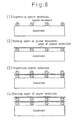
- Fig. 8 shows conceptual views of a progressive process for alternate layer formation.
- the spacer molecules (globular molecules) are dispersed on a substrate. This can be realized, for example, by distribution accomplished by spraying a dispersion of the spacer molecules in a dispersion medium (a volatile solvent such as ethanol, acetone, etc.).
- the layer of spacer molecules can be formed by a vacuum layer formation process such as MBE, laser ablation or the like, using rapid vapor deposition at a layer formation rate (1 ⁇ /sec or less) that is lower than the level for the single molecular layer level.
- the planar molecules are accumulated thereover by an appropriate layer forming method so that the individual planar molecules bridge across multiple globular molecules.
- step (3) This forms a planar molecule layer in a manner which maintains an open space from the surface of the substrate.
- the spacer molecules are distributed in the same manner as step (1) on the planar molecule layer formed in step (2).
- step (4) a planar molecule layer is formed in the same manner as step (2).
- planar molecule layer used may be any of the planar molecules mentioned above, or laminar substances such as graphite, boron nitride, etc. Layer-formable materials such as metals and ceramics may also be used.
- Methane was then introduced into the capsule from a methane bomb to bring the internal capsule pressure to 0.5 MPa.
- the capsule in this state was immersed in liquid nitrogen filling a Dewar vessel, and kept there for 20 minutes at the temperature of the liquid nitrogen (-196°C). This liquefied all of the methane gas in the capsule and adsorbed it onto the activated carbon.
- the capsule was continuously kept immersed in the liquid nitrogen, and water vapor generated from a water tank (20-60°C temperature) was introduced into the capsule. This caused immediate freezing of the water vapor to ice by the temperature of the liquid nitrogen, so that the liquefied and adsorbed methane gas was frozen and encapsulated in the ice.
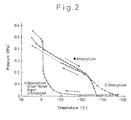
- Fig. 2 shows the desorption behavior of methane when the temperatures of capsules storing methane according to Example 1 and the comparative example were allowed to naturally increase to room temperature.
- the temperature on the horizontal axis and the pressure on the vertical axis are, respectively, the temperature and pressure in the capsule as measured with the thermocouple and pressure gauge shown in Fig. 1.
- Fig. 1 An apparatus with the construction shown in Fig. 1 was used for storage of methane gas according to the invention by the following procedure.
- the gas to be stored was liquefied methane supplied from a liquefied methane vessel, instead of supplying gaseous methane from a methane bomb.
- the capsule was immersed directly into a Dewar vessel filled with liquid nitrogen, and kept at the liquid nitrogen temperature (-196°C) for 20 minutes.
- liquefied methane was introduced into the capsule from the liquefied methane vessel. This resulted in adsorption of the liquefied methane onto the activated carbon in the capsule.
- the capsule was then kept immersed in the liquid nitrogen, and water vapor generated from a water tank (2.0-60°C temperature) was introduced into the capsule. This caused immediate freezing of the water vapor to ice by the temperature of the liquid nitrogen, so that the liquefied and adsorbed methane gas was frozen and encapsulated in the ice.
- a gas occluding material according to the invention was prepared with the following composition.
- Cyclic molecule 1,6,20,25-tetraaza(6,1,6,1)paracyclophane powder
- a gas occluding material according to the invention was prepared with the following composition.
- the gas occluding material according to the invention prepared in Example 5 was placed in a vessel, and ultrasonic waves at a frequency of 50 Hz were applied for 10 minutes.
- the methane adsorptions of the gas occluding materials of the invention prepared in Examples 4-6 above were measured under various pressures. For comparison, the same measurement was made for activated carbon (mean particle size: 5 mm) and CNG. The measuring conditions were as follows.
- Example 5 wherein the globular molecules were added, and Example 6, wherein ultrasonic waves were applied, had even better adsorption than Example 4. That is, Example 5 maintained suitable gaps by the spacer effect of the globular molecules, thus exhibiting higher adsorption than Example 4. Also, Example 6 had better filling density and dispersion degree due to application of the ultrasonic waves, and therefore exhibited even higher adsorption than Example 5.
Landscapes
- Engineering & Computer Science (AREA)
- Mechanical Engineering (AREA)
- General Engineering & Computer Science (AREA)
- Chemical & Material Sciences (AREA)
- Chemical Kinetics & Catalysis (AREA)
- General Chemical & Material Sciences (AREA)
- Oil, Petroleum & Natural Gas (AREA)
- Filling Or Discharging Of Gas Storage Vessels (AREA)
- Solid-Sorbent Or Filter-Aiding Compositions (AREA)
Description
- The present invention relates to a gas occluding material based on adsorption and a process for its production.
- An important issue in the storage of a gas, such as natural gas, is how gas which is at low density under normal temperature and pressure can be efficiently stored at high density. Even among natural gas components, butane and similar gases can be liquefied at normal pressure by pressurization at a relatively low pressure (CNG), but methane and similar gases are not easily liquefied by pressure at normal temperature.
- One method that has conventionally been used as a method for storage of such gases which are difficult to liquefy by pressure at near normal temperature, is liquefaction while maintaining cryogenic temperature, as in the case of LNG and the like. With this type of gas liquefaction system it is possible to store a 600-fold volume at normal temperature and pressure. However, in the case of LNG for example, a cryogenic temperature of - 163°C or below must be maintained, inevitably leading to higher equipment and operating costs.
- An alternative being studied is a method of storing gas by adsorption (ANG: adsorbed natural gas) without special pressure or cryogenic temperature.
- In Japanese Examined Patent Publication No. 9-210295 there is proposed an adsorption storage method for gas such as methane and ethane in a porous material such as activated carbon at near normal temperature, in the presence of a host compound such as water, and this publication explains that large-volume gas storage is possible by a synergistic effect of the adsorption power and pseudo-high-pressure effect of the porous material and formation of inclusion compounds with the host compound.
- However, even this proposed method is not able to realize storage density comparable to that of storage methods using cryogenic temperature, such as with LNG.
- The use of activated carbon has been proposed as a gas occluding material for storage of gases that do not liquefy at relatively low pressures of up to about 10 atmospheres, such as hydrogen and natural gas (see Japanese Unexamined Patent Publication No. 9-86912, for example). Activated carbon can be coconut shell-based, fiber-based, coal-based, etc., but these have had a problem of inferior storage efficiency (storage gas volume per unit volume of storage vessel) compared to conventional gas storage methods such as compressed natural gas (CNG) and liquefied natural gas (LNG). This is because only pores of a limited size effectively function as adsorption sites among the various pore sizes of the activated carbon. For example, methane is adsorbed only in micropores (2 nm or less), while pores of other sizes (mesopores: approximately 2-50 nm, macropores: 50 nm and greater) contribute little to methane adsorption.
- It is an object of the invention to provide a gas occluding material with higher storage efficiency than activated carbon.
- The object above is achieved by providing a gas occluding material comprising globular molecules.
- In the gas occluding material of the invention, the gas is adsorbed between the planes of the planar molecules or in the rings of the cyclic molecules. It is appropriate for the ring size of the cyclic molecules to be somewhat larger than the size of the gas molecules.
- EP-A-0 020 210 discloses a gas occluding material comprising paracyclophane such as [2,2,2] paracyclophane which enables the adsorption of gas such as hydrogen.
- WO 96 12551 A relates to polyarylene ethers used as filter material for removing NO2 from gases and liquids.
-
- Fig. 1 is a layout drawing showing an example of an apparatus construction for a gas storage method according to a Reference method.
- Fig. 2 is a graph showing a comparison between a Reference example and a comparative example in terms of the temperature-dependent desorption behavior of methane gas adsorbed and liquefied at a cryogenic temperature.
- Fig. 3(1) to (3) are schematic drawings showing construction examples for ideal models of gas occluding materials according to the invention.
- Fig. 4 is a graph showing a comparison of volume storage efficiency V/V0 for the different structural models of Fig. 3 and conventional gas storage systems.
- Fig. 5 shows structural formulas for typical planar molecules.
- Fig. 6 shows structural formulas for typical cyclic molecules.
- Fig. 7 shows a structural formula for a typical globular molecule.
- Fig. 8 is a set of conceptual drawings showing a procedure for alternate formation of a planar molecule layer and dispersion of globular molecules.
- Fig. 9 is a graph showing the results of measuring methane adsorption under various pressures, for a gas occluding material according to the invention and a conventional gas occluding material.
-
- According to a Reference method, a gas which is in a liquefied state at cryogenic temperature is encapsulated by a frozen medium to allow freezing storage at a temperature higher than the necessary cryogenic temperature for liquefaction.
- The gas to be stored is introduced into the storage vessel in a gaseous or liquefied state. A gas to be stored which is introduced in a gaseous state must first be lowered to a cryogenic temperature for liquefaction, but after it has been encapsulated in a liquefied state with the frozen medium it can be stored frozen at a temperature higher than the cryogenic temperature.
- The frozen medium used is a substance which is gaseous or liquid, has a higher freezing temperature than the liquefaction temperature of the gas to be stored and does not react with the gas to be stored, the adsorbent or the vessel at the storage temperature.
- By using a medium with a freezing temperature (melting temperature, sublimation temperature) close to room temperature it is possible to realize storage at near room temperature while maintaining the high density exhibited at cryogenic temperature.
- Representative examples of such media are substances with a freezing temperature (commonly, "melting temperature") in the range of -20°C to +20°C, such as water (Tm = 0°C), dodecane (-9.6°C), dimethyl phthalate (0°C), diethyl phthalate (-3°C), cyclohexane (6.5°C) and dimethyl carbonate (0.5°C).
- The adsorbent used may be a conventional gas adsorbent, typical of which are any of various inorganic or organic adsorbents such as activated carbon, zeolite, silica gel and the like.
- The gas to be stored may be a gas that can be liquefied and adsorbed at a cryogenic temperature comparable to that of conventional LNG or liquid nitrogen, and hydrogen, helium, nitrogen and hydrocarbon gases may be used. Typical examples of hydrocarbon gases include methane, ethane, propane and the like.
- Construction examples for ideal models of gas occluding materials according to the invention are shown in Fig. 3. Based on the carbon atom diameter of 0.77 Å and the C-C bond distance of 1.54 Å, it is possible to construct gaps of ideal size for adsorption of molecules of the target gas. In the illustrated example, an ideal gap size of 11.4 Å is adopted for methane adsorption.
- Fig. 3(1) is a honeycomb structure model, having a square grid-like cross-sectional shape with sides of 11.4 Å, and a void volume of 77.6%.
- Fig. 3(2) is a slit structure model, having a construction of laminated slits with a width of 11.4 Å, and a void volume of 88.1%.
- Fig. 3(3) is a nanotube structure model (for example, 53 carbon tubes, single wall), having a construction of bundled carbon nanotubes with a diameter of 11.4 Å, and a void volume of 56.3%.
- Fig. 4 shows the volume storage efficiency V/V0 for the gas occluding materials of the different structural models of Fig. 3, in comparison to conventional storage systems.
- Typical planar molecules used to construct an occluding material according to the invention include coronene, anthracene, pyrene, naphtho (2,3-a)pyrene, 3-methylconanthrene, violanthrone, 7-methylbenz(a)anthracene, dibenz(a,h)anthracene, 3-methylcoranthracene, dibeno(b,def)chrysene, 1,2;8,9-dibenzopentacene, 8,16-pyranthrenedione, coranurene and ovalene. Their structural formulas as shown in Fig. 5.
- Typical cyclic molecules used include phthalocyanine, 1-aza-15-crown 5-ether, 4,13-diaza-18-crown 6-ether, dibenzo-24-crown 8-ether and 1,6,20,25-tetraaza(6,1,6,1)paracyclophane. Their structural formulas are shown in Fig. 6.
- Typical globular molecules used are fullarenes, which include C60, C70, C76, C84, etc. as the number of carbon atoms in the molecule. The structural formula for C60 is shown in Fig. 7 as a representative example.
- The included globular molecules function as spacers between planar molecules in particular, forming spaces of 2.0-20 Å which is a suitable size for adsorption of gas molecules such as hydrogen, methane, propane, CO2, ethane and the like. For example, fullarenes have diameters of 10-18 Å, and are particularly suitable for formation of micropore structures appropriate for adsorption of methane. Globular molecules, are added at about 1-50 wt% to achieve a spacer effect.
- A preferred mode of a gas occluding material according to the invention is a powder form, and a suitable vessel may be filled with a powder of a planar molecule material, a powder of a cyclic molecule material, a mixture of both powders, or any one of these three in admixture with a powder of a globular molecule material.
- Application of ultrasonic vibrations to the vessel is preferred to increase the filling density while also increasing the degree of dispersion, to help prevent aggregation between the molecules.
- Another preferred mode of a gas occluding material according to the invention is a system of alternating layers of planar molecules and globular molecules. Here, it is preferred for the globular molecules to be dispersed by spraying. Such alternate formation of planar molecule/globular molecule layers can be accomplished by a common layer forming technique, such as electron beam vapor deposition, molecular beam epitaxy (MBE) or laser ablation.
- Fig. 8 shows conceptual views of a progressive process for alternate layer formation. First, in step (1) the spacer molecules (globular molecules) are dispersed on a substrate. This can be realized, for example, by distribution accomplished by spraying a dispersion of the spacer molecules in a dispersion medium (a volatile solvent such as ethanol, acetone, etc.). The layer of spacer molecules can be formed by a vacuum layer formation process such as MBE, laser ablation or the like, using rapid vapor deposition at a layer formation rate (1 Å/sec or less) that is lower than the level for the single molecular layer level. Next, in step (2), the planar molecules are accumulated thereover by an appropriate layer forming method so that the individual planar molecules bridge across multiple globular molecules. This forms a planar molecule layer in a manner which maintains an open space from the surface of the substrate. In step (3), the spacer molecules are distributed in the same manner as step (1) on the planar molecule layer formed in step (2). Then in step (4), a planar molecule layer is formed in the same manner as step (2). These steps are repeated thereafter, for formation of a gas occluding material with the necessary thickness.
- The planar molecule layer used may be any of the planar molecules mentioned above, or laminar substances such as graphite, boron nitride, etc. Layer-formable materials such as metals and ceramics may also be used.
- An apparatus with the construction shown in Fig. 1 was used for storage of methane gas according to the invention by the following procedure.
- First, 5 g of activated carbon powder (particle size approximately 3-5 mm) was loaded into a sample capsule (10 cc volume) having a airtight construction, and the inside of the capsule was decompressed to 1 x 10⁻⁶ MPa by a rotary pump.
- Methane was then introduced into the capsule from a methane bomb to bring the internal capsule pressure to 0.5 MPa.
- The capsule in this state was immersed in liquid nitrogen filling a Dewar vessel, and kept there for 20 minutes at the temperature of the liquid nitrogen (-196°C). This liquefied all of the methane gas in the capsule and adsorbed it onto the activated carbon.
- The capsule was continuously kept immersed in the liquid nitrogen, and water vapor generated from a water tank (20-60°C temperature) was introduced into the capsule. This caused immediate freezing of the water vapor to ice by the temperature of the liquid nitrogen, so that the liquefied and adsorbed methane gas was frozen and encapsulated in the ice.
- As a comparative example, the steps up to liquefaction and adsorption of the methane were carried out according to the same procedure as for Example 1, but no water vapor was introduced thereafter.
- Fig. 2 shows the desorption behavior of methane when the temperatures of capsules storing methane according to Example 1 and the comparative example were allowed to naturally increase to room temperature. In the drawing, the temperature on the horizontal axis and the pressure on the vertical axis are, respectively, the temperature and pressure in the capsule as measured with the thermocouple and pressure gauge shown in Fig. 1.
- when the methane-introduced capsule.is immersed in the liquid nitrogen, adsorption proceeds as the temperature inside the capsule falls causing a linear reduction in the internal capsule pressure, and when liquefaction begins the internal capsule pressure falls rapidly to a measured pressure of 0 MPa, while reaching the liquid nitrogen temperature of -196°C.
- In the comparative example (○ in Fig. 2) wherein no water vapor was introduced after the liquid nitrogen temperature was reached, removal of the capsule from the liquid nitrogen with the resulting temperature increase produced a condition wherein a slight temperature increase to about -180°C already began to cause methane desorption and initiated a pressure increase.
- In contrast, in the Reference example (⋄ in Fig. 2) wherein water vapor was introduced after the liquid nitrogen temperature was reached to accomplish freezing encapsulation, the desorption detected as an increase in the pressure value occurred only after the temperature had progressed to -50°C, and a substantial portion of the methane remained in an adsorbed state without desorption even up to just under 0°C.
- Gas storage was carried out according to the invention by the same procedure as in Example 1 (Reference), except that liquid water from a water tank was introduced into the capsule instead of water vapor, after the liquid nitrogen temperature was reached.
- As a result, the same desorption behavior was found as in Example 1 (Reference) shown in Fig. 2, and low pressure was maintained up to near 0°C.
- An apparatus with the construction shown in Fig. 1 was used for storage of methane gas according to the invention by the following procedure. However, the gas to be stored was liquefied methane supplied from a liquefied methane vessel, instead of supplying gaseous methane from a methane bomb.
- First, 5 g of activated carbon powder (particle size: approximately 3-5 mm) was loaded into a sample capsule (volume: 10 cc) with a sealed construction.
- The capsule was immersed directly into a Dewar vessel filled with liquid nitrogen, and kept at the liquid nitrogen temperature (-196°C) for 20 minutes.
- Next, liquefied methane was introduced into the capsule from the liquefied methane vessel. This resulted in adsorption of the liquefied methane onto the activated carbon in the capsule.
- The capsule was then kept immersed in the liquid nitrogen, and water vapor generated from a water tank (2.0-60°C temperature) was introduced into the capsule. This caused immediate freezing of the water vapor to ice by the temperature of the liquid nitrogen, so that the liquefied and adsorbed methane gas was frozen and encapsulated in the ice.
- A gas occluding material according to the invention was prepared with the following composition.
- Cyclic molecule: 1,6,20,25-tetraaza(6,1,6,1)paracyclophane powder
- A gas occluding material according to the invention was prepared with the following composition.
-
- Planar molecule: 3-methylcoranthracene powder, 90 wt% content
- Globular molecule: C60 powder, 10 wt% content
-
- The gas occluding material according to the invention prepared in Example 5 was placed in a vessel, and ultrasonic waves at a frequency of 50 Hz were applied for 10 minutes.
- The methane adsorptions of the gas occluding materials of the invention prepared in Examples 4-6 above were measured under various pressures. For comparison, the same measurement was made for activated carbon (mean particle size: 5 mm) and CNG. The measuring conditions were as follows.
-
- Temperature: 25°C
- Adsorbent filling volume: 10 cc
-
- As a result, as shown in Fig. 9, the gas occluding materials prepared in Examples 4, 5 and 6 according to the invention were found to have substantially better methane adsorption than activated carbon. In addition, Example 5, wherein the globular molecules were added, and Example 6, wherein ultrasonic waves were applied, had even better adsorption than Example 4. That is, Example 5 maintained suitable gaps by the spacer effect of the globular molecules, thus exhibiting higher adsorption than Example 4. Also, Example 6 had better filling density and dispersion degree due to application of the ultrasonic waves, and therefore exhibited even higher adsorption than Example 5.
- According to the invention there is further provided a gas occluding material with a higher storage efficiency than activated carbon.
Claims (4)
- A gas occluding material comprising either or both planar molecules and cyclic molecules,
characterized in that
the gas occluding material further includes globular molecules. - A process of producing a gas occluding material according to claim 1,
characterized by
applying ultrasonic vibrations to a vessel containing a powder of a planar molecule material, a powder of a cyclic molecule material, a mixture of both powders, or any one of these three in admixture with a powder of a globular molecule material, to increase the filling density and dispersion degree. - A process of producing a gas occluding material according to claim 1,
characterized by
alternatingly forming a planar molecule layer and a globular molecule layer. - A process of producing a gas occluding material according to claim 3,
characterized in that
the globular molecules are dispersed by spraying.
Applications Claiming Priority (5)
| Application Number | Priority Date | Filing Date | Title |
|---|---|---|---|
| JP18871198A JP3546704B2 (en) | 1998-07-03 | 1998-07-03 | Gas storage method |
| JP18871198 | 1998-07-03 | ||
| JP19336398A JP3565026B2 (en) | 1998-07-08 | 1998-07-08 | Gas occlusion material and method for producing the same |
| JP19336398 | 1998-07-08 | ||
| EP99926862A EP1099077B1 (en) | 1998-07-03 | 1999-06-30 | Gas storage method and system, and gas occluding material |
Related Parent Applications (1)
| Application Number | Title | Priority Date | Filing Date |
|---|---|---|---|
| EP99926862A Division EP1099077B1 (en) | 1998-07-03 | 1999-06-30 | Gas storage method and system, and gas occluding material |
Publications (3)
| Publication Number | Publication Date |
|---|---|
| EP1306605A2 EP1306605A2 (en) | 2003-05-02 |
| EP1306605A3 EP1306605A3 (en) | 2003-05-28 |
| EP1306605B1 true EP1306605B1 (en) | 2004-12-15 |
Family
ID=26505100
Family Applications (2)
| Application Number | Title | Priority Date | Filing Date |
|---|---|---|---|
| EP03001655A Expired - Lifetime EP1306605B1 (en) | 1998-07-03 | 1999-06-30 | Gas occluding material |
| EP99926862A Expired - Lifetime EP1099077B1 (en) | 1998-07-03 | 1999-06-30 | Gas storage method and system, and gas occluding material |
Family Applications After (1)
| Application Number | Title | Priority Date | Filing Date |
|---|---|---|---|
| EP99926862A Expired - Lifetime EP1099077B1 (en) | 1998-07-03 | 1999-06-30 | Gas storage method and system, and gas occluding material |
Country Status (9)
| Country | Link |
|---|---|
| US (2) | US6481217B1 (en) |
| EP (2) | EP1306605B1 (en) |
| KR (2) | KR100493648B1 (en) |
| CN (2) | CN1125938C (en) |
| AR (1) | AR013288A1 (en) |
| BR (1) | BR9911824A (en) |
| DE (2) | DE69911790T2 (en) |
| RU (1) | RU2228485C2 (en) |
| WO (1) | WO2000001980A2 (en) |
Families Citing this family (22)
| Publication number | Priority date | Publication date | Assignee | Title |
|---|---|---|---|---|
| GB2360574A (en) * | 2000-03-25 | 2001-09-26 | Oxford Applied Res Ltd | Storing a gas by encapsulation, particularly in an adsorbent. |
| KR20030004434A (en) * | 2001-03-29 | 2003-01-14 | 미츠비시 쥬고교 가부시키가이샤 | Gas hydrate production device and gas hydrate dehydrating device |
| US6749826B2 (en) | 2001-06-13 | 2004-06-15 | The Regents Of The University Of California | Carbon nanotube coatings as chemical absorbers |
| JP5019683B2 (en) * | 2001-08-31 | 2012-09-05 | 三菱重工業株式会社 | Gas hydrate slurry dewatering apparatus and method |
| JP4076749B2 (en) * | 2001-10-15 | 2008-04-16 | 富士フイルム株式会社 | Conductive organic compound and electronic device |
| US20080020248A1 (en) * | 2002-05-03 | 2008-01-24 | Ion America Corporation | Hydrocarbon gas carbon nanotube storage media |
| US7024869B2 (en) * | 2002-12-16 | 2006-04-11 | Air Products And Chemicals, Inc. | Addition of odorants to hydrogen by incorporating odorants with hydrogen storage materials |
| US7135057B2 (en) * | 2003-04-16 | 2006-11-14 | Hewlett-Packard Development Company, L.P. | Gas storage medium and methods |
| WO2006031645A2 (en) * | 2004-09-13 | 2006-03-23 | Ion America Corporation | Hydrocarbon gas carbon nanotube storage media |
| DE102005023036B4 (en) * | 2005-05-13 | 2007-05-31 | Deutsches Zentrum für Luft- und Raumfahrt e.V. | Hydrogen storage and hydrogen storage method |
| US20080016768A1 (en) | 2006-07-18 | 2008-01-24 | Togna Keith A | Chemically-modified mixed fuels, methods of production and used thereof |
| RU2319893C1 (en) * | 2006-08-01 | 2008-03-20 | Институт физики им. Л.В. Киренского Сибирского отделения РАН | Method and device for storing gas inside solid carrier |
| US7955415B2 (en) * | 2007-06-06 | 2011-06-07 | Vista Texas Holdings, Llc | Natural gas storage apparatus and method of use |
| US20090282839A1 (en) * | 2008-05-15 | 2009-11-19 | Sigal Richard F | Apparatus and method of storing and transporting a gas |
| WO2010126637A1 (en) * | 2009-02-09 | 2010-11-04 | The Board Of Trustees Of The University Of Illinois | Hydrogen storage using hydrocarbon nanostructures and sonication |
| DE102009020138B3 (en) * | 2009-05-06 | 2010-12-02 | Institut für Luft- und Kältetechnik gGmbH | Method for storing industrial gas in thermally insulated, pressure-tight storage tank of motor vehicle, involves using accumulator to store gas at temperature close to critical point and at pressure higher than given critical pressure |
| EA015874B1 (en) * | 2009-12-23 | 2011-12-30 | Игорь Викторович Мишенин | Adsorbent increasing container capacity for storing and transporting methane at low pressure |
| EA021956B1 (en) * | 2010-06-17 | 2015-10-30 | Карлсберг Брюириз А/С | Method of filling a canister with propellant gas |
| WO2011159259A1 (en) * | 2010-06-17 | 2011-12-22 | National University Of Singapore | Method and system for storing natural gas |
| CN102182918B (en) * | 2011-03-23 | 2012-11-07 | 大连海事大学 | Natural gas adsorption storage device for natural gas automobiles |
| CN114562678B (en) | 2016-07-01 | 2024-09-13 | 英格维蒂南卡罗来纳有限责任公司 | Method for enhancing volumetric capacity in a gas storage and release system |
| CN112999846B (en) * | 2020-12-10 | 2024-04-09 | 福建皓尔宝科技集团有限公司 | Composition solution and method for online real-time removal of xylene in indoor air |
Family Cites Families (37)
| Publication number | Priority date | Publication date | Assignee | Title |
|---|---|---|---|---|
| DE903498C (en) | 1942-07-02 | 1954-02-08 | Julius Pintsch K G | Method for storing natural gas, coke oven gas and. Like. Methane-rich gases |
| US2663626A (en) * | 1949-05-14 | 1953-12-22 | Pritchard & Co J F | Method of storing gases |
| US3151467A (en) * | 1961-12-04 | 1964-10-06 | Union Carbide Corp | Process and apparatus for the filling, transportation and dispensing of hazardous fluids |
| US3864927A (en) * | 1972-12-14 | 1975-02-11 | Chou H Li | Method and apparatus for storage, transport, and use of cryogenic gases in solid form |
| JPS5140387A (en) * | 1974-10-04 | 1976-04-05 | Mitsui Petrochemical Ind | CHITSUSOSANKABUTSUGANJUGASU NO SHORIHOHO |
| FR2457709A1 (en) * | 1979-05-29 | 1980-12-26 | Anvar | NOVEL GAS ADSORPTION AGENTS USEFUL IN PARTICULAR FOR SEPARATING HYDROGEN FROM A PHASE CONTAINING IT |
| US4477492A (en) * | 1983-04-22 | 1984-10-16 | E. I. Du Pont De Nemours And Company | Process for preparing superficially porous supports for chromatography and catalysts |
| JPH0731178B2 (en) | 1985-11-26 | 1995-04-10 | エヌオーケー株式会社 | Oxygen absorber |
| US4690750A (en) | 1986-06-13 | 1987-09-01 | Exxon Research And Engineering Company | Micro-porous superlattice separations |
| DE3644346A1 (en) | 1986-12-19 | 1987-05-21 | Saeulentechnik Dr Ing Herbert | Matrix-bound crown ether ligands as separating material in the affinity chromatography of nucleic acids |
| RU2036701C1 (en) | 1989-05-29 | 1995-06-09 | Хальдор Топсее А/С | Method of separation of gas from hydrogen sulfide; absorbent used |
| RU2015990C1 (en) * | 1989-10-27 | 1994-07-15 | Новиков Олег Николаевич | Method for producing molded (co)polymer |
| RU2033452C1 (en) * | 1991-05-22 | 1995-04-20 | Томский филиал Института структурной макрокинетики РАН | Method for production of nondusting gas absorbers based on intermetallic powders |
| JPH05170429A (en) * | 1991-12-18 | 1993-07-09 | Mitsubishi Materials Corp | Cross-linked porous body of clay and its production |
| US5215841A (en) * | 1991-12-30 | 1993-06-01 | Xerox Corporation | Electrophotographic imaging member with overcoatings containing fullerenes |
| US5308481A (en) * | 1992-06-02 | 1994-05-03 | Analytical Bio-Chemistry Laboratories, Inc. | Chemically bound fullerenes to resin and silica supports and their use as stationary phases for chromatography |
| JPH0663396A (en) | 1992-08-18 | 1994-03-08 | Osaka Gas Co Ltd | Occlusion material |
| US5292707A (en) * | 1992-11-25 | 1994-03-08 | Allied-Signal Inc. | Improving the density of carbon molecular sieves for the storage of natural gas |
| JPH06192584A (en) | 1993-09-01 | 1994-07-12 | Nippon Shokubai Co Ltd | New phtalocyanine compound, its production and near infrared absorbing material containing the compound |
| US5536893A (en) | 1994-01-07 | 1996-07-16 | Gudmundsson; Jon S. | Method for production of gas hydrates for transportation and storage |
| JPH07246334A (en) | 1994-03-10 | 1995-09-26 | Toyobo Co Ltd | Reactive substance adsorbent |
| US5538675A (en) * | 1994-04-14 | 1996-07-23 | The Dow Chemical Company | Method for producing silicon nitride/silicon carbide composite |
| JP3298735B2 (en) * | 1994-04-28 | 2002-07-08 | 科学技術振興事業団 | Fullerene complex |
| WO1996012551A1 (en) | 1994-10-25 | 1996-05-02 | Hoechst Aktiengesellschaft | Filter material and process for producing no2-free gases |
| RU2100313C1 (en) | 1994-12-06 | 1997-12-27 | Анатолий Александрович Ерофеев | Method of manufacturing items from powder |
| JPH09132580A (en) | 1995-11-13 | 1997-05-20 | Osaka Gas Co Ltd | New dicarboxylic acid copper complex, gas-storage apparatus and gas-fueled automobile |
| NZ280962A (en) | 1995-02-13 | 1997-03-24 | Osaka Gas Co Ltd | Biphenyl dicarboxylic acid copper complex, use as methane absorbing-retaining agent, and use in gas storage apparatus |
| IT1277457B1 (en) | 1995-08-07 | 1997-11-10 | Getters Spa | COMBINATION OF GETTER MATERIALS AND RELATED DEVICE |
| JPH0986912A (en) | 1995-09-27 | 1997-03-31 | Suzuki Motor Corp | Molding method for gas adsorbent fine powder and heat treatment jig |
| RU2087188C1 (en) * | 1995-12-20 | 1997-08-20 | Институт катализа им.Г.К.Борескова СО РАН | Porous carbon material |
| JPH09192206A (en) | 1996-01-16 | 1997-07-29 | Matsumoto Yushi Seiyaku Co Ltd | Deodorants |
| JP2987686B2 (en) | 1996-01-31 | 1999-12-06 | 東京瓦斯株式会社 | Gas storage method |
| US5761910A (en) | 1996-05-20 | 1998-06-09 | Advanced Technology Materials, Inc. | High capacity gas storage and dispensing system |
| KR100234143B1 (en) * | 1996-06-07 | 1999-12-15 | 미야즈 쥰이치로 | Resist material and fabrication method thereof |
| KR100264819B1 (en) | 1997-04-25 | 2000-10-02 | 안자이 구니오 | Method for utilization of meterial comprising a hydrate-like product of gases and tank therefor |
| JPH10299997A (en) * | 1997-04-28 | 1998-11-13 | Tokyo Gas Co Ltd | BOG treatment method and apparatus for low temperature liquid storage tank |
| US6113673A (en) * | 1998-09-16 | 2000-09-05 | Materials And Electrochemical Research (Mer) Corporation | Gas storage using fullerene based adsorbents |
-
1999
- 1999-06-30 KR KR10-2000-7014965A patent/KR100493648B1/en not_active Expired - Fee Related
- 1999-06-30 DE DE69911790T patent/DE69911790T2/en not_active Expired - Fee Related
- 1999-06-30 WO PCT/JP1999/003530 patent/WO2000001980A2/en not_active Ceased
- 1999-06-30 US US09/720,807 patent/US6481217B1/en not_active Expired - Fee Related
- 1999-06-30 EP EP03001655A patent/EP1306605B1/en not_active Expired - Lifetime
- 1999-06-30 DE DE69922710T patent/DE69922710T2/en not_active Expired - Fee Related
- 1999-06-30 BR BR9911824-6A patent/BR9911824A/en not_active IP Right Cessation
- 1999-06-30 CN CN99809118A patent/CN1125938C/en not_active Expired - Fee Related
- 1999-06-30 EP EP99926862A patent/EP1099077B1/en not_active Expired - Lifetime
- 1999-06-30 KR KR10-2003-7010908A patent/KR100426737B1/en not_active Expired - Fee Related
- 1999-06-30 RU RU2001103053/06A patent/RU2228485C2/en not_active IP Right Cessation
- 1999-07-02 AR ARP990103239A patent/AR013288A1/en unknown
-
2002
- 2002-04-19 US US10/125,413 patent/US7060653B2/en not_active Expired - Fee Related
-
2003
- 2003-03-31 CN CNB031086039A patent/CN1330412C/en not_active Expired - Fee Related
Also Published As
| Publication number | Publication date |
|---|---|
| CN1311847A (en) | 2001-09-05 |
| EP1306605A2 (en) | 2003-05-02 |
| KR100426737B1 (en) | 2004-04-09 |
| DE69922710T2 (en) | 2005-12-22 |
| DE69922710D1 (en) | 2005-01-20 |
| CN1330412C (en) | 2007-08-08 |
| CN1125938C (en) | 2003-10-29 |
| US6481217B1 (en) | 2002-11-19 |
| BR9911824A (en) | 2001-03-27 |
| KR100493648B1 (en) | 2005-06-02 |
| WO2000001980A3 (en) | 2000-11-09 |
| RU2228485C2 (en) | 2004-05-10 |
| EP1306605A3 (en) | 2003-05-28 |
| DE69911790T2 (en) | 2004-08-12 |
| CN1448651A (en) | 2003-10-15 |
| KR20030086266A (en) | 2003-11-07 |
| EP1099077B1 (en) | 2003-10-01 |
| US7060653B2 (en) | 2006-06-13 |
| KR20010053266A (en) | 2001-06-25 |
| AR013288A1 (en) | 2000-12-13 |
| DE69911790D1 (en) | 2003-11-06 |
| EP1099077A2 (en) | 2001-05-16 |
| US20020108382A1 (en) | 2002-08-15 |
| WO2000001980A2 (en) | 2000-01-13 |
Similar Documents
| Publication | Publication Date | Title |
|---|---|---|
| EP1099077B1 (en) | Gas storage method and system, and gas occluding material | |
| KR101135453B1 (en) | Gas Storage and Dispensing System with Monolithic Carbon Adsorbent | |
| JP3963951B2 (en) | Method and container for storing gas | |
| Huang et al. | Selective adsorption of olefin–paraffin on diamond-like frameworks: diamondyne and PAF-302 | |
| KR100910059B1 (en) | Gas storage medium, gas storage apparatus and method | |
| US6035550A (en) | Method and apparatus for treating bog in a low temperature liquid storage tank | |
| RU2319893C1 (en) | Method and device for storing gas inside solid carrier | |
| JP3710594B2 (en) | Automotive fuel gas tank and automotive fuel gas station | |
| JP3565026B2 (en) | Gas occlusion material and method for producing the same | |
| JP3809894B2 (en) | Gas storage method | |
| JP3546704B2 (en) | Gas storage method | |
| JP2004016976A (en) | Self-locking carbon adsorbent | |
| JP3522493B2 (en) | Portable and replaceable fuel gas tank | |
| EP1139006A1 (en) | A method of storing a gas by cryosorption followed by encapsulation | |
| JPH10299999A (en) | Adjustment method of city gas supply and city gas tank therefor |
Legal Events
| Date | Code | Title | Description |
|---|---|---|---|
| PUAI | Public reference made under article 153(3) epc to a published international application that has entered the european phase |
Free format text: ORIGINAL CODE: 0009012 |
|
| PUAL | Search report despatched |
Free format text: ORIGINAL CODE: 0009013 |
|
| AC | Divisional application: reference to earlier application |
Ref document number: 1099077 Country of ref document: EP Kind code of ref document: P |
|
| AK | Designated contracting states |
Designated state(s): DE FR GB IT |
|
| AK | Designated contracting states |
Designated state(s): DE FR GB IT |
|
| 17P | Request for examination filed |
Effective date: 20030805 |
|
| 17Q | First examination report despatched |
Effective date: 20030925 |
|
| AKX | Designation fees paid |
Designated state(s): DE FR GB IT |
|
| GRAP | Despatch of communication of intention to grant a patent |
Free format text: ORIGINAL CODE: EPIDOSNIGR1 |
|
| GRAA | (expected) grant |
Free format text: ORIGINAL CODE: 0009210 |
|
| GRAS | Grant fee paid |
Free format text: ORIGINAL CODE: EPIDOSNIGR3 |
|
| AC | Divisional application: reference to earlier application |
Ref document number: 1099077 Country of ref document: EP Kind code of ref document: P |
|
| AK | Designated contracting states |
Kind code of ref document: B1 Designated state(s): DE FR GB IT |
|
| REG | Reference to a national code |
Ref country code: GB Ref legal event code: FG4D |
|
| REF | Corresponds to: |
Ref document number: 69922710 Country of ref document: DE Date of ref document: 20050120 Kind code of ref document: P |
|
| ET | Fr: translation filed | ||
| PLBE | No opposition filed within time limit |
Free format text: ORIGINAL CODE: 0009261 |
|
| STAA | Information on the status of an ep patent application or granted ep patent |
Free format text: STATUS: NO OPPOSITION FILED WITHIN TIME LIMIT |
|
| 26N | No opposition filed |
Effective date: 20050916 |
|
| REG | Reference to a national code |
Ref country code: GB Ref legal event code: 746 Effective date: 20070417 |
|
| PGFP | Annual fee paid to national office [announced via postgrant information from national office to epo] |
Ref country code: IT Payment date: 20090622 Year of fee payment: 11 |
|
| PGFP | Annual fee paid to national office [announced via postgrant information from national office to epo] |
Ref country code: GB Payment date: 20090624 Year of fee payment: 11 Ref country code: DE Payment date: 20090626 Year of fee payment: 11 |
|
| GBPC | Gb: european patent ceased through non-payment of renewal fee |
Effective date: 20100630 |
|
| REG | Reference to a national code |
Ref country code: FR Ref legal event code: ST Effective date: 20110228 |
|
| PG25 | Lapsed in a contracting state [announced via postgrant information from national office to epo] |
Ref country code: IT Free format text: LAPSE BECAUSE OF NON-PAYMENT OF DUE FEES Effective date: 20100630 |
|
| PG25 | Lapsed in a contracting state [announced via postgrant information from national office to epo] |
Ref country code: DE Free format text: LAPSE BECAUSE OF NON-PAYMENT OF DUE FEES Effective date: 20110101 |
|
| PG25 | Lapsed in a contracting state [announced via postgrant information from national office to epo] |
Ref country code: FR Free format text: LAPSE BECAUSE OF NON-PAYMENT OF DUE FEES Effective date: 20100630 |
|
| PG25 | Lapsed in a contracting state [announced via postgrant information from national office to epo] |
Ref country code: GB Free format text: LAPSE BECAUSE OF NON-PAYMENT OF DUE FEES Effective date: 20100630 |
|
| PGFP | Annual fee paid to national office [announced via postgrant information from national office to epo] |
Ref country code: FR Payment date: 20090611 Year of fee payment: 11 |