EP1306527A1 - Dieselmotor mit variablem Kompressionsverhältnis - Google Patents
Dieselmotor mit variablem Kompressionsverhältnis Download PDFInfo
- Publication number
- EP1306527A1 EP1306527A1 EP01125281A EP01125281A EP1306527A1 EP 1306527 A1 EP1306527 A1 EP 1306527A1 EP 01125281 A EP01125281 A EP 01125281A EP 01125281 A EP01125281 A EP 01125281A EP 1306527 A1 EP1306527 A1 EP 1306527A1
- Authority
- EP
- European Patent Office
- Prior art keywords
- camshaft
- engine
- diesel engine
- closing
- intake valves
- Prior art date
- Legal status (The legal status is an assumption and is not a legal conclusion. Google has not performed a legal analysis and makes no representation as to the accuracy of the status listed.)
- Granted
Links
- 230000006835 compression Effects 0.000 title claims description 23
- 238000007906 compression Methods 0.000 title claims description 23
- 230000003111 delayed effect Effects 0.000 claims abstract description 10
- 230000010363 phase shift Effects 0.000 claims abstract description 8
- 238000000034 method Methods 0.000 claims abstract description 6
- 230000000694 effects Effects 0.000 description 4
- 239000000446 fuel Substances 0.000 description 4
- MWUXSHHQAYIFBG-UHFFFAOYSA-N Nitric oxide Chemical compound O=[N] MWUXSHHQAYIFBG-UHFFFAOYSA-N 0.000 description 3
- 238000002485 combustion reaction Methods 0.000 description 3
- 239000000203 mixture Substances 0.000 description 3
- 230000002411 adverse Effects 0.000 description 2
- 238000010586 diagram Methods 0.000 description 2
- 239000003344 environmental pollutant Substances 0.000 description 2
- 231100000719 pollutant Toxicity 0.000 description 2
- 239000004215 Carbon black (E152) Substances 0.000 description 1
- UGFAIRIUMAVXCW-UHFFFAOYSA-N Carbon monoxide Chemical compound [O+]#[C-] UGFAIRIUMAVXCW-UHFFFAOYSA-N 0.000 description 1
- 230000033228 biological regulation Effects 0.000 description 1
- 229910002091 carbon monoxide Inorganic materials 0.000 description 1
- 239000003054 catalyst Substances 0.000 description 1
- 238000004140 cleaning Methods 0.000 description 1
- 230000008878 coupling Effects 0.000 description 1
- 238000010168 coupling process Methods 0.000 description 1
- 238000005859 coupling reaction Methods 0.000 description 1
- 230000007423 decrease Effects 0.000 description 1
- 230000003247 decreasing effect Effects 0.000 description 1
- 238000005516 engineering process Methods 0.000 description 1
- 239000007789 gas Substances 0.000 description 1
- 229930195733 hydrocarbon Natural products 0.000 description 1
- 150000002430 hydrocarbons Chemical class 0.000 description 1
- 238000002347 injection Methods 0.000 description 1
- 239000007924 injection Substances 0.000 description 1
- 230000003647 oxidation Effects 0.000 description 1
- 238000007254 oxidation reaction Methods 0.000 description 1
Images
Classifications
-
- F—MECHANICAL ENGINEERING; LIGHTING; HEATING; WEAPONS; BLASTING
- F02—COMBUSTION ENGINES; HOT-GAS OR COMBUSTION-PRODUCT ENGINE PLANTS
- F02D—CONTROLLING COMBUSTION ENGINES
- F02D13/00—Controlling the engine output power by varying inlet or exhaust valve operating characteristics, e.g. timing
- F02D13/02—Controlling the engine output power by varying inlet or exhaust valve operating characteristics, e.g. timing during engine operation
- F02D13/0223—Variable control of the intake valves only
- F02D13/0226—Variable control of the intake valves only changing valve lift or valve lift and timing
-
- F—MECHANICAL ENGINEERING; LIGHTING; HEATING; WEAPONS; BLASTING
- F01—MACHINES OR ENGINES IN GENERAL; ENGINE PLANTS IN GENERAL; STEAM ENGINES
- F01L—CYCLICALLY OPERATING VALVES FOR MACHINES OR ENGINES
- F01L1/00—Valve-gear or valve arrangements, e.g. lift-valve gear
- F01L1/02—Valve drive
-
- F—MECHANICAL ENGINEERING; LIGHTING; HEATING; WEAPONS; BLASTING
- F01—MACHINES OR ENGINES IN GENERAL; ENGINE PLANTS IN GENERAL; STEAM ENGINES
- F01L—CYCLICALLY OPERATING VALVES FOR MACHINES OR ENGINES
- F01L1/00—Valve-gear or valve arrangements, e.g. lift-valve gear
- F01L1/02—Valve drive
- F01L1/024—Belt drive
-
- F—MECHANICAL ENGINEERING; LIGHTING; HEATING; WEAPONS; BLASTING
- F01—MACHINES OR ENGINES IN GENERAL; ENGINE PLANTS IN GENERAL; STEAM ENGINES
- F01L—CYCLICALLY OPERATING VALVES FOR MACHINES OR ENGINES
- F01L1/00—Valve-gear or valve arrangements, e.g. lift-valve gear
- F01L1/02—Valve drive
- F01L1/04—Valve drive by means of cams, camshafts, cam discs, eccentrics or the like
- F01L1/047—Camshafts
- F01L1/053—Camshafts overhead type
-
- F—MECHANICAL ENGINEERING; LIGHTING; HEATING; WEAPONS; BLASTING
- F01—MACHINES OR ENGINES IN GENERAL; ENGINE PLANTS IN GENERAL; STEAM ENGINES
- F01L—CYCLICALLY OPERATING VALVES FOR MACHINES OR ENGINES
- F01L1/00—Valve-gear or valve arrangements, e.g. lift-valve gear
- F01L1/34—Valve-gear or valve arrangements, e.g. lift-valve gear characterised by the provision of means for changing the timing of the valves without changing the duration of opening and without affecting the magnitude of the valve lift
-
- F—MECHANICAL ENGINEERING; LIGHTING; HEATING; WEAPONS; BLASTING
- F01—MACHINES OR ENGINES IN GENERAL; ENGINE PLANTS IN GENERAL; STEAM ENGINES
- F01L—CYCLICALLY OPERATING VALVES FOR MACHINES OR ENGINES
- F01L13/00—Modifications of valve-gear to facilitate reversing, braking, starting, changing compression ratio, or other specific operations
- F01L13/0015—Modifications of valve-gear to facilitate reversing, braking, starting, changing compression ratio, or other specific operations for optimising engine performances by modifying valve lift according to various working parameters, e.g. rotational speed, load, torque
- F01L13/0036—Modifications of valve-gear to facilitate reversing, braking, starting, changing compression ratio, or other specific operations for optimising engine performances by modifying valve lift according to various working parameters, e.g. rotational speed, load, torque the valves being driven by two or more cams with different shape, size or timing or a single cam profiled in axial and radial direction
- F01L13/0047—Modifications of valve-gear to facilitate reversing, braking, starting, changing compression ratio, or other specific operations for optimising engine performances by modifying valve lift according to various working parameters, e.g. rotational speed, load, torque the valves being driven by two or more cams with different shape, size or timing or a single cam profiled in axial and radial direction the movement of the valves resulting from the sum of the simultaneous actions of at least two cams, the cams being independently variable in phase in respect of each other
-
- F—MECHANICAL ENGINEERING; LIGHTING; HEATING; WEAPONS; BLASTING
- F02—COMBUSTION ENGINES; HOT-GAS OR COMBUSTION-PRODUCT ENGINE PLANTS
- F02D—CONTROLLING COMBUSTION ENGINES
- F02D13/00—Controlling the engine output power by varying inlet or exhaust valve operating characteristics, e.g. timing
- F02D13/02—Controlling the engine output power by varying inlet or exhaust valve operating characteristics, e.g. timing during engine operation
- F02D13/0223—Variable control of the intake valves only
- F02D13/0226—Variable control of the intake valves only changing valve lift or valve lift and timing
- F02D13/023—Variable control of the intake valves only changing valve lift or valve lift and timing the change of valve timing is caused by the change in valve lift, i.e. both valve lift and timing are functionally related
-
- F—MECHANICAL ENGINEERING; LIGHTING; HEATING; WEAPONS; BLASTING
- F02—COMBUSTION ENGINES; HOT-GAS OR COMBUSTION-PRODUCT ENGINE PLANTS
- F02D—CONTROLLING COMBUSTION ENGINES
- F02D13/00—Controlling the engine output power by varying inlet or exhaust valve operating characteristics, e.g. timing
- F02D13/02—Controlling the engine output power by varying inlet or exhaust valve operating characteristics, e.g. timing during engine operation
- F02D13/0269—Controlling the valves to perform a Miller-Atkinson cycle
-
- F—MECHANICAL ENGINEERING; LIGHTING; HEATING; WEAPONS; BLASTING
- F01—MACHINES OR ENGINES IN GENERAL; ENGINE PLANTS IN GENERAL; STEAM ENGINES
- F01L—CYCLICALLY OPERATING VALVES FOR MACHINES OR ENGINES
- F01L1/00—Valve-gear or valve arrangements, e.g. lift-valve gear
- F01L1/02—Valve drive
- F01L1/04—Valve drive by means of cams, camshafts, cam discs, eccentrics or the like
- F01L1/047—Camshafts
- F01L1/053—Camshafts overhead type
- F01L2001/0537—Double overhead camshafts [DOHC]
-
- F—MECHANICAL ENGINEERING; LIGHTING; HEATING; WEAPONS; BLASTING
- F01—MACHINES OR ENGINES IN GENERAL; ENGINE PLANTS IN GENERAL; STEAM ENGINES
- F01L—CYCLICALLY OPERATING VALVES FOR MACHINES OR ENGINES
- F01L13/00—Modifications of valve-gear to facilitate reversing, braking, starting, changing compression ratio, or other specific operations
- F01L13/0015—Modifications of valve-gear to facilitate reversing, braking, starting, changing compression ratio, or other specific operations for optimising engine performances by modifying valve lift according to various working parameters, e.g. rotational speed, load, torque
- F01L2013/0089—Modifications of valve-gear to facilitate reversing, braking, starting, changing compression ratio, or other specific operations for optimising engine performances by modifying valve lift according to various working parameters, e.g. rotational speed, load, torque with means for delaying valve closing
-
- F—MECHANICAL ENGINEERING; LIGHTING; HEATING; WEAPONS; BLASTING
- F02—COMBUSTION ENGINES; HOT-GAS OR COMBUSTION-PRODUCT ENGINE PLANTS
- F02D—CONTROLLING COMBUSTION ENGINES
- F02D13/00—Controlling the engine output power by varying inlet or exhaust valve operating characteristics, e.g. timing
- F02D13/02—Controlling the engine output power by varying inlet or exhaust valve operating characteristics, e.g. timing during engine operation
- F02D13/0203—Variable control of intake and exhaust valves
- F02D13/0215—Variable control of intake and exhaust valves changing the valve timing only
- F02D13/0219—Variable control of intake and exhaust valves changing the valve timing only by shifting the phase, i.e. the opening periods of the valves are constant
-
- Y—GENERAL TAGGING OF NEW TECHNOLOGICAL DEVELOPMENTS; GENERAL TAGGING OF CROSS-SECTIONAL TECHNOLOGIES SPANNING OVER SEVERAL SECTIONS OF THE IPC; TECHNICAL SUBJECTS COVERED BY FORMER USPC CROSS-REFERENCE ART COLLECTIONS [XRACs] AND DIGESTS
- Y02—TECHNOLOGIES OR APPLICATIONS FOR MITIGATION OR ADAPTATION AGAINST CLIMATE CHANGE
- Y02T—CLIMATE CHANGE MITIGATION TECHNOLOGIES RELATED TO TRANSPORTATION
- Y02T10/00—Road transport of goods or passengers
- Y02T10/10—Internal combustion engine [ICE] based vehicles
- Y02T10/12—Improving ICE efficiencies
Definitions
- the invention relates to a diesel engine with a variable compression ratio, containing at least one row of cylinders with at least one inlet valve and at least one exhaust valve per cylinder which is provided by a device can be controlled with variable phase shift.
- the invention further relates to a method for controlling a diesel engine a turbocharger, which to vary the compression ratio Closing at least one intake valve is delayed.
- the compression ratio of a diesel engine is defined as the ratio of the cylinder volume at bottom dead center to the cylinder volume at top dead center.
- the compression ratio set for state-of-the-art diesel engines makes a compromise under different objectives For a good cold start behavior of the diesel engine is a high compression ratio with a corresponding temperature increase of the compressed Air-fuel mixture desirable. With the engine warmed up are against lower compression ratios preferred, as these have lower mechanical This results in loads and reduced combustion noises at full load to have.
- variable compression ratio diesel engines the can be adapted to the respective framework, desirable.
- Changing the compression ratio is known to change the ratio of the Cylinder volume at top dead center to cylinder volume at bottom dead center to change the piston.
- Such a change can be caused, for example, by a change in position of the piston relative to the crankshaft or a complete The crankshaft is moved relative to the engine.
- the diesel engine according to the invention can be operated with a variable compression ratio operate and contains at least one set of cylinders, each cylinder has at least one inlet valve and at least one outlet valve.
- the Diesel engine is characterized in that for the at least one row of cylinders (At least) two camshafts for the intake valves of the cylinders are, the first camshaft opening and the second camshaft opening Closing the intake valves controls, and further comprising the second camshaft means contains for phase shift.
- the proposed diesel engine By controlling the closing of the intake valves (IVC) of all cylinders one Row of cylinders via its own, second camshaft, with means for phase shifting provided, there may be a delay in the closing of the intake valves can be set.
- Such a delay causes a reduction in the effective compression ratio when operating the diesel engine, which in particular with the engine warmed up to reduce noise and the pollutant emissions can be exploited. Guaranteed at the same time the first camshaft separate from the second camshaft, that the opening of the Intake valves can be done regardless of closing. With a delay the closing of the intake valves is thus not a disadvantageous change in the opening of the inlet valves connected.
- the proposed diesel engine a relatively simple structure because it is inexpensive, compact mechanical components.
- the means for phase shifting the second camshaft are preferred for a delay of the closing time by up to 60 ° after the usual Inlet buckles (IVC) set up.
- IVC Inlet buckles
- Such a degree of delay is on the one hand sufficient for the desired bandwidth of the compression ratio and on the other hand still relatively easy to implement with mechanical means.
- An example of such a mechanism can be found in Steffens (Steffens N. et al. (1997) Continuous intake and exhaust camshaft adjustment for small and Large series, 6th Aachen Coll. Vehicle and Engine Technology, 1005 - 1024) described.
- the first and the second Camshaft arranged parallel and closely adjacent to each other. To this way it can be ensured that both camshafts are on the same Intake valves can act and relatively little space in the ken and relatively little space in the area of the diesel engine claim.
- the drives that cause rotation of the first and second camshafts, respectively cause are preferably at opposite ends of the camshafts arranged. This means that the drive for the first camshaft on one first end of this camshaft and that the drive of the second, parallel to the first Camshaft is arranged at that end of the second camshaft, which is opposite to said first end of the first camshaft. Such an arrangement is the at the two ends of the camshafts existing space optimally used.
- the diesel engine contains a turbocharger, via which the air-fuel mixture with increased boost pressure in the cylinder chamber can be introduced, as well as an engine control system using the means is coupled to the phase shift of the second camshaft.
- the engine control is set up to delay the closing of the intake valves in Depending on the engine speed, engine load and / or the boost pressure of the Adapt turbocharger. In particular, this can be set up in such a way that with the delay of closing the intake valves at low engine speed increasing engine load is reduced more and more.
- the reduction of the compression ratio by delaying the closing of the intake valves as a side effect that the motor torque decreases, because that when closing the volume of the intake valves in the cylinder is reduced.
- the first camshaft which controls the opening of the intake valves, can at Special design of the diesel engine at the same time as the exhaust valves be coupled to control their opening and / or closing. To this way, the structure of the diesel engine is additionally simplified because it is on a separate one Camshaft for the exhaust valves can be dispensed with.
- the invention further relates to a method for controlling a diesel engine a turbocharger, which to vary the compression ratio Closing at least one intake valve is delayed.
- the procedure is thereby characterized in that at low engine speed, the closing of the intake valves with increasing engine load, there is less delay to a constant To ensure engine performance.
- This method is described in the above explained way takes into account that the turbocharger at low engine speeds the drop in torque due to a delayed IVC is not due to increased Boost pressure can compensate. Therefore, a higher engine output should be provided the delay of the IVC will be canceled accordingly.
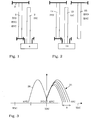
- Figure 1 shows schematically a top view of two camshafts 1 and 2, which assigned to a cylinder bank of a (not shown) diesel engine are.
- a diesel engine is characterized by a high compression ratio (typically 18: 1 versus 10: 1 for spark ignited Engines), a late fuel injection in the compression stroke, a stratified Air-fuel mixture in the cylinder and auto-ignition.
- the first camshaft 1 has a gear 3 or the like at its upper end in the figure which is driven by a chain, a belt or other gears can be.
- Cams (not shown) are arranged on the camshaft 1, which in the example shown with the inlet valves and the outlet valves interact with the cylinder row of the diesel engine.
- a second camshaft is parallel and closely adjacent to the first camshaft 1 2 arranged. This second camshaft 2 controls only that Closing the intake valves (IVC).
- the first camshaft 1 therefore only controls still opening the inlet valves (IVO) and opening (EVO) and closing (EVC) of the exhaust valves.
- the second camshaft 2 is driven at its lower end in the figure, so that their drive is opposite to that of the first camshaft 1. Furthermore is a device 4 between the second camshaft 2 and its drive provided for phase shift, which is typically a variable phase shift the second camshaft 2 by up to 60 ° crankshaft angle allowed.
- phase shift typically a variable phase shift the second camshaft 2 by up to 60 ° crankshaft angle allowed.
- FIG. 2 shows schematically the top view of an alternative embodiment of the cam shafts of a diesel engine.
- the starting point here is a state of the art at which for the intake valves and the exhaust valves of a cylinder bank two different Camshafts 11 and 15 are provided.
- the camshaft 15 controls only the opening (EVO) and closing (EVC) of the Exhaust valves.
- the first camshaft controls 11 however, only the opening of the intake valves (IVO), while similar to Figure 1 for closing the intake valves (IVC) parallel and closely adjacent to a first camshaft 11, a second camshaft 12 is provided. Coupling them and control with means 14 for phase shifting is similar as in Figure 1, so that a new description will be omitted can.
- FIG 3 shows in a diagram the possibilities of valve control in one Diesel engine according to the invention.
- Time is on the horizontal axis plotted, with the points marked at which the piston on top dead center (TDC).
- the opening stroke is on the vertical axis Exhaust valves or intake valves applied.
- the curve 20 describes the opening behavior of an exhaust valve while the family of curves 21 belongs to an inlet valve. From the illustration it can be seen that the Times of opening the exhaust valve (EVO), closing the exhaust valve (EVC) and the opening of the inlet valve (IVO) are unchanged, the last two times mentioned just behind or shortly before top dead center (TDC).
Landscapes
- Engineering & Computer Science (AREA)
- Mechanical Engineering (AREA)
- General Engineering & Computer Science (AREA)
- Chemical & Material Sciences (AREA)
- Combustion & Propulsion (AREA)
- Output Control And Ontrol Of Special Type Engine (AREA)
Abstract
Description
- Figur 1
- schematisch die Anordnung zweier Nockenwellen in einem erfindungsgemäßen Dieselmotor mit einer gemeinsamen Nockenwelle für Einlaß- und Auslaßventile;
- Figur 2
- schematisch die Anordnung dreier Nockenwellen in einem erfindungsgemäßen Dieselmotor mit verschiedenen Nockenwellen für Einlaß- und Auslaßventile; und
- Figur 3
- ein Zeitdiagramm für das variable Schließen der Einlaßventile bei einem erfindungsgemäßen Dieselmotor.
Claims (8)
- Dieselmotor mit variablem Kompressionsverhältnis, enthaltend mindestens eine Reihe von Zylindern mit mindestens einem Einlaßventil und mindestens einem Auslaßventil pro Zylinder, welche von einer Vorrichtung mit variabler Phasenverschiebung angesteuert werden,
dadurch gekennzeichnet, daß
für die Zylinderreihe zwei Nockenwellen für die Einlaßventile vorhanden sind, wobei die erste Nockenwelle (1, 11) das Öffnen und die zweite Nokkenwelle (2, 12) das Schließen der Einlaßventile steuert, und wobei die zweite Nockenwelle Mittel (4, 14) zur Phasenverschiebung enthält. - Dieselmotor nach Anspruch 1,
dadurch gekennzeichnet, daß
die Mittel zur Phasenverschiebung (4, 14) für eine Verzögerung des Schließzeitpunktes (IVC) um bis zu etwa 60° nach dem üblichen IVC eingerichtet sind. - Dieselmotor nach Anspruch 1 oder 2,
dadurch gekennzeichnet, daß
die erste (1, 11) und die zweite Nockenwelle (2, 12) parallel und benachbart zueinander angeordnet sind. - Dieselmotor nach Anspruch 3,
dadurch gekennzeichnet, daß
die Antriebe der ersten (1, 11) und der zweiten Nockenwelle (2, 12) an gegenüberliegenden Enden der Nockenwellen angeordnet sind. - Dieselmotor nach einem der Ansprüche 1 bis 4,
dadurch gekennzeichnet, daß
dieser einen Turbolader sowie eine mit den Mitteln (4, 14) zur Phasenverschiebung gekoppelte Motorsteuerung aufweist, wobei die Motorsteuerung dahingehend ausgebildet ist, die Verzögerung des Schließens der Einlaßventile in Abhängigkeit von der Motordrehzahl, der Motorlast und/oder dem Ladedruck des Turboladers anzupassen. - Dieselmotor nach Anspruch 5,
dadurch gekennzeichnet, daß
die Motorsteuerung dahingehend ausgebildet ist, die Verzögerung des Schließens der Einlaßventile bei geringer Motordrehzahl mit zunehmender Motorlast zu verringern, um eine gleichbleibende Motorleistung zu gewährleisten. - Dieselmotor nach einem der Ansprüche 1 bis 6,
dadurch gekennzeichnet, daß
die erste Nockenwelle (1, 11) auch die Auslaßventile steuert. - Verfahren zur Steuerung eines Dieselmotors mit einem Turbolader, wobei zur Variation des Kompressionsverhältnisses das Schließen mindestens eines Einlaßventils verzögert wird,
dadurch gekennzeichnet, daß
bei geringer Motordrehzahl das Schließen der Einlaßventile mit zunehmender Motorlast weniger verzögert wird, um eine gleichbleibende Motorleistung zu gewährleisten.
Priority Applications (3)
| Application Number | Priority Date | Filing Date | Title |
|---|---|---|---|
| EP01125281A EP1306527B1 (de) | 2001-10-25 | 2001-10-25 | Dieselmotor mit variablem Kompressionsverhältnis |
| DE50113447T DE50113447D1 (de) | 2001-10-25 | 2001-10-25 | Dieselmotor mit variablem Kompressionsverhältnis |
| US10/065,496 US20030079702A1 (en) | 2001-10-25 | 2002-10-24 | Variable effective compression ratio using VVT |
Applications Claiming Priority (1)
| Application Number | Priority Date | Filing Date | Title |
|---|---|---|---|
| EP01125281A EP1306527B1 (de) | 2001-10-25 | 2001-10-25 | Dieselmotor mit variablem Kompressionsverhältnis |
Publications (2)
| Publication Number | Publication Date |
|---|---|
| EP1306527A1 true EP1306527A1 (de) | 2003-05-02 |
| EP1306527B1 EP1306527B1 (de) | 2008-01-02 |
Family
ID=8179066
Family Applications (1)
| Application Number | Title | Priority Date | Filing Date |
|---|---|---|---|
| EP01125281A Expired - Lifetime EP1306527B1 (de) | 2001-10-25 | 2001-10-25 | Dieselmotor mit variablem Kompressionsverhältnis |
Country Status (3)
| Country | Link |
|---|---|
| US (1) | US20030079702A1 (de) |
| EP (1) | EP1306527B1 (de) |
| DE (1) | DE50113447D1 (de) |
Cited By (3)
| Publication number | Priority date | Publication date | Assignee | Title |
|---|---|---|---|---|
| WO2008046887A1 (de) * | 2006-10-18 | 2008-04-24 | Mahle International Gmbh | Betätigungseinrichtung für zwei parallel drehende nockenwellen |
| EP1550794A3 (de) * | 2003-12-18 | 2009-12-30 | General Motors Corporation | Dieselmotor mit doppeltem Einla nocken zur Steuerung des Verdichtungsverhältnisses |
| NL1038649A (en) * | 2011-03-08 | 2012-09-11 | Rosenthal Msc | Valve system and drive there for. |
Families Citing this family (7)
| Publication number | Priority date | Publication date | Assignee | Title |
|---|---|---|---|---|
| DE10307167A1 (de) * | 2003-02-20 | 2004-09-02 | Daimlerchrysler Ag | Verfahren zur Steuerung eines Einlassventils einer Brennkraftmaschine |
| US6918384B2 (en) * | 2003-12-08 | 2005-07-19 | General Motors Corporation | Diesel engine with cam phasers for in-cylinder temperature control |
| US7395790B2 (en) | 2004-11-18 | 2008-07-08 | S&S Cycle, Inc. | Reed valve breather for evolution engine |
| DE602008001371D1 (de) * | 2008-04-10 | 2010-07-08 | Fiat Ricerche | Turbokraftstoffmotor mit variabler Steuerung der Aufnahmeventile |
| JP4716053B2 (ja) | 2008-09-12 | 2011-07-06 | 三菱自動車工業株式会社 | 内燃機関 |
| EP2389504A4 (de) * | 2009-01-23 | 2013-08-07 | Turbo Innovation Llc | Zyklus für einen verbrennungsmotor |
| US10760519B2 (en) * | 2018-05-22 | 2020-09-01 | Mazda Motor Corporation | Control device of compression-ignition engine |
Citations (4)
| Publication number | Priority date | Publication date | Assignee | Title |
|---|---|---|---|---|
| US5970929A (en) * | 1996-01-26 | 1999-10-26 | Maurice Tacquet | Turbocharged 4 stroke diesel engine with a variable camshaft timing system |
| US6044816A (en) * | 1997-10-24 | 2000-04-04 | Daimlerchrysler Ag | Variable valve control for an internal combustion engine |
| US6058896A (en) * | 1998-04-02 | 2000-05-09 | Daimlerchrysler Ag | Variable valve control for an internal combustion engine |
| US6209516B1 (en) | 1998-10-30 | 2001-04-03 | Mitsubishi Jidosha Kogyo Kabushiki Kaisha | Control system and control method for diesel engine |
Family Cites Families (5)
| Publication number | Priority date | Publication date | Assignee | Title |
|---|---|---|---|---|
| US3610218A (en) * | 1970-04-13 | 1971-10-05 | Roger Owen Durham | Desmodromic valve actuator |
| JP3298352B2 (ja) * | 1995-03-16 | 2002-07-02 | 日産自動車株式会社 | ディーゼルエンジン |
| JP3123398B2 (ja) * | 1995-07-26 | 2001-01-09 | トヨタ自動車株式会社 | 内燃機関の連続可変バルブタイミング制御装置 |
| JP3834921B2 (ja) * | 1997-04-02 | 2006-10-18 | 三菱自動車工業株式会社 | 可変動弁機構 |
| ES1040073Y (es) * | 1998-04-23 | 1999-07-16 | Martinez Jose Benlloch | Dispositivo perfeccionado para el accionamiento en las valvulas de distribucion variable para motores de combustion interna. |
-
2001
- 2001-10-25 EP EP01125281A patent/EP1306527B1/de not_active Expired - Lifetime
- 2001-10-25 DE DE50113447T patent/DE50113447D1/de not_active Expired - Lifetime
-
2002
- 2002-10-24 US US10/065,496 patent/US20030079702A1/en not_active Abandoned
Patent Citations (4)
| Publication number | Priority date | Publication date | Assignee | Title |
|---|---|---|---|---|
| US5970929A (en) * | 1996-01-26 | 1999-10-26 | Maurice Tacquet | Turbocharged 4 stroke diesel engine with a variable camshaft timing system |
| US6044816A (en) * | 1997-10-24 | 2000-04-04 | Daimlerchrysler Ag | Variable valve control for an internal combustion engine |
| US6058896A (en) * | 1998-04-02 | 2000-05-09 | Daimlerchrysler Ag | Variable valve control for an internal combustion engine |
| US6209516B1 (en) | 1998-10-30 | 2001-04-03 | Mitsubishi Jidosha Kogyo Kabushiki Kaisha | Control system and control method for diesel engine |
Cited By (4)
| Publication number | Priority date | Publication date | Assignee | Title |
|---|---|---|---|---|
| EP1550794A3 (de) * | 2003-12-18 | 2009-12-30 | General Motors Corporation | Dieselmotor mit doppeltem Einla nocken zur Steuerung des Verdichtungsverhältnisses |
| WO2008046887A1 (de) * | 2006-10-18 | 2008-04-24 | Mahle International Gmbh | Betätigungseinrichtung für zwei parallel drehende nockenwellen |
| US8141528B2 (en) | 2006-10-18 | 2012-03-27 | Mahle International Gmbh | Actuating device for two parallel rotating camshafts |
| NL1038649A (en) * | 2011-03-08 | 2012-09-11 | Rosenthal Msc | Valve system and drive there for. |
Also Published As
| Publication number | Publication date |
|---|---|
| EP1306527B1 (de) | 2008-01-02 |
| DE50113447D1 (de) | 2008-02-14 |
| US20030079702A1 (en) | 2003-05-01 |
Similar Documents
| Publication | Publication Date | Title |
|---|---|---|
| DE19818596C5 (de) | Verfahren zum Betrieb einer im Viertakt arbeitenden Hubkolbenbrennkraftmaschine | |
| EP1296043B1 (de) | Brennkraftmaschine | |
| EP0663042B1 (de) | Hybridgesteuerter viertakt-ottomotor | |
| DE10344913B4 (de) | Motor mit modifizierten Nockenprofilen zur internen AGR-Steuerung | |
| DE102010008959A1 (de) | Verbrennungsmotor mit variablem Ventiltrieb | |
| DD148971A5 (de) | Verfahren und vorrichtung zur verbesserung des wirkungsgrades einer aufgeladenen brennkraftmaschine | |
| DE102004046534B4 (de) | Verfahren und Vorrichtung zum Betreiben eines Motors | |
| DE102005031241A1 (de) | Variabler Ventiltrieb einer Kolben-Brennkraftmaschine | |
| EP2183469B1 (de) | Kolbenmotor | |
| DE102016209957A1 (de) | Verfahren zum Betreiben einer Brennkraftmaschine und Brennkraftmaschine | |
| WO2008031555A1 (de) | Brennkraftmaschine mit gemischten nockenwellen | |
| DE10359267B4 (de) | Verbrennungsmotor mit Ansaugventilen, variabler Ventilbetätigung und Zeitsteuerung | |
| DE102017206266A1 (de) | Verfahren zum Betreiben einer Brennkraftmaschine und Brennkraftmaschine | |
| EP1306527B1 (de) | Dieselmotor mit variablem Kompressionsverhältnis | |
| DE102004041607B4 (de) | Verbrennungsmotor | |
| EP1331382B1 (de) | Verfahren, Computerprogramm und Steuer und/oder Regelgerät zum Betreiben einer Brennkraftmaschine, sowie Brennkraftmaschine | |
| EP3008300B1 (de) | Brennkraftmaschine und verfahren zum wechsel der betriebsart einer solchen brennkraftmaschine von einem normalbetrieb in einen scavengingbetrieb | |
| EP1333158B1 (de) | Viertakt-Ottomotor mit Direkteinspritzung und Verfahren zur Ventilsteuerung | |
| DE69400893T2 (de) | Viertaktbrennkraftmaschine | |
| EP1338776B1 (de) | Viertakt-Ottomotor mit separat verstellbaren Nockenwellen sowie Steuerungsverfahren | |
| DE10344426B4 (de) | Verfahren zum Betrieb einer Brennkraftmaschine | |
| EP1191211A2 (de) | Verfahren zum Betreiben einer fremdgezündeten Brennkraftmaschine | |
| EP1464813B1 (de) | Verfahren zum Betrieb einer Brennkraftmaschine mit zwei Einlassventilen | |
| EP1741904B1 (de) | Verfahren zur Steuerung eines Viertakt-Ottomotors mit variabler Ventilsteuerung | |
| EP2532860B1 (de) | Brennkraftmaschine |
Legal Events
| Date | Code | Title | Description |
|---|---|---|---|
| PUAI | Public reference made under article 153(3) epc to a published international application that has entered the european phase |
Free format text: ORIGINAL CODE: 0009012 |
|
| AK | Designated contracting states |
Designated state(s): AT BE CH CY DE DK ES FI FR GB GR IE IT LI LU MC NL PT SE TR |
|
| AX | Request for extension of the european patent |
Extension state: AL LT LV MK RO SI |
|
| 17P | Request for examination filed |
Effective date: 20031103 |
|
| AKX | Designation fees paid |
Designated state(s): DE FR GB |
|
| 17Q | First examination report despatched |
Effective date: 20070219 |
|
| GRAC | Information related to communication of intention to grant a patent modified |
Free format text: ORIGINAL CODE: EPIDOSCIGR1 |
|
| GRAP | Despatch of communication of intention to grant a patent |
Free format text: ORIGINAL CODE: EPIDOSNIGR1 |
|
| RAP1 | Party data changed (applicant data changed or rights of an application transferred) |
Owner name: FORD GLOBAL TECHNOLOGIES, LLC |
|
| GRAS | Grant fee paid |
Free format text: ORIGINAL CODE: EPIDOSNIGR3 |
|
| GRAA | (expected) grant |
Free format text: ORIGINAL CODE: 0009210 |
|
| AK | Designated contracting states |
Kind code of ref document: B1 Designated state(s): DE FR GB |
|
| REG | Reference to a national code |
Ref country code: GB Ref legal event code: FG4D Free format text: NOT ENGLISH |
|
| REF | Corresponds to: |
Ref document number: 50113447 Country of ref document: DE Date of ref document: 20080214 Kind code of ref document: P |
|
| GBT | Gb: translation of ep patent filed (gb section 77(6)(a)/1977) |
Effective date: 20080403 |
|
| ET | Fr: translation filed | ||
| PLBE | No opposition filed within time limit |
Free format text: ORIGINAL CODE: 0009261 |
|
| STAA | Information on the status of an ep patent application or granted ep patent |
Free format text: STATUS: NO OPPOSITION FILED WITHIN TIME LIMIT |
|
| 26N | No opposition filed |
Effective date: 20081003 |
|
| PGFP | Annual fee paid to national office [announced via postgrant information from national office to epo] |
Ref country code: GB Payment date: 20140925 Year of fee payment: 14 |
|
| PGFP | Annual fee paid to national office [announced via postgrant information from national office to epo] |
Ref country code: FR Payment date: 20140924 Year of fee payment: 14 Ref country code: DE Payment date: 20141028 Year of fee payment: 14 |
|
| REG | Reference to a national code |
Ref country code: DE Ref legal event code: R119 Ref document number: 50113447 Country of ref document: DE |
|
| GBPC | Gb: european patent ceased through non-payment of renewal fee |
Effective date: 20151025 |
|
| PG25 | Lapsed in a contracting state [announced via postgrant information from national office to epo] |
Ref country code: GB Free format text: LAPSE BECAUSE OF NON-PAYMENT OF DUE FEES Effective date: 20151025 Ref country code: DE Free format text: LAPSE BECAUSE OF NON-PAYMENT OF DUE FEES Effective date: 20160503 |
|
| REG | Reference to a national code |
Ref country code: FR Ref legal event code: ST Effective date: 20160630 |
|
| PG25 | Lapsed in a contracting state [announced via postgrant information from national office to epo] |
Ref country code: FR Free format text: LAPSE BECAUSE OF NON-PAYMENT OF DUE FEES Effective date: 20151102 |