EP1302467A2 - Process for the preparation of substituted thiazoline derivatives and their intermediate - Google Patents
Process for the preparation of substituted thiazoline derivatives and their intermediate Download PDFInfo
- Publication number
- EP1302467A2 EP1302467A2 EP02021002A EP02021002A EP1302467A2 EP 1302467 A2 EP1302467 A2 EP 1302467A2 EP 02021002 A EP02021002 A EP 02021002A EP 02021002 A EP02021002 A EP 02021002A EP 1302467 A2 EP1302467 A2 EP 1302467A2
- Authority
- EP
- European Patent Office
- Prior art keywords
- formula
- hcl
- methylcysteine
- thiazoline
- solvent
- Prior art date
- Legal status (The legal status is an assumption and is not a legal conclusion. Google has not performed a legal analysis and makes no representation as to the accuracy of the status listed.)
- Withdrawn
Links
- 0 C*CC1CCCC1 Chemical compound C*CC1CCCC1 0.000 description 2
Classifications
-
- C—CHEMISTRY; METALLURGY
- C07—ORGANIC CHEMISTRY
- C07D—HETEROCYCLIC COMPOUNDS
- C07D417/00—Heterocyclic compounds containing two or more hetero rings, at least one ring having nitrogen and sulfur atoms as the only ring hetero atoms, not provided for by group C07D415/00
- C07D417/02—Heterocyclic compounds containing two or more hetero rings, at least one ring having nitrogen and sulfur atoms as the only ring hetero atoms, not provided for by group C07D415/00 containing two hetero rings
- C07D417/04—Heterocyclic compounds containing two or more hetero rings, at least one ring having nitrogen and sulfur atoms as the only ring hetero atoms, not provided for by group C07D415/00 containing two hetero rings directly linked by a ring-member-to-ring-member bond
-
- C—CHEMISTRY; METALLURGY
- C07—ORGANIC CHEMISTRY
- C07C—ACYCLIC OR CARBOCYCLIC COMPOUNDS
- C07C319/00—Preparation of thiols, sulfides, hydropolysulfides or polysulfides
- C07C319/02—Preparation of thiols, sulfides, hydropolysulfides or polysulfides of thiols
-
- C—CHEMISTRY; METALLURGY
- C07—ORGANIC CHEMISTRY
- C07D—HETEROCYCLIC COMPOUNDS
- C07D277/00—Heterocyclic compounds containing 1,3-thiazole or hydrogenated 1,3-thiazole rings
- C07D277/02—Heterocyclic compounds containing 1,3-thiazole or hydrogenated 1,3-thiazole rings not condensed with other rings
- C07D277/08—Heterocyclic compounds containing 1,3-thiazole or hydrogenated 1,3-thiazole rings not condensed with other rings having one double bond between ring members or between a ring member and a non-ring member
- C07D277/12—Heterocyclic compounds containing 1,3-thiazole or hydrogenated 1,3-thiazole rings not condensed with other rings having one double bond between ring members or between a ring member and a non-ring member with hetero atoms or with carbon atoms having three bonds to hetero atoms with at the most one bond to halogen, e.g. ester or nitrile radicals, directly attached to ring carbon atoms
Definitions
- Substituted thiazolines such as 4,5-dihydro-2- (2,4-dihydroxyphenyl) -4-methylthiazol-4- (S) -carboxylic acid, 4,5-dihydro-2- (2,3-dihydroxyphenyl) -4-methyl-thiazol-4 (S) -carboxylic acid, 4,5-dihydro-2- (2-hydroxy-3-methoxyphenyl) -4-methyl-thiazole-4- (S) -carboxylic acid, 4,5-dihydro-2- (4-carboxy-2-hydroxyphenyl) -4-methyl-thiazole-4- (S) -carboxylic acid, 4,5-dihydro-2- (2-hydroxyphenyl) -4-methyl-thiazole-4- (S) -carboxylic acid, 4,5-dihydro-2- (3-hydroxyquinolin-2-yl) -4-methylthiazol-4- (S) -carboxylic acid, 4,5
- This compound is produced by coupling the (S) - ⁇ -methylcysteine or a salt thereof with the corresponding nitrile or imido ester compound and has already been described in the literature. This is how the Coupling of (S) - ⁇ -methylcysteine hydrochloride with 2,4-dihydroxy-benzonitrile for example according to J. Med. Chem.
- the object of the invention was a process which can be carried out on an industrial scale to find that the production of substituted thiazolines compared to State of the art ensures higher yields with a simpler reaction.
- the invention therefore relates to a process for the preparation of substituted thiazolines of the formula (I) in the Ar are a phenyl, naphthyl, thienyl, pyridyl or quinolinyl radical, which is optionally substituted by one or more substituents from the group halogen, OH, benzyloxy, C 1 -C 4 alkyl, C 1 -C 4 alkoxy , COOR 1 can be substituted with R 1 equal to H or C 1 -C 4 alkyl, by coupling (S) - ⁇ -methylcysteine hydrochloride of the formula (II) with an aromatic or heteroaromatic nitrile of the formula (III) Ar-CN in which Ar is as defined above or a corresponding C 1 -C 4 alkylimidate, which is characterized in that (S) - ⁇ -methylcysteine hydrochloride of the formula (II) in a C 1 -C 4 alcohol, a mixture from two or more
- Ar represents a phenyl, naphthyl, thienyl, pyridyl or quinolinyl radical, with the phenyl and naphthyl radical being preferred.
- Ar particularly preferably denotes phenyl.
- the radicals may optionally also be substituted one or more times by substituents from the group halogen, such as fluorine, chlorine, iodine or bromine, OH, benzyloxy, C 1 -C 4 -alkyl, such as methyl, ethyl, propyl and butyl, C 1 -C 4 -Alkoxy, such as methoxy, ethoxy, butoxy, COOR 1 with R 1 being H or C 1 -C 4 -alkyl.
- Preferred substituents are Cl, OH, methyl, methoxy and COOH, OH is particularly preferred.
- Ar is preferably substituted by one or two, particularly preferably by two, of the above-mentioned substituents.
- Possible preferred end compounds which can be prepared according to the invention are, for example, 4,5-dihydro-2- (2,4-dihydroxyphenyl) -4-methylthiazol-4- (S) -carboxylic acid, 4,5-dihydro-2- (2nd , 3-dihydroxyphenyl) -4-methylthiazole-4- (S) -carboxylic acid, 4,5-di-hydro-2- (2-hydroxy-3-methoxyphenyl) -4-methylthiazole-4- (S) - carboxylic acid, 4,5-dihydro-2- (4-carboxy-2-hydroxyphenyl) -4-methylthiazole-4- (S) -carboxylic acid, 4,5-dihydro-2- (2-hydroxyphenyl) -4- methylthiazol-4- (S) -carboxylic acid, 4,5-di-hydro-2- (3-hydroxy-quinolin-2-yl) -4-methylthiazol-4- (S) -car
- the starting compound used is (S) - ⁇ -methylcysteine hydrochloride of the formula (II) and a nitrile of the formula (III) or a corresponding imidate is used.
- (S) - ⁇ -Methylcysteine hydrochloride can be prepared, for example, according to the prior art, such as according to Synlett (1994), pages 702-703.
- (S) - ⁇ -methylcysteine hydrochloride is preferably prepared according to a modified variant, which is also the subject of the invention.
- a suitable protective group such as tetrahydropyranyl, acetyl, benzy
- Base such as triethylamine, di-i-propyl-ethylamine, pyridine, etc. in a C 1 -C 4 alcohol, such as methanol, ethanol, butanol, a mixture of two or more C 1 -C 4 alcohols or a mixture of C 1 -C 4 alcohol and a hydrocarbon, such as toluene, or an alkane, for example hexane, heptane, etc., to give a compound of the formula (VI) in which Ar and R 2 are as defined above, coupled.
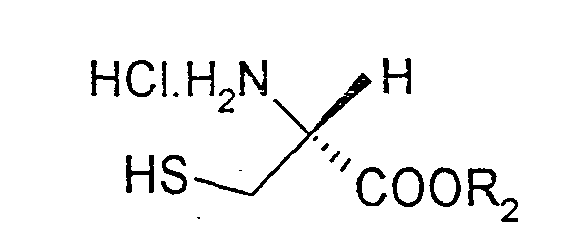
- L-cysteine and the L-cysteine-C 1 -C 4 -ester hydrochloride are suitable as L-cysteine compounds of the formula (IV).
- the L-cysteine compounds of the formula (IV) are then reacted either with a corresponding nitrile of the formula (V) or with the corresponding C 1 -C 4 -alkylimidate HCl.
- Suitable nitriles are benzonitrile, tolunitrile or 2,4-dihydroxybenzonitrile protected on the oxygen atoms, for example with tetrahydropyranyl, acetyl or benzyl.
- the corresponding C 1 -C 4 alkylimidates are either commercially available or can be prepared from the nitriles using a C 1 -C 4 alcohol and HCl.
- the nitrile of the formula (V) or the corresponding alkylimidate is preferably used in an equimolar amount based on the L-cysteine compound of the formula (IV). If necessary, an excess can also be used, but this does not result in any advantages.
- the coupling with the L-cysteine compound takes place in the presence of a tert.
- Base such as triethylamine, di-i-propyl-ethylamine or pyridine. Triethylamine is preferably used.
- the tert. Base is added in an amount of 0.9 to 1.3 mol, preferably from 1.0 to 1.2 mol and particularly preferably from 1.02 to 1.1 mol, per mol of L-cysteine compound. Larger excesses can also be used, but have a negative effect on the yield.
- Compounds of formula (VI) are, for example, 4-carbethoxy-2-phenylthiazoline, 2-phenylthiazoline-4-carboxylic acid, 4-carbethoxy-2- (2,4-ditetrahydropyranyl) thiazoline, etc. If L-cysteine is used as the L-cysteine compound, a compound of the formula (VI) with R 2 equal to H is obtained, which is then converted into a C 1 -C 4 ester.
- the compound of formula (VI) in which R 2 is C 1 -C 4 alkyl is then in a second stage, after aqueous work-up and extraction, optionally azeotropic drying of the extracts and / or isolation of the compound, using a Methylation reagent, for example with methyl iodide, chloride or bromide, under the action of a base to give the corresponding thiazoline of the formula (VII) where Ar is as defined above and R 3 is C 1 -C 4 alkyl, such as 4-carbethoxy-4-methyl-2-phenylthiazoline or 4-carbethoxy-4-methyl-2- (2,4-ditetrahydropyranyl) implemented thiazoline etc.
- a Methylation reagent for example with methyl iodide, chloride or bromide
- This second step takes place in an ether, for example in methyl tert-butyl ether (MTBE), tetrahydrofuran (THF) or diethyl ether, and in the presence of a base.
- Lithium diisopropylamide (LDA) which is obtained from diisopropylamine and butyllithium, is preferably used as the base.
- the methylating agent is used in an amount of 1 to 3 mol, preferably 1 to 2 mol and particularly preferably 1.2 to 1.7 mol, per mol of compound of the formula (VI).
- LDA is used in an amount of 1 to 1.5 mol, preferably from 1 to 1.3 mol and particularly preferably from 1.05 to 1.2 mol, per mol of compound of the formula (VI).
- the methylation takes place at a temperature from -80 ° C to + 40 ° C, preferably from -30 ° C to + 35 ° C and particularly preferably from -20 ° C to + 30 ° C.
- sufficient HCl is added to achieve a pH between 1.5 and 5, preferably between 2 and 3, whereupon a two-phase mixture is obtained.
- the organic phase which contains the thiazoline of the formula (VII), can be used directly in the next step after extraction. However, the thiazoline of the formula (VII) can also be isolated first.
- the corresponding thiazoline carboxylic acid of the formula (VIII) is obtained by basic hydrolysis and, if appropriate, after splitting off a protective group on one or more hydroxyl groups on the aromatic radical.
- Ar is as defined above, such as optionally substituted 4-methyl-2-phenylthiazoline-4-carboxylic acid, etc. obtained as a racemate.
- a base such as NaOH, KOH, LiOH, etc., or a mixture of base and THF or dioxane, preferably to the product solution from stage 2, whereby a two-phase reaction mixture is obtained which is stirred at reflux temperature.
- HCl is added to the aqueous phase until a pH between 1.5 to 4.5, preferably between 1.5 to 4 and particularly preferably 1.5 to 3 is reached.
- the acidification separates the acid as an oil, which can optionally be isolated by extraction, separation of the organic phase, removal of water by azeotropic distillation and distillation of the extractant.
- the racemate is separated using a split base.
- Suitable cleavage bases are, for example, enantiomerically pure, chiral amines, such as optionally substituted phenylethylamine, optionally substituted phenylglycinamide, norephedrine, quinine, etc.
- the cleavage takes place in a solvent in which the thiazoline-4-carboxylic acid of the formula (VIII) dissolves, for example in an alcohol, such as ethanol, propanol, etc., an alcohol / water mixture, an acetic acid ester, such as isopropyl acetate (IPA ), Ethyl acetate, etc.
- a solvent in which the thiazoline-4-carboxylic acid of the formula (VIII) dissolves for example in an alcohol, such as ethanol, propanol, etc., an alcohol / water mixture, an acetic acid ester, such as isopropyl acetate (IPA ), Ethyl acetate, etc.
- IPA isopropyl acetate
- the crystallization is started with stirring by cooling the reaction mixture.
- a multi-stage temperature program in which the cooling rate varies in the individual stages can be selected.
- crystallization it is also possible to support or initiate this by seeding.
- HCl is then added to a mixture of chiral salt, water and a suitable solvent, giving two clear phases.
- Suitable solvents are those which are immiscible with water, which dissolve the acid and which are resistant to HCl. Examples of these are ethers or esters. Ethers are preferably used, particularly preferably MTBE.
- the HCI is added until the pH of the aqueous phase is 1 to 4, preferably 1 to 3 and particularly preferably 1.5 to 3.
- the organic phase is then separated off and, if necessary, washed.
- a lipase-catalyzed resolution of the thiazoline of the formula (VII) can also be carried out.
- Suitable lipases are, for example, Pig Liver Esterase, Candida rugosa Lipase, Aspergillus species Lipase, Aspergillus species Protease, Bacillus species Protease, Subtilisin Carlsberg, Candida antarctica "A” lipase, Candida antarctica "B” lipase, ChiroCLEC TM-PC (dry), ChiroCLEC TM-PC (slurry), etc.
- the (S) -thiazolinecarboxylic acid of the formula (VIII) is subsequently converted into (S) -2-methylcysteine HCl by acid hydrolysis.
- the (S) -thiazolinecarboxylic acid of the formula (VIII) is dissolved in HCl and the solution thus obtained is boiled at reflux temperature. It is preferred to work under a nitrogen atmosphere. After 1 to 30 hours, preferably 5 to 25 hours and particularly preferably after 10 to 20 hours, the reaction mixture is cooled to 0 to 35 ° C., preferably to 10 to 30 ° C.
- the cleavage product which has precipitated out for example optionally substituted benzoic acid, which is then washed one or more times with optionally degassed water or with dilute HCl.
- the acidic filtrate is first extracted with a suitable extractant to remove the cleavage product completely.
- suitable solvents are MTBE, toluene, ethyl methyl ketone, IPA, THF, CH 2 Cl 2 , diethyl ether etc.
- the (S) -2-methylcysteine HCl can then be isolated by spray drying the aqueous phase.
- the aqueous phase is evaporated, preferably under reduced pressure, giving an oil which is subsequently dissolved 1 to 5 times in optionally degassed water, or a mixture of water with tetrahydrofuran (THF), acetone or IPA is and in each case completely or to a 65 to 20% solution, preferably evaporated under reduced pressure.
- a solvent suitable for azeotropic distillation which forms an azeotrope with water, for example toluene, dichloromethane, 2-butanol, i-propanol or MTBE, is added to the concentrated solution thus obtained, and that in Solution contained water dragged out.
- the remaining suspension or solution containing the (S) -2-methylcysteine HCl can then be used directly in the next step, coupling with a nitrile of the formula (III). If necessary, the solution or suspension is supplemented with fresh solvent and then reacted directly with the nitrile of the formula (III) in the presence of a tertiary base to give the desired end product, a thiazoline of the formula (I).
- the remaining suspension or solution can, however, optionally be used to precipitate the (S) -2-methylcysteine HCl with an ether, such as MTBE, diethyl ether, diisopropyl ether, etc., or a hydrocarbon, such as a C 6 -C 8 alkane, toluene, etc., are added, whereupon the (S) -2-methylcysteine HCl is filtered off, washed one or more times with the ether or hydrocarbon used and dried under vacuum.
- an ether such as MTBE, diethyl ether, diisopropyl ether, etc.
- a hydrocarbon such as a C 6 -C 8 alkane, toluene, etc.
- Another production variant according to the invention for (S) -2-methylcysteine HCl is a modified variant of the Seebach analog synthesis described in Tetrahedron (1993), 49 (24), p.5359-5364, which is based on the enantioselective methylation induced by a chiral protective group of the unnatural and therefore not commercially available S-cysteine methyl ester HCl.
- the readily available L-cysteine ethyl ester HCl is in a first stage with 2 to 3 equivalents of acetone in a hydrocarbon, for example toluene, hexane, etc. or in acetone itself, optionally in the presence of a tert.
- Amines such as triethylamine, di-i-propyl-ethylamine or pyridine, etc., implemented.
- the reaction mixture is cooled, the precipitate is filtered off, washed if necessary and the filtrate is freed from the solvent. If acetone itself is used as a solvent, there is no need to separate the water of reaction.
- the reaction solution is merely concentrated, the residue is partitioned between NaHCO 3 , NaOH or KOH and toluene and the product is isolated from the organic phase.
- the acetonide obtained in this way is dissolved in the 2nd stage in 2 to 3 equivalents of formic acid, toluene or acetic anhydride is added and the reaction mixture obtained is stirred for some time, preferably for 10 minutes to 5 hours.
- the reaction mixture is then concentrated and partitioned between an ether, ester or suitable hydrocarbon and a sodium hydrogen carbonate, NaOH or KOH solution.
- the organic phase is dried azeotropically and freed from the solvent.
- the methylation of the N-formylated acetonide (3-formyl-2,2-dimethyl-thiazoline-4-carboxylic acid ethyl ester) obtained from the 2nd stage takes place by deprotonation with 1 to 1.5 equivalents, preferably of 1.1 to 1.2 equivalents of LDA and subsequent reaction with 1 to 2 equivalents, preferably with 1.1 to 1.5 equivalents of methylating agent.
- Suitable solvents are, for example, MTBE, THF, diethyl ether, etc. If appropriate, a co-solvent such as 1,3-dimethyl-3,4,5,6-tetrahydro- (1H) -pyrimidinone (DMPU) can also be added.
- DMPU 1,3-dimethyl-3,4,5,6-tetrahydro- (1H) -pyrimidinone
- the reaction temperature is -25 to -80 ° C, preferably -35 to -75 ° C and particularly preferably -45 to -55 ° C. An aqueous workup then takes place.
- the enantiomer separation of the racemic 3-formyl-2,2,4-trimethylthiazoline-4-carboxylic acid ethyl ester obtained is then preferably carried out by means of selective ester hydrolysis using a lipase, for example with Pig Liver Esterase, Candida rugosa lipase, Aspergillus species lipase; Aspergillus species protease, Bacillus species protease, Subtilisin Carlsberg, Candida antarctica "A” lipase, Candida antarctica "B” lipase, ChiroCLEC TM-PC (dry), ChiroCLEC TM-PC (slurry), etc.
- a lipase for example with Pig Liver Esterase, Candida rugosa lipase, Aspergillus species lipase; Aspergillus species protease, Bacillus species protease, Subtilisin Carlsberg, Candida antarctica "A” lipase,
- the (S) -2-methylcysteine HCl which is produced according to the prior art or preferably that according to one of the variants according to the invention, preferably according to the modified Synlett variant, is then mixed with an aromatic or heteroaromatic nitrile of the formula (III) Ar-CN or a corresponding one C 1 -C 4 alkyl imidate coupled.
- Ar has the same meaning as in formula (I).
- Some of the nitriles are commercially available, but can also be prepared from the corresponding aldehydes, for example using formic acid, sodium formate and hydroxylammonium sulfate.
- the corresponding C 1 -C 4 alkylimidates can be prepared from the nitriles using a C 1 -C 4 alcohol and HCl.
- the coupling takes place in a C 1 -C 4 alcohol, a mixture of two or more C 1 -C 4 alcohols or a mixture of C 1 -C 4 alcohol and a hydrocarbon with 0.5 to 2 mol of a nitrile of the formula (III) or on the corresponding C 1 -C 4 alkylimidate per mol (S) - ⁇ -methylcysteine hydrochloride in the presence of 1.5 to 3 mol of a tertiary base per mol (S) - ⁇ -methylcysteine hydrochloride , 0.8 to 1.5 mol, particularly preferably 0.9 to 1.1 mol, of nitrile or imidate are preferably used.
- tert a C 1 -C 4 alcohol, a mixture of two or more C 1 -C 4 alcohols or a mixture of C 1 -C 4 alcohol and a hydrocarbon with 0.5 to 2 mol of a nitrile of the formula (III) or on the corresponding C 1 -C 4 alkylim
- Base are, for example, triethylamine, di-i-propylethylamine or pyridine, which are preferably in an amount of 1.8 to 2.5 mol, particularly preferably 1.9 to 2.2 mol, of amine per mol of (S) - ⁇ - Methylcysteine hydrochloride can be added.
- Suitable solvents are C 1 -C 4 alcohols, such as methanol, ethanol butanol, a mixture of two or more C 1 -C 4 alcohols or a mixture of C 1 -C 4 alcohol and a hydrocarbon, such as toluene, C 6 -C 8 alkane, etc. However, ethanol and / or butanol is preferably used.
- Base is adjusted to a pH of 6.5 to 10, preferably 7 to 9 and particularly preferably 7.5 to 8 in the reaction solution.
- the reaction mixture is heated with stirring for 1 to 40 hours, preferably for 5 to 30 hours and particularly preferably for 15 to 25 hours, preferably under a nitrogen atmosphere, to 50 ° C. to the reflux temperature. Thereafter, the mixture is optionally cooled and the solvent is distilled off, preferably under reduced pressure, whereby an oil is obtained.
- the corresponding thiazoline of the formula (I) is then isolated from this oil by extraction of the impurities and precipitation of the thiazoline by acidification from the reaction mixture. For this purpose, the oil is distributed between water and a suitable solvent or extraction agent and excess starting material is extracted at a suitable pH.
- the oil when using 2,4-dihydroxynitrile, the oil is taken up in water, the pH with a suitable base, for example with KOH, NaOH, etc., to a pH of 6.5 to 9, preferably 7 to 9 and particularly preferably adjusted from 7.5 to 8 and extracted one or more times with a suitable extracting agent, such as, for example, diethyl ether, MTBE, dichloromethane, ethyl acetate, etc.
- a suitable extracting agent such as, for example, diethyl ether, MTBE, dichloromethane, ethyl acetate, etc.
- the aqueous phase is separated off and adjusted to a pH of 10 to 14, preferably 11 to 13, using a suitable base, for example KOH, NaOH, etc.
- a suitable extraction agent such as diethyl ether, MTBE, dichloromethane, ethyl acetate, etc.
- a suitable acid such as HCl, H 2 SO 4 , HBr and so on a pH of 6.5 to 10, preferably from 7 to 9 and particularly preferably from 7.5 to 8.
- the extractant is then completely removed from the water phase by distillation, preferably under reduced pressure.
- the extraction or cleaning steps at different pH values can also be carried out in different orders.
- the remaining aqueous solution is acidified with a suitable acid, such as HCl H 2 SO 4 , HBr, etc., until a pH of 1 to 3, preferably 1 to 2, is reached.
- a suitable acid such as HCl H 2 SO 4 , HBr, etc.
- the desired thiazoline begins to crystallize out.
- the suspension obtained in this way is then stirred for a while, preferably for 10 minutes to 3 hours, particularly preferably for 30 minutes to 1.5 hours, at a temperature of 5 to 25 ° C., preferably 10 to 20 ° C., and then the solid is filtered off , washed and dried under vacuum.
- a racemate separation of 4-carbethoxy-4,5-dihydro-4-methyl-2-phenylthiazoline was carried out using lipase:
- Preparation of a stock solution 300 mg of 4-carbethoxy-4,5-dihydro-4 -methyl-2-phenylthiazoline were taken up in 26 ml of phosphate buffer and dissolved by adding 1 ml of DMF and 1 ml of isopropyl acetate. 2 ml of this stock solution were added to about 20 mg of Candida rugosa lipase and stirred for 24 hours at room temperature. After 4 hours an ee of 70% was found with a yield of 79%, after 24 hours an ee of 99% (with a yield of 70%) by means of chiral GC.
- Candida antarctica A Aspergillus species Protease and various results similar to CLECs.
- the insoluble residue (62.5 g) was filtered off and washed twice with 50 ml of MTBE each.
- 10 g of activated carbon (Norit CA 5) were added to the mother liquor and the mixture was refluxed for 1 h, filtered through Celite Super Hyflow at 40 ° C. and washed twice with 50 ml of MTBE each.
- the mother liquor was washed three times with 100 ml of water. After the water had been azeotropically removed from the MTBE solution, the mixture was concentrated to about 20% of the original volume under reduced pressure and 500 ml of toluene were added. The remaining MTBE was then withdrawn further. A brown precipitate precipitated out, which was filtered off.
- the aqueous solution was further acidified to pH 1.5 with about 4.6 ml of 6 M HCl. 4,5-Dihydro-2- (2,4-dihydroxyphenyl) -4-methylthiazol-4- (S) -carboxylic acid begins crystallize. This Suspension was stirred at 15 ° C for 1 h. The solid was filtered off twice with each 10 ml of water (15 ° C) washed and dried under vacuum (30 mbar) at 55 ° C.
- the aqueous solution was further diluted with 5.2 ml of 6 M HCi Acidified to pH 2, starting 4,5-dihydro-2- (2,4-dihydroxyphenyl) -4-methylthiazole-4- (S) -carboxylic acid crystallize. This suspension was stirred at 20 ° C for 1 h. The solid was filtered off, washed twice with 20 ml of water and dried under vacuum (20 mbar) at 50 ° C.
Landscapes
- Chemical & Material Sciences (AREA)
- Organic Chemistry (AREA)
- Thiazole And Isothizaole Compounds (AREA)
- Pharmaceuticals Containing Other Organic And Inorganic Compounds (AREA)
- Organic Low-Molecular-Weight Compounds And Preparation Thereof (AREA)
- Preparation Of Compounds By Using Micro-Organisms (AREA)
Abstract
Description
Substituierte Thiazoline, wie etwa 4,5-Dihydro-2-(2,4-dihydroxyphenyl)-4-methylthiazol-4-(S)-carbonsäure, 4,5-Dihydro-2-(2,3-dihydroxyphenyl)-4-methyl-thiazol-4-(S)-carbonsäure, 4,5-Dihydro-2-(2-hydroxy-3-methoxyphenyl)-4-methylthiazol-4-(S)-carbonsäure, 4,5-Dihydro-2-(4-carboxy-2-hydroxyphenyl)-4-methylthiazol-4-(S)-carbonsäure, 4,5-Dihydro-2-(2-hydroxyphenyl)-4-methylthiazol-4-(S)-carbonsäure, 4,5-Dihydro-2-(3-hydroxyquinolin-2-yl)-4-methylthiazol-4-(S)-carbonsäure, 4,5-Dihydro-2-(2-hydroxynaphth-1-yl)-4-methylthiazol-4-(S)-carbonsäure, 4, 5-Dihydro-2-(3-hydro-xynaphth-2-yl)-4-methylthiazol-4-(S)-carbonsäure, 4,5-Dihydro-2-(2-hydroxy-phenyl-methyl)-4-methylthiazol-4-(S)-carbonsäure, u.s.w. sind potentielle Eisenchelatoren: Die Herstellung dieser Verbindung erfolgt über die Kopplung des (S)-α-Methylcysteins oder eines Salzes davon mit der entsprechenden Nitril- oder Imidoesterverbindung und wurde bereits in der Literatur beschrieben. So erfolgt die Kopplung von (S)-α-Methylcystein-Hydrochlorid mit 2,4-Dihydroxy-benzonitril beispielsweise gemäß J. Med. Chem. 1999, 42,2432-2440 in entgastem Methanol durch 3-tägiges Erhitzen auf 71°C unter Zusatz von entgastem Phosphatpuffer, zur Erzielung eines pH-Wertes von 6, wodurch nach Aufarbeitung des Reaktionsgemisches 4,5-Dihydro-2-(2,4-dihydroxyphenyl)-4-methylthiazol-4-(S)-carbonsäu-re in 57%iger Ausbeute erhalten wird. Analog wird 4,5-Dihydro-2-(2-hydroxyphenyl)-4-methylthiazol-4-(S)-carbonsäure in einer Ausbeute von lediglich 32% hergestellt. Eine wichtige Zwischenverbindung für die Synthese der oben angeführten Zielverbindungen ist dabei das (S)-α-Methylcystein, das beispielsweise gemäß Tetrahedron 1993, 49 (24), 5359-5364 in einer Seebach-analogen Synthese durch saure Hydrolyse von 2S,4S-Methyl-2-tert.-butyl-1,3-thiazolidin-3-formyl-4-methyl-4-carboxylat erhalten wird. 2S,4S-Methyl-2-tert.-butyl-1,3-thiazolidin-3-formyl-4-methyl-4-carboxylat wird dabei ausgehend von (S)-Cysteinmethylester und Pivaldehyd über 2S-Methyl-2-tert.-butyl-1,3-thiazolidin-4-carboxylat, Einführung einer Formylschutzgruppe zu 2S,4S-Methyl-2-tert.-butyl-1,3-thiazolidin-3-formyl-4-carboxylat, Reaktion bei -78°C mit Lithiumdiisopropylamid zum korrespondierenden Enolat und Quenchen des Enolates mit Methyliodid hergestellt. Die Ausbeute an (S)-α-Methylcystein ausgehend von (S)-Cysteinethylester beträgt dabei lediglich 29%. Neben der geringen Ausbeute an (S)-α-Methylcystein sind die aufwendigen Verfahrensschritte und vor allem das Ausgangsprodukt (S)-Cysteinmethylester-Hydrochlorid, einer unnatürlichen, kommerziell nicht verfügbaren und daher für technische Synthesen nicht in Betracht zu ziehende Verbindung, wesentliche Nachteile dieser Herstellvariante.Substituted thiazolines, such as 4,5-dihydro-2- (2,4-dihydroxyphenyl) -4-methylthiazol-4- (S) -carboxylic acid, 4,5-dihydro-2- (2,3-dihydroxyphenyl) -4-methyl-thiazol-4 (S) -carboxylic acid, 4,5-dihydro-2- (2-hydroxy-3-methoxyphenyl) -4-methyl-thiazole-4- (S) -carboxylic acid, 4,5-dihydro-2- (4-carboxy-2-hydroxyphenyl) -4-methyl-thiazole-4- (S) -carboxylic acid, 4,5-dihydro-2- (2-hydroxyphenyl) -4-methyl-thiazole-4- (S) -carboxylic acid, 4,5-dihydro-2- (3-hydroxyquinolin-2-yl) -4-methylthiazol-4- (S) -carboxylic acid, 4,5-dihydro-2- (2-hydroxynaphth-1-yl) -4- methylthiazol-4 (S) -carboxylic acid, 4,5-dihydro-2- (3-hydro-xynaphth-2-yl) -4-methylthiazol-4- (S) -carboxylic acid, 4,5-dihydro-2- (2-hydroxy-phenyl-methyl) -4-methylthiazol-4- (S) -carboxylic acid, etc. are potential iron chelators: This compound is produced by coupling the (S) -α-methylcysteine or a salt thereof with the corresponding nitrile or imido ester compound and has already been described in the literature. This is how the Coupling of (S) -α-methylcysteine hydrochloride with 2,4-dihydroxy-benzonitrile for example according to J. Med. Chem. 1999, 42, 2432-2440 in degassed methanol 3 days heating to 71 ° C with the addition of degassed phosphate buffer to achieve this a pH of 6, which after working up the reaction mixture 4,5-Dihydro-2- (2,4-dihydroxyphenyl) -4-methylthiazol-4- (S) -carboxylic acid in 57% Yield is obtained. Analogously, 4,5-dihydro-2- (2-hydroxyphenyl) -4-methylthiazole-4- (S) -carboxylic acid produced in a yield of only 32%. A important intermediate for the synthesis of the above-mentioned target compounds is the (S) -α-methylcysteine, for example according to tetrahedron 1993, 49 (24), 5359-5364 in a Seebach analog synthesis by acid hydrolysis obtained from 2S, 4S-methyl-2-tert-butyl-1,3-thiazolidine-3-formyl-4-methyl-4-carboxylate becomes. 2S, 4S-methyl-2-tert-butyl-1,3-thiazolidin-3-formyl-4-methyl-4-carboxylate starting from (S) -cysteine methyl ester and pivaldehyde over 2S-methyl-2-tert-butyl-1,3-thiazolidine-4-carboxylate, Introduction of a formyl protection group 2S, 4S-methyl-2-tert-butyl-1,3-thiazolidine-3-formyl-4-carboxylate, reaction at -78 ° C with lithium diisopropylamide to the corresponding enolate and quenching the enolate made with methyl iodide. Starting from (S) -α-methylcysteine of (S) -cysteine ethyl ester is only 29%. In addition to the low yield an (S) -α-methylcysteine are the complex process steps and above all that Starting product (S) -cysteine methyl ester hydrochloride, an unnatural, commercial not available and therefore not considered for technical syntheses pulling connection, significant disadvantages of this manufacturing variant.
In Synlett (1994), Seite 702-703 werden (R)-und (S)-Methylcysteinethyiester-Hydrochlorid durch Reaktion von Ethylbenzimidat-Hydrochlorid mit L-Cysteinethylester-Hydrochlorid, anschließender Methylierung und Racemattrennung des dadurch erhaltenen racemischen Gemisches von 4-Carbethoxy-4-methyl-2-phenylthiazolin mittels präparativer HPLC auf Cellulosetriacetat, sowie saurer Hydrolyse der erhaltenen enantiomerenreinen (R) und (S)- 4-Carbethoxy-4-methyl-2-phenyl-thiazoline mit nachfolgender Veresterung hergestellt. (R)-Methyl-Cysteinethylester-Hydrochlorid wird sodann mit Cyanomethyl-diphenylphosphinoxid zum korrespondierenden Thiazolin kondensiert. In weiterer Folge wird gemäß Synlett Thiangazol als Endprodukt hergestellt.In Synlett (1994), pages 702-703, (R) and (S) -methylcysteine ethyl ester hydrochloride by reaction of ethylbenzimidate hydrochloride with L-cysteine ethyl ester hydrochloride, subsequent methylation and racemate separation of the racemic mixture of 4-carbethoxy-4-methyl-2-phenylthiazoline thus obtained by means of preparative HPLC on cellulose triacetate and acid hydrolysis of the enantiomerically pure (R) and (S) - 4-carbethoxy-4-methyl-2-phenyl-thiazolines obtained with subsequent esterification. (R) -methyl-cysteine ethyl ester hydrochloride is then with cyanomethyl-diphenylphosphine oxide condensed to the corresponding thiazoline. Subsequently, according to Synlett Thiangazole produced as an end product.
Aufgabe der Erfindung war es ein im technischem Maßstab durchführbares Verfahren zu finden, das die Herstellung von substituierten Thiazolinen in im Vergleich zum Stand der Technik höheren Ausbeuten bei einfacherer Reaktionsführung gewährleistet.The object of the invention was a process which can be carried out on an industrial scale to find that the production of substituted thiazolines compared to State of the art ensures higher yields with a simpler reaction.
Gegenstand der Erfindung ist daher ein Verfahren zur Herstellung von substituierten
Thiazolinen der Formel (I)
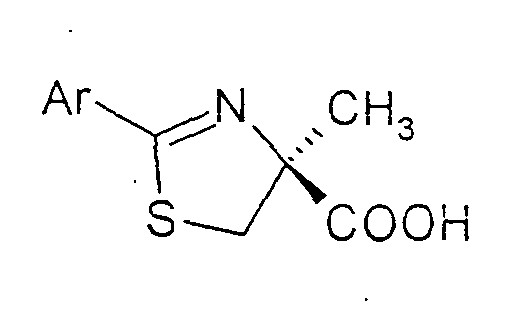
durch Kopplung von (S)-α-Methylcystein-Hydrochlorid der Formel (II)

by coupling (S) -α-methylcysteine hydrochloride of the formula (II)
Durch das erfindungsgemäße Verfahren werden substituierte Thiazoline der Formel
(I) hergestellt.
In der Formel (I) bedeutet Ar einen Phenyl-, Naphthyl-, Thienyl-, Pyridyl- oder Chinolinylrest,
wobei der Phenyl- und Naphthylrest bevorzugt sind. Besonders bevorzugt
bedeutet Ar Phenyl. Substituted thiazolines of the formula (I) are prepared by the process according to the invention.
In formula (I), Ar represents a phenyl, naphthyl, thienyl, pyridyl or quinolinyl radical, with the phenyl and naphthyl radical being preferred. Ar particularly preferably denotes phenyl.
Die Reste können dabei gegebenenfalls auch ein oder mehrfach durch Substituenten
aus der Gruppe Halogen, wie Fluor, Chlor, lod oder Brom, OH, Benzyloxy, C1-C4-Alkyl,
wie Methyl, Ethyl, Propyl und Butyl, C1-C4-Alkoxy,wie Methoxy, Ethoxy, Butoxy,
COOR1 mit R1 gleich H oder C1-C4-Alkyl substituiert sein. Bevorzugte Substituenten
sind Cl, OH, Methyl, Methoxy und COOH, besonders bevorzugt ist OH.
Bevorzugt ist Ar durch einen oder zwei, besonders bevorzugt durch zwei, der oben
angeführten Substituenten substituiert.
Mögliche bevorzugte Endverbindungen, die erfindungsgemäß hergestellt werden
können, sind beispielsweise 4,5-Dihydro-2-(2,4-dihydroxyphenyl)-4-methylthiazol-4-(S)-carbonsäure,
4,5-Dihydro-2-(2,3-dihydroxyphenyl)-4-methylthia-zol-4-(S)-carbonsäure,
4,5-Di-hydro-2-(2-hydroxy-3-methoxyphenyl)-4-methylthiazol-4-(S)-carbonsäure,
4,5-Dihy-dro-2-(4-carboxy-2-hydroxyphenyl)-4-methylthiazol-4-(S)-carbonsäure,
4,5-Dihydro-2-(2-hydroxyphenyl)-4-methylthiazol-4-(S)-carbonsäure, 4,5-Di-hydro-2-(3-hydroxy-quinolin-2-yl)-4-methylthiazol-4-(S)-carbonsäure,
4,5-Dihydro-2-(2-hydroxynaphth-1-yl)-4-methylthiazol-4-(S)-carbonsäure,
4,5-Dihydro-2-(3-hydroxy-naphth-2-yl)-4-methylthiazol-4-(S)-carbonsäure,
4,5-Dihydro-2-(2-hydroxy-phenyl-methyl)-4-methyl-thiazol-4-(S)-carbonsäure,
u.s.w.The radicals may optionally also be substituted one or more times by substituents from the group halogen, such as fluorine, chlorine, iodine or bromine, OH, benzyloxy, C 1 -C 4 -alkyl, such as methyl, ethyl, propyl and butyl, C 1 -C 4 -Alkoxy, such as methoxy, ethoxy, butoxy, COOR 1 with R 1 being H or C 1 -C 4 -alkyl. Preferred substituents are Cl, OH, methyl, methoxy and COOH, OH is particularly preferred.
Ar is preferably substituted by one or two, particularly preferably by two, of the above-mentioned substituents.
Possible preferred end compounds which can be prepared according to the invention are, for example, 4,5-dihydro-2- (2,4-dihydroxyphenyl) -4-methylthiazol-4- (S) -carboxylic acid, 4,5-dihydro-2- (2nd , 3-dihydroxyphenyl) -4-methylthiazole-4- (S) -carboxylic acid, 4,5-di-hydro-2- (2-hydroxy-3-methoxyphenyl) -4-methylthiazole-4- (S) - carboxylic acid, 4,5-dihydro-2- (4-carboxy-2-hydroxyphenyl) -4-methylthiazole-4- (S) -carboxylic acid, 4,5-dihydro-2- (2-hydroxyphenyl) -4- methylthiazol-4- (S) -carboxylic acid, 4,5-di-hydro-2- (3-hydroxy-quinolin-2-yl) -4-methylthiazol-4- (S) -carboxylic acid, 4,5-dihydro- 2- (2-hydroxynaphth-1-yl) -4-methylthiazol-4- (S) -carboxylic acid, 4,5-dihydro-2- (3-hydroxy-naphth-2-yl) -4-methylthiazol-4- (S) -carboxylic acid, 4,5-dihydro-2- (2-hydroxy-phenyl-methyl) -4-methyl-thiazole-4- (S) -carboxylic acid, etc
Als Ausgangsverbindung werden (S)-α-Methylcystein-Hydrochlorid der Formel (II) und ein Nitril der Formel (III) oder ein korrespondierendes Imidat eingesetzt.The starting compound used is (S) -α-methylcysteine hydrochloride of the formula (II) and a nitrile of the formula (III) or a corresponding imidate is used.
(S)-α-Methylcystein-Hydrochlorid kann beispielsweise gemäß dem Stand der Technik,
wie etwa gemäß Synlett (1994), Seite 702-703 hergestellt werde. Bevorzugt wird
(S)-α-Methylcystein-Hydrochlorid jedoch nach einer modifizierten Variante hergestellt,
die ebenfalls Gegenstand der Erfindung ist.
Bei dieser modifizierten Variante werden in der ersten Stufe L-Cystein-Verbindungen
der Formel (IV)
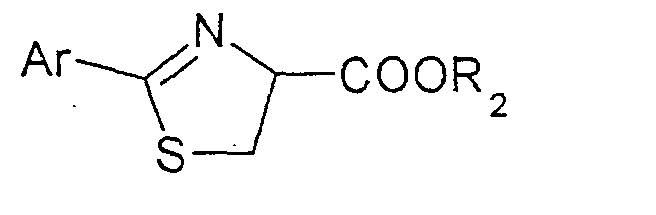
gekoppelt.
Als L-Cysteinverbindungen der Formel (IV) eignen sich L-Cystein, sowie die L-Cystein-C1-C4-ester-Hydrochloride.
Die L-Cysteinverbindungen der Formel (IV) wird sodann entweder mit einem entsprechende
Nitril der Formel (V) oder dem korrespondierendem C1-C4-Alkylimidat
HCl umgesetzt. (S) -α-Methylcysteine hydrochloride can be prepared, for example, according to the prior art, such as according to Synlett (1994), pages 702-703. However, (S) -α-methylcysteine hydrochloride is preferably prepared according to a modified variant, which is also the subject of the invention.
In this modified variant, L-cysteine compounds of the formula (IV)
coupled.
L-cysteine and the L-cysteine-C 1 -C 4 -ester hydrochloride are suitable as L-cysteine compounds of the formula (IV).
The L-cysteine compounds of the formula (IV) are then reacted either with a corresponding nitrile of the formula (V) or with the corresponding C 1 -C 4 -alkylimidate HCl.
Als Nitrile eignen sich dabei Benzonitril, Tolunitril oder an den Sauerstoffatomen beispielsweise
mit Tetrahydropyranyl, Acetyl oder Benzyl geschütztes 2,4-Dihydroxybenzonitril.
Die korrespondierenden C1-C4-Alkylimidate sind entweder käuflich erwerbbar oder
können aus den Nitrilen mit einem C1-C4-Alkohol und HCI hergestellt werden.
Das Nitril der Formel (V) bzw. das entsprechende Alkylimidat wird dabei bevorzugt in
einer äquimolaren Menge bezogen auf die L-Cysteinverbindung der Formel (IV) eingesetzt.
Gegebenenfalls kann auch ein Überschuss eingesetzt werden, wodurch jedoch
keine Vorteile erzielt werden. Die Kopplung mit der L-Cysteinverbindung erfolgt
in Anwesenheit einer tert. Base, wie Triethylamin, Di-i-Propyl-Ethylamin oder Pyridin.
Bevorzugt wird Triethylamin verwendet.
Die tert. Base wird in einer Menge von 0,9 bis 1,3 mol, bevorzugt von 1,0 bis 1,2 mol
und besonders bevorzugt von 1,02 bis 1,1 mol pro mol L-Cysteinverbindung zugesetzt.
Größere Überschüsse können auch eingesetzt werden, wirken sich aber negativ
auf die Ausbeute aus.
Verbindungen der Formel (VI) sind beispielsweise 4-Carbethoxy-2-phenylthiazolin, 2-Phenylthiazolin-4-carbonsäure,
4-Carbethoxy-2-(2,4-ditetrahydropyranyl)thiazolin
usw..
Wird als L-Cysteinverbindung L-Cystein eingesetzt, so wird eine Verbindung der
Formel (VI) mit R2 gleich H erhalten, die sodann in einen C1-C4-Ester überführt wird.
Die Verbindung der Formel (VI), in der R2 C1-C4-Alkyl bedeutet, wird sodann in einer
2.Stufe, nach wässriger Aufarbeitung und Extraktion, gegebenenfalls azeotrope
Trocknung der Extrakte und/oder gegebenenfalls Isolierung der Verbindung, mit einem
Methylierungsreagens, beispielsweise mit Methyliodid, -chlorid oder -bromid,
unter Einwirkung einer Base zum entsprechenden Thiazolin der Formel (VII)

The corresponding C 1 -C 4 alkylimidates are either commercially available or can be prepared from the nitriles using a C 1 -C 4 alcohol and HCl.
The nitrile of the formula (V) or the corresponding alkylimidate is preferably used in an equimolar amount based on the L-cysteine compound of the formula (IV). If necessary, an excess can also be used, but this does not result in any advantages. The coupling with the L-cysteine compound takes place in the presence of a tert. Base such as triethylamine, di-i-propyl-ethylamine or pyridine.
Triethylamine is preferably used.
The tert. Base is added in an amount of 0.9 to 1.3 mol, preferably from 1.0 to 1.2 mol and particularly preferably from 1.02 to 1.1 mol, per mol of L-cysteine compound. Larger excesses can also be used, but have a negative effect on the yield.
Compounds of formula (VI) are, for example, 4-carbethoxy-2-phenylthiazoline, 2-phenylthiazoline-4-carboxylic acid, 4-carbethoxy-2- (2,4-ditetrahydropyranyl) thiazoline, etc.
If L-cysteine is used as the L-cysteine compound, a compound of the formula (VI) with R 2 equal to H is obtained, which is then converted into a C 1 -C 4 ester. The compound of formula (VI) in which R 2 is C 1 -C 4 alkyl is then in a second stage, after aqueous work-up and extraction, optionally azeotropic drying of the extracts and / or isolation of the compound, using a Methylation reagent, for example with methyl iodide, chloride or bromide, under the action of a base to give the corresponding thiazoline of the formula (VII)
Dieser 2.Schritt erfolgt in einem Ether, beispielsweise in Methyl-tert.butylether
(MTBE), Tetrahydrofuran (THF) oder Diethylether, und in Anwesenheit einer Base
statt. Als Base wird bevorzugt Lithiumdiisopropylamid (LDA) verwendet, das aus Diisopropylamin
und Butyllithium erhalten wird.
Das Methylierungsmittel wird dabei in einer Menge von 1 bis 3 mol, bevorzugt von 1
bis 2 mol und besonders bevorzugt von 1,2 bis 1,7 mol pro mol Verbindung der Formel
(VI) eingesetzt.
LDA wird in einer Menge von 1 bis 1,5 mol, bevorzugt von 1 bis 1,3 mol und besonders
bevorzugt von 1,05 bis 1,2 mol pro mol Verbindung der Formel (VI) eingesetzt.
Die Methylierung erfolgt bei einer Temperatur von -80°C bis +40°C, bevorzugt von
-30°C bis +35°C und besonders bevorzugt von -20°C bis +30°C.
Nach erfolgter Umsetzung wird soviel HCI zugegeben, dass ein pH-Wert zwischen
1,5 und 5, bevorzugt zwischen 2 bis 3 erreicht wird, worauf ein zweiphasiges Gemisch
erhalten wird.
Die organische Phase, die das Thiazolin der Formel (VII) enthält, kann direkt, nach
Extraktion, in die nächste Stufe eingesetzt werden. Das Thiazolin der Formel (VII)
kann jedoch auch zuerst isoliert werden.
Bei der 3. Stufe wird durch basische Hydrolyse, sowie gegebenenfalls nach Abspaltung
einer Schutzgruppe an einer oder mehreren am aromatischen Rest befindlichen
Hydroxygruppe(n) die korrespondierende Thiazolincarbonsäure der Formel (VIII)

Als 4.Schritt erfolgt die Racemattrennung mit einer Spaltbase. Als Spaltbase eignen
sich beispielsweise enantiomerenreine, chirale Amine, wie etwa gegebenenfalls substituiertes
Phenylethylamin, gegebenenfalls substituiertes Phenylglycinamid, Norephedrin,
Chinin u.s.w..
Die Spaltung erfolgt in einem Lösungsmittel, in dem sich die Thiazolin-4-carbonsäure
der Formel (VIII) löst, beispielsweise in einem Alkohol, wie etwa Ethanol, Propanol
u.s.w., einem Alkohol/Wasser-Gemisch, einem Essigsäureester, wie etwa Isopropylacetat
(IPA), Essigsäureethylester, u.s.w.. Nach der Zugabe der Spaltbase wird unter
Rühren mit der Kristallisation durch Abkühlen des Reaktionsgemisches begonnen.
Dazu kann beispielsweise ein mehrstufiges Temperaturprogramm, bei welchem
die Abkühlgeschwindigkeit in den einzelnen Stufen variiert, gewählt werden. Bei der
Kristallisation ist es auch möglich diese durch Animpfen zu unterstützen bzw. auszulösen.
Bevorzugt wird nach dem Animpfen eine Zeit lang etwas langsamer abgekühlt
und gegen Ende der Kristallisation, zur vollständigen Ausfällung, wieder etwas
schneller abgekühlt. Die Abkühlung erfolgt von Raumtemperatur auf bis zu -15°C.
Nach beendeter Kristallisation wird filtriert, die Kristalle bevorzugt gewaschen und
anschließend gegebenenfalls getrocknet.
Die so erhaltenen Salze der Carbonsäure werden zur Aufreinigung sodann bevorzugt
umkristallisiert. Dazu werden die erhaltenen Kristalle bei erhöhter Temperatur in einem
geeigneten Lösungsmittel gelöst und das gereinigte Carbonsäuresalz wiederum
durch Abkühlen unter Rühren auskristallisiert. Auch hier ist ein mehrstufiges Temperaturprogramm
möglich.
Nach abgeschlossener Kristallisation wird das entsprechende chirale Carbonsäuresalz
wiederum abfiltriert und gegebenenfalls getrocknet.
Zur Freisetzung der entsprechenden chiralen Säure wird sodann zu einem Gemisch
aus chiralem Salz, Wasser und einem geeigneten Lösungsmittel HCI zugegeben,
wodurch zwei klare Phasen erhalten werden. Als Lösungsmittel eignen sich solche,
die mit Wasser nicht mischbar sind, die die Säure lösen und die gegen HCI resistent
sind. Beispiele dafür sind Ether oder Ester. Bevorzugt werden Ether eingesetzt, besonders
bevorzugt MTBE. Die HCI-Zugabe erfolgt so lange, bis der pH-Wert der
wässrigen Phase 1 bis 4, bevorzugt 1 bis 3 und besonders bevorzugt 1,5 bis 3 beträgt.
Dann wird die organische Phase abgetrennt und gegebenenfalls gewaschen.
Nach Abtrennung des Lösungsmittels wird die (S)-Thiazolincarbonsäure der Formel
(VIII), beispielsweise (S)-4-Methyl-2-phenylthiazolin-4-carbonsäure oder (S)-4-Methyl-2-(2,4-dihydroxyphenyl)thiazolin-4-carbonsäure
usw. erhalten.This second step takes place in an ether, for example in methyl tert-butyl ether (MTBE), tetrahydrofuran (THF) or diethyl ether, and in the presence of a base. Lithium diisopropylamide (LDA), which is obtained from diisopropylamine and butyllithium, is preferably used as the base.
The methylating agent is used in an amount of 1 to 3 mol, preferably 1 to 2 mol and particularly preferably 1.2 to 1.7 mol, per mol of compound of the formula (VI).
LDA is used in an amount of 1 to 1.5 mol, preferably from 1 to 1.3 mol and particularly preferably from 1.05 to 1.2 mol, per mol of compound of the formula (VI).
The methylation takes place at a temperature from -80 ° C to + 40 ° C, preferably from -30 ° C to + 35 ° C and particularly preferably from -20 ° C to + 30 ° C.
After the reaction has taken place, sufficient HCl is added to achieve a pH between 1.5 and 5, preferably between 2 and 3, whereupon a two-phase mixture is obtained.
The organic phase, which contains the thiazoline of the formula (VII), can be used directly in the next step after extraction. However, the thiazoline of the formula (VII) can also be isolated first.
In the third stage, the corresponding thiazoline carboxylic acid of the formula (VIII) is obtained by basic hydrolysis and, if appropriate, after splitting off a protective group on one or more hydroxyl groups on the aromatic radical.
In the fourth step, the racemate is separated using a split base. Suitable cleavage bases are, for example, enantiomerically pure, chiral amines, such as optionally substituted phenylethylamine, optionally substituted phenylglycinamide, norephedrine, quinine, etc.
The cleavage takes place in a solvent in which the thiazoline-4-carboxylic acid of the formula (VIII) dissolves, for example in an alcohol, such as ethanol, propanol, etc., an alcohol / water mixture, an acetic acid ester, such as isopropyl acetate (IPA ), Ethyl acetate, etc. After the addition of the cleavage base, the crystallization is started with stirring by cooling the reaction mixture. For this purpose, for example, a multi-stage temperature program in which the cooling rate varies in the individual stages can be selected. During crystallization it is also possible to support or initiate this by seeding. It is preferred to cool a little more slowly after inoculation and to cool down a little more quickly towards the end of the crystallization to complete precipitation. The cooling takes place from room temperature down to -15 ° C. After crystallization has ended, the mixture is filtered, the crystals are preferably washed and then optionally dried.
The carboxylic acid salts thus obtained are then preferably recrystallized for purification. For this purpose, the crystals obtained are dissolved in a suitable solvent at elevated temperature and the purified carboxylic acid salt is again crystallized out by cooling with stirring. A multi-stage temperature program is also possible here.
After crystallization is complete, the corresponding chiral carboxylic acid salt is filtered off again and optionally dried.
To release the corresponding chiral acid, HCl is then added to a mixture of chiral salt, water and a suitable solvent, giving two clear phases. Suitable solvents are those which are immiscible with water, which dissolve the acid and which are resistant to HCl. Examples of these are ethers or esters. Ethers are preferably used, particularly preferably MTBE. The HCI is added until the pH of the aqueous phase is 1 to 4, preferably 1 to 3 and particularly preferably 1.5 to 3. The organic phase is then separated off and, if necessary, washed. After the solvent has been separated off, the (S) -thiazolinecarboxylic acid of the formula (VIII), for example (S) -4-methyl-2-phenylthiazoline-4-carboxylic acid or (S) -4-methyl-2- (2,4-dihydroxyphenyl ) thiazoline-4-carboxylic acid, etc. obtained.
Anstelle der Racematspaltung durch Spaltbasen kann jedoch auch eine lipasenkatalysierte
Racemattrennung des Thiazolins der Formel (VII) durchgeführt werden.
Geeignete Lipasen sind beispielsweise Pig Liver Esterase, Candida rugosa Lipase,
Aspergillus species Lipase, Aspergillus species Protease, Bacillus species Protease,
Subtilisin Carlsberg, Candida antarctica "A" Lipase, Candida antarctica "B" Lipase,
ChiroCLECTM-PC (dry), ChiroCLECTM-PC (slurry), u.s.w..Instead of the resolution of racemates by means of cleavage bases, a lipase-catalyzed resolution of the thiazoline of the formula (VII) can also be carried out.
Suitable lipases are, for example, Pig Liver Esterase, Candida rugosa Lipase, Aspergillus species Lipase, Aspergillus species Protease, Bacillus species Protease,
Subtilisin Carlsberg, Candida antarctica "A" lipase, Candida antarctica "B" lipase, ChiroCLEC TM-PC (dry), ChiroCLEC TM-PC (slurry), etc.
Die (S)-Thiazolincarbonsäure der Formel (VIII) wird in weiterer Folge durch saure
Hydrolyse in (S)-2-Methylcystein HCl überführt.
Dazu wird die (S)-Thiazolincarbonsäure der Formel (VIII) in HCI gelöst und die so
erhaltene Lösung bei Rückflusstemperatur gekocht. Bevorzugt wird dabei unter
Stickstoffatmosphäre gearbeitet. Nach 1 bis 30 Stunden, bevorzugt 5 bis 25 Stunden
und besonders bevorzugt nach 10 bis 20 Stunden wird das Rektionsgemisch auf 0
bis 35°C, bevorzugt auf 10 bis 30°C und besonders bevorzugt auf 10 bis 20°C abgekühlt
und das ausgefallene Spaltprodukt, beispielsweise gegebenenfalls substituierte
Benzoesäure, abgetrennt, welches sodann mit gegebenenfalls entgastem Wasser
oder mit verdünnter HCI ein- oder mehrmals gewaschen wird. Das saure Filtrat wird
gegebenenfalls zuerst zur vollständigen Entfernung des Spaltproduktes mit einem
geeigneten Extraktionsmittel extrahiert. Beispiele für geeignete Lösungsmittel sind
MTBE, Toluol, Ethylmethylketon, IPA, THF, CH2Cl2, Diethylether u.s.w.. Die Isolierung
von (S)-2-Methylcystein HCl kann sodann mittels Sprühtrocknung der wässrigen
Phase erfolgen. !n einer anderen Variante wird die wässrige Phase, bevorzugt unter
reduziertem Druck, eingedampft, wodurch ein Öl erhalten wird, das in weiterer Folge
1 bis 5mal in gegebenenfalls entgastem Wasser, oder einem Gemisch aus Wasser
mit Tetrahydrofuran (THF), Aceton oder IPA gelöst wird und jeweils zur Gänze oder
bis zu einer 65 bis 20%igen Lösung, bevorzugt unter reduziertem Druck, eingedampft
wird.
Wird das Reaktionsgemisch nicht zur Gänze eingedampft, so wird der so erhaltenen
konzentrierten Lösung ein für die azeotrope Destillation geeignetes Lösungsmittel,
das mit Wasser ein Azeotrop bildet, beispielsweise Toluol, Dichlormethan, 2-Butanol,
i-Propanol oder MTBE, zugesetzt und das in der Lösung enthaltene Wasser ausgeschleppt.
Die verbleibende Suspension oder Lösung, die das (S)-2-Methylcystein
HCl, enthält, kann sodann direkt in die nächste Stufe, die Kopplung mit
einem Nitril der Formel (III), eingesetzt werden. Gegebenenfalls wird dazu die Lösung
bzw. Suspension mit frischem Lösungsmittel ergänzt und anschließend direkt
mit dem Nitril der Formel (III) in Gegenwart einer tertiären Base zum gewünschten
Endprodukt, einem Thiazolin der Formel (I) umgesetzt.
Die verbleibende Suspension oder Lösung kann aber auch gegebenenfalls zum Ausfällen
des (S)-2-Methylcystein HCl mit einem Ether, wie etwa MTBE, Diethylether,
Diisopropylether u.s.w., oder einem Kohlenwasserstoff, wie etwa einem C6-C8-Alkan,
Toluol, u.s.w., versetzt werden, worauf das (S)-2-Methylcystein HCl abfiltriert, ein oder
mehrere Male mit dem verwendeten Ether oder Kohlenwasserstoff gewaschen
und unter Vakuum getrocknet wird. The (S) -thiazolinecarboxylic acid of the formula (VIII) is subsequently converted into (S) -2-methylcysteine HCl by acid hydrolysis.
For this purpose, the (S) -thiazolinecarboxylic acid of the formula (VIII) is dissolved in HCl and the solution thus obtained is boiled at reflux temperature. It is preferred to work under a nitrogen atmosphere. After 1 to 30 hours, preferably 5 to 25 hours and particularly preferably after 10 to 20 hours, the reaction mixture is cooled to 0 to 35 ° C., preferably to 10 to 30 ° C. and particularly preferably to 10 to 20 ° C., and the cleavage product which has precipitated out , for example optionally substituted benzoic acid, which is then washed one or more times with optionally degassed water or with dilute HCl. If necessary, the acidic filtrate is first extracted with a suitable extractant to remove the cleavage product completely. Examples of suitable solvents are MTBE, toluene, ethyl methyl ketone, IPA, THF, CH 2 Cl 2 , diethyl ether etc. The (S) -2-methylcysteine HCl can then be isolated by spray drying the aqueous phase. In another variant, the aqueous phase is evaporated, preferably under reduced pressure, giving an oil which is subsequently dissolved 1 to 5 times in optionally degassed water, or a mixture of water with tetrahydrofuran (THF), acetone or IPA is and in each case completely or to a 65 to 20% solution, preferably evaporated under reduced pressure.
If the reaction mixture is not completely evaporated, a solvent suitable for azeotropic distillation, which forms an azeotrope with water, for example toluene, dichloromethane, 2-butanol, i-propanol or MTBE, is added to the concentrated solution thus obtained, and that in Solution contained water dragged out. The remaining suspension or solution containing the (S) -2-methylcysteine HCl can then be used directly in the next step, coupling with a nitrile of the formula (III). If necessary, the solution or suspension is supplemented with fresh solvent and then reacted directly with the nitrile of the formula (III) in the presence of a tertiary base to give the desired end product, a thiazoline of the formula (I).
The remaining suspension or solution can, however, optionally be used to precipitate the (S) -2-methylcysteine HCl with an ether, such as MTBE, diethyl ether, diisopropyl ether, etc., or a hydrocarbon, such as a C 6 -C 8 alkane, toluene, etc., are added, whereupon the (S) -2-methylcysteine HCl is filtered off, washed one or more times with the ether or hydrocarbon used and dried under vacuum.
Durch diese erfindungsgemäße Methode wird (S)-2-Methylcystein HCl in kristalliner Form in einer Ausbeute von bis zu 95% erhalten.By this method according to the invention (S) -2-methylcysteine HCl in crystalline Form obtained in a yield of up to 95%.
Eine weitere erfindungsgemäße Herstellungsvariante für (S)-2-Methylcystein HCl ist
eine modifizierte Variante der in Tetrahedron (1993), 49 (24), S.5359-5364 beschriebenen
Seebach-analogen Synthese, die auf der durch eine chirale Schutzgruppe
induzierten enantioselektiven Methylierung des unnatürlichen und daher kommerziell
nicht verfügbaren S-Cysteinmethylester HCl beruht.
Bei der erfindungsgemäßen Variante wird das leicht verfügbare L-Cysteinethylester
HCl in einer ersten Stufe mit 2 bis 3 Äquivalenten Aceton in einem
Kohlenwasserstoff, beispielsweise Toluol, Hexan, u.s.w. oder in Aceton selbst, gegebenenfalls
in Anwesenheit eines tert. Amines, wie Triethylamin, Di-i-Propyl-Ethylamin
oder Pyridin u.s.w, umgesetzt. Nach dem Abtrennen des Reaktionswassers wird das
Reaktionsgemisch abgekühlt, der Niederschlag abfiltriert, gegebenenfalls gewaschen
und das Filtrat vom Lösungsmittel befreit. Wird Aceton selbst als Lösungsmittel eingesetzt,
so entfällt das Abtrennen des Reaktionswassers. Die Reaktionslösung wird
lediglich eingeengt, der Rückstand zwischen NaHCO3, NaOH oder KOH und Toluol
verteilt und das Produkt aus der organischen Phase isoliert.
Das so erhaltene Acetonid wird in der 2.Stufe in 2 bis 3 Äquivalenten Ameisensäure
gelöst, mit Toluol oder Essigsäureanhydrid versetzt und das erhaltene Reaktionsgemisch
für einige Zeit, bevorzugt für 10 min bis zu 5 Stunden gerührt. Danach wird
das Reaktionsgemisch eingeengt und zwischen einem Ether, Ester oder geeigneten
Kohlenwasserstoff und einer Natriumhydrogencarbonat-, NaOH- oder KOH-Lösung
verteilt. Die organische Phase wird azeotrop getrocknet und vom Lösungsmittel befreit.
In der 3.Stufe erfolgt die Methylierung des aus der 2.Stufe erhaltenen N-formylierten
Acetonids (3-Formyl-2,2-dimethyl-thiazolin-4-carbonsäure-ethylester) durch Deprotonierung
mit 1 bis 1,5 Äquivalenten, bevorzugt von 1,1 bis 1,2 Äquivalenten an LDA
und anschließender Umsetzung mit 1 bis 2 Äquivalenten, bevorzugt mit 1,1 bis
1,5Äquivalenten Methylierungsmittel. Another production variant according to the invention for (S) -2-methylcysteine HCl is a modified variant of the Seebach analog synthesis described in Tetrahedron (1993), 49 (24), p.5359-5364, which is based on the enantioselective methylation induced by a chiral protective group of the unnatural and therefore not commercially available S-cysteine methyl ester HCl.
In the variant according to the invention, the readily available L-cysteine ethyl ester HCl is in a first stage with 2 to 3 equivalents of acetone in a hydrocarbon, for example toluene, hexane, etc. or in acetone itself, optionally in the presence of a tert. Amines, such as triethylamine, di-i-propyl-ethylamine or pyridine, etc., implemented. After the water of reaction has been separated off, the reaction mixture is cooled, the precipitate is filtered off, washed if necessary and the filtrate is freed from the solvent. If acetone itself is used as a solvent, there is no need to separate the water of reaction. The reaction solution is merely concentrated, the residue is partitioned between NaHCO 3 , NaOH or KOH and toluene and the product is isolated from the organic phase.
The acetonide obtained in this way is dissolved in the 2nd stage in 2 to 3 equivalents of formic acid, toluene or acetic anhydride is added and the reaction mixture obtained is stirred for some time, preferably for 10 minutes to 5 hours. The reaction mixture is then concentrated and partitioned between an ether, ester or suitable hydrocarbon and a sodium hydrogen carbonate, NaOH or KOH solution. The organic phase is dried azeotropically and freed from the solvent.
In the 3rd stage, the methylation of the N-formylated acetonide (3-formyl-2,2-dimethyl-thiazoline-4-carboxylic acid ethyl ester) obtained from the 2nd stage takes place by deprotonation with 1 to 1.5 equivalents, preferably of 1.1 to 1.2 equivalents of LDA and subsequent reaction with 1 to 2 equivalents, preferably with 1.1 to 1.5 equivalents of methylating agent.
Als Lösungsmittel eignen sich beispielsweise MTBE, THF, Diethylether, u.s.w.. Gegebenenfalls
kann auch ein Co-Solvent, wie etwa 1,3-Dimethyl-3,4,5,6-tetrahydro-(1H)-pyrimidinon
(DMPU) zugesetzt werden. Die Reaktionstemperatur liegt bei -25
bis -80°C, bevorzugt bei -35 bis -75°C und besonders bevorzugt bei -45 bis -55°C.
Anschließend erfolgt eine wässrige Aufarbeitung.
Die Enantiomerentrennung des erhaltenen racemischen 3-Formyl-2,2,4-trimethylthiazolin-4-carbonsäure-ethylester
erfolgt sodann bevorzugt mittels selektiver Esterhydrolyse
unter Verwendung einer Lipase, beispielsweise mit Pig Liver Esterase,
Candida rugosa Lipase, Aspergillus species Lipase; Aspergillus species Protease,
Bacillus species Protease, Subtilisin Carlsberg, Candida antarctica "A" Lipase, Candida
antarctica "B" Lipase, ChiroCLECTM-PC (dry), ChiroCLECTM-PC (slurry), u.s.w..Suitable solvents are, for example, MTBE, THF, diethyl ether, etc. If appropriate, a co-solvent such as 1,3-dimethyl-3,4,5,6-tetrahydro- (1H) -pyrimidinone (DMPU) can also be added. The reaction temperature is -25 to -80 ° C, preferably -35 to -75 ° C and particularly preferably -45 to -55 ° C.
An aqueous workup then takes place.
The enantiomer separation of the racemic 3-formyl-2,2,4-trimethylthiazoline-4-carboxylic acid ethyl ester obtained is then preferably carried out by means of selective ester hydrolysis using a lipase, for example with Pig Liver Esterase, Candida rugosa lipase, Aspergillus species lipase; Aspergillus species protease, Bacillus species protease, Subtilisin Carlsberg, Candida antarctica "A" lipase, Candida antarctica "B" lipase, ChiroCLEC TM-PC (dry), ChiroCLEC TM-PC (slurry), etc.
Nach erfolgter Enantiomerentrennung erfolgt in der 5.Stufe die Hydrolyse zu (S)-2-Methylcystein HCl analog dem vorher beschriebenen Verfahren, wobei die Abtrennung der Benzoesäure entfällt.After separation of the enantiomers, the hydrolysis to (S) -2-methylcysteine takes place in the 5th stage HCl analogous to the previously described method, with the separation the benzoic acid is eliminated.
Das gemäß dem Stand der Technik oder bevorzugt das gemäß einer der erfindungsgemäßen
Variante, bevorzugt nach der modifizierten Synlett-Variante hergestellte
(S)-2-Methylcystein HCl wird sodann mit einem aromatischen oder heteroaromatischen
Nitril der Formel (III) Ar-CN oder einem korrespondierendem C1-C4-Alkylimidat
gekoppelt.
In der Formel (III) hat Ar dieselbe Bedeutung wie in Formel (I).
Die Nitrile sind zum Teil käuflich erwerbbar, können aber auch aus den entsprechenden
Aldehyden, beispielsweise mittels Ameisensäure, Natriumformiat und Hydroxylammoniumsulfat,
hergestellt werden.
Die korrespondierenden C1-C4-Alkylimidate können aus den Nitrilen mit einem C1-C4-Alkohol
und HCI hergestellt werden.The (S) -2-methylcysteine HCl which is produced according to the prior art or preferably that according to one of the variants according to the invention, preferably according to the modified Synlett variant, is then mixed with an aromatic or heteroaromatic nitrile of the formula (III) Ar-CN or a corresponding one C 1 -C 4 alkyl imidate coupled.
In formula (III), Ar has the same meaning as in formula (I).
Some of the nitriles are commercially available, but can also be prepared from the corresponding aldehydes, for example using formic acid, sodium formate and hydroxylammonium sulfate.
The corresponding C 1 -C 4 alkylimidates can be prepared from the nitriles using a C 1 -C 4 alcohol and HCl.
Das entsprechende Nitril oder das Imidat wird sodann erfindungsgemäß mit (S)-2-Methylcystein HCl gekoppelt. The corresponding nitrile or the imidate is then in accordance with the invention with (S) -2-methylcysteine HCl coupled.
Die Kopplung erfolgt in einem C1-C4-Alkohol, einem Gemisch aus zwei oder mehreren
C1-C4-Alkoholen oder einem Gemisch aus C1-C4-Alkohol und einem Kohlenwasserstoff
mit 0,5 bis 2 mol an einem Nitril der Formel (III) bzw an dem korrespondierenden
C1-C4-Alkylimidat pro mol (S)-α-Methylcystein-Hydrochlorid in Gegenwart
von 1,5 bis 3 mol einer tertiären Base pro mol (S)-α-Methylcystein-Hydrochlorid. Bevorzugt
werden 0,8 bis 1,5 mol, besonders bevorzugt 0,9 bis 1,1 mol Nitril bzw. Imidat
eingesetzt. Als tert. Base eignen sich beispielsweise Triethylamin, Di-i-Propyl-Ethylamin
oder Pyridin, die bevorzugt in einer Menge von 1,8 bis 2,5 mol, besonders
bevorzugt 1,9 bis 2,2 mol Amin pro mol (S)-α-Methylcystein-Hydrochlorid zugesetzt
werden. Als Lösungsmittel eignen sich C1-C4-Alkohole, wie Methanol, Ethanol Butanol,
ein Gemisch aus zwei oder mehreren C1-C4-Alkoholen oder ein Gemisch aus C1-C4-Alkohol
und einem Kohlenwasserstoff, wie etwa Toluol, C6-C8-Alkan, u.s.w.. Bevorzugt
wird jedoch Ethanol und /oder Butanol eingesetzt.
Durch die Zugabe der tert. Base wird in der Reaktionslösung ein pH-Wert von 6.5
bis 10, bevorzugt von 7 bis 9 und besonders bevorzugt von 7.5 bis 8 eingestellt.
Das Reaktionsgemisch wird unter Rühren für 1 bis 40 Stunden, bevorzugt für 5 bis
30 Stunden und besonders bevorzugt für 15 bis 25 Stunden, bevorzugt unter Stickstoffatmosphäre,
auf 50°C bis zur Rückflusstemperatur erhitzt.
Danach wird gegebenenfalls abgekühlt und das Lösungsmittel, bevorzugt unter reduziertem
Druck, abdestilliert, wodurch ein Öl erhalten wird.
Aus diesem Öl wird das entsprechenden Thiazolin der Formel (I) sodann durch Extraktion
der Verunreinigungen und Ausfällen des Thiazolins durch Ansäuern aus dem
Reaktionsgemisch isoliert.
Dazu wird das Öl zwischen Wasser und einem geeigneten Lösungs- bzw. Extraktionsmittel
verteilt und bei einem geeigneten pH-Wert überschüssiges Edukt extrahiert.
Beispielsweise wird bei Verwendung von 2,4-Dihydroxynitril das Öl in Wasser
aufgenommen, der pH-Wert mit einer geeigneten Base, beispielsweise mit KOH,
NaOH, u.s.w. auf einen pH-Wert von Wert von 6.5 bis 9, bevorzugt von 7 bis 9 und
besonders bevorzugt von 7.5 bis 8 eingestellt und ein oder mehrere Male mit einem
geeigneten Extraktionsmittel, wie etwa Diethylether, MTBE, Dichlormethan, Essigsäureethylester,
u.s.w. extrahiert.
Die wässrige Phase wird abgetrennt und mit einer geeigneten Base, beispielsweise
mit KOH, NaOH, u.s.w. auf einen pH-Wert von Wert von 10 bis 14, bevorzugt von 11
bis 13 eingestellt. Danach erfolgt erneut eine ein- oder mehrmalige Extraktion mit
einem geeigneten Extraktionsmittel, wie etwa Diethylether, MTBE, Dichlormethan,
Essigsäureethylester, u.s.w.. Anschließend wird gegebenenfalls filtriert, beispielsweise
mit Aktivkohle und sodann mit einer geeigneten Säure, wie etwa HCI, H2SO4,
HBr u.s.w. ein pH-Wert von 6.5 bis 10, bevorzugt von 7 bis 9 und besonders bevorzugt
von 7.5 bis 8 eingestellt. Aus der Wasserphase wird sodann das Extraktionsmittel
vollständig durch Destillation, bevorzugt unter reduziertem Druck, entfernt.
Die Extraktions- bzw. Reinigungsschritte bei unterschiedlichem pH-Wert können
auch in unterschiedlicher Reihenfolge durchgeführt werden.
Die verbleibende wässrige Lösung wird mit einer geeigneten Säure, wie etwa HCI
H2SO4, HBr u.s.w. solange angesäuert bis ein pH-Wert von 1 bis 3, bevorzugt von 1
bis 2 erreicht wird. Dabei beginnt das gewünschte Thiazolin auszukristallisieren. Die
so erhaltene Suspension wird sodann noch für einige Zeit, bevorzugt für 10min bis 3
Stunden, besonders bevorzugt für 30min bis 1,5 Stunden bei einer Temperatur von 5
bis 25°C, bevorzugt von 10 bis 20°C gerührt, anschließend der Feststoff abfiltriert,
gewaschen und unter Vakuum getrocknet.The coupling takes place in a C 1 -C 4 alcohol, a mixture of two or more C 1 -C 4 alcohols or a mixture of C 1 -C 4 alcohol and a hydrocarbon with 0.5 to 2 mol of a nitrile of the formula (III) or on the corresponding C 1 -C 4 alkylimidate per mol (S) -α-methylcysteine hydrochloride in the presence of 1.5 to 3 mol of a tertiary base per mol (S) -α-methylcysteine hydrochloride , 0.8 to 1.5 mol, particularly preferably 0.9 to 1.1 mol, of nitrile or imidate are preferably used. As tert. Base are, for example, triethylamine, di-i-propylethylamine or pyridine, which are preferably in an amount of 1.8 to 2.5 mol, particularly preferably 1.9 to 2.2 mol, of amine per mol of (S) -α- Methylcysteine hydrochloride can be added. Suitable solvents are C 1 -C 4 alcohols, such as methanol, ethanol butanol, a mixture of two or more C 1 -C 4 alcohols or a mixture of C 1 -C 4 alcohol and a hydrocarbon, such as toluene, C 6 -C 8 alkane, etc. However, ethanol and / or butanol is preferably used.
By adding the tert. Base is adjusted to a pH of 6.5 to 10, preferably 7 to 9 and particularly preferably 7.5 to 8 in the reaction solution.
The reaction mixture is heated with stirring for 1 to 40 hours, preferably for 5 to 30 hours and particularly preferably for 15 to 25 hours, preferably under a nitrogen atmosphere, to 50 ° C. to the reflux temperature.
Thereafter, the mixture is optionally cooled and the solvent is distilled off, preferably under reduced pressure, whereby an oil is obtained.
The corresponding thiazoline of the formula (I) is then isolated from this oil by extraction of the impurities and precipitation of the thiazoline by acidification from the reaction mixture.
For this purpose, the oil is distributed between water and a suitable solvent or extraction agent and excess starting material is extracted at a suitable pH. For example, when using 2,4-dihydroxynitrile, the oil is taken up in water, the pH with a suitable base, for example with KOH, NaOH, etc., to a pH of 6.5 to 9, preferably 7 to 9 and particularly preferably adjusted from 7.5 to 8 and extracted one or more times with a suitable extracting agent, such as, for example, diethyl ether, MTBE, dichloromethane, ethyl acetate, etc.
The aqueous phase is separated off and adjusted to a pH of 10 to 14, preferably 11 to 13, using a suitable base, for example KOH, NaOH, etc. This is followed by a single or repeated extraction with a suitable extraction agent, such as diethyl ether, MTBE, dichloromethane, ethyl acetate, etc. Then, if appropriate, it is filtered, for example with activated carbon and then with a suitable acid, such as HCl, H 2 SO 4 , HBr and so on a pH of 6.5 to 10, preferably from 7 to 9 and particularly preferably from 7.5 to 8. The extractant is then completely removed from the water phase by distillation, preferably under reduced pressure.
The extraction or cleaning steps at different pH values can also be carried out in different orders.
The remaining aqueous solution is acidified with a suitable acid, such as HCl H 2 SO 4 , HBr, etc., until a pH of 1 to 3, preferably 1 to 2, is reached. The desired thiazoline begins to crystallize out. The suspension obtained in this way is then stirred for a while, preferably for 10 minutes to 3 hours, particularly preferably for 30 minutes to 1.5 hours, at a temperature of 5 to 25 ° C., preferably 10 to 20 ° C., and then the solid is filtered off , washed and dried under vacuum.
Durch das erfindungsgemäße Kopplungsverfahren werden Thiazoline der Formel (I) im Vergleich zum Stand der Technik wesentlich höheren Ausbeuten von bis zu 99% erhalten. The coupling process according to the invention gives thiazolines of the formula (I) Compared to the prior art, significantly higher yields of up to 99% receive.
100 g (0.54 mol, 1.00 eq) Ethylbenzimidat·HCl und 100 g (0.54 mol, 1.00 eq) Cysteinethylester·HCl wurden in einem 500 ml Schmizo, ausgestattet mit einem Rückflusskühler, in 500 ml Ethanol suspendiert. Das Ethanol wurde zuvor entgast, indem man es zweimal unter Stickstoffatmosphäre bis zum Rückfluss erhitzte. Nach Zugabe von 57.4 g (0.567 mol, 1.05 eq) Triethylamin wurde das Reaktionsgemisch 2 h rückflußgekocht. Das Ethanol wurde unter reduziertem Druck (100 mbar) abdestilliert (455 ml Destillat), wodurch man eine ölige gelbe Suspension erhielt. Zu dieser wurden 450 ml MTBE gegeben. Dieses Gemisch wurde mit 200 ml 0.5 M HCl und zweimal mit 200 ml Wasser gewaschen. Die organische Phase wurde abgetrennt und das restliche Wasser durch eine azeotrope Destillation (Wasserabscheider, 4 h, 10 ml Wasser) ausgekreist. Dann wurden noch 125 ml MTBE abdestilliert, um den Wassergehalt so weit wie möglich zu reduzieren. Es wurden 400 ml einer hellgelben MTBE-Lösung (Wasserwert nach Karl Fischer: < 0.05 %w/w), erhalten, welche das Produkt 4-Carbethoxy-2-phenylthiazolin enthält. Diese Lösung wurde in Stufe 2 eingesetzt100 g (0.54 mol, 1.00 eq) ethylbenzimidate · HCl and 100 g (0.54 mol, 1.00 eq) ethyl cysteine ester · HCl were in a 500 ml Schmizo, equipped with a reflux condenser, suspended in 500 ml of ethanol. The ethanol was previously degassed by heated twice to reflux under a nitrogen atmosphere. After adding 57.4 g (0.567 mol, 1.05 eq) triethylamine, the reaction mixture was refluxed for 2 h. The ethanol was distilled off under reduced pressure (100 mbar) (455 ml Distillate), whereby an oily yellow suspension was obtained. This became 450 ml MTBE given. This mixture was mixed with 200 ml of 0.5 M HCl and twice Washed 200 ml of water. The organic phase was separated and the rest Water by an azeotropic distillation (water separator, 4 h, 10 ml water) removed from circulation. Then 125 ml of MTBE were distilled off to determine the water content reduce as much as possible. There were 400 ml of a light yellow MTBE solution (Water value according to Karl Fischer: <0.05% w / w), which is the product Contains 4-carbethoxy-2-phenylthiazoline. This solution was used in stage 2
152.2 g (0.594 mol, 1.10 eq) Butyllithiumlösung (25 %ig in Heptan) wurden unter Stickstoff innerhalb von 30 min zu einer Lösung von 90.8 ml (65.6 g, 0.648 mol, 1.20 eq) Diisopropylamin in 800 ml absolutem MTBE bei -15 °C zugetropft. Diese Lösung wurde 30 min bei -15 °C gerührt. 400 ml der MTBE-Lösung mit dem 4-Carbethoxy-2-phenylthiazolin wurden innerhalb von 30 min bei -15 °C zugetropft und 1 h bei -15 °C gerührt, wodurch eine braune Lösung entstand. 115.0 g (50.4 ml, 0.81 mol, 1.50 eq) Methyliodid wurden zugegeben und das Reaktionsgemisch auf 23 °C erwärmt und weitere 3 h bei dieser Temperatur gerührt. Anschließend wurden 300 ml 2 M HCI langsam unter starker Rührung zugegeben, dann auf pH 2-3 gestellt, sodass die Temperatur nicht über 30 °C stieg. Das dadurch erhaltene zweiphasige Gemisch wurde noch 30 min lang gerührt. Dann wurde die organische Phase abgetrennt. Diese MTBE-Lösung, enthaltend 4-Carbethoxy-4-methyl-2-phenylthiazolin, wurde in Stufe 3 eingesetzt.152.2 g (0.594 mol, 1.10 eq) of butyllithium solution (25% in heptane) were added Nitrogen within 30 min to a solution of 90.8 ml (65.6 g, 0.648 mol, 1.20 eq) Diisopropylamine in 800 ml of absolute MTBE added dropwise at -15 ° C. This solution was stirred at -15 ° C for 30 min. 400 ml of the MTBE solution with the 4-carbethoxy-2-phenylthiazoline were added dropwise at -15 ° C. within 30 min and at -15 for 1 h ° C stirred, resulting in a brown solution. 115.0 g (50.4 ml, 0.81 mol, 1.50 eq) methyl iodide was added and the reaction mixture was heated to 23 ° C. and stirred for a further 3 h at this temperature. Then 300 ml of 2 M HCl slowly added with vigorous stirring, then adjusted to pH 2-3 so that the Temperature did not rise above 30 ° C. The two-phase mixture thus obtained was stirred for a further 30 min. Then the organic phase was separated. This MTBE solution containing 4-carbethoxy-4-methyl-2-phenylthiazoline was used in step 3 used.
Zu der Produktlösung aus Stufe 3 (1340 m!) wurden 270 ml 4 M NaOH (2 eq) zugegeben.
Dieses zweiphasige Gemisch wurde unter Rührung 1 h (52 °C Siedetemperatur)
rückflussgekocht. Nach Abkühlen auf Raumtemperatur wurden die Phasen getrennt.
Nach Abdestillieren von Ethanol von der wässrigen Phase unter reduziertem
Druck (50 mbar, 40 °C, 100 ml Destillat) wurde diese wieder mit 250 ml MTBE gewaschen.
Die wässrige Phase wurde abgetrennt und mit 6 M HCI auf pH 2-3 gestellt,
wobei die Temperatur nicht 35 °C überstieg. Beim Sauerstellen scheidet sich rac. 4-Methyl-2-phenylthiazolin-4-carbonsäure
als ein Öl ab. Um eine schöne Phasentrennung
zu erreichen, wurden 100 ml MTBE zugegeben, gut geschüttelt und die organische
Phase abgetrennt. Die wässrige Phase wurde mit 200 ml MTBE gewaschen.
Die vereinigten MTBE-Phasen wurden mit 100 ml Wasser gewaschen. Dann wurde
von der MTBE-Lösung, die die Säure enthielt, das Wasser mittels azeotroper Destillation
entfernt. Das MTBE wurde unter reduziertem Druck bei 50 °C abdestilliert, wodurch
ein braunes Öl erhalten wurde. Dieses wurde noch einmal in 200 ml MTBE
aufgenommen und MTBE wieder abgezogen bis man die racemische 4-Methyl-2-phenylthiazolin-4-carbonsäure
als Öl erhalten hat.
Gesamtausbeute Stufe 1-3: 92,9 g racemische 4-Methyl-2-phenylthiazolin-4-carbonsäure
(77,7% d.Th.) 270 ml of 4 M NaOH (2 eq) were added to the product solution from stage 3 (1340 m!). This two-phase mixture was refluxed with stirring for 1 h (52 ° C. boiling temperature). After cooling to room temperature, the phases were separated. After ethanol had been distilled off from the aqueous phase under reduced pressure (50 mbar, 40 ° C., 100 ml of distillate), it was washed again with 250 ml of MTBE. The aqueous phase was separated off and adjusted to pH 2-3 with 6 M HCl, the temperature not exceeding 35 ° C. When acidified, rac differs. 4-Methyl-2-phenylthiazoline-4-carboxylic acid as an oil. To achieve a good phase separation, 100 ml MTBE were added, shaken well and the organic phase separated. The aqueous phase was washed with 200 ml MTBE. The combined MTBE phases were washed with 100 ml of water. The water was then removed from the MTBE solution containing the acid by azeotropic distillation. The MTBE was distilled off under reduced pressure at 50 ° C., whereby a brown oil was obtained. This was taken up again in 200 ml of MTBE and MTBE was drawn off again until the racemic 4-methyl-2-phenylthiazoline-4-carboxylic acid was obtained as an oil.
Overall yield stage 1-3: 92.9 g of racemic 4-methyl-2-phenylthiazoline-4-carboxylic acid (77.7% of theory)
92.9 g (0.42 mol, 1.00 eq) der racemischen 4-Methyl-2-phenylthiazolin-4-carbonsäure
wurden in 370 ml Isopropylacetat in einem 500 ml Schmizo gelöst. Zu
dieser Suspension wurden 40.1 ml (38.2 g, 0.75 eq) (R)-Phenylethylamin gegeben,
wobei sich sofort eine klare Lösung bildete, mit welcher die Kristallisation unter Rührung
gemäß nachfolgendem Temperaturprogramm durchgeführt wurde:
Bei 10 °C wurde die Lösung mit Kristallen des Phenylethylamin (PE)-Salzes angeimpft.
Die Kristallisation setzte hierauf bei 7 °C ein. Nach abgeschlossener Kristallisation
wurde filtriert und die Kristalle zweimal mit je 50 ml kaltem Isopropylacetat gewaschen.
Das gelbe PE-Salz wurde bei 50 °C unter Vakuum getrocknet.
Ausbeute: 48.0 g (33.4 % d. Th., ee% = 91.5 (GC))The solution was seeded with crystals of the phenylethylamine (PE) salt at 10 ° C. The crystallization then started at 7 ° C. After crystallization was complete, the mixture was filtered and the crystals were washed twice with 50 ml of cold isopropyl acetate each time. The yellow PE salt was dried at 50 ° C under vacuum.
Yield: 48.0 g (33.4% of theory, ee% = 91.5 (GC))
48.0 g (0.14 mol) des PE-Salzes wurden in 450 ml Isopropylacetat in einem 500 ml
Schmizo bei 90 °C Manteltemperatur gelöst. Es wurde eine klare, gelbliche Lösung
erhalten, mit welcher unter Rührung die Umkristallisation gemäß nachfolgendem
Temperaturprogramm durchgeführt wurde:
Bei 80 °C wurde die Lösung mit Kristallen des PE-Salzes angeimpft. Die Kristallisation
setzte hierauf bei 75 °C ein. Nach abgeschlossener Kristallisation wurde filtriert
und die Kristalle zweimal mit je 50 ml kaltem Isopropylacetat gewaschen (Chirale
Reinheit > 99:1). Das gelbe PE-Salz wurde bei 50 °C unter Vakuum getrocknet
Ausbeute: 42.0 g (87.5 % d. Th., ee% = 98.7 (GC))At 80 ° C the solution was seeded with crystals of the PE salt. Crystallization then started at 75 ° C. After crystallization was complete, the mixture was filtered and the crystals were washed twice with 50 ml of cold isopropyl acetate (chiral purity> 99: 1). The yellow PE salt was dried at 50 ° C under vacuum
Yield: 42.0 g (87.5% of theory, ee% = 98.7 (GC))
Zu einem kräftig gerührten Gemisch von 42.0 g (0.12 mol) chiralem PE-Salz, 52.5 ml
Wasser und 315 ml MTBE wurden langsam ca. 125 ml 1 M HCI zugegeben wobei
zwei klare Phasen erhalten wurden. Die HCl-Zugabe erfolgte solange, bis der pH-Wert
der wässrigen Phase 2-3 betrug. Die organische Phase wurde abgetrennt und
zweimal mit je 105 ml Wasser gewaschen. Von der organischen Phase wurde MTBE
abgezogen, wodurch die chirale 4-Methyl-2-phenylthiazolin-4-carbonsäure als gelbes
Öl erhalten wurde, welches über Nacht bei Raumtemperatur durchkristallisierte.
Ausbeute: 26.0 g (95.8 % d. Th.)About 125 ml of 1 M HCl were slowly added to a vigorously stirred mixture of 42.0 g (0.12 mol) of chiral PE salt, 52.5 ml of water and 315 ml of MTBE, giving two clear phases. The HCl was added until the pH of the aqueous phase was 2-3. The organic phase was separated off and washed twice with 105 ml of water each time. MTBE was removed from the organic phase, giving the chiral 4-methyl-2-phenylthiazoline-4-carboxylic acid as a yellow oil which crystallized overnight at room temperature.
Yield: 26.0 g (95.8% of theory)
Als Alternative zu den Stufen 3 und 4 wurde eine Racemattrennung von 4-Carbethoxy-4,5-dihydro-4-methyl-2-phenylthiazolin
mittels Lipase durchgeführt:
Herstellung einer Stammlösung: 300 mg 4-Carbethoxy-4,5-dihydro-4-methyl-2-phenylthiazolin
wurden in 26ml Phosphatpuffer aufgenommen und durch Zugabe von
1 ml DMF und 1ml Isopropylacetat gelöst. Von dieser Stammlösung wurden 2ml zu
ca. 20 mg Candida rugosa Lipase zugegeben und 24 Stunden bei Raumtemperatur
gerührt.
Nach 4 Stunden wurde bei einer Ausbeute von 79% ein ee von 70%, nach 24 Stunden
ein ee von 99% (bei 70% Ausbeute) mittels chiraler GC festgestellt.As an alternative to steps 3 and 4, a racemate separation of 4-carbethoxy-4,5-dihydro-4-methyl-2-phenylthiazoline was carried out using lipase: Preparation of a stock solution: 300 mg of 4-carbethoxy-4,5-dihydro-4 -methyl-2-phenylthiazoline were taken up in 26 ml of phosphate buffer and dissolved by adding 1 ml of DMF and 1 ml of isopropyl acetate. 2 ml of this stock solution were added to about 20 mg of Candida rugosa lipase and stirred for 24 hours at room temperature.
After 4 hours an ee of 70% was found with a yield of 79%, after 24 hours an ee of 99% (with a yield of 70%) by means of chiral GC.
Unter anderem konnten noch mit Candida antarctica A, Aspergillus species Protease und diversen CLECs ähnliche Ergebnisse erzielt werden. Among other things, Candida antarctica A, Aspergillus species Protease and various results similar to CLECs.
In 65 ml 6 M HCI (entgast durch zweimaliges Aufkochen in Stickstoffatmosphäre) wurden 6.20 g (28.0 mmol) 4-Methyl-2-phenylthiazolin-4-carbonsäure gelöst. Diese Lösung wurde dann 16 h in Stickstoffatmosphäre rückflussgekocht. Nach Abkühlen auf Raumtemperatur wurde das Reaktionsgemisch filtriert, um die ausgefallene Benzoesäure (2.94 g = 85.3 %) abzutrennen, welche zweimal mit je 10 ml entgastem Wasser gewaschen wurde. Das HCI-saure Filtrat wurde anschließend dreimal mit je 30 ml MTBE extrahiert. Die wässrige Phase wurde unter reduziertem Druck zu einem Öl eingedampft, welches zweimal hintereinander in je 55 ml entgastem Wasser gelöst und immer bis zu einer ca. 50 %igen Lösung unter reduziertem Druck eingedampft wurde. Zu dieser konzentrierten Lösung wurden anschließend 150 ml MTBE (entgast durch zweimaliges Aufkochen in Stickstoffatmospäre) gegeben. Das Wasser wurde durch azeotrope Destillation (Wasserabscheider) bei 52 °C ausgeschleppt, wobei sich zunächst im Kolben ein Öl bildete, welches bei weiterem Azeotropisieren in einen Niederschlag von (S)-2-Methylcysteinhydrochlorid zerfiel. Nach Abdestillieren von ca. 40 ml MTBE und Abkühlen der Suspension auf 20 °C wurde das (S)-2-Methylcysteinhydrochlorid abfiltriert, zweimal mit je 20 ml MTBE gewaschen und unter Vakuum (20 mbar) bei 50 °C getrocknet.In 65 ml 6 M HCI (degassed by boiling twice in a nitrogen atmosphere) 6.20 g (28.0 mmol) of 4-methyl-2-phenylthiazoline-4-carboxylic acid were dissolved. This The solution was then refluxed for 16 hours in a nitrogen atmosphere. After cooling The reaction mixture was filtered to room temperature to remove the precipitated benzoic acid (2.94 g = 85.3%), which are degassed twice with 10 ml each Water was washed. The HCI acidic filtrate was then three times with each Extracted 30 ml of MTBE. The aqueous phase became one under reduced pressure Evaporated oil, which was dissolved twice in succession in 55 ml of degassed water and always evaporated to an approx. 50% solution under reduced pressure has been. 150 ml of MTBE were then added to this concentrated solution (degassed by boiling twice in a nitrogen atmosphere). The water was carried out by azeotropic distillation (water separator) at 52 ° C, An oil initially formed in the flask, which with further azeotroping into a precipitate of (S) -2-methylcysteine hydrochloride. After distilling off The (S) -2-methylcysteine hydrochloride was obtained from approx. 40 ml MTBE and cooling the suspension to 20 ° C filtered off, washed twice with 20 ml of MTBE and under Vacuum (20 mbar) dried at 50 ° C.
5. Stufe: Saure Hydrolyse zum (S)-2-Methylcysteinhydrochlorid (Variante b)
18,6 g 4-Methyl-2-phenylthiazolin-4-carbonsäure wurden unter Stickstoffatmosphäre
in 186 ml 6n HCI gelöst und dann für 16 Stunden unter Rückfluß erhitzt. Nach Abkühlen
auf 20°C wurde die ausgefallene Benzoesäure abfiltriert und mit 2 x 10ml VE-Wasser
nachgewaschen. Das Filtrat wurde dreimal mit je 95ml MTBE extrahiert, danach
wurde restliches MTBE durch Evakuieren bei Raumtemperatur abgezogen und
erst danach das Wasser bei vermindertem Druck und max. 40°C abdestilliert. Das
erhaltene Öl wurde in 110ml Wasser gelöst und nochmals bis auf eine ca. 50%ige
Lösung eingeengt. Zu dieser konzentrierten Lösung wurden 300ml 2-Butanol zugegeben
und das restliche Wasser durch Abdestillieren des Azeotrops von 2-Butanol
und Wasser (gesamt: 250 ml) ausgeschleppt. Dabei wurde ein Wassergehalt von
0,6gg% in der letzten Destillatfraktion erreicht. Die erhaltene konzentrierte Lösung
wurde unter vermindertem Druck weiter eingeengt, auf Raumtemperatur gekühlt und
danach mit 200ml MTBE versetzt. Die ausgefallenen Kristalle wurden abgesaugt, 2 x
mit je 20ml MTBE nachgewaschen und bei 45°C / 30mbar getrocknet
Ausbeute: 13,62 g (94,5% d.Th.) Reinheit: 91,8gg% (quant. NMR) 5th stage: Acid hydrolysis to (S) -2-methylcysteine hydrochloride (variant b) 18.6 g of 4-methyl-2-phenylthiazoline-4-carboxylic acid were dissolved in 186 ml of 6N HCl under a nitrogen atmosphere and then heated under reflux for 16 hours , After cooling to 20 ° C., the precipitated benzoic acid was filtered off and washed with 2 × 10 ml of deionized water. The filtrate was extracted three times with 95 ml MTBE, then the remaining MTBE was removed by evacuation at room temperature and only then the water under reduced pressure and max. Distilled off at 40 ° C. The oil obtained was dissolved in 110 ml of water and again concentrated to an approx. 50% solution. 300 ml of 2-butanol were added to this concentrated solution and the remaining water was carried out by distilling off the azeotrope of 2-butanol and water (total: 250 ml). A water content of 0.6gg% was reached in the last distillate fraction. The concentrated solution obtained was further concentrated under reduced pressure, cooled to room temperature and then mixed with 200 ml of MTBE. The precipitated crystals were filtered off with suction, washed twice with 20 ml MTBE each and dried at 45 ° C./30 mbar
Yield: 13.62 g (94.5% of theory) Purity: 91.8 gg% (quant. NMR)
50,0g (0,27 Mol) L-Cysteinethylester Hydrochlorid wurden in 500ml n-Hexan suspendiert und bei Raumtemperatur mit 31,4g (0,54 Mol) Aceton und 27,3g (0,27 Mol) Triethylamin versetzt. Danach wurde das Reaktionsgemisch am Wasserabscheider unter Abtrennung des Reaktionswassers für 2 Stunden zum Sieden erhitzt. Das Reaktionsgemisch wurde abgekühlt, der Niederschlag (Triethylamin Hydrochlorid) abfiltriert, mit Hexan gewaschen und das Filtrat vom Lösungsmittel befreit.50.0 g (0.27 mol) of L-cysteine ethyl ester hydrochloride were suspended in 500 ml of n-hexane and at room temperature with 31.4g (0.54 mol) acetone and 27.3g (0.27 mol) Triethylamine added. The reaction mixture was then on a water separator heated to boiling for 2 hours while separating off the water of reaction. The reaction mixture was cooled, the precipitate (triethylamine hydrochloride) was filtered off, washed with hexane and the filtrate is freed from the solvent.
Ausbeute an 2,2-Dimethyl-thiazolin-4-carbonsäureethylester (Acetonid):
48,6 g (95% d.Th.) farbloses Öl; Reinheit: 99,8 Fl% (GC)Yield of 2,2-dimethyl-thiazoline-4-carboxylic acid ethyl ester (acetonide):
48.6 g (95% of theory) colorless oil; Purity: 99.8 fl% (GC)
45 g (0,24 Mol) 2,2-Dimethyl-thiazolin-4-carbonsäureethylester (Acetonid) wurden in 450 g Ameisensäure gelöst, mit 180 g Essigsäureanhydrid versetzt (exotherme Reaktion) und für eine Stunde gerührt. Das Reaktionsgemisch wurde am Rotavapor eingeengt und zwischen MTBE und Natriumhydrogencarbonat-Lösung verteilt. Die organische Phase wurde azeotrop gertocknet und dann vom Lösungsmittel befreit. 45 g (0.24 mol) of 2,2-dimethyl-thiazoline-4-carboxylic acid ethyl ester (acetonide) were in 450 g of formic acid dissolved, mixed with 180 g of acetic anhydride (exothermic Reaction) and stirred for one hour. The reaction mixture was on a Rotavapor concentrated and distributed between MTBE and sodium hydrogen carbonate solution. The organic phase was dried azeotropically and then freed from the solvent.
Ausbeute an 3-Formyl-2,2-dimethyl-thiazolin-4-carbonsäure-ethylester:
51g (98% d.Th.) farbloses Öl Reinheit: 98,2 Fl% (GC)Yield of ethyl 3-formyl-2,2-dimethyl-thiazoline-4-carboxylate:
51g (98% of theory) colorless oil purity: 98.2 fl% (GC)
12,1g (120mmol) Diisopropylamin wurden unter Stickstoffatmosphäre in 200ml MTBE
gelöst, zu dieser Lösung wurden bei -20°C 28,1g (110mmol) einer 25%igen Butyllithium-Lösung
in Heptan zugetropft und für 20 Minuten gerührt. Zu der so hergestellten
LDA-Lösung wurden bei -50°C 21,7g (100mmol) 3-Formyl-2,2-dimethyl-thiazolin-4-carbonsäureethylester
in 100ml MTBE innerhalb einer halben Stunde zugetropft.
Dabei bildete sich eine orange Suspension. Nach einer Stunde Reaktionszeit wurden
7,4 ml (120 mmol) Methyljodid in 40 ml DMPU zugetropft und für weitere 1,5 Stunden
bei -50°C gerührt und zuletzt auf Raumtemperatur erwärmt. Das Reaktionsgemisch
wurde mit 125ml 1n HCI versetzt und die Phasen getrennt. Die wässrige Phase (pH
2,5) wurde mit 100ml MTBE extrahiert und die vereinten organischen Phasen zwei
mal mit je 100ml gesättigter Natriumchlorid-Lösung gewaschen. Die organische Phase
wurde über Natriumsulfat getrocknet, filtriert und das Lösungsmittel abgezogen
(21,5 g).
Der Rückstand wurde bei 140-145°C / 4mbar destilliert und das Destillat (9,37g), der
racemische 3-Formyl-2,2,3-trimethyl-thiazolin-4-carbonsäureethylester säulenchromatographisch
über Kieselgel 60 mit Ethylacetat:Hexan = 1:5 gereinigt.12.1 g (120 mmol) of diisopropylamine were dissolved in 200 ml of MTBE under a nitrogen atmosphere, to this solution 28.1 g (110 mmol) of a 25% strength butyllithium solution in heptane were added dropwise and the mixture was stirred for 20 minutes. 21.7 g (100 mmol) of 3-formyl-2,2-dimethyl-thiazoline-4-carboxylic acid ethyl ester in 100 ml of MTBE were added dropwise to the LDA solution thus prepared at -50 ° C. in the course of half an hour. An orange suspension was formed. After a reaction time of one hour, 7.4 ml (120 mmol) of methyl iodide in 40 ml of DMPU were added dropwise and the mixture was stirred for a further 1.5 hours at -50 ° C. and finally warmed to room temperature. The reaction mixture was mixed with 125 ml of 1N HCl and the phases were separated. The aqueous phase (pH 2.5) was extracted with 100 ml of MTBE and the combined organic phases were washed twice with 100 ml of saturated sodium chloride solution. The organic phase was dried over sodium sulfate, filtered and the solvent removed (21.5 g).
The residue was distilled at 140-145 ° C / 4mbar and the distillate (9.37g), the racemic 3-formyl-2,2,3-trimethyl-thiazoline-4-carboxylic acid ethyl ester, was subjected to column chromatography on silica gel 60 with ethyl acetate: hexane = 1 : 5 cleaned.
161, 4 mg Substrat (3-Formyl-2,2,3-trimethyl-thiazolin-4-carbonsäureethylester) wurden in 12ml Phosphatpuffer aufgenommen und mit 100mg DMF versetzt. Nach 7 Minuten Rühren wurde eine klare Lösung erhalten. Von dieser Stammlösung wurden 1,35ml (entspricht 18,83mg Substrat) zur Candida antarctica "B" Lipase zugesetzt und das Reaktionsgemisch 24h bei Raumtemperatur gerührt. Anschließend wurde das Produkt (3-Formyl-2,2,3-trimethyl-thiazolin-4-carbonsäure) durch Extraktion mittels MTBE mit einem ee von 80% isoliert.161.4 mg substrate (3-formyl-2,2,3-trimethyl-thiazoline-4-carboxylic acid ethyl ester) were taken up in 12 ml of phosphate buffer and mixed with 100 mg of DMF. After 7 minutes A clear solution was obtained with stirring. From this stock solution 1.35 ml (corresponds to 18.83 mg substrate) added to the Candida antarctica "B" lipase and the reaction mixture was stirred for 24 hours at room temperature. Then was the product (3-formyl-2,2,3-trimethyl-thiazoline-4-carboxylic acid) by extraction using MTBE isolated with an ee of 80%.
140mg (0,6mmol) 3-Formyl-2,2,4-trimethyl-thiazolin-4-carbonsäureethylester wurden
in 5ml 5n HCI für 20 Stunden zu Sieden erhitzt, zur Trockene eingedampft und anschließend
zwei mal wieder in 5ml Wasser aufgenommen und neuerlich eingedampft.
Ausbeute: 100mg leicht gelbe Kristalle von (S)-2-Methylcystein HCl (~quantitativ)140 mg (0.6 mmol) of 3-formyl-2,2,4-trimethyl-thiazoline-4-carboxylic acid ethyl ester were boiled in 5 ml of 5N HCl for 20 hours, evaporated to dryness and then taken up again twice in 5 ml of water and evaporated again ,
Yield: 100 mg of slightly yellow crystals of (S) -2-methylcysteine HCl (~ quantitative)
In einen 500 ml Schmizo wurden 50.0 g (0.362, 1.0 eq) 2,4-Dihydroxybenzaldehyd
und 180 ml Ameisensäure gegeben, wodurch eine braune Suspension zustande
kam. 45.8 g (0.673 mol, 1.8 eq) Natriumformiat wurden innerhalb von 2 min zuchargiert,
wobei die Temperatur auf 33 °C anstieg. Nachdem das Reaktionsgemisch wieder
auf 30 °C abgekühlt war, wurden 35.6 g (0.217 mol, 1.2 eq) Hydroxylammoniumsulfat
innerhalb von 3 min zugegeben, woraus eine dicke braune Suspension resultierte.
Nach 10 min Rühren bei 30 - 32 °C wurde daraus eine braune Lösung. Während
des anschließenden Erwärmens auf 100 °C setzte bei 38 °C eine Kristallisation
ein. Bei 70 °C ging der Kristallbrei in eine dünne Suspension über, welche wieder
rührfähig war. Dieses Reaktionsgemisch wurde 2 h bei 100 °C gerührt, die Farbe
wechselte dabei auf dunkelbraun. Ein IPC (Memi-IP-4_01) und ein DC (Kieselgel 60
F254, Aceton:n-Hexan:Wasser 20:20:1) zeigte fast vollständigen Umsatz. Die Ameisensäure
wurde unter reduziertem Druck abdestilliert (60 °C, 10 mbar, 170 ml Destillat).
Der feste dunkelbraune Rückstand wurde in 400 ml MTBE bei 40 °C 1 h lang
eingerührt. Der unlösliche Rückstand (62.5 g) wurde abfiltriert und zweimal mit je 50
ml MTBE gewaschen. Zur Mutterlauge gab man 10 g Aktivkohle (Norit CA 5) und das
Gemisch wurde 1 h rückflussgekocht, bei 40 °C über Celite Super Hyflow filtriert und
zweimal mit je 50 ml MTBE gewaschen. Die Mutterlauge wurde dreimal mit je 100 ml
Wasser gewaschen. Nach dem azeotropen Auskreisen des Wassers aus der MTBE-Lösung
wurde auf ca. 20 % des ursprünglichen Volumens unter reduziertem Druck
eingeengt und 500 ml Toluol zugegeben. Das restliche MTBE wurde dann weiter abgezogen.
Dabei fiel ein brauner Niederschlag aus, welcher abfiltriert wurde. Die Toluollösung
wurde dann auf ein Volumen von ca. 150 ml eingeengt, wobei das 2,4-Dihydroxybenzonitril
auskristallisierte. Dieses wurde abfiltriert, zweimal mit je 30 ml
Toluol gewaschen und unter Vakuum getrocknet (45 °C, 20 mbar)
Ausbeute an 2,4-Dihydroxybenzonitril: 34.5 g (70.5 %, Reinheit 97 % (HPLC))50.0 g (0.362, 1.0 eq) of 2,4-dihydroxybenzaldehyde and 180 ml of formic acid were added to a 500 ml Schmizo, resulting in a brown suspension. 45.8 g (0.673 mol, 1.8 eq) of sodium formate were added within 2 min, the temperature rising to 33 ° C. After the reaction mixture had cooled back to 30 ° C., 35.6 g (0.217 mol, 1.2 eq) of hydroxylammonium sulfate were added over the course of 3 minutes, resulting in a thick brown suspension. After stirring for 10 min at 30-32 ° C, it became a brown solution. During the subsequent heating to 100 ° C, crystallization started at 38 ° C. At 70 ° C the crystal slurry went into a thin suspension, which was again stirrable. This reaction mixture was stirred at 100 ° C. for 2 hours, the color changing to dark brown. An IPC (Memi-IP-4_01) and a TLC (silica gel 60 F 254 , acetone: n-hexane: water 20: 20: 1) showed almost complete conversion. The formic acid was distilled off under reduced pressure (60 ° C., 10 mbar, 170 ml distillate). The solid dark brown residue was stirred in 400 ml MTBE at 40 ° C for 1 h. The insoluble residue (62.5 g) was filtered off and washed twice with 50 ml of MTBE each. 10 g of activated carbon (Norit CA 5) were added to the mother liquor and the mixture was refluxed for 1 h, filtered through Celite Super Hyflow at 40 ° C. and washed twice with 50 ml of MTBE each. The mother liquor was washed three times with 100 ml of water. After the water had been azeotropically removed from the MTBE solution, the mixture was concentrated to about 20% of the original volume under reduced pressure and 500 ml of toluene were added. The remaining MTBE was then withdrawn further. A brown precipitate precipitated out, which was filtered off. The toluene solution was then concentrated to a volume of approximately 150 ml, the 2,4-dihydroxybenzonitrile crystallizing out. This was filtered off, washed twice with 30 ml of toluene each time and dried under vacuum (45 ° C., 20 mbar)
Yield of 2,4-dihydroxybenzonitrile: 34.5 g (70.5%, purity 97% (HPLC))
In 40 ml Ethanol (entgast durch zweimaliges Aufkochen in Stickstoffatmosphäre) wurden 4.00 g (23.3 mmol, 1.0 eq) (S)-2-Methylcysteinhydrochlorid, hergestellt nach Beispiel 1, und 3.14 g (23.3 mmol, 1.0 eq) 2,4-Dihydroxybenzonitril, hergestellt nach Beispiel 3, suspendiert und 4.95 g (6.8 ml, 48.9 mmol, 2.05 eq) Triethylamin zugegeben. Die erhaltene Suspension weist einen pH-Wert von 7.5 - 8.0 auf und wurde für 20 h unter Rührung und Stickstoff auf Rückflußtemperatur erhitzt. Dann wurde auf 20 °C abgekühlt und Ethanol unter reduziertem Druck abdestilliert wodurch ein Öl erhalten wurde. Dieses wurde in 50 ml Wasser gelöst, der pH-Wert mit ca. 1.0 ml 20 %i-ger KOH auf pH 7.5 eingestellt und dreimal mit j 20 ml MTBE extrahiert. Die wässrige Phase wurde abgetrennt und mit ca. 10.5 ml 20 %iger KOH auf pH 12 gestellt. Es wurde viermal mit je 20 ml MTBE extrahiert, bis ein Triethylamingehalt < 0.1 %area (IPC (GC)) erreicht wurde und dann mit ca 3.4 ml 6 M HCl auf pH 7.5 gestellt. Aus der Wasserphase wurde das MTBE vollständig mit einer Destillation unter reduziertem Druck entfernt (50 °C, 200 - 45 mbar, 8 ml Destillat). Die wässrige Lösung wurde mit ca. 4.6 ml 6 M HCl weiter auf pH 1.5 angesäuert. Dabei beginnt 4,5-Dihydro-2-(2,4-dihydroxyphenyl)-4-methylthiazol-4-(S)-carbonsäure auszukristallisieren. Diese Suspension wurde 1 h bei 15 °C gerührt. Der Feststoff wurde abfiltriert, zweimal mit je 10 ml Wasser (15 °C) gewaschen und unter Vakuum (30 mbar) bei 55 °C getrocknet.In 40 ml of ethanol (degassed by boiling twice in a nitrogen atmosphere) 4.00 g (23.3 mmol, 1.0 eq) of (S) -2-methylcysteine hydrochloride were prepared according to Example 1, and 3.14 g (23.3 mmol, 1.0 eq) 2,4-dihydroxybenzonitrile, prepared according to Example 3, suspended and 4.95 g (6.8 ml, 48.9 mmol, 2.05 eq) triethylamine added. The suspension obtained has a pH of 7.5-8.0 and was made for Heated to reflux temperature for 20 h with stirring and nitrogen. Then it turned to 20 Cooled and distilled off ethanol under reduced pressure, thereby obtaining an oil has been. This was dissolved in 50 ml of water, the pH with about 1.0 ml of 20% i-ger KOH adjusted to pH 7.5 and extracted three times with j 20 ml MTBE. The watery Phase was separated off and adjusted to pH 12 with about 10.5 ml of 20% KOH. It was extracted four times with 20 ml MTBE until a triethylamine content <0.1% area (IPC (GC)) was reached and then adjusted to pH 7.5 with about 3.4 ml of 6 M HCl. Out In the water phase, the MTBE was completely reduced by distillation Pressure removed (50 ° C, 200 - 45 mbar, 8 ml distillate). The aqueous solution was further acidified to pH 1.5 with about 4.6 ml of 6 M HCl. 4,5-Dihydro-2- (2,4-dihydroxyphenyl) -4-methylthiazol-4- (S) -carboxylic acid begins crystallize. This Suspension was stirred at 15 ° C for 1 h. The solid was filtered off twice with each 10 ml of water (15 ° C) washed and dried under vacuum (30 mbar) at 55 ° C.
5.17 g (87.6 % d. Th., 1H-NMR zeigte keine signifikanten Verunreinigungen)5.17 g (87.6% of theory, 1 H-NMR showed no significant impurities)
5,80 g einer ~80%igen Lösung von (R)-2-Methylcysteinhydrochlorid in 2-Butanol (entspricht 5,38g bzw. 25mmol, 1,0 eq Reinsubstanz) (hergestellt nach Beispiel 1, 5. Stufe, Variante b, Produktlösung vor Fällung mit MTBE) und 3,41g (25mmol, 1,0 eq) 2,4-Dihydroxybenzonitril, hergestellt nach Beispiel 3, wurden in 55 ml 2-Butanol suspendiert und 5,18g (7,1 ml, 51,2 mmol, 2.05 eq) Triethylamin zugegeben. Die erhaltene Suspension wies einen pH-Wert von 7.5 auf und wurde für 20 h unter Rührung und Stickstoffatmosphäre auf Rückflußtemperatur erhitzt. Nach 2 Stunden war der pH-Wert auf 7,0 gefallen, daher wurden weitere 0,7 g (0,96 ml, 7 mmol, 0,25 eq.) Triethylamin zugegeben, worauf sich ein pH-Wert von 7,5 einstellte, der dann stabil blieb. Nach 20 Stunden Reaktionszeit wurde das Lösungsmittel unter reduziertem Druck abdestilliert, wodurch ein Öl erhalten wurde. Dieses wurde in 50 ml Wasser gelöst, der pH-Wert mit 20,5 ml 20 %iger KOH auf pH 12,5 eingestellt und dreimal mit je 30 ml MTBE extrahiert. Die wässrige Phase wurde abgetrennt und mit 6,0 ml 6 M HCI auf pH 7 gestelit, dann wurde das MTBE unter reduziertem Druck abgezogen (25-30 °C, bis 45 mbar). Die wässrige Lösung wurde mit 5,2 ml 6 M HCi weiter auf pH 2 angesäuert, dabei begann 4,5-Dihydro-2-(2,4-dihydroxyphenyl)-4-methylthiazol-4-(S)-carbonsäure auszukristallisieren. Diese Suspension wurde 1 h bei 20°C gerührt. Der Feststoff wurde abfiltriert, zweimal mit je 20 ml Wasser gewaschen und unter Vakuum (20 mbar) bei 50 °C getrocknet.5.80 g of a ~ 80% solution of (R) -2-methylcysteine hydrochloride in 2-butanol (corresponds to 5.38g or 25mmol, 1.0 eq pure substance) (prepared according to Example 1, 5. Step, variant b, product solution before precipitation with MTBE) and 3.41 g (25mmol, 1.0 eq) 2,4-Dihydroxybenzonitrile, prepared according to Example 3, were suspended in 55 ml of 2-butanol and 5.18 g (7.1 ml, 51.2 mmol, 2.05 eq) of triethylamine were added. The received Suspension had a pH of 7.5 and was stirred for 20 h and nitrogen atmosphere heated to reflux temperature. After 2 hours it was pH dropped to 7.0, therefore an additional 0.7 g (0.96 ml, 7 mmol, 0.25 eq.) Triethylamine added, which resulted in a pH of 7.5, which was then stable remained. After a reaction time of 20 hours, the solvent was reduced The pressure was distilled off, whereby an oil was obtained. This was in 50 ml of water dissolved, the pH adjusted to 20.5 ml of 20% KOH to pH 12.5 and three times extracted with 30 ml MTBE each. The aqueous phase was separated off and treated with 6.0 ml of 6 M HCI adjusted to pH 7, then the MTBE was removed under reduced pressure (25-30 ° C, up to 45 mbar). The aqueous solution was further diluted with 5.2 ml of 6 M HCi Acidified to pH 2, starting 4,5-dihydro-2- (2,4-dihydroxyphenyl) -4-methylthiazole-4- (S) -carboxylic acid crystallize. This suspension was stirred at 20 ° C for 1 h. The solid was filtered off, washed twice with 20 ml of water and dried under vacuum (20 mbar) at 50 ° C.
6,25 g (98,5 % d. Th., DC zeigte keine signifikanten Verunreinigungen)6.25 g (98.5% of theory, TLC showed no significant impurities)
Claims (11)
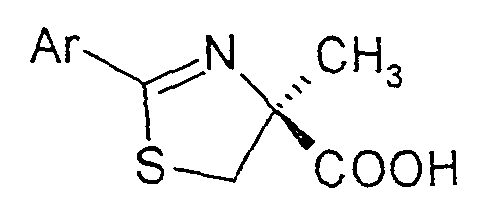
durch Kopplung von (S)-α-Methylcystein-Hydrochlorid der Formel (II)

by coupling (S) -α-methylcysteine hydrochloride of the formula (II)
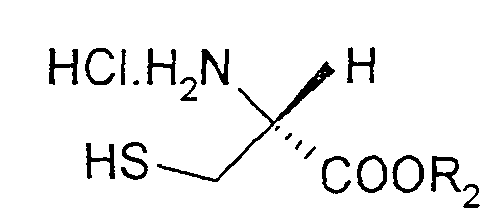

gekoppelt wird, die

methyliert wird, worauf

is coupled, the
is methylated, whereupon
Applications Claiming Priority (2)
| Application Number | Priority Date | Filing Date | Title |
|---|---|---|---|
| AT16392001 | 2001-10-16 | ||
| AT0163901A AT500490A1 (en) | 2001-10-16 | 2001-10-16 | METHOD FOR THE PRODUCTION OF SUBSTITUTED THIAZOLINES AND THEIR INTERMEDIATE PRODUCTS |
Publications (2)
| Publication Number | Publication Date |
|---|---|
| EP1302467A2 true EP1302467A2 (en) | 2003-04-16 |
| EP1302467A3 EP1302467A3 (en) | 2003-05-02 |
Family
ID=3688515
Family Applications (1)
| Application Number | Title | Priority Date | Filing Date |
|---|---|---|---|
| EP02021002A Withdrawn EP1302467A3 (en) | 2001-10-16 | 2002-09-20 | Process for the preparation of substituted thiazoline derivatives and their intermediate |
Country Status (4)
| Country | Link |
|---|---|
| US (2) | US6894170B2 (en) |
| EP (1) | EP1302467A3 (en) |
| JP (1) | JP2003201284A (en) |
| AT (1) | AT500490A1 (en) |
Cited By (5)
| Publication number | Priority date | Publication date | Assignee | Title |
|---|---|---|---|---|
| WO2003097622A3 (en) * | 2002-05-15 | 2004-04-08 | Genzyme Corp | Synthesis of 2-alkylcysteines, 2-(hydroxylated phenyl)-4-alkylthiazoline-4-carboxylic acids and derivatives thereof |
| WO2004031163A1 (en) * | 2002-10-01 | 2004-04-15 | Kaneka Corporation | PROCESS FOR PRODUCING OPTICALLY ACTIVE α-SUBSTITUTED CYSTEINE OR SALT THEREOF, INTERMEDIATE THEREFOR, AND PROCESS FOR PRODUCING THE SAME |
| EP1452529A1 (en) * | 2003-02-27 | 2004-09-01 | Consortium für elektrochemische Industrie GmbH | PRocess for an electrophilic substitution of thiazolidines or oxazolidines |
| WO2004092119A3 (en) * | 2003-04-17 | 2005-03-03 | Consortium Elektrochem Ind | Method for producing alpha-methylated cysteine and serine derivatives |
| EP1721902A1 (en) * | 2005-05-09 | 2006-11-15 | Ajinomoto Co., Inc. | Production methods of thiazoline compounds and optically active alpha-alkylcysteine |
Families Citing this family (8)
| Publication number | Priority date | Publication date | Assignee | Title |
|---|---|---|---|---|
| WO2005055931A2 (en) * | 2003-12-03 | 2005-06-23 | University Of Medicine And Dentistry Of New Jersey | Method of preventing survival of retrovirally cells and of inhibiting formation of infectious retroviruses |
| CN103435569B (en) | 2008-07-14 | 2015-08-19 | 法罗肯生物科学公司 | Denitrogenation as metal chelator is mixed the new salts of Desferrithiocin polyether analogues and polymorphic form |
| EP2459544A4 (en) * | 2009-07-27 | 2012-12-05 | Ferrokin Biosciences Inc | Prodrugs of desazadesferrothiocin polyether analogues as metal chelation agents |
| JP2013525495A (en) | 2010-05-04 | 2013-06-20 | シャイアー・リミテッド・ライアビリティ・カンパニー | Desazadesferrithiocin analogues as metal chelators |
| PT2624695E (en) | 2010-10-08 | 2015-12-01 | Nivalis Therapeutics Inc | Novel substituted quinoline compounds as s-nitrosoglutathione reductase inhibitors |
| US8785643B2 (en) | 2010-12-16 | 2014-07-22 | N30 Pharmaceuticals, Inc. | Substituted bicyclic aromatic compounds as S-nitrosoglutathione reductase inhibitors |
| CN104892477A (en) * | 2015-06-15 | 2015-09-09 | 尚科生物医药(上海)有限公司 | Preparation method of chirality 2-methyl cysteine and hydrochloride thereof |
| WO2017044766A1 (en) | 2015-09-10 | 2017-03-16 | Nivalis Therapeutics, Inc. | Solid forms of an s-nitrosoglutathione reductase inhibitor |
Family Cites Families (3)
| Publication number | Priority date | Publication date | Assignee | Title |
|---|---|---|---|---|
| US220504A (en) * | 1879-10-14 | Improvement in globe-holders for gas-fixtures | ||
| EP0045281B1 (en) * | 1980-07-28 | 1985-05-08 | Ciba-Geigy Ag | Triazoline derivatives and processes for their preparation |
| US6794515B2 (en) * | 2002-05-15 | 2004-09-21 | Genzyme Corporation | Synthesis of 2-alkylcysteine via substituted thiazoline amide |
-
2001
- 2001-10-16 AT AT0163901A patent/AT500490A1/en not_active Application Discontinuation
-
2002
- 2002-09-20 EP EP02021002A patent/EP1302467A3/en not_active Withdrawn
- 2002-10-15 US US10/270,324 patent/US6894170B2/en not_active Expired - Fee Related
- 2002-10-15 JP JP2002300807A patent/JP2003201284A/en not_active Withdrawn
-
2004
- 2004-12-15 US US11/011,110 patent/US20050101782A1/en not_active Abandoned
Cited By (20)
| Publication number | Priority date | Publication date | Assignee | Title |
|---|---|---|---|---|
| US6903220B2 (en) | 2002-05-15 | 2005-06-07 | Genzyme Corporation | Synthesis of chiral 2-alkyl amino acids |
| US7038073B2 (en) | 2002-05-15 | 2006-05-02 | Genzyme Corporation | Synthesis of 2-alkyl amino acids |
| US7576234B2 (en) | 2002-05-15 | 2009-08-18 | Genzyme Corporation | Synthesis of 2-alkyl amino acids |
| US6794515B2 (en) | 2002-05-15 | 2004-09-21 | Genzyme Corporation | Synthesis of 2-alkylcysteine via substituted thiazoline amide |
| US6846958B2 (en) | 2002-05-15 | 2005-01-25 | Genzyme Corporation | Synthesis of benzimidate from benzoic acid |
| US6861532B2 (en) | 2002-05-15 | 2005-03-01 | Genzyme Corporation | Synthesis of 2-alkylcysteine |
| US7294718B2 (en) | 2002-05-15 | 2007-11-13 | Genzyme Corporation | Synthesis of a 4-methylthiazole-4(S)-carboxylic acid compound |
| US6875883B2 (en) | 2002-05-15 | 2005-04-05 | Genzyme Corporation | Synthesis of benzonitriles from substituted benzaldehyde |
| US6878828B2 (en) | 2002-05-15 | 2005-04-12 | Genzyme Corporation | Synthesis of 2-alkylcysteine via substituted thiazoline ester |
| US7285676B2 (en) | 2002-05-15 | 2007-10-23 | Genzyme Corporation | Synthesis of chiral 2-alkyl amino acids |
| US7002036B2 (en) | 2002-05-15 | 2006-02-21 | Genzyme Corporation | Synthesis of 2-alkyl amino acids |
| US6982335B2 (en) | 2002-05-15 | 2006-01-03 | Genzyme Corporation | Synthesis of substituted thiazoline carboxylic acids |
| WO2003097622A3 (en) * | 2002-05-15 | 2004-04-08 | Genzyme Corp | Synthesis of 2-alkylcysteines, 2-(hydroxylated phenyl)-4-alkylthiazoline-4-carboxylic acids and derivatives thereof |
| US6875882B2 (en) | 2002-05-15 | 2005-04-05 | Genzyme Corporation | Synthesis of benzonitriles from substituted benzoic acid |
| US7115769B2 (en) | 2002-05-15 | 2006-10-03 | Genzyme Corporation | Synthesis of 2-alkylcysteine via phase transfer catalysis |
| US7285670B2 (en) | 2002-05-15 | 2007-10-23 | Genzyme Corporation | Synthesis of substituted thiazoline carboxylic acids |
| WO2004031163A1 (en) * | 2002-10-01 | 2004-04-15 | Kaneka Corporation | PROCESS FOR PRODUCING OPTICALLY ACTIVE α-SUBSTITUTED CYSTEINE OR SALT THEREOF, INTERMEDIATE THEREFOR, AND PROCESS FOR PRODUCING THE SAME |
| EP1452529A1 (en) * | 2003-02-27 | 2004-09-01 | Consortium für elektrochemische Industrie GmbH | PRocess for an electrophilic substitution of thiazolidines or oxazolidines |
| WO2004092119A3 (en) * | 2003-04-17 | 2005-03-03 | Consortium Elektrochem Ind | Method for producing alpha-methylated cysteine and serine derivatives |
| EP1721902A1 (en) * | 2005-05-09 | 2006-11-15 | Ajinomoto Co., Inc. | Production methods of thiazoline compounds and optically active alpha-alkylcysteine |
Also Published As
| Publication number | Publication date |
|---|---|
| AT500490A1 (en) | 2006-01-15 |
| US6894170B2 (en) | 2005-05-17 |
| US20050101782A1 (en) | 2005-05-12 |
| US20030088105A1 (en) | 2003-05-08 |
| JP2003201284A (en) | 2003-07-18 |
| EP1302467A3 (en) | 2003-05-02 |
Similar Documents
| Publication | Publication Date | Title |
|---|---|---|
| SK283663B6 (en) | Method of making (S)-(+)-3-(aminomethyl)-5-methylhexanoic acid | |
| EP1302467A2 (en) | Process for the preparation of substituted thiazoline derivatives and their intermediate | |
| KR20170026444A (en) | Process for the preparation of 3-hydroxypicolinic acids | |
| US4228299A (en) | Chemical process for preparing alkyl esters or the amide of 3-(β,.beta. | |
| RU2015953C1 (en) | Process for splitting 2,2-dimethylcyclopropanecarboxylic acid racemate | |
| HU194154B (en) | Process for producing esters of 4-/acyloxy/-3-oxo-butiric acid | |
| US5900492A (en) | Method of producing optically active cyclopropane derivatives | |
| US4582931A (en) | Preparation of 2-Deutero-D-serine | |
| JP2787973B2 (en) | Purification method of piperidine intermediate | |
| US4559178A (en) | Resolution of 3-benzoylthio-2-methyl-propanoic acid with (+)-dehydroabietylamine | |
| AT410545B (en) | METHOD FOR PRODUCING CHIRAL ALPHA HYDROXYCARBOXYLIC ACIDS | |
| JP6287528B2 (en) | Method for producing optically active 3,3-difluorolactic acid derivative | |
| US20080281125A1 (en) | Process for Preparing Enantiopure E-(2S)-Alkyl-5-Halopent-4-Enoic Acids and Esters | |
| HUT58734A (en) | Optical separating process for producing 3r/3-carboxy-benzyl/-6-/5-fluoro-2-benzothiazolyl/-methoxy-4r-chromanol | |
| FR2590894A1 (en) | AMINO-4-BUTANOIC ACID DERIVATIVES, PROCESS FOR PREPARING SAME AND USE THEREOF | |
| DE10317878A1 (en) | Process for the preparation of alpha-methylated cysteine and serine derivatives | |
| DE102004053311B3 (en) | Preparation of thiazolidine compounds, useful as intermediates for pharmaceutically active substances, comprises conversion of acid compounds to their corresponding ester compounds, followed by reaction with pivalaldehyde in situ | |
| AT413100B (en) | Preparation of chiral alpha-hydroxy-amides and carboxylic acids by controlled hydrolysis of corresponding hydroxynitriles with hydrochloric acid in carboxylic acid solvent | |
| DE68913688T2 (en) | Process for the production of leukotriene antagonists. | |
| JPH11322665A (en) | Method for purifying optically active α-trifluoromethyl lactic acid | |
| JPH10218840A (en) | Production of optically active cyclopropane derivative | |
| HK1117495A (en) | Process for preparing enantiopure e-(2s)-alkyl-5-halopent-4-enoic acids and esters | |
| JPS6213936B2 (en) | ||
| JPS6363546B2 (en) | ||
| EP0373057A1 (en) | Process for the preparation of (2-propyl)2-pentenoic acid and its esters |
Legal Events
| Date | Code | Title | Description |
|---|---|---|---|
| PUAI | Public reference made under article 153(3) epc to a published international application that has entered the european phase |
Free format text: ORIGINAL CODE: 0009012 |
|
| PUAL | Search report despatched |
Free format text: ORIGINAL CODE: 0009013 |
|
| AK | Designated contracting states |
Designated state(s): AT BE BG CH CY CZ DE DK EE ES FI FR GB GR IE IT LI LU MC NL PT SE SK TR |
|
| AX | Request for extension of the european patent |
Extension state: AL LT LV MK RO SI |
|
| AK | Designated contracting states |
Designated state(s): AT BE BG CH CY CZ DE DK EE ES FI FR GB GR IE IT LI LU MC NL PT SE SK TR |
|
| AX | Request for extension of the european patent |
Extension state: AL LT LV MK RO SI |
|
| 17P | Request for examination filed |
Effective date: 20030816 |
|
| AKX | Designation fees paid |
Designated state(s): AT BE BG CH CY CZ DE DK EE ES FI FR GB GR IE IT LI LU MC NL PT SE SK TR |
|
| 17Q | First examination report despatched |
Effective date: 20040625 |
|
| STAA | Information on the status of an ep patent application or granted ep patent |
Free format text: STATUS: THE APPLICATION IS DEEMED TO BE WITHDRAWN |
|
| 18D | Application deemed to be withdrawn |
Effective date: 20060630 |