Technical Field
-
The present invention relates to pharmaceutical compositions
comprising 3,5-dicyanopyridine derivatives or their pharmaceutically
acceptable salts as effective components, a high conductance-type of
calcium-activated K channel opening agents, smooth muscle relaxants for
bladder and agents for treating pollakiuria and urinary incontinence, as well
as novel 3,5-dicyanopyridine derivatives or their pharmaceutically acceptable
salts.
Background Art
-
It is known that the K channel plays an important role in generation
of resting membrane potential or action potential in cells and the opening of
the K channel induces hyperpolarizaiton of the cell membrane to suppress
excitability of the cells and exhibit the effect of smooth muscle relaxation (J.
Urol., 154, 1914-20, 1995).
-
The high conductance-type of calcium-activated K channel (also
referred to as maxi-K channel or BK channel) is one of calcium-activated K
channels that open when an increase in Ca level in the cells and
depolarization of membrane is detected, and which are widely distributed in
the living body to have an important function as an excitable negative
feedback system (Am. J. Physiol., 291, C9-C34, 1996). Thus, the drugs of
opening the maxi-K channel are expected to have the effects for protecting or
improving the function of a variety of organs by exhibiting relaxation in the
smooth muscle or suppression of the hyper excitation in the neurocytes.
-
Particularly, among them, it is known that the smooth muscle of the
bladder is highly sensitive to maxi-K channel inhibitors, charybdotoxin and
iberiotoxin (J. Pharmacol. Exp. Ther., 259 (1), 439-443, 1991), and accordingly
the drugs of opening the maxi-K channel are expected to be highly bladder
selective agents for treating pollakiuria or urinary incontinence.
-
The compounds of the invention exhibit the effect of opening the
maxi-K channel to hyper polarize the membrane potential in the cells, and
they, acting through their smooth muscle relaxant effect or effect for
suppressing nerve excitation, are useful, for example, in prophylaxis and/or
treatment of hypertension, asthma, premature birth, irritable bowel
syndrome, chronic heart failure, angina pectoris, myocardial infarction,
cerebral infarction, subarachnoid hemorrhage, cerebrovascular spasm,
cerebral hypoxia, peripheral vascular diseases, anxiety, male baldness,
erectile insufficiency, diabetes mellitus, diabetic peripheral neuropathy, other
diabetic complication, infertility, urinary calculus and its accompanying pain
(relief), particularly in treatment of instability of urinary bladder, e.g.,
pollakiuria, urinary incontinence, nocturnal enuresis.
-
It has been reported concerning the maxi-K channel opening drug
that the pyrrole derivative NS-8 of the following structure exhibits a relaxant
effect for the murine removed bladder smooth muscle, and charybdotoxin
exhibits an inhibitory effect to the relaxant action and further makes
rhythmic vesical contraction subsided in an anesthetized rat to increase the
bladder volume without having any influence on the maximum contraction
pressure of the bladder (Nippon Hinyouki-ka Gakkai Zasshi (J. Jap.
Urological Association), 89 (2), 138, 1998).
-
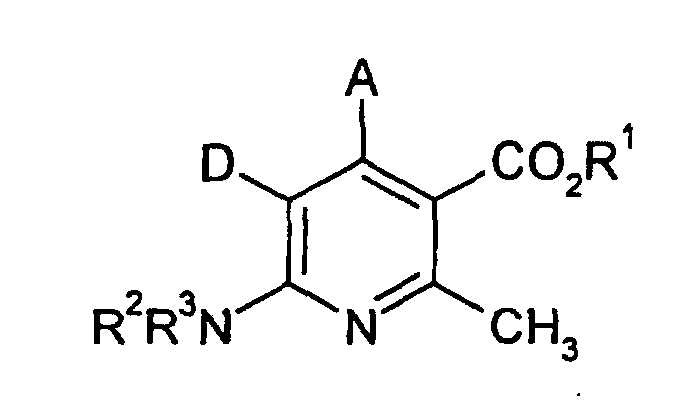
In JP8-67670, the 4-phenyl-6-aminonicotinic acid derivatives as
shown below have been disclosed as maxi K channel regulators, which are
useful in treatment of brain diseases.
(wherein D represents a nitro or cyano. Other symbols are defined in the
specification of JP8-67670)
-
Other derivatives disclosed as the maxi-K channel opening agents
include benzimidazole derivatives in EP477819 and EP617023, pyridine
derivatives in WO94/22807 and WO96/06610, thiopyranopyridine deivatives
in WO96/2547, cyclohexadiene derivatives in EP698597, pyran derivatives in
EP758649, nitrogen-containing 5-membered ring derivatives in WO98/04135,
indole derivatives in WO98/16222, quinoline derivatives in WO98/23273 and
WO99/09983, and anthranilic acid derivatives in WO99/07669 and
WO99/07670. However, there is no report on 3,5-dicyanopyridine
derivatives.
-
On the other hand, as for the 3,5-dicyanopyridine derivatives,
2-amino-3,5-dicyano-4-aryl-6-sulfanylpyridine derivatives have been
disclosed in WO01/25210 as ligands for adenosine receptors, which are
described as useful in prophylaxis and/or treatment of cardiovascular
diseases, urogenital diseases, respiratory diseases, inflammation and
inflammation in nervous system, diabetes mellitus, particularly diabetes
mellitus in pancreas, neural degenerative diseases, pain, hepatic fibrosis, and
liver cirrhosis.
-
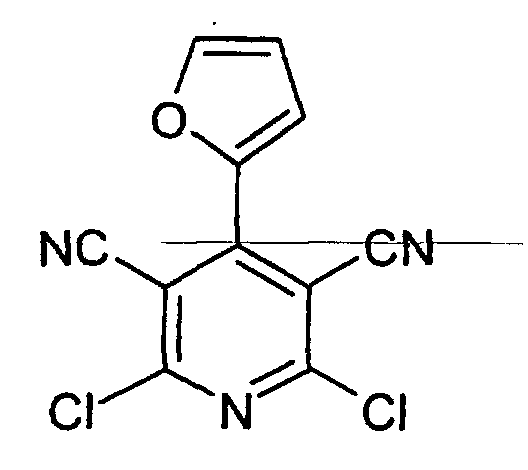
In Japanese Patent Publication No. 48-24726/1973, the
3,5-dicyanopyridine derivatives of the following structure have been
described, which can be used as antifungals, insecticides, herbicides,
miticides, nematocides, and antimicrobials, particularly as bactericides.
-
In addition, a process for synthesizing 3,5-dicyanopyridine derivatives
or the use of the 3,5-dicyanopyridine derivatives as intermediates in
synthesis have been described in J. Chin. Chem. Soc. (Taipei)(2000), 47(2),
347-350; Eur. J. Med. Chem. (1998), 33(11), 887-897; Reel. Trav. Chim.
Pays-Bas (1994), 113(1), 35-9; Eur. J. Med. Chem. Chim. Ther. (1984), 19(6),
555-7.
-
In addition, the 3,5-dicyanopyridine derivatives have also been
reported in Phosphorus, Sulfur Silicon Relat. Elem. (2000), 163, 29-40; Chem.
Commun. (Cambridge)(2000), (18), 1775-1776; Mendeleev Commun. (2000),
(3), 114-115; Russ. Chem. Bull. (2000), 49(2), 348-354; Proc. Natl. Acad. Sci.
U.S.A. (2000), 97(11), 6073-6078; Russ. J. Org. Chem. (1999), 35(9),
1377-1384; Chin. Pharm. J. (Taipei)(1999), 51(5), 313-318; Mendeleev
Commun. (2000), (1), 7-9; J. Am. Chem. Soc. (2000), 122(8), 1572-1579; J. Am.
Chem. Soc. (2000), 122(8), 1580-1588; Z. Naturforsch., B: Chem. Sci. (1999),
54(9), 1205-1209., Mendeleev Commun. (1999), (4), 166-167., Heterocycl.
Commun. (1999), 5(2), 179-182., J. Heterocycl. Chem. (1999), 36(2), 481-483.,
J. Serb. Chem. Soc. (1999), 64(1), 9-18., AIP Conf. Proc. (1998), 450(SCIFI 97:
Conference on Scintillating Fiber Detectors), 14-24., J. Prakt. Chem./Chem.-Ztg.
(1998), 340(7), 676-678., Chem. Heterocycl. Compd. (N. Y.) (1998), 34(2),
188-194., Chem. Heterocycl. Compd. (N. Y.) (1998), 34(1), 96-101., Chem.
Heterocycl. Compd. (N. Y.) (1998), Volume Date 1997, 33(12), 1430-1437., Rev.
Roum. Chim. (1998), 43(2), 163-170., Chem. Heterocycl. Compd. (N. Y.) (1998),
Volume Date 1997, 33(11),., Russ. J. Org. Chem. (1997), 33(7), 1014-1017.,
Chem. Heterocycl. Compd. (N. Y.) (1998), Volume Date 1997, 33(7), 793-798.,
Chem. Heterocycl. Compd. (N. Y.) (1997), 33(5), 587-595., Russ. Chem. Bull.
(1997), 46(11), 1909-1911., Chem. Heterocycl. Compd. (N. Y.) (1998), Volume
Date 1997, 33(7), 871-872., J. Chem. Soc., Perkin Trans. 1 (1997), (21),
3285-3290., J. Chem. Res., Synop. (1997), (9), 312-313., Bioorg. Med. Chem.
(1997), 5(8), 1543-1553., Heterocycl. Commun. (1997), 3(4), 371-380.,
Tetrahedron (1997), 53(23), 7911-7916., Monatsh. Chem. (1997), 128(1),
29-35., Ukr. Khim. Zh. (Russ. Ed.) (1996), 62(11-12), 61-66., Dokl. Akad. Nauk
(1997), 352(5), 636-640., Heteroat. Chem. (1997), 8(1), 1-6., Khim. Geterotsikl.
Soedin. (1996), (8), 1099-1103., Khim. Geterotsikl. Soedin. (1996), (8),
1094-1098., Tetrahedron (1996), 52(31), 10497-10506., Khim. Geterotsikl.
Soedin. (1996), (1), 67-73., Izv. Akad. Nauk, Ser. Khim. (1996), (4), 938-942.,
Tetrahedron (1996), 52(3), 1011-26., Bull. Soc. Chim. Fr. (1995), 132(9), 920-4.,
Natl. Acad. Sci. Lett. (India) (1995), Volume Date 1995, 18(1&2), 15-16.,
Monatsh. Chem. (1995), 126(6/7), 663-71., Tetrahedron (1995), 51(2), 635-48.,
Zh. Org. Khim. (1994), 30(4), 581-7., Aswan Sci. Technol. Bull. (1994), 15
108-19., Tetrahedron (1994), 50(22), 6705-14., Heterocycles (1994), 38(6),
1299-305., J. Heterocycl. Chem. (1994), 31(1), 49-52., Arch. Pharm.
(Weinheim, Ger.) (1993), 326(12), 959-61., Synth. Commun. (1993), 23(18),
2605-9., Corros. Sci. (1993), 34(5), 779-84., J. Heterocycl. Chem. (1992), 29(7),
1693-702., Gazz. Chim. Ital. (1992), 122(8), 299-303., Z. Naturforsch., B:
Chem. Sci. (1992), 47(10), 1438-40., EP476607, Z. Naturforsch., B: Chem. Sci.
(1992), 47(4), 572-8., Bull. Fac. Sci., Assiut Univ. (1991), 20(2), 43-53., Bull.
Fac. Sci., Assiut Univ. (1991), 20(2), 135-40., Monatsh. Chem. (1991), 122(12),
1035-45., Izv. Akad. Nauk SSSR, Ser. Khim. (1991), (7), 1643-6., J. Chem. Res.,
Synop. (1991), (7), 178-9., Phosphorus, Sulfur Silicon Relat. Elem. (1991),
55(1-4), 175-83., J. Chem. Res., Synop. (1991), (5), 116-17., Zh. Obshch. Khim.
(1990), 60(12), 2750-5., Arch. Pharmacal Res. (1990), 13(3), 274-7.,
DE3905238, Orient. J. Chem. (1989), 5(4), 273-80., J. Chem. Res., Synop.
(1990), (6), 186-7., DD275688, Phosphorus, Sulfur Silicon Relat. Elem. (1990),
48(1-4), 281-4., Indian J. Chem., Sect. B (1990), 29B(4), 322-5., J. Chem. Res.,
Synop. (1990), (5), 136-7., Ukr. Khim. Zh. (Russ. Ed.) (1990), 56(1), 65-9., Zh.
Org. Khim. (1989), 25(6), 1323-30., Zh. Org. Khim. (1989), 25(3), 622-8., J.
Prakt. Chem. (1988), 330(5), 817-13., Zh. Org. Khim. (1988), 24(4), 854-61.,
Acta Pol. Pharm. (1987), 44(1), 32-41., J. Chem. Eng. Data (1988), 33(2),
218-19., Gazz. Chim. Ital. (1987), 117(7), 385-9., Zh. Obshch. Khim. (1987),
57(4), 959-61., Z. Naturforsch., B: Chem. Sci. (1987), 42(1), 107-11., Z.
Naturforsch., B: Anorg. Chem., Org. Chem. (1986), 41B(6), 781-3., Izv. Akad.
Nauk SSSR, Ser. Khim. (1986), (1), 153-9., Heterocycles (1985), 23(12),
3107-10., Liebigs Ann. Chem. (1986), (9), 1639-44., Heterocycles (1985), 23(8),
2013-17., Drug Chem. Toxicol. (1977) (1985), 8(3), 171-82., Chem. Ber. (1985),
118(6), 2198-207., An. Quim., Ser. C (1984), 80(3), 268-72., Heterocycles
(1985), 23(1), 93-8., Synthesis (1984), (8), 679-81., DD210262, An. Quim., Ser.
C (1983), 79(3), 368-72., Zh. Obshch. Khim. (1983), 53(5), 1187-8., J.
Heterocycl. Chem. (1982), 19(5), 1021-4., Zh. Org. Khim. (1982), 18(11),
2421-5., DD150894, Synthesis (1982), (4), 320-2., Deposited Doc. (1981),
VINITI 1509-81, 12 pp. Avail.: VINITI., Monatsh. Chem. (1981), 112(8-9),
973-85., Monatsh. Chem. (1981), 112(11), 1271-7., Synthesis (1981), (7),
529-30., Synthesis (1981), (7), 531-3., Bull. Chem. Soc. Jpn. (1981), 54(3),
787-9., An. Quim., Ser. C (1980), 76(1), 68-9., Indian J. Chem., Sect. B (1980),
19B(2), 151-2., Pol. J. Chem. (1979), 53(10), 2121-7., Arch. Pharm. (Weinheim,
Ger.) (1979), 312(6), 478-86., An. Quim. (1978), 74(4), 648-50., Synthesis
(1978), (9), 681-2., J. Chem. Soc., Perkin Trans. 1 (1978), (6), 549-53., An.
Quim. (1977), 73(11), 1359-62., Afinidad (1978), 35(354), 138-40., Proc. R. Ir.
Acad., Sect. B (1977), 77B(19-47), 533-8; Yakugaku Zasshi (1977), 97(9),
1022-33; J. Org. Chem. (1977), 42(21), 3410-13; An. Quim. (1976), 72(11-12),
926-30; PL72750; An. Quim. (1974), 70(12), 951-8; Acta Pol. Pharm. (1974),
31(3), 271-8; J. Org. Chem. (1974), 39(25), 3735-8; J. Org. Chem. (1974),
39(12), 1685-8; Indian J. Chem. (1973), 11(12), 1315-16; Aust. J. Chem. (1973),
26(11), 2567-9; DE2206506; Act Pol. Pharm. (1972), 29(6), 545-53; J. Chem.
Soc., Perkin Trans. 1 (1972), (23), 2946-50; Chem. Parm Bull. (1972), 20(7),
1544-50; Ind. Chim. Belge (1968), 33(5), 449-54; J. Chem. Soc. C (1968), (10),
1252-8; J. Chem. Soc. C (1968), (8), 960-6; An. R. Soc. Esp. Fis. Quim., Ser. B
(1967), 63(6), 691-702; Rev. R. Acad. Cienc. Exactas, Fis. Nat. Madrid (1966),
60(1), 35-144.
-
However, there is no report on the relation to a "high
conductance-type of calcium-activated K channel opening agents", "smooth
muscle relaxants for bladder" and "agents for treating pollakiuria and
urinary incontinence" at all.
-
Though the compounds as descried in the above-mentioned patent
specifications are known as the maxi-K channel opening agents, it is a
therapeutically important problem to create a much better maxi-K channel
opening agent as well as a therapeutic agent for treating pollakiuria and
urinal incontinence based on the above-mentioned effect.
Disclosure of Invention
-
The present inventors worked assiduously to study maxi-K channel
opening compounds and found that 3,5-dicyanopyridine derivatives exhibit an
excellent effect to open the maxi-K channel. The invention was completed
based on this finding.
-
According to the invention, there are provided a high
conductance-type of calcium-activated K channel (maxi-K channel) opening
agents, smooth muscle relaxants for bladder and agents for treating
pollakiuria and urinary incontinence, comprising any one of
3,5-dicyanopyridine derivatives of the general formula (I) or pharmaceutically
acceptable salts thereof as effective components.
Wherein
R
1 represents H, an optionally substituted lower alkyl, optionally
substituted cycloalkyl, optionally substituted aryl, optionally substituted
heteroaryl, or optionally substituted 5- or 6-membered saturated heterocycle;
R
2 and R
3 are the same or different, each representing -O-R
4,
-S(O)
n-R
4, -N(-R
4)-R
5, -NHCO-R
5, -NHS(O)
n-R
5, -NHCON(-R
4)-R
5, -N(CO-R
5)
2,
halogen atom or optionally substituted heteroaryl;
R
4 represents H, an optionally substituted lower alkyl, optionally
substituted lower alkenyl, optionally substituted alkynyl, optionally
substituted aryl, optionally substituted heteroaryl, or optionally substituted
5- or 6-membered saturated heterocycle;
R
5 represents H, an optionally substituted lower alkyl, cycloalkyl,
-lower alkyl-O-lower alkyl, -lower alkyl-O-aryl, -lower alkyl-aryl, optionally
substituted aryl, or optionally substituted heteroaryl;
or alternatively R
4 and R
5 taken with the adjacent N atom may form
a 5- or 6-membered saturated heterocycle or a heteroaryl;
n represents 0, 1 or 2.
-
The 3,5-dicyanopyridine derivatives are characterized in the
structure that they are substituted by cyano groups at the 3 and 5 positions
of the pyridine ring and in the pharmacological properties that they exhibit
an opening effect for the maxi-K channel.
-
In addition, according to the invention, there are provided
3,5-dicyanopyridine derivatives of the general formula (II) or
pharmaceutically acceptable salts thereof.
Wherein
R
6 represents phenyl, 2-fluorophenyl, 2,5-difluorophenyl,
2,6-difluorophenyl, 4-aminophenyl, 2,3-dihydro-1H-indol-6-yl, quinolin-7-yl,
3,4,5,6-tetrahydro-2H-pyran-2-yl, cyclohexylmethyl, benzyl, thiophen-2-yl or
thiophen-3-yl;
R
7 and R
8 are the same or different, each representing -O-R
9,
-S(O)
m-R
9, -N(-R
9)-R
10, -NHCO-R
10, -NHS(O)
m-R
10, -NHCON(-R
9)-R
10,
-N(CO-R
10)
2, halogen atom or optionally substituted heteroaryl;
R
9 represents H, an optionally substituted lower alkyl, optionally
substituted lower alkenyl, optionally substituted alkynyl, optionally
substituted aryl, optionally substituted heteroaryl, or optionally substituted
5- or 6-membered saturated heterocycle;
R
10 represents H, an optionally substituted lower alkyl, cycloalkyl,
-lower alkyl-O-lower alkyl, -lower alkyl-O-aryl, -lower alkyl-aryl, optionally
substituted aryl, or optionally substituted heteroaryl;
or alternatively R
9 and R
10 taken with the adjacent N atom may form
a 5- or 6-membered saturated heterocycle or a heteroaryl;
m represents 0, 1 or 2;
provided that
when R
6 is phenyl, then
R
7 is methoxy, 2-(2-amino-3-phenylpropionyloxy)ethoxy, 2-hydroxyethoxy,
2-aminomethylphenoxy or pyridin-3-ylmethyloxy; when R
5 is phenyl and R
7 is
methoxy, then R
8 is 2-hydroxyethylamino or methoxycarbonylmethylamino;
when R
6 is phenyl, 2-fluorophenyl, 2,5-difluorophenyl,
2,6-difluorophenyl or 4-aminophenyl, R
7 is -S-R
9, and R
9 is not
N-oxidopyridinylmethyl, then
R
8 excludes NH
2;
when R
6 is benzyl, then
2-amino-4-benzyl-6-ethoxypyridine-3,5-dicarbonitrile is excluded;
when R
6 is thiophen-2-yl, then
R
7 is methoxy or 2-hydroxyethylsulfanyl;
when R
6 is thiophen-3-yl, then
2-amino-6-sulfanyl-4-(thiophen-2-yl)pyridine-3,5-dicarbonitrile is excluded.
-
Among the compounds represented by the general formula (II) or
their pharmaceutically acceptable salts, the followings are preferred:
- 2-amino-4-(2-fluorophenyl)-6-methoxypyridine-3,5-dicarbonitrile;
- 2-amino-6-methoxy-4-(tetrahydro-2H-pyran-2-yl)pyridine-3,5-dicarbonitrile;
- 2-[(6-amino-3,5-dicyano-4-phenylpyridin-2-yl)oxy]ethyl (S)-2-amino-3-phenyl
propanoate;
- 2-amino-6-(2,2-difluoroethoxy)-4-(2-fluorophenyl)pyridine-3,5-dicarbonitrile;
- 2-amino-4-(2-fluorophenyl)-6-(prop-2-yn-1-yloxy)pyridine-3,5-dicarbonitrile;
- N-[3,5-dicyano-4-(2-fluorophenyl)-6-methoxypyridin-2-yl]acetamide;
- 2-amino-4-(2,3-dihydro-1H-indol-6-yl)-6-methoxypyridine-3,5-dicarbonitrile;
- N-[3,5-dicyano-4-(2-fluorophenyl)-6-methoxypyridin-2-yl]-2-methoxyacetamide;
- N-[3,5-dicyano-4-(2,6-difluorophenyl)-6-methoxypyridin-2-yl]-2-methoxyacetamide;
- N-[3,5-dicyano-4-(2,6-difluorophenyl)-6-methoxypyridin-2-yl]acetamide;
- N-[3,5-dicyano-6-methoxy-4-(tetrahydropyran-2-yl)pyridin-2-yl]-2-methoxyacetamide;
- N-[3,5-dicyano-6-(2,2-difluoroethoxy)-4-(2-fluorophenyl)pyridin-2-yl]-2-methoxyacetamide;
- 2-amino-6-methoxy-4-thiophen-2-ylpyridine-3,5-dicarbonitrile;
- 2-amino-6-methylsulfanyl-4-thiophen-3-ylpyridine-3,5-dicarbonitrile;
- 2-amino-6-(2-hydroxyethoxy)-4-phenylpyridine-3,5-dicarbonitrile;
- 2-amino-6-[(2-hydroxyethyl)sulfanyl]-4-thiophen-2-ylpyridine-3,5-dicarbonitrile;
- 2-amino-4-(4-aminophenyl)-6-methoxypyridine-3,5-dicarbonitrile;
- N-(3,5-dicyano-6-methoxy-4-thiophen-2-ylpyridin-2-yl)acetamide;
- 2-amino-4-(2,5-difluorophenyl)-6-methoxypyridine-3,5-dicarbonitrile;
- 2-[(2-hydroxyethyl)amino]-6-methoxy-4-phenylpyridine-3,5-dicarbonitrile;
- methyl [(3,5-dicyano-6-methoxy-4-phenylpyridin-2-yl)amino]acetate;
- 2-amino-4-(2,6-difluorophenyl)-6-methoxypyridine-3,5-dicarbonitrile;
- 2-amino-4-(2-fluorophenyl)-6-(2-hydroxyethoxy)pyridine-3,5-dicarbonitrile;
- 2-amino-4-(2-fluorophenyl)-6-isopropoxypyridine-3,5-dicarbonitrile;
- 2-amino-4-benzyl-6-methoxypyridine-3,5-dicarbonitrile;
- 2-amino-4-cyclohextlmethyl-6-methoxypyridine-3,5-dicarbonitrile;
- 2-amino-6-(3-fluorophenoxy)-4-(2-fluorophenyl)pyridine-3,5-dicarbonitrile;
- 2-amino-6-(2-aminomethylphenoxy)-4-phenylpyridine-3,5-dicarbonitrile;
- 2-allyloxy-6-amino-4-(2-fluorophenyl)pyridine-3,5-dicarbonitrile;
- 2-amino-4-(2-fluorophenyl)-6-(pyridin-3-ylmethoxy)pyridine-3,5-dicarbonitrile
;
- 2-amino-4-benzyl-6-[(pyridin-3-ylmethyl)sulfanyl]pyridine-3,5-dicarbonitrile;
- 2-amino-4-benzyl-6-(pyridin-3-ylmethoxy)pyridine-3,5-dicarbonitrile;
- 2-amino-4-(2,6-difluorophenyl)-6-(pyridin-3-ylmethoxy)pyridine-3,5-dicarbonitrile;
- 2-amino-4-phenyl-6-(pyridin-3-ylmethoxy)pyridine-3,5-dicarbonitrile;
- 2-amino-4-(2-fluorophenyl)-6-{[(1-oxidopyridin-3-yl)methyl]sulfanyl}pyridine-3,5-dicarbonitrile;
- 2-amino-4-(2-fluorophenyl)-6-(pyridin-2-ylmethoxy)pyridine-3,5-dicarbonitrile
;
- 2-amino-4-(2-fluorophenyl)-6-(pyridin-4-ylmethoxy)pyridine-3,5-dicarbonitrile
;
- 2-amino-6-benzylsulfanyl-4-(tetrahydro-2H-pyran-2-yl)pyridine-3,5-dicarbonitrile;
- 2-amino-4-(2-fluorophenyl)-6-[(1-oxidopyridin-3-yl)methoxy]pyridine-3,5-dicarbonitrile;
- 2-amino-6-(but-3-en-1-yloxy)-4-(2-fluorophenyl)pyridine-3,5-dicarbonitrile;
- 2-diacetylamino-4-(2-fluorophenyl)-6-methoxypyridine-3,5-dicarbonitrile;
- N-[3,5-dicyano-4-(2-fluorophenyl)-6-methoxypyridin-2-yl]propionamide;
- N-[3,5-dicyano-4-(2-fluorophenyl)-6-methoxypyridin-2-yl]-2,2,2-trifluoroacetamide;
- N-[3,5-dicyano-4-(2-fluorophenyl)-6-methoxypyridin-2-yl]isobutyramide;
- N-[3,5-dicyano-4-(2-fluorophenyl)-6-methoxypyridin-2-yl]-3-phenylpropionamide;
- N-[3,5-dicyano-4-(2-fluorophenyl)-6-methoxypyridin-2-yl]-2-phenoxyacetamide;
- N-[3,5-dicyano-4-(2-fluorophenyl)-6-methoxypyridin-2-yl]-2-phenylacetamide;
- 1-[3,5-dicyano-4-(2-fluorophenyl)-6-methoxypyridin-2-yl]-3-(2-hydroxyethyl)urea;
- N-[3,5-dicyano-4-(2-fluorophenyl)-6-methoxypyridin-2-yl]-2,2-dimethylpropionamide;
- N-[3,5-dicyano-4-(2-fluorophenyl)-6-methoxypyridin-2-yl]hexanamide;
- N-[3,5-dicyano-4-(2-fluorophenyl)-6-methoxypyridin-2-yl]thiophene-2-carboxamide;
- methyl N-[3,5-dicyano-4-(2-fluorophenyl)-6-methoxy-pyridin-2-yl]oxamate;
- N-[3,5-dicyano-4-(2-fluorophenyl)-6-methoxypyridin-2-yl]pyridine-2-carboxamide;
- 2-amino-6-methoxy-4-quinolin-7-ylpyridine-3,5-dicarbonitrile;
- N-[3,5-dicyano-4-(2-fluorophenyl)-6-methoxypyridin-2-yl]naphthalene-2-carboxamide;
- N-[3,5-dicyano-4-(2-fluorophenyl)-6-methoxypyridin-2-yl]furan-2-carboxamide
;
- [3,5-dicyano-4-(2-fluorophenyl)-6-methoxypyridin-2-ylcarbamoyl]methylacetate;
- 2-benzyloxy-N-[3,5-dicyano-4-(2-fluorophenyl)-6-methoxypyridin-2-yl]acetamide;
- N-[3,5-dicyano-4-(2-fluorophenyl)-6-methoxypyridin-2-yl]-3-methoxypropionamide;
- N-[3,5-dicyano-4-(2-fluorophenyl)-6-methoxypyridin-2-yl]-2-dimethylaminoacetamide;
- N-[3,5-dicyano-4-(2-fluorophenyl)-6-methoxypyridin-2-yl]-3-pyridin-3-ylpropionamide; or
- (R)-N-[3,5-dicyano-4-(2-fluorophenyl)-6-methoxypyridin-2-yl]-2-phenylpropionamide; or
pharmaceutically acceptable salts thereof. More preferred are:
- 2-amino-4-(2-fluorophenyl)-6-methoxypyridine-3,5-dicarbonitrile;
- 2-amino-6-methoxy-4-(tetrahydro-2H-pyran-2-yl)pyridine-3,5-dicarbonitrile;
- 2-[(6-amino-3,5-dicyano-4-phenylpyridin-2-yl)oxy]ethyl (S)-2-amino-3-phenylpropanoate;
- 2-amino-6-(2,2-difluoroethoxy)-4-(2-fluorophenyl)pyridine-3,5-dicarbonitrile;
- 2-amino-4-(2-fluorophenyl)-6-(prop-2-yn-1-yloxy)pyridine-3,5-dicarbonitrile;
- N-[3,5-dicyano-4-(2-fluorophenyl)-6-methoxypyridin-2-yl]acetamide;
- 2-amino-4-(2,3-dihydro-1H-indol-6-yl)-6-methoxypyridine-3,5-dicarbonitrile;
- N-[3,5-dicyano-4-(2-fluorophenyl)-6-methoxypyridin-2-yl]-2-methoxyacetamide;
- N-[3,5-dicyano-4-(2,6-diffuorophenyl)-6-methoxypyridin-2-yl]-2-methoxyacetamide;
- N-[3,5-dicyano-4-(2,6-difluorophenyl)-6-methoxypyridin-2-yl]acetamide;
- N-[3,5-dicyano-6-methoxy-4-(tetrahydropyran-2-yl)pyridin-2-yl]-2-methoxyacetamide; or
- N-[3,5-dicyano-6-(2,2-difluoroethoxy)-4-(2-fluorophenyl)pyridin-2-yl]-2-methoxyacetamide; or
pharmaceutically acceptable salts thereof.-
-
According to the invention, there are provided pharmaceutical
compositions, a high conductance-type of calcium-activated K channel
opening agents, smooth muscle relaxants for bladder and agents for treating
pollakiuria and urinary incontinence, comprising any one of the following
compounds represented by the general formula (II) or their pharmaceutically
acceptable salts as effective components. Preferred are:
- 2-amino-4-(2-fluorophenyl)-6-methoxypyridine-3,5-dicarbonitrile;
- 2-amino-6-methoxy-4-(tetrahydro-2H-pyran-2-yl)pyridine-3,5-dicarbonitrile;
- 2-[(6-amino-3,5-dicyano-4-phenylpyridin-2-yl)oxy]ethyl (S)-2-amino-3-phenylpropanoate;
- 2-amino-6-(2,2-difluoroethoxy)-4-(2-fluorophenyl)pyridine-3,5-dicarbonitrile;
- 2-amino-4-(2-fluorophenyl)-6-(prop-2-yn-1-yloxy)pyridine-3,5-dicarbonitrile;
- N-[3,5-dicyano-4-(2-fluorophenyl)-6-methoxypyridin-2-yl]acetamide;
- 2-amino-4-(2,3-dihydro-1H-indol-6-yl)-6-methoxypyridine-3,5-dicarbonitrile;
- N-[3,5-dicyano-4-(2-fluorophenyl)-6-methoxypyridin-2-yl]-2-methoxyacetamide;
- N-[3,5-dicyano-4-(2,6-difluorophenyl)-6-methoxypyridin-2-yl]-2-methoxyacetamide;
- N-[3,5-dicyano-4-(2,6-difluorophenyl)-6-methoxypyridin-2-yl]acetamide;
- N-[3,5-dicyano-6-methoxy-4-(tetrahydropyran-2-yl)pyridin-2-yl]-2-methoxyacetamide;
- N-[3,5-dicyano-6-(2,2-difluoroethoxy)-4-(2-fluorophenyl)pyridin-2-yl]-2-methoxyacetamide;
- 2-amino-6-methoxy-4-thiophen-2-ylpyridine-3,5-dicarbonitrile;
- 2-amino-6-methylsulfanyl-4-thiophen-3-ylpyridine-3,5-dicarbonitrile;
- 2-amino-6-(2-hydroxyethoxy)-4-phenylpyridine-3,5-dicarbonitrile;
- 2-amino-6-[(2-hydroxyethyl)sulfanyl]-4-thiophen-2-ylpyridine-3,5-dicarbonitrile;
- 2-amino-4-(4-aminophenyl)-6-methoxypyridine-3,5-dicarbonitrile;
- N-(3,5-dicyano-6-methoxy-4-thiophen-2-ylpyridin-2-yl)acetamdie;
- 2-amino-4-(2,5-difluorophenyl)-6-methoxypyridine-3,5-dicarbonitrile;
- 2-[(2-hydroxyethyl)amino]-6-methoxy-4-phenylpyridine-3,5-dicarbonitrile;
- methyl [(3,5-dicyano-6-methoxy-4-phenylpyridin-2-yl)amino]acetate;
- 2-amino-4-(2,6-difluorophenyl)-6-methoxypyridine-3,5-dicarbonitrile;
- 2-amino-4-(2-fluorophenyl)-6-(2-hydroxyethoxy)pyridine-3,5-dicarbonitrile;
- 2-amino-4-(2-fluorophenyl)-6-isopropoxypyridine-3,5-dicarbonitrile;
- 2-amino-4-benzyl-6-methoxypyridine-3,5-dicarbonitrile;
- 2-amino-4-cyclohexylmethyl-6-methoxypyridine-3,5-dicarbonitrile;
- 2-amino-6-(3-fluorophenoxy)-4-(2-fluorophenyl)pyridine-3,5-dicarbonitrile;
- 2-amino-6-(2-aminomethylphenoxy)-4-phenylpyridine-3,5-dicarbonitrile;
- 2-allyloxy-6-amino-4-(2-fluorophenyl)pyridine-3,5-dicarbonitrile;
- 2-amino-4-(2-fluorophenyl)-6-(pyridin-3-ylmethoxy)pyridine-3,5-dicarbonitrile
;
- 2-amino-4-benzyl-6-[(piridin-3-ylmethyl)sulfanyl]pyridine-3,5-dicarbonitrile;
- 2-amino-4-benzyl-6-(pyridin-3-ylmethoxy)pyridine-3,5-dicarbonitrile;
- 2-amino-4-(2,6-difluorophenyl)-6-(pyridin-3-ylmethoxy)pyridine-3,5-dicarbonitrile;
- 2-amino-4-phenyl-6-(pyridin-3-ylmethoxy)pyridine-3,5-dicarbonitrile;
- 2-amino-4-(2-fluorophenyl)-6-{[(1-oxidopyridin-3-yl)methyl]sulfanyl)pyridine-3,5-dicarbonitrile;
- 2-amino-4-(2-fluorophenyl)-6-(pyridin-2-ylmethoxy)pyridine-3,5-dicarbonitrile
;
- 2-amino-4-(2-fluorophenyl)-6-(pyridin-4-ylmethoxy)pyridine-3,5-dicarbonitrile
;
- 2-amino-6-benzylsulfanyl-4-(tetrahydro-2H-pyran-2-yl)pyridine-3,5-dicarbonitrile;
- 2-amino-4-(2-fluorophenyl)-6-[(1-oxidopyridin-3-yl)methoxy]pyridine-3,5-dicarbonitrile;
- 2-amino-6-(but-3-en-1-yloxy)-4-(2-fluorophenyl)pyridine-3,5-dicarbonitrile;
- 2-diacetylamino-4-(2-fluorophenyl)-6-methoxypyridine-3,5-dicarbonitrile;
- N-[3,5-dicyano-4-(2-fluorophenyl)-6-methoxypyridin-2-yl]propionamide;
- N-[3,5-dicyano-4-(2-fluorophenyl)-6-methoxypyridin-2-yl]-2,2,2-trifluoroacetamide;
- N-[3,5-dicyano-4-(2-fluorophenyl)-6-methoxypyridin-2-yl]isobutyramide;
- N-[3,5-dicyano-4-(2-fluorophenyl)-6-methoxypyridin-2-yl]-3-phenylpropionamide;
- N-[3,5-dicyano-4-(2-fluorophenyl)-6-methoxypyridin-2-yl]-2-phenoxyacetamide;
- N-[3,5-dicyano-4-(2-fluorophenyl)-6-methoxypyridin-2-yl]-2-phenylacetamide;
- 1-[3,5-dicyano-4-(2-fluorophenyl)-6-methoxypyridin-2-yl]-3-(2-hydroxyethyl)urea;
- N-[3,5-dicyano-4-(2-fluorophenyl)-6-methoxypyridin-2-yl]-2,2-dimethylpropionamide;
- N-[3,5-dicyano-4-(2-fluorophenyl)-6-methoxypyridin-2-yl]hexanamide;
- N-[3,5-dicyano-4-(2-fluorophenyl)-6-methoxypyridin-2-yl]thiophene-2-carboxamide;
- methyl N-[3,5-dicyano-4-(2-fluorophenyl)-6-methoxy-pyridin-2-yl]oxamate;
- N-[3,5-dicyano-4-(2-fluorophenyl)-6-methoxypyridin-2-yl]pyridine-2-carboxamide;
- 2-amino-6-methoxy-4-quinolin-7-ylpyridine-3,5-dicarbonitrile;
- N-[3,5-dicyano-4-(2-fluorophenyl)-6-methoxypyridin-2-yl]naphthalene-2-carboxamide;
- N-[3,5-dicyano-4-(2-fluorophenyl)-6-methoxypyridin-2-yl]furan-2-carboxamide
;
- [3,5-dicyano-4-(2-fluorophenyl)-6-methoxypyridin-2-ylcarbamoyl]methyl
acetate;
- 2-benzyloxy-N-[3,5-dicyano-4-(2-fluorophenyl)-6-methoxypyridin-2-yl]acetamide;
- N-[3,5-dicyano-4-(2-fluorophenyl)-6-methoxypyridin-2-yl]-3-methoxypropionamide;
- N-[3,5-dicyano-4-(2-fluorophenyl)-6-methoxypyridin-2-yl]-2-dimethylaminoacetamide;
- N-[3,5-dicyano-4-(2-fluorophenyl)-6-methoxypyridin-2-yl]-3-pyridin-3-ylpropionamide; or
- (R)-N-[3,5-dicyano-4-(2-fluorophenyl)-6-methoxypyridin-2-yl]-2-phenylpropionamide; or
pharmaceutically acceptable salts thereof. More preferred are:
- 2-amino-4-(2-fluorophenyl)-6-methoxypyridine-3,5-dicarbonitrile;
- 2-amino-6-methoxy-4-(tetrahydro-2H-pyran-2-yl)pyridine-3,5-dicarbonitrile;
- 2-[(6-amino-3,5-dicyano-4-phenylpyridin-2-yl)oxy]ethyl (S)-2-amino-3-phenylpropanoate;
- 2-amino-6-(2,2-difluoroethoxy)-4-(2-fluorophenyl)pyridine-3,5-dicarbonitrile;
- 2-amino-4-(2-fluorophenyl)-6-(prop-2-yn-1-yloxy)pyridine-3,5-dicarbonitrile;
- N-[3,5-dicyano-4-(2-fluorophenyl)-6-methoxypyridin-2-yl]acetamide;
- 2-amino-4-(2,3-dihydro-1H-indol-6-yl)-6-methoxypyridine-3,5-dicarbonitrile;
- N-[3,5-dicyano-4-(2-fluorophenyl)-6-methoxypyridin-2-yl]-2-methoxyacetamide;
- N-[3,5-dicyano-4-(2,6-difluorophenyl)-6-methoxypyridin-2-yl]-2-methoxyacetamide;
- N-[3,5-dicyano-4-(2,6-difluorophenyl)-6-methoxypyridin-2-yl]acetamide;
- N-[3,5-dicyano-6-methoxy-4-(tetrahydropyran-2-yl)pyridin-2-yl]-2-methoxyacetamide; or
- N-[3,5-dicyano-6-(2,2-difluoroethoxy)-4-(2-fluorophenyl)pyridin-2-yl]-2-methoxyacetamide; or
pharmaceutically acceptable salts thereof.-
-
The compounds represented by the general formula (I) or (II) are
further described as follows.
-
In the definition of the groups of the general formulae in the present
specification, the term "lower" means, unless otherwise indicated, a straight
or branched carbon chain of 1 to 6 carbon atoms.
-
Accordingly, the term "lower alkyl" means a C1-6 alkyl, specifically
including methyl, ethyl, propyl, butyl, pentyl, hexyl or isopropyl and a
structural isomer thereof, preferably C1-4 alkyl, more preferably methyl or
ethyl.
-
The term "lower alkenyl" means a C2-6 alkenyl, specifically including
ethenyl, 1-propenyl, 1-butenyl, 1-pentenyl, 1-hexenyl or 2-propenyl,
1-methyl-2-propenyl, and a structural isomer thereof, preferably 2-propenyl.
-
The term "lower alkynyl" means a C2-6 alkynyl, specifically including
ethynyl, 1-propynyl, 1-butynyl, 1-pentynyl, 1-hexynyl or 2-propynyl,
2-butynyl, 1-methyl-2-propynyl, and a structural isomer thereof, preferably
2-propynyl or 2-butynyl.
-
The term "cycloalkyl" means a 3- to 8-membered cyclic hydrocarbon,
specifically including cyclopropyl, cyclobutyl, cyclopentyl, cyclohexyl,
cycloheptyl, and cyclooctyl.
-
The "halogen atom" includes fluorine atom, chlorine atom, bromine
atom, and iodine atom.
-
The term "aryl" means an optionally substituted C6-14 monocyclic to
tricyclic aromatic ring, specifically including phenyl, naphthyl, anthranyl,
phenanthryl, and the like, and preferably phenyl.
-
The term "heteroaryl" means an optionally substituted 5- to
8-membered monocyclic to tricyclic aromatic ring containing 1 to 4
heteroatoms selected from oxygen atom, sulfur atom and nitrogen atom,
specifically including monocyclic heteroaryls such as furyl, thienyl, pyrrolyl,
imidazolyl, thiazolyl, pyrazolyl, isothiazolyl, isoxazolyl, pyridyl, pyrimidyl,
pyridazinyl, pyrazyl, triazolyl, tetrazolyl, and the like; and bicyclic
heteroaryls such as indolyl, 2,3-dihydro-1H-indolyl, quinolyl, isoquinolyl,
benzimidazolyl, naphthyridinyl, 1,3-benzodioxyl, 1,2,3,4-tetrahydroquinolyl,
3,4-dihydro-2H-benzo[1,4]oxazinyl, and the like.
-
The "5- or 6-membered saturated heterocycle" includes specifically
pyrrolidine, piperidine, tetrahydrofuran, tetrahydropyran, morpholine,
thiomorpholine, piperazine, and the like.
-
The "cyclic amino" includes specifically morpholino, piperidinyl,
piperazinyl, methylpiperazinyl, pyrrolidinyl, and the like.
-
In this specification, as the substituent contained in "optionally
substituted lower alkyl group", "optionally substituted lower alkenyl group",
"optionally substituted lower alkynyl group", "optionally substituted
cycloalkyl group", "optionally substituted aryl group", "optionally substituted
heteroaryl" or "optionally substituted 5- or 6-membered saturated
heterocyclic group", any kind of the conventionally used substituents may be
used, and the respective groups may contain 1 to 3 substituents.
-
The preferred substituent of the "optionally substituted lower alkyl
group" as R1 includes halogen atom; cycloalkyl; optionally substituted aryl;
optionally substituted 5- or 6- membered saturated heterocyclic group;
optionally substituted heteroaryl; -O-aryl-; -O-heteroaryl; -NH2; -NH-lower
alkyl; -N-di-lower alkyl; cyclic alkyl; -OH; -O-lower alkyl; and -S-lower alkyl.
These substituents of 2 or more may be attached to an alkyl group.
-
The preferred substituent of the "optionally substituted aryl group",
"optionally substituted heteroaryl", "optionally substituted 5- or 6-membered
saturated heterocycle" or "optionally substituted cycloalkyl" as R1 includes
halogen atom; lower alkyl; -OH; -O-lower alkyl; nitro; -NH2; -NH-lower alkyl;
-N-di-lower alkyl; cyclic amino; -CO2H; -lower alkyl-CO2H; -CO-lower alkyl;
-lower alkyl-aryl; -lower alkyl-CO2-lower alkyl; -CO2-lower alkyl; -S-lower
alkyl; -SO-lower alkyl; -SO2-lower alkyl; -NHCO-lower alkyl; -NHSO2-lower
alkyl; -NHCO-cyclic amino; or-O-lower alkyl-O- group; and heteroaryl. The
lower alkyl in these groups may be substituted by -OH; -NH2; -NH-lower
alkyl; or -N-di-lower alkyl; or -COOH, and it may form a new ring with the
endocyclic atom present in the original ring to form a condensed ring.
-
The preferred substituent of the "optionally substituted lower alkyl
group", or "optionally substituted alkenyl group" as R4, R5, R9 and R10
includes halogen atom; -OH; -O-lower alkyl; -O-aralkyl; -OCO-lower alkyl;
lower alkyl-NH2 optionally substituted by -OCO-; -COOH; -COO-lower alkyl;
-NH2; -NH-lower alkyl; -N-di-lower alkyl; lower alkyl-NH2 optionally
substituted by -NHCO-; -SO-lower alkyl; -SO2-lower alkyl; optionally
substituted aryl; optionally substituted heteroaryl; and optionally substituted
5- or 6-membered saturated heterocycle. In these substituents, the -NH2
group may further be substituted by a -COO-lower alkyl or -COO-lower
alkyl-aryl, or they may form a 1,3-dioxoisoindolin-2-yl group.
-
The preferred substituent of the "optionally substituted aryl group",
"optionally substituted heteroaryl", or "optionally substituted 5- or
6-membered saturated heterocycle" as R4, R5, R9 and R10 includes halogen
atom; -NH2; -NH-lower alkyl; -N-di-lower alkyl; cyclic amino; lower alkyl;
-COOH; -COO-lower alkyl; and lower alkyl-NH2. The lower alkyl in these
groups may be substituted by halogen atom; -OH; -NH2; -NH-lower alkyl; or
-N-di-lower alkyl group, and it may form a new ring with the endocyclic atom
present in the original ring to form a condensed ring.
-
The compounds of the invention in some cases exist in the form of
geometrical isomer or tautomer based on the double bond or amide bond
depending on the kind of the substituent. These isomers including their
isolated form and mixtures are also included in the invention. In addition,
the compounds of the invention in some cases contain an asymmetric carbon
or carbons and in such cases exist in the form of isomers based on the
asymmetric carbon. The invention accordingly includes those optical
isomers as a mixture or in an isolated form. Moreover, the invention also
includes labeled compounds derived from the compounds of the invention by
labeling with a radioisotope.
-
In addition, pharmaceutically acceptable pro-drugs are included in
the compounds of the invention. The pharmaceutically acceptable pro-drugs
mean the compounds of the invention in which a certain group can be
converted into a functional group such as -NH2, -OH, -COOH, and so on by
solvolysis or in a physiological condition. As for the groups used in the
formation of the pro-drugs, those described in Prog. Med. 5, 2157-2161, 1985
or "Iyakuhin no Kaihatsu (Drug Development)" (Hirokawa Publishing
Company, 1990) Vol. 7, Molecular Design, 163-196, are exemplified.
-
In addition, the compounds of the invention in some cases may form
acid addition salts or salts with bases depending on the kind of the
substituents. Such salts are also included in the invention as far as they are
pharmaceutically acceptable. Specifically, such acid addition salts include
those with an inorganic acid such as hydrochloric acid, hydrobromic acid,
hydroiodic acid, sulfuric acid, nitric acid, phosphoric acid, and the like, and
an organic acid such as formic acid, acetic acid, propionic acid, oxalic acid,
malonic acid, succinic acid, fumaric acid, maleic acid, lactic acid, malic acid,
citric acid, tartaric acid, carbonic acid, picric acid, methanesulfonic acid,
ethanesulfonic acid, glutamic acid, and the like. Also included are salts with
an inorganic base such as sodium, potassium, magnesium, calcium,
aluminum, and the like, or an organic base such as methylamine, ethylamine,
meglumine, ethanolamine, and the like, or a basic amino acid such as lysine,
arginine, ornithine, and the like, or ammonium slats. Moreover, the
invention includes a variety of the hydrates or solvates and polymorphic
crystals of the compounds of the invention or their pharmaceutically
acceptable salts.
Processes for Production
-
The compounds of the invention and pharmaceutically acceptable
salts thereof may be produced according to a variety of well-known synthetic
methods utilizing the characteristics based on their basic structure or the
kind of the substituents. In some functional groups, during syntheses, it is
appropriate in view of the production technique to replace the functional
group with a suitable protective group (one readily convertible into the
original functional group) at the stage of the starting or intermediate
compounds. Such a functional group is exemplified by an amino group,
hydroxyl group, carboxyl group, and so on. As for the protecting groups,
those described in for example Greene and Wuts, "Protective Groups in
Organic Synthesis (3rd edition)" are exemplified. These protective groups
may properly be selected according to the reaction condition. In such a
process, the introduced protective group is removed if necessary after the
main reaction, to yield the desired compound.
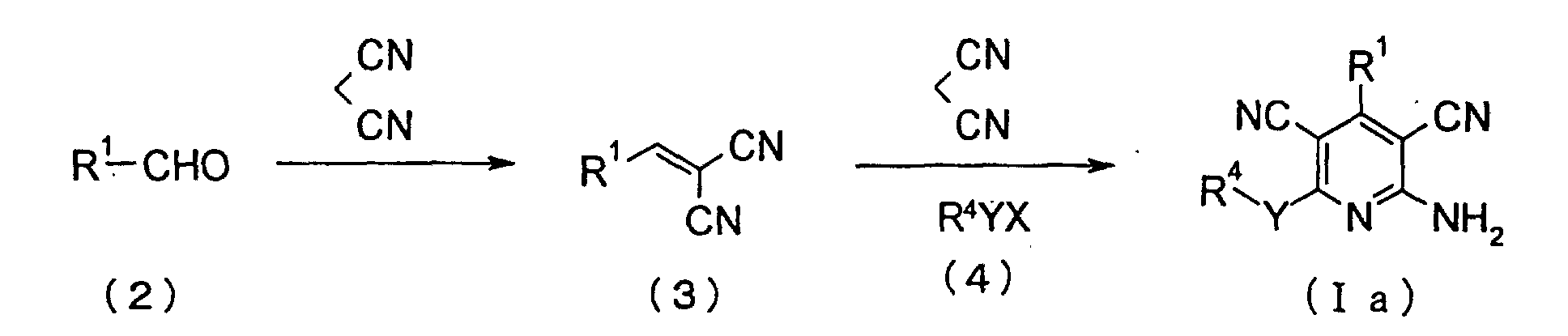
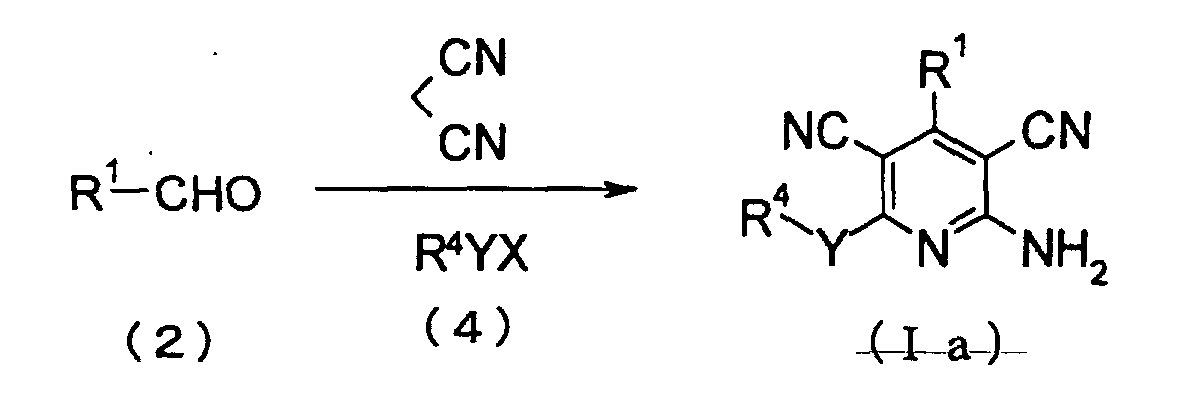
(First Process)
-
(Wherein R
1 and R
4 have the meanings as defined above; X represents a Na,
K or Li atom; Y is O or S)
-
Among the compounds of the invention, the compounds represented
by the general formula (Ia) may be produced from the aldehydes of the
general formula (2) through the dicyanoethylenes of the general formula (3).
-
The reaction of a reasonable amount of the aldehyde (2) with an
equimolar or excess amount of malononitrile may be carried out without any
solvent or in an inert solvent such as water, dimethylformamide (DMF),
dimethylsulfoxide (DMSO), ether, tetrahydrofuran (THF), dioxane, acetone,
methyl ethyl ketone (MEK), methanol (MeOH), ethanol (EtOH), methylene
chloride, dichloroethane, chloroform, and the like, to give the dicyanoethylene
(3). As the reaction solvent, a mixture of an alcohol and water is
particularly preferred. It is also appropriate to use a corresponding amount
of an amino acid such as glycine, a salt such as ammonium acetate, an
organic base such as piperidine or its acetate, as a catalyst, with glycine
being particularly preferred. The reaction is conducted at room temperature
or elevated temperature, preferably at room temperature (W.S. Emerson, T.M.
Patrick Jr, J. Org. Chem., 14, 790, 1949; J.B. Bastus, Tetrahedron Lett., 955,
1963, and so on).
-
The resulting dicyanoethylene (3) and malononitrile are then allowed
to react with an equimolar or excess amount of the alkoxide or thioalkoxide of
the general formula (4) without any solvent or in an inert solvent such as
water, DMF, DMSO, ether, THF, dioxane, acetone, MEK, MeOH, EtOH,
methylene chloride, dichloroethane, and the like, or in an alcohol
corresponding to the alkoxide or thioalkoxide to give the compound (Ia). As
the solvent, an alcohol is particularly preferred. The reaction is conducted
at room temperature or elevated temperature, preferably at room
temperature (W.J. Middleton, V.A. Engelhardt et al., J. Am. Chem. Soc., 80,
2832, 1958; Fuentes L., Soto J.L. et al., Heterocycles, 23 (1), 93, 1985, and so
on).
(Second Process)
-
(Wherein R
1 and R
4 have the meanings as defined above; X represents a Na,
K or Li atom; Y is O or S)
-
Among the compounds of the invention, the compounds represented
by the general formula (Ia) may also be produced directly from the aldehydes
of the general formula (2).
-
The aldehyde (2) is allowed to react with 2 equimolar or more
amounts of malononitrile and 3 equimolar or more amounts of the alkoxide or
thioalkoxide of the general formula (4) without any solvent or in an inert
solvent such as water, DMF, DMSO, ether, THF, dioxane, acetone, MEK,
MeOH, EtOH, methylene chloride, dichloroethane, and the like or in an
alcohol corresponding to the alkoxide or thioalkoxide to give the compound
(Ia). As the solvent, an alcohol is particularly preferred. The reaction is
conducted at room temperature or elevated temperature, preferably at room
temperature (A.S. Alverez-Insua, M. Lora-Tamayo, J.L. Soto, J. Heterocycl.
Chem., 7, 1305, 1970, and so on).
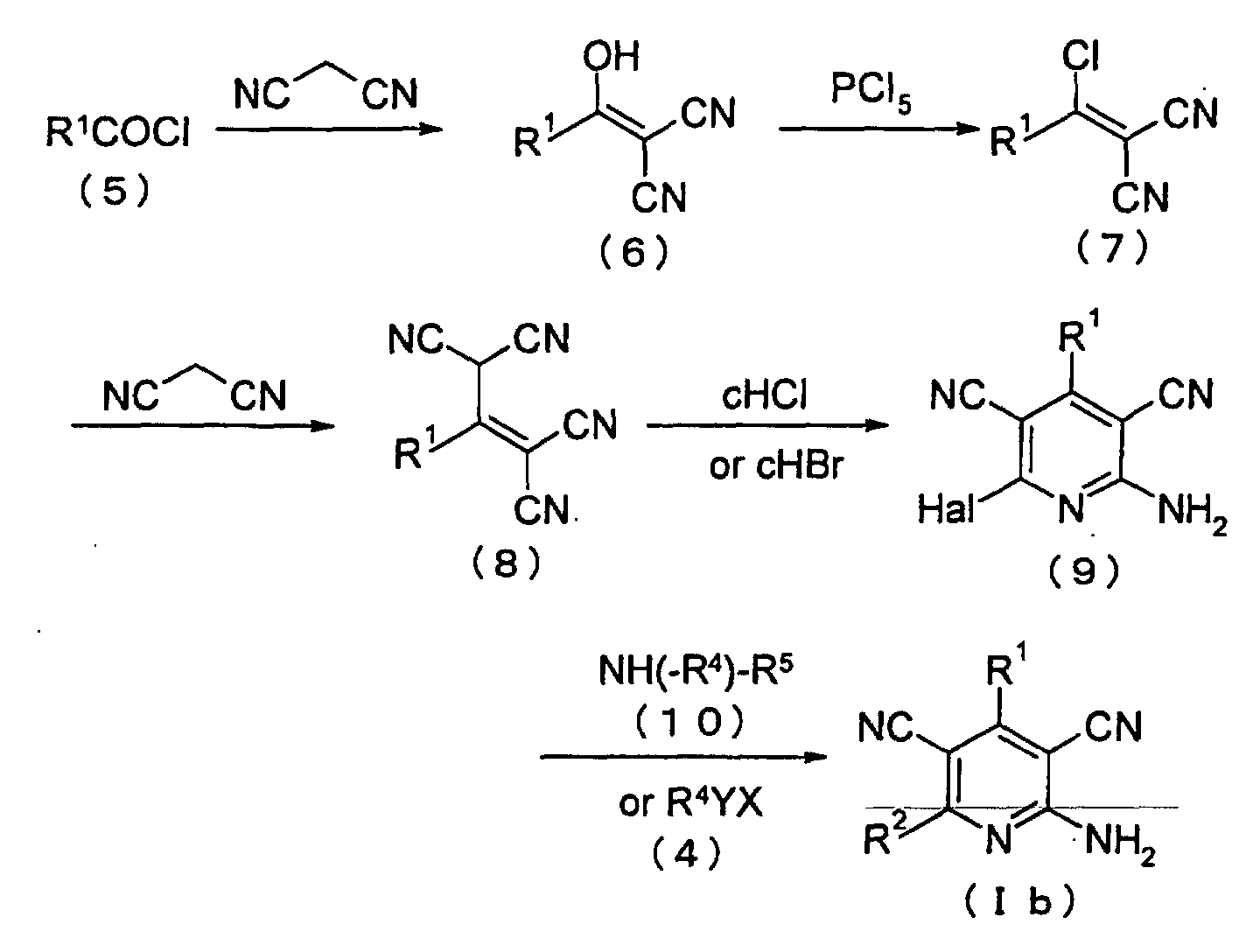
(Third Process)
-
(Wherein R
1, R
2, R
4 and R
5 have the meanings as defined above; Hal
represents a Br or Cl atom; X represents a Na, K or Li atom; Y is an O or S
atom)
-
Among the compounds of the invention, the compounds represented
by the general formula (Ib) may be produced according to the following
process.
-
The acid chloride represented by the general formula (5) is allowed to
react with malononitrile in an inert solvent such as dichloromethane in the
presence of a base such as an aqueous sodium hydroxide solution and an
organic ammonium salt such as benzyl triethylammonium chloride to give
the hydroxydicyanoethylene of the general formula (6). The
hydroxydicyanoethylene (6) is then allowed to react with a chlorinating agent
such as phosphorus pentachloride without any solvent or in an inert solvent
such as chloroform to give the chlorinated derivative of the general formula
(7). The chlorinated derivative (7) is allowed to react with malononitrile in
an inert solvent such as alcohol using an alkoxide such as sodium alkoxide to
give the tetracyano derivative of the general formula (8), which is then
allowed to react with concentrated HCl or concentrated HBr in an inert
solvent such as acetone to give the halo-pyridine of the general formula (9).
The halo-pyridine (9) is allowed to react with an equimolar or excess amount
of an amine of the general formula (10) or alkoxide or thioalkoxide of the
general formula (4) without any solvent or in an inert solvent such as DMF,
DMSO, ether, THF, dioxane, acetone, MEK, MeOH, EtOH, methylene
chloride, dichloroethane, and the like, if required in the presence of a base
such as potassium carbonate, triethylamine, and the like.
-
Particularly, when R1 is hydrogen, it is possible to carry out the same
reaction using ethyl orthoformate in place of the acid chloride (5)(J. Am.
Chem. Soc., 2832, 1958, ibid., 2815, 1958; J. Org. Chem., 5379, 1988,
Synthesis, 8, 679, 1984, and so on).
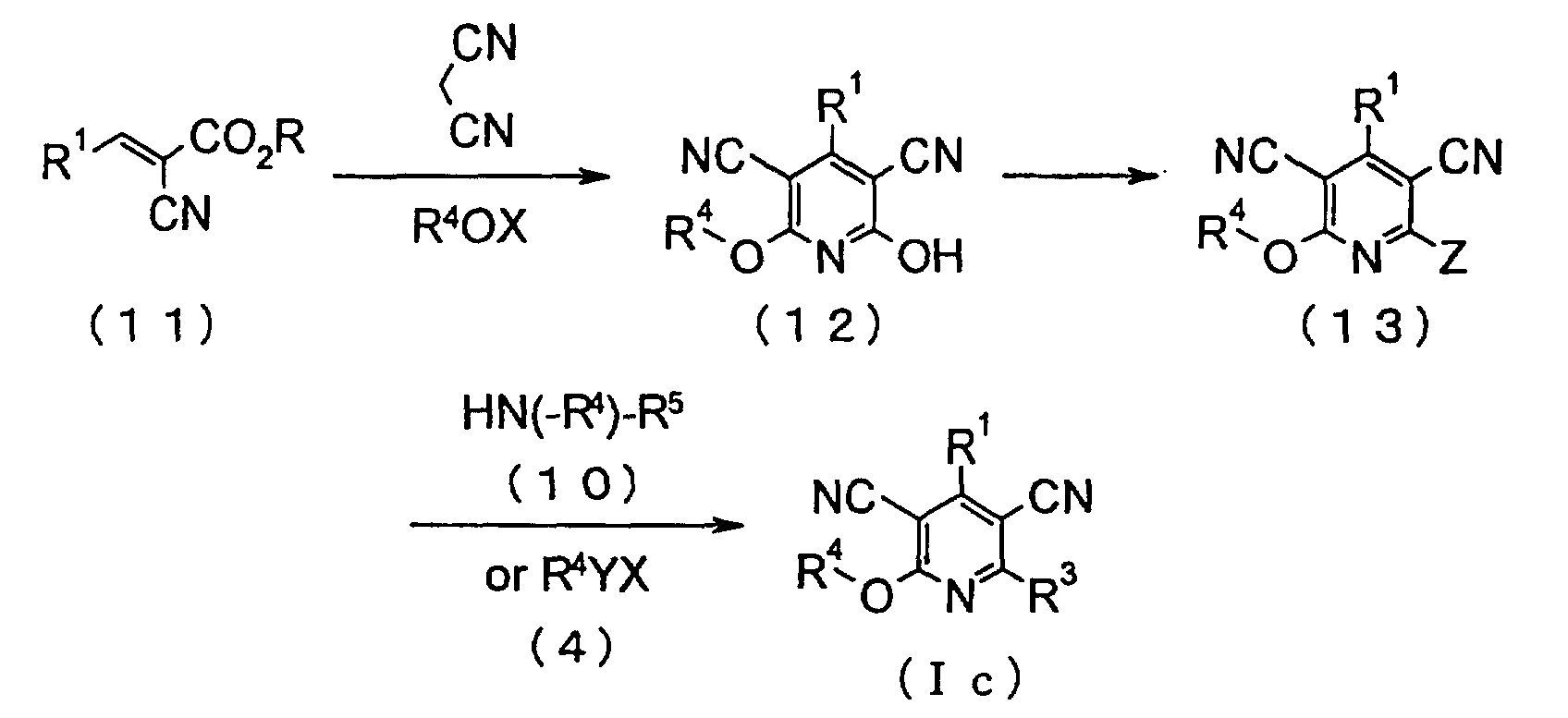
(Fourth Process)
-
(Wherein R
1, R
3, R
4 and R
5 have the meanings as defined above; R represents
a lower alkyl group, preferably methyl or ethyl; X represents a Na, K or Li
atom; Y is an O or S atom; Z is a halogen atom, p-toluenesulfonyloxy, or
methane sulfonyloxy)
-
Among the compounds of the invention, the compounds represented
by the general formula (Ic) may be produced according to the following
process.
-
The hydroxypyridine derivatives represented by the general formula
(12) can be produced according to the method described in Synthesis, p. 681,
1978. That is, the cyanoacetic acid ester derivative represented by the
general formula (11) is allowed to react with malononitrile and an alkoxide in
an alcohol at room temperature or under heating to give the hydroxypyridine
derivative (12). The hydroxypyridine derivative (12) is subjected to
halogenation with phosphorus oxychloride or sulfonylation with
methanesulfonyl chloride or p-toluenesulfonyl chloride without any solvent or
in an inert solvent such as methylene chloride to give the compound of the
general formula (13). The compound (13) is allowed to react with an
equimolar or excess amount of an amine of the general formula (10) or an
alkoxide thioalkoxide of the general formula (4) without any solvent or in an
inert solvent such as DMF, DMSO, ether, THF, dioxane, acetone, MEK,
MeOH, EtOH, methylene chloride, dichloroethane, and the like, if required in
the presence of a base such as potassium carbonate, triethylamine, and the
like.
(Fifth Process)
-
(Wherein R
1, R
2 and R
3 have the same meanings as defined above)
-
The compounds (I) of the invention may also be produced from the
dihydropyridines of the general formula (Id).
-
When the dihydropyridine (Id) is produced as a major product or
by-product in the first or fourth process, it may be oxidized with an oxidizing
agent such as manganese dioxide in an inert solvent such as DMF, ether, THF,
dioxane, acetone, MEK, methylene chloride, dichloroethane, and the like to
give the compound (I)(Alvarez, C., et al., Synth. Commun., 21(5), 619, 1991,
and so on).
-
Alternatively, the compounds of the invention may be produced from
the compounds produced in the above-described first to fifth processes by
suitable conversion of the functional groups in a conventional way.
-
The conventional suitable conversion of the functional groups may be
carried out according to the methods as described in the above-mentioned
"Protective Groups in Organic Synthesis (3rd edition)", in which are
described protection and deprotection of a carboxyl group, hydroxyl group,
amino group, mercapto group, etc.; acylation; sulfonylation; as well as
alkylation using an alkylating agent having a halogen or sulfonyloxy group
with a base such as potassium carbonate or sodium hydride; oxidation of a
sulfur atom with an oxidizing agent such as metachloroperbenzoic acid;
conversion of an amino group into a halogeno or hydoroxyl group by the
Sandmeyer reaction; removal of the lower alkyl in a lower alkyl-O- group
attached at the 2 and/or 6 position of pyridine with acetic acid or
concentrated hydrochloric acid; halogenation of the hydroxyl group attached
at the 2 and/or 6 position of pyridine with phosphorus oxychloride;
substitution of the halogen, lower alkyl-O-, lower alkyl-SO- or lower
alkyl-SO2- attached at the 2 and/or 6 position of pyridine for which can be
properly applied a base such as potassium carbonate, alkali metal lower
alkoxide or sodium hydride, with an alcohol, thioalcohol or amine; reduction
of a nitro group, etc., with palladium-carbon, etc.; fluorination of a halogen
other than fluorine with potassium fluoride; conversion of a carboxyl group
into an amino group by the Curtius reaction; and the like. These reactions
may be achieved according to the methods described in "Jikken Kagaku
Kohza (Handbook of Experimental Chemistry) 4th edition" (Maruzen Co.;
1990-1992).
-
Thus resulting compounds of the invention may be isolated and
purified as free products or salts thereof. The isolation and purification may
be conducted in a conventional chemical procedure such as extraction,
condensation, distillation, crystallization, filtration, recrystallization, a
variety of chromatography, and the like.
-
A variety of isomers may be separated in a conventional manner
utilizing the physical properties between the isomers. For example, the
racemates can be converted into the sterochemically pure isomers by means
of optical resolution (for example, conversion into the diastereomeric salt with
a usual optically active acid (e.g., tartaric acid), followed by optical resolution).
A mixture of diastereomers may be separated in a conventional manner, for
example, fractional crystallization or chromatography.
-
In addition, the optically active compounds may also be produced
from the suitable optically active starting compounds.
Industrial Applicability
-
The compounds of the invention are useful as drugs for treatment of
pollakiuria or urinary incontinence since they exhibit a high
conductance-type calcium activated K channel (maxi-K channel) opening
effect to show a smooth muscle relaxant effect in the urinary bladder.
Additionally, the compounds of the invention are also useful in prophylaxis
and/or treatment of hypertension, asthma, premature birth, irritable bowel
syndrome, chronic heart failure, angina pectoris, myocardial infarction,
cerebral infarction, subarachnoid hemorrhage, cerebrovascular spasm,
cerebral hypoxia, peripheral vascular diseases, anxiety, male bald head,
erectile insufficiency, diabetes mellitus, diabetic peripheral neuropathy, other
diabetic complication, infertility, urinary calculus and its accompanying pain
(relief).
-
The compounds of the invention inhibit spontaneous construction of
the rat's removed bladder specimen. Since the inhibitory action is blocked
by a known maxi-K channel blocker charybdotoxin or iberiotoxin, it is
confirmed that the effect of the compounds of the invention is based on the
maxi-K channel opening effect. Thus, the pharmacological effect of the
compounds of the invention was confirmed according to the following method.
<Inhibitory effect in construction of the rat's removed bladder specimen>
-
In this experiment, SD-family male rats (9-13 weeks of age) were
used. The rats were killed by bleeding under ether anesthesia, and the
bladders were removed. The removed bladders were immediately washed in
a Klebs-Henseleit solution (NaCl 118.4, KCl 4.7, KH
2PO
4 1.2, MgSO
4 1.2,
CaCl
2 2.5, NaHCO
3 25.0, glucose 11.1 [mM], aeration with 95% O
2/5% CO
2
mixed gas) kept at 37°C, and prepared into rectangular specimens of about 10
mm long and about 2 mm width on a Petri dish filled with the
Klebs-Henseleit solution. The respective specimens were ligated at the both
ends with a cotton string via a wire hook, and the one end was fixed to an FD
pick-up and the other hung down vertically in an organ bath filled with the
Klebs-Henseleit solution. After completion of the operation, 1.0 g of static
tensile stress was given to the respective slices, which were then allowed to
stand for 1.5-2 hours to stabilize. Then, a KCl solution was added to the
organ bath so that the final K
+ ion concentration become 15 mM to induce the
contraction. Thereafter, the specimens were further allowed to stand for
about 1-2 hours to stabilize, and the test was started. The contraction of the
smooth muscle was measured isometrically through the FD pick-up, and the
output signal was amplified through a strain stress amplifier to continuously
record a chart on a pen recorder. At the same time, the respective
contraction wave forms to be analyzed were recorded on a personal computer
as magnetic data through an analogue/digital signal converter, and the
under-area of the contraction was calculated by analytical software. The
contraction 5 minutes immediately after the start of the test was regarded as
the value before administration of the drug to be tested (100% reference
value). The drug to be tested was added into the bath at intervals of 30
minutes, and the contraction for 5 minutes, respectively 25 minutes after the
administration, was analyzed. The drug to be tested was administered at a
common ratio of 3 or 10 accumulatively. The effect of the drug to be tested
was represented by the dose by which 50% inhibition was attained to the
value before the administration (100% reference value). Additionally, the
wave form of contraction at the highest dose of the drug was recorded, and
then a maxi-K channel selective blocker, charybdotoxin or iberiotoxin, was
administered so that the final concentration in the organ bath became 100
nM. Thus, the effect of the drug was observed whether it was blocked or not.
| Example | Inhibition of the contraction of rat's
removed bladder specimen IC50/µM |
| 1 | 0.15 |
| 3 | 0.23 |
| 6 | 1.3 |
| 11 | 0.41 |
| 12 | 0.41 |
| 15 | 2.8 |
| 20 | 0.11 |
| 58 | 1.4 |
| 150 | 1.3 |
| 151 | 1.0 |
| 263 | 0.042 |
| NS-8 (Reference) | 1.1 |
-
As described above, the compounds of the invention exhibit an
inhibitory effect to the contraction of the rat's removed bladder specimen. In
addition, the inhibition of the contraction of the bladder smooth muscle by
the compounds of the invention was confirmed to be through the effect of the
maxi-K channel opening because the inhibition was blocked by
administration of charybdotoxin or iberiotoxin.
<Effect on the efflux of 86-rubidium in the cultured cells derived from human
bladder>
-
This experiment was carried out according to the slightly modified
method described in Daniel et al., Journal of Pharmacological Methods, 25,
185-193, 1991. In this experiment, the cultured cells (HTB-9) derived from
human bladder were used. It has been confirmed by Monen et al. that the
said cells are abundant in the maxi-K channel (J. Membrane Biol., 161,
247-256, 1998). The cells were incubated on a 96-well culture plate'in which
an RPMI-1640 medium containing 10% calf serum was placed, so that the
cells became confluent. The medium was then removed under suction, and
further RPMI-1640 medium containing 1 µCi/ml of 86-rubidium (86Rb)
belonging to the same group as K was added so as to be 100µl/well. After
lapse of 18-24 hours, the cells were washed well with an incubation solution
(HEPES-buffered salt solution: comprising HBS, HEPES 20, NaCl 137, KCl
4.7, CaCl2 1.8, MgCl2 0.6, glucose 7.7 [mM]). Then, an incubation solution
containing 0.3µM calcimycin (A23187) and DMSO was added at 200µl/well in
the presence or absence of the test material. After lapse of 30 minute, the
incubated solution was recovered with a pipette, and further a fresh
incubation solution was added at 150µl/well. This was admixed with the
washings to completely recover 86Rb fluxed from the cells into the
supernatant (Solution 1). Then, 86Rb remaining in the cells was recovered.
That is, 0.1M aqueous solution of NaOH was added at 0.175µl/well and
agitated well for 15 minutes in a mixer to destroy the cells. This was
neutralized with addition of 0.175µl/well of 0.1M HCl aqueous solution, and
recovered completely with a pipette (Solution 2). In recovering the
respective solutions, 96-well culture plates (white) were used as counting
vessels. The 86Rb amount contained in the counting vessels was determined
by means of a liquid scintillation counter. The increase of 86Rb eluted from
the cells was calculated from [Radioactivity cpm in Solution
1]/([ Radioactivity cpm in Solution 1]+[ Radioactivity cpm in Solution
2])×100(%). The dose was calculated from the above-described efflux amount
of 86Rb which was increased by the drug to be tested and reached 60%. This
was regarded as the activity of the drug.
-
As a result, it was found that the compounds of the invention greatly
increased the efflux of 86Rb from the cultured cells derived from human
bladder. From the above results, it was demonstrated that the compounds of
the invention exhibit the effect of opening the maxi-K channel of human
bladder cells.
<Effect on the rhythmic contraction of the bladder in rats under urethane
anesthesia>
-
SD-Family female rats (about 300 g) were used. A catheter was
inserted into the bladder through the external urethral orifice under
urethane anesthesia and spontaneous breathing. The other end was
connected to a pressure transducer and an infusion pump through a
three-way cock. On the other hand, another catheter for measuring blood
pressure was inserted into the right common carotid artery. Physiological
saline warmed at about 38°C was injected in the bladder at a rate of 4.2 ml/hr
until rhythmical bladder contraction was induced. Change of the internal
pressure in the bladder was continuously recorded on a recorder. After the
rhythmical bladder contraction was stabilized, a test compound suspended in
0.5% methylcellulose aqueous solution was administered through a catheter
which had been attached to the duodenum. Thus, frequency of the bladder
contraction (every 10 minutes), force of bladder contraction and average blood
pressure were observed as evaluation items up to 2 hours after
administration of the test compound.
| Example | Inhibition of frequency of the
bladder contraction
max% inhibition/% | Frequency of Bladder
Contraction
Retention time of 50%
Inhibition/min
(10 mg/kg, i.d.) |
| 3 | 97 | 39 |
| 6 | 65 | 39 |
| 11 | 87 | 27 |
| 12 | 77 | 31 |
| 15 | 89 | 36 |
| 20 | 86 | 40 |
| 58 | 93 | 46 |
| 150 | 81 | 30 |
| 151 | 71 | 26 |
| 252 | 78 | 32 |
| 263 | 69 | 23 |
-
The compounds of the invention, as mentioned above, exhibited the
effect of inhibiting the frequency of bladder contraction without altering the
average blood pressure and the force of bladder contraction in
urethane-anesthetic rats.
-
From these results, it can be said that the compounds of the invention
are useful as drugs for treatment of pollakiuria and/or urinary incontinence.
-
From the above results, it was demonstrated that the compounds of
the invention exhibit the effect of opening the maxi-K channel in the bladder
smooth muscle and are useful as drugs for treatment of pollakiuria and
urinary incontinence.
-
The pharmaceutical preparations containing one or more species of
the compounds of the invention or their salts may be produced with carriers
or excipients conventionally used in pharmaceutical formulation as well as
additives. As for the carriers or excipients for pharmaceutical preparations,
solid or liquid ones, for example, lactose, magnesium stearate, starch, talc,
gelatin, agar, pectin, gum arabic, olive oil, sesame oil, cacao butter, ethylene
glycol, and other conventional ones are included.
-
Administration may be achieved by oral administration in a form of
tablets, pills, capsules, granules, powder, liquid preparations, and the like, or
by perenteral administration in a form of intravenous or intramuscular
injections, suppositories, percutaneous preparations, and the like. The dose
may be determined corresponding to individual cases taken the condition, age
and sex of the subject into consideration. Usually, it may be administered
orally in a single or divided dose of 1-1000 mg/day, preferably 50-200 mg/day
for an adult, or intravenously at a single or divided dose of 1-500 mg/day for
an adult, or continuously administered intravenously within a period of 1 to
24 hours a day. As described above, needless to say, the dose is altered
depending on various conditions, and in some cases it is -sufficient in a
smaller amount than that as mentioned above.
-
According to the invention, as an orally administrable solid
composition, tablets, powder, granules, and the like are used. In such a solid
composition, one or more of active materials are admixed with at least one
inert diluent, for example, lactose, mannitol, glucose, hydroxypropyl cellulose,
fine crystalline cellulose, starch, polyvinylpyrrolidone, metasilicic acid, or
magnesium aluminate. The compositions may contain additives other than
the inert diluents, for example, a lubricant such as magnesium stearate, or a
disintegrator such as cellulose calcium gluconate, a stabilizer such as lactose,
and a solubilizing agent such as glutamic acid or aspartic acid, according to a
conventional manner. The tablets or pills, if required, may be coated with a
gastric or enteric coating film such as sucrose, gelatin, hydroxypropylcellulose,
hydroxypropylmethylcellulose phthalate, and the like.
-
In the liquid compositions for oral administration, a pharmaceutically
acceptable emulsifying agent, solubilizing agent, suspending agent, syrup,
elixir, and the like may be contained, and a generally used inert diluent, for
example, purified water, ethanol, and the like may be contained. In addition
to such inert diluents, a wetting agent, auxiliary agent such as suspending
agent, sweetener, flavor, aromatic agent, antiseptic, and the like may be
contained.
-
The injection preparations for perenteral administration include
sterile aqueous or nonaqueous solutions, suspensions, and emulsions. As
the aqueous solutions or suspensions, for example, distilled water or
physiological saline is included. The nonaqueous solution or suspension
includes, for example, propylene glycol, polyethylene glycol, a vegetable oil
such as olive oil, an alcohol such as ethanol, polysorbate 80, and the like.
Such compositions may further contain an antiseptic, wetting agent,
emulsifying agent, dispersant, stabilizer (e.g., lactose), and solubilizing agent
(e.g., glutamic acid, aspartic acid). These compositions are sterilized by
filtration through a bacterial filter or by addition of a sterilizer or by
irradiation. These may be prepared as a sterile solid composition and
dissolved in sterile water or sterile solvent for injection before using.
Best Mode for Carrying Out the Invention
-
The invention will be explained in more details by the following
examples which are not intended as a limitation thereof.
Reference Example 1
-
To a solution of 10 ml of benzaldehyde in 100 ml of EtOH-water (7:3)
was added 6.5 g of malononitrile and 0.1 g of glycine, and the mixture was
stirred at room temperature for 6 hours. The precipitated crystals were
collected by filtration, washed with EtOH-water (7:3), and dried under
reduced pressure to give 13.1 g of benzylidenemalononitrile.
-
In the same manner as in Reference Example 1, the compounds of
Reference Examples 2 to 7 were produced.
Reference Example 8
-
To a solution of 5.0 g of 4-aminomethylbenzoic acid in 40 ml of
dioxane-water (1:1) was added 6.0 g of NaHCO3 and a solution of 7.6 g of
di-tertiary butyl dicarbonate in 20 ml of dioxane in order at room
temperature, and the mixture was stirred at room temperature for 4 days.
The solvent was distilled off under reduced pressure, and the residue was
neutralized with aqueous hydrochloric acid. The precipitated solid was
collected by filtration, and dried under reduced pressure to give 8.0 g of a
carboxylic acid. The carboxylic acid (0.85 g) was dissolved in 10 ml of THF,
to which was added 0.60 g of 1,1'-carbonylbis-1H-imidazole under ice-cooling,
and the mixture was stirred at 50°C for 40 minutes. To the resulting
solution was added 0.43 g of N,O-dimethylhydroxylamine hydrochloride and
0.7 ml of triethylamine (Et3N) in order under ice-cooling, and the mixture
was stirred overnight at room temperature. Water was added to the mixture,
and the mixture was extracted with ethyl acetate (EtOAc). The resulting
organic layer was dried over anhydrous sodium sulfate, filtered, and
evaporated under reduced pressure. The resulting residue was purified by
silica gel column chromatography to give 0.98 g of an amide. The amide
(0.98 g) was dissolved in 10 ml of THF, to which was added 0.12 g of lithium
aluminum hydride at -78°C, and the mixture was stirred at the same
temperature for 40 minutes. There was added 2.0 g of Na2SO4·10H2O and
the mixture was warmed up to room temperature and stirred for 3 hours.
The reaction mixture was filtered and evaporated under reduced pressure to
give 0.76 g of tertiary (t-)butyl 4-formylbenzylcarbamate.
Reference Example 9
-
To a solution of 2.0 g of 3-bromobenzylamine hydrochloride in 20 ml of
dioxane-water (1:1) was added 1.5 g of NaHCO3 and a solution of 2.2 g of
di-t-butyl dicarbonate in 10 ml of dioxane in order at room temperature, and
the mixture was stirred at room temperature for 1 day. Water was added to
the reaction mixture and the reaction mixture was extracted with EtOAc.
The organic layer was dried over anhydrous sodium sulfate and evaporated
under reduced pressure to give 3.0 g of a bromo-derivative. The
bromo-derivative (3.0 g) was dissolved in 30 ml of THF, to which was added
14 ml of 1.5M butyllithium/hexane solution at -78°C, and the mixture was
stirred at the same temperature for 30 minutes. To the resulting solution
was added a solution of 1.7 ml of DMF in 10 ml of THF at -78°C, and the
mixture was warmed up to -15°C over 1.5 hours. An aqueous ammonium
chloride solution was added to the reaction mixture and extracted with
EtOAc. The resulting organic layer was dried over anhydrous sodium
sulfate, filtered, and evaporated under reduced pressure. The resulting
residue was purified by silica gel column chromatography to give 0.89 g of
t-butyl 3-formylbenzylcarbamate.
Reference Example 10
-
To 9.0 g of malononitrile was added 13.5 ml of ethyl orthoformate and
5.6 ml of pyridine (Py) at room temperature, and the mixture was stirred at
120°C for 30 minutes. The mixture was allowed to cool to room temperature,
and to the mixture EtOH was added to yield crystals as precipitate, which
was collected by filtration to give 10.2 g of 1,1,3,3-tetracyanopropene pyridine
salt. This (6.2 g) was dissolved in 50 ml of acetone, to the solution was
added 20 ml of concentrated hydrochloric acid (c-HCl) under ice cooling, and
the mixture was stirred at 50°C overnight. The precipitated crystals were
collected by filtration, washed with EtOH, and dried under reduced pressure
to give 4.47 g of 2-amino-6-chloropyridine-3,5-dicarbo-nitrile.
Reference Example 11
-
To a solution of 2.0 g of 4-hydroxybenzonitrile in 20 ml of DMF was
added 2.8 g of potassium carbonate and 2.2 ml of benzyl bromide in order
under ice cooling, and the mixture was stirred at room temperature for 1 day.
The reaction mixture was concentrated under reduced pressure, and water
was added and extracted with EtOAc. The resulting organic layer was dried
over anhydrous sodium sulfate, filtered, and evaporated under reduced
pressure to give 4-benzyloxy-benzonitrile. This compound (3.7 g) was
dissolved in 40 ml of THF, to the solution was added 20 ml of 1M-BH3-THF in
20 ml of THF under ice cooling, and the mixture was heated under reflux
with stirring for 1 hour. The reaction mixture was cooled in an ice bath, 10
ml of MeOH was added to the mixture, and the mixture was heated under
reflux with stirring for 30 minutes. The reaction mixture was again cooled
in an ice bath, added 2.0 ml of c-HCl to the mixture, and the mixture was
heated under reflux with stirring for 30 minutes. The reaction mixture was
then allowed to cool to room temperature, and the precipitated solid was
collected by filtration to give 4-benzyloxybenzylamine hydrochloride. The
4-benzyloxybenzylamine hydrochloride (1.28 g) was dissolved in 30 ml of
dioxane-water (1:1), to the solution was added 0.65 g of NaHCO3 and a
solution of 1.3 g of di-t-butyl dicarbonate in 5.0 ml of dioxane in order at room
temperature, and the mixture was stirred at room temperature for 4.5 hours.
The solvent was distilled off under reduced pressure, water was then added
to the residue, and the mixture was extracted with ethyl acetate. The
resulting organic layer was dried over anhydrous sodium sulfate, filtered, and
evaporated under reduced pressure to give t-butyl
4-benzyloxybenzylcarbamate. This compound (1.96 g) was dissolved in 20
ml of ethyl acetate, to the solution was added 0.20 g of 10% palladium-carbon
(Pd/C), and the mixture was stirred in hydrogen under atmospheric pressure
at room temperature overnight. The reaction mixture was filtered and
evaporated under reduced pressure, and the resulting residue was purified by
silica gel column chromatography to give 1.21 g of t-butyl
4-hydroxybenzylcarbamate.
-
In the same manner as in Reference Example 11, the compounds of
Reference Examples 12 and 13 were produced.
Reference Example 14
-
To a solution of 6.0 g of 3-carboxybenzaldehyde in 40 ml of 29%
ammonia water was added 11.6 g of 40% glyoxal aqueous solution at 0°C.
The mixture was warmed up to room temperature and stirred for 16 hours.
The reaction mixture was concentrated under reduced pressure and
neutralized with c-HCl at pH 7.0, and the precipitated crude crystals were
collected by filtration, and washed with water and EtOH to give 5.3 g of
3-(1H-imidazol-2-yl)benzoic acid [1H-NMR (DMSO-d 6): δ 3.31 (1H, brs), 7.17
(2H, s), 7.57 (1H, t), 7.89 (1H, dt), 8.17 (1H, td), 8.55 (1H, d)].
-
This compound (500 mg) was dissolved in 10 ml of DMF, to the
solution was added 646 mg of 1,1'-carbonyldiimidazole at room temperature.
At room temperature, to the mixture was added 520 mg of
N,O-dimethylhydroxylamine hydrochloride and 1.0 ml of Et3N, and stirred.
To the mixture was added 10 ml of water and the mixture was extracted with
EtOAc. The organic layer was washed with a saturated sodium chloride
aqueous solution (brine), dried over magnesium sulfate (MgSO4), and
evaporated to give a crude product. This was purified by silica gel column
chromatography to give 600 mg of
3-(1H-imidazol-2-yl)-N-methoxy-N-methylbenzamide [1H-NMR (DMSO-d 6): δ
3.31 (3H, s), 3.56 (3H, s), 7.04 (1H, s), 7.27 (1H, s), 7.48-7.52 (3H, m), 8.16 (1H,
m), 8.31 (1H, s)].
-
This compound (3.4 mg) was dissolved in 20 ml of THF, to the solution
was added 29 ml of diisobutylaluminum hydride (DIBAL; 1M toluene
solution) at 0°C. The mixture was stirred for 2 hours, then added 8 ml of
DIBAL (1M toluene solution) to the mixture, and it was further stirred for 2
hours. Then, 5 ml of 1M-HCl aqueous solution(aq.) was added to the
mixture, and the mixture was extracted with EtOAc. The organic layer was
washed with brine, dried over MgSO4, and evaporated to give a crude product.
This was separated and purified by silica gel column chromatography to give
2.2 g of 3-(1H-imidazol-2-yl)benzaldehyde.
Reference Example 15
-
To a solution of 2.0 g of 3-hydroxybenzaldehyde in 15 ml of DMF was
added 2.5 g of K2CO3 and 7.2 g of ethylene carbonate at room temperature,
and the mixture was heated up to 100°C and stirred for 3 hours. The solvent
was distilled off, and the residue was purified by silica gel column
chromatography to give 2.7 g of 3-(2-hydroxyethoxy)benzaldehyde. This
compound (2.7 g) was dissolved in 50 ml of EtOH-water (7:3), to the solution
was added 1.08 g of malononitrile and 50 mg of glycine, and the mixture was
stirred at room temperature overnight. The mixture was then extracted
with EtOAc, washed with brine, dried over MgSO4 and evaporated to give a
crude product. This was separated and purified by silica gel column
chromatography to give 2-[3-(2-hydroxyethoxy)benzylidene]malononitrile in
quantitative yield.
Example 1
-
To 20 ml of MeOH was added 0.70 g of Na under ice cooling, and the
mixture was stirred at room temperature until Na was dissolved. To the
mixture were added 0.85 g of malononitrile and 2.0 g of the compound
prepared in Reference Example 3, and the mixture was heated under reflux
with stirring for 3 hours. The reaction mixture was poured into ice water,
and the precipitated crystals were collected by filtration, recrystallized from
ethyl acetate, and dried under reduced pressure to give 0.25 g of
2-amino-6-methoxy-4-(2-thienyl)pyridine-3,5-dicarbo-nitrile.
-
In the same manner as in Example 1, the compound of Example 2
was synthesized.
Example 3
-
To 50 ml of MeOH was added 4.00 g of sodium methoxide, 3.19 g of
malononitrile, and 3.00 g of 2-fluorobenzaldehyde under ice cooling, and the
mixture was stirred at room temperature overnight. The precipitated
crystals were collected by filtration, washed with methanol, and dried under
reduced pressure to give 1.05 g of
2-amino-6-methoxy-4-(2-fluorophenyl)pyridine-3,5-dicarbonitril.
-
In the same manner as in Example 3, the compounds of Examples 4
and 5 were synthesized.
Example 6
-
In argon atmosphere, 3.4 g of DMSO in 5 ml of methylene chloride
was dropwise added to a solution of 2.8 g of oxalyl dichloride in 75 ml of
methylene chloride at -78°C and stirred for 10 minutes. To the solution was
dropwise added a solution of 2.3 g of tetrahydropyran-2-methanol in 15 ml
methylene chloride at the same temperature. The mixture was then
warmed up to room temperature over 1 hour, and then to the mixture was
added 10 g of Et3N. The reaction mixture was poured into water and
extracted with chloroform. The organic layer was dried over anhydrous
sodium sulfate and evaporated under reduced pressure to give
tetrahydropyran-2-carbaldehyde. This was dissolved in 30 ml of MeOH, to
the solution was added 2.6 g of malononitrile and 3.2 g of sodium methoxide
in order under ice cooling. The reaction mixture was stirred at room
temperature for 5 days, poured into a saturated ammonium chloride aqueous
solution, and the mixture was extracted with EtOAc. The organic layer was
dried over anhydrous sodium sulfate, and concentrated under reduced
pressure. The residue was purified by silica gel column chromatography to
give 0.73 g of
2-amino-4-(2-tetrahydropyranyl)-6-methoxypyridine-3,5-dicarbonitrile.
Example 7
-
To a solution of 2.0 g of the compound prepared in Reference Example
4 in 10 ml of EtOH was added 0.85 g of malononitrile and 0.90 g of sodium
thiomethoxide under ice cooling, and the mixture was stirred at room
temperature overnight. The precipitated crystals were collected by filtration,
washed with EtOH, and dried under reduced pressure to give 1.44 g of
2-amino-6-methylsulfanyl-4-(3-thienyl)pyridine-3,5-dicarbonitrile.
-
In the same manner as in Example 7, the compound of Example 8
was synthesized.
Example 9
-
To a solution of 12 g of malononitrile in 300 ml of methylene chloride
was added 20 ml of benzoyl chloride, 3.0 g of bentyl triethylammonium
chloride and 40 ml of 10M NaOH aq. under ice cooling, and the mixture was
stirred at room temperature overnight. The resulting solid material was
collected by filtration, dissolved in water, the solution was neutralized with
c-HCl, and extracted with chloroform. The organic layer was dried over
anhydrous sodium sulfate, filtered, and concentrated under reduced pressure
to give 22.6 g of benzoylmalononitrile. This compound (22.6g) was dissolved
in 200 ml of methylene chloride, to the solution was added 50 g of phosphorus
pentachloride, and the mixture was heated under reflux with stirring
overnight. The mixture was then concentrated under reduced pressure and
purified by silica gel column chromatography to give 15.2 g of a
chloro-derivative. This chloro-derivative (7.2 g) was allowed to react with an
EtOH solution of malononitrile sodium salt prepared from 70 ml of EtOH, 1.8
g of Na and 2.6 g of malononitrile, under ice cooling for a day to give 7.44 g of
a tetracyano-derivative. This tetracyano-derivative (1.0 g) was dissolved in
20 ml of acetone, to the solution was added 5.0 ml of c-HCl, and the mixture
was stirred at 50°C for 4.5 hours. The precipitated crystals were collected by
filtration, washed with EtOH, and dried under reduced pressure to give 0.95
g of 2-amino-6-chloro-4-phenylpyridine-3,5-dicarbonitrile.
-
In the same manner as in Example 9, the compound of Example 10
was synthesized.
Example 11
-
To a solution of 202 mg of propargyl alcohol in 5 ml of DMF was
added 145 mg of 60% sodium hydride (NaH) under ice cooling, and the
mixture was stirred at room temperature for 10 minutes. To the mixture
was added 500 mg of the compound prepared in Example 10, and the mixture
was stirred at room temperature for 2 hours. Further, to the mixture was
added 404 mg of propargyl alcohol and 290 mg of 60% NaH, and the mixture
was stirred for 1 hour, and ice was added to it. The reaction mixture was
acidified with hydrochloric acid aqueous solution, and the precipitated solid
material was collected by filtration and washed with water and hexane. The
resulting solid material was recrystallized from EtOH to give 308 mg of
2-amino-4-(2-fluorophenyl)-6-(prop-2-yn-1-yloxy)pyridine-3,5-dicarbonitrile.
Example 12
-
To a solution of 500 mg of the compound prepared in Example 10 in 5
ml of DMF was added 444 mg of 2,2-difluoroethanol and 278 mg of 60% NaH
under ice cooling. The reaction mixture was stirred at room temperature for
3 hours, and then ice was added to it. The precipitated solid material was
collected by filtration and washed with water and hexane. The resulting
solid material was recrystallized from EtOH to give 306 mg of
2-amino-6-(2,2-difluoroethoxy)-4-(2-fluorophenyl)pyridine-3,5-dicarbonitrile.
Example 13
-
To 10 ml of ethylene glycol was added 0.10 g Na at room temperature,
and the mixture was stirred at 60°C until Na was dissolved. To the mixture
was added 0.30 g of the compound prepared in Example 9, and the mixture
was stirred at room temperature for 1 day. Water was added to the mixture,
and the precipitated crystals were collected by filtration. The resulting solid
material was recrystallized from EtOH to give 0.28 g of
2-amino-6-(2-hydroxyethoxy)-4-phenylpyridine-3,5-dicarbonitrile.
Example 14
-
A mixture of 310 mg of the compound prepared in Example 13, 380
mg of N-carbobenzoxy-L-valine, 350 mg of
1-ethyl-3-(3-dimethylaminopropyl)carbodiimide hydrochloride (WSC HCl), 50
mg of 4-dimethylaminopyridine (DMAP) and 6 ml of DMF was stirred at
room temperature overnight. The mixture was concentrated under reduced
pressure, and the residue was dissolved in ethyl acetate and washed with
water. The organic layer was dried over anhydrous MgSO4, concentrated
under reduced pressure, and the resulting residue was purified by silica gel
column chromatography (ethyl acetate:chloroform = 1:4) to give 461 mg of
2-{(2-amino-3,5-dicyano-4-phenylpyridin-6-yl)oxy} ethyl
(S)-2-benzyloxycarbonylamino-3-methylbutanoate [1H-NMR (DMSO-d 6): δ
0.87 (6H, d), 1.97-2.08 (1H, m), 3.91-3.97 (1H, m), 4.34-4.64 (4H, m), 5.03 (2H,
brm), 7.28-7.71 (11H, m), 8.02 (2H, brs)].
-
A mixture of 406 mg of this compound, 50 ml of THF, 400 mg of 10%
palladium-carbon/50% water, 30 ml of MeOH and 1 ml of 1M HCl aq. was
stirred under hydrogen pressure of 3 kg/cm2 for 1 hour in a Parr apparatus.
The reaction mixture was filtered through celite and concentrated under
reduced pressure. The residue was dissolved in chloroform and washed with
a sodium bicarbonate aqueous solution. The organic layer was dried over
MgSO4, concentrated under reduced pressure, and the residue was purified
by silica gel column chromatography (MeOH:chloroform = 3:97) to give 113
mg of 2-[(6-amino-3,5-dicyano-4-phenylpyridin-2-yl)oxy]ethyl
(S)-2-amino-3-methylbutanoate. This compound was dissolved in MeOH
together with 26 mg of oxalic acid, and the solvent was distilled off. The
precipitated crystals were washed with ethyl acetate to give 122 mg of
2-[(6-amino-3,5-dicyano-4-phenylpyridin-2-yl)oxy]ethyl
(S)-2-amino-3-methylbutanoate monooxalate.
Example 15
-
A mixture of 348 mg of the compound prepared in Example 13, 440
mg of N-(t-butoxycarbonyl)-L-phenylalanine, 390 mg of WSC HCl, 50 mg of
DMAP and 6 ml of DMF was stirred at room temperature for 2 hours. The
mixture was concentrated under reduced pressure, and the residue was
dissolved in ethyl acetate and the organic layer was washed with water. The
organic layer was dried over anhydrous MgSO4, concentrated under reduced
pressure, and the resulting residue was purified by silica gel column
chromatography (EtOAc:chloroform = 3:17) to give 635 mg of
2-[(2-amino-3,5-dicyano-4-phenylpyridin-6-yl)oxy]ethyl
(S)-2-(t-butoxycarbonylamino)-3-phenylpropanoate [1H-NMR (DMSO-d 6): δ
1.31 (9H, s), 2.80-3.03 (2H, m), 4.13-4.62 (5H, m), 7.15-7.28 (5H, m), 7.32 (1H,
d), 7.46-7.60 (5H, m), 8.02 (2H, brs)].
-
A mixture of 575 mg of this compound, 30 ml of MeOH and 6 ml of 4M
HCl-EtOAc solution was stirred at room temperature or under refluxing for
20 minutes. The reaction mixture was concentrated under reduced pressure,
and the precipitated crystals were washed with EtOAc to give 401 mg of
2-[(2-amino-3,5-dicyano-4-phenylpyridin-6-yl)oxy]ethyl
(S)-2-amino-3-phenylpropanoate monohydrochloride monohydrate.
Example 16
-
To a solution of 3.00 g of the compound prepared in Example 4 in 10
ml of MeOH was added 2 ml of concentrated sulfuric acid, and the mixture
was heated under reflux with stirring for 5 hours. The reaction mixture was
cooled to room temperature, and the precipitated crystals were collected by
filtration to give 2.60 g of methyl
4-(2-amino-3,5-dicyano-6-methoxypyridin-4-yl)benzoate.
Example 17
-
To a suspension of 1.3 g of the compound of Example 77 in 40 ml of
dichloromethane was added 1.1 g of metachloroperbenzoic acid under ice
cooling, and the mixture was stirred for 1 hour. The reaction mixture was
washed with a saturated sodium hydrogencarbonate aqueous solution and
extracted with chloroform. The organic layer was dried over anhydrous
sodium sulfate, concentrated under reduced pressure, and the residue was
recrystallized from EtOH to give 0.57 g of
2-amino-6-methanesulfinyl-4-(2-fluorophenyl)pyridine-3,5-dicarbonitrile.
Example 18
-
To a solution of 400 mg of the compound prepared in Example 17 in 6
ml of propan-2-ol was added 60 mg of 60% NaH, and the mixture was stirred
for 1 hour. The reaction mixture was poured into water, and the precipitate
was collected by filtration and recrystallized from EtOH to give 140 mg of
2-amino-4-(2-fluorophenyl)-6-isopropoxypyridine-3,5-dicarbonitrile.
Example 19
-
To a solution of 500 mg of the compound prepared in Example 1 in 10
ml of Py was added 5 ml of acetic anhydride and 25 mg of DMPA, and the
mixture was stirred at room temperature for 20 hours. The reaction mixture
was concentrated, and the residue was recrystallized from EtOH to give 370
mg of N-(3,5-dicyano-6-methoxy-4-thiophen-2-ylpyridin-2-yl)acetamide.
Example 20
-
To a solution of 7.00 g of the compound prepared in Example 4 in
t-butyl alcohol was added 8.47 g of diphenylphosphoryl azide and 3.12 g of
Et3N, and the mixture was stirred under refluxing for 5 hours. Water was
added to the reaction mixture and extracted with EtOAc. The organic layer
was washed with brine, dried over anhydrous MgSO4, filtered, and
concentrated under reduced pressure. The residue was purified by silica gel
column chromatography to give 5.75 g of t-butyl
[4-(2-amino-3,5-dicyano-6-methoxypyridin-4-yl)phenyl]carbamate. This
compound was dissolved in dioxane, to the solution was added 10 ml of 4M
HCl-acetic acid solution, and the mixture was stirred under heating at 50°C
for 2 hours. Further, 10 ml of 4M HCl-acetic acid solution was added, and
the mixture was stirred under heating at 50°C for 3 hours. The reaction
mixture was allowed to cool to room temperature, and the precipitated
crystals were collected by filtration. The crystals were suspended in MeOH,
adjusted to pH 10 with addition of 1M NaOH aq., then stirred at room
temperature for 2 hours, and collected by filtration. The crystals were added
to MeOH, to the mixture was further added 6.0 ml of 4M HCl-EtOAc solution.
The reaction mixture was concentrated, and the residual crystals were
washed with MeOH to give 1240 mg of
2-amino-(4-aminophenyl)-6-methoxypyridine-3,5-dicarbonitrile
monohydrochloride monohydrate.
Example 21
-
To 1.00 g of the compound prepared in Example 5 was added 10 ml of
acetic acid and 2 ml of c-HCl, and the mixture was stirred under heating at
100°C for 2 hours, and then allowed to cool to room temperature. The
precipitated crystals were collected by filtration and recrystallized from
acetone-water to give 416 mg of
2-amino-(4-aminophenyl)-6-hydroxypyridine-3,5-dicarbonitrile.
Example 22
-
To 500 mg of the compound prepared in Example 5 was added 2.2 ml
of 1.5M KOH/MeOH-aqueous solution and 20 ml of MeOH, and the mixture
was stirred under heating at 60°C for 3 hours. The mixture was then
neutralized with 1M HCl aq., and the precipitated crystals were collected by
filtration and recrystallized from acetone-water to give 218 mg of
4'-(2-amino-3,5-dicyano-6-hydroxypyridin-4-yl)acetanilide.
Examples 23 and 24
-
To a suspension of 1.0 g of the compound prepared in Example 8 in 30
ml of dibromomethane was added 6 ml of isoamyl nitrite, and the mixture
was stirred for 3 days. The precipitate was collected from the reaction
mixture by filtration and recrystallized from EtOH to give 0.087 g of
2-hydroxy-6-methylsulfanyl-4-thiophen-2-ylpyridine-3,5-dicarbonitrile
(Example 23). In addition, the mother liquid was evaporated under reduced
pressure and the residue was purified by silica gel column chromatography to
give 1.9 g of
2-bromo-6-methylsulfanyl-4-thiophen-2-ylpyridine-3,5-dicarbonitrile
(Example 24).
Examples 25, 26 and 27
-
To a suspension of 16 g of the compound prepared in Example 2 in
500 g of dibromomethane was added 47 ml of isoamyl nitrite, and the mixture
was stirred for 10 days. The precipitate was collected from the reaction
mixture by filtration and recrystallized from EtOH to give 0.27 g of
2-hydroxy-6-methoxy-4-phenylpyridine-3,5-dicarbonitrile (Example 25). In
addition, the mother liquid was evaporated under reduced pressure and the
residue was purified by silica gel column chromatography to give 1.9 g of
2-methoxy-4-phenylylpyridine-3,5-dicarbonitrile (Example 26) and 3.5 g of
2-bromo-6-methoxy-4-phenylylpyridine-3,5-dicarbonitrile (Example 27).
Example 28
-
To a solution of 0.88 g of
2-amino-6-methoxy-4-(4-t-butoxycarbonylaminomethyl)phenylpyridine-3,5-di
carbonitrile (which was synthesized starting from 0.95 g of the compound
prepared in Reference Example 5 in the same manner as in Example 1) in 10
ml of EtOAc was added 4.0 ml of 4M HCl-EtOAc solution under ice cooling,
and the mixture was stirred at room temperature for a day. The precipitated
solid material was collected by filtration, dissolved in water, and neutralized
with a sodium carbonate aqueous solution. The resulting solid material was
collected by filtration, washed with EtOH, and dried under reduced pressure
to give 0.37 g of
2-amino-4-(4-aminomethylphenyl)-6-methoxypyridine-3,5-dicarbonitrile.
This compound (0.37 g) was added to 15 ml of EtOH, to the solution was
added 1.0 ml of 4M HCl-EtOAc solution, and the mixture was heated under
reflux for dissolution. The mixture was filtered while hot and evaporated
under reduced pressure. The resulting crystals were washed with EtOH and
dried under reduced pressure to give 0.27 g of
2-amino-4-(4-aminomethylphenyl)-6-methoxypyridine-3,5-dicarbonitrile
monohydrochloride.
Example 29
-
To a solution of 1.0 g of the compound of Example 79 in a mixture of
40 ml of EtOH and 10 ml of water was added 1.0 g of NaOH, and the mixture
was stirred for 3 hours. The reaction mixture was acidified with c-HCl, and
the precipitate was collected by filtration and recrystallized from EtOH to
give 251 mg of 4-(2-amino-3,5-dicyano-6-methylsulfanylpyridin-4-yl)benzoic
acid.
Example 30
-
To a solution of 500 mg of the compound of Example 83 in 20 ml of
dioxane was added 8 ml of 6M HCl aq., and the mixture was heated at 70°C
with stirring for 3 hours. The reaction mixture was concentrated under
reduced pressure, and the residue was washed with EtOH, and the washings
were concentrated. The residual crystals were washed with ether to give
125 mg of
3-[2-(2-amino-3,5-dicyano-6-methylsulfanylpyridin-4-yl)-1H-pyrrol-1-yl]propio
nic acid.
Example 31
-
To 0.33 g of the compound of Example 199 was added 5 ml of 25%
hydrobromic acid/acetic acid solution at room temperature, and the mixture
was stirred at 110°C for a day. The reaction mixture was allowed to cool to
room temperature, and the resulting crystals were collected by filtration and
dried under reduced pressure to give 0.08 g of
3-[(6-amino-3,5-dicyano-4-phenylpyridin-2-yl)oxy]benzoic acid.
Example 32
-
To 2 ml of trifluoroacetic acid was added 300 mg of t-butyl
3-(2-amino-3,5-dicyano-6-methoxypyridin-4-yl)piperidine-1-carboxylate
[1H-NMR (DMSO-d 6): δ 1.42 (9H, s), 1.73-1.92 (2H, m), 2.20-2.40 (1H, m),
2.55-2.65 (1H, m), 2.92-3.02 (1H, m), 3.25-3.30 (1H, m), 3.92-4.06 (5H, m),
7.90 (2H, brs)] (synthesized starting from t-butyl
3-hydroxymethylpiperidine-1-carboxylate in the same manner as in Example
6) under ice cooling, and the mixture was stirred for 30 minutes. To the
mixture was added 20 ml of 1M NaOH aq., and the resulting precipitate was
recrystallized from EtOH to give 100 mg of
2-amino-6-methoxy-4-piperidine-3,5-dicarbonitrile.
Example 33
-
To 0.20 g of
2-(2-methylpropan-2-yloxyethoxy)-6-methoxy-4-phenylpyridine-3,5-dicarbonit
rile [1H-NMR (DMSO-d 6): δ 1.24 (9H, s), 3.74-3.81 (2H, m), 4.13 (3H, s),
4.55-4.64 (2H, m), 7.51-7.57 (5H, m)](synthesized starting from the compound
of Example 357 in the same manner as in Example 11) was added 5 ml of
trifluoroacetic acid under ice cooling, and the mixture was stirred at room
temperature for 15 minutes. The reaction mixture was poured into water
and extracted with EtOAc. The organic layer was dried over anhydrous
sodium sulfate and concentrated under reduced pressure. The residue was
purified by silica gel column chromatography to give 0.13 g of
2-(2-hydroxyethoxy)-6-methoxy-4-phenylpyridine-3,5-dicarbonitrile.
Example 34
-
To a solution of 2.80 g of
3-(2-amino-3,5-dicyano-6-methoxypyridin-4-yl)benzoic acid [1H-NMR
(DMSO-d 6): δ 3.92 (3H, s), 7.68-7.82 (2H, dm), 8.02-8.36 (4H, m), 13.3 (1H,
brs)](synthesized starting from 3-carboxybenzaldehyde in the same manner
as in Example 3) in 60 ml of MeOH was added 1 ml of concentrated sulfuric
acid, and the mixture was heated under reflux with stirring overnight. The
reaction mixture was allowed to cool to room temperature, and the
precipitated crystals were collected by filtration to give 2.41 g of methyl
3-(2-amino-3,5-dicyano-6-methoxypyridin-4-yl)benzoate. This compound (40
g) was dissolved in 60 ml of THF, to the solution was dropwise added 25 ml of
DIBAL (1M toluene solution) at 0 to -5°C, and the mixture was stirred at the
same temperature for 1 hour. To the mixture was added 1M HCl aq., and
the mixture was extracted with EtOAc. The organic layer was washed with
brine, dried over MgSO4, filtered, and concentrated under reduced pressure.
The residual crystals were washed with MeOH to give 1.40 g of
2-amino-4-[3-(hydroxymethyl)phenyl]-6-methoxypyridine-3,5-dicarbonitrile.
Example 35
-
To a solution of 500 mg of
2-amino-6-methylsulfanyl-4-(3-nitrophenyl)pyridine-3,5-dicarbonitrile
[1H-NMR (DMSO-d 6): δ 2.67 (3H, s), 7.89 (1H, t), 8.04 (1H, d), 8.15 (2H, brs),
8.44 (1H, m), 8.49 (1H, m)](synthesized starting from 3-nitrobenzaldehyde in
the same manner as in Example 7) in THF was added 50 mg of 10% Pd/C,
and the mixture was hydrogenated in hydrogen gas with stirring at room
temperature for 3 hours. After filtration, additional 200 mg of 10% Pd/C
was added to the filtrate, and the mixture was hydrogenated in hydrogen gas
with stirring at room temperature for 1 hour. After filtration, additional 200
mg of 10% Pd/C was added to the filtrate, and the mixture was hydrogenated
in hydrogen gas with stirring at room temperature for 5 hours. After
filtration, the filtrate was concentrated and the residue was purified by silica
gel column chromatography. The resulting aniline derivative was added to
chloroform/MeOH, to the solution was further added 0.55 ml of 4M
HCl-EtOAc solution. The reaction mixture was concentrated and the
residual crystals were washed with ethanol to give 170 mg of
2-amino-4-(3-aminophenyl)-6-methylsulfanylpyridine-3,5-dicarbonitrile
monohydrochloride.
Example 36
-
To a solution of 170 mg of the compound prepared in Example 20 in 5
ml of Py was added 97 mg of morpholine-4-carbonyl chloride, and the mixture
was stirred at room temperature for 6 days. The mixture was acidified with
addition of 1M HCl aq., and the crystals were collected by filtration and
washed with THF to give 101 mg of
4'-(2-amino-3,5-dicyano-6-methoxypyridin-4-yl)morpholine-4-carbonitrile.
Example 37
-
To a solution of 500 mg of the compound of Example 100 in DMF was
added 323 mg of 2-diethylamino-1-chloroethane hydrochloride and 516 mg of
K2CO3, and the mixture was stirred at room temperature for 1 hour and then
at 70°C for 30 minutes. There was further added 64 mg of
2-diethylamino-1-chloroethane hydrochloride and 103 mg of mg of K2CO3,
and the mixture was stirred at 70°C for 1 hour. Water was added to the
mixture, and the mixture was extracted with EtOAc. The organic layer was
washed with brine, dried over MgSO4, and filtered. To the filtrate was
added 1 ml of 4M HCl aq., and the mixture was concentrated under reduced
pressure. The residue was crystallized from ether-EtOH to give 480 mg of
2-amino-4-[4-(2-diethylaminoethoxy)phenyl]-6-methoxypyridine-3,5-dicarboni
trile monohydrochloride.
Example 38
-
To a solution of 500 mg of the compound prepared in Example 20 in
Py was added 228 mg of methanesulfonyl chloride, and the mixture was
stirred at room temperature overnight. The reaction mixture was acidified
with addition of 1M HCl aq., and the crystals were collected by filtration and
recrystallized from acetonitrile to give 286 mg of
N-[4-(2-amino-3,5-dicyano-6-methoxypyridin-4-yl)phenyl]methanesulfonamid
e.
Example 39
-
To a solution of
2-amino-6-methoxy-4-(1-tritylpiperidin-4-yl)pyridine-3,5-dicarbonitrile
(synthesized starting from 2.0 g of 1-tritylpiperidin-4-ylmethanol in the same
manner as in Example 6) in 20 ml of acetone was added 5 ml of c-HCl, and
the resulting precipitate was collected by filtration and recrystallized from
EtOH to give 632 mg of
2-amino-6-methoxy-4-piperidin-4-ylpyridine-3,5-dicarbonitrile
monohydrochloride dihydrate.
Example 40
-
To a solution of 1.09 g of
2-amino-6-[(2,2-dimethyl-1,3-dioxolan-4-yl)methoxy]phenylpyridine-3,5-dicar
bonitrile [[1H-NMR (DMSO-d 6): δ 1.30 (3H, s), 1.36 (3H, s), 3.60-3.90 (1H, m),
3.95-4.25 (1H, m), 4.44 (3H, brs), 7.55 (5H, brs), 7.98 (2H, brs)](synthesized
starting from 2,2-dimethyl-1,3-dioxolane-4-methanol and the compound
prepared in Example 9 in the same manner as in Example 11) in 15 ml of
EtOH was added 1.0 ml of c-HCl under ice cooling, and the mixture was
stirred at room temperature for a day. The reaction mixture was
concentrated under reduced pressure. To the residue was added water, and
the mixture was extracted with EtOAc. The resulting organic layer was
dried over anhydrous sodium sulfate, filtered, and evaporated under reduced
pressure. The resulting residue was recrystallized from EtOAc to give 0.75 g
of 2-amino-6-(2,3-dihydroxypropoxy)-4-phenylpyridine-3,5-dicarbonitrile.
Example 41
-
To a solution of 5.0 g of malononitirle in 80 ml of diethyl ether was
added 4.5 ml of EtOH and 19 ml of 4M HCl-EtOAc solution under ice cooling,
and the mixture was stirred at 4°C overnight. The precipitated solid
material was filtered to give 5.7 g of ethyl 2-cyanoacetimidate hydrochloride.
This compound (3.5 g) was added together with 5.5 g of ammonium acetate to
a solution of 1.0 ml of benzaldehyde in 15 ml of EtOH at room temperature,
and the mixture was heated under reflux with stirring for a day. The
reaction mixture was poured into ice water, and the precipitated crystals
were collected by filtration, washed with EtOH, and dried under reduced
pressure to give 0.67 g of 2,6-diamino-4-phenylpyridine-3,5-dicarbonitrile.
Example 42
-
To a solution of 2.2 g of
2-amino-6-(1-benzylpiperidin-2-ylmethoxy)-4-(2-fluorophenyl)pyridine-3,5-dic
arbonitrile (synthesized starting from (1-benzylpiperidin-2-yl)methanol and
the compound prepared in Example 10 in the same manner as in Example 11)
in 40 ml of MeOH was added 2.0 g of 10% Pd/C, and the mixture was stirred
in hydrogen atmosphere at room temperature for 2 hours. The reaction
mixture was filtered through celite, and the filtrate was concentrated and
purified by silica gel column chromatography. Then, 2 ml of 4M HCl-EtOAc
solution was added to the residue, and the resulting crude crystals were
washed with EtOAc to give 224 mg of
2-amino-4-(2-fluorophenyl)-6-(piperidin-2-ylmethoxy)pyridine-3,5-dicarbonitri
le monohydrochloride.
Example 43
-
To a solution of 0.20 g of the compound of Example 357 in DMF was
added 0.44 g of potassium fluoride at room temperature, and the mixture was
stirred for 4 hours. The reaction mixture was poured into water and
extracted with chloroform, and the organic layer was dried over anhydrous
sodium sulfate and concentrated under reduced pressure. The residue was
purified by silica gel column chromatography and recrystallized from EtOH
to give 27 mg of 2-fluoro-6-methoxy-4-phenylpyridine-3,5-dicarbonitrile.
Example 44
-
To a suspension of 0.50 g of the compound prepared in Example 8 in
100 ml dichloromethane was added 1.0 g of metachloroperbenzoic acid, and
the mixture was stirred for 18 hours. The reaction mixture was washed
with a saturated sodium hydrogencarbonate aqueous solution and extracted
with chloroform. The organic layer was dried over anhydrous sodium sulfate,
concentrated under reduced pressure, and the residue was recrystallized
from EtOH to give 0.18 g of
2-amino-6-methanesulfonyl-4-thiophen-2-ylpyridine-3,5-dicarbonitrile.
Example 45
-
To a solution of 700 mg of the compound prepared in Example 7 in
DMF was added 102 mg of 60% NaH and then 353 mg of methanesulfonyl
chloride, and the mixture was stirred at room temperature for 1 hour.
Additional 102 mg of 60% NaH was added, and the mixture was stirred at
room temperature for 1 hour. Water and 1M HCl aq. were then addedto the
mixture, and the precipitated crystals were collected by filtration and
purified by silica gel column chromatography to give 40 mg of
N-(3,5-dicyano-6-methylsulfanyl-4-thiophen-3-ylpyridin-2-yl)methanesulfona
mide.
Example 46
-
To a solution of 600 mg of
2-amino-6-methoxy-4-thiophen-3-ylpyridine-3,5-dicarbonitrile [1H-NMR
(DMSO-d 6): δ 3.97 (3H, s), 7.37 (1H, dd), 7.77 (1H, dd), 8.02 (1H,
dd)](synthesized starting from the compound prepared in Reference Example
4 in the same manner as in Example 1) in 4 g of ethylene glycol was added
128 mg of 60% NaH, and the mixture was stirred at 110°C for 20 minutes.
The reaction mixture was poured into water, 4 ml of 1M HCl and chloroform,
and the resulting precipitate was collected by filtration and recrystallized
from EtOH to give 218 mg of
2-amino-6-(2-hydroxyethoxy)-4-thiophen-3-ylpyridine-3,5-dicarbonitrile.
Example 47
-
The compound (0.20 g) of Example 357 was added to 3 ml of
ethylenediamine and stirred at room temperature for 20 minutes. The
reaction mixture was poured into water, and the precipitate was collected by
filtration. This was dissolved in 3 ml of EtOH, to the solution was added 3
ml of 4M HCl-EtOAc solution, and the precipitated crystals were collected by
filteration to give 75 mg of
2,6-bis(2-aminoethylamino)-4-phenylpyridine-3,5-dicarbonitrile
dihydrochloride.
Example 48
-
A solution of 500 mg of the compound of Example 144 and 551 mg of
1,1'-carbonyldiimidazole in 5 ml of DMF was stirred at 50°C for 1 hour.
There was added a solution of 487 mg of guanidine hydrochloride and 196 mg
of 60% NaH in 5 ml of DMF separately prepared, and the mixture was stirred
at room temperature overnight. Water was added to the mixture, and the
precipitated crystals were collected by filtration. The crystals were dissolved
in EtOH, to the solution was added 2 ml of 4M HCl-EtOAc solution, and the
precipitated crystals were collected by filtration and washed with EtOH to
give 400 mg of
N-[3'(2-amino-3,5-dicyano-6-methoxypyridin-4-yl)benzoyl]guanidine
monohydrochloride.
Example 49
-
To 10 ml of phosphorus oxychloride was added 250 mg of the
compound of Example 145, and the mixture was stirred at 90°C for 2 hours.
The reaction mixture was poured into ice water and the precipitated crystals
were collected by filtration and washed with water and EtOH to give 210 mg
of 2-amino-4-(3-cyanophenyl)-6-methoxypyridine-3,5-dicarbonitrile.
Example 50
-
To a solution of 300 mg of the compound of Example 102 dissolved in
5 ml of acetic acid was added 180 mg of 2,5-dimethoxytetrahydrofuran, and
the mixture was stirred at 60°C for 2 hours. After evaporation under
reduced pressure, the residue was purified by silica gel column
chromatography to give 89 mg of
2-amino-6-methoxy-4-[3-(1H-pyrrol-1-yl)phenyl]pyridine-3,5-dicarbonitrile.
Example 51
-
To a solution of 500 mg of the compound of Example 334 dissolved in
15 ml of toluene was added 160 mg of hexane-2,5-dione and 20 mg of
p-toluenesulfonic acid, and the mixture was heated under reflux for 2 hours.
After cooling to room temperature, 1M NaOH was added to the mixture and
extracted with EtOAc. The solvent was distilled off under reduced pressure
and the residue was purified by silica gel column chromatography and
recrystallization to give 150 mg of
2-amino-6-benzylsulfanyl-4-[3-(2,5-dimethyl-1H-pyrrol-1-yl)phenyl]pyridine-3
,5-dicarbonitrile.
Example 52
-
To a solution of 2.3 g of 60% NaH in 40 ml of THF was added 1.66 g of
Ni(OAc)2 and 2.2 ml of 3-hydroxy-1-methylpiperidine in order, and the
mixture was stirred at 65°C for 2 hours. After cooling to room temperature,
0.50 g of the compound of Example 76 was added to the mixture, and the
mixture was stirred at 65°C overnight. The reaction mixture was poured
into ice water and the mixture was extracted with EtOAc. The organic layer
was washed with a saturated sodium chloride aqueous solution, dried over
anhydrous sodium sulfate, and filtered. The solvent was distilled off under
reduced pressure, and the resulting residue was purified on silica gel column
chromatography and recrystallized from EtOH to give 0.26 g of
2-amino-6-[(1-methylpiperidin-3-yl)oxy]-4-phenylpyridine-3,5-dicarbonitrile.
Example 53
-
To a solution of 5.00 g of the compound of Example 126 dissolved in
100 ml of acetic acid was added 10 ml of c-HCl, and the mixture was stirred
at 100°C for 3 hours. The solvent was distilled off under reduced pressure,
water added to the residue, and the precipitated crystals were collected by
filtration and washed with water and EtOH to give 4.28 g of
2-amino-4-(2,5-difluorophenyl)-6-hydroxypyridine-3,5-dicarbonitrile.
Example 54
-
A solution of 2.00 g of the compound prepared in Example 53
dissolved in 30 ml of phosphorus oxychloride was stirred at 80°C for 24 hours.
After evaporation of the solvent, ice water was added to the residue, and the
precipitated crystals were collected by filtration. The crystals were washed
with water and EtOH to give 2.13 g of
2-amino-6-chloro-4-(2,5-difluorophenyl)pyridine-3,5-dicarbonitrile.
Example 55
-
To a solution of 0.20 g of the compound of Example 352 dissolved in
5.0 ml of acetic acid was added 0.20 g of iron (reduced), and the mixture was
stirred at 50°C for 3 hours and then at room temperature overnight. The
insoluble material was filtered off and the solvent was distilled off under
reduced pressure to give the residue, which was purified by silica gel column
chromatography to give 0.12 g of a compound. This compound was
suspended in EtOH and allowed to react with 4M HCl-EtOAc to give 0.11 g of
2-amino-4-(3-aminophenyl)-6-[(pyridin-3-yl)sulfanyl]pyridine-3,5-dicarbonitril
e dihydrochloride.
Example 56
-
To a solution of 1.0 g of the compound prepared in Example 55
dissolved in 20 ml of dichloroethane was added 262 mg of formalin and 0.37
ml of acetic acid, and the mixture was stirred for 30 minutes. To the
mixture was added 1.4 g of sodium triacetoxyborohydride, and after stirring
for 1 hour water was added to the mixture and it was extracted with EtOAc.
The organic layer was distilled off and the residue was purified by silica gel
column chromatography. Then, 4M HCl-EtOAc solution was added, and the
mixture was stirred for 30 minutes and evaporated, The residue was
purified by recrystallization to give 79 mg of
2-amino-4-(3-dimethylaminophenyl)-6-[(pyridin-3-ylmethyl)sulfanyl]pyridine-3,5-dicarbonitrile
dihydrochloride.
Example 57
-
To a solution of 400 mg of
1-t-butoxycarbonyl-2,3-dihydroindole-6-carboxylic acid in THF was added
CDI at room temperature. The mixture was warmed up to 50°C and then
stirred for 10 minutes. After cooling to 0°C, 1 ml of water and 168 mg of
sodium borohydride were added to the mixture and the mixture was stirred
for 1 hour. Water was added to the mixture, and the mixture was extracted
with ethyl acetate. The organic layer was dried over magnesium sulfate,
filtered and concentrated under reduced pressure. The resulting crude
product was purified by silica gel column chromatography to give 400 mg of
1-t-butoxycarbonyl-6-hydroxymethyl-2,3-dihydroindole (FAB-MS m/z: 249
(M+)).
-
This compound (400 mg) was dissolved in dichloromethane, to the
solution was added 1.6 ml of triethylamine and 5 ml of DMSO. After cooling
to 0°C, there was dropwise added a solution of 2.5 g of SO3·Py in 5 ml of
DMSO. After stirring for 30 minutes, the mixture was warmed up to room
temperature. Water was added to the mixture, and the mixture was
extracted with EtOAc. The organic layer was dried over magnesium sulfate,
filtered and concentrated under reduced pressure. The resulting crude
product was purified by silica gel column chromatography to give 80 mg of
1-t-butoxycarbonyl-6-formyl-2,3-dihydroindole (FAB-MS m/z: 248 (M++1)).
-
This compound (80 mg) was dissolved in 5 ml of MeOH, to the
solution was added 43 mg of malononitrile and 52 mg of sodium methoxide at
0°C, and the mixture was warmed up to room temperature and stirred for 12
hours. The reaction mixture was concentrated under reduced pressure, and
the resulting crude product was dissolved in 5 ml of EtOH, to the solution
was added c-HCl, and stirred under heating at 80°C for 1 hour. After cooling
to room temperature, the mixture was concentrated under reduced pressure,
and the residue was neutralized with 1M sodium hydroxide aqueous solution.
The resulting crystals were collected by filtration and dissolved in 5 ml of
EtOH, to the solution was then added 1 ml of 4M HCl-EtOAc solution. The
reaction mixture was concentrated under reduced pressure, and the resulting
crude crystals were washed with EtOH to give 40 mg of
2-amino-4-(2,3-dihydro-1H-indol-6-yl)-6-methoxypyridine-3,5-dicarbonitrile
monohydrochloride.
Examples 58 and 59
-
To a solution of 500 mg of the compound prepared in Example 3 in 10
ml of Py was added 5 ml of acetic anhydride and 25 mg of DMAP, and the
mixture was stirred at room temperature overnight. The solvent was
distilled off under reduced pressure, and water was added to the residue, and
the mixture was extracted with EtOAc. The organic layer was washed with
water and 1M HCl aq., dried over anhydrous MgSO4, and filtered. The
filtrate was concentrated under reduced pressure, and the residue was
purified by silica gel column chromatography to give 2 kinds of oily products
of which the Rf values on a thin layer chromatogram were different from each
other. The respective products were crystallized from ether-EtOH to give
110 mg of N-[3,5-dicyano-4-(2-fluorophenyl)-6-methoxypyridin-2-yl]acetamide
(Example 58) and 25 mg of
2-diacetylamino-4-(2-fluorophenyl)-6-methoxypyridine-3,5-dicarbonitrile
(Example 59).
Example 60
-
To a solution of 700 mg of the compound prepared in Example 3 in
THF was added 125 mg of 60% NaH and then after stirring 562 mg of
2-methoxyacetyl chloride under ice cooling, and the mixture was stirred at
room temperature overnight. Ice was added to the reaction mixture and it
was extracted with EtOAc. The organic layer was concentrated under
reduced pressure and the residue was purified by silica gel column
chromatography. The resulting oily material was crystallized from ether to
give 473 mg of
N-[3,5-dicyano-4-(2-fluorophenyl)-6-methoxypyridin-2-yl]-2-methoxyacetamid
e.
Example 61
-
To a solution of 600 mg of the compound prepared in Example 12 in
10 ml of THF was added 90 mg of 60% NaH and then after stirring 267 mg of
2-methoxyacetyl chloride under ice cooling, and the mixture was stirred at
room temperature for 1 hour. Then, additional 90 mg of 60% NaH was
added and the mixture was stirred at room temperature overnight. To the
mixture was added ice and 1M NaOH aq., and the mixture was stirred for 2
hours and extracted with EtOAc. The organic layer was washed with water
and brine, dried over anhydrous MgSO4, and filtered. The filtrate was
concentrated under reduced pressure, and the residue was recrystallized
from EtOH to give 213 mg of
N-[3,5-dicyano-6-(2,2-difluoroethoxy)-4-(2-fluorophenyl)pyridin-2-yl]-2-metho
xyacetamide.
Example 62
-
To a solution of 532 mg of the compound of Example 127 in 10 ml of
THF was added 89 mg of 60% NaH and then after stirring 242 mg of
2-methoxyacetyl chloride under ice cooling, and the mixture was stirred at
room temperature for 1 hour. To the mixture was further added 89 mg of
60% NaH and 242 mg of 2-methoxyacetyl chloride, and the mixture was
stirred at room temperature overnight. To the mixture was added ice and
1M NaOH aq., and the mixture was stirred for 8 hours and then acidified
with 1M HCl aq. The reaction mixture was extracted with EtOAc. The
organic layer was washed with water and brine, dried over anhydrous MgSO4,
and filtered. The filtrate was concentrated under reduced pressure, and the
residue was purified by silica gel column chromatography. The resulting
crystals were recrystallized from MeOH to give 243 mg of
N-[3,5-dicyano-4-(2,6-difluorophenyl)-6-methoxypyridin-2-yl]-2-methoxyaceta
mide.
Example 63
-
To a solution of 532 mg of the compound of Example 127 in 10 ml of
THF was added 89 mg of 60% NaH and then after stirring 175 mg of acetyl
chloride under ice cooling, and the mixture was stirred at room temperature
for 1 hour. Then, additional 89 mg of 60% NaH was added, and the mixture
was stirred at room temperature for 1 hour. Ice was added to the mixture
and it was extracted with EtOAc. The organic layer was concentrated under
reduced pressure, and the residue was purified by silica gel column
chromatography. The resulting oily product was crystallized from EtOH to
give 78 mg of
N-[3,5-dicyano-4-(2,6-difluorophenyl)-6-methoxypyridin-2-yl]acetamide.
Example 64
-
To a solution of 480 mg of the compound prepared in Example 6 in 10
ml of THF was added 89 mg of 60% NaH and then after stirring 242 mg of
2-methoxyacetyl chloride under ice cooling, and the mixture was stirred at
room temperature for 1 hour. To the mixture was further added 89 mg of
60% NaH and 242 mg of 2-methoxyacetyl chloride, and the mixture was
stirred at room temperature overnight. To the mixture was added ice, and
the mixture was extracted with EtOAc. The organic layer was washed with
water and brine, dried over anhydrous MgSO4, and filtered. The filtrate was
concentrated under reduced pressure, and the residue was recrystallized
from EtOH to give 180 mg of
N-[3,5-dicyano-6-methoxy-4-(tetrahydropyran-2-yl)pyridin-2-yl]-2-methoxyac
etamide.
Example 65
-
To a solution of 5.0 g of 2-(3-bromophenyl)-1,3-dioxolane in 50 ml of
toluene was added 4.2 g of 2-chloropropylamine hydrochloride, 500 mg of
Pd2(dba)3, 500 mg of BINAP and 9.4 g of sodium t-butoxide, and the mixture
was stirred at 80°C for 1 hour. Water was added to the mixture and the
mixture was extracted with EtOAc. The organic layer was dried over
anhydrous MgSO4 and concentrated under reduced pressure, and the
resulting residue was purified by silica gel column chromatography to give
860 mg of 1-(3-[1,3]dioxolan-2-ylphenyl)azetidine (FAB-MS m/z: 206 (M++1)).
-
This compound (860 mg) was dissolved in 10 ml of acetic acid, to the
solution was added 330 mg of malonodinitrile and 0.5 ml of piperidine at
room temperature, and the mixture was warmed up to 50°C and stirred for 12
hours. Water was added to the mixture, and the mixture was extracted with
EtOAc. The organic layer was dried over anhydrous MgSO4 and
concentrated under reduced pressure, and the resulting crude product was
purified by silica gel column chromatography to give 130 mg of
2-(3-azetidin-1-ylbenzylidene)malononitrile (FAB-MS m/z: 210 (M++1)).
-
This compound (130 mg) was dissolved in 5 ml of MeOH, to the
solution was added 41 mg of malononitrile and 67 mg of sodium methoxide,
and the mixture was stirred for 12 hours. Water was added to the mixture,
and the mixture was extracted with EtOAc. The organic layer was dried
over anhydrous MgSO4 and concentrated under reduced pressure, and the
resulting crude product was purified by silica gel column chromatography.
The crude crystals were dissolved in EtOH, to the solution was then added 1
ml of 4M HCl-EtOAc solution. The mixture was concentrated under reduced
pressure, and the resulting crude crystals were recrystallized from EtOH to
give 11 mg of
2-amino-4-[3-(3-chloropropylamino)phenyl]-6-methoxypyridine-3,5-dicarbonit
rile monohydrochloride.
Example 66
-
To a solution of 1.1 g of 1-triisopropylsilyl-1H-pyrrole-3-carbaldehyde
in 20 ml of MeOH was added 580 mg of malononitrile and 700 mg of sodium
methoxide at 0°C, and the mixture was warmed up to room temperature and
stirred for 12 hours. Water was added to the mixture, and the mixture was
extracted with EtOAc. The organic layer was dried over anhydrous MgSO4
and concentrated under reduced pressure, and the resulting crude product
was purified by silica gel column chromatography. The resulting crystals
were recrystallized from EtOH to give 150 mg of
2-amino-6-methoxy-4-(1H-pyrrol-3-yl)pyridine-3,5-dicarbonitrile.
Example 67
-
To a solution of 1.0 g of 2-aminothiazole-5-carbaldehyde in 20 ml of
THF was added 2.5 g of DIBOC and 1.4 g of DMAP at room temperature, and
the mixture was stirred for 12 hours. Water was added to the mixture, and
the mixture was extracted with EtOAc. The organic layer was dried over
anhydrous MgSO4 and concentrated under reduced pressure, and the
resulting crude product was purified by silica gel column chromatography to
give 600 mg of t-butyl (5-formylthiazole-2-yl)carbamate (FAB-MS m/z: 229
(M++1)).
-
This compound (600 mg) was dissolved in 15 ml of MeOH, to the
solution was added 350 mg of malononitrile and 420 mg of sodium methoxide
at 0°, and the mixture was warmed up to room temperature and stirred for
100 hours. Water was added to the mixture, and the mixture was extracted
with EtOAc. The organic layer was dried over anhydrous MgSO4 and
concentrated under reduced pressure, and the resulting crude product was
purified by silica gel column chromatography. The resulting crystals were
recrystallized from EtOH to give 290 mg of t-butyl
[5-(2-amino-3,5-dicyano-6-methoxypyridin-4-yl)thiazol-2-yl]carbamate
(FAB-MS m/z: 373 (M++1)).
-
This compound (290 mg) was dissolved in 5 ml of MeOH, to the
solution was added 1 ml of 4M HCl-EtOAc solution at room temperature.
The reaction mixture was concentrated under reduce pressure, and the
resulting crude crystals were washed with EtOH to give 110 mg of
2-amino-4-(2-aminothiazol-5-yl)-6-methoxypyridine-3,5-dicarbonitrile
monohydrochloride.
Example 68
-
To a solution of 17.7 g of methyl 2-cyano-3-(2-fluorophenyl)acrylate in
20 ml of MeOH was added 11.1 g of sodium methoxide and 6.79 g of
malononitrile, and the mixture was stirred at room temperature overnight
and then under reflux for 3 hours. The solvent was distilled off under
reduce pressure, 1M HCl aq. was added to the residue, and the precipitated
crystals were collected by filtration and washed with water and EtOH to give
8.46 g of 4-(2-fluorophenyl)-2-hydroxy-6-methoxypyridine-3,5-dicarbonitrile
(FAB-MS m/z: 270 (M++1)).
-
This compound (500 mg) was dissolved in 10 ml of dichloroethane, to
the solution was added 425 mg of tosyl chloride, 0.33 ml of triethylamine and
50 mg of DMAP, and the mixture was stirred at room temperature for 3 hours.
To the mixture was added 340 mg of 2-aminoethanol, and the mixture was
stirred for 1 hour. Then, 1M HCl aq. was added to the reaction mixture, and
the precipitated crystals were collected by filtration. The crystals were
purified by silica gel column chromatography. The resulting oily material
was crystallized from ether to give 138 mg of
4-(2-fluorophenyl)-2-[(2-hydroxyethyl)amino]-6-methoxypyridine-3,5-dicarbon
itrile.
Example 69
-
To a solution of 268 mg of the compound prepared in Example 3 in 5
ml of THF was added 0.14 ml of triethylamine at room temperature. After
addition of 0.14 ml of trifluoroacetic anhydride at 0°C, the mixture was
warmed up to room temperature and stirred for 20 hours. Additional 0.07
ml of triethylamine and 0.07 ml trifluoroacetic anhuydride were added, and
the mixture was warmed up to 50°C and stirred for 5 hours. After cooling to
room temperature, water was added to the mixture, and the mixture was
extracted with chloroform. The organic layer was washed with water and
then with brine, dried over anhydrous sodium sulfate and evaporated under
reduced pressure. The resulting residue was washed with hexane to give
300 mg of
N-[3,5-dicyano-4-(2-fluorophenyl)-6-methoxypyridin-2-yl]-2,2,2-trifluoroaceta
mide.
Example 70
-
To a solution of 500 mg of the compound prepared in Example 3 in 10
ml of THF was added 86 mg of 60% NaH and then after stirring 234 mg of
cyclopropanecarbonyl chloride under ice cooling, and the mixture was stirred
at room temperature for 1 hour. To the mixture was added additional 86 mg
of 60% NaH and the mixture was stirred at room temperature for 1 hour.
Ice was added, and the mixture was extracted with EtOAc. The organic
layer was washed with brine, dried over anhydrous MgSO4, and filtered.
The filtrate was concentrated under reduced pressure, and the residue was
recrystallized from ethanol to give 260 mg of
N-[3,5-dicyano-4-(2-fluorophenyl)-6-methoxypyridin-2-yl]cyclopropanecarboxa
mide.
Example 71
-
To a solution of 463 mg of the compound prepared in Example 74 in 6
ml of THF was added 98 mg of dimethylamine hydrochloride at room
temperature. Triethylamine (0.50 ml) was added to the mixture at 0°C, then
warmed up to room temperature and stirred for 12 hours. Additional 0.38
ml of triethylamine and 74 mg of dimethylamine hydrochloride were added,
and the mixture was stirred at room temperature for 2.5 hours. The
precipitated crystals were collected by filtration, and the filtrate was
concentrated under reduce pressure and purified by silica gel column
chromatography to give 139 mg of
3-[3,5-dicyano-4-(2-fluorophenyl)-6-methoxypyridin-2-yl]-1,1-dimethylurea.
Example 72
-
To a solution of 500 mg of the compound prepared in Example 3 in 10
ml of THF was added 84 mg of 60% NaH at 0°C, and the mixture was stirred
at the same temperature for 20 minutes. At 0°C, to the mixture was added
0.27 ml of methyl 3-chlorocarbonyl-propionate, and the mixture was warmed
up to room temperature and stirred for 1 hour. Again, 84 mg of 60% NaH
was added to the mixture at 0°C, and the mixture was warmed up to room
temperature, and stirred for 30 minutes. Then, 0.27 ml of methyl
3-chlorocarbonyl-propionate was added and the mixture was stirred for 1
hour. Water was added to the mixture, and the mixture was extracted with
EtOAc. The organic layer was washed with brine, dried over anhydrous
MgSO4 and concentrated under reduced pressure. The resulting crude
product was purified by silica gel column chromatography (hexane-ethyl
acetate) and recrystallized from diethyl ether to give 738 mg of
2-[bis(3-methoxycarbonylpropanoyl)amino]-4-(fluorophenyl)-6-methoxypyridi
ne-3,5-dicarbonitrile.
Example 73
-
To a solution of 700 mg of the compound prepared in Example 3 in 10
ml of THF was added 483 mg of propionyl chloride and 1.1 ml of
triethylamine under ice cooling, and the mixture was stirred at room
temperature overnight. To the mixture was added 483 mg of propionyl
chloride and 1.1 ml of triethylamine, and the mixture was stirred at room
temperature for 3 hours. Then, additional 242 mg of propionyl chloride and
0.55 ml of triethylamine, and the mixture was stirred for 2 hours. Ice was
added to the mixture. The mixture was acidified with 1M HCl aq., and
extracted with EtOAc. The organic layer was concentrated under reduced
pressure, and the residue was purified by silica gel column chromatography.
The resulting oily material was crystallized from ether to give 403 mg of
2-dipropanoylamino-4-(2-fluorophenyl)-6-methoxypyridine-3,5-dicarbonitrile.
Example 74
-
To a solution of 5 g of the compound prepared in Example 3 in 93 ml
of THF was added 5.16 ml of triethylamine. To the mixture was added 4.70
ml of phenyl chloroformate at 0°C, and the mixture was warmed up to room
temperature and stirred at room temperature for 2.5 hours. The
precipitated crystals were collected by filtration, and the filtrate was
concentrated under reduce pressure and purified by silica gel column
chromatography (hexane-ethyl acetate) to give 6.323 g of
2-[bis(phenoxycarbonyl)amino]-4-(2-fluorophenyl)-6-methoxypyridine-3,5-dica
rbonitrile.
-
The structure and physical properties of the compounds prepared in
Reference Examples and Working Examples are shown in Tables 1 to 10.
The symbols in the tables have the following meanings.
Rf: Reference Example number
Ex: Example number
Data: Physical Data (MS: FAB-MS(M+H)
+; MN: FAB-MS(M-H)
-;
NMR: δ (ppm) of the peak in
1H-NMR in DMSO-
d 6 as a solvent for
measurement unless otherwise indicated using (CH
3)
4Si as internal
reference
mp: melting point)
Salt: HCl: hydrochloride; Ox: oxalate; H
2O: hydrate;
EtOH: ethanol solvate; no indication: free
Syn: Process for production (the numeral indicates the Example number
corresponding to the production)
R, R
1, R
2, R
3: the substituent in the general formulae
Me: methyl; Et: ethyl; iPr: isopropyl; cPr; cyclopropyl; tBu: tertiary butyl;
cPen: cyclopentyl; cHex: cyclohexyl; cHep: cycloheptyl; Ph: phenyl; Bn: benzyl;
Pn: pyridylmethyl; The: thienyl: Py: pyridyl; Mor: morpholin-4-yl; Ac: acetyl;
Bz: benzoyl; Boc: t-butyloxycarbonyl. The numeral prefixed to the
substituent indicates the position of the substituent; for example, 2,5-diF-Ph
means 2,5-difluorophenyl; 3-BocNHCH
2-Bn,
3-(t-butyloxycarbonylaminomethyl) phenylmethyl; 2-Me-3-PnS,
2-methylpyridin-3-ylmethylsulfanyl; and 5-CO
2H-2-The,
5-carboxylthiophen-2-yl, respectively.
| Rf | Compound Name | Data |
| 1 | 2-benylidenemalononitrile | NMR(CDCl3):7.30-7.70(2H,m),7.78(1H,s), 7.70-8.10(3H,m). |
| 2 | 2-(2-fluorobenzylidene)malononi trile | NMR:7.51-7.73(2H,m),7.72-7.80(1H,m),8. 07(1H,t),8.60(1H,s). |
| 3 | 2-(thiophen-2-ylmethylidene)ma lononitrile | NMR(CDCl3):7.27(1H,dd),7.70-8.00(3H,m ). |
| 4 | 2-(thiophen-3-ylmethylidene)ma lononitrile | NMR(CDCl3):7.50(1H,dd),7.76(1H,s),7.81 (1H,d),8.18(1H,dd). |
| 5 | 2-[(4-(t-butoxycarbonylaminome thyl)benzylidene) malononitrile | NMR(CDCl3):1.46(9H,s),4.39(2H,d),4.90(1H,brs),7.45(2H,d),7.79(2H,d),7.93(1H,s). |
| 6 | 2-[(3-(t-butoxycarbonylaminome thyl)benzylidene) malononitrile | NMR:1.39(9H,s),4.18(2H,d),7.48(1H,dd),7 .56(1H,s),7.59(1H,d),7.79(1H,s),7.89(1H,d ),8.55(1H,s). |
| 7 | 2-(4-dimethylaminobenzylidene) malononitrile | NMR:3.10(6H,s),6.85(2H,d),7.84(2H,d),8. 05(1H,s). |
| 8 | t-butyl 4-formylbenzylcarbamate | NMR(CDCl3):1.47(9H,s),4.38(2H,d),4.80(1H,brs),7.45(2H,d),7.85(2H,d),10.0(1H,s). |
| 9 | t-butyl 3-formylbenzylcarbamate | NMR(CDCl3):1.47(9H,s),4.38(2H,d),4.80(1H,brs),7.45-7.60(2H,m),7.65-7.85(2H,m) ,10.0(1H,s). |
| 10 | 2-amino-6-chloropyridine-3,5-di carbonitrile | NMR:8.36(2H,brs),8.55(1H,s). |
| 11 | t-butyl 4-hydroxybenzylcarbamate | NMR(CDCl3):1.46(9H,s),4.21(2H,d),4.75(1H,brs),5.08(1H,s),6.77(2H,d),7.14(2H,d). |
| 12 | t-butyl 3-hydroxybenzylcarbamate 3-hydroxybenzylcarbamate | NMR(CDCl3):1.46(9H,s),4.25(2H,d),4.75(1H,brs),5.05(1H,s),6.60-6-90(3H,m),7.05-7.25(1H,m). |
| 13 | t-butyl 2-hydroxybenzylcarbamate | NMR(CDCl3):1.44(9H,s),4.14(2H,d),5.20(1H,s),6.65-7.40(4H,m),8.77(1H,s). |
| 14 | 3-(1H-imidazol-2-yl)benzaldehy de | NMR:7.01-8.47(7H,m),10.07(1H,s). |
| 15 | 2-[3-(2-hydroxyethoxy)benzylide ne]malononitrile | NMR(CDCl3):1.97(1H,t),3.98-4.03(2H,m), 4.15-4.18(2H,m),7.20-7.61(4H,m),9.98(1H ,s). |