EP1298951B1 - Resourcensteuerungsverfahren, Mobilkommunikationssystem und Basisstation - Google Patents
Resourcensteuerungsverfahren, Mobilkommunikationssystem und Basisstation Download PDFInfo
- Publication number
- EP1298951B1 EP1298951B1 EP02021877A EP02021877A EP1298951B1 EP 1298951 B1 EP1298951 B1 EP 1298951B1 EP 02021877 A EP02021877 A EP 02021877A EP 02021877 A EP02021877 A EP 02021877A EP 1298951 B1 EP1298951 B1 EP 1298951B1
- Authority
- EP
- European Patent Office
- Prior art keywords
- mobile station
- service
- resources
- mobile
- resource
- Prior art date
- Legal status (The legal status is an assumption and is not a legal conclusion. Google has not performed a legal analysis and makes no representation as to the accuracy of the status listed.)
- Expired - Lifetime
Links
Images






Classifications
-
- H—ELECTRICITY
- H04—ELECTRIC COMMUNICATION TECHNIQUE
- H04W—WIRELESS COMMUNICATION NETWORKS
- H04W72/00—Local resource management
- H04W72/50—Allocation or scheduling criteria for wireless resources
- H04W72/56—Allocation or scheduling criteria for wireless resources based on priority criteria
-
- H—ELECTRICITY
- H04—ELECTRIC COMMUNICATION TECHNIQUE
- H04W—WIRELESS COMMUNICATION NETWORKS
- H04W28/00—Network traffic management; Network resource management
- H04W28/16—Central resource management; Negotiation of resources or communication parameters, e.g. negotiating bandwidth or QoS [Quality of Service]
- H04W28/18—Negotiating wireless communication parameters
- H04W28/22—Negotiating communication rate
-
- H—ELECTRICITY
- H04—ELECTRIC COMMUNICATION TECHNIQUE
- H04W—WIRELESS COMMUNICATION NETWORKS
- H04W72/00—Local resource management
- H04W72/50—Allocation or scheduling criteria for wireless resources
- H04W72/51—Allocation or scheduling criteria for wireless resources based on terminal or device properties
Definitions
- the present invention relates to a resource control method in a mobile communication system between a base station and a plurality of mobile stations, the base station, the mobile stations and a mobile communication system including the base station and the mobile stations.
- a conventional quality guarantee service e. g., in a circuit-switchedvoice service in the mobile communication
- the cut-off of the communication desired to be continued is a large loss in a service.
- each user notifies to a network a QoS request in which two values composed of the maximum and minimum of resources required are included.
- the network checks allocatable resources, and the resources are utilized within the range between an amount of the maximum requested resources and an amount of the minimum requested resources of the connection request.
- the resources are allocated depending on a traffic state at the time when a new connection request or a handover request is originated. Accordingly, when a plurality of service classes exist, if the times of issuing connection requests by a plurality of users of the same service class are different from each other, unfairness mayoccur among users of the same service class. Specifically, the unfairness occurs if the maximum request resources are allocated to the user issuing the request in non-congested condition and the minimum request resources are allocated to the user issuing the request in congested condition.
- the users of a low priority service class who originate the request in non-congested condition are sometimes allocated with the maximum request resource amount
- the users of a high priority service class who originate the request in congested condition are sometimes allocated with the minimum request resource amount. Accordingly, unfairness occurs for these users of the different service classes.
- Existence of the unfairness among the users of the same service class and different service classes makes it impossible to provide service with fairness, and may deteriorate a degree of satisfaction of users.
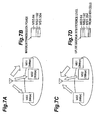
- Figs. 7A to 7D mobile stations (hereinafter referred to as MS) MS1 and MS3 shall belong to a high service class demanding a high transmission rate, and a MS2 shall belong to a low service class demanding a low transmission rate.
- Fig. 7A shows a communication from a base station to each mobile station
- Fig. 7C shows a communication from the mobile station to the base station.
- the thickness of the arrow in Fig. 7A indicates a magnitude of transmission power allocated to each MS, and a stacking graph of the transmission power allocated to each MS is shown in Fig. 7B.
- the thickness of the arrow in Fig. 8A described later similarly shows a magnitude of transmission power, and Fig. 8B described later similarly shows a stacking graph of the transmission power.
- the thickness of the arrow in Fig. 7C indicates a magnitude of received power relating to a received signal from each MS, and a stacking graph of the received power from each MS is shown in Fig. 7D.
- the thickness of the arrow in Fig. 8C described later similarly shows the magnitude of the received power
- Fig. 8D described later shows the stacking graph of the received power similarly.
- the resources were allocated to the MS1 and MS2 for the maximum request of QoS. For example, the resources were allocated to the MS1 and MS2 so that transmission rates of 384 kbps and 192 kbps could be realized.
- the MS3 when the MS3 originates a new connection request in this state, the remaining transmission power resource is small. Accordingly, the transmission rate as little as 64 kbps can be provided to the MS3. Therefore, unfairness occurs in the service provided to the MS1 and MS3 that are users of the same service class. 64 kbps is allocated to the MS3 of a high service class and 192 kbps is allocated to the MS2 of a low service class. Thus, unfairness occurs also in the service provided to the MS2 and MS3 that are users of the different service classes.
- Such a state may occur also when the handover request is originated. Specifically, as shown in Figs. 8A to 8D, since there was a margin of the resources when the MS1 and MS2 originated the handover request, the resources were allocated to the MS1 and MS2 for the maximum request of QoS . For example, the resources were respectively allocated to the MS1 and MS2 so that the transmission rates of 384 kbps and 384 kbps could be realized.
- the MS3 when the MS3 originates the handover request in this state, the remaining transmission power resource is small. Accordingly, the transmission rate as little as 32 kbps can be provided to the MS3. Therefore, unfairness occurs in the service provided to the MS1 and MS3 that are the users of the same service class. 32 kbps is allocated to the MS3 of the high service class, and 384 kbps is allocated to the MS2 of the low service class. Thus, unfairness occurs also in the service provided to the MS2 and the MS3 that are the users of the different service classes.
- the maximum request resource is allocated to the user issuing the new connection request or the handover request in non-congested condition
- the minimum request resource is allocated to the user issuing the new connection request or the handover request in congested condition.
- unfairness occurs in the service among the users of the same service class.
- the maximum request resource is allocated to the user of the low priority class issuing the new connection request or the handover request in non-congested condition
- the minimum request resource is allocated to the user of the high priority class issuing the new connection request or the handover request in congested condition.
- unfairness occurs in the service among the users of the different service classes.
- EP 111921311, EP 0932280 A2 and US 6,240,079 B1 describe other concepts of granting QoS requests. But none of these concepts is capable to provide service with fairness.
- an object of the present invention is to provide a resource control method, a mobile communication system and a base station, which are capable of keeping fairness of a service by providing QoS of approximately an equal degree to users of the same service class, and capable of providing a service with fairness which can relatively keep QoS among the service classes by maintaining a rate between transmission rates for the different service classes, to a previously determined rate.
- the “resource” in this case means resources of the base station exclusively allocated to the individual mobile stations in communicating with the respective mobile station, which include transmission power necessary for providing a certain communication quality or QoS (a transmission rate, a delay, an error rate and the like), buffer capacitance, and the like.
- a certain communication quality means a communication quality which neither increases nor decreases by a predetermined rate relative to a communication quality provided to other users of the same service class, or a communication quality which neither increases nor decreases by a predetermined rate relative to a communication quality provided to users of other service classes.
- the case where the unallocated resources are short means that the unallocated resources increase or decrease by a predetermined rate relative to resources that have been allocated to the mobile stations of the same class or the mobile stations of the different service classes.
- a constitution should be preferably adopted, in which the base station adjusts a degree of fairness among the mobile stations of the same service class or among the mobile stations of the different service classes by adjusting the predetermined rate.
- the present invention should be preferably constituted so that the base station estimates a transmission rate capable of being provided to the mobile station as the unallocated resource that can be allocated to the mobile station.
- the resource control method according to the present invention may be constituted as follows.
- the resource control method according to the present invention is a resource control method in a mobile communication between a base station and each of a plurality of mobile stations, wherein, at certain time intervals or in a case where some resources are released, and in a case where resources need to be reassigned, the base station reassigns the resources that have been allocated to the respective mobile stations, depending on states among mobile stations of the same service class or among mobile stations of the different service classes.
- the case where the reassignment of the resources is necessary means that resources allocated to the mobile stations of a predetermined ratio or more among the mobile stations increase or decrease by a predetermined rate relative to resources allocated to the mobile stations of the same service class or the mobile stations of the different service classes.
- the present invention should preferably have a constitution, in which the base station adjusts a degree of fairness among the mobile stations of the same service class or among the mobile stations of the different service classes by adjusting both of the predetermined rate and the predetermined ratio, or by adjusting one of the predetermined rate and the predetermined ratio.
- the present invention should preferably have a constitution, in which the base station reassigns the resources so that the resources, which have been allocated to the respective mobile stations belonging to the same service class, are within a predetermined range.
- the present invention should preferably have a constitution, in which the base station reassigns the resources so that service qualities provided by the resources allocated to the respective mobile stations belonging to the different service classes are at a predetermined relative rates.
- the resources are reassigned depending on the service class to which the user belongs, and even when the total traffic capacitance varies, fairness of a service is kept by providing the resources of approximately the equal degree among the users of the same service class, and differentiation among the users of the different service classes is kept by maintaining a previously determined rate.
- fairness can be provided.
- the service with fairness can be provided and a degree of user satisfaction can be enhanced.
- 3G cell a cell of the third generation mobile communication system showing a large capacitance difference
- 4G cell a cell of the fourth generation mobile communication system
- the present invention according to the foregoing resource control method can be described as an invention of amobile communication system and abase station as follows.
- the mobile communication system is a mobile communication system constituted by including a base station and a plurality of mobile stations located in a cell controlled by the base station, communicating with the base station, wherein in a case where a new connection request or a handover request is originated and in a case where unallocated resources necessary for the communication are short, the base station reassigns resources that have been allocated to the respective mobile stations, depending on states among mobile stations of the same service class or among mobile stations of the different service classes.
- a mobile communication system is a mobile communication system constituted by including a base station and a plurality of mobile stations located in a cell controlled by the base station, communicating with the base station, wherein in a case where some resources are released or at certain time intervals, and in a case where reassignment of resources is necessary, the base station reassigns resources that have been allocated to the respective mobile stations, depending on states among mobile stations of the same service class or among mobile stations of the different service classes.
- a base station is a base station which communicates with each of a plurality of mobile stations located in a cell, wherein in a case where a new connection request or a handover request is originated and in a case where unallocated resources necessary for the communication are short, the base station reassigns resources that have been allocated to the respective mobile stations, depending on states among mobile stations of the same service class or among mobile stations of the different service classes.
- a base station is a base station which communicates with each of a plurality of mobile stations located in a cell, wherein in a case where some resources are released or at certain time intervals, and in a case where reassignment of resources is necessary, the base station reassigns resources that have been allocated to the respective mobile stations, depending on states among mobile stations of the same service class or among mobile stations of the different service classes.
- the base station according to the present invention Focusing on an operation between the base station and each mobile station in the mobile communication system, the base station according to the present invention and the mobile station according to the present invention can be described as follows.
- the base station is a base station which communicates with each of a plurality of mobile stations located in a cell, the base station comprising recognition means for recognizing a present service quality and a service class for a communicating mobile station; estimation means for estimating an amount of resources necessary for performing transmission/reception to/from the mobile station at a certain transmission rate; determination means for determining an amount of resources and a transmission race to be allocated to the mobile station, based on the service class of the mobile station, the present service quality and the estimated amount of resources; and instruction means for instructing the amount of resources and the transmission rate, which are determined, to the mobile station.
- a mobile station in the mobile communication system may be a mobile station which communicates with a base station, the mobile station comprising: class notification means for notifying to the base station a service class to which the mobile station belongs; service quality measurement means for measuring a present service quality at the time of a new connection, at the time of a handover and at certain time intervals; service quality notification means for notifying the service quality obtained by the measurement to the base station; recognition means for recognizing an amount of resources and a transmission rate, which are instructed by the base station; and communication means for communicating with the base station based on the amount of resources and the transmission rate, which are instructed.
- the resource control method according to the present invention canbe described as a resource control method comprising a plurality of steps as follows.
- the resource control method is a resource control method that is executed by abase station in amobile communicationbetween the base station and each of a plurality of mobile stations.
- the resource control method comprises: an unallocated resource measurement step (S01) of measuring an amount of unallocated resources, when one mobile station originates a new connection request or a handover request; a service quality calculation step (S02) of calculating a service quality which can be provided to the one mobile station with the amount of the unallocated resources obtained by the measurement; a decision step (S03) of deciding whether the service quality obtained by the calculation is within a predetermined range in accordance with a service class to which the one mobile station belongs; and a reassignment step (S04) of reassigning the resources to eachmobile station depending on the service class to which each mobile station belongs, when the service quality is not within the predetermined range in accordance with the service class to which the one mobile station belongs (in a case where a negative decision
- the resource control method is a resource control method that is executed by a base station in a mobile communication between the base station and each of a plurality of mobile stations.
- the resource control method comprises: a service quality information collection step (S11) of collecting service quality information of each mobile station when some resources are released or at certain time intervals; a state decision step (S12) of checking for each mobile station, based on the collected service quality information of each mobile station, whether the service quality of each mobile station is within a predetermined range in accordance with the service class to which each mobile station belongs, and of deciding whether the service qualities for mobile stations of more than a predetermined ratio among the total mobile stations are not within the predetermined range in accordance with the service class to which each mobile station belongs; and a reassignment step (S13) of reassigning the resources to each mobile station depending on the service class to which each mobile station belongs, when the service qualities for the mobile stations of more than a predetermined ratio among the total mobile stations are not within the predetermined
- the resources are reassigned depending on the service class to which the user belongs. Even when the total traffic capacitance varies, fairness of a service is kept by providing the resources of approximately an equal degree among the users of the same service class, and differentiation among the users of the different service classes is kept by maintaining a previously determined rate. Thus, the service with fairness can be provided. As described above, the service with fairness can be provided by achieving the fairness among the users of the same service class and among the users of the different service classes, thus enhancing the degree of user satisfaction.
- the base station preferably reassigns the resources to each mobile station specifically as described below.
- the base station should reassign the resources to each mobile station so that a service quality provided by a resource allocated to the one mobile station approximates to service qualities provided by resources allocated to the other mobile stations within a predetermined range.
- the base station should reassign the resources to each mobile station so that a rate of a service quality provided by a resource allocated to the one mobile station to those provided by resources allocated to the other mobile stations is within a predetermined range, a center of which is a predetermined value determined by the service class of the one mobile station and the service classes of the other mobile stations.
- the base station should reassign the resources to each mobile station in the reassignment step so that a service quality provided by a resource allocated to the one mobile station approximates to a service quality provided by a resource allocated to the first mobile station within a predetermined range and so that a rate of the service quality provided by the resource allocated to the one mobile station to a service quality provided by a resource allocated to the second mobile station is within a predetermined range, a center of which is a predetermined value determined by the service class of the one mobile station and the service class of the second mobile station.
- the present invention according to the foregoing resource control method comprising the plurality of steps can be also described as an invention of a mobile communication system and a base station as follows.
- a mobile communication system is constituted by comprising: a base station; and a plurality of mobile stations located in a cell controlled by the base station, communicating with the base station, wherein the base station includes: unallocated resource measurement means for measuring an amount of unallocated resources, when one mobile station originates a new connection request or a handover request; service quality calculation means for calculating a service quality which can be provided to the one mobile station with the amount of the unallocated resources obtained by the measurement; decision means for deciding whether the service quality obtained by the calculation is within a predetermined range in accordance with a service class to which the one mobile station belongs; and reassignment means for reassigning the resources to each mobile station depending on the service class to which each mobile station belongs, when the service quality is not within the predetermined range in accordance with the service class to which the one mobile station belongs.
- a mobile communication system is constituted by comprising: a base station; and a plurality of mobile stations located in a cell controlled by the base station, communicating with the base station, wherein the base station includes: service quality information collection means for collecting service quality information of each mobile station when some resources are released or at certain time intervals; state decision means for checking for each mobile station, based on the collected service quality information of each mobile station, whether the service quality of each mobile station is within a predetermined range in accordance with the service class to which each mobile station belongs, and for deciding whether the service qualities for mobile stations of more than a predetermined ratio among the total mobile stations are not within the predetermined range in accordance with the service class to which each mobile station belongs; and reassignment means for reassigning the resources to each mobile station depending on the service class to which each mobile station belongs, when the service qualities for the mobile stations of more than a predetermined ratio among the total mobile stations are not within the predetermined range in accordance with the service class to which each mobile station belongs.
- the base station is a base station which communicates with each of a plurality of mobile stations located in a cell, the base station comprising: unallocated resource measurement means for measuring an amount of unallocated resources, when one mobile station originates a new connection request or a handover request; service quality calculation means for calculating a service quality which can be provided to the one mobile station with the amount of the unallocated resources obtained by the measurement; decision means for deciding whether the service quality obtained by the calculation is within a predetermined range in accordance with a service class to which the one mobile station belongs; and reassignment means for reassigning the resources to each mobile station depending on the service class to which each mobile station belongs, when the service quality is not within the predetermined range in accordance with the service class towhich the onemobile stationbelongs.
- the base station according to the present invention is a base station which communicates with each of a plurality of mobile stations located in a cell, the base station comprising: service quality information collection means for collecting service quality information of each mobile station when some resources are released or at certain time intervals; state decision means for checking for each mobile station, based on the collected service quality information of each mobile station, whether the service quality of each mobile station is within a predetermined range in accordance with the service class to which each mobile station belongs, and for deciding whether the service qualities for mobile stations of more than a predetermined ratio among the total mobile stations is not within the predetermined range in accordance with the service class to which each mobile station belongs; and reassignment means for reassigning the resources to each mobile station depending on the service class to which each mobile station belongs, when the service qualities for the mobile stations of more than a predetermined ratio among the total mobile stations is not within the predetermined range depending on the service class to which each mobile station belongs.
- a mobile communication system is the one constituted by comprising a base station 10 and mobile stations 20 (hereinafter referred to as MS) located within a cell controlled by the base station 10, which communicates between the base station 10 and each mobile station 20.
- MS mobile stations 20
- a portable terminal such as a portable phone and a mobile terminal corresponds to the mobile station 20.
- the base station 10 comprises a circulator 100; a demodulation circuit 101; a signal separation circuit 102; a priority recognition circuit 104 for recognizing a priority (service class) and the present communication quality (for example, a transmission rate and the like) concerning the mobile station 20 that is a communication partner; a remaining resource amount confirmation circuit 105 for confirming an amount of remaining resources; a transmission rate calculation circuit 106 for calculating a transmission rate that can be provided to the mobile station; a transmission rate calculation circuit 107 by a reassignment (hereinafter referred to as a reassignment transmission rate calculation circuit 107), which calculates a transmission rate by the reassignment when the transmission rate becomes lower than a previously set threshold value; a modulation method resource determination circuit 108 for determining a modulation method and an amount of radio resources; a notification information control circuit 109 which generates notification information for notifying the determined transmission rate, modulation method and amount of radio
- a transmission request transmitted from the mobile station 20 to the base station 10 in an uplink direction or a transmission request transmitted from a superordinate network to the base station 10 in a downlink direction is input to the priority recognition circuit 104 through the circulator 100, the decoding circuit 101 and the signal separation circuit 102.
- a priority service class
- an amount of remaining resources is confirmed by the remaining resource amount confirmation circuit 105, and a transmission rate that can be provided to this mobile station 20 is calculated by the transmission rate calculation circuit 106. If this transmission rate becomes lower than a previously set threshold value, the reassignment transmission rate calculation circuit 107 is started up, and a reassignment transmission rate is calculated by the reassignment transmission rate calculation circuit 107.
- the modulation method and the amount of the radio resources are determined by the modulation method resource determination circuit 108.
- the determined modulation method, the determined amount of the radio resources and the transmission rate obtained by the foregoing calculation are input to the notification information control circuit 109 and the signal multiplexing circuit 111, and then are transmitted, together with downlink information transmitted through the decoding circuit 112, to the mobile station 20 through the modulation circuit 110 and the circulator 100.
- the signal separation circuit 102, the priority recognition circuit 104, the remaining resource amount confirmation circuit 105, the transmission rate calculation circuit 106, the reassignment transmission rate calculation circuit 107, the modulation method resource determination circuit 108, the notification information control circuit 109 and the signal multiplexing circuit 111 may be provided between an input terminal of the decoding circuit 103 and an input terminal of the coding circuit 112, that is, on the right sides of the decoding circuit 103 and the coding circuit 112 in Fig. 1.
- recognition means provided in the foregoing base station according to the present invention corresponds to the priority recognition circuit 104; estimation means corresponds to the remaining resource amount confirmation circuit 105; determination means corresponds to the transmission rate calculation circuit 106, the reassignment transmission rate calculation circuit 107 and the modulation method resource determination circuit 108; and instruction means corresponds to the notification information control circuit 109.
- the mobile station 20 comprises a priority confirmation section 200 for confirming a priority of a transmitted object; a coding circuit 201; a modulation circuit 202; a circulator 203; a signal separation circuit 204; a demodulation circuit 205; a decoding circuit 206; a received signal quality measurement section 207; and a base station notification section 203.
- the priority confirmation section 200 confirms the priority of the transmitted object. Together with the transmission request, this priority information is transmitted to the base station 10, which is illustrated in Fig. 1, through the coding circuit 201, the modulation circuit 202 and the circulator 203.
- the coding circuit 201 information concerning the amount of the radio resources, the modulation method and the transmission rate, which are determined by the base station 10 is input to the coding circuit 201 through the circulator 203 and the signal separation circuit 204. Subsequently, the packet of the transmitted object is modulated in the modulation circuit 202 depending on the amount of the radio resources and the modulation method, which were determined by the base station 10, and is transmitted to the base station 10 through the circulator 203.
- the downlink communication information concerning both of the amount of the radio resources and the modulation method, which were determined by the base station 10, is acquired from the signal separation circuit 204, and is demodulated in the demodulation circuit 205 depending on the modulation method. Then, the information concerning both of the amount of the radio resources and the modulation method are decoded by the decoding circuit 206, and this information becomes a downlink information.
- the received signal quality measurement section 207 measures a downlink received signal quality, and cutputs a measurement result to the base station notification section 208.
- the base station notification section 208 notifies received signal quality information of the measurement result, for example, transmission rate information, to the base station 10 at certain time intervals.
- a transmission rate is taken as an example of QoS, and, in terms of a priority, users shall be divided into two including a high service class (class 1) and a low service class (class 2) -
- the class 1 shall indicate a user that requests a high transmission rate "rate_1”
- the class 2 shall indicate a user that requests a low transmission rate "rate_2”.
- a sum of users of the class 1 and class 2 shall be N.
- the number of users of the class 1 shall be J
- Total indicates down or uplink total capacitance of the resources.
- a transmission rate that can be provided for each code of CDMA is represented by "rate_ch”
- a target SIR is represented by "SIR_tg”.
- “Sum_idown” and “Sum_iup” are a downlink interference amount on the basis of MSi and an uplink interference amount on the basis of the base station, respectively.
- transmission power "Power_ch_i” necessary for providing the transmission rate of rate_ch to the user i is calculated by the equation 1.
- “Attenuation” and “Shadow” represent distance attenuation and shadowing, respectively.
- received power "Power_ch_i" in the base station, which is required for providing the transmission rate "rate_ch” is calculated by the equation 2.
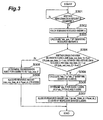
- Fig. 3 a flowchart of an operation of the base station at the time of the connection request (when the new connection request or the handover request is originated) is illustrated.
- the base station waits for the connection request (S301), and when the connection request is originated (affirmative decision in S301), the base station checks the remaining resource amount A that can be allocated (S302). Then, in a state where the remaining resource amount is A, the base station calculates QoS which can be provided to the mobile station that is the user who originated the connection request (S303).
- QoS is the transmission rate "rate_now_i", for example.
- the base station decides whether (when this user belongs to class 1, and ((rate_now_i/rate_1) ⁇ 1- ⁇ ) or ((rate_now_i/rate_1) > 1+ ⁇ ), or when this user belongs to class 2, and ((rate_now_i/rate_2) ⁇ 1- ⁇ ) or ((rate_now_i/rate_2) > 1+ ⁇ )) or not (S304).
- the base station determines the transmission rate of the mobile station that is the user who originated the connection request to be "rate_now_i" (S308), and allocates the resource amount (rate_now_i/rate_ch ⁇ Power_ch_i) to the mobile station (S309), the resource amount being necessary for providing "rate_now_i", thus finishing the process.
- the base station calculates "rate_1" and "rate_2" which satisfy the foregoing equations 4 and 5 (S305), and determines "rate_1" and "rate_2" for the users of the service classes 1 and 2, respectively (S306).
- the base station allocates the resource amount (rate_1 (or 2)/rate_ch ⁇ Power_ch_i) to the users of the respective service classes (S307), the resource amount being necessary for providing the rates, and the base station completes the process.
- R described above is a previously determined value, and by varying the value of R, it is possible to adjust the degree of fairness among the users of the same service class and among the users of difference service classes.
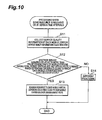
- Fig. 4 illustrates a flowchart of a resource reassignment operation of the base station at the time when some resources are released and at the time when a certain time interval has passed.
- the base station it is monitored whether any resources are released or whether the certain time interval has passed (S401). If some resources are released or if the certain time interval has passed, the transmission rate of the user of each service class is checked (S402) . Then, it is decided whether the transmission rates of the users of P% among the total users come under the next status; (when a user belongs to class 1, and ((rate_now_i/rate_1) ⁇ 1- ⁇ ) or ((rate_now_i/rate_1) > 1+ ⁇ )), or (when a user belongs to class 2, and ((rate now i/rate 2) ⁇ 1- ⁇ ) or ((rate_now_i/rate_2) > 1+ ⁇ )) (S403).
- Figs. 5A to 5D Images of the transmission rates after the reassignments by the processing of this embodiment described above are illustrated in Figs. 5A to 5D and Figs. 6A to 6D.
- MS1 and MS3 shall belong to a high service class requesting a high transmission rate
- MS2 shall belong to a low service class requesting a low transmission rate.
- Fig. 5A illustrates the downlink communication from the base station to the mobile station
- Fig. 5C illustrates the uplink communication from the mobile station to the base station.
- the thickness of the arrows in Fig. 5A shows a magnitude of transmission power allocated to each MS, and a stacking graph of the transmission power allocated to each MS is illustrated in Fig. 5B.
- the thickness of the arrows in Fig. 6A to be described later similarly shows a magnitude of transmission power allocated to each MS, and a stacking graph of the transmission power allocated to each MS is similarly illustrated in Fig. 6B.
- the thickness of the arrows in Fig. 5C illustrates a magnitude of received power relating to a received signal from each MS, and a stacking graph of the received power from each MS is also illustrated in Fig. 5D.
- the thickness of the arrows in Fig. 6C to be described later similarly shows a magnitude of received power from each MS, and a stacking graph of the received power from each MS is similarly illustrated in Fig. 6D.
- the resource reassignment is performed even if the remaining resource is short.
- the resources are allocated to MS1 and MS3 that are users of the same service class so that transmission rates of 256 kbps can be realized, and the resources are allocated to MS2 that is a user of a low service class so that a transmission rate of 128 kbps can be realized.
- a service quality of the same degree can be provided to the users of the same class, and a rate of the service quality is kept to be a certain value for the users of the difference service classes, whereby QoS with fairness can be provided.
- This reassignment can be applied to the case where a handover request is originated. Specifically, as shown in Figs. 6A to 6D, assuming that MS1 to MS3 be users of the same service class, when the handover request is originated from MS3 accompanied with movement in a state where the resources are allocated only to MS1 and MS2, the resource reassignment is performed even if the remaining resource is short. Accordingly, the resources are allocated to MS1 to MS3, which are the users of the same service class, so that a transmission rate of 256 kbps can be realized. Also in this case, QoS with fairness can be provided by providing the service quality of the same degree to the users of the same service class. Particularly, it is possible to reduce a quality difference among the users of the same service class during handover between 3G and 4G cells with a large capacitance difference therebetween.
- a transmission rate for each code is 500 kbps and capacitance W of the total cells is 10 Mbps.
- a rate R of the class 2 to the class 1 shall be 2.
- a transmission rate is an object to be discussed.
- the downlink communication is established on the premise that a sum of the transmission power allocated to the respective users is equal to the total transmission power of the base station, and the uplink communication is established on the premise that the total received power from the respective users is equal to a sum of allowable received power of the base station.
- both of the up and downlink communications shall be established on the premise that the sum of transmission rates allocated to the respective users is equal to total cell capacitance from the viewpoint of cell capacitance.
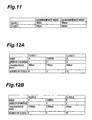
- Fig. 12A classes of users, an origination order of requests from the users and allocated transmission rates are illustrated.
- the usersAandC shall be the ones belonging to the class 1, and the user B shall be the one belonging to the class 2.
- the origination of the requests shall be performed in the order of A, B and C .
- 3 Mbps that is the maximum request was allocated to the user A because no resource was not yet allocated.
- 6 Mbps that is the maximum request for the user B was allocated to the user B because the remaining resource amount was more than the maximum request of the user B.
- Allocation rates of the users of the classes 1 and 2 after the reassignment shall be r1 and r2.
- R indicates a rate of the transmission rate among the service classes.
- N1 andN2 indicate the number of the users belonging to the service classes 1 and 2, respectively, and W indicates capacitance of the total cells.
- the transmission rate that can be provided to the user of the class 1 is 2.5 Mbps by allocating 5 codes to the user of the class 1
- the transmission rate that can be provided to the user of the class 2 is 5 Mbps by allocating 10 codes to the user of the class 2.
- Fig. 12B Transmission rates which were allocated to the respective users upon the application of the present invention are shown in Fig. 12B.
- the services of approximately an equal degree can be provided to the users A and C of the class 1.
- the rate R of the transmission rates between the users B of the class 2 and C of the class 1 is maintained so as to be 2, which is previously determined.
- services with fairness can be provided and the degree of user satisfaction can be enhanced by achieving fairness among the users of the same class and among the users of the different classes.
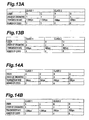
- Fig. 13A the transmission rates of the respective users before the allocation of the transmission rate to the user A is finished are shown.
- 1.5 Mbps is allocated to the user C of the class 1
- 3 Mbps is allocated to the users B and C of the class 2
- the foregoing states occur for all users (100 % of the users). Therefore, the affirmative decision is made in S403 of Fig. 4, and then processes concerning the reassignment of the resource after S404 are executed.
- r2 is 4 Mbps and r1 is 2 Mbps with use of the foregoing equations 6 and 7.
- Fig. 13B the transmission rates allocated to the respective users upon the application of the present invention are shown.
- the services of approximately an equal degree can be provided to the users B and D of the class 2.
- the rate R of the transmission rates between the users B and D of the class 2 and the user C of the class 1 is maintained so as to be 2 that is previously determined.
- services with fairness can be provided and the degree of user satisfaction can be enhanced by achieving fairness among the users of the same class and among the users of the different classes.
- Fig. 14A the transmission rates allocated to the respective users before the reassignment are shown. Since 3 Mbps is allocated to the users B and D of the class 2 at this time, the above-described states do not occur. However, since only 1 Mbps is allocated to the users A and C of the class 1, the foregoing states occur. Specifically, since the foregoing states occur for 50 % of all users, the affirmative decision is performed in S403 of Fig. 4, and the processes concerning the reassignment of the resource after S404 are executed. In this case, since both of the numbers N1 and N2 of the users of the classes 1 and 2 are 2 and capacitance W is 9 Mbps, r2 is 3 Mbps and r1 is 1.5 Mbps with use of the foregoing equations 6 and 7.
- Fig. 14B the transmission rates allocated to the respective users upon the application of the present invention are shown.
- the services of approximately an equal degree can be provided to the users A and C of the class 1 as well as to the users B and D of the class 2.
- the rate R of the transmission rates between the users B and D of the class 2 and the users A and C of the class 1 is maintained so as to be 2 that is previously determined.
- services with fairness can be provided and the degrees of user satisfaction can be enhanced by achieving fairness among the users of the same class and among the users of the different classes.
- the resources are reassigned depending on the service class to which the user belongs. Even when the total traffic capacitance varies, the resources of approximately an equal degree are provided to the users of the same service class. Thus, the fairness of the service is maintained, and the discrimination of the service class among the users of the different service classes is kept by maintaining the predetermined rate. Thus, it is possible to provide the service with fairness.
- the service with fairness can be provided by achieving the fairness for the users of the same service class and for the users of the different service classes, thus enhancing the degree of the user satisfaction.
- the service with fairness can be provided by achieving the fairness for the users of the same service class and for the users of the different service classes, thus enhancing the degree of the user satisfaction.
Landscapes
- Engineering & Computer Science (AREA)
- Computer Networks & Wireless Communication (AREA)
- Signal Processing (AREA)
- Mobile Radio Communication Systems (AREA)
Claims (15)
- Ein Verfahren zur Ressourcensteuerung, welches durch eine Basisstation (10) bei einer mobilen Kommunikation zwischen der Basisstation (10) und jeder von einer Vielzahl von mobilen Stationen (20) ausgeführt wird, aufweisendeinen Bestimmungsschritt (S01, S11) des Bestimmens der nicht zugewiesenen Menge von Ressourcen und/oder von Dienstequalitätsinformation von jeder Mobilstation;einen Entscheidungsschritt (S03, S12) des Entscheidens, ob die Neuzuweisung von Ressourcen erforderlich ist, basierend auf den in dem Bestimmungsschritt bestimmten Werten und einer vorbestimmten Bedingung zur Entscheidung, ob die Neuzuweisung von Ressourcen erforderlich ist, wenn eine Mobilstation (20) eine neue Verbindungsaufbauanforderung veranlasst, wenn eine Mobilstation (20) eine Übergabeanforderung veranlasst, wenn einige Ressourcen freigegeben werden und/oder zu bestimmten Zeitintervallen,
dadurch gekennzeichnet, dass das Verfahren zur Ressourcensteuerung ferner aufweisteinen Neuzuweisungsschritt (S04, S13) des Neuzuweisens der Ressourcen zu einer Mobilstation (20) von jeder Diensteklasse in einem Fall, in dem entschieden wird, dass die Neuzuweisung von Ressourcen erforderlich ist, worin eine Dienstequalität, welche durch eine einer Mobilstation (20) zugeordneten Ressource bereitgestellt wird, die Dienstequalitäten approximiert, welche durch Ressourcen bereitgestellt werden, die anderen Mobilstationen der gleichen Diensteklasse in einem vorbestimmten Bereich zugeordnet sind, und bei dem eine Rate der Dienstequalität, welche durch eine Ressource bereitgestellt wird, die einer Mobilstation (20) zugeordnet ist zu jener, welche durch Ressourcen bereitgestellt wird, die anderen Mobilstationen (20) von verschiedenen Diensteklassen zugeordnet sind, sich in einem vorbestimmten Bereich befindet, dessen Zentrum ein vorbestimmter Wert ist, der entsprechend der Diensteklasse der einen Mobilstation (20) und der Diensteklassen der anderen Mobilstationen (20) bestimmt wird. - Ein Verfahren zur Steuerung von Ressourcen nach Anspruch 1, dadurch gekennzeichnet, dass der Neuzuweisungsschritt enthälteinen Schritt zur Berechnung der Dienstequalität (S02) des Berechnens einer Dienstequalität, welche der Mobilstation (20) jeder Diensteklasse bereitgestellt werden kann, im Fall, in dem entschieden wird, dass die Neuzuweisung von Ressourcen erforderlich ist, worin eine Dienstequalität, welche durch eine Ressource bereitgestellt wird, welche der einen Mobilstation (20) zugeordnet ist, die Dienstequalitäten approximiert, welche durch Ressourcen bereitgestellt werden, die anderen Mobilstationen (20) der gleichen Diensteklasse in einem vorbestimmten Bereich zugeordnet sind, und bei dem eine Rate einer Dienstequalität, die durch eine Ressource bereitgestellt wird, welche der einen Mobilstation (20) zugeordnet ist zu jener, welche durch Ressourcen bereitgestellt wird, die anderen Mobilstationen (20) von verschiedenen Diensteklassen zugeordnet sind, sich in einem vorbestimmten Bereich befindet, dessen Zentrum ein vorbestimmter Wert ist, der bestimmt wird gemäß der Diensteklasse der einen Mobilstation (20) und der Diensteklassen der anderen Mobilstationen (20); undeinen Ressourcenneuzuweisungsschritt des Neuzuweisens der Ressource zu jeder Mobilstation, worin eine Ressource, welche zur Bereitstellung der berechneten Dienstequalität der Mobilstation (20) von jeder Diensteklasse benötigt wird, der Mobilstation (20) von jeder Diensteklasse neu zugewiesen wird.
- Das Verfahren zur Steuerung von Ressourcen gemäß Anspruch 1 oder 2 dadurch gekennzeichnet, dass der Entscheidungsschritt enthälteinen Messschritt von nicht zugewiesenen Ressourcen des Messens einer Menge von nicht zugewiesenen Ressourcen bei beidem oder einem von, wenn eine Mobilstation (20) eine neue Verbindungsaufbauanforderung veranlasst, und wenn eine Mobilstation (20) eine Übergabeanforderung veranlasst;einen Schritt zur Berechnung einer Dienstequalität, des Berechnens einer Dienstequalität, welcher der Mobilstation (20) zur Verfügung gestellt werden kann, mit der Menge von nicht zugewiesenen Ressourcen, die durch den Messschritt erhalten wurde; undeinen Qualitätsentscheidungsschritt des Entscheidens, ob die Neuzuweisung von Ressourcen erforderlich ist, indem bewertet wird, ob die durch die Berechnung erhaltene Dienstequalität sich in einem vorbestimmten Bereich in Übereinstimmung mit einer Diensteklasse befindet, zu welcher die Mobilstation (20) gehört.
- Das Verfahren zur Steuerung von Ressourcen gemäß Anspruch 1 oder 2 dadurch gekennzeichnet, dass der Entscheidungsschritt enthälteinen Schritt zur Sammlung der Dienstequalität, des Sammelns von Dienstequalitätsinformation von jeder Mobilstation (20), welche von den Mobilstationen der Basisstation mitgeteilt wird, bei beidem oder einem von, wenn einige Ressourcen freigegeben werden und zu bestimmten Zeitintervallen; undeinen Zustandsentscheidungsschritt des Entscheidens, ob die Neuzuweisung von Ressourcen erforderlich ist, indem für jede Mobilstation, basierend auf der gesammelten Dienstequalitätsinformation von jeder Mobilstation überprüft wird, ob die Dienstequalität von jeder Mobilstation (20) sich in einem vorbestimmten Bereich befindet, abhängig von der Diensteklasse, zu welcher die Mobilstation (20) gehört und des Bewertens, ob die Dienstequalitäten von Mobilstationen (20) von mehr als einem vorgegebenen Verhältnis unter den gesamten Mobilstationen (20) sich nicht innerhalb einem vorbestimmten Bereich in Übereinstimmung mit der Diensteklasse befinden, zu welcher jeder Mobilstation (20) gehört.
- Das Verfahren zur Steuerung von Ressourcen nach Anspruch 3, dadurch gekennzeichnet, dass die Basisstation (10) auf eine Weise entworfen ist, dass die Basisstation (10) einen Grad von Fairness unter den Mobilstationen der gleichen Diensteklasse oder unter den Mobilstationen (20) von verschiedenen Diensteklassen justiert, indem sie den vorbestimmten Bereich justiert, der im Qualitätsentscheidungsschritt verwendet wird.
- Das Verfahren zur Steuerung von Ressourcen nach Anspruch 4, dadurch gekennzeichnet, dass die Basisstation (10) auf eine Weise entworfen ist, dass die Basisstation (10) einen Grad von Fairness unter den Mobilstationen (20) der gleichen Diensteklasse oder unter den Mobilstationen (20) der verschiedenen Diensteklassen justiert, indem sie wenigstens eines aus dem vorbestimmten Bereich und dem vorbestimmten Verhältnis justiert, die in dem Zustandsentscheidungsschritt verwendet werden.
- Das Verfahren zur Steuerung von Ressourcen nach Anspruch 3 dadurch gekennzeichnet, dass die Basisstation (10) auf eine Weise entworfen ist, dass die Basisstation (10) eine Senderate als die nicht zugewiesenen Ressourcen abschätzt, welche der Mobilstation (20) zur Verfügung gestellt werden kann, die der Mobilstation zugewiesen werden können.
- Ein mobiles Kommunikationssystem aufweisendeine Basisstation (10); undeine Vielzahl von Mobilstationen (20), die in einer Zelle angeordnet sind, welche durch die Basisstation (10) kontrolliert wird, welche mit der Basisstation (10) kommunizieren,worin die Basisstation (10) enthältBestimmungsmittel zur Bestimmung der nicht zugewiesenen Ressourcenmenge und/oder von Dienstequalitätsinformation von jeder Mobilstation;Entscheidungsmittel zum Bestimmen, ob die Neuzuweisung von Ressourcen erforderlich ist, basierend auf den Werten, die in dem Bestimmungsschritt bestimmt wurden und einer vorbestimmten Bedingung zur Entscheidung, ob die Neuzuweisung von Ressourcen erforderlich ist, wenn eine Mobilstation (20) eine Neuverbindungsanforderung veranlasst, wenn eine Mobilstation (20) eine Übergabeanforderung veranlasst, wenn einige Ressourcen freigegeben werden, und/oder zu bestimmten Zeitintervallen,
dadurch gekennzeichnet, dass die Basisstation (10) ferner enthältNeuzuweisungsmittel zur Neuzuweisung der Ressourcen zu einer Mobilstation (20) von jeder Diensteklasse in einem Fall, in dem entschieden wird, dass die Neuzuweisung von Ressourcen erforderlich ist, worin eine Dienstequalität, die durch eine der einen Mobilstation (20) zugeordneten Ressource bereitgestellt wird, die Dienstequalitäten approximiert, welche durch Ressourcen bereitgestellt werden, die anderen Mobilstationen (20) der gleichen Diensteklasse innerhalb eines vorbestimmten Bereiches zugeordnet sind und worin eine Rate einer Dienstequalität, welche durch eine Ressource bereitgestellt wird, die der einen Mobilstation (20) zugeordnet ist, zu jener, die durch Ressourcen bereitgestellt werden, welche den anderen Mobilstationen (20) von verschiedenen Diensteklassen zugeordnet sind, sich innerhalb eines vorbestimmten Bereiches befindet, dessen Zentrum ein vorbestimmter Wert ist, der gemäß der Diensteklasse der Mobilstation (20) und der Diensteklassen der anderen Mobilstationen (20) bestimmt wird. - Das mobile Kommunikationssystem gemäß Anspruch 8 dadurch gekennzeichnet, dass das Neuzuweisungsmittel enthältMittel zur Berechnung der Dienstequalität zur Berechnung einer Dienstequalität, welche der Mobilstation (20) jeder Diensteklasse bereitgestellt werden kann, im Fall, dass entschieden wird, dass die Neuzuweisung von Ressourcen erforderlich ist, worin eine Dienstequalität, die durch eine der einen Mobilstation (20) zugeordneten Ressource bereitgestellt wird, Dienstequalitäten annähert, welche durch Ressourcen bereitgestellt werden, die anderen Mobilstationen (20) der gleichen Diensteklasse in einem vorbestimmten Bereich zugeordnet sind, und eine Rate einer Dienstequalität, welche durch eine Ressource bereitgestellt wird, die der einen Mobilstation (20) zugeordnet ist zu jener, welche durch Ressourcen bereitgestellt wird, die den anderen Mobilstationen (20) von verschiedenen Diensteklassen zugeordnet sind, sich innerhalb eines vorbestimmten Bereiches befindet, dessen Zentrum ein vorbestimmter Wert ist, der entsprechend der Diensteklasse der einen Mobilstation (20) und der Diensteklassen der anderen Mobilstationen (20) bestimmt wird; undMittel zur Neuzuweisung zur Neuzuweisung der Ressource zu jeder Mobilstation, worin eine Ressource, die zur Bereitstellung der berechneten Dienstequalität der Mobilstation (20) von jeder Diensteklasse benötigt wird, der Mobilstation (20) von jeder Diensteklasse neu zugewiesen wird.
- Das mobile Kommunikationssystem gemäß Anspruch 8 oder 9 dadurch gekennzeichnet, dass das Mittel zur Entscheidung enthält:Mittel zur Messung nicht zugewiesener Ressourcen, um eine Menge von nicht zugewiesenen Ressourcen bei beidem oder einem von, wenn eine Mobilstation (20) eine neue Verbindungsanforderung veranlasst, und wenn eine Mobilstation (20) eine Übergabeanforderung veranlasst, zu messen;Mittel zur Berechnung der Dienstequalität zur Berechnung einer Dienstequalität, welche der Mobilstation (20) mit der Menge von nicht zugewiesenen Ressourcen, die durch Messung erhalten wurden, bereitgestellt werden kann; undQualitätsentscheidungsmittel zur Entscheidung, ob die Neuzuweisung von Ressourcen erforderlich ist, indem bewertet wird, ob die durch die Berechnung erhaltene Dienstequalität sich innerhalb eines vorbestimmten Bereiches befindet, in Übereinstimmung mit einer Diensteklasse, zu welcher die Mobilstation (20) gehört.
- Das mobile Kommunikationssystem nach Anspruch 8 oder 9 dadurch gekennzeichnet, dass Mittel zur Entscheidung enthält:Mittel zur Sammlung von Dienstequalitätsinformation zum Sammeln von Dienstequalitätsinformation von jeder Mobilstation (20), welche von den Mobilstationen der Basisstation mitgeteilt wird, bei beidem oder einem von, wenn einige Ressourcen freigegeben werden und zu bestimmten Zeitintervallen; undMittel zur Entscheidung eines Zustands zum Entscheiden, ob die Neuzuweisung von Ressourcen erforderlich ist, indem für jede Mobilstation basierend auf der gesammelten Dienstequalitätsinformation von jeder Mobilstation überprüft wird, ob die Dienstequalität von jeder Mobilstation (20) sich in einem vorbestimmten Bereich befindet, abhängig von der Diensteklasse zu welcher jede Mobilstation (20) gehört, und um zu Bewerten, ob die Dienstequalitäten der Mobilstationen (20) von mehr als einem vorbestimmten Verhältnis unter den gesamten Mobilstationen (20) sich nicht innerhalb einem vorbestimmten Bereich in Übereinstimmung mit der Diensteklasse befinden, zu welcher jede Mobilstation (20) gehört.
- Eine Basisstation (10), welche mit jeder von einer Vielzahl von Mobilstationen (20) kommuniziert, die in einer Zelle angeordnet sind, wobei die Basisstation (10) aufweistBestimmungsmittel zur Bestimmung der Menge von nicht zugewiesenen Ressourcen und/oder von Dienstequalitätsinformation von jeder Mobilstation;Mittel zur Entscheidung des Entscheidens, ob die Neuzuweisung von Ressourcen erforderlich ist, basierend auf den in dem Bestimmungsschritt bestimmten Werten und einer vorbestimmten Bedingung zur Entscheidung, ob die Neuzuweisung von Ressourcen erforderlich ist, bei wenigstens einer Zeitgebung wenn eine Mobilstation (20) eine Neuverbindungsanforderung veranlasst, wenn eine Mobilstation (20) eine Übergabeanforderung veranlasst, wenn einige Ressourcen freigegeben werden und/oder zu bestimmten Zeitintervallen,
dadurch gekennzeichnet, dass die Basisstation (10) weiter aufweistMittel zur Neuzuweisung zur Neuzuweisung der Ressourcen zu einer Mobilstation (20) von jeder Diensteklasse im Fall, in dem entschieden wird, dass die Neuzuweisung von Ressourcen erforderlich ist, worin eine Dienstequalität, die durch eine einer Mobilstation (20) zugewiesenen Ressource bereitgestellt wird, Dienstequalitäten approximiert, welche durch Ressourcen bereitgestellt werden, die anderen Mobilstationen (20) der gleichen Diensteklasse innerhalb einem vorbestimmten Bereich zugeordnet sind, und eine Rate einer Dienstequalität, welche durch eine Ressource bereitgestellt wird, welche der einen Mobilstation (20) zugeordnet ist zu jener, die durch Ressourcen bereitgestellt wird, die den anderen Mobilstationen (20) von verschiedenen Diensteklassen zugeordnet sind, sich innerhalb einem vorbestimmten Bereich befindet, dessen Zentrum ein vorbestimmter Wert ist, der entsprechend der Diensteklasse der einen Mobilstation (20) und der Diensteklassen der anderen Mobilstationen (20) bestimmt wird. - Die Basisstation (10) nach Anspruch 12 dadurch gekennzeichnet, dass das Mittel zur Neuzuweisung enthältMittel zur Berechnung der Dienstequalität zur Berechnung einer Dienstequalität, welche der Mobilstation (20) jeder Diensteklasse zur Verfügung gestellt werden kann im Fall, in dem entschieden wird, dass die Neuzuweisung von Ressourcen erforderlich ist, worin eine Dienstequalität, die durch eine einer Mobilstation (20) zugeordneten Ressource bereitgestellt wird, Dienstequalitäten approximiert, welche durch Ressourcen bereitgestellt werden, die anderen Mobilstationen (20) der gleichen Dienstequalität innerhalb einem vorbestimmten Bereich zugeordnet sind und eine Rate einer Dienstequalität, welche durch eine Ressource bereitgestellt wird, die einer Mobilstation (20) zugeordnet ist zu jener, welche durch Ressourcen bereitgestellt wird, die den anderen Mobilstationen (20) von verschiedenen Diensteklassen zugeordnet sind, sich innerhalb einem vorbestimmten Bereich befindet, dessen Zentrum ein vorbestimmter Wert ist, der entsprechend der Diensteklasse der einen Mobilstation (20) und den Diensteklassen der anderen Mobilstationen (20) bestimmt wird; undMittel zur Neuzuweisung zur Neuzuweisung der Ressource zu jeder Mobilstation, worin eine Ressource, die zur Bereitstellung der berechneten Dienstequalität der Mobilstation (20) von jeder Diensteklasse benötigt wird, der Mobilstation (20) von jeder Diensteklasse neu zugeordnet wird.
- Die Basisstation (10) nach Anspruch 12 oder 13 dadurch gekennzeichnet, dass das Mittel zur Entscheidung enthältMessmittel zur Messung nicht zugeordneter Ressourcen zur Messung einer Menge von nicht zugewiesenen Ressourcen bei beidem oder einem von, wenn eine Mobilstation (20) eine Neuverbindungsanforderung veranlasst, und wenn eine Mobilstation (20) eine Übergabeanforderung veranlasst;Mittel zur Berechnung der Dienstequalität zur Berechnung einer Dienstequalität, welche der Mobilstation (20) mit der Menge von nicht zugewiesenen Ressourcen, die durch die Messung erhalten wurde, bereitgestellt werden kann; undMittel zur Entscheidung der Qualität zur Entscheidung, ob die Neuzuweisung von Ressourcen erforderlich ist, indem bewertet wird, ob die durch Berechnung erhaltene Dienstequalität sich innerhalb einem vorbestimmten Bereich in Übereinstimmung mit der Diensteklasse befindet, zu welcher die Mobilstation (20) gehört.
- Die Basisstation (10) gemäß Anspruch 12 oder 13 dadurch gekennzeichnet, dass das Mittel zur Entscheidung enthältMittel zur Sammlung von Dienstequalitätsinformation zur Sammlung der Dienstequalitätsinformation von jeder Mobilstation (20), die von den Mobilstationen der Basisstation mitgeteilt wird, bei beidem oder einem von, wenn einige Ressourcen freigegeben werden und zu bestimmten Zeitintervallen; undMittel zur Entscheidung eines Zustands, um zu entscheiden, ob die Neuzuweisung von Ressourcen erforderlich ist, indem für jede Mobilstation basierend auf der gesammelten Dienstequalitätsinformation von jeder Mobilstation überprüft wird, ob die Dienstequalität von jeder Mobilstation (20) sich innerhalb einem vorbestimmten Bereich befindet, abhängig von der Diensteklasse, zu welcher jede Mobilstation (20) gehört und um zu Bewerten, ob die Dienstequalitäten der Mobilstationen (20) von mehr als einem vorbestimmten Verhältnis unter den gesamten Mobilstationen (20) sich nicht innerhalb einem vorbestimmten Bereich in Übereinstimmung mit der Diensteklasse befinden, zu welcher die Mobilstation (20) gehört.
Applications Claiming Priority (2)
| Application Number | Priority Date | Filing Date | Title |
|---|---|---|---|
| JP2001305700 | 2001-10-01 | ||
| JP2001305700 | 2001-10-01 |
Publications (3)
| Publication Number | Publication Date |
|---|---|
| EP1298951A2 EP1298951A2 (de) | 2003-04-02 |
| EP1298951A3 EP1298951A3 (de) | 2003-10-29 |
| EP1298951B1 true EP1298951B1 (de) | 2006-11-22 |
Family
ID=19125450
Family Applications (1)
| Application Number | Title | Priority Date | Filing Date |
|---|---|---|---|
| EP02021877A Expired - Lifetime EP1298951B1 (de) | 2001-10-01 | 2002-09-30 | Resourcensteuerungsverfahren, Mobilkommunikationssystem und Basisstation |
Country Status (4)
| Country | Link |
|---|---|
| US (1) | US7089017B2 (de) |
| EP (1) | EP1298951B1 (de) |
| CN (1) | CN1251525C (de) |
| DE (1) | DE60216213T2 (de) |
Families Citing this family (43)
| Publication number | Priority date | Publication date | Assignee | Title |
|---|---|---|---|---|
| JP3898965B2 (ja) * | 2002-03-06 | 2007-03-28 | 株式会社エヌ・ティ・ティ・ドコモ | 無線リソース割り当て方法及び基地局 |
| US20050282572A1 (en) * | 2002-11-08 | 2005-12-22 | Jeroen Wigard | Data transmission method, radio network controller and base station |
| WO2005006150A2 (en) * | 2003-07-09 | 2005-01-20 | Interdigital Technology Corporation | Method and system for managing radio resources in a time-slotted communication system |
| CA2534630C (en) * | 2003-07-17 | 2016-05-24 | Interdigital Technology Corporation | Signaling method for wlan network control |
| US7721289B2 (en) * | 2003-08-29 | 2010-05-18 | Microsoft Corporation | System and method for dynamic allocation of computers in response to requests |
| GB0323199D0 (en) * | 2003-10-03 | 2003-11-05 | Fujitsu Ltd | Soft handover |
| JP4278530B2 (ja) * | 2004-02-13 | 2009-06-17 | 富士通株式会社 | 符号分割多重通信システム及びその周波数割当て方法 |
| EP1720364A4 (de) * | 2004-02-23 | 2011-02-09 | Nec Corp | Mobilteilnehmernetzwerk und betriebsmittelverwaltungsverfahren |
| CN100337507C (zh) * | 2004-03-15 | 2007-09-12 | 大唐移动通信设备有限公司 | 移动通信系统中非实时业务的资源分配和调度方法 |
| JP2005277602A (ja) * | 2004-03-23 | 2005-10-06 | Kenwood Corp | サービスクラス制御システム、サービスクラス制御装置、端末装置、サービスクラス制御方法及びプログラム |
| SE0402963D0 (sv) * | 2004-12-03 | 2004-12-03 | Ericsson Telefon Ab L M | Method and apparatus for allocating radio resources in a mobile radio network |
| KR100638587B1 (ko) | 2004-12-16 | 2006-10-26 | 주식회사 팬택 | 어플리케이션 속성에 따른 트래픽 데이터 전송속도의 자동설정을 위한 이동통신 단말기 및 방법 |
| ATE554567T1 (de) * | 2004-12-29 | 2012-05-15 | Ericsson Telefon Ab L M | Prioritäts-träger in einem mobiltelekommunikationsnetz |
| FR2883444B1 (fr) * | 2005-03-17 | 2007-05-04 | Evolium Sas Soc Par Actions Si | Procede d'analyse du fonctionnement d'un reseau de telecommunication mobile cellulaire |
| JP4713925B2 (ja) * | 2005-04-18 | 2011-06-29 | 株式会社エヌ・ティ・ティ・ドコモ | 伝送速度制御方法、移動局及び無線基地局 |
| US9277455B2 (en) * | 2005-05-04 | 2016-03-01 | Alcatel Lucent | Flow-based call admission control for wireless communication systems |
| GB2426151B (en) * | 2005-05-12 | 2007-09-05 | Motorola Inc | Optimizing network performance for communication servcies |
| EP1935207A1 (de) * | 2005-10-07 | 2008-06-25 | Alcatel Lucent | Verfahren und vorrichtung zur unterstützung einer funkkommunikationsübertragung in einem zellulären funkkommunikationssystem |
| JP4612523B2 (ja) * | 2005-10-13 | 2011-01-12 | 株式会社日立製作所 | 無線通信システム及び基地局 |
| US7558577B2 (en) * | 2005-11-10 | 2009-07-07 | Motorola, Inc. | Methods for dividing base station resources |
| JP4699889B2 (ja) * | 2005-12-08 | 2011-06-15 | 株式会社エヌ・ティ・ティ・ドコモ | 呼受付制御装置、呼受付制御方法 |
| US8462727B2 (en) * | 2006-03-10 | 2013-06-11 | Motorola Mobility Llc | Method and system for streamlined call setup |
| JP4762788B2 (ja) * | 2006-05-26 | 2011-08-31 | テクトロニクス・インターナショナル・セールス・ゲーエムベーハー | 通信信号の電力表示方法及び信号分析装置 |
| JP4848890B2 (ja) | 2006-08-23 | 2011-12-28 | 日本電気株式会社 | 移動通信システム及びその方法並びにそれに用いる基地局 |
| KR100951824B1 (ko) * | 2006-10-11 | 2010-04-12 | 삼성전자주식회사 | 무선통신 시스템에서 무선 자원 할당 방법 및 장치 |
| CN101529854B (zh) * | 2006-10-17 | 2012-12-26 | 法国电信公司 | 用于控制服务接入的系统和对应方法、控制装置、以及计算机程序 |
| KR101015681B1 (ko) * | 2007-07-16 | 2011-02-22 | 삼성전자주식회사 | 통신 시스템에서 대역폭 할당 방법 및 장치 |
| CN101198165B (zh) * | 2007-10-19 | 2011-08-24 | 中兴通讯股份有限公司 | 资源接纳控制方法 |
| JP5242586B2 (ja) * | 2007-10-31 | 2013-07-24 | 三菱電機株式会社 | 移動体通信システムおよび移動局 |
| US8107961B1 (en) * | 2008-07-01 | 2012-01-31 | Sprint Spectrum L.P. | Method and system for optimizing frequency allocation during handoff |
| US8514226B2 (en) * | 2008-09-30 | 2013-08-20 | Verizon Patent And Licensing Inc. | Methods and systems of graphically conveying a strength of communication between users |
| EP2178332B1 (de) * | 2008-10-20 | 2012-04-11 | Koninklijke KPN N.V. | Verfahren und System für dienstabhängige Ressourcenzuweisung |
| JP5173786B2 (ja) * | 2008-12-22 | 2013-04-03 | 株式会社日立製作所 | 無線基地局装置および無線通信システム |
| KR101310902B1 (ko) | 2009-02-27 | 2013-10-14 | 한국전자통신연구원 | 펨토셀의 서비스 제공 방법 및 이를 위한 송수신기 |
| JP5414619B2 (ja) * | 2010-05-21 | 2014-02-12 | 株式会社日立製作所 | 複数無線システムの体感品質向上制御を行う無線通信システム,アクセスポイント,ゲートウェイ |
| CN101888670B (zh) * | 2010-06-29 | 2013-01-30 | 华为技术有限公司 | 无线资源管理方法、装置、无线网络控制器和基站 |
| EP2434826A1 (de) * | 2010-08-30 | 2012-03-28 | NTT DoCoMo, Inc. | Verfahren und Vorrichtung für die Zuweisung von Netzwerkraten |
| JP5692399B2 (ja) * | 2011-09-21 | 2015-04-01 | 富士通株式会社 | 無線通信システム、無線基地局、無線端末及び通信制御方法 |
| CN104346283B (zh) * | 2013-08-01 | 2018-09-28 | 腾讯科技(北京)有限公司 | 网络媒介信息存储量的询量分配方法和装置 |
| US10635493B2 (en) * | 2017-11-14 | 2020-04-28 | Salesforce.Com, Inc. | Computing resource allocation based on number of items in a queue and configurable list of computing resource allocation steps |
| JP7468278B2 (ja) * | 2020-09-29 | 2024-04-16 | 株式会社デンソー | 通信制御装置、通信制御方法、および通信制御プログラム |
| JP7354979B2 (ja) * | 2020-09-29 | 2023-10-03 | 株式会社デンソー | 通信管理装置、通信管理方法、および通信管理プログラム |
| WO2022147725A1 (zh) * | 2021-01-07 | 2022-07-14 | 华为技术有限公司 | 通信方法及装置 |
Family Cites Families (22)
| Publication number | Priority date | Publication date | Assignee | Title |
|---|---|---|---|---|
| JPH01162379A (ja) | 1987-12-18 | 1989-06-26 | Fujitsu Ltd | 半導体装置の製造方法 |
| EP0680680B1 (de) * | 1993-09-20 | 2002-10-16 | CODEX CORPORATION, a subsidiary company of MOTOROLA INC. | Dynamische ratenanpassung zur ueberlastregelung in kommunikationsnetzwerken |
| FI96558C (fi) * | 1994-09-27 | 1996-07-10 | Nokia Telecommunications Oy | Menetelmä datasiirtoa varten TDMA-matkaviestinjärjestelmässä sekä menetelmän toteuttava matkaviestinjärjestelmä |
| US5615121A (en) * | 1995-01-31 | 1997-03-25 | U S West Technologies, Inc. | System and method for scheduling service providers to perform customer service requests |
| US6418148B1 (en) * | 1995-10-05 | 2002-07-09 | Lucent Technologies Inc. | Burst-level resource allocation in cellular systems |
| FI106181B (fi) * | 1997-09-17 | 2000-11-30 | Nokia Mobile Phones Ltd | Kanavien allokointi solukkoradiojärjestelmän tukiasemissa |
| DE69829515T2 (de) * | 1998-01-21 | 2006-02-16 | Juniper Networks, Inc., Sunnyvale | Dynamische Netzbandbreitenzuweisung für Multimedia-Anwendungen mit weichen Dienstqualitätsanforderungen |
| GB9817268D0 (en) * | 1998-08-07 | 1998-10-07 | Northern Telecom Ltd | A method of allocating resources in a telecommunications network |
| US20020058532A1 (en) * | 1998-09-25 | 2002-05-16 | Snelgrove William Martin | Method and system for negotiating telecommunication resources |
| US6366780B1 (en) * | 1998-10-08 | 2002-04-02 | Nortel Networks Ltd. | Real-time spectrum usage data collection in a wireless communication system |
| DE19848116A1 (de) * | 1998-10-19 | 2000-05-04 | Siemens Ag | Verfahren und Funk-Kommunikationssystem zur Signalisierungssteuerung |
| US6324403B1 (en) * | 1998-11-05 | 2001-11-27 | Lucent Technologies, Inc. | Dynamic reduction of telephone call congestion |
| US6567415B1 (en) * | 1999-03-20 | 2003-05-20 | Lucent Technologies Inc. | Packet scheduling in a communication network with statistical multiplexing of service classes |
| JP3710660B2 (ja) | 1999-12-15 | 2005-10-26 | 株式会社エヌ・ティ・ティ・ドコモ | 移動通信におけるスロット割当て方法及びその方法を使用する基地局並びに移動局 |
| GB0000528D0 (en) * | 2000-01-11 | 2000-03-01 | Nokia Networks Oy | Location of a station in a telecommunications system |
| EP1596621B1 (de) * | 2000-01-19 | 2007-03-07 | Lucent Technologies Inc. | Vorrichtung zur Funkressourcenzuweisung |
| JP4162347B2 (ja) * | 2000-01-31 | 2008-10-08 | 富士通株式会社 | ネットワークシステム |
| GB0016185D0 (en) * | 2000-06-30 | 2000-08-23 | Nokia Networks Oy | Dynamic DSCP availability request method |
| US6901259B2 (en) * | 2001-02-15 | 2005-05-31 | Motorola, Inc. | Communication system that provides adjustable communication service availability to subscribers |
| US6895235B2 (en) * | 2001-06-05 | 2005-05-17 | Telcordia Technologies, Inc. | Adaptive load and coverage management system and method |
| US20030032433A1 (en) * | 2001-07-26 | 2003-02-13 | Yoaz Daniel | Resource management in cellular networks |
| US7366134B2 (en) * | 2001-08-17 | 2008-04-29 | Comsat Corporation | Dynamic allocation of network resources in a multiple-user communication system |
-
2002
- 2002-09-29 CN CN02144220.7A patent/CN1251525C/zh not_active Expired - Fee Related
- 2002-09-30 DE DE60216213T patent/DE60216213T2/de not_active Expired - Lifetime
- 2002-09-30 EP EP02021877A patent/EP1298951B1/de not_active Expired - Lifetime
- 2002-10-01 US US10/260,424 patent/US7089017B2/en not_active Expired - Lifetime
Also Published As
| Publication number | Publication date |
|---|---|
| CN1251525C (zh) | 2006-04-12 |
| DE60216213D1 (de) | 2007-01-04 |
| DE60216213T2 (de) | 2007-10-11 |
| CN1411295A (zh) | 2003-04-16 |
| EP1298951A3 (de) | 2003-10-29 |
| EP1298951A2 (de) | 2003-04-02 |
| US20030064730A1 (en) | 2003-04-03 |
| US7089017B2 (en) | 2006-08-08 |
Similar Documents
| Publication | Publication Date | Title |
|---|---|---|
| EP1298951B1 (de) | Resourcensteuerungsverfahren, Mobilkommunikationssystem und Basisstation | |
| EP1119213B1 (de) | Verfahren zur Zuteilung von Funkressourcen | |
| KR100457156B1 (ko) | 타임슬롯 선택과 할당 방법 및 이 방법을 이용한 기지국과이동국 | |
| US7738508B2 (en) | Packet switched connections using dedicated channels | |
| EP1844575B1 (de) | Verfahren und system zur schätzung der anzahl zusätzlich erlaubter anrufe zur verwendung bei der rufzulassungssteuerung | |
| US7133676B2 (en) | Channel setting method in mobile communication system | |
| CN100473214C (zh) | 移动通信系统,基站设备,及控制移动通信系统的方法 | |
| US7295514B2 (en) | Method of controlling call admission in a mobile communication system | |
| EP1691566A1 (de) | Verfahren zur Funkmittelzuteilung für die Aufwärtsverbindung, Funkbasisstation, und Funknetzsteuerungseinheit | |
| US20050276256A1 (en) | Capacity allocation for packet data bearers | |
| JP2000091985A (ja) | 通信システムの電力制御方法 | |
| JP4213445B2 (ja) | リソース制御方法、移動通信システム及び基地局 | |
| WO2010038590A1 (ja) | 無線基地局、スケジューリングシステム、割り当て制御方法および記録媒体 | |
| EP1795037B1 (de) | Resourcenzuteilung in einem kommunikationssystem | |
| KR20170091051A (ko) | 비면허 대역의 채널 액세스 방법 | |
| WO2006107909A2 (en) | Communication system and a processor and a method for use therein | |
| KR101072189B1 (ko) | 무선 이동통신 시스템의 상향링크 스케줄링 방법 | |
| EP1187507B1 (de) | System und Verfahren zur Zeitschlitzzuweisung mit verminderten Messungen | |
| KR100869812B1 (ko) | Wcdma의 노드 b에서 위치등록 채널을 할당하는 방법및 이를 이용하는 이동통신시스템 | |
| PAF-KIET | Handover management in GSM cellular system |
Legal Events
| Date | Code | Title | Description |
|---|---|---|---|
| PUAI | Public reference made under article 153(3) epc to a published international application that has entered the european phase |
Free format text: ORIGINAL CODE: 0009012 |
|
| AK | Designated contracting states |
Kind code of ref document: A2 Designated state(s): AT BE BG CH CY CZ DE DK EE ES FI FR GB GR IE IT LI LU MC NL PT SE SK TR |
|
| AX | Request for extension of the european patent |
Extension state: AL LT LV MK RO SI |
|
| PUAL | Search report despatched |
Free format text: ORIGINAL CODE: 0009013 |
|
| AK | Designated contracting states |
Kind code of ref document: A3 Designated state(s): AT BE BG CH CY CZ DE DK EE ES FI FR GB GR IE IT LI LU MC NL PT SE SK TR |
|
| AX | Request for extension of the european patent |
Extension state: AL LT LV MK RO SI |
|
| 17P | Request for examination filed |
Effective date: 20031108 |
|
| 17Q | First examination report despatched |
Effective date: 20040121 |
|
| AKX | Designation fees paid |
Designated state(s): DE FR GB IT SE |
|
| RTI1 | Title (correction) |
Free format text: RESOURCE CONTROL METHOD, MOBILE COMMUNICATION SYSTEM AND BASE STATION |
|
| GRAP | Despatch of communication of intention to grant a patent |
Free format text: ORIGINAL CODE: EPIDOSNIGR1 |
|
| GRAS | Grant fee paid |
Free format text: ORIGINAL CODE: EPIDOSNIGR3 |
|
| GRAA | (expected) grant |
Free format text: ORIGINAL CODE: 0009210 |
|
| AK | Designated contracting states |
Kind code of ref document: B1 Designated state(s): DE FR GB IT SE |
|
| REG | Reference to a national code |
Ref country code: GB Ref legal event code: FG4D |
|
| REF | Corresponds to: |
Ref document number: 60216213 Country of ref document: DE Date of ref document: 20070104 Kind code of ref document: P |
|
| REG | Reference to a national code |
Ref country code: SE Ref legal event code: TRGR |
|
| ET | Fr: translation filed | ||
| PLBE | No opposition filed within time limit |
Free format text: ORIGINAL CODE: 0009261 |
|
| STAA | Information on the status of an ep patent application or granted ep patent |
Free format text: STATUS: NO OPPOSITION FILED WITHIN TIME LIMIT |
|
| 26N | No opposition filed |
Effective date: 20070823 |
|
| REG | Reference to a national code |
Ref country code: FR Ref legal event code: PLFP Year of fee payment: 14 |
|
| REG | Reference to a national code |
Ref country code: FR Ref legal event code: PLFP Year of fee payment: 15 |
|
| REG | Reference to a national code |
Ref country code: FR Ref legal event code: PLFP Year of fee payment: 16 |
|
| REG | Reference to a national code |
Ref country code: FR Ref legal event code: PLFP Year of fee payment: 17 |
|
| PGFP | Annual fee paid to national office [announced via postgrant information from national office to epo] |
Ref country code: IT Payment date: 20180919 Year of fee payment: 17 Ref country code: DE Payment date: 20180918 Year of fee payment: 17 Ref country code: FR Payment date: 20180813 Year of fee payment: 17 |
|
| PGFP | Annual fee paid to national office [announced via postgrant information from national office to epo] |
Ref country code: SE Payment date: 20180910 Year of fee payment: 17 Ref country code: GB Payment date: 20180926 Year of fee payment: 17 |
|
| REG | Reference to a national code |
Ref country code: DE Ref legal event code: R119 Ref document number: 60216213 Country of ref document: DE |
|
| PG25 | Lapsed in a contracting state [announced via postgrant information from national office to epo] |
Ref country code: DE Free format text: LAPSE BECAUSE OF NON-PAYMENT OF DUE FEES Effective date: 20200401 |
|
| PG25 | Lapsed in a contracting state [announced via postgrant information from national office to epo] |
Ref country code: SE Free format text: LAPSE BECAUSE OF NON-PAYMENT OF DUE FEES Effective date: 20191001 Ref country code: IT Free format text: LAPSE BECAUSE OF NON-PAYMENT OF DUE FEES Effective date: 20190930 |
|
| GBPC | Gb: european patent ceased through non-payment of renewal fee |
Effective date: 20190930 |
|
| PG25 | Lapsed in a contracting state [announced via postgrant information from national office to epo] |
Ref country code: GB Free format text: LAPSE BECAUSE OF NON-PAYMENT OF DUE FEES Effective date: 20190930 Ref country code: FR Free format text: LAPSE BECAUSE OF NON-PAYMENT OF DUE FEES Effective date: 20190930 |