EP1298748A2 - Bipolar plate for fuel cell, method for manufacturing the bipolar plate, and fuel cell using the bipolar plate - Google Patents
Bipolar plate for fuel cell, method for manufacturing the bipolar plate, and fuel cell using the bipolar plate Download PDFInfo
- Publication number
- EP1298748A2 EP1298748A2 EP02021386A EP02021386A EP1298748A2 EP 1298748 A2 EP1298748 A2 EP 1298748A2 EP 02021386 A EP02021386 A EP 02021386A EP 02021386 A EP02021386 A EP 02021386A EP 1298748 A2 EP1298748 A2 EP 1298748A2
- Authority
- EP
- European Patent Office
- Prior art keywords
- fuel cell
- bipolar plate
- novolac type
- resin
- type phenol
- Prior art date
- Legal status (The legal status is an assumption and is not a legal conclusion. Google has not performed a legal analysis and makes no representation as to the accuracy of the status listed.)
- Withdrawn
Links
Images


Classifications
-
- H—ELECTRICITY
- H01—ELECTRIC ELEMENTS
- H01M—PROCESSES OR MEANS, e.g. BATTERIES, FOR THE DIRECT CONVERSION OF CHEMICAL ENERGY INTO ELECTRICAL ENERGY
- H01M8/00—Fuel cells; Manufacture thereof
- H01M8/02—Details
- H01M8/0202—Collectors; Separators, e.g. bipolar separators; Interconnectors
- H01M8/0204—Non-porous and characterised by the material
- H01M8/0221—Organic resins; Organic polymers
-
- H—ELECTRICITY
- H01—ELECTRIC ELEMENTS
- H01M—PROCESSES OR MEANS, e.g. BATTERIES, FOR THE DIRECT CONVERSION OF CHEMICAL ENERGY INTO ELECTRICAL ENERGY
- H01M8/00—Fuel cells; Manufacture thereof
- H01M8/02—Details
- H01M8/0202—Collectors; Separators, e.g. bipolar separators; Interconnectors
- H01M8/0204—Non-porous and characterised by the material
- H01M8/0223—Composites
- H01M8/0226—Composites in the form of mixtures
-
- Y—GENERAL TAGGING OF NEW TECHNOLOGICAL DEVELOPMENTS; GENERAL TAGGING OF CROSS-SECTIONAL TECHNOLOGIES SPANNING OVER SEVERAL SECTIONS OF THE IPC; TECHNICAL SUBJECTS COVERED BY FORMER USPC CROSS-REFERENCE ART COLLECTIONS [XRACs] AND DIGESTS
- Y02—TECHNOLOGIES OR APPLICATIONS FOR MITIGATION OR ADAPTATION AGAINST CLIMATE CHANGE
- Y02E—REDUCTION OF GREENHOUSE GAS [GHG] EMISSIONS, RELATED TO ENERGY GENERATION, TRANSMISSION OR DISTRIBUTION
- Y02E60/00—Enabling technologies; Technologies with a potential or indirect contribution to GHG emissions mitigation
- Y02E60/30—Hydrogen technology
- Y02E60/50—Fuel cells
-
- Y—GENERAL TAGGING OF NEW TECHNOLOGICAL DEVELOPMENTS; GENERAL TAGGING OF CROSS-SECTIONAL TECHNOLOGIES SPANNING OVER SEVERAL SECTIONS OF THE IPC; TECHNICAL SUBJECTS COVERED BY FORMER USPC CROSS-REFERENCE ART COLLECTIONS [XRACs] AND DIGESTS
- Y02—TECHNOLOGIES OR APPLICATIONS FOR MITIGATION OR ADAPTATION AGAINST CLIMATE CHANGE
- Y02P—CLIMATE CHANGE MITIGATION TECHNOLOGIES IN THE PRODUCTION OR PROCESSING OF GOODS
- Y02P70/00—Climate change mitigation technologies in the production process for final industrial or consumer products
- Y02P70/50—Manufacturing or production processes characterised by the final manufactured product
Definitions
- the present invention relates to a bipolar plate for fuel cells, a method for manufacturing the bipolar plate, and a fuel cell using the bipolar plate. More specifically, the present invention relates to a bipolar plate for fuel cells, which has excellent conductivity, gas impermeability, and mechanical strength. The bipolar plate has excellent dimensional accuracy having no generation of warping, cracking, blister, etc., and the internal state thereof is also excellent. The present invention further relates to a simple and reliable method for manufacturing the bipolar plate for a fuel cell, and a fuel cell having high performance using the bipolar plate.
- a “fuel cell” may be defined as a device which generates electric and thermal energy by utilizing an electrochemical reaction between a fuel and an oxidant.
- the fuel cell has a basic structure of a single cell unit, in which two electrodes are provided so as to be separated from each other via an electrolyte are held by two "bipolar plates” provided with flow field of fuel, such as hydrogen gas, or of an oxidant, such as oxygen gas or air.
- fuel such as hydrogen gas
- an oxidant such as oxygen gas or air.
- a solid polymer type fuel cell which uses a solid polymer electrolyte membrane for the electrolyte, hydrogen gas for the fuel, and air for the oxidant
- a direct methanol type fuel cell which extracts hydrogen directly from methanol in the fuel cell and uses it as a fuel, is capable of efficiently generating electric power at a relatively low operation temperature of less than 200°C.
- bipolar plates used for these fuel cells it is required for the bipolar plates used for these fuel cells to have characteristics, such as gas impermeability, in order to stably supply fuel to flow field generated on one side of bipolar plate and oxidant to that of the other side of bipolar plate, and conductivity to improve power generation efficiency, in addition to durability under fuel cell operating environments.
- a binding agent may be added to a carbonaceous powder and the mixture is molded into blocks after being heated and kneaded.
- the resulting graphitized material obtained by calcinating the molded substance is formed into the shape of a bipolar plate by machining.
- the bipolar plates obtained become porous due to the generation of volatile matter during the calcinations-graphitizing process, and problems are generated for the gas impermeability of the bipolar plates.
- thermosetting resin such as a general purpose phenol resin specifically mentioned in the publications
- bubbles and holes are generated inside or at surfaces of the product due to condensed water or gas generated during the reaction. Accordingly, the product becomes heterogeneous and problems, such as warping and blister, are caused which makes the product unsuitable for use in the bipolar plates for a fuel cell.
- an object of the present invention in consideration of the above, is to provide a bipolar plate for a fuel cell, having excellent gas impermeability, conductivity, and durability. Also, another object of the present invention is to provide a method for manufacturing the bipolar plate for a fuel cell, which is excellent in gas impermeability, conductivity, and durability, and that is excellent in moldability and mass productivity. Furthermore, yet another object of the present invention is to provide a fuel cell with high performance using the bipolar plate having excellent gas impermeability, conductivity, and durability.
- the inventors of the present invention after diligent studies to achieve the above objects, have found that a bipolar plate for a fuel cell having excellent gas impermeability, conductivity, and durability can be obtained, and a method for producing a bipolar plate for a fuel cell having excellent moldability and mass productivity can be provided by a bipolar plate for a fuel cell including an addition cross-linking reaction cured composition formed by the reaction of a novolac type phenol resin with a compound having at least two ethylenically unsaturated double bonds. Furthermore, the inventors of the present invention have found that a fuel cell with high performance can be provided by using the above bipolar plate having excellent gas impermeability, conductivity, and durability, and have thereby completed the present invention.
- the present invention provides a bipolar plate for a fuel cell, including a conductive material (A); a novolac type phenol resin or a phenol dicyclopentadiene resin (B); and a compound having at least two ethylenically unsaturated double bonds (C), wherein the conductive material (A) is dispersed in an addition cross-linking reaction cured composition formed by the reaction of the novolac type phenol resin or the phenol dicyclopentadiene resin (B) with the compound having at least two ethylenically unsaturated double bonds (C).
- the present invention provides a method for manufacturing a bipolar plate for a fuel cell, including the steps of mixing a conductive material (A), a novolac type phenol resin or a phenol dicyclopentadiene resin (B), and a compound having at least two ethylenically unsaturated double bonds (C), and heating and molding a resulting mixture into a shape of a bipolar plate.
- the present invention provides a fuel cell, including an electrolyte membrane, a pair of electrodes, and the above-mentioned bipolar plate for a fuel cell, wherein the pair of electrodes are placed on both sides of electrolyte membrane, and the electrolyte membrane is put between a pair of bipolar plates.
- the bipolar plate for a fuel cell of the present invention has excellent gas impermeability, conductivity, and mechanical strength. Also, the bipolar plate has an excellent dimensional accuracy having no generation of warping, cracking, blister, etc., and an internal state thereof is excellent. Moreover, according to the method for manufacturing the bipolar plate for a fuel cell of the present invention, a bipolar plate, which is excellent in gas impermeability, conductivity, and mechanical strength, that is also excellent in the dimensional accuracy having no generation of warping, cracking, blister, etc., and internally, can be manufactured using simple processes in an economical and reliable manner. Furthermore, the fuel cell according to the present invention has high performance using the bipolar plate having excellent gas impermeability, conductivity, and durability.
- a bipolar plate for a fuel cell includes a conductive material (A) which is dispersed in an addition cross-linking reaction cured compound including a novolac type phenol resin or a phenol dicyclopentadiene resin (B) and a compound (C) having at least two ethylenically unsaturated double bonds.
- the conductive material (A) used in the present invention is not particularly limited, and examples of the conductive material (A) include, for instance, a carbon material, a metal, a metallic compound, and a conductive polymer. Among them, use of the carbon material is preferable from the viewpoint of its durability.
- Examples of the above-mentioned carbon material include, for instance, artificial graphite, natural graphite, glassy carbon, carbon black, acetylene black, ketjen black, and expanded graphite which can be obtained by chemically treating the graphite.
- these carbon materials use of the artificial graphite, natural graphite, and expanded graphite is preferable from the viewpoint of achieving high conductivity with small amounts thereof.
- the shapes of the graphite materials are not limited and can be of any shape, such as that of a fiber, powder, foil, scale, needle, or the shape may be spherical or amorphous.
- examples of the fiber shaped carbon material include, for instance, depending on the kinds of raw fiber materials, a pitch type, PAN type, and rayon type carbon fibers.
- a pitch type a pitch type
- PAN type a pitch type carbon fibers
- rayon type carbon fibers a carbon fibers, which are produced by a carbonizing process and a graphitizing process at a high temperature of 2,000°C or more, is preferable from the viewpoint of the performance in conductivity.
- the length and shape of the carbon fibers are not particularly limited; however, the length of the fiber is preferably 25 mm or less by taking into account the kneading affinity with a resin.
- Examples of the carbon fiber having the corresponding length include filaments, chopped strands, and milled fibers.
- examples of the above-mentioned metal and metallic compounds include, for instance, aluminum, zinc, iron, copper, nickel, silver, gold, stainless steel, palladium, titanium and borides thereof, borides of zirconium, and borides of hafnium.
- the shape of the metal and the metal compounds can be any shape, such as that of a powder, fiber, or foil, or may be amorphous.
- the above-mentioned conductive materials can be used alone or in combination. Also, a non-conductive material can be used together with the above-mentioned conductive material, and a composite material made of the conductive material and a non-conductive material can be also used, as long as it does not degrade the effects of the present invention.
- Examples of the composite material made of the conductive material and the non-conductive material include, for instance, glass fibers surface treated by metal, glass beads surface treated by metal, and inorganic fillers surface treated by metal.
- the amount of the above conductive material (A) is preferably 50-95% by weight, and more preferably 70-90% by weight, with respect to a mixture including the conductive material (A), a novolac type phenol resin or a phenol dicyclopentadiene resin (B), which will be described later, and a compound having at least two ethylenically unsaturated double bonds (C), which will be also described later. If the amount of the conductive material (A) is within the above-mentioned range, the fluidity and the moldability of the mixture will be excellent, and a superior conductivity required by a fuel cell can be obtained.
- the phenol resin used in the embodiment of the present invention is a novolac type phenol resin or a phenol dicyclopentadiene resin (B).
- the novolac type phenol resin include, for instance, a novolac type phenol resin formed by a reaction of a phenol type compound with a formaldehyde supplying substance, and a phenol resin prepared by a reaction of a xylene resin with a phenol type compound.
- the phenol dicyclopentadiene resin (B), which is used in the embodiment of the present invention has a structure expressed by the following general formula (1). (where A indicates a residue of a phenol type compound, and n indicates an integer between zero and 10).
- the present invention it is possible to modify and use the above-mentioned phenol resin. Moreover, the resin can be used alone or in a mixture of two or more.
- novolac type phenol resins prepared by the reaction of a phenol type compound with a formaldehyde supplying substance, novolac type phenol resins whose ratio of the number of methylene groups bonded to the ortho-positions, with respect to the phenolic hydroxyl group, of aromatic rings contained in one molecule of the phenol resin to the number of those bonded to the para-positions (hereinafter referred to as the O/P ratio) is 3 or more, or novolac type phenol resins having ethylenically unsaturated double bonds in a molecule, are particularly preferable.
- the O/P ratio of the novolac type phenol resin is defined as follows.
- methylene groups are bonded to the aromatic rings contained in a molecule in three patterns, namely, the methylene groups are bonded to the ortho-positions, the ortho-position and the para-position, or para-positions, with respect of the hydroxyl group, of aromatic rings contained in one molecule.
- the O/P ratio is expressed by the ratio of a total of the number of methylene groups bonded to the ortho-positions and a half of the number of methylene groups bonded to the ortho-position and the para-position, with respect to the hydroxyl group, to a total of the number of methylene groups bonded to the para-positions and a half of the number of methylene groups bonded to the ortho-position and the para-position, of the aromatic rings.
- the number of methylene groups bonded to aromatic rings contained in one molecule of the novolac type phenol resin used in the embodiment of the present invention and the bonding pattern thereof can be measured by using a conventional method which measures the absorption position and the strength thereof with reference to a standard whose number and the pattern of the methylene groups have been identified and the absorption position and the strength thereof have been determined.
- a conventional method which measures the absorption position and the strength thereof with reference to a standard whose number and the pattern of the methylene groups have been identified and the absorption position and the strength thereof have been determined.
- Examples of the above conventional methods include a method using, for instance, an infrared absorption spectrum, a nuclear magnetic resonance, or a gel permeation chromatography.
- novolac type phenol resins having different O/P ratio When two or more of the novolac type phenol resins having different O/P ratio are used as a mixture, they may be formulated to have an O/P ratio of 3 or more.
- a novolac type phenol resin it is preferable that a novolac type phenol resin have an O/P ratio as large as possible, and especially, one having an O/P ratio between 4 and 7 is preferable.
- any of what are generally called "high ortho-novolac type phenol resins", which are commercially available, can be used.
- a novolac type phenol resin having an O/P ratio of 3 or more is called a high ortho-novolac type phenol resin.
- the novolac type phenol resins prepared by the reaction of a phenol type compound with a formaldehyde supplying substance include not only one having a structure in which the phenol type compounds are bonded only by the methylene groups but also one having both the methylene groups and the dimethylene ether groups, and are bonded by the two.
- the number average molecular weight of the novolac type phenol resin or the phenol dicyclopentadiene resin (B) is not particularly limited; however, it is preferable that the range of the number average molecular weight thereof be within the range of 200-2,000, and more preferably within the range of 300-3,000. If the number average molecular weight is within the range of 200-2,000, the solubility to the compound having at least two ethylenically unsaturated double bonds (C) is improved.
- the high ortho-novolac type phenol resin can be obtained via an addition-condensation reaction in the presence of a weak acidic catalyst, such as zinc acetate, which will be described later.
- a weak acidic catalyst such as zinc acetate
- the phenol dicyclopentadiene thus obtained can be directly used for a reaction.
- any conventionally known phenol type compounds can be utilized, and examples of such phenol type compounds include, for instance, phenols, bisphenols, such as bisphenol F, bisphenol A, and bisphenol AF, alkyl substituted phenols, such as cresol, xylenol, and p-tertiary butylphenol, halogenophenols, such as bromophenol, aromatic hydrocarbons having at least two phenolic hydroxyl groups, such as resorcin, and naphthols, such as 1-naphthol, 2-naphthol, 1,6-dihydroxy naphthalene, and 2,7-dihydroxy naphthalene.
- phenol type compounds can be used alone or in a mixture of two or more.
- a compound having no substituents at the ortho-, and para- positions such as phenol, m-cresol, and 3,5-xylenol, is used alone or in a mixture of two or more.
- any known formaldehyde supplying substance can be used, and examples of such substance include a formaldehyde aqueous solution, and paraformaldehyde.
- the catalysts used for preparing the novolac type phenol resins are not particularly limited.
- examples of such catalyst include, for instance, oxalic acid, hydrochloric acid, sulfuric acid, p-toluene sulfonic acid, phosphoric acid, metallic salts, such as zinc acetate, and manganese borate, and metallic oxides, such as lead oxide, and zinc oxide.
- metallic salts such as zinc acetate, and manganese borate
- the metallic oxides, such as lead oxide, and zinc oxide is preferable to obtain the above-mentioned high ortho-novolac type phenol resin.
- examples of the catalysts used for preparing the phenol dicyclopentadiene resin include, for instance, Lewis acid catalysts, such as aluminum chloride, boron trifluoride, zinc chloride, sulfuric acid, and titanium chloride.
- the above-mentioned novolac type phenol resin having ethylenically unsaturated double bonds may be obtained by using a phenol type compound having at least one ethylenically unsaturated double bonds together with an ordinary phenol type compound having no ethylenically unsaturated double bonds.
- the above-mentioned phenol type compound having at least one ethylenically unsaturated double bond is not particularly limited, and examples thereof include, for instance, (o-, m-, or p-) allylphenol, (o-, m-, or p-) vinylphenol, (o-, m-, or p-) propenyl phenol, (o-, m-, or p-) isopropenyl phenol, allylresorcinol, diallylresorcinol, allylcatechol, diallylcatechol, allylhydroquinone, diallylhydroquinone, and allylpyrogallol.
- use of allylphenol is preferable.
- reaction of the above-mentioned phenol type compound with a formaldehyde supplying substance, etc., and the reaction of the phenol type compound with dicyclopentadiene can be carried out in the presence of an organic solvent.
- organic solvent it is possible to add an organic solvent to a reaction product which has been obtained in the presence of no organic solvents.
- reaction can be carried out in a batch or in a tubular reaction vessel having static mixing elements.
- the novolac type phenol resin or phenol dicyclopentadiene resin (B) used in the embodiment of the present invention is preferably one containing the least amount of residue, the metallic salts and/or metallic oxides used as the catalyst in the reaction, in particular, it is preferable to use one having 0.005 ppm or less of an amount of the metallic salts and/or metallic oxides. If such metallic compounds, etc., remain in the resulting products, they may consume a curing catalyst, which will be described later, and thus not preferable. Any conventionally known methods can be used for decreasing the remaining amount of the metallic salts and/or metallic oxides; however, a method of repeat washing with water is normally most easy, and hence preferable.
- the compound having at least two ethylenically unsaturated double bonds (C) used in the embodiment of the present invention is not particularly limited, and non-limiting examples thereof include, for instance, divinylbenzene, alkyldivinylbenzene and halogen substitutes thereof; and compounds having at least one phenolic hydroxyl group and at least three ethylenically unsaturated double bonds, such as triallylphenol, trivinylphenol, tripropenylphenol, triisopropenylphenol, triallylresorcinol, and trivinylresorcinol.
- divinylbenzene and compounds having at least one and phenolic hydroxyl group, and at least three ethylenically unsaturated double bonds are preferable, and divinylbenzene is particularly preferable.
- divinylbenzene is particularly preferable.
- triallylphenol is particularly preferable.
- the above-mentioned compound can be used alone or in a mixture of two or more as the compound (C) having at least two ethylenically unsaturated double bonds.
- the compound (C) may also include, in addition to the above-mentioned compounds, compounds having one ethylenically unsaturated double bond.
- Examples of such a compound having one ethylenically unsaturated double bond include, for instance, aromatic monovinyl compounds, such as ethylbenzene, styrene, methylstyrene, ethylstyrene, and monobromostyrene, and aliphatic monovinyl compounds, such as methyl (meth)acrylate, stearyl (meth)acrylate, N-methylol (meth)acrylate (meth)acryl amide, and ⁇ -mercaptopropyltrimethoxysilane.
- aromatic monovinyl compounds such as ethylbenzene, styrene, methylstyrene, ethylstyrene, and monobromostyrene
- aliphatic monovinyl compounds such as methyl (meth)acrylate, stearyl (meth)acrylate, N-methylol (meth)acrylate (meth)acryl amide, and ⁇
- the novolac type phenol resin or phenol dicyclopentadiene resin (B), and the compound having at least two ethylenically unsaturated double bonds (C) are added and cross-linked via a molding process.
- Non-limiting examples of the curing catalysts (D) include, for instance, metallic salts, such as aluminum chloride, and stannous chloride, inorganic acids, such as sulfuric acid, hydrochloric acid, and phosphoric acid, organic sulfonic acids, such as benzene sulfonic acid, and p-toluene sulfonic acid, organic carboxylic acids, such as acetic acid, oxalic acid, and maleic acid, halides of these, and sulfonized compounds derived from novolac type phenol resins.
- metallic salts such as aluminum chloride, and stannous chloride
- inorganic acids such as sulfuric acid, hydrochloric acid, and phosphoric acid
- organic sulfonic acids such as benzene sulfonic acid, and p-toluene sulfonic acid
- organic carboxylic acids such as acetic acid, oxalic acid, and maleic acid, halides of these
- the amount of the above curing catalyst (D) used in a reaction is not particularly limited; however, it is generally preferable to use 0.1-5.0% by weight of the catalyst with respect to the above-mentioned mixture.
- Non-limiting examples of the curing catalysts (D), other than those mentioned above, include phosphite, such as monophenyl phosphite, esters derived from sulfuric acid and organic sulfonic acid, salts, such as p-toluene methyl sulfonate, and ammonium chloride, and potential catalysts, such as various onium salts, a typical example of which is sulfonium salt, i.e., catalysts which are decomposed under a certain temperature conditions, and generate acidic components.
- the above-mentioned curing catalyst may be used alone or in a mixture of a curing catalyst with a potential catalyst.
- the bipolar plates for a fuel cell according to the embodiment of the present invention may be molded using a mixture of the above conductive material (A), the novolac type phenol resin or phenol dicyclopentadiene resin (B), and the compound having at least two ethylenically unsaturated double bonds (C).
- the above-mentioned conductive material (A) is dispersed in an addition cross-linking reaction cured compound of the novolac type phenol resin or phenol dicyclopentadiene resin (B), and the compound having at least two ethylenically unsaturated double bonds (C).
- the above bipolar plate for a fuel cell may be obtained by mixing the above conductive material (A), the novolac type phenol resin or phenol dicyclopentadiene resin (B), the compound having at least two ethylenically unsaturated double bonds (C), and if necessary the curing catalyst (D), and heat molding the resulting mixture.
- Methods for mixing the above conductive material (A) with the novolac type phenol resin or phenol dicyclopentadiene resin (B), and the compound (C) having at least two ethylenically unsaturated double bonds are not particularly limited, and any conventional industrial methods using, for instance, a kneader, agitator, and mixer can be employed.
- a kneader, agitator, and mixer can be employed.
- the above mixture can be easily formed into a desired shape by using a mold, etc., having the desired shape of the bipolar plate, and carrying out a process of compression molding, transfer molding, injection molding, and so forth.
- the molding temperature for carrying out the molding process can be arbitrary selected, however, from the viewpoint of increasing the productivity, it is preferable to use a temperature in the range of 140-190°C.
- the shape of the bipolar plate for a fuel cell according to the embodiment of the present invention is not particularly limited, and for instance, one having flow field of gas or liquid at both sides thereof as shown in FIG. 1 can be used.
- the bipolar plate for a fuel cell according to the present invention is used for a fuel cell whose operation temperature during power generation is less than 200°C.
- the bipolar plate for a fuel cell according to the present invention can be used as various types of bipolar plates for a fuel cell, such as a hydrazine type, direct methanol type, alkali type, polymer electrolyte membrane type, phosphoric acid type and so forth.
- the fuel cell according to an embodiment of the present invention includes an electrolyte membrane and the above-mentioned bipolar plate, and has a stack structure in which the pair of electrodes are placed on both sides of electrolyte membrane, and the electrolyte membrane is put between a pair of bipolar plates.
- the above-mentioned structural unit (cell unit) held by the pair of bipolar plates is generally a basic structure of the fuel cell, and when high output is required, a plurality of the cell units are stacked in series to form a stack structure, and electricity is collected using the current collecting plates disposed at both sides of the stack.
- substances such as potassium hydroxide are used for the hydrazine type and the alkali type fuel cell, an ion exchange membrane, etc., is used for the direct methanol and the polymer electrolyte membrane type, and phosphoric acid, etc., is used for the phosphoric acid type fuel cell.
- the electrodes include a fuel electrode and an oxidant electrode.
- materials used for the electrodes include, for instance, platinum, palladium, silver, and nickel, and if necessary, the electrodes are held by a surface of carbon black or carbon fiber.
- fuel for the fuel cell electrode include, for instance, hydrazine, methanol, and hydrogen gas.
- the hydrogen gas can be obtained from decomposed water, natural gas, and hydrocarbons, such as petroleum, coal, and methanol.
- a humidified fuel such as a mixed vapor of hydrogen gas and water.
- the oxidant for the oxidant electrode examples include, for instance, hydrogen peroxide aqueous solution, air, and oxygen gas. Among these, it is preferable to use air due to the ease of handling. When the ion exchange membrane is used as the electrolyte, it is preferable to use a humidified oxidant.
- the bipolar plate according to the embodiment of the present invention may be used as a bipolar plate for the fuel cell of the above-mentioned type.
- the bipolar plate of the present invention is suitable for the polymer electrolyte membrane type fuel cell.
- the polymer electrolyte membrane type fuel cell shown in FIG. 2 includes a cell 1, which is a basic structural unit of the fuel cell, and the cell 1 includes a membrane-electrode assembly 5, and the bipolar plates 6 and 7 sandwich the membrane-electrode assembly 5 from both sides.
- the membrane-electrode assembly 5 includes a solid polymer electrolyte membrane 2, a fuel electrode 3, and an oxidant electrode 4.
- Passages 8 are formed on the surface of the bipolar plates 6 and 7 to be suitable for supplying fuel or oxidant in a stable manner. Also, heat may be extracted from the fuel cell by introducing water as a heat exchange medium to the flow fields 8.
- FIG. 3 An example of a cell stack which is formed by stacking a plurality of the cells 1 having the above-mentioned structure in series is shown in FIG. 3 which is within the scope of the present invention.
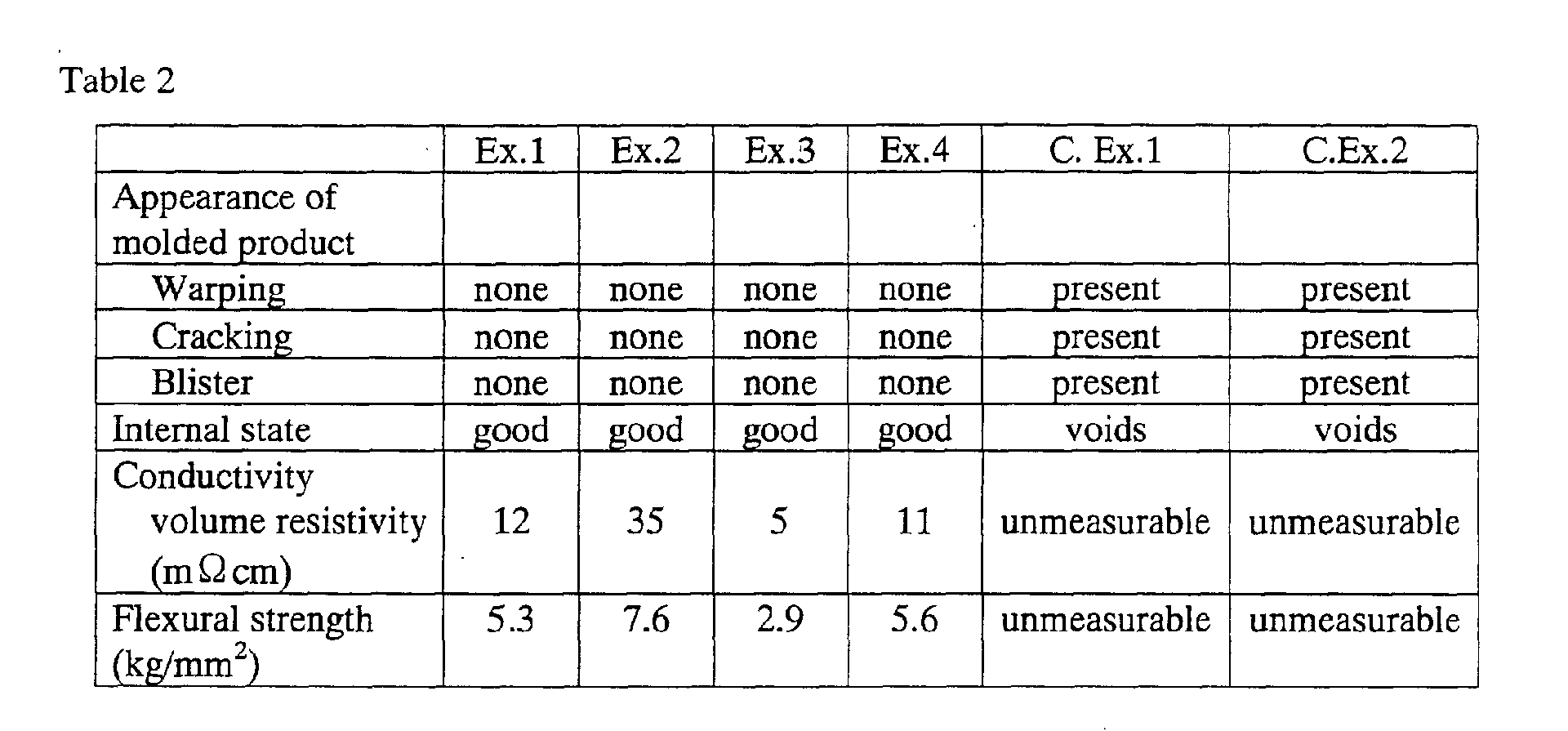
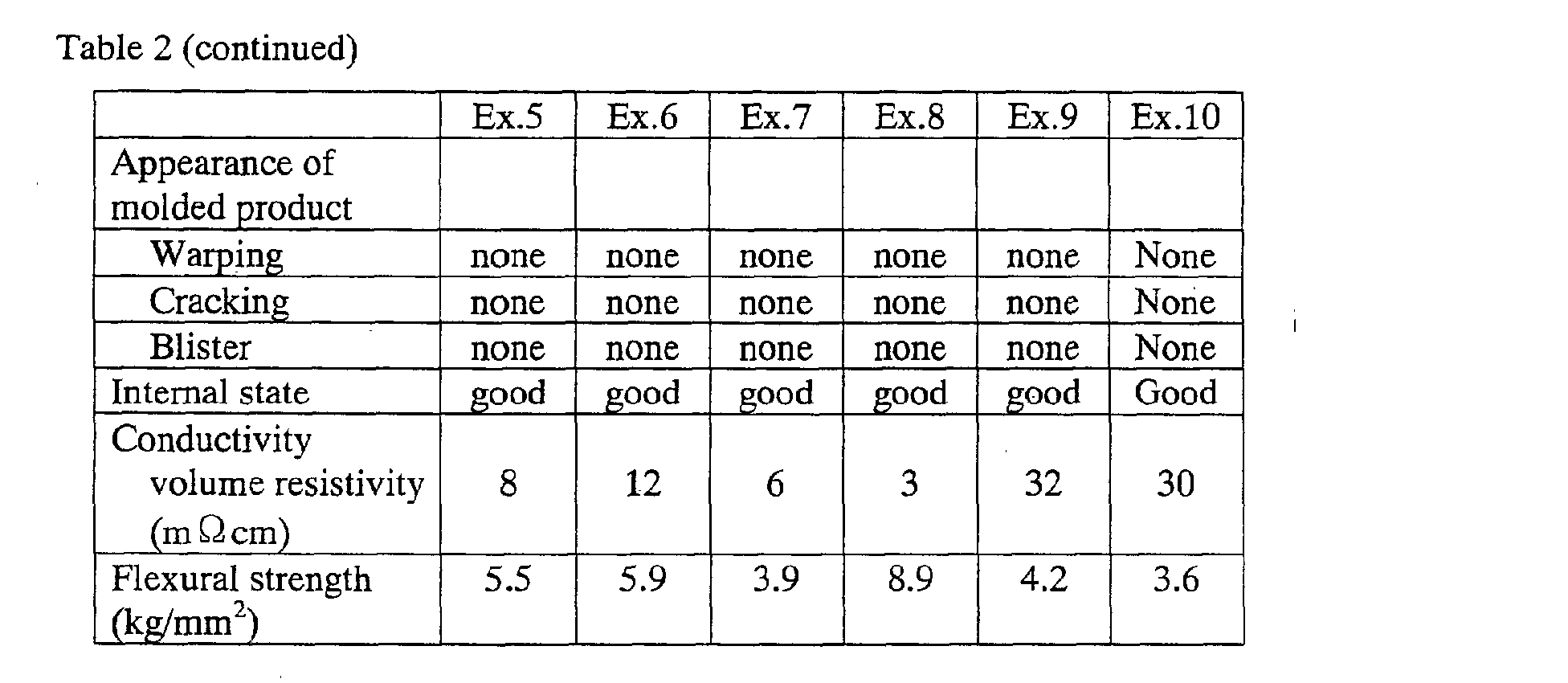
- Bipolar plates for fuel cells obtained in the following examples and comparative examples were directly used as test pieces, and warping, cracking, blister, if any, and the internal states of the test piece were observed visually.
- warping, cracking, and blister a test piece having no occurrence thereof was evaluated as "none", and a test piece having even a slight occurrence thereof was evaluated as "present”.
- the internal state the cross-section of the test piece was observed visually, and one having a dense cross-section was evaluated as "good”, and one having a cross-section with a number of voids was evaluated as "voids".
- test piece having a width of 1 cm, a thickness of 4 mm, and a length of 20 cm was obtained, and the volume resistivity of the test piece was measured in accordance with JIS C2525.
- a test piece on which cracks were generated, and the volume thereof could not be properly measured was evaluated as "unmeasurable".
- the flat plate product obtained in the following examples and comparative examples was directly used as a test piece, and the flexural strength thereof was measured in accordance with JIS K-6911.
- the evaluation criteria for "unmeasurable” is the same as the above for the conductivity.
- Phenol (940 g, 10 mol), xylene (470 g), and 80% paraformaldehyde (281.3 g, 7.5 mol) were added to a four neck flask (3L) including an agitator, a condenser, a thermometer, and a dropping funnel, and the mixture was stirred.
- a catalyst zinc acetate hydrate (4.7 g) was added, and the temperature was increased to the reflux temperature.
- the mixture was distillated and the temperature thereof was increased to 130°C while removing residual water and xylene, which is a solvent, and this temperature was maintained for two hours.
- the resin was washed two times using water, the amount of zinc acetate contained in the resin became 0.003 ppm.
- the resin was heated again to remove the remaining water to obtain a solid novolac type phenol resin.
- the resin had a softening point measured by ball-and-ring method of 85°C, a number average molecular weight of 852 (measured by GPC), and an O/P ratio of 4.3 (measured by C 13 -NMR).
- divinylbenzen 80% purity, containing ethylstyrene, 100 parts
- the resin was dissolved at 50°C to obtain a resin solution.
- a resin solution A To the resin solution (100 parts), 30% paratoluene sulfonic acid dissolved into phenol (1.55 parts) were added and uniformly agitated to obtain a phenol resin solution.
- the resin solution is referred to as a resin solution A.
- Phenol (752 g, 8 mol), o -allylphenol (268 g, 2 mol), xylene (470 g), and 80% paraformaldehyde (243.8 g, 6.5 mol) were added to a four neck flask (3L) including an agitator, a condenser, a thermometer, and a dropping funnel, and the mixture was stirred.
- a catalyst zinc acetate 2 hydrate (4.7 g) was added, and the temperature was elevated to the reflux temperature.
- a part of free phenol was removed at 170°C and under a vacuum condition, and then the product was removed from the reaction vessel to obtain a solid novolac resin.
- the solid novolac resin had a softening point measured by ball-and-ring method of 65°C, and a number average molecular weight of 723 (measured by GPC).
- GPC GPC
- the O/P ratio of the resin was 4.9.
- divinylbenzen 80% purity, containing ethylstyrene, 80 parts
- the resin was dissolved at 50°C to obtain a resin solution.
- xylene sulfonic acid (1 part) was added and uniformly agitated to obtain a resin solution.
- the resin solution is referred to as a resin solution B.
- phenol resin DPP-3H (a phenol dicyclopentadiene resin, a product of Nippon Petrochemicals Co., 100 parts) was dissolved in divinylbenzen (80% purity, containing ethylstyrene, 80 parts) at 50°C to obtain a resin solution.
- divinylbenzen 80% purity, containing ethylstyrene, 80 parts
- xylene sulfonic acid (1 part) was added and uniformly agitated to obtain a resin solution.
- the resin solution is referred to as a resin solution C.
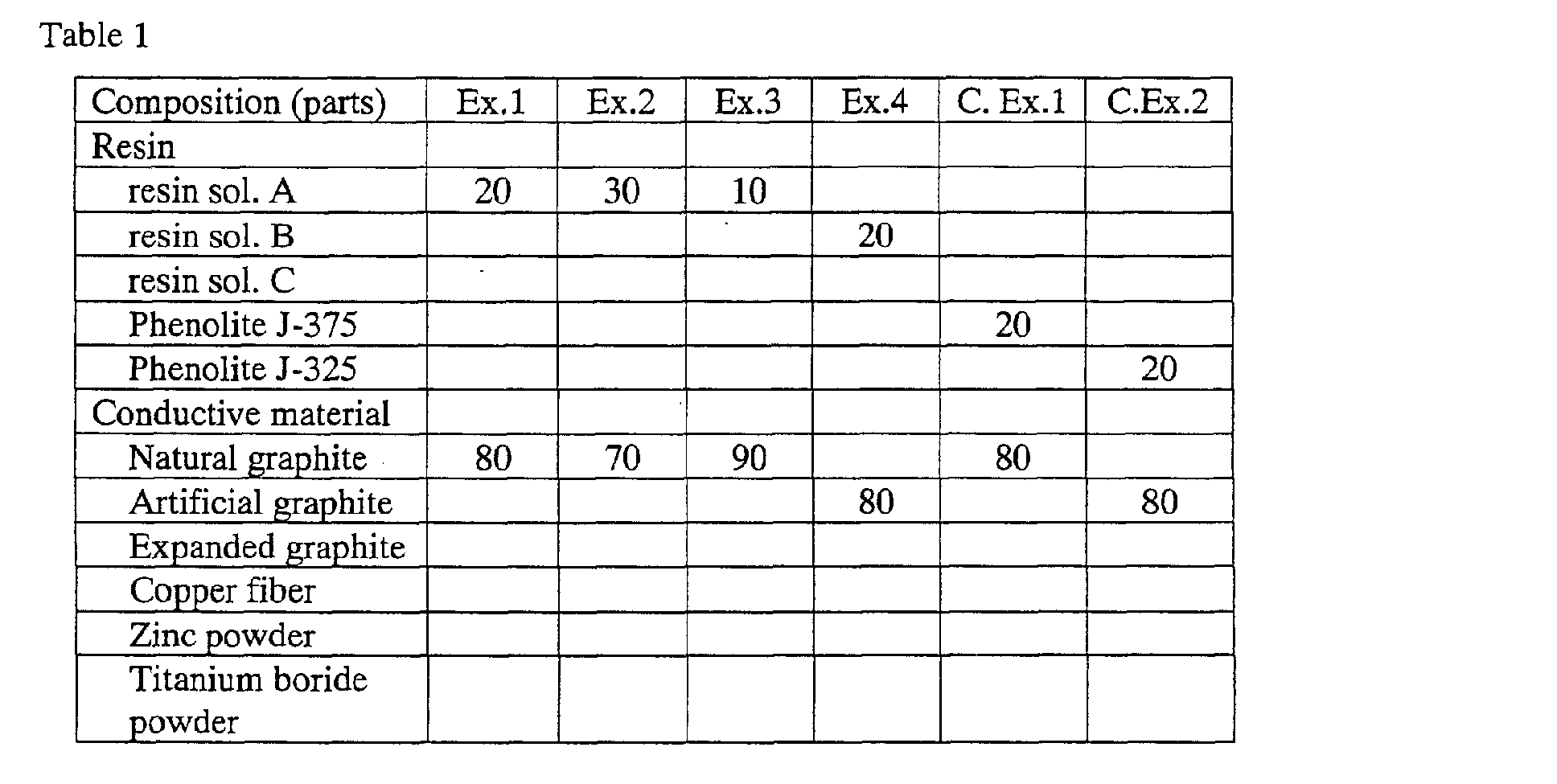
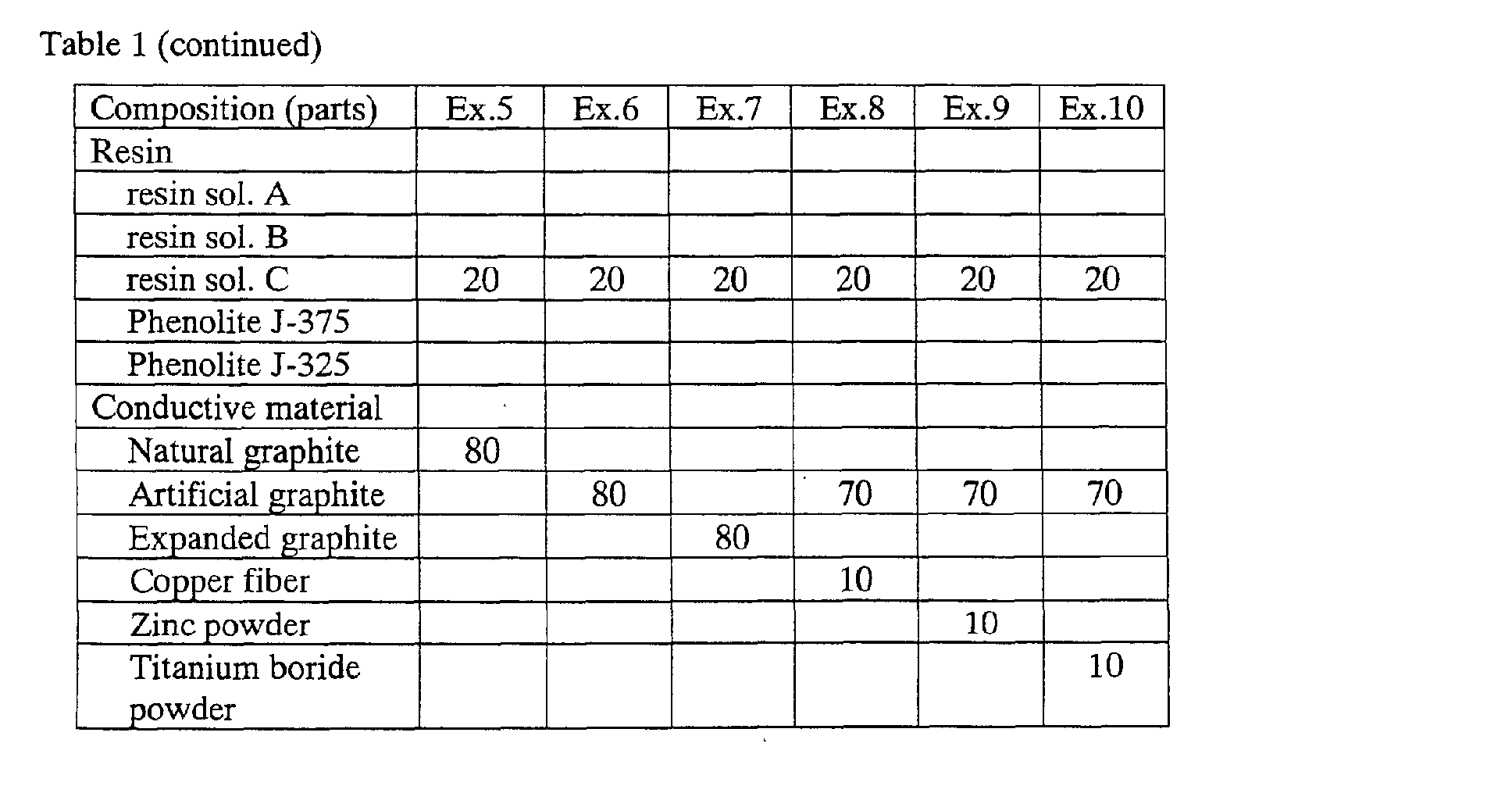
- the resin solutions A-C prepared in the above Synthetic Examples 1-3 and a conductive material were mixed in proportions shown in the following Table 1.
- the mixture was filled in a metallic mold having a shape of the bipolar plate for a fuel cell, and also in a mold of flat plate shape, the temperature of which was increased to 150°C, and was molded using a compression molding machine under the conditions of a pressure of 100 kg/cm 2 (gauge pressure) and a molding time of 30 minutes to produce a bipolar plate for a fuel cell and a product of flat plate shape (a width of 20 cm, a thickness of 4 mm, and a length of 20 cm).
- the appearance of the bipolar plate for a fuel cell, and the conductivity and the flexural strength of the flat plate product were evaluated. The results are tabulated in the following Table 2.
- a bipolar plate for a fuel cell and a product of flat plate shape were prepared using the same conditions as in Example 1 except that phenolite J-375 (a general purpose novolac type phenol resin containing hexamethylene tetramine as a curing agent, a product of Dainippon Ink and Chemicals Incorporated) was used instead of the resin solution A.
- phenolite J-375 a general purpose novolac type phenol resin containing hexamethylene tetramine as a curing agent, a product of Dainippon Ink and Chemicals Incorporated
- a bipolar plate for a fuel cell and a product of flat plate shape were prepared using the same conditions as in Example 1 except that phenolite J-325 (a general purpose resol type phenol resin, a product of Dainippon Ink and Chemicals Incorporated) was used instead of the resin solution A.
- phenolite J-325 a general purpose resol type phenol resin, a product of Dainippon Ink and Chemicals Incorporated
- the appearance of the obtained bipolar plate for a fuel cell, and the conductivity and the flexural strength of the flat plate product were evaluated in the same manner as in Example 1. The results are tabulated in Table 2.
Landscapes
- Chemical & Material Sciences (AREA)
- Life Sciences & Earth Sciences (AREA)
- Engineering & Computer Science (AREA)
- Manufacturing & Machinery (AREA)
- Sustainable Development (AREA)
- Sustainable Energy (AREA)
- Chemical Kinetics & Catalysis (AREA)
- Electrochemistry (AREA)
- General Chemical & Material Sciences (AREA)
- Composite Materials (AREA)
- Fuel Cell (AREA)
Abstract
Description

Claims (17)
- A bipolar plate for a fuel cell, comprising:a conductive material (A);a novolac type phenol resin or a phenol dicyclopentadiene resin (B); anda compound having at least two ethylenically unsaturated double bonds (C), whereinthe conductive material (A) is dispersed in an addition cross-linking reaction cured composition formed by the reaction of the novolac type phenol resin or the phenol dicyclopentadiene resin (B) with the compound having at least two ethylenically unsaturated double bonds (C).
- A bipolar plate for a fuel cell according to claim 1, wherein the novolac type phenol resin has an O/P ratio of 3 or more, the O/P ratio defined as a ratio of the number of methylene groups bonded to the ortho-positions, with respect to a phenolic hydroxyl group, of aromatic rings contained in one molecule of the novolac type phenol resin to the number of methylene groups bonded to the para-positions.
- A bipolar plate for a fuel cell according to claim 1, wherein the novolac type phenol resin includes an ethylenically unsaturated double bond.
- A bipolar plate for a fuel cell according to claim 1, wherein a number average molecular weight of the novolac type phenol resin is within a range of 200-2,000.
- A bipolar plate for a fuel cell according to claim 1, wherein a number average molecular weight of the phenol dicyclopentadiene resin is within a range of 200-2,000.
- A bipolar plate for a fuel cell according to claim 1, wherein the compound having at least two ethylenically unsaturated double bonds (C) is divinylbenzene.
- A bipolar plate for a fuel cell according to claim 1, wherein the ratio of the novolac type phenol resin or a phenol dicyclopentadiene resin (B) to the compound having at least two ethylenically unsaturated double bonds is within a range of 70:30-40:60.
- A bipolar plate for a fuel cell according to claim 1, wherein the bipolar plate is used for a fuel cell whose operating temperature during power generation is less than 200°C.
- A method for manufacturing a bipolar plate for a fuel cell, comprising the steps of:mixing a conductive material (A), a novolac type phenol resin or a phenol dicyclopentadiene resin (B), and a compound having at least two ethylenically unsaturated double bonds (C), andheating and molding a resulting mixture into a shape of a bipolar plate.
- A method for manufacturing a bipolar plate for a fuel cell according to claim 9, wherein the novolac type phenol resin has an O/P ratio of 3 or more, the O/P ratio defined as a ratio of the number of methylene groups bonded to the ortho-positions, with respect to a phenolic hydroxyl group, of aromatic rings contained in one molecule of the novolac type phenol resin to the number of methylene groups bonded to the para-positions.
- A method for manufacturing a bipolar plate for a fuel cell according to claim 9, wherein the compound having at least two ethylenically unsaturated double bonds (C) is divinylbenzene.
- A method for manufacturing a bipolar plate for a fuel cell according to claim 9, wherein the novolac type phenol resin includes an ethylenically unsaturated double bond.
- A method for manufacturing a bipolar plate for a fuel cell, comprising the steps of:mixing a conductive material (A), a novolac type phenol resin or a phenol dicyclopentadiene resin (B), a compound having at least two ethylenically unsaturated double bonds (C), and a curing catalyst (D), andheating and molding a resulting mixture into a shape of a bipolar plate.
- A method for manufacturing a bipolar plate for a fuel cell according to claim 13, wherein the novolac type phenol resin has an O/P ratio of 3 or more, the O/P ratio defined as a ratio of the number of methylene groups bonded to the ortho-positions, with respect to a phenolic hydroxyl group, of aromatic rings contained in one molecule of the novolac type phenol resin to the number of methylene groups bonded to the para-positions.
- A method for manufacturing a bipolar plate for a fuel cell according to claim 13, wherein the compound having at least two ethylenically unsaturated double bonds is divinylbenzene.
- A method for manufacturing a bipolar plate for a fuel cell according to claim 13, wherein the novolac type phenol resin includes an ethylenically unsaturated double bond.
- A fuel cell, comprising:an electrolyte membrane;a pair of electrodes, anda bipolar plate for a fuel cell as set forth in any one of claims 1-8, whereinthe pair of electrodes are placed on both sides of the electrolyte membrane, and the electrolyte membrane is put between a pair of the bipolar plates.
Applications Claiming Priority (2)
| Application Number | Priority Date | Filing Date | Title |
|---|---|---|---|
| JP2001293612 | 2001-09-26 | ||
| JP2001293612 | 2001-09-26 |
Publications (2)
| Publication Number | Publication Date |
|---|---|
| EP1298748A2 true EP1298748A2 (en) | 2003-04-02 |
| EP1298748A3 EP1298748A3 (en) | 2006-06-21 |
Family
ID=19115363
Family Applications (1)
| Application Number | Title | Priority Date | Filing Date |
|---|---|---|---|
| EP02021386A Withdrawn EP1298748A3 (en) | 2001-09-26 | 2002-09-24 | Bipolar plate for fuel cell, method for manufacturing the bipolar plate, and fuel cell using the bipolar plate |
Country Status (4)
| Country | Link |
|---|---|
| US (1) | US20030068542A1 (en) |
| EP (1) | EP1298748A3 (en) |
| CN (1) | CN1409426A (en) |
| CA (1) | CA2404841A1 (en) |
Cited By (1)
| Publication number | Priority date | Publication date | Assignee | Title |
|---|---|---|---|---|
| CN104091957A (en) * | 2014-07-11 | 2014-10-08 | 江苏超洁绿色能源科技有限公司 | Preparation method of superconducting composite graphite bipolar plate for proton-exchange-membrane fuel battery |
Families Citing this family (10)
| Publication number | Priority date | Publication date | Assignee | Title |
|---|---|---|---|---|
| KR20040077752A (en) * | 2002-01-22 | 2004-09-06 | 이 아이 듀폰 디 네모아 앤드 캄파니 | Compression mould for making a membrane electrode assembly |
| GB0315686D0 (en) * | 2003-07-04 | 2003-08-13 | Honeywell Normalair Garrett | Ionic conduction device |
| KR100542132B1 (en) * | 2003-09-26 | 2006-01-10 | 삼성에스디아이 주식회사 | Bipolar Plates for Fuel Cells |
| EP1521320B8 (en) * | 2003-09-30 | 2016-10-12 | Nichias Corporation | Separator for fuel cell |
| WO2005056880A1 (en) * | 2003-12-12 | 2005-06-23 | David Systems & Technology, S.L. | Bipolar plate and production method thereof |
| US20060172172A1 (en) * | 2005-02-01 | 2006-08-03 | Tao Xie | Hydrophilic bipolar plates |
| US8383291B2 (en) * | 2007-05-23 | 2013-02-26 | GM Global Technology Operations LLC | Three-dimensional hydrophilic porous structures for fuel cell plates |
| DE112020006845T5 (en) * | 2020-05-14 | 2022-12-22 | Robert Bosch Gesellschaft mit beschränkter Haftung | Proton exchange membrane fuel cell, method of manufacturing the same and proton exchange membrane fuel battery |
| CN112663189A (en) * | 2020-12-08 | 2021-04-16 | 中国科学院山西煤炭化学研究所 | Mixed yarn and manufacturing method thereof, carbon paper and manufacturing method thereof |
| DE102024129148A1 (en) * | 2024-10-09 | 2026-04-09 | TRUMPF Laser- und Systemtechnik SE | Method for laser welding of workpieces susceptible to hot cracking |
Family Cites Families (10)
| Publication number | Priority date | Publication date | Assignee | Title |
|---|---|---|---|---|
| US4200706A (en) * | 1978-05-30 | 1980-04-29 | Conoco, Inc. | Curing of phenol-formaldehyde resins |
| US4755575A (en) * | 1981-07-01 | 1988-07-05 | Union Carbide Corporation | Process for preparing fiber reinforced molded articles |
| US4359438A (en) * | 1981-09-21 | 1982-11-16 | Ashland Oil, Inc. | Process for molding corrosion resistant fuel cell collecting plates |
| JPH0756807B2 (en) * | 1986-02-03 | 1995-06-14 | 株式会社東芝 | Fuel cell |
| US5776633A (en) * | 1995-06-22 | 1998-07-07 | Johnson Controls Technology Company | Carbon/carbon composite materials and use thereof in electrochemical cells |
| AU757196B2 (en) * | 1997-10-14 | 2003-02-06 | Cytec Technology Corp. | Conductive thermoset molding composition and method for producing same |
| JP4000651B2 (en) * | 1998-01-19 | 2007-10-31 | トヨタ自動車株式会社 | Manufacturing method of fuel cell separator |
| DE60016295T2 (en) * | 1999-02-16 | 2005-05-04 | Nichias Corp. | resin composition |
| CA2323835A1 (en) * | 1999-10-20 | 2001-04-20 | Nisshinbo Industries, Inc. | Fuel cell separator and fuel cell of solid polymer type |
| US6596137B2 (en) * | 2000-02-25 | 2003-07-22 | Tokoyama Corporation | Bipolar membrane |
-
2002
- 2002-09-24 US US10/252,591 patent/US20030068542A1/en not_active Abandoned
- 2002-09-24 CA CA002404841A patent/CA2404841A1/en not_active Abandoned
- 2002-09-24 EP EP02021386A patent/EP1298748A3/en not_active Withdrawn
- 2002-09-24 CN CN02132327A patent/CN1409426A/en active Pending
Cited By (1)
| Publication number | Priority date | Publication date | Assignee | Title |
|---|---|---|---|---|
| CN104091957A (en) * | 2014-07-11 | 2014-10-08 | 江苏超洁绿色能源科技有限公司 | Preparation method of superconducting composite graphite bipolar plate for proton-exchange-membrane fuel battery |
Also Published As
| Publication number | Publication date |
|---|---|
| CA2404841A1 (en) | 2003-03-26 |
| EP1298748A3 (en) | 2006-06-21 |
| CN1409426A (en) | 2003-04-09 |
| US20030068542A1 (en) | 2003-04-10 |
Similar Documents
| Publication | Publication Date | Title |
|---|---|---|
| EP1298748A2 (en) | Bipolar plate for fuel cell, method for manufacturing the bipolar plate, and fuel cell using the bipolar plate | |
| CA2363996C (en) | Separator for fuel cell and manufacture method for the same | |
| US6746792B2 (en) | Fuel cell separator composition, fuel cell separator and method of manufacture, and solid polymer fuel cell | |
| US20030190516A1 (en) | Fuel cell separator and method of manufacture | |
| CN113270606A (en) | High-strength graphite bipolar plate and preparation method thereof | |
| CN112430297B (en) | Preparation process of carbon paper for phenolic resin modified toughened and reinforced gas diffusion layer | |
| US20040005493A1 (en) | Fuel cell separator and method of manufacture | |
| JP2004103494A (en) | Fuel cell separator, method for producing the same, and fuel cell using the fuel cell separator | |
| WO1999049530A1 (en) | Separator for fuel cell and method for producing the same | |
| JPH11354138A (en) | Ribbed fuel-cell separator, its manufacture, and fuel cell | |
| CN115233489A (en) | Carbon fiber paper and preparation method and application thereof | |
| JP2002083609A (en) | Composition for fuel cell separator and method for producing the same | |
| JP3608669B2 (en) | Method for producing electrode substrate | |
| JP5502552B2 (en) | Composition for fuel cell separator, fuel cell separator, and method for producing fuel cell | |
| JP3470964B2 (en) | Fuel cell separator and method of manufacturing the same | |
| KR20100020050A (en) | Mixture for manufacturing self-healing fuel cell bipolar plate and fuel cell bipolar plate | |
| JP2005339953A (en) | Fuel cell prepreg, fuel cell separator comprising the fuel cell prepreg, and method for producing the same | |
| JP2003173796A (en) | Fuel cell separator, method for producing the same, and fuel cell | |
| JP5520104B2 (en) | Manufacturing method of fuel cell separator | |
| JP4678170B2 (en) | Fuel cell separator | |
| KR100834607B1 (en) | Composition for forming separator plate for polymer electrolyte fuel cell and separator plate for polymer electrolyte fuel cell formed therefrom | |
| JP5991470B2 (en) | Fuel cell separator | |
| JP5845458B2 (en) | Manufacturing method of fuel cell separator | |
| JP3448771B2 (en) | Fuel cell separator and method of manufacturing the same | |
| JP2001313044A (en) | Method of manufacturing fuel cell separator and fuel cell separator |
Legal Events
| Date | Code | Title | Description |
|---|---|---|---|
| PUAI | Public reference made under article 153(3) epc to a published international application that has entered the european phase |
Free format text: ORIGINAL CODE: 0009012 |
|
| AK | Designated contracting states |
Kind code of ref document: A2 Designated state(s): AT BE BG CH CY CZ DE DK EE ES FI FR GB GR IE IT LI LU MC NL PT SE SK TR Designated state(s): AT BE BG CH CY CZ DE DK EE ES FI FR GB GR IE IT LI LU MC NL PT SE SK TR |
|
| AX | Request for extension of the european patent |
Extension state: AL LT LV MK RO SI |
|
| PUAL | Search report despatched |
Free format text: ORIGINAL CODE: 0009013 |
|
| AK | Designated contracting states |
Kind code of ref document: A3 Designated state(s): AT BE BG CH CY CZ DE DK EE ES FI FR GB GR IE IT LI LU MC NL PT SE SK TR |
|
| AX | Request for extension of the european patent |
Extension state: AL LT LV MK RO SI |
|
| 17P | Request for examination filed |
Effective date: 20060829 |
|
| AKX | Designation fees paid |
Designated state(s): DE FR GB IT |
|
| STAA | Information on the status of an ep patent application or granted ep patent |
Free format text: STATUS: THE APPLICATION HAS BEEN WITHDRAWN |
|
| 18W | Application withdrawn |
Effective date: 20070309 |