EP1298742A1 - Electrode material for non-aqueous solvent secondary cell, electrode and secondary cell - Google Patents
Electrode material for non-aqueous solvent secondary cell, electrode and secondary cell Download PDFInfo
- Publication number
- EP1298742A1 EP1298742A1 EP02700620A EP02700620A EP1298742A1 EP 1298742 A1 EP1298742 A1 EP 1298742A1 EP 02700620 A EP02700620 A EP 02700620A EP 02700620 A EP02700620 A EP 02700620A EP 1298742 A1 EP1298742 A1 EP 1298742A1
- Authority
- EP
- European Patent Office
- Prior art keywords
- electrode
- electrode material
- secondary cell
- aqueous solvent
- capacity
- Prior art date
- Legal status (The legal status is an assumption and is not a legal conclusion. Google has not performed a legal analysis and makes no representation as to the accuracy of the status listed.)
- Granted
Links
Classifications
-
- H—ELECTRICITY
- H01—ELECTRIC ELEMENTS
- H01M—PROCESSES OR MEANS, e.g. BATTERIES, FOR THE DIRECT CONVERSION OF CHEMICAL ENERGY INTO ELECTRICAL ENERGY
- H01M4/00—Electrodes
- H01M4/02—Electrodes composed of, or comprising, active material
- H01M4/36—Selection of substances as active materials, active masses, active liquids
- H01M4/58—Selection of substances as active materials, active masses, active liquids of inorganic compounds other than oxides or hydroxides, e.g. sulfides, selenides, tellurides, halogenides or LiCoFy; of polyanionic structures, e.g. phosphates, silicates or borates
- H01M4/583—Carbonaceous material, e.g. graphite-intercalation compounds or CFx
-
- H—ELECTRICITY
- H01—ELECTRIC ELEMENTS
- H01M—PROCESSES OR MEANS, e.g. BATTERIES, FOR THE DIRECT CONVERSION OF CHEMICAL ENERGY INTO ELECTRICAL ENERGY
- H01M10/00—Secondary cells; Manufacture thereof
- H01M10/05—Accumulators with non-aqueous electrolyte
-
- H—ELECTRICITY
- H01—ELECTRIC ELEMENTS
- H01M—PROCESSES OR MEANS, e.g. BATTERIES, FOR THE DIRECT CONVERSION OF CHEMICAL ENERGY INTO ELECTRICAL ENERGY
- H01M4/00—Electrodes
- H01M4/02—Electrodes composed of, or comprising, active material
- H01M4/13—Electrodes for accumulators with non-aqueous electrolyte, e.g. for lithium-accumulators; Processes of manufacture thereof
-
- H—ELECTRICITY
- H01—ELECTRIC ELEMENTS
- H01M—PROCESSES OR MEANS, e.g. BATTERIES, FOR THE DIRECT CONVERSION OF CHEMICAL ENERGY INTO ELECTRICAL ENERGY
- H01M4/00—Electrodes
- H01M4/02—Electrodes composed of, or comprising, active material
- H01M4/36—Selection of substances as active materials, active masses, active liquids
- H01M4/362—Composites
- H01M4/364—Composites as mixtures
-
- H—ELECTRICITY
- H01—ELECTRIC ELEMENTS
- H01M—PROCESSES OR MEANS, e.g. BATTERIES, FOR THE DIRECT CONVERSION OF CHEMICAL ENERGY INTO ELECTRICAL ENERGY
- H01M4/00—Electrodes
- H01M4/02—Electrodes composed of, or comprising, active material
- H01M4/36—Selection of substances as active materials, active masses, active liquids
- H01M4/38—Selection of substances as active materials, active masses, active liquids of elements or alloys
-
- H—ELECTRICITY
- H01—ELECTRIC ELEMENTS
- H01M—PROCESSES OR MEANS, e.g. BATTERIES, FOR THE DIRECT CONVERSION OF CHEMICAL ENERGY INTO ELECTRICAL ENERGY
- H01M4/00—Electrodes
- H01M4/02—Electrodes composed of, or comprising, active material
- H01M4/36—Selection of substances as active materials, active masses, active liquids
- H01M4/38—Selection of substances as active materials, active masses, active liquids of elements or alloys
- H01M4/46—Alloys based on magnesium or aluminium
-
- H—ELECTRICITY
- H01—ELECTRIC ELEMENTS
- H01M—PROCESSES OR MEANS, e.g. BATTERIES, FOR THE DIRECT CONVERSION OF CHEMICAL ENERGY INTO ELECTRICAL ENERGY
- H01M10/00—Secondary cells; Manufacture thereof
- H01M10/05—Accumulators with non-aqueous electrolyte
- H01M10/052—Li-accumulators
-
- H—ELECTRICITY
- H01—ELECTRIC ELEMENTS
- H01M—PROCESSES OR MEANS, e.g. BATTERIES, FOR THE DIRECT CONVERSION OF CHEMICAL ENERGY INTO ELECTRICAL ENERGY
- H01M4/00—Electrodes
- H01M4/02—Electrodes composed of, or comprising, active material
- H01M2004/026—Electrodes composed of, or comprising, active material characterised by the polarity
- H01M2004/027—Negative electrodes
-
- H—ELECTRICITY
- H01—ELECTRIC ELEMENTS
- H01M—PROCESSES OR MEANS, e.g. BATTERIES, FOR THE DIRECT CONVERSION OF CHEMICAL ENERGY INTO ELECTRICAL ENERGY
- H01M4/00—Electrodes
- H01M4/02—Electrodes composed of, or comprising, active material
-
- Y—GENERAL TAGGING OF NEW TECHNOLOGICAL DEVELOPMENTS; GENERAL TAGGING OF CROSS-SECTIONAL TECHNOLOGIES SPANNING OVER SEVERAL SECTIONS OF THE IPC; TECHNICAL SUBJECTS COVERED BY FORMER USPC CROSS-REFERENCE ART COLLECTIONS [XRACs] AND DIGESTS
- Y02—TECHNOLOGIES OR APPLICATIONS FOR MITIGATION OR ADAPTATION AGAINST CLIMATE CHANGE
- Y02E—REDUCTION OF GREENHOUSE GAS [GHG] EMISSIONS, RELATED TO ENERGY GENERATION, TRANSMISSION OR DISTRIBUTION
- Y02E60/00—Enabling technologies; Technologies with a potential or indirect contribution to GHG emissions mitigation
- Y02E60/10—Energy storage using batteries
Definitions
- the present invention relates to a non-aqueous solvent secondary cell electrode; particularly an electrode material (composition) forming a negative electrode having a large doping capacity per volume and suitable for providing a non-aqueous solvent secondary cell (or battery) having a high energy density.
- JP-A Japanese Laid-Open Patent Appln.
- the cell utilizes a phenomenon that a carbon intercalation compound of lithium can be easily formed electrochemically, and when the cell is charged, lithium in the positive electrode comprising, e.g., a chalcogenide compound, such as LiCoO 2 , is electrochemically inserted between carbon layers in the negative electrode (doping).
- the carbon thus-doped with lithium functions as a lithium electrode to cause a discharge, whereby the lithium is liberated (de-doped) from the carbon layers to return to the positive electrode.
- an amount of electricity utilizable per unit weight is determined by a lithium-dedoping capacity, so that such an electrode-forming carbonaceous material should desirably have a large lithium-dedoping capacity.
- a non-aqueous solvent secondary cell using such an intermetallic compound as a negative electrode material suffers from a problem of wasting lithium in the positive electrode because of a large irreversible capacity (non-dedoping capacity) expressed as a difference between the doping capacity and the dedoping capacity of lithium in the intermetallic compound, and also a problem of an inferior secondary cell cycle characteristic (repetitive charge-discharge performance) due to crystal structure destruction and fine powder formation of the inter-metallic compound caused by repetitive expansion and contraction accompanying the repetition of doping-dedoping cycles in the inter-metallic compound.
- the present invention aims at providing a complex electrode material functioning as an active substance, which has a large charge-discharge capacity and a small irreversible capacity determined as a difference between the doping capacity and the dedoping capacity and can provide a non-aqueous solvent secondary cell having excellent cycle characteristics, and also an electrode and a secondary cell obtained therefrom.
- the above-mentioned problems of increase in irreversible capacity and deterioration of cycle characteristic encountered with the use of a high volume-basis capacity Li-doping metal material inclusive of the above-mentioned inter-metallic compound can be remarkably improved by the co-presence of a capacitive carbon material which per se has abilities of doping and dedoping lithium (Li).
- the capacitive carbon material is present between metal material particles in a state of good electrical contact therewith and functions as a sort of lubricant for absorbing stresses of expansion and contraction of metal material particles occurring at the time of doping and dedoping of lithium during the charging and discharging steps.
- the electrode material for a non-aqueous solvent secondary cell is characterized by comprising a powdery mixture of a metal material and a capacitive carbon material each capable of doping and dedoping lithium, and an optional fine electroconductive additive, and containing 5 - 60 wt.% of the metal material and 40 - 95 wt.% of the capacitive carbon material.
- the present invention further provides an electrode formed of the above-mentioned electrode material together with a binder, and also a non-aqueous solvent secondary cell including the electrode as at least one of the positive electrode and the negative electrode, preferably as the negative electrode.
- a first component of the electrode material of the present invention functioning as an electrode active substance of a non-aqueous solvent secondary cell is a (powdery) metal material capable of doping and dedoping lithium (Li), which may comprise a simple substance of elements (A-group elements), such as Ag, B, Al, Ga, In, Tl, Si, Ge, Sn, Pb, Sb, Bi and Te, capable of alloying with Li, or an inter-metallic compound comprising at least one A-group element, and a metal selected from elements (B-group elements), such as Cu, Mg, Mo, Fe, Ni and Co.
- A-group elements such as Ag, B, Al, Ga, In, Tl, Si, Ge, Sn, Pb, Sb, Bi and Te
- an inter-metallic compound of Sn with a metal selected from the group consisting of Cu, Mg, Mo, Fe and Ni, more preferably from the group consisting of Cu, Mg, and Fe, in order to provide an electrode material exhibiting good capacity per volume and cycle characteristic, and it is particularly preferred to use an inter-metallic compound comprising at least Cu and Sn.
- a Cu-Sn inter-metallic compound may be represented by a formula of Cu x Sn y M z , wherein M represents an optionally contained one or more elements capable of forming an inter-metallic compound with Cu and Sn, and x, y and z are positive numbers representing atomic ratios among these elements.
- Examples of M may include the above-mentioned elements other than Cu and Sn, and further Li, Na, K, Ca, Ti, Zr, V, Nb, Ta, W, Mn, Rh, Ir and Zn.
- the atomic ratio x/y may preferably be in the range of 0.2 - 5, more preferably 0.4 - 4, particularly preferably 0.5 - 3.5. Too large x/y is not preferred because of a decrease in capacity. Too small x/y may provide large doping capacity and dedoping capacity at the initial stage, but tends to result in a lowering in capacity along with a repetition of charge-discharge, i.e., an inferior cycle characteristic.
- the above-mentioned preferred ranges for the x/y atomic ratio between Cu and Sn also hold true with the atomic ratio between the B-group element and the A-group element, other than Cu and Sn.
- the atomic ratio z/y defining the amount of the third element M should preferably be at most 1.0.
- the above-mentioned metal material may preferably be used in a powdery state providing a volume-average particle size generally in a range of 0.05 - 100 ⁇ m, particularly 0.1 - 30 ⁇ m. If the volume-average particle size is too small, the metal material is liable to be affected by a chemical reaction, such as oxidation, due to an increase in surface area of the particles. Further, the surfaces are liable to provide active sites for hydrogen-withdrawal reaction, etc., so that the electrolytic solution is liable to be decomposed noticeably at the time of first charging. This is not desirable. Too large a volume-average particle size results in an increased electrode thickness leading to an increased internal resistance of the electrode and an increased Li-diffusion distance into the particles, which adversely affect the rate characteristic and the charge-discharge efficiency. This is also undesirable.
- the metal material is used in an amount occupying 5 - 60 wt.%, preferably 5 - 50 wt. %, further preferably 5 - 40 wt.%. If the amount is too small, the effect of increasing the doping capacity and the dedoping capacity owing to the use of the metal material is scarce. On the other hand, if the amount is too large, it becomes difficult to attain the effects of lowering the irreversible capacity and improving the cycle characteristic owing to the incorporation of the capacitive carbon material.
- a second component of the electrode material according to the present invention is a capacitive carbon material which per se has a capacity of doping and dedoping Li. It is generally preferred to use a carbonaceous material which exhibits a dedoping capacity of at least 300 mAh/g by itself as measured according to a method described hereinafter.
- Capacitive carbon materials preferably used in the present invention may roughly include: (i) flaky graphite (natural graphite) characterized by an average layer plane spacing as measured by X-ray diffraction (d 002 ) of at most 0.345 nm, preferably at most 0.340 nm, further preferably at most 0.338 nm, and a specific surface area as measured by the BET method according to nitrogen adsorption (S BET ) of at least 1 m 2 /g; (ii) granular graphite (artificial graphite) characterized by a d 002 value of below 0.345 nm, preferably at most 0.340 nm, further preferably at most 0.338 nm, and an S BET value of at most 1 m 2 /g; and (iii) non-graphitic porous carbon material characterized by a d 002 value of at least 0.345 nm, preferably at least 0.365 nm, and an S BET value
- the flaky graphite (i) having a large outer surface area (as represented by an S BET value of at least 1 m 2 /g, preferably at least 2 m 2 /g, further preferably 3 m 2 /g or larger) and also an excellent ductility, is ideal and provides a good cycle characteristic.
- the granular graphite (artificial graphite) (ii) has a large lithium-doping and -dedoping capacity by itself, but is liable to result in a lowering in electroconductivity with the metal material particles on repetition of charge-discharge when used alone, so that it is necessary to retain the electroconductivity between both particles at a good level by adding a fine electroconductive additive described later.
- granular graphite used together with a fine electroconductive additive is isotropic and suitable for forming an electrode layer together with the metal material particles and a binder described later by coating, and is therefor a capacitive carbon material preferably used in the present invention also in view of its large lithium-doping and -dedoping capacity.
- the non-graphitic carbonaceous materials (iii) have a substantially large lithium-doping and -dedoping capacity, but among these, e.g., a carbonaceous material originated from plants, such as coconut shell, has somewhat inferior conductivity, so that it is preferred to co-use a fine electroconductive additive together with such a carbonaceous material of plant origin.
- a pitch-based carbonaceous material exhibits a good electroconductivity by itself, so that it can be used without using a fine electroconductive additive in combination.
- An example of pitch-based non-graphitic porous carbonaceous material may be obtained through a process including steps of: mixing petroleum or coal pitch with an additive comprising an aromatic compound having two or three aromatic rings and a boiling point of at least 200 °C or a mixture thereof under heat-melting to form a shaped pitch product; extracting the additive from the shaped pitch product with a solvent showing a low dissolving power to the pitch and a high dissolving power to the additive; infusibilizing the resultant porous shaped pitch product by oxidization; and carbonizing the porous shaped pitch product at a temperature of 900 - 1500 °C under a reduced pressure of at most 10 KPa.
- the capacitive carbon material is used in an amount of occupying at least 40 wt.%, more specifically in an amount selected from the range of 40 - 95 wt.%, so as to provide a total amount of 100 wt.% together with the above-mentioned metal material and the optionally added fine electroconductive additive described hereinafter.
- a fine electroconductive additive in combination therewith to ensure a good electrical conductivity between the carbon material and the metal material.
- the fine electroconductive additive used for this purpose may comprise electroconductive carbon or metal in the form of powder or fiber.
- the fine electroconductive additive may preferably have an average particle size (or diameter) of at most 1 ⁇ m.
- Particularly preferred examples of the fine electroconductive additive may include carbon black, such as acetylene black or furnace black.
- Such a fine electroconductive additive inclusive of carbon black has only a small capacity of doping and dedoping lithium (e.g., 25 mAh/g or less) by itself, but contributes to the maintenance of a good cycle characteristic by ensuring an electrical continuity between the metal material and the carbon material.
- the fine electroconductive additive may generally be used in an amount occupying 1 to 10 wt.% of the electrode material of the present invention. A larger amount is not preferred because it leads to a lower capacity of the resultant electrode.
- the electrode material of the present invention may be obtained as a powdery mixture of the above-mentioned metal material, carbon material and optional fine electroconductive additive.
- the secondary cell electrode of the present invention may be obtained, e.g., through a process wherein a binder is further added to the above-mentioned electrode material, or the components thereof inclusive of the metal material, carbon material and optional fine electroconductive additive, and an appropriate amount of appropriate solvent is added and mixed therewith to form a pasty electrode composition, which is then applied onto an electroconductive substrate comprising, e.g., a circular of rectangular metal sheet, dried thereon and press-molded to form a layer of, e.g., 10 - 200 ⁇ m in thickness.
- a binder is further added to the above-mentioned electrode material, or the components thereof inclusive of the metal material, carbon material and optional fine electroconductive additive, and an appropriate amount of appropriate solvent is added and mixed therewith to form a pasty electrode composition, which is then applied onto an electroconductive substrate comprising, e.g., a circular of rectangular metal sheet, dried thereon and press-molded to form a layer of, e.g., 10 - 200 ⁇ m in
- the binder may comprise, e.g., polyvinylidene fluoride, polytetrafluoroethylene or SBR, and is not particularly restricted as far as it is non-reactive with the electrolytic solution.
- the binder may preferably be used in an amount of 0.5 to 10 wt.parts per 100 wt.parts of the electrode material of the present invention. If the addition amount of the binder is excessive, the resultant electrode is caused to have a large electrical resistivity leading to a large internal resistance of the resultant cell and an undesirably lower cell performance. On the other hand, if the addition amount of the binder is too small, the bonding of the individual electrode material particles with each other and with the electroconductive substrate is liable to be insufficient.
- the electrode material of the present invention can also be used as a positive electrode material for a non-aqueous solvent-type secondary cell by utilizing its good doping characteristic but may preferably be used as a negative electrode material of a non-aqueous solvent-type secondary cell, particularly for constituting a negative electrode to be doped with lithium as an active substance of a lithium secondary cell.
- the other materials for constituting the cell such as the positive electrode material, the separator and the electrolytic solution, are not particularly restricted, but various materials used or proposed hitherto for such a non-aqueous solvent secondary cell may be used.
- the positive electrode material may comprise a complex metal chalcogenide, particularly a complex metal oxide, such as LiCoO 2 , LiNiO 2 , LiMnO 2 or LiMn 2 O 4 .
- a complex metal oxide such as LiCoO 2 , LiNiO 2 , LiMnO 2 or LiMn 2 O 4 .
- Such a positive electrode material may be formed alone or in combination with an appropriate binder into a layer on an electroconductive substrate.
- the non-aqueous solvent-type electrolytic solution used in combination with the positive electrode and the negative electrode described above may generally be formed by dissolving an electrolyte in a non-aqueous solvent.
- the non-aqueous solvent may comprise one or two or more species of organic solvents, such as propylene carbonate, ethylene carbonate, dimethyl carbonate, diethyl carbonate, dimethoxyethane, diethoxyethane, gamma-butyrolactone, tetrahydrofuran, 2-methyl-tetrahydrofuran, sulfolane, and 1,3-dioxolane.
- Examples of the electrolyte may include LiClO 4 , LiPF 6 , LiBF 4 , LiCF 3 SO 3 , LiAsF 6 , LiCl, LiBr, LiB(C 6 H 5 ) 4 , and LiN(SO 2 CF 3 ) 2 .
- a secondary cell may generally be formed by disposing the above-formed positive electrode and negative electrode opposite to each other, optionally with a liquid-permeable separator composed of, e.g., unwoven cloth or other porous materials, disposed therebetween, and dipping the positive and negative electrodes together with an intermediate permeable separator in an electrolytic solution as described above.
- a liquid-permeable separator composed of, e.g., unwoven cloth or other porous materials
- the values of d 002 and S BET (specific surface area) of the carbon material described herein are based values measured according to the following measurement methods.
- graphite monochromator As for the correction of the diffraction pattern, no correction was effected with respect to the Lorentz polarization factor, absorption factor, atomic scattering factor, etc., but only the correction of double lines of K ⁇ 1 and K ⁇ 2 was effected according to the Rachinger's method.
- the peak position of the (002) diffraction line is determined by the center of gravity method (i.e., a method wherein the position of a gravity center of diffraction lines is obtained to determine a peak position as a 2 ⁇ value corresponding to the gravity center) and calibrated by the diffraction peak of (111) plane of high-purity silicon powder as the standard substance.
- a sample carbon material pulverized into an average diameter of 5 - 50 ⁇ m was packed in a sample tube, and the sample tube was cooled to -196 °C while flowing helium gas containing nitrogen at a concentration of 30 mol. %, thereby causing the carbonaceous material to adsorb nitrogen. Then, the sample tube was restored to room temperature to measure the amount of nitrogen desorbed from the sample by a thermal conductivity-type detector, thereby to obtain the adsorbed nitrogen amount V (cm 3 /g-sample).
- Metal materials were prepared in the same manner as in Example 1 except for changing the Cu/Sn atomic ratios as shown in Table 1, and electrode materials and disk-shaped filmy electrodes of the present invention were prepared therefrom otherwise in the same manner as in Example 1.
- a metal material (intermetallic compound) was obtained in the same manner as in Example 1 except for using Mg powder (made by Wako Jun'yaku Kogyo) and Sn powder so as to provide an Mg/Sn atomic ratio of 2/1, and the metal material was used otherwise in the same manner as in Example 1 to obtain an electrode material of the present invention and a disk-shaped filmy electrode.
- a metal material (intermetallic compound) was obtained in the same manner as in Example 1 except for using Fe powder (made by Wako Jun'yaku Kogyo) and Sn powder so as to provide an Fe/Sn atomic ratio of 2/1, and the metal material was used otherwise in the same manner as in Example 1 to obtain an electrode material of the present invention and a disk-shaped filmy electrode.
- Example 1 An electrode material composed of only the flaky graphite powder used in Example 1 and containing no metal material was used to prepare a disk-shaped filmy electrode otherwise in the same manner as in Example 1.
- a metal material of the Al powder used in Example 8 and the flaky graphite powder used in Example 1 were blended in a weight ratio of 70:30 to obtain an electrode material, and the electrode material was used otherwise in the same manner as in Example 1 to prepare a disk-shaped filmy electrode.
- the electrodes obtained in Examples and Comparative Examples described above were respectively used to prepare a non-aqueous solvent-type secondary battery (cell) and the performances thereof were evaluated in the following manner.
- the electrode material of the present invention is generally suited for constituting a negative electrode of a non-aqueous solvent secondary battery.
- an electrode material inclusive of a doping capacity and a de-doping capacity for a cell active substance and also an amount of the cell active substance remaining in the electrode material without being dedoped (“irreversible capacity" (A-B)) in a manner free from a fluctuation in performance of a counter electrode material
- A-B irreversible capacity
- each of the 15 mm-dia. disk-shaped filmy electrodes was press-bonded onto a 17 mm-dia. stainless steel net disk spot-welded to an inner lid of a can for a coin-shaped cell of 2016 size (i.e., a diameter of 20 mm and a thickness of 1.6 mm) to form a positive electrode containing ca. 20 mg of electrode material.
- a negative electrode lithium electrode
- a 17 mm-dia stainless steel net disk was preliminarily spot-welded to an outer lid of the 2016-size coin-shaped cell can, and a 15 mm-dia. disk stamped from a 0.5 mm-thick lithium metal sheet was press-bonded onto the stainless steel net disk to provide a negative electrode.
- a coin-shaped non-aqueous solvent lithium secondary cell of 2016 size was assembled in an Ar glove box by using the above-prepared positive and negative electrodes, and an electrolytic solution prepared by adding LiPF 6 in a mixture solvent of ethylene carbonate, dimethyl carbonate and ethyl methyl carbonate in volumetric ratios of 1:1:1 at a rate of 1 mol/liter, together with a separator of polypropylene-made micro-porous membrane and a polyethylene-made gasket.
- the electrode material was subjected to doping and dedoping of lithium to evaluate the capacities therefor.
- the doping was effected by charging the cell at a constant current density of 1.0 mA/cm 2 until the equilibrium potential between the terminals reached 0 volt, and then charging the cell at a constant voltage of 0 volt while gradually reducing the current down to 200 ⁇ A, when the doping was terminated.
- the electricity thus flowed was divided by the weight of the electrode material used to provide a doping capacity (A) in terms of mAh/g. Then, in a similar manner, a current was flowed in a reverse direction to dedope the lithium from the doped electrode material.
- the dedoping was effected by discharging the cell at a constant current density of 1.0 mA/cm 2 until the equilibrium potential between the terminals reached 1.5 volts, when the de-dedoping was terminated.
- the electricity thus flowed was divided by the weight of the electrode material to provide a dedoping capacity (B) in terms of mAh/g.
- the dedoping capacity (B) was divided by the doping capacity (A) and multiplied by 100 to provide a discharge efficiency (%). This is a measure of effective utilization of the active substance.
- the dedoping capacity (B) was multiplied by the electrode bulk density (unit: mg/cm 3 ) to provide dedoping volumetric capacity (unit: mAh/cm 3 ).
- the discharge capacity (dedoping capacity) at a 10th-cycle discharge was divided by the first-cycle discharge and multiplied by 100 to provide a discharge capacity retentivity (%). Further, a dedoping volumetric capacity in the 10-th cycle discharge (unit: mAh/cm 3 ) was also obtained.
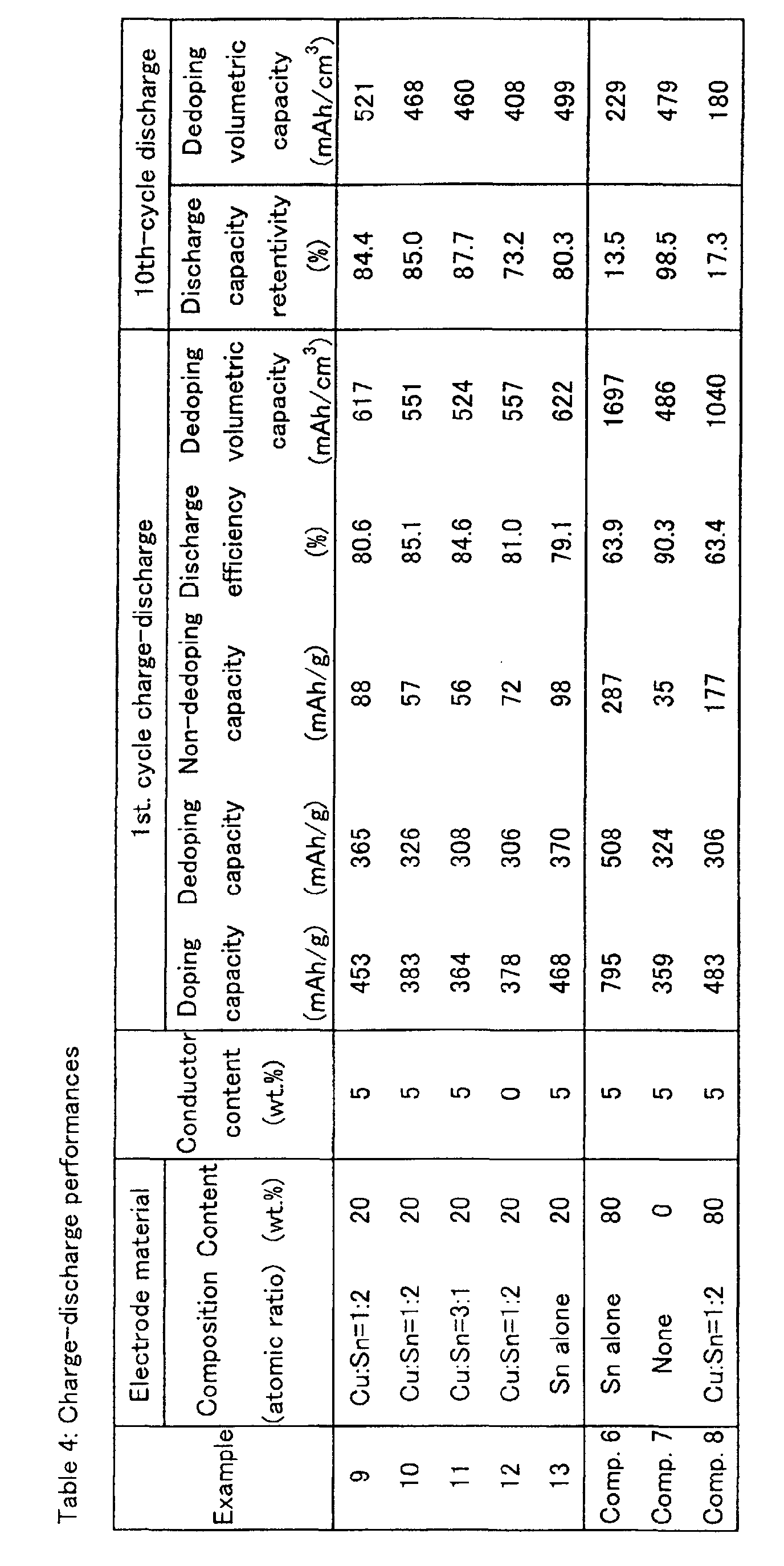
- a disk-shaped filmy electrode was prepared in the same manner as in Example 9 (by using the same electrode material as in Example 9) except for changing the ratio of the electrode material and the binder from 90:10 (by weight) to 95:5 (by weight).
- An electrode material was prepared by blending the metal material (intermetallic compound) and the granular graphite (artificial graphite) and without adding the fine electroconductive additive (carbon black) thereto, and a disk-shaped filmy electrode was prepared by using the electrode material otherwise in the same manner as in Example 9.
- An electrode material was prepared in the same manner as in Example 9 except for blending the Sn powder, the granular graphite and the carbon black in weight ratios of 80:15:5, and a disk-shaped filmy electrode was prepared by using the electrode material otherwise in the same manner as in Example 9.
- An electrode material was prepared by blending the granular graphite and the carbon black in a weight ratio of 95:5, and a disk-shaped filmy electrode was prepared by using the electrode material otherwise in the same manner as in Example 9.
- Non-aqueous solvent secondary cells were prepared and the performances thereof were evaluated in the same manner as in Examples 1 - 8, etc., except for using the disk-shaped filmy electrodes prepared in the above Examples 9 - 13 and Comparative Examples 6 - 8. The results are shown in Table 4.
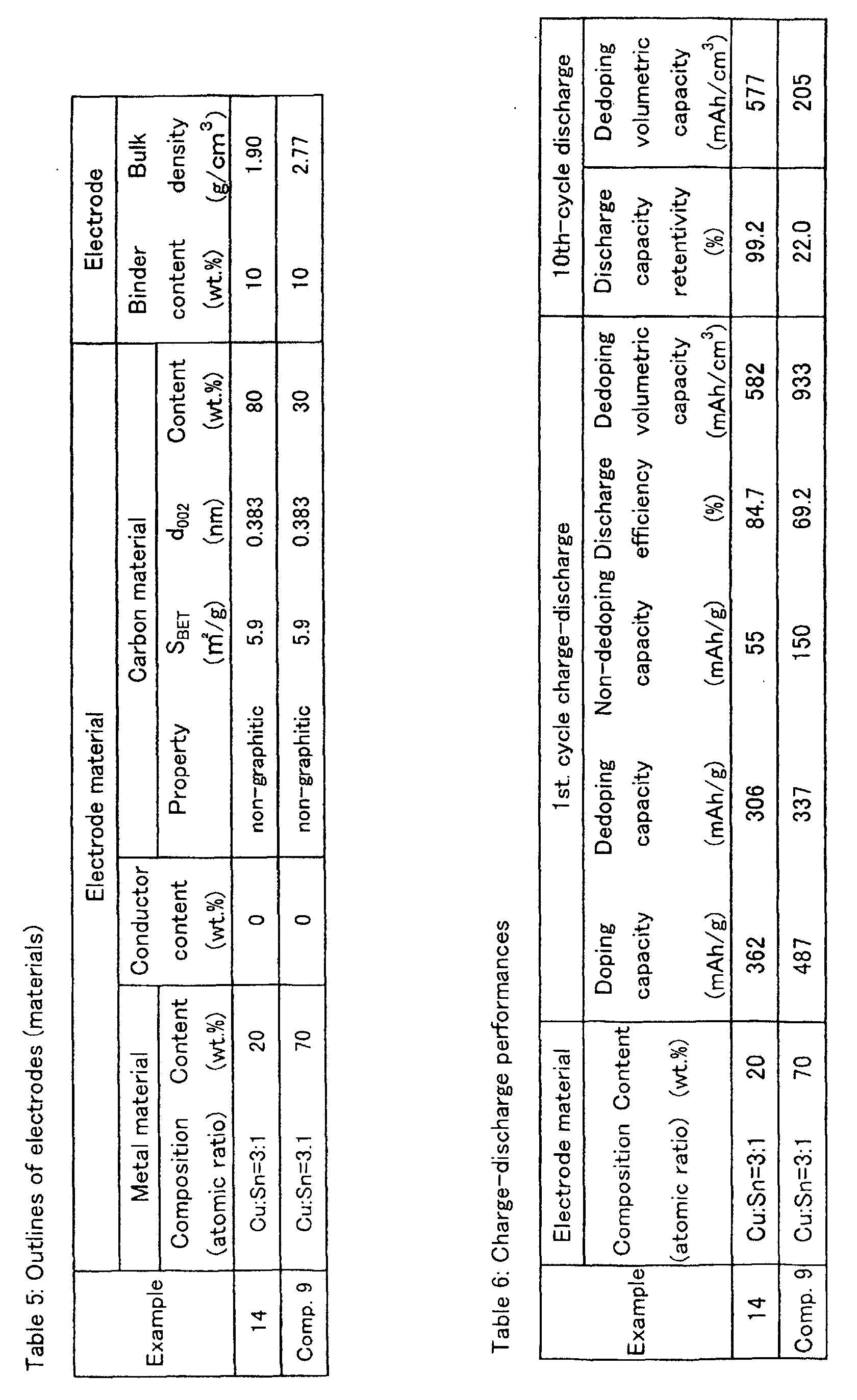
- Non-aqueous solvent secondary cells were prepared and the performances thereof were evaluated in the same manner as in Examples 1 - 8, etc., except for using the disk-shaped filmy electrodes prepared in the above Example 14 and Comparative Example 9. The results are shown in Table 6.
- the present invention provides an electrode material for a non-aqueous solvent secondary cell having a high discharge capacity (dedoping capacity) per volume as a whole and an improved cycle characteristic by combining a metal (intermetallic compound) electrode material which has a high charging capacity (doping capacity) per volume but also has drawbacks of a large irreversible capacity and a poor cycle characteristic, with a capacitive carbon material which per se has capacities of doping and dedoping Li, optionally together with a fine electroconductive additive, to remarkably improve the above-mentioned drawbacks of the metal electrode material.
- the present invention also provides an electrode and a secondary cell containing the electrode material.
Landscapes
- Chemical & Material Sciences (AREA)
- Chemical Kinetics & Catalysis (AREA)
- Electrochemistry (AREA)
- General Chemical & Material Sciences (AREA)
- Composite Materials (AREA)
- Inorganic Chemistry (AREA)
- Engineering & Computer Science (AREA)
- Materials Engineering (AREA)
- Manufacturing & Machinery (AREA)
- Battery Electrode And Active Subsutance (AREA)
- Secondary Cells (AREA)
- Electric Double-Layer Capacitors Or The Like (AREA)
Abstract
Description


Claims (9)
- An electrode material for a non-aqueous solvent secondary cell, comprising a powdery mixture of a metal material and a capacitive carbon material each capable of doping and dedoping lithium, and an optional fine electroconductive additive, and containing 5 - 60 wt.% of the metal material and 40 - 95 wt.% of the capacitive carbon material.
- An electrode material according to Claim 1, wherein the metal material is an intermetallic compound of at least one species of metal selected from Cu, Mg, Mo, Fe and Ni with Sn.
- An electrode material according to Clam 1, wherein the metal material is an intermetallic compound of Cu and Sn.
- An electrode material according to any one of Claims 1 to 3, wherein the capacitive carbon material has an average layer spacing of at most 0.345 nm as measured by X-ray diffraction method and a specific surface of at least 1 m2/g as measured by BET method according to nitrogen adsorption.
- An electrode material according to any one of Claims 1 to 3, wherein the capacitive carbon material has an average layer spacing of at most 0.345 nm as measured by X-ray diffraction method and a specific surface of at most 1 m2/g as measured by BET method according to nitrogen adsorption, and is contained together with 1 - 10 wt.% of an fine electroconductive additive.
- An electrode material according to any one of Claims 1 to 3, wherein the capacitive carbon material is a non-graphitic porous carbon material having an average layer spacing of at least 0.345 nm as measured by X-ray diffraction method and a specific surface area of at least 2.0 m2/g.
- An electrode for a non-aqueous solvent secondary cell, obtained by forming an electrode material according to any one of Claims 1 to 6 together with a binder.
- A non-aqueous solvent secondary cell including the electrode of Claim 7 as either one of a positive electrode and a negative electrode.
- A non-aqueous solvent secondary cell including the electrode of Claim 7 as a negative electrode.
Priority Applications (1)
| Application Number | Priority Date | Filing Date | Title |
|---|---|---|---|
| EP08171914.8A EP2058879B1 (en) | 2001-02-22 | 2002-02-20 | Electrode material for non-aqueous solvent secondary cell, electrode and secondary cell |
Applications Claiming Priority (3)
| Application Number | Priority Date | Filing Date | Title |
|---|---|---|---|
| JP2001047062A JP4789330B2 (en) | 2001-02-22 | 2001-02-22 | Non-aqueous solvent secondary battery electrode material, electrode and secondary battery |
| JP2001047062 | 2001-02-22 | ||
| PCT/JP2002/001461 WO2002067348A1 (en) | 2001-02-22 | 2002-02-20 | Electrode material for non-aqueous solvent secondary cell, electrode and secondary cell |
Related Child Applications (2)
| Application Number | Title | Priority Date | Filing Date |
|---|---|---|---|
| EP08171914.8A Division EP2058879B1 (en) | 2001-02-22 | 2002-02-20 | Electrode material for non-aqueous solvent secondary cell, electrode and secondary cell |
| EP08171914.8 Division-Into | 2008-12-17 |
Publications (3)
| Publication Number | Publication Date |
|---|---|
| EP1298742A1 true EP1298742A1 (en) | 2003-04-02 |
| EP1298742A4 EP1298742A4 (en) | 2006-12-06 |
| EP1298742B1 EP1298742B1 (en) | 2012-03-28 |
Family
ID=18908571
Family Applications (2)
| Application Number | Title | Priority Date | Filing Date |
|---|---|---|---|
| EP02700620A Expired - Lifetime EP1298742B1 (en) | 2001-02-22 | 2002-02-20 | Electrode material for non-aqueous solvent secondary cell, electrode and secondary cell |
| EP08171914.8A Expired - Lifetime EP2058879B1 (en) | 2001-02-22 | 2002-02-20 | Electrode material for non-aqueous solvent secondary cell, electrode and secondary cell |
Family Applications After (1)
| Application Number | Title | Priority Date | Filing Date |
|---|---|---|---|
| EP08171914.8A Expired - Lifetime EP2058879B1 (en) | 2001-02-22 | 2002-02-20 | Electrode material for non-aqueous solvent secondary cell, electrode and secondary cell |
Country Status (7)
| Country | Link |
|---|---|
| US (2) | US7147970B2 (en) |
| EP (2) | EP1298742B1 (en) |
| JP (1) | JP4789330B2 (en) |
| KR (1) | KR100512620B1 (en) |
| CN (2) | CN100440590C (en) |
| AT (1) | ATE551738T1 (en) |
| WO (1) | WO2002067348A1 (en) |
Families Citing this family (23)
| Publication number | Priority date | Publication date | Assignee | Title |
|---|---|---|---|---|
| KR100570637B1 (en) | 2003-05-21 | 2006-04-12 | 삼성에스디아이 주식회사 | Anode Active Material for Lithium Secondary Battery and Manufacturing Method Thereof |
| WO2005011028A1 (en) * | 2003-07-28 | 2005-02-03 | Showa Denko K.K. | High density electrode and battery using the electrode |
| WO2005098999A1 (en) * | 2004-04-05 | 2005-10-20 | Kureha Corporation | Negative electrode material for nonacqueous electrolyte secondary battery of high input/output current, method for producing the same and battery employing negative electrode material |
| JP4910281B2 (en) * | 2004-11-05 | 2012-04-04 | ソニー株式会社 | Negative electrode for lithium ion secondary battery and lithium ion secondary battery |
| KR100814878B1 (en) * | 2006-11-17 | 2008-03-20 | 삼성에스디아이 주식회사 | Lithium secondary battery |
| KR100938059B1 (en) * | 2007-10-23 | 2010-01-21 | 삼성에스디아이 주식회사 | Anode for lithium secondary battery and lithium secondary battery using same |
| JP5330903B2 (en) * | 2009-06-08 | 2013-10-30 | 株式会社神戸製鋼所 | Negative electrode material for lithium ion secondary battery, manufacturing method thereof, and lithium ion secondary battery |
| CN103003984A (en) * | 2010-04-23 | 2013-03-27 | 新日铁住金株式会社 | Anode material of non-aqueous electrolyte secondary battery and method for producing same |
| JP5729520B2 (en) * | 2012-08-27 | 2015-06-03 | 新日鐵住金株式会社 | Negative electrode active material |
| JPWO2014038494A1 (en) | 2012-09-06 | 2016-08-08 | 株式会社クレハ | Nonaqueous electrolyte secondary battery negative electrode material |
| JP6350646B2 (en) * | 2014-02-25 | 2018-07-04 | 新日鐵住金株式会社 | Negative electrode active material, negative electrode and battery |
| HUE044657T2 (en) * | 2014-02-25 | 2019-11-28 | Nippon Steel & Sumitomo Metal Corp | Negative electrode active substance material, negative electrode, and cell |
| PL3113260T3 (en) * | 2014-02-25 | 2019-05-31 | Nippon Steel & Sumitomo Metal Corp | Negative electrode active substance material, negative electrode, and cell |
| KR102059887B1 (en) * | 2014-02-25 | 2019-12-27 | 닛폰세이테츠 가부시키가이샤 | Composite particle, negative electrode, and cell |
| KR20160124221A (en) * | 2014-02-25 | 2016-10-26 | 신닛테츠스미킨 카부시키카이샤 | Negative electrode active substance material, negative electrode, and cell |
| EP3360180A4 (en) * | 2015-10-08 | 2019-06-12 | William Marsh Rice University | POROUS CARBON MATERIALS WITH HIGH SPECIFIC SURFACE USED AS ELECTRODES |
| CN118919883A (en) | 2016-08-31 | 2024-11-08 | 威廉马歇莱思大学 | Anode, cathode and separator for battery, and manufacturing method and use thereof |
| KR102321261B1 (en) | 2017-10-27 | 2021-11-03 | 주식회사 엘지에너지솔루션 | Negative electrode active material for lithium secondary battery and lithium secondary battery comprising the same |
| EP3920201A1 (en) * | 2017-11-21 | 2021-12-08 | Asahi Kasei Kabushiki Kaisha | Separator for electricity storage devices, and electricity storage device |
| US11605817B2 (en) | 2019-09-24 | 2023-03-14 | William Marsh Rice University | Sulfurized carbon cathodes |
| US11984576B1 (en) | 2019-10-01 | 2024-05-14 | William Marsh Rice University | Alkali-metal anode with alloy coating applied by friction |
| WO2021195450A1 (en) | 2020-03-26 | 2021-09-30 | Zeta Energy Llc | Sulfurized-carbon cathode with conductive carbon framework |
| JP7492806B2 (en) * | 2020-07-03 | 2024-05-30 | リファインホールディングス株式会社 | Carbonaceous material dispersion and method for producing same |
Family Cites Families (16)
| Publication number | Priority date | Publication date | Assignee | Title |
|---|---|---|---|---|
| JPS57208079A (en) | 1981-06-18 | 1982-12-21 | Sanyo Electric Co Ltd | Rechargeable lithium cell |
| JPS62122066A (en) | 1985-04-30 | 1987-06-03 | Mitsubishi Petrochem Co Ltd | Nonaqueous solvent battery |
| JPS6290863A (en) | 1985-05-10 | 1987-04-25 | Asahi Chem Ind Co Ltd | Secondary cell |
| JP2674793B2 (en) * | 1988-08-31 | 1997-11-12 | ソニー 株式会社 | Non-aqueous electrolyte battery |
| US5069683A (en) * | 1989-05-11 | 1991-12-03 | Moli Energy Limited | Process of making a rechargeable battery |
| JPH10321225A (en) * | 1997-05-20 | 1998-12-04 | Hitachi Ltd | Lithium secondary battery, portable electric device and electronic device, electric vehicle, and power storage device using the lithium secondary battery |
| US6030726A (en) * | 1996-06-17 | 2000-02-29 | Hitachi, Ltd. | Lithium secondary battery having negative electrode of carbon material which bears metals |
| CN1061472C (en) | 1996-12-25 | 2001-01-31 | 中国科学院化学研究所 | Carbon material for cathode of lithium secondry battery |
| CN1061474C (en) * | 1996-12-25 | 2001-01-31 | 中国科学院化学研究所 | Lithium ion battery and manufacture thereof |
| JPH10308207A (en) * | 1997-05-08 | 1998-11-17 | Matsushita Denchi Kogyo Kk | Non-aqueous electrolyte secondary battery |
| US5807645A (en) * | 1997-06-18 | 1998-09-15 | Wilson Greatbatch Ltd. | Discharge promoter mixture for reducing cell swelling in alkali metal electrochemical cells |
| JP3200572B2 (en) * | 1997-07-31 | 2001-08-20 | 株式会社日立製作所 | Lithium secondary battery |
| JPH1186853A (en) | 1997-09-11 | 1999-03-30 | Hitachi Ltd | Lithium secondary battery |
| JP2000090926A (en) * | 1998-09-11 | 2000-03-31 | Mitsubishi Chemicals Corp | Non-aqueous secondary battery |
| US6664004B2 (en) * | 2000-01-13 | 2003-12-16 | 3M Innovative Properties Company | Electrode compositions having improved cycling behavior |
| JP2002093411A (en) * | 2000-09-08 | 2002-03-29 | Sumitomo Metal Ind Ltd | Anode materials for non-aqueous electrolyte secondary batteries |
-
2001
- 2001-02-22 JP JP2001047062A patent/JP4789330B2/en not_active Expired - Fee Related
-
2002
- 2002-02-20 AT AT02700620T patent/ATE551738T1/en active
- 2002-02-20 CN CNB2006101356822A patent/CN100440590C/en not_active Expired - Fee Related
- 2002-02-20 KR KR10-2002-7014173A patent/KR100512620B1/en not_active Expired - Fee Related
- 2002-02-20 EP EP02700620A patent/EP1298742B1/en not_active Expired - Lifetime
- 2002-02-20 CN CNB028013611A patent/CN1331251C/en not_active Expired - Fee Related
- 2002-02-20 US US10/258,169 patent/US7147970B2/en not_active Expired - Lifetime
- 2002-02-20 WO PCT/JP2002/001461 patent/WO2002067348A1/en not_active Ceased
- 2002-02-20 EP EP08171914.8A patent/EP2058879B1/en not_active Expired - Lifetime
-
2006
- 2006-03-20 US US11/378,300 patent/US7235329B2/en not_active Expired - Lifetime
Also Published As
| Publication number | Publication date |
|---|---|
| CN1331251C (en) | 2007-08-08 |
| JP2002251992A (en) | 2002-09-06 |
| KR20020093062A (en) | 2002-12-12 |
| US7235329B2 (en) | 2007-06-26 |
| EP2058879B1 (en) | 2017-05-03 |
| CN100440590C (en) | 2008-12-03 |
| CN1945875A (en) | 2007-04-11 |
| US20060159995A1 (en) | 2006-07-20 |
| EP1298742A4 (en) | 2006-12-06 |
| WO2002067348A1 (en) | 2002-08-29 |
| JP4789330B2 (en) | 2011-10-12 |
| US20030118908A1 (en) | 2003-06-26 |
| ATE551738T1 (en) | 2012-04-15 |
| KR100512620B1 (en) | 2005-09-02 |
| EP2058879A1 (en) | 2009-05-13 |
| CN1462486A (en) | 2003-12-17 |
| EP1298742B1 (en) | 2012-03-28 |
| US7147970B2 (en) | 2006-12-12 |
Similar Documents
| Publication | Publication Date | Title |
|---|---|---|
| US7235329B2 (en) | Electrode material for non-aqueous solvent-secondary cell, electrode and secondary cell | |
| US8748036B2 (en) | Non-aqueous secondary battery | |
| US6855460B2 (en) | Negative electrodes for lithium cells and batteries | |
| JP4218098B2 (en) | Nonaqueous electrolyte secondary battery and negative electrode material thereof | |
| US5756062A (en) | Chemically modified graphite for electrochemical cells | |
| CA2686890A1 (en) | Plastic crystal electrolyte with a broad potential window | |
| JP7165913B2 (en) | Non-aqueous electrolyte secondary battery | |
| JP5497177B2 (en) | Powder for negative electrode material of lithium ion secondary battery, lithium ion secondary battery negative electrode and capacitor negative electrode, and lithium ion secondary battery and capacitor | |
| JPWO2007007636A1 (en) | Non-aqueous electrolyte secondary battery | |
| KR20130042548A (en) | Powder for lithium ion secondary battery negative electrode material, lithium ion secondary battery negative electrode, capacitor negative electrode, lithium ion secondary battery, and capacitor | |
| JP7475753B2 (en) | Electrolyte for non-aqueous secondary battery and non-aqueous secondary battery using the same | |
| JPH06111818A (en) | Carbon negative electrode for non-aqueous electrolyte secondary battery | |
| KR20050000318A (en) | Negative-electrode material and battery using the same | |
| JP3367060B2 (en) | Negative electrode for lithium secondary battery | |
| JP5584302B2 (en) | Powder for negative electrode material of lithium ion secondary battery, lithium ion secondary battery negative electrode and capacitor negative electrode using the same, lithium ion secondary battery and capacitor | |
| JP2003264006A (en) | Lithium ion secondary battery and method of charging lithium ion secondary battery | |
| JP7498535B2 (en) | Electrolyte for non-aqueous secondary battery and non-aqueous secondary battery using the same | |
| JP7178278B2 (en) | Anode materials for storage devices | |
| JP4905909B2 (en) | Lithium-containing nitride and energy storage device using the same | |
| JP2004349217A (en) | Electrode material for nonaqueous solvent secondary battery | |
| JP2005340025A (en) | Negative electrode material and battery using the same |
Legal Events
| Date | Code | Title | Description |
|---|---|---|---|
| PUAI | Public reference made under article 153(3) epc to a published international application that has entered the european phase |
Free format text: ORIGINAL CODE: 0009012 |
|
| 17P | Request for examination filed |
Effective date: 20021023 |
|
| AK | Designated contracting states |
Kind code of ref document: A1 Designated state(s): AT BE CH CY DE DK ES FI FR GB GR IE IT LI LU MC NL PT SE TR Designated state(s): AT BE CH CY DE DK ES FI FR GB GR IE IT LI LU MC NL PT SE TR |
|
| AX | Request for extension of the european patent |
Extension state: AL LT LV MK RO SI |
|
| RAP1 | Party data changed (applicant data changed or rights of an application transferred) |
Owner name: KUREHA CORPORATION |
|
| A4 | Supplementary search report drawn up and despatched |
Effective date: 20061107 |
|
| 17Q | First examination report despatched |
Effective date: 20080723 |
|
| RIC1 | Information provided on ipc code assigned before grant |
Ipc: H01M 4/02 20060101AFI20110729BHEP Ipc: H01M 4/62 20060101ALI20110729BHEP |
|
| GRAP | Despatch of communication of intention to grant a patent |
Free format text: ORIGINAL CODE: EPIDOSNIGR1 |
|
| GRAS | Grant fee paid |
Free format text: ORIGINAL CODE: EPIDOSNIGR3 |
|
| RIN1 | Information on inventor provided before grant (corrected) |
Inventor name: ISHIKAWA, MINORU,N Inventor name: SHIMIZU, KAZUHIKO,N Inventor name: WAKAHOI, TAKASHI,N Inventor name: HOSHI, AKIO,N Inventor name: SONOBE, NAOHIRO,N Inventor name: MORINISHI, SHUJI,N |
|
| GRAA | (expected) grant |
Free format text: ORIGINAL CODE: 0009210 |
|
| AK | Designated contracting states |
Kind code of ref document: B1 Designated state(s): AT BE CH CY DE DK ES FI FR GB GR IE IT LI LU MC NL PT SE TR |
|
| REG | Reference to a national code |
Ref country code: GB Ref legal event code: FG4D |
|
| REG | Reference to a national code |
Ref country code: CH Ref legal event code: EP |
|
| REG | Reference to a national code |
Ref country code: AT Ref legal event code: REF Ref document number: 551738 Country of ref document: AT Kind code of ref document: T Effective date: 20120415 |
|
| REG | Reference to a national code |
Ref country code: IE Ref legal event code: FG4D |
|
| REG | Reference to a national code |
Ref country code: DE Ref legal event code: R096 Ref document number: 60242497 Country of ref document: DE Effective date: 20120516 |
|
| REG | Reference to a national code |
Ref country code: NL Ref legal event code: VDEP Effective date: 20120328 |
|
| PG25 | Lapsed in a contracting state [announced via postgrant information from national office to epo] |
Ref country code: FI Free format text: LAPSE BECAUSE OF FAILURE TO SUBMIT A TRANSLATION OF THE DESCRIPTION OR TO PAY THE FEE WITHIN THE PRESCRIBED TIME-LIMIT Effective date: 20120328 Ref country code: GR Free format text: LAPSE BECAUSE OF FAILURE TO SUBMIT A TRANSLATION OF THE DESCRIPTION OR TO PAY THE FEE WITHIN THE PRESCRIBED TIME-LIMIT Effective date: 20120629 |
|
| REG | Reference to a national code |
Ref country code: AT Ref legal event code: MK05 Ref document number: 551738 Country of ref document: AT Kind code of ref document: T Effective date: 20120328 |
|
| PG25 | Lapsed in a contracting state [announced via postgrant information from national office to epo] |
Ref country code: CY Free format text: LAPSE BECAUSE OF FAILURE TO SUBMIT A TRANSLATION OF THE DESCRIPTION OR TO PAY THE FEE WITHIN THE PRESCRIBED TIME-LIMIT Effective date: 20120328 |
|
| PG25 | Lapsed in a contracting state [announced via postgrant information from national office to epo] |
Ref country code: SE Free format text: LAPSE BECAUSE OF FAILURE TO SUBMIT A TRANSLATION OF THE DESCRIPTION OR TO PAY THE FEE WITHIN THE PRESCRIBED TIME-LIMIT Effective date: 20120328 Ref country code: BE Free format text: LAPSE BECAUSE OF NON-PAYMENT OF DUE FEES Effective date: 20120328 |
|
| PG25 | Lapsed in a contracting state [announced via postgrant information from national office to epo] |
Ref country code: PT Free format text: LAPSE BECAUSE OF FAILURE TO SUBMIT A TRANSLATION OF THE DESCRIPTION OR TO PAY THE FEE WITHIN THE PRESCRIBED TIME-LIMIT Effective date: 20120730 |
|
| PG25 | Lapsed in a contracting state [announced via postgrant information from national office to epo] |
Ref country code: NL Free format text: LAPSE BECAUSE OF FAILURE TO SUBMIT A TRANSLATION OF THE DESCRIPTION OR TO PAY THE FEE WITHIN THE PRESCRIBED TIME-LIMIT Effective date: 20120328 Ref country code: DK Free format text: LAPSE BECAUSE OF FAILURE TO SUBMIT A TRANSLATION OF THE DESCRIPTION OR TO PAY THE FEE WITHIN THE PRESCRIBED TIME-LIMIT Effective date: 20120328 Ref country code: AT Free format text: LAPSE BECAUSE OF FAILURE TO SUBMIT A TRANSLATION OF THE DESCRIPTION OR TO PAY THE FEE WITHIN THE PRESCRIBED TIME-LIMIT Effective date: 20120328 |
|
| PLBE | No opposition filed within time limit |
Free format text: ORIGINAL CODE: 0009261 |
|
| STAA | Information on the status of an ep patent application or granted ep patent |
Free format text: STATUS: NO OPPOSITION FILED WITHIN TIME LIMIT |
|
| PG25 | Lapsed in a contracting state [announced via postgrant information from national office to epo] |
Ref country code: IT Free format text: LAPSE BECAUSE OF FAILURE TO SUBMIT A TRANSLATION OF THE DESCRIPTION OR TO PAY THE FEE WITHIN THE PRESCRIBED TIME-LIMIT Effective date: 20120328 |
|
| 26N | No opposition filed |
Effective date: 20130103 |
|
| REG | Reference to a national code |
Ref country code: DE Ref legal event code: R097 Ref document number: 60242497 Country of ref document: DE Effective date: 20130103 |
|
| PG25 | Lapsed in a contracting state [announced via postgrant information from national office to epo] |
Ref country code: ES Free format text: LAPSE BECAUSE OF FAILURE TO SUBMIT A TRANSLATION OF THE DESCRIPTION OR TO PAY THE FEE WITHIN THE PRESCRIBED TIME-LIMIT Effective date: 20120709 |
|
| PG25 | Lapsed in a contracting state [announced via postgrant information from national office to epo] |
Ref country code: MC Free format text: LAPSE BECAUSE OF NON-PAYMENT OF DUE FEES Effective date: 20130228 |
|
| REG | Reference to a national code |
Ref country code: CH Ref legal event code: PL |
|
| PG25 | Lapsed in a contracting state [announced via postgrant information from national office to epo] |
Ref country code: LI Free format text: LAPSE BECAUSE OF NON-PAYMENT OF DUE FEES Effective date: 20130228 Ref country code: CH Free format text: LAPSE BECAUSE OF NON-PAYMENT OF DUE FEES Effective date: 20130228 |
|
| REG | Reference to a national code |
Ref country code: IE Ref legal event code: MM4A |
|
| PG25 | Lapsed in a contracting state [announced via postgrant information from national office to epo] |
Ref country code: IE Free format text: LAPSE BECAUSE OF NON-PAYMENT OF DUE FEES Effective date: 20130220 |
|
| PG25 | Lapsed in a contracting state [announced via postgrant information from national office to epo] |
Ref country code: TR Free format text: LAPSE BECAUSE OF FAILURE TO SUBMIT A TRANSLATION OF THE DESCRIPTION OR TO PAY THE FEE WITHIN THE PRESCRIBED TIME-LIMIT Effective date: 20120328 |
|
| PG25 | Lapsed in a contracting state [announced via postgrant information from national office to epo] |
Ref country code: LU Free format text: LAPSE BECAUSE OF NON-PAYMENT OF DUE FEES Effective date: 20130220 |
|
| REG | Reference to a national code |
Ref country code: FR Ref legal event code: PLFP Year of fee payment: 15 |
|
| REG | Reference to a national code |
Ref country code: FR Ref legal event code: PLFP Year of fee payment: 16 |
|
| REG | Reference to a national code |
Ref country code: FR Ref legal event code: PLFP Year of fee payment: 17 |
|
| PGFP | Annual fee paid to national office [announced via postgrant information from national office to epo] |
Ref country code: DE Payment date: 20200219 Year of fee payment: 19 Ref country code: GB Payment date: 20200219 Year of fee payment: 19 |
|
| PGFP | Annual fee paid to national office [announced via postgrant information from national office to epo] |
Ref country code: FR Payment date: 20200219 Year of fee payment: 19 |
|
| REG | Reference to a national code |
Ref country code: DE Ref legal event code: R119 Ref document number: 60242497 Country of ref document: DE |
|
| GBPC | Gb: european patent ceased through non-payment of renewal fee |
Effective date: 20210220 |
|
| PG25 | Lapsed in a contracting state [announced via postgrant information from national office to epo] |
Ref country code: DE Free format text: LAPSE BECAUSE OF NON-PAYMENT OF DUE FEES Effective date: 20210901 Ref country code: FR Free format text: LAPSE BECAUSE OF NON-PAYMENT OF DUE FEES Effective date: 20210228 Ref country code: GB Free format text: LAPSE BECAUSE OF NON-PAYMENT OF DUE FEES Effective date: 20210220 |