EP1298538A1 - Verfahren und Vorrichtung zur Identifizierung von Bereitstellen von Objekten in einem Computernetzwerk - Google Patents
Verfahren und Vorrichtung zur Identifizierung von Bereitstellen von Objekten in einem Computernetzwerk Download PDFInfo
- Publication number
- EP1298538A1 EP1298538A1 EP01123128A EP01123128A EP1298538A1 EP 1298538 A1 EP1298538 A1 EP 1298538A1 EP 01123128 A EP01123128 A EP 01123128A EP 01123128 A EP01123128 A EP 01123128A EP 1298538 A1 EP1298538 A1 EP 1298538A1
- Authority
- EP
- European Patent Office
- Prior art keywords
- computer
- cache
- copy
- complementary
- request
- Prior art date
- Legal status (The legal status is an assumption and is not a legal conclusion. Google has not performed a legal analysis and makes no representation as to the accuracy of the status listed.)
- Granted
Links
Images






Classifications
-
- G—PHYSICS
- G06—COMPUTING OR CALCULATING; COUNTING
- G06F—ELECTRIC DIGITAL DATA PROCESSING
- G06F16/00—Information retrieval; Database structures therefor; File system structures therefor
- G06F16/90—Details of database functions independent of the retrieved data types
- G06F16/95—Retrieval from the web
- G06F16/957—Browsing optimisation, e.g. caching or content distillation
- G06F16/9574—Browsing optimisation, e.g. caching or content distillation of access to content, e.g. by caching
Definitions
- the present invention generally relates to electronic data processing, and more particularly, relates to method, computer program product and system for adjusting caches in a network.
- Scalability of a computer system means that system performance can be improved by adding more hardware in a linear way. System performance can be measured by the time the system needs to respond to an user interaction (response time of the system).
- An example for a client-server system is the SAP R/3TM system, where one database server stores all application data.
- the database server can be accessed substantially simultaneously by a plurality of application users using a plurality of client computers. Each client computer accesses at least an application server.
- a plurality of application servers accesses the database server.
- Application servers handle the application logic, thus taking away load from the database server.
- the application servers store copies of original database objects in a so-called buffer area (cache) of their memories to reduce the number of accesses to the original database objects.
- the present invention provides computer-implemented method, computer program product and computer system to solve the technical problem of substantially simultaneous access by a deliberate number of users to an object that is stored in a computer network, such as the internet.
- a further technical problem is consistency of multiple copies of the same object in multiple caches to prevent a computer user from working with an old version of the object.
- substantially simultaneous access to an object by a large number of users is achieved by storing buffered copies of the object in the caches of a plurality of network computers.
- Each buffered copy of the object should be identical with the original object that is stored somewhere in a database of a network computer.
- the inventive method, computer system and computer program products provide a consistent copy of the object at a network computer where the object is requested, rather than retrieving the original object from the database each time when a user tries to access.
- the present invention solves the aforementioned problem of removing the object access bottleneck in prior art systems by routing an object request to a cache computer that stores an appropriate copy of the requested object. Further, according to the present invention the copy is distributed to the requesting computer, thus increasing the number of suppliers for the requested object by one. This is achieved through the features of a computer-implemented object-supplier-identification that is described as computer-implemented methods, computer system and corresponding computer program products.
- the inventive method involves a first computer having a first cache and a second computer having a second cache.
- the method comprises the following steps:
- inventive method optionally comprises the steps e) to g) to further provide an object distribution mechanism, as expressed in the features of the dependent claims 2 to 4:
- the advantage of the object distribution mechanism according to the present invention is the availability of the requested object on the first and second cache computers and the exchange of information about this availability. Therefore, If a further request for the object is directed to the first cache computer, the request is instantly answered from the first cache. If the request is directed to a further cache computer with a further, synchronized digest matrix, there are now two suppliers (first and second computer) to deliver on the request.
- Computer 903 is a conventional personal computer (PC), a desktop and hand-held device, a multiprocessor computer, a pen computer, a microprocessor-based or programmable consumer electronics, a minicomputer, a mainframe computer, a personal mobile computing device, a mobile phone, a portable or stationary personal computer, a palmtop computer or the like.
- PC personal computer
- desktop and hand-held device a multiprocessor computer
- pen computer a microprocessor-based or programmable consumer electronics
- minicomputer a mainframe computer
- a personal mobile computing device a mobile phone
- portable or stationary personal computer a palmtop computer or the like.
- Processor 910 is, for example, a central processing unit (CPU), a micro-controller unit (MCU), digital signal processor (DSP), or the like.
- CPU central processing unit
- MCU micro-controller unit
- DSP digital signal processor
- Memory 920 symbolizes elements that temporarily or permanently store data and instructions. Although memory 920 is conveniently illustrated as part of computer 903, memory function can also be implemented in network 990, in computers 904/902 and in processor 910 itself (e.g., cache, register), or elsewhere. Memory 920 can be a read only memory (ROM), a random access memory (RAM), or a memory with other access options.
- ROM read only memory
- RAM random access memory
- Memory 920 is physically implemented by computer-readable media, such as, for example: (a) magnetic media, like a hard disk, a floppy disk, or other magnetic disk, a tape, a cassette tape; (b) optical media, like optical disk (CD-ROM, digital versatile disk - DVD); (c) semiconductor media, like DRAM, SRAM, EPROM, EEPROM, memory stick, or by any other media, like paper.
- computer-readable media such as, for example: (a) magnetic media, like a hard disk, a floppy disk, or other magnetic disk, a tape, a cassette tape; (b) optical media, like optical disk (CD-ROM, digital versatile disk - DVD); (c) semiconductor media, like DRAM, SRAM, EPROM, EEPROM, memory stick, or by any other media, like paper.
- Memory 920 stores support modules such as, for example, a basic input output system (BIOS), an operating system (OS), a program library, a compiler, an interpreter, and a text- processing tool.
- support modules are commercially available and can be installed on computer 903 by those of skill in the art. For simplicity, these modules are not illustrated.
- CPP 100 is illustrated as being stored in memory 920, CPP 100 can be located elsewhere. CPP 100 can also be embodied in carrier 970.
- Carrier 970 is illustrated outside computer 903. For communicating CPP 100 to computer 903, carrier 970 is conveniently inserted into input device 940.
- Carrier 970 is implemented as any computer readable medium, such as a medium largely explained above (cf. memory 920).
- carrier 970 is an article of manufacture comprising a computer readable medium having computer readable program code means embodied therein for executing the method of the present invention.
- program signal 980 can also embody computer program 100. Signal 980 travels on network 990 to computer 903.
- Output device 950 symbolizes a device that presents instructions and data that have been processed.
- a monitor or a display (cathode ray tube (CRT), flat panel display, liquid crystal display (LCD), speaker, printer, plotter, vibration alert device.
- CTR cathode ray tube
- LCD liquid crystal display
- speaker printer
- vibration alert device Similar as above, output device 950 communicates with the user, but it can also communicate with further computers.
- Input device 940 and output device 950 can be combined to a single device; any device 940 and 950 can be provided optional.
- Bus 930 and network 990 provide logical and physical connections by conveying instruction and data signals. While connections inside computer 903 are conveniently referred to as “bus 930", connections between computers 903-902 are referred to as “network 990". Optionally, network 990 comprises gateways being computers that specialize in data transmission and protocol conversion.
- Devices 940 and 950 are coupled to computer 903 by bus 930 (as illustrated) or by network 990 (optional). While the signals inside computer 903 are mostly electrical signals, the signals in network are electrical, magnetic, optical or wireless (radio) signals.
- Networking environments are commonplace in offices, enterprise-wide computer networks, intranets and the internet (i.e. world wide web). The physical distance between a remote computer and computer 903 is not important.
- Network 990 can be a wired or a wireless network.
- network 990 is, for example, a local area network (LAN), a wide area network (WAN), a public switched telephone network (PSTN); a Integrated Services Digital Network (ISDN), an infra-red (IR) link, a radio link, like Universal Mobile Telecommunications System (UMTS), Global System for Mobile Communication (GSM), Code Division Multiple Access (CDMA), or satellite link.
- LAN local area network
- WAN wide area network
- PSTN public switched telephone network
- ISDN Integrated Services Digital Network
- IR infra-red
- radio link like Universal Mobile Telecommunications System (UMTS), Global System for Mobile Communication (GSM), Code Division Multiple Access (CDMA), or satellite link.
- UMTS Universal Mobile Telecommunications System
- GSM Global System for
- Transmission protocols and data formats are known, for example, as transmission control protocol/internet protocol (TCP/IP), hyper text transfer protocol (HTTP), secure HTTP, wireless application protocol, unique resource locator (URL), a unique resource identifier (URI), hyper text markup language HTML, extensible markup language (XML), extensible hyper text markup language (XHTML), wireless application markup language (WML), etc.
- TCP/IP transmission control protocol/internet protocol
- HTTP hyper text transfer protocol
- HTTP secure HTTP
- wireless application protocol unique resource locator
- URL unique resource locator
- URI unique resource identifier
- HTML hyper text markup language
- XML extensible markup language
- XHTML extensible hyper text markup language
- WML wireless application markup language
- An interface can be, for example, a serial port interface, a parallel port interface, a game port, a universal serial bus (USB) interface, an internal or external modem, a video adapter, or a sound card.
- USB universal serial bus
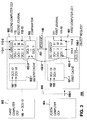
- FIG. 2 illustrates details of two different states (FIG. 2A, FIG. 2B) of a preferred embodiment of computer system 999.
- Hardware components of computer system 999 are illustrated by dotted lines or frames, whereas software related components are illustrated by solid lines or frames.
- IDs e.g. OC3 for third computer 903
- values e.g. OC3/2 for S-mark 121-2
- FIG. 2A shows four computers 901, 902, 903, 904 of computer system 999 that are connected via network 990.
- First computer 901 (CC1) and second computer 902 (CC2) are C-computers.
- Third computer 903 (OC3) and forth computer 904 (OC4) are O-computers. There can be a deliberate number of C-computers and 0-computers in computer system 999.
- First computer 901 has first cache 921-1.
- first cache 921-1 stores objects 192 (OC4/01) and 193 (OC4/02).
- objects 192, 193 were previously loaded from forth computer 904 (OC4) or from a further cache computer.
- Second cache 922-1 stores objects 190'' (OC3/01) and 191 (OC3/02).
- Object 190'' is a cached copy of the original object 190 on third computer 903 (OC3).
- objects 190'', 191 were previously loaded from third computer 903 (OC3) or from a further cache computer.
- first computer 901 has first digest matrix 141 and second computer 902 has second digest matrix 142.
- First digest matrix 141 comprises column 141-1 (CC) and column 141-2 (OC/COR).
- Column 141-1 stores IDs of C-computers (e.g. CC1, CC2) of computer system 999.
- Column 141-2 stores a content digest (e.g. content digest CC1 141-12) of the corresponding C-computer in column 141-1.
- digest matrix 141 has a content digest for each C-computer in computer system 999.
- Each content digest comprises representations of objects that are stored in the cache of the corresponding C-computer.
- each object representation is implemented as a bit pattern.
- the object representations OC3/01R and OC3/02R represent the objects 190'' (OC3/01) and 191 (OC3/02) of second computer 902 (CC2), respectively. Details about object representations are explained under FIG. 6.
- Second digest matrix 142 comprises columns 142-1 and 142-2 that are functionally equivalent with columns 141-1 and 141-2, respectively.
- First computer 901 receives 410 request 190-1 for object 190.
- the requestor can be any other computer in computer system 999, e.g. a client computer operated by a human user.
- request 190-1 has the format of an object key (e.g. OC3/01).
- First computer 901 checks 420 (cf. FIG. 4A) first cache 921-1 for a copy 190' of the object 190. For example, this is achieved by comparing request 190-1 with a comparable portion (e.g. object key) of objects stored in first cache 921-1. A further example is scanning content digest 141-12, as explained under FIG. 6. If first cache 921-1 has a copy (e.g. 190') of requested object 190 it answers 430 the request 190-1 by sending the copy 190' to the requestor.
- a comparable portion e.g. object key
- first computer 901 sends 448 message 180 to the requestor (not shown) to convey the information to the requestor that requested object 190 is not immediately available.
- First computer 901 identifies 440 second computer 902 as supplier of further copy 190'' of the requested object 190.
- First computer 901 uses predefined digest matrix 141 of first computer 901.
- content digest 141-22 of C-computer 902 (CC2) comprises the object representation OC3/01R of the requested object 190 (OC3/01), indicating that further copy 190'' is stored in second cache 922-1 of second computer 902.
- a supplier (CC2) for the requested object is now identified.
- first computer 901 forwards 450 request 190-1 to second computer 902 (CC2), to retrieve further copy 190'' from second cache 922-1.
- FIG. 2B illustrates computer system 999 after synchronizing 480 second digest matrix 142 with first digest matrix 142.
- Second computer 902 (CC2) transmits 440 object 190 from second cache 922-1 to first cache 921-1. Thereby, first computer 901 stores copy 190' in first cache 922-1.
- First computer 901 updates 470 its content digest 141-22 in first digest matrix 141 by adding an object representation (OC3/01R) for object 190.
- first computer 901 sends updated first digest matrix 141 to second computer 902. Then, second computer 902 (CC1) synchronizes 480 second digest matrix 142 with updated first digest matrix 141.
- An advantage of the present invention is the availability of the same object 190 (OC3/01) in computer system 999 in the form of buffered copies 190', 190'' on multiple computers 901, 902, respectively. Therefore, the bottleneck of a single source of data for object 190 in computer system 999 is removed. Further, the information about the multiple storage locations of an object is spread by synchronizing the digest matrices of C-computers in computer system 999.
- the advantage is an efficient routing of an object request to a supplier of the object by identifying the supplier via a digest matrix.
- FIG. 3 illustrates further details of the preferred embodiment of computer system 999 with the four computers 901, 902, 903, 904 that are described under FIG. 2.
- hardware components of computer system 999 are illustrated by dotted lines or frames, whereas software related components are illustrated by solid lines or frames.
- First computer 901 stores first journal 111.
- First journal 111 comprises all journal entries relating to object modifications on forth computer 904.
- first journal 111 further stores journal entry 111-10 (OC3/1) that corresponds to a modification of object 190 (OC3/01) on third computer 903 (OC3).
- Second computer 902 stores second journal 112.
- Second journal 112 comprises all journal entries relating to third computer 903.
- second journal 112 stores additional entries that refer to further origin computers. It is not important for the present invention, how journal entries originating in an origin computer are transmitted to a corresponding journal of a cache computer, where the origin computer is assigned to.
- the origin computer intermediately stores the journal entries and the cache computer loads new journal entries of the assigned origin computer at predefined time intervals.
- journal entry 112-10 refers to third computer 903 (OC3).
- journal entry 112-10 has a key that comprises a relative timestamp for the journal entry. That is, the relative timestamp indicates for each journal entry referring to a specific origin computer if the journal entry was generated before or after another journal entry. Therefore, the relative temporary order of the corresponding object modifications on the specific origin computer is known.
- journal entry key 112-1 comprises an ID (OC) of the corresponding O-computer (e.g. OC3) and an USN (e.g. 1).
- journal entry 112-10 comprises the ID (e.g.
- Journal 111 comprises columns 111-1 and 111-2 that are functionally equivalent to columns 112-1 and 112-2 respectively.
- a person of skill in the art can synchronize first and second journals 111, 112. For example, techniques for synchronizing journals are described for database computers (cf.: Flexible Update Propagation for Weakly Consistent Replication; K. Petersen, M. J. Spreitzer, D. B. Terry, M. M. Theimer, and A. J. Demers; Proceedings of the 16th ACM Symposium on Operating Systems Principles (SOSP-16), Saint Malo, France, October 5-8, 1997, pages 288-301).
- First journal entry 111-10 indicates the relative timestamp (OC3/1) of the last synchronization.
- first computer 901 forwards 450 (cf. FIG. 2A) object request 190-1 to second computer 902, preferably, information about a relative timestamp for the requested object 190 is also transmitted 452-2 from first computer 901 to second computer 902.
- first computer 901 identifies 452-1 journal entry 111-10 of first journal 111 as the latest, most current journal entry referring to requested object 190.
- Comparator 160 of second computer 902 compares 452-3 the relative timestamps of latest second journal entry 112-10 (referring to requested object 190) and latest first journal entry 111-10.
- the relative timestamp of second journal entry 112-10 (OC3/3) was generated later than the relative timestamp of first journal entry 111-10 (OC3/1), which is derived from the higher USN portion (3 > 1) of the journal key.
- the probability depends on the quality of the journal synchronization amongst all cache computers of computer system 999.
- a C-computer preferably, deletes obsolete object copies from its cache. For example, obsolete copies in a cache are detected when synchronizing the journal of a cache computer with the journal of a further cache computer and a journal entry of the further cache computer indicates a modification of a cached object that occurred after the caching of the object.
- second cache 922-1 transmits 460 (cf. FIG. 2B) copy 190'' to first cache 921-1 to answer request 190-1.
- second computer 902 In case second computer 902 recognizes that cached copy 190'' is invalid (e.g. when the relative timestamp of second journal entry 112-10 was generated earlier than the relative timestamp of first journal entry 111-10), second computer optionally sends 454 message 180 to first computer. Message 180 indicates that no valid copy of requested object 190 is available in second cache 922-1. Further, second computer 902 optionally deletes the invalid copy from its cache. In a preferred embodiment of the present invention, second computer 902 then tries to identify a further supplier of requested object 190 by using second digest matrix 142 according to the inventive method 400 described under FIG. 2A. In this case, second computer 902 gets the role of first computer 902 and the further supplier (further cache computer, not shown) gets the role of second computer 902.
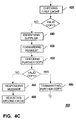
- FIG. 4 illustrates simplified flowchart diagrams (FIGS. 4A, 4B, 4C) of method 400 according to the present invention.
- Method 400 is for identifying a supplier cache computer (e.g. CC2) for a requested object (e.g. OC3/01).
- Optional steps of method 400 allow the distribution of a copy (e.g. 190'') of the requested object across multiple cache computers in computer system 999.
- Mandatory steps of method 400 are illustrated by solid frames, whereas optional steps are illustrated by dashed frames.
- the flowchart diagrams illustrate a preferred order of the method steps without the intention of limiting the invention. Optionally, the steps can also be executed in a different order.
- method 400 involves first computer 901 (cf. FIG. 2A) having first cache 921-1 (cf. FIG. 2A) and at least second computer 902 (cf. FIG. 2A) having second cache 922-1 (cf. FIG. 2A).
- FIG. 4A illustrates method 400 comprising the steps:
- method 400 comprises the further steps:
- first computer 901 receives request 190-1 for object 190.
- the request 190-1 is launched by a user via a further computer in computer system 999 that serves as a client computer for the user.
- object 190 stores bank account information of a specific customer of the user and the user wants to review this information.
- first computer 901 checks 420 first cache 921-1 for a copy (e.g. 190') of object 190.
- request 190-1 has the format of an object key (OC3/01).
- first computer scans first cache 921-1 and compares request 190-1 with object keys of objects 192, 193 (OC4/01, OC4/02).
- first computer 901 answers 430 the request 190-1 in the answering 430 step by sending the copy 190' to the requesting computer (e.g. the client computer of the user).
- the requesting computer e.g. the client computer of the user.
- first cache 921-1 does not have copy 190'.
- first computer 901 identifies 440 second computer 902 as supplier of further copy 190'' of object 190.
- First computer 901 uses predefined first digest matrix 141 (cf. FIG. 2A) of first computer 901.
- digest matrix 141 indicates that further copy 190'' is stored in second cache 922-1 of second computer 902 (CC2) because content digest 141-22 (cf. FIG. 2A) for second computer 902 (CC2 in column 141-1, cf. FIG 2A) has a representation (OC3/01R) of object 190 (OC3/01).
- method 400 provides a solution to the problem of identifying a supplier of a requested object 190 within computer system 999.
- the supplier is a cache computer (e.g. CC2) that can deliver a cached copy (e.g. 190'') of the object 190 faster than the origin computer (e.g. OC3) can deliver the original object 190.
- the optional steps of method 400 allow computer system 999 to distribute a copy of the requested object 190 from supplying second computer 902 to requesting first computer 901, thus first computer 901 becoming a possible supplier once the optional steps of method 400 are executed.
- first computer 901 forwards 450 request 190-1 to second computer 902.
- second computer 902 retrieves further copy 190'' from second cache 922-1 and transmits 460 further copy 190'' to first cache 921-1.
- first computer 901 answers 465 the request 190-1 of the user by sending further copy 190'' to the corresponding requesting computer (e.g. the client computer of the user).
- first computer 901 stores further copy 190'' as copy 190' in first cache 921-1.
- first computer 901 updates first digest matrix 141 according to first cache 921-1. That is, a representation (OC3/01R) of object 190 is added to content digest 141-12 of CC1 because copy 190' was added to first content cache 921-1.
- second computer 902 receives updated first digest matrix 141 from first computer 901. Second computer 902 synchronizes second digest matrix 142 with first digest matrix 141. Preferably, content digests (e.g. 141-12) of first digest matrix 141 that refer to C-computers different from second computer 902 (CC2) replace the corresponding entries in second digest matrix 142.
- the second digest matrix entry referring to CC2 remains unchanged because second computer 902 knows the content of its own second cache 922-1 better than any other C-computer in computer system 999. Therefore, second computer 902 does not allow other C-computers, such as CC1, to update this information.
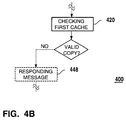
- FIG. 4B illustrates further optional method 400 step responding 448.
- the responding 448 step is performed after the checking step 420 in case that no copy of requested object 190 is in first cache 921-1.
- First computer 901 then responds to request 190-1 with message 180.
- message 180 indicates to the user that first computer 901 cannot immediately supply the requested object information.
- FIG. 4C illustrates further optional method 400 steps to prevent second computer 902 from transmitting an obsolete copy of object 190 to first computer 901.
- the additional optional steps are:
- second computer 902 checks the validity of further copy 190'' in second cache 922-1.
- checking 452 is performed as described under FIG. 3, by performing steps 452-1, 452-2 and 452-3 using comparator 160.
- transmitting step 460 is performed.
- second computer responds to request 190-1 of first computer 901 with message 180.
- message 180 indicates that further copy 190'' is obsolete.
- second computer 902 then adjusts 456 second cache 922-1 by deleting obsolete further copy 190''.
- first computer 901 can repeat step 440 to identify via its digest matrix 141 a further supplier (C-computer, not shown). Then, method 400 is continued with the further supplier playing the role of second computer 902.
- second computer 902 can play the role of first computer 901 in method 400 and use its own digest matrix 142 to identify the further supplier.
- the further supplier plays the role of second computer 902.
- Both alternatives can be repeated by computer system 999 until a valid copy of object 190 is retrieved from a cache within computer system 999. If no cached copy of requested object 190 is available in computer system 999, the system behaves like a prior art system and retrieves original object 190 directly from the corresponding 0-computer 903 (OC3).
- the cache computer that retrieves object 190 from OC3 stores a copy of the object in its cache and updates its digest matrix accordingly, thus becoming a supplier according to the invention.
- FIG. 5 illustrates simplified flowchart diagrams of further method 500 according to the present invention.
- Method 500 is for distributing a cached copy of a requested object from a supplying cache computer to a requesting cache computer.
- Mandatory steps of method 500 are illustrated by solid frames, whereas optional steps are illustrated by dashed frames.
- the flowchart diagrams illustrate a preferred order of the method steps without the intention of limiting the invention. Optionally, the steps can also be executed in a different order.
- FIG 5A illustrates method 500 comprising the following steps:
- Method 500 comprises the further optional steps:
- Steps 510, 520, 530, 540, 550, 570, 580 and 590 of method 500 correspond to steps 410, 420, 430, 440, 450, 460, 470 and 480 of method 400, respectively (as described under FIG. 4).
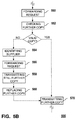
- FIG. 5B illustrates further optional steps of method 500.
- Optional step checking 552 corresponds to step checking 452 of method 400, as described under FIG. 4.
- Optional steps identifying 554, forwarding 556, transmitting 558 and replacing 560 prevent second computer 902 from transmitting obsolete copy 190'' (cf. FIG. 2B) of object 190 to first computer 901.
- second computer 902 identifies 554 further cache computer 906 (cf. FIG. 7) as supplier of still further copy 190''' (cf. FIG. 7) of object 190.
- Second computer 902 uses digest matrix 142 (cf. FIG. 7) of second computer 902 in a way that is functionally equivalent to how first computer 901 uses its digest matrix 141 (cf. FIG. 2).
- digest matrix 142 indicates that still further copy 190''' is stored in further cache 926-1 of further computer 905.
- second computer 902 forwards request 190-1 to further computer 905.
- step 558 further computer 906 transmits still further copy 190''' from further cache 926-1 to second cache 922-1, thus answering request 190-1.
- second computer 902 replaces the value of obsolete further copy 190'' with the value of still further copy 190'''.
- Second computer 902 then transmits 570 further copy 190'' to first computer 901 to answer the original request 190-1 received by first computer 901.
- a person of skill in the art can apply method 500 as well as method 400 to computer system 999 in such a way that consecutively all cache computers that appear as object suppliers for request 190-1 in any digest matrix of any cache computer are queried to answer request 190-1.
- Once a valid copy of requested object 190 is found on a cache computer it is transmitted back to the cache computer that forwarded the request.
- the valid copy goes back the same path that request 190-1 used when being forwarded.
- the digest matrix of a requesting cache computer is synchronized with the digest matrix of the supplying cache computer after the valid copy was transmitted.
- digest matrices of all cache computers can be synchronized with an independent synchronization mechanism - for example, at predefined time intervals.
- FIG. 6 illustrates details of a preferred embodiment of a mechanism to scan content digests (e.g. 141-22) for a representation of an object request (e.g. 190-1).
- C-computers CC1, CC2 and CC5 store cache copies 190', 190'' and 190''' in their caches 921-1, 922-1 and 926-1, respectively.
- the arrows illustrate method 500 steps forwarding 550 request 190-1 (cf. FIG. 2A) from CC1 to CC2, forwarding 556 request 190-1 from CC2 to CC5, transmitting 558 still further copy 190''' from CC5 to CC22 and transmitting 570 further copy 190'' from CC2 to CC1.
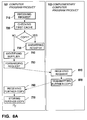
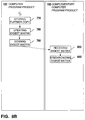
- FIG. 8 illustrates computer program product 101 and complementary computer program 102.
- Computer program products 101 and 102 complement each other when running on two cache computers 901, 902 with similar functionality.
- computer program 101 is running on cache computer 901
- complementary computer program 102 is running on complementary cache computer 902.
- each cache computer 900, 901, 902, 905 and 906 runs a first computer program that is functionally equivalent to CPP 101 and a second computer program that is functionally equivalent to CPP 102. This allows each cache computer to act as requesting computer and as supplying computer according to the invention.
- CPP 101 has a plurality of instructions for causing processor 911 of computer 901 having cache 921-1 to execute steps for identifying complementary computer 902 having complementary cache 922-1.
- CPP 101 causes computer 901 to execute the following steps:
- CPP steps 710-740 correspond to steps 410-440 of method 400 (cf. FIG. 4A)
- CPP 101 causes computer 901 to execute the following further steps for retrieving further copy 190'' from complementary computer 902:
- Step 750 corresponds to step 450 (cf. FIG. 4A).
- Steps 760, 770 correspond to the part of transmitting step 460 of method 400 that is performed on computer 901 (cf. FIG. 2A).
- CPP 101 optionally causes computer 901 to execute the following further steps for distributing updated information about the content of its cache 921-1:
- Step 780 corresponds to step 470 of method 400.
- Step 790 corresponds to the part of synchronizing step 480 that is performed on computer 901.
- Step 810 corresponds to the part of forwarding step 450 that is performed on complementary computer 902.
- Step 820 corresponds to the part of step transmitting step 460 that is performed on complementary computer 902.
- CPP 102 optionally causes complementary computer 902 to execute the following further steps for receiving updated information about the content of cache 921-1 of computer 901:
- Steps 830, 840 correspond to the part of synchronizing step 480 that is performed on complementary computer 902.
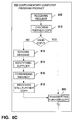
- FIG. 8C illustrates further optional steps of CPP 102 that are performed by complementary computer 902 when executing CPP 102. Preferably but not limiting, the steps are performed in the illustrated order.
- the following optional steps of CPP 102 prevent complementary computer 902 from transmitting an obsolete copy of requested object 190 to computer 901:
- checking step 832 detects invalidity (obsoleteness) of further copy 190'', it is convenient that CPP 102 causes complementary computer 902 to execute the further optional step:
- Steps 812, 814 and 816 correspond to steps 552, 554 and 556 of method 500, respectively.
- Step 818 corresponds to parts of steps 558 and 560 of method 500 that are performed on complementary computer 902.
- Step 813 corresponds to responding step 454 of method 400.
- the present invention is described as computer system 999 in FIGS. 1, 2, 3 and 7.
- computer system 999 is summarized again in the following.
- Computer system 999 comprising first cache computer 901 and at least second cache computer 902.
- First cache computer 901 has:
- First cache computer 901 optionally further comprises:
- Second cache computer 902 has:
- second cache computer 902 further has:
Landscapes
- Engineering & Computer Science (AREA)
- Databases & Information Systems (AREA)
- Theoretical Computer Science (AREA)
- Data Mining & Analysis (AREA)
- Physics & Mathematics (AREA)
- General Engineering & Computer Science (AREA)
- General Physics & Mathematics (AREA)
- Information Retrieval, Db Structures And Fs Structures Therefor (AREA)
Priority Applications (2)
| Application Number | Priority Date | Filing Date | Title |
|---|---|---|---|
| EP01123128A EP1298538B1 (de) | 2001-09-27 | 2001-09-27 | Verfahren und Vorrichtung zur Identifizierung von Bereitstellen von Objekten in einem Computernetzwerk |
| US10/259,996 US6820114B2 (en) | 2001-09-27 | 2002-09-27 | Identifying object suppliers in a network |
Applications Claiming Priority (1)
| Application Number | Priority Date | Filing Date | Title |
|---|---|---|---|
| EP01123128A EP1298538B1 (de) | 2001-09-27 | 2001-09-27 | Verfahren und Vorrichtung zur Identifizierung von Bereitstellen von Objekten in einem Computernetzwerk |
Publications (2)
| Publication Number | Publication Date |
|---|---|
| EP1298538A1 true EP1298538A1 (de) | 2003-04-02 |
| EP1298538B1 EP1298538B1 (de) | 2012-05-30 |
Family
ID=8178745
Family Applications (1)
| Application Number | Title | Priority Date | Filing Date |
|---|---|---|---|
| EP01123128A Expired - Lifetime EP1298538B1 (de) | 2001-09-27 | 2001-09-27 | Verfahren und Vorrichtung zur Identifizierung von Bereitstellen von Objekten in einem Computernetzwerk |
Country Status (1)
| Country | Link |
|---|---|
| EP (1) | EP1298538B1 (de) |
Citations (1)
| Publication number | Priority date | Publication date | Assignee | Title |
|---|---|---|---|---|
| GB2294132A (en) | 1994-10-10 | 1996-04-17 | Marconi Gec Ltd | Data communication network |
Family Cites Families (1)
| Publication number | Priority date | Publication date | Assignee | Title |
|---|---|---|---|---|
| EP1298537B1 (de) * | 2001-09-27 | 2008-08-13 | Sap Ag | Verfahren und Vorrichtung zur Aktualisierung des Cachespeichers |
-
2001
- 2001-09-27 EP EP01123128A patent/EP1298538B1/de not_active Expired - Lifetime
Patent Citations (1)
| Publication number | Priority date | Publication date | Assignee | Title |
|---|---|---|---|---|
| GB2294132A (en) | 1994-10-10 | 1996-04-17 | Marconi Gec Ltd | Data communication network |
Non-Patent Citations (7)
| Title |
|---|
| A. ROUSSKOV: "Cache Digests", COMPUTER NETWORKS AND ISDN SYSTEMS, vol. 30, 1998, pages 2155 - 2168 |
| FAN L ET AL: "SUMMARY CACHE: A SCALABLE WIDE-AREA WEB CACHE SHARING PROTOCOL", IEEE / ACM TRANSACTIONS ON NETWORKING, IEEE INC. NEW YORK, US, vol. 8, no. 3, June 2000 (2000-06-01), pages 281 - 293, XP000947331, ISSN: 1063-6692 * |
| H. YU ET AL.: "A scalable Web Cache Consistency. Architecture", COMPUTER COMMUNICATION REVIEW, ACM, 1 October 1999 (1999-10-01), pages 163 - 174 |
| LI FAN: "Summary Cache: A Scalable Wide-Area Web Cache Sharing Protocol", IEEE/ACM TRANSACTIONS ON NETWORKING, vol. 8, no. 3, June 2000 (2000-06-01), pages 281 - 293 |
| M. MAKPANGOU: "Replicated Directory Service for Weakly Consistent Distributed Caches", PROC. OF THE 19TH INTERNATIONAL CONFERENCE ON DISTRIBUTED COMPUTING SYSTEMS ICDCS'99, 31 May 1999 (1999-05-31), pages 92 - 100 |
| MAKPANGOU M ET AL: "REPLICATED DIRECTORY SERVICE FOR WEAKLY CONSISTENT DISTRIBUTED CACHES", PROCEEDINGS OF THE 19TH INTERNATIONAL CONFERENCE ON DISTRIBUTED COMPUTING SYSTEMS. ICDCS '99. AUSTIN, TX, MAY 31 - JUNE 4, 1999, INTERNATIONAL CONFERENCE ON DISTRIBUTED COMPUTING SYSTEMS, LOS ALAMITOS, CA: IEEE COMPUTER SOC, US, 31 May 1999 (1999-05-31), pages 92 - 100, XP000883606, ISBN: 0-7803-5706-X * |
| ROUSSKOV A ET AL: "Cache digests", COMPUTER NETWORKS AND ISDN SYSTEMS, NORTH HOLLAND PUBLISHING. AMSTERDAM, NL, vol. 30, no. 22-23, 25 November 1998 (1998-11-25), pages 2155 - 2168, XP004152168, ISSN: 0169-7552 * |
Also Published As
| Publication number | Publication date |
|---|---|
| EP1298538B1 (de) | 2012-05-30 |
Similar Documents
| Publication | Publication Date | Title |
|---|---|---|
| US6389460B1 (en) | Method and apparatus for efficient storage and retrieval of objects in and from an object storage device | |
| US6584548B1 (en) | Method and apparatus for invalidating data in a cache | |
| US7539778B2 (en) | Method for a caching mechanism for a central synchronization server | |
| US6615235B1 (en) | Method and apparatus for cache coordination for multiple address spaces | |
| US6574715B2 (en) | Method and apparatus for managing internal caches and external caches in a data processing system | |
| EP1620808B1 (de) | Datenzugriff beruhend auf benutzer-identität | |
| US7461097B2 (en) | Method, system, and computer program for migrating content from source database to target database | |
| US6457103B1 (en) | Method and apparatus for caching content in a data processing system with fragment granularity | |
| US6557076B1 (en) | Method and apparatus for aggressively rendering data in a data processing system | |
| US6339793B1 (en) | Read/write data sharing of DASD data, including byte file system data, in a cluster of multiple data processing systems | |
| US20040073630A1 (en) | Integrated JSP and command cache for web applications with dynamic content | |
| US20020116582A1 (en) | Batching of invalidations and new values in a web cache with dynamic content | |
| US20040064650A1 (en) | Method, system, and program for maintaining data in distributed caches | |
| US9081807B2 (en) | Event-driven invalidation of pages for web-based applications | |
| US20020198883A1 (en) | Web system having clustered application servers and clustered databases | |
| US20020188631A1 (en) | Method, system, and software for transmission of information | |
| EP1623558B1 (de) | Datenzugriff in einem computernetzwerk | |
| CN102985921A (zh) | 在具有电子资源数据库的客户端装置中高速缓存电子文档资源 | |
| US20020116583A1 (en) | Automatic invalidation dependency capture in a web cache with dynamic content | |
| US20070233935A1 (en) | Adaptive edge processing of application data | |
| US20020092012A1 (en) | Smart-caching system and method | |
| US20020111992A1 (en) | JSP composition in a cache for web applications with dynamic content | |
| US20020147887A1 (en) | Distributed execution coordination for web caching with dynamic content | |
| US6519598B1 (en) | Active memory and memory control method, and heterogeneous data integration use system using the memory and method | |
| US20020112125A1 (en) | Command caching to improve network server performance |
Legal Events
| Date | Code | Title | Description |
|---|---|---|---|
| PUAI | Public reference made under article 153(3) epc to a published international application that has entered the european phase |
Free format text: ORIGINAL CODE: 0009012 |
|
| AK | Designated contracting states |
Kind code of ref document: A1 Designated state(s): AT BE CH CY DE DK ES FI FR GB GR IE IT LI LU MC NL PT SE TR Designated state(s): AT BE CH CY DE DK ES FI FR GB GR IE IT LI LU MC NL PT SE TR |
|
| AX | Request for extension of the european patent |
Extension state: AL LT LV MK RO SI |
|
| 17P | Request for examination filed |
Effective date: 20031002 |
|
| AKX | Designation fees paid |
Designated state(s): AT BE CH CY DE DK ES FI FR GB GR IE IT LI LU MC NL PT SE TR |
|
| 17Q | First examination report despatched |
Effective date: 20050223 |
|
| RAP1 | Party data changed (applicant data changed or rights of an application transferred) |
Owner name: SAP AG |
|
| GRAJ | Information related to disapproval of communication of intention to grant by the applicant or resumption of examination proceedings by the epo deleted |
Free format text: ORIGINAL CODE: EPIDOSDIGR1 |
|
| GRAP | Despatch of communication of intention to grant a patent |
Free format text: ORIGINAL CODE: EPIDOSNIGR1 |
|
| GRAP | Despatch of communication of intention to grant a patent |
Free format text: ORIGINAL CODE: EPIDOSNIGR1 |
|
| GRAS | Grant fee paid |
Free format text: ORIGINAL CODE: EPIDOSNIGR3 |
|
| GRAA | (expected) grant |
Free format text: ORIGINAL CODE: 0009210 |
|
| AK | Designated contracting states |
Kind code of ref document: B1 Designated state(s): AT BE CH CY DE DK ES FI FR GB GR IE IT LI LU MC NL PT SE TR |
|
| REG | Reference to a national code |
Ref country code: GB Ref legal event code: FG4D |
|
| REG | Reference to a national code |
Ref country code: CH Ref legal event code: EP |
|
| REG | Reference to a national code |
Ref country code: AT Ref legal event code: REF Ref document number: 560352 Country of ref document: AT Kind code of ref document: T Effective date: 20120615 |
|
| REG | Reference to a national code |
Ref country code: IE Ref legal event code: FG4D |
|
| REG | Reference to a national code |
Ref country code: DE Ref legal event code: R096 Ref document number: 60146610 Country of ref document: DE Effective date: 20120726 |
|
| REG | Reference to a national code |
Ref country code: NL Ref legal event code: VDEP Effective date: 20120530 |
|
| PG25 | Lapsed in a contracting state [announced via postgrant information from national office to epo] |
Ref country code: FI Free format text: LAPSE BECAUSE OF FAILURE TO SUBMIT A TRANSLATION OF THE DESCRIPTION OR TO PAY THE FEE WITHIN THE PRESCRIBED TIME-LIMIT Effective date: 20120530 Ref country code: SE Free format text: LAPSE BECAUSE OF FAILURE TO SUBMIT A TRANSLATION OF THE DESCRIPTION OR TO PAY THE FEE WITHIN THE PRESCRIBED TIME-LIMIT Effective date: 20120530 Ref country code: CY Free format text: LAPSE BECAUSE OF FAILURE TO SUBMIT A TRANSLATION OF THE DESCRIPTION OR TO PAY THE FEE WITHIN THE PRESCRIBED TIME-LIMIT Effective date: 20120530 |
|
| REG | Reference to a national code |
Ref country code: AT Ref legal event code: MK05 Ref document number: 560352 Country of ref document: AT Kind code of ref document: T Effective date: 20120530 |
|
| PG25 | Lapsed in a contracting state [announced via postgrant information from national office to epo] |
Ref country code: GR Free format text: LAPSE BECAUSE OF FAILURE TO SUBMIT A TRANSLATION OF THE DESCRIPTION OR TO PAY THE FEE WITHIN THE PRESCRIBED TIME-LIMIT Effective date: 20120831 |
|
| PG25 | Lapsed in a contracting state [announced via postgrant information from national office to epo] |
Ref country code: BE Free format text: LAPSE BECAUSE OF FAILURE TO SUBMIT A TRANSLATION OF THE DESCRIPTION OR TO PAY THE FEE WITHIN THE PRESCRIBED TIME-LIMIT Effective date: 20120530 |
|
| PG25 | Lapsed in a contracting state [announced via postgrant information from national office to epo] |
Ref country code: NL Free format text: LAPSE BECAUSE OF FAILURE TO SUBMIT A TRANSLATION OF THE DESCRIPTION OR TO PAY THE FEE WITHIN THE PRESCRIBED TIME-LIMIT Effective date: 20120530 Ref country code: DK Free format text: LAPSE BECAUSE OF FAILURE TO SUBMIT A TRANSLATION OF THE DESCRIPTION OR TO PAY THE FEE WITHIN THE PRESCRIBED TIME-LIMIT Effective date: 20120530 Ref country code: AT Free format text: LAPSE BECAUSE OF FAILURE TO SUBMIT A TRANSLATION OF THE DESCRIPTION OR TO PAY THE FEE WITHIN THE PRESCRIBED TIME-LIMIT Effective date: 20120530 |
|
| PG25 | Lapsed in a contracting state [announced via postgrant information from national office to epo] |
Ref country code: IT Free format text: LAPSE BECAUSE OF FAILURE TO SUBMIT A TRANSLATION OF THE DESCRIPTION OR TO PAY THE FEE WITHIN THE PRESCRIBED TIME-LIMIT Effective date: 20120530 Ref country code: PT Free format text: LAPSE BECAUSE OF FAILURE TO SUBMIT A TRANSLATION OF THE DESCRIPTION OR TO PAY THE FEE WITHIN THE PRESCRIBED TIME-LIMIT Effective date: 20121001 |
|
| PLBE | No opposition filed within time limit |
Free format text: ORIGINAL CODE: 0009261 |
|
| STAA | Information on the status of an ep patent application or granted ep patent |
Free format text: STATUS: NO OPPOSITION FILED WITHIN TIME LIMIT |
|
| PG25 | Lapsed in a contracting state [announced via postgrant information from national office to epo] |
Ref country code: MC Free format text: LAPSE BECAUSE OF NON-PAYMENT OF DUE FEES Effective date: 20120930 Ref country code: ES Free format text: LAPSE BECAUSE OF FAILURE TO SUBMIT A TRANSLATION OF THE DESCRIPTION OR TO PAY THE FEE WITHIN THE PRESCRIBED TIME-LIMIT Effective date: 20120910 |
|
| REG | Reference to a national code |
Ref country code: CH Ref legal event code: PL |
|
| 26N | No opposition filed |
Effective date: 20130301 |
|
| REG | Reference to a national code |
Ref country code: IE Ref legal event code: MM4A |
|
| REG | Reference to a national code |
Ref country code: DE Ref legal event code: R097 Ref document number: 60146610 Country of ref document: DE Effective date: 20130301 |
|
| PG25 | Lapsed in a contracting state [announced via postgrant information from national office to epo] |
Ref country code: LI Free format text: LAPSE BECAUSE OF NON-PAYMENT OF DUE FEES Effective date: 20120930 Ref country code: CH Free format text: LAPSE BECAUSE OF NON-PAYMENT OF DUE FEES Effective date: 20120930 Ref country code: IE Free format text: LAPSE BECAUSE OF NON-PAYMENT OF DUE FEES Effective date: 20120927 |
|
| PG25 | Lapsed in a contracting state [announced via postgrant information from national office to epo] |
Ref country code: TR Free format text: LAPSE BECAUSE OF FAILURE TO SUBMIT A TRANSLATION OF THE DESCRIPTION OR TO PAY THE FEE WITHIN THE PRESCRIBED TIME-LIMIT Effective date: 20120530 |
|
| PG25 | Lapsed in a contracting state [announced via postgrant information from national office to epo] |
Ref country code: LU Free format text: LAPSE BECAUSE OF NON-PAYMENT OF DUE FEES Effective date: 20120927 |
|
| REG | Reference to a national code |
Ref country code: DE Ref legal event code: R082 Ref document number: 60146610 Country of ref document: DE Representative=s name: MUELLER-BORE & PARTNER PATENTANWAELTE PARTG MB, DE |
|
| REG | Reference to a national code |
Ref country code: DE Ref legal event code: R082 Ref document number: 60146610 Country of ref document: DE Representative=s name: MUELLER-BORE & PARTNER PATENTANWAELTE PARTG MB, DE Effective date: 20141210 Ref country code: DE Ref legal event code: R081 Ref document number: 60146610 Country of ref document: DE Owner name: SAP SE, DE Free format text: FORMER OWNER: SAP AG, 69190 WALLDORF, DE Effective date: 20120531 Ref country code: DE Ref legal event code: R081 Ref document number: 60146610 Country of ref document: DE Owner name: SAP SE, DE Free format text: FORMER OWNER: SAP AG, 69190 WALLDORF, DE Effective date: 20141210 |
|
| REG | Reference to a national code |
Ref country code: FR Ref legal event code: PLFP Year of fee payment: 16 |
|
| REG | Reference to a national code |
Ref country code: FR Ref legal event code: PLFP Year of fee payment: 17 |
|
| REG | Reference to a national code |
Ref country code: FR Ref legal event code: PLFP Year of fee payment: 18 |
|
| REG | Reference to a national code |
Ref country code: DE Ref legal event code: R079 Ref document number: 60146610 Country of ref document: DE Free format text: PREVIOUS MAIN CLASS: G06F0017300000 Ipc: G06F0016000000 |
|
| PGFP | Annual fee paid to national office [announced via postgrant information from national office to epo] |
Ref country code: GB Payment date: 20200922 Year of fee payment: 20 Ref country code: FR Payment date: 20200914 Year of fee payment: 20 Ref country code: DE Payment date: 20200925 Year of fee payment: 20 |
|
| REG | Reference to a national code |
Ref country code: DE Ref legal event code: R071 Ref document number: 60146610 Country of ref document: DE |
|
| REG | Reference to a national code |
Ref country code: GB Ref legal event code: PE20 Expiry date: 20210926 |
|
| PG25 | Lapsed in a contracting state [announced via postgrant information from national office to epo] |
Ref country code: GB Free format text: LAPSE BECAUSE OF EXPIRATION OF PROTECTION Effective date: 20210926 |