EP1293590A1 - Water-based treating agent for metal surface - Google Patents
Water-based treating agent for metal surface Download PDFInfo
- Publication number
- EP1293590A1 EP1293590A1 EP02712462A EP02712462A EP1293590A1 EP 1293590 A1 EP1293590 A1 EP 1293590A1 EP 02712462 A EP02712462 A EP 02712462A EP 02712462 A EP02712462 A EP 02712462A EP 1293590 A1 EP1293590 A1 EP 1293590A1
- Authority
- EP
- European Patent Office
- Prior art keywords
- water
- surface treatment
- metal surface
- treatment agent
- based metal
- Prior art date
- Legal status (The legal status is an assumption and is not a legal conclusion. Google has not performed a legal analysis and makes no representation as to the accuracy of the status listed.)
- Withdrawn
Links
- 229910052751 metal Inorganic materials 0.000 title claims abstract description 52
- 239000002184 metal Substances 0.000 title claims abstract description 52
- XLYOFNOQVPJJNP-UHFFFAOYSA-N water Substances O XLYOFNOQVPJJNP-UHFFFAOYSA-N 0.000 title claims abstract description 31
- 239000003795 chemical substances by application Substances 0.000 title claims abstract description 14
- 239000012756 surface treatment agent Substances 0.000 claims abstract description 47
- 229910052782 aluminium Inorganic materials 0.000 claims abstract description 30
- XAGFODPZIPBFFR-UHFFFAOYSA-N aluminium Chemical compound [Al] XAGFODPZIPBFFR-UHFFFAOYSA-N 0.000 claims abstract description 30
- 239000003822 epoxy resin Substances 0.000 claims abstract description 25
- 229920000647 polyepoxide Polymers 0.000 claims abstract description 25
- 229920001577 copolymer Polymers 0.000 claims abstract description 21
- 150000002085 enols Chemical class 0.000 claims abstract description 6
- 125000000129 anionic group Chemical group 0.000 claims abstract description 4
- 125000002091 cationic group Chemical group 0.000 claims abstract description 4
- 125000000468 ketone group Chemical group 0.000 claims abstract description 4
- 229930194542 Keto Natural products 0.000 claims abstract description 3
- WASQWSOJHCZDFK-UHFFFAOYSA-N diketene Chemical compound C=C1CC(=O)O1 WASQWSOJHCZDFK-UHFFFAOYSA-N 0.000 claims abstract 2
- 239000000463 material Substances 0.000 claims description 11
- -1 dicarbonyl compound Chemical class 0.000 claims description 9
- 239000000178 monomer Substances 0.000 claims description 6
- 150000003016 phosphoric acids Chemical class 0.000 claims description 6
- 125000004435 hydrogen atom Chemical group [H]* 0.000 claims description 4
- 125000000008 (C1-C10) alkyl group Chemical group 0.000 claims description 2
- 125000006374 C2-C10 alkenyl group Chemical group 0.000 claims description 2
- 239000007769 metal material Substances 0.000 claims description 2
- 125000002496 methyl group Chemical group [H]C([H])([H])* 0.000 claims description 2
- FYYHWMGAXLPEAU-UHFFFAOYSA-N Magnesium Chemical compound [Mg] FYYHWMGAXLPEAU-UHFFFAOYSA-N 0.000 claims 2
- 229910052749 magnesium Inorganic materials 0.000 claims 2
- 239000011777 magnesium Substances 0.000 claims 2
- 238000000576 coating method Methods 0.000 abstract description 26
- 239000011248 coating agent Substances 0.000 abstract description 25
- NBIIXXVUZAFLBC-UHFFFAOYSA-N Phosphoric acid Chemical compound OP(O)(O)=O NBIIXXVUZAFLBC-UHFFFAOYSA-N 0.000 abstract description 22
- 150000001875 compounds Chemical class 0.000 abstract description 12
- 229910000147 aluminium phosphate Inorganic materials 0.000 abstract description 11
- 239000002253 acid Substances 0.000 abstract description 8
- 238000004381 surface treatment Methods 0.000 abstract description 8
- 150000002739 metals Chemical class 0.000 abstract description 2
- 239000010408 film Substances 0.000 description 32
- 239000000758 substrate Substances 0.000 description 27
- 238000005260 corrosion Methods 0.000 description 19
- 230000007797 corrosion Effects 0.000 description 19
- 230000000052 comparative effect Effects 0.000 description 17
- 238000011156 evaluation Methods 0.000 description 14
- 239000000243 solution Substances 0.000 description 12
- ZMANZCXQSJIPKH-UHFFFAOYSA-N Triethylamine Chemical compound CCN(CC)CC ZMANZCXQSJIPKH-UHFFFAOYSA-N 0.000 description 9
- 238000006243 chemical reaction Methods 0.000 description 9
- 238000004528 spin coating Methods 0.000 description 7
- 229920005989 resin Polymers 0.000 description 6
- 239000011347 resin Substances 0.000 description 6
- ZCDOYSPFYFSLEW-UHFFFAOYSA-N chromate(2-) Chemical compound [O-][Cr]([O-])(=O)=O ZCDOYSPFYFSLEW-UHFFFAOYSA-N 0.000 description 5
- 239000000203 mixture Substances 0.000 description 5
- 239000003973 paint Substances 0.000 description 5
- KFZMGEQAYNKOFK-UHFFFAOYSA-N Isopropanol Chemical compound CC(C)O KFZMGEQAYNKOFK-UHFFFAOYSA-N 0.000 description 4
- OWBTYPJTUOEWEK-UHFFFAOYSA-N butane-2,3-diol Chemical compound CC(O)C(C)O OWBTYPJTUOEWEK-UHFFFAOYSA-N 0.000 description 4
- 150000002148 esters Chemical class 0.000 description 4
- 238000000034 method Methods 0.000 description 4
- ZWEHNKRNPOVVGH-UHFFFAOYSA-N 2-Butanone Chemical compound CCC(C)=O ZWEHNKRNPOVVGH-UHFFFAOYSA-N 0.000 description 3
- NIXOWILDQLNWCW-UHFFFAOYSA-M Acrylate Chemical compound [O-]C(=O)C=C NIXOWILDQLNWCW-UHFFFAOYSA-M 0.000 description 3
- VYZAMTAEIAYCRO-UHFFFAOYSA-N Chromium Chemical compound [Cr] VYZAMTAEIAYCRO-UHFFFAOYSA-N 0.000 description 3
- XEKOWRVHYACXOJ-UHFFFAOYSA-N Ethyl acetate Chemical compound CCOC(C)=O XEKOWRVHYACXOJ-UHFFFAOYSA-N 0.000 description 3
- LYCAIKOWRPUZTN-UHFFFAOYSA-N Ethylene glycol Chemical compound OCCO LYCAIKOWRPUZTN-UHFFFAOYSA-N 0.000 description 3
- ZMXDDKWLCZADIW-UHFFFAOYSA-N N,N-Dimethylformamide Chemical compound CN(C)C=O ZMXDDKWLCZADIW-UHFFFAOYSA-N 0.000 description 3
- DNIAPMSPPWPWGF-UHFFFAOYSA-N Propylene glycol Chemical compound CC(O)CO DNIAPMSPPWPWGF-UHFFFAOYSA-N 0.000 description 3
- NIXOWILDQLNWCW-UHFFFAOYSA-N acrylic acid group Chemical group C(C=C)(=O)O NIXOWILDQLNWCW-UHFFFAOYSA-N 0.000 description 3
- 239000007864 aqueous solution Substances 0.000 description 3
- 238000005452 bending Methods 0.000 description 3
- 230000015572 biosynthetic process Effects 0.000 description 3
- IISBACLAFKSPIT-UHFFFAOYSA-N bisphenol A Chemical compound C=1C=C(O)C=CC=1C(C)(C)C1=CC=C(O)C=C1 IISBACLAFKSPIT-UHFFFAOYSA-N 0.000 description 3
- 229910000151 chromium(III) phosphate Inorganic materials 0.000 description 3
- IKZBVTPSNGOVRJ-UHFFFAOYSA-K chromium(iii) phosphate Chemical compound [Cr+3].[O-]P([O-])([O-])=O IKZBVTPSNGOVRJ-UHFFFAOYSA-K 0.000 description 3
- 238000001035 drying Methods 0.000 description 3
- 238000005342 ion exchange Methods 0.000 description 3
- 229920000728 polyester Polymers 0.000 description 3
- 229920001225 polyester resin Polymers 0.000 description 3
- 239000004645 polyester resin Substances 0.000 description 3
- 239000000047 product Substances 0.000 description 3
- 239000002904 solvent Substances 0.000 description 3
- 238000011179 visual inspection Methods 0.000 description 3
- LTQBNYCMVZQRSD-UHFFFAOYSA-N (4-ethenylphenyl)-trimethoxysilane Chemical compound CO[Si](OC)(OC)C1=CC=C(C=C)C=C1 LTQBNYCMVZQRSD-UHFFFAOYSA-N 0.000 description 2
- OZAIFHULBGXAKX-UHFFFAOYSA-N 2-(2-cyanopropan-2-yldiazenyl)-2-methylpropanenitrile Chemical compound N#CC(C)(C)N=NC(C)(C)C#N OZAIFHULBGXAKX-UHFFFAOYSA-N 0.000 description 2
- QGZKDVFQNNGYKY-UHFFFAOYSA-N Ammonia Chemical compound N QGZKDVFQNNGYKY-UHFFFAOYSA-N 0.000 description 2
- IJGRMHOSHXDMSA-UHFFFAOYSA-N Atomic nitrogen Chemical compound N#N IJGRMHOSHXDMSA-UHFFFAOYSA-N 0.000 description 2
- ROSDSFDQCJNGOL-UHFFFAOYSA-N Dimethylamine Chemical compound CNC ROSDSFDQCJNGOL-UHFFFAOYSA-N 0.000 description 2
- 239000004593 Epoxy Substances 0.000 description 2
- QUSNBJAOOMFDIB-UHFFFAOYSA-N Ethylamine Chemical compound CCN QUSNBJAOOMFDIB-UHFFFAOYSA-N 0.000 description 2
- XEEYBQQBJWHFJM-UHFFFAOYSA-N Iron Chemical compound [Fe] XEEYBQQBJWHFJM-UHFFFAOYSA-N 0.000 description 2
- 229920000877 Melamine resin Polymers 0.000 description 2
- CERQOIWHTDAKMF-UHFFFAOYSA-N Methacrylic acid Chemical compound CC(=C)C(O)=O CERQOIWHTDAKMF-UHFFFAOYSA-N 0.000 description 2
- BAPJBEWLBFYGME-UHFFFAOYSA-N Methyl acrylate Chemical compound COC(=O)C=C BAPJBEWLBFYGME-UHFFFAOYSA-N 0.000 description 2
- BAVYZALUXZFZLV-UHFFFAOYSA-N Methylamine Chemical compound NC BAVYZALUXZFZLV-UHFFFAOYSA-N 0.000 description 2
- 239000002202 Polyethylene glycol Substances 0.000 description 2
- PPBRXRYQALVLMV-UHFFFAOYSA-N Styrene Chemical compound C=CC1=CC=CC=C1 PPBRXRYQALVLMV-UHFFFAOYSA-N 0.000 description 2
- QAOWNCQODCNURD-UHFFFAOYSA-N Sulfuric acid Chemical compound OS(O)(=O)=O QAOWNCQODCNURD-UHFFFAOYSA-N 0.000 description 2
- 239000003513 alkali Substances 0.000 description 2
- 125000003342 alkenyl group Chemical group 0.000 description 2
- 238000009835 boiling Methods 0.000 description 2
- 238000005336 cracking Methods 0.000 description 2
- 229910001873 dinitrogen Inorganic materials 0.000 description 2
- 238000003912 environmental pollution Methods 0.000 description 2
- 125000003055 glycidyl group Chemical group C(C1CO1)* 0.000 description 2
- 238000010438 heat treatment Methods 0.000 description 2
- 239000012299 nitrogen atmosphere Substances 0.000 description 2
- 150000001451 organic peroxides Chemical class 0.000 description 2
- 229920001223 polyethylene glycol Polymers 0.000 description 2
- 229920000642 polymer Polymers 0.000 description 2
- 239000011541 reaction mixture Substances 0.000 description 2
- 229910000077 silane Inorganic materials 0.000 description 2
- 239000007921 spray Substances 0.000 description 2
- 239000004094 surface-active agent Substances 0.000 description 2
- 238000003786 synthesis reaction Methods 0.000 description 2
- GETQZCLCWQTVFV-UHFFFAOYSA-N trimethylamine Chemical compound CN(C)C GETQZCLCWQTVFV-UHFFFAOYSA-N 0.000 description 2
- 229920002818 (Hydroxyethyl)methacrylate Polymers 0.000 description 1
- RYHBNJHYFVUHQT-UHFFFAOYSA-N 1,4-Dioxane Chemical compound C1COCCO1 RYHBNJHYFVUHQT-UHFFFAOYSA-N 0.000 description 1
- TUSDEZXZIZRFGC-UHFFFAOYSA-N 1-O-galloyl-3,6-(R)-HHDP-beta-D-glucose Natural products OC1C(O2)COC(=O)C3=CC(O)=C(O)C(O)=C3C3=C(O)C(O)=C(O)C=C3C(=O)OC1C(O)C2OC(=O)C1=CC(O)=C(O)C(O)=C1 TUSDEZXZIZRFGC-UHFFFAOYSA-N 0.000 description 1
- KTZVZZJJVJQZHV-UHFFFAOYSA-N 1-chloro-4-ethenylbenzene Chemical compound ClC1=CC=C(C=C)C=C1 KTZVZZJJVJQZHV-UHFFFAOYSA-N 0.000 description 1
- LVJZCPNIJXVIAT-UHFFFAOYSA-N 1-ethenyl-2,3,4,5,6-pentafluorobenzene Chemical compound FC1=C(F)C(F)=C(C=C)C(F)=C1F LVJZCPNIJXVIAT-UHFFFAOYSA-N 0.000 description 1
- SMZOUWXMTYCWNB-UHFFFAOYSA-N 2-(2-methoxy-5-methylphenyl)ethanamine Chemical compound COC1=CC=C(C)C=C1CCN SMZOUWXMTYCWNB-UHFFFAOYSA-N 0.000 description 1
- IBDVWXAVKPRHCU-UHFFFAOYSA-N 2-(2-methylprop-2-enoyloxy)ethyl 3-oxobutanoate Chemical compound CC(=O)CC(=O)OCCOC(=O)C(C)=C IBDVWXAVKPRHCU-UHFFFAOYSA-N 0.000 description 1
- DPBJAVGHACCNRL-UHFFFAOYSA-N 2-(dimethylamino)ethyl prop-2-enoate Chemical compound CN(C)CCOC(=O)C=C DPBJAVGHACCNRL-UHFFFAOYSA-N 0.000 description 1
- WYGWHHGCAGTUCH-UHFFFAOYSA-N 2-[(2-cyano-4-methylpentan-2-yl)diazenyl]-2,4-dimethylpentanenitrile Chemical compound CC(C)CC(C)(C#N)N=NC(C)(C#N)CC(C)C WYGWHHGCAGTUCH-UHFFFAOYSA-N 0.000 description 1
- OAGGYKVXVKGZOZ-UHFFFAOYSA-N 2-amino-1-(dimethylamino)ethanol Chemical compound CN(C)C(O)CN OAGGYKVXVKGZOZ-UHFFFAOYSA-N 0.000 description 1
- SVONRAPFKPVNKG-UHFFFAOYSA-N 2-ethoxyethyl acetate Chemical compound CCOCCOC(C)=O SVONRAPFKPVNKG-UHFFFAOYSA-N 0.000 description 1
- FWWXYLGCHHIKNY-UHFFFAOYSA-N 2-ethoxyethyl prop-2-enoate Chemical compound CCOCCOC(=O)C=C FWWXYLGCHHIKNY-UHFFFAOYSA-N 0.000 description 1
- OMIGHNLMNHATMP-UHFFFAOYSA-N 2-hydroxyethyl prop-2-enoate Chemical compound OCCOC(=O)C=C OMIGHNLMNHATMP-UHFFFAOYSA-N 0.000 description 1
- RUMACXVDVNRZJZ-UHFFFAOYSA-N 2-methylpropyl 2-methylprop-2-enoate Chemical compound CC(C)COC(=O)C(C)=C RUMACXVDVNRZJZ-UHFFFAOYSA-N 0.000 description 1
- RZVINYQDSSQUKO-UHFFFAOYSA-N 2-phenoxyethyl prop-2-enoate Chemical compound C=CC(=O)OCCOC1=CC=CC=C1 RZVINYQDSSQUKO-UHFFFAOYSA-N 0.000 description 1
- MCDBEBOBROAQSH-UHFFFAOYSA-N 3-[dimethoxy(methyl)silyl]propyl prop-2-enoate Chemical class CO[Si](C)(OC)CCCOC(=O)C=C MCDBEBOBROAQSH-UHFFFAOYSA-N 0.000 description 1
- NYUTUWAFOUJLKI-UHFFFAOYSA-N 3-prop-2-enoyloxypropane-1-sulfonic acid Chemical compound OS(=O)(=O)CCCOC(=O)C=C NYUTUWAFOUJLKI-UHFFFAOYSA-N 0.000 description 1
- KBQVDAIIQCXKPI-UHFFFAOYSA-N 3-trimethoxysilylpropyl prop-2-enoate Chemical class CO[Si](OC)(OC)CCCOC(=O)C=C KBQVDAIIQCXKPI-UHFFFAOYSA-N 0.000 description 1
- 239000004925 Acrylic resin Substances 0.000 description 1
- 229920000178 Acrylic resin Polymers 0.000 description 1
- 239000004342 Benzoyl peroxide Substances 0.000 description 1
- OMPJBNCRMGITSC-UHFFFAOYSA-N Benzoylperoxide Chemical compound C=1C=CC=CC=1C(=O)OOC(=O)C1=CC=CC=C1 OMPJBNCRMGITSC-UHFFFAOYSA-N 0.000 description 1
- 229930185605 Bisphenol Natural products 0.000 description 1
- DKPFZGUDAPQIHT-UHFFFAOYSA-N Butyl acetate Natural products CCCCOC(C)=O DKPFZGUDAPQIHT-UHFFFAOYSA-N 0.000 description 1
- 229920001651 Cyanoacrylate Polymers 0.000 description 1
- 239000001263 FEMA 3042 Substances 0.000 description 1
- WOBHKFSMXKNTIM-UHFFFAOYSA-N Hydroxyethyl methacrylate Chemical compound CC(=C)C(=O)OCCO WOBHKFSMXKNTIM-UHFFFAOYSA-N 0.000 description 1
- 239000004640 Melamine resin Substances 0.000 description 1
- VVQNEPGJFQJSBK-UHFFFAOYSA-N Methyl methacrylate Chemical compound COC(=O)C(C)=C VVQNEPGJFQJSBK-UHFFFAOYSA-N 0.000 description 1
- 229910019142 PO4 Inorganic materials 0.000 description 1
- LRBQNJMCXXYXIU-PPKXGCFTSA-N Penta-digallate-beta-D-glucose Natural products OC1=C(O)C(O)=CC(C(=O)OC=2C(=C(O)C=C(C=2)C(=O)OC[C@@H]2[C@H]([C@H](OC(=O)C=3C=C(OC(=O)C=4C=C(O)C(O)=C(O)C=4)C(O)=C(O)C=3)[C@@H](OC(=O)C=3C=C(OC(=O)C=4C=C(O)C(O)=C(O)C=4)C(O)=C(O)C=3)[C@H](OC(=O)C=3C=C(OC(=O)C=4C=C(O)C(O)=C(O)C=4)C(O)=C(O)C=3)O2)OC(=O)C=2C=C(OC(=O)C=3C=C(O)C(O)=C(O)C=3)C(O)=C(O)C=2)O)=C1 LRBQNJMCXXYXIU-PPKXGCFTSA-N 0.000 description 1
- 239000004372 Polyvinyl alcohol Substances 0.000 description 1
- BLRPTPMANUNPDV-UHFFFAOYSA-N Silane Chemical compound [SiH4] BLRPTPMANUNPDV-UHFFFAOYSA-N 0.000 description 1
- 229910000831 Steel Inorganic materials 0.000 description 1
- 239000006096 absorbing agent Substances 0.000 description 1
- 125000005396 acrylic acid ester group Chemical group 0.000 description 1
- 229920006243 acrylic copolymer Polymers 0.000 description 1
- 239000000654 additive Substances 0.000 description 1
- 239000005456 alcohol based solvent Substances 0.000 description 1
- 125000005370 alkoxysilyl group Chemical group 0.000 description 1
- 229920000180 alkyd Polymers 0.000 description 1
- 125000005250 alkyl acrylate group Chemical group 0.000 description 1
- 125000003277 amino group Chemical group 0.000 description 1
- 229910021529 ammonia Inorganic materials 0.000 description 1
- 239000002518 antifoaming agent Substances 0.000 description 1
- 235000019400 benzoyl peroxide Nutrition 0.000 description 1
- GCTPMLUUWLLESL-UHFFFAOYSA-N benzyl prop-2-enoate Chemical compound C=CC(=O)OCC1=CC=CC=C1 GCTPMLUUWLLESL-UHFFFAOYSA-N 0.000 description 1
- 125000003178 carboxy group Chemical group [H]OC(*)=O 0.000 description 1
- 150000001732 carboxylic acid derivatives Chemical class 0.000 description 1
- 150000001735 carboxylic acids Chemical class 0.000 description 1
- 239000003054 catalyst Substances 0.000 description 1
- 229920002678 cellulose Polymers 0.000 description 1
- 239000001913 cellulose Substances 0.000 description 1
- 239000007795 chemical reaction product Substances 0.000 description 1
- KRVSOGSZCMJSLX-UHFFFAOYSA-L chromic acid Substances O[Cr](O)(=O)=O KRVSOGSZCMJSLX-UHFFFAOYSA-L 0.000 description 1
- 229910052804 chromium Inorganic materials 0.000 description 1
- 239000011651 chromium Substances 0.000 description 1
- 239000008199 coating composition Substances 0.000 description 1
- 238000007739 conversion coating Methods 0.000 description 1
- HPNMFZURTQLUMO-UHFFFAOYSA-N diethylamine Chemical compound CCNCC HPNMFZURTQLUMO-UHFFFAOYSA-N 0.000 description 1
- GYZLOYUZLJXAJU-UHFFFAOYSA-N diglycidyl ether Chemical compound C1OC1COCC1CO1 GYZLOYUZLJXAJU-UHFFFAOYSA-N 0.000 description 1
- 125000005594 diketone group Chemical group 0.000 description 1
- 238000007865 diluting Methods 0.000 description 1
- 238000003618 dip coating Methods 0.000 description 1
- 230000000694 effects Effects 0.000 description 1
- 238000005516 engineering process Methods 0.000 description 1
- 125000003700 epoxy group Chemical group 0.000 description 1
- 125000001033 ether group Chemical group 0.000 description 1
- 150000002170 ethers Chemical class 0.000 description 1
- 238000007730 finishing process Methods 0.000 description 1
- AWJWCTOOIBYHON-UHFFFAOYSA-N furo[3,4-b]pyrazine-5,7-dione Chemical compound C1=CN=C2C(=O)OC(=O)C2=N1 AWJWCTOOIBYHON-UHFFFAOYSA-N 0.000 description 1
- LNEPOXFFQSENCJ-UHFFFAOYSA-N haloperidol Chemical compound C1CC(O)(C=2C=CC(Cl)=CC=2)CCN1CCCC(=O)C1=CC=C(F)C=C1 LNEPOXFFQSENCJ-UHFFFAOYSA-N 0.000 description 1
- FUZZWVXGSFPDMH-UHFFFAOYSA-N hexanoic acid Chemical compound CCCCCC(O)=O FUZZWVXGSFPDMH-UHFFFAOYSA-N 0.000 description 1
- OAKJQQAXSVQMHS-UHFFFAOYSA-N hydrazine group Chemical group NN OAKJQQAXSVQMHS-UHFFFAOYSA-N 0.000 description 1
- 125000002887 hydroxy group Chemical group [H]O* 0.000 description 1
- 125000001841 imino group Chemical group [H]N=* 0.000 description 1
- 229910052742 iron Inorganic materials 0.000 description 1
- 239000012948 isocyanate Substances 0.000 description 1
- 150000002513 isocyanates Chemical class 0.000 description 1
- 229920005684 linear copolymer Polymers 0.000 description 1
- 150000002734 metacrylic acid derivatives Chemical class 0.000 description 1
- 239000003960 organic solvent Substances 0.000 description 1
- 150000002903 organophosphorus compounds Chemical class 0.000 description 1
- RPQRDASANLAFCM-UHFFFAOYSA-N oxiran-2-ylmethyl prop-2-enoate Chemical compound C=CC(=O)OCC1CO1 RPQRDASANLAFCM-UHFFFAOYSA-N 0.000 description 1
- FEUIEHHLVZUGPB-UHFFFAOYSA-N oxolan-2-yl prop-2-enoate Chemical compound C=CC(=O)OC1CCCO1 FEUIEHHLVZUGPB-UHFFFAOYSA-N 0.000 description 1
- 238000010422 painting Methods 0.000 description 1
- JRKICGRDRMAZLK-UHFFFAOYSA-L peroxydisulfate Chemical compound [O-]S(=O)(=O)OOS([O-])(=O)=O JRKICGRDRMAZLK-UHFFFAOYSA-L 0.000 description 1
- 239000010452 phosphate Substances 0.000 description 1
- ACVYVLVWPXVTIT-UHFFFAOYSA-N phosphinic acid Chemical compound O[PH2]=O ACVYVLVWPXVTIT-UHFFFAOYSA-N 0.000 description 1
- 150000003014 phosphoric acid esters Chemical class 0.000 description 1
- 230000000379 polymerizing effect Effects 0.000 description 1
- 229920001296 polysiloxane Polymers 0.000 description 1
- 229920002689 polyvinyl acetate Polymers 0.000 description 1
- 239000011118 polyvinyl acetate Substances 0.000 description 1
- 229920002451 polyvinyl alcohol Polymers 0.000 description 1
- 238000002360 preparation method Methods 0.000 description 1
- 239000003755 preservative agent Substances 0.000 description 1
- LYBIZMNPXTXVMV-UHFFFAOYSA-N propan-2-yl prop-2-enoate Chemical compound CC(C)OC(=O)C=C LYBIZMNPXTXVMV-UHFFFAOYSA-N 0.000 description 1
- 150000003242 quaternary ammonium salts Chemical group 0.000 description 1
- 239000007870 radical polymerization initiator Substances 0.000 description 1
- 238000006748 scratching Methods 0.000 description 1
- 150000004756 silanes Chemical class 0.000 description 1
- 239000007787 solid Substances 0.000 description 1
- 238000005507 spraying Methods 0.000 description 1
- 239000010959 steel Substances 0.000 description 1
- 150000003440 styrenes Chemical class 0.000 description 1
- 239000000126 substance Substances 0.000 description 1
- 125000001174 sulfone group Chemical group 0.000 description 1
- LRBQNJMCXXYXIU-NRMVVENXSA-N tannic acid Chemical compound OC1=C(O)C(O)=CC(C(=O)OC=2C(=C(O)C=C(C=2)C(=O)OC[C@@H]2[C@H]([C@H](OC(=O)C=3C=C(OC(=O)C=4C=C(O)C(O)=C(O)C=4)C(O)=C(O)C=3)[C@@H](OC(=O)C=3C=C(OC(=O)C=4C=C(O)C(O)=C(O)C=4)C(O)=C(O)C=3)[C@@H](OC(=O)C=3C=C(OC(=O)C=4C=C(O)C(O)=C(O)C=4)C(O)=C(O)C=3)O2)OC(=O)C=2C=C(OC(=O)C=3C=C(O)C(O)=C(O)C=3)C(O)=C(O)C=2)O)=C1 LRBQNJMCXXYXIU-NRMVVENXSA-N 0.000 description 1
- 229940033123 tannic acid Drugs 0.000 description 1
- 235000015523 tannic acid Nutrition 0.000 description 1
- 229920002258 tannic acid Polymers 0.000 description 1
- OPQYOFWUFGEMRZ-UHFFFAOYSA-N tert-butyl 2,2-dimethylpropaneperoxoate Chemical compound CC(C)(C)OOC(=O)C(C)(C)C OPQYOFWUFGEMRZ-UHFFFAOYSA-N 0.000 description 1
- ISIJQEHRDSCQIU-UHFFFAOYSA-N tert-butyl 2,7-diazaspiro[4.5]decane-7-carboxylate Chemical compound C1N(C(=O)OC(C)(C)C)CCCC11CNCC1 ISIJQEHRDSCQIU-UHFFFAOYSA-N 0.000 description 1
- 150000003512 tertiary amines Chemical group 0.000 description 1
- 229920002803 thermoplastic polyurethane Polymers 0.000 description 1
- 239000010409 thin film Substances 0.000 description 1
- 150000003609 titanium compounds Chemical class 0.000 description 1
- 238000005303 weighing Methods 0.000 description 1
Classifications
-
- C—CHEMISTRY; METALLURGY
- C23—COATING METALLIC MATERIAL; COATING MATERIAL WITH METALLIC MATERIAL; CHEMICAL SURFACE TREATMENT; DIFFUSION TREATMENT OF METALLIC MATERIAL; COATING BY VACUUM EVAPORATION, BY SPUTTERING, BY ION IMPLANTATION OR BY CHEMICAL VAPOUR DEPOSITION, IN GENERAL; INHIBITING CORROSION OF METALLIC MATERIAL OR INCRUSTATION IN GENERAL
- C23C—COATING METALLIC MATERIAL; COATING MATERIAL WITH METALLIC MATERIAL; SURFACE TREATMENT OF METALLIC MATERIAL BY DIFFUSION INTO THE SURFACE, BY CHEMICAL CONVERSION OR SUBSTITUTION; COATING BY VACUUM EVAPORATION, BY SPUTTERING, BY ION IMPLANTATION OR BY CHEMICAL VAPOUR DEPOSITION, IN GENERAL
- C23C22/00—Chemical surface treatment of metallic material by reaction of the surface with a reactive liquid, leaving reaction products of surface material in the coating, e.g. conversion coatings, passivation of metals
-
- C—CHEMISTRY; METALLURGY
- C23—COATING METALLIC MATERIAL; COATING MATERIAL WITH METALLIC MATERIAL; CHEMICAL SURFACE TREATMENT; DIFFUSION TREATMENT OF METALLIC MATERIAL; COATING BY VACUUM EVAPORATION, BY SPUTTERING, BY ION IMPLANTATION OR BY CHEMICAL VAPOUR DEPOSITION, IN GENERAL; INHIBITING CORROSION OF METALLIC MATERIAL OR INCRUSTATION IN GENERAL
- C23C—COATING METALLIC MATERIAL; COATING MATERIAL WITH METALLIC MATERIAL; SURFACE TREATMENT OF METALLIC MATERIAL BY DIFFUSION INTO THE SURFACE, BY CHEMICAL CONVERSION OR SUBSTITUTION; COATING BY VACUUM EVAPORATION, BY SPUTTERING, BY ION IMPLANTATION OR BY CHEMICAL VAPOUR DEPOSITION, IN GENERAL
- C23C26/00—Coating not provided for in groups C23C2/00 - C23C24/00
-
- Y—GENERAL TAGGING OF NEW TECHNOLOGICAL DEVELOPMENTS; GENERAL TAGGING OF CROSS-SECTIONAL TECHNOLOGIES SPANNING OVER SEVERAL SECTIONS OF THE IPC; TECHNICAL SUBJECTS COVERED BY FORMER USPC CROSS-REFERENCE ART COLLECTIONS [XRACs] AND DIGESTS
- Y10—TECHNICAL SUBJECTS COVERED BY FORMER USPC
- Y10T—TECHNICAL SUBJECTS COVERED BY FORMER US CLASSIFICATION
- Y10T428/00—Stock material or miscellaneous articles
- Y10T428/31504—Composite [nonstructural laminate]
- Y10T428/31511—Of epoxy ether
-
- Y—GENERAL TAGGING OF NEW TECHNOLOGICAL DEVELOPMENTS; GENERAL TAGGING OF CROSS-SECTIONAL TECHNOLOGIES SPANNING OVER SEVERAL SECTIONS OF THE IPC; TECHNICAL SUBJECTS COVERED BY FORMER USPC CROSS-REFERENCE ART COLLECTIONS [XRACs] AND DIGESTS
- Y10—TECHNICAL SUBJECTS COVERED BY FORMER USPC
- Y10T—TECHNICAL SUBJECTS COVERED BY FORMER US CLASSIFICATION
- Y10T428/00—Stock material or miscellaneous articles
- Y10T428/31504—Composite [nonstructural laminate]
- Y10T428/31511—Of epoxy ether
- Y10T428/31529—Next to metal
Definitions
- the present invention relates to a surface treatment agent which is possible to make a metal surface rust-proofing and to improve the coating film adhesion, and in particular to a metal surface treatment agent suitable for use with aluminum products such as pre-coated aluminum sheets.
- Metal surfaces have been treated conventionally to improve the corrosion resistance of the metal surfaces, with a number of types of metal surface treatment agent being used.
- metal surface treatment agent a number of types of metal surface treatment agent being used.
- chromate treatment using a compound containing chromic acid is commonly used, since chromate treatment gives metal excellent corrosion resistance and also exhibits good properties in terms of adhesion to paints.
- Epoxy resin type materials give improved adhesion to the substrate.
- a water-soluble coating composition comprising water and an alkali-neutralized reaction product of the reaction between a phosphoric acid containing P-OH bonds, an epoxy resin and a glycidyl (meth)acrylate (Japanese Patent Publication No.
- the present inventors disclosed a novel tricarbonyl compound, a novel tricarbonyl-group-containing acrylic copolymer, and a metal surface treatment agent using the same, as a surface treatment agent that adheres strongly to a metal surface and gives excellent corrosion resistance and corrosion resistability even in the case of a thin film. Furthermore, in Japanese Patent Publication No. 2001-316835, the present inventors disclosed a metal surface treatment agent in which an epoxy ester reaction mixture between a phosphoric acid type compound and an epoxy resin is assorted with a silane compound or a titanium compound.
- the metal surface treatment agents according to the prior art described above give excellent corrosion resistability and are suited to applications in which this treatment is the finishing process (for example an automobile evaporator), application to so-called pre-coated aluminum sheets, i.e. aluminum plates further coated with a polyester, a fluororesin, an epoxy resin or the like, is difficult.
- pre-coated aluminum sheets i.e. aluminum plates further coated with a polyester, a fluororesin, an epoxy resin or the like.
- corrosion resistability is required first of all, and coating film adhesion is not required that much.
- pre-coated aluminum sheets on the other hand, the surface is painted, and hence various properties are required of the aluminum plate after the painting.
- the user may use the aluminum plate after bending, and hence coating film adhesion, flexibility and ease of bending are important.
- surface treatment agents applied to pre-coated aluminum sheets there are calls to move from organic solvents to water-based solvents.
- surface treatment agents applied to pre-coated aluminum sheets may be required to give the pre-coated aluminum sheet surface acid resistance.
- the present inventors studied assiduously, and as a result discovered that a water-based metal surface treatment agent having the following (1) to (3) as essential components is effective for attaining the above object.
- the copolymer used in the water-based metal surface treatment agent of the present invention preferably contains a compound represented by undermentioned structural formula (I) as one of the monomers thereof.
- R 1 is a hydrogen atom or a methyl group
- R 2 is a C 2-10 alkenyl group having a double bond at the end thereof or a C 1-10 alkyl group
- 1 is 1 to 3
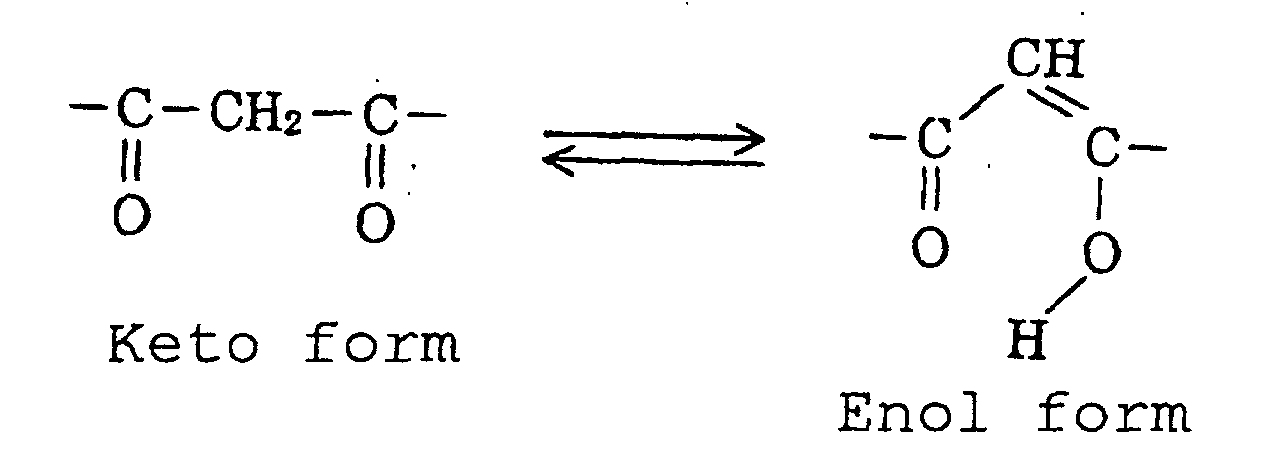
- x and y are independently each 0 or 1. Note, however, that the compound is shown only in the keto form above, but the compound may also exist as an enol tautomeric form as shown below; the enol form is also deemed to be included in the present invention.
- Examples of unsaturated monomers which form the copolymer with a compound represented by above-mentioned formula (I) include alkyl acrylates such as methyl acrylate and isopropyl acrylate, hydroxyethyl acrylate, polyethylene glycol acrylate, dimethylaminoethyl acrylate, glycidyl acrylate, 2-cyano acrylate, benzyl acrylate, phenoxyethyl acrylate, tetrahydrofuryl acrylate, dicyclopentenyloxy acrylate, fluoroacrylates, sulfopropyl acrylate, ⁇ -ethoxyethyl acrylate, ⁇ -acryloxypropylalkoxysilanes and methacrylates thereof, and unsaturated-bond-containing carboxylic acids such as acrylic acid and methacrylic acid.
- alkyl acrylates such as methyl acrylate and isopropyl acrylate, hydroxyethyl acryl
- a side chain containing at least one cationic group such as an amino group, an imino group, a tertiary amine group, a quaternary ammonium salt group or a hydrazine group, anionic group such as a carboxyl group, a sulfone group, a sulfate ester group or a phosphate ester group, or nonionic group such as a hydroxyl group, an ether group or an acido group is necessary.
- 4-vinylphenyltrimethoxysilane or the like can also be used as the above-mentioned unsaturated monomer.
- examples of unsaturated monomers having an alkoxysilyl group such as the above-mentioned ⁇ -acryloxypropylalkoxysilanes include ⁇ -acryloxypropyltrimethoxysilane, ⁇ -acryloxypropylmethyldimethoxysilane and methacryloxy derivatives thereof, and 4-vinylphenyltrimethoxysilane.
- styrene compounds such as 4-chlorostyrene and pentafluorostyrene can also be preferably used. Moreover, it is possible to use a plurality of these materials together.
- organic peroxide, an organic azo compound, or a persulfate can be used as a radical polymerization initiator when forming the polymer or copolymer.
- organic peroxides include benzoyl peroxide and t-butyl peroxypivalate.
- organic azo compounds include 2,2'-azobisisobutyronitrile and 2,2'-azobis(2,4-dimethylvaleronitrile).
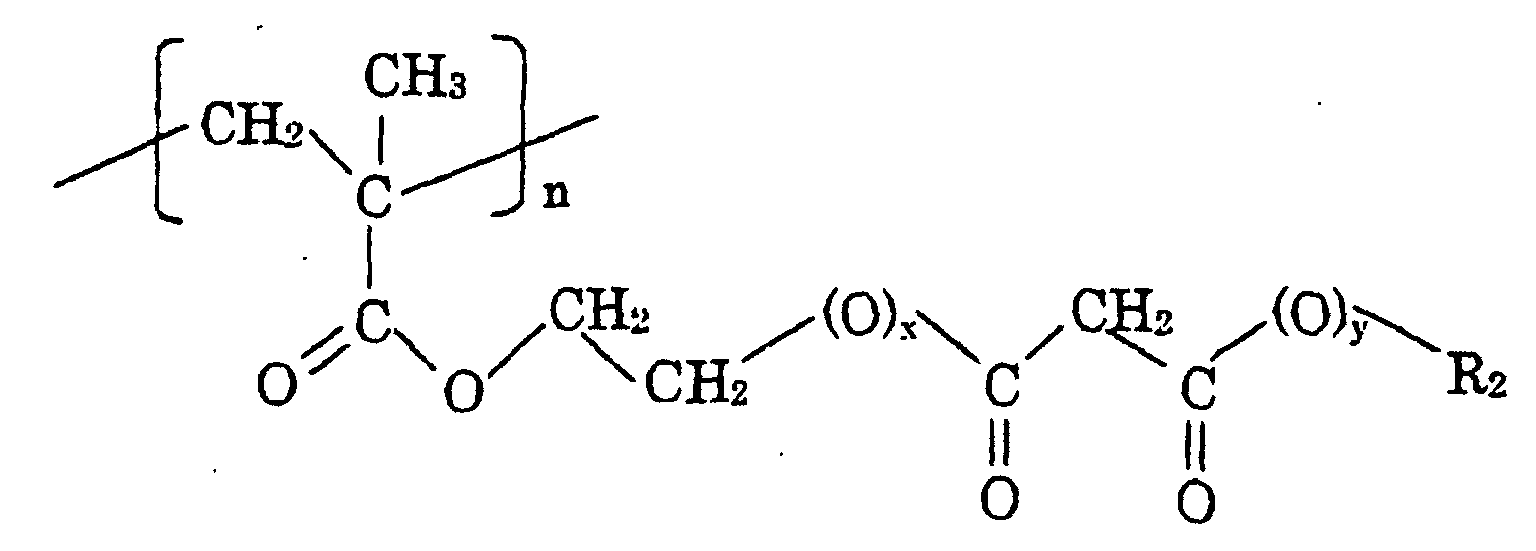
- the copolymer of the present invention can be obtained as a substantially linear structure.
- R 2 in general formula (I) is an alkenyl group
- a hardenable copolymer is obtained having a structure in which the alkenyl groups hang down.
- a copolymer can be crosslinked and thus cured by heat, ultraviolet rays, or a curing catalyst or curing agent.
- the molecular weight of the linear copolymer of the present invention although not being particularly limited, should be about 1,000 to 1,000,000, preferably 5,000 to 200,000.
- the metal surface treatment agent of the present invention also has as essential components an epoxy resin modified with a phosphoric acid type compound, and a water-soluble curing agent.
- the epoxy resin modified with a phosphoric acid type compound can be obtained by epoxy ester reaction of a phosphoric acid type compound and an epoxy resin.
- phosphoric acid, phosphorous acid, or hypophosphorous acid, or an ester thereof is preferable as the phosphoric acid type compound; in the case of the ester, a lower alkyl monophosphate ester is preferable.
- epoxy resin reacted with the phosphoric acid type compound there are no particular limitations on the epoxy resin reacted with the phosphoric acid type compound, but for example a bisphenol type epoxy resin synthesized using bisphenol A or the like is preferable.
- the phosphoric acid type compound and the epoxy resin is reacted such that there are 0.5 to 4.0 equivalents of P-OH groups in the phosphoric acid type compound per 1 equivalent of epoxy groups. It is preferable for the reaction to be proceeded at a reaction temperature of 60 to 150°C. Moreover, the reaction can be carried out in a solvent. Examples of solvents that can be used include alcohol solvents such as ethylene glycol, propylene glycol and methylpropylene glycol, and ether compounds thereof, ethyl acetate, butyl acetate, cellosolve acetate, methyl ethyl ketone, dimethylformamide, and dioxane. After the reaction has been completed, water is added to the reaction mixture to obtain an aqueous solution. Moreover, it is also possible to treat the mixture with an alkali to neutralize active hydrogen groups in the product.
- alkalis examples include ammonia, dimethylamine, diethylamine, methylamine, ethylamine, trimethylamine, triethylamine and dimethylaminoethanolamine. It is preferable for the amount of the alkali used to be 0.8 to 1.5 equivalents per 1 equivalent of active hydrogens in the resin.
- water-soluble curing agent examples include melamine resins and blocked isocyanate resins.
- a water-soluble resin may be included in the metal surface treatment agent of the present invention.
- a water-soluble resin contributes to improving the film formation ability of the surface treatment agent, and further improves the corrosion resistance of the surface coating film.
- examples of such a water-soluble resin include polyvinyl alcohol, saponified polyvinyl acetate, cellulose, alkyd resins, polyester resins, polyethylene glycol, epoxy resins, acrylic resins, urethane resins, and acrylic silicones.
- a preferable composition of the metal surface treatment agent of the present invention is 10 to 50, preferably 20 to 40, parts by weight of the phosphoric-acid-modified epoxy resin, 30 to 70, preferably 40 to 60, parts by weight of an acrylic dicarbonyl copolymer, and 5 to 40, preferably 10 to 30, parts by weight of the water-soluble curing agent, where the treatment agent is 100 parts by weight in total.
- Additives such as viscosity regulators, antifoaming agents, ultraviolet absorbers, preservatives, surfactants and the like may also be used in the metal surface treatment agent of the present invention.
- a publicly known application method can be used for applying the metal surface treatment agent of the present invention onto a metal surface, for example spray coating, dip coating, brush application, roll coating or spin coating.
- the coating film after the drying is preferably 0.1 to 100 ⁇ m, more preferably 0.5 to 10 ⁇ m. If this thickness is less than 0.1 ⁇ m then it will not be possible to obtain sufficient corrosion resistability, whereas if this thickness is greater than 100 ⁇ m then it will not obtain a uniform coating film.
- the phosphoric-acid-modified epoxy resin and the acrylic dicarbonyl copolymer used in the water-based metal treatment agent of the present invention were synthesized.
- the metal surface treatment agent was prepared using the phosphoric-acid-modified epoxy resin and the acrylic dicarbonyl copolymer, and surface of an aluminum plate was treated with the agent.
- a description will be given of the method of evaluating the metal surface after the treatment and the results of the evaluation.
- the surface treatment agent prepared in (3) was applied onto an aluminum plate (A1050P, 55 ⁇ 55 ⁇ 0.6mm, made by Kobe Seiko) using a spin coating method.
- the plate was heated for 10 minutes at 220°C, thus producing a test substrate.
- the thickness of the surface treatment coating film after the drying was about 1 ⁇ m.
- test substrate produced in (4) was subjected to a saltwater spray test as stipulated in JIS-Z-2371, and the corrosion resistability was evaluated by visual inspection.
- the test time was 168 hours. There were 3 evaluation levels as follows, and the evaluation results are shown later in Table 2.
- a polyester paint was applied by spin coating onto the surface treatment coating film on the test substrate produced in (4). The substrate was then heated for 5 minutes at 245°C. The thickness of the polyester paint film formed on the test substrate was about 15 ⁇ m. Using this test substrate, coating film adhesion, flexibility and acid resistance were tested as described below. The test results are shown later in Table 3.
- test substrate was immersed in boiling water for 5 hours, and then a checkerboard tape peeling test was performed as stipulated in JIS-K-5400. There were 3 evaluation levels as. follows, with evaluating by visual inspection.
- test substrate was first bent to the 180° graduation mark under conditions of a mandrel diameter of 3mm and an auxiliary plate thickness of 3.5mm. The test substrate was then immersed in boiling water for 5 hours, and then the bent part of the test substrate was visually observed. There were 3 evaluation levels as follows.
- Cross cuts were put in close to the center of the test substrate using a cutter, the test substrate was immersed for 24 hours in a 5w/v% sulfuric acid solution, and then a tape peeling test was carried out on the cross cut part. There were 3 evaluation levels as follows, with evaluating by visual inspection.
- a solution was prepared by weighing out the components used in Example 1 in the prescribed amounts and then dissolving in pure water and diluting such that the solid content became 20%. Then, the solution was applied by spin coating onto a zinc-plated steel plate (Jinkoto nonkurometohin, 60 ⁇ 80 ⁇ 0.6mm, made by Shin Nippon Seitetsu). The plate was then heated for 10 minutes at 220°C, thus producing a test substrate, and then a pencil-scratching test was carried out as stipulated in JIS-K-5400. The result was that the pencil hardness was above 5H. Note that the thickness of the surface treatment film was about 3 ⁇ m.
- a metal surface treatment agent was prepared having a composition as in Example 1 but without the acrylic dicarbonyl copolymer. Moreover, in Comparative Example 2, a metal surface treatment agent was prepared having a composition as in Example 1 but without the phosphoric-acid-modified epoxy resin.
- Chromic phosphate treatment (using Arusafu 407-47, made by Nippon Peinto, chemical conversion coating film chrome amount approx. 20mg/m 2 ) was carried out as foundation treatment on an aluminum substrate (A1050P, 55 ⁇ 55 ⁇ 0.6mm, made by Kobe Seiko). The substrate was then subjected to the same saltwater spray test as in Example 1.
- an epoxy resin type primer was applied by spin coating onto the chromic phosphate-treated aluminum substrate, and then the substrate was heated for 5 minutes at 245°C.
- the film thickness of the primer was about 5 ⁇ m.
- a polyester resin was then applied by spin coating onto the aluminum substrate, and then the substrate was heated for 5 minutes at 245°C.
- the film thickness of the topcoat was about 15 ⁇ m.
- the resulting substrate was subjected to evaluations as a coating film foundation as in Example 1.
- a polyester resin as a topcoat was applied by spin coating directly onto a chromic phosphate-treated aluminum substrate produced as in Comparative Example 3 without applying a primer first, and then the substrate was heated for 5 minutes at 245°C. The film thickness of the topcoat was about 15 ⁇ m.
- the resulting substrate was subjected to evaluations as a coating film foundation as in Example 1. Corrosion resistability evaluation results Example 1 ⁇ Comparative Example 1 ⁇ Comparative Example 2 ⁇ Comparative Example 3 ⁇ Coating film adhesion, flexibility and acid resistance evaluation results Coating film adhesion Flexibility Acid resistance Example 1 ⁇ ⁇ ⁇ Comparative Example 1 ⁇ ⁇ ⁇ Comparative Example 2 ⁇ ⁇ X Comparative Example 3 ⁇ ⁇ ⁇ Comparative Example 4 ⁇ ⁇ ⁇
- test substrate surface-treated using the surface treatment agent of the present invention showed excellent results in terms of all of the properties corrosion resistability, coating film adhesion, flexibility and acid resistance.
- the water-based metal surface treatment agent of the present invention If used, then an excellent corrosion resistability effect is exhibited after the surface treatment, even though chrome, which causes environmental pollution, is not used. Moreover, the water-based metal treatment agent of the present invention does not contain silane compounds, and hence the metal surface coating film formed has excellent acid resistance. In addition, the metal surface coating film has excellent coating film adhesion and flexibility. The water-based metal surface treatment agent of the present invention is thus suitable for use with aluminum products such as pre-coated aluminum sheets.
Landscapes
- Chemical & Material Sciences (AREA)
- Organic Chemistry (AREA)
- Engineering & Computer Science (AREA)
- Materials Engineering (AREA)
- Mechanical Engineering (AREA)
- Metallurgy (AREA)
- Chemical Kinetics & Catalysis (AREA)
- General Chemical & Material Sciences (AREA)
- Paints Or Removers (AREA)
- Chemical Treatment Of Metals (AREA)
- Compositions Of Macromolecular Compounds (AREA)
- Preventing Corrosion Or Incrustation Of Metals (AREA)
- Application Of Or Painting With Fluid Materials (AREA)
Abstract
Description
- The present invention relates to a surface treatment agent which is possible to make a metal surface rust-proofing and to improve the coating film adhesion, and in particular to a metal surface treatment agent suitable for use with aluminum products such as pre-coated aluminum sheets.
- Metal surfaces have been treated conventionally to improve the corrosion resistance of the metal surfaces, with a number of types of metal surface treatment agent being used. Of the various types of metal surface treatment, chromate treatment using a compound containing chromic acid is commonly used, since chromate treatment gives metal excellent corrosion resistance and also exhibits good properties in terms of adhesion to paints.
- However, it has been pointed out that the chromium used in chromate treatment causes environmental pollution, and hence in recent years alternative metal surface treatment methods and surface treatment agents have been developed. Materials of such surface treatment agents include tannic acid, organophosphorus compounds, silane type coatings, and surfactants, as disclosed in Hyomen Gijutsu ('Surface Technology'), 49 (3), 221 (1998). Moreover, a surface treatment agent obtained by copolymerizing an unsaturated carboxylic acid (Japanese Patent Publication No. H5-222324) and a surface treatment agent that is a copolymer of a glycidyl-group-containing unsaturated monomer and an acrylic acid ester (Japanese Patent Publication No. H3-192166) are known. These materials all use an acrylic type resin, and to achieve sufficient corrosion resistability the coating film must be made thick. Moreover, the adhesion of these materials to various metals such as iron and aluminum is not always adequate, and in a wet environment the adhesion may drop markedly resulting in the coating film peeling off. Epoxy resin type materials, on the other hand, give improved adhesion to the substrate. For example, a water-soluble coating composition comprising water and an alkali-neutralized reaction product of the reaction between a phosphoric acid containing P-OH bonds, an epoxy resin and a glycidyl (meth)acrylate (Japanese Patent Publication No. H5-148447), and an epoxy resin composition comprising a polyglycidyl compound and a phosphoric acid ester containing P-OH bonds obtained from a phosphoric acid and a monoglycidyl ether or ester compound (Japanese Patent Publication No. H9-176285), have been proposed. However, although these materials give good adhesion, it is necessary to make the coating film thick to improve the corrosion resistability.
- In contrast with the above, in Japanese Patent Publication No. 2001-39927, the present inventors disclosed a novel tricarbonyl compound, a novel tricarbonyl-group-containing acrylic copolymer, and a metal surface treatment agent using the same, as a surface treatment agent that adheres strongly to a metal surface and gives excellent corrosion resistance and corrosion resistability even in the case of a thin film. Furthermore, in Japanese Patent Publication No. 2001-316835, the present inventors disclosed a metal surface treatment agent in which an epoxy ester reaction mixture between a phosphoric acid type compound and an epoxy resin is assorted with a silane compound or a titanium compound.
- However, although the metal surface treatment agents according to the prior art described above give excellent corrosion resistability and are suited to applications in which this treatment is the finishing process (for example an automobile evaporator), application to so-called pre-coated aluminum sheets, i.e. aluminum plates further coated with a polyester, a fluororesin, an epoxy resin or the like, is difficult. In the case of aluminum plates used in automobile evaporators, corrosion resistability is required first of all, and coating film adhesion is not required that much. With pre-coated aluminum sheets, on the other hand, the surface is painted, and hence various properties are required of the aluminum plate after the painting. Specifically, not to mention the corrosion resistability of a painted aluminum plate, the user may use the aluminum plate after bending, and hence coating film adhesion, flexibility and ease of bending are important. In addition, with surface treatment agents applied to pre-coated aluminum sheets, there are calls to move from organic solvents to water-based solvents.
- Furthermore, depending on the usage environment, surface treatment agents applied to pre-coated aluminum sheets may be required to give the pre-coated aluminum sheet surface acid resistance.
- It is thus an object of the present invention to provide a water-based metal surface treatment agent that forms a coating film having excellent corrosion resistability, coating film adhesion and flexibility, and can be used with various types of metal surface, including pre-coated aluminum sheets.
- The present inventors studied assiduously, and as a result discovered that a water-based metal surface treatment agent having the following (1) to (3) as essential components is effective for attaining the above object.
- (1) A copolymer, containing in a side chain a diketone or ketoester capable of switching between keto and enol tautomeric forms, and containing at least one hydrophilic side chain containing a cationic group, an anionic group or a nonionic group.
- (2) An epoxy resin modified with a phosphoric acid type compound.
- (3) A water-soluble curing agent.
-
- In particular, the copolymer used in the water-based metal surface treatment agent of the present invention preferably contains a compound represented by undermentioned structural formula (I) as one of the monomers thereof.
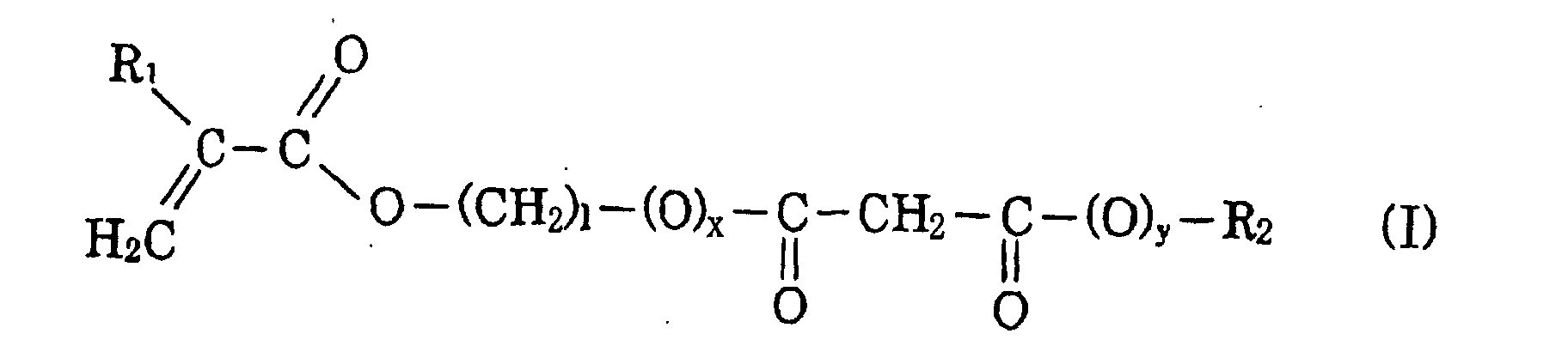
- In formula (I), R1 is a hydrogen atom or a methyl group, R2 is a C2-10 alkenyl group having a double bond at the end thereof or a C1-10 alkyl group, 1 is 1 to 3, and x and y are independently each 0 or 1. Note, however, that the compound is shown only in the keto form above, but the compound may also exist as an enol tautomeric form as shown below; the enol form is also deemed to be included in the present invention.
- Examples of unsaturated monomers which form the copolymer with a compound represented by above-mentioned formula (I) include alkyl acrylates such as methyl acrylate and isopropyl acrylate, hydroxyethyl acrylate, polyethylene glycol acrylate, dimethylaminoethyl acrylate, glycidyl acrylate, 2-cyano acrylate, benzyl acrylate, phenoxyethyl acrylate, tetrahydrofuryl acrylate, dicyclopentenyloxy acrylate, fluoroacrylates, sulfopropyl acrylate, β-ethoxyethyl acrylate, γ-acryloxypropylalkoxysilanes and methacrylates thereof, and unsaturated-bond-containing carboxylic acids such as acrylic acid and methacrylic acid. However, to make the copolymer water-soluble, a side chain containing at least one cationic group such as an amino group, an imino group, a tertiary amine group, a quaternary ammonium salt group or a hydrazine group, anionic group such as a carboxyl group, a sulfone group, a sulfate ester group or a phosphate ester group, or nonionic group such as a hydroxyl group, an ether group or an acido group is necessary. Moreover, 4-vinylphenyltrimethoxysilane or the like can also be used as the above-mentioned unsaturated monomer. Moreover, examples of unsaturated monomers having an alkoxysilyl group such as the above-mentioned γ-acryloxypropylalkoxysilanes include
γ-acryloxypropyltrimethoxysilane,
γ-acryloxypropylmethyldimethoxysilane and methacryloxy derivatives thereof, and 4-vinylphenyltrimethoxysilane. Furthermore, styrene compounds such as 4-chlorostyrene and pentafluorostyrene can also be preferably used. Moreover, it is possible to use a plurality of these materials together. - An organic peroxide, an organic azo compound, or a persulfate can be used as a radical polymerization initiator when forming the polymer or copolymer. Preferable examples of organic peroxides include benzoyl peroxide and t-butyl peroxypivalate. Preferable examples of organic azo compounds include 2,2'-azobisisobutyronitrile and 2,2'-azobis(2,4-dimethylvaleronitrile).
- As exemplified by the undermentioned general formula, the copolymer of the present invention can be obtained as a substantially linear structure. In the case that R2 in general formula (I) is an alkenyl group, a hardenable copolymer is obtained having a structure in which the alkenyl groups hang down. After applying onto the metal surface, such a copolymer can be crosslinked and thus cured by heat, ultraviolet rays, or a curing catalyst or curing agent. The molecular weight of the linear copolymer of the present invention, although not being particularly limited, should be about 1,000 to 1,000,000, preferably 5,000 to 200,000.
- In addition to the copolymer described above, the metal surface treatment agent of the present invention also has as essential components an epoxy resin modified with a phosphoric acid type compound, and a water-soluble curing agent.
- The epoxy resin modified with a phosphoric acid type compound can be obtained by epoxy ester reaction of a phosphoric acid type compound and an epoxy resin.
- Here, phosphoric acid, phosphorous acid, or hypophosphorous acid, or an ester thereof is preferable as the phosphoric acid type compound; in the case of the ester, a lower alkyl monophosphate ester is preferable.
- Moreover, there are no particular limitations on the epoxy resin reacted with the phosphoric acid type compound, but for example a bisphenol type epoxy resin synthesized using bisphenol A or the like is preferable.
- The phosphoric acid type compound and the epoxy resin is reacted such that there are 0.5 to 4.0 equivalents of P-OH groups in the phosphoric acid type compound per 1 equivalent of epoxy groups. It is preferable for the reaction to be proceeded at a reaction temperature of 60 to 150°C. Moreover, the reaction can be carried out in a solvent. Examples of solvents that can be used include alcohol solvents such as ethylene glycol, propylene glycol and methylpropylene glycol, and ether compounds thereof, ethyl acetate, butyl acetate, cellosolve acetate, methyl ethyl ketone, dimethylformamide, and dioxane. After the reaction has been completed, water is added to the reaction mixture to obtain an aqueous solution. Moreover, it is also possible to treat the mixture with an alkali to neutralize active hydrogen groups in the product.
- Examples of alkalis that can be used include ammonia, dimethylamine, diethylamine, methylamine, ethylamine, trimethylamine, triethylamine and dimethylaminoethanolamine. It is preferable for the amount of the alkali used to be 0.8 to 1.5 equivalents per 1 equivalent of active hydrogens in the resin.
- There are no particular limitations on the water-soluble curing agent, but examples include melamine resins and blocked isocyanate resins.
- A water-soluble resin may be included in the metal surface treatment agent of the present invention. A water-soluble resin contributes to improving the film formation ability of the surface treatment agent, and further improves the corrosion resistance of the surface coating film. Examples of such a water-soluble resin include polyvinyl alcohol, saponified polyvinyl acetate, cellulose, alkyd resins, polyester resins, polyethylene glycol, epoxy resins, acrylic resins, urethane resins, and acrylic silicones.
- A preferable composition of the metal surface treatment agent of the present invention is 10 to 50, preferably 20 to 40, parts by weight of the phosphoric-acid-modified epoxy resin, 30 to 70, preferably 40 to 60, parts by weight of an acrylic dicarbonyl copolymer, and 5 to 40, preferably 10 to 30, parts by weight of the water-soluble curing agent, where the treatment agent is 100 parts by weight in total.
- Additives such as viscosity regulators, antifoaming agents, ultraviolet absorbers, preservatives, surfactants and the like may also be used in the metal surface treatment agent of the present invention.
- A publicly known application method can be used for applying the metal surface treatment agent of the present invention onto a metal surface, for example spray coating, dip coating, brush application, roll coating or spin coating.
- To further improve the corrosion resistability of a metallic material using the metal surface treatment agent of the present invention, it is preferable to dry by heating after applying the treatment agent. This drying by heating is preferably continued for 30 seconds to 60 minutes at 100 to 230°C. The thickness of the coating film after the drying is preferably 0.1 to 100µm, more preferably 0.5 to 10µm. If this thickness is less than 0.1µm then it will not be possible to obtain sufficient corrosion resistability, whereas if this thickness is greater than 100µm then it will not obtain a uniform coating film.
- Following is a detailed description of the water-based metal surface treatment agent of the present invention through examples and comparative examples.
- In the present example, firstly the phosphoric-acid-modified epoxy resin and the acrylic dicarbonyl copolymer used in the water-based metal treatment agent of the present invention were synthesized. Next, the metal surface treatment agent was prepared using the phosphoric-acid-modified epoxy resin and the acrylic dicarbonyl copolymer, and surface of an aluminum plate was treated with the agent. Finally, a description will be given of the method of evaluating the metal surface after the treatment and the results of the evaluation.
- 42.85g of 85% phosphoric acid and 33.8g of methylpropylene glycol were put into a 3-mouth 11 flask, this solution was agitated, and nitrogen gas was purged into the flask for 30 minutes. The phosphoric acid solution was then heated to 120°C, and then a solution prepared by dissolving 141.25g of an epoxy resin (Epikoto 828 made by Yuka Sheru Epokishi) in 24.95g of methylpropylene glycol was instilled into the phosphoric acid solution over 60 minutes under the nitrogen atmosphere. After completing the instillation, the materials were reacted for 30 minutes at the same temperature (120°C). 31.7g of ion exchange water was then instilled in, and reaction was continued for a further 2 hours. The solution was then cooled to 70°C, 83.8g of triethylamine was added, and reacted for 15 minutes. Next, the reaction solution was cooled to room temperature, and 1482.65g of ion exchange water was added, thus obtaining a 10wt% phosphoric-acid-modified epoxy resin aqueous solution.
- 6g of methyl methacrylate, 14.22g of isobutyl methacrylate, 1.56g of styrene, 6.70g of methacrylic acid, 5.21g of hydroxyethyl methacrylate, 20.95g of acetoacetoxyethyl methacrylate, 0.66g of 2,2'-azoisobutyronitrile, 55.30g of methylpropylene glycol and 304.70g of isopropanol were put into a 3-mouth flask, and nitrogen gas was purged into the flask for 30 minutes. The reaction vessel was then heated in an oil bath, and the materials were agitated for 4 hours at 85°C undet the nitrogen atmosphere, thus polymerizing. Next, the isopropanol was removed from the polymer solution obtained. 15.75g of triethylamine was then added, and the solution was agitated, and then 426.65g of ion exchange water was added, thus obtaining a 10wt% acrylic dicarbonyl copolymer aqueous solution.
- The phosphoric-acid-modified epoxy resin synthesized in (1) above, a melamine resin (Saimeru 350 made by Mitsui Saitekku, diluted with pure water to make a solution having a nonvolatile content of 10wt%) and the acrylic dicarbonyl copolymer synthesized in (2) above were mixed together in the proportions by mass shown in Table 1 below, thus preparing a surface treatment agent. Note that Table 1 also shows the component proportions for Comparative Examples 1 and 2 described below.
Proportions by mass of components of surface treatment agent Component Example 1 Comparative
Example 2Comparative
Example 1Phosphoric-acid-modified epoxy resin 3 3 - Water-soluble curing agent 2 2 2 Acrylic dicarbonyl copolymer 5 - 5 - The surface treatment agent prepared in (3) was applied onto an aluminum plate (A1050P, 55×55×0.6mm, made by Kobe Seiko) using a spin coating method. The plate was heated for 10 minutes at 220°C, thus producing a test substrate. The thickness of the surface treatment coating film after the drying was about 1µm.
- The test substrate produced in (4) was subjected to a saltwater spray test as stipulated in JIS-Z-2371, and the corrosion resistability was evaluated by visual inspection. The test time was 168 hours. There were 3 evaluation levels as follows, and the evaluation results are shown later in Table 2.
- ○: Virtually no rusting
- Δ: Pitting in places
- ×: Corrosion over whole surface
-
- A polyester paint was applied by spin coating onto the surface treatment coating film on the test substrate produced in (4). The substrate was then heated for 5 minutes at 245°C. The thickness of the polyester paint film formed on the test substrate was about 15µm. Using this test substrate, coating film adhesion, flexibility and acid resistance were tested as described below. The test results are shown later in Table 3.
- The test substrate was immersed in boiling water for 5 hours, and then a checkerboard tape peeling test was performed as stipulated in JIS-K-5400. There were 3 evaluation levels as. follows, with evaluating by visual inspection.
- ○: No peeling
- Δ: Slight peeling seen at intersections in checkerboard pattern
- ×: Peeling over whole surface
-
- Using a bending test apparatus as stipulated in JIS-K-5400, the test substrate was first bent to the 180° graduation mark under conditions of a mandrel diameter of 3mm and an auxiliary plate thickness of 3.5mm. The test substrate was then immersed in boiling water for 5 hours, and then the bent part of the test substrate was visually observed. There were 3 evaluation levels as follows.
- ○: No cracking at bent part
- Δ: Slight cracking seen at bent part
- ×: Paint film peeled away from bent part
-
- Cross cuts were put in close to the center of the test substrate using a cutter, the test substrate was immersed for 24 hours in a 5w/v% sulfuric acid solution, and then a tape peeling test was carried out on the cross cut part. There were 3 evaluation levels as follows, with evaluating by visual inspection.
- ○: No peeling
- Δ: Slight peeling seen at intersections of cross cuts
- ×: Peeling over whole surface
-
- A solution was prepared by weighing out the components used in Example 1 in the prescribed amounts and then dissolving in pure water and diluting such that the solid content became 20%. Then, the solution was applied by spin coating onto a zinc-plated steel plate (Jinkoto nonkurometohin, 60×80×0.6mm, made by Shin Nippon Seitetsu). The plate was then heated for 10 minutes at 220°C, thus producing a test substrate, and then a pencil-scratching test was carried out as stipulated in JIS-K-5400. The result was that the pencil hardness was above 5H. Note that the thickness of the surface treatment film was about 3µm.
- In Comparative Example 1, a metal surface treatment agent was prepared having a composition as in Example 1 but without the acrylic dicarbonyl copolymer. Moreover, in Comparative Example 2, a metal surface treatment agent was prepared having a composition as in Example 1 but without the phosphoric-acid-modified epoxy resin.
- Using these metal surface treatment agents, aluminum test substrates were produced as in Example 1, and evaluated. The evaluation results are shown later in Tables 2 and 3.
- Chromic phosphate treatment (using Arusafu 407-47, made by Nippon Peinto, chemical conversion coating film chrome amount approx. 20mg/m2) was carried out as foundation treatment on an aluminum substrate (A1050P, 55×55×0.6mm, made by Kobe Seiko). The substrate was then subjected to the same saltwater spray test as in Example 1.
- Moreover, an epoxy resin type primer was applied by spin coating onto the chromic phosphate-treated aluminum substrate, and then the substrate was heated for 5 minutes at 245°C. The film thickness of the primer was about 5µm. As a topcoat, a polyester resin was then applied by spin coating onto the aluminum substrate, and then the substrate was heated for 5 minutes at 245°C. The film thickness of the topcoat was about 15µm. The resulting substrate was subjected to evaluations as a coating film foundation as in Example 1.
- A polyester resin as a topcoat was applied by spin coating directly onto a chromic phosphate-treated aluminum substrate produced as in Comparative Example 3 without applying a primer first, and then the substrate was heated for 5 minutes at 245°C. The film thickness of the topcoat was about 15µm. The resulting substrate was subjected to evaluations as a coating film foundation as in Example 1.
Corrosion resistability evaluation results Example 1 ○ Comparative Example 1 Δ Comparative Example 2 × Comparative Example 3 ○ Coating film adhesion, flexibility and acid resistance evaluation results Coating film adhesion Flexibility Acid resistance Example 1 ○ ○ ○ Comparative
Example 1× × × Comparative
Example 2× × X Comparative
Example 3Δ Δ ○ Comparative
Example 4× × × - As can be seen from Tables 2 and 3, the test substrate surface-treated using the surface treatment agent of the present invention showed excellent results in terms of all of the properties corrosion resistability, coating film adhesion, flexibility and acid resistance.
- If the water-based metal surface treatment agent of the present invention is used, then an excellent corrosion resistability effect is exhibited after the surface treatment, even though chrome, which causes environmental pollution, is not used. Moreover, the water-based metal treatment agent of the present invention does not contain silane compounds, and hence the metal surface coating film formed has excellent acid resistance. In addition, the metal surface coating film has excellent coating film adhesion and flexibility. The water-based metal surface treatment agent of the present invention is thus suitable for use with aluminum products such as pre-coated aluminum sheets.
Claims (8)
- A water-based metal surface treatment agent comprising components following (1) to (3):(1) a copolymer, containing in a side chain a diketene or ketoester capable of switching between keto and enol tautomeric forms, and containing at least one hydrophilic side chain containing a cationic group, an anionic group or a nonionic group;(2) an epoxy resin modified with a phosphoric acid type compound; and(3) a water-soluble curing agent.
- The water-based metal surface treatment agent according to claim 1, at least one monomer of the copolymer of (1) being a dicarbonyl compound represented by undermentioned structural formula (I);wherein an enol tautomeric form of the dicarbonyl compound is also included, and in formula (I), R1 is a hydrogen atom or a methyl group, R2 is a C2-10 alkenyl group having a double bond at the end thereof or a C1-10 alkyl group, 1 is 1 to 3, and x and y are each independently 0 or 1.

- The water-based metal surface treatment agent according to claim 1 or 2, being a water-based metal surface treatment agent for aluminum or magnesium.
- The water-based metal surface treatment agent according to claim 1 or 2, being a water-based metal surface treatment agent for pre-coated aluminum.
- A metallic material, having been treated with the water-based metal surface treatment agent according to claim 1 or 2.
- An aluminum material, having been treated with the water-based metal surface treatment agent according to claim 1 or 2.
- A magnesium material, having been treated with the water-based metal surface treatment agent according to claim 1 or 2.
- A pre-coated aluminum material, having been treated with the water-based metal surface treatment agent according to claim 1 or 2.
Applications Claiming Priority (3)
| Application Number | Priority Date | Filing Date | Title |
|---|---|---|---|
| JP2001125206A JP5099732B2 (en) | 2001-04-24 | 2001-04-24 | Water-based metal surface treatment agent |
| JP2001125206 | 2001-04-24 | ||
| PCT/JP2002/001427 WO2002090616A1 (en) | 2001-04-24 | 2002-02-19 | Water-based treating agent for metal surface |
Publications (2)
| Publication Number | Publication Date |
|---|---|
| EP1293590A1 true EP1293590A1 (en) | 2003-03-19 |
| EP1293590A4 EP1293590A4 (en) | 2010-05-05 |
Family
ID=18974465
Family Applications (1)
| Application Number | Title | Priority Date | Filing Date |
|---|---|---|---|
| EP02712462A Withdrawn EP1293590A4 (en) | 2001-04-24 | 2002-02-19 | WATER-BASED TREATMENT AGENT FOR A METAL SURFACE |
Country Status (7)
| Country | Link |
|---|---|
| US (1) | US6921577B2 (en) |
| EP (1) | EP1293590A4 (en) |
| JP (1) | JP5099732B2 (en) |
| KR (1) | KR100462020B1 (en) |
| CN (1) | CN1210441C (en) |
| TW (1) | TW555884B (en) |
| WO (1) | WO2002090616A1 (en) |
Cited By (3)
| Publication number | Priority date | Publication date | Assignee | Title |
|---|---|---|---|---|
| CN101885832A (en) * | 2010-07-12 | 2010-11-17 | 中科院广州化灌工程有限公司 | Preparation and application of latent nonionic self-emulsifying epoxy curing agent |
| CN102517574A (en) * | 2011-12-29 | 2012-06-27 | 中国石油天然气集团公司 | A kind of steel pipe surface treatment liquid and its application method |
| CN112574638A (en) * | 2020-11-09 | 2021-03-30 | 广西民族大学 | Chemical bonding type metal anticorrosion water-based paint and preparation method thereof |
Families Citing this family (10)
| Publication number | Priority date | Publication date | Assignee | Title |
|---|---|---|---|---|
| JP4934677B2 (en) * | 2006-11-27 | 2012-05-16 | 日本パーカライジング株式会社 | Surface treatment agent, metal material using the same, novel compound and production method thereof |
| US20080292801A1 (en) * | 2007-05-23 | 2008-11-27 | National Starch And Chemical Investment Holding Corporation | Corrosion-Preventive Adhesive Compositions |
| JP5263167B2 (en) * | 2007-09-18 | 2013-08-14 | 宇部興産株式会社 | Anticorrosive agent or release agent containing substituted ketone compound or derivative thereof, and method for producing the same |
| JP6350161B2 (en) * | 2013-10-02 | 2018-07-04 | ダイキン工業株式会社 | Waterproof and moisture-proof durable coating composition |
| CN103695931B (en) * | 2013-11-29 | 2016-08-24 | 明光市留香泵业有限公司 | A kind of Water-soluble metal short-term antirust liquid and preparation method thereof |
| CN105463438A (en) * | 2015-12-31 | 2016-04-06 | 芜湖市金宇石化设备有限公司 | Anti-corrosion treatment method for automobile aluminum pedal |
| CN105543868A (en) * | 2015-12-31 | 2016-05-04 | 芜湖市金宇石化设备有限公司 | Preparation method of cleaning fluid for aluminum product surface treatment |
| CN105568275A (en) * | 2015-12-31 | 2016-05-11 | 芜湖市金宇石化设备有限公司 | Corrosion resistant foundation liquid for corrosion resistant treatment of aluminum vehicle pedal |
| CN105543869A (en) * | 2015-12-31 | 2016-05-04 | 芜湖市金宇石化设备有限公司 | Cleaning fluid for aluminum product surface treatment |
| CN105624685A (en) * | 2015-12-31 | 2016-06-01 | 芜湖市金宇石化设备有限公司 | Preparation method for anti-corrosion basic fluid for anti-corrosion treatment of automobile aluminum pedal |
Family Cites Families (6)
| Publication number | Priority date | Publication date | Assignee | Title |
|---|---|---|---|---|
| JPH0791432B2 (en) | 1989-12-22 | 1995-10-04 | 昭和高分子株式会社 | Rust-preventive water-dispersible resin composition |
| JP3100207B2 (en) | 1991-11-29 | 2000-10-16 | 旭電化工業株式会社 | Water-soluble coating resin composition |
| JPH05222324A (en) | 1992-02-10 | 1993-08-31 | Dainippon Ink & Chem Inc | Aqueous anticorrosive coating composition |
| JP3669747B2 (en) * | 1995-12-21 | 2005-07-13 | 旭電化工業株式会社 | Epoxy resin composition |
| JP3588014B2 (en) * | 1999-07-28 | 2004-11-10 | 株式会社日鉱マテリアルズ | Novel tricarbonyl compound and metal surface treatment agent using the same |
| JP3505129B2 (en) * | 2000-04-28 | 2004-03-08 | 株式会社日鉱マテリアルズ | Surface treatment agent for metal material and surface treatment metal material |
-
2001
- 2001-04-24 JP JP2001125206A patent/JP5099732B2/en not_active Expired - Lifetime
-
2002
- 2002-02-19 WO PCT/JP2002/001427 patent/WO2002090616A1/en not_active Ceased
- 2002-02-19 KR KR10-2002-7009029A patent/KR100462020B1/en not_active Expired - Lifetime
- 2002-02-19 CN CNB028000188A patent/CN1210441C/en not_active Expired - Lifetime
- 2002-02-19 US US10/169,893 patent/US6921577B2/en not_active Expired - Lifetime
- 2002-02-19 EP EP02712462A patent/EP1293590A4/en not_active Withdrawn
- 2002-04-10 TW TW091107149A patent/TW555884B/en not_active IP Right Cessation
Non-Patent Citations (2)
| Title |
|---|
| No further relevant documents disclosed * |
| See also references of WO02090616A1 * |
Cited By (4)
| Publication number | Priority date | Publication date | Assignee | Title |
|---|---|---|---|---|
| CN101885832A (en) * | 2010-07-12 | 2010-11-17 | 中科院广州化灌工程有限公司 | Preparation and application of latent nonionic self-emulsifying epoxy curing agent |
| CN102517574A (en) * | 2011-12-29 | 2012-06-27 | 中国石油天然气集团公司 | A kind of steel pipe surface treatment liquid and its application method |
| CN112574638A (en) * | 2020-11-09 | 2021-03-30 | 广西民族大学 | Chemical bonding type metal anticorrosion water-based paint and preparation method thereof |
| CN112574638B (en) * | 2020-11-09 | 2021-12-28 | 广西民族大学 | Chemical bonding type metal anticorrosion water-based paint and preparation method thereof |
Also Published As
| Publication number | Publication date |
|---|---|
| CN1455828A (en) | 2003-11-12 |
| US20030017343A1 (en) | 2003-01-23 |
| EP1293590A4 (en) | 2010-05-05 |
| CN1210441C (en) | 2005-07-13 |
| WO2002090616A1 (en) | 2002-11-14 |
| TW555884B (en) | 2003-10-01 |
| KR20030017464A (en) | 2003-03-03 |
| JP5099732B2 (en) | 2012-12-19 |
| KR100462020B1 (en) | 2004-12-17 |
| US6921577B2 (en) | 2005-07-26 |
| JP2002322339A (en) | 2002-11-08 |
Similar Documents
| Publication | Publication Date | Title |
|---|---|---|
| EP1622987B1 (en) | Non-chromate conversion coating treatment for metals | |
| EP2294248B2 (en) | Midly alkaline thin inorganic corrosion protective coating for metal substrates | |
| US6921577B2 (en) | Water-based metal surface treatment agent | |
| JP2002275648A (en) | Metal surface treatment agent | |
| US20090068480A1 (en) | Method for coating metal substrates with a radically polymerizable coating agent and coated substrates | |
| JP2009191284A (en) | Metal surface treatment agent | |
| US20080171195A1 (en) | Method For Applying Integrated Pre-Treatment Layers Containing Dicarboxylic Acid Olefin Copolymers To Metallic Surfaces | |
| EP2294146B1 (en) | Cross linking thin organic coating resins to substrates through polyfunctional bridging molecules | |
| JP6367462B2 (en) | Metal surface treatment agent for galvanized steel or zinc-base alloy plated steel, coating method and coated steel | |
| JPWO2018074195A1 (en) | Aqueous metal surface treatment agent, metal surface treatment method and surface treated metal plate | |
| JPS60219265A (en) | Method for treating metallic surface | |
| US6395336B1 (en) | Process for improving the corrosion resistance of a metal surface | |
| JP2001316835A (en) | Surface treatment agent for metal material and surface treated metal material | |
| WO1994025639A1 (en) | Organic-composite-plated steel plate and coating resin composition used for producing the same | |
| JP3588014B2 (en) | Novel tricarbonyl compound and metal surface treatment agent using the same | |
| KR20030077637A (en) | Water-based surface-treating agent for plated metal sheet, surface-treated metal sheet, and process for producing the same | |
| JPH0454746B2 (en) | ||
| JPH09208859A (en) | Composition for treating metal surface and surface-treated metal sheet | |
| JPS63145785A (en) | Metal surface treatment composition | |
| JP3519483B2 (en) | Aqueous paint composition | |
| JP2024067756A (en) | Aqueous surface treatment composition | |
| WO2021131690A1 (en) | Coating composition, coated metal materials, and method for coating metal materials | |
| JP2003166070A (en) | Surface treatment composition for metallic material | |
| JPH08216330A (en) | Organic composite plated steel sheet with excellent paint adhesion, corrosion resistance by electrodeposition, bare corrosion resistance after processing and weldability | |
| JPH1121676A (en) | Resin chromate composition and surface treated metal material |
Legal Events
| Date | Code | Title | Description |
|---|---|---|---|
| PUAI | Public reference made under article 153(3) epc to a published international application that has entered the european phase |
Free format text: ORIGINAL CODE: 0009012 |
|
| 17P | Request for examination filed |
Effective date: 20021115 |
|
| AK | Designated contracting states |
Designated state(s): DE GB Kind code of ref document: A1 Designated state(s): DE GB |
|
| RIN1 | Information on inventor provided before grant (corrected) |
Inventor name: KUMAGAI, M,ISOHARA PLANT, NIKKO MATERIALS CO. LTD Inventor name: OUCHI, T.,ISOHARA PLANT, NIKKO MATERIALS CO., LTD Inventor name: TSUCHIDA, KATSUYUKIISOHARA PLANT, |
|
| RAP1 | Party data changed (applicant data changed or rights of an application transferred) |
Owner name: NIKKO MATERIALS CO., LTD. |
|
| RAP1 | Party data changed (applicant data changed or rights of an application transferred) |
Owner name: NIPPON MINING & METALS CO., LTD. |
|
| A4 | Supplementary search report drawn up and despatched |
Effective date: 20100407 |
|
| 17Q | First examination report despatched |
Effective date: 20101013 |
|
| STAA | Information on the status of an ep patent application or granted ep patent |
Free format text: STATUS: THE APPLICATION IS DEEMED TO BE WITHDRAWN |
|
| 18D | Application deemed to be withdrawn |
Effective date: 20110224 |