EP1288276A1 - Electroluminescent devices having diarylanthracene polymers - Google Patents
Electroluminescent devices having diarylanthracene polymers Download PDFInfo
- Publication number
- EP1288276A1 EP1288276A1 EP02078395A EP02078395A EP1288276A1 EP 1288276 A1 EP1288276 A1 EP 1288276A1 EP 02078395 A EP02078395 A EP 02078395A EP 02078395 A EP02078395 A EP 02078395A EP 1288276 A1 EP1288276 A1 EP 1288276A1
- Authority
- EP
- European Patent Office
- Prior art keywords
- carbon atoms
- aryl
- heteroaryl
- polymer
- electroluminescent device
- Prior art date
- Legal status (The legal status is an assumption and is not a legal conclusion. Google has not performed a legal analysis and makes no representation as to the accuracy of the status listed.)
- Withdrawn
Links
- 0 CC(C)(C)c(cc1)cc2c1c(*)c(cc(cc1)NC(C)(C)C)c1c2* Chemical compound CC(C)(C)c(cc1)cc2c1c(*)c(cc(cc1)NC(C)(C)C)c1c2* 0.000 description 9
Images


Classifications
-
- C—CHEMISTRY; METALLURGY
- C08—ORGANIC MACROMOLECULAR COMPOUNDS; THEIR PREPARATION OR CHEMICAL WORKING-UP; COMPOSITIONS BASED THEREON
- C08G—MACROMOLECULAR COMPOUNDS OBTAINED OTHERWISE THAN BY REACTIONS ONLY INVOLVING UNSATURATED CARBON-TO-CARBON BONDS
- C08G61/00—Macromolecular compounds obtained by reactions forming a carbon-to-carbon link in the main chain of the macromolecule
- C08G61/02—Macromolecular compounds containing only carbon atoms in the main chain of the macromolecule, e.g. polyxylylenes
- C08G61/10—Macromolecular compounds containing only carbon atoms in the main chain of the macromolecule, e.g. polyxylylenes only aromatic carbon atoms, e.g. polyphenylenes
-
- C—CHEMISTRY; METALLURGY
- C08—ORGANIC MACROMOLECULAR COMPOUNDS; THEIR PREPARATION OR CHEMICAL WORKING-UP; COMPOSITIONS BASED THEREON
- C08G—MACROMOLECULAR COMPOUNDS OBTAINED OTHERWISE THAN BY REACTIONS ONLY INVOLVING UNSATURATED CARBON-TO-CARBON BONDS
- C08G61/00—Macromolecular compounds obtained by reactions forming a carbon-to-carbon link in the main chain of the macromolecule
- C08G61/12—Macromolecular compounds containing atoms other than carbon in the main chain of the macromolecule
- C08G61/122—Macromolecular compounds containing atoms other than carbon in the main chain of the macromolecule derived from five- or six-membered heterocyclic compounds, other than imides
- C08G61/123—Macromolecular compounds containing atoms other than carbon in the main chain of the macromolecule derived from five- or six-membered heterocyclic compounds, other than imides derived from five-membered heterocyclic compounds
-
- C—CHEMISTRY; METALLURGY
- C09—DYES; PAINTS; POLISHES; NATURAL RESINS; ADHESIVES; COMPOSITIONS NOT OTHERWISE PROVIDED FOR; APPLICATIONS OF MATERIALS NOT OTHERWISE PROVIDED FOR
- C09K—MATERIALS FOR MISCELLANEOUS APPLICATIONS, NOT PROVIDED FOR ELSEWHERE
- C09K11/00—Luminescent materials, e.g. electroluminescent or chemiluminescent
- C09K11/06—Luminescent materials, e.g. electroluminescent or chemiluminescent containing organic luminescent materials
-
- H—ELECTRICITY
- H10—SEMICONDUCTOR DEVICES; ELECTRIC SOLID-STATE DEVICES NOT OTHERWISE PROVIDED FOR
- H10K—ORGANIC ELECTRIC SOLID-STATE DEVICES
- H10K85/00—Organic materials used in the body or electrodes of devices covered by this subclass
- H10K85/10—Organic polymers or oligomers
- H10K85/111—Organic polymers or oligomers comprising aromatic, heteroaromatic, or aryl chains, e.g. polyaniline, polyphenylene or polyphenylene vinylene
-
- H—ELECTRICITY
- H10—SEMICONDUCTOR DEVICES; ELECTRIC SOLID-STATE DEVICES NOT OTHERWISE PROVIDED FOR
- H10K—ORGANIC ELECTRIC SOLID-STATE DEVICES
- H10K85/00—Organic materials used in the body or electrodes of devices covered by this subclass
- H10K85/10—Organic polymers or oligomers
- H10K85/111—Organic polymers or oligomers comprising aromatic, heteroaromatic, or aryl chains, e.g. polyaniline, polyphenylene or polyphenylene vinylene
- H10K85/113—Heteroaromatic compounds comprising sulfur or selene, e.g. polythiophene
-
- C—CHEMISTRY; METALLURGY
- C09—DYES; PAINTS; POLISHES; NATURAL RESINS; ADHESIVES; COMPOSITIONS NOT OTHERWISE PROVIDED FOR; APPLICATIONS OF MATERIALS NOT OTHERWISE PROVIDED FOR
- C09K—MATERIALS FOR MISCELLANEOUS APPLICATIONS, NOT PROVIDED FOR ELSEWHERE
- C09K2211/00—Chemical nature of organic luminescent or tenebrescent compounds
- C09K2211/14—Macromolecular compounds
- C09K2211/1408—Carbocyclic compounds
- C09K2211/1416—Condensed systems
-
- C—CHEMISTRY; METALLURGY
- C09—DYES; PAINTS; POLISHES; NATURAL RESINS; ADHESIVES; COMPOSITIONS NOT OTHERWISE PROVIDED FOR; APPLICATIONS OF MATERIALS NOT OTHERWISE PROVIDED FOR
- C09K—MATERIALS FOR MISCELLANEOUS APPLICATIONS, NOT PROVIDED FOR ELSEWHERE
- C09K2211/00—Chemical nature of organic luminescent or tenebrescent compounds
- C09K2211/14—Macromolecular compounds
- C09K2211/1441—Heterocyclic
- C09K2211/1458—Heterocyclic containing sulfur as the only heteroatom
-
- C—CHEMISTRY; METALLURGY
- C09—DYES; PAINTS; POLISHES; NATURAL RESINS; ADHESIVES; COMPOSITIONS NOT OTHERWISE PROVIDED FOR; APPLICATIONS OF MATERIALS NOT OTHERWISE PROVIDED FOR
- C09K—MATERIALS FOR MISCELLANEOUS APPLICATIONS, NOT PROVIDED FOR ELSEWHERE
- C09K2211/00—Chemical nature of organic luminescent or tenebrescent compounds
- C09K2211/14—Macromolecular compounds
- C09K2211/1441—Heterocyclic
- C09K2211/1466—Heterocyclic containing nitrogen as the only heteroatom
-
- C—CHEMISTRY; METALLURGY
- C09—DYES; PAINTS; POLISHES; NATURAL RESINS; ADHESIVES; COMPOSITIONS NOT OTHERWISE PROVIDED FOR; APPLICATIONS OF MATERIALS NOT OTHERWISE PROVIDED FOR
- C09K—MATERIALS FOR MISCELLANEOUS APPLICATIONS, NOT PROVIDED FOR ELSEWHERE
- C09K2211/00—Chemical nature of organic luminescent or tenebrescent compounds
- C09K2211/14—Macromolecular compounds
- C09K2211/1441—Heterocyclic
- C09K2211/1475—Heterocyclic containing nitrogen and oxygen as heteroatoms
-
- H—ELECTRICITY
- H10—SEMICONDUCTOR DEVICES; ELECTRIC SOLID-STATE DEVICES NOT OTHERWISE PROVIDED FOR
- H10K—ORGANIC ELECTRIC SOLID-STATE DEVICES
- H10K50/00—Organic light-emitting devices
- H10K50/10—OLEDs or polymer light-emitting diodes [PLED]
- H10K50/11—OLEDs or polymer light-emitting diodes [PLED] characterised by the electroluminescent [EL] layers
-
- H—ELECTRICITY
- H10—SEMICONDUCTOR DEVICES; ELECTRIC SOLID-STATE DEVICES NOT OTHERWISE PROVIDED FOR
- H10K—ORGANIC ELECTRIC SOLID-STATE DEVICES
- H10K85/00—Organic materials used in the body or electrodes of devices covered by this subclass
- H10K85/10—Organic polymers or oligomers
- H10K85/111—Organic polymers or oligomers comprising aromatic, heteroaromatic, or aryl chains, e.g. polyaniline, polyphenylene or polyphenylene vinylene
- H10K85/114—Poly-phenylenevinylene; Derivatives thereof
-
- H—ELECTRICITY
- H10—SEMICONDUCTOR DEVICES; ELECTRIC SOLID-STATE DEVICES NOT OTHERWISE PROVIDED FOR
- H10K—ORGANIC ELECTRIC SOLID-STATE DEVICES
- H10K85/00—Organic materials used in the body or electrodes of devices covered by this subclass
- H10K85/10—Organic polymers or oligomers
- H10K85/111—Organic polymers or oligomers comprising aromatic, heteroaromatic, or aryl chains, e.g. polyaniline, polyphenylene or polyphenylene vinylene
- H10K85/115—Polyfluorene; Derivatives thereof
-
- H—ELECTRICITY
- H10—SEMICONDUCTOR DEVICES; ELECTRIC SOLID-STATE DEVICES NOT OTHERWISE PROVIDED FOR
- H10K—ORGANIC ELECTRIC SOLID-STATE DEVICES
- H10K85/00—Organic materials used in the body or electrodes of devices covered by this subclass
- H10K85/10—Organic polymers or oligomers
- H10K85/151—Copolymers
-
- H—ELECTRICITY
- H10—SEMICONDUCTOR DEVICES; ELECTRIC SOLID-STATE DEVICES NOT OTHERWISE PROVIDED FOR
- H10K—ORGANIC ELECTRIC SOLID-STATE DEVICES
- H10K85/00—Organic materials used in the body or electrodes of devices covered by this subclass
- H10K85/60—Organic compounds having low molecular weight
- H10K85/615—Polycyclic condensed aromatic hydrocarbons, e.g. anthracene
-
- Y—GENERAL TAGGING OF NEW TECHNOLOGICAL DEVELOPMENTS; GENERAL TAGGING OF CROSS-SECTIONAL TECHNOLOGIES SPANNING OVER SEVERAL SECTIONS OF THE IPC; TECHNICAL SUBJECTS COVERED BY FORMER USPC CROSS-REFERENCE ART COLLECTIONS [XRACs] AND DIGESTS
- Y10—TECHNICAL SUBJECTS COVERED BY FORMER USPC
- Y10S—TECHNICAL SUBJECTS COVERED BY FORMER USPC CROSS-REFERENCE ART COLLECTIONS [XRACs] AND DIGESTS
- Y10S428/00—Stock material or miscellaneous articles
- Y10S428/917—Electroluminescent
Definitions
- the present invention relates to electroluminescent (EL) devices having diarylanthracene polymers.
- Electroluminescent (EL) devices such as light emitting diode (LED) are opto-electronic devices which radiate light on the application of an electrical field.
- Organic materials including both polymers and small molecules have been used to fabricate LEDs. LEDs fabricated from these materials offer several advantages over other technologies, such as simpler manufacturing, low operating voltages, and the possibility of producing large area and full-color displays.
- Organic polymers generally offer significant processing advantages over small molecules especially for large area EL display because polymer films can be easily produced by casting from solution.
- Conjugated polymers are a class of polymers that possess an extended ⁇ -bond network along polymer main chain. Their electronic states can delocalize caused by the effect of the electron-lattice and electron-electron interactions. Conjugated polymers such as poly(phenylvinylene) (PPV) were first introduced as EL materials by Burroughes and others in 1990 (Burroughes, J. H. Nature 1990, 347 , 539-41).
- PV poly(phenylvinylene)
- dialkoxy-substituted PPV such as poly(2,5-dialkoxy-p-phenylenevinylene) and MEH-PPV
- poly[2-methoxy-5-(2'-ethyl-hexoxyl)-p-phenylenevinylene] have been developed.
- EL efficiency has been improved by balanced electron-hole injection and recombination of the charge carriers.
- Other conjugated polymers such as polydialkylfluorene (PF) (Ohmori, Y. and others Jpn. J. Appl. Phys. Part 2 1991, 20 , L1941-L1943), poly(p-phenylene) (PPP) (Grem, G. and others Adv. Mater. 1992, 4 , 36-7), and poly(thiophene) (Ohmori, Y. and others Solid State Commun. 1991, 80, 605) have also been studied.
- PF polydialkylfluorene
- PPP poly(p-phenylene)
- the light-emitting layer of an EL device comprises a highly luminescent material where electroluminescence is produced as a result of electron-hole pair recombination in this region.
- electroluminescence is produced as a result of electron-hole pair recombination in this region.
- efficient and highly fluorescent materials are required. 9,10-Diaryl substituted anthracenes are well known for their high fluorescence efficiency.
- the highly efficient light output and high operational stability of EL devices have been disclosed in commonly assigned US-A-5,935,721 and US-A-5,972,247 by using substituted anthracenes as light-emitting materials.
- an electroluminescent device comprises an anode, a cathode, and an emissive layer having a polymer luminescent material disposed between the anode and cathode, the polymer luminescent material includes diarylanthracene-based conjugated polymer having a repeating unit of the following formula: wherein:
- the present invention provides light-emitting materials with a number of advantages that include good solubility, efficiency and stability.
- the emitting color of the polymer can be easily tuned by the incorporation of desired Ar group.
- other electro-optical properties can also be tuned with Ar group.
- the materials from the present invention can also be used as host materials for other light emitting materials.
- the present invention provides light emitting polymers containing diarylanthracene with good solubility and thermal stability as shown in formula I.
- the rigid chromophore in the polymer main chain increases the rigidity of the polymer backbone and improves thermal properties.
- Polymers containing such chromophore are highly fluorescent and efficient light emitting materials.
- Incorporation of the Ar group has the following features:
- the polymer shown in formula I is a homopolymer or a copolymer containing a diarylanthracene repeating unit.
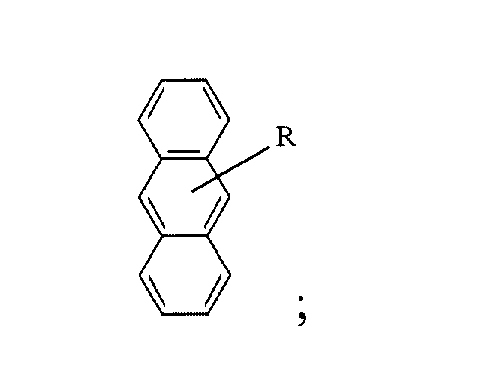
- Ar 1 and Ar 2 individually represent or wherein: R is a substituent including hydrogen, alkyl group of from 1 to 24 carbon atoms, or aryl or substituted aryl of from 6 to 28 carbon atoms, or heteroaryl or substituted heteroaryl of from 4 to 40 carbons, or a cyano group, a nitro group, a chlorine, bromine, or a fluorine atom;
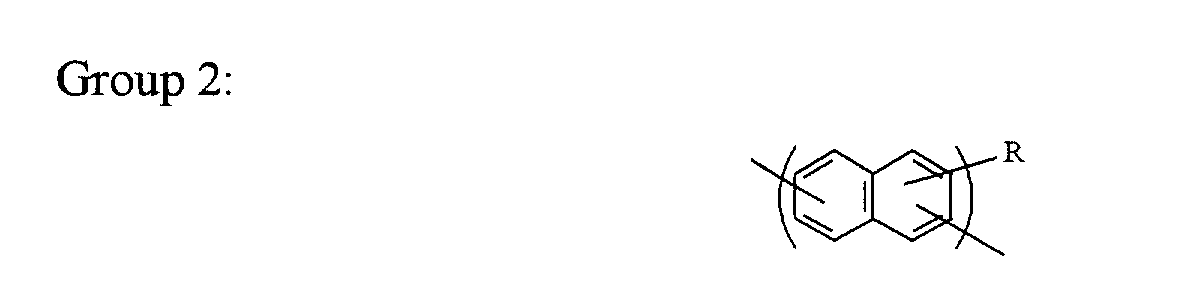
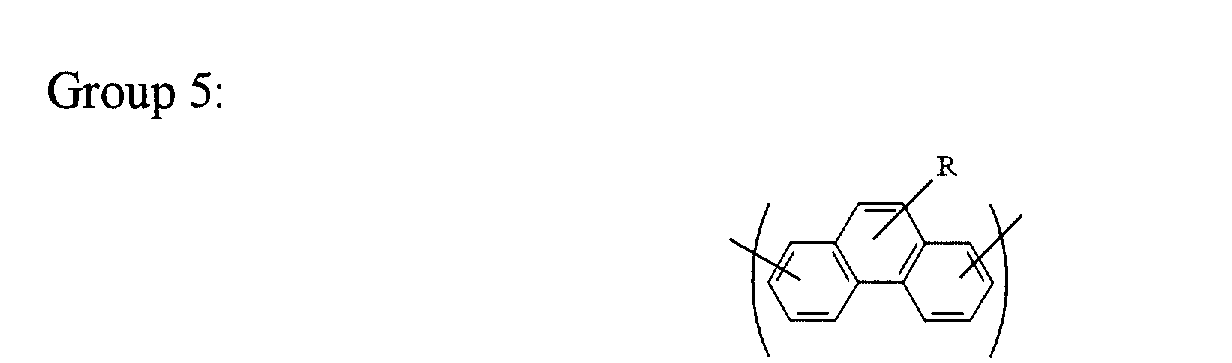
- Ar represents the following groups: wherein: R is a substituent including hydrogen, alkyl group of from 1 to 24 carbon atoms, or aryl or substituted aryl of from 6 to 28 carbon atoms, or heteroaryl or substituted heteroaryl of from 4 to 40 carbons, or a cyano group, a nitro group, a chlorine, bromine, or a fluorine atom; and m is an integer from 1 to 3; wherein: X is an O or S atom; wherein: p is an integer from 0 to 2; wherein: X 1 is an O atom or two cyano groups; wherein: R 1 is a substituent including hydrogen, alkyl group of from 1 to 24 carbon atoms, or aryl or substituted aryl of from 6 to 28 carbon atoms, or heteroaryl or substituted heteroaryl of from 4 to 40 carbons; wherein: X 2 is a nitrogen or carbon atom; wherein: R 1 is defined as above, and p is an integer from
- Ar 3 is defined as Ar, R 2 and R 3 are each independently hydrogen, alkyl group of from 1 to 24 carbon atoms, or aryl or substituted aryl of from 6 to 28 atoms, or heteroaryl or substituted heteroaryl of from 4 to 40 atoms, or a cyano group.
- R 2 and R 3 are hydrogen, or a cyano group;
- p is an integer from 0 to 2.
- Ar can be one or the combination of more than one of the above divided groups.
- the specific molecular structures can be the combination of any of the above drawn structures.
- the polymerization method and the molecular weights of the resulting polymers used in the present invention are illustrative only.
- the polymers may be prepared by condensation polymerizations, preferably by cross-coupling reactions such as the Pd-catalyzed Suzuki coupling reaction. Such a reaction was first reported by Suzuki and others on the coupling of aromatic boronic acid derivatives with aromatic halides (Suzuki, A. and others Synthetic Comm. 1981, 11(7) , 513). A modified process was reported by Inbasekaran and others to prepare conjugated polymers for EL devices (Inbasekaran, M. and others US-A-5,777,070). According to the present invention, the above mentioned polymers were prepared by Suzuki coupling reaction of an aromatic diboronic acid ester with an aromatic dibromide. The synthetic schemes for polymers and monomers are illustrated in Schemes 1-3.
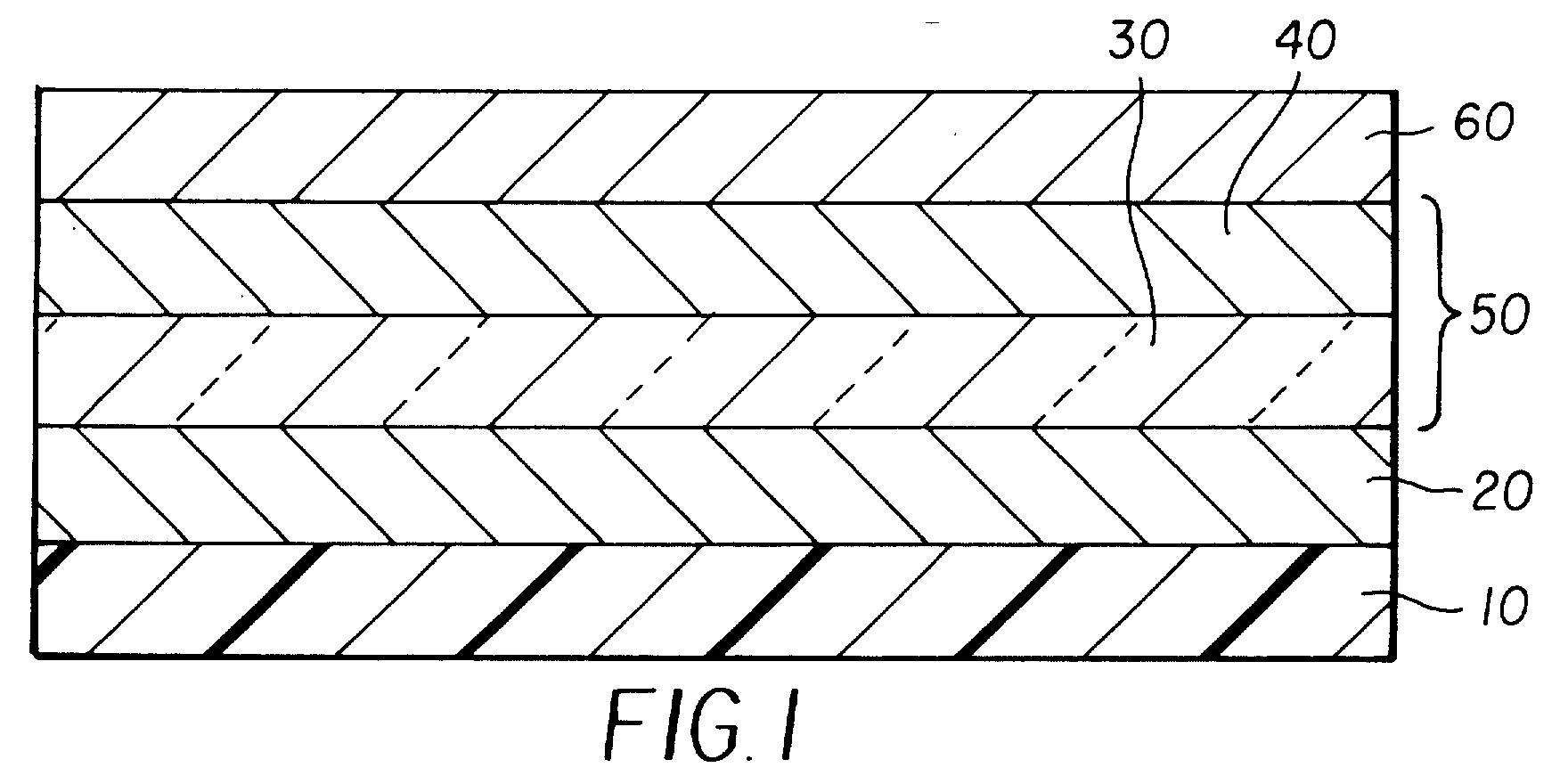
- FIG. 1 illustrates the basic structure used to construct organic EL devices. It is a bi-layer structure including a hole transport layer 30 and an electron transport layer 40.
- the electron transport layer 40 is also the emissive layer from which electroluminescence originates. Together they form the EL medium 50.
- the anode layer 20 is adjacent to the hole transport layer 30 and the cathode 60 is adjacent to the electron transport layer 40.
- the substrate is layer 10. This figure is for illustration only and the individual layer thickness is not scaled according to the actual thickness.
- FIG. 2 illustrates an alternative construction of the EL device. It is a modified bi-layer structure.
- the EL medium contains an emissive layer between the hole transport layer and the electron transport layer. This emissive layer is the layer where electroluminescence originates.
- layer 300 is the hole transport layer
- layer 400 is the emissive layer
- layer 500 is the electron transport layer
- the substrate is layer 100. This figure is for illustration only and the individual layer thickness is not scaled according to the actual thickness.
- the bi-layer EL devices are the basic structure providing high luminous efficiency and low operating voltage.
- Alternative EL device structures have been demonstrated to provide improved device performance.
- These alternative structures include features in addition to the basic bi-layer structure such as the following structure a) hole injection layer as disclosed in the commonly-assigned US-A-4,356,429; b) cathode modification with alkaline or alkaline halides as disclosed in the commonly-assigned US-A-5,776,622; c) anode modification with plasma-deposited fluorocarbons; and d) doped emitter layer inserted between the hole transport and electron transport layer as disclosed in the commonly-assigned US-A-4,769,292.
- FIG. 3 illustrates another alternative construction of an EL device. It is a single-layer structure comprising an emitting layer 3000, sandwiched between an anode 2000 and a cathode 4000. The emitting layer 3000 also acts as a charge carrier layer. Thus, single layer 3000 is the electroluminescent medium.
- the substrate is layer 1000. This figure is for illustration only and the individual layer thickness is not scaled according to the actual thickness.
- a preferred EL device structure of this invention is a single-layer structure including an anode, a cathode, and single layer of electroluminescent medium.
- This electroluminescent layer is the emissive layer, and is also capable of transporting electrons as well as holes. The principal function of this layer is to provide efficient emissive centers for electroluminescence.
- This layer can include one of the above-mentioned polymers or the blend of two or more polymers; or polymers doped with one or more fluorescent dyes (FD), phosphorescent materials, or other light-emitting material; or the above-mentioned polymers used as dopants for other EL materials; or the above-mentioned polymers finely distributed in a non-EL polymer, such as in the matrix of a thermoplastic polymer. Such distribution can improve the processing and physical properties of the polymers.
- FD fluorescent dyes
- the fluorescent dye is usually present in an amount on the order of a few molar percent or less of the host polymer and it is sufficient to cause the EL emission to be predominantly that of the fluorescent dye.
- highly efficient EL devices can be constructed.
- the color of the EL devices can be tuned using fluorescent dyes of different emission wavelengths.
- EL color characteristics of the combined spectra of the individual fluorescent dyes are produced. This dopant scheme has been described in considerable detail for EL devices in the commonly-assigned US-A-4,769,292.
- An important criterion for choosing a fluorescent dye as a dopant capable of modifying the hue of light emission when present in a host material is a comparison of their energy bandgap.
- a necessary condition is that the energy band gap of the dopant is smaller than that of the host polymer.
- the criterion is that the triplet energy of the host is larger than that of the dopants.
- Preferred fluorescent dyes used as the dopant in the emissive layer include but are not limited to coumarins, stilbenes, distrylstibenes, anthracene derivatives, tetracene, perlenes, rhodamines, and arylamines.
- Preferred phosphorescent dopants include but are not limited to organometallic iridium, platinum, palladium, or osmium compounds.
- the molecular structures of the preferred fluorescent dyes for the emissive layer in the EL device are listed as follows:
- the above-mentioned polymers can be deposited as high quality transparent thin films by spin-coating or inkjet printing the polymer solutions.
- the spin-coating technique is used to form layer 3000, and preferably, only one polymer is deposited as single layer of electroluminescent medium.
- Preferred materials are used in forming the anode modified with fluorocarbons.
- the anode can also be modified by a conducting polymer such as poly(3,4-ethylene dioxythiphene) (PEDOT) (Groenendaal, L. and others Adv. Mater. 2000, 12 , 481).
- Preferred materials for use in forming the cathode of the EL devices of this invention are Mg, Li, or alloys of these materials as disclosed in US-A-5,429,884 (Namiki and others) and the commonly-assigned US-A-5,776,622.
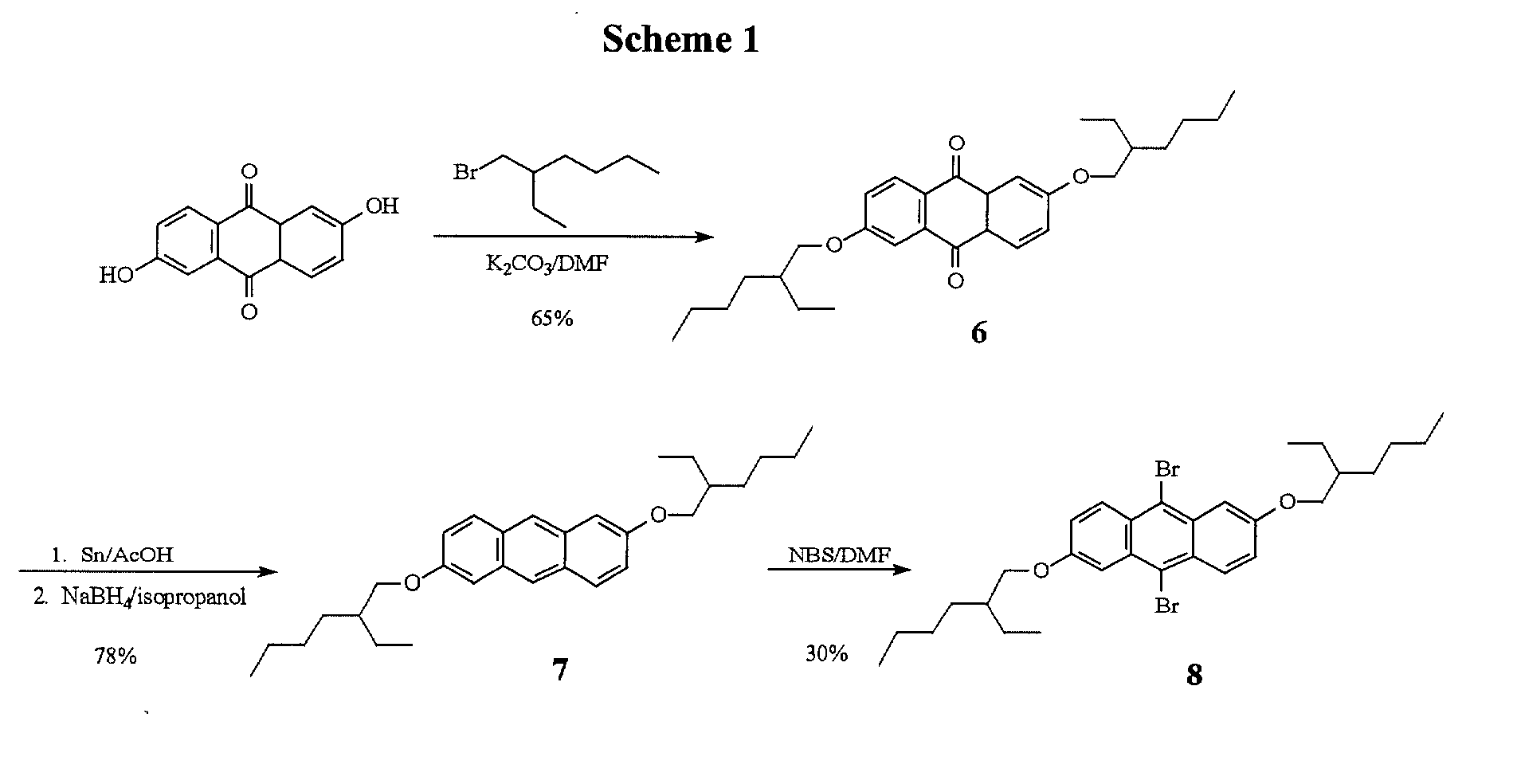
- Monomers to be used in the present invention are illustrative only. Any monomers can be used as long as the polymer formed satisfies the general formula: Typical monomer and polymer synthesis is illustrated in Schemes 1-3.
- the reaction was warmed up slightly and HI solution (47% in water, 39 mL, 0.21 mol) was added slowly to quench the reaction and to de-protect the TBDMS group.
- the deep brown reaction was heated to reflux for 10 min. and most of the solvent was removed under reduced pressure.
- the reaction mixture was then extracted with methylene chloride three times.
- the combined organic phase was washed with saturated sodium metabisulfate solution, water, and brine, and dried over MgSO 4 .
- the crude product was obtained as brown viscous oil and was purified by column chromatography on silica gel with 15/85 ether/hexane as an eluent.
- the pure product was obtained as 5.5 g of light green-yellow solid at 42% yield.
- the yellow solid was dissolved in 200 mL of isopropanol and added dropwise to a solution of NaBH 4 (6.50 g, 0.17 mol) in 300 mL of isopropanol. The reaction was heated at reflux overnight. After cooled to room temperature, the reaction was quenched with dilute HCl solution and then poured into water. The yellow precipitate was collected by filtration, washed with water and ethanol and dried to give 55.2 g of pure product as yellow powder at 78% yield in two steps.
- the reaction was heated for 13 h and bromobenzene was added to end-cap boronate group.
- the reaction was heated for another 6 h and then poured into 60 mL of methanol.
- the precipitated polymer was washed with methanol, diluted HCl solution, and dried to give light yellow polymer 0.82 g at 7% yield.
- the polymer was then extracted with acetone with a Soxhlet setup overnight to remove oligomer and residual catalyst. Polymer was re-precipitated from chloroform into methanol three times to give final polymer 0.80 g.
- Size exclusion chromatography (in THF with polystyrene as standard) analysis indicates that the polymer has a weight average molecular weight (Mw) of 9390 and a polydispersity of 1.78.
- Thermal analysis indicates that polymer has a thermal onset decomposition temperature 435 °C, and no glass transition temperature was observed before 435 °C.
- the organic EL medium has single layer of polymer thin film.
- the above sequence completed the deposition of the EL device.
- the device was then hermetically packaged in a dry glove box for protection against ambient environment.
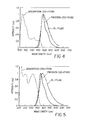
- FIGS. 4, 5 and 6 show the absorption, emission, and PL spectra of polymers 17, 20 and 4 respectively.
- EL spectra of device fabricated from polymer 17 and 20 are shown in FIG 7. Absorption and emission spectra were obtained from dilute toluene solutions, photoluminescence (PL) spectra from solid thin films of the polymers, and EL spectra were obtained from ITO(PEDOT)/polymer/Mg:Ag EL devices.
- R is a substituent including hydrogen, alkyl group of from 1 to 24 carbon atoms, or aryl or substituted aryl of from 6 to 28 carbon atoms, or heteroaryl or substituted heteroaryl of from 4 to 40 carbons, or a cyano group, a nitro group, a chlorine, bromine, or a fluorine atom.
- R is a substituent including hydrogen, alkyl group of from 1 to 24 carbon atoms, or aryl or substituted aryl of from 6 to 28 carbon atoms, or heteroaryl or substituted heteroaryl of from 4 to 40 carbons, or a cyano group, a nitro group, a chlorine, bromine, or a fluorine atom.
- R is a substituent including hydrogen, alkyl group of from 1 to 24 carbon atoms, or aryl or substituted aryl of from 6 to 28 carbon atoms, or heteroaryl or substituted heteroaryl of from 4 to 40 carbons, or a cyano group, a nitro group, a chlorine, bromine, or a fluorine atom;
- R 1 is a substituent including hydrogen, alkyl group of from 1 to 24 carbon atoms, or aryl or substituted aryl of from 6 to 28 carbon atoms, or heteroaryl or substituted heteroaryl of from 4 to 40 carbons;
- R is a substituent including hydrogen, alkyl group of from 1 to 24 carbon atoms, or aryl or substituted aryl of from 6 to 28 carbon atoms, or heteroaryl or substituted heteroaryl of from 4 to 40 carbons, or a cyano group, a nitro group, a chlorine, bromine, or a fluorine atom; wherein:
Landscapes
- Chemical & Material Sciences (AREA)
- Organic Chemistry (AREA)
- Engineering & Computer Science (AREA)
- Materials Engineering (AREA)
- Health & Medical Sciences (AREA)
- Chemical Kinetics & Catalysis (AREA)
- Medicinal Chemistry (AREA)
- Polymers & Plastics (AREA)
- Electroluminescent Light Sources (AREA)
- Polyoxymethylene Polymers And Polymers With Carbon-To-Carbon Bonds (AREA)
- Organic Low-Molecular-Weight Compounds And Preparation Thereof (AREA)
Abstract

Description
- The present invention relates to electroluminescent (EL) devices having diarylanthracene polymers.
- Electroluminescent (EL) devices such as light emitting diode (LED) are opto-electronic devices which radiate light on the application of an electrical field. Organic materials including both polymers and small molecules have been used to fabricate LEDs. LEDs fabricated from these materials offer several advantages over other technologies, such as simpler manufacturing, low operating voltages, and the possibility of producing large area and full-color displays. Organic polymers generally offer significant processing advantages over small molecules especially for large area EL display because polymer films can be easily produced by casting from solution.
- Conjugated polymers are a class of polymers that possess an extended π-bond network along polymer main chain. Their electronic states can delocalize caused by the effect of the electron-lattice and electron-electron interactions. Conjugated polymers such as poly(phenylvinylene) (PPV) were first introduced as EL materials by Burroughes and others in 1990 (Burroughes, J. H. Nature 1990, 347, 539-41). To improve the polymer solubility, dialkoxy-substituted PPV such as poly(2,5-dialkoxy-p-phenylenevinylene) and MEH-PPV, poly[2-methoxy-5-(2'-ethyl-hexoxyl)-p-phenylenevinylene] have been developed. EL efficiency has been improved by balanced electron-hole injection and recombination of the charge carriers. Other conjugated polymers such as polydialkylfluorene (PF) (Ohmori, Y. and others Jpn. J. Appl. Phys. Part 2 1991, 20, L1941-L1943), poly(p-phenylene) (PPP) (Grem, G. and others Adv. Mater. 1992, 4, 36-7), and poly(thiophene) (Ohmori, Y. and others Solid State Commun. 1991, 80, 605) have also been studied.
- The light-emitting layer of an EL device comprises a highly luminescent material where electroluminescence is produced as a result of electron-hole pair recombination in this region. In order to achieve efficient light output the efficient and highly fluorescent materials are required. 9,10-Diaryl substituted anthracenes are well known for their high fluorescence efficiency. The highly efficient light output and high operational stability of EL devices have been disclosed in commonly assigned US-A-5,935,721 and US-A-5,972,247 by using substituted anthracenes as light-emitting materials.
- It is an object of the present invention to provide luminescent polymeric materials useful for polymer EL devices.
- It is a further object of the present invention to provide various energy bandgap luminescent polymers which emit broad range of color.
- A new class of anthracene-based polymers has been discovered for use in electroluminescent devices.
- These objects are achieved in an electroluminescent device comprises an anode, a cathode, and an emissive layer having a polymer luminescent material disposed between the anode and cathode, the polymer luminescent material includes diarylanthracene-based conjugated polymer having a repeating unit of the following formula:wherein:
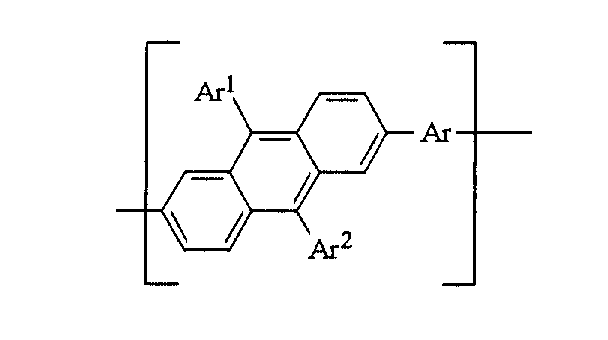
- Ar1, Ar2, and Ar are each individually aryl or substituted aryl of from 6 to 40 carbon atoms; or
- Ar1, Ar2, and Ar are each individually substituted heteroaryl or unsubstituted heteroaryl having 4 to 40 carbons.
-
- The present invention provides light-emitting materials with a number of advantages that include good solubility, efficiency and stability. The emitting color of the polymer can be easily tuned by the incorporation of desired Ar group. Furthermore, other electro-optical properties can also be tuned with Ar group. The materials from the present invention can also be used as host materials for other light emitting materials.
- FIG. 1 illustrates in cross-section a bi-layer EL device which can use a polymer in accordance with the present invention;
- FIG. 2 illustrates a cross-section of a modified bi-layer EL device which can use a polymer in accordance with the present invention;
- FIG. 3 illustrates a cross-section of a single-layer EL device which can use a polymer in accordance with the present invention;
- FIG. 4 illustrates the absorption, emission, and photoluminescence
spectra of
polymer 17; - FIG. 5 illustrates the absorption, emission, and photoluminescence
spectra of
polymer 20; - FIG. 6 illustrates the absorption, emission, and photoluminescence spectra of polymer 4; and
- FIG. 7 illustrates the electroluminescence spectra of single-layer
EL device fabricated from
polymers -
- The present invention provides light emitting polymers containing diarylanthracene with good solubility and thermal stability as shown in formula I. The rigid chromophore in the polymer main chain increases the rigidity of the polymer backbone and improves thermal properties. Polymers containing such chromophore are highly fluorescent and efficient light emitting materials. Incorporation of the Ar group has the following features:
- 1) to further improve solubility of the polymer;
- 2) to achieve balanced electron-hole injection and recombination of the charge carriers;
- 3) to improve electron or hole transporting ability; and
- 4) to improve the emitting hue of the polymer.
-
- The polymer shown in formula I is a homopolymer or a copolymer containing a diarylanthracene repeating unit.wherein:
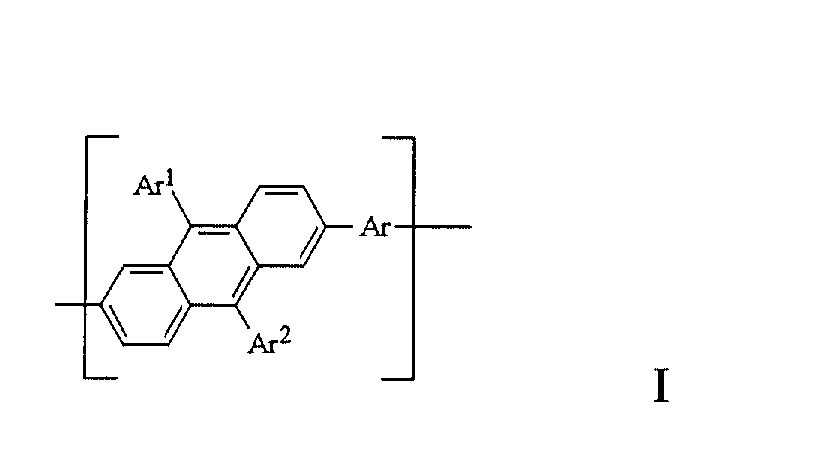
- Ar1, Ar2, and Ar are each individually aryl or substituted aryl of from 6 to 40 carbon atoms; or
- Ar1, Ar2, and Ar are each individually substituted heteroaryl or unsubstituted heteroaryl having 4 to 40 carbons;
-
- For example, Ar1 and Ar2 individually represent


 or
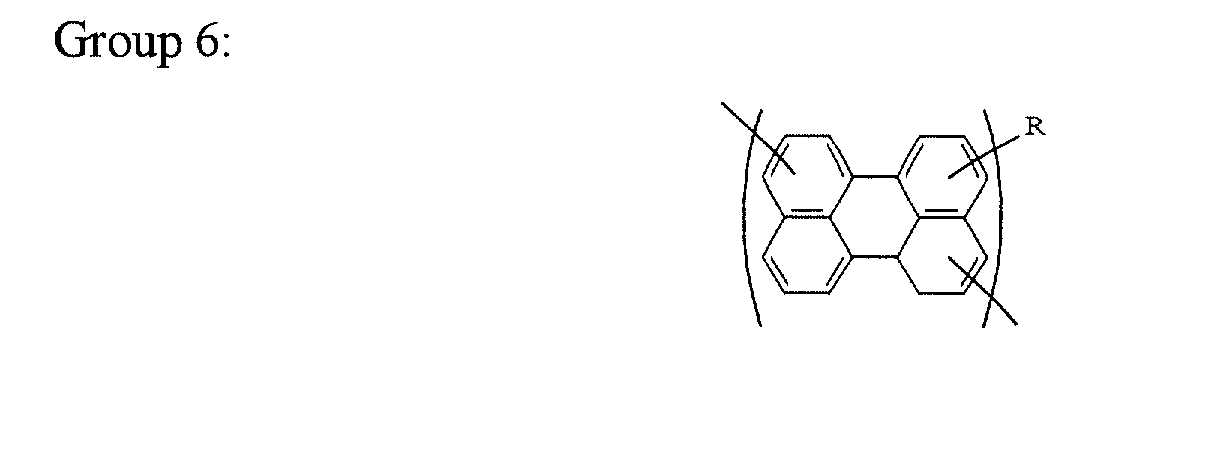
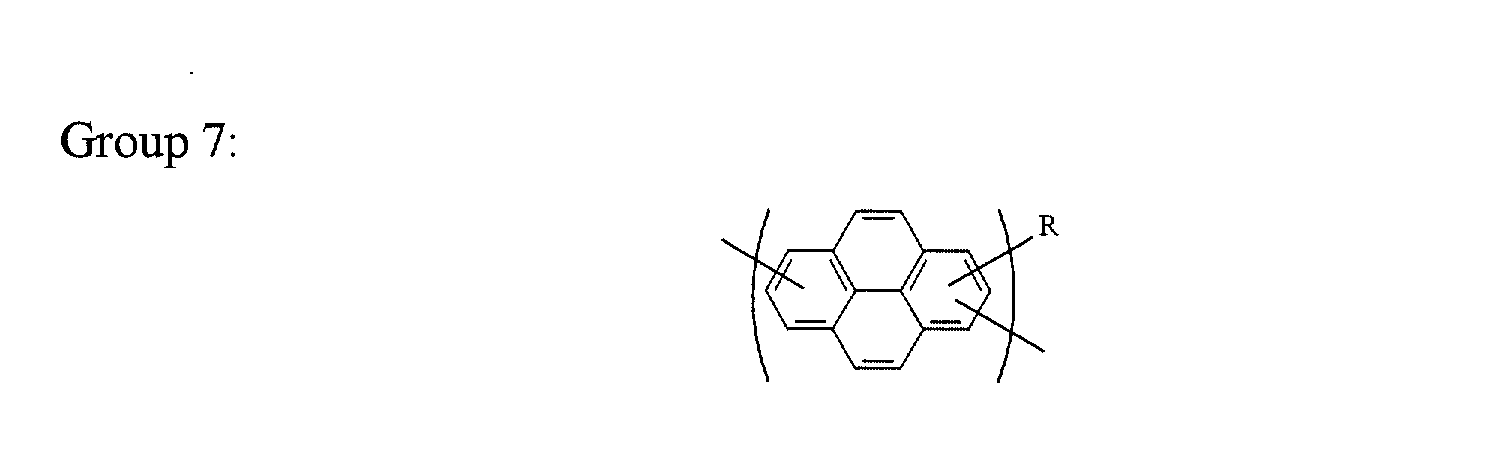
or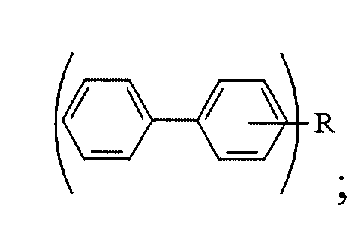 wherein: R is a substituent including hydrogen, alkyl group of from 1 to 24 carbon atoms, or aryl or substituted aryl of from 6 to 28 carbon atoms, or heteroaryl or substituted heteroaryl of from 4 to 40 carbons, or a cyano group, a nitro group, a chlorine, bromine, or a fluorine atom;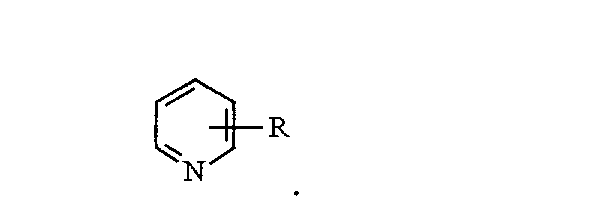
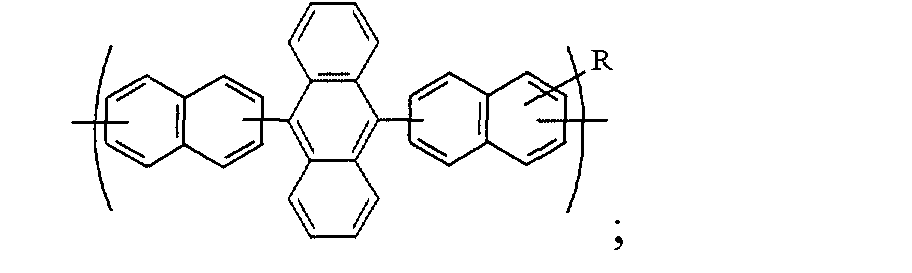
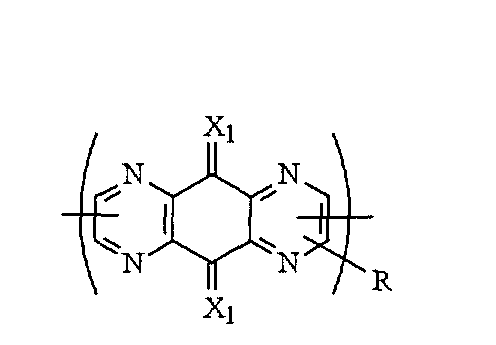
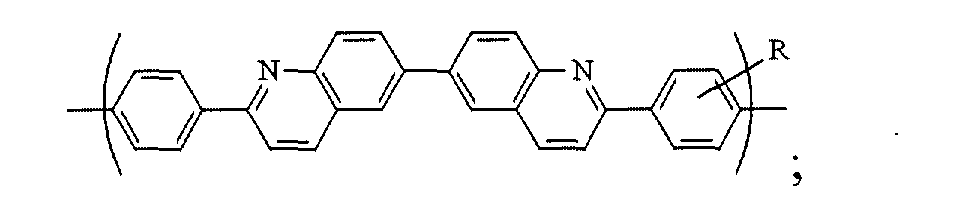
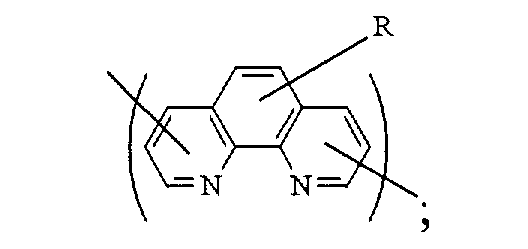
- Ar represents the following groups:wherein: R is a substituent including hydrogen, alkyl group of from 1 to 24 carbon atoms, or aryl or substituted aryl of from 6 to 28 carbon atoms, or heteroaryl or substituted heteroaryl of from 4 to 40 carbons, or a cyano group, a nitro group, a chlorine, bromine, or a fluorine atom; and m is an integer from 1 to 3;




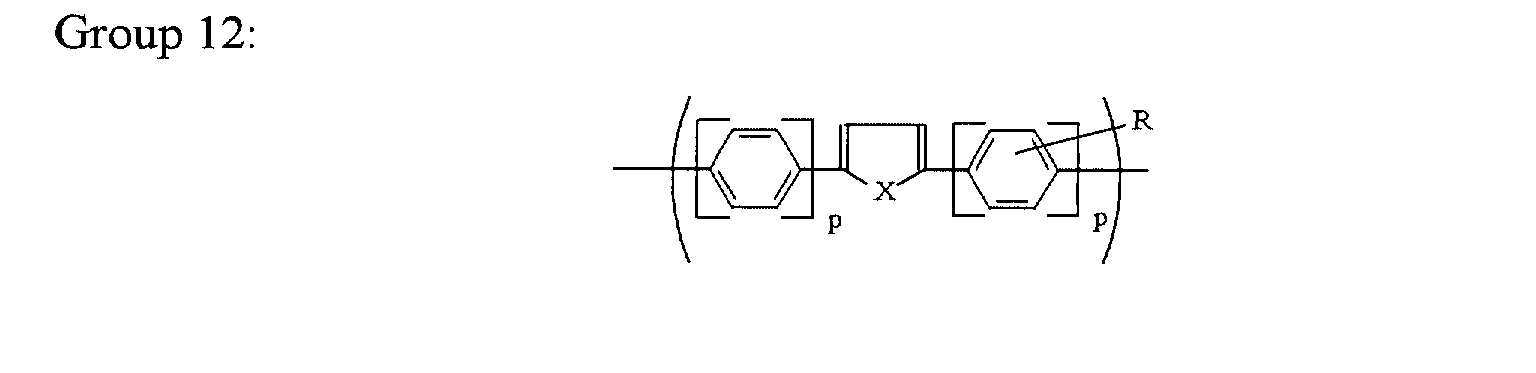
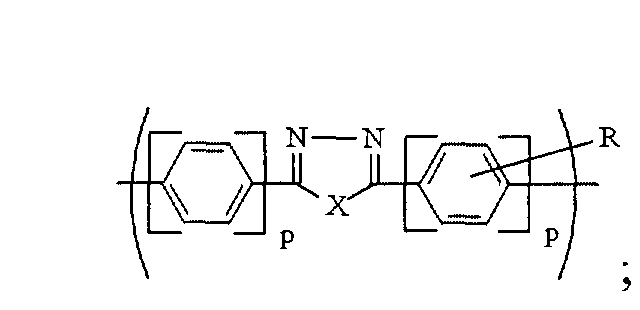
 wherein: X is an O or S atom;
 wherein: p is an integer from 0 to 2;

 wherein: X1 is an O atom or two cyano groups;
 wherein: R1 is a substituent including hydrogen, alkyl group of from 1 to 24 carbon atoms, or aryl or substituted aryl of from 6 to 28 carbon atoms, or heteroaryl or substituted heteroaryl of from 4 to 40 carbons;
 wherein: X2 is a nitrogen or carbon atom;


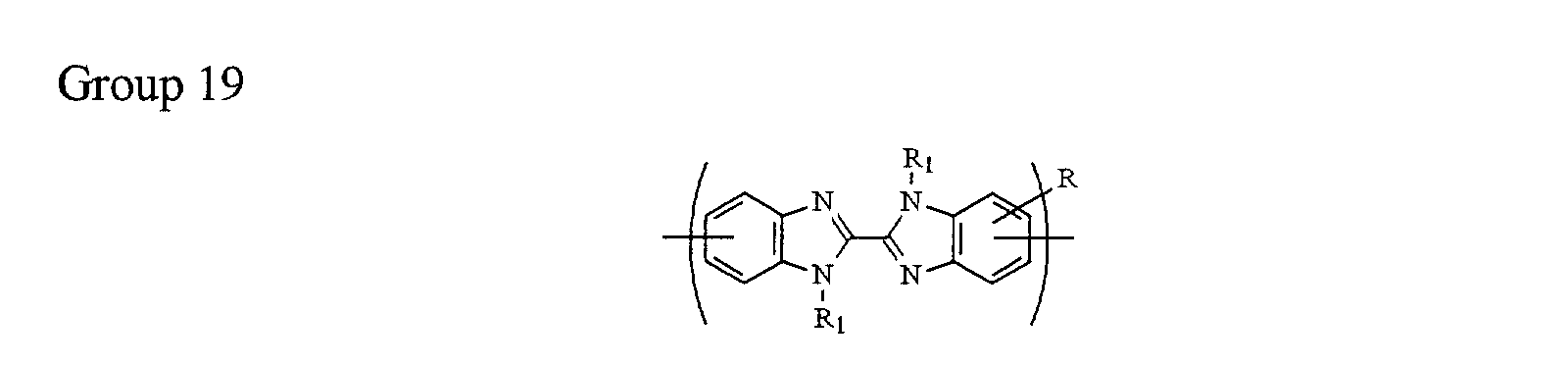

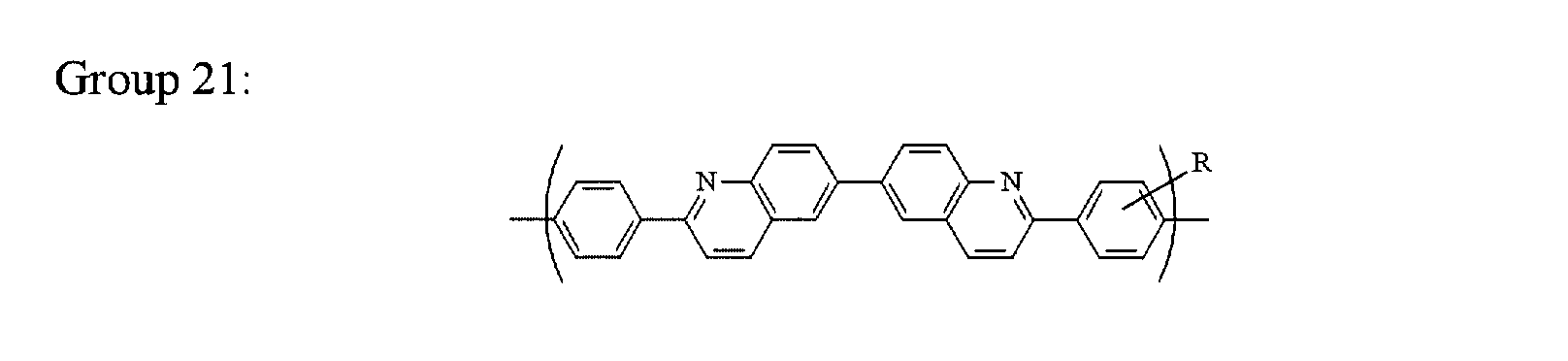
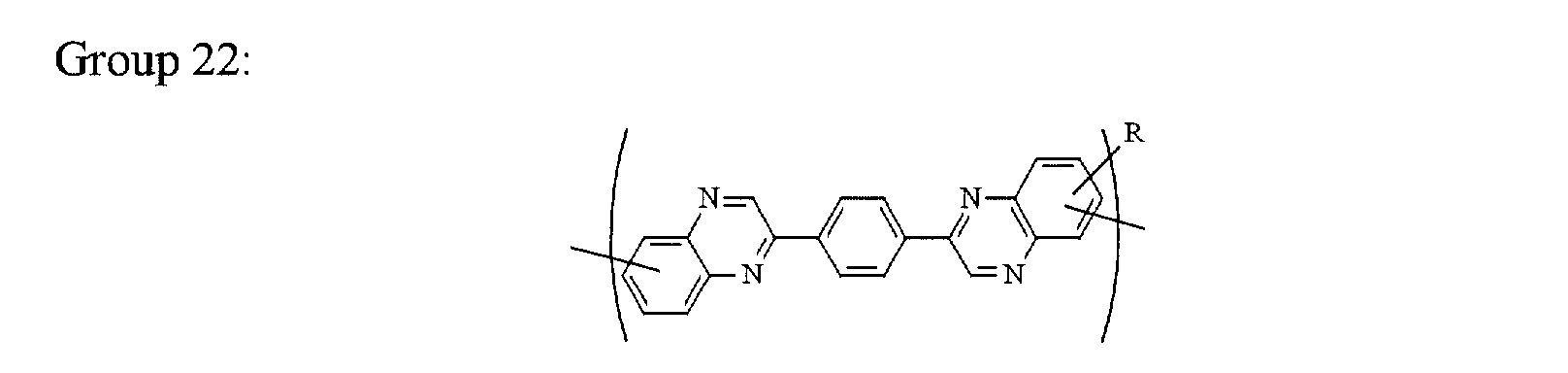
 wherein: R1 is defined as above, and p is an integer from 0 to 2.
 wherein: Ar3 is defined as Ar, R2 and R3 are each independently hydrogen, alkyl group of from 1 to 24 carbon atoms, or aryl or substituted aryl of from 6 to 28 atoms, or heteroaryl or substituted heteroaryl of from 4 to 40 atoms, or a cyano group. Preferably, R2 and R3 are hydrogen, or a cyano group; p is an integer from 0 to 2.
- The following molecular structures constitute specific examples of preferred polymers satisfying the requirement of this invention:
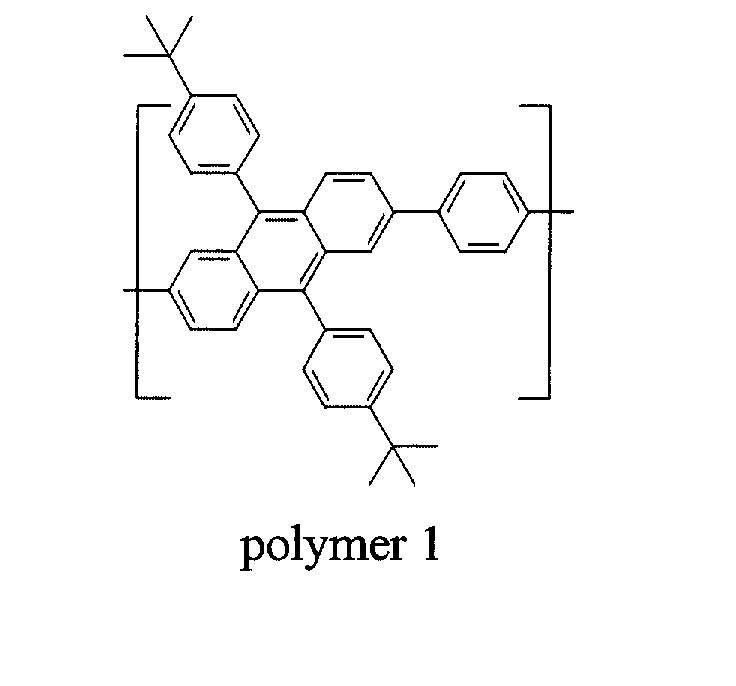


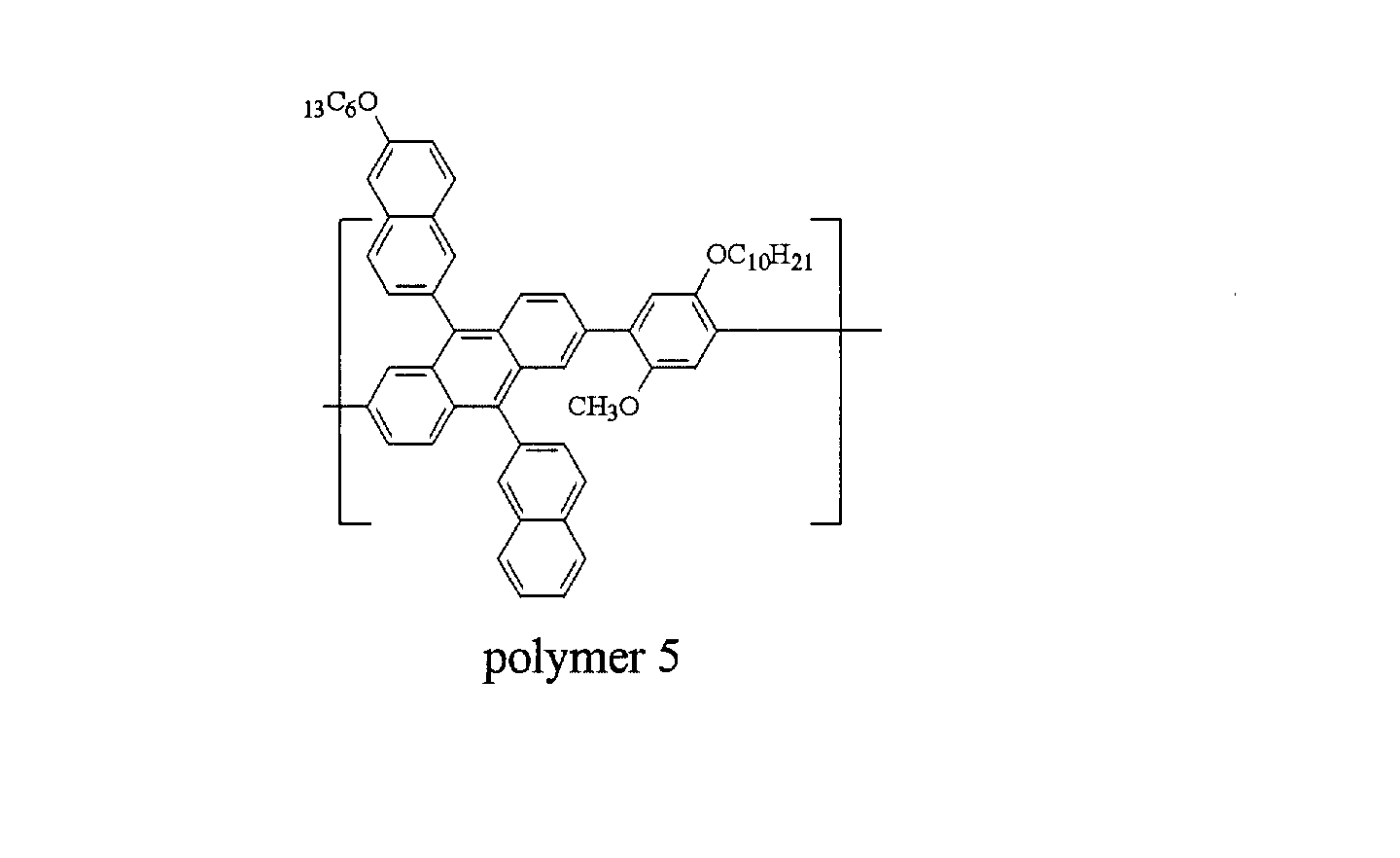
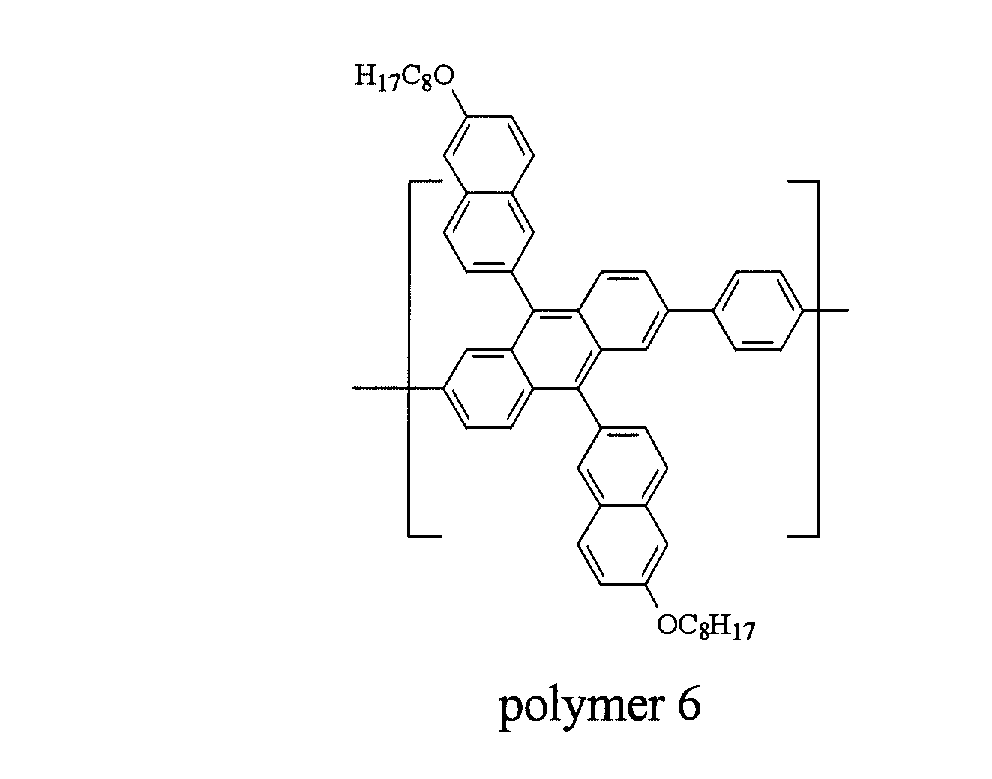


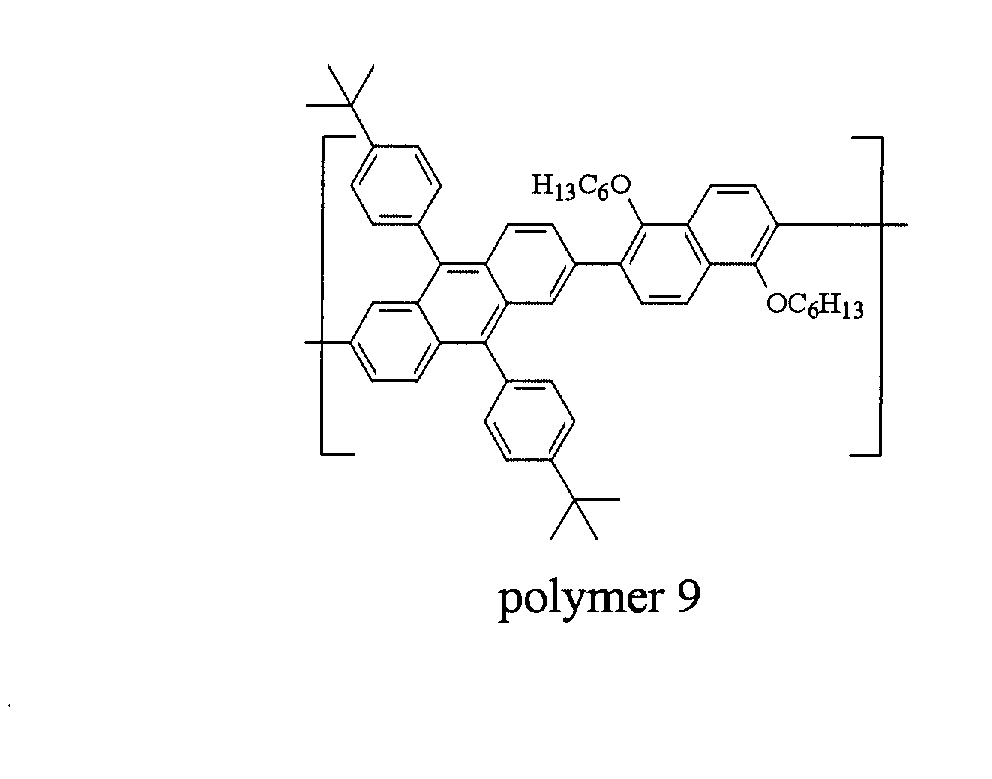
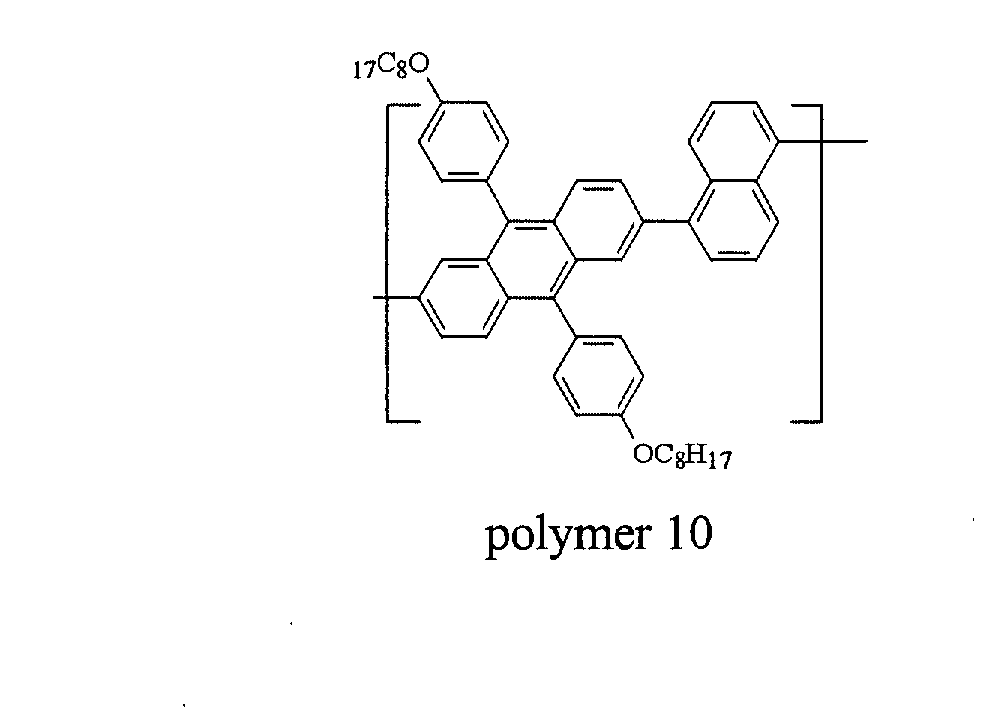
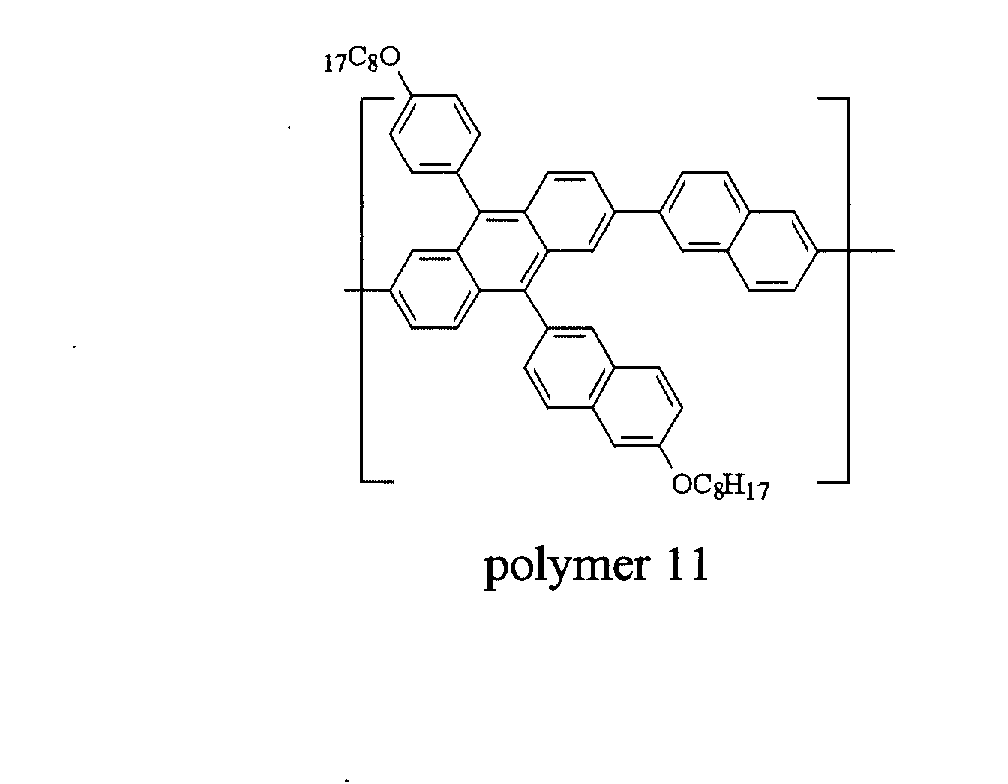


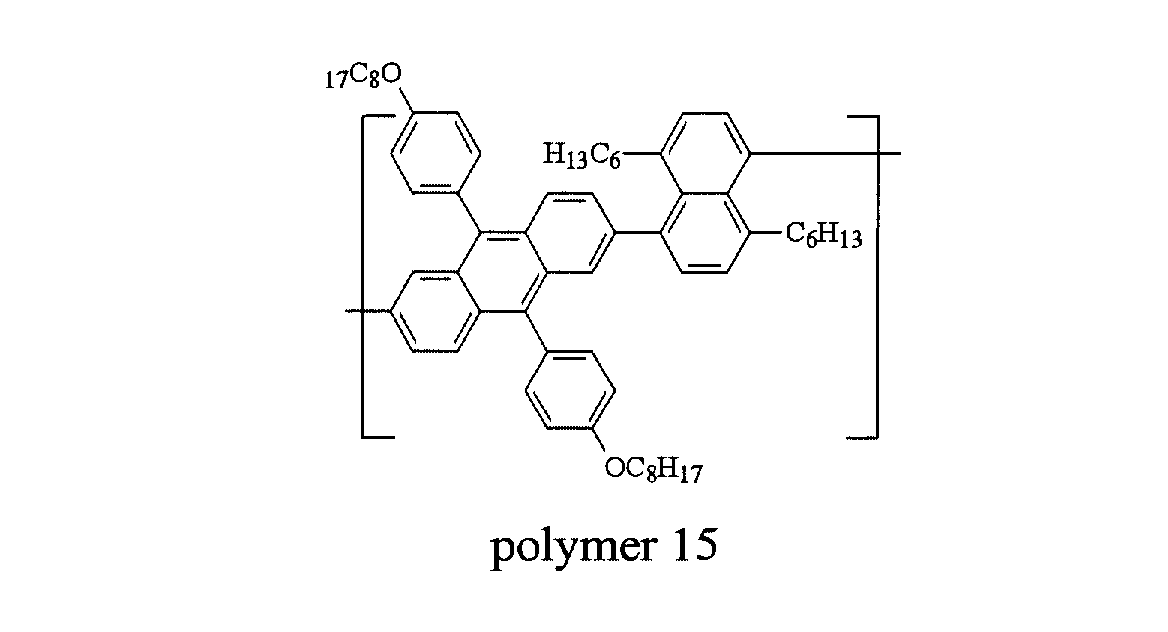
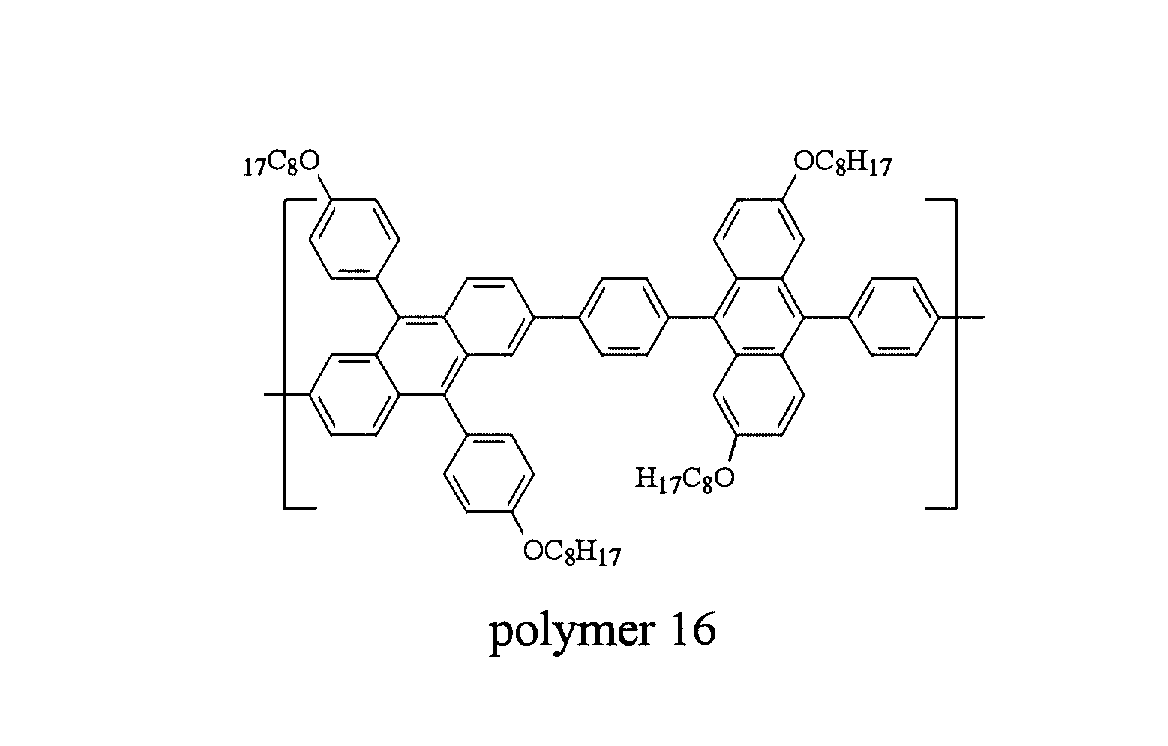

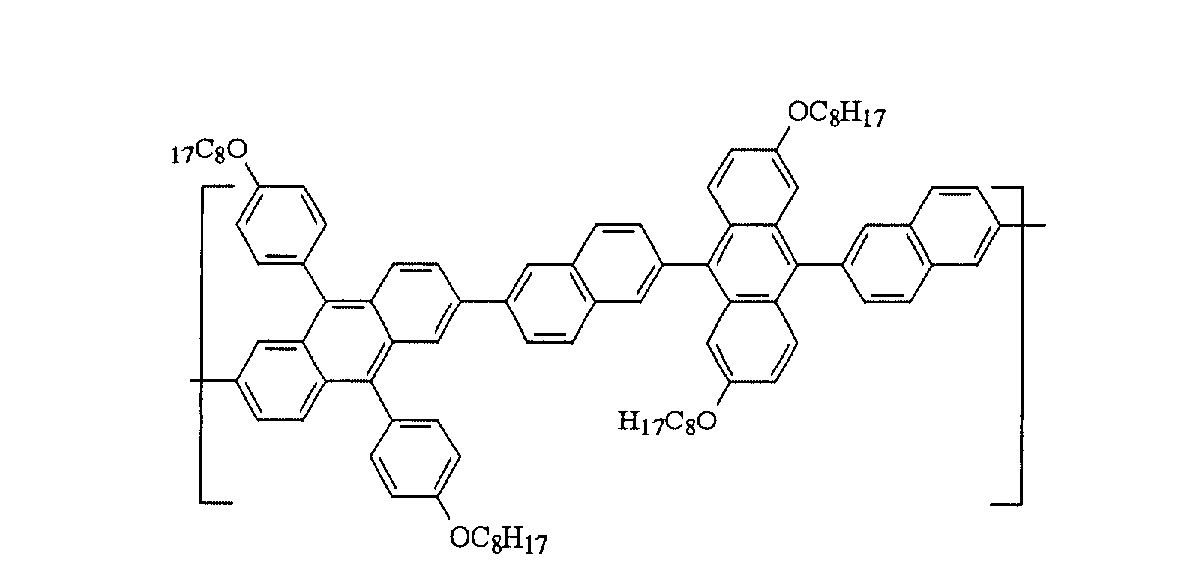


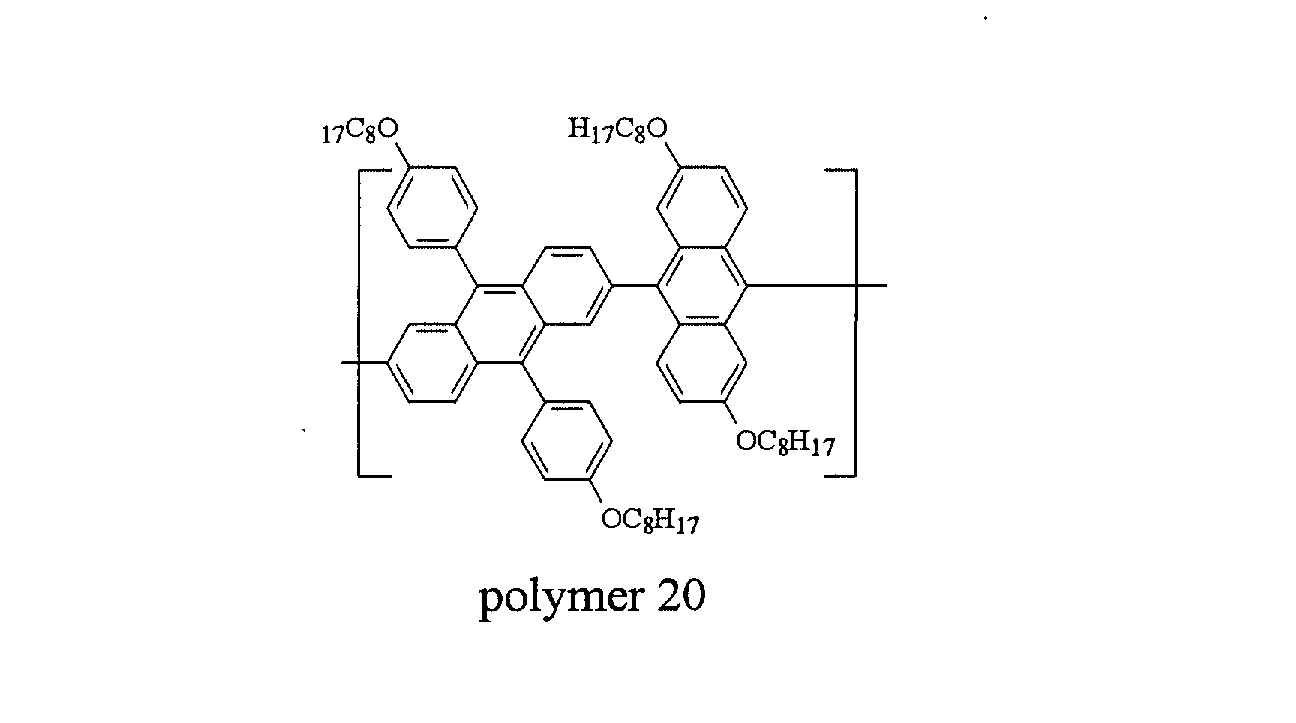
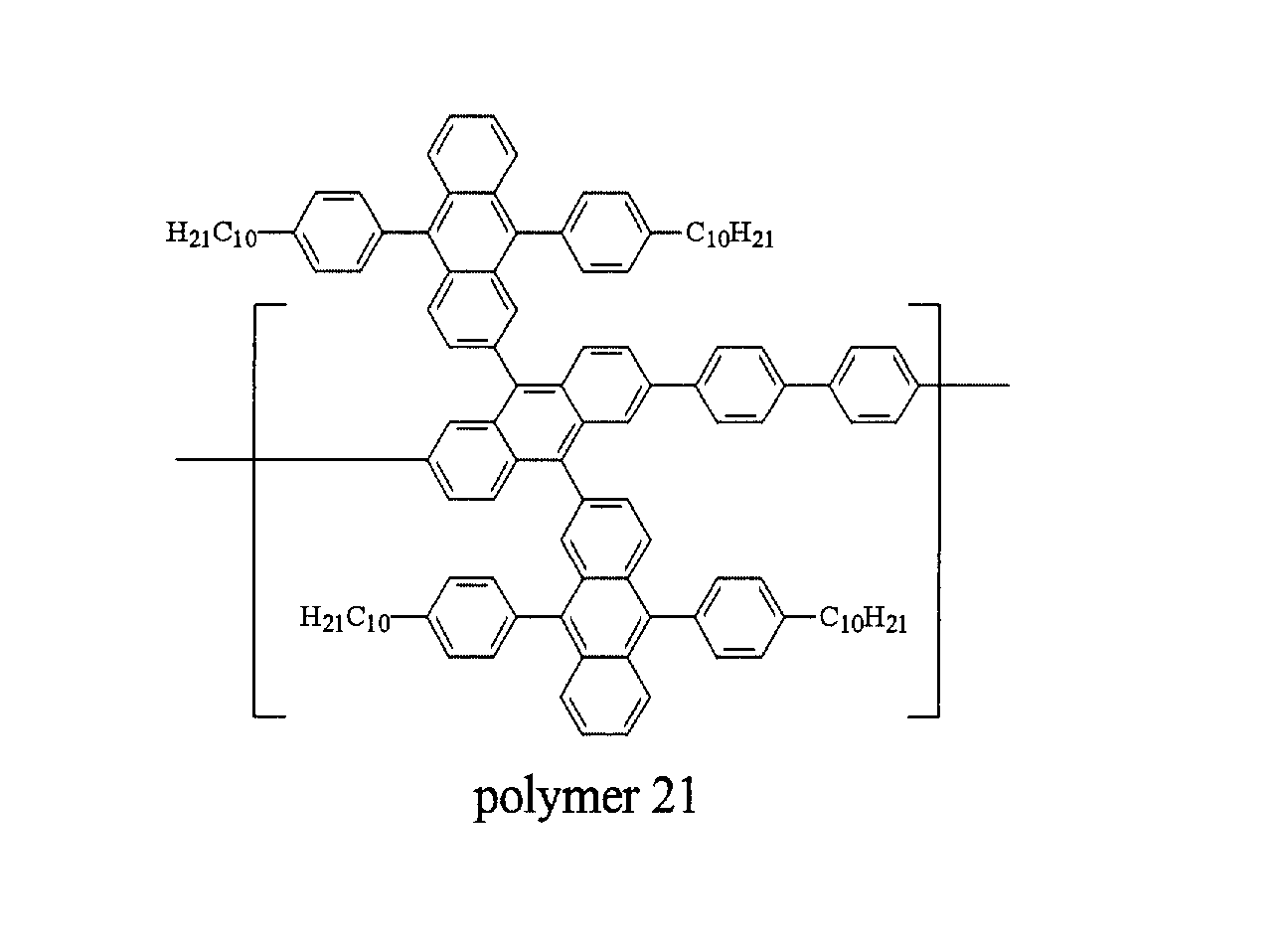

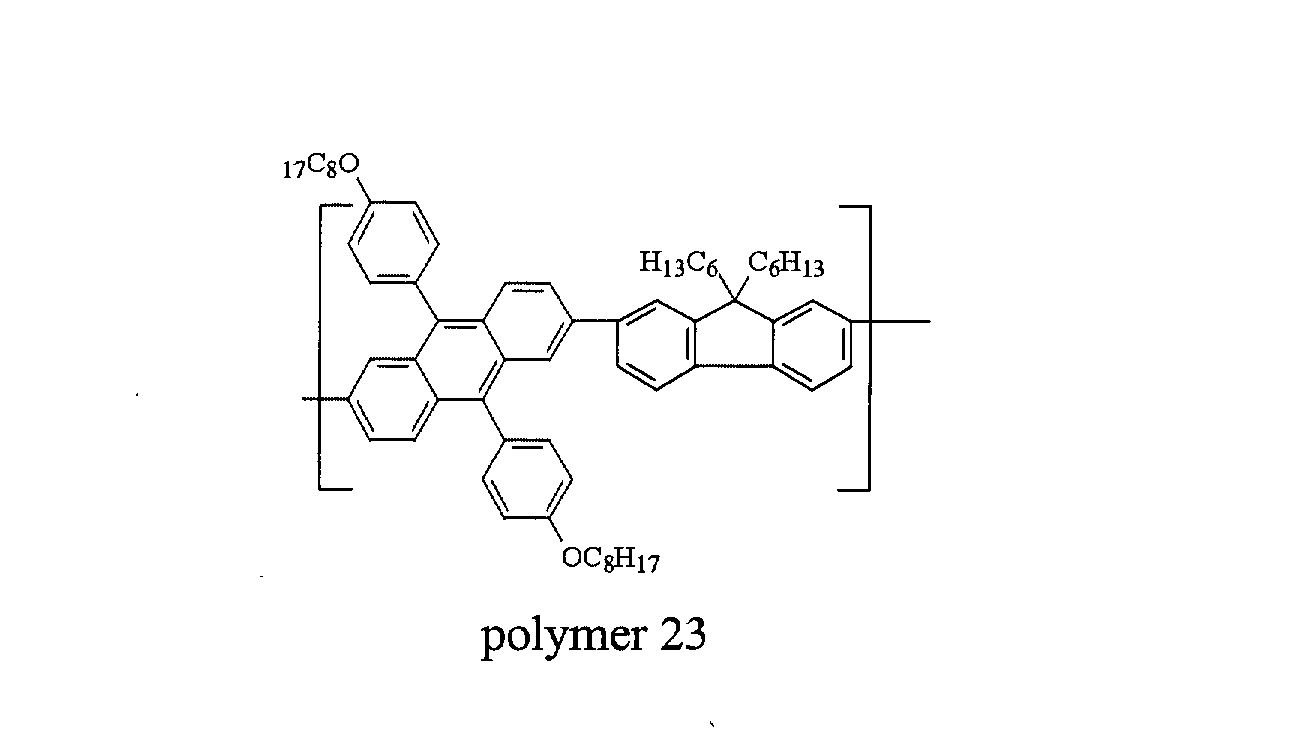


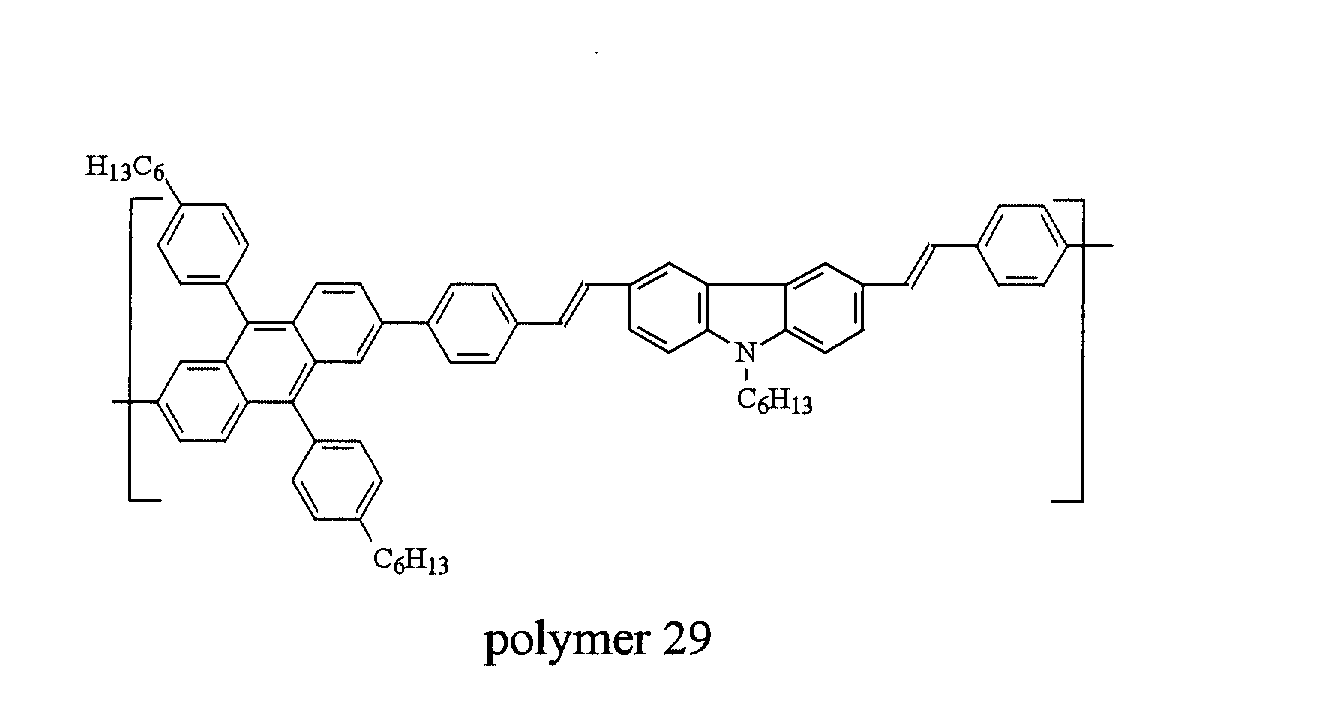


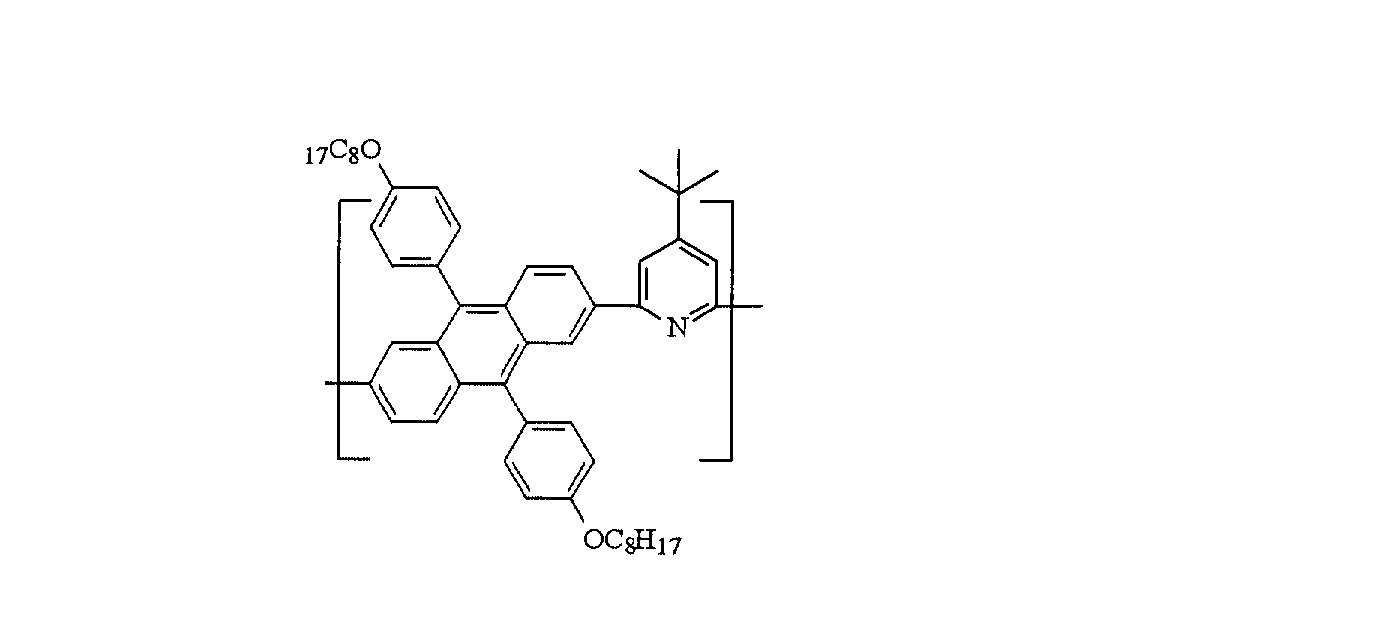

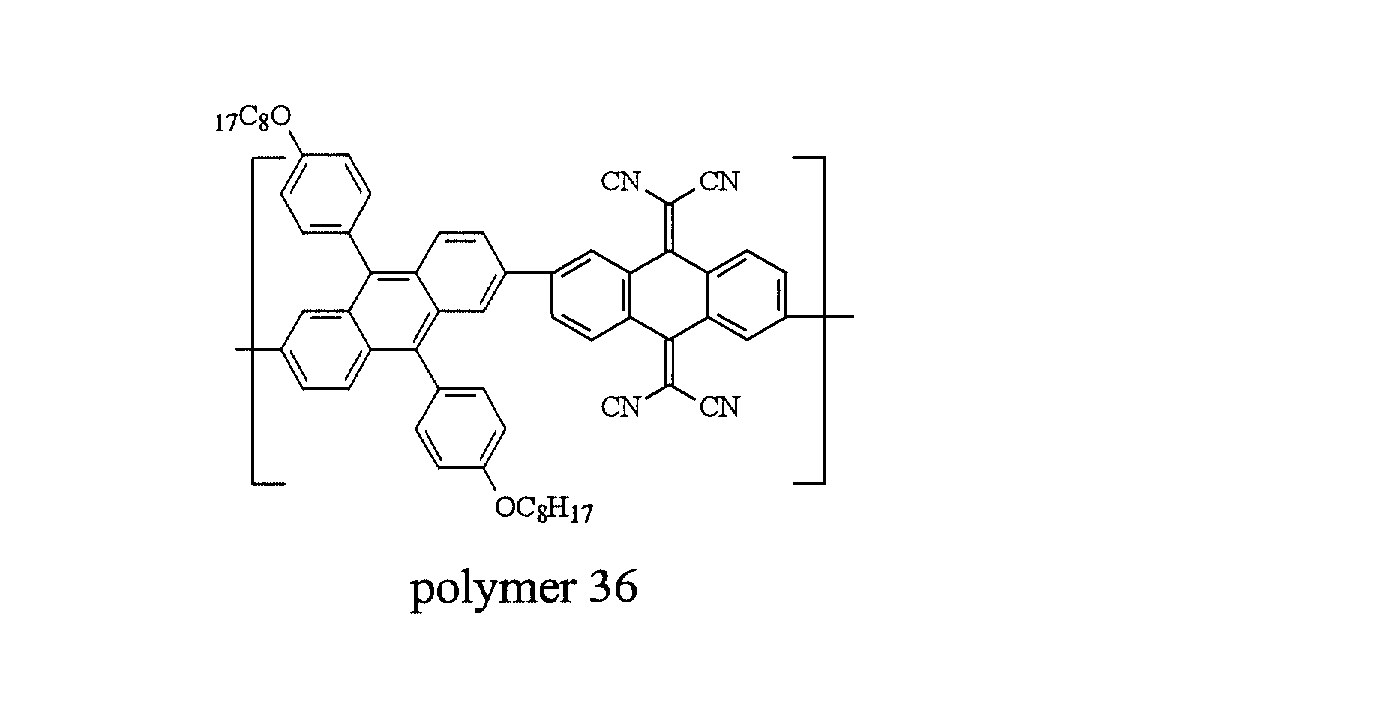
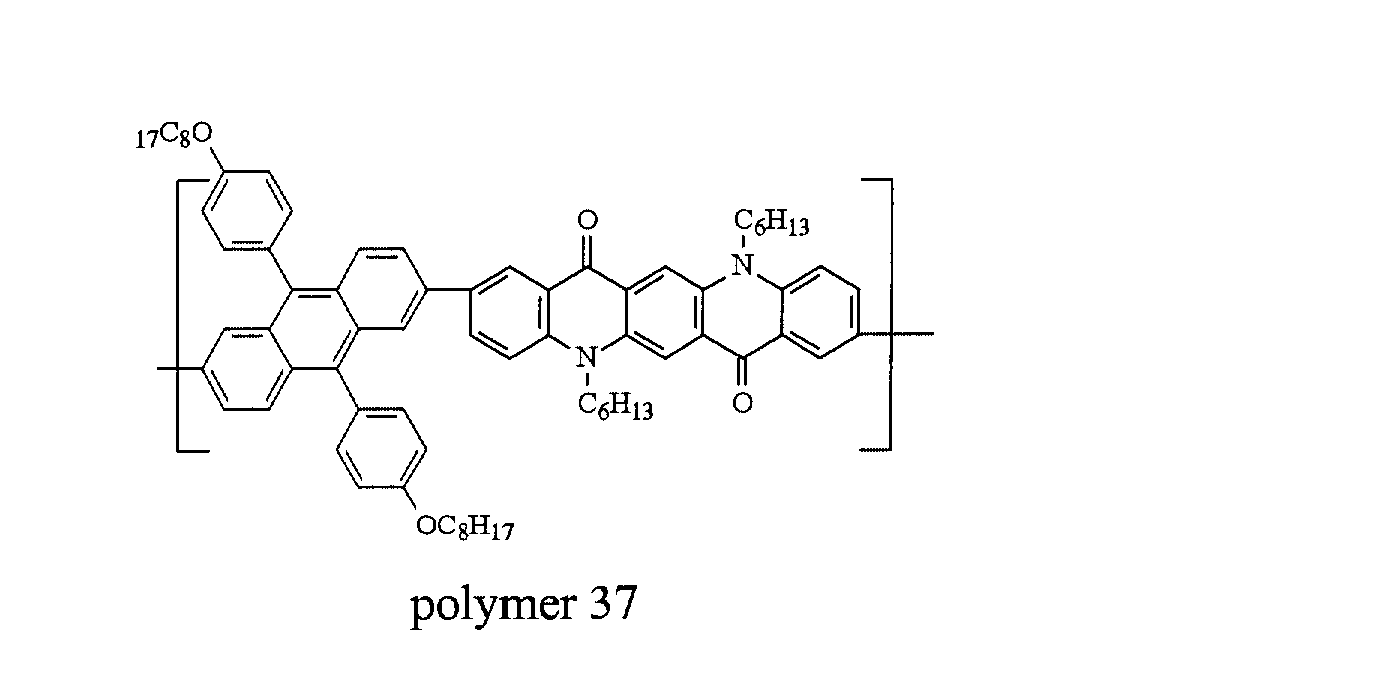


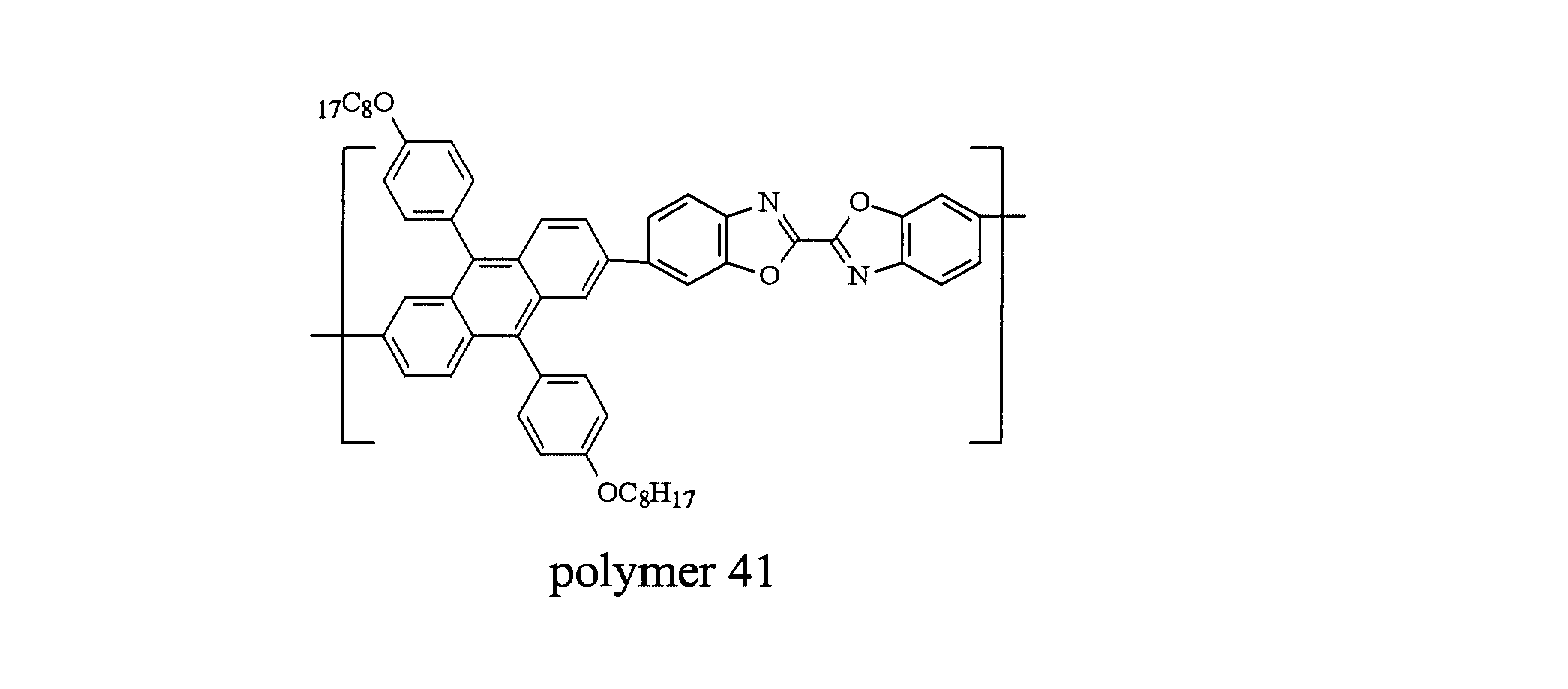


- In formula I:

- Ar can be one or the combination of more than one of the above divided groups. The specific molecular structures can be the combination of any of the above drawn structures.
- The polymerization method and the molecular weights of the resulting polymers used in the present invention are illustrative only. The polymers may be prepared by condensation polymerizations, preferably by cross-coupling reactions such as the Pd-catalyzed Suzuki coupling reaction. Such a reaction was first reported by Suzuki and others on the coupling of aromatic boronic acid derivatives with aromatic halides (Suzuki, A. and others Synthetic Comm. 1981, 11(7), 513). A modified process was reported by Inbasekaran and others to prepare conjugated polymers for EL devices (Inbasekaran, M. and others US-A-5,777,070). According to the present invention, the above mentioned polymers were prepared by Suzuki coupling reaction of an aromatic diboronic acid ester with an aromatic dibromide. The synthetic schemes for polymers and monomers are illustrated in Schemes 1-3.
- FIG. 1 illustrates the basic structure used to construct organic EL devices. It is a bi-layer structure including a
hole transport layer 30 and anelectron transport layer 40. Theelectron transport layer 40 is also the emissive layer from which electroluminescence originates. Together they form theEL medium 50. Theanode layer 20 is adjacent to thehole transport layer 30 and thecathode 60 is adjacent to theelectron transport layer 40. The substrate islayer 10. This figure is for illustration only and the individual layer thickness is not scaled according to the actual thickness. - FIG. 2 illustrates an alternative construction of the EL device. It is a modified bi-layer structure. The EL medium contains an emissive layer between the hole transport layer and the electron transport layer. This emissive layer is the layer where electroluminescence originates. Thus,
layer 300 is the hole transport layer,layer 400 is the emissive layer,layer 500 is the electron transport layer, and together they form theelectroluminescent medium 600.Layer 200 is the anode andlayer 700 is the cathode. The substrate islayer 100. This figure is for illustration only and the individual layer thickness is not scaled according to the actual thickness. - The bi-layer EL devices are the basic structure providing high luminous efficiency and low operating voltage. Alternative EL device structures have been demonstrated to provide improved device performance. These alternative structures include features in addition to the basic bi-layer structure such as the following structure a) hole injection layer as disclosed in the commonly-assigned US-A-4,356,429; b) cathode modification with alkaline or alkaline halides as disclosed in the commonly-assigned US-A-5,776,622; c) anode modification with plasma-deposited fluorocarbons; and d) doped emitter layer inserted between the hole transport and electron transport layer as disclosed in the commonly-assigned US-A-4,769,292.
- FIG. 3 illustrates another alternative construction of an EL device. It is a single-layer structure comprising an emitting
layer 3000, sandwiched between ananode 2000 and acathode 4000. The emittinglayer 3000 also acts as a charge carrier layer. Thus,single layer 3000 is the electroluminescent medium. The substrate islayer 1000. This figure is for illustration only and the individual layer thickness is not scaled according to the actual thickness. - A preferred EL device structure of this invention is a single-layer structure including an anode, a cathode, and single layer of electroluminescent medium. This electroluminescent layer is the emissive layer, and is also capable of transporting electrons as well as holes. The principal function of this layer is to provide efficient emissive centers for electroluminescence. This layer can include one of the above-mentioned polymers or the blend of two or more polymers; or polymers doped with one or more fluorescent dyes (FD), phosphorescent materials, or other light-emitting material; or the above-mentioned polymers used as dopants for other EL materials; or the above-mentioned polymers finely distributed in a non-EL polymer, such as in the matrix of a thermoplastic polymer. Such distribution can improve the processing and physical properties of the polymers.
- The fluorescent dye is usually present in an amount on the order of a few molar percent or less of the host polymer and it is sufficient to cause the EL emission to be predominantly that of the fluorescent dye. Using this method, highly efficient EL devices can be constructed. Simultaneously, the color of the EL devices can be tuned using fluorescent dyes of different emission wavelengths. By using a mixture of fluorescent dyes, EL color characteristics of the combined spectra of the individual fluorescent dyes are produced. This dopant scheme has been described in considerable detail for EL devices in the commonly-assigned US-A-4,769,292. An important criterion for choosing a fluorescent dye as a dopant capable of modifying the hue of light emission when present in a host material is a comparison of their energy bandgap. For efficient energy transfer from the host to the dopant molecule, a necessary condition is that the energy band gap of the dopant is smaller than that of the host polymer. For efficient energy transfer from the host to phosphorescent dopants, the criterion is that the triplet energy of the host is larger than that of the dopants. Preferred fluorescent dyes used as the dopant in the emissive layer include but are not limited to coumarins, stilbenes, distrylstibenes, anthracene derivatives, tetracene, perlenes, rhodamines, and arylamines. Preferred phosphorescent dopants include but are not limited to organometallic iridium, platinum, palladium, or osmium compounds.
- The molecular structures of the preferred fluorescent dyes for the emissive layer in the EL device are listed as follows:

- FD 1 R=H
- FD 2 R=CO2Pr-i

- FD 3 R=H, R'=t-Bu
- FD 4 R=R'=t-Bu
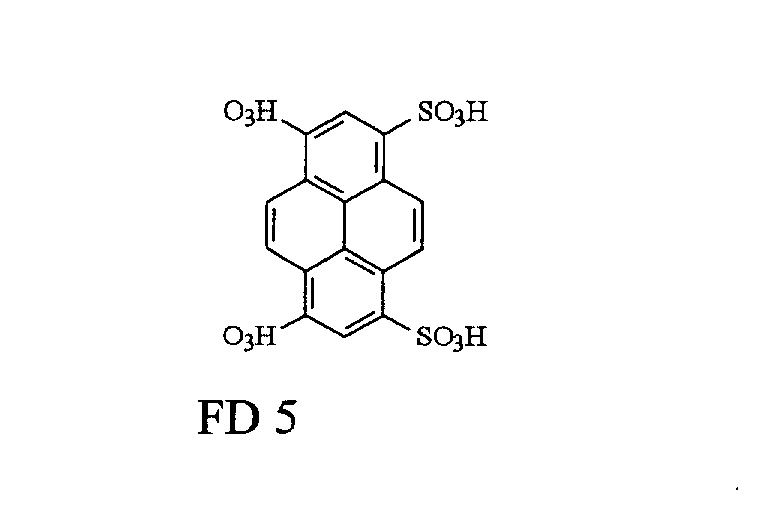
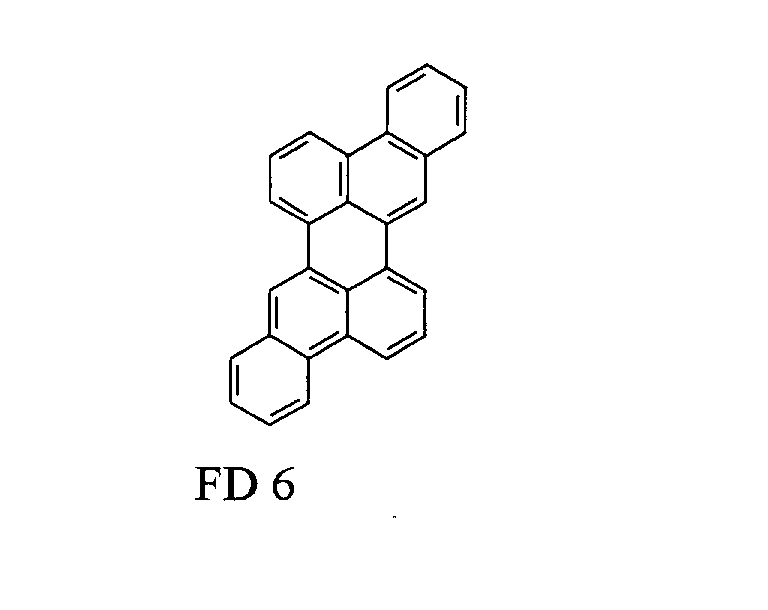


- FD 8 R=H
- FD 9 R=Me
- FD 10 R=Pr-i
- FD 11 R=2-ethylhexyl
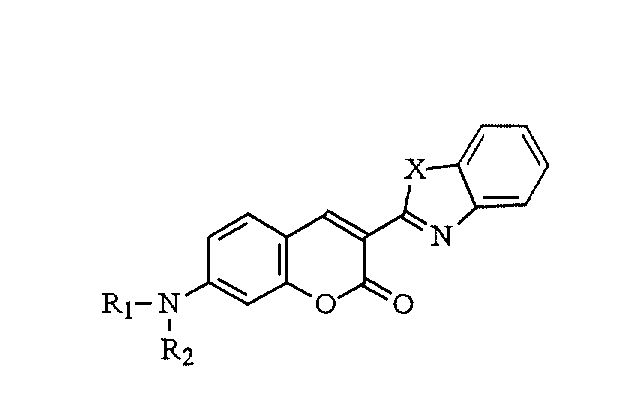
- FD 12 R1=R2=Me, X=O
- FD 12 R1=R2=Me, X=O
- FD 13 R1=R2=hexyl, X=O
- FD 14 R1=R2=phenyl, X=O
- FD 15 R1=R2=Me, X=S
- FD 16 R1=R2=hexyl, X=S
- FD 17 R1=R2=phenyl, X=S
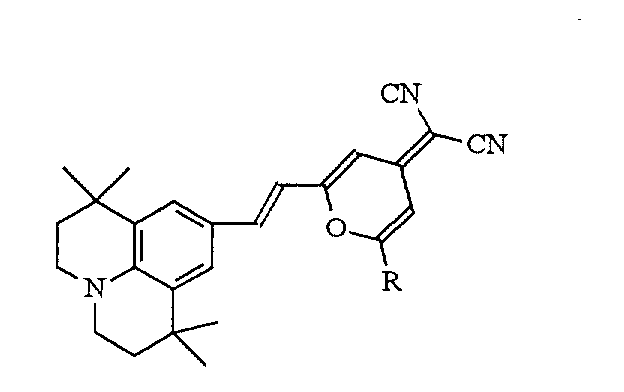
- FD 18 R=n-hexyl
- FD 19 R=phenyl
-
- The above-mentioned polymers can be deposited as high quality transparent thin films by spin-coating or inkjet printing the polymer solutions. Preferably, the spin-coating technique is used to form
layer 3000, and preferably, only one polymer is deposited as single layer of electroluminescent medium. - Preferred materials are used in forming the anode modified with fluorocarbons. The anode can also be modified by a conducting polymer such as poly(3,4-ethylene dioxythiphene) (PEDOT) (Groenendaal, L. and others Adv. Mater. 2000, 12, 481). Preferred materials for use in forming the cathode of the EL devices of this invention are Mg, Li, or alloys of these materials as disclosed in US-A-5,429,884 (Namiki and others) and the commonly-assigned US-A-5,776,622.
- The invention and its advantages are further illustrated by the following specific examples:
- Monomers to be used in the present invention are illustrative only. Any monomers can be used as long as the polymer formed satisfies the general formula:Typical monomer and polymer synthesis is illustrated in Schemes 1-3.

-


- To a 1-L round-bottomed flask were added 4-bromophenol (60.0 g, 0.35 mol), potassium carbonate (52.7 g, 0.38 mol), 2-ethylhexyl bromide (73.7 g, 0.38 mol) and
DMF 200 mL. The reaction mixture was stirred at 90 °C under nitrogen overnight. The reaction was poured into water and extracted with ether three times and the combined organic phase was washed with water three times and dried over MgSO4. After solvent was removed, the crude product was obtained as light brown liquid. Pure product was obtained by column chromatography on silica gel using ether/hexane (10/90) as an eluent to give 71.2 g of light yellow liquid at 72% yield. 1H NMR (CDCl3) δ (ppm): 0.88-0.93 (m, 6 H, CH3), 1.27-1.46 (m, 8 H), 1.65-1.74 (m, 1 H), 3.78 (d, J= 5.7 Hz, 2 H, OCH2), 6.76 (d, J = 8.9 Hz, 2 H), 7.33 (d, J= 8.9 Hz, 2 H). 13C NMR (CDCl3): 11.08, 14.08, 23.03, 23.80, 29.05, 30.46, 39.29, 70.72, 112.42, 116.29, 132.11, 158.47. FD-MS: m/z 285 (M+). - To a 2-L round-bottomed flask were added 2,6-dihydroxyanthraquinone (80.0 g, 0.33 mol), imidazole (108.8 g, 1.6 mol), t-butyldimethylsilyl chloride (115.5 g, 0.77 mol), and
DMF 600 mL. The dark red mixture was heated to 90 °C for 3 h. TLC indicated the completion of the reaction. The reaction was cooled down and poured into 2 L of cool water. The dark green needle like precipitate was filtered off and washed with water and methanol. The dark green crystals were dissolved in ether and the black insoluble part was filtered off. The bright yellow filtrate was concentrated and the crude product was suspended in boiling methanol. The yellow precipitated was filtered to give pure 85.1 g product as yellow silky crystals at 54% yield. 1H NMR (CDCl3) δ (ppm): 0.28 (s, 12H), 1.00 (s, 18 H), 7.14 (dd, J1 = 8.5 Hz, J2 = 2.5 Hz, 2 H), 7.64 (d, J= 2.5 Hz, 2 H), 8.17 (d, J= 8.5 Hz, 2 H). 13C NMR (CDCl3): - 4.36, 25.53, 117.35, 125.34, 127.57, 129.73, 135.73, 161.26, 182.17. Mp 131-133 °C. FD-MS: m/z 468 (M+). - Compound 1 (18.3 g, 0.064 mol) was dissolved in 60 mL of anhydrous THF and cooled to -78 °C. To this solution was added n-BuLi (2.5 M in hexane, 25.6 mL, 0.064 mol) slowly to maintain the temperature below -60 °C. After addition, the orange-yellow solution was stirred at -78 °C for an hour. Compound 2 (10.0 g, 0.021 mol) was dissolved in 30 mL of anhydrous THF and added dropwise to the above cooled solution. TLC analysis indicated the completion of the reaction after 3 h. The reaction was warmed up slightly and HI solution (47% in water, 39 mL, 0.21 mol) was added slowly to quench the reaction and to de-protect the TBDMS group. The deep brown reaction was heated to reflux for 10 min. and most of the solvent was removed under reduced pressure. The reaction mixture was then extracted with methylene chloride three times. The combined organic phase was washed with saturated sodium metabisulfate solution, water, and brine, and dried over MgSO4. The crude product was obtained as brown viscous oil and was purified by column chromatography on silica gel with 15/85 ether/hexane as an eluent. The pure product was obtained as 5.5 g of light green-yellow solid at 42% yield. 1H NMR (CDCl3) δ (ppm): 0.92-1.01 (m, 12 H, CH3), 1.26-1.46 (m, 16 H), 1.77-1.86 (m, 2 H), 3.96 (d, J = 5.7 Hz, 4 H, OCH2), 4.93 (s, br, 2 H, OH), 6.91 (d,J= 2.3 Hz, 2 H), 6.95 (dd, J1 = 9.5 Hz, J2 = 2.4 Hz, 2 H), 7.09 (d, J= 8.6 Hz, 4 H, phenyl), 7.31 (d, J= 8.6 Hz, 4 H, phenyl), 7.60 (d, J= 9.4 Hz, 2 H). 13C NMR (CDCl3): 11.17, 14.13, 23.09, 23.91, 29.13, 30.58, 39.46, 70.62, 106.88, 114.49, 118.59, 127.33, 129.00, 129.93, 131.02, 132.21, 151.75, 158.72. M.p. 195-197 °C. FD-MS: m/z 618 (M+).
- Compound 3 (4.5 g, 0.007 mol) was dissolved in 50 mL of dry pyridine and cooled to 0 °C. To this brown red solution was added slowly triflate anhydride (6.2 g, 0.022 mol). The dark green reaction was stirred at room temperature for 20 min. TLC indicated the completion of the reaction. The reaction was poured into water and extracted with ether (3x200 mL). The combined organic phase was washed with 2N HCl (2x200 mL) and dried over MgSO4. The crude product was purified by column chromatography on silica gel using CH2Cl2/hexane (10/90) to give 5.9 g of blue fluorescent yellow crystalline product at 92% yield. 1H NMR (CDCl3) δ (ppm): 0.94-1.04 (m, 12 H, CH3), 1.38-1.60(m, 16H), 1.81-1.88 (m, 2 H), 4.01 (d,J = 5.7 Hz, 4 H, OCH2), 7.16 (d,J = 8.5Hz, 4 H, phenyl), 7.25 (dd, J1 = 9.5Hz, J2 = 2.4Hz, 2 H), 7.35 (d, J= 8.5Hz, 4 H, phenyl), 7.66 (d, J= 2.3 Hz, 2 H), 7.88 (d, J= 9.5 Hz, 2H). M.p. 103-104 °C. FD-MS: m/z 882 (M+).
- Compound 4 (4.1 g, 0.005 mol), bis(neopentyl glycolato)diboron (2.3 g, 0.01 mol), 1,1'-bis(diphenylphosphino)ferrocene)dichloropalladium (II)/dichloromethane complex (0.23 g, 6 mol% to compound 4), 1,1'-bis(diphenylphosphino)ferrocene (0.15 g, 6 mol% to 4), and potassium acetate (2.7 g, 0.028 mol) were mixed with 50 mL of dioxane. The mixture was degassed with nitrogen for 10 min. and then heated to 80 °C overnight. The reaction was cooled and
ice water 50 mL was added. Brown precipitate formed and was filtered, washed with water and hexane. The brownish yellow solid was dissolved in ether, washed with water (5x100 mL) to remove the by-product neopentyl glycol to give 3.3 g of product as light brownish yellow solid at 88% yield. 1H NMR (CDCl3) δ (ppm): 0.94-1.04 (m, 24 H, CH3), 1.21-1.43 (m, 16 H), 1.80-1.88 (m, 2 H), 3.72 (s, 8 H), 4.02 (d, J = 5.7 Hz, 4 H, OCH2), 7.14 (d, J= 8.5 Hz, 4 H, phenyl), 7.38 (d, J= 8.5 Hz, 4 H, phenyl), 7.62-7.70 (m, 4 H), 8.28 (s, 2 H). 13C NMR (CDCl3): 11.24, 14.16, 21.95, 23.12, 23.95, 29.20, 30.64, 31.83, 39.57, 70.71, 72.24, 114.38, 126.02, 128.25, 130.20, 130.98, 131.26, 132.38, 132.49, 134.41, 134.52, 137.47, 158.59. M.p. 191-193 °C. FD-MS: m/z 810 (M+). - 2,6-Dihydroxyanthraquinone (100.0 g, 0.42 mol) and 2-ethylhexyl bromide (165.0 g, 0.86 mol) were dissolved in 1 L of DMF. To this solution was added anhydrous K2CO3 (120.0 g, 0.87 mol). The reaction was heated at 90 °C overnight. Most of DMF was removed and 500 mL of water was added. The reaction was extracted with ether (3x400 mL), washed with brine (1x200 mL), and dried over MgSO4. Solvent was removed and the crude product was recrystallized from methanol to give 125.2 g of yellow powdery product at 65% yield. 1H NMR (CDCl3) δ (ppm): 0.92-0.98 (m, 12 H, CH3), 1.34-1.54 (m, 16 H), 1.75-1.81 (m, 2 H, CH(CH3)), 4.02 (d, J = 5.5 Hz, 4 H, OCH2), 7.19 (d, J = 8.4 Hz, 2 H), 7.70 (s, 2 H), 8.19 (d, J= 8.5 Hz, 2 H). 13C NMR (CDCl3): 11.12, 14.06, 23.04, 23.88, 29.08, 30.51, 39.34, 71.34, 110.64, 120.84, 127.00, 129.62, 135.88, 164.29, 182.27. M.p. 49-51 °C. FD-MS: m/z 464 (M+).
- To a 1-L round-bottomed flask was added compound 6 (75.0 g, 0.16 mol), tin (80.0 g, 0.67 mol), and 375 mL of acetic acid. The reaction was refluxed for 2 h during which the reaction became a slurry. The reaction was cooled to room temperature and the top layer was decanted. The solid was washed with CH2Cl2. The combined organic phase was washed with water, saturated NaHCO3 solution and brine, and dried over MgSO4. Solvent was removed to yield 72.1 g of yellow solid. The yellow solid was dissolved in 200 mL of isopropanol and added dropwise to a solution of NaBH4 (6.50 g, 0.17 mol) in 300 mL of isopropanol. The reaction was heated at reflux overnight. After cooled to room temperature, the reaction was quenched with dilute HCl solution and then poured into water. The yellow precipitate was collected by filtration, washed with water and ethanol and dried to give 55.2 g of pure product as yellow powder at 78% yield in two steps. 1H NMR (CDCl3) δ (ppm): 0.92-1.62 (m, 14 H, alkyl), 1.79-1.87 (m, 1 H, alkyl), 3.99 (d, J= 5.7 Hz, 2 H, OCH2), 7.14 (d, J= 9.4 Hz, 2 H), 7.17 (s, 2 H, 1 and 5 of anthracene), 8.17 (s, 2 H, 9 and 10 of anthracene). 13C NMR (CDCl3): 11.19, 14.10, 23.10, 24.07, 29.18, 30.72, 39.44, 70.48, 104.58, 120.85, 124.09, 128.71, 129.06, 131.30, 156.22. M.p. 60-62 °C. FD-MS: m/z 436 (M+).
- Compound 7 (13.5 g, 0.031 mol) was added to 150 mL of DMF and cooled down to 0 °C. To this suspension was added NBS (11.60 g, 0.065 mol) in 60 mL of DMF. Upon addition of NBS, the reaction became clear and turned to dark green color. The reaction was stirred at room temperature under nitrogen overnight. The reaction was poured into 200 mL of water, and extracted with methylene chloride (3x300 mL). The combined organic phase was washed thoroughly with water (3x100 mL) and brine (1x100 mL), and dried over MgSO4. After removal of the solvent, the dark brown residue was washed with hexane to collect greenish yellow crystals. The crude crystals were recrystallized from acetone to give flake like greenish yellow fluorescent product. The filtrates were combined and purified by chromatography on silica gel with hexane as eluent. The total yield of the reaction is 5.5 g at 30% yield. 1H NMR (CDCl3) δ (ppm): 0.93-1.70 (m, 14 H, alkyl), 1.81-1.89 (m, 1 H, alkyl), 3.12 (d, J= 5.4 Hz, 2 H, OCH2), 7.34 (d, J = 9.2Hz, 2H), 8.00 (d, J= 9.2 Hz, 2 H), 8.71 (s, 2 H, 1 and 5 of anthracene). 13C NMR (CDCl3): 11.12, 14.10, 23.08, 23.93, 29.15, 30.52, 39.88, 72.76, 107.74, 117.02, 125.27, 129.51, 129.75, 130.12, 152.87. M.p. 103-105 °C. FD-MS: m/z 590 (M+).
- Compound 5 (0.73 g, 0.9 mmol), compound 4 (0.80 g, 0.9mmol), and Aliquat® 336 (0.050 g, 13 mol% to compound 5) were dissolved in 4.5 mL of toluene. To this solution was added 2 M Na2CO3 aqueous solution (1.5 mL, 3.0 mmol). The reaction mixture was bubbled with dry nitrogen for 15 min and catalyst tetrakis(triphenylphosphine)palladium (40 mg, 3mol% to compound 5) was added. The reaction was heated under vigorous reflux for 24 h, and small amount of phenylboronic acid was added for end-capping of bromo group. The reaction was heated for 13 h and bromobenzene was added to end-cap boronate group. The reaction was heated for another 6 h and then poured into 60 mL of methanol. The precipitated polymer was washed with methanol, diluted HCl solution, and dried to give light yellow polymer 0.82 g at 7% yield. The polymer was then extracted with acetone with a Soxhlet setup overnight to remove oligomer and residual catalyst. Polymer was re-precipitated from chloroform into methanol three times to give final polymer 0.80 g. Size exclusion chromatography (SEC) (in THF with polystyrene as standard) analysis indicates that the polymer has a weight average molecular weight (Mw) of 9390 and a polydispersity of 1.78. Thermal analysis indicates that polymer has a thermal onset decomposition temperature 435 °C, and no glass transition temperature was observed before 435 °C.
- The procedure used to prepare
polymer 17 was followed. Compound 5 (1.50 g, 1.85 mmol), compound 2 (1.10 g, 1.85 mmol), and Aliquat® 336 (0.10 g) were dissolved in 9.5 mL of toluene. To this solution were added 2 M Na2CO3 aqueous solution (3.1 mL, 6.2 mmol) and catalyst tetrakis(triphenylphosphine)palladium (80 mg). After polymerization and purification 1.18 g of light yellow polymer was obtained. The polymer has a Mw of 8420 and a polydispersity of 1.59. Thermal analysis indicates that polymer has a thermal onset decomposition temperature 395 °C, and no glass transition temperature was observed before 395 °C. - The procedure used to prepare
polymer 17 was followed. Compound 4 (0.85 g, 1.05 mol), 4,4'-biphenyl diboronate (0.36 g, 1.05 mmol), and Aliquat® 336 (0.05 g) were dissolved in 5 mL of toluene. To this solution were added 2 M Na2CO3 aqueous solution (1.6 mL, 3.2 mmol) and tetrakis(triphenylphosphine)palladium catalyst (36 mg). After polymerization and purification 0.30 g of light yellow polymer was obtained. - An EL device satisfying the requirements of the invention was constructed in the following manner. The organic EL medium has single layer of polymer thin film.
- a) An indium-tin-oxide (ITO) coated glass substrate was sequentially ultra-sonicated in a commercial detergent, rinsed with deionized water, degreased in toluene vapor and exposed to ultraviolet light and ozone for a few minutes.
- b) An aqueous solution of PEDOT (1.3% in water, Baytron P from Bayer Corp.) was spin-coated onto ITO under a controlled spinning speed to obtain thickness of 500 Angstroms. The coating was baked in an oven at 120 °C for 20 min.
- c) A toluene solution of a polymer (30 mg in 30 mL of solvent) was filtered through a 0.2 µm Teflon filter. The polymer solution was then spin-coated onto PEDOT under a controlled spinning speed. The thickness of the polymer film was between 500-700 Angstroms.
- d) On the top of the polymer film was deposited a cathode layer of 2000 Angstroms thick consisting of a 10:1 atomic ratio of Mg and Ag.
-
- The above sequence completed the deposition of the EL device. The device was then hermetically packaged in a dry glove box for protection against ambient environment.
- FIGS. 4, 5 and 6 show the absorption, emission, and PL spectra of
polymers polymer - Other features of the invention are included below.
- The electroluminescent device wherein Ar represents:wherein: R is a substituent including hydrogen, alkyl group of from 1 to 24 carbon atoms, or aryl or substituted aryl of from 6 to 28 carbon atoms, or heteroaryl or substituted heteroaryl of from 4 to 40 carbons, or a cyano group, a nitro group, a chlorine, bromine, or a fluorine atom.
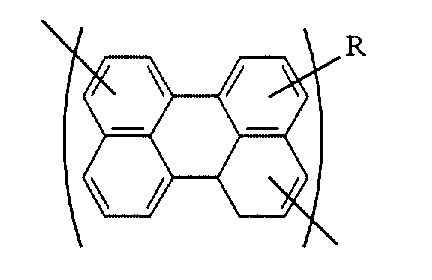
- The electroluminescent device wherein Ar represents:

- The electroluminescent device wherein Ar represents:wherein: R is a substituent including hydrogen, alkyl group of from 1 to 24 carbon atoms, or aryl or substituted aryl of from 6 to 28 carbon atoms, or heteroaryl or substituted heteroaryl of from 4 to 40 carbons, or a cyano group, a nitro group, a chlorine, bromine, or a fluorine atom.

- The electroluminescent device wherein Ar represents:
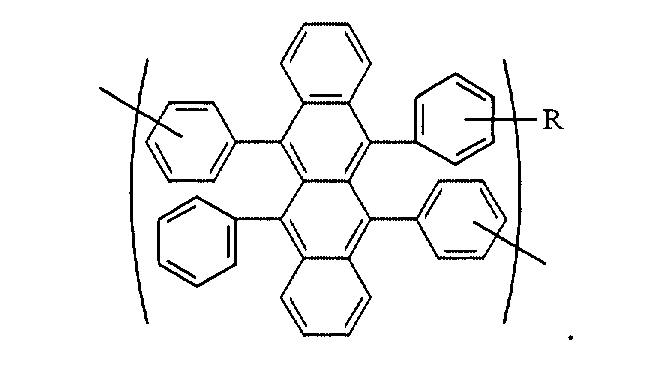
- The electroluminescent device wherein Ar represents:wherein: R is a substituent including hydrogen, alkyl group of from 1 to 24 carbon atoms, or aryl or substituted aryl of from 6 to 28 carbon atoms, or heteroaryl or substituted heteroaryl of from 4 to 40 carbons, or a cyano group, a nitro group, a chlorine, bromine, or a fluorine atom;

- R1 is a substituent, and can be hydrogen, alkyl group of from 1 to 24 carbon atoms, or aryl or substituted aryl of from 6 to 28 carbon atoms, or heteroaryl or substituted heteroaryl of from 4 to 40 carbons; and
- X2 is a nitrogen or carbon atom.
-
- The electroluminescent device wherein Ar represents:wherein: R1 is a substituent including hydrogen, alkyl group of from 1 to 24 carbon atoms, or aryl or substituted aryl of from 6 to 28 carbon atoms, or heteroaryl or substituted heteroaryl of from 4 to 40 carbons; and

- X2 is a nitrogen or carbon atom.
-
- The electroluminescent device wherein Ar represents:wherein:

- Ar3 is the same as Ar;
- R2 and R3 are independently hydrogen, alkyl group of from 1 to 24 carbon atoms, or aryl or substituted aryl of from 6 to 28 atoms, or heteroaryl or substituted heteroaryl of from 4 to 40 atoms, or a cyano group; and
- R is a substituent including hydrogen, alkyl group of from 1 to 24 carbon atoms, or aryl or substituted aryl of from 6 to 28 carbon atoms, or heteroaryl or substituted heteroaryl of from 4 to 40 carbons, or a cyano group, a nitro group, a chlorine, bromine, or a fluorine atom.
-
- The electroluminescent device wherein Ar represents:wherein:
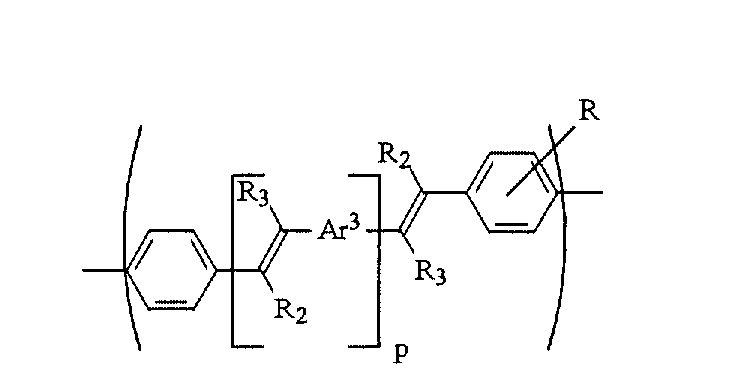
- Ar3 is the same as Ar; and
- R2 and R3 are independently hydrogen, alkyl group of from 1 to 24 carbon atoms, or aryl or substituted aryl of from 6 to 28 atoms, or heteroaryl or substituted heteroaryl of from 4 to 40 atoms, or a cyano group.
-
- The electroluminescent device wherein Ar is:wherein: R is a substituent including hydrogen, alkyl group of from 1 to 24 carbon atoms, or aryl or substituted aryl of from 6 to 28 carbon atoms, or heteroaryl or substituted heteroaryl of from 4 to 40 carbons, or a cyano group, a nitro group, a chlorine, bromine, or a fluorine atom;

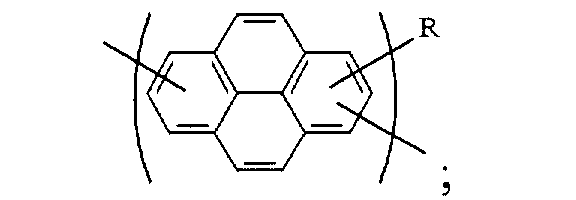
 wherein: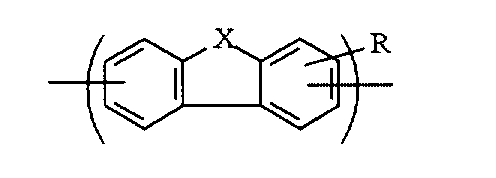
- X is an O or S atom;
 wherein: p is an integer from 0 to 2;
-
- The electroluminescent device wherein Ar is:


 wherein:
- X is an O or S atom;
wherein: p is an integer from 0 to 2;



 wherein: X1 is an O atom or two cyano groups;
 wherein: R1 is a substituent including hydrogen, alkyl group of from 1 to 24 carbon atoms, or aryl or substituted aryl of from 6 to 28 carbon atoms, or heteroaryl or substituted heteroaryl of from 4 to 40 carbons;



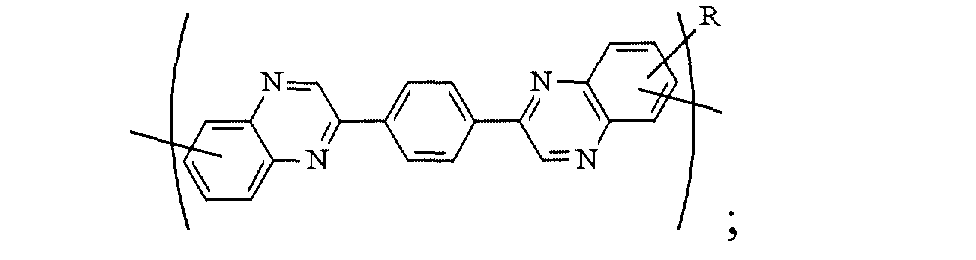 or
or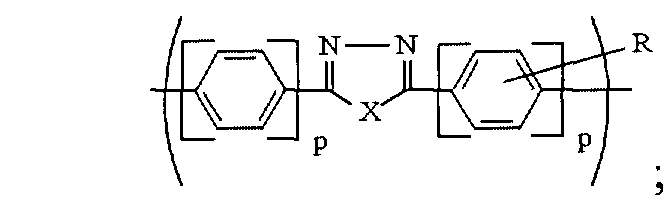

-









Claims (10)
- An electroluminescent device comprises an anode, a cathode, and an emissive layer having a polymer luminescent material disposed between the anode and cathode, the polymer luminescent material includes diarylanthracene-based conjugated polymer having a repeating unit of the following formula:wherein:
 Ar1, Ar2, and Ar are each individually aryl or substituted aryl of from 6 to 40 carbon atoms; orAr1, Ar2, and Ar are each individually substituted heteroaryl or unsubstituted heteroaryl having 4 to 40 carbons.
 - The electroluminescent device of claim 1 wherein:wherein: R is a substituent including hydrogen, alkyl group of from 1 to 24 carbon atoms, or aryl or substituted aryl of from 6 to 28 carbon atoms, or heteroaryl or substituted heteroaryl of from 4 to 40 carbons, or a cyano group, a nitro group, a chlorine, bromine, or a fluorine atom.Ar1 and Ar2 individually represent


 or
or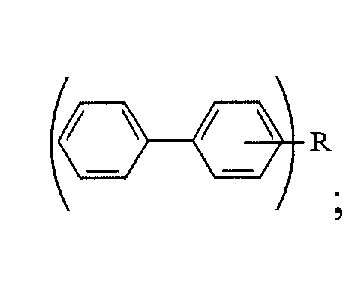

- The electroluminescent device of claim 1 wherein Ar represents:wherein: R is a substituent including hydrogen, alkyl group of from 1 to 24 carbon atoms, or aryl or substituted aryl of from 6 to 28 carbon atoms, or heteroaryl or substituted heteroaryl of from 4 to 40 carbons, or a cyano group, a nitro group, a chlorine, bromine, or a fluorine atom; and
 m is an integer from 1 to 3.
 - The electroluminescent device of claim 2 wherein Ar represents:wherein:
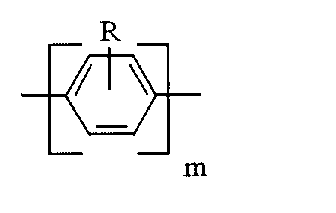 m is an integer from 1 to 3.
 - The electroluminescent device of claim 1 wherein Ar represents:wherein: R is a substituent including hydrogen, alkyl group of from 1 to 24 carbon atoms, or aryl or substituted aryl of from 6 to 28 carbon atoms, or heteroaryl or substituted heteroaryl of from 4 to 40 carbons, or a cyano group, a nitro group, a chlorine, bromine, or a fluorine atom.
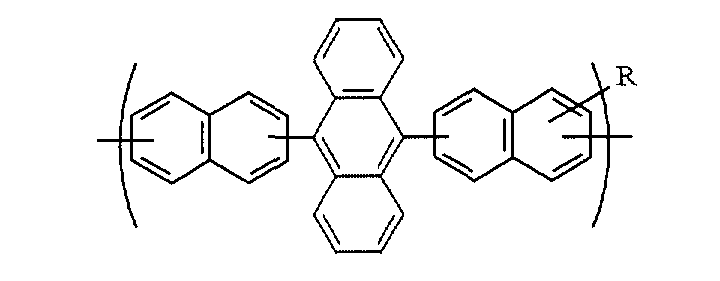
- The electroluminescent device of claim 2 wherein Ar represents:

- The electroluminescent device of claim 1 wherein Ar represents:wherein: R is a substituent including hydrogen, alkyl group of from 1 to 24 carbon atoms, or aryl or substituted aryl of from 6 to 28 carbon atoms, or heteroaryl or substituted heteroaryl of from 4 to 40 carbons, or a cyano group, a nitro group, a chlorine, bromine, or a fluorine atom.
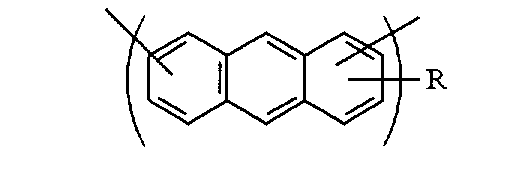
- The electroluminescent device of claim 2 wherein Ar represents:

- The electroluminescent device of claim 1 wherein Ar represents:wherein: R is a substituent including hydrogen, alkyl group of from 1 to 24 carbon atoms, or aryl or substituted aryl of from 6 to 28 carbon atoms, or heteroaryl or substituted heteroaryl of from 4 to 40 carbons, or a cyano group, a nitro group, a chlorine, bromine, or a fluorine atom.

- The electroluminescent device of claim 2 wherein Ar represents:

Applications Claiming Priority (2)
| Application Number | Priority Date | Filing Date | Title |
|---|---|---|---|
| US941120 | 2001-08-28 | ||
| US09/941,120 US6638644B2 (en) | 2001-08-28 | 2001-08-28 | Electroluminescent devices having diarylanthracene polymers |
Publications (1)
| Publication Number | Publication Date |
|---|---|
| EP1288276A1 true EP1288276A1 (en) | 2003-03-05 |
Family
ID=25475959
Family Applications (1)
| Application Number | Title | Priority Date | Filing Date |
|---|---|---|---|
| EP02078395A Withdrawn EP1288276A1 (en) | 2001-08-28 | 2002-08-16 | Electroluminescent devices having diarylanthracene polymers |
Country Status (5)
| Country | Link |
|---|---|
| US (1) | US6638644B2 (en) |
| EP (1) | EP1288276A1 (en) |
| JP (1) | JP2003163088A (en) |
| KR (1) | KR100903247B1 (en) |
| CN (1) | CN100425671C (en) |
Cited By (4)
| Publication number | Priority date | Publication date | Assignee | Title |
|---|---|---|---|---|
| WO2010149258A1 (en) * | 2009-06-26 | 2010-12-29 | Merck Patent Gmbh | Polymers comprising substituted anthracenyl units, blends comprising said polymers, and device comprising said polymers or blends |
| EP2364964A1 (en) * | 2006-03-06 | 2011-09-14 | LG Chem, Ltd. | Novel anthracene derivative and organic electronic device using the same |
| WO2012052704A3 (en) * | 2010-10-19 | 2012-06-07 | Cambridge Display Technology Limited | Polymer and organic light-emitting device |
| EP2576652A4 (en) * | 2010-06-04 | 2014-09-03 | Univ Tongji | METHODS OF PRODUCING POLYANTHRACENE AND APPLICATIONS THEREOF |
Families Citing this family (29)
| Publication number | Priority date | Publication date | Assignee | Title |
|---|---|---|---|---|
| US7306559B2 (en) * | 1997-07-02 | 2007-12-11 | Lumitex, Inc. | Illuminated surgical retractor |
| JP2007527379A (en) * | 2003-07-10 | 2007-09-27 | メルク パテント ゲゼルシャフト ミット ベシュレンクテル ハフトング | Substituted anthracene |
| GB0329364D0 (en) | 2003-12-19 | 2004-01-21 | Cambridge Display Tech Ltd | Optical device |
| US7267892B2 (en) * | 2004-02-25 | 2007-09-11 | Eastman Kodak Company | Electroluminescent devices having pendant naphthylanthracene-based polymers |
| WO2006059486A1 (en) * | 2004-12-02 | 2006-06-08 | Konica Minolta Holdings, Inc. | Organic thin-film transistor material, organic thin-film transistor, field effect transistor, switching device, organic semiconductor material, and organic semiconductor film |
| JP4790260B2 (en) * | 2004-12-22 | 2011-10-12 | 出光興産株式会社 | Organic electroluminescence device using anthracene derivative |
| EP1866367A2 (en) * | 2005-04-05 | 2007-12-19 | CIBA SPECIALTY CHEMICALS HOLDING INC. Patent Departement | Additive mixtures for agricultural articles |
| US7842823B2 (en) * | 2005-10-27 | 2010-11-30 | The Regents Of The University Of California | Fluorogenic probes for reactive oxygen species |
| CN100361980C (en) * | 2005-12-29 | 2008-01-16 | 中国科学院上海有机化学研究所 | A New Blue Light Material--Anthracene Derivatives Containing Triazine Ring |
| CN100489008C (en) * | 2006-03-28 | 2009-05-20 | 青岛科技大学 | Poly(2,6)- and poly(2,7)- anthryl ethene derivatives as electroluminescent materials and method for preparing same |
| JPWO2008056652A1 (en) * | 2006-11-09 | 2010-02-25 | 出光興産株式会社 | Organic EL material-containing solution, organic EL material synthesis method, compound synthesized by this synthesis method, organic EL material thin film formation method, organic EL material thin film, organic EL element |
| KR100910134B1 (en) * | 2007-07-13 | 2009-08-03 | (주)그라쎌 | Organic light emitting material and organic light emitting device comprising the same |
| US8791258B2 (en) * | 2008-06-10 | 2014-07-29 | The Regents Of The University Of California | Pro-fluorescent probes |
| DE102009030848A1 (en) * | 2009-06-26 | 2011-02-03 | Merck Patent Gmbh | Polymers comprising structural units which have alkylalkoxy groups, blends containing these polymers and optoelectronic devices containing these polymers and blends |
| CN101597255B (en) * | 2009-07-07 | 2012-10-24 | 清华大学 | Organic material and application thereof in organic electroluminescence device (OELD) |
| GB2499969A (en) * | 2010-06-25 | 2013-09-11 | Cambridge Display Tech Ltd | Composition comprising an organic semiconducting material and a triplet-accepting material |
| JP5875852B2 (en) * | 2010-12-21 | 2016-03-02 | 住友化学株式会社 | Polymer compound and organic EL device using the same |
| JP5913959B2 (en) * | 2010-12-21 | 2016-05-11 | 住友化学株式会社 | Composition and block copolymer |
| WO2012090971A1 (en) * | 2010-12-27 | 2012-07-05 | 住友化学株式会社 | Photoelectric conversion element and composition used in same |
| JP2012151464A (en) * | 2010-12-27 | 2012-08-09 | Sumitomo Chemical Co Ltd | Compound and thin film containing it |
| WO2012090972A1 (en) * | 2010-12-27 | 2012-07-05 | 住友化学株式会社 | Reactive compound, and method for producing polymer using same |
| JP6314467B2 (en) * | 2013-12-16 | 2018-04-25 | 住友化学株式会社 | Composition and light emitting device using the same |
| JP6443741B2 (en) * | 2014-12-12 | 2018-12-26 | 川崎化成工業株式会社 | Photo radical polymerization initiator |
| KR102065717B1 (en) * | 2016-12-26 | 2020-01-13 | 주식회사 엘지화학 | Polarizer protecting film, polarizer plate comprising the same, liquid crystal display comprising the polarizer plate, and coating composition for polarizer protecting film |
| CN116583131A (en) | 2017-04-26 | 2023-08-11 | Oti照明公司 | Method for patterning a coating on a surface and apparatus comprising the patterned coating |
| US11751415B2 (en) | 2018-02-02 | 2023-09-05 | Oti Lumionics Inc. | Materials for forming a nucleation-inhibiting coating and devices incorporating same |
| JP7390739B2 (en) | 2019-03-07 | 2023-12-04 | オーティーアイ ルミオニクス インコーポレーテッド | Materials for forming nucleation-inhibiting coatings and devices incorporating the same |
| KR102831863B1 (en) | 2019-04-18 | 2025-07-10 | 오티아이 루미오닉스 인크. | Material for forming a nucleation-inhibiting coating and device comprising the same |
| WO2022123431A1 (en) | 2020-12-07 | 2022-06-16 | Oti Lumionics Inc. | Patterning a conductive deposited layer using a nucleation inhibiting coating and an underlying metallic coating |
Citations (3)
| Publication number | Priority date | Publication date | Assignee | Title |
|---|---|---|---|---|
| EP0681019A2 (en) * | 1994-04-26 | 1995-11-08 | TDK Corporation | Phenylanthracene derivative and organic EL element |
| US5935721A (en) * | 1998-03-20 | 1999-08-10 | Eastman Kodak Company | Organic electroluminescent elements for stable electroluminescent |
| EP0952200A2 (en) * | 1998-03-20 | 1999-10-27 | Eastman Kodak Company | Organic electroluminescent elements for stable blue electroluminescent devices |
Family Cites Families (8)
| Publication number | Priority date | Publication date | Assignee | Title |
|---|---|---|---|---|
| US4356429A (en) | 1980-07-17 | 1982-10-26 | Eastman Kodak Company | Organic electroluminescent cell |
| US4769292A (en) | 1987-03-02 | 1988-09-06 | Eastman Kodak Company | Electroluminescent device with modified thin film luminescent zone |
| US5429884A (en) | 1992-01-17 | 1995-07-04 | Pioneer Electronic Corporation | Organic electroluminescent element |
| US5776622A (en) | 1996-07-29 | 1998-07-07 | Eastman Kodak Company | Bilayer eletron-injeting electrode for use in an electroluminescent device |
| US5777070A (en) | 1997-10-23 | 1998-07-07 | The Dow Chemical Company | Process for preparing conjugated polymers |
| KR100280707B1 (en) * | 1998-11-12 | 2001-02-01 | 김순택 | Light-Emitting Compound and Display Device Adopting It as Coloring Material |
| US6268072B1 (en) * | 1999-10-01 | 2001-07-31 | Eastman Kodak Company | Electroluminescent devices having phenylanthracene-based polymers |
| US6361887B1 (en) * | 1999-10-20 | 2002-03-26 | Eastman Kodak Company | Electroluminescent devices having naphthylanthracene-based polymers |
-
2001
- 2001-08-28 US US09/941,120 patent/US6638644B2/en not_active Expired - Lifetime
-
2002
- 2002-08-16 EP EP02078395A patent/EP1288276A1/en not_active Withdrawn
- 2002-08-27 KR KR1020020050705A patent/KR100903247B1/en not_active Expired - Lifetime
- 2002-08-27 JP JP2002246694A patent/JP2003163088A/en active Pending
- 2002-08-28 CN CNB021421129A patent/CN100425671C/en not_active Expired - Fee Related
Patent Citations (3)
| Publication number | Priority date | Publication date | Assignee | Title |
|---|---|---|---|---|
| EP0681019A2 (en) * | 1994-04-26 | 1995-11-08 | TDK Corporation | Phenylanthracene derivative and organic EL element |
| US5935721A (en) * | 1998-03-20 | 1999-08-10 | Eastman Kodak Company | Organic electroluminescent elements for stable electroluminescent |
| EP0952200A2 (en) * | 1998-03-20 | 1999-10-27 | Eastman Kodak Company | Organic electroluminescent elements for stable blue electroluminescent devices |
Cited By (7)
| Publication number | Priority date | Publication date | Assignee | Title |
|---|---|---|---|---|
| EP2364964A1 (en) * | 2006-03-06 | 2011-09-14 | LG Chem, Ltd. | Novel anthracene derivative and organic electronic device using the same |
| WO2010149258A1 (en) * | 2009-06-26 | 2010-12-29 | Merck Patent Gmbh | Polymers comprising substituted anthracenyl units, blends comprising said polymers, and device comprising said polymers or blends |
| US8557953B2 (en) | 2009-06-26 | 2013-10-15 | Merck Patent Gmbh | Polymers comprising substituted anthracenyl units, blends comprising these polymers, and devices comprising these polymers or blends |
| EP2576652A4 (en) * | 2010-06-04 | 2014-09-03 | Univ Tongji | METHODS OF PRODUCING POLYANTHRACENE AND APPLICATIONS THEREOF |
| US9290610B2 (en) | 2010-06-04 | 2016-03-22 | Tongji University | Methods of producing polyanthracene and uses thereof |
| WO2012052704A3 (en) * | 2010-10-19 | 2012-06-07 | Cambridge Display Technology Limited | Polymer and organic light-emitting device |
| GB2497904A (en) * | 2010-10-19 | 2013-06-26 | Cambridge Display Tech Ltd | Polymer and organic light-emitting device |
Also Published As
| Publication number | Publication date |
|---|---|
| US20030082402A1 (en) | 2003-05-01 |
| KR100903247B1 (en) | 2009-06-17 |
| CN1407054A (en) | 2003-04-02 |
| JP2003163088A (en) | 2003-06-06 |
| CN100425671C (en) | 2008-10-15 |
| US6638644B2 (en) | 2003-10-28 |
| KR20030019123A (en) | 2003-03-06 |
Similar Documents
| Publication | Publication Date | Title |
|---|---|---|
| US6638644B2 (en) | Electroluminescent devices having diarylanthracene polymers | |
| EP1088875B1 (en) | Electroluminescent devices having phenylanthracene-based polymers | |
| EP1094101B1 (en) | Electroluminescent devices having naphthylanthracene-based polymers | |
| JP4959100B2 (en) | Substituted fluorene polymer and method for producing the same | |
| KR101041766B1 (en) | Conjugated polymers and combinations containing carbazole, methods of making and uses thereof | |
| JP5662403B2 (en) | Electroluminescent device | |
| US6887972B2 (en) | Blue electroluminescent materials for polymer light-emitting diodes | |
| JP2004532325A5 (en) | ||
| CN100523122C (en) | Organic electroluminescent polymer having 9,9-di(fluorenyl)-2,7-fluorenyl unit and organic electroluminescent device manufactured using the same | |
| US6613457B2 (en) | Electroluminescent devices having diarylanthracene ladder polymers in emissive layers | |
| JP3939624B2 (en) | Blue electroluminescent polymer and organic electroluminescent device using the same | |
| JP3939533B2 (en) | Electroluminescent polymer introduced with fluorene and electroluminescent device using the same | |
| KR100528323B1 (en) | Blue Electroluminescent Polymer And Organo-electroluminescent Device Manufactured By Using The Same | |
| KR20030008993A (en) | Spirobifluorene compounds, electroluminescence polymer and electroluminescence element having the same | |
| KR100394509B1 (en) | High Functional Light Emitting Polymers Containing Tetra-substituted Phenylene unit for Use in Electroluminescent Devices | |
| KR100604196B1 (en) | Poly (spirobifluorenyl-2,7-vinylene) -based and poly (alkylfluorenyl-2,7-vinylene) derivatives having improved thermal stability and luminescence properties, and electroluminescent devices using the same | |
| Lee et al. | Synthesis of new fluorene-based copolymers containing an anthracene derivative and their applications in polymeric light-emitting diodes | |
| KR20070016594A (en) | Distrylbenzene derivatives, organic electroluminescent molecules and organic electroluminescent devices produced therefrom |
Legal Events
| Date | Code | Title | Description |
|---|---|---|---|
| PUAI | Public reference made under article 153(3) epc to a published international application that has entered the european phase |
Free format text: ORIGINAL CODE: 0009012 |
|
| AK | Designated contracting states |
Kind code of ref document: A1 Designated state(s): AT BE BG CH CY CZ DE DK EE ES FI FR GB GR IE IT LI LU MC NL PT SE SK TR Designated state(s): AT BE BG CH CY CZ DE DK EE ES FI FR GB GR IE IT LI LU MC NL PT SE SK TR |
|
| AX | Request for extension of the european patent |
Extension state: AL LT LV MK RO SI |
|
| 17P | Request for examination filed |
Effective date: 20030802 |
|
| AKX | Designation fees paid |
Designated state(s): DE FR GB |
|
| STAA | Information on the status of an ep patent application or granted ep patent |
Free format text: STATUS: THE APPLICATION HAS BEEN WITHDRAWN |
|
| 18W | Application withdrawn |
Effective date: 20081023 |