EP1284346A2 - Fahrzeug mit Verbrennungsmotor und Brennstoffzelle - Google Patents
Fahrzeug mit Verbrennungsmotor und Brennstoffzelle Download PDFInfo
- Publication number
- EP1284346A2 EP1284346A2 EP02015275A EP02015275A EP1284346A2 EP 1284346 A2 EP1284346 A2 EP 1284346A2 EP 02015275 A EP02015275 A EP 02015275A EP 02015275 A EP02015275 A EP 02015275A EP 1284346 A2 EP1284346 A2 EP 1284346A2
- Authority
- EP
- European Patent Office
- Prior art keywords
- combustion engine
- vehicle according
- fuel cell
- internal combustion
- transmission
- Prior art date
- Legal status (The legal status is an assumption and is not a legal conclusion. Google has not performed a legal analysis and makes no representation as to the accuracy of the status listed.)
- Granted
Links
Images

Classifications
-
- B—PERFORMING OPERATIONS; TRANSPORTING
- B60—VEHICLES IN GENERAL
- B60K—ARRANGEMENT OR MOUNTING OF PROPULSION UNITS OR OF TRANSMISSIONS IN VEHICLES; ARRANGEMENT OR MOUNTING OF PLURAL DIVERSE PRIME-MOVERS IN VEHICLES; AUXILIARY DRIVES FOR VEHICLES; INSTRUMENTATION OR DASHBOARDS FOR VEHICLES; ARRANGEMENTS IN CONNECTION WITH COOLING, AIR INTAKE, GAS EXHAUST OR FUEL SUPPLY OF PROPULSION UNITS IN VEHICLES
- B60K6/00—Arrangement or mounting of plural diverse prime-movers for mutual or common propulsion, e.g. hybrid propulsion systems comprising electric motors and internal combustion engines
- B60K6/20—Arrangement or mounting of plural diverse prime-movers for mutual or common propulsion, e.g. hybrid propulsion systems comprising electric motors and internal combustion engines the prime-movers consisting of electric motors and internal combustion engines, e.g. HEVs
- B60K6/22—Arrangement or mounting of plural diverse prime-movers for mutual or common propulsion, e.g. hybrid propulsion systems comprising electric motors and internal combustion engines the prime-movers consisting of electric motors and internal combustion engines, e.g. HEVs characterised by apparatus, components or means specially adapted for HEVs
- B60K6/32—Arrangement or mounting of plural diverse prime-movers for mutual or common propulsion, e.g. hybrid propulsion systems comprising electric motors and internal combustion engines the prime-movers consisting of electric motors and internal combustion engines, e.g. HEVs characterised by apparatus, components or means specially adapted for HEVs characterised by the fuel cells
-
- B—PERFORMING OPERATIONS; TRANSPORTING
- B60—VEHICLES IN GENERAL
- B60K—ARRANGEMENT OR MOUNTING OF PROPULSION UNITS OR OF TRANSMISSIONS IN VEHICLES; ARRANGEMENT OR MOUNTING OF PLURAL DIVERSE PRIME-MOVERS IN VEHICLES; AUXILIARY DRIVES FOR VEHICLES; INSTRUMENTATION OR DASHBOARDS FOR VEHICLES; ARRANGEMENTS IN CONNECTION WITH COOLING, AIR INTAKE, GAS EXHAUST OR FUEL SUPPLY OF PROPULSION UNITS IN VEHICLES
- B60K1/00—Arrangement or mounting of electrical propulsion units
- B60K1/04—Arrangement or mounting of electrical propulsion units of the electric storage means for propulsion
-
- B—PERFORMING OPERATIONS; TRANSPORTING
- B60—VEHICLES IN GENERAL
- B60K—ARRANGEMENT OR MOUNTING OF PROPULSION UNITS OR OF TRANSMISSIONS IN VEHICLES; ARRANGEMENT OR MOUNTING OF PLURAL DIVERSE PRIME-MOVERS IN VEHICLES; AUXILIARY DRIVES FOR VEHICLES; INSTRUMENTATION OR DASHBOARDS FOR VEHICLES; ARRANGEMENTS IN CONNECTION WITH COOLING, AIR INTAKE, GAS EXHAUST OR FUEL SUPPLY OF PROPULSION UNITS IN VEHICLES
- B60K17/00—Arrangement or mounting of transmissions in vehicles
- B60K17/34—Arrangement or mounting of transmissions in vehicles for driving both front and rear wheels, e.g. four wheel drive vehicles
- B60K17/356—Arrangement or mounting of transmissions in vehicles for driving both front and rear wheels, e.g. four wheel drive vehicles having fluid or electric motor, for driving one or more wheels
-
- B—PERFORMING OPERATIONS; TRANSPORTING
- B60—VEHICLES IN GENERAL
- B60K—ARRANGEMENT OR MOUNTING OF PROPULSION UNITS OR OF TRANSMISSIONS IN VEHICLES; ARRANGEMENT OR MOUNTING OF PLURAL DIVERSE PRIME-MOVERS IN VEHICLES; AUXILIARY DRIVES FOR VEHICLES; INSTRUMENTATION OR DASHBOARDS FOR VEHICLES; ARRANGEMENTS IN CONNECTION WITH COOLING, AIR INTAKE, GAS EXHAUST OR FUEL SUPPLY OF PROPULSION UNITS IN VEHICLES
- B60K6/00—Arrangement or mounting of plural diverse prime-movers for mutual or common propulsion, e.g. hybrid propulsion systems comprising electric motors and internal combustion engines
- B60K6/20—Arrangement or mounting of plural diverse prime-movers for mutual or common propulsion, e.g. hybrid propulsion systems comprising electric motors and internal combustion engines the prime-movers consisting of electric motors and internal combustion engines, e.g. HEVs
- B60K6/22—Arrangement or mounting of plural diverse prime-movers for mutual or common propulsion, e.g. hybrid propulsion systems comprising electric motors and internal combustion engines the prime-movers consisting of electric motors and internal combustion engines, e.g. HEVs characterised by apparatus, components or means specially adapted for HEVs
- B60K6/40—Arrangement or mounting of plural diverse prime-movers for mutual or common propulsion, e.g. hybrid propulsion systems comprising electric motors and internal combustion engines the prime-movers consisting of electric motors and internal combustion engines, e.g. HEVs characterised by apparatus, components or means specially adapted for HEVs characterised by the assembly or relative disposition of components
-
- B—PERFORMING OPERATIONS; TRANSPORTING
- B60—VEHICLES IN GENERAL
- B60K—ARRANGEMENT OR MOUNTING OF PROPULSION UNITS OR OF TRANSMISSIONS IN VEHICLES; ARRANGEMENT OR MOUNTING OF PLURAL DIVERSE PRIME-MOVERS IN VEHICLES; AUXILIARY DRIVES FOR VEHICLES; INSTRUMENTATION OR DASHBOARDS FOR VEHICLES; ARRANGEMENTS IN CONNECTION WITH COOLING, AIR INTAKE, GAS EXHAUST OR FUEL SUPPLY OF PROPULSION UNITS IN VEHICLES
- B60K6/00—Arrangement or mounting of plural diverse prime-movers for mutual or common propulsion, e.g. hybrid propulsion systems comprising electric motors and internal combustion engines
- B60K6/20—Arrangement or mounting of plural diverse prime-movers for mutual or common propulsion, e.g. hybrid propulsion systems comprising electric motors and internal combustion engines the prime-movers consisting of electric motors and internal combustion engines, e.g. HEVs
- B60K6/42—Arrangement or mounting of plural diverse prime-movers for mutual or common propulsion, e.g. hybrid propulsion systems comprising electric motors and internal combustion engines the prime-movers consisting of electric motors and internal combustion engines, e.g. HEVs characterised by the architecture of the hybrid electric vehicle
- B60K6/48—Parallel type
-
- B—PERFORMING OPERATIONS; TRANSPORTING
- B60—VEHICLES IN GENERAL
- B60K—ARRANGEMENT OR MOUNTING OF PROPULSION UNITS OR OF TRANSMISSIONS IN VEHICLES; ARRANGEMENT OR MOUNTING OF PLURAL DIVERSE PRIME-MOVERS IN VEHICLES; AUXILIARY DRIVES FOR VEHICLES; INSTRUMENTATION OR DASHBOARDS FOR VEHICLES; ARRANGEMENTS IN CONNECTION WITH COOLING, AIR INTAKE, GAS EXHAUST OR FUEL SUPPLY OF PROPULSION UNITS IN VEHICLES
- B60K6/00—Arrangement or mounting of plural diverse prime-movers for mutual or common propulsion, e.g. hybrid propulsion systems comprising electric motors and internal combustion engines
- B60K6/20—Arrangement or mounting of plural diverse prime-movers for mutual or common propulsion, e.g. hybrid propulsion systems comprising electric motors and internal combustion engines the prime-movers consisting of electric motors and internal combustion engines, e.g. HEVs
- B60K6/50—Architecture of the driveline characterised by arrangement or kind of transmission units
- B60K6/52—Driving a plurality of drive axles, e.g. four-wheel drive
-
- B—PERFORMING OPERATIONS; TRANSPORTING
- B60—VEHICLES IN GENERAL
- B60K—ARRANGEMENT OR MOUNTING OF PROPULSION UNITS OR OF TRANSMISSIONS IN VEHICLES; ARRANGEMENT OR MOUNTING OF PLURAL DIVERSE PRIME-MOVERS IN VEHICLES; AUXILIARY DRIVES FOR VEHICLES; INSTRUMENTATION OR DASHBOARDS FOR VEHICLES; ARRANGEMENTS IN CONNECTION WITH COOLING, AIR INTAKE, GAS EXHAUST OR FUEL SUPPLY OF PROPULSION UNITS IN VEHICLES
- B60K6/00—Arrangement or mounting of plural diverse prime-movers for mutual or common propulsion, e.g. hybrid propulsion systems comprising electric motors and internal combustion engines
- B60K6/20—Arrangement or mounting of plural diverse prime-movers for mutual or common propulsion, e.g. hybrid propulsion systems comprising electric motors and internal combustion engines the prime-movers consisting of electric motors and internal combustion engines, e.g. HEVs
- B60K6/50—Architecture of the driveline characterised by arrangement or kind of transmission units
- B60K6/54—Transmission for changing ratio
-
- F—MECHANICAL ENGINEERING; LIGHTING; HEATING; WEAPONS; BLASTING
- F02—COMBUSTION ENGINES; HOT-GAS OR COMBUSTION-PRODUCT ENGINE PLANTS
- F02B—INTERNAL-COMBUSTION PISTON ENGINES; COMBUSTION ENGINES IN GENERAL
- F02B43/00—Engines characterised by operating on gaseous fuels; Plants including such engines
- F02B43/10—Engines or plants characterised by use of other specific gases, e.g. acetylene, oxyhydrogen
-
- F—MECHANICAL ENGINEERING; LIGHTING; HEATING; WEAPONS; BLASTING
- F02—COMBUSTION ENGINES; HOT-GAS OR COMBUSTION-PRODUCT ENGINE PLANTS
- F02B—INTERNAL-COMBUSTION PISTON ENGINES; COMBUSTION ENGINES IN GENERAL
- F02B75/00—Other engines
- F02B75/16—Engines characterised by number of cylinders, e.g. single-cylinder engines
- F02B75/18—Multi-cylinder engines
- F02B75/22—Multi-cylinder engines with cylinders in V, fan, or star arrangement
-
- H—ELECTRICITY
- H01—ELECTRIC ELEMENTS
- H01M—PROCESSES OR MEANS, e.g. BATTERIES, FOR THE DIRECT CONVERSION OF CHEMICAL ENERGY INTO ELECTRICAL ENERGY
- H01M8/00—Fuel cells; Manufacture thereof
- H01M8/04—Auxiliary arrangements, e.g. for control of pressure or for circulation of fluids
- H01M8/04007—Auxiliary arrangements, e.g. for control of pressure or for circulation of fluids related to heat exchange
-
- H—ELECTRICITY
- H01—ELECTRIC ELEMENTS
- H01M—PROCESSES OR MEANS, e.g. BATTERIES, FOR THE DIRECT CONVERSION OF CHEMICAL ENERGY INTO ELECTRICAL ENERGY
- H01M8/00—Fuel cells; Manufacture thereof
- H01M8/04—Auxiliary arrangements, e.g. for control of pressure or for circulation of fluids
- H01M8/04223—Auxiliary arrangements, e.g. for control of pressure or for circulation of fluids during start-up or shut-down; Depolarisation or activation, e.g. purging; Means for short-circuiting defective fuel cells
- H01M8/04268—Heating of fuel cells during the start-up of the fuel cells
-
- F—MECHANICAL ENGINEERING; LIGHTING; HEATING; WEAPONS; BLASTING
- F02—COMBUSTION ENGINES; HOT-GAS OR COMBUSTION-PRODUCT ENGINE PLANTS
- F02B—INTERNAL-COMBUSTION PISTON ENGINES; COMBUSTION ENGINES IN GENERAL
- F02B75/00—Other engines
- F02B75/16—Engines characterised by number of cylinders, e.g. single-cylinder engines
- F02B75/18—Multi-cylinder engines
- F02B2075/1804—Number of cylinders
- F02B2075/1832—Number of cylinders eight
-
- H—ELECTRICITY
- H01—ELECTRIC ELEMENTS
- H01M—PROCESSES OR MEANS, e.g. BATTERIES, FOR THE DIRECT CONVERSION OF CHEMICAL ENERGY INTO ELECTRICAL ENERGY
- H01M2250/00—Fuel cells for particular applications; Specific features of fuel cell system
- H01M2250/20—Fuel cells in motive systems, e.g. vehicle, ship, plane
-
- H—ELECTRICITY
- H01—ELECTRIC ELEMENTS
- H01M—PROCESSES OR MEANS, e.g. BATTERIES, FOR THE DIRECT CONVERSION OF CHEMICAL ENERGY INTO ELECTRICAL ENERGY
- H01M8/00—Fuel cells; Manufacture thereof
- H01M8/04—Auxiliary arrangements, e.g. for control of pressure or for circulation of fluids
- H01M8/04007—Auxiliary arrangements, e.g. for control of pressure or for circulation of fluids related to heat exchange
- H01M8/04067—Heat exchange or temperature measuring elements, thermal insulation, e.g. heat pipes, heat pumps, fins
- H01M8/04074—Heat exchange unit structures specially adapted for fuel cell
-
- Y—GENERAL TAGGING OF NEW TECHNOLOGICAL DEVELOPMENTS; GENERAL TAGGING OF CROSS-SECTIONAL TECHNOLOGIES SPANNING OVER SEVERAL SECTIONS OF THE IPC; TECHNICAL SUBJECTS COVERED BY FORMER USPC CROSS-REFERENCE ART COLLECTIONS [XRACs] AND DIGESTS
- Y02—TECHNOLOGIES OR APPLICATIONS FOR MITIGATION OR ADAPTATION AGAINST CLIMATE CHANGE
- Y02E—REDUCTION OF GREENHOUSE GAS [GHG] EMISSIONS, RELATED TO ENERGY GENERATION, TRANSMISSION OR DISTRIBUTION
- Y02E60/00—Enabling technologies; Technologies with a potential or indirect contribution to GHG emissions mitigation
- Y02E60/30—Hydrogen technology
- Y02E60/50—Fuel cells
-
- Y—GENERAL TAGGING OF NEW TECHNOLOGICAL DEVELOPMENTS; GENERAL TAGGING OF CROSS-SECTIONAL TECHNOLOGIES SPANNING OVER SEVERAL SECTIONS OF THE IPC; TECHNICAL SUBJECTS COVERED BY FORMER USPC CROSS-REFERENCE ART COLLECTIONS [XRACs] AND DIGESTS
- Y02—TECHNOLOGIES OR APPLICATIONS FOR MITIGATION OR ADAPTATION AGAINST CLIMATE CHANGE
- Y02P—CLIMATE CHANGE MITIGATION TECHNOLOGIES IN THE PRODUCTION OR PROCESSING OF GOODS
- Y02P70/00—Climate change mitigation technologies in the production process for final industrial or consumer products
- Y02P70/50—Manufacturing or production processes characterised by the final manufactured product
-
- Y—GENERAL TAGGING OF NEW TECHNOLOGICAL DEVELOPMENTS; GENERAL TAGGING OF CROSS-SECTIONAL TECHNOLOGIES SPANNING OVER SEVERAL SECTIONS OF THE IPC; TECHNICAL SUBJECTS COVERED BY FORMER USPC CROSS-REFERENCE ART COLLECTIONS [XRACs] AND DIGESTS
- Y02—TECHNOLOGIES OR APPLICATIONS FOR MITIGATION OR ADAPTATION AGAINST CLIMATE CHANGE
- Y02T—CLIMATE CHANGE MITIGATION TECHNOLOGIES RELATED TO TRANSPORTATION
- Y02T10/00—Road transport of goods or passengers
- Y02T10/10—Internal combustion engine [ICE] based vehicles
- Y02T10/30—Use of alternative fuels, e.g. biofuels
-
- Y—GENERAL TAGGING OF NEW TECHNOLOGICAL DEVELOPMENTS; GENERAL TAGGING OF CROSS-SECTIONAL TECHNOLOGIES SPANNING OVER SEVERAL SECTIONS OF THE IPC; TECHNICAL SUBJECTS COVERED BY FORMER USPC CROSS-REFERENCE ART COLLECTIONS [XRACs] AND DIGESTS
- Y02—TECHNOLOGIES OR APPLICATIONS FOR MITIGATION OR ADAPTATION AGAINST CLIMATE CHANGE
- Y02T—CLIMATE CHANGE MITIGATION TECHNOLOGIES RELATED TO TRANSPORTATION
- Y02T10/00—Road transport of goods or passengers
- Y02T10/60—Other road transportation technologies with climate change mitigation effect
- Y02T10/62—Hybrid vehicles
-
- Y—GENERAL TAGGING OF NEW TECHNOLOGICAL DEVELOPMENTS; GENERAL TAGGING OF CROSS-SECTIONAL TECHNOLOGIES SPANNING OVER SEVERAL SECTIONS OF THE IPC; TECHNICAL SUBJECTS COVERED BY FORMER USPC CROSS-REFERENCE ART COLLECTIONS [XRACs] AND DIGESTS
- Y02—TECHNOLOGIES OR APPLICATIONS FOR MITIGATION OR ADAPTATION AGAINST CLIMATE CHANGE
- Y02T—CLIMATE CHANGE MITIGATION TECHNOLOGIES RELATED TO TRANSPORTATION
- Y02T90/00—Enabling technologies or technologies with a potential or indirect contribution to GHG emissions mitigation
- Y02T90/40—Application of hydrogen technology to transportation, e.g. using fuel cells
Definitions
- the present invention relates to a vehicle according to the preamble of Claim 1.
- the combustion engine is used in modern mid-range and luxury vehicles arranged in the longitudinal direction of the vehicle.
- an auxiliary drive is provided at the front of the engine.
- Auxiliary units such as e.g. Air conditioners, hydraulic pumps etc. are in the front area of the engine or attached to the side and are driven by V-ribbed belts.
- the Transmission can be and is a step automatic or a manual transmission usually in the area between the engine and the rear axle in the Arranged near the engine. There is a between the engine and the transmission hydrodynamic torque converter or a dry friction clutch intended.
- the starter for the internal combustion engine is usually a DC motor that starts up its torque over a Planetary gear, a one-track mechanism and a starter ring gear to the crankshaft of the engine.
- a transfer case In a vehicle with rear-axle drive, one leads from the transmission output PTO shaft to the rear to a transfer case (axle gear) and from there via drive shafts to the two rear wheels.
- a transfer case With a vehicle with all-wheel drive there is a transfer case with or without behind the gearbox Gear ratio arranged, which the drive torque to a PTO shaft to the front axle and another PTO shaft to the rear axle "distributed".
- a transfer case is also on the front axle "Distribution" of the drive torque between the two front wheels intended.
- Another problem with conventional vehicle concepts is that Axle load distribution since the front axle is the main load of the drive train has to carry. Especially in luxury vehicles, the Powertrains are heavy, which is also becoming increasingly difficult is compatible with the requirement of sustainable resource conservation.
- the object of the invention is therefore to provide a vehicle with an improved To create a "drive and energy supply concept".
- the basic principle of the invention consists in a vehicle with a Internal combustion engine and a fuel cell to supply electrical Vehicle systems where the fuel cell is thermally connected to the internal combustion engine is "coupled".
- the waste heat is the internal combustion engine for heating the fuel cell, i.e. to the Maintaining the working temperature of the fuel cell used.
- the working temperature of these five basic types is very different and is between 70 ° and 1000 ° depending on the type.
- the waste heat from the internal combustion engine which at conventional vehicles largely unused in the exhaust system the environment escapes and is used to "heat" the fuel cell.
- the fuel cell directly on the housing of the internal combustion engine flanged, which is a particularly efficient heat transfer allows.
- the fuel cell is arranged there where there is a manual or automatic transmission in conventional vehicles located.
- the gearbox is shifted to the rear in the area in front of the Rear axle transfer case, which is advantageous in terms of axle load distribution is.
- the fuel cell has the function of an “additional Power generation device” (auxiliary power unit) and supplies various electrical consumers with electricity, e.g. an electromagnetic Valve train (EVT), the vehicle electrical system, X-by-wire systems, air conditioning, as well as consumers, even when the internal combustion engine is at a standstill work.
- auxiliary power unit e.g. an electromagnetic Valve train (EVT)
- EKT electromagnetic Valve train
- X-by-wire systems X-by-wire systems
- air conditioning as well as consumers
- the hydrogen required for operating the fuel cell can be obtained, for example, from the liquid fuel of the internal combustion engine by means of a fuel reformer.
- the reformate which arises in the case of "hydrogen elimination” can be used as a "fuel addition” for the internal combustion engine, for example during a cold start, or in natural gas engines in "rich operation” to reduce NO x .
- the reformate can also be supplied to the exhaust gas upstream of the catalytic converter, which enables exhaust gas aftertreatment, ie nitrogen oxide reduction with hydrogen.
- the gearbox according to the invention in the area of the rear axle distribution gearbox is arranged ("transaxle arrangement"), a high-speed manual transmission or a continuously variable transmission, such as a full toroidal gear.
- the arrangement of the transmission in the area of On the one hand, rear axle has the advantage that the PTO shaft "only” on the Torque / speed range of the internal combustion engine can be designed got to. With regard to the dimensioning of the gearbox, it makes sense to the drive power at the highest possible speed through the transmission lead because at high gearbox speed and low torque a Weight reduction of the transmission is possible.
- a "Transaxle gear arrangement” a placement of the fuel cell in immediate engine proximity, i.e. where the gearbox in conventional Vehicles is arranged. In particular comes as a transmission Full toroidal gear is considered, since it does not require a torque converter and has a relatively "slim design".
- Hydrogen, natural gas and diesel can be used as fuel for the internal combustion engine or gasoline can be used.
- the motor preferably has one electromagnetic valve train, since this results in a variety of There are advantages such as an almost throttle-free charge change, the Possibility of variable cylinder deactivation, the reduction of the cold start drag torque etc.
- the electromagnetic valve train is preferred powered by the fuel cell, making it a good one electrical efficiency results.
- a switchable electrical "Additional drive” provided.
- the additional drive is preferably a "disc-shaped" electric motor. That means he has a relatively large one Diameter and a comparatively short overall length, what a Arrangement in the front area of the internal combustion engine enables.
- the auxiliary drive has different functions. For one, it serves as “Starter” for the internal combustion engine. Secondly, he's over one "Coupling device” or via a “freewheel” and drive shafts with the Front wheels connected and can be switched as a front axle drive be used. The vehicle operates in overrun mode Additional drive as a “generator”, which means a recovery of braking energy (Recuperation), that is, a feedback of those generated in overrun mode enables electrical energy in a vehicle battery. In “engine operation” the auxiliary drive is powered by the fuel cell.
- the “additional drive” can also be switched to "passive".
- the auxiliary drive only serves as a passive Torque transmission device, the drive torque for the Front wheels generated by the internal combustion engine. That is, from Internal combustion engine can have a torque above the deactivated Auxiliary drive can be transferred to the front wheels.
- the front differential Small gear can be arranged, which is the torque of the auxiliary drive converted into a front axle torque.
- the "Front axle drive train” designed only for low load operation what enables a light and inexpensive construction.
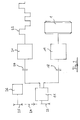
- Figure 1 shows a vehicle with front wheels 1, 2 and rear wheels 3, 4, each of which can be driven via an associated drive shaft 5-8.
- the front wheels 1, 2 are connected to an electric motor 11 via the assigned drive shafts 5, 6, a front axle differential 9 and a front axle transmission 10.
- the electric motor 11 has a relatively large diameter and a short overall length and is arranged on the front of an internal combustion engine 12.
- the transmission 14 can, for example, be a manual transmission, a stepped automatic transmission or a continuously variable transmission, in particular a Full toroidal gear.
- the output of the transmission 14 is one Rear axle transfer case 15 connected, which is that of the internal combustion engine 12 delivered torque on the two rear wheels 3 and 4 divides.
- a fuel cell 17 provided in an area 16 behind the internal combustion engine 12, in the conventional Vehicles the gearbox is arranged is a fuel cell 17 provided.
- the fuel cell 17 thermally with the Internal combustion engine 12 coupled. For this purpose, it is directly to the Flanged internal combustion engine 12.
- a Heat exchanger can be provided, the engine waste heat of the fuel cell 17 feeds. The waste heat from the internal combustion engine 12 is therefore not released unused to the environment, but to maintain the Operating temperature of the fuel cell used. Such a thing "Heat management" enables efficiency optimization.
- the fuel cell 17 can (not shown) are supplied with hydrogen.
- the reformer (not shown) splits from the fuel of the internal combustion engine, for example gasoline, Diesel or natural gas, hydrogen and leads the hydrogen to the Fuel cell 17 too.
- the hydrogen and atmospheric oxygen then becomes Electricity generated.
- the fuel cell 17 can also be operated directly by an Vehicle arranged hydrogen tank can be supplied with hydrogen.
- the internal combustion engine can then either be a "hydrogen engine” or, as explained above, operated with natural gas, petrol or diesel.
- the current supplied by the fuel cell 17 is used for the supply various electrical consumers in the vehicle and additionally feeds one here battery, not shown.
- the electric motor 11 is operated by the Fuel cell 17 supplied with electricity.
- the fuel cell also supplies 17 further electrical "X-by-wire systems" with electricity, such as a Air conditioning etc.
- the Electric motor 11 also serves as a starter or starter for the internal combustion engine 12th
- a braking energy recovery is via the electric motor 11 possible.
- overrun mode can namely over the front wheels 1, 2, the drive shafts 5, 6, the front differential 9 and that Front axle transmission 10 generated by the electric motor 11 generator current become.
- the electricity generated from the braking energy can then be converted into a Vehicle battery is fed in and stored there chemically.
- the Electric motor 1 thus represents a "wear-free" brake in overrun mode and enables recuperation of braking energy.
- FIG. 2 describes the operation of the electric motor 11 in more detail.
- the electric motor 11 is connected to the two front wheels via a clutch 18 and a transmission 19, which is generally referred to here as a "wheel transmission", only one front wheel 1 being shown here.
- the "wheel transmission” 19 is formed by the front axle transfer case 9 shown in FIG. 1 and a front axle transmission 10 which may be provided.
- the electric motor 11 is also via a further clutch 20 and "Internal combustion engine transmission 21" with a crankshaft 22 of the internal combustion engine connected.
- auxiliary unit 26 can, for example, an air conditioning system, a hydraulic pump etc.
- the electric motor 11 is via electrical supply lines, not shown here powered by the fuel cell 17. If the Clutch 18 closed and the clutch 20 is open, then over the electric motor 11 transmit torque to the front wheels become. In this case, the electric motor 11 functions as a front axle drive. Conversely, pushing or braking energy can be applied mechanically in overrun mode from the front wheels via the wheel gear 19 and the clutch 18 in the Electric motor can be initiated. The electric motor then works as Generator and gives the generated electricity e.g. to a not shown here Vehicle battery from. This is a braking energy recovery or one Recuperation possible.
- a “non-electric front axle drive” is also possible. If namely the two clutches 18, 20 are closed and the "primary drive" of the Front axle, that is, the electric motor 11 is switched off, then the Electric motor 11 as a "passive" torque transmission device be used. That is via the crankshaft 22, the Internal combustion engine transmission 21, the clutch 20, the electric motor 11, the Coupling 18 and the wheel gear 19 can torque from Internal combustion engine to be transferred to the front wheels. So it is also an internal combustion engine driven switchable front wheel drive possible.
- a "secondary drive independent of the primary drive” being represented. Via the electric motor 11, fed from the battery or from the fuel cell 17, can with the internal combustion engine uncoupled the auxiliary units, in particular the air conditioning system mechanically driven become. This has the consequence that one from the air conditioning system Stand air conditioning can be and with a suitable choice of translations in the accessory drive not all accessories when the engine is not running need their own electric drive.
Landscapes
- Engineering & Computer Science (AREA)
- Chemical & Material Sciences (AREA)
- Combustion & Propulsion (AREA)
- Mechanical Engineering (AREA)
- Transportation (AREA)
- Sustainable Energy (AREA)
- Life Sciences & Earth Sciences (AREA)
- Sustainable Development (AREA)
- General Engineering & Computer Science (AREA)
- Chemical Kinetics & Catalysis (AREA)
- Electrochemistry (AREA)
- General Chemical & Material Sciences (AREA)
- Manufacturing & Machinery (AREA)
- Electric Propulsion And Braking For Vehicles (AREA)
- Arrangement Or Mounting Of Propulsion Units For Vehicles (AREA)
- Hybrid Electric Vehicles (AREA)
- Engine Equipment That Uses Special Cycles (AREA)
- Control Of Vehicle Engines Or Engines For Specific Uses (AREA)
- Fuel Cell (AREA)
Abstract
Description
- alkalische Brennstoffzelle
- Membranbrennstoffzelle
- phosphorsaure Brennstoffzelle
- Schmelzkarbonatbrennstoffzelle
- Festoxidbrennstoffzelle.
- bessere Achslastverteilung durch die Getriebanordnung im Bereich der Hinterachse
- einfach und kostengünstig zu realisierender Zusatzantrieb für die Vorderachse
- Bremsenergierückgewinnung über die Vorderachse und den Zusatzantrieb
- kompaktes Schaltgetriebe mit wesentlich "erhöhter Drehmomentkapazität"
- Einsatz eines stufenlosen Getriebes, insbesondere eines Volltoroidgetriebes ohne Wandlerkupplung
- optimale Anordnung der als zusätzliche Energieversorgungseinheit dienenden Brennstoffzelle in direkter Motornähe zur Versorgung des Bordnetzes, des elektrischen Zusatzantriebes, der Standklimaanlage, und weiterer elektrischer Verbraucher auch bei Motorstillstand
- verringerte Kaltstartemissionen
- Verkürzung der Warmlaufphase des Motors
- Zusatzheizung für den Innenraum
- optimiertes Wärmemanagement
- Kostenersparnis bei der Katalysatortechnik, da in der Warmlauf- bzw. Kaltstartphase eine direkte Kraftstoffzugabe in den Motor möglich ist, sowie eine Zugabe in das Abgassystem vor dem Katalysator
- wirkungsgradoptimierte Stromerzeugung.
- Figur 1
- eine schematische Darstellung eines Fahrzeugs gemäß der Erfindung; und
- Figur 2
- den Zusatzantrieb gemäß der Erfindung in schematischer Darstellung.
Claims (16)
- Fahrzeug, mit einem Verbrennungsmotor und einer Brennstoffzelle zum Erzeugen elektrischer Energie, dadurch gekennzeichnet, dass die Brennstoffzelle (17) thermisch mit dem Verbrennungsmotor (12) gekoppelt ist.
- Fahrzeug nach Anspruch 1, dadurch gekennzeichnet, dass die Brennstoffzelle (17) unmittelbar am Gehäuse des Verbrennungsmotors (12) angeordnet ist.
- Fahrzeug nach Anspruch 1 oder 2, dadurch gekennzeichnet, dass die Brennstoffzelle (17) im Bereich zwischen dem Verbrennungsmotor (12) und einer Fahrzeughinterachse (3, 4) angeordnet ist
- Fahrzeug nach Anspruch 2 oder 3, dadurch gekennzeichnet, dass ein Reformer vorgesehen ist, der aus Kraftstoff zur Versorgung des Verbrennungsmotors (12) Brennstoff für die Brennstoffzelle (17) abspaltet und der Brennstoffzelle (17) zuführt.
- Fahrzeug nach einem der Ansprüche 1 bis 4, dadurch gekennzeichnet, dass eine antreibbare Hinterachse (3, 4) vorgesehen ist, und dass im Bereich der Hinterachse (3, 4) ein Getriebe (14) zum Variieren der Hinterachsübersetzung vorgesehen ist.
- Fahrzeug nach Anspruch 5, dadurch gekennzeichnet, dass das Getriebe (14) ein stufenloses Getriebe ist.
- Fahrzeug nach Anspruch 5 oder 6, dadurch gekennzeichnet, dass das Getriebe (14) ein Volltoroidgetriebe ist.
- Fahrzeug nach Anspruch 5, dadurch gekennzeichnet, dass das Getriebe (14) ein Handschaltgetriebe ist.
- Fahrzeug nach Anspruch 5, dadurch gekennzeichnet, dass das Getriebe (14) ein Automatikgetriebe ist.
- Fahrzeug nach einem der Ansprüche 1 bis 9, dadurch gekennzeichnet, dass der Verbrennungsmotor ein Wasserstoffmotor ist.
- Fahrzeug nach einem der Ansprüch1 bis 10, dadurch gekennzeichnet, dass der Verbrennungsmotor eine elektromagnetische Ventilsteuerung aufweist, wobei die elektromagnetische Ventilsteuerung von der Brennstoffzelle (17) mit Strom versorgt wird.
- Fahrzeug nach einem der Ansprüche 1 bis 1, dadurch gekennzeichnet, dass im Frontbereich des Verbrennungsmotors ein zuschaltbarer elektrischer Zusatzantrieb (11) vorgesehen ist, der als Motor und als Generator betreibbar ist.
- Fahrzeug nach Anspruch 12, dadurch gekennzeichnet, dass der Zusatzantrieb (11) über eine Kupplung (18) und ein Radgetriebe (19) mit Vorderrädern (1, 2) des Fahrzeugs verbunden ist.
- Fahrzeug nach Anspruch 12 oder 13, dadurch gekennzeichnet, dass der Zusatzantrieb (11) über eine Kupplung (20) und ein Motorgetriebe (21) mit einer Kurbelwelle (22) des Verbrennungsmotors (12) kinematisch gekoppelt ist.
- Fahrzeug nach einem der Ansprüche 12 bis 14, dadurch gekennzeichnet, dass der Zusatzantrieb elektrisch mit der Brennstoffzelle (17) verbunden ist.
- Fahrzeug nach einem der Ansprüche 12 bis 15, dadurch gekennzeichnet, dass der Zusatzantrieb (11) über einen Riementrieb (23 - 25) mit elektrischen Energieverbrauchern (26) verbunden ist.
Applications Claiming Priority (2)
| Application Number | Priority Date | Filing Date | Title |
|---|---|---|---|
| DE10140210 | 2001-08-16 | ||
| DE10140210 | 2001-08-16 |
Publications (3)
| Publication Number | Publication Date |
|---|---|
| EP1284346A2 true EP1284346A2 (de) | 2003-02-19 |
| EP1284346A3 EP1284346A3 (de) | 2003-08-13 |
| EP1284346B1 EP1284346B1 (de) | 2007-02-07 |
Family
ID=7695636
Family Applications (1)
| Application Number | Title | Priority Date | Filing Date |
|---|---|---|---|
| EP02015275A Expired - Lifetime EP1284346B1 (de) | 2001-08-16 | 2002-07-09 | Fahrzeug mit Verbrennungsmotor und Brennstoffzelle |
Country Status (5)
| Country | Link |
|---|---|
| US (1) | US6935282B2 (de) |
| EP (1) | EP1284346B1 (de) |
| JP (1) | JP2003129836A (de) |
| DE (1) | DE50209424D1 (de) |
| ES (1) | ES2278840T3 (de) |
Cited By (8)
| Publication number | Priority date | Publication date | Assignee | Title |
|---|---|---|---|---|
| FR2839583A1 (fr) * | 2002-05-10 | 2003-11-14 | Bosch Gmbh Robert | Installation de piles a combustible et vehicule equipe d'une telle installation |
| DE10355397A1 (de) * | 2003-11-25 | 2005-06-30 | Behr Gmbh & Co. Kg | Kraftfahrzeug-Klimaanlage mit Standklimatisierung |
| DE102004006152A1 (de) * | 2004-02-07 | 2005-09-08 | Rheinmetall Landsysteme Gmbh | Gepanzertes Kampffahrzeug |
| DE102005039092A1 (de) * | 2005-08-08 | 2007-02-15 | Deutsches Zentrum für Luft- und Raumfahrt e.V. | Brennstoffzellensystem und Verfahren zur Bereitstellung von Energie an einem Brennstoffzellensystem |
| WO2007105056A3 (en) * | 2006-03-10 | 2008-01-17 | Toyota Motor Co Ltd | Fuel cell electric vehicle and method of changing position of fuel cell stack |
| DE102006027901A1 (de) * | 2006-06-17 | 2008-02-07 | Volkswagen Ag | Hybridantriebsstrang eines Kraftfahrzeugs |
| WO2011113830A1 (de) * | 2010-03-16 | 2011-09-22 | Bayerische Motoren Werke Aktiengesellschaft | Kraftfahrzeug |
| DE102020113089A1 (de) | 2020-05-14 | 2021-11-18 | Schaeffler Technologies AG & Co. KG | Antriebseinheit für ein Hybridkraftfahrzeug mit Schaltgetriebe; sowie Verfahren zum Umschalten zwischen zwei Gängen |
Families Citing this family (13)
| Publication number | Priority date | Publication date | Assignee | Title |
|---|---|---|---|---|
| US6976353B2 (en) * | 2002-01-25 | 2005-12-20 | Arvin Technologies, Inc. | Apparatus and method for operating a fuel reformer to provide reformate gas to both a fuel cell and an emission abatement device |
| FR2861220B1 (fr) * | 2003-10-16 | 2005-12-23 | Renault Sa | Dispositif et procede de prechauffage d'un systeme pile a combustible |
| DE102004048526A1 (de) * | 2004-08-12 | 2006-02-23 | Bayerische Motoren Werke Ag | Brennstoffzellen-System |
| JP4583836B2 (ja) * | 2004-08-20 | 2010-11-17 | 本田技研工業株式会社 | 燃料電池車両 |
| US7291934B2 (en) * | 2005-08-30 | 2007-11-06 | Caterpillar Inc. | Machine with an electrical system |
| US20070144460A1 (en) * | 2005-12-22 | 2007-06-28 | Bleil Julika | Hybrid system of fuel cell and combustion engine |
| WO2007102822A1 (en) * | 2006-03-09 | 2007-09-13 | Utc Power Corporation | Pem fuel cell auxiliary power system and method for starting an internal combustion engine vehicle |
| DE102006039106A1 (de) * | 2006-08-19 | 2008-02-21 | Daimler Ag | Vorrichtung zum Antreiben eines Brennstoffzellen-Fahrzeuges |
| JP5856484B2 (ja) | 2012-01-06 | 2016-02-09 | 株式会社日立製作所 | 動力変換システム |
| TWI526655B (zh) | 2013-07-23 | 2016-03-21 | 財團法人工業技術研究院 | 廢熱回收裝置以及廢熱回收方法 |
| JP6481193B2 (ja) * | 2014-06-13 | 2019-03-13 | 三菱自動車工業株式会社 | 電動車両 |
| CN106762235B (zh) * | 2015-01-08 | 2018-12-28 | 赵卫强 | 提供清洁、环保、可循环燃料的车辆动力系统 |
| DE102019132410A1 (de) * | 2019-11-29 | 2021-06-02 | Audi Ag | Verfahren zum Starten eines Kraftfahrzeuges mit einer Brennstoffzellenvorrichtung sowie Kraftfahrzeug |
Family Cites Families (17)
| Publication number | Priority date | Publication date | Assignee | Title |
|---|---|---|---|---|
| EP0201670B1 (de) * | 1985-05-08 | 1993-05-26 | Volkswagen Aktiengesellschaft | Einrichtung zur Aufbereitung von im wesentlichen aus Methanol bestehenden Flüssigkeiten |
| DE4412453A1 (de) | 1994-04-12 | 1995-10-26 | Daimler Benz Ag | Anordnung eines Antriebsaggregats in einem Elektrofahrzeug |
| DE4412451C1 (de) | 1994-04-12 | 1995-09-28 | Daimler Benz Ag | Anordnung eines Antriebsaggregats in einem Elektrofahrzeug |
| US5887554A (en) * | 1996-01-19 | 1999-03-30 | Cohn; Daniel R. | Rapid response plasma fuel converter systems |
| DE19703171A1 (de) | 1997-01-29 | 1998-08-06 | Bayerische Motoren Werke Ag | Fahrzeug mit einem Antriebs-Verbrennungsmotor |
| US5976723A (en) * | 1997-03-12 | 1999-11-02 | Boffito; Claudio | Getter materials for cracking ammonia |
| US6209494B1 (en) * | 1997-03-14 | 2001-04-03 | Procyon Power Systems, Inc. | Hybrid fuel-cell electric-combustion power system using complete pyrolysis |
| CA2341437C (en) * | 1998-08-27 | 2007-05-01 | Tyma, Inc. | Fuel supply system for a vehicle including a vaporization device for converting fuel and water into hydrogen |
| JP4131309B2 (ja) | 1999-02-18 | 2008-08-13 | トヨタ自動車株式会社 | 燃料電池と内燃機関のハイブリッドシステム |
| DE19913795C1 (de) * | 1999-03-26 | 2000-10-05 | Daimler Chrysler Ag | Vorrichtung mit einer Brennkraftmaschine und mit einem Brennstoffzellensystem |
| EP1175472B1 (de) * | 1999-03-26 | 2004-01-28 | Prestel, Michael | Verfahren und vorrichtung zur erzeugung von energie bzw. methanol |
| DE19923315B4 (de) | 1999-05-21 | 2015-06-18 | Zf Friedrichshafen Ag | Antriebssystem für ein Kraftfahrzeug |
| DE19928102B4 (de) * | 1999-06-19 | 2005-06-02 | Daimlerchrysler Ag | Fahrzeug mit einem Antriebs-Verbrennungsmotor und mit einem Brennstoffzellensystem zur Stromversorgung elektrischer Verbraucher des Fahrzeugs und Verfahren zum Betrieb eines derartigen Fahrzeugs |
| DE19931061A1 (de) | 1999-07-01 | 2001-01-11 | Mannesmann Ag | Anordnung zum Beheizen/Kühlen einer Brennstoffzelle und Brennstoffzellensystem |
| US6205957B1 (en) * | 1999-09-16 | 2001-03-27 | Eaton Corporation | Natural gas engine with in situ generation of an autoignition product |
| US6463889B2 (en) * | 2001-03-08 | 2002-10-15 | General Motors Corporation | POx cold start vapor system |
| US6502533B1 (en) * | 2001-09-29 | 2003-01-07 | George Beuan Kirby Meacham | Internal combustion fuel reforming |
-
2002
- 2002-07-03 US US10/188,077 patent/US6935282B2/en not_active Expired - Fee Related
- 2002-07-09 EP EP02015275A patent/EP1284346B1/de not_active Expired - Lifetime
- 2002-07-09 DE DE50209424T patent/DE50209424D1/de not_active Expired - Fee Related
- 2002-07-09 ES ES02015275T patent/ES2278840T3/es not_active Expired - Lifetime
- 2002-07-10 JP JP2002201435A patent/JP2003129836A/ja active Pending
Cited By (9)
| Publication number | Priority date | Publication date | Assignee | Title |
|---|---|---|---|---|
| FR2839583A1 (fr) * | 2002-05-10 | 2003-11-14 | Bosch Gmbh Robert | Installation de piles a combustible et vehicule equipe d'une telle installation |
| DE10355397A1 (de) * | 2003-11-25 | 2005-06-30 | Behr Gmbh & Co. Kg | Kraftfahrzeug-Klimaanlage mit Standklimatisierung |
| DE102004006152A1 (de) * | 2004-02-07 | 2005-09-08 | Rheinmetall Landsysteme Gmbh | Gepanzertes Kampffahrzeug |
| DE102005039092A1 (de) * | 2005-08-08 | 2007-02-15 | Deutsches Zentrum für Luft- und Raumfahrt e.V. | Brennstoffzellensystem und Verfahren zur Bereitstellung von Energie an einem Brennstoffzellensystem |
| DE102005039092B4 (de) * | 2005-08-08 | 2007-06-21 | Deutsches Zentrum für Luft- und Raumfahrt e.V. | Brennstoffzellensystem |
| WO2007105056A3 (en) * | 2006-03-10 | 2008-01-17 | Toyota Motor Co Ltd | Fuel cell electric vehicle and method of changing position of fuel cell stack |
| DE102006027901A1 (de) * | 2006-06-17 | 2008-02-07 | Volkswagen Ag | Hybridantriebsstrang eines Kraftfahrzeugs |
| WO2011113830A1 (de) * | 2010-03-16 | 2011-09-22 | Bayerische Motoren Werke Aktiengesellschaft | Kraftfahrzeug |
| DE102020113089A1 (de) | 2020-05-14 | 2021-11-18 | Schaeffler Technologies AG & Co. KG | Antriebseinheit für ein Hybridkraftfahrzeug mit Schaltgetriebe; sowie Verfahren zum Umschalten zwischen zwei Gängen |
Also Published As
| Publication number | Publication date |
|---|---|
| EP1284346B1 (de) | 2007-02-07 |
| US6935282B2 (en) | 2005-08-30 |
| EP1284346A3 (de) | 2003-08-13 |
| DE50209424D1 (de) | 2007-03-22 |
| ES2278840T3 (es) | 2007-08-16 |
| JP2003129836A (ja) | 2003-05-08 |
| US20030033992A1 (en) | 2003-02-20 |
Similar Documents
| Publication | Publication Date | Title |
|---|---|---|
| EP1284346B1 (de) | Fahrzeug mit Verbrennungsmotor und Brennstoffzelle | |
| EP2370285B1 (de) | Hybrid-antriebseinheit und verfahren zu deren betrieb | |
| EP0967103B1 (de) | Elektro-mechanischer Antriebsstrang | |
| EP2240339B1 (de) | Kraftfahrzeugantriebsstrang | |
| DE10152809B4 (de) | Verfahren zum Betreiben eines Hybridantriebssystems | |
| DE60012658T2 (de) | Hybridantrieb mit integriertem Motorgenerator | |
| EP1173343B1 (de) | Hybridantrieb mit schaltbaren kupplungen für ein kraftfahrzeug | |
| EP1954542B1 (de) | Hybridantrieb für fahrzeuge sowie verfahren zur steuerung eines getriebes für einen hybridantrieb | |
| DE102006044500B4 (de) | Elektromechanisches Getriebe mit Eingangsverzweigung, zwei festen Drehzahlverhältnissen und einer Betriebsart | |
| DE102006040359B4 (de) | Elektrisch variables Hybridgetriebe | |
| DE60315828T2 (de) | Hybridfahrzeug mit antrieb durch eine brennkraftmaschine und elektromotoren | |
| DE102005047653B4 (de) | Hybridantriebseinheit mit Niedertemperatur-Kreislauf | |
| DE102010036321B4 (de) | Antriebssystem für ein Hybridfahrzeug und Hybridfahrzeug mit einem derartigen Antriebssystem | |
| DE102014118199B4 (de) | Leistungsübertragungssystem eines Hybridelektrofahrzeugs | |
| DE102009041207A1 (de) | 8-Gang-Hybridgetriebearchitekturen | |
| DE102013114100B4 (de) | Leistungsübertragungssystem eines Hybrid-Elektrofahrzeuges | |
| EP1115591A1 (de) | Antriebssystem für kraftfahrzeuge | |
| EP2500197B1 (de) | Über Nebentrieb verbundener Hybridantrieb | |
| DE102014118155A1 (de) | Leistungsübertragungssystem eines Hybrid-Elektrofahrzeuges | |
| DE10012221A1 (de) | Hybridantriebseinrichtung für Kraftfahrzeuge | |
| CN109080428A (zh) | 一种混联式混合动力系统及包括该混合动力系统的车辆 | |
| DE102015217159A1 (de) | Autarke elektrische Achse für Allradantrieb | |
| EP1307937A2 (de) | Brennstoffzellensystem in einem fahrzeug mit einem verbrennungs-motor und verfahren zu dessen betrieb | |
| DE102020101830A1 (de) | Elektromechanische antriebseinheit und ein antriebsstrang | |
| CN211166415U (zh) | 混合动力车的多模动力系统 |
Legal Events
| Date | Code | Title | Description |
|---|---|---|---|
| PUAI | Public reference made under article 153(3) epc to a published international application that has entered the european phase |
Free format text: ORIGINAL CODE: 0009012 |
|
| AK | Designated contracting states |
Designated state(s): AT BE BG CH CY CZ DE DK EE ES FI FR GB GR IE IT LI LU MC NL PT SE SK TR |
|
| AX | Request for extension of the european patent |
Extension state: AL LT LV MK RO SI |
|
| PUAL | Search report despatched |
Free format text: ORIGINAL CODE: 0009013 |
|
| AK | Designated contracting states |
Designated state(s): AT BE BG CH CY CZ DE DK EE ES FI FR GB GR IE IT LI LU MC NL PT SE SK TR |
|
| AX | Request for extension of the european patent |
Extension state: AL LT LV MK RO SI |
|
| 17P | Request for examination filed |
Effective date: 20030708 |
|
| AKX | Designation fees paid |
Designated state(s): DE ES FR GB IT |
|
| GRAP | Despatch of communication of intention to grant a patent |
Free format text: ORIGINAL CODE: EPIDOSNIGR1 |
|
| GRAS | Grant fee paid |
Free format text: ORIGINAL CODE: EPIDOSNIGR3 |
|
| GRAA | (expected) grant |
Free format text: ORIGINAL CODE: 0009210 |
|
| AK | Designated contracting states |
Kind code of ref document: B1 Designated state(s): DE ES FR GB IT |
|
| REG | Reference to a national code |
Ref country code: GB Ref legal event code: FG4D Free format text: NOT ENGLISH |
|
| GBT | Gb: translation of ep patent filed (gb section 77(6)(a)/1977) |
Effective date: 20070219 |
|
| REF | Corresponds to: |
Ref document number: 50209424 Country of ref document: DE Date of ref document: 20070322 Kind code of ref document: P |
|
| ET | Fr: translation filed | ||
| REG | Reference to a national code |
Ref country code: ES Ref legal event code: FG2A Ref document number: 2278840 Country of ref document: ES Kind code of ref document: T3 |
|
| PLBE | No opposition filed within time limit |
Free format text: ORIGINAL CODE: 0009261 |
|
| STAA | Information on the status of an ep patent application or granted ep patent |
Free format text: STATUS: NO OPPOSITION FILED WITHIN TIME LIMIT |
|
| 26N | No opposition filed |
Effective date: 20071108 |
|
| PGFP | Annual fee paid to national office [announced via postgrant information from national office to epo] |
Ref country code: ES Payment date: 20090630 Year of fee payment: 8 Ref country code: FR Payment date: 20090727 Year of fee payment: 8 |
|
| PGFP | Annual fee paid to national office [announced via postgrant information from national office to epo] |
Ref country code: DE Payment date: 20090916 Year of fee payment: 8 Ref country code: GB Payment date: 20090730 Year of fee payment: 8 |
|
| PGFP | Annual fee paid to national office [announced via postgrant information from national office to epo] |
Ref country code: IT Payment date: 20090729 Year of fee payment: 8 |
|
| GBPC | Gb: european patent ceased through non-payment of renewal fee |
Effective date: 20100709 |
|
| REG | Reference to a national code |
Ref country code: FR Ref legal event code: ST Effective date: 20110331 |
|
| PG25 | Lapsed in a contracting state [announced via postgrant information from national office to epo] |
Ref country code: DE Free format text: LAPSE BECAUSE OF NON-PAYMENT OF DUE FEES Effective date: 20110201 |
|
| REG | Reference to a national code |
Ref country code: DE Ref legal event code: R119 Ref document number: 50209424 Country of ref document: DE Effective date: 20110201 |
|
| PG25 | Lapsed in a contracting state [announced via postgrant information from national office to epo] |
Ref country code: FR Free format text: LAPSE BECAUSE OF NON-PAYMENT OF DUE FEES Effective date: 20100802 Ref country code: IT Free format text: LAPSE BECAUSE OF NON-PAYMENT OF DUE FEES Effective date: 20100709 |
|
| PG25 | Lapsed in a contracting state [announced via postgrant information from national office to epo] |
Ref country code: GB Free format text: LAPSE BECAUSE OF NON-PAYMENT OF DUE FEES Effective date: 20100709 |
|
| REG | Reference to a national code |
Ref country code: ES Ref legal event code: FD2A Effective date: 20110818 |
|
| PG25 | Lapsed in a contracting state [announced via postgrant information from national office to epo] |
Ref country code: ES Free format text: LAPSE BECAUSE OF NON-PAYMENT OF DUE FEES Effective date: 20100710 |