EP1284174A1 - Hoop for CVT belt and manufactoring method therefor - Google Patents
Hoop for CVT belt and manufactoring method therefor Download PDFInfo
- Publication number
- EP1284174A1 EP1284174A1 EP02017666A EP02017666A EP1284174A1 EP 1284174 A1 EP1284174 A1 EP 1284174A1 EP 02017666 A EP02017666 A EP 02017666A EP 02017666 A EP02017666 A EP 02017666A EP 1284174 A1 EP1284174 A1 EP 1284174A1
- Authority
- EP
- European Patent Office
- Prior art keywords
- foreign matter
- hoop
- particle size
- type
- less
- Prior art date
- Legal status (The legal status is an assumption and is not a legal conclusion. Google has not performed a legal analysis and makes no representation as to the accuracy of the status listed.)
- Granted
Links
- 238000000034 method Methods 0.000 title claims description 15
- 239000002245 particle Substances 0.000 claims abstract description 104
- 239000006061 abrasive grain Substances 0.000 claims description 85
- 238000005498 polishing Methods 0.000 claims description 41
- 230000005484 gravity Effects 0.000 claims description 21
- 238000005121 nitriding Methods 0.000 claims description 17
- 238000004519 manufacturing process Methods 0.000 claims description 15
- 239000003082 abrasive agent Substances 0.000 claims description 14
- 239000011230 binding agent Substances 0.000 claims description 11
- 238000005480 shot peening Methods 0.000 claims description 9
- PNEYBMLMFCGWSK-UHFFFAOYSA-N aluminium oxide Inorganic materials [O-2].[O-2].[O-2].[Al+3].[Al+3] PNEYBMLMFCGWSK-UHFFFAOYSA-N 0.000 description 20
- 229910052593 corundum Inorganic materials 0.000 description 19
- 229910001845 yogo sapphire Inorganic materials 0.000 description 19
- UFHFLCQGNIYNRP-UHFFFAOYSA-N Hydrogen Chemical compound [H][H] UFHFLCQGNIYNRP-UHFFFAOYSA-N 0.000 description 16
- MCMNRKCIXSYSNV-UHFFFAOYSA-N Zirconium dioxide Chemical compound O=[Zr]=O MCMNRKCIXSYSNV-UHFFFAOYSA-N 0.000 description 16
- 239000000463 material Substances 0.000 description 16
- 239000001257 hydrogen Substances 0.000 description 15
- 229910052739 hydrogen Inorganic materials 0.000 description 15
- 229920005989 resin Polymers 0.000 description 14
- 239000011347 resin Substances 0.000 description 14
- 150000001875 compounds Chemical class 0.000 description 11
- 150000004767 nitrides Chemical class 0.000 description 11
- 239000010410 layer Substances 0.000 description 9
- 229910000831 Steel Inorganic materials 0.000 description 7
- 230000000694 effects Effects 0.000 description 7
- 238000000605 extraction Methods 0.000 description 7
- 239000010959 steel Substances 0.000 description 7
- 230000002708 enhancing effect Effects 0.000 description 6
- XLYOFNOQVPJJNP-UHFFFAOYSA-N water Substances O XLYOFNOQVPJJNP-UHFFFAOYSA-N 0.000 description 6
- ATJFFYVFTNAWJD-UHFFFAOYSA-N Tin Chemical compound [Sn] ATJFFYVFTNAWJD-UHFFFAOYSA-N 0.000 description 5
- 239000007789 gas Substances 0.000 description 5
- 238000005406 washing Methods 0.000 description 5
- QGZKDVFQNNGYKY-UHFFFAOYSA-N Ammonia Chemical compound N QGZKDVFQNNGYKY-UHFFFAOYSA-N 0.000 description 4
- 229910001240 Maraging steel Inorganic materials 0.000 description 4
- VYPSYNLAJGMNEJ-UHFFFAOYSA-N Silicium dioxide Chemical compound O=[Si]=O VYPSYNLAJGMNEJ-UHFFFAOYSA-N 0.000 description 4
- 238000009661 fatigue test Methods 0.000 description 4
- 238000007517 polishing process Methods 0.000 description 4
- 238000005452 bending Methods 0.000 description 3
- 238000001493 electron microscopy Methods 0.000 description 3
- 230000000977 initiatory effect Effects 0.000 description 3
- 150000001247 metal acetylides Chemical class 0.000 description 3
- 238000012360 testing method Methods 0.000 description 3
- VEXZGXHMUGYJMC-UHFFFAOYSA-N Hydrochloric acid Chemical compound Cl VEXZGXHMUGYJMC-UHFFFAOYSA-N 0.000 description 2
- 229910052681 coesite Inorganic materials 0.000 description 2
- 229910052906 cristobalite Inorganic materials 0.000 description 2
- 150000002500 ions Chemical class 0.000 description 2
- 239000011159 matrix material Substances 0.000 description 2
- 239000002184 metal Substances 0.000 description 2
- ZEZKMMFYTLTLJS-UHFFFAOYSA-N methanol;hydrobromide Chemical compound Br.OC ZEZKMMFYTLTLJS-UHFFFAOYSA-N 0.000 description 2
- 239000000203 mixture Substances 0.000 description 2
- 230000001376 precipitating effect Effects 0.000 description 2
- 150000003839 salts Chemical class 0.000 description 2
- 239000000377 silicon dioxide Substances 0.000 description 2
- 229910052682 stishovite Inorganic materials 0.000 description 2
- 239000002344 surface layer Substances 0.000 description 2
- 229910052905 tridymite Inorganic materials 0.000 description 2
- GRYLNZFGIOXLOG-UHFFFAOYSA-N Nitric acid Chemical compound O[N+]([O-])=O GRYLNZFGIOXLOG-UHFFFAOYSA-N 0.000 description 1
- 229910021529 ammonia Inorganic materials 0.000 description 1
- 238000000137 annealing Methods 0.000 description 1
- 230000005540 biological transmission Effects 0.000 description 1
- 238000010494 dissociation reaction Methods 0.000 description 1
- 230000005593 dissociations Effects 0.000 description 1
- 238000009826 distribution Methods 0.000 description 1
- 230000003631 expected effect Effects 0.000 description 1
- 238000000227 grinding Methods 0.000 description 1
- 238000009776 industrial production Methods 0.000 description 1
- 239000011259 mixed solution Substances 0.000 description 1
- 229920003052 natural elastomer Polymers 0.000 description 1
- 229920001194 natural rubber Polymers 0.000 description 1
- 229910017604 nitric acid Inorganic materials 0.000 description 1
- 230000002093 peripheral effect Effects 0.000 description 1
- 238000005554 pickling Methods 0.000 description 1
- 238000004451 qualitative analysis Methods 0.000 description 1
- 238000004904 shortening Methods 0.000 description 1
- 229910001220 stainless steel Inorganic materials 0.000 description 1
- 239000010935 stainless steel Substances 0.000 description 1
- 229920003051 synthetic elastomer Polymers 0.000 description 1
- 229920003002 synthetic resin Polymers 0.000 description 1
- 239000000057 synthetic resin Substances 0.000 description 1
- 239000005061 synthetic rubber Substances 0.000 description 1
- 101150051314 tin-10 gene Proteins 0.000 description 1
Images


Classifications
-
- C—CHEMISTRY; METALLURGY
- C22—METALLURGY; FERROUS OR NON-FERROUS ALLOYS; TREATMENT OF ALLOYS OR NON-FERROUS METALS
- C22C—ALLOYS
- C22C38/00—Ferrous alloys, e.g. steel alloys
- C22C38/10—Ferrous alloys, e.g. steel alloys containing cobalt
- C22C38/105—Ferrous alloys, e.g. steel alloys containing cobalt containing Co and Ni
-
- B—PERFORMING OPERATIONS; TRANSPORTING
- B24—GRINDING; POLISHING
- B24C—ABRASIVE OR RELATED BLASTING WITH PARTICULATE MATERIAL
- B24C1/00—Methods for use of abrasive blasting for producing particular effects; Use of auxiliary equipment in connection with such methods
- B24C1/08—Methods for use of abrasive blasting for producing particular effects; Use of auxiliary equipment in connection with such methods for polishing surfaces, e.g. smoothing a surface by making use of liquid-borne abrasives
-
- B—PERFORMING OPERATIONS; TRANSPORTING
- B24—GRINDING; POLISHING
- B24C—ABRASIVE OR RELATED BLASTING WITH PARTICULATE MATERIAL
- B24C11/00—Selection of abrasive materials or additives for abrasive blasts
-
- C—CHEMISTRY; METALLURGY
- C22—METALLURGY; FERROUS OR NON-FERROUS ALLOYS; TREATMENT OF ALLOYS OR NON-FERROUS METALS
- C22C—ALLOYS
- C22C38/00—Ferrous alloys, e.g. steel alloys
- C22C38/06—Ferrous alloys, e.g. steel alloys containing aluminium
-
- C—CHEMISTRY; METALLURGY
- C22—METALLURGY; FERROUS OR NON-FERROUS ALLOYS; TREATMENT OF ALLOYS OR NON-FERROUS METALS
- C22C—ALLOYS
- C22C38/00—Ferrous alloys, e.g. steel alloys
- C22C38/12—Ferrous alloys, e.g. steel alloys containing tungsten, tantalum, molybdenum, vanadium, or niobium
-
- C—CHEMISTRY; METALLURGY
- C22—METALLURGY; FERROUS OR NON-FERROUS ALLOYS; TREATMENT OF ALLOYS OR NON-FERROUS METALS
- C22C—ALLOYS
- C22C38/00—Ferrous alloys, e.g. steel alloys
- C22C38/14—Ferrous alloys, e.g. steel alloys containing titanium or zirconium
-
- C—CHEMISTRY; METALLURGY
- C23—COATING METALLIC MATERIAL; COATING MATERIAL WITH METALLIC MATERIAL; CHEMICAL SURFACE TREATMENT; DIFFUSION TREATMENT OF METALLIC MATERIAL; COATING BY VACUUM EVAPORATION, BY SPUTTERING, BY ION IMPLANTATION OR BY CHEMICAL VAPOUR DEPOSITION, IN GENERAL; INHIBITING CORROSION OF METALLIC MATERIAL OR INCRUSTATION IN GENERAL
- C23C—COATING METALLIC MATERIAL; COATING MATERIAL WITH METALLIC MATERIAL; SURFACE TREATMENT OF METALLIC MATERIAL BY DIFFUSION INTO THE SURFACE, BY CHEMICAL CONVERSION OR SUBSTITUTION; COATING BY VACUUM EVAPORATION, BY SPUTTERING, BY ION IMPLANTATION OR BY CHEMICAL VAPOUR DEPOSITION, IN GENERAL
- C23C8/00—Solid state diffusion of only non-metal elements into metallic material surfaces; Chemical surface treatment of metallic material by reaction of the surface with a reactive gas, leaving reaction products of surface material in the coating, e.g. conversion coatings, passivation of metals
- C23C8/02—Pretreatment of the material to be coated
Definitions
- the present invention relates to a hoop for a CVT (continuously variable transmission) belt for an automobile, and more particularly, relates to a technique for enhancing the fatigue strength by minimizing the effects of foreign matter.
- a CVT belt is composed of plural push blocks linked annularly by a metal hoop.
- the hoop is exposed to repeated bending loads, and high fatigue strength is therefore required.
- various methods have been proposed.
- JP-A Japanese Patent Application Laid-open
- No. 11-293407 discloses maraging steel in which particle sizes of Ti type inclusions are restricted to 8 ⁇ m or less as a hoop material
- JP-A No. 2001-64755 discloses maraging steel in which particle sizes of nonmetallic inclusions are restricted to 30 ⁇ m or less.
- improvements to the hoop itself have also been proposed.
- JP-A No. 1-142022 discloses a technique for enhancing the fatigue strength by gas nitriding treatment of the hoop.
- JP-A No. 63-96258 discloses a technique for enhancing the fatigue strength by shot peening on the hoop.
- nitriding examples include salt bath nitriding, gas nitriding, and ion nitriding.
- Salt bath nitriding is not suited to the purpose of enhancing the fatigue strength because a nitride layer or a porous layer is formed, and ion nitriding is poor in productivity.
- gas nitriding is free from such problems, and in particular gas nitriding by using ammonia gas is suited to industrial production in applications where the flexural rate is large and high fatigue strength is required, such as for the metal hoop used in automotive CVTs.
- N 2 and H 2 are produced by dissociation equilibrium of ammonia, and hydrogen interstitially enters into the steel along with progress in nitriding. Also, in annealing or pickling performed in a reducing atmosphere by hydrogen gas, hydrogen interstitially enters into the steel.
- the hydrogen interstitially entering into the steel is captured on the interface of the foreign matter and the matrix of the steel if foreign matter is present in the steel or on the steel surface.
- the hydrogen thus captured on the surface of the foreign matter in the manufacturing process induces hydrogen brittleness in the course of use of the product, and along with the notching effect by the foreign matter, it initiates fatigue rupture.
- brittleness is significant if foreign matter is present on the surface or in the vicinity of the product of which the surface is treated for hardening such as by nitriding, thereby contrarily lowering the fatigue strength.
- the amount of hydrogen captured between the matrix of the steel and the foreign mater depends on the surface area of the foreign matter. As the surface area of the foreign matter is increases, a larger amount of hydrogen is captured, and it is likely to act as initiations of fatigue rupture. In addition, the hoop is exposed to repeated bending loads, and the greatest stress acts on the surface and its vicinity. Therefore, the hoop is not sensitive to hydrogen capturing in the inside, but is extremely sensitive to hydrogen capturing near the surface. In the nitrided hoop, therefore, the fatigue strength in the hardened layer by nitriding is extremely important, and when hydrogen is captured on the surface or hardened layer, it has a large effect on the fatigue strength. From such viewpoint, the present inventors quantitatively analyzed the effects of the foreign matter existing in the surface and nitrided hardened layer on the fatigue strength.
- the hoop for a CVT belt (hereinafter called a hoop) of the invention is developed on the basis of the above findings.
- the present invention provides a hoop for a CVT belt, comprising foreign matter existing in a nitrided hardened layer and a surface thereof, wherein the foreign matter has a particle size of 25 ⁇ m or less.
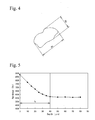
- the particle size d of foreign matter is expressed by the square root of (dx X dy), that is, (dx X dy) 0.5 , where dx is the maximum diameter across the foreign matter, and dy is the maximum diameter in the direction perpendicular to the direction of the maximum diameter across the foreign matter, as shown in Fig. 4.
- the foreign matter includes, aside from the inclusions precipitating in the manufacturing process of the hoop material, driven and dented matter in the hoop in the process of barrel polishing or shot peening.
- the hoop of the invention may be manufactured by barrel polishing and/or shot peening, and subsequent nitriding.
- the fatigue strength can be enhanced without removing foreign matter by electrolytic polishing or the like. That is, by limiting the particle size of foreign matter in the specified range, the hydrogen capturing amount is suppressed, and improvement of in fatigue strength by nitriding is not impeded. It is known that the hydrogen capturing amount differs with the kind of foreign matter. For example, TiN and other nitrides, and SiC and other carbides have a large hydrogen capturing ability, whereas oxides such as Al 2 O 3 , SiO 2 , and ZrO 2 have relatively small hydrogen capturing ability. Therefore, foreign matter of nitrides or carbides, if smaller in particle size, is likely to cause fatigue rupture, whereas foreign matter of oxide is less likely to initiate fatigue rupture if relatively large in particle size.
- the present invention further provides a hoop in which the foreign matter existing in the nitrided hardened layer and surface of the hoop comprises at least one of an oxide-type foreign matter, a nitride-type foreign matter, and a carbide-type foreign matter, the oxide-type foreign matter has a particle size of 25 ⁇ m or less, the nitride-type foreign matter and the carbide-type foreign matter have particle sizes of 17 ⁇ m or less.
- the manufacturing method for a hoop of the invention is explained.
- the present inventors took notice of the foreign matter driven or dented into the hoop by barrel polishing, and researched the abrasive grains used in barrel polishing.
- various abrasive materials are used, such as media having abrasive grains solidified by binder, or compounds containing abrasive grains.
- the particle size of these abrasives grains is smaller, the effect is smaller on the fatigue strength when driven into the hoop, but it takes a long time to perform barrel polishing.
- the inventors searched for the proper particle size of abrasive grains of abrasive material not having an effect on the fatigue strength if driven into the hoop, while shortening the time required for barrel polishing as much as possible. That is, in the course of barrel polishing, abrasive grains of the abrasive material are ground, and the particle size is made smaller when driven into the hoop. Therefore, abrasive grains of oxide material exceeding a particle size of 25 ⁇ m, and abrasive grains of foreign matter of nitride and carbide exceeding the particle size of 17 ⁇ m may be used.
- the manufacturing method for a hoop of the invention is based on the results of the studies above. That is, the present invention provides a manufacturing method for a hoop for a CVT belt, comprising barrel polishing using at least an abrasive material containing abrasive grains, the abrasive grains in the abrasive material comprising at least one of an oxide-type abrasive grain, a nitride-type abrasive grain, and a carbide-type abrasive grain, wherein the oxide-type abrasive grain has an average particle size of 30 ⁇ m or less, the nitride-type abrasive grain and the carbide-type abrasive grain have average particle sizes of 20 ⁇ m or less.
- the size of the foreign matter driven into the hoop can be limited in the specified range.
- Abrasive grains of nitride-type and carbide-type abrasive grains are not ground easily compared with oxide-type abrasive grains, and it is assumed that relatively large grains may be driven into the hoop after the barrel polishing process. From this point of view, too, it is important to define the particle size of nitride-type and carbide-type abrasive grains to be smaller than the particle size of oxide-type abrasive grains.
- the inventors also researched into the particle size of grains contained in the media. According to the research made by the inventors, abrasive particles projecting from the media surface are often partially cut off and dissociated from the media during the barrel polishing process. Therefore, the abrasive grains contained in the media may be set to be larger than the abrasive grains contained in the abrasive material.
- Another manufacturing method for a hoop of the invention is realized by quantitatively analyzing the particle size of abrasive grains dissociated from the media. That is, the present invention provides a manufacturing method for a hoop for a CVT belt, comprising barrel polishing using at least a media in which an abrasive grain is solidified by a binder, wherein the abrasive grain contained in the media has an average particle size of 100 ⁇ m or less.
- the media containing such abrasive grains the size of the foreign matter driven into the hoop can be limited within the specified range.
- the media is preferred to be composed of abrasive grains solidified by resin. That is, in barrel polishing, abrasive grains existing near the surface of the hoop are driven into the hoop by the impact of collision of the hoop and the media. Therefore, by using the binder made of resin, the impact of collision of media and hoop is lessened, and abrasive grains are hardly driven in. Moreover, by using the binder made of resin, the binding force of the abrasive grains and the binder is more resistant to impacts, and abrasive grains are hardly dissociated completely from the resin.
- the term "resin” refers to any binder mainly composed of synthetic resin or natural or synthetic rubber.
- barrel polishing is a process of adding water and polishing by maintaining contact between the media and the hoop. Therefore, the polishing power in barrel polishing and the size of foreign matter driven into the hoop depend on the ratio by weight of the media to water (bulk specific gravity), rather than the weight of the media itself.
- the bulk specific gravity of the media When the bulk specific gravity of the media is close to that of water, the media behave similarly to flowing water, and the impact against the hoop is smaller, and the foreign matter to be driven is less, and in contrast, when the bulk specific gravity of the media is greater than that of water, the media tends to behave differently from flowing water, and the impact against the hoop is larger, and the foreign matter to be driven is estimated to be larger.
- the bulk specific gravity of the media is desired to be as small as possible.
- the relationship between the bulk specific gravity and the particle size of the foreign matter driven into the hoop varies depending on whether the abrasive grains are oxide-type or carbide-type. That is, oxide-type abrasive grains are easily ground and are reduced in particle size, whereas carbide-type abrasive grains are difficult to grind, and therefore the bulk specific gravity of the media must be set to be smaller than in the case of oxide-type abrasive grains.
- the bulk specific gravity of the media is preferred to be 2.0 or less, and in the case of the media composed of carbide-type abrasive grains, the bulk specific gravity of the media is preferred to be 1.6 or less.
- relatively large abrasive grains may be dissociated from the media during the barrel polishing process, and if the barrel polishing process continues while such abrasive grains are present, they may be driven into the hoop, and the fatigue strength is lowered. Accordingly, after barrel polishing, at least by washing away the abrasive material, it is preferred to repeat such barrel polishing and washing several times. In this case of washing, only the abrasive material can be separated from the washing tank, or the abrasive material and media can be separated from the washing tank.
- Materials for the hoop of the invention include, for example, maraging steel disclosed in JP-A No. 62-80322, and high strength stainless steel disclosed in JP-A No. 2000-63998.
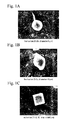
- the maximum particle size of Al 2 O 3 was 8 ⁇ m
- the maximum particle size of SiO 2 was 10 ⁇ m
- the maximum particle size of TiN was 10 ⁇ m.
- the term "particle size" always conforms to this definition.
- the material was processed into a hoop by a known method, and the marginal edges were removed by barrel polishing under various conditions. Other conditions of barrel polishing are shown in Table 2.
- Table 2 A representative piece of foreign matter existing on the hoop surface is shown in an electron microscope photograph in Fig. 2.
- the foreign matter shown in Fig. 2 is considerably larger than the inclusions shown in Figs. 1A to 1C, and this foreign matter was known to be an abrasive grain driven into the hoop by barrel polishing, not an inclusion precipitating in the material.
- the hoop sample was aged and was nitrided in an atmosphere containing ammonia gas.
- the hoop thus fabricated measured 9 mm in width, 0.18 mm in thickness, and 600 mm in peripheral length, having a hardness distribution in the depth direction shown in Fig. 5.
- the region indicated by symbol L is a layer hardened by nitriding.
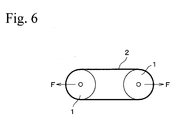
- a fatigue test was conducted by using a testing machine shown in Fig. 6.
- the testing machine shown in Fig. 6 is designed to wind a hoop 2 around a pair of rollers 1 and 1 of 55 mm in diameter, and to rotate while applying a force to the rollers 1 and 1 in directions to differing from each other.
- the force applied to the rollers 1 and 1 was 3200 N.
- two bending forces are applied by the rollers 1, and hence two times of the number of revolutions of the hoop 2 is defined as the service life (number of cycles).
- the fatigue test was terminated when the hoop 2 broke or the service life reached 10 8 cycles.
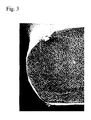
- Fig. 3 shows an electron microscope photograph of fracture surface of the hoop.
- Fig. 3 since the foreign matter driven into the hoop surface is opposite to the fracture surface, it is known that the foreign matter is the initiation of the fracture.
- the particle size of the foreign matter on the hoop surface opposite to the fracture surface is also shown in Table 2.
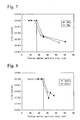
- Fig. 7 shows the relationship between the particle size and life of the foreign matter of nitride or carbide
- Fig. 8 shows the relationship between the particle size and life of the foreign matter of oxide. It is known from Fig. 7 and Fig.
- the life is generally close to 10 8 cycles when the particle size of foreign matter existing on the hoop surface is 25 ⁇ m or less.
- the life is 10 8 cycles at the particle size of 17 ⁇ m or less, and extremely excellent fatigue strength is demonstrated.
- the life is 10 8 cycles at the particle size of 25 ⁇ m or less, and extremely excellent fatigue strength is demonstrated. From these results, it is known that there is a difference in the hydrogen capturing amount between oxide foreign matter and nitride or carbide foreign matter, and also that the susceptibility to fatigue and allowable particle size of foreign matter are different.
- the range of the invention is confirmed to be appropriate.
- abrasive grains of the compound are driven into the hoop (samples 2, 3, 8, 9).
- abrasive grains of the media are driven into the hoop (samples 4, 5, 7, 10).
- the particle size of abrasive grains driven into the hoop is smaller than the particle size of the abrasive grains, and it is less than 25 ⁇ m of the upper limit of the invention in samples 1 to 5. This is because the abrasive grains are ground along with the progress in barrel polishing.
- sample 1 of particle size of oxide abrasive grains contained in the compound of 30 ⁇ m or less the particle size of foreign matter driven into the hoop is 19 ⁇ m, which is substantially smaller than the preferable range of 25 ⁇ m for the invention.
- sample 6 of particle size of oxide abrasive grains contained in the compound exceeding 30 ⁇ m the particle size of the foreign matter driven into the hoop is 37 ⁇ m.
- the particle size of foreign matter driven into the hoop is 17 ⁇ m or less, which is smaller than the preferable range of 17 ⁇ m or less for the invention.
- the particle size of the foreign matter driven into the hoop is 22 ⁇ m or more.
- sample 5 (using media only) of which the binder of media is a resin
- the average particle size of the abrasive grains of the media is 100 ⁇ m
- the particle size of foreign matter driven into the hoop is 7.3 to 25 ⁇ m. That is, in sample 5, since the weight of the media is low, the impact is small and drop-out of abrasive grains is less, and hence the collision impact between the media and hoop is smaller, so that the abrasive grains to be driven are smaller in size.
- sample 7 since the binder is vitrified, the weight of the media is greater than that of the resin, and the impact is larger. As a result, the particle size of foreign matter was as large as 33 ⁇ m, and hence the life was only 10 6 cycles (see Fig. 8).
- samples 8 and 9 foreign matter of a larger particle size than the particle size of abrasive grains of the compound being used was detected. Accordingly, inclusions of the material of samples 8 and 9 were measured by a dissolving extraction method, and larger inclusions than abrasive grains were observed. That is, the abrasive grains contain some larger than average particle size. In the case of alumina or other oxide abrasive grains, they are ground right after the start of grinding, and become smaller than the average particle size, but since abrasive grains of nitride and carbide are less likely to be ground, abrasive grains larger than the average particle size are left over, which are finally driven into the hoop surface.
- the bulk specific gravity of the media is discussed. Hoops were fabricated in the same conditions as in Embodiment 1, and marginal edges were removed by barrel polishing under various conditions. In this barrel polishing, using the resin having oxide abrasive grains bound by a binder, various bulk specific gravities were set by varying the abrasive grain rate of the media (the content of abrasive grains in the media). In this barrel polishing, the rotary barrel was set at a speed of 24 rpm, and polishing was operated continuously for 4 hours. Table 3 shows other conditions of barrel polishing.
- the maximum particle size of foreign matter extracted from the surface of the hoop after barrel polishing by the dissolving extraction method is also recorded in Table 3, and the relationship between the bulk specific gravity of the media and the maximum particle size of the foreign matter driven into the hoop is shown in Fig. 9.
- Fig. 9 in the case of oxide abrasive grains, when the bulk specific gravity of the media is 2.0 or less, the maximum particle size of the foreign matter is 20 ⁇ m or less, which is within a preferred range of 25 ⁇ m or less of the invention.
- a hoop for a CVT belt including foreign matter existing in a nitrided hardened layer and surface of the hoop the foreign matter comprises an oxide-type foreign matter, a nitride-type foreign matter, and carbide-type foreign matter.
- the oxide-type foreign matter has a particle size of 25 ⁇ m or less
- the nitride-type foreign matter and/or the carbide-type foreign matter have particle sizes of 17 ⁇ m or less.
Landscapes
- Chemical & Material Sciences (AREA)
- Engineering & Computer Science (AREA)
- Mechanical Engineering (AREA)
- Materials Engineering (AREA)
- Metallurgy (AREA)
- Organic Chemistry (AREA)
- Chemical Kinetics & Catalysis (AREA)
- Finish Polishing, Edge Sharpening, And Grinding By Specific Grinding Devices (AREA)
- Solid-Phase Diffusion Into Metallic Material Surfaces (AREA)
Abstract
Description
| C | Si | Mn | P | S | Ni | Mo | Co | Al | Ti |
| ≤ 0.01 | ≤ 0.05 | ≤ 0.05 | ≤ 0.008 | ≤ 0.004 | 15-19 | 3-5.5 | 8-15 | 0.05 - 0.15 | 0.4 - 1.5 |
| Barrel method | Duration, number of number of times | Media | Compound | Type of surface foreign matter | Foreign matter particle size (µm) | ||||
| Abrasive grain | Binder | | Size | ||||||
| Sample | |||||||||
| 1 | Rotary barrel (24rpm) | 4hr continuous | Al2O3 Average particle size = 30µm | Vitrified prism | Triangular | 15×12 mm | Al2O3 Average particle size=30µm | Al2O3 | 19 |
| | 4hr continuous | Al2O3 Average particle size = 30µm | Vitrified | Triangular prism | 15×12 mm | SiC Average particle size=20µm | SiC SiC | 17 15 11 8 | |
| Sample 3 | 4hr continuous | Al2O3 Average particle size = 30µm | Vitrified | Triangular prism | 15×12 mm | TiN Average particle size= | TiN | 10 15 | |
| Sample 4 | 1hrx4 times | Al2O3 Average particle size = 100µm | Vitrified | Triangular prism | 15×12 mm | None | Al2O3 | 23 | |
| | 4hr continuous | ZrO2 Average particle size = 100µm | Resin | Triangular pyramid | 15×12 | None | ZrO | 2 | 25 22 17.3 11.5 8.8 7.3 |
| Sample 6 | 4hr continuous | Al2O3 Average particle size= 50µm | Vitrified | Triangular prism | 15×12 mm | Al2O3 Average particle size =50µm | Al2O3 | 37 31 | |
| Sample 7 | 4hr continuous | Al2O3 Average particle size = 100µm | Vitrified | Triangular prism | 15×12 mm | None | Al2O3 | 33 | |
| Sample 8 | 4hr continuous | Al2O3 Average particle size = 30µm | Vitrified | Triangular prism | 15×12 mm | SiC Average particle size= | SiC | 50 25 25 | |
| Sample 9 | 4hr continuous | Al2O3 Average particle size = 30µm | Vitrified | Triangular prism | 15×12 mm | TiN Average particle size=30µm | TiN | 22 43 | |
| | 4hr continuous | Al2O3 Average particle size = 100µm | Vitrified | Triangular prism | 15x12 | None | ZrO | 2 | 30 |
| Media | Bulk specific gravity (g/cm3) | Compound | Type of foreign matter on surface | Particle size of foreign matter (µm) | ||||
| Abrasive grain | Binder | Shape | Size | |||||
| ZrO2 Average particle size=100 µm | Resin | Triangular pyramid | 15 × 12 mm | 1.2 1.2 1.2 | None | ZrO2 | 7.3 15 8.8 | |
| Triangular pyramid | 15 × 12 mm | 1.4 1.4 | 17.3 11.5 | |||||
| Triangular pyramid | 15 × 12 | 2 2 2 | 15 20 19 | |||||
| ZrO2 Average particle size=100 µm | Resin | Triangular pyramid | 15 × 12 mm | 2.2 2.2 | | ZrO | 2 | 35 33 |
| Al2O3 Average particle size =100 µm | Vitrified | Triangular prism | 15 × 12 mm | 2.6 2.6 2.6 | None | Al2O3 | 37 33 31 |
| Media | Bulk specific gravity (g/cm3) | Compound | Type of foreign matter on surface | Particle size of foreign matter (µm) | |||
| Abrasive grain | Binder | Shape | Size | ||||
| SiC Average particle size =100 µm | Resin | Triangular pyramid | 15 × 12 mm | 1.2 1.2 1.2 | None | SiC | 7.3 15 8.58 |
| Triangular pyramid | 15 × 12 mm | 1.6 1.6 | 17 11.5 | ||||
| SiC Average particle size =100 µm | Resin | Triangular pyramid | 15 × 12 mm | 1.9 1.9 1.9 | None | SiC | 27 20 25 |
| Triangular pyramid | 15 × 12 mm | 2.3 2.3 | 30 26 |
Claims (8)
- A hoop for a CVT belt, the hoop comprising foreign matter existing in a nitrided hardened layer and a surface thereof,
wherein the foreign matter has a particle size of 25 µm or less. - A hoop for a CVT belt, the hoop being manufactured by barrel polishing and/or shot peening and subsequent nitriding, and comprising foreign matter existing in a nitrided hardened layer and a surface thereof,
wherein the foreign matter has a particle size of 25 µm or less. - The hoop for a CVT belt according to claim 1, wherein the foreign matter existing in the nitrided hardened layer and surface of the hoop comprises at least one of an oxide-type foreign matter, a nitride-type foreign matter, and a carbide-type foreign matter,
the oxide-type foreign matter has a particle size of 25 µm or less, the nitride-type foreign matter and the carbide-type foreign matter have particle sizes of 17 µm or less. - The hoop for a CVT belt according to claim 2, wherein the foreign matter existing in the nitrided hardened layer and surface of the hoop comprises at least one of an oxide-type foreign matter, a nitride-type foreign matter, and a carbide-type foreign matter,
the oxide-type foreign matter has a particle size of 25 µm or less, the nitride-type foreign matter and the carbide-type foreign matter have particle sizes of 17 µm or less. - A manufacturing method for a hoop for a CVT belt, the method comprising barrel polishing using at least an abrasive material containing abrasive grains, the abrasive grains in the abrasive material comprising at least one of an oxide-type abrasive grain, a nitride-type abrasive grain, and a carbide-type abrasive grain,
wherein the oxide-type abrasive grain has an average particle size of 30 µm or less, the nitride-type abrasive grain and the carbide-type abrasive grain have average particle sizes of 20 µm or less. - A manufacturing method for a hoop for a CVT belt, the method comprising barrel polishing using at least a media in which an abrasive grain is solidified by a binder,
wherein the abrasive grain contained in the media has an average particle size of 100 µm or less. - The manufacturing method for a hoop for a CVT belt according to claim 6, wherein the abrasive grain in the media comprises an oxide-type abrasive grain, and the bulk specific gravity of the media is 2.0 or less.
- The manufacturing method for a hoop for a CVT belt according to claim 6, wherein the abrasive grain in the media comprises a carbide-type abrasive grain, and the bulk specific gravity of the media is 1.6 or less.
Applications Claiming Priority (2)
| Application Number | Priority Date | Filing Date | Title |
|---|---|---|---|
| JP2001240432A JP3884246B2 (en) | 2001-08-08 | 2001-08-08 | CVT belt hoop manufacturing method |
| JP2001240432 | 2001-08-08 |
Publications (2)
| Publication Number | Publication Date |
|---|---|
| EP1284174A1 true EP1284174A1 (en) | 2003-02-19 |
| EP1284174B1 EP1284174B1 (en) | 2011-04-13 |
Family
ID=19071045
Family Applications (1)
| Application Number | Title | Priority Date | Filing Date |
|---|---|---|---|
| EP02017666A Expired - Lifetime EP1284174B1 (en) | 2001-08-08 | 2002-08-06 | Hoop for CVT belt and manufactoring method therefor |
Country Status (4)
| Country | Link |
|---|---|
| US (1) | US7204892B2 (en) |
| EP (1) | EP1284174B1 (en) |
| JP (1) | JP3884246B2 (en) |
| DE (1) | DE60239720D1 (en) |
Cited By (2)
| Publication number | Priority date | Publication date | Assignee | Title |
|---|---|---|---|---|
| WO2009134119A1 (en) * | 2008-04-28 | 2009-11-05 | Robert Bosch Gmbh | Drive belt ring component and manufacturing method and maraging steel base material therefor |
| EP2998612A4 (en) * | 2013-05-13 | 2016-12-21 | Toyota Motor Co Ltd | METHOD FOR MANUFACTURING AN ENDLESS METAL RING, AND DEVICE FOR REMOVING ENDLESS METAL RING RESIN |
Families Citing this family (4)
| Publication number | Priority date | Publication date | Assignee | Title |
|---|---|---|---|---|
| JP4045248B2 (en) * | 2004-03-01 | 2008-02-13 | ジヤトコ株式会社 | Inspection method for continuously variable transmission belts |
| JP5317552B2 (en) * | 2008-06-26 | 2013-10-16 | オーエスジー株式会社 | Rolling dies |
| JP5920221B2 (en) * | 2010-11-12 | 2016-05-18 | 日本精工株式会社 | Actuator manufacturing method |
| JP6036574B2 (en) | 2013-06-25 | 2016-11-30 | トヨタ自動車株式会社 | Manufacturing method of laminated ring |
Citations (4)
| Publication number | Priority date | Publication date | Assignee | Title |
|---|---|---|---|---|
| GB2205060A (en) * | 1987-05-23 | 1988-11-30 | Sillavan Metal Services Limite | Abrasive metal finishing method and apparatus |
| US5531634A (en) * | 1995-02-03 | 1996-07-02 | Schott; Paul | Method of using an abrasive material for blast cleaning of solid surfaces |
| JPH11293497A (en) * | 1998-04-09 | 1999-10-26 | Murata Boring Giken Kk | High durability insoluble electrode for electrolysis |
| US20010000912A1 (en) * | 1997-10-31 | 2001-05-10 | Nobuyuki Kambe | Silicon oxide particles |
Family Cites Families (10)
| Publication number | Priority date | Publication date | Assignee | Title |
|---|---|---|---|---|
| JPS6280322A (en) | 1985-10-04 | 1987-04-13 | Hitachi Metals Ltd | Endless steel belt and manufacture thereof |
| JPS6396258A (en) | 1986-10-13 | 1988-04-27 | Toyota Motor Corp | Surface treatment of endless metallic belt |
| JPS63267157A (en) | 1987-04-22 | 1988-11-04 | Noritake Dia Kk | Barrel polishing medium and its manufacture |
| JPH01142022A (en) | 1987-11-27 | 1989-06-02 | Sumitomo Metal Ind Ltd | Manufacture of seamless metallic belt |
| JPH03149176A (en) | 1989-10-31 | 1991-06-25 | Pentel Kk | Compound abrasive material |
| JP3690774B2 (en) | 1998-04-14 | 2005-08-31 | 日立金属株式会社 | Maraging steel strip |
| JP3421265B2 (en) | 1998-06-12 | 2003-06-30 | 日新製鋼株式会社 | Metastable austenitic stainless steel sheet for continuously variable transmission belt and method of manufacturing the same |
| DE10010383B4 (en) * | 1999-03-04 | 2004-09-16 | Honda Giken Kogyo K.K. | Process for the production of maraging steel |
| JP3110733B1 (en) | 1999-06-24 | 2000-11-20 | 住友特殊金属株式会社 | Maraging steel sheet excellent in fatigue characteristics and method for producing the same |
| DE60111718T2 (en) * | 2001-03-19 | 2006-05-04 | Van Doorne's Transmissie B.V. | Metal thrust belt and material for it |
-
2001
- 2001-08-08 JP JP2001240432A patent/JP3884246B2/en not_active Expired - Fee Related
-
2002
- 2002-08-06 DE DE60239720T patent/DE60239720D1/en not_active Expired - Lifetime
- 2002-08-06 EP EP02017666A patent/EP1284174B1/en not_active Expired - Lifetime
- 2002-08-08 US US10/214,314 patent/US7204892B2/en not_active Expired - Lifetime
Patent Citations (4)
| Publication number | Priority date | Publication date | Assignee | Title |
|---|---|---|---|---|
| GB2205060A (en) * | 1987-05-23 | 1988-11-30 | Sillavan Metal Services Limite | Abrasive metal finishing method and apparatus |
| US5531634A (en) * | 1995-02-03 | 1996-07-02 | Schott; Paul | Method of using an abrasive material for blast cleaning of solid surfaces |
| US20010000912A1 (en) * | 1997-10-31 | 2001-05-10 | Nobuyuki Kambe | Silicon oxide particles |
| JPH11293497A (en) * | 1998-04-09 | 1999-10-26 | Murata Boring Giken Kk | High durability insoluble electrode for electrolysis |
Cited By (5)
| Publication number | Priority date | Publication date | Assignee | Title |
|---|---|---|---|---|
| WO2009134119A1 (en) * | 2008-04-28 | 2009-11-05 | Robert Bosch Gmbh | Drive belt ring component and manufacturing method and maraging steel base material therefor |
| EP2998612A4 (en) * | 2013-05-13 | 2016-12-21 | Toyota Motor Co Ltd | METHOD FOR MANUFACTURING AN ENDLESS METAL RING, AND DEVICE FOR REMOVING ENDLESS METAL RING RESIN |
| EP3388711A1 (en) * | 2013-05-13 | 2018-10-17 | Toyota Jidosha Kabushiki Kaisha | Endless metal ring manufacturing method |
| US10843245B2 (en) | 2013-05-13 | 2020-11-24 | Toyota Jidosha Kabushiki Kaisha | Endless metal ring manufacturing method and endless metal ring resin removal device |
| US10926310B2 (en) | 2013-05-13 | 2021-02-23 | Toyota Jidosha Kabushiki Kaisha | Endless metal ring manufacturing method and endless metal ring resin removal device |
Also Published As
| Publication number | Publication date |
|---|---|
| US20030045387A1 (en) | 2003-03-06 |
| US7204892B2 (en) | 2007-04-17 |
| DE60239720D1 (en) | 2011-05-26 |
| EP1284174B1 (en) | 2011-04-13 |
| JP3884246B2 (en) | 2007-02-21 |
| JP2003049906A (en) | 2003-02-21 |
Similar Documents
| Publication | Publication Date | Title |
|---|---|---|
| Gammon et al. | Metallography and microstructures of titanium and its alloys | |
| JP5398574B2 (en) | Duplex stainless steel material for vacuum vessel and manufacturing method thereof | |
| KR20110076924A (en) | Abrasive Particles with Unique Forms | |
| TW201043367A (en) | Fixed abrasive sawing wire | |
| JP2008195994A (en) | Surface modification method for titanium products and surface modified titanium products | |
| US7204892B2 (en) | Hoop for CVT belt and manufacturing method therefor | |
| WO2009107288A1 (en) | Material for projecting material for shot-peening, finished wire, production process, and projecting material for shot-peening | |
| Vander Voort | Metallographic techniques in failure analysis | |
| JP6820657B2 (en) | Cubic boron nitride particles with a unique morphology | |
| AU732550B2 (en) | Martensitic stainless steel products | |
| WO2020234836A1 (en) | Revealing prior austenite grain boundaries of low-carbon micro-alloyed steel | |
| JP3830119B2 (en) | Cut-wire iron shot for blasting | |
| JP2004346424A (en) | Manufacturing method of coil spring and coil spring | |
| US4736547A (en) | Steel abrading elements for mass finishing of workpieces and methods of making and using same | |
| JP2017170504A (en) | Manufacturing method of ferritic stainless steel sheet | |
| RU2429195C1 (en) | Procedure for surface of diamond grains roughing | |
| JP2002069565A (en) | High strength steel having excellent delayed fracture resistance and its production method | |
| JPH11269630A (en) | Surface treated steel members | |
| JP2007056333A (en) | Method of shot peening of nitriding member and nitriding member treated by the method | |
| JPS63196380A (en) | Method for producing shot particles | |
| JP3009452B2 (en) | Method of manufacturing high strength carbonitrided coil spring | |
| US4835911A (en) | Methods of making steel abrading elements for mass finishing of workpieces and for using same | |
| JP7295411B2 (en) | Evaluation method for metallic materials | |
| JP2803915B2 (en) | Method of improving fatigue strength of high strength coil spring | |
| Yamada et al. | Improvement of fatigue strength of nitrided high-strength valve springs by application of a new super fine shot-peening technology |
Legal Events
| Date | Code | Title | Description |
|---|---|---|---|
| PUAI | Public reference made under article 153(3) epc to a published international application that has entered the european phase |
Free format text: ORIGINAL CODE: 0009012 |
|
| 17P | Request for examination filed |
Effective date: 20020806 |
|
| AK | Designated contracting states |
Designated state(s): AT BE BG CH CY CZ DE DK EE ES FI FR GB GR IE IT LI LU MC NL PT SE SK TR |
|
| AX | Request for extension of the european patent |
Extension state: AL LT LV MK RO SI |
|
| AKX | Designation fees paid |
Designated state(s): DE FR NL |
|
| 17Q | First examination report despatched |
Effective date: 20031113 |
|
| GRAP | Despatch of communication of intention to grant a patent |
Free format text: ORIGINAL CODE: EPIDOSNIGR1 |
|
| RIC1 | Information provided on ipc code assigned before grant |
Ipc: C23C 8/02 20060101AFI20100923BHEP |
|
| GRAS | Grant fee paid |
Free format text: ORIGINAL CODE: EPIDOSNIGR3 |
|
| GRAA | (expected) grant |
Free format text: ORIGINAL CODE: 0009210 |
|
| RIN1 | Information on inventor provided before grant (corrected) |
Inventor name: ODAGIRI, YOSHIHIRO Inventor name: ISHII, KAZUO |
|
| AK | Designated contracting states |
Kind code of ref document: B1 Designated state(s): DE FR NL |
|
| REF | Corresponds to: |
Ref document number: 60239720 Country of ref document: DE Date of ref document: 20110526 Kind code of ref document: P |
|
| REG | Reference to a national code |
Ref country code: DE Ref legal event code: R096 Ref document number: 60239720 Country of ref document: DE Effective date: 20110526 |
|
| REG | Reference to a national code |
Ref country code: NL Ref legal event code: T3 |
|
| PLBE | No opposition filed within time limit |
Free format text: ORIGINAL CODE: 0009261 |
|
| STAA | Information on the status of an ep patent application or granted ep patent |
Free format text: STATUS: NO OPPOSITION FILED WITHIN TIME LIMIT |
|
| 26N | No opposition filed |
Effective date: 20120116 |
|
| REG | Reference to a national code |
Ref country code: DE Ref legal event code: R097 Ref document number: 60239720 Country of ref document: DE Effective date: 20120116 |
|
| PGFP | Annual fee paid to national office [announced via postgrant information from national office to epo] |
Ref country code: NL Payment date: 20120809 Year of fee payment: 11 |
|
| REG | Reference to a national code |
Ref country code: NL Ref legal event code: V1 Effective date: 20140301 |
|
| PG25 | Lapsed in a contracting state [announced via postgrant information from national office to epo] |
Ref country code: NL Free format text: LAPSE BECAUSE OF NON-PAYMENT OF DUE FEES Effective date: 20140301 |
|
| REG | Reference to a national code |
Ref country code: DE Ref legal event code: R084 Ref document number: 60239720 Country of ref document: DE Effective date: 20140428 |
|
| REG | Reference to a national code |
Ref country code: FR Ref legal event code: PLFP Year of fee payment: 14 |
|
| PGFP | Annual fee paid to national office [announced via postgrant information from national office to epo] |
Ref country code: FR Payment date: 20150629 Year of fee payment: 14 |
|
| REG | Reference to a national code |
Ref country code: FR Ref legal event code: ST Effective date: 20170428 |
|
| PG25 | Lapsed in a contracting state [announced via postgrant information from national office to epo] |
Ref country code: FR Free format text: LAPSE BECAUSE OF NON-PAYMENT OF DUE FEES Effective date: 20160831 |
|
| PGFP | Annual fee paid to national office [announced via postgrant information from national office to epo] |
Ref country code: DE Payment date: 20170801 Year of fee payment: 16 |
|
| REG | Reference to a national code |
Ref country code: DE Ref legal event code: R119 Ref document number: 60239720 Country of ref document: DE |
|
| PG25 | Lapsed in a contracting state [announced via postgrant information from national office to epo] |
Ref country code: DE Free format text: LAPSE BECAUSE OF NON-PAYMENT OF DUE FEES Effective date: 20190301 |