EP1281920A2 - Pipe freezer with quick connect pipe adaptors - Google Patents

Pipe freezer with quick connect pipe adaptors Download PDF

Info

Publication number
EP1281920A2
EP1281920A2 EP02253044A EP02253044A EP1281920A2 EP 1281920 A2 EP1281920 A2 EP 1281920A2 EP 02253044 A EP02253044 A EP 02253044A EP 02253044 A EP02253044 A EP 02253044A EP 1281920 A2 EP1281920 A2 EP 1281920A2
Authority
EP
European Patent Office
Prior art keywords
chamber
pipe
adapter
hose
evaporation chamber
Prior art date
Legal status (The legal status is an assumption and is not a legal conclusion. Google has not performed a legal analysis and makes no representation as to the accuracy of the status listed.)
Withdrawn
Application number
EP02253044A
Other languages
German (de)
French (fr)
Other versions
EP1281920A3 (en
Inventor
Limen Chen
Current Assignee (The listed assignees may be inaccurate. Google has not performed a legal analysis and makes no representation or warranty as to the accuracy of the list.)
Spectronics Corp
Original Assignee
Spectronics Corp
Priority date (The priority date is an assumption and is not a legal conclusion. Google has not performed a legal analysis and makes no representation as to the accuracy of the date listed.)
Filing date
Publication date
Application filed by Spectronics Corp filed Critical Spectronics Corp
Priority to EP07121552A priority Critical patent/EP1895249A3/en
Publication of EP1281920A2 publication Critical patent/EP1281920A2/en
Publication of EP1281920A3 publication Critical patent/EP1281920A3/en
Withdrawn legal-status Critical Current

Links

Images

Classifications

    • FMECHANICAL ENGINEERING; LIGHTING; HEATING; WEAPONS; BLASTING
    • F25REFRIGERATION OR COOLING; COMBINED HEATING AND REFRIGERATION SYSTEMS; HEAT PUMP SYSTEMS; MANUFACTURE OR STORAGE OF ICE; LIQUEFACTION SOLIDIFICATION OF GASES
    • F25DREFRIGERATORS; COLD ROOMS; ICE-BOXES; COOLING OR FREEZING APPARATUS NOT OTHERWISE PROVIDED FOR
    • F25D15/00Devices not covered by group F25D11/00 or F25D13/00, e.g. non-self-contained movable devices
    • FMECHANICAL ENGINEERING; LIGHTING; HEATING; WEAPONS; BLASTING
    • F16ENGINEERING ELEMENTS AND UNITS; GENERAL MEASURES FOR PRODUCING AND MAINTAINING EFFECTIVE FUNCTIONING OF MACHINES OR INSTALLATIONS; THERMAL INSULATION IN GENERAL
    • F16LPIPES; JOINTS OR FITTINGS FOR PIPES; SUPPORTS FOR PIPES, CABLES OR PROTECTIVE TUBING; MEANS FOR THERMAL INSULATION IN GENERAL
    • F16L55/00Devices or appurtenances for use in, or in connection with, pipes or pipe systems
    • F16L55/10Means for stopping flow in pipes or hoses
    • F16L55/103Means for stopping flow in pipes or hoses by temporarily freezing liquid sections in the pipe
    • FMECHANICAL ENGINEERING; LIGHTING; HEATING; WEAPONS; BLASTING
    • F25REFRIGERATION OR COOLING; COMBINED HEATING AND REFRIGERATION SYSTEMS; HEAT PUMP SYSTEMS; MANUFACTURE OR STORAGE OF ICE; LIQUEFACTION SOLIDIFICATION OF GASES
    • F25BREFRIGERATION MACHINES, PLANTS OR SYSTEMS; COMBINED HEATING AND REFRIGERATION SYSTEMS; HEAT PUMP SYSTEMS
    • F25B39/00Evaporators; Condensers
    • F25B39/02Evaporators
    • FMECHANICAL ENGINEERING; LIGHTING; HEATING; WEAPONS; BLASTING
    • F28HEAT EXCHANGE IN GENERAL
    • F28FDETAILS OF HEAT-EXCHANGE AND HEAT-TRANSFER APPARATUS, OF GENERAL APPLICATION
    • F28F9/00Casings; Header boxes; Auxiliary supports for elements; Auxiliary members within casings
    • F28F9/02Header boxes; End plates
    • F28F9/0246Arrangements for connecting header boxes with flow lines
    • FMECHANICAL ENGINEERING; LIGHTING; HEATING; WEAPONS; BLASTING
    • F28HEAT EXCHANGE IN GENERAL
    • F28FDETAILS OF HEAT-EXCHANGE AND HEAT-TRANSFER APPARATUS, OF GENERAL APPLICATION
    • F28F9/00Casings; Header boxes; Auxiliary supports for elements; Auxiliary members within casings
    • F28F9/02Header boxes; End plates
    • F28F9/0246Arrangements for connecting header boxes with flow lines
    • F28F9/0256Arrangements for coupling connectors with flow lines
    • F28F9/0258Arrangements for coupling connectors with flow lines of quick acting type, e.g. with snap action

Definitions

  • This invention relates generally to portable apparatus for freezing the liquid contents of pipes for working on the pipe, and to the more particular field of portable pipe freezers that use a refrigerant cycle for cooling the pipe.
  • Pipe freezers are used in repairing or replacing pipe sections or repairing or adding fittings.
  • the effect of blocking flow in the pipe can be achieved by freezing the water in a section of the pipe.
  • the frozen section acts as an ice plug that blocks flow.
  • Some pipe freezer devices use frozen CO 2 (dry ice) for the heat transfer to freeze the section of pipe.
  • This invention relates to devices that use a refrigerant in a refrigeration cycle for the heat transfer.
  • Such devices are described, for example, in U. S. patent 5,548,965 and its counterparts DE 196 17 619.0 and GB 2,301,661.
  • the same patent describes an evaporator head with multiple channels sized to fit various standard pipe diameters.
  • Two evaporator heads are connected to a portable condenser/compressor unit by flexible coaxial tubes that cycle refrigerant to and from the evaporation chambers.
  • This invention improves upon the pipe freezer of U.S. Patent 5,548,965 by structural differences that make it easier to install the evaporator heads in some situations; specifically the use of interchangeable adapters that slide onto the evaporator chambers to adapt the head for pipes of different diameters.
  • the invention further adds internal structural differences that improve the distribution and flow path of the refrigerant along the pipe section, and thus improve the evaporation heat exchange.
  • the invention is in an apparatus for freezing the contents of a pipe through the use of a refrigeration cycle.
  • the apparatus includes a portable condenser/compressor unit and a pair of flexible coaxial hoses connected to an evaporation chamber.
  • a set of interchangeable adapters, each configured with one or more nearly semicircular channels conforming to a standard pipe diameter are used to place the evaporation chamber along and in heat transfer conduction with a section of a pipe.
  • the adapters are configured to hold the evaporation chamber in a position such that the length axis of the chamber is aligned parallel to the axis of the pipe.
  • the evaporation chamber has its coupling for the refrigerant hose located along its length dimension. The coupling orients the hose such that the hose is generally perpendicular to the length axis of the evaporation chamber. This angle of connection into the adapter makes it easier to install the evaporator head to a pipe when the pipe is close to a wall or structure that interferes with the hose being aligned parallel to the pipe.
  • a baffle may be placed between the outlet of the inner tube of the hose and the return to the outer tube.
  • the baffle forces refrigerant sprayed out of the inner tube to migrate from essentially the entry point of the chamber to an end wall and then back toward the entry point before entering the outer tube. This long migration path allows more efficient evaporation in the chamber and thus more efficient heat exchange.
  • the evaporation chamber is in the shape of a right cylinder closed by a pair of end plates.
  • a set of interchangeable adapters has on each adapter a channel of greater than semicircular arc and a radius just slightly larger than that of the cylindrical chamber to provide a conformal "slide-on" fit over the cylindrical chamber.
  • the channel defines an open slot that allows the adapter to slide past the hose coupling.
  • the channel is preferably be less than about 330° arc so that the slot is large enough to allow some rotational movement of the chamber within the adapter channel to facilitate connection to the pipe.
  • the evaporation chamber is constructed of a heat conductive metal, preferably aluminum.
  • the evaporation chamber is protected from dents and scratches by installing over it a replaceable open cylindrical sleeve.
  • the adapters are sized to provide a slide-on conformal fit over the sleeve.
  • the invention is in improvements to a portable pipe freezer apparatus as disclosed in U.S. patent 5,548,965.
  • the description of the preferred embodiments of that patent are adopted herein by reference so that it will not be necessary to repeat common elements.
  • Figure 9 (reproduced from U. S. 5,548,965) shows the basic elements of that prior portable pipe freezer apparatus.
  • the pipe freezer apparatus system (10) is installed on a pipe (12) to freeze the water (14) inside a section of pipe to form an ice plug.
  • the piper freezer includes a portable condenser/compressor unit (16) that has a compressor (18), a pair of condensers (20), and a fan (22).
  • the condenser /compressor unit is connected to a pair of evaporators (24 and 26) by flexible coaxial hoses (28and 30, respectively).
  • the coaxial hoses have an inner tube (32) and an outer tube (34).
  • the inner tube delivers high-pressure liquid refrigerant to an evaporation chamber and the outer tube returns refrigerant vapor from the evaporation chamber to the condenser/compressor unit.
  • liquid refrigerant (36) under high pressure enters through the inner tube (32) into an inner chamber (38) of the evaporators.
  • the inner tube extends well into the chamber and acts as a metering device to spray the liquid refrigerant into the low-pressure inner chamber of the evaporators.
  • the refrigerant evaporates, it absorbs heat from the evaporator (24) and by conduction heat exchange from the adjacent pipe and the water inside the pipe.
  • the refrigerant vapor is drawn from the evaporator through the outer tube (34) by suction and returned into the compressor 18, which raises the pressure of the vapor.
  • the high pressure vapor passes through a condenser, in which the vapor is exposed to a large cooling surface area from which heat is convected by the fan (22).
  • the refrigerant (36) is cooled to the condensation temperature, releases its heat of condensation and changes phase back into a liquid at high pressure to complete the cycle.
  • This invention changes the configuration of the evaporators.
  • the evaporation chamber is inside a metal cylinder 100 or evaporator head.
  • the evaporator head is provided with a set of interchangeable adapters to fit pipes of different standard diameters.
  • the adapter 102 in Figure 1 has different-sized, nearly semi-circular channels (104, 106, 108 and 110) for a conforming fit along relatively small (e.g., 15mm, 18mm, 22mm and 28 mm) diameter pipes. It would be sufficient, however, to provide a different adapter for each pipe diameter.
  • the adapter 102 also has a greater than semicircular channel 112 having a radius sufficient to make a slide-on conforming fit over the outer surface of the evaporator head to receive the evaporator head and to hold the evaporator chamber in a position such that the length axis ("D" in Figure 1) is aligned parallel to the axis of a pipe placed in any of the semicircular channels.
  • the coaxial hose (114) does not enter along the end of the cylinder, but rather enters through a hose coupling (116) that is located approximately midway along the length (D) of the cylinder.
  • the hose coupling directs the inner tube of the hose generally perpendicular to the length axis of the evaporation chamber.
  • the hose could be made to enter the chamber at a more acute angle, although there is no apparent advantage to do so.
  • the channel 112 on the adapter has a arc of greater than 180 degrees, but preferably not more than about 330 degrees, so that the cylindrical evaporator head can slide into the channel with the hose and hose coupling in the slot 112 that is left open. It is most preferable to have the slot extend even further to permit the cylinder to rotate inside the coupling through about 45 degrees so that the hose can be positioned according to the space and obstacles around the pipe.
  • the connection to the evaporator in a direction generally perpendicular to the pipe permits the freezer unit to be used in more confined space than orienting the hoses along the axis of the pipe, as in the prior pipe freezer.
  • the adapter (120) of Figure 2 has two nearly semi-circular channels (124 and 122) conforming to the outer diameter of intermediate sized pipes (e. g. 35mm and 42mm, or 48mm and 60mm)).
  • the adapter (128) of Figure 3 has a single nearly semi-circular channel (130) for a relatively large pipe (e.g. 73 mm or higher.).
  • the greater than semi-circular channel (126 and 132) for the evaporator head is the same as the channel (112) on the adapter 102 of Figure 1.
  • the hose coupling directs the hose in a direction essentially at right angle to the axis of the pipe.
  • the inner tube (122) of the hose projects through the coupling to near the opposite inner wall of the cylinder to spray the liquid refrigerant against the wall.
  • the refrigerant evaporates, the vapor is drawn back into the coupling to the outer tube of the hose. Since the coupling orients the inner tube essentially perpendicular to the length axis of the chamber, the distance from the end of the inner tube back into the coupling is not as great as when the inner tube is aligned with the length axis. This situation may result in less efficient heat transfer, as some liquid refrigerant may be drawn back into the outer hose and evaporate on return to the compressor rather than in the chamber.
  • a metal baffle plate (124) is placed in the evaporator head, as shown in Figure 5.
  • the baffle plate preferably is located in a chord of the cylindrical chamber near the hose coupling and extends toward and nearly to the end walls of the chamber.
  • the baffle plate (124) may be a flat plate extending along the length of the chamber and terminate near the end plates, or as in Figures Sand 6, may then extend along the end plates of the chamber.
  • the inner tube (122) of the refrigerant hose extends through the baffle plate.
  • refrigerant sprayed from the inner tube (122) must migrate to the ends of the chamber to pass around the plate (124) and return to the midpoint of the chamber to be pulled into the coupling for return to the compressor/condenser (128) in the outer tube of the hose (126). This longer path makes more evaporation take place in the chamber and promotes more efficient heat exchange.
  • FIGs 5 and 6 show a preferred configuration of baffle.
  • the baffle (130) is saddle-shaped with a long flat top section (132) and two end sections (134) close to and essentially parallel to the end walls (136) of the cylinder. This creates a large evaporation space inside the baffle and forces the refrigerant to migrate essentially along the perimeter of the chamber before re-entering the hose coupling (116).
  • Figure 7 shows another preferred construction of a cylindrical evaporation chamber.
  • the chamber as described in previous embodiments, is formed as a hollow right cylinder (138) closed at both ends by end plates (136).
  • the cylinder and plates are formed from a heat conductive metal, preferably aluminum.
  • the surface of the cylinder should make a tight conforming fit into the adapter. This smooth fit would be lost if the cylinder became dented or scratched, as softer metals are prone to become in a working environment.
  • a replaceable protective sleeve 140
  • the sleeve is also made of a heat conductive metal, again preferably aluminum.
  • the sleeve has a slot opening to allow the sleeve to slide past the hose coupling onto the cylinder.
  • the adapters are sized to made a tight conformal fit with the sleeve. If the sleeve becomes dented or scratched, it can be replaced at much less cost than the evaporation chamber.
  • Figure 8 shows an alternative shape of evaporation chamber.
  • the chamber (150) is rectangular in cross section, with its length dimension directed into the paper.
  • the adapter (152) has a rectangular channel for a conformal fit around three sides of the chamber.
  • the rectangular chamber is slide into the adapter, and a bracket (154) is placed over it and held to the adapter by thumbscrews (156) in threaded bores of the adapter.
  • the evaporator is similar to the cylindrical evaporator in that the hose coupling is located approximately midway along the evaporator's length dimension and is oriented perpendicular to the length axis of the chamber.
  • a baffle is preferably located in the chamber between the outlet of the inner tube of the hose and the return to the outer tube to force refrigerant sprayed out of the inner tube to migrate from essentially the midway point of the chamber to an end wall and then back toward the midway point before entering the outer tube.
  • evaporation chamber could also be used in accordance with the invention.
  • the exterior of the chamber could include flat sides, such as a hexagonal or octagonal cylinder, and the adapters would be correspondingly configured to slide-on over the hexagonal or octagonal exterior.
Landscapes

  • Engineering & Computer Science (AREA)
  • General Engineering & Computer Science (AREA)
  • Mechanical Engineering (AREA)
  • Physics & Mathematics (AREA)
  • Thermal Sciences (AREA)
  • Chemical & Material Sciences (AREA)
  • Combustion & Propulsion (AREA)
  • Devices That Are Associated With Refrigeration Equipment (AREA)
  • Removal Of Water From Condensation And Defrosting (AREA)

Abstract

A portable pipe freezer apparatus includes a condenser/compressor unit (128) and a pair of flexible coaxial hoses (122,126) each connected to an evaporator head (100) with a set of interchangeable adapters (102) configured with one or more nearly semicircular channels (104,106,108,110) conforming to selected standard pipe diameters. The adapters (102) hold the evaporation chamber (150) in a position such that the length axis of the chamber (150) is aligned parallel to the axis of the pipe. The evaporation chambers (150) have a coupling (116) for a coaxial hose (114) located along the length of the chamber (150). The coupling (116) preferably orients the hose (114) generally perpendicular to the length axis of the chamber (150). Inside of the chamber (150), a baffle (124,130) placed between the outlet of the inner tube (122) of the hose (114) and the return to the outer tube (126) forces refrigerant sprayed out of the inner tube (122) to migrate from essentially the midway point of the chamber (150) to an end wall, around the baffle (124,130), and then back toward the midway point before entering the outer tube (126). In a preferred embodiment, the evaporation chamber (150) is in the shape of a right cylinder (138) closed by a pair of end plates (136), and is covered with a protective sleeve (140) to protect the evaporation chamber from dents and scratches.

Description

Field of the Invention.
This invention relates generally to portable apparatus for freezing the liquid contents of pipes for working on the pipe, and to the more particular field of portable pipe freezers that use a refrigerant cycle for cooling the pipe.
Background of the Invention.
Pipe freezers are used in repairing or replacing pipe sections or repairing or adding fittings. When there is no convenient shut-off valve, the effect of blocking flow in the pipe can be achieved by freezing the water in a section of the pipe. The frozen section acts as an ice plug that blocks flow.
Some pipe freezer devices use frozen CO2 (dry ice) for the heat transfer to freeze the section of pipe. This invention however, relates to devices that use a refrigerant in a refrigeration cycle for the heat transfer. Such devices are described, for example, in U. S. patent 5,548,965 and its counterparts DE 196 17 619.0 and GB 2,301,661. The same patent describes an evaporator head with multiple channels sized to fit various standard pipe diameters. Two evaporator heads are connected to a portable condenser/compressor unit by flexible coaxial tubes that cycle refrigerant to and from the evaporation chambers.
This invention improves upon the pipe freezer of U.S. Patent 5,548,965 by structural differences that make it easier to install the evaporator heads in some situations; specifically the use of interchangeable adapters that slide onto the evaporator chambers to adapt the head for pipes of different diameters. The invention further adds internal structural differences that improve the distribution and flow path of the refrigerant along the pipe section, and thus improve the evaporation heat exchange.
Summary of the Invention.
The invention is in an apparatus for freezing the contents of a pipe through the use of a refrigeration cycle. The apparatus includes a portable condenser/compressor unit and a pair of flexible coaxial hoses connected to an evaporation chamber. A set of interchangeable adapters, each configured with one or more nearly semicircular channels conforming to a standard pipe diameter are used to place the evaporation chamber along and in heat transfer conduction with a section of a pipe.
The adapters are configured to hold the evaporation chamber in a position such that the length axis of the chamber is aligned parallel to the axis of the pipe. The evaporation chamber has its coupling for the refrigerant hose located along its length dimension. The coupling orients the hose such that the hose is generally perpendicular to the length axis of the evaporation chamber. This angle of connection into the adapter makes it easier to install the evaporator head to a pipe when the pipe is close to a wall or structure that interferes with the hose being aligned parallel to the pipe.
Inside the evaporation chamber, a baffle may be placed between the outlet of the inner tube of the hose and the return to the outer tube. The baffle forces refrigerant sprayed out of the inner tube to migrate from essentially the entry point of the chamber to an end wall and then back toward the entry point before entering the outer tube. This long migration path allows more efficient evaporation in the chamber and thus more efficient heat exchange.
In a preferred embodiment, the evaporation chamber is in the shape of a right cylinder closed by a pair of end plates. A set of interchangeable adapters has on each adapter a channel of greater than semicircular arc and a radius just slightly larger than that of the cylindrical chamber to provide a conformal "slide-on" fit over the cylindrical chamber. The channel defines an open slot that allows the adapter to slide past the hose coupling.
The channel is preferably be less than about 330° arc so that the slot is large enough to allow some rotational movement of the chamber within the adapter channel to facilitate connection to the pipe.
The evaporation chamber is constructed of a heat conductive metal, preferably aluminum. In a preferred embodiment, the evaporation chamber is protected from dents and scratches by installing over it a replaceable open cylindrical sleeve. When the sleeve is used, the adapters are sized to provide a slide-on conformal fit over the sleeve.
Brief Description of the Drawings.
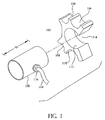
  • Figure 1 is a perspective view of a cylindrical evaporator chamber and one of a set of adapters for different standard diameters of pipe.
  • Figure 2 is a profile view of another adapter.
  • Figure 3 is a profile view of another adapter.
  • Figure 4 is a section view of an evaporator chamber and adapter on a pipe.
  • Figure 5 is a schematic view of an evaporator in section connected to a condenser/compressor unit to show flow path of refrigerant.
  • Figure 6 is a section view of a cylindrical evaporation chamber with a preferred configuration of baffle.
  • Figure 7 is a partially exploded view of an evaporation chamber with a replaceable protective sleeve.
  • Figure 8 is a profile view of a rectangular evaporation chamber and an associated adapter.
  • Figure 9 is a schematic view of the prior art portable pipe freezer of U. S. Patent 5,548,965.
  • Detailed Description of Several Embodiments of the Invention.
    The invention is in improvements to a portable pipe freezer apparatus as disclosed in U.S. patent 5,548,965. The description of the preferred embodiments of that patent are adopted herein by reference so that it will not be necessary to repeat common elements. In brief description, however, Figure 9 (reproduced from U. S. 5,548,965) shows the basic elements of that prior portable pipe freezer apparatus.
    Referring to Figure 9, the pipe freezer apparatus system (10) is installed on a pipe (12) to freeze the water (14) inside a section of pipe to form an ice plug. The piper freezer includes a portable condenser/compressor unit (16) that has a compressor (18), a pair of condensers (20), and a fan (22). The condenser /compressor unit is connected to a pair of evaporators (24 and 26) by flexible coaxial hoses (28and 30, respectively). The coaxial hoses have an inner tube (32) and an outer tube (34). The inner tube delivers high-pressure liquid refrigerant to an evaporation chamber and the outer tube returns refrigerant vapor from the evaporation chamber to the condenser/compressor unit.
    In the well-known refrigeration cycle, liquid refrigerant (36) under high pressure enters through the inner tube (32) into an inner chamber (38) of the evaporators. The inner tube extends well into the chamber and acts as a metering device to spray the liquid refrigerant into the low-pressure inner chamber of the evaporators. As the refrigerant evaporates, it absorbs heat from the evaporator (24) and by conduction heat exchange from the adjacent pipe and the water inside the pipe. The refrigerant vapor is drawn from the evaporator through the outer tube (34) by suction and returned into the compressor 18, which raises the pressure of the vapor. The high pressure vapor passes through a condenser, in which the vapor is exposed to a large cooling surface area from which heat is convected by the fan (22). The refrigerant (36) is cooled to the condensation temperature, releases its heat of condensation and changes phase back into a liquid at high pressure to complete the cycle.
    This invention changes the configuration of the evaporators. As shown in Figure 1, the evaporation chamber is inside a metal cylinder 100 or evaporator head. The evaporator head is provided with a set of interchangeable adapters to fit pipes of different standard diameters. The adapter 102 in Figure 1 has different-sized, nearly semi-circular channels (104, 106, 108 and 110) for a conforming fit along relatively small (e.g., 15mm, 18mm, 22mm and 28 mm) diameter pipes. It would be sufficient, however, to provide a different adapter for each pipe diameter.
    The adapter 102 also has a greater than semicircular channel 112 having a radius sufficient to make a slide-on conforming fit over the outer surface of the evaporator head to receive the evaporator head and to hold the evaporator chamber in a position such that the length axis ("D" in Figure 1) is aligned parallel to the axis of a pipe placed in any of the semicircular channels.
    The coaxial hose (114) does not enter along the end of the cylinder, but rather enters through a hose coupling (116) that is located approximately midway along the length (D) of the cylinder. The hose coupling directs the inner tube of the hose generally perpendicular to the length axis of the evaporation chamber. The hose could be made to enter the chamber at a more acute angle, although there is no apparent advantage to do so.
    The channel 112 on the adapter has a arc of greater than 180 degrees, but preferably not more than about 330 degrees, so that the cylindrical evaporator head can slide into the channel with the hose and hose coupling in the slot 112 that is left open. It is most preferable to have the slot extend even further to permit the cylinder to rotate inside the coupling through about 45 degrees so that the hose can be positioned according to the space and obstacles around the pipe. The connection to the evaporator in a direction generally perpendicular to the pipe permits the freezer unit to be used in more confined space than orienting the hoses along the axis of the pipe, as in the prior pipe freezer.
    Other adapters in the set are shown in Figures 2 and 3. The adapter (120) of Figure 2 has two nearly semi-circular channels (124 and 122) conforming to the outer diameter of intermediate sized pipes (e. g. 35mm and 42mm, or 48mm and 60mm)). The adapter (128) of Figure 3 has a single nearly semi-circular channel (130) for a relatively large pipe (e.g. 73 mm or higher.). The greater than semi-circular channel (126 and 132) for the evaporator head is the same as the channel (112) on the adapter 102 of Figure 1.
    Referring now to Figure 4, when the adapter (102) is placed on a water pipe (120), the hose coupling directs the hose in a direction essentially at right angle to the axis of the pipe. The inner tube (122) of the hose projects through the coupling to near the opposite inner wall of the cylinder to spray the liquid refrigerant against the wall. As the refrigerant evaporates, the vapor is drawn back into the coupling to the outer tube of the hose. Since the coupling orients the inner tube essentially perpendicular to the length axis of the chamber, the distance from the end of the inner tube back into the coupling is not as great as when the inner tube is aligned with the length axis. This situation may result in less efficient heat transfer, as some liquid refrigerant may be drawn back into the outer hose and evaporate on return to the compressor rather than in the chamber.
    To make the refrigerant evaporation in the chamber more efficient, a metal baffle plate (124) is placed in the evaporator head, as shown in Figure 5. The baffle plate preferably is located in a chord of the cylindrical chamber near the hose coupling and extends toward and nearly to the end walls of the chamber. The baffle plate (124) may be a flat plate extending along the length of the chamber and terminate near the end plates, or as in Figures Sand 6, may then extend along the end plates of the chamber.
    The inner tube (122) of the refrigerant hose extends through the baffle plate. Thus, refrigerant sprayed from the inner tube (122) must migrate to the ends of the chamber to pass around the plate (124) and return to the midpoint of the chamber to be pulled into the coupling for return to the compressor/condenser (128) in the outer tube of the hose (126). This longer path makes more evaporation take place in the chamber and promotes more efficient heat exchange.
    Figures 5 and 6 show a preferred configuration of baffle. The baffle (130) is saddle-shaped with a long flat top section (132) and two end sections (134) close to and essentially parallel to the end walls (136) of the cylinder. This creates a large evaporation space inside the baffle and forces the refrigerant to migrate essentially along the perimeter of the chamber before re-entering the hose coupling (116).
    Figure 7 shows another preferred construction of a cylindrical evaporation chamber. The chamber, as described in previous embodiments, is formed as a hollow right cylinder (138) closed at both ends by end plates (136). The cylinder and plates are formed from a heat conductive metal, preferably aluminum. To obtain good heat conduction between the chamber and the adapter, the surface of the cylinder should make a tight conforming fit into the adapter. This smooth fit would be lost if the cylinder became dented or scratched, as softer metals are prone to become in a working environment. To protect the valuable evaporation chamber, it is preferred to install over it a replaceable protective sleeve (140), as shown in Figure 7. The sleeve is also made of a heat conductive metal, again preferably aluminum. The sleeve has a slot opening to allow the sleeve to slide past the hose coupling onto the cylinder. The adapters are sized to made a tight conformal fit with the sleeve. If the sleeve becomes dented or scratched, it can be replaced at much less cost than the evaporation chamber.
    Figure 8 shows an alternative shape of evaporation chamber. In the embodiment, the chamber (150) is rectangular in cross section, with its length dimension directed into the paper. The adapter (152) has a rectangular channel for a conformal fit around three sides of the chamber. The rectangular chamber is slide into the adapter, and a bracket (154) is placed over it and held to the adapter by thumbscrews (156) in threaded bores of the adapter. Otherwise, the evaporator is similar to the cylindrical evaporator in that the hose coupling is located approximately midway along the evaporator's length dimension and is oriented perpendicular to the length axis of the chamber. A baffle is preferably located in the chamber between the outlet of the inner tube of the hose and the return to the outer tube to force refrigerant sprayed out of the inner tube to migrate from essentially the midway point of the chamber to an end wall and then back toward the midway point before entering the outer tube.
    Other shapes of evaporation chamber could also be used in accordance with the invention. For example, the exterior of the chamber could include flat sides, such as a hexagonal or octagonal cylinder, and the adapters would be correspondingly configured to slide-on over the hexagonal or octagonal exterior.

    Claims (14)

    1. A portable pipe freezer of the type using a refrigeration cycle, having a portable condenser/compressor unit and a pair of flexible coaxial hoses connected to the condenser/compressor unit, each hose having an inner tube for the delivery of high pressure liquid refrigerant to an evaporation chamber and an outer tube for the return of refrigerant vapor from the evaporation chamber to the condenser/compressor unit, each hose having connected to its end distal to the condenser/compressor unit an evaporation chamber having a length axis; characterized by:
      (a) the evaporation chamber having a hose coupling along its length dimension to couple the chamber to the hose, and
      (b) a plurality of interchangeable adapters, each adapter being constructed of a heat conductive metal and configured with one or more nearly semicircular channels conforming to a selected pipe diameter such that an adapter can be placed along a section of a pipe, each adapter further configured to receive and hold an evaporation chamber in a position wherein the length axis of the evaporation chamber is aligned parallel to the axis of the pipe when the adapter is placed along a section of pipe.
    2. A pipe freezer as in claim 1, wherein the coupling is oriented to couple the hose to the chamber in an orientation such that the inner tube of the hose is directed generally perpendicular to the length axis of the chamber.
    3. A pipe freezer as in either of claims 1 or 2, wherein the hose coupling is located approximately midway along the length dimension of the evaporation chamber.
    4. A pipe freezer as in any of claims 1, 2 or 3 wherein the exterior of the evaporation chamber is in the shape of a right cylinder.
    5. A pipe freezer as in claim 4, each adapter further configured with a greater than semicircular channel conforming to the outer diameter of the chamber such that the adapter can slide past the hose coupling.
    6. A pipe freezer as in claim 5, wherein the channel is less that about 330 degrees of arc.
    7. A pipe freezer as in any of claims 1 through 6, wherein the interior of the chamber contains a baffle plate oriented with respect to the inner tube such that refrigerant sprayed out of the inner tube must migrate around the baffle before entering the outer tube to return to the condenser/compressor unit.
    8. A pipe freezer as in claim 7, wherein the baffle plate is sized and located such that refrigerant sprayed out of the inner tube is directed toward and closely approaches an end wall of the chamber before returning to enter the outer tube.
    9. A pipe freezer as in any of claims 1 through 8, wherein the evaporation chamber is covered by a replaceable protective sleeve made of heat conductive metal.
    10. A pipe freezer substantially as herein before described with reference to and as illustrated in any one of the accompanying drawings.
    11. A combination of pipe adapter and evaporator chamber for freezing the contents of a pipe through the use of cycling refrigerant, the evaporator head comprising:
      (a) a cylindrical tube made of heat conductive metal having an outer surface and a hollow interior, and closed by two end plates to form an evaporation chamber;
      (b) a hose coupling located along the length of the tube between the end plates for receiving a coaxial hose through which refrigerant may be transported into and out of the evaporation chamber;
      (c) an adapter having one or more pipe receiving surfaces and configured to engage with the cylindrical tube, and
      (d) at least one baffle located inside the chamber for efficient distribution of refrigerant within the chamber.
    12. A combination of pipe adapter and evaporator chamber as in claim 11, wherein the adapter has a channel into which the evaporation chamber can slide, and the channel defines a slot of sufficient width to allow the hose coupling to slide through the slot.
    13. A combination of pipe adapter and evaporator chamber as in claim 12, wherein the slot is of sufficient width to allow to the allow the evaporation chamber may rotate up to approximately 45 degrees about its longitudinal axis while it is engaged in the adapter.
    14. A combination of pipe adapter and evaporator chamber substantially as herein before described with reference to and as illustrated in any one of the accompanying drawings.
    EP02253044A 2001-08-02 2002-04-30 Pipe freezer with quick connect pipe adaptors Withdrawn EP1281920A3 (en)

    Priority Applications (1)

    Application Number Priority Date Filing Date Title
    EP07121552A EP1895249A3 (en) 2001-08-02 2002-04-30 Pipe freezer with quick connect pipe adapters

    Applications Claiming Priority (2)

    Application Number Priority Date Filing Date Title
    US921353 2001-08-02
    US09/921,353 US6408638B1 (en) 2001-08-02 2001-08-02 Pipe freezer with quick connect evaporator heads

    Related Child Applications (1)

    Application Number Title Priority Date Filing Date
    EP07121552A Division EP1895249A3 (en) 2001-08-02 2002-04-30 Pipe freezer with quick connect pipe adapters

    Publications (2)

    Publication Number Publication Date
    EP1281920A2 true EP1281920A2 (en) 2003-02-05
    EP1281920A3 EP1281920A3 (en) 2003-11-26

    Family

    ID=25445315

    Family Applications (2)

    Application Number Title Priority Date Filing Date
    EP07121552A Withdrawn EP1895249A3 (en) 2001-08-02 2002-04-30 Pipe freezer with quick connect pipe adapters
    EP02253044A Withdrawn EP1281920A3 (en) 2001-08-02 2002-04-30 Pipe freezer with quick connect pipe adaptors

    Family Applications Before (1)

    Application Number Title Priority Date Filing Date
    EP07121552A Withdrawn EP1895249A3 (en) 2001-08-02 2002-04-30 Pipe freezer with quick connect pipe adapters

    Country Status (2)

    Country Link
    US (1) US6408638B1 (en)
    EP (2) EP1895249A3 (en)

    Families Citing this family (3)

    * Cited by examiner, † Cited by third party
    Publication number Priority date Publication date Assignee Title
    US6718789B1 (en) * 2002-05-04 2004-04-13 Arthur Radichio Pipe freezer with defrost cycle
    US8240167B2 (en) * 2010-02-08 2012-08-14 Ingram Michael T Cryogenic freezing apparatus
    US11761855B2 (en) * 2019-07-03 2023-09-19 Rtx Corporation Apparatus and method for testing additively manufactured engine components

    Citations (1)

    * Cited by examiner, † Cited by third party
    Publication number Priority date Publication date Assignee Title
    US5548965A (en) 1995-05-31 1996-08-27 Spectronics Corporation Multi-cavity evaporator

    Family Cites Families (9)

    * Cited by examiner, † Cited by third party
    Publication number Priority date Publication date Assignee Title
    US2572555A (en) * 1944-11-03 1951-10-23 Freez Seal Equipment Company L Water pipe repairing equipment
    US4267699A (en) * 1979-02-21 1981-05-19 Bahrenburg Harry H Freeze isolation seal
    US4309875A (en) * 1979-05-14 1982-01-12 Gerald M. D'Agostino Pipe freezer or the like
    DE3477417D1 (en) * 1983-08-02 1989-04-27 Ronald Hallett Pipe freezing device
    DE3903009A1 (en) * 1989-02-02 1990-08-09 Rothenberger Werkzeuge Masch Device for freezing pipelines through which media flow, in particular water conduits (water piping)
    US5836167A (en) * 1995-09-18 1998-11-17 Nowsco Well Service Ltd. Method and apparatus for freezing large pipe
    US5680770A (en) * 1996-11-04 1997-10-28 Freeze Service, Inc. Pipe freezing apparatus
    US6141972A (en) * 1998-12-07 2000-11-07 Evans; Daniel J. Invasive cryogenic tool and method for freezing the content of a pipe
    CA2372596C (en) * 1999-05-06 2004-08-31 Arthur Radichio Pipe freezer

    Patent Citations (3)

    * Cited by examiner, † Cited by third party
    Publication number Priority date Publication date Assignee Title
    US5548965A (en) 1995-05-31 1996-08-27 Spectronics Corporation Multi-cavity evaporator
    GB2301661A (en) 1995-05-31 1996-12-11 Spectronics Corp Evaporator for freezing the contents of a pipe
    DE19617619A1 (en) 1995-05-31 1996-12-12 Spectronics Corp Device or evaporator for freezing a pipe section

    Also Published As

    Publication number Publication date
    EP1895249A2 (en) 2008-03-05
    US6408638B1 (en) 2002-06-25
    EP1281920A3 (en) 2003-11-26
    EP1895249A3 (en) 2008-08-06

    Similar Documents

    Publication Publication Date Title
    EP1031802B1 (en) Improved inlet for an evaporator
    US7331195B2 (en) Refrigerant distribution device and method
    US8413715B2 (en) Refrigerant evaporator with U-turn block and refrigerant-distributing holes
    US6598412B1 (en) Interchangeable adapters for pipe freezer apparatus
    US20140007600A1 (en) Evaporator, and method of conditioning air
    US10378826B2 (en) Heat Exchanger
    WO2006044448A3 (en) Falling film evaporator
    AU784140B2 (en) Heat exchanger header construction
    JPH0933165A (en) Multi-cavity evaporator
    CN110857822A (en) Gas-liquid separator and air conditioning system
    EP0145114B1 (en) Pipe freezing device
    EP1281920A2 (en) Pipe freezer with quick connect pipe adaptors
    EP1177404B1 (en) Pipe freezer
    US9574694B2 (en) Pipe freezer system
    KR102224118B1 (en) Double pipe heat-exchanger with one body type connector
    CN110411075B (en) Condenser and Air Conditioner
    CN113063241B (en) Heat exchange assembly
    CN221403618U (en) Refrigerator heat exchanger
    KR200168019Y1 (en) Condensing unit for refrigerator
    GB2236587A (en) Heat exchangers
    KR20010096496A (en) Cooling tube for a heat exchanger
    JPH01296067A (en) Defrosting in two-element refrigerator and its device
    JPH0614882U (en) Drain treatment device for refrigeration unit

    Legal Events

    Date Code Title Description
    PUAI Public reference made under article 153(3) epc to a published international application that has entered the european phase

    Free format text: ORIGINAL CODE: 0009012

    AK Designated contracting states

    Designated state(s): AT BE CH CY DE DK ES FI FR GB GR IE IT LI LU MC NL PT SE TR

    AX Request for extension of the european patent

    Extension state: AL LT LV MK RO SI

    PUAL Search report despatched

    Free format text: ORIGINAL CODE: 0009013

    AK Designated contracting states

    Kind code of ref document: A3

    Designated state(s): AT BE CH CY DE DK ES FI FR GB GR IE IT LI LU MC NL PT SE TR

    AX Request for extension of the european patent

    Extension state: AL LT LV MK RO SI

    17P Request for examination filed

    Effective date: 20040211

    AKX Designation fees paid

    Designated state(s): AT BE CH CY DE DK ES FI FR GB GR IE IT LI LU MC NL PT SE TR

    STAA Information on the status of an ep patent application or granted ep patent

    Free format text: STATUS: THE APPLICATION IS DEEMED TO BE WITHDRAWN

    18D Application deemed to be withdrawn

    Effective date: 20081029