EP1281395A1 - Composition à usage cosmétique ou dermatologique contenant un polymère tribloc - Google Patents
Composition à usage cosmétique ou dermatologique contenant un polymère tribloc Download PDFInfo
- Publication number
- EP1281395A1 EP1281395A1 EP02291582A EP02291582A EP1281395A1 EP 1281395 A1 EP1281395 A1 EP 1281395A1 EP 02291582 A EP02291582 A EP 02291582A EP 02291582 A EP02291582 A EP 02291582A EP 1281395 A1 EP1281395 A1 EP 1281395A1
- Authority
- EP
- European Patent Office
- Prior art keywords
- carbon atoms
- composition according
- water
- soluble
- chosen
- Prior art date
- Legal status (The legal status is an assumption and is not a legal conclusion. Google has not performed a legal analysis and makes no representation as to the accuracy of the status listed.)
- Granted
Links
Classifications
-
- A—HUMAN NECESSITIES
- A61—MEDICAL OR VETERINARY SCIENCE; HYGIENE
- A61Q—SPECIFIC USE OF COSMETICS OR SIMILAR TOILETRY PREPARATIONS
- A61Q19/00—Preparations for care of the skin
- A61Q19/08—Anti-ageing preparations
-
- A—HUMAN NECESSITIES
- A61—MEDICAL OR VETERINARY SCIENCE; HYGIENE
- A61K—PREPARATIONS FOR MEDICAL, DENTAL OR TOILETRY PURPOSES
- A61K8/00—Cosmetics or similar toiletry preparations
- A61K8/18—Cosmetics or similar toiletry preparations characterised by the composition
- A61K8/72—Cosmetics or similar toiletry preparations characterised by the composition containing organic macromolecular compounds
- A61K8/90—Block copolymers
-
- A—HUMAN NECESSITIES
- A61—MEDICAL OR VETERINARY SCIENCE; HYGIENE
- A61Q—SPECIFIC USE OF COSMETICS OR SIMILAR TOILETRY PREPARATIONS
- A61Q19/00—Preparations for care of the skin
-
- A—HUMAN NECESSITIES
- A61—MEDICAL OR VETERINARY SCIENCE; HYGIENE
- A61Q—SPECIFIC USE OF COSMETICS OR SIMILAR TOILETRY PREPARATIONS
- A61Q1/00—Make-up preparations; Body powders; Preparations for removing make-up
- A61Q1/02—Preparations containing skin colorants, e.g. pigments
-
- A—HUMAN NECESSITIES
- A61—MEDICAL OR VETERINARY SCIENCE; HYGIENE
- A61Q—SPECIFIC USE OF COSMETICS OR SIMILAR TOILETRY PREPARATIONS
- A61Q1/00—Make-up preparations; Body powders; Preparations for removing make-up
- A61Q1/14—Preparations for removing make-up
-
- A—HUMAN NECESSITIES
- A61—MEDICAL OR VETERINARY SCIENCE; HYGIENE
- A61Q—SPECIFIC USE OF COSMETICS OR SIMILAR TOILETRY PREPARATIONS
- A61Q17/00—Barrier preparations; Preparations brought into direct contact with the skin for affording protection against external influences, e.g. sunlight, X-rays or other harmful rays, corrosive materials, bacteria or insect stings
- A61Q17/04—Topical preparations for affording protection against sunlight or other radiation; Topical sun tanning preparations
-
- A—HUMAN NECESSITIES
- A61—MEDICAL OR VETERINARY SCIENCE; HYGIENE
- A61Q—SPECIFIC USE OF COSMETICS OR SIMILAR TOILETRY PREPARATIONS
- A61Q5/00—Preparations for care of the hair
Definitions
- the present application relates to a cosmetic composition and / or dermatological comprising at least one aqueous phase comprising at least a block polymer, and to its uses in the cosmetic field or dermatological, in particular for the care, cleaning, protection and / or make-up of keratin materials (skin, mucous membranes, keratin fibers such as hair and eyelashes).
- keratin materials skin, mucous membranes, keratin fibers such as hair and eyelashes.
- cosmetic compositions in particular those intended for care or cleansing of human skin or hair, includes a aqueous phase which is gelled, that is to say thickened, using one or more thickening agent (s) or gelling agent.
- a aqueous phase which is gelled, that is to say thickened, using one or more thickening agent (s) or gelling agent.
- These may be, for example, lotions which are aqueous solutions containing no oily phase, or emulsions which can be direct oil-in-water (O / W) emulsions comprising a fatty phase or oily phase dispersed in a continuous aqueous phase, or reverse water-in-oil (W / O) emulsions comprising an aqueous phase dispersed in an oily continuous phase.
- emulsions here is meant both the dispersions obtained in the absence of emulsifying surfactants as the emulsions obtained in the presence of emulsifying surfactants.
- Oil-in-water emulsions are the most requested in the field cosmetic because they bring to the application on the skin, a touch more softer, less fatty, fresher and lighter than water-in-oil emulsion systems, thanks to the presence of water in the continuous external phase.
- the gelling agents mentioned above have no properties amphiphiles capable of stabilizing the globules of the phase dispersed in the continuous phase of an emulsion.
- crosslinked amphiphilic gelling agents such as the marketed products by the company Goodrich under the name Pemulen, which allow to incorporate larger oil fractions, but they are used in general in the presence of other hydrophilic gelling agents because their gelling properties and cosmetics are not important and / or good.
- block polymers are water-soluble or water-dispersible polymers, of triblock structure B-A-B, where A is an ionic water-soluble polymer block and B is a polymer block hydrophobic; they exhibit gelling properties of the aqueous phase, weight concentrations less than 15% by weight.
- These polymers provide a wide range of textures with good properties cosmetics. The solubilization or dispersion of these polymers in water is easy and the gelation properties obtained are reproducible depending on of different lots.
- These polymers also make it possible to prepare cosmetic compositions or dermatological including an aqueous phase whose pH can vary in a wide range and whose viscosity remains stable over time at temperature ambient or at higher temperatures. They also make it possible to carry out homogeneous, non-runny, non-runny, soft and slippery products application and stable in storage.
- the present invention relates to a cosmetic composition and / or dermatological, characterized in that it comprises at least one phase aqueous comprising at least one water-soluble or water-dispersible polymer, triblock structure B-A-B where A is an ionic water-soluble polymer block and B is a hydrophobic polymer block, and where the quantity of polymer block A is equal to or greater than 50% of the total weight of the triblock polymer.
- the proportion of at least 50% of polymer block A makes it possible to obtain good gelling properties of the polymer.
- the polymers triblocks used according to the invention as gelling agents have a polymeric block ionic water-soluble A which is completely water-soluble, that is to say which is completely free of hydrophobic monomer, and polymer blocks hydrophobic B which are completely hydrophobic, i.e. which are completely free of hydrophilic monomers.
- Preferred triblock polymers B-A-B comprising an ionic polymer block A fully water-soluble and completely hydrophobic polymer blocks B have the advantage of being easy to synthesize and giving as good gelation than the others for lower concentrations.
- composition according to the invention preferably comprises at least an aqueous phase comprising at least one water-soluble polymer or water-dispersible, of triblock structure B-A-B where A is an ionic polymer block completely water-soluble and B is a completely hydrophobic polymer block, and where the quantity of polymer block A is equal to or greater than 50% by weight total of triblock polymer.
- Another subject of the invention is the use of at least one water-soluble polymer or water-dispersible, of triblock structure B-A-B, where A is a polymer block ionic water soluble and B a hydrophobic polymer block, and where the amount of polymer block A is equal to or greater than 50% of the total weight of the polymer triblocks, for gelling and / or thickening a cosmetic composition and / or dermatological comprising at least one aqueous phase.
- the invention also relates to the use of at least one water-soluble or water-dispersible polymer, of triblock structure B-A-B, where A is a completely water-soluble ionic polymer block and B a polymer block completely hydrophobic, and where the quantity of polymer block A is equal or greater than 50% of the total weight of the triblock polymer, for the gelling of a cosmetic or dermatological composition comprising at least one phase aqueous.
- the triblock polymers used according to the invention allow good gelation of the aqueous phases. Furthermore, this gelling power has the advantage of being little modified in the presence of surfactants, whether these are nonionic or ionic (anionic or cationic) and whether they are emulsifying surfactants or surfactants detergents (or foaming surfactants). When the amount of surfactant is high (greater than 1%), the gelling power remains even if it can be reduced.
- the Applicant unexpectedly found that the polymers of the invention of triblock structure B-A-B, where A is a polymer block ionic water-soluble and B a hydrophobic polymer block, the quantity of block polymer A being equal to or greater than 50% of the total weight of the polymer triblocks, had emulsifying properties and could also be used for the preparation of emulsion without emulsifying surfactant or containing low levels of emulsifying surfactant (from 0 to about 1% in weight relative to the total weight of the composition and preferably less than 0.5 % by weight), in particular O / W emulsions.
- emulsifying surfactant the monomeric surfactants having properties emulsifying.
- the subject of the invention is also a cosmetic composition and / or dermatological in the form of an oil-in-water emulsion comprising a phase oily dispersed in an aqueous phase, characterized in that it comprises from 0 to about 1% by weight of emulsifying surfactant, relative the total weight of the composition, and that it conforms to the defined composition above comprising a water-soluble or water-dispersible polymer, triblock structure B-A-B, where A is an ionic water-soluble polymer block and B a hydrophobic polymer block, and where the amount of polymer block A is equal to or greater than 50% of the total weight of the triblock polymer ,.
- the emulsion as well obtained is considered a surfactant-free emulsion emulsifier.
- the plaintiff also unexpectedly found that it produced gelling synergy when using a polymer water-soluble or water-dispersible, of triblock structure B-A-B where A is a block ionic water-soluble polymer and B a hydrophobic polymer block, the quantity of polymer block A being equal to or greater than 50% of the total weight triblock polymer, with a diblock water-soluble or water-dispersible polymer neutral A'-B in which A 'is a neutral water-soluble polymer block and B a hydrophobic polymer block.
- the subject of the invention is also a cosmetic composition and / or dermatological, characterized in that it comprises at least one phase aqueous comprising at least one water-soluble or water-dispersible polymer, triblock structure B-A-B, where A is an ionic water-soluble polymer block and B a hydrophobic polymer block, and where the amount of polymer block A is equal to or greater than 50% of the total weight of the triblock polymer, and at least one water-soluble or water-dispersible neutral diblock polymer A'-B in which A 'is a neutral water-soluble polymer block and B a hydrophobic polymer block.
- water-soluble or water-dispersible is meant in the present application, polymers which, introduced into an aqueous phase at 25 ° C, at a concentration by weight equal to 1%, allow obtaining a solution macroscopically homogeneous and transparent, i.e. having a value of maximum light transmittance, at a wavelength of 500 nm, at through a 1 cm thick sample, at least 70%, preferably at least minus 80%.
- polymer block in the present application is meant a polymer (homopolymer or copolymer) with a molar mass greater than 400 g / mole, and preferably greater than 800 g / mole.
- hydrophobic block is meant in the present application, a polymer (homopolymer or copolymer) which, introduced into a hydrocarbon solvent with 25 ° C, at a concentration by weight equal to 1%, allows obtaining a solution macroscopically homogeneous and transparent, i.e. having a value of maximum light transmittance, at a wavelength of 500 nm, at through a 1 cm thick sample, at least 70%, preferably at least minus 80%.
- alkanes such as cyclohexane (dielectric constant: 2.02)
- solvents aromatics such as ethylbenzene (dielectric constant: 2.4); ketones such as cyclohexanone (d
- compositions of the invention being intended for topical application contain a physiologically acceptable medium, i.e. a medium compatible with all keratin materials such as the skin, nails, mucous membranes and hair or any other skin area of the body.
- a physiologically acceptable medium i.e. a medium compatible with all keratin materials such as the skin, nails, mucous membranes and hair or any other skin area of the body.
- the ionic water-soluble block A of the polymers of the invention can optionally be obtained from one or more monomers chosen from hydrophobic monomers (Ib), neutral water-soluble monomers (lc) and their mixtures.
- the hydrophobic monomers which may be present must be in a quantity low enough for block A to be water-soluble.
- the water-soluble block ionic A can also be an ionic water-soluble polymer such as by example polyethylene imine.
- the ionic water-soluble block A is totally or partially neutralized.
- We "partially neutralized” means neutralization of at least 20% in mole.
- the neutralization rate is preferably at least 30% and better still 40 100% by mole.
- the ionic water-soluble block A can be neutralized by a mineral or organic base.
- This base can be chosen, for example, from sodium salts, ammonium, lithium, calcium, magnesium, substituted ammonium by 1 to 4 alkyl groups bearing from 1 to 15 carbon atoms, or also from organic bases such as mono-, di-, and triethanolamine, aminoethylpropanediol, N-methyl-glucamine, and basic amino acids, such as arginine and lysine, and mixtures thereof.
- the hydrophobic block B of the polymers of the invention can optionally be obtained from one or more ionic or neutral water-soluble monomers (le), said water-soluble monomers being present in an amount low enough for block B to be hydrophobic.
- the two blocks B can be identical or different.
- the triblock polymers used in the composition of the invention have a mass molar ranging from 1,000 g / mole to 500,000 g / mole, preferably 2,000 g / mole at 300,000 g / mole.
- the ionic water-soluble block A has a molar mass ranging from 600 g / mole to 300,000 g / mole, preferably from 1,200 g / mole to 180,000 g / mole.
- Hydrophobic block B has a molar mass ranging from 400 g / mole to 200,000 g / mole, preferably from 800 g / mole to 120,000 g / mole.
- the proportion of the ionic hydrophilic block A in the polymer of the invention is equal to or greater than 50% by weight, and it is preferably greater than 60% by weight relative to the total weight of the triblock polymer (block A + blocks B).
- the block polymer used in the composition of the invention contains an aromatic nucleus, this nucleus is not present only in one block (A or B) but never simultaneously in the blocks A and B.
- the triblock polymer contains, as block A, sodium polyacrylate and, as block B, polystyrene. It can more particularly be Polystyrene (2500 g / mole) - Sodium polyacrylate (29,800 g / mole) - Polystyrene (2,500 g / mole).
- the block polymers of the invention can be prepared by the methods of synthesis conventionally used to obtain block polymers. We can cite for example as a preparation process, polymerizations of the type anionic or cationic, and controlled radical polymerization (see “New Method of Polymer Synthesis ", Blackie Academic & Professional, London, 1995, volume 2, page 1, or Trends Polym. Sci. 4, page 183 (1996) by C. J.
- Hawker which can be implemented according to different methods such as for example the Atom Transfer Radical Polymerization or ATRP (see JACS, 117, page 5614 (1995), of Matyjasezwski et al.), the method of radicals such as nitroxides (Georges et al., Macromolecules, 1993, 26, 2987) or the reversible chain transfer channel with addition-fragmentation (Radical Addition-Fragmentation chain Transfer) such as the MADIX process (Macromolecular Design via the Interchange of Xanthate) (Charmot D., Corpart P., Adam H., Zard S.Z., Biadatti T., Bouhadir G., Macromol. Symp., 2000, 150, 23).
- MADIX process Macromolecular Design via the Interchange of Xanthate
- the triblock polymers used in the composition of the invention can be obtained by these synthesis processes. These processes can also be used to obtain only one of the two types of blocks of the polymer of the invention, the other block being introduced into the final polymer via the initiator used or by coupling reaction between blocks A and B.
- the amount of triblock polymer (s) in the composition of the invention may vary depending on the type of composition you want to obtain and the degree of gelation desired. It can range, for example, from 0.01 to 20% by weight, preferably 0.05 to 15% by weight and better still 0.1 to 10% by weight relative to the total weight of composition.
- the triblock polymers B-A-B are used with diblock polymers A'-B comprising a block neutral water-soluble polymer A and a hydrophobic polymer block B.
- the polymers of the invention can be used as gelling agents, either alone (one or more triblock polymers B-A-B) or in combination with one or several water-soluble or water-dispersible polymers, of diblock structure A'-B where A 'is a neutral water-soluble polymer block and B a polymer block hydrophobic as defined above for the triblock copolymer.
- the amount of ionic triblock polymer B-A-B in the mixture of ionic triblock polymers B-A-B and neutral diblock polymers A'-B is greater than 10% by weight and preferably more than 20% by weight relative to the total amount of triblock and diblock polymers, which means that on 100% of the mixture, there must have at least 10% triblock polymer (s).
- the block hydrophobic polymer B has the same definition as that given above for triblock polymers.
- the neutral water-soluble block A ′ can be a polymer (homopolymer or copolymer) polyoxyalkylenated and in particular polyoxyethylenated or polyoxypropylenated, such as for example polyethylene oxide (POE), polyoxide propylene (POP), copolymers of ethylene oxide (EO), oxide of propylene (OP) and their mixtures.
- polyethylene oxide POE
- POP polyoxide propylene
- EO ethylene oxide
- OP oxide of propylene
- the neutral water-soluble block A 'can optionally also be obtained from hydrophobic monomers (Ig), the so-called hydrophobic monomers being present in a sufficiently small amount by relative to the monomers (If) so that the block A 'is soluble in water.
- the neutral diblock copolymers A'-B have a molar mass ranging from 1000 g / mole and 500,000 g / mole, preferably from 2,000 g / mole to 300,000 g / mole.
- the neutral water-soluble block A ' has a molar mass ranging from 500 g / mole to 250,000 g / mole, preferably from 1000 g / mole to 150,000 g / mole.
- Hydrophobic block B has a molar mass ranging from 500 g / mole to 250,000 g / mole, preferably from 1 000 g / mole to 150,000 g / mole.
- the amount of the neutral hydrophilic block A 'in the diblock copolymer A'-B is greater than 50% of the total weight of the diblock polymer, and preferably greater than 60% of the total weight of the diblock polymer.
- the cosmetic or dermatological compositions of the invention can have a pH varying over a wide range, and which may range, for example, from 2 to 10, preferably 3 to 8 and better still 4 to 7.
- the aqueous phase of the compositions according to the invention comprises at least the water.
- the compositions of the invention may contain, in addition to water, at least an oily phase and / or one or more organic, hydrophilic solvents, lipophilic and / or amphiphilic, physiologically acceptable, i.e. well tolerated and giving a cosmetically acceptable feel.
- Organic solvents can represent from 5 to 50% of the total weight of the composition.
- Organic solvents can be chosen from the group consisting of hydrophilic organic solvents, organic solvents lipophilic, amphiphilic solvents, or mixtures thereof.
- the amount of water ranges from preferably from 10 to 99.99% by weight relative to the total weight of the composition.
- organic solvents there may be mentioned, for example, mono-alcohols lower linear or branched having 1 to 8 carbon atoms, such as ethanol, propanol, butanol, isopropanol, isobutanol; polyols such as propylene glycol, isoprene glycol, butylene glycol, glycerol, sorbitol; the mono- or di-alkyl isosorbide in which the alkyl groups have from 1 to 5 atoms carbon such as dimethyl isosorbide; polyethylene glycols in particular those having from 6 to 80 ethylene oxides; ethylene glycol ethers such as diethylene glycol mono-methyl or mono-ethyl ether; propylene ethers glycol such as dipropylene glycol methyl ether; polyol esters and ethers, such as polypropylene glycol esters (PPG) and more especially esters polypropylene glycol (PPG) and fatty acid, ethers of P
- the composition of the invention can comprise at least one fatty phase called also oily phase.
- the fatty phase or oily phase can represent from 0 at 50% by weight relative to the total weight of the composition.
- the oily phase preferably represents from 0.1 to 50% by weight and better still 0.5 to 30% by weight relative to the total weight of the composition.
- Hydrocarbon oil is understood to mean, in the list of oils cited above, any oil mainly comprising carbon and hydrogen atoms, and optionally ester, ether, fluorinated, carboxylic acid and / or alcohol.
- the other fatty substances which may be present in the oily phase are by example fatty acids with 8 to 30 carbon atoms, such as acid stearic, lauric acid, palmitic acid and oleic acid; waxes like lanolin, beeswax, carnauba or candellila wax, paraffin, lignite or microcrystalline waxes, ceresin or ozokerite, synthetic waxes such as polyethylene waxes, Fischer-Tropsch waxes ; gums such as silicone gums (dimethiconol); the silicone resins such as trifluoromethyl-C1-4-alkyldimethicone and trifluoropropyldimethicone; and silicone elastomers like products marketed under the names "KSG” by the company Shin-Etsu, under the names "Trefil", "BY29” or "EPSX” by the company Dow Corning or under the names "Gransil” by the company Grant Industries.
- fatty substances can be chosen in a variety of ways by those skilled in the art in order to to prepare a composition having the properties, for example of consistency or of texture, desired.
- composition of the invention may comprise an aqueous phase alone, or a aqueous phase and a fatty phase (W / O or O / W emulsion) or several phases aqueous and a fatty phase (W / O / W emulsion) or an aqueous phase and several fatty phases (M / W / M). It can thus constitute a solution, a gel, an emulsion (single or multiple).
- composition when it is an emulsion, it may not contain a surfactant emulsifier but it can also contain at least one emulsifying surfactant.
- the emulsifying surfactants are appropriately chosen according to the emulsion to be obtained (W / O or O / W).
- a surfactant emulsifier for example, a nonionic emulsifying surfactant, such as esters and ose ethers such as sucrose stearate, sucrose cocoate, and mixture of sorbitan stearate and sucrose cocoate marketed by the ICI company under the name of Arlatone 2121®; polyol esters, especially glycerol or sorbitol, such as glyceryl stearate, polyglyceryl-2 stearate, sorbitan stearate; glycerol ethers; the oxyethylenated and / or oxypropylenated ethers such as oxyethylenated ether, oxypropylenated from lauric alcohol to 25 oxyethylenated groups and 25 groups oxypropylenated (CTFA name "PPG-25 laureth-25”) and the oxyethyl,
- a nonionic emulsifying surfactant such
- emulsifier fatty esters of polyol, especially glycerol or sorbitol, and in particular isostearic, oleic and ricinoleic polyol esters, such as the mixture of petrolatum, polyglyceryl-3 oleate, glyceryl isostearate, hydrogenated castor oil and ozokerite, sold under the name PROTEGIN W® by the company Goldschmidt, sorbitan isostearate, diisostearate polyglyceryl, polyglyceryl-2 sesqui-isostearate; the esters and ose ethers such as "Methyl glucose dioleate"; fatty esters such as magnesium lanolate; dimethicone copolyols and alkyl-dimethicone copolyols such as Laurylmethicone copolyol sold under the name Dow CO
- the emulsifying surfactants can be introduced as such or in the form mixed with other emulsifying surfactants and / or with other compounds such as fatty alcohols or oils.
- amphiphilic polymers such as modified acrylic copolymers such as for example products marketed under the names Pemulen by the company Goodrich; the 2-acrylamido-2-methylpropane sulfonic acid copolymers with chain hydrophobic, as described in document EP-A-1 069 142 incorporated here for reference; polyolefins with an optionally esterified succinic termination or amidified, like the compounds described in documents US-A-4,234,435, US-A-4,708,753, US-A-5,129,972, US-A-4,931,110, GB-A-2,156,799 and US-A-4,919,179 incorporated here for reference.
- terminating polyolefins succinic mention may in particular be made of polyisobutylenes with termination modified succinic, such as the products marketed under the names L2724 and L2721 by the company Lubrizol.
- the amount of emulsifying surfactant can range from 0 to 1% in emulsions say free of emulsifying surfactant.
- the amount of emulsifier (s) can range from 0.01 to 10% of the total weight of the composition, and preferably from 0.1 to 5% of the total weight of the composition.
- compositions of the invention can contain usual adjuvants in the cosmetic and dermatological fields, others conventional hydrophilic or lipophilic gelling agents and / or thickeners; of the foaming surfactants; polymers; moisturizers; emollients; hydrophilic or lipophilic active agents; anti-free radical agents; of the sequestering; antioxidants; preservatives; alkalizing agents or acidifiers; perfumes ; pigments; charges ; film-forming agents; coloring matters, and mixtures thereof.
- the quantities of these different adjuvants are those conventionally used in the fields considered.
- hydrophilic polymers such as carboxyvinyl polymers such as carbomers; 2-acrylamido-2-methylpropane acid polymers sulfonic phase soluble or dispersible aqueous like the polymer marketed under the name "Hostacerin AMPS ”by the company Clariant; synthetic neutral polymers like polyvinylpyrrolidone (PVP), polyvinyl acetate (PVA); polysaccharides like guar gums, xanthan gums and cellulose derivatives like by example hydroxyethylcellulose; water-soluble silicone derivatives or water dispersible such as acrylic silicones and cationic silicones.
- lipophilic gelling agents such as modified clays or modified polysaccharides.
- moisturizers and for example protein hydrolysates and polyols such as glycerin, glycols such as polyethylene glycols, and sugar derivatives; natural extracts; anti-inflammatory drugs; oligomers procyannidolic; vitamins like vitamin A (retinol), vitamin C (ascorbic acid), vitamin E (tocopherol), vitamin B5 (panthenol), vitamin B3 (niacinamide), derivatives of these vitamins (especially esters) and their mixtures; urea; caffeine; depigmenters such as kojic acid, hydroquinone and caffeic acid; salicylic acid and its derivatives; alpha hydroxy acids such as lactic acid and glycolic acid and their derivatives; the retinoids such as carotenoids and vitamin A derivatives; filters solar; hydrocortisone; melatonin; extracts of algae, mushrooms, plants, yeasts, bacteria; enzymes; DHEA and its derivative
- foaming surfactants mention may be made of non-foaming surfactants ionic, anionic, amphoteric and zwitterionic and their mixtures.
- the nonionic foaming surfactants can be chosen, for example, from alkyl polyglucosides (APG), maltose esters, fatty alcohols polyglycerolated, glucamine derivatives such as 2-ethyl hexyl oxy-carbonyl n-methyl glucamine, and mixtures thereof.
- APG alkyl polyglucosides
- maltose esters fatty alcohols polyglycerolated
- glucamine derivatives such as 2-ethyl hexyl oxy-carbonyl n-methyl glucamine, and mixtures thereof.
- alkylpolyglucosides there may be mentioned more particularly decylglucoside (Alkyl-C9 / C11-polyglucoside (1.4)) as the product marketed under the name MYDOL 10 ® by the company Kao Chemicals, the product marketed under the name PLANTAREN 2000 UP ® by the company Henkel, and the product marketed under the name ORAMIX NS 10 ® by the company Seppic; caprylyl / capryl glucoside like product sold under the name ORAMIX CG 110 ® by the Company Seppic; laurylglucoside like the products marketed under the PLANTAREN 1200 N ® and PLANTACARE 1200 ® names by the company Henkel; and coco-glucoside as the product marketed under the name PLANTACARE 818 / UP ® by the company Henkel.
- decylglucoside Alkyl-C9 / C11-polyglucoside (1.4)
- the anionic surfactants can be chosen in particular from carboxylates; amino acid derivatives such as sarcosinates and especially acylsarcosinates such as sodium lauroyl sarcosinate, sodium myristoyl sarcosinate; alkyl sulfates; alkyl ether sulfates such as sodium lauryl ether sulfate and ammonium lauryl ether sulfate; sulfonates such as, for example, alpha-olefins sulfonates; isethionates and acylisethionates such as sodium cocoylisethionate; taurates; the sulfosuccinates; alkyl sulfoacetates; phosphates and alkylphosphates such as lauryl phosphate; polypeptides; anionic alkyl derivatives polyglucoside; fatty acid soaps such as potassium or sodium of lauric, myristic, palmi
- Amphoteric and zwitterionic surfactants can be chosen for example among betaines such as cocobetaine, laurylbétaine, laurylbéta ⁇ ne oxyethylenated, oxyethylenated stearylbetaine; N-alkylamidobetaines such as cocamidopropyl betaine; glycine derivatives such as N-cocoylglycinate sodium or potassium; sultaines such as cocoyl-amidopropylhydroxysulfobetaine ; alkyl polyaminocarboxylates; alkylamphoacetates such as N-cocoyl-N-carboxymethoxyethyl-N-carboxymethyl-ethylenediamine N-di-sodium and N-cocoyl-N-hydroxyethyl-N-carboxymethyl-ethylenediamine N-sodium; and their mixtures.
- betaines such as cocobetaine, laurylb
- Sun filters can be chosen from organic filters, filters physical and their mixtures.
- titanium oxides. or zinc in the form of micro- or nanoparticles (nanopigments) optionally coated, and mixtures thereof.
- Pigments are used in particular in makeup compositions.
- pigments mention may be made of mineral pigments and in particular oxides metals such as titanium, zirconium or cerium dioxides, as well as oxides of zinc, iron or chromium, ferric blue, nacres such as mica coated with titanium oxide, iron oxide, natural pigment or bismuth oxychloride as well as colored titanium mica; and pigments organic such as carbon black and lacquers which are calcium salts, barium, aluminum or zirconium, acid dyes such as halo-acid, azo or anthraquinone dyes.
- pigments can be treated so as to make their surface hydrophobic; this treatment can be carried out according to methods known to those skilled in the art job ; the pigments can in particular be coated with compounds silicone such as PDMS and / or by polymers.
- fillers mention may be made, for example, in addition to pigments, silica; talc; polyamide particles and in particular those sold under the name ORGASOL by the company Atochem; polyethylene powders; microspheres based on acrylic copolymers, such as those ethylene glycol dimethacrylate / lauryl methacrylate copolymer sold by the company Dow Corning under the name of POLYTRAP; powders expanded such as hollow microspheres and in particular, microspheres marketed under the name EXPANCEL by the company Kemanord Plast or under the name MICROPEARL F 80 ED by the company Matsumoto; powders of natural organic materials such as corn starches, wheat or rice, crosslinked or not, such as starch powders crosslinked by octenylsuccinic anhydride, sold under the name DRY-FLO by the company National Starch; silicone resin microbeads such as those sold under the name TOSPEARL by the company Toshiba Silicone; and their mixtures.
- compositions according to the invention can be in the form of gels, lotions, milks, more or less creamy creams, pasta. These compositions are prepared according to the usual methods.
- the block polymer used being water-soluble, it is generally introduced into an aqueous phase.
- compositions of the invention can be used as a care product, treatment, protection, cleaning, make-up removal, and / or make-up keratin materials (skin, hair, scalp, eyelashes, eyebrows, nails or mucous membranes) such as creams for protection, treatment or care for the face, hand or body, body milk for protection or care, gels or foams for the care of the skin and / or mucous membranes (lips).
- keratin materials skin, hair, scalp, eyelashes, eyebrows, nails or mucous membranes
- creams for protection, treatment or care for the face, hand or body, body milk for protection or care gels or foams for the care of the skin and / or mucous membranes (lips).
- compositions of the invention may contain sun filters and thus be also used as a sun protection product.
- compositions can be used as make-up products, especially make-up of the skin, eyebrows, eyelashes and lips, such as face creams, foundations, mascaras, reds to lips.
- Such products generally contain pigments.
- compositions according to the invention can also be used as rinse-off products or as leave-in products for cleaning the skin of the face and / or body and / or for cleaning the hair, for example as hair products including for the care and conditioning of hair.
- the subject of the invention is the cosmetic use of a cosmetic composition as defined above, as a rinsed or leave-in hair product.
- the subject of the invention is the cosmetic use of a cosmetic composition as defined above, as a cleansing and / or make-up removing product skin and / or eyes.
- composition cosmetic as defined above, as a skin care product, hair, scalp, eyelashes, eyebrows, nails or mucous membranes.
- composition cosmetic as defined above, as a makeup product.
- composition cosmetic as defined above, as a sun protection product (protection against the sun and / or UV rays from tanning equipment).
- Another subject of the invention is a cosmetic (non-therapeutic) treatment process keratinous material such as the skin, scalp, hair, eyelashes, eyebrows, nails or mucous membranes, characterized in that is applied to the keratinous material, a cosmetic composition such as defined above.
- the gelling power of polymers has been demonstrated by rheology using an RS150 rheometer (Haake) operating at imposed stress, and equipped with 35mm / 2 ° cone / plane geometry.
- RS150 rheometer Haake
- a regulatory system in Peltier effect temperature ensures temperature the sample at 20 ° C during the measurements.
- the rheological characterizations have were carried out in flow and dynamic modes.
- the measurements are carried out by imposing an ascending ramp and a descending ramp under equilibrium stress of 0 Pa up to a constraint corresponding to a shear speed of 500 s -1 . These measurements make it possible to evaluate the viscosity of the systems studied for shear rates equal to 0.001 s -1 , 0.01 s -1 and 100 s -1 .
- the limits of the linear viscoelastic domains were determined at 10 -2 and 1 Hz by subjecting the sample to a series of sinusoidal constraints of fixed frequency and increasing amplitudes distributed logarithmically between two limits at the rate of 5 points per decade.
- the linear viscoelastic behavior is then characterized by subjecting the sample to a series of 20 sinusoidal constraints of frequencies logarithmically distributed between 10 and 10 -2 Hz and of amplitudes such that the amplitude of deformation is constant and located in the linear domain previously determined.
- G * and ⁇ are the viscoelastic parameters used to measure the physical properties of viscoelastic fluids, as explained in "An introduction to rheology" by HA BARNES, JF HUTTON, K. WALTERS, pages 46 to 54 (Ed. Elsevier 1989).
- the module G * is equal to the square root of the sum of the squares of the elastic module G '(conservation module or “storage modulus") and of the loss module G "(loss module or” loss modulus "').
- tangent of the loss angle ⁇ is equal to the ratio G "/ G '.
- the triblock polymer used was prepared by anionic polymerization.
- Aqueous solution containing 0.6% (by weight) of a triblock polymer Polystyrene (2500 g / mole) - Sodium polyacrylate (29800 g / mole) - Polystyrene (2500 g / mol).
- the quantity of polymer block A represents 85.63% of the total weight of the triblock polymer.
- This solution is prepared by simply dissolving the adequate amount of polymer in powder form in demineralized water, with stirring at 25 ° C. The preparation of this solution does not require a dispersion process specific. This solution is transparent and gelled.
- the triblock polymer Polystyrene (2500 g / mole) - Sodium polyacrylate (29800 g / mole) - Polystyrene (2500 g / mole) has a gelling power of water at a low mass concentration (0.6%). This solution has a character marked shear thinning and elastic behavior. The gelling power of this polymer is reproducible between different batches.
- Aqueous solution containing 3% (by weight) of a triblock polymer Polystyrene (2500 g / mole) - Sodium polyacrylate (29800 g / mole) - Polystyrene (2500 g / mol).
- the quantity of polymer block A represents 85.63% of the total weight of the triblock polymer.
- This solution is prepared by simply dissolving the adequate amount of polymer in powder form in demineralized water, with stirring at 25 ° C. The preparation of this solution does not require a dispersion process specific. This solution is transparent and gelled.
- the triblock polymer Polystyrene (2500 g / mole) - Sodium polyacrylate (29800 g / mole) - Polystyrene (2500 g / mole) present at a mass concentration 3% greater gelling power than 0.6% concentration. Its elastic behavior is also more marked. The gelling power of this polymer is reproducible between different batches.
- the quantity of block A (Polyacrylate block of water-soluble sodium) represents 85.63% of the total weight of the triblock polymer.
- This solution is prepared by simply dissolving the adequate amount of polymer in powder form in demineralized water, with stirring at 25 ° C for 7 hours. This solution is gelled and transparent.
- this triblock polymer has a concentration of 2% (by weight) in water of good gelling properties.
- This aqueous solution contains 0.6% by weight of a triblock polymer Polystyrene (2500 g / mole) - Sodium polyacrylate (29800 g / mole) - Polystyrene (2500 g / mole) and 0.6% by weight of a diblock polymer Polystyrene (3600 g / mole) - Polyethylene oxide (7000 g / mole).
- This solution is prepared by dissolving the adequate amount of polymers in powder form in demineralized water, with stirring at 25 ° C.
- the solution obtained is transparent and gelled.
- This solution is prepared by dissolving the adequate amount of polymer in powder form in demineralized water, with stirring at 25 ° C.
- the solution obtained is transparent and fluid.
- the diblock polymer Polystyrene (3600 g / mole) - Poly ethylene oxide (7000 g / mole) is soluble in water at a concentration of 0.6% by weight, but it does not exhibits no gelling power of water under these concentration conditions.
- This example highlights the maintenance of the gelling power of polymers used according to the invention, in the presence of surfactants.
- non-ionic surfactant PEG-100 stearate
- non-ionic surfactant PEG-100 stearate
- Triblock polymer Polystyrene (2500 g / mole) - Sodium polyacrylate (29800 g / mole) - Polystyrene (2500 g / mole) 0.6% Conservative 0.2% Ascorbic acid 10% Dipropylene glycol 5% Demineralized Water 84.2%
- the serum is prepared by dissolving the triblock polymer in water demineralized containing the preservative, ascorbic acid and dipropylene glycol, with stirring for 2 hours.
- the formula obtained is an anti-aging serum with a beautiful texture.
- Example 7 Body milk (O / W emulsion without emulsifying surfactant)
- the aqueous phase is prepared by dissolving the polymer in demineralized water containing the preservative, with stirring for 2 hours. The oily phase is then introduced slowly into the aqueous phase with stirring.
- Aqueous phase Triblock polymer Polystyrene (2500 g / mole) - Sodium polyacrylate (29800 g / mole) - Polystyrene (2500 g / mole) 2.6% Conservative 0.2% Demineralized Water 82.2% Oily phase Parleam Oil 9% cyclohexadimethylsiloxane 6%
- the aqueous phase is prepared by dissolving the polymer in demineralized water containing the preservative, with stirring for 2 hours. The oily phase is then introduced slowly into the aqueous phase with stirring.
Landscapes
- Health & Medical Sciences (AREA)
- Life Sciences & Earth Sciences (AREA)
- Animal Behavior & Ethology (AREA)
- General Health & Medical Sciences (AREA)
- Public Health (AREA)
- Veterinary Medicine (AREA)
- Dermatology (AREA)
- Gerontology & Geriatric Medicine (AREA)
- Birds (AREA)
- Epidemiology (AREA)
- Cosmetics (AREA)
- Graft Or Block Polymers (AREA)
Abstract
Description
- les polymères naturels tels que les gommes de xanthane et de guar ou encore les dérivés cellulosiques, les amidons et les alginates. Ces composés n'apportent pas des propriétés cosmétiques suffisamment bonnes pour être utilisés seuls comme agent épaississant ou gélifiant. Leur origine naturelle peut d'autre part induire des problèmes de reproductibilité entre les lots de matière première, se traduisant par une variabilité du pouvoir gélifiant.
- les gélifiants polymériques réticulés tels que les Carbopols commercialisés par la société Goodrich, ou les polymères d'acide 2-acrylamido 2-méthylpropane sulfonique réticulés et au moins partiellement neutralisés comme par exemple le produit commercialisé sous la dénomination Hostacerin AMPS par la société Clariant. Ces agents gélifiants réticulés nécessitent de suivre un protocole spécifique de dispersion dans l'eau ou dans la phase huileuse, afin d'obtenir des niveaux de viscosité reproductibles. Différents agents gélifiants sont proposés afin de limiter ces problèmes de dispersions, comme par exemple les carbopols ETD qui sont des carbopols particuliers dits « faciles à disperser » (ETD = « Easy To Disperse ») ou encore les gélifiants réticulés dispersés dans une huile ou un mélange d'huiles, tel que le polyacrylamide commercialisé par la société Seppic sous la dénomination Sépigel 305. Toutefois, la dispersion dans l'eau des Carbopols ETD nécessite de suivre un protocole spécifique de gonflement du polymère, tandis que les gélifiants fournis en dispersion dans une huile introduisent obligatoirement dans la composition une phase huileuse et des tensioactifs.
- l'acide (méth)acrylique,
- l'acide styrène sulfonique,
- l'acide vinylsulfonique et l'acide (méth)allylsulfonique,
- l'acide vinyl phosphonique,
- l'acide maléique,
- l'acide itaconique,
- l'acide crotonique,
- le chlorure de diméthyldiallyl ammonium,
- le chlorure de méthylvinylimidazolium,
- les carboxybétaïnes ou sulfobétaïnes éthyléniques, obtenues par exemple par quaternisation de monomères comportant une insaturation éthylénique et comportant une fonction amine, par des sels de sodium d'acide carboxylique à halogène mobile (ex : chloroacétate) ou par des sulfones cycliques (ex : propane sulfone),
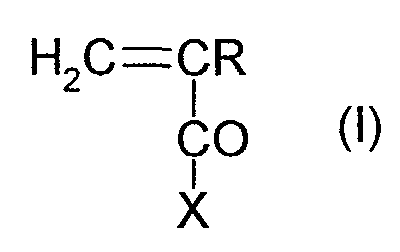
- les monomères vinyliques hydrosolubles de formule (I) suivante :
dans laquelle :

- R est choisi parmi H, -CH3, -C2H5 ou -C3H7 ;
- X est choisi parmi :
- les oxydes d'alkyle de type ―OR1 où R1 est un radical hydrocarboné, linéaire ou ramifié, saturé ou insaturé, ayant de 1 à 6 atomes de carbone, substitué par au moins un groupement carboxylate (CO2 -) et/ou sulfonique (-SO3 -) et/ou sulfate (-SO4 -) et/ou phosphate (-PO4H2 -) et/ou ammonium quaternaire (-N+R2R3R4), les radicaux R2, R3 et R4 étant, indépendamment l'un de l'autre, un radical hydrocarboné, linéaire ou ramifié, saturé ou insaturé ayant 1 à 6 atomes de carbone, sous réserve que la somme des atomes de carbone de R1 + R2 + R3 + R4 ne dépasse pas 6. En outre, le radical R1 peut être éventuellement substitué par un atome d'halogène (iode, brome, chlore, fluor) ; un groupement hydroxy (-OH) ; acide carboxylique (-COOH) ; éther (-O-); amine primaire (-NH2) ; amine secondaire (-NHR5) ; amine tertiaire (-NR5R6), les radicaux R5 et R6 étant, indépendamment l'un de l'autre, un radical hydrocarboné, linéaire ou ramifié, saturé ou insaturé ayant 1 à 6 atomes de carbone, sous réserve que la somme des atomes de carbone de R1 + R5 + R6 ne dépasse pas 6. Comme monomères vinyliques comportant des groupes ester (X=OR1), on peut citer par exemple le méthacrylate de diméthylaminoéthyl quaternisé (MADAME).
- les groupements -NH2, -NHR7 et -NR7R8 dans lesquels R7 et R8 sont, indépendamment l'un de l'autre, un radical hydrocarboné, linéaire ou ramifié, saturé ou insaturé ayant 1 à 6 atomes de carbone, sous réserve que le nombre total d'atomes de carbone de R7 + R8 ne dépasse pas 6, lesdits radicaux R7 et/ou R8 étant substitués par au moins un groupement carboxylate (CO2 -) et/ou sulfonique (-SO3 -) et/ou sulfate (-SO4 -) et/ou phosphate (-PO4H2 -) et/ou amine quaternaire (-N+R9R10R11), les radicaux R9, R10 et R11 étant, indépendamment l'un de l'autre, un radical hydrocarboné, linéaire ou ramifié, saturé ou insaturé ayant 1 à 6 atomes de carbone, sous réserve que la somme des atomes de carbone de R7 + R8 + R9 + R10 + R11 ne dépasse pas 6. En outre, les radicaux R7 et/ou R8 peuvent éventuellement être substitués par un atome d'halogène (iode, brome, chlore, fluor) ; un groupement hydroxy (-OH) ; acide carboxylique (COOH), éther (-O-); amine primaire (-NH2) ; amine secondaire (-NHR5) ; amine tertiaire (-NR5R6) où R5 et R6 ont les significations indiquées ci-dessus, sous réserve que la somme des atomes de carbone de R7 + R8 + R5 + R6 ne dépasse pas 6. Comme monomères vinyliques comportant des groupes amide, on peut citer par exemple l'acide 2-acrylamido-2-méthylpropane sulfonique (AMPS), le chlorure de (méth)acrylamidopropyltriméthylammonium (APTAC et MAPTAC) ;
- les substituants R et X étant tels que le monomère de formule (I) soit hydrosoluble ;
- et les mélanges de ces monomères (la).
- le styrène et ses dérivés tel que le 4-butylstyrène, l'alpha méthylstyrène et le vinyltoluène,
- l'acétate de vinyle de formule CH2=CH-OCOCH3 ;
- les vinyléthers de formule CH2=CHOR12 dans laquelle R12 est un radical hydrocarboné, linéaire ou ramifié, saturé ou insaturé, ayant de 1 à 6 atomes de carbone ;
- l'acrylonitrile ;
- la caprolactone ;
- le chlorure de vinyle et le chlorure de vinylidène ;
- les monomères siliconés insaturés, tels que le méthacryloxypropyl-tris(triméthylsiloxy)silane et les méthacrylamides siliconés,
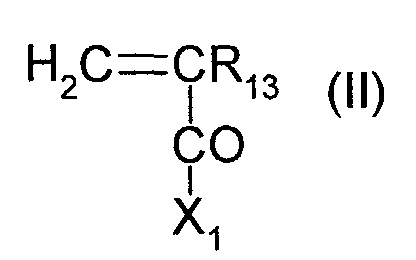
- les monomères vinyliques hydrophobes de formule (II) suivante :
dans laquelle :

- R13 est choisi parmi H, -CH3, -C2H5 ou -C3H7 ;
- X1 est choisi parmi :
- les oxydes d'alkyle de type ―OR14 où R14 est un radical hydrocarboné, linéaire ou ramifié, saturé ou insaturé, ayant de 1 à 6 atomes de carbone. On peut citer par exemple comme monomères de ce type, le méthacrylate de méthyle, le méthacrylate d'éthyle, le (meth)acrylate de n-butyle, le (meth)acrylate de tertio-butyle, l'acrylate de cyclohexyle, l'acrylate d'isobornyle et l'acrylate d'éthyle 2-hexyle.
- les groupements -NH2, -NHR15 et ―NR15R16 dans lesquels R15 et R16 sont indépendamment l'un de l'autre des radicaux hydrocarbonés, linéaires ou ramifiés, saturés ou insaturés ayant 1 à 6 atomes de carbone, sous réserve que le nombre total d'atomes de carbone de R15 + R16 ne dépasse pas 6.
- les substituants R13 et X1 étant tels que le monomère de formule (II) soit hydrophobe.
- et les mélanges de ces monomères.
- le (méth)acrylamide,
- la N-vinylacétamide et la N-méthyl N-vinylacétamide,
- la N-vinylformamide et la N-méthyl N-vinylformamide,
- l'anhydride maléique,
- la vinylamine,
- les N-vinyllactames comportant un groupe alkyle cyclique ayant de 4 à 9 atomes de carbone, tels que la N-vinylpyrrolidone, la N-butyrolactame et la N-vinylcaprolactame,
- l'alcool vinylique de formule CH2=CHOH,
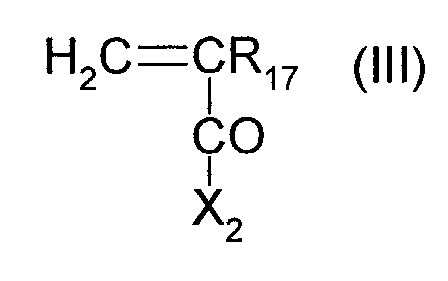
- les monomères vinyliques hydrosolubles de formule (III) suivante :
dans laquelle :

- R17 est choisi parmi H, -CH3, -C2H5 ou -C3H7 ;
- X2 est choisi parmi :
- les oxydes d'alkyle de type ―OR18 où R18 est un radical hydrocarboné, linéaire ou ramifié, saturé ou insaturé, ayant de 1 à 6 atomes de carbone, éventuellement substitué par un atome d'halogène (iode, brome, chlore, fluor) ; un groupement acide carboxylique (-COOH), hydroxy (-OH) ; éther (-O-) ; amine primaire (-NH2) ; amine secondaire (-NHR19), tertiaire (-NR19R20), les radicaux R19 et R20 étant, indépendamment l'un de l'autre, un radical hydrocarboné, linéaire ou ramifié, saturé ou insaturé ayant 1 à 6 atomes de carbone, sous réserve que la somme des atomes de carbone de R18 + R19 + R20 ne dépasse pas 6. On peut citer par exemple comme monomères de formule (III) où X2 est un radical ―OR18, le (méth)acrylate de glycidyle, le méthacrylate d'hydroxyéthyle, et les (méth)acrylates d'éthylène glycol, de diéthylèneglycol ou de polyalkylèneglycol.
- les groupements -NH2, -NHR21 et ―NR21R22 dans lesquels R21 et R22 sont indépendamment l'un de l'autre des radicaux hydrocarbonés, linéaires ou ramifiés, saturés ou insaturés ayant 1 à 6 atomes de carbone, sous réserve que le nombre total d'atomes de carbone de R21 + R22 ne dépasse pas 6, lesdits radicaux R21 et R22 étant éventuellement substitués par un atome d'halogène (iode, brome, chlore, fluor) ; un groupement hydroxy (-OH) ; acide carboxylique (CO2H) ; éther (-O-); amine primaire (-NH2) amine secondaire (-NHR23) ; ou amine tertiaire (-NR23R24), les radicaux R23 et R24 étant, indépendamment l'un de l'autre, un radical hydrocarboné, linéaire ou ramifié, saturé ou insaturé ayant 1 à 6 atomes de carbone, sous réserve que la somme des atomes de carbone de R21 + R22 + R23 + R24 ne dépasse pas 6. On peut citer par exemple comme monomères de ce type, le diméthylamino-éthylméthacrylamide et la N,N-diméthylacrylamide.
- les substituants R17 et X2 étant tels que le monomère de formule (III) soit hydrosoluble.
- les mélanges de ces monomères (lc).
- le styrène et ses dérivés tel que le 4-butylstyrène, l'alpha méthylstyrène et le vinyltoluène,
- l'acétate de vinyle de formule CH2=CH-OCOCH3,
- les vinyléthers de formule CH2=CHOR25 dans laquelle R25 est un radical hydrocarboné, linéaire ou ramifié, saturé ou insaturé, ayant de 1 à 22 atomes de carbone,
- l'acrylonitrile,
- le chlorure de vinyle et le chlorure de vinylidène,
- la caprolactone,
- les alcènes tels que l'éthylène, le propylène, le butylène et le butadiène,
- les monomères siliconés insaturés tels que le méthacryloxypropyl-tris(triméthylsiloxy)silane et les méthacrylamides siliconés, ainsi que les dérivés siliconés conduisant après polymérisation à des polymères siliconés, tels que le polydiméthylsiloxane.
- les monomères vinyliques hydrophobes de formule (IV) suivante :
dans laquelle :

- R26 est choisi parmi H, -CH3, -C2H5 ou -C3H7 ;
- X3 est choisi parmi :
- les oxydes d'alkyle de type ―OR27 où R27 est un radical hydrocarboné, linéaire ou ramifié, saturé ou insaturé, ayant de 1 à 22 atomes de carbone, éventuellement substitué par un atome d'halogène (iode, brome, chlore, fluor) ; un groupement carboxylate (-CO2 -), sulfonique (-SO3 -), sulfate (-SO4 -), phosphate (-PO4H2 -), hydroxy (-OH), acide carboxylique (-COOH), éther (-O-), amine primaire (-NH2), amine secondaire (-NHR28), tertiaire (-NR28R29) ou quaternaire (-N+R28R29R30), les radicaux R28, R29 et R30 étant, indépendamment l'un de l'autre, un radical hydrocarboné, linéaire ou ramifié, saturé ou insaturé ayant 1 à 22 atomes de carbone, sous réserve que la somme des atomes de carbone de R27 + R28+ R29+ R30 ne dépasse pas 22 ; ou bien R27 est un radical perfluoroalkyle, comportant de préférence de 1 à 18 atomes de carbone. Comme monomères vinyliques hydrophobes comportant des groupements oxydes d'alkyle de type ―OR27, on peut citer par exemple le méthacrylate de méthyle, le méthacrylate d'éthyle, le (meth)acrylate de n-butyle, le (meth)acrylate de tertio-butyle, l'acrylate de cyclohexyle, l'acrylate d'isobornyle et l'acrylate d'éthyle 2-hexyle. Comme monomère de formule (IV) avec un radical perfluoroalkyle constituant le groupe R27, on peut citer par exemple l'acrylate d'éthyle perfluorooctyle et le (méth)acrylate de trifluorométhyle ;
- les groupements -NH3, -NHR31 et ―NR31R32 dans lesquels les radicaux R31 et R32 sont, indépendamment l'un de l'autre, un radical hydrocarboné, linéaire ou ramifié, saturé ou insaturé ayant 1 à 22 atomes de carbone, sous réserve que le nombre total d'atomes de carbone de R31 + R32 ne dépasse pas 22, lesdits radicaux R31 et R32 étant éventuellement substitués par un atome d'halogène (iode, brome, chlore, fluor) ; un groupement hydroxy (-OH), éther (-O-), carboxylate (-CO2 -), sulfonique (-SO3 -), sulfate (-SO4 -), phosphate (-PO4H2 -), acide carboxylique (-COOH), amine primaire (-NH2), amine secondaire (-NHR28), tertiaire (-NR28R29), ou quaternaire (-N+R28R29R30) où R28, R29 et R30 ont les mêmes significations que celles indiquées ci-dessus, sous réserve que la somme des atomes de carbone de R31 + R32+ R28+ R29 R30 ne dépasse pas 22. R31 et R32 indépendamment l'un de l'autre peuvent également être un radical perfluoroalkyle, comportant de préférence de 1 à 18 atomes de carbone.
- les substituants R26 et X3 étant tels que le monomère de formule (IV) soit hydrophobe ;
- ou des mélanges de ces monomères (Id).
- l'acide (méth)acrylique ;
- l'acide styrène sulfonique ;
- l'acide vinylsulfonique et l'acide (méth)allylsulfonique ;
- l'acide vinyl phosphonique ;
- l'anhydride maléique ;
- l'acide maléique ;
- l'acide itaconique ;
- l'acide crotonique ;
- le chlorure de diméthyldiallyl ammonium ;
- le chlorure de méthylvinylimidazolium ;
- le (méth)acrylamide ;
- la N-vinylacétamide et la N-méthyl N-vinylacétamide ;
- la N-vinylformamide et la N-méthyl N-vinylformamide ;
- les N-vinyllactames comportant un groupe alkyle cyclique ayant de 4 à 9 atomes de carbone, tels que la N-vinylpyrrolidone, la N-butyrolactame et la N-vinylcaprolactame,
- l'alcool vinylique de formule CH2=CHOH ;
- la 2-vinylpyridine et la 4-vinylpyridine ;
- les monomères vinyliques hydrosolubles de formule (V) suivante :
dans laquelle :

- R33 est choisi parmi H, -CH3, -C2H5 ou -C3H7 ;
- X4 est choisi parmi :
- les oxydes d'alkyle de type ―OR34 où R34 est un radical hydrocarboné, linéaire ou ramifié, saturé ou insaturé, ayant de 1 à 6 atomes de carbone, éventuellement substitué par un atome d'halogène (iode, brome, chlore, fluor); un groupement carboxylate (-COO-), acide carboxylique (-COOH), sulfonique (-SO3 -), sulfate (-SO4 -), phosphate (-PO4H2 -), hydroxy (-OH), éther (-O-), amine primaire (-NH2), amine secondaire (-NHR35), amine tertiaire (-NR35R36) ou un ammonium quaternaire (-N+R35R36R37) les radicaux R35, R36 et R37 étant, indépendamment l'un de l'autre, un radical hydrocarboné, linéaire ou ramifié, saturé ou insaturé ayant 1 à 6 atomes de carbone, sous réserve que la somme des atomes de carbone de R34 + R35 + R36 + R37 ne dépasse pas 6. Comme monomères vinyliques comportant des groupes ester (X4=OR34), on peut citer par exemple le méthacrylate de diméthylaminoéthyl quaternisé (MADAME), le (méth)acrylate de glycidyle, le méthacrylate d'hydroxyéthyle, et les (méth)acrylates d'éthylène glycol, de diéthylèneglycol ou de polyalkylèneglycol.
- les groupements -NH2, -NHR38 et -NR38R39 dans lesquels les radicaux R38 et R39 sont, indépendamment l'un de l'autre, des radicaux hydrocarbonés, linéaires ou ramifiés, saturés ou insaturés ayant 1 à 6 atomes de carbone, sous réserve que le nombre total d'atomes de carbone de R38 + R39 ne dépasse pas 6, lesdits radicaux R38 et/ou R39 étant éventuellement substitués par un atome d'halogène (iode, brome, chlore, fluor); un groupement carboxylate (-COO-), sulfonique (-SO3 -); sulfate (-SO4 -) ; phosphate (-PO4H2 -) ; hydroxy (-OH); acide carboxylique (-COOH), éther (-O-); amine primaire (-NH2) ; amine secondaire (-NHR35), tertiaire (-NR35R36) ou un ammonium quaternaire (-N+R35R36R37) où R35, R36 et R37 ont la même signification qu'indiquée ci-dessus, sous réserve que la somme des atomes de carbone de R38 + R39 + R35 + R36 + R37 ne dépasse pas 6. Comme monomères vinyliques hydrosolubles de formule (V) comportant des groupes amide, on peut citer par exemple l'acide 2-acrylamido-2-méthylpropane sulfonique (AMPS), le chlorure de (méth)acrylamidopropyltriméthylammonium (APTAC et MAPTAC) et la N,N diméthylacrylamide.
- les substituants R33 et X4 étant tels que le monomère de formule (V) soit hydrosoluble.
- et les mélanges des monomères (le).
- le (méth)acrylamide,
- la N-vinylacétamide et la N-méthyl N-vinylacétamide,
- la N-vinylformamide et la N-méthyl N-vinylformamide,
- les N-vinyllactames comportant un groupe alkyle cyclique ayant de 4 à 9 atomes de carbone, tels que la N-vinylpyrrolidone, la N-butyrolactame et la N-vinylcaprolactame,
- l'alcool vinylique de formule CH2=CHOH,
- l'anhydride maléique,
- la vinylamine,
- les monomères vinyliques hydrosolubles de formule (VI) suivante :
dans laquelle :
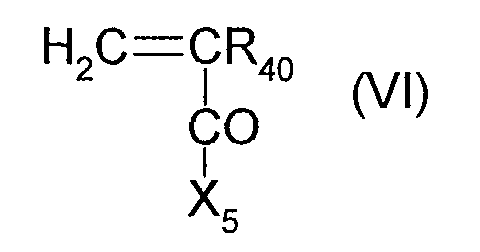
- R40 est choisi parmi H, -CH3, -C2H5 ou -C3H7 ;
- X5 est choisi parmi :
- les oxydes d'alkyle de type ―OR41 où R41 est un radical hydrocarboné, linéaire ou ramifié, saturé ou insaturé, ayant de 1 à 6 atomes de carbone, éventuellement substitué par un atome d'halogène (iode, brome, chlore, fluor); un groupement hydroxy (-OH) ; acide carboxylique (-COOH), éther (-O-); amine primaire (-NH2) ; amine secondaire (-NHR42) : ou amine tertiaire (-NR42R43), les radicaux R42 et R43 étant, indépendamment l'un de l'autre, un radical hydrocarboné, linéaire ou ramifié, saturé ou insaturé ayant 1 à 6 atomes de carbone, sous réserve que la somme des atomes de carbone de R41 + R42 + R43 ne dépasse pas 6. Comme monomères vinyliques hydrosolubles de formule (VI) comportant des groupes esters, on peut citer par exemple le (méth)acrylate de glycidyle, le méthacrylate d'hydroxyéthyle, et les (méth)acrylates d'éthylène glycol, de diéthylèneglycol ou de polyalkylèneglycol.
- les groupements -NH2, -NHR44 et -NR44R45 dans lesquels R44 et R45 sont indépendamment l'un de l'autre des radicaux hydrocarbonés, linéaires ou ramifiés, saturés ou insaturés ayant 1 à 6 atomes de carbone, sous réserve que le nombre total d'atomes de carbone de R44 + R45 ne dépasse pas 6, lesdits radicaux R44 et R45 étant éventuellement substitués par un atome d'halogène (iode, brome, chlore, fluor) ; un groupement acide carboxylique (-COOH) ; hydroxy (-OH) ; éther (-O-); amine primaire (-NH2) ; amine secondaire (-NHR46), ou amine tertiaire (-NR46R47), les radicaux R46 et R47 étant, indépendamment l'un de l'autre, un radical hydrocarboné, linéaire ou ramifié, saturé ou insaturé ayant 1 à 6 atomes de carbone, sous réserve que la somme des atomes de carbone de R44 + R45 + R46 et R47 ne dépasse pas 6. Comme monomères vinyliques hydrosolubles de formule (VI) comportant des groupes amides, on peut citer par exemple la N,N diméthylacrylamide.
- les substituants R40 et X5 étant tels que le monomère de formules (VI) soit hydrosoluble ;
- et les mélanges de ces monomères (If).
- le styrène et ses dérivés tel que la 4-butylstyrène, l'alpha méthylstyrène et le vinyltoluène,
- l'acétate de vinyle de formule CH2=CH-OCOCH3 ;
- les vinyléthers de formule CH2=CHOR48 dans laquelle R48 est un radical hydrocarboné, linéaire ou ramifié, saturé ou insaturé, ayant de 1 à 6 atomes de carbone ;
- l'acrylonitrile,
- la caprolactone,
- le chlorure de vinyle et le chlorure de vinylidène,
- les monomères siliconés insaturés, tels que le méthacryloxypropyl-tris(triméthylsiloxy)silane et les méthacrylamides siliconés,
- les monomères vinyliques hydrophobes de formule (VII) suivante :
dans laquelle :

- R49 est choisi parmi H, -CH3, -C2H5 ou -C3H7 ;
- X6 est choisi parmi :
- les oxydes d'alkyle de type ―OR50 où R50 est un radical hydrocarboné, linéaire ou ramifié, saturé ou insaturé, ayant de 1 à 6 atomes de carbone. Comme monomères vinyliques hydrophobes de formule (VII) comportant des groupes esters, on peut citer par exemple le méthacrylate de méthyle, le méthacrylate d'éthyle, le (meth)acrylate de n-butyle, le (meth)acrylate de tertio-butyle, l'acrylate de cyclohexyle et l'acrylate d'isobornyle et l'acrylate d'éthyle 2-hexyle ;
- les groupements -NH2, -NHR51 et ―NR51R52 dans lesquels R51 et R52 sont indépendamment l'un de l'autre des radicaux hydrocarbonés, linéaires ou ramifiés, saturés ou insaturés ayant 1 à 6 atomes de carbone, sous réserve que le nombre total d'atomes de carbone de R51 + R52 ne dépasse pas 6 ;
- les substituants R49 et X6 étant tels que le monomère de formule (VII) soit hydrophobe ;
- et les mélanges de ces monomères (Ig).
- les huiles hydrocarbonées d'origine animale, telles que le perhydrosqualène ;
- les huiles hydrocarbonées d'origine végétale, telles que les triglycérides liquides d'acides gras comportant de 4 à 10 atomes de carbone comme les triglycérides des acides heptanoïque ou octanoïque ou encore, par exemple les huiles de tournesol, de maïs, de soja, de courge, de pépins de raisin, de sésame, de noisette, d'abricot, de macadamia, d'arara, de tournesol, de ricin, d'avocat, les triglycérides des acides caprylique/caprique comme ceux vendus par la société Stearineries Dubois ou ceux vendus sous les dénominations Miglyol 810, 812 et 818 par la société Dynamit Nobel, l'huile de jojoba, l'huile de beurre de karité ;
- les esters et les éthers de synthèse, notamment d'acides gras, comme les huiles de formules RaCOORb et RaORb dans laquelle Ra représente le reste d'un acide gras comportant de 8 à 29 atomes de carbone, et Rb représente une chaíne hydrocarbonée, ramifiée ou non, contenant de 3 à 30 atomes de carbone, comme par exemple l'huile de Purcellin, l'isononanoate d'isononyle, le myristate d'isopropyle, le palmitate d'éthyl-2-hexyle, le stéarate d'octyl-2-dodécyle, l'érucate d'octyl-2-dodécyle, l'isostéarate d'isostéaryle ; les esters hydroxylés comme l'isostéaryl lactate, l'octylhydroxystéarate, l'hydroxystéarate d'octyldodécyle, le diisostéaryl-malate, le citrate de triisocétyle, les heptanoates, octanoates, décanoates d'alcools gras ; les esters de polyol, comme le dioctanoate de propylène glycol, le diheptanoate de néopentylglycol et le diisononanoate de diéthylèneglycol ; et les esters du pentaérythritol comme le tétraisostéarate de pentaérythrityle ;
- les hydrocarbures linéaires ou ramifiés, d'origine minérale ou synthétique, tels que les huiles de paraffine, volatiles ou non, et leurs dérivés, la vaseline, les polydécènes, le polyisobutène hydrogéné tel que l'huile de parléam ;
- les alcools gras ayant de 8 à 26 atomes de carbone, comme l'alcool cétylique, l'alcool stéarylique et leur mélange (alcool cétylstéarylique), l'octyldodécanol, le 2-butyloctanol, le 2-hexyldécanol, le 2-undécylpentadécanol, l'alcool oléique ou l'alcool linoléique ;
- les alcools gras alcoxylés et notamment éthoxylés tels que l'oleth-12, le ceteareth-12 et le ceteareth-20 ;
- les huiles fluorées partiellement hydrocarbonées et/ou siliconées comme celles décrites dans le document JP-A-2-295912. Comme huiles fluorées, on peut citer aussi le perfluorométhylcyclopentane et le perfluoro-1,3 diméthylcyclohexane, vendus sous les dénominations de "FLUTEC PC1®" et "FLUTEC PC3®" par la Société BNFL Fluorochemicals; le perfluoro-1,2-diméthylcyclobutane; les perfluoroalcanes tels que le dodécafluoropentane et le tétradécafluorohexane, vendus sous les dénominations de "PF 5050®" et "PF 5060®" par la Société 3M, ou encore le bromoperfluorooctyle vendu sous la dénomination "FORALKYL®" par la Société Atochem ; le nonafluorométhoxybutane vendu sous la dénomination "MSX 4518®" par la Société 3M et le nonafluoroéthoxyisobutane ; les dérivés de perfluoromorpholine, tels que la 4-trifluorométhyl perfluoromorpholine vendue sous la dénomination "PF 5052®" par la Société 3M ;
- les huiles de silicone comme les polyméthylsiloxanes (PDMS) volatiles ou non à chaíne siliconée linéaire ou cyclique, liquides ou pâteux à température ambiante, notamment les cyclopolydiméthylsiloxanes (cyclométhicones) telles que la cyclohexasiloxane ; les polydiméthylsiloxanes comportant des groupements alkyle, alcoxy ou phényle, pendant ou en bout de chaíne siliconée, groupements ayant de 2 à 24 atomes de carbone ; les silicones phénylées comme les phényltriméthicones, les phényldiméthicones, les phényltriméthylsiloxydiphénylsiloxanes, les diphényl-diméthicones, les diphénylméthyldiphényl trisiloxanes, les 2-phényléthyltriméthyl-siloxysilicates, et les polyméthylphénylsiloxanes ;
- leurs mélanges.
- PABA,
- Ethyl PABA,
- Ethyl Dihydroxypropyl PABA,
- Ethylhexyl Diméthyl PABA vendu notamment sous le nom « ESCALOL 507 » par ISP,
- Glyceryl PABA,
- PEG-25 PABA vendu sous le nom « UVINUL P25 » par BASF,
- Homosalate vendu sous le nom « EUSOLEX HMS » par RONA/EM INDUSTRIES,
- Ethylhexyl Salicylate vendu sous le nom « NEO HELIOPAN OS » par HAARMANN et REIMER,
- Dipropyleneglycol Salicylate vendu sous le nom « DIPSAL » par SCHER,
- TEA Salicylate, vendu sous le nom « NEO HELIOPAN TS » par HAARMANN et REIMER,
- Butyl Methoxydibenzoylmethane vendu notamment sous le nom commercial « PARSOL 1789 » par HOFFMANN LA ROCHE,
- Isopropyl Dibenzoylmethane,
- Ethylhexyl Methoxycinnamate vendu notamment sous le nom commercial « PARSOL MCX » par HOFFMANN LA ROCHE,
- Isopropyl Methoxy cinnamate,
- Isoamyl Methoxy cinnamate vendu sous le nom commercial « NEO HELIOPAN E 1000 » par HAARMANN et REIMER,
- Cinoxate,
- DEA Methoxycinnamate,
- Diisopropyl Methylcinnamate,
- Glyceryl Ethylhexanoate Dimethoxycinnamate
- Octocrylene vendu notamment sous le nom commercial « UVINUL N539 » par BASF,
- Etocrylene, vendu notamment sous le nom commercial « UVINUL N35 » par BASF,
- Benzophenone-1 vendu sous le nom commercial « UVINUL 400 » par BASF,
- Benzophenone-2 vendu sous le nom commercial « UVINUL D50 » par BASF
- Benzophenone-3 ou Oxybenzone, vendu sous le nom commercial « UVINUL M40 » par BASF,
- Benzophenone-4 vendu sous le nom commercial « UVINUL MS40 » par BASF,
- Benzophenone-5
- Benzophenone-6 vendu sous le nom commercial « HELISORB 11 » par NORQUAY
- Benzophenone-8 vendu sous le nom commercial « SPECTRA-SORB UV-24 » PAR AMERICAN CYANAMID
- Benzophenone-9 vendu sous le nom commercial« UVINUL DS-49» par BASF,
- Benzophenone-12
- 3-Benzylidene camphor fabriqué sous le nom « MEXORYL SD» par CHIMEX,
- 4-Methylbenzylidene camphor vendu sous le nom « EUSOLEX 6300 » par MERCK,
- Benzylidene Camphor Sulfonic Acid fabriqué sous le nom « MEXORYL SL» par CHIMEX,
- Camphor Benzalkonium Methosulfate fabriqué sous le nom « MEXORYL SO » par CHIMEX,
- Terephthalylidene Dicamphor Sulfonic Acid fabriqué sous le nom « MEXORYL SX » par CHIMEX,
- Polyacrylamidomethyl Benzylidene Camphor fabriqué sous le nom « MESORYL SW » par CHIMEX,
- Phenylbenzimidazole Sulfonic Acid vendu notamment sous le nom commercial « EUSOLEX 232 » par MERCK,
- Benzimidazilate vendu sous le nom commercial commercial « NEO HELIOPAN AP » par HAARMANN et REIMER,
- Anisotriazine vendu sous le nom commercial «TINOSORB S » par CIBA GEIGY,
- Ethylhexyl triazone vendu notamment sous le nom commercial «UVINUL T150 » par BASF,
- Diethylhexyl Butamido Triazone vendu sous le nom commercial « UVASORB HEB » par SIGMA 3V,
- Drometrizole Trisiloxane vendu sous le nom « SILATRIZOLE » par RHODIA CHIMIE,
- Menthyl anthranilate vendu sous le nom commercial commercial « NEO HELIOPAN MA » par HAARMANN et REIMER,
- Ethylhexyl Dimethoxybenzylidene Dioxoimidazoline Propionate,
- Polyorganosiloxane à fonctions benzalmalonate vendu sous la dénomination commerciale « PARSOL SLX » par HOFFMANN LA ROCHE
- et leurs mélanges.
- Ethylhexyl Salicylate,
- Butyl Methoxydibenzoylmethane,
- Ethylhexyl Methoxycinnamate,
- Octocrylene,
- Phenylbenzimidazole Sulfonic Acid,
- Terephthalylidene Dicamphor Sulfonic,.
- Benzophenone-3,
- Benzophenone-4,
- Benzophenone-5,
- 4-Methylbenzylidene camphor,
- Benzimidazilate,
- Anisotriazine,
- Ethylhexyl triazone,
- Diethylhexyl Butamido Triazone,
- Methylene bis-Benzotriazolyl Tetramethylbutylphenol,
- Drometrizole Trisiloxane,
- et leurs mélanges.
- Déformation = 0,15% afin de se situer dans le domaine de viscoélasticité linéaire,
- Fréquences comprises entre 0,01 rad/s et 100 rad/s,
| Polymère triblocs | |
| Polystyrène (2500 g/mole) ― Polyacrylate de sodium (29800 g/mole) - Polystyrène (2500 g/mole) | 0,6 % |
| Conservateur | 0,2 % |
| Acide ascorbique | 10 % |
| Dipropylène glycol | 5 % |
| Eau déminéralisée | 84,2 % |
| Phase aqueuse : | |
| Polymère triblocs | |
| Polystyrène (2500 g/mole) - Polyacrylate de sodium (29800 g/mole) - Polystyrène (2500 g/mole) | 0,52 % |
| Conservateur | 0,2 % |
| Eau déminéralisée | 84,28 % |
| Phase huileuse : | |
| Huile de Parléam | 9 % |
| Cyclohexadiméthylsiloxane | 6 % |
| Phase aqueuse : | |
| Polymère triblocs | |
| Polystyrène (2500 g/mole) - Polyacrylate de sodium (29800 g/mole) - Polystyrène (2500 g/mole) | 2,6 % |
| Conservateur | 0,2 % |
| Eau déminéralisée | 82,2 % |
| Phase huileuse | |
| Huile de Parléam | 9 % |
| Cyclohexadiméthylsiloxane | 6 % |
Claims (52)
- Composition cosmétique et/ou dermatologique, caractérisée en ce qu'elle comprend au moins une phase aqueuse comportant au moins un polymère hydrosoluble ou hydrodispersible, de structure triblocs B-A-B où A est un bloc polymérique hydrosoluble ionique et B un bloc polymérique hydrophobe et où la quantité de bloc polymérique A est égale ou supérieure à 50 % du poids total du polymère triblocs.
- Composition selon la revendication 1, caractérisée en ce que le bloc hydrosoluble ionique A est obtenu à partir d'un ou plusieurs monomères hydrosolubles (la), ou de leurs sels, les monomères (la) étant choisis parmi :l'acide (méth)acrylique,l'acide styrène sulfonique,l'acide vinylsulfonique et l'acide (méth)allylsulfonique,l'acide vinyl phosphonique,l'acide maléique,l'acide itaconique,l'acide crotonique,le chlorure de diméthyldiallyl ammonium,le chlorure de méthylvinylimidazolium,les carboxybétaïnes ou sulfobétaïnes éthyléniques,les monomères vinyliques hydrosolubles de formule (I) suivante :dans laquelle :
 R est choisi parmi H, -CH3, -C2H5 ou -C3H7 ;X est choisi parmi :les oxydes d'alkyle de type ―OR1 où R1 est un radical hydrocarboné, linéaire ou ramifié, saturé ou insaturé, ayant de 1 à 6 atomes de carbone, substitué par au moins un groupement carboxylate, sulfonique, sulfate, phosphate et/ou ammonium quaternaire (-N+R2R3R4), les radicaux R2, R3 et R4 étant, indépendamment l'un de l'autre, un radical hydrocarboné, linéaire ou ramifié, saturé ou insaturé ayant 1 à 6 atomes de carbone, sous réserve que la somme des atomes de carbone de R1 + R2 + R3 + R4 ne dépasse pas 6 ; le radical R1 étant éventuellement substitué par un atome d'halogène ; un groupement hydroxy ; acide carboxylique ; éther ; amine primaire ; amine secondaire (-NHR5) ; amine tertiaire (-NR5R6), les radicaux R5 et R6 étant, indépendamment l'un de l'autre, un radical hydrocarboné, linéaire ou ramifié, saturé ou insaturé ayant 1 à 6 atomes de carbone, sous réserve que la somme des atomes de carbone de R1 + R5 + R6 ne dépasse pas 6 ;les groupements -NH2, -NHR7 et ―NR7R8 dans lesquels R7 et R8 sont, indépendamment l'un de l'autre, un radical hydrocarboné, linéaire ou ramifié, saturé ou insaturé ayant 1 à 6 atomes de carbone, sous réserve que le nombre total d'atomes de carbone de R7 + R8 ne dépasse pas 6, lesdits radicaux R7 et/ou R8 étant substitués par au moins un groupement carboxylate, sulfonique, sulfate, phosphate et/ou amine quaternaire (-N+R9R10R11), les radicaux R9, R10 et R11 étant, indépendamment l'un de l'autre, un radical hydrocarboné, linéaire ou ramifié, saturé ou insaturé ayant 1 à 6 atomes de carbone, sous réserve que la somme des atomes de carbone de R7 + R8 + R9 + R10 + R11 ne dépasse pas 6 ; les radicaux R7 et/ou R8 étant éventuellement substitués par un atome d'halogène ; ou un groupement hydroxy ; éther ; acide carboxylique ; amine primaire ; amine secondaire (-NHR5) ; ou amine tertiaire (-NR5R6) où R5 et R6 ont les significations indiquées ci-dessus, sous réserve que la somme des atomes de carbone de R7 + R8 + R5 + R6 ne dépasse pas 6 ;les substituants R et X étant tels que le monomère de formule (I) soit hydrosoluble ;les mélanges de ces monomères.
 - Composition selon la revendication 1 ou 2, caractérisée en ce que le bloc hydrosoluble ionique A est obtenu en outre à partir d'un ou plusieurs monomères choisis parmi les monomères hydrophobes (Ib), les monomères hydrosolubles neutres (lc), et leurs mélanges.
- Composition selon la revendication précédente, caractérisée en ce que le monomère hydrophobe (Ib) est choisi parmi :le styrène et ses dérivés,l'acétate de vinyle,les vinyléthers de formule CH2=CHOR12 dans laquelle R12 est un radical hydrocarboné, linéaire ou ramifié, saturé ou insaturé, ayant de 1 à 6 atomes de carbone ;l'acrylonitrile ;la caprolactone ;le chlorure de vinyle et le chlorure de vinylidène ;les monomères siliconés insaturés ;les monomères vinyliques hydrophobes de formule (II) suivante :dans laquelle :
 R13 est choisi parmi H, -CH3, -C2H5 ou -C3H7 ;X1 est choisi parmi :les oxydes d'alkyle de type ―OR14 où R14 est un radical hydrocarboné, linéaire ou ramifié, saturé ou insaturé, ayant de 1 à 6 atomes de carbone ;les groupements -NH2, -NHR15 et ―NR15R16 dans lesquels R15 et R16 sont indépendamment l'un de l'autre des radicaux hydrocarbonés, linéaires ou ramifiés, saturés ou insaturés ayant 1 à 6 atomes de carbone, sous réserve que le nombre total d'atomes de carbone de R15 + R16 ne dépasse pas 6 ;les substituants R13 et X1 étant tels que le monomère de formule (II) soit hydrophobe ;les mélanges de ces monomères.
 - Composition selon la revendication 3 ou 4 caractérisée en ce que le monomère hydrosoluble neutre (lc) est choisi parmi :le (méth)acrylamide,la N-vinylacétamide et la N-méthyl N-vinylacétamide,la N-vinylformamide et la N-méthyl N-vinylformamide,l'anhydride maléique,la vinylamine,les N-vinyllactames comportant un groupe alkyle cyclique ayant de 4 à 9 atomes de carbone,l'alcool vinylique,les monomères vinyliques hydrosolubles de formule (III) suivante :dans laquelle :
 R17 est choisi parmi H, -CH3, -C2H5 ou -C3H7X2 est choisi parmi :les oxydes d'alkyle de type ―OR18 où R18 est un radical hydrocarboné, linéaire ou ramifié, saturé ou insaturé, ayant de 1 à 6 atomes de carbone, éventuellement substitué par un atome d'halogène ; un groupement hydroxy ; acide carboxylique ; éther ; amine primaire ; amine secondaire (-NHR19) ;ou amine tertiaire (-NR19R20) ; les radicaux R19 et R20 étant, indépendamment l'un de l'autre, un radical hydrocarboné, linéaire ou ramifié, saturé ou insaturé ayant 1 à 6 atomes de carbone, sous réserve que la somme des atomes de carbone de R18 + R19 + R20 ne dépasse pas 6 ;les groupements -NH2, -NHR21 et ―NR21R22 dans lesquels R21 et R22 sont indépendamment l'un de l'autre des radicaux hydrocarbonés, linéaires ou ramifiés, saturés ou insaturés ayant 1 à 6 atomes de carbone, sous réserve que le nombre total d'atomes de carbone de R21 + R22 ne dépasse pas 6, lesdits radicaux R21 et R22 étant éventuellement substitués par un atome d'halogène ; un groupement acide carboxylique ; hydroxy ; éther ; amine primaire ; amine secondaire (-NHR23) ; ou amine tertiaire (-NR23R24), les radicaux R23 et R24 étant, indépendamment l'un de l'autre, un radical hydrocarboné, linéaire ou ramifié, saturé ou insaturé ayant 1 à 6 atomes de carbone, sous réserve que la somme des atomes de carbone de R21 + R22 + R23 + R24 ne dépasse pas 6 ;les substituants R17 et X2 étant tels que le monomère de formule (III) soit hydrosoluble ;les mélanges de ces monomères.
 - Composition selon la revendication 1, caractérisée en ce que le bloc hydrosoluble ionique A est un polymère hydrosoluble ionique.
- Composition selon la revendication précédente, caractérisée en ce que le bloc hydrosoluble ionique A est la polyéthylène imine.
- Composition selon l'une quelconque des revendications précédentes, caractérisée en ce que le bloc hydrosoluble ionique A est totalement ou partiellement neutralisé par une base minérale ou organique.
- Composition selon l'une quelconque des revendications précédentes, caractérisée en ce que le bloc hydrophobe B est obtenu à partir d'un ou plusieurs monomères hydrophobes (Id), choisis parmi :le styrène et ses dérivés,l'acétate de vinyle,les vinyléthers de formule CH2=CHOR25 dans laquelle R25 est un radical hydrocarboné, linéaire ou ramifié, saturé ou insaturé, ayant de 1 à 22 atomes de carbone,l'acrylonitrile,le chlorure de vinyle et le chlorure de vinylidène,la caprolactone,les alcènes,les monomères siliconés insaturés,les dérivés siliconés,les monomères vinyliques hydrophobes de formule (IV) suivante :dans laquelle :
 R26 est choisi parmi H, -CH3, -C2H5 ou -C3H7 ;X3 est choisi parmi :les oxydes d'alkyle de type ―OR27 où R27 est un radical hydrocarboné, linéaire ou ramifié, saturé ou insaturé, ayant de 1 à 22 carbones, éventuellement substitué par un atome d'halogène ; un groupement carboxylate, sulfonique, sulfate, phosphate, hydroxy, acide carboxylique, éther, amine primaire, amine secondaire (-NHR28), tertiaire (-NR28R29) ou quaternaire (-N+R28R29R30), les radicaux R28, R29 et R30 étant, indépendamment l'un de l'autre, un radical hydrocarboné, linéaire ou ramifié, saturé ou insaturé ayant 1 à 22 atomes de carbone, sous réserve que la somme des atomes de carbone de R27 + R28 + R29 + R30 ne dépasse pas 22 ; ou bien R27 est un radical perfluoroalkyle, comportant de 1 à 18 atomes de carbone ;les groupements -NH2, -NHR31 et ―NR31R32 dans lesquels les radicaux R31 et R32 sont, indépendamment l'un de l'autre, un radical hydrocarboné, linéaire ou ramifié, saturé ou insaturé ayant 1 à 22 atomes de carbone, sous réserve que le nombre total d'atomes de carbone de R31 + R32 ne dépasse pas 22, lesdits radicaux R31 et R32 étant éventuellement substitués par un atome d'halogène ; un groupement hydroxy, éther, carboxylate, sulfonique, sulfate, phosphate, acide carboxylique, amine primaire, amine secondaire (-NHR28), tertiaire (-NR28R29) ou quaternaire (-N+R28R29R30) où R28, R29 et R30 ont les mêmes significations que celles indiquées ci-dessus, sous réserve que la somme des atomes de carbone de R31 + R32+ R28 + R29 + R30 ne dépasse pas 22; ou bien R31 et R32 indépendamment l'un de l'autre sont un radical perfluoroalkyle comportant de préférence de 1 à 18 atomes de carbone ;les substituants R26 et X3 étant tels que le monomère de formule (IV) soit hydrophobe ;et les mélanges de ces monomères.
 - Composition selon la revendication précédente, caractérisée en ce que le bloc hydrophobe B est obtenu en outre à partir d'un ou plusieurs monomères hydrosolubles ioniques ou neutres (le) choisis parmi les monomères suivants, ou leurs sels :l'acide (méth)acrylique ;l'acide styrène sulfonique ;l'acide vinylsulfonique et l'acide (méth)allylsulfonique ;l'acide vinyl phosphonique ;l'anhydride maléique ;l'acide maléique ;l'acide itaconique ;l'acide crotonique ;le chlorure de diméthyldiallyl ammonium ;le chlorure de méthylvinylimidazolium ;le (méth)acrylamide ;la N-vinylacétamide et la N-méthyl N-vinylacétamide ;la N-vinylformamide et la N-méthyl N-vinylformamide ;les N-vinyllactames comportant un groupe alkyle cyclique ayant de 4 à 9 atomes de carbone ;l'alcool vinylique ;la 2-vinylpyridine et la 4-vinylpyridine ;les monomères vinyliques hydrosolubles de formule (V) suivante :dans laquelle :
 R33 est choisi parmi H, -CH3, -C2H5 ou -C3H7 ;X4 est choisi parmi :les oxydes d'alkyle de type -OR34 où R34 est un radical hydrocarboné, linéaire ou ramifié, saturé ou insaturé, ayant de 1 à 6 atomes de carbone, éventuellement substitué par un atome d'halogène ; un groupement carboxylate, acide carboxylique, sulfonique, sulfate, phosphate, hydroxy, éther, amine primaire, amine secondaire (-NHR35), amine tertiaire (-NR35R36), ammonium quaternaire (-N+R35R36R37), les radicaux R35, R36 et R37 étant, indépendamment l'un de l'autre, un radical hydrocarboné, linéaire ou ramifié, saturé ou insaturé ayant 1 à 6 atomes de carbone, sous réserve que la somme des atomes de carbone de R34 + R35 + R36 + R37 ne dépasse pas 6 ;les groupements -NH2, -NHR38 et ―NR38R39 dans lesquels les radicaux R38 et R39 sont, indépendamment l'un de l'autre, des radicaux hydrocarbonés, linéaires ou ramifiés, saturés ou insaturés ayant 1 à 6 atomes de carbone, sous réserve que le nombre total d'atomes de carbone de R38 + R39 ne dépasse pas 6, lesdits radicaux R38 et/ou R39 étant éventuellement substitués par un atome d'halogène ; un groupement carboxylate ; acide carboxylique ; sulfonique ; sulfate ; phosphate ; hydroxy ; éther ; amine primaire ; amine secondaire (-NHR35) ; tertiaire (-NR35R36) ou ammonium quaternaire (-N+R35R36R37) où R35, R36 et R37 ont la même signification qu'indiquée ci-dessus, sous réserve que la somme des atomes de carbone de R38 + R39 + R35 + R36 + R37 ne dépasse pas 6 ;les substituants R33 et X4 étant tels que le monomère de formule (V) soit hydrosoluble ;et les mélanges de ces monomères.
 - Composition selon l'une quelconque des revendications précédentes, caractérisée en ce que le polymère triblocs a une masse molaire allant de 1 000 g/mole à 500 000 g/mole.
- Composition selon l'une quelconque des revendications précédentes, caractérisée en ce que le polymère triblocs a une masse molaire allant de 2 000 g/mole à 300 000 g/mole.
- Composition selon l'une quelconque des revendications précédentes, caractérisée en ce que la proportion du bloc hydrophile ionique A dans le copolymère est supérieure à 60 % en poids par rapport au poids total des blocs A et B.
- Composition selon l'une quelconque des revendications 1 à 3, 7 à 10 et 12 à 13, caractérisée en ce que le bloc polymérique ionique A est totalement hydrosoluble et le bloc polymérique B est totalement hydrophobe.
- Composition selon la revendication précédente, caractérisée en ce que le polymère triblocs comporte, comme bloc A, du polyacrylate de sodium et, comme bloc B, du polystyrène.
- Composition selon l'une quelconque des revendications précédentes, caractérisée en ce que la quantité de polymère(s) va de 0,01 à 20 % en poids par rapport au poids total de la composition.
- Composition selon l'une quelconque des revendications précédentes, caractérisée en ce qu'elle contient en outre au moins un polymère diblocs A'-B hydrosoluble ou hydrodispersible, dans lequel A' est un bloc polymérique hydrosoluble neutre et B un bloc polymérique hydrophobe conforme aux revendications 9 et 10.
- Composition selon la revendication précédente, caractérisée en ce que la quantité du polymère triblocs ionique B-A-B est supérieure à 10 % en poids par rapport à la quantité totale de polymères triblocs et diblocs.
- Composition selon la revendication 17 ou 18, caractérisée en ce que le bloc A' est obtenu à partir d'un ou plusieurs monomères hydrosolubles choisis parmi les monomères (If) suivants :le (méth)acrylamide,la N-vinylacétamide et la N-méthyl N-vinylacétamide,la N-vinylformamide et la N-méthyl N-vinylformamide,les N-vinyllactames comportant un groupe alkyl cyclique ayant de 4 à 9 atomes de carbone,l'alcool vinylique,l'anhydride maléique,la vinylamine,les monomères vinyliques hydrosolubles de formule (VI) suivante :dans laquelle :
 R40 est choisi parmi H, -CH3, -C2H5 ou -C3H7 ;X5 est choisi parmi :les oxydes d'alkyle de type ―OR41 où R41 est un radical hydrocarboné, linéaire ou ramifié, saturé ou insaturé, ayant de 1 à 6 atomes de carbone, éventuellement substitué par un atome d'halogène ; un groupement acide carboxylique ; hydroxy ; éther ; amine primaire ; amine secondaire (-NHR42) ; ou amine tertiaire (-NR42R43), les radicaux R42 et R43 étant, indépendamment l'un de l'autre, un radical hydrocarboné, linéaire ou ramifié, saturé ou insaturé ayant 1 à 6 atomes de carbone, sous réserve que la somme des atomes de carbone de R41 + R42 + R43 ne dépasse pas 6 ;les groupements -NH2, -NHR44 et -NR44R45 dans lesquels R44 et R45 sont indépendamment l'un de l'autre des radicaux hydrocarbonés, linéaires ou ramifiés, saturés ou insaturés ayant 1 à 6 atomes de carbone, sous réserve que le nombre total d'atomes de carbone de R44 + R45 ne dépasse pas 6, lesdits radicaux R44 et R45 étant éventuellement substitués par un atome d'halogène ; un groupement acide carboxylique ; hydroxy ; éther ; amine primaire ; amine secondaire (-NHR46) ; ou amine tertiaire (-NR46R47), les radicaux R46 et R47 étant, indépendamment l'un de l'autre, un radical hydrocarboné, linéaire ou ramifié, saturé ou insaturé ayant 1 à 6 atomes de carbone, sous réserve que la somme des atomes de carbone de R44 + R45 + R46 et R47 ne dépasse pas 6 ;les substituants R40 et X5 étant tels que le monomère de formule (VI) soit hydrosoluble ;et les mélanges de ces monomères.
 - Composition selon la revendication précédente, caractérisée en ce que le bloc hydrosoluble neutre A' est obtenu en outre à partir d'un ou plusieurs monomères hydrophobes (Ig) choisi parmi les monomères suivants :le styrène et ses dérivés,l'acétate de vinyle,les vinyléthers de formule CH2=CHOR48 dans laquelle R48 est un radical hydrocarboné, linéaire ou ramifié, saturé ou insaturé, ayant de 1 à 6 atomes de carbone,l'acrylonitrile,la caprolactone,le chlorure de vinyle et le chlorure de vinylidène,les monomères siliconés insaturés,les monomères vinyliques hydrophobes de formule (VII) suivante :dans laquelle :
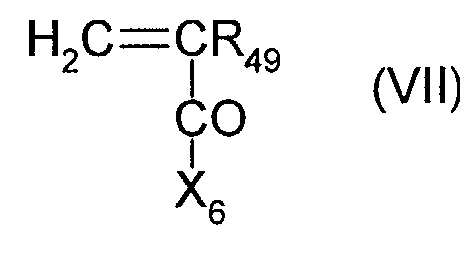 R49 est choisi parmi H, -CH3, -C2H5 ou -C3H7;X6 est choisi parmi :les oxydes d'alkyle de type ―OR50 où R50 est un radical hydrocarboné, linéaire ou ramifié, saturé ou insaturé, ayant de 1 à 6 atomes de carbone ;les groupements -NH2, ―NHR51 et -NR51R52 dans lesquels R51 et R52 sont indépendamment l'un de l'autre des radicaux hydrocarbonés, linéaires ou ramifiés, saturés ou insaturés ayant 1 à 6 atomes de carbone, sous réserve que le nombre total d'atomes de carbone de R51 + R52 ne dépasse pas 6 ;les substituants R49 et X6 étant tels que le monomère de formule (VII) soit hydrophobe ;et leurs mélanges.
 - Composition selon l'une quelconque des revendications 17 à 20, caractérisée en ce que le polymère diblocs neutre a une masse molaire allant de 1 000 g/mole à 500 000 g/mole.
- Composition selon l'une quelconque des revendications 17 à 21, caractérisée en ce que la quantité du bloc hydrophile neutre A' dans le polymère diblocs A'-B est supérieure à 50 % du poids total du polymère dibloc.
- Composition selon l'une quelconque des revendications précédentes, caractérisée en ce qu'elle contient un milieu physiologiquement acceptable.
- Composition selon l'une quelconque des revendications précédentes, caractérisée en ce qu'elle contient en outre au moins un solvant organique choisi dans le groupe constitué par les solvants organiques hydrophiles, les solvants organiques lipophiles, les solvants amphiphiles ou leurs mélanges.
- Composition selon la revendication précédente, caractérisée en ce que les solvants organiques sont choisis dans le groupe constitué par les mono-alcools ayant de 1 à 8 atomes de carbone, les polyols, les mono- et di-alkyl isosorbides, les polyéthylène glycols, les éthers d'éthylène glycol, les éthers de propylène glycol, les éthers de polyol, les esters de polyol, les esters d'acide gras et d'alkyle, et leurs mélanges.
- Composition selon la revendication 24 ou 25, caractérisée en ce que le ou les solvants organiques représentent de 5 à 50 % du poids total de la composition.
- Composition selon l'une quelconque des revendications précédentes, caractérisée en ce qu'elle constitue une solution, un gel ou une émulsion.
- Composition selon l'une quelconque des revendications 1 à 26, caractérisée en ce qu'elle comprend au moins une phase huileuse.
- Composition selon la revendication précédente, caractérisée en ce que la phase huileuse comprend au moins une huile.
- Composition selon l'une quelconque des revendications 1 à 26 et 28 à 29, caractérisée en ce qu'elle constitue une émulsion H/E, E/H, E/H/E, H/E/H.
- Composition selon l'une quelconque des revendications précédentes, caractérisée en ce qu'elle contient en outre au moins un adjuvant choisi dans le groupe constitué par les gélifiants et/ou épaississants ; les polymères ; les tensioactifs moussants ; les agents hydratants ; les émollients ; les actifs hydrophiles ou lipophiles ; les agents anti-radicaux libres ; les séquestrants ; les antioxydants ; les conservateurs ; les agents alcanisants ou acidifiants ; les parfums ; les pigments ; les charges ; les agents filmogènes ; les matières colorantes ; et leurs mélanges.
- Composition selon la revendication précédente, caractérisée en ce que l'actif est choisi parmi les hydrolysats de protéines ; les anti-inflammatoires ; les polyols ; les dérivés de sucre ; les extraits naturels ; les oligomères procyannidoliques ; les vitamines ; l'urée ; la caféine ; les dépigmentants ; l'acide salicylique et ses dérivés ; les alpha-hydroxyacides ; les rétinoïdes ; les filtres solaires ; l'hydrocortisone ; la mélatonine ; les extraits d'algues, de champignons, de végétaux, de levures, de bactéries ; les enzymes ; la DHEA et ses dérivés et métabolites ; les actifs anti-bactériens ; les agents matifiants ; les agents tenseurs ; et leurs mélanges.
- Composition selon la revendication précédente, caractérisée en ce que l'actif est choisi parmi la vitamine A, la vitamine C, la vitamine E, la vitamine B5, la vitamine B3, leurs dérivés et leurs mélanges.
- Composition selon la revendication 32 ou 33, caractérisée en ce que l'actif est choisi parmi le triclosan, le triclocarban, l'acide salicylique et ses dérivés, et leurs mélanges.
- Composition selon l'une quelconque des revendications 32 à 34, caractérisée en ce que l'actif est un filtre solaire choisi parmi les filtres organiques, les filtres physiques et leurs mélanges.
- Composition selon la revendication précédente, caractérisée en ce que le filtre organique est choisi les dérivés de l'acide para-aminobenzoique ; les dérivés salicyliques ; les dérivés du dibenzoylméthane ; les dérivés cinnamiques ; les déérivés de β,β'-diphénylacrylate ; les dérivés de la benzophénone ; les dérivés du benzylidène camphre ; les dérivés du phenyl benzimidazole ; les dérivés de la triazine ; les dérivés du phenyl benzotriazole ; les dérivés anthraniliques ; les dérivés d'imidazolines ; les dérivés du benzalmalonate ; et leurs mélanges.
- Composition selon la revendication 35, caractérisée en ce que le filtre physique est choisi parmi les oxydes de titane, les oxydes de zinc et leurs mélanges.
- Composition selon la revendication 31, caractérisée en ce que le tensioactif moussant est choisi parmi les tensioactifs non ioniques, anioniques, amphotères et zwitterioniques, et leurs mélanges.
- Composition selon la revendication précédente, caractérisée en ce que le tensioactif moussant est choisi parmi les alkyl polyglucosides ; les esters de maltose ; les alcools gras polyglycérolés ; les dérivés de glucamine ; les carboxylates ; les dérivés des aminoacides ; les alkyl sulfates ; les alkyl éther sulfates ; les sulfonates ; les iséthionates et acyliséthionates ; les taurates ; les sulfosuccinates ; les alkyl sulfoacétates ; les phosphates et alkylphosphates ; les polypeptides ; les dérivés anioniques d'alkyl polyglucoside ; les savons d'acides gras ; les bétaïnes ; les N-alkylamidobétaïnes ; les dérivés de la glycine ; les sultaïnes ; les alkyl polyaminocarboxylates ; les alkylamphoacétates ; et leurs mélanges.
- Composition cosmétique et/ou dermatologique sous forme d'émulsion huile-dans-eau comportant une phase huileuse dispersée dans une phase aqueuse, caractérisée par le fait qu'elle comprend de 0 à environ 1 % en poids de tensioactif émulsionnant, par rapport au poids total de la composition, et qu'elle est conforme à la composition selon l'une quelconque des revendications 1 à 26 et 28 à 39.
- Composition selon l'une quelconque des revendications précédentes, caractérisée en ce qu'elle constitue un produit de soin, de traitement, de protection, de nettoyage, de démaquillage et /ou de maquillage des matières kératiniques.
- Composition selon la revendication précédente, caractérisée en ce que la matière kératinique est la peau.
- Utilisation cosmétique d'une composition cosmétique selon l'une quelconque des revendications 1 à 40, comme produit de soin pour la peau, les cheveux, le cuir chevelu, des cils, des sourcils, des ongles ou des muqueuses.
- Utilisation cosmétique d'une composition cosmétique selon l'une quelconque des revendications 1 à 40, comme produit de maquillage.
- Utilisation cosmétique d'une composition cosmétique selon l'une quelconque des revendications 1 à 40, comme produit de protection solaire.
- Utilisation cosmétique d'une composition cosmétique selon l'une quelconque des revendications 1 à 40, comme produit capillaire rincé ou non-rincé.
- Utilisation cosmétique d'une composition cosmétique selon l'une quelconque des revendications 1 à 40, comme produit de nettoyage et/ou de démaquillage de la peau et/ou des yeux.
- Procédé de traitement cosmétique d'une matière kératinique, caractérisé en ce que l'on applique sur la matière kératinique, une composition cosmétique telle que définie selon l'une quelconque des revendications 1 à 40.
- Procédé selon la revendication précédente, caractérisé en ce que la matière kératinique est la peau.
- Utilisation d'au moins un polymère hydrosoluble ou hydrodispersible, de structure triblocs B-A-B, où A est un bloc polymérique hydrosoluble ionique et B un bloc polymérique hydrophobe et où la quantité de bloc polymérique A est égale ou supérieure à 50 % du poids total du polymère triblocs B-A-B, pour gélifier et/ou épaissir une composition cosmétique et/ou dermatologique comprenant au moins une phase aqueuse.
- Utilisation selon la revendication précédente, caractérisée en ce que le bloc polymèrique ionique A est totalement hydrophile et le bloc polymérique B est totalement hydrophobe.
- Utilisation selon la revendication 50 ou 51, caractérisée en ce que la composition comprend en outre un polymère hydrosoluble ou hydrodispersible diblocs A'-B dans lequel A' est un bloc polymérique hydrosoluble neutre et B un bloc polymérique hydrophobe.
Applications Claiming Priority (2)
| Application Number | Priority Date | Filing Date | Title |
|---|---|---|---|
| FR0109614A FR2827513B1 (fr) | 2001-07-18 | 2001-07-18 | Composition a usage cosmetique ou dermatologique contenant un polymere triblocs |
| FR0109614 | 2001-07-18 |
Publications (2)
| Publication Number | Publication Date |
|---|---|
| EP1281395A1 true EP1281395A1 (fr) | 2003-02-05 |
| EP1281395B1 EP1281395B1 (fr) | 2007-07-18 |
Family
ID=8865669
Family Applications (1)
| Application Number | Title | Priority Date | Filing Date |
|---|---|---|---|
| EP02291582A Expired - Lifetime EP1281395B1 (fr) | 2001-07-18 | 2002-06-25 | Composition à usage cosmétique ou dermatologique contenant un polymère tribloc |
Country Status (8)
| Country | Link |
|---|---|
| US (2) | US6994846B2 (fr) |
| EP (1) | EP1281395B1 (fr) |
| JP (2) | JP2003055137A (fr) |
| CN (1) | CN1415280A (fr) |
| AT (1) | ATE367149T1 (fr) |
| DE (1) | DE60221198T2 (fr) |
| ES (1) | ES2289064T3 (fr) |
| FR (1) | FR2827513B1 (fr) |
Cited By (4)
| Publication number | Priority date | Publication date | Assignee | Title |
|---|---|---|---|---|
| FR2845930A1 (fr) * | 2002-10-21 | 2004-04-23 | Oreal | Procede de solubilisation de composes lipophiles en solution aqueuse par des copolymeres blocs amphiphiles et composition cosmetique |
| WO2004035013A3 (fr) * | 2002-10-21 | 2004-06-17 | Oreal | Procede de dissolution de composes lipophiles dans une solution aqueuse avec des copolymeres sequences amphiphiles, et compositions cosmetiques |
| FR2852512A1 (fr) * | 2003-03-19 | 2004-09-24 | Oreal | Composition a usage cosmetique ou dermatologique contenant un polymere bloc |
| WO2004087081A1 (fr) * | 2003-04-01 | 2004-10-14 | Unilever Plc | Copolymeres blocs aba pour composition de coiffure |
Families Citing this family (39)
| Publication number | Priority date | Publication date | Assignee | Title |
|---|---|---|---|---|
| FR2827513B1 (fr) * | 2001-07-18 | 2005-09-23 | Oreal | Composition a usage cosmetique ou dermatologique contenant un polymere triblocs |
| FR2833186B1 (fr) * | 2001-12-12 | 2004-01-23 | Rhodia Chimie Sa | Utilisation de copolymeres cationiques a blocs comme aide au depot d'emulsions simples ou multiples |
| DE60233691D1 (de) * | 2001-12-12 | 2009-10-22 | Rhodia Chimie Sa | Kosmetische Zusammensetzung mit einem Blockcopolymer |
| US20050106117A1 (en) * | 2002-03-12 | 2005-05-19 | Gerald Adams | Triblock copolymers for cosmetic or personal care compositions |
| US7618617B2 (en) * | 2002-05-31 | 2009-11-17 | L'oreal | Aqueous hair treatment compositions, thickened with an amphiphilic linear block copolymer |
| US7153494B2 (en) * | 2002-10-21 | 2006-12-26 | L'oreal | Dibenzoylmethane sunscreen compositions photostabilized with amphiphilic block copolymers |
| FR2853534B1 (fr) * | 2003-04-14 | 2006-06-23 | Oreal | Composition photoprotectrice aqueuse comprenant au moins un copolymere diblocs ou triblocs et un 4,4-diarylbutadiene, utilisations |
| US20050008596A1 (en) * | 2003-05-27 | 2005-01-13 | L'oreal | Composition containing an oxidation-sensitive active principle and a polyisobutylene polymer |
| FR2841139B1 (fr) * | 2003-05-27 | 2008-03-28 | Oreal | Composition cosmetique et/ou dermatologique contenant au moins un actif hydrophile sensible a l'oxydation stabilise par au moins un polymere amphiphile choisi parmi les oligomeres ou polymeres derives de polyolefines |
| JP4829795B2 (ja) * | 2003-11-05 | 2011-12-07 | ディーエスエム アイピー アセッツ ビー.ブイ. | ポリシロキサンに基づくuvフィルタを含有する、uvフィルタの総量が減少した光保護組成物 |
| US9572754B2 (en) * | 2004-03-04 | 2017-02-21 | L'oreal | Transparent self-tanning gels containing a water-soluble/dispersible acrylamido-2-methylpropanesulfonic acid polymer |
| FR2868784B1 (fr) * | 2004-04-09 | 2006-05-26 | Oreal | Copolymere sequence, composition le comprenant et procede de traitement cosmetique |
| US7863361B2 (en) * | 2005-11-15 | 2011-01-04 | Momentive Performance Materials Inc. | Swollen silicone composition, process of producing same and products thereof |
| US8017687B2 (en) * | 2005-11-15 | 2011-09-13 | Momentive Performance Materials Inc. | Swollen silicone composition and process of producing same |
| EP2046850A1 (fr) * | 2006-08-03 | 2009-04-15 | Ciba Holding Inc. | Blocs copolymères à dérivés diallyldialkylammonium |
| US20080059313A1 (en) * | 2006-08-30 | 2008-03-06 | Oblong John E | Hair care compositions, methods, and articles of commerce that can increase the appearance of thicker and fuller hair |
| US8076280B2 (en) * | 2006-12-20 | 2011-12-13 | Basf Se | Emulsions containing encapsulated fragrances and personal care compositions comprising said emulsions |
| US20080181956A1 (en) * | 2007-01-31 | 2008-07-31 | The Procter & Gamble Company | Oil-in-water personal care composition |
| BRPI0806825A2 (pt) * | 2007-02-06 | 2011-09-13 | Ciba Holding Inc | copolimeros em bloco polissiloxano |
| US8029771B2 (en) | 2007-06-29 | 2011-10-04 | Mary Kay Inc. | Guar gum containing compounds |
| US8414872B2 (en) | 2007-09-10 | 2013-04-09 | Liquid Keratin, Inc. | Hair straightening formulations, methods and systems |
| CN101959495A (zh) * | 2008-02-29 | 2011-01-26 | 宝洁公司 | 毛发护理组合物和增加毛发直径的方法 |
| US20100322983A1 (en) * | 2009-06-22 | 2010-12-23 | Susan Adair Griffiths-Brophy | Personal-Care Composition |
| US11173106B2 (en) * | 2009-10-07 | 2021-11-16 | Johnson & Johnson Consumer Inc. | Compositions comprising a superhydrophilic amphiphilic copolymer and a micellar thickener |
| US8399590B2 (en) * | 2009-10-07 | 2013-03-19 | Akzo Nobel Chemicals International B.V. | Superhydrophilic amphiphilic copolymers and processes for making the same |
| US8258250B2 (en) | 2009-10-07 | 2012-09-04 | Johnson & Johnson Consumer Companies, Inc. | Compositions comprising superhydrophilic amphiphilic copolymers and methods of use thereof |
| US9034968B2 (en) | 2011-03-31 | 2015-05-19 | W. R. Grace & Co.-Conn. | Cationic polymers for treating construction aggregates |
| EP2691076A1 (fr) * | 2011-03-31 | 2014-02-05 | Evocutis plc | Formulations topiques d'acide usnique |
| WO2013075116A2 (fr) | 2011-11-17 | 2013-05-23 | Heliae Development, Llc | Compositions riches en oméga 7 et procédés d'isolement d'acides gras oméga 7 |
| CN103224623A (zh) * | 2013-04-28 | 2013-07-31 | 徐州众恒淀粉科技有限公司 | 一种聚乙酰胺亚甲基马来酸酯的合成方法 |
| CN105188850A (zh) | 2013-05-16 | 2015-12-23 | 宝洁公司 | 毛发增稠组合物及使用方法 |
| EP3003496A1 (fr) * | 2013-05-24 | 2016-04-13 | L'oreal | Composition cosmétique comprenant une phase aqueuse et une phase grasse visuellement distinctes |
| EP3099284B1 (fr) * | 2014-01-31 | 2021-07-28 | ISP Investments LLC | Composition d'écran solaire en émulsion d'huile dans l'eau |
| DE202014010561U1 (de) * | 2014-08-13 | 2016-01-04 | Clariant International Ltd. | VOC-arme Amine als oberflächenaktiver Bestandteil in Dispersionen |
| DE102014216602A1 (de) * | 2014-08-21 | 2016-02-25 | Beiersdorf Ag | Stabile kosmetische Zubereitung |
| BR112017012615B1 (pt) * | 2014-12-18 | 2021-04-06 | L'oreal | Composição e película de enrijecimento da pele, e, método para melhorar a aparência da pele |
| US10835479B2 (en) | 2015-12-31 | 2020-11-17 | L'oreal | Systems and methods for improving the appearance of the skin |
| EP3522859A4 (fr) * | 2016-03-14 | 2020-01-15 | ISP Investments LLC | Composition de soin personnel pour substrat kératinique comprenant un polymère d'après-shampooing, de protection des couleurs et de coiffage |
| KR102022238B1 (ko) * | 2018-10-31 | 2019-09-18 | 코스맥스 주식회사 | 고내수성을 갖는 수중유형 자외선 차단 화장료 조성물 및 그 제조방법 |
Citations (4)
| Publication number | Priority date | Publication date | Assignee | Title |
|---|---|---|---|---|
| FR2710646A1 (fr) * | 1993-10-01 | 1995-04-07 | Lvmh Rech | Microdispersions stables et microgels à base de polymères acryliques, leur procédé d'obtention et compositions, notamment cosmétiques, les contenant. |
| EP0947527A1 (fr) * | 1998-04-03 | 1999-10-06 | The B.F. Goodrich Company | Copolymères à blocs au milieu aqueux et un procédé pour leur production |
| EP1002527A2 (fr) * | 1998-09-25 | 2000-05-24 | L'oreal | Composition aqueuse gélifiée stable à forte teneur en électrolyte |
| WO2001016187A1 (fr) * | 1999-09-01 | 2001-03-08 | Rhodia Chimie | Composition aqueuse gelifiee comportant un copolymere a blocs comprenant au moins un bloc hydrosoluble et un bloc hydrophobe |
Family Cites Families (4)
| Publication number | Priority date | Publication date | Assignee | Title |
|---|---|---|---|---|
| US4505827A (en) * | 1983-09-19 | 1985-03-19 | The Dow Chemical Company | Triblock polymers of the BAB type having hydrophobic association capabilities for rheological control in aqueous systems |
| FR2824832B1 (fr) * | 2001-05-16 | 2005-05-27 | Oreal | Polymeres hydrosolubles a squelette hydrosoluble et a unites laterales a lcst, leur procede de preparation, compositions aqueuses les contenant, et leur utilisation dans le domaine cosmetique |
| FR2827513B1 (fr) * | 2001-07-18 | 2005-09-23 | Oreal | Composition a usage cosmetique ou dermatologique contenant un polymere triblocs |
| US20040202634A1 (en) * | 2003-03-19 | 2004-10-14 | L'oreal | Composition useful for cosmetic or dermatological use containing a block copolymer |
-
2001
- 2001-07-18 FR FR0109614A patent/FR2827513B1/fr not_active Expired - Fee Related
-
2002
- 2002-06-25 DE DE60221198T patent/DE60221198T2/de not_active Expired - Lifetime
- 2002-06-25 AT AT02291582T patent/ATE367149T1/de not_active IP Right Cessation
- 2002-06-25 EP EP02291582A patent/EP1281395B1/fr not_active Expired - Lifetime
- 2002-06-25 ES ES02291582T patent/ES2289064T3/es not_active Expired - Lifetime
- 2002-07-17 CN CN02126332.9A patent/CN1415280A/zh active Pending
- 2002-07-17 JP JP2002208769A patent/JP2003055137A/ja not_active Withdrawn
- 2002-07-18 US US10/197,555 patent/US6994846B2/en not_active Expired - Fee Related
-
2005
- 2005-09-21 JP JP2005274712A patent/JP2006016406A/ja not_active Withdrawn
- 2005-10-17 US US11/250,639 patent/US20060134053A1/en not_active Abandoned
Patent Citations (4)
| Publication number | Priority date | Publication date | Assignee | Title |
|---|---|---|---|---|
| FR2710646A1 (fr) * | 1993-10-01 | 1995-04-07 | Lvmh Rech | Microdispersions stables et microgels à base de polymères acryliques, leur procédé d'obtention et compositions, notamment cosmétiques, les contenant. |
| EP0947527A1 (fr) * | 1998-04-03 | 1999-10-06 | The B.F. Goodrich Company | Copolymères à blocs au milieu aqueux et un procédé pour leur production |
| EP1002527A2 (fr) * | 1998-09-25 | 2000-05-24 | L'oreal | Composition aqueuse gélifiée stable à forte teneur en électrolyte |
| WO2001016187A1 (fr) * | 1999-09-01 | 2001-03-08 | Rhodia Chimie | Composition aqueuse gelifiee comportant un copolymere a blocs comprenant au moins un bloc hydrosoluble et un bloc hydrophobe |
Non-Patent Citations (1)
| Title |
|---|
| C. TSITSILIANIS ET AL.: "An Associative Polyelectrolyte End-Capped with Short Polystyrene Chains.", MACROMOLECULES, vol. 33, no. 8, 2000, pages 2936 - 2943, XP002202464 * |
Cited By (5)
| Publication number | Priority date | Publication date | Assignee | Title |
|---|---|---|---|---|
| FR2845930A1 (fr) * | 2002-10-21 | 2004-04-23 | Oreal | Procede de solubilisation de composes lipophiles en solution aqueuse par des copolymeres blocs amphiphiles et composition cosmetique |
| WO2004035013A3 (fr) * | 2002-10-21 | 2004-06-17 | Oreal | Procede de dissolution de composes lipophiles dans une solution aqueuse avec des copolymeres sequences amphiphiles, et compositions cosmetiques |
| FR2852512A1 (fr) * | 2003-03-19 | 2004-09-24 | Oreal | Composition a usage cosmetique ou dermatologique contenant un polymere bloc |
| EP1462094A1 (fr) * | 2003-03-19 | 2004-09-29 | L'oreal | Composition à usage cosmétique ou dermatologique contenant un polymère bloc |
| WO2004087081A1 (fr) * | 2003-04-01 | 2004-10-14 | Unilever Plc | Copolymeres blocs aba pour composition de coiffure |
Also Published As
| Publication number | Publication date |
|---|---|
| CN1415280A (zh) | 2003-05-07 |
| EP1281395B1 (fr) | 2007-07-18 |
| US20060134053A1 (en) | 2006-06-22 |
| FR2827513B1 (fr) | 2005-09-23 |
| DE60221198T2 (de) | 2008-04-10 |
| US20030059391A1 (en) | 2003-03-27 |
| FR2827513A1 (fr) | 2003-01-24 |
| ES2289064T3 (es) | 2008-02-01 |
| JP2003055137A (ja) | 2003-02-26 |
| DE60221198D1 (de) | 2007-08-30 |
| JP2006016406A (ja) | 2006-01-19 |
| ATE367149T1 (de) | 2007-08-15 |
| US6994846B2 (en) | 2006-02-07 |
Similar Documents
| Publication | Publication Date | Title |
|---|---|---|
| EP1281395B1 (fr) | Composition à usage cosmétique ou dermatologique contenant un polymère tribloc | |
| EP1279398B1 (fr) | Composition à usage topique contenant un polymère diblocs | |
| EP2266531B1 (fr) | Composition cosmétique comprenant un polymère superabsorbant et un filtre uv organique | |
| EP1493421B1 (fr) | Composition pour application topique contenant un organopolysiloxane élastomère et une dispersion aqueuse de copolymère siliconé bloc | |
| EP1493774A2 (fr) | Composition pour application topique contenant un polymère hydrosoluble à base de AMPS avec des chaines latérales de polyoxyalkylène | |
| FR2956579A1 (fr) | Composition comprenant un polymere superabsorbant et tensioactif gemine | |
| FR2824832A1 (fr) | Polymeres hydrosolubles a squelette hydrosoluble et a unites laterales a lcst, leur procede de preparation, compositions aqueuses les contenant, et leur utilisation dans le domaine cosmetique | |
| EP1355989A1 (fr) | Emulsions et compositions moussantes contenant un polymere comprenant des unites hydrosolubles et des unites lcst, notamment pour des applications cosmetiques | |
| US20040202634A1 (en) | Composition useful for cosmetic or dermatological use containing a block copolymer | |
| EP1331000A1 (fr) | Composition de protection solaire de la peau ou des cheveux contenant un polymère semi-cristallin | |
| FR2964865A1 (fr) | Composition cosmetique comprenant un compose d'acide cucurbique et un ester d'acide gras | |
| FR2874322A1 (fr) | Composition cosmetique contenant de la sillice pyrogenee | |
| WO2004028483A2 (fr) | Composition cosmetique ou dermatologique contenant un derive d'acide ascorbique et un filtre | |
| FR2853534A1 (fr) | Composition photoprotectrice aqueuse comprenant au moins un copolymere diblocs ou triblocs et un 4,4-diarylbutadiene, utilisations | |
| EP2018838B1 (fr) | Emulsion huile-dans-eau contenant un polymère amphiphile | |
| EP1466587B1 (fr) | Composition sous forme d'une émulsion huile-dans-eau contenant un polymère amphiphile, et ses utilisations notamment cosmétiques | |
| EP1462094A1 (fr) | Composition à usage cosmétique ou dermatologique contenant un polymère bloc | |
| FR2846556A1 (fr) | Composition cosmetique contenant des fibres et un polymere associatif |
Legal Events
| Date | Code | Title | Description |
|---|---|---|---|
| PUAI | Public reference made under article 153(3) epc to a published international application that has entered the european phase |
Free format text: ORIGINAL CODE: 0009012 |
|
| AK | Designated contracting states |
Designated state(s): AT BE CH CY DE DK ES FI FR GB GR IE IT LI LU MC NL PT SE TR |
|
| AX | Request for extension of the european patent |
Extension state: AL LT LV MK RO SI |
|
| 17P | Request for examination filed |
Effective date: 20030805 |
|
| AKX | Designation fees paid |
Designated state(s): AT BE CH CY DE DK ES FI FR GB GR IE IT LI LU MC NL PT SE TR |
|
| RIC1 | Information provided on ipc code assigned before grant |
Ipc: A61Q 19/00 20060101ALI20061122BHEP Ipc: A61K 8/06 20060101ALI20061122BHEP Ipc: A61K 8/90 20060101AFI20061122BHEP |
|
| GRAP | Despatch of communication of intention to grant a patent |
Free format text: ORIGINAL CODE: EPIDOSNIGR1 |
|
| GRAS | Grant fee paid |
Free format text: ORIGINAL CODE: EPIDOSNIGR3 |
|
| GRAA | (expected) grant |
Free format text: ORIGINAL CODE: 0009210 |
|
| AK | Designated contracting states |
Kind code of ref document: B1 Designated state(s): AT BE CH CY DE DK ES FI FR GB GR IE IT LI LU MC NL PT SE TR |
|
| REG | Reference to a national code |
Ref country code: GB Ref legal event code: FG4D Free format text: NOT ENGLISH |
|
| REG | Reference to a national code |
Ref country code: CH Ref legal event code: EP |
|
| REF | Corresponds to: |
Ref document number: 60221198 Country of ref document: DE Date of ref document: 20070830 Kind code of ref document: P |
|
| REG | Reference to a national code |
Ref country code: IE Ref legal event code: FG4D Free format text: LANGUAGE OF EP DOCUMENT: FRENCH |
|
| GBT | Gb: translation of ep patent filed (gb section 77(6)(a)/1977) |
Effective date: 20071008 |
|
| PG25 | Lapsed in a contracting state [announced via postgrant information from national office to epo] |
Ref country code: FI Free format text: LAPSE BECAUSE OF FAILURE TO SUBMIT A TRANSLATION OF THE DESCRIPTION OR TO PAY THE FEE WITHIN THE PRESCRIBED TIME-LIMIT Effective date: 20070718 Ref country code: NL Free format text: LAPSE BECAUSE OF FAILURE TO SUBMIT A TRANSLATION OF THE DESCRIPTION OR TO PAY THE FEE WITHIN THE PRESCRIBED TIME-LIMIT Effective date: 20070718 Ref country code: PT Free format text: LAPSE BECAUSE OF FAILURE TO SUBMIT A TRANSLATION OF THE DESCRIPTION OR TO PAY THE FEE WITHIN THE PRESCRIBED TIME-LIMIT Effective date: 20071218 |
|
| NLV1 | Nl: lapsed or annulled due to failure to fulfill the requirements of art. 29p and 29m of the patents act | ||
| REG | Reference to a national code |
Ref country code: ES Ref legal event code: FG2A Ref document number: 2289064 Country of ref document: ES Kind code of ref document: T3 |
|
| PG25 | Lapsed in a contracting state [announced via postgrant information from national office to epo] |
Ref country code: AT Free format text: LAPSE BECAUSE OF FAILURE TO SUBMIT A TRANSLATION OF THE DESCRIPTION OR TO PAY THE FEE WITHIN THE PRESCRIBED TIME-LIMIT Effective date: 20070718 |
|
| REG | Reference to a national code |
Ref country code: IE Ref legal event code: FD4D |
|
| PG25 | Lapsed in a contracting state [announced via postgrant information from national office to epo] |
Ref country code: GR Free format text: LAPSE BECAUSE OF FAILURE TO SUBMIT A TRANSLATION OF THE DESCRIPTION OR TO PAY THE FEE WITHIN THE PRESCRIBED TIME-LIMIT Effective date: 20071019 Ref country code: DK Free format text: LAPSE BECAUSE OF FAILURE TO SUBMIT A TRANSLATION OF THE DESCRIPTION OR TO PAY THE FEE WITHIN THE PRESCRIBED TIME-LIMIT Effective date: 20070718 |
|
| PLBE | No opposition filed within time limit |
Free format text: ORIGINAL CODE: 0009261 |
|
| STAA | Information on the status of an ep patent application or granted ep patent |
Free format text: STATUS: NO OPPOSITION FILED WITHIN TIME LIMIT |
|
| PG25 | Lapsed in a contracting state [announced via postgrant information from national office to epo] |
Ref country code: IE Free format text: LAPSE BECAUSE OF FAILURE TO SUBMIT A TRANSLATION OF THE DESCRIPTION OR TO PAY THE FEE WITHIN THE PRESCRIBED TIME-LIMIT Effective date: 20070718 |
|
| 26N | No opposition filed |
Effective date: 20080421 |
|
| PG25 | Lapsed in a contracting state [announced via postgrant information from national office to epo] |
Ref country code: SE Free format text: LAPSE BECAUSE OF FAILURE TO SUBMIT A TRANSLATION OF THE DESCRIPTION OR TO PAY THE FEE WITHIN THE PRESCRIBED TIME-LIMIT Effective date: 20071018 |
|
| BERE | Be: lapsed |
Owner name: L'OREAL Effective date: 20080630 |
|
| PG25 | Lapsed in a contracting state [announced via postgrant information from national office to epo] |
Ref country code: MC Free format text: LAPSE BECAUSE OF NON-PAYMENT OF DUE FEES Effective date: 20080630 |
|
| REG | Reference to a national code |
Ref country code: CH Ref legal event code: PL |
|
| PG25 | Lapsed in a contracting state [announced via postgrant information from national office to epo] |
Ref country code: BE Free format text: LAPSE BECAUSE OF NON-PAYMENT OF DUE FEES Effective date: 20080630 |
|
| PG25 | Lapsed in a contracting state [announced via postgrant information from national office to epo] |
Ref country code: CH Free format text: LAPSE BECAUSE OF NON-PAYMENT OF DUE FEES Effective date: 20080630 Ref country code: LI Free format text: LAPSE BECAUSE OF NON-PAYMENT OF DUE FEES Effective date: 20080630 |
|
| PG25 | Lapsed in a contracting state [announced via postgrant information from national office to epo] |
Ref country code: CY Free format text: LAPSE BECAUSE OF FAILURE TO SUBMIT A TRANSLATION OF THE DESCRIPTION OR TO PAY THE FEE WITHIN THE PRESCRIBED TIME-LIMIT Effective date: 20070718 |
|
| REG | Reference to a national code |
Ref country code: ES Ref legal event code: FD2A Effective date: 20080626 |
|
| PG25 | Lapsed in a contracting state [announced via postgrant information from national office to epo] |
Ref country code: IT Free format text: LAPSE BECAUSE OF NON-PAYMENT OF DUE FEES Effective date: 20080625 |
|
| PG25 | Lapsed in a contracting state [announced via postgrant information from national office to epo] |
Ref country code: ES Free format text: LAPSE BECAUSE OF NON-PAYMENT OF DUE FEES Effective date: 20080626 |
|
| PG25 | Lapsed in a contracting state [announced via postgrant information from national office to epo] |
Ref country code: LU Free format text: LAPSE BECAUSE OF NON-PAYMENT OF DUE FEES Effective date: 20080625 |
|
| PGFP | Annual fee paid to national office [announced via postgrant information from national office to epo] |
Ref country code: FR Payment date: 20100709 Year of fee payment: 9 |
|
| PG25 | Lapsed in a contracting state [announced via postgrant information from national office to epo] |
Ref country code: TR Free format text: LAPSE BECAUSE OF FAILURE TO SUBMIT A TRANSLATION OF THE DESCRIPTION OR TO PAY THE FEE WITHIN THE PRESCRIBED TIME-LIMIT Effective date: 20070718 |
|
| PGFP | Annual fee paid to national office [announced via postgrant information from national office to epo] |
Ref country code: DE Payment date: 20100625 Year of fee payment: 9 Ref country code: GB Payment date: 20100623 Year of fee payment: 9 |
|
| GBPC | Gb: european patent ceased through non-payment of renewal fee |
Effective date: 20110625 |
|
| REG | Reference to a national code |
Ref country code: FR Ref legal event code: ST Effective date: 20120229 |
|
| REG | Reference to a national code |
Ref country code: DE Ref legal event code: R119 Ref document number: 60221198 Country of ref document: DE Effective date: 20120103 |
|
| PG25 | Lapsed in a contracting state [announced via postgrant information from national office to epo] |
Ref country code: DE Free format text: LAPSE BECAUSE OF NON-PAYMENT OF DUE FEES Effective date: 20120103 Ref country code: FR Free format text: LAPSE BECAUSE OF NON-PAYMENT OF DUE FEES Effective date: 20110630 |
|
| PG25 | Lapsed in a contracting state [announced via postgrant information from national office to epo] |
Ref country code: GB Free format text: LAPSE BECAUSE OF NON-PAYMENT OF DUE FEES Effective date: 20110625 |