EP1277807A2 - Thermoplastic resin composition - Google Patents
Thermoplastic resin composition Download PDFInfo
- Publication number
- EP1277807A2 EP1277807A2 EP02015628A EP02015628A EP1277807A2 EP 1277807 A2 EP1277807 A2 EP 1277807A2 EP 02015628 A EP02015628 A EP 02015628A EP 02015628 A EP02015628 A EP 02015628A EP 1277807 A2 EP1277807 A2 EP 1277807A2
- Authority
- EP
- European Patent Office
- Prior art keywords
- component
- thermoplastic resin
- resin
- resin composition
- carbon black
- Prior art date
- Legal status (The legal status is an assumption and is not a legal conclusion. Google has not performed a legal analysis and makes no representation as to the accuracy of the status listed.)
- Granted
Links
Classifications
-
- C—CHEMISTRY; METALLURGY
- C08—ORGANIC MACROMOLECULAR COMPOUNDS; THEIR PREPARATION OR CHEMICAL WORKING-UP; COMPOSITIONS BASED THEREON
- C08K—Use of inorganic or non-macromolecular organic substances as compounding ingredients
- C08K7/00—Use of ingredients characterised by shape
- C08K7/22—Expanded, porous or hollow particles
- C08K7/24—Expanded, porous or hollow particles inorganic
-
- C—CHEMISTRY; METALLURGY
- C08—ORGANIC MACROMOLECULAR COMPOUNDS; THEIR PREPARATION OR CHEMICAL WORKING-UP; COMPOSITIONS BASED THEREON
- C08K—Use of inorganic or non-macromolecular organic substances as compounding ingredients
- C08K3/00—Use of inorganic substances as compounding ingredients
- C08K3/02—Elements
- C08K3/04—Carbon
-
- C—CHEMISTRY; METALLURGY
- C08—ORGANIC MACROMOLECULAR COMPOUNDS; THEIR PREPARATION OR CHEMICAL WORKING-UP; COMPOSITIONS BASED THEREON
- C08L—COMPOSITIONS OF MACROMOLECULAR COMPOUNDS
- C08L101/00—Compositions of unspecified macromolecular compounds
- C08L101/12—Compositions of unspecified macromolecular compounds characterised by physical features, e.g. anisotropy, viscosity or electrical conductivity
-
- C—CHEMISTRY; METALLURGY
- C08—ORGANIC MACROMOLECULAR COMPOUNDS; THEIR PREPARATION OR CHEMICAL WORKING-UP; COMPOSITIONS BASED THEREON
- C08K—Use of inorganic or non-macromolecular organic substances as compounding ingredients
- C08K2201/00—Specific properties of additives
- C08K2201/014—Additives containing two or more different additives of the same subgroup in C08K
Definitions
- the present invention relates to a thermoplastic resin composition. More particularly, it relates to a thermoplastic resin composition having excellent mechanical strength and heat resistance as well as fine electrical properties such as conductivity and antistatic properties.
- an electroconductive material in an electrically insulating thermoplastic resin to provide it with specific properties such as conductivity and antistatic properties
- conductive materials include ionic surfactants, nonionic surfactants, organic compounds having polyethylene glycol units or ionic functional groups, such as high polymeric antistats, and inorganic materials such as carbon black, carbon fiber, metallic fiber, metallic powder and metal oxides.
- carbon black is used for obtaining high conductivity at a small mixing rate.
- thermoplastic resins such as molding workability, mechanical strength (particularly toughness) and surface appearance.
- the request from the market for the minimized tendency of the conductive resin-made electric and electronic parts to collect dust and dirt is becoming more and more serious every year. This request is particularly strong on IC chips used for semiconductors, wafers and interior components of hard discs used for computers, for which it is essential to afford antistatic properties to perfectly prevent collection of dust and dirt.
- conductive resin materials for example, alloys mainly composed of polycarbonate resin (such as polycarbonate resin and ABS resin blend) and alloys mainly composed of polyphenylene ether-based resin (such as polyphenylene ether resin and polystyrene resin blend) are used.
- These conductive resin materials have the disadvantage of being lowered in mechanical strength and fluidity as a large amount of carbon black must be blended for providing high conductivity to the molding resin material.
- a conductive resin molded part to be coated is electrified and a coating material charged with the opposite polarity is sprayed to the said part.
- This coating method makes use of the attractive force generated between the molded part surface and the coating material by charging them with opposite polarities to strengthen adhesion of the coating material to the part surface.
- Polycarbonate resin and polyester resin blends and polyphenylene resin and polyamide resin blends are prevalently used for automobile exterior trim parts and outer plate parts.
- these molding resin materials also have the problem of reduced mechanical strength and fluidity because of mixing of a conductive material for providing conductivity to the resin materials.
- Japanese Patent Application Laid-Open (KOKAI) No. 2-201811 discloses a resin material having its conductivity improved by the addition of a small amount of carbon black by selectively containing it in the sea phase in the micro structure of a resin blend, but this resin material is still not cleared of the problem of reduced molding workability.
- Japanese Patent Application Laid-Open (KOKAI) No. 10-204305 teaches that molding workability and surface appearance can be improved by selectively containing a conductive material such as carbon black in the island phase, i.e. discontinuous phase in the micro structure of a resin blend, but the composition is still unsatisfactory in volume resistivity.
- the first object of the present invention is to provide a thermoplastic resin composition improved in electrical properties such as electroconductivity and antistatic properties with no compromise in the essential properties of thermoplastic resins such as mechanical strength and fluidity.
- the second object of the present invention is to provide a thermoplastic resin composition with improved volume resistivity.
- thermoplastic resin composition comprising two different thermoplastic resins (component A and component B), conductive carbon black (component C), and conductive carbon black having a larger specific surface area than that of component C or hollow carbon fibril (component D), said thermoplastic resin composition having an island-and-sea micro structure constituted by component A and component B, component C existing mostly in the island phase, and component D existing mostly in the sea phase.
- thermoplastic resin composition in the present invention, two different thermoplastic resins (component A and component B) are used in combination.
- the thermoplastic resins usable as component A are principally those classified as amorphous thermoplastic resins
- the thermoplastic resins usable as component B are principally those designated as crystalline thermoplastic resins. It is possible to use a combination of different amorphous thermoplastic resins or a combination of different crystalline thermoplastic resins.
- amorphous thermoplastic resin is used to refer to those thermoplastic resins whose heat of fusion as measured by a differential scanning calorimeter, for example, Perkin-Elmer's DSC-II is less than 1 calorie/gram, and the term “crystalline thermoplastic resin” refers to those thermoplastic resins whose heat of fusion is not less than 1 calorie/gram.
- Differential scanning calorimeter is capable of measuring glass transition temperature, melting point and heat of fusion of thermoplastic resins.
- Heat of fusion can be determined by heating the sample to a temperature above the expected melting point, then cooling the sample at a rate of 10°C/min till reaching 20°C, leaving the sample as it is for about one minute, and then again heating the sample at a rate of 10°C.
- the heat of fusion adopted in the present invention is the value measured by the heating-cooling cycles becomes constant within the range of experimental errors.
- thermoplastic resin is used in the present invention to refer to those resins which are softened when heated and can be deformed or fluidized by applying an external force.
- amorphous thermoplastic resins are aromatic vinyl compound-based resins, polycarbonate resins, polyphenylene ether resins, polysulfone resins, polyolefinic elastomers, polystyrene-based elastomers, and amorphous polyamides. These resins may be used either singly or as a mixture of two of them.
- the crystalline thermoplastic resins are polyolefinic resins, polyester resins, polyacetal resins, polyphenylene sulfide resins, and polyamide resins. These resins may be used singly or as a mixture of two of them.
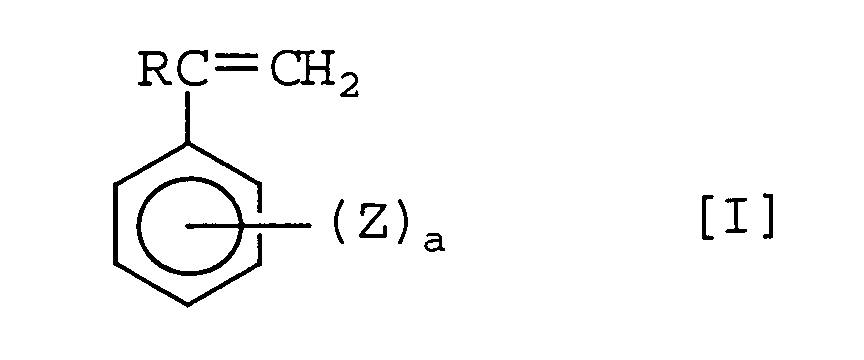
- the aromatic vinyl compound-based resins mentioned as an example of the amorphous thermoplastic resins are the resins (polymers) derived from the compounds having the molecular structural of the following formula [I]: wherein R is a hydrogen atom, an alkyl group or a halogen atom, Z is a hydrogen atom, an alkyl group, a halogen atom or a vinyl group and "a" is an integer of 1 to 5.
- Examples of the resins having the structure of the formula [I] include polystyrenes, rubber-reinforced polystyrenes, styrene-acrylonitrile copolymer, acrylonitrile-butadiene-styrene copolymer (ABS resin), styrene-maleic anhydride copolymer, and styrene-maleimide copolymer.
- the polycarbonates mentioned as another example of the amorphous thermoplastic resins include aromatic polycarbonates, aliphatic polycarbonates, and aromatic-aliphatic polycarbonates. Of these resins, aromatic polycarbonates are preferred. Such aromatic polycarbonates are the thermoplastic aromatic polycarbonate polymers or copolymers which may be branched and which can be obtained by reacting an aromatic hydroxyl compound or a mixture of the said compound and a small quantity of a polyhydroxyl compound with phosgene or a diester of carbonic acid.
- the preparation method of these aromatic polycarbonates is not specifically defined in the present invention; it is possible to use the conventional well-known methods such as phosgene method (interfacial polymerization method) and melting method (ester exchange method).
- the aromatic polycarbonate resins produced by the melting method may have been adjusted in the amount of terminal OH group.
- tetramethylbisphenol A bis(4-hydroxyphenyl)-P-diisopropylbenzene
- hydroquinone resorcinol
- 4,4-dihydroxydiphenyl and the like can be used, bisphenol A being preferred.
- a compound prepared by bonding one or more units of tetraalkylsulfonium sulphonate to the said aromatic dihydroxyl compound, and/or a polymer or oligomer containing phenolic OH groups at both terminals and having a siloxane structure may be allowed to coexist in small quantities.
- the amount of these compounds used is preferably in the range of 0.01 to 10 mol%, more preferably 0.1 to 2 mol%.
- aromatic polycarbonate resins are polycarbonate resins derived from 2,2-bis(4-hydroxyphenyl)propane, and polycarbonate copolymers derived from 2,2-bis(4-hydroxyphenyl)propane and other amoratic dihydroxyl compounds.
- a polymer or an oligomer having a siloxane structure may be additionally copolymerized therewith for further elevating flame retardancy of this resin.
- the aromatic polycarbonate resin may be a mixture of two or more resins with different compositions.
- Molecular weight of the aromatic polycarbonate resin is preferably 13,000 to 30,000 in terms of viscosity-average molecular weight calculated from the solution viscosity measured at 25°C using methylene chloride as solvent.
- the viscosity-average molecular weight of this resin is less than 13,000, the molded article obtained from the resin composition may be unsatisfactory in mechanical strength, and when the viscosity-average molecular weight exceeds 30,000, the obtained resin composition may be poor in moldability.
- the more preferred range of viscosity-average molecular weight is from 15,000 to 27,000, even more preferably from 17,000 to 24,000.
- a monovalent aromatic hydroxyl compound is used as a starting material.
- exemplary of such monovalent aromatic hydroxyl compounds are m- and p-methylphenol, m- and p-propylphenol, p-tert-butylphenol, and long chain alkylsubstituted p-phenol.
- the polyphenylene ether resins which are still another example of the amorphous thermoplastic resins, are the homopolymers or copolymers having the structure represented by the following formula [II]: wherein Q 1 and Q 2 are each a primary or secondary alkyl group.
- Preferred examples of the primary alkyl groups represented by Q 1 and Q 2 are methyl, ethyl, n-propyl, n-butyl, n-amyl, isoamyl, 2-methylbutyl, n-hexyl, 2,3-dimethylbutyl, 2-, 3- or 4-methylpentyl and heptyl, and preferred examples of the secondary alkyl groups are isopropyl, sec-butyl and 1-ethylpropyl.
- Q 1 is an alkyl or phenyl group, especially an alkyl group having 1 to 4 carbon atoms
- Q 2 is hydrogen atom.
- "b" is about not less than 10.
- a preferred example of the homopolymers of polyphenylene ether is one which comprises 2,6-dimethyl-1,4-phenylene ether units, and a preferred example of the copolymers is a random copolymer comprising a combination of the above-said units and 2,3,6-trimethyl-1,4-phenylene ether units.
- Many preferred examples of the homopolymers and random copolymers are described in the existing patents and literature.
- Polyphenylene ethers containing a molecular structural portion functioning for improving molecular weight, melt viscosity and/or other properties such as impact strength are also preferred.
- the polyphenylene ether used here is preferably one whose intrinsic viscosity as measured in chloroform at 30°C is 0.2 to 0.8 dl/g.
- intrinsic viscosity is less than 0.2 dl/g, the produced resin composition may lack in impact resistance, and when intrinsic viscosity exceeds 0.8 dl/g, the composition may be unsatisfactory in moldability.
- the preferred range of intrinsic viscosity is from 0.2 to 0.7 dl/g, especially from 0.25 to 0.6 dl/g.
- the polysulfone resins are the resins having the molecular structure represented by the following formula [III] : wherein "c" is about not less than 10.
- the polyolefinic elastomers mentioned as an example of the thermoplastic resins usable as component A are the block copolymers comprising soft segments of EPDM or EPR and hard segments of polypropylene or polyethylene.
- the polystyrene-based elastomers, which are another example of component A thermoplastic resins, are the block copolymers comprising soft segments of polybutadiene or polyisoprene and hard segments of polystyrene.
- the polyolefin resins cited as an example of component B thermoplastic resins include homopolymers of ⁇ -olefins, copolymers thereof, and copolymers which are mainly composed of an ⁇ -olefin (or ⁇ -olefins) and if necessary may have other unsaturated monomer(s) as a sub-component.
- the "copolymers” mentioned above may be of any type: block, random, graft or a composite thereof.
- the modified versions, such as chlorinated, sulfonated and carbonylated versions, of these olefin polymers are also usable.
- Exemplary of the said ⁇ -olefins are ethylene, propylene, butene-1, pentene-1, hexene-1, heptene-1 and octene-1. Those with a carbon number of 2 to 8 are preferred because of easy availability.
- Examples of the said other unsaturated monomers include unsaturated organic acids such as (meth)acrylic acids, (meth)acrylic esters and maleic acid, esters of these organic acids, anhydrides thereof, and unsaturated alicyclic olefins.
- the polyolefins mentioned above include low-density polyethylenes, medium-density polyethylenes, high-density polyethylenes, polypropylene, polybutene, poly-4-methyl-pentene-1, propylene-ethylene block copolymer, propylene-ethylene random copolymer, and copolymers of ethylene and other copolymerizable monomers.
- polyester resins which are another example of component B thermoplastic resins
- thermoplastic polyester resins obtained by condensing dicarboxylic acids, lower alkyl esters thereof, acid halides or acid anhydride derivatives with glycols or divalent phenols according to a conventional method.
- the dicarboxylic acids may be either aromatic or aliphatic.
- these dicarboxylic acids include oxalic acid, malonic acid, succinic acid, glutaric acid, adipic acid, suberic acid, azelaic acid, sebacic acid, terephthalic acid, isophthalic acid, p,p'-dicarboxydiphenylsulfone, p-carboxyphenoxyacetic acid, p-carboxyphenoxypropionic acid, p-carboxyphenoxybutyric acid, p-carboxyphenoxyvaleric acid, 2,6-naphthalindicarboxylic acid, 2,7-naphthalindicarboxylic acid, and mixtures of these carboxylic acids.
- the glycols may be either aliphatic or aromatic.
- aliphatic glycols are C 2 -C 12 alkylene glycols such as ethylene glycol, 1,3-propylene glycol, 1,4-butene glycol, 1,6-hexene glycol and 1,12-dodecamethylene glycol.
- aromatic glycols is p-xylene glycol.
- divalent phenols are pyrocatechol, resorcinol, hydroquinone, and alkylsubstituted derivatives of these compounds. 1,4-cyclohexanedimethanol can be cited as other appropriate glycol for the above condensation.
- polyesters those produced by ring-opening polymerization of lactone, such as polypivalolactone and poly( ⁇ -captrolactone), can be mentioned.
- polyester resins there can be mentioned those in the form of a polymer (thermoplastic liquid crystal polymer, TLCP) which forms liquid crystal in a molten state.
- the presently commercially available liquid crystal polyester resins which fall under this category include X7G (Eastman Kodak), Xyday (Datoco Co., Ltd), Econol (Sumitomo Chemical), and Bectra (Celanese Co., Ltd).
- those preferred to be used as component B are polyethylene terephthalate (PET), polybutyrene terephthalate (PBT), polynaphthalene terephthalate (PEN), poly(1,4-cyclohexanedimethylene terephthalate (PCT), and liquid crystal polyesters.
- PET polyethylene terephthalate
- PBT polybutyrene terephthalate
- PEN polynaphthalene terephthalate
- PCT poly(1,4-cyclohexanedimethylene terephthalate
- liquid crystal polyesters liquid crystal polyesters.
- polyacetal resins usable as component B thermal resin are high-molecular weight polyacetal homopolymers produced from polymerization of formaldehyde or trioxane.
- the acetal resins produced from formaldehyde have a high molecular weight and possess a structure represented by the following formula [IV] : wherein "d" is about not less than 100.
- polyacetals In order to enhance heat resistance and chemical resistance of the polyacetal resins, usually the terminal group is converted to ester group or ether group.
- polyacetals also include polyacetal copolymers.
- copolymers are the block copolymers of formaldehyde and other types of monomer or prepolymer capable of providing active hydrogen, such as alkylene glycol, polythiol, vinyl acetate-acrylic acid copolymer or reduced butadiene-acrylonitrile copolymer.
- Formaldehyde and trioxane can be copolymerized with other aldehydes, cyclic ethers, vinyl compounds, ketenes, cyclic carbonates, epoxides, isocyanates and ethers. Examples of these compounds are ethylene oxide, 1,3-dioxane, 1,3-dioxepene, epichlorohydrin, propylene oxide, isobutylene oxide and styrene oxide.
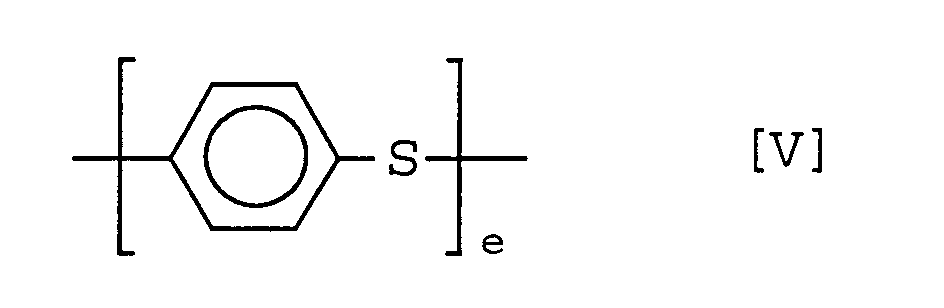
- polyphenylene sulfide resins are the crystalline hompolymers or copolymers containing as main structural element the repeating units represented by the following formula [V]: wherein "e" is about not less than 10.
- polysulfide resins such as: p-dichlorobenzene is polymerized in the presence of sulfur and sodium carbonate; the said monomer is polymerized in a polar solvent in the presence of sodium sulfide, or sodium hydrosulfide and sodium hyroxide, or hydrogen sulfide and sodium hydroxide; p-chlorothiophenol is self-condensed.
- p-dichlorobenzene is polymerized in the presence of sulfur and sodium carbonate
- the said monomer is polymerized in a polar solvent in the presence of sodium sulfide, or sodium hydrosulfide and sodium hyroxide, or hydrogen sulfide and sodium hydroxide
- p-chlorothiophenol is self-condensed.
- the most appropriate is the method in which sodium sulfide and p-chlorobenzene are reacted in an amide type solvent such as N-methylpyrrolidone or dimethylacetamide or
- polyphenylene sulfide resins in the present invention are those having as main structural element the repeating units represented by the above formula [V], that is, homopolymers comprising the repeating units of the formula [V], and copolymers mainly comprising the said repeating units of the formula [V] (preferably not less than 80 mol%) and containing one or more other types of repeating units at a small proportion (preferably not more than 20 mol%).
- the polyamides are those having -CONH- bond in the backbone and meltable by heating.
- Typical examples of such polyamides are polyamide-4, polyamide-6, polyamide-6 ⁇ 6, polyamide-12, polyamide-6 ⁇ 10, and other crystalline or amorphous polyamides containing known monomeric materials such as aromatic diamines and aromatic dicarboxylic acids.
- the preferred polyamides are nylon-6, nylong-6 ⁇ 6 and half-aromatic nylon, and these may be used in combination with amorphous polyamides.
- the polyamide used in the present invention is preferably one whose relative viscosity as measured in 98% concentrated sulfuric acid at 25°C falls in the range of 2.0 to 7.0.
- the produced resin composition may be low in mechanical strength, and when the relative viscosity exceeds 7.0, the composition may be poor in moldability.
- thermoplastic resin composition according to the present invention is characterized by the island-and-sea micro structure (phase separation).
- the "island-and-sea micro structure" referred to in the present invention signifies a micro-structure in which the islands are dispersed forming a discontinuous phase in the sea phase forming a continuous phase. This can be easily confirmed by electron microscopical examination. For example, a small piece is cut out from a pellet or molded product of the thermoplastic resin composition and sliced by an ultramicrotome (e. g.
- thermoplastic resin composition having such a microform makes it possible to obtain a molded article with excellent mechanical strength.
- the thermoplastic resin used as component A comprises mostly an amorphous thermoplastic resin and constitutes the island phase in the micro structure
- thermoplastic resin used as component B comprises mostly a crystalline thermoplastic resin and forms the sea phase in the micro structure.
- the combination of component A and component B resins cases where the component A thermoplastic resin is a polycarbonate resin and the component B thermoplastic resin is a polyolefinic resin, and the component A thermoplastic resin is a polyphenylene ether resin and the component B thermoplastic resin is a polyamide resin are preferable.
- thermoplastic resin composition In the thermoplastic resin composition according to the present invention, conductive carbon black (component C) exists mostly in the island phase of the micro structure constituted by component A and component B thermoplastic resins, and hollow carbon fibrils or conductive carbon black (component D) exists mostly in the sea phase.
- component C and component D By using both component C and component D and dispersing them in the manner described above, it is possible to obtain a thermoplastic resin composition which suffers no excess reduction of fluidity and is capable of providing a molded article with excellent conductivity and antistatic properties.
- the specific surface area of conductive carbon black of component C determined by BET adsorption isotherm with an N 2 gas is usually not more than 600 m 2 /g.
- the preferred range of the specific surface area of component C is from 10 to 450 m 2 /g, more preferably from 10 to 100 m 2 /g.
- the dibutyl phthalate (DBP) oil absorption as measured according to ASTM D2414 (DBP oil absorption) is usually not more than 200 ml/100 g, preferably not more than 150 ml/100 g.
- An example of carbon black that can meet such a physical properly requirement is acetylene black obtained by pyrolyzing acetylene gas.
- the specific surface area of component D conductive carbon black determined by BET adsorption isotherm with an N 2 gas is usually not less than 600 m 2 /g.
- the preferred range of the specific surface area of component D conductive carbon black is from 750 to 1,300 m 2 /g.
- the DBP oil absorption of component D conductive carbon black is usually not less than 200 ml/100 g, preferably not less than 150 ml/100 g.
- a typical example of carbon black that meets the above property requirements is ketchen black produced by incomplete furnace combustion using crude oil as starting material.
- the hollow carbon fibril of component D is essentially a columnar fibril having an outside region composed of a plurality of essentially continuous layers of regularly arranged carbon atoms and an inside hollow region, in which the respective layers and the hollow region are disposed substantially concentric to each other. Further, the regularly arranged carbon atoms in the said outside region are graphite-like, and the diameter of the said hollow region is preferably in the range of 2 to 20 nm.
- Such hollow carbon fibrils are described in detail in Japanese Patent Application Laid-Open (KOHYO) No. 62-500943, U.S. Patent No. 4,663,230, etc., and they can be produced, for instance, by a method in which, as described in the above-mentioned U.S.
- the particles containing a transition metal such as alumina-supported iron, cobalt, nickel or the like are brought into contact with a carbon-containing gas such as carbon monoxide or hydrogen carbide at a high temperature of 850 to 1,200°C, and the pyrolytically produced carbon is grown into fiber with the transition metal as starting point.
- a carbon-containing gas such as carbon monoxide or hydrogen carbide
- the hollow carbon fibrils usable as component D in the present invention are commercially available under the trade name of Graphite Fibril from Hyperion Catalysis International, Inc.
- thermoplastic resin for the preparation of the thermoplastic resin composition according to the present invention, first component C and component D are blended and dispersed respectively in a thermoplastic resin, and then the resin containing component C and the resin containing component D are melted and mixed together.
- the thermoplastic resin as explained above, comprises component A thermoplastic resin and component B thermoplastic resin, in which the two thermoplastic resins are preferably combined in such a ratio that component A thermoplastic resin will be 5 to 65 parts by weight and component B thermoplastic resin will be 95 to 35 parts by weight in 100 parts by weight of the two thermoplastic resins combined.
- component A thermoplastic resin is less than 5 parts by weight and component B thermoplastic resin exceeds 95 parts by weight, the produced composition may lack in mechanical strength and moldability, and when component A thermoplastic resin exceeds 65 parts by weight and component B thermoplastic resin is less than 35 parts by weight, the produced composition tends to become low in conductivity although it depends on the content of conductive carbon black.
- the amounts of component C and component D are preferably selected so that both of component C and component D will fall within the range of 0.1 to 15 parts by weight to 100 parts by weight of component A and component B combined.
- the amount of component C or component D is less than 0.1 part by weight, conductivity and antistatic properties may be deteriorated, and when the amount of component C or component D exceeds 15 parts by weight, mechanical strength and moldability may be deteriorated.
- the amount of component C is more preferably 0.5 to 12 parts by weight, especially 1 to 10 parts by weight, based on 100 parts by weight of component A and component B combined.
- the amount of component D is more preferably 0.5 to 12 parts by weight, especially 1 to 10 parts by weight, based on 100 parts by weight of component A and component B combined.
- the total amount of component C and component D is preferably 3 to 16 parts by weight, more preferably 4 to 13 parts by weight, especially not less than 7 parts by weight but not more than 12 parts by weight, based on 100 parts by weight of component A and component B combined.
- the component D/component C ratio by weight is preferably 80/20 to 20/80, more preferably 70/30 to 30/70, especially 49/51 to 30/70.
- component C or component D are dispersed in component A thermoplastic resin forming the island phase to prepare an intermediate composition X, and separately from the above, component C or component D are also dispersed in component B thermoplastic resin forming the sea phase to prepare an intermediate composition Y. Then these intermediate compositions X and Y are mixed, or component B thermoplastic resin, component D and other optional components are mixed with intermediate composition X, and the obtained mixture is melted and kneaded to give the objective thermoplastic resin composition.
- Such melting and kneading provides a resin composition having an island-and-sea micro structure.
- the weight-average particle size of the island phase is preferably not less than 3 ⁇ m for improving mechanical strength and moldability. Said melting and kneading causes a small portion of component C to pass into component B thermoplastic resin while forcing some of component D to shift into component A thermoplastic resin, but preferably not less than 70% by weight of component C is allowed to exist in the island phase while not less than 70% by weight of component D is allowed to exist in the sea phase.
- thermoplastic resin and dispersing component D in component B thermoplastic resin it is possible to use, for example, the following methods: (1) Predetermined amounts of resin and conductive carbon black are mixed, and the mixture is melted and kneaded by a proper melting and kneading machine such as single-screw extruder, multiple-screw extruder, Banbury mixer, roll mill, Brabender Plastogram, etc., and then granulated; (2) The said components are added to a suitable solvent, for example, a hydrocarbon such as hexane, heptane, benzene, toluene, xylene, etc., or a derivative thereof, and the dissolved components are mixed with each, or the dissolved components are mixed with the undissolved components in a suspended state.
- a suitable solvent for example, a hydrocarbon such as hexane, heptane, benzene, toluene, xylene, etc., or a derivative thereof, and the dissolved
- the above-mentioned method (1) (melting and kneading method) is preferred.
- this melting and kneading method (1) preferably a masterbatch with a high content of conductive carbon black is prepared previously, and this masterbatch is melted and kneaded with thermoplastic resins, as it is thereby possible to obtain a thermoplastic resin composition having conductive carbon black dispersed uniformly therein.
- thermoplastic resin composition various types of other resin additives can be blended within limits not affecting the purpose and effect of the present invention.
- the resin additives that can be blended include colorant, plasticizer, lubricant, thermal stabilizer, light stabilizer, ultraviolet absorber, filler, foaming agent, flame retardant, anticorrosive agent, etc. These resin additives are preferably blended in the final step of the preparation process of the thermoplastic resin composition according to the present invention.
- thermoplastic resin composition according to the present invention is particularly suited for use as a molding material for the articles which are required to have conductivity and/or antistatic properties, such as OA equipment, electronic devices, conductive packaging parts, antistatic packaging parts, and automobile parts to be coated by electrostatic coating.
- thermoplastic resin molding methods such as injection molding, blow molding, extrusion molding, sheet forming, thermoforming, rotational molding, laminate molding, etc.
- the present invention can produce the following notably advantageous effects, and its industrial utility value is very great.
- Table 1 The components shown in Table 1 were weighed out at the rates shown in the same table and uniformly mixed by a tumbling mixer, and the obtained mixture was melted and kneaded by a twin-screw extruder (30 mm ⁇ ) at a cylinder temperature of 280°C and a screw speed of 250 rpm, and pelletized.
- the test piece used for measuring volume resistivity was as described above.
- the type and ratio (wt%) of the resin having an island-and-sea micro structure, the type of carbon black, and the type and ratio (wt%) of the resin phase containing carbon black were checked.
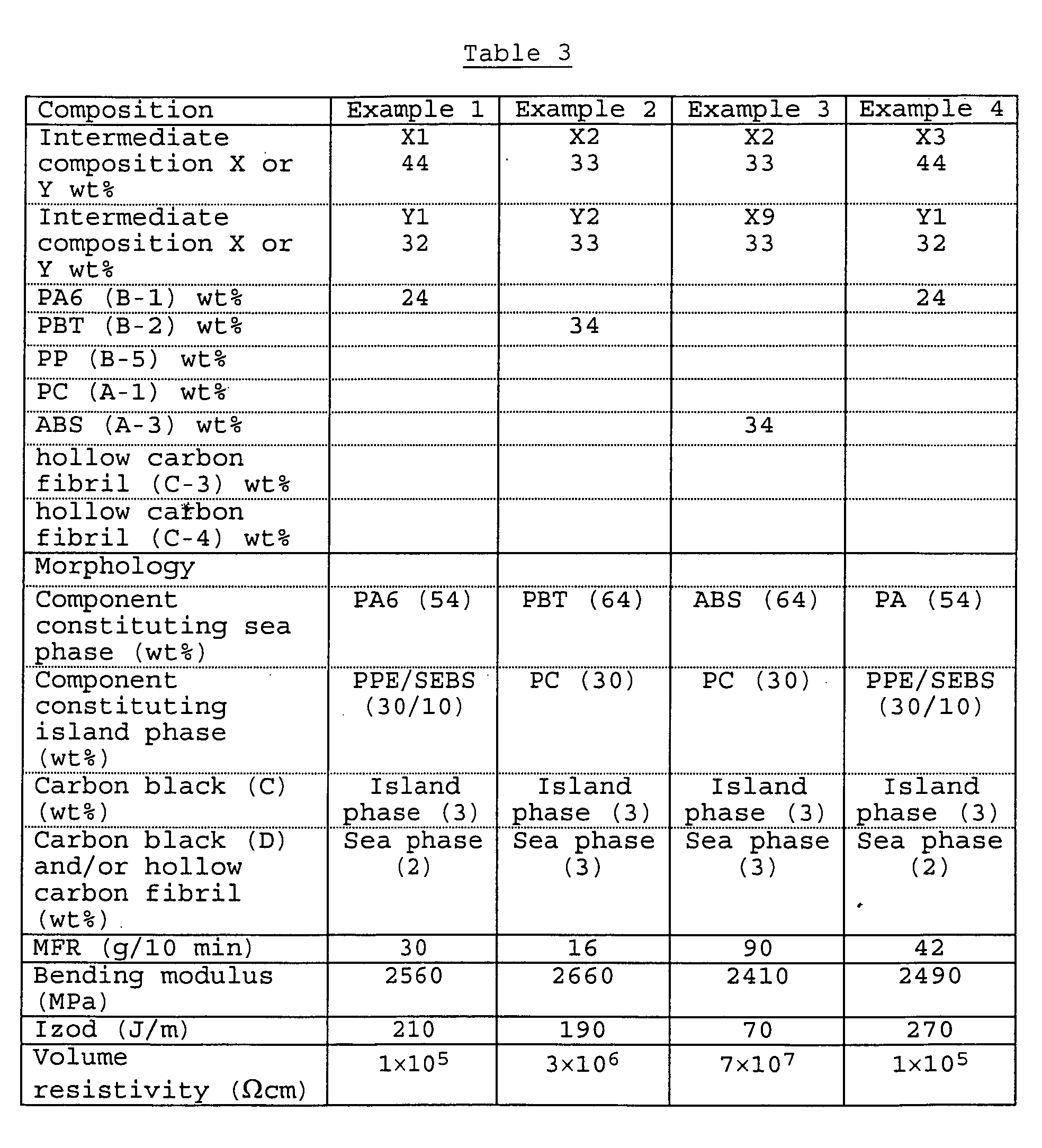
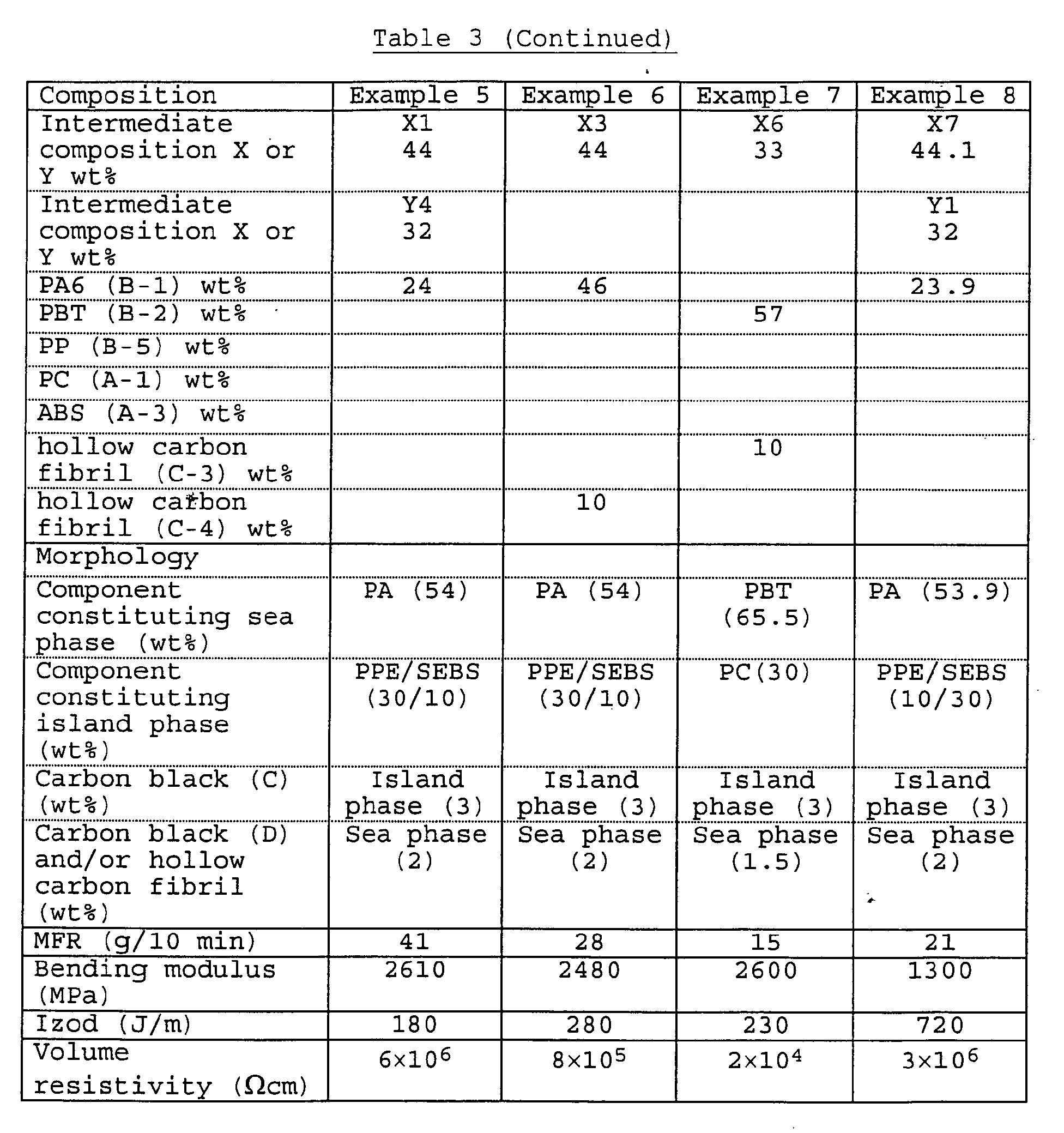
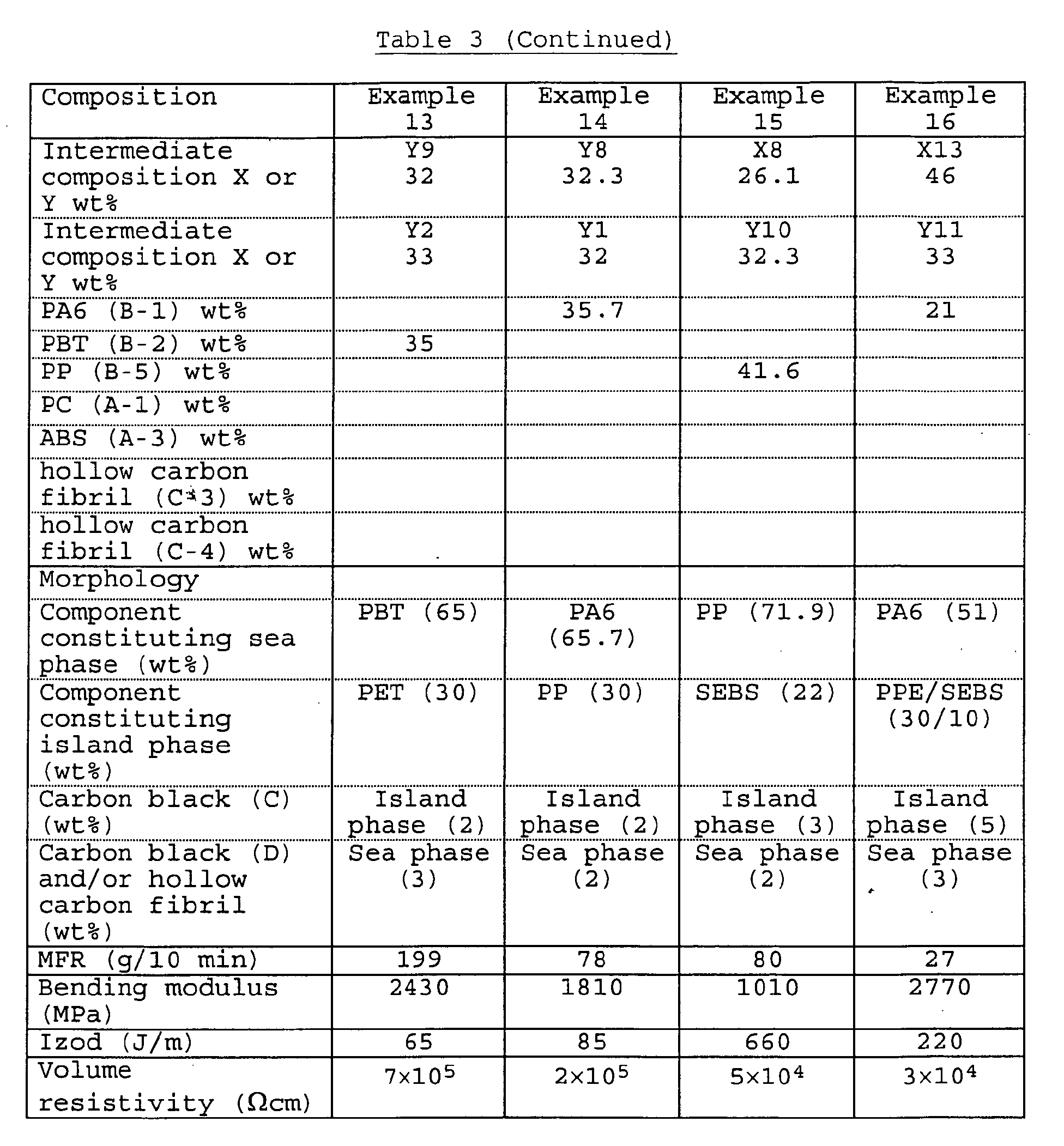
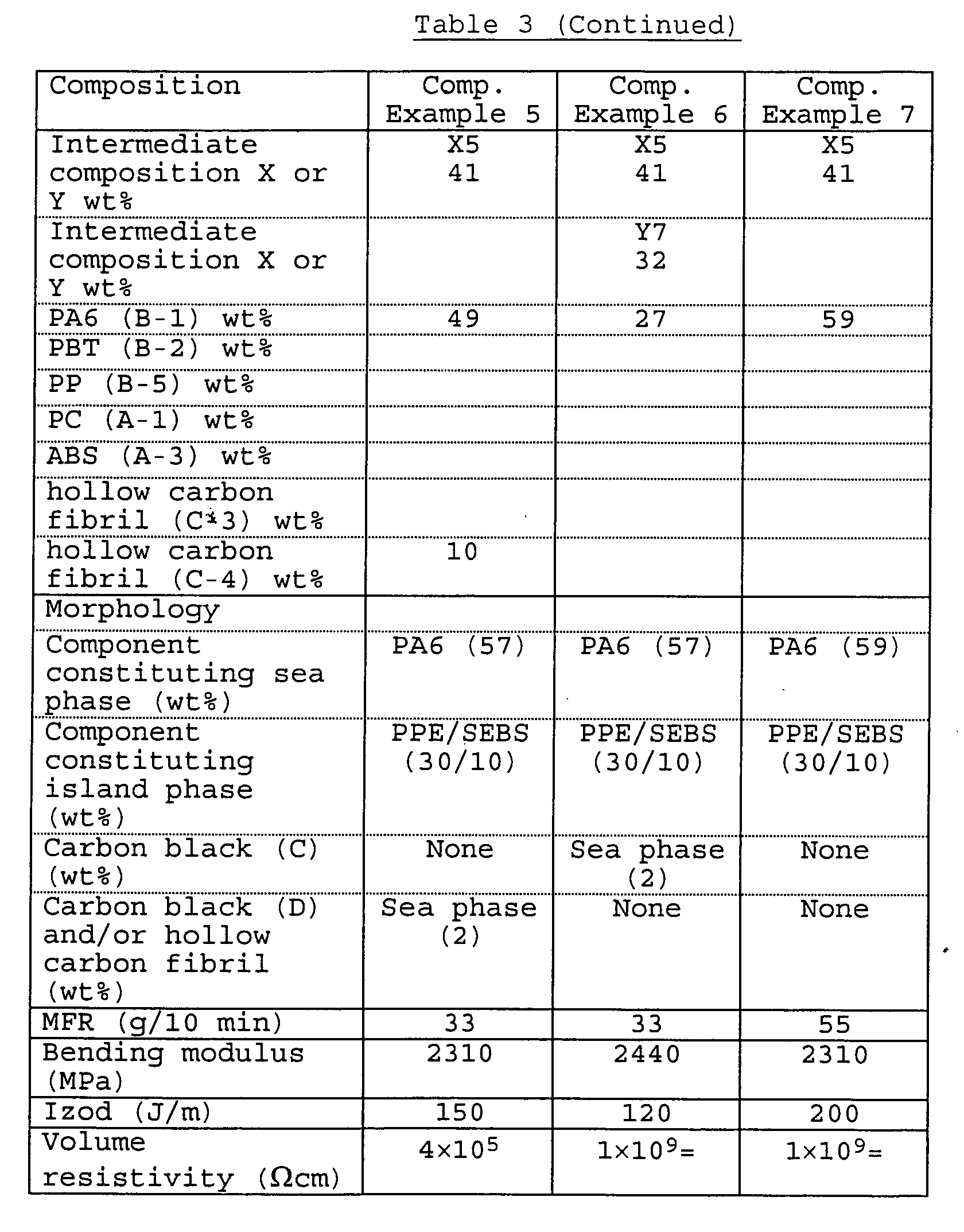
- the evaluation results are shown in Table 3.
- Example 3 The same procedure as defined in Example 1 was conducted except that carbon black having a small specific surface area (component C) was blended in the sea phase while blending carbon black having a large specific surface area (component D) in the island phase as shown in Table 3 to obtain a mixture, and this mixture was melted and kneaded by a twin-screw extruder and pelletized. A test piece was molded from the pellets by injection molding and subjected to the same evaluation tests as conducted in Example 1. The evaluation results are shown in Table 3.
- Pellets and a test piece were obtained by conducting the same procedure as defined in Comparative Example 1 except that no carbon black was blended in the island phase, and the test piece was subjected to the evaluation tests to obtain the results shown in Table 3.
- Pellets and a test piece were obtained by conducting the same procedure as defined in Comparative Example 1 except that no carbon black was blended in the sea phase, and the test piece was subjected to the evaluations tests to obtain the results shown in Table 3.
- Pellets and a test piece were obtained by conducting the same procedure as defined in Comparative Example 1 except that no carbon black was blended in the island phase, and the test piece was subjected to the evaluation tests to obtain the results shown in Table 3.
- Example 3 The same procedure as defined in Example 1 was conducted except that component C was not blended and component D alone was blended in the sea phase as shown in Table 3 to obtain a mixture, and this mixture was melted and kneaded by a twin-screw extruder and pelletized. A test piece was molded from the pellets and subjected to the same evaluation tests as conducted in Example 1. The evaluation results are shown in Table 3.
- Pellets and a test piece were obtained by conducting the same procedure as defined in Comparative Example 5 except that component C was blended in the sea phase but hollow carbon fibrils (component D) were not blended as shown in Table 3, and the test piece was subjected to the evaluation tests to obtain the results shown in Table 3.
Landscapes
- Chemical & Material Sciences (AREA)
- Health & Medical Sciences (AREA)
- Chemical Kinetics & Catalysis (AREA)
- Medicinal Chemistry (AREA)
- Polymers & Plastics (AREA)
- Organic Chemistry (AREA)
- Compositions Of Macromolecular Compounds (AREA)
Abstract
said thermoplastic resin composition having an island-and-sea micro structure constituted by component A and component B,
component C existing mostly in the island phase, and
component D existing mostly in the sea phase.
Description
said thermoplastic resin composition having an island-and-sea micro structure constituted by component A and component B,
component C existing mostly in the island phase, and
component D existing mostly in the sea phase.







Claims (6)
- A thermoplastic resin composition comprising two different thermoplastic resins (component A and component B), conductive carbon black (component C), and conductive carbon black having a larger specific surface area than that of component C or hollow carbon fibril (component D),
said thermoplastic resin composition having an island-and-sea micro structure constituted by component A and component B,
component C existing mostly in the island phase, and
component D existing mostly in the sea phase. - A thermoplastic resin composition according to claim 1, wherein the specific surface area of conductive carbon black of component C is less than 600 m2/g, and the specific surface area of conductive carbon black of component D is not less than 600 m2/g.
- A thermoplastic resin composition according to claim 1, wherein component A is an amorphous thermoplastic resin and constitutes the island phase, and component B is a crystalline thermoplastic resin and constitutes the sea phase.
- A thermoplastic resin composition according to claim 1, wherein component A is a polyphenylene ether resin, a polycarbonate resin, a polystyrene resin, an ABS resin, a polyolefinic elastomer, a polystyrene-based elastomer, or a mixture thereof.
- A thermoplastic resin composition according to claim 1, wherein component B is a polyamide resin, a polyester resin, a polyolefinic resin, a polyphenylene sulfide resin, or a mixture thereof.
- A thermoplastic resin composition according to claim 1, wherein component A is a polycarbonate resin and component B is a polyolefinic resin, or component A is a polyphenylene ether resin and component B is a polyamide resin.
Applications Claiming Priority (4)
| Application Number | Priority Date | Filing Date | Title |
|---|---|---|---|
| JP2001218778 | 2001-07-18 | ||
| JP2001218779 | 2001-07-18 | ||
| JP2002018779 | 2001-07-18 | ||
| JP2001218778 | 2001-07-18 |
Publications (3)
| Publication Number | Publication Date |
|---|---|
| EP1277807A2 true EP1277807A2 (en) | 2003-01-22 |
| EP1277807A3 EP1277807A3 (en) | 2003-08-20 |
| EP1277807B1 EP1277807B1 (en) | 2007-05-02 |
Family
ID=26618962
Family Applications (1)
| Application Number | Title | Priority Date | Filing Date |
|---|---|---|---|
| EP02015628A Expired - Lifetime EP1277807B1 (en) | 2001-07-18 | 2002-07-16 | Thermoplastic resin composition |
Country Status (4)
| Country | Link |
|---|---|
| US (1) | US7008991B2 (en) |
| EP (1) | EP1277807B1 (en) |
| JP (1) | JP4078537B2 (en) |
| DE (1) | DE60219853T2 (en) |
Cited By (3)
| Publication number | Priority date | Publication date | Assignee | Title |
|---|---|---|---|---|
| EP1736512A4 (en) * | 2004-04-14 | 2008-07-02 | Asahi Kasel Chemicals Corp | CONDUCTIVE RESIN COMPOSITION |
| WO2008078849A1 (en) | 2006-12-22 | 2008-07-03 | Cheil Industries Inc. | Electroconductive thermoplastic resin composition and plastic article |
| US10538611B2 (en) | 2014-04-18 | 2020-01-21 | Nippon A&L Inc. | Graft copolymer and thermoplastic resin composition |
Families Citing this family (41)
| Publication number | Priority date | Publication date | Assignee | Title |
|---|---|---|---|---|
| WO2004025761A2 (en) * | 2002-09-12 | 2004-03-25 | E.I. Dupont Canada Company | Compositions and method for making fuel cell collector plates |
| US7413685B2 (en) * | 2002-09-12 | 2008-08-19 | E.I. Du Pont Canada Company | Composition and method for making fuel cell collector plates with improved properties |
| EP1473317B1 (en) * | 2002-12-26 | 2005-11-23 | Asahi Kasei Chemicals Corporation | Conductive master batch and conductive resin composition |
| JP3711285B2 (en) * | 2002-12-26 | 2005-11-02 | 旭化成ケミカルズ株式会社 | Manufacturing method of conductive masterbatch |
| WO2004086541A2 (en) * | 2003-03-25 | 2004-10-07 | E.I. Du Pont Canada Company | Integrated electrically conductive electrochemical cell component |
| US20060188773A1 (en) * | 2003-03-25 | 2006-08-24 | Peter Andrin | Process for joining a gas diffusion layer to a separator plate |
| KR101136676B1 (en) * | 2003-08-14 | 2012-04-18 | 도요 세이칸 가부시키가이샤 | Packing container |
| TW200519150A (en) * | 2003-12-05 | 2005-06-16 | Showa Denko Kk | Conductive resin composition and molded product thereof |
| JP5025079B2 (en) * | 2003-12-05 | 2012-09-12 | 昭和電工株式会社 | Conductive resin composition and molded body thereof |
| US20050209391A1 (en) * | 2004-03-17 | 2005-09-22 | Toshiya Nakayama | Transport and storage carrier of semiconductor parts containing wafer |
| JP4146815B2 (en) * | 2004-03-26 | 2008-09-10 | シャープ株式会社 | Manufacturing method of semiconductor device for optical communication |
| JP5221876B2 (en) * | 2004-11-04 | 2013-06-26 | ライオン株式会社 | Conductive masterbatch and resin composition containing the same |
| JP4788149B2 (en) * | 2005-02-09 | 2011-10-05 | 東レ株式会社 | Method for producing polyamide resin composition |
| JP4894168B2 (en) * | 2005-03-25 | 2012-03-14 | 東レ株式会社 | Polyamide resin composition and method for producing the same |
| ATE404979T1 (en) * | 2006-03-22 | 2008-08-15 | Premix Oy | ELECTRICALLY CONDUCTIVE ELASTOMER MIXTURE, METHOD OF PRODUCING SAME AND USE OF THE MIXTURE |
| FR2899236B1 (en) * | 2006-04-04 | 2008-05-16 | Rhodia Recherches & Tech | ELECTRICALLY CONDUCTIVE COMPOSITION BASED ON POLYAMIDE MATRIX. |
| US20070238832A1 (en) * | 2006-04-05 | 2007-10-11 | General Electric Company | Method of making a poly(arylene ether)/polyamide composition |
| US20070235697A1 (en) * | 2006-04-05 | 2007-10-11 | General Electric Company | Poly(arylene ether)/polyamide composition |
| US20070235698A1 (en) * | 2006-04-05 | 2007-10-11 | General Electric Company | vehicular body part |
| JP2007302817A (en) * | 2006-05-12 | 2007-11-22 | Mitsubishi Engineering Plastics Corp | Thermoplastic resin composition for manufacturing automotive exterior parts |
| ATE518025T1 (en) * | 2006-11-14 | 2011-08-15 | Arkema Inc | MULTI-COMPONENT FIBERS WITH LONG CHAIN POLYAMIDES |
| US8263213B2 (en) * | 2006-12-19 | 2012-09-11 | E I Du Pont De Nemours And Company | Painted composite thermoplastic articles |
| JP5216230B2 (en) * | 2007-03-29 | 2013-06-19 | Jx日鉱日石エネルギー株式会社 | Conductive resin composition |
| US7800379B2 (en) * | 2007-12-12 | 2010-09-21 | Delphi Technologies, Inc. | Fuel sensor |
| AU2007362485B2 (en) * | 2007-12-14 | 2013-12-12 | Prysmian S.P.A. | Electric article comprising at least one element made from a semiconductive polymeric material and semiconductive polymeric composition |
| TWI393730B (en) * | 2008-12-08 | 2013-04-21 | Taiwan Textile Res Inst | Conductive masterbatches and conductive monofilaments |
| KR101539709B1 (en) * | 2008-12-31 | 2015-07-28 | 에스케이케미칼 주식회사 | High Strength Polyphenylene Sulfide / Polyethylene Terephthalate Blend Resin Composition and Manufacturing Method Thereof |
| US20100327234A1 (en) * | 2009-06-24 | 2010-12-30 | Cheil Industries Inc. | Polyphenylene Ether Thermoplastic Resin Composition, Method of Preparing the Same, and Molded Product Using the Same |
| JP5493529B2 (en) * | 2009-07-16 | 2014-05-14 | 富士ゼロックス株式会社 | Conductive member, charging device, process cartridge, and image forming apparatus |
| JP5446555B2 (en) * | 2009-07-30 | 2014-03-19 | Dic株式会社 | Method for increasing elongation of polyarylene sulfide resin, and polyarylene sulfide molded article |
| KR101266300B1 (en) | 2009-11-02 | 2013-05-22 | 제일모직주식회사 | Polyphenyleneether resin composition and molded product using the same |
| JP2012122057A (en) * | 2010-11-15 | 2012-06-28 | Nagoya Institute Of Technology | Inorganic organic composite composition |
| KR101413835B1 (en) * | 2011-03-25 | 2014-06-30 | 도레이 카부시키가이샤 | Thermoplastic resin composition and molded article using same |
| FR2973387B1 (en) * | 2011-04-04 | 2013-03-29 | Rhodia Operations | POLYAMIDE COMPOSITION OF HIGH THERMAL CONDUCTIVITY |
| JPWO2014148071A1 (en) * | 2013-03-22 | 2017-02-16 | 株式会社オートネットワーク技術研究所 | Covered wire with terminal |
| JP6122115B2 (en) * | 2013-07-08 | 2017-04-26 | 三洋化成工業株式会社 | Resin current collector material and resin current collector |
| CN111448279B (en) | 2018-01-30 | 2021-08-10 | 拓自达电线株式会社 | Conductive adhesive composition |
| TWI866934B (en) | 2019-03-04 | 2024-12-21 | 日商拓自達電線股份有限公司 | Conductive adhesive composition |
| CN111909467A (en) * | 2020-07-15 | 2020-11-10 | 日彩复合塑料(深圳)有限公司 | Plastic tray material and preparation method thereof |
| EP4502072A4 (en) * | 2022-03-25 | 2026-04-01 | Sekisui Techno Molding Co Ltd | RESIN COMPOSITION AND RESIN BODY |
| WO2025214813A1 (en) | 2024-04-12 | 2025-10-16 | Boosting Innovation In Poliba S.C. A R.L. | Bio-based polymer-carbon composite formulation for electrodes and electrochemical energy conversion and storage devices |
Family Cites Families (13)
| Publication number | Priority date | Publication date | Assignee | Title |
|---|---|---|---|---|
| FR2469429B1 (en) * | 1979-11-16 | 1986-06-27 | Comp Generale Electricite | PLASTIC MATERIAL WITH HIGH THERMAL CONDUCTIVITY AND GOOD MECHANICAL STRENGTH |
| JPS62119272A (en) * | 1985-11-19 | 1987-05-30 | Mitsubishi Petrochem Co Ltd | resin resistor |
| JP2756548B2 (en) * | 1989-01-31 | 1998-05-25 | 日本ジーイープラスチックス株式会社 | Conductive resin mixture |
| JP2889918B2 (en) * | 1989-03-08 | 1999-05-10 | 三菱化学株式会社 | Seamless electrophotographic photosensitive member conductive substrate |
| JP2883128B2 (en) * | 1989-11-13 | 1999-04-19 | 三菱化学株式会社 | Conductive thermoplastic resin composition |
| EP0616013B1 (en) * | 1993-03-19 | 1999-06-02 | Mitsubishi Chemical Corporation | Thermoplastic resin composition |
| US5484838A (en) * | 1994-12-22 | 1996-01-16 | Ford Motor Company | Thermoplastic compositions with modified electrical conductivity |
| US6409942B1 (en) * | 1996-11-07 | 2002-06-25 | Carmel Olefins Ltd. | Electrically conductive compositions and methods for producing same |
| JPH10204305A (en) * | 1996-11-25 | 1998-08-04 | Cosmo Sogo Kenkyusho:Kk | Electromagnetic wave shielding resin composition, and molded article using the composition |
| JPH11163589A (en) * | 1997-11-25 | 1999-06-18 | Matsushita Electric Works Ltd | Composite for electromagnetic shield and manufacture thereof |
| WO2000068299A2 (en) * | 1999-05-07 | 2000-11-16 | General Electric Company | Conductive compositions with compositionally controlled bulk resistivity |
| US6441084B1 (en) * | 2000-04-11 | 2002-08-27 | Equistar Chemicals, Lp | Semi-conductive compositions for wire and cable |
| US6455771B1 (en) * | 2001-03-08 | 2002-09-24 | Union Carbide Chemicals & Plastics Technology Corporation | Semiconducting shield compositions |
-
2002
- 2002-07-16 EP EP02015628A patent/EP1277807B1/en not_active Expired - Lifetime
- 2002-07-16 DE DE60219853T patent/DE60219853T2/en not_active Expired - Lifetime
- 2002-07-17 US US10/198,190 patent/US7008991B2/en not_active Expired - Lifetime
- 2002-07-17 JP JP2002207999A patent/JP4078537B2/en not_active Expired - Lifetime
Cited By (5)
| Publication number | Priority date | Publication date | Assignee | Title |
|---|---|---|---|---|
| EP1736512A4 (en) * | 2004-04-14 | 2008-07-02 | Asahi Kasel Chemicals Corp | CONDUCTIVE RESIN COMPOSITION |
| US7696274B2 (en) | 2004-04-14 | 2010-04-13 | Asahi Kasei Chemicals Corporation | Conductive resin composition |
| WO2008078849A1 (en) | 2006-12-22 | 2008-07-03 | Cheil Industries Inc. | Electroconductive thermoplastic resin composition and plastic article |
| EP2121848A4 (en) * | 2006-12-22 | 2012-10-10 | Cheil Ind Inc | ELECTRICALLY CONDUCTIVE THERMOPLASTIC COMPOSITION AND PLASTIC MATERIAL |
| US10538611B2 (en) | 2014-04-18 | 2020-01-21 | Nippon A&L Inc. | Graft copolymer and thermoplastic resin composition |
Also Published As
| Publication number | Publication date |
|---|---|
| EP1277807A3 (en) | 2003-08-20 |
| US20030130405A1 (en) | 2003-07-10 |
| JP2003096317A (en) | 2003-04-03 |
| US7008991B2 (en) | 2006-03-07 |
| DE60219853T2 (en) | 2008-01-17 |
| JP4078537B2 (en) | 2008-04-23 |
| DE60219853D1 (en) | 2007-06-14 |
| EP1277807B1 (en) | 2007-05-02 |
Similar Documents
| Publication | Publication Date | Title |
|---|---|---|
| EP1277807B1 (en) | Thermoplastic resin composition | |
| EP0627468B1 (en) | Thermoplastic resin composition and molded product thereof | |
| KR100612174B1 (en) | Method For Producing A Conductive Masterbatch | |
| KR100706651B1 (en) | Electrically Conductive Thermoplastic Compositions and Plastic Molded Articles | |
| EP1508595B1 (en) | Polyphenylene sulfide resin composition | |
| US6353050B1 (en) | Thermoplastic blend comprising poly(arylene ether) and polyamide | |
| US6608133B2 (en) | Thermoplastic resin composition, molded product using the same and transport member for electric and electronic parts using the same | |
| JP2003064255A (en) | Thermoplastic resin composition | |
| JPH05271532A (en) | Electrically conductive resin composition | |
| JP2974039B2 (en) | Thermoplastic resin composition | |
| JP4397115B2 (en) | Thermoplastic resin composition and molded article thereof | |
| JP5553441B2 (en) | Conductive thermoplastic resin film or sheet | |
| JP2002146206A (en) | Thermoplastic resin composition | |
| JP2002146205A (en) | Thermoplastic resin composition | |
| JP4450557B2 (en) | Conductive thermoplastic resin composition | |
| JP4608151B2 (en) | Thermoplastic resin composition | |
| JP4570682B2 (en) | Conductive thermoplastic resin composition | |
| JP4393110B2 (en) | Conductive thermoplastic resin composition | |
| JPH0812768A (en) | Molded product of thermoplastic resin composition | |
| JP5352364B2 (en) | Thermoplastic resin composition and molded article thereof | |
| CN1326916C (en) | Conductive masterbatch and conductive resin composition | |
| JP3798437B2 (en) | Flame retardant resin composition | |
| WO2024004603A1 (en) | Thermoplastic resin composition, and molded product | |
| JP2003026937A (en) | Thermoplastic resin composition | |
| JP2005264028A (en) | Resin composition |
Legal Events
| Date | Code | Title | Description |
|---|---|---|---|
| PUAI | Public reference made under article 153(3) epc to a published international application that has entered the european phase |
Free format text: ORIGINAL CODE: 0009012 |
|
| AK | Designated contracting states |
Kind code of ref document: A2 Designated state(s): AT BE BG CH CY CZ DE DK EE ES FI FR GB GR IE IT LI LU MC NL PT SE SK TR |
|
| AX | Request for extension of the european patent |
Free format text: AL;LT;LV;MK;RO;SI |
|
| PUAL | Search report despatched |
Free format text: ORIGINAL CODE: 0009013 |
|
| RIC1 | Information provided on ipc code assigned before grant |
Ipc: 7C 08K 3/04 A Ipc: 7C 08K 7/24 B Ipc: 7C 08L 101/12 B |
|
| AK | Designated contracting states |
Designated state(s): AT BE BG CH CY CZ DE DK EE ES FI FR GB GR IE IT LI LU MC NL PT SE SK TR |
|
| AX | Request for extension of the european patent |
Extension state: AL LT LV MK RO SI |
|
| 17P | Request for examination filed |
Effective date: 20031222 |
|
| AKX | Designation fees paid |
Designated state(s): DE FR GB |
|
| GRAP | Despatch of communication of intention to grant a patent |
Free format text: ORIGINAL CODE: EPIDOSNIGR1 |
|
| GRAS | Grant fee paid |
Free format text: ORIGINAL CODE: EPIDOSNIGR3 |
|
| GRAA | (expected) grant |
Free format text: ORIGINAL CODE: 0009210 |
|
| AK | Designated contracting states |
Kind code of ref document: B1 Designated state(s): DE FR GB |
|
| REG | Reference to a national code |
Ref country code: GB Ref legal event code: FG4D |
|
| REF | Corresponds to: |
Ref document number: 60219853 Country of ref document: DE Date of ref document: 20070614 Kind code of ref document: P |
|
| ET | Fr: translation filed | ||
| PLBE | No opposition filed within time limit |
Free format text: ORIGINAL CODE: 0009261 |
|
| STAA | Information on the status of an ep patent application or granted ep patent |
Free format text: STATUS: NO OPPOSITION FILED WITHIN TIME LIMIT |
|
| 26N | No opposition filed |
Effective date: 20080205 |
|
| REG | Reference to a national code |
Ref country code: FR Ref legal event code: PLFP Year of fee payment: 15 |
|
| REG | Reference to a national code |
Ref country code: FR Ref legal event code: PLFP Year of fee payment: 16 |
|
| REG | Reference to a national code |
Ref country code: FR Ref legal event code: PLFP Year of fee payment: 17 |
|
| PGFP | Annual fee paid to national office [announced via postgrant information from national office to epo] |
Ref country code: FR Payment date: 20210611 Year of fee payment: 20 |
|
| PGFP | Annual fee paid to national office [announced via postgrant information from national office to epo] |
Ref country code: GB Payment date: 20210623 Year of fee payment: 20 |
|
| PGFP | Annual fee paid to national office [announced via postgrant information from national office to epo] |
Ref country code: DE Payment date: 20210622 Year of fee payment: 20 |
|
| REG | Reference to a national code |
Ref country code: DE Ref legal event code: R071 Ref document number: 60219853 Country of ref document: DE |
|
| REG | Reference to a national code |
Ref country code: GB Ref legal event code: PE20 Expiry date: 20220715 |
|
| PG25 | Lapsed in a contracting state [announced via postgrant information from national office to epo] |
Ref country code: GB Free format text: LAPSE BECAUSE OF EXPIRATION OF PROTECTION Effective date: 20220715 |