EP1277591A2 - Resin composition for recording sheets - Google Patents
Resin composition for recording sheets Download PDFInfo
- Publication number
- EP1277591A2 EP1277591A2 EP02015931A EP02015931A EP1277591A2 EP 1277591 A2 EP1277591 A2 EP 1277591A2 EP 02015931 A EP02015931 A EP 02015931A EP 02015931 A EP02015931 A EP 02015931A EP 1277591 A2 EP1277591 A2 EP 1277591A2
- Authority
- EP
- European Patent Office
- Prior art keywords
- resin
- polyvinyl alcohol
- mole
- group
- resin composition
- Prior art date
- Legal status (The legal status is an assumption and is not a legal conclusion. Google has not performed a legal analysis and makes no representation as to the accuracy of the status listed.)
- Withdrawn
Links
- 239000011342 resin composition Substances 0.000 title claims abstract description 31
- 229920005989 resin Polymers 0.000 claims abstract description 72
- 239000011347 resin Substances 0.000 claims abstract description 72
- 239000004372 Polyvinyl alcohol Substances 0.000 claims abstract description 42
- 229920002451 polyvinyl alcohol Polymers 0.000 claims abstract description 42
- 125000005702 oxyalkylene group Chemical group 0.000 claims abstract description 27
- 125000002091 cationic group Chemical group 0.000 claims abstract description 23
- 239000007864 aqueous solution Substances 0.000 claims abstract description 18
- 230000007062 hydrolysis Effects 0.000 claims description 23
- 238000006460 hydrolysis reaction Methods 0.000 claims description 23
- 239000000203 mixture Substances 0.000 claims description 12
- 150000003242 quaternary ammonium salts Chemical group 0.000 claims description 8
- 230000002265 prevention Effects 0.000 abstract description 9
- 238000006116 polymerization reaction Methods 0.000 description 22
- -1 polyoxyethylene Polymers 0.000 description 19
- 239000000178 monomer Substances 0.000 description 17
- 239000000123 paper Substances 0.000 description 17
- 238000000034 method Methods 0.000 description 15
- 239000011248 coating agent Substances 0.000 description 14
- 238000000576 coating method Methods 0.000 description 14
- XLYOFNOQVPJJNP-UHFFFAOYSA-N water Substances O XLYOFNOQVPJJNP-UHFFFAOYSA-N 0.000 description 14
- LFQSCWFLJHTTHZ-UHFFFAOYSA-N Ethanol Chemical compound CCO LFQSCWFLJHTTHZ-UHFFFAOYSA-N 0.000 description 13
- 239000007787 solid Substances 0.000 description 12
- 229920003171 Poly (ethylene oxide) Polymers 0.000 description 11
- 239000000243 solution Substances 0.000 description 11
- 239000000758 substrate Substances 0.000 description 11
- 229920001567 vinyl ester resin Polymers 0.000 description 9
- ATVJXMYDOSMEPO-UHFFFAOYSA-N 3-prop-2-enoxyprop-1-ene Chemical compound C=CCOCC=C ATVJXMYDOSMEPO-UHFFFAOYSA-N 0.000 description 8
- 239000011247 coating layer Substances 0.000 description 7
- 229920001577 copolymer Polymers 0.000 description 7
- 239000010410 layer Substances 0.000 description 7
- 238000007639 printing Methods 0.000 description 7
- OKKJLVBELUTLKV-UHFFFAOYSA-N Methanol Chemical compound OC OKKJLVBELUTLKV-UHFFFAOYSA-N 0.000 description 6
- 125000004435 hydrogen atom Chemical group [H]* 0.000 description 6
- 239000002904 solvent Substances 0.000 description 6
- XTXRWKRVRITETP-UHFFFAOYSA-N Vinyl acetate Chemical compound CC(=O)OC=C XTXRWKRVRITETP-UHFFFAOYSA-N 0.000 description 5
- 125000000217 alkyl group Chemical group 0.000 description 5
- 239000003054 catalyst Substances 0.000 description 5
- 150000001875 compounds Chemical class 0.000 description 5
- 125000006353 oxyethylene group Chemical group 0.000 description 5
- VVJKKWFAADXIJK-UHFFFAOYSA-N Allylamine Chemical compound NCC=C VVJKKWFAADXIJK-UHFFFAOYSA-N 0.000 description 4
- KFZMGEQAYNKOFK-UHFFFAOYSA-N Isopropanol Chemical compound CC(C)O KFZMGEQAYNKOFK-UHFFFAOYSA-N 0.000 description 4
- 238000007645 offset printing Methods 0.000 description 4
- 229920001451 polypropylene glycol Polymers 0.000 description 4
- 239000004094 surface-active agent Substances 0.000 description 4
- HRPVXLWXLXDGHG-UHFFFAOYSA-N Acrylamide Chemical compound NC(=O)C=C HRPVXLWXLXDGHG-UHFFFAOYSA-N 0.000 description 3
- NLXLAEXVIDQMFP-UHFFFAOYSA-N Ammonium chloride Substances [NH4+].[Cl-] NLXLAEXVIDQMFP-UHFFFAOYSA-N 0.000 description 3
- UHOVQNZJYSORNB-UHFFFAOYSA-N Benzene Chemical compound C1=CC=CC=C1 UHOVQNZJYSORNB-UHFFFAOYSA-N 0.000 description 3
- KWYUFKZDYYNOTN-UHFFFAOYSA-M Potassium hydroxide Chemical compound [OH-].[K+] KWYUFKZDYYNOTN-UHFFFAOYSA-M 0.000 description 3
- HEMHJVSKTPXQMS-UHFFFAOYSA-M Sodium hydroxide Chemical compound [OH-].[Na+] HEMHJVSKTPXQMS-UHFFFAOYSA-M 0.000 description 3
- 239000003513 alkali Substances 0.000 description 3
- 230000000052 comparative effect Effects 0.000 description 3
- 238000011156 evaluation Methods 0.000 description 3
- 238000007641 inkjet printing Methods 0.000 description 3
- VLKZOEOYAKHREP-UHFFFAOYSA-N n-Hexane Chemical compound CCCCCC VLKZOEOYAKHREP-UHFFFAOYSA-N 0.000 description 3
- 238000012546 transfer Methods 0.000 description 3
- HTJPXZLCIQAUTM-UHFFFAOYSA-N 1-ethenyl-2,3-dimethylimidazolidin-1-ium;chloride Chemical compound [Cl-].CC1N(C)CC[NH+]1C=C HTJPXZLCIQAUTM-UHFFFAOYSA-N 0.000 description 2
- OZAIFHULBGXAKX-UHFFFAOYSA-N 2-(2-cyanopropan-2-yldiazenyl)-2-methylpropanenitrile Chemical compound N#CC(C)(C)N=NC(C)(C)C#N OZAIFHULBGXAKX-UHFFFAOYSA-N 0.000 description 2
- NIXOWILDQLNWCW-UHFFFAOYSA-M Acrylate Chemical compound [O-]C(=O)C=C NIXOWILDQLNWCW-UHFFFAOYSA-M 0.000 description 2
- 229920002799 BoPET Polymers 0.000 description 2
- ROSDSFDQCJNGOL-UHFFFAOYSA-N Dimethylamine Chemical compound CNC ROSDSFDQCJNGOL-UHFFFAOYSA-N 0.000 description 2
- LRHPLDYGYMQRHN-UHFFFAOYSA-N N-Butanol Chemical compound CCCCO LRHPLDYGYMQRHN-UHFFFAOYSA-N 0.000 description 2
- VYPSYNLAJGMNEJ-UHFFFAOYSA-N Silicium dioxide Chemical compound O=[Si]=O VYPSYNLAJGMNEJ-UHFFFAOYSA-N 0.000 description 2
- WQDUMFSSJAZKTM-UHFFFAOYSA-N Sodium methoxide Chemical compound [Na+].[O-]C WQDUMFSSJAZKTM-UHFFFAOYSA-N 0.000 description 2
- NJSSICCENMLTKO-HRCBOCMUSA-N [(1r,2s,4r,5r)-3-hydroxy-4-(4-methylphenyl)sulfonyloxy-6,8-dioxabicyclo[3.2.1]octan-2-yl] 4-methylbenzenesulfonate Chemical group C1=CC(C)=CC=C1S(=O)(=O)O[C@H]1C(O)[C@@H](OS(=O)(=O)C=2C=CC(C)=CC=2)[C@@H]2OC[C@H]1O2 NJSSICCENMLTKO-HRCBOCMUSA-N 0.000 description 2
- 238000010521 absorption reaction Methods 0.000 description 2
- 150000004808 allyl alcohols Chemical class 0.000 description 2
- 230000000903 blocking effect Effects 0.000 description 2
- 238000006243 chemical reaction Methods 0.000 description 2
- 239000003795 chemical substances by application Substances 0.000 description 2
- 239000008119 colloidal silica Substances 0.000 description 2
- 238000007334 copolymerization reaction Methods 0.000 description 2
- ZQMIGQNCOMNODD-UHFFFAOYSA-N diacetyl peroxide Chemical compound CC(=O)OOC(C)=O ZQMIGQNCOMNODD-UHFFFAOYSA-N 0.000 description 2
- 150000002148 esters Chemical class 0.000 description 2
- 238000010528 free radical solution polymerization reaction Methods 0.000 description 2
- 230000003301 hydrolyzing effect Effects 0.000 description 2
- 239000004816 latex Substances 0.000 description 2
- 229920000126 latex Polymers 0.000 description 2
- 238000004519 manufacturing process Methods 0.000 description 2
- 125000002496 methyl group Chemical group [H]C([H])([H])* 0.000 description 2
- 239000002685 polymerization catalyst Substances 0.000 description 2
- 150000003839 salts Chemical class 0.000 description 2
- 229920003002 synthetic resin Polymers 0.000 description 2
- 239000000057 synthetic resin Substances 0.000 description 2
- 125000000391 vinyl group Chemical group [H]C([*])=C([H])[H] 0.000 description 2
- 229920002554 vinyl polymer Polymers 0.000 description 2
- 229920000178 Acrylic resin Polymers 0.000 description 1
- 239000004925 Acrylic resin Substances 0.000 description 1
- 239000004342 Benzoyl peroxide Substances 0.000 description 1
- OMPJBNCRMGITSC-UHFFFAOYSA-N Benzoylperoxide Chemical compound C=1C=CC=CC=1C(=O)OOC(=O)C1=CC=CC=C1 OMPJBNCRMGITSC-UHFFFAOYSA-N 0.000 description 1
- 229920002134 Carboxymethyl cellulose Polymers 0.000 description 1
- VEXZGXHMUGYJMC-UHFFFAOYSA-M Chloride anion Chemical compound [Cl-] VEXZGXHMUGYJMC-UHFFFAOYSA-M 0.000 description 1
- IAZDPXIOMUYVGZ-UHFFFAOYSA-N Dimethylsulphoxide Chemical compound CS(C)=O IAZDPXIOMUYVGZ-UHFFFAOYSA-N 0.000 description 1
- YCKRFDGAMUMZLT-UHFFFAOYSA-N Fluorine atom Chemical compound [F] YCKRFDGAMUMZLT-UHFFFAOYSA-N 0.000 description 1
- YIVJZNGAASQVEM-UHFFFAOYSA-N Lauroyl peroxide Chemical compound CCCCCCCCCCCC(=O)OOC(=O)CCCCCCCCCCC YIVJZNGAASQVEM-UHFFFAOYSA-N 0.000 description 1
- CERQOIWHTDAKMF-UHFFFAOYSA-N Methacrylic acid Chemical class CC(=C)C(O)=O CERQOIWHTDAKMF-UHFFFAOYSA-N 0.000 description 1
- CNCOEDDPFOAUMB-UHFFFAOYSA-N N-Methylolacrylamide Chemical compound OCNC(=O)C=C CNCOEDDPFOAUMB-UHFFFAOYSA-N 0.000 description 1
- 239000002202 Polyethylene glycol Substances 0.000 description 1
- XBDQKXXYIPTUBI-UHFFFAOYSA-M Propionate Chemical compound CCC([O-])=O XBDQKXXYIPTUBI-UHFFFAOYSA-M 0.000 description 1
- 229920002472 Starch Polymers 0.000 description 1
- KXKVLQRXCPHEJC-UHFFFAOYSA-N acetic acid trimethyl ester Natural products COC(C)=O KXKVLQRXCPHEJC-UHFFFAOYSA-N 0.000 description 1
- 238000005903 acid hydrolysis reaction Methods 0.000 description 1
- 150000003926 acrylamides Chemical class 0.000 description 1
- 229920006243 acrylic copolymer Polymers 0.000 description 1
- 239000000654 additive Substances 0.000 description 1
- 229910052783 alkali metal Inorganic materials 0.000 description 1
- 150000001340 alkali metals Chemical class 0.000 description 1
- 125000002947 alkylene group Chemical group 0.000 description 1
- PNEYBMLMFCGWSK-UHFFFAOYSA-N aluminium oxide Inorganic materials [O-2].[O-2].[O-2].[Al+3].[Al+3] PNEYBMLMFCGWSK-UHFFFAOYSA-N 0.000 description 1
- 239000002518 antifoaming agent Substances 0.000 description 1
- FKAFXYWNAXLJKT-UHFFFAOYSA-N azanium 3,3-dimethyl-2-methylidenebutanamide chloride Chemical compound [Cl-].[NH4+].CC(C(C(=O)N)=C)(C)C FKAFXYWNAXLJKT-UHFFFAOYSA-N 0.000 description 1
- 235000019400 benzoyl peroxide Nutrition 0.000 description 1
- 238000009835 boiling Methods 0.000 description 1
- 239000001768 carboxy methyl cellulose Substances 0.000 description 1
- 235000010948 carboxy methyl cellulose Nutrition 0.000 description 1
- 239000008112 carboxymethyl-cellulose Substances 0.000 description 1
- 239000008199 coating composition Substances 0.000 description 1
- 238000005260 corrosion Methods 0.000 description 1
- 230000007797 corrosion Effects 0.000 description 1
- GQOKIYDTHHZSCJ-UHFFFAOYSA-M dimethyl-bis(prop-2-enyl)azanium;chloride Chemical compound [Cl-].C=CC[N+](C)(C)CC=C GQOKIYDTHHZSCJ-UHFFFAOYSA-M 0.000 description 1
- 230000000694 effects Effects 0.000 description 1
- 238000007720 emulsion polymerization reaction Methods 0.000 description 1
- UYMKPFRHYYNDTL-UHFFFAOYSA-N ethenamine Chemical class NC=C UYMKPFRHYYNDTL-UHFFFAOYSA-N 0.000 description 1
- YCUBDDIKWLELPD-UHFFFAOYSA-N ethenyl 2,2-dimethylpropanoate Chemical compound CC(C)(C)C(=O)OC=C YCUBDDIKWLELPD-UHFFFAOYSA-N 0.000 description 1
- MEGHWIAOTJPCHQ-UHFFFAOYSA-N ethenyl butanoate Chemical compound CCCC(=O)OC=C MEGHWIAOTJPCHQ-UHFFFAOYSA-N 0.000 description 1
- CMDXMIHZUJPRHG-UHFFFAOYSA-N ethenyl decanoate Chemical compound CCCCCCCCCC(=O)OC=C CMDXMIHZUJPRHG-UHFFFAOYSA-N 0.000 description 1
- GLVVKKSPKXTQRB-UHFFFAOYSA-N ethenyl dodecanoate Chemical compound CCCCCCCCCCCC(=O)OC=C GLVVKKSPKXTQRB-UHFFFAOYSA-N 0.000 description 1
- GFJVXXWOPWLRNU-UHFFFAOYSA-N ethenyl formate Chemical compound C=COC=O GFJVXXWOPWLRNU-UHFFFAOYSA-N 0.000 description 1
- UJRIYYLGNDXVTA-UHFFFAOYSA-N ethenyl hexadecanoate Chemical compound CCCCCCCCCCCCCCCC(=O)OC=C UJRIYYLGNDXVTA-UHFFFAOYSA-N 0.000 description 1
- AFSIMBWBBOJPJG-UHFFFAOYSA-N ethenyl octadecanoate Chemical compound CCCCCCCCCCCCCCCCCC(=O)OC=C AFSIMBWBBOJPJG-UHFFFAOYSA-N 0.000 description 1
- UIWXSTHGICQLQT-UHFFFAOYSA-N ethenyl propanoate Chemical compound CCC(=O)OC=C UIWXSTHGICQLQT-UHFFFAOYSA-N 0.000 description 1
- ZQZUENMXBZVXIZ-UHFFFAOYSA-N ethenyl tetradecanoate Chemical compound CCCCCCCCCCCCCC(=O)OC=C ZQZUENMXBZVXIZ-UHFFFAOYSA-N 0.000 description 1
- 125000001495 ethyl group Chemical group [H]C([H])([H])C([H])([H])* 0.000 description 1
- 239000011737 fluorine Substances 0.000 description 1
- 229910052731 fluorine Inorganic materials 0.000 description 1
- 239000011521 glass Substances 0.000 description 1
- 239000011086 glassine Substances 0.000 description 1
- 150000004679 hydroxides Chemical class 0.000 description 1
- 230000001771 impaired effect Effects 0.000 description 1
- 238000009776 industrial production Methods 0.000 description 1
- 239000003112 inhibitor Substances 0.000 description 1
- 239000011256 inorganic filler Substances 0.000 description 1
- 229910003475 inorganic filler Inorganic materials 0.000 description 1
- 239000002917 insecticide Substances 0.000 description 1
- NLYAJNPCOHFWQQ-UHFFFAOYSA-N kaolin Chemical compound O.O.O=[Al]O[Si](=O)O[Si](=O)O[Al]=O NLYAJNPCOHFWQQ-UHFFFAOYSA-N 0.000 description 1
- 239000007788 liquid Substances 0.000 description 1
- 238000005259 measurement Methods 0.000 description 1
- FQPSGWSUVKBHSU-UHFFFAOYSA-N methacrylamide Chemical class CC(=C)C(N)=O FQPSGWSUVKBHSU-UHFFFAOYSA-N 0.000 description 1
- WFKDPJRCBCBQNT-UHFFFAOYSA-N n,2-dimethylprop-2-enamide Chemical compound CNC(=O)C(C)=C WFKDPJRCBCBQNT-UHFFFAOYSA-N 0.000 description 1
- 229940088644 n,n-dimethylacrylamide Drugs 0.000 description 1
- YLGYACDQVQQZSW-UHFFFAOYSA-N n,n-dimethylprop-2-enamide Chemical compound CN(C)C(=O)C=C YLGYACDQVQQZSW-UHFFFAOYSA-N 0.000 description 1
- OMNKZBIFPJNNIO-UHFFFAOYSA-N n-(2-methyl-4-oxopentan-2-yl)prop-2-enamide Chemical compound CC(=O)CC(C)(C)NC(=O)C=C OMNKZBIFPJNNIO-UHFFFAOYSA-N 0.000 description 1
- DNTMQTKDNSEIFO-UHFFFAOYSA-N n-(hydroxymethyl)-2-methylprop-2-enamide Chemical compound CC(=C)C(=O)NCO DNTMQTKDNSEIFO-UHFFFAOYSA-N 0.000 description 1
- ZIWDVJPPVMGJGR-UHFFFAOYSA-N n-ethyl-2-methylprop-2-enamide Chemical compound CCNC(=O)C(C)=C ZIWDVJPPVMGJGR-UHFFFAOYSA-N 0.000 description 1
- SWPMNMYLORDLJE-UHFFFAOYSA-N n-ethylprop-2-enamide Chemical compound CCNC(=O)C=C SWPMNMYLORDLJE-UHFFFAOYSA-N 0.000 description 1
- YPHQUSNPXDGUHL-UHFFFAOYSA-N n-methylprop-2-enamide Chemical compound CNC(=O)C=C YPHQUSNPXDGUHL-UHFFFAOYSA-N 0.000 description 1
- 125000000843 phenylene group Chemical group C1(=C(C=CC=C1)*)* 0.000 description 1
- 229920003023 plastic Polymers 0.000 description 1
- 239000004033 plastic Substances 0.000 description 1
- 229920003207 poly(ethylene-2,6-naphthalate) Polymers 0.000 description 1
- 229920001223 polyethylene glycol Polymers 0.000 description 1
- 239000011112 polyethylene naphthalate Substances 0.000 description 1
- 229920006290 polyethylene naphthalate film Polymers 0.000 description 1
- 229920000139 polyethylene terephthalate Polymers 0.000 description 1
- 229920001296 polysiloxane Polymers 0.000 description 1
- 229920002689 polyvinyl acetate Polymers 0.000 description 1
- 239000011118 polyvinyl acetate Substances 0.000 description 1
- BDAWXSQJJCIFIK-UHFFFAOYSA-N potassium methoxide Chemical compound [K+].[O-]C BDAWXSQJJCIFIK-UHFFFAOYSA-N 0.000 description 1
- 239000003755 preservative agent Substances 0.000 description 1
- 238000010526 radical polymerization reaction Methods 0.000 description 1
- 238000001454 recorded image Methods 0.000 description 1
- 238000012552 review Methods 0.000 description 1
- QDRKDTQENPPHOJ-UHFFFAOYSA-N sodium ethoxide Chemical compound [Na+].CC[O-] QDRKDTQENPPHOJ-UHFFFAOYSA-N 0.000 description 1
- 239000008107 starch Substances 0.000 description 1
- 235000019698 starch Nutrition 0.000 description 1
- 239000000126 substance Substances 0.000 description 1
- 125000005156 substituted alkylene group Chemical group 0.000 description 1
- 125000005650 substituted phenylene group Chemical group 0.000 description 1
- 238000010557 suspension polymerization reaction Methods 0.000 description 1
- 239000012085 test solution Substances 0.000 description 1
- 239000002562 thickening agent Substances 0.000 description 1
- 238000002834 transmittance Methods 0.000 description 1
- RRHXZLALVWBDKH-UHFFFAOYSA-M trimethyl-[2-(2-methylprop-2-enoyloxy)ethyl]azanium;chloride Chemical compound [Cl-].CC(=C)C(=O)OCC[N+](C)(C)C RRHXZLALVWBDKH-UHFFFAOYSA-M 0.000 description 1
Classifications
-
- B—PERFORMING OPERATIONS; TRANSPORTING
- B41—PRINTING; LINING MACHINES; TYPEWRITERS; STAMPS
- B41M—PRINTING, DUPLICATING, MARKING, OR COPYING PROCESSES; COLOUR PRINTING
- B41M5/00—Duplicating or marking methods; Sheet materials for use therein
- B41M5/50—Recording sheets characterised by the coating used to improve ink, dye or pigment receptivity, e.g. for ink-jet or thermal dye transfer recording
- B41M5/52—Macromolecular coatings
- B41M5/5254—Macromolecular coatings characterised by the use of polymers obtained by reactions only involving carbon-to-carbon unsaturated bonds, e.g. vinyl polymers
-
- B—PERFORMING OPERATIONS; TRANSPORTING
- B41—PRINTING; LINING MACHINES; TYPEWRITERS; STAMPS
- B41M—PRINTING, DUPLICATING, MARKING, OR COPYING PROCESSES; COLOUR PRINTING
- B41M5/00—Duplicating or marking methods; Sheet materials for use therein
- B41M5/50—Recording sheets characterised by the coating used to improve ink, dye or pigment receptivity, e.g. for ink-jet or thermal dye transfer recording
- B41M5/52—Macromolecular coatings
- B41M5/5236—Macromolecular coatings characterised by the use of natural gums, of proteins, e.g. gelatins, or of macromolecular carbohydrates, e.g. cellulose
-
- B—PERFORMING OPERATIONS; TRANSPORTING
- B41—PRINTING; LINING MACHINES; TYPEWRITERS; STAMPS
- B41M—PRINTING, DUPLICATING, MARKING, OR COPYING PROCESSES; COLOUR PRINTING
- B41M5/00—Duplicating or marking methods; Sheet materials for use therein
- B41M5/50—Recording sheets characterised by the coating used to improve ink, dye or pigment receptivity, e.g. for ink-jet or thermal dye transfer recording
- B41M5/52—Macromolecular coatings
- B41M5/5245—Macromolecular coatings characterised by the use of polymers containing cationic or anionic groups, e.g. mordants
Definitions
- the present invention relates to a resin composition for recording papers or sheets to be printed by ink jet method, offset printing method, flexographic printing method, heat-sensitive recording method and the like. More particularly, the present invention relates to a resin composition suitable for forming an ink receptive layer of recording papers or sheets, which has excellent printability such as ink receptivity, feathering prevention, gloss and weatherability.
- JP-A-61-10483 discloses using a cation-modified polyvinyl alcohol in the coating layer for the purpose of improving ink receptivity and sharpness of recorded images
- JP-A-10-309780 discloses using an alkyleneoxide-modified polyvinyl alcohol resin in the coating layer for the purpose of improving ink absorption, water resistance, resolution of images and blocking resistance
- JP-A-2001-121814 discloses using a composition comprising an acrylic copolymer having a crosslinkable group and a polyvinyl alcohol resin for forming the coating layer for the purpose of improving uniformity and sharpness of images, and water resistance.
- An object of the present invention is to provide a resin composition for recording sheets, which has excellent printability in respect of ink receptivity, feathering prevention property, gloss, weatherability and the like.
- a further object of the present invention is to provide a resin composition suitable for production of recording sheets for ink jet printing, offset printing, flexographic printing, heat-sensitive recording or the like, and applicable to not only paper substrate but also plastic substrates to form the ink receptive layer thereon.
- Another object of the present invention is to provide a recording sheet having excellent ink receptivity, feathering prevention property, gloss, weatherability or the like.
- recording sheets having excellent properties such as ink receptivity, feathering prevention property, gloss and weatherability can be obtained when an ink receptive layer is formed on recording sheet substrates from a coating composition prepared by using an oxyalkyrene group-containing polyvinyl alcohol resin (A) and a cationic group-containing polyvinyl alcohol resin (B) in combination so that a solution of a mixture of the resins (A) and (B) dissolved in water in a concentration of 15 % by weight has a transparency of at least 50 % measured according to JIS K 6726.
- a coating composition prepared by using an oxyalkyrene group-containing polyvinyl alcohol resin (A) and a cationic group-containing polyvinyl alcohol resin (B) in combination so that a solution of a mixture of the resins (A) and (B) dissolved in water in a concentration of 15 % by weight has a transparency of at least 50 % measured according to JIS K 6726.
- a resin composition for recording sheets comprising (A) a polyvinyl alcohol resin containing oxyalkylene groups and (B) a polyvinyl alcohol resin containing cationic groups, wherein a 15 % by weight aqueous solution of the mixture of said resin (A) and said resin (B) has a transparency of not less than 50 % measured according to JIS K 6726.
- the oxyalkylene group-containing polyvinyl alcohol resin (A) used in the present invention includes polyvinyl alcohol resins containing an oxyalkylene group of the formula (1): wherein R 1 and R 2 are a hydrogen atom or an alkyl group (particularly methyl group or ethyl group), R 3 is a hydrogen atom, an alkyl group or an alkylamide group, and n is a positive integer.
- the oxyalkylene group-containing polyvinyl alcohol resin (A) can be obtained, for instance, by copolymerizing a vinyl ester compound with an unsaturated monomer having oxyalkylene group (1) and hydrolyzing the resulting copolymer.
- the unsaturated monomers having oxyalkylene group (1) include, for instance, the following compounds, but are not limited thereto in the present invention.
- R is a hydrogen atom or a methyl group
- R 1 and R 2 are independently a hydrogen atom or an alkyl group
- R 3 is a hydrogen atom, an alkyl group or an alkylamide group
- A is an alkylene group, a substituted alkylene group, a phenylene group or a substituted phenylene group
- m is 0 or an integer of not less than 1
- n is an integer of 1 to 100.
- monomers of the following formula (3) examples of which are polyoxyethylene(meth)acrylamide, polyoxypropylene(meth)acrylamide, polyoxyethylene(1-(meth)acrylamide-1,1-dimethylpropyl) ester and the like: wherein A, R, R 1 , R 2 , R 3 , m and n are as defined above, and R 4 is a hydrogen atom, an alkyl group or a group of the following formula (4): wherein R 1 , R 2 and R 3 are as defined above, and n is an integer of 1 to 300.
- (meth)allyl alcohol compounds (5) are preferably used.
- Polyoxyalkylene allylamines such as polyoxyethylene allylamine and polyoxypropylene allylamine
- polyoxyalkylene vinylamines such as polyoxyethylene vinylamine and polyoxypropylene vinylamine
- the oxyalkylene group-containing unsaturated monomers may be used alone or in admixture thereof.
- vinyl ester compounds to be copolymerized with the oxyalkylene group-containing unsaturated monomers are, for instance, vinyl formate, vinyl acetate, vinyl trifluroacetate, vinyl propionate, vinyl butyrate, vinyl caprate, vinyl laurate, vinyl myristate, vinyl palmitate, vinyl stearate, vinyl pivalate, and the like. These may be used alone or in admixture thereof. Vinyl acetate is preferred in practical use.
- the polymerization method is not particularly limited, and known polymerization methods can be suitably used.
- a solution polymerization using an alcohol such as methanol, ethanol or isopropanol as a solvent is usually practiced.
- Emulsion polymerization and suspension polymerization are also of course adoptable.
- any manners can be used, e.g., a manner wherein first the whole amount of a vinyl ester and a part of an oxyalkylene group-containing unsaturated monomers are charged in a reactor and the polymerization is started, and the remaining monomer is then continuously, intermittently or stepwise added during the polymerization period, and a manner wherein monomers are added at one time in the initial stage of the polymerization.
- the copolymerization reaction is carried out by using known polymerization catalysts such as radical polymerization catalysts and low-temperature active catalysts, e.g., azobisisobutyronitrile, acetyl peroxide, benzoyl peroxide and lauroyl peroxide.
- the reaction temperature is selected from the range between about 35°C and the boiling point of a solvent.
- the obtained copolymers are then hydrolyzed.
- the hydrolysis is carried out by known methods. Both alkali hydrolysis and acid hydrolysis can be adopted, but in case of industrial production, the copolymer is dissolved in an alcohol solvent and hydrolyzed in the presence of an alkali catalyst.
- the alcohol are, for instance, methanol, ethanol, isopropanol, butanol and the like.
- the concentration of the copolymer in the alcohol solution is selected from 20 to 50 % by weight.
- the alcohol solvent may contain water in an amount of about 0.3 to about 10 % by weight based on the total weight of alcohol and water.
- various solvents e.g., esters such as methyl acetate, benzene, hexane and DMSO (dimethyl sulfoxide), may be added to the alcohol solution.
- esters such as methyl acetate, benzene, hexane and DMSO (dimethyl sulfoxide)
- the hydrolysis catalyst includes alkali catalysts, e.g., hydroxides and alcoholates of alkali metals such as sodium hydroxide, potassium hydroxide, sodium methylate, sodium ethylate and potassium methylate.
- alkali catalysts e.g., hydroxides and alcoholates of alkali metals such as sodium hydroxide, potassium hydroxide, sodium methylate, sodium ethylate and potassium methylate.
- the amount of such a catalyst is preferably from 1 to 100 millimolar equivalents based on the vinyl ester compound.
- copolymers of vinyl esters and oxyalkylene group-containing monomers are partially or completely hydrolyzed to provide oxyalkylene group-containing polyvinyl alcohol resins (A).
- the content of oxyalkylene group in the resin (A) is from 0.1 to 30 % by mole, especially from 0.5 to 25 % by mole, more especially from 1.0 to 20 % by mole. If the content of oxyalkylene group is less than 0.1 % by mole, the ink receptivity of recording sheets tends to deteriorate or the feathering tends to easily occur. If the content is more than 30 % by mole, the weatherability and water resistance of recording sheets tend to deteriorate.
- the degree of hydrolysis (of the vinyl ester component, e.g., vinyl acetate component) of the oxyalkylene group-containing polyvinyl alcohol resins (A) is not particularly limited, but preferably the degree of hydrolysis is from 50 to 100 % by mole, especially from 70 to 100 % by mole. If the degree of hydrolysis is less than 50 % by mole, the ink receptivity and weatherability tend to deteriorate.
- the degree of polymerization of the resin (A) is also not limited, but preferably the average degree of polymerization is from 50 to 3,000, especially from 100 to 2,500. If the average degree of polymerization is less than 50, the film-forming property is poor, so recording sheets may cause blocking since stickiness remains on the coated surface of recording sheets. If the average degree of polymerization is more than 3,000, the viscosity of a coating solution to prepare the recording sheets raises too high, so the workability is deteriorated or the coated surface does not become flat and smooth.
- Cationic group-containing polyvinyl alcohol resins (B) used in the present invention are obtained by hydrolyzing copolymers of unsaturated monomers having a cationic group and vinyl ester compounds as mentioned above in the same manner as above.
- Examples of the unsaturated monomers having a cationic group are, for instance, trimethyl-(methacrylamide)-ammonium chloride, 2,3-dimethyl-1-vinylimidazolinium chloride, dimethyldiallylammonium chloride, (meth)acrylamidealkyltrialkylammonium salts such as trimethyl-(3-acrylamide-3-dimethylpropyl)-ammonium chloride, 3-acrylamidepropyltrimethylammonium chloride and 3-methacrylamidepropyltrimethylammonium chloride, a quaternary ammonium salt of N-(3-allyloxy-2-hydroxypropyl)dimethyl amine, quaternary ammonium salts of acrylamide, methacrylamide and their derivatives such as N-methylacrylamide, N-ethylacrylamide, N,N-dimethylacrylamide, diacetoneacrylamide, N-methylolacrylamide, N-methylmethacrylamide, N-ethylmethacrylamide and
- the content of cationic group in the cationic group-containing polyvinyl alcohol resin (B) is from 0.3 to 10 % by mole, especially from 0.5 to 8 % by mole. If the content of cationic group is less than 0.3 % by mole, the image stability, water resistance and resolution are deteriorated. If the content of cationic group is more than 10 % by mole, the adhesion between the formed film and the substrate of recording sheets or the weatherability tends to lower.
- the degree of hydrolysis (of the vinyl ester component, e.g., vinyl acetate component) of the cationic group-containing polyvinyl alcohol resins (B) is not particularly limited, but it is preferable by the same reasons as the polyvinyl alcohol resin (A) that the degree of hydrolysis is from 50 to 100 % by mole, especially from 70 to 100 % by mole.
- the degree of polymerization of the resin (B) is also not limited, but it is preferable by the same reasons as the polyvinyl alcohol resin (A) that the average degree of polymerization is from 50 to 3,000, especially from 100 to 2,500.
- the resin composition of the present invention comprises the resin (A) and the resin (B) as mentioned above. It is further required that a 15 % by weight aqueous solution of the resin composition has a transparency of at least 50 %, preferably at least 60 %, when the resin composition is composed of only the resins (A) and (B). If the transparency is less than 50 %, the objects of the present invention cannot be achieved.
- transparency means a value measured according to JIS K 6726 with respect to a solution of the resin composition dissolved in water in a concentration of 15 % by weight.
- the manner of adjusting the transparency of 15 % by weight aqueous solution of the resin composition to 50 % or more is not particularly limited.
- the transparency of 50 % or more can be achieved, for instance, (1) by adjusting the content of oxyalkylene group in the resin (A) within the range of 0.2 to 30 % by mole, (2) by adjusting the content of cationic group in the resin (B) within the range of 0.3 to 10 % by mole, (3) by adjusting the difference in degree of hydrolysis between the resin (A) and the resin (B) within 10 % by mole, preferably within 5 % by mole, or (4) by using the resins (A) and (B) both having a degree of hydrolysis of at least 60 % by mole.
- the proportions of the components (A) and (B) included in the resin composition are not particularly limited.
- the A/B ratio of the amount of the resin (A) to the amount of the resin (B) in the resin composition is preferably from 99/1 to 1/99 by weight, more preferably from 90/10 to 10/90 by weight. If the A/B ratio is less than 1/99 by weight, the weatherability tends to lower, and if the A/B ratio exceeds 99/1 by weight, the image stability is deteriorated due to feathering of the coating layer.
- the resin composition of the present invention may contain various known additives, as occasion demands, e.g., an inorganic filler such as synthetic silica, colloidal silica or alumina, a defoaming agent, a releasing agent, a surface active agent such as silicone-based surfactants, fluorine-containing surfactants or polyethylene glycol-based surfactants, a preserving agent, an insecticide, a corrosion inhibitor, and a thickener.
- an inorganic filler such as synthetic silica, colloidal silica or alumina
- a defoaming agent such as a releasing agent
- a surface active agent such as silicone-based surfactants, fluorine-containing surfactants or polyethylene glycol-based surfactants
- a preserving agent such as an insecticide, a corrosion inhibitor, and a thickener.
- the resin composition of the present invention may be incorporated with other agents conventionally used for conversion of paper, e.g., known resins conventionally used for production of coated paper such as other polyvinyl alcohol resins, starch, carboxymethyl cellulose, acrylic resin latex and SBR latex, so long as the effects of the present invention are not impaired.
- known resins conventionally used for production of coated paper such as other polyvinyl alcohol resins, starch, carboxymethyl cellulose, acrylic resin latex and SBR latex, so long as the effects of the present invention are not impaired.
- Examples of the substrates of recording sheets to which the resin composition of the present invention is applied are, for instance, woodfree paper, mechanical paper, (semi-)glassine paper, glossy paper, paper, coated paper (resin-coated paper), synthetic paper, PET film and sheet, PVC film and sheet, and PEN (polyethylene naphthalate) film and sheet.
- the substrates are not limited thereto, and other papers or synthetic resin films and sheets can be used.
- Recording sheets are prepared by coating the resin composition of the present invention onto a recording sheet substrate.
- the coating can be conducted by any known method, e.g., size press coating, roll coating, air doctor coating, blade coating, and gate roll coating. It is preferable to coat the resin composition in the form of an aqueous solution having a solid concentration of 1 to 70 % by weight, especially 2 to 60 % by weight, more especially 5 to 50 % by weight. If the solid concentration (concentration of resin components) is less than 1 % by weight, the coating build-up is small, so the image concentration and surface strength of paper are apt to be low and the practicality is poor.
- the amount for coating of the resin composition is from about 0.1 to about 40 g/m 2 , preferably about 0.5 to about 20 g/m 2 , on solid basis.
- a top coat layer made of a conventional polyvinyl alcohol (partially or completely hydrolyzed polyvinyl acetate) or the like may be further provided, as occasion demands, on the surface of the coating layer of the resin composition according to the present invention.
- the thus obtained recording sheets have a good ink receptive layer on the surface of a substrate such as paper or synthetic resin film or sheet, and have an excellent printability (evaluated particularly in respect of ink receptivity, feathering prevention property, gloss, and weatherability) and the like.
- the transparency of an aqueous solution was measured according to JIS K 6726 except that the concentration of the solution was adjusted to 15 %.
- aqueous solution having a concentration of 15 % was allowed to stand for about 1 hour at 30°C to remove bubbles on the surface, and put in an absorption cell made of a glass having a thickness of 20 mm.
- the light transmittance (%) of the test solution relative to that of water was measured at a wavelength of 430 nm. An average value was obtained from triplicate measurements.
- a recording sheet obtained in Examples was printed with each color of yellow, cyan and magenta by an ink jet printer (model PM-770C made by Seiko Epson Corporation). After allowing the printed recording sheet to stand at 20°C and 65 %RH for 20 seconds, another non-printed recording sheet was stacked on the printed surface, and thereto was applied a load of 5 g/cm 2 for 30 seconds. Transfer of ink to the non-printed sheet was visually observed, and the ink receptivity was evaluated according to the following criteria.
- An obtained recording sheet was printed with magenta single color by the same ink jet printer as above. Subsequently lines of about 1 mm in width was printed thereon with cyan color. The degree of feathering at the boundary of the lines was observed by a microscope and evaluated according to the following criteria.
- Solid printing of magenta single color was applied to an obtained recording sheet by the same ink jet printer as above, and the printed sheet was allowed to stand at 40°C and 90 %RH for 10 days.
- the print concentration of the printed part was measured by a Macbeth densitometer (model RD914 made by Kollmorgen Corporation). Difference between the print concentrations measured before and after allowing to stand for 10 days was obtained, wherein the print concentration before allowing to stand for 10 days was measured after allowing the printed sheet to stand at 20°C and 65 %RH for 1 hour from the printing.
- the transparency of the resulting solution measured according to JIS K 6726 was 85 %.
- colloidal silica (trade mark "SNOWTEX", made by Nissan Chemical Industries, Ltd.) in an amount of 200 parts per 100 parts of the resin composition (i.e., mixture of the above-mentioned resins (A) and (B)).
- the resulting resin composition was applied to a woodfree paper having a basis weight of 65 g/m 2 in an amount of 10 g/m 2 (solid basis) by an applicator, and was dried at 110°C for 2 minutes to give a recording sheet (a).
- the resin composition was also applied to a PET film having a transparency of 96 % and a thickness of 100 ⁇ m in the same manner as above to give a recording sheet (b).
- the transparency of the resulting solution measured according to JIS K 6726 was 88 %.
- the transparency of the resulting solution measured according to JIS K 6726 was 72 %.
- the transparency of the resulting solution measured according to JIS K 6726 was 80 %.
- the transparency of the resulting solution measured according to JIS K 6726 was 65 %.
- the transparency of a 15 % aqueous solution of a mixture of the resin (A) and the resin (B) in a weight ratio of 50/50 was 77 %.
- the results of evaluation of recording sheets (a) and (b) are shown in Table 1.
- the transparency of a 15 % aqueous solution of a mixture of the resin (A) and the resin (B) in a weight ratio of 70/30 was 92 %.
- the results of evaluation of recording sheets (a) and (b) are shown in Table 1.
- Example 1 The procedure of Example 1 was repeated except that the cationic group-containing polyvinyl alcohol resin (B) was not used. The results are shown in Table 1.
- Example 1 The procedure of Example 1 was repeated except that the oxyalkylene group-containing polyvinyl alcohol resin (A) was not used. The results are shown in Table 1.
- Example 1 The procedure of Example 1 was repeated except that a non-modified polyvinyl alcohol having a degree of hydrolysis of 88 % by mole and an average degree of polymerization of 1,500 was used instead of the cationic group-containing polyvinyl alcohol resin (B), and the resin (A) and the non-modified polyvinyl alcohol were used in a weight ratio of 50/50.
- the transparency of a 15 % aqueous solution of this mixture was 40 %. The results are shown in Table 1.
- the resin compositions of the present invention can provide recording sheets having an excellent printability such as ink receptivity, feathering prevention property, gloss and weatherability.
- the resin compositions are applicable to not only paper substrate, but also resin substrates such as PET, PVC and PP films or sheets.
- the recording sheets obtained according to the present invention are printable by various methods such ink jet printing, offset printing, flexographic printing, and heat-sensitive recording.
- a resin composition suitable for forming ink receptive layer of recording sheets and having excellent ink receptivity, feathering prevention, gloss and weatherability which comprises (A) an oxyalkylene group-containing polyvinyl alcohol resin and (B) a cationic group-containing polyvinyl alcohol resin, wherein a 15 % by weight aqueous solution of the resin composition has a transparency according to JIS K 6726 of at least 50 %.
Landscapes
- Chemical & Material Sciences (AREA)
- Chemical Kinetics & Catalysis (AREA)
- Ink Jet Recording Methods And Recording Media Thereof (AREA)
- Compositions Of Macromolecular Compounds (AREA)
- Addition Polymer Or Copolymer, Post-Treatments, Or Chemical Modifications (AREA)
- Macromonomer-Based Addition Polymer (AREA)
- Ink Jet (AREA)
- Thermal Transfer Or Thermal Recording In General (AREA)
- Paper (AREA)
Abstract
Description
- The present invention relates to a resin composition for recording papers or sheets to be printed by ink jet method, offset printing method, flexographic printing method, heat-sensitive recording method and the like. More particularly, the present invention relates to a resin composition suitable for forming an ink receptive layer of recording papers or sheets, which has excellent printability such as ink receptivity, feathering prevention, gloss and weatherability.
- Heretofore, for the purpose of improving the printability of recording sheets for ink jet printing, offset printing, flexographic printing, heat-sensitive recording or the like, it has been tried to provide a particular coating layer (ink receptive layer) on the surface of the sheet substrates.
- For example, (1) JP-A-61-10483 discloses using a cation-modified polyvinyl alcohol in the coating layer for the purpose of improving ink receptivity and sharpness of recorded images; (2) JP-A-10-309780 discloses using an alkyleneoxide-modified polyvinyl alcohol resin in the coating layer for the purpose of improving ink absorption, water resistance, resolution of images and blocking resistance; and (3) JP-A-2001-121814 discloses using a composition comprising an acrylic copolymer having a crosslinkable group and a polyvinyl alcohol resin for forming the coating layer for the purpose of improving uniformity and sharpness of images, and water resistance.
- However, as a result of detail review of these publications, it has been found that further improvement in gloss and weatherability is desired in proposal (1), that feathering may occur in the coating layer to deteriorate the image stability in proposal (2), and that further improvement in gloss and weatherability is desired in proposal (3). Accordingly, there is a demand for a coating resin composition excellent in all of ink receptivity, feathering prevention property, gloss and weatherability.
- An object of the present invention is to provide a resin composition for recording sheets, which has excellent printability in respect of ink receptivity, feathering prevention property, gloss, weatherability and the like.
- A further object of the present invention is to provide a resin composition suitable for production of recording sheets for ink jet printing, offset printing, flexographic printing, heat-sensitive recording or the like, and applicable to not only paper substrate but also plastic substrates to form the ink receptive layer thereon.
- Another object of the present invention is to provide a recording sheet having excellent ink receptivity, feathering prevention property, gloss, weatherability or the like.
- These and other objects of the present invention will become apparent from the description hereinafter.
- It has now been found that recording sheets having excellent properties such as ink receptivity, feathering prevention property, gloss and weatherability can be obtained when an ink receptive layer is formed on recording sheet substrates from a coating composition prepared by using an oxyalkyrene group-containing polyvinyl alcohol resin (A) and a cationic group-containing polyvinyl alcohol resin (B) in combination so that a solution of a mixture of the resins (A) and (B) dissolved in water in a concentration of 15 % by weight has a transparency of at least 50 % measured according to JIS K 6726.
- Thus, in accordance with the present invention, there is provided a resin composition for recording sheets, comprising (A) a polyvinyl alcohol resin containing oxyalkylene groups and (B) a polyvinyl alcohol resin containing cationic groups, wherein a 15 % by weight aqueous solution of the mixture of said resin (A) and said resin (B) has a transparency of not less than 50 % measured according to JIS K 6726.
- The oxyalkylene group-containing polyvinyl alcohol resin (A) used in the present invention includes polyvinyl alcohol resins containing an oxyalkylene group of the formula (1):wherein R1 and R2 are a hydrogen atom or an alkyl group (particularly methyl group or ethyl group), R3 is a hydrogen atom, an alkyl group or an alkylamide group, and n is a positive integer.

- The oxyalkylene group-containing polyvinyl alcohol resin (A) can be obtained, for instance, by copolymerizing a vinyl ester compound with an unsaturated monomer having oxyalkylene group (1) and hydrolyzing the resulting copolymer.
- The unsaturated monomers having oxyalkylene group (1) include, for instance, the following compounds, but are not limited thereto in the present invention.
- There are mentioned monomers of the following formula (2), examples of which are polyoxyethylene (meth)acrylate, polyoxypropylene (meth)acrylate and the like:wherein R is a hydrogen atom or a methyl group, R1 and R2 are independently a hydrogen atom or an alkyl group, R3 is a hydrogen atom, an alkyl group or an alkylamide group, A is an alkylene group, a substituted alkylene group, a phenylene group or a substituted phenylene group, m is 0 or an integer of not less than 1, n is an integer of 1 to 100.

- There are mentioned monomers of the following formula (3), examples of which are polyoxyethylene(meth)acrylamide, polyoxypropylene(meth)acrylamide, polyoxyethylene(1-(meth)acrylamide-1,1-dimethylpropyl) ester and the like:wherein A, R, R1, R2, R3, m and n are as defined above, and R4 is a hydrogen atom, an alkyl group or a group of the following formula (4):
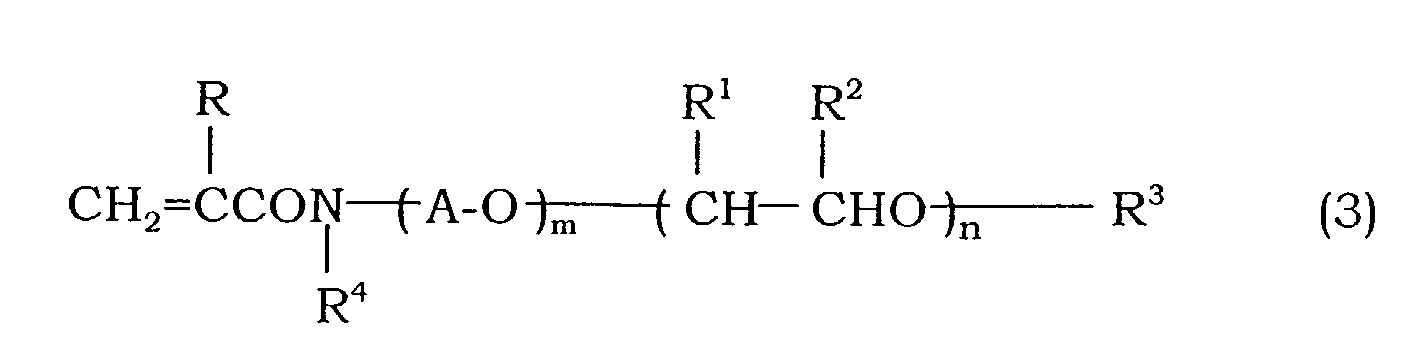 wherein R1, R2 and R3 are as defined above, and n is an integer of 1 to 300.
- There are mentioned monomers of the following formula (5), examples of which are polyoxyethylene (meth)allyl ether, polyoxypropylene (meth)allyl ether and the like.wherein R, R1, R2, R3 and n are as defined above.

- There are mentioned monomers of the following formula (6), examples of which are polyoxyethylene vinyl ether, polyoxypropylene vinyl ether and the like:wherein A, R1, R2, R3, m and n are as defined above.

- Of these unsaturated monomers containing oxyalkylene group, (meth)allyl alcohol compounds (5) are preferably used.
- Polyoxyalkylene allylamines such as polyoxyethylene allylamine and polyoxypropylene allylamine, and polyoxyalkylene vinylamines such as polyoxyethylene vinylamine and polyoxypropylene vinylamine, can also be used.
- The oxyalkylene group-containing unsaturated monomers may be used alone or in admixture thereof.
- Examples of the vinyl ester compounds to be copolymerized with the oxyalkylene group-containing unsaturated monomers are, for instance, vinyl formate, vinyl acetate, vinyl trifluroacetate, vinyl propionate, vinyl butyrate, vinyl caprate, vinyl laurate, vinyl myristate, vinyl palmitate, vinyl stearate, vinyl pivalate, and the like. These may be used alone or in admixture thereof. Vinyl acetate is preferred in practical use.
- Upon the copolymerization of vinyl esters and oxyalkylene group-containing monomers, the polymerization method is not particularly limited, and known polymerization methods can be suitably used. A solution polymerization using an alcohol such as methanol, ethanol or isopropanol as a solvent is usually practiced. Emulsion polymerization and suspension polymerization are also of course adoptable. As to a manner of charging monomers in such a solution polymerization, any manners can be used, e.g., a manner wherein first the whole amount of a vinyl ester and a part of an oxyalkylene group-containing unsaturated monomers are charged in a reactor and the polymerization is started, and the remaining monomer is then continuously, intermittently or stepwise added during the polymerization period, and a manner wherein monomers are added at one time in the initial stage of the polymerization. The copolymerization reaction is carried out by using known polymerization catalysts such as radical polymerization catalysts and low-temperature active catalysts, e.g., azobisisobutyronitrile, acetyl peroxide, benzoyl peroxide and lauroyl peroxide. The reaction temperature is selected from the range between about 35°C and the boiling point of a solvent.
- The obtained copolymers are then hydrolyzed. The hydrolysis is carried out by known methods. Both alkali hydrolysis and acid hydrolysis can be adopted, but in case of industrial production, the copolymer is dissolved in an alcohol solvent and hydrolyzed in the presence of an alkali catalyst. Examples of the alcohol are, for instance, methanol, ethanol, isopropanol, butanol and the like. The concentration of the copolymer in the alcohol solution is selected from 20 to 50 % by weight. The alcohol solvent may contain water in an amount of about 0.3 to about 10 % by weight based on the total weight of alcohol and water. Also, for the purpose of control of dielectric constant of the solvent in hydrolysis, various solvents, e.g., esters such as methyl acetate, benzene, hexane and DMSO (dimethyl sulfoxide), may be added to the alcohol solution.
- The hydrolysis catalyst includes alkali catalysts, e.g., hydroxides and alcoholates of alkali metals such as sodium hydroxide, potassium hydroxide, sodium methylate, sodium ethylate and potassium methylate. The amount of such a catalyst is preferably from 1 to 100 millimolar equivalents based on the vinyl ester compound.
- The copolymers of vinyl esters and oxyalkylene group-containing monomers are partially or completely hydrolyzed to provide oxyalkylene group-containing polyvinyl alcohol resins (A).
- In the present invention, it is preferable that the content of oxyalkylene group in the resin (A) is from 0.1 to 30 % by mole, especially from 0.5 to 25 % by mole, more especially from 1.0 to 20 % by mole. If the content of oxyalkylene group is less than 0.1 % by mole, the ink receptivity of recording sheets tends to deteriorate or the feathering tends to easily occur. If the content is more than 30 % by mole, the weatherability and water resistance of recording sheets tend to deteriorate.
- The degree of hydrolysis (of the vinyl ester component, e.g., vinyl acetate component) of the oxyalkylene group-containing polyvinyl alcohol resins (A) is not particularly limited, but preferably the degree of hydrolysis is from 50 to 100 % by mole, especially from 70 to 100 % by mole. If the degree of hydrolysis is less than 50 % by mole, the ink receptivity and weatherability tend to deteriorate.
- The degree of polymerization of the resin (A) is also not limited, but preferably the average degree of polymerization is from 50 to 3,000, especially from 100 to 2,500. If the average degree of polymerization is less than 50, the film-forming property is poor, so recording sheets may cause blocking since stickiness remains on the coated surface of recording sheets. If the average degree of polymerization is more than 3,000, the viscosity of a coating solution to prepare the recording sheets raises too high, so the workability is deteriorated or the coated surface does not become flat and smooth.
- Cationic group-containing polyvinyl alcohol resins (B) used in the present invention are obtained by hydrolyzing copolymers of unsaturated monomers having a cationic group and vinyl ester compounds as mentioned above in the same manner as above.
- Examples of the unsaturated monomers having a cationic group are, for instance, trimethyl-(methacrylamide)-ammonium chloride, 2,3-dimethyl-1-vinylimidazolinium chloride, dimethyldiallylammonium chloride, (meth)acrylamidealkyltrialkylammonium salts such as trimethyl-(3-acrylamide-3-dimethylpropyl)-ammonium chloride, 3-acrylamidepropyltrimethylammonium chloride and 3-methacrylamidepropyltrimethylammonium chloride, a quaternary ammonium salt of N-(3-allyloxy-2-hydroxypropyl)dimethyl amine, quaternary ammonium salts of acrylamide, methacrylamide and their derivatives such as N-methylacrylamide, N-ethylacrylamide, N,N-dimethylacrylamide, diacetoneacrylamide, N-methylolacrylamide, N-methylmethacrylamide, N-ethylmethacrylamide and N-methylolmethacrylamide, (meth)acryloyloxyalkyltrialkylammonium salts such as acryloyoxyethyltrimethylammonium chloride and methacryloyloxyethyltrimethylammonium chloride, and the like.
- It is preferable that the content of cationic group in the cationic group-containing polyvinyl alcohol resin (B) is from 0.3 to 10 % by mole, especially from 0.5 to 8 % by mole. If the content of cationic group is less than 0.3 % by mole, the image stability, water resistance and resolution are deteriorated. If the content of cationic group is more than 10 % by mole, the adhesion between the formed film and the substrate of recording sheets or the weatherability tends to lower.
- The degree of hydrolysis (of the vinyl ester component, e.g., vinyl acetate component) of the cationic group-containing polyvinyl alcohol resins (B) is not particularly limited, but it is preferable by the same reasons as the polyvinyl alcohol resin (A) that the degree of hydrolysis is from 50 to 100 % by mole, especially from 70 to 100 % by mole.
- The degree of polymerization of the resin (B) is also not limited, but it is preferable by the same reasons as the polyvinyl alcohol resin (A) that the average degree of polymerization is from 50 to 3,000, especially from 100 to 2,500.
- The resin composition of the present invention comprises the resin (A) and the resin (B) as mentioned above. It is further required that a 15 % by weight aqueous solution of the resin composition has a transparency of at least 50 %, preferably at least 60 %, when the resin composition is composed of only the resins (A) and (B). If the transparency is less than 50 %, the objects of the present invention cannot be achieved.
- The term "transparency" as used herein means a value measured according to JIS K 6726 with respect to a solution of the resin composition dissolved in water in a concentration of 15 % by weight.
- The manner of adjusting the transparency of 15 % by weight aqueous solution of the resin composition to 50 % or more is not particularly limited. The transparency of 50 % or more can be achieved, for instance, (1) by adjusting the content of oxyalkylene group in the resin (A) within the range of 0.2 to 30 % by mole, (2) by adjusting the content of cationic group in the resin (B) within the range of 0.3 to 10 % by mole, (3) by adjusting the difference in degree of hydrolysis between the resin (A) and the resin (B) within 10 % by mole, preferably within 5 % by mole, or (4) by using the resins (A) and (B) both having a degree of hydrolysis of at least 60 % by mole.
- The proportions of the components (A) and (B) included in the resin composition are not particularly limited. The A/B ratio of the amount of the resin (A) to the amount of the resin (B) in the resin composition is preferably from 99/1 to 1/99 by weight, more preferably from 90/10 to 10/90 by weight. If the A/B ratio is less than 1/99 by weight, the weatherability tends to lower, and if the A/B ratio exceeds 99/1 by weight, the image stability is deteriorated due to feathering of the coating layer.
- Besides the above-mentioned components (A) and (B), the resin composition of the present invention may contain various known additives, as occasion demands, e.g., an inorganic filler such as synthetic silica, colloidal silica or alumina, a defoaming agent, a releasing agent, a surface active agent such as silicone-based surfactants, fluorine-containing surfactants or polyethylene glycol-based surfactants, a preserving agent, an insecticide, a corrosion inhibitor, and a thickener. Also, the resin composition of the present invention may be incorporated with other agents conventionally used for conversion of paper, e.g., known resins conventionally used for production of coated paper such as other polyvinyl alcohol resins, starch, carboxymethyl cellulose, acrylic resin latex and SBR latex, so long as the effects of the present invention are not impaired.
- Examples of the substrates of recording sheets to which the resin composition of the present invention is applied are, for instance, woodfree paper, mechanical paper, (semi-)glassine paper, glossy paper, paper, coated paper (resin-coated paper), synthetic paper, PET film and sheet, PVC film and sheet, and PEN (polyethylene naphthalate) film and sheet. The substrates are not limited thereto, and other papers or synthetic resin films and sheets can be used.
- Recording sheets are prepared by coating the resin composition of the present invention onto a recording sheet substrate. The coating can be conducted by any known method, e.g., size press coating, roll coating, air doctor coating, blade coating, and gate roll coating. It is preferable to coat the resin composition in the form of an aqueous solution having a solid concentration of 1 to 70 % by weight, especially 2 to 60 % by weight, more especially 5 to 50 % by weight. If the solid concentration (concentration of resin components) is less than 1 % by weight, the coating build-up is small, so the image concentration and surface strength of paper are apt to be low and the practicality is poor. If the solid concentration is more than 70 % by weight, the viscosity of a coating liquid becomes high, so the coating operation becomes difficult and uniform coating film is hard to obtain. The amount for coating of the resin composition is from about 0.1 to about 40 g/m2, preferably about 0.5 to about 20 g/m2, on solid basis.
- A top coat layer made of a conventional polyvinyl alcohol (partially or completely hydrolyzed polyvinyl acetate) or the like may be further provided, as occasion demands, on the surface of the coating layer of the resin composition according to the present invention.
- The thus obtained recording sheets have a good ink receptive layer on the surface of a substrate such as paper or synthetic resin film or sheet, and have an excellent printability (evaluated particularly in respect of ink receptivity, feathering prevention property, gloss, and weatherability) and the like.
- The present invention is more specifically described and explained by means of the following Examples in which all parts and % are by weight unless otherwise noted. It is to be understood that the present invention is not limited to the Examples.
- In the Examples, evaluation of properties was made according to the following methods.
- The transparency of an aqueous solution was measured according to JIS K 6726 except that the concentration of the solution was adjusted to 15 %.
- An aqueous solution having a concentration of 15 % was allowed to stand for about 1 hour at 30°C to remove bubbles on the surface, and put in an absorption cell made of a glass having a thickness of 20 mm. The light transmittance (%) of the test solution relative to that of water was measured at a wavelength of 430 nm. An average value was obtained from triplicate measurements.
- A recording sheet obtained in Examples was printed with each color of yellow, cyan and magenta by an ink jet printer (model PM-770C made by Seiko Epson Corporation). After allowing the printed recording sheet to stand at 20°C and 65 %RH for 20 seconds, another non-printed recording sheet was stacked on the printed surface, and thereto was applied a load of 5 g/cm2 for 30 seconds. Transfer of ink to the non-printed sheet was visually observed, and the ink receptivity was evaluated according to the following criteria.
- ○: No transfer of ink is observed.
- Δ: A trace of ink transferred is observed.
- ×: Transfer of ink is clearly observed.
-
- An obtained recording sheet was printed with magenta single color by the same ink jet printer as above. Subsequently lines of about 1 mm in width was printed thereon with cyan color. The degree of feathering at the boundary of the lines was observed by a microscope and evaluated according to the following criteria.
- ○: The ratio of width of feathering to width of printed line (1 mm) is less than 10 %.
- Δ: The ratio of width of feathering to width of printed line (1 mm) is from 10 to less than 30 %.
- ×: The ratio of width of feathering to width of printed line (1 mm) is 30 % or more.
-
- Solid printing of magenta single color was applied to an obtained recording sheet in the same manner as above. After allowing the printed sheet to stand at 20°C and 65 %RH for 72 hours, the gloss of the printed part was measured by an angle-changeable glossmeter (model VG-Σ80 made by Nippon Denshoku Kogyo Kabushiki Kaisha).
- Solid printing of magenta single color was applied to an obtained recording sheet by the same ink jet printer as above, and the printed sheet was allowed to stand at 40°C and 90 %RH for 10 days. The print concentration of the printed part was measured by a Macbeth densitometer (model RD914 made by Kollmorgen Corporation). Difference between the print concentrations measured before and after allowing to stand for 10 days was obtained, wherein the print concentration before allowing to stand for 10 days was measured after allowing the printed sheet to stand at 20°C and 65 %RH for 1 hour from the printing.
- An aqueous solution having a solid concentration of 15 % was prepared by dissolving in water 60 parts of an oxyalkylene group-containing polyvinyl alcohol resin (A) having an oxyethylene group content of 3 % by mole (modified with polyoxyethylene allyl ether having an average chain length n=20, i.e., hydrolyzed copolymer of vinyl acetate and polyoxyethylene allyl ether), a degree of hydrolysis of 85 % by mole and an average degree of polymerization of 1,200 and 40 parts of a cationic group-containing polyvinyl alcohol resin (B) having a quaternary ammonium salt group content of 1 % by mole (modified with 2,3-dimethyl-1-vinylimidazolinium chloride), a degree of hydrolysis of 82 % by mole and an average degree of polymerization of 1,700. The transparency of the resulting solution measured according to JIS K 6726 was 85 %.
- To the 15 % aqueous solution was then added colloidal silica (trade mark "SNOWTEX", made by Nissan Chemical Industries, Ltd.) in an amount of 200 parts per 100 parts of the resin composition (i.e., mixture of the above-mentioned resins (A) and (B)). The resulting resin composition was applied to a woodfree paper having a basis weight of 65 g/m2 in an amount of 10 g/m2 (solid basis) by an applicator, and was dried at 110°C for 2 minutes to give a recording sheet (a).
- The resin composition was also applied to a PET film having a transparency of 96 % and a thickness of 100 µm in the same manner as above to give a recording sheet (b).
- The properties of the obtained recording sheets (a) and (b) were measured. The results are shown in Table 1.
- An aqueous solution having a solid concentration of 15 % was prepared by dissolving in water 85 parts of an oxyalkylene group-containing polyvinyl alcohol resin (A) having an oxyethylene group content of 13 % by mole (modified with polyoxyethylene allyl ether having an average chain length n=10), a degree of hydrolysis of 92 % by mole and an average degree of polymerization of 600 and 15 parts of a cationic group-containing polyvinyl alcohol resin (B) having a quaternary ammonium salt group content of 4 % by mole [modified with trimethyl-(3-acrylamide-3-dimethylpropyl)-ammonium chloride], a degree of hydrolysis of 96 % by mole and an average degree of polymerization of 1,400. The transparency of the resulting solution measured according to JIS K 6726 was 88 %.
- Recording sheets (a) and (b) were then prepared in the same manner as in Example 1 and evaluated.
- The results are shown in Table 1.
- An aqueous solution having a solid concentration of 15 % was prepared by dissolving in water 25 parts of an oxyalkylene group-containing polyvinyl alcohol resin (A) having an oxyethylene group content of 6 % by mole (modified with polyoxyethylene allyl ether having an average chain length n=5), a degree of hydrolysis of 88 % by mole and an average degree of polymerization of 1,500 and 75 parts of a cationic group-containing polyvinyl alcohol resin (B) having a quaternary ammonium salt group content of 7 % by mole [modified with diallyldimethylammonium chloride], a degree of hydrolysis of 88 % by mole and an average degree of polymerization of 1,000. The transparency of the resulting solution measured according to JIS K 6726 was 72 %.
- Recording sheets (a) and (b) were then prepared in the same manner as in Example 1 and evaluated.
- The results are shown in Table 1.
- An aqueous solution having a solid concentration of 15 % was prepared by dissolving in water 50 parts of an oxyalkylene group-containing polyvinyl alcohol resin (A) having an oxyethylene group content of 0.7 % by mole (modified with polyoxyethylene allyl ether having an average chain length n=15), a degree of hydrolysis of 94 % by mole and an average degree of polymerization of 2,700 and 50 parts of a cationic group-containing polyvinyl alcohol resin (B) having a quaternary ammonium salt group content of 0.5 % by mole [modified with diallyldimethylammonium chloride], a degree of hydrolysis of 99 % by mole and an average degree of polymerization of 2,700. The transparency of the resulting solution measured according to JIS K 6726 was 80 %.
- Recording sheets (a) and (b) were then prepared in the same manner as in Example 1 and evaluated.
- The results are shown in Table 1.
- An aqueous solution having a solid concentration of 15 % was prepared by dissolving in water 60 parts of an oxyalkylene group-containing polyvinyl alcohol resin (A) having an oxyethylene group content of 1 % by mole (modified with polyoxyethylene allyl ether having an average chain length n=20), a degree of hydrolysis of 99 % by mole and an average degree of polymerization of 1,900 and 40 parts of a cationic group-containing polyvinyl alcohol resin (B) having a quaternary ammonium salt group content of 2 % by mole [modified with trimethyl-(methacrylamide)-ammonium chloride], a degree of hydrolysis of 91 % by mole and an average degree of polymerization of 1,800. The transparency of the resulting solution measured according to JIS K 6726 was 65 %.
- Recording sheets (a) and (b) were then prepared in the same manner as in Example 1 and evaluated.
- The results are shown in Table 1.
- The procedure of Example 1 was repeated except that the ratio of the resin (A) to the resin (B) was changed to A/B = 50/50 by weight. The transparency of a 15 % aqueous solution of a mixture of the resin (A) and the resin (B) in a weight ratio of 50/50 was 77 %. The results of evaluation of recording sheets (a) and (b) are shown in Table 1.
- The procedure of Example 1 was repeated except that the ratio of the resin (A) to the resin (B) was changed to A/B = 70/30 by weight. The transparency of a 15 % aqueous solution of a mixture of the resin (A) and the resin (B) in a weight ratio of 70/30 was 92 %. The results of evaluation of recording sheets (a) and (b) are shown in Table 1.
- The procedure of Example 1 was repeated except that the cationic group-containing polyvinyl alcohol resin (B) was not used. The results are shown in Table 1.
- The procedure of Example 1 was repeated except that the oxyalkylene group-containing polyvinyl alcohol resin (A) was not used. The results are shown in Table 1.
- The procedure of Example 1 was repeated except that a non-modified polyvinyl alcohol having a degree of hydrolysis of 88 % by mole and an average degree of polymerization of 1,500 was used instead of the cationic group-containing polyvinyl alcohol resin (B), and the resin (A) and the non-modified polyvinyl alcohol were used in a weight ratio of 50/50. The transparency of a 15 % aqueous solution of this mixture was 40 %. The results are shown in Table 1.
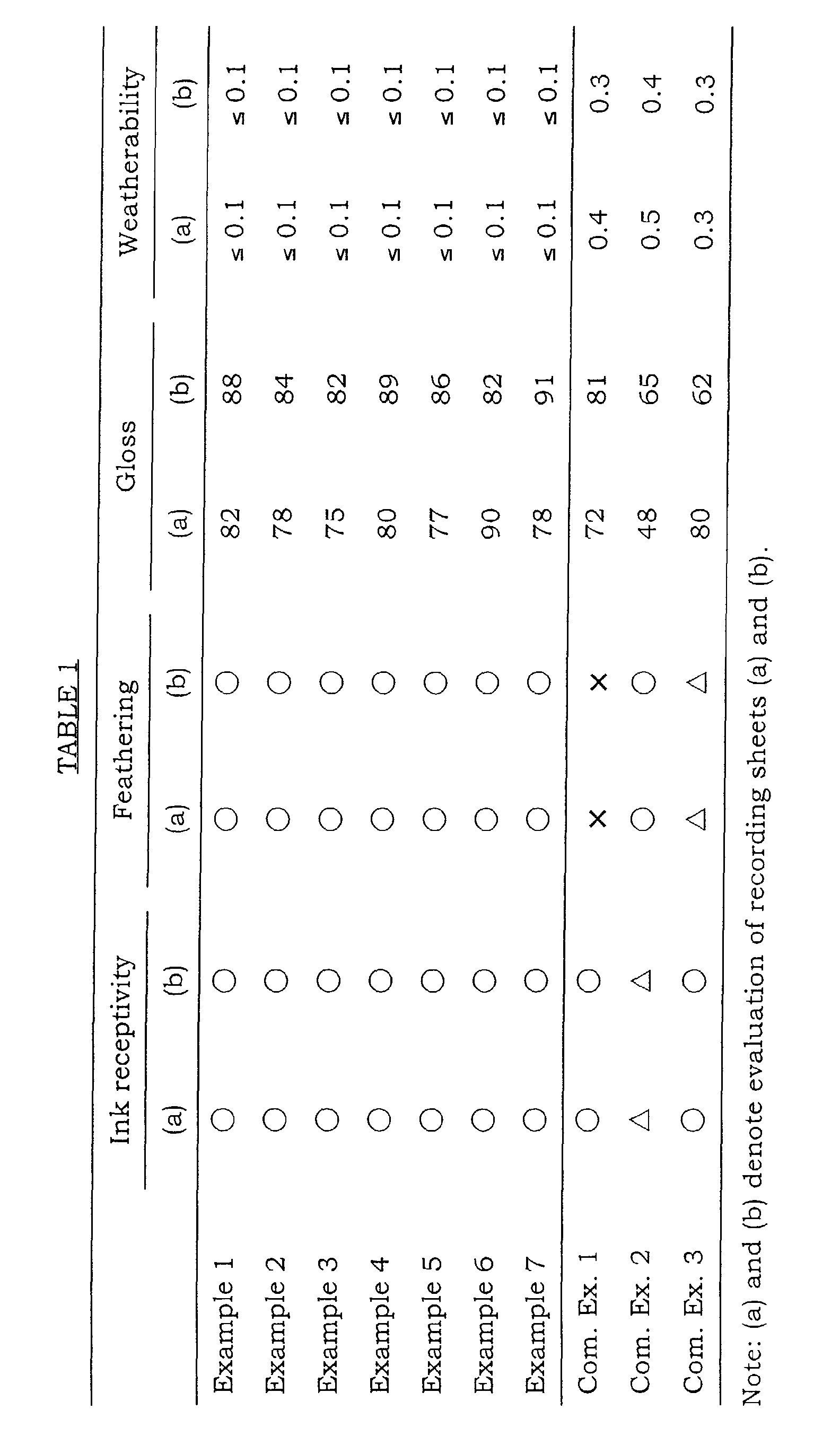
- As understood from the results shown in Table 1, the resin compositions of the present invention can provide recording sheets having an excellent printability such as ink receptivity, feathering prevention property, gloss and weatherability. The resin compositions are applicable to not only paper substrate, but also resin substrates such as PET, PVC and PP films or sheets. The recording sheets obtained according to the present invention are printable by various methods such ink jet printing, offset printing, flexographic printing, and heat-sensitive recording.
- A resin composition suitable for forming ink receptive layer of recording sheets and having excellent ink receptivity, feathering prevention, gloss and weatherability, which comprises (A) an oxyalkylene group-containing polyvinyl alcohol resin and (B) a cationic group-containing polyvinyl alcohol resin, wherein a 15 % by weight aqueous solution of the resin composition has a transparency according to JIS K 6726 of at least 50 %.
Claims (5)
- A resin composition for recording sheets, which comprises:wherein a 15 % by weight aqueous solution of the mixture of said resin (A) and said resin (B) has a transparency of not less than 50 % measured according to JIS K 6726.(A) a polyvinyl alcohol resin containing oxyalkylene groups, and(B) a polyvinyl alcohol resin containing cationic groups,
- The composition of Claim 1, wherein said cationic group is a quaternary ammonium salt group.
- The composition of Claim 1 or 2, wherein said polyvinyl alcohol resin (A) contains 0.2 to 30 % by mole of oxyalkylene groups.
- The composition of Claim 1, 2 or 3, wherein said polyvinyl alcohol resin (B) contains 0.3 to 10 % by mole of cationic groups.
- The composition of any one of Claims 1 to 4, wherein difference in degrees of hydrolysis between said resin (A) and said resin (B) is at most 10 % by mole.
Applications Claiming Priority (2)
| Application Number | Priority Date | Filing Date | Title |
|---|---|---|---|
| JP2001218955 | 2001-07-19 | ||
| JP2001218955A JP5159008B2 (en) | 2001-07-19 | 2001-07-19 | Resin composition for recording sheet |
Publications (2)
| Publication Number | Publication Date |
|---|---|
| EP1277591A2 true EP1277591A2 (en) | 2003-01-22 |
| EP1277591A3 EP1277591A3 (en) | 2004-02-04 |
Family
ID=19053044
Family Applications (1)
| Application Number | Title | Priority Date | Filing Date |
|---|---|---|---|
| EP02015931A Withdrawn EP1277591A3 (en) | 2001-07-19 | 2002-07-17 | Resin composition for recording sheets |
Country Status (3)
| Country | Link |
|---|---|
| US (1) | US6664332B2 (en) |
| EP (1) | EP1277591A3 (en) |
| JP (1) | JP5159008B2 (en) |
Cited By (2)
| Publication number | Priority date | Publication date | Assignee | Title |
|---|---|---|---|---|
| FR2862668A1 (en) * | 2003-11-24 | 2005-05-27 | Honnorat Rech S & Services | Unlayered paper for high-quality ink jet printing e.g. of photographs, comprises silica-filled paper treated inside the paper machine with a formulation containing a hydrophilic binder and predispersed silica |
| EP1466749A3 (en) * | 2003-04-07 | 2005-11-23 | Yuen Foong Yu Paper MFG Company, Limited | Ink-absorbing recording medium and method of manufacturing the same |
Families Citing this family (4)
| Publication number | Priority date | Publication date | Assignee | Title |
|---|---|---|---|---|
| JP5321211B2 (en) * | 2009-04-14 | 2013-10-23 | 日本精工株式会社 | Biodegradable plastic machine parts and rolling bearings |
| JP5627420B2 (en) * | 2010-11-30 | 2014-11-19 | 日本合成化学工業株式会社 | Aqueous composition |
| JP6472250B2 (en) * | 2015-01-08 | 2019-02-20 | キヤノン株式会社 | Image recording method |
| US20230256765A1 (en) * | 2020-07-10 | 2023-08-17 | Brady Worldwide, Inc. | Outdoor-Durable Inkjet-Receptive Topcoat Formula and Article |
Citations (3)
| Publication number | Priority date | Publication date | Assignee | Title |
|---|---|---|---|---|
| JPS6110483A (en) | 1984-06-27 | 1986-01-17 | Canon Inc | Recording material |
| JPH10309780A (en) | 1997-05-13 | 1998-11-24 | Daicel Chem Ind Ltd | Recording sheet |
| JP2001121814A (en) | 1999-10-27 | 2001-05-08 | Daicel Chem Ind Ltd | Resin composition for ink jet recording sheet and recording sheet using the same |
Family Cites Families (29)
| Publication number | Priority date | Publication date | Assignee | Title |
|---|---|---|---|---|
| US1971662A (en) * | 1929-12-27 | 1934-08-28 | Ig Farbenindustrie Ag | Ether of polyvinyl alcohol |
| US3033841A (en) * | 1958-01-03 | 1962-05-08 | Shawinigan Chem Ltd | Vinyl acetate-polyoxyalkylene compound copolymers and method of preparation |
| US3218281A (en) * | 1958-09-22 | 1965-11-16 | Shawinigan Chem Ltd | Polymer emulsions with vinyl acetate-polyoxyalkylene compound copolymer as stabilizer |
| US2936263A (en) * | 1958-09-23 | 1960-05-10 | Hardt Foundation | Therapeutic package |
| US3106543A (en) * | 1960-04-12 | 1963-10-08 | Du Pont | Reaction product of an alkylene oxidepolyvinyl alcohol mixture with untreated polyvinyl alcohol |
| US3114650A (en) * | 1960-06-10 | 1963-12-17 | Spraylat Corp | Tire coated with removable coating comprising modified polyvinyl alcohol and method of coating |
| US3064911A (en) * | 1960-09-09 | 1962-11-20 | American Viscose Corp | Method for making a yarn package |
| US3346530A (en) * | 1963-07-31 | 1967-10-10 | Monsanto Co | Polyvinyl alcohol compositions plasticized with monophenyl ethers of polyoxy ethylene glycols |
| DE3168590D1 (en) * | 1980-05-09 | 1985-03-14 | Hoechst Ag | Polyvinyl alcohol composition, its preparation process, its use |
| JPS56152734A (en) * | 1981-04-09 | 1981-11-26 | Nippon Synthetic Chem Ind Co Ltd:The | Emulsifying, dispersing and stabilizing agent |
| US4636805A (en) * | 1984-03-23 | 1987-01-13 | Canon Kabushiki Kaisha | Record-bearing member and ink-jet recording method by use thereof |
| US4618648A (en) * | 1985-04-26 | 1986-10-21 | Air Products And Chemicals, Inc. | Copolymers of vinyl alcohol and poly(alkyleneoxy)acrylates |
| JPS6220505A (en) * | 1985-07-18 | 1987-01-29 | Kyoritsu Yuki Kogyo Kenkyusho:Kk | Production of cation-modified polyvinyl alcohol |
| JP2583084B2 (en) * | 1987-12-17 | 1997-02-19 | 日本合成化学工業株式会社 | Waste container |
| JPS6456135A (en) * | 1988-08-01 | 1989-03-03 | Kuraray Co | Aqueous dispersion |
| JPH0493301A (en) * | 1990-08-10 | 1992-03-26 | Kuraray Co Ltd | Dispersing agent and dispersion stabilizer for suspension polymerization of vinyl monomer |
| JP3053229B2 (en) * | 1991-02-08 | 2000-06-19 | 株式会社クラレ | Manufacturing method of thermal recording sheet |
| JP3053231B2 (en) * | 1991-02-19 | 2000-06-19 | 株式会社クラレ | Inkjet recording sheet |
| US5478884A (en) * | 1992-10-27 | 1995-12-26 | Nippon Gohsei Kagaku Kogyo Kabushiki Kaisha | Oxyalkylene group-containing polyvinyl alcohol resin composition and process for the production of shaped articles from said composition |
| US5824462A (en) * | 1993-05-17 | 1998-10-20 | Mitsubishi Paper Mills Limited | Resin-coated paper |
| JP3412865B2 (en) * | 1993-07-16 | 2003-06-03 | キヤノン株式会社 | Recording sheet and ink jet recording method using the same |
| JPH08199079A (en) * | 1995-01-23 | 1996-08-06 | Kuraray Co Ltd | Aqueous dispersion of polymer particles |
| TW453951B (en) * | 1995-06-07 | 2001-09-11 | Toyo Boseki | Recording member and method for producing the same |
| EP0956971B1 (en) * | 1998-05-11 | 2002-07-10 | Daicel Chemical Industries, Ltd. | Ink-receptor sheet for ink-jet printing and method for producing the same |
| JP2000033770A (en) * | 1998-05-11 | 2000-02-02 | Daicel Chem Ind Ltd | Ink receiving sheet and method of manufacturing the same |
| JP3923179B2 (en) * | 1998-05-21 | 2007-05-30 | 三菱製紙株式会社 | Inkjet recording medium |
| WO2000074945A1 (en) * | 1999-06-04 | 2000-12-14 | Daicel Chemical Industries, Ltd. | Resin composition for ink-jet recording sheet and recording sheet made with the same |
| JP2000343811A (en) * | 1999-06-04 | 2000-12-12 | Daicel Chem Ind Ltd | Resin composition for recording sheet and recording sheet using the same |
| JP2001138621A (en) * | 1999-11-11 | 2001-05-22 | Konica Corp | Ink jet recording sheet |
-
2001
- 2001-07-19 JP JP2001218955A patent/JP5159008B2/en not_active Expired - Fee Related
-
2002
- 2002-07-17 EP EP02015931A patent/EP1277591A3/en not_active Withdrawn
- 2002-07-17 US US10/199,230 patent/US6664332B2/en not_active Expired - Fee Related
Patent Citations (3)
| Publication number | Priority date | Publication date | Assignee | Title |
|---|---|---|---|---|
| JPS6110483A (en) | 1984-06-27 | 1986-01-17 | Canon Inc | Recording material |
| JPH10309780A (en) | 1997-05-13 | 1998-11-24 | Daicel Chem Ind Ltd | Recording sheet |
| JP2001121814A (en) | 1999-10-27 | 2001-05-08 | Daicel Chem Ind Ltd | Resin composition for ink jet recording sheet and recording sheet using the same |
Cited By (2)
| Publication number | Priority date | Publication date | Assignee | Title |
|---|---|---|---|---|
| EP1466749A3 (en) * | 2003-04-07 | 2005-11-23 | Yuen Foong Yu Paper MFG Company, Limited | Ink-absorbing recording medium and method of manufacturing the same |
| FR2862668A1 (en) * | 2003-11-24 | 2005-05-27 | Honnorat Rech S & Services | Unlayered paper for high-quality ink jet printing e.g. of photographs, comprises silica-filled paper treated inside the paper machine with a formulation containing a hydrophilic binder and predispersed silica |
Also Published As
| Publication number | Publication date |
|---|---|
| US20030040573A1 (en) | 2003-02-27 |
| JP5159008B2 (en) | 2013-03-06 |
| JP2003026885A (en) | 2003-01-29 |
| US6664332B2 (en) | 2003-12-16 |
| EP1277591A3 (en) | 2004-02-04 |
Similar Documents
| Publication | Publication Date | Title |
|---|---|---|
| EP0998395B1 (en) | Ink-receptive compositions and coated products | |
| EP0076490B1 (en) | Paper coating agent | |
| JP2006095825A (en) | Recording medium | |
| CA2291252C (en) | Coating composition and printing medium | |
| EP0275100B1 (en) | Recording media for ink | |
| EP1500669B1 (en) | Vinyl alcohol polymer | |
| US6664332B2 (en) | Resin composition for recording sheets | |
| JP2005120115A (en) | Polyvinyl alcohol resin composition | |
| EP1364804B1 (en) | Cationic coating for printable surfaces | |
| JPS63176174A (en) | Ink jet recording sheet having excellent water-proof performance | |
| JP3720444B2 (en) | Recording material for water-based ink recording | |
| JP3053231B2 (en) | Inkjet recording sheet | |
| JP5078268B2 (en) | Resin composition and use thereof | |
| JP3892220B2 (en) | Inkjet recording medium | |
| JPS63183873A (en) | Ink jet recording sheet superior in water resistance | |
| JPH08324105A (en) | Ink jet recording paper | |
| JP2000158801A (en) | Inkjet recording media | |
| JP2001072711A (en) | Resin composition | |
| JP3914417B2 (en) | Inkjet recording medium | |
| JP2009102641A (en) | Vinyl alcohol polymer | |
| JP3868868B2 (en) | Inkjet recording medium | |
| JP5089148B2 (en) | INKJET RECORDING MEDIUM, INK RECEIVING LAYER COATING LIQUID, AND METHOD FOR PRODUCING INKJET RECORDING MEDIUM | |
| JPH06171207A (en) | Inkjet recording sheet | |
| JP2008163179A (en) | Resin composition and inkjet recording medium using the same | |
| JP2002220559A (en) | Ink-jet fading inhibitor and recording material |
Legal Events
| Date | Code | Title | Description |
|---|---|---|---|
| PUAI | Public reference made under article 153(3) epc to a published international application that has entered the european phase |
Free format text: ORIGINAL CODE: 0009012 |
|
| AK | Designated contracting states |
Kind code of ref document: A2 Designated state(s): AT BE BG CH CY CZ DE DK EE ES FI FR GB GR IE IT LI LU MC NL PT SE SK TR |
|
| AX | Request for extension of the european patent |
Free format text: AL;LT;LV;MK;RO;SI |
|
| PUAL | Search report despatched |
Free format text: ORIGINAL CODE: 0009013 |
|
| AK | Designated contracting states |
Kind code of ref document: A3 Designated state(s): AT BE BG CH CY CZ DE DK EE ES FI FR GB GR IE IT LI LU MC NL PT SE SK TR |
|
| AX | Request for extension of the european patent |
Extension state: AL LT LV MK RO SI |
|
| 17P | Request for examination filed |
Effective date: 20040322 |
|
| AKX | Designation fees paid |
Designated state(s): BE CH DE FR LI |
|
| GRAP | Despatch of communication of intention to grant a patent |
Free format text: ORIGINAL CODE: EPIDOSNIGR1 |
|
| STAA | Information on the status of an ep patent application or granted ep patent |
Free format text: STATUS: THE APPLICATION IS DEEMED TO BE WITHDRAWN |
|
| 18D | Application deemed to be withdrawn |
Effective date: 20051229 |