BACKGROUND OF THE INVENTION
Field of the Invention
The present invention relates to a gaming
apparatus which displays symbols in a plurality of
display regions and determines winnings based on the
arrangement of the symbols, a method of controlling the
gaming apparatus, a program, and a computer-readable
recording medium.
Related Background Art
Slot machines can be cited as typical examples of
gaming apparatuses in which the symbols to be displayed
in each of a plurality of display regions are
determined by random values and winnings are determined
based on the arrangement of the symbols on the display.
With the recent "game boom," slot machines are gaining
great popularity in casinos and game centers.
With conventional slot machines, those having
display regions consisting of 3 rows and 3 columns have
been the mainstream, but recently, slot machines having
display regions in 4 or more columns have begun to
appear. With this kind of slot machine, it is possible
to set up a "pay line," a line which determines
winnings, in a variety of ways, such as a zigzag line.
This results in increased player interest in the slot
machine.
In addition, as a scheme for increasing player
interest, it has become a popular trend to offer bonus
games on the slot machine. These bonus games are
awarded when, for example, symbols occur in a specified
arrangement, and the player is awarded a monetary prize
or a token according to the results of the bonus game.
SUMMARY OF THE INVENTION
The above-mentioned conventional gaming
apparatuses, in general, are mostly of the type where
bonus games are started when a predetermined number of
bonus symbols are lined up from the left. The bonus
game proceeds on a second display, which is different
from the display which displays the normal slot machine
game. Players who want more excitement are not
satisfied with gaming apparatuses which have this kind
of conventional bonus game, and want even newer gaming
apparatuses to appear.
In addition, in recent years game content has
become increasingly complicated and it is important
that players be able to readily recognize when the
machine is in a bonus game. If the aspect of making
game content more enjoyable is pursued excessively, to
the extent that players cannot grasp the overly-complicated
game content, the result is that player
interest in the game wanes.
The present invention has been designed in order
to solve the aforementioned problems, and it is an
object thereof to provide a gaming apparatus which can
attract player interest by renewing the content of
bonus games and can make it easy for the player to
recognize that the machine is in a bonus game, a method
of controlling the gaming apparatus, a program, and a
computer-readable recording medium.
The present invention comprises a display having
display regions for displaying symbols in 3 rows by X
columns (where X is an integer 5 or larger), and a
controller which executes a prescribed program and
controls a display content of the aforementioned
display. In response to the aforementioned program,
the controller determines which of the symbols from
among a plurality of kinds of symbols, including
special "bonus symbols", is to be displayed in each of
the display regions, and determines winnings based on
the arrangement of symbols displayed in the display
regions. In the case that bonus symbols are displayed
in each of the (X-2) display regions which are on the
center row of the aforementioned three rows, but
excluding the regions in both side columns, a bonus
game will be started on the display. In the bonus game,
a predetermined character is caused to move on the
display regions which surround the (X-2) bonus symbols,
and then this character is made to perform a
predetermined action on one of the plurality of display
regions. The content of a bonus to be awarded to the
player is determined based on the type of symbol
displayed in the display region where the character
performs the predetermined action.
With the gaming apparatus of the present invention,
a bonus game starts when bonus symbols are displayed in
the (X-2) display regions of the display regions
arranged in X columns but excluding both side columns,
and which are on the center row of the plurality of
display regions formed in three rows. In this way, by
making it such that the bonus game starts whenever
bonus symbols appear in the columns other than the two
edge display regions, without the requirement that a
bonus symbol be lined up in the leftmost display region,
a freshness can be provided to the player.
In addition, when the bonus game begins, the
controller moves a prescribed character on the display
regions surrounding the (X-2) bonus symbols positioned
in the central portion. Here, the character moves over
the top row, the bottom row and the left and right side
columns of the plurality of display regions. That is,
since the (X-2) bonus symbols line up in the central
portion, a pathway for the character to travel is
formed surrounding those bonus symbols.
In this way, by creating a link between the
conditions which cause a bonus game to start and the
content of the bonus game, greater player attraction
toward the gaming apparatus can be achieved. In
addition, because bonus games proceed on the display
where the symbols are arranged, the player can readily
grasp that the machine is now in a bonus game.
In a bonus game, the above-mentioned character
performs a predetermined action on one of the plurality
of display regions. Then, based on the type of symbol
displayed in the display region where that action is
performed, the controller determines the content of the
bonus to be awarded to the player.
Some examples of bonuses to be awarded to players
as a result of the bonus game are payout of coins or
the playing of another bonus game.
In addition, in the gaming apparatus according to
the present invention, a storage means can be provided
for storing a table showing the correspondence
relationship between the type of symbol and the bonus
content, and the controller can be configured such that
it determines the content of the bonus to be awarded to
the player based on the table of the storage means.
In the gaming apparatus according to the present
invention, in the case that a bonus symbol is displayed
in each of the X columns except for both side columns,
it is preferable that the controller move the bonus
symbols to the center row of each of the columns and
cause the bonus game to start.
In this case, it is sufficient if the bonus
symbols are displayed in each column of the X columns
except for both side columns, and even if they do not
line up in the center row of the three rows, the bonus
game will be started. As a result, the player feels
that the chance of being able to play a bonus game is
high, and even more interest can be drawn to the gaming
apparatus.
In addition, if the gaming apparatus according to
the present invention is made as a slot machine, the
controller may determine, from among the plurality of
types of symbols, which symbols to display in each of
the display regions according to random number values.
If the gaming apparatus according to the present
invention is made as a slot machine, the controller may
be configured so that it displays an image of three
rows by X columns of slot machine reels on the display.
In addition, in the gaming apparatus according to
the present invention, in the bonus game, it is
preferable that, after awarding the bonus to the player,
the character be caused to move again over the display
regions surrounding the bonus symbols, and that
afterward the character be made to perform the
predetermined action on one of the display regions.
In this case, it is possible for the player to
gain bonuses over a plurality of plays, and interest in
the gaming apparatus can be enhanced.
In this case it is also preferable that the cause
a mark to be displayed on the display region where the
character performs the predetermined action to show
that the character has performed the action there. It
is also preferable that, in the case that the character
performs the predetermined action on a display region
where a mark is already displayed, the bonus game be
made to end.
In the case that a character selects a display
region which has already been selected and shows a mark,
the bonus game is made to end. In this way, the player
hopes that the character will not perform the
predetermined action on a display region where a mark
is displayed, and thus the bonus game is made even more
thrilling.
In addition, with the gaming apparatus according
to the present invention, it is preferable that a
second display be further provided and that, in the
case that an opportunity for another bonus game is
provided to the player as a result of a bonus game,
this other bonus game be displayed on the second
display.
In this way, by running the other bonus game on a
display different from that of the first bonus game, a
clear sense of the start of the new game is conveyed to
the player and the entertainment level is enhanced.
The gaming apparatus control method according to
the present invention comprises a display having
display regions on which symbols are to be displayed,
and a controller that executes a prescribed program and
controls the display content of the display. The
gaming apparatus control method comprises the steps of:
displaying on the display the display regions as 3 rows
and X columns (where X is an integer of 5 or larger);
determining, from among a plurality of types of symbols
including special bonus symbols, which of the symbols
to display on the various display regions; determining
winnings based on the arrangement of displayed symbols
on the display regions; starting a bonus game on the
display in the case that the bonus symbols are
displayed in each of the (X-2) display regions on the
center line of the three lines, but excluding both side
columns; causing a prescribed character in the bonus
game to move on the display regions which surround the
(X-2) bonus symbols and then causing the character to
perform a specific action on one of the plurality of
display regions; and determining the content of the
bonus to be awarded to the player based on the type of
symbol displayed in the display region where the
character performs the prescribed action.
With the gaming apparatus control method according
to the present invention, a bonus game starts when
bonus symbols are displayed in each of the above-mentioned
(X-2) display regions of the display regions
arranged in X columns, but excluding both side columns,
which are on the center row of the plurality of display
regions formed in three rows. In this way, by making
it such that the bonus game starts whenever bonus
symbols appear in columns other than the two end
display regions, without the requirement that a bonus
symbol be lined up in the leftmost display region, a
freshness can be provided to the player.
In addition, when the bonus game begins, the
controller moves a predetermined character on the
display regions which surround the (X-2) bonus symbols
positioned in the central portion. Here, the character
moves over the top row, the bottom row and the left and
right side columns of the plurality of display regions.
That is, since the (X-2) bonus symbols line up in the
central portion, a pathway for the character to travel
is formed surrounding those bonus symbols.
In this way, by creating a link between the
conditions which cause a bonus game to start and the
content of the bonus game, greater player attraction
toward the gaming apparatus can be achieved. In
addition, because bonus game play proceeds on the
display where the symbols were arranged, the player can
readily grasp that the machine is now in a bonus game.
In a bonus game, the character performs a
prescribed action on one of the plurality of display
regions. Then, based on the type of symbol displayed
in the display region where that action is performed,
the controller determines the content of the bonus to
be awarded to the player.
In addition, in the gaming apparatus control
method according to the present invention, a storage
means may be provided for storing a table showing the
correspondence relationship between the type of symbol
and the bonus content, and the content of the bonus may
be determined based on the table of the storage means
in the step for determining the content of the bonus to
be awarded to the player.
In the gaming apparatus control method according
to the present invention, in the case that a bonus
symbol is displayed in each of the X columns except for
both side columns, it is preferable that the controller
move the bonus symbols of each of the columns to the
center row of the 3 rows and cause the bonus game to
start.
In this case, it is sufficient if the bonus
symbols are displayed in each column of the X columns
except for both side columns, and even if they do not
line up in the center row of the three rows, the bonus
game will be started. As a result, the player feels
that the chance of being able to play a bonus game is
high and even more interest can be drawn to the gaming
apparatus.
The program according to the present invention
causes the following steps to be executed by a
computer: displaying on the display the display regions
on which symbols are to be displayed as 3 rows by X
columns (where X is an integer of 5 or larger) ;
determining, from among a plurality of types of symbols
including special bonus symbols, which of these symbols
to display on each of the display regions; determining
winnings based on the arrangement of symbols displayed
on the display regions; starting a bonus game on the
display in the case that the bonus symbols are
displayed in each of the (X-2) display regions on the
center line of the 3 lines, but excluding both side
columns; causing a prescribed character in the bonus
game to move on the display regions which surround the
(X-2) bonus symbols, and then causing the character to
perform a predetermined action on one of the plurality
of display regions; and determining the content of the
bonus to be awarded to the player based on the type of
symbol displayed in the display region where the
character performs the predetermined action.
The computer-readable recording medium according
to the present invention is characterized in that the
aforementioned program is stored therein.
By running this kind of program on a computer, the
kind of effect discussed in the description of the
aforementioned gaming apparatus and gaming apparatus
control method can be obtained. That is, by creating a
link between the conditions which cause a bonus game to
start and the content of the bonus game, greater player
attraction toward the gaming apparatus can be achieved.
In addition, because the bonus game takes place in
succession on the display where the symbols are
arranged, the player can readily grasp that the machine
is now in a bonus game.
The present invention will become more fully
understood from the detailed description given
hereinbelow and the accompanying drawings which are
given by way of illustration only, and thus are not to
be considered as limiting the present invention.
Further scope of applicability of the present
invention will become apparent from the detailed
description given hereinafter. However, it should be
understood that the detailed description and specific
examples, while indicating preferred embodiments of the
invention, are given by way of illustration only, since
various changes and modifications within the spirit and
scope of the invention will become apparent to those
skilled in the art from this detailed description.
BRIEF DESCRIPTION OF THE DRAWINGS
The present invention may be more readily
described with reference to the accompanying drawings
in which:
DESCRIPTION OF THE PREFERRED EMBODIMENTS
Below, the preferred embodiments of the present
invention are described in detail, referring to the
accompanying drawings. Note that the same key numbers
are used for identical elements and redundant
explanations are omitted.
Fig. 1 is a perspective view showing the external
appearance of slot machine (gaming apparatus) 10
according to the present embodiment. In the slot
machine 10, the lower side of cabinet 40 is equipped
with a main display 20 for digital display of the slot.
game, and the upper side of cabinet 40 is equipped with
a second display 30 for digital display of the sub-game
which will be described later. Both the main display
20 and the second display 30 are liquid crystal
displays, and the main display 20 is a touch screen
display.
Below and in front of main display 20 are provided
a coin slot 22 for inserting a medium such as a token
or coin (below, these are referred to by the general
term "coin"), and a bill inserter 23 for inserting
money bills. The player can play the slot game using
either coins or bills. Of course, it is also possible
to design the apparatus such that the game is conducted
using only coins or bills. In addition, in the lowest
part of cabinet 40, a coin receiving part 42 is
provided where the player receives the coins that are
paid out.
In front of coin slot 22, six push buttons are
arranged. These are buttons provided on commonly known
slot machines, and in order from the left include: a
start button 24 for directing the start of symbol
rotation, a BET button 25 for indicating 1 BET, a
MAXBET button 26 for placing a BET from the number of
remaining credits up to the maximum bet number (for
example 30), a REPEATBET button 27 for placing a BET of
the same amount as in the previous play, a collect
button 28 for confirming the coins which have been won
in the games, and a payout button 29 which instructs
that the coins be paid out. In addition, to the left
of coin slot 22 in the figure, two selection buttons 31
and 32 are provided for use in sub-games (described
below) which are played on second display 30.
Fig. 2 is a block diagram showing the controller
50 that controls the processing of slot machine 10 of
this embodiment and the various actuators which are
electrically connected thereto.
Included in controller 50 are: a CPU 51 for
integrating the various control functions; main memory
52, serving as a storage means storing the program and
data necessary for the slot game; an image processing
circuit 53 which has Video RAM and controls the display
content of the main display 20; a hopper driving
circuit for controlling a hopper 44 which pays out the
accumulated coins to the player; second memory 55,
serving as a storage means storing the program and data
necessary for the sub-games; and an image processing
circuit 56 which has Video RAM and controls the display
content of the second display 30. In addition, between
CPU 51 and the various actuators, I/O ports and so on
are appropriately placed.
The main memory 52 has a ROM area and a RAM area,
and in the ROM area are included at least a program
which includes a module for executing the slot game and
bonus game (described below), and data related to
symbol images and to a pay table showing the payout
according to the symbol arrangement. Meanwhile,
variable data such as the player BET number, credit
number, etc. are written in the RAM area of main memory
52. A ROM area and RAM area are similarly provided in
the second memory 55. A program and data relating to
the sub-games are written in the ROM area. In addition,
a touch sensor 21 is installed in the main display 20
and the player can input various kinds of information
by touching the display screen.
Further, connected to CPU 51 via a bus are: a coin
sensor 45 for detecting the insertion of a coin, a
start button 24, a BET button 25, selection buttons 31
and 32, etc. In addition, although omitted from the
drawings, various buttons, a bill sensor, etc. are also
connected to the controller 50. Also, the
aforementioned hopper 44 and coin sensor are contained
in the cabinet 40 shown in Fig. 1.
Fig. 3 is an illustration showing the display
screen of the main display 20. In the present
embodiment, a total of 15 display regions, 3 rows by 5
columns, are provided for displaying a plurality of
symbols. In addition, image processing is performed
such that reels with a plurality of types of symbols
depicted on the circumferences thereof rotate, and when
each reel stops, selected symbols are displayed in
display regions A1 through A3, B1 through B3, C1
through C3, D1 through D3, and E1 through E3.
In addition, below the display regions, the
following are displayed: number of remaining credits,
number of effective lines (LINES), LINE BET, which is
the BET number for each line, TOTAL BET, which is the
total number which the player has bet this time, the
payout amount the player has won in this game (WON),
etc. In addition, on main display 20 are displayed:
PAY TABLE key 61 for instructing display of the pay
table which shows the amounts which are paid to players,
and HELP key for requesting advice when the game method,
etc. is unclear. When the player touches these keys 61
and 62, that touch is detected by touch sensor 21, and
a pay table and an explanation of the operating method
are displayed on the screen respectively.
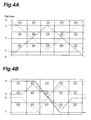
Fig. 4A and Fig. 4B are diagrams showing the pay
lines of slot machine 10. To simplify comprehension,
pay lines are shown separated into two figures. As
shown in each figure, in this game, nine pay lines have
been prepared. If the prescribed symbols line up on
any of these pay lines, a payout is paid to the player
according to the prescribed line up. With the 3 row by
5 column layout of the present embodiment, because the
number of columns has been increased in this way, a
variety of pay lines can be configured.
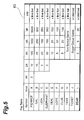
Fig. 5 shows pay table 63 of slot machine 10. As
described above, the information of this pay table 63
is stored ahead of time in main memory 52 and when the
player touches the PAY TABLE key 61 of main display 20,
the table is displayed on the screen. In this slot
game, the symbols are ranked in the following order:
PIERROT (clown), GAL (pretty girl), LION, ELEPHANT,
SEAL, LOPE (tightrope walker), CLUB (juggler), TENT,
TICKET, and BEAR. In addition, to classify the symbols,
they are assigned codes from A to G and J and L. Then,
for example, if three of the LOPE (tightrope walker)
symbols line up in order from the left reel, the
player's monetary prize is an amount 5 times the BET
number wagered on the reel where the symbols lined up.
The TICKET symbols shown by code J are bonus
symbols for starting the bonus game. The TICKET
symbols can be displayed on the reels of columns 2, 3,
and 4, and symbols for those columns are respectively a
TICKET symbol with the letters "CIR" displayed, a
TICKET symbol with the letters "CUS" displayed, and a
TICKET symbol with the words "GOLD TICKET" displayed on
a banner (see Fig. 9). That is, the TICKET symbol
cannot be displayed in the leftmost display region or
in the rightmost display region.
Details will be provided later in the description
relating to the method, but if TICKET symbols are
displayed in each of the second, third and fourth reels,
regardless of the row, a decision is made to switch to
the bonus game. For the bonus game, the TICKET symbols
move to display regions B2, C2, and D2. Afterward, the
clown character appears on main display 20, moves on
the area surrounding the TICKET symbols, and selects
one of the symbols displayed in that surrounding area.
Then the content of the bonus to be awarded to the
player is determined according to the type of symbol
selected.
The control relating to this kind of bonus game is
performed through cooperative working of the CPU 51 of
controller 50, main memory 52, image processing circuit
53 and main display 20.
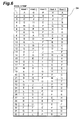
Fig. 6 is symbol table 64 which shows the symbols
displayed on each reel. The information for symbol
table 64 is stored in main memory 52. The letters in
the table indicate the symbol types shown in Fig. 5.
For example, TICKET symbols (shown by "J") are in
positions 3, 13, and 23 of the second reel; positions 3,
13, and 23 of the third reel; and position 3 of the
fourth reel. In the display regions of main display 20,
images are formed as though symbols were depicted on
reels in the order shown in this table 64.
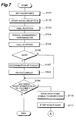
Next, the control method of the slot machine of
the present embodiment will be described referring to
the flow charts of Fig. 7 and Fig. 8.
First, referring to Fig. 7, the control method of
slot machine 10 is explained up to the start of a bonus
game.
When slot machine 10 is operated, CPU 51 accesses
main memory 51 and transfers to image processing
circuit 53 the information related to the basic screen
of the slot game, such as a framework to form the
display region, PAY TABLE key 61, etc. In image
processing circuit 53, this information, after once
being stored in Video RAM, is displayed on main display
20. In this way, the slot machine goes into the state
where a player can play the slot game. The following
processing is accomplished by running the module
relating to the slot game on CPU 51, the program having
been stored in main memory 52.
In step 101 (below, "step" is abbreviated as "S"),
CPU 51 of controller 50 awaits the player's BET. A BET
can be placed in a situation where credits remain, and
the player indicates the BET number using any of the
BET button 25, MAXBET button 26, or REPEATBET button 27.
When BET placing is complete, the player pushes
start button 24 (S102) and the reels begin to spin on
main display 20 (S103). Specifically, CPU 51, having
received a start signal from start button 24, controls
image processing circuit 53 and causes it to perform
image processing so that it appears that actual reels
are indeed spinning. Note that in the case that a
player pushes the MAXBET button 26 or REPEATBET button
27, the reels begin to spin without having to push
start button 24.
After the reels begin spinning, CPU 51 generates
random numbers by means of the program in main memory
52, and according to those values, determines the
position where each reel stops, in other words,
determines the symbol to be displayed in each display
region (S104). Note that this kind of selection based
on random number values may be performed with any
desired timing. For example, selection may be
performed when start button 24 is pushed or selection
may be redone whenever the BET button is pushed.
Next, CPU 51 controls image processing circuit 53
to stop each reel on main display 20 (5105). It may be
set such that, at this time, one symbol is invariably
displayed in each display region, or it may be set such
that there are cases where, based on the random number
values, symbols are not displayed or only a part of the
symbols are displayed. In the present embodiment, it
is set that one symbol will invariably be displayed in
each display region.
After the reels stop, CPU 51 makes a judgment as
to winnings (S106). Since the judgment about winnings
can be made at the time that the symbol arrangement is
determined in S104, S106 may be placed before S105.
Then, in the case that the symbols are in a winning
arrangement, CPU 51, based on pay table 63 stored in
main memory 52, determines the payout to be paid to the
player (5107) and causes the payout amount to be
displayed in the "WON" column of main display 20 (S108).
On the other hand, in the case of no win in S106,
processing proceeds straight to S109, without passing
S107 or S108.
In S109, CPU 51 determines whether or not TICKET
symbols are displayed in all of columns 2, 3, and 4
(S109). In other words, it determines whether it can
switch to a bonus game or not. In the present
embodiment, even if the TICKET symbols in columns 2, 3,
and 4 are all in different rows, it is made to switch
to a bonus game. Note that this judgment can be made
at any time, as long as it is after the determination
of symbol arrangement in S104.
If a situation occurs in which TICKET symbols are
not displayed on all reels 2, 3, and 4, the slot game
ends and, for example, "GAME OVER" is displayed on the
main screen.
On the other hand, in the case that, as shown in
Fig. 9, TICKET symbols are displayed on all reels 2, 3,
and 4, a determination is made to switch to a bonus
game. In the same figure, TICKET symbols 70, 71, and
72, which are bonus symbols, are displayed in display
regions B2, C1, and D3 (TICKET symbols are encircled by
a broken line). In this way, by making it such that
the bonus game starts whenever TICKET symbols (bonus
symbols) appear in columns other than the two end
display regions, without the requirement that TICKET
symbols be lined up from the leftmost display region, a
freshness can be provided to the player.
As shown in Fig. 10, CPU 51 controls image
processing circuit 53 to moves TICKET symbols 70, 71,
and 72 to the center row of the three rows, that is, to
display regions B2, C2, and D2 (S110). In other words,
TICKET symbols 70, 71 and 72 become surrounded by one
line of circumjacent display regions. In this way,
preparations for the bonus game are completed and the
bonus game is started.
Fig. 8 is a flow chart showing the method of
control of slot machine 10 during the bonus game. The
following processing is performed by CPU 51's executing
the module relating to the bonus game of the program
stored in main memory 52.
When the bonus game starts, first in S112, CPU 51
controls image processing circuit 53, and as shown in
Fig. 11, the character of a clown 66 riding on a large
ball is displayed on main display 20. The image
information of this clown character is stored ahead of
time in main memory 52.
Next, based on random number values obtained by
the program in main memory 52, CPU 51 determines on
which display region clown character 66, which will
later be made to move, will be stopped (S113). Here,
it is assumed that display region D1 is selected. As
indicated above, since it has been set in the present
embodiment that one symbol will invariably be displayed
in each display region, it may be said that in S113, it
is the symbol where the clown character will stop which
is selected.
Thereafter, as shown in Fig. 12, image processing
circuit 53, under the control of CPU 51, causes clown
character 66 to move over the display regions
surrounding the three TICKET symbols 70, 71, and 72
which are displayed in central display regions B2, C2,
and D2 (S114). The direction of movement may be either
clockwise or counter-clockwise, and it is also
acceptable to have movement which alternates these
directions. At this time, clown character 66 moves
across the upper row, the lower row, and the right and
left end columns of the plurality of display regions.
In other words, a pathway for the movement of clown
character 66 is formed of the regions surrounding the
bonus symbols which are lined up in the center parts of
the three out of five reel columns which are not the
two end ones.
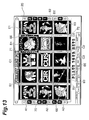
Next, as shown in Fig. 13, CPU 51 controls image
processing circuit 53 to cause clown character 66 to
stop its movement and fall down on the symbol selected
in S113 (S115). In the present embodiment, the player
can grasp the fact that the symbol of that display
region has been selected by the fact that the clown
character 66 performs the action of falling down. It
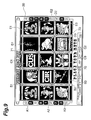
is assumed in the present embodiment that the ELEPHANT
symbol displayed in display region D1 has been selected.
Note that the present embodiment is such that through
the falling down action of the clown, that symbol is
selected, but another action could also indicate that
the symbol had been selected. For example, the clown
character 66 may simply stop over the symbol or perform
another action such as a flip.
Next, in S116, CPU 51 determines whether or not a
"COLLECT" mark is displayed in the symbol selected by
the falling down of the clown. This "COLLECT" mark is
displayed in symbols which have once been selected by
the clown's falling down. Thus, at the beginning of a
bonus game, no marks are displayed on any of the
symbols.
Then, if a COLLECT mark is not displayed in the
selected symbol, processing proceeds to S117 and the
type of the symbol is determined. A bonus is awarded
to the player depending on the type of symbol. At this
time, CPU 15 determines the bonus content based on
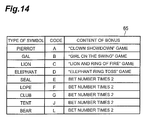
Table 65 shown in Fig. 14.
Table 65 shown in Fig. 14 shows the correspondence
relationship between the symbol selected by the falling
down of the clown character 66 and the content of the
bonus to be awarded to the player. This information is
stored in the ROM area of main memory 52. As is clear
from Table 65, in the case that any one of PIERROT
(clown) (A), GAL (B), LION (C), ELEPHANT (D) is
selected, processing proceeds to S118 and play advances
into the second bonus game mode (below, this second
bonus game is referred to as "sub-game"). On the other
hand, in the case that one of the lower level five
symbols, SEAL (E), LOPE (tight rope walker) (F), CLUB
(juggler) (G), TENT (J), or BEAR (L) is selected,
processing proceeds to S120 and payout of twice the
total BET number in the slot game is paid out.
In S117, when it is ascertained that the ELEPHANT
symbol (display region D1) been has selected, CPU 51
confirms execution of "Elephant's ring toss game",
which is a sub-game, based on Table 65, and executes
the "Elephant's ring toss game" program which is stored
in second memory 55 of controller 50 (S119).
This sub-game unfolds on second display 30, and
the content of the display on second display 30 is
controlled by image processing circuit 56. In this way,
by running the sub-game, which is another bonus game,
on a display different from that of the initial bonus
game, the player receives a strong impression that a
new bonus game has started and the level of
entertainment can be increased.
Upon starting "Elephant's ring toss game," image
processing is performed such that, for example, clown
character 66 which selected the elephant symbol on main
display 20 is bounced up to second display 30 by that
elephant. There, the clown character displayed on
second display 30 throws rings at the trunk of another
elephant which makes an appearance there, and a payout
is paid to the player according to the number of rings
which land encircling the elephant's trunk. In running
this sub-game, the image processing for the clown's
tossing of the rings is done based on a payout decision
made ahead of time, based on a random number value in
accordance with the program of second memory 55.
To explain another sub-game simply, in the case
that the PIERROT (clown) symbol is selected, for
example, the "clown showdown game" is executed. Two
clowns appear in the scene and the player chooses one.
Then, in the case that the clown the player has
selected is the winner, based on the results of a
tightrope walking or ball-riding showdown, the player
is paid a specified payout. Note that for selection of
the clown, selection buttons 31 and 32 may be used or a
touch sensor may be provided on second display 30, the
player making his selection by touching the clown on
the screen.
After awarding the player the bonus of a sub-game
or a coin payout, in S121, CPU 51 controls image
processing circuit 53 and displays a COLLECT mark (see
Fig. 15) to indicate on the selected symbol (the
elephant symbol) that clown character 66 has already
selected that symbol by falling down on it. Image
information for the COLLECT mark is stored in the ROM
area of second memory 55.
Next, CPU 51 determines whether or not all the
symbols surrounding TICKET symbols 70, 71, and 72 have
been selected (S122). In the case that all the symbols
have been selected, the bonus game ends and the player
is notified of that fact, for example, through an
indication on the display. On the other hand, in the
case that not all of the symbols have been selected,
processing returns to a stage before S113 and through
the processing of S113 through S115, the clown
character 66 is moved again and is made to select a
symbol by falling down. In other words, the player is
given another chance to obtain a bonus. In this way,
by providing the player with the chance to gain bonuses
multiple times, the level of player interest toward
slot machine 10 can be enhanced. Note that in symbol
selection in S113, previously selected symbols are also
targets for selection.
In the case that there is no COLLECT mark
displayed on the selected symbol, in S117 and following
steps, a bonus is given to the player according to the
type of symbol. On the other hand, in S116, if a
COLLECT mark is displayed on the selected symbol (for
example, the case where in Fig 15, the elephant symbol
of display region D1 is selected) the bonus game ends
and the player is notified of that fact. Through
setting in this way such that the bonus game ends when
a character selects a display region in which a COLLECT
mark is displayed for a second time because the region
has been previously selected, the player hopes that
clown character 66 will not fall down on a display
region where the COLLECT mark is displayed, and thus
the bonus game can be made even more thrilling.
In the case that no COLLECT mark is displayed on
the selected symbol, and the player is awarded a sub-game
or a specified payout, afterward in S121 a COLLECT
mark is displayed on the selected symbol.
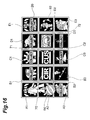
Until the bonus game ends because all the symbols
have been selected or until the bonus game ends because
a COLLECT mark is selected, clown character 66
continues to select symbols and the player is given
bonus chances. There, as shown in Fig. 16, as more
bonuses are awarded, the number of symbols on which
COLLECT marks are displayed grows. As the player's
chances of being able to get a bonus gradually drop,
the thrill of suspense increases.
As explained above, novelty is markedly enhanced
by creating a relationship between the bonus game start
condition which is the displaying of TICKET symbols 70,
71, and 72 in the center display regions of the (X-2)
(in this case 3) columns of the X columns (here, 5
columns), excluding both side columns, and the bonus
game content of clown character 66's movement over the
display areas surrounding the central TICKET symbols 70,
71, and 72 and as a result, players can be attracted to
slot machine 10. In addition, because the bonus game
takes place in succession on main display 20 where the
symbols are arranged, the player can readily grasp that
a bonus game has begun.
In addition, in the present embodiment, the
configuration is such that regardless of the row of
reel 2, 3 and 4 in which the bonus symbol is displayed,
the bonus game starts. However, it is also acceptable
for transition to a bonus game to occur only in the
case that the bonus symbol is displayed in the center
row of each reel (in other words, when displayed in
display regions B2, C2, and D2). However, in the
former case, wherein the configuration is such that
regardless of the row of reel 2, 3 and 4 in which the
bonus symbol is displayed, the bonus game starts, the
player feels that the chances to play a bonus game are
increased, drawing further interest to slot machine 10.
Note that in the present embodiment, there are 3
rows by 5 columns of display regions, but the number of
columns need not be limited to this, and any integer of
5 or larger is acceptable. In such a case, the
condition for start of the bonus game is that bonus
symbols be displayed in the (X-2) columns, excluding
both side columns. For example, in the case that
display regions in 3 rows by 7 columns are provided, it
would be necessary for bonus symbols to be displayed in
5 columns, excluding the left and right side columns.
In this case, just as with the above-mentioned
embodiment, there exists one row of display regions
above, below, and on both sides of the group of (X-2)
bonus symbols lined up on the center row and the above-mentioned
type of bonus game can be implemented.
Next, referring to Figs. 17 and 18, preferred
embodiments of a program and a computer-readable
recording medium on which the program is recorded are
described.
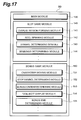
Fig. 17 is a diagram showing each module in
program 80 of the present embodiment and Fig. 18 is a
diagram showing the CD-ROM (recording medium) 90 into
which program 80 is written.
Program 80 includes main module 130 which
integrates the processing, slot game module 140 which
relates to slot game processing, and bonus game module
150 which relates to bonus game processing.
Further, slot game module 140 includes at least:
display region forming module 141, reel turning module
142, symbol determining module 143, and winnings
determining module 144.
Display region forming module 141 forms on the
display display regions of 3 rows by X columns (where X
is an integer of 5 or greater) in which symbols
(including bonus symbols) are displayed. Reel turning
module 142 displays the turning reels on the display.
Symbol determining module 143 determines the symbols to
be displayed in each display region based on random
number values. Winnings determining module 144 makes
decisions as to winnings, based on the arrangement of
symbols displayed in each display region. In the case
that winnings determining module 144 detects that bonus
symbols are displayed in each of the (X-2) display
regions which are the X columns excluding the two side
columns, reel turning module 142 moves the bonus
symbols of each column to the center row of the three
rows, and advances to the bonus game. By the
computer's executing each of these modules, the
processing for each of S101 through S111 in
aforementioned slot machine 10 can be accomplished.
Bonus game module 150 includes at least: character
moving module 151, "stop symbol" determining module 152,
bonus content determining module 153, COLLECT display
module 154, and bonus end determining module 155.
In a bonus game, character moving module 151 moves
a prescribed character (this will be explained below
with the clown character as the specific character, as
in the above-mentioned example) around the central
bonus symbols. "Stop symbol" determining module 152
determines, based on random number values, the symbol
on which the clown character will perform a prescribed
action (for example, falling down). Bonus content
determining module 153 determines the content of the
bonus to be awarded to the player based on the table
(see Fig. 14) which shows the correspondence
relationship between the type of selected symbol and
the content of the bonus. COLLECT display module 154
displays a COLLECT mark on symbols selected by the
clown character's falling down, to indicate that they
have been previously selected. Bonus end determining
module 155 determines that the bonus game has ended in
the case that the clown character has selected all the
symbols surrounding the bonus symbols or in the case
that a symbol displaying a COLLECT mark is selected.
Through the computer's execution of each of these
modules, the processing of each of S112 through S122 of
Fig. 8 can be accomplished in the aforementioned slot
machine 10.
By installing program 80 of the above type,
received as a carrier wave via a communications network
such as the Internet, or program 80 recorded in a
recording medium such as CR-ROM 90, in any type of
computer, such as a personal computer, a PDA (Personal
Digital Assistant), etc., games similar to the above-mentioned
slot machine 10 can be realized.
Note that it is acceptable to build into program
80 the image data for the symbols, characters, etc.
necessary for actualizing the game; the pay table; the
correspondence table relating the symbol selected in
the bonus game and the bonus content; etc.
Alternatively, these data, etc. may be installed in the
computer from a source other than the program. Further,
all the various modules necessary for the processing
performed by slot machine 10, not only the modules
shown in Fig. 17, may be built into in program 80.
In addition, the above-mentioned recording device
can be any kind of device as long as the information
written into it can be read out by a computer. For
example, this corresponds to magnetic disks such as
floppy disks, optical disks such as DVD's,
semiconductor storage devices, etc.
Above, the invention made by the present inventors
was described concretely based on an embodiment, but
the present invention is not limited to the above-mentioned
embodiment. For example, without displaying
spin type reels, the symbols in each display region can
be made to rotate independently in the up-down
direction. In addition, the bonus symbols and the
character which moves on the display in the bonus game
are not limited to those described above, but a variety
of changes could be made.
In addition, selection of symbols for display in
the display regions may be performed based on random
number values obtained with a random number generator,
without utilizing random numbers obtained from the
program.
Further, the controller can be made into separate
units for main display use and second display use
respectively, or game CPU's may be provided for
displaying games on each display. In addition, the main
display and second display may be any type of device,
such as CRT plasma type, organic EL, etc.
In addition, the gaming apparatus according to the
present invention is not limited to the above-described
slot machine. For example, the slot game may be
implemented on the liquid crystal screen of a pachinko
game, or it could be a game apparatus of the type
provided with a stop button whereby the player can stop
the reels (for example, the game type known as "Pachisuro,"
short for Pachi[nko]-suro[tto] [="slot"]).
As described above, by means of the present
invention, it is possible to attract player interest
through renewal of bonus game content and to enable a
player readily to grasp that a bonus game is in
progress.
From the invention thus described, it will be
obvious that the embodiments of the invention may be
varied in many ways. Such variations are not to be
regarded as a departure from the spirit and scope of
the invention, and all such modifications as would be
obvious to one skilled in the art are intended for
inclusion within the scope of the following claims.