Technical Field
The present invention relates to a process of preparing
a polyimide and, more particularly, to a process for
preparing a polyimide which comprises effecting an
imidization reaction of a diamine and a tetracarboxylic
dianhydride by use of as a solvent an equimolar composition
comprising a specific nitrogen-containing cyclic compound and
a specific phenol, and precipitating a polyimide and/or
oligomers during the imidization reaction to thereby make the
reaction system slurry.
Also, the invention relates to such an equimolar
composition.
Background Art
Conventionally, polyimides, which exhibit excellent heat
resistance, mechanical properties, electrical properties,
etc., have found many applications in various fields as
molding materials, composite materials, electrical and
electronic materials, etc. In particular,
biphenyltetracarboxylic acid type polyimides, having a
variety of characteristics that are different from those of
pyromellitic acid type polyimides, are highly useful and thus
become targets for many studies and utilization. Of these, a
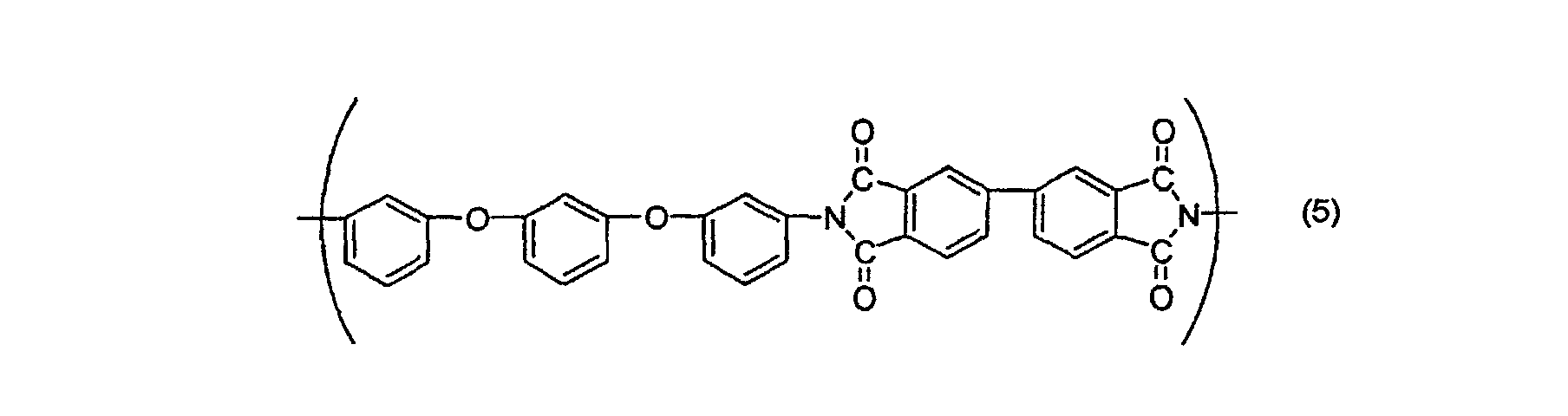
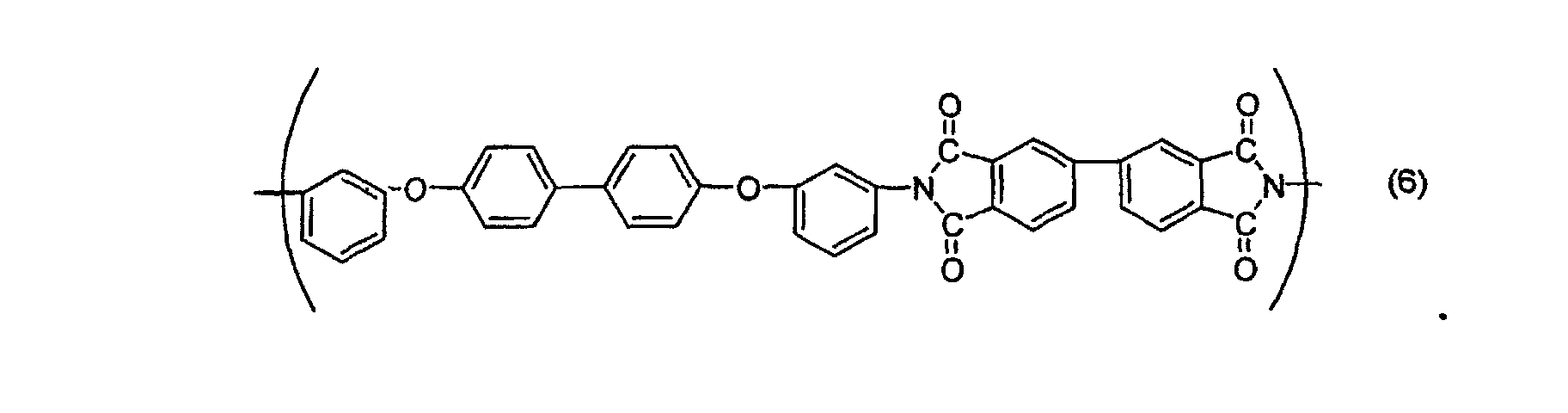
polyimide having the repeating structure units indicated by
chemical formulas (4) to (6) below:
shows thermoplasticity, and therefore can provide molded
products of diverse shapes by means of melt molding such as
compression molding, extrusion, injection molding, and the
like. As a result, utility thereof is extremely high (see G.
L. Wilkes et al., Macromolecules, 30, pp.1012 (1997); S.
Tamai et al., Polymer, 37 (16) pp.3683 (1996); S. Tamai et
al., Polymer, 39 (10) pp.1945 (1998), etc.).
Polyimide molded products are normally manufactured by
sinter molding of non-thermoplastic polyimide powder or by
melt molding of thermoplastic polyimide powder. For this
reason, many processes have been developed for manufacturing
polyimide powder.
For example, Japanese Patent Laid-Open Nos. 4-142332 and
2000-1545 have disclosed processes for preparing pyromellitic
acid type polyimides, which are made to yield polyimides by
thermally imidizing in aprotic polar solvents. Pyromellitic
acid type polyimides exhibit low solubilities in solvents,
and thus form and precipitate as the reaction proceeds,
leading to easy yield of polyimide powder.
However, as indicated in T. Nakano, 2nd Intern. Conf. on
IP, etc., biphenyltetracarboxylic acid type polyimides have
high solubilities in solvents, and thus the aforementioned
processes were difficult to utilize. In other words, the
processes caused problems that include no precipitation of
generated biphenyltetracarboxylic acid type polyimides or
solidification of the reaction system because the products
contain a large amount of solvents and thus swell even though
the polyimides were attempted to prepare by heating in
aprotic polar solvents.
For example, in G. L. Wilkes et al., Macromolecules, 30,
pp.1012 (1997), heating in N-methyl-2-pyrrolidone, an aprotic
polar solvent, gives a polyimide having the repeating
structure unit as indicated by chemical formula (4) above.
In this case, while the polymer forms and precipitates as the
reaction proceeds, the concentration of the polymer is made
to be about 10% by weight during the reaction. This is due
to the fact that setting of the concentration during
polymerization to be equal to or higher than this
concentration causes the reaction system to be in the form of
clay, making it impossible to agitate because the
precipitated polyimides contain a large amount of solvent and
thus swell.
Also, in Japanese Patent Laid-Open Nos. 2000-103854 and
8-121386, etc., heating in cresol for the imidization
reaction yields a polyimide having the repeating structure
unit as shown in chemical formula (4) or (6) above. In this
case, since the formed polymer is dissolved in the solvent,
the polymer is made to precipitate using a large quantity of
poor solvent after the reaction.
As discussed above, preparation of a
biphenyltetracarboxylic acid type polyimide by thermally
imidizing in a solvent conventionally included reaction at a
low concentration or dilution with a poor solvent subsequent
to reaction at a high concentration, and so the volume
efficiency was extremely poor and thus the productivity was
extremely low. That is, for example, the use of a reaction
vessel of a capacity of 1 m3 provides less than 100 kg of an
obtained polyimide, in accordance with the process of G. L.
Wilkes et al., or provides less than 20 kg of a polyimide
according to Japanese Patent Laid-Open No. 2000-103854.
Furthermore, conventional processes, wherein
precipitated polyimides contain large amounts of solvents,
require strenuous efforts for solvent removal by means of
drying or the like.
In addition, Japanese Patent Laid-Open No. 6-220194
entitled "Polyimide Solution Compositions and Manufacturing
Processes Thereof" describes a "process for manufacturing a
polyimide wherein polycondensation is conducted in the
presence of a phenolic compound in the process wherein a
dianhydride is made to directly react with an aromatic
diamine in an organic polar solvent to imidization reaction."
This invention is dealing with a solution of a polyimide
containing aliphatic compounds that are soluble in an organic
polar solvent and the object thereof is to suppress side
reactions during the thermal imidization reaction in the
solvent.
On the other hand, the process of preparing a polyimide
of the present invention is capable of obtaining a slurry
reaction solution by precipitating a polyimide during the
imidization reaction, and the object thereof is to simply
obtain a polyimide only by direct filtration of the reaction
solution.
Therefore, the present invention is completely different
from the aforementioned publications in their target and
object.
Moreover, in the aforementioned publications, a phenolic
compound is utilized as a catalyst for suppressing a side
reaction and the amount by weight thereof is also 1/10 to 1/2
that of an organic polar solvent (9 to 33% by weight of the
total amount of solvents), which is extremely small as
compared with the present invention.
In addition, the aforementioned Japanese Patent Laid-Open
No. 6-220194 does not disclose at all a process of
preparing a biphenyltetracarboxylic acid type polyimide with
high productivity, as will be described in the present
invention, in which a nitrogen-containing cyclic compound
indicated by chemical formula (1), discussed later, of
organic polar solvents is strongly associated with a phenol,
resulting in dissolution of the polyimide precursor
(polyamide acid) and undissolution of polyimide, and an
equimolar composition has an extremely high boiling
temperature. For example, the publication indicates that
synthesis of a polyimide, including as a solvent polar
solvents of N-methyl-2-pyrrolidone and a phenol (mixing molar
ratio of N-methyl-2-pyrrolidone to phenol is 65.5/34.5), is
carried out at a reaction temperature of 180°C, however, it
does not describe specificity concerning a boiling point, etc.
for the mixed solvent of N-methyl-2-pyrrolidone and a phenol,
nor does it indicate that the mixed solvent thereof exhibits
a high boiling temperature and does not mix with water.
Additionally, this publication does not disclose that the use
of an equimolar composition having such specific properties
as a solvent in a specified amount permits a
biphenyltetracarboxylic acid type polyimide to precipitate
during the imidization reaction.
Therefore, a process of preparing a
biphenyltetracarboxylic acid type polyimide with high
productivity has been demanded.
That is, the present invention has been made to solve
problems associated with the prior art described above and an
object of the present invention is to provide a process of
preparing a polyimide by means of simple, easy, cost-effective
steps without losing various properties (molding
processability, sliding property, low water absorbability,
electrical property, thermal oxidation stability, radiation
resistance) of polyimides derived from diverse structures
thereof.
Disclosure of the Invention
In order to solve the aforementioned problems, the
present inventors have made studies, and as a result, they
have found that use of a specified composition as a reaction
solvent can provide a polyimide by means of simple, easy,
cost-effective steps without losing various properties
(molding processability, sliding properties, low water
absorbability, electrical properties, thermal oxidation
stability, radiation resistance) of biphenyltetracarboxylic
acid type polyimides. Based on this finding, the present
invention has been completed.
Accordingly, the process of preparing a polyimide of the
present invention comprises effecting an imidization reaction
of a diamine and a tetracarboxylic dianhydride in a solvent
containing 50 to 100% by weight of an equimolar composition
of a nitrogen-containing cyclic compound indicated in
chemical formula (1) below and a phenol indicated by chemical
formula (2) below.
In formula (1), X represents -CH
2- or -N(CH
3)-. In formula
(2), R
1 and R
2 may be the same as, or different from, each
other and represent each any one of -H, -OH, -CH
3, -C
2H
7, -
C
3H
7, -C
2H
9, -C
5H
11, -C
6H
13, -C
7H
15, -C
8H
17, -C
9H
19, -C
10H
21, -OCH
3,
-O(C
6H
5), -NO
2, -Cl, -Br and -F.
The aforementioned tetracarboxylic dianhydride
preferably contains a biphenyltetracarboxylic dianhydride,
and this tetracarboxylic dianhydride desirably contains 30 to
100 mol % of the biphenyltetracarboxylic dianhydride based on
the total amount of the tetracarboxylic dianhydride.
The polyimide obtained by the aforementioned imidization
reaction preferably has the repeating structure unit
indicated by chemical formula (3) below.
In formula (3), Y represents at least one member selected
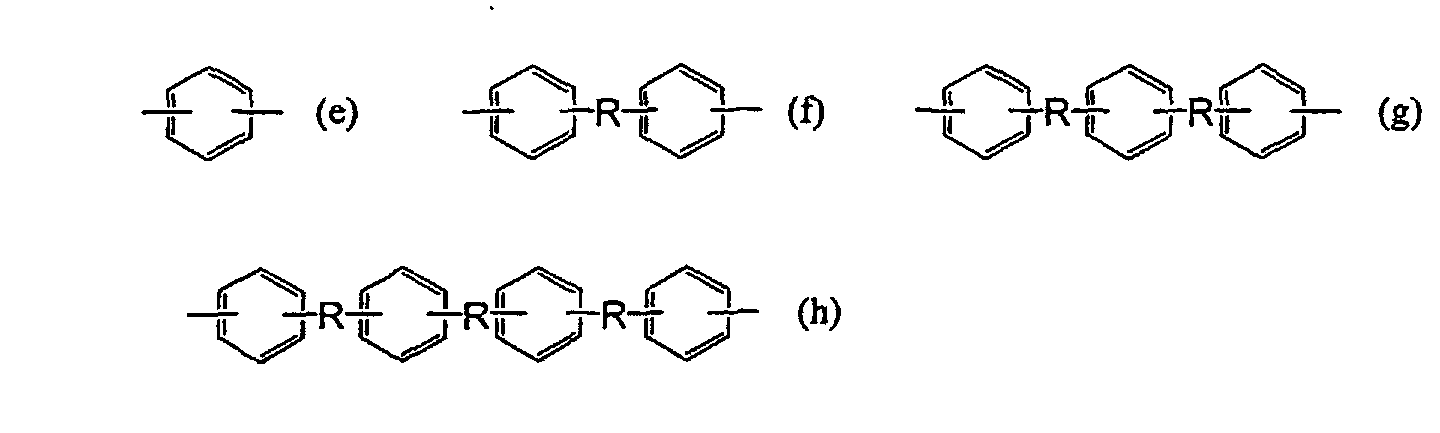
from the group consisting of formulas (e) to (h):
wherein R's may be the same as, or different from, each other
and represent each any one of a single bond, -O-, -CO-, -SO
2-,
-S-, -CH
2- and -C(CH
3)
2-.
Preferably, the total repeating structure units contain
30 to 100 mol % of the repeating structure unit indicated by
chemical formula (3) above and contain 0 to 70 mol % of the
balance different from the repeating structure unit indicated
by chemical formula (3) above.
The balance preferably has a repeating structure unit of
component units derived from an aromatic tetracarboxylic acid,
different from the repeating structure unit indicated by
chemical formula (3) above.
The repeating structure unit of component units derived
from the aromatic tetracarboxylic acid is preferably the
repeating structure units indicated by chemical formulas (a)
and/or (b) below.
In formulas (a) and (b) above, Ar
1 denotes at least one
member selected from the group consisting of formulas (e) to
(h) :
in formulas (f), (g) and (h), R's may be the same as, or
different from, each other and represent each any one of a
single bond, -O-, -CO-, -SO
2-, -S-, -CH
2- and -C(CH
3)
2-.
In formula (b) above, Ar2 denotes at least one member
selected from the group consisting of -O-, -CO-, -SO2-, -S-,
-CH2- and -C(CH3)2-.
The polyimide having repeating structure unit indicated
by chemical formula (3) above preferably contains at least
one of the repeating structure units indicated by general
formulas (4) to (6) below.
The compound indicated by chemical formula (1) above is
preferably N-methyl-2-pyrrolidone and/or 1,3'-dimethyl-2-imidazolidinone.
The phenol indicated by chemical formula (2) above is
preferably at least one compound selected from the group
consisting of phenol, o-chlorophenol, m-chlorophenol, p-chlorophenol,
o-cresol, m-cresol, p-cresol, 2,3-xylenol, 2,4-xylenol,
2,5-xylenol, 2,6-xylenol, 3,4-xylenol and 3,5-xylenol.
In a solvent containing 50 to 100% by weight of an
equimolar composition of a compound indicated by chemical
formula (1) above and a phenol indicated by chemical formula
(2) above, the balance of the solvent preferably contains 0
to 50% by weight of a compound indicated by chemical formula
(1) above or a phenol indicated by chemical formula (2) above.
The process of preparing a polyimide is capable of
precipitating a polyimide and/or oligomers during the
imidization reaction to make the reaction system slurry.
In the process of preparing a polyimide, the reaction is
preferably conducted in the presence of an end capper.
The process of preparing a polyimide can provide a
polyimide powder by precipitating a product during the
imidization reaction.
The concentration of raw material monomers of diamines
and tetracarboxylic dianhydrides ((total weight of raw
material monomers)/ (total weight of raw material monomers +
weight of solvent)) in a reaction solution is preferably in
the range of 5 to 50% by weight.
The polyimide according to the present invention is
characterized by being obtained by the aforementioned process.
The polyimide powder according to the present invention
is characterized by being obtained by the aforementioned
process.
The solvent according to the present invention comprises
an equimolar composition of a compound indicated by chemical
formula (1) below and a phenol indicated by chemical formula
(2) below:
(inn formula (1), X represents -CH
2- or -N(CH
3)-, and in
formula (2), R
1 and R
2 may be the same as, or different from,
each other and represent each any one of -H, -OH, -CH
3, -C
2H
7,
-C
3H
7, -C
2H
9, -C
5H
11, -C
6H
13, -C
7H
15, -C
8H
17, -C
9H
19, -C
10H
21, -OCH
3,
-O(C
6H
5), -NO
2, -Cl, -Br and -F.).
If the solvent contains 50 to 100% by weight of an
equimolar composition of a compound indicated by chemical
formula (1) above and a phenol indicated by chemical formula
(2) above, it may further contain other solvents.
Brief Description of the Drawings
Fig. A1 shows a chart of IR spectra of N-methyl-2-pyrrolidone,
m-cresol and an equimolar composition thereof;
Fig. A2 shows a chart of a 1H-NMR spectrum of an
equimolar composition of N-methyl-2-pyrrolidone and m-cresol;
Fig. A3 shows a chart of a 13C-NMR spectrum of an
equimolar composition of N-methyl-2-pyrrolidone and m-cresol;
Fig. A4 shows a chart of IR spectra of N-methyl-2-pyrrolidone,
p-chlorophenol and an equimolar composition
thereof;
Fig. A5 shows a chart of a 1H-NMR spectrum of an
equimolar composition of N-methyl-2-pyrrolidone and p-chlorophenol;
Fig. A6 shows a chart of a 13C-NMR spectrum of an
equimolar composition of N-methyl-2-pyrrolidone and p-chlorophenol;
Fig. B1 shows a chart of IR spectra of 1,3-dimethyl-2-imidazolidinone,
m-cresol and an equimolar composition
thereof;
Fig. B2 shows a chart of a 1H-NMR spectrum of an
equimolar composition of 1,3-dimethyl-2-imidazolidinone and
m-cresol;
Fig. B3 shows a chart of a 13C-NMR spectrum of an
equimolar composition of 1,3-dimethyl-2-imidazolidinone and
m-cresol;
Fig. B4 shows a chart of IR spectra of 1,3-dimethyl-2-imidazolidinone,
p-chlorophenol and an equimolar composition
thereof;
Fig. B5 shows a chart of a 1H-NMR spectrum of an
equimolar composition of 1,3-dimethyl-2-imidazolidinone and
p-chlorophenol; and
Fig. B6 shows a chart of a 13C-NMR spectrum of an
equimolar composition of 1,3-dimethyl-2-imidazolidinone and
p-chlorophenol.
Best Mode for Carrying out the Invention
The process of preparing a polyimide of the present
invention comprises effecting an imidization reaction in a
solvent containing 50 to 100% by weight of an equimolar
composition of a nitrogen-containing cyclic compound
indicated by chemical formula (1) and a phenol indicated by
chemical formula (2). In this case, the process can be
preferably utilized for the preparation of a polyimide having
the repeating structure unit indicated by chemical formula
(3).
Specific examples of the process of preparing a
polyimide of the present invention will be described
hereinafter.
The process includes dissolving or dispersing a diamine,
a tetracarboxylic dianhydride and an end capper in a solvent
containing 50 to 100% by weight of an equimolar composition
of a nitrogen-containing cyclic compound indicated by
chemical formula (1) and a phenol indicated by chemical
formula (2), heating the reaction system to thereby dissolve
the monomers and/or the polyimide precursers (polyamide
acids) in the solvent leading to a uniform reaction system,
further heating the reaction system to effect an imidization
reaction of the diamine, tetracarboxylic dianhydride and end
capper to thereby precipitate products, polyimide and/or
oligomers, in powderlike form and to make the reaction system
slurry, and subsequently recovering a powderlike polyimide by
filtration of the reaction solution after the completion of
the reaction.
<Solvent>
The present invention relates to a process of preparing
a polyimide by using, as a solvent used in the imidization
reaction, a solvent containing 50 to 100% by weight of an
equimolar composition of a nitrogen-containing cyclic
compound indicated by chemical formula (1) and a phenol
indicated by chemical formula (2).
In formula (1) above, X represents -CH2- or -N(CH3)-. In
formula (2) above, R1 and R2 may be the same as, or different
from, each other and represent each any one of -H, -OH, -CH3,
-C2H7, -C3H7, -C2H9, -C5H11, -C6H13, -C7H15, -C8H17, -C9H19, -C10H21,
-OCH3, -O(C6H5), -NO2, -Cl, -Br and -F.
<Nitrogen-containing cyclic compound indicated by
chemical formula (1)>
The nitrogen-containing cyclic compound indicated by
chemical formula (1) used in the present invention is N-methyl-2-pyrrolidone
and/or 1,3-dimethyl-2-imidazolidinone.
The N-methyl-2-pyrrolidone used in the present invention
can be prepared by applying, as required, a conventional
well-known process, and, for example, can be obtained by
reacting γ-butyrolactone gained by dehydrogenation of 1,4-butanediol
or water addition to maleic anhydride with a
monoalkylamine such as monomethylamine. In addition,
commercially available N-methyl-2-pyrrolidone (Mitsubishi
Chemical Co., BASF Co., etc.) can also be used.
The 1,3-dimethyl-2-imidazolidinone used in the present
invention can be prepared by applying, as required, a
conventional well-known process, or commercially available
one (Mitsui Chemicals Inc., etc.) can also be used.
The nitrogen-containing cyclic compound indicated by
chemical formula (1) above is known as an aprotic polar
solvent and has conventionally been used as a polymerization
solvent for a polyimide. However, this nitrogen-containing
cyclic compound has strong affinity for a polyimide and thus
easily dissolves a polyimide. Thus, a conventional process
of preparing a polyimide using as a solvent this nitrogen-containing
cyclic compound has disadvantages in that the
reaction solution becomes viscous without precipitation of a
formed polyimide, requiring a large amount of poor solvent
for recovery of the polyimide and the reaction system is
solidified because the formed polyimide contains a large
quantity of solvent to thereby precipitate in a swelled state.
In addition, the nitrogen-containing cyclic compound
indicated by chemical formula (1) has strong affinity for
water and therefore mixes with water without limitation. As
a result, a conventional process of preparing a polyimide
using as a solvent this nitrogen-containing cyclic compound
can hardly remove water generated as a by-product along with
the formation of a polyimide, leading to a decrease in
reaction rate and target molecular weight. Therefore, a
conventional process of preparing a polyimide using as a
solvent this nitrogen-containing cyclic compound normally
carries out reaction in the presence of an azeotropic mixture
of a solvent and water to thereby eliminate water, a by-product.
<Phenols indicated by chemical formula (2)>
The Phenol indicated by chemical formula (2) above used
in the present invention, more specifically, includes phenol,
catechol, resorcinol, hydroquinone, o-ethylphenol, methylphenol,
p-ethylphenol, octyl phenol, o-cresol, m-cresol,
p-cresol, 2,3-xylenol, 2,4-xylenol, 2,5-xylenol, 2,6-xylenol,
3,4-xylenol, 3,5-xylenol, guaiacol, nonyl phenol, o-chlorophenol,
m-chlorophenol, p-chlorophenol, o-bromophenol,
m-bromophenol, p-bromophenol, o-fluorophenol, m-fluorophenol,
p-fluorophenol, o-phenylphenol, m-phenylphenol, p-phenylphenol,
o-nitrophenol, m-nitrophenol and p-nitrophenol.
These may be used singly or in a mixture of two or more
species.
In addition, in the present invention, of these phenols,
phenol, o-cresol, m-cresol, p-cresol, 2,3-xylenol, 2/4-xylenol,
2,5-xylenol, 2,6-xylenol, 3,4-xylenol, 3,5-xylenol,
o-chlorophenol, m-chlorophenol and p-chlorophenol are
preferably used and of these, use of m-cresol, p-cresol and
p-chlorophenol is particularly preferable.
In the present invention, these phenols can be used
singly or in combination of two or more species.
These phenols can be prepared by applying, as required,
the conventional well-known processes, or commercially
available one can be used.
The phenol indicated by chemical formula (2) above is
known as a good solvent for a polyimide and has
conventionally been utilized as a polymerization solvent for
a polyimide. However, a conventional process of preparing a
polyimide using as a solvent this phenol has disadvantages in
that the reaction solution becomes viscous without
precipitation of a formed polyimide, requiring a large amount
of poor solvent for recovery of the polyimide and the
reaction system is solidified because the formed polyimide
contains a large quantity of solvent to thereby precipitate
in a swelled state.
<Equimolar composition of nitrogen-containing cyclic
compound indicated by chemical formula (1) and phenol
indicated by chemical formula (2)>
The equimolar composition according to the present
invention is a composition prepared by blending in equimolar
quantities a nitrogen-containing cyclic compound indicated by
chemical formula (1) with a phenol indicated by chemical
formula (2).
The equimolar composition according to the present
invention, as will also be shown in examples described later,
allows a carbonyl group of a nitrogen-containing cyclic
compound indicated by chemical formula (1) and a hydroxyl
group of a phenol indicated by chemical formula (2) to form a
strong hydrogen bond and thus strong association. This may
relatively weaken the affinity of a nitrogen-containing
cyclic compound indicated by chemical formula (1) for a
polyimide or that of a phenol indicated by chemical formula
(2) for a polyimide, leading to suppression of the
dissolution of a polyimide and the swelling of a polyimide
due to solvent contained.
The equimolar composition according to the present
invention has an extremely high boiling point as compared
with those of the individual species therein and is in a
liquid state at room temperature, because the nitrogen-containing
cyclic compound indicated by chemical formula (1)
is strongly associated with the phenol indicated by chemical
formula (2).
More specifically, as will also be shown in examples
later, for example, an equimolar composition of N-methyl-2-pyrrolidone
(boiling point 204°C, solidifying point -23°C)
and m-cresol (boiling point 202.2°C, solidifying point
11.5°C) has the boiling point of 230°C and a solidifying
point lower than 0°C; an equimolar composition of N-methyl-2-pyrrolidone
and p-cresol (boiling point 201.9°C, solidifying
point 34.8°C) has the boiling point of 245°C and a
solidifying point lower than 0°C. In the former example, the
boiling point of the composition is higher by about 15 to
20°C than that of N-methyl-2-pyrrolidone or those of phenols;
in the latter example, the difference is as very large as
about 40 to 45°C. In addition, for example, an equimolar
composition of 1,3-dimethyl-2-imidazolidinone (boiling point
about 225°C, solidifying point about 8°C) and m-cresol
(boiling point about 202°C, solidifying point about 12°C) has
the boiling point of 237°C and a solidifying point lower than
0°C; an equimolar composition of 1,3-dimethyl-2-imidazolidinone
and p-chlorophenol (boiling point about 217°C,
solidifying point about 43°C) has the boiling point of 257°C
and a solidifying point lower than 0°C. In the former
example, the boiling point of the composition is higher by
about 12°C than that of 1,3-dimethyl-2-imidazolidinone and
higher by 35°C than that of m-cresol. In the latter example,
the boiling point of the composition is higher by about 20°C
than that of 1,3-dimethyl-2-imidazolidinone and higher by
28°C than that of p-chlorophenol; these differences of
boiling point are very large.
Thus, in the present invention, by mixing N-methyl-2-pyrrolidone
and a phenol in an equimolar amount, there can be
obtained a composition having an extremely increased boiling
point, for example, higher by 10°C or more, preferably higher
by 20°C or more, and more preferably higher by 25°C or more,
than that of the N-methyl-2-pyrrolidone or phenol, and also
having a solidifying point of a room temperature in a
liquidlike state (for example, liquid even at 5°C). In
addition, by mixing 1,3-dimethyl-2-imidazolidinone and a
phenol in an equimolar amount, there can be obtained a
composition having an extremely increased boiling point, for
example, higher by 3°C or more, preferably higher by 10°C or
more, more preferably higher by 20°C or more, and most
preferably higher by 30°C or more, than that of the 1,3-dimethyl-2-imidazolidinone
or phenol, and also having a
solidifying point of a room temperature in a liquidlike state
(for example, liquid even at 5°C).
Additionally, the boiling point of a solvent in the
present invention refers to the temperature at which the
temperature of a liquid phase in a boiling solution becomes
equal to that of the gas phase of the solvent vapor.
Incidentally, the boiling point of a mixed solvent with
no association generally obeys Raoult's Law. Further,
interaction of hydrogen bonding or the like between mixed
solvent components is known to change the boiling point
indicated by Raoult's Law. However, for example, the boiling
point of an azeotropic composition mixture of phenol
exhibiting weak acidity and aniline exhibiting weak basicity
is 186.2°C, which is only slightly higher than those of
phenol (181.2°C) and aniline (184.4°C), in contrast to an
extreme boiling point rise as in the present invention. In
addition, salts made from acids and bases are known to have
high melting points or be nonvolatile. For example, salts
formed from phenols of weak acidity and sodium hydroxide
(sodium phenolates trihydrate) have melting points of 61 to
64°C and salts formed from N-methyl-2-pyrrolidone (a) of weak
basicity have melting points of 80 to 88°C, exhibiting high
melting points, and thus these cannot be used as solvents.
As described above, the properties of equimolar compositions
according to the present invention are highly specific.
In the equimolar composition of the present invention,
the nitrogen-containing cyclic compound indicated by chemical
formula (1) and the phenol indicated by chemical formula (2)
are strongly associated through hydrogen bonds. Therefore,
the composition does not vary depending on pressure during
distillation operation or the like, as distinct from general
azeotropic mixtures. The equimolar composition in the
present invention hardly causes changes in composition ratio
even though evaporation and concentration are repeated.
Accordingly, even though the equimolar composition in the
present invention is recovered by distillation or the like
and supplied for recycling, they always hold a constant
composition and therefore do not require composition
adjustment. In addition, the equimolar composition in the
present invention is separated into the nitrogen-containing
cyclic compound indicated by chemical formula (1) and the
phenol in the presence of bases such as sodium hydroxide, and
therefore the nitrogen-containing cyclic compound indicated
by chemical formula (1) and phenol, i.e. the raw materials,
can be recovered by distillation or the like.
The equimolar composition according to the present
invention, as will also be shown in examples set forth later,
is high in polarity and does not mix with water.
Consequently, the raw materials for polyimide production and
polyimide precursors (polyamic acids) have good solubility
and the removal of water generated during dehydration is easy,
and thus the composition is well suitable as a solvent for
polyimide polymerization.
<Solvent containing 50 to 100% by weight of equimolar
composition>
In the process of preparing a polyimide of the present
invention, as a reaction solvent, a solvent containing 50 to
100% by weight of an equimolar composition of a nitrogen-containing
cyclic compound indicated by chemical formula (1)
above and a phenol indicated by chemical formula (2) above is
used.
The solvent used in the present invention is primarily
comprised of the aforementioned equimolar composition. The
equimolar composition is preferably 70 to 100% by weight,
more preferably 80 to 100% by weight, and most preferably 90
to 100% by weight, of the total amount of the solvent. In
addition, the solvents other than the equimolar composition
may be 0 to 50% by weight, preferably 0 to 30% by weight,
more preferably 0 to 20% by weight, and most preferably 0 to
10% by weight, of the total amount of the solvent. Making
other solvent coexist can arbitrarily change various physical
properties of reaction solvents, such as melting point,
boiling point, polarity, dielectric constant and solubility,
used in the present invention.
Other solvents that may be contained include, for
example, phenolic solvents, aprotic amide solvents, etheric
solvents and amine solvents.
As phenolic solvents, the aforementioned phenols (2) can
be used, which include, for example, phenol, o-chlorophenol,
m-chlorophenol, p-chlorophenol, o-cresol, m-cresol, p-cresol,
2,3-xylenol, 2,4-xylenol, 2,5-xylenol, 2,6-xylenol, 3,4-xylenol
and 3,5-xylenol.
Aprotic amide solvents include, for example, N,N-dimethylformamide,
N,N-dimethylacetamide, N,N-diethylacetamide
N-methyl-2-pyrrolidone, 1,3-dimethyl-2-imidazolidinone,
N-methylcaprolactam and
hexamethylphosphorotriamide.
Etheric solvents include, for example, 1,2-dimethoxyethane,
bis(2-methoxyethyl) ether, 1,2-bis(2-methoxyethoxy)ethane,
tetrahydrofuran, bis [2-(2-methoxyethoxy)ethyl]
ether and 1,4-dioxane.
Amine solvents include, for example, pyridine, quinoline,
isoquinoline, α-picoline, β-picoline, γ-picoline, isophorone,
piperidine, 2,4-lutidine, 2,6-lutidine, trimethylamine,
triethylamine, tripropylamine and tributylamine.
In addition, other solvents that can be used, besides
the ones described above, include dimethyl sulfoxide,
dimethyl sulfone, diphenyl ether, sulfolane, diphenyl sulfone,
tetramethylurea, anisole, water, benzene, toluene, o-xylene,
m-xylene, p-xylene, chlorobenzene, o-dichlorobenzene, m-dichlorobenzene,
p-dichlorobenzene, bromobenzene, o-dibromobenzene,
m-dibromobenzene, p-dibromobenzene, o-chlorotoluene,
m-chlorotoluene, p-chlorotoluene, o-bromotoluene,
m-bromotoluene, p-bromotoluene, acetone, methyl
ethyl ketone, methyl isobutyl ketone, methanol, ethanol,
propanol, isopropanol, butanol, isobutanol, pentane, hexane,
heptane, cyclohexane, dichloromethane, chloroform, carbon
tetrachloride, fluorobenzene, methyl acetate, ethyl acetate,
butyl acetate, methyl formate and ethyl formate.
As solvents that may be included in the process of
preparing a polyimide of the present invention, particularly
preferred are the same solvent as the nitrogen-containing
cyclic compound indicated by chemical formula (1) or the
phenol indicated by chemical formula (2), which constitutes
an actually used equimolar composition.
<Polyimide>
The process of preparing a polyimide of the present
invention can preferably be applied to preparation of a
polyimide having the repeating structure unit indicated by
formula (3) below.
In formula (3) indicated above, Y presents at least one
member selected from the group consisting of formulas (e) to
(h):
wherein R's are the same as, or different from, each
other and represent each any one of a single bond, -O-, -CO-,
-SO
2-, -S-, -CH
2- and -C(CH
3)
2-.
Here, the polyimide having the repeating structure unit
indicated by chemical formula (3) above contains 30 to 100
mol %, preferably 50 to 100 mol %, most preferably 55 to 100
mol % of the repeating structure unit indicated by chemical
formula (3) above, based on the total repeating structure
units, and the balance thereof preferably has, for example, a
repeating structure unit containing component units derived
from aromatic tetracarboxylic acids, different from the
repeating structure unit indicated by chemical formula (3)
above, and desirably contains, for example, 0 to 70 mol %,
preferably 0 to 50 mol %, and most preferably 0 to 45 mol %
of the repeating structure units indicated by chemical
formulas (a) and/or (b) below.
In formulas (a) and (b) indicated above, Ar
1 denotes at
least one member selected from the group consisting of
formulas (e) to (h):
wherein R's are the same as, or different from, each
other and represent each any one of a single bond, -O-, -CO-,
-SO
2-, -S-, -CH
2- and -C(CH
3)
2-.
In formula (b) indicated above, Ar2 denotes at least one
member selected from the group consisting of -O-, -CO-, -SO2-,
-S-, -CH2- and -C(CH3)2-.
In addition, the polyimide having the repeating
structure unit indicated by the aforementioned general
formula (3) preferably has at least one of the repeating
structure units indicated by general formulas (4) to (6)
below:
Further, it is preferred that the repeating structure
unit constituting the aforementioned balance does not contain
component units derived from aliphatic tetracarboxylic acids
containing aromatic rings and tetracarboxylic acids
containing fluorine.
As described in T. Nakano, 2nd Intern. Conf. on PI, etc.,
biphenyltetracarboxylic acid type polyimides composed of the
repeating structure unit indicated by chemical formula (3)
above are highly soluble in solvents. Therefore, when a
polyimide containing 30 to 100 mol % of the repeating
structure unit indicated by chemical formula (3) above of the
total repeating structure units is subjected to the
imidization reaction by a conventional process, i.e., by
heating in a polar solvent such as N-methyl-2-pyrrolidone or
cresol, problems sometimes arise that the generated polyimide
is not precipitated and the reaction system is solidified
because the formed polyimide contains a large quantity of
solvent to thereby precipitate in a swelled state. In
addition, the polyimide composed of the repeating structure
unit indicated by chemical formula (a) does not need the
preparation process of the present invention because the
polyimide has a low solubility in solvents and the formed
polyimide precipitates when the imidization reaction by
heating is carried out by the conventional process, that is,
in a polar solvent such as N-methyl-2-pyrrolidone or cresol.
Moreover, the polyimide composed of the repeating structure
unit indicated by chemical formula (b) is very soluble in
solvents, and so problems sometimes arise that the generated
polyimide is not precipitated and the reaction system is
solidified because the formed polyimide contains a large
quantity of solvent to thereby precipitate in a swelled state,
even though the preparation process of the present invention
is used.
The polyimide prepared by the preparation process of the
present invention may be encapped at the terminals thereof by
an end capper such as phthalic anhydride, aniline, maleic
anhydride, or phenylethynylphthalic anhydride. Additionally,
the polyimide may have branches in the structure of the main
chain, side chains or terminals, and may also have structure
for crosslinkage, ring structure or the like.
The degree of polymerization of a polyimide prepared by
a preparation process of the present invention is not limited
and is arbitrarily selected dependent on applications of a
polyimide. In the conventional process of preparing a
polyimide, the formed polyimide does not precipitate, that is,
when the formed polyimide is dissolved in solvent, the
reaction solution becomes viscous and therefore the
polymerization degree of a prepared polyimide is restricted.
On the other hand, in the process of preparing a polyimide of
the present invention, the formed polyimide precipitates and
the reaction solution becomes slurry, and so the reaction
solution does not become viscous and thus allows agitatin
even when producing a high-molecular polyimide.
<Diamine>
In the process of preparing a polyimide of the present
invention, a conventionally well-known aromatic diamine can
preferably be used. Additionally, when aliphatic diamines,
siloxane diamines or fluorine-containing diamines are used,
the obtained polyimide dissolves in the solvents used in the
present invention, so that the aimed effects of the present
invention cannot be obtained in some cases.
(1) Diamines having one benzene ring include, for example, p-phenylenediamine
and m-phenylenediamine. (2) Diamines having two benzene rings include, for example,
3,3'-diaminodiphenyl ether, 3,4'-diaminodiphenyl ether, 4,4'-diaminodiphenyl
ether, 3,3'-diaminodiphenyl sulfide, 3,4'-diaminodiphenyl
sulfide, 4,4'-diaminodiphenyl sulfide, 3,3'-diaminodiphenyl
sulfone, 3,4'-diaminodiphenyl sulfone, 4,4'-diaminodiphenyl
sulfone,
3,3'-diaminobenzophenone, 4,4'-diaminobenzophenone,
3,4'-diaminobenzophenone, 3,3'-diaminodiphenylmethane, 4,4'-diaminodiphenylmethane,
3,4'-diaminodiphenylmethane, 2,2-di(3-aminophenyl)propane,
2,2-di(4-aminophenyl)propane, 2-(3-aminophenyl)-2-(4-aminophenyl)propane,
1,1-di(3-aminophenyl)-1-phenylethane,
1,1-di(4-aminophenyl)-1-phenylethane, and 1-(3-aminophenyl)-1-(4-aminophenyl)-1-phenylethane. (3) Diamines having three benzene rings include, for example,
1,3-bis(3-aminophenoxy)benzene, 1,3-bis(4-aminophenoxy)benzene,
1,4-bis(3-aminophenoxy)benzene, 1,4-bis(4-aminophenoxy)benzene,
1,3-bis(3-aminobenzoyl)benzene,
1,3-bis(4-aminobenzoyl)benzene, 1,4-bis(3-aminobenzoyl)benzene,
1,4-bis(4-aminobenzoyl)benzene, 1,3-bis(3-amino-α,α-dimethylbenzyl)benzene,
1,3-bis(4-amino-α,α-dimethylbenzyl)benzene,
1,4-bis(3-amino-α,α-dimethylbenzyl)benzene,
1,4-bis(4-amino-α,α-dimethylbenzyl)benzene,
2,6-bis(3-aminophenoxy)benzonitrile,
and 2,6-bis(3-aminophenoxy)pyridine. (4) Diamines having four benzene rings include, for example,
4,4'-bis(3-aminophenoxy)biphenyl, 4,4'-bis(4-aminophenoxy)biphenyl,
bis[4-(3-aminophenoxy)phenyl] ketone,
bis[4-(4-aminophenoxy)phenyl] ketone,
bis[4-(3-aminophenoxy)phenyl]sulfide,
bis[4-(4-aminophenoxy)phenyl]sulfide,
bis[4-(3-aminophenoxy)phenyl]sulfone,
bis[4-(4-aminophenoxy)phenyl]sulfone,
bis[4-(3-aminophenoxy)phenyl] ether,
bis[4-(4-aminophenoxy)phenyl] ether,
2,2-bis[4-(3-aminophenoxy)phenyl]propane, and
2,2-bis[4-(4-aminophenoxy)phenyl]propane. (5) Diamines having five benzene rings include, for example,
1,3-bis[4-(3-aminophenoxy)benzoyl]benzene,
1,3-bis[4-(4-aminophenoxy)benzoyl]benzene,
1,4-bis[4-(3-aminophenoxy)benzoyl]benzene,
1,4-bis[4-(4-aminophenoxy)benzoyl]benzene,
1,3-bis[4-(3-aminophenoxy)-α,α-dimethylbenzyl]benzene, 1,3-bis[4-(4-aminophenoxy)-α,α-dimethylbenzyl]benzene,
1,4-bis[4-(3-aminophenoxy)-α,α-dimethylbenzyl]benzene,
and
1,4-bis[4-(4-aminophenoxy)-α,α-dimethylbenzyl]benzene. (6) Diamines having six benzene rings include, for example,
4,4'-bis[4-(4-aminophenoxy)benzoyl]diphenyl ether,
4,4'-bis[4-(4-amino-α,α-dimethylbenzyl)phenoxy]benzophenone,
4,4'-bis[4-(4-amino-α,α-dimethylbenzyl)phenoxy]diphenylsulfone,
and
4,4'-bis[4-(4-aminophenoxy)phenoxy]diphenylsulfone. (7)'Diamines having other aromatic substituents include, for
example, 3,3'-diamino-4,4'-diphenoxybenzophenone, 3,3'-diamino-4,4'-dibiphenoxybenzophenone,
3,3'-diamino-4-phenoxybenzophenone,
and 3,3'-diamino-4-biphenoxybenzophenone.
In the present invention, there can also, as necessary,
be used diamines wherein part or all of the hydrogen atoms on
the aromatic rings of diamines having aromatic rings are
replaced with substituents such as a methyl group, a methoxy
group, an ethynyl group to be a crosslinking point, a
benzocyclobutene-4'-yl group, a vinyl group, an allyl group,
a cyano group, an isocyanate group, a nitrilo group, and an
isopropenyl group.
Further, there can also, as necessary, be used diamines
having in their main skeleton chain substituents such as a
vinylene group, a vinylidene group and an ethynylidene group,
to be crosslinking points.
Additionally, there can also be used triamines and
tetraamines instead of diamines in order to incorporate
branches.
These diamines can be used singly or in combination of
two or more species.
<Tetracarboxylic dianhydride>
In the process of preparing a polyimide of the present
invention, biphenyltetracarboxylic dianhydrides are
preferably used as tetracarboxylic dianhydrides. These
biphenyltetracarboxylic dianhydrides, more particularly,
include 3,3',4,4'-biphenyltetracarboxylic dianhydrides,
2,3',3,4'-biphenyltetracarboxylic dianhydrides and 2,2',3,3'-biphenyltetracarboxylic
dianhydrides. These
biphenyltetracarboxylic dianhydrides can be used singly or in
combination of two or more species. Of these, 3,3',4,4'-biphenyltetracarboxylic
dianhydrides are preferable as
tetracarboxylic dianhydrides in the present invention.
In the present invention, biphenyltetracarboxylic
dianhydrides are preferably used as tetracarboxylic
dianhydrides and other conventionally well-known
tetracarboxylic dianhydrides can be used together with the
biphenyltetracarboxylic dianhydrides. As these other
tetracarboxylic dianhydrides, aromatic tetracarboxylic
dianhydrides are preferably used. In addition, when
aliphatic tetracarboxylic acids free of aromatic rings and
tetracarboxylic acids containing fluorine are used, aimed
effects of the present invention cannot be obtained in some
cases since polyimides thus obtained dissolve in solvents
used in the present invention. These aliphatic
tettacarboxylic acids free of aromatic rings include, for
example, bicyclo(2,2,2)-octo-7-ene-2,3,5,6-tetracarboxylic
dianhydrides, ethylenetetracarboxylic dianhydrides,
butanetetracarboxylic dianhydrides, and
cyclopentanetetracarboxylic dianhydrides.
Therefore it is not preferable for the present invention
to use as other tetracarboxylic acids aliphatic
tetracarboxylic acids free of aromatic rings or
tetracarboxylic acids containing fluorine.
Other aromatic tetracarboxylic dianhydrides to be used
together with the aforementioned biphenyltetracarboxylic
dianhydrides in the present invention include, for example,
pyromellitic dianhydride, bis(3,4-dicarboxyphenyl)ether
dianhydride,
bis(3,4-dicarboxyphenyl)sulfide dianhydride,
bis(3,4-dicarboxyphenyl)sulfone dianhydride,
2,2-bis(3,4-dicarboxyphenyl)propane dianhydride,
1,3-bis(3,4-dicarboxyphenoxy)benzene dianhydride,
1,4-bis (3,4-dicarboxyphenoxy)benzene dianhydride,
4,4'-bis(3,4-dicarboxyphenoxy)biphenyl dianhydride,
2,2-bis[(3,4-dicarboxyphenoxy)phenyl]propane dianhydride,
2,3,6,7-naphthalenetetracarboxylic dianhydride,
1,4,'5,8-naphthalenetetracarboxylic dianhydride, 2,2',3,3'-benzophenonetetracarboxylic
dianhydride, 2,3',3,4'-benzophenonetetracarboxylic
dianhydride,
2,2-bis(2,3-dicarboxyphenyl)propane dianhydride,
bis(2,3-dicarboxyphenyl) ether dianhydride,
bis(2,3-dicarboxyphenyl)sulfide dianhydride,
bis(2,3-dicarboxyphenyl)sulfone dianhydride,
1,3-bis(2,3-dicarboxyphenoxy)benzene dianhydride,
1,4-bis(2,3-dicarboxyphenoxy)benzene dianhydride, and
1,2,5,6-naphthalenetetracarboxylic dianhydride.
These other aromatic tetracarboxylic dianhydrides can be
used singly or in combination of two or more species.
In the present invention, there can also, as necessary,
be used tetracarboxylic dianhydrides wherein part or all of
the hydrogen atoms on the aromatic rings of aromatic
tetracarboxylic dianhydrides are replaced with substituents
such as a methyl group, a methoxy group, an ethynyl group to
be a crosslinking point, a benzocyclobutene-4'-yl group, a
vinyl group, an allyl group, a cyano group, an isocyanate
group, a nitrilo group, and an isopropenyl group.
Further, there can also be used tetracarboxylic
dianhydrides having in their main skeleton chain substituents
such as a vinylene group, a vinylidene group and an
ethynylidene group, to be crosslinking points.
Additionally, there can also be used hexacarboxylic
trianhydrides and octacarboxylic tetraanhydrides instead of
tetracarboxylic dianhydrides in order to incorporate branches.
These tetracarboxylic dianhydrides can be used singly or
in combination of two or more species.
For the amount of tetracarboxylic dianhydride used in
the present invention, the amount of biphenyltetracarboxylic
dianhydride is preferably 30 to 100 mol %, more preferably 50
to 100 mol %, and most preferably 55 to 100 mol %, based on
the total amount of tetracarboxylic dianhydride, and the
amount of other tetracarboxylic dianhydrides is preferably 0
to 70 mol %, more preferably 0 to 50 mol %, and most
preferably 0 to 45 mol %, based on the total amount of
tetracarboxylic dianhydride.
When the amount of the other tetracarboxylic
dianhydrides to be used exceeds 70 mol %, a polyimide to be
obtained is excessively soluble in the solvent, which
sometimes creates problems that the generated polyimide is
not precipitated and the reaction system is solidified
because the formed polyimide contains a large quantity of
solvent to thereby precipitate in a swelled state, even
though the preparation process of the present invention is
utilized. In addition, when more than 70 mol % of a
pyromellitic dianhydride is, for example, used as another
tetracarboxylic dianhydride, the preparation process of the
present invention is not required since a polyimide to be
obtained has a low solubility in the solvent.
In other words, the formed polyimide precipitates even
in a conventional process in which the thermal imidization
reaction is carried out in a polar solvent such as N-methyl-2-pyrrolidone
or cresol.
<Amounts of diamines and tetracarboxylic dianhydrides>
The amount of tetracarboxylic dianhydrides to be used in
the present invention (sum of the amount of
biphenyltetracarboxylic dianhydrides and the amount of other
tetracarboxylic dianhydrides) is not particularly limited,
however, they are normally used preferably in an amount of
0.8 to 1.25 mol per mol of diamine(s) to be used. Changing
the molar ratio of tetracarboxylic dianhydrides to diamines,
to be used, can control the molecular weights of polyimides
to be obtained.
When this molar ratio (tetracarboxylic
dianhydride/diamine) is less than 0.8, the molecular weight
of a polyimide sufficiently exhibiting various properties
cannot be obtained, and on the other hand, when the molar
ratio exceeds 1.25, the molecular weight of a polyimide
sometimes decreases.
In addition, when a monoamine is used as an end capper,
as will be set forth later, the amount of a tetracarboxylic
dianhydride to be used is preferably in the range of 1.01 to
1.25 mols, more preferably 1.05 to 1.20 mols, and most
preferably 1.07 to 1.15 mols, per total one mol of diamine(s)
to be used. In this case, when the molar ratio
(tetracarboxylic dianhydride/diamine) is less than 1.01 or
exceeds 1.25, endcapping (termination) becomes insufficient,
which sometimes inversely affects the thermal stability and
processability of a polyimide obtained.
Furthermore, when a dicarboxylic acid or an anhydride or
a derivative thereof described later is used as an end capper,
the amount of a tetracarboxylic dianhydride to be used is
preferably 0.8 to 0.99 mol, more preferably 0.85 to 0.97 mol
and most preferably 0.90 to 0.95 mol, per total one mol of
diamine(s) to be used. In this case, when the molar ratio
(tetracarboxylic dianhydride/diamine) is less than 0.8 or
exceeds 0.99, endcapping becomes insufficient, which
sometimes inversely affects the thermal stability and
processability of a polyimide obtained.
The molecular weight of a polyimide can be controlled by
changing the molar ratio of a diamine and a tetracarboxylic
dianhydride, which are used in preparing a polyimide, and the
optimal charging ratio thereof varies in some cases depending
on the purities and amounts of impurities of raw materials,
polymerization processes, kinds of solvents, polymerization
temperature and polymerization duration, etc.
Additionally, the total mols of the diamine(s) to be
used and the total mols of the tetracarboxylic dianhydride(s)
to be used should be almost the same to obtain a sufficiently
high molecular weight polyimide. In this case, use of a
conventional process, wherein the formed polyimide does not
precipitate, leads to a very high viscosity of the reaction
solution and thus difficulty in agitation. However,
according to the preparation process of the present invention,
the formed polyimide precipitates, making the reaction system
slurry, so that the reaction solution does not become viscous,
not preventing agitation.
<End capper>
In the process of preparing a polyimide of the present
invention, an end capper can be used, as needed. The end
capper to be used is not particularly limited and various
kinds thereof can be used. Of these, monoamines,
dicarboxylic anhydrides, or the like can preferably be used.
Monoamines to be used as these end cappers include, for
example, aniline, o-toluidine, m-toluidine, p-toluidine, 2,3-xylidine,
2,4-xylidine, 2,5-xylidine, 2,6-xylidine, 3,4-xylidine,
3,5-xylidine, o-chloroaniline, m-chloroaniline, p-chloroaniline,
o-bromoaniline, m-bromoaniline, p-bromoaniline,
o-nitroaniline, m-nitroaniline, p-nitroaniline, o-anisidine,
m-anisidine, p-anisidine, o-phenetidine, m-phenetidine, p-phenetidine,
o-aminophenol, m-aminophenol, p-aminophenol, o-aminobenzaldehyde,
m-aminobenzaldehyde, p-aminobenzaldehyde,
o-aminobenzonitrile, m-aminobenzonitrile, p-aminobenzonitrile,
2-aminobiphenyl, 3-aminobiphenyl, 4-aminobiphenyl, 2-aminophenylphenyl
ether, 3-aminophenylphenyl ether, 4-aminophenylphenyl
ether, 2-aminobenzophenone, 3-aminobenzophenone,
4-aminobenzophenone, 2-aminophenylphenyl
sulfide, 3-aminophenylphenyl sulfide, 4-aminophenylphenyl
sulfide, 2-aminophenylphenyl sulfone, 3-aminophenylphenyl
sulfone, 4-aminophenylphenyl sulfone, α-naphthylamine, β-naphthylamine,
1-amino-2-naphthol, 2-amino-1-naphthol, 4-amino-1-naphthol,
5-amino-1-naphthol, 5-amino-2-naphthol, 7-amino-2-naphthol,
8-amino-1-naphthol, 8-amino-2-naphthol, 1-aminoanthracene,
2-aminoanthracene, 9-aminoanthracene,
methylamine, dimethylamine, ethylamine, diethylamine,
propylamine, dipropylamine, isopropylamine, diisopropylamine,
butylamine, dibutylamine, isobutylamine, diisobutylamine,
penthylamine, dipenthylamine, benzylamine, cyclopropylamine,
cyclobutylamine, cyclopenthylamine, and cyclohexyl amine.
In addition, dicarboxylic anhydrides used as these end
cappers include, for example, phthalic anhydride, 2,3-benzophenonedicarboxylic
anhydride, 3,4-benzophenonedicarboxylic
anhydride, 2,3-dicarboxyphenylphenyl
ether anhydride, 3,4-dicarboxyphenylphenyl ether anhydride,
2,3-biphenyldicarboxylic anhydride, 3,4-biphenyldicarboxylic
anhydride, 2,3-dicarboxyphenylphenyl sulfone anhydride, 3,4-dicarboxyphenylphenyl
sulfone anhydride, 2,3-dicarboxyphenylphenyl
sulfide anhydride, 3,4-dicarboxyphenylphenyl
sulfide anhydride, 1,2-naphthalenedicarboxylic
anhydride, 2,3-naphthalenedicarboxylic
anhydride, 1,8-naphthalenedicarboxylic
anhydride, 1,2-anthracenedicarboxylic
anhydride, 2,3-anthracenedicarboxylic anhydride, and 1,9-anthracenedicarboxylic
anhydride.
In these monoamines and dicarboxylic anhydrides, parts
of the structures thereof may be replaced by groups having no
reactivity with amines and carboxylic anhydrides.
There can also be sued a monoamine or a dicarboxylic
anhydride wherein part of the structure thereof is replaced
by a substituent such as an ethynyl group, a
benzocyclobutene-4'-yl group, a vinyl group, an allyl group,
a cyano group, an isocyanate group, a nitrilo group, and an
isopropenyl group, a vinylene group, a vinylidene group or
ethynylidene group, which becomes crosslinking points.
These end cappers can be used singly or in combination
of two or more species.
The amount of the end cappers to be used is not
particularly limited, however, preferably, the
relation 100 ≥
([Dc] - [Ma])/([Da] - [Tc]) ≥ 2 holds, and more preferably,
the
relation 20 ≥ ([Dc] - [Ma])/([Da] - [Tc]) ≥ 3 holds,
wherein
When the value of ([Dc] - [Ma])/ ([Da] - [Tc]) is less
than 2, a sufficient termination of molecule ends cannot be
obtained, which in turn decreases the thermal stability,
thermal oxidation stability and mold processability of an
obtained polyimide in some cases. When the value of ([Dc] -
[Ma])/ ([Da] - [Tc]) exceeds 100, the control of the
molecular weight of an obtained polyimide and the cleaning of
excessive end cappers are sometimes difficult.
In addition, in the preparation process of the present
invention, the end capper is preferably charged at the
starting time of the reaction together with an aromatic
diamine and an aromatic tetracarboxylic dianhydride. Since
the formed polymer precipitates as the reaction proceeds in
the preparation process of the present invention, sufficient
termination may not occur when the end capper is added
afterward.
<Catalyst>
In the process of preparing a polyimide of the present
invention, when the reaction of a diamine and a
tetracarboxylic dianhydride is carried out, a well-known
catalyst can be utilized in combination with these. A basic
catalyst is preferably used when a catalyst is used.
The basic catalyst includes amine-based compounds such
as pyridine, quinoline, isoquinoline, α-picoline, β-picoline,
γ-picoline, isophorone, piperidine, 2,4-lutidine, 2,6-lutidine,
trimethylamine, triethylamine, tripropylamine,
tributylamine, organic bases such as imidazole, N,N-dimethylaniline
and N,N-diethylaniline, and inorganic bases
such as potassium hydroxide, sodium hydroxide, potassium
carbonate, sodium carbonate, potassium bicarbonate and sodium
bicarbonate.
The amount of the catalyst to be used is preferably
0.001 to 0.50 mol, and more preferably 0.05 to 0.2 mol, per
total one mol of diamine(s) to be used.
<Preparation of polyimide>
The process of preparing a polyimide of the present
invention is not particularly limited, as long as a solvent
containing 50 to 100% by weight of an equimolar composition
of a nitrogen-containing cyclic compound indicated by
chemical formula (1) above and a phenol indicated by chemical
formula (2) is used. However, preferably, the diamine of a
raw material monomer and the tetracarboxylic dianhydride are
kept dissolved in the solvent or suspended and are heated to
effect an imidization by thermal dehydration. In this case,
the order and timing of charging of a diamine, a
tetracarboxylic dianhydride and an end capper can be
arbitrarily chosen.
The concentrations of the raw material monomers to be
used in the present invention are not particularly limited,
and the structure and molecular weight of a polyimide to be
obtained can be arbitrarily set by conditions such as
reaction temperature and temperature during filtration. The
preparation process according to the present invention
permits a slurry polymerization at high concentrations as
compared with the process by polyimide preparation in a well-known
phenol-based single solvent.
In order to make the most of these characteristics
concerning the present invention, the concentration of raw
material monomers is preferably 5 to 50% by weight, more
preferably 10 to 45% by weight, still more preferably 18 to
40% by weight, and most preferably 23 to 37% by weight, based
on the total amount of the reaction solution.
When the concentration of raw material monomers is less
than 5% by weight, a yield per batch diminishes and thus
production efficiency decreases, resulting in a loss of
characteristics of the present invention. On the other hand,
when the concentration exceeds 50% by weight, stable
production may be prevented due to difficulty in agitation of
a reaction solution in the imidization reaction step.
In addition, the aforementioned concentration refers to
a concentration indicated by ((total weight of raw material
monomers)/ (total weight of raw material monomers) + (weight
of solvents)) × 100 (%).
To polymerization temperature, polymerization duration
and polymerization pressure are applied well-known conditions
without particular limitation. In other words, the reaction
temperature is preferably about 80°C to about 400°C, and more
preferably about 100°C to about 300°C. In addition, the upper
limit of the reaction temperature is restricted by the
boiling point of solvent at a pressure during polymerization.
Further, the reaction time is normally preferably 0.5 to 24
hours, depending on solvents to be used and other reaction
conditions.
Moreover, according to the preparation process of the
present invention, the solvent used for the reaction has a
high boiling point, and so, for example, even in a
temperature over 200°C polymerization can be effectively
carried out. Accordingly, the reaction is conducted at a
normal pressure and eliminates the need for a special
apparatus for decreasing or increasing the pressure of the
reaction system, and therefore the process can be simplified.
Additionally, the aforementioned polymerization can be
carried out in any atmosphere of air, nitrogen, helium, neon
and argon, and the atmosphere during reaction is not
particularly limited. However, nitrogen or argon of an inert
gas is preferably used.
The concentration of the polyimide thus obtained is
preferably 5 to 50% by weight, more preferably 10 to 45% by
weight, still more preferably 18 to 40% by weight, and most
preferably 23 to 37% by weight, based on the total amount of
the reaction solution.
In addition, the concentration used herein refers to a
concentration indicated by ((weight of polyimide)/ (weight of
polyimide) + (weight of solvents)) × 100 (%).
<State of reaction solution in polymerization step>
In the process of preparing a polyimide of the present
invention, by using a solvent containing 50 to 100% by weight
of an equimolar composition of a nitrogen-containing cyclic
compound indicated by chemical formula (1) above and a phenol
indicated by chemical formula (2) above as a solvent, the
state of the reaction solution in the final stage of the
imidization reaction in the polyimide preparation step can be
made to be a slurry state wherein a polyimide precipitates in
the solvent, even at normal pressure and under conditions
within the aforementioned reaction temperature range. A
typical reaction status includes an example wherein a monomer
and/or a polyimide precursor dissolve at early stages of the
reaction and the reaction solution once becomes a homogeneous
solution and then a polyimide precipitates as the reaction
proceeds, allowing the reaction solution to become slurry.
Additionally, the "final phase" of reaction used in this
specification refers to a stage wherein a reaction progresses
as described previously and polymerization of a polyimide and
polyimide yielding are almost completed.
Further, even though this slurry reaction solution is
cooled to approximately room temperature, the reaction
solution does not become viscous, but keeps a slurry state.
<Recovery of polyimide>
In the present invention, a polyimide can be obtained
simply by directly filtering the thus obtained slurry
reaction solution. In addition, to ensure the precipitation
of a polyimide, a poor solvent such as toluene, methanol,
ethanol, methyl ethyl ketone, water or N-methyl-2-pyrrolidone
can be charged, as necessary.
In the process of preparing a polyimide of the present
invention, the polyimide obtained by such an operation is
normally powderlike, and therefore the solvent can easily be
removed and the product can be easily used for a variety of
applications. Moreover, the solvent in the recovered
polyimide can be removed in well-known various ways. For
example, the solvent can be removed by drying in an oven at
100 to 400°C.
Normally in the production of a polyimide,
polymerization is carried out in many cases by causing the
concentration of raw materials to be low to some extent (for
example, about 10% by weight) to thereby prevent the
solidification or the like of a formed polymer, although it
varies with the structure of a formed polyimide. However,
use of a mixed solvent of a high boiling point relating to
the present invention can obtain the reaction solution in a
slurry state without solidification of the reaction solution
although the total concentration of the raw materials for a
polyimide is made to be higher (for example, 20% by weight or
more) for imidization, and thus the productivity of a
polyimide in an industrial process can be improved. Moreover,
the thus obtained polyimide also shows physical properties
equivalent to those of a polyimide obtained by a conventional
low concentration polymerization (e.g. about 10% by weight).
That is, no physical properties such as molding
processability, sliding properties, low water absorbability,
electrical properties, thermal oxidation stability and
radiation resistance deteriorate.
The polyimide obtained by the process of preparing a
polyimide of the present invention has physical properties
equivalent to those of a polyimide obtained by a conventional
process. Therefore, the polyimide can be applied to a
conventionally well-known process, including compression
molding, sinter molding, extrusion, injection molding, or
transfer molding, and can be supplied to conventionally known
applications.
Industrial Applicability
The polyimides obtained by the process of the present
invention can be used in variety of applications; for example,
trays for IC package, trays for the IC manufacturing step, IC
sockets, and wafer carriers in the semiconductor package
area; connectors, sockets and bobbins as well as
manufacturing jigs such as hard disk carriers, liquid crystal
display carriers and trays for quartz oscillator production
in the electrical and electronic parts area; separation claws
for copiers, adiabatic bearings for copiers, and gears for
copiers in the office equipment parts area; thrust washers,
transmission rings, piston rings, and oil seal rings in the
automobile parts area; bearing retainers, pump gears,
conveyer chains, and sliding bushes for stretching machines
in the industrial equipment parts area; and films and fibers
in other areas.
In addition, the aforementioned equimolar composition or
the solvent containing a specified amount of an equimolar
composition, according to the present invention, has a high
boiling point and a low solidifying point, and has an
appropriate polarity (e.g. dielectric constant of 20 (almost
equal to that of acetone) to 33 (almost the same as that of
methanol)), and also has a specific characteristic of not
mixing with water, and therefore it can be simply and easily
utilized as organic solvents under normal reaction conditions
and even under high-temperature reaction conditions. Their
applications include, for example, reaction solvents for
diverse organic and inorganic reactions, solvents for
polyimide synthesis during production of polymers such as a
polyimide, solvents for extraction and refining of various
chemical substances, solvents for ink and paints dissolving
dyes, pigments, etc., cleaning agents, coolants and heating
media, solvents for paints and adhesives dissolving polymers
and polymer plasticizers. Of these, production of a
polyimide, for example, is sometimes carried out under high-temperature
conditions such as at a polymerization
temperature of 200°C or higher at normal pressure, and
therefore the equimolar composition or solvents containing a
specified amount of the equimolar composition, concerning the
present invention, are particularly useful as organic
solvents for polyimide synthesis.
Further, the equimolar composition or the solvent
containing a specified amount of the equimolar composition,
relating to the present invention, has a high boiling point,
and thus permits shortening of reaction time because the
reaction temperature can be increased, when they are used as
solvents for polymerization or reaction.
Moreover, when the equimolar composition or the solvent
containing a specified amount of the equimolar composition,
relating to the present invention, is used as a refining
solvent, the refining yield of a target product can be
improved in crystallizing operation of conducting dissolution
at high temperature and crystallization at low temperature,
because a large solubility difference is obtained by
enlarging the temperature difference between the high
temperature and the low temperature.
Effects of the Invention
The process of preparing a polyimide of the present
invention can provide a slurry reaction solution having a
precipitate of a polyimide and provide a polyimide simply by
direct filtration of this reaction solution, and therefore
can give a polyimide in an easy and inexpensive way.
Moreover, the preparation process of the present invention
allows the reaction solution to be slurry without
solidification even though the polymerization is conducted by
making high the concentration of raw materials for polyimide
production, and can thus improve the productivity of a
polyimide and does not worsen the various physical properties
of a polyimide (molding processability, sliding property, low
water absorbability, electrical property, thermal oxidation
stability, radiation resistance) derived from diverse
structures.
Examples
The present invention will be described in more detail
with reference to the following Examples. However, the
prevent invention is by no means limited to these Examples.
In addition, methods for testing various samples common
to Examples and Comparative Examples will be described in the
following.
Measurement was made using a DSC (Shimadzu DT-40 Series,
DSC-41M) at a rate of temperature rise of 10°C/min.
Example A1
Refined N-methyl-2-pyrrolidone having a boiling point of
204.5°C and a water content of 10 ppm or less was prepared by
charging N-methyl-2-pyrrolidone into a flask equipped with a
sufficiently dried packed column and distilling it in a
nitrogen atmosphere at normal pressure. In addition, m-cresol
(reagent grade) was similarly distilled to give
refined m-cresol having a boiling point of 202.2°C and a
water content of 10 ppm or less.
In a dry box, an equimolar composition (liquid) of
refined N-methyl-2-pyrrolidone and refined m-cresol was
obtained by charging 99.1 g (1.00 mol) of the aforementioned
refined N-methyl-2-pyrrolidone into a flask and further
gradually adding to this 108.1 g (1.00 mol) of refined m-cresol
with agitation.
The equimolar composition thus obtained was heated at
normal pressure and the temperatures of the liquid and gas
phases thereof during boiling were measured to give 230°C
both for the liquid phase and the gas phase. This
temperature was higher by 25.5°C than the boiling point of
the refined N-methyl-2-pyrrolidone (204.5°C) and higher by
27.8°C than the boiling point of the refined m-cresol
(202.2°C). Further, the equimolar composition thus obtained
was placed in a flask and was kept in ice water of 0°C for 3
hours, however, the equimolar composition did not solidify
and remained in a liquid state.
Fig. A1 shows IR spectra of the obtained equimolar
composition and reagent-grade N-methyl-2-pyrrolidone and m-cresol.
The IR spectrum of the equimolar composition shows
that a broad band of 3000 to 4000 cm-1 indicating the OH
stretching vibrations, which shows the presence of
intramolecular and intermolecular hydrogen bonds, and a band
of 1671cm-1 indicating the C=O stretching vibration, shift to
lower wavenumbers, as compared with those of the single
species, N-methyl-2-pyrrolidone and m-cresol. Further, the
C-O stretching vibration attributable to the formation of an
association by hydrogen bonding is observed at 1287 cm-1. The
above results show that the equimolar composition has a
strong hydrogen bond between the C=O of N-methyl-2-pyrrolidone
and the OH of m-cresol.
Figs. A2 and A3 show 1H-and 13C-NMR spectra of the
obtained equimolar composition. The proton and carbon
signals of the equimolar composition are equal to those of
the well-known single species, N-methyl-2-pyrrolidone and m-cresol,
indicating that no ionic bonds are formed.
The obtained equimolar composition had a dielectric
constant of 24.0 and a dielectric loss tangent of 0.353. In
addition, 5 g of the obtained equimolar composition was mixed
with 5 g of pure water in a sample bottle and the mixture was
vigorously stirred, however, the equimolar composition and
the pure water were not mixed and were kept separated in two
layers.
Example A2
Into a simple evaporation distillation apparatus
equipped with a vacuum device, cooling tube, efflux receptor,
and thermometer, into which nitrogen had been incorporated
with a capillary, 40 g of the composition obtained in Example
A1 was charged. After the pressure of the inside of the
system was lowered to 1.33 × 10⁴ Pa, the temperature was
gradually raised from room temperature in an oil bath and
three distillates of about 10 g each of distillate solution
were separately fractionated from the start of distillation.
The obtained compositions of the forerun, middle-run,
post-run and bottom (about 10 g each) were measured by a gas
chromatography (column: UniotrHP 80/100 KG-02, 3.2 × 6m,
column temperature 180°C) to give each the same composition,
N-methyl-2-pyrrolidone/ m-cresol = 47.8% by weight/ 52.2% by
weight (1:1 by molar ratio), that is, no difference in
compositions thereof was found. In addition, the calibration
curve was constructed using the refined N-methyl-2-pyrrolidone
and the refined m-cresol prepared in Example A1.
Example A3
Distillation was conducted in the same manner as in
Example A2 except that the internal pressure of flask of 1.33
× 103 Pa was used instead of that of 1.33 × 10⁴ Pa in Example
A2, to thereby obtain about 10 g each of the forerun, middle-run,
post-run and bottom. The compositions of N-methyl-2-pyrrolidone
and m-cresol contained therein were determined in
the same manner as in Example A2 to give each the same
composition, N-methyl-2-pyrrolidone/ m-cresol = 47.8% by
weight/ 52.2% by weight (1:1 by molar ratio), that is, no
difference in compositions thereof was found.
Example A4
N-methyl-2-pyrrolidone (100.0 g, 1.01 mol) and m-cresol
(100.0 g, 0.925 mol) were precisely weighed and charged into
a simple distillation apparatus equipped with a cooling tube,
distillate liquid receiver, and thermometer, and then simple
evaporation distillation was carried out in a nitrogen
atmosphere at normal pressure. After about 20 g of a forerun
was distilled and the temperature of the column head was
stabilized at 230°C, the receiver was replaced with another
one and the distillation was continued to give about 170 g of
a mainrun. The composition of the mainrun thus obtained was
N-methyl-2-pyrrolidone/ m-cresol = 47.8% by weight/ 52.2% by
weight (1:1 by molar ratio).
Example A5
About 100 g of the mainrun obtained in Example A4 was
charged into a flask equipped with a cooling tube and
distillate liquid receiver and then was boiled in a nitrogen
atmosphere at normal pressure. The amount was totally
recovered with the distillate liquid receiver. The recovered
liquid was again boiled in a similar manner and was recovered.
The composition of the liquid thus obtained was N-methyl-2-pyrrolidone/
m-cresol = 47.8% by weight/ 52.2% by weight (1:1
by molar ratio).
Examples A6 to A8
The equimolar composition of the refined N-methyl-2-pyrrolidone
and the refined m-cresol and the refined N-methyl-2-pyrrolidone
or the refined m-cresol, obtained in
Example A1, were blended according to the amounts indicated
in Table A1. The boiling points as measured in the same
manner as in Example A1 are shown in Table A1.
In addition, the solutions shown in Table A1 were
individually placed in flasks and were kept in ice water of
0°C for 3 hours, however, the solutions did not solidify and
remained in a liquid state.
Comparative Examples A1 to A4
The equimolar composition of the refined N-methyl-2-pyrrolidone
and the refined m-cresol and the refined N-methyl-2-pyrrolidone
or the refined m-cresol, obtained in
Example A1, were blended according to the amounts indicated
in Table A1. The boiling points as measured in the same
manner as in Example A1 are shown in Table A1.
Example A9
P-cresol (reagent grade) was distilled in the same
manner as in Example A1 to prepare refined p-cresol having a
boiling point of 201.9°C and a water content of 10 ppm or
less.
In a dry box, an equimolar composition (liquid) of
refined N-methyl-2-pyrrolidone and refined p-cresol was
obtained by charging 99.1 g (1.00 mol) of the refined N-methyl-2-pyrrolidone
prepared in Example A1 into a flask and
further gradually adding to this 108.1 g (1.00 mol) of the
above refined p-cresol with agitation.
The equimolar composition thus obtained was heated at
normal pressure and the temperatures of the liquid and gas
phases thereof during boiling were measured to give 228°C
both for the liquid phase and the gas phase. This
temperature was higher by 23.5°C than the boiling point of
the refined N-methyl-2-pyrrolidone (204.5°C) and higher by
26.1°C than the boiling point of the refined p-cresol
(201.9°C). Further, the equimolar composition thus obtained
was placed in a flask and was kept in ice water of 0°C for 3
hours, however, the equimolar composition did not solidify
and remained in a liquid state.
In addition, 5 g of the obtained equimolar composition
was mixed with 5 g of pure water in a sample bottle and the
mixture was vigorously stirred, however, the equimolar
composition and the pure water were not mixed and were kept
separated in two layers.
Example A10
P-chlorophenol (reagent grade) was distilled in the same
manner as in Example A1 to prepare refined p-chlorophenol
having a boiling point of 217°C and a water content of 10 ppm
or less.
In a dry box, an equimolar composition (liquid) of
refined N-methyl-2-pyrrolidone and refined p-chlorophenol was
obtained by charging 99.1 g (1.00 mol) of the refined N-methyl-2-pyrrolidone
prepared in Example A1 into a flask and
further gradually adding to this 128.6 g (1.00 mol) of the
above refined p-chlorophenol with agitation.
The equimolar composition thus obtained was heated at
normal pressure and the temperatures of the liquid and gas
phases thereof during boiling were measured to give 245°C
both for the liquid phase and the gas phase. This
temperature was higher by about 41°C than the boiling point
of the refined N-methyl-2-pyrrolidone (204.5°C) and higher by
28°C than the boiling point of the refined p-chlorophenol
(217°C). Further, the equimolar composition thus obtained
was placed in a flask and was kept in ice water of 0°C for 3
hours, however, the equimolar composition did not solidify
and remained in a liquid state.
Fig. A4 shows IR spectra of the obtained equimolar
composition and reagent-grade N-methyl-2-pyrrolidone and p-chlorophenol.
The IR spectrum of the equimolar composition
shows that a broad band of 3000 to 4000 cm-1 indicating the
OH stretching vibrations, which shows the presence of
intramolecular and intermolecular hydrogen bonds, and a band
of 1671cm-1 indicating the C=O stretching vibration, shift to
lower wavenumbers, as compared with those of the single
species, N-methyl-2-pyrrolidone and p-chlorophenol. Further,
the C-O stretching vibration attributable to the formation of
an association by hydrogen bonding is observed at 1269 cm-1.
The above results show that the equimolar composition has a
strong hydrogen bond between the C=O of N-methyl-2-pyrrolidone
and the OH of p-chlorophenol.
Figs. A5 and A6 show 1H- and 13C-NMR spectra of the
obtained equimolar composition. The proton and carbon
signals of the equimolar composition are equal to those of
the well-known single species, N-methyl-2-pyrrolidone and p-chlorophenol,
indicating that no ionic bonds are formed.
The obtained equimolar composition had a dielectric
constant of 32.8 and a dielectric loss tangent of 0.434. In
addition, 5 g of the obtained equimolar composition was mixed
with 5 g of pure water in a sample bottle and the mixture was
vigorously stirred, however, the equimolar composition and
the pure water were not mixed and were kept separated in two
layers.
| | Amount of formulation (g) | Content of equimolar composition (wt%) | Boiling point (°C) |
| | Equimolar composition | N-methyl-2-pyrrolidone | m-cresol |
| Comp.Ex. A1 | 0 | 0 | 25.0 | 0 | 202 |
| Comp.Ex. A2 | 10.4 | 0 | 14.6 | 41.6 | 209 |
| Example A6 | 20.9 | 0 | 4.1 | 83.6 | 228 |
| Example A7 | 25.0 | 0 | 0 | 100 | 230 |
| Example A8 | 19.3 | 5.7 | 0 | 77.2 | 224 |
| Comp.Ex. A3 | 9.6 | 15.4 | 0 | 38.4 | 213 |
| Comp.Ex. A4 | 0 | 25.0 | 0 | 0 | 204 |
| Equimolar composition: equimolar composition of refined N-methyl-2-pyrrolidone and refined m-cresol Content: (amount of equimolar composition (g)/total amount of formulation (25 g)) × 100 (wt%) |
Refined 1,3-dimethyl-2-imidazolidinone having a boiling
point of 225.5°C and a water content of 10 ppm or less was
prepared by charging 1,3-dimethyl-2-imidazolidinone into a
flask equipped with a sufficiently dried packed column and
distilling it in a nitrogen atmosphere at normal pressure.
In addition, m-cresol (reagent grade) was similarly distilled
to give refined m-cresol having a boiling point of 202.2°C
and a water content of 10 ppm or less.
In a dry box, an equimolar composition (liquid) of
refined 1,3-dimethyl-2-imidazolidinone and refined m-cresol
was obtained by charging 114.1 g (1.00 mol) of the
aforementioned refined 1,3-dimethyl-2-imidazolidinone into a
flask and further adding to this 108.1 g (1.00 mol) of
refined m-cresol with agitation.
The equimolar composition thus obtained was heated at
normal pressure and the temperatures of the liquid and gas
phases thereof during boiling were measured to give 237°C
both for the liquid phase and the gas phase. This
temperature was higher by about 12°C than the boiling point
of the refined 1,3-dimethyl-2-imidazolidinone (225.5°C) and
higher by about 35°C than the boiling point of the refined m-cresol
(202.2°C). Further, the equimolar composition thus
obtained was placed in a flask and was kept in ice water of
0°C for 3 hours, however, the equimolar composition did not
solidify and remained in a liquid state.
Fig. B1 shows IR spectra of the obtained equimolar
composition and reagent-grade 1,3-dimethyl-2-imidazolidinone
and m-cresol. The IR spectrum of the equimolar composition
shows that a broad band of 3000 to 4000 cm-1 indicating the
OH stretching vibrations, which shows the presence of
intramolecular and intermolecular hydrogen bonds, and a band
of 1693cm-1 indicating the C=O stretching vibration, shift to
lower wavenumbers, as compared with those of the single
species, 1,3-dimethyl-2-imidazolidinone and m-cresol. The
above results show that the equimolar composition has a
strong hydrogen bond between the C=O of 1,3-dimethyl-2-imidazolidinone
and the OH of m-cresol.
Figs. B2 and B3 show 1H- and 13C-NMR spectra of the
obtained equimolar composition. The proton and carbon
signals of the equimolar composition are equal to those of
the well-known single species, 1,3-dimethyl-2-imidazolidinone
and m-cresol, indicating that no ionic bonds are formed.
The obtained equimolar composition had a dielectric
constant of 24.1 and a dielectric loss tangent of 0.412. In
addition, 5 g of the obtained equimolar composition was mixed
with 5 g of pure water in a sample bottle and the mixture was
vigorously stirred, however, the equimolar composition and
the pure water were not mixed and were kept separated in two
layers.
Example B2
Into a simple evaporation distillation apparatus
equipped with a vacuum device, cooling tube, efflux receptor,
and thermometer, into which nitrogen had been incorporated
with a capillary, 40 g of the composition obtained in Example
B1 was charged. After the pressure of the inside of the
system was lowered to 1.33 × 10⁴ Pa, the temperature was
gradually raised from room temperature in an oil bath and
three distillates of about 10 g each of distillate solution
were separately distilled from the start of distillation.
The obtained compositions of the forerun, middle-run,
post-run and bottom (about 10 g each) were measured by a gas
chromatography (column: UniotrHP 80/100 KG-02, 3.2 × 6 m,
column temperature 180°C) to give each the same composition,
1,3-dimethyl-2-imidazolidinone/ m-cresol = 51.35% by weight/48.65%
by weight (1:1 by molar ratio), that is, no difference
in compositions thereof was found. In addition, the
calibration curve was constructed using the refined 1,3-dimethyl-2-imidazolidinone
and the refined m-cresol prepared
in Example B1.
Example B3
Distillation was conducted in the same manner as in
Example B2, except that the internal pressure of flask of
1.33 × 10³ Pa was used instead of that of 1.33 × 10⁴ Pa in
Example B2, to thereby obtain about 10 g each of the forerun,
middle-run, post-run and bottom. The compositions of 1,3-dimethyl-2-imidazolidinone
and m-cresol contained therein
were determined in the same manner as in Example B2 to give
each the same composition, 1,3-dimethyl-2-imidazolidinone/ m-cresol
= 51.35% by weight/ 48.65% by weight (1:1 by molar
ratio), that is, no difference in compositions thereof was
found.
Example B4
1,3-dimethyl-2-imidazolidinone (100.0 g, 0.876 mol) and
m-cresol (100.0 g, 0.925 mol) were precisely weighed and
charged into a simple distillation apparatus equipped with a
cooling tube, distillate liquid receiver, and thermometer,
and then simple evaporation distillation was carried out in a
nitrogen atmosphere at normal pressure. After about 30 g of
a forerun was distilled and the temperature of the column
head was stabilized at 237°C, the receiver was replaced with
another one and the distillation was continued to give about
155 g of a mainrun. The composition of the mainrun thus
obtained was 1,3-dimethyl-2-imidazolidinone/ m-cresol =
51.35% by weight/ 48.65% by weight (1:1 by molar ratio).
Example B5
The mainrun (100 g) obtained in Example B4 was charged
into a flask equipped with a cooling tube and distillate
liquid receiver and then was boiled in a nitrogen atmosphere
at normal pressure. The amount was totally recovered with
the distillate liquid receiver. The recovered liquid was
again boiled in a similar manner and was recovered. The
composition of the liquid thus obtained was 1,3-dimethyl-2-imidazolidinone/
m-cresol = 51.35% by weight/ 48.65% by
weight (1:1 by molar ratio).
Example B6
P-cresol (reagent grade) was distilled in the same
manner as in Example B1 to prepare refined p-cresol having a
boiling point of 201.9°C and a water content of 10 ppm or
less.
In a dry box, an equimolar composition (liquid) of
refined N-methyl-2-pyrrolidone and refined p-cresol was
obtained by charging 114.1 g (1.00 mol) of the refined 1,3-dimethyl-2-imidazolidinone
prepared in Example B1 into a
flask and further gradually adding to this 108.1 g (1.00 mol)
of the above refined p-cresol with agitation.
The equimolar composition thus obtained was heated at
normal pressure and the temperatures of the liquid and gas
phases thereof during boiling were measured to give 236°C
both for the liquid phase and the gas phase. This
temperature was higher by about 11°C than the boiling point
of the refined 1,3-dimethyl-2-imidazolidinone (225.5°C) and
higher by about 34°C than the boiling point of the refined p-cresol
(201.9°C). Further, the equimolar composition thus
obtained was placed in a flask and was kept in ice water of
0°C for 3 hours, however, the equimolar composition did not
solidify and remained in a liquid state.
In addition, 5 g of the obtained equimolar composition
was mixed with 5 g of pure water in a sample bottle and the
mixture was vigorously stirred, however, the equimolar
composition and the pure water were not mixed and were kept
separated in two layers.
Example B7
Phenol (reagent grade) was distilled in the same manner
as in Example B1 to prepare refined phenol having a boiling
point of 181.2°C and a water content of 10 ppm or less.
In a dry box, an equimolar composition (liquid) of
refined 1,3-dimethyl-2-imidazolidinone and refined phenol was
obtained by charging 114.1 g (1.00 mol) of the refined 1,3-dimethyl-2-imidazolidinone
prepared as described in Example
B1 into a flask and further gradually adding to this 94.1 g
(1.00 mol) of the above refined phenol with agitation.
The equimolar composition thus obtained was heated at
normal pressure and the temperatures of the liquid and gas
phases thereof during boiling were measured to give 229°C
both for the liquid phase and the gas phase. This
temperature was higher by about 4°C than the boiling point of
the refined 1,3-dimethyl-2-imidazolidinone (225.5°C) and
higher by about 27°C than the boiling point of the refined p-cresol
(201.9°C). Further, the equimolar composition thus
obtained was placed in a flask and was kept in ice water of
0°C for 3 hours, however, the equimolar composition did not
solidify and remained in a liquid state.
In addition, 5 g of the obtained equimolar composition
was mixed with 5 g of pure water in a sample bottle and the
mixture was vigorously stirred, however, the equimolar
composition and the pure water were not mixed and were kept
separated in two layers.
Example B8
P-chlorophenol (reagent grade) was distilled in the same
manner as in Example B1 to prepare refined p-chlorophenol
having a boiling point of 217°C and a water content of 10 ppm
or less.
In a dry box, an equimolar composition (liquid) of
refined 1,3-dimethyl-2-imidazolidinone and refined p-chlorophenol
was obtained by charging 114.1 g (1.00 mol) of
the refined 1,3-dimethyl-2-imidazolidinone prepared as in
Example B1 into a flask and further gradually adding to this
128.6 g (1.00 mol) of the above refined p-chlorophenol with
agitation.
The equimolar composition thus obtained was heated at
normal pressure and the temperatures of the liquid and gas
phases thereof during boiling were measured to give 257°C
both for the liquid phase and the gas phase. This
temperature was higher by about 32°C than the boiling point
of the refined 1,3-dimethyl-2-imidazolidinone (225.5°C) and
higher by 40°C than the boiling point of the refined p-chlorophenol
(217°C). Further, the equimolar composition
thus obtained was placed in a flask and was kept in ice water
of 0°C for 3 hours, however, the equimolar composition did
not solidify and remained in a liquid state.
Fig. B4 shows IR spectra of the obtained equimolar
composition and reagent-grade 1,3-dimethyl-2-imidazolidinone
and p-chlorophenol. The IR spectrum of the equimolar
composition shows that a broad band of 3000 to 4000 cm-1
indicating the OH stretching vibrations, which shows the
presence of intramolecular and intermolecular hydrogen bonds,
and a band of 1693cm-1 indicating the C=O stretching
vibration, shift to lower wavenumbers, as compared with those
of the single species, 1,3-dimethyl-2-imidazolidinone and p-chlorophenol.
The above results show that the equimolar
composition has a strong hydrogen bond between the C=O of
1,3-dimethyl-2-imidazolidinone and the OH of p-chlorophenol.
Figs. B5 and B6 show 1H- and 13C-NMR spectra of the
obtained equimolar composition. The proton and carbon
signals of the equimolar composition are equal to those of
the well-known single species, 1,3-dimethyl-2-imidazolidinone
and p-chlorophenol, indicating that no ionic bonds are formed.
The obtained equimolar composition had a dielectric
constant of 32.5 and a dielectric loss tangent of 0.495. In
addition, 5 g of the obtained equimolar composition was mixed
with 5 g of pure water in a sample bottle and the mixture was
vigorously stirred; however, the equimolar composition and
the pure water were not mixed and were kept separated in two
layers.
Examples B9 to B11
The equimolar composition of the refined 1,3-dimethyl-2-imidazolidinone
and the refined p-chlorophenol, the refined
1,3-dimethyl-2-imidazolidinone or the refined p-chlorophenol,
obtained in Example B1 was blended according to the amounts
indicated in Table B1. The boiling points as measured in the
same manner as in Example B1 are shown in Table B1.
In addition, the solutions shown in Table B1 were
individually placed in flasks and were kept in ice water of
0°C for 3 hours, however, the solutions did not solidify and
remained in a liquid state.
Comparative Examples B1 and B2
An equimolar composition of the refined 1,3-dimethyl-2-imidazolidinone
and the refined p-chlorophenol, the refined
1,3-dimethyl-2-imidazolidinone or the refined p-chlorophenol,
obtained in Example B1, was blended according to the amounts
indicated in Table B1 The boiling points as measured in the
same manner as in Example B1 are shown in Table B1
| | Amount of formulation (g) | Content of equimolar composition (wt%) | Boiling point (°C) |
| | Equimolar composition | 1,3-Dimethyl -2-imidazolidinone | p-chlorotion-phenol |
| Comp.Ex. B1 | 0 | 0 | 25.0 | 0 | 217 |
| Example B9 | 19.5 | 0 | 5.5 | 78.0 | 251 |
| Example B10 | 25.0 | 0 | 0 | 100 | 257 |
| Example B11 | 20.6 | 4.4 | 0 | 82.4 | 243 |
| Comp.Ex. B2 | 0 | 25.0 | 0 | 0 | 225 |
Equimolar composition: equimolar composition of refined 1,3-dimethyl-2-imidazolidinone and refined p-chlorophenol
Content: (amount of equimolar composition (g)/ total amount of formulation (25 g)) × 100 (wt%) |
Into a vessel equipped with a stirrer, reflux condenser,
water separator, and nitrogen inlet, were charged 799 g of a
solvent of a composition indicated in Table C1 (the amount of
solvent of 2570 g only for Comparative Example C9) and the
raw material monomers of a polyimide:
This mixture was heated from room temperature to 200°C over
150 min with stirring in a nitrogen atmosphere and was
allowed to react at 200°C for 12 hours. In addition, the
theoretical yield of polymer in this case is 275.3 g and the
concentration of polymer is 25.6% (9.7% only for Comparative
Example C9).
Table C2 shows the states of reaction solutions in the
process of raising temperature from room temperature to 200°C
and in the reaction process at 200°C. Note that each symbol
in Table C2 indicates a following state.
Further, for reaction solutions being capable of
agitation (Examples C1 to C9 and Comparative Example C9), a
solution wherein 3.703 g (25.00 mmol) of phthalic anhydride
was dissolved in 70 g of each solvent was dropped into a
corresponding reaction solution, and the reaction was
continued at 200°C for another 6 hours.
Thereafter, the inside of the reaction system was cooled
to 30°C, and the obtained precipitates were filtered for
Examples C1 to C9. Comparative Example C9 did not give a
precipitate in this stage, and the obtained viscous polymer
solution was placed in 10 liters of toluene with vigorous
stirring, and the precipitated polymer was collected by
filtration.
Furthermore, for Examples C1 to C9, the obtained polymer
was washed with 1 liter of a respective solvent thereof,
followed by 1 liter of toluene. In addition, for Comparative
Example C9, the obtained polymer was washed with 2 liters of
toluene. The polymers thus obtained were subjected to
preliminary drying at 50°C for 24 hours, followed by drying
in a nitrogen flow at 300°C for 12 hours.
For Examples C1 to C9 and Comparative Example C9, the
obtained polyimide powder was subjected to measurement by the
aforementioned methods of inherent viscosity, glass
transition temperature, 5% by-weight decrease temperature,
and melt viscosity (430°C/5 min). The results obtained are
shown in Table C3.
In addition, Examples C1 to C9 indicate that use of
solvents relating to the present invention makes it possible
to adequately synthesize a polyimide in a high concentration
(about 25% by weight) wherein it is impossible to realize
synthesis in normal solvent system as is shown in Comparative
Example C (Comparative Example C2, C4, C6 or C8), and that
the obtained polyimide by a process of the present invention
exhibits physical properties equivalent to those of a
polyimide obtained by low concentration polymerization
(Comparative Example C9, about 10% by weight) in a normal
solvent system.
Moreover, according to the preparation process of the
present invention, the reaction system is in a slurry state,
and thus the polyimide can be isolated by filtration only,
leading to an easy and simple process. Additionally, this
polyimide is totally comparable to one obtained by a normal
process in physical properties and exhibits good heat
resistance.
| | Equimolar composition (A) | Solvent (B) | Blending ratio (A)/(B) [wt/wt] |
| Example C1 | m-cresol/ N-methyl-2-pyrrolidone | Not used | 100/0 |
| Example C2 | m-cresol | 75/25 |
| Example C3 | 50/50 |
| Comparative Example C1 | 25/75 |
| Comparative Example C2 | 0/100 |
| Example C4 | N-methyl-2-pyrrolidone | 75/25 |
| Example C5 | 50/50 |
| Comparative Example C3 | 25/75 |
| Comparative Example C4 | 0/100 |
| Example C6 | p-cresol | 75/25 |
| Example C7 | 50/50 |
| Comparative Example C5 | 25/75 |
| Comparative Example C6 | 0/100 |
| Example C8 | N,N'-dimethyl-imidazolidinone | 75/25 |
| Example C9 | 50/50 |
| Comparative Example C7 | 25/75 |
| Comparative Example C8 | 0/100 |
| Comparative Example C9 | m-cresol | 0/100 |
| Temperature | Room temperature | 50°C | 100°C | 150°C | 200°C |
| Time duration | | | | | 0 hr | 3 hr | 6 hr | 9 hr | 12 hr |
| Example C1 | SL | SL | B | C | SL | SL | SL | SL | SL |
| Example C2 | SL | SL | B | C | SL | SL | SL | SL | SL |
| Example C3 | SL | SL | B | SL | SL | SL | SL | SL | SL |
| Comparative Example C1 | SL | SL | SL | D | D | Agitation becomes difficult |
| Comparative Example C2 | SL | SL | SL | B | Agitation becomes difficult and the system solidifies |
| Example C4 | SL | SL | B | C | SL | SL | SL | SL | SL |
| Example C5 | SL | SL | B | C | SL | SL | SL | SL | SL |
| Comparative Example C3 | SL | SL | B | B | The system suddenly precipitates and solidifies near 180°C. |
| Comparative Example C4 | SL | SL | B | B | The system suddenly precipitates and solidifies near 190°C. |
| Example C6 | SL | SL | B | C | SL | SL | SL | SL | SL |
| Example C7 | SL | SL | B | C | SL | SL | SL | SL | SL |
| Comparative Example C5 | SL | SL | SL | D | D | D | Agitation becomes difficult |
| Comparative Example C6 | SL | SL | SL | B | Agitation becomes difficult and the system solidifies |
| Example C8 | SL | SL | B | C | SL | SL | SL | SL | SL |
| Example C9 | SL | SL | B | C | SL | SL | SL | SL | SL |
| Comparative Example C7 | SL | SL | B | B | The system suddenly precipitates and solidifies near 190°C. |
| Comparative Example C8 | SL | SL | B | B | The system suddenly precipitates and solidifies near 200°C. |
| Comparative Example C9 | SL | SL | SL | B | B | B | B | B | B |
| Temperature | Inherent viscosity [dl/g] | Glass transition temperature [°C] | Melting point [°C] | 5% by weightdecrease temperature [°C] | Melt viscosity [Pa·sec] (430°C/5 min.) |
| Example C1 | 0.93 | 192 | 395 | 563 | 660 |
| Example C2 | 0.92 | 192 | 396 | 565 | 680 |
| Example C3 | 0.92 | 193 | 396 | 565 | 670 |
| Example C4 | 0.95 | 192 | 395 | 564 | 650 |
| Example C5 | 0.94 | 192 | 395 | 563 | 640 |
| Example C6 | 0.92 | 192 | 395 | 562 | 660 |
| Example C7 | 0.90 | 193 | 396 | 565 | 690 |
| Example C8 | 0.93 | 192 | 396 | 565 | 680 |
| Example C9 | 0.96 | 193 | 395 | 564 | 680 |
| Comparative Example C9 | 0.98 | 193 | 396 | 565 | 720 |
Into a vessel equipped with a stirrer, reflux condenser,
water separator, and nitrogen inlet, were charged 2437 g of a
solvent of a composition indicated in Table C4 and the raw
material monomers of a polyimide:
This mixture was heated from room temperature to 200°C over
150 min with stirring in a nitrogen atmosphere and was
allowed to react at 200°C for 4 hours. In addition, the
theoretical yield of polymer in this case is 591.0 g and the
concentration of polymer is 19.5%.
Table C5 shows the states of reaction solutions in the
process of raising temperature from room temperature to 200°C
and in the reaction process at 200°C. Note that each symbol
in Table C5 indicates a following state.
Further, into each of reaction solutions being capable
of agitation (Examples C10 to C12 and Comparative Example
C10), 17.77 g (120.0 mmol) of phthalic anhydride was charged,
and the reaction was continued at 200°C for another 4 hours.
Thereafter, the inside of the reaction system was cooled
to 30°C, and the obtained precipitates were filtered for
Examples C10 to C12. Comparative Example C10 did not give a
precipitate in this stage and the obtained viscous polymer
solution was placed in 10 liters of toluene with vigorous
stirring, and the precipitated polymer was collected by
filtration.
Furthermore, for Examples C10 to C12, the obtained
polymer was washed with 1 liter of a respective solvent
thereof, followed by 1 liter of toluene. In addition, for
Comparative Example C10, the obtained polymer was washed with
2 liters of toluene. The polymers thus obtained were
subjected to preliminary drying at 50°C for 24 hours,
followed by vacuum drying in a nitrogen flow at 200°C for 12
hours.
For Examples C10 to C12 and Comparative Example C10, the
obtained polyimide powder was subjected to measurement by the
aforementioned methods of inherent viscosity, glass
transition temperature, and 5% by-weight decrease temperature.
The results obtained are shown in Table C6.
| | Equimolar composition (A) | Solvent (B) | Blending ratio (A)/(B) [wt/wt] |
| Example C10 | Mixture of m- and p-cresols/N-methyl-2-pyrrolidone | Not used | 100/0 |
| Example C11 | Mixture of m-and p-cresols | 75/25 |
| Comparative Example C10 | 0/100 |
| Example C12 | N-methyl-2-pyrrolidone | 75/25 |
| Comparative Example C11 | 0/100 |
| Temperature | Room temperature | 50°C | 100°C | 150°C | 200°C |
| Time duration |
| | | | | | 0 hr | 1 hr | 2 hr | 3 hr | 4 hr |
| Example C10 | SL | SL | B | C | SL | SL | SL | SL | SL |
| Example C11 | SL | SL | B | C | SL | SL | SL | SL | SL |
| Comparative Example C10 | SL | SL | SL | B | B | B | B | B | B |
| Example C12 | SL | SL | B | SL | SL | SL | SL | SL | SL |
| Comparative Example C11 | SL | SL | B | B | The system suddenly precipitates and solidifies near 190°C. |
| Temperature | Inherent viscosity [dl/g] | Glass transition temperature temperature [°C] | 5% by weight decrease temperature [°C] |
| Example C10 | 0.44 | 239 | 556 |
| Example C11 | 0.45 | 238 | 557 |
| Comparative Example C10 | 0.46 | 239 | 555 |
| Example C12 | 0.44 | 238 | 555 |
From the results of these Examples C1 to C12, according
to the preparation process of the present invention, the
reaction system is in a slurry state, and thus the polyimide
can be isolated by filtration only, leading to an easy and
simple process. In addition, this polyimide is totally
comparable to one obtained by a normal process in physical
properties and exhibits good heat resistance.
Example C13
A polyimide was obtained in the same conditions as in
Example C10 except that instead of both the first charging of
phthalic anhydride and the second charging of phthalic
anhydride for a reaction solution being capable of agitation
in Example C10, 10.66 g (72.00 mmol) of phthalic anhydride
and 11.92 g (48.00 mmol) of 4-phenylethynylphthalic anhydride
were, respectively, charged. The polyimide powder thus
obtained had a glass transition temperature of 238°C.
Further, this powder was melted in a furnace at 360°C
and was maintained for 4 hours to yield a lump of polyimide.
This polyimide showed a glass transition temperature of 246°C.
Examples D1 to D9 and Comparative Examples D1 to D9
Into a vessel equipped with a stirrer, reflux condenser,
water separator, and nitrogen inlet, were charged 799 g of a
solvent of a composition indicated in Table D1 (the amount of
solvent of 2570 g only for Comparative Example D9) and the
raw material monomers of a polyimide:
This mixture was heated from room temperature to 200°C over
150 min with stirring in a nitrogen atmosphere and was
allowed to react at 200°C for 12 hours. In addition, the
theoretical yield of polymer in this case is 275.3 g and the
concentration of polymer is 25.6% (9.7% only for Comparative
Example D9).
Table D2 shows the states of reaction solutions in the
process of raising temperature from room temperature to 200°C
and in the reaction process at 200°C. Note that each symbol
in Table D2 indicates a following state.
Further, for reaction solutions being capable of
agitation (Examples D1 to D9 and Comparative Example D9), a
solution wherein 3.703 g (25.00 mmol) of phthalic anhydride
was dissolved in 70 g of each solvent was dropped into a
corresponding reaction solution, and the reaction was
continued at 200°C for another 6 hours.
Thereafter, the inside of the reaction system was cooled
to 30°C, and the obtained precipitates were filtered for
Examples D1 to D9. Comparative Example D9 did not give a
precipitate in this stage and the viscous polymer solution
obtained was placed in 10 liters of toluene with vigorous
stirring, and the precipitated polymer was collected by
filtration.
Furthermore, for Examples D1 to D9, the obtained polymer
was washed with 1 liter of a respective solvent thereof,
followed by 1 liter of toluene. In addition, for Comparative
Example D7, the obtained polymer was washed with 2 liters of
toluene. The polymers thus obtained were subjected to
preliminary drying at 50°C for 24 hours, followed by drying
in a nitrogen flow at 300°C for 12 hours.
For Examples D1 to D9 and Comparative Example D9, the
obtained polyimide powder was subjected to measurement by the
aforementioned methods of inherent viscosity, glass
transition temperature, 5% by-weight decrease temperature,
and melt viscosity (430°C/5 min). The results obtained are
shown in Table D4.
In addition, Examples D1 to D9 show that use of solvents
relating to the present invention makes it possible to
adequately synthesize a polyimide in a high concentration
(25% by weight) wherein it is impossible to realize synthesis
in normal solvent system as is shown in Comparative Example D
(Comparative Example D2, D4, D6 or D8), and that the obtained
polyimide by the process of the present invention exhibits
physical properties equivalent to those of the obtained
polyimide by low concentration polymerization (Comparative
Example D9, 10% by weight) in a normal solvent system.
Moreover, according to the preparation process of the
present invention, the reaction system is in a slurry state,
and thus the polyimide can be isolated by filtration only,
leading to an easy and simple process. Additionally, this
polyimide is totally comparable to one obtained by a normal
process in physical properties and exhibits good heat
resistance.
| | Equimolar composition (A) | Solvent (B) | Blending ratio (A)/(B) [wt/wt] |
| Example D1 | m-cresol/ 1,3-dimethyl-2-imidazolidinone | Not used | 100/0 |
| Example D2 | m-cresol | 75/25 |
| Example D3 | 50/50 |
| Comparative Example D1 | 25/75 |
| Comparative Example D2 | 0/100 |
| Example D4 | N-methyl-2-pyrrolidone | 75/25 |
| Example D5 | 50/50 |
| Comparative Example D3 | 25/75 |
| Comparative Example D4 | 0/100 |
| Example D6 | p-cresol | 75/25 |
| Example D7 | 50/50 |
| Comparative Example D5 | 25/75 |
| Comparative Example D6 | 0/100 |
| Example D8 | 1,3-dimethyl-2-imidazolidinone | 75/25 |
| Example D9 | 50/50 |
| Comparative Example D7 | 25/75 |
| Comparative Example D8 | 0/100 |
| Comparative Example D9 | m-cresol | 0/100 |
| Temperature | Room temperature | 50°C | 100°C | 150°C | 200°C |
| Time duration |
| | | | | | 0 hr | 3 hr | 6 hr | 9 hr | 12 hr |
| Example D1 | SL | SL | B | C | SL | SL | SL | SL | SL |
| Example D2 | SL | SL | B | C | SL | SL | SL | SL | SL |
| Example D3 | SL | SL | B | C | SL | SL | SL | SL | SL |
| Comparative Example D1 | SL | SL | SL | D | Agitation becomes difficult. |
| Comparative Example D2 | SL | SL | SL | B | Agitation becomes difficult and the system solidifies. |
| Example D4 | SL | SL | B | C | SL | SL | SL | SL | SL |
| Example D5 | SL | SL | B | C | SL | SL | SL | SL | SL |
| Comparative Example D3 | SL | SL | B | B | The system suddenly precipitates and solidifies near 190°C. |
| Comparative Example D4 | SL | SL | B | B | The system suddenly precipitates and solidifies near 190°C. |
| Example D6 | SL | SL | B | C | SL | SL | SL | SL | SL |
| Example D7 | SL | SL | B | C | SL | SL | SL | SL | SL |
| Comparative Example D5 | SL | SL | SL | D | Agitation becomes difficult. |
| Comparative Example D6 | SL | SL | SL | B | Agitation becomes difficult and the system solidifies. |
| Example D8 | SL | SL | B | C | SL | SL | SL | SL | SL |
| Example D9 | SL | SL | B | C | SL | SL | SL | SL | SL |
| Comparative Example D7 | SL | SL | B | B | The system suddenly precipitates and solidifies near 190°C. |
| Comparative Example D8 | SL | SL | B | B | The system suddenly precipitates and solidifies near 190°C. |
| Comparative Example D9 | SL | SL | SL | B | B | B | B | B | B |
| | Inherent viscosity [dl/g] | Glass transition temperature [°C] | Melting point [°C] | 5% by weight decrease temperature [°C] | Melt viscosity [Pa·sec] (430°C/5 min.) |
| Example D1 | 0.96 | 192 | 395 | 564 | 700 |
| Example D2 | 0.97 | 192 | 396 | 564 | 690 |
| Example D3 | 0.97 | 194 | 396 | 565 | 680 |
| Example D4 | 0.98 | 192 | 395 | 562 | 680 |
| Example D5 | 0.97 | 192 | 395 | 565 | 670 |
| Example D6 | 0.94 | 192 | 395 | 564 | 660 |
| Example D7 | 0.94 | 193 | 395 | 564 | 670 |
| Example D8 | 0.95 | 192 | 396 | 564 | 690 |
| Example D9 | 0.97 | 192 | 396 | 564 | 710 |
| Comparative Example D9 | 0.98 | 193 | 395 | 565 | 720 |
Into a vessel equipped with a stirrer, reflux condenser,
water separator, and nitrogen inlet, were charged 2437 g of a
solvent of a composition indicated in Table D4 and the raw
material of a polyimide:
This mixture was heated from room temperature to 200°C over
150 min with stirring in a nitrogen atmosphere and was
allowed to react at 200°C for 4 hours. In addition, the
theoretical yield of polymer in this case is 591.0 g and the
concentration of polymer is 19.5%.
Table D5 shows the states of reaction solutions in the
process of raising temperature from room temperature to 200°C
and in the reaction process at 200°C. Note that each symbol
in Table D5 indicates a following state.
Further, into each of reaction solutions being capable
of agitation (Examples D10 to D12 and Comparative Example
D10), 17.77 g (120.0 mmol) of phthalic anhydride was charged,
and the reaction was continued at 200°C for another 4 hours.
Thereafter, the inside of the reaction system was cooled
to 30°C, and the obtained precipitates were filtered for
Examples D10 to D12. Comparative Example D10 did not give a
precipitate in this stage and the obtained viscous polymer
solution was placed in 10 liters of toluene with vigorous
stirring, and the precipitated polymer was collected by
filtration.
Furthermore, for Examples D10 to D12, the obtained
polymer was washed with 1 liter of a respective solvent
thereof, followed by 1 liter of toluene. In addition, for
Comparative Example D10, the obtained polymer was washed with
2 liters of toluene. The polymers thus obtained were
subjected to preliminary drying at 50°C for 24 hours,
followed by vacuum drying in a nitrogen flow at 200°C for 12
hours.
For Examples D10 to D12 and Comparative Example D10, the
obtained polyimide powder was subjected to measurement by the
aforementioned methods of inherent viscosity, glass
transition temperature, and 5% by-weight decrease temperature.
The results obtained are shown in Table D6.
| | Equimolar composition (A) | Solvent (B) | Blending ratio (A)/(B) [wt/wt] |
| Example D10 | Mixture of m-and p-cresols/ 1,3-dimethyl-2-imidazolidinone | Not used | 100/0 |
| Example D11 | Mixture of m-and p-cresols | 75/25 |
| Comparative Example D10 | 0/100 |
| Example D12 | 1,3-Dimethyl-2-imidazolidinone | 75/25 |
| Comparative Example D11 | 0/100 |
| Temperature | Room temperature | 50°C | 100°C | 150°C | 200°C |
| Time duration |
| | | | | | 0 hr | 1 hr | 2 hr | 3 hr | 4 hr |
| Example D10 | SL | SL | B | C | SL | SL | SL | SL | SL |
| Example D11 | SL | SL | B | C | SL | SL | SL | SL | SL |
| Comparative Example D10 | SL | SL | SL | B | B | B | B | B | B |
| Example D12 | SL | SL | B | C | SL | SL | SL | SL | SL |
| Comparative Example D1 | SL | SL | B | B | The system suddenly precipitates and solidifies near 190°C. |
| | Inherent viscosity [dl/g] | Glass transition temperature [°C] | 5% by weight decrease temperature [°C] |
| Example D10 | 0.45 | 237 | 557 |
| Example D11 | 0.45 | 238 | 557 |
| Comparative Example D10 | 0.44 | 238 | 557 |
| Example D12 | 0.44 | 238 | 556 |
From these results, according to the preparation process
of the present invention, the reaction system is in a slurry
state, and thus the polyimide can be isolated by filtration
only, leading to an easy and simple process. In addition,
this polyimide is totally comparable to one obtained by a
normal process in physical properties and exhibits good heat
resistance.
Example D13
A polyimide was obtained in the same conditions as in
Example D10 except that instead of both the first charging of
phthalic anhydride and the second charging of phthalic
anhydride for a reaction solution being capable of agitation
in Example D10, 10.66 g (72.00 mmol) of phthalic anhydride
and 11.92 g (48.00 mmol) of 4-phenylethynylphthalic anhydride
were, respectively, charged. The polyimide powder thus
obtained had a glass transition temperature of 238°C.
Further, this powder was melted in a furnace at 360°C and was
maintained for 4 hours to yield a lump of polyimide. This
polyimide showed a glass transition temperature of 245°C.
Examples E1 and E2 and Comparative Examples E1 to E12
The reaction was carried out in accordance with Example
C1 except that 1031 g of a solvent of a composition indicated
in Table E1 was used. However, in Comparative Examples E5 to
E8, the reaction was conducted under reflux at a boiling
temperature (180 to 200°C) of a solvent. In addition, the
theoretical yield of polymer in this case is 275.3 g and the
concentration of polymer is 21.1%.
Table E2 shows the states of reaction solutions in the
process of raising temperature from room temperature to a
reaction temperature and in the reaction process. Note that
each symbol in Table E2 indicates a following state.
Further, for reaction solutions being capable of
agitation (Examples E1 and E2 and Comparative Examples E3, E4,
E8 and E10), a solution wherein 3.703 g (25.00 mmol) of
phthalic anhydride was dissolved in 70 g of each solvent was
dropped into a corresponding reaction solution, and the
reaction was continued at 200°C for another 6 hours.
Thereafter, the inside of the reaction system was cooled
to 30°C, and the obtained precipitate was collected by
filtration, and then was washed with 1 liter of a respective
solvent, followed by 1 liter of toluene. The polymers thus
obtained were subjected to preliminary drying at 50°C for 24
hours, followed by drying in a nitrogen flow at 300°C for 12
hours.
The obtained polyimide powder was subjected to
measurement by the aforementioned methods of inherent
viscosity, glass transition temperature, 5% by-weight
decrease temperature, and melt viscosity (430°C/5 min). The
results obtained are shown in Table E3.
Comparative Examples E1, E2, E5 to E7, E9, E11, and E12
indicate that the formed precipitate causes the reaction
solution to suddenly become jelly or solidify as imidization
proceeds, when monomers and/or polyimide precursors dissolve
to make the solution homogeneous with the use of a solvent
not containing an equimolar composition. In addition,
Comparative Examples E3, E4, E8 and E10 show that the
obtained polyimide has an abnormally high degree of
polymerization (inherent viscosity) and has extremely poor
thermal stability (weight decrease temperature) and melt
flowability (melt viscosity), when monomers and/or polyimide
precursors do not dissolve to make the reaction proceed in a
slurry state with the use of a solvent not containing an
equimolar composition.
| | Blending solvent | Blending ratio (A)/(B) [wt/wt] | Content of equimolar composition (wt%) |
| | Solvent (A) | Solvent (B) |
| Example E1 | m-cresol | N-methyl-2-pyrrolidone | 50/50 | 95.8 |
| Example E2 | N,N'-dimethyl-imidazolidinone | 50/50 | 97.4 |
| Comparative Example E1 | Diphenyl ether | 75/25 | - |
| Comparative Example E2 | 50/50 | - |
| Comparative Example E3 | 25/75 | - |
| Comparative Example E4 | 0/100 | - |
| Comparative Example E5 | o-dichloro-benzene | 75/25 | - |
| Comparative Example E6 | 50/50 | - |
| Comparative Example E7 | 25/75 | - |
| Comparative Example E8 | 0/100 |
| Comparative Example E9 | Benzyl alcohol | 50/50 | - |
| Comparative Example E10 | 0/100 | - |
| Comparative Example E11 | Dimethyl sulfoxide | 50/50 | - |
| Comparative Example E12 | 0/100 | - |
| Equimolar composition: equimolar composition of nitrogen containing cyclic compounds and phenols Content: (equimolar composition (g)/ total amount of formulation (g)) × 100 (wt%) |
| Temperature | Room temperature | 50°C | 100°C | 150°C | 200°C |
| Time duration | | | | | 0 hr | 3 hr | 6 hr | 9 hr | 12 hr |
| Example E1 | SL | SL | B | C | SL | SL | SL | SL | SL |
| Example E2 | SL | SL | B | C | SL | SL | SL | SL | SL |
| Comparative Example E1 | SL | SL | B | B | C | The system totally becomes jelly and agitation difficult |
| Comparative Example E2 | SL | SL | SL | C | The system totally becomes jelly and agitation difficult |
| Comparative Example E3 | SL | SL | SL | SL | SL | SL | D | D | D |
| Comparative Example E4 | SL | SL | SL | SL | SL | SL | SL | SL | SL |
| Comparative Example E5 | SL | SL | B | B | B | The system totally becomes jelly and agitation difficult |
| Comparative Example E6 | SL | SL | B | B | The system suddenly precipitates and solidifies near 170°C |
| Comparative Example E7 | SL | SL | SL | SL | The system suddenly solidifies near 160°C |
| Comparative Example E8 | SL | SL | SL | SL | SL | SL | SL | SL | SL |
| Comparative Example E9 | SL | SL | SL | B | The system suddenly solidifies near 180°C |
| Comparative Example E10 | SL | SL | SL | SL | SL | SL | SL | SL | SL |
| Comparative Example E11 | SL | SL | B | B | The system suddenly precipitates and solidifies near 190°C |
| Comparative Example E12 | SL | SL | B | B | The system suddenly precipitates and solidifies near 170°C |
| Temperature | Inherent viscosity [dl/g] | Glass transition temperature [°C] | 5% by decrease temperature [°C] | Melt viscosity [Pa·sec] (430°C/5 min.) |
| Example E1 | 0.93 | 192 | 562 | 680 |
| Example E2 | 0.92 | 192 | 562 | 650 |
| Comparative Example E3 | 1.10 | 196 | 547 | 3240 |
| Comparative Example E4 | 1.65 | 198 | 524 | 15600 |
| Comparative Example E8 | 1.58 | 196 | 550 | Not melt or flow |
| Comparative Example E10 | 1.85 | 195 | 544 | Not melt or flow |
The reaction was carried out in accordance with Example
C10 except that 1098 g of a solvent of a composition
indicated in Table E4 was used. In addition, the theoretical
yield of polymer in this case is 591.0 g and the
concentration of polymer is 35.0%.
Table E5 shows the states of reaction solutions in the
process of raising temperature from room temperature to a
reaction temperature and in the reaction process. Note that
each symbol in Table E5 indicates a following state.
Further, into each of reaction solutions being capable
of agitation (Examples E4 to E7), 17.77 g (120.0 mmol) of
phthalic anhydride was charged, and the reaction was
continued at 200°C for another 4 hours.
Thereafter, the inside of the reaction system was cooled
to 30°C, and the obtained precipitate was collected by
filtration, and then was washed with 1 liter of a respective
solvent, followed by 1 liter of toluene. The polymers thus
obtained were subjected to preliminary drying at 50°C for 24
hours, followed by drying in a nitrogen flow at 200°C for 12
hours.
The obtained polyimide powder was subjected to
measurement by the aforementioned methods of inherent
viscosity, glass transition temperature, 5% by-weight
decrease temperature, and melt viscosity (420°C/5 min). The
results obtained are shown in Table E4.
Examples E4 to E7 show that a high content of an
equimolar composition in solvents used sufficiently permits
the synthesis of a polyimide even in an extremely high
concentration of polymer such as about 35% by weight and also
results in good physical properties of the obtained polyimide.
| | Blending solvent | | Content of equimolar composition (wt%) |
| | Solvent (A) | Solvent (B) | Blending ratio (A)/(B) [wt/wt] |
| Reference Example E1 | Mixture of m- and p-cresols | N-methyl-2-pyrrolidone | 75/25 | 52.3 |
| Example E4 | 50/50 | 95.8 |
| Comparative Example E13 | 25/75 | 47.9 |
| Comparative Example E14 | N,N'-dimethyl-imidasolidinone | 80/20 | 38.9 |
| Example E5 | 60/40 | 77.9 |
| Example E6 | 50/50 | 97.4 |
| Example E7 | 40/60 | 82.2 |
| Comparative Example E15 | 20/80 | 41.1 |
| Equimolar composition: equimolar composition of nitrogen containing cyclic compounds and phenols Content: (equimolar composition (g)/ total amount of formulation (g)) × 100 (wt%) |
| Temperature | Room temperature | 50°C | 100°C | 150°C | 200°C * |
| Time duration | | | | | 0 hr | 3 hr | 6 hr | 9 hr | 12 hr |
| Reference Example E1 | SL | SL | B | B | The system totally becomes jelly and agitation difficult |
| Example E4 | SL | SL | SL | B | SL | SL | SL | SL | SL |
| Comparative Example E13 | SL | SL | B | C | The system suddenly precipitates and solidifies near 170°C |
| Comparative Example E14 | SL | SL | B | B | The system totally becomes jelly and agitation difficult |
| Example E5 | SL | SL | SL | B | C | SL | SL | SL | SL |
| Example E6 | SL | SL | SL | B | SL | SL | SL | SL | SL |
| Example E7 | SL | SL | B | B | SL | SL | SL | SL | SL |
| Comparative Example E15 | SL | SL | B | B | The system suddenly precipitates and solidifies near 160°C |
| Temperature | Inherent viscosity [dl/g] | Glass transition temperature [°C] | 5% by weight decrease temperature [°C] | Melt viscosity [Pa·sec] (420°C/5 min.) |
| Example E4 | 0.42 | 236 | 553 | 200 |
| Example E5 | 0.44 | 238 | 557 | 220 |
| Example E6 | 0.42 | 237 | 555 | 220 |
| Example E7 | 0.41 | 237 | 554 | 200 |
Polyimides were synthesized according to Example C10 at
a reaction temperature of 200°C for Example E8 and at a
reaction temperature of 230°C for Example E9. After the
initiation of reaction, the reaction slurry solution was
partly collected in 3, 6 and 9 hours. The samples were
subjected to filtration and drying, followed by measurement
of inherent viscosity. The results are shown in Table E7.
The results indicate that the reaction time can be
shortened by making the reaction temperature higher than
200°C.
| | Example E8, reaction temperature 200°C | Example E9, reaction temperature 230°C |
| Reaction time (hrs) | 3 | 6 | 9 | 3 | 6 | 9 |
| Inherent viscosity (dl/g) | 0.37 | 0.39 | 0.40 | 0.40 | 0.40 | 0.40 |
Into a vessel equipped with a stirrer, reflux condenser,
water separator, and nitrogen inlet, solvents and polyimide
raw materials indicated in Table E8 were charged. This
mixture was heated from room temperature to 200°C over 150
min with stirring in a nitrogen atmosphere and was allowed to
react at 200°C for 4 hours. In addition, the concentration
of polymer during this polymerization is 25.0%.
Table E9 shows the states of reaction solutions in the
process of raising temperature from room temperature to 200°C
and in the reaction process at 200°C.
Further, 17.77 g (120.0 mmol) of phtalic anhydride was
charged, and the reaction was continued at 200°C for another
4 hours.
Thereafter, the inside of the reaction system was cooled
to 30°C, and the obtained precipitate was collected by
filtration and washed with 1 liter of a respective solvent,
followed by 1 liter of toluene. Additionally, Comparative
Examples E19, E21, E23 and E25 did not give precipitates in
this stage and the obtained viscous polymer solution was
placed in 10 liters of toluene with vigorous stirring, and
the precipitated polymer was collected by filtration and
washed with 2 liters of toluene. The polymers thus obtained
were subjected to preliminary drying at 50°C for 24 hours,
followed by vacuum drying in a nitrogen flow at 200°C for 12
hours.
For Examples E10 to E13 and Comparative Example E17, E19,
E21, E23, and E25, the obtained polyimide powder was
subjected to measurement by the aforementioned method of
inherent viscosity and glass transition temperature. The
results obtained are shown in Table E9.
From the results of Comparative Example E17 and
Reference Example E2, the polyimide utilizing
pyromellitic dianhydride as tetracarboxylic dianhydride
is not preferable since the polyimide precipitates and
the reaction solution solidifies as the imidization
proceeds when an equimolar composition is used as a
solvent. In addition, when cresol is used as a solvent,
this polyimide precipitates and becomes good slurry as
the imidization proceeds.
On the other hand, for the polyimide containing 30
mol % or more of biphenyltetracarboxylic dianhydride as
tetracarboxylic dianhydride, when cresol is used as a
solvent, polyimide does not precipitate even though the
imidization proceeds, and therefore the recovery of the
polymer requires a large quantity of a poor solvent.
However, when an equimolar composition is used as a
solvent, a polyimide precipitates as the imidization
proceeds, yielding good slurry.
These results prove that according to the process of
preparing a biphenyltetracarboxylic acid type polyimide
of the present invention, the reaction system is in a
slurry state, and thus the polyimide can be isolated by
filtration only, leading to an easy and simple process.
In addition, this polyimide is totally comparable to one
obtained by a normal process in physical properties and
exhibits good heat resistance.
Examples E14 and E15, Comparative Examples E27 to E39 and
Reference Example E3 to E5
Into a vessel equipped with a stirrer, reflux
condenser, water separator, and nitrogen inlet, solvents
and polyimide raw materials indicated in Table E10 were
charged. This mixture was heated from room temperature
to 200°C over 2 hours with stirring in a nitrogen
atmosphere and was allowed to react at 200°C for 4 hours.
In addition, the concentration of polymer during this
polymerization is 25.0%.
Table E10 shows the states of reaction solutions in
the process of raising temperature from room temperature
to 200°C and in the reaction process at 200°C.
These results indicate that when bis(3,4-dicarboxyphenoxy)
ether dianhydride as a tetracarboxylic
dianhydride and bicyclo(2,2,2)-octo-7-ene-2,3,5,6-tetracarboxylic
dianhydride as an aliphatic
tetracarboxylic dianhydride are used, the solvent
solubility of a polyimide to be obtained is too high and
a polyimide to be obtained does not precipitate even when
the equimolar composition is used as a solvent.

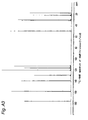


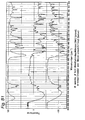
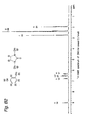


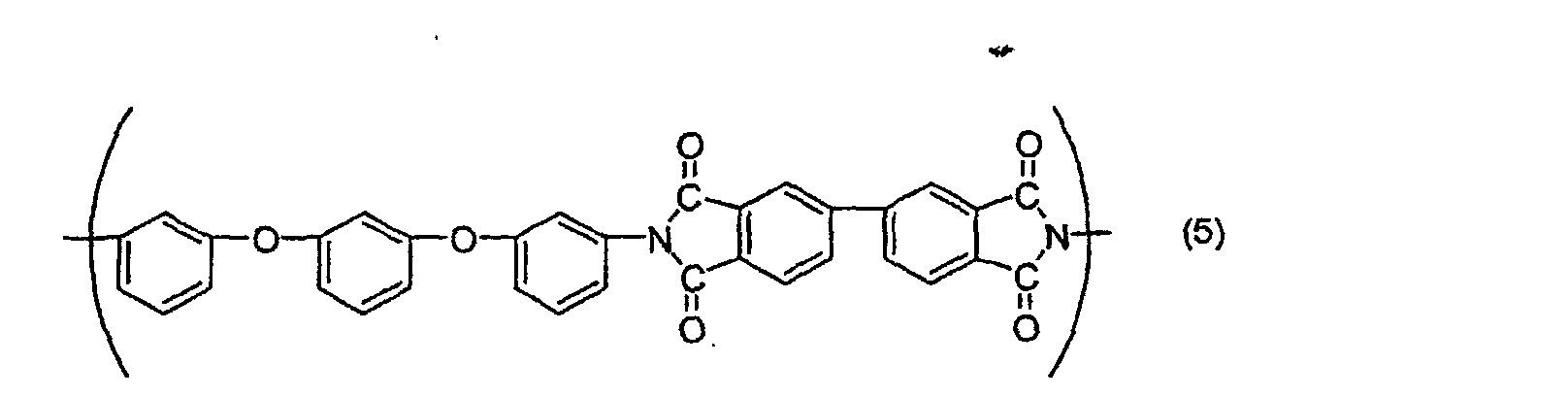
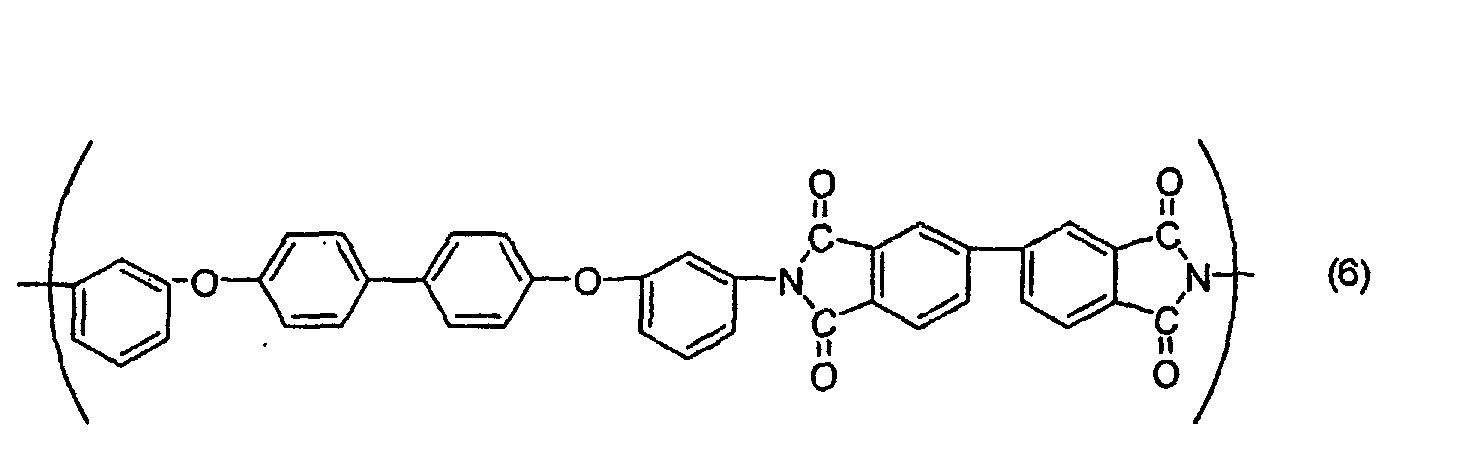
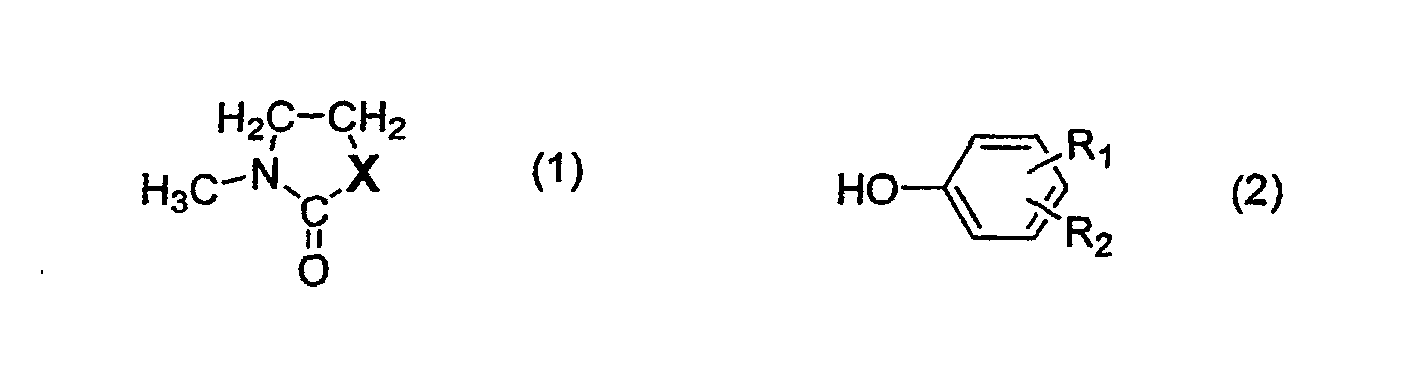


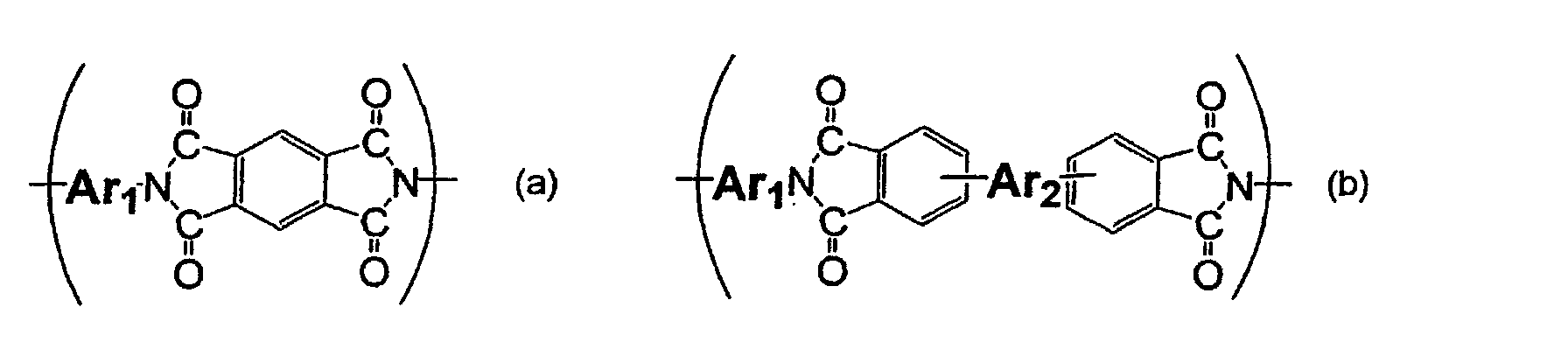

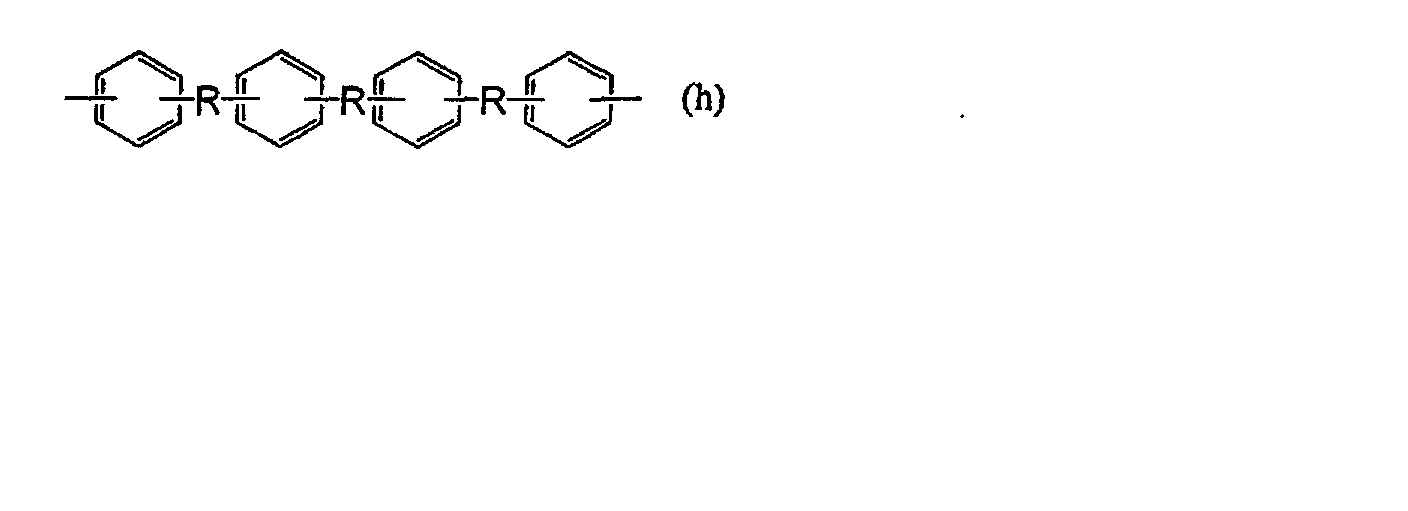


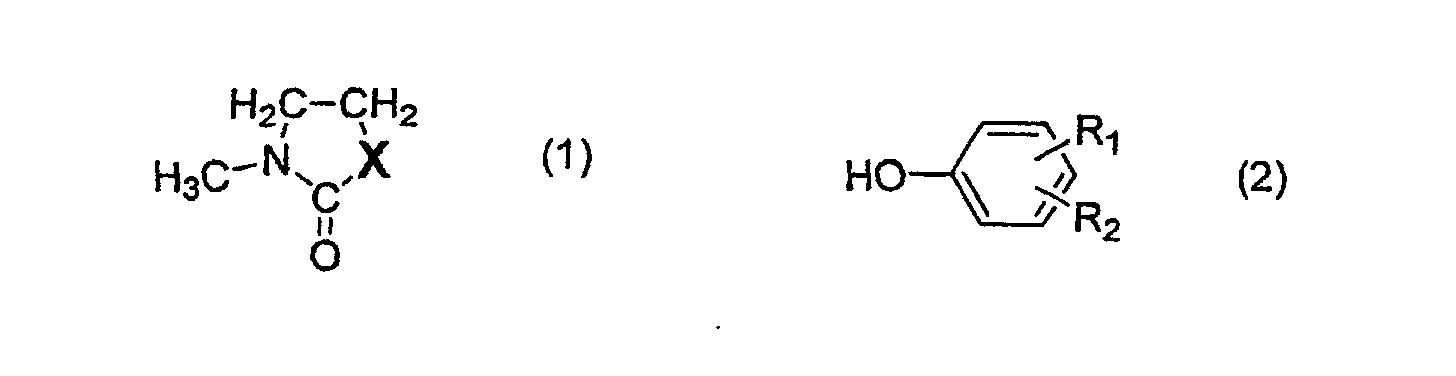
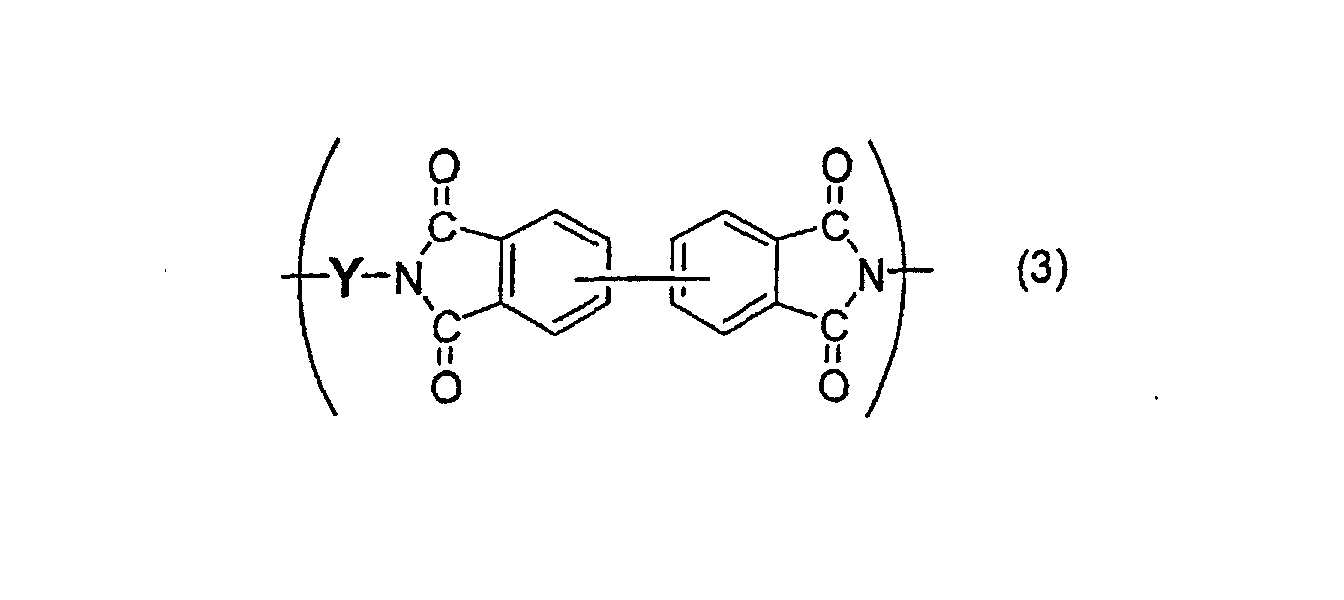
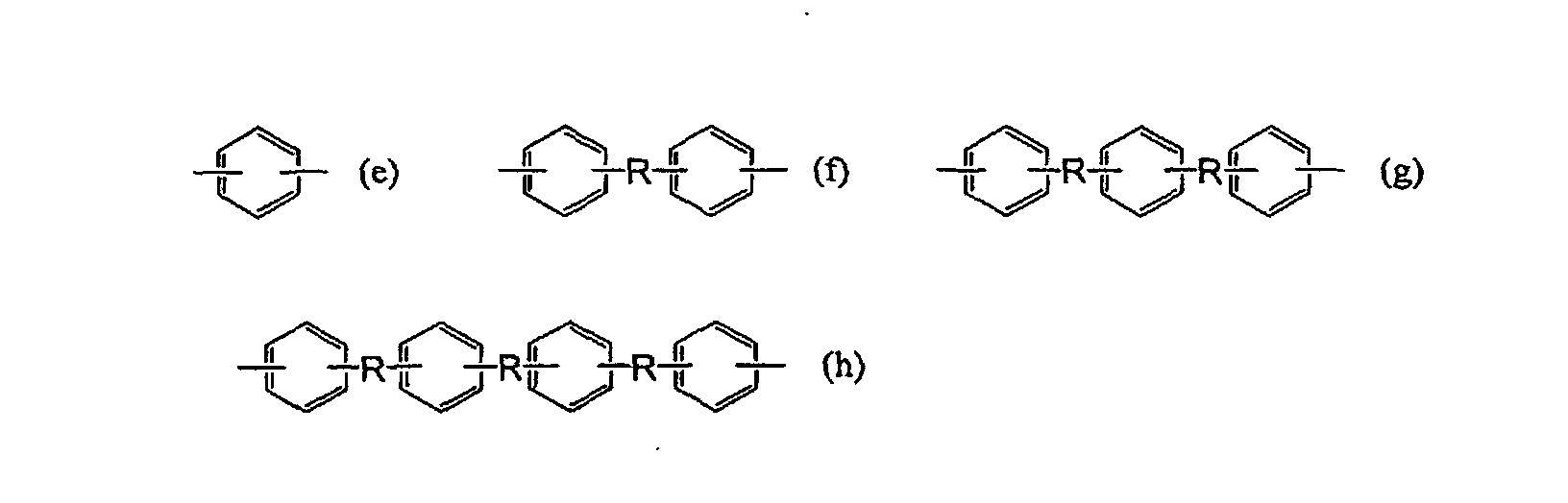


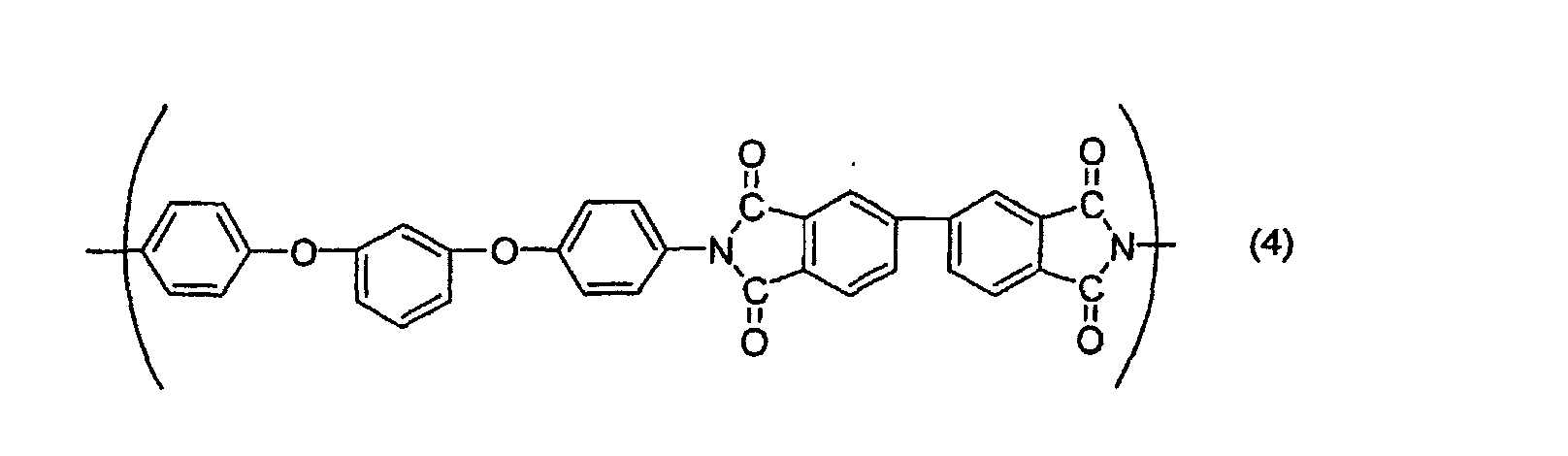
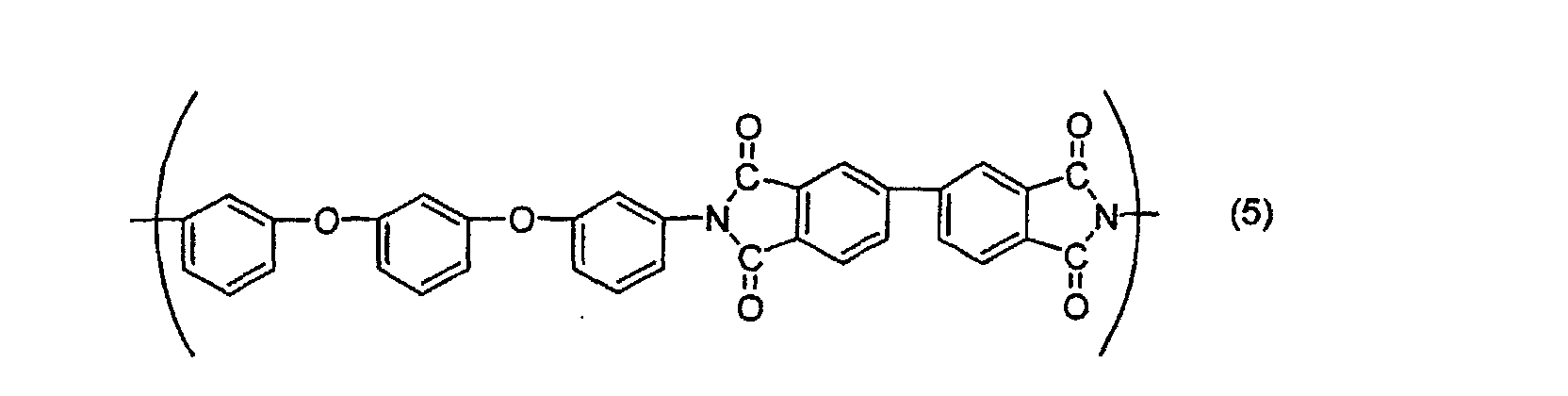
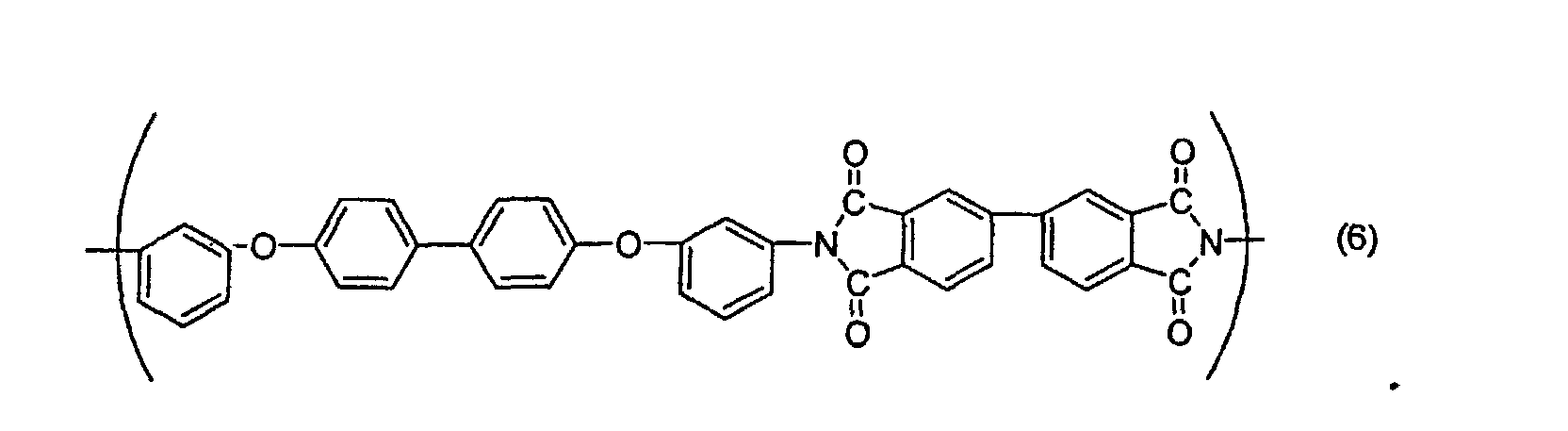

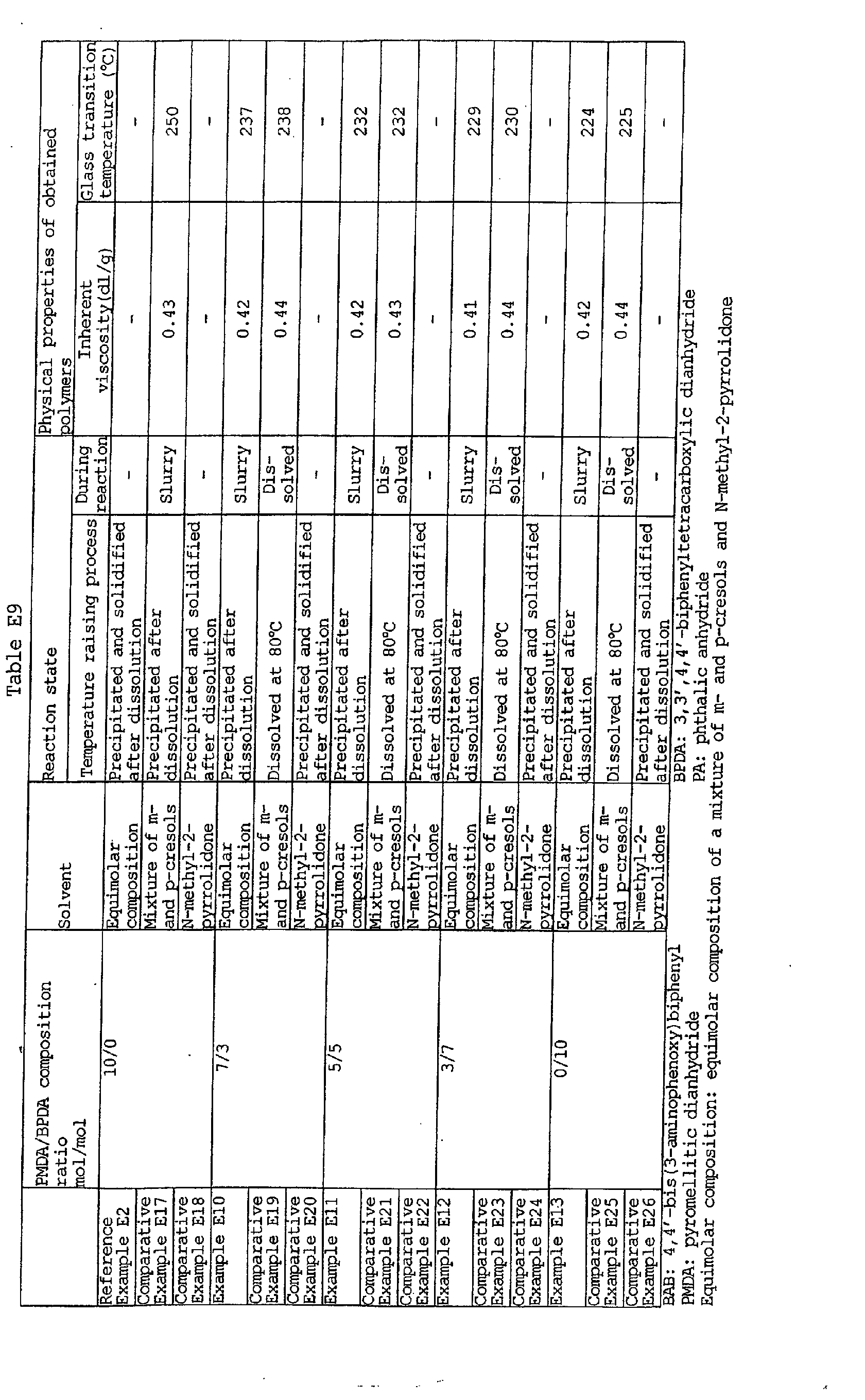


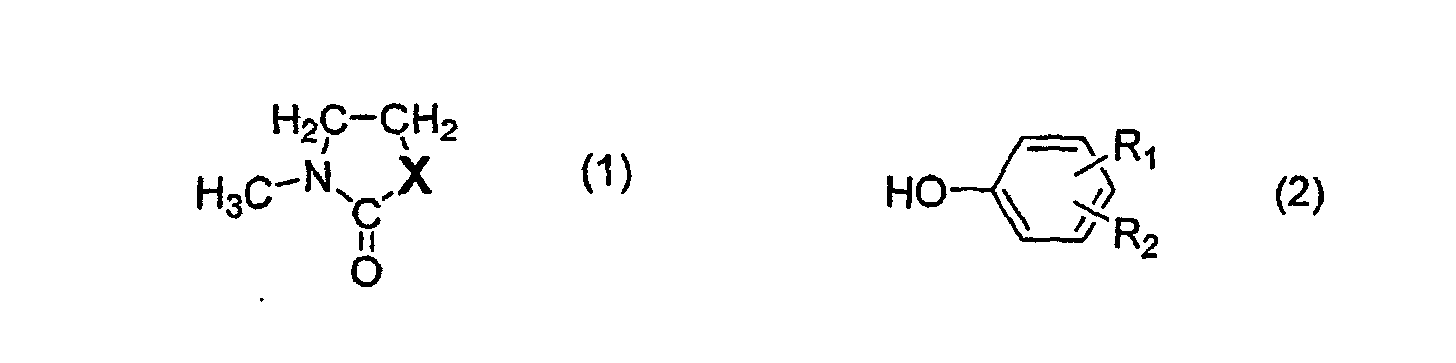
 wherein, R's may be the same as, or different from, each other and represent each any one of a single bond, -O-, - CO-, -SO2-, -S-, -CH2- and -C(CH3)2-.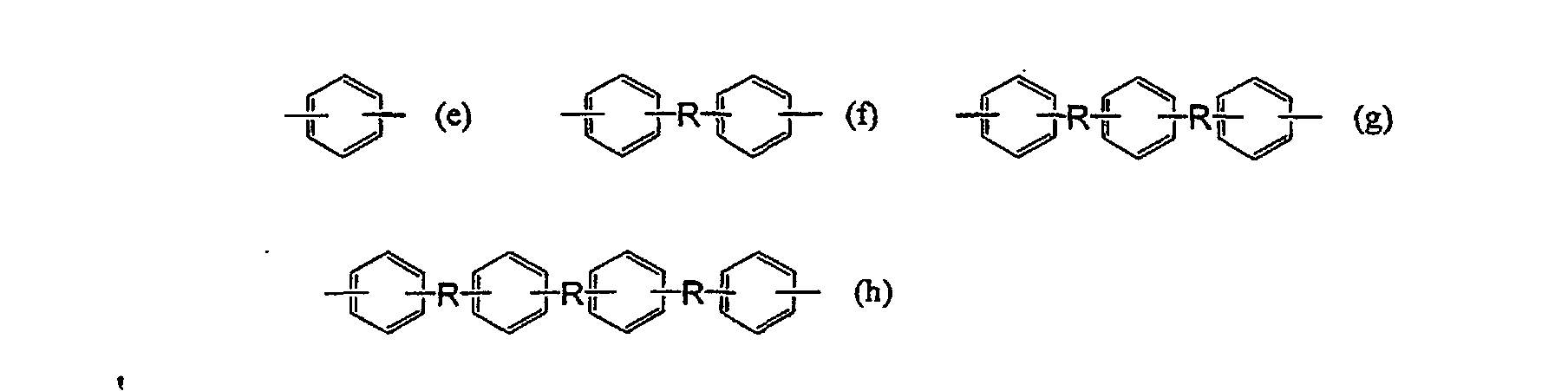
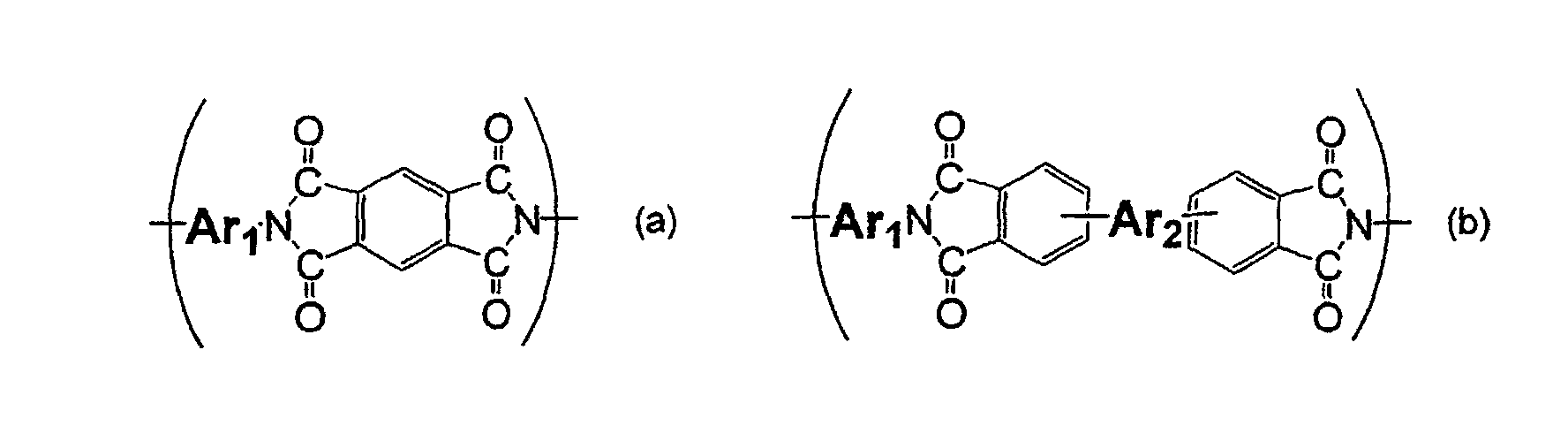 in formulas (f), (g) and (h), R's may be the same as, or different from, each other and represent each any one of a single bond, -O-, -CO-, -SO2-, -S-, -CH2- and -C(CH3)2-, and