EP1273566A2 - Verfahren zum kontinuierlichen Herstellen von Esterölen - Google Patents
Verfahren zum kontinuierlichen Herstellen von Esterölen Download PDFInfo
- Publication number
- EP1273566A2 EP1273566A2 EP02014219A EP02014219A EP1273566A2 EP 1273566 A2 EP1273566 A2 EP 1273566A2 EP 02014219 A EP02014219 A EP 02014219A EP 02014219 A EP02014219 A EP 02014219A EP 1273566 A2 EP1273566 A2 EP 1273566A2
- Authority
- EP
- European Patent Office
- Prior art keywords
- column
- reaction
- reaction column
- eth
- ester
- Prior art date
- Legal status (The legal status is an assumption and is not a legal conclusion. Google has not performed a legal analysis and makes no representation as to the accuracy of the status listed.)
- Granted
Links
Images

Classifications
-
- C—CHEMISTRY; METALLURGY
- C07—ORGANIC CHEMISTRY
- C07C—ACYCLIC OR CARBOCYCLIC COMPOUNDS
- C07C67/00—Preparation of carboxylic acid esters
- C07C67/03—Preparation of carboxylic acid esters by reacting an ester group with a hydroxy group
Definitions
- the invention relates to a process for the continuous production of ester oils, those from esters from an aliphatic C6-C10 monocarboxylic acid and a higher alcohol exist, by transesterification of a methyl or ethyl ester Monocarboxylic acid with the higher alcohol under homogeneous alkaline catalysis, the feed materials boiling in the same temperature range and the Boiling temperatures differ in particular only by a maximum of 10 ° C.
- Ester oils have been known for a long time and are used in large quantities Amounts used as part of lubricants. This registration relates is particularly concerned with the production of octanoic acid-2-ethyl-hexyl ester Invention is not limited to this ester, but that Manufacturing process can also use other similar esters or feedstocks similar properties are used.
- Continuous transesterification processes are also generally known, in which is a mixture of an ester and an alcohol, which is difficult volatile ester, as well as the transesterification catalyst the upper part of a Feeds distillation column and heated such that the liberated Alcohol was distilled off overhead and the more volatile ester at the bottom of the Column arises where it can be withdrawn.
- OEH 2-ethylhexanoic acid
- ETH 2-ethylhexanol
- C6-10 2-ethylhexanol
- a stirred tank reactor with a dephlegmator is used as the reactor or column and vacuum system used.
- the excess of 2-ethylhexanol is distilled off after the reaction.
- reaction columns It is also known for continuous production of products several reactants a reaction column with a number of bubble trays use.
- a reactant is usually on the top reaction plate abandoned as a liquid. The liquid flows from top down over the trays through the column.
- reaction product of value is drawn off at the bottom of the reaction column.
- the vaporous excess of reactants supplied in vapor form and the vapor form Reaction by-product in the condenser and is fully condensed there.
- the column or the trays can be heated.
- the entire liquid reactant is at the bottom the column is not always fully converted into the reaction product of value.
- the Reactant can in a bottom evaporator at the pressure of the reaction column are only partially distilled off from the reaction product.
- each bell of a throttle bore Under normal operation the gas velocity must be in a throttle bore with an 11 mm diameter be greater than 8 m / s so that the floors do not rain through.
- the invention has for its object a continuous production of To enable ester oils by a method of the type mentioned, wherein Almost complete sales are achieved after only a short dwell time becomes. Further advantages of the invention can be found below.
- This object is achieved according to the invention in the process of the type mentioned at the outset solved in that the process in a reaction column with a Majority of soils that run empty without gas pollution that one the liquid feed materials in the upper part of the column and that one Inert gas as support gas flow from bottom to top through the reaction column leaves.
- octanoic acid-2-ethyl-hexyl ester is issued Methyl octanoate (ME) and 2-ethylhexanol (ETH).
- Nitrogen is preferably used as the inert gas.
- an alcoholate of an alkali metal in particular, is used as the catalyst Sodium methylate, and a dry, warmed inert gas that the Feed materials dry. Drying with the inert gas stream reduces the Moisture content of the feed materials before the catalyst with the moisture can react.
- the sodium methylate catalyst therefore remains active because it will no sodium hydroxide solution is formed, and without sodium hydroxide solution only in the reaction system takes place a slight soap formation of the methyl ester takes place. Without drying through that The catalyst would not be inert gas, or would be only under large ones, sodium methylate Difficulty to use.
- 30% methanolic sodium methylate is used as the catalyst a, which can be dissolved in 2-ethylhexanol.
- the reaction column can be heated over its entire length. It is possible but also that only the upper floors are heated. It is therefore proposed that at least the upper plates of the reaction column are heated.
- the starting materials flow in cocurrent from top to bottom through the reaction column.
- reaction column flowing inert gas flow (gas load) to the minimum value at which does not cause the feedstocks to rain through the floors.
- the reaction column works without Bottom evaporator.
- Feedstocks for the synthesis of octanoic acid-2-ethyl-hexyl ester are 2-ethylhexanol (ETH) and methyl ester (ME), preferably pure methyl ester C8 (ME C8).
- ETH 2-ethylhexanol
- ME methyl ester
- ME C8 pure methyl ester C8
- Fresh ME C8 (158 kg / kmol) is placed on the top according to the invention Reaction tray only warmed up slightly.
- the top floors become Drying the methyl ester used and also have the function of Dephlegmator.
- the liquid Reactant supplied hot in known reaction columns, the liquid Reactant supplied hot.
- 2-Ethylhexanol is added as dry as possible.
- Fresh ETH 130 kg / kmol is according to the invention as a liquid on the second top reaction plate or hot fed just below.
- ETH and ME flow in direct current from top to bottom through the column.
- vaporous ETH is out of the question since it has soils with only a few flows would completely condense. The floors above would run dry. Vaporous methanol is also not suitable as a support gas, since it is in the Solve OEH and in reaction equilibrium a high turnover to OEH would prevent.
- nitrogen is used as the support gas.
- the nitrogen is preferably heated using a heater.
- An amount of nitrogen is preferably added to the lowermost tray so that the trays do not rain even when the reaction is complete.
- the comparable air velocity w air of nitrogen in the throttle bores is preferably set above 7.8 m / s, as has already been stated above.
- the gas empty pipe speed is based on the column cross section preferably equal to or greater than 0.06 m / s and in particular less than 0.079 m / s.
- the catalyst used is preferably 30% methanolic Na methylate solution (Na-M) used.
- the Na methylate solution is fed into the column separately at the level of the ETH feed fed.
- the Na methylate solution can also be used together with the ETH.
- 1.1 to 3 mol Na methylate / kmol fresh methyl ester is added.
- the Na methylate could co-exist React water to NaOH.
- the NaOH would then saponify the methyl esters.
- the soaps would fail on the reaction trays, the bells would clog and the pressure loss would increase.
- the Na methylate solution should not be in direct contact with the moist one Get methyl ester or ME-containing recycle product, otherwise the Moisture in the methyl ester causes saponification.
- the desired reaction also does not jump or only very slowly.
- ETH contains 0.1% water and 0.24% water in ME C8-10 are measured, there is no separate drying step according to the invention Raw materials. In the known batch processes, the raw materials are used dried for about 1 hour.
- the nitrogen support gas is preferably also used to dry the starting materials.
- the nitrogen flow lowers the partial pressure as it flows through the top trays and the moisture is expelled from the feedstocks before that Water can deactivate the catalyst Na methylate.
- Molar is preferably fed in only as much fresh ETH as ME becomes. There is preferably an ETH excess of 1.3 to 1.6 mol in the column ETH / mol ME before. The excess of ETH is preferably circulated.
- the first circuit preferably consists of: top of the reaction column, Rectification attachment, partial condenser, warm return.
- the temperature of the dephlegmator is advantageously set so that the Return is 5 to 15 ° C warmer than the condensation temperature of methanol. Only a little methanol condenses, which as vapors from the dephlegmator together with the gaseous main part of the methanol and with the Nitrogen stream is discharged. At lower condensation temperatures Condense more methanol and circulate in the upper part of the column become. The turnover rate would decrease.
- a second circuit is preferably used, which consists of: sump Reaction column, stripping column, vapors condense, condensate warm up Return the top reaction tray.
- the methanol is removed from the Washed out gas stream.
- the OEH raw after the stripping column still contains catalyst and soap components. It is colored.
- the soap components can be filtered off from the cold OEH.
- the filtrate is clear.
- methyl ester C8 (ME) and 2-ethylhexanol (ETH) are in the same boiling range boil, they flow in cocurrent through the reaction column from above below. 30% methanolic Na methylate, which is used in the ETH can be solved.
- As support gas so that the floors do not rain through, flows heated inert gas, especially nitrogen from bottom to top through the heated column. At the same time, the nitrogen flow dries the feed materials. On a separate drying step is not necessary. This leaves the catalyst Na methylate active and does not become sodium hydroxide solution with the residual moisture of the feed materials implemented. Without sodium hydroxide in the system, there is no soap formation the methyl ester.
- the reaction to octanoic acid-2-ethyl-hexyl ester runs particularly on the upper trays from.
- the reaction product methanol evaporates and leaves quickly the reaction mixture.
- the reaction equilibrium shifts quickly Octanoic acid-2-ethyl-hexyl ester.
- With a dwell time of about 45 minutes (based on the Feed) practically all of the methyl ester is converted at the bottom of the column. 1.3 mol ETH / mol ME are sufficient as an ETH excess.
- the ETH excess can be obtained from the reaction product in a stripping column Remove under vacuum.
- the bottom temperature of the stripping column is the boiling temperature of the OEH.
- Emulsified soap components can be made from the filter out cold OEH raw.
- the octanoic acid-2-ethyl-hexyl ester OEH can still be distilled overhead.
- the OEH distillate is water-clear.
- the residual amounts of ETH in the distillate are less than 0.3%.
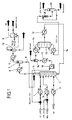
- Figure 1 is a flow diagram of a plant for performing the invention Process exemplified.
- Fresh methyl ester ME is combined with the returned ETH in one Heat exchanger 1 warmed up slightly and the top of a reaction column 2 fed.
- Fresh ETH is combined with the catalyst in one another heat exchanger 3 heated and also the upper part of the reaction column 2, but fed to a floor below the top floor. about A heater 4 becomes nitrogen gas at the bottom of the reaction column 2 fed.
- the excess of ETH is returned in two cycles.
- the Reaction column 2 vapors rise, consisting of nitrogen gas, methanol, ETH and ME exist. They are partially in after cooling in the heat exchanger 6 a dephlegmator 7 condenses.
- the ETH and ME Condensate flows via the return line 8 to the rectification attachment 5 Reaction column 2 back.
- the brothers rising from Dephlegmator 7 consist essentially of methanol and nitrogen. You will be looking for one further cooling in the heat exchanger 9 passed to the cold trap 10, where ETH, ME and water and the reaction by-product methanol condense.
- the remaining gas stream contains little methanol and only traces of ETH and ME as well as the total nitrogen content. This gas flow is in the downstream scrubber 11 treated with a little water, the methanol is washed out and finally only nitrogen remains as a gas component.
- the bottom product of the rectification column 2 is via a further heater 12 a middle plate of a stripping column 13, which under vacuum is operated, supplied.
- the stripping column 13 has a cooler 14 at the top and equipped with a sump heater 15. Via a cold trap 16 and one Another cooler 17 is the product obtained at the top of the stripping column 13 as condensate via a pump 18 warm the top reaction plate Rectification column 2 fed.
- the distillate provides that Desired end product OEH.
- a reaction column 2 with 17 trays and with a hold up of 0.15 l / tray was fed 1.3 kg / h ME C8 at a temperature of 75 ° C.
- 1.07 kg / h of ETH were fed in together with 0.43 kg / h of excess ETH at a temperature of 160 ° C.
- 1.2 g of 30% methanolic Na methylate / kg ETH were dissolved in the ETH.
- 1.2 m 3 / h of nitrogen (empty pipe speed 0.059 m / s) at a temperature of 160 ° C. were fed into the bottom floor.
- the reaction column 2 was heated to 160 ° C. An existing one Bottom evaporator was not heated, so that the column 2 without Swamp evaporator worked.
- the return from the dephlegmator 6.7 had one Temperature of 70 ° C.
- the condensate from the cold trap was not returned. In the remaining methanol from a nitrogen-vapor stream became a water-filled washer 11 washed out.
- wash water of washer 2 no upper phase observed.
- the wash water contained 17% methanol and approx. 0.1% ETH.
- the cold trap 10 was the Soap formation on the reaction trays low.
- the soaps were warm Condition solved and did not fail.
- the pressure loss in the reaction column 2 corresponded to the hydrostatic pressure loss.
- the excess ETH was distilled off in a stripping column 13 with falling film evaporator 15.
- the feed was fed into the center of the column at a temperature of 120 ° C.
- the OEH raw was obtained at the bottom of the stripping column.
- the OEH-raw contained less than 0.3% ETH.
- the OEH-raw product was light yellow and showed warm Condition no soap streaks. However, it was cloudy.
- Soap components could be filtered off from the cloudy, cooled OEH-raw.
- the filtered OEH-crude was light yellow and clear. It could be used directly as a drilling fluid become.
Landscapes
- Chemical & Material Sciences (AREA)
- Organic Chemistry (AREA)
- Organic Low-Molecular-Weight Compounds And Preparation Thereof (AREA)
- Fats And Perfumes (AREA)
- Low-Molecular Organic Synthesis Reactions Using Catalysts (AREA)
Abstract
Description
| VWZ | ETH | ME | OEH |
| 8 | 75,7 | 5,2 | 19,1 |
| 19 | 67,3 | 1,1 | 31,6 |
| 31 | 66,2 | 0,4 | 33,4 |
| 35 | 52,2 | 0,2 | 47,6 |
| 41 | 23,9 | 0,06 | 76,0 |
| am Kopf | 115 °C |
| am Feed-Boden | 121 °C |
| unterste Zone | 175 °C |
| im Sumpf | 204 °C |
| 1 | Wärmetauscher |
| 2 | Reaktionskolonne |
| 3 | Wärmetauscher |
| 4 | Erhitzer |
| 5 | Rektifikationsaufsatz |
| 6 | Wärmetauscher |
| 7 | Dephlegmator |
| 8 | Rücklaufleitung |
| 9 | Wärmetauscher |
| 10 | Kühlfalle |
| 11 | Wäscher |
| 12 | Erhitzer, Fallfilmverdampfer |
| 13 | Abtriebskolonne |
| 14 | Kühler |
| 15 | Sumpferhitzer |
| 16 | Kühlfalle |
| 17 | Kühler |
| 18 | Pumpe |
| 19 | Destillationskolonne |
| 20 | Fallfilmverdampfer |
Claims (9)
- Verfahren zum kontinuierlichen Herstellen von Esterölen, the aus Estern aus einer aliphatischen C6-C10-Monocarbonsäure und einem höheren Alkohol bestehen, durch Umestern eines Methyl- oder Ethylesters der Monocarbonsäure mit dem höheren Alkohol unter homogener alkalischer Katalyse, wobei die Einsatzstoffe im gleichen Temperaturbereich sieden und die Siedetemperaturen sich insbesondere nur um höchstens 10 °C unterscheiden,
dadurch gekennzeichnet, dass man das Verfahren in einer Reaktionskolonne (2) mit einer Mehrzahl von Böden durchführt, welche ohne Gasbelastung leerlaufen, dass man die flüssigen Einsatzstoffe im oberen Teil der Kolonne (2) zuführt und dass man ein Inertgas als Stützgas von unten nach oben durch die Reaktionskolonne (2) strömen lässt. - Verfahren nach Anspruch 1,
dadurch gekennzeichnet, dass man Octansäure-2-Ethyl-Hexylester (OEH), insbesondere aus Octansäure-Methylester (ME) und 2-Ethylhexanol (ETH), herstellt. - Verfahren nach einem der vorhergehenden Ansprüche,
dadurch gekennzeichnet, dass man als Inertgas Stickstoff einsetzt. - Verfahren nach einem der vorhergehenden Ansprüche,
dadurch gekennzeichnet, dass man als Katalysator ein Alkoholat eines Alkalimetalls, insbesondere Natrium-Methylat, und ein trockenes, erwärmtes Inertgas einsetzt, das die Einsatzstoffe trocknet. - Verfahren nach dem vorhergehenden Anspruch,
dadurch gekennzeichnet, dass man 30 %iges methanolisches Natrium-Methylat als Katalysator einsetzt . - Verfahren nach einem der vorhergehenden Ansprüche,
dadurch gekennzeichnet, dass zumindest die oberen Böden der Reaktionskolonne (2) beheizt sind. - Verfahren nach einem der vorhergehenden Ansprüche,
dadurch gekennzeichnet, dass die Einsatzstoffe im Gleichstrom von oben nach unten durch die Reaktionskolonne (2) strömen. - Verfahren nach einem der vorhergehenden Ansprüche,
dadurch gekennzeichnet, dass man den durch die Reaktionskolonne (2) strömenden Inertgas-Strom (Gasbelastung) auf den minimalen Wert einstellt, bei welchem ein Durchregnen der Einsatzstoffe durch die Böden nicht auftritt. - Verfahren nach einem der vorhergehenden Ansprüche,
dadurch gekennzeichnet, dass die Reaktionskolonne (2) ohne Sumpfverdampfer arbeitet.
Applications Claiming Priority (2)
| Application Number | Priority Date | Filing Date | Title |
|---|---|---|---|
| DE10132677A DE10132677A1 (de) | 2001-07-05 | 2001-07-05 | Wäßrige, geruchsneutrale Waschdispersionen |
| DE10132677 | 2001-07-05 |
Publications (3)
| Publication Number | Publication Date |
|---|---|
| EP1273566A2 true EP1273566A2 (de) | 2003-01-08 |
| EP1273566A3 EP1273566A3 (de) | 2004-01-21 |
| EP1273566B1 EP1273566B1 (de) | 2006-08-30 |
Family
ID=7690760
Family Applications (1)
| Application Number | Title | Priority Date | Filing Date |
|---|---|---|---|
| EP02014219A Expired - Lifetime EP1273566B1 (de) | 2001-07-05 | 2002-06-26 | Verfahren zum kontinuierlichen Herstellen von Esterölen |
Country Status (3)
| Country | Link |
|---|---|
| EP (1) | EP1273566B1 (de) |
| AT (1) | ATE338019T1 (de) |
| DE (2) | DE10132677A1 (de) |
Family Cites Families (3)
| Publication number | Priority date | Publication date | Assignee | Title |
|---|---|---|---|---|
| US5064935A (en) * | 1990-08-01 | 1991-11-12 | E. I. Dupont De Nemours And Company | Continuous process for preparing poly(butylene terephthalate) oligomer or poly(butylene isophthalate) oligomer |
| US5767257A (en) * | 1996-07-19 | 1998-06-16 | The Procter & Gamble Company | Methods for producing polyol fatty acid polyesters using atmospheric or superatmospheric pressure |
| US5945529A (en) * | 1996-07-19 | 1999-08-31 | The Procter & Gamble Company | Synthesis of polyol fatty acid polyesters using column with inert gas stripping |
-
2001
- 2001-07-05 DE DE10132677A patent/DE10132677A1/de not_active Withdrawn
-
2002
- 2002-06-26 AT AT02014219T patent/ATE338019T1/de not_active IP Right Cessation
- 2002-06-26 EP EP02014219A patent/EP1273566B1/de not_active Expired - Lifetime
- 2002-06-26 DE DE50207974T patent/DE50207974D1/de not_active Expired - Fee Related
Also Published As
| Publication number | Publication date |
|---|---|
| ATE338019T1 (de) | 2006-09-15 |
| EP1273566B1 (de) | 2006-08-30 |
| EP1273566A3 (de) | 2004-01-21 |
| DE50207974D1 (de) | 2006-10-12 |
| DE10132677A1 (de) | 2003-01-16 |
Similar Documents
| Publication | Publication Date | Title |
|---|---|---|
| EP0795536B1 (de) | Verfahren zur kontinuierlichen Herstellung von Alkylestern der (Meth)acrylsäure | |
| EP0141358B1 (de) | Verfahren zur verbesserten destillativen Aufarbeitung von Glycerin | |
| EP0132570B1 (de) | Verbessertes Verfahren zur schonenden Destillation von Fettsäuren | |
| DE2545508B2 (de) | Verfahren zum destillieren und reinigen eines rohalkohol enthaltenden gemisches | |
| DE19604267A1 (de) | Verfahren zur kontinuierlichen Herstellung von Alkylestern der (Meth)acrylsäure | |
| EP0033929A1 (de) | Verfahren zur kontinuierlichen Herstellung von Triacetin | |
| WO1999050219A1 (de) | Verfahren zur herstellung von acrylsäure und acrylsäureestern | |
| DE3143734A1 (de) | Verfahren zur kontinuierlichen rektifikation eines alkohole enthaltenden fluessigkeitsgemisches" | |
| EP0332971B1 (de) | Verfahren zur kontinuierlichen Umesterung von Fettsäureniedrigalkyl-estern | |
| DE3522897C2 (de) | ||
| DE10063175A1 (de) | Verfahren zur Herstellung von höheren (Meth)acrylsäureestern | |
| EP0291870B1 (de) | Verfahren zur Herstellung von Triglyceriden | |
| EP1273566B1 (de) | Verfahren zum kontinuierlichen Herstellen von Esterölen | |
| EP0464045B1 (de) | Diskontinuierliches verfahren zum führen einer heterogen katalysierten reaktion und anlage zum heterogen katalysierten herstellen von produkten | |
| WO2000058249A1 (de) | Verfahren zur destillativen auftrennung eines flüssigen rohalkoholgemisches | |
| DE102005010587A1 (de) | Verfahren zur Herstellung von Alkylestern der (Meth)acrylsäure | |
| DE3146191A1 (de) | Verfahren zum kontinuierlichen verestern von methacrylsaeure | |
| DE10330934A1 (de) | Isolierung von Citronellal oder Citronellol aus einem Rohgemisch | |
| DE3236977C2 (de) | Verfahren zur Geradeausdestillation von Fettrohsäuren, die zumindest teilweise ungesättigt sind | |
| WO2023031386A1 (de) | Optimierte katalysatoraufarbeitung und -recycling bei der synthese von methacrolein | |
| DE3636754A1 (de) | Verfahren zur herstellung von essigsaeurealkylestern | |
| DE3236985A1 (de) | Verfahren zum entgasen, entwaessern und zur vorlaufabtrennung bei der geradeausdestillation von fettrohsaeuren | |
| DD231065A1 (de) | Verfahren zur gewinnung von glyzerin hoher reinheit aus hochdruckspaltprodukten | |
| DE3333558C2 (de) | ||
| DE1923142C3 (de) | Verfahren zur destiilativen Reinigung von Gemischen höher molekularer Fettsäuren oder fetten ölen und Einrichtung zur Ausübung des Verfahrens |
Legal Events
| Date | Code | Title | Description |
|---|---|---|---|
| PUAI | Public reference made under article 153(3) epc to a published international application that has entered the european phase |
Free format text: ORIGINAL CODE: 0009012 |
|
| 17P | Request for examination filed |
Effective date: 20020626 |
|
| AK | Designated contracting states |
Kind code of ref document: A2 Designated state(s): AT BE CH CY DE DK ES FI FR GB GR IE IT LI LU MC NL PT SE TR |
|
| AX | Request for extension of the european patent |
Free format text: AL;LT;LV;MK;RO;SI |
|
| PUAL | Search report despatched |
Free format text: ORIGINAL CODE: 0009013 |
|
| AK | Designated contracting states |
Kind code of ref document: A3 Designated state(s): AT BE CH CY DE DK ES FI FR GB GR IE IT LI LU MC NL PT SE TR |
|
| AX | Request for extension of the european patent |
Extension state: AL LT LV MK RO SI |
|
| AKX | Designation fees paid |
Designated state(s): AT BE CH CY DE DK ES FI FR GB GR IE IT LI LU MC NL PT SE TR |
|
| 17Q | First examination report despatched |
Effective date: 20050509 |
|
| RAP1 | Party data changed (applicant data changed or rights of an application transferred) |
Owner name: COGNIS IP MANAGEMENT GMBH |
|
| GRAP | Despatch of communication of intention to grant a patent |
Free format text: ORIGINAL CODE: EPIDOSNIGR1 |
|
| GRAS | Grant fee paid |
Free format text: ORIGINAL CODE: EPIDOSNIGR3 |
|
| GRAA | (expected) grant |
Free format text: ORIGINAL CODE: 0009210 |
|
| AK | Designated contracting states |
Kind code of ref document: B1 Designated state(s): AT BE CH CY DE DK ES FI FR GB GR IE IT LI LU MC NL PT SE TR |
|
| PG25 | Lapsed in a contracting state [announced via postgrant information from national office to epo] |
Ref country code: IT Free format text: LAPSE BECAUSE OF FAILURE TO SUBMIT A TRANSLATION OF THE DESCRIPTION OR TO PAY THE FEE WITHIN THE PRESCRIBED TIME-LIMIT;WARNING: LAPSES OF ITALIAN PATENTS WITH EFFECTIVE DATE BEFORE 2007 MAY HAVE OCCURRED AT ANY TIME BEFORE 2007. THE CORRECT EFFECTIVE DATE MAY BE DIFFERENT FROM THE ONE RECORDED. Effective date: 20060830 Ref country code: NL Free format text: LAPSE BECAUSE OF FAILURE TO SUBMIT A TRANSLATION OF THE DESCRIPTION OR TO PAY THE FEE WITHIN THE PRESCRIBED TIME-LIMIT Effective date: 20060830 Ref country code: GB Free format text: LAPSE BECAUSE OF FAILURE TO SUBMIT A TRANSLATION OF THE DESCRIPTION OR TO PAY THE FEE WITHIN THE PRESCRIBED TIME-LIMIT Effective date: 20060830 Ref country code: FI Free format text: LAPSE BECAUSE OF FAILURE TO SUBMIT A TRANSLATION OF THE DESCRIPTION OR TO PAY THE FEE WITHIN THE PRESCRIBED TIME-LIMIT Effective date: 20060830 Ref country code: IE Free format text: LAPSE BECAUSE OF FAILURE TO SUBMIT A TRANSLATION OF THE DESCRIPTION OR TO PAY THE FEE WITHIN THE PRESCRIBED TIME-LIMIT Effective date: 20060830 |
|
| REG | Reference to a national code |
Ref country code: GB Ref legal event code: FG4D Free format text: NOT ENGLISH |
|
| REG | Reference to a national code |
Ref country code: CH Ref legal event code: EP |
|
| REG | Reference to a national code |
Ref country code: IE Ref legal event code: FG4D Free format text: LANGUAGE OF EP DOCUMENT: GERMAN |
|
| REF | Corresponds to: |
Ref document number: 50207974 Country of ref document: DE Date of ref document: 20061012 Kind code of ref document: P |
|
| PG25 | Lapsed in a contracting state [announced via postgrant information from national office to epo] |
Ref country code: SE Free format text: LAPSE BECAUSE OF FAILURE TO SUBMIT A TRANSLATION OF THE DESCRIPTION OR TO PAY THE FEE WITHIN THE PRESCRIBED TIME-LIMIT Effective date: 20061130 Ref country code: DK Free format text: LAPSE BECAUSE OF FAILURE TO SUBMIT A TRANSLATION OF THE DESCRIPTION OR TO PAY THE FEE WITHIN THE PRESCRIBED TIME-LIMIT Effective date: 20061130 |
|
| PG25 | Lapsed in a contracting state [announced via postgrant information from national office to epo] |
Ref country code: ES Free format text: LAPSE BECAUSE OF FAILURE TO SUBMIT A TRANSLATION OF THE DESCRIPTION OR TO PAY THE FEE WITHIN THE PRESCRIBED TIME-LIMIT Effective date: 20061211 |
|
| PG25 | Lapsed in a contracting state [announced via postgrant information from national office to epo] |
Ref country code: PT Free format text: LAPSE BECAUSE OF FAILURE TO SUBMIT A TRANSLATION OF THE DESCRIPTION OR TO PAY THE FEE WITHIN THE PRESCRIBED TIME-LIMIT Effective date: 20070212 |
|
| NLV1 | Nl: lapsed or annulled due to failure to fulfill the requirements of art. 29p and 29m of the patents act | ||
| ET | Fr: translation filed | ||
| GBV | Gb: ep patent (uk) treated as always having been void in accordance with gb section 77(7)/1977 [no translation filed] |
Effective date: 20060830 |
|
| REG | Reference to a national code |
Ref country code: IE Ref legal event code: FD4D |
|
| PGFP | Annual fee paid to national office [announced via postgrant information from national office to epo] |
Ref country code: DE Payment date: 20070621 Year of fee payment: 6 |
|
| PLBE | No opposition filed within time limit |
Free format text: ORIGINAL CODE: 0009261 |
|
| STAA | Information on the status of an ep patent application or granted ep patent |
Free format text: STATUS: NO OPPOSITION FILED WITHIN TIME LIMIT |
|
| 26N | No opposition filed |
Effective date: 20070531 |
|
| BERE | Be: lapsed |
Owner name: COGNIS IP MANAGEMENT G.M.B.H. Effective date: 20070630 |
|
| PG25 | Lapsed in a contracting state [announced via postgrant information from national office to epo] |
Ref country code: MC Free format text: LAPSE BECAUSE OF NON-PAYMENT OF DUE FEES Effective date: 20070630 |
|
| REG | Reference to a national code |
Ref country code: CH Ref legal event code: PL |
|
| PG25 | Lapsed in a contracting state [announced via postgrant information from national office to epo] |
Ref country code: BE Free format text: LAPSE BECAUSE OF NON-PAYMENT OF DUE FEES Effective date: 20070630 |
|
| PG25 | Lapsed in a contracting state [announced via postgrant information from national office to epo] |
Ref country code: CH Free format text: LAPSE BECAUSE OF NON-PAYMENT OF DUE FEES Effective date: 20070630 Ref country code: GR Free format text: LAPSE BECAUSE OF FAILURE TO SUBMIT A TRANSLATION OF THE DESCRIPTION OR TO PAY THE FEE WITHIN THE PRESCRIBED TIME-LIMIT Effective date: 20061201 Ref country code: LI Free format text: LAPSE BECAUSE OF NON-PAYMENT OF DUE FEES Effective date: 20070630 |
|
| PGFP | Annual fee paid to national office [announced via postgrant information from national office to epo] |
Ref country code: FR Payment date: 20070608 Year of fee payment: 6 |
|
| PG25 | Lapsed in a contracting state [announced via postgrant information from national office to epo] |
Ref country code: AT Free format text: LAPSE BECAUSE OF NON-PAYMENT OF DUE FEES Effective date: 20070626 |
|
| REG | Reference to a national code |
Ref country code: FR Ref legal event code: ST Effective date: 20090228 |
|
| PG25 | Lapsed in a contracting state [announced via postgrant information from national office to epo] |
Ref country code: DE Free format text: LAPSE BECAUSE OF NON-PAYMENT OF DUE FEES Effective date: 20090101 |
|
| PG25 | Lapsed in a contracting state [announced via postgrant information from national office to epo] |
Ref country code: CY Free format text: LAPSE BECAUSE OF FAILURE TO SUBMIT A TRANSLATION OF THE DESCRIPTION OR TO PAY THE FEE WITHIN THE PRESCRIBED TIME-LIMIT Effective date: 20060830 Ref country code: LU Free format text: LAPSE BECAUSE OF NON-PAYMENT OF DUE FEES Effective date: 20070626 Ref country code: FR Free format text: LAPSE BECAUSE OF NON-PAYMENT OF DUE FEES Effective date: 20080630 |
|
| PG25 | Lapsed in a contracting state [announced via postgrant information from national office to epo] |
Ref country code: TR Free format text: LAPSE BECAUSE OF FAILURE TO SUBMIT A TRANSLATION OF THE DESCRIPTION OR TO PAY THE FEE WITHIN THE PRESCRIBED TIME-LIMIT Effective date: 20060830 |