EP1271473A1 - Procédé et système de pré et de post-traitement d'un signal audio pour la transmission sur un canal fortement pertubé - Google Patents
Procédé et système de pré et de post-traitement d'un signal audio pour la transmission sur un canal fortement pertubé Download PDFInfo
- Publication number
- EP1271473A1 EP1271473A1 EP02291421A EP02291421A EP1271473A1 EP 1271473 A1 EP1271473 A1 EP 1271473A1 EP 02291421 A EP02291421 A EP 02291421A EP 02291421 A EP02291421 A EP 02291421A EP 1271473 A1 EP1271473 A1 EP 1271473A1
- Authority
- EP
- European Patent Office
- Prior art keywords
- signal
- audio
- frequency
- level
- noise
- Prior art date
- Legal status (The legal status is an assumption and is not a legal conclusion. Google has not performed a legal analysis and makes no representation as to the accuracy of the status listed.)
- Granted
Links
- 238000000034 method Methods 0.000 title claims abstract description 26
- 230000005236 sound signal Effects 0.000 title claims description 43
- 230000005540 biological transmission Effects 0.000 title claims description 12
- 238000012805 post-processing Methods 0.000 title claims description 9
- 238000001228 spectrum Methods 0.000 claims abstract description 36
- 238000012886 linear function Methods 0.000 claims abstract description 9
- 238000009499 grossing Methods 0.000 claims description 9
- 238000007781 pre-processing Methods 0.000 claims description 7
- 238000012545 processing Methods 0.000 claims description 5
- 241001644893 Entandrophragma utile Species 0.000 description 11
- 238000004458 analytical method Methods 0.000 description 11
- 230000009466 transformation Effects 0.000 description 10
- 239000003607 modifier Substances 0.000 description 8
- 210000004027 cell Anatomy 0.000 description 7
- 230000004048 modification Effects 0.000 description 6
- 238000012986 modification Methods 0.000 description 6
- 241000897276 Termes Species 0.000 description 4
- 238000010586 diagram Methods 0.000 description 4
- 230000000694 effects Effects 0.000 description 4
- 230000006870 function Effects 0.000 description 4
- 235000021183 entrée Nutrition 0.000 description 3
- 230000007774 longterm Effects 0.000 description 3
- 230000003595 spectral effect Effects 0.000 description 3
- 238000010183 spectrum analysis Methods 0.000 description 3
- 241001080024 Telles Species 0.000 description 2
- 230000001944 accentuation Effects 0.000 description 2
- 230000003416 augmentation Effects 0.000 description 2
- 238000004364 calculation method Methods 0.000 description 2
- 230000008859 change Effects 0.000 description 2
- 230000008569 process Effects 0.000 description 2
- 230000004044 response Effects 0.000 description 2
- 238000005070 sampling Methods 0.000 description 2
- 230000035945 sensitivity Effects 0.000 description 2
- 230000001131 transforming effect Effects 0.000 description 2
- 238000012935 Averaging Methods 0.000 description 1
- 240000008042 Zea mays Species 0.000 description 1
- 230000003044 adaptive effect Effects 0.000 description 1
- 238000013459 approach Methods 0.000 description 1
- 230000033228 biological regulation Effects 0.000 description 1
- 230000015556 catabolic process Effects 0.000 description 1
- 238000004140 cleaning Methods 0.000 description 1
- 238000006731 degradation reaction Methods 0.000 description 1
- 230000000977 initiatory effect Effects 0.000 description 1
- 230000008447 perception Effects 0.000 description 1
- 238000002203 pretreatment Methods 0.000 description 1
- 238000011084 recovery Methods 0.000 description 1
- 230000009467 reduction Effects 0.000 description 1
- 230000002441 reversible effect Effects 0.000 description 1
- 238000007493 shaping process Methods 0.000 description 1
- 230000001360 synchronised effect Effects 0.000 description 1
- 230000002123 temporal effect Effects 0.000 description 1
- 238000011282 treatment Methods 0.000 description 1
Images


Classifications
-
- G—PHYSICS
- G10—MUSICAL INSTRUMENTS; ACOUSTICS
- G10L—SPEECH ANALYSIS TECHNIQUES OR SPEECH SYNTHESIS; SPEECH RECOGNITION; SPEECH OR VOICE PROCESSING TECHNIQUES; SPEECH OR AUDIO CODING OR DECODING
- G10L21/00—Speech or voice signal processing techniques to produce another audible or non-audible signal, e.g. visual or tactile, in order to modify its quality or its intelligibility
- G10L21/02—Speech enhancement, e.g. noise reduction or echo cancellation
- G10L21/0208—Noise filtering
-
- H—ELECTRICITY
- H04—ELECTRIC COMMUNICATION TECHNIQUE
- H04B—TRANSMISSION
- H04B1/00—Details of transmission systems, not covered by a single one of groups H04B3/00 - H04B13/00; Details of transmission systems not characterised by the medium used for transmission
- H04B1/62—Details of transmission systems, not covered by a single one of groups H04B3/00 - H04B13/00; Details of transmission systems not characterised by the medium used for transmission for providing a predistortion of the signal in the transmitter and corresponding correction in the receiver, e.g. for improving the signal/noise ratio
-
- G—PHYSICS
- G10—MUSICAL INSTRUMENTS; ACOUSTICS
- G10L—SPEECH ANALYSIS TECHNIQUES OR SPEECH SYNTHESIS; SPEECH RECOGNITION; SPEECH OR VOICE PROCESSING TECHNIQUES; SPEECH OR AUDIO CODING OR DECODING
- G10L21/00—Speech or voice signal processing techniques to produce another audible or non-audible signal, e.g. visual or tactile, in order to modify its quality or its intelligibility
- G10L21/02—Speech enhancement, e.g. noise reduction or echo cancellation
- G10L21/0208—Noise filtering
- G10L21/0216—Noise filtering characterised by the method used for estimating noise
- G10L21/0232—Processing in the frequency domain
Definitions
- the invention relates to a pre-treatment method and system. and post-processing of digital audio or speech signals to keep the signal quality as high as possible in the presence of a strong noise level.
- Quality even in frequency selective channels, is similar to the quality of AM (Anglo-Saxon abbreviation of Amplitude modulation) in a Gaussian type channel, with a scattered power which can be less than a tenth of the power needed for a real amplitude modulation, since no continuous carrier is transmitted.
- AM Anglo-Saxon abbreviation of Amplitude modulation
- the gain compensation has in particular the following effect: in all cases, the noise added to the samples received after demodulation has a flat frequency spectrum.
- the noise is Gaussian with a simple channel and more or less impulsive with frequency selective channels (channels having multiple propagation paths).
- Patent application WO 98/06090 discloses a system and a method implementing a nonlinear transformation on the signal so increase the perceptible quality of the audio or speech signal.
- the nonlinear transformation is applied to each of the Sk components of the spectrum obtained after a windowing and transforming step of Fourier.
- the system and method according to the invention propose a new approach where the treatments are carried out no longer considering the component of the spectrum at a given frequency k, but taking into account a value derived for example from an average or smoothing around this frequency.
- the object of the invention is a method for modifying an audio signal or speech characterized in that it comprises at least one step where the frequency spectrum S (k) of the signal is transformed by application of a non-linear function, said non-linear function being applied to a signal level A (k), B (k) determined taking into account the different signal levels a (k), b (k) for the frequency k concerned and / or neighboring frequencies, (step 2a, step 8a).
- Step 2a is for example executed before transmission and step 8a after receiving the signal.
- Processing on transmission and processing on reception can be performed synchronously on signal slices corresponding one by one.
- the method includes for example a pre-emphasis step of the audio signal to the program intended to give it a frequency spectrum at long term, parallel to that of the reception noise and a step of de-emphasis of the audio signal on reception.
- logarithm function and steps 2a and 8a can be performed by smoothing signal levels.
- this filter includes an FIR type filter at transmitter and receiver, this filter can have positive coefficients.
- the transmitter includes for example a pre-emphasis device of the audio signal before its emission and the receiver a device deemphasis of the audio signal.
- the receiver may include a noise clipping device.
- Figure 1 shows, in a signal intensity diagram expressed in dB (ordinate axis, logarithmic scale) - frequency given in Hz (on the abscissa), the frequency spectrum of the original audio signal or useful (curve I) and that of the reception noise (spurious signal) (curve II) obtained in transmission systems according to the prior art.
- dB ordinate axis, logarithmic scale
- curve II reception noise
- Figure 2 shows schematically in a frame identical to that of the FIG. 1, the frequency spectra of the useful audio signal and of the noise at the reception as it should be to get quality practically perfect for audio signal.
- the curve I representative of the audio signal has a level always higher than that of curve II representative of the spectrum of the noise at reception.
- Noise is "masked" throughout the band frequency considered. This leads to a high quality of perception: the noise is masked at all frequencies, even if its total power is same as that of the noise whose spectrum is given by curve II of the figure 1.
- the object of the invention relates to a system and a method having in particular to obtain the results illustrated by the curves of the figure 2.
- the signal considered can be an audio or speech signal.
- the audio or speech signal concerned in the present invention has a structure known to those skilled in the art which will therefore not be Detailed.
- the process steps described above can be carried out by installing software on the transmitter (software) or modifying the electronic devices composing the transmitter.
- Figure 3 shows diagrammatically in the form of a block diagram simplified, the different elements of the device pre-processing block encoder for performing the above steps 1 to 4.
- the pre-emphasis can be performed directly in the frequency domain by replacing L '(k) by L' (k) + dL (k), where dL (k) is a constant increasing the gain according to the frequency k.
- the device 231 can perform de-emphasis (removal of device 21) directly in the frequency domain by modifying the level L '(k) at the frequency k by an amount equal to -dL (k), where dL (k) is the same constant gain increase than that of the transmitter.
- the levels individual measured L '(k) are not exactly the same as in the transmitter because the noise has been added to the wanted signal.
- the level calculated for frequency k corresponds to an average value of the signal levels for the frequencies k-1, k, k + 1
- the influence of noise is divided by 3, i.e., the error made in the estimation of B (k) (from which L '(k) is deduced) is three times lower than without the smoothing step, thus leading to a significantly lower degradation in quality subjective.
- the noise reduction is equal to 924/4096, which corresponds approximately -6.5 dB with this filter.
- the smoothing can use a different low-pass filter F (z), or even be implemented by more indirect but just as effective means.
- F (z) low-pass filter
- One of these means consists for example in making the inverse Fourier transform of the levels b (k), to obtain the autocorrelation r (k), which is multiplied by a coefficient ⁇ k with y less than 1 and whose we do the Fourier transform to directly obtain the B (k).
- a very general condition is that the filter F (z) (or its equivalent according to the process used) has coefficients all strictly positive in order to prevent the A (k) on transmission or the B (k) on reception may become negative or null.
Landscapes
- Engineering & Computer Science (AREA)
- Signal Processing (AREA)
- Human Computer Interaction (AREA)
- Quality & Reliability (AREA)
- Health & Medical Sciences (AREA)
- Audiology, Speech & Language Pathology (AREA)
- Computational Linguistics (AREA)
- Physics & Mathematics (AREA)
- Acoustics & Sound (AREA)
- Multimedia (AREA)
- Computer Networks & Wireless Communication (AREA)
- Transmission Systems Not Characterized By The Medium Used For Transmission (AREA)
- Reduction Or Emphasis Of Bandwidth Of Signals (AREA)
- Noise Elimination (AREA)
- Stereo-Broadcasting Methods (AREA)
Abstract
- déterminer le niveau A(k), B(k) de signal associé à une fréquence k en tenant compte des différents niveaux a(k), b(k) du signal pour la fréquence k concernée et/ou les fréquences voisines, (étape 2a, étape 8a)
- appliquer la fonction non-linaire sur ledit niveau (A(k), B(k)).
Description
- déterminer le niveau A(k), B(k) de signal associé à une fréquence k en tenant compte des différents niveaux a(k), b(k) du signal pour la fréquence k concernée et/ou les fréquences voisines, (étape 2a, étape 8a),
- appliquer une fonction non-linaire sur ledit niveau A(k), B(k).
- En combinant le pré et le post-traitement, on obtient un spectre en
fréquence du bruit, à l'origine plat, modifié de façon telle que :
- aux fréquences où le signal audio est fort, le niveau de bruit est augmenté,
- aux fréquences où le niveau de signal est faible, le niveau de bruit est diminué.
- Le niveau de bruit est modifié (augmentation ou diminution) pour que le dit bruit reste en-dessous du signal utile pour pratiquement toutes les fréquences. Ceci augmente considérablement la qualité subjective de l'audio, même si la puissance totale de bruit est modifiée de façon non prédictible.
- Comme l'oreille a une sensibilité « logarithmique » (l'intensité du signal perçu à une fréquence donnée est plus ou moins proportionnelle au logarithme de son intensité réelle), le pré et le post traitement auront notamment pour but de modifier de façon correspondante le logarithme de l'intensité du signal à chaque fréquence ou sous-bande du signal audio, au niveau de l'émetteur et ensuite au niveau du récepteur.
- La figure 1, les spectres en fréquence du signal audio utile et du bruit à la réception,
- La figure 2, les spectres en fréquence souhaités pour les signaux de la figure 1,
- La figure 3, un diagramme bloc des différentes étapes à l'émission selon l'invention,
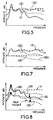
- Les figures 4 et 5, les spectres en fréquence du signal audio utile transmis,
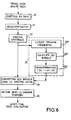
- La figure 6, un diagramme bloc des différentes étapes à la réception,
- Les figures 7 et 8, les spectres en fréquence du signal audio utile et du bruit à la réception.
- un pré-traitement du signal audio utile modifiant la composition spectrale du signal audio transmis de façon telle que le spectre de fréquence moyenné dans le temps est approximativement plat, i.e, « parallèle » au spectre du bruit généré du côté récepteur après démodulation.
- un post-traitement du côté du récepteur en deux étapes :
- un nettoyage du signal visant à éliminer les pics de bruit (lorsque le bruit n'est pas Gaussien),
- une modification inverse et sensiblement identique du spectre en fréquence de l'audio (+ bruit), afin d'avoir un signal audio avec le même spectre en fréquence (ou sensiblement le même) que le signal audio non traité.
- un système de régulation automatique de gain 10 (contrôle automatique de gain ou CAG) ayant notamment pour fonction de limiter la gamme dynamique du signal audio à l'entrée afin d'obtenir une puissance moyennée quasiment constante dans le temps (sur une durée importante), et fournissant le signal S1.
- un dispositif 11 ayant pour fonction d'analyser le spectre du signal audio utile S1 issu du CAG 10, en utilisant par exemple une transformée de Fourier rapide FFTs avec fenêtrage et recouvrement.
- un dispositif 12 pour calculer la modification de gain qui dérive S'(k) de S(k). Ce dispositif 12 comporte par exemple un dispositif 121 permettant de calculer le niveau a(k) et de le lisser dans le domaine fréquentiel pour obtenir A(k), un dispositif 122 de calcul des niveaux L(k), étape 2b), un dispositif 123 permettant de transformer L(k) en L'(k), étape 2c).
- Un dispositif 13 adapté pour modifier le module ou amplitude des composantes du spectre en fréquence initial S(k), en tenant compte de la différence L'(k) - L(k) entre les logarithmes des niveaux lissés avant et après transformation.
- Un système 14 de reconstruction temporel, basé sur une transformée de Fourier inverse et la procédure « overlapp-and-add » (recouvrement et addition).
- Un dispositif 15 pour pré-accentuer le signal dans le domaine temporel qui donne les échantillons finaux qui seront distribués dans les composantes (cellules) en phase et en quadrature des cellules de données libres de la trame transmise (ils remplacent les cellules initiales QAM).
- un système 20 d'écrêtage adaptatif qui élimine les pics de bruit lorsque leur répartition n'est pas gaussienne. Ce système peut par exemple évaluer une valeur efficace (RMS ou « Root Man Square ») à court terme du signal d'entrée et éliminer (mettre à zéro ou écrêter) les échantillons pour lesquels la valeur absolue de l'amplitude est plus grande que K fois la valeur RMS. La valeur de K peut être estimée de manière heuristique en prenant en compte les propriétés statistiques du signal audio (distribution laplacienne en première approximation). Une valeur entre 5 et 8 peut être utilisée.
- Un dispositif 21 de dé-accentuation qui compense exactement la pré-accentuation réalisée au niveau de l'émetteur.
- Un dispositif 22 d'analyse de spectre, qui peut être le même que celui (11) utilisé dans l'émetteur.
- Un dispositif 23 comportant un dispositif 231 permettant d'effectuer un lissage des valeurs de niveau de signal selon l'étape 8a), un dispositif 232 pour calculer les niveaux L'(k) (étape 8b)) et un dispositif 233 pour transformer la valeur L'(k) en une valeur L"(k) (étape 8c).
- Un dispositif 24 permettant de modifier les amplitudes des composantes dans le domaine fréquentiel du spectre initial de fréquence en tenant compte des différences L"(k) - L'(k) pour une valeur k donnée.
- Un système 25 de reconstruction de signal dans le domaine temporel qui peut être le même que le dispositif 14 utilisé au niveau de l'émetteur.
Claims (12)
- Procédé pour modifier un signal audio ou de parole caractérisé en ce qu'il comporte au moins une étape où le spectre en fréquence S(k) du signal est transformé par application d'une fonction non-linéaire, ladite fonction étant appliquée sur un niveau de signal A(k), B(k) déterminé en tenant compte de plusieurs niveaux a(k), b(k) du signal pour la fréquence k concernée et/ou les fréquences voisines, (étape 2a, étape 8a).
- Procédé selon la revendication 1 caractérisé en ce que l'étape 2a est exécutée avant l'émission du signal et l'étape 8a après la réception du signal.
- Procédé selon l'une des revendications 1 à 2 caractérisé en ce que les traitements à l'émission et les traitements à la réception sont effectués de façon synchrone sur des tranches de signal se correspondant une à une.
- Procédé selon l'une des revendications 1 à 3 caractérisé en ce qu'il comporte une étape de pré-accentuation du signal audio à l'émission et une étape de désaccentuation du signal audio à la réception.
- Procédé selon l'une des revendications 1 à 4 caractérisé en ce qu'il comporte une étape d'écrêtage des impulsions de bruit à la réception avant l'étape de désaccentuation.
- Procédé selon l'une des revendications 1 à 5 caractérisé en ce que l'on utilise comme fonction non-linéaire la fonction logarithme.
- Procédé selon l'une des revendications 1 à 6 caractérisé en ce que l'étape 2a ou l'étape 8a consiste à lisser les niveaux a(k), b(k).
- Système de pré-traitement et de post-traitement d'un signal audio ou de parole caractérisé en ce que l'émetteur et/ou le récepteur comportent au moins un moyen adapté à :déterminer le niveau A(k), B(k) de signal associé à une fréquence k en tenant compte des différents niveaux a(k), b(k) du signal pour la fréquence k concernée et/ou les fréquences voisines, (étape 2a, étape 8a),appliquer une fonction non-linaire sur ledit niveau A(k), B(k).
- Système selon la revendication 8 caractérisé en ce qu'il comporte un filtre de type FIR au niveau de l'émetteur et du récepteur.
- Système selon la revendication 9 caractérisé en ce que le filtre a des coefficients positifs.
- Système selon l'une des revendications 8 à 10 caractérisé en ce que l'émetteur comporte un dispositif de pré-accentuation du signal audio avant son émission et le récepteur un dispositif de désaccentuation du signal audio.
- Système selon l'une des revendications 8 à 11 caractérisé en ce que le récepteur comporte un dispositif d'écrêtage du bruit.
Applications Claiming Priority (2)
| Application Number | Priority Date | Filing Date | Title |
|---|---|---|---|
| FR0108279 | 2001-06-22 | ||
| FR0108279A FR2826492B1 (fr) | 2001-06-22 | 2001-06-22 | Procede et systeme de pre et de post-traitement d'un signal audio pour la transmission sur un canal fortement perturbe |
Publications (2)
| Publication Number | Publication Date |
|---|---|
| EP1271473A1 true EP1271473A1 (fr) | 2003-01-02 |
| EP1271473B1 EP1271473B1 (fr) | 2008-02-20 |
Family
ID=8864672
Family Applications (1)
| Application Number | Title | Priority Date | Filing Date |
|---|---|---|---|
| EP02291421A Expired - Lifetime EP1271473B1 (fr) | 2001-06-22 | 2002-06-07 | Procédé et système de pré et de post-traitement d'un signal audio pour la transmission sur un canal fortement pertubé |
Country Status (6)
| Country | Link |
|---|---|
| US (1) | US7561702B2 (fr) |
| EP (1) | EP1271473B1 (fr) |
| AT (1) | ATE387001T1 (fr) |
| CA (1) | CA2389785A1 (fr) |
| DE (1) | DE60225089T2 (fr) |
| FR (1) | FR2826492B1 (fr) |
Families Citing this family (1)
| Publication number | Priority date | Publication date | Assignee | Title |
|---|---|---|---|---|
| JP2019046515A (ja) * | 2017-08-30 | 2019-03-22 | 株式会社東芝 | ディスク装置およびヘッド装置 |
Citations (2)
| Publication number | Priority date | Publication date | Assignee | Title |
|---|---|---|---|---|
| US5574990A (en) * | 1993-05-27 | 1996-11-12 | Lucent Technologies Inc. | Predistortion technique for communications systems |
| WO1998006090A1 (fr) * | 1996-08-02 | 1998-02-12 | Universite De Sherbrooke | Codage parole/audio a l'aide d'une transformee non lineaire a amplitude spectrale |
Family Cites Families (4)
| Publication number | Priority date | Publication date | Assignee | Title |
|---|---|---|---|---|
| FR2654542B1 (fr) * | 1989-11-14 | 1992-01-17 | Thomson Csf | Procede et dispositif de codage de filtres predicteurs de vocodeurs tres bas debit. |
| FR2690551B1 (fr) * | 1991-10-15 | 1994-06-03 | Thomson Csf | Procede de quantification d'un filtre predicteur pour vocodeur a tres faible debit. |
| US5465396A (en) * | 1993-01-12 | 1995-11-07 | Usa Digital Radio Partners, L.P. | In-band on-channel digital broadcasting |
| FR2738383B1 (fr) * | 1995-09-05 | 1997-10-03 | Thomson Csf | Procede de quantification vectorielle de vocodeurs bas debit |
-
2001
- 2001-06-22 FR FR0108279A patent/FR2826492B1/fr not_active Expired - Fee Related
-
2002
- 2002-06-07 AT AT02291421T patent/ATE387001T1/de not_active IP Right Cessation
- 2002-06-07 EP EP02291421A patent/EP1271473B1/fr not_active Expired - Lifetime
- 2002-06-07 DE DE60225089T patent/DE60225089T2/de not_active Expired - Lifetime
- 2002-06-17 CA CA002389785A patent/CA2389785A1/fr not_active Abandoned
- 2002-06-21 US US10/176,190 patent/US7561702B2/en not_active Expired - Fee Related
Patent Citations (2)
| Publication number | Priority date | Publication date | Assignee | Title |
|---|---|---|---|---|
| US5574990A (en) * | 1993-05-27 | 1996-11-12 | Lucent Technologies Inc. | Predistortion technique for communications systems |
| WO1998006090A1 (fr) * | 1996-08-02 | 1998-02-12 | Universite De Sherbrooke | Codage parole/audio a l'aide d'une transformee non lineaire a amplitude spectrale |
Non-Patent Citations (3)
| Title |
|---|
| HERNANDEZ L ET AL: "A continuous-time noise-shaping modulator for logarithmic A/D conversion", ISCAS'99. PROCEEDINGS OF THE 1999 IEEE INTERNATIONAL SYMPOSIUM ON CIRCUITS AND SYSTEMS VLSI (CAT. NO.99CH36349), ORLANDO, FL, USA, 30 MAY-2 JUNE 1999, 1999, Piscataway, NJ, USA, IEEE, USA, pages 364 - 367 vol.2, XP002190230, ISBN: 0-7803-5471-0 * |
| LEFEBVRE R ET AL: "Spectral amplitude warping (SAW) for noise spectrum shaping in audio coding", INTERNATIONAL CONFERENCE ON ACOUSTICS, SPEECH, AND SIGNAL PROCESSING, 1997. ICASSP-97, 1997 MUNICH, GERMANY, LOS ALAMITOS, CA, USA,IEEE COMPUT. SOC, US, 21 April 1997 (1997-04-21), pages 335 - 338, XP010226203, ISBN: 0-8186-7919-0 * |
| MARTINEZ R ET AL: "Combining linear and non-linear processing in the time and in the spectral domain for non-stationary noise filtering", PROCEEDINGS OF THE IEEE-EURASIP WORKSHOP ON NONLINEAR SIGNAL AND IMAGE PROCESSING (NSIP'99), ANTALAYA, TURKEY, 20-23 JUNE 1999, 1999, Instanbul, Turkey, Bogazici Univ, Turkey, pages 598 - 602 vol.2, XP008000688, ISBN: 975-518-133-4 * |
Also Published As
| Publication number | Publication date |
|---|---|
| FR2826492B1 (fr) | 2003-09-26 |
| DE60225089T2 (de) | 2009-02-19 |
| CA2389785A1 (fr) | 2002-12-22 |
| FR2826492A1 (fr) | 2002-12-27 |
| US20030014244A1 (en) | 2003-01-16 |
| US7561702B2 (en) | 2009-07-14 |
| EP1271473B1 (fr) | 2008-02-20 |
| DE60225089D1 (de) | 2008-04-03 |
| ATE387001T1 (de) | 2008-03-15 |
Similar Documents
| Publication | Publication Date | Title |
|---|---|---|
| EP0918317B1 (fr) | Procédé de filtrage fréquentiel appliqué au débruitage de signaux sonores mettant en oeuvre un filtre de Wiener | |
| EP1789956A1 (fr) | Procede de traitement d'un signal sonore bruite et dispositif pour la mise en ceuvre du procede | |
| FR3012928A1 (fr) | Modificateurs reposant sur un snr estime exterieurement pour des calculs internes de mmse | |
| FR3012929A1 (fr) | Modificateur de la presence de probabilite de la parole perfectionnant les performances de suppression du bruit reposant sur le log-mmse | |
| FR3047578A1 (fr) | Procede d'estimation de parametres de signaux contenus dans une bande de frequences | |
| EP3192073A1 (fr) | Discrimination et atténuation de pré-échos dans un signal audionumérique | |
| EP0549445A1 (fr) | Procédé de transmission de signaux de référence dans un système de transmission de données sur plusieur porteuses | |
| EP2515300B1 (fr) | Procédé et système de réduction du bruit | |
| FR2742613A1 (fr) | Procede d'evaluation d'un facteur de qualite representatif d'un canal de transmission d'un signal numerique, et recepteur correspondant | |
| EP0884926A1 (fr) | Procédé et dispositif de traitement optimisé d'un signal perturbateur lors d'une prise de son | |
| FR2628589A1 (fr) | Codeur differentiel a filtre predicteur auto-adaptatif et decodeur utilisable en liaison avec un tel codeur | |
| EP1271473B1 (fr) | Procédé et système de pré et de post-traitement d'un signal audio pour la transmission sur un canal fortement pertubé | |
| EP1032169B1 (fr) | Système pour l'estimation du gain complexe d'un canal de transmission | |
| FR2970828A1 (fr) | Filtre de ponderation, procedes et dispositifs d'emission et de reception d'un signal analogique et programme d'ordinateur correspondants | |
| FR3113537A1 (fr) | Procédé et dispositif électronique de réduction du bruit multicanale dans un signal audio comprenant une partie vocale, produit programme d’ordinateur associé | |
| FR2826208A1 (fr) | Systeme et procede de transmission d'un signal audio ou phonie | |
| EP0585434B1 (fr) | Procede et dispositif de filtrage pour la reduction des preechos d'un signal audio-numerique | |
| FR3112915A1 (fr) | Procédé d’estimation d’un signal interférent, procédé d’atténuation d’un signal interférent contenu dans un signal réceptionné et système de réception | |
| FR2659510A1 (fr) | Dispositif de reception d'un spectre disperse. | |
| EP1107528B1 (fr) | Méthode de détection de blocs pour canal soumis à évanouissement | |
| EP1246373A1 (fr) | Procédé et dispositif pour le traitement d'interferences dans des signaux reçus par un réseau de capteurs | |
| FR3152934A1 (fr) | Procédé de calcul de coefficients de compensation d'une chaine de réception analogique, dispositif et programme correspondant | |
| EP1478096B1 (fr) | Dispositif et procédé de réjection d'interférences auto-adaptatif | |
| FR2927202A1 (fr) | Ponderation en puissance d'un signal multiporteuse a la reception dans un systeme de communication. | |
| EP4168829A1 (fr) | Procédé de traitement d'un signal de radionavigation issu d'un satellite |
Legal Events
| Date | Code | Title | Description |
|---|---|---|---|
| PUAI | Public reference made under article 153(3) epc to a published international application that has entered the european phase |
Free format text: ORIGINAL CODE: 0009012 |
|
| AK | Designated contracting states |
Kind code of ref document: A1 Designated state(s): AT BE CH CY DE DK ES FI FR GB GR IE IT LI LU MC NL PT SE TR |
|
| AX | Request for extension of the european patent |
Free format text: AL;LT;LV;MK;RO;SI |
|
| 17P | Request for examination filed |
Effective date: 20030701 |
|
| AKX | Designation fees paid |
Designated state(s): AT BE CH CY DE DK ES FI FR GB GR IE IT LI LU MC NL PT SE TR |
|
| 17Q | First examination report despatched |
Effective date: 20060807 |
|
| 17Q | First examination report despatched |
Effective date: 20060807 |
|
| GRAP | Despatch of communication of intention to grant a patent |
Free format text: ORIGINAL CODE: EPIDOSNIGR1 |
|
| GRAS | Grant fee paid |
Free format text: ORIGINAL CODE: EPIDOSNIGR3 |
|
| GRAA | (expected) grant |
Free format text: ORIGINAL CODE: 0009210 |
|
| RAP1 | Party data changed (applicant data changed or rights of an application transferred) |
Owner name: THALES |
|
| AK | Designated contracting states |
Kind code of ref document: B1 Designated state(s): AT BE CH CY DE DK ES FI FR GB GR IE IT LI LU MC NL PT SE TR |
|
| REG | Reference to a national code |
Ref country code: GB Ref legal event code: FG4D Free format text: NOT ENGLISH |
|
| REG | Reference to a national code |
Ref country code: CH Ref legal event code: EP |
|
| REG | Reference to a national code |
Ref country code: IE Ref legal event code: FG4D Free format text: LANGUAGE OF EP DOCUMENT: FRENCH |
|
| REF | Corresponds to: |
Ref document number: 60225089 Country of ref document: DE Date of ref document: 20080403 Kind code of ref document: P |
|
| PG25 | Lapsed in a contracting state [announced via postgrant information from national office to epo] |
Ref country code: ES Free format text: LAPSE BECAUSE OF FAILURE TO SUBMIT A TRANSLATION OF THE DESCRIPTION OR TO PAY THE FEE WITHIN THE PRESCRIBED TIME-LIMIT Effective date: 20080531 Ref country code: FI Free format text: LAPSE BECAUSE OF FAILURE TO SUBMIT A TRANSLATION OF THE DESCRIPTION OR TO PAY THE FEE WITHIN THE PRESCRIBED TIME-LIMIT Effective date: 20080220 |
|
| NLV1 | Nl: lapsed or annulled due to failure to fulfill the requirements of art. 29p and 29m of the patents act | ||
| PG25 | Lapsed in a contracting state [announced via postgrant information from national office to epo] |
Ref country code: AT Free format text: LAPSE BECAUSE OF FAILURE TO SUBMIT A TRANSLATION OF THE DESCRIPTION OR TO PAY THE FEE WITHIN THE PRESCRIBED TIME-LIMIT Effective date: 20080220 |
|
| REG | Reference to a national code |
Ref country code: IE Ref legal event code: FD4D |
|
| PG25 | Lapsed in a contracting state [announced via postgrant information from national office to epo] |
Ref country code: IE Free format text: LAPSE BECAUSE OF FAILURE TO SUBMIT A TRANSLATION OF THE DESCRIPTION OR TO PAY THE FEE WITHIN THE PRESCRIBED TIME-LIMIT Effective date: 20080220 Ref country code: DK Free format text: LAPSE BECAUSE OF FAILURE TO SUBMIT A TRANSLATION OF THE DESCRIPTION OR TO PAY THE FEE WITHIN THE PRESCRIBED TIME-LIMIT Effective date: 20080220 Ref country code: NL Free format text: LAPSE BECAUSE OF FAILURE TO SUBMIT A TRANSLATION OF THE DESCRIPTION OR TO PAY THE FEE WITHIN THE PRESCRIBED TIME-LIMIT Effective date: 20080220 Ref country code: PT Free format text: LAPSE BECAUSE OF FAILURE TO SUBMIT A TRANSLATION OF THE DESCRIPTION OR TO PAY THE FEE WITHIN THE PRESCRIBED TIME-LIMIT Effective date: 20080721 Ref country code: SE Free format text: LAPSE BECAUSE OF FAILURE TO SUBMIT A TRANSLATION OF THE DESCRIPTION OR TO PAY THE FEE WITHIN THE PRESCRIBED TIME-LIMIT Effective date: 20080520 |
|
| PLBE | No opposition filed within time limit |
Free format text: ORIGINAL CODE: 0009261 |
|
| STAA | Information on the status of an ep patent application or granted ep patent |
Free format text: STATUS: NO OPPOSITION FILED WITHIN TIME LIMIT |
|
| BERE | Be: lapsed |
Owner name: THALES Effective date: 20080630 |
|
| 26N | No opposition filed |
Effective date: 20081121 |
|
| PG25 | Lapsed in a contracting state [announced via postgrant information from national office to epo] |
Ref country code: MC Free format text: LAPSE BECAUSE OF NON-PAYMENT OF DUE FEES Effective date: 20080630 |
|
| REG | Reference to a national code |
Ref country code: CH Ref legal event code: PL |
|
| PG25 | Lapsed in a contracting state [announced via postgrant information from national office to epo] |
Ref country code: BE Free format text: LAPSE BECAUSE OF NON-PAYMENT OF DUE FEES Effective date: 20080630 |
|
| REG | Reference to a national code |
Ref country code: FR Ref legal event code: ST Effective date: 20090228 |
|
| PG25 | Lapsed in a contracting state [announced via postgrant information from national office to epo] |
Ref country code: CH Free format text: LAPSE BECAUSE OF NON-PAYMENT OF DUE FEES Effective date: 20080630 Ref country code: LI Free format text: LAPSE BECAUSE OF NON-PAYMENT OF DUE FEES Effective date: 20080630 |
|
| PG25 | Lapsed in a contracting state [announced via postgrant information from national office to epo] |
Ref country code: CY Free format text: LAPSE BECAUSE OF FAILURE TO SUBMIT A TRANSLATION OF THE DESCRIPTION OR TO PAY THE FEE WITHIN THE PRESCRIBED TIME-LIMIT Effective date: 20080220 |
|
| PG25 | Lapsed in a contracting state [announced via postgrant information from national office to epo] |
Ref country code: FR Free format text: LAPSE BECAUSE OF NON-PAYMENT OF DUE FEES Effective date: 20080630 |
|
| PG25 | Lapsed in a contracting state [announced via postgrant information from national office to epo] |
Ref country code: LU Free format text: LAPSE BECAUSE OF NON-PAYMENT OF DUE FEES Effective date: 20080607 |
|
| PG25 | Lapsed in a contracting state [announced via postgrant information from national office to epo] |
Ref country code: TR Free format text: LAPSE BECAUSE OF FAILURE TO SUBMIT A TRANSLATION OF THE DESCRIPTION OR TO PAY THE FEE WITHIN THE PRESCRIBED TIME-LIMIT Effective date: 20080220 |
|
| PG25 | Lapsed in a contracting state [announced via postgrant information from national office to epo] |
Ref country code: GR Free format text: LAPSE BECAUSE OF FAILURE TO SUBMIT A TRANSLATION OF THE DESCRIPTION OR TO PAY THE FEE WITHIN THE PRESCRIBED TIME-LIMIT Effective date: 20080521 |
|
| PGFP | Annual fee paid to national office [announced via postgrant information from national office to epo] |
Ref country code: GB Payment date: 20140604 Year of fee payment: 13 |
|
| PGFP | Annual fee paid to national office [announced via postgrant information from national office to epo] |
Ref country code: IT Payment date: 20140611 Year of fee payment: 13 Ref country code: DE Payment date: 20140603 Year of fee payment: 13 |
|
| REG | Reference to a national code |
Ref country code: DE Ref legal event code: R119 Ref document number: 60225089 Country of ref document: DE |
|
| PG25 | Lapsed in a contracting state [announced via postgrant information from national office to epo] |
Ref country code: IT Free format text: LAPSE BECAUSE OF NON-PAYMENT OF DUE FEES Effective date: 20150607 |
|
| GBPC | Gb: european patent ceased through non-payment of renewal fee |
Effective date: 20150607 |
|
| PG25 | Lapsed in a contracting state [announced via postgrant information from national office to epo] |
Ref country code: DE Free format text: LAPSE BECAUSE OF NON-PAYMENT OF DUE FEES Effective date: 20160101 Ref country code: GB Free format text: LAPSE BECAUSE OF NON-PAYMENT OF DUE FEES Effective date: 20150607 |