EP1270907A1 - Throttle device and throttle sensor of internal combustion engine - Google Patents
Throttle device and throttle sensor of internal combustion engine Download PDFInfo
- Publication number
- EP1270907A1 EP1270907A1 EP00915347A EP00915347A EP1270907A1 EP 1270907 A1 EP1270907 A1 EP 1270907A1 EP 00915347 A EP00915347 A EP 00915347A EP 00915347 A EP00915347 A EP 00915347A EP 1270907 A1 EP1270907 A1 EP 1270907A1
- Authority
- EP
- European Patent Office
- Prior art keywords
- resistor
- throttle
- throttle valve
- sensor
- valve shaft
- Prior art date
- Legal status (The legal status is an assumption and is not a legal conclusion. Google has not performed a legal analysis and makes no representation as to the accuracy of the status listed.)
- Withdrawn
Links
Images








Classifications
-
- F—MECHANICAL ENGINEERING; LIGHTING; HEATING; WEAPONS; BLASTING
- F02—COMBUSTION ENGINES; HOT-GAS OR COMBUSTION-PRODUCT ENGINE PLANTS
- F02D—CONTROLLING COMBUSTION ENGINES
- F02D9/00—Controlling engines by throttling air or fuel-and-air induction conduits or exhaust conduits
- F02D9/08—Throttle valves specially adapted therefor; Arrangements of such valves in conduits
- F02D9/10—Throttle valves specially adapted therefor; Arrangements of such valves in conduits having pivotally-mounted flaps
- F02D9/1035—Details of the valve housing
- F02D9/105—Details of the valve housing having a throttle position sensor
-
- F—MECHANICAL ENGINEERING; LIGHTING; HEATING; WEAPONS; BLASTING
- F02—COMBUSTION ENGINES; HOT-GAS OR COMBUSTION-PRODUCT ENGINE PLANTS
- F02D—CONTROLLING COMBUSTION ENGINES
- F02D35/00—Controlling engines, dependent on conditions exterior or interior to engines, not otherwise provided for
-
- F—MECHANICAL ENGINEERING; LIGHTING; HEATING; WEAPONS; BLASTING
- F02—COMBUSTION ENGINES; HOT-GAS OR COMBUSTION-PRODUCT ENGINE PLANTS
- F02D—CONTROLLING COMBUSTION ENGINES
- F02D11/00—Arrangements for, or adaptations to, non-automatic engine control initiation means, e.g. operator initiated
- F02D11/06—Arrangements for, or adaptations to, non-automatic engine control initiation means, e.g. operator initiated characterised by non-mechanical control linkages, e.g. fluid control linkages or by control linkages with power drive or assistance
- F02D11/10—Arrangements for, or adaptations to, non-automatic engine control initiation means, e.g. operator initiated characterised by non-mechanical control linkages, e.g. fluid control linkages or by control linkages with power drive or assistance of the electric type
- F02D11/106—Detection of demand or actuation
-
- F—MECHANICAL ENGINEERING; LIGHTING; HEATING; WEAPONS; BLASTING
- F02—COMBUSTION ENGINES; HOT-GAS OR COMBUSTION-PRODUCT ENGINE PLANTS
- F02D—CONTROLLING COMBUSTION ENGINES
- F02D9/00—Controlling engines by throttling air or fuel-and-air induction conduits or exhaust conduits
- F02D9/08—Throttle valves specially adapted therefor; Arrangements of such valves in conduits
- F02D9/10—Throttle valves specially adapted therefor; Arrangements of such valves in conduits having pivotally-mounted flaps
- F02D9/1065—Mechanical control linkage between an actuator and the flap, e.g. including levers, gears, springs, clutches, limit stops of the like
-
- F—MECHANICAL ENGINEERING; LIGHTING; HEATING; WEAPONS; BLASTING
- F16—ENGINEERING ELEMENTS AND UNITS; GENERAL MEASURES FOR PRODUCING AND MAINTAINING EFFECTIVE FUNCTIONING OF MACHINES OR INSTALLATIONS; THERMAL INSULATION IN GENERAL
- F16K—VALVES; TAPS; COCKS; ACTUATING-FLOATS; DEVICES FOR VENTING OR AERATING
- F16K37/00—Special means in or on valves or other cut-off apparatus for indicating or recording operation thereof, or for enabling an alarm to be given
- F16K37/0008—Mechanical means
Definitions
- the present invention relates to a throttle assembly for controlling the flow(amount of the flow) of intake air in an internal combustion engine, as well as a throttle sensor for detecting the degree of opening of a throttle valve used in the throttle device.
- an electronically controlled throttle assembly wherein the operation of a throttle valve in an engine is controlled by an electrically-driven actuator (e.g., a DC motor or a stepping motor).
- an electrically-driven actuator e.g., a DC motor or a stepping motor.
- the electronically controlled throttle assembly controls the throttle valve angle (throttle valve opening) to an optimum value according to the state of an engine and in accordance with a signal indicative of the degree of opening of an accelerator pedal or a traction control signal.
- a sensor for detecting the angle of the throttle valve what is called a throttle sensor (also called an opening meter or a throttle position sensor) is attached to a throttle body.
- the throttle sensor there generally is adopted a potentiometer type sensor, wherein a brush (slider) adapted to rotate together with a throttle valve shaft slides on a resistor, thereby outputting a potential difference signal (sensor detection signal) corresponding to the degree of opening of a throttle valve.
- throttle sensors of this type so far used there are known, for example, such throttle sensors as are disclosed in Japanese Patent Laid Open Nos. 7-343878 and 9-32588, wherein a resistor and a wiring pattern of a potentiometer are formed on a substrate.
- the substrate is attached to a cover of a receptacle portion containing a reduction gear mechanism.
- a brush is attached to a flat surface of a driven gear (or a rotor) mounted on a throttle valve shaft.
- the brush slides on a resistor and a conductor both formed on the substrate (a flat surface). Since the driven gear is used also as a moving element to which the brush of the potentiometer is attached, the number of components used can be so much reduced.
- the present invention basically proposes the following throttle assemblies:
- an electronically controlled throttle assembly is composed principally of a throttle body 1, which may be referred to simply as the body hereinafter, a throttle valve 4, a motor (a throttle valve driving unit or an electrically-driven actuator) 22 for actuating the throttle valve 4, a reduction gear mechanism 100, a sensor (throttle sensor) 101 for detecting the angle ( degree ) of opening, which may be referred to simply as opening hereinafter, of the throttle valve 4, and a cover 16 for protecting a throttle valve shaft 3, motor 22 and reduction gear mechanism 100.
- the body 1 is formed by molding a receptacle portion (intake bore) 2 for the throttle valve 4 and a receptacle portion (motor housing) 1c for the motor 22 integrally with each other.
- the throttle valve 4 is mounted to the shaft 3 with screws 5, and the shaft 3 is supported by bearings 6 and 26 which are installed in the body 1.
- a ball bearing has heretofore been used as a bearing usually adopted.
- a ball bearing and a cap-shaped plain bearing are used as the bearings 6 and 26, respectively. The reason therefor and their details will be described later.
- the ball bearing 6 is secured to a bearing boss 1a through a seal ring 8.
- An inner ring 6a of the ball bearing 6 is press-fitted on an outer periphery of the throttle valve shaft 3, while an outer ring 6b thereof is fitted in an inner periphery of the bearing boss 1a by transition fit (sliding fit).
- the throttle valve shaft 3 projects to the exterior of a side wall of the body 1, and a spring 10, a lever 9, a spring 11, and a final-stage gear (driven gear) 12 in the reduction gear mechanism 100, which will be described later, are fitted on the projecting one end of the throttle valve shaft.
- the plain bearing 26 is mounted by press-fitting for example.
- Throttle valve-related components such as the throttle valve shaft 3, reduction gear mechanism 100 and motor 22 are accommodated within a receptacle portion (case) 1d formed in a side wall of the body 1, the receptacle portion 1d being covered with a synthetic resin cover 16.
- the throttle valve mechanism is disposed so as to be protected by a single cover 16, an opening (a motor mounting opening) 1c' of the motor housing 1c is positioned so as to face the interior of the receptacle portion 1d, through which opening the motor 22 is received into the housing, and an end bracket 22a of the motor is fixed with screws 37 around the opening 1c' (see Figs. 4 to 6).
- Motor terminals 23 formed on the end bracket 22a are positioned near a side wall of the receptacle portion 1d so as to face toward the cover 16 and are connected to relay terminals 24a through relay connectors 33.
- the relay connectors 33 may be in any of various forms. In this embodiment, sleeves are used as the relay connectors 33, slits 34 and 35 (see Fig. 5) are formed respectively in both ends of each of the slits in 90°-shifted directions, and each motor terminal 23 and relay terminal 24a are fitted in the slits 34 and 35.
- the terminals 23 and 24a also face in 90°-shifted directions to match the extending directions of the slits 34 and 35.
- the motor 22 is driven in accordance with an accelerator signal related to the depression quantity of an accelerator pedal and a traction control signal, and the power of the motor 22 is transmitted to the throttle valve shaft 3 through the reduction gear mechanism 100 (a motor pinion 21, an intermediate gear 20, and the final-stage fear 12).
- the pinion 21 is mounted on a motor shaft 27 and the intermediate gear 20 is fitted free on a shaft 19 which is fixed to the throttle body 1.
- the intermediate gear 20 comprises a gear 20a of a larger diameter meshing with the pinion 21 and a gear 20b of a smaller diameter meshing with the gear 12.
- the final-stage gear 12 is a sectorial gear and, as shown in Figs. 2 to 6 and Fig. 8, a holder 12c for holding brushes (sliders) 13 of a potentiometer is integral with the gear 12.
- the holder 12c is formed so as to be positioned on a peripheral surface of the gear 12 on the side opposite to a toothed area of the same gear.
- the gear 12 has a hole 12h for passing one end 3a' (having at least two flat surfaces) of the throttle valve shaft 3 therethrough.
- the hole 12h is formed in a shape engageable with the one end 3a' of the throttle valve shaft, and through this engagement the gear 12 rotates integrally with the throttle valve shaft 3.
- the lever 9 is fitted free on the outer periphery (circumferential surface) of the throttle valve shaft 3 so that the lever 9 and the gear 12 are pulled toward each other through a spring 11.
- a lug indicated at 12f in Figs. 2 to 4 comes into engagement with a lug 9a of the lever 9 shown in Fig. 6.
- the lug 12f is formed inside the gear 12.
- a lug 12g formed on the gear 12 is for positioning in an assembling work relative to a lug 9b formed on the lever 9 side.
- a spring 10 is a return spring for the throttle valve. One end of the spring 10 is anchored to a spring retaining portion (not shown) provided on the body 1 side and the opposite end thereof is anchored to the lever 9.
- the spring 10 which imparts a return force to the throttle valve shaft through the gear 12, constitutes a known default opening setting mechanism in cooperation with the spring 11 and the lever 9.
- the default opening setting mechanism is for holding an initial opening of the throttle valve larger than a fully closed position during OFF of an engine key (in other words, while the electrically-driven actuator 22 is deenergized). From a default opening position up to a fully open control position, a throttle valve opening is determined in accordance with the balance between the motor power and the spring (return spring) 10. For controlling the throttle valve opening smaller than the default opening, the movement of the lever 9 is prevented by a default opening stopper (not shown) and only the gear 12 and the throttle valve shaft 3 are turned in fully closing direction against the force of the spring 11.
- Numeral 25 denotes a fully closing stopper which defines a mechanical fully closed position of the throttle valve, which fully closed position is determined by abutment of a movable-side stopper 12d against the stopper 25, the stopper 12d being formed on one side of the sectorial gear 12.
- the stopper 12d is fixed with a nut 25a.
- a central portion is constituted by a metallic plate 12a, and a teeth-forming portion 12b, the brush holder 12c and the remaining portion are formed integrally by molding a synthetic resin (a reinforced plastic).
- the metallic plate 12a is insert-molded into the resin portion of the gear.
- the movable-side stopper 12d is integral with the metallic plate 12a.
- the stopper 12d is formed of a metal for improving the accuracy of the stopper position. More particularly, the mechanical fully closed position of the throttle valve serves as a reference point in control and the stopper 12d strikes against the fixed-side fully closing stopper 25 once at every beginning or end of operation. Thus, a high accuracy is required for the stopper 12d, and for this reason the stopper 12d is formed of a metal which is high in rigidity.
- the gear 12 is further provided with a movable-side stopper 12e for defining a fully open position of the throttle valve (Figs. 2 and 8).
- the stopper 12e is formed by molding a synthetic resin integrally with the gear 12 and the brush holder 12c. It suffices for the movable-side fully opening stopper 12e to be formed of a synthetic resin because the stopper 12e generally does not strike against any other component during operation.
- Numeral 12i denotes a guide for engagement of the gear 12 with the lever 9.
- the holder 12c for holding the brushes 13 is formed on a peripheral surface of the gear 12, and two brushes 13 are arranged on an outer surface of the holder 13c side by side in the axial direction of the gear 12.
- a rotational radius from the throttle valve shaft 3 up to the tips of the brushes 13 is set larger than that of the driven gear 12.
- the reason why two brushes 13 are used is that it is intended to use a dual system (two) of throttle sensors.
- the dual system is advantageous in that even in the event of failure of one throttle sensor, the other can be used as a substitute and that even in the event of occurrence of any trouble on one sensor side, the trouble can be detected by processing signals provided from both sensors.
- the brushes 13 are fitted on lugs 12j formed on the holder 12, which lugs 12j are then crushed with heat to fix the brushes onto the holder.
- the brushes 13 may be fixed using screws or an adhesive.
- the gear 12 is fixed to one end 3' of the throttle valve shaft 3 with use of a nut 17 and a washer 18.
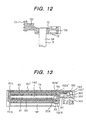
- the gear 12 is not limited to the one described above. Such gears as illustrated in Figs. 11 and 12 are also employable.
- the portion of the brush holder 12c is formed of a synthetic resin, while the teeth-forming area 12b and the remaining portion are formed using a sintered metal, and the brush holder 12c is outer-molded to the gear 12 with use of a resin.
- a great feature of the cover 16 used in this embodiment is that a stator (resistors and wiring patterns) which constitutes the throttle sensor (potentiometer) 101, as well as a wall portion 15 which holds the stator are provided directly in the cover 16.
- resistors and wiring patterns are formed on a substrate as a separate member from the cover and the substrate is then attached to the inner surface of the cover.
- This embodiment intends to make it possible to mold the holding member (wall portion) 15 for the potentiometer (especially resistors and wiring patterns) integrally with the cover 16 while minimizing the influence of such thermal expansion, contraction and deformation of the cover as just referred to above, and to this end the following means is adopted in the embodiment.
- the wall portion 15 is.formed by bending a thin plate in a curvilinearly projecting shape so as to minimize the area thereof occupied on the cover 16 and by raising, like erection, the thus-curved thin plate from the inner surface of the cover.
- the wall portion 15 not only the thermal expansion and contraction of the wall portion can be kept to a minimum, but also the wall portion can be enhanced in its rigidity and is difficult to be thermally deformed.
- a reinforcing rib 15d is formed on the back of the wall portion 15 to enhance the strength of the wall portion.
- the brushes 13 are mounted on the peripheral surface through the holder 12c so that their tips face in the radial direction of the throttle valve shaft 3.
- the brushes 13 may be mounted to a component other than the gear 12.
- a rotor used exclusively for the brush holder may be attached to one end 3a' of the throttle valve shaft 3.
- Resistors R1 and R2 (see Fig. 13) on which the brushes 13 slide are formed on one side of a film 14 by printing together with auxiliary resistors R3, R4, conductors 150, 151, 151' which constitute wiring patterns, conductors 141, 142 for taking out signals, and terminals 161-164. As shown in Figs. 2, 3 and 4, these registers and conductors are arcuately curved together with the film 14. Thus, the resistors R1 and R2 are formed as curved resistors.
- the curved resistors R1 and R2 are omitted their illustration for the convenience of drawing.
- the film 14 may hereinafter be referred to as the curved resistor or film with resistors.
- the wall portion 15 which holds the curved resistor 14 i.e., film with resistors R1 and R2 is formed by molding integrally with the cover 16 which covers one end side of the throttle valve shaft of the throttle body 1.
- the wall portion 15 is formed in conformity with the direction of the bushes 13 and is positioned on the inner surface of the cover 16 and near the corner located on the side opposite to the teeth portion of the gear 12.
- the wall portion 15 is in a curvilinearly erected shape which draws an arc about the axis of the throttle valve shaft 3.
- the conductor 141 for taking out an output signal and the resistor R1, as well as the conductor 142 for taking out an output signal and the resistor R2, are arranged in parallel on one side of the synthetic resin film (sheet) 14, with auxiliary resistors R3 and R4 being further added.
- the conductors 141 and 142 are formed using a material of a low resistivity, e.g., silver paste, while the resistors R3 and R4 are formed using a material of a relatively high resistivity, e.g. carbon, provided no limitation is made thereto.
- a material of a low resistivity e.g., silver paste
- the resistors R3 and R4 are formed using a material of a relatively high resistivity, e.g. carbon, provided no limitation is made thereto.
- the surfaces of the conductors 141, 142, 150, 150', 151 and 151' formed of silver paste for example are also coated with carbon.
- One of the two brushes 13 slides while straddling both resistor R1 and conductor 141, while the other brush 13 slides while straddling both resistor R2 and conductor 142.
- the conductors 141, 142 and the brushes 13 turn conductive with each other in the thickness direction of the carbon film at the brush contact positions (the resistance is low because the film thickness is small), so the carbon film formed on the conductors causes no obstacle. Rather, by coating the conductors (silver paste) with a hard carbon, it is possible to improve the abrasion resistance when the brushes 13 slide on the conductors 141 and 142.
- the resistor R1 is formed between ends 151a and 151b of a wiring conductor, using only a resistive material. Also as to the resistors R2, R3 and R4, they are formed in the same way.
- Fig. 13 the portions corresponding to the resistors R1, R2, R3 and R4 are hatched.
- the resistors and wiring layout in Fig. 13 coincide with the circuit diagram of Fig. 14.
- TPS1 first sensor output terminal
- Vcc positive terminal
- TPS2 second sensor output terminal
- GND ground terminal
- the first sensor output terminal 161 serves as a terminal of the output taking-out conductor 141.
- the conductor 141 is wider at its portion where the associated brush 13 slides.
- the power supply terminal 162 is connected to one end of the auxiliary resistor R3 through the conductor 150, while the opposite end of the auxiliary resistor R3 is connected to one end of the resistor R1 through the conductor end 151a and is also connected to one end of the resistor R2 through the conductor end 151a and the conductor 151.
- the opposite end of the resistor R1 is connected to one end of the auxiliary resistor R4 through the conductors 151b, 151' and 151a'.
- the opposite end of the auxiliary resistor R4 is connected to the ground terminal 164 through conductors 150a' and 150'.
- the second sensor output terminal 163 serves as a terminal of the output taking-out conductor 142.
- the conductor 142 is wider at its portion where the associated brush 13 slides.
- Fig. 14 schematically illustrates a state in which one brush 13 slides while straddling the resistor R1 and the conductor 141 and the other brush 13 slides while straddling the resistor R2 and the conductor 142.
- the brushes 13 move, for example, in an opening direction from a closed state
- the brush 13 which slides on the resistor R1 moves from a low potential side (ground side) to a high potential side (positive side of the power supply), while the brush 13 which slides on the resistor R2 moves from the high to the low potential side.
- An equivalent circuit thereof is illustrated in Fig. 15.
- the sensor output terminals 161 and 162 take out potentials at the brush contact points of the resistors R1 and R2.
- the resistors R1 and R2 are connected at one ends thereof to the positive terminal 162 of the power supply and at the opposite ends to the ground terminal 164. Further, the contact positions of the brushes 13 serve as output points for taking out output voltages, the auxiliary resistor R3 is connected between one ends of the resistors R1, R2 and the positive terminal 162 of the power supply, and the auxiliary resistors R3 and R4 are connected between the opposite ends of the resistors R1, R2 and the ground. terminal 164. In other words, the auxiliary resistors R3 and R4 are provided at both ends of the resistors R1 and R2.
- the resistors R1 and R2 are each several kilo-ohms and the resistors R3 and R4 are each several hundred ohms.
- Fig. 16 illustrates operational characteristics of sensor output voltages relative to movement quantities (throttle valve openings) of the brushes 13.
- the movement quantity 0 corresponds to a fully closed position in control of the throttle valve opening and the movement quantity 40 corresponds to a fully open position in control.
- the numeral 1 ⁇ represents an operational characteristic at the brush contact point potential in resistor R1 and numeral 2 ⁇ represents an operational characteristic at the brush contact point potential in resistor R2.
- a mean value of both operational characteristics 1 ⁇ and 2 ⁇ lies at an intermediate level of potential. If there should occur any trouble in one of the sensor outputs, the mean value of the operational characteristics 1 ⁇ and 2 ⁇ is biased to either the upper or the lower side of the above intermediate level. From this bias it is possible to judge which sensor is out of order.
- auxiliary resistors 33 and 34 it is possible to make gentle the gradient of the sensor output characteristics (operational characteristics 1 ⁇ and 2 ⁇ ) relative to the movement quantity of the brushes (throttle valve opening) and hence possible to diminish output variation characteristics induced by changes in temperature of the resistors for example.
- the potential difference at both ends of the resistors R1 and R2 becomes 4.4V, so that the gradient of output characteristics (operational characteristics 1 ⁇ and 2 ⁇ ) relative to the movement quantity of the brushes becomes smaller than that at the both-end potential difference of 5V of the resistors R1 and R2 (in the absence of the auxiliary resistors R3 and R4). Therefore, even where the operational characteristics vary according to temperatures, the variation range is made narrow to prevent deterioration of the sensor accuracy.
- auxiliary resistors R3 and R4 are disposed at both ends of the resistors R1 and R2, such an auxiliary resistor R3 or R4 as described above may be disposed at only one ends of the resistors R1 and R2, and even in this case it is possible to narrow the variation range of the sensor operation characteristics.
- one end 14a of the film 14 is made small in width and the terminals 161 ⁇ 164 are arranged on one side of the one end 14a.
- a terminal box 32 for insertion therein of one end 14a of the film is formed by the side of the wall portion 15 integrally with the cover 16.
- an upper portion 32a and a side portion 32b close to the wall portion 15 are open so that one end 14a of the film can be inserted therein.
- terminals 161-164 formed at one end of the film 14 and relay terminals 40-1 to 40-4, which communicate with connector terminals, are connected together electrically.
- connector terminals 40 for external connection of the throttle sensors and connector terminals 24 (two in this embodiment) for external connection of the motor power supply are disposed in a connector case 16b of the cover 16.
- Conductors 40' for connection between the connector terminals 40 and the throttle sensors and conductors 24' for connection between the connector terminals 24 and the relay terminals 24a of the motor power supply are insert-molded into the cover 16 (this state is shown in Fig.
- one ends of the conductors 40' i.e., the terminals 40-1 to 40-4
- one ends of the conductors 40' are erected so as to be positioned by the side of one end 15b of the wall portion which is for holding the curved resistors, in other words, they rise so as to project upward from the inner surface of the cover 16, further, one ends 24a of the conductors 24' of the motor power supply are erected from the inner surface of the cover 16.
- One end 14a of the film 14 is inserted into the terminal box 32 in such a manner that the terminals 161 ⁇ 164 formed on the film 14 and the terminals 40-1-40-4 conducted into the terminal box 32 confront each other, and a plate spring 36 serving as a film pressing member is inserted into the terminal box 32, whereby the terminals can be connected positively without separation.
- the relay terminals 24a on the motor side and the motor terminals 23 are connected together through the relay connectors 33.
- the film 14 with curved resistors is affixed to the wall portion 15, the resistors and wiring patterns may be printed directly onto the surface of the wall portion 15.
- a throttle assembly and a throttle sensor capable of contributing to the reduction in the number of components of the throttle sensor, capable of reducing the manufacturing cost and simplifying the assembling work and further capable of ensuring high sensor accuracy and reliability.
Landscapes
- Engineering & Computer Science (AREA)
- General Engineering & Computer Science (AREA)
- Mechanical Engineering (AREA)
- Chemical & Material Sciences (AREA)
- Combustion & Propulsion (AREA)
- Control Of Throttle Valves Provided In The Intake System Or In The Exhaust System (AREA)
- Measurement Of Length, Angles, Or The Like Using Electric Or Magnetic Means (AREA)
Abstract
In a throttle body there are provided a throttle
valve for controlling the flow of intake air in an internal
combustion engine, an electrically-driven actuator for
actuating the throttle valve, and a reduction gear
mechanism for the actuator, and a receptacle portion for
receiving the reduction gear mechanism therein is formed in
a side wall of the throttle body. A cover which covers the
receptacle portion is attached to a side wall of the
throttle body. The throttle assembly of the invention is .
provided with a potentiometer type sensor for detecting the
degree of opening of the throttle valve, the sensor
comprising a slider and a resistor, the slider being
adapted to slide on the resistor and mounted to a
peripheral surface of a driven gear so that a tip end
thereof faces in a radial direction of a throttle valve
shaft, the driven gear being disposed on the throttle valve
shaft side of the reduction gear mechanism. On the other
hand, the resistor is constituted by a curved resistor
which confronts the slider in the said radial direction.
A wall portion which holds the curved resistor is formed by
molding integrally with the aforesaid cover.
Description
- The present invention relates to a throttle assembly for controlling the flow(amount of the flow) of intake air in an internal combustion engine, as well as a throttle sensor for detecting the degree of opening of a throttle valve used in the throttle device.
- Heretofore, an electronically controlled throttle assembly has practically been used wherein the operation of a throttle valve in an engine is controlled by an electrically-driven actuator (e.g., a DC motor or a stepping motor).
- The electronically controlled throttle assembly controls the throttle valve angle (throttle valve opening) to an optimum value according to the state of an engine and in accordance with a signal indicative of the degree of opening of an accelerator pedal or a traction control signal. To this end, a sensor for detecting the angle of the throttle valve, what is called a throttle sensor (also called an opening meter or a throttle position sensor) is attached to a throttle body.
- As the throttle sensor there generally is adopted a potentiometer type sensor, wherein a brush (slider) adapted to rotate together with a throttle valve shaft slides on a resistor, thereby outputting a potential difference signal (sensor detection signal) corresponding to the degree of opening of a throttle valve.
- As throttle sensors of this type so far used there are known, for example, such throttle sensors as are disclosed in Japanese Patent Laid Open Nos. 7-343878 and 9-32588, wherein a resistor and a wiring pattern of a potentiometer are formed on a substrate. The substrate is attached to a cover of a receptacle portion containing a reduction gear mechanism. A brush is attached to a flat surface of a driven gear (or a rotor) mounted on a throttle valve shaft. In this type of a throttle sensor, the brush slides on a resistor and a conductor both formed on the substrate (a flat surface). Since the driven gear is used also as a moving element to which the brush of the potentiometer is attached, the number of components used can be so much reduced.
- It is an object of the present invention to provide a throttle device capable of contributing to reducing the number of components of a throttle sensor, capable of reducing the manufacturing cost and simplifying the assembling work, and further capable of ensuring high accuracy and reliability of the sensor.
- For achieving the above-mentioned object the present invention basically proposes the following throttle assemblies:
- (1) A throttle assembly comprising a throttle body having
a throttle valve, an electrically-driven actuator for
actuating the throttle valve, and a sensor for detecting
the degree of opening of the throttle valve,
wherein the sensor is constituted by a potentiometer whose output varies: according to the rotation of a throttle valve shaft and which comprises a slider (also called a brush) and a resistor, the slider being adapted to slide on the resistor and disposed on one end side of a throttle valve shaft so that a tip end thereof faces in a radial direction of the throttle valve shaft, the resistor being formed as an arcuately curved surface (what is called a curved resistor), and a wall portion which holds the curved resistor is formed by molding integrally with a cover which covers the one end side of the throttle valve shaft in the throttle body. According to a preferred example of the above throttle device (1), the peripheral resistor holding portion (wall portion) is formed by molding integrally with the cover, as described above, and the slider is attached to a peripheral portion of a gear (a driven gear as a final-stage gear in a reduction gear mechanism) mounted on the throttle valve shaft. - (2) A throttle assembly comprising a throttle body and, as
components mounted to the throttle body, a throttle valve
for controlling the flow of intake air in an internal
combustion engine, an electrically-driven actuator for
actuating the throttle valve, a reduction gear mechanism
for the actuator, and a sensor for detecting the degree of
opening of the throttle valve,
wherein one end of a throttle valve shaft is projected outwards from a side wall of the throttle body, the reduction gear mechanism and the sensor are disposed on a side face of the throttle body on the projecting side of the throttle valve shaft,
a bearing which supports one end of the throttle valve shaft on the projecting side of the throttle valve shaft, out of bearings which support the throttle valve shaft, is a ball bearing, a bearing located on the opposite side of the throttle valve shaft is a cap-shaped plain bearing, and one bearing boss of the throttle valve shaft is covered with the plain bearing. - (3) A throttle sensor for detecting the degree of opening
of a throttle valve which controls the flow of intake air
in an internal combustion engine,
wherein the throttle sensor is constituted by a potentiometer whose output varies according to the rotation of the throttle valve, the potentiometer comprising a slider adapted to rotate integrally with a throttle valve shaft and a resistor on which the slider slides, the resistor being connected at one end thereof to a positive-side terminal of a power supply and at an opposite end thereof to a ground-side terminal, the position at which the resistor contacts the slider is an output point for taking out an output voltage, and an auxiliary resistor (or resistors) is connected either between one end of the resistor and the positive-side terminal of the power supply or between the opposite end of the resistor and the ground-side terminal, or both. In other words, an auxiliary resistor is provided at one end or at each of both ends of the resistor which is a component of the potentiometer. -
-
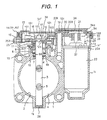
- Fig. 1 is a longitudinal sectional view of a
throttle assembly according to an embodiment of the present
invention and Fig. 2 is a plan view showing a throttle body
used in the embodiment, with a
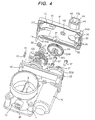
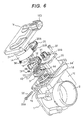
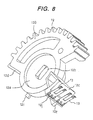
cover 16 removed from the throttle body to see the uncovered interior. A gear indicated at 12 in Fig. 2 is mounted to a throttle valve shaft on the throttle body side, but in the same figure, for understanding in what positional relation thegear 12 is inside thegear cover 16, thegear 12 alone is removed from thethrottle valve shaft 3 and is illustrated together with the gear cover. - Fig. 3 is a partial perspective view showing the state of Fig. 2 rspectively, Figs. 4, 5 and 6 are exploded perspective views showing the throttle assembly of this embodiment as seen in different angles, Fig. 7 is a perspective view showing, in a disassembled state, components of a throttle sensor which is attached to the cover, Fig. 8 is a perspective view showing a driven gear with brush (slider) which is one of reduction gears used in the embodiment, Fig. 9 is a side view of the cover, Fig. 10 is a sectional view showing the driven gear as mounted to a throttle valve shaft, Figs. 11 and 12 are sectional views showing other examples of driven gears, Fig. 13 is a developed view of a film with resistor used in the throttle sensor, Fig. 14 is a circuit diagram of resistors and wiring patterns shown in Fig. 13, Fig. 15 is an equivalent circuit diagram thereof, and Fig. 16 is an operation characteristic diagram of the throttle sensor used in the embodiment.
-
- An embodiment of the present invention will be described hereinunder with reference to the accompanying drawings.
- As shown in Fig. 1, an electronically controlled throttle assembly (throttle valve assembly) is composed principally of a
throttle body 1, which may be referred to simply as the body hereinafter, athrottle valve 4, a motor (a throttle valve driving unit or an electrically-driven actuator) 22 for actuating thethrottle valve 4, areduction gear mechanism 100, a sensor (throttle sensor) 101 for detecting the angle ( degree ) of opening, which may be referred to simply as opening hereinafter, of thethrottle valve 4, and acover 16 for protecting athrottle valve shaft 3,motor 22 andreduction gear mechanism 100. - The
body 1 is formed by molding a receptacle portion (intake bore) 2 for thethrottle valve 4 and a receptacle portion (motor housing) 1c for themotor 22 integrally with each other. Thethrottle valve 4 is mounted to theshaft 3 withscrews 5, and theshaft 3 is supported bybearings body 1. - Various bearings are mentioned as examples of the
bearing 6, among which a ball bearing has heretofore been used as a bearing usually adopted. In this embodiment, a ball bearing and a cap-shaped plain bearing are used as thebearings bearing boss 1a through aseal ring 8. Aninner ring 6a of the ball bearing 6 is press-fitted on an outer periphery of thethrottle valve shaft 3, while anouter ring 6b thereof is fitted in an inner periphery of thebearing boss 1a by transition fit (sliding fit). - Only one end of the
throttle valve shaft 3 projects to the exterior of a side wall of thebody 1, and aspring 10, alever 9, aspring 11, and a final-stage gear (driven gear) 12 in thereduction gear mechanism 100, which will be described later, are fitted on the projecting one end of the throttle valve shaft. The plain bearing 26 is mounted by press-fitting for example. - Throttle valve-related components (hereinafter referred to as the throttle valve mechanism) such as the
throttle valve shaft 3,reduction gear mechanism 100 andmotor 22 are accommodated within a receptacle portion (case) 1d formed in a side wall of thebody 1, thereceptacle portion 1d being covered with asynthetic resin cover 16. - More specifically, the throttle valve mechanism is disposed so as to be protected by a
single cover 16, an opening (a motor mounting opening) 1c' of themotor housing 1c is positioned so as to face the interior of thereceptacle portion 1d, through which opening themotor 22 is received into the housing, and anend bracket 22a of the motor is fixed withscrews 37 around the opening 1c' (see Figs. 4 to 6). -
Motor terminals 23 formed on theend bracket 22a are positioned near a side wall of thereceptacle portion 1d so as to face toward thecover 16 and are connected torelay terminals 24a throughrelay connectors 33. Therelay connectors 33 may be in any of various forms. In this embodiment, sleeves are used as therelay connectors 33,slits 34 and 35 (see Fig. 5) are formed respectively in both ends of each of the slits in 90°-shifted directions, and eachmotor terminal 23 andrelay terminal 24a are fitted in theslits terminals slits - The
motor 22 is driven in accordance with an accelerator signal related to the depression quantity of an accelerator pedal and a traction control signal, and the power of themotor 22 is transmitted to thethrottle valve shaft 3 through the reduction gear mechanism 100 (amotor pinion 21, anintermediate gear 20, and the final-stage fear 12). Thepinion 21 is mounted on amotor shaft 27 and theintermediate gear 20 is fitted free on ashaft 19 which is fixed to thethrottle body 1. Theintermediate gear 20 comprises agear 20a of a larger diameter meshing with thepinion 21 and agear 20b of a smaller diameter meshing with thegear 12. - The final-
stage gear 12 is a sectorial gear and, as shown in Figs. 2 to 6 and Fig. 8, aholder 12c for holding brushes (sliders) 13 of a potentiometer is integral with thegear 12. Theholder 12c is formed so as to be positioned on a peripheral surface of thegear 12 on the side opposite to a toothed area of the same gear. - Before describing features of the
gear 12 in detail, reference will first be made to the relation between thegear 12 and thelever 9. As shown in Fig. 8, thegear 12 has ahole 12h for passing oneend 3a' (having at least two flat surfaces) of thethrottle valve shaft 3 therethrough. Thehole 12h is formed in a shape engageable with the oneend 3a' of the throttle valve shaft, and through this engagement thegear 12 rotates integrally with thethrottle valve shaft 3. - The
lever 9 is fitted free on the outer periphery (circumferential surface) of thethrottle valve shaft 3 so that thelever 9 and thegear 12 are pulled toward each other through aspring 11. For example, a lug indicated at 12f in Figs. 2 to 4 comes into engagement with alug 9a of thelever 9 shown in Fig. 6. Thelug 12f is formed inside thegear 12. Further, alug 12g formed on thegear 12 is for positioning in an assembling work relative to a lug 9b formed on thelever 9 side. - A
spring 10 is a return spring for the throttle valve. One end of thespring 10 is anchored to a spring retaining portion (not shown) provided on thebody 1 side and the opposite end thereof is anchored to thelever 9. - The
spring 10, which imparts a return force to the throttle valve shaft through thegear 12, constitutes a known default opening setting mechanism in cooperation with thespring 11 and thelever 9. - The default opening setting mechanism is for holding an initial opening of the throttle valve larger than a fully closed position during OFF of an engine key (in other words, while the electrically-driven
actuator 22 is deenergized). From a default opening position up to a fully open control position, a throttle valve opening is determined in accordance with the balance between the motor power and the spring (return spring) 10. For controlling the throttle valve opening smaller than the default opening, the movement of thelever 9 is prevented by a default opening stopper (not shown) and only thegear 12 and thethrottle valve shaft 3 are turned in fully closing direction against the force of thespring 11.Numeral 25 denotes a fully closing stopper which defines a mechanical fully closed position of the throttle valve, which fully closed position is determined by abutment of a movable-side stopper 12d against thestopper 25, thestopper 12d being formed on one side of thesectorial gear 12. Thestopper 12d is fixed with anut 25a. - As to the material of the
gear 12 used in this embodiment, as is seen from a sectional view of Fig. 10, a central portion is constituted by ametallic plate 12a, and a teeth-formingportion 12b, thebrush holder 12c and the remaining portion are formed integrally by molding a synthetic resin (a reinforced plastic). In this case, themetallic plate 12a is insert-molded into the resin portion of the gear. The movable-side stopper 12d is integral with themetallic plate 12a. - The
stopper 12d is formed of a metal for improving the accuracy of the stopper position. More particularly, the mechanical fully closed position of the throttle valve serves as a reference point in control and thestopper 12d strikes against the fixed-side fully closingstopper 25 once at every beginning or end of operation. Thus, a high accuracy is required for thestopper 12d, and for this reason thestopper 12d is formed of a metal which is high in rigidity. - The
gear 12 is further provided with a movable-side stopper 12e for defining a fully open position of the throttle valve (Figs. 2 and 8). Thestopper 12e is formed by molding a synthetic resin integrally with thegear 12 and thebrush holder 12c. It suffices for the movable-side fully openingstopper 12e to be formed of a synthetic resin because thestopper 12e generally does not strike against any other component during operation.Numeral 12i denotes a guide for engagement of thegear 12 with thelever 9. - The
holder 12c for holding thebrushes 13 is formed on a peripheral surface of thegear 12, and twobrushes 13 are arranged on an outer surface of the holder 13c side by side in the axial direction of thegear 12. A rotational radius from thethrottle valve shaft 3 up to the tips of thebrushes 13 is set larger than that of the drivengear 12. The reason why two brushes 13 are used is that it is intended to use a dual system (two) of throttle sensors. The dual system is advantageous in that even in the event of failure of one throttle sensor, the other can be used as a substitute and that even in the event of occurrence of any trouble on one sensor side, the trouble can be detected by processing signals provided from both sensors. - For example, as shown in Fig. 8, the
brushes 13 are fitted on lugs 12j formed on theholder 12, which lugs 12j are then crushed with heat to fix the brushes onto the holder. Alternatively, thebrushes 13 may be fixed using screws or an adhesive. - The
gear 12 is fixed to one end 3' of thethrottle valve shaft 3 with use of anut 17 and awasher 18. - The
gear 12 is not limited to the one described above. Such gears as illustrated in Figs. 11 and 12 are also employable. - In the
gear 12 illustrated in Fig. 11, the portion of thebrush holder 12c is formed of a synthetic resin, while the teeth-formingarea 12b and the remaining portion are formed using a sintered metal, and thebrush holder 12c is outer-molded to thegear 12 with use of a resin. - In the
gear 12 illustrated in Fig. 12, all the constituent portions of thegear 12, including thebrush holder 12c, are formed using a synthetic resin, which resin is insert-molded into oneend 3a of thethrottle valve shaft 3, thus dispensing with thenut 17 and thewasher 18. - The following description is now provided about the
cover 16. - A great feature of the
cover 16 used in this embodiment is that a stator (resistors and wiring patterns) which constitutes the throttle sensor (potentiometer) 101, as well as awall portion 15 which holds the stator are provided directly in thecover 16. - Heretofore, for reducing the number of components of a throttle assembly, there has been made an attempt to secure a brush directly to a driven gear in a reduction gear mechanism, but if the member for holding resistors and wiring patterns (conductors) in a potentiometer can be formed by molding integrally with the
cover 16, there can be made a further contribution to the reduction in the number of components. - However, in case of forming resistors and wiring patterns directly on an inner surface of the
cover 16, since thecover 16 is formed of a synthetic resin, the resistors may be deteriorated in accuracy under the influence of thermal expansion, contraction and deformation of the cover. According to a conventional measure adopted for avoiding such an inconvenience, resistors and wiring patterns are formed on a substrate as a separate member from the cover and the substrate is then attached to the inner surface of the cover. - This embodiment intends to make it possible to mold the holding member (wall portion) 15 for the potentiometer (especially resistors and wiring patterns) integrally with the
cover 16 while minimizing the influence of such thermal expansion, contraction and deformation of the cover as just referred to above, and to this end the following means is adopted in the embodiment. - As a basic structure, the
wall portion 15 is.formed by bending a thin plate in a curvilinearly projecting shape so as to minimize the area thereof occupied on thecover 16 and by raising, like erection, the thus-curved thin plate from the inner surface of the cover. According to such an arcuately curved shape of thewall portion 15, not only the thermal expansion and contraction of the wall portion can be kept to a minimum, but also the wall portion can be enhanced in its rigidity and is difficult to be thermally deformed. In this embodiment, moreover, a reinforcingrib 15d is formed on the back of thewall portion 15 to enhance the strength of the wall portion. - As to the
brushes 13, they are mounted on the peripheral surface through theholder 12c so that their tips face in the radial direction of thethrottle valve shaft 3. Thebrushes 13 may be mounted to a component other than thegear 12. For example, a rotor used exclusively for the brush holder may be attached to oneend 3a' of thethrottle valve shaft 3. - Resistors R1 and R2 (see Fig. 13) on which the
brushes 13 slide are formed on one side of afilm 14 by printing together with auxiliary resistors R3, R4,conductors conductors film 14. Thus, the resistors R1 and R2 are formed as curved resistors. - The reason why two resistors R1 and R2 are used in the potentiometer and so are the
brushes 13 is because it is intended to form two throttle sensors. As to operational characteristics of the potentiometer used in this embodiment, reference will be made thereto later. - In the other figures than Fig. 13, for example in Figs. 2, 3, 4 to 6 and 7, the curved resistors R1 and R2 are omitted their illustration for the convenience of drawing. For convenience sake, the
film 14 may hereinafter be referred to as the curved resistor or film with resistors. - As noted earlier, the
wall portion 15 which holds the curved resistor 14 (i.e., film with resistors R1 and R2) is formed by molding integrally with thecover 16 which covers one end side of the throttle valve shaft of thethrottle body 1. - As shown in Fig. 2, the
wall portion 15 is formed in conformity with the direction of thebushes 13 and is positioned on the inner surface of thecover 16 and near the corner located on the side opposite to the teeth portion of thegear 12. Thewall portion 15 is in a curvilinearly erected shape which draws an arc about the axis of thethrottle valve shaft 3. - Now, with reference to Figs. 13 to 15, a description will be given below about the circuit configuration of the potentiometer and related wiring layout used in this embodiment.
- As shown in Fig. 13, the
conductor 141 for taking out an output signal and the resistor R1, as well as theconductor 142 for taking out an output signal and the resistor R2, are arranged in parallel on one side of the synthetic resin film (sheet) 14, with auxiliary resistors R3 and R4 being further added. - The
conductors - Actually, the surfaces of the
conductors brushes 13 slides while straddling both resistor R1 andconductor 141, while theother brush 13 slides while straddling both resistor R2 andconductor 142. Theconductors brushes 13 turn conductive with each other in the thickness direction of the carbon film at the brush contact positions (the resistance is low because the film thickness is small), so the carbon film formed on the conductors causes no obstacle. Rather, by coating the conductors (silver paste) with a hard carbon, it is possible to improve the abrasion resistance when thebrushes 13 slide on theconductors - The resistor R1 is formed between
ends - In Fig. 13, the portions corresponding to the resistors R1, R2, R3 and R4 are hatched. The resistors and wiring layout in Fig. 13 coincide with the circuit diagram of Fig. 14.
- At one
end 14a of thefilm 14 are disposed a first sensor output terminal (TPS1) 161, a positive terminal (Vcc) 162 of a power supply, a second sensor output terminal (TPS2) 163, and a ground terminal (GND) 164. - The first
sensor output terminal 161 serves as a terminal of the output taking-outconductor 141. Theconductor 141 is wider at its portion where the associatedbrush 13 slides. - The
power supply terminal 162 is connected to one end of the auxiliary resistor R3 through theconductor 150, while the opposite end of the auxiliary resistor R3 is connected to one end of the resistor R1 through theconductor end 151a and is also connected to one end of the resistor R2 through theconductor end 151a and theconductor 151. The opposite end of the resistor R1 is connected to one end of the auxiliary resistor R4 through theconductors ground terminal 164 throughconductors 150a' and 150'. - The second
sensor output terminal 163 serves as a terminal of the output taking-outconductor 142. Theconductor 142 is wider at its portion where the associatedbrush 13 slides. - Fig. 14 schematically illustrates a state in which one
brush 13 slides while straddling the resistor R1 and theconductor 141 and theother brush 13 slides while straddling the resistor R2 and theconductor 142. According to the wiring illustrated in Figs. 13 and 14, if thebrushes 13 move, for example, in an opening direction from a closed state, thebrush 13 which slides on the resistor R1 moves from a low potential side (ground side) to a high potential side (positive side of the power supply), while thebrush 13 which slides on the resistor R2 moves from the high to the low potential side. An equivalent circuit thereof is illustrated in Fig. 15. Thesensor output terminals - According to the above wiring patterns, the resistors R1 and R2 are connected at one ends thereof to the
positive terminal 162 of the power supply and at the opposite ends to theground terminal 164. Further, the contact positions of thebrushes 13 serve as output points for taking out output voltages, the auxiliary resistor R3 is connected between one ends of the resistors R1, R2 and thepositive terminal 162 of the power supply, and the auxiliary resistors R3 and R4 are connected between the opposite ends of the resistors R1, R2 and the ground. terminal 164. In other words, the auxiliary resistors R3 and R4 are provided at both ends of the resistors R1 and R2. The resistors R1 and R2 are each several kilo-ohms and the resistors R3 and R4 are each several hundred ohms. - Fig. 16 illustrates operational characteristics of sensor output voltages relative to movement quantities (throttle valve openings) of the
brushes 13. In the same figure, themovement quantity 0 corresponds to a fully closed position in control of the throttle valve opening and themovement quantity 40 corresponds to a fully open position in control. Thenumeral 1 ○ represents an operational characteristic at the brush contact point potential in resistor R1 and numeral 2 ○ represents an operational characteristic at the brush contact point potential in resistor R2. A mean value of bothoperational characteristics 1 ○ and 2 ○ lies at an intermediate level of potential. If there should occur any trouble in one of the sensor outputs, the mean value of theoperational characteristics 1 ○ and 2 ○ is biased to either the upper or the lower side of the above intermediate level. From this bias it is possible to judge which sensor is out of order. - By using the
auxiliary resistors operational characteristics 1 ○ and 2 ○) relative to the movement quantity of the brushes (throttle valve opening) and hence possible to diminish output variation characteristics induced by changes in temperature of the resistors for example. - In this connection, reference will now be made, for example, to the case where the power supply voltage is 5V and the ground voltage is 0V. In this case, in the absence of resistors R3 and R4, a voltage of 5V is applied to both ends of the resistors R1 and R2, but in the presence of the auxiliary resistors R3 and R4 as in this embodiment, the voltage at one ends (the ground side) of the resistors R1 and R2 is raised to a higher level (say, 0.3V) than zero level because of the presence of resistor R3, while the voltage at the opposite ends (the positive side of the power supply) becomes somewhat lower (say, 4.7V) than 5V because of the presence of resistor R4. Thus, the potential difference at both ends of the resistors R1 and R2 becomes 4.4V, so that the gradient of output characteristics (
operational characteristics 1 ○ and 2 ○) relative to the movement quantity of the brushes becomes smaller than that at the both-end potential difference of 5V of the resistors R1 and R2 (in the absence of the auxiliary resistors R3 and R4). Therefore, even where the operational characteristics vary according to temperatures, the variation range is made narrow to prevent deterioration of the sensor accuracy. - Although in this embodiment the auxiliary resistors R3 and R4 are disposed at both ends of the resistors R1 and R2, such an auxiliary resistor R3 or R4 as described above may be disposed at only one ends of the resistors R1 and R2, and even in this case it is possible to narrow the variation range of the sensor operation characteristics.
- As shown in Fig. 13, one
end 14a of thefilm 14 is made small in width and theterminals 161∼164 are arranged on one side of the oneend 14a. - On the inner surface of the
cover 16, as shown in Figs. 2 and 7, aterminal box 32 for insertion therein of oneend 14a of the film is formed by the side of thewall portion 15 integrally with thecover 16. - In the
terminal box 32, anupper portion 32a and aside portion 32b close to thewall portion 15 are open so that oneend 14a of the film can be inserted therein. - At the position of the
terminal box 32 the terminals 161-164 formed at one end of thefilm 14 and relay terminals 40-1 to 40-4, which communicate with connector terminals, are connected together electrically. - More specifically, as shown in Fig. 9, connector terminals 40 (four in this embodiment) for external connection of the throttle sensors and connector terminals 24 (two in this embodiment) for external connection of the motor power supply are disposed in a
connector case 16b of thecover 16. Conductors 40' for connection between theconnector terminals 40 and the throttle sensors and conductors 24' for connection between theconnector terminals 24 and therelay terminals 24a of the motor power supply are insert-molded into the cover 16 (this state is shown in Fig. 7 with the conductors partially omitted) and one ends of the conductors 40', i.e., the terminals 40-1 to 40-4, are erected so as to be positioned by the side of oneend 15b of the wall portion which is for holding the curved resistors, in other words, they rise so as to project upward from the inner surface of thecover 16, further, one ends 24a of the conductors 24' of the motor power supply are erected from the inner surface of thecover 16. - One
end 14a of thefilm 14 is inserted into theterminal box 32 in such a manner that theterminals 161~164 formed on thefilm 14 and the terminals 40-1-40-4 conducted into theterminal box 32 confront each other, and aplate spring 36 serving as a film pressing member is inserted into theterminal box 32, whereby the terminals can be connected positively without separation. Therelay terminals 24a on the motor side and themotor terminals 23 are connected together through therelay connectors 33. - Advantages of this embodiment are as follows.
- 1 ○ In the throttle sensor, the
brushes 13 come into contact with the curved resistors 14 (R1, R2) while facing in the radial direction of thethrottle valve shaft 3. This is advantageous in point of reliability. More particularly, thebrushes 13 are mounted on the throttle valve shaft through the holder, but an assembling error developed in the throttle valve shaft is generally larger in the thrust direction than in the radial direction. The reason is that variations in machining and variations in assembly accumulate to 1 mm or so in the radial direction, whereas in the thrust direction there occur only coaxiality deviation and variations among molded products, which can be suppressed to below several hundred micron meters.Consequently, the separating force of each brush from the associated resistor induced by wobbling of the throttle valve shaft is larger in the case where the brush is brought into contact (sliding contact) with the resistor in the thrust direction of the throttle valve shaft (the contact in this case is a plane contact) than in the case where the brush is brought into contact with the resistor in the radial direction of the throttle valve shaft (the contact in this case is a curved contact). Therefore, in the former (plane contact) case, it is necessary that the contact pressure of the brush against the resistor be set larger than in the latter (curved contact) to prevent the brush and the resistor from coming out of contact with each other. So increasing the contact pressure will accelerate the wear of the brush and that of the resistor.This embodiment adopts the latter method, whereby it is possible to prevent the brush-resistor separation without so much increasing the contact pressure. Consequently, it is possible to enhance the reliability of the throttle sensor and also enhance the abrasion resistance and durability of the sensor components. - 2 ○ Even in case of adopting such a curved contact (curved
resistor) type throttle sensor (potentiometer) as described
above, this embodiment makes it possible to reduce the
number of components and reduce the product cost. More
particularly, for mounting a curved resistor type sensor
into the
cover 16 of thethrottle body 1, there may be adopted a different method wherein the throttle sensor is beforehand unitized separately from the cover and is then installed into the cover. In this case, however, it is necessary that sensor components (e.g., resistor, rotor with brush, and resistor holding member) be accommodated together into a dedicated unit case (sensor housing). On the other hand, this embodiment dispenses with such a sensor unit as mentioned above and permits thegear 12 to serve also as the rotor with brush. In this embodiment, moreover, since the curved resistor holding member (wall portion 15) is integral with thecover 16, it is possible to reduce the number of throttle sensor components and hence reduce the product cost and simplify the assembling work. Further, although the curved resistor holding portion is provided in the cover, it is possible to ensure a high sensor accuracy because there is adopted a structure which is difficult to be influenced by thermal expansion, contraction and deformation of the cover. - 3 ○ By providing at least one of the auxiliary resistors R3 and R4 in each throttle sensor it is possible to obtain operational characteristics of the sensor with suppressed thermal variation.
- 4 ○ It is possible to simplify the bearing structure of the
throttle valve shaft having the throttle sensors; besides,
it is possible to reduce the number of components used and
thereby realize a compact bearing protecting structure. In more particular terms, according to this
embodiment, only one
end 3a' of thethrottle valve shaft 3 is projected to the exterior of a side wall of the throttle body and the reduction gear mechanism and the throttle sensors are disposed on the throttle body side face on the projecting side of the throttle valve shaft.Thus, where the reduction gear mechanism and the throttle sensors are arranged together on one side face of the throttle body, a highly accurate bearing such as theball bearing 6 or any other rolling bearing of reduced wobbling may be used as the bearing for the throttle valve shaft on the side where the above components are arranged, while a bearing, e.g., plain bearing, which is less expensive but somewhat inferior in accuracy than the ball bearing, may be used as the other bearing.Further, since theplain bearing 26 is cap-shaped and covers onebearing boss 1b on the throttle valve shaft, it is possible to omit the use of a dedicated cap or cover for the bearingboss 1b. - 5 ○ Additionally, according to this embodiment, at least one
end 15a of thewall portion 15 which holds thecurved resistor 14 is rounded at 41, so at the time of positioning thebrushes 13 on the curved resistor after installation of thegear 12 and the cover, thebrushes 13 can be mounted easily by allowing them to slide on therounded surface 41. The numeral 15c in Figs. 2 and 3 denotes a stepped portion to be used for positioning thefilm 14, the steppedportion 15c being formed at one end of thewall portion 15. Also for mounting thefilm 14 to thewall portion 15, for connecting the sensor terminals and for mounting the brushes, this embodiment adopts a structure which takes the easiness of those works into account, thus permitting the reduction of the working cost. -
- Although in the above embodiment the
film 14 with curved resistors is affixed to thewall portion 15, the resistors and wiring patterns may be printed directly onto the surface of thewall portion 15. - According to the present invention, as set forth above, it is possible to provide a throttle assembly and a throttle sensor, capable of contributing to the reduction in the number of components of the throttle sensor, capable of reducing the manufacturing cost and simplifying the assembling work and further capable of ensuring high sensor accuracy and reliability.
Claims (11)
1. A throttle assembly for an internal combustion
engine,
comprising a throttle body having a throttle valve, an electrically-driven actuator for actuating the throttle valve, and a sensor for detecting the degree of opening of the throttle valve,
wherein said sensor is constituted by a potentiometer whose output varies according to the rotation of a throttle valve shaft and which comprises a slider and a resistor, the slider being adapted to slide on the resistor and disposed on one end side of a throttle valve shaft, the resistor being formed as an arcuately curved surface (the resistor having the arcuately curved surface will hereinafter be referred to as the curved resistor), and a wall portion which holds the curved resistor is. formed by molding integrally with a cover which covers the. one end side of the throttle valve shaft in the throttle body.
comprising a throttle body having a throttle valve, an electrically-driven actuator for actuating the throttle valve, and a sensor for detecting the degree of opening of the throttle valve,
wherein said sensor is constituted by a potentiometer whose output varies according to the rotation of a throttle valve shaft and which comprises a slider and a resistor, the slider being adapted to slide on the resistor and disposed on one end side of a throttle valve shaft, the resistor being formed as an arcuately curved surface (the resistor having the arcuately curved surface will hereinafter be referred to as the curved resistor), and a wall portion which holds the curved resistor is. formed by molding integrally with a cover which covers the. one end side of the throttle valve shaft in the throttle body.
2. A throttle assembly for an internal combustion
engine, comprising a throttle body and, as components
mounted to the throttle body, a throttle valve for
controlling the flow of intake air in the internal
combustion engine, an electrically-driven actuator for
actuating the throttle valve, and a reduction gear
mechanism for the actuator, with a receptacle portion for
the reduction gear mechanism being formed in a side wall of
the throttle body and with a cover which covers said
receptacle portion being attached to the side wall of the
throttle body,
wherein a potentiometer type sensor for detecting the degree of opening of the throttle valve is provided, said sensor comprising a slider and a resistor, the slider being adapted to slide on the resistor and mounted to a peripheral surface of a driven gear so that a tip end thereof faces in a radial direction of a throttle valve shaft in the reduction gear mechanism, said driven gear being provided on the throttle valve shaft side, said resistor being constituted by a curved resistor which confronts the slider in said radial direction, and a wall portion which holds said curved resistor is formed by molding integrally with said cover.
wherein a potentiometer type sensor for detecting the degree of opening of the throttle valve is provided, said sensor comprising a slider and a resistor, the slider being adapted to slide on the resistor and mounted to a peripheral surface of a driven gear so that a tip end thereof faces in a radial direction of a throttle valve shaft in the reduction gear mechanism, said driven gear being provided on the throttle valve shaft side, said resistor being constituted by a curved resistor which confronts the slider in said radial direction, and a wall portion which holds said curved resistor is formed by molding integrally with said cover.
3. A throttle assembly for an internal combustion
engine according to claim 1 or claim 2, wherein said cover
is formed of a synthetic resin, a connector case having a
connector terminal for external connection of said sensor
is formed integrally with said cover, a conductor which
connects said connector terminal and said sensor with each
other is insert-molded into said cover, one end of said
conductor rising so as to project upward from an inner
surface of the cover by the side of one end of said wall
portion which holds the curved resistor, said conductor and
said sensor being electrically connected with each other at
the rising position of the conductor.
4. A throttle assembly for an internal combustion
engine according to claim 1 or claim 2, wherein said curved
resistor is formed by printing a resistor and a wiring
pattern onto a synthetic resin film, and said film is
affixed to a curved surface of said wall portion.
5. A throttle assembly for an internal combustion
engine according to claim 1 or claim 2, wherein said wall
portion which holds the curved resistor has an arcuately
curved surface, and a resistor and a wiring pattern both
constituting the curved resistor are formed directly on
said arcuately curved surface.
6. A throttle assembly for an internal combustion
engine according to claim 2, wherein a rotational radius
from the throttle valve shaft up to the tip end of the
slider is set larger than a tooth top radius, or an outside
radius, of said driven shaft.
7. A throttle assembly for an internal combustion
engine according to any of claims 1 to 6, wherein at least
one end of said wall portion which holds the curved
resistor is rounded.
8. A throttle assembly for an internal combustion
engine according to any of claims 1 to 7, wherein said wall
portion which holds the curved resistor is formed in a
curvilinearly erected shape which draws an arc centered on
the axis of said throttle valve shaft, and a rib is formed
on the wall portion on the side opposite to the side where
the curved resistor is disposed.
9. A throttle assembly comprising a throttle body
and, as components mounted to the throttle body, a throttle
valve for controlling the flow of intake air in an internal
combustion engine, an electrically-driven actuator for
actuating the throttle valve, a reduction gear mechanism
for the actuator, and a sensor for detecting the degree of
opening of the throttle valve,
wherein one end of a throttle valve shaft is projected outwards from a side wall of the throttle body, said reduction gear mechanism and said sensor are disposed on a side face of the throttle body on the projecting side of said throttle valve shaft,
a bearing which supports one end of the throttle valve shaft on the projecting side of the throttle valve shaft, out of bearings which support the throttle valve shaft, is a ball bearing, a bearing located on the opposite side of the throttle valve shaft is a cap-shaped plain bearing, and one bearing boss of the throttle valve shaft is covered with said plain bearing.
wherein one end of a throttle valve shaft is projected outwards from a side wall of the throttle body, said reduction gear mechanism and said sensor are disposed on a side face of the throttle body on the projecting side of said throttle valve shaft,
a bearing which supports one end of the throttle valve shaft on the projecting side of the throttle valve shaft, out of bearings which support the throttle valve shaft, is a ball bearing, a bearing located on the opposite side of the throttle valve shaft is a cap-shaped plain bearing, and one bearing boss of the throttle valve shaft is covered with said plain bearing.
11. A throttle sensor for detecting the degree of
opening of a throttle valve which controls the flow of
intake air in an internal combustion engine,
wherein the throttle sensor is constituted by a potentiometer whose output varies according to the rotation of the throttle valve, said potentiometer comprising a slider adapted to rotate integrally with a throttle valve shaft and a resistor on which the slider slides, the resistor being connected at one end thereof to a positive-side terminal of a power supply and at an opposite end thereof to a ground-side terminal, the position at which the resistor contacts slider is an output point for taking out an output voltage, and an auxiliary resistor (or resistors) is connected either between one end of the resistor and the positive-side terminal of the power supply or between the opposite end of the resistor and the ground-side terminal, or both.
wherein the throttle sensor is constituted by a potentiometer whose output varies according to the rotation of the throttle valve, said potentiometer comprising a slider adapted to rotate integrally with a throttle valve shaft and a resistor on which the slider slides, the resistor being connected at one end thereof to a positive-side terminal of a power supply and at an opposite end thereof to a ground-side terminal, the position at which the resistor contacts slider is an output point for taking out an output voltage, and an auxiliary resistor (or resistors) is connected either between one end of the resistor and the positive-side terminal of the power supply or between the opposite end of the resistor and the ground-side terminal, or both.
12. A throttle sensor for detecting the degree of
opening of a throttle valve which controls the flow of
intake air in an internal combustion engine,
wherein the throttle sensor is constituted by a potentiometer, said potentiometer comprising a slider adapted to rotate integrally with a throttle valve shaft and a resistor on which the slider slides, and an auxiliary resistor is disposed at one or both ends of said resistor.
wherein the throttle sensor is constituted by a potentiometer, said potentiometer comprising a slider adapted to rotate integrally with a throttle valve shaft and a resistor on which the slider slides, and an auxiliary resistor is disposed at one or both ends of said resistor.
Applications Claiming Priority (1)
| Application Number | Priority Date | Filing Date | Title |
|---|---|---|---|
| PCT/JP2000/002196 WO2001077506A1 (en) | 2000-04-05 | 2000-04-05 | Throttle device and throttle sensor of internal combustion engine |
Publications (1)
| Publication Number | Publication Date |
|---|---|
| EP1270907A1 true EP1270907A1 (en) | 2003-01-02 |
Family
ID=11735898
Family Applications (1)
| Application Number | Title | Priority Date | Filing Date |
|---|---|---|---|
| EP00915347A Withdrawn EP1270907A1 (en) | 2000-04-05 | 2000-04-05 | Throttle device and throttle sensor of internal combustion engine |
Country Status (4)
| Country | Link |
|---|---|
| US (2) | US6691678B1 (en) |
| EP (1) | EP1270907A1 (en) |
| KR (1) | KR20020081362A (en) |
| WO (1) | WO2001077506A1 (en) |
Cited By (1)
| Publication number | Priority date | Publication date | Assignee | Title |
|---|---|---|---|---|
| US7055498B2 (en) * | 2000-04-05 | 2006-06-06 | Hitachi, Ltd. | Throttle assembly for internal combustion engine, and throttle sensor |
Families Citing this family (23)
| Publication number | Priority date | Publication date | Assignee | Title |
|---|---|---|---|---|
| US6217832B1 (en) | 1998-04-30 | 2001-04-17 | Catalytica, Inc. | Support structures for a catalyst |
| DE10112427A1 (en) * | 2001-03-15 | 2002-09-19 | Bosch Gmbh Robert | Electric motor actuator unit for internal combustion engine comprises fuel or air feed system with sensor mounted on the bearer |
| DE10137026A1 (en) * | 2001-07-30 | 2003-02-20 | Siemens Ag | Drive device for setting drive has intermediate gear composed of pinion and gear wheel |
| DE10138060A1 (en) * | 2001-08-03 | 2003-02-20 | Bosch Gmbh Robert | Throttle device with drive holder and drive contact |
| JP2003201883A (en) * | 2002-01-07 | 2003-07-18 | Keihin Corp | Throttle opening sensor |
| JP2004150323A (en) * | 2002-10-30 | 2004-05-27 | Hitachi Ltd | Electronically controlled throttle device for internal combustion engine |
| JP2004300944A (en) * | 2003-03-28 | 2004-10-28 | Denso Corp | Throttle device for internal combustion engine |
| DE10341394A1 (en) * | 2003-09-05 | 2005-04-28 | Pierburg Gmbh | locking device |
| ITBO20030532A1 (en) * | 2003-09-15 | 2005-03-16 | Magneti Marelli Powertrain Spa | METHOD FOR THE REALIZATION OF A BUTTERFLY VALVE A |
| JP2005147012A (en) * | 2003-11-17 | 2005-06-09 | Aisan Ind Co Ltd | Throttle control device and its manufacturing method |
| US20050126270A1 (en) | 2003-12-11 | 2005-06-16 | Liang Shao | Throttle position sensor |
| US7574797B2 (en) * | 2004-07-22 | 2009-08-18 | Ford Global Technologies, Llc | Throttle body and method of assembly |
| US7032885B2 (en) * | 2004-07-22 | 2006-04-25 | Automotive Components Holdings, Llc | Throttle body and method of assembly |
| US8074622B2 (en) * | 2005-01-25 | 2011-12-13 | Borgwarner, Inc. | Control and interconnection system for an apparatus |
| JP2008240610A (en) * | 2007-03-27 | 2008-10-09 | Aisan Ind Co Ltd | Throttle device of internal combustion engine |
| DE102008030003A1 (en) * | 2008-06-24 | 2009-12-31 | Mahle International Gmbh | actuator |
| JP5162003B2 (en) * | 2011-05-20 | 2013-03-13 | 三菱電機株式会社 | Intake air amount control device for internal combustion engine |
| US20150008351A1 (en) * | 2013-07-03 | 2015-01-08 | Thomas A. Hartman | Ball valve and method of assembling the same |
| JP5943007B2 (en) * | 2014-01-14 | 2016-06-29 | 株式会社デンソー | Sensor module |
| US10041420B2 (en) * | 2016-08-31 | 2018-08-07 | Borgwarner Inc. | Valve assembly and valve system including same |
| CN112424460B (en) * | 2018-07-23 | 2023-02-28 | 日立安斯泰莫株式会社 | Electric control throttle device |
| KR102144817B1 (en) * | 2019-05-15 | 2020-08-14 | 인지컨트롤스 주식회사 | Multi valve for vehicle and actuator apparatus thereof |
| DE112021007300T5 (en) * | 2021-03-17 | 2024-01-25 | Mikuni Corporation | ELECTRICAL MODULE |
Family Cites Families (45)
| Publication number | Priority date | Publication date | Assignee | Title |
|---|---|---|---|---|
| US4355293A (en) * | 1979-10-22 | 1982-10-19 | The Bendix Corporation | Electrical resistance apparatus having integral shorting protection |
| US4430634A (en) * | 1982-01-18 | 1984-02-07 | Cts Corporation | Rotary potentiometer with molded terminal package |
| JPS60152902A (en) * | 1984-01-20 | 1985-08-12 | Aisan Ind Co Ltd | Throttle sensor of engine |
| FR2560428B1 (en) * | 1984-02-28 | 1987-02-27 | Renix Electronique Sa | ROTARY POTENTIOMETER IN PARTICULAR FOR ANGULAR POSITION MEASUREMENT |
| JPS6281004U (en) * | 1985-11-08 | 1987-05-23 | ||
| FR2597970A1 (en) * | 1986-04-25 | 1987-10-30 | Mcb | SENSOR WITH ROTARY POTENTIOMETER FOR LOCATING THE ANGULAR POSITION OR MOVEMENT OF A ROTATING SHAFT |
| JPH0689683B2 (en) * | 1987-07-03 | 1994-11-09 | 株式会社日立製作所 | Electronically controlled fuel injection device |
| JPH02130403A (en) * | 1988-11-11 | 1990-05-18 | Hitachi Ltd | Throttle sensor |
| JP2796372B2 (en) * | 1989-09-20 | 1998-09-10 | 株式会社日立製作所 | Throttle sensor |
| US5065721A (en) * | 1990-03-28 | 1991-11-19 | Siemens Automotive L.P. | Power supply circuit for dual throttle position sensors of an electronic engine throttle control |
| DE4014508A1 (en) * | 1990-05-07 | 1991-11-14 | Vdo Schindling | LOAD ADJUSTMENT DEVICE |
| JPH0486340A (en) * | 1990-07-27 | 1992-03-18 | Hitachi Ltd | Internal combustion engine throttle valve opening sensor |
| JP3273052B2 (en) * | 1991-01-29 | 2002-04-08 | シーティーエス・コーポレーション | Electronic circuit packaged with position sensor |
| JP2639452B2 (en) * | 1991-04-10 | 1997-08-13 | 株式会社ミクニ | Throttle opening sensor |
| US5321980A (en) * | 1991-05-10 | 1994-06-21 | Williams Controls, Inc. | Integrated throttle position sensor with independent position validation sensor |
| WO1993025804A1 (en) * | 1992-06-10 | 1993-12-23 | Siemens Electric Limited | Internal combustion engine exhaust control valve |
| JP3377107B2 (en) * | 1993-01-28 | 2003-02-17 | 三信工業株式会社 | Ship propulsion engine |
| US5602732A (en) * | 1994-12-21 | 1997-02-11 | General Motors Corporation | Fault tolerant displacement determination method |
| JP3318150B2 (en) * | 1995-02-28 | 2002-08-26 | 株式会社ユニシアジェックス | Throttle valve switch device |
| DE19510622A1 (en) * | 1995-03-23 | 1996-09-26 | Bosch Gmbh Robert | IC engine throttle with throttle flap housing |
| DE19525510B4 (en) * | 1995-07-13 | 2008-05-08 | Robert Bosch Gmbh | Throttle actuator |
| EP0821217B1 (en) * | 1996-01-10 | 2004-04-07 | Matsushita Electric Industrial Co., Ltd. | Rotating throttle position sensor |
| JPH09203607A (en) * | 1996-01-29 | 1997-08-05 | Matsushita Electric Ind Co Ltd | Rotary throttle position sensor |
| JPH09236447A (en) * | 1996-03-01 | 1997-09-09 | Nippon Soken Inc | Non-contact type potentiometer |
| EP0828067B1 (en) * | 1996-09-03 | 2005-01-12 | Hitachi, Ltd. | A throttle valve control device for an internal combustion engine |
| JP3116868B2 (en) * | 1997-07-23 | 2000-12-11 | トヨタ自動車株式会社 | Error detection method for linear position sensor |
| US6538555B2 (en) * | 1998-03-13 | 2003-03-25 | Mannesmann Vdo Ag | Throttle valve having potentiometer with supporting plate |
| US6140907A (en) * | 1998-08-20 | 2000-10-31 | Cts Corporation | Carbon fiber contacting position sensor |
| JP3587695B2 (en) * | 1998-09-08 | 2004-11-10 | アルプス電気株式会社 | Rotary sensor |
| JP3767774B2 (en) * | 1998-10-26 | 2006-04-19 | 三菱電機株式会社 | Vehicle drive output control device |
| JP2000130210A (en) * | 1998-10-29 | 2000-05-09 | Aisin Seiki Co Ltd | Throttle control device |
| EP1024267A3 (en) * | 1999-01-29 | 2003-08-06 | AB Elektronik GmbH | Throttle valve rotation angle sensor |
| US6031448A (en) * | 1999-02-05 | 2000-02-29 | Cts Corporation | Modular position sensor |
| US6288534B1 (en) * | 1999-02-10 | 2001-09-11 | Cts Corporation | Non-contacting throttle valve position sensor |
| US6040756A (en) * | 1999-02-16 | 2000-03-21 | Cts Corproation | Compact potentiometer |
| US6390062B1 (en) * | 1999-05-10 | 2002-05-21 | Hitachi, Ltd. | Throttle device of internal combustion engine |
| JP2001289610A (en) * | 1999-11-01 | 2001-10-19 | Denso Corp | Rotation angle detector |
| US6448762B1 (en) * | 1999-11-01 | 2002-09-10 | Denso Corporation | Rotation-angle-detection device having magnetic sensor fixed to cover with detection direction transverse to cover longitudinal direction |
| US6173939B1 (en) * | 1999-11-10 | 2001-01-16 | Ford Global Technologies, Inc. | Electronic throttle control system with two-spring failsafe mechanism |
| US6349701B1 (en) * | 2000-02-21 | 2002-02-26 | Aisan Kogyo Kabushiki Kaisha | Throttle control apparatus for internal combustion engine |
| US6691678B1 (en) * | 2000-04-05 | 2004-02-17 | Hitachi, Ltd. | Throttle assembly for internal combustion engine, and throttle sensor |
| JP3866899B2 (en) * | 2000-04-06 | 2007-01-10 | 株式会社日立製作所 | Throttle valve control device for internal combustion engine and automobile |
| DE10024426A1 (en) * | 2000-05-19 | 2001-11-22 | Pierburg Ag | Damper actuator |
| JP2002089292A (en) * | 2000-09-19 | 2002-03-27 | Hitachi Ltd | Throttle device |
| DE10112427A1 (en) * | 2001-03-15 | 2002-09-19 | Bosch Gmbh Robert | Electric motor actuator unit for internal combustion engine comprises fuel or air feed system with sensor mounted on the bearer |
-
2000
- 2000-04-05 US US09/763,947 patent/US6691678B1/en not_active Expired - Fee Related
- 2000-04-05 EP EP00915347A patent/EP1270907A1/en not_active Withdrawn
- 2000-04-05 WO PCT/JP2000/002196 patent/WO2001077506A1/en not_active Ceased
- 2000-04-05 KR KR1020027011244A patent/KR20020081362A/en not_active Ceased
-
2003
- 2003-12-18 US US10/737,993 patent/US7055498B2/en not_active Expired - Fee Related
Non-Patent Citations (1)
| Title |
|---|
| See references of WO0177506A1 * |
Cited By (1)
| Publication number | Priority date | Publication date | Assignee | Title |
|---|---|---|---|---|
| US7055498B2 (en) * | 2000-04-05 | 2006-06-06 | Hitachi, Ltd. | Throttle assembly for internal combustion engine, and throttle sensor |
Also Published As
| Publication number | Publication date |
|---|---|
| US7055498B2 (en) | 2006-06-06 |
| KR20020081362A (en) | 2002-10-26 |
| US6691678B1 (en) | 2004-02-17 |
| WO2001077506A1 (en) | 2001-10-18 |
| US20040123838A1 (en) | 2004-07-01 |
Similar Documents
| Publication | Publication Date | Title |
|---|---|---|
| US6691678B1 (en) | Throttle assembly for internal combustion engine, and throttle sensor | |
| US7152581B2 (en) | Throttle valve control apparatus of internal combustion engine and automobile using the same | |
| EP1028239B2 (en) | Throttle valve position sensor | |
| JP4115388B2 (en) | Butterfly valve connection piece | |
| US7210451B2 (en) | Throttle control devices | |
| EP1111343A1 (en) | Method and device for contactless position measurement | |
| US20040231644A1 (en) | Throttle control devices | |
| US6729299B2 (en) | Throttle body | |
| EP1096235B1 (en) | Magnetic rotation sensor | |
| JP4877753B2 (en) | Electric accelerator pedal device and rotation angle sensor | |
| JP3539299B2 (en) | Rotation angle detector | |
| KR20040018536A (en) | ENGINE CONTROLLER ECU(Electronic Control Unit), ECU CASE, AND TPS(Throttle Position Sensor) | |
| JP3491584B2 (en) | Rotation angle output adjustment method | |
| US6845649B2 (en) | Rotational angle output regulating method | |
| JPWO2001077506A1 (en) | Throttle device and throttle sensor for internal combustion engine | |
| JP4215783B2 (en) | Throttle valve control device for internal combustion engine | |
| US6366080B1 (en) | Sensor for sensing rotary movement including a stationary sensor unit and a rotatable sensor unit | |
| US6703828B2 (en) | Mechanical design for a sensor to prevent an ice lock condition | |
| JP2002089292A (en) | Throttle device | |
| JP2004332633A (en) | Throttle control device | |
| JPH0942913A (en) | Position sensor | |
| KR100328498B1 (en) | throttle position sensor | |
| JP2004150323A (en) | Electronically controlled throttle device for internal combustion engine | |
| KR20010106066A (en) | Intake air quantity control device for internal combustion engine |
Legal Events
| Date | Code | Title | Description |
|---|---|---|---|
| PUAI | Public reference made under article 153(3) epc to a published international application that has entered the european phase |
Free format text: ORIGINAL CODE: 0009012 |
|
| 17P | Request for examination filed |
Effective date: 20020823 |
|
| AK | Designated contracting states |
Kind code of ref document: A1 Designated state(s): AT BE CH CY DE DK ES FI FR GB GR IE IT LI LU MC NL PT SE |
|
| RBV | Designated contracting states (corrected) |
Designated state(s): DE FR IT SE |
|
| STAA | Information on the status of an ep patent application or granted ep patent |
Free format text: STATUS: THE APPLICATION IS DEEMED TO BE WITHDRAWN |
|
| 18D | Application deemed to be withdrawn |
Effective date: 20041103 |