EP1270651B1 - Process for preparing a polymer film comprising a propylene random copolymer - Google Patents
Process for preparing a polymer film comprising a propylene random copolymer Download PDFInfo
- Publication number
- EP1270651B1 EP1270651B1 EP20010115469 EP01115469A EP1270651B1 EP 1270651 B1 EP1270651 B1 EP 1270651B1 EP 20010115469 EP20010115469 EP 20010115469 EP 01115469 A EP01115469 A EP 01115469A EP 1270651 B1 EP1270651 B1 EP 1270651B1
- Authority
- EP
- European Patent Office
- Prior art keywords
- polymer film
- preparing
- film according
- comonomer
- copolymer
- Prior art date
- Legal status (The legal status is an assumption and is not a legal conclusion. Google has not performed a legal analysis and makes no representation as to the accuracy of the status listed.)
- Expired - Lifetime
Links
Images

Classifications
-
- C—CHEMISTRY; METALLURGY
- C08—ORGANIC MACROMOLECULAR COMPOUNDS; THEIR PREPARATION OR CHEMICAL WORKING-UP; COMPOSITIONS BASED THEREON
- C08F—MACROMOLECULAR COMPOUNDS OBTAINED BY REACTIONS ONLY INVOLVING CARBON-TO-CARBON UNSATURATED BONDS
- C08F210/00—Copolymers of unsaturated aliphatic hydrocarbons having only one carbon-to-carbon double bond
- C08F210/04—Monomers containing three or four carbon atoms
- C08F210/06—Propene
-
- C—CHEMISTRY; METALLURGY
- C08—ORGANIC MACROMOLECULAR COMPOUNDS; THEIR PREPARATION OR CHEMICAL WORKING-UP; COMPOSITIONS BASED THEREON
- C08F—MACROMOLECULAR COMPOUNDS OBTAINED BY REACTIONS ONLY INVOLVING CARBON-TO-CARBON UNSATURATED BONDS
- C08F210/00—Copolymers of unsaturated aliphatic hydrocarbons having only one carbon-to-carbon double bond
- C08F210/16—Copolymers of ethene with alpha-alkenes, e.g. EP rubbers
-
- C—CHEMISTRY; METALLURGY
- C08—ORGANIC MACROMOLECULAR COMPOUNDS; THEIR PREPARATION OR CHEMICAL WORKING-UP; COMPOSITIONS BASED THEREON
- C08J—WORKING-UP; GENERAL PROCESSES OF COMPOUNDING; AFTER-TREATMENT NOT COVERED BY SUBCLASSES C08B, C08C, C08F, C08G or C08H
- C08J5/00—Manufacture of articles or shaped materials containing macromolecular substances
- C08J5/18—Manufacture of films or sheets
-
- C—CHEMISTRY; METALLURGY
- C08—ORGANIC MACROMOLECULAR COMPOUNDS; THEIR PREPARATION OR CHEMICAL WORKING-UP; COMPOSITIONS BASED THEREON
- C08J—WORKING-UP; GENERAL PROCESSES OF COMPOUNDING; AFTER-TREATMENT NOT COVERED BY SUBCLASSES C08B, C08C, C08F, C08G or C08H
- C08J2323/00—Characterised by the use of homopolymers or copolymers of unsaturated aliphatic hydrocarbons having only one carbon-to-carbon double bond; Derivatives of such polymers
- C08J2323/02—Characterised by the use of homopolymers or copolymers of unsaturated aliphatic hydrocarbons having only one carbon-to-carbon double bond; Derivatives of such polymers not modified by chemical after treatment
- C08J2323/10—Homopolymers or copolymers of propene
- C08J2323/14—Copolymers of propene
-
- Y—GENERAL TAGGING OF NEW TECHNOLOGICAL DEVELOPMENTS; GENERAL TAGGING OF CROSS-SECTIONAL TECHNOLOGIES SPANNING OVER SEVERAL SECTIONS OF THE IPC; TECHNICAL SUBJECTS COVERED BY FORMER USPC CROSS-REFERENCE ART COLLECTIONS [XRACs] AND DIGESTS
- Y10—TECHNICAL SUBJECTS COVERED BY FORMER USPC
- Y10T—TECHNICAL SUBJECTS COVERED BY FORMER US CLASSIFICATION
- Y10T428/00—Stock material or miscellaneous articles
- Y10T428/31504—Composite [nonstructural laminate]
- Y10T428/31855—Of addition polymer from unsaturated monomers
- Y10T428/31909—Next to second addition polymer from unsaturated monomers
Definitions
- the present invention relates to a process for preparing a polymer film comprising a propylene random copolymer with the comonomer being ethylene or an ⁇ -olefin, in particular ethylene, having at least four carbon atoms and a total comonomer content of 4.5 to 12 mol%.
- films are one of the main applications of propylene random copolymers. Such films, in turn, are applied mainly for packaging purposes such as food packaging.
- a gas phase process for the production of propylene-ethylene random copolymer and the production of a film thereof are disclosed.
- a propylene copolymer composition for films and a process for the production thereof are disclosed.
- the copolymer composition comprises a propylene homopolymer phase and a propylene/ethylene copolymer phase.
- EP 0 538 749 discloses a polypropylene composition
- a polypropylene composition comprising a mixture of random propylene copolymers, with the comonomers being ethylene or an alpha-olefin having at least four carbon atoms and the total comonomer content of each copolymer is less than 10%.
- US 4,822,840 relates to a polypropylene composition
- a polypropylene composition comprising a random propylene copolymer with the comonomers being ethylene (0.5 to 6%) and alpha-olefin (2 to 13%) having at least four carbon atoms.
- the desired film properties there are good optical properties as e.g. high transparency, low haze and high gloss, good heat sealing properties and good mechanical properties.
- Polymer films produced from known propylene random copolymers still may be improved with respect to these properties, in particular with respect to a combination of satisfactory values for all or some of the above-mentioned properties.
- the present invention in a first embodiment provides a process for preparing a polymer film comprising a propylene random copolymer with the comonomer being ethylene or an ⁇ -olefin having at least four carbon atoms and a total comonomer content of 4.5 to 12 mol% wherein the sealing initiation temperature SIT of the film is T m - 30°C or less, preferably T m - 33°C or less.
- the polymer film of this embodiment is showing superior sealing properties due to the low SIT in relation to the melting temperature T m .
- the present invention in a second embodiment provides a process for preparing a polymer film comprising a propylene random copolymer with the comonomer being ethylene or an ⁇ -olefin having at least four carbon atoms and a total comonomer content of 4.5 to 12 mol% wherein the film is having a relative reduction of the static friction value (inside-inside) from one to four days of 35 % or more, preferably 40 % or more.
- the polymer film of this embodiment is showing superior processing properties due to the enhanced decrease of the static friction values which allows for the film being further processed within a shorter time after its production.
- the present invention in a third embodiment provides a process for preparing a polymer film comprising a propylene random copolymer with the comonomer being ethylene or an ⁇ -olefin having at least four carbon atoms and a total comonomer content of 4.5 to 12 mol% wherein the distribution of the comonomer in the random copolymer determined according to TREF method is multimodal, preferably bimodal.
- TREF temperature rising elution fractionation
- a process as described below provides for an even comonomer distribution in the propylene copolymer.
- the comonomers act as sterical defects and hence interrupt the sequence of isotactic propylene monomers.
- an even distribution of the comonomers an even distribution of sterical defects is obtained, i.e. it is possible by this process to tailor the defect distribution and hence the isotacticity distribution of the polypropylene polymer.
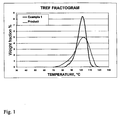
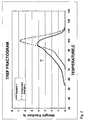
- modality of the comonomer distribution of the copolymer refers to the form of the curve in the TREF fractogram, i.e. the appearance of the graph showing the polymer weight fraction as a function of its solution temperature.
- the different polymer fractions produced in the different reactors will each have their own comonomer distribution which may considerably differ from one another.
- the TREF curve of the resulting final polymer is then obtained as a superposition of the TREF curves of the different polymer fractions.
- this curve will for example show two or more distinct maxima, a maximum and one or more shoulders, or will at least be distinctly broadened compared to the curves for the individual fractions.
- the TREF curve is having such a shape so that for the person skilled in the art it is clear that the broadened curve is originating from a superposition of two or more different TREF curves and hence shows a multimodal ethylene distribution.
- a polymer showing such a TREF curve is designated as having a "multimodal comonomer distribution".
- "bimodal comonomer distribution” is designating the case that the TREF curve of the final polymer is originating from two polymer fractions with different ethylene distributions.
- This TREF curves for example is showing two different maxima, a maximum and a shoulder or is distinctly broadened. It is having such a shape so that for the person skilled in the art it is clear that the curve is originating from a superposition of two different TREF curves.
- the multimodal copolymer is having an elution interval of 50°C or more.
- the elution interval designates the temperature range of the polymer elution determined from the TREF curve, i.e. the temperature range T end - T start , wherein Tend means the temperature where the last polymer fraction is eluted, i.e. at this temperature the polymer has been completely eluted from the column, and T start means the temperature where the polymer starts to elute, i.e. where the first fraction of the polymer is eluted (eluted weight fraction > 0).
- the copolymer is having a melting temperature T m of 135°C or higher.
- the copolymer is having an ethylene content of 5 wt.% or lower.
- the present invention in a fourth embodiment provides a process for preparing a polymer film comprising a propylene random copolymer with the comonomer being ethylene or an ⁇ -olefin comprising at least four carbon atoms, wherein the copolymer is having an elution interval of 50°C or more.
- the copolymer in this embodiment is having a melting temperature T m of 135°C or higher.
- the copolymer in this embodiment is having an ethylene content of 5 wt.% or lower.
- the copolymer in this embodiment is produced according to the multistage process described below and further preferred to all preferred embodiments of this process wherein the ethylene content of the products from slurry reactor and gas phase reactor are different.
- the present invention in a fifth embodiment provides a process for preparing a polymer film comprising a propylene random copolymer with the comonomer being ethylene, wherein the random copolymer is a unimodal polymer and the elution interval is determined by the equation Y ⁇ 4.5 ⁇ m + 16 wherein Y is the elution interval in °C and m is the percentage of ethylene in the copolymer in wt.%.
- Such unimodal polymers are produced by the multistage process described below wherein the ethylene content of the products from the slurry reactor and the gas phase reactor is the same.
- a polymer film according to any of the second to fifth of the above-described embodiments is having a sealing initiation temperature SIT of T m - 30°C or less, preferably T m - 33°C or less.
- a polymer film according to any of the first, third, fourth or fifth of the above-described embodiments is having a relative reduction of the static friction value (inside-inside) from one to four days of 35 % or more, preferably 40 % or more.
- a polymer film according to any of the first and second of the above-described embodiments comprises a propylene random copolymer wherein further the distribution of the comonomer in the random copolymer determined according to TREF method is multimodal, preferably bimodal.
- a polymer film according to any of the first and second of the above-described embodiments comprises a propylene random wherein the copolymer is having an elution interval of 50°C or more.
- a polymer film according to any of the first and second of the above-described embodiments comprises a propylene random copolymer wherein the random copolymer is a unimodal polymer and the elution interval is determined by the equation Y ⁇ 4.5 ⁇ m + 16 wherein Y is the elution interval in °C and m is the percentage of ethylene in the copolymer in wt.%.
- the comonomer in the propylene random copolymer used for the production of the inventive film is ethylene.
- the total ethylene content of the copolymer is 3 wt.% or more, more preferably 5 wt% or more.
- the total ethylene content of the copolymer is 9 wt.% or less, more preferably 8 wt.% or less.
- the tensile modulus of the film is low so that "soft" films are obtained. It is therefore preferred that the inventive polymer film is having a tensile modulus in the machine direction (MD) of 400 MPa or less, preferably 350 MPa or less.
- MD machine direction
- the polymer film according to the present invention preferably is having a thickness of 10 to 500 ⁇ m, more preferably of 20 to 200 ⁇ m
- the propylene random copolymer used for the production of the inventive film has an MFR 2 of 1 to 20, preferably of 2 to 12.
- the content of xylene solubles of the inventive polymer film is from 4 to 15 wt.%, more preferred from 6 to 10 wt.%.
- the film further comprises a nucleating agent.
- nucleating agents are for example sodium benzoate (CAS 532-32-1); 1,3:2,4-bis(3,4-dimethylbenzylidene)-sorbitol (CAS 135861-56-2, Millad 3988).
- the application of a nucleating agent increases the crystallisation rate of the polymer film. They are predominantly used for the production of thicker films for improving the optical properties thereof and/or for the improvement of the ageing properties of films.
- the inventive polymer film can be produced by any film making process known to the skilled person.
- the film can be produced by a cast process, a cast process with subsequent orientation of the film leading to a biaxial oriented polypropylene (BOPP) film, a roll stack process or a blown film process.
- BOPP biaxial oriented polypropylene
- inventive polymer film is produced in a cast process or a process leading to BOPP or a blown film process.
- the polymer before film forming is subjected to a "controlled rheology" (visbreaking) process. This is done in order to obtain required values for e.g. MFR 2 , polydispersity index PI and M w /M n of the polymer.
- Visbreaking of the copolymer is normally carried out in the molten stage of the polymer in single- or twin-screw extruders in the presence of free radical initiators such as peroxides, preferably in an inert atmosphere. Visbreaking processes are well known to the skilled person. Usually, visbreaking e.g. leads to a significant increase in the MFR 2 value.
- the propylene random copolymer after visbreaking is having an MFR 2 value of 6.0 to 12.0 g/10min.
- the MFR 2 of the propylene random copolymer accordingly is preferably from 1.5 to 3.0 g/10min.
- the propylene random copolymer used for the production of the inventive polymer film preferably has a molecular weight distribution with a polydispersity M w /M n from 2 to 7, preferably from 4 to 6.
- the polymer used for the production of the inventive cast film after visbreaking has a shear thinning index SHI of 3 to 5, further preferred of 3.5 to 4.5.
- the propylene random copolymers used for the production of the inventive film which may be obtained according to the process described below usually have a high degree of isotacticity measured in accordance to the FTIR-method, due to the catalyst systems (single-site or Ziegler-Natta) used for polymerisation.
- the propylene polymer has a degree of isotacticity as determined from FTIR (as described in: T. Sundell, H. Fagerholm & H. Crozier, Isotacticity determination of polypropylene using FT-Raman spectroscopy, Polymer 37, 1996, 3227-31 ) of 90% or more, more preferably of 95% or more and most preferably of 98% or more.
- FTIR as described in: T. Sundell, H. Fagerholm & H. Crozier, Isotacticity determination of polypropylene using FT-Raman spectroscopy, Polymer 37, 1996, 3227-31
- the copolymer may contain commonly used additives like:
- the propylene random copolymer used for the inventive films in all of the above-described embodiments is produced in a process for preparing a propylene random comonomer comprising polymerisation of propylene with a comonomer, said comonomer being ethylene or an ⁇ -olefin comprising at least four carbon atoms, in the presence of a catalyst in a multistage process comprising polymerisation of propylene with a comonomer in a first reaction zone including at least one slurry reactor to give a first polymerisation product, transferring said first product to a second reaction zone including at least one gas phase reactor and polymerisation of propylene with a comonomer in said gas phase reactor in the presence of said first polymerisation product, wherein the temperature in the gas phase reactor is higher than that in the slurry reactor.
- the temperature in the gas phase reactor is at least 5°C, preferably at least 10°C and most preferably at least 15°C higher than that in the slurry reactor.
- the comonomer content of the product produced in the gas phase reactor may be lower, equal to or higher than that of the product produced in the slurry reactor.
- both products after being produced are inseparably mixed with each other.
- the properties of the product produced in the gas phase reactors such as its ethylene content may nevertheless be determined by considering the corresponding values for the slurry reactor product and the final polymer and taking into account the production split.
- the comonomer content of the product produced in the gas phase reactor is the same or higher than that of the product produced in the slurry reactor and particularly preferred the comonomer content of the product produced in the gas phase reactor is higher than that of the product produced in the slurry reactor.
- the comonomer content of the product produced in the gas phase reactor is at least 0.75 mol% (corresponding to 0.5 wt.% for ethylene as a comonomer), more preferably at least 1.5 mol% (corresponding to 1 wt.% for ethylene as a comonomer) higher than that of the product produced in the slurry reactor.
- the comonomer used in the process and hence contained in the obtained polymer is ethylene.
- Propylene-ethylene random copolymers are particularly suited for film applications.
- the ethylene content of the product produced in the slurry reactor is from 3 to 6 wt.%, more preferably from 3 to 4 wt.%.
- the ethylene content of the product produced in the gas phase reactor is from 3 to 10 wt.%, more preferably from 4 to 8 wt.%.
- Slurry reactor designates any reactor such as a continous or simple batch stirred tank reactor or loop reactor operating in bulk or slurry, including supercritical conditions, in which the polymer forms in particulate form.
- the slurry reactor is operated as a bulk reactor.
- "Bulk” means a polymerisation in a reaction medium comprising at least 60 wt.% monomer.
- the bulk reactor is a loop reactor.
- the temperature in the slurry reactor is 65°C or more, more preferably 70°C or more.
- the temperature in the gas phase reactor is 80°C or more, more preferably 85°C or more.
- the production split between the slurry reactor and the gas phase reactor is from 10:90 to 70:30, more preferred from 20:80 to 65:35 and most preferred from 40:60 to 60:40.
- All catalysts suitable for the polymerisation of propylene with ethylene or an ⁇ -olefin such as single-site catalysts and Ziegler-Natta catalysts can be used. If single side catalysts are used, those described in WO 95/12627 and WO 00/34341 are preferred.
- a Ziegler-Natta type catalyst system comprising a catalyst component (comprising also vinyl-modified catalyst component), a cocatalyst component and an external electron donor is used.
- a catalyst component comprising also vinyl-modified catalyst component
- a cocatalyst component comprising also vinyl-modified catalyst component
- an external electron donor is used.
- Such catalyst systems are described in, for example, US 5,234,879 , WO 92/19653 , WO 92/19658 and WO 99/33843 and systems comprising vinyl-modified catalyst components in WO 99/24478 and WO 99/24479 . The content of these documents is herein included by reference.
- the external donors are silane based donors having the formula (I) R n R' m Si(R"O) a-n-m (I) wherein
- the aliphatic groups in the meanings of R and R' can be saturated or unsaturated.
- R and R' are linear C 1 to C 12 hydrocarbons which include methyl, ethyl, propyl, butyl, octyl and decanyl.
- suitable saturated branched C 1-8 alkyl groups the following can be mentioned: isopropyl, isobutyl, isopentyl, tert.-butyl, tert.-amyl and neopentyl.
- Cyclic aliphatic groups containing 4 to 8 carbon atoms comprise e.g. cyclopentyl, cyclohexyl, methylcyclopentyl and cycloheptyl.
- the donors used can be strongly coordinating donors which form relatively strong complexes with catalyst surface, mainly with MgCl 2 surface in the presence of aluminium alkyl and TiCl 4 .
- this kind of donors have the structure of the general formula (II): R"' n Si(OMe) 4-n (II) wherein R''' is a branched aliphatic or cyclic or aromatic group and n is 1 or 2, preferably 2 [ Härkönen et al., Macromol. Chem. 192 (1991) 2857-2863 ].
- the external donor is selected from the group consisting of dicyclopentyl dimethoxysilane, diisopropyl dimethoxysilane, di-isobutyl dimethoxysilane and di-t-butyl dimethoxysilane, most preferably dicyclopentyl dimethoxysilane (D donor).
- the main polymerisation stages may be preceded by prepolymerisation in which up to 10 wt.%, preferably 0.1 to 10 wt.%, and most preferred from 0.5. to 5 wt.% of the total amount of the polymer is produced.
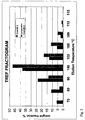
- Fractionation of the polypropylene samples was achieved by using analytical TREF.
- the TREF profiles were generated using a home made instrument, which is similar to a published design ( Wild, L., Trends Polym Sci. 1993, 1, 50 ).
- the sample was dissolved in xylene (2 to 4 mg/ml) at 130°C and injected into the column at 130°C, and the latter was then cooled to 20°C at a rate of 1.5 K/h.
- the column was subsequently eluted with 1,2,4-trichlorobenzene (TCB) at a flow rate of 0.5 ml/min while the temperature was increased from 20°C to 130°C over 4.5 h.
- TBC 1,2,4-trichlorobenzene
- the output detected with an i.r. detector operating at a wavelength of 3.41 ⁇ m, was presented as a fractogram normalised to constant area.
- xylene solubles fraction For the determination of the xylene solubles fraction, 2.0 g of polymer is desolved in 250 ml p -xylene at 135°C under agitation. After 30 ⁇ 2 min the solution is allowed to cool for 15 min at ambient temperature and then allowed to settle for 30 min at 25 ⁇ 0.5°C. The solution is filtered with filter paper into two 100 ml flasks.
- M w /M n was determined using gel permeation chromatography (GPC) at 130°C.
- GPC gel permeation chromatography
- TCB 1,2,4-trichlorobenzene
- MFR 2 was measured according to ISO 1133 at 230 °C and a load of 2.16 kg.
- Viscosity measurements are made with a dynamic rheometer (RDA-II QC).
- the shear thinning index. SHI is the most sensitive parameter for obtaining information about the MMD of polypropylene. SHI is calculated by dividing the Zero Shear Viscosity by a complex viscosity value obtained at a certain constant shear stress value, G*.
- the abbreviation SHI (0/50) is the ratio between the zero shear viscosity and the viscosity at a shear stress of 50 000 Pa.
- Continous multistage process was used to produce propylene copolymers.
- the process comprised a prepolymerisation step, a loop reactor and a fluidized bed gas phase reactor was used.
- the catalyst used was highly active, stereospecific transesterified MgCl 2 -supported Ziegler-Natta catalyst prepared according to US 5,234,879 at a titanization temperature of 135°C.
- the catalyst was contacted with a cocatalyst (triethylaluminium, TEAL), and an external donor (donor D, dicyclopentyl dimethoxysilane) with the Al/Ti ratio of 200 and an Al/D ratio of 10, to yield a catalyst system.
- TEAL triethylaluminium
- donor D dicyclopentyl dimethoxysilane
- the catalyst system and propylene were fed into the prepolymerisation reactor which was operated at 30°C.
- the prepolymerised catalyst was used in the subsequent polymerisation reactors.
- Propylene, ethylene and hydrogen and the prepolymerised catalyst were fed into the loop reactor which was operated as bulk reactor at the temperatures as indicated in Table 1 and a pressure of 55 bar.
- the polymer slurry stream was fed from the loop reactor into the gas phase reactor which was operated at the temperatures as indicated in Table 1 and a pressure of 20 bar. More propylene, ethylene and hydrogen were fed into the gas phase reactor to control the desired properties of the final polymer.
- the split between loop/gas phase reactor or loop/loop reactor was 70/30 to 40/60.
- Table 1 Unit Example 1
- Example 2 Example 3 Comparative Example 1 Comparative Example 2 Al/D mol/mol 10 10 10 10 Al/Ti mol/mol 200 200 200 200 200 Production split Loop:GPR/2nd loop) 70:30 40:60 45:55 60:40 60:40 Loop Temperature °C 70 70 70 67 67 Ethylene wt.% 3.2 3.9 3.4 3.5 4.7 MFR 2 g/10min 1.5 1.5 1.5 1.5 1.5 1.5 1.5 GPR/2nd loop Temperature °C 85 85 85 67 67 Final Product Ethylene wt.% 3.3 5.1 6.0 3.5 4.7 MFR 2 g/10min 1.3 1.3 1.5 1.5 1.5 1.5 1.5
- Ethylene content in loop product varied between 3.2 and 3.9 wt.%.
- the final ethylene content was 3.3 wt.%, 5 wt.% to 6 wt.%.
- the content of xylene solubles (XS) was increased from 5.5 to 11 wt.%, when total ethylene content increased from 3.3 to 6 wt.%. Less sticky material (XS) was produced in GPR at a certain comonomer content compared to loop (Fig. 4).
- XS xylene solubles
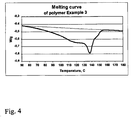
- Loop ethylene content determined the melting point of product, and it was between 137 and 147°C in spite of increased ethylene content in GPR.
- examples 4 and 5 the polymer according to example 2 was used and for the production of the films of examples 6 and 7 the polymer of example 3 was used.
- the following additives were added to the propylene random copolymers used for the production of the films according to the invention and to the polymers used for the production of the comparative films before film production: Irganox B215 and Irgafos 168)) 1500 ppm (antioxidant mixture of Irganox 1010 Calcium stearate 1000 ppm (acid scavenger) Erucamide 1000 ppm (slip agent) Oleamide 1000 ppm (slip agent) Syloblock 45 1800 ppm (silica, antiblock agent)
- the films were produced on a single-screw extruder with a screw diameter of 60 mm, using a multilayer feedblock and a slot die of 6.6 x 800 mm in a cast-film setup with a melt temperature at the die of 250°C, a chill roll temperature of 15°C and a counter-roll temperature of 25°C.
- the takeoff speed was adjusted such that the desired thickness of 30 and 50 ⁇ m was achieved.
- the tensile modulus in machine direction MD, the yield stress MD and elongation at break MD were determined according to the tensile test DIN 53455.
- the haze was determined according to ASTM D-1003-92.
- the delta friction (1/4), i.e. the relative reduction the static friction value (inside/inside) was calculated from friction test DIN 53375.
Landscapes
- Chemical & Material Sciences (AREA)
- Health & Medical Sciences (AREA)
- Chemical Kinetics & Catalysis (AREA)
- Medicinal Chemistry (AREA)
- Polymers & Plastics (AREA)
- Organic Chemistry (AREA)
- Engineering & Computer Science (AREA)
- Manufacturing & Machinery (AREA)
- Materials Engineering (AREA)
- Manufacture Of Macromolecular Shaped Articles (AREA)
- Addition Polymer Or Copolymer, Post-Treatments, Or Chemical Modifications (AREA)
- Polymerisation Methods In General (AREA)
- Medicinal Preparation (AREA)
Priority Applications (14)
| Application Number | Priority Date | Filing Date | Title |
|---|---|---|---|
| EP20010115469 EP1270651B1 (en) | 2001-06-27 | 2001-06-27 | Process for preparing a polymer film comprising a propylene random copolymer |
| EP05016989.5A EP1607433B1 (en) | 2001-06-27 | 2001-06-27 | Polymer film comprising a propylene random copolymer |
| AT01115469T ATE370184T1 (de) | 2001-06-27 | 2001-06-27 | Verfahren zur herstellung einer polymerfolie die ein statistisches propylencopolymer enthält |
| DE2001629939 DE60129939T2 (de) | 2001-06-27 | 2001-06-27 | Verfahren zur Herstellung einer Polymerfolie die ein statistisches Propylencopolymer enthält |
| JP2003509015A JP4188821B2 (ja) | 2001-06-27 | 2002-06-26 | プロピレンランダム共重合体を含むポリマーフィルム |
| PCT/EP2002/007085 WO2003002639A1 (en) | 2001-06-27 | 2002-06-26 | Polymer film comprising a propylene random copolymer |
| KR1020037016934A KR100845583B1 (ko) | 2001-06-27 | 2002-06-26 | 프로필렌 랜덤 공중합체를 포함하는 중합체 필름 |
| US10/481,785 US7683141B2 (en) | 2001-06-27 | 2002-06-26 | Polymer film comprising a propylene random copolymer |
| CNB028130030A CN100516123C (zh) | 2001-06-27 | 2002-06-26 | 包括丙烯无规共聚物的聚合物膜 |
| PL366944A PL204187B1 (pl) | 2001-06-27 | 2002-06-26 | Sposób wytwarzania folii polimerowej zawierającej statystyczny kopolimer propylenu |
| CZ20033526A CZ20033526A3 (cs) | 2001-06-27 | 2002-06-26 | Polymerní fólie obsahující nahodilý kopolymer propylenu |
| RU2003137597A RU2334766C2 (ru) | 2001-06-27 | 2002-06-26 | Полимерная пленка, содержащая статистический сополимер пропилена |
| US11/790,254 US20070203309A1 (en) | 2001-06-27 | 2007-04-24 | Polymer film comprising a propylene random copolymer |
| US11/790,226 US20070197743A1 (en) | 2001-06-27 | 2007-04-24 | Polymer film comprising a propylene random copolymer |
Applications Claiming Priority (1)
| Application Number | Priority Date | Filing Date | Title |
|---|---|---|---|
| EP20010115469 EP1270651B1 (en) | 2001-06-27 | 2001-06-27 | Process for preparing a polymer film comprising a propylene random copolymer |
Related Child Applications (1)
| Application Number | Title | Priority Date | Filing Date |
|---|---|---|---|
| EP05016989.5A Division EP1607433B1 (en) | 2001-06-27 | 2001-06-27 | Polymer film comprising a propylene random copolymer |
Publications (2)
| Publication Number | Publication Date |
|---|---|
| EP1270651A1 EP1270651A1 (en) | 2003-01-02 |
| EP1270651B1 true EP1270651B1 (en) | 2007-08-15 |
Family
ID=8177835
Family Applications (2)
| Application Number | Title | Priority Date | Filing Date |
|---|---|---|---|
| EP20010115469 Expired - Lifetime EP1270651B1 (en) | 2001-06-27 | 2001-06-27 | Process for preparing a polymer film comprising a propylene random copolymer |
| EP05016989.5A Revoked EP1607433B1 (en) | 2001-06-27 | 2001-06-27 | Polymer film comprising a propylene random copolymer |
Family Applications After (1)
| Application Number | Title | Priority Date | Filing Date |
|---|---|---|---|
| EP05016989.5A Revoked EP1607433B1 (en) | 2001-06-27 | 2001-06-27 | Polymer film comprising a propylene random copolymer |
Country Status (11)
| Country | Link |
|---|---|
| US (3) | US7683141B2 (enExample) |
| EP (2) | EP1270651B1 (enExample) |
| JP (1) | JP4188821B2 (enExample) |
| KR (1) | KR100845583B1 (enExample) |
| CN (1) | CN100516123C (enExample) |
| AT (1) | ATE370184T1 (enExample) |
| CZ (1) | CZ20033526A3 (enExample) |
| DE (1) | DE60129939T2 (enExample) |
| PL (1) | PL204187B1 (enExample) |
| RU (1) | RU2334766C2 (enExample) |
| WO (1) | WO2003002639A1 (enExample) |
Cited By (1)
| Publication number | Priority date | Publication date | Assignee | Title |
|---|---|---|---|---|
| AU2011244480B2 (en) * | 2010-04-20 | 2014-02-27 | Borealis Ag | Polypropylene bottles |
Families Citing this family (35)
| Publication number | Priority date | Publication date | Assignee | Title |
|---|---|---|---|---|
| ATE407970T1 (de) | 2005-01-14 | 2008-09-15 | Borealis Polymers Oy | Heterophasische polymerzusammensetzung und verfahren zu ihrer herstellung |
| PL1724289T5 (pl) * | 2005-05-20 | 2013-06-28 | Borealis Tech Oy | Polimer o wysokiej wartości szybkości płynięcia oraz o poprawionej trwałości przeznaczony do wytwarzania rur |
| US7517569B2 (en) | 2005-06-06 | 2009-04-14 | Cryovac, Inc. | Shrink packaging barrier film |
| US7935301B2 (en) | 2005-08-01 | 2011-05-03 | Cryovac, Inc. | Method of thermoforming |
| WO2007107579A1 (en) * | 2006-03-21 | 2007-09-27 | Basell Poliolefine Italia S.R.L. | A controlled nucleated polymer composition |
| EP1964873A1 (en) * | 2007-02-21 | 2008-09-03 | Borealis Technology Oy | Polypropylene films having improved optical properties |
| EP2042552A1 (en) * | 2007-09-27 | 2009-04-01 | Borealis Technology Oy | Polyolefin compositions having improved optical and mechanical properties |
| US8470915B2 (en) * | 2007-10-30 | 2013-06-25 | Milliken & Company | Additive composition and thermoplastic compositions comprising the same |
| EP2147939A1 (en) | 2008-07-22 | 2010-01-27 | Borealis AG | Polypropylene composition with improved optics for film and moulding applications |
| US8945460B2 (en) | 2008-10-27 | 2015-02-03 | Borealis Ag | Extrusion blown molded bottles with high stiffness and transparency |
| EP2350187B1 (en) * | 2008-10-27 | 2012-09-05 | Borealis AG | Extrusion blown molded bottles with high stiffness and transparency |
| US20100159173A1 (en) * | 2008-12-18 | 2010-06-24 | Fina Technology, Inc. | Polyethylene Polymerization Processes |
| KR101060012B1 (ko) * | 2009-06-02 | 2011-08-29 | 주식회사 효성 | 폴리프로필렌 랜덤 공중합체의 제조방법 |
| EP2338931A1 (en) | 2009-12-23 | 2011-06-29 | Borealis AG | Blown grade showing superior stiffness, transparency and processing behaviour |
| EP2338930A1 (en) | 2009-12-23 | 2011-06-29 | Borealis AG | Blownfilm grade showing superior stiffness, transparency and processing behaviour |
| EP2380926B1 (en) | 2010-04-26 | 2017-06-21 | Borealis AG | Masterbatch for improving stiffness and transparency of a random propylene copolymer |
| ES2569183T3 (es) | 2011-01-03 | 2016-05-09 | Borealis Ag | Material de sellado de polipropileno con alta temperatura de fusión |
| ES2426273T3 (es) * | 2011-05-23 | 2013-10-22 | Borealis Ag | Copolímero de propileno aleatorio con alta rigidez y baja turbidez |
| HUE061316T2 (hu) | 2013-07-09 | 2023-06-28 | Totalenergies Onetech Belgium | Propilén kopolimer bopp hõvel lezárható fóliarétegekhez |
| DE102013113120B4 (de) * | 2013-11-27 | 2023-06-29 | Loparex Germany Gmbh & Co. Kg | Folie für Etiketten und Abdeckbahnen |
| ES2787886T3 (es) | 2013-12-04 | 2020-10-19 | Borealis Ag | Composición de polipropileno adecuada para pintura sin imprimación |
| BR112016014027B1 (pt) | 2013-12-20 | 2021-03-23 | Sabic Global Technologies B.V. | Sistema catalisador para a polimerização de uma olefina, seu processo de preparação, poliolefina e processo de preparação da mesma |
| EA033164B1 (ru) | 2013-12-20 | 2019-09-30 | Сауди Бейсик Индастриз Корпорейшн | Каталитическая система для полимеризации олефина |
| MX2016008035A (es) | 2013-12-20 | 2017-03-03 | Saudi Basic Ind Corp | Sistema catalizador para polimerizacion de una olefina. |
| BR112016014175B1 (pt) | 2013-12-20 | 2021-06-22 | Saudi Basic Industries Corporation | Sistema catalisador para polimerização de uma olefina, seu processo de preparação, poliolefina e processo de preparação da mesma |
| EP2965908B1 (en) * | 2014-07-09 | 2018-03-21 | Borealis AG | Propylene random copolymer for film applications |
| ES2735352T3 (es) | 2014-12-12 | 2019-12-18 | Borealis Ag | Películas de polipropileno con capacidad de impresión mejorada |
| ES2829208T3 (es) | 2014-12-12 | 2021-05-31 | Borealis Ag | Películas de polipropileno con comportamiento de sellado mejorado, especialmente considerando las propiedades de sellado mejoradas |
| EP3187512A1 (en) | 2015-12-31 | 2017-07-05 | Borealis AG | Process for preparing propylene copolymer compositions |
| EP3249004A1 (en) | 2016-05-24 | 2017-11-29 | Clariant International Ltd | Release components to increase anti-adhesion properties of thermoplastic packaging material |
| US11390700B2 (en) * | 2017-05-18 | 2022-07-19 | Borealis Ag | Propylene-ethylene random copolymer with improved irradiation resistance |
| EP3652247B2 (en) | 2017-07-14 | 2024-09-04 | Borealis AG | Polypropylene composition |
| CA3102004A1 (en) * | 2018-06-11 | 2019-12-19 | W.R. Grace & Co.-Conn. | Propylene-ethylene copolymer compositions suitable for hot fill packaging of foodstuffs |
| ES2970457T3 (es) * | 2018-06-29 | 2024-05-28 | Borealis Ag | Composición de copolímero aleatorio C2C3 |
| AU2019378072B2 (en) | 2018-11-15 | 2022-04-14 | Abu Dhabi Polymers Co. Ltd (Borouge) L.L.C. | Polymer composition for blow molding applications |
Family Cites Families (28)
| Publication number | Priority date | Publication date | Assignee | Title |
|---|---|---|---|---|
| JPS6055046A (ja) * | 1983-09-07 | 1985-03-29 | Idemitsu Petrochem Co Ltd | プロピレン共重合体組成物 |
| CN1047600C (zh) * | 1986-10-09 | 1999-12-22 | 三井化学株式会社 | 低结晶性丙烯系无规共聚体组合物的制法 |
| KR920000173B1 (ko) | 1986-10-09 | 1992-01-09 | 미쓰이세끼유 가가꾸고오교오 가부시끼가이샤 | 저결정성 프로필렌계 랜덤 공중합체 조성물, 그 제조방법 및 폴리프로필렌 복합 적층체 |
| DE4031784A1 (de) * | 1990-10-08 | 1992-04-09 | Hoechst Ag | Beidseitig niedrigsiegelnde, bedruckbare, biaxial orientierte polyolefin-mehrschichtfolie |
| MX9200724A (es) * | 1991-02-22 | 1993-05-01 | Exxon Chemical Patents Inc | Mezcla termosellable de polietileno o plastomero de muy baja densidad con polimeros a base de polipropileno y pelicula termosellable asi como articulos hechos con aquellas. |
| EP0538749B1 (en) | 1991-10-21 | 1995-01-11 | Mitsubishi Petrochemical Co., Ltd. | Propylene copolymer composition |
| IT1254244B (it) * | 1992-03-10 | 1995-09-14 | Himont Inc | Composizioni di copolimeri random del propene contenenti una alfa- olefina come comonomero |
| US5587436A (en) * | 1992-11-12 | 1996-12-24 | Quantum Chemical Corporation | Process for controlling the polymerization of propylene and ethylene and copolymer products |
| JP3916681B2 (ja) * | 1994-04-15 | 2007-05-16 | 三菱化学株式会社 | プロピレン系フィルム |
| JP3264148B2 (ja) * | 1995-08-31 | 2002-03-11 | 住友化学工業株式会社 | プロピレン−エチレンランダム共重合体、その製法及びフィルム |
| AU1129097A (en) * | 1995-12-08 | 1997-07-03 | Union Carbide Chemicals & Plastics Technology Corporation | Process for the production of bimodalpropylene copolymers |
| IT1282691B1 (it) | 1996-02-27 | 1998-03-31 | Montell North America Inc | Processo per la preparazione di copolimeri random del propilene e prodotti cosi' ottenuti |
| US6583227B2 (en) * | 1996-09-04 | 2003-06-24 | Exxonmobil Chemical Patents Inc. | Propylene polymers for films |
| DE19652734A1 (de) * | 1996-12-18 | 1998-06-25 | Hoechst Trespaphan Gmbh | Beidseitig siegelfähige orientierte Polyolefin-Mehrschichtfolie, Verfahren zu ihrer Herstellung und ihre Verwendung |
| DE19722569A1 (de) * | 1997-05-28 | 1998-12-03 | Basf Ag | Statistische Propylencopolymerisate |
| FI104824B (fi) * | 1997-06-24 | 2000-04-14 | Borealis As | Menetelmä propeenin terpolymeerien aikaansaamiseksi |
| BR9810290A (pt) * | 1997-06-24 | 2000-09-19 | Borealis As | Copolìmero polipropileno heterofásico, processo para a preparação do mesmo, e, uso de um polìmero. |
| FI111848B (fi) * | 1997-06-24 | 2003-09-30 | Borealis Tech Oy | Menetelmä ja laitteisto propeenin homo- ja kopolymeerien valmistamiseksi |
| FI111847B (fi) * | 1997-06-24 | 2003-09-30 | Borealis Tech Oy | Menetelmä propeenin kopolymeerien valmistamiseksi |
| FI973816A0 (fi) * | 1997-09-26 | 1997-09-26 | Borealis As | Polypropen med hoeg smaeltstyrka |
| US5984839A (en) * | 1998-05-04 | 1999-11-16 | Corkum; Eric T. | Exercise machine having a built-in computer |
| US6268063B1 (en) * | 1998-08-25 | 2001-07-31 | Tokuyama Corporation | Propylene resin composition, process for the preparation thereof, and use thereof |
| US6670423B2 (en) | 2001-02-20 | 2003-12-30 | E. I. Du Pont De Nemours And Company | Polar ethylene-based polymer, cycloolefin polymer blends |
| EP1270628B1 (en) * | 2001-06-27 | 2004-10-06 | Borealis Technology Oy | Propylene random copolymer and process for the production thereof |
| EP2147939A1 (en) | 2008-07-22 | 2010-01-27 | Borealis AG | Polypropylene composition with improved optics for film and moulding applications |
| EP2586824B1 (en) | 2011-10-31 | 2016-09-14 | Borealis AG | Polypropylene blend with improved balance between SIT and melting point |
| ES2829208T3 (es) | 2014-12-12 | 2021-05-31 | Borealis Ag | Películas de polipropileno con comportamiento de sellado mejorado, especialmente considerando las propiedades de sellado mejoradas |
| US10233271B2 (en) | 2015-06-12 | 2019-03-19 | Borealis Ag | Process for producing propylene polymer compositions |
-
2001
- 2001-06-27 AT AT01115469T patent/ATE370184T1/de not_active IP Right Cessation
- 2001-06-27 DE DE2001629939 patent/DE60129939T2/de not_active Expired - Lifetime
- 2001-06-27 EP EP20010115469 patent/EP1270651B1/en not_active Expired - Lifetime
- 2001-06-27 EP EP05016989.5A patent/EP1607433B1/en not_active Revoked
-
2002
- 2002-06-26 WO PCT/EP2002/007085 patent/WO2003002639A1/en not_active Ceased
- 2002-06-26 US US10/481,785 patent/US7683141B2/en not_active Expired - Lifetime
- 2002-06-26 JP JP2003509015A patent/JP4188821B2/ja not_active Expired - Fee Related
- 2002-06-26 RU RU2003137597A patent/RU2334766C2/ru not_active IP Right Cessation
- 2002-06-26 KR KR1020037016934A patent/KR100845583B1/ko not_active Expired - Fee Related
- 2002-06-26 CN CNB028130030A patent/CN100516123C/zh not_active Expired - Fee Related
- 2002-06-26 PL PL366944A patent/PL204187B1/pl not_active IP Right Cessation
- 2002-06-26 CZ CZ20033526A patent/CZ20033526A3/cs unknown
-
2007
- 2007-04-24 US US11/790,226 patent/US20070197743A1/en not_active Abandoned
- 2007-04-24 US US11/790,254 patent/US20070203309A1/en not_active Abandoned
Non-Patent Citations (1)
| Title |
|---|
| None * |
Cited By (2)
| Publication number | Priority date | Publication date | Assignee | Title |
|---|---|---|---|---|
| AU2011244480B2 (en) * | 2010-04-20 | 2014-02-27 | Borealis Ag | Polypropylene bottles |
| AU2011244480C1 (en) * | 2010-04-20 | 2014-12-18 | Borealis Ag | Polypropylene bottles |
Also Published As
| Publication number | Publication date |
|---|---|
| US7683141B2 (en) | 2010-03-23 |
| US20070203309A1 (en) | 2007-08-30 |
| DE60129939T2 (de) | 2008-05-15 |
| RU2003137597A (ru) | 2005-05-27 |
| CN100516123C (zh) | 2009-07-22 |
| US20070197743A1 (en) | 2007-08-23 |
| EP1270651A1 (en) | 2003-01-02 |
| PL204187B1 (pl) | 2009-12-31 |
| ATE370184T1 (de) | 2007-09-15 |
| EP1607433A1 (en) | 2005-12-21 |
| CN1520438A (zh) | 2004-08-11 |
| RU2334766C2 (ru) | 2008-09-27 |
| US20040175591A1 (en) | 2004-09-09 |
| KR20040028794A (ko) | 2004-04-03 |
| WO2003002639A1 (en) | 2003-01-09 |
| JP4188821B2 (ja) | 2008-12-03 |
| PL366944A1 (en) | 2005-02-07 |
| JP2004530781A (ja) | 2004-10-07 |
| EP1607433B1 (en) | 2016-08-10 |
| KR100845583B1 (ko) | 2008-07-10 |
| CZ20033526A3 (cs) | 2004-11-10 |
| DE60129939D1 (de) | 2007-09-27 |
Similar Documents
| Publication | Publication Date | Title |
|---|---|---|
| EP1270651B1 (en) | Process for preparing a polymer film comprising a propylene random copolymer | |
| EP1434810B2 (en) | Propylene random copolymer | |
| EP1849827B1 (en) | Propylene polymer composition and oriented film made therefrom | |
| EP2173471B1 (en) | Process for producing propylene terpolymers | |
| EP2462175B1 (en) | Improved polypropylene for use in bopp applications | |
| EP2147026B1 (en) | Soft propylene polymer compositions | |
| EP2158228B1 (en) | Catalyst system for polypropylene copolymers | |
| EP2152768B1 (en) | Polypropylene copolymer |
Legal Events
| Date | Code | Title | Description |
|---|---|---|---|
| PUAI | Public reference made under article 153(3) epc to a published international application that has entered the european phase |
Free format text: ORIGINAL CODE: 0009012 |
|
| 17P | Request for examination filed |
Effective date: 20010627 |
|
| AK | Designated contracting states |
Kind code of ref document: A1 Designated state(s): AT BE CH CY DE DK ES FI FR GB GR IE IT LI LU MC NL PT SE TR |
|
| AX | Request for extension of the european patent |
Free format text: AL;LT;LV;MK;RO;SI |
|
| 17Q | First examination report despatched |
Effective date: 20030409 |
|
| AKX | Designation fees paid |
Designated state(s): AT BE CH CY DE DK ES FI FR GB GR IE IT LI LU MC NL PT SE TR |
|
| 17Q | First examination report despatched |
Effective date: 20030409 |
|
| RIC1 | Information provided on ipc code assigned before grant |
Ipc: C08J 5/18 20060101AFI20070124BHEP Ipc: C08L 23/14 20060101ALI20070124BHEP |
|
| RTI1 | Title (correction) |
Free format text: PROCESS FOR PREPARING A POLYMER FILM COMPRISING A PROPYLENE RANDOM COPOLYMER |
|
| GRAP | Despatch of communication of intention to grant a patent |
Free format text: ORIGINAL CODE: EPIDOSNIGR1 |
|
| GRAS | Grant fee paid |
Free format text: ORIGINAL CODE: EPIDOSNIGR3 |
|
| GRAA | (expected) grant |
Free format text: ORIGINAL CODE: 0009210 |
|
| AK | Designated contracting states |
Kind code of ref document: B1 Designated state(s): AT BE CH CY DE DK ES FI FR GB GR IE IT LI LU MC NL PT SE TR |
|
| REG | Reference to a national code |
Ref country code: GB Ref legal event code: FG4D |
|
| REG | Reference to a national code |
Ref country code: CH Ref legal event code: EP |
|
| REG | Reference to a national code |
Ref country code: IE Ref legal event code: FG4D |
|
| REF | Corresponds to: |
Ref document number: 60129939 Country of ref document: DE Date of ref document: 20070927 Kind code of ref document: P |
|
| PG25 | Lapsed in a contracting state [announced via postgrant information from national office to epo] |
Ref country code: NL Free format text: LAPSE BECAUSE OF FAILURE TO SUBMIT A TRANSLATION OF THE DESCRIPTION OR TO PAY THE FEE WITHIN THE PRESCRIBED TIME-LIMIT Effective date: 20070815 Ref country code: ES Free format text: LAPSE BECAUSE OF FAILURE TO SUBMIT A TRANSLATION OF THE DESCRIPTION OR TO PAY THE FEE WITHIN THE PRESCRIBED TIME-LIMIT Effective date: 20071126 Ref country code: FI Free format text: LAPSE BECAUSE OF FAILURE TO SUBMIT A TRANSLATION OF THE DESCRIPTION OR TO PAY THE FEE WITHIN THE PRESCRIBED TIME-LIMIT Effective date: 20070815 |
|
| NLV1 | Nl: lapsed or annulled due to failure to fulfill the requirements of art. 29p and 29m of the patents act | ||
| PG25 | Lapsed in a contracting state [announced via postgrant information from national office to epo] |
Ref country code: LI Free format text: LAPSE BECAUSE OF FAILURE TO SUBMIT A TRANSLATION OF THE DESCRIPTION OR TO PAY THE FEE WITHIN THE PRESCRIBED TIME-LIMIT Effective date: 20070815 Ref country code: AT Free format text: LAPSE BECAUSE OF FAILURE TO SUBMIT A TRANSLATION OF THE DESCRIPTION OR TO PAY THE FEE WITHIN THE PRESCRIBED TIME-LIMIT Effective date: 20070815 Ref country code: CH Free format text: LAPSE BECAUSE OF FAILURE TO SUBMIT A TRANSLATION OF THE DESCRIPTION OR TO PAY THE FEE WITHIN THE PRESCRIBED TIME-LIMIT Effective date: 20070815 |
|
| REG | Reference to a national code |
Ref country code: CH Ref legal event code: PL |
|
| ET | Fr: translation filed | ||
| PG25 | Lapsed in a contracting state [announced via postgrant information from national office to epo] |
Ref country code: DK Free format text: LAPSE BECAUSE OF FAILURE TO SUBMIT A TRANSLATION OF THE DESCRIPTION OR TO PAY THE FEE WITHIN THE PRESCRIBED TIME-LIMIT Effective date: 20070815 Ref country code: GR Free format text: LAPSE BECAUSE OF FAILURE TO SUBMIT A TRANSLATION OF THE DESCRIPTION OR TO PAY THE FEE WITHIN THE PRESCRIBED TIME-LIMIT Effective date: 20071116 |
|
| PG25 | Lapsed in a contracting state [announced via postgrant information from national office to epo] |
Ref country code: PT Free format text: LAPSE BECAUSE OF FAILURE TO SUBMIT A TRANSLATION OF THE DESCRIPTION OR TO PAY THE FEE WITHIN THE PRESCRIBED TIME-LIMIT Effective date: 20080115 |
|
| PLBE | No opposition filed within time limit |
Free format text: ORIGINAL CODE: 0009261 |
|
| STAA | Information on the status of an ep patent application or granted ep patent |
Free format text: STATUS: NO OPPOSITION FILED WITHIN TIME LIMIT |
|
| PG25 | Lapsed in a contracting state [announced via postgrant information from national office to epo] |
Ref country code: SE Free format text: LAPSE BECAUSE OF FAILURE TO SUBMIT A TRANSLATION OF THE DESCRIPTION OR TO PAY THE FEE WITHIN THE PRESCRIBED TIME-LIMIT Effective date: 20071115 |
|
| 26N | No opposition filed |
Effective date: 20080516 |
|
| PG25 | Lapsed in a contracting state [announced via postgrant information from national office to epo] |
Ref country code: MC Free format text: LAPSE BECAUSE OF NON-PAYMENT OF DUE FEES Effective date: 20080630 |
|
| GBPC | Gb: european patent ceased through non-payment of renewal fee |
Effective date: 20080627 |
|
| PG25 | Lapsed in a contracting state [announced via postgrant information from national office to epo] |
Ref country code: IE Free format text: LAPSE BECAUSE OF NON-PAYMENT OF DUE FEES Effective date: 20080627 |
|
| PG25 | Lapsed in a contracting state [announced via postgrant information from national office to epo] |
Ref country code: GB Free format text: LAPSE BECAUSE OF NON-PAYMENT OF DUE FEES Effective date: 20080627 |
|
| PG25 | Lapsed in a contracting state [announced via postgrant information from national office to epo] |
Ref country code: CY Free format text: LAPSE BECAUSE OF FAILURE TO SUBMIT A TRANSLATION OF THE DESCRIPTION OR TO PAY THE FEE WITHIN THE PRESCRIBED TIME-LIMIT Effective date: 20070815 |
|
| PG25 | Lapsed in a contracting state [announced via postgrant information from national office to epo] |
Ref country code: LU Free format text: LAPSE BECAUSE OF NON-PAYMENT OF DUE FEES Effective date: 20080627 |
|
| PG25 | Lapsed in a contracting state [announced via postgrant information from national office to epo] |
Ref country code: TR Free format text: LAPSE BECAUSE OF FAILURE TO SUBMIT A TRANSLATION OF THE DESCRIPTION OR TO PAY THE FEE WITHIN THE PRESCRIBED TIME-LIMIT Effective date: 20070815 |
|
| PGFP | Annual fee paid to national office [announced via postgrant information from national office to epo] |
Ref country code: BE Payment date: 20110614 Year of fee payment: 11 |
|
| BERE | Be: lapsed |
Owner name: BOREALIS TECHNOLOGY OY Effective date: 20120630 |
|
| PG25 | Lapsed in a contracting state [announced via postgrant information from national office to epo] |
Ref country code: BE Free format text: LAPSE BECAUSE OF NON-PAYMENT OF DUE FEES Effective date: 20120630 |
|
| REG | Reference to a national code |
Ref country code: FR Ref legal event code: PLFP Year of fee payment: 16 |
|
| REG | Reference to a national code |
Ref country code: FR Ref legal event code: PLFP Year of fee payment: 17 |
|
| PGFP | Annual fee paid to national office [announced via postgrant information from national office to epo] |
Ref country code: DE Payment date: 20170621 Year of fee payment: 17 Ref country code: FR Payment date: 20170621 Year of fee payment: 17 |
|
| PGFP | Annual fee paid to national office [announced via postgrant information from national office to epo] |
Ref country code: IT Payment date: 20170622 Year of fee payment: 17 |
|
| REG | Reference to a national code |
Ref country code: DE Ref legal event code: R119 Ref document number: 60129939 Country of ref document: DE |
|
| PG25 | Lapsed in a contracting state [announced via postgrant information from national office to epo] |
Ref country code: IT Free format text: LAPSE BECAUSE OF NON-PAYMENT OF DUE FEES Effective date: 20180627 Ref country code: FR Free format text: LAPSE BECAUSE OF NON-PAYMENT OF DUE FEES Effective date: 20180630 Ref country code: DE Free format text: LAPSE BECAUSE OF NON-PAYMENT OF DUE FEES Effective date: 20190101 |