EP1266982A2 - Method for production of zinc oxide single crystal - Google Patents
Method for production of zinc oxide single crystal Download PDFInfo
- Publication number
- EP1266982A2 EP1266982A2 EP02251915A EP02251915A EP1266982A2 EP 1266982 A2 EP1266982 A2 EP 1266982A2 EP 02251915 A EP02251915 A EP 02251915A EP 02251915 A EP02251915 A EP 02251915A EP 1266982 A2 EP1266982 A2 EP 1266982A2
- Authority
- EP
- European Patent Office
- Prior art keywords
- single crystal
- zno
- zinc oxide
- melt
- solvent
- Prior art date
- Legal status (The legal status is an assumption and is not a legal conclusion. Google has not performed a legal analysis and makes no representation as to the accuracy of the status listed.)
- Withdrawn
Links
Images

Classifications
-
- C—CHEMISTRY; METALLURGY
- C30—CRYSTAL GROWTH
- C30B—SINGLE-CRYSTAL GROWTH; UNIDIRECTIONAL SOLIDIFICATION OF EUTECTIC MATERIAL OR UNIDIRECTIONAL DEMIXING OF EUTECTOID MATERIAL; REFINING BY ZONE-MELTING OF MATERIAL; PRODUCTION OF A HOMOGENEOUS POLYCRYSTALLINE MATERIAL WITH DEFINED STRUCTURE; SINGLE CRYSTALS OR HOMOGENEOUS POLYCRYSTALLINE MATERIAL WITH DEFINED STRUCTURE; AFTER-TREATMENT OF SINGLE CRYSTALS OR A HOMOGENEOUS POLYCRYSTALLINE MATERIAL WITH DEFINED STRUCTURE; APPARATUS THEREFOR
- C30B9/00—Single-crystal growth from melt solutions using molten solvents
-
- C—CHEMISTRY; METALLURGY
- C30—CRYSTAL GROWTH
- C30B—SINGLE-CRYSTAL GROWTH; UNIDIRECTIONAL SOLIDIFICATION OF EUTECTIC MATERIAL OR UNIDIRECTIONAL DEMIXING OF EUTECTOID MATERIAL; REFINING BY ZONE-MELTING OF MATERIAL; PRODUCTION OF A HOMOGENEOUS POLYCRYSTALLINE MATERIAL WITH DEFINED STRUCTURE; SINGLE CRYSTALS OR HOMOGENEOUS POLYCRYSTALLINE MATERIAL WITH DEFINED STRUCTURE; AFTER-TREATMENT OF SINGLE CRYSTALS OR A HOMOGENEOUS POLYCRYSTALLINE MATERIAL WITH DEFINED STRUCTURE; APPARATUS THEREFOR
- C30B15/00—Single-crystal growth by pulling from a melt, e.g. Czochralski method
-
- C—CHEMISTRY; METALLURGY
- C30—CRYSTAL GROWTH
- C30B—SINGLE-CRYSTAL GROWTH; UNIDIRECTIONAL SOLIDIFICATION OF EUTECTIC MATERIAL OR UNIDIRECTIONAL DEMIXING OF EUTECTOID MATERIAL; REFINING BY ZONE-MELTING OF MATERIAL; PRODUCTION OF A HOMOGENEOUS POLYCRYSTALLINE MATERIAL WITH DEFINED STRUCTURE; SINGLE CRYSTALS OR HOMOGENEOUS POLYCRYSTALLINE MATERIAL WITH DEFINED STRUCTURE; AFTER-TREATMENT OF SINGLE CRYSTALS OR A HOMOGENEOUS POLYCRYSTALLINE MATERIAL WITH DEFINED STRUCTURE; APPARATUS THEREFOR
- C30B29/00—Single crystals or homogeneous polycrystalline material with defined structure characterised by the material or by their shape
- C30B29/10—Inorganic compounds or compositions
- C30B29/16—Oxides
Definitions
- This invention relates to a method for the production of a zinc oxide single crystal that is usable for the production of a single crystal by the top-seeded solution growth method (TSSG method) and the traveling-solvent floating-zone method (TSFZ method) of zinc oxide and for the production of a single crystal by the liquid-phase epitaxy growth method.
- TSSG method top-seeded solution growth method
- TSFZ method traveling-solvent floating-zone method
- Zinc oxide is an interesting substance that, though an oxide in entity, is capable of giving rise to a direct transition type semiconductor manifesting a band gap of 3.3 eV. It is a material that can be expected to find utility as a blue ultraviolet emission material. It also exhibits piezoelectricity, fluorescence and photoconductivity and combines diverse functions. In recent years, this substance has been attracting attention as a magnetic semiconductor and has been promising more extensive utility. It, therefore, is required to form a large single crystal of high quality.
- the conventional hydrothermal synthesis method or slow-cooling method fails to produce a large single crystal long in an expected direction of crystal axis and necessitates a long time for the production of a crystal
- the top-seeded solution growth method (TSSG method) and the traveling-solvent floating-zone method (TSFZ method) using boron oxide and vanadium oxide as solvents have been proposed with a view to overcoming the drawbacks of the conventional methods (Japanese Patent Application No. 2000-394927).
- An object of this invention is to provide a method for producing a transparent white zinc oxide without requiring use of vanadium oxide as a solvent.
- the method for the production of a zinc oxide single crystal comprises the steps of mixing zinc oxide as a solute with molybdenum oxide as a solvent to form a mixture, thermally fusing the mixture to produce a melt, and keeping a temperature of the melt intact or lowering the temperature of the melt, thereby allowing a microcrystal represented by the general formula, ZnO, to be deposited and grown on a seed crystal or substrate.
- the method described above embraces a method wherein the mixture is interposed between a raw material feed rod of zinc oxide and the seed crystal before the thermally fusing step and the thermally fusing step is taken at not less than 1060°C to form a floating melt zone, and further comprising a step of moving the floating melt zone toward the raw material feed rod, thereby inducing deposition of a single crystal on said seed crystal.
- the solute is allowed to contain one or more foreign elements selected from the group consisting of Li, Na, K, Cu, Ag, N, P. As, Cr, Al, Bi, Sb, Co, Fe, Ni, Ti, Mn, V and Pr.
- This invention is capable of depositing and growing a ZnO single crystal on a seed crystal by the top-seeded solution growth method (TSSG method) or the traveling-solvent floating-zone method (TSFZ method) using the melt and is also capable of producing a ZnO single crystal membrane on a substrate by the liquid-phase epitaxy growth method which comprises immersing the substrate in the melt.
- TSSG method top-seeded solution growth method
- TSFZ method traveling-solvent floating-zone method
- FIG. 1 is a phase diagram of the ZnO-MoO 3 system (R. Kohlmuller and J. P. Faurie, Bull. Soc. Chim. Fr., (1968) 4381).
- a liquidus line exists in a composition of 51 to 100 mol% of ZnO and 49 to 0 mol% of MoO 3 .
- the raw material for the mixed composition between these oxide melts at any temperature falling in the liquidus line.
- the temperature of the molten raw material is gradually lowered, the composition of the molten raw material is continuously shifted along the liquidus line toward the MoO 3 side and the ZnO is gradually precipitated as a solid phase.
- ZnO is known to have the characteristic properties thereof conspicuously varied by the incorporation therein of a foreign element.
- the ZnO compounds incorporating therein a foreign element such as Li, Na, K, Cu, Ag, N, P, As, Cr, Al, Bi, Sb, Co, Fe, Ni, Ti, Mn, V or Pr, in a proportion of not more than several % have been heretofore utilized in the production of p type semiconductors, magnetic semiconductors, conductivity controllers, varistors, etc.
- a ZnO solid solution single crystal which has the added foreign element mixed homogeneously therein can be produced by establishing in a crucible a temperature environment furnished with a temperature gradient such that the bottom part of the crucible has a slightly higher temperature than the surface of the solution for the growth of a crystal, placing in the bottom part of the crucible a ZnO block incorporating therein a required quantity of the added element, and keeping the solution at a fixed temperature meanwhile pulling and growing the crystal, thereby causing the block in the bottom part of the crucible to be melted in proportion as the part thereof is spent for the growth, enabling the composition of the solution to remain intact constantly, and consequently permitting the added element to be homogeneously mixed in the produced single crystal.
- a ZnO single crystal grown from a solution which is formed basically of zinc oxide and molybdenum oxide is made to form a finished product deposited on the same ZnO or on a seed crystal having a lattice constant and a melting point approximate closely thereto, or a ZnO single crystal membrane similarly derived is made to grow on a substrate.
- This invention proposes a method for the production of a ZnO single crystal, comprising the steps of mixing zinc oxide as a solute with molybdenum oxide as a solvent, heating the resultant mixture to produce a melt, keeping the produced melt at a fixed temperature or cooling it to a lowered temperature, and consequently inducing deposition and growth of a microcrystal represented by the general formula, ZnO, on a seed crystal or on a substrate.
- TSSG top-seeded solution growth method
- THFZ traveling-solvent floating-zone method
- a single crystal can be deposited on a seed crystal by mixing zinc oxide as a solute with molybdenum oxide as a solvent to form a fixture, interposing the mixture between a raw material feed rod of zinc oxide and the seed crystal, heating the mixture to not lower than 1060°C to produce a melt that forms a floating melt zone, and moving the floating melt zone toward the raw material feed rod, thereby inducing the deposition of a single crystal on the seed crystal.
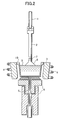
- a ZnO single crystal was produced by the top-seeded solution growth method (TSSG method).
- the single crystal growth device used for this production is illustrated in FIG. 2.
- 1 denotes a pulling shaft, 2 a platinum shaft, 3 a heat insulator, 4 a RF heating coil, 5 a thermocouple, 6 a crucible support, 7 a seed crystal, 8 a grown single crystal, 9 a starting raw material, and 10 a platinum crucible.
- ZnO and MoO 3 were mixed at a molar ratio of 54:46.
- 100 g of the produced mixture was placed and heated to about 1150°C by the induction heating method using the RF heating coil 4 till solution.
- the ZnO single crystal 7 as a seed crystal was brought into contact with the surface of the melt.
- a ZnO microcrystal was deposited little by little on the interface of the melt contiguous with the seed crystal which had the lowest temperature in the melt and crystallized and grown on the seed crystal 7.
- the single crystal S grown as described above was gradually pulled up from the melt.
- the pulling of the grown single crystal was carried out simultaneously with the lowering of the temperature of the melt.
- the speed of pulling the ZnO single crystal was in the range of 0.5 ⁇ 1.0 mm/h
- the temperature lowering speed of the melt was in the range of 2 ⁇ 5°C/h
- the rotational frequency of crystal was in the range of 15 ⁇ 30 rpm
- the atmosphere was open air.
- a transparent white ZnO single crystal measuring 20 ⁇ 22 ⁇ 3 mm could be obtained in a production time of 6 hours.
- a ZnO single crystal was produced by the top-seeded solution growth method (TSSG method) using the same device as in Example 1.
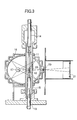
- a ZnO single crystal was produced by the traveling-solvent floating-zone method (TSFZ method).
- FIG. 3 A floating zone single crystal production device used for the production is illustrated in FIG. 3.
- 11 denotes a raw material feed rod, 12 a seed crystal, 13 a melt zone (solvent), 14 and 15 each a rotary shaft, 16 a quartz tube, 17 a halogen lamp, 18 an ellipsoidal mirror, 19 an inspection window, 10 a lens, and 21 an inspection screen.
- a ZnO powder was compressed in a pressure molder to form a round bar measuring 6 mm in diameter and 7 cm in length. This round bar was homogeneously fired at 1400°C for15 hours to obtain the ZnO raw material feed rod 11.
- a powder obtained by mixing ZnO and MoO 3 at a molar ratio of 54:46 was fired at 750°C for 15 hours.
- a pressure molder was used to compress the fired powder to form a round bar measuring 6 mm in diameter.
- the round bar was homogeneously fired at 800°C for 15 hours to obtain a solvent. Thereafter, the solvent in the shape of a round bar was cut radially to form discs and these discs were fused to a ZnO raw material feed rod.
- the cylindrical bar specimen having the solvent fused to the leading end of the ZnO single crystal was fixed to the upper sample rotary shaft 14 in the floating zone single crystal production device adopting the infrared heating method.
- a fired ZnO feed rod was similarly fixed as a seed crystal 12 to the lower rotary shaft 15.
- the seed crystal 12 and the ZnO raw material feed rod 11 having the solvent fused thereto were set so as not to deviate from the rotary shaft.
- the solvent mentioned above was thermally fused by the use of the infrared ray from the halogen lamp 17.
- the seed crystal was brought into contact with the molten solvent and, by virtue of the surface tension of the liquid, the molten solvent was kept between the raw material supply rod and the seed crystal. Thereafter, the raw material feed rod and the seed crystal were rotated at 30 rpm in the mutually opposite directions.
- the molten solvent was moved at a speed of 0.5 mm/hr in the direction of the raw material feed rod, namely in the upward direction, to induce growth of a ZnO single crystal on the seed crystal.
- a ZnO single crystal was produced by the liquid-phase epitaxy growth method using the same device as in Example 1.
- ZnO and MoO 3 were mixed at a molar ratio of 54:46.
- a platinum crucible 10 measuring 45 mm in diameter and 30 mm in height and concurrently serving as a heater element, 100 g of the produced mixture was placed and heated to about 1150°C by the inducting heating method using a RF heating coil 4 till fusion.
- a ZnO single crystal substrate or a sapphire substrate was brought into contact with the surface of the consequently produced melt, left immersed in the meld for 5 minutes, and then pulled up to produce a ZnO single crystal by the liquid-phase epitaxy growth method.
- a Li-added ZnO solid solution single crystal was produced by using the same device as in Example 1, setting the position of the peripheral edge part of the platinum crucible 10 at a height of 1 ⁇ 2 cm from the upper edge of the RF heating coil 4, keeping the bottom part of the crucible at a higher temperature than the surface of the melt, and keeping the melt at a fixed temperature.
- the starting raw material was prepared by mixing ZnO, MoO 3 , and Li 2 CO 3 at a molar ratio of 54:45.5:0.5. The resultant mixture was placed in the platinum crucible and melted therein.
Landscapes
- Chemical & Material Sciences (AREA)
- Engineering & Computer Science (AREA)
- Crystallography & Structural Chemistry (AREA)
- Materials Engineering (AREA)
- Metallurgy (AREA)
- Organic Chemistry (AREA)
- Inorganic Chemistry (AREA)
- Crystals, And After-Treatments Of Crystals (AREA)
Abstract
Description
Claims (8)
- A method for the production of a zinc oxide single crystal, comprising:a step of mixing zinc oxide as a solute with molybdenum oxide as a solvent to form a mixture,a step of thermally fusing the mixture to produce a melt, anda step of keeping a temperature of the melt intact or lowering the temperature of the melt, thereby inducing deposition and growth of a microcrystal represented by the general formula, ZnO, on a seed crystal (12) or substrate.
- The method according to claim 1, wherein the mixture is interposed between a raw material feed rod (11) of zinc oxide and the seed crystal (12) before the thermally fusing step and the thermally fusing step is taken at not less than 1060°C to form a floating melt zone (13), and further comprising a step of moving the floating melt zone toward the raw material feed rod, thereby inducing deposition of a single crystal on said seed crystal.
- The method according to claim 1, wherein a mixing ratio of the solute to the solvent is in the range of 99.9 ∼ 51 mol% vs. 0.1 ∼ 49 mol%.
- The method according to claim 2, wherein a mixing ratio of the solute to the solvent is in the range of 99.9 ∼ 51 mol% vs. 0.1 ∼ 49 mol%.5.
- The method according to claim 1, wherein the solute contains a small quantity of a foreign element.
- The method according to claim 2, wherein said zinc oxide contains a small quantity of a foreign element.
- The method according to claim 5, wherein the foreign element is one or more members selected from the group consisting of Li, Na, K, Cu, Ag, N, P, As, Cr, Al, Bi, Sb, Co, Fe, Ni, Ti, Mn, V, and Pr.
- The method according to claim 6, wherein the foreign element is one or more members selected from the group consisting of Li, Na, K, Cu, Ag, N, P, As, Cr, Al, Bi, Sb, Co, Fe, Ni, Ti, Mn, V, and Pr.
Applications Claiming Priority (2)
| Application Number | Priority Date | Filing Date | Title |
|---|---|---|---|
| JP2001177499A JP3694736B2 (en) | 2001-06-12 | 2001-06-12 | Method for producing zinc oxide single crystal |
| JP2001177499 | 2001-06-12 |
Publications (2)
| Publication Number | Publication Date |
|---|---|
| EP1266982A2 true EP1266982A2 (en) | 2002-12-18 |
| EP1266982A3 EP1266982A3 (en) | 2006-07-05 |
Family
ID=19018334
Family Applications (1)
| Application Number | Title | Priority Date | Filing Date |
|---|---|---|---|
| EP02251915A Withdrawn EP1266982A3 (en) | 2001-06-12 | 2002-03-18 | Method for production of zinc oxide single crystal |
Country Status (3)
| Country | Link |
|---|---|
| US (1) | US20020185055A1 (en) |
| EP (1) | EP1266982A3 (en) |
| JP (1) | JP3694736B2 (en) |
Cited By (4)
| Publication number | Priority date | Publication date | Assignee | Title |
|---|---|---|---|---|
| CN100360720C (en) * | 2006-03-24 | 2008-01-09 | 中国科学院上海硅酸盐研究所 | Ventilated Crucible Drop Growth Method for Zinc Oxide Single Crystal |
| CN100401602C (en) * | 2003-11-27 | 2008-07-09 | 中国科学院福建物质结构研究所 | A liquid phase epitaxy method for growing zinc oxide blue-violet light semiconductor |
| US8409348B2 (en) | 2007-03-16 | 2013-04-02 | Ube Industries, Ltd. | Production method of zinc oxide single crystal |
| WO2016054866A1 (en) * | 2014-10-10 | 2016-04-14 | 北京工业大学 | Gzo (zno:ga) crystal growth method |
Families Citing this family (9)
| Publication number | Priority date | Publication date | Assignee | Title |
|---|---|---|---|---|
| US7279040B1 (en) | 2005-06-16 | 2007-10-09 | Fairfield Crystal Technology, Llc | Method and apparatus for zinc oxide single crystal boule growth |
| JP5146310B2 (en) * | 2006-03-01 | 2013-02-20 | 三菱瓦斯化学株式会社 | Method for producing ZnO single crystal by liquid phase growth method |
| JP4827099B2 (en) | 2007-01-19 | 2011-11-30 | トヨタ自動車株式会社 | Powder phosphor and method for manufacturing the same, and light emitting device, display device and fluorescent lamp having powder phosphor |
| JP5260881B2 (en) * | 2007-03-20 | 2013-08-14 | 三菱瓦斯化学株式会社 | Mg-containing ZnO mixed crystal single crystal, laminated body thereof, and production method thereof |
| US8389099B1 (en) | 2007-06-01 | 2013-03-05 | Rubicon Technology, Inc. | Asymmetrical wafer configurations and method for creating the same |
| FR2929959B1 (en) * | 2008-04-10 | 2010-08-27 | Commissariat Energie Atomique | PROCESS FOR THE PREPARATION OF ZINC OXIDE (ZNO) POLYCRISTALS AND MONOCRYSTALS ON CHEMICALLY ACTIVATED SUBLIMATION GERM AT HIGH TEMPERATURE |
| DE102008019127B4 (en) * | 2008-04-16 | 2010-12-09 | Epcos Ag | Multilayer component |
| DE102008035102A1 (en) * | 2008-07-28 | 2010-02-11 | Epcos Ag | Multilayer component |
| CN101824652B (en) * | 2010-05-06 | 2012-05-30 | 中国科学院宁波材料技术与工程研究所 | Preparation method of alnico magnet |
Family Cites Families (9)
| Publication number | Priority date | Publication date | Assignee | Title |
|---|---|---|---|---|
| US3043671A (en) * | 1960-04-07 | 1962-07-10 | Bell Telephone Labor Inc | Zinc oxide crystal growth method |
| US3953281A (en) * | 1974-06-27 | 1976-04-27 | International Business Machines Corporation | Method and system for growing monocrystalline ingots |
| US4111852A (en) * | 1976-12-30 | 1978-09-05 | Westinghouse Electric Corp. | Pre-glassing method of producing homogeneous sintered zno non-linear resistors |
| US4297250A (en) * | 1980-01-07 | 1981-10-27 | Westinghouse Electric Corp. | Method of producing homogeneous ZnO non-linear powder compositions |
| JP2552309B2 (en) * | 1987-11-12 | 1996-11-13 | 株式会社明電舎 | Non-linear resistor |
| US5444040A (en) * | 1989-12-18 | 1995-08-22 | Seiko Epson Corporation | Superconductive oxide single crystal and manufacturing method thereof |
| JPH0690035A (en) * | 1992-09-08 | 1994-03-29 | Ngk Insulators Ltd | Piezoelectric and its manufacture |
| US5891828A (en) * | 1996-10-14 | 1999-04-06 | Agency Of Industrial Science & Technology, Ministry Of International Trade & Industry | Method of producing superconducting PrBa2 Cu3 Oy single crystal and PrBa2 Cu3 Oy superconducting device |
| JP3936767B2 (en) * | 1997-02-21 | 2007-06-27 | 財団法人国際超電導産業技術研究センター | Preparation method of oxide crystals |
-
2001
- 2001-06-12 JP JP2001177499A patent/JP3694736B2/en not_active Expired - Lifetime
-
2002
- 2002-03-18 EP EP02251915A patent/EP1266982A3/en not_active Withdrawn
- 2002-03-19 US US10/100,144 patent/US20020185055A1/en not_active Abandoned
Cited By (5)
| Publication number | Priority date | Publication date | Assignee | Title |
|---|---|---|---|---|
| CN100401602C (en) * | 2003-11-27 | 2008-07-09 | 中国科学院福建物质结构研究所 | A liquid phase epitaxy method for growing zinc oxide blue-violet light semiconductor |
| CN100360720C (en) * | 2006-03-24 | 2008-01-09 | 中国科学院上海硅酸盐研究所 | Ventilated Crucible Drop Growth Method for Zinc Oxide Single Crystal |
| US8409348B2 (en) | 2007-03-16 | 2013-04-02 | Ube Industries, Ltd. | Production method of zinc oxide single crystal |
| WO2016054866A1 (en) * | 2014-10-10 | 2016-04-14 | 北京工业大学 | Gzo (zno:ga) crystal growth method |
| US9458553B2 (en) | 2014-10-10 | 2016-10-04 | Beijing University Of Technology | Method for growing GZO (ZnO:Ga) crystals |
Also Published As
| Publication number | Publication date |
|---|---|
| US20020185055A1 (en) | 2002-12-12 |
| EP1266982A3 (en) | 2006-07-05 |
| JP2003002790A (en) | 2003-01-08 |
| JP3694736B2 (en) | 2005-09-14 |
Similar Documents
| Publication | Publication Date | Title |
|---|---|---|
| US20020185055A1 (en) | Method for production of zinc oxide single crystal | |
| TWI404841B (en) | Method for producing ZnO single crystal according to liquid phase growth method | |
| RU2474625C2 (en) | Method of producing zinc oxide monocrystal | |
| US5057492A (en) | Method for preparing a single crystal of lanthanum cuprate | |
| EP1234899A2 (en) | A single crystal and method of manufacturing same | |
| US5554219A (en) | Process for producing single-crystal bulk zinc selenide | |
| JP3548910B2 (en) | Method for producing ZnO single crystal | |
| JP3207983B2 (en) | Method for producing single crystals of I-III-VI2 group compounds | |
| JP2004091222A (en) | Method for manufacturing oxide semiconductor single crystal | |
| CN121451296B (en) | Lithium molybdenum chromate monocrystal, preparation method thereof and optical filter | |
| JP3906359B2 (en) | Method for producing P-type semiconductor SrCu2O2 single crystal | |
| JP4882075B2 (en) | Rutile (TiO2) single crystal manufacturing method, rutile (TiO2) single crystal, and optical isolator using the same | |
| EP1670974A1 (en) | Spinel articles and methods for forming same | |
| JPS59107997A (en) | Single crystal growth method of inorganic composite oxide | |
| JPH06345583A (en) | Method and device for producing single crystal | |
| JP3193440B2 (en) | Method for producing I-III-VI2 group semiconductor single crystal | |
| JPH0471877B2 (en) | ||
| JPS6016890A (en) | Preparation of hgcdte crystal | |
| JPH04295097A (en) | Production of cadmium manganese telluride single crystal | |
| JPH08295507A (en) | Optical crystal and its production | |
| JPS62288185A (en) | Production of compound semiconductor crystal | |
| JPS5964587A (en) | Preparation of single crystal | |
| JPH09124397A (en) | Production of ferrite single crystal | |
| JP2000178095A (en) | Crystal growth method | |
| JP2008254938A (en) | Method for producing rutile (TiO2) single crystal, rutile (TiO2) single crystal, and jewelery product using the same |
Legal Events
| Date | Code | Title | Description |
|---|---|---|---|
| PUAI | Public reference made under article 153(3) epc to a published international application that has entered the european phase |
Free format text: ORIGINAL CODE: 0009012 |
|
| AK | Designated contracting states |
Kind code of ref document: A2 Designated state(s): AT BE CH CY DE DK ES FI FR GB GR IE IT LI LU MC NL PT SE TR |
|
| AX | Request for extension of the european patent |
Free format text: AL;LT;LV;MK;RO;SI |
|
| PUAL | Search report despatched |
Free format text: ORIGINAL CODE: 0009013 |
|
| AK | Designated contracting states |
Kind code of ref document: A3 Designated state(s): AT BE CH CY DE DK ES FI FR GB GR IE IT LI LU MC NL PT SE TR |
|
| AX | Request for extension of the european patent |
Extension state: AL LT LV MK RO SI |
|
| AKX | Designation fees paid | ||
| REG | Reference to a national code |
Ref country code: DE Ref legal event code: 8566 |
|
| STAA | Information on the status of an ep patent application or granted ep patent |
Free format text: STATUS: THE APPLICATION IS DEEMED TO BE WITHDRAWN |
|
| 18D | Application deemed to be withdrawn |
Effective date: 20070111 |