EP1266825A1 - Procédé de séparation d'une arme aéroportée propulsée par rapport à un porteur - Google Patents
Procédé de séparation d'une arme aéroportée propulsée par rapport à un porteur Download PDFInfo
- Publication number
- EP1266825A1 EP1266825A1 EP02291476A EP02291476A EP1266825A1 EP 1266825 A1 EP1266825 A1 EP 1266825A1 EP 02291476 A EP02291476 A EP 02291476A EP 02291476 A EP02291476 A EP 02291476A EP 1266825 A1 EP1266825 A1 EP 1266825A1
- Authority
- EP
- European Patent Office
- Prior art keywords
- weapon
- carrier
- separation
- propulsion
- allowing
- Prior art date
- Legal status (The legal status is an assumption and is not a legal conclusion. Google has not performed a legal analysis and makes no representation as to the accuracy of the status listed.)
- Granted
Links
- 238000000034 method Methods 0.000 title claims abstract description 12
- 238000000926 separation method Methods 0.000 claims description 44
- 230000001960 triggered effect Effects 0.000 claims description 9
- 238000010304 firing Methods 0.000 claims description 2
- 230000008901 benefit Effects 0.000 description 3
- RZVHIXYEVGDQDX-UHFFFAOYSA-N 9,10-anthraquinone Chemical compound C1=CC=C2C(=O)C3=CC=CC=C3C(=O)C2=C1 RZVHIXYEVGDQDX-UHFFFAOYSA-N 0.000 description 2
- 230000001133 acceleration Effects 0.000 description 2
- 238000011161 development Methods 0.000 description 2
- 230000018109 developmental process Effects 0.000 description 2
- 239000003380 propellant Substances 0.000 description 2
- 241001080024 Telles Species 0.000 description 1
- 230000007423 decrease Effects 0.000 description 1
- 230000007613 environmental effect Effects 0.000 description 1
- 230000005484 gravity Effects 0.000 description 1
- 230000007257 malfunction Effects 0.000 description 1
- 239000000463 material Substances 0.000 description 1
Images

Classifications
-
- F—MECHANICAL ENGINEERING; LIGHTING; HEATING; WEAPONS; BLASTING
- F42—AMMUNITION; BLASTING
- F42B—EXPLOSIVE CHARGES, e.g. FOR BLASTING, FIREWORKS, AMMUNITION
- F42B15/00—Self-propelled projectiles or missiles, e.g. rockets; Guided missiles
-
- B—PERFORMING OPERATIONS; TRANSPORTING
- B64—AIRCRAFT; AVIATION; COSMONAUTICS
- B64D—EQUIPMENT FOR FITTING IN OR TO AIRCRAFT; FLIGHT SUITS; PARACHUTES; ARRANGEMENT OR MOUNTING OF POWER PLANTS OR PROPULSION TRANSMISSIONS IN AIRCRAFT
- B64D7/00—Arrangement of military equipment, e.g. armaments, armament accessories or military shielding, in aircraft; Adaptations of armament mountings for aircraft
- B64D7/08—Arrangement of rocket launchers
-
- F—MECHANICAL ENGINEERING; LIGHTING; HEATING; WEAPONS; BLASTING
- F41—WEAPONS
- F41F—APPARATUS FOR LAUNCHING PROJECTILES OR MISSILES FROM BARRELS, e.g. CANNONS; LAUNCHERS FOR ROCKETS OR TORPEDOES; HARPOON GUNS
- F41F3/00—Rocket or torpedo launchers
- F41F3/04—Rocket or torpedo launchers for rockets
- F41F3/06—Rocket or torpedo launchers for rockets from aircraft
-
- F—MECHANICAL ENGINEERING; LIGHTING; HEATING; WEAPONS; BLASTING
- F42—AMMUNITION; BLASTING
- F42B—EXPLOSIVE CHARGES, e.g. FOR BLASTING, FIREWORKS, AMMUNITION
- F42B10/00—Means for influencing, e.g. improving, the aerodynamic properties of projectiles or missiles; Arrangements on projectiles or missiles for stabilising, steering, range-reducing, range-increasing or fall-retarding
- F42B10/32—Range-reducing or range-increasing arrangements; Fall-retarding means
- F42B10/48—Range-reducing, destabilising or braking arrangements, e.g. impact-braking arrangements; Fall-retarding means, e.g. balloons, rockets for braking or fall-retarding
-
- F—MECHANICAL ENGINEERING; LIGHTING; HEATING; WEAPONS; BLASTING
- F42—AMMUNITION; BLASTING
- F42B—EXPLOSIVE CHARGES, e.g. FOR BLASTING, FIREWORKS, AMMUNITION
- F42B10/00—Means for influencing, e.g. improving, the aerodynamic properties of projectiles or missiles; Arrangements on projectiles or missiles for stabilising, steering, range-reducing, range-increasing or fall-retarding
- F42B10/60—Steering arrangements
Definitions
- the invention relates to the separation - or dropping - of airborne weapons propelled.
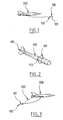
- FIG. 1 Schematically illustrated in Figure 1 the separation of a weapon 100 compared to a carrier 200.
- Such a weapon 100 comprises for example, as illustrated in the figure 2, control means 101, as well as propulsion means 102.
- the control means 101 are for example adjustable control surfaces. They are controlled, with the propulsion means 102, by means 103 of trajectory control and management, which include for example an inertial unit and a microprocessor, the latter managing the movements of the control surfaces 101 of the weapon 100, as well as the means of propulsion 102.
- the separation of the weapon is carried out towards the front of the carrier or down.
- Separation from the front has the advantage of providing very important propulsion energy to the weapon. So the weapon has the energy required to make a positive resource and avoid obstacles.
- Front separation is also common at high altitudes (HA).
- the weapon creates a passage in near transonic from the plane.
- the weapon is piloted in a closed loop upon separation. This is the typical case of a missile air-air which has only a very short time to intercept its target.
- the invention overcomes these drawbacks.
- the invention provides a method for separation from an aircraft type carrier, an airborne weapon comprising means propulsion and as well as means for its automatic guidance on a target, characterized in that upon separation of the weapon from to the bearer, the means of propulsion of the weapon are not engaged, one slows the weapon in relation to the carrier to pass it behind it and in that the propulsion and automatic guidance of the weapon are not triggered towards its target only after a certain predetermined time.
- Rear separation requires a weak impulse and more longer than a forward separation.
- the triggering of the propulsion means 102 of the weapon is carried out only after a certain duration, which makes it possible to be sure that the weapon does not catch up with the carrier 200. We thus quickly establish a minimum safety distance 300 between the weapon and the carrier.
- the weapon 100 since the weapon 100 is behind the carrier 200, the latter does not has no fear of releases of gas by propulsion means 102.
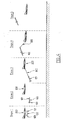
- the weapon is made 100, as well as illustrated in Figure 4 (which will be described in more detail below), a positive resource after a certain predetermined time.
- the positive resource increases the drag of the weapon 100 by taking incidence of its axis relative to the trajectory and thus decreases its speed.
- This positive resource is made so that the weapon has a maximum load factor.
- n cos ⁇ + V 2 / (R g)
- ⁇ is the angle of inclination of the airplane with the vertical
- V is the aerodynamic speed of the airplane in the air
- R is the radius of curvature of the path of the aircraft
- g is the acceleration of gravity.
- the weapon has a load factor of 1, it steals stationary. When the load factor is greater than 1, the weapon has an upward trajectory. A load factor less than 1 means that the gun goes down.
- a speed called conventional speed which is a function the initial speed of the weapon, as well as the altitude which is that of the carrier and the weapon when fired.
- This conventional speed calculated by the management resources 103 is compared to a threshold value.
- the management means 103 control the control surfaces 101 so that the weapon performs a positive resource (load factor greater than 1).
- the weapon performs a negative resource (load factor less than 1).
- Display means inside the carrier 200 allow the pilot to know what is the scenario in which he finds himself (speed conventional or above the above threshold) and therefore to know what will be the trajectory of the weapon after its separation.
- a dial is provided on which a cursor moves which is a function of the conventional speed and on which a landmark which allows the pilot to know if the conventional speed is above or below the threshold.
- the criteria for selecting the different types of trajectory for the weapon is simple, easy to develop, reliable and inexpensive in this respect.
- the conventional threshold speed can be approximately equal to 380 knots.
- the resource is triggered 1.5 to 2 seconds after separation of the weapon with the bearer.
- the wearer therefore has time to free himself while knowing the position of the weapon.
- This period of time makes it possible to establish a safety distance (referenced by 300 in FIG. 3) between the weapon 100 and the carrier 200.
- the the safety distance is advantageously greater than 50 meters.
- the ballistic phase during which the weapon is not propelled lasts about 5 seconds. After this time, the drive is started.
- FIGS. 4 to 5 we have shown the stages of rear separation and loop guidance opened.
- step 1 the weapon 100 is separated physically from carrier 200.
- This separation is carried out in the form of a drop of the type of the one that is used for smooth bombs, namely below the device 200 with the control surfaces 101 of the weapon inactive.
- Weapon 100 starts at lose energy compared to the carrier 200.
- the distance between the weapon 100 and the carrier 200 gradually increases.
- weapon 100 begins to fall in ballistic phase (step 2).
- Wings located on the back of the 100 weapon
- / or control surfaces located at the front of the weapon 100
- the control surfaces 101 are activated for, depending on whether or not the conventional speed of the weapon is greater than threshold at which it is compared, have weapon 100 perform a resource positive or a negative resource.
- the distance between weapon 100 and carrier 200 further increases made of the increase in the drag of the weapon due to its taking of incidence.
- the propulsion means are triggered only after a enough time for the weapon to be at a safe distance relative to the device (there is generally at least 5 seconds between the dropping and triggering the propulsion).
- the impulse given by the propulsion means is initially weak intensity, which allows to maintain the safety distance 300.
- the weapon 100 having, if necessary, taken from the slope and having moved away from the safety zone, the piloting of the weapon in closed loop on its target is triggered (step 5 - about 10 seconds after the drop).
- the entire trajectory of the weapon between the release and triggering of closed loop guidance is reproducible from one separation to another and independent of the position of the target.
- propulsion is also triggered when the descent slope is reached.
Landscapes
- Engineering & Computer Science (AREA)
- General Engineering & Computer Science (AREA)
- Aviation & Aerospace Engineering (AREA)
- Physics & Mathematics (AREA)
- Fluid Mechanics (AREA)
- Chemical & Material Sciences (AREA)
- Combustion & Propulsion (AREA)
- Aiming, Guidance, Guns With A Light Source, Armor, Camouflage, And Targets (AREA)
- Control Of Position, Course, Altitude, Or Attitude Of Moving Bodies (AREA)
Abstract
Description
L'arme peut également éviter un obstacle lorsqu'elle se situe en très basse altitude.
Les moyens employés pour résoudre les problèmes ne comportent pas de moyens logiciels compliqués et onéreux.
- après une première phase de chute balistique, on fait prendre à l'arme une incidence qui augmente sa traínée et la ralentit.
- on déclenche la propulsion sensiblement lorsque l'arme a atteint une pente de montée ou de descente qui correspond au facteur de charge maximal.
- on détermine si l'on donne à l'arme une incidence positive ou une incidence négative en fonction de la vitesse et de l'altitude de l'arme et du porteur à la séparation.
- on détermine en fonction de la vitesse et de l'altitude de l'arme et du porteur à la séparation une valeur de vitesse conventionnelle, en ce qu'on compare la valeur de vitesse conventionnelle ainsi obtenue à une valeur seuil, et en ce que, en fonction du résultat de cette comparaison, on détermine si l'on donne à l'arme une incidence positive ou une incidence négative.
- la propulsion n'est déclenchée après la séparation qu'après une durée permettant un éloignement supérieur à une distance de sécurité minimale entre l'arme et le porteur.
- une distance de sécurité minimale est de 50 m ou supérieure.
Enfin, l'invention concerne un système pour la gestion du tir, à partir d'un porteur de type aéronef, d'une arme aéroportée comportant des moyens de propulsion et ainsi que des moyens permettant son guidage automatique sur une cible, qui comporte dans l'aéronef des moyens permettant l'affichage à destination d'un pilote d'une information relative à la vitesse conventionnelle déterminée ou susceptible de l'être lors de la mise en oeuvre d'un procédé conforme à celui décrit dans les développements précédents.
- la figure 1 illustre une séparation d'une arme vers l'avant du porteur dont elle se sépare ;
- la figure 2 est une représentation schématique d'une telle arme ;
- la figure 3 le principe de la séparation d'une arme vers l'arrière du porteur ;
- la figure 4 illustre des étapes de guidage à la suite d'une séparation en très basse altitude, la vitesse conventionnelle de l'arme étant supérieure à la valeur seuil donnée ; et
- la figure 5 illustre des étapes de guidage à la suite d'une séparation en HA.
V est la vitesse aérodynamique de l'avion dans l'air ;
R est le rayon de courbure de la trajectoire de l'avion ;
g est l'accélération de la pesanteur.)
Claims (8)
- Procédé pour la séparation par rapport à un porteur (200) de type aéronef, d'une arme (100) aéroportée comportant des moyens de propulsion (102) et ainsi que des moyens (101, 103) permettant son guidage automatique sur une cible, l'arme étant propulsée, lorsque les moyens de propulsion sont enclenchés, dans une direction selon laquelle il y aurait un risque que l'arme ne rattrape le porteur, caractérisé en ce qu'à à la séparation de l'arme par rapport au porteur, les moyens de propulsion (102) de l'arme (100) ne sont pas enclenchés, on ralentit l'arme par rapport au porteur (200) pour la faire passer derrière celui-ci et en ce qu'on ne déclenche la propulsion et le guidage automatique de l'arme vers sa cible qu'après un certain temps prédéterminé, permettant un éloignement supérieur à une distance de sécurité minimale entre l'arme et le porteur.
- Procédé selon la revendication 1, caractérisé en ce que qu'après une première phase de chute balistique, on fait prendre à l'arme (100) une incidence qui augmente sa traínée et la ralentit.
- Procédé selon la revendication 2, caractérisé que l'on déclenche la propulsion sensiblement lorsque l'arme (100) a atteint une pente de montée de descente qui correspond un facteur de charge maximal.
- Procédé selon l'une des revendications 2 ou 3, caractérisé en ce qu'on détermine si l'on donne à l'arme une incidence positive ou une incidence négative en fonction de la vitesse et de l'altitude de l'arme et du porteur à la séparation.
- Procédé selon la revendication 4, caractérisé en ce qu'on détermine, en fonction de la vitesse et de l'altitude de l'arme (100) et du porteur (200) à la séparation, une valeur de vitesse conventionnelle, en ce qu'on compare la valeur de vitesse conventionnelle ainsi obtenue à une valeur seuil, et en ce que, en fonction du résultat de cette comparaison, on détermine si l'on donne à l'arme une incidence positive ou une incidence négative.
- Procédé selon la revendication 1, caractérisé en ce que une distance de sécurité minimale est de 50 m ou supérieure.
- Arme (100) aéroportée du type comportant des moyens de propulsion (102) ainsi que des moyens (101, 103) permettant son guidage automatique sur une cible qui lui est désignée, caractérisé en ce qu'elle comporte des moyens aptes à commander les moyens de guidage pour mettre en oeuvre le procédé de séparation selon les revendications 1 à 7.
- Système pour la gestion du tir, à partir d'un porteur de type aéronef, d'une arme (100) aéroportée comportant des moyens de propulsion (102) et ainsi que des moyens (101) permettant son guidage automatique sur une cible, caractérisé en ce qu'il comporte dans l'aéronef des moyens permettant l'affichage à destination d'un pilote d'une information relative à la vitesse conventionnelle déterminée ou susceptible de l'être lors de la mise en oeuvre d'un procédé conforme à la revendication 5.
Applications Claiming Priority (2)
| Application Number | Priority Date | Filing Date | Title |
|---|---|---|---|
| FR0107858A FR2826109B1 (fr) | 2001-06-15 | 2001-06-15 | Procede de separation d'une arme aeroportee propulsee par rapport a un porteur |
| FR0107858 | 2001-06-15 |
Publications (2)
| Publication Number | Publication Date |
|---|---|
| EP1266825A1 true EP1266825A1 (fr) | 2002-12-18 |
| EP1266825B1 EP1266825B1 (fr) | 2007-08-15 |
Family
ID=8864354
Family Applications (1)
| Application Number | Title | Priority Date | Filing Date |
|---|---|---|---|
| EP20020291476 Expired - Lifetime EP1266825B1 (fr) | 2001-06-15 | 2002-06-13 | Procédé de séparation d'une arme aéroportée propulsée par rapport à un porteur |
Country Status (3)
| Country | Link |
|---|---|
| EP (1) | EP1266825B1 (fr) |
| DE (1) | DE60221746T2 (fr) |
| FR (1) | FR2826109B1 (fr) |
Families Citing this family (1)
| Publication number | Priority date | Publication date | Assignee | Title |
|---|---|---|---|---|
| CN109343563B (zh) * | 2018-10-15 | 2020-06-05 | 北京理工大学 | 考虑舵机失效及落角约束的飞行器制导系统及方法 |
Citations (7)
| Publication number | Priority date | Publication date | Assignee | Title |
|---|---|---|---|---|
| US4135686A (en) * | 1974-11-02 | 1979-01-23 | Dornier Gmbh | Device for starting rocket-driven missiles |
| US4290364A (en) * | 1978-01-24 | 1981-09-22 | Messerschmitt-Bolkow-Blohm G.M.B.H. | Guided bomb for use in low level flying |
| FR2657157A1 (fr) * | 1990-01-16 | 1991-07-19 | Thomson Brandt Armements | Dispositif de correction de courbure d'un trajectoire d'une munition perforante pour des cibles a haute resistance mecanique. |
| US5036466A (en) * | 1989-10-03 | 1991-07-30 | Grumman Aerospace Corporation | Distributed station armament system |
| FR2681676A1 (fr) * | 1991-09-24 | 1993-03-26 | Thomson Brandt Armements | Procede de largage d'une munition a dispositif de freinage retarde, et munition pour la mise en óoeuvre du procede. |
| EP0562831A1 (fr) * | 1992-03-27 | 1993-09-29 | British Aerospace Public Limited Company | Appareil de lancement d'un véhicule aérien |
| US5931874A (en) * | 1997-06-04 | 1999-08-03 | Mcdonnell Corporation | Universal electrical interface between an aircraft and an associated store providing an on-screen commands menu |
-
2001
- 2001-06-15 FR FR0107858A patent/FR2826109B1/fr not_active Expired - Lifetime
-
2002
- 2002-06-13 EP EP20020291476 patent/EP1266825B1/fr not_active Expired - Lifetime
- 2002-06-13 DE DE2002621746 patent/DE60221746T2/de not_active Expired - Lifetime
Patent Citations (7)
| Publication number | Priority date | Publication date | Assignee | Title |
|---|---|---|---|---|
| US4135686A (en) * | 1974-11-02 | 1979-01-23 | Dornier Gmbh | Device for starting rocket-driven missiles |
| US4290364A (en) * | 1978-01-24 | 1981-09-22 | Messerschmitt-Bolkow-Blohm G.M.B.H. | Guided bomb for use in low level flying |
| US5036466A (en) * | 1989-10-03 | 1991-07-30 | Grumman Aerospace Corporation | Distributed station armament system |
| FR2657157A1 (fr) * | 1990-01-16 | 1991-07-19 | Thomson Brandt Armements | Dispositif de correction de courbure d'un trajectoire d'une munition perforante pour des cibles a haute resistance mecanique. |
| FR2681676A1 (fr) * | 1991-09-24 | 1993-03-26 | Thomson Brandt Armements | Procede de largage d'une munition a dispositif de freinage retarde, et munition pour la mise en óoeuvre du procede. |
| EP0562831A1 (fr) * | 1992-03-27 | 1993-09-29 | British Aerospace Public Limited Company | Appareil de lancement d'un véhicule aérien |
| US5931874A (en) * | 1997-06-04 | 1999-08-03 | Mcdonnell Corporation | Universal electrical interface between an aircraft and an associated store providing an on-screen commands menu |
Also Published As
| Publication number | Publication date |
|---|---|
| EP1266825B1 (fr) | 2007-08-15 |
| DE60221746D1 (de) | 2007-09-27 |
| FR2826109A1 (fr) | 2002-12-20 |
| DE60221746T2 (de) | 2008-06-05 |
| FR2826109B1 (fr) | 2004-02-27 |
Similar Documents
| Publication | Publication Date | Title |
|---|---|---|
| EP3150957B1 (fr) | Projectile d'artillerie ayant une phase pilotée | |
| EP0081421B1 (fr) | Méthode de guidage terminal et missile guidé opérant selon cette méthode | |
| US8047070B2 (en) | Fast response projectile roll estimator | |
| WO2011080410A1 (fr) | Systeme d'emport et de largage de charge pour avion de transport | |
| EP0329523B1 (fr) | Vecteur guidé de par faisceau laser et impulseurs pyrotechniques | |
| EP0439392B1 (fr) | Projectile et son procédé d'utilisation | |
| EP0161962B1 (fr) | Système d'arme et missile pour la destruction structurale d'une cible aérienne au moyen d'une charge focalisée | |
| FR2785381A1 (fr) | Procede et dispositif pour permettre l'execution, par un vehicule, d'un virage rapide dans un milieu fluide | |
| EP1266825B1 (fr) | Procédé de séparation d'une arme aéroportée propulsée par rapport à un porteur | |
| EP0918205B1 (fr) | Projectile ayant une direction d'action radiale | |
| EP0257163B1 (fr) | Procédé et véhicule de lancement par un sous-marin en plongée d'un missile aérien | |
| EP0062563B1 (fr) | Procédé de pilotage en facteur de charge d'un missile et systèmes d'armes correspondants | |
| EP3788249B1 (fr) | Projectile propulsé par statoréacteur | |
| EP0610129B1 (fr) | Procédé de lancement et de contrÔle, à partir d'un véhicule mobile, d'un projectile non guidé verticalement et à trajectoire freinée | |
| FR2865537A1 (fr) | Fusee pour munitions | |
| EP0420760B1 (fr) | Procédé et système de guidage autonome vers une cible d'un projectile balistique aéroporté propulsé | |
| EP0482970B1 (fr) | Dispositif pour imprimer une trajectoire infléchie latéralement à un projectile lancé à partir d'un engin aérien | |
| US12270632B1 (en) | Deployable flap for high-G maneuvers | |
| FR2504703A1 (fr) | Systeme d'asservissement d'un projectile a une reference axiale pour supprimer l'effet du vent | |
| EP1291600A1 (fr) | Procédé de guidage d'un engin, notamment d'une munition | |
| FR3153160A1 (fr) | Drone autoguidé par dispositif optronique d'écartométrie à double usage. | |
| FR2558585A1 (fr) | Sous-munitions largables pour projectile, notamment antichar | |
| WO2007115998A1 (fr) | Dispositif de controle de mise a feu de la charge d'une roquette et procede de lancement d'une roquette equipe d'un tel dispositif | |
| FR2747770A1 (fr) | Procede et dispositif d'elaboration de commande d'ejection des sous-munitions portees par une munition air-sol de type cargo | |
| EP1236966A1 (fr) | Contrôle de la vitesse d'une arme aéroportée |
Legal Events
| Date | Code | Title | Description |
|---|---|---|---|
| PUAI | Public reference made under article 153(3) epc to a published international application that has entered the european phase |
Free format text: ORIGINAL CODE: 0009012 |
|
| AK | Designated contracting states |
Kind code of ref document: A1 Designated state(s): AT BE CH CY DE DK ES FI FR GB GR IE IT LI LU MC NL PT SE TR |
|
| AX | Request for extension of the european patent |
Free format text: AL;LT;LV;MK;RO;SI |
|
| 17P | Request for examination filed |
Effective date: 20030602 |
|
| AKX | Designation fees paid |
Designated state(s): DE GB IT |
|
| RAP1 | Party data changed (applicant data changed or rights of an application transferred) |
Owner name: SAGEM DEFENSE SECURITE |
|
| 17Q | First examination report despatched |
Effective date: 20051017 |
|
| GRAP | Despatch of communication of intention to grant a patent |
Free format text: ORIGINAL CODE: EPIDOSNIGR1 |
|
| GRAS | Grant fee paid |
Free format text: ORIGINAL CODE: EPIDOSNIGR3 |
|
| GRAA | (expected) grant |
Free format text: ORIGINAL CODE: 0009210 |
|
| AK | Designated contracting states |
Kind code of ref document: B1 Designated state(s): DE GB IT |
|
| REG | Reference to a national code |
Ref country code: GB Ref legal event code: FG4D Free format text: NOT ENGLISH |
|
| GBT | Gb: translation of ep patent filed (gb section 77(6)(a)/1977) |
Effective date: 20070823 |
|
| REF | Corresponds to: |
Ref document number: 60221746 Country of ref document: DE Date of ref document: 20070927 Kind code of ref document: P |
|
| PLBE | No opposition filed within time limit |
Free format text: ORIGINAL CODE: 0009261 |
|
| STAA | Information on the status of an ep patent application or granted ep patent |
Free format text: STATUS: NO OPPOSITION FILED WITHIN TIME LIMIT |
|
| 26N | No opposition filed |
Effective date: 20080516 |
|
| PGFP | Annual fee paid to national office [announced via postgrant information from national office to epo] |
Ref country code: DE Payment date: 20140523 Year of fee payment: 13 Ref country code: IT Payment date: 20140529 Year of fee payment: 13 |
|
| REG | Reference to a national code |
Ref country code: DE Ref legal event code: R119 Ref document number: 60221746 Country of ref document: DE |
|
| PG25 | Lapsed in a contracting state [announced via postgrant information from national office to epo] |
Ref country code: IT Free format text: LAPSE BECAUSE OF NON-PAYMENT OF DUE FEES Effective date: 20150613 |
|
| PG25 | Lapsed in a contracting state [announced via postgrant information from national office to epo] |
Ref country code: DE Free format text: LAPSE BECAUSE OF NON-PAYMENT OF DUE FEES Effective date: 20160101 |
|
| PGFP | Annual fee paid to national office [announced via postgrant information from national office to epo] |
Ref country code: GB Payment date: 20210519 Year of fee payment: 20 |
|
| REG | Reference to a national code |
Ref country code: GB Ref legal event code: PE20 Expiry date: 20220612 |
|
| PG25 | Lapsed in a contracting state [announced via postgrant information from national office to epo] |
Ref country code: GB Free format text: LAPSE BECAUSE OF EXPIRATION OF PROTECTION Effective date: 20220612 |