EP1264859A1 - Polyester composition, films made thereof and process for producing the composition - Google Patents
Polyester composition, films made thereof and process for producing the composition Download PDFInfo
- Publication number
- EP1264859A1 EP1264859A1 EP01998595A EP01998595A EP1264859A1 EP 1264859 A1 EP1264859 A1 EP 1264859A1 EP 01998595 A EP01998595 A EP 01998595A EP 01998595 A EP01998595 A EP 01998595A EP 1264859 A1 EP1264859 A1 EP 1264859A1
- Authority
- EP
- European Patent Office
- Prior art keywords
- polyester composition
- metal
- ligand
- composition according
- polyester
- Prior art date
- Legal status (The legal status is an assumption and is not a legal conclusion. Google has not performed a legal analysis and makes no representation as to the accuracy of the status listed.)
- Granted
Links
- 239000000203 mixture Substances 0.000 title claims abstract description 133
- 229920000728 polyester Polymers 0.000 title claims abstract description 131
- 238000000034 method Methods 0.000 title claims abstract description 21
- 229910052751 metal Inorganic materials 0.000 claims abstract description 130
- 239000002184 metal Substances 0.000 claims abstract description 129
- 239000003446 ligand Substances 0.000 claims abstract description 76
- 239000003054 catalyst Substances 0.000 claims abstract description 54
- 229910021645 metal ion Inorganic materials 0.000 claims abstract description 28
- 229910052757 nitrogen Inorganic materials 0.000 claims abstract description 22
- 125000004429 atom Chemical group 0.000 claims abstract description 19
- 125000004430 oxygen atom Chemical group O* 0.000 claims abstract description 14
- 229910052717 sulfur Inorganic materials 0.000 claims abstract description 13
- 125000004434 sulfur atom Chemical group 0.000 claims abstract description 11
- 125000004433 nitrogen atom Chemical group N* 0.000 claims abstract description 10
- 238000006068 polycondensation reaction Methods 0.000 claims description 34
- 238000005809 transesterification reaction Methods 0.000 claims description 34
- -1 polyethylene terephthalate Polymers 0.000 claims description 29
- 229920000139 polyethylene terephthalate Polymers 0.000 claims description 21
- 239000005020 polyethylene terephthalate Substances 0.000 claims description 21
- 238000004519 manufacturing process Methods 0.000 claims description 18
- 125000004122 cyclic group Chemical group 0.000 claims description 17
- 229910052732 germanium Inorganic materials 0.000 claims description 17
- 238000005886 esterification reaction Methods 0.000 claims description 16
- 230000032050 esterification Effects 0.000 claims description 14
- GNPVGFCGXDBREM-UHFFFAOYSA-N germanium atom Chemical compound [Ge] GNPVGFCGXDBREM-UHFFFAOYSA-N 0.000 claims description 13
- 239000000155 melt Substances 0.000 claims description 13
- XEEYBQQBJWHFJM-UHFFFAOYSA-N Iron Chemical compound [Fe] XEEYBQQBJWHFJM-UHFFFAOYSA-N 0.000 claims description 10
- FYYHWMGAXLPEAU-UHFFFAOYSA-N Magnesium Chemical compound [Mg] FYYHWMGAXLPEAU-UHFFFAOYSA-N 0.000 claims description 10
- 229910052749 magnesium Inorganic materials 0.000 claims description 10
- 239000011777 magnesium Substances 0.000 claims description 10
- ZLMJMSJWJFRBEC-UHFFFAOYSA-N Potassium Chemical compound [K] ZLMJMSJWJFRBEC-UHFFFAOYSA-N 0.000 claims description 9
- 239000002739 cryptand Substances 0.000 claims description 9
- 229920000570 polyether Polymers 0.000 claims description 9
- 229910052700 potassium Inorganic materials 0.000 claims description 9
- 239000011591 potassium Substances 0.000 claims description 9
- 150000002170 ethers Chemical class 0.000 claims description 8
- 150000001875 compounds Chemical class 0.000 claims description 7
- 229920000768 polyamine Polymers 0.000 claims description 7
- PXHVJJICTQNCMI-UHFFFAOYSA-N Nickel Chemical compound [Ni] PXHVJJICTQNCMI-UHFFFAOYSA-N 0.000 claims description 6
- RYGMFSIKBFXOCR-UHFFFAOYSA-N Copper Chemical compound [Cu] RYGMFSIKBFXOCR-UHFFFAOYSA-N 0.000 claims description 5
- 229910052802 copper Inorganic materials 0.000 claims description 5
- 239000010949 copper Substances 0.000 claims description 5
- 229910052742 iron Inorganic materials 0.000 claims description 5
- VKCLPVFDVVKEKU-UHFFFAOYSA-N S=[P] Chemical compound S=[P] VKCLPVFDVVKEKU-UHFFFAOYSA-N 0.000 claims description 4
- 229910052787 antimony Inorganic materials 0.000 claims description 4
- WATWJIUSRGPENY-UHFFFAOYSA-N antimony atom Chemical compound [Sb] WATWJIUSRGPENY-UHFFFAOYSA-N 0.000 claims description 4
- OYPRJOBELJOOCE-UHFFFAOYSA-N Calcium Chemical compound [Ca] OYPRJOBELJOOCE-UHFFFAOYSA-N 0.000 claims description 3
- DGAQECJNVWCQMB-PUAWFVPOSA-M Ilexoside XXIX Chemical compound C[C@@H]1CC[C@@]2(CC[C@@]3(C(=CC[C@H]4[C@]3(CC[C@@H]5[C@@]4(CC[C@@H](C5(C)C)OS(=O)(=O)[O-])C)C)[C@@H]2[C@]1(C)O)C)C(=O)O[C@H]6[C@@H]([C@H]([C@@H]([C@H](O6)CO)O)O)O.[Na+] DGAQECJNVWCQMB-PUAWFVPOSA-M 0.000 claims description 3
- WHXSMMKQMYFTQS-UHFFFAOYSA-N Lithium Chemical compound [Li] WHXSMMKQMYFTQS-UHFFFAOYSA-N 0.000 claims description 3
- ATJFFYVFTNAWJD-UHFFFAOYSA-N Tin Chemical compound [Sn] ATJFFYVFTNAWJD-UHFFFAOYSA-N 0.000 claims description 3
- RTAQQCXQSZGOHL-UHFFFAOYSA-N Titanium Chemical compound [Ti] RTAQQCXQSZGOHL-UHFFFAOYSA-N 0.000 claims description 3
- HCHKCACWOHOZIP-UHFFFAOYSA-N Zinc Chemical compound [Zn] HCHKCACWOHOZIP-UHFFFAOYSA-N 0.000 claims description 3
- 229910052782 aluminium Inorganic materials 0.000 claims description 3
- XAGFODPZIPBFFR-UHFFFAOYSA-N aluminium Chemical compound [Al] XAGFODPZIPBFFR-UHFFFAOYSA-N 0.000 claims description 3
- 229910052788 barium Inorganic materials 0.000 claims description 3
- DSAJWYNOEDNPEQ-UHFFFAOYSA-N barium atom Chemical compound [Ba] DSAJWYNOEDNPEQ-UHFFFAOYSA-N 0.000 claims description 3
- 229910052790 beryllium Inorganic materials 0.000 claims description 3
- ATBAMAFKBVZNFJ-UHFFFAOYSA-N beryllium atom Chemical compound [Be] ATBAMAFKBVZNFJ-UHFFFAOYSA-N 0.000 claims description 3
- 125000002619 bicyclic group Chemical group 0.000 claims description 3
- 229910052793 cadmium Inorganic materials 0.000 claims description 3
- BDOSMKKIYDKNTQ-UHFFFAOYSA-N cadmium atom Chemical compound [Cd] BDOSMKKIYDKNTQ-UHFFFAOYSA-N 0.000 claims description 3
- 229910052792 caesium Inorganic materials 0.000 claims description 3
- TVFDJXOCXUVLDH-UHFFFAOYSA-N caesium atom Chemical compound [Cs] TVFDJXOCXUVLDH-UHFFFAOYSA-N 0.000 claims description 3
- 229910052791 calcium Inorganic materials 0.000 claims description 3
- 239000011575 calcium Substances 0.000 claims description 3
- 229910017052 cobalt Inorganic materials 0.000 claims description 3
- 239000010941 cobalt Substances 0.000 claims description 3
- GUTLYIVDDKVIGB-UHFFFAOYSA-N cobalt atom Chemical compound [Co] GUTLYIVDDKVIGB-UHFFFAOYSA-N 0.000 claims description 3
- 229910052744 lithium Inorganic materials 0.000 claims description 3
- WPBNNNQJVZRUHP-UHFFFAOYSA-L manganese(2+);methyl n-[[2-(methoxycarbonylcarbamothioylamino)phenyl]carbamothioyl]carbamate;n-[2-(sulfidocarbothioylamino)ethyl]carbamodithioate Chemical compound [Mn+2].[S-]C(=S)NCCNC([S-])=S.COC(=O)NC(=S)NC1=CC=CC=C1NC(=S)NC(=O)OC WPBNNNQJVZRUHP-UHFFFAOYSA-L 0.000 claims description 3
- 229910052759 nickel Inorganic materials 0.000 claims description 3
- 229910052701 rubidium Inorganic materials 0.000 claims description 3
- IGLNJRXAVVLDKE-UHFFFAOYSA-N rubidium atom Chemical compound [Rb] IGLNJRXAVVLDKE-UHFFFAOYSA-N 0.000 claims description 3
- 229910052708 sodium Inorganic materials 0.000 claims description 3
- 239000011734 sodium Substances 0.000 claims description 3
- 229910052712 strontium Inorganic materials 0.000 claims description 3
- CIOAGBVUUVVLOB-UHFFFAOYSA-N strontium atom Chemical compound [Sr] CIOAGBVUUVVLOB-UHFFFAOYSA-N 0.000 claims description 3
- 229910052718 tin Inorganic materials 0.000 claims description 3
- 229910052719 titanium Inorganic materials 0.000 claims description 3
- 239000010936 titanium Substances 0.000 claims description 3
- 229910052725 zinc Inorganic materials 0.000 claims description 3
- 239000011701 zinc Substances 0.000 claims description 3
- 239000004952 Polyamide Substances 0.000 claims description 2
- 229920002614 Polyether block amide Polymers 0.000 claims description 2
- 239000004721 Polyphenylene oxide Substances 0.000 claims description 2
- 229920002647 polyamide Polymers 0.000 claims description 2
- 229920001470 polyketone Polymers 0.000 claims description 2
- 230000002411 adverse Effects 0.000 abstract description 3
- LYCAIKOWRPUZTN-UHFFFAOYSA-N Ethylene glycol Chemical compound OCCO LYCAIKOWRPUZTN-UHFFFAOYSA-N 0.000 description 110
- OKKJLVBELUTLKV-UHFFFAOYSA-N Methanol Chemical compound OC OKKJLVBELUTLKV-UHFFFAOYSA-N 0.000 description 63
- WOZVHXUHUFLZGK-UHFFFAOYSA-N dimethyl terephthalate Chemical compound COC(=O)C1=CC=C(C(=O)OC)C=C1 WOZVHXUHUFLZGK-UHFFFAOYSA-N 0.000 description 50
- 238000006116 polymerization reaction Methods 0.000 description 36
- 230000003247 decreasing effect Effects 0.000 description 25
- 238000010438 heat treatment Methods 0.000 description 24
- XEZNGIUYQVAUSS-UHFFFAOYSA-N 18-crown-6 Chemical compound C1COCCOCCOCCOCCOCCO1 XEZNGIUYQVAUSS-UHFFFAOYSA-N 0.000 description 23
- IJGRMHOSHXDMSA-UHFFFAOYSA-N Atomic nitrogen Chemical compound N#N IJGRMHOSHXDMSA-UHFFFAOYSA-N 0.000 description 23
- 238000006243 chemical reaction Methods 0.000 description 23
- 229920000642 polymer Polymers 0.000 description 23
- 239000010410 layer Substances 0.000 description 22
- SCVFZCLFOSHCOH-UHFFFAOYSA-M potassium acetate Chemical compound [K+].CC([O-])=O SCVFZCLFOSHCOH-UHFFFAOYSA-M 0.000 description 20
- YBMRDBCBODYGJE-UHFFFAOYSA-N germanium dioxide Chemical compound O=[Ge]=O YBMRDBCBODYGJE-UHFFFAOYSA-N 0.000 description 19
- 230000002829 reductive effect Effects 0.000 description 18
- 238000005266 casting Methods 0.000 description 17
- XLYOFNOQVPJJNP-UHFFFAOYSA-N water Substances O XLYOFNOQVPJJNP-UHFFFAOYSA-N 0.000 description 17
- 239000002245 particle Substances 0.000 description 16
- 230000000052 comparative effect Effects 0.000 description 15
- 229920006267 polyester film Polymers 0.000 description 13
- 239000007787 solid Substances 0.000 description 13
- 239000000243 solution Substances 0.000 description 12
- LFQSCWFLJHTTHZ-UHFFFAOYSA-N Ethanol Chemical compound CCO LFQSCWFLJHTTHZ-UHFFFAOYSA-N 0.000 description 10
- 235000011056 potassium acetate Nutrition 0.000 description 10
- 229940119177 germanium dioxide Drugs 0.000 description 9
- UEGPKNKPLBYCNK-UHFFFAOYSA-L magnesium acetate Chemical compound [Mg+2].CC([O-])=O.CC([O-])=O UEGPKNKPLBYCNK-UHFFFAOYSA-L 0.000 description 9
- 239000011654 magnesium acetate Substances 0.000 description 9
- 235000011285 magnesium acetate Nutrition 0.000 description 9
- 229940069446 magnesium acetate Drugs 0.000 description 9
- 239000000047 product Substances 0.000 description 9
- 229910052783 alkali metal Inorganic materials 0.000 description 8
- ADCOVFLJGNWWNZ-UHFFFAOYSA-N antimony trioxide Chemical compound O=[Sb]O[Sb]=O ADCOVFLJGNWWNZ-UHFFFAOYSA-N 0.000 description 8
- 238000003756 stirring Methods 0.000 description 8
- 229910052723 transition metal Inorganic materials 0.000 description 8
- 150000003624 transition metals Chemical class 0.000 description 8
- WVLBCYQITXONBZ-UHFFFAOYSA-N trimethyl phosphate Chemical compound COP(=O)(OC)OC WVLBCYQITXONBZ-UHFFFAOYSA-N 0.000 description 8
- 229910052774 Proactinium Inorganic materials 0.000 description 7
- 229910052784 alkaline earth metal Inorganic materials 0.000 description 7
- 238000009835 boiling Methods 0.000 description 7
- 239000000706 filtrate Substances 0.000 description 7
- WGCNASOHLSPBMP-UHFFFAOYSA-N hydroxyacetaldehyde Natural products OCC=O WGCNASOHLSPBMP-UHFFFAOYSA-N 0.000 description 7
- 239000003381 stabilizer Substances 0.000 description 7
- QTBSBXVTEAMEQO-UHFFFAOYSA-N Acetic acid Chemical compound CC(O)=O QTBSBXVTEAMEQO-UHFFFAOYSA-N 0.000 description 6
- OKTJSMMVPCPJKN-UHFFFAOYSA-N Carbon Chemical compound [C] OKTJSMMVPCPJKN-UHFFFAOYSA-N 0.000 description 6
- 239000002253 acid Substances 0.000 description 6
- 150000001340 alkali metals Chemical class 0.000 description 6
- MTHSVFCYNBDYFN-UHFFFAOYSA-N diethylene glycol Chemical compound OCCOCCO MTHSVFCYNBDYFN-UHFFFAOYSA-N 0.000 description 6
- OFOBLEOULBTSOW-UHFFFAOYSA-N Malonic acid Chemical compound OC(=O)CC(O)=O OFOBLEOULBTSOW-UHFFFAOYSA-N 0.000 description 5
- 150000001342 alkaline earth metals Chemical class 0.000 description 5
- 230000000694 effects Effects 0.000 description 5
- 239000000696 magnetic material Substances 0.000 description 5
- 150000002009 diols Chemical class 0.000 description 4
- 239000002305 electric material Substances 0.000 description 4
- 238000001125 extrusion Methods 0.000 description 4
- 238000001914 filtration Methods 0.000 description 4
- 239000000463 material Substances 0.000 description 4
- 150000002739 metals Chemical class 0.000 description 4
- 230000003287 optical effect Effects 0.000 description 4
- 238000010525 oxidative degradation reaction Methods 0.000 description 4
- 239000005022 packaging material Substances 0.000 description 4
- 238000000197 pyrolysis Methods 0.000 description 4
- XQQZRZQVBFHBHL-UHFFFAOYSA-N 12-crown-4 Chemical compound C1COCCOCCOCCO1 XQQZRZQVBFHBHL-UHFFFAOYSA-N 0.000 description 3
- VFTFKUDGYRBSAL-UHFFFAOYSA-N 15-crown-5 Chemical compound C1COCCOCCOCCOCCO1 VFTFKUDGYRBSAL-UHFFFAOYSA-N 0.000 description 3
- VYPSYNLAJGMNEJ-UHFFFAOYSA-N Silicium dioxide Chemical compound O=[Si]=O VYPSYNLAJGMNEJ-UHFFFAOYSA-N 0.000 description 3
- NINIDFKCEFEMDL-UHFFFAOYSA-N Sulfur Chemical compound [S] NINIDFKCEFEMDL-UHFFFAOYSA-N 0.000 description 3
- ZMANZCXQSJIPKH-UHFFFAOYSA-N Triethylamine Chemical compound CCN(CC)CC ZMANZCXQSJIPKH-UHFFFAOYSA-N 0.000 description 3
- 239000000654 additive Substances 0.000 description 3
- 239000007864 aqueous solution Substances 0.000 description 3
- 230000003197 catalytic effect Effects 0.000 description 3
- 238000004140 cleaning Methods 0.000 description 3
- YSSSPARMOAYJTE-UHFFFAOYSA-N dibenzo-18-crown-6 Chemical compound O1CCOCCOC2=CC=CC=C2OCCOCCOC2=CC=CC=C21 YSSSPARMOAYJTE-UHFFFAOYSA-N 0.000 description 3
- MXCSCGGRLMRZMF-UHFFFAOYSA-N dibenzo-30-crown-10 Chemical compound O1CCOCCOCCOCCOC2=CC=CC=C2OCCOCCOCCOCCOC2=CC=CC=C21 MXCSCGGRLMRZMF-UHFFFAOYSA-N 0.000 description 3
- 238000004821 distillation Methods 0.000 description 3
- 238000001035 drying Methods 0.000 description 3
- 150000002148 esters Chemical class 0.000 description 3
- VKYKSIONXSXAKP-UHFFFAOYSA-N hexamethylenetetramine Chemical compound C1N(C2)CN3CN1CN2C3 VKYKSIONXSXAKP-UHFFFAOYSA-N 0.000 description 3
- VNWKTOKETHGBQD-UHFFFAOYSA-N methane Natural products C VNWKTOKETHGBQD-UHFFFAOYSA-N 0.000 description 3
- 238000002156 mixing Methods 0.000 description 3
- 239000002685 polymerization catalyst Substances 0.000 description 3
- 239000000126 substance Substances 0.000 description 3
- 239000011593 sulfur Substances 0.000 description 3
- PUPZLCDOIYMWBV-UHFFFAOYSA-N (+/-)-1,3-Butanediol Chemical compound CC(O)CCO PUPZLCDOIYMWBV-UHFFFAOYSA-N 0.000 description 2
- ZICJVWKUZQNARJ-UHFFFAOYSA-N 1,4,7,10,13,16,19,22,25,28-decaoxacyclotriacontane Chemical compound C1COCCOCCOCCOCCOCCOCCOCCOCCOCCO1 ZICJVWKUZQNARJ-UHFFFAOYSA-N 0.000 description 2
- VTYYLEPIZMXCLO-UHFFFAOYSA-L Calcium carbonate Chemical compound [Ca+2].[O-]C([O-])=O VTYYLEPIZMXCLO-UHFFFAOYSA-L 0.000 description 2
- XTHFKEDIFFGKHM-UHFFFAOYSA-N Dimethoxyethane Chemical compound COCCOC XTHFKEDIFFGKHM-UHFFFAOYSA-N 0.000 description 2
- GRYLNZFGIOXLOG-UHFFFAOYSA-N Nitric acid Chemical compound O[N+]([O-])=O GRYLNZFGIOXLOG-UHFFFAOYSA-N 0.000 description 2
- HEDRZPFGACZZDS-MICDWDOJSA-N Trichloro(2H)methane Chemical compound [2H]C(Cl)(Cl)Cl HEDRZPFGACZZDS-MICDWDOJSA-N 0.000 description 2
- 230000000996 additive effect Effects 0.000 description 2
- 125000002723 alicyclic group Chemical group 0.000 description 2
- 239000003513 alkali Substances 0.000 description 2
- LJCFOYOSGPHIOO-UHFFFAOYSA-N antimony pentoxide Chemical compound O=[Sb](=O)O[Sb](=O)=O LJCFOYOSGPHIOO-UHFFFAOYSA-N 0.000 description 2
- 238000001479 atomic absorption spectroscopy Methods 0.000 description 2
- QVGXLLKOCUKJST-UHFFFAOYSA-N atomic oxygen Chemical compound [O] QVGXLLKOCUKJST-UHFFFAOYSA-N 0.000 description 2
- 238000010533 azeotropic distillation Methods 0.000 description 2
- 150000007514 bases Chemical class 0.000 description 2
- YHWCPXVTRSHPNY-UHFFFAOYSA-N butan-1-olate;titanium(4+) Chemical compound [Ti+4].CCCC[O-].CCCC[O-].CCCC[O-].CCCC[O-] YHWCPXVTRSHPNY-UHFFFAOYSA-N 0.000 description 2
- WERYXYBDKMZEQL-UHFFFAOYSA-N butane-1,4-diol Chemical compound OCCCCO WERYXYBDKMZEQL-UHFFFAOYSA-N 0.000 description 2
- 230000015556 catabolic process Effects 0.000 description 2
- 238000007600 charging Methods 0.000 description 2
- 239000007795 chemical reaction product Substances 0.000 description 2
- 239000011248 coating agent Substances 0.000 description 2
- 238000000576 coating method Methods 0.000 description 2
- DIOQZVSQGTUSAI-UHFFFAOYSA-N decane Chemical compound CCCCCCCCCC DIOQZVSQGTUSAI-UHFFFAOYSA-N 0.000 description 2
- 238000000354 decomposition reaction Methods 0.000 description 2
- 238000006731 degradation reaction Methods 0.000 description 2
- 238000007786 electrostatic charging Methods 0.000 description 2
- CTCOPPBXAFHGRB-UHFFFAOYSA-N ethanolate;germanium(4+) Chemical compound [Ge+4].CC[O-].CC[O-].CC[O-].CC[O-] CTCOPPBXAFHGRB-UHFFFAOYSA-N 0.000 description 2
- HQSABGXVCAIVJY-UHFFFAOYSA-N ethene titanium Chemical group C=C.C=C.C=C.C=C.[Ti] HQSABGXVCAIVJY-UHFFFAOYSA-N 0.000 description 2
- 230000004927 fusion Effects 0.000 description 2
- DCAYPVUWAIABOU-UHFFFAOYSA-N hexadecane Chemical compound CCCCCCCCCCCCCCCC DCAYPVUWAIABOU-UHFFFAOYSA-N 0.000 description 2
- 230000007062 hydrolysis Effects 0.000 description 2
- 239000012535 impurity Substances 0.000 description 2
- 239000010954 inorganic particle Substances 0.000 description 2
- QQVIHTHCMHWDBS-UHFFFAOYSA-N isophthalic acid Chemical compound OC(=O)C1=CC=CC(C(O)=O)=C1 QQVIHTHCMHWDBS-UHFFFAOYSA-N 0.000 description 2
- 238000005259 measurement Methods 0.000 description 2
- 239000012528 membrane Substances 0.000 description 2
- 229910017604 nitric acid Inorganic materials 0.000 description 2
- 239000011146 organic particle Substances 0.000 description 2
- 238000006400 oxidative hydrolysis reaction Methods 0.000 description 2
- 229910052760 oxygen Inorganic materials 0.000 description 2
- 239000001301 oxygen Substances 0.000 description 2
- NFHFRUOZVGFOOS-UHFFFAOYSA-N palladium;triphenylphosphane Chemical compound [Pd].C1=CC=CC=C1P(C=1C=CC=CC=1)C1=CC=CC=C1.C1=CC=CC=C1P(C=1C=CC=CC=1)C1=CC=CC=C1.C1=CC=CC=C1P(C=1C=CC=CC=1)C1=CC=CC=C1.C1=CC=CC=C1P(C=1C=CC=CC=1)C1=CC=CC=C1 NFHFRUOZVGFOOS-UHFFFAOYSA-N 0.000 description 2
- DMDPGPKXQDIQQG-UHFFFAOYSA-N pentaglyme Chemical compound COCCOCCOCCOCCOCCOC DMDPGPKXQDIQQG-UHFFFAOYSA-N 0.000 description 2
- XNGIFLGASWRNHJ-UHFFFAOYSA-N phthalic acid Chemical compound OC(=O)C1=CC=CC=C1C(O)=O XNGIFLGASWRNHJ-UHFFFAOYSA-N 0.000 description 2
- 229920001225 polyester resin Polymers 0.000 description 2
- 239000004645 polyester resin Substances 0.000 description 2
- 239000000843 powder Substances 0.000 description 2
- 239000008213 purified water Substances 0.000 description 2
- 238000010791 quenching Methods 0.000 description 2
- CXMXRPHRNRROMY-UHFFFAOYSA-N sebacic acid Chemical compound OC(=O)CCCCCCCCC(O)=O CXMXRPHRNRROMY-UHFFFAOYSA-N 0.000 description 2
- 238000007086 side reaction Methods 0.000 description 2
- 239000002904 solvent Substances 0.000 description 2
- VDZOOKBUILJEDG-UHFFFAOYSA-M tetrabutylammonium hydroxide Chemical compound [OH-].CCCC[N+](CCCC)(CCCC)CCCC VDZOOKBUILJEDG-UHFFFAOYSA-M 0.000 description 2
- DNIAPMSPPWPWGF-GSVOUGTGSA-N (R)-(-)-Propylene glycol Chemical compound C[C@@H](O)CO DNIAPMSPPWPWGF-GSVOUGTGSA-N 0.000 description 1
- BYEAHWXPCBROCE-UHFFFAOYSA-N 1,1,1,3,3,3-hexafluoropropan-2-ol Chemical compound FC(F)(F)C(O)C(F)(F)F BYEAHWXPCBROCE-UHFFFAOYSA-N 0.000 description 1
- NLMDJJTUQPXZFG-UHFFFAOYSA-N 1,4,10,13-tetraoxa-7,16-diazacyclooctadecane Chemical compound C1COCCOCCNCCOCCOCCN1 NLMDJJTUQPXZFG-UHFFFAOYSA-N 0.000 description 1
- PXGZQGDTEZPERC-UHFFFAOYSA-N 1,4-cyclohexanedicarboxylic acid Chemical compound OC(=O)C1CCC(C(O)=O)CC1 PXGZQGDTEZPERC-UHFFFAOYSA-N 0.000 description 1
- VMCIKMLQXFLKAX-UHFFFAOYSA-N 1-methoxy-2-[2-[2-[2-[2-(2-methoxyethoxy)ethoxy]ethoxy]ethoxy]ethoxy]ethane Chemical compound COCCOCCOCCOCCOCCOCCOC VMCIKMLQXFLKAX-UHFFFAOYSA-N 0.000 description 1
- 238000001644 13C nuclear magnetic resonance spectroscopy Methods 0.000 description 1
- 238000005160 1H NMR spectroscopy Methods 0.000 description 1
- ISPYQTSUDJAMAB-UHFFFAOYSA-N 2-chlorophenol Chemical compound OC1=CC=CC=C1Cl ISPYQTSUDJAMAB-UHFFFAOYSA-N 0.000 description 1
- LLLVZDVNHNWSDS-UHFFFAOYSA-N 4-methylidene-3,5-dioxabicyclo[5.2.2]undeca-1(9),7,10-triene-2,6-dione Chemical compound C1(C2=CC=C(C(=O)OC(=C)O1)C=C2)=O LLLVZDVNHNWSDS-UHFFFAOYSA-N 0.000 description 1
- UUAGPGQUHZVJBQ-UHFFFAOYSA-N Bisphenol A bis(2-hydroxyethyl)ether Chemical compound C=1C=C(OCCO)C=CC=1C(C)(C)C1=CC=C(OCCO)C=C1 UUAGPGQUHZVJBQ-UHFFFAOYSA-N 0.000 description 1
- 229920000858 Cyclodextrin Polymers 0.000 description 1
- ALQSHHUCVQOPAS-UHFFFAOYSA-N Pentane-1,5-diol Chemical compound OCCCCCO ALQSHHUCVQOPAS-UHFFFAOYSA-N 0.000 description 1
- XBDQKXXYIPTUBI-UHFFFAOYSA-M Propionate Chemical compound CCC([O-])=O XBDQKXXYIPTUBI-UHFFFAOYSA-M 0.000 description 1
- 239000004809 Teflon Substances 0.000 description 1
- 229920006362 Teflon® Polymers 0.000 description 1
- XDODWINGEHBYRT-UHFFFAOYSA-N [2-(hydroxymethyl)cyclohexyl]methanol Chemical compound OCC1CCCCC1CO XDODWINGEHBYRT-UHFFFAOYSA-N 0.000 description 1
- VSVVZZQIUJXYQA-UHFFFAOYSA-N [3-(3-dodecylsulfanylpropanoyloxy)-2,2-bis(3-dodecylsulfanylpropanoyloxymethyl)propyl] 3-dodecylsulfanylpropanoate Chemical compound CCCCCCCCCCCCSCCC(=O)OCC(COC(=O)CCSCCCCCCCCCCCC)(COC(=O)CCSCCCCCCCCCCCC)COC(=O)CCSCCCCCCCCCCCC VSVVZZQIUJXYQA-UHFFFAOYSA-N 0.000 description 1
- LUSFFPXRDZKBMF-UHFFFAOYSA-N [3-(hydroxymethyl)cyclohexyl]methanol Chemical compound OCC1CCCC(CO)C1 LUSFFPXRDZKBMF-UHFFFAOYSA-N 0.000 description 1
- YIMQCDZDWXUDCA-UHFFFAOYSA-N [4-(hydroxymethyl)cyclohexyl]methanol Chemical compound OCC1CCC(CO)CC1 YIMQCDZDWXUDCA-UHFFFAOYSA-N 0.000 description 1
- YKTSYUJCYHOUJP-UHFFFAOYSA-N [O--].[Al+3].[Al+3].[O-][Si]([O-])([O-])[O-] Chemical compound [O--].[Al+3].[Al+3].[O-][Si]([O-])([O-])[O-] YKTSYUJCYHOUJP-UHFFFAOYSA-N 0.000 description 1
- 230000001133 acceleration Effects 0.000 description 1
- 150000001242 acetic acid derivatives Chemical class 0.000 description 1
- 150000007513 acids Chemical class 0.000 description 1
- 125000001931 aliphatic group Chemical group 0.000 description 1
- PNEYBMLMFCGWSK-UHFFFAOYSA-N aluminium oxide Inorganic materials [O-2].[O-2].[O-2].[Al+3].[Al+3] PNEYBMLMFCGWSK-UHFFFAOYSA-N 0.000 description 1
- 150000001412 amines Chemical group 0.000 description 1
- 238000000889 atomisation Methods 0.000 description 1
- NDKBVBUGCNGSJJ-UHFFFAOYSA-M benzyltrimethylammonium hydroxide Chemical compound [OH-].C[N+](C)(C)CC1=CC=CC=C1 NDKBVBUGCNGSJJ-UHFFFAOYSA-M 0.000 description 1
- GGHTWSNOKADVAG-UHFFFAOYSA-N butan-1-olate germanium(4+) Chemical compound [Ge+4].CCCC[O-].CCCC[O-].CCCC[O-].CCCC[O-] GGHTWSNOKADVAG-UHFFFAOYSA-N 0.000 description 1
- VSGNNIFQASZAOI-UHFFFAOYSA-L calcium acetate Chemical compound [Ca+2].CC([O-])=O.CC([O-])=O VSGNNIFQASZAOI-UHFFFAOYSA-L 0.000 description 1
- 239000001639 calcium acetate Substances 0.000 description 1
- 235000011092 calcium acetate Nutrition 0.000 description 1
- 229960005147 calcium acetate Drugs 0.000 description 1
- 229910000019 calcium carbonate Inorganic materials 0.000 description 1
- 239000001506 calcium phosphate Substances 0.000 description 1
- 235000011010 calcium phosphates Nutrition 0.000 description 1
- 150000001768 cations Chemical class 0.000 description 1
- 238000009833 condensation Methods 0.000 description 1
- 230000005494 condensation Effects 0.000 description 1
- 239000000470 constituent Substances 0.000 description 1
- 238000010276 construction Methods 0.000 description 1
- 238000001816 cooling Methods 0.000 description 1
- 229920006037 cross link polymer Polymers 0.000 description 1
- 230000007547 defect Effects 0.000 description 1
- 230000000593 degrading effect Effects 0.000 description 1
- 238000012691 depolymerization reaction Methods 0.000 description 1
- 238000001514 detection method Methods 0.000 description 1
- JVLRYPRBKSMEBF-UHFFFAOYSA-K diacetyloxystibanyl acetate Chemical compound [Sb+3].CC([O-])=O.CC([O-])=O.CC([O-])=O JVLRYPRBKSMEBF-UHFFFAOYSA-K 0.000 description 1
- 150000001991 dicarboxylic acids Chemical class 0.000 description 1
- 239000000539 dimer Substances 0.000 description 1
- 238000004090 dissolution Methods 0.000 description 1
- 230000001747 exhibiting effect Effects 0.000 description 1
- 239000004312 hexamethylene tetramine Substances 0.000 description 1
- 235000010299 hexamethylene tetramine Nutrition 0.000 description 1
- XXMIOPMDWAUFGU-UHFFFAOYSA-N hexane-1,6-diol Chemical compound OCCCCCCO XXMIOPMDWAUFGU-UHFFFAOYSA-N 0.000 description 1
- 238000006460 hydrolysis reaction Methods 0.000 description 1
- 229910052588 hydroxylapatite Inorganic materials 0.000 description 1
- 230000002401 inhibitory effect Effects 0.000 description 1
- 230000000977 initiatory effect Effects 0.000 description 1
- 230000003993 interaction Effects 0.000 description 1
- 150000002500 ions Chemical class 0.000 description 1
- 238000003475 lamination Methods 0.000 description 1
- XIXADJRWDQXREU-UHFFFAOYSA-M lithium acetate Chemical compound [Li+].CC([O-])=O XIXADJRWDQXREU-UHFFFAOYSA-M 0.000 description 1
- 229940071257 lithium acetate Drugs 0.000 description 1
- 238000002844 melting Methods 0.000 description 1
- 230000008018 melting Effects 0.000 description 1
- DNIAPMSPPWPWGF-UHFFFAOYSA-N monopropylene glycol Natural products CC(O)CO DNIAPMSPPWPWGF-UHFFFAOYSA-N 0.000 description 1
- RIWRFSMVIUAEBX-UHFFFAOYSA-N n-methyl-1-phenylmethanamine Chemical compound CNCC1=CC=CC=C1 RIWRFSMVIUAEBX-UHFFFAOYSA-N 0.000 description 1
- ABMFBCRYHDZLRD-UHFFFAOYSA-N naphthalene-1,4-dicarboxylic acid Chemical compound C1=CC=C2C(C(=O)O)=CC=C(C(O)=O)C2=C1 ABMFBCRYHDZLRD-UHFFFAOYSA-N 0.000 description 1
- DFFZOPXDTCDZDP-UHFFFAOYSA-N naphthalene-1,5-dicarboxylic acid Chemical compound C1=CC=C2C(C(=O)O)=CC=CC2=C1C(O)=O DFFZOPXDTCDZDP-UHFFFAOYSA-N 0.000 description 1
- RXOHFPCZGPKIRD-UHFFFAOYSA-N naphthalene-2,6-dicarboxylic acid Chemical compound C1=C(C(O)=O)C=CC2=CC(C(=O)O)=CC=C21 RXOHFPCZGPKIRD-UHFFFAOYSA-N 0.000 description 1
- SLCVBVWXLSEKPL-UHFFFAOYSA-N neopentyl glycol Chemical compound OCC(C)(C)CO SLCVBVWXLSEKPL-UHFFFAOYSA-N 0.000 description 1
- 239000012299 nitrogen atmosphere Substances 0.000 description 1
- QJGQUHMNIGDVPM-UHFFFAOYSA-N nitrogen group Chemical group [N] QJGQUHMNIGDVPM-UHFFFAOYSA-N 0.000 description 1
- 238000001225 nuclear magnetic resonance method Methods 0.000 description 1
- 239000003960 organic solvent Substances 0.000 description 1
- 230000003647 oxidation Effects 0.000 description 1
- 238000007254 oxidation reaction Methods 0.000 description 1
- PVADDRMAFCOOPC-UHFFFAOYSA-N oxogermanium Chemical compound [Ge]=O PVADDRMAFCOOPC-UHFFFAOYSA-N 0.000 description 1
- SOQBVABWOPYFQZ-UHFFFAOYSA-N oxygen(2-);titanium(4+) Chemical class [O-2].[O-2].[Ti+4] SOQBVABWOPYFQZ-UHFFFAOYSA-N 0.000 description 1
- XYJRXVWERLGGKC-UHFFFAOYSA-D pentacalcium;hydroxide;triphosphate Chemical compound [OH-].[Ca+2].[Ca+2].[Ca+2].[Ca+2].[Ca+2].[O-]P([O-])([O-])=O.[O-]P([O-])([O-])=O.[O-]P([O-])([O-])=O XYJRXVWERLGGKC-UHFFFAOYSA-D 0.000 description 1
- 229910052698 phosphorus Inorganic materials 0.000 description 1
- 239000011574 phosphorus Substances 0.000 description 1
- 229920001515 polyalkylene glycol Polymers 0.000 description 1
- 235000013772 propylene glycol Nutrition 0.000 description 1
- 238000000746 purification Methods 0.000 description 1
- 239000002994 raw material Substances 0.000 description 1
- 238000011084 recovery Methods 0.000 description 1
- 230000000717 retained effect Effects 0.000 description 1
- 230000002441 reversible effect Effects 0.000 description 1
- HFHDHCJBZVLPGP-UHFFFAOYSA-N schardinger α-dextrin Chemical compound O1C(C(C2O)O)C(CO)OC2OC(C(C2O)O)C(CO)OC2OC(C(C2O)O)C(CO)OC2OC(C(O)C2O)C(CO)OC2OC(C(C2O)O)C(CO)OC2OC2C(O)C(O)C1OC2CO HFHDHCJBZVLPGP-UHFFFAOYSA-N 0.000 description 1
- 239000000377 silicon dioxide Substances 0.000 description 1
- 239000002356 single layer Substances 0.000 description 1
- 239000002002 slurry Substances 0.000 description 1
- WBHQBSYUUJJSRZ-UHFFFAOYSA-M sodium bisulfate Chemical compound [Na+].OS([O-])(=O)=O WBHQBSYUUJJSRZ-UHFFFAOYSA-M 0.000 description 1
- 229910000342 sodium bisulfate Inorganic materials 0.000 description 1
- 125000006850 spacer group Chemical group 0.000 description 1
- 150000003464 sulfur compounds Chemical class 0.000 description 1
- 150000003512 tertiary amines Chemical class 0.000 description 1
- 229940073455 tetraethylammonium hydroxide Drugs 0.000 description 1
- LRGJRHZIDJQFCL-UHFFFAOYSA-M tetraethylazanium;hydroxide Chemical compound [OH-].CC[N+](CC)(CC)CC LRGJRHZIDJQFCL-UHFFFAOYSA-M 0.000 description 1
- 150000003609 titanium compounds Chemical class 0.000 description 1
- OGIDPMRJRNCKJF-UHFFFAOYSA-N titanium oxide Inorganic materials [Ti]=O OGIDPMRJRNCKJF-UHFFFAOYSA-N 0.000 description 1
- IMFACGCPASFAPR-UHFFFAOYSA-N tributylamine Chemical compound CCCCN(CCCC)CCCC IMFACGCPASFAPR-UHFFFAOYSA-N 0.000 description 1
- QORWJWZARLRLPR-UHFFFAOYSA-H tricalcium bis(phosphate) Chemical class [Ca+2].[Ca+2].[Ca+2].[O-]P([O-])([O-])=O.[O-]P([O-])([O-])=O QORWJWZARLRLPR-UHFFFAOYSA-H 0.000 description 1
- GAJQCIFYLSXSEZ-UHFFFAOYSA-L tridecyl phosphate Chemical compound CCCCCCCCCCCCCOP([O-])([O-])=O GAJQCIFYLSXSEZ-UHFFFAOYSA-L 0.000 description 1
- ZIBGPFATKBEMQZ-UHFFFAOYSA-N triethylene glycol Chemical compound OCCOCCOCCO ZIBGPFATKBEMQZ-UHFFFAOYSA-N 0.000 description 1
- 239000013638 trimer Substances 0.000 description 1
- CFAVHELRAWFONI-UHFFFAOYSA-N tris(2,4-dibutylphenyl) phosphite Chemical compound CCCCC1=CC(CCCC)=CC=C1OP(OC=1C(=CC(CCCC)=CC=1)CCCC)OC1=CC=C(CCCC)C=C1CCCC CFAVHELRAWFONI-UHFFFAOYSA-N 0.000 description 1
Classifications
-
- B—PERFORMING OPERATIONS; TRANSPORTING
- B32—LAYERED PRODUCTS
- B32B—LAYERED PRODUCTS, i.e. PRODUCTS BUILT-UP OF STRATA OF FLAT OR NON-FLAT, e.g. CELLULAR OR HONEYCOMB, FORM
- B32B27/00—Layered products comprising a layer of synthetic resin
- B32B27/36—Layered products comprising a layer of synthetic resin comprising polyesters
-
- B—PERFORMING OPERATIONS; TRANSPORTING
- B32—LAYERED PRODUCTS
- B32B—LAYERED PRODUCTS, i.e. PRODUCTS BUILT-UP OF STRATA OF FLAT OR NON-FLAT, e.g. CELLULAR OR HONEYCOMB, FORM
- B32B27/00—Layered products comprising a layer of synthetic resin
- B32B27/06—Layered products comprising a layer of synthetic resin as the main or only constituent of a layer, which is next to another layer of the same or of a different material
- B32B27/08—Layered products comprising a layer of synthetic resin as the main or only constituent of a layer, which is next to another layer of the same or of a different material of synthetic resin
-
- C—CHEMISTRY; METALLURGY
- C08—ORGANIC MACROMOLECULAR COMPOUNDS; THEIR PREPARATION OR CHEMICAL WORKING-UP; COMPOSITIONS BASED THEREON
- C08G—MACROMOLECULAR COMPOUNDS OBTAINED OTHERWISE THAN BY REACTIONS ONLY INVOLVING UNSATURATED CARBON-TO-CARBON BONDS
- C08G63/00—Macromolecular compounds obtained by reactions forming a carboxylic ester link in the main chain of the macromolecule
- C08G63/78—Preparation processes
- C08G63/82—Preparation processes characterised by the catalyst used
-
- C—CHEMISTRY; METALLURGY
- C08—ORGANIC MACROMOLECULAR COMPOUNDS; THEIR PREPARATION OR CHEMICAL WORKING-UP; COMPOSITIONS BASED THEREON
- C08G—MACROMOLECULAR COMPOUNDS OBTAINED OTHERWISE THAN BY REACTIONS ONLY INVOLVING UNSATURATED CARBON-TO-CARBON BONDS
- C08G63/00—Macromolecular compounds obtained by reactions forming a carboxylic ester link in the main chain of the macromolecule
- C08G63/88—Post-polymerisation treatment
- C08G63/90—Purification; Drying
-
- C—CHEMISTRY; METALLURGY
- C08—ORGANIC MACROMOLECULAR COMPOUNDS; THEIR PREPARATION OR CHEMICAL WORKING-UP; COMPOSITIONS BASED THEREON
- C08L—COMPOSITIONS OF MACROMOLECULAR COMPOUNDS
- C08L67/00—Compositions of polyesters obtained by reactions forming a carboxylic ester link in the main chain; Compositions of derivatives of such polymers
- C08L67/02—Polyesters derived from dicarboxylic acids and dihydroxy compounds
-
- C—CHEMISTRY; METALLURGY
- C08—ORGANIC MACROMOLECULAR COMPOUNDS; THEIR PREPARATION OR CHEMICAL WORKING-UP; COMPOSITIONS BASED THEREON
- C08L—COMPOSITIONS OF MACROMOLECULAR COMPOUNDS
- C08L101/00—Compositions of unspecified macromolecular compounds
Definitions
- the present invention relates to polyester compositions having excellent heat resistance, colorability, and weathering resistance which are used as magnetic materials, packaging materials, optical materials, electric materials, etc., to polyester films, and to methods for producing polyester compositions.
- Polyester films polyethylene terephthalate films in particular, having excellent mechanical characteristics, thermal characteristics, and electrical characteristics, are widely used in various industrial fields and are in increasing demand. However, as the applications broaden and the demands increase, there is a greater need for improvements in the characteristics and productivity of polyesters. Therefore, although polyester films are produced for various purposes, such as for industrial use and for magnetic material use, there are many problems to be solved.
- a film is electrostatically charged and brought into close contact with a casting drum when cooling and setting are performed.
- a metal at a predetermined amount or more is desirably added to the polymer.
- productivity is improved by the addition of the metal, heat resistance is degraded because the metal acts as a degradation catalyst, which is undesirable.
- the metal additive is inactivated or a portion of the metal is removed.
- metal additive is inactivated using a phosphorus compound, although the metal can be inactivated, the electrostatic adhesion between the molten film and the casting drum is decreased, which is problematic.
- Japanese Unexamined Patent Application Publication No. 2000-34343 discloses a method for recovering and removing a catalyst from ethylene glycol produced in a polycondensation step.
- no proposition has been made on recovery and removal of a metal catalyst from a polyester composition.
- a polyester composition or a polyester film according to the present invention includes a ligand capable of coordinating to a metal or metal ion, wherein the ligand includes at least one donor atom selected from the group consisting of a nitrogen atom, a sulfur atom, and an oxygen atom.
- a method for producing a polyester composition according to the present invention includes, in the process of producing a polyester, a step of separating and recovering a catalyst by adding a ligand which is capable of coordinating to a metal or metal ion and which includes at least one donor atom selected from the group consisting of a nitrogen atom, a sulfur atom, and an oxygen atom.
- a polyester composition of the present invention includes a ligand capable of coordinating to a metal or metal ion, wherein the ligand includes at least one donor atom selected from the group consisting of a nitrogen atom, a sulfur atom, and an oxygen atom.
- the polyester composition of the present invention may be produced by a method in which a dialkyl ester is used as an acid component, and after initiating a transesterification reaction of the dialkyl ester with a diol component, a polycondensation step is performed by heating the reaction product under reduced pressure to eliminate an excess diol component.
- the polyester composition may be produced by direct polymerization using a dicarboxylic acid as an acid component.
- the ligand used in the present invention is preferably a clathrate compound.
- Preferred examples of the ligands used in the present invention include linear polyether amides, cyclic polyethers, linear polyethers, cyclic polyether polyesters, cyclic polyketones, cyclic polyamines, cyclic polyamine polyamides, cyclic polythiaethers, azacrown ethers, thiacrown ethers, cyclic azathiacrown ethers, azathiacrown ethers, bicyclic cryptands, tricyclic cryptands, spherical cryptands, linear polyamines, and sulfur-containing ligands such as phosphorus sulfide. Cyclodextrin is also a preferred ligand used in the present invention.
- cyclic polyethers are particularly preferred because they have a simple structure and have superior coordination linkage to metal ions in terms of entropy.
- Suitable ligands are 18-crown-6, 15-crown-5, 12-crown-4, 30-crown-10, dibenzo-18-crown-6, and dibenzo-30-crown-10 among the cyclic polyethers; pentaglyme, hexaglyme, and decane glyme among the linear polyethers; tetraamines, hexamethylene tetraamine (hexaamine), and pentaamines among the linear polyamines; phosphorus sulfide among the sulfur compounds; and [2,1,1], [2,2,1], [2,2,2], [3,2,2], [3,3,2], and [3,3,3] cryptands as the bicyclic cryptands.
- 18-crown-6 is preferable because structural distortion does not occur and because six-coordination to a metal ion is enabled, and 30-crown-10 is also desirable because ten-coordination to a metal or metal ion is enabled and it surrounds the metal or metal ion almost completely, resulting in stable conformation.
- the ligand used in the present invention includes at least 4 donor atoms so that the active sites of the metal ion are blocked. If the number of donor atoms is 3 or less, the active sites of the metal, the number of active sites usually being 4 or more, may not be blocked by the coordination. If the number of donor atoms exceeds 20, the ring structure becomes large, and as a result, the conformation for receiving the metal or metal ion may be distorted, resulting in difficulty in trapping the metal or metal ion. Therefore, the number of donor atoms of the ligand is preferably 4 to 20, and more preferably, 6 to 10.
- the donor atom of the ligand is preferably an oxygen atom.
- the oxygen atom which has the highest electronegativity among the oxygen atom, the nitrogen atom, and the sulfur atom, can hold a metal having a small ionic radius, such as an alkali metal or alkaline-earth metal, more strongly by ionic bonding (ion-dipole interaction) in addition to covalent bonding.
- the oxygen atom can coordinate to a catalyst composed of a transition metal, such as antimony or germanium, and reverse reactions, that is, pyrolysis, oxidative degradation, and hydrolysis reactions of the polymer, can be inhibited by the steric hindrance effect of the ligand.
- a catalyst composed of a transition metal such as antimony or germanium
- reverse reactions that is, pyrolysis, oxidative degradation, and hydrolysis reactions of the polymer
- the metal to which the ligand coordinates has a large ionic radius, such as in the case of a metal other than an alkali metal or alkaline-earth metal, since the covalent bond is stronger than the ionic bond, the nitrogen atom or sulfur atom is preferred.
- the ligand used in the present invention is added in the polycondensation step and the timing of addition is not particularly limited. However, in order to inhibit the ligand from scattering, the ligand is preferably added after esterification and transesterification reactions or after polymerization, and in order to prevent the catalytic activity from being decreased by the ligand, the ligand is preferably added after the transesterification reaction or after polymerization.
- transesterification catalysts and polymerization catalysts and (2) compounds containing various metal elements to improve productivity by improving electrostatic characteristics are often added.
- (1) include iron, antimony, titanium, aluminum, germanium, manganese, cobalt, zinc, copper, nickel, cadmium, and tin.
- (2) include lithium, sodium, potassium, rubidium, cesium, beryllium, magnesium, calcium, strontium, and barium. Additionally, a large amount of a metal, such as magnesium, may be added to accelerate the productivity by decreasing the melt resistivity and increasing the casting rate.
- the metals or metal ions described above also accelerate depolymerization reactions, such as decomposition, in addition to the acceleration of esterification reactions and polycondensation reactions. Therefore, in the present invention, by adding a predetermined ligand after the esterification reaction or polycondensation reaction, depolymerization can be inhibited.
- the metal or metal ion is preferably at least one element selected from the group consisting of lithium, sodium, potassium, rubidium, cesium, beryllium, magnesium, calcium, strontium, barium, iron, antimony, titanium, aluminum, germanium, manganese, cobalt, zinc, copper, nickel, cadmium, and tin.
- the ligand of the present invention coordinates to these metals or metal ions, thus providing satisfactory performance.
- a ligand which does not impair the activity of the polycondensation catalyst metal must be used.
- the polycondensation catalyst metal antimony trioxide, antimony pentaoxide, antimony acetate, germanium dioxide, germanium tetraethoxide, tetrabutyl titanate, or the like having an ionic radius of 0.53 to 1.00 ⁇ is often used.
- germanium dioxide is used as the polycondensation catalyst, the ionic diameter of the germanium ion is 1.74 ⁇ , and since oxygen atoms, etc., coordinate to the germanium ion in the reaction system, the effective ionic radius is larger than that.
- the ligand can only enclose the transesterification catalyst without enclosing germanium dioxide which is the polymerization catalyst. Furthermore, as necessary, the transesterification catalyst can be separated and recovered from the polyester composition.
- the catalysts can be enclosed, and, as necessary, the catalysts can be recovered from the polyester composition.
- a metal for improving electrostatic attraction is added, preferably, the metal is enclosed in a clathrate compound beforehand so that only the ionic character is retained.
- the amount of ligand added is preferably 0.001 to 10% by weight of the resultant polyester composition, and more preferably, 0.01 to 5% by weight. If the content of the ligand is out of the range of 0.001 to 10% by weight, sufficient activity-inhibiting effects and catalyst-eliminating effects may not be obtained. If the content of the ligand exceeds 10% by weight, the amount of ligand'which is by itself subjected to pyrolysis, mechanical decomposition, and oxidative degradation may become significant, resulting in a decrease in heat resistance.
- the molar ratio Rma S/Ma is preferably in the range of 0.001 to 30, more preferably, 0.01 to 10, and most preferably, 0.1 to 5.
- the molar ratio Rmt S/Mt is preferably in the range of 0.001 to 30, more preferably, 0.01 to 10, and most preferably, 0.1 to 5.
- the molar ratio Rms S/Ms is preferably in the range of 0.001 to 30, more preferably, 0.01 to 10, and most preferably, 0.1 to 5.
- the melt resistivity of the polyester composition is preferably less than 15 ⁇ 10 7 ⁇ cm, and more preferably, less than 10 ⁇ 10 7 ⁇ cm. If the melt resistivity is 15 ⁇ 10 7 ⁇ cm or more, electrostatic casting cannot be performed satisfactorily, and air can easily enter between the film and the casting drum during the melt extrusion casting. As a result, a decrease in the film-forming rate may be necessitated.
- the melt resistivity is defined as the value calculated by measuring the current flow when a voltage is applied to the polyester composition in the molten state, and is an index of electric conductivity.
- the melt resistivity is preferably not increased by the presence of the ligand. If the melt resistivity is increased, electrostatic charging is degraded in the film-forming step, thus degrading the productivity of the film.
- the relationship R/R0 ⁇ 1.3 is satisfied, more preferably, R/R0 ⁇ 1.1, and most preferably, R/R0 ⁇ 1.0, wherein R is a melt resistivity when the ligand is added, and R0 is a melt resistivity before the addition of the ligand.
- the polyester composition includes ethylene terephthalate or ethylene-2,6-naphthalate as a principal constituent in view of heat resistance and mechanical characteristics.
- a dicarboxylic acid or an ester-forming derivative thereof and a diol may be copolymerized to provide characteristics, such as heat resistance, high rigidity, and electrostatic properties.
- dicarboxylic acid components copolymerizable in the polyester composition of the present invention are isophthalic acid, phthalic acid, 1,4-naphthalenedicarboxylic acid, 1,5-naphthalenedicarboxylic acid, 2,6-naphthalenedicarboxylic acid, 4-4'-diphenyldicarboxylic acid, 4-4'-diphenyletherdicarboxylic acid, and 4-4'-diphenylsulfonedicarboxylic acid, or ester-forming derivatives thereof.
- diol components are aliphatic, alicyclic, and aromatic diols, such as ethylene glycol, 1,2-propanediol, neopentyl glycol, 1,3-butanediol, 1,4-butanediol, 1,5-pentanediol, 1,6-hexanediol, 1,2-cyclohexanedimethanol, 1,3-cyclohexanedimethanol, 1,4-cyclohexanedimethanol, diethylene glycol, triethylene glycol, polyalkylene glycols, and 2,2-bis(4'- ⁇ -hydroxyethoxyphenyl)propane. These components may be used alone or in combination.
- examples of the alicyclic dicarboxylic acid components copolymerizable in the polyester composition of the present invention include 1,4-cyclohexanedicarboxylic acid.
- Aliphatic dicarboxylic acids such as sebacic acid and dimer acids, and other dicarboxylic acids may also be used as copolymerizable components.
- acetates such as calcium acetate, magnesium acetate, and lithium acetate
- titanium compounds such as titanium tetraethylene glycoxide
- polymerization catalysts examples include antimony trioxide, antimony pentaoxide, germanium dioxide, germanium tetrabutoxide, germanium tetraethoxide, titanium tetraethylene glycoxide, and tetrabutyl titanate.
- a stabilizer may be added in the polycondensation step in order to prevent side reactions, such as pyrolysis of the polyester.
- stabilizers that can be used are tetrakis ⁇ methylene-3-(dodecylthio)propionate)methane, tetrakis ⁇ methylene-(3,5-t-butyl-4-hydroxyhydrocinnamate) ⁇ methane, tridecylphosphate, tris(2,4-dibutylphenyl)phosphite, and tetrakis ⁇ methylene-3-(3',5'-di-t-butyl-4'-hydroxyphenyl)propionate)methane. These substances may be used alone or in combination.
- the amount of the stabilizer to be added is preferably 0.03 to 2% by weight of the resultant polyester composition, and more preferably, 0.05 to 1.9% by weight. If the amount of the stabilizer to be added is less than 0.03% by weight, the oxidation stability-improving effect may be decreased, or if the amount of the stabilizer exceeds 2% by weight, the polycondensation reaction may be hampered.
- a basic compound if a small amount of a basic compound is added in the esterification step, it is possible to obtain a polyester composition with a low content of side reaction products.
- a basic compound examples include tertiary amines, such as triethylamine, tributylamine, and benzylmethylamine, and quaternary amines, such as tetraethylammonium hydroxide, tetrabutylammonium hydroxide, and trimethylbenzylammonium hydroxide.
- the polyester composition of the present invention may be formed into a film by a melt extrusion method. That is, after the polyester composition is dried, the polyester composition is fed into a single-screw or twin-screw extruder provided with a T-die and is extruded on a casting drum at the melting temperature of the polyester, and electrostatic casting is performed to produce an unoriented film. In order to obtain an oriented polyester film, the unoriented film is further drawn by sequential biaxial orientation or simultaneous biaxial orientation, followed by heat treatment.
- the polyester composition of the present invention alone may be formed into a film, or the polyester composition of the present invention may be mixed with another polyester composition to form a film.
- 1% by weight or more of the polyester composition of the present invention is preferably mixed with another polyester composition to form a film.
- a laminated film having a structure including a layer composed of the polyester composition of the present invention and a layer composed of another polyester composition so that the laminated film has combined characteristics of the individual layers.
- a combined block including at least two rectangular lamination layers is melt-extruded from a die to form an unoriented sheet so that the individual layers are laminated at a predetermined thickness ratio and with a predetermined construction, and then biaxial drawing and heat treatment are preformed.
- the draw ratio is usually 2 to 5 times in each of the longitudinal and transverse directions.
- redrawing may be performed either in the longitudinal direction or in the transverse direction, or simultaneous biaxial drawing may be performed.
- coating components may be applied in-line before drawing or between longitudinal drawing and transverse drawing. Alternatively, off-line coating may be performed after drawing.
- the esterification catalyst and the polycondensation catalyst are separated and recovered by adding a ligand which is capable of coordinating to a metal or metal ion and which contains at least one donor atom selected from the group consisting of a nitrogen atom, a sulfur atom, and an oxygen atom.
- a dicarboxylic acid or an ester thereof and a glycol are used as raw materials.
- a distillate which is retrieved from the system is usually generated.
- the distillate contains 100 to 800 ppm, calculated on the basis of metal atomic weight, of catalysts, 4 to 20% by weight of water, 80 to 96% by weight of the glycol component, 0.3 to 5% by weight of the lower condensate (cyclic trimer) of the polyester, and 0.01 to 10% by weight of the ligand, in addition to stabilizers, iron, etc.
- the esterification catalyst and the polycondensation catalyst from the distillate which is retrieved from the system in the esterification step and/or the polycondensation step.
- a distillation step is performed to eliminate the water, low-boiling point components, the glycol, and the ligand, and simultaneously a residual catalyst is reacted with the glycol to produce a coordination compound including the glycol.
- a solution containing the water, the low-boiling point components, the glycol, and the ligand and a solid residue containing the catalyst are separated from each other.
- the solution containing the water, the low-boiling point components, the glycol, and the ligand is dissolved in an organic solvent, and purification is performed by the addition of activated carbon.
- the insoluble residue is filtered out, and water is added to the filtrate, followed by mixing.
- a precipitated solid is then separated by filtration, and cleaning is performed with water and ethanol, followed by drying to recover the ligand.
- the solid residue is further fractionated by a hot water dissolution step into a solid residue and a lower condensate, the stabilizer, and iron which are insoluble in water. Since substances other than the catalysts are insoluble in water, by filtering these substances out, followed by condensation, the catalysts can be recovered.
- the catalysts thus recovered are retrieved as solids and can be used as additives in the esterification step and the polycondensation step in the same manner as the unused catalysts, and the quality of the polyester is not degraded.
- electrostatic casting capability is not substantially degraded in the film-forming step.
- the reason for this is considered to be that the metal or metal ion which is coordinated to the ligand described in the present invention loses its catalytic activity while retaining its electric characteristics, or differing from the ionic bond, the ligand which is not strongly bonded to the metal ion is dissociated from the metal ion because of the high voltage during electrostatic charging, thus exhibiting its electric characteristics.
- Inorganic particles or organic particles may be added to the polyester composition of the present invention as necessary.
- the inorganic particles to be added are not particularly limited, and compounds, such as silica, alumina, calcium carbonate, titanium oxides, calcium phosphates, hydroxyapatite, and aluminum silicate, may be used.
- Examples of the organic particles include crosslinked polymer particles.
- polyester compositions suitable for various applications such as for magnetic materials, packaging materials, optical materials, and electric materials, can be produced.
- the polyester composition, the method for producing the polyester composition, and the film in accordance with the present invention have excellent heat resistance, colorability, and weathering resistance and are suitable for various applications, such as for magnetic materials, packaging materials, optical materials, and electric materials.
- a polymer in the quantity of 8 g was placed in a test tube, heat treatment was performed in a nitrogen atmosphere at a pressure of 0.1 MPa at 300°C, for 10 minutes (t 0 ), 3 hours (t), and 6 hours (t), and the respective values ⁇ were measured.
- Electrodes were formed by placing a Teflon spacer between two copper plates, each with a size of 22 cm 2 , the distance between the copper plates being 9 mm. The electrodes were immersed in a polymer melted at 290°C, and a resistance was calculated based on a current measured when a voltage of 5,000 V was applied between the electrodes.
- a polymer in the quantity of 8 g was melted and molded into a plate, and the intensity of fluorescence X-rays was measured. The value measured was converted into the metal content using an analytical curve which was preliminarily prepared using samples with known contents.
- Alkali metals were measured by atomic absorption spectrometry. Using a hollow cathode lamp as a light source, 8 g of a polymer was atomized by flame atomization, and detection was performed by a photometric unit. The value measured was converted into the metal content using an analytical curve which was preliminarily prepared.
- the pressure of the reaction system was gradually decreased while heating, and under reduced pressure, at 290°C, polymerization was performed while stirring the mixture and distilling methanol off.
- the degree of polymerization reached the equivalent of an intrinsic viscosity of 0.62
- the system was purged with nitrogen and the pressure was returned to the atmospheric pressure, and then, 0.06 parts by weight of potassium acetate and an ethylene glycol solution of 18-crown-6 (10 mol % relative to the metal content excluding the metal contained in particles) were thoroughly mixed and added thereto.
- the pressure of the reaction system was gradually decreased, and under reduced pressure, at 290°C, polymerization was performed again in the same manner as that described above.
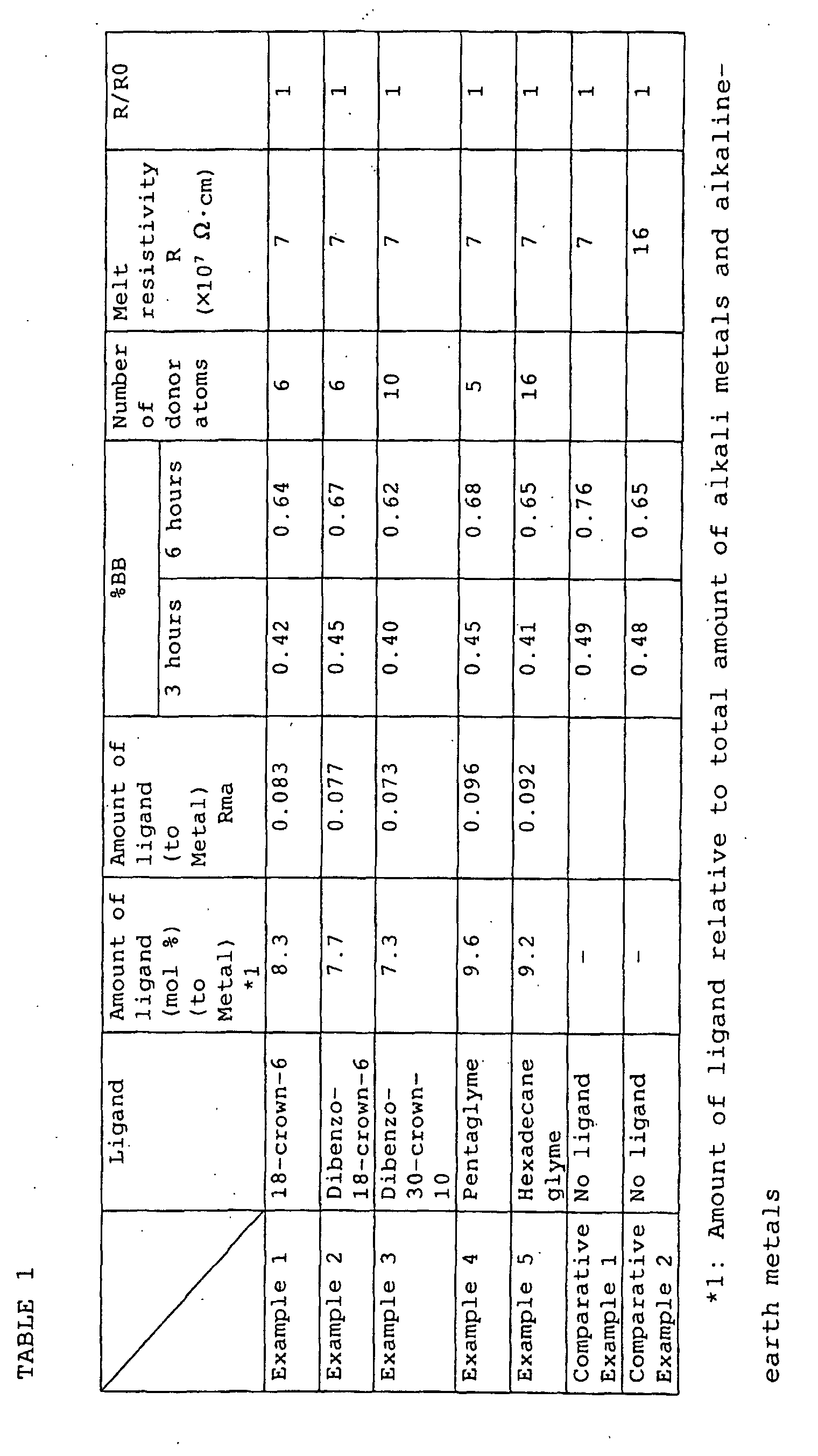
- a polyester composition was obtained in the same manner as that of Example 1 apart from the fact that the equimolecular amount of dibenzo-18-crown-6 was used instead of 18-crown-6. The results thereof are shown in Table 1.
- a polyester composition was obtained in the same manner as that of Example 1 apart from the fact that the equimolecular amount of dibenzo-30-crown-10 was used instead of 18-crown-6. The results thereof are shown in Table 1.
- a polyester composition was obtained in the same manner as that of Example 1 apart from the fact that the equimolecular amount of pentaglyme was used instead of 18-crown-6. The results thereof are shown in Table 1.
- a polyester composition was obtained in the same manner as that of Example 1 apart from the fact that the equimolecular amount of hexadecane glyme was used instead of 18-crown-6. The results thereof are shown in Table 1.
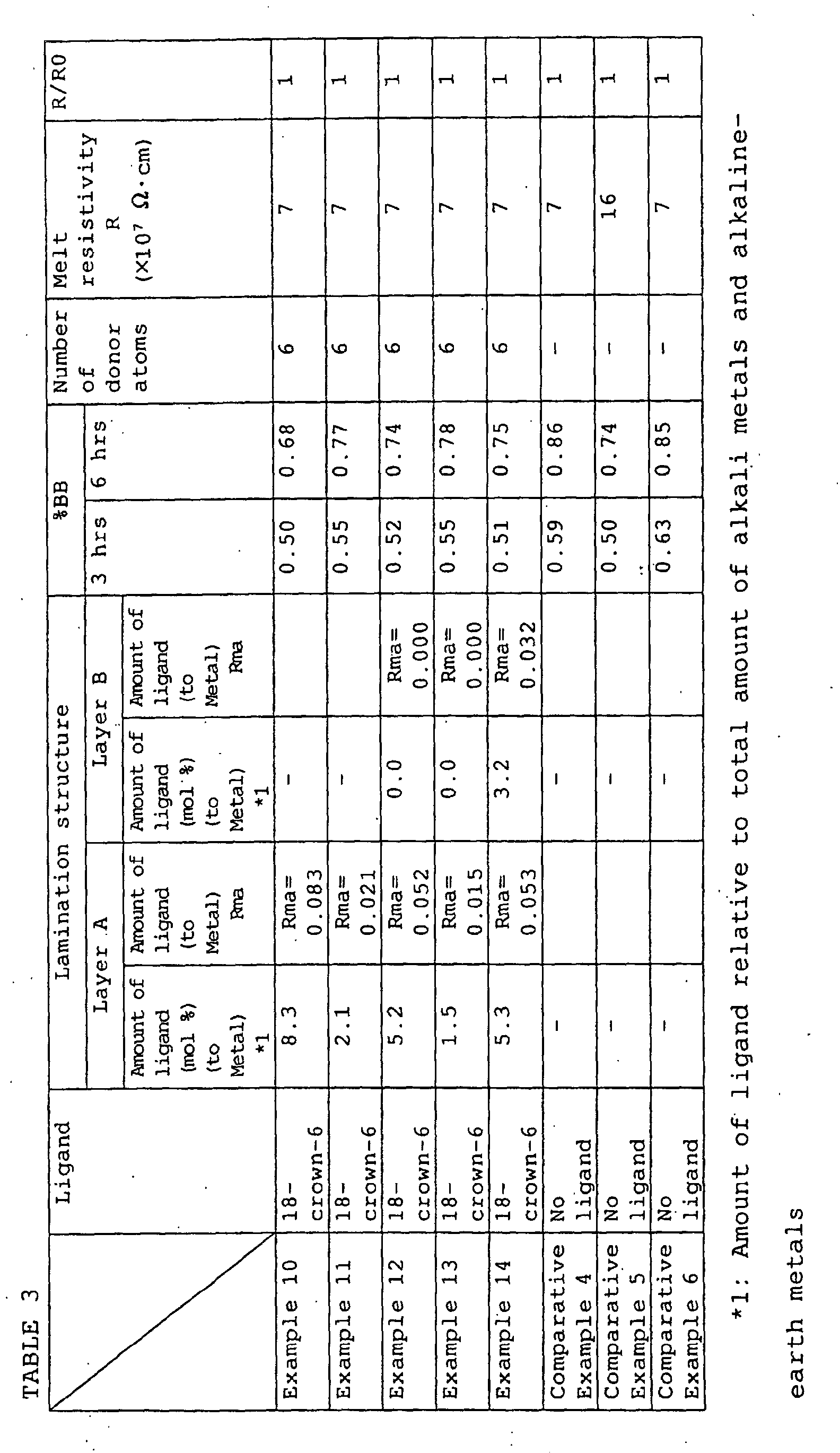
- the polyester composition (W) obtained in Example 1 was thoroughly dried, fed into an extruder, and melt-extruded on a casting drum. Fusion bonding was performed while electrostatically charging the casting drum, and quench hardening was performed to produce a single-layer unoriented film. The unoriented film was then drawn, 3.5 times in the longitudinal direction at 90°C and 3.5 times in the transverse direction at 105°C, and a polyester film with a thickness of 10 ⁇ m was thus obtained. Satisfactory film formability was exhibited. The film thus obtained had satisfactory heat resistance and productivity. The results thereof are shown in Table 3.
- the mixture was fed into a primary layer (layer A) extruder.
- the polyester (S) containing particles obtained in Reference Example 1 was dried and dry blended with polyethylene terephthalate (PL) so that the particle content was 0.5% by weight.
- the mixture was fed into a secondary layer (layer B) extruder. Melt extrusion was performed through a two-layer die onto a casting drum, and fusion bonding was performed while electrostatically charging the casting drum, followed by quench hardening.
- a film was formed in the same manner as that of Example 12 apart from the fact that the polyethylene terephthalate (PL) obtained in Comparative Example 1 was fed instead of the polyester composition (W) obtained in Example 1. Poor heat resistance was exhibited and productivity was degraded. The results thereof are shown in Table 3.
- a film was formed in the same manner as that of Example 10 apart from the fact that the polyethylene terephthalate (K) obtained in Comparative Example 2 was fed instead of the polyester composition (W) obtained in Example 1. Although heat resistivity was satisfactory, melt resistivity was increased and productivity was degraded. The results thereof are shown in Table 3.
- the pressure of the reaction system was gradually decreased while heating, and under a reduced pressure of 133 Pa, at 290°C, polymerization was performed while stirring and distilling methanol off.
- the degree of polymerization reached the equivalent of an intrinsic viscosity of 0.62
- the system was purged with nitrogen and the pressure was returned to the atmospheric pressure.
- 0.03% by weight of potassium acetate and 0.2% by weight of an ethylene glycol solution of 18-crown-6 were thoroughly mixed and added thereto.
- the pressure of the reaction system was gradually decreased, and under a reduced pressure of 133 Pa, at 290°C, polymerization was performed again in the same manner as that described above.
- the degree of polymerization reached the equivalent of an intrinsic viscosity of 0.62
- discharge was performed at a predetermined torque, and a polyester composition with an intrinsic viscosity of 0.60 was thereby obtained.
- the results thereof are shown in Table 4 below.
- the amount of metal added means the amount of metal added before repolymerization
- the metal content means the amount of metal in the resultant polyester composition. The difference between the amount of metal added and the metal content corresponds to the amount of metal removed.
- a precipitated solid was then separated by filtration, and cleaning was performed with water and ethanol, followed by drying. A white powder (18-crown-6) was thereby obtained.
- To the solid residue 100 parts by weight of purified water was added, and the solid residue was dissolved by heating at 95°C at atmospheric pressure for 2 hours. Insoluble components were filtered out at 50°C using a membrane filter (5.0 ⁇ m). The filtrate contained 500 ppm, calculated on the basis of germanium atomic weight, of the germanium catalyst, 50 ppm of the magnesium catalyst, and 3,000 ppm of the potassium catalyst.
- the resultant filtrate was condensed at 95°C at 55,000 Pa for 2 hours and an aqueous solution containing 1.5% by weight of germanium, 9% by weight of potassium, and 0.15% by weight of magnesium was formed.
- Acetic acid and ethylene glycol (EG) were added thereto and azeotropic distillation was performed to form an EG solution (mixed catalyst) containing 4.5% by weight of germanium, 18% by weight of potassium, and 0.45% by weight of magnesium.
- the pressure of the reaction system was gradually decreased while heating, and under reduced pressure, at 290°C, polymerization was performed while stirring and distilling methanol off.
- the degree of polymerization reached the equivalent of an intrinsic viscosity of 0.62
- the system was purged with nitrogen and the pressure was returned to the atmospheric pressure.
- An ethylene glycol solution of the 18-crown-6 recovered in Example 1 was prepared and thoroughly mixed, and 0.2% by weight thereof was added to the reaction system.
- the pressure of the reaction system was gradually decreased, and under reduced pressure, at 290°C, polymerization was performed again in the same manner as that described above.
- the degree of polymerization reached the equivalent of an intrinsic viscosity of 0.62
- discharge was performed at a predetermined torque, and a polyester composition with an intrinsic viscosity of 0.60 was thereby obtained.
- the results thereof are shown in Table 4.
- the amount of metal added means the amount of metal added before repolymerization
- the metal content means the amount of metal in the resultant polyester composition. The difference between the amount of metal added and the metal content corresponds to the amount of metal removed.
- the pressure of the reaction system was gradually decreased while heating, and under reduced pressure, at 290°C, polymerization was performed while stirring and distilling methanol off.
- the degree of polymerization reached the equivalent of an intrinsic viscosity of 0.62
- the system was purged with nitrogen and the pressure was returned to the atmospheric pressure.
- Potassium acetate in the amount of 0.03% by weight and an ethylene glycol solution of dibenzo-18-crown-6 in the amount of 0.2% by weight were thoroughly mixed and added to the system.
- the pressure of the reaction system was gradually decreased, and under reduced pressure, at 290°C, polymerization was performed again in the same manner as that described above.
- the degree of polymerization reached the equivalent of an intrinsic viscosity of 0.62
- discharge was performed at a predetermined torque, and a polyester composition with an intrinsic viscosity of 0.60 was thereby obtained.
- the results thereof are shown in Table 4.
- the amount of metal added means the amount of metal added before repolymerization
- the metal content means the amount of metal in the resultant polyester composition. The difference between the amount of metal added and the metal content corresponds to the amount of metal removed.
- a polyester composition was obtained in the same manner as that of Example 15 apart from the fact that, instead of 18-crown-6, the equivalent weight percent of dibenzo-30-crown-10 was added.
- the results thereof are shown in Table 4.
- the amount of metal added means the amount of metal added before repolymerization
- the metal content means the amount of metal in the resultant polyester composition. The difference between the amount of metal added and the metal content corresponds to the amount of metal removed.
- the pressure of the reaction system was gradually decreased while heating, and under reduced pressure, at 290°C, polymerization was performed while stirring and distilling methanol off.
- the degree of polymerization reached the equivalent of an intrinsic viscosity of 0.62
- the system was purged with nitrogen and the pressure was returned to the atmospheric pressure.
- an ethylene glycol solution of 12-crown-4 was thoroughly mixed and 0.2% by weight thereof was added to the reaction system.
- the pressure of the reaction system was gradually decreased, and under reduced pressure, at 290°C, polymerization was performed again in the same manner as that described above.
- the degree of polymerization reached the equivalent of an intrinsic viscosity of 0.62
- discharge was performed at a predetermined torque, and a polyester composition with an intrinsic viscosity of 0.60 was thereby obtained.
- the results thereof are shown in Table 4.
- the amount of metal added means the amount of metal added before repolymerization
- the metal content means the amount of metal in the resultant polyester composition. The difference between the amount of metal added and the metal content corresponds to the amount of metal removed.
- a polyester composition was obtained in the same manner as that of Example 15 apart from the fact that, instead of 18-crown-6, the equivalent weight percent of 15-crown-5 was added.
- the results thereof are shown in Table 4.
- the amount of metal added means the amount of metal added before repolymerization
- the metal content means the amount of metal in the resultant polyester composition. The difference between the amount of metal added and the metal content corresponds to the amount of metal removed.
- the pressure of the reaction system was gradually decreased while heating, and under a reduced pressure of 133 Pa, at 290°C, polymerization was performed while stirring and distilling ethylene glycol off.
- the degree of polymerization reached the equivalent of an intrinsic viscosity of 0.62
- the system was purged with nitrogen and the pressure was returned to the atmospheric pressure.
- 0.003% by weight of potassium acetate and an ethylene glycol solution of hexamine in a predetermined amount were thoroughly mixed and added to the reaction system.
- the pressure of the reaction system was gradually decreased, and under a reduced pressure of 133 Pa, at 290°C, polymerization was performed again in the same manner as that described above.
- the degree of polymerization reached the equivalent of an intrinsic viscosity of 0.62
- a polymer was discharged, and a polyester composition with an intrinsic viscosity of 0.60 was thereby obtained.
- the results thereof are shown in Table 4.
- the amount of metal added means the amount of metal added before repolymerization
- the metal content means the amount of metal in the resultant polyester composition.
- the difference between the amount of metal added and the metal content corresponds to the amount of metal removed.
- a precipitated solid was then separated by filtration, and cleaning was performed with water and ethanol, followed by drying. A white powder (hexaamine) was thereby obtained.
- To the solid residue 100 parts by weight of purified water was added, and the solid residue was dissolved by heating at 95°C at atmospheric pressure for 2 hours. Insoluble components were filtered out at 50°C using a membrane filter (5.0 ⁇ m). The filtrate contained 500 ppm, calculated on the basis of germanium atomic weight, of the germanium catalyst, 50 ppm of the magnesium catalyst, and 300 ppm of the potassium catalyst.
- the resultant filtrate was condensed at 95°C at 55,000 Pa for 2 hours and an aqueous solution containing 1.5% by weight of germanium, 0.9% by weight of potassium, and 0.15% by weight of magnesium was formed.
- Acetic acid and ethylene glycol (EG) were added thereto and azeotropic distillation was performed to form an EG solution (mixed catalyst) containing 4.5% by weight of germanium, 1.8% by weight of potassium, and 0.45% by weight of magnesium.
- the pressure of the reaction system was gradually decreased while heating, and under a reduced pressure of 133 Pa, at 290°C, polymerization was performed while stirring and distilling ethylene glycol off.
- the degree of polymerization reached the equivalent of an intrinsic viscosity of 0.62
- the system was purged with nitrogen and the pressure was returned to the atmospheric pressure.
- An ethylene glycol solution of the hexaamine recovered in Example 21 was prepared and thoroughly mixed and a predetermined amount thereof was added to the reaction system.
- the pressure of the reaction system was gradually decreased, and under a reduced pressure of 133 Pa, at 290°C, polymerization was performed again in the same manner as that'described above.
- the degree of polymerization reached the equivalent of an intrinsic viscosity of 0.62
- a polymer was discharged, and a polyester composition with an intrinsic viscosity of 0.60 was thereby obtained.
- the results thereof are shown in Table 4.
- the amount of metal added means the amount of metal added before repolymerization
- the metal content means the amount of metal in the resultant polyester composition. The difference between the amount of metal added and the metal content corresponds to the amount of metal removed.
- the pressure of the reaction system was gradually decreased while heating, and under a reduced pressure of 133 Pa, at 290°C, polymerization was performed while stirring and distilling ethylene glycol off.
- the degree of polymerization reached the equivalent of an intrinsic viscosity of 0.62
- the system was purged with nitrogen and the pressure was returned to the atmospheric pressure.
- Potassium acetate in the amount of 0.03% by weight and an ethylene glycol solution of hexaamine in a predetermined amount were thoroughly mixed and added to the reaction system.
- the pressure of the reaction system was gradually decreased, and under a reduced pressure of 133 Pa, at 290°C, polymerization was performed again in the same manner as that described above.
- the degree of polymerization reached the equivalent of an intrinsic viscosity of 0.62
- a polymer was discharged, and a polyester composition with an intrinsic viscosity of 0.60 was thereby obtained.
- the results thereof are shown in Table 4.
- the amount of metal added means the amount of metal added before repolymerization
- the metal content means the amount of metal in the resultant polyester composition. The difference between the amount of metal added and the metal content corresponds to the amount of metal removed.
- a polyester composition was obtained in the same manner as that of Example 15 apart from the fact that the amount of 18-crown-6 added was 0.025% by weight and a predetermined amount of hexaamine was added. The results thereof are shown in Table 4.
- a polyester composition was obtained in the same manner as that of Example 15 apart from the fact that 18-crown-6 was not added. The results thereof are shown in Table 4.
- the amount of metal added means the amount of metal added before repolymerization
- the metal content means the amount of metal in the resultant polyester composition.
- polyester composition and film of the present invention are suitable for various applications, such as for magnetic materials, packaging materials, optical materials, and electric materials because of excellent heat resistance, colorability, and weathering resistance.
- a method for producing a polyester composition of the present invention it is possible to remove metal catalysts, which adversely affect heat resistance, without decreasing electrostatic adhesion between a molten film and a casting drum. Consequently, it is possible to produce polyester compositions at high productivity. Moreover, in accordance with the method for producing the polyester composition of the present invention, it is possible to recover catalysts, and thus production costs can be reduced.
Landscapes
- Chemical & Material Sciences (AREA)
- Health & Medical Sciences (AREA)
- Chemical Kinetics & Catalysis (AREA)
- Medicinal Chemistry (AREA)
- Polymers & Plastics (AREA)
- Organic Chemistry (AREA)
- Polyesters Or Polycarbonates (AREA)
- Compositions Of Macromolecular Compounds (AREA)
- Manufacture Of Macromolecular Shaped Articles (AREA)
Abstract
Description

Claims (17)
- A polyester composition comprising a ligand capable of coordinating to a metal or metal ion, wherein the ligand comprises at least one donor atom selected from the group consisting of a nitrogen atom, a sulfur atom, and an oxygen atom.
- A polyester composition according to Claim 1, wherein the ligand is a clathrate compound.
- A polyester composition according to Claim 1, wherein the ligand is at least one compound selected from the group consisting of linear polyether amides, cyclic polyethers, linear polyethers, cyclic polyether polyesters, cyclic polyketones, cyclic polyamines, cyclic polyamine polyamides, cyclic polythiaethers, azacrown ethers, thiacrown ethers, cyclic azathiacrown ethers, azathiacrown ethers, bicyclic cryptands, tricyclic cryptands, spherical cryptands, linear polyamines, and phosphorus sulfide.
- A polyester composition according to Claim 1, wherein the number of donor atoms contained in the ligand is 4 to 20.
- A polyester composition according to Claim 1, wherein the metal or metal ion is at least one element selected from the group consisting of lithium, sodium, potassium, rubidium, cesium, beryllium, magnesium, calcium, strontium, barium, iron, antimony, titanium, aluminum, germanium, manganese, cobalt, zinc, copper, nickel, cadmium, and tin.
- A polyester composition according to Claim 1, wherein the polyester composition has a melt resistivity of less than 15 × 107 Ω·cm.
- A polyester composition according to Claim 1, wherein a melt resistivity R0 before the addition of the ligand and a melt resistivity R after the addition of the ligand satisfy the relationship R/R0 ≤ 1.3.
- A polyester composition according to Claim 1, the polyester composition comprises polyethylene terephthalate or polyethylene-2,6-naphthalate.
- A film comprising a polyester composition according to Claim 1.
- A laminated film comprising at least one layer of the film according to Claim 9.
- A method for producing a polyester composition comprising a process of producing a polyester, the process comprising a step of separating and recovering a catalyst by adding a ligand which is capable of coordinating to a metal or metal ion and which comprises at least one donor atom selected from the group consisting of a nitrogen atom, a sulfur atom, and an oxygen atom.
- A method for producing a polyester composition according to Claim 11, wherein the number of donor atoms contained in the ligand is 4 to 20.
- A method for producing a polyester composition according to Claim 11, wherein the process of producing the polyester further comprises an esterification step using an esterification catalyst or a transesterification catalyst.
- A method for producing a polyester composition according to Claim 11, wherein the process of producing the polyester further comprises a polycondensation step using a polycondensation catalyst.
- A method for producing a polyester composition according to Claim 11, wherein an esterification catalyst is separated and recovered.
- A method for producing a polyester composition according to Claim 11, wherein a polycondensation catalyst is separated and recovered.
- A method for producing a polyester composition according to Claim 11, wherein an esterification catalyst and/or a polycondensation catalyst which is separated and recovered is used.
Applications Claiming Priority (5)
| Application Number | Priority Date | Filing Date | Title |
|---|---|---|---|
| JP2000367245 | 2000-12-01 | ||
| JP2000367245 | 2000-12-01 | ||
| JP2001139648 | 2001-05-10 | ||
| JP2001139648A JP2002332338A (en) | 2001-05-10 | 2001-05-10 | Method for producing polyester composition |
| PCT/JP2001/010347 WO2002044275A1 (en) | 2000-12-01 | 2001-11-28 | Polyester composition, films made thereof and process for producing the composition |
Publications (3)
| Publication Number | Publication Date |
|---|---|
| EP1264859A1 true EP1264859A1 (en) | 2002-12-11 |
| EP1264859A4 EP1264859A4 (en) | 2005-03-30 |
| EP1264859B1 EP1264859B1 (en) | 2008-10-29 |
Family
ID=26605086
Family Applications (1)
| Application Number | Title | Priority Date | Filing Date |
|---|---|---|---|
| EP01998595A Expired - Lifetime EP1264859B1 (en) | 2000-12-01 | 2001-11-28 | Polyester composition, films made thereof and process for producing the composition |
Country Status (6)
| Country | Link |
|---|---|
| US (1) | US7060749B2 (en) |
| EP (1) | EP1264859B1 (en) |
| KR (1) | KR100797903B1 (en) |
| CN (1) | CN1235972C (en) |
| DE (1) | DE60136339D1 (en) |
| WO (1) | WO2002044275A1 (en) |
Families Citing this family (7)
| Publication number | Priority date | Publication date | Assignee | Title |
|---|---|---|---|---|
| KR100843397B1 (en) * | 2002-10-03 | 2008-07-03 | 도레이 가부시끼가이샤 | Polyester Resin Compositions, Catalyst for Polyester Production, Polyester Film, and Magnetic Recording Medium |
| JP3963456B2 (en) * | 2003-06-16 | 2007-08-22 | キヤノン株式会社 | Photosensitive resin composition, ink jet recording head using the same, and method for producing the same |
| EP2115045B1 (en) | 2007-02-20 | 2016-10-26 | Cellresin Technologies, LLC | Combination of substituted cyclodextrin compound and activated carbon |
| US20090060860A1 (en) * | 2007-08-31 | 2009-03-05 | Eva Almenar | Beta-cyclodextrins as nucleating agents for poly(lactic acid) |
| KR20140072934A (en) * | 2012-12-03 | 2014-06-16 | 도레이첨단소재 주식회사 | Encapsulation composition for a solarcell and preparing process fo the sheet using the same |
| CN105272890A (en) * | 2015-11-02 | 2016-01-27 | 西安近代化学研究所 | Open chain azathiacrown ether |
| CN119798624B (en) * | 2025-03-14 | 2025-06-06 | 浙江理工大学 | Preparation technology of regenerated resin based on waste polyester alcoholysis byproducts |
Family Cites Families (22)
| Publication number | Priority date | Publication date | Assignee | Title |
|---|---|---|---|---|
| DE1694202A1 (en) * | 1967-10-10 | 1971-04-08 | Hoechst Ag | Thermoplastic molding compounds made from polyesters |
| US3687978A (en) * | 1969-08-06 | 1972-08-29 | Du Pont | Macrocyclic polyether compounds |
| JPS5910698B2 (en) * | 1978-05-18 | 1984-03-10 | 東洋紡績株式会社 | polyester composition |
| JPS58134119A (en) * | 1982-02-02 | 1983-08-10 | Kanegafuchi Chem Ind Co Ltd | Preparation of aromatic polyester |
| US4405741A (en) * | 1982-09-20 | 1983-09-20 | Plastics Engineering Company | Fast crystallizing polyalkyleneterephthalate resin compositions |
| DE3328565A1 (en) * | 1983-08-08 | 1985-02-28 | Chemische Werke Hüls AG, 4370 Marl | METHOD FOR PRODUCING NOTCH SHAPED TOES MOLDING MATERIALS BASED ON POLY (ALKYLENE TEREPHTHALATES) |
| US4795771A (en) * | 1986-02-26 | 1989-01-03 | Toyo Boseki Kabushiki Kaisha | Polyester composition |
| WO1988000953A1 (en) * | 1986-08-04 | 1988-02-11 | Toray Industries, Inc. | Resin composition and process for its preparation |
| JP2595234B2 (en) * | 1987-03-10 | 1997-04-02 | 株式会社リコー | Electrophotographic photoreceptor |
| NZ239723A (en) * | 1990-09-18 | 1993-06-25 | Chicopee | Blends comprising a hydrophilic block poly (ether-co-amide) and a hydrophobic polymer |
| US5431856A (en) * | 1990-10-09 | 1995-07-11 | Instytut Wlokiennictwa | Conductive fibres |
| JP3125939B2 (en) * | 1991-06-10 | 2001-01-22 | 東洋紡績株式会社 | Polyester resin composition |
| US5281691A (en) | 1992-06-19 | 1994-01-25 | Eastman Kodak Company | Poly(3-hydroxyalkanoates) |
| NL9300194A (en) * | 1993-02-01 | 1994-09-01 | Gen Electric | Polymer blend and articles formed therefrom. |
| US5363179A (en) * | 1993-04-02 | 1994-11-08 | Rexham Graphics Inc. | Electrographic imaging process |
| TW330940B (en) * | 1993-12-22 | 1998-05-01 | Mitsui Petroleum Chemicals Ind | A method of manufacturing polyesters |
| US5624987A (en) * | 1995-09-15 | 1997-04-29 | Brink; Andrew E. | Polyalkylene ethers as plasticizers and flow aids in poly(1,4-cyclohexanedimethylene terephthalate) resins |
| DE19731762A1 (en) * | 1997-07-24 | 1999-01-28 | Basf Ag | Thermoplastic molding compounds with improved chemical resistance |
| JP2000007766A (en) * | 1998-06-26 | 2000-01-11 | Unitika Ltd | Polyester composition and preparation thereof |
| JP2000034343A (en) * | 1998-07-21 | 2000-02-02 | Kanebo Ltd | Method for recovering polyester-polycondensation catalyst |
| US6020421A (en) * | 1998-09-01 | 2000-02-01 | Unitika Ltd. | Polyester composition and method for producing the same |
| JP2000080284A (en) * | 1998-09-04 | 2000-03-21 | Unitika Ltd | Thermoplastic resin pellets and polyester molded products using the same |
-
2001
- 2001-11-28 DE DE60136339T patent/DE60136339D1/en not_active Expired - Lifetime
- 2001-11-28 US US10/182,556 patent/US7060749B2/en not_active Expired - Fee Related
- 2001-11-28 WO PCT/JP2001/010347 patent/WO2002044275A1/en not_active Ceased
- 2001-11-28 KR KR1020027008497A patent/KR100797903B1/en not_active Expired - Fee Related
- 2001-11-28 EP EP01998595A patent/EP1264859B1/en not_active Expired - Lifetime
- 2001-11-28 CN CNB018043631A patent/CN1235972C/en not_active Expired - Fee Related
Also Published As
| Publication number | Publication date |
|---|---|
| KR100797903B1 (en) | 2008-01-24 |
| WO2002044275A1 (en) | 2002-06-06 |
| US7060749B2 (en) | 2006-06-13 |
| EP1264859B1 (en) | 2008-10-29 |
| CN1396944A (en) | 2003-02-12 |
| KR20020080356A (en) | 2002-10-23 |
| CN1235972C (en) | 2006-01-11 |
| EP1264859A4 (en) | 2005-03-30 |
| DE60136339D1 (en) | 2008-12-11 |
| US20030045649A1 (en) | 2003-03-06 |
Similar Documents
| Publication | Publication Date | Title |
|---|---|---|
| JP2005089572A (en) | Method for producing polybutylene terephthalate | |
| US7060749B2 (en) | Polyester composition, films made thereof and process for producing the composition | |
| US20030219614A1 (en) | Biaxially oriented, hydrolysis-resistant film made from a thermoplastic with a hydrolysis stabilizer, process for producing the film, use of the film, and capacitors produced from the film | |
| EP0962483B1 (en) | Biaxially oriented polyester film for laminating metal sheets | |
| KR100716478B1 (en) | Biaxially Oriented Polyester Film for Metal Plate Bonding Processing | |
| JP2000162596A (en) | Polyester film for process paper in manufacture of liquid crystal display | |
| JP3245994B2 (en) | Copolyester and film for bonding metal plates | |
| EP1796114A2 (en) | Composite film for condenser, method for production thereof and base film therefor | |
| JP2002332338A (en) | Method for producing polyester composition | |
| JPH06116486A (en) | Copolyester composition and film for laminating metal plates | |
| EP2743287A1 (en) | Polyester resin composition, process for producing the same, and polyester film | |
| JP3009575B2 (en) | Polyester film for metal plate lamination processing | |
| JP2002359145A (en) | Aromatic liquid crystal polyester film for condenser | |
| JP3508886B2 (en) | Thermoplastic polyester elastomer | |
| JP2004002515A (en) | Polyester resin, biaxially stretched film and insulating film for capacitor comprising the same | |
| JP2002226685A (en) | Polyester composition and film | |
| JP3277576B2 (en) | Copolyester and film for bonding metal plates | |
| JP3269132B2 (en) | Copolyester and film for bonding metal plates | |
| JP4088972B2 (en) | Polyester film | |
| JP4923385B2 (en) | Polyester film | |
| KR0140296B1 (en) | Method for producing polyethylene naphthalate | |
| JP2000204229A (en) | Polyester composition and its production | |
| KR20240151401A (en) | Recycled polyester resin and film, and preparation method thereof | |
| JP2005187763A (en) | Unoriented polyester film | |
| JPS6226342B2 (en) |
Legal Events
| Date | Code | Title | Description |
|---|---|---|---|
| PUAI | Public reference made under article 153(3) epc to a published international application that has entered the european phase |
Free format text: ORIGINAL CODE: 0009012 |
|
| 17P | Request for examination filed |
Effective date: 20020709 |
|
| AK | Designated contracting states |
Kind code of ref document: A1 Designated state(s): DE FR GB LU NL |
|
| A4 | Supplementary search report drawn up and despatched |
Effective date: 20050210 |
|
| 17Q | First examination report despatched |
Effective date: 20050413 |
|
| 17Q | First examination report despatched |
Effective date: 20050413 |
|
| GRAP | Despatch of communication of intention to grant a patent |
Free format text: ORIGINAL CODE: EPIDOSNIGR1 |
|
| GRAS | Grant fee paid |
Free format text: ORIGINAL CODE: EPIDOSNIGR3 |
|
| GRAA | (expected) grant |
Free format text: ORIGINAL CODE: 0009210 |
|
| AK | Designated contracting states |
Kind code of ref document: B1 Designated state(s): DE FR GB LU NL |
|
| REG | Reference to a national code |
Ref country code: GB Ref legal event code: FG4D |
|
| REF | Corresponds to: |
Ref document number: 60136339 Country of ref document: DE Date of ref document: 20081211 Kind code of ref document: P |
|
| NLV1 | Nl: lapsed or annulled due to failure to fulfill the requirements of art. 29p and 29m of the patents act | ||
| PG25 | Lapsed in a contracting state [announced via postgrant information from national office to epo] |
Ref country code: NL Free format text: LAPSE BECAUSE OF FAILURE TO SUBMIT A TRANSLATION OF THE DESCRIPTION OR TO PAY THE FEE WITHIN THE PRESCRIBED TIME-LIMIT Effective date: 20081029 |
|
| PLBE | No opposition filed within time limit |
Free format text: ORIGINAL CODE: 0009261 |
|
| STAA | Information on the status of an ep patent application or granted ep patent |
Free format text: STATUS: NO OPPOSITION FILED WITHIN TIME LIMIT |
|
| 26N | No opposition filed |
Effective date: 20090730 |
|
| PGFP | Annual fee paid to national office [announced via postgrant information from national office to epo] |
Ref country code: FR Payment date: 20131108 Year of fee payment: 13 Ref country code: DE Payment date: 20131120 Year of fee payment: 13 Ref country code: GB Payment date: 20131127 Year of fee payment: 13 |
|
| PGFP | Annual fee paid to national office [announced via postgrant information from national office to epo] |
Ref country code: LU Payment date: 20131202 Year of fee payment: 13 |
|
| REG | Reference to a national code |
Ref country code: DE Ref legal event code: R119 Ref document number: 60136339 Country of ref document: DE |
|
| PG25 | Lapsed in a contracting state [announced via postgrant information from national office to epo] |
Ref country code: LU Free format text: LAPSE BECAUSE OF NON-PAYMENT OF DUE FEES Effective date: 20141128 |
|
| GBPC | Gb: european patent ceased through non-payment of renewal fee |
Effective date: 20141128 |
|
| REG | Reference to a national code |
Ref country code: FR Ref legal event code: ST Effective date: 20150731 |
|
| PG25 | Lapsed in a contracting state [announced via postgrant information from national office to epo] |
Ref country code: GB Free format text: LAPSE BECAUSE OF NON-PAYMENT OF DUE FEES Effective date: 20141128 Ref country code: DE Free format text: LAPSE BECAUSE OF NON-PAYMENT OF DUE FEES Effective date: 20150602 |
|
| PG25 | Lapsed in a contracting state [announced via postgrant information from national office to epo] |
Ref country code: FR Free format text: LAPSE BECAUSE OF NON-PAYMENT OF DUE FEES Effective date: 20141201 |