EP1263693B1 - Method for producing ceramic composite foams with high mechanical strength - Google Patents
Method for producing ceramic composite foams with high mechanical strength Download PDFInfo
- Publication number
- EP1263693B1 EP1263693B1 EP01905518.5A EP01905518A EP1263693B1 EP 1263693 B1 EP1263693 B1 EP 1263693B1 EP 01905518 A EP01905518 A EP 01905518A EP 1263693 B1 EP1263693 B1 EP 1263693B1
- Authority
- EP
- European Patent Office
- Prior art keywords
- foam
- producing
- ceramic
- final
- mechanical strength
- Prior art date
- Legal status (The legal status is an assumption and is not a legal conclusion. Google has not performed a legal analysis and makes no representation as to the accuracy of the status listed.)
- Expired - Lifetime
Links
Images
Classifications
-
- C—CHEMISTRY; METALLURGY
- C04—CEMENTS; CONCRETE; ARTIFICIAL STONE; CERAMICS; REFRACTORIES
- C04B—LIME, MAGNESIA; SLAG; CEMENTS; COMPOSITIONS THEREOF, e.g. MORTARS, CONCRETE OR LIKE BUILDING MATERIALS; ARTIFICIAL STONE; CERAMICS; REFRACTORIES; TREATMENT OF NATURAL STONE
- C04B38/00—Porous mortars, concrete, artificial stone or ceramic ware; Preparation thereof
- C04B38/0022—Porous mortars, concrete, artificial stone or ceramic ware; Preparation thereof obtained by a chemical conversion or reaction other than those relating to the setting or hardening of cement-like material or to the formation of a sol or a gel, e.g. by carbonising or pyrolysing preformed cellular materials based on polymers, organo-metallic or organo-silicon precursors
- C04B38/0025—Porous mortars, concrete, artificial stone or ceramic ware; Preparation thereof obtained by a chemical conversion or reaction other than those relating to the setting or hardening of cement-like material or to the formation of a sol or a gel, e.g. by carbonising or pyrolysing preformed cellular materials based on polymers, organo-metallic or organo-silicon precursors starting from inorganic materials only, e.g. metal foam; Lanxide type products
-
- C—CHEMISTRY; METALLURGY
- C04—CEMENTS; CONCRETE; ARTIFICIAL STONE; CERAMICS; REFRACTORIES
- C04B—LIME, MAGNESIA; SLAG; CEMENTS; COMPOSITIONS THEREOF, e.g. MORTARS, CONCRETE OR LIKE BUILDING MATERIALS; ARTIFICIAL STONE; CERAMICS; REFRACTORIES; TREATMENT OF NATURAL STONE
- C04B35/00—Shaped ceramic products characterised by their composition; Ceramics compositions; Processing powders of inorganic compounds preparatory to the manufacturing of ceramic products
- C04B35/01—Shaped ceramic products characterised by their composition; Ceramics compositions; Processing powders of inorganic compounds preparatory to the manufacturing of ceramic products based on oxide ceramics
-
- C—CHEMISTRY; METALLURGY
- C04—CEMENTS; CONCRETE; ARTIFICIAL STONE; CERAMICS; REFRACTORIES
- C04B—LIME, MAGNESIA; SLAG; CEMENTS; COMPOSITIONS THEREOF, e.g. MORTARS, CONCRETE OR LIKE BUILDING MATERIALS; ARTIFICIAL STONE; CERAMICS; REFRACTORIES; TREATMENT OF NATURAL STONE
- C04B35/00—Shaped ceramic products characterised by their composition; Ceramics compositions; Processing powders of inorganic compounds preparatory to the manufacturing of ceramic products
- C04B35/01—Shaped ceramic products characterised by their composition; Ceramics compositions; Processing powders of inorganic compounds preparatory to the manufacturing of ceramic products based on oxide ceramics
- C04B35/10—Shaped ceramic products characterised by their composition; Ceramics compositions; Processing powders of inorganic compounds preparatory to the manufacturing of ceramic products based on oxide ceramics based on aluminium oxide
- C04B35/111—Fine ceramics
-
- C—CHEMISTRY; METALLURGY
- C04—CEMENTS; CONCRETE; ARTIFICIAL STONE; CERAMICS; REFRACTORIES
- C04B—LIME, MAGNESIA; SLAG; CEMENTS; COMPOSITIONS THEREOF, e.g. MORTARS, CONCRETE OR LIKE BUILDING MATERIALS; ARTIFICIAL STONE; CERAMICS; REFRACTORIES; TREATMENT OF NATURAL STONE
- C04B35/00—Shaped ceramic products characterised by their composition; Ceramics compositions; Processing powders of inorganic compounds preparatory to the manufacturing of ceramic products
- C04B35/01—Shaped ceramic products characterised by their composition; Ceramics compositions; Processing powders of inorganic compounds preparatory to the manufacturing of ceramic products based on oxide ceramics
- C04B35/10—Shaped ceramic products characterised by their composition; Ceramics compositions; Processing powders of inorganic compounds preparatory to the manufacturing of ceramic products based on oxide ceramics based on aluminium oxide
- C04B35/111—Fine ceramics
- C04B35/117—Composites
-
- C—CHEMISTRY; METALLURGY
- C04—CEMENTS; CONCRETE; ARTIFICIAL STONE; CERAMICS; REFRACTORIES
- C04B—LIME, MAGNESIA; SLAG; CEMENTS; COMPOSITIONS THEREOF, e.g. MORTARS, CONCRETE OR LIKE BUILDING MATERIALS; ARTIFICIAL STONE; CERAMICS; REFRACTORIES; TREATMENT OF NATURAL STONE
- C04B35/00—Shaped ceramic products characterised by their composition; Ceramics compositions; Processing powders of inorganic compounds preparatory to the manufacturing of ceramic products
- C04B35/01—Shaped ceramic products characterised by their composition; Ceramics compositions; Processing powders of inorganic compounds preparatory to the manufacturing of ceramic products based on oxide ceramics
- C04B35/10—Shaped ceramic products characterised by their composition; Ceramics compositions; Processing powders of inorganic compounds preparatory to the manufacturing of ceramic products based on oxide ceramics based on aluminium oxide
- C04B35/111—Fine ceramics
- C04B35/117—Composites
- C04B35/119—Composites with zirconium oxide
-
- C—CHEMISTRY; METALLURGY
- C04—CEMENTS; CONCRETE; ARTIFICIAL STONE; CERAMICS; REFRACTORIES
- C04B—LIME, MAGNESIA; SLAG; CEMENTS; COMPOSITIONS THEREOF, e.g. MORTARS, CONCRETE OR LIKE BUILDING MATERIALS; ARTIFICIAL STONE; CERAMICS; REFRACTORIES; TREATMENT OF NATURAL STONE
- C04B35/00—Shaped ceramic products characterised by their composition; Ceramics compositions; Processing powders of inorganic compounds preparatory to the manufacturing of ceramic products
- C04B35/622—Forming processes; Processing powders of inorganic compounds preparatory to the manufacturing of ceramic products
- C04B35/626—Preparing or treating the powders individually or as batches ; preparing or treating macroscopic reinforcing agents for ceramic products, e.g. fibres; mechanical aspects section B
- C04B35/62605—Treating the starting powders individually or as mixtures
- C04B35/6261—Milling
-
- C—CHEMISTRY; METALLURGY
- C04—CEMENTS; CONCRETE; ARTIFICIAL STONE; CERAMICS; REFRACTORIES
- C04B—LIME, MAGNESIA; SLAG; CEMENTS; COMPOSITIONS THEREOF, e.g. MORTARS, CONCRETE OR LIKE BUILDING MATERIALS; ARTIFICIAL STONE; CERAMICS; REFRACTORIES; TREATMENT OF NATURAL STONE
- C04B35/00—Shaped ceramic products characterised by their composition; Ceramics compositions; Processing powders of inorganic compounds preparatory to the manufacturing of ceramic products
- C04B35/622—Forming processes; Processing powders of inorganic compounds preparatory to the manufacturing of ceramic products
- C04B35/626—Preparing or treating the powders individually or as batches ; preparing or treating macroscopic reinforcing agents for ceramic products, e.g. fibres; mechanical aspects section B
- C04B35/62605—Treating the starting powders individually or as mixtures
- C04B35/6261—Milling
- C04B35/62615—High energy or reactive ball milling
-
- C—CHEMISTRY; METALLURGY
- C04—CEMENTS; CONCRETE; ARTIFICIAL STONE; CERAMICS; REFRACTORIES
- C04B—LIME, MAGNESIA; SLAG; CEMENTS; COMPOSITIONS THEREOF, e.g. MORTARS, CONCRETE OR LIKE BUILDING MATERIALS; ARTIFICIAL STONE; CERAMICS; REFRACTORIES; TREATMENT OF NATURAL STONE
- C04B2235/00—Aspects relating to ceramic starting mixtures or sintered ceramic products
- C04B2235/02—Composition of constituents of the starting material or of secondary phases of the final product
- C04B2235/30—Constituents and secondary phases not being of a fibrous nature
- C04B2235/32—Metal oxides, mixed metal oxides, or oxide-forming salts thereof, e.g. carbonates, nitrates, (oxy)hydroxides, chlorides
- C04B2235/3217—Aluminum oxide or oxide forming salts thereof, e.g. bauxite, alpha-alumina
-
- C—CHEMISTRY; METALLURGY
- C04—CEMENTS; CONCRETE; ARTIFICIAL STONE; CERAMICS; REFRACTORIES
- C04B—LIME, MAGNESIA; SLAG; CEMENTS; COMPOSITIONS THEREOF, e.g. MORTARS, CONCRETE OR LIKE BUILDING MATERIALS; ARTIFICIAL STONE; CERAMICS; REFRACTORIES; TREATMENT OF NATURAL STONE
- C04B2235/00—Aspects relating to ceramic starting mixtures or sintered ceramic products
- C04B2235/02—Composition of constituents of the starting material or of secondary phases of the final product
- C04B2235/30—Constituents and secondary phases not being of a fibrous nature
- C04B2235/32—Metal oxides, mixed metal oxides, or oxide-forming salts thereof, e.g. carbonates, nitrates, (oxy)hydroxides, chlorides
- C04B2235/3231—Refractory metal oxides, their mixed metal oxides, or oxide-forming salts thereof
- C04B2235/3244—Zirconium oxides, zirconates, hafnium oxides, hafnates, or oxide-forming salts thereof
-
- C—CHEMISTRY; METALLURGY
- C04—CEMENTS; CONCRETE; ARTIFICIAL STONE; CERAMICS; REFRACTORIES
- C04B—LIME, MAGNESIA; SLAG; CEMENTS; COMPOSITIONS THEREOF, e.g. MORTARS, CONCRETE OR LIKE BUILDING MATERIALS; ARTIFICIAL STONE; CERAMICS; REFRACTORIES; TREATMENT OF NATURAL STONE
- C04B2235/00—Aspects relating to ceramic starting mixtures or sintered ceramic products
- C04B2235/02—Composition of constituents of the starting material or of secondary phases of the final product
- C04B2235/30—Constituents and secondary phases not being of a fibrous nature
- C04B2235/40—Metallic constituents or additives not added as binding phase
- C04B2235/402—Aluminium
-
- C—CHEMISTRY; METALLURGY
- C04—CEMENTS; CONCRETE; ARTIFICIAL STONE; CERAMICS; REFRACTORIES
- C04B—LIME, MAGNESIA; SLAG; CEMENTS; COMPOSITIONS THEREOF, e.g. MORTARS, CONCRETE OR LIKE BUILDING MATERIALS; ARTIFICIAL STONE; CERAMICS; REFRACTORIES; TREATMENT OF NATURAL STONE
- C04B2235/00—Aspects relating to ceramic starting mixtures or sintered ceramic products
- C04B2235/02—Composition of constituents of the starting material or of secondary phases of the final product
- C04B2235/30—Constituents and secondary phases not being of a fibrous nature
- C04B2235/42—Non metallic elements added as constituents or additives, e.g. sulfur, phosphor, selenium or tellurium
- C04B2235/428—Silicon
-
- Y—GENERAL TAGGING OF NEW TECHNOLOGICAL DEVELOPMENTS; GENERAL TAGGING OF CROSS-SECTIONAL TECHNOLOGIES SPANNING OVER SEVERAL SECTIONS OF THE IPC; TECHNICAL SUBJECTS COVERED BY FORMER USPC CROSS-REFERENCE ART COLLECTIONS [XRACs] AND DIGESTS
- Y10—TECHNICAL SUBJECTS COVERED BY FORMER USPC
- Y10T—TECHNICAL SUBJECTS COVERED BY FORMER US CLASSIFICATION
- Y10T428/00—Stock material or miscellaneous articles
- Y10T428/249921—Web or sheet containing structurally defined element or component
- Y10T428/249953—Composite having voids in a component [e.g., porous, cellular, etc.]
Definitions
- the present invention relates to a method for producing ceramic composite foams with high mechanical strength, more particularly ceramic composite foams formed with reaction bonded (RB) materials (metals and metal oxides) and through a thermal treatment (slow oxidation) typical of this reaction bonded production way.
- RB reaction bonded
- Ceramic foam structures are porous materials with a very low density (from 10 to 20% theoretical density (TD)) which are used in a wide range of applications such as filters for melt metals, furnace liners, soot filters, catalyst substrates, biomedical implants, electro-ceramics, etc. Ceramic foam structures are disclosed by L.M. Sheppard, "Porous Ceramics : Processing and Applications", pp. 3-23 in Ceramics Transactions, vol.31, Porous Materials, ed. by K. Ishizaki, L.M. Sheppard, S. Okada, T. Hamasaki, and B. Huybrechts, ACS, Westerville, OH, 1993 and by L. Montanaro, Y. Joyrand, G. Fantozzi and A. Negro "Ceramics Foams by Powder Processing” J. Eur. Ceram. Soc. 18 (1998), 1339-1350 .
- TD theoretical density
- This method has the advantage that the cell size of such structures can be easily adapted by starting from another PU-foam having the appropriate cell size.
- a reaction bonded composite material, manufactured and thermally treated in the right way has a strength which is normally twice to three times higher than a similar material produced with a traditional method [ J. Luyten, J. Cooymans, C. Smolders, S. Vercauteren, E.F. Vansant, R. Leysen “Shaping of multilayer ceramic membranes by dip coating", J. Eur. Ceram. Soc.17, 273-279,1997 ].
- such production way is appropriate for incorporating all sorts of phases, providing new composite materials with optimalized properties [ N. Claussen, Suxing Wu and D. Holz, "Reaction Bonding of Aluminum Oxide (RBAO) Composites : Processing, Reaction Mechanisms and Properties, J. Eur. Ceram. Soc. 14 (1994) 97-109 ].
- the starting point is a blend of metal and/or metal oxide powders, which, after shaping, are allowed to react in a controlled way with a gas.
- a gas for example, after shaping, air heating is very slowly performed while the Al-fraction is oxidized, forming a fine Al 2 O 3 granule network.
- This oxidation is completed at 900°C, but time and temperature obviously depend upon the thickness and density of the green starting core. In order to avoid cracking, such heating step should be performed slowly.
- Such oxidation is not accompanied with a densification of the piece, but with an expansion. Further heating provides for the necessary contraction and densification of the material.
- Reaction Sintering it is meant a reaction of different materials in a solid state at a high temperature (> 1000°C), whereby beside the generation of new compounds, a densification of the material also occurs.
- An example thereof is the conversion of Al 2 O 3 and SiO 2 into mullite (Al 6 Si 2 O 13 ).
- a filter and a method for obtaining such a filter through reaction sintering are disclosed in WO 98/25685 .
- Combustion Synthesis is a production method wherein the starting point is ceramic precursors based on polymers. After shaping, a pyrolysis at high temperature (> 1000°C) is carried out in which a reaction occurs with the released carbon.
- a pyrolysis at high temperature > 1000°C
- An example is to heat silane compounds into ceramic material SiC through reaction of Si with C.
- Porous membranes and methods for obtaining such membranes are disclosed in WO 96/06814 , WO 96/00125 and US 5 279 737 .
- the disclosed method is each time a combustion synthesis.
- the invention aims to produce a ceramic foam having improved mechanical strength.
- the present invention relates to a method for producing a ceramic foam structure characterized in that it is produced from a reaction bonded powder.
- the foam structure can be open or closed.
- the reaction bonded powder comprises two or more elements selected from the group consisting of metal and metal oxide.
- the average pore size is higher than 10 ⁇ m.
- the 4p bending strength is higher than 2 MPa.
- the present invention is a production method for producing a ceramic foam structure, characterized in that the method comprises the following steps:
- the foam production is preferably done through a technique selected from the group consisting of polyurethane replica technique and gel casting method.
- the oxidation step comprises a step wherein the foam is maintained at the final temperature for one hour.
- the final thermal treatment may comprise a sintering step at a temperature comprised between 1600°C and 1700°C.
- a ceramic foam structure may be obtained with such method.
- ceramic foams may be prepared which show better mechanical properties compared to traditional foams.
- Bulk reaction bonded materials are a new kind of materials with a higher strength and which allow easily the incorporation into the structure of K ic (crack propagation factor) enhancing phases.
- the invention comprises on one hand producing new porous RB ceramic composites and on the other hand converting them, using one of the current methods, into a ceramic foam structure.
- the starting point here is a reaction bonded powder (i.e. a blend of metal and metal oxides), and the PU (polyurethane) replica method or the gel casting method is used.
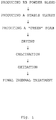
- FIG. 1 A possible flowsheet of a method according to the invention is shown in Fig. 1 .
- the production method offers the possibility to integrate in a simple way all kinds of phases into the matrix material.
- the mechanical strength the requirements of a specific application may be satisfied.
- Producing powders, conditioning them and treating them thermally should be adjusted depending upon the composition of the composite.
- Preparation of the slurry should also be considered depending upon the composition, i.e. the additives are typical of the specific composition of the starting powder and of the applied producing way for producing a foam structure. If possible, an aqueous solution is preferred (environmental aspect).
- the new proposed process comprises the following novelties compared to the traditional methods:
- An Al/Al 2 O 3 blend in a 40/60 ratio by weight is intensively ground in a solvent (acetone, ethanol, methanol,). This may be done using an attritor and/or a planetary ball mill.
- the stable slurry may be prepared in a solvent such as acetone, ethanol or methanol, or in water.
- a solvent such as acetone, ethanol or methanol
- an Al/Al 2 O 3 powder blend should be first passivated so as to prevent hydrolysis and therefore H 2 generation. This can be done for example by adding an excess dispersing agent (e.g. Darvan C).
- the dispersing agent is absorbed on the Al surface and protects it from water.
- Classical additives such as dispersing agents, an anti-foam agent, a wetting agent etc. are preferably added in order to optimize the properties.
- Extra ZrO 2 is added in the second composition in order to increase strength and because it improves the wetting of Al with Al 2 O 3 .
- compositions are ground in acetone in a planetary ball mill with ZrO 2 balls.
- the starting powders and the grinding time are selected in such a way that a porous structure is obtained after shaping (extrusion) and sintering (oxidation, mainly under 1000°C, and final thermal treatment).
- XRD analysis shows formation of mullite with some Al 2 O 3 and ZrO 2 in the first composition, and mullite, ZrO 2 and some Al 2 O 3 in the second composition. Free SiO 2 is no longer found, on the contrary, a full conversion into mullite occuring at temperatures not exceeding 1500°C is observed.
- the porosity is 35 to 40%, the maximum pore size is 2 ⁇ m and 4p bending strengths in the range from 50 to 100 MPa are obtained.
- Al/Al 2 O 3 50/50 vol% are intensively blended/ground under acetone.
- This powder is dispersed, after passivation, in water with Darvan C TM as a dispersing agent and gelatine as a wetting agent.
- the water/solids ratio is adjusted so that a little viscous and consequently castable slurry is obtained.
- a PU sponge (30 PPI) from Recticel company (Wetteren, Belgium) is dipped into this slurry.
- the excess slurry quantity is expressed from the sponge after which the assembly is dried.
- a final sintering operation for one hour at a temperature comprised between 1650 and 1700°C results in a 2.9 MPa three point bending strength for a foam having a cell size of approximatively 1.3 mm and a density in the range between 15 and 20% TD.
Landscapes
- Chemical & Material Sciences (AREA)
- Engineering & Computer Science (AREA)
- Ceramic Engineering (AREA)
- Manufacturing & Machinery (AREA)
- Materials Engineering (AREA)
- Structural Engineering (AREA)
- Organic Chemistry (AREA)
- Inorganic Chemistry (AREA)
- Composite Materials (AREA)
- Dispersion Chemistry (AREA)
- Chemical Kinetics & Catalysis (AREA)
- Porous Artificial Stone Or Porous Ceramic Products (AREA)
- Compositions Of Oxide Ceramics (AREA)
Description
- The present invention relates to a method for producing ceramic composite foams with high mechanical strength, more particularly ceramic composite foams formed with reaction bonded (RB) materials (metals and metal oxides) and through a thermal treatment (slow oxidation) typical of this reaction bonded production way.
- Ceramic foam structures are porous materials with a very low density (from 10 to 20% theoretical density (TD)) which are used in a wide range of applications such as filters for melt metals, furnace liners, soot filters, catalyst substrates, biomedical implants, electro-ceramics, etc. Ceramic foam structures are disclosed by L.M. Sheppard, "Porous Ceramics : Processing and Applications", pp. 3-23 in Ceramics Transactions, vol.31, Porous Materials, ed. by K. Ishizaki, L.M. Sheppard, S. Okada, T. Hamasaki, and B. Huybrechts, ACS, Westerville, OH, 1993 and by L. Montanaro, Y. Joyrand, G. Fantozzi and A. Negro "Ceramics Foams by Powder Processing" J. Eur. Ceram. Soc. 18 (1998), 1339-1350.
- Each new application requires specific properties such as a determined cell size, a satisfactory thermal shock strength, a mechanical strength and/or a determined resistance to crack propagation (toughness). These two latter properties limit particularly a quick development, mainly in structural applications where an optimum strength/weight ratio is desired.
- Nowadays about 10 ceramic materials are commercially available as foams. The choice of the material type depends upon the specific properties. The most currently used production method for these foam structures is the PU-replica method wherein a soft PU-foam is dipped into a ceramic slurry. After elimination of the excess slurry and drying, the PU-foam is burnt off and, after sintering, a ceramic foam is obtained.
- This method has the advantage that the cell size of such structures can be easily adapted by starting from another PU-foam having the appropriate cell size.
- One inconvenience is the less satisfactory mechanical properties. Drying and burning off should be carefully carried out in order to prevent crack formation. Besides, "struts" (ribs) also occur naturally with typical prism-shaped cavities due to burning off of the PU-struts. This also is obviously an additional weakness for the foam structure.
- In another method, such as gel casting, somewhat better mechanical properties are observed with specific cell sizes. But, in this case, there are more problems to obtain a determined cell size.
- Nevertheless, whatever the production method is, the lifetime of foam structures in a number of applications is mainly limited due to their lack of mechanical strength.
- A reaction bonded composite material, manufactured and thermally treated in the right way has a strength which is normally twice to three times higher than a similar material produced with a traditional method [J. Luyten, J. Cooymans, C. Smolders, S. Vercauteren, E.F. Vansant, R. Leysen "Shaping of multilayer ceramic membranes by dip coating", J. Eur. Ceram. Soc.17, 273-279,1997]. Moreover, such production way is appropriate for incorporating all sorts of phases, providing new composite materials with optimalized properties [N. Claussen, Suxing Wu and D. Holz, "Reaction Bonding of Aluminum Oxide (RBAO) Composites : Processing, Reaction Mechanisms and Properties, J. Eur. Ceram. Soc. 14 (1994) 97-109].
- The production of dense RB materials is well known, specially disclosed by Prof. Claussen [N. Claussen, R. Janssen and D. Holz, J. Euram. Soc. Japan 103 [8] 749-758 (1995)]. Porous RBAO materials for membrane substrates were developed by the inventors [J. Luyten, J. Cooymans, C. Smolders, S. Vercauteren, E.F. Vansant, R. Leysen "Shaping of multilayer ceramic membranes by dip coating", J. Eur. Ceram. Soc. 17, 273-279, 1997]. The pore size of such materials (1 µm) is indeed of another order than that of the foam structure (1 mm). Reaction Bonding, Combustion Synthesis and Reaction Sintering are three different notions which should not be confused.
- In Reaction Bonding, the starting point is a blend of metal and/or metal oxide powders, which, after shaping, are allowed to react in a controlled way with a gas. For an Al/Al2O3 powder blend for example, after shaping, air heating is very slowly performed while the Al-fraction is oxidized, forming a fine Al2O3 granule network. This oxidation is completed at 900°C, but time and temperature obviously depend upon the thickness and density of the green starting core. In order to avoid cracking, such heating step should be performed slowly. Such oxidation is not accompanied with a densification of the piece, but with an expansion. Further heating provides for the necessary contraction and densification of the material.
- By Reaction Sintering it is meant a reaction of different materials in a solid state at a high temperature (> 1000°C), whereby beside the generation of new compounds, a densification of the material also occurs. An example thereof is the conversion of Al2O3 and SiO2 into mullite (Al6Si2O13).
- A filter and a method for obtaining such a filter through reaction sintering are disclosed in
WO 98/25685 - Combustion Synthesis is a production method wherein the starting point is ceramic precursors based on polymers. After shaping, a pyrolysis at high temperature (> 1000°C) is carried out in which a reaction occurs with the released carbon. An example is to heat silane compounds into ceramic material SiC through reaction of Si with C.
- Porous membranes and methods for obtaining such membranes are disclosed in
WO 96/06814 WO 96/00125 US 5 279 737 . The disclosed method is each time a combustion synthesis. - Other references include J. Saggio-Woyanski, C.E. Scott, WP Minnear, "Processing of Porous Ceramics" Amer. Ceram. Soc. Bull., vol. 71, n° 11, nov. 1992, pp. 1674-81 and P. Sepulveda, "Gelcasting foams for porous ceramics", Amer. Ceram. Soc. Bull., vol. 76, n° 10, oct. 1997,61-66.
- In order to enhance application possibilities for ceramic foams, to extend their lifetime and to improve them qualitatively for the today application field, it is necessary to develop new strong ceramic foam structures starting from a modified production method and new material compositions.
- Accordingly, the invention aims to produce a ceramic foam having improved mechanical strength.
- The present invention relates to a method for producing a ceramic foam structure characterized in that it is produced from a reaction bonded powder.
- The foam structure can be open or closed. The reaction bonded powder comprises two or more elements selected from the group consisting of metal and metal oxide.
- Preferably, the average pore size is higher than 10 µm.
- Preferably, the 4p bending strength is higher than 2 MPa.
- The present invention is a production method for producing a ceramic foam structure, characterized in that the method comprises the following steps:
- providing a reaction bonded powder blend with metal and a metal oxide, by grinding the powder blend in a solvent selected from the group consisting of acetone, ethanol and methanol,
- producing a stable slurry of the powder blend in water or in a solvent,
- producing a foam,
- drying said foam,
- calcinating said foam,
- oxidizing said foam through slow air heating up to a final temperature between 900°C and 1100°C, and
- a final thermal treatment.
- The foam production is preferably done through a technique selected from the group consisting of polyurethane replica technique and gel casting method.
- In a preferred embodiment, the oxidation step comprises a step wherein the foam is maintained at the final temperature for one hour. The final thermal treatment may comprise a sintering step at a temperature comprised between 1600°C and 1700°C.
- A ceramic foam structure may be obtained with such method.
- Using this method, ceramic foams may be prepared which show better mechanical properties compared to traditional foams.
- Bulk reaction bonded materials are a new kind of materials with a higher strength and which allow easily the incorporation into the structure of Kic (crack propagation factor) enhancing phases.
- Consequently, the invention comprises on one hand producing new porous RB ceramic composites and on the other hand converting them, using one of the current methods, into a ceramic foam structure.
- The starting point here is a reaction bonded powder (i.e. a blend of metal and metal oxides), and the PU (polyurethane) replica method or the gel casting method is used.
- A possible flowsheet of a method according to the invention is shown in
Fig. 1 . - Moreover, the production method offers the possibility to integrate in a simple way all kinds of phases into the matrix material. Thus, beside the mechanical strength, the requirements of a specific application may be satisfied.
- Combining different metals and metal oxides provides materials with a wide range of new properties and consequently of new possibilities.
- Producing powders, conditioning them and treating them thermally should be adjusted depending upon the composition of the composite.
- Preparation of the slurry should also be considered depending upon the composition, i.e. the additives are typical of the specific composition of the starting powder and of the applied producing way for producing a foam structure. If possible, an aqueous solution is preferred (environmental aspect).
- The new proposed process comprises the following novelties compared to the traditional methods:
- a. the starting point is a blend of metals and metal oxides,
- b. they are conveniently conditioned, for example ground in acetone,
- c. preparing a stable suspension of a metal/metal oxide blend involves special requirements as to the producing method and the additives to be added,
- d. depending upon the selected production path for producing the green foam, new additives should be added, e.g., if the PU-replica method is used, a wetting agent should be added, while for the gel casting method a foam stabilizing agent should be used, etc.,
- e. the oxidation and final treatment should be performed with a sufficiently slow heating speed and with different temperature plateaus in order to allow for the conversion of metals into oxides to be completed and without crack formation. Such oxidation is mainly performed under 1000°C.
- An Al/Al2O3 blend in a 40/60 ratio by weight is intensively ground in a solvent (acetone, ethanol, methanol,...). This may be done using an attritor and/or a planetary ball mill.
- The stable slurry may be prepared in a solvent such as acetone, ethanol or methanol, or in water. When using water, an Al/Al2O3 powder blend should be first passivated so as to prevent hydrolysis and therefore H2 generation. This can be done for example by adding an excess dispersing agent (e.g. Darvan C). The dispersing agent is absorbed on the Al surface and protects it from water.
- Classical additives such as dispersing agents, an anti-foam agent, a wetting agent etc. are preferably added in order to optimize the properties.
- Two compositions are used as starting points: Al/Al2O3/Si and Al/Si/Al2O3/ZrO2
- Extra ZrO2 is added in the second composition in order to increase strength and because it improves the wetting of Al with Al2O3.
- Both compositions are ground in acetone in a planetary ball mill with ZrO2 balls.
- The starting powders and the grinding time are selected in such a way that a porous structure is obtained after shaping (extrusion) and sintering (oxidation, mainly under 1000°C, and final thermal treatment). XRD analysis shows formation of mullite with some Al2O3 and ZrO2 in the first composition, and mullite, ZrO2 and some Al2O3 in the second composition. Free SiO2 is no longer found, on the contrary, a full conversion into mullite occuring at temperatures not exceeding 1500°C is observed. The porosity is 35 to 40%, the maximum pore size is 2 µm and 4p bending strengths in the range from 50 to 100 MPa are obtained.
- Al/Al2O3 50/50 vol% are intensively blended/ground under acetone. This powder is dispersed, after passivation, in water with Darvan C™ as a dispersing agent and gelatine as a wetting agent. The water/solids ratio is adjusted so that a little viscous and consequently castable slurry is obtained.
- A PU sponge (30 PPI) from Recticel company (Wetteren, Belgium) is dipped into this slurry. The excess slurry quantity is expressed from the sponge after which the assembly is dried.
- Slow air heating is subsequently carried out up to 1100°C, whereby the polyurethane is burnt off at a temperature lower than 500°C and the oxidation of the powder metal fraction starts simultaneously. Some oxidation is terminated at 900°C. Further heating up to 1100°C offers a limited presintering which allows handling the foams carefully.
- A final sintering operation for one hour at a temperature comprised between 1650 and 1700°C results in a 2.9 MPa three point bending strength for a foam having a cell size of approximatively 1.3 mm and a density in the range between 15 and 20% TD.
- An identical example may be presented, wherein the shaping operation, here the Pu-replica method, is replaced by gel casting.
- Generally speaking, the following can be stated regarding the temperatures and times that are used for the oxidation and sintering steps:
- Oxidation: after the slow heating step, the material is heated for one hour at a temperature comprised between 900°C and 1100°C. The precise temperature depends upon the granularity (and therefore the reactivity) of the powder.
- Sintering: sintering is completed by maintaining, in a final step, the material for one hour at a temperature comprised between 1600°C and 1700°C, depending upon the starting material and the desired final density.
Claims (4)
- A method for producing a ceramic foam structure, characterized in that the method comprises the following steps:• providing a reaction bonded powder blend comprising a metal and a metal oxide, by grinding the powder blend in a solvent selected from the group consisting of acetone, ethanol and methanol,• producing a stable slurry of the powder blend in water or in a solvent,• producing a foam,• drying said foam,• calcinating said foam,• oxidizing said foam through slow air heating up to a final temperature comprised between 900°C and 1100°C, and• a final thermal treatment.
- The method according to claim 1, characterized in that the production of the foam is done through a technique selected from the group consisting of the polyurethane-replica technique and the gel casting method.
- The method according to claim 1 or 2, characterized in that the oxidation comprises a step wherein the foam is maintained for one hour at the final temperature.
- The method according to any one of claims 1 to 3, characterized in that the final thermal treatment comprises a sintering step at a temperature comprised between 1600°C and 1700°C.
Applications Claiming Priority (3)
| Application Number | Priority Date | Filing Date | Title |
|---|---|---|---|
| BE200000122 | 2000-02-14 | ||
| BE2000/0122A BE1013287A5 (en) | 2000-02-14 | 2000-02-14 | Ceramic composite foams with high mechanical strength. |
| PCT/BE2001/000022 WO2001058829A1 (en) | 2000-02-14 | 2001-02-14 | Ceramic composite foams with high mechanical strength |
Publications (2)
| Publication Number | Publication Date |
|---|---|
| EP1263693A1 EP1263693A1 (en) | 2002-12-11 |
| EP1263693B1 true EP1263693B1 (en) | 2017-04-05 |
Family
ID=3896414
Family Applications (1)
| Application Number | Title | Priority Date | Filing Date |
|---|---|---|---|
| EP01905518.5A Expired - Lifetime EP1263693B1 (en) | 2000-02-14 | 2001-02-14 | Method for producing ceramic composite foams with high mechanical strength |
Country Status (6)
| Country | Link |
|---|---|
| US (1) | US20030148089A1 (en) |
| EP (1) | EP1263693B1 (en) |
| JP (1) | JP4901045B2 (en) |
| AU (1) | AU2001233517A1 (en) |
| BE (1) | BE1013287A5 (en) |
| WO (1) | WO2001058829A1 (en) |
Families Citing this family (5)
| Publication number | Priority date | Publication date | Assignee | Title |
|---|---|---|---|---|
| FR2857961A1 (en) * | 2003-07-24 | 2005-01-28 | Centre Nat Rech Scient | Preparation of a monolithic solid inorganic sponge with three degrees of porosity for a wide range of filtration and insulation applications |
| EP1522797A3 (en) * | 2003-10-09 | 2009-02-18 | Walter Meier (Klima International) AG | Ceramic plate for humidification of an airflow |
| DE102005061291B4 (en) * | 2005-12-20 | 2008-01-03 | Heraeus Electro-Nite International N.V. | Ceramic perforated brick and metallurgical vessel |
| CN109678478A (en) * | 2018-10-30 | 2019-04-26 | 航天特种材料及工艺技术研究所 | A kind of light, high-intensitive and lower thermal conductivity anorthite porous ceramic film material and preparation method thereof |
| CN112390658B (en) * | 2020-10-29 | 2022-05-31 | 中国工程物理研究院激光聚变研究中心 | Mechanical processing and forming method for oxide foamed ceramic material |
Family Cites Families (7)
| Publication number | Priority date | Publication date | Assignee | Title |
|---|---|---|---|---|
| US3111396A (en) * | 1960-12-14 | 1963-11-19 | Gen Electric | Method of making a porous material |
| DE4039530A1 (en) * | 1990-05-29 | 1991-12-05 | Claussen Nils | Prodn. of ceramic moulding - by heat treating finely dispersed powder mixt. of aluminium, alumina and silicon-contg. moulding in oxygen atmos. |
| WO1994017012A1 (en) * | 1993-01-27 | 1994-08-04 | University Of Cincinnati | Porous ceramic and porous ceramic composite structure |
| EP0701472A1 (en) * | 1994-06-24 | 1996-03-20 | Micropyretics Heaters International | Porous membranes and methods for making |
| WO1996006814A2 (en) * | 1994-08-29 | 1996-03-07 | Micropyretics Heaters International | Filter manufactured by micropyrectic synthesis |
| JP2765543B2 (en) * | 1995-12-26 | 1998-06-18 | 株式会社日立製作所 | Reaction sintered ceramics and method for producing the same |
| FI103644B (en) * | 1996-12-11 | 1999-08-13 | Ensto Ceramics Oy | Filter |
-
2000
- 2000-02-14 BE BE2000/0122A patent/BE1013287A5/en not_active IP Right Cessation
-
2001
- 2001-02-14 EP EP01905518.5A patent/EP1263693B1/en not_active Expired - Lifetime
- 2001-02-14 WO PCT/BE2001/000022 patent/WO2001058829A1/en not_active Ceased
- 2001-02-14 US US10/182,322 patent/US20030148089A1/en not_active Abandoned
- 2001-02-14 JP JP2001558383A patent/JP4901045B2/en not_active Expired - Lifetime
- 2001-02-14 AU AU2001233517A patent/AU2001233517A1/en not_active Abandoned
Non-Patent Citations (1)
| Title |
|---|
| None * |
Also Published As
| Publication number | Publication date |
|---|---|
| JP4901045B2 (en) | 2012-03-21 |
| WO2001058829A1 (en) | 2001-08-16 |
| BE1013287A5 (en) | 2001-11-06 |
| EP1263693A1 (en) | 2002-12-11 |
| US20030148089A1 (en) | 2003-08-07 |
| JP2003522707A (en) | 2003-07-29 |
| AU2001233517A1 (en) | 2001-08-20 |
Similar Documents
| Publication | Publication Date | Title |
|---|---|---|
| Montanaro et al. | Ceramic foams by powder processing | |
| She et al. | Oxidation bonding of porous silicon carbide ceramics | |
| Colombo et al. | Ceramic foams from preceramic polymers | |
| WO2008027423A2 (en) | Glass bonded ceramic structures | |
| JPH07187845A (en) | Porous ceramic body and method for producing the same | |
| JPS6152111B2 (en) | ||
| WO1991018846A1 (en) | Reaction-bonded mullite-containing ceramic, its formation and use | |
| Nangrejo et al. | Porosity and strength of silicon carbide foams prepared using preceramic polymers | |
| Wu et al. | Preparation and properties of reticulated porous γ-Y2Si2O7 ceramics with high porosity and relatively high strength | |
| CN1331560C (en) | Low temperature sintering reticular silicon carbide ceramic filtering device with high fire resisting level and its preparation method | |
| US20030148089A1 (en) | Ceramic composite foams with high mechanical strength | |
| JP3983838B2 (en) | Method for producing high-strength porous α-SiC sintered body | |
| JPS5913470B2 (en) | Silica brick manufacturing method | |
| Afolabi et al. | Processing and Applications of Composite Ceramic Materials for Emerging Technologies | |
| JP2508511B2 (en) | Alumina composite | |
| JP2001206785A (en) | Method for producing silicon carbide porous body | |
| JPH11139877A (en) | Heat-insulating silicon nitride based sintered body and method for producing the same | |
| Snijkers et al. | Near-Net-Shape Ceramics by Reactive Processing | |
| JP3176203B2 (en) | Method for producing silicon nitride based sintered body | |
| JP5712142B2 (en) | Porous ceramic sintered body and method for producing porous ceramic sintered body | |
| Lü et al. | Laser Sintering of Ceramics | |
| JPH11139891A (en) | Manufacturing method of multilayer ceramics | |
| JPH05279116A (en) | Low thermal expansion ceramic material and manufacturing method thereof | |
| JPH04270174A (en) | Composite sintered ceramic and its production | |
| Talmy et al. | Mullite Whiskers and Mullite-whisker Felt |
Legal Events
| Date | Code | Title | Description |
|---|---|---|---|
| PUAI | Public reference made under article 153(3) epc to a published international application that has entered the european phase |
Free format text: ORIGINAL CODE: 0009012 |
|
| 17P | Request for examination filed |
Effective date: 20020725 |
|
| AK | Designated contracting states |
Kind code of ref document: A1 Designated state(s): AT BE CH CY DE DK ES FI FR GB GR IE IT LI LU MC NL PT SE TR |
|
| AX | Request for extension of the european patent |
Free format text: AL;LT;LV;MK;RO;SI |
|
| 17Q | First examination report despatched |
Effective date: 20080717 |
|
| REG | Reference to a national code |
Ref country code: DE Ref legal event code: R079 Ref document number: 60150385 Country of ref document: DE Free format text: PREVIOUS MAIN CLASS: C04B0038000000 Ipc: C04B0035010000 |
|
| GRAP | Despatch of communication of intention to grant a patent |
Free format text: ORIGINAL CODE: EPIDOSNIGR1 |
|
| RIC1 | Information provided on ipc code assigned before grant |
Ipc: C04B 35/01 20060101AFI20160905BHEP Ipc: C04B 38/00 20060101ALI20160905BHEP Ipc: C04B 35/626 20060101ALI20160905BHEP Ipc: C04B 35/119 20060101ALI20160905BHEP Ipc: C04B 35/111 20060101ALI20160905BHEP Ipc: C04B 35/117 20060101ALI20160905BHEP |
|
| INTG | Intention to grant announced |
Effective date: 20160920 |
|
| GRAS | Grant fee paid |
Free format text: ORIGINAL CODE: EPIDOSNIGR3 |
|
| GRAA | (expected) grant |
Free format text: ORIGINAL CODE: 0009210 |
|
| AK | Designated contracting states |
Kind code of ref document: B1 Designated state(s): AT BE CH CY DE DK ES FI FR GB GR IE IT LI LU MC NL PT SE TR |
|
| REG | Reference to a national code |
Ref country code: GB Ref legal event code: FG4D |
|
| REG | Reference to a national code |
Ref country code: CH Ref legal event code: EP |
|
| REG | Reference to a national code |
Ref country code: AT Ref legal event code: REF Ref document number: 881665 Country of ref document: AT Kind code of ref document: T Effective date: 20170415 |
|
| REG | Reference to a national code |
Ref country code: IE Ref legal event code: FG4D |
|
| REG | Reference to a national code |
Ref country code: DE Ref legal event code: R096 Ref document number: 60150385 Country of ref document: DE |
|
| REG | Reference to a national code |
Ref country code: NL Ref legal event code: FP |
|
| REG | Reference to a national code |
Ref country code: AT Ref legal event code: MK05 Ref document number: 881665 Country of ref document: AT Kind code of ref document: T Effective date: 20170405 |
|
| PG25 | Lapsed in a contracting state [announced via postgrant information from national office to epo] |
Ref country code: FI Free format text: LAPSE BECAUSE OF FAILURE TO SUBMIT A TRANSLATION OF THE DESCRIPTION OR TO PAY THE FEE WITHIN THE PRESCRIBED TIME-LIMIT Effective date: 20170405 Ref country code: GR Free format text: LAPSE BECAUSE OF FAILURE TO SUBMIT A TRANSLATION OF THE DESCRIPTION OR TO PAY THE FEE WITHIN THE PRESCRIBED TIME-LIMIT Effective date: 20170706 Ref country code: AT Free format text: LAPSE BECAUSE OF FAILURE TO SUBMIT A TRANSLATION OF THE DESCRIPTION OR TO PAY THE FEE WITHIN THE PRESCRIBED TIME-LIMIT Effective date: 20170405 Ref country code: ES Free format text: LAPSE BECAUSE OF FAILURE TO SUBMIT A TRANSLATION OF THE DESCRIPTION OR TO PAY THE FEE WITHIN THE PRESCRIBED TIME-LIMIT Effective date: 20170405 |
|
| PG25 | Lapsed in a contracting state [announced via postgrant information from national office to epo] |
Ref country code: SE Free format text: LAPSE BECAUSE OF FAILURE TO SUBMIT A TRANSLATION OF THE DESCRIPTION OR TO PAY THE FEE WITHIN THE PRESCRIBED TIME-LIMIT Effective date: 20170405 Ref country code: PT Free format text: LAPSE BECAUSE OF FAILURE TO SUBMIT A TRANSLATION OF THE DESCRIPTION OR TO PAY THE FEE WITHIN THE PRESCRIBED TIME-LIMIT Effective date: 20170807 |
|
| REG | Reference to a national code |
Ref country code: DE Ref legal event code: R097 Ref document number: 60150385 Country of ref document: DE |
|
| REG | Reference to a national code |
Ref country code: FR Ref legal event code: PLFP Year of fee payment: 18 |
|
| PG25 | Lapsed in a contracting state [announced via postgrant information from national office to epo] |
Ref country code: DK Free format text: LAPSE BECAUSE OF FAILURE TO SUBMIT A TRANSLATION OF THE DESCRIPTION OR TO PAY THE FEE WITHIN THE PRESCRIBED TIME-LIMIT Effective date: 20170405 |
|
| PLBE | No opposition filed within time limit |
Free format text: ORIGINAL CODE: 0009261 |
|
| STAA | Information on the status of an ep patent application or granted ep patent |
Free format text: STATUS: NO OPPOSITION FILED WITHIN TIME LIMIT |
|
| 26N | No opposition filed |
Effective date: 20180108 |
|
| REG | Reference to a national code |
Ref country code: CH Ref legal event code: PL |
|
| PG25 | Lapsed in a contracting state [announced via postgrant information from national office to epo] |
Ref country code: MC Free format text: LAPSE BECAUSE OF FAILURE TO SUBMIT A TRANSLATION OF THE DESCRIPTION OR TO PAY THE FEE WITHIN THE PRESCRIBED TIME-LIMIT Effective date: 20170405 |
|
| REG | Reference to a national code |
Ref country code: IE Ref legal event code: MM4A |
|
| PG25 | Lapsed in a contracting state [announced via postgrant information from national office to epo] |
Ref country code: LI Free format text: LAPSE BECAUSE OF NON-PAYMENT OF DUE FEES Effective date: 20180228 Ref country code: LU Free format text: LAPSE BECAUSE OF NON-PAYMENT OF DUE FEES Effective date: 20180214 Ref country code: CH Free format text: LAPSE BECAUSE OF NON-PAYMENT OF DUE FEES Effective date: 20180228 |
|
| PG25 | Lapsed in a contracting state [announced via postgrant information from national office to epo] |
Ref country code: IE Free format text: LAPSE BECAUSE OF NON-PAYMENT OF DUE FEES Effective date: 20180214 |
|
| PG25 | Lapsed in a contracting state [announced via postgrant information from national office to epo] |
Ref country code: TR Free format text: LAPSE BECAUSE OF FAILURE TO SUBMIT A TRANSLATION OF THE DESCRIPTION OR TO PAY THE FEE WITHIN THE PRESCRIBED TIME-LIMIT Effective date: 20170405 |
|
| PGFP | Annual fee paid to national office [announced via postgrant information from national office to epo] |
Ref country code: GB Payment date: 20200123 Year of fee payment: 20 Ref country code: NL Payment date: 20200127 Year of fee payment: 20 Ref country code: IT Payment date: 20200121 Year of fee payment: 20 Ref country code: DE Payment date: 20200121 Year of fee payment: 20 |
|
| PGFP | Annual fee paid to national office [announced via postgrant information from national office to epo] |
Ref country code: BE Payment date: 20200124 Year of fee payment: 20 |
|
| PG25 | Lapsed in a contracting state [announced via postgrant information from national office to epo] |
Ref country code: CY Free format text: LAPSE BECAUSE OF FAILURE TO SUBMIT A TRANSLATION OF THE DESCRIPTION OR TO PAY THE FEE WITHIN THE PRESCRIBED TIME-LIMIT Effective date: 20170405 |
|
| PGFP | Annual fee paid to national office [announced via postgrant information from national office to epo] |
Ref country code: FR Payment date: 20200122 Year of fee payment: 20 |
|
| REG | Reference to a national code |
Ref country code: DE Ref legal event code: R071 Ref document number: 60150385 Country of ref document: DE |
|
| REG | Reference to a national code |
Ref country code: NL Ref legal event code: MK Effective date: 20210213 |
|
| REG | Reference to a national code |
Ref country code: GB Ref legal event code: PE20 Expiry date: 20210213 |
|
| REG | Reference to a national code |
Ref country code: BE Ref legal event code: MK Effective date: 20210214 |
|
| PG25 | Lapsed in a contracting state [announced via postgrant information from national office to epo] |
Ref country code: GB Free format text: LAPSE BECAUSE OF EXPIRATION OF PROTECTION Effective date: 20210213 |