EP1262530A1 - Adhesive composition - Google Patents
Adhesive composition Download PDFInfo
- Publication number
- EP1262530A1 EP1262530A1 EP00976282A EP00976282A EP1262530A1 EP 1262530 A1 EP1262530 A1 EP 1262530A1 EP 00976282 A EP00976282 A EP 00976282A EP 00976282 A EP00976282 A EP 00976282A EP 1262530 A1 EP1262530 A1 EP 1262530A1
- Authority
- EP
- European Patent Office
- Prior art keywords
- group
- polymerizable monomer
- adhesive composition
- meth
- adhesive
- Prior art date
- Legal status (The legal status is an assumption and is not a legal conclusion. Google has not performed a legal analysis and makes no representation as to the accuracy of the status listed.)
- Granted
Links
- 0 *C(C(O*(OI)I)=O)=N Chemical compound *C(C(O*(OI)I)=O)=N 0.000 description 1
Classifications
-
- C—CHEMISTRY; METALLURGY
- C09—DYES; PAINTS; POLISHES; NATURAL RESINS; ADHESIVES; COMPOSITIONS NOT OTHERWISE PROVIDED FOR; APPLICATIONS OF MATERIALS NOT OTHERWISE PROVIDED FOR
- C09J—ADHESIVES; NON-MECHANICAL ASPECTS OF ADHESIVE PROCESSES IN GENERAL; ADHESIVE PROCESSES NOT PROVIDED FOR ELSEWHERE; USE OF MATERIALS AS ADHESIVES
- C09J4/00—Adhesives based on organic non-macromolecular compounds having at least one polymerisable carbon-to-carbon unsaturated bond ; adhesives, based on monomers of macromolecular compounds of groups C09J183/00 - C09J183/16
Definitions
- the present invention relates to an adhesive composition for hard tissues used in the medical and dental fields, showing strong adhesion to hard tissues such as bone, nail and tooth, and being excellent in peripherical sealability. More specifically, the present invention relates to a dental adhesive composition which is usually used for bonding to a tooth a resin material such as a dental bonding material, a dental luting material, a dental composite resin or a dental compomer, especially for the purpose of giving tooth excellent peripherical sealability in odontotherapy.
- a resin material such as a dental bonding material, a dental luting material, a dental composite resin or a dental compomer
- filling restorative material which is a so-called filling composite resin or filling compomer, a crown restorative material such as a dental metal alloy, porcelain or a resin material, and the like.
- a filling restorative material and crown restorative materials themselves do not exhibit adhesive properties, conventionally various dental adhesives have been used.
- acidic etching-type adhesive system in which a tooth surface is treated with a strong acidic etching agent such as phosphoric acid, and thereafter a bonding material is applied thereto for adhesion.
- peripheral sealability means sealing ability of an adhesive at the bonding portion (peripherical portion).
- the peripherical sealability can be evaluated by immersing a sample in a solution of a colorant, for instance, an aqueous basic fuchsine solution.
- a colorant for instance, an aqueous basic fuchsine solution.
- An object of the present invention is to provide an adhesive composition for hard tissues, which exhibits excellent adhesive properties for hard tissues, especially tooth such as enamel, dentin or cement, and which is especially excellent in peripherical sealability.
- the present invention relates to an adhesive composition
- an adhesive composition comprising:
- the acidic group-containing polymerizable monomer (a) is a component for giving teeth excellent adhesive property.
- the acidic group-containing polymerizable monomer (a) has at least one polymerizable unsaturated group selected from the group consisting of acryloyl group, methacryloyl group, vinyl group and vinylbenzyl group. Among them, acryloyl group or methacryloyl group is preferable. In the present specification, the term "(meth)acryl” collectively expresses both methacryl and acryl.
- the acidic group of the acidic group-containing polymerizable monomer (a) includes at least one member selected from the group consisting of phosphate group, pyrophosphate group, thiophosphate group, carboxylate group and sulfonate group.
- the acidic group-containing polymerizable monomer (a) examples include a phosphate group-containing polymerizable monomer, a pyrophosphate group-containing polymerizable monomer, a thiophosphate group-containing polymerizable monomer, a carboxylate group-containing polymerizable monomer and a sulfonate group-containing polymerizable monomer.
- phosphate group-containing polymerizable monomer examples include 6-(meth)acryloyloxyhexyl dihydrogen phosphate, 7-(meth)acryloyloxyheptyl dihydrogen phosphate, 8-(meth)acryloyloxyoctyl dihydrogen phosphate, 9-(meth)acryloyloxynonyl dihydrogen phosphate, 10-(meth)acryloyloxydecyl dihydrogen phosphate, 11-(meth)acryloyloxyundecyl dihydrogen phosphate, 12-(meth)acryloyloxydodecyl dihydrogen phosphate, 16-(meth)acryloyloxyhexadecyl dihydrogen phosphate, 20-(meth)acryloyloxyeicosyl dihydrogen phosphate, di(meth)acryloyloxyhexyl hydrogen phosphate, di(meth)acryloyloxyheptyl hydrogen phosphate,
- pyrophosphate group-containing polymerizable monomer examples include di[2-(meth)acryloyloxyethyl] pyrophosphate, di[4-(meth)acryloyloxybutyl] pyrophosphate, di[6-(meth)acryloyloxyhexyl] pyrophosphate, di[8-(meth)acryloyloxyoctyl] pyrophosphate, di[9-(meth)acryloyloxynonyl] pyrophosphate, di[10-(meth)acryloyloxydecyl] pyrophosphate, di[10-(meth)acryloyloxyundecyl] pyrophosphate, and their acid chlorides, and the like.
- thiophosphate group-containing polymerizable monomer examples include 6-(meth)acryloyloxyhexyl dihydrogen dithiophosphate, 8-(meth)acryloyloxyoctyl dihydrogen dithiophosphate, 9-(meth)acryloyloxynonyl dihydrogen dithiophosphate, 10-(meth)acryloyloxydecyl dihydrogen dithiophosphate, and their acid chlorides, and the like.
- the carboxylate group-containing polymerizable monomer includes, for instance, 4-(meth)acryloyloxyethoxycabonyl phthalic acid, 4-(meth)acryloyloxybutoxycarbonyl phthalic acid, 4-(meth)acryloyloxyhexyloxycarbonyl phthalic acid, 4-(meth)acryloyloxyoctyloxycarbonyl phthalic acid, 4-(meth)acryloyloxydecyloxycarbonyl phthalic acid, and their acid anhydrides; 5-(meth)acryloylaminopentyl carboxylic acid, 6-(meth)acryloyloxy-1,1-hexane dicarboxylic acid, 8-(meth)acryloyloxy-1,1-octane dicarboxylic acid, 10-(meth)acryloyloxy-1,1-decane dicarboxylic acid, 11-(meth)acryloyloxy-1,1-undecane dicarbox
- sulfonate group-containing polymerizable monomer examples include 2-(meth)acrylamide-2-methylpropanesulfonic acid, styrenesulfonic acid, 2-sulfoethyl (meth)acrylate, 6-sulfohexyl (meth)acrylate, p-(meth)acryloyloxybenzenesulfonic acid, and the like.
- Any of the acidic group-containing polymerizable monomers (a) can be used alone or in combination of at least two kinds.
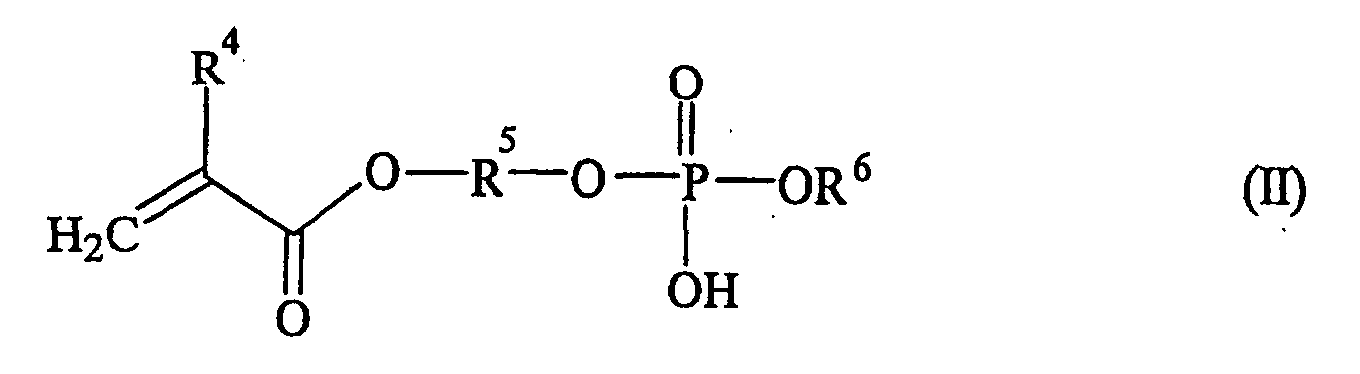
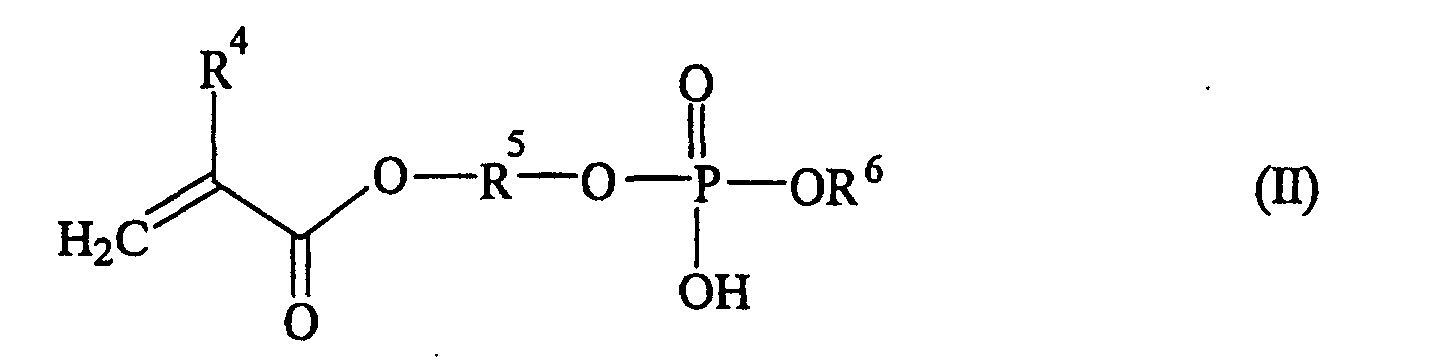
- the phosphate group-containing polymerizable monomer especially a phosphate group-containing polymerizable monomer represented by the general formula (II): wherein R 4 is hydrogen atom or methyl group; R 5 is an alkylene group having 6 to 25 carbon atoms; and R 6 is hydrogen atom, an alkyl group or phenyl group, can be suitably used, because there are exhibited excellent adhesive property, adhesion durability, and peripherical sealability for enamel and dentin. It is desired that the number of carbon atoms of the alkyl group represented by R 6 is 1 to 20, preferably 1 to 10.
- the content of the acidic group-containing polymerizable monomer (a) in the adhesive composition of the present invention is 1 to 70% by weight, preferably 5 to 60% by weight, more preferably 10 to 50% by weight, from the viewpoints of improvements in adhesive strength and peripherical sealability for teeth.
- the polymerizable monomer (b) is a component capable of improving peripherical sealability.
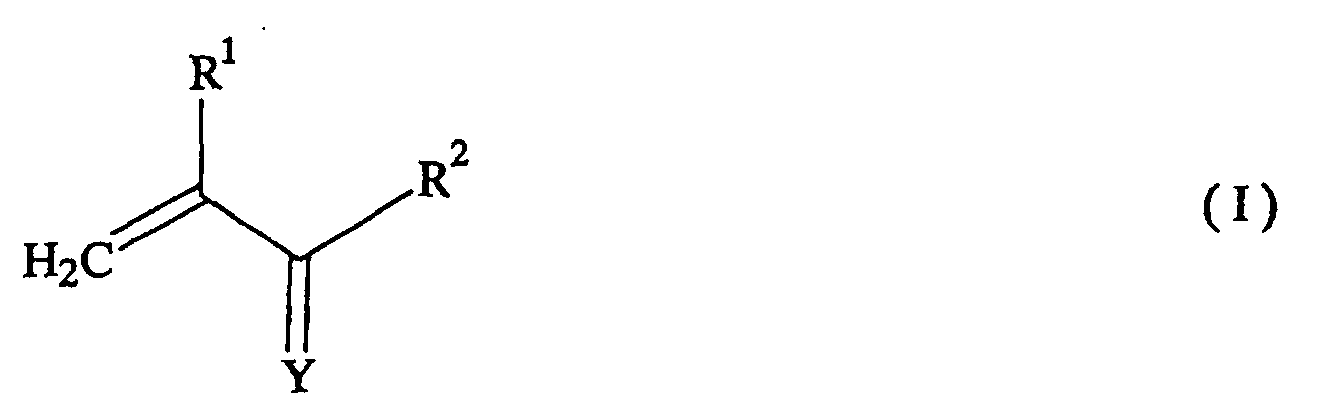
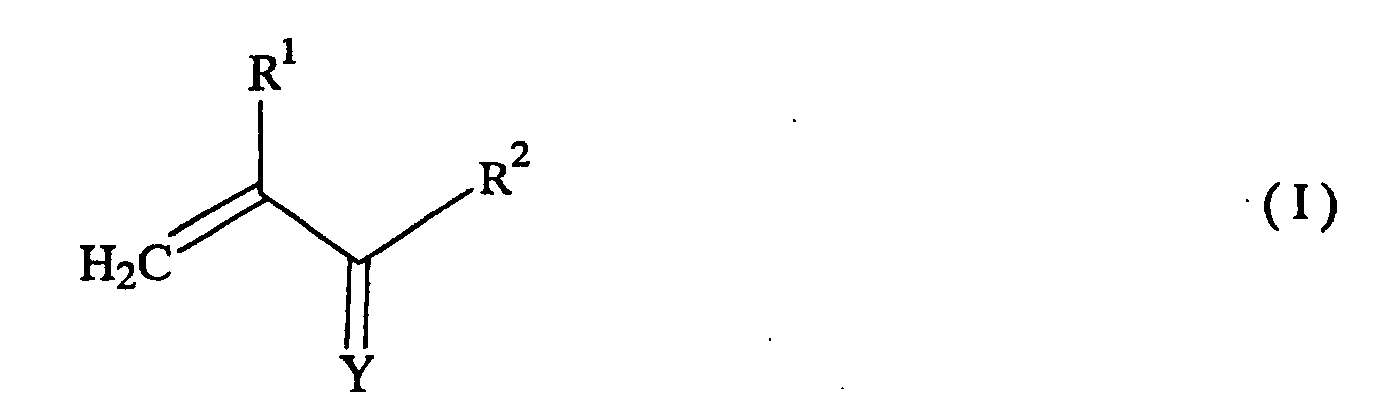
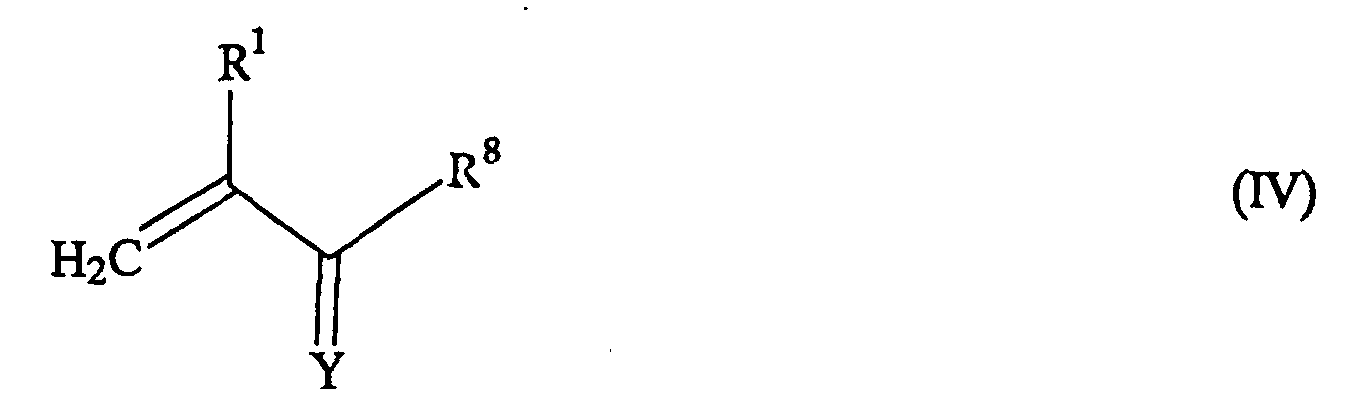
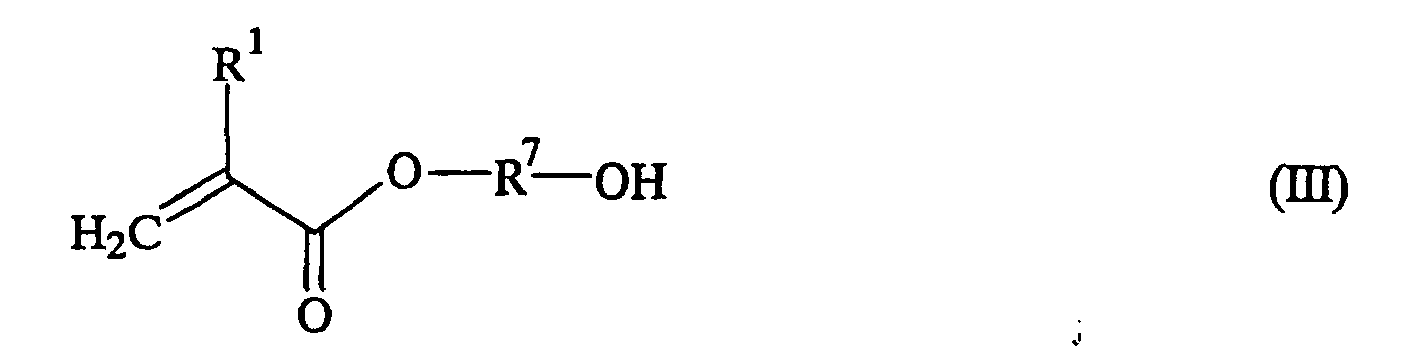
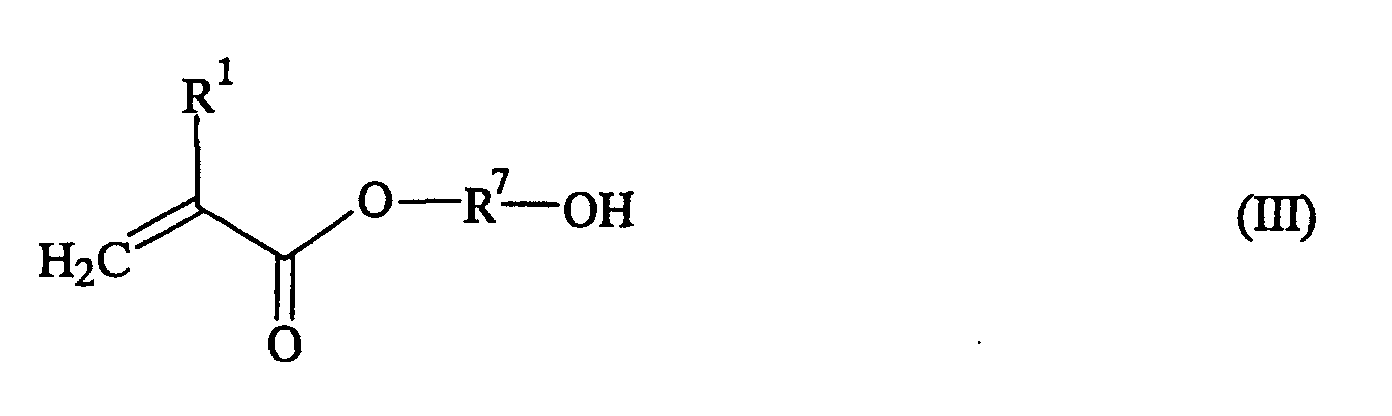
- Representative examples of the polymerizable monomer represented by the general formula (I) include a hydroxyl group-containing polymerizable monomer represented by the general formula (III): wherein R 1 is hydrogen atom or methyl group; and R 7 is an alkylene group having 6 to 25 carbon atoms; and a polymerizable monomer represented by the general formula (IV): wherein R 1 is hydrogen atom or methyl group; R 8 is a halogen atom, hydroxyl group, mercapto group or amino group; and Y is oxygen atom or sulfur atom. These can be each used alone or in combination of at least two kinds.
- hydroxyl group-containing polymerizable monomer represented by the general formula (III) examples include 6-hydroxyhexyl (meth)acrylate, 7-hydroxyheptyl (meth)acrylate, 8-hydroxyoctyl (meth)acrylate, 9-hydroxynonyl (meth)acrylate, 10-hydroxydecyl (meth)acrylate, 11-hydroxyundecyl (meth)acrylate, 12-hydroxydodecyl (meth)acrylate, 16-hydroxyhexadecyl (meth)acrylate, 20-hydroxyeicosyl (meth)acrylate, and the like. These can be used alone or in combination of at least two kinds.
- hydroxyl group-containing polymerizable monomers represented by the general formula (III) 8-hydroxyoctyl (meth)acrylate, 10-hydroxydecyl (meth)acrylate, 12-hydroxydodecyl (meth)acrylate and 16-hydroxyhexadecyl (meth)acrylate can be suitably used.
- polymerizable monomer represented by the general formula (IV) examples include (meth)acrylic acid, (meth)acrylic acid chloride, (meth)acrylic acid bromide, 2-methylpropenethionic acid, 2-methylpropenedithionic acid, propenethionic acid, propenedithionic acid, and the like. These can be used alone or in combination of at least two kinds.
- acrylic acid and methacrylic acid are preferable.
- the hydroxyl group-containing polymerizable monomer represented by the general formula (III) is used together with the polymerizable monomer represented by the general formula (IV), from the viewpoint of improvement in peripherical sealability.
- the weight ratio of the hydroxyl group-containing polymerizable monomer represented by the general formula (III)/the polymerizable monomer represented by the general formula (IV) is 0.005 to 200, preferably 0.05 to 20, from the viewpoint of improvement in peripherical sealability.
- the phosphate group-containing polymerizable monomer represented by the general formula (II) is used as the acidic group-containing polymerizable monomer (a), and that the hydroxyl group-containing polymerizable monomer represented by the general formula (III) is used as the polymerizable monomer (b), from the viewpoint of improvement in the peripherical sealability.
- the group R 5 in the phosphate group-containing polymerizable monomer represented by the general formula (II) is identical to R 7 in the hydroxyl group-containing polymerizable monomer represented by the general formula (III), from the viewpoint of further increasing the durability of peripherical sealability.
- the number of carbon atoms of the alkylene group of R 7 in the hydroxyl group-containing polymerizable monomer represented by the general formula (III) is 8 to 25, from the viewpoints of further increasing the adhesion durability and the peripherical sealability.
- the ratio of the acidic group-containing polymerizable monomer (a) to the polymerizable monomer (b) is important.
- the weight ratio of the polymerizable monomer (b) / the acidic group-containing polymerizable monomer (a) is adjusted to 0.001 to 0.5, preferably 0.005 to 0.3, more preferably 0.01 to 0.1, from the viewpoints of increasing the peripherical sealability and adhesive strength.
- the hydrophilic polymerizable monomer (c) used in the present invention refers to a compound having a solubility of at least 10%, more preferably at least 30% in water of 25°C.
- hydrophilic polymerizable monomer (c) examples include 2-hydroxyethyl (meth)acrylate, 2-hydroxypropyl (meth)acrylate, 3-hydroxypropyl (meth)acrylate, 1,3-dihydroxypropyl (meth)acrylate, 2,3-dihydroxypropyl (meth)acrylate, 2-hydroxypropyl-1,3-di(meth)acrylate, 3-hydroxypropyl-1,2-di(meth)acrylate, 2-trimethylammonium ethyl (meth)acrylchloride, (meth)acrylamide, 2-hydroxyethyl (meth)acrylamide, polyethylene glycol di(meth)acrylate, the number of oxyethylene groups of which is at least 9, and the like.
- hydrophilic polymerizable monomers (c) a preference is given to hydrophilic polymerizable monomers of which alkylene group has 1 to 3 carbon atoms, from the viewpoint of improvement in penetrability to the teeth.
- the content of the hydrophilic polymerizable monomer (c) in the adhesive composition of the present invention is 5 to 95% by weight, preferably 10 to 90% by weight, more preferably 15 to 70% by weight, from the viewpoints of improvements in adhesive property and peripherical sealability.
- the adhesive composition of the present invention may contain water (d) as occasion demands.
- water (d) is contained in the adhesive composition, adhesive property and peripherical sealability for teeth can be improved.
- Water (d) may be any of those which do not substantially contain impurities which give wrong influence to the exhibition of adhesive strength between the teeth and the restorative material.
- Water (d) is preferably distilled water or ion-exchanged water.
- the content of water (d) in the adhesive composition of the present invention is usually 0.1 to 80% by weight, preferably 0.5 to 70% by weight, more preferably 1 to 60% by weight, from the viewpoints of improvements in adhesive property and peripherical sealability for teeth.
- the adhesive composition when the adhesive composition is very thinly spread over the tooth surface with a dental air syringe or the like after the adhesive composition is applied to the tooth surface, the adhesive composition can be cured together with a dental bonding material, a dental luting material and a dental composite resin at the same time, so that a polymerization initiator is not necessarily required.
- the adhesive composition of the present invention when used in combination with a dental luting material comprising a redox chemical polymerization initiator, it is preferable that a reducing agent and/or an oxidizing agent is contained in the adhesive composition from the viewpoint of improvement in adhesive property.
- the adhesive composition of the present invention is coated in a thickness of at least 10 ⁇ m, it is preferable that a polymerization initiator (e) is contained in the adhesive composition.
- polymerization initiator (e) there can be employed a known photopolymerization initiator and/or chemical polymerization initiator.
- the photopolymerization initiator includes, for instance, ⁇ -diketones, ketals, thioxanthones, acylphosphine oxides, coumarines, halomethyl group-substituted-s-triazine derivatives, and the like.
- ⁇ -ketones examples include camphorquinone, benzyl, 2,3-pentadione, and the like.
- Examples of the ketals include benzyl dimethyl ketal, benzyl diethyl ketal, and the like.
- Examples of the thioxanthones include 2-chlorothioxanthone, 2,4-diethylthioxanthone, and the like.
- acylphosphine oxides include, for instance, 2,4,6-trimethylbenzoyldiphenylphosphine oxide, 2,6-dimethoxybenzoyldiphcnylphosphine oxide, 2,6-dichlorobenzoyldiphenylphosphine oxide, 2,3,5,6-tetramethylbenzoyldiphenylphosphine oxide, benzoyl di-(2,6-dimethylphenyl) phosphonate, 2,4,6-trimethylbenzoylethoxyphenylphosphine oxide, water-soluble acylphosphine oxide compounds disclosed in Japanese Examined Patent Publication No. Hei 3-57916, and the like.
- Examples of the coumarines include compounds listed in Japanese Patent Laid-Open No. Hei 10-245525, such as 3,3'-carbonylbis(7-diethylamino)coumarine, 3-(4-methoxybenzoyl)coumarine, 3-thienoylcoumarine, and the like.
- halomethyl group-substituted-s-triazine derivatives include compounds listed in Japanese Patent Laid-Open No. Hei 10-245525, such as 2,4,6-tris(trichloromethyl)-s-triazine, 2,4,6-tris(tribromomethyl)-s-triazine and 2-methyl-4,6-bis(trichloromethyl)-s-triazine.
- a benzoyl alkyl ether, a benzoyl dimethyl ketal or the like is preferable as a photopolymerization catalyst.
- the photopolymerization initiator can be used alone or in combination of at least two kinds.
- the content of the photopolymerization initiator in the adhesive composition of the present invention is not limited to specified ones. It is desired that the content is usually 0.01 to 10% by weight, preferably 0.1 to 5% by weight.
- the photopolymerization initiator When the photopolymerization initiator is used as the polymerization initiator (e), the photopolymerization initiator may be used alone. However, in order to further accelerate photo-thermosetting properties, it is preferable that the photopolymerization initiator is used together with a reducing agent.
- the reducing agent includes tertiary amines, aldehydes, thiol group-containing compounds, and the like.
- tertiary amines examples include 2-dimethylaminoethyl methacrylate, N,N-bis[(moth)acryloyloxyethyl]-N-methylamine, ethyl 4-dimethylaminobenzoate, butyl 4-dimethylaminobenzoate, butoxyethyl 4-dimethylaminobenzoate, N-methyldiethanolamine, 4-dimethylaminobenzophenone, and the like.
- aldehydes examples include dimethylaminobenzaldehyde, terephthalaldehyde, and the like.
- thiol group-containing compounds examples include 2-mercaptobenzoxazole, decanethiol, 3-mercaptopropyltrimethoxysilane, thiobenzoic acid, and the like.
- These reducing agents can be used alone or in combination of at least two kinds.
- the content of the reducing agent in the adhesive composition of the present invention is not limited to specified ones. It is desired that the content is usually 0.01 to 10% by weight, preferably 0.05 to 7% by weight, more preferably 0.1 to 5% by weight.
- a redox polymerization initiator comprising an oxidizing agent and a reducing agent.
- the adhesive composition of the present invention is used together with the other material, for instance, a restorative material such as a dental bonding material, a composite resin, a compomer, a resin for denture base, a resin cement or a resin-reinforceable glass ionomer cement, it is possible to include only one of the oxidizing agent and the reducing agent in the adhesive composition, as long as at least one of the oxidizing agent and the reducing agent is contained in the restorative material.
- a restorative material such as a dental bonding material, a composite resin, a compomer, a resin for denture base, a resin cement or a resin-reinforceable glass ionomer cement
- the oxidizing agent includes, for instance, organic peroxides such as diacyl peroxides, peroxy esters, dialkyl peroxides, peroxy ketals, ketone peroxides and hydroperoxides.
- diacyl peroxides examples include benzoyl peroxide, 2,4-dichlorobenzoyl peroxide, m-toluoyl peroxide, and the like.
- peroxy esters examples include t-butylperoxy benzoate, bis-t-butylperoxy isophthalate, 2,5-dimethyl-2,5-bis(benzoylperoxy)hexane, t-butylperoxy-2-ethylhexanoate, t-butylperoxy isopropyl carbonate, and the like.
- dialkyl peroxides examples include dicumyl peroxide, di-t-butyl peroxide, lauroyl peroxide, and the like.
- peroxy ketals examples include 1,1-bis(t-butylperoxy) 3,3,5-trimethylcyclohexane, 1,1-bis(t-butylperoxy)cyclohexane, 1,1-bis(t-hexylperoxy)cyclohexane, and the like.
- ketone peroxides include methyl ethyl ketone peroxide, cyclohexanone peroxide, methyl acetoacetate peroxide, and the like.
- hydroperoxides examples include t-butyl hydroperoxide, cumene hydroperoxide, p-diisopropylbenzene peroxide, and the like.
- aromatic tertiary amines aromatic tertiary amines, aliphatic tertiary amines, sulfinic acids and their salts can be cited as preferred ones.
- aromatic tertiary amines include N,N-dimethylaniline, N,N-dimethyl-p-toluidine, N,N-dimethyl-m-toluidine, N,N-diethyl-p-toluidine, N,N-dimethyl-3,5-dimethylaniline, N,N-dimethyl-3,4-dimethylaniline, N,N-dimethyl-4-ethylaniline, N,N-dimethyl-4-i-propylaniline, N,N-dimethyl-4-t-butylaniline, N,N-dimethyl-3,5-di-t-butylaniline, N,N-bis(2-hydroxyethyl)-3,5-dimethylaniline, N,N-di(2-hydroxyethyl)-p-toluidine, N,N-bis(2-hydroxyethyl)-3,4-dimethylaniline, N,N-bis(2-hydroxyethyl)-3
- aliphatic tertiary amines include trimethylamine, triethylamine, N-methyldiethanolamine, N-ethyldiethanolamine, N-n-butyldiethanolamine, N-lauryldiethanolamine, triethanolamine, (2-dimethylamino)ethyl methacrylate, N-methyldiethanolamine dimethacrylate, N-ethyldiethanolamine dimethacrylate, triethanolamine monomethacrylate, triethanolamine dimethacrylate, triethanolamine trimethacrylate, and the like.
- sulfinic acids or their salts include benzenesulfinic acid, sodium benzenesulfinate, potassium benzenesulfinate, calcium benzenesulfinate, lithium benzenesulfinate, toluenesulfinic acid, sodium toluenesulfinate, potassium toluenesulfinate, calcium toluenesulfinate, lithium toluenesulfinate, 2,4,6-trimethylbenzenesulfinic acid, sodium 2,4,6-trimethylbenzenesulfinate, potassium 2,4,6-trimethylbenzenesulfinate, calcium 2,4,6-trimethylbenzenesulfinate, lithium 2,4,6-trimethylbenzenesulfinate, 2,4,6-triethylbenzenesulfinic acid, sodium 2,4,6-triethylbenzenesulfinate, potassium 2,4,6-triethylbenzenesulfinic acid, sodium 2,4,6-trieth
- oxidizing agents and reducing agents can be used alone or in combination of at least two kinds.
- the content of the chemical polymerization initiator in the adhesive composition of the present invention is not limited to specified ones. It is desired that the content is usually 0.01 to 10% by weight, preferably 0.05 to 7% by weight, more preferably 0.1 to 5% by weight.
- hydrophobic polymerizable monomer other than the acidic group-containing polymerizable monomer (a), the polymerizable monomer (b) and the hydrophilic polymerizable monomer (c) (hereinafter simply referred to as "hydrophobic polymerizable monomer").
- the hydrophobic polymerizable monomer includes, for instance, esters of carboxylic acids such as ⁇ -cyanoacrylic acid, (meth)acrylic acid, ⁇ -halogenated acrylic acids, crotonic acid, cinnamic acid, sorbic acid, maleic acid and itaconic acid; (meth)acrylamide and derivatives of (meth)acrylamide; vinyl esters; vinyl ethers; mono-N-vinyl derivatives, styrene derivatives, and the like. Among them, (meth)acrylic acid esters are preferably used.
- hydrophobic polymerizable monomer examples include the following monomers.
- the term "monofunctional monomer” as referred to herein means a monomer having one olefinic double bond.
- Ethylene glycol di(meth)acrylate triethylene glycol di(meth)acrylate, propylene glycol di(meth)acrylate, neopentyl glycol di(meth)acrylate, 1,6-hexanediol di(meth)acrylate, 1,10-decanediol di(meth)acrylate, bisphenol A diglycidyl (meth)acrylate, 2,2-bis[4-(meth)acryloyloxyethoxyphenyl]propane, 2,2-bis[4-(meth)acryloyloxypolyethoxyphenyl]propane, 2,2-bis[4-[3-(meth)acryloyloxy-2-hydroxypropoxy]phenyl]propane, 1,2-bis[3-(meth)acryloyloxy-2-hydroxypropoxy]ethane, pentaerythritol di(meth)acrylate, 1,2-bis(3-methacryloyloxy-2-hydroxypropoxy)
- hydrophobic polymerizable monomers can be used alone or in combination of at least two kinds.
- the content of the hydrophobic polymerizable monomer in the adhesive composition of the present invention is usually at most 60% by weight, preferably at most 40% by weight, especially from the viewpoint of maintaining adhesive strength against enamel.
- a volatile organic solvent can be contained in the adhesive composition.
- volatile organic solvent it is desired to use a volatile organic solvent usually having a boiling point of at most 150°C, preferably at most 100°C at atmospheric pressure.
- volatile organic solvent examples include alcohols such as ethanol, methanol, 1-propananol and isopropananol; ketones such as acetone and methyl ethyl ketone; ester compounds such as ethyl acetate, methyl acetate and ethyl propionate; ethers such as 1,2-dimethoxyethane, 1,2-diethoxyethane and tetrahydrofuran; hydrocarbon compounds such as heptane, hexane and toluene; halogenated hydrocarbon compounds such as chloroform and dichloromethane; and the like.
- These volatile organic solvents may be used alone or in combination of at least two kinds. Among them, a water-soluble volatile solvent such as ethanol or acetone is preferable.
- the content of the volatile organic solvent in the adhesive composition of the present invention is not limited to specified ones. It is desired that the content is usually at most 60% by weight, preferably at most 30% by weight.
- the volatile organic solvent is contained in the adhesive composition, in order not to impair its adhesive property, it is preferable that the volatile solvent is evaporated as much as possible with a dental air syringe or the like after the adhesive composition is applied to a tooth.
- a polymerization inhibitor, a colorant, a fluorescent, an ultraviolet absorbent and the like may be properly added to the adhesive composition of the present invention as occasion demands.
- a cationic antibacterial compound such as cetyl pyridium chloride, chlorhexidine hydrochloride, a benzalkonium chloride, (meth)acryloyloxydodecyl pyridium bromide, (meth)acryloyloxyhexadecyl pyridium chloride or (meth)acryloyloxydecyl ammonium chloride.
- the adhesive composition of the present invention there may be contained in the adhesive composition of the present invention a known fluorine compound which releases a fluorine ion, such as sodium fluoride, lithium fluoride or cetylamine hydrofluoride.
- a filler can be contained in the adhesive composition of the present invention within an amount which would not impair the fluidity of the adhesive composition.
- the filler includes an inorganic filler, an organic filler or their composites.
- the inorganic filler includes, for instance, minerals of which basic material is silica, such as silica, kaolin, clay and mica; ceramics of which basic material is silica, comprising Al 2 O 3 , B 2 O 3 , TiO 2 , ZrO 2 , BaO, La 2 O 3 , SrO 2 , CaO P 2 O 5 and the like; glass such as lanthanum glass, barium glass, strontium glass, sodium glass, lithium borosilicate glass, zinc glass, fluoroaluminum borosilicate glass, borosilicate glass and bio glass; crystal silica, hydroxylapatite, alumina, titanium oxide, yttrium oxide, zirconia, calcium phosphate, barium sulfate, aluminum hydroxide, and the like.
- minerals of which basic material is silica such as silica, kaolin, clay and mica
- ceramics of which basic material is silica comprising Al 2 O 3 , B 2 O 3
- the organic filler includes, for instance, organic resins such as polymethyl methacrylate, polyfunctional methacrylate polymer, polyamide, polystyrene, polyvinyl chloride, chloroprene rubber, nitrile rubber and styrene-butadiene rubber.
- organic resins such as polymethyl methacrylate, polyfunctional methacrylate polymer, polyamide, polystyrene, polyvinyl chloride, chloroprene rubber, nitrile rubber and styrene-butadiene rubber.
- inorganic/organic composite filler in which the inorganic filler is dispersed in these organic resins, or in which the inorganic filler is coated with the above-mentioned organic resin.
- these fillers may be used after previously subjecting to a surface treatment with a known agent for surface treatment, such as a silane coupling agent as occasion demands.
- the agent for surface treatment includes, for instance, vinyltrimethoxysilane, vinyltriethoxysilane, vinyltrichlorosilane, vinyltri( ⁇ -methoxyethoxy)silane, ⁇ -methacryloyloxypropyltrimethoxysilane, ⁇ -glycidoxypropyltrimethoxysilane, ⁇ -mercaptopropyltrimethoxysilane, ⁇ -aminopropyltriethoxysilane, and the like.
- the content of the filler in the adhesive composition of the present invention is not limited to specified ones. It is desired that the content is usually at most 30% by weight, preferably at most 10% by weight.
- the viscosity of the adhesive composition is controlled to at most 1 Pa•s at 30°C by dispersing a filler having an average particle diameter of 0.001 to 30 ⁇ m in the adhesive composition, from the viewpoints of penetrability, coatability, thermosetting property for teeth.
- the adhesive composition of the present invention it is preferable to control the viscosity to 0.1 to 1 Pa•s at 30°C.
- the adhesive composition of the present invention can be used in various forms.
- the adhesive composition of the present invention can be used as an agent for pretreatment in order to bond to teeth a material to be bonded, such as a dental bonding material, a resin cement, a glass ionomer cement, a zinc phosphate cement, a polycarboxylate cement, a silicate cement or a zinc oxide eugenol cement, or to enhance adhesive properties (form 1).
- the adhesive composition also can be used as an adhesive for bonding a dental composite resin or a compomer for filling with teeth (form 2).
- the adhesive composition can be used as a fissure sealant material applied to pit and fissure, or a coating material for root and a proximal teeth portion (form 3), or can be used as a dentinal canal sealant material for the purpose of suppressing hyperesthesia (form 4).
- the content of the acidic group-containing polymerizable monomer (a) in the adhesive composition is 5 to 40% by weight, that the content of the polymerizable monomer (b) is 0.005 to 20% by weight, and that the content of the hydrophilic polymerizable monomer (c) is 10 to 90% by weight, and it is more preferable that water (d) is contained in a content of 5 to 60% by weight.
- the weight ratio of (b)/(a), that is, the polymerizable monomer (b)/the acidic group-containing polymerizable monomer (a) is adjusted to 0.001 to 0.5.
- the content of the acidic group-containing polymerizable monomer (a) in the adhesive composition is 10 to 50% by weight, that the content of the polymerizable monomer (b) is 0.01 to 25% by weight, and that the content of the hydrophilic polymerizable monomer (c) is 5 to 50% by weight, and it is more preferable that water (d) is contained in a content of 0.1 to 10% by weight.
- the weight ratio of the polymerizable monomer (b)/the acidic group-containing polymerizable monomer (a) is adjusted to 0.001 to 0.5.
- a hydrophobic polymerizable monomer other than the acidic group-containing polymerizable monomer (a), the polymerizable monomer (b) and the hydrophilic polymerizable monomer (c) in a content of 5 to 40% by weight, from the viewpoints of more improving adhesive property and peripherical sealability.
- a filler may be contained in this adhesive composition within a range of at most 30% by weight.
- the adhesive composition of the present invention can be used for not only hard tissues such as teeth but also crown restorative materials such as metals, porcelains, ceramics and composite resin cured products. Further, the adhesive composition of the present invention may be used in combination with a commercially available dental metal primer, a primer for bonding porcelain, an acidic etching agent or a tooth face cleaning agent such as a hypochlorite. Among them, it is especially preferable that the adhesive composition of the present invention is used in combination with the acidic etching agent, because more excellent peripherical sealability can be imparted to enamel.
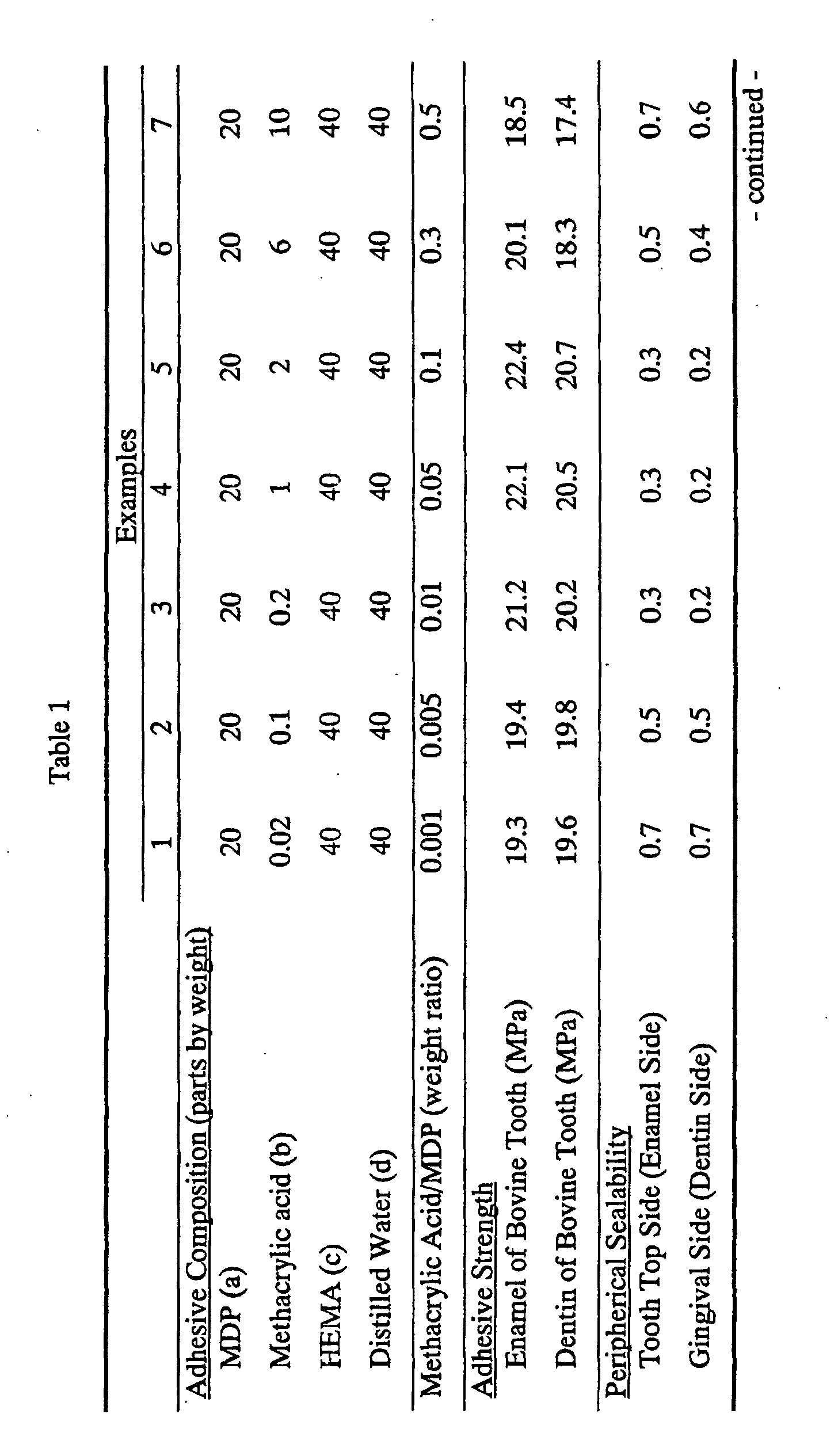
- An adhesive composition composed of 20 parts by weight of MDP, 0.02 parts by weight of methacrylic acid, 40 parts by weight of HEMA and 40 parts by weight of distilled water was prepared.
- the adhesive strength and peripherical sealability were determined in accordance with the following testing method for adhesive strength and testing method for peripherical sealability. The results are shown in Table 1.
- Bovine front teeth were smoothly wet-grinded with #1000 silicon carbide paper (manufactured by Nippon Kenshi K.K.) to expose their enamel surfaces or dentin surfaces, and thereafter water on the surfaces was blown away with a dental air syringe.
- An adhesive tape having a thickness of about 150 ⁇ m with a hole opening having a diameter of 3 mm was pasted to the exposed enamel surfaces or dentin surfaces, and the adhesive composition obtained in Example 1 was applied to the hole with a brush.
- the adhesive composition was allowed to stand for 30 seconds, and thereafter dried with an air syringe to a degree such that the adhesive composition had no fluidity.
- a photopolymerizable dental bonding material "Clearfil Megabond” (manufactured by Kuraray Co., Ltd., trade name) was applied onto the dried adhesive composition with a brush so that its thickness became about 100 ⁇ m.
- the resulting coat was photo-irradiated with a dental photoirradiator "LIGHTEL II” (manufactured by Gunma Ushio Denki K.K., trade name) for 10 seconds to cure the coat.
- a commercially available photopolymerizable dental composite resin "Clearfil AP-X" (manufactured by Kuraray Co., Ltd., trade name) was mounted on the cured coat, and covered with a film made of EVAL (manufactured by Kuraray Co., Ltd., registered trademark). Thereafter, the slide glass was pressed over the film, and photo-irradiated for 40 seconds with the above-mentioned photoirradiator to cure the composite resin.
- a stainless steel rod was bonded to the cured surface with a commercially available dental resin cement "Panavia 21" (manufactured by Kuraray Co., Ltd., trade name) to give a test piece. After 30 minutes, the test piece was immersed in water of 37°C for 24 hours, and thereafter a thermal cycle comprising immersing the test piece in cold water of 4°C for one minute and in hot water of 60°C for one minute was carried out 2000 times. Thereafter, its adhesive strength was determined. A universal tester (manufactured by Instron) was used for the determination of the adhesive strength, and the tensile adhesive strength was determined under the conditions of a cross head speed of 2 mm/minute. The determination value for each adhesive strength was expressed as an average value of the determination values of 8 test pieces.
- a cavity having a diameter of about 4 mm and a depth of about 3 mm was formed by using a dental air turbine so that the cervical line of the molar portion of a human evulsed tooth was positioned at the center.
- the adhesive composition obtained in Example 1 was applied to the internal surface of the cavity, and the adhesive composition was allowed to stand for 30 seconds, and thereafter dried with an air syringe to a degree such that the adhesive composition had no fluidity.
- a photopolymerizable dental bonding material "Clearfil Megabond” manufactured by Kuraray Co., Ltd., trade name) was applied to the internal surface of the cavity so that its thickness became about 100 ⁇ m.
- the resulting coat was photo-irradiated for 10 seconds with a dental photoirradiator "LIGHTEL II” (manufactured by Gunma Ushio Denki K.K., trade name) to cure the coat. Further, a commercially available photopolymerizable dental composite resin "Clearfil AP-X” (manufactured by Kuraray Co., Ltd., trade name) was filled in the cavity, and photo-irradiated for 40 seconds with the above-mentioned photoirradiator to cure the composite resin.
- test piece was immersed in water at 37°C for 24 hours, and thereafter a thermal cycle comprising immersing in cold water of 4°C for one minute and in hot water of 60°C for one minute was carried out 2000 times. Thereafter, the test piece was immersed in a 0.2% aqueous basic fuchsine solution at 37°C for 24 hours, and thereafter the test piece was taken out from the solution and washed with water.
- the test piece was dried with a dental air syringe, and its restored portion was divided into three portions lengthwise using a low-speed diamond cutter to give three slices per tooth. Fifteen slices were prepared from five molar teeth from human teeth in total.
- the evaluation of the penetration of the colorant was made by observing both the cavity margin of a tooth top side (enamel side) and the cavity margin of a gingival side (dentin side) by naked eyes with a light microscope (magnification: 25 times), obtaining the following scores, and averaging the scores of 15 slices.
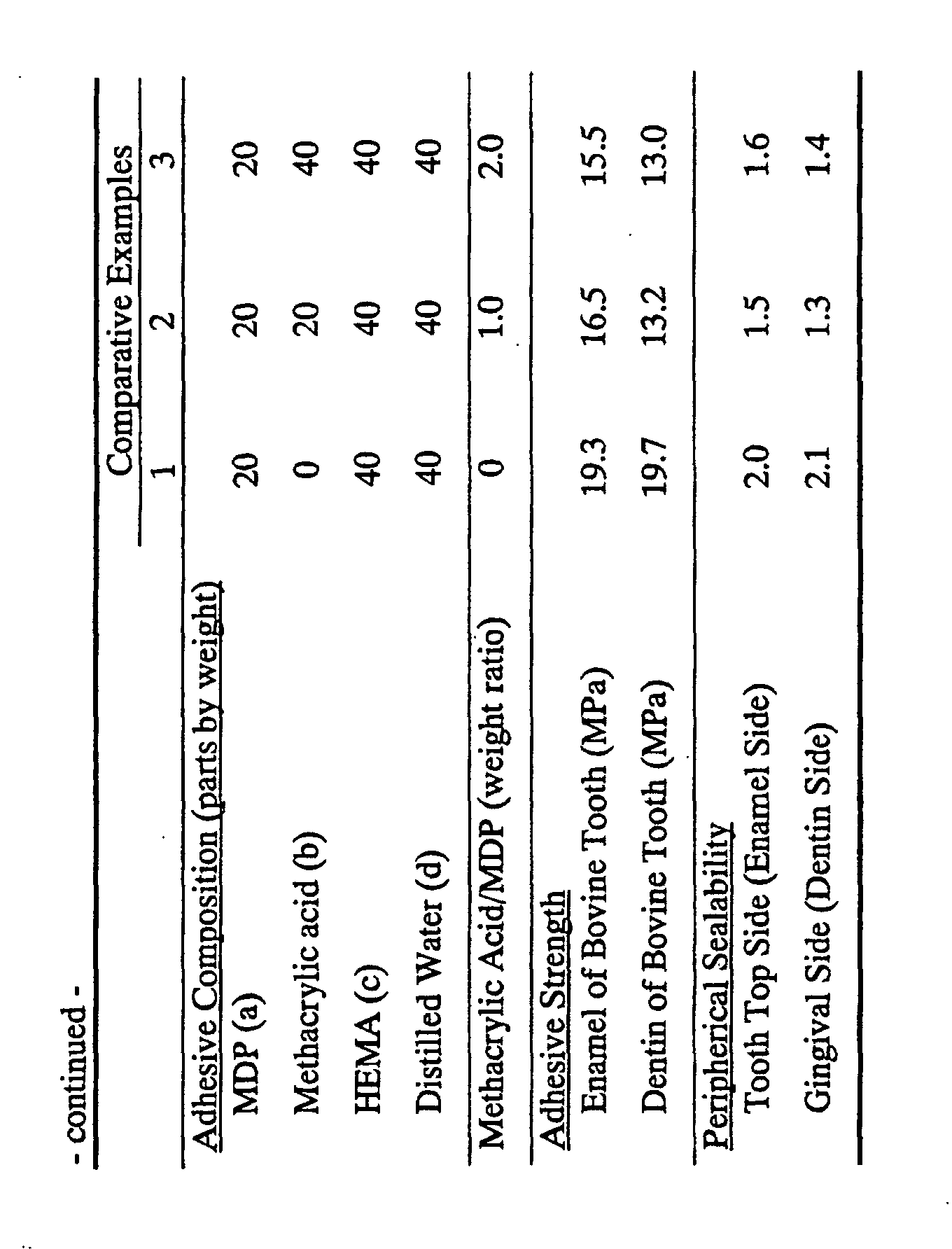
- Adhesive compositions in which the amount of methacrylic acid was changed were prepared as shown in Table 1.
- the adhesive strength test and peripherical sealability test were carried out in the same manner as in Example 1 using these adhesive compositions. The results are also shown in Table 1.
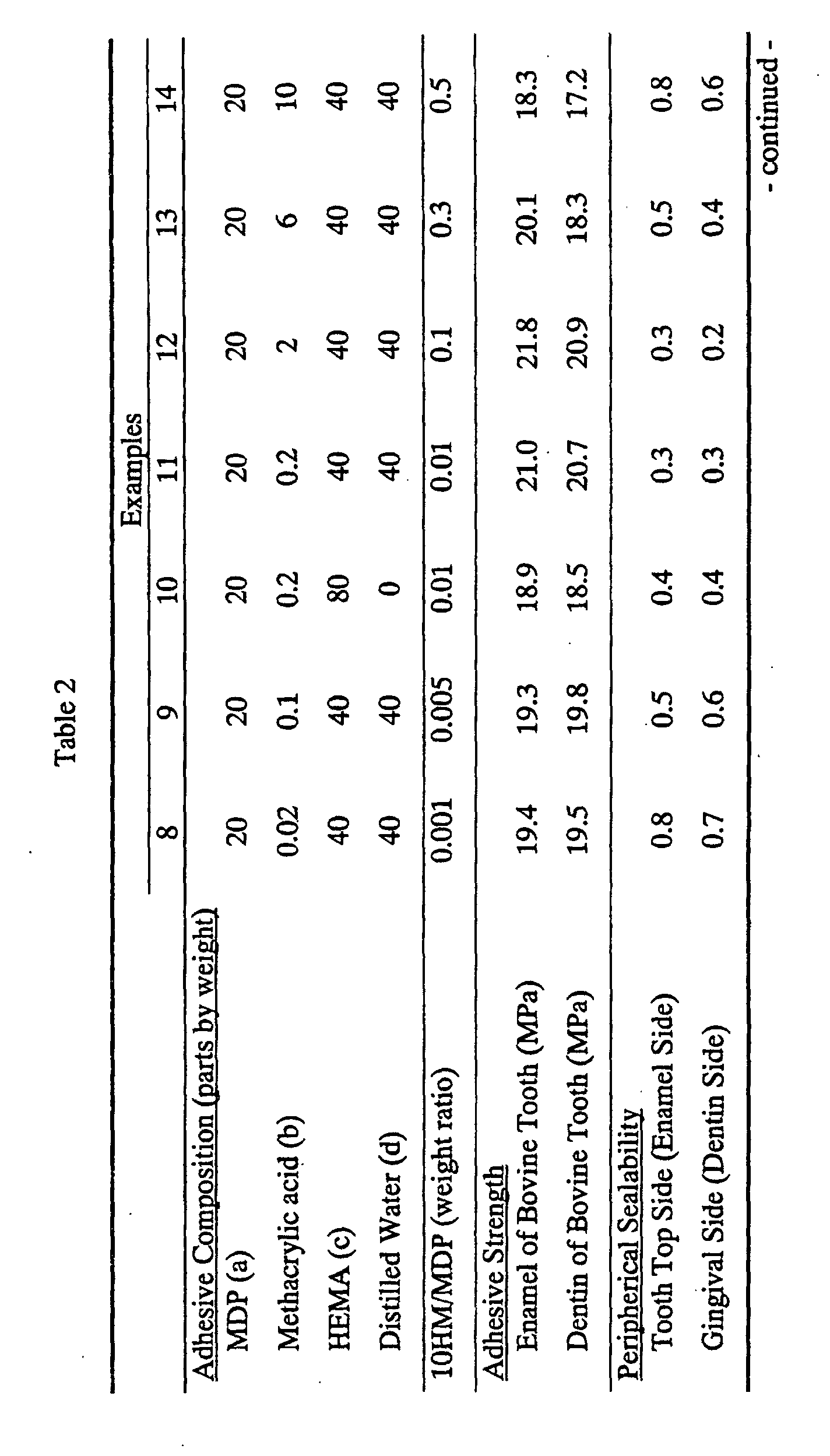
- Adhesive compositions composed of MDP, 10HM, HEMA, distilled water and the like were prepared as shown in Table 2.
- the adhesive strength test and peripherical sealability test were carried out in the same manner as in Example 1 using these adhesive compositions. The results are also shown in Table 2.
- Adhesive compositions composed of MEPP, methacrylic acid, HEMA, distilled water, CQ, DEPT, TPBSS and DMAB were prepared as shown in Table 3.
- the adhesive strength test and peripherical sealability test were carried out in the same manner as in Example 1 using these adhesive compositions. The results are also shown in Table 3.
- Adhesive compositions in which methacrylic acid was removed from the adhesive compositions used in Examples 15 to 18 were prepared as shown in Table 3.
- the adhesive strength test and peripherical sealability test were carried out in the same manner as in Example 1 using these adhesive compositions. The results are also shown in Table 3.
- Adhesive compositions composed of MDP, 10HM, HEMA, distilled water, CQ, DEPT, TPBSS and DMAB were prepared as shown in Table 4. The adhesive strength test and peripherical sealability test were carried out in the same manner as in Example 1 using these adhesive compositions. The results are also shown in Table 4.
- Adhesive compositions in which 10HM was removed from the adhesive compositions used in Examples 19 to 23 were prepared as shown in Table 4.
- the adhesive strength test and peripherical sealability test were carried out in the same manner as in Example 1 using these adhesive compositions. The results are also shown in Table 4.
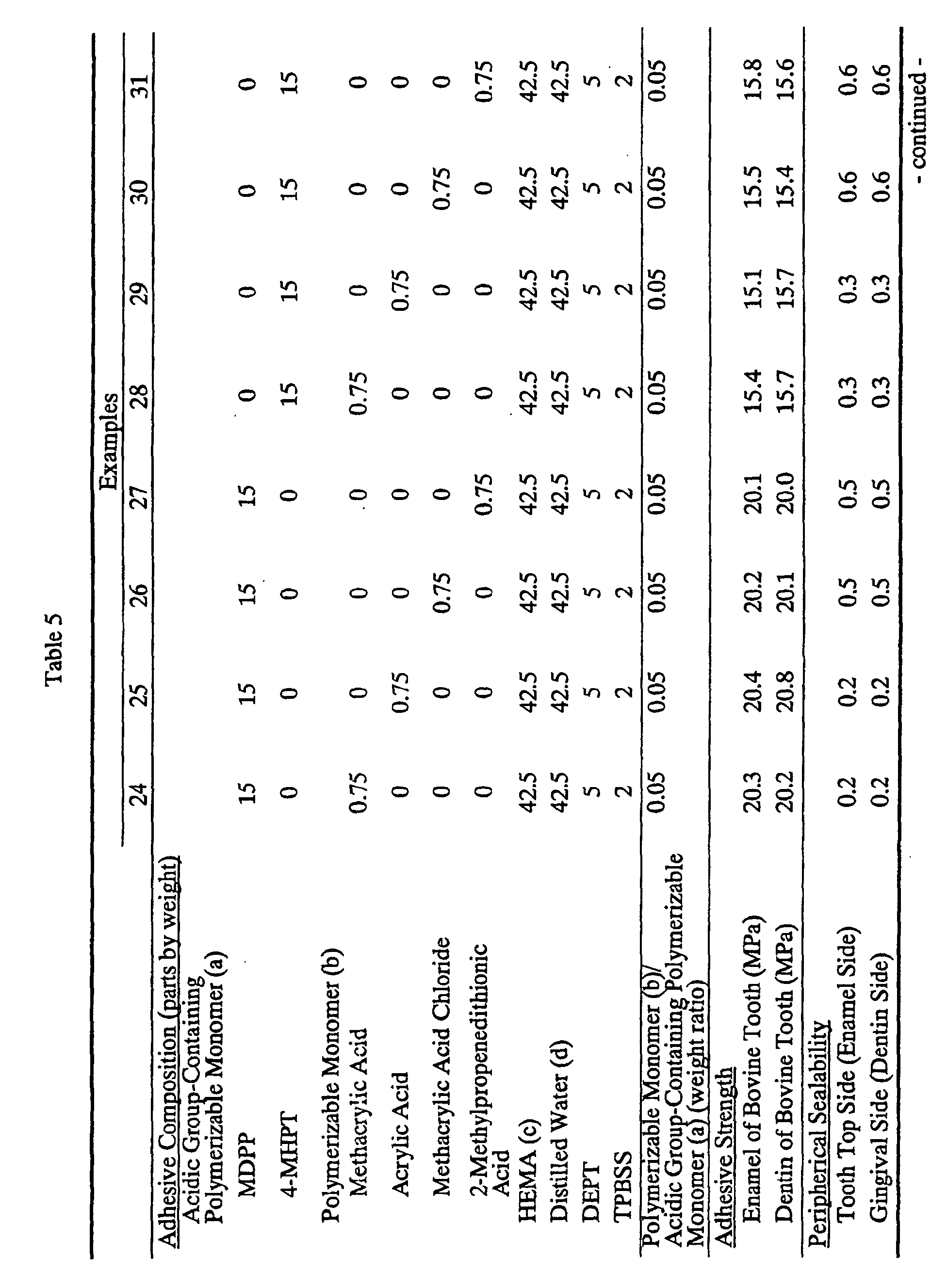
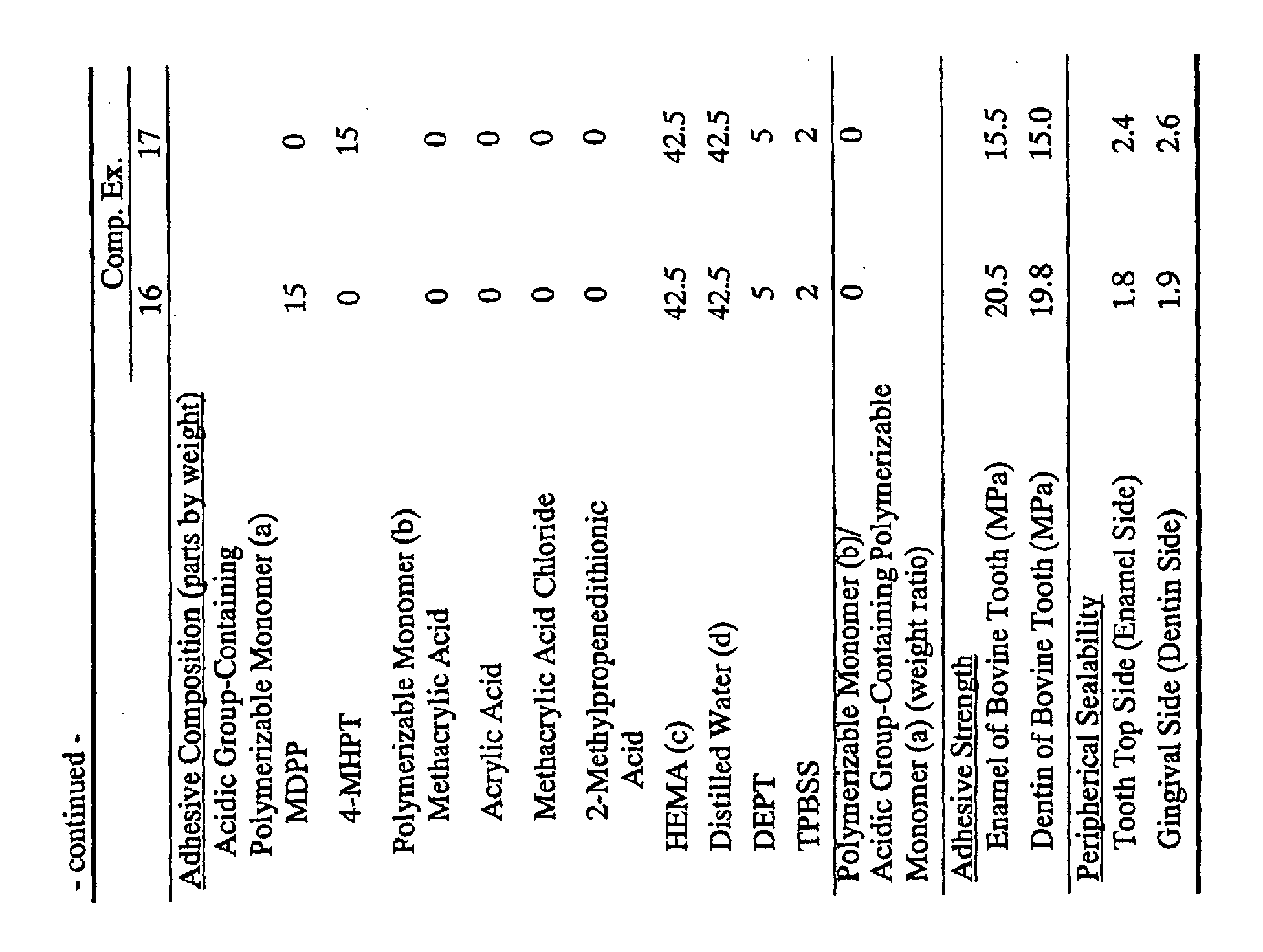
- Adhesive compositions prepared by adding methacrylic acid, acrylic acid, methacrylic acid chloride or 2-methylpropenedithionic acid to a composition composed of MDPP or 4-MHPT, HEMA, distilled water, DEPT, TPBSS and the like were prepared as shown in Table 5.
- the adhesive strength test and peripherical sealability test were carried out in the same manner as in Example 1 using these adhesive compositions. The results are also shown in Table 5.
- Adhesive compositions in which methacrylic acid was removed from an adhesive composition used in Example 24 and an adhesive composition used in Example 28 were prepared as shown in Table 5.
- the adhesive strength test and peripherical sealability test were carried out in the same manner as in Example 1 using these adhesive compositions. The results are also shown in Table 5.
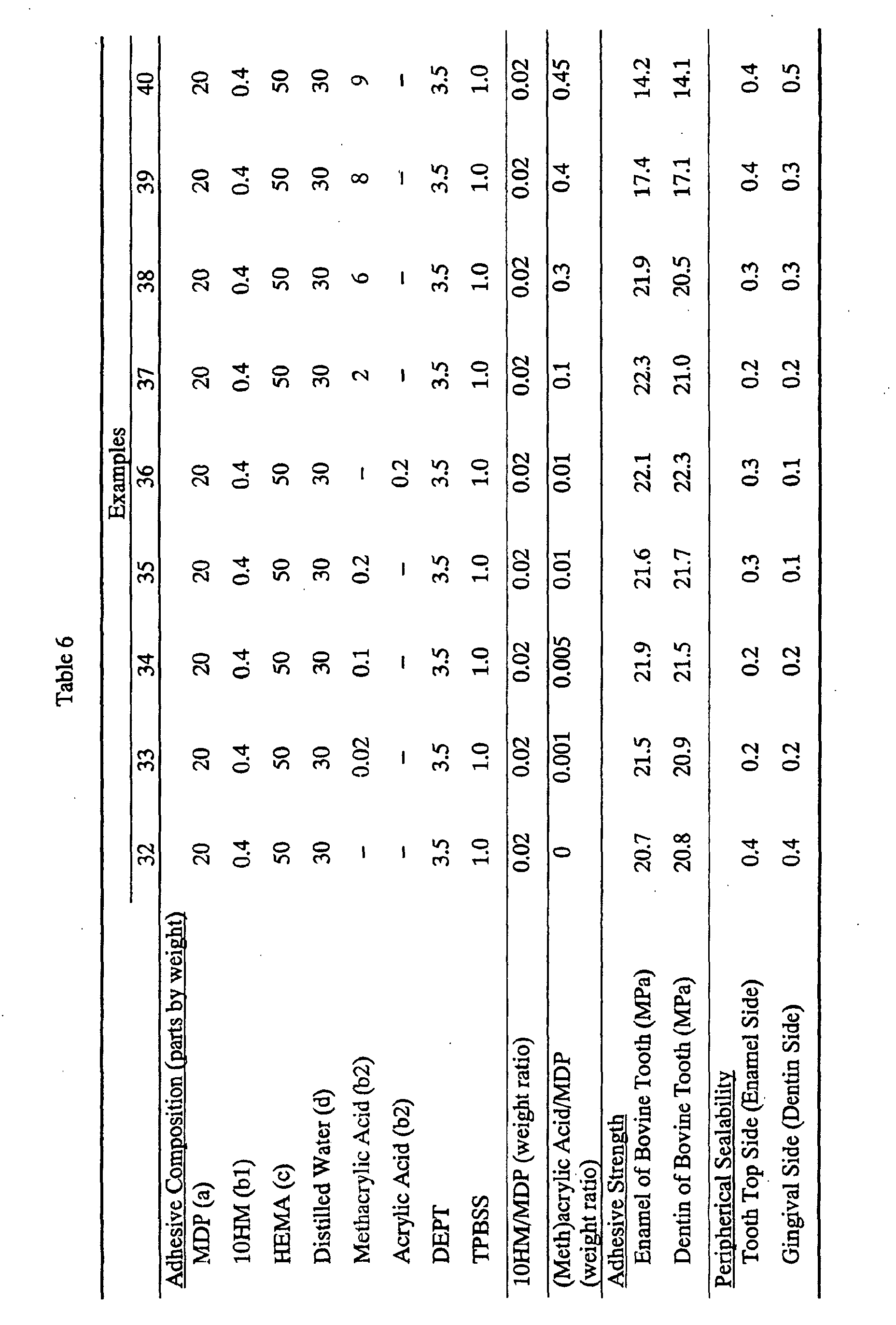
- Adhesive compositions composed of MDP, 10HM, HEMA, distilled water, methacrylic acid or acrylic acid, DEPT and TPBSS were prepared as shown in Table 6.
- the adhesive strength test and peripherical sealability test were carried out in the same manner as in Example 1 using these adhesive compositions. The results are also shown in Table 6.
- Adhesive compositions composed of a phosphate group-containing polymerizable monomer having a different alkylene chain length, a hydroxyl group-containing polymerizable monomer having a different alkylene chain length, HEMA and distilled water were prepared as shown in Table 7.
- the adhesive strength test and peripherical sealability test were carried out in the same manner as in Example 1 using these adhesive compositions. The results are also shown in Table 7.
- Adhesive compositions composed of a phosphate group-containing polymerizable monomer having a different alkylene chain length, 4HM, HEMA and distilled water were prepared as shown in Table 8.
- the adhesive strength test and peripherical sealability test were carried out in the same manner as in Example 1 using these adhesive compositions. The results are also shown in Table 8.
- a bonding material composed of 61 parts by weight of Bis-GMA, 31 parts by weight of HEMA, 5 parts by weight of colloidal silica [Aerosil 380, manufactured by Nippon Aerosil K.K.], 2 parts by weight of CQ, and 1 part by weight of DMAB was prepared and used in place of "Clearfil Megabond” (manufactured by Kuraray Co., Ltd., trade name).
- the adhesive composition of Example 3 had an adhesive strength of 17.5 MPa against bovine enamel and an adhesive strength of 15.8 MPa against bovine dentine, adhesive strength is excellent.
- the adhesive composition of Example 3 had a score of 0.5 for the cavity margin of a tooth top side (enamel side) and a score of 0.4 for the cavity margin of a gingival side (dentin side), peripherical sealability is excellent.
- An adhesive composition composed of 35 parts by weight of MDP, 2 parts by weight of methacrylic acid, 40 parts by weight of HEMA, 5 parts by weight of Bis-GMA, 10 parts by weight of 14G, 5 parts by weight of distilled water, 2.5 parts by weight of TMDPO, 0.5 parts by weight of DMAB and 0.05 parts by weight of BHT was prepared. Adhesive strength was determined in accordance with the testing method for adhesive strength described below using this adhesive composition. As a result, since the adhesive strength against bovine enamel was 17.5 MPa and the adhesive strength against bovine dentine was 14.6 MPa, adhesive strength is excellent.
- peripherical sealability was determined in accordance with the testing method for peripherical sealability described below. As a result, since the score for the cavity margin of a tooth top side (enamel side) was 0.3 and the score for the cavity margin of a gingival side (dentin side) was 0.3, peripherical sealability is excellent.
- Bovine front teeth were smoothly wet-grinded with #1000 silicon carbide paper (manufactured by Nippon Kenshi K.K.) to expose their enamel surfaces or dentin surfaces, and thereafter water on the surfaces was blown away with a dental air syringe.
- An adhesive tape having a thickness of about 150 ⁇ m with a hole opening having a diameter of 3 mm was pasted to the exposed enamel surfaces or dentin surfaces, and the adhesive composition obtained in Example 52 was applied in a thickness of about 100 ⁇ m to the hole with a brush.
- the resulting coat was photo-irradiated with a dental photoirradiator "LIGHTEL II” (manufactured by Gunma Ushio Denki K.K., trade name) for 30 seconds to cure the coat.
- a commercially available photopolymerizable dental composite resin "Clearfil AP-X” manufactured by Kuraray Co., Ltd., trade name
- EVAL manufactured by Kuraray Co., Ltd., registered trademark
- a stainless steel rod was bonded to the cured surface with a commercially available dental resin cement "Panavia 21" (manufactured by Kuraray Co., Ltd., trade name) to give a test piece. After 30 minutes, the test piece was immersed in water of 37°C for 24 hours, and thereafter a thermal cycle comprising immersing the test piece in cold water of 4°C for one minute and in hot water of 60°C for one minute was carried out 2000 times. Thereafter, its adhesive strength was determined. A universal tester (manufactured by Instron) was used for the determination of the adhesive strength, and the tensile adhesive strength was determined under the conditions of a cross head speed of 2 mm/minute. The determination value for each adhesive strength was expressed as an average value of the determination values of 8 test pieces.
- a cavity having a diameter of about 4 mm and a depth of about 3 mm was formed by using a dental air turbine so that the cervical line of the molar portion of a human evulsed tooth was positioned at the center.
- the adhesive composition obtained in Example 52 was applied to the internal surface of the cavity so that its thickness became about 100 ⁇ m. After 30 seconds, the resulting coat was photo-irradiated for 30 seconds with a dental photoirradiator "LIGHTEL II" (manufactured by Gunma Ushio Denki K.K., trade name) to cure the coat.
- a commercially available photopolymerizable dental composite resin "Clearfil AP-X” (manufactured by Kuraray Co., Ltd., trade name) was filled in the cavity, and photo-irradiated for 40 seconds with the above-mentioned photoirradiator to cure the composite resin.
- "Clearfil Megabond” (manufactured by Kuraray Co., Ltd., trade name) was applied to the portions other than the cavity restorative portion and its surroundings, and photo-irradiated for 30 seconds with the above-mentioned photoirradiator to cure the resin.
- test piece was immersed in water at 37°C for 24 hours, and thereafter a thermal cycle comprising immersing in cold water of 4°C for one minute and in hot water of 60°C for one minute was carried out 2000 times.
- the test piece was immersed in a 0.2% aqueous basic fuchsine solution at 37°C for 24 hours, and thereafter the test piece was taken out from the solution and washed with water.
- the test piece was dried with a dental air syringe, and its restored portion was divided into three portions lengthwise using a low-speed diamond cutter to give three slices per tooth. Fifteen slices were prepared from five molar teeth from human teeth in total. The evaluation of the penetration of the colorant was made in accordance with the evaluation method of Example 1.
- An adhesive composition in which methacrylic acid was removed from the adhesive composition used in Example 52 was prepared.
- Adhesive strength was determined in accordance with the testing method for adhesive strength of Example 52 using this adhesive composition.
- the adhesive strength against bovine enamel was 17.2 MPa and the adhesive strength against bovine dentine was 14.3 MPa, adhesive strength is excellent.
- peripherical sealability was determined in accordance with the testing method for peripherical sealability of Example 52.
- the score for the cavity margin of a tooth top side (enamel side) was 1.5 and the score for the cavity margin of a gingival side (dentin side) was 2.0, peripherical sealability is drastically deteriorated as compared to Example 52.
- An adhesive composition composed of 34 parts by weight of MDP, 2 parts by weight of 10HM, 40 parts by weight of HEMA, 5 parts by weight of Bis-GMA, 5 parts by weight of 9G, 5 parts by weight of UDMA, 5 parts by weight of distilled water, 3 parts by weight of TMDPO, 0.5 parts by weight of CQ, 0.5 parts by weight of DMAB and 0.05 parts by weight of BHT was prepared.
- Adhesive strength was determined in accordance with the testing method for adhesive strength of Example 52 using this adhesive composition. As a result, since the adhesive strength against bovine enamel was 16.5 MPa and the adhesive strength against bovine dentine was 14.1 MPa, adhesive strength is excellent.
- peripherical sealability was determined in accordance with the testing method for peripherical sealability of Example 52. As a result, since the score for the cavity margin of a tooth top side (enamel side) was 0.3 and the score for the cavity margin of a gingival side (dentin side) was 0.3, peripherical sealability is excellent.
- Adhesive strength was determined in accordance with the testing method for adhesive strength described below using the adhesive composition of Example 52. As a result, since the adhesive strength against bovine enamel was 21.5 MPa and the adhesive strength against bovine dentine was 14.1 MPa, adhesive strength is excellent.
- peripherical sealability was determined in accordance with the testing method for peripherical sealability described below. As a result, since the score for the cavity margin of a tooth top side (enamel side) was 0.1 and the score for the cavity margin of a gingival side (dentin side) was 0.6, peripherical sealability is excellent.
- Bovine front teeth were smoothly wet-grinded with #1000 silicon carbide paper (manufactured by Nippon Kenshi K.K.) to expose their enamel surfaces or dentin surfaces, and thereafter water on the surfaces was blown away with a dental air syringe.
- An adhesive tape having a thickness of about 150 ⁇ m with a hole opening having a diameter of 3 mm was pasted to the exposed enamel surfaces or dentin surfaces.
- a 40% aqueous phosphoric acid solution was applied to the hole portion, and washed with water after 15 seconds passed. Water was gently wiped off with absorbent cotton so that the tooth etched by phosphoric acid would not be dried.
- the adhesive composition obtained in Example 52 was immediately applied to the hole with a brush so that its thickness became about 100 ⁇ m.
- the resulting coat was photo-irradiated with a dental photoirradiator "LIGHTEL II” (manufactured by Gunma Ushio Denki K.K., trade name) for 30 seconds to cure the coat.
- a commercially available photopolymerizable dental composite resin "Clearfil AP-X” manufactured by Kuraray Co., Ltd., trade name
- EVAL manufactured by Kuraray Co., Ltd., registered trademark
- a stainless steel rod was bonded to the cured surface with a commercially available dental resin cement "Panavia 21" (manufactured by Kuraray Co., Ltd., trade name) to give a test piece. After 30 minutes, the test piece was immersed in water of 37°C for 24 hours, and thereafter a thermal cycle comprising immersing the test piece in cold water of 4°C for one minute and in hot water of 60°C for one minute was carried out 2000 times. Thereafter, its adhesive strength was determined. A universal tester (manufactured by Instron) was used for the determination of the adhesive strength, and the tensile adhesive strength was determined under the conditions of a cross head speed of 2 mm/minute. The determination value for each adhesive strength was expressed as an average value of the determination values of 8 test pieces.
- a cavity having a diameter of about 4 mm and a depth of about 3 mm was formed by using a dental air turbine so that the cervical line of the molar portion of a human evulsed tooth was positioned at the center.
- a 40% aqueous phosphoric acid solution was applied to the internal surface of the cavity, and washed with water after 15 seconds. Water was gently wiped off with absorbent cotton so that the tooth etched by phosphoric acid would not be dried.
- the adhesive composition obtained in Example 52 was immediately applied to the internal surface of the cavity so that its thickness became about 100 ⁇ m.
- the resulting coat was photo-irradiated for 30 seconds with a dental photoirradiator "LIGHTEL II” (manufactured by Gunma Ushio Denki K.K., trade name) to cure the coat. Further, a commercially available photopolymerizable dental composite resin "Clearfil AP-X” (manufactured by Kuraray Co., Ltd., trade name) was filled in the cavity, and photo-irradiated for 40 seconds with the above-mentioned photoirradiator to cure the composite resin.
- test piece was immersed in water at 37°C for 24 hours, and thereafter a thermal cycle comprising immersing in cold water of 4°C for one minute and in hot water of 60°C for one minute was carried out 2000 times. Thereafter, the test piece was immersed in a 0.2% aqueous basic fuchsine solution at 37°C for 24 hours, and thereafter the test piece was taken out from the solution and washed with water.
- the test piece was dried with a dental air syringe, and its restored portion was divided into three portions lengthwise using a low-speed diamond cutter to give three slices per tooth. Fifteen slices were prepared from five molar teeth from human teeth in total. The evaluation of the penetration of the colorant was made in accordance with the evaluation method of Example 1.
- Adhesive strength was determined in accordance with the testing method for adhesive strength of Example 54 using the adhesive composition of Comparative Example 23. As a result, since the adhesive strength against bovine enamel was 21.2 MPa and the adhesive strength against bovine dentine was 14.1 MPa, adhesive strength is excellent.
- peripherical sealability was determined in accordance with the testing method for peripherical sealability of Example 54. However, since the score for the cavity margin of a tooth top side (enamel side) was 0.8 and the score for the cavity margin of a gingival side (dentin side) was 2.4, peripherical sealability is clearly deteriorated as compared to Example 54.
- Adhesive strength was determined in accordance with the testing method for adhesive strength described below using the adhesive composition of Example 24. As a result, since the adhesive strength against bovine enamel was 18.6 MPa and the adhesive strength against bovine dentine was 9.6 MPa, adhesive strength is excellent.
- peripherical sealability was determined in accordance with the testing method for peripherical sealability described below. As a result, since the score for the cavity margin of a tooth top side (enamel side) was 0.2 and the score for the cavity margin of a gingival side (dentin side) was 0.4, peripherical sealability is also excellent.
- Bovine front teeth were smoothly wet-grinded with #1000 silicon carbide paper (manufactured by Nippon Kenshi K.K.) to expose their enamel surfaces or dentin surfaces, and thereafter water on the surfaces was blown away with a dental air syringe.
- An adhesive tape having a thickness of about 150 ⁇ m with a hole opening having a diameter of 4 mm was pasted to the exposed enamel surfaces or dentin surfaces, and the adhesive composition obtained in Example 24 was applied to the hole with a brush.
- the adhesive composition was allowed to stand for 30 seconds, and thereafter dried with an air syringe to a degree such that the adhesive composition had no fluidity.
- a stainless steel rod was bonded to the applied surface of this adhesive composition with a commercially available dental resin cement "Panavia 21" (manufactured by Kuraray Co., Ltd., trade name) to give a test piece. After 30 minutes, the test piece was immersed in water of 37°C for 24 hours, and thereafter a thermal cycle comprising immersing the test piece in cold water of 4°C for one minute and in hot water of 60°C for one minute was carried out 2000 times. Thereafter, its adhesive strength was determined. A universal tester (manufactured by Instron) was used for the determination of the adhesive strength, and the tensile adhesive strength was determined under the conditions of a cross head speed of 2 mm/minute. The determination value for each adhesive strength was expressed as an average value of the determination values of 8 test pieces.
- a cavity having a diameter of about 4 mm and a depth of about 3 mm was formed by using a dental air turbine so that the cervical line of the molar portion of a human evulsed tooth was positioned at the center.
- An impression was prepared by using a commercially available dental rubbery elastic impression material "Exafine” (manufactured by K.K. G. C., trade name), and thereafter a cured product of a dental crown material "Estenia” (manufactured by Kuraray Co., Ltd., trade name) was prepared.
- the surface of the cured product was coated with a 40% aqueous phosphoric acid solution for 5 seconds, washed with water, and dried. Further, a dental porcelain bonding material "Clearfil Porcelain Bond” (manufactured by Kuraray Co., Ltd., trade name) was applied thereto, and dried with a dental air syringe.
- the adhesive composition obtained in Example 24 was applied to the internal surface of the cavity, and the adhesive composition was allowed to stand for 30 seconds, and thereafter dried with the air syringe to a degree such that the adhesive composition had no fluidity.
- the cured product of Estenia (manufactured by Kuraray Co., Ltd., trade name) was glued with a dental resin cement "Panavia 21" (manufactured by Kuraray Co., Ltd., trade name), and thereafter an excess paste was removed.
- Oxyguard II manufactured by Kuraray Co., Ltd., trade name
- Oxyguard II was applied to the peripherical portion to cure the surface of the resin cement, and after 10 minutes passed, Oxyguard II was removed with a water gun.
- "Clearfil Megabond” manufactured by Kuraray Co., Ltd., trade name
- test piece was immersed in water at 37°C for 24 hours, and thereafter a thermal cycle comprising immersing in cold water of 4°C for one minute and in hot water of 60°C for one minute was carried out 2000 times. Thereafter, the test piece was immersed in a 0.2% aqueous basic fuchsine solution at 37°C for 24 hours, and thereafter the test piece was taken out from the solution and washed with water.
- the test piece was dried with a dental air syringe, and its restored portion was divided into three portions lengthwise using a low-speed diamond cutter to give three slices per tooth. Fifteen slices were prepared from five molar teeth from human teeth in total. The evaluation of the penetration of the colorant was made in accordance with the evaluation method of Example 1.
- Adhesive strength was determined in accordance with the testing method for adhesive strength of Example 55 using the adhesive composition of Comparative Example 16. As a result, since the adhesive strength against bovine enamel was 18.3 MPa and the adhesive strength against bovine dentine was 9.3 MPa, adhesive strength is excellent.
- peripherical sealability was determined in accordance with the testing method for peripherical sealability of Example 55. However, since the score for the cavity margin of a tooth top side (enamel side) was 1.7 and the score for the cavity margin of a gingival side (dentin side) was 1.9, peripherical sealability is deteriorated as compared to Example 55.
- the adhesive composition of the present invention strongly bonds to a tooth and shows excellent peripherical sealability, it can be suitably used for bonding a hard tissue with a resin material in the medical field and the dental field.
- the adhesive composition of the present invention can improve peripherical sealability especially for a tooth, so that the penetration of the bacterial caries into the bonding portion can be suppressed, whereby regeneration of caries can be prevented. Therefore, the adhesive composition is highly valuable in the contribution to dental therapy.
Landscapes
- Chemical & Material Sciences (AREA)
- Organic Chemistry (AREA)
- Dental Preparations (AREA)
- Adhesives Or Adhesive Processes (AREA)
- Addition Polymer Or Copolymer, Post-Treatments, Or Chemical Modifications (AREA)
- Materials For Medical Uses (AREA)
Abstract
Description
wherein R3 is an alkylene group having 6 to 25 carbon atoms; and Y is oxygen atom or sulfur atom; and

- MDP:
- 10-Methacryloyloxydecyl dihydrogen phosphate
- MOP:
- 8-Methacryloyloxyoctyl dihydrogen phosphate
- ADDP:
- 12-Acryloyloxydodecyl dihydrogen phosphate
- MHEP:
- 16-Methacryloyloxyhexadecyl ethylhydrogen phosphate
- MEPP:
- Methacryloyloxy ethylphenyl phosphonate
- MDPP:
- 10-Methacryloyloxydecyl phosphonic acid
- 4-MHPT:
- 4-Methacryloyloxyhexyl oxycarbonyl phthalic acid
- 4HM:
- 4-Hydroxybutyl methacrylate
- 6HM:
- 6-Hydroxyhexyl methacrylate
- 8HM:
- 8-Hydroxyoctyl methacrylate
- 10HM:
- 10-Hydroxydecyl methacrylate
- 12HA:
- 12-Hydroxydodecyl methacrylate
- 16HA:
- 16-Hydroxyhexadecyl methacrylate
- HEMA:
- 2-Hydroxyethyl methacrylate
- 9G:
- Polyethylene glycol dimethacrylate (number of moles of oxyethylene group added being 9)
- 14G:
- Polyethylene glycol dimethacrylate (number of moles of oxyethylene group added being 14)
- CQ:
- Camphorquinone
- TMDPO:
- 2,4,6-Trimethylbenzoyldiphenylphosphine oxide
- DEPT:
- N,N-Di(2-hydroxyethyl)-p-toluidine
- TPBSS:
- Sodium 2,4,6-triisopropylbenzenesulfinate
- DMAB:
- N,N-Dimethylaminobenzophenone
- BHT:
- t-Butylhydroxytoluene
- Bis-GMA:
- Bisphenol A diglycidyl methacrylate
- UDMA:
- [2,2,4-Trimethylhexamethylenebis(2-carbamoyloxyethyl)] dimethacrylate
- Score 0:
- No penetration of a colorant to wall and bottom of the cavity is recognized.
- Score 1:
- No penetration of a colorant to the bottom of the cavity is recognized, but as to the wall of the cavity, penetration of the colorant to at most 1/2 of the wall of the cavity is recognized.
- Score 2:
- No penetration of a colorant to the bottom of the cavity is recognized, but as to the wall of the cavity, penetration of the colorant to at least 1/2 of the wall of the cavity is recognized.
- Score 3:
- Penetration of a colorant to wall and bottom of the cavity is recognized.



| Comparative Examples | ||||
| 18 | 19 | 20 | 21 | |
| Adhesive Composition (parts by weight) | ||||
| Phosphate Group-Containing Polymerizable Monomer (a) | ||||
| MOP | 15 | 0 | 0 | 0 |
| MDP | 0 | 15 | 0 | 0 |
| ADDP | 0 | 0 | 15 | 0 |
| MHEP | 0 | 0 | 0 | 15 |
| 4HM | 0.3 | 0.3 | 0.3 | 0.3 |
| HEMA (c) | 42.5 | 42.5 | 42.5 | 42.5 |
| Distilled Water (d) | 42.5 | 42.5 | 42.5 | 42.5 |
| 4HM/Phosphate Group-Containing Polymerizable Monomer (a) (weight ratio) | 0.02 | 0.02 | 0.02 | 0.02 |
| Adhesive Strength | ||||
| Enamel of Bovine Tooth (MPa) | 17.1 | 21.4 | 19.0 | 17.4 |
| Dentin of Bovine Tooth (MPa) | 17.8 | 21.3 | 18.9 | 17.8 |
| Peripherical Sealability | ||||
| Tooth Top Side (Enamel Side) | 1.5 | 1.3 | 1.4 | 1.7 |
| Gingival Side (Dentin Side) | 1.3 | 1.5 | 1.6 | 2.0 |
Claims (8)
- An adhesive composition comprising:wherein the weight ratio of the polymerizable monomer (b) / acidic group-containing polymerizable monomer (a) is 0.001 to 0.5.(a) an acidic group-containing polymerizable monomer;(b) a polymerizable monomer represented by the general formula (I):wherein R1 is hydrogen atom or methyl group; R2 is a halogen atom, hydroxyl group, mercapto group, amino group or -O-R3-OH group,

wherein R3 is an alkylene group having 6 to 25 carbon atoms; and Y is oxygen atom or sulfur atom; and(c) a hydrophilic polymerizable monomer, - The adhesive composition according to claim 2, wherein the acidic group-containing polymerizable monomer (a) is a phosphate group-containing polymerizable monomer.
- The adhesive composition according to claim 2, wherein the phosphate group-containing polymerizable monomer is represented by the general formula (II):wherein R4 is hydrogen atom or methyl group; R5 is an alkylene group having 6 to 25 carbon atoms; and R6 is hydrogen atom, an alkyl group or phenyl group.
- The adhesive composition according to claim 1, wherein the polymerizable monomer (b) is a hydroxyl group-containing polymerizable monomer represented by the general formula (III):wherein R1 is hydrogen atom or methyl group; and R7 is an alkylene group having 6 to 25 carbon atoms.
- The adhesive composition according to claim 1, wherein the acidic group-containing polymerizable monomer (a) is a phosphate group-containing polymerizable monomer represented by the general formula (II):wherein R4 is hydrogen atom or methyl group; R5 is an alkylene group having 6 to 25 carbon atoms; and R6 is hydrogen atom, an alkyl group or phenyl group, and the polymerizable monomer (b) is a hydroxyl group-containing polymerizable monomer represented by the general formula (III):
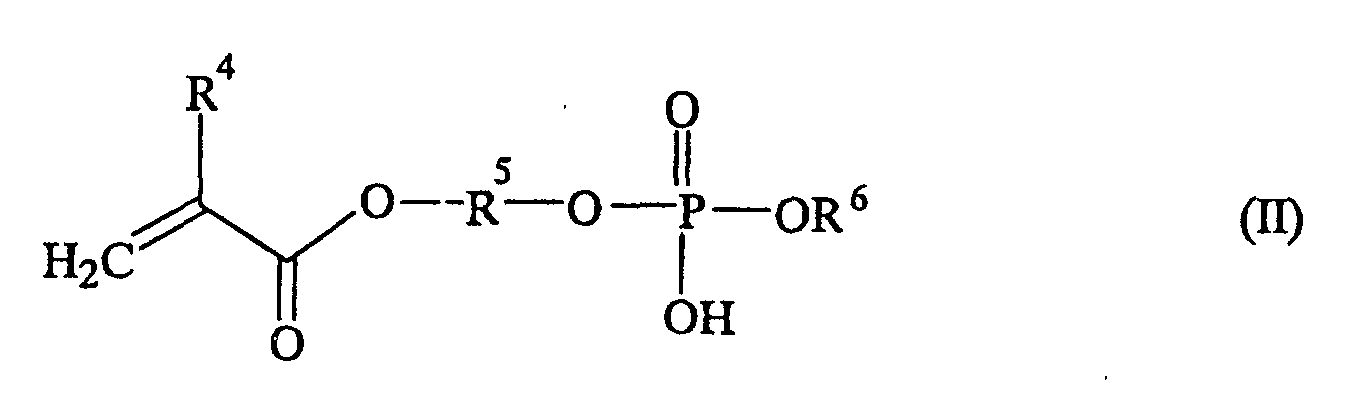 wherein R1 is hydrogen atom or methyl group; and R7 is an alkylene group having 6 to 25 carbon atoms, and R5 is identical to R7.
- The adhesive composition according to claim 1, wherein the polymerizable monomer (b) comprises a hydroxyl group-containing polymerizable monomer represented by the general formula (III):wherein R1 is hydrogen atom or methyl group; and R7 is an alkylene group having 6 to 25 carbon atoms, and a polymerizable monomer represented by the general formula (IV):
 wherein R1 is hydrogen atom or methyl group; R8 is a halogen atom, hydroxyl group, mercapto group or amino group; and Y is oxygen atom or sulfur atom.
- The adhesive composition according to claim 1, further comprising (d) water.
- The adhesive composition according to claim 1, further comprising (e) a polymerization initiator.
Applications Claiming Priority (5)
| Application Number | Priority Date | Filing Date | Title |
|---|---|---|---|
| JP33110499 | 1999-11-22 | ||
| JP33110499 | 1999-11-22 | ||
| JP2000028746 | 2000-02-07 | ||
| JP2000028746 | 2000-02-07 | ||
| PCT/JP2000/008075 WO2001038449A1 (en) | 1999-11-22 | 2000-11-16 | Adhesive composition |
Publications (3)
| Publication Number | Publication Date |
|---|---|
| EP1262530A1 true EP1262530A1 (en) | 2002-12-04 |
| EP1262530A4 EP1262530A4 (en) | 2009-04-01 |
| EP1262530B1 EP1262530B1 (en) | 2011-03-30 |
Family
ID=26573755
Family Applications (1)
| Application Number | Title | Priority Date | Filing Date |
|---|---|---|---|
| EP00976282A Expired - Lifetime EP1262530B1 (en) | 1999-11-22 | 2000-11-16 | Adhesive composition for hard tissues |
Country Status (8)
| Country | Link |
|---|---|
| US (1) | US6939901B2 (en) |
| EP (1) | EP1262530B1 (en) |
| JP (1) | JP4724345B2 (en) |
| AT (1) | ATE503810T1 (en) |
| AU (1) | AU768789B2 (en) |
| CA (1) | CA2392227C (en) |
| DE (1) | DE60045797D1 (en) |
| WO (1) | WO2001038449A1 (en) |
Cited By (4)
| Publication number | Priority date | Publication date | Assignee | Title |
|---|---|---|---|---|
| EP2228049A1 (en) * | 2009-03-09 | 2010-09-15 | Dentsply DeTrey GmbH | Dental composition |
| US20110297171A1 (en) * | 2008-08-29 | 2011-12-08 | Hisaki Tanaka | Artificial nail composition having improved adhesion property |
| WO2014208941A1 (en) * | 2013-06-27 | 2014-12-31 | 동우화인켐 주식회사 | Acrylic copolymer and adhesive composition containing same |
| EP1695685B2 (en) † | 2003-12-19 | 2016-12-28 | Kuraray Noritake Dental Inc. | One-part dental adhesive composition |
Families Citing this family (23)
| Publication number | Priority date | Publication date | Assignee | Title |
|---|---|---|---|---|
| JP2002226314A (en) * | 2001-02-07 | 2002-08-14 | Kuraray Co Ltd | Adhesive composition for pillarless enamel |
| DE10124028B4 (en) | 2001-05-16 | 2010-02-18 | 3M Espe Ag | Self-adhesive dental materials |
| JP4398254B2 (en) * | 2001-12-28 | 2010-01-13 | 株式会社トクヤマ | Dental adhesive |
| DE10228540A1 (en) * | 2002-06-26 | 2004-01-22 | Ivoclar Vivadent Ag | Dental materials based on hydroxyalkylacrylamides |
| US20040206932A1 (en) | 2002-12-30 | 2004-10-21 | Abuelyaman Ahmed S. | Compositions including polymerizable bisphosphonic acids and methods |
| WO2005003192A1 (en) | 2003-06-26 | 2005-01-13 | Symyx Technologies, Inc. | Synthesis of photoresist polymers |
| JP4261288B2 (en) * | 2003-08-22 | 2009-04-30 | デンツプライ三金株式会社 | Dental adhesive composition |
| WO2005027864A1 (en) * | 2003-09-19 | 2005-03-31 | Symyx Technologies, Inc. | Materials for enhanced delivery of hydrophilic active agents in personal care formulations |
| US8465284B2 (en) | 2004-07-08 | 2013-06-18 | 3M Innovative Properties Company | Dental methods, compositions, and kits including acid-sensitive dyes |
| US8722760B2 (en) | 2004-08-11 | 2014-05-13 | 3M Innovative Properties Company | Self-adhesive compositions including a plurality of acidic compounds |
| DE102004061924B4 (en) * | 2004-12-22 | 2010-01-28 | Ivoclar Vivadent Ag | Hydrolysis stable self-etching one-component end-face adhesive |
| CN101557791B (en) | 2006-12-13 | 2013-05-22 | 3M创新有限公司 | Methods of using a dental composition having an acidic component and a photobleachable dye |
| JP5702044B2 (en) * | 2008-03-04 | 2015-04-15 | 株式会社松風 | Photo-curable dental composition that suppresses color tone change by monomer |
| JP5479326B2 (en) * | 2008-04-25 | 2014-04-23 | サンメディカル株式会社 | Easy-to-remove dental curable composition |
| JP5250371B2 (en) * | 2008-10-01 | 2013-07-31 | 株式会社松風 | Dental colorant composition that can be mixed and can reproduce color tone freely, and its set and method |
| EP2229930B1 (en) * | 2009-03-17 | 2012-12-12 | Ivoclar Vivadent AG | Dental universal adhesive compound |
| CA2760029C (en) | 2009-03-27 | 2019-08-13 | Bisco, Inc. | Curable zirconia adhesive compositions for dental restorations |
| CN102341416B (en) * | 2009-07-01 | 2014-06-04 | 积水化学工业株式会社 | Binder resin for conductive paste, conductive paste, and solar cell element |
| US20120213832A1 (en) * | 2009-10-23 | 2012-08-23 | Tatsuya Ori | Removable dental curable composition |
| JP6224481B2 (en) * | 2014-02-21 | 2017-11-01 | クラレノリタケデンタル株式会社 | Organophosphate compound, polymerizable composition containing organophosphate compound, and dental bonding material |
| CA3057863C (en) * | 2017-03-29 | 2023-02-07 | Covalon Technologies Ltd. | Coating compositions, polymeric coatings, and methods |
| US12195691B2 (en) * | 2020-12-28 | 2025-01-14 | Idemitsu Kosan Co.,Ltd. | Lubricating oil additive composition and lubricating oil composition |
| WO2022145462A1 (en) * | 2020-12-28 | 2022-07-07 | 出光興産株式会社 | Lubricating oil additive composition and lubricating oil composition |
Family Cites Families (36)
| Publication number | Priority date | Publication date | Assignee | Title |
|---|---|---|---|---|
| IE37702B1 (en) * | 1972-11-16 | 1977-09-28 | Loctite Ltd | Dental filling composition and process for use thereof |
| JPS5148596A (en) * | 1974-10-24 | 1976-04-26 | Sankin Ind Co | Shikayo shufukuzairyo |
| JPS52113089A (en) * | 1976-03-17 | 1977-09-21 | Kuraray Co | Dental material |
| JPS5369494A (en) | 1976-11-30 | 1978-06-20 | Kuraray Co | Bonding agent for human hard tissue |
| JPS5367740A (en) | 1976-11-29 | 1978-06-16 | Kuraray Co Ltd | Adhesives for hard tissue of human body |
| JPS6017235B2 (en) | 1977-05-24 | 1985-05-01 | 株式会社クラレ | biological hard tissue adhesive |
| JPS5915468A (en) * | 1982-07-16 | 1984-01-26 | Kuraray Co Ltd | Adhesive |
| JPS58128393A (en) | 1982-01-28 | 1983-07-30 | Kuraray Co Ltd | Novel polymerizable phosphoric monoester and its preparation |
| JPS58192891A (en) | 1982-05-04 | 1983-11-10 | Kuraray Co Ltd | Novel polymerizable phosphoric acid monoester and its preparation |
| US4650847A (en) * | 1981-07-29 | 1987-03-17 | Kuraray Co., Ltd. | Adhesive composition |
| JPS5821607A (en) * | 1981-07-30 | 1983-02-08 | Kuraray Co Ltd | dental adhesive |
| JPS61176506A (en) * | 1985-01-30 | 1986-08-08 | Kanebo Ltd | Dental adhesive |
| JPH0764699B2 (en) * | 1986-10-30 | 1995-07-12 | 三井石油化学工業株式会社 | Dental adhesive composition |
| JPH0759487B2 (en) * | 1986-10-30 | 1995-06-28 | 三井石油化学工業株式会社 | Dental adhesive composition |
| JPH0699528B2 (en) * | 1986-12-26 | 1994-12-07 | 三井石油化学工業株式会社 | Curable composition |
| JPH0653751B2 (en) | 1986-02-12 | 1994-07-20 | 宇部興産株式会社 | Phosphoryl compounds and adhesives containing them |
| US4719149A (en) | 1986-02-28 | 1988-01-12 | Minnesota Mining And Manufacturing Company | Method for priming hard tissue |
| KR950003688B1 (en) * | 1986-10-30 | 1995-04-17 | 미쓰이세끼유 가가꾸 고오교오 가부시끼가이샤 | Curable composition |
| JP2543516B2 (en) | 1987-03-09 | 1996-10-16 | 三井石油化学工業株式会社 | Dental curable adhesive |
| JPS6490277A (en) * | 1987-09-30 | 1989-04-06 | Kuraray Co | Dental adhesive |
| JP2688710B2 (en) * | 1988-10-26 | 1997-12-10 | 三井石油化学工業株式会社 | Tooth adhesive composition |
| JPH02188509A (en) * | 1989-01-17 | 1990-07-24 | Kanebo Ltd | Dental adhesive |
| JP2634276B2 (en) | 1990-02-15 | 1997-07-23 | 株式会社松風 | Primer composition |
| JP2865794B2 (en) | 1990-04-12 | 1999-03-08 | 株式会社松風 | Adhesive composition |
| JP3158422B2 (en) * | 1990-10-16 | 2001-04-23 | 大日本インキ化学工業株式会社 | Water-based photocurable adhesive composition |
| JP2848974B2 (en) * | 1991-02-26 | 1999-01-20 | 三井化学株式会社 | Dental adhesive |
| JP3495099B2 (en) * | 1993-08-02 | 2004-02-09 | サンメディカル株式会社 | Curable adhesive composition and adhesive kit |
| US5530038A (en) | 1993-08-02 | 1996-06-25 | Sun Medical Co., Ltd. | Primer composition and curable composition |
| JP3449755B2 (en) * | 1993-09-17 | 2003-09-22 | 株式会社クラレ | Adhesive set |
| JP3443188B2 (en) * | 1994-03-30 | 2003-09-02 | サンメディカル株式会社 | Curable composition |
| JP3474331B2 (en) * | 1994-10-07 | 2003-12-08 | 株式会社クラレ | Antibacterial dental adhesive composition |
| JP3449843B2 (en) * | 1995-12-11 | 2003-09-22 | 株式会社クラレ | Dental adhesive system with excellent operability |
| DE69817760T2 (en) * | 1997-06-09 | 2004-08-05 | KURARAY CO., LTD, Kurashiki | POLYMERIZABLE COMPOSITION FOR DENTAL APPLICATIONS |
| JP2000086421A (en) * | 1998-09-08 | 2000-03-28 | Gc Corp | Adhesive set for dental purpose |
| BR0006009A (en) * | 1999-03-31 | 2001-03-06 | Kuraray Co | Organophosphorous compounds for polymerizable dental compositions |
| TWI262795B (en) | 1999-05-31 | 2006-10-01 | Kuraray Co | Adhesive composition and method for producing it |
-
2000
- 2000-11-16 WO PCT/JP2000/008075 patent/WO2001038449A1/en not_active Ceased
- 2000-11-16 EP EP00976282A patent/EP1262530B1/en not_active Expired - Lifetime
- 2000-11-16 CA CA2392227A patent/CA2392227C/en not_active Expired - Fee Related
- 2000-11-16 JP JP2001540205A patent/JP4724345B2/en not_active Expired - Lifetime
- 2000-11-16 AT AT00976282T patent/ATE503810T1/en not_active IP Right Cessation
- 2000-11-16 AU AU14138/01A patent/AU768789B2/en not_active Ceased
- 2000-11-16 DE DE60045797T patent/DE60045797D1/en not_active Expired - Lifetime
-
2002
- 2002-05-22 US US10/151,927 patent/US6939901B2/en not_active Expired - Lifetime
Cited By (6)
| Publication number | Priority date | Publication date | Assignee | Title |
|---|---|---|---|---|
| EP1695685B2 (en) † | 2003-12-19 | 2016-12-28 | Kuraray Noritake Dental Inc. | One-part dental adhesive composition |
| US20110297171A1 (en) * | 2008-08-29 | 2011-12-08 | Hisaki Tanaka | Artificial nail composition having improved adhesion property |
| US8449869B2 (en) * | 2008-08-29 | 2013-05-28 | Kabushiki Kaisha Shofu | Artificial nail composition having improved adhesion property |
| EP2228049A1 (en) * | 2009-03-09 | 2010-09-15 | Dentsply DeTrey GmbH | Dental composition |
| WO2010102786A1 (en) * | 2009-03-09 | 2010-09-16 | Dentsply Detrey Gmbh | Dental composition |
| WO2014208941A1 (en) * | 2013-06-27 | 2014-12-31 | 동우화인켐 주식회사 | Acrylic copolymer and adhesive composition containing same |
Also Published As
| Publication number | Publication date |
|---|---|
| AU768789B2 (en) | 2004-01-08 |
| JP4724345B2 (en) | 2011-07-13 |
| US6939901B2 (en) | 2005-09-06 |
| WO2001038449A1 (en) | 2001-05-31 |
| DE60045797D1 (en) | 2011-05-12 |
| AU1413801A (en) | 2001-06-04 |
| CA2392227A1 (en) | 2001-05-31 |
| ATE503810T1 (en) | 2011-04-15 |
| CA2392227C (en) | 2010-02-16 |
| EP1262530B1 (en) | 2011-03-30 |
| US20020198284A1 (en) | 2002-12-26 |
| EP1262530A4 (en) | 2009-04-01 |
Similar Documents
| Publication | Publication Date | Title |
|---|---|---|
| EP1262530B1 (en) | Adhesive composition for hard tissues | |
| EP0980682B1 (en) | Bonding compositions for dental use | |
| EP1057468B1 (en) | Adhesive composition and method for producing it | |
| US20030064102A1 (en) | Antimicrobial Composition | |
| EP2835128B1 (en) | One-pack dental adhesive | |
| JPWO2001038449A1 (en) | adhesive composition | |
| EP1550428B1 (en) | Dental coating kit | |
| JP4822609B2 (en) | Antibacterial composition | |
| JP4176196B2 (en) | Dental adhesive system | |
| JP4675456B2 (en) | Adhesive composition | |
| JP4822636B2 (en) | Dental composition | |
| JP4198237B2 (en) | Antibacterial dental adhesive system | |
| JP4241982B2 (en) | Adhesive system | |
| JP4514447B2 (en) | Dental adhesive composition | |
| JP4717167B2 (en) | Adhesive composition for metal materials | |
| JP4472322B2 (en) | One-part dental adhesive composition | |
| JP4615260B2 (en) | Pit fissure filling kit | |
| JP4759149B2 (en) | Dental composition | |
| JP4514470B2 (en) | Two-component adhesive for columnless enamel | |
| JP4514469B2 (en) | Two-component adhesive for columnless enamel | |
| JP4538257B2 (en) | Dental pulp covering material | |
| JP2004196735A (en) | Dental coating composition | |
| JP4583035B2 (en) | Adhesive composition |
Legal Events
| Date | Code | Title | Description |
|---|---|---|---|
| PUAI | Public reference made under article 153(3) epc to a published international application that has entered the european phase |
Free format text: ORIGINAL CODE: 0009012 |
|
| 17P | Request for examination filed |
Effective date: 20020613 |
|
| AK | Designated contracting states |
Kind code of ref document: A1 Designated state(s): AT BE CH CY DE DK ES FI FR GB GR IE IT LI LU MC NL PT SE TR |
|
| RAP1 | Party data changed (applicant data changed or rights of an application transferred) |
Owner name: KURARAY MEDICAL INC. |
|
| A4 | Supplementary search report drawn up and despatched |
Effective date: 20090227 |
|
| RIC1 | Information provided on ipc code assigned before grant |
Ipc: A61K 6/083 20060101ALI20090223BHEP Ipc: C09J 4/02 20060101AFI20010605BHEP |
|
| 17Q | First examination report despatched |
Effective date: 20090710 |
|
| GRAP | Despatch of communication of intention to grant a patent |
Free format text: ORIGINAL CODE: EPIDOSNIGR1 |
|
| RTI1 | Title (correction) |
Free format text: ADHESIVE COMPOSITION FOR HARD TISSUES |
|
| GRAS | Grant fee paid |
Free format text: ORIGINAL CODE: EPIDOSNIGR3 |
|
| GRAA | (expected) grant |
Free format text: ORIGINAL CODE: 0009210 |
|
| AK | Designated contracting states |
Kind code of ref document: B1 Designated state(s): AT BE CH CY DE DK ES FI FR GB GR IE IT LI LU MC NL PT SE TR |
|
| REG | Reference to a national code |
Ref country code: GB Ref legal event code: FG4D |
|
| REG | Reference to a national code |
Ref country code: CH Ref legal event code: EP |
|
| REG | Reference to a national code |
Ref country code: IE Ref legal event code: FG4D |
|
| REF | Corresponds to: |
Ref document number: 60045797 Country of ref document: DE Date of ref document: 20110512 Kind code of ref document: P |
|
| REG | Reference to a national code |
Ref country code: DE Ref legal event code: R096 Ref document number: 60045797 Country of ref document: DE Effective date: 20110512 |
|
| REG | Reference to a national code |
Ref country code: CH Ref legal event code: NV Representative=s name: NOVAGRAAF INTERNATIONAL SA |
|
| REG | Reference to a national code |
Ref country code: CH Ref legal event code: PFA Owner name: KURARAY MEDICAL INC. Free format text: KURARAY MEDICAL INC.#1621, SAKAZU#KURASHIKI-SHI, OKAYAMA 710-8622 (JP) -TRANSFER TO- KURARAY MEDICAL INC.#1621, SAKAZU#KURASHIKI-SHI, OKAYAMA 710-8622 (JP) |
|
| REG | Reference to a national code |
Ref country code: NL Ref legal event code: VDEP Effective date: 20110330 |
|
| PG25 | Lapsed in a contracting state [announced via postgrant information from national office to epo] |
Ref country code: SE Free format text: LAPSE BECAUSE OF FAILURE TO SUBMIT A TRANSLATION OF THE DESCRIPTION OR TO PAY THE FEE WITHIN THE PRESCRIBED TIME-LIMIT Effective date: 20110330 Ref country code: GR Free format text: LAPSE BECAUSE OF FAILURE TO SUBMIT A TRANSLATION OF THE DESCRIPTION OR TO PAY THE FEE WITHIN THE PRESCRIBED TIME-LIMIT Effective date: 20110701 |
|
| PG25 | Lapsed in a contracting state [announced via postgrant information from national office to epo] |
Ref country code: AT Free format text: LAPSE BECAUSE OF FAILURE TO SUBMIT A TRANSLATION OF THE DESCRIPTION OR TO PAY THE FEE WITHIN THE PRESCRIBED TIME-LIMIT Effective date: 20110330 Ref country code: CY Free format text: LAPSE BECAUSE OF FAILURE TO SUBMIT A TRANSLATION OF THE DESCRIPTION OR TO PAY THE FEE WITHIN THE PRESCRIBED TIME-LIMIT Effective date: 20110330 Ref country code: FI Free format text: LAPSE BECAUSE OF FAILURE TO SUBMIT A TRANSLATION OF THE DESCRIPTION OR TO PAY THE FEE WITHIN THE PRESCRIBED TIME-LIMIT Effective date: 20110330 |
|
| PG25 | Lapsed in a contracting state [announced via postgrant information from national office to epo] |
Ref country code: PT Free format text: LAPSE BECAUSE OF FAILURE TO SUBMIT A TRANSLATION OF THE DESCRIPTION OR TO PAY THE FEE WITHIN THE PRESCRIBED TIME-LIMIT Effective date: 20110801 |
|
| PG25 | Lapsed in a contracting state [announced via postgrant information from national office to epo] |
Ref country code: ES Free format text: LAPSE BECAUSE OF FAILURE TO SUBMIT A TRANSLATION OF THE DESCRIPTION OR TO PAY THE FEE WITHIN THE PRESCRIBED TIME-LIMIT Effective date: 20110711 |
|
| PG25 | Lapsed in a contracting state [announced via postgrant information from national office to epo] |
Ref country code: NL Free format text: LAPSE BECAUSE OF FAILURE TO SUBMIT A TRANSLATION OF THE DESCRIPTION OR TO PAY THE FEE WITHIN THE PRESCRIBED TIME-LIMIT Effective date: 20110330 |
|
| PLBE | No opposition filed within time limit |
Free format text: ORIGINAL CODE: 0009261 |
|
| STAA | Information on the status of an ep patent application or granted ep patent |
Free format text: STATUS: NO OPPOSITION FILED WITHIN TIME LIMIT |
|
| PG25 | Lapsed in a contracting state [announced via postgrant information from national office to epo] |
Ref country code: DK Free format text: LAPSE BECAUSE OF FAILURE TO SUBMIT A TRANSLATION OF THE DESCRIPTION OR TO PAY THE FEE WITHIN THE PRESCRIBED TIME-LIMIT Effective date: 20110330 |
|
| 26N | No opposition filed |
Effective date: 20120102 |
|
| REG | Reference to a national code |
Ref country code: DE Ref legal event code: R097 Ref document number: 60045797 Country of ref document: DE Effective date: 20120102 |
|
| PG25 | Lapsed in a contracting state [announced via postgrant information from national office to epo] |
Ref country code: IT Free format text: LAPSE BECAUSE OF FAILURE TO SUBMIT A TRANSLATION OF THE DESCRIPTION OR TO PAY THE FEE WITHIN THE PRESCRIBED TIME-LIMIT Effective date: 20110330 |
|
| PG25 | Lapsed in a contracting state [announced via postgrant information from national office to epo] |
Ref country code: MC Free format text: LAPSE BECAUSE OF NON-PAYMENT OF DUE FEES Effective date: 20111130 |
|
| REG | Reference to a national code |
Ref country code: DE Ref legal event code: R082 Ref document number: 60045797 Country of ref document: DE Representative=s name: HOFFMANN - EITLE, DE |
|
| REG | Reference to a national code |
Ref country code: CH Ref legal event code: PFA Owner name: KURARAY NORITAKE DENTAL, INC. Free format text: KURARAY MEDICAL INC.#1621, SAKAZU#KURASHIKI-SHI, OKAYAMA 710-8622 (JP) -TRANSFER TO- KURARAY NORITAKE DENTAL, INC.#1621, SAKAZU, KURASHIKI-SHI#OKAYAMA 710-8622 (JP) |
|
| REG | Reference to a national code |
Ref country code: IE Ref legal event code: MM4A |
|
| REG | Reference to a national code |
Ref country code: DE Ref legal event code: R082 Ref document number: 60045797 Country of ref document: DE Representative=s name: HOFFMANN - EITLE PATENT- UND RECHTSANWAELTE PA, DE Effective date: 20120723 Ref country code: DE Ref legal event code: R081 Ref document number: 60045797 Country of ref document: DE Owner name: KURARAY NORITAKE DENTAL INC., KURASHIKI, JP Free format text: FORMER OWNER: KURARAY MEDICAL, INC., KURASHIKI, OKAYAMA, JP Effective date: 20120723 Ref country code: DE Ref legal event code: R081 Ref document number: 60045797 Country of ref document: DE Owner name: KURARAY NORITAKE DENTAL INC., KURASHIKI, JP Free format text: FORMER OWNER: KURARAY CO., LTD., KURASHIKI, OKAYAMA, JP Effective date: 20110303 |
|
| PG25 | Lapsed in a contracting state [announced via postgrant information from national office to epo] |
Ref country code: IE Free format text: LAPSE BECAUSE OF NON-PAYMENT OF DUE FEES Effective date: 20111116 |
|
| REG | Reference to a national code |
Ref country code: FR Ref legal event code: CD Owner name: KURARAY NORITAKE DENTAL INC., JP Effective date: 20130329 |
|
| PG25 | Lapsed in a contracting state [announced via postgrant information from national office to epo] |
Ref country code: LU Free format text: LAPSE BECAUSE OF NON-PAYMENT OF DUE FEES Effective date: 20111116 |
|
| PG25 | Lapsed in a contracting state [announced via postgrant information from national office to epo] |
Ref country code: TR Free format text: LAPSE BECAUSE OF FAILURE TO SUBMIT A TRANSLATION OF THE DESCRIPTION OR TO PAY THE FEE WITHIN THE PRESCRIBED TIME-LIMIT Effective date: 20110330 |
|
| REG | Reference to a national code |
Ref country code: FR Ref legal event code: PLFP Year of fee payment: 16 |
|
| REG | Reference to a national code |
Ref country code: FR Ref legal event code: PLFP Year of fee payment: 17 |
|
| REG | Reference to a national code |
Ref country code: FR Ref legal event code: PLFP Year of fee payment: 18 |
|
| REG | Reference to a national code |
Ref country code: FR Ref legal event code: PLFP Year of fee payment: 19 |
|
| PGFP | Annual fee paid to national office [announced via postgrant information from national office to epo] |
Ref country code: BE Payment date: 20190917 Year of fee payment: 20 |
|
| PGFP | Annual fee paid to national office [announced via postgrant information from national office to epo] |
Ref country code: DE Payment date: 20191105 Year of fee payment: 20 |
|
| PGFP | Annual fee paid to national office [announced via postgrant information from national office to epo] |
Ref country code: FR Payment date: 20191014 Year of fee payment: 20 |
|
| PGFP | Annual fee paid to national office [announced via postgrant information from national office to epo] |
Ref country code: CH Payment date: 20191116 Year of fee payment: 20 |
|
| PGFP | Annual fee paid to national office [announced via postgrant information from national office to epo] |
Ref country code: GB Payment date: 20191115 Year of fee payment: 20 |
|
| REG | Reference to a national code |
Ref country code: DE Ref legal event code: R071 Ref document number: 60045797 Country of ref document: DE |
|
| REG | Reference to a national code |
Ref country code: CH Ref legal event code: PL |
|
| REG | Reference to a national code |
Ref country code: GB Ref legal event code: PE20 Expiry date: 20201115 |
|
| REG | Reference to a national code |
Ref country code: BE Ref legal event code: MK Effective date: 20201116 |
|
| PG25 | Lapsed in a contracting state [announced via postgrant information from national office to epo] |
Ref country code: GB Free format text: LAPSE BECAUSE OF EXPIRATION OF PROTECTION Effective date: 20201115 |