EP1261163B1 - System and method for error recovery using negative acknowledgements (NACK) - Google Patents
System and method for error recovery using negative acknowledgements (NACK) Download PDFInfo
- Publication number
- EP1261163B1 EP1261163B1 EP02252835A EP02252835A EP1261163B1 EP 1261163 B1 EP1261163 B1 EP 1261163B1 EP 02252835 A EP02252835 A EP 02252835A EP 02252835 A EP02252835 A EP 02252835A EP 1261163 B1 EP1261163 B1 EP 1261163B1
- Authority
- EP
- European Patent Office
- Prior art keywords
- message
- round
- node
- nak
- messages
- Prior art date
- Legal status (The legal status is an assumption and is not a legal conclusion. Google has not performed a legal analysis and makes no representation as to the accuracy of the status listed.)
- Expired - Lifetime
Links
- 238000000034 method Methods 0.000 title description 9
- 238000011084 recovery Methods 0.000 title description 6
- 230000005540 biological transmission Effects 0.000 claims description 16
- 238000004891 communication Methods 0.000 claims description 9
- 230000001419 dependent effect Effects 0.000 claims description 2
- 239000000872 buffer Substances 0.000 description 4
- 238000012216 screening Methods 0.000 description 4
- 230000002028 premature Effects 0.000 description 2
- 238000004088 simulation Methods 0.000 description 2
- 238000012790 confirmation Methods 0.000 description 1
- 230000000593 degrading effect Effects 0.000 description 1
- 238000001514 detection method Methods 0.000 description 1
- 230000009977 dual effect Effects 0.000 description 1
- 230000000694 effects Effects 0.000 description 1
- 230000002250 progressing effect Effects 0.000 description 1
- 230000001105 regulatory effect Effects 0.000 description 1
- 230000000717 retained effect Effects 0.000 description 1
- 238000012163 sequencing technique Methods 0.000 description 1
- 230000000153 supplemental effect Effects 0.000 description 1
- 230000001360 synchronised effect Effects 0.000 description 1
- 230000001960 triggered effect Effects 0.000 description 1
Images




Classifications
-
- H—ELECTRICITY
- H04—ELECTRIC COMMUNICATION TECHNIQUE
- H04L—TRANSMISSION OF DIGITAL INFORMATION, e.g. TELEGRAPHIC COMMUNICATION
- H04L1/00—Arrangements for detecting or preventing errors in the information received
- H04L1/12—Arrangements for detecting or preventing errors in the information received by using return channel
- H04L1/16—Arrangements for detecting or preventing errors in the information received by using return channel in which the return channel carries supervisory signals, e.g. repetition request signals
- H04L1/18—Automatic repetition systems, e.g. Van Duuren systems
- H04L1/1829—Arrangements specially adapted for the receiver end
- H04L1/1858—Transmission or retransmission of more than one copy of acknowledgement message
-
- H—ELECTRICITY
- H04—ELECTRIC COMMUNICATION TECHNIQUE
- H04L—TRANSMISSION OF DIGITAL INFORMATION, e.g. TELEGRAPHIC COMMUNICATION
- H04L1/00—Arrangements for detecting or preventing errors in the information received
- H04L1/12—Arrangements for detecting or preventing errors in the information received by using return channel
- H04L1/16—Arrangements for detecting or preventing errors in the information received by using return channel in which the return channel carries supervisory signals, e.g. repetition request signals
- H04L1/1607—Details of the supervisory signal
- H04L1/1671—Details of the supervisory signal the supervisory signal being transmitted together with control information
-
- H—ELECTRICITY
- H04—ELECTRIC COMMUNICATION TECHNIQUE
- H04L—TRANSMISSION OF DIGITAL INFORMATION, e.g. TELEGRAPHIC COMMUNICATION
- H04L1/00—Arrangements for detecting or preventing errors in the information received
- H04L1/12—Arrangements for detecting or preventing errors in the information received by using return channel
- H04L1/16—Arrangements for detecting or preventing errors in the information received by using return channel in which the return channel carries supervisory signals, e.g. repetition request signals
- H04L1/18—Automatic repetition systems, e.g. Van Duuren systems
- H04L1/1809—Selective-repeat protocols
Definitions
- This invention relates to error recovery in communications on a network. This invention further relates to error recovery based on a NAK (negative acknowledgment).
- Radio Link Protocol provides an octet stream transport service over physical channels with a best effort recovery capability.
- a burst control method enables efficient use of radio resources by accommodating the bursty nature of traffic With optimized RLP and burst assignment algorithms, data services can be improved in throughput and latency.
- ARQ Automatic Repeat Request
- the sender is requested for missing data to be retransmitted when errors are detected at the receiving side.
- a receiver is usually allowed to request for missing data R times where R is a specified integer.
- R may impose a restraint on the capability of error recovery.
- the transmission scheme is the same as the NAK scheme. This means that the number of retransmissions by the data sender is equal to the number of NAK requests it receives. In practice, NAK frames may be lost in transit.
- the NAK is usually transmitted multiple times, with a set of consecutive NAKs being issued as a "round.” For any particular message, as identified by its sequence number, a plurality of rounds may be necessary. Each round is triggered by a failure of the message to arrive at the receiver successfully before expiry of a timer. There exists a need to relieve the amount of traffic without degrading the best-effort recovery capability.
- US-A-4 422 171 discloses a method and system for transferring large amounts of bulk data from a source station and a second station over a long propagation delay path.
- the destination station transmits data frames that include a positive or negative acknowledgement to indicate whether or not a source station data frame was correctly received by the destination station.
- a data frame header format is disclosed which includes a history count. A history count is sent along with each ACK returned from a receiver back to a source transmitter to indicate the number of frames correctly received since a bad frame.
- WO-A-01/13542 discloses a method and system that retransmits data according to a radio link protocol (RLP).
- RLP radio link protocol
- a receiver stores sequence numbers of a plurality of frames that are not received from a transmitter and transmits a retransmission request including fields that include the sequence numbers.
- the receiver compares the stored sequence numbers with the sequence numbers of frames received in response to the request. If the receiver receives a frame having a higher sequence number than a lost frame, the receiver requests retransmission of the lost frame.
- This system aims to ensure early detection and retransmission of lost frames.
- the present invention is directed to a system and method pertaining to a network having a sending node that sends a first message and a receiving node for receiving the first message.
- the receiving node sends a NAK to the sending node if the receiving node fails to receive the first message.
- the sending node is operable to screen the NAK upon receipt to determine whether or not the receipt of the NAK by the sending node triggers retransmission of the first message from the sending node.
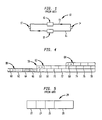
- FIG. 1 shows an exemplary communications network 10 having at least two nodes 12 and 14.
- the network 10 may be a radio wave communications network, in which the node 12 is a mobile station and node 14 is a base station. Alternatively, for example, either node may be a repeater.
- the sending node or sender 12 transmits a message 16 on a channel 11 to the receiving node or receiver 14. Due to errors on the channel 11, the message 16 may fail to arrive at thereceiver 14, either because the transmission never reaches thereceiver 14, or because the message becomes corrupted in transit. As a precaution, the sender 12 will generally transmit the message 16 multiple consecutive times. This takes advantage of time diversity, so that some iterations of the transmission may survive, for example, a burst error.
- the receiver 14 issues a NAK to inform the sender 12 that the message has not been received when the receiver 14 detects loss of the message.
- Messages other than the message 16 are also routed on the channel 11, each message having a unique sequence number.
- the receiver 14 queues arriving messages so that they are delivered in order to the upper layers. For messages it has dispatched, the sender 12 keeps them queued pending confirmation of their safe arrival at the receiver 14.
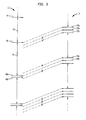
- FIG. 2 shows a trace of a typical routing sequence for any particular message on the network 10.
- the time sequence of events is represented as progressing from the top of the page to the bottom.
- a message transmission 30 of the message 16 is followed by a round of NAKs 38a-38c.
- the sender 12 issues three retransmissions 32a-32c of the message, one retransmission for each NAK the sender 12 has received. It is noted that although the order of arrival of NAKs is shown in FIG. 2 to be the same as the order of their issuance, this will not generally be the case.
- the receiver 14 Upon issuance of the last NAK of the set, NAK 38c, the receiver 14 starts a timer for a predetermined receive time period 39.
- the receiver 14 If the receiver 14 has not successfully received the message by expiry of the timer, the receiver 14 starts a new round of NAKs, consisting of the set of NAKs 40a-40c. A plurality of rounds may be invoked, resulting in much traffic on the channel 11. It is noted, in particular, that the NAKs 38b and 38c can safely be screened or ignored, since they report the same missing data as does the NAK 38a. It is also noted that even if the receiver 14 has successfully received the message by expiry of the timer, a NAK may still be issued - reporting missing data for another message other than the message 16, as explained further below. FIG. 2, again, shows the routing for a single given message.
- FIG. 3 also shows an example of the routing for a given message 16 on the network 10, and represents a first embodiment of the invention.
- a message transmission 44 is followed by round n of NAKs 52a-52c, where n is an integer.
- the sender 12 Upon dispatch of the transmission 44, the sender 12 starts a predetermined sender time period 45.
- the period 45 corresponds to an estimated round trip time between the sender 12 and the receiver 14. Any NAK arriving before the end of the period 45 is assumed to have originated as a result of transmissions from a round previous to the round n, and will be ignored by the sender 12. The reason is that the arriving NAK could not have been issued in response to the transmission 44, whereas the transmission 44 may have successfully delivered a message to the receiver 14.
- the present invention eliminates unnecessary retransmissions, and the associated traffic.
- the first of the round n NAKs the NAK 52a
- the arrival of the NAK 52a at the sender 12 results in a round n of retransmissions, here shown as a single retransmission 46, and in the starting of the time period 47.
- the time period 47 here, for simplicity of demonstration, has a duration equal to that of the period 45, although the present invention is not limited to such equality.
- the NAKs 52b and 52c because they arrive before expiry of the period 47, are ignored by the sender 12, and their arrival does not trigger retransmission of messages.
- the NAK 54a from round n+1 also arrives during the period 47, and is consequently ignored.
- the NAK 54b of the same round, n+1 is not ignored, but, instead, triggers a round n+1 of retransmissions.
- the round n+1 of retransmissions iterates a plurality of retransmissions, in this case two retransmission, 48a and 48b.
- the number of retransmissions is a function K(n) of the round number n of retransmissions
- the number of NAKs is a function M(p) at the round number p of NAKs.
- FIG. 4 shows, in an example for purposes of illustration, that each retransmission of a round of retransmissions will generally dispatch a block consisting of more than one message.
- an exemplary round of retransmission 58 generally consists of multiple retransmissions, in this case three retransmissions 80, 82 and 84.
- a frame containing a data block 80 having four messages 60, 62, 64 and 66, with the message 60 to be retransmitted is sent out.
- a frame length later, such as twenty milliseconds later, in another frame, a data block 82 is that data block also transmitted containing message 60, but containing in addition the three different messages 68, 70 and 72.
- a data block 84 is transmitted, the data block 84 also containing the message 60, but in addition containing three different messages 74, 76 and 78.
- the message 60 is sent out in three separate iterated retransmissions, so that the loss of any one of the retransmissions does not prevent the message 60 from arriving at receiver 14.
- the round of retransmissions 58 is set at 3 for the message 60, because each block retransmitted in the round 58 contains the message 60.
- the other messages transmitted in this round are either retransmitted, or newly transmitted (i.e., newly received at the receiver).
- a burst is a supplemental channel that shares traffic load in a given channel, and exists for a burst time interval. At setup of the channel 11, the burst time interval is set. Errors on a channel may increase traffic on the channel 11 so as to invoke a burst. On the other hand, if a channel is plagued by too many errors, the burst assignment is prematurely terminated. Thus, valuable burst resources are released and available elsewhere.
- a NAK count adjusted for NAKs that are screened is used to determine an estimated frame error rate (FER).
- FER frame error rate
- the NAK scheme wherein the iterations vary by round, may cause fluctuations in the estimated FER that lead to false alarms invoking a burst or that lead to premature termination of a burst. Screening NAKs smoothes fluctuations and reduces the likelihood of these flow control problems. Simulations have shown that the resulting conservative FER estimation can save many data bursts from premature termination. Simulation results have also shown that sufficient input data rate to a channel causes transmission reiterations to degrade throughput.
- the response to the exceeded threshold is a different retransmission scheme as per negotiations upon setup of the channel.
- the threshold is defined as ⁇ H, where H is the bandwidth of the channel (i.e., the maximum data rate the channel can support) and ⁇ is a prescribed factor, 0 ⁇ l.
- RTT round trip time
- FIG. 5 shows a simplified format of a conventional NAK 20 used in RLP
- a field 22 is an acknowledgment (ACK), denoting the highest sequence number for the messages successfully received. Based thereupon, the sender will release buffers no longer needed for ensuring successful receipt of the ACKED message.
- the fields 24 and 26 contain the sequence numbers of the first and last, respectively, of a strictly consecutive string of sequence numbers of messages outstanding. Every message sequence number in between the first and last sequence numbers of the string belongs to message not received at the receiver 14.
- FIG. 6 shows details of an exemplary NAK in the second embodiment of the invention.
- FIG. 6(a) shows a NAK frame 130, having a control block 132 and a data block 134.
- a control block 140 has as a leftmost field 142 containing the highest message sequence number received at the receiver 14.
- the field 144 has the number of strings in the NAK 130.
- the fields 146 and 148 contain the first sequence number of a particular string and the last sequence number of that string, respectively.
- the next field, 150 has the round number of NAKs for that string.
- a message is not noticed as missing at the receiver 14 until an arriving message reveals a gap in the sequence numbers, corresponding to a string.
- a receive timer is started for each message in the string.
- updating of the round number of NAKs is governed by the receive timer. Accordingly, the round number for each message of a string will be the same, and will be referred to as the round number for the string.
- Fields 152, 154 and 156 are, respectively, the second string's first and last sequence numbers and the round.
- a field 158 is padding at the end of the control block 140.
- a data block 170 has as a leading field 172 the number of messages.
- Fields 174 and 176 are, respectively, the first and second of those messages.
- a field 178 is padding.
- This format eliminates the need for implementing the sender 12 with send time periods, and the associated timers.
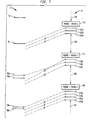
- FIG.7 shows an example of the flow of a typical message using this format.
- Send time periods are not needed, because the sender 12 can check the round number contained in the arriving NAK.
- a NAK 102a arrives at the sender 12 and triggers a retransmission 94.
- the NAKs 102b and 102c are ignored by the sender 12, because they indicate round n of retransmission, which already occurred by means of the retransmission 94.
- round n NAKs 102a-c are sent out, the receiver 14 starts a receive time period 106. Upon the expiry of the time period 106, the receiver 14 checks whether the expected message has arrived.
- step 114 increases by one the round of NAKs and dispatches NAKs 118 a, b and c of the resulting round of NAKs, which is now n+1.
- the sender 12 receives the NAK 118b first.
- the sender 12 compares the round number in the NAK 118b to the most recent round number of retransmission. Because the arriving round number of NAKs is greater, the sender 12 triggers the next round of retransmission, round n+1, consisting here of two iterations.
- the later arriving NAKs 118a and 118c report the same missing information as the NAK 118b has already reported, and therefore the NAKs 118a and 118c are ignored by receiver 12.
- the data field 150 carries the round number, making NAK screening unnecessary. Needless retransmissions are avoided, and iterations of retransmissions can be flexibly set independently of NAK iterations to tune traffic flow.
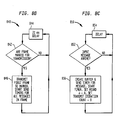
- FIG. 8 shows four exemplary subprocesses, 810, 840, 850 and 860, for operating the sender 12 of the first embodiment.
- a block fill subprocess 810 in FIG. 8(a) queries at step 812 whether a frame is ready for transmission. If so, the frame is marked for transmission (step 814). For all messages marked for retransmission, the transmit iteration counts are bumped down. If no frame is ready for transmission, step 816 queries if any message is marked for retransmission. If not, step 818 queries if any message is queried on the input of the sender 12. If not, after a delay 820, there is again a query on whether a frame is ready for transmission.
- messages are queried on input, they are loaded into a frame (step 822) to the extent they will fit. If a message is marked for retransmission, query is made whether the leading message, the message for which retransmission takes on the highest priority, has a nonzero transmit iteration count (step 824). If so, the leading message is loaded into the frame (step 826) In step 822, any lower priority messages marked for retransmission and any queried input messages are loaded into the remaining part of the frame to the extent they will fit. If the leading message has a zero-valued transmit iteration count, the lowest sequence numbered message marked for retransmission is selected as the leading message (step 828) and its transmit iteration count is set equal to K(n).
- FIG. 8(b) shows a transmitblock subprocess 840.
- Step 842 determines if any frame is marked for transmission. If not, there is a delay 844. If so, the first frame so marked is transmitted (step 846). Send timers are started for all messages in the frame.
- FIG. 8(c) shows an inputmessage subprocess 850.
- Step 852 queries if an input message has arrived. If not, there is a delay 854. If so, a buffer and a send timer are created for the message (step 856), and the timer is started. The round of retransmission n and the transmit iteration count are both initialized to zero.
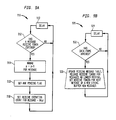
- FIG. 9 shows five exemplary subprocesses, 910, 920, 930, 950 and 970, for operating the receiver 14 of the first embodiment.
- a receivetimer subprocess 910 makes inquiry (step 912) as to whether a message receive timer has expired. If not, there is a delay 913. If so, the round p of NAKs for the message is bumped up (step 914), a NAK pending flag is set (step 916), and a receive iteration count for the message is set to M(p) (step 918).
- a framearrived subprocess 920 queries if a data frame has arrived (step 922). If not, there is a delay 924. If so, a missing message table is updated to reflect messages no longer missing at the receive 14. Receive timers are released for those messages no longer missing. Also, if a message arriving out of sequence creates a new string, receive timers are started for each message of the string. Each new message is buffered (step 926).
- a transmitNAK subprocess 930 queries as to whether a NAK pending flag is set (step 932). If not, there is a 20 ms delay 934. If so, a NAK is constructed based on data in the missing message table, and the NAK is transmitted (step 935). Receive timers for all missing messages indicated in the NAK are reset (step 937), and the receive iteration counts for those messages are bumped down (step 939). Steps 935 and 846 may be synchronized to load a NAK and messages into a single frame to fulfill a node's dual role as a sender and as a receiver.
- an outputreceivedmessages subprocess 950 for an outputreceivedmessages subprocess 950, the lowermost sequence-numbered messages that have arrived at the receiver 14 are loaded into the current frame (step 952). Buffers for those messages are released (step 954). The current frame is outputted (step 956). After a 20 ms delay 958, the subprocess 950 is repeated.
- a NAKpending subprocess 970 queries whether any missing message has a nonzero receive iteration count (step 972). If not, there is a delay 974. If so, the NAK pending flag is cleared.
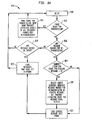
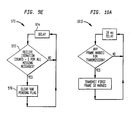
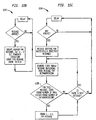
- FIG. 10 illustrates exemplary subprocesses 1010, 1020 and 1030 for operating the sender 12 of the second embodiment. These subprocesses replace subprocesses 840, 850 and 860, respectively, of the first embodiment, while subprocess 810 is retained.
- a transmitblock2 subprocess 1010 differs from the transmitblock subprocess 840 (FIG. 8(b)) and an inputmessage2 subprocess 1020 (in FIG. 10(b)) differs from the input message subprocess 850 (in FIG. 8(c)), in that send timers at the sender 12 have been eliminated.
- a comparison of a NAKreceive 2 subprocess 1030 (in FIG. 10(c)) and the corresponding NAKreceive subprocess 860 (in FIG. 8(d)) shows that the send timers have been replaced in an architecture that inserts a round number, such as the field 150, in a NAK, and that compares that round number to the round number of retransmission (step 1038).
- the overhead of setting up and retaining timers at the sender 12 for each message is eliminated. Yet, we retain the NAK screening advantages in reduced traffic and improved burst control, leading to better message flow.
- the systems and methods of this invention may be realized on a computer network or a computer using communications software.
- they may be implemented as enhancements to the RLP standard for CDMA (Code-Division Multiple Access). They are, however, not limited to such, and have applications in other protocols.
- CDMA Code-Division Multiple Access
Landscapes
- Engineering & Computer Science (AREA)
- Computer Networks & Wireless Communication (AREA)
- Signal Processing (AREA)
- Detection And Prevention Of Errors In Transmission (AREA)
- Communication Control (AREA)
- Small-Scale Networks (AREA)
- Mobile Radio Communication Systems (AREA)
Applications Claiming Priority (2)
| Application Number | Priority Date | Filing Date | Title |
|---|---|---|---|
| US861740 | 2001-05-21 | ||
| US09/861,740 US6920598B2 (en) | 2001-05-21 | 2001-05-21 | System and method for error recovery using NAKs |
Publications (3)
| Publication Number | Publication Date |
|---|---|
| EP1261163A2 EP1261163A2 (en) | 2002-11-27 |
| EP1261163A3 EP1261163A3 (en) | 2002-12-18 |
| EP1261163B1 true EP1261163B1 (en) | 2004-10-13 |
Family
ID=25336622
Family Applications (1)
| Application Number | Title | Priority Date | Filing Date |
|---|---|---|---|
| EP02252835A Expired - Lifetime EP1261163B1 (en) | 2001-05-21 | 2002-04-23 | System and method for error recovery using negative acknowledgements (NACK) |
Country Status (4)
| Country | Link |
|---|---|
| US (1) | US6920598B2 (enExample) |
| EP (1) | EP1261163B1 (enExample) |
| JP (1) | JP4112277B2 (enExample) |
| DE (1) | DE60201553T2 (enExample) |
Cited By (3)
| Publication number | Priority date | Publication date | Assignee | Title |
|---|---|---|---|---|
| US8406309B2 (en) | 2005-10-21 | 2013-03-26 | Qualcomm Incorporated | Video rate adaptation to reverse link conditions |
| US8548048B2 (en) | 2005-10-27 | 2013-10-01 | Qualcomm Incorporated | Video source rate control for video telephony |
| US8842555B2 (en) | 2005-10-21 | 2014-09-23 | Qualcomm Incorporated | Methods and systems for adaptive encoding of real-time information in packet-switched wireless communication systems |
Families Citing this family (24)
| Publication number | Priority date | Publication date | Assignee | Title |
|---|---|---|---|---|
| US7684329B2 (en) * | 2002-05-06 | 2010-03-23 | Qualcomm Incorporated | Method and apparatus for augmenting physical layer ARQ in a wireless data communication system |
| US8218573B2 (en) | 2003-01-21 | 2012-07-10 | Qualcomm Incorporated | Power boosting in a wireless communication system |
| DE10315249A1 (de) * | 2003-04-03 | 2004-11-18 | Rohde & Schwarz Gmbh & Co. Kg | Verfahren und Messgerät zum Ermitteln einer Fehlerrate ohne Incremental Redundancy |
| JP4244159B2 (ja) * | 2003-05-16 | 2009-03-25 | 株式会社エヌ・ティ・ティ・ドコモ | 受信装置、通信システムおよびプログラム |
| US8855572B2 (en) * | 2004-06-16 | 2014-10-07 | Qualcomm Incorporated | Method and apparatus for link control in wireless communications |
| RU2364035C2 (ru) * | 2004-06-16 | 2009-08-10 | Квэлкомм Инкорпорейтед | Способ и устройство управления линией связи в системе беспроводной связи |
| US7818757B1 (en) * | 2005-07-18 | 2010-10-19 | Sybase, Inc. | Method for guaranteeing processing of messages in a continuous processing system |
| EP1925114A1 (en) * | 2005-08-24 | 2008-05-28 | TELEFONAKTIEBOLAGET LM ERICSSON (publ) | Data unit transmission method |
| US20070053287A1 (en) * | 2005-09-07 | 2007-03-08 | Gang Li | System and method for selecting data rates in a wireless communication system |
| US8102878B2 (en) | 2005-09-29 | 2012-01-24 | Qualcomm Incorporated | Video packet shaping for video telephony |
| US8514711B2 (en) * | 2005-10-21 | 2013-08-20 | Qualcomm Incorporated | Reverse link lower layer assisted video error control |
| KR100710063B1 (ko) * | 2005-12-23 | 2007-04-23 | 주식회사 팬택 | 이동 통신 단말기에서 데이터 서비스 환경을 설정하는 방법및 그 방법을 채용한 이동 통신 단말기 |
| EP1816776A1 (en) * | 2006-02-07 | 2007-08-08 | Alcatel Lucent | Device and method for mitigating effects of impulse noise on data packet transfer |
| JP5020952B2 (ja) * | 2006-06-20 | 2012-09-05 | 株式会社エヌ・ティ・ティ・ドコモ | 移動通信システムで使用される無線通信装置及び方法 |
| US8140928B2 (en) * | 2006-06-20 | 2012-03-20 | Ntt Docomo, Inc. | Radio communications apparatus and method used in a mobile communications system |
| US8219869B2 (en) * | 2006-06-22 | 2012-07-10 | Lg Electronics Inc. | Method of retransmitting data in a mobile communication system |
| US9049015B2 (en) * | 2007-09-12 | 2015-06-02 | Cisco Technology, Inc. | Allowing TCP ACK to pass a gateway while queuing data for parsing |
| CN103067143B (zh) * | 2007-10-03 | 2016-03-30 | 富士通株式会社 | 无线通信装置 |
| US8797850B2 (en) | 2008-01-10 | 2014-08-05 | Qualcomm Incorporated | System and method to adapt to network congestion |
| DE102008042172A1 (de) * | 2008-09-17 | 2010-03-18 | Robert Bosch Gmbh | Verfahren zum Betreiben eines Kommunikationssystems mit mehreren Knoten und Kommunikationssystem mit mehreren Knoten |
| WO2010075409A1 (en) * | 2008-12-22 | 2010-07-01 | LiveTimeNet, Inc. | A system and method for recovery of packets in overlay networks |
| TWI502919B (zh) * | 2013-08-07 | 2015-10-01 | Univ Nat Sun Yat Sen | 由單一計時器提供自動重傳請求事件觸發與管理的系統及其方法 |
| US8971177B1 (en) * | 2013-10-10 | 2015-03-03 | National Sun Yat-Sen University | Event trigger and management system for providing automatic repeat requests by single timer and method thereof |
| US10223179B2 (en) * | 2016-05-17 | 2019-03-05 | International Business Machines Corporation | Timeout processing for messages |
Family Cites Families (13)
| Publication number | Priority date | Publication date | Assignee | Title |
|---|---|---|---|---|
| US4422171A (en) * | 1980-12-29 | 1983-12-20 | Allied Corporation, Law Department | Method and system for data communication |
| JP2615509B2 (ja) * | 1990-10-30 | 1997-05-28 | 富士通株式会社 | 通信装置 |
| US5222061A (en) * | 1991-10-31 | 1993-06-22 | At&T Bell Laboratories | Data services retransmission procedure |
| JP3000911B2 (ja) * | 1996-01-10 | 2000-01-17 | 日本電気株式会社 | 移動体ファクシミリ通信における自動再送プロトコルの再送待ちフレーム数最適値自動設定方式 |
| US5703562A (en) * | 1996-11-20 | 1997-12-30 | Sandia Corporation | Method for transferring data from an unsecured computer to a secured computer |
| US6021124A (en) * | 1997-08-19 | 2000-02-01 | Telefonaktiebolaget Lm Ericsson | Multi-channel automatic retransmission query (ARQ) method |
| US6052812A (en) * | 1998-01-07 | 2000-04-18 | Pocketscience, Inc. | Messaging communication protocol |
| US6381215B1 (en) * | 1998-06-29 | 2002-04-30 | Microsoft Corporation | Method and computer program product for efficiently and reliably sending small data messages from a sending system to a large number of receiving systems |
| US6392993B1 (en) * | 1998-06-29 | 2002-05-21 | Microsoft Corporation | Method and computer program product for efficiently and reliably sending small data messages from a sending system to a large number of receiving systems |
| US6567388B1 (en) | 1999-03-05 | 2003-05-20 | Qualcomm, Incorporated | Method and apparatus for efficient data retransmission in a voice-over-data communication system |
| US6581175B1 (en) * | 1999-06-29 | 2003-06-17 | Nortel Networks Limited | Apparatus and method of requesting retransmission of a message across a network |
| KR100424654B1 (ko) | 1999-08-02 | 2004-03-24 | 삼성전자주식회사 | 이동 통신시스템에서 라디오링크프로토콜에 따른 데이터 재전송 장치 및 방법 |
| US6625172B2 (en) * | 2001-04-26 | 2003-09-23 | Joseph P. Odenwalder | Rescheduling scheduled transmissions |
-
2001
- 2001-05-21 US US09/861,740 patent/US6920598B2/en not_active Expired - Lifetime
-
2002
- 2002-04-23 EP EP02252835A patent/EP1261163B1/en not_active Expired - Lifetime
- 2002-04-23 DE DE60201553T patent/DE60201553T2/de not_active Expired - Lifetime
- 2002-05-21 JP JP2002145928A patent/JP4112277B2/ja not_active Expired - Fee Related
Cited By (3)
| Publication number | Priority date | Publication date | Assignee | Title |
|---|---|---|---|---|
| US8406309B2 (en) | 2005-10-21 | 2013-03-26 | Qualcomm Incorporated | Video rate adaptation to reverse link conditions |
| US8842555B2 (en) | 2005-10-21 | 2014-09-23 | Qualcomm Incorporated | Methods and systems for adaptive encoding of real-time information in packet-switched wireless communication systems |
| US8548048B2 (en) | 2005-10-27 | 2013-10-01 | Qualcomm Incorporated | Video source rate control for video telephony |
Also Published As
| Publication number | Publication date |
|---|---|
| EP1261163A3 (en) | 2002-12-18 |
| JP2002368752A (ja) | 2002-12-20 |
| EP1261163A2 (en) | 2002-11-27 |
| DE60201553D1 (de) | 2004-11-18 |
| DE60201553T2 (de) | 2006-03-02 |
| US20020174395A1 (en) | 2002-11-21 |
| US6920598B2 (en) | 2005-07-19 |
| JP4112277B2 (ja) | 2008-07-02 |
Similar Documents
| Publication | Publication Date | Title |
|---|---|---|
| US6920598B2 (en) | System and method for error recovery using NAKs | |
| US9794028B2 (en) | Automatic retransmission and error recovery for packet oriented point-to-multipoint communication | |
| EP1527431B1 (en) | Method and apparatus for reducing transmission errors in a third generation cellular system | |
| US8036101B2 (en) | Retransmission apparatus and method for high-speed data processing | |
| US6496481B1 (en) | Data transfer method for wire real-time communications | |
| EP1766834B1 (en) | Radio link protocols for a wireless communication system | |
| ES2297162T3 (es) | Metodo para vigilar los numeros de secuencia de transmision asignados a unidades de datos de protocolo para detectar y corregir errores de transmision. | |
| US20020036992A1 (en) | Method and apparatus for packet size dependent link adaptation for wireless packet | |
| EP1855411A2 (en) | Retransmission apparatus and method for high-speed data processing | |
| US20040013114A1 (en) | Methods and devices for the retransmission of data packets | |
| JP2006523042A (ja) | 再送信の方法とシステム | |
| CA2467811C (en) | Enhanced data link layer selective reject mechanism in noisy wireless environment | |
| JP5143225B2 (ja) | 別チャネルのステータスレポートの順序の乱れた配信 | |
| KR20070106985A (ko) | 중복 확인으로 데이터 흐름 제어 | |
| CN101447855A (zh) | 在无线接入网络中移动接收窗口的方法 | |
| CN101421965A (zh) | 使用传输窗口的通信系统中的优化分组数据传输协议 | |
| KR20070108801A (ko) | 고속 데이터 처리를 위한 효율적인 재전송 장치 및 방법 | |
| KR20060079570A (ko) | 통신 시스템에서 데이터 재전송 장치 및 방법 | |
| WO2003067803A1 (en) | Method and apparatus for a nack-protocol | |
| Bestak et al. | Interactions between the TCP and RLC Protocols in UMTS | |
| Bestak et al. | A TCP connection over uplink UMTS radio access bearer in RLC acknowledged mode | |
| GB2348583A (en) | Automatic re-transmission of data | |
| AU2002221270A1 (en) | Automatic retransmission and error recovery for packet oriented point-to-multipoint communication | |
| HK1077663B (en) | Method and apparatus for reducing transmission errors in a third generation cellular system | |
| JP2010045845A (ja) | 再送信の方法とシステム |
Legal Events
| Date | Code | Title | Description |
|---|---|---|---|
| PUAI | Public reference made under article 153(3) epc to a published international application that has entered the european phase |
Free format text: ORIGINAL CODE: 0009012 |
|
| PUAL | Search report despatched |
Free format text: ORIGINAL CODE: 0009013 |
|
| 17P | Request for examination filed |
Effective date: 20020510 |
|
| AK | Designated contracting states |
Kind code of ref document: A2 Designated state(s): AT BE CH CY DE DK ES FI FR GB GR IE IT LI LU MC NL PT SE TR |
|
| AX | Request for extension of the european patent |
Free format text: AL;LT;LV;MK;RO;SI |
|
| AK | Designated contracting states |
Kind code of ref document: A3 Designated state(s): AT BE CH CY DE DK ES FI FR GB GR IE IT LI LU MC NL PT SE TR |
|
| AX | Request for extension of the european patent |
Free format text: AL;LT;LV;MK;RO;SI |
|
| 17Q | First examination report despatched |
Effective date: 20021220 |
|
| AKX | Designation fees paid |
Designated state(s): DE FR GB IT |
|
| GRAP | Despatch of communication of intention to grant a patent |
Free format text: ORIGINAL CODE: EPIDOSNIGR1 |
|
| GRAS | Grant fee paid |
Free format text: ORIGINAL CODE: EPIDOSNIGR3 |
|
| GRAA | (expected) grant |
Free format text: ORIGINAL CODE: 0009210 |
|
| AK | Designated contracting states |
Kind code of ref document: B1 Designated state(s): DE FR GB IT |
|
| REG | Reference to a national code |
Ref country code: GB Ref legal event code: FG4D |
|
| REG | Reference to a national code |
Ref country code: IE Ref legal event code: FG4D |
|
| REF | Corresponds to: |
Ref document number: 60201553 Country of ref document: DE Date of ref document: 20041118 Kind code of ref document: P |
|
| ET | Fr: translation filed | ||
| PLBE | No opposition filed within time limit |
Free format text: ORIGINAL CODE: 0009261 |
|
| STAA | Information on the status of an ep patent application or granted ep patent |
Free format text: STATUS: NO OPPOSITION FILED WITHIN TIME LIMIT |
|
| 26N | No opposition filed |
Effective date: 20050714 |
|
| PGFP | Annual fee paid to national office [announced via postgrant information from national office to epo] |
Ref country code: IT Payment date: 20080422 Year of fee payment: 7 |
|
| PG25 | Lapsed in a contracting state [announced via postgrant information from national office to epo] |
Ref country code: IT Free format text: LAPSE BECAUSE OF NON-PAYMENT OF DUE FEES Effective date: 20090423 |
|
| REG | Reference to a national code |
Ref country code: GB Ref legal event code: 732E Free format text: REGISTERED BETWEEN 20131107 AND 20131113 |
|
| REG | Reference to a national code |
Ref country code: FR Ref legal event code: CD Owner name: ALCATEL-LUCENT USA INC. Effective date: 20131122 |
|
| REG | Reference to a national code |
Ref country code: FR Ref legal event code: GC Effective date: 20140410 |
|
| REG | Reference to a national code |
Ref country code: FR Ref legal event code: RG Effective date: 20141015 |
|
| REG | Reference to a national code |
Ref country code: FR Ref legal event code: PLFP Year of fee payment: 14 |
|
| REG | Reference to a national code |
Ref country code: FR Ref legal event code: PLFP Year of fee payment: 15 |
|
| PGFP | Annual fee paid to national office [announced via postgrant information from national office to epo] |
Ref country code: DE Payment date: 20160421 Year of fee payment: 15 Ref country code: GB Payment date: 20160421 Year of fee payment: 15 |
|
| PGFP | Annual fee paid to national office [announced via postgrant information from national office to epo] |
Ref country code: FR Payment date: 20160421 Year of fee payment: 15 |
|
| REG | Reference to a national code |
Ref country code: DE Ref legal event code: R119 Ref document number: 60201553 Country of ref document: DE |
|
| GBPC | Gb: european patent ceased through non-payment of renewal fee |
Effective date: 20170423 |
|
| REG | Reference to a national code |
Ref country code: FR Ref legal event code: ST Effective date: 20171229 |
|
| PG25 | Lapsed in a contracting state [announced via postgrant information from national office to epo] |
Ref country code: DE Free format text: LAPSE BECAUSE OF NON-PAYMENT OF DUE FEES Effective date: 20171103 Ref country code: FR Free format text: LAPSE BECAUSE OF NON-PAYMENT OF DUE FEES Effective date: 20170502 |
|
| PG25 | Lapsed in a contracting state [announced via postgrant information from national office to epo] |
Ref country code: GB Free format text: LAPSE BECAUSE OF NON-PAYMENT OF DUE FEES Effective date: 20170423 |