EP1260498A1 - Novel color former and recording material - Google Patents
Novel color former and recording material Download PDFInfo
- Publication number
- EP1260498A1 EP1260498A1 EP01908206A EP01908206A EP1260498A1 EP 1260498 A1 EP1260498 A1 EP 1260498A1 EP 01908206 A EP01908206 A EP 01908206A EP 01908206 A EP01908206 A EP 01908206A EP 1260498 A1 EP1260498 A1 EP 1260498A1
- Authority
- EP
- European Patent Office
- Prior art keywords
- group
- compound
- urea
- urethane
- heat
- Prior art date
- Legal status (The legal status is an assumption and is not a legal conclusion. Google has not performed a legal analysis and makes no representation as to the accuracy of the status listed.)
- Granted
Links
- 0 Cc1c(*)[n](*)c2ccccc12 Chemical compound Cc1c(*)[n](*)c2ccccc12 0.000 description 17
- MGADZUXDNSDTHW-UHFFFAOYSA-N C1OC=CC=C1 Chemical compound C1OC=CC=C1 MGADZUXDNSDTHW-UHFFFAOYSA-N 0.000 description 1
- RDOXTESZEPMUJZ-UHFFFAOYSA-N COc1ccccc1 Chemical compound COc1ccccc1 RDOXTESZEPMUJZ-UHFFFAOYSA-N 0.000 description 1
- ZWVZMLQGGCVPQM-UHFFFAOYSA-N Cc(c(N=O)c1)ccc1NC(Oc1ccccc1)=O Chemical compound Cc(c(N=O)c1)ccc1NC(Oc1ccccc1)=O ZWVZMLQGGCVPQM-UHFFFAOYSA-N 0.000 description 1
- YXFVVABEGXRONW-UHFFFAOYSA-N Cc1ccccc1 Chemical compound Cc1ccccc1 YXFVVABEGXRONW-UHFFFAOYSA-N 0.000 description 1
- PAYRUJLWNCNPSJ-UHFFFAOYSA-N Nc1ccccc1 Chemical compound Nc1ccccc1 PAYRUJLWNCNPSJ-UHFFFAOYSA-N 0.000 description 1
- NWKXORMTLGAFMP-UHFFFAOYSA-N O=[C+]Oc1ccccc1 Chemical compound O=[C+]Oc1ccccc1 NWKXORMTLGAFMP-UHFFFAOYSA-N 0.000 description 1
- AQQFSMUQQRGKAP-UHFFFAOYSA-N [CH2-]Oc1ccccc1 Chemical compound [CH2-]Oc1ccccc1 AQQFSMUQQRGKAP-UHFFFAOYSA-N 0.000 description 1
- UHOVQNZJYSORNB-UHFFFAOYSA-N c1ccccc1 Chemical compound c1ccccc1 UHOVQNZJYSORNB-UHFFFAOYSA-N 0.000 description 1
Classifications
-
- C—CHEMISTRY; METALLURGY
- C09—DYES; PAINTS; POLISHES; NATURAL RESINS; ADHESIVES; COMPOSITIONS NOT OTHERWISE PROVIDED FOR; APPLICATIONS OF MATERIALS NOT OTHERWISE PROVIDED FOR
- C09K—MATERIALS FOR MISCELLANEOUS APPLICATIONS, NOT PROVIDED FOR ELSEWHERE
- C09K9/00—Tenebrescent materials, i.e. materials for which the range of wavelengths for energy absorption is changed as a result of excitation by some form of energy
- C09K9/02—Organic tenebrescent materials
-
- B—PERFORMING OPERATIONS; TRANSPORTING
- B41—PRINTING; LINING MACHINES; TYPEWRITERS; STAMPS
- B41M—PRINTING, DUPLICATING, MARKING, OR COPYING PROCESSES; COLOUR PRINTING
- B41M5/00—Duplicating or marking methods; Sheet materials for use therein
- B41M5/26—Thermography ; Marking by high energetic means, e.g. laser otherwise than by burning, and characterised by the material used
- B41M5/30—Thermography ; Marking by high energetic means, e.g. laser otherwise than by burning, and characterised by the material used using chemical colour formers
- B41M5/333—Colour developing components therefor, e.g. acidic compounds
- B41M5/3333—Non-macromolecular compounds
-
- C—CHEMISTRY; METALLURGY
- C07—ORGANIC CHEMISTRY
- C07C—ACYCLIC OR CARBOCYCLIC COMPOUNDS
- C07C275/00—Derivatives of urea, i.e. compounds containing any of the groups, the nitrogen atoms not being part of nitro or nitroso groups
- C07C275/28—Derivatives of urea, i.e. compounds containing any of the groups, the nitrogen atoms not being part of nitro or nitroso groups having nitrogen atoms of urea groups bound to carbon atoms of six-membered aromatic rings of a carbon skeleton
- C07C275/40—Derivatives of urea, i.e. compounds containing any of the groups, the nitrogen atoms not being part of nitro or nitroso groups having nitrogen atoms of urea groups bound to carbon atoms of six-membered aromatic rings of a carbon skeleton being further substituted by nitrogen atoms not being part of nitro or nitroso groups
-
- C—CHEMISTRY; METALLURGY
- C07—ORGANIC CHEMISTRY
- C07C—ACYCLIC OR CARBOCYCLIC COMPOUNDS
- C07C311/00—Amides of sulfonic acids, i.e. compounds having singly-bound oxygen atoms of sulfo groups replaced by nitrogen atoms, not being part of nitro or nitroso groups
- C07C311/30—Sulfonamides, the carbon skeleton of the acid part being further substituted by singly-bound nitrogen atoms, not being part of nitro or nitroso groups
- C07C311/45—Sulfonamides, the carbon skeleton of the acid part being further substituted by singly-bound nitrogen atoms, not being part of nitro or nitroso groups at least one of the singly-bound nitrogen atoms being part of any of the groups, X being a hetero atom, Y being any atom, e.g. N-acylaminosulfonamides
- C07C311/47—Y being a hetero atom
-
- C—CHEMISTRY; METALLURGY
- C07—ORGANIC CHEMISTRY
- C07C—ACYCLIC OR CARBOCYCLIC COMPOUNDS
- C07C317/00—Sulfones; Sulfoxides
- C07C317/16—Sulfones; Sulfoxides having sulfone or sulfoxide groups and singly-bound oxygen atoms bound to the same carbon skeleton
- C07C317/22—Sulfones; Sulfoxides having sulfone or sulfoxide groups and singly-bound oxygen atoms bound to the same carbon skeleton with sulfone or sulfoxide groups bound to carbon atoms of six-membered aromatic rings of the carbon skeleton
-
- C—CHEMISTRY; METALLURGY
- C07—ORGANIC CHEMISTRY
- C07C—ACYCLIC OR CARBOCYCLIC COMPOUNDS
- C07C317/00—Sulfones; Sulfoxides
- C07C317/26—Sulfones; Sulfoxides having sulfone or sulfoxide groups and nitrogen atoms, not being part of nitro or nitroso groups, bound to the same carbon skeleton
- C07C317/32—Sulfones; Sulfoxides having sulfone or sulfoxide groups and nitrogen atoms, not being part of nitro or nitroso groups, bound to the same carbon skeleton with sulfone or sulfoxide groups bound to carbon atoms of six-membered aromatic rings of the carbon skeleton
- C07C317/34—Sulfones; Sulfoxides having sulfone or sulfoxide groups and nitrogen atoms, not being part of nitro or nitroso groups, bound to the same carbon skeleton with sulfone or sulfoxide groups bound to carbon atoms of six-membered aromatic rings of the carbon skeleton having sulfone or sulfoxide groups and amino groups bound to carbon atoms of six-membered aromatic rings being part of the same non-condensed ring or of a condensed ring system containing that ring
- C07C317/38—Sulfones; Sulfoxides having sulfone or sulfoxide groups and nitrogen atoms, not being part of nitro or nitroso groups, bound to the same carbon skeleton with sulfone or sulfoxide groups bound to carbon atoms of six-membered aromatic rings of the carbon skeleton having sulfone or sulfoxide groups and amino groups bound to carbon atoms of six-membered aromatic rings being part of the same non-condensed ring or of a condensed ring system containing that ring with the nitrogen atom of at least one amino group being part of any of the groups, X being a hetero atom, Y being any atom, e.g. N-acylaminosulfones
- C07C317/42—Y being a hetero atom
-
- B—PERFORMING OPERATIONS; TRANSPORTING
- B41—PRINTING; LINING MACHINES; TYPEWRITERS; STAMPS
- B41M—PRINTING, DUPLICATING, MARKING, OR COPYING PROCESSES; COLOUR PRINTING
- B41M5/00—Duplicating or marking methods; Sheet materials for use therein
- B41M5/26—Thermography ; Marking by high energetic means, e.g. laser otherwise than by burning, and characterised by the material used
- B41M5/30—Thermography ; Marking by high energetic means, e.g. laser otherwise than by burning, and characterised by the material used using chemical colour formers
- B41M5/337—Additives; Binders
- B41M5/3375—Non-macromolecular compounds
-
- C—CHEMISTRY; METALLURGY
- C07—ORGANIC CHEMISTRY
- C07C—ACYCLIC OR CARBOCYCLIC COMPOUNDS
- C07C2601/00—Systems containing only non-condensed rings
- C07C2601/12—Systems containing only non-condensed rings with a six-membered ring
- C07C2601/14—The ring being saturated
Definitions
- the present invention relates to a novel urea-urethane compound.
- the present invention relates also to a novel color-producing composition obtained by using the urea-urethane compound, and a recording material obtained by using the color-producing composition.
- the color-producing composition of the present invention is useful as a color-producing composition for recording materials which use a recording energy such as heat, pressure or the like, and the present invention relates to, in particular, a color-producing composition capable of giving an improved storage stability to an uncolored portion (an original recording material surface) and a developed color image, and a recording material, in particular, a heat-sensitive recording material, which is obtained by using the color-producing composition.
- color-producing systems which use a recording energy such as heat, pressure or the like have been known.
- color-producing systems usually composed of a two-component color-producing system consisting of a colorless or light-colored dye precursor and a developer capable of causing color development on contact with the dye precursor have been known since early times and are commonly utilized in recording materials.
- pressure-sensitive recording materials which record using pressure
- heat-sensitive recording materials which record using heat
- light-sensitive recording materials which record using light.
- Pressure-sensitive recording materials have been generally used in the planar forms, similar to paper.
- the pressure-sensitive recording material is obtained by dissolving a dye precursor in a suitable solvent, emulsifying the resulting solution to several microns, and forming the emulsion into microcapsules.
- a first layer also referre to herein as upper paper
- a second layer also referred to herein as under paper
- a developer layer containing a developer are placed one upon the other so that the microcapsule-coated surface and the developer-coated surface face each other.
- the microcapsules When a pressure is applied to the resulting assembly by writing, striking or the like, the microcapsules are destroyed to release the contents including the dye precursor.
- the dye precursor transfers to the developer layer to come into contact with the developer, so that color development reaction occurs, resulting in recording of an image.
- a heat-sensitive recording method comprising recording by means of heat energy has been often adopted in various information machines such as facsimiles, printers, recorders and the like.
- a heat-sensitive recording material used in the heat-sensitive recording method has many excellent characteristics such as a high whiteness, appearance and feel which are similar to those of ordinary planar paper, and an excellent aptitude for recording, for example, a high color development sensitivity.
- the heat-sensitive recording method is advantageous, for example, in that an apparatus used in the method is small, requires no maintenance and produces no noise. Therefore, the range of use of the heat-sensitive recording method has been increased in various fields of, for instance, recorders for measurement, facsimiles, printers, terminals of computer, labels, and automatic vending machines for railroad tickets or the like.
- a recording material obtained by forming on a substrate a color-producing layer containing a two-component color-producing composition is mainly used, and the components of the heat-sensitive composition are brought into contact with each other by treating the recording material with heat supplied as the recording energy from a thermal head, a hot stamp, laser beams or the like, whereby color development and recording are carried out.
- Many compositions used as the color-producing composition are those obtained by using a colorless or light-colored, electron-donating dye precursor (in particular, a leuco dye) and an acidic developer such as a phenolic compound.
- An example of a recording material obtained by using a dye precursor is thermal paper obtained by using a combination of Crystal Violet lactone and 4,4'-isopropylidenediphenol (bisphenol A) as a heat-sensitive color-producing composition (see U.S. Patent 3539375, etc.).
- an electron-donating compound and an electron-accepting compound are mainly used.
- the electron-donating compound and the electron-accepting compound have, for example, the following excellent characteristics: the dye precursor as electron-donating compound and the developer as electron-accepting compound come into contact with each other to give a nearly instantaneous developed color image with a high density; and a nearly white appearance can be obtained and various hues such as red, orange, yellow, green, blue, black, etc. can be obtained.
- the developed color image obtained is so poor in chemical resistance that the record disappears easily on contact with a plasticizer contained in a plastic sheet or an eraser, or a chemical contained in food or cosmetics.
- the developed color image is so poor in record storage stability that the record fades or, worse yet, disappears when exposed to sunlight for a relatively short period of time. Therefore, color-producing compositions comprising the dye precursor and the developer are limited in their use to a considerable extent, and their improvement is eagerly desired.
- phenolic compounds represented by bisphenol A are considered unsuitable for use because they are likely to be endocrine disrupters, and hence a non-phenolic developer is preferred.
- JP-A-59-115887 and U.S. Patent 4521793 disclose recording materials comprising a combination of color-producing compositions comprising an aromatic isocyanate compound and an imino compound, as recording materials having a high shelf stability.
- These references disclose various recording materials in which the two color-producing compositions are brought into contact with each other to be reacted, by application of recording energy such as heat, pressure, light or the like.
- the references describe the fact that various colors such as red, orange, yellow, light brown, dark brown, etc. can be developed by properly selecting the color-producing compositions.
- the development of a black color is not yet sufficient and is eagerly desired in the case of recording materials commonly used at present.
- JP-A-8-2111 and JP-A-8-2112 disclose heat-sensitive recording materials having a color-producing layer containing a colorless or light-colored dye precursor and a urea compound, as heat-sensitive recording materials obtained by using a non-phenolic developer. These recording materials, however, give a low coloring density and have an insufficient shelf stability.
- JP-A-5-116459 discloses a heat-sensitive recording material having a heat-sensitive color-producing layer containing a colorless or light-colored dye precursor and a sulfonylurea compound. This recording material, however, gives a low whiteness and has an insufficient shelf stability.
- the present invention is intended to provide a novel urea-urethane compound or urea-urethane composition that exhibits excellent performance characteristics when used as developer in a color-producing composition.
- the present invention is also intended to provide a novel color-producing composition excellent in image preservability and coloring density, and a recording material, in particular, a heat-sensitive recording material, which is obtained by the use of the color-producing composition, by using any of various urea-urethane compounds or urea-urethane compositions.
- the present invention relates to a novel color-producing composition possessing further improved performance characteristics by virtue of the addition of various additives to a urea-urethane compound or a urea-urethane composition and a dye precursor, and a recording material obtained by using said color-producing composition.
- the present inventors earnestly investigated the synthesis of various compounds for color-producing composition and consequently found that specific compounds exhibit surprisingly excellent performance characteristics, whereby the present invention has been accomplished. Furthermore, the present inventors found that specific compounds exhibit surprisingly excellent performance characteristics in combination with a specific dye precursor, whereby the present invention has been accomplished.
- the present invention is as follows.
- a first aspect of the invention is directed to a urea-urethane compound characterized by being represented by the following formula (c) and having a molecular weight of 5,000 or less: wherein R is an aliphatic compound residue, A 1 and A 2 are independently an aromatic compound residue, the nitrogen atoms of the urea group are directly bonded to the carbon atoms, respectively, of the aromatic rings of A 1 and A 2 , and R, A 1 and A 2 may have one or more substituents.
- a second aspect of the invention is directed to a urea-urethane compound characterized by being represented by the following formula (d): wherein R is an aliphatic compound residue, hydrogen atom(s) of each benzene ring may be replaced by an aromatic compound residue, an aliphatic compound residue, a heterocyclic compound residue, a hydroxyl group, a nitro group, a nitrile group, a carbamoyl group, a sulfamoyl group, a carboxyl group, a nitroso group, an amino group, an oxyamino group, a nitroamino group, a hydrazino group, a ureido group, an isocyanate group, a mercapto group, a sulfo group or a halogen atom, and R may have one or more substituents.
- R is an aliphatic compound residue, hydrogen atom(s) of each benzene ring may be replaced by an aromatic
- a third aspect of the invention is directed to a urea-urethane compound characterized by being represented by the following formula (e) or (f), having at least one urethane group and at least one urea group in a total number of not more than 10 and not less than 3, and having a molecular weight of 5,000 or less: wherein R is an aliphatic compound residue, Y is an aromatic compound residue, a heterocyclic compound residue or an aliphatic compound residue, ⁇ 1 is an aromatic, heterocyclic or aliphatic compound residue which is different from Y and has a valence of 2 or more, n is an integer of 2 or more, and each of the residues may have one or more substituents; or wherein Z 1 and Y are independently an aromatic compound residue or a heterocyclic compound residue, ⁇ 1 is an aliphatic compound residue having a valence of 2 or more, n is an integer of 2 or more, and each of the residues may have one or more substituents.
- R is an ali
- a fourth aspect of the invention is directed to a urea-urethane compound characterized by being represented by the following formula (g) or (h): wherein hydrogen atom(s) of each benzene ring may be replaced by an aromatic compound residue, an aliphatic compound residue, a heterocyclic compound residue, a hydroxyl group, a nitro group, a nitrile group, a carbamoyl group, a sulfamoyl group, a carboxyl group, a nitroso group, an amino group, an oxyamino group, a nitroamino group, a hydrazino group, a ureido group, an isocyanate group, a mercapto group, a sulfo group or a halogen atom, ⁇ 1 is an aliphatic compound residue having a valence of 2 or more, n is an integer of 2 or more, and each of the residues may have one or more substituents; or where
- a fifth aspect of the invention is directed to a urea-urethane composition which is characterized by comprising a urea-urethane compound and a diluent.
- a sixth aspect of the invention is directed to a urea-urethane composition according to the fifth aspect of the invention, wherein the diluent is a urea compound and/or a urethane compound.
- a seventh aspect of the invention is directed to a urea-urethane composition according to the fifth aspect of the invention, wherein the diluent is a compound obtained by reacting a polyisocyanate compound with a hydroxy compound or an amino compound.
- An eighth aspect of the invention is directed to a urea-urethane composition obtained by reacting a polyisocyanate compound with a hydroxy compound and an amino compound, which is characterized by comprising 50 wt% or more of a urea-urethane compound having at least one urea group and at least one urethane group in a total number of 2 to 10 in the molecular structure and having a molecular weight of 5,000 or less.
- a ninth aspect of the invention is directed to a urea-urethane composition according to the eighth aspect of the invention, wherein the hydroxy compound is a phenolic compound.
- a tenth aspect of the invention is directed to a urea-urethane composition according to the eighth aspect of the invention, wherein the hydroxy compound is an alcohol compound.
- An eleventh aspect of the invention is directed to a urea-urethane composition according to any one of the eighth to tenth aspects of the invention, wherein the amino compound is an aromatic amino compound.
- a twelfth aspect of the invention is directed to a urea-urethane composition according to any one of the eighth to eleventh aspects of the invention, wherein the polyisocyanate compound is an aromatic polyisocyanate compound.
- a thirteenth aspect of the invention is directed to a process for producing a urea-urethane composition which is characterized by reacting a polyisocyanate compound with a hydroxy compound so that the ratio of the number of moles of the polyisocyanate compound to the number of hydroxyl equivalents of the hydroxy compound becomes 100/1 to 1/2, to form one or more urethane groups from some of the isocyanate groups of the polyisocyanate compound, and then adding an amino compound thereto to react the same with the remaining isocyanate group(s) of the polyisocyanate compound to form one or more urea groups.
- a fourteenth aspect of the invention is directed to a process for producing a urea-urethane composition which is characterized by reacting a polyisocyanate compound with an amino compound so that the ratio of the number of moles of the polyisocyanate compound to the number of amino equivalents of the amino compound becomes 100/1 to 1/2, to form one or more urea groups from some of the isocyanate groups of the polyisocyanate compound, and then adding a hydroxy compound thereto to react the same with the remaining isocyanate group(s) of the polyisocyanate compound to form one or more urethane groups.
- a fifteenth aspect of the invention is directed to a process for producing a urea-urethane composition according to the thirteenth or fourteenth aspect of the invention, which is characterized by successively carrying out the reaction for forming one or more urethane groups and the reaction for forming one or more urea groups.
- a sixteenth aspect of the invention is directed to a process for producing a urea-urethane composition which comprises reacting an amino compound with a polyisocyanate adduct obtained by the reaction of a polyisocyanate compound with a hydroxy compound, so that the equivalent ratio of isocyanate group to amino group becomes 2/1 to 1/100, to form one or more urea groups, and then removing the unreacted amino compound.
- a seventeenth aspect of the invention is directed to a process for producing a urea-urethane composition which comprises reacting a hydroxy compound with a polyisocyanate adduct obtained by the reaction of a polyisocyanate compound with an amino compound, so that the equivalent ratio of isocyanate group to hydroxyl group becomes 2/1 to 1/100, to form one or more urethane groups, and then removing the unreacted hydroxy compound.
- An eighteenth aspect of the invention is directed to a process for producing a urea-urethane composition according to any one of the thirteenth to seventeenth aspects of the invention, which is characterized by carrying out the reaction for forming one or more urethane groups and/or the reaction for forming one or more urea groups, without a solvent, or carrying out the reaction for forming one or more urethane groups and the reaction for forming one or more urea groups, by the use of the same solvent.
- a nineteenth aspect of the invention is directed to a process for producing a urea-urethane composition according to any one of the thirteenth to eighteenth aspects of the invention, wherein the reaction for forming one or more urethane groups and/or the reaction for forming one or more urea groups are carried out at a temperature of 0 - 300°C.
- a twentieth aspect of the invention is directed to a process for producing a urea-urethane composition according to any one of the thirteenth to nineteenth aspects of the invention, wherein the reaction for forming one or more urethane groups and/or the reaction for forming one or more urea groups are carried out in the presence of a catalyst.
- a twenty-first aspect of the invention is directed to a color-producing composition
- a color-producing composition comprising a developer comprising a urea-urethane compound.
- a twenty-second aspect of the invention is directed to a color-producing composition
- a color-producing composition comprising a developer comprising a urea-urethane compound, and a colorless or light-colored dye precursor.
- a twenty-third aspect of the invention is directed to a color-producing composition according to the twenty-second aspect of the invention, wherein the colorless or light-colored dye precursor is a leuco dye.
- a twenty-fourth aspect of the invention is directed to a color-producing composition according to the twenty-first to twenty-third aspects of the invention, wherein said developer is a urea-urethane compound according to any one of the first to fourth aspects of the invention, a urea-urethane composition according to any one of the fifth to twelfth aspects of the invention, or a composition produced by a production process according to any one of the thirteenth to twentieth aspects of the invention.
- a twenty-fifth aspect of the invention is directed to a color-producing composition according to either of the twenty-third and twenty-fourth aspects of the invention, which is characterized in that the leuco dye is at least one leuco dye selected from triarylmethane type leuco dyes, fluoran type leuco dyes, fluorene type leuco dyes and diphenylmethane type leuco dyes.
- a twenty-sixth aspect of the invention is directed to a color-producing composition according to either of the twenty-third and twenty-fourth aspects of the invention, which is characterized in that the leuco dye is a compound represented by the following formula (i) : wherein both Y 2 and Y 3 are alkyl groups or alkoxyalkyl groups, Y 4 is a hydrogen atom, an alkyl group or an alkoxy group, and each of Y 5 and Y 6 is a hydrogen atom, a halogen atom, an alkyl group or an alkoxy group.
- a twenty-seventh aspect of the invention is directed to a color-producing composition according to either of the twenty-third and twenty-fourth aspects of the invention, which is characterized in that the leuco dye is a compound represented by the following formula (j) : wherein each of R 5 and R 6 is a group represented by the formula (k) or the formula (1): (wherein each of R 11 through R 15 is a hydrogen atom, a halogen atom, an alkyl group of 1 to 8 carbon atoms, an alkoxy group of 1 to 8 carbon atoms, or -NR 16 R 17 wherein each of R 16 and R 17 is an alkyl group of 1 to 8 carbon atoms), or (wherein each of R 18 and R 19 is a hydrogen atom, an alkyl group of 1 to 8 carbon atoms, or a phenyl group), and each of R 7 through R 10 is a hydrogen atom, a halogen atom, an alkyl group of 1 to 8 carbon atoms, an alkoxy group
- a twenty-eighth aspect of the invention is directed to a color-producing composition according to any one of the twenty-first to twenty-seventh aspects of the invention, which is characterized in that the melting point of the urea-urethane compound developer is not higher than 500°C and not lower than 40°C.
- a twenty-ninth aspect of the invention is directed to a color-producing composition according to any one of the twenty-first to twenty-seventh aspects of the invention, which is characterized in that the urea-urethane compound developer comprises a compound selected from compounds represented by the following general formula (V) or (VI): wherein hydrogen atom(s) of each benzene ring may be replaced by an aromatic compound residue, an aliphatic compound residue, a heterocyclic compound residue, a nitro group, a hydroxyl group, a carboxyl group, a nitroso group, a nitrile group, a carbamoyl group, a ureido group, an isocyanate group, a mercapto group, a sulfo group, a sulfamoyl group or a halogen atom, each of the residues may have one or more substituents, ⁇ is a group selected from the group consisting of -SO 2 -, -O-,
- a thirtieth aspect of the invention is directed to a color-producing composition according to any one of the twenty-first to twenty-seventh aspects of the invention, which is characterized in that the urea-urethane compound developer comprises a compound selected from compounds represented by the following structural formulas (XX) and (XXI):
- a thirty-first aspect of the invention is directed to a color-producing composition according to any one of the twenty-first to thirtieth aspects of the invention, which further comprises a heat-meltable material.
- a thirty-second aspect of the invention is directed to a color-producing composition according to the thirty-first aspect of the invention, which is characterized in that the heat-meltable material is at least one compound selected from ⁇ -naphthylbenzyl ether, p-benzylbiphenyl, 1,2-di(m-methylphenoxy)ethane, di-p-methylbenzyl oxalate, 1,2-diphenoxymethylbenzene, m-terphenyl and stearamide.
- a thirty-third aspect of the invention is directed to a color-producing composition according to the thirty-first aspect of the invention, wherein the heat-meltable material is that represented by the following structural formula (XVIII): wherein Y is any of -SO 2 -, -(S) n -, -O-, -CO-, -CH 2 -, -CH(C 6 H 5 )-, -C(CH 3 ) 2 -, -COCO-, -CO 3 -, -COCH 2 CO-, -COOCH 2 -, -CONH-, -OCH 2 - and -NH-, n is 1 or 2, and hydrogen atom(s) of each benzene ring may be replaced by a halogen atom, a hydroxyl group, a nitro group, a nitroso group, a nitrile group, an isocyanate group, an isothiocyanate group, a mercapto group, a s
- a thirty-fourth aspect of the invention is directed to a color-producing composition according to the thirty-third aspect of the invention, wherein the heat-meltable material is that represented by the following structural formula (XIX): wherein hydrogen atom(s) of each benzene ring may be replaced by a halogen atom, a hydroxyl group, a nitro group, a nitroso group, a nitrile group, an isocyanate group, an isothiocyanate group, a mercapto group, a sulfamoyl group, a sulfonic acid group, an amino group, an aromatic compound residue, an aliphatic compound residue or a heterocyclic compound residue.
- the heat-meltable material is that represented by the following structural formula (XIX): wherein hydrogen atom(s) of each benzene ring may be replaced by a halogen atom, a hydroxyl group, a nitro group, a nitroso group, a n
- a thirty-fifth aspect of the invention is directed to a color-producing composition according to any one of the twenty-first to thirty-fourth aspects of the invention, which further comprises an isocyanate compound.
- a thirty-sixth aspect of the invention is directed to a color-producing composition according to any one of the twenty-first to thirty-fourth aspects of the invention, which further comprises an isocyanate compound and an imino compound.
- a thirty-seventh aspect of the invention is directed to a color-producing composition according to any one of the twenty-first to thirty-sixth aspects of the invention, which further comprises an amino compound.
- a thirty-eighth aspect of the invention is directed to a color-producing composition according to any one of the twenty-first to thirty-seventh aspects of the invention, wherein the developer further comprises an acidic developer.
- a thirty-ninth aspect of the invention is directed to a color-producing composition according to the thirty-eighth aspect of the invention, which is characterized in that the acidic developer is at least one developer selected from 2,2-bis(4-hydroxyphenyl)-propane, 4-isopropyloxyphenyl-4'-hydroxyphenylsulfone, bis(3-ally-4-hydroxyphenyl)sulfone, 2,4'-dihydroxydiphenylsulfone and 4,4'-[oxybis(ethyleneoxy-p-phenylenesulfonyl)]diphenol.
- the acidic developer is at least one developer selected from 2,2-bis(4-hydroxyphenyl)-propane, 4-isopropyloxyphenyl-4'-hydroxyphenylsulfone, bis(3-ally-4-hydroxyphenyl)sulfone, 2,4'-dihydroxydiphenylsulfone and 4,4'-[oxybis(ethyleneoxy-p-phenylenesulfonyl
- a fortieth aspect of the invention is directed to a color-producing composition according to any one of the twenty-first to thirty-ninth aspects of the invention, which further comprises a fluorescent dye.
- a forty-first aspect of the invention is directed to a color-producing composition according to any one of the twenty-first to fortieth aspects of the invention, which further comprises a shelf-stability-imparting agent.
- a forty-second aspect of the invention is directed to a recording material comprising a substrate and a color-producing layer formed thereon, said color-producing layer comprising a urea-urethane compound according to any one of the first to fourth aspects of the invention, a urea-urethane composition according to any one of the fifth to twelfth aspects of the invention, or a color-producing composition according to any one of the twenty-first to forty-first aspects of the invention.
- a forty-third aspect of the invention is directed to a recording material according to the forty-second aspect of the invention, which is characterized in that a protective layer for the color-producing layer is formed on the color-producing layer.
- a forty-fourth aspect of the invention is directed to a recording material according to the forty-third aspect of the invention, which is characterized in that the protective layer comprises a water-soluble polymer.
- a forty-fifth aspect of the invention is directed to a recording material according to either of the forty-third and forty-fourth aspects of the invention, which is characterized in that the protective layer comprises an inorganic pigment and/or an organic pigment.
- a forty-sixth aspect of the invention is directed to a recording material according to any one of the forty-third to forty-fifth aspects of the invention, which is characterized in that the protective layer comprises a lubricant.
- a forty-seventh aspect of the invention is directed to a recording material according to the forty-second aspect of the invention, which is characterized in that an intermediate layer is formed on the substrate and that the color-producing layer is formed on said intermediate layer.
- a forty-eighth aspect of the invention is directed to a recording material according to the forty-seventh aspect of the invention, which is characterized in that the intermediate layer comprises a water-soluble polymer.
- a forty-ninth aspect of the invention is directed to a recording material according to either of the forty-seventh and forty-eighth aspects of the invention, which is characterized in that the intermediate layer comprises an inorganic pigment and/or an organic pigment.
- a fiftieth aspect of the invention is directed to a recording material according to the forty-second aspect of the invention, which is characterized in that a back coating layer is formed on the substrate on the side reverse to the side having the color-producing layer formed thereon.
- a fifty-first aspect of the invention is directed to a recording material according to the fiftieth aspect of the invention, which is characterized in that the back coating layer comprises a water-soluble polymer.
- a fifty-second aspect of the invention is directed to a recording material according to either of the fiftieth and fifty-first aspects of the invention, which is characterized in that the back coating layer comprises an inorganic pigment and/or an organic pigment.
- a fifty-third aspect of the invention is directed to a recording material according to any one of the forty-second to fifty-second aspects of the invention, which is characterized by using at least one compound selected from water-soluble polymers and anionic surfactants, as a dispersing agent for the urea-urethane compound.
- a fifty-fourth aspect of the invention is directed to a recording material according to any one of the forty-second to fifty-second aspects of the invention, which is characterized by using at least one compound selected from poly(vinyl alcohol)s, modified poly(vinyl alcohol)s, methyl cellulose, hydroxypropylmethyl cellulose, condensed sodium naphthalenesulfonate, polycarboxylic acid ammonium salts, water-soluble low-molecular weight copolymers, and sodium 2-ethylhexylsulfosuccinate, as a dispersing agent for the urea-urethane compound.
- a fifty-fifth aspect of the invention is directed to a recording material according to any one of the forty-second to fifty-fourth aspects of the invention, which is characterized by using at least one compound selected from water-soluble polymers, nonionic surfactants and anionic surfactants, as a dispersing agent for a dye precursor.
- a fifty-sixth aspect of the invention is directed to a recording material according to any one of the forty-second to fifty-fourth aspects of the invention, which is characterized by using at least one compound selected from methyl cellulose, hydroxypropylmethyl cellulose, polyethylene glycol fatty acid esters, polyoxyethylene alkyl ether sulfates and sodium 2-ethylhexylsulfosuccinate, as a dispersing agent for a dye precursor.
- a fifty-seventh aspect of the invention is directed to a recording material according to any one of the forty-second to fifty-sixth aspects of the invention, which is a heat-sensitive recording material.
- a fifty-eighth aspect of the invention is directed to a heat-sensitive recording material according to the fifty-seventh aspect of the invention, which is characterized in that the average particle size of the urea-urethane compound is not more than 5 ⁇ m and not less than 0.05 ⁇ m.
- a fifty-ninth aspect of the invention is directed to a heat-sensitive recording material according to the fifty-seventh and fifty-eighth aspects of the invention, which is characterized in that a liquid temperature at grinding of the urea-urethane compound is 60°C or lower.
- a sixtieth aspect of the invention is directed to a heat-sensitive recording material according to any one of the fifty-seventh to fifty-ninth aspects of the invention, which is characterized in that a pH at grinding of the urea-urethane compound is 5 to 10.
- a sixty-first aspect of the invention is directed to a heat-sensitive recording material according to any one of the fifty-seventh to sixtieth aspects of the invention, which is characterized by using at least one compound selected from water-soluble polymers and anionic surfactants, as a dispersing agent for a heat-meltable material.
- a sixty-second aspect of the invention is directed to a heat-sensitive recording material according to any one of the fifty-seventh to sixtieth aspects of the invention, which is characterized by using at least one compound selected from poly(vinyl alcohol)s, modified poly(vinyl alcohol)s, methyl cellulose, hydroxypropylmethyl cellulose, condensed sodium naphthalenesulfonate, polycarboxylic acid ammonium salts, water-soluble low-molecular weight copolymers, and sodium 2-ethylhexylsulfosuccinate, as a dispersing agent for a heat-meltable material.
- a sixty-third aspect of the invention is directed to a heat-sensitive recording material according to any one of the fifty-seventh to sixty-second aspects of the invention, which is characterized in that the urea-urethane compound and a heat-meltable material are finely ground together.
- a sixty-fourth aspect of the invention is directed to a heat-sensitive recording material according to any one of the fifty-seventh to sixty-third aspects of the invention, which is characterized in that the pH of the substrate surface to be coated with the heat-sensitive recording layer of the heat-sensitive recording material is 3 to 9.
- a sixty-fifth aspect of the invention is directed to a process for producing a heat-sensitive recording material according to any one of the fifty-seventh to sixty-fourth aspects of the invention, which is characterized by applying on the substrate a heat-sensitive coating liquid of pH 5 to 12 for forming the heat-sensitive recording layer of the heat-sensitive recording material.
- a sixty-sixth aspect of the invention is directed to a recording material according to the forty-second aspect of the invention, which is a heat-sensitive magnetic recording material.
- a sixty-seventh aspect of the invention is directed to a heat-sensitive magnetic recording material according to the sixty-sixth aspect of the invention, which is characterized in that a heat-sensitive recording layer comprising a urea-urethane compound developer is formed on one side of the substrate, and a magnetic recording layer on the other side.
- a sixty-eighth aspect of the invention is directed to a railroad ticket that is a heat-sensitive magnetic recording material according to the sixty-sixth or sixty-seventh aspect of the invention.
- a sixty-ninth aspect of the invention is directed to a ticket that is a heat-sensitive magnetic recording material according to the sixty-sixth or sixty-seventh aspect of the invention.
- a seventieth aspect of the invention is directed to a recording material according to the forty-second aspect of the invention, which is a label for heat-sensitive recording.
- a seventy-first aspect of the invention is directed to a label for heat-sensitive recording according to the seventieth aspect of the invention, which is characterized in that a heat-sensitive recording layer comprising a urea-urethane compound developer is formed on one side of the substrate, and an adhesive layer on the other side.
- a seventy-second aspect of the invention is directed to a label for heat-sensitive recording according to the seventy-first aspect of the invention, which is characterized in that a back coating layer is formed between the adhesive layer and the substrate.
- a seventy-third aspect of the invention is directed to a label for heat-sensitive recording according to either of the seventy-first and seventy-second aspects of the invention, which is characterized in that an intermediate layer is formed between the heat-sensitive recording layer and the substrate.
- a seventy-fourth aspect of the invention is directed to a label for heat-sensitive recording according to any one of the seventy-first to seventy-third aspects of the invention, which is characterized in that a protective layer is formed on the heat-sensitive recording layer.
- a seventy-fifth aspect of the invention is directed to a recording material according to the forty-second aspect of the invention, which is a multicolor heat-sensitive recording material.
- a seventy-sixth aspect of the invention is directed to a multicolor heat-sensitive recording material according to the seventy-fifth aspect of the invention, wherein at least two heat-sensitive recording layers are formed on one side of the substrate, said recording material being characterized in that at least one of said heat-sensitive recording layers comprises a urea-urethane compound developer.
- a seventy-seventh aspect of the invention is directed to a multicolor heat-sensitive recording material according to the seventy-sixth aspect of the invention, which is characterized in that an intermediate layer is formed between the heat-sensitive recording layers.
- a seventy-eighth aspect of the invention is directed to a multicolor heat-sensitive recording material characterized by comprising a substrate and two heat-sensitive recording layers laminated on one side of the substrate which have different color development temperatures, respectively, and undergo color development in different color tones, respectively, the upper heat-sensitive recording layer comprising either an agent used both as developer and tone reducer, or a reversible developer, and the lower heat-sensitive recording layer comprising a urea-urethane compound developer.
- a seventy-ninth aspect of the invention is directed to a multicolor heat-sensitive recording material according to the seventy-eighth aspect of the invention, which is characterized in that, of the two heat-sensitive recording layers, the upper layer is a low-temperature color-producing layer capable of undergoing color development at a low temperature and undergoing achromatization at a high temperature, and the lower layer is a high-temperature color-producing layer capable of undergoing color development at a high temperature.
- An eightieth aspect of the invention is directed to an article for laser marking characterized by having on the surface a heat-sensitive recording layer comprising a urea-urethane compound developer.
- An eighty-first aspect of the invention is directed to an article for laser marking characterized by having on the surface a heat-sensitive recording layer comprising a colorless or light-colored dye precursor, a urea-urethane compound developer and a recording sensitivity improving agent.
- An eighty-second aspect of the invention is directed to an article for laser marking according to either of the eightieth and eighty-first aspects of the invention, which is characterized by having on the heat-sensitive recording layer a protective layer comprising an aqueous binder having a glass transition point of 20 - 80°C.
- An eighty-third aspect of the invention is directed to an article for laser marking according to the eighty-first aspect of the invention, wherein the recording sensitivity improving agent is at least one compound selected from aluminum hydroxide, muscovite, wollastonite and kaolin.
- An eighty-fourth aspect of the invention is directed to an article for laser marking according to any one of the eightieth to eighty-third aspects of the invention, which is any of labels, packaging materials and containers.
- An eighty-fifth aspect of the invention is directed to a process for producing an article for laser marking which is characterized by applying on a substrate a color-producing marking composition comprising a urea-urethane compound developer, and drying the thus treated substrate.
- An eighty-sixth aspect of the invention is directed to a process for producing an article for laser marking which is characterized by applying on a substrate a color-producing marking composition comprising a colorless or light-colored dye precursor, a urea-urethane compound developer and a recording sensitivity improving agent, and drying the thus treated substrate.
- An eighty-seventh aspect of the invention is directed to a method for marking an article which is characterized by irradiating the heat-sensitive recording layer of an article for laser marking according to any one of the eightieth to eighty-fourth aspects of the invention, with laser beams.
- An eighty-eighth aspect of the invention is directed to a color-producing marking composition characterized by comprising a urea-urethane compound developer.
- An eighty-ninth aspect of the invention is directed to a color-producing marking composition characterized by comprising a colorless or light-colored dye precursor, a urea-urethane compound developer and a recording sensitivity improving agent.
- Each of the urea-urethane compounds of the first to fourth aspects of the present invention has both at least one urea group and at least one urethane group.
- the urea-urethane compounds of the first to fourth aspects of the present invention an aliphatic compound residue is bonded to the terminal oxygen atom of the urethane group. Therefore, the urea-urethane compounds can be obtained as compounds excellent in physical and chemical stability, in particular, heat stability. Moreover, the urea-urethane compounds can be obtained by using relatively inexpensive materials.
- urea-urethane compounds can be obtained with a high purity.
- each end of the urea group should be bonded to an aromatic compound residue.
- the aromatic compound residue is preferably an aromatic ring shown in the formula (d).
- a group at each end of the urea group is, for example, as follows: in the formula (e), the group at each end may be any of an aromatic compound residue, a heterocyclic compound residue and an aliphatic compound residue, and in the formula (f), the group at each end may be either an aromatic compound residue or a heterocyclic compound residue. In both the formulas (e) and (f), the group at each end of the urea group is preferably an aromatic compound residue.
- the urea group and the urethane group are adjacent to each other through at least one compound residue (such a structure portion is hereinafter referred to as a urea-urethane structure portion). It is preferable that only one compound residue be present between the urea group and the urethane group. In addition, this residue is preferably an aromatic ring.
- the number of urea-urethane structure portions is two or more in the formulas (e) and (f). On the other hand, the number of urea-urethane structure portions is one in some cases in the urea-urethane compound of the formula (c) or (d).
- a residue to be bonded to each end of the urea group is limited to the most preferable residue, i.e., an aromatic compound residue in order to enable the compound to function as a developer to a cetain extent; on the other hand, in the formulas (e) and (f), a residue to be bonded to each end of the urethane group need not always be an aromatic compound residue.
- the number of urea-urethane structure portions present in the molecule be 1 to 10, preferably 1 to 5, more preferably 2 to 4.
- the urea-urethane compound may have in the molecule one or more other urea groups and urethane groups in addition to the urea-urethane structure portion(s).
- aliphatic used in the case of the first to fourth aspects of the present invention includes the term “alicyclic”.
- aliphatic compound residue used in the case of the first to fourth aspects of the present invention means a residue bonded by the carbon atom of the aliphatic hydrocarbon portion in the residue.
- aromatic compound residue used therein means a residue bonded by the carbon atom of the aromatic ring such as benzene ring in the residue.
- heterocyclic compound residue used therein means a residue bonded by a carbon atom forming the heterocyclic ring in the residue.
- substituents of the aliphatic compound residue, the heterocyclic compound residue and the aromatic compound residue are alkyl groups, cycloalkyl groups, phenyl group, amide group, alkoxyl groups, nitro group, nitrile group, halogen atoms, formyl group, dialkylamino groups, toluenesulfonyl group and methanesulfonyl group.
- the total number of one or more aliphatic urethane groups and one or more urea groups, which are present in the molecular structure of each of the urea-urethane compounds of the first to fourth aspects of the present invention is not more than 11 and not less than 2, preferably not more than 11 and not less than 3, more preferably not more than 11 and not less than 4.
- the ratio of the urethane group(s) to the urea group(s) is preferably 1 : 3 to 3 : 1, more preferably 1 : 2 to 2 : 1, most preferably 1 : 1.
- the molecular weight of the urea-urethane compounds is 5,000 or less, preferably 2,000 or less.
- a compound having a melting point is preferably used.
- the melting point or the urea-urethane compounds of the first to fourth aspects of the present invention ranges preferably from 40°C to 500°C, more preferably from 60°C to 300°C, most preferably from 60°C to 250°C.
- a process for synthesizing each of the urea-urethane compounds of the first to fourth aspects of the present invention is not particularly limited.
- a process in which the urea-urethane compound is synthesized by the reaction of an isocyanate compound with an alcohol compound and an amine compound is preferable because of its ease.
- a process for producing the urea-urethane compound of the formula (c) of the first aspect of the present invention is not limited.
- This compound can be obtained, for example, by reacting an alcohol compound of the following formula (m) with an isocyanate compound of the following formula (n) and an amine compound of the following formula (o) according to, for example, the reaction formula (A') or (B') shown below: R ⁇ OH wherein R is an aliphatic compound residue which may have one or more substituents; OCN ⁇ A 1 ⁇ NCO wherein A 1 is an aromatic compound residue which may have one or more substituents; and A 2 ⁇ NH 2 wherein A 2 is an aromatic compound residue which may have one or more substituents.
- a process for producing the urea-urethane compound of the formula (d) of the second aspect of the present invention is not particularly limited.
- This compound can be obtained, for example, by reacting an alcohol compound of the formula (m) with an isocyanate compound of the following formula (p) and an amine compound of the following formula (q) according to, for example, the reaction formula (C') or (D') shown below: wherein hydrogen atom(s) of the benzene ring may be replaced by an aromatic compound residue, an aliphatic compound residue, a heterocyclic compound residue, a hydroxyl group, a nitro group, a nitrile group, a carbamoyl group, a sulfamoyl group, a carboxyl group, a nitroso group, an amino group, an oxyamino group, a nitroamino group, a hydrazino group, a ureido group, an isocyanate group, a mercapto group,
- a process for producing the urea-urethane compound of the formula (e) of the third aspect of the present invention is not limited.
- This compound can be obtained, for example, by reacting an alcohol compound of the general formula (m) with an isocyanate compound of the following general formula (r) and an amine compound of the following general formula (s) according to, for example, the reaction formula (E') or (F') shown below: OCN ⁇ Y ⁇ NCO wherein Y is an aromatic compound residue, a heterocyclic compound residue or an aliphatic compound residue, and each of the residues may have one or more substituents; and wherein ⁇ 1 is an aromatic, aliphatic or heterocyclic compound residue having a valence of 2 or more, n is an integer of 2 or more, and each of the residues may have one or more substituents.
- a process for producing the urea-urethane compound of the formula (f) of the third aspect of the present invention is not limited.
- This compound can be obtained, for example, by reacting an amine compound of the following general formula (t) with an isocyanate compound of the general formula (r) and an alcohol compound of the following general formula (u) according to, for example, the reaction formula (G') or (H') shown below: Z 1 ⁇ NH 2 wherein Z 1 is is an aromatic compound residue or a heterocyclic compound residue, and each of the residues may have one or more substituents; and wherein ⁇ 1 is an aliphatic compound residue which has a valence of 2 or more and may have one or more substituents, and n is an integer of 2 or more.
- a process for producing the urea-urethane compound of the formula (g) of the fourth aspect of the present invention is not limited.
- This compound can be obtained, for example, by reacting an alcohol compound of the formula (u) with an isocyanate compound of the formula (p) and an amine compound of the formula (q) according to, for example, the reaction formula (i') or (J') shown below:
- a process for producing the urea-urethane compound of the formula (h) of the fourth aspect of the present invention is not limited.
- This compound can be obtained, for example, by reacting an amine compound of the following formula (XVII) with an isocyanate compound of the formula (p) and an alcohol compound of the general formula (m) according to, for example, the reaction formula (K') or (L') shown below: wherein hydrogen atom(s) of each benzene ring may be replaced by an aromatic compound residue, an aliphatic compound residue, a heterocyclic compound residue, a nitro group, a hydroxyl group, a carboxyl group, a nitroso group, a nitrile group, a carbamoyl group, a ureido group, an isocyanate group, a mercapto group, a sulfo group, a sulfamoyl group or a halogen atom, each of the residues may have one or more substituent
- any alcohol compound may be used so long as it has one or more OH groups bonded to one or more carbon atoms, respectively, of an aliphatic compound.
- the alcohol compound are the alcohols described in Solvent Handbook, Kodansha Scientific Co., Ltd., the ninth impression (1989), pp. 327-420 and pp. 772-817.
- the alcohol compound includes, for example, aliphatic alcohols such as methanol, ethanol, propanol, isopropanol, n-butanol, isobutanol, sec-butanol, tert-butanol, pentanol, cyclopentanol, tert-amyl alcohol, 2-pentanol, isoamyl alcohol, hexanol, 3-hexanol, cyclohexanol, cyclohexylmethanol, 4-methyl-2-pentanol, heptanol, isoheptanol, octanol, 2-ethyl-1-hexanol, capryl alcohol, nonyl alcohol, isononyl alcohol, decanol, undecyl alcohol, dodecyl alcohol, tridecyl alcohol, tetradecyl alcohol, hexadecyl alcohol, octadecyl alcohol, is
- polyhydric alcohols glycol
- acryl polyols fluorinated polyols, polybutadiene polyols, polyhydroxy polyols, castor-oil-derived polyols, polymer polyols, halogen-containing polyols, phosphorus-containing polyols, etc.
- alkanolamines such as N,N-dialkyl-ethanolamines, N,N-dialkylisopropanolamines, N-alkyldiethanolamines, N-alkyldiisopropanolamines, triethanolamine, triisopropanolamine, N,N,N',N'-tetrakis(2-hydroxyethyl)ethylenediamine, N,N,N',N'-tetrakis(2-hydroxypropyl)ethylenediamine, etc.
- monoalcohols having one OH group are preferable, and aliphatic alcohols and glycol ethers, which have 10 or less carbon atoms are more preferable.
- the isocyanate compound of the formula (n) is not particularly limited so long as it is an aromatic isocyanate having two or more isocyanate groups bonded to carbon atoms, respectively.
- the isocyanate compound includes, for example, p-phenylene diisocyanate, m-phenylene diisocyanate, o-phenylene diisocyanate, 2,5-dimethoxybenzene-1,4-diisocyanate, 2,4-toluene diisocyanate, 2,6-toluene diisocyanate, diphenylmethane diisocyanate, o-tolidine diisocyanate, diphenyl ether diisocyanate, 1,5-naphthylene diisocyanate, dianisidine diisocyanate, 3,3'-dimethyl-4,4'-diphenylmethane diisocyanate, triphenylmethane triisocyanate, tris(4-phenyliso
- diisocyanate dimers such as N,N'-(4,4'-dimethyl-3,3'-diphenyldiisocyanato)-urethodione (Desmodule TT, a trade name), a toluene diisocyanate dimer; and diisocyanate trimers such as 4,4',4"-trimethyl-3,3',3"-triisocyanato-2,4,6-triphenylcyanurate.
- water adduct isocyanates of toluene diisocyanate, diphenylmethane diisocyanate and the like such as 1,3-bis(3-isocyanato-4-methylphenyl)urea
- polyol adducts such as trimethylolpropane adducts of toluene diisocyanate (Desmodule L and Coronate L, trade names)
- amine adducts water adduct isocyanates of toluene diisocyanate, diphenylmethane diisocyanate and the like, such as 1,3-bis(3-isocyanato-4-methylphenyl)urea
- polyol adducts such as trimethylolpropane adducts of toluene diisocyanate (Desmodule L and Coronate L, trade names)
- amine adducts such as trimethylolpropane adducts of tol
- aromatic isocyanates having isocyanate groups bonded to a benzene ring are preferable. More preferable are p-phenylene diisocyanate, m-phenylene diisocyanate, o-phenylene diisocyanate, 2,4-toluene diisocyanate, 2,6-toluene diisocyanate, diphenylmethane diisocyanate, o-tolidine diisocyanate, diphenyl ether diisocyanate, 1,5-naphthylene diisocyanate, triphenylmethane triisocyanate, N,N'-(4,4'-dimethyl-3,3'-diphenyldiisocyanato)urethodione (Desmodule TT, a trade name), 4,4',4"-trimethyl-3,3',3"-triisocyanato-2,4,6-triphenylcyanur
- the isocyanate compound of the formula (n) are toluene diisocyanates.
- toluene diisocyanates 2.4-toluene diisocyanate is preferable.
- mixtures of 2.4-toluene diisocyanate and 2,6-toluene diisocyanate are generally on the market and available at a low price and may also be used as the isocyanate compound of the formula (n).
- aromatic amines such as aniline, o-toluidine, m-toluidine, p-toluidine, o-anisidine, p-anisidine, p-phenetidine, N,N-dimethyl-p-phenylenediamine, N,N-diethyl-p-phenylenediamine, 2,4-dimethoxyaniline, 2,5-dimethoxyaniline, 3,4-dimethoxyaniline, p-aminoacetanilide, p-aminobenzoic acid, o-aminophenol, m-aminophenol, p-aminophenol, 2,3-xylidine, 2,4-xylidine, 3,4-xylidine, 2,6-xylidine, 4-aminobenzonitrile, anthranilic acid, p-cresidine, 2,5-dichloroaniline, 2,6-d
- the aromatic isocyanate compound of the formula (p) includes 2,4-toluene diisocyanate, 2,6-toluene diisocyanate, m-phenylene diisocyanate, p-phenylene diisocyanate, o-phenylene diisocyanate, etc.
- the toluene diisocynates are preferable, and 2,4-toluene diisocyanate is more preferable.
- the aromatic amine compound of the formula (q) is not particularly limited so long as it has one or more amino group directly bonded to one or more carbon atoms, respectively, of the benzene ring.
- hydrogen atom(s) of the benzene ring may be replaced by an aromatic compound residue, an aliphatic compound residue, a heterocyclic compound residue, a hydroxyl group, a nitro group, a nitrile group, a carbamoyl group, a sulfamoyl group, a carboxyl group, a nitroso group, an oxyamino group, a nitroamino group, a hydrazino group, a ureido group, an isocyanate group, a mercapto group, a sulfo group or a halogen atom.
- the aromatic amine compound of the formula (q) includes, for example, aromatic monoamines such as aniline, o-toluidine, m-toluidine, p-toluidine, o-anisidine, p-anisidine, p-phenetidine, 2,4-dimethoxyaniline, 2,5-dimethoxyaniline, 3,4-dimethoxyaniline, p-aminoacetanilide, carboxy-substituted anilines (e.g. p-aminobenzoic acid), hydroxyl-substituted anilines (e.g.
- o-aminophenol m-aminophenol, p-aminophenol and 2-amino-4-chlorophenol
- 2, 3-xylidine 2,4-xylidine, 3,4-xylidine, 2,6-xylidine, nitrile-substituted anilines (e.g. 4-aminobenzonitrile), anthranilic acid, p-cresidine, halogen-substituted anilines (e.g.
- the isocyanate compound of the formula (r) is not particularly limited so long as it has two or more isocyanate groups bonded to carbon atoms, respectively.
- This compound includes, for example, p-phenylene diisocyanate, m-phenylene diisocyanate, o-phenylene diisocyanate, 2,5-dimethoxybenzene-1,4-diisocyanate, 2,4-toluene diisocyanate, 2,6-toluene diisocyanate, diphenylmethane diisocyanate, o-tolidine diisocyanate, diphenyl ether diisocyanate, 1,5-naphthylene diisocyanate, dianisidine diisocyanate, 9-ethylcarbazole-3,6-diisocyanate, 3,3'-dimethyl-4,4'-diphenylmethane diisocyanate, hexamethylene diisocyanate, iso
- diisocyanate dimers such as N,N'-(4,4'-dimethyl-3,3'-diphenyldiisocyanato)-urethodione (Desmodule TT, a trade name), a toluene diisocyanate dimer; and diisocyanate trimers such as 4,4',4"-trimethyl-3,3',3"-triisocyanato-2,4,6-triphenylcyanurate.
- water adduct isocyanates of toluene diisocyanate, diphenylmethane diisocyanate and the like such as 1,3-bis(3-isocyanato-4-methylphenyl)urea
- polyol adducts such as trimethylolpropane adducts of toluene diisocyanate (Desmodule L and Coronate L, trade names)
- amine adducts water adduct isocyanates of toluene diisocyanate, diphenylmethane diisocyanate and the like, such as 1,3-bis(3-isocyanato-4-methylphenyl)urea
- polyol adducts such as trimethylolpropane adducts of toluene diisocyanate (Desmodule L and Coronate L, trade names)
- amine adducts such as trimethylolpropane adducts of tol
- aromatic isocyanates having isocyanate groups bonded to a benzene ring are preferable. More preferable are p-phenylene diisocyanate, m-phenylene diisocyanate, o-phenylene diisocyanate, 2,4-toluene diisocyanate, 2,6-toluene diisocyanate, diphenylmethane diisocyanate, o-tolidine diisocyanate, diphenyl ether diisocyanate, 1,5-naphthylene diisocyanate, triphenylmethane triisocyanate, N,N'-(4,4'-dimethyl-3,3'-diphenyldiisocyanato)urethodione (Desmodule TT, a trade name), 4,4',4"-trimethyl-3,3',3"-triisocyanato-2,4,6-triphenylcyanur
- the isocyanate compound of the formula (r) are toluene diisocyanates.
- toluene diisocyanates 2.4-toluene diisocyanate is preferable.
- 2,4-toluene diisocyanate mixtures of 2.4-toluene diisocyanate and 2,6-toluene diisocyanate are generally on the market and available at a low price and may also be used as the isocyanate compound of the formula (r).
- the amine compound of the general formula (s) is not particularly limited so long as it has two or more amino groups.
- This compound includes, for example, aromatic amines such as 4,4'-diamino-3,3'-diethyldiphenylmethane, 4,4'-diaminobenzanilide, 3,5-diaminochlorobenzene, diaminodiphenyl ether, 3,3'-dichloro-4,4'-diaminodiphenylmethane, 3,3'-dimethyl-4,4'-diaminodiphenylmethane, tolidine base, dianisidine, bis[4-(m-aminophenoxy)phenyl] sulfone, bis[4-(p-aminophenoxy)phenyl] sulfone, bis[3-methyl-4-(p-aminophenoxy)phenyl] sulfone, 3,3'-dimethoxy-4,4'-diamin
- the aromatic amines are preferable, and aniline derivatives having at least two amino groups and represented by the following formula (VIII) are especially preferable: wherein R 1 , R 2 , R 3 and R 4 are independently a hydrogen atom, a halogen atom, an alkyl group, an alkoxy group or an amino group, X 1 and X 2 are independently an amino group or a group represented by the formula (b): and Y 1 is any of -SO 2 -, -O-, -(S) n -, -(CH 2 ) n -, -CO-, -CONH-, -NH-, -CH(COOR 1 )-, -C(CF 3 ) 2 -, -CR 2 R 3 - and a group represented by any of the formulas (a): or is absent, each of R 1 , R 2 and R 3 is an alkyl group, and n is 1 or 2.
- R 1 , R 2 and R 3 is an alkyl
- the amine compound of the general formula (t) includes aromatic amines such as aniline, o-toluidine, m-toluidine, p-toluidine, o-anisidine, p-anisidine, p-phenetidine, N,N-dimethyl-p-phenylenediamine, N,N-diethyl-p-phenylenediamine, 2,4-dimethoxyaniline, 2,5-dimethoxyaniline, 3,4-dimethoxyaniline, p-aminoacetanilide, p-aminobenzoic acid, o-aminophenol, m-aminophenol, p-aminophenol, 2,3-xylidine, 2,4-xylidine, 3,4-xylidine, 2,6-xylidine, 4-aminobenzonitrile, anthranilic acid, p-cresidine, 2,5-dichloroaniline, 2,6-dichloroaniline,
- the alcohol compound of the general formula (u) is not particularly limited so long as it is a polyol compound having two or more OH groups.
- the alcohol compound includes diols such as ethylene glycol, diethylene glycol, triethylene glycol, 1,3-propanediol, 1,2-propanediol, propylene glycol, dipropylene glycol, tripropylene glycol, 1,4-butanediol, 1,5-pentanediol, 1,6-hexanediol, hexylene glycol, 1,9-nonanediol, neopentyl glycol, methylpentanediol, etc.; aliphatic polyols such as glycerin, castor oil, trimethylolpropane, trimethylolethane, hexanetriol, pentaerythritol, ⁇ -methyl glucoside, sorbitol, sucrose, etc.; polyo
- polyhydric alcohols e.g. glycerin and propylene glycol
- acryl polyols fluorinated polyols, polybutadiene polyols, polyhydroxy polyols, castor-oil-derived polyols, polymer polyols, halogen-containing polyols, phosphorus-containing polyols, etc.
- alkanolamines such as N-alkyldiethanolamines, N-alkyldiisopropanolamines, triethanolamine, triisopropanolamine, N,N,N',N'-tetrakis(2-hydroxyethyl)ethylenediamine, N,N,N',N'-tetrakis(2-hydroxypropyl)ethylenediamine, etc.
- the amine compound of the general formula (XVII) includes, for example, aromatic diamines such as 4,4'-diamino-3,3'-diethyldiphenylmethane, 4,4'-diaminobenzanilide, 3,5-diaminochlorobenzene, diaminodiphenyl ether, 3,3'-dichloro-4,4'-diaminodiphenylmethane, 3,3'-dimethyl-4,4'-diaminodiphenylmethane, tolidine base, dianisidine, bis[4-(m-aminophenoxy)phenyl] sulfone, bis[4-(p-aminophenoxy)phenyl] sulfone, bis[3-methyl-4-(p-aminophenoxy)phenyl] sulfone, 3,3'-dimethoxy-4,4'-diaminobiphenyl, 3,3'-dimethyl-4,4'-
- the isocyanate and the corresponding reactants are mixed to be reacted in an organic solvent or without a solvent, after which filtration, crystallization, desolvation, etc. are carried out to collect crystals, whereby the desired compound is obtained.
- the reaction may be carried out by a method in which a material having two or more groups in the molecule is used in large excess and another material to be reacted with the groups is added thereto in small portions. When this method is adopted, it is possible to react only one of the two or more groups. In the addition, it is preferable to stir the system thoroughly to effect sufficient dispersion of the added material immediately after the addition.
- any of the urea-urethane compounds exemplified herein A method for the reaction is not limited to the above method and any method may be adopted so long as the same result as above can be obtained.
- the reactants one or more compounds may be used depending on purposes.
- the solvent any solvent may be used so long as it does not react with an isocyanate group and the functional groups of the reactants.
- the solvent includes, for example, aliphatic hydrocarbons, alicyclic hydrocarbons, aromatic hydrocarbons, chlorinated aliphatic hydrocarbons, chlorinated aromatic hydrocarbons, chlorinated alicyclic hydrocarbons, and ketones.
- Methyl ethyl ketone, toluene and the like are especially preferable which dissolve the isocyanate and in which the reaction product has a low solubility.
- the reaction product obtained by the above reaction procedure is not always a single compound, but is obtained as a mixture of compounds different in the position of a substituent, in some cases.
- urea-urethane compounds of the first to fourth aspects of the present invention are the following compounds ((S-1) to (S-70)).
- Each of the urea-urethane compositions according to the fifth to twelfth aspects of the present invention and the urea-urethane compositions produced by the production processes of the thirteenth to twentieth aspects of the invention preferably comprises 50 wt% or more, more preferably 60 wt% or more, further preferably 70 wt% or more of a urea-urethane compound having in the molecule at least one urethane group (-NHCOO- group) and at least one urea group (-NHCONH- group) in a total number of 2 to 10 and having a molecular weight of 5,000 or less.
- Such a urea-urethane composition can be used in combination with a colorless or light-colored dye precursor in order to obtain a color-producing composition for a heat-sensitive recording material or a pressure-sensitive recording material.
- This color-producing composition is so effective that it is excellent in both color-producing capability and print preservability.
- the urea-urethane compound as the main constituent of the urea-urethane composition has at least one urea group and at least one urethane group in the molecule.
- the urea group and the urethane group are preferably adjacent to each other through at least one compound residue (such a structure portion is hereinafter referred to as a urea-urethane structure portion).
- the total number of the urethane group(s) and the urea group(s) is not more than 10 and not less than 2, preferably not more than 10 and not less than 3, more preferably not more than 10 and not less than 4.
- the ratio of urethane group(s) to urea group(s) in a molecule of the urea-urethane compound is preferably 1 : 3 to 3 : 1, more preferably 1 : 2 to 2 : 1, most preferably 1 : 1.
- the molecular weight of the urea-urethane compound is 5,000 or less, preferably 2,000 or less.
- the content of the urea-urethane compound in each of the urea-urethane compositions according to the fifth to twentieth aspects of the present invention is 50 wt% or more.
- Such a urea-urethane composition can be produced by a relatively simple production process. On the other hand, it can exhibit excellent performance characteristics because of the high proportion of the urea-urethane compound capable of exhibiting excellent color-developing capability and preserving capability which are required of a color-producing composition.
- the urea-urethane compound either a single compound or a mixture of two or more compounds including isomers may be used.
- urea-urethane compound a mixture of two or more compounds including isomers may be used as the urea-urethane compound in order to improve the color-developing capability, preserving capability and the like.
- the urea-urethane compound of the present invention may be properly diluted with a material that does not lessen the effects of the present invention.
- a diluent includes, for example, the heat-meltable materials, acidic developers, amine compounds, isocyanate compounds, urea compounds, urethane compounds and the like, which are described hereinafter.
- the urea compounds and the urethane compounds which have a structure similar to that of the urea-urethane compound, are preferable because they can improve the sensitivity.
- compounds obtained by reacting a polyisocyanate compound with a hydroxy compound or an amino compound are preferable.
- Such a diluent is preferably contained in the resulting dilution in a proportion of 0.0001 to 50 wt% based on the total weight of the urea-urethane compound and the diluent.
- the content of the diluent is more preferably 40 wt% or less, still more preferably 30 wt% or less, for the exhibition of the preserving capability.
- the content of the diluent is more preferably 0.01 wt% or more, still more preferably 1 wt% or more, for improving the sensitivity.
- Such a diluent is produced during the synthetic reaction of the urea-urethane compound in some cases.
- a urea-urethane composition comprising a diluent and a urea-urethane compound having at least one urea group and at least one urethane group in a total number of 2 to 10 in the molecular structure and having a molecular weight of 5,000 or less, which is characterized by comprising the diluent in a proportion of 0.0001 to 50 wt%.
- Each of the urea-urethane compositions according to the fifth to twentieth aspects of the present invention is preferably a colorless or light-colored solid having a melting point, from the view-point of utility in a heat-sensitive recording material.
- the melting point of the composition is preferably 40°C to 300°C, more preferably 60°C to 260°C.
- any of the urea-urethane compositions according to the fifth to twentieth aspects of the present invention, there is preferably adopted a process of forming one or more urethane groups from at least one of the isocyanate groups of a polyisocyanate compound and the hydroxyl group(s) of a hydroxy compound, and then forming one or more urea groups from the remaining unreacted isocyanate group(s) of the same polyisocyanate compound and the amino group(s) of an amino compound; or a process of forming one or more urea groups from at least one of the isocyanate groups of a polyisocyanate compound and the amino group(s) of an amino compound, and then forming one or more urethane groups from the remaining unreacted isocyanate group(s) of the same polyisocyanate compound and the hydroxyl group(s) of a hydroxy compound.
- the urea-urethane composition can be efficiently obtained by using the polyisocyanate compound in an excess amount over hydroxyl group(s), bonding the polyisocyanate compound to the hydroxy compound in an amount of one molecule per hydroxyl group of the hydroxy compound to react only one of the isocyanate groups of the polyisocyanate compound and leave at least one of the isocyanate groups unreacted, and then reacting the remaining unreacted isocyanate group(s) with an amino compound to form one or more urea groups.
- one or more urethane groups by reacting the polyisocyanate compound with the hydroxy compound so that the ratio of the number of moles of the polyisocyanate compound to the number of hydroxyl equivalents of the hydroxy compound becomes 100/1 to 1/2, and that the ratio of the number of isocyanate group equivalents of the polyisocyanate compound to the number of hydroxyl equivalents of the hydroxy compound becomes 1000/1 to 1/1.
- the hydroxy compound is preferably added in small portions so that the polyisocyanate compound is always present in the reaction system in an excess amount over hydroxyl group(s).
- Such an adding method is preferable particularly when the reaction is carried out at a ratio of the number of moles of the polyisocyanate compound to the number of hydroxyl equivalents of the hydroxy compound of near 1/1, for example, 5/1 to 1/2.
- the urea-urethane composition can be efficiently obtained by using the polyisocyanate compound in an excess amount over amino group(s), bonding the polyisocyanate compound to the amino compound in an amount of one molecule per amino group of the amino compound to react one of the isocyanate groups of the polyisocyanate compound and leave at least one of the isocyanate groups unreacted, and then reacting the remaining unreacted isocyanate group(s) with a hydroxy compound to form one or more urethane groups.
- one or more urea groups by reacting the polyisocyanate compound with the amino compound so that the ratio of the number of moles of the polyisocyanate compound to the number of amino equivalents of the amino compound becomes 100/1 to 1/2, and that the ratio of the number of isocyanate group equivalents of the polyisocyanate compound to the number of amino equivalents of the amino compound becomes 1000/1 to 1/1.
- the amino compound is preferably added in small portions so that the polyisocyanate compound is always present in the reaction system in an excess amount over amino group(s).
- Such an adding method is preferable particularly when the reaction is carried out at a ratio of the number of moles of the polyisocyanate compound to the number of amino equivalents of the amino compound of near 1/1, for example, 5/1 to 1/2.
- the reaction of a polyisocyanate compound with a hydroxy compound for forming one or more urethane groups is preferably carried out without a solvent or by adding, dropping or pouring the hydroxy compound without a solvent, a dilution of the hydroxy compound with a solvent or a dispersion of the hydroxy compound in a solvent continuously or by portions to a dilution of the polyisocyanate compound with a solvent or a dispersion of the polyisocyanate compound in a solvent.
- reaction of a polyisocyanate compound with an amino compound for forming one or more urea groups may be carried out without a solvent or by adding, dropping or pouring the amino compound without a solvent, a dilution of the amino compound with a solvent or a dispersion of the amino compound in a solvent continuously or by portions to a dilution of the polyisocyanate compound with a solvent or a dispersion of the polyisocyanate compound in a solvent.
- the above production process comprising adding a hydroxy compound or an amino compound to a polyisocyanate compound in small portions is preferable particularly in the following case: in a reaction process for the production of the urea-urethane composition, while leaving at least one of the isocyanate groups in molecules of the polyisocyanate compound, the other isocyanate group(s) is reacted with the hydroxy compound or the amino compound to form one or more urethane groups or urea groups, respectively.
- said production process is preferable when a hydroxy compound having two or more hydroxyl groups or an amino compound having two or more amino groups is reacted with a polyisocyanate compound having two or more isocyanate groups.
- reaction for forming one or more urethane groups and the reaction for forming one or more urea groups are carried out individually and successively.
- the urea-urethane compound content of the urea-urethane composition is undesirably decreased. It is preferable to carry out these urethane group forming reaction and urea group forming reaction continuously. In the process of the present invention, since separation and purification steps are not necessary in the course of the production, the production can be simplified by carrying out the two reaction steps continuously.
- the urea-urethane composition when a polyisocyanate adduct with a hydroxy compound is used which is an isocyanate already having one or more urethane groups in the molecule, the urea-urethane composition can be obtained by reacting this adduct with an amino compound.
- the urea-urethane composition when a polyisocyanate adduct with an amino compound is used which is an isocyanate already having one or more urea groups in the molecule, the urea-urethane composition can be obtained by reacting this adduct with a hydroxy compound.
- it is preferable to form one or more urethane groups by carrying out the reaction at an equivalent ratio of isocyanate group to hydroxyl group of 2/1 to 1/100, and remove the unreacted hydroxy compound.
- the solvent is not particularly limited so long as it does not react with an isocyanate group and the like.
- the solvent includes, for example, aliphatic hydrocarbons, alicyclic hydrocarbons, aromatic hydrocarbons, chlorinated aliphatic hydrocarbons, chlorinated aromatic hydrocarbons, chlorinated alicyclic hydrocarbons, ketones and phosphoric esters. Acetone, methyl ethyl ketone, toluene and the like are especially preferable which dissolve the isocyanate and in which the reaction product has a low solubility.
- the phosphoric esters in particular, trimethyl phosphate are preferable.
- the formation of one or more urethane groups and the formation of one or more urea groups are preferably carried out in one and the same solvent in order to make it easy to reuse the solvent and carry out the reaction for the urea group formation and the reaction for the urethane group formation continuously.
- the reaction temperature at which a polyisocyanate is reacted with a hydroxy compound and/or an amino compound to form one or more urethane groups and/or one or more urea groups is 0°C to 300°C, preferably 5°C to 200°C, more preferably 10°C to 150°C.
- the reaction temperature is properly adjusted depending on the polyisocyanate compound, hydroxy compound and amino compound selected. It is also possible to carry out the urethane group formation and the urea group formation at different temperatures suitable for the formations, respectively.
- a catalyst may be used for reacting a polyisocyanate with a hydroxy compound and/or an amino compound to form one or more urethane groups and/or one or more urea groups.
- the catalyst includes, for example, tertiary amine compounds such as triethylamine, 1,4-diazabicyclo(2,2,2)octane, etc.; and organic acid tin salts such as dibutyltin dilaurate, etc.
- the catalyst concentration is 1 to 10,000 ppm, preferably 10 to 2,000 ppm, relative to the isocyanate compound.
- the tertiary amine compounds are preferable.
- a urea-urethane composition containing a urea-urethane compound having a plurality of urea-urethane structure portions in the molecule can be obtained by repeating the steps of the production process of the present invention two or more times by using, for example, an amino compound having two or more amino groups and a hydroxy compound having two or more hydroxyl groups. Since a sufficiently high yield from reaction can be attained in each step, the production process of the present invention permits relatively easy production of a urea-urethane composition having high performance characteristics.
- the polyisocyanate compound used in each of the fifth to twentieth aspects of the present invention is not particularly limited so long as it has two or more isocyanate groups bonded to carbon atoms, respectively.
- the polyisocyanate compound includes, for example, p-phenylene diisocyanate, m-phenylene diisocyanate, o-phenylene diisocyanate, 2,5-dimethoxybenzene-1,4-diisocyanate, 2,4-toluene diisocyanate, 2,6-toluene diisocyanate, diphenylmethane diisocyanate, o-tolidine diisocyanate, diphenyl ether diisocyanate, 1,5-naphthylene diisocyanate, dianisidine diisocyanate, 9-ethylcarbazole-3,6-diisocyanate, 3,3'-dimethyl-4,4'-diphenylmethane diisocyanate,
- polyisocyanate compound there may also be used diisocyanate dimers such as N,N'-(4,4'-dimethyl-3,3'-diphenyldiisocyanato)-urethodione (Desmodule TT, a trade name), a toluene diisocyanate dimer; and diisocyanate trimers such as 4,4',4"-trimethyl-3,3',3"-triisocyanato-2,4,6-triphenylcyanurate.
- diisocyanate dimers such as N,N'-(4,4'-dimethyl-3,3'-diphenyldiisocyanato)-urethodione (Desmodule TT, a trade name), a toluene diisocyanate dimer; and diisocyanate trimers such as 4,4',4"-trimethyl-3,3',3"-triisocyanato-2,4,6-triphenylcyanurate.
- water adduct isocyanates of toluene diisocyanate, diphenylmethane diisocyanate and the like such as 1,3-bis(3-isocyanato-4-methylphenyl)urea
- polyol adducts such as trimethylolpropane adducts of toluene diisocyanate (Desmodule L and Coronate L, trade names)
- amine adducts water adduct isocyanates of toluene diisocyanate, diphenylmethane diisocyanate and the like, such as 1,3-bis(3-isocyanato-4-methylphenyl)urea
- polyol adducts such as trimethylolpropane adducts of toluene diisocyanate (Desmodule L and Coronate L, trade names)
- amine adducts such as trimethylolpropane adducts of tol
- the polyisocyanate compound are aromatic polyisocyanates having isocyanate groups bonded to a benzene ring, such as p-phenylene diisocyanate, m-phenylene diisocyanate, o-phenylene diisocyanate, 2, 4-toluene diisocyanate, 2,6-toluene diisocyanate, diphenylmethane diisocyanate, o-tolidine diisocyanate, diphenyl ether diisocyanate, 1,5-naphthylene diisocyanate, triphenylmethane triisocyanate, N,N'-(4,4'-dimethyl-3,3'-diphenyldiisocyanato)urethodione (Desmodule TT, a trade name), 4,4',4"-trimethyl-3,3',3"-triisocyanato-2,4,6-tripheny
- the polyisocyanate compound are toluene diisocyanates.
- toluene diisocyanates 2.4-toluene diisocyanate is preferable.
- mixtures of 2.4-toluene diisocyanate and 2,6-toluene diisocyanate are generally on the market and available at a low price and may also be used as the polyisocyanate compound.
- phenolic compounds and alcohol compounds are mentioned.
- the phenolic compounds include, for example, phenol, cresol, xylenol, p-ethylphenol, o-isopropylphenol, resorcinol, p-tert-butylphenol, p-tert-octylphenol, 2-cyclohexylphenol, 2-allylphenol, 4-indanol, thymol, 2-naphthol, p-nitrophenol, o-chlorophenol, p-chlorophenol, 2,2-bis(4-hydroxyphenyl)-propane, 2, 2-bis (hydroxyphenyl) butane, 2, 2-bis (hydroxyphenyl)pentane, 2,2-bis(hydroxyphenyl)heptane, catechol, 3-methylcatechol, 3-methoxycatechol, pyrogallol, hydroquinone, methylhydroquinone, 4-phenylphenol, p,p'-biphenol, 4-cumylphenol, butyl bis(4-hydroxyphenyl
- phenol, phenol derivatives represented by the following formula (w) and diphenol compounds represented by the following formula (XVI) are preferable.
- hydrogen atom(s) of the benzene ring may be replaced by an alkyl group, a cycloalkyl group, a phenyl group, an amide group, an alkoxyl group, a nitro group, a nitrile group, a halogen atom, a formyl group, a dialkylamino group, a toluenesulfonyl group, a methanesulfonyl group or an OH group; and wherein hydrogen atom(s) of each benzene ring may be replaced by a substituent which is preferably an aromatic compound residue, an aliphatic compound residue or a heterocyclic compound residue though the substituent may be a hydroxyl group, a nitro group, a nitrile group, a carbamoyl
- aliphatic used in the case of the fifth to twentieth aspects of the present invention includes the term “alicyclic”.
- aliphatic compound residue used in the case of the fifth to twentieth aspects of the present invention means a residue bonded by the carbon atom of the aliphatic hydrocarbon portion in the residue.
- aromatic compound residue used therein means a residue bonded by the carbon atom of the aromatic ring such as benzene ring in the residue.
- heterocyclic compound residue used therein means a residue bonded by the carbon atom forming the heterocyclic ring in the residue.
- substituent of the aliphatic compound residue, heterocyclic compound residue or aromatic compound residue are alkyl groups, cycloalkyl groups, phenyl group, amide group, alkoxyl groups, nitro group, nitrile group, halogen atoms, formyl group, dialkylamino groups, toluenesulfonyl group and methanesulfonyl group.
- alcohol compounds compounds having at least one OH group bonded to the carbon atom of an aliphatic compound are mentioned.
- examples of the alcohol compounds are the alcohols described in Solvent Handbook, Kodansha Scientific Co., Ltd., the ninth impression (1989), pp. 327-420 and pp. 772-817.
- the alcohol compound includes, for example, aliphatic alcohols such as methanol, ethanol, propanol, isopropanol, n-butanol, isobutanol, sec-butanol, tert-butanol, pentanol, cyclopentanol, tert-amyl alcohol, 2-pentanol, isoamyl alcohol, hexanol, 3-hexanol, cyclohexanol, cyclohexylmethanol, 4-methyl-2-pentanol, heptanol, isoheptanol, octanol, 2-ethyl-1-hexanol, capryl alcohol, nonyl alcohol, isononyl alcohol, decanol, undecyl alcohol, dodecyl alcohol, tridecyl alcohol, tetradecyl alcohol, hexadecyl alcohol, octadecyl alcohol, is
- polyhydric alcohols glycol
- acryl polyols fluorinated polyols, polybutadiene polyols, polyhydroxy polyols, castor oil-derived polyols, polymer polyols, halogen-containing polyols, phosphorus-containing polyols, etc.
- alkanolamines such as N,N-dialkylethanolamines, N,N-dialkylisopropanolamines, N-alkyldiethanolamines, N-alkyldiisopropanolamines, triethanolamine, triisopropanolamine, N,N,N',N'-tetrakis(2-hydroxyethyl)ethylenediamine, N,N,N',N'-tetrakis(2-hydroxypropyl)ethylenediamine, etc.
- aliphatic alcohols having 10 or less carbon atoms the glycol ethers, the diols, the aliphatic polyols, polyols having a molecular weight of 2,000 or less, and the alkanolamines are preferable.
- the above-exemplified alcohol compounds may be used singly or in combination, and the above-exemplified phenolic compounds may also be used singly or in combination.
- any compound may be used so long as it has one or more amino groups bonded to carbon atoms, respectively.
- the amino compound includes, for example, aromatic amines such as aniline, o-toluidine, m-toluidine, p-toluidine, o-anisidine, p-anisidine, p-phenetidine, N,N-dimethyl-p-phenylenediamine, N,N-diethyl-p-phenylenediamine, 2,4-dimethoxyaniline, 2,5-dimethoxyaniline, 3,4-dimethoxyaniline, p-aminoacetanilide, p-aminobenzoic acid, o-aminophenol, m-aminophenol, p-aminophenol, 2,3-xylidine, 2,4-xylidine, 3,4-xylidine, 2,6-x
- the aromatic amines are preferable, and aniline derivatives having at least one amino group and represented by the following formula (z) or (VIII) are especially preferable: wherein R 1 and R 2 are independently a hydrogen atom, a halogen atom, an alkyl group, an alkoxy group or an amino group; or wherein R 1 , R 2 , R 3 and R 4 are independently a hydrogen atom, a halogen atom, an alkyl group, an alkoxy group or an amino group, X 1 and X 2 are independently an amino group or a group represented by the formula (b): and Y 1 is any of -SO 2 -, -O-, -(S) n -, -(CH 2 ) n -, -CO-, -CONH-, -NH-, -CH(COOR 1 )-, -C(CF 3 ) 2 -, -CR 2 R 3 - and a
- Such amine compounds may be used singly or in combination.
- the urea-urethane compound used as a developer in each of the twenty-first and twenty-second aspects of the present invention refers to a compound having at least one urea group (-NHCONH- group) and at least one urethane group (-NHCOO- group) in the molecule.
- urea-urethane compound having at least one urea group and at least one urethane group in the molecule is an excellent developer for a colorless or light-colored dye precursor, and a color-producing composition comprising the urea-urethane compound and the dye precursor and a recording material obtained by using the color-producing composition give a high coloring density and have an excellent shelf stability.
- any compound may be used so long as it has both at least one urea group (-NHCONH- group) and at least one urethane group (-NHCOO- group) in the molecule.
- the urea-urethane compound is preferably an aromatic compound or a heterocyclic compound.
- the urea-urethane compound is preferably a compound in which an aromatic compound residue or heterocyclic compound residue is directly bonded to each end of each of the urea group(s) and the urethane group(s).
- urea group(s) (-NHCONH- group(s)) and urethane group(s) (-NHCOO- group(s)
- one or more sulfonic acid groups (-SO 2 - groups), amide groups (-NHCO- groups) or isopropylidene groups (-C(CH 3 ) 2 -groups) be present in the molecule without binding directly to the urea group(s).
- the molecular weight of the urea-urethane compound is preferably 5,000 or less, more preferably 2,000 or less.
- the total number of urea group(s) and urethane group(s) in the urea-urethane compound is preferably 20 or less, more preferably 10 or less.
- the ratio of urea group(s) to urethane group(s) in the molecular structure of the urea-urethane compound is preferably 1 : 3 to 3 : 1, in particular, 1 : 2 to 2 : 1.
- the urea-urethane compound When used in a heat-sensitive recording material, is preferably one that has a melting point.
- the melting point ranges preferably from 40°C to 500°C, in particular, from 60°C to 300°C.
- a process for synthesizing the urea-urethane compound used as developer in each of the twenty-first and twenty-second aspects of the present invention is not particularly limited so long as at least one urea group (-NHCONH- group) and at least one urethane group (-NHCOO- group) are formed.
- a process in which the urea-urethane compound is produced by the reaction of an isocyanate compound with an OH group-containing compound and an amine compound is preferable because of its ease.
- an isocyanate having at least two isocyanate groups is used as a starting material and one or more urethane groups are formed by reacting all the isocyanate groups except at least one with an OH group-containing compound, after which one or more urea groups can be formed by reacting the remaining isocyanate group(s) with an amine compound. It is also possible to form one or more urea groups by reacting all the isocyanate groups except at least one with an amine compound at first, and then form one or more urethane groups by reacting the remaining isocyanate group(s) with an OH group-containing compound.
- the starting isocyanate is not particularly limited so long as it has two or more isocyanate groups.
- the starting isocyanate includes, for example, p-phenylene diisocyanate, 2,5-dimethoxybenzene-1,4-diisocyanate, 2,4-toluene diisocyanate, 2,6-toluene diisocyanate, diphenylmethane diisocyanate, o-tolidine diisocyanate, diphenyl ether diisocyanate, 1,5-naphthylene diisocyanate, dianisidine diisocyanate, 9-ethylcarbazole-3,6-diisocyanate, 3,3'-dimethyl-4,4'-diphenylmethane diisocyanate, hexamethylene diisocyanate, isophorone diisocyanate, triphenylmethane triisocyanate, tris(4-phenylisocyanato)
- diisocyanate dimers such as N,N'-(4,4'-dimethyl-3,3'-diphenyldiisocyanato)urethodione (Desmodule TT, a trade name), a toluene diisocyanate dimer; and diisocyanate trimers such as 4,4',4"-trimethyl-3,3',3"-triisocyanato-2,4,6-triphenylcyanurate.
- water adduct isocyanates of toluene diisocyanate, diphenylmethane diisocyanate and the like such as 1,3-bis(3-isocyanato-4-methylphenyl)urea
- polyol adducts such as trimethylolpropane adduct of toluene diisocyanate (Desmodule L, a trade name)
- amine adducts There may also be used compounds having two or more isocyanate groups, among the isocyanate compounds and isocyanate adduct compounds described in the specification of JP-A-8-225445 and the specification of JP-A-8-250623.
- the starting isocyanate are toluene diisocyanates.
- toluene diisocyanates 2.4-toluene diisocyanate is preferable.
- mixtures of 2.4-toluene diisocyanate and 2,6-toluene diisocyanate are generally on the market and available at a low price and may also be used as the staring isocyanate.
- any compound may be used so long as it has one or more amino groups.
- the amine compound includes, for example, aromatic amines such as aniline, o-toluidine, m-toluidine, p-toluidine, o-anisidine, p-anisidine, p-phenetidine, N,N-dimethylaniline, N,N-diethylaniline, N,N-dimethyl-p-phenylenediamine, N,N-diethyl-p-phenylenediamine, 2,4-dimethoxyaniline, 2,5-dimethoxyaniline, 3,4-dimethoxyaniline, p-aminoacetanilide, p-aminobenzoic acid, o-aminophenol, m-aminophenol, p-aminophenol, 2,3-
- aniline derivatives having at least one amino group and represented by the following formula (VIII) are especially preferable: wherein R 1 , R 2 , R 3 and R 4 are independently a hydrogen atom, a halogen atom, an alkyl group, an alkoxy group or an amino group, X 1 and X 2 are independently an amino group or a group represented by the formula (b): and Y 1 is any of -SO 2 -, -O-, -(S) n -, -(CH 2 ) n -, -CO-, -CONH- and a group represented by any of the formulas (a): or is absent, and n is 1 or 2.
- any compound may be used so long as it contains one or more OH groups.
- the OH group-containing compound includes, for example, phenols such as phenol, cresol, xylenol, p-ethylphenol, o-isopropylphenol, resorcinol, p-tert-butylphenol, p-tert-octylphenol, 2-cyclohexylphenol, 2-allylphenol, 4-indanol, thymol, 2-naphthol, p-nitrophenol, o-chlorophenol, p-chlorophenol, 2,2-bis(4-hydroxyphenyl)-propane, 2,2-bis(hydroxyphenyl)butane, 2,2-bis(hydroxyphenyl)pentane, 2,2-bis(hydroxyphenyl)heptane, catechol, 3-methylcatechol, 3-methoxycatechol,
- the OH group-containing compound also includes alcohols such as methanol, ethanol, propanol, butanol, pentanol, hexanol, heptanol, octanol, isopropanol, iosbutanol, isopentanol, 2-ethyl-1-hexanol, 1-decanol, 2-pentanol, 3-hexanol, tert-butanol, tert-amyl alcohol, methyl Cellosolve, butyl Cellosolve, methyl Carbitol, allyl alcohol, 2-methyl-2-propen-1-ol, benzyl alcohol, 4-pyridinemethanol, phenyl Cellosolve, furfuryl alcohol, cyclohexanol, cyclohexylmethanol, cyclopentanol, 2-chloroethanol, 1-chloro-3-hydroxypropane, glycerin, glycerol, etc
- the urea-urethane compound used as developer in each of the twenty-first and twenty-second aspects of the present invention is preferably a urea-urethane compound having a molecular structure in which the number of urea groups (A) and the number of urethane groups (B) satisfy the following numeral formula: 10 ⁇ (A + B) ⁇ 3 wherein each of A and B is an integer of 1 or more.
- a process in which the urea-urethane compound is produced by the reaction of an isocyanate compound with an OH group-containing compound and an amine compound is preferable because of its ease.
- a urea-urethane compound having at least one urea group and at least one urethane group in a total number of at least 3 can be obtained, for example, by using an isocyanate having at least two isocyanate groups, as a starting material, reacting all the isocyanate groups except at least one with an OH group-containing compound to form one or more urethane groups, and then reacting the remaining isocyanate groups of two molecules of the resulting urethane compound with each other by the use of water to bond them to each other.
- a urea-urethane compound having at least one urea group and at least one urethane group in a total number of at least 3 can be obtained, for example, by using an isocyanate having at least two isocyanate groups, as a starting material, reacting all the isocyanate groups except at least one with an OH group-containing compound to form one or more urethane groups, reacting the remaining isocyanate group(s) with an amine compound having two or more amino groups, to form one or more urea groups, and reacting the remaining amino group(s) with an isocyanate compound.
- a urea-urethane compound having at least one urea group and at least one urethane group in a total number of at least 3 can be obtained also by reacting all the isocyanate groups except at least one with an amine compound at first to form one or more urea groups, reacting the remaining isocyanate group(s) with a compound containing two or more OH groups, to form one or more urethane groups, and then reacting the resulting compound with an isocyanate compound.
- a urea-urethane compound having at least one urea group and at least one urethane group in a total number of 3 to 10 can be obtained by using an isocyanate compound having two or more isocyanate groups, as the isocyanate to be lastly reacted, and repeating a procedure of reacting the remaining isocyanate group(s) with a compound containing two or more OH groups or an amino compound having two or more amino groups.
- the starting isocyanate is not particularly limited so long as it has two or more isocyanate groups.
- the starting isocyanate includes, for example, p-phenylene diisocyanate, 2,5-dimethoxybenzene-1,4-diisocyanate, 2,4-toluene diisocyanate, 2,6-toluene diisocyanate, diphenylmethane diisocyanate, o-tolidine diisocyanate, diphenyl ether diisocyanate, 1,5-naphthylene diisocyanate, dianisidine diisocyanate, 9-ethylcarbazole-3,6-diisocyanate, 3,3'-dimethyl-4,4'-diphenylmethane diisocyanate, hexamethylene diisocyanate, isophorone diisocyanate, triphenylmethane triisocyanate, tris(4-phenylisocyanate)
- diisocyanate dimers such as N,N'-(4,4'-dimethyl-3,3'-diphenyldiisocyanato)urethodione (Desmodule TT, a trade name), a toluene diisocyanate dimer; and diisocyanate trimers such as 4,4',4"-trimethyl-3,3',3"-triisocyanato-2,4,6-triphenylcyanurate.
- water adduct isocyanates of toluene diisocyanate, diphenylmethane diisocyanate and the like such as 1,3-bis(3-isocyanato-4-methylphenyl)urea
- polyol adducts such as trimethylolpropane adduct of toluene diisocyanate (Desmodule L, a trade name)
- amine adducts water adduct isocyanates of toluene diisocyanate, diphenylmethane diisocyanate and the like, such as 1,3-bis(3-isocyanato-4-methylphenyl)urea
- polyol adducts such as trimethylolpropane adduct of toluene diisocyanate (Desmodule L, a trade name)
- amine adducts such as trimethylolpropane adduct of toluene diisocyanate (
- the starting isocyanate are toluene diisocyanates.
- toluene diisocyanates 2.4-toluene diisocyanate is preferable.
- mixtures of 2.4-toluene diisocyanate and 2,6-toluene diisocyanate are generally on the market and available at a low price and may also be used as the staring isocyanate.
- the mixtures of these toluene diisocyanate isomers are liquid at ordinary temperatures.
- any compound may be used so long as it has one or more amino groups.
- the amine compound includes, for example, aromatic amines such as aniline, o-toluidine, m-toluidine, p-toluidine, o-anisidine, p-anisidine, p-phenetidine, N,N-dimethylaniline, N,N-diethylaniline, N,N-dimethyl-p-phenylenediamine, N,N-diethyl-p-phenylenediamine, 2,4-dimethoxyaniline, 2,5-dimethoxyaniline, 3,4-dimethoxyaniline, p-aminoacetanilide, p-aminobenzoic acid, o-aminophenol, m-aminophenol, p-aminophenol, 2,3-xy
- aniline derivatives having at least one amino group and represented by the following formula (VIII) are especially preferable: wherein R 1 , R 2 , R 3 and R 4 are independently a hydrogen atom, a halogen atom, an alkyl group, an alkoxy group or an amino group, X 1 and X 2 are independently an amino group or a group represented by the formula (b): and Y 1 is any of -SO 2 -, -O-, -(S) n -, -(CH 2 ) n -, -CO-, -CONH- and a group represented by any of the formulas (a) : or is absent, and n is 1 or 2.
- any compound may be used so long as it contains one or more OH groups.
- the OH group-containing compound includes, for example, phenols such as phenol, cresol, xylenol, p-ethylphenol, o-isopropylphenol, resorcinol, p-tert-butylphenol, p-tert-octylphenol, 2-cyclohexylphenol, 2-allylphenol, 4-indanol, thymol, 2-naphthol, p-nitrophenol, o-chlorophenol, p-chlorophenol, 2,2-bis(4-hydroxyphenyl)-propane, 2,2-bis(hydroxyphenyl)butane, 2,2-bis(hydroxyphenyl)pentane, 2,2-bis(hydroxyphenyl)heptane, catechol, 3-methylcatechol, 3-methoxycatechol,
- the OH group-containing compound also includes alcohols such as methanol, ethanol, propanol, butanol, pentanol, hexanol, heptanol, octanol, isopropanol, iosbutanol, isoheptanol, 2-ethyl-1-hexanol, 1-decanol, 2-pentanol, 3-hexanol, tert-butanol, tert-amyl alcohol, methyl Cellosolve, butyl Cellosolve, methyl Carbitol, allyl alcohol, 2-methyl-2-propen-1-ol, benzyl alcohol, 4-pyridinemethanol, phenyl Cellosolve, furfuryl alcohol, cyclohexanol, cyclohexylmethanol, cyclopentanol, 2-chloroethanol, 1-chloro-3-hydroxypropane, glycerin, glycerol,
- urea-urethane compounds represented by any of the following general formulas (I) to (VII) are also preferable: wherein X and Z are independently an aromatic compound residue, a heterocyclic compound residue or an aliphatic compound residue, each of the residues may have one or more substituents, and Y 0 is a group selected from the group consisting of tolylene group, xylylene group, naphthylene group, hexamethylene group and - ⁇ -CH 2 - ⁇ - group wherein - ⁇ - is a phenylene group; wherein X and Y are independently an aromatic compound residue, a heterocyclic compound residue or an aliphatic compound residue, and each of the residues may have one or more substituents; wherein X and Y are independently an aromatic compound residue, a heterocyclic compound residue or an aliphatic compound residue, ⁇ is a residue having a
- urea-urethane compounds of the formulas (I) to (VII) are also quite novel. These novel compounds are useful in the case of recording materials which use a recording energy such as heat, pressure or the like.
- a process for producing the urea-urethane compound of the formula (I) used in each of the twenty-first and twenty-second aspects of the present invention is not limited.
- This compound can be obtained, for example, by reacting an OH group-containing compound of the following general formula (IX) with an isocyanate compound of the following general formula (X) and an amine compound of the following general formula (XI) according to, for instance, the reaction formula (A) shown below: X ⁇ OH OCN ⁇ Y 0 ⁇ NCO Z ⁇ NH 2 wherein X and Z are independently an aromatic compound residue, a heterocyclic compound residue or an aliphatic compound residue, each of the residues may have one or more substituents, and Y 0 is a group selected from the group consisting of tolylene group, xylylene group, naphthylene group, hexamethylene group and - ⁇ -CH 2 - ⁇ - group wherein - ⁇ - is a phenylene group.
- aliphatic used herein includes the term “alicyclic”.
- a process for producing the urea-urethane compound of the formula (II) used in each of the twenty-first and twenty-second aspects of the present invention is not limited.
- This compound can be obtained, for example, by reacting an OH group-containing compound of the general formula (IX) with an isocyanate compound of the following general formula (XII) and water according to, for instance, the reaction formula (B) shown below: OCN ⁇ Y ⁇ NCO wherein Y is an aromatic compound residue, a heterocyclic compound residue or an aliphatic compound residue, and each of the residues may have one or more substituents.
- a process for producing the urea-urethane compound of the formula (III) used in each of the twenty-first and twenty-second aspects of the present invention is not limited.
- This compound can be obtained, for example, by reacting an OH group-containing compound of the general formula (IX) with an isocyanate compound of the general formula (XII) and an amine compound of the following general formula (XIII) according to, for instance, the reaction formula (C) or (D) shown below: wherein ⁇ is a residue having a valence of 2 or more, and n is an integer of 2 or more.
- a process for producing the urea-urethane compound of the formula (IV) used in each of the twenty-first and twenty-second aspects of the present invention is not limited.
- This compound can be obtained, for example, by reacting an amine compound of the general formula (XI) with an isocyanate compound of the general formula (XII) and an OH group-containing compound of the following general formula (XIV) according to, for instance, the reaction formula (E) or (F) shown below: wherein ⁇ is a residue having a valence of 2 or more, and n is an integer of 2 or more.
- the OH group-containing compound of the general formula (IX) is not particularly limited so long as it has one or more OH groups.
- This compound includes, for example, monophenols such as phenol, cresol, xylenol, p-ethylphenol, o-isopropylphenol, resorcinol, p-tert-butylphenol, p-tert-octylphenol, 2-cyclohexylphenol, 2-allylphenol, 4-indanol, thymol, 2-naphthol, p-nitrophenol, o-chlorophenol, p-chlorophenol, 4-phenylphenol, 4-hydroxyphenyl-4'-methylphenyl sulfone, 3-chloro-4-hydroxyphenyl-4'-methylphenyl sulfone, 4-isopropylphenyl-4'-hydroxyphenyl sulfone, 4-isopropyloxyphenyl-4'-hydroxyphenyl sulf
- the compound of the general formula (IX) also includes diphenols such as 2,2-bis(4-hydroxyphenyl)propane, 2,2-bis(hydroxyphenyl)butane, 2,2-bis(hydroxyphenyl)pentane, 2,2-bis(hydroxyphenyl)-heptane, catechol, 3-methylcatechol, 3-methoxycatechol, pyrogallol, hydroquinone, methylhydroquinone, 4-phenylphenol, 4,4'-biphenol, 4-cumylphenol, butyl bis(4-hydroxyphenyl)acetate, benzyl bis(4-hydroxyphenyl)acetate, bis(4-hydroxyphenyl) sulfone, bis(3-methyl-4-hydroxyphenyl) sulfone, bis(3,5-dimethyl-4-hydroxyphenyl) sulfone, 3,4-dihydroxyphenyl-4'-methylphenyl sulfone, bis (2-allyl-4-hydroxyphenyl) sulfone,
- OH group-containing compounds those having an amino group are not desirable.
- the amino group When the amino group is present together with the OH group(s), the amino group has a higher reactivity towards an isocyanate group than does the OH group and hence reacts with the isocyanate group before the OH group, so that it is difficult in some cases to obtain the desired compound.
- the compound of the general formula (IX) further includes monohydric alcohols such as methanol, ethanol, propanol, butanol, pentanol, hexanol, heptanol, octanol, isopropanol, isobutanol, isopentanol, 2-ethyl-1-hexanol, 1-decanol, 2-pentanol, 3-hexanol, tert-butanol, tert-amyl alcohol, methyl Cellosolve, butyl Cellosolve, methyl Carbitol, allyl alcohol, 2-methyl-2-propen-1-ol, benzyl alcohol, 4-pyridinemethanol, phenyl Cellosolve, furfuryl alcohol, cyclohexanol, cyclohexylmethanol, cyclopentanol, 2-chloroethanol, 1-chloro-3-hydroxypropane, glycerin, gly
- polyether type polyols such as polypropylene glycols, polytetramethylene ether glycols, adipate-derived polyols, epoxy-modified polyols, polyether ester polyols, polycarbonate polyols, polycaprolactone diols, phenolic polyols, amine-modified polyols, etc.; and polyols such as ethylene glycol, diethylene glycol, 1,3-propanediol, 1,2-propanediol, propylene glycol, dipropylene glycol, 1,4-butanediol, 1,5-pentanediol, 1,6-hexanediol, 1,6-hexane glycol, 1,9-nonanediol, acryl polyols, fluorocarbon polyols, polybutadiene polyols, polyhydroxy polyols, trimethyl
- the isocyanate compound of the general formula (X) includes 2,4-toluene diisocyanate, 2,6-toluene diisocyanate, diphenylmethane diisocyanate, hexamethylene diisocyanate, 1,5-naphthylene diisocyanate, m-xylylene diisocyanate, etc. Of these, the toluene diisocyanates are preferable.
- the isocyanate compound of the general formula (XII) is not particularly limited so long as it has two or more isocyanate groups.
- This compound includes, for example, p-phenylene diisocyanate, 2,5-dimethoxybenzene-1,4-diisocyanate, 2,4-toluene diisocyanate, 2,6-toluene diisocyanate, diphenylmethane diisocyanate, o-tolidine diisocyanate, 1,5-naphthylene diisocyanate, dianisidine diisocyanate, 9-ethylcarbazole-3,6-diisocyanate, 3,3'-dimethyl-4,4'-diphenylmethane diisocyanate, hexamethylene diisocyanate, isophorone diisocyanate, triphenylmethane triisocyanate, tris(4-phenylisocyanato)thiophosphate, 4,4
- diisocyanate dimers such as N,N'-(4,4'-dimethyl-3,3'-diphenyldiisocyanato)urethodione (Desmodule TT, a trade name), a toluene diisocyanate dimer; and diisocyanate trimers such as 4,4',4"-trimethyl-3,3',3"-triisocyanato-2,4,6-triphenylcyanurate.
- water adduct isocyanates of toluene diisocyanate, diphenylmethane diisocyanate and the like such as 1,3-bis(3-isocyanato-4-methylphenyl)urea
- polyol adducts such as trimethylolpropane adduct of toluene diisocyanate (Desmodule L, a trade name)
- amine adducts water adduct isocyanates of toluene diisocyanate, diphenylmethane diisocyanate and the like, such as 1,3-bis(3-isocyanato-4-methylphenyl)urea
- polyol adducts such as trimethylolpropane adduct of toluene diisocyanate (Desmodule L, a trade name)
- amine adducts such as trimethylolpropane adduct of toluene diisocyanate (
- isocyanate compounds there may also be used compounds having two or more isocyanate groups, among the isocyanate compounds and isocyanate adduct compounds described in the specifications of JP-A-10-76757 and JP-A-10-95171.
- An especially preferable example of the isocyanate compound of the general formula (XII) is toluene diisocyanate.
- the amine compound of the general formula (XI) is not particularly limited so long as it has one or more amino groups.
- This compound includes, for example, aromatic monoamines such as aniline, o-toluidine, m-toluidine, p-toluidine, o-anisidine, p-anisidine, p-phenetidine, 2,4-dimethoxyaniline, 2,5-dimethoxyaniline, 3,4-dimethoxyaniline, p-aminoacetanilide, p-aminobenzoic acid, o-aminophenol, m-aminophenol, p-aminophenol, 2,3-xylidine, 2,4-xylidine, 3,4-xylidine, 2,6-xylidine, 4-aminobenzonitrile, anthranilic acid, p-cresidine, 2,5-dichloroaniline, 2,6-dichloroaniline, 3,4-dichloroaniline, 3,5
- the amine compound of the general formula (XI) also includes, for example, heterocyclic compound amines such as 3-amino-1,2,4-triazole, 2-aminopyridine, 3-aminopyridine, 4-aminopyridine, ⁇ -amino- ⁇ -caprolactam, acetoguanamine, 2,4-diamino-6-[2'-methylimidazolyl-(1)]ethyl-S-triazine, 2,3-diaminopyridine, 2,5-diaminopyridine, 2,3,5-triaminopyridine, 1-amino-4-methylpiperazine, 1-(2-aminoethyl)piperazine, bis(aminopropyl)piperazine, N-(3-aminopropyl)morpholine, etc.; and aliphatic amines such as methylamine, ethylamine, stearylamine, allylamine, isopropylamine, 2-ethylhex
- the amine compound of the general formula (XIII) is not particularly limited so long as it has two or more amino groups.
- This compound includes, for example, aromatic amines such as 4,4'-diamino-3,3'-diethyldiphenylmethane, 4,4'-diaminobenzanilide, 3,5-diaminochlorobenzene, diaminodiphenyl ether, 3,3'-dichloro-4,4'-diaminodiphenylmethane, 3,3'-dimethyl-4,4'-diaminodiphenylmethane, tolidine base, dianisidine, bis[4-(m-aminophenoxy)phenyl] sulfone, bis[4-(p-aminophenoxy)phenyl] sulfone, bis[3-methyl-4-(p-aminophenoxy)phenyl] sulfone, 3,3'-dimethoxy-4,4'-dia
- aniline derivatives having at least two amino groups and represented by the following formula (VIII) are especially preferable: wherein R 1 , R 2 , R 3 and R 4 are independently a hydrogen atom, a halogen atom, an alkyl group, an alkoxy group or an amino group, X 1 and X 2 are independently an amino group or a group represented by the formula (b): and Y 1 is any of -SO 2 -, -O-, -(S) n -, -(CH 2 ) n -, -CO-, -CONH- and a group represented by any of the formulas (a) : or is absent, and n is 1 or 2.
- the OH group-containing compound of the general formula (XIV) is not particularly limited so long as it has two or more OH groups.
- This compound includes, for example, diphenols such as 2,2-bis(4-hydroxyphenyl)propane, 2,2-bis(hydroxyphenyl)butane, 2,2-bis(hydroxyphenyl)pentane, 2,2-bis(hydroxyphenyl)-heptane, catechol, 3-methylcatechol, 3-methoxycatechol, pyrogallol, hydroquinone, methylhydroquinone, p,p'-biphenol, butyl bis(4-hydroxyphenyl)acetate, benzyl bis(4-hydroxyphenyl)acetate, bis(4-hydroxyphenyl) sulfone, bis(3-methyl-4-hydroxyphenyl) sulfone, bis(3,5-dimethyl-4-hydroxyphenyl) sulfone, 3,4-dihydroxyphenyl-4'-methylphenyl sulfone,
- the OH group-containing compound of the general formula (XIV) also includes polyether type polyols such as polypropylene glycols, polytetramethylene ether glycols, adipate-derived polyols, epoxy-modified polyols, polyether ester polyols, polycarbonate polyols, polycaprolactone diols, phenolic polyols, amine-modified polyols, etc.; and polyols such as ethylene glycol, diethylene glycol, 1,3-propanediol, 1,2-propanediol, propylene glycol, dipropylene glycol, 1,4-butanediol, 1,5-pentanediol, 1,6-hexanediol, 1,6-hexane glycol, 1,9-nonanediol, acryl polyols, fluorocarbon polyols, polybutadiene polyols, polyhydroxy polyols,
- a process for producing the urea-urethane compound of the formula (V) used in each of the twenty-first and twenty-second aspects of the present invention is not limited.
- This compound can be obtained, for example, by reacting a monophenol compound with an aromatic diisocyanate compound and a diamine compound of the following general formula (XV) according to, for instance, the reaction formula (G) or (H) shown below: wherein hydrogen atom(s) of each benzene ring may be replaced by a substituent which is preferably an aromatic compound residue, an aliphatic compound residue or a heterocyclic compound residue though the substituent may be a nitro group, a hydroxyl group, a carboxyl group, a nitroso group, a nitrile group, a carbamoyl group, a ureido group, an isocyanate group, a mercapto group, a sulfo group, a sulfamoyl group or a halogen atom,
- a process for producing the urea-urethane compound of the formula (VI) used in each of the twenty-first and twenty-second aspects of the present invention is not limited.
- This compound can be obtained, for example, by reacting an aniline derivative with an aromatic diisocyanate compound and a dihydroxy compound of the following general formula (XVI) according to, for instance, the reaction formula (J) or (K) shown below: wherein hydrogen atom(s) of each benzene ring may be replaced by a substituent which is preferably an aromatic compound residue, an aliphatic compound residue or a heterocyclic compound residue though the substituent may be a hydroxyl group, a nitro group, a nitrile group, a carbamoyl group, a sulfamoyl group, a carboxyl group, a nitroso group, an amino group, an oxyamino group, a nitroamino group, a hydrazino group, a ureido group, an iso
- the phenolic compound usable for synthesizing the urea-urethane compound of the formula (V) is not particularly limited so long as it has one or more OH groups on the benzene ring.
- hydrogen atom(s) of the benzene ring may be replaced by a substituent other than OH group, i.e., an aromatic compound residue, an aliphatic compound residue, a heterocyclic compound residue, a nitro group, a carboxyl group, a nitroso group, a nitrile group, a carbamoyl group, a ureido group, an isocyanate group, a mercapto group, a sulfo group, a sulfamoyl group or a halogen atom.
- phenolic compound Preferable examples of the phenolic compound are phenols such as phenol, cresol, xylenol, p-ethylphenol, o-isopropylphenol, resorcinol, p-tert-butylphenol, p-tert-octylphenol, 2-cyclohexylphenol, 2-allylphenol, 4-indanol, thymol, 2-naphthol, nitro-substituted phenols (e.g. p-nitrophenol), halogen-substituted phenols (e.g.
- o-chlorophenol and p-chlorophenol 4-phenylphenol, 4-hydroxyphenyl-4'-methylphenyl sulfone, 3-chloro-4-hydroxyphenyl-4'-methylphenyl sulfone, 4-isopropylphenyl-4'-hydroxyphenyl sulfone, 4-isopropyloxyphenyl-4'-hydroxyphenyl sulfone, 4-hydroxyphenyl-4'-benzyloxyphenyl sulfone, 4-isopropylphenyl-4'-hydroxyphenyl sulfone, 4-hydroxy-4'-isopropoxydiphenyl sulfone, phenyl salicylate, salicylanilide, methyl 4-hydroxybenzoate, benzyl 4-hydroxybenzoate, (4'-chlorobenzyl) 4-hydroxybenzoate, dimethyl 3-hydroxyphthalate, 4-methoxyphenol, 4-(benzyloxy)phenol, 4-hydroxybenzaldehyde, 4-n-oct
- phenolic compound there may also be used phenolic compounds having one or more substituents including carboxyl group, nitroso group, nitrile group, carbamoyl group, ureido group, isocyanate group, mercapto group, sulfo group, sulfamoyl group, etc.
- substituents including carboxyl group, nitroso group, nitrile group, carbamoyl group, ureido group, isocyanate group, mercapto group, sulfo group, sulfamoyl group, etc.
- those having an amino group are not desirable. Since the amino group has a higher reactivity towards an isocyanate group than does an OH group, the amino group reacts with the isocyanate group before the OH group, so that it is difficult in some cases to obtain the desired compound.
- the aromatic diisocyanate compound usable for synthesizing the urea-urethane compound of the formula (V) or (VI) is not particularly limited so long as it has two isocyanate groups bonded to its benzene ring.
- the aromatic diisocyanate compound includes, for example, p-phenylene diisocyanate, 2,5-dimethoxybenzene-1,4-diisocyanate, 2,4-toluene diisocyanate and 2,6-toluene diisocyanate.
- Especially preferable examples of the aromatic diisocyanate compound are toluene diisocyanates. Of the toluene diisocyanates, 2,4-toluene diisocyanate is preferable.
- mixtures of 2.4-toluene diisocyanate and 2,6-toluene diisocyanate are generally on the market and available at a low price and may also be used as the aromatic diisocyanate.
- the mixtures of these toluene diisocyanate isomers are liquid at ordinary temperatures.
- the diamine compound of the general formula (XV) which is usable for synthesizing the urea-urethane compound of the formula (V) includes, for example, aromatic diamines such as 4,4'-diamino-3,3'-diethyldiphenylmethane, 4,4'-diaminobenzanilide, 3,5-diaminochlorobenzene, diaminodiphenyl ether, 3,3'-dichloro-4,4'-diaminodiphenylmethane, 3,3'-dimethyl-4,4'-diaminodiphenylmethane, tolidine base, dianisidine, bis[4-(m-aminophenoxy)phenyl] sulfone, bis[4-(p-aminophenoxy)phenyl] sulfone, bis[3-methyl-4-(p-aminophenoxy)phenyl] sulfone, 3,3'-dimethoxy-4,4
- the aniline derivative usable for synthesizing the urea-urethane compound of the formula (VI) is not particularly limited so long as it is an aniline compound having one or more amino groups on the benzene ring.
- hydrogen atom(s) of the benzene ring may be replaced by an aromatic compound residue, an aliphatic compound residue, a heterocyclic compound residue, a hydroxyl group, a nitro group, a nitrile group, a carbamoyl group, a sulfamoyl group, a carboxyl group, a nitroso group, an amino group, an oxyamino group, a nitroamino group, a hydrazino group, a ureido group, an isocyanate group, a mercapto group, a sulfo group or a halogen atom.
- aniline compound Preferable examples of such an aniline compound are aniline, o-toluidine, m-toluidine, p-toluidine, o-anisidine, p-anisidine, p-phenetidine, N,N-dimethyl-p- phenylenediamine, N,N-diethyl-p-phenylenediamine, 2,4-dimethoxyaniline, 2,5-dimethoxyaniline, 3,4-dimethoxyaniline, p-aminoacetanilide, carboxy-substituted anilines (e.g. p-aminobenzoic acid), hydroxyl-substituted anilines (e.g.
- o-aminophenol m-aminophenol, 2-amino-4-chlorophenol and p-aminophenol
- 2,3-xylidine 2,4-xylidine, 3,4-xylidine, 2,6-xylidine
- nitrile-substituted anilines e.g. 4-aminobenzonitrile
- anthranilic acid p-cresidine
- halogen-substituted anilines e.g.
- aniline derivatives there may also be used aniline derivatives having one or more substituents including carboxyl group, nitroso group, oxyamino group, nitroamino group, hydrazino group, ureido group, isocyanate group, mercapto group, sulfo group, etc.
- the dihydroxy compound of the general formula (XVI) which is usable for synthesizing the urea-urethane compound of the formula (VI) includes diphenols such as 2,2-bis(4-hydroxyphenyl)propane, 2,2-bis(hydroxyphenyl)butane, 2,2-bis(hydroxyphenyl)-pentane, 2,2-bis(hydroxyphenyl)heptane, 4,4'-biphenol, butyl bis(4-hydroxyphenyl)acetate, benzyl bis(4-hydroxyphenyl)acetate, bis(4-hydroxyphenyl) sulfone, bis(3-methyl-4-hydroxyphenyl) sulfone, bis(3,5-dimethyl-4-hydroxyphenyl) sulfone, bis(2-allyl-4-hydroxyphenyl) sulfone, bis(2-methyl-3-tert-butyl-4-hydroxyphenyl) sulfide, 4,4'-dihydroxydiphenyl ether, 4,4'-thi
- a process for synthesizing the urea-urethane compound of the formula (VII) used in each of the twenty-first and twenty-second aspects of the present invention is not particularly limited.
- This compound can be obtained, for example, by reacting an OH group-containing compound of the general formula (IX) with an isocyanate compound of the general formula (XII) and an amine compound of the general formula (XI) according to, for instance, the following reaction formula (L).
- alkyl groups alkenyl groups, phenyl group, cycloalkyl groups, amide group, alkoxyl groups, nitro group, nitroso group, nitrile group, toluenesulfonyl group, methanesulfonyl group, acetyl group, halogen atoms, formyl group, dialkylamino groups and isocyanate group are preferable.
- urea-urethane compounds of the general formulas (I) to (VII) as developer compounds of the general formulas (II) to (VI) are preferable and compounds of the general formulas (V) and (VI) are especially preferable.
- the residue bonded to the urea group or urethane group is preferably an aromatic compound residue or a heterocyclic compound residue.
- the urea-urethane compound used in each of the twenty-first and twenty-second aspects of the present invention may be obtained by mixing the isocyanate with the corresponding reactants in an organic solvent or without a solvent, reacting them, and then collecting the resulting crystals by filtration.
- the reactants one or more compounds may be used depending on purposes.
- the solvent any solvent may be used so long as it does not react with an isocyanate group and the functional groups of the reactants.
- the solvent includes, for example, aliphatic hydrocarbons, alicyclic hydrocarbons, aromatic hydrocarbons, chlorinated aliphatic hydrocarbons, chlorinated aromatic hydrocarbons, chlorinated alicyclic hydrocarbons, and ketones.
- Methyl ethyl ketone, toluene and the like are especially preferable which dissolve the isocyanate and in which the reaction product has a low solubility.
- the reaction product obtained by the above reaction procedure is not always a single compound, but is obtained as a mixture of compounds different in the position of a substituent, in some cases.
- urea-urethane compound used in each of the twenty-first and twenty-second aspects of the present invention are the following compounds ((E-1) to (E-43)).
- the urea-urethane compound used as developer in the present invention is usually a colorless or light-colored compound that is solid at ordinary temperatures.
- the molecular weight of the urea-urethane compound used as developer in the present invention is preferably 5,000 or less, more preferably 2,000 or less.
- the total number of urea group(s) and urethane group(s) in the urea-urethane compound used as developer in the present invention is preferably 20 or less, more preferably 10 or less.
- the ratio of urea group(s) to urethane group(s) in the molecular structure of the urea-urethane compound is preferably 1 : 3 to 3 : 1, in particular, 1 : 2 to 2 : 1.
- the urea-urethane compound of one kind or, if necessary, a combination of the urea-urethane compounds of two or more kinds may be used.
- the urea-urethane compound When used in a heat-sensitive recording material, is preferably one that has a melting point.
- the melting point of the urea-urethane compound used as developer in the present invention ranges preferably from 40°C to 500°C, in particular, from 60°C to 300°C.
- the colorless or light-colored dye precursor used in the twenty-second aspect of the present invention is a compound well known as a color former used in pressure-sensitive recording materials and heat-sensitive recording materials and is not particularly limited.
- the dye precursor leuco dyes are especially preferable, and triarylmethane type leuco dyes, fluoran type leuco dyes, fluorene type leuco dyes, diphenylmethane type leuco dyes and the like are more preferable. Typical examples of the leuco dyes are given below.
- the leuco dyes also includes, for example, the following compounds that can absorb a near infrared ray: 3,6-bis(dimethylamino)fluorene-9-spiro-3'-(6'-dimethylamino-phthalide), 3-diethylamino-6-dimethylaminofluorene-9-spiro-3'-(6'-dimethylaminophthalide), 3,6-bis(diethylamino)fluorene-9-spiro-3'-(6'-dimethylaminophthalide), 3-dibutylamino-6-dimethylaminofluorene-9-spiro-3'-(6'-dimethylaminophthalide), 3-dibutylamino-6-diethylaminofluorene-9-spiro-3'-(6'-dimethylaminophthalide), 3,6-bis(dimethylamino)-fluorene-9-spiro-3'-(6'-
- the triarylmethane type leuco dyes, fluoran type leuco dyes, fluorene type leuco dyes and diphenylmethane type leuco dyes are preferable from the viewpoint of sensitivity and plasticizer resistance, and compounds having a structure represented by the following chemical formula (i) or (j) are more preferable: wherein both Y 2 and Y 3 are alkyl groups or alkoxyalkyl groups, Y 4 is a hydrogen atom, an alkyl group or an alkoxy group, and each of Y 5 and Y 6 is a hydrogen atom, a halogen atom, an alkyl group or an alkoxy group; or wherein each of R 5 and R 6 is a group represented by the formula (k) or the formula (l) : (wherein each of R 11 through R 15 is a hydrogen atom, a halogen atom, a C 1 -C 8 alkyl group, a C 1
- Such colorless or light-colored dye precursors may be used in combination of two or more thereof if necessary.
- the urea-urethane compound as developer is used in a proportion of preferably 5 to 1,000 parts by weight, more preferably 20 to 500 parts by weight, per 100 parts by weight of the colorless or light-colored dye precursor.
- the proportion of the urea-urethane compound as developer 5 parts by weight or more is sufficient to allow the dye precursor to develop a color. At such a proportion, the coloring density is high.
- the proportion of the urea-urethane compound as developer is 1,000 parts by weight or less, the urea-urethane compound as developer hardly remains as a surplus, and this is economically advantageous and hence preferable.
- any of the urea-urethane compounds of the first to fourth aspects of the present invention or any of the urea-urethane compositions of the fifth to twelfth aspects of the present invention can be used. Synthesis processes of these compounds and compositions are as already described in detail in the explanations of the first to twelfth aspects of the present invention.
- the incorporation of an isocyanate compound into the color-producing composition of the present invention improves the shelf stability of the composition.
- the isocyanate compound incorporated into the color-producing composition of the present invention refers to a colorless or light-colored, aromatic or heterocyclic isocyanate compound that is solid at ordinary temperatures. For example, one or more of the following isocyanate compounds are used.
- the isocyanate compound incorporated includes 2,6-dichlorophenyl isocyanate, p-chlorophenyl isocyanate, 1,3-phenylene diisocyanate, 1,4-phenylene diisocyanate, 1,3-dimethylbenzene-4,6-diisocyanate, 1,4-dimethylbenzene-2,5-diisocyanate, 1-methoxybenzene-2,4-diisocyanate, 1-methoxybenzene-2,5-diisocyanate, 1-ethoxybenzene-2,4-diisocyanate, 2,5-dimethoxybenzene-1,4-diisocyanate, 2,5-diethoxylbenzene-1,4-diisocyanate, 2,5-dibutoxybenzene-1,4-diisocyanate, azobenzene-4,4'-diisocyanate, diphenyl ether-4,4'-diisocyanate,
- these isocyanates may be used in the form of a so-called block isocyanate, i.e., an addition compound with a phenol, lactam, oxime or the like, they may be used in the form of a diisocyanate dimer such as 1-methylbenzene-2,4-diisocyanate dimer, or a diisocyanurate trimer as an isocyanurate, and they may be used in the form of a polyisocyanate obtained as an adduct by the use of any of various polyols and the like.
- block isocyanate i.e., an addition compound with a phenol, lactam, oxime or the like
- they may be used in the form of a diisocyanate dimer such as 1-methylbenzene-2,4-diisocyanate dimer, or a diisocyanurate trimer as an isocyanurate
- they may be used in the form of a polyisocyanate obtained as an a
- water adduct isocyanates of 2,4-toluene diisocyanate, diphenylmethane diisocyanate and the like such as 1,3-bis(3-isocyanato-4-methylphenyl)urea
- polyol adducts such as trimethylolpropane adduct of toluene diisocyanate (Desmodule L, a trade name)
- phenol adduct isocyanates amine adduct isocyanates
- the isocyanate compound is used in a proportion of preferably 5 to 500 parts by weight, more preferably 20 to 200 parts by weight, per 100 parts by weight of the colorless or light-colored dye precursor.
- a proportion of the isocyanate compound is 5 parts by weight or more, a sufficient improving effect on the shelf stability can be obtained and the coloring density is high.
- the proportion of the isocyanate compound is 500 parts by weight or less, the isocyanate compound hardly remains as a surplus, and this is economically advantageous and hence preferable.
- incorporation of an imino compound into the color-producing composition of the present invention further improves the shelf stability.
- the imino compound that can be incorporated into the color-producing composition of the present invention is a colorless or light-colored compound that has at least one imino group and is solid at ordinary temperatures. Two or more imino compounds may be incorporated in combination, depending on purposes. As the imino compound, those described in JP-A-9-142032 can be mentioned, and the contents of this reference are hereby incorporated herein by reference.
- iminoisoindoline derivatives are preferable, and 1,3-diimino-4,5,6,7-tetrachloroisoindoline, 3-imino-4,5,6,7-tetrachloroisoindolin-1-one and 1,3-diimino-4,5,6,7-tetrabromoisoindoline are more preferable.
- the imino compound is used in a proportion of preferably 5 to 500 parts by weight, more preferably 20 to 200 parts by weight, per 100 parts by weight of the colorless or light-colored dye precursor.
- a proportion of the imino compound is 5 parts by weight or more, an improving effect on the shelf stability is obtained.
- the proportion of the imino compound is 500 parts by weight or less, the imino compound hardly remains as a surplus, and this is economically advantageous and hence preferable.
- an amino compound into the color-producing composition of the present invention improves the preservability of an original recording material surface and print.
- the amino compound that can be incorporated is a colorless or light-colored substance having at least one primary, secondary or tertiary amino group.
- an amino compound those described in JP-A-9-142032 can be mentioned.
- aniline derivatives having at least one amino group and represented by the following formula (VIII) are especially preferable: wherein R 1 , R 2 , R 3 and R 4 are independently a hydrogen atom, a halogen atom, an alkyl group, an alkoxy group or an amino group, X 1 and X 2 are independently an amino group or a group represented by the formula (b): and Y 1 is any of -SO 2 -, -O-, -(S) n -, -(CH 2 ) n -, -CO-, -CONH- and a group represented by any of the formulas (a): or is absent, and n is 1 or 2.
- the proportion of the amino compound is preferably 1 to 500 parts by weight per 100 parts by weight of the colorless or light-colored dye precursor.
- the content of the amino compound is 1 part by weight or more per part of the urea-urethane compound, the print preservability can be improved.
- the content is 500 parts by weight or less, performance characteristics of the resulting composition can be sufficiently improved and such a content is advantageous from the viewpoint of cost.
- the acidic developer that is used when the color-producing composition of the present invention is used in a heat-sensitive recording material conventional electron-accepting materials are used and, in particular, phenol derivatives; aromatic carboxylic acid derivatives or their metal compounds; salicylic acid derivatives or their metal salts; N,N-diarylthiourea derivatives; sulfonylurea derivatives; etc. are preferable.
- the phenol derivatives are especially preferable.
- phenol derivatives are 2,2-bis(4-hydroxyphenyl)propane, 2,2-bis(hydroxyphenyl)butane, 2,2-bis(hydroxyphenyl)-pentane, 2,2-bis(hydroxyphenyl)heptane, 1,1-bis(4-hydroxyphenyl)cyclohexane, butyl bis(4-hydroxyphenyl)-acetate, benzyl bis(4-hydroxyphenyl)acetate, bis (4-hydroxyphenyl) sulfone, bis(3-methyl-4-hydroxyphenyl) sulfone, 4-hydroxyphenyl-4'-methylphenyl sulfone, 3-chloro-4-hydroxyphenyl-4'-methylphenyl sulfone, 3,4-dihydroxyphenyl-4'-methylphenyl sulfone, 4-isopropylphenyl-4'-hydroxyphenyl sulfone, 4-isopropyloxyphenyl-4'-hydroxyphenyl sulfone, 4-
- the salicylic acid derivatives include 4-n-octyloxysalicylic acid, 4-n-butyloxysalicylic acid, 4-n-pentyloxysalicylic acid, 3-n-dodecyloxysalicylic acid, 3-n-octanoyloxysalicylic acid, 4-n-octyloxycarbonylaminosalicylic acid, 4-n-octanoyloxycarbonylaminosalicylic acid, etc.
- the sulfonylurea derivatives include, for example, compounds containing one or more arylsulfonylaminoureido groups, such as 4,4-bis(p-toluenesulfonylaminocarbonylamino)diphenylmethane, 4,4-bis(o-toluenesulfonylaminocarbonylamino)diphenylmethane, 4,4-bis(p-toluenesulfonylaminocarbonylamino)-diphenyl sulfide, 4,4-bis(p-toluenesulfonylaminocarbonylamino)diphenyl ether, N-(p-toluenesulfonyl)-N'-phenylurea, etc.
- arylsulfonylaminoureido groups such as 4,4-bis(p-toluenesulfonylaminocarbonylamino
- phenolic compounds such as N-stearyl-N'-(2-hydroxyphenyl)urea, N-stearyl-N'-(3-hydroxyphenyl)urea, N-stearyl-N'-(4-hydroxyphenyl)urea, p-stearoylaminophenol, o-stearoylaminophenol, p-lauroylaminophenol, p-butyrylaminophenol, m-acetylaminophenol, o-acetylaminophenol, p-acetylaminophenol, o-butylaminocarbonylphenol, o-stearylaminocarbonylphenol, p-stearylaminocarbonylphenol, 1,1,3-tris(3-tert-butyl-4-hydroxy-6-methylphenyl)butane, 1,1,3-tris(3-tert-butyl-4-hydroxy-6-ethylpheny
- the above-mentioned acidic developer is used in a proportion of preferably 5 to 500 parts by weight, more preferably 20 to 200 parts by weight, per 100 parts by weight of the colorless or light-colored dye precursor.
- proportion of the acidic developer is 5 parts by weight or more, the color development of the dye precursor is satisfactory and the coloring density is high.
- the proportion of the acidic developer is 500 parts by weight or less, the acidic developer hardly remains, and this is economically advantageous and hence preferable.
- the incorporation of an acidic developer into the color-producing composition improves the coloring density and enables the pressure-sensitive recording material to produce a brilliant color.
- the acidic developer includes, for example, inorganic compounds such as acid clay, activated clay, attapulgite, bentonite, zeolite, colloidal silica, magnesium silicate, talc, aluminum silicate, etc.; phenol, cresol, butylphenol, octylphenol, phenylphenol, chlorophenol, salicylic acid and the like, or aldehyde condensation novolak resins derived therefrom and their metal salts; and salicylic acid derivatives such as 3-isopropylsalicylic acid, 3-phenylsalicylic acid, 3-cyclohexylsalicylic acid, 3,5-di-t-butylsalicylic acid, 3,5-di( ⁇ -methylbenzyl)-salicylic acid, 3,5-di-t-octylsalicylic acid, 3-methyl-5-benzylsalicylic acid, 3,5-di( ⁇ , ⁇ -di
- the incorporation of also a fluorescent dye into the color-producing composition of the present invention improves the whiteness.
- a fluorescent dye to be incorporated into the color-producing composition of the present invention various well-known ones can be used, and there are mentioned stilbene derivatives, coumarin derivatives, pyrazoline derivatives, bisstyrylbiphenyl derivatives, naphthalimide derivatives, bisbenzoxazolyl derivatives, etc.
- the fluorescent dye is not limited to them, diaminostilbenedisulfonic acid derivatives are especially preferable.
- the fluorescent dye is made present in an amount of preferably 0.01 to 3 wt%, more preferably 0.1 to 2 wt%, based on the total weight (in terms of solids) of the color-producing composition.
- the amount of the fluorescent dye used is more than 3 wt%, the color-producing composition is colored in some cases.
- the amount is less than 0.01 wt%, the effect of the fluorescent dye on the whiteness is lessened.
- the color-producing composition of the present invention may contain shelf-stability-imparting agents.
- the shelf-stability-imparting agents usable in the present invention are additives such as image-stabilizing agents, light stabilizers, antioxidants, etc.
- shelf-stability-imparting agents in combination with a urea-urethane compound developer (i.e. a developer comprising a urea-urethane compound) and a colorless and light-colored dye precursor, the light resistance of the color-producing composition can be improved and a recording material excellent in light resistance can be obtained.
- a urea-urethane compound developer i.e. a developer comprising a urea-urethane compound
- a colorless and light-colored dye precursor the light resistance of the color-producing composition can be improved and a recording material excellent in light resistance can be obtained.
- the image-stabilizing agents as preferable examples of the shelf-stability-imparting agents used in the present invention include, for example, 1,1,3-tris(2-methyl-4-hydroxy-5-tert-butylphenyl)butane, 1,1,3-tris(2-methyl-4-hydroxy-5-cyclohexylphenyl)-butane, hindered phenol compounds [e.g., 1,1,3-tris(2-methyl-4-hydroxy-5-tert-butylphenyl)butane, 1,1,3-tris(2-methyl-4-hydroxy-5-cyclohexylphenyl)-butane, hindered phenol compounds [e.g.
- these image-stabilizing agents are used in a proportion of preferably 5 to 1,000 parts by weight, more preferably 10 to 500 parts by weight, per 100 parts by weight of the colorless or light-colored dye precursor.
- the proportion of the image-stabilizing agents is 5 parts by weight or more, the light resistance is good and the coloring density is high.
- the proportion of the image-stabilizing agents is more than 1,000 parts by weight, their effect on the light resistance is not heightened and moreover, such a proportion is economically disadvantageous.
- the light stabilizers as preferable examples of the shelf-stability-imparting agents used in the present invention include, for example, 2-(2'-hydroxy-5'-methylphenyl)benzotriazole, 2-(3',5'-di-t-butyl-2'-hydroxyphenyl)benzotriazole, 2-(5'-t-butyl-2'-hydroxyphenyl)benzotriazole, 2-[2'-hydroxy-5'-(1,1,3,3-tetramethylbutyl)phenyl]benzotriazole, 2-(3',5'-di-t-butyl-2'-hydroxyphenyl)-5-chlorobenzotriazole, 2-(3'-t-butyl-2'-hydroxy-5'-methylphenyl)-5-chlorobenzotriazole, 2-(2'-hydroxy-4'-octoxyphenyl)benzotriazole, 2-(3',5'-di-t-pentyl-2'-hydroxyphenyl)
- these light stabilizers are used in a proportion of preferably 5 to 1,000 parts by weight, more preferably 10 to 500 parts by weight, per 100 parts by weight of the colorless or light-colored dye precursor.
- the proportion of the light stabilizers is 5 parts by weight or more, the light resistance is good and the coloring density is high.
- the proportion of the light stabilizers is more than 1,000 parts by weight, their effect on the light resistance is not heightened and moreover, such a proportion is economically disadvantageous.
- the antioxidants as preferable examples of the shelf-stability-imparting agents used in the present invention include, for example, 2,6-di-t-butyl-4-methylphenol, 2-t-4,6-dimethylphenol, 2,6-di-t-butyl-4-ethylphenol, 2,6-di-t-butyl-4-n-butylphenol, 2,6-di-t-butyl-4-isobutylphenol, 2,6-dicyclopentyl-4-methylphenol, 2-( ⁇ -methylcyclohexyl)-4,6-dimethylphenol, 2,6-dioctadecyl-4-methylphenol, 2,4,6-tricyclohexylphenol, 2,6-dinonyl-4-methylphenol, 2,6-di-t-butyl-4-methoxymethylphenol, 2,4-dimethyl-6-(1'-methyl-undeca-1'-yl)-phenol, 2,4-dimethyl-6-(1'-methyl-h
- these antioxidants are used in a proportion of preferably 5 to 1,000 parts by weight, more preferably 10 to 500 parts by weight, per 100 parts by weight of the colorless or light-colored dye precursor.
- the proportion of the antioxidants is 5 parts by weight or more, the light resistance is good and the coloring density is high.
- the proportion of the anti-oxidants is more than 1,000 parts by weight, their effect on the light resistance is not heightened and moreover, such a proportion is economically disadvantageous.
- the color-producing composition of the present invention can be made into a recording material by forming a color-producing layer of the composition on some substrate by a method such as coating.
- the structure of the recording material is varied depending on the kind of the recording material.
- the color-producing composition of the present invention can be used in any of various recording materials such as heat-sensitive recording materials, pressure-sensitive recording materials and the like, and is suitable particularly for the heat-sensitive recording materials.
- a heat-sensitive recording layer capable of producing a color on heating is formed on a substrate.
- the above-mentioned urea-urethane compound, the above-mentioned colorless or light-colored dye precursor such as a leuco dye, the heat-meltable material described hereinafter, and the like should be applied on a substrate, each in the form of a dispersion together with other necessary components to form a heat-sensitive recording layer.
- the dispersion is prepared by finely grinding one or more compounds as each of the components described above, with a sand grinder or the like in an aqueous solution containing a compound having dispersing capability, such as a water-soluble polymer, a surfactant or the like.
- a compound having dispersing capability such as a water-soluble polymer, a surfactant or the like.
- the particle size of each of the dispersions thus obtained is preferably adjusted to 0.1 to 10 ⁇ m, in particular, to about 1 ⁇ m.
- diethanolamine alkylphosphates and potassium alkylphosphates specialty carboxylic acid-based polymers, etc.
- nonionic surfactants such as polyoxyethylene alkyl ethers, polyoxyethylene alky phenyl ethers, polyoxyethylene sorbitan fatty acid esters, fatty acid monoglycerides, polyethylene glycol fatty acid esters, etc.
- cationic surfactants such as dicyanamidopolyamines, tertiary amine salts, quaternary ammonium salts, etc.
- the polyvinyl alcohols, carboxylic acid-modified polyvinyl alcohols, sulfonic acid-modified polyvinyl alcohols and methyl cellulose are especially preferable.
- the above-exemplified compounds may be used singly or as a mixture thereof.
- the adjustment of the average particle size of the urea-urethane compound developer to not more than 5 ⁇ m and not less than 0.05 ⁇ m makes it possible to obtain a heat-sensitive recording material which has a sufficient color development sensitivity, gives a very stable printed developed color image, and has a good plasticizer resistance.
- the average particle size is more preferably not more than 3 ⁇ m and not less than 0.1 ⁇ m.
- the average particle size is less than 0.05 ⁇ m, the preservability of the original recording material surface against plasticizers is deteriorated.
- the average particle size is more than 5 ⁇ m, the sensitivity of the heat-sensitive recording material is decreased.
- the temperature of the aqueous medium is preferably 60°C or lower.
- the urea-urethane compound developer comes into contact with water, so that hydrolysis of its urethane group(s) proceeds depending on conditions. Therefore, the sensitivity of a heat-sensitive recording material obtained by the use of the urea-urethane compound developer tends to be decreased.
- the medium temperature at the grinding is higher than 60°C, the sensitivity is remarkably decreased.
- the medium temperature at the grinding is more preferably 40°C or lower.
- the urea-urethane compound developer when ground, it is preferably ground in a neutral pH range of 5 to 10.
- the pH at the grinding is lower than 5, an inorganic pigment and the like are decomposed in the production of a heat-sensitive coating liquid, so that the sensitivity tends to be decreased.
- the pH is higher than 10, the urea-urethane compound developer is hydrolyzed, so that the sensitivity is decreased in some cases.
- diethanolamine alkylphosphates and potassium alkylphosphates specialty carboxylic acid-based polymers, etc.
- nonionic surfactants such as polyoxyethylene alkyl phenyl ethers, polyoxyethylene sorbitan fatty acid esters, fatty acid monoglycerides, polyethylene glycol fatty acid esters, etc.
- cationic surfactants such as dicyanamidopolyamines, tertiary amine salts, quaternary ammonium salts, etc.
- the water-soluble polymers and the anionic surfactants are especially preferable because they make it possible to obtain a heat-sensitive recording material that has a high sensitivity irrespective of conditions of dispersing the urea-urethane compound developer and has an improved preservability of the original recording material surface against plasticizers irrespective of the average particle size of the urea-urethane compound developer.
- the poly(vinyl alcohol)s, modified poly(vinyl alcohol)s, methyl cellulose, hydroxypropylmethyl cellulose, condensed sodium naphthalenesulfonate, polycarboxylic acid ammonium salts, water-soluble low-molecular weight copolymers and sodium 2-ethylhexylsulfosuccinate are more preferable.
- methyl cellulose, hydroxypropylmethyl cellulose, condensed sodium naphthalenesulfonate, and water-soluble low-molecular weight copolymers are still more preferable, and hydroxypropylmethyl cellulose is the most preferable.
- the above-exemplified dispersing agents may be used singly or as a mixture thereof.
- the same compounds as those used as the dispersing agent for dispersing the urea-urethane compound developer can be used.
- the water-soluble polymers, the anionic surfactants and mixed dispersing agents of these two kinds of the compounds are especially preferable for improving a heat-sensitive recording material in sensitivity and in preservability of the original recording material surface against plasticizers.
- Mixed dispersing agents consisting of methyl cellulose or hydroxypropylmethyl cellulose as a water-soluble polymer and a polyoxyethylene alkyl ether sulfate or sodium 2-ethylhexylsulfosuccinate as an anionic surfactant are more preferable.
- a mixed dispersing agent of hydroxypropylmethyl cellulose and sodium 2-ethylhexylsulfosuccinate is the most preferable.
- the pH of a coating liquid containing the urea-urethane compound and the colorless or light-colored dye precursor is preferably 5 to 12.
- the heat-sensitive recording layer may contain, besides the components described above, pigments such as diatomaceous earth, talc, kaolin, calcined kaolin, calcium carbonate, magnesium carbonate, titanium oxide, zinc oxide, silicon oxide, aluminum hydroxide, urea-formaldehyde resin, etc.
- the heat-sensitive recording layer may, if necessary, contain metal salts of higher fatty acids, such as zinc stearate, calcium stearate, etc.; and waxes such as paraffin, oxidized paraffin, polyethylenes, oxidized polyethylenes, stearamide, cator wax, etc., for the purpose of, for example, preventing the wear of a head and sticking.
- the heat-sensitive recording layer may also contain dispersing agents such as sodium dioctylsulfosuccinate, etc.; ultraviolet absorbers of benzophenone type, benzotriazole type and the like; surfactants; fluorescent dyes; etc.
- dispersing agents such as sodium dioctylsulfosuccinate, etc.; ultraviolet absorbers of benzophenone type, benzotriazole type and the like; surfactants; fluorescent dyes; etc.
- binder usable for forming the heat-sensitive recording layer there can be mentioned, for example, water-soluble binders such as starches, hydroxyethyl cellulose, methyl cellulose, carboxymethyl cellulose, gelatin, casein, poly(vinyl alcohol)s, modified poly(vinyl alcohol)s, sodium poly(acrylate)s, acrylamide-acrylic ester copolymers, acrylamide-acrylic ester-methacrylic acid terpolymers, alkali salts of styrene-maleic anhydride copolymers, alkali salts of ethylene-maleic anhydride copolymers, etc.; and latex type water-insoluble binders of styrene-butadiene copolymers, acrylonitrile-butadiene copolymers, methyl acrylate-butadiene copolymers, etc.
- water-soluble binders such as starches, hydroxyethyl cellulose, methyl cellulose, carboxymethyl
- the substrate for the heat-sensitive recording layer paper is mainly used, though any of various woven fabrics, nonwoven fabrics, synthetic resin films, laminated papers, synthetic papers, metal foils, and composite sheets obtained by combining two or more of them may be used besides paper, depending on their purpose.
- the basis weight of the substrate is preferably 40 g/m 2 to 200 g/m 2 .
- the substrate is preferably excellent in surface smoothness and flatness because a heat-sensitive recording material obtained by the use of the substrate is desired to have as high a flatness as possible. Therefore, the substrate is preferably subjected to surface treatment by applying heat and pressure by means of any of a machine calender, soft calender, supercalender and the like.
- the surface pH of the substrate is preferably 3 to 9, more preferably 5 to 9, most preferably 6 to 8.
- fog tends to occur.
- the surface pH of the substrate is higher than 12, the urea-urethane compound developer is decomposed, so that the coloring density is decreased in some cases.
- the heat-sensitive recording layer may be composed of either a single layer or two or more layers.
- the heat-sensitive recording layer may have, for example, a multilayer structure formed by incorporating each color-producing component into one layer.
- a protective layer composed of a single layer or two or more layers may be formed on the heat-sensitive recording layer, and an intermediate layer composed of a single layer or two or more layers may also be formed between the substrate and the heat-sensitive recording layer.
- the heat-sensitive recording layer can be obtained by mixing aqueous dispersions prepared by fine grinding of each color-producing component or any other component, with a binder and the like, applying the resulting mixture on the substrate, and drying the mixture.
- the coating amount of this coating liquid is preferably 1 to 15 g/m 2 when the coating liquid is in a dried state.
- a heat-meltable material may be incorporated into the color-producing composition in order to improve the sensitivity.
- the heat-meltable material is preferably one which has a melting point of 60°C to 180°C, in particular, one which has a melting point of 80°C to 140°C.
- the heat-meltable material includes, for example, benzyl p-benzyloxybenzoate, stearamide or its emulsified product, palmitamide, N-methylolstearamide, ⁇ -naphthyl benzyl ether, N-stearylurea, N,N'-distearylurea, phenyl ⁇ -naphthoate, phenyl 1-hydroxy-2-naphthoate, ⁇ -naphthol (p-methylbenzyl) ether, 1,4-dimethoxynaphthalene, 1-methoxy-4-benzyloxynaphthalene, N-stearoylurea, p-benzylbiphenyl, 1,2-di (m-methylphenoxy) ethane, 1-phenoxy-2-(4-chlorophenoxy)ethane, 1,4-butanediol phenyl ether, dimethyl terephthalate, m-ter
- 4,4'-dimethoxybenzophenone, 4,4'-dichlorobenzophenone, 4,4'-difluorobenzophenone, diphenyl sulfone, 4,4'-dichlorodiphenyl sulfone, 4,4'-difluorodiphenyl sulfone, 4,4'-dichlorodiphenyl disulfide, diphenylamine, 2-methyl-4-methoxydiphenylamine, N,N'-diphenyl-p-phenylenediamine, 1-(N-phenylamino)naphthalene, benzil, 1,3-diphenyl-1,3-propanedione, etc. are preferable as the heat-meltable material because they are very effective in improving the sensitivity.
- benzyl 4-hydroxybenzoate 4-(benzyloxy)phenol, 2,4-dihydroxybenzophenone, 2,2',4,4'-tetrahydroxybenzophenone, 4,4'-dihydroxybenzophenone, 2,2-bis(4-hydroxyphenyl)propane, 4,4'-dihydroxydiphenyl sulfone, bis(3-methyl-4-hydroxyphenyl) sulfone, bis(3,5-dimethyl-4-hydroxyphenyl) sulfone, 3,4-dihydroxyphenyl-4'-methylphenyl sulfone, bis(2-methyl-3-tert-butyl-4-hydroxyphenyl) sulfide, 4,4'-dihydroxydiphenyl ether, 4,4'-thiodiphenol, 4,4'-dihydroxydiphenylmethane, 3,3'-dihydroxydiphenylamine, bis(4-hydroxy-3-methylphenyl)
- diphenyl sulfone, di-p-methylbenzyl oxalate, benzil, ⁇ -naphthyl benzyl ether, p-benzylbiphenyl, 1,2-di(m-methylphenoxy)ethane, 1,2-diphenoxymethylbenzene, m-terphenyl and stearamide are preferably used.
- heat-meltable material of the following structural formula (XVIII), among the above-exemplified heat-meltable materials, in a heat-sensitive recording material is markedly effective in increasing the sensitivity of the recording material and improving the plasticizer resistance of a print portion and the heat resistance of the original recording material surface.
- Heat-meltable materials represented by the structural formula (XIX) shown below are especially preferable.
- Y is any of -SO 2 -, -(S) n -, -O-, -CO-, -CH 2 -, -CH(C 6 H 5 )-, -C(CH 3 ) 2 -, -COCO-, -CO 3 -, -COCH 2 CO-, -COOCH 2 -, -CONH-, -OCH 2 - and -NH-, n is 1 or 2, and hydrogen atom(s) of each benzene ring may be replaced by a halogen atom, a hydroxyl group, a nitro group, a nitroso group, a nitrile group, an isocyanate group, an isothiocyanate group, a mercapto group, a sulfamoyl group, a sulfone group, an amino group, an aromatic compound residue, an aliphatic compound residue or a heterocyclic compound residue.
- hydrogen atom(s) of each benzene ring may be replaced by a halogen atom, a hydroxyl group, a nitro group, a nitroso group, a nitrile group, an isocyanate group, an isothiocyanate group, a mercapto group, a sulfamoyl group, a sulfone group, an amino group, an aromatic compound residue, an aliphatic compound residue or a heterocyclic compound residue.
- the above-exemplified heat-meltable materials may be used singly or as a mixture thereof.
- the heat-meltable material is used in a proportion of preferably 10 to 300 parts by weight, more preferably 20 to 250 parts by weight, per 100 parts by weight of the colorless or light-colored dye precursor.
- the same compounds as those used as the dispersing agent for dispersing the urea-urethane compound developer can be used.
- the water-soluble polymers and the anionic surfactants are especially preferable for improving a heat-sensitive recording material in preservability of the original recording material surface against plasticizers.
- the poly(vinyl alcohol)s, modified poly(vinyl alcohol)s, methyl cellulose, hydroxypropylmethyl cellulose, condensed sodium naphthalenesulfonate, polycarboxylic acid ammonium salts, water-soluble low-molecular weight copolymers and sodium 2-ethylhexylsulfosuccinate are more preferable.
- the modified poly(vinyl alcohol)s, methyl cellulose, hydroxypropylmethyl cellulose, condensed sodium naphthalenesulfonate, polycarboxylic acid ammonium salts are still more preferable, and hydroxypropylmethyl cellulose is the most preferable.
- the above-exemplified dispersing agents may be used singly or as a mixture thereof.
- the moisture resistance of the non-print portion (the original surface) of a heat-sensitive recording material can be improved by using at least one dispersing agent for the urea-urethane compound developer selected from methyl cellulose, hydroxypropylmethyl cellulose, condensed sodium naphthalenesulfonate and water-soluble low-molecular weight copolymers, and at least one dispersing agent for the heat-meltable material selected from modified poly(vinyl alcohol)s, methyl cellulose, hydroxypropylmethyl cellulose, condensed sodium naphthalenesulfonate and polycarboxylic acid ammonium salts.
- at least one dispersing agent for the urea-urethane compound developer selected from methyl cellulose, hydroxypropylmethyl cellulose, condensed sodium naphthalenesulfonate and water-soluble low-molecular weight copolymers
- at least one dispersing agent for the heat-meltable material selected from modified poly(vinyl alcohol)s,
- the color-producing composition of the present invention can be used in various heat-sensitive recording materials and is especially suitable for heat-sensitive magnetic recording materials, labels for heat-sensitive recording, multicolor heat-sensitive recording materials, and heat-sensitive recording materials for laser marking.
- the recording material is preferably in the following form: a heat-sensitive recording layer containing the urea-urethane compound developer is formed on one side of a substrate and a magnetic recording layer is formed on the other side.
- the magnetic recording layer of the heat-sensitive magnetic recording material is formed by coating a substrate with a coating material prepared by uniformly dispersing ferromagnetic powder such as barium ferrite, strontium ferrite, Co- ⁇ -Fe 2 O 2 , ⁇ -Fe 2 O 2 or the like in an aqueous binder such as an aqueous emulsion resin, and drying the coated substrate.
- a coating material prepared by uniformly dispersing ferromagnetic powder such as barium ferrite, strontium ferrite, Co- ⁇ -Fe 2 O 2 , ⁇ -Fe 2 O 2 or the like in an aqueous binder such as an aqueous emulsion resin, and drying the coated substrate.
- various additives such as antistatic agents (e.g. carbon graphite), lubricants (e.g. wax), color pigments for hue adjustment, coating-film flexibilizers [e.g. poly(ethylene oxide)s], etc. may be added depending on their purpose.
- the heat-sensitive magnetic recording material of the present invention is suitable as heat-sensitive magnetic recording materials used as rail road tickets, tickets, prepaid cards, etc.
- the label is preferably in the following form: a heat-sensitive recording layer containing the urea-urethane compound developer is formed on one side of a substrate and an adhesive layer is formed on the other side.
- the adhesive layer of this heat-sensitive recording material is composed mainly of a pressure-sensitive adhesive.
- the pressure-sensitive adhesive includes, for example, synthetic-rubber-based emulsion type adhesives, acrylic emulsion type adhesives, natural-rubber-based solvent type adhesives, acrylic solvent type adhesives and silicon-based solvent type adhesives. Of these, the acrylic emulsion type adhesives are especially preferable.
- a reverse-side layer (a back coating layer) is, if necessary, formed between the adhesive layer and the substrate in the label for heat-sensitive recording produced by a process according to the present invention, taking-out of curl, prevention of electrostatic charge, and adjustment of coefficient of friction are possible in the label for heat-sensitive recording.
- a coating liquid for the reverse-side layer a coating method for the coating liquid, and the like, the same components, method and the like as in the formation of the heat-sensitive recording layer may be employed.
- the dry spread of the coating liquid ranges preferably from 0.2 to 10.0 g/m 2 .
- the order of coating in the production of the label for heat-sensitive recording is not particularly limited.
- the heat-sensitive recording layer is formed on one side of the substrate and then the back coating layer is formed on the other side, after which the adhesive layer is formed on the back coating layer; or the back coating layer is formed on one side of the substrate and then the heat-sensitive recording layer is formed on the other side, after which the adhesive layer is formed on the back coating layer.
- a liquid for forming the adhesive layer may be directly applied on the back coating layer and dried, or a material obtained by previously applying a liquid for forming the adhesive layer, on release paper, followed by drying may be attached to the back coating layer side of a heat-sensitive recording material having no adhesive layer formed thereon.
- the thermal response can be improved by forming an intermediate layer composed of a single layer or two or more layers, between the heat-sensitive recording layer and the substrate.
- the intermediate layer is composed mainly of an organic or inorganic pigment, hollow particles and an aqueous binder such as a water-soluble polymer or a latex.
- the organic or inorganic pigment and the aqueous binder the same organic or inorganic pigment and aqueous binder as used in the heat-sensitive recording layer can be used.
- a method for forming the intermediate layer is not particularly limited. As this method, the same method as the method for forming the heat-sensitive recording layer can be adopted.
- the dry spread for forming the intermediate layer ranges preferably from 2.0 to 15.0 g/m 2 .
- this recording material is preferably in the following form: at least two heat-sensitive recording layers are formed on one side of a substrate and at least one of said heat-sensitive recording layers contains the urea-urethane compound developer.
- synthetic paper produced by kneading a polyolefin resin and a white inorganic pigment with heating, extruding the kneaded product through a die, stretching the extruded product in a lengthwise direction, laminating one or two films made of a polyolefin resin and a white inorganic pigment on each side of the stretched product, and stretching the resulting assembly in a crosswise direction to make the same semitransparent or opaque; films obtained by kneading one of or a mixture of two or more of thermoplastic resins such as polyethylenes, polypropylenes, ethylene-vinyl acetate copolymer resins, poly(vinyl chloride)s, polystyrenes, polyesters, etc.
- thermoplastic resins such as polyethylenes, polypropylenes, ethylene-vinyl acetate copolymer resins, poly(vinyl chloride)s, polystyrenes, polyesters, etc.
- the substrates made of pulp fiber are preferably coated with a heat-sensitive layer after previous formation of a layer for coating in order to improve the uniformity of image.
- the heat-sensitive color-producing layer comprises as its main constituents an adhesive and a color-producing composition capable of causing color development reaction owing to the contact of materials with each other made by heating.
- a color-producing composition capable of causing color development reaction owing to the contact of materials with each other made by heating.
- Specific examples of the color-producing composition are combinations of a colorless or light-colored dye precursor and the above-mentioned urea-urethane developer capable of allowing said dye precursor to develop a color, on heating, and combinations of a diazo compound and a coupler capable of developing a color by its reaction with a diazo compound.
- crosslinking agents, pigments and heat-meltable materials may be incorporated into the color-producing composition.
- the coating amount of the heat-sensitive color-producing layer is preferably 3 to 15 g/m 2 from the viewpoint of color development sensitivity and coloring density.
- the colorless or light-colored dye precursor already described is used which can develop a color when reacted with the urea-urethane compound developer with heating.
- a heat-sensitive recording layer comprising as its main constituents a diazo compound and a coupler capable of developing a color by its reaction with said diazo compound
- these compounds are a well-known light-decomposable diazo compound and a coupler capable of forming a pigment by its reaction with said diazo compound.
- a basic material and the like may be added in order to accelerate the reaction of the diazo compound with the coupler.
- the coupler and the basic material are preferably used as a mixture thereof in proportions of 10 to 1,000 parts by weight and 10 to 2,000 parts by weight, respectively, per 100 parts by weight of the diazo compound.
- light-decomposable diazo compound used herein means a diazo type photosensitive material capable of forming a pigment by its reaction with a coupling component on heating, such as a diazonium salt, diazosulfonate compound, diazoamino compound, quinonediazide compound or the like.
- the diazonium salt refers to a compound represented by the general formula: Ar-N 2 + ⁇ X - wherein Ar is an aromatic portion, N 2 + is a diazonium group, and X - is a counter anion.
- Such compounds have various maximum absorption wavelengths, depending on the positions and kinds of substituents of the Ar portion.
- diazonium compound used in the present invention are 4-dimethylaminobenzenediazonium, 4-diethylaminobenzenediazonium, 4-dipropylaminobenzenediazonium, 4-methylbenzylaminobenzenediazonium, 4-dibenzylaminobenzenediazonium, 4-ethylhydroxyethylaminobenzenediazonium, 4-diethylamino-2-methoxybenzenediazonium, 4-dimethyl-3-methylbenzenediazonium, 4-benzoylamino-2,5-diethoxybenzenediazonium, 4-morpholinobenzenediazonium, 4-morpholino-2,5-diethoxybenzenediazonium, 4-morpholino-2,5-dibutoxybenzenediazonium, 4-anilinobenzenediazonium, 4-toluylmercapto-2,5-diethoxybenzenediazonium, 4-(N,N-dioctylcarbamoyl)benzenediazonium,
- the counter anion of the diazonium salt used in the present invention are Cl ⁇ 1/2Z n Cl 2 - , BF 4 - , PF 6 - , B(ph) 4 - , C n F 2n+1 COO - (n is 3 to 9), C m F 2m+1 SO 3 - (m is 2 to 8), (C k F 2k+1 SO 2 ) 2 CH - (k is 1 to 18), etc.
- the diazosulfonate compound used in the present invention is a compound represented by the general formula: Ar-N 2 -SO 3 Na wherein Ar is an aromatic portion.
- Specific examples of the diazosulfonate compound used in the present invention are sodium benzenediazosulfonates having one or more substituents including 2-methoxy, 2-phenoxy, 2-methoxy-4-phenoxy, 2,4-dimethoxy, 2-methyl-4-methoxy, 2,4-dimethyl, 2,4,6-trimethyl, 2,4,6-trimethoxy, 2,4-dimethoxy-5-chloro, 2-methoxy-5-nitro, 2-methoxy-5-acetamido, 2-methoxy-5-N,N-diethylsulfonamido, 2-methoxy-5-N-phenylcarbamyl, 3-methyl, 4-methyl, 4-methoxy, 4-ethoxy, 4-phenyl, 4-phenoxy, 4-acetamido, etc.; and sodium benzenediazosulfon
- the diazoamino compound usable in the present invention is a compound obtained by coupling a diazo group with dicyandiamide, sarcosine, methyltaurine, N-ethylanthranilic acid-5-sulfonic acid, monoethanolamine, diethanolamine, guanidine or the like.
- the quinonediazide used in the present invention is considered as an internal-salt type diazonium salt from the viewpoint of structure and is, for example, o-quinonediazide or o-naphthoquinonediazide.
- the quinonediazide includes salts, esters and amide compounds of 1,2-quinonediazide-4-sulfonic acid, 1,2-naphthoquinonediazide-5-sulfonic acid, 1,2-naphthoquinonediazide-4-sulfonic acid, etc.
- quinonediazide used in the present invention are sodium 1,2-quinonediazide-4-sulfonate, sodium 1,2-naphthoquinonediazide-5-sulfonate, sodium 1,2-naphthoquinonediazide-4-sulfonate, p-cumylphenyl 1,2-naphthoquinonediazide-5-sulfonate, p-cumylphenyl 1,2-naphthoquinonediazide-4-sulfonate, methyl 1,2-naphthoquinonediazide-5-sulfonate, ethyl 1,2-naphthoquinonediazide-5-sulfonate, 1,2-naphthoquinonediazide-5-sulfonic acid dimethylamide, esters of 1,2-naphthoquinonediazide-5-sulfonic acid and a novolak resin, etc.
- these light-decomposable diazo compounds are sodium 1,2-
- the coupler used in the present invention is one that reacts with the diazo compound to form a pigment.
- typical couplers capable of forming a yellow pigment are compounds which have a methylene group activated by a carbonyl group adjacent thereto and are represented by the general formula RCOCH 2 CO-R' wherein R is an alkyl group or an allyl group, and R' is an aromatic amine.
- Magenta couplers are, for example, 1) cyanoacetyl derivatives of cyclic compounds, or 2) heterocyclic compounds having active methylene or any other coupling portion on the heterocyclic ring.
- the magenta couplers include, for example, pyrazolone compounds and indazolone compounds.
- Cyan couplers include, for example, phenols and naphthols.
- coupler used in the present invention are 4-(p-toluenesulfonylamino)- ⁇ -benzoylacetanilide, ⁇ -benzoyl-o-methoxyacetanilide, 2-cyanoacetyl-coumarone, 1-(2,4,6-trichlorophenyl)-3-p-nitroamino-2-pyrazolon-5-one, resorcin, phloroglucin, 2,3-dihydroxynaphthalene, 2,6-dibromo-1,5-dihydroxynaphthalene, N-(o-acetamidophenethyl)-1-hydroxy-2-napthoamide, etc.
- these couplers may be used singly or in combination.
- a basic material is preferably incorporated into the heat-sensitive color-producing layer.
- the basic material includes, for example, nitrogen-containing compounds such as inorganic and organic ammonium salts, organic amines, amides, urea and thiourea and their derivatives, thiazoles, pyrroles, pyrimidines, piperazines, guanidines, imidazoles, imidazolines, triazoles, morpholines, piperidines, amidines, formamidines, pyridines, etc.
- these compounds are tricyclohexylamine, tribenzylamine, octadodecylbenzylamine, stearylamine, allylurea, thiourea, methylthiourea, allylthiourea, ethylenethiourea, 2-benzylimidazole, 4-phenylimidazole, 2-phenyl-4-methylimidazole, 2-undecylimidazoline, 2,4,5-trifuryl-2-imidazoline, 1,2-diphenyl-4,4-dimethyl-2-imidazoline, 2-phenyl-2-imidazoline, 1,2,3-triphenylguanidine, 1,2-dicyclohexylguanidine, 1,2,3-tricyclohexylguanidine, guanidine trichloroacetate, N,N'-dibenzylpiperazine, 4,4'-dithiomorpholine, morpholinium trichloroacetate, 2-a
- the storage stability can be improved by adding a weakly acidic material such as citric acid, tartaric acid, oxalic acid, boric acid, phosphoric acid, pyrophosphoric acid or the like to the heat-sensitive color-producing layer formed of a combination of the diazo compound and the coupler.
- a weakly acidic material such as citric acid, tartaric acid, oxalic acid, boric acid, phosphoric acid, pyrophosphoric acid or the like to the heat-sensitive color-producing layer formed of a combination of the diazo compound and the coupler.
- the color-producing components used in the present invention can be used in a solid dispersion state attained by dispersing the components in an aqueous solution of a water-soluble polymer, followed by coating and drying, as in a conventional method adopted in heat-sensitive recording materials. It is also possible to improve the green stability by encapsulating a color former to form microcapsules and preventing the contact of the color former with a developer at ordinary temperatures by utilizing the isolating effect of the capsule walls, as described in JP-A-59-190886, JP-A-60-49991, JP-A-61-169281, etc.
- microcapsules are characterized in that they enable the color former and the developer to come into contact with each other only during heating at a certain temperature or higher.
- the temperature at the starting of the contact of the color former with the developer can be controlled by properly choosing a material for the capsule wall, a core material for the capsule, additives, etc.
- microcapsule wall As a material for the walls of the microcapsules in the present invention, there are mentioned conventional materials for microcapsule wall, such as polyurethanes, polyureas, polyesters, polycarbonates, urea-formaldehyde resins, melamine resins, polystyrenes, styrene-methacrylate copolymers, gelatin, poly(vinylpyrrolidone)s, poly(vinyl alcohol)s, etc. These polymers may be used singly or in combination.
- the adhesive contained in the heat-sensitive color-producing layer either water-soluble resins or water-dispersible resins may be used.
- the resulting mixture should be free from coloration, aggregation and a high viscosity.
- a coating film formed as heat-sensitive recording layer should be tough and should not have desensitizing effect.
- the content of the adhesive in the heat-sensitive color-producing layer is preferably 8 to 20% based on the amount (in terms of solids) of the heat-sensitive color-producing layer. A content of less than 8% is disadvantageous in that the strength of the coating film is low. A content of more than 20% involves a problem of sensitivity decrease.
- a crosslinking agent for curing the resin can be used.
- the intermediate layer comprises as its main constituent the same resin as the water-soluble or water-dispersible resin used as the adhesive in the heat-sensitive recording layers, and may further comprises pigments, crosslinking agents, etc.
- the coating amount of the intermediate layer is preferably 1.0 to 5.0 g/m 2 . When the coating amount is less than 1.0 g/m 2 , no sufficient preventive effect on diffusion between the recording layers can be obtained, resulting in a deteriorated quality of image. When the coating amount is more than 5.0 g/m 2 , the sensitivity is disadvantageously decreased.
- the multicolor heat-sensitive recording material of the present invention there can be mentioned a multicolor heat-sensitive recording material in which two heat-sensitive recording layers which have different color development temperatures, respectively, and undergo color development in different color tones, respectively, are laminated on one side of a substrate, and of these recording layers, the upper heat-sensitive recording layer contains either an agent used both as developer and tone reducer, or a reversible developer, and the lower heat-sensitive recording layer contains the urea-urethane compound developer.
- the agent used both as developer and tone reducer in the upper heat-sensitive recording layer is an amphoteric compound having an acidic group having a color-developing function and a basic group having an achromatizing function, which performs the color-developing function on heating at a low temperature and performs the achromatizing function on heating at a high temperature.
- a typical example of the acidic group is phenolic hydroxyl group or carboxyl group.
- a typical example of the basic group is amino group.
- the amphoteric compound may have the basic group as a functional group, it is preferably has the basic group as a portion of a salt compound, as in a complex of a phenolcarboxylic acid compound and an amine compound.
- the phenolcarboxylic acid compound that constitutes the agent used both as developer and tone reducer includes 2-hydroxybenzoic acid, 3-hydroxybenzoic acid, 4-hydroxybenzoic acid, 3,4-dihydroxybenzoic acid, 3,5-dihydroxybenzoic acid, 2,3-dihydroxybenzoic acid, 2,4-dihydroxybenzoic acid, 2,5-dihydroxybenzoic acid, 2,6-dihydroxybenzoic acid, gallic acid, bis(4-hydroxyphenyl)acetic acid, 3,3-bis(4-hydroxyphenyl)propionic acid, etc.
- the amine compound that forms the salt or complex salt together with the phenolcarboxylic acid compound includes octylamine, nonylamine, decylamine, laurylamine, tetradecylamine, heptadecylamine, stearylamine, behenylamine, 3-methoxypropylamine, hexamethylenediamine, etc.
- the reversible developer is, for example, a phenolic compound or a phosphonic acid compound, which has an aliphatic hydrocarbon group of 8 or more carbon atoms. Specific examples of such a reversible developer are those mentioned below.
- the reversible developer is not limited to those mentioned below, and any reversible developer may be used so long as it performs a color-developing function on heating at a low temperature and performs an achromatizing function on heating at a high temperature.
- the reversible developer includes 4-(octadecylthio)phenol, 4-(dococylthio)phenol, 4-(octadecyloxy)phenol, 4-(dococyloxy)phenol, N-octadecyl-4-hydroxybenzamide, 4'-hydroxydocosaneanilide, N-(4-hydroxyphenyl)-N'-n-octadecylurea, docosylphosphonic acid, etc.
- urea-urethane compound makes it possible to obtain an article for laser marking which is sufficient in coloring density and gives such a very stable printed developed color image that the image is hardly discolored or faded even by fats and oil, chemicals, fingerprints, etc. Therefore, the employment is especially advantageous from the viewpoint of long-term preservation of records.
- the heat-sensitive recording layer of the article for laser marking of the present invention preferably contains a recording sensitivity improving agent.
- the recording sensitivity improving agent usable therein compounds capable of absorbing laser beams used for irradiation are used.
- various inorganic compounds such as aluminum hydroxide, wollastonite, bentonite, micas (e.g. muscovite and phlogopite), calcium silicate, talc, kaolin, clay, and silicate minerals (e.g. foyaite, hornblende and albite).
- Aluminum hydroxide, muscovite, wollastonite and kaolin are especially preferable.
- These inorganic compounds may be used singly or as a mixture thereof.
- the proportions of the colorless or light-colored dye precursor and recording sensitivity improving agent used in the heat-sensitive recording layer in the present invention are not particularly limited and may be properly chosen depending on the kinds of the dye precursor and recording sensitivity improving agent used.
- the recording sensitivity improving agent can be used in a proportion of 10 to 5,000 parts by weight, preferably 100 to 2,000 parts by weight, per 100 parts by weight of the color former.
- the contents of the dye precursor, the urea-urethane compound developer and the recording sensitivity improving agent in the heat-sensitive recording layer can be adjusted as follows: based on the total weight (in terms of solids) of said layer, the content of the dye precursor ranges from 5 to 30 wt%, preferably from 10 to 25 wt%, the content of the urea-urethane compound developer ranges from 10 to 60 wt%, preferably from 20 to 50 wt%, and the content of the recording sensitivity improving agent ranges from 5 to 40 wt%, preferably from 10 to 30 wt%.
- an acidic developer into the heat-sensitive recording layer of the article for laser marking of the present invention improves the sensitivity and enables the article for laser marking to produce a brilliant color.
- the acidic developer the above-exemplified conventional electron-accepting materials are used.
- a heat-meltable material can be incorporated into the heat-sensitive recording layer.
- the heat-meltable material is preferably one which has a melting point of 60°C to 180°C, in particular, 80°C to 140°C.
- the color-producing marking composition of the present invention can be obtained by using the above-mentioned colorless or light-colored dye precursor, urea-urethane compound developer, recording sensitivity improving agent and aqueous binder and water as essential constituents, and mixing various assistants therewith if necessary.
- the water used in the color-producing marking composition has a pH in a range of 5 to 12, preferably 6 to 9. When the pH is lower than 5, fog is caused. When the pH is higher than 12, there are likely to be undesirable influences such as loss of the color-developing capability of the urea-urethane compound developer.
- the water may be used in admixture with a water-soluble organic solvent such as methanol, ethanol or the like.
- various assistants may, if necessary, be incorporated into the color-producing marking composition used in the present invention, in order to, for example, facilitate the application of the composition on a substrate.
- the various assistants include, for example, dispersing agents (e.g. sodium dioctylsulfosuccinate, sodium dodecylbenzenesulfonate, lauryl alcohol sulfuric acid ester sodium salt, and fatty acid metal salts), opacifying agents (e.g. titanium oxide), defoaming agents, viscosity modifiers, fluorescent dyes, and coloring agents.
- a substrate on which the color-producing marking composition of the present invention is printed (applied) is not particularly limited so long as it requires marking.
- the substrate there are mentioned, for example, the predetermined portions of food containers, packaging materials, electronic parts and the like, and articles (e.g. substrates for label) to be attached thereto.
- the substrates for label papers (e.g. paper and synthetic paper), synthetic resin films, plastics, metallized paper and synthetic paper, metallized films, metals, wood, etc. are properly used depending on their purpose.
- the color-producing marking composition is prepared, for example, as follows.
- the binder is dissolved or dispersed in water or a solvent composed mainly of water.
- the color former, the developer, the recording sensitivity improving agent and the like components that should be dispersed in water or a solvent composed mainly of water are treated together or individually in water or an aqueous solvent, which contains a dispersing agent such as a poly(vinyl alcohol), by using a dispersing machine such as a ball mill, attritor, sand grinder or the like, whereby one or more dispersions are prepared.
- the average particle size of each component after the dispersing operation is usually about 2 ⁇ or less, preferably about 1 ⁇ or less.
- the binder and the dispersion(s) are mixed to obtain the color-producing marking composition of the present invention.
- the solid content of said color-producing marking composition is 20 to 70 wt%, preferably about 30 to about 65 wt%.
- the color-producing marking composition may be applied directly on the substrate, or it may be applied on the substrate that has been previously subjected to surface treatment, undercoating or the like.
- the application can be carried out by using a suitable coater such as a roll coater, gravure coater, micro-gravure coater, knife coater, spray coater or the like.
- the thickness of the coating film (the heat-sensitive recording layer) obtained by the application and drying can be usually adjusted to 1 to 4 ⁇ . When the thickness is less than 1 ⁇ , color development by laser irradiation is not sufficient and moreover, the coating film tends to be peeled off. On the other hand, when the thickness is more than 4 ⁇ , the drying characteristics and the label attachability tend to be deteriorated.
- the drying is varied depending on coating conditions such as the speed of line and may be conducted either at room temperature, or by heating under conditions which do not cause color development in the heat-sensitive recording layer.
- the protective layer of the article for laser marking of the present invention is formed by applying a transparent clear coating liquid on the heat-sensitive recording layer.
- the clear coating liquid is an aqueous composition consisting of an aqueous binder, water and the like.
- aqueous binder used in the clear coating liquid for the protective layer in the present invention there are mentioned those obtained by using as a base a per se known water-soluble or water-dispersible resin used in a coating material or ink.
- a resin has a hydrophilic group (e.g. carboxyl group or amino group) optionally introduced thereinto for impartment of the water-solubility or water-dispersibility.
- a resin having a glass transition temperature in a range of 20 - 80°C, preferably 35 - 70°C is used. When the glass transition temperature is lower than 20°C, the scuff resistance, chemical resistance, water resistance and the like of the protective layer are deteriorated.
- the protective layer is brittle, is poor in flexibility and the like, and is easily cracked. Therefore, both of such glass transition temperatures are not desirable. If necessary, leveling agents, slip-properties-imparting agents, defoaming agents and the like may be incorporated into said clear coating liquid in addition to the components described above.
- an acrylic resin can be obtained by using an alkyl (number of carbon atoms: 1 to 24) ester of acrylic acid or methacrylic acid as a main component in combination with any of, for example, unsaturated carboxylic acids such as acrylic acid, methacrylic acid, maleic acid, etc.; hydroxy-containing unsaturated monomers such as hydroxyethyl acrylate, hydroxypropyl methacrylate, etc.; amino-containing unsaturated monomers such as acrylamide, methacrylamide, etc.; and other unsaturated monomers such as styrene, acrylonitrile, vinyl acetate, vinyl chloride, etc., and copolymerizing the alkyl ester with such a comonomer.
- unsaturated carboxylic acids such as acrylic acid, methacrylic acid, maleic acid, etc.
- hydroxy-containing unsaturated monomers such as hydroxyethyl acrylate, hydroxypropyl methacrylate, etc.
- a polyester resin can be obtained by the ester reaction of a polybasic acid (including acid anhydrides) having two or more carboxyl groups in the molecule with a polyhydric alcohol having two or more hydroxyl groups in the molecule.
- the glass transition point of such an aqueous binder can be adjusted to any temperature by properly choosing the kinds, combination and proportions of components that constitute said binder.
- Said clear coating liquid is prepared by dissolving or dispersing the above-mentioned aqueous binder in suitable water, and if necessary, is incorporated with leveling agents, slip-properties-imparting agents, defoaming agents and the like.
- the solid content of said clear coating liquid ranges preferably from 20 to 70 wt%, in particular, from 30 to 60 wt%.
- Said clear coating liquid can be printed (applied) on the surface of a dried coating film formed as the heat-sensitive recording layer.
- a method for the printing (application) is not particularly limited. The application can be carried out by means of a roll coater, gravure coater, micro-gravure coater, spray coater or the like.
- the thickness of the coating film thus formed can be usually adjusted to 3 to 10 ⁇ .
- the thickness is less than 3 ⁇ , the protection of the heat-sensitive recording layer afforded by said clear coating is not sufficient and the chemical resistance, rub resistance and the like are deteriorated.
- the thickness is more than 10 ⁇ , the drying characteristics and physical performance of the coating film tend to be deteriorated. Drying of said clear coating liquid is varied depending on coating conditions such as the speed of line and may be conducted either at room temperature, or by heating under conditions which do not cause color development in the heat-sensitive recording layer.
- the irradiated portion is heated, so that the urea-urethane compound developer and the dye precursor react with each other to develop a color, resulting in marking.
- the amount of energy of laser beams used for the irradiation is not particularly limited, it is preferably 1.4 J (joule)/cm 2 or less when the possibility of fracture of the coating film is taken into consideration.
- the lower limit of the amount of energy required for color development is unknown because there is no apparatus capable of producing low energy, sufficient color development takes place even at an amount of energy of 0.4 J/cm 2 .
- the suitable amount of energy for color development by the irradiation ranges from 0.4 to 1.4 J/cm 2 , in particular, from 0.45 to 1.2 J/cm 2 .
- a laser used for the irradiation a pulsed laser or a scanning laser is suitable.
- any of, for example, gas lasers, excimer lasers and semiconductor lasers may be used.
- Specific examples of the laser are carbon dioxide lasers, mixed gas lasers, YAG lasers, ruby lasers, etc.
- a method for irradiating a portion of a desirable form with laser beams there are mentioned a method of irradiating the coating film with laser beams through a metal mask to irradiate the coating film with laser beams in conformity with the form of the opening of the metal mask; and a method of inputting a desirable form to a computer and irradiating the coating film with laser beams in accordance with the desirable form in a manner of so-called drawing with a single stroke.
- the irradiated portion When the heat-sensitive recording layer is irradiated with laser beams, the irradiated portion is increased in temperature to undergo color development caused by melting and mixing of the color-producing components in the heat-sensitive recording layer, resulting in the appearance of letters or a figure, which has a clear desirable form.
- This color change by the irradiation can be carried out in a moment because the energy density of laser beams is high.
- a label as the article for laser marking of the present invention can be produced by forming a heat-sensitive recording layer and a protective layer by the above-mentioned methods on a substrate for label properly selected depending on its purpose from papers (e.g. paper and synthetic paper), synthetic resin films, plastics, metallized paper and synthetic paper, metallized films, metals, etc.
- papers e.g. paper and synthetic paper
- synthetic resin films plastics
- metallized paper and synthetic paper metallized films
- metals etc.
- the label thus obtained can be used in all the fields of conventional labels, it is preferably used in the fields of, in particular, food, medicine, toiletries, publications, and electric and electronic parts, etc.
- a packaging material as the article for laser marking of the present invention is produced by forming a heat-sensitive recording layer and a protective layer by the above-mentioned methods on any of various conventional packaging materials such as boxes, packing paper and packages, which are obtained by the use of a substrate properly selected depending on its purpose from papers (e.g. paper and synthetic paper), synthetic resin films, plastics, metallized paper and synthetic paper, metallized films, metals, glass, wood, etc.
- said packaging material can be used in all the fields of conventional packaging materials, it is preferably used in the fields of, in particular, food, medicine, toiletries, publications, and electric and electronic parts, etc.
- a container as the article for laser marking of the present invention is produced by forming a heat-sensitive recording layer and a protective layer on a substrate such as glass, plastic, metal or the like by the above-mentioned methods.
- This food container can be used in all the fields of conventional food containers, such as the fields of bottles for liquors and refreshing drinks, retort-food containers, instant-food containers, cosmetics containers, medicine container, toiletry products, etc.
- the recording material can have, for example, the forms disclosed in U.S. Patent Nos. 2505470, 2712507, 2730456, 2730457 and 3418250, etc. That is, various forms such as the following forms can be employed: a pressure-sensitive recording paper obtained by dissolving the dye precursor or a mixture of the dye precursors in a solvent consisting of one of or a mixture of two or more of alkylated naphthalenes, alkylated diphenyls, alkylated diphenylmethanes, alkylated diarylethanes, synthetic oils (e.g.
- a pressure-sensitive recording paper obtained by holding, between the above-mentioned upper paper and under paper, an intermediate paper coated with a dispersion of the urea-urethane compound on one side and the dye precursor on the other side; a self-type pressure-sensitive recording paper obtained by applying the above-mentioned dispersion of the urea-urethane compound (and an amino compound and/or a developer) and the above-mentioned dispersion containing the dye precursor, on the same surface of a substrate as a mixture or
- microcapsules As a process for producing microcapsules, there can be adopted, for example, the coacervation processes disclosed in U.S. Patent Nos. 2800457 and 2800458, the interfacial polymerization processes disclosed in JP-B-38-19574, JP-B-42-446, JP-B-42-771, etc., the in-situ processes disclosed in JP-B-36-9168, JP-B-51-9079, etc., the melt dispersion cooling processes disclosed in Brit. Patent Nos. 952807 and 96-5074, etc., and the spray drying processes disclosed in U.S. Patent No. 311140, Brit. Patent No. 930422, etc.
- the color-producing composition of the present invention corresponds to the combination of a dye precursor and a developer described in each of the above references and the like.
- each component such as the urea-urethane compound may be used in the form of a solution or dispersion in a solvent.
- each component may be used in the form of a solution or dispersion in a solvent, or a combination of the urea-urethane compound, the amino compound and optionally the developer may be used in the form of a solution or dispersion in a solvent.
- a film is formed on an interface by using two kinds of monomers, i.e., an oil monomer and a water-soluble monomer.
- monomers i.e., an oil monomer and a water-soluble monomer.
- a process in which a polybasic acid chloride is used as an oil phase and a polyvalent amine as an aqueous phase, and a polyamide film is formed on the interface a process in which a polybasic acid chloride is used as an oil phase and a polyhydric hydroxy compound as an aqueous phase, and a polyester film is formed on the interface; a process in which a polyvalent isocyanate is used as an oil phase and a polyhydric alcohol or a polyhydric phenol as an aqueous phase, and a polyurethane film is formed on the interface; and a process in which a polyvalent isocyanate is used as an oil phase and a polyvalent amine as an aqueous phase, and a poly
- said isocyanate compound is consumed in forming a film for microcapsules and is not directly concerned with a developed color image, and it is absolutely necessary to use a water-soluble monomer together with the isocyanate compound.
- its employment is distinguished from the employment of the isocyanate compound according to the present invention.
- Dispersions of compounds which are not made into microcapsules are prepared by finely grinding one or more compounds as each component in an aqueous solution containing a compound having dispersing capability, such as a water-soluble polymer, a surfactant or the like.
- a compound having dispersing capability such as a water-soluble polymer, a surfactant or the like.
- the urea-urethane compound may be dispersed together with an amino compound and an acidic developer.
- paper is mainly used, though any of various woven fabrics, nonwoven fabrics, synthetic resin films, laminated papers, synthetic papers, metal foils, and composite sheets obtained by combining two or more of them may be used besides paper, depending on their purpose.
- the binder includes, for example, water-soluble binders such as starches, hydroxyethyl cellulose, methyl cellulose, carboxymethyl cellulose, gelatin, casein, poly(vinyl alcohol)s, modified poly(vinyl alcohol)s, sodium poly(acrylate)s, acrylamide-acrylic ester copolymers, acrylamide-acrylic ester-methacrylic acid terpolymers, alkali salts of styrene-maleic anhydride copolymers, alkali salts of ethylene-maleic anhydride copolymers, etc.; and latex type water-insoluble binders of styrene-butadiene copolymers, acrylonitrile-butadiene copolymers, methyl acrylate-butadiene copolymers, etc.
- water-soluble binders such as starches, hydroxyethyl cellulose, methyl cellulose, carboxymethyl cellulose, gelatin, casein, poly(vinyl
- the recording layer may contain a hindered phenol compound or an ultraviolet absorber.
- the hindered phenol compound or ultraviolet absorber includes, for example, 1,1,3-tris (3'-cyclohexyl-4'-hydroxyphenyl)butane, 1,1,3-tris(2-methyl-4-hydroxy-5-tert-butylpheny)butane, 4,4'-thiobis (3-methyl-6-tert-butylphenol), 1,3,5-trimethyl- 2,4,6-tris(3,5-di-tert-butyl-4-hydroxybenzyl)benzene, 2,2'-dihydroxy-4,4'-dimethoxybenzophenone, p-octylphenyl salicylate, 2-(2'-hydroxy-5'-methylpheny)benzotriazole, ethyl-2-cyano-3,3'-diphenyl acrylate and tetra(2,2,6,6-tetramethyl-4-piperidyl)-1,
- a method for forming the color-producing layer is not particularly limited.
- the color-producing layer is formed, for example, by applying a coating liquid for the color-producing layer on a substrate by a suitable coating method such as free-fall curtain coating, air-knife coating, Bariber blade coating, Pure blade coating, short-dwell coating or the like, and drying the thus treated substrate.
- the coating amount of the coating liquid for the color-producing layer is not particularly limited and is usually controlled in a range of 1 to 15 g/m 2 , preferably about 3 to about 10 g/m 2 , in terms of dry weight.
- the thermal response can be improved by forming an intermediate layer between the heat-sensitive recording layer and the substrate.
- a technique for improving the color development sensitivity for example, by co-using a heat-meltable material in a color-producing layer has been employed.
- the improvement of the sensitivity by such a method is disadvantageous in that fog tends to be caused by heat or friction. It facilitates the occurrence of fog particularly in heat-sensitive recording materials obtained by using the urea-urethane compound developer excellent in color development sensitivity.
- conventional heat-sensitive recording materials without print preservability even if fog is caused, it disappears like a print, so that, in particular, fog in the case of using the recording material after long-term storage is seldom taken into account.
- the intermediate layer is composed mainly of an organic or inorganic pigment, hollow particles and an aqueous binder such as a water-soluble polymer or a latex.
- an organic or inorganic pigment and the aqueous binder the same organic or inorganic pigment and aqueous binder as used in the heat-sensitive recording layer can be used.
- a method for forming the intermediate layer is not particularly limited. As this method, the same method as the method for forming the heat-sensitive recording layer can be adopted.
- the dry spread for forming the intermediate layer ranges preferably from 2.0 to 15.0 g/m 2 .
- the surface pH of the intermediate layer formed on the substrate is preferably 3 to 9, more preferably 5 to 9, most preferably 6 to 8.
- the rub resistance of the resulting recording paper can be improved by forming a protective layer composed mainly of a water-soluble polymer, on the heat-sensitive recording layer if necessary.
- a protective layer composed mainly of a water-soluble polymer, on the heat-sensitive recording layer if necessary.
- the protective layer by forming the protective layer, the accumulation of traces of rubbing can be made difficult even if the recording paper is used after long-term storage.
- the water-soluble polymer contained in the protective layer are the water-soluble polymer binders mentioned in relation to the above-mentioned heat-sensitive recording layer.
- the water-soluble polymer can be used together with a conventional waterproofing agent capable of waterproofing the water-soluble polymer.
- Specific examples of the waterproofing agent are formaldehyde, glyoxal, chrome alum, melamine, melamine-formaldehyde resins, polyamide resins, polyamide-epichlorohydrin resins, etc.
- pigments, metal soaps, waxes, crosslinking agents, etc. are incorporated into the protective layer for the purpose of, for example, improving the matching with a thermal head during printing and improving the water resistance of the protective layer.
- the pigments include zinc oxide, calcium carbonate, barium sulfate, titanium oxide, lithopone, talc, pagodite, kaolin, aluminum hydroxide, silica, amorphous silica, etc.
- the amount of the pigments added is 0.5 to 4 times, preferably 0.8 to 3.5 times, the total weight of the polymers. When the amount is below the lower limit of the above range, the pigments are not effective in improving the matching with a thermal head. When the amount is above the upper limit, the sensitivity of the heat-sensitive recording material is remarkably decreased, so that the commercial value of the recording material is impaired.
- the metal soaps include, for example, emulsions of higher fatty acid metal salts such as zinc stearate, calcium stearate, aluminum stearate, etc.
- the metal soaps are added in a proportion of 0.5 to 20 wt%, preferably 1 to 10 wt%, based on the total weight of the protective layer.
- the waxes include, for example, emulsions of paraffin wax, microcrystalline wax, carnauba wax, methylolstearoamide, polyethylene wax, etc.
- the waxes are added in a proportion of 1 to 20 wt%, preferably 1 to 10 wt%, based on the total weight of the protective layer.
- a surfactant is added to a coating liquid for forming the protective layer, in order to obtain a uniform coating layer.
- the surfactant includes alkali metal salts of sulfosuccinic acids, fluorine-containing surfactants, etc.
- Specific examples of the surfactant are sodium salts or ammonium salts of di-(2-ethylhexyl)sulfosuccinic acid, di-(n-hexyl)sulfosuccinic acid, etc.
- any surfactant is effective so long as it is anionic.
- Conventional auxiliary additives such as fillers, heat-meltable materials (lubricants), surfactants, fluorescent dyes, etc.
- the dry spread of the protective layer is preferably about 0.5 to about 10 g/m 2 , in particular, about 1 to about 5 g/m 2 .
- a reverse-side layer (a back coating layer) is, if necessary, formed on the side reverse to the recording layer of the recording material produced by the process of the present invention, curling of the resulting recording paper can be made difficult.
- the formation of the reverse-side layer is effective for the following reason: said developer is superior to other developers in dispersibility, gives a dispersion with a small particle size easily, and has a high sensitivity, but when a coating liquid prepared by mixing said developer with other necessary components is applied on a substrate, the cohesive force of a binder is increased at the time of drying because of the small particle size of the developer, so that the recording layer is eaily shrunk, resulting in easy curling.
- the same components and method as in the case of the protective recording layer may be employed.
- the dry spread of the coating liquid ranges preferably from 0.2 to 10.0 g/m 2 .
- Coloring density at an applied voltage of 24 V and a pulse width of 1.5 msec was measured with an optical densitometer by using a printing tester manufactured by Ohkura Denki K.K., and a thermal head KJT-256-8MG manufactured by Kyocera Co., Ltd.
- a heat-sensitive recording material was held between vinyl chloride wrap films or in a vinyl chloride file, and a load of 300 g/cm 2 was applied thereto from above. After standing at 40°C for 24 hours, the coloring density of the printed portion and the non-printed portion (the original recording material surface) was visually estimated. When there was only a slight decrease in print density, the print preservability was rated as good.
- a heat-sensitive recording material was allowed to stand at 60°C and 25% RH for 24 hours and the degree of fading of print was visually estimated. When the degree of fading is low, the print preservability was rated as good.
- a heat-sensitive recording material was allowed to stand at 80°C and 25% RH for 24 hours and the degree of fading of print was visually estimated.
- the degree of fading was low, the print preservability was rated as good.
- the coloring density of the original recording material surface was also visually estimated. When the color development was slight, the preservability of original recording material surface was rated as good.
- Hand cream (Atrix, a trade name, mfd. by Kao Corp.) was thinly applied on the developed color image portion obtained in the coloring density estimation, and after standing at ambient temperature for 7 days, the color density of print portion was visually estimated. When there was only a slight decrease in print density, the print preservability was rated as good.
- a dispersion was prepared by dispersing 2 g of this compound by grinding it together with 8 g of a 2.5 wt% aqueous solution of a poly(vinyl alcohol) (Gohseran L-3266, a trade name, mfd. by The Nippon Synthetic Chemical Industry Co., Ltd.) in a paint shaker for 6 hours.
- the temperature of the dispersion immediately after the dispersing operation was 25°C.
- the diameter of dispersed particles of the compound was about 0.6 ⁇ m.
- Another dispersion was prepared by dispersing 70 g of 3-dibutylamino-6-methyl-7-anilinofluoran by grinding it together with 130 g of a 8 wt% poly(vinyl alcohol) aqueous solution in a sand grinder (mfd. by AIMEX CO., LTD.; vessel capacity 400 ml) at a number of revolution of 2,000 rpm for 3 hours.
- a sand grinder mfd. by AIMEX CO., LTD.; vessel capacity 400 ml
- dispersion was prepared by dispersing 70 g of diphenyl sulfone by grinding it together with 130 g of a 5.4 wt% poly(vinyl alcohol) aqueous solution in a sand grinder (mfd. by AIMEX CO., LTD.; vessel capacity 400 ml) at a number of revolution of 2,000 rpm for 3 hours.
- a sand grinder mfd. by AIMEX CO., LTD.; vessel capacity 400 ml
- Still another dispersion was prepared by mixing 10 g of calcium carbonate with 30 g of water and stirring the mixture by the use of a stirrer.
- a coating liquid was obtained by stirring and mixing the above-mentioned dispersions and other components in the following proportions (dry basis proportions); the dispersion of the above-mentioned compound in terms of dry solids: 30 parts by weight, the 3-dibutylamino-6-methyl-7-anilinofluoran dispersion in terms of dry solids: 15 parts by weight, the diphenyl sulfone dispersion in terms of dry solids: 30 parts by weight, the calcium carbonate dispersion in terms of dry solids: 20 parts by weight, a zinc stearate dispersion (solid content: 16 wt%) in terms of dry solids: 10 parts by weight, and a 15 wt% poly(vinyl alcohol) in terms of dry solids: 7 parts by weight.
- the coating liquid was applied on base paper with a basis weight of 50 g/m 2 by the use of a bar coater of rod number 10. After drying, supercalendering was conducted to obtain a heat-sensitive recording material.
- the coating amount of the coating liquid was 4 g/m 2 in terms of dry weight.
- the melting point of the white crystals was 169°C, and their analytical measurements were as follows.
- the melting point of the white crystals was 161°C, and their analytical measurement was as follows. Result of IR measurement: Characteristic peaks appeared at 1070 cm -1 , 1220 cm -1 , 1550 cm -1 , 1600 cm -1 , 1700 cm -1 and 3300 cm -1 .
- urea-urethane composition 3 g of the above-mentioned urea-urethane compound and 2 g of the urethane compound were mixed to obtain a urea-urethane composition. Thereafter, 2 g of the urea-urethane composition was ground together with 8 g of a 2.5 wt% methyl cellulose aqueous solution in a paint shaker for 45 minutes to be dispersed, whereby a dispersion was obtained.
- a heat-sensitive recording material was produced in the same manner as in Example 4 except for using a urea-urethane composition obtained by mixing 4.5 g of the urea-urethane compound and 0.5 g of the urethane compound which had been synthesized in Example 4, in place of the urea-urethane composition used in Example 4, and was evaluated.
- the results obtained are summarized in Table 1.
- a heat-sensitive recording material was produced in the same manner as in Example 4 except that in place of the urea-urethane composition used in Example 4, there was used 7.4 g of a urea-urethane composition obtained as white crystals in the same manner as in Example 4 except for adding 2.2 g of diphenyl sulfone to the reaction system before the precipitation by the addition of toluene after the synthetic reaction of the urea-urethane compound, stirring the resulting mixture, adding toluene to the mixture, recovering the crystals precipitated, by filtration, washing the crystals with hexane, and then drying the crystals overnight in a vacuum.
- the heat-sensitive recording material was evaluated. The results obtained are summarized in Table 1.
- the melting point of the light-yellow powder was 160 - 180°C.
- the content of the urea-urethane main constituent in the urea-urethane composition was 68% as measured by liquid chromatography.
- the melting point of the slightly yellow powder was 130 - 170°C.
- the content of the urea-urethane main constituent in the urea-urethane composition was 65% as measured by liquid chromatography.
- the melting point of the white crystals was 169°C.
- characteristic peaks due to a urea-urethane compound appeared at 1660 cm -1 and 1740 cm -1 .
- the content of the urea-urethane main constituent in the urea-urethane composition was 52% as measured by liquid chromatography.
- the reaction was carried out while raising the reaction temperature stepwise as follows: 60°C for 5 h, 65°C for 2 h, 70°C for 1 h, and 75°C for 1 h. Then, 0.42 mg of triethylamine was added, and the reaction was carried out at 80°C for another 8 h. The reaction mixture was cooled to room temperature and the resulting white crystals were recovered by filtration. The white crystals were dried overnight in a vacuum to obtain 59 g of a urea-urethane composition as white crystals. The melting point of these white crystals was 170°C.
- Heat-sensitive recording materials were produced in the same manner as in Example 8 except for using 4,4'-dichlorodiphenyl sulfone (Example 12), 4,4'-dihydroxydiphenyl sulfone (Example 13), 2,4'-dihydroxydiphenyl sulfone (Example 14), 4-(benzyloxy)phenol (Example 15), salicylanilide (Example 16), 4,4'-diaminodiphenyl sulfone (Example 17), 4,4'-dichlorobenzophenone (Example 18), 4,4'-diaminodiphenylmethane (Example 19), 4,4'-dimethoxybenzophenone (Example 20), diphenyl carbonate (Example 21), 4,4'-dimethoxydiphenyl sulfone (Example 22) or 4,4'-diallyloxydiphenyl sulfone (Example 23) in place of
- a heat-sensitive recording material was produced in the same manner as in Example 1 except for using 2,2-bis(4-hydroxyphenyl)propane in place of the urea-urethane compound synthesized in Example 1, and was evaluated. The results obtained are summarized in Table 1.
- a heat-sensitive recording material was produced in the same manner as in Example 1 except for using the compound obtained above, in place of the urea-urethane compound synthesized in Example 1, and was evaluated. The results obtained are summarized in Table 1.
- a heat-sensitive recording material was produced in the same manner as in Example 1 except for using 1,3-diphenylurea in place of the urea-urethane compound synthesized in Example 1, and was evaluated. The results obtained are summarized in Table 1.
- a dispersion was prepared by dispersing 2 g of the obtained compound by grinding it together with 8 g of a 2.5 wt% poly(vinyl alcohol) aqueous solution in a paint shaker for 6 hours.
- the temperature of the dispersion immediately after the dispersing operation was 25°C.
- the diameter of dispersed particles of the compound was 0.6 ⁇ m.
- Another dispersion was prepared by dispersing 70 g of 3-dibutylamino-6-methyl-7-anilinofluoran by grinding it together with 130 g of a 5.4 wt% aqueous solution of hydroxypropylmethyl cellulose (Metlose 60SH-03, mfd. by Shin-Etsu Chemical Co., Ltd.) in a sand grinder (mfd. by AIMEX CO., LTD.; vessel capacity 400 ml) at a number of revolution of 2,000 rpm for 3 hours.
- a sand grinder mfd. by AIMEX CO., LTD.
- dispersion was prepared by dispersing 70 g of diphenyl sulfone by grinding it together with 130 g of a 8 wt% poly(vinyl alcohol) aqueous solution in a sand grinder (mfd. by AIMEX CO., LTD.; vessel capacity 400 ml) at a number of revolution of 2,000 rpm for 3 hours.
- a sand grinder mfd. by AIMEX CO., LTD.; vessel capacity 400 ml
- Still another dispersion was prepared by mixing 10 g of calcium carbonate with 30 g of water and stirring the mixture by the use of a stirrer.
- a coating liquid was obtained by stirring and mixing the above-mentioned dispersions and other components in the following proportions (dry basis proportions); the dispersion of the above-mentioned compound in terms of dry solids: 20 parts by weight, the 3-dibutylamino-6-methyl-7-anilinofluoran dispersion in terms of dry solids: 10 parts by weight, the diphenyl sulfone dispersion in terms of dry solids: 25 parts by weight, the calcium carbonate dispersion in terms of dry solids: 40 parts by weight, a zinc stearate dispersion (solid content: 16 wt%) in terms of dry solids: 20 parts by weight, and a 15 wt% poly(vinyl alcohol) in terms of dry solids: 15 parts by weight.
- the coating liquid was applied on base paper with a basis weight of 50 g/m 2 by the use of a bar coater of rod number 10.
- the coating amount of the coating liquid was 5 g/m 2 in terms of dry weight. After drying, supercalendering was conducted to obtain a heat-sensitive recording material.
- Heat-sensitive recording materials were produced in the same manner as in Example 24 except for using 3-diethylamino-6-methyl-7-anilinofluoran (Example 25) or 3,3-bis(p-dimethylaminophenyl)-6-dimethylaminophthalide (Example 26) in place of 3-dibutylamino-6-methyl-7-anilinofluoran, and were evaluated.
- the results obtained are summarized in Table 2.
- Heat-sensitive recording materials were produced in the same manner as in Example 24 except for using methyl cellulose (Metlose M-15, mfd. by Shin-Etsu Chemical Co., Ltd.) (Example ⁇ 27), a polyoxyethylene alkyl ether sulfate (Rebenol WX, mfd. by Kao Corp.) (Example 28) or sodium 2-ethylhexylsulfosuccinate (Neocol SWC, mfd.
- Example 29 in place of the hydroxypropylmethyl cellulose used in Example 24 for dispersing 3-dibutylamino-6-methyl-7-anilinofluoran, and the heat-sensitive recording materials were evaluated. The results obtained are summarized in Table 2.
- a urea-urethane compound developer dispersion, a 3-dibutylamino-6-methyl-7-anilinofluoran dispersion, a diphenyl sulfone dispersion and a calcium carbonate dispersion were prepared in the same manner as in Example 24.
- a dispersion was prepared by dispersing 70 g of 2,2-bis(4-hydroxyphenyl)propane by grinding it together with 130 g of a 5.4 wt% poly(vinyl alcohol) aqueous solution in a sand grinder (mfd. by AIMEX CO., LTD.; vessel capacity 400 ml) at a number of revolution of 2,000 rpm for 3 hours.
- a coating liquid was obtained by stirring and mixing the above-mentioned dispersions and other components in the following proportions (dry basis proportions); the urea-urethane compound dispersion in terms of dry solids: 10 parts by weight, the 3-dibutylamino-6-methyl-7-anilinofluoran dispersion in terms of dry solids: 10 parts by weight, the diphenyl sulfone dispersion in terms of dry solids: 20 parts by weight, the 2,2-bis(4-hydroxyphenyl)propane dispersion in terms of dry solids: 10 parts by weight, the calcium carbonate dispersion in terms of dry solids: 20 parts by weight, a zinc stearate dispersion (solid content: 16 wt%) in terms of dry solids: 10 parts by weight, and a 15 wt% poly(vinyl alcohol) in terms of dry solids: 10 parts by weight.
- a heat-sensitive recording material was produced in the same manner as in Example 24 except for using the coating liquid obtained above, and was evaluated. The results obtained are summarized in Table 2.
- Heat-sensitive recording materials were produced in the same manner as in Example 30 except for using 4-isopropyloxyphenyl-4'-hydroxyphenyl sulfone (D-8, a trade name, mfd. by Nippon Soda Co., Ltd.), (Example 31), bis(3-allyl-4-hydroxyphenyl) sulfone (TG-SA, a trade name, mfd. by Nippon Kayaku Co., Ltd.) (Example 32), 2,4'-dihydroxydiphenyl sulfone (24BPS, a trade name, mfd.
- D-8 4-isopropyloxyphenyl-4'-hydroxyphenyl sulfone
- TG-SA bis(3-allyl-4-hydroxyphenyl) sulfone
- 24BPS 2,4'-dihydroxydiphenyl sulfone
- Example 33 or a mixture composed mainly of 4,4'-[oxybis(ethyleneoxy-p-phenylenesulfonyl)]diphenol (D-90, a trade name, mfd. by Nippon Soda Co., Ltd.) (Example 34) in place of 2,2-bis(4-hydroxyphenyl)-propane, and the heat-sensitive recording materials were evaluated.
- Table 2 The results obtained are summarized in Table 2.
- Heat-sensitive recording materials were produced in the same manner as in each of Examples 30 to 34 except for using ⁇ -naphthylbenzyl ether (BON, a trade name, mfd. by Ueno Fine Chemicals Industry Ltd.) (Examples 35 to 39), p-benzylbiphenyl (PBBP, a trade name, mfd. by Nippon Steel Chemical Co., Ltd.) (Examples 40 to 44), 1,2-di(m-methylphenoxy)ethane (KS-235, a trade name, mfd.
- BON ⁇ -naphthylbenzyl ether
- PBBP p-benzylbiphenyl
- KS-235 1,2-di(m-methylphenoxy)ethane
- Examples 45 to 49 di-p-methylbenzyl oxalate (HS3520, a trade name, mfd. by Dainippon Ink and Chemicals, Inc.) (Examples 50 to 54), 1,2-diphenoxymethylbenzene (PMB-2, a trade name, mfd. by Nicca Chemical Co., Ltd.) (Examples 55 to 59) or m-terphenyl (mtp, a trade name, mfd. by Nippon Steel Chemical Co., Ltd.) (Examples 60 to 64) in place of diphenyl sulfone, and the heat-sensitive recording materials were evaluated. The results obtained are summarized in Table 2.
- Heat-sensitive recording materials were produced in the same manner as in Example 24 except for using a stearamide emulsified product (Highmicron G-270, a trade name, mfd. by Chukyo Yushi Co., Ltd.) (Example 65) or acetoacetic o-chloroanilide (mfd. by Mitsuboshi Chemical Co., Ltd.) (Example 66) in place of diphenyl sulfone, and were evaluated. The results obtained are summarized in Table 2.
- a stearamide emulsified product Highmicron G-270, a trade name, mfd. by Chukyo Yushi Co., Ltd.
- acetoacetic o-chloroanilide mfd. by Mitsuboshi Chemical Co., Ltd.
- a heat-sensitive recording material was produced in the same manner as in Example 30 except for adding a stilbene type fluorescent dye (Kayahol 3BS, a trade name, mfd. by Nippon Kayaku Co., Ltd.) to the coating liquid prepared in Example 30, in a proportion of 1 part by weight per 100 parts by weight (in terms of dry solids) of the coating liquid, and was evaluated.
- a stilbene type fluorescent dye Kayahol 3BS, a trade name, mfd. by Nippon Kayaku Co., Ltd.
- a dispersion was obtained by dispersing 70 g of 1,1,3-tris(2-methyl-4-hydroxy-5-tert-butylphenyl)-butane by grinding it together with 130 g of a 5.4 wt% poly(vinyl alcohol) aqueous solution in a sand grinder (mfd. by AIMEX CO., LTD.; vessel capacity 400 ml) at a number of revolution of 2,000 rpm for 3 hours.
- a heat-sensitive recording material was produced in the same manner as in Example 30 except for adding the aforesaid 1,1,3-tris(2-methyl-4-hydroxy-5-tert-butylphenyl)butane dispersion to the coating liquid prepared in Example 30, in a proportion of 10 parts by weight per 100 parts by weight (in terms of dry solids) of the coating liquid, and was evaluated.
- Table 2 The results obtained are summarized in Table 2.
- Example 68 a heat-sensitive recording material was produced in the same manner as in Example 68 except for using the compound obtained above, in place of the urea-urethane compound used in Example 68, and was evaluated.
- the results obtained are summarized in Table 2.
- Heat-sensitive recording materials were produced in the same manner as in Example 68 except for using 1,1,3-tris(2-methyl-4-hydroxy-5-cyclohexylphenyl)butane (Adecaarcles DH-43, mfd. by Asahi Denka Kogyo K.K.) (Example 70), 4-benzyloxy-4'-(2,3-epoxy-2-methylprop-1-yloxy)diphenyl sulfone (NTZ-95, mfd.
- Example 71 methylenebis(2-hydroxy-3-(benzotriazol-2-yl)-5-tert-octylphenyl) (Example 72), 2-(2'-hydroxy-5'-methylphenyl)-benzotriazole (Adecaarcles DN-13, mfd. by Asahi Denka Kogyo K.K.) (Example 73), 1,3,5-tris(2,6-dimethyl-4-tert-butyl-3-hydroxybenzyl) isocyanurate (Adecaarcles DH-48, mfd.
- Example 74 or sodium 2,2-methylenebis(4,6-di-tert-butylphenyl)-phosphate (Adecaarcles F-85, mfd. by Asahi Denka Kogyo K.K.) (Example 75) in place of 1,1,3-tris(2-methyl-4-hydroxy-5-tert-butylphenyl)butane, and the heat-sensitive recording materials were evaluated. The results obtained are summarized in Table 2.
- a heat-sensitive recording material was produced in the same manner as in Example 24 except for using 2,2-bis(4-hydroxyphenyl)propane in place of the urea-urethane compound synthesized in Example 24, and was evaluated. The results obtained are summarized in Table 2.
- Example 24 1.3 o ⁇ 82 o ⁇ Example 25 1.3 o ⁇ 81 o ⁇ Example 26 1.3 o ⁇ 82 o ⁇ Example 27 1.3 o ⁇ 82 o ⁇ Example 28 1.3 o ⁇ 82 o ⁇ Example 29 1.3 o ⁇ 82 o ⁇ Example 30 1.3 ⁇ o ⁇ 81 ⁇ Example 31 1.3 ⁇ o ⁇ 81 ⁇ Example 32 1.3 ⁇ o ⁇ 81 ⁇ Example 33 1.3 ⁇ o ⁇ 81 ⁇ Example 34 1.2 o ⁇ 81 ⁇ Example 35 1.4 ⁇ o ⁇ 82 ⁇ o ⁇ Example 36 1.4 ⁇ o ⁇ 83 ⁇ o ⁇ Example 37 1.4 ⁇ o ⁇ 82 ⁇ o ⁇ Example 38 1.3 ⁇ o ⁇ 82 ⁇ o ⁇ Example 39 1.2 o ⁇ 82 ⁇ o ⁇ Example 40 1.3 ⁇ o ⁇ 82 ⁇ o ⁇ Example 39 1.2 o ⁇ 82
- the surface of a heat-sensitive recording material was strongly rubbed with a nail, and whether color development had been caused in the rubbed portion was visually judged. When the recording material showed no remarkable trace of the rubbing, it was rated good in rub resistance.
- a cylinder (weight: 2 kg) having a face with a diameter of 5 cm was moved 50 times on one and the same portion with a length of 20 cm of the recording surface of each heat-sensitive recording material produced, at a rate of 20 cm/sec, and then the recording material was allowed to stand at room temperature for one week. After one week of the standing, whether a printed image could be read was visually judged. When the printed image could be sufficiently read, the recording material was rated good.
- a heat-sensitive coating liquid was obtained in the same manner as in Example 24. Then, the coating liquid was applied on base paper with a basis weight of 50 g/m 2 by the use of a bar coater of rod number 10. After drying, supercalendering was conducted to form a heat-sensitive color-producing layer on the substrate. The coating amount of the coating liquid was 5 g/m 2 in terms of dry weight.
- a dispersion was prepared by dispersing 40 g of kaolin by grinding it together with 60 g of a 0.7 % sodium hexametaphosphate aqueous solution in a sand grinder (mfd. by AIMEX CO., LTD.; vessel capacity 400 ml) at a number of revolution of 2,000 rpm for 3 hours.
- a coating liquid for forming a protective layer was obtained by stirring and mixing the kaolin dispersion and other components in the following proportions (dry basis proportions); the kaolin dispersion in terms of dry solids: 20 parts by weight, a zinc stearate dispersion (solid content: 16 wt%) in terms of dry solids: 10 parts by weight, a carboxy-modified poly(vinyl alcohol) aqueous solution in terms of dry solids: 40 parts by weight, and a polyacrylamidoepichlorohydrin crosslinking agent aqueous solution in terms of dry solids: 5 parts by weight.
- the coating liquid for forming a protective layer was applied on the heat-sensitive color-producing layer by the use of a bar coater of rod number 5. After drying, supercalendering was conducted to obtain a heat-sensitive recording material.
- the coating amount of the coating liquid for forming a protective layer was 2 g/m 2 in terms of dry weight.
- the result of evaluating the sensitivity of the heat-sensitive recording material obtained was so good that the optical density was 1.3.
- the print preservability evaluated by the use of vinyl chloride wrap films was good.
- the surface of the heat-sensitive recording material was strongly rubbed with a nail and whether color development had been caused in the rubbed portion was visually judged to find that there was no remarkable trace of the rubbing, namely, the rub resistance was good.
- the result of a long-term test for evaluating the rub resistance was so good that a printed image could be sufficiently read.
- Heat-sensitive recording materials were produced in the same manner as in Example 76 except for using a poly(vinyl alcohol) (Example 77) or an acrylic copclymer (Example 78) in place of the carboxy-modified poly(vinyl alcohol), and were evaluated. The results obtained are summarized in Table 3. Examples 79 to 81
- Heat-sensitive recording materials were produced in the same manner as in Example 76 except for using aluminum hydroxide (Example 79), a crosslinkable poly(methyl methacrylate) resin (Example 80) or silica dioxide (Example 81) in place of kaolin, and were evaluated. The results obtained are summarized in Table 3.
- a coating liquid for intermediate layer was obtained by stirring and mixing a 33 wt% calcined kaolin dispersion and a 50 wt% styrene/butadiene based latex aqueous dispersion in proportions (dry basis proportions) of 100 parts by weight and 12 parts by weight, respectively.
- a back coating liquid was obtained by stirring and mixing a 20 wt% acrylic emulsion and a 10 wt% silica fine powder dispersion (Fineseal SP-10) in proportions (dry basis proportions) of 100 parts by weight and 7 parts by weight, respectively.
- the aforesaid coating liquid for intermediate layer was applied on one side of base paper (50 g/m 2 ) in an amount of 10 g/m 2 in terms of solids and dried, and the heat-sensitive coating liquid prepared in Example 76 was applied on the same side in an amount of 5 g/m 2 in terms of solids and dried, after which the coating liquid for protective layer prepared in Example 76 was applied on the same side in an amount of 2 g/m 2 in terms of solids and dried. Then, the aforesaid back coating liquid was applied on the uncoated side in an amount of 1 g/m 2 in terms of solids and dried, and calendering was conducted to produce a heat-sensitive recording material, which was evaluated. The results obtained are summarized in Table 3.
- Example 76 A heat-sensitive recording material was produced in the same manner as in Example 76 except that no coating liquid for forming a protective layer was applied on the heat-sensitive color-producing layer, and the recording material was evaluated.
- the results obtained are summarized in Table 3.
- Sensitivity of thermal paper Plasticizer resistance (print preservability) Rub Resistance Accumulation of traces of rubbing Total evaluation
- Example 76 1.3 o ⁇ o ⁇ o ⁇ o ⁇ Example 77 1.3 o ⁇ o ⁇ o ⁇ o ⁇ Example 78 1.3 o ⁇ ⁇ o ⁇ o ⁇ ⁇ o ⁇ Example 79 1.3 o ⁇ o ⁇ o o o o ⁇ Example 80 1.3 o ⁇ ⁇ o ⁇ o ⁇ ⁇ o ⁇ Example 81 1.3 o ⁇ ⁇ ⁇ o ⁇ ⁇ ⁇ ⁇ Comparative Example 9 1.3 ⁇ ⁇ ⁇ ⁇ ⁇
- a dispersion was prepared by dispersing 2 g of the compound obtained in Example 24, by grinding it together with 8 g of a 2.5 wt% aqueous solution of a poly(vinyl alcohol) (Gohsenol KL-05, mfd. by The Nippon Synthetic Chemical Industry Co., Ltd.) in a paint shaker for 6 hours.
- the temperature of the dispersion immediately after the dispersing operation was 25°C and the pH of the dispersion was 8.
- the diameter of dispersed particles of the compound was 0.6 ⁇ m.
- Another dispersion was prepared by dispersing 70 g of 3-dibutylamino-6-methyl-7-anilinofluoran by grinding it together with 130 g of a 5.4 wt% poly(vinyl alcohol) aqueous solution in a sand grinder (mfd. by AIMEX CO., LTD.; vessel capacity 400 ml) at a number of revolution of 2,000 rpm for 3 hours.
- a sand grinder mfd. by AIMEX CO., LTD.; vessel capacity 400 ml
- Still another dispersion was prepared by mixing 10 g of calcium carbonate with 30 g of water and stirring the mixture by the use of a stirrer.
- a coating liquid was obtained by stirring and mixing the above-mentioned dispersions and other components in the following proportions (dry basis proportions); the dispersion of the above-mentioned compound in terms of dry solids: 30 parts by weight, the 3-dibutylamino-6-methyl-7-anilinofluoran dispersion in terms of dry solids: 15 parts by weight, the diphenyl sulfone dispersion in terms of dry solids: 30 parts by weight, the calcium carbonate dispersion in terms of dry solids: 20 parts by weight, a zinc stearate dispersion (solid content: 16 wt%) in terms of dry solids: 10 parts by weight, and a 15 wt% poly(vinyl alcohol) in terms of dry solids: 7 parts by weight.
- the pH of the coating liquid was 8.2.
- the coating liquid was applied on the surface of woodfree paper with a basis weight of 50 g/m 2 in an amount of 5 g/m 2 in terms of dry weight and dried, followed by supercalendering, to produce a heat-sensitive recording material.
- the result of evaluating the color development sensitivity of the heat-sensitive recording material obtained was so good that the optical density was 1.3.
- the print preservability evaluated by the use of vinyl chloride wrap films was so good that no fading occurred. The results obtained are summarized in Table 4.
- a dispersion was prepared by dispersing 2 g of the same urea-urethane compound as used in Example 83 and 2 g of diphenyl sulfone by grinding them together with 16 g of a 2.5 wt% aqueous solution of a modified poly(vinyl alcohol) (Gohsenol KL-05, mfd. by The Nippon Synthetic Chemical Industry Co., Ltd.) in a paint shaker for 6 hours.
- a modified poly(vinyl alcohol) Gohsenol KL-05, mfd. by The Nippon Synthetic Chemical Industry Co., Ltd.
- Example 83 a heat-sensitive recording material was produced in the same manner as in Example 83 except for adding the aforesaid co-dispersion in a proportion of 60 parts by weight in terms of dry solids, in place of the dispersion of the urea-urethane compound used in Example 83 and the diphenyl sulfone dispersion, and the recording material was evaluated.
- the results obtained are summarized in Table 4.
- a dispersion was prepared by dispersing 2 g of this compound and 2 g of diphenyl sulfone by grinding them together with 16 g of a 2.5 wt% aqueous solution of a modified poly(vinyl alcohol) (Gohseran L-3266, mfd. by The Nippon Synthetic Chemical Industry Co., Ltd.) in a paint shaker for 6 hours.
- a modified poly(vinyl alcohol) Gohseran L-3266, mfd. by The Nippon Synthetic Chemical Industry Co., Ltd.
- Example 83 a heat-sensitive recording material was produced in the same manner as in Example 83 except for adding the co-dispersion of the above-mentioned compound and dipheny sulfone in a proportion of 60 parts by weight in terms of dry solids, in place of the dispersion of the urea-urethane compound used in Example 83 and the diphenyl sulfone dispersion, and the recording material was evaluated.
- the results obtained are summarized in Table 4.
- a dispersion was prepared by dispersing 2 g of the compound obtained in Example 69 and 2 g of dimethylbenzyl oxalate by grinding them together with 16 g of a 2.5 wt% aqueous solution of a modified poly(vinyl alcohol) (Gohseran L-3266, mfd. by The Nippon Synthetic Chemical Industry Co., Ltd.) in a paint shaker for 6 hours.
- a modified poly(vinyl alcohol) Gohseran L-3266, mfd. by The Nippon Synthetic Chemical Industry Co., Ltd.
- Example 83 a heat-sensitive recording material was produced in the same manner as in Example 83 except for adding the co-dispersion of the above-mentioned compound and dimethylbenzyl oxalate in a proportion of 60 parts by weight in terms of dry solids, in place of the dispersion of the urea-urethane compound used in Example 83 and the diphenyl sulfone dispersion, and the recording material was evaluated.
- the results obtained are summarized in Table 4.
- a dispersion was prepared by dispersing 2 g of the compound obtained in Example 2, by grinding it together with 8 g of a 2.5 wt% aqueous solution of methyl cellulose (Metlose SM-15, mfd. by Shin-Etsu Chemical Co., Ltd.) in a paint shaker for 6 hours.
- methyl cellulose Metal SM-15, mfd. by Shin-Etsu Chemical Co., Ltd.
- Example 83 a heat-sensitive recording material was produced in the same manner as in Example 83 except for using the dispersion of the aforesaid compound in place of the dispersion of the urea-urethane compound used in Example 83, and the recording material was evaluated.
- the results obtained are summarized in Table 4.
- Heat-sensitive recording materials were produced in the same manner as in Example 83 except for using a polycarboxylic acid ammonium salt (Dispersant 5027, mfd. by Sunnopco Co., Ltd.) (Example 88), a water-soluble low-molecular weight copolymer (Discort N14, mfd. by Dai-ichi Kogyo Seiyaku Co., Ltd.) (Example 89), sodium 2-ethylhexylsulfosuccinate (Neocol SWC, mfd.
- a polycarboxylic acid ammonium salt Dispersant 5027, mfd. by Sunnopco Co., Ltd.
- Example 88 a water-soluble low-molecular weight copolymer
- Discort N14 mfd. by Dai-ichi Kogyo Seiyaku Co., Ltd.
- sodium 2-ethylhexylsulfosuccinate Na
- Example 90 hydroxypropylmethyl cellulose (Metlose 60SH-03, mfd. by Shin-Etsu Chemical Co., Ltd.) (Example 91), or condensed sodium naphthalenesulfonate (Roma D, mfd. by Sunnopco Co., Ltd.) (Example 92) in place of the poly(vinyl alcohol) (Gohsenol KL-05, mfd. by The Nippon Synthetic Chemical Industry Co., Ltd.) used as a dispersing agent for the urea-urethane compound in Example 83, and the heat-sensitive recording materials were evaluated. The results obtained are summarized in Table 4.
- Heat-sensitive recording materials were produced in the same manner as in Example 83 except for using methyl cellulose (Metlose SM-15, mfd. by Shin-Etsu Chemical Co., Ltd.) (Example 93), a water-soluble low-molecular weight copolymer (Discort N14, mfd. by Dai-ichi Kogyo Seiyaku Co., Ltd.) (Example 94), sodium 2-ethylhexylsulfosuccinate (Neocol SWC, mfd. by Dai-ichi Kogyo Seiyaku Co., Ltd.) (Example 95), hydroxypropylmethyl cellulose (Metlose 60SH-03, mfd.
- Example 96 condensed sodium naphthalenesulfonate (Roma D, mfd. by Sunnopco Co., Ltd.) (Example 97) or a polycarboxylic acid ammonium salt (Dispersant 5027, mfd. by Sunnopco Co., Ltd.) (Example 98) in place of the poly(vinyl alcohol) (Gosenol KL-05, mfd. by The Nippon Synthetic Chemical Industry Co., Ltd.) used as a dispersing agent for diphenyl sulfone in Example 83, and the heat-sensitive recording materials were evaluated. The results obtained are summarized in Table 4.
- Heat-sensitive recording materials were produced in the same manner as in Example 87 except for using methyl cellulose (Metlose SM-15, mfd. by Shin-Etsu Chemical Co., Ltd.) (Example 99), hydroxypropylmethyl cellulose (Metlose 60SH-03, mfd. by Shin-Etsu Chemical Co., Ltd.) (Example 100) or a modified poly(vinyl alcohol) (Gohseran L-3266, mfd. by The Nippon Synthetic Chemical Industry Co., Ltd.) (Example 101) in place of the poly(vinyl alcohol) (Gohsenol KL-05, mfd. by The Nippon Synthetic Chemical Industry Co., Ltd.) used as a dispersing agent for diphenyl sulfone in Example 87, and the heat-sensitive recording materials were evaluated. The results obtained are summarized in Table 4.
- a heat-sensitive recording material was produced in the same manner as in Example 99 except for using a modified poly(vinyl alcohol) (Gohseran L-3266, mfd. by The Nippon Synthetic Chemical Industry Co., Ltd.) in place of the methyl cellulose (Metlose SM-15, mfd. by Shin-Etsu Chemical Co., Ltd.) used as a dispersing agent for the urea-urethane compound in Example 99, and the recording material was evaluated. The results obtained are summarized in Table 4.
- a modified poly(vinyl alcohol) Gohseran L-3266, mfd. by The Nippon Synthetic Chemical Industry Co., Ltd.
- methyl cellulose Methodlose SM-15, mfd. by Shin-Etsu Chemical Co., Ltd.
- Heat-sensitive recording materials were produced in the same manner as in Example 89 except for using methyl cellulose (Metlose SM-15, mfd. by Shin-Etsu Chemical Co., Ltd.) (Example 103) or hydroxypropylmethyl cellulose (Metlose 60SH-03, mfd. by Shin-Etsu Chemical Co., Ltd.) (Example 104) in place of the poly(vinyl alcohol) (Gohsenol KL-05, mfd. by The Nippon Synthetic Chemical Industry Co., Ltd.) used as a dispersing agent for diphenyl sulfone in Example 89, and the heat-sensitive recording materials were evaluated. The results obtained are summarized in Table 4.
- Heat-sensitive recording materials were produced in the same manner as in Example 91 except for using methyl cellulose (Metlose SM-15, mfd. by Shin-Etsu Chemical Co., Ltd.) (Example 105) or hydroxypropylmethyl cellulose (Metlose 60SH-03, mfd. by Shin-Etsu Chemical Co., Ltd.) (Example 106) in place of the poly(vinyl alcohol) (Gohsenol KL-05, mfd. by The Nippon Synthetic Chemical Industry Co., Ltd.) used as a dispersing agent for diphenyl sulfone in Example 91, and the heat-sensitive recording materials were evaluated. The results obtained are summarized in Table 4.
- Heat-sensitive recording materials were produced in the same manner as in Example 104 except for using hydroxypropylmethyl cellulose (Metlose 60SH-03, mfd. by Shin-Etsu Chemical Co., Ltd.) (Example 107) or a mixed dispersing agent of hydroxypropylmethyl cellulose (Metlose 60SH-03, mfd. by Shin-Etsu Chemical Co., Ltd.) and sodium 2-ethylhexylsulfosuccinate (Neocol SWC, mfd.
- hydroxypropylmethyl cellulose Metallose 60SH-03, mfd. by Shin-Etsu Chemical Co., Ltd.
- a mixed dispersing agent of hydroxypropylmethyl cellulose Metallose 60SH-03, mfd. by Shin-Etsu Chemical Co., Ltd.
- sodium 2-ethylhexylsulfosuccinate Naeocol SWC, mfd.
- Example 108 weight ratio: 1/1 (Example 108) in place of the poly(vinyl alcohol) used as a dispersing agent for 3-dibutylamino-6-methyl-7-anilinofluoran in Example 104, and the heat-sensitive recording materials were evaluated.
- Table 4 The results obtained are summarized in Table 4.
- a heat-sensitive recording sheet was produced in the same manner as in Example 83 except for using 2,2-bis(4-hydroxyphenyl)propane in place of the urea-urethane compound used in Example 83, and was evaluated.
- the results obtained are summarized in Table 4.
- Example 83 The same urea-urethane compound as used in Example 83 was dispersed in the same manner as in Example 83 except for changing the dispersion time, and the average particle sizes of the resulting dispersions were measured and found to be 0.04 ⁇ m (Comparative Example 11) and 6.5 ⁇ m (Comparative Example 12). Heat-sensitive recording sheets were produced in the same manner as in Example 83 except for using each of the above-mentioned dispersions, and were evaluated. The results obtained are summarized in Table 4.
- Example 83 The same urea-urethane compound as used in Example 83 was dispersed in the same manner as in Example 83 except for maintaining the dispersing temperature at 65°C during the dispersing operation. Except for using the dispersion thus obtained, a heat-sensitive recording sheet was produced in the same manner as in Example 83, and was evaluated. The results obtained are summarized in Table 4.
- Example 83 The same urea-urethane compound as used in Example 83 was dispersed in the same manner as in Example 83 except for adjusting the pH of the dispersion medium used for the dispersing operation to 4. Except for using the dispersion thus obtained, a heat-sensitive recording sheet was produced in the same manner as in Example 83, and was evaluated. The results obtained are summarized in Table 4.
- Example 83 The same urea-urethane compound as used in Example 83 was dispersed in the same manner as in Example 83 except for adjusting the pH of the dispersion medium used for the dispersing operation to 11. Except for using the dispersion thus obtained, a heat-sensitive recording sheet was produced in the same manner as in Example 83, and was evaluated. The results obtained are summarized in Table 4.
- Example 83 The pH of the coating liquid prepared in Example 83 was adjusted to 4.0 with 1N-sulfuric acid. Except for using the coating liquid thus adjusted, a heat-sensitive recording sheet was produced in the same manner as in Example 83, and was evaluated. The results obtained are summarized in Table 4.
- Example 83 The pH of the coating liquid prepared in Example 83 was adjusted to 12.5 with 1N-sodium hydroxide. Except for using the coating liquid thus adjusted, a heat-sensitive recording sheet was produced in the same manner as in Example 83, and was evaluated. The results obtained are summarized in Table 4.
- the coating liquid prepared in Example 83 was applied on woodfree paper with a surface pH of 3.2 in an amount of 5 g/m 2 in terms of dry weight and dried, followed by supercalendering, to produce a heat-sensitive recording material.
- the result of evaluating the color development sensitivity of the heat-sensitive recording material obtained was so good that the optical density was 1.3.
- the print preservability evaluated by the use of vinyl chloride wrap films was so good that no fading occurred.
- the preservability or the original recording material surface was so good that the surface was hardly colored.
- Table 5 The results obtained are summarized in Table 5.
- Heat-sensitive recording materials were produced in the same manner as in Example 109 except for using woodfree paper with a surface pH of 5 (Example 110) or woodfree paper with a surface pH of 6.8 (Example 111) in place of the woodfree paper with a surface pH of 3.2, and were evaluated.
- the results obtained are summarized in Table 5.
- Heat-sensitive recording materials were produced in the same manner as in Example 109 except for using woodfree paper with a surface pH of 2.8 (Comparative Example 18) or woodfree paper with a surface pH of 9.5 (Comparative Example 19) in place of the woodfree paper with a surface pH of 3.2, and were evaluated.
- the results obtained are summarized in Table 5.
- Sensitivity of thermal paper Plasticizer resistance (print preservability) Plasticizer resistance (preservability of original recording material surface) Total evaluation
- Example 109 1.3 o ⁇ ⁇ o ⁇ ⁇ o ⁇ Example 110 1.3 o ⁇ o ⁇ o ⁇ Example 111 1.3 o ⁇ o ⁇ o ⁇ Comparative Example 18 1.3 ⁇ ⁇ ⁇ Comparative Example 19 1.0 ⁇ ⁇ ⁇
- a coating liquid for magnetic recording layer was prepared by subjecting 100 parts by weight of barium ferrite (coercive force: 2,700), 25 parts by weight of sodium polyacrylate (a 20 wt% aqueous solution), 100 parts by weight of a poly(vinylidene chloride) (a 49 wt% dispersion), 15 parts by weight of carbon black (a 36 wt% dispersion), 10 parts by weight of paraffin wax (a 20 wt% dispersion obtained by the use of methyl cellulose) and 100 parts by weight of water to dispersion in a ball mill for 10 hours.
- a coating liquid for heat-sensitive recording layer was obtained in the same manner as in Example 24.
- the coating liquid for magnetic recording layer prepared in A) was applied on one side of woodfree paper with a basis weight of 150 g/m 2 in an amount of 30 g/m 2 in terms of dry weight and dried to obtain a magnetic recording layer.
- the coating liquid for heat-sensitive recording layer prepared in B) was applied on the other side of the substrate having the aforesaid magnetic recording layer, in an amount of 6 g/m 2 in terms of dry weight and dried, followed by supercalendering, to obtain a heat-sensitive magnetic recording material.
- Example 112 0.7 part by weight of the zinc stearate dispersion obtained above, 45.0 parts by weight of the silica dispersion obtained above and 11.3 parts by weight of water were mixed to prepare a coating liquid for protective layer.
- a heat-sensitive magnetic recording material was produced in the same manner as in Example 112 except for forming a protective layer by applying the aforesaid coating liquid for protective layer on the heat-sensitive recording layer of the heat-sensitive magnetic recording material of Example 112 in an amount of 3 g/m 2 in terms of dry weight, followed by drying, and the heat-sensitive magnetic recording material was evaluated. The results obtained are summarized in Table 6.
- a coating liquid for intermediate layer was prepared which was composed of 80 parts by weight (in terms of dry solids) of a 48% dispersion of polystyrene fine particles and 20 parts by weight (in terms of dry solids) of a 40% styrene-acrylic ester copolymer emulsion.
- a heat-sensitive magnetic recording material was produced in the same manner as in Example 113 except for forming an intermediate layer by applying the aforesaid coating liquid between the heat-sensitive recording layer and substrate of the heat-sensitive magnetic recording material of Example 113 in an amount of 8 g/m 2 in terms of dry weight, followed by drying, and the heat-sensitive magnetic recording material was evaluated.
- the results obtained are summarized in Table 6.
- Example 112 A heat-sensitive recording sheet was produced in the same manner as in Example 112 except for using 2,2-bis(4-hydroxyphenyl)propane in place of the urea-urethane compound used in Example 112, and was evaluated. The results obtained are summarized in Table 6. Sensitivity of thermal paper Plasticizer resistance (print preservability) Total evaluation Example 112 1.3 o ⁇ o ⁇ Example 113 1.2 o ⁇ o ⁇ Example 114 1.3 o ⁇ o ⁇ Comparative Example 20 1.3 ⁇ ⁇
- a coating liquid for heat-sensitive recording layer was obtained in the same manner as in Example 24.
- the coating liquid for heat-sensitive recording layer prepared in A) was applied on the surface of woodfree paper with a basis weight of 150 g/m 2 in an amount of 7 g/m 2 in terms of dry weight and dried, followed by supercalendering, to produce a sheet coated with a heat-sensitive recording layer.
- a mold release agent composed of oily dimethyl silicone was applied on base paper with a basis weight of 40 g/m 2 in an amount of 1 g/m 2 by the use of a gravure coater to form a release layer. Then, an adhesive layer component consisting of 100 parts by weight of chlorinated rubber, 20 parts by weight of ester gum and 120 parts by weight of dibutyl phthalate was applied on the release layer in an amount of 10 g/m 2 .
- a coating liquid for back coating layer was prepared by mixing 100 parts by weight of a styrene-maleic acid copolymer with 50 parts by weight of kaolin.
- a label for heat-sensitive recording was produced in the same manner as in Example 115 except for forming a back coating layer by applying the aforesaid coating liquid on the side reverse to the side coated with a heat-sensitive recording layer of the label for heat-sensitive recording of Example 115 in an amount of 1 g/m 2 in terms of dry weight, followed by drying, and the label was evaluated. The results obtained are summarized in Table 7.
- a coating liquid for intermediate layer was prepared which was composed of 80 parts by weight (in terms of dry solids) of a 48% dispersion of polystyrene fine particles and 20 parts by weight (in terms of dry solids) of a 40% styrene-acrylic ester copolymer emulsion.
- a label for heat-sensitive recording was produced in the same manner as in Example 116 except for forming an intermediate layer by applying the aforesaid coating liquid between the heat-sensitive recording layer and substrate of the label for heat-sensitive recording of Example 116 in an amount of 8 g/m 2 in terms of dry weight, followed by drying, and the label was evaluated.
- the results obtained are summarized in Table 7.
- Example 117 0.7 part by weight of the zinc stearate dispersion obtained above, 45.0 parts by weight of the silica dispersion obtained above and 11.3 parts by weight of water were mixed to prepare a coating liquid for protective layer.
- a label for heat-sensitive recording was produced in the same manner as in Example 117 except for forming a protective layer by applying the aforesaid coating liquid on the heat-sensitive recording layer of the label for heat-sensitive recording of Example 117 in an amount of 3 g/m 2 in terms of dry weight, followed by drying, and the label was evaluated.
- Table 7 The results obtained are summarized in Table 7.
- Example 115 A heat-sensitive recording sheet was produced in the same manner as in Example 115 except for using 2,2-bis(4-hydroxyphenyl)propane in place of the urea-urethane compound used in Example 115, and was evaluated. The results obtained are summarized in Table 7. Sensitivity of thermal paper Plasticizer resistance (print preservability) Total evaluation Example 115 1.3 ⁇ o ⁇ ⁇ o ⁇ Example 116 1.3 ⁇ o ⁇ ⁇ o ⁇ Example 117 1.4 ⁇ o ⁇ o ⁇ Example 118 1.3 o ⁇ o ⁇ Comparative Example 21 1.3 ⁇ ⁇
- the coating materials for heat-sensitive color-producing layer and coating material for intermediate layer described below were applied on one side of a commercial poly(ethylene terephthalate) film of 75 ⁇ m in thickness (Lumilar E, a trade name, Toray Industries, Inc.) so that the following multiple layers might be formed on the substrate in the following order: a cyan color development heat-sensitive recording layer, an intermediate layer, a magenta color development heat-sensitive recording layer, an intermediate layer, a yellow color development heat-sensitive recording layer, and an intermediate layer.
- the application was carried out by bar coating so that the coating amounts of each heat-sensitive recording layer and each intermediate layer after drying might be 6.5 g/m 2 and 2.0 g/m 2 , respectively, whereby a multicolor heat-sensitive recording material was obtained.
- Liquid A (a heat-sensitive color-developable dye dispersion)
- Liquid B (a developer dispersion)
- a urea-urethane compound was synthesized in the same manner as in Example 24, and a dispersion was prepared by dispersing 30 g of this compound by grinding it together with 120 g of a 2.5 wt% poly(vinyl alcohol) aqueous solution in a sand grinder for 3 hours.
- the temperature of the dispersion immediately after the dispersing operation was 25°C.
- the diameter of dispersed particles of the compound was 0.6 ⁇ m.
- a coating material for cyan color development heat-sensitive color-producing layer was prepared by mixing 30 parts by weight of the liquid A, 120 parts by weight of the liquid B, 52 parts by weight of a 60% calcium carbonate slurry, 40 parts by weight of a 10% poly(vinyl alcohol) aqueous solution, 28 parts by weight of an SBR latex (L-1537, a trade name, ASAHI Chemical Industry, Co., Ltd.; solid content 50%), 11 parts by weight of stearamide (Celozol A-877, a trade name, mfd. by Chukyo Yushi Co., Ltd.; solid content 26.5%) and 82 parts by weight of water.
- Liquid A (a heat-sensitive color-developable dye dispersion)
- Liquid B (a coupler dispersion)
- a coating material for magenta color development heat-sensitive color-producing layer was prepared by mixing 30 parts by weight of the liquid A, 90 parts by weight of the liquid B, 52 parts by weight of a 60% calcium carbonate slurry, 40 parts by weight of a 10% poly(vinyl alcohol) aqueous solution, 28 parts by weight of an SBR latex (L-1537, a trade name, ASAHI Chemical Industry, Co., Ltd.; solid content 50%), 11 parts by weight of stearamide (Celozol A-877, a trade name, mfd. by Chukyo Yushi Co., Ltd.; solid content 26.5%) and 82 parts by weight of water.
- Liquid A (a heat-sensitive color-developable dye dispersion)
- Liquid B (a coupler dispersion)
- a coating material for yellow color development heat-sensitive color-producing layer was prepared by mixing 30 parts by weight of the liquid A, 90 parts by weight of the liquid B, 52 parts by weight of a 60% calcium carbonate slurry, 40 parts by weight of a 10% poly(vinyl alcohol) aqueous solution, 28 parts by weight of an SBR latex (L-1537, a trade name, ASAHI Chemical Industry, Co., Ltd.; solid content 50%), 11 parts by weight of stearamide (Celozol A-877, a trade name, mfd. by Chukyo Yushi Co., Ltd.; solid content 26.5%) and 82 parts by weight of water.
- a coating material for intermediate layer was prepared by mixing 42 parts by weight of a 60% kaolinite clay (average particle size: 0.6 ⁇ m) dispersion, 200 parts by weight of a carboxylic acid-modified poly(vinyl alcohol) aqueous solution (Gohsenol T-330, a trade name, mfd. by The Nippon Synthetic Chemical Industry Co., Ltd.; solid content 10%), 100 parts by weight of an acrylic emulsion (SC-2250, a trade name, mfd. by Nippon Shokubai Co., Ltd.; solid content 40%), 33 parts by weight of a dimethylolurea solution (J-001, a trade name, mfd.
- a 60% kaolinite clay average particle size: 0.6 ⁇ m
- a carboxylic acid-modified poly(vinyl alcohol) aqueous solution Gohsenol T-330, a trade name, mfd. by The Nippon Synthetic Chemical Industry Co., Ltd.; solid
- each of the above-mentioned organic compounds (A) to (D) was mixed with 40 g of a 10% poly(vinyl alcohol) solution (degree of polymerization 500, and degree of saponification 90%) and 20 g of water, and each of the thus obtained compositions was subjected to dispersion in a vertical sand mill (a sand grinder manufactured by AIMEX CO., LTD.) so that the particle size might be 1 ⁇ m, whereby dispersions were prepared as liquids (A) to (D) corresponding to the compounds (A) to (D), respectively.
- a vertical sand mill a sand grinder manufactured by AIMEX CO., LTD.
- a 21% zinc stearate dispersion was prepared as a lubricant dispersion, a liquid (F), and a 10% poly(vinyl alcohol (NM11, mfd. by The Nippon Synthetic Chemical Industry Co., Ltd.) was prepared as an adhesive liquid (G).
- a high-temperature color development heat-sensitive layer was formed by applying the aforesaid coating liquid (I) for high-temperature color development heat-sensitive layer on woodfree paper (neutral paper) with a basis weight of 60 g/m 2 in an amount of 8 g/m 2 in terms of dry weight by means of a Mayer bar.
- the coating liquid (II) for low-temperature color development heat-sensitive layer was applied on the above-mentioned high-temperature color development heat-sensitive layer in an amount of 5 g/m 2 in terms of dry weight. Then, the Bekk smoothness (JIS-P8119) of the heat-sensitive recording surface was adjusted to 150 seconds by smoothing treatment by means of a supercalender, whereby a two-color heat-sensitive recording material was obtained.
- a multicolor heat-sensitive recording material was produced in the same manner as in Example 119 except for using 2,2-bis(4-hydroxyphenyl)propane in place of the urea-urethane compound synthesized in Example 119, and was evaluated. The results obtained are summarized in Table 8.
- a two-color heat-sensitive recording material was produced in the same manner as in Example 120 except for using 2,2-bis(4-hydroxyphenyl)propane in place of the urea-urethane compound used in Example 120, and was evaluated.
- the results obtained are summarized in Table 8.
- the multicolor heat-sensitive recording materials obtained in Examples 119 and 120 and Comparative Examples 22 and 23 were subjected to printing by the use of a commercial thermal printer (NC-1, a trade name, mfd. by Fuji Photo Film Co., Ltd.), and the quality of image and the image preservability were evaluated by the following methods.
- NC-1 a commercial thermal printer
- mfd. a trade name, mfd. by Fuji Photo Film Co., Ltd.
- Each recording material was held between vinyl chloride wrap films or in a vinyl chloride file, and a load of 300 g/cm 2 was applied thereto from above. After standing at 40°C for 24 hours, the coloring density of the printed portion and the non-printed portion (the original recording material surface) was visually estimated. When there was only a slight decrease in print density, the image preservability was rated good.
- a urea-urethane compound was synthesized in the same manner as in Example 24, and a dispersion was prepared by dispersing 2 g of this compound by grinding it together with 8 g of a 2.5 wt% poly(vinyl alcohol) aqueous solution in a paint shaker for 6 hours.
- the temperature of the dispersion immediately after the dispersing operation was 25°C.
- the diameter of dispersed particles of the compound was 0.6 ⁇ m.
- Another dispersion was prepared by dispersing 70 g of 3-dibutylamino-6-methyl-7-anilinofluoran by grinding it together with 130 g of a 5.4 wt% poly(vinyl alcohol) aqueous solution in a sand grinder (mfd. by AIMEX CO., LTD.; vessel capacity 400 ml) at a number of revolution of 2,000 rpm for 3 hours.
- a sand grinder mfd. by AIMEX CO., LTD.; vessel capacity 400 ml
- dispersion was prepared by dispersing 70 g of diphenyl sulfone by grinding it together with 130 g of a 5.4 wt% poly(vinyl alcohol) aqueous solution in a sand grinder (mfd. by AIMEX CO., LTD.; vessel capacity 400 ml) at a number of revolution of 2,000 rpm for 3 hours.
- a sand grinder mfd. by AIMEX CO., LTD.; vessel capacity 400 ml
- Still another dispersion was prepared by mixing 10 g of calcium carbonate with 30 g of water and stirring the mixture by the use of a stirrer.
- an aluminum hydroxide dispersion was prepared by treating a mixture of 60 parts by weight of aluminum hydroxide and 40 parts by weight of a 12.5 wt% poly(vinyl alcohol) aqueous solution for 2 hours by the use of a sand grinder to disperse aluminum hydroxide so that the average particle size might be about 1 ⁇ m.
- a coating liquid was obtained by stirring and mixing the above-mentioned dispersions and other components in the following proportions (dry basis proportions); the dispersion of the above-mentioned compound in terms of dry solids: 20 parts by weight, the 3-dibutylamino-6-methyl-7-anilinofluoran dispersion in terms of dry solids: 10 parts by weight, the diphenyl sulfone dispersion in terms of dry solids: 25 parts by weight, the calcium carbonate dispersion in terms of dry solids: 40 parts by weight, the aluminum hydroxide dispersion in terms of dry solids: 13 parts by weight, a zinc stearate dispersion (solid content: 16 wt%) in terms of dry solids: 20 parts by weight, and a 15 wt% poly(vinyl alcohol) in terms of dry solids: 15 parts by weight.
- this coating liquid for heat-sensitive recording layer was applied on aluminized paper at a rate of 50 m/min by the use of a gravure coater (200 mesh; plate depth 20 ⁇ ).
- the aluminized paper thus treated was dried at 80°C for 3 seconds to obtain a heat-sensitive recording layer of 2 ⁇ in thickness.
- a clear coating liquid composed of an aqueous dispersion of an acrylic resin (composed mainly of methyl methacrylate units, 2-ethylhexyl acrylate units and styrene units, and having a glass transition point of about 40°C) was applied on the coated surface of the aluminized paper to a thickness of 8 ⁇ by the use of a roll coater and dried at 80°C for 10 seconds to obtain metallized paper for laser marking according to the present invention.
- an acrylic resin composed mainly of methyl methacrylate units, 2-ethylhexyl acrylate units and styrene units, and having a glass transition point of about 40°C
- the metallized paper was irradiated with laser beams from a carbon dioxide laser. A clear mark could be obtained and the color developability was good.
- a plasticizer resistance test was carried out by holding the metallized paper between wrap films, to find that the plasticizer resistance was so good that no fading of print portion was caused. The results obtained are summarized in Table 9.
- a urea-urethane compound was synthesized in the same manner as in Example 85, and a dispersion was prepared by dispersing 2 g of this compound by grinding it together with 8 g of a 2.5 wt% poly(vinyl alcohol) aqueous solution in a paint shaker for 6 hours.
- metallized paper for laser marking was produced in the same manner as in Example 121 except for using the dispersion of the aforesaid compound in place of the dispersion of the compound obtained in Example 121, and using diphenyl sulfone in place of aluminum hydroxide, and was evaluated.
- the results obtained are summarized in Table 9.
- Metallized paper for laser marking was produced in the same manner as in Example 121 except for using 2,2-bis(4-hydroxyphenyl)propane in place of the urea-urethane compound synthesized in Example 121, and was evaluated. The results obtained are summarized in Table 9.
- An article for laser marking was irradiated with laser beams in a dose of 0.6 J/cm 2 from a carbon dioxide laser (Unimark, mfd. by USHIO INC.) through a stencil capable of permitting appearance of figures. When a clear mark was obtained and the coloring density was high, the color development sensitivity was rated good.
- microcapsule dispersion was applied on paper and dried to obtain upper paper.
- a dispersion was prepared by dispersing 15 g of a composition synthesized in the same manner as in Example 7, by grinding it together with 45 g of a 2 wt% poly(vinyl alcohol) aqueous solution in a paint shaker at ambient temperature for 45 minutes.
- Another dispersion was prepared by mixing 60 g of calcium carbonate with 90 g of water and stirring the mixture by the use of a stirrer.
- a coating liquid was prepared by mixing and stirring 40 parts by weight of the dispersion of the aforesaid composition, 125 parts by weight of the calcium carbonate dispersion and 120 parts by weight of a 10 wt% poly(vinyl alcohol) aqueous solution.
- the coating liquid was applied on base paper with a basis weight of 40 g/m 2 by the use of a bar coater of rod number 10 to obtain under paper.
- a pressure-sensitive recording material was produced in the same manner as in Example 123 except for using activated clay as developer in place of the urea-urethane compound used in Example 123, and was evaluated. The results obtained are summarized in Table 10. Coloring density of pressure-sensitive paper Solvent resistance (hand cream) Example 123 1.3 o ⁇ Comparative Example 25 0.9 ⁇
Landscapes
- Chemical & Material Sciences (AREA)
- Organic Chemistry (AREA)
- Chemical Kinetics & Catalysis (AREA)
- General Chemical & Material Sciences (AREA)
- Physics & Mathematics (AREA)
- Optics & Photonics (AREA)
- Engineering & Computer Science (AREA)
- Materials Engineering (AREA)
- Heat Sensitive Colour Forming Recording (AREA)
- Organic Low-Molecular-Weight Compounds And Preparation Thereof (AREA)
Abstract
Description

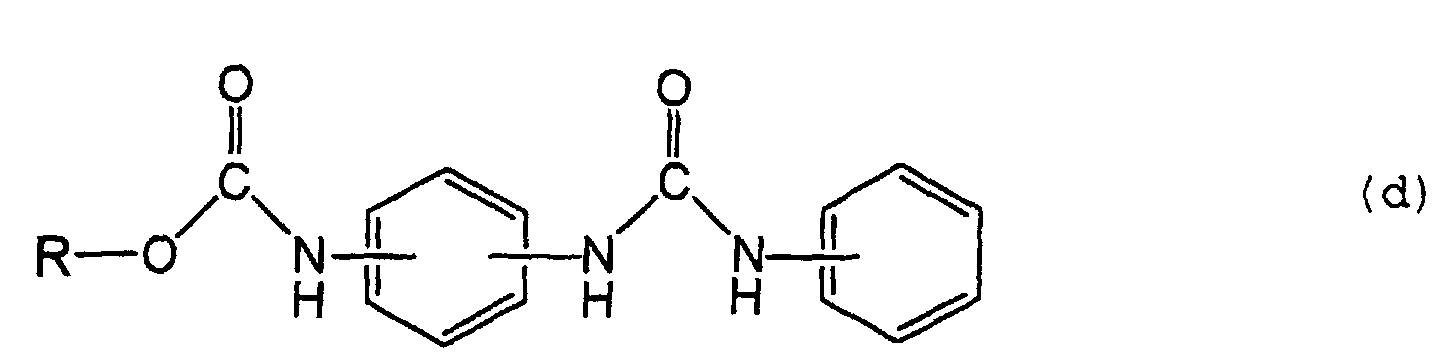

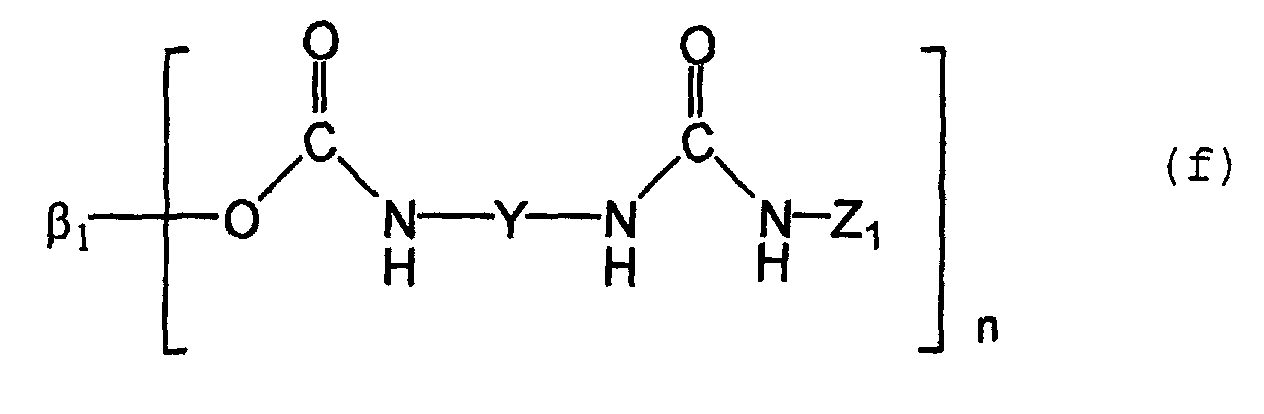

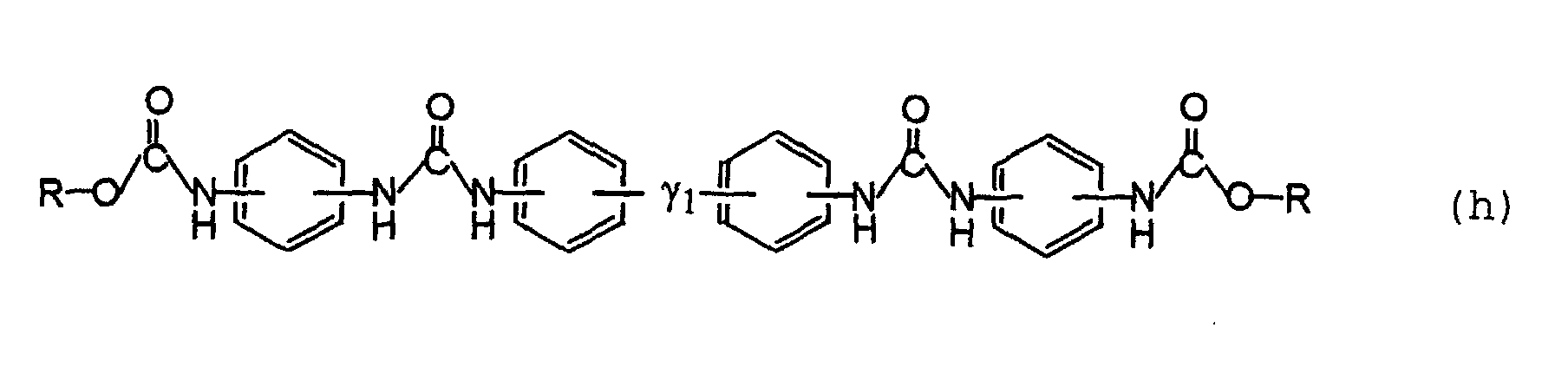

wherein the polyisocyanate compound is an aromatic polyisocyanate compound.
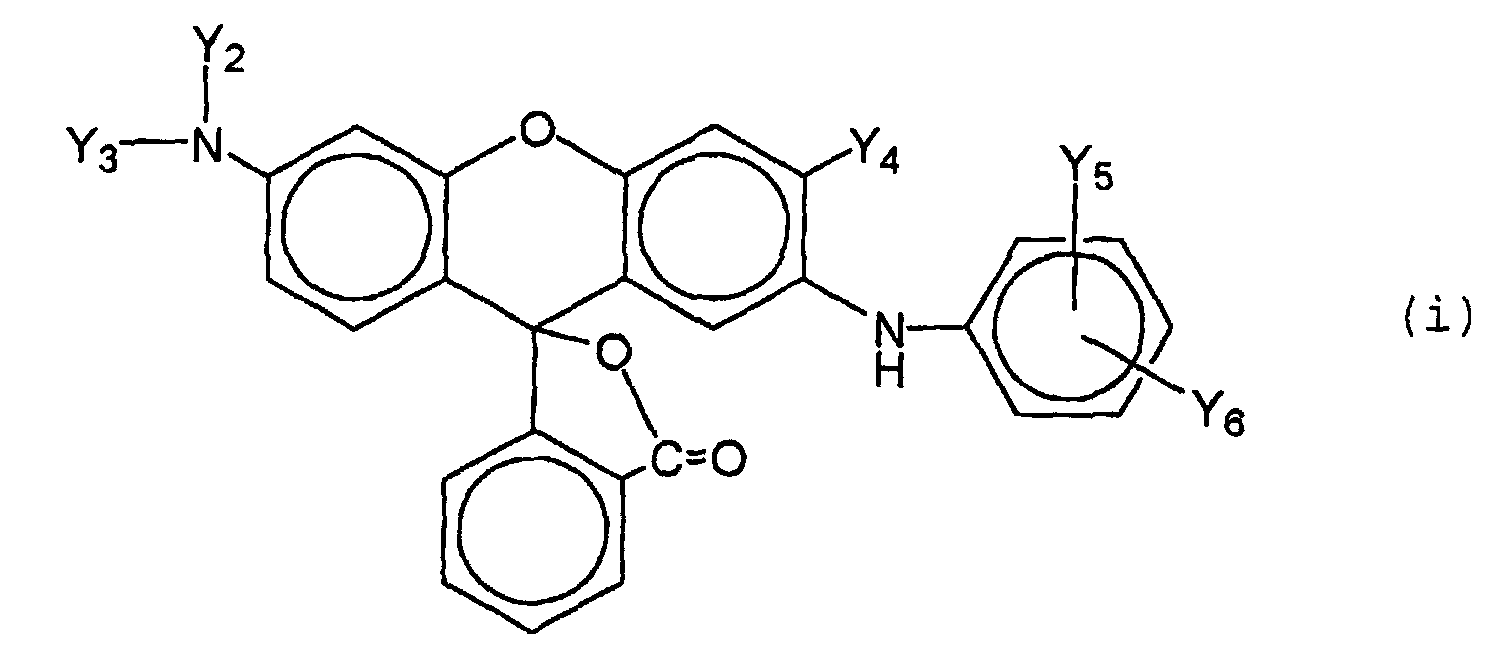


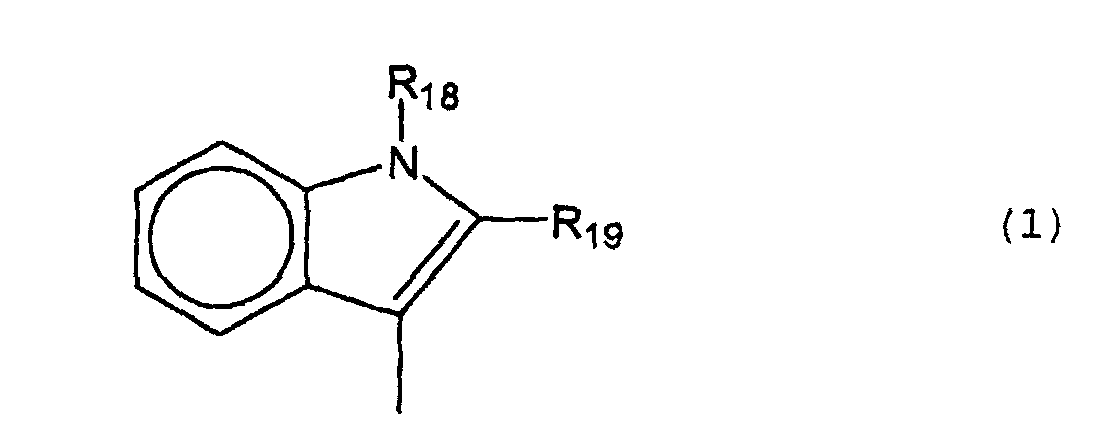



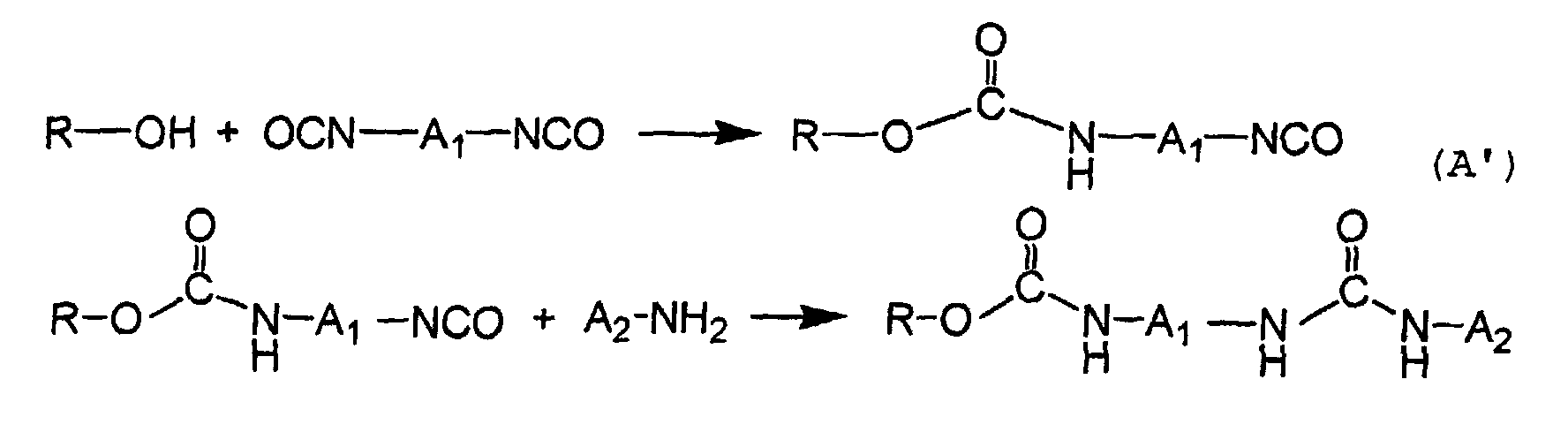
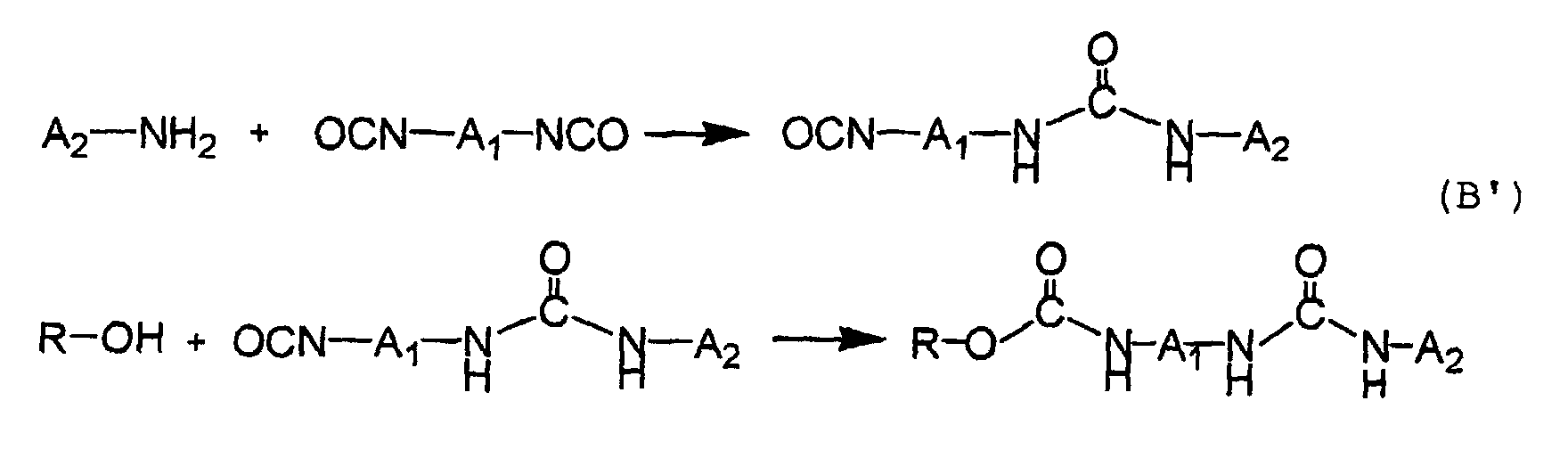
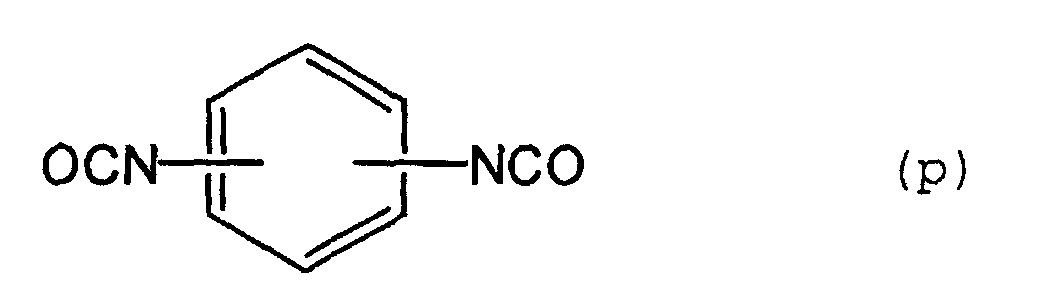
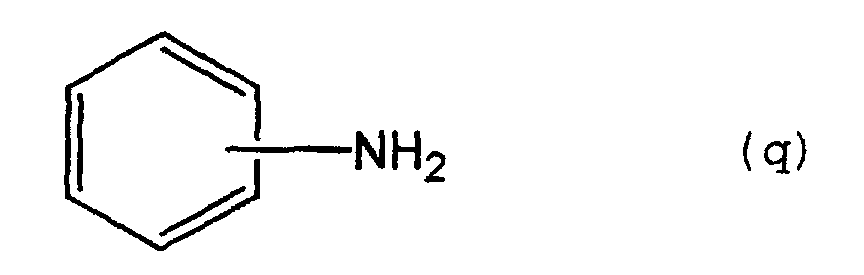


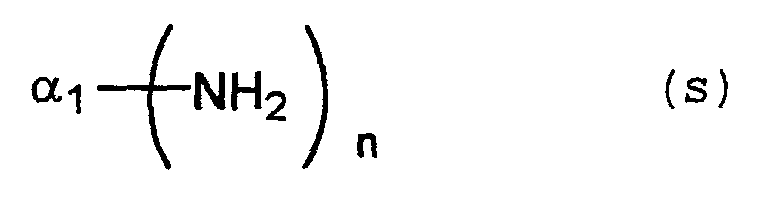
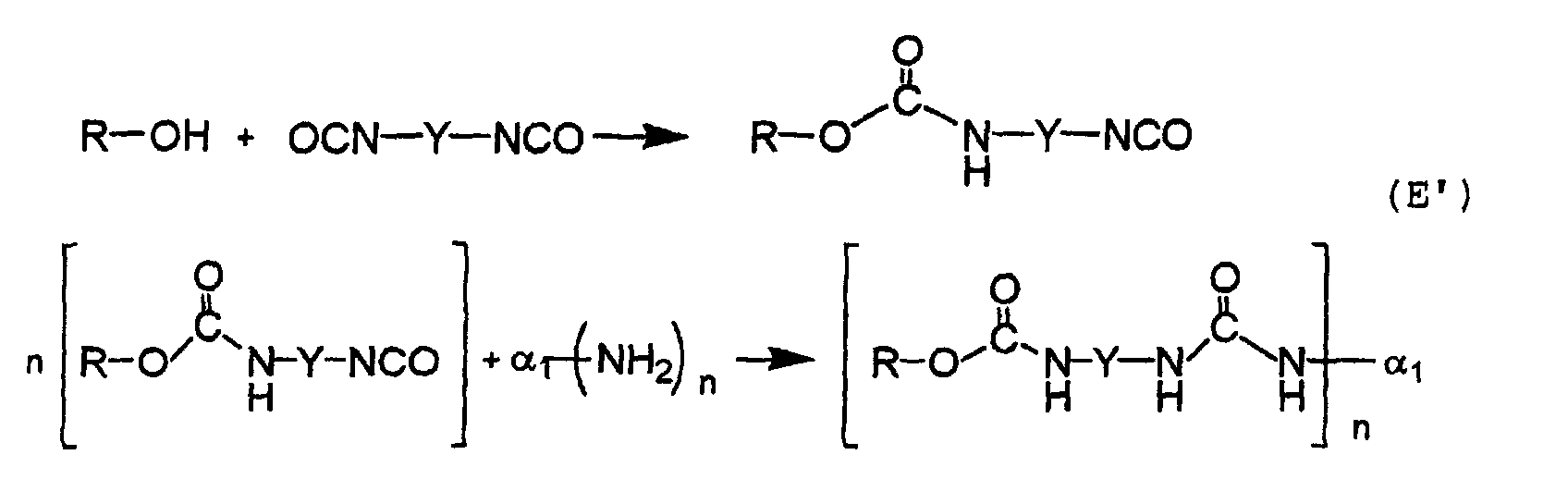
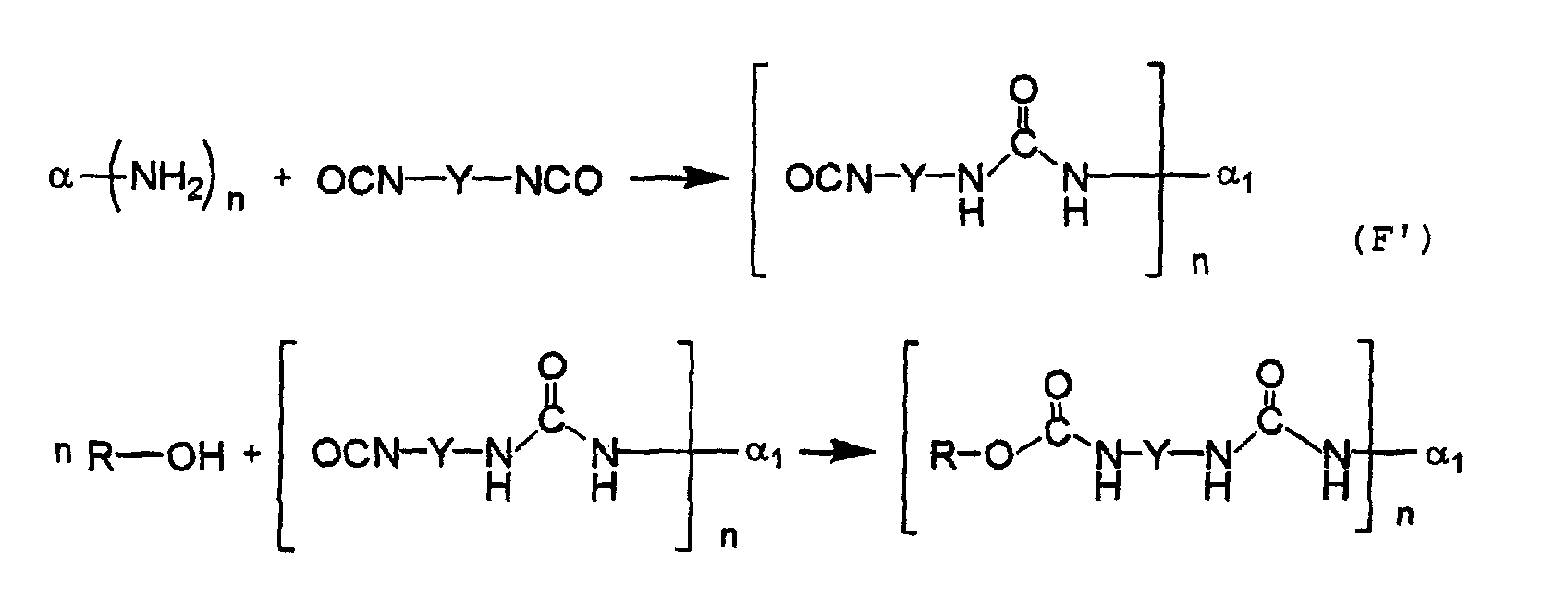

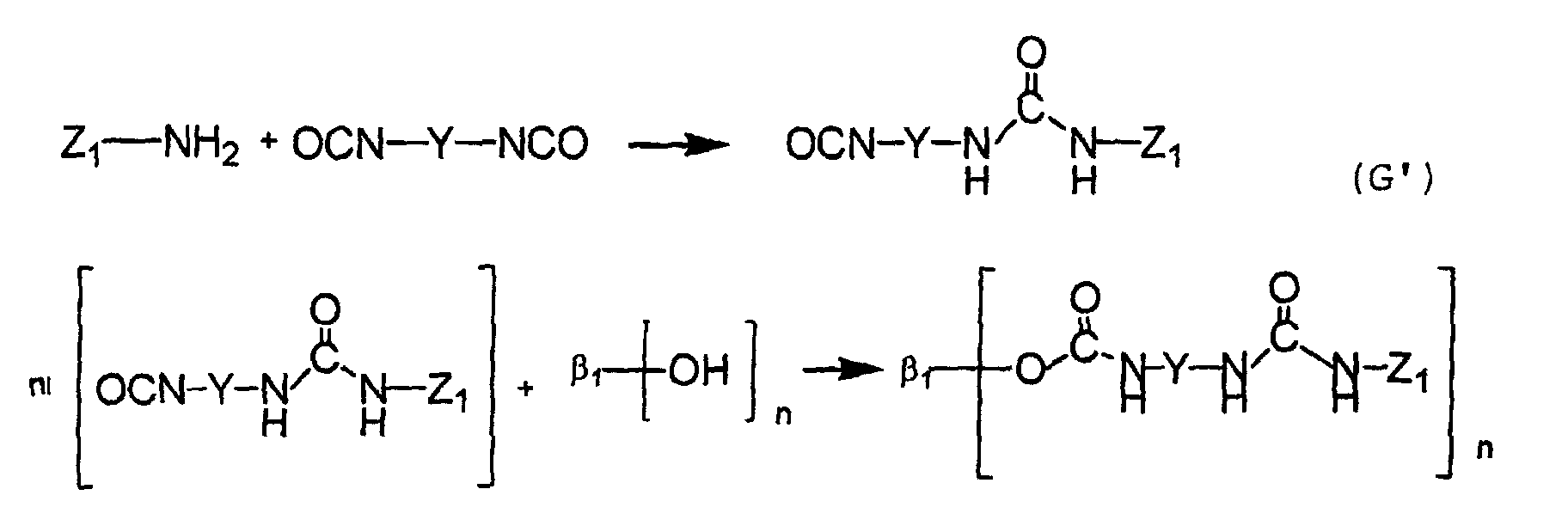
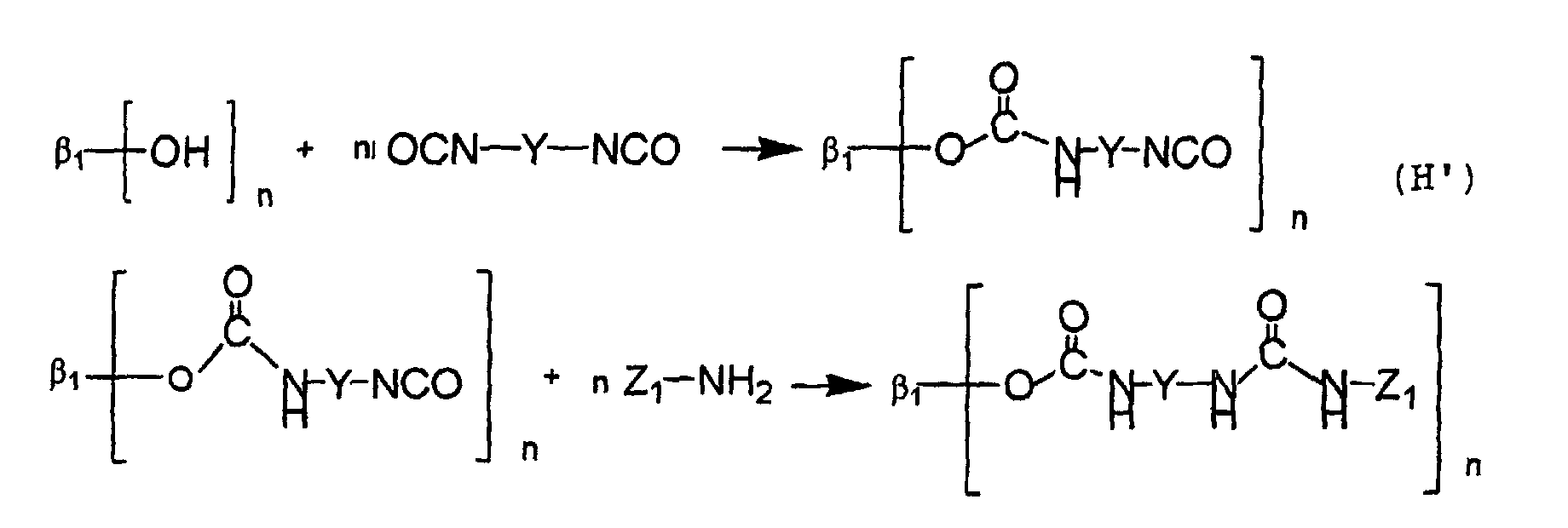
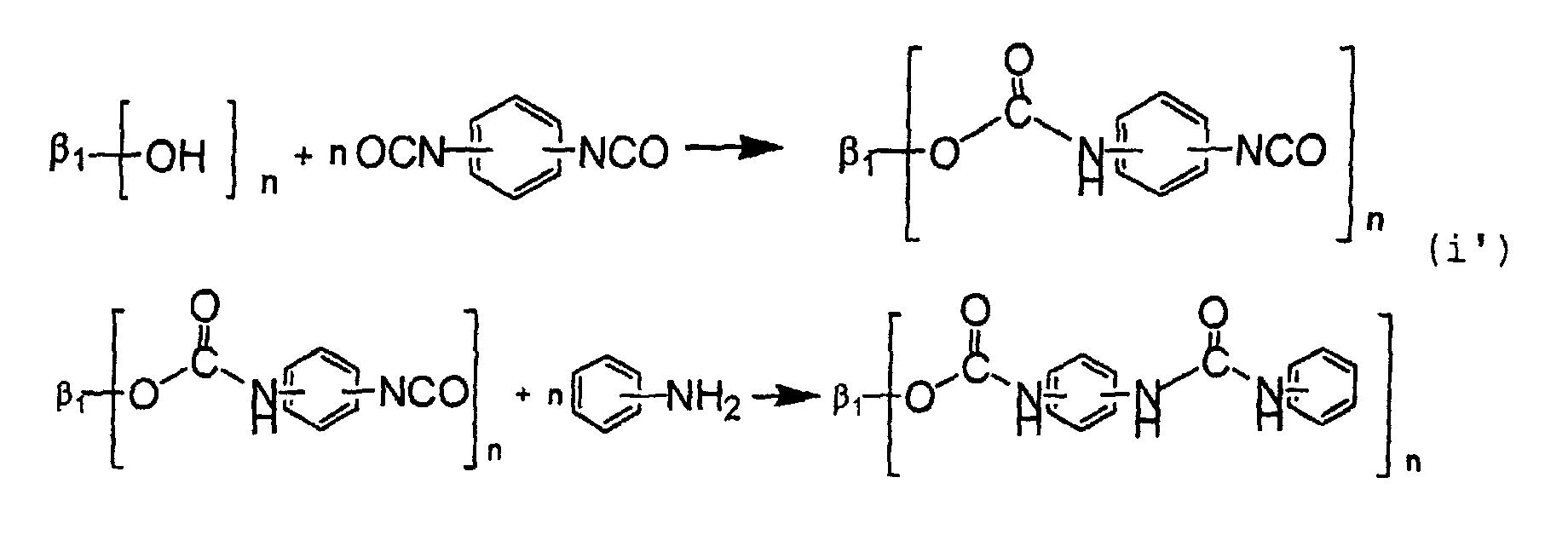
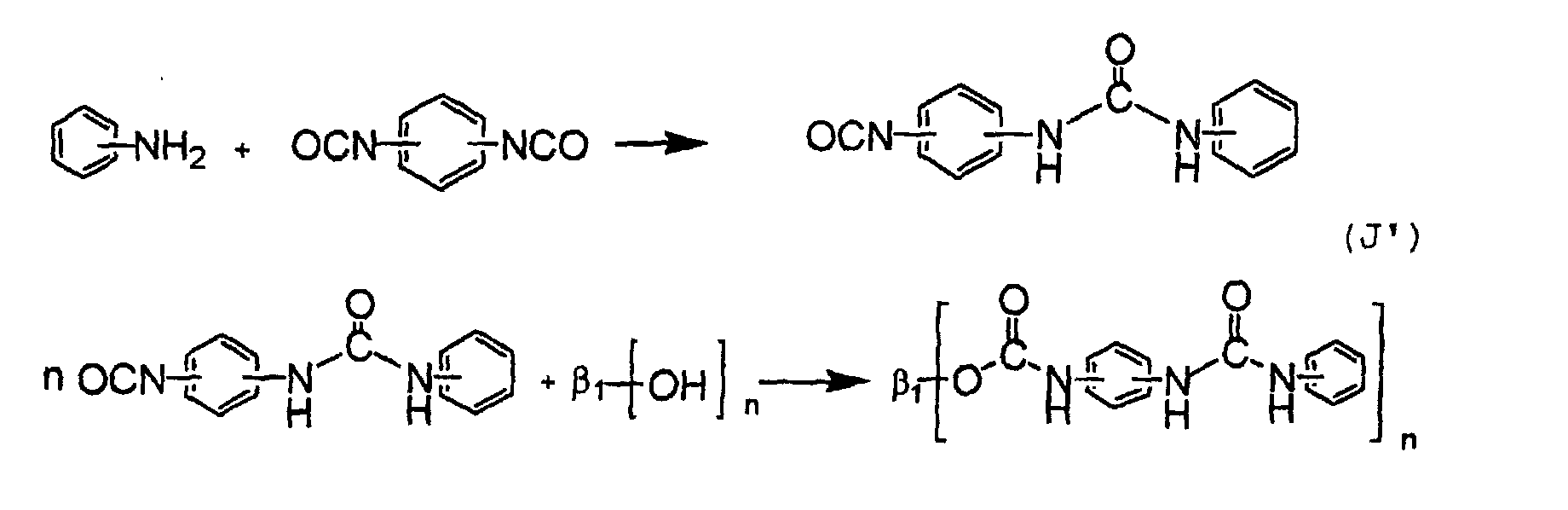
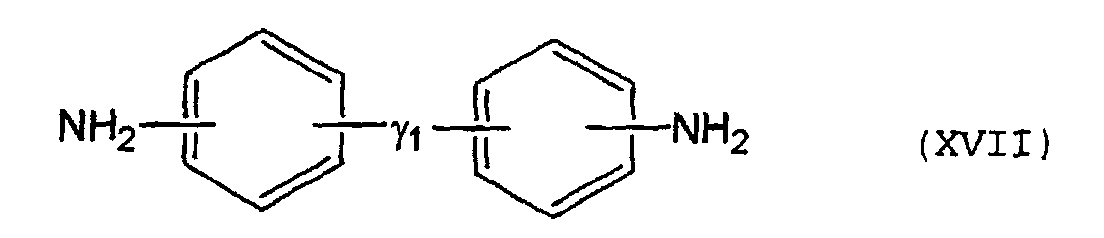

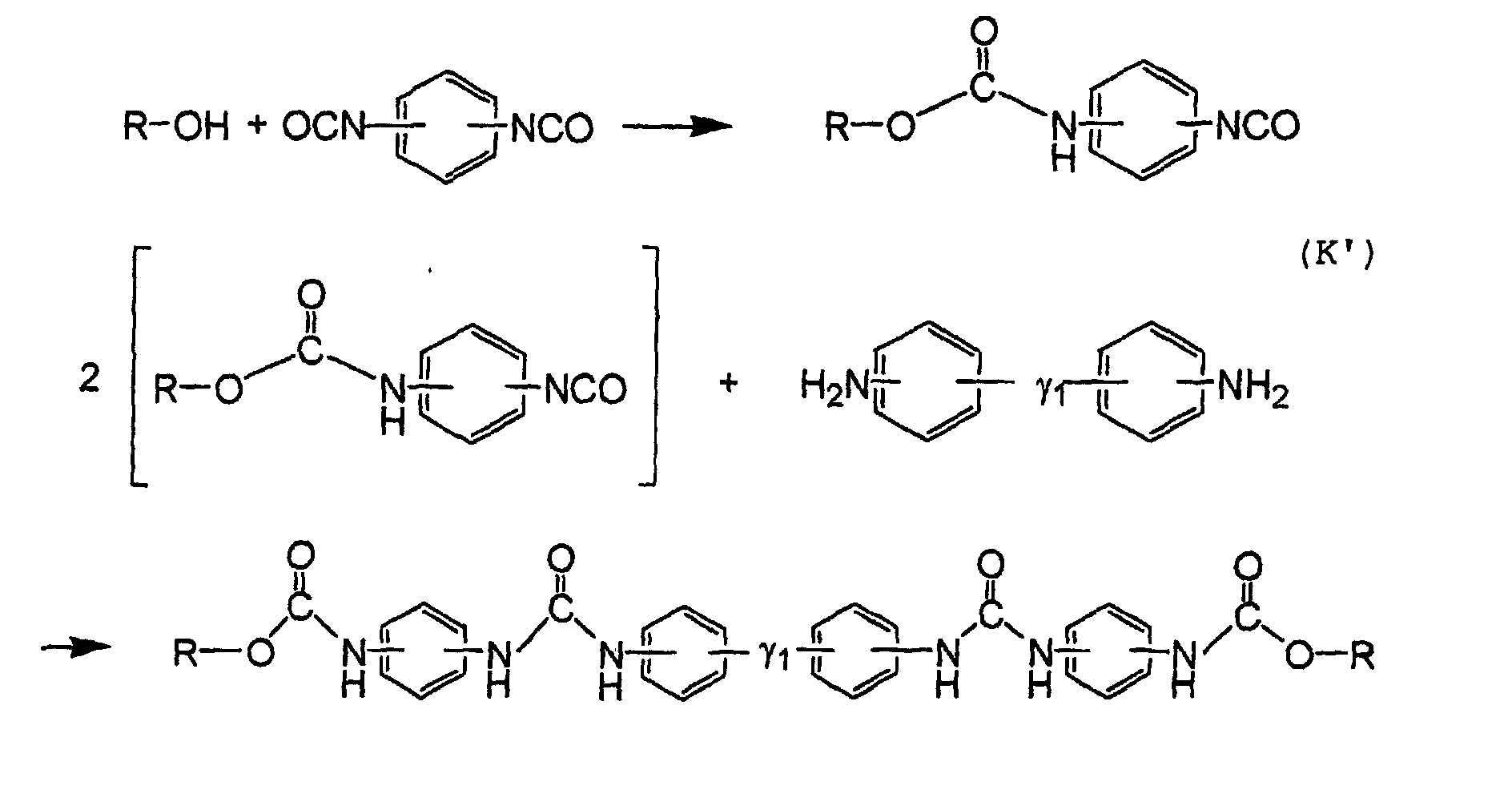
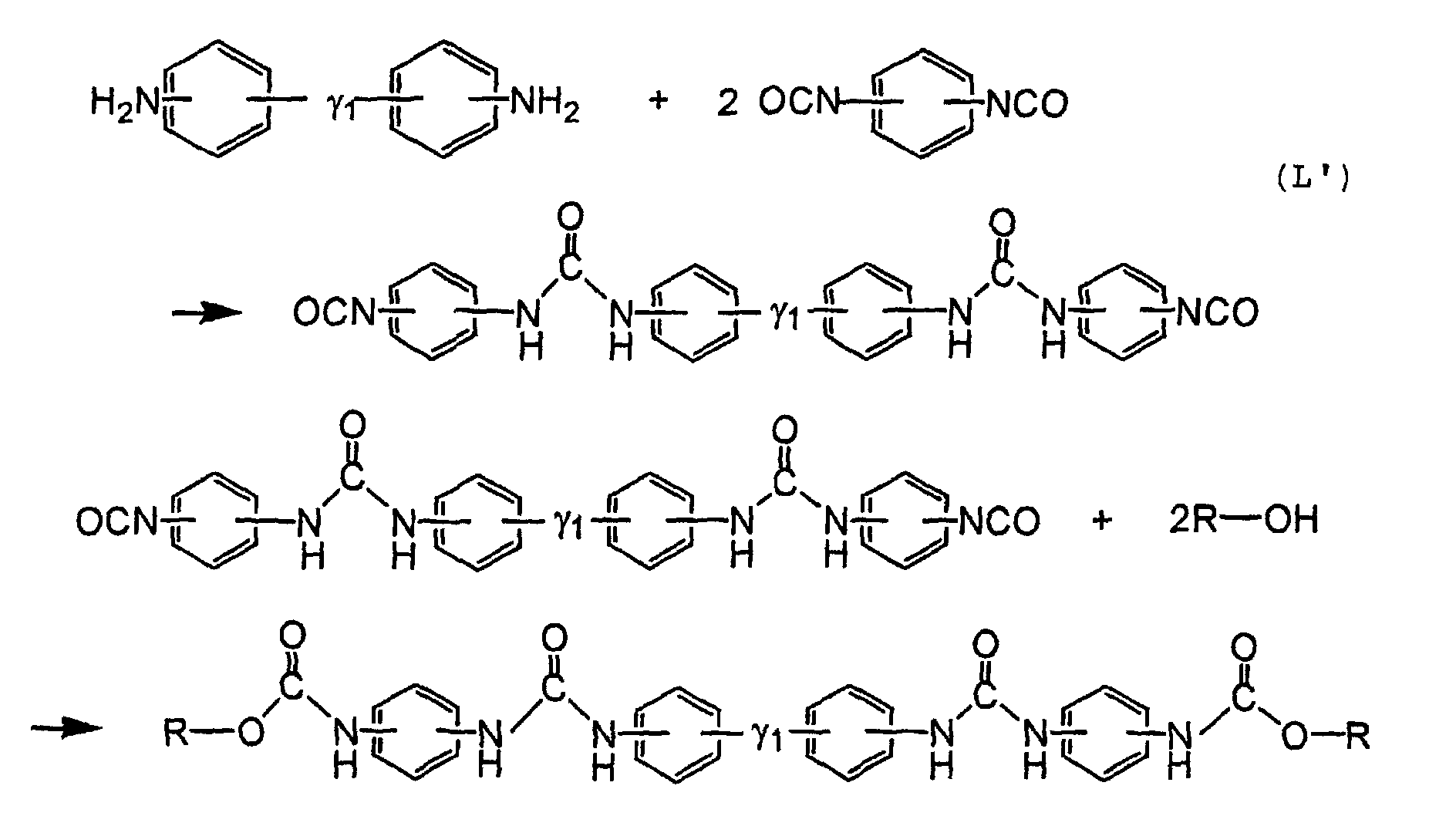


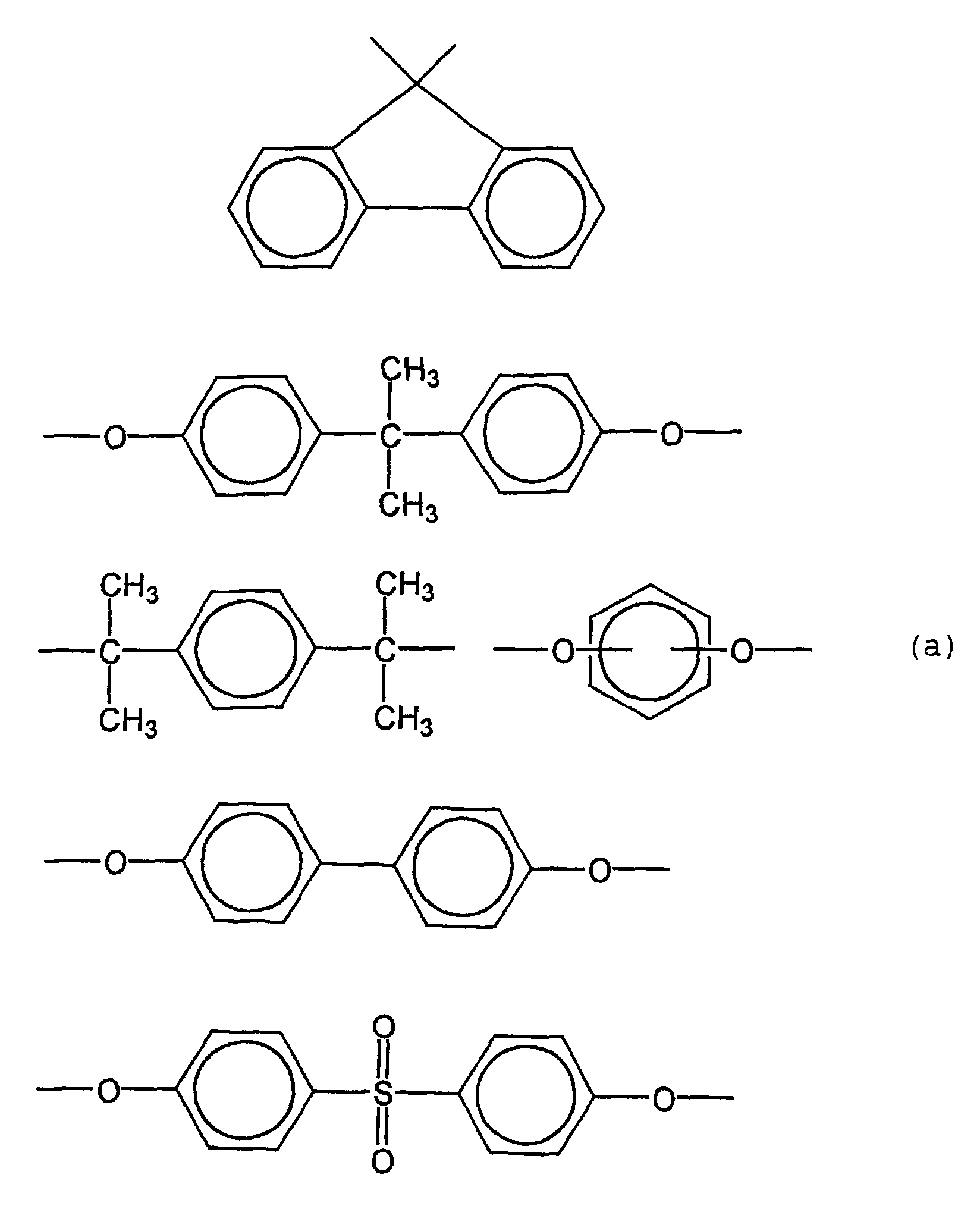
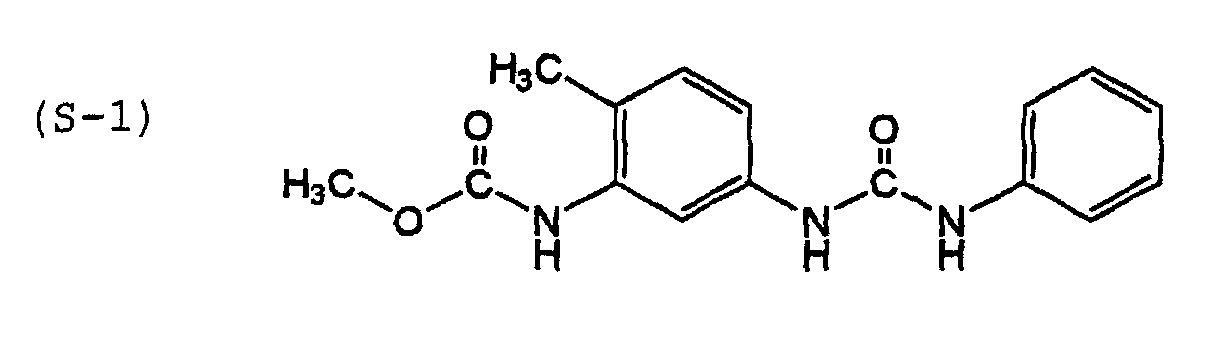
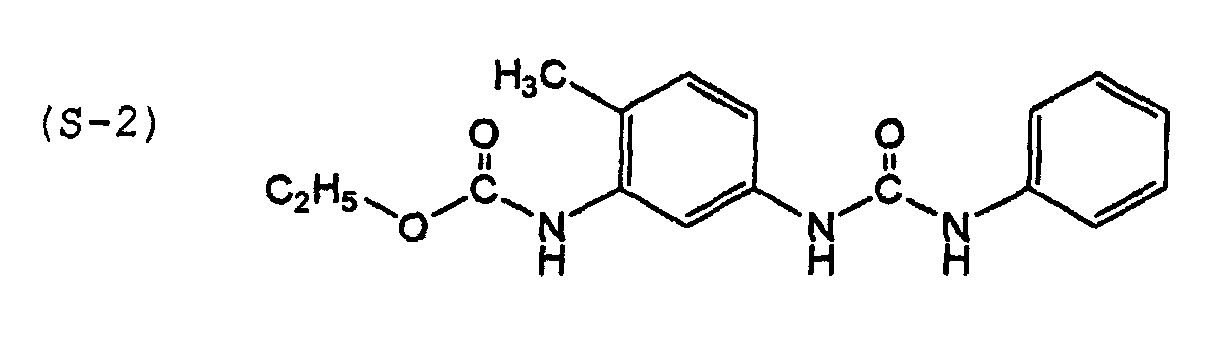

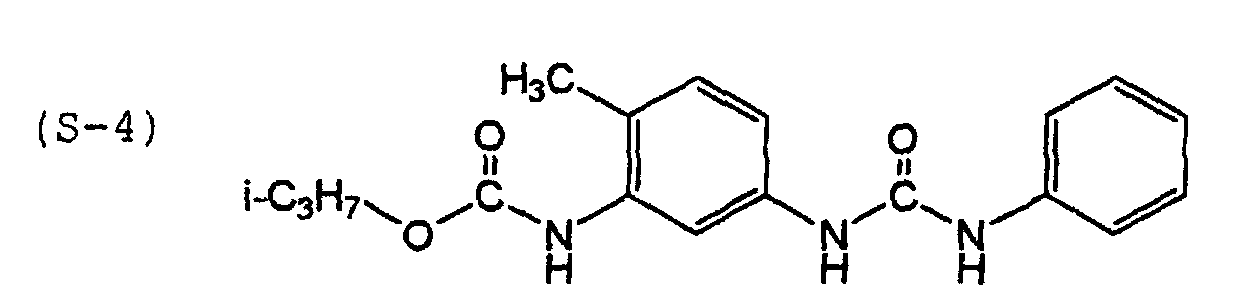


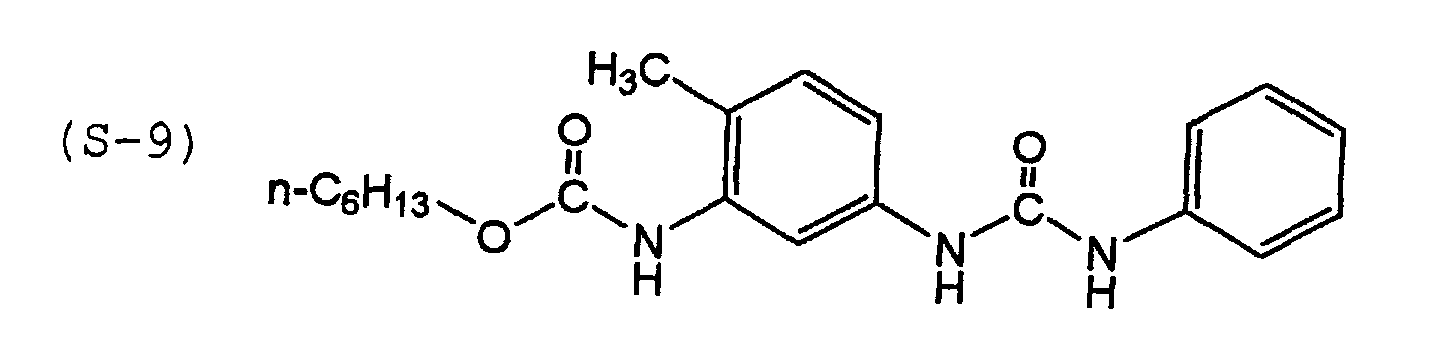
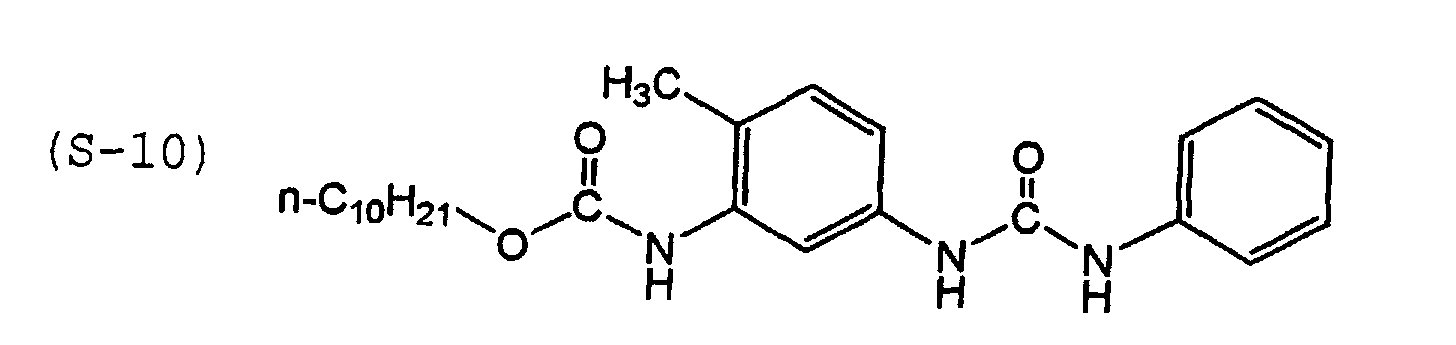


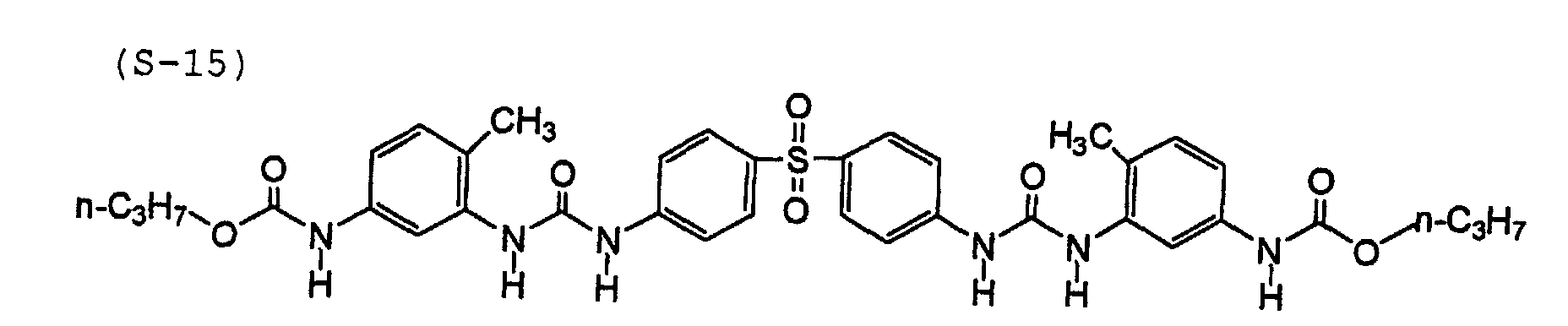

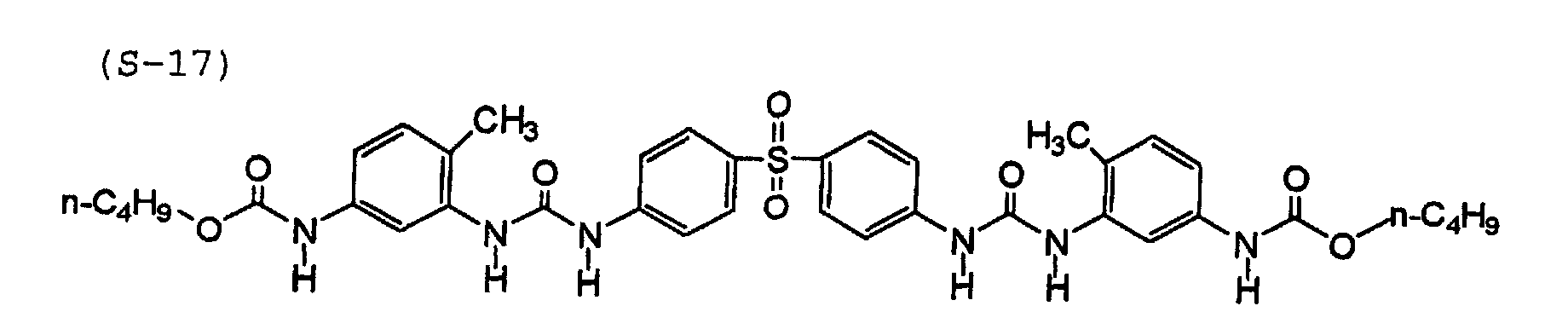
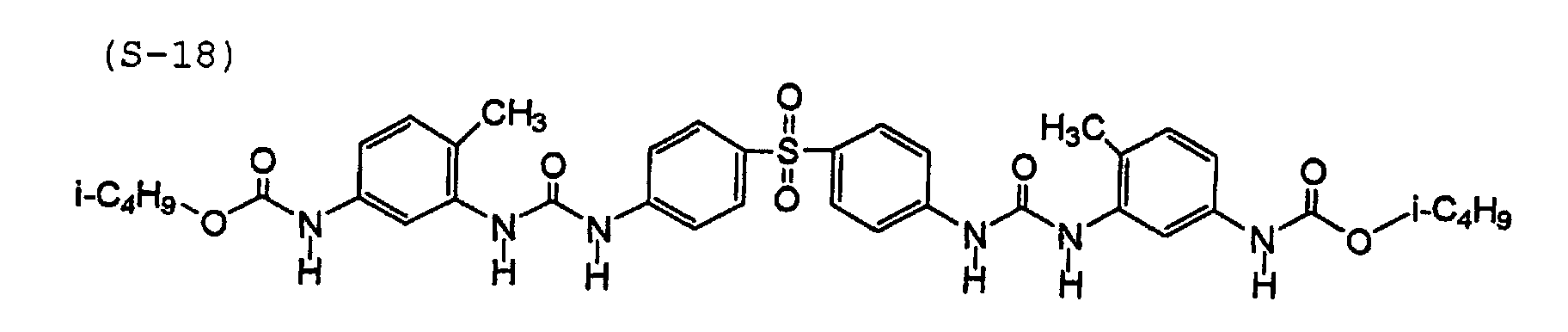
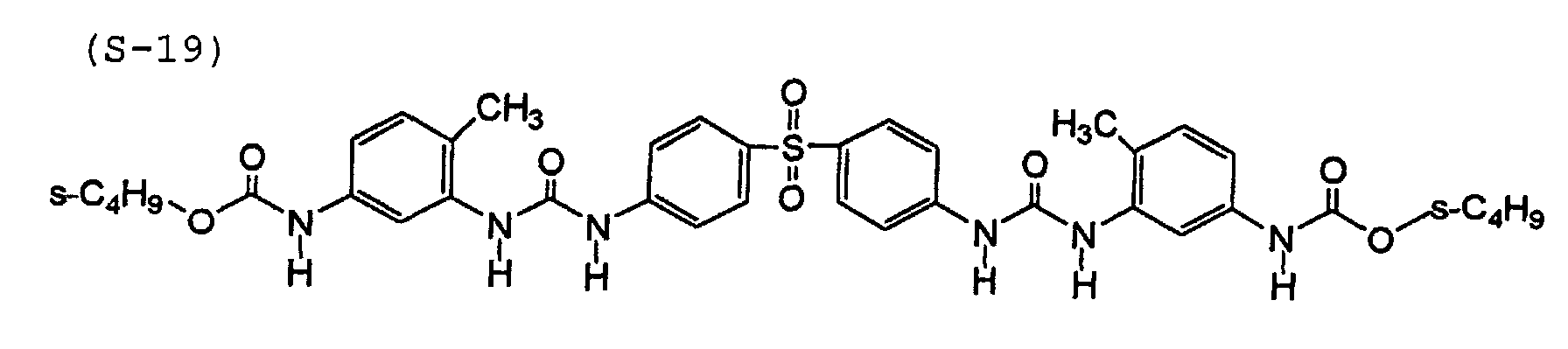


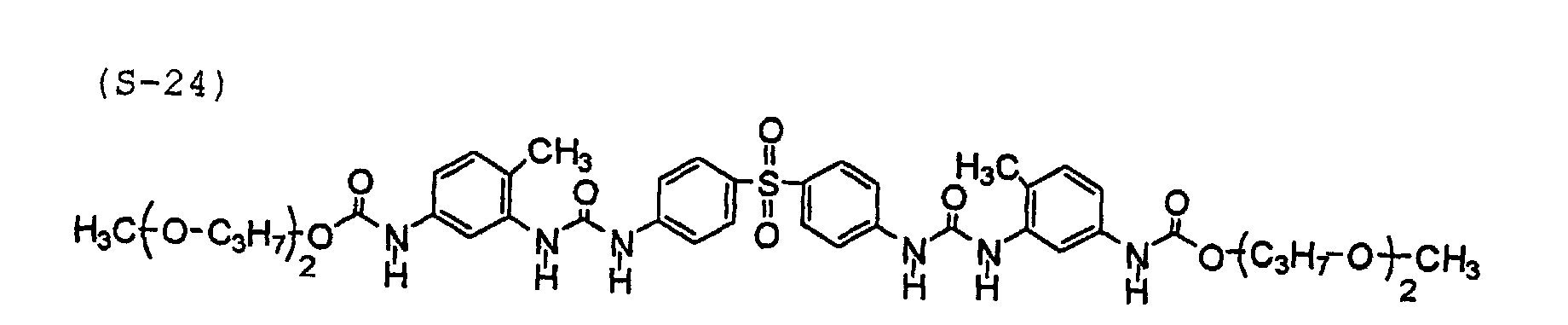
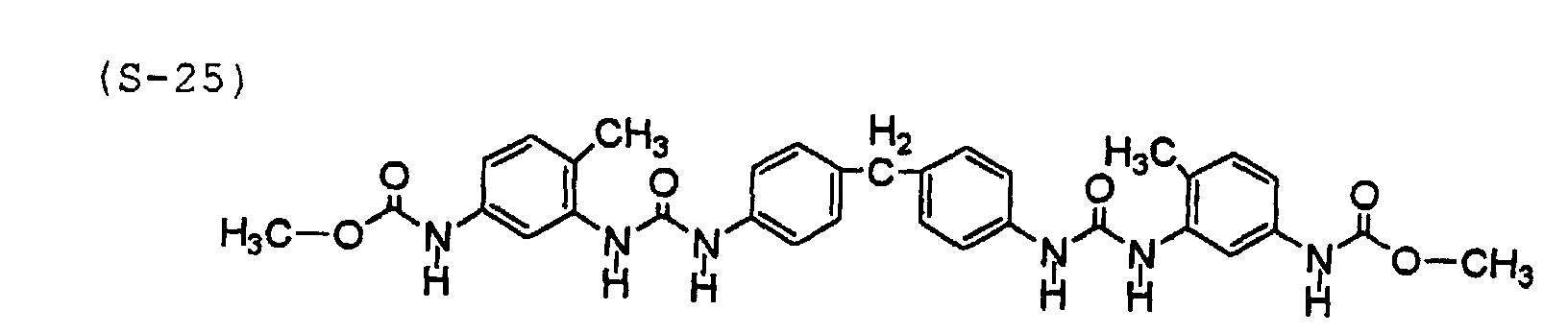
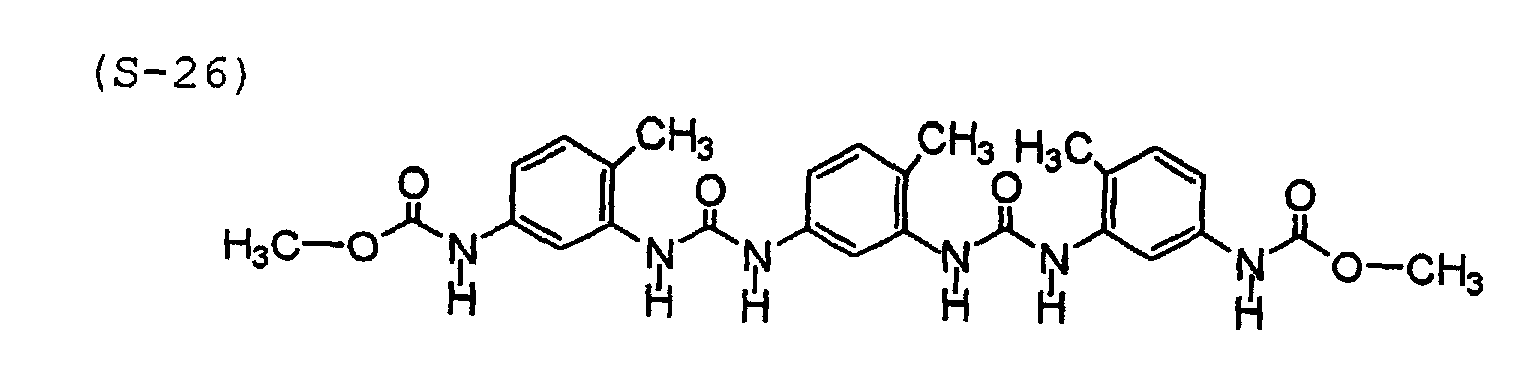
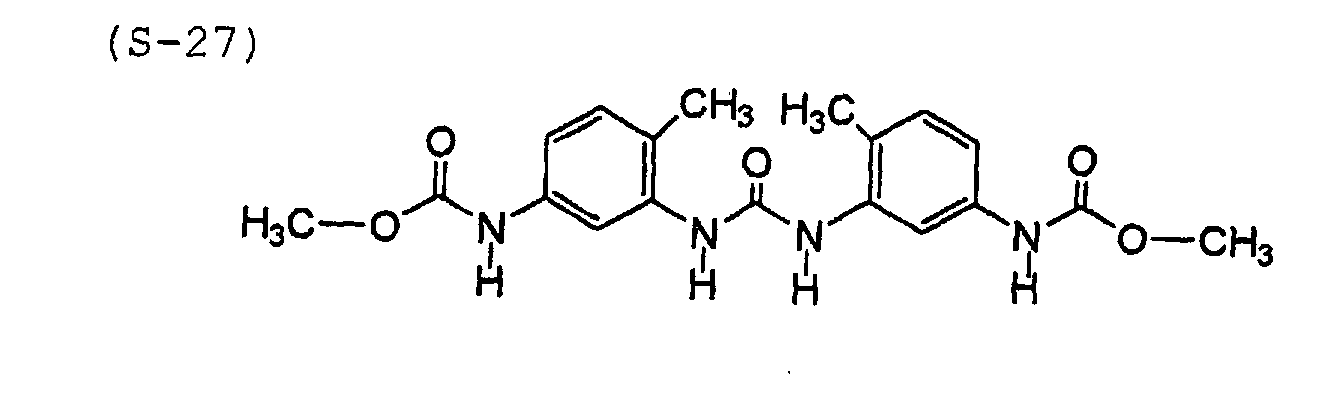
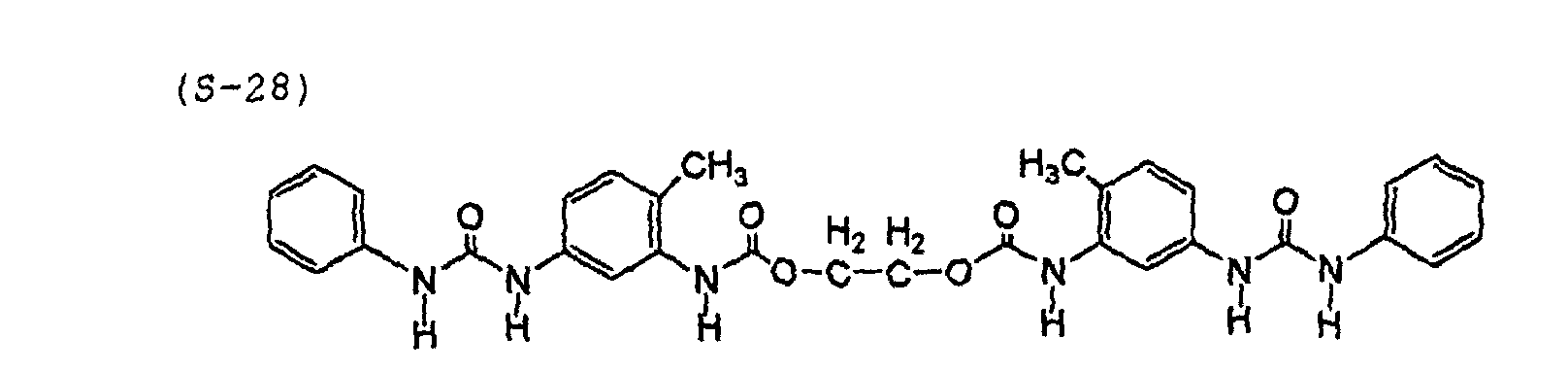
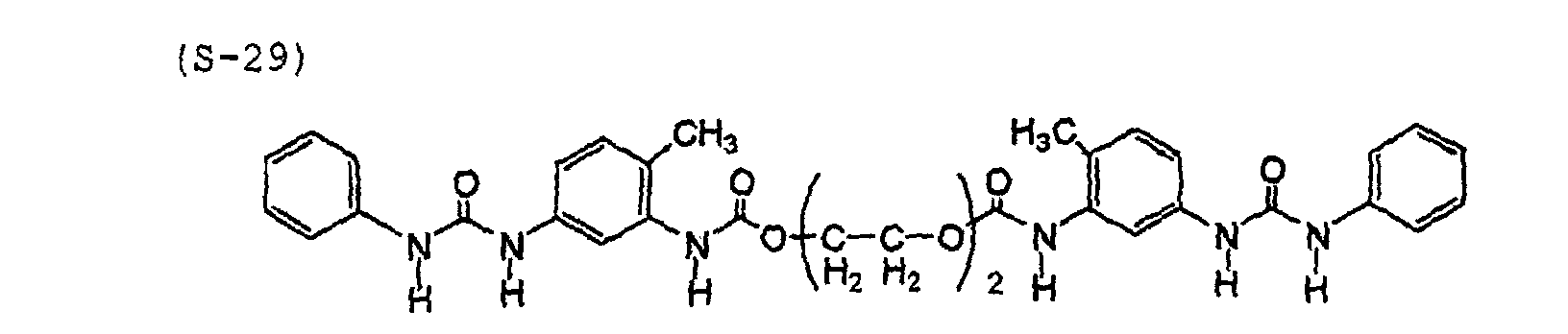
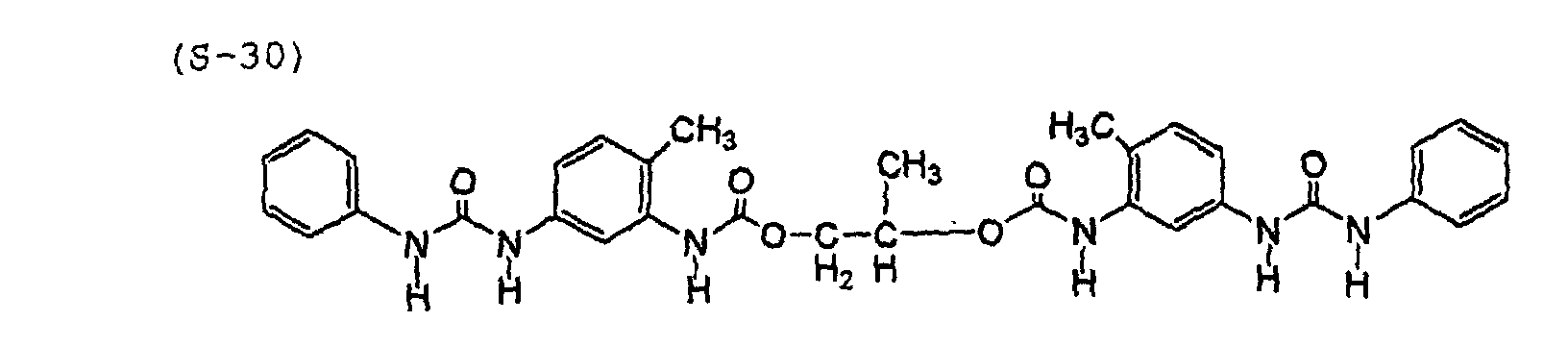
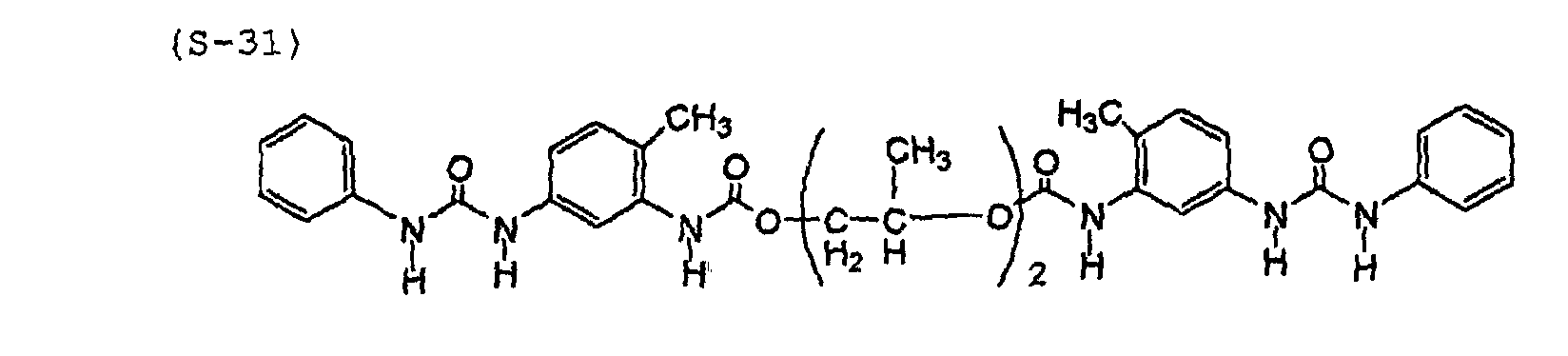
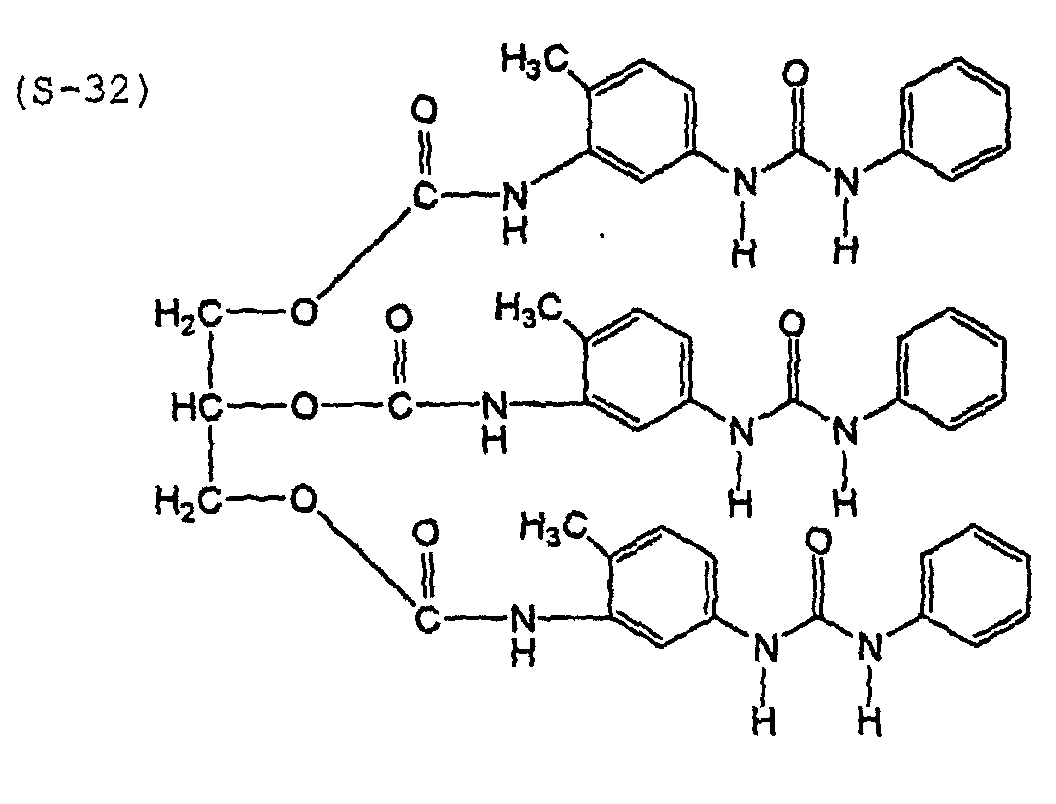
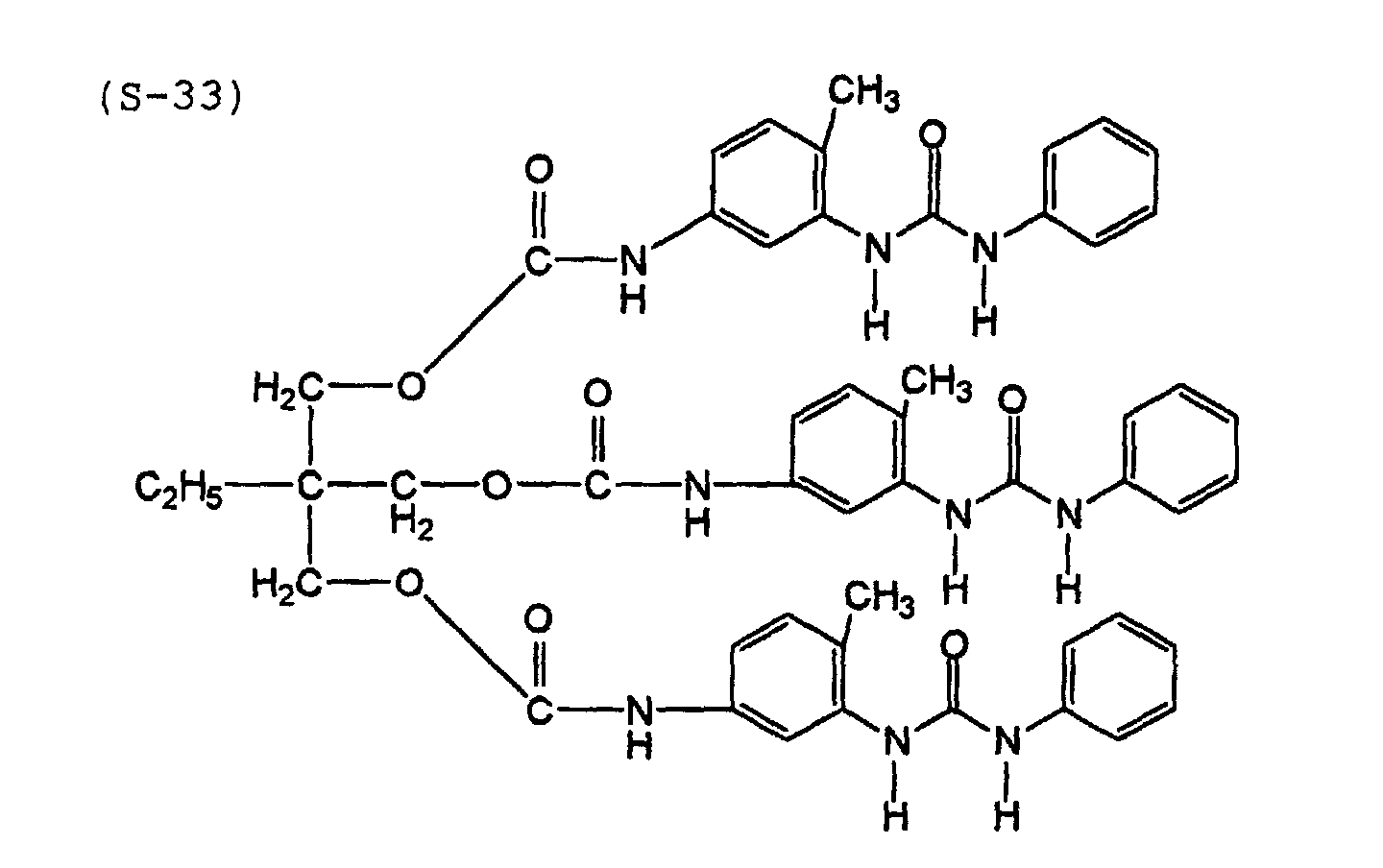
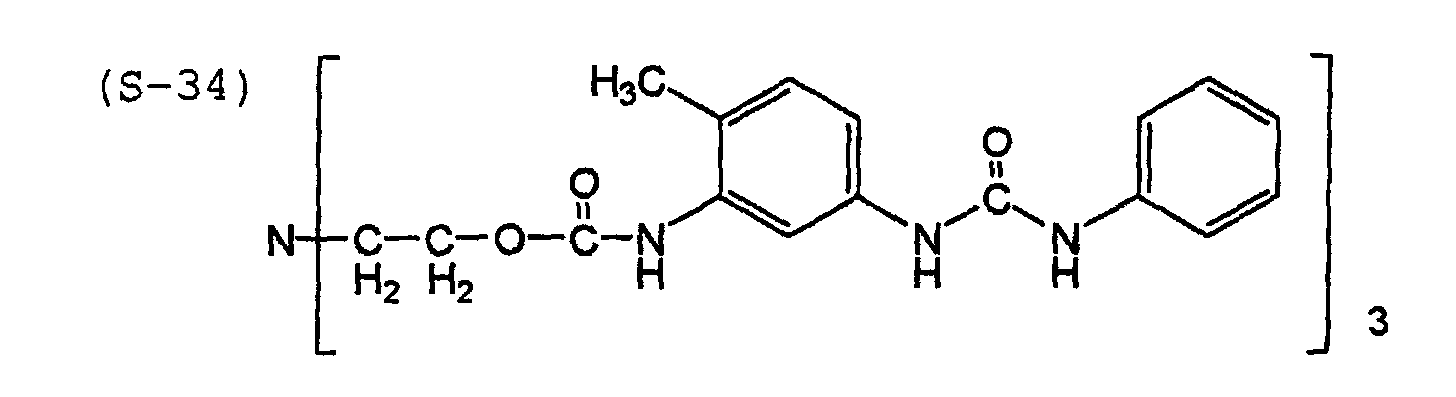

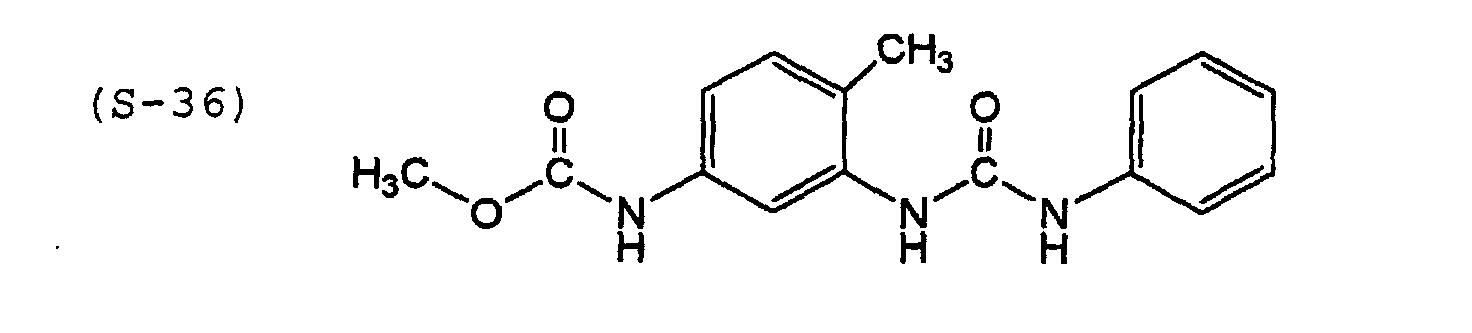


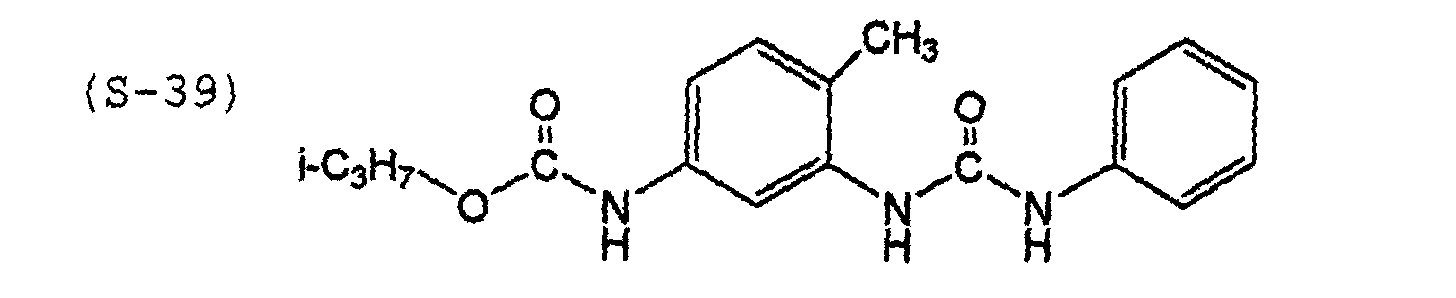
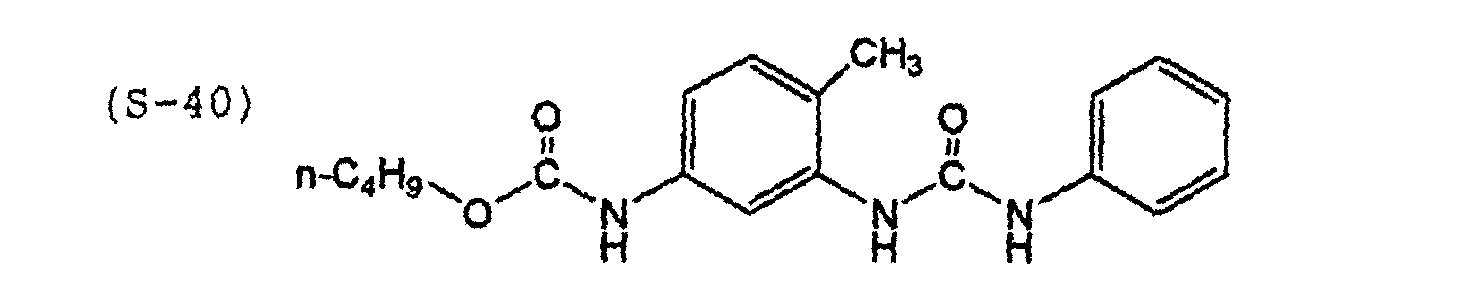

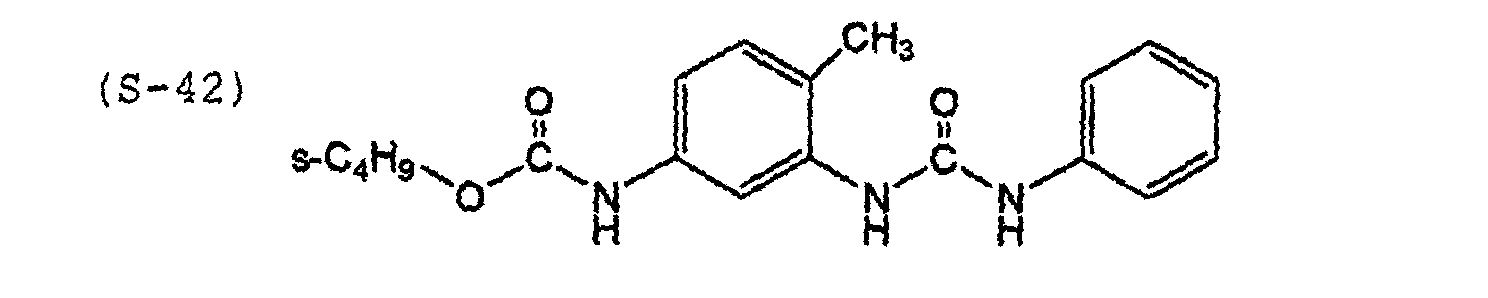

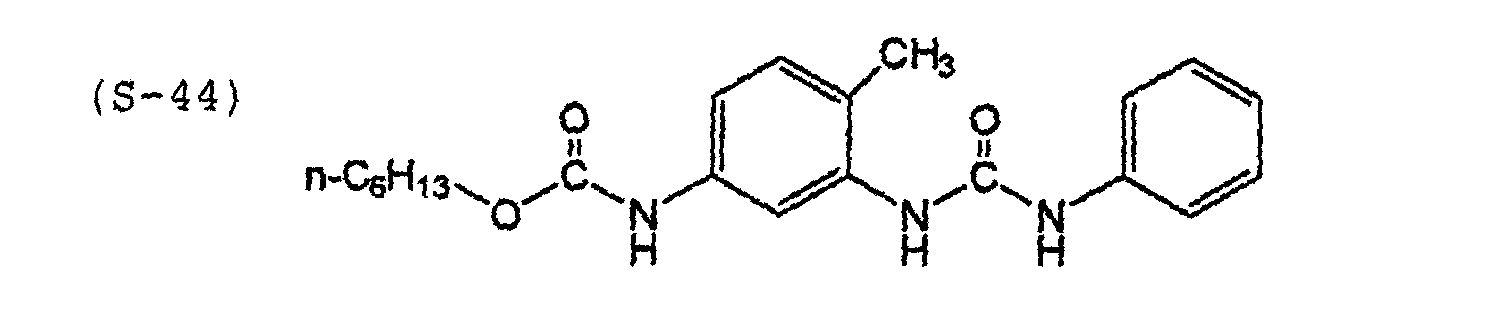

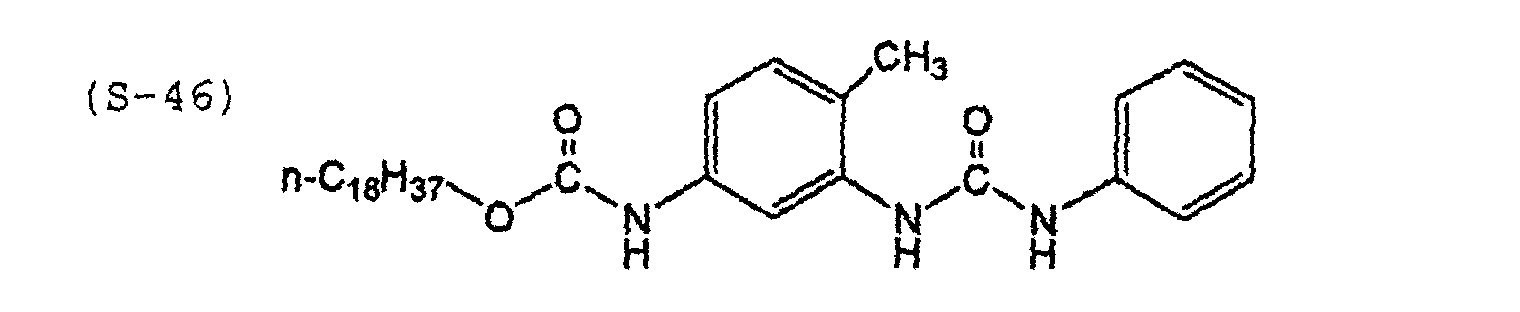

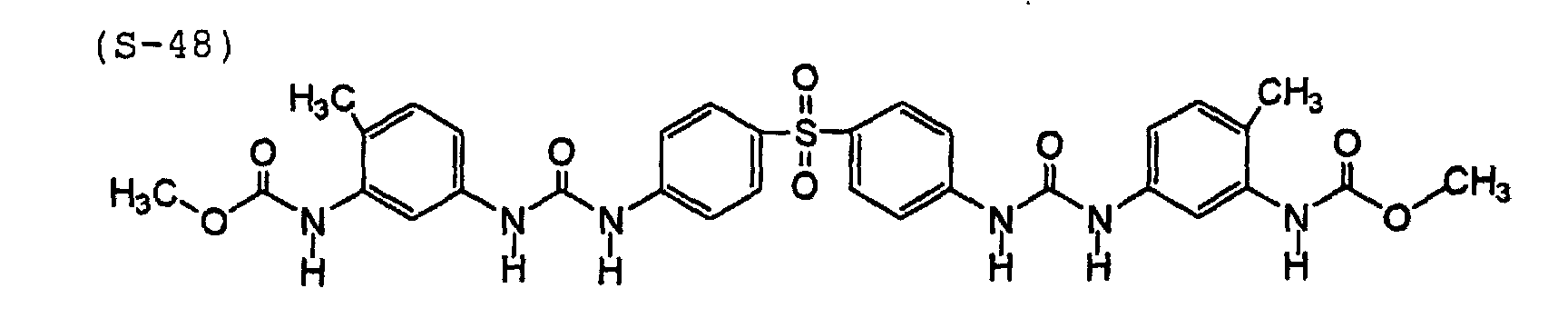


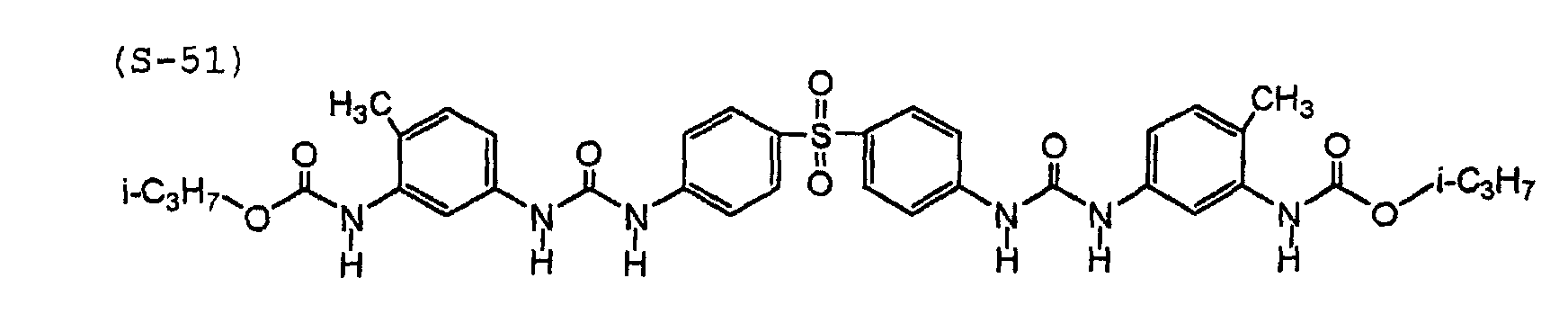


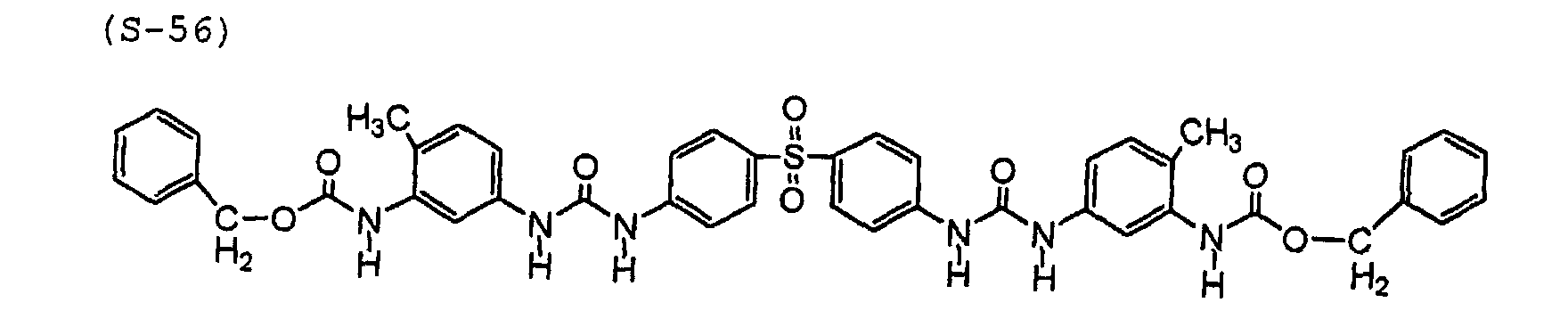


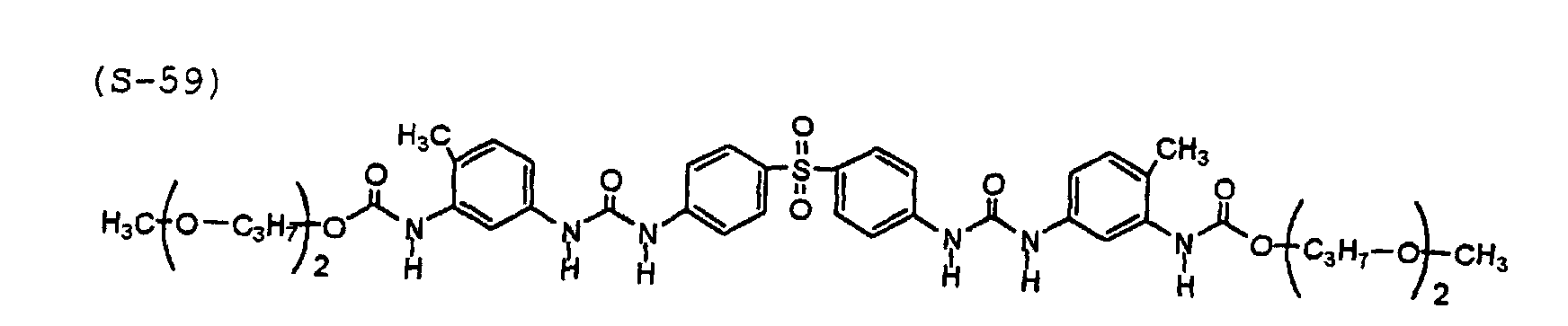
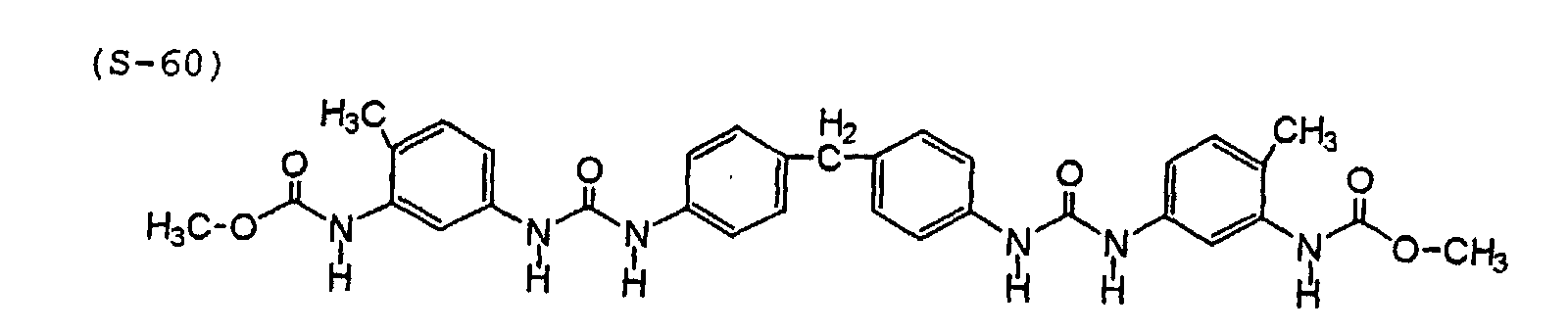

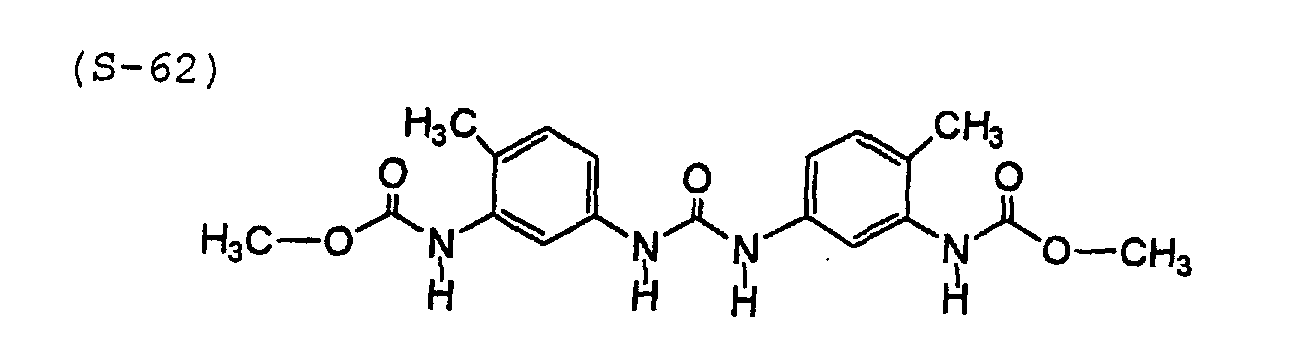
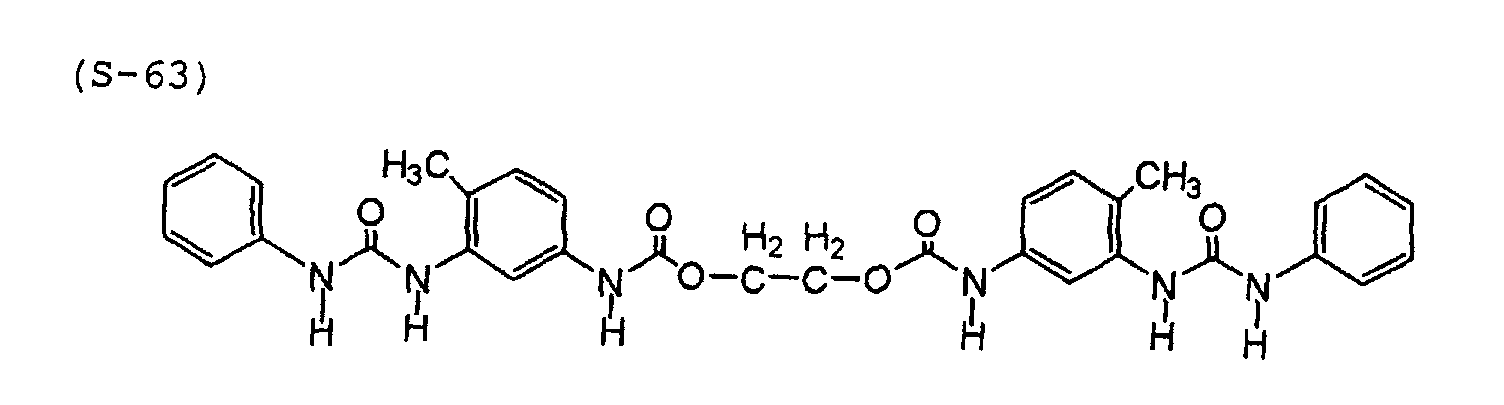


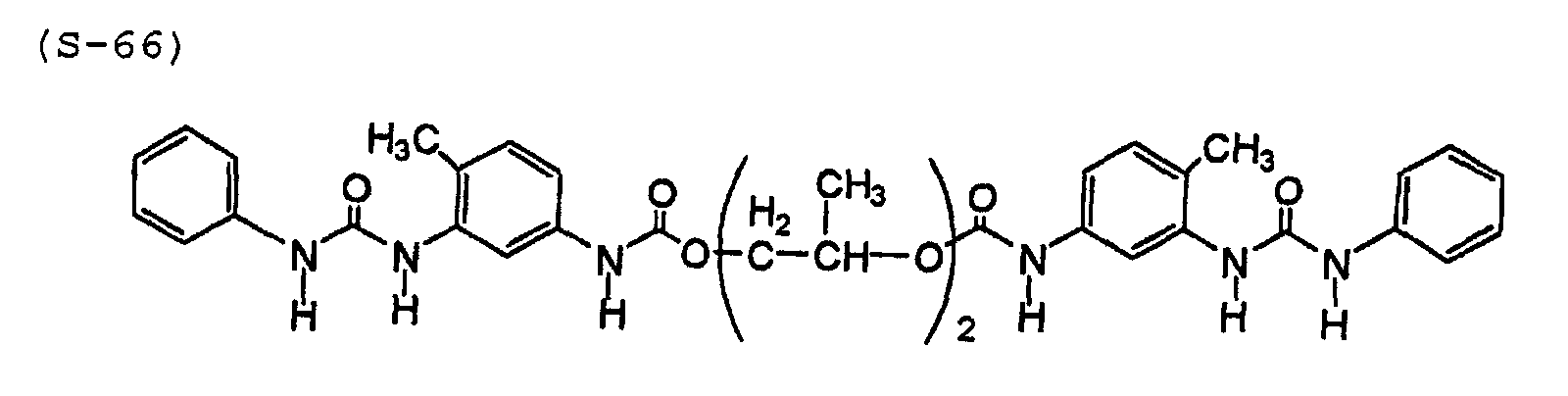
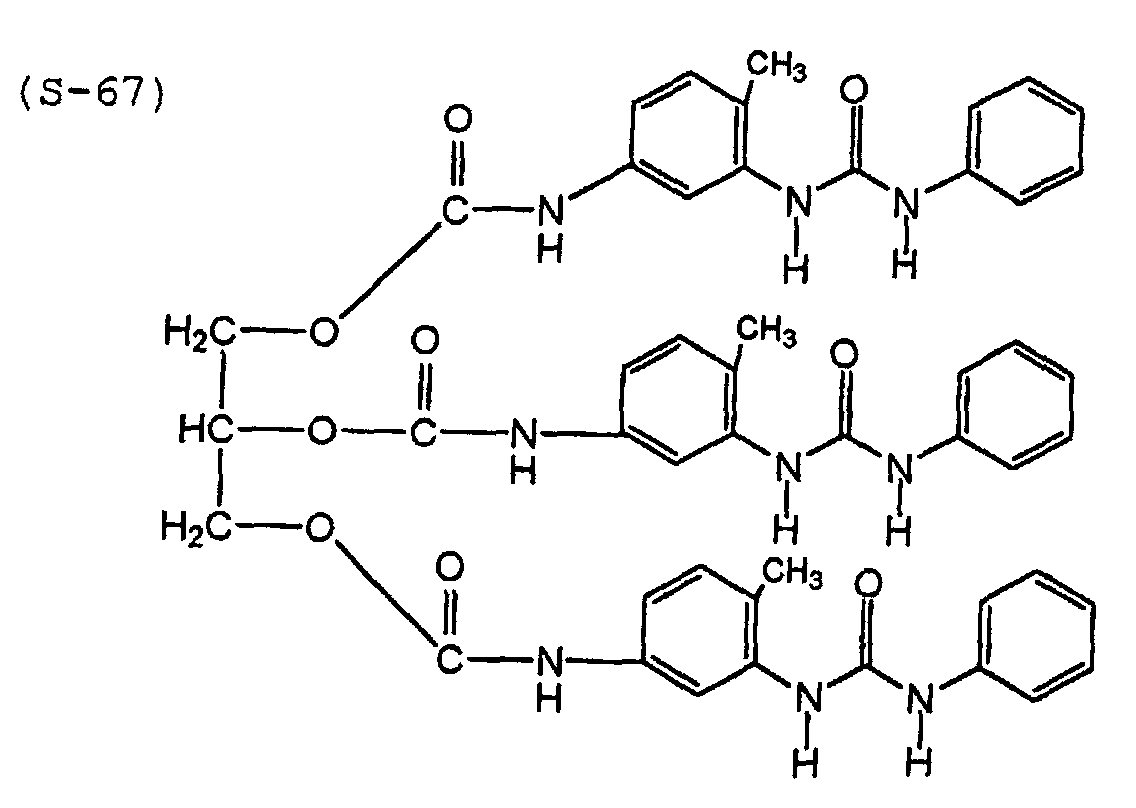


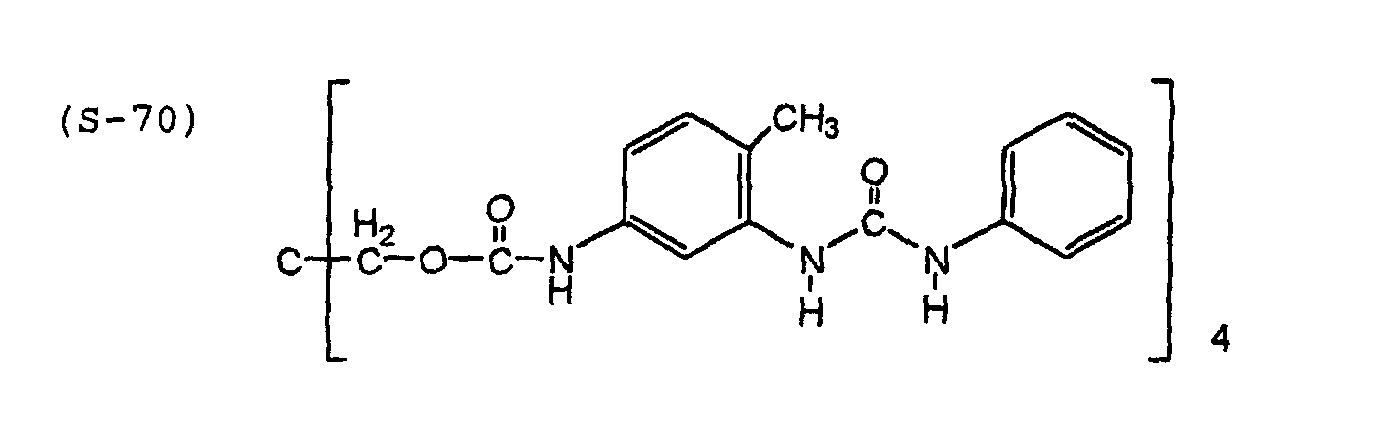

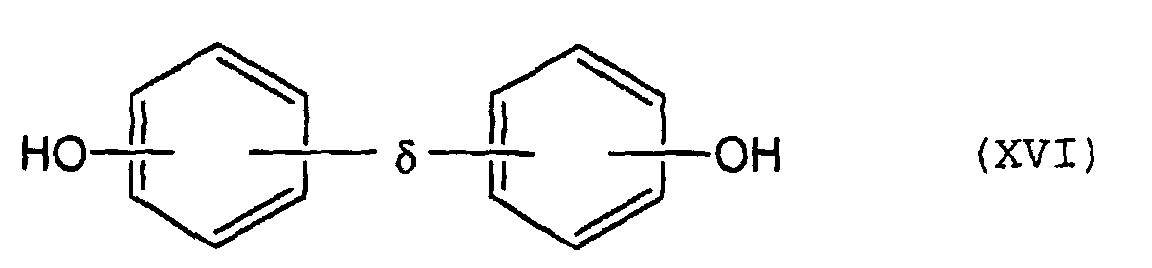
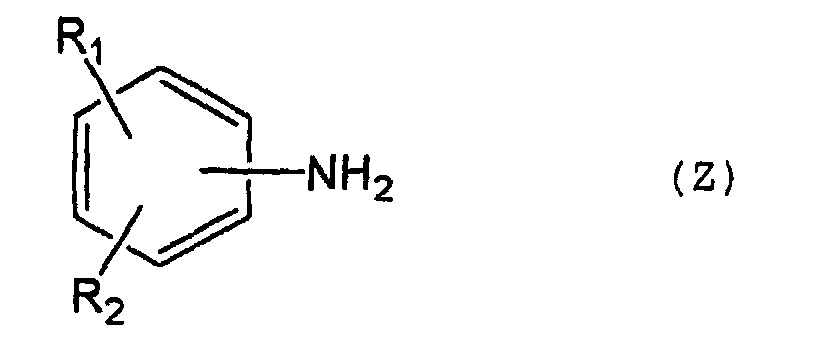

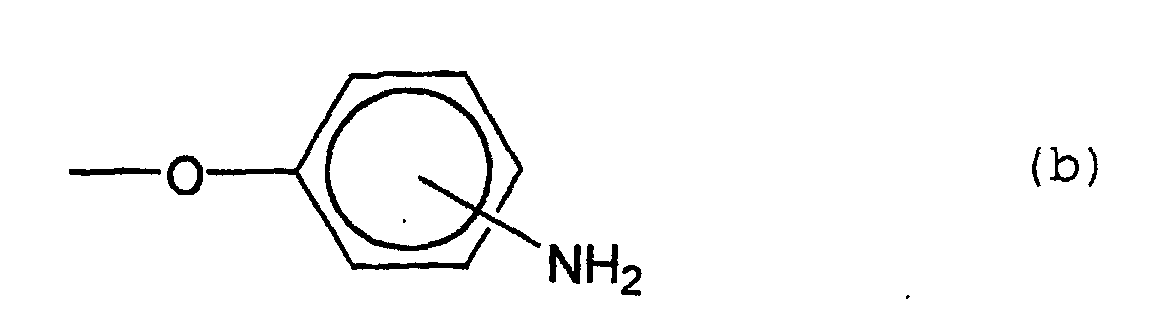


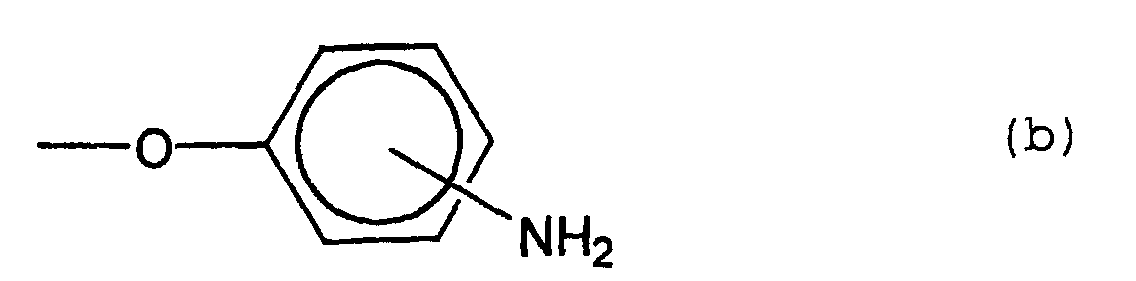
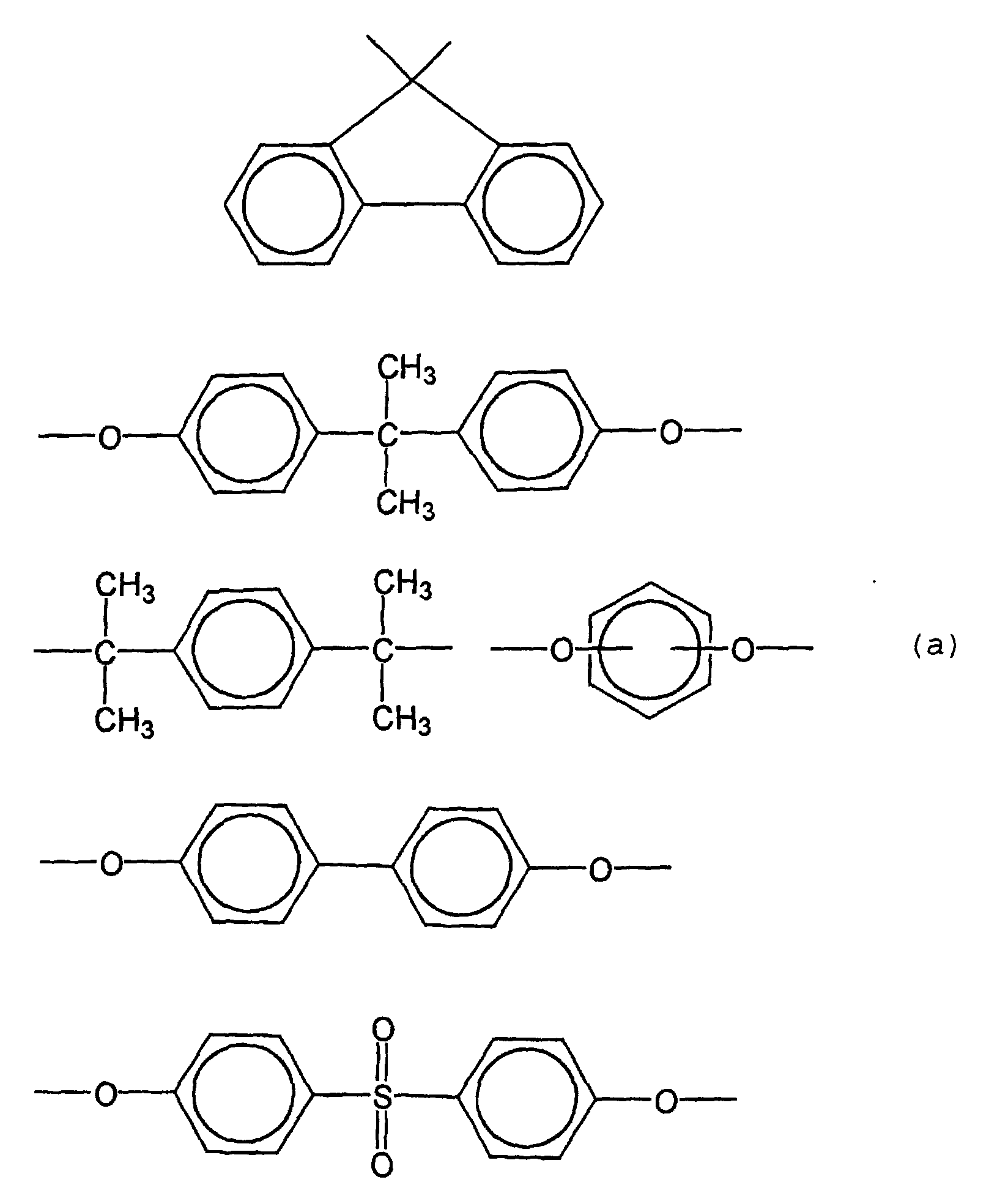


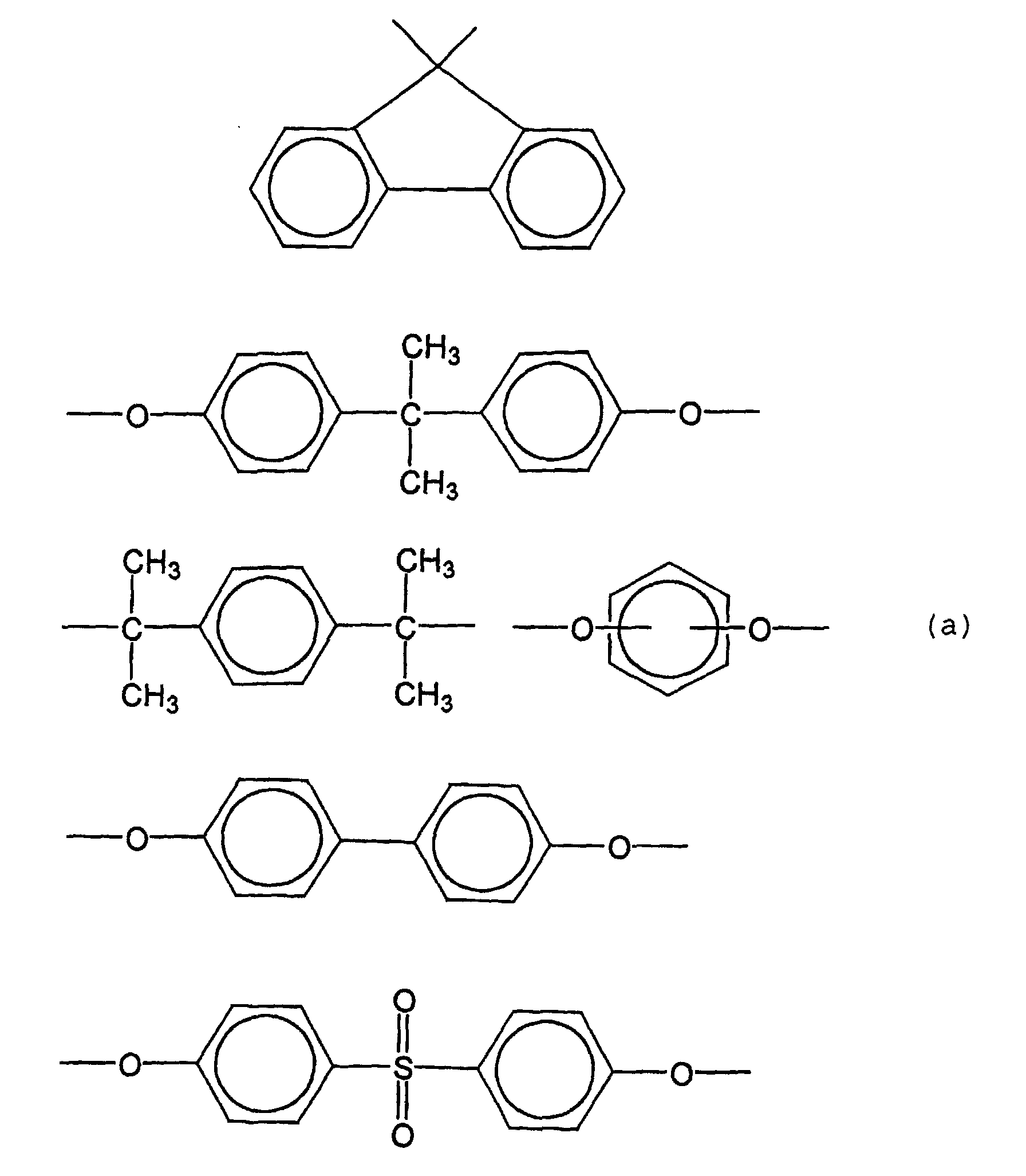




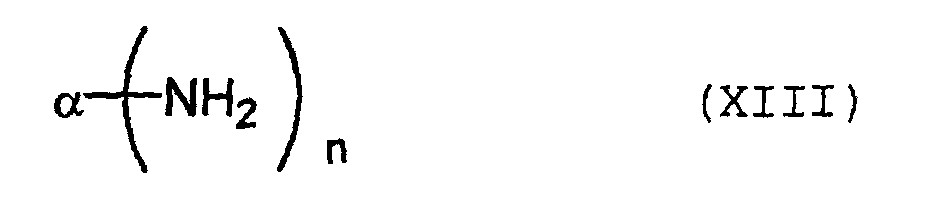
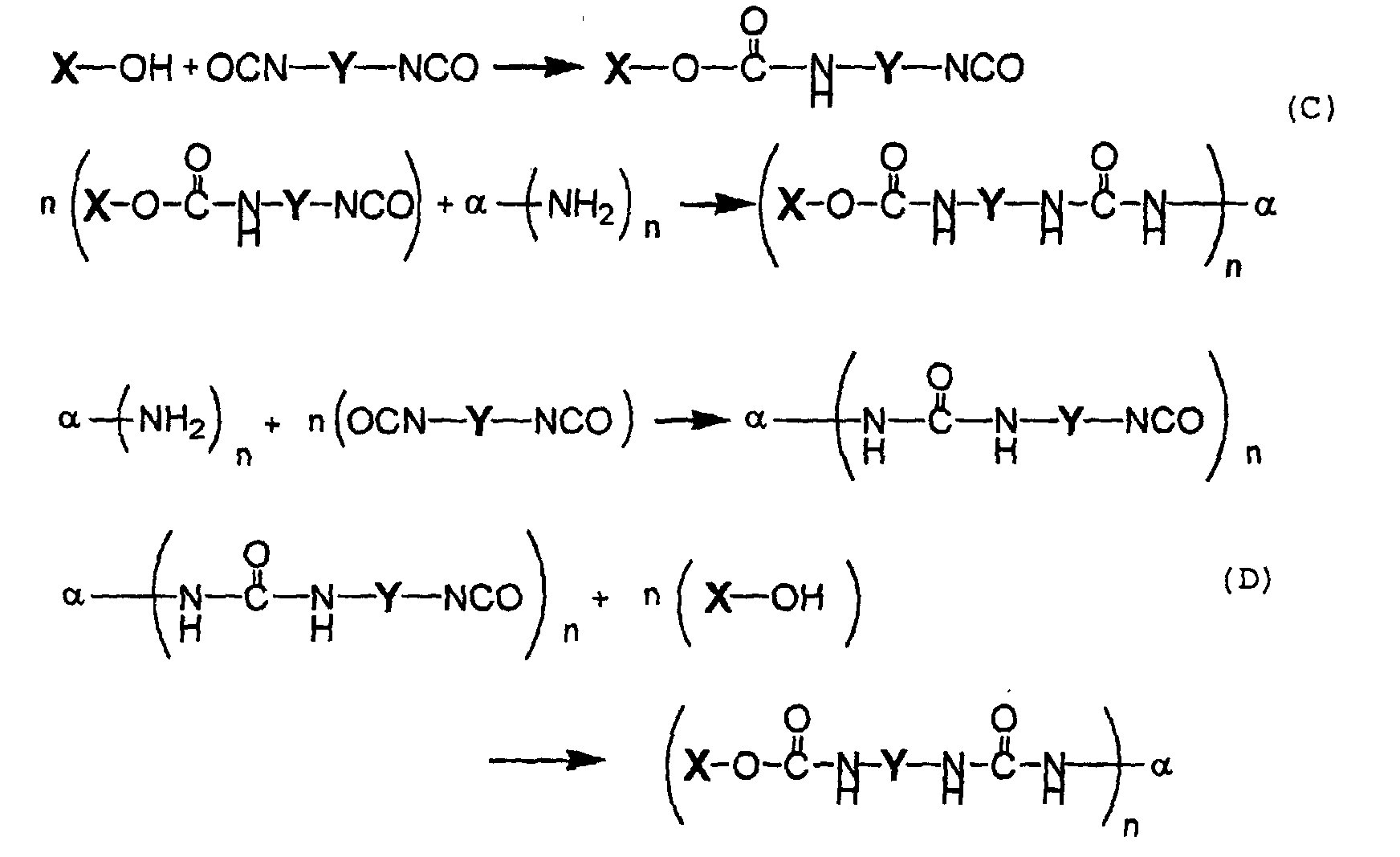
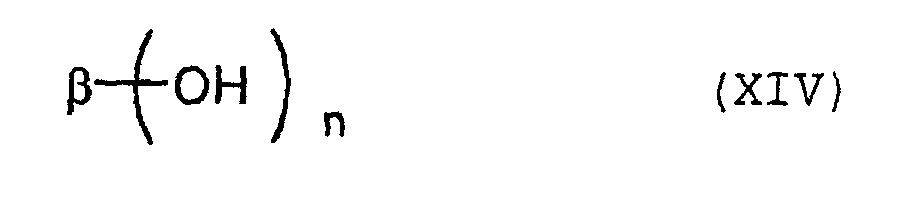


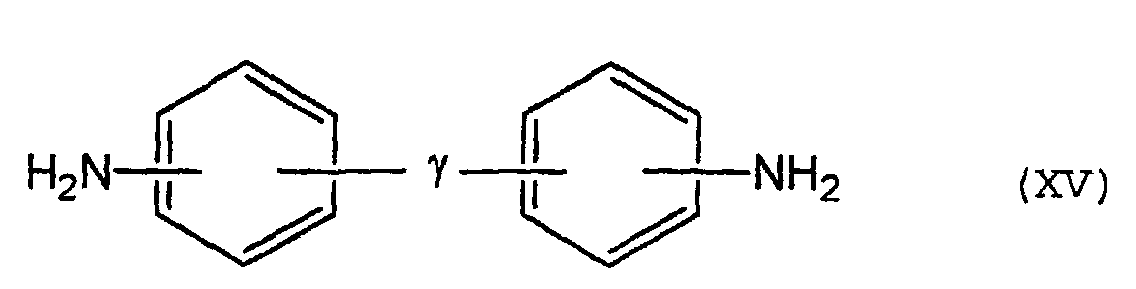

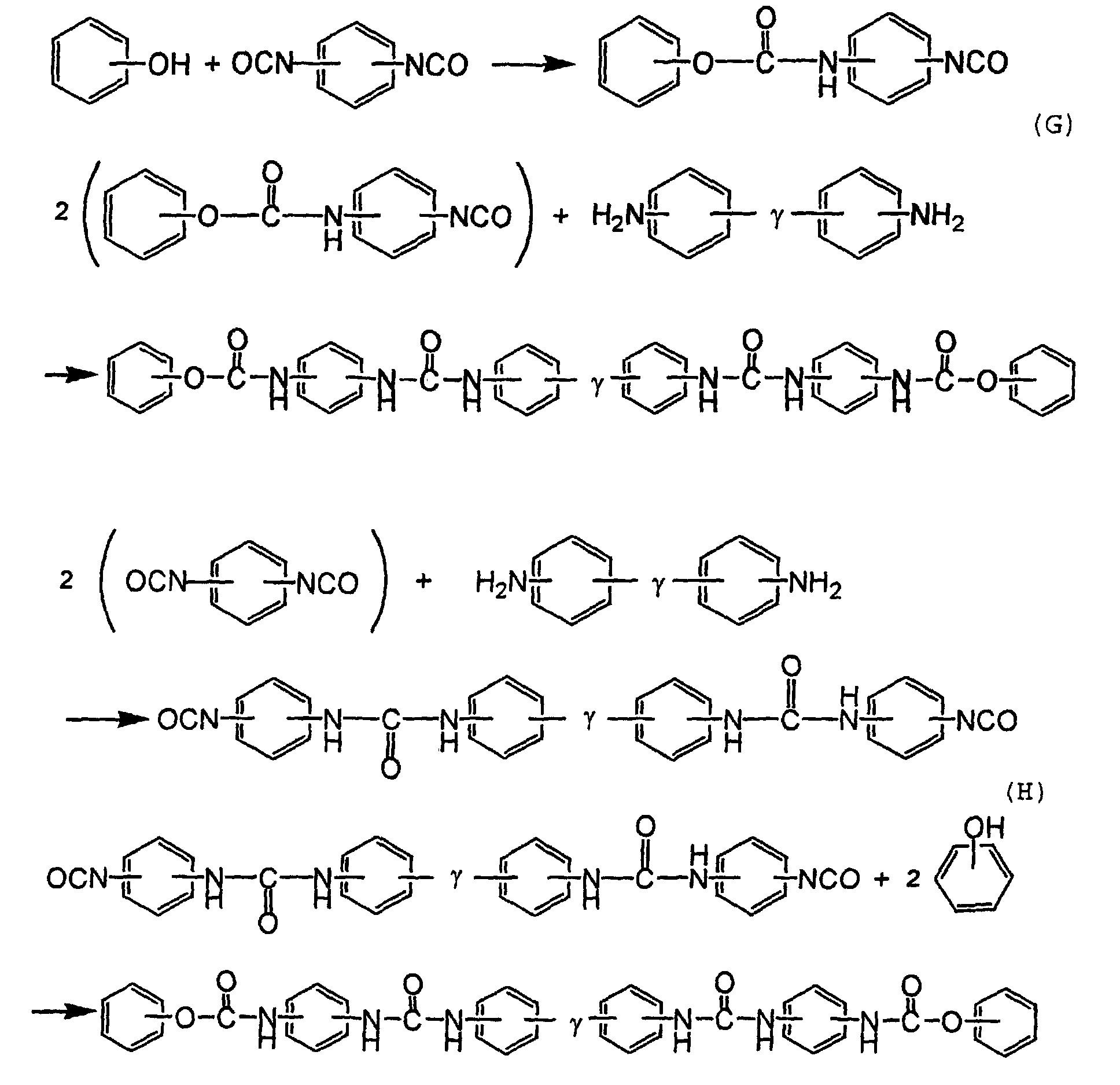
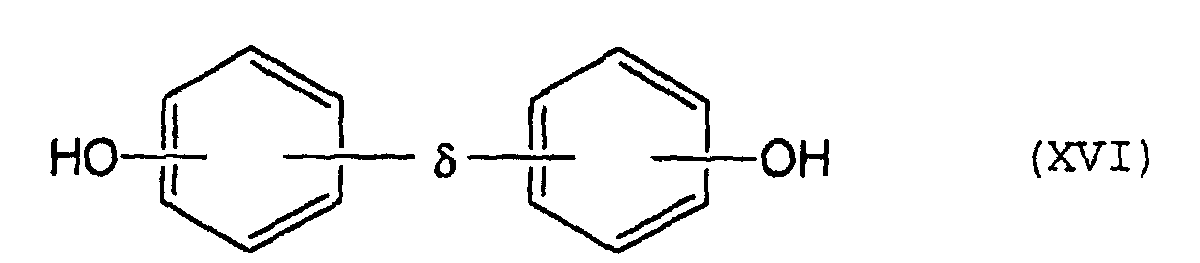
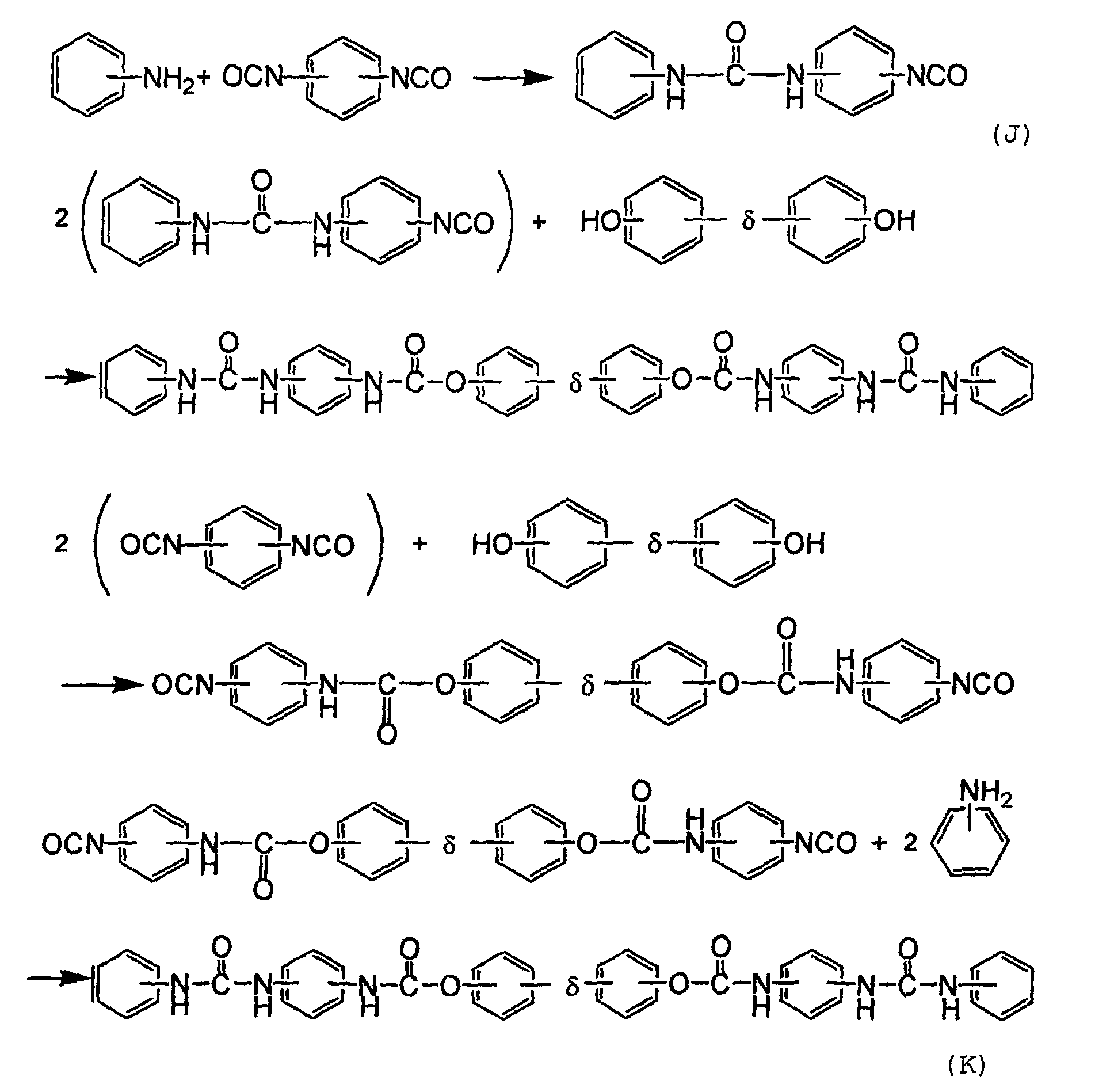
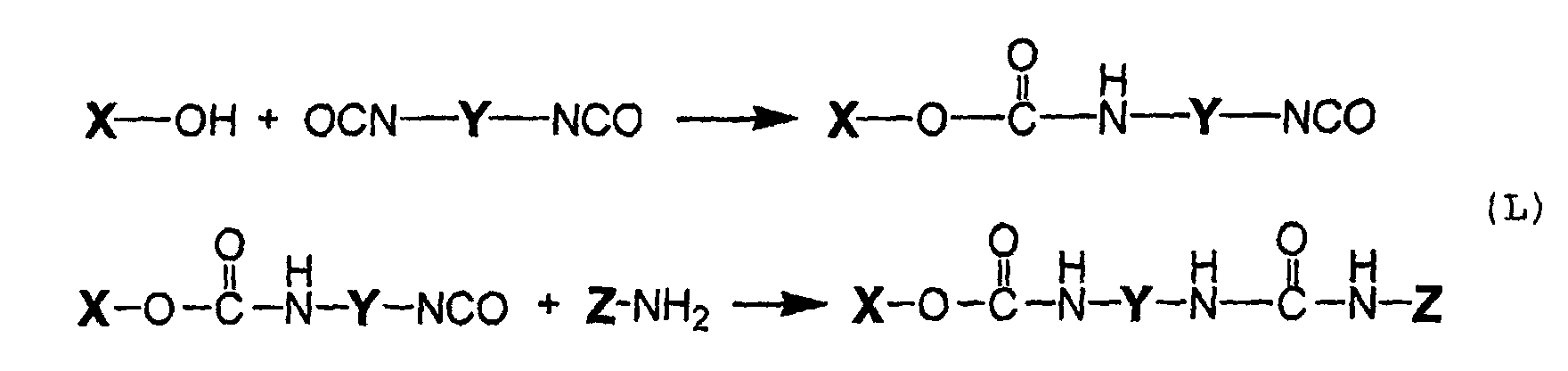
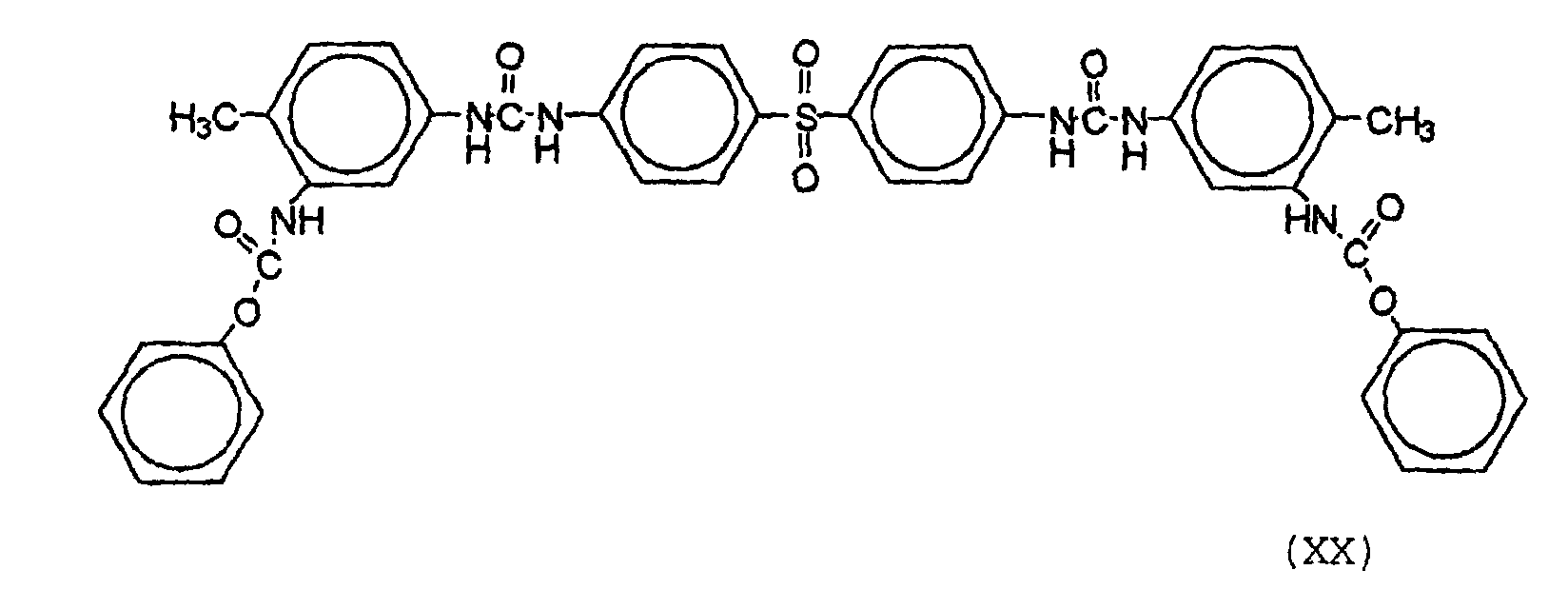
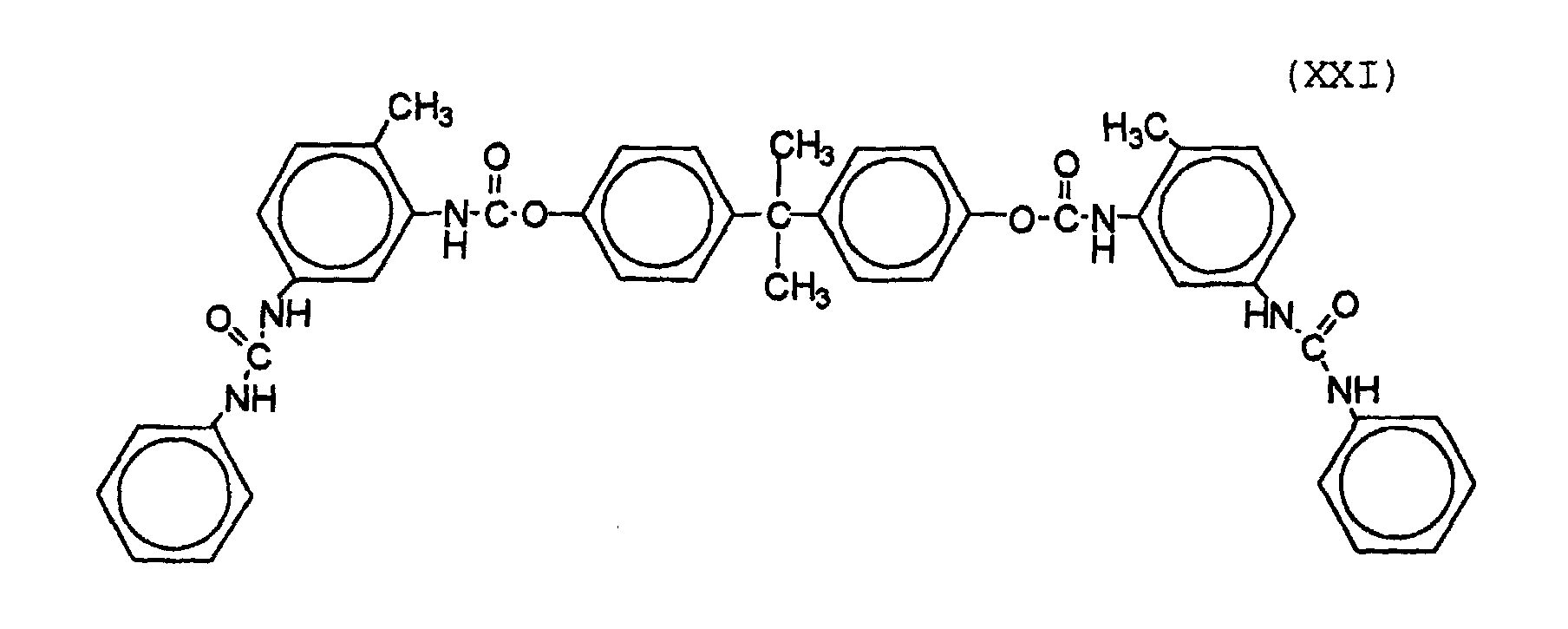
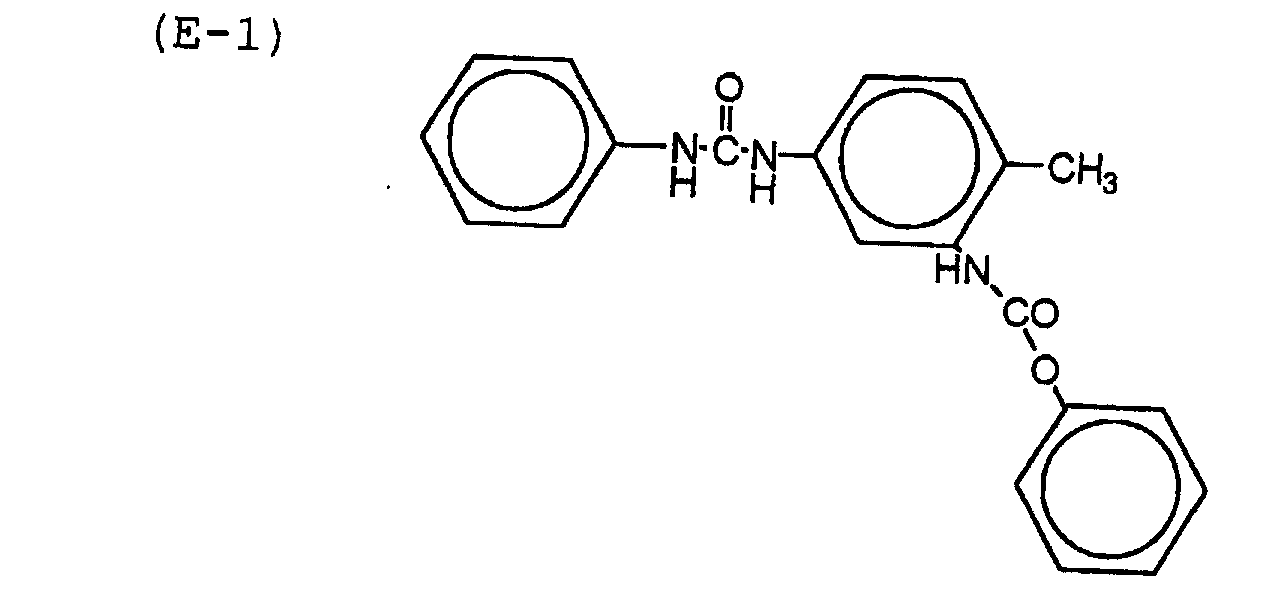
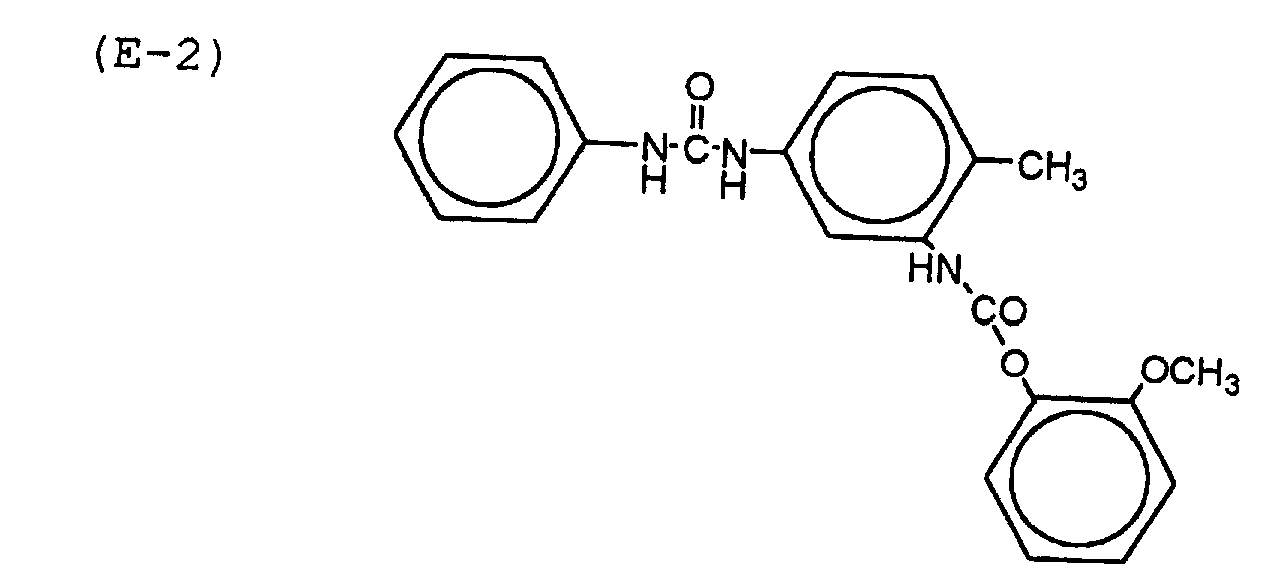
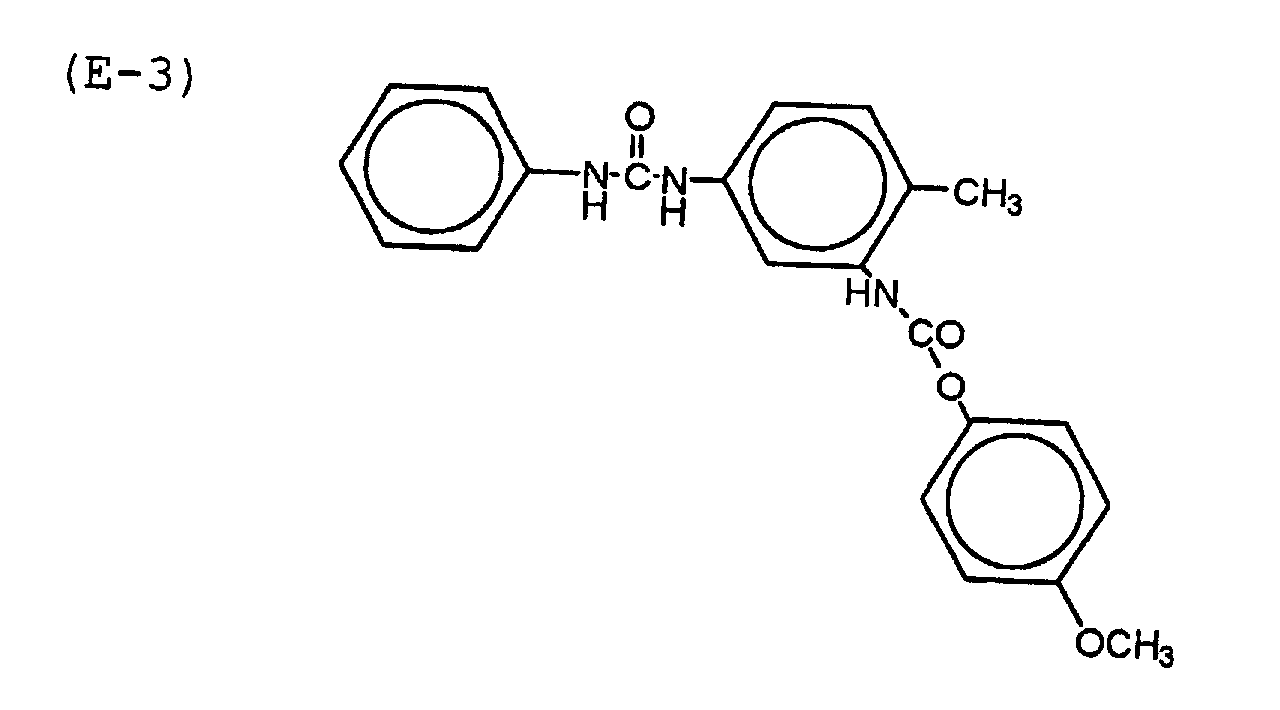


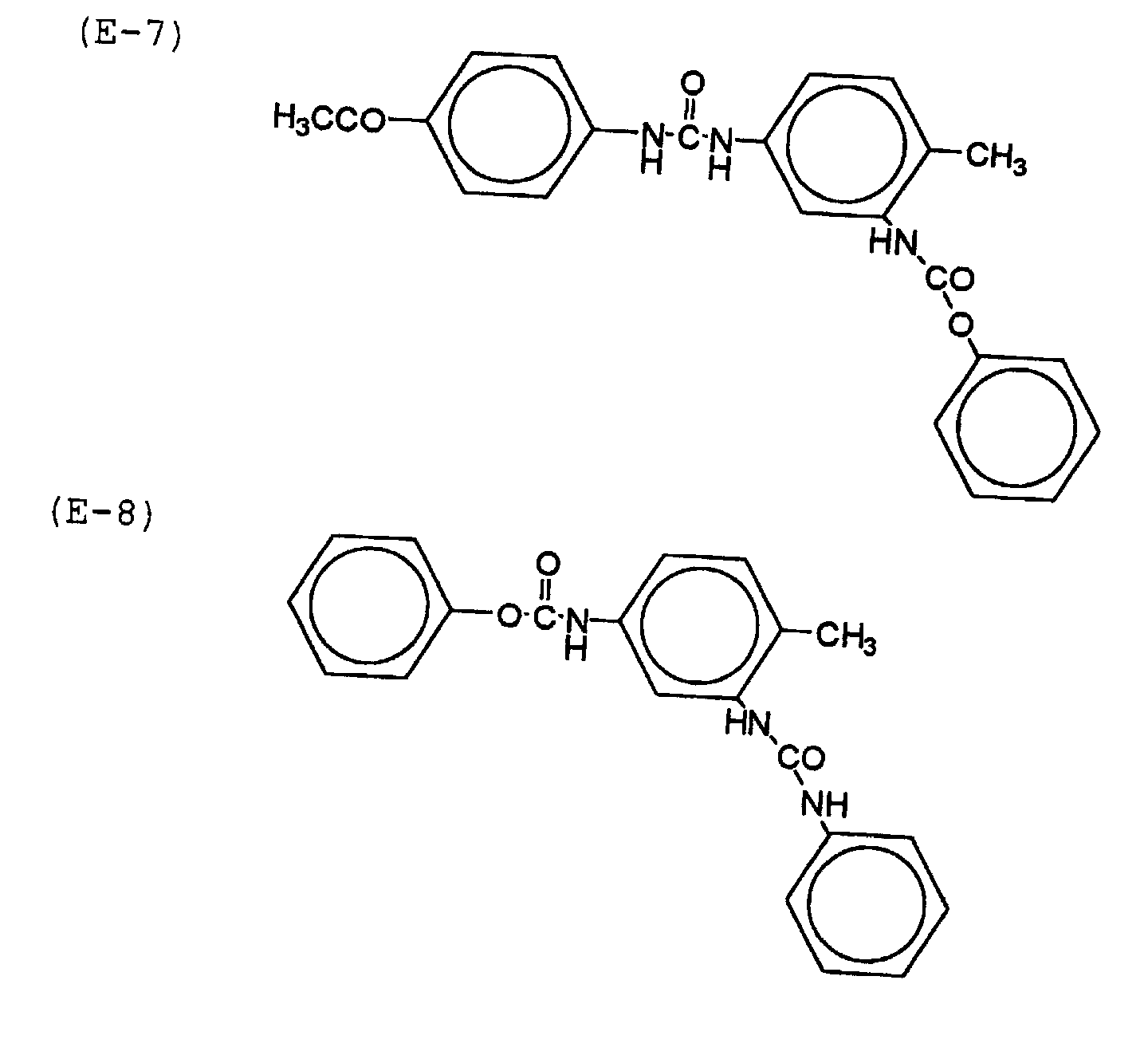

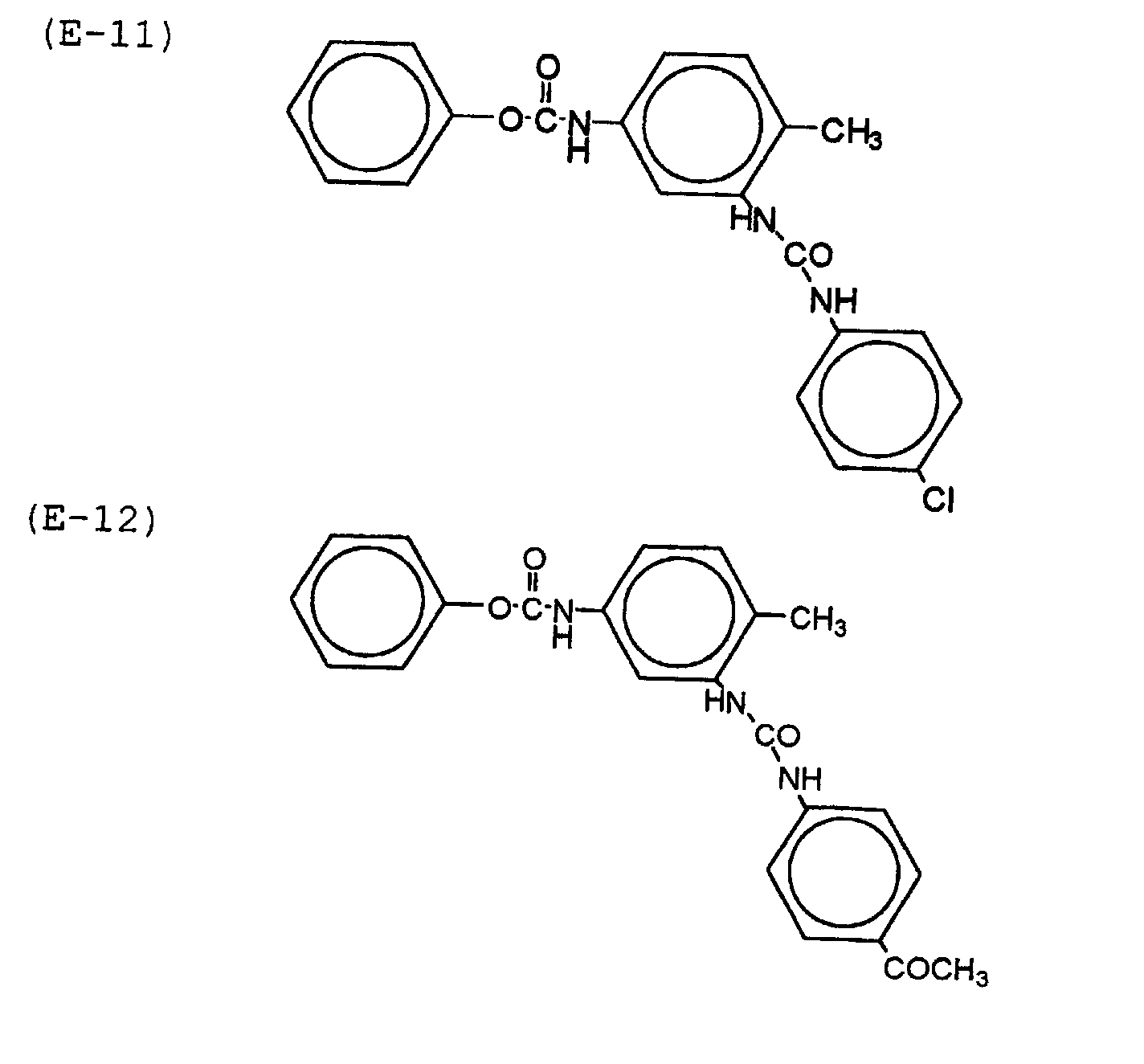

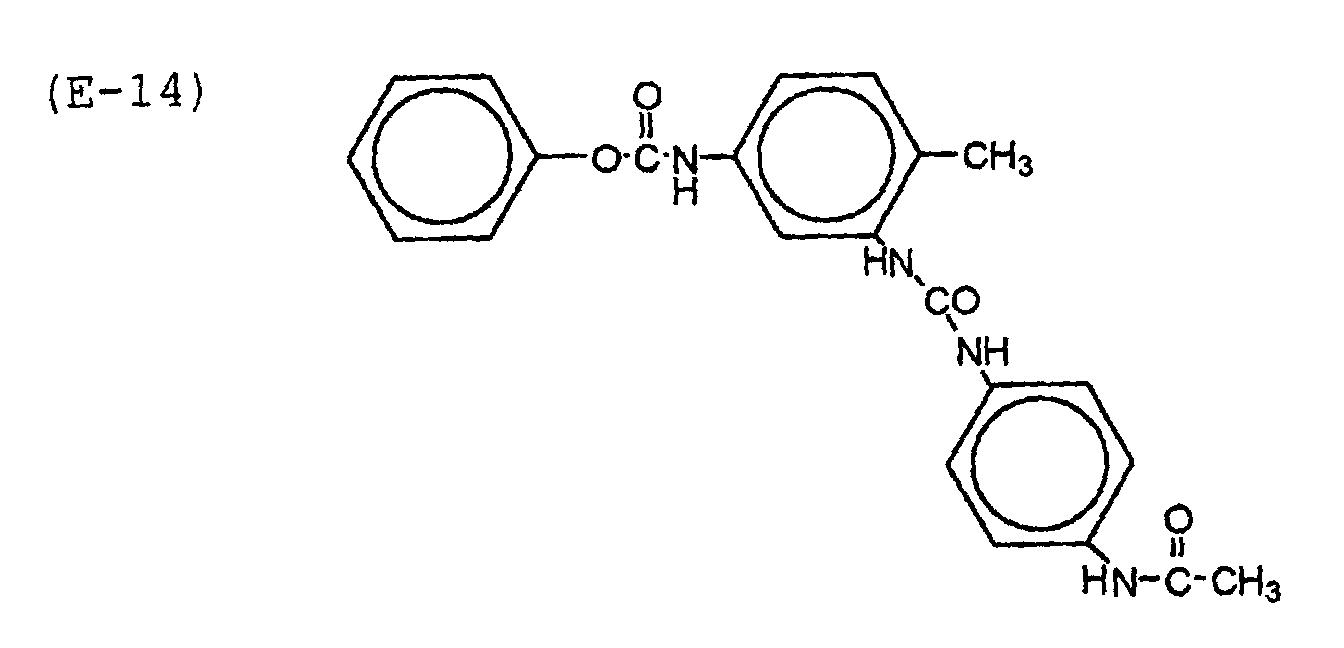
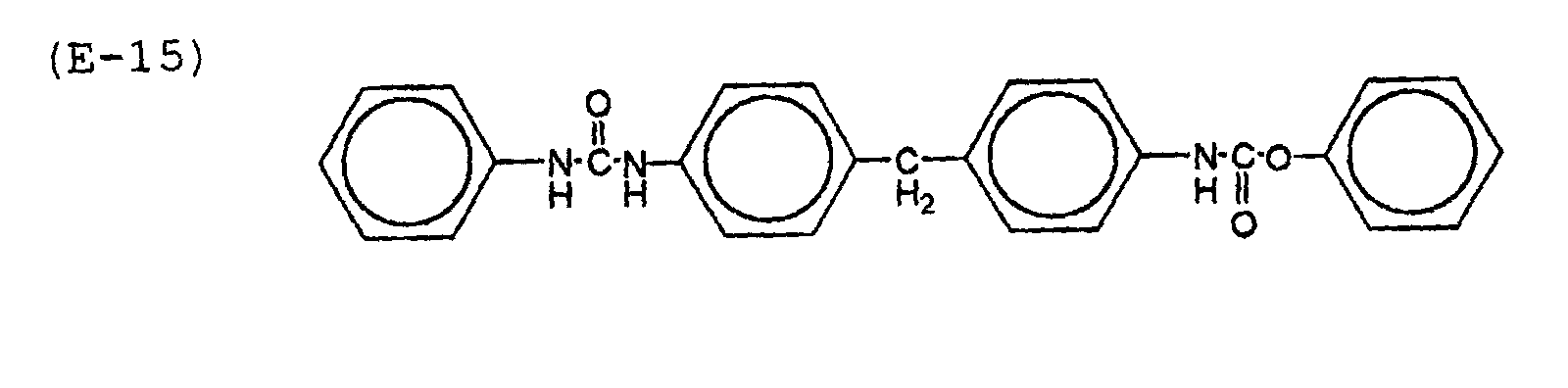
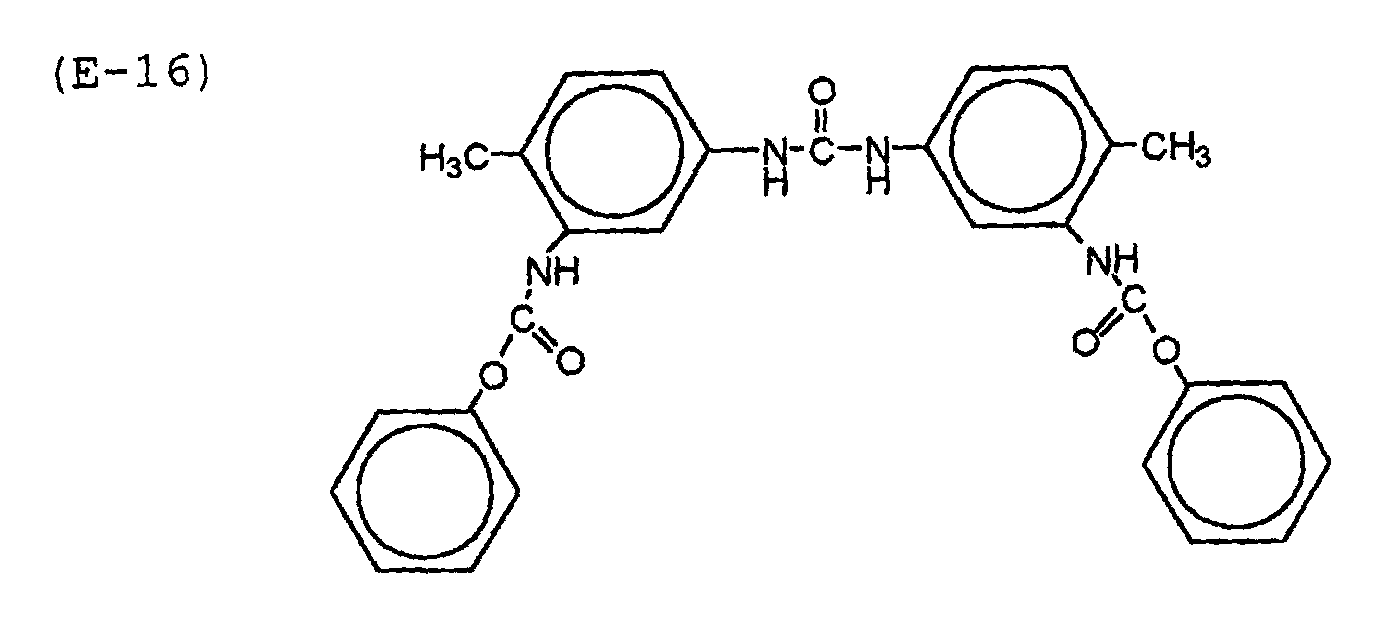


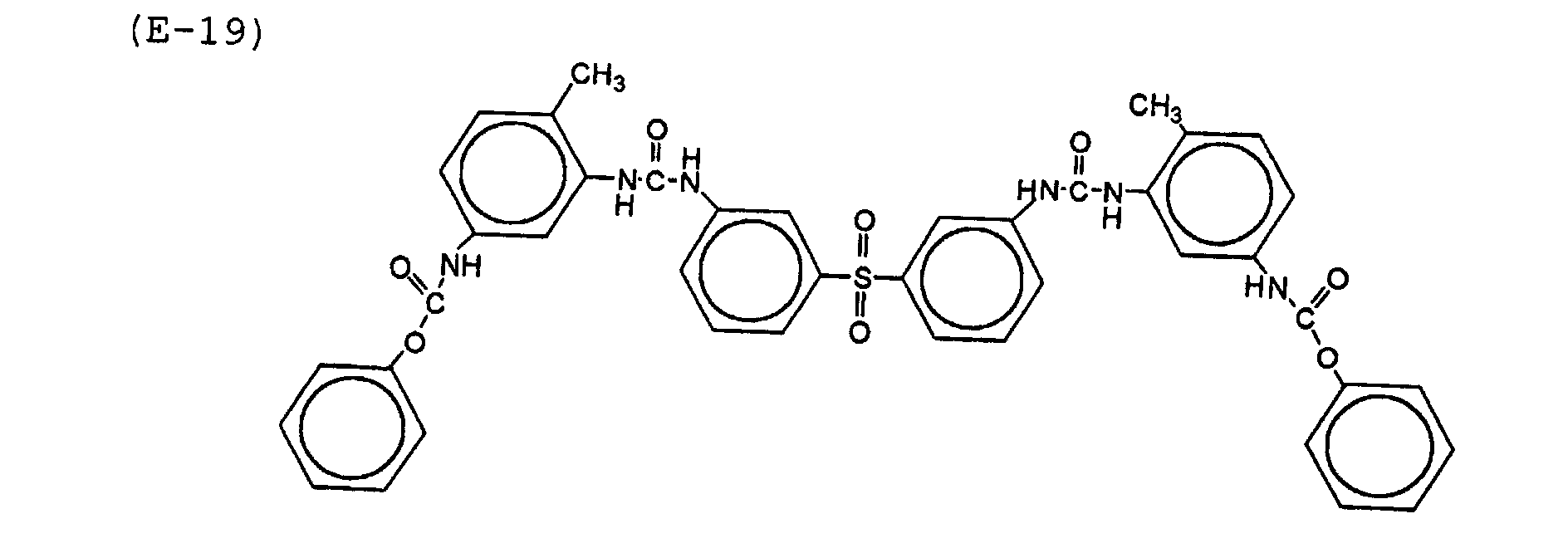

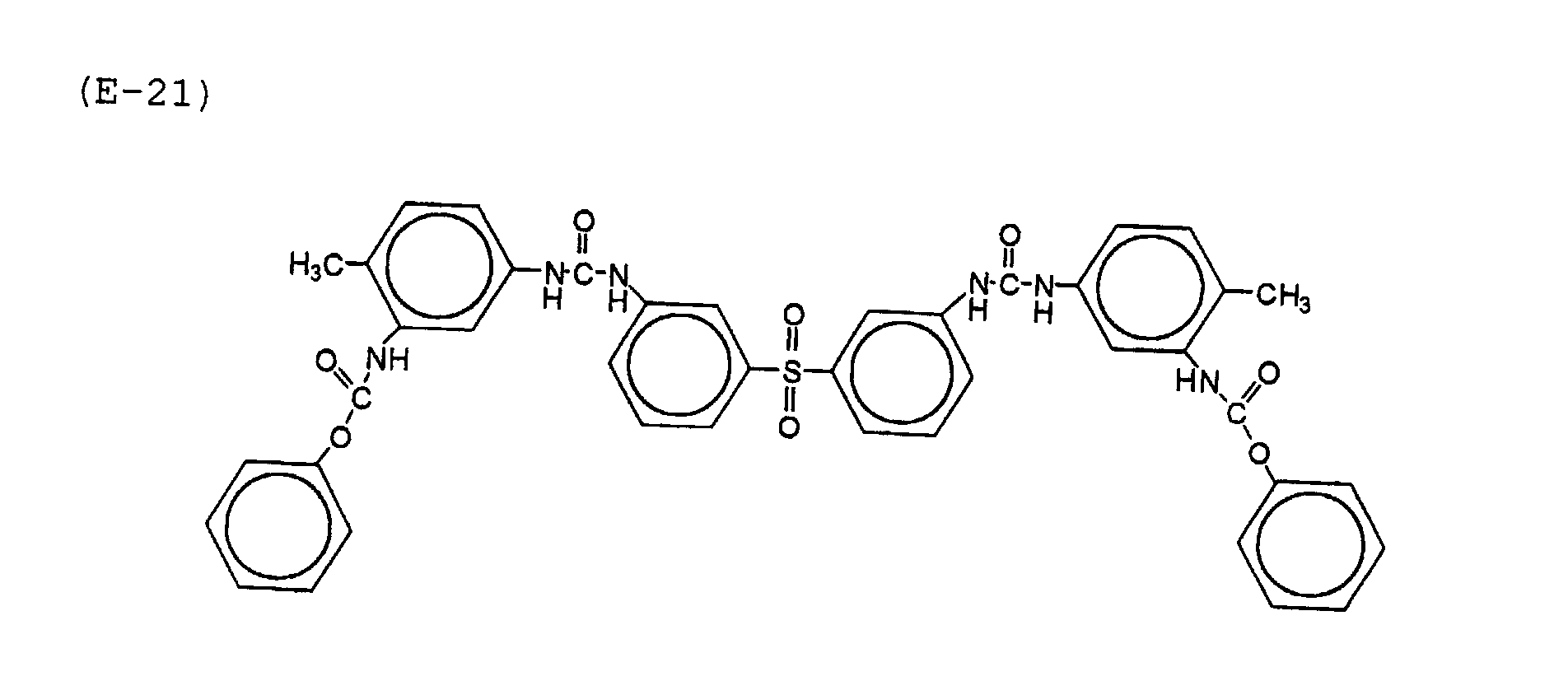
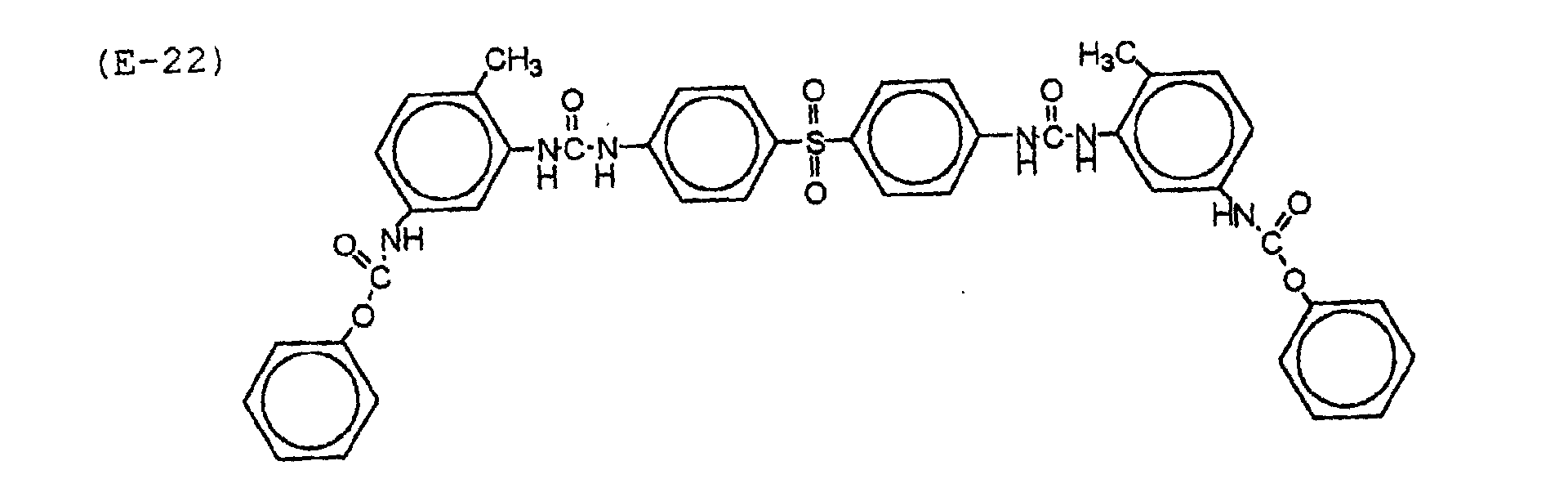
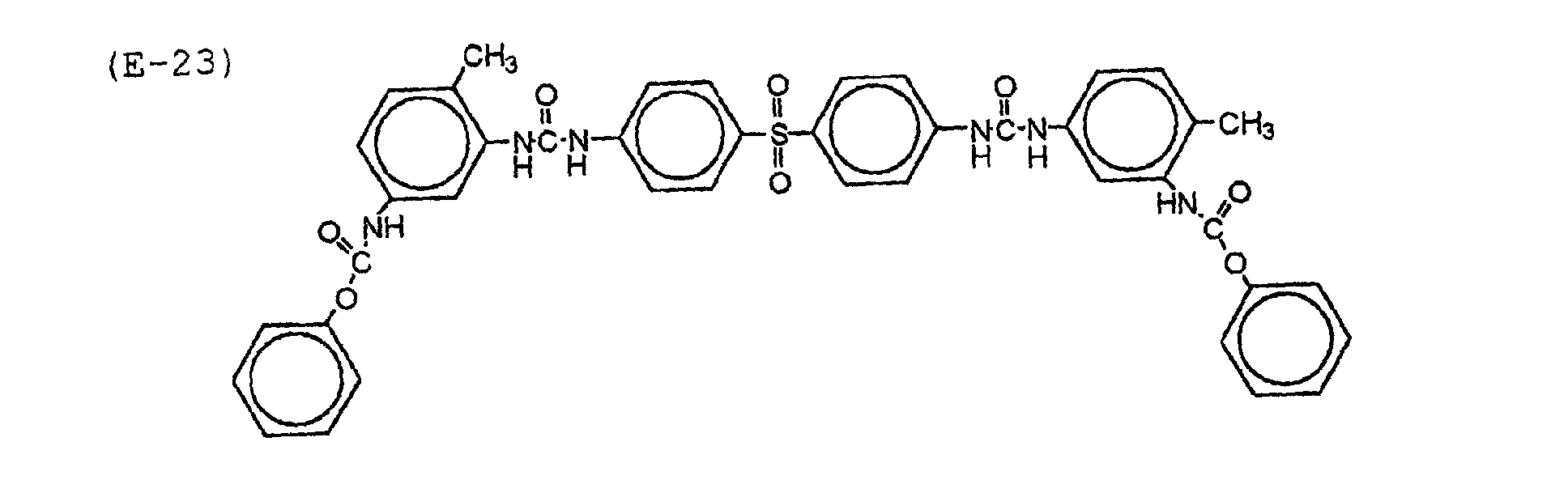
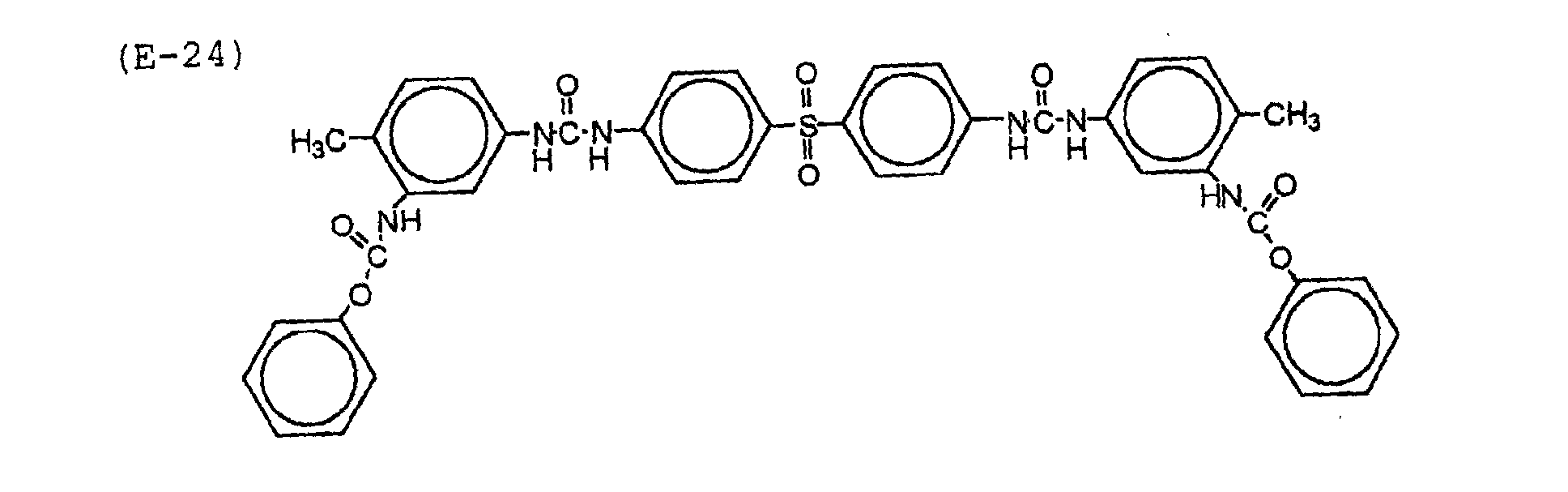
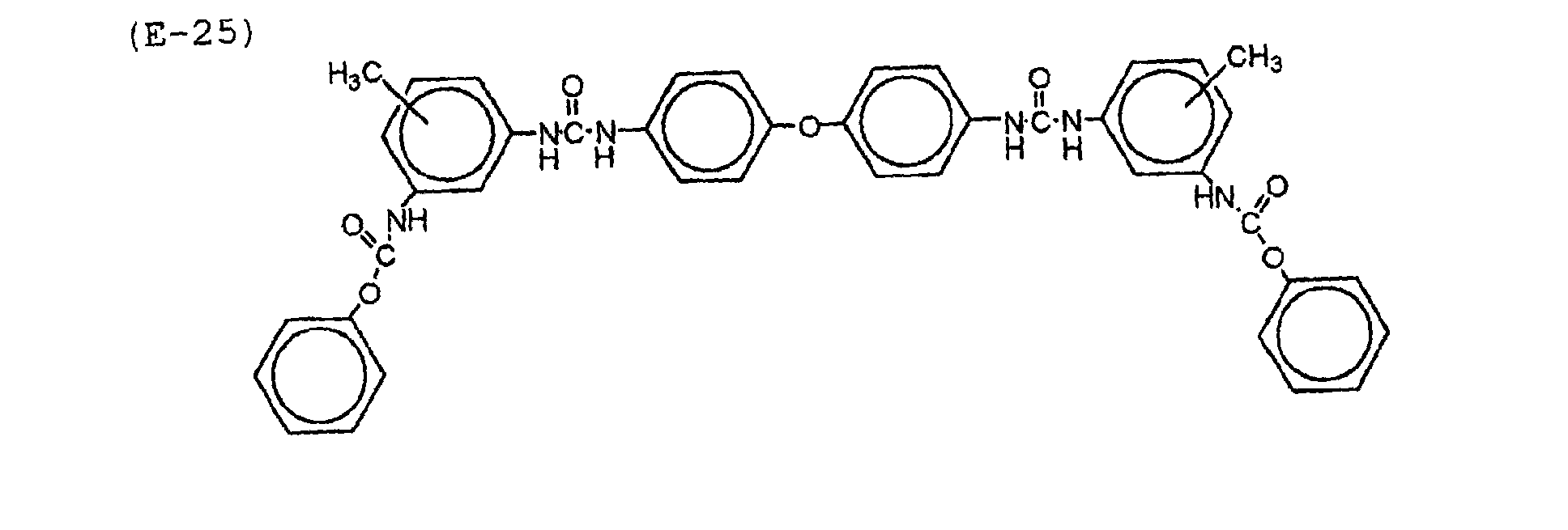

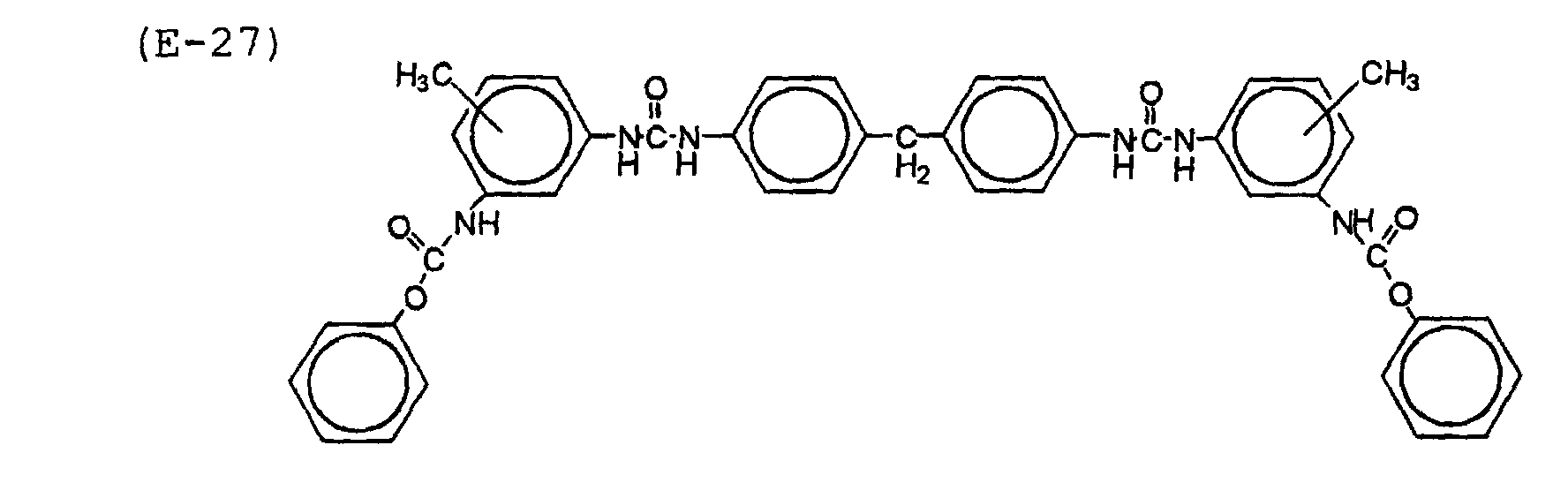
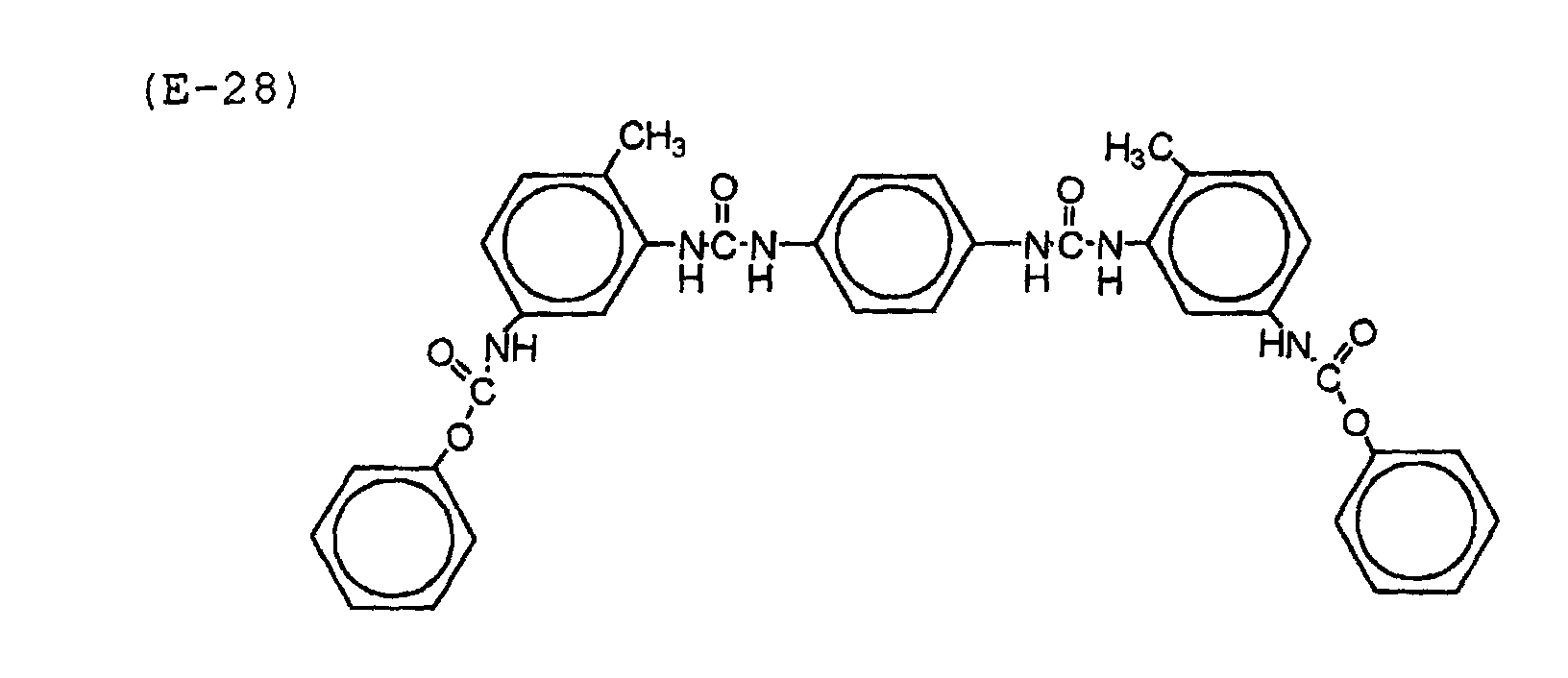
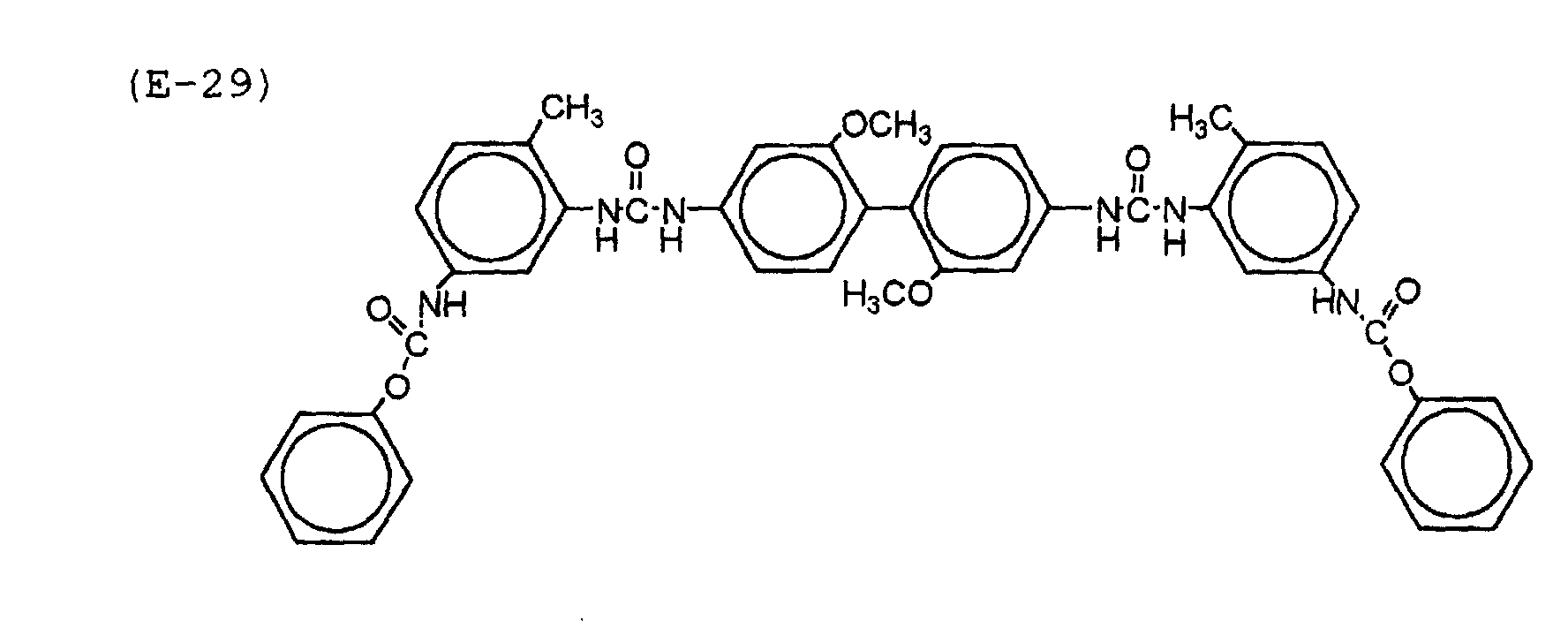
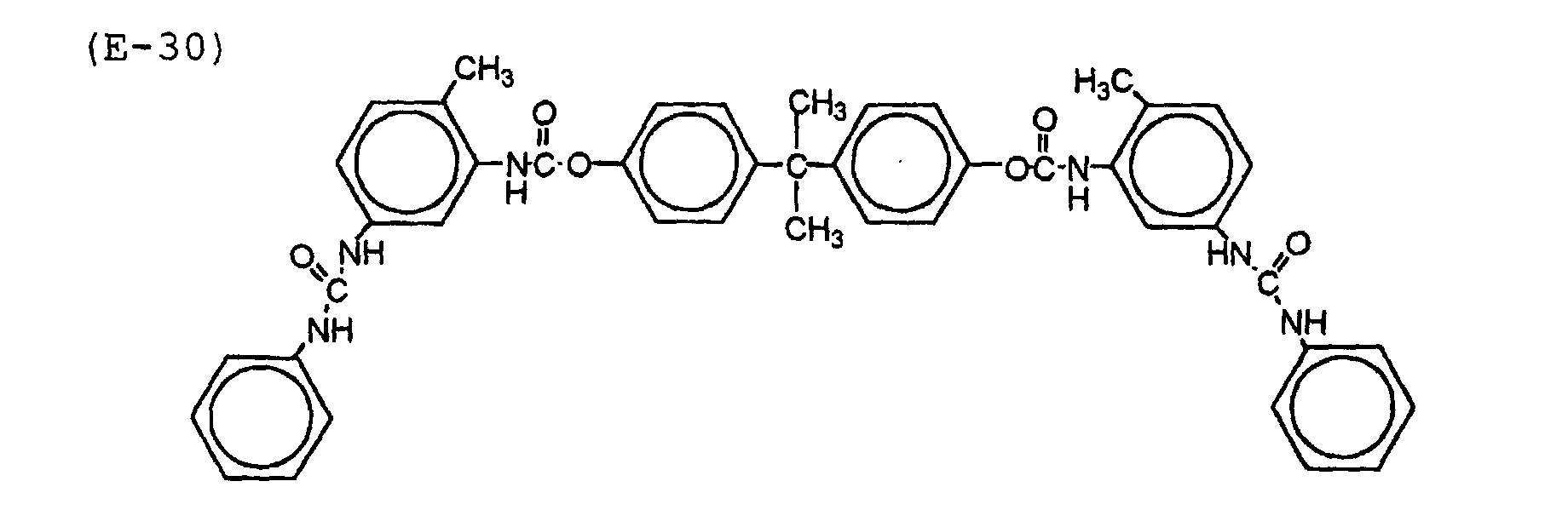
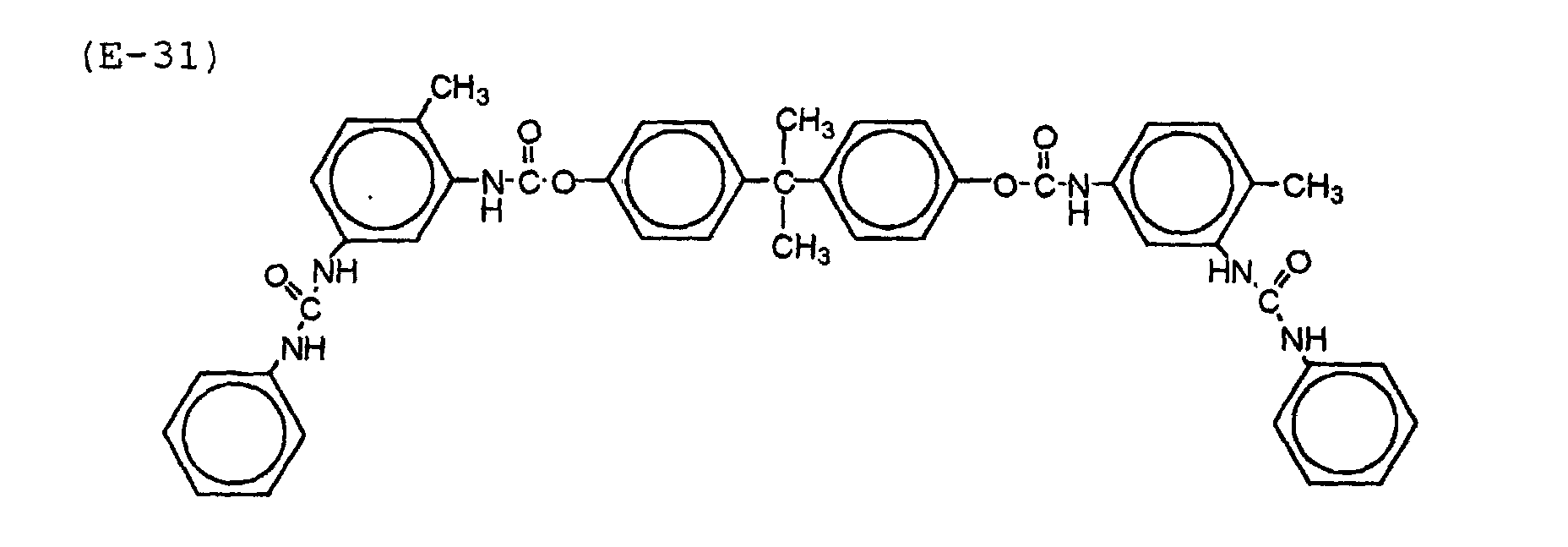

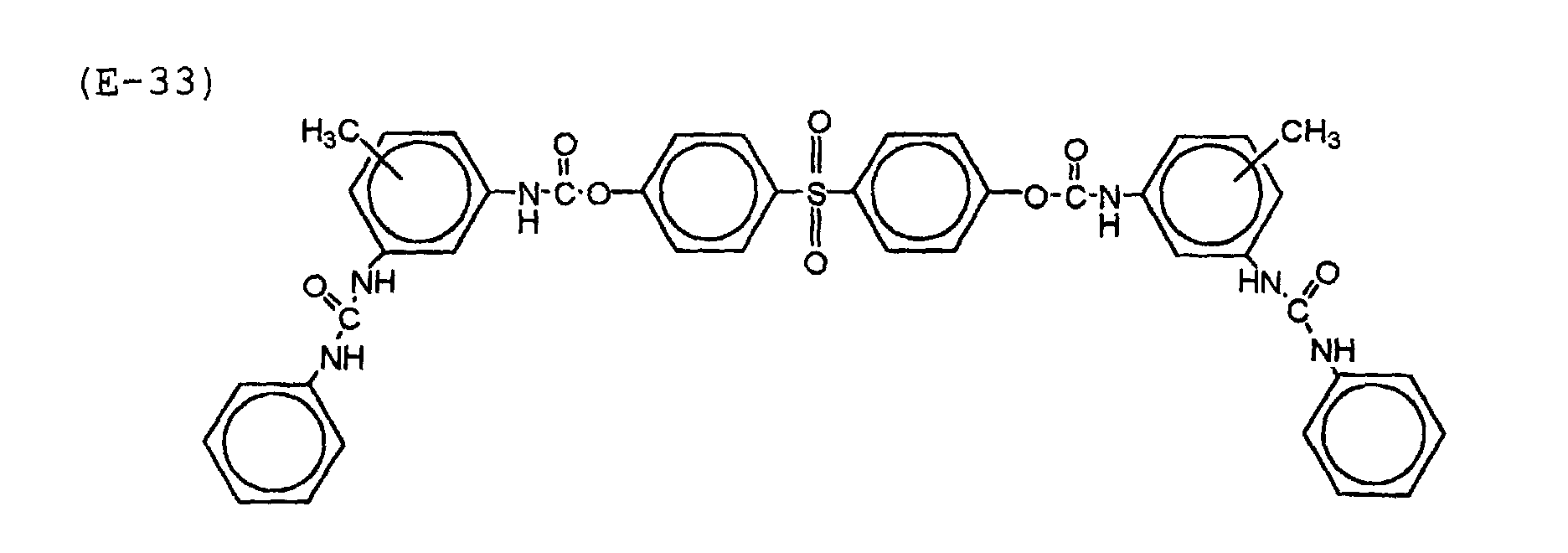







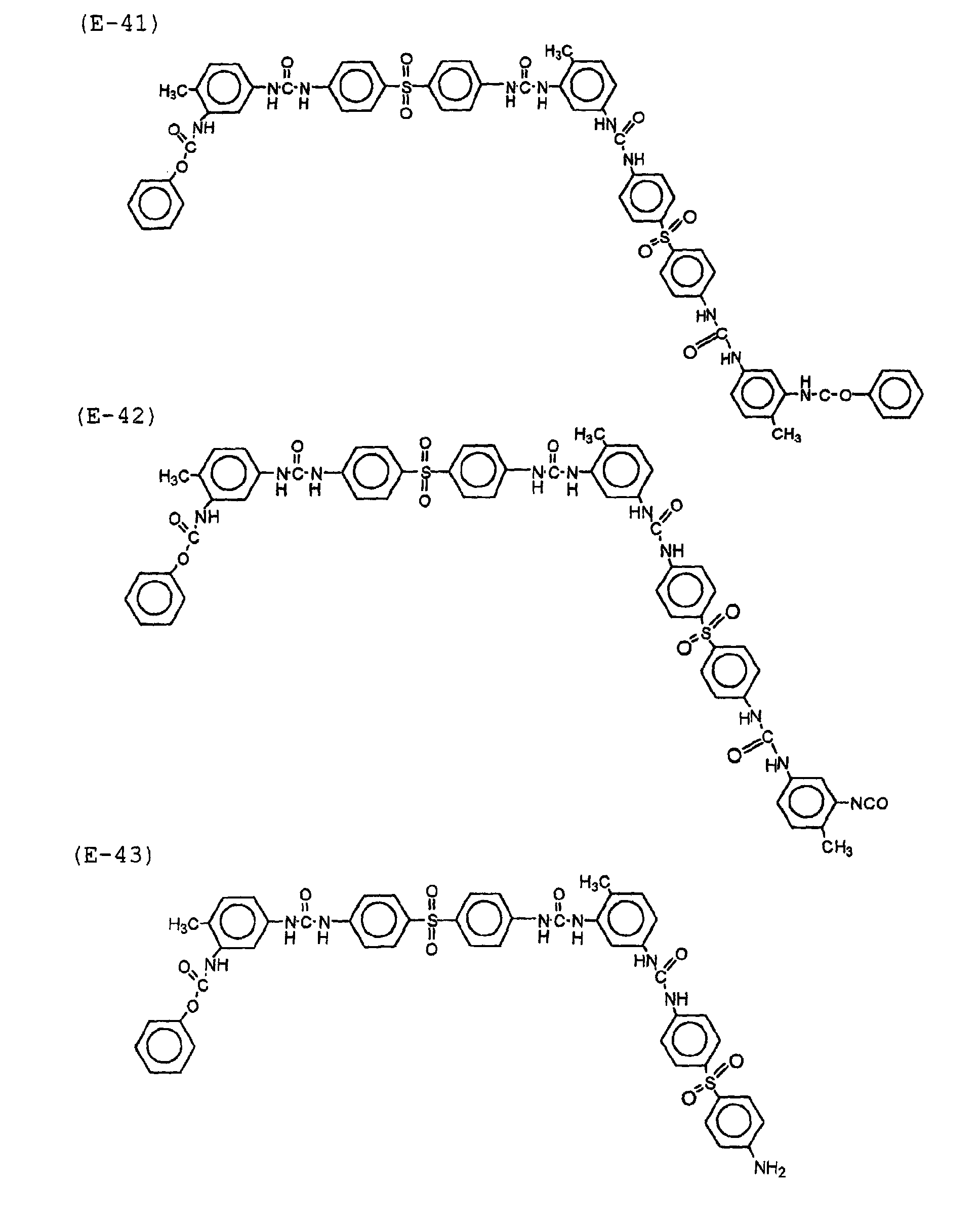

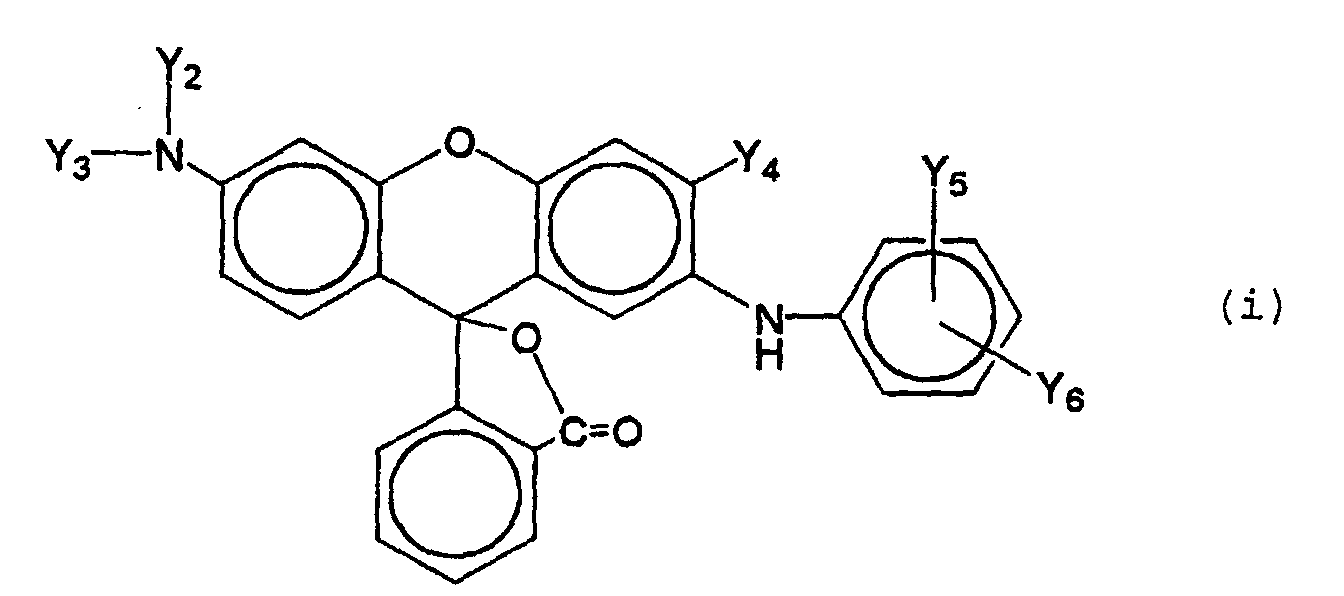
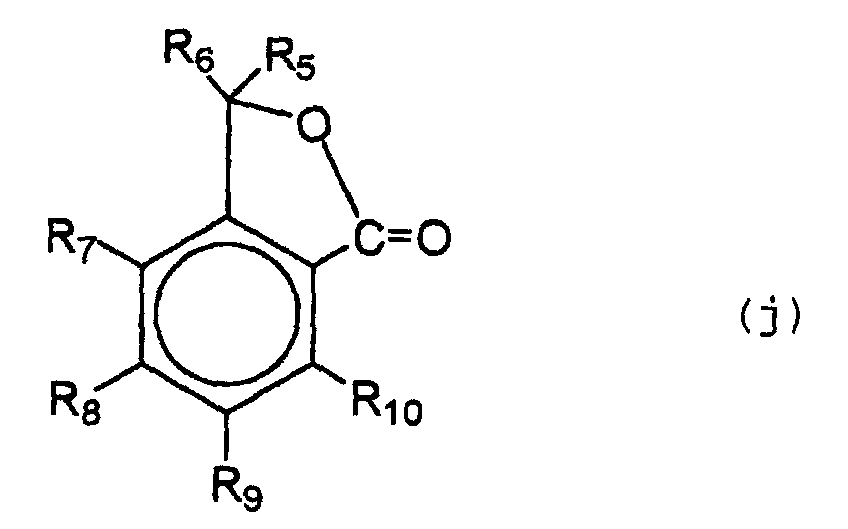

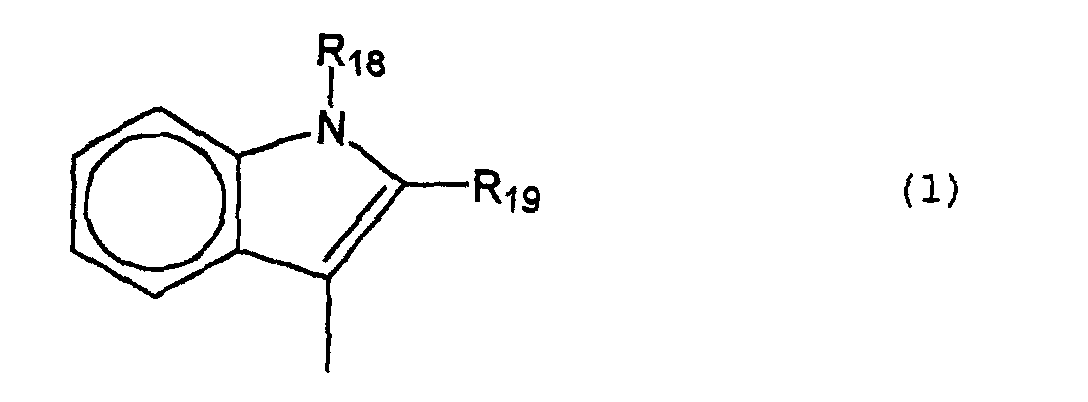


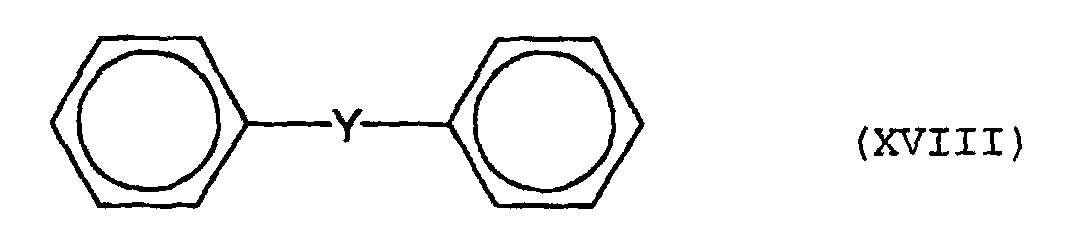

[M+H]+ was detected at m/z 661.
Characteristic peaks appeared at 1070 cm-1, 1220 cm-1, 1550 cm-1, 1600 cm-1, 1700 cm-1 and 3300 cm-1.
Characteristic peaks appeared at 1240 cm-1, 1550 cm-1, 1640 cm-1, 1720 cm-1 and 3300 cm-1.
Result of IR measurement:
Characteristic peaks appeared at 1220 cm-1, 1520 cm-1, 1630 cm-1, 1710 cm-1, 2900 cm-1 and 3300 cm-1.
Result of mass spectrum measurement:
[M+H]+ was detected at m/z 596.
Result of IR measurement:
Characteristic peaks appeared at 1230 cm-1, 1470 cm-1, 1510 cm-1, 1570 cm-1, 1620 cm-1, 1700 cm-1, 2900 cm-1 and 3300 cm-1.


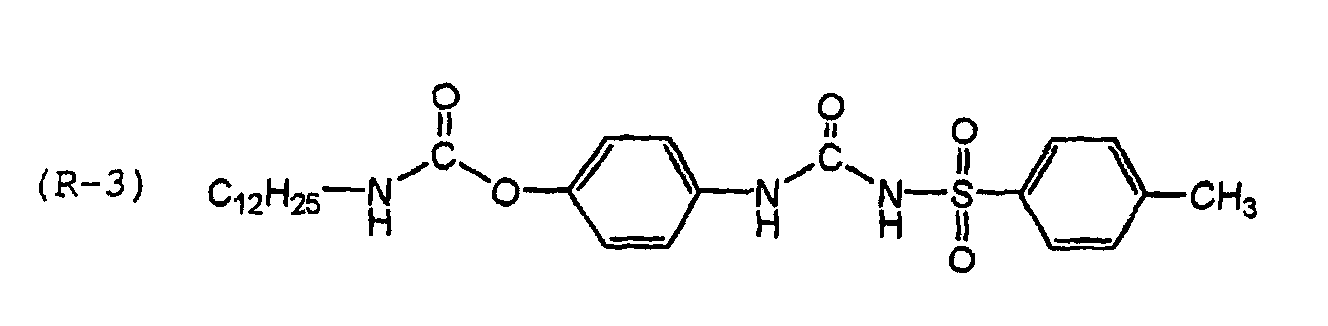
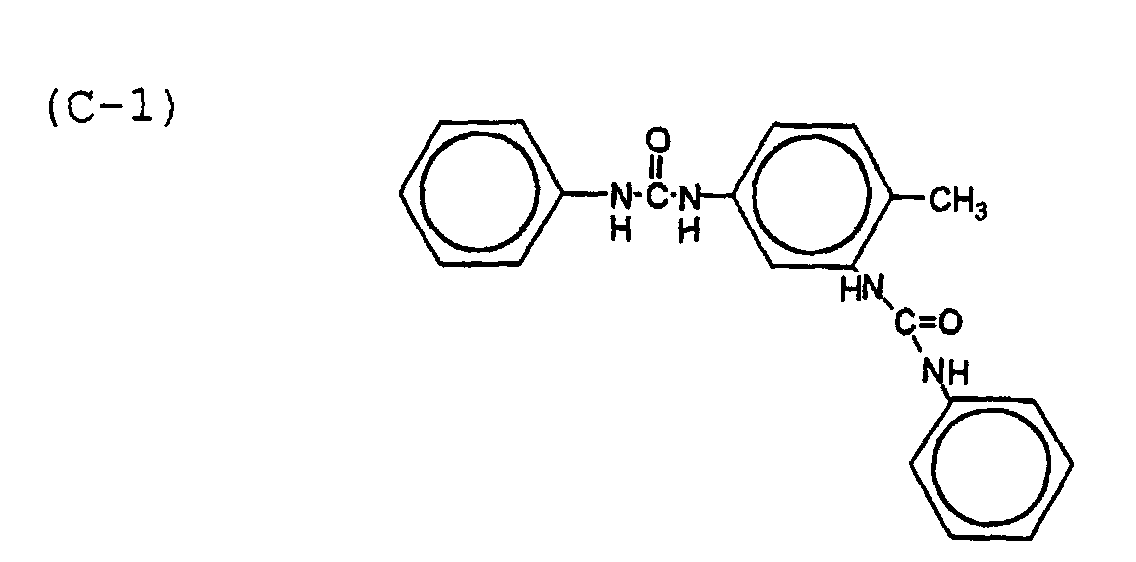
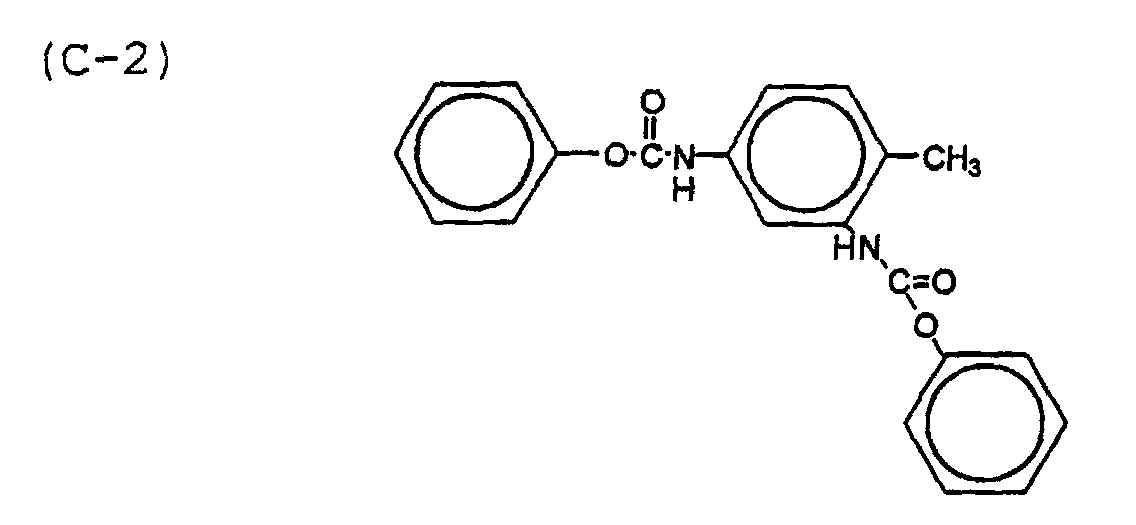
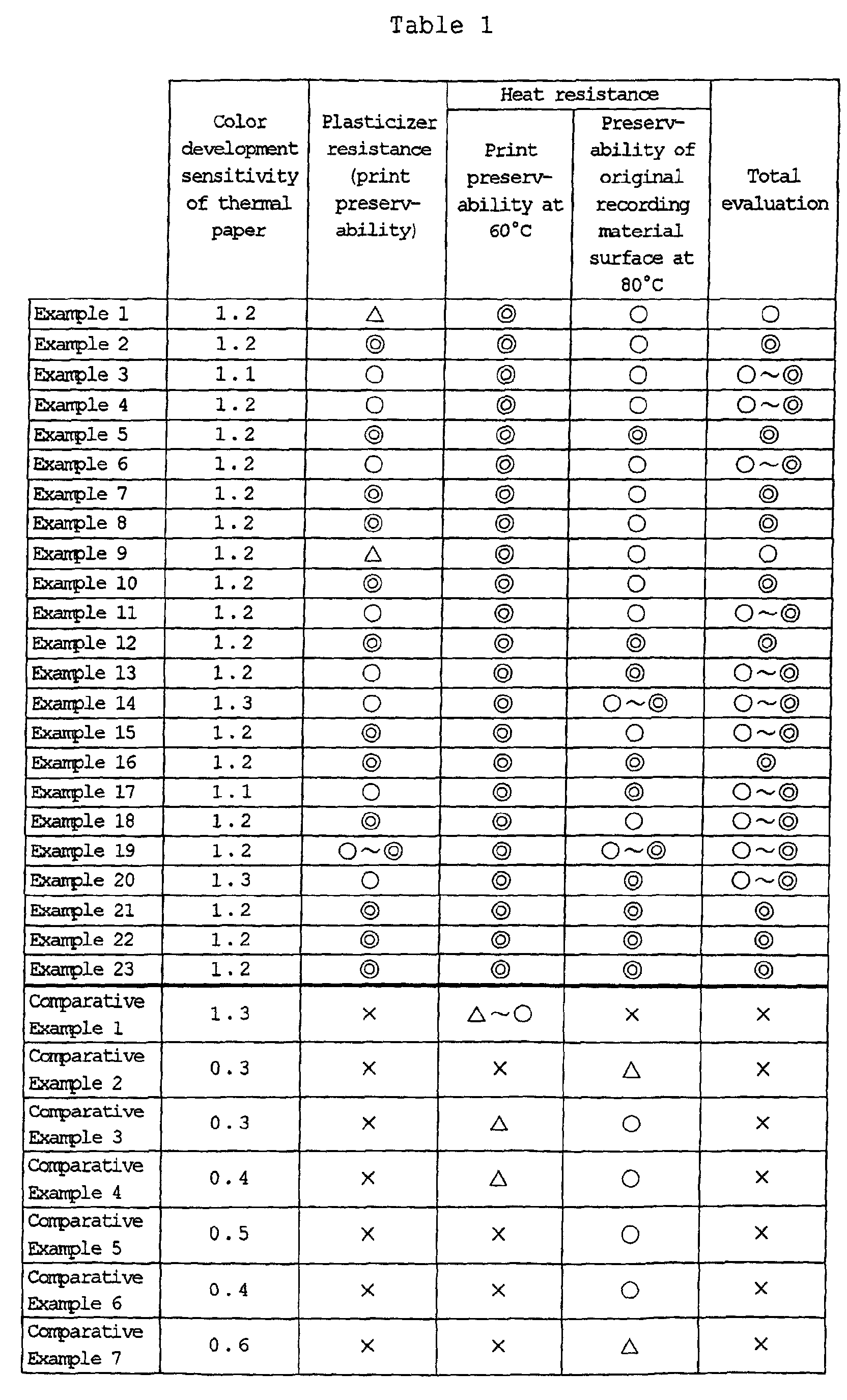
| Sensitivity of thermal paper | Plasticizer resistance (print preservability) | Whiteness | Total evaluation | |
| Example 24 | 1.3 | o ○ | 82 | o ○ |
| Example 25 | 1.3 | o ○ | 81 | o ○ |
| Example 26 | 1.3 | o ○ | 82 | o ○ |
| Example 27 | 1.3 | o ○ | 82 | o ○ |
| Example 28 | 1.3 | o ○ | 82 | o ○ |
| Example 29 | 1.3 | o ○ | 82 | o ○ |
| Example 30 | 1.3 | ○∼o ○ | 81 | ○ |
| Example 31 | 1.3 | ○∼o ○ | 81 | ○ |
| Example 32 | 1.3 | ○∼o ○ | 81 | ○ |
| Example 33 | 1.3 | ○∼o ○ | 81 | ○ |
| Example 34 | 1.2 | o ○ | 81 | ○ |
| Example 35 | 1.4 | ○∼o ○ | 82 | ○∼o ○ |
| Example 36 | 1.4 | ○∼o ○ | 83 | ○∼o ○ |
| Example 37 | 1.4 | ○∼o ○ | 82 | ○∼o ○ |
| Example 38 | 1.3 | ○∼o ○ | 82 | ○∼o ○ |
| Example 39 | 1.2 | o ○ | 82 | ○∼o ○ |
| Example 40 | 1.3 | ○∼o ○ | 82 | ○∼o ○ |
| Example 41 | 1.3 | ○∼o ○ | 83 | ○∼o ○ |
| Example 42 | 1.3 | ○∼o ○ | 82 | ○∼o ○ |
| Example 43 | 1.3 | ○∼o ○ | 82 | ○∼o ○ |
| Example 44 | 1.2 | o ○ | 82 | ○∼o ○ |
| Example 45 | 1.3 | ○∼o ○ | 83 | ○∼o ○ |
| Example 46 | 1.3 | ○∼o ○ | 83 | ○∼o ○ |
| Example 47 | 1.3 | ○∼o ○ | 82 | ○∼o ○ |
| Example 48 | 1.3 | ○∼o ○ | 82 | ○∼o ○ |
| Example 49 | 1.2 | o ○ | 82 | ○∼o ○ |
| Example 50 | 1.3 | ○∼o ○ | 83 | ○∼o ○ |
| Example 51 | 1.4 | ○∼o ○ | 82 | ○∼o ○ |
| Example 52 | 1.4 | ○∼o ○ | 82 | ○∼o ○ |
| Example 53 | 1.3 | ○∼o ○ | 82 | ○∼o ○ |
| Example 54 | 1.2 | o ○ | 82 | ○∼o ○ |
| Example 55 | 1.3 | ○∼o ○ | 83 | ○∼o ○ |
| Example 56 | 1.3 | ○∼o ○ | 82 | ○∼o ○ |
| Example 57 | 1.3 | ○∼o ○ | 82 | ○∼o ○ |
| Example 58 | 1.3 | ○∼o ○ | 82 | ○∼o ○ |
| Example 59 | 1.2 | o ○ | 82 | ○∼o ○ |
| Example 60 | 1.3 | ○∼o ○ | 82 | ○∼o ○ |
| Example 61 | 1.3 | ○∼o ○ | 82 | ○∼o ○ |
| Example 62 | 1.3 | ○∼o ○ | 82 | ○∼o ○ |
| Example 63 | 1.3 | ○∼o ○ | 82 | ○∼o ○ |
| Example 64 | 1.2 | o ○ | 82 | ○∼o ○ |
| Example 65 | 1.3 | ○∼o ○ | 83 | o ○ |
| Example 66 | 1.2 | o ○ | 82 | o ○ |
| Example 67 | 1.3 | ○∼o ○ | 85 | ○∼o ○ |
| Example 68 | 1.3 | o ○ | 82 | o ○ |
| Example 69 | 1.3 | o ○ | 82 | o ○ |
| Example 70 | 1.3 | o ○ | 82 | o ○ |
| Example 71 | 1.3 | o ○ | 82 | o ○ |
| Example 72 | 1.3 | ○∼o ○ | 83 | ○∼o ○ |
| Example 73 | 1.3 | ○∼o ○ | 82 | ○∼o ○ |
| Example 74 | 1.3 | ○∼o ○ | 82 | ○∼o ○ |
| Example 75 | 1.3 | ○∼o ○ | 83 | ○∼o ○ |
| Comparative Example 8 | 1.3 | × | 78 | × |
| Sensitivity of thermal paper | Plasticizer resistance (print preservability) | Rub Resistance | Accumulation of traces of rubbing | Total evaluation | |
| Example 76 | 1.3 | o ○ | o ○ | o ○ | o ○ |
| Example 77 | 1.3 | o ○ | o ○ | o ○ | o ○ |
| Example 78 | 1.3 | o ○ | ○∼o ○ | o ○ | ○∼o ○ |
| Example 79 | 1.3 | o ○ | o ○ | o ○ | o ○ |
| Example 80 | 1.3 | o ○ | ○∼o ○ | o ○ | ○∼o ○ |
| Example 81 | 1.3 | o ○ | o ○ | o ○ | o ○ |
| Example 82 | 1.4 | o ○ | o ○ | o ○ | o ○ |
| Comparative Example 9 | 1.3 | Δ∼○ | ×∼Δ | × | × |
| Sensitivity of thermal paper | Plasticizer resistance (print preservability) | Plasticizer resistance (preservability of original recording material surface) | Total evaluation | |
| Example 83 | 1.3 | o ○ | ○∼o ○ | ○∼o ○ |
| Example 84 | 1.4 | o ○ | ○∼o ○ | ○∼o ○ |
| Example 85 | 1.3 | ○∼o ○ | o ○ | ○∼o ○ |
| Example 86 | 1.3 | o ○ | o ○ | ○∼o ○ |
| Example 87 | 1.3 | ○∼o ○ | o ○ | ○∼o ○ |
| Example 88 | 1.3 | o ○ | o ○ | o ○ |
| Example 89 | 1.3 | o ○ | o ○ | o ○ |
| Example 90 | 1.2 | o ○ | o ○ | o ○ |
| Example 91 | 1.3 | o ○ | ○∼o ○ | ○∼o ○ |
| Example 92 | 1.2 | o ○ | ○∼o ○ | ○∼o ○ |
| Example 93 | 1.3 | o ○ | o ○ | o ○ |
| Example 94 | 1.3 | o ○ | o ○ | o ○ |
| Example 95 | 1.3 | o ○ | o ○ | o ○ |
| Example 96 | 1.3 | o ○ | ○∼o ○ | ○∼o ○ |
| Example 97 | 1.3 | o ○ | ○∼o ○ | ○∼o ○ |
| Example 98 | 1.3 | o ○ | ○∼o ○ | ○∼o ○ |
| Example 99 | 1.3 | o ○ | o ○ | o ○ |
| Example 100 | 1.3 | o ○ | o ○ | o ○ |
| Example 101 | 1.4 | o ○ | o ○ | o ○ |
| Example 102 | 1.4 | o ○ | o ○ | o ○ |
| Example 103 | 1.3 | o ○ | o ○ | o ○ |
| Example 104 | 1.3 | o ○ | o ○ | o ○ |
| Example 105 | 1.3 | o ○ | o ○ | o ○ |
| Example 106 | 1.3 | o ○ | o ○ | o ○ |
| Example 107 | 1.3 | o ○ | o ○ | o ○ |
| Example 108 | 1.4 | o ○ | o ○ | o ○ |
| Comparative Example 10 | 1.3 | × | ○ | × |
| Comparative Example 11 | 1.3 | ○ | × | × |
| Comparative Example 12 | 0.7 | Δ | ○ | × |
| Comparative Example 13 | 0.8 | Δ | Δ | × |
| Comparative Example 14 | 1.0 | Δ | × | × |
| Comparative Example 15 | 0.8 | Δ | Δ | × |
| Comparative Example 16 | 1.1 | Δ | × | × |
| Comparative Example 17 | 0.9 | × | Δ | × |
| Sensitivity of thermal paper | Plasticizer resistance (print preservability) | Plasticizer resistance (preservability of original recording material surface) | Total evaluation | |
| Example 109 | 1.3 | o ○ | ○∼o ○ | ○∼o ○ |
| Example 110 | 1.3 | o ○ | o ○ | o ○ |
| Example 111 | 1.3 | o ○ | o ○ | o ○ |
| Comparative Example 18 | 1.3 | Δ | × | × |
| Comparative Example 19 | 1.0 | Δ | Δ | × |
| Sensitivity of thermal paper | Plasticizer resistance (print preservability) | Total evaluation | |
| Example 112 | 1.3 | o ○ | o ○ |
| Example 113 | 1.2 | o ○ | o ○ |
| Example 114 | 1.3 | o ○ | o ○ |
| Comparative Example 20 | 1.3 | × | × |
| Sensitivity of thermal paper | Plasticizer resistance (print preservability) | Total evaluation | |
| Example 115 | 1.3 | ○∼o ○ | ○∼o ○ |
| Example 116 | 1.3 | ○∼o ○ | ○∼o ○ |
| Example 117 | 1.4 | ○∼o ○ | o ○ |
| Example 118 | 1.3 | o ○ | o ○ |
| Comparative Example 21 | 1.3 | × | × |
| Quality of image | Image preservability | Total evaluation | |
| Example 119 | ○ | o ○ | o ○ |
| Example 120 | ○ | o ○ | o ○ |
| Comparative Example 22 | Δ | Δ∼× | × |
| Comparative Example 23 | × | × | × |
| Marking sensitivity | Plasticizer resistance (print preservability) | Total evaluation | |
| Example 121 | o ○ | o ○ | o ○ |
| Example 122 | ○∼o ○ | o ○ | o ○ |
| Comparative Example 24 | ○ | × | × |
| Coloring density of pressure-sensitive paper | Solvent resistance (hand cream) | |
| Example 123 | 1.3 | o ○ |
| Comparative Example 25 | 0.9 | × |
Claims (89)
- A urea-urethane compound characterized by being represented by the following formula (c) and having a molecular weight of 5,000 or less:wherein R is an aliphatic compound residue, A1 and A2 are independently an aromatic compound residue, the nitrogen atoms of the urea group are directly bonded to the carbon atoms, respectively, of the aromatic rings of A1 and A2, and R, A1 and A2 may have one or more substituents.
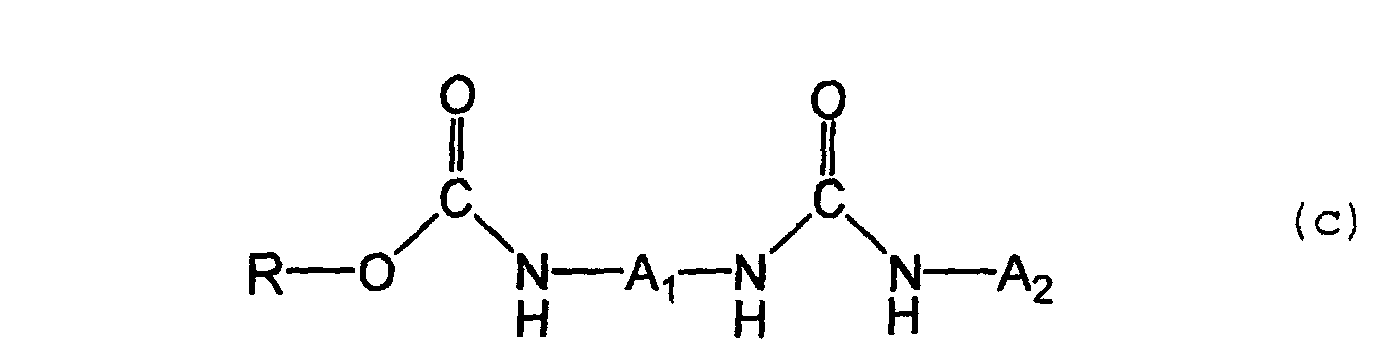
- A urea-urethane compound characterized by being represented by the following formula (d):wherein R is an aliphatic compound residue, hydrogen atom(s) of each benzene ring may be replaced by an aromatic compound residue, an aliphatic compound residue, a heterocyclic compound residue, a hydroxyl group, a nitro group, a nitrile group, a carbamoyl group, a sulfamoyl group, a carboxyl group, a nitroso group, an amino group, an oxyamino group, a nitroamino group, a hydrazino group, a ureido group, an isocyanate group, a mercapto group, a sulfo group or a halogen atom, and R may have one or more substituents.
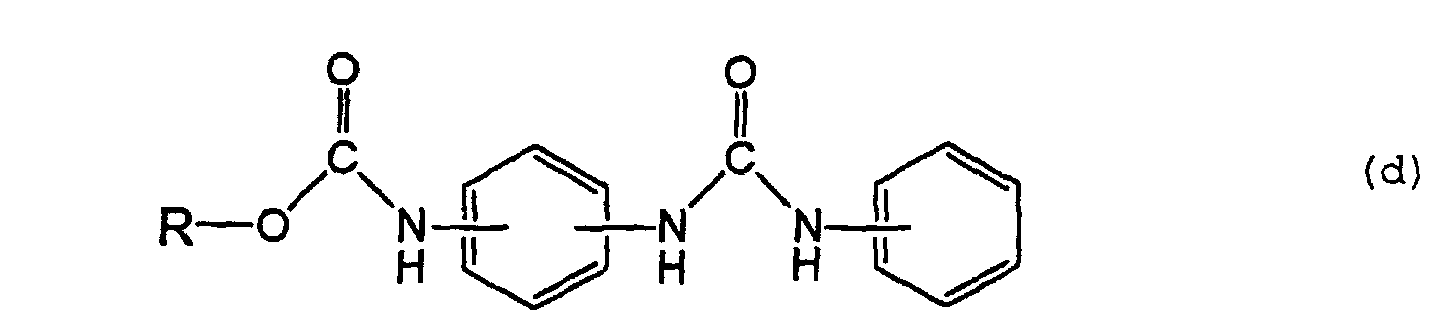
- A urea-urethane compound characterized by being represented by the following formula (e) or (f), having at least one urethane group and at least one urea group in a total number of not more than 10 and not less than 3, and having a molecular weight of 5,000 or less:wherein R is an aliphatic compound residue, Y is an aromatic compound residue, a heterocyclic compound residue or an aliphatic compound residue, α1 is an aromatic, heterocyclic or aliphatic compound residue which is different from Y and has a valence of 2 or more, n is an integer of 2 or more, and each of the residues may have one or more substituents; or
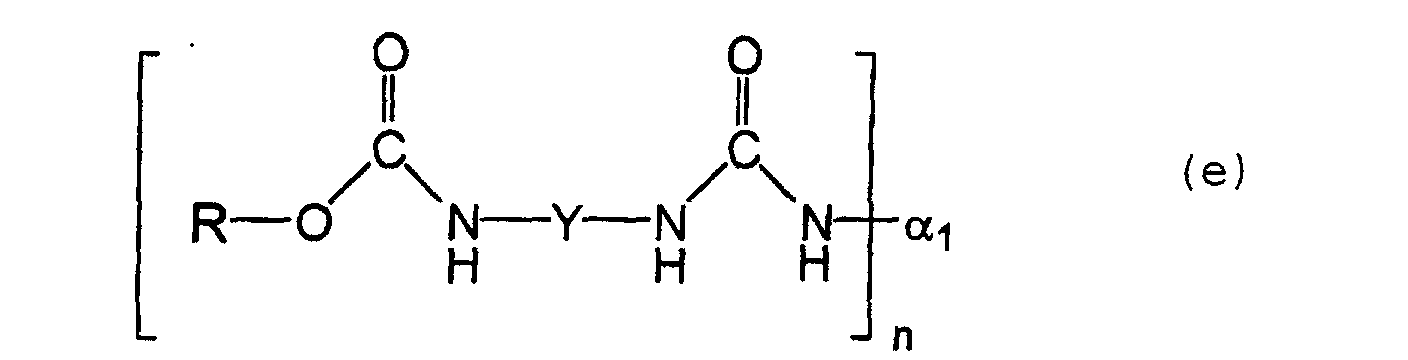 wherein Z1 and Y are independently an aromatic compound residue or a heterocyclic compound residue, β1 is an aliphatic compound residue having a valence of 2 or more, n is an integer of 2 or more, and each of the residues may have one or more substituents.
- A urea-urethane compound characterized by being represented by the following formula (g) or (h):wherein hydrogen atom(s) of each benzene ring may be replaced by an aromatic compound residue, an aliphatic compound residue, a heterocyclic compound residue, a hydroxyl group, a nitro group, a nitrile group, a carbamoyl group, a sulfamoyl group, a carboxyl group, a nitroso group, an amino group, an oxyamino group, a nitroamino group, a hydrazino group, a ureido group, an isocyanate group, a mercapto group, a sulfo group or a halogen atom, β1 is an aliphatic compound residue having a valence of 2 or more, n is an integer of 2 or more, and each of the residues may have one or more substituents; or
 wherein Rs are independently an aliphatic compound residue, hydrogen atom(s) of each benzene ring may be replaced by an aromatic compound residue, an aliphatic compound residue or a heterocyclic compound residue, each of the residues may have one or more substituents, γ1 is a group selected from the group consisting of -SO2-, -O-, -(S)n-, -(CH2)n-, -CO-, -CONH-, -NH-, -CH(COOR1)-, -C(CF3)2-, -CR2R3- and any of groups represented by the formulas (a):
 or is absent, each of R1, R2 and R3 is an alkyl group, and n is 1 or 2.
- A urea-urethane composition which is characterized by comprising a urea-urethane compound and a diluent.
- A urea-urethane composition according to claim 5, wherein the diluent is a urea compound and/or a urethane compound.
- A urea-urethane composition according to claim 5, wherein the diluent is a compound obtained by reacting a polyisocyanate compound with a hydroxy compound or an amino compound.
- A urea-urethane composition obtained by reacting a polyisocyanate compound with a hydroxy compound and an amino compound, which is characterized by comprising 50 wt% or more of a urea-urethane compound having at least one urea group and at least one urethane group in a total number of 2 to 10 in the molecular structure and having a molecular weight of 5,000 or less.
- A urea-urethane composition according to claim 8, wherein the hydroxy compound is a phenolic compound.
- A urea-urethane composition according to claim 8, wherein the hydroxy compound is an alcohol compound.
- A urea-urethane composition according to any one of claims 8 to 10, wherein the amino compound is an aromatic amino compound.
- A urea-urethane composition according to any one of claims 8 to 11, wherein the polyisocyanate compound is an aromatic polyisocyanate compound.
- A process for producing a urea-urethane composition, characterized by reacting a polyisocyanate compound with a hydroxy compound so that the ratio of the number of moles of the polyisocyanate compound to the number of hydroxyl equivalents of the hydroxy compound becomes 100/1 to 1/2, to form one or more urethane groups from some of the isocyanate groups of the polyisocyanate compound, and then adding an amino compound thereto to react the same with the remaining isocyanate group(s) of the polyisocyanate compound to form one or more urea groups.
- A process for producing a urea-urethane composition, characterized by reacting a polyisocyanate compound with an amino compound so that the ratio of the number of moles of the polyisocyanate compound to the number of amino equivalents of the amino compound becomes 100/1 to 1/2, to form one or more urea groups from some of the isocyanate groups of the polyisocyanate compound, and then adding a hydroxy compound thereto to react the same with the remaining isocyanate group(s) of the polyisocyanate compound to form one or more urethane groups.
- A process for producing a urea-urethane composition according to claim 13 or 14, characterized by successively carrying out the reaction for forming one or more urethane groups and the reaction for forming one or more urea groups.
- A process for producing a urea-urethane composition which comprises reacting an amino compound with a polyisocyanate adduct obtained by the reaction of a polyisocyanate compound with a hydroxy compound, so that the equivalent ratio of isocyanate group to amino group becomes 2/1 to 1/100, to form one or more urea groups, and then removing the unreacted amino compound.
- A process for producing a urea-urethane composition which comprises reacting a hydroxy compound with a polyisocyanate adduct obtained by the reaction of a polyisocyanate compound with an amino compound, so that the equivalent ratio of isocyanate group to hydroxyl group becomes 2/1 to 1/100, to form one or more urethane groups, and then removing the unreacted hydroxy compound.
- A process for producing a urea-urethane composition according to any one of claims 13 to 17, characterized by carrying out the reaction for forming one or more urethane groups and/or the reaction for forming one or more urea groups, without a solvent, or carrying out the reaction for forming one or more urethane groups and the reaction for forming one or more urea groups, by the use of the same solvent.
- A process for producing a urea-urethane composition according to any one of claims 13 to 18, wherein the reaction for forming one or more urethane groups and/or the reaction for forming one or more urea groups are carried out at a temperature of 0 - 300°C.
- A process for producing a urea-urethane composition according to any one of claims 13 to 19, wherein the reaction for forming one or more urethane groups and/or the reaction for forming one or more urea groups are carried out in the presence of a catalyst.
- A color-producing composition comprising a developer comprising a urea-urethane compound.
- A color-producing composition comprising a developer comprising a urea-urethane compound, and a colorless or light-colored dye precursor.
- A color-producing composition according to claim 22, wherein the colorless or light-colored dye precursor is a leuco dye.
- A color-producing composition according to claims 21 to 23, wherein said developer is a urea-urethane compound according to any one of claims 1 to 4, a urea-urethane composition according to any one of claims 5 to 12, or a composition produced by a production process according to any one of claims 13 to 20.
- A color-producing composition according to either of claims 23 and 24, characterized in that the leuco dye is at least one leuco dye selected from triarylmethane type leuco dyes, fluoran type leuco dyes, fluorene type leuco dyes and diphenylmethane type leuco dyes.
- A color-producing composition according to either of claims 23 and 24, characterized in that the leuco dye is a compound represented by the following formula (i) :wherein both Y2 and Y3 are alkyl groups or alkoxyalkyl groups, Y4 is a hydrogen atom, an alkyl group or an alkoxy group, and each of Y5 and Y6 is a hydrogen atom, a halogen atom, an alkyl group or an alkoxy group.
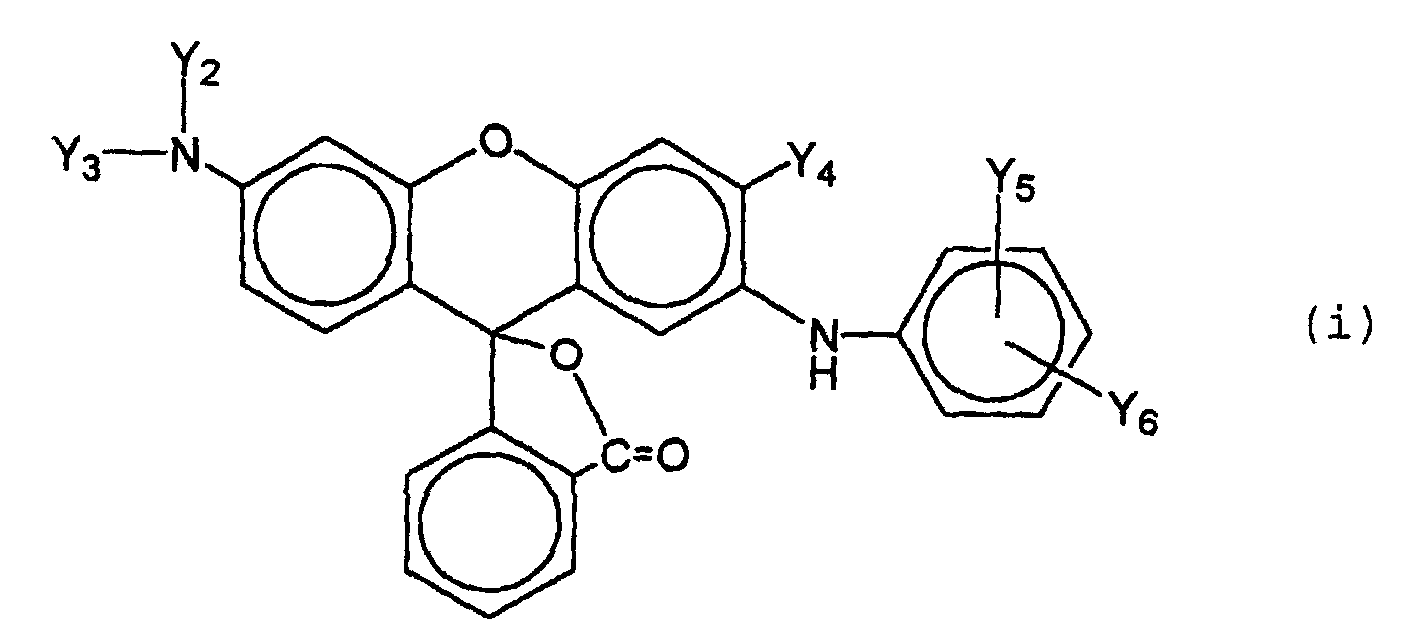
- A color-producing composition according to either of claims 23 and 24, characterized in that the leuco dye is a compound represented by the following formula (j) :wherein each of R5 and R6 is a group represented by the formula (k) or the formula (1):
 (wherein each of R11 through R15 is a hydrogen atom, a halogen atom, a C1-C8 alkyl group, a C1-C8 alkoxy group, or -NR16R17 wherein each of R16 and R17 is an alkyl group of 1 to 8 carbon atoms), or
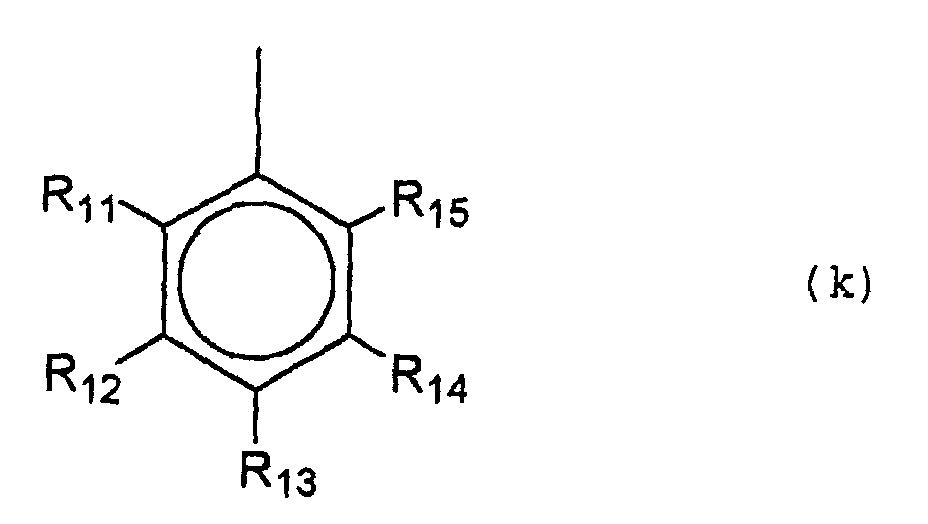 (wherein each of R18 and R19 is a hydrogen atom, an alkyl group of 1 to 8 carbon atoms, or a phenyl group), and each of R7 through R10 is a hydrogen atom, a halogen atom, an alkyl group of 1 to 8 carbon atoms, an alkoxy group of 1 to 8 carbon atoms, or -NR20R21 wherein each of R20 and R21 is an alkyl group of 1 to 8 carbon atoms.
- A color-producing composition according to any one of claims 21 to 27, characterized in that the melting point of the urea-urethane compound developer is not higher than 500°C and not lower than 40°C.
- A color-producing composition according to any one of claims 21 to 27, characterized in that the urea-urethane compound developer comprises a compound selected from compounds represented by the following general formula (V) or (VI):wherein hydrogen atom(s) of each benzene ring may be replaced by an aromatic compound residue, an aliphatic compound residue, a heterocyclic compound residue, a nitro group, a hydroxyl group, a carboxyl group, a nitroso group, a nitrile group, a carbamoyl group, a ureido group, an isocyanate group, a mercapto group, a sulfo group, a sulfamoyl group or a halogen atom, each of the residues may have one or more substituents, γ is a group selected from the group consisting of -SO2-, -O-, -(S)n-, -(CH2)n-, -CO-, -CONH- and any of groups represented by the formulas (a):
 or is absent, and n is 1 or 2; and
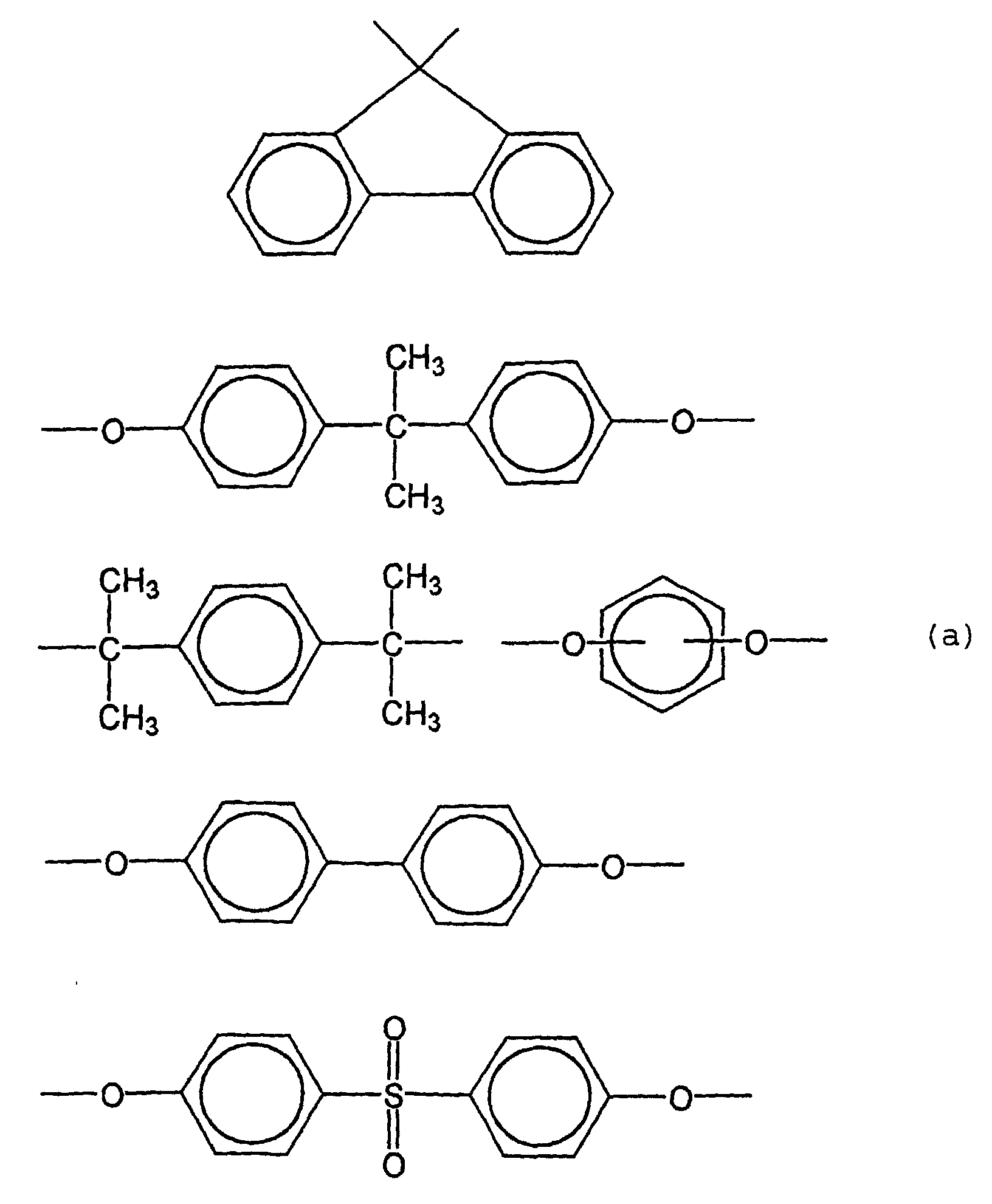 wherein hydrogen atom(s) of each benzene ring may be replaced by an aromatic compound residue, an aliphatic compound residue, a heterocyclic compound residue, a hydroxyl group, a nitro group, a nitrile group, a carbamoyl group, a sulfamoyl group, a carboxyl group, a nitroso group, an amino group, an oxyamino group, a nitroamino group, a hydrazino group, a ureido group, an isocyanate group, a mercapto group, a sulfo group or a halogen atom, each of the residues may have one or more substituents, δ is a group selected from the group consisting of -SO2-, -O-, -(S)n-, -(CH2)n-, -CO-, -CONH-, -NH-, -CH(COOR1)-, -C(CF3)2- and -CR2R3- or is absent, each of R1, R2 and R3 is an alkyl group, and n is 1 or 2.
- A color-producing composition according to any one of claims 21 to 27, characterized in that the urea-urethane compound developer comprises a compound selected from compounds represented by the following structural formulas (XX) and (XXI):
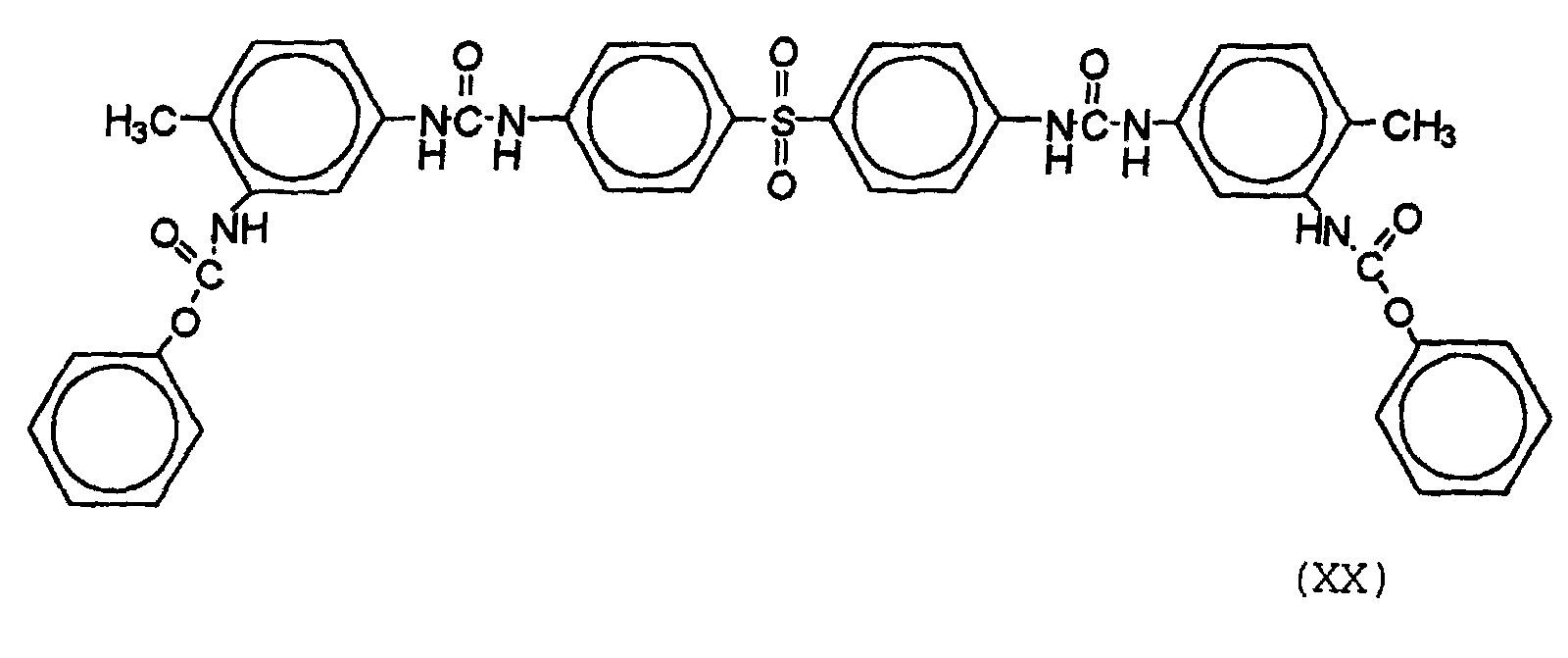

- A color-producing composition according to any one of claims 21 to 30, which further comprises a heat-meltable material.
- A color-producing composition according to claim 31, characterized in that the heat-meltable material is at least one compound selected from β-naphthylbenzyl ether, p-benzylbiphenyl, 1,2-di(m-methylphenoxy)ethane, di-p-methylbenzyl oxalate, 1,2-diphenoxymethylbenzene, m-terphenyl and stearamide.
- A color-producing composition according to claim 31, wherein the heat-meltable material is that represented by the following structural formula (XVIII):wherein Y is any of -SO2-, -(S)n-, -O-, -CO-, -CH2-, -CH(C6H5)-, -C(CH3)2-, -COCO-, -CO3-, -COCH2CO-, -COOCH2-, -CONH-, -OCH2- and -NH-, n is 1 or 2, and hydrogen atom(s) of each benzene ring may be replaced by a halogen atom, a hydroxyl group, a nitro group, a nitroso group, a nitrile group, an isocyanate group, an isothiocyanate group, a mercapto group, a sulfamoyl group, a sulfonic acid group, an amino group, an aromatic compound residue, an aliphatic compound residue or a heterocyclic compound residue.

- A color-producing composition according to claim 33, wherein the heat-meltable material is that represented by the following structural formula (XIX):wherein hydrogen atom(s) of each benzene ring may be replaced by a halogen atom, a hydroxyl group, a nitro group, a nitroso group, a nitrile group, an isocyanate group, an isothiocyanate group, a mercapto group, a sulfamoyl group, a sulfonic acid group, an amino group, an aromatic compound residue, an aliphatic compound residue or a heterocyclic compound residue.

- A color-producing composition according to any one of claims 21 to 34, which further comprises an isocyanate compound.
- A color-producing composition according to any one of claims 21 to 34, which further comprises an isocyanate compound and an imino compound.
- A color-producing composition according to any one of claims 21 to 36, which further comprises an amino compound.
- A color-producing composition according to any one of claims 21 to 37, wherein the developer further comprises an acidic developer.
- A color-producing composition according to claim 38, characterized in that the acidic developer is at least one developer selected from 2,2-bis(4-hydroxyphenyl)propane, 4-isopropyloxyphenyl-4'-hydroxyphenylsulfone, bis(3-ally-4-hydroxyphenyl)sulfone, 2,4'-dihydroxydiphenylsulfone and 4,4'-[oxybis(ethyleneoxyp-phenylenesulfonyl)]diphenol.
- A color-producing composition according to any one of claims 21 to 39, which further comprises a fluorescent dye.
- A color-producing composition according to any one of claims 21 to 40, which further comprises a shelf-stability-imparting agent.
- A recording material comprising a substrate and a color-producing layer formed thereon, said color-producing layer comprising a urea-urethane compound according to any one of claims 1 to 4, a urea-urethane composition according to any one of claims 5 to 12, or a color-producing composition according to any one of claims 21 to 41.
- A recording material according to claim 42, characterized in that a protective layer for the color-producing layer is formed on the color-producing layer.
- A recording material according to claim 43, characterized in that the protective layer comprises a water-soluble polymer.
- A recording material according to either of claims 43 and 44, characterized in that the protective layer comprises an inorganic pigment and/or an organic pigment.
- A recording material according to any one of claims 43 to 45, characterized in that the protective layer comprises a lubricant.
- A recording material according to claim 42, characterized in that an intermediate layer is formed on the substrate and that the color-producing layer is formed on said intermediate layer.
- A recording material according to claim 47, characterized in that the intermediate layer comprises a water-soluble polymer.
- A recording material according to either of claims 47 and 48, characterized in that the intermediate layer comprises an inorganic pigment and/or an organic pigment.
- A recording material according to claim 42, characterized in that a back coating layer is formed on the substrate on the side reverse to the side having the color-producing layer formed thereon.
- A recording material according to claim 50, characterized in that the back coating layer comprises a water-soluble polymer.
- A recording material according to either of claims 50 and 51, characterized in that the back coating layer comprises an inorganic pigment and/or an organic pigment.
- A recording material according to any one of claims 42 to 52, characterized by using at least one compound selected from water-soluble polymers and anionic surfactants, as a dispersing agent for the urea-urethane compound.
- A recording material according to any one of claims 42 to 52, characterized by using at least one compound selected from poly(vinyl alcohol)s, modified poly(vinyl alcohol)s, methyl cellulose, hydroxypropylmethyl cellulose, condensed sodium naphthalenesulfonate, polycarboxylic acid ammonium salts, water-soluble low-molecular weight copolymers, and sodium 2-ethylhexylsulfosuccinate, as a dispersing agent for the urea-urethane compound.
- A recording material according to any one of claims 42 to 54, characterized by using at least one compound selected from water-soluble polymers, nonionic surfactants and anionic surfactants, as a dispersing agent for a dye precursor.
- A recording material according to any one of claims 42 to 54, characterized by using at least one compound selected from methyl cellulose, hydroxypropylmethyl cellulose, polyethylene glycol fatty acid esters, polyoxyethylene alkyl ether sulfates and sodium 2-ethylhexylsulfosuccinate, as a dispersing agent for a dye precursor.
- A recording material according to any one of claims 42 to 56, which is a heat-sensitive recording material.
- A heat-sensitive recording material according to claim 57, characterized in that the average particle size of the urea-urethane compound is not more than 5 µm and not less than 0.05 µm.
- A heat-sensitive recording material according to claims 57 and 58, characterized in that a liquid temperature at grinding of the urea-urethane compound is 60°C or lower.
- A heat-sensitive recording material according to any one of claims 57 to 59, characterized in that a pH at grinding of the urea-urethane compound is 5 to 10.
- A heat-sensitive recording material according to any one of claims 57 to 60, characterized by using at least one compound selected from water-soluble polymers and anionic surfactants, as a dispersing agent for a heat-meltable material.
- A heat-sensitive recording material according to any one of claims 57 to 60, characterized by using at least one compound selected from poly(vinyl alcohol)s, modified poly(vinyl alcohol)s, methyl cellulose, hydroxypropylmethyl cellulose, condensed sodium naphthalenesulfonate, polycarboxylic acid ammonium salts, water-soluble low-molecular weight copolymers, and sodium 2-ethylhexylsulfosuccinate, as a dispersing agent for a heat-meltable material.
- A heat-sensitive recording material according to any one of claims 57 to 62, characterized in that the urea-urethane compound and a heat-meltable material are finely ground together.
- A heat-sensitive recording material according to any one of claims 57 to 63, characterized in that the pH of the substrate surface to be coated with the heat-sensitive recording layer of the heat-sensitive recording material is 3 to 9.
- A process for producing a heat-sensitive recording material according to any one of claims 57 to 64, characterized by applying on the substrate a heat-sensitive coating liquid of pH 5 to 12 for forming the heat-sensitive recording layer of the heat-sensitive recording material.
- A recording material according to claim 42, which is a heat-sensitive magnetic recording material.
- A heat-sensitive magnetic recording material according to claim 66, characterized in that a heat-sensitive recording layer comprising a urea-urethane compound developer is formed on one side of the substrate, and a magnetic recording layer on the other side.
- A railroad ticket that is a heat-sensitive magnetic recording material according to claim 66 or 67.
- A ticket that is a heat-sensitive magnetic recording material according to claim 66 or 67.
- A recording material according to claim 42, which is a label for heat-sensitive recording.
- A label for heat-sensitive recording according to claim 70, characterized in that a heat-sensitive recording layer comprising a urea-urethane compound developer is formed on one side of the substrate, and an adhesive layer on the other side.
- A label for heat-sensitive recording according to claim 71, characterized in that a back coating layer is formed between the adhesive layer and the substrate.
- A label for heat-sensitive recording according to either of claims 71 and 72, characterized in that an intermediate layer is formed between the heat-sensitive recording layer and the substrate.
- A label for heat-sensitive recording according to any one of claims 71 to 73, characterized in that a protective layer is formed on the heat-sensitive recording layer.
- A recording material according to claim 42, which is a multicolor heat-sensitive recording material.
- A multicolor heat-sensitive recording material according to claim 75, wherein at least two heat-sensitive recording layers are formed on one side of the substrate, said recording material being characterized in that at least one of said heat-sensitive recording layers comprises a urea-urethane compound developer.
- A multicolor heat-sensitive recording material according to claim 76, characterized in that an intermediate layer is formed between the heat-sensitive recording layers.
- A multicolor heat-sensitive recording material characterized by comprising a substrate and two heat-sensitive recording layers laminated on one side of the substrate which have different color development temperatures, respectively, and undergo color development in different color tones, respectively, the upper heat-sensitive recording layer comprising either an agent used both as developer and tone reducer, or a reversible developer, and the lower heat-sensitive recording layer comprising a urea-urethane compound developer.
- A multicolor heat-sensitive recording material according to claim 78, characterized in that, of the two heat-sensitive recording layers, the upper layer is a low-temperature color-producing layer capable of undergoing color development at a low temperature and undergoing achromatization at a high temperature, and the lower layer is a high-temperature color-producing layer capable of undergoing color development at a high temperature.
- An article for laser marking characterized by having on the surface a heat-sensitive recording layer comprising a urea-urethane compound developer.
- An article for laser marking characterized by having on the surface a heat-sensitive recording layer comprising a colorless or light-colored dye precursor, a urea-urethane compound developer and a recording sensitivity improving agent.
- An article for laser marking according to either of claims 80 and 81, characterized by having on the heat-sensitive recording layer a protective layer comprising an aqueous binder having a glass transition point of 20 - 80°C.
- An article for laser marking according to claim 81, wherein the recording sensitivity improving agent is at least one compound selected from aluminum hydroxide, muscovite, wollastonite and kaolin.
- An article for laser marking according to any one of claims 80 to 83, which is any of labels, packaging materials and containers.
- A process for producing an article for laser marking, characterized by applying on a substrate a color-producing marking composition comprising a urea-urethane compound developer, and drying the thus treated substrate.
- A process for producing an article for laser marking, characterized by applying on a substrate a color-producing marking composition comprising a colorless or light-colored dye precursor, a urea-urethane compound developer and a recording sensitivity improving agent, and drying the thus treated substrate.
- A method for marking an article, characterized by irradiating the heat-sensitive recording layer of an article for laser marking according to any one of claims 80 to 84, with laser beams.
- A color-producing marking composition characterized by comprising a urea-urethane compound developer.
- A color-producing marking composition characterized by comprising a colorless or light-colored dye precursor, a urea-urethane compound developer and a recording sensitivity improving agent.
Applications Claiming Priority (9)
| Application Number | Priority Date | Filing Date | Title |
|---|---|---|---|
| JP2000057538 | 2000-03-02 | ||
| JP2000057538 | 2000-03-02 | ||
| JP2000059298 | 2000-03-03 | ||
| JP2000059047 | 2000-03-03 | ||
| JP2000059047 | 2000-03-03 | ||
| JP2000059298 | 2000-03-03 | ||
| JP2000267467 | 2000-09-04 | ||
| JP2000267467A JP4577965B2 (en) | 2000-03-03 | 2000-09-04 | Thermal recording material and method for producing the same |
| PCT/JP2001/001577 WO2001066515A1 (en) | 2000-03-02 | 2001-03-01 | Novel color former and recording material |
Publications (3)
| Publication Number | Publication Date |
|---|---|
| EP1260498A1 true EP1260498A1 (en) | 2002-11-27 |
| EP1260498A4 EP1260498A4 (en) | 2012-05-16 |
| EP1260498B1 EP1260498B1 (en) | 2014-07-09 |
Family
ID=27481090
Family Applications (1)
| Application Number | Title | Priority Date | Filing Date |
|---|---|---|---|
| EP01908206.4A Expired - Lifetime EP1260498B1 (en) | 2000-03-02 | 2001-03-01 | Novel color former and recording material |
Country Status (3)
| Country | Link |
|---|---|
| EP (1) | EP1260498B1 (en) |
| BR (1) | BR0108850A (en) |
| ES (1) | ES2497040T3 (en) |
Cited By (2)
| Publication number | Priority date | Publication date | Assignee | Title |
|---|---|---|---|---|
| EP1681174A4 (en) * | 2003-10-23 | 2008-06-11 | Chemipro Kasei Kaisha Ltd | DISPERSION COMPOSITION AND RECORDING MATERIAL |
| US12049566B2 (en) | 2016-07-29 | 2024-07-30 | Hitachi Chemical Diagnostics Systems Co., Ltd. | Method for preserving leuco chromogen-containing aqueous solution |
Family Cites Families (6)
| Publication number | Priority date | Publication date | Assignee | Title |
|---|---|---|---|---|
| JPH02141288A (en) * | 1988-11-24 | 1990-05-30 | Toyobo Co Ltd | Dyeing resin for sublimation transfer image receiving material |
| JP3453741B2 (en) * | 1993-07-08 | 2003-10-06 | 日本製紙株式会社 | Thermal recording medium |
| CA2161376C (en) * | 1994-10-27 | 2005-01-11 | Toshiaki Minami | Reversible multi-color thermal recording medium |
| JPH09263624A (en) * | 1996-03-27 | 1997-10-07 | Fuji Photo Film Co Ltd | Color-producing agent-containing microcapsule and recording material using the same |
| JP3842384B2 (en) * | 1997-06-09 | 2006-11-08 | 富士写真フイルム株式会社 | Coloring agent-containing microcapsules and recording material using the same |
| JPH115026A (en) * | 1997-06-17 | 1999-01-12 | Fuji Photo Film Co Ltd | Color developer containing microcapsule and recording material using the same |
-
2001
- 2001-03-01 ES ES01908206.4T patent/ES2497040T3/en not_active Expired - Lifetime
- 2001-03-01 EP EP01908206.4A patent/EP1260498B1/en not_active Expired - Lifetime
- 2001-03-01 BR BR0108850-5A patent/BR0108850A/en not_active IP Right Cessation
Cited By (2)
| Publication number | Priority date | Publication date | Assignee | Title |
|---|---|---|---|---|
| EP1681174A4 (en) * | 2003-10-23 | 2008-06-11 | Chemipro Kasei Kaisha Ltd | DISPERSION COMPOSITION AND RECORDING MATERIAL |
| US12049566B2 (en) | 2016-07-29 | 2024-07-30 | Hitachi Chemical Diagnostics Systems Co., Ltd. | Method for preserving leuco chromogen-containing aqueous solution |
Also Published As
| Publication number | Publication date |
|---|---|
| ES2497040T3 (en) | 2014-09-22 |
| EP1260498B1 (en) | 2014-07-09 |
| EP1260498A4 (en) | 2012-05-16 |
| BR0108850A (en) | 2004-01-06 |
Similar Documents
| Publication | Publication Date | Title |
|---|---|---|
| US7807738B2 (en) | Compound for color-producing composition, and recording material | |
| EP1116713A1 (en) | Novel color-developing compound and recording material | |
| JPWO2000014058A1 (en) | Novel color former compound and recording material | |
| JP2000143611A (en) | New color former and recording material | |
| US20070099130A1 (en) | Developer for recording materials | |
| KR100549037B1 (en) | New colorants and recording materials | |
| JP2002332271A (en) | New color formers and recording materials | |
| RU2245873C2 (en) | New color-forming compositions and recording material | |
| EP1260498B1 (en) | Novel color former and recording material | |
| CN101003499B (en) | Chromogenic composition and recording material | |
| CN100446990C (en) | Color developing agent for recording material | |
| JP3836868B2 (en) | Urea urethane compound | |
| JP3836867B2 (en) | New urea urethane compounds | |
| JP2002144746A (en) | New color formers and recording materials | |
| JP3789927B2 (en) | New urea urethane compounds | |
| JP3795062B2 (en) | New urea urethane compounds | |
| JP2002052841A (en) | Thermal recording material and method for producing the same | |
| JP2004154943A (en) | Color former and recording material | |
| JP2001246857A (en) | Multicolor thermal recording material | |
| JP2001246856A (en) | Thermal recording sheet | |
| JP2001341424A (en) | Urea urethane compound sensitizer for developer | |
| JP2001246859A (en) | Label for thermal recording | |
| JP2001246854A (en) | Recording material | |
| JP2001246858A (en) | Thermal magnetic recording material | |
| JP2001246855A (en) | Record sheet |
Legal Events
| Date | Code | Title | Description |
|---|---|---|---|
| PUAI | Public reference made under article 153(3) epc to a published international application that has entered the european phase |
Free format text: ORIGINAL CODE: 0009012 |
|
| 17P | Request for examination filed |
Effective date: 20020920 |
|
| AK | Designated contracting states |
Kind code of ref document: A1 Designated state(s): AT BE CH CY DE DK ES FI FR GB GR IE IT LI LU MC NL PT SE TR |
|
| AX | Request for extension of the european patent |
Free format text: AL;LT;LV;MK;RO;SI |
|
| RAP1 | Party data changed (applicant data changed or rights of an application transferred) |
Owner name: CHEMIPRO KASEI KAISHA, LTD. |
|
| A4 | Supplementary search report drawn up and despatched |
Effective date: 20120416 |
|
| RIC1 | Information provided on ipc code assigned before grant |
Ipc: C07C 317/42 20060101ALI20120411BHEP Ipc: C09K 9/02 20060101ALI20120411BHEP Ipc: C07D 405/04 20060101ALI20120411BHEP Ipc: B41M 5/26 20060101ALI20120411BHEP Ipc: C07D 307/85 20060101ALI20120411BHEP Ipc: C07D 229/00 20060101ALI20120411BHEP Ipc: C07C 275/40 20060101AFI20120411BHEP Ipc: C07C 317/22 20060101ALI20120411BHEP Ipc: C07D 493/10 20060101ALI20120411BHEP Ipc: B41M 5/30 20060101ALI20120411BHEP Ipc: C07C 311/47 20060101ALI20120411BHEP |
|
| 17Q | First examination report despatched |
Effective date: 20121114 |
|
| GRAP | Despatch of communication of intention to grant a patent |
Free format text: ORIGINAL CODE: EPIDOSNIGR1 |
|
| RIC1 | Information provided on ipc code assigned before grant |
Ipc: C07D 307/85 20060101ALI20140102BHEP Ipc: B41M 5/333 20060101ALI20140102BHEP Ipc: C07D 229/00 20060101ALI20140102BHEP Ipc: C07D 405/04 20060101ALI20140102BHEP Ipc: B41M 5/26 20060101ALI20140102BHEP Ipc: B41M 5/337 20060101ALI20140102BHEP Ipc: C07C 275/40 20060101AFI20140102BHEP Ipc: C07D 493/10 20060101ALI20140102BHEP Ipc: C07C 311/47 20060101ALI20140102BHEP Ipc: C07C 317/42 20060101ALI20140102BHEP Ipc: C07C 317/22 20060101ALI20140102BHEP Ipc: B41M 5/30 20060101ALI20140102BHEP Ipc: C09K 9/02 20060101ALI20140102BHEP |
|
| INTG | Intention to grant announced |
Effective date: 20140117 |
|
| GRAS | Grant fee paid |
Free format text: ORIGINAL CODE: EPIDOSNIGR3 |
|
| GRAA | (expected) grant |
Free format text: ORIGINAL CODE: 0009210 |
|
| AK | Designated contracting states |
Kind code of ref document: B1 Designated state(s): AT BE CH CY DE DK ES FI FR GB GR IE IT LI LU MC NL PT SE TR |
|
| REG | Reference to a national code |
Ref country code: GB Ref legal event code: FG4D |
|
| REG | Reference to a national code |
Ref country code: CH Ref legal event code: EP Ref country code: CH Ref legal event code: NV Representative=s name: BOHEST AG, CH Ref country code: AT Ref legal event code: REF Ref document number: 676530 Country of ref document: AT Kind code of ref document: T Effective date: 20140715 |
|
| REG | Reference to a national code |
Ref country code: IE Ref legal event code: FG4D |
|
| REG | Reference to a national code |
Ref country code: CH Ref legal event code: PCAR Free format text: NEW ADDRESS: HOLBEINSTRASSE 36-38, 4051 BASEL (CH) |
|
| REG | Reference to a national code |
Ref country code: DE Ref legal event code: R096 Ref document number: 60148895 Country of ref document: DE Effective date: 20140821 |
|
| REG | Reference to a national code |
Ref country code: ES Ref legal event code: FG2A Ref document number: 2497040 Country of ref document: ES Kind code of ref document: T3 Effective date: 20140922 |
|
| REG | Reference to a national code |
Ref country code: AT Ref legal event code: MK05 Ref document number: 676530 Country of ref document: AT Kind code of ref document: T Effective date: 20140709 |
|
| REG | Reference to a national code |
Ref country code: NL Ref legal event code: VDEP Effective date: 20140709 |
|
| PG25 | Lapsed in a contracting state [announced via postgrant information from national office to epo] |
Ref country code: PT Free format text: LAPSE BECAUSE OF FAILURE TO SUBMIT A TRANSLATION OF THE DESCRIPTION OR TO PAY THE FEE WITHIN THE PRESCRIBED TIME-LIMIT Effective date: 20141110 Ref country code: GR Free format text: LAPSE BECAUSE OF FAILURE TO SUBMIT A TRANSLATION OF THE DESCRIPTION OR TO PAY THE FEE WITHIN THE PRESCRIBED TIME-LIMIT Effective date: 20141010 Ref country code: SE Free format text: LAPSE BECAUSE OF FAILURE TO SUBMIT A TRANSLATION OF THE DESCRIPTION OR TO PAY THE FEE WITHIN THE PRESCRIBED TIME-LIMIT Effective date: 20140709 |
|
| PG25 | Lapsed in a contracting state [announced via postgrant information from national office to epo] |
Ref country code: AT Free format text: LAPSE BECAUSE OF FAILURE TO SUBMIT A TRANSLATION OF THE DESCRIPTION OR TO PAY THE FEE WITHIN THE PRESCRIBED TIME-LIMIT Effective date: 20140709 Ref country code: NL Free format text: LAPSE BECAUSE OF FAILURE TO SUBMIT A TRANSLATION OF THE DESCRIPTION OR TO PAY THE FEE WITHIN THE PRESCRIBED TIME-LIMIT Effective date: 20140709 Ref country code: CY Free format text: LAPSE BECAUSE OF FAILURE TO SUBMIT A TRANSLATION OF THE DESCRIPTION OR TO PAY THE FEE WITHIN THE PRESCRIBED TIME-LIMIT Effective date: 20140709 |
|
| REG | Reference to a national code |
Ref country code: DE Ref legal event code: R097 Ref document number: 60148895 Country of ref document: DE |
|
| PG25 | Lapsed in a contracting state [announced via postgrant information from national office to epo] |
Ref country code: IT Free format text: LAPSE BECAUSE OF FAILURE TO SUBMIT A TRANSLATION OF THE DESCRIPTION OR TO PAY THE FEE WITHIN THE PRESCRIBED TIME-LIMIT Effective date: 20140709 Ref country code: DK Free format text: LAPSE BECAUSE OF FAILURE TO SUBMIT A TRANSLATION OF THE DESCRIPTION OR TO PAY THE FEE WITHIN THE PRESCRIBED TIME-LIMIT Effective date: 20140709 |
|
| PLBE | No opposition filed within time limit |
Free format text: ORIGINAL CODE: 0009261 |
|
| STAA | Information on the status of an ep patent application or granted ep patent |
Free format text: STATUS: NO OPPOSITION FILED WITHIN TIME LIMIT |
|
| 26N | No opposition filed |
Effective date: 20150410 |
|
| PG25 | Lapsed in a contracting state [announced via postgrant information from national office to epo] |
Ref country code: LU Free format text: LAPSE BECAUSE OF FAILURE TO SUBMIT A TRANSLATION OF THE DESCRIPTION OR TO PAY THE FEE WITHIN THE PRESCRIBED TIME-LIMIT Effective date: 20150301 Ref country code: MC Free format text: LAPSE BECAUSE OF FAILURE TO SUBMIT A TRANSLATION OF THE DESCRIPTION OR TO PAY THE FEE WITHIN THE PRESCRIBED TIME-LIMIT Effective date: 20140709 |
|
| REG | Reference to a national code |
Ref country code: IE Ref legal event code: MM4A |
|
| PG25 | Lapsed in a contracting state [announced via postgrant information from national office to epo] |
Ref country code: IE Free format text: LAPSE BECAUSE OF NON-PAYMENT OF DUE FEES Effective date: 20150301 |
|
| REG | Reference to a national code |
Ref country code: FR Ref legal event code: PLFP Year of fee payment: 16 |
|
| PG25 | Lapsed in a contracting state [announced via postgrant information from national office to epo] |
Ref country code: BE Free format text: LAPSE BECAUSE OF FAILURE TO SUBMIT A TRANSLATION OF THE DESCRIPTION OR TO PAY THE FEE WITHIN THE PRESCRIBED TIME-LIMIT Effective date: 20140709 |
|
| REG | Reference to a national code |
Ref country code: FR Ref legal event code: PLFP Year of fee payment: 17 |
|
| PGFP | Annual fee paid to national office [announced via postgrant information from national office to epo] |
Ref country code: CH Payment date: 20170321 Year of fee payment: 17 |
|
| PGFP | Annual fee paid to national office [announced via postgrant information from national office to epo] |
Ref country code: GB Payment date: 20170214 Year of fee payment: 17 |
|
| PG25 | Lapsed in a contracting state [announced via postgrant information from national office to epo] |
Ref country code: TR Free format text: LAPSE BECAUSE OF FAILURE TO SUBMIT A TRANSLATION OF THE DESCRIPTION OR TO PAY THE FEE WITHIN THE PRESCRIBED TIME-LIMIT Effective date: 20140709 |
|
| REG | Reference to a national code |
Ref country code: FR Ref legal event code: PLFP Year of fee payment: 18 |
|
| REG | Reference to a national code |
Ref country code: CH Ref legal event code: PL |
|
| GBPC | Gb: european patent ceased through non-payment of renewal fee |
Effective date: 20180301 |
|
| PG25 | Lapsed in a contracting state [announced via postgrant information from national office to epo] |
Ref country code: GB Free format text: LAPSE BECAUSE OF NON-PAYMENT OF DUE FEES Effective date: 20180301 Ref country code: LI Free format text: LAPSE BECAUSE OF NON-PAYMENT OF DUE FEES Effective date: 20180331 Ref country code: CH Free format text: LAPSE BECAUSE OF NON-PAYMENT OF DUE FEES Effective date: 20180331 |
|
| PGFP | Annual fee paid to national office [announced via postgrant information from national office to epo] |
Ref country code: FI Payment date: 20200305 Year of fee payment: 20 |
|
| PGFP | Annual fee paid to national office [announced via postgrant information from national office to epo] |
Ref country code: FR Payment date: 20200106 Year of fee payment: 20 |
|
| PGFP | Annual fee paid to national office [announced via postgrant information from national office to epo] |
Ref country code: ES Payment date: 20200401 Year of fee payment: 20 Ref country code: DE Payment date: 20200522 Year of fee payment: 20 |
|
| REG | Reference to a national code |
Ref country code: DE Ref legal event code: R071 Ref document number: 60148895 Country of ref document: DE |
|
| REG | Reference to a national code |
Ref country code: FI Ref legal event code: MAE |
|
| REG | Reference to a national code |
Ref country code: ES Ref legal event code: FD2A Effective date: 20211230 |
|
| PG25 | Lapsed in a contracting state [announced via postgrant information from national office to epo] |
Ref country code: ES Free format text: LAPSE BECAUSE OF EXPIRATION OF PROTECTION Effective date: 20210302 |